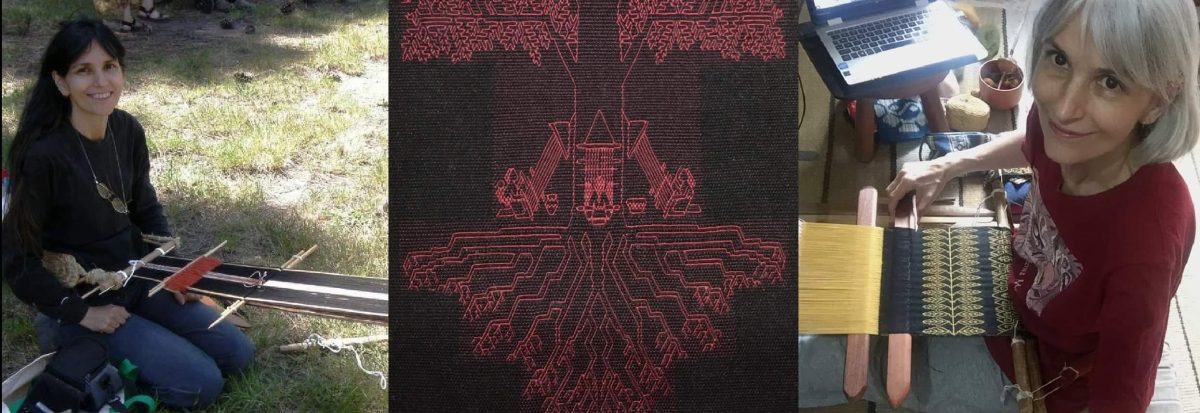
Heads-up: Much of this post is dedicated to the Ayoreo looped stitching that I’ve been studying with my teacher here but yes, there’s also a bit of backstrap loom weaving thrown in here and there.
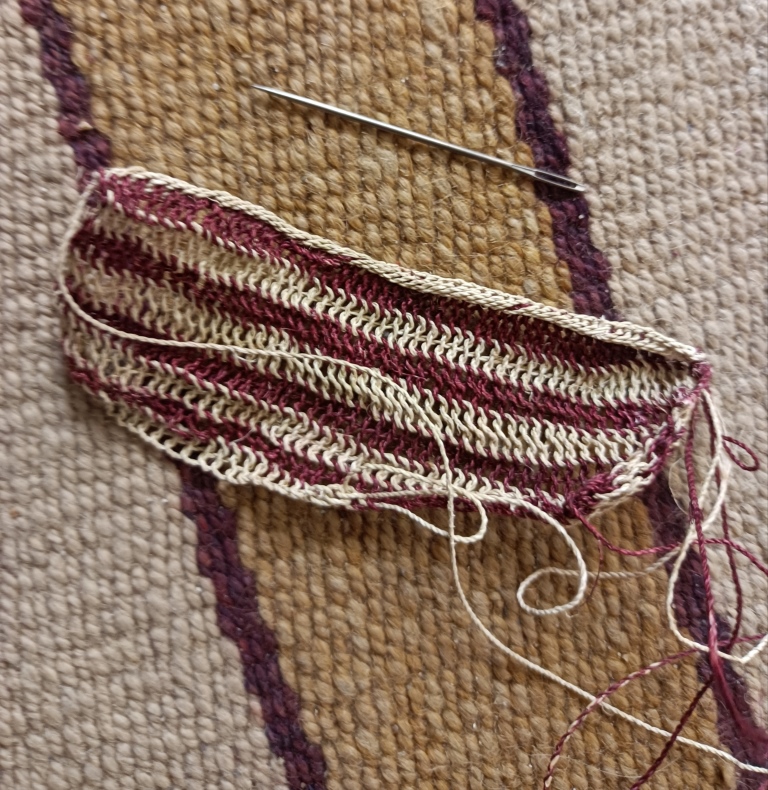
I’ve been back in Santa Cruz for a while now after my trip to see my highland teachers. I got straight back to studying the textile crafts of the lowlands. While I still haven’t managed to get together with my Ayoreo teacher to learn how to spin the lovely bundle of garabatá fiber that she got for me, I’ve still been busily scavenging all the spun garabatá thread that I can find so that I can continue to practice, practice, practice.

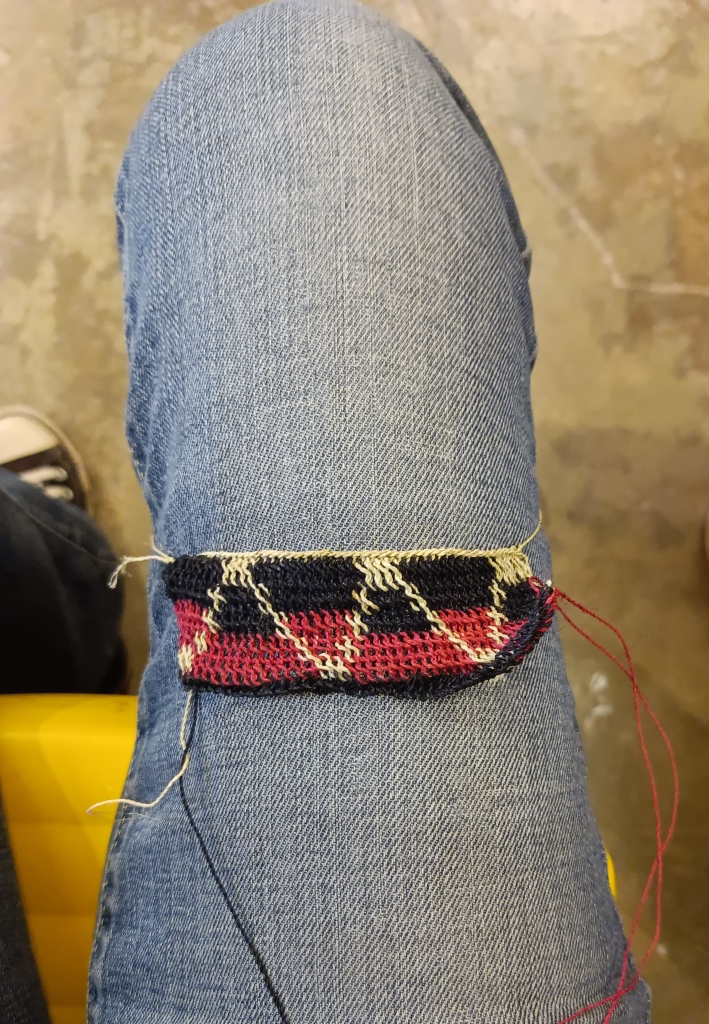
You may remember that I’d taken a few lengths of spun garabatá thread with me to the highlands to throw into the indigo pot. It was such a small amount. I had to think carefully about how to best use it.

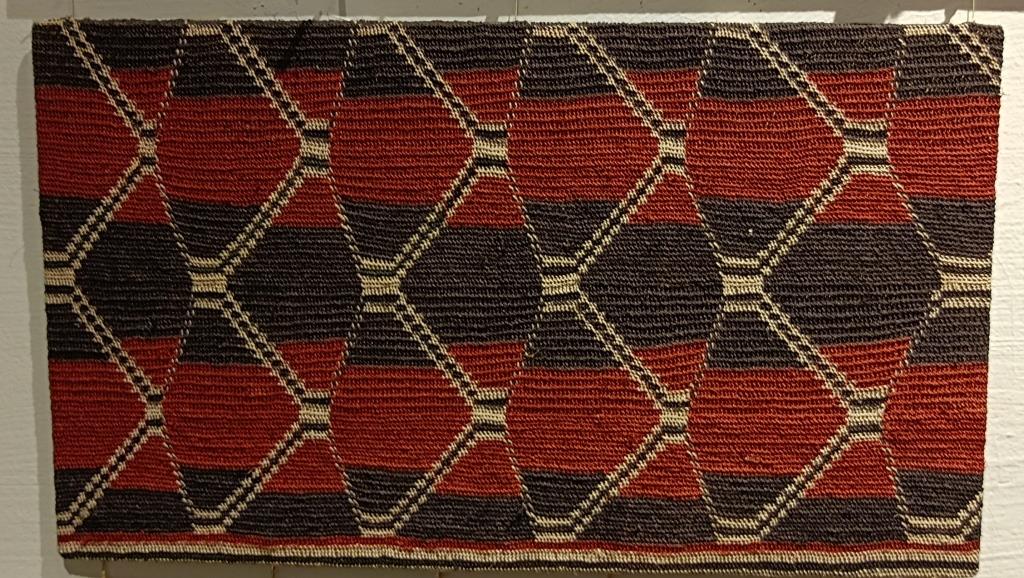
I decided to try to copy the pattern on an Ayoreo bag that I’d bought which had been made with what looks to me to be a combination of Dosapey and Chiqueno pattern. The Chiqueno pattern is the fine-lined diamond shape. For all I know, this combination of figures has another name altogether and identifies another clan. I’ll have to ask Rocío next time I see her. So far, I only know the two patterns that identify the Dosapey and Chequeno clans. Rocío tells me that the techniques used to produce those two can be used in various combinations to create all the other patterns. Right now I have my eye on a pattern on a bag stitched by a Wichi artisan of Argentina which doesn’t seem to be one used by the Ayoreo here in Bolivia.


Because of my limited supply of garabatá thread, I’ve been only stitching one face of the larger finished items and turning to my backstrap loom to weave the other face in cotton.

There’s something so nice about weaving just simple white cloth like this. I’m using the non-mercerized cotton that my Guaraní teachers call “crudo” and which does indeed have a very raw feel to it. The woven and stitched panels are quite easy to combine and I really like the result.
I still had indigo thread left over from that project and decided to try another project in which the color might play a larger role.
I love going to this little store that’s just a few blocks from my place here in the center of town. It’s on one of my regular evening walking routes. Carmen sells Guaraní and Ayoreo crafts and, as far as I can see, is the only one selling Ayoreo products in that entire handcraft market.

I drop by now and then to look at the products and be inspired. Occasionally, I can’t help but buy a little something.

I bought a conveniently small Ayoreo bag from Carmen (convenient because it was one of the lowest priced bags due to its size) which had four rows of the Chiqueno pattern on a surprisingly bright turquoise background. This would inspire my next project…..multiple rows of half the Chiqueno pattern.

What remained to be done was to continue that pattern to complete the full Chiqueno diamond. This was my hide-away-inside-during-the-Carnival-madness project.


The diamond shapes are very easy to weave although I couldn’t match the scale of the pattern on the garabata piece.

Only after sewing the two pieces together and declaring it finished, did I have the idea of trying to copy the horizontal stripes on the edge of the garabatá piece. I could have woven them as vertical stripes and then turned the fabric sideways to sew. It would have looked pretty cool having the stripes continue from the edge of the garabatá piece across the back of the bag. Too late! But that idea no doubt is going to stick with me until I have a chance to try it out in another project.
Carmen told me that she often travels out to the communities to bring back new products and that she would look for garabatá thread for me on these visits. Because this particular conversation had taken place in December last year, I had given up hope that this would ever happen. However…. I was out on my evening stroll last week and bumped into Carmen in the street. She’d just closed up shop and told me that she had thread for me. The excitement!

There’s been some activity with my Guaraní teachers too.

Now that I’ve learned the basics behind dressing and operating the Guaraní loom, I’ve been trying to focus on specific details rather than spending the entire time in class warping for a large project. It’s about process rather than product for me and my desire to do this is not something that my teacher quite understands. In this particular class, I could have happily spent the whole time just making string heddles in the Guaraní style over and over again until I felt less clumsy about it. The Guaraní style of heddle making is not like anything I’ve run across before. I think I have the hang of it now, though.
I think I disappoint Clara a little when I don’t want to put a large warp on the loom. She suggests making a placemat, for example, but no, I’m boring and weird and just want to make heddles…haha.

Below, you can see what the heddles look like at the end of the project when they’re removed from the loom. The warp above is a combination of colored Clea two-ply crochet cotton (roughly 8/2) and the heavier non-mercerized white. My teachers always use the heavier thread for heddles.

I wasn’t all that interested in weaving off that last narrow project. Like I said, I really only wanted to practice making heddles. But I did weave it and it was good practice in heddle operation using a method which also seems to be very unique to Guaraní weavers.


In this class, I wanted to learn how to warp a checkerboard pattern that Clara and Eldina often use in their work and see the different ways it can be manipulated to create patterns both with and without doing pick-up. I’ve set up a warp with this pattern on my backstrap loom now for further study. I’ll show you the results next time.
After being cooped up for four days straight during Carnival, I decided to take a trip with a friend up to the foothills for a weekend about 2 hours out of Santa Cruz city. It was a nice way to escape the heat, do some walking, treat myself to some meals out and, most importantly, visit the hummingbird refuge!


We went to the Refugio de Colibríes (hummingbird refuge) with very low expectations so as not to be disappointed. Maybe we’d see a couple of birds if we sat very still for an hour. Wrong! We saw loads of them. I’m not going to rattle off the various species but if you’re on Facebook you can visit the refugio’s page and see the photos taken by owner, Saúl, with accompanying descriptions.
I managed to get this shot by placing my phone over the eye piece of Saúl’s telescope. I could see the little guy’s chest moving to its heartbeat through the telescope. But the telescope was just an added bonus. The naked eye alone was enough to be able to enjoy the birds and be able to distinguish one species from the next. Owner-guide Saúl was fantastic. Goodness knows how many times he’s explained the same things to visitors but he does so with such enthusiasm.
Maybe there’ll be a hummingbird figure on my next Guaraní warp.