Does one backstrap loom operating method fit all? Definitely not, especially when working with sticky, sticky, mill-spun singles wool. Give it a shot of hairspray some people will say, or coat it in sizing. My reaction is “yuck” (mind you, I’ve never tried it!). My hands are right in there in amongst the threads in the kind of pick-up patterning I do and I like to feel the natural fiber rather than a starchy stiffness or chemical coating.
The process is more meaningful to me than the finished product and I would rather slow down and adapt my method for operating the loom than coat the threads with stuff. (I’m quite sure I’ll try it one of these days, though, as I get further along with weaving with my own handspun cotton singles and will then take all this back).
I don’t want to limit myself to only the smoothest and friendliest of materials that are deemed suitable for warp-faced weaving on a backstrap loom. And so I will occasionally jump in and make the sticky stuff work. I guess in a way I enjoy the challenge as well as the feel of the finished product. Of course much depends on the intended use of the finished product.

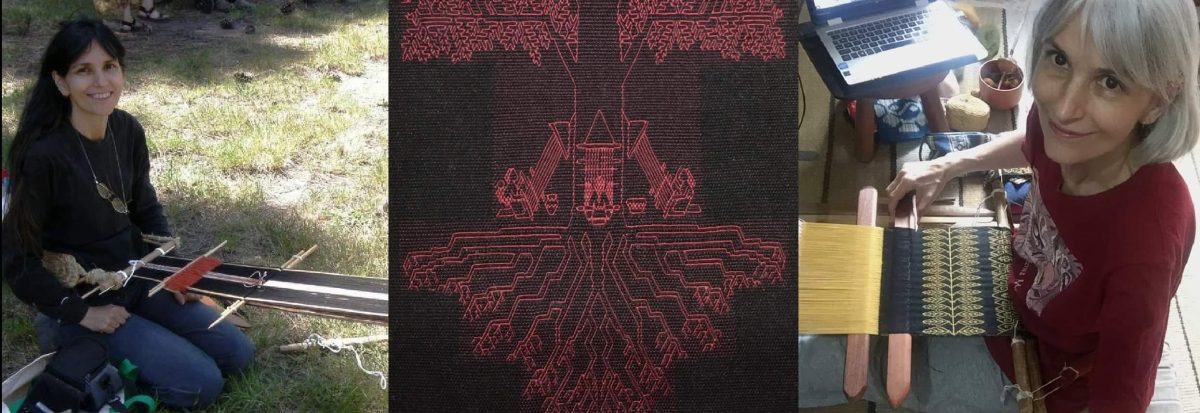
I have used this wool in three small projects in plain warp-faced weaving so far. It has stood up well in the weaving process and with use. I had yet to use it in any kind of denser warp-float structures, let alone in the three-color structure that I was planning. I figured that I could weave a sample to see how it behaved and then decide if I wanted to take it on for a larger project. I was confident that I could make it work. It just depended on how much work I had to put into making it work. Working with yarn like this usually involves slowing down and gently coaxing unwilling threads to release their sticky hairy grip on their neighbors so that you can get something that resembles a clear shed without damaging the yarn.

What made things a little trickier was the fact that I dyed some of the yarn. In the hot water the singles sort of poofed up (surely there’s a technical term for this) and didn’t recover when they dried. The un-dyed yarn looked thin and wiry next to it.
I wove a narrow sample in the three-color structure and decided that it would be doable in a wider project. Surprisingly, the threads in the tiny plain-weave borders were ones that complained most with that alarming rasping and tearing sound that they make as their entwined hairy fingers are torn apart. It all sounds very violent, doesn’t it?! But in reality it all has to be done very gently. In the warp-float section, there were far fewer complaints but I still had to work to clear sheds.

I sampled both the reversible and non-reversible versions of the three-color technique and also played with different weights of wool weft. Using the same yarn as weft gave me the best result.
There was a lot of pick-up to be done in my much larger planned pattern flanked by a lot more plain weave. Because operating the loom for the wide plain-weave borders required slower more gentle operation of the loom, I decided to just weave the pattern on its own and to add the sides as separate pieces. That way I could just place all my focus on the pick-up.

I’ve woven this three-color structure several times before using Tencel, tapestry wool and my own plied handspun wool and have achieved nice crisp images. The hairiness of the singles yarn gives a much more rustic look to the figures. It grows on you and I love the way it feels.

I had set up my warp with two sets of string heddles and once I had figured out my method for working them with this extra sticky stuff, I was on my way and enjoying seeing the pattern emerge. It’s always good to have multiple ways of adjusting basic methods to suit the kind of material with which you are working.

I didn’t do a whole lot of color flipping on this one, unlike the hummingbird camera strap that I wove in my own handspun. I just flipped to outline some leaves in red rather than white in one part. This wasn’t the kind of design in which I could regularly flip the background color.


One thing that I always try to do when weaving with wool is advance the warp as often as possible so that the heddles and rods are not abrading one spot for too long.
And here it is finished….

Next came the grey side pieces….


So, what is this project supposed to be? It will hopefully be the cover for a folder that holds my pattern charts. I just have to figure out how to construct the folder. I want it to have multiple pockets for the various categories of structures and it may need to be expandable.
While I figure that out, I’ll start washing my handspun cotton singles as I have a project in mind for them and I might start preparing the handspun wool I recently got in the market for some cochineal dyeing. We have a run of really high temperatures coming up and I can’t say that I’m keen on having the stove on for these tasks. I don’t have air conditioning. But never mind, there’s always plenty of other fiber-y things to do.

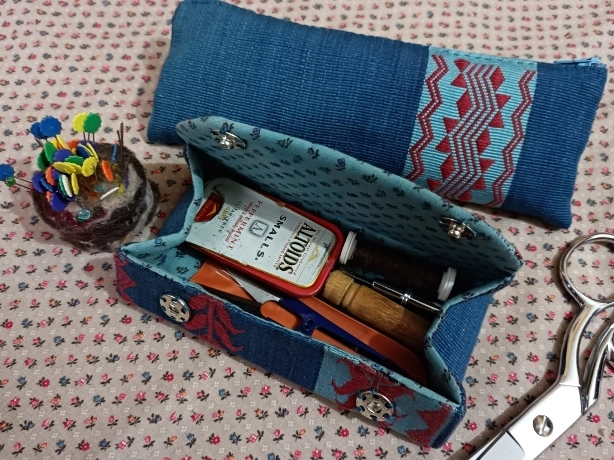
I’ll just pop in a photo here of the box purse that I was making in my last post. I didn’t show a photo of the open box with its contents. It’s so handy…I love it.

I’m going to leave you with a couple of short videos I took of weavers in Peru working with wide wool warps on their backstrap looms. You will see that some time and effort needs to put into opening the shed-rod shed with the particular kind of warp material they are using. Its not just a matter of drawing the shed rod forward to the heddles and then sliding the two together. The threads don’t smoothly rise and pop through to the other side as you often see happening in the hands of some backstrap loom weavers on Youtube who are using other kinds of friendlier warp material. Those of us who are privileged to be able to work with all kinds of warp materials soon find out that there isn’t just one single method that fits all.