Backstrap Weaving – The View from the Driver’s Seat

Twice during my recent trip away I got to sit in the ”driver’s seat” to experience what a weaver from another culture sees as they sit at their backstrap loom gazing down the length of their warp.

First, I got to spend the day with Yan Zhang, a woman from mainland China who went to study with backstrap weavers of the Li minority group who live on Hainan Island, China. She kindly brought her loom and warping frame and we, along with my good friend Deanna, talked about all things backstrappy for a good part of the day. You may remember Yan from a previous post of mine in which I embedded a beautiful video that she made of herself warping and  weaving with her teacher on Hainan Island. I had also written about a loom and patterning process from Hainan Island when I crossed paths with Megan in this post. some time ago.

Unrolling the warp and feeling excited as the beautiful cloth and tools are revealed.
Soaking up everything Yan has to tell me about the process…and hoping that I might have a chance to try!

Here’s my view as I sit at Yan’s foot-tensioned loom with its circular warp. While I have woven many a time using my big toe to tension my warp, this was the first time I had had the opportunity to sit at one of these awesome foot-tensioned backstrap looms. Yan’s legs are shorter than mine which meant that we needed to unroll the woven cloth from the beam and adjust length. We didn’t take the time to get it quite right and, as a result, I didn’t have the full range of movement in my feet that was necessary to be able to operate the loom comfortably. Nevertheless I got to use the loom and throw some shots of weft and it was thrilling!

The pattern structure is what I call ”simple warp-floats”. Floats form the patterns on one face of the cloth but not on the other. The loom was set up to create all the pattern sheds with heddle rods and other sticks in place and so no pick-up was required. I loved having my feet be part of the loom. I loved the feeling of curling my toes around the beams. Of course it requires lots of practice to make just the right amount of tension adjustments with movements of the feet. Quite often, I moved my feet too much and had the far beam slide down off the balls of my feet.

Look at Yan’s feet flexed toward her so that she can relax tension enough on the warp to enable her to raise a heddled shed.  She is adding the threads that are held on her pattern stick to the main heddled shed.

The tools that Yan used were all beautiful in their simplicity. She told us that some weavers on Hainan Island have introduced materials such as pvc pipe and I often see these also being used in the highlands here in Bolivia and Peru. Yan’s tools are all natural traditional materials.

Like backstrap weavers in many regions around the world, the shuttle is a simple stick. I  love the shape the yarn takes as it is wound onto the shuttle and Yan showed us how the Li weavers create that. Look at that gorgeous sword on the floor! The heddle rods are doubled pieces of bamboo and weavers look long and hard to find bamboo that grows in such a way. Once found, these pieces very much cherished. They are formed when a thin off-shoot of bamboo grows parallel to a piece of larger girth. The larger piece holds the heddles  while the thinner piece closes around them and secures them. Yan does not use a temple. When I asked her about that, she indicated that the coil rod is what is used to help maintain consistent width.

When we asked Yan about the thread she was using we all had a chuckle when she said it came from the craft chain store Joann! My Vietnamese weaving friends in the USA were never quite comfortable with the thread that they bought locally. Whenever a family member traveled back to Vietnam they were asked to bring back thread.

Yan showed us her handwoven skirt fabric and the way it is wrapped and pleated to fit the user.

Yan also learned how to spin cotton with her Li teachers and showed us a beautiful piece that she has woven using her own hand spun cotton. Here it is removed from the loom still in its uncut circle…

One of the other many fascinating things for me was the frame that Li weavers use to measure their warps. The loom can be set up anywhere and held between the body and the feet. In the same way, the warp can be measured anywhere on a simple hand-held device!

The particular warping path shown in my photo is what Yan calls ”four point” and creates the shortest possible warp. She showed me how to wind this shortest warp for what she says might be used to make a scarf. We separated the colors at the cross sticks in much the same way I was taught to do using my four warping stakes. The heddles are only made once the warp is off the frame and on the beams. However, the threads are turned in such a way as the warp is wound on the frame to allow the immediate insertion of the coil rod when the warp is removed. You can see the way the warp threads wrap around the upper right corner of the frame.

I shared some of my weaving with Yan and we compared warp-float techniques as well as the techniques used to create patterns using supplementary weft. She liked my wrist band with my leaf pattern in supplementary weft and I was happy that she accepted it as a gift. Here she is wearing it while warping.

She showed us some fabric that was woven by her teacher which is considered particularly precious because it is embedded with slivers of mica. You can see one sliver glinting in the light in the next picture. Follow that column down and you will clearly see the pieces of mica sitting under the red warp threads.

It was an absolute delight meeting and weaving with Yan. It was just a few months ago that I first saw her beautiful video on Youtube. I am grateful to my friend Deanna for opening up her home for this visit. Deanna is my backstrap weaving buddy and she of course was just as interested to meet Yan and spend the day with her.

A week or so later, I got to sit in the driver’s seat at another backstrap loom, this time from Guatemala. Susan had been to Guatemala and bought a loom with a couple of yards of cotton cloth already woven and wound onto its beam. She asked me to give her some tips on how to operate the loom so that she could finish off the weaving.

Single-layer warps are used in Guatemala rather than the circular ones that the Li weavers use. This one is made up of lively cotton stripes. Two colors have been used to create horizontal bars on one half of the warp. There is even some variegated thread in use on one edge.  Variegated thread was also used to make the colorful heddles. Susan did not know for what this piece of cloth was intended but I think the sturdy cotton fabric could be made into tote bags.

Unlike the Li weavers, Guatemalan weavers use a simple temple which is made up of a length of bamboo with open ends that spans the width of the cloth and two small nails. The piece of bamboo sits below the fabric. The nails are pushed through the edges of the fabric from top to bottom and then turned into the open ends of the bamboo.

The loom came with a good ol’ hefty sword…not as smooth and polished with use as the sword Yan was using but it certainly does its job in propping open the sheds and beating the weft firmly into place. I used the two cross sticks that are typical in Guatemalan backstrap looms as ”twisty sticks” to help raise the heddle shed.

One thing I found particularly interesting was the way the weaver had settled the far end of her warp. This is the second time I have seen this. My Guatemalan teachers taught me to start out by weaving an inch or so at the far end of the loom before turning it around and starting from the other end. The inch of weaving at the far end locks the two layers of threads together around the far beam and also sets the width at the far end of the loom. I noticed that the weaver who was using the loom that Susan bought had simply placed a metal rod in the second cross, lodged it up against the far beam and firmly lashed it into place. This is a quicker and far less fiddly way of achieving the same result, although perhaps not quite as pretty!

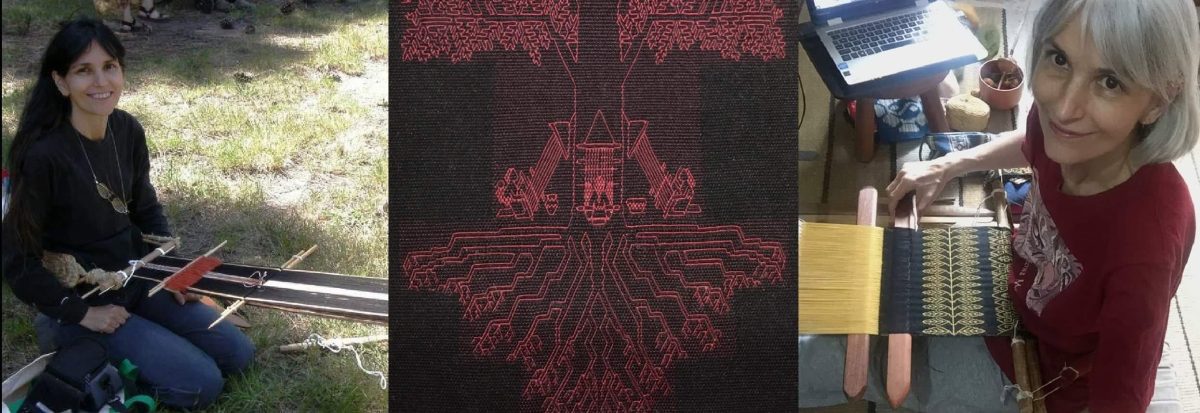
Yes, I had a very nice time sitting in the driver’s seat of these two looms and am so grateful for these opportunities. I think both Yan and I show it in our faces…the joy of weaving on a backstrap loom! The wonder of “being the loom”!

Right now, I am happily weaving on a 180-inch-long narrow warp, creating the straps for my blue pocket bag. I bought the wool yarn I needed to finish the project while I was away. It’s just a plain blue strap in the sturdy intermesh structure and it is a nice way to get back into the loom with an easy task which gives me head space to plan out my next project while I weave. I will get to use my shoulder bag with its quirky pocket on my next trip away in late July.

Oh, and if you happen to subscribe to Spin Off magazine, the summer issue has an article by Devin Helman to which I was excited to be invited to contribute.

You will also see Sara Lamb’s contribution to Devin’s article, Honest Cloth, as well as words of spinning wisdom from Kristin Merritt whose work I often show here on my blog.

And…here’s the ten-month grey hair update.

DON’T FORGET: While Patternfish sales will cease on May 31st, you still have until June 30 to download and save your purchases to a safe place. I’ll be announcing the new home for my ebooks in my next post.


Backstrap Weaving – Inspiring Ikat

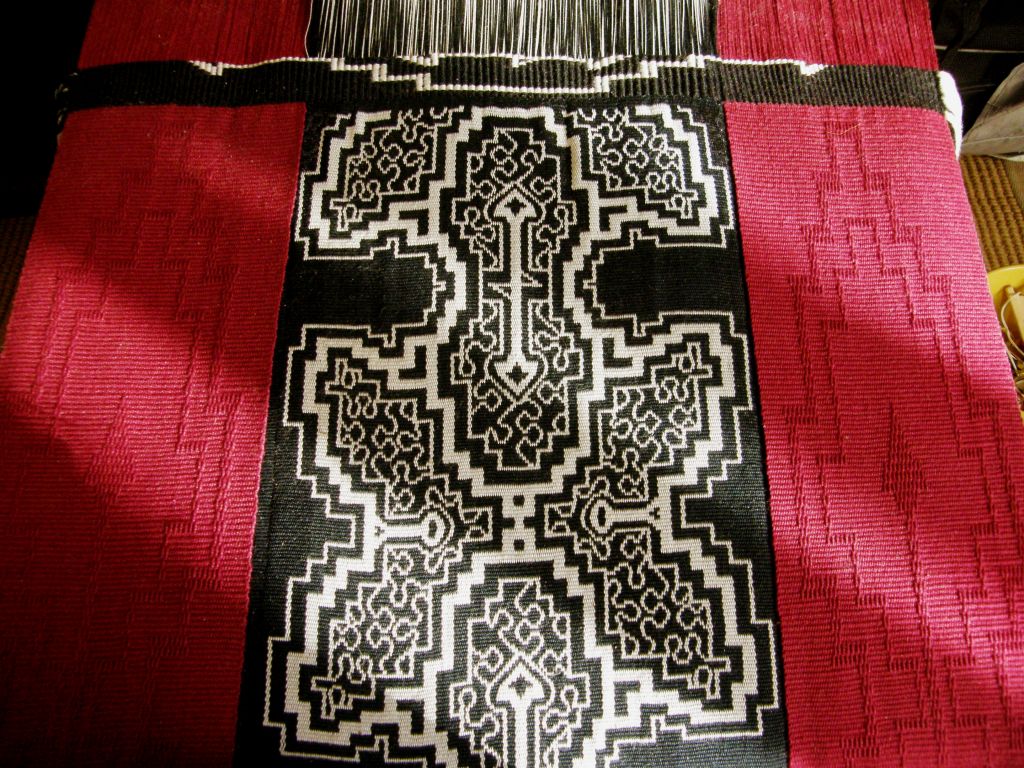
sunlight on red panels backstrap weaving“Question of the Week” on the Warped Weavers Forum asked us if our finished projects always measured up to what we had envisioned. It is interesting for me to think about this and see how my ideas about the larger projects on which I have been working lately have evolved during the long process of weaving.

I have been spending months planning and weaving these wall hangings, often interrupted by a break of several more months while I travel.

I look back at my notebook with its sketches and glued-in pictures and can see how far the finished pieces sometimes stray from the original idea.

Sometimes it is a technical hitch that does not allow me to create what I had envisioned. For example, I had wanted the Shipibo-inspired piece to comprise only curves but could not manage to form nice smooth curves with the thicker solid lines in double weave. That had almost caused me to abandon the idea. But, I went with a strong angular outline filled with finer curves instead and I really like that contrast.

backstrap weaving Bhutan bagSometimes, in the middle of a project something will catch my eye online, or someone will show me something and I will want to add those ideas to the mix.

That is what happened with my Tales of the Sub-Continent fabric which started with a Bhutanese-inspired motif and spread to Afghanistan, Nepal and beyond.

Sometimes it works, sometimes it doesn’t. When it doesn’t, it goes into the closet. And this is one of the many cool things about backstrap weaving…my half woven projects can be easily removed, still on their metal rods, from the loom bars and stored. I can discover a project months later, pull it out and wonder why on earth I hadn’t liked it! Then it can be easily lashed back onto the loom bars and continued..

It’s like in the old days before digital cameras. I never wanted to process my rolls of film until at least three weeks after my trip. If I got impatient and processed them straight away, I would always be disappointed with the shots. They didn’t live up to my fresh memories of the things I had seen on the trip. The colors would not be as brilliant and they wouldn’t have captured the mood.

However, just a few months later, they would look fantastic as my memory of how things had looked and felt faded.

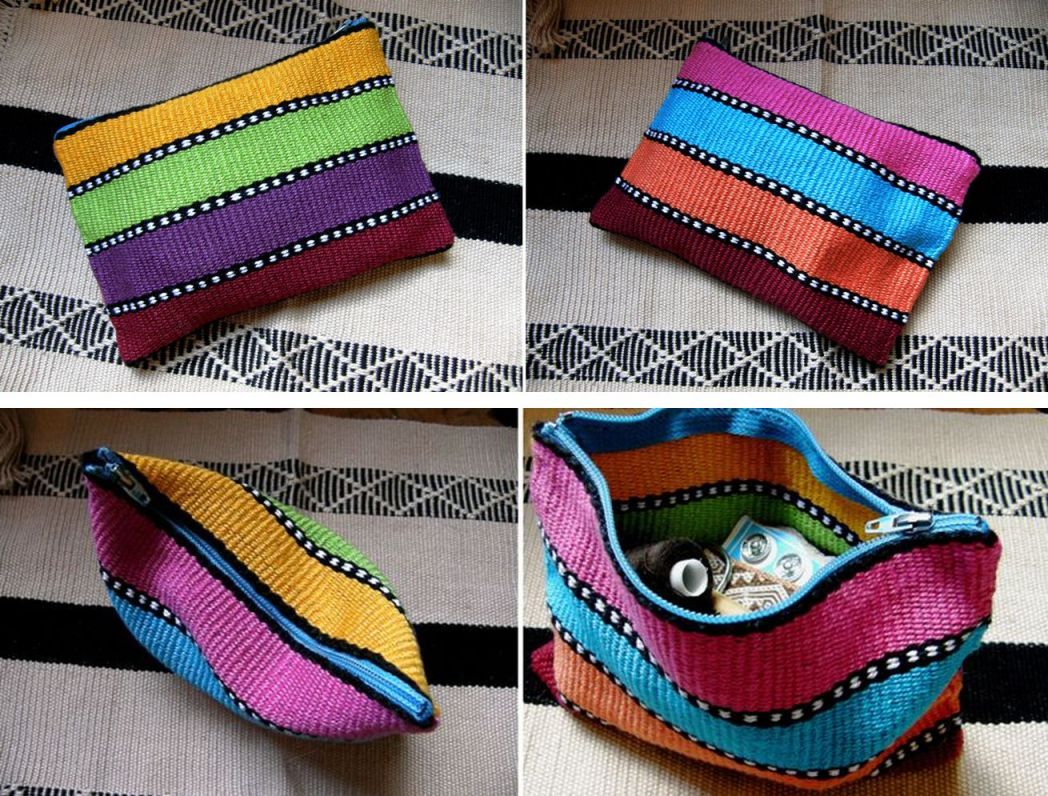
striped-pouch-x-4I detested the above fabric when I first wove it. It was a demo warp that I had hastily put together before a trip. I wanted something fun, bright and cheery in place of the black that I am so often using. It didn’t come out as I had envisioned and I didn’t even take it out of my bag to show anyone as I thought it was so ugly. Now I love the fabric, the original idea has been long forgotten, and the little sewing kit pouch is really useful.

Guatemalan supplementary weft sampler overviewThis fabric has also been living in the back of the closet for the longest time. I wove it to practice what I had learned in Guatemala shortly after returning way back in 2008. Now I love it and need to make something from it.

There have been a few things that simply didn’t work as far as I was concerned and those things got tossed. But, I have to wonder how I would feel about them if I were to uncover them in the closet today. If there isn’t even a picture of it, it means that I must have really hated it!

All this is leading up to my telling you that I have been walking by last week’s forlorn, rejected ikat piece, which has been sitting on a bench in my bedroom all week, and finding myself eventually wondering why I hadn’t liked it. Of course, there’s a whole blog post dedicated to why!  But, I finally decided that I could unweave some parts and improve it somewhat. So, here I am weaving away on that piece again…and not just to get it of the loom and learn more lessons…no, it’s because I actually like it now despite its flaws.

I spent most of the week washing yarn to take of the wax finish, setting it up on a frame and wrapping it for a new slightly larger ikat motif.latest ikat projectI was very excited about this new larger motif and really wanted to weave it. However, I had to face the fact that I didn’t have any black cold water dye left. In the end, I couldn’t resist trying to achieve black by mixing  colors.

Well, it looked black in the bath and even looked black while it hung to dry. However, the rinse water certainly wasn’t black and the dry cloth has a purply reddish glow.  It is kind of like the color of those big, fat, juicy, ripe mulberrries on the tree. They look so black and shiny but your hands and lips stain purply-red (which is why my brother and I could never get away with eating from the forbidden tree in our backyard as kids). I almost unwrapped it but I will wait until I return from my next US trip with fresh supplies of dye and I will overdye this warp black. That warp has to go on the back burner for now. What will be interesting, will be seeing what colors have already seeped under the wraps.

Here’s some online inspiration for more and more ikat experiments…lots of reasons to keep at it!

Photo used with the permission of the Ministerio de Cultura de la Nación Argentina. The ikat poncho was woven by Guillermina Cabral.

Ponchos on and off the runway….

Don Juan Millain shows a ponch woven by Norma Millain. Photo from the Facebook page of MATRA - Ministerio de Cultura de la Nación Argentina.
Don Juan Millain shows a ponch woven by Norma Millain. Photo from the Facebook page of MATRA – Ministerio de Cultura de la Nación Argentina.

And on the loom….

Graciela Salvatierra's work in Catamarca, Argentina from the Facebook page of Ponchos Artesanales  Salvatierra ll
Graciela Salvatierra’s work in Catamarca, Argentina from the Facebook page of Ponchos Artesanales Salvatierra ll

And here’s my wee, wobbly project being slowly fixed…straightened on one side, and now with white embroidery floss for supplementary weft which looks so much better than the creamy colored silk I was using last week.

ikat

Chris Buckley, in Beijing, has shared many images with me over the years from his vast collection of textiles. I was happy to find his Art Southeast Asia page on Facebook recently, via a weaving friend, and see the picture of Li ikat weaving that he had posted. He has just had an article on these pieces published in the September issue of Textiles Asia (I have a copy coming my way). There were a lot of tiny wrapped sections in his piece! and the seeping of the indigo into the white has created a nice effect. Using handspun cotton…now that’s a whole other trip.

chris buckleyHere is his description that accompanies the picture:

The September 2014 issue of Textiles Asia (www.textilesasia.com) includes my article on ikat made by the Meifu Li people of Hainan. The Li make dense, complex and beautiful ikat, using locally grown handspun cotton and natural indigo dye. The designs are tied on the warp threads with small strips of resist, before the yarn is dyed. The dyed threads are woven on a simple backstrap loom, so that the designs appear in white on a deep blue background on the finished fabric. Motifs include geometric forms, human figures and amphibians, such as those in the photo here, which shows a detail of a large sarong. These were mainly for ceremonial use (weddings and festivals). The Textiles Asia magazine is excellent and I recommend it to anyone with an interest in this area.

You can watch a short Youtube video here showing the ikat process with string and masking tape used by some weavers in Argentina.

I think they are very brave to use that heavy marker pen! I tried using a fine-tip marker and the ink bled into the yarn. Now I use faint pencil marks.

A booklet that I have on Guatemalan ikat, known there as jaspe,  says that the person tying the knots marks with a pen the parts that need to be reserved. Most likely they are less prone to making mistakes than I am!

A Guatemalan jaspe warp ready for weaving
A Guatemalan jaspe warp ready for weaving.

Leaving ikat aside for now, let’s look at some other kinds of backstrap woven beauty. Gwen shared with us pictures of the beautiful pick-up weaving that she saw on a recent visit to the Cusco area of Peru.

10305594_10203495499921874_8779412477090214824_nThis is one of the textiles that has inspired her to take up backstrap weaving and she has already woven her own backstrap. Her enthusiasm and obvious enjoyment of the whole process has me remembering the simple pleasure of just sitting at the loom and working the sheds, listening to sticks clack while watching the warp and weft interact and the fabric appear…

gwendolyn facebook (2)I appreciate her having taken this next picture of the process of braiding the ends of the backstrap and inserting the cord. I didn’t use a picture of this in my article and I know that Gwen’s picture will make the process very clear to those who may be unsure.

gwendolyn facebook (3)Some more simple pleasures…

10570318_770325679684468_7800201937456857640_n…weaving outdoors on a warm sunny day. Oscar Vasquez tells me that he doesn’t live in a part of Mexico where backstrap weaving is practiced and so, he has been following the same WeaveZine article that Gwen used (the Spanish translation) to weave a narrow band while out and about.

This coming week, I hope to warp the two red panels that will accompany the central  ikat panel of my planned wall hanging. I will create another red-on-red pattern using simple warp floats. The motif will have elements of that used in the ikat panel.

See you next week.