Backstrap Weaving – The Plain Parts

I live right in the heart of Santa Cruz city. It is a crazy jungle of tangled electrical wiring, crumbling adobe and sagging red rooftops. Even when I am alone in my little condo I can sense the beat of the city as people go about their daily lives…booming tropical rhythms, car horns constantly blaring, the scratching scraping sound as the washer woman in the building next door scrubs the heck out of the clothes. And then there are the smells. At any hour of day or night someone somewhere in the neighborhood is having a barbecue. I live within a stone’s throw of one of the city’s largest street markets. That brings its own collection of interesting aromas.  The football stadium is four blocks away….faint cheers, chants and whistles on weekends and, if the wind is blowing the right way, I get to hear all the concerts for free.  It is colorful and somewhat joyful…nothing “plain” about it, that’s for sure.

I have been going through old pictures. Here’s a reminder that there are some simple, “plain” places to which one can go to escape all the man-made mayhem. Right here in the city there is a very odd and very large and unexpected stretch of sand dunes. Go there mid-week and you can have it to yourself. On weekends it becomes yet another venue for salsa music and barbecues.

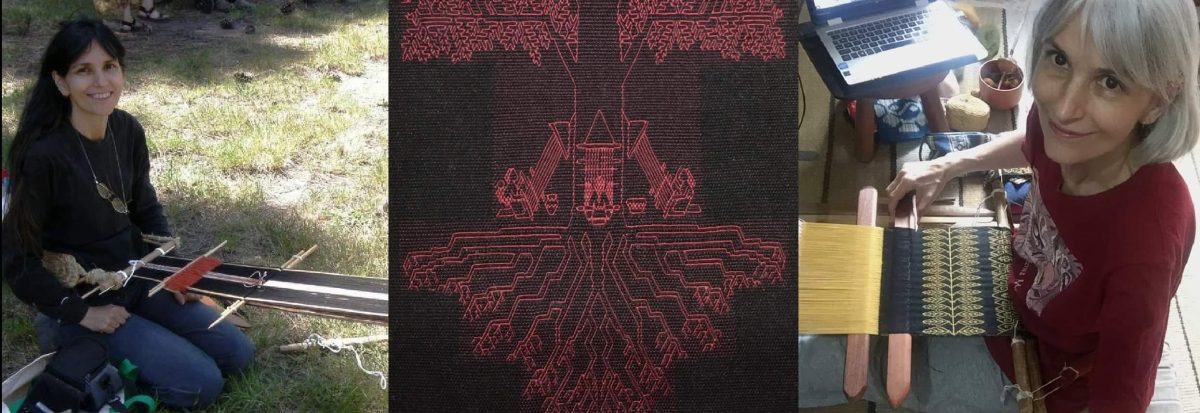
OLYMPUS DIGITAL CAMERA???????????????????????????????I am weaving the black panel of my wall hanging project. Nothing plain about this. In fact, I have to keep stopping and checking myself…how much pattern is too much…have I gone too far? Is it too much, overdone?

The thing is, I am still learning LOTS of lessons from weaving this piece and so I won’t be using it for the wall hanging. I will finish it and keep learning from it.

There are definitely some things I would do differently a second time around. Luckily I have a whole lot of green Guatemalan cotton that I can dye black for a second attempt and I think that my silk supply will hold out too.

I can probably make something nice from what has now become another “sample” and I will start again on the wall hanging panel.

I will tell you just one of the lessons I learned. If you are doing plain weave and using black warp and weft it really doesn’t matter if some parts of your piece are a little less warp-faced than others. You won’t be able to notice that fact.

However, when you are using a white continuous supplementary weft, it DOES matter. The smart thing to do is to put that white weft in as a tester right at the beginning. That way you will be able to tell if some of the black warps have a slightly different spacing to others as the white weft will show through. You can then go about shifting and settling the warps so that their spacing is consistent and completely hides the white weft.

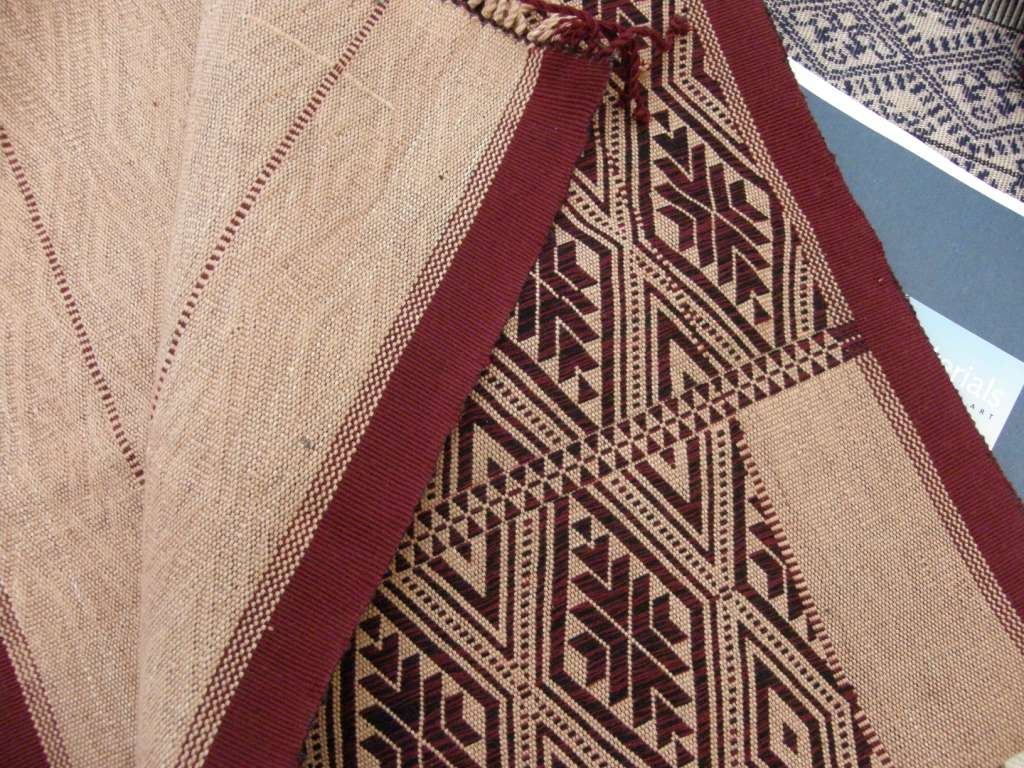
At the same time I have been doing a little study of some of the different ways that indigenous weavers here treat the plain parts of their woven pieces. By plain parts I mean those that do not have any kind of pick-up patterning.

???????????????????????????????

Here are some examples…from left to right…

Sample 1: A rolled edge. There are actually 18 brown warp ends there on that border that have been woven and rolled to form a sort of tube edge. The edge is good and thick and would provide very good protection for the sides of a belt. The weavers from San Ignacio de Loyola use this kind of edging for the plain weave that borders their belts.

weaver san ignacio de loyolaSample 2: Two-weft-span borders. I learned this method from my teacher Maximia in the Bolivian highlands. Look at difference in the yellow edge on sample 2 and the green 1/1 plain weave border on Sample 3.
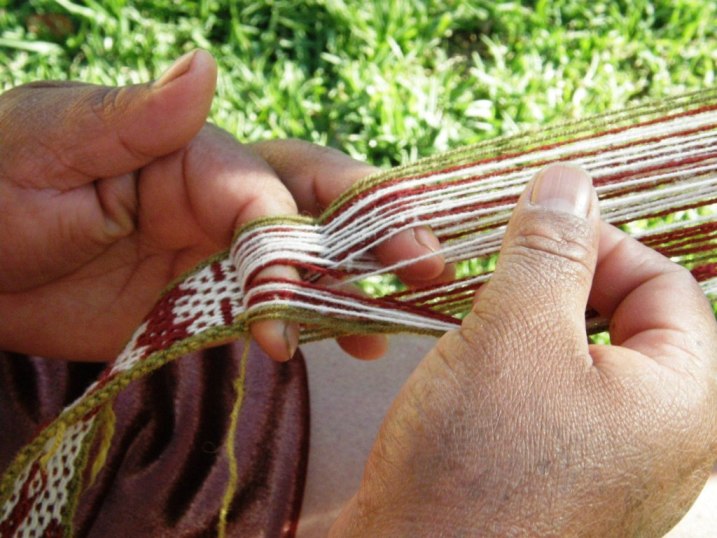
??????????????????????Maxima makes a cross with her fingers while she picks the various colors needed to create her pebble weave pattern. She first takes the borders from the far side of the cross, then works her way across the warp picking her pattern , She finishes by taking the borders from the near side of the cross. This is what enables her to form the two-weft-span borders.

Sample 3: 1/1 Plain Weave. Using  1/1 plain weave  as the border gives the  pattern area another dimension. The border remains “flat” and the pattern area is raised. This is a very nice effect.

Sample 4: Intermesh border. This is the “thick border” that I explain in Andean Pebble Weave and was taught to me by weavers in Ayacucho. Because it is a three-shed structure, it is the perfect companion to the two-heddle pebble weave set-up. The plain borders match the thickness of the pebble weave sections.
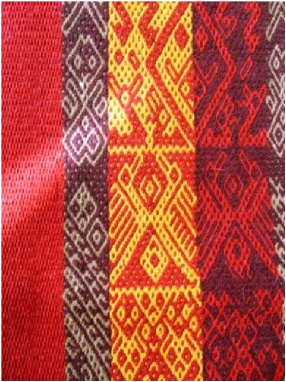
intermesh borderIn this pebble weave piece from Ayacucho, the red plain area on the left is woven using the intermesh structure.

pebble weave cell phone pouch backstrap weavingHere are some of the sample bands that Maxima and I wove using the border method in Sample 2. My cell phone pouch uses the method in Sample 4 for the plain red sections.

The method I most use is that in Sample 4…intermesh.

Oline friend Larisa sent me pictures of her project using intermesh using scrap yarn for learning purposes and so the piece does not have as good a contrast in colors as she would have liked. She says that she believes that intermesh is good for “bold statements”.
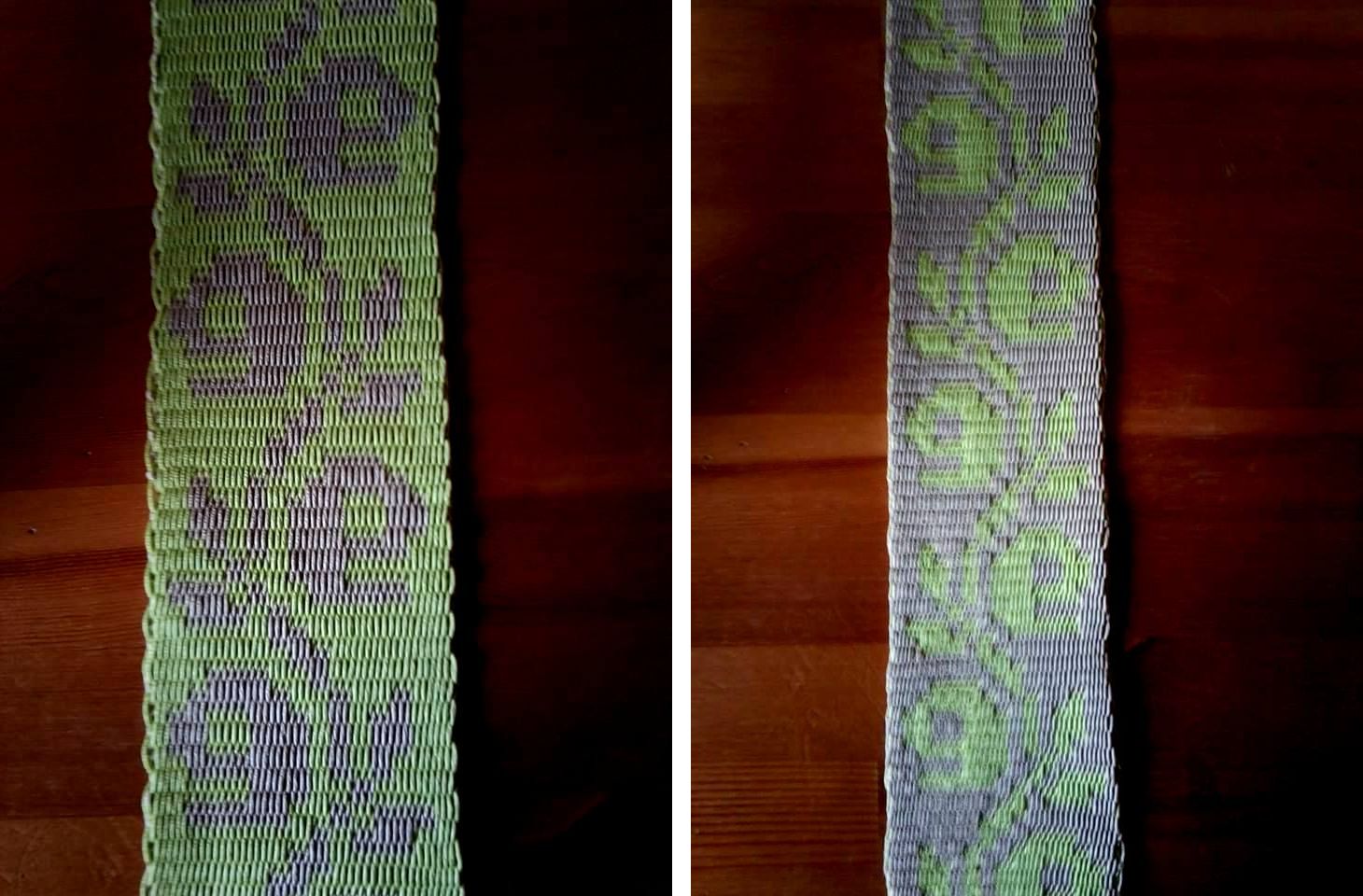
larisa flowersLarisa tells me that her rosebud motif is based on one from Palestinian embroidery.  Gorgeous!

Julia used Plymouth Yarn Fantasy Naturale to make the pebble weave band, below. This yarn, for me, is the perfect weight for making a backstrap and I have used it often for that purpose alongside some doubled Tahki Cotton Classic for additional colors. You will need two skeins of Plymouth for a backstrap in the dimensions I give in my WeaveZine article.

julia plymouthYou can see one of the beautiful swords in the picture from Magical Moons.
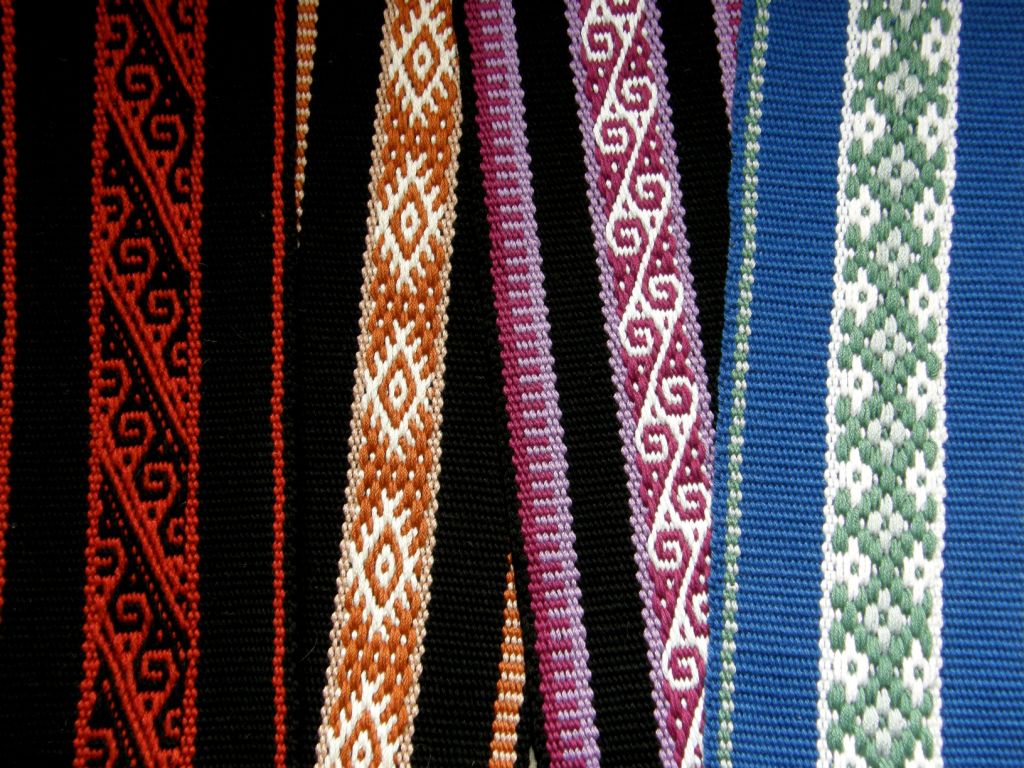
,y backstrap s made from Plymouth Yarn Fantasy Naturale and doubled Tahki Cotton Classic.
My backstraps made from Plymouth Yarn Fantasy Naturale and doubled Tahki Cotton Classic.

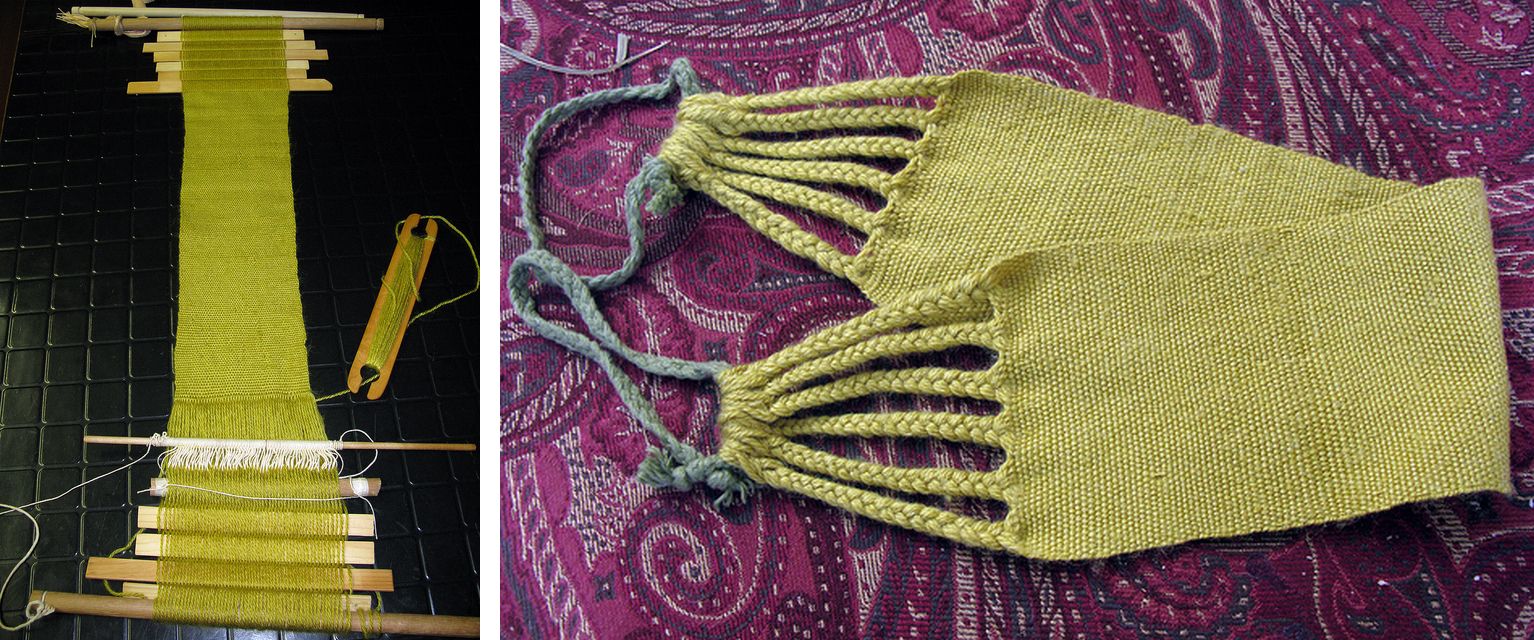
Julia wove with me one day and we played with the finishing techniques shown below in which we worked with tubular bands, coil stitches and cross knit looping.
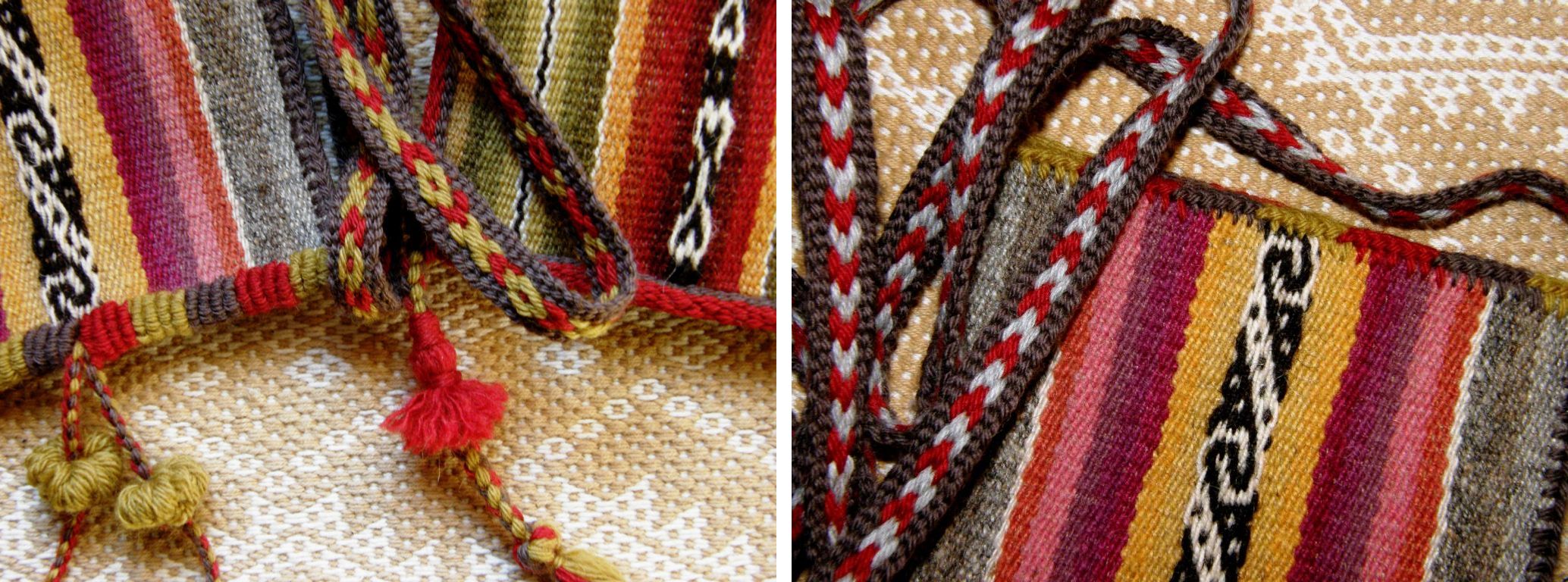
finishing techniquesI gave Julia a piece of wool woven cloth made by Maxima and weavers in her cooperative in Cochabamba so that she could practice her new skills. Here is her finished bag:

julia bag tubular class (2)The broader part of the strap is two tubular bands edging a piece of linen. Beautiful work and she had just the right colors of yarn for this project.julias bag of finishes

~~~~~~~~~~~~~~~~~~~~~~~~~

4mum

~~~~~~~~~~~~~~~~~~~~~~~~~~

Backstrap Weaving – Working the Weft

I keep picking up the white paper bag that is lying on the chair in the bedroom half buried under a pile of tubular bands and warps. I scratch my head and wonder “What on earth is this?” My idea was to stop putting weaving things away in the closet. I fear the old “out of sight, out of mind” thing. So, the bag remains on the chair. I open the bag…oh yes, the contents of the paper bag are too precious to be left just lying about.  However, they are out of sight in the bag and, therefore, I keep forgetting what a  gorgeous delicate object it is that lies within.

Guatemalan supplementary weftIt is the wee Guatemalan backstrap loom that I bought at the Santa Fe International Folk Art Market in July. I gaped at the stunningly beautiful and delicate cotton gauze huipiles on the Guatemalan stand of weaver Amalia Gue with their white-on-white supplementary-weft patterns and was thrilled when I found that I could take home a relatively inexpensive example of these remarkable pieces.

This photo and description of Amalia Gue is from the website of the Santa Fe International Folk Art Market.

Guatemala_AmaliaGue_ArtistPortrait2_smAmalia represents Ixbalamke, a cooperative of women dedicated to the production of traditional textiles and preservation of traditional weaving. They live in the community of Samac de Cobán in Alta Verpaz and are inspired by the landscape and beautiful views of the region. The members of the cooperative maintain the intricate technique of gauze weaving and the use of coyuche, or natural brown cotton – practices that are rapidly disappearing. They also have a project making little looms for younger generations to continue to learn the tradition of weaving.

The cotton warp and weft is very fine and rather soft and a bit fluffy. It had not been sized. A thicker very loosely spun cotton is used for the supplementary weft. I haven’t looked at it closely enough to see if it is one thick strand or several fine strands combined. I am afraid that I will have to pull out one of the motifs in orderto ascertain that.

There are no obvious start and finish weft tails for the figures. The little bird figures just mysteriously start and finish. By picking at the weft I can see that the cotton used to weave the figures is most likely just twisted to undo the spin a little so that it can be torn when the motif is finished rather  than cut to give a blunt end. The torn end then just sits obediently within the shed. I think the fluffiness of the supplementary weft and the thread used for the ground weave causes all the fibers to interact and  somehow mesh and this is what prevents the motifs from unravelling….just my guesses and ramblings.

Guatemakan mini loom with supplementary weft patterningSo insanely delicate. Yet, this is the fabric of huipiles that I assume are frequently washed.

As it turns out, I have three large skeins of natural and bleached white Guatemalan cotton that is the same as the thread used in this piece. It has sat in the closet since 2008. It was an impulse buy and, when I got it home, I figured that it was way too soft for warp-faced backstrap weaving. I decided that one day I would size it and use it for something. For me, the biggest challenge will be achieving that even gauze-y ground weave. How in the world do the weavers manage that?  The good thing is that I have a ton of the thread and can afford to experiment and fail and try again.

I haven’t done supplementary-weft patterning on an open weave like that before. There will be much to learn! He is one of the huipiles for sale on the Gautemalan stand. This one was easier to capture in a photograph than the white-on-white ones.

Guatemalan huipil santa fe folk art market 2013So, while on the subject of the workings of supplementary wefts to create patterns, let me show you a few more things that I saw while in Santa Fe.

This is the work of weavers in the Sna Jolobil cooperative in Chiapas, Mexico headed by Pedro Meza Meza…

???????????????????????????????

And from Myanmar, Chin weaving…..

myanmar supp wef….brought to the Market by Khun Shwe and Pa Mang, experts in the textiles of the 40 subgroups within the Chin culture.

All the textiles I looked at on Khun Shwe’s stand were created with the single-faced weft inlay technique that I describe in my tutorial here. Below, you can see the “clean” back side of one of the pieces. 

single faced supplementary weft patterning myanmar

khun shwe myanmarIf you are in Santa Fe outside of the weekend of the International Folk Art Market there are still plenty of ethnic textiles to be seen at the Travelers’ Market not far from the downtown area. Many thanks to Marilyn who put me onto this place. It kept me happily occupied during one of the days leading up to the Folk Market.

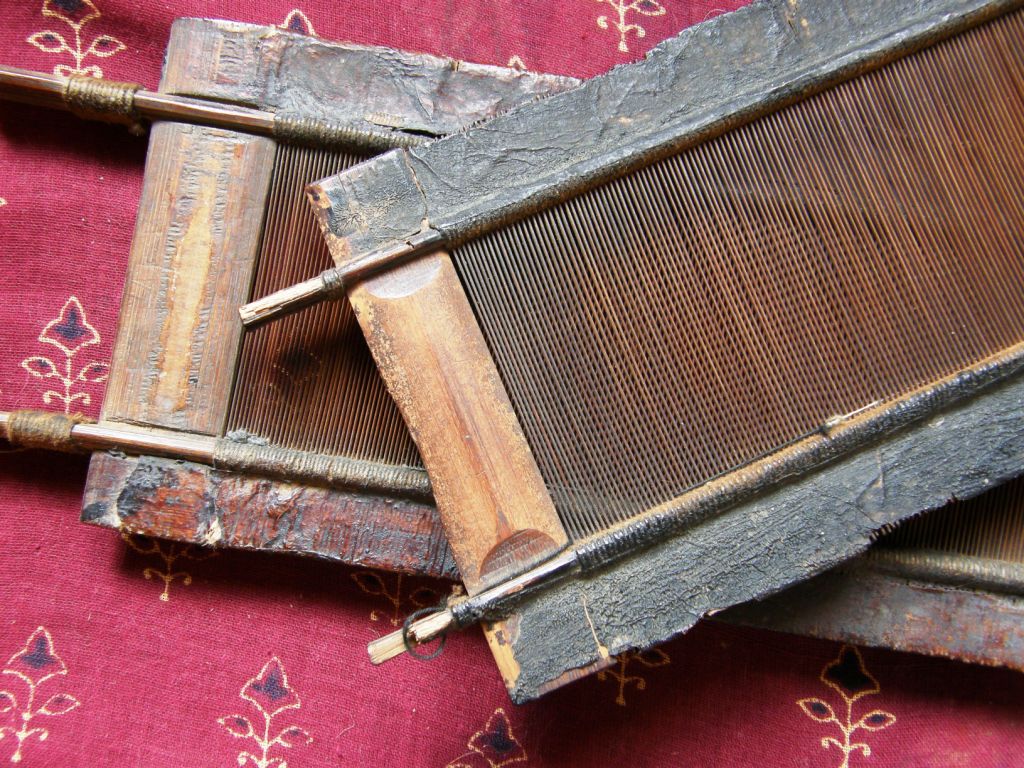
There, I got to catch up with Pam Nadjowski whom I had met at Convergence 2010 in Albuquerque. Pam has a booth in the Travelers’ Market with textiles, jewellry and artefacts from Chinese minority groups that she has collected over the years. It was from Pam, in the booth she had at Convergence, that I bought the beautiful fine bamboo reeds that I use on my backstrap loom when I want to weave balanced cloth. These are treasures to me!

bamboo reedsPam allowed me to examine and photograph the beautiful silk brocade cloths, with pattern appearing on both sides, which come from the Quiandongnan area of China. They are used as baby carrying slings.

Sadae Torimaru in “Spiritual Fabric. 20 Years of Textile Research among the Liao People of Guizhou, China” briefly describes the patterning technique. She shows a weaver working at a floor loom and writes that each row of supplementary weft pattern takes 7-8 minutes to pick. The book includes 3 pages of images of individual symbols that are traditionally woven into the baby carrying slings and information about what they represent….such things as roosters’ feet, grass in paddy fields and a big tiger’s claw. It is interesting to go through the photos I took and identify the symbols in the book.

Here is just one of many pieces that I photographed. What an amazing piece of fabric in which to carry a baby.

???????????????????????????????I’ll show you just one more thing from Nagaland, a state in the far north-easten part of India.  There happened to be an exhibit of Nagaland textiles while I was visiting the Travelers’ Market.  Here is a very striking piece of fabric patterned with supplementary wefts. It is quite a contrast to the delicate Miao brocade. I like the way the supplementary weft extends from the sides of the cloth to form a fringe….an interesting solution to bulky weft turns on the edge of the fabric. I have more interesting pieces to show from Nagaland….another time.

???????????????????????????????As for my own weaving, it is a little “on hold” as I am counting down to my departure.

My living room floor has once again turned into a hop-scotch field of baskets of skeined yarn,  all sizes of balls of yarn arranged in possible color combinations, sticks, elastic bands, tape, warping boards and STUFF. This is where I warp. I love the speed and efficiency that comes from winding many warps this way….choose the colors, wind the warp, put the warp on the sticks, make heddles. For the simplest warps I make the heddles after the warp is wound right there on the warping board….Done!…NEXT!

4 color pebble weaveThe bedroom remains the paradise where I do the actual weaving. It is simply a smaller version of the chaos of the living room but has many more sticks as well as scattered cushions on which to sit and weave.

Now that I don’t have my cat anymore, I don’t need to put everything away from kitty claws at night. This means that things can remain in sight and in mind at all times rather than being put away in the closet to be possibly forgotten. There is quite an array of bits and pieces scattered about to remind me that there is this certain thing that I wanted to investigate further, or that color combo that I wanted to try or that pattern that I wanted to chart. I see them during the day and step on them in the middle of the night if I need to visit the bathroom.

I now have several weaving anchor points in the bedroom so I don’t even need to roll up a project and put it aside when I feel like working on another for a change of pace.

Between spurts of warping which can be rather mind-numbing, I wove one more  pattern on the four-color pebble weave band and rearranged the colors a little for the repeated motif. This is certainly something that can “un-numb” my mind!

And then, when my head is good and clear, I work on my supplementary-weft wall hanging. It’s not a sampler. I don’t want any mistakes in it and so, I leave that project for the times when I feel relaxed and want to reward myself after a good long bout of warping. I will give you a break from seeing that project this week.

Let’s look at what others have been up to….

hummingbird_guitar_strap_002_mediumI taught Janet the two-heddle intermesh technique that I teach in my second book, when I was visiting with her in northern California last spring. She wove this guitar strap using her own handspun wool and…. look at that, first prize at County Fair!  The strap has bird, leaf and hummingbird patterns. I got to see it when I was at her place in July but wasn’t allowed to show it here at that time because of the rules of entry in the Fair. I have been waiting and waiting to show you how fabulous this is.

Photo by Zev Eisenberg

Figmentling, from Ravelry, told me that she learned how to twine from the basic tutorial here on my blog. This is another resource that she consulted as well as this discussion on Weavolution where my friend, Franco Rios, lists many more resources for instructions and information. Then, she took it so so much further and created the bag you see above! It has interesting finishing techniques and a braided strap that she learned to make from Ingrid Crickmore’s loop braiding blog. She drafted her own pattern which she says commemorates the new bak’tun in the Mayan calendar.

DigitalLeaf from Ravelry shared pictures of her backstrap project.

DigitalLeaf backstrapIt looks  wide and very comfortable, has nice edges and is beautifully finished. I hope that she will get a lot of use from it.

And finally, I would like to share a comment I got from a reader this week. As one of my goals in writing my second book was to have people feeling confident and inspired enough to design and weave their own pebble weave patterns, I can’t tell you how happy this comment made me:

Thank goodness! I have finally cracked it. Having worked my way through the first Andean pebble weave book I was looking forward to dipping into the second and then I noticed that you had changed the pattern format. My heart sank and I put that book away for a month. But I looked at it this weekend, tried one of the smaller bands without any notations (thought it best just to throw myself into it) and by the time I was halfway through the first repeat it all made perfect sense and I can now read them perfectly and am presently designing my first band from scratch

Thank you Laverne – you have opened a whole new range of patterns to me.I will post my first effort when it is completed (if it works, that is)!

See you next week!