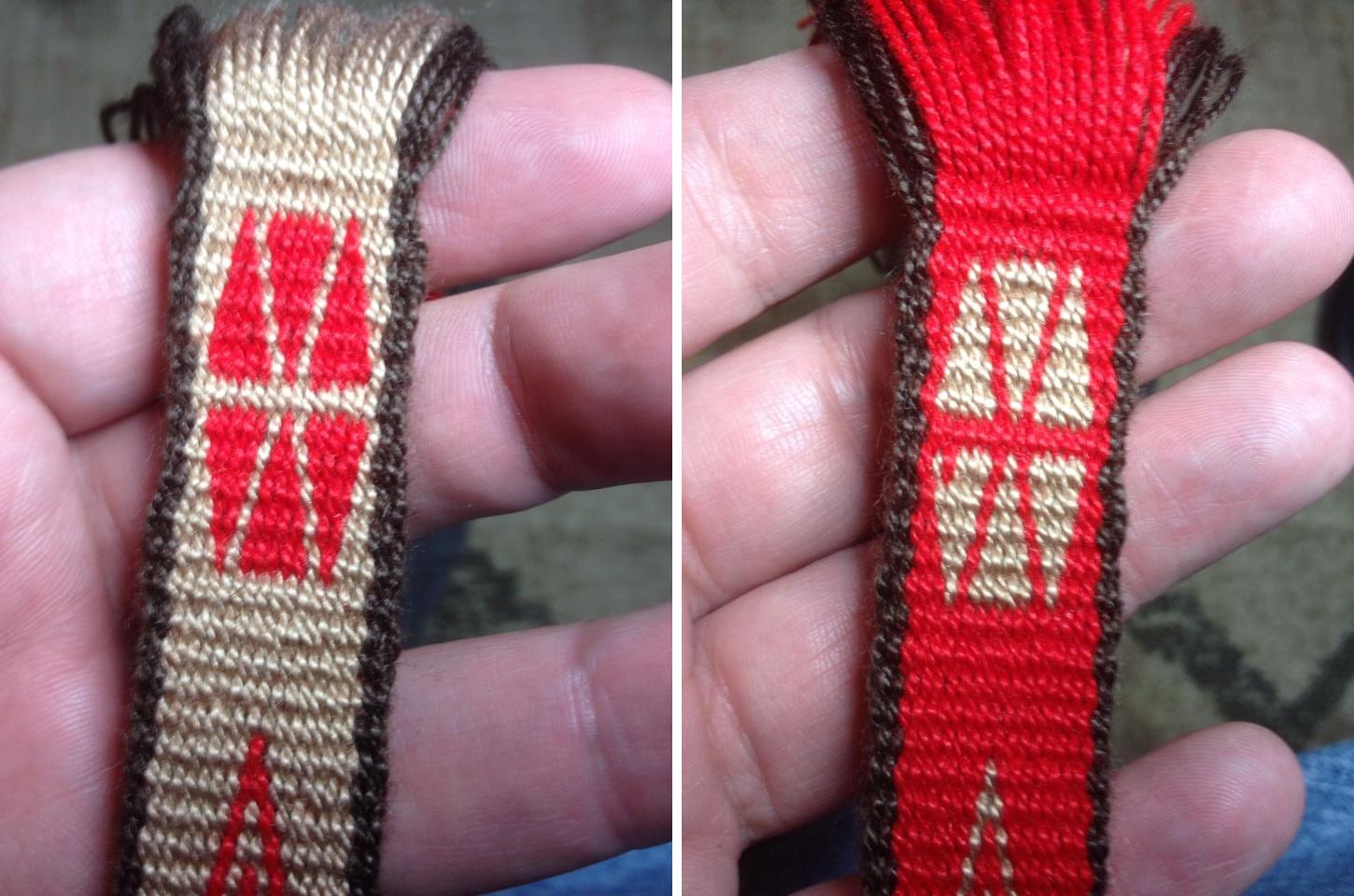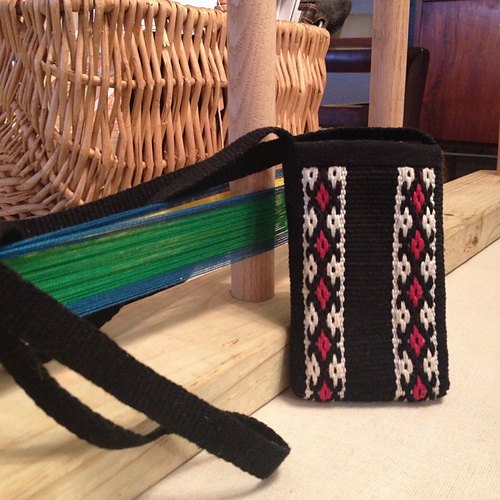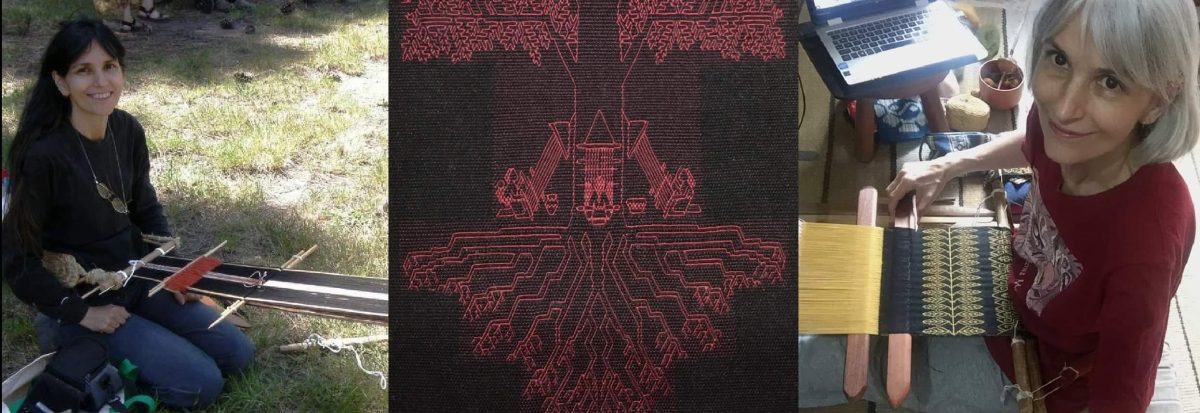
Backstrap Weaving – Wool Weather

Finally….I am weaving with the right material to suit the season. It’s winter here in Bolivia and, although I am back in a tshirt and shorts today, we have had a couple of weeks of rather chilly weather. I wove with 20/2 wool as I finished the second of two purple panels that I plan to sew together. While doing so, I used the joined brown wool panels that I recently wove as my lap blanket. It was just the right weight for the cool-ish temperatures that we sometimes experience here in our tropical winter.

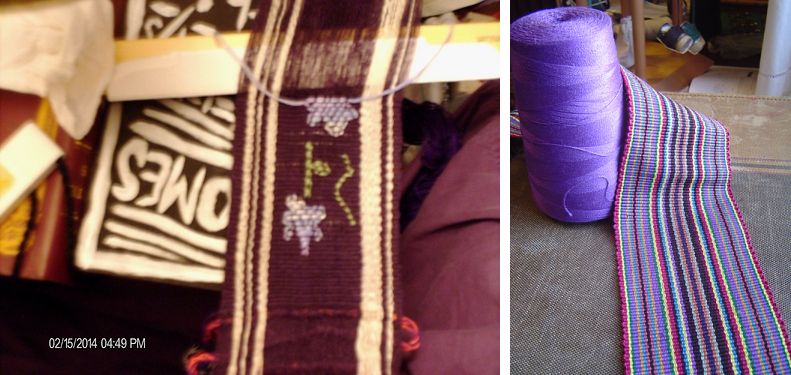
two purple wool panels backstrap weavingHere are the two finished panels that have been washed and pressed. The one on the left is actually showing its ”wrong” side so you can see how the narrower of the two patterns looks on the reverse. When both ”right” faces are showing, the wider strips of hook patterns on the two panels are mirror images. I created the patterns using black supplementary warp threads. I now have to decide which kind of joining stitch I will use to connect the panels and what I would like to apply to the edges.

My brown wool piece has been sitting by waiting for its edging. I have not quite made up my mind about that but I now have the brown wool that I need and just need to make some sketches and plan out the pattern. I am thinking about applying a flat band to the edges rather than a tubular one.

brown wool panelsl backstrap weavingIn the meantime, I have warped a sample using the same wool I used for my panels for my next project. The item itself is small but there will be quite a lot of time involved as I hope to weave the piece with four selvedges as well as include a tiny pocket and lots of decorative stitching and other embellishments. My short, narrow sample will simply show me how my pattern will look in my chosen colors of 20/2 wool.

sample warp for wool chuspaI want to make a 4-inch wide pouch…the kind people often wear around their necks at conferences. All participants were given one at a conference that I attended and it turned out to be the handiest thing for storing room key cards, meal passes, the business cards of people we had met along with other bits and pieces. So, I want to weave one of my own and I want it to look like a mini ch’uspa….the woven pouch in which people here in Bolivia carry their coca leaves.

chuspa I wove in Potosi 1997Here’s the acrylic ch’uspa I wove with my teachers in Potosi, Bolivia back in 1997. Using her drop spindle, my teacher Hilda added twist to the acrylic yarn that we had bought in the market. The piece has four selvedges and I wove it down on my knees using a horizontal ground loom.

Hilda showing me how to finish a four-selvedge piece.
Hilda showing me how to finish my first piece with four-selvedges.

I wove a few inches at both ends of the loom and then, when the space in between was too small to allow me to continue weaving the pick-up pattern, I changed to weaving just horizontal bars. Eventually, the space was too small to allow me to continue using the shed rod. It was removed and I continued using only the heddles for one shed while needle-weaving the other.. I finally had to remove the hedddles and create both sheds using a needle.

A shed is created by picking up every other warp end on a needle and then transferring the ends to a very narrow wooden sword or metal rod. Then the weft is passed.

It is a slow, slow process. Hilda had helped me finish my first piece this way but for this, my second piece, I was on my own!

While Hilda wove a band on a backstrap loom and her sister Juliana cut wool to spin, I wove the fabric for the little pouch on a ground loom.

The pouch has the little outer pocket that is typical of many of the Bolivian ch’uspas. I had asked to be shown how to weave a ch’uspa and Julia and Hilda had to consult about how exactly to wind the warp to include the pocket as neither had woven one for many years.

warping-for-chuspaSetting up to weave this odd-looking warp is easy enough when using a ground loom. You simply pound stakes into the ground to hold the extra warp-length for the pocket section under tension.

It’s a bit more fiddly when using a backstrap loom. Some years ago, I tried it here at home using cotton. The warping and set-up went smoothly but I came to the conclusion that cotton was not a good material for this particular technique….at least not in my hands. So, I am looking forward to trying again with wool. It seems to me that a stretchier material would make things a lot easier.

chuspa experiment in cottonThe little pocket sits on the outside of the pouch and is accessed from the inside…

chuspa-inside-outI have turned my woven ch’uspa inside out in the above photos and you can see the little pocket opening.

When I had finished weaving the pouch, after having struggled through the final rows of needle weaving, Hilda and I set about decorating it. She taught me to weave and sew a patterned tubular edging. We edged the pocket with a tripled cross-knit looping stitch and then added a finger-loop braided strap.

This is the pattern  that I hope to use (it is charted in my 2nd book) and my sample will tell me if it is going to look too small in the 20/2 wool. I charted these birds from a small fragment of pre-columbian cloth that Tom Knisely once brought to show me when I was visiting the Mannings.pre columbian bird patternI’ll be embellishing my little pouch in almost every way I know using patterned tubular bands, coil stitches and other decorative sewn finishes, braids and pompoms …it should be a fun project.

finishes


Backstrap Weaving – All Warps Great and Small

A couple of months ago, I created a project that had outgrown my regular loom bars and I had to buy brooms and cut them down for my beams. That project was a plain-weave piece of 2000 ends of 60/2 silk and supplemental weft for patterning. This week I find myself weaving with the same silk and my regular loom bars but, this time, my project is a mere half-inch wide.

silk on silk supplementary weft motifsIt may seem like overkill using those big sticks for such a tiny project. Many a time I have abandoned the sticks to pass cord through the end loops of the warp and tie that to my waist with the other end of the warp hooked to my big toe. No backstrap, no sticks…just fingers, a toe and string.

However, I do prefer the stability of the sticks and I feel perfectly balanced and at home with what may look to others as a very cumbersome, clumsy and perhaps unnecessarily complex set-up. I think this backstrap weaver in Mexico feels the same way I do.

picture by Karen Elwell
Picture by Karen Elwell

I think her band may be even narrower than mine. The narrow band project is happening because I promised some lanyards for name tags for a friend. They need to be roughly 1/2 ” wide and 34” long. I have to admit that it is a nice change and break to be weaving these after having had so many large projects on my loom lately.

I wanted to fit a lot of pattern into that mere half-inch space and so I used 60/2 silk. I wove an Andean Pebble Weave pattern. Because it is a complementary-warp structure with warp-floats on both faces, the band is dense enough to make a good lanyard. I chose a pattern that I have woven so so many times before, I can just about do it with my eyes shut. I was a bit put off by the impending boredom…34″ of a pattern that I already know so well and have woven in many color combinations. I wouldn’t experience the delight of seeing new shapes and forms appear or new color combinations. It was just going to be very, very slow going with the fine silk.

So, I decided to set it up for loom-controlled patterning so I wouldn’t have to have my fingers in among the size 60/2 threads. Having it set up with a series of heddles to control all the pattern sheds would make this novel and interesting, not to mention fast!

pebble weave guitar strapA few years ago, I wove this guitar strap for a friend. She was giving it as a birthday present and it had to mailed to the USA from Bolivia. I was on a deadline and had to move fast. I set up only two  heddles in addition to the two pebble heddles to speed things up a bit. Part of the process was still weaver-controlled in that I was picking up some of the sheds by hand.

For the new silk lanyard project I went with almost 100% loom control…

silk lanyard with multiple heddlesI have five sets of heddles and a shed loop. This particular pattern has a couple of horizontal bars. I picked up the first horizontal bar by hand, stored it on a saver cord and used that cord to weave the second horizontal bar. Then I had to remove the cord. That is the only time I picked up by hand. I could have installed another set of heddles for that pick but didn’t want to clutter things up too much. This silk does tend to fluff and there is a lot of extra abrasion with sheds being cleared through all those heddles.  The weaving went really fast and what I thought might be tedious was, in fact, a lot of fun.

silk lanyardBand weavers in Peru sometimes use multiple string heddles on their simple body-tensioned warps to quickly weave small repeating patterns…

Picture by Virginia Glenn

Now I am weaving a second lanyard with #10 crochet cotton. As the thread is heavier, there is less detail in the pattern…only 16 ends of pattern threads this time compared to 64 in the silk lanyard. I have installed more heddles for this one as this mercerized thread can take the abrasion better than the silk.

second lanyard with 7 heddles and a loopThis project has 7 sets of heddles with one pattern shed held in a loop. The colors of the heddles help me find my way in the sequence. It’s another pattern that I have woven many times and that I did not wish to pick up for 34”. I used it quite recently on my silk yurt-shaped pouch and accessories.

yurt pouch with cuff and necklaceIt has gotten to the stage where I am not interested in weaving something unless there is some major learning to be had. This project will show me how well I can manage 7 sets of heddles and if the work of clearing sheds through multiple heddles makes this method worthwhile. It is not something that I am planning on adopting for my own weavings. I really do prefer getting my hands in there and doing the pick-up!

weaver san ignacio de loyolaI doubt you will be seeing me doing this any time soon! I will weave a couple more lanyards and see just how many sets of heddles I am willing to manage for other patterns.

I have seen other pattern shed storage systems used by backstrap weaver in various places…sheds stored in multiple heddles and on sticks. Deb McClintock showed me how Laos weavers use a vertical shed storage system on their floor looms. She adapted the system to one of her own floor looms.

deb-mcclintock-adapted-pattern-storage-systemInspired by that, I have sometimes placed colored strings on my string heddles to help me lift threads for small repeating supplementary-weft patterns. The colored guide threads help me locate the spot where the pattern needs to be placed and gives me the first pick rather than having to count lots of fine warp ends.

pattern warp storage systemHere is a video that I took of Deb McClintock  demonstrating the Laos pattern storage system.

I have not had the chance to see how other backstrap weavers in Asia set up pattern storage systems. I have seen lots of sticks piled up on backstrap warps but have never seen them in use. An online weaving friend in Turkey, Adem, sent me a link to a very interesting video showing how a backstrap weaver uses those sticks. The video does not give information about the weaver but I believe, from having looked around online, that she may be a Karen weaver of Thailand or Myanmar. She mentions having brought thread with her from Thailand. There seem to be a few groups of Burmese weavers being formed in the USA where the ladies can come together, teach and support each other, practice their art and eventually sell their cloth.

These are a couple of shots from a video made about a group of such weavers in Vermont at the Vermont Folklife Center. They show the pattern sticks in the warp between the shed rod and coil rod.

pattern sticks backstrap warp Burma

pattern sticks Here is the video that Adem sent me. The weaver is using a simple warp-float technique with floats formed from the threads in one of the two basic sheds on only one face of the fabric. It is a very cool set-up!

And so, I will be be playing with multiple heddles on my teeny tiny warps for a few days. If it is fun, I will make even more lanyards than I originally promised.

two wool panels with aligned motifsIn the meantime, the brown wool on which I had been waiting arrived and now I can plan and weave the edging for the brown wool panels that I recently finished.

I finished the purple wool panel and have put that aside. It was tougher weaving the pattern on the purple piece than the ones I chose for the brown panel.

A few factors made weaving the brown panel more enjoyable. Firstly, I used the Andean Pebble Weave structure on the brown panels which means that every second weft shot was through a loom-controlled shed. That speeds things up. Plus, I just love working those two sets of heddles. The fact that there are six different motifs made it a lot more interesting too. I was also weaving the narrow continuous pattern alongside the larger motifs for the first time. It was my own design which added extra interest.

I used a supplementary-warp structure for the purple panel. I have never been a huge fan of this structure and, unfortunately, weaving this piece did not change the way I feel about it. I am not sure what it is…I just don’t like the way it feels.

The motif was continuous and rather confusing with those hooks going this way and that but I like those kinds of pick-up challenges! I really want to wash this piece and see how things come together after the wet finishing. However, I dare not do that until I have the second matching panel completed. In any case, I am really pleased with the way it came out. It will be nice to have these two large wool pieces showing two different structures. I will weave more in this wool set representing other structures.

finished purple panel on loom I have quite a few lovely things to show from my online weaving friends but will leave them for next week.

Instead, let me leave you with this gorgeous video of a song by Mapuche singer Anahi Mariluan sung in a mix of Spanish and the language of her people of southern Chile and Argentina. I am very grateful to my many Chilean and Argentinean online weaving friends who send me links to these beautiful things. The scenery of the south in this video is stunning and the song is so peaceful and delicate yet powerful. On the Youtube page for this video you can see the lyrics…. ” No Estamos Solas” –  ”We are not Alone”. You can listen to more here.

Backstrap Weaving – Colors

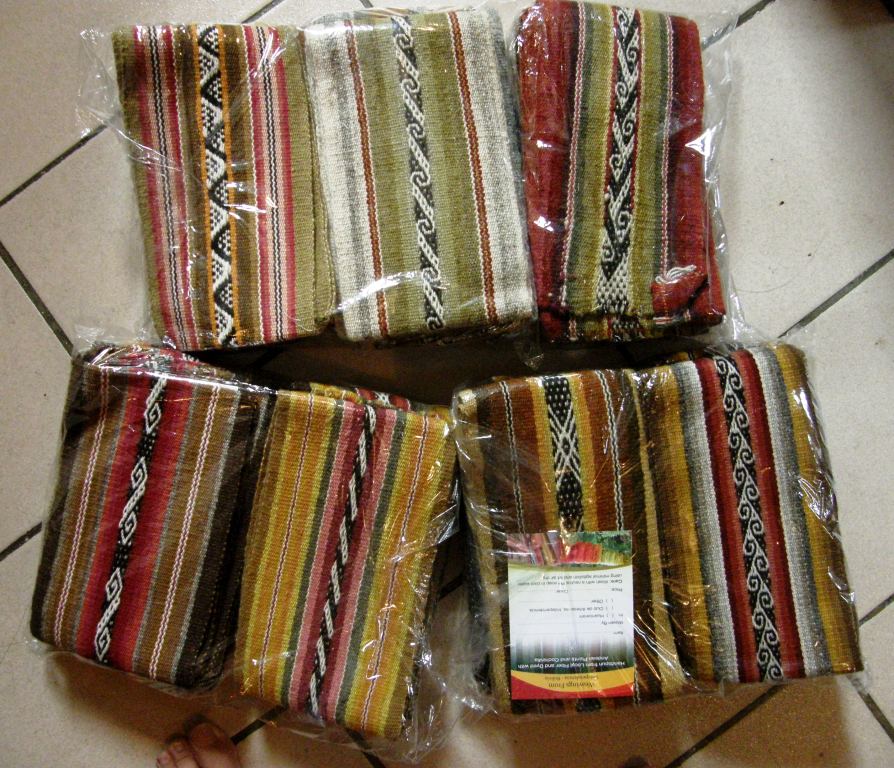
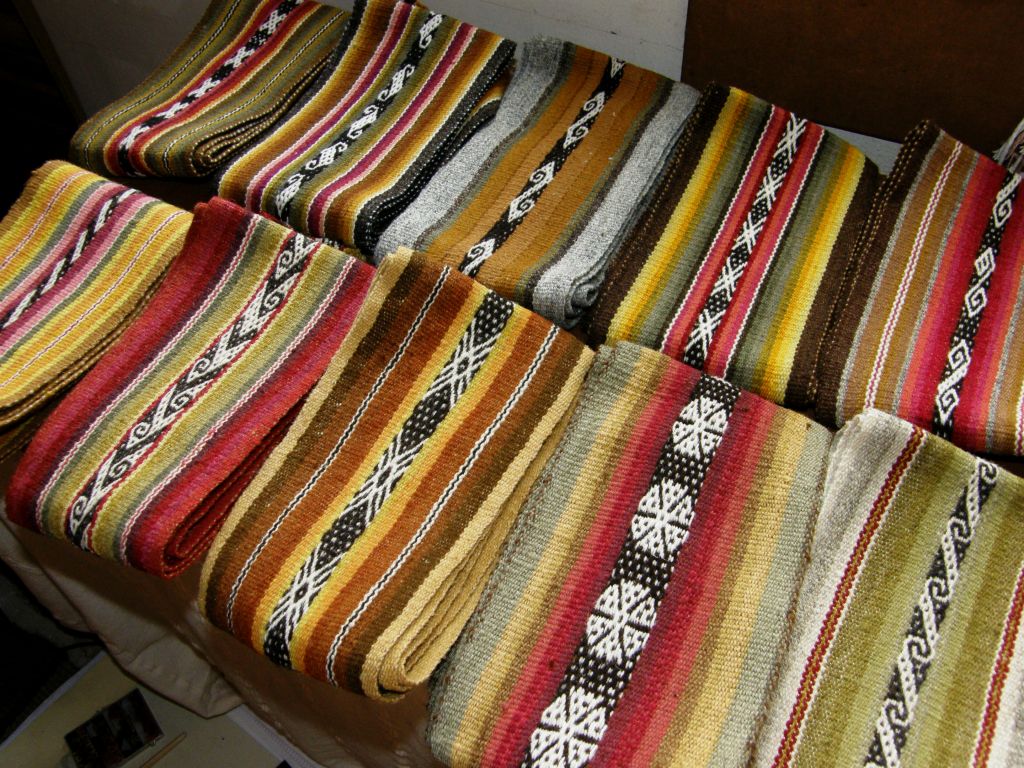
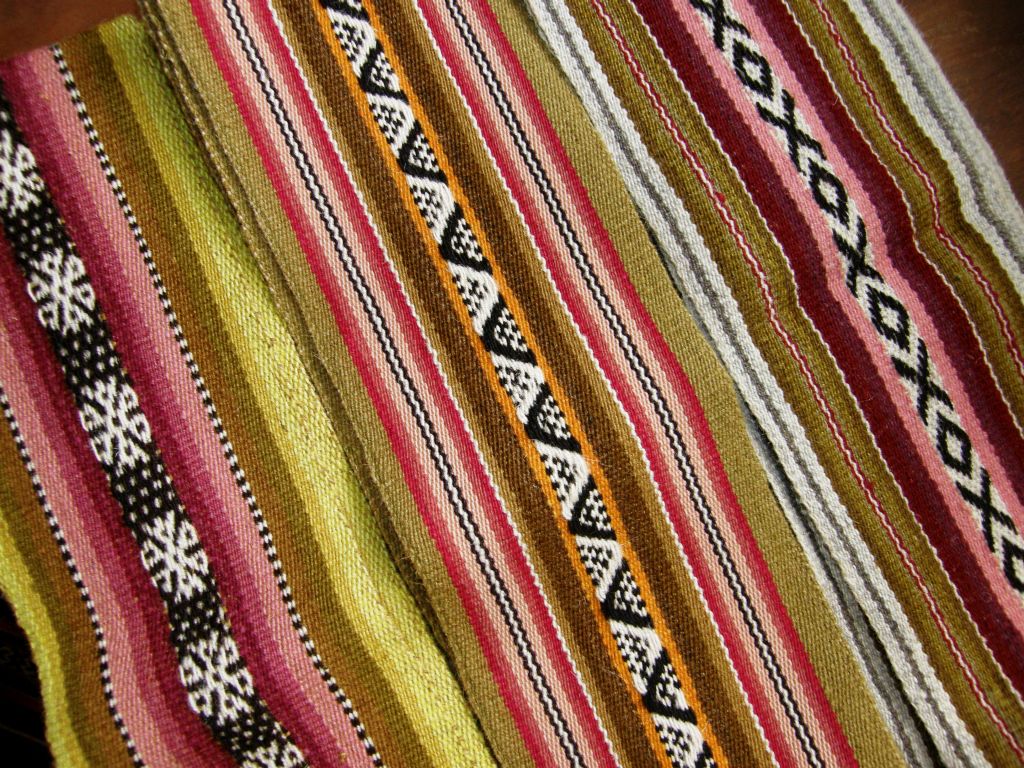
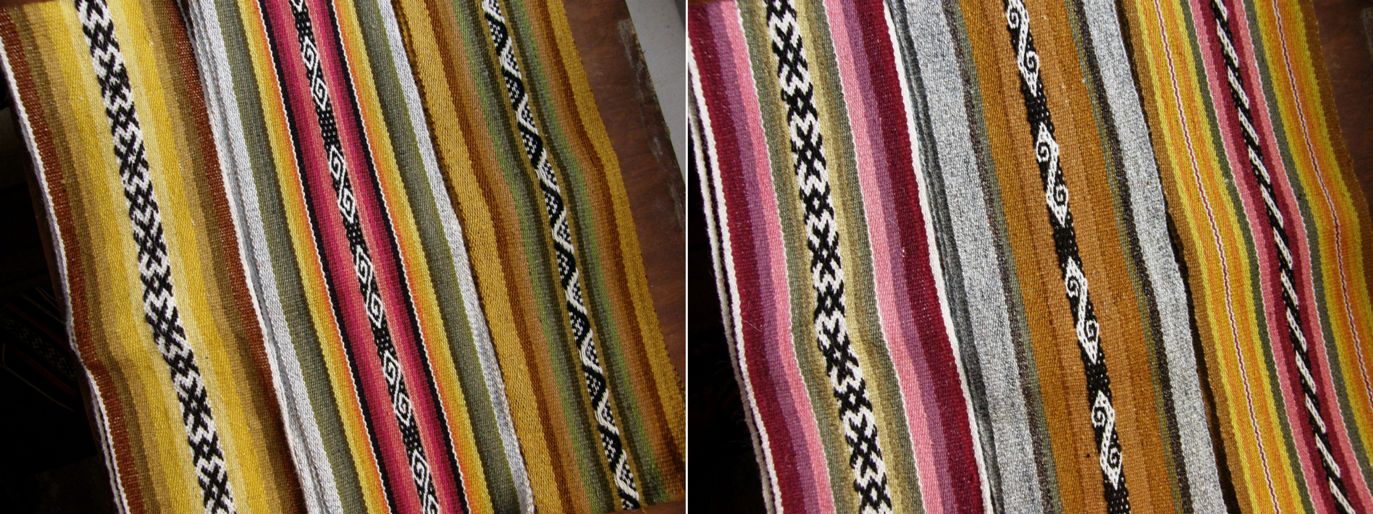
band from PAZA BoliviaGorgeous colors! Just what I need to lighten a dreary drizzly day in the tropics….warm colors of the highland countryside. This is one of the bands that I received recently from PAZA Bolivia. My weaving teacher, Maxima, heads the cooperative that weaves these bands on the traditional leaning vertical loom in Cochabamba, Bolivia. The weavers use their own handspun wool which has been colored with natural dyes.

If you are a regular reader of my blog, you will be used to seeing this annual event – the arrival of the Cochabamba fajas. You will have heard many times about my excitement at opening the box with its outpouring of colors and aromas of the Bolivian countryside.

PAZA BoliviaI mentioned to my friend Dorinda, who works with the weavers and helps to manage their sales, that this latest batch of bands was lacking the rich chocolate browns of previous collections I had received. I was surprised when she told me that those darker colors were obtained from khesi misa, or soot. 

What I wasn’t surprised to hear was that the ladies do not enjoy scraping off the build-up of soot on their kitchen walls to use in the dye pot. As you can imagine, it is mixed with grease from the hundreds of cooked meals and must be truly awful to work with. I don’t know what the cooking spaces look like in the communities where these weavers live but I can show you the kitchen of one of my teachers in another part of Bolivia to give you an idea. This is an old print from 1998.

kitchen candelariaOf course, it is so much nicer to be dyeing with leaves and flowers and cochineal bugs. Natural black can always provide the dark contrast and some of the greens that are obtained are quite dark too.

I have showed you pictures of Independencia and Huancarani where Maxima lives in other blog posts. At around 2600 meters above sea level (approx 8600 ft), it is very green and hilly. Pictures that Dorinda sends me or posts show the ladies working in pretty gardens amongst an abundance of plants and flowers.

grphuancarani

1 (1)The city of El Alto in La Paz, on the other hand, sits above 4000 meters (approx 13000 ft). It’s a different story up there on the Bolivian high plains – dry, flat and largely colorless. That’s why a recently finished project of several high apartment blocks in El Alto has attracted widespread attention. Bolivian artist Mamani Mamani, known for his use of color, (see an example of his work at left)was commissioned to design enormous  murals for the walls of the buildings.  I am hoping that the next time I fly to El Alto airport in La Paz, I will see these colorful images standing out against the dry and dusty plains. The following pictures of the project are from the webpage of Mistura Urbana

mamani-mamani-el-alto-la-paz-whipala-bolivia99

mamani-mamani-el-alto-la-paz-whipala-bolivia-1

More of Mamani Mamani’s work can be seen here.

In this next picture, you can really appreciate the bleak surroundings…

mamani-mamani-el-alto-la-paz-whipala-bolivia-9

mamani-mamani-el-alto-la-paz-whipala-bolivia6I became a little obsessed with the red, purple and gold that you can see in this last picture. Actually, the red-purple-gold ”thing” really started when I watched the movie The Grand Budapest Hotel for the second time last week. As it was a second viewing, my mind was freer to wander and take in more of the scenery and sets and the purple, red and gold kept calling to me…

This image released by Fox Searchlight shows Tom Wilkinson, Tony Revolori, center, and Owen Wilson, right, in "The Grand Budapest Hotel ." (AP Photo/Fox Searchlight)
This image released by Fox Searchlight shows Tom Wilkinson, Tony Revolori, center, and Owen Wilson, right, in “The Grand Budapest Hotel .” (AP Photo/Fox Searchlight)

It’s not like I haven’t used this combination before…

amulet bag backstrap weavingWhat looks rather blue in this picture is actually a dark purple. This is an amulet bag that I made many years ago when I was first practicing sewing and weaving tubular edgings. It was a cute little pouch with its cross-warp strap and pom poms. My friend DY has it hanging from the rear view mirror in her car.

Last week, I was about to start my next wool project and I had purple, gold and red wool…perfect. Well, not so much. The purple wasn’t deep enough, the gold was greenish and the red just wasn’t lipstick-y enough. I spent several days winding warp with these colors, adding and subtracting ends, re arranging ends, pulling things out and starting again before I gave up on trying to make the particular tones of red, purple and gold work. It was so hard for me to wipe that color combination from my mind and start anew.

So, this is what I have come up with. You can see that I really wanted to use the purple! It is one of two panels that will be connected with decorative stitching. I am creating the patterns with supplemental warp threads. There was one more thing that I wanted to change but I got to the point where I realized that this could go on forever! and so I just decided to get on with it and weave. The center stitching, which will run along the right hand edge, will be in the greenish gold and the edging around the two joined panels will be in purple. I hope that will balance it all out. And, I am very pleased that I remembered, despite all the warping chaos, to add a stripe at the inner edge to make placing the stitches easier.

wool panel with supplementary warp patterns backstrap weavingIn the meantime, my brown wool is on its way in the post so that I can create the outer edging for my first wool panel piece…

decortaive joining stitch on wool panels Something is going on with me and I am noticing color more. I am currently watching the series Parenthood for the first time on dvd. I see scenes with characters dressed in black seated on a butter-yellow couch in front of a dark green wall and all I can think of are the colors. Will we ever see a red-white-black piece from me again? Undoubtedly! I still have more hangings in that series that I want to create.

Now, it’s back to the loom for me and I will leave you with some final splashes of color…

cochabamba bands


Backstrap Weaving – The Boomerang Effect

I am supposed to be in Miami airport right now awaiting my flight back to Bolivia. I have had a wonderful month in Australia and it is time to go to my home (the real home in Bolivia).

Off I went to Sydney airport yesterday to get my flight to the US. I put on a brave face after sad goodbyes to family. But here I sit today back in my brother’s Sydney home…it’s a long story!!

Orange banksia give a warm glow to the bush in mid-winter.

The Boomerang Effect! It is common in Australia when lending someone something, to hand the item over while emphasising that it is “a boomerang”. That is to say, it is expected that the item will return to its owner in the same way that a properly thrown boomerang will.

Well, I am feeling rather boomerang-ish today having bounced from home to airport and back again.

Looking on the bright side, this unexpected turn of events means that I can spend more time with my nephew as well as write a blog post today.

It also means that I can go back to the Blue Mountains tomorrow for the gathering of weavers at Helen’s place in Springwood. Yay! All her floor loom weaving friends will be there in the morning for Show and Tell.. I wasn’t expecting to see any of these weavers again on his trip, yet here I am boomerang-ing back there!

I love the Blue Mountains! I got to spend even more time up there this last week exploring 4wd back roads and doing a bit of hiking through the beautiful Australian bush.

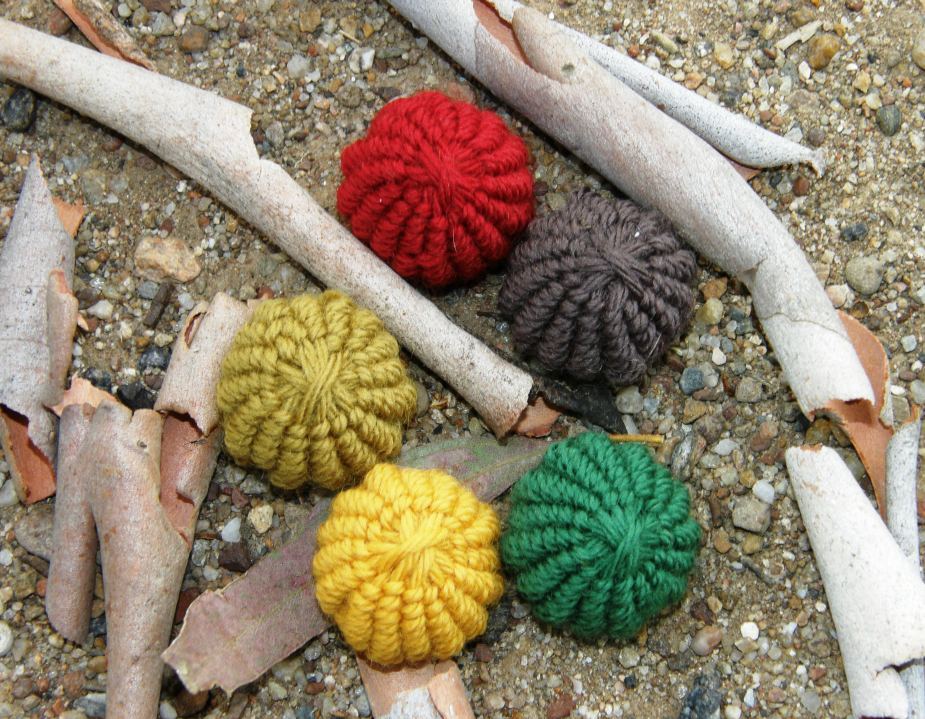
The banksias that we saw that day make me think of the little ridged baubles that I learned to make with a Guild friend the last time I was here in Sydney…

???????????????????????????????

We walked to lookouts with lovely over Lake Burragorang.

blue mountains sydney

Perched on the end of that rock, I felt like I was sitting in the tree tops…

bush walking in the blue mountainsThe real winter suddenly set in and it was cold!

Last weekend it was still warm enough to take things outside for a bit of warping. I had a group over to my brother’s home for two days of Andean Pebble Weave. We enjoyed the chance to stretch our legs in the fresh air while winding some more warps for sampling and designing.

warping for backsrap weaving sydney


Kelcie gets a new band started with palin pebble weave.
Kelcie gets a new band started with plain pebble weave.

fr-kyriakos-pebble-weaveThe group comprised Kelcie and Jen, who had woven with me last November, Pam, whom I have known online for years and who had come over from southern New Zealand (Sydney weather was relatively balmy for her!) and father Kyriakos who came up from the monastery in Bombala.

We wove together for two days.

Father Kyriakos, as you may know from having seen his work in previous blog posts, had more than just dabbled in Andean Pebble Weave and has been designing and weaving his own pebble weave patterns. I am so glad he came. We have been corresponding for some time and I really wanted to meet him as well as see his projects “in person”. He said that…While your videos have always been a big help and enabled me to do as much as I have so far, having personal demonstrations and answers to my own questions has already helped me to be more efficient and have more understanding of what this weaving is about.

Above,you can see his partly woven backstrap from a photo that he sent me some time ago. The design is one that Julia had created and father Kyriakos added his own elements to it at start and finish. He brought the finished piece along to Sydney to show along with narrower and samples and examples of his own “sotis” work of East Timor that he had studied on floor looms with Australian weaver Kay Faulkner.

???????????????????????????????Kelcie had brought examples of East Timorese weaving when we had woven together last year…

???????????????????????????????Father Kyriakos also brought a Latvian belt, woven using a supplemental-warp technique, that a friend had bought in Latvia and brought back for him. I have seen plenty of pictures of these but never one “in person”…

latvian beltJen brought in pieces that she had bought on a trip to Peru where she had studied tapestry techniques with Maximo Laura. This is a striking embroidered belt that had been made for the tourist market in Arequipa…

embroidered belt from arequipa peruI love the color ideas that these pieces give…I would never think to combine those colors!

Father Kyriakos has been working on and refining a kangaroo motif using the Andean Pebble Weave structure for some time. He also brought along his progress with that to share and I thought that it would make a nice project as a souvenir of my Australian vsit.
One of the tasks that I had set myself for this trip was to investigate the kind of cotton that is available in Sydney stores that would be suitable for warp-faced weaving on backstrap looms. I bought what is labeled as “4-ply” thread at Lincraft. I was told that the name 4-ply in Australia actually refers to the size of the thread rather than to the number of plied strands. In the USA any weight of yarn could comprise four plied strands. It’s a little confusing! I also bought 8-ply versions of this cotton thread at Spotlight and I will give report on this and other available thread in future blog posts.
So, here is the “Kyriakos Kangaroo” woven by me using the Lincraft 4-ply…

???????????????????????????????

barefoot warping for backstrap weavingFather Kyriakos says that he still has some refinements in mind. I played around a bit with the mountains under the kangaroo. They made me think of the southern highlands…the “Australian Alps”…where I had lived and worked for many years.Kangaroos could be spotted now and then on the drive up to the ski fields.

The Lincraft thread is not mercerized but is fairly tightly twisted. It will pill if the heddles are wrenched about and needs to be handled with care. I really like the way it feels. Lincraft has a pretty good range of colors on its shelves.

I set this band up in a very “barefoot” manner.I had already packed all my backstrap weaving gear away and did not feel like fishing out my warping stakes and loom bars.

I warped around my index finger and big toe as my Bolivan weaving teacher, Maxima, does. This is probably the widest thing I have warped this way and, as the threads piled up around my finger, I figured that I was bound to have some tension issues. As it turns out, I didn’t!

When it came time to weave,  you can see, I only got out my sword and used pencils for cross sticks and loom bars. A piece of string is my backstrap. The front beam is a pen onto which I attached rubber bands so that the “backstrap” would not slip off. It was pretty comfortable!

Normally, I would use heddles spread along a stick for a piece of this width but I chose to just tie them in a bunch rather than to search for more pencils.

barefoot backstrap weavingSomeone else who is getting into barefoot weaving is my student, Emerald. You may remember that I stayed with Emerald in her home in Ultimo a couple of weeks ago and wove with her. One of the things we did was the intermesh technique and, although she has a nice set up for backstrap weaving in her living room, she decided to try to include her entire body in the loom…

emerald backstrap weavingThere are chopsticks and a pencil in her set-up. She also finished off a short and narrow pebble weave band barefoot. This was an exercise in weaving without a chart.

emerald (2)In the meantime, in other parts of the world, Diane, one of the ladies who wove with me when I visited Yale university, was inspired enough to apply for a grant to go and weave in Guatemala during her summer break. My friend Barbara, who is in contact with her, sent me this picture of something Diane wove with her Guatemalan teachers…

diane yale guatemalan weavingCheryl, who wove with me last spring, is sampling for a camera strap project…
cheryl pebble weave backstrap


And now… a wee favor to ask of all of you. You may have noticed that I have sometimes mentioned my nephew here in past blog posts and the fact that he is a triathlete. I am staying with him now in Sydney and get to watch his rigorous training schedule. He is up and out and swimming laps or biking and then getting home before I can even get out of bed.

During the Ravellenic Games that ran alongside the Winter Olympics this year, I wove one of his favorite inspirational sports quotes into a silk bookmark for him..

??????????????????????I guess that I haven’t had much of a chance to be a big part of his life. After seeing him a few times in his very early months and years, I headed off to live in South America. I returned for a visit when he was 3 during which I watched Jurassic Park with him and he offered to sit by me in case I got scared. I didn’t see him again until he was 12. He wrote to me when he was 8 to ask me if I lived in a hut in the jungle. Fortunately, I visited Australia more often when he was in his teens and the internet kept us in good touch. He taught me to juggle and we did a great trip,  just the two of us, to Ayers Rock in 2006.

1531560_610507969021654_2085106992_nNow he is a traithlete studying to be a teacher (like me!) and will be representing Australia in the ITU World Championships in Weihai, China in September. He took part in ITU World Championships in the USA and Spain winning the silver medal in his age group in both. It was quite a blow when he was injured for the championships in France last year. So…he is going for gold this time…his last amateur event before turning pro.

His trip to China, as with all the other trips to the World Championships, must be self- funded and he is looking for sponsors. What I would ask you to do for me, as a big favor, please…. is simply to go over to Facebook and “like” his page. More “likes” will show potential sponsors  that he has the loyalty of a good-sized audience and could make all the difference.

I haven’t told him I am doing this and would love to surprise him with a small boost to his fan page tomorrow. I hope that you can take a moment to help out.

???????????????????????????????

And now to see if I can make it on a flight out soon….wish me luck!

Backstrap Weaving – Color fom the Cochabamba “campo”

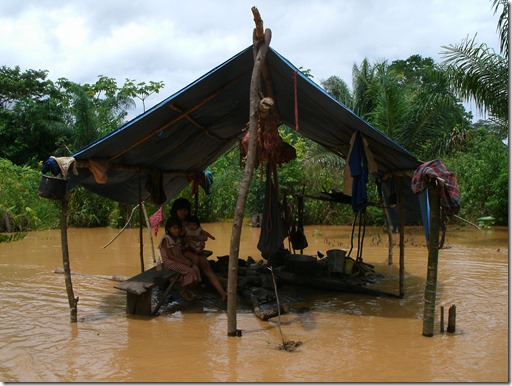
The big rains have more or less stopped here in Santa Cruz. We get a shower about twice a day. Each one has has me holding my breath. The outer wall of my bedroom has been hacked out so that it can dry out  and then be filled and repaired and made watertight, we hope. The huge wooden wall unit in my bedroom had one side on the point of collapse when the water soaked through. Now it is being supported by my large weaving sticks. Whine , whine, whine… a picture like this from this blog soon makes you stop. Such is the situation in the province of Beni in Bolivia. No walls at all and  sticks support the roof.

AguaYaku

I heard from my friend Dorinda up in the highlands in the province of Cochabamba, another of the effected areas, but she did not mention the rains and I am guessing that they are okay. Dorinda had written to let me know that she had mailed the box of woven bands that I had ordered from the weaving cooperative that my teacher Maxima heads. Dorinda blogs about her work with Maxima and the weavers of Huancarani at PAZA Bolivia.

Exciting! As the post office box I use is in someone else’s name, I had to be patient and wait for my treasure to be picked up.

packagedbands from CochabambaMy home is a disaster of warps, yarn and sticks right now. I really had to resist opening the packages straight away, unfolding the luscious bands, and laying them out to view on every available space. Dorinda included a list of the weavers and each band is tagged with the weaver’s name. She also sent me a document with a short story on each of the ladies. It so nice to handle one of the bands, look at the picture of the weaver and read her story.

Cochabamba bands in boxOnce I had put things in order, two days later, I opened the packages and  released all those lovely aromas of wool, dyestuffs, and “campo”.

I like to feel the cloth. The yarn is the weavers’ own handspun, most often made with fleece from their own flocks. The colors are all natural and were created from cochineal and local plants.

Which weaver would be considered the best amongst her peers, I wonder. Whose cloth is the stiffest? This seems to be one of the things that the weavers themselves appreciate. I wonder which pattern they would consider the most complex. What different effects did they achieve in their use of warp and weft colors? Who matched the weft color to the edge color and who used a contrast color to create attractive little dots along the edge? Whose color combination was vastly different to everyone else’s?

Did they all get together and decide not to duplicate the patterns or was that just a happy coincidence? Were any made by the teenagers who are still in training?

Without unfolding them, I picked out two which I considered my favorites. I was happy to see that one of the two had been woven my Maxima. I wondered if I had simply recognized her style.

Fifteen different weavers had made the bands with no repetition of color arrangement and just two patterns duplicated. The width of the stripes of color ,and the narrow strips of threaded-in pattern that sometimes separate them, was in a form that was often repeated and could be characteristic of certain communities or even families.

???????????????????????????????Seventeen bands were patterned with complementary-warp designs and three used a supplementary-warp structure.

The weavers used a complementary-warp structure to create the patterns on these bands.
One of the bands with pattern created with supplementary warps is on the right.
The band on the right is one of those which was patterned with supplementary warps.

The second of the two bands that I had picked out as favorites was made by Narciza, Maxima’s older sister. I just love Narciza’s color combinations. Below you can see her adding a tubular border to one of her woven pieces. As is done in Peru, she uses a forked stick to hold the cross for this particular type of patterned tubular band. Strangely, younger sister Maxima never learned to weave this kind of tubular band with its distinctive eye pattern and only recently learned it at the Tinkuy in Cusco last year.

Narciza Cortez

DioniciaDionicia Crespo is the oldest weaver in Hauncarani still weaving to sell at 82 years old!

Of course, her fading eyesight plays a role in the straightness of her edges, Dorinda tells me.

She doesn’t have glasses. Somebody told me the women are embarrassed to try out reading glasses because glasses are associated with education and the Huancarani weavers are illiterate (Dorinda)

Her edges look good to me!

You can see her at left preparing her frame for warping.

???????????????????????????????

advianaBands that represent three stages of life….you can see 82-year old  Dionicia’s band above on the left. A piece by Vilma, Maxima’s eldest daughter, is in the middle and the band created by the youngest weaver of this collection of bands, 18-year old Adviana, is on the right.

Dorinda tells me that Adviana is one of the few of the younger generation who has learned how to weave. 

When she began weaving to sell through PAZA she relied on her grandmother´s assistance, but now weaves on her own. (Dorinda)

???????????????????????????????Family traits? The band on the left is Maxima’s, daughter Vilma’s is in the middle and older sister Narciza’s is on the right.

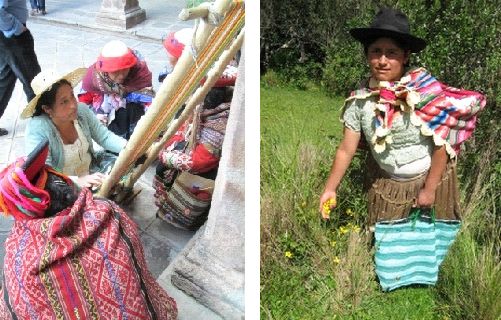
Mxima demonstrating at Tinkuy 2013 and daughter Vilma collecting flowers for the dyepot.
Maxima demonstrating at Tinkuy 2013 and daughter Vilma collecting flowers for the dyepot.

A couple more pictures to finish before I put the bands back in their box….

Cochabamba bands 1

Cochabamba bands 2Enough color? Let me calm things down a bit now with some black and white.

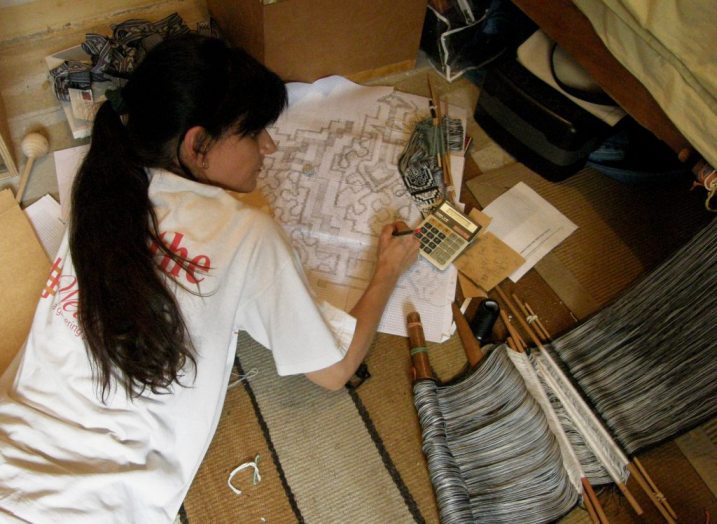
A question was asked in one of the forums this week about what kind of weaving software people use. There are still quite a lot of good old fashioned paper-and-pencil people around amongst those who were excitedly discussing all the ins and outs of the various available programs.

charting for backstrap weaving

black panel for all hanging backstrap weavingMe? I am a paper-and-pencil gal. That’s the new panel for the wall hanging over which I have been dithering. I love charting this way. It makes me feel like a kid again and it is very relaxing. While a young fellow dangled from a cage outside my window and hacked away at my wall, I calmy colored in cells on my graph paper. Prior to that, I had just as calmly sat and  made four sets of string heddles of 353 ends each on that black and white cotton warp.

If you are thinking that that is a weird-looking pattern, you are right! I really have no idea what this will end up looking like even after sampling! I just need to dive in and do it. I fussed over it more than usual….measuring, shifting things about, uncrossing warps, measuring again and finally got the first weft shot in. That always feels good. I am weaving this in double weave. It is embedded double weave as there is a very narrow plain-weave border on either side.

???????????????????????????????I finished the silk bookmark that was part of the Ravelry event but I am calling it a sample for now. There are several things about it with which I am not pleased and, as I have plenty of warp left, I will start it again with improvements.

The silk is lovely to work with! Using the four sets of string heddles and a pick-up stick I never have to actually touch the threads. I worked with this same silk as supplementary weft last summer and it was horrid to handle with sweaty hands.

The bookmark is light and supple…just the right thickness to slip between pages. I am pleased with all that. Now to fix that other stuff that I don’t like as much.

While on the subject of double weave, Scott has allowed me to show pictures that he posted of his double-weave sample band. He is studying the one-weft version from my tutorial here and has done a really good job.

scott double weaveRavelry projects have been coming in as we approach the end of the Sochi Games…

kim's bagKim finished her piece and sewed int a small bag for which she also wove a strap. Now she is on the lookout for a button to close it.

joyful and juliaJoyful has been converting her flowere doodles into patterns using embroidery floss as supplementary weft on her plain-weave band. Julia will use purple cloth with her finished piece along with her sewing talents to create something useful.

Another week comes to a close.  I try and mix it up…a little warping, a little charting, a little weaving for myself. I hope to make some good progress on the wall hanging this coming week.

Bye for now.