Backstrap Weaving – Show and Tell

Show and Tell and tell and tell…get the word out, spread the obsession. It is exciting to be all the way over here in Australia and run across this…
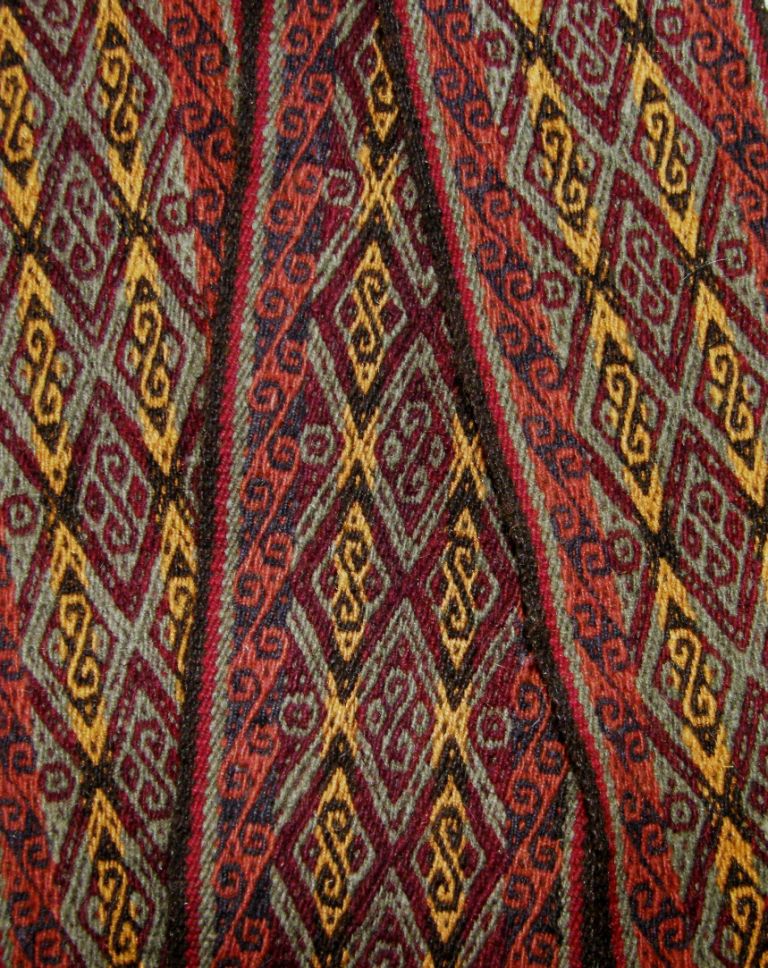
??????????????????????The Center for Traditonal Textiles in Cusco (CTTC) reaches across the world, showing and telling, promoting and sustaining the work of  weavers on simple looms in remote communities of highland Peru. This piece was bought from founder Nilda Callañaupa herself when she visited Bothwell, Tasmania in 2007. One of the people who came to weave with me a few weeks ago here in Sydney had been to Peru and came with  bags and pieces still on the loom with those distinctive Chinchero patterns woven with handspun naturally dyed yarn. One of the other ladies immediately picked up her smartphone and started searching for the site from which she could buy these items. Show and Tell…spread the word!

From the CTTC's Facebook page
From the CTTC’s Facebook page

One of the greatest Show and Tell events in my world of weaving was held last month in Cusco. The CTTC hosted its second Tinkuy de Tejedores, a gathering of weavers from across the Americas and even from as far away as Asia.

I couldn’t go this time but have heard a few reports from friends.

Dorinda, who works with weavers in Cochabamba, Bolivia went with one of my weaving teachers, Maxima. Maxima took workshops and learned three new figures in a backstrap weaving class as well as the ñawi awapa edging. It was something she had been wanting to learn for years. Her sister knew how to do it but I guess she hasn’t been nearby to teach it to Maxima. Finally, the curiosity has been satisfied and I look forward to seeing Maxima put it to use.

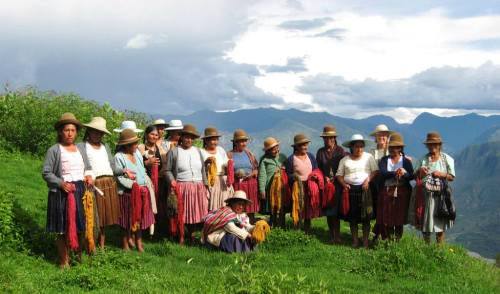
Maxima and a group of Bolivian weavers at Tinkuy 2010

Dorinda’s PAZA website is currently down but she tells me that she has four blog posts prepared with details of the trip ready to go up once the problem is fixed.

???????????????????????????????Who doesn’t like Show and Tell? In the guild meetings that I have attended so far in the US and Australia, this has always been my favorite part. I am a member of several online weaving groups and we do our share of show and tell on a daily basis. Some of the larger groups, like Warped Weavers on Ravelry, can have dozens of projects presented in a single day. There is always something to learn. But, of course there is nothing like being able to actually handle the fabrics and yarns and listen to the weavers and spinners’ enthusiastic descriptions and explanations.

I spent a nice Saturday  in the lower Blue Mountains last Saturday at the home of weaver Helen (author of the electronic newsletter, Weavers Forum). Helen has a nice group of about fifteen mountain weavers and spinners who regularly meet at her home for fiber talk, lots of laughter, occasional workshops and, of course, show and tell. That’s yet another reason for me to consider settling in the mountains should I ever come back to Australia to live permanently….the aromas and colors of the bush, the bird song, the cicadas, the coolness,….and a lovely community of weavers!

Lorette with knotted pile on backstrap loomLorette brought along a backstrap loom that she and a few friends had put together some years ago with its unfinished project. Just when I am taking home tools for knotted pile weaving and wondering if I am mad to be thinking about doing it on a backstrap loom, along comes Lorette with her Show and Tell. She showed me that yes, it is do-able and that she was able to produce nice firm and well beaten rows of cut pile. I wonder if she has found the inspiration to finish this project now.

I was happy to receive the most beautiful gift from Helen as I left after a fun day spent with her weaving friends…

??????????????????????My camera has somewhat softened the pretty tones of green in this scarf but I hope that it gives you an idea of its wonderful flowing liquid silkiness. This was made by Helen in an advancing twill structure. This was Show and Tell and  I got to keep it! It is just the kind of light weight scarf that I can really use. Beautiful!

??????????????????????Yesterday I went out to Dace’s home. Dace had invited me to her home for a morning of dyeing.

The Mission: take home cotton yarn that had been dyed with native Australian plants.

I would like to weave something that represents my trip and this seemed like a good way to start. Fortunately, I had taught myself from an experience many years ago that cotton and wool take color very differently. I had been wooed by the sight of the most amazing shade of orange that Dace had achieved when dyeing wool with leaves from a certain kind of eucalyptus (see left). I knew not to expect anything like this kind of intensity from cotton.

Two of the ladies at the gathering at Helen’s house advised me to mordant my thread with diluted soy milk which I did. Dace’s home filled with the gorgeous aroma of eucalyptus as the pots boiled on the stove. It drove her husband and cat away for the day! You can see the tree from which Dace took leaves and bark below right. She told me that it is one of the “box” varieties of eucalypt.

eucalyptus for dyeingAs the pots, one with bark and the other with  leaves boiled away, we did a lot of Show and Tell. Dace showed me some yarn that she dyed with the same variety of eucalypt…

spun yarn by daceAgain, that gorgeous orange! And again I reminded myself that I was not expect anything like that result. Still, I couldn’t help hoping…
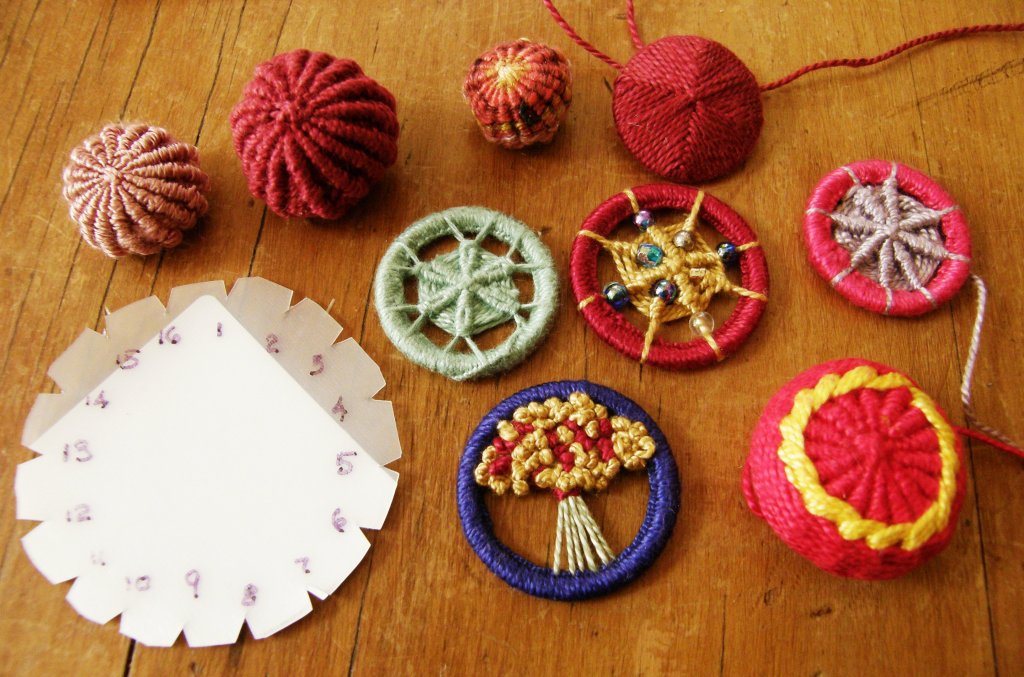
??????????????????????This was another fascinating piece of Show and Tell. Dace had taken the NSW guild’s summer school class lat January on buttons and produced all these over the course of four days. I was especially interested in the ball-like buttons upper left which so resembled the little coil stitch pom-poms that Bolivian weavers sometimes have dangling form their ch’uspas, coca leaf bags. Dace gave me enough information to be able to come home and make one…fun! The Bolivian pom poms can be made in multiple colors whereas these ball-like buttons cannot.

???????????????????????????????There you can see my button (made with wool) nestled between my dyed skeins. The skens on the left came from the leaf pot and the other from the bark. Okay, so they are not the most brilliant tones in the world but…mission accomplished. I have cotton dyed with native Australian plant material. And I will take home the happy smells of the Austraian bush which have not faded after rinsing. Dace told me to use vinegar with the rinse but I didn’t, not wanting to lose the eucalyptus smell.

Those buttons! I am on a road trip to Canberra tomorrow to watch my nephew compete in a triathlon. Guess what I’ll be doing in the car and probably during the race!

Dace is Latvian and, while talking about both our backgrounds, she came out with some Latvian bands that she had bought on a trip to her homeland in 2011. These are all woven with supplemental warps (and now I realize that we are probably not looking at the “good” face of the one on the left).

??????????????????????I love the simple border on the third band from the left…so simple and so very effective.
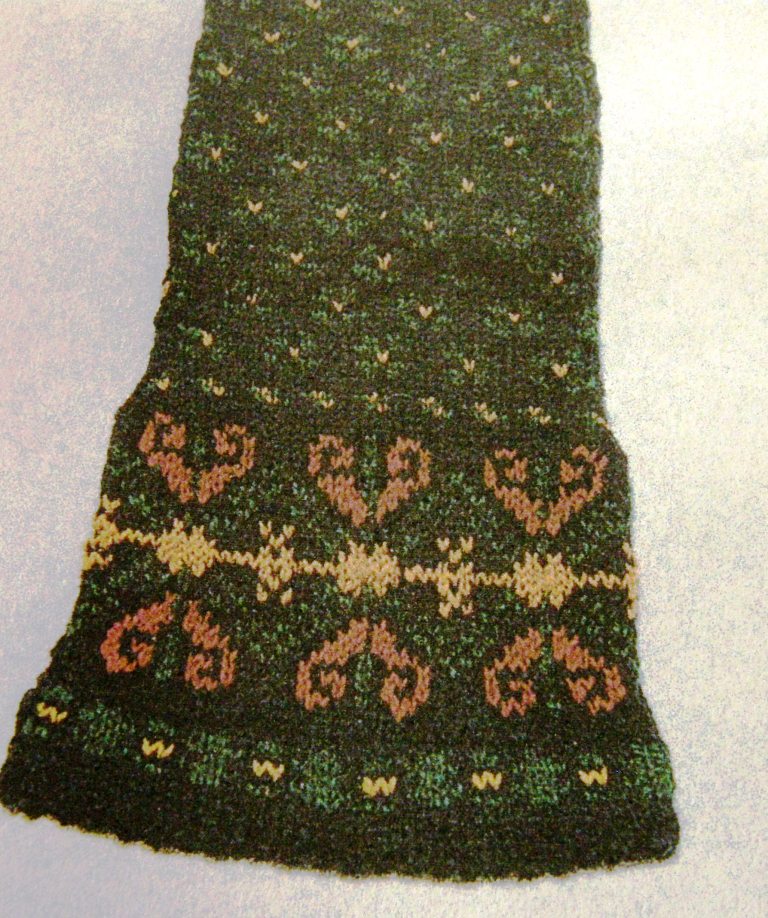
Latvian mitten patternDace showed me pictures of Latvian mittens and I loved this one with its hook design…a hook and its reflection…so like a classic Andean weaving motif which I am sure that many of you will recognize.

Speaking of Latvian bands, I  made contact online with Sanita who very recently started a blog on Latvian band weaving. She is slowly constructing it and it promises to be very informative. So far, she has included pictures of bands with pick-up patterns using supplemental warps as well as (and this make me very excited) those which have used what I call the Andean Pebble Weave structure.

Sanita confirmed the stucture by sending me charts of some of the patterns. I think I am edging a little closer to finding an answer to my questions about the use of this structure in the belts of the Russian Old Believers.

Keep an eye on Sanita’s site.

Well, I am off to make some more button/pom poms and can’t wait to have some dangling from my next woven pouch. I miss my loom and my big weaving…this is the next best thing until I get back to Bolivia.

knitted hat with south american birdSpeaking of pom poms, I will leave you with one last picture. I uncovered a relic from my past while going through boxes of “stuff” here in Australia. This is possibly the only surviving piece from the little knitting machine endeavor I had in my early 20s. I used to make hats and headbands by the dozens for skiers. It seems like I might have been trying to use up odds and ends of left over colors in this one! The thing that I like is the little South American-like bird motif that I chose to include. I have no idea about the origin of that motif but I think it is fun to see that many many years before South America and weaving became a part of my life, I had a definite interest in these kinds of patterns.

See you next week! (possibly from Bolivia)

Backstrap Weaving – The Stories Within the Cloth

I am all packed and I  leave tomorrow which leaves me with a day to wander around in circles and wonder about what I have forgotten. So, before I drive myself crazy, I think I should sit down and write a blog post.

Late last week I picked up from the post office a box of ten fajas, belts, that I had ordered from Maxima and the weavers in the communities in and around Independencia in Cochabamba. (All photos of the weavers except for the first one, are taken from the PAZA webpage with the kind permission of Dorinda Dutcher).

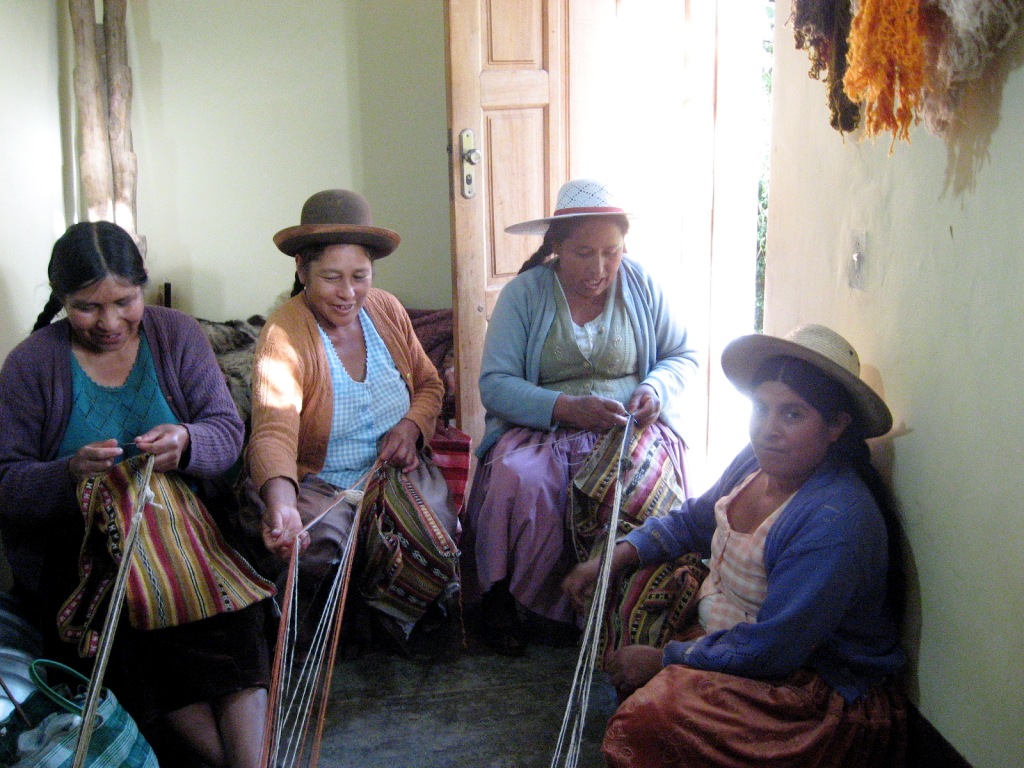
??????????????????????These are the ladies with whom American Dorinda Dutcher has been working for years, helping them to recover and pass on their spinning, dyeing and weaving skills and market their woven goods. If you follow my blog, you will have seen pictures of and heard stories about Maxima Cortez, one of the women with whom Dorinda has most closely worked. She is the coordinator of the various Handicraft Group activities. Maxima is one of my weaving teachers and was my roommate at the Tinkuy in Peru.

Maxima, daughter Soraida and granddaughter Nilda were my weaving companions for my three-day stay in Cochabamba.

???????????????????????????????

CdCWeave

???????????????????????????????
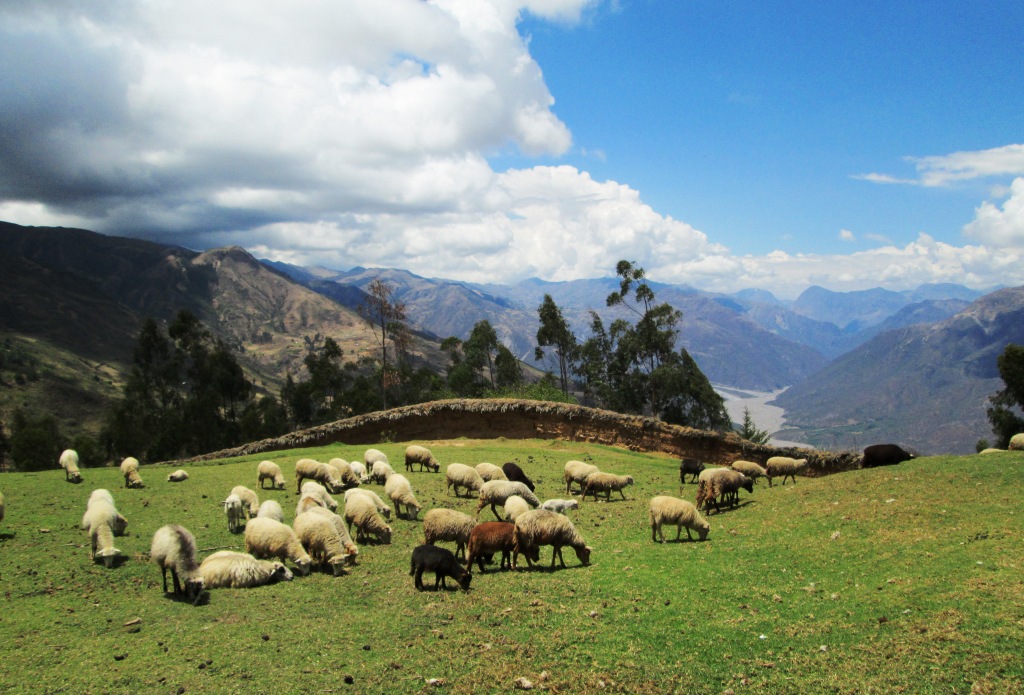
The flock belonging to Casimira, one of the spinners and weavers who made the bands in my order.

I opened the box of  fajas and saw the two colorful packages of neatly folded and stacked bands each with a label detailing the name of the weaver and her community.

It was such a happy sight but, what really hit me, was that wonderful aroma of wool mixed with the various smells of the natural dye substances that are used to create the colors.

It was such a strong fragrance that my cat immediately awoke and had to come over to roll in the bands.

And then there were the textures. Each weaver and spinner has their own style and beat and the bands varied from those that were smooth and taut to those which had more dimension and drape.

???????????????????????????????I counted eight different tones from cochineal dye and even more shades of green and then closer inspection helped me to see which ones were most likely made by the younger members of the communities…the ones where the weaver jumped a little erratically from pattern to pattern spoke of a youngster who was keen to try out her entire newly acquired repertoire in the one piece.

Perhaps the ones that have some little flaws are from the youngsters too or maybe they are from mothers who were distracted for a moment by one of their little ones.

Each one tells a story and it is strange sitting here in this tropical heat and imagining the sounds of the looms, the cool green slopes and valleys and music of the highland region in which they were made.

grphuancarani

Dorinda shared some pictures and a little information about each and every weaver with me. Here are just a few…

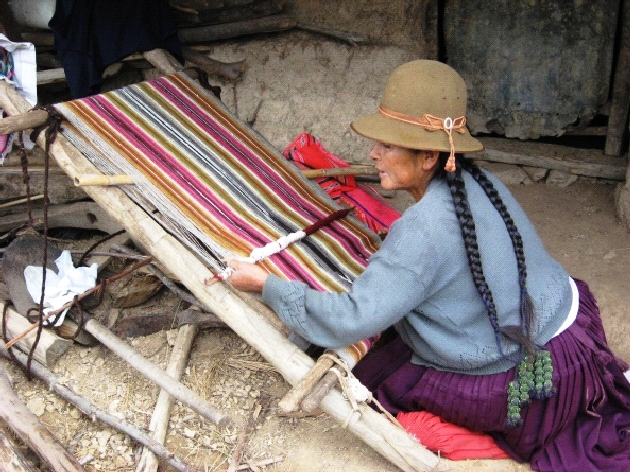
Here is Casimira Calcina working on the leaning verticalloom which is typical of the region. She lives in the rural community of Huancarani. Being widowed and with her children having migrated, she works hard alone to run her farm and tend her flock.
Here is Casimira Calcina working on the leaning vertical loom which is typical of the region. She lives in the rural community of Huancarani. Being widowed and with her children having migrated, she works hard alone to run her farm and tend her flock.
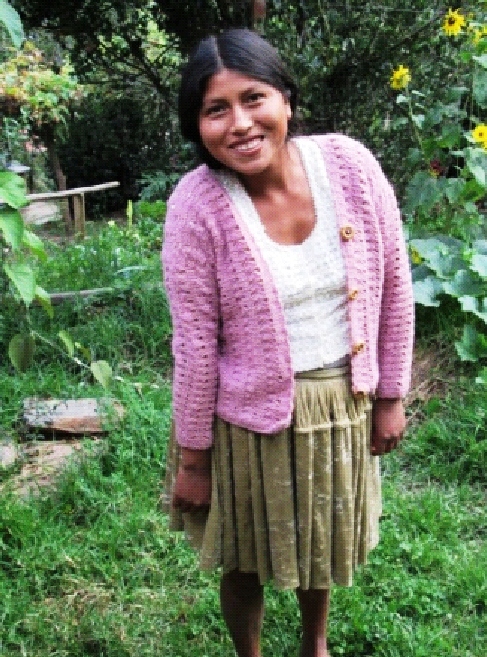
Adviana Vargas is 18 and still considered a "chica". Howevere, she weaves with the women's group as she lives with teh father of her 16-month old son and is expecting another child. She is showing the cardigan that she made after a visting volunteer opened up the mystery of the patterns and instructions in magazines that had been in the group's possession for years. Unitl then no onehad had the skills to read and interpret them.
Adviana Vargas is 18 and still considered a “chica”. However, she weaves with the  adult group as she lives with the father of her 16-month old son and is expecting another child. She is wearing the cardigan that she made after a visiting volunteer opened up the mystery of the patterns and instructions in magazines that had been in the group’s possession for years. Until then no one had had the skills to read and interpret them.
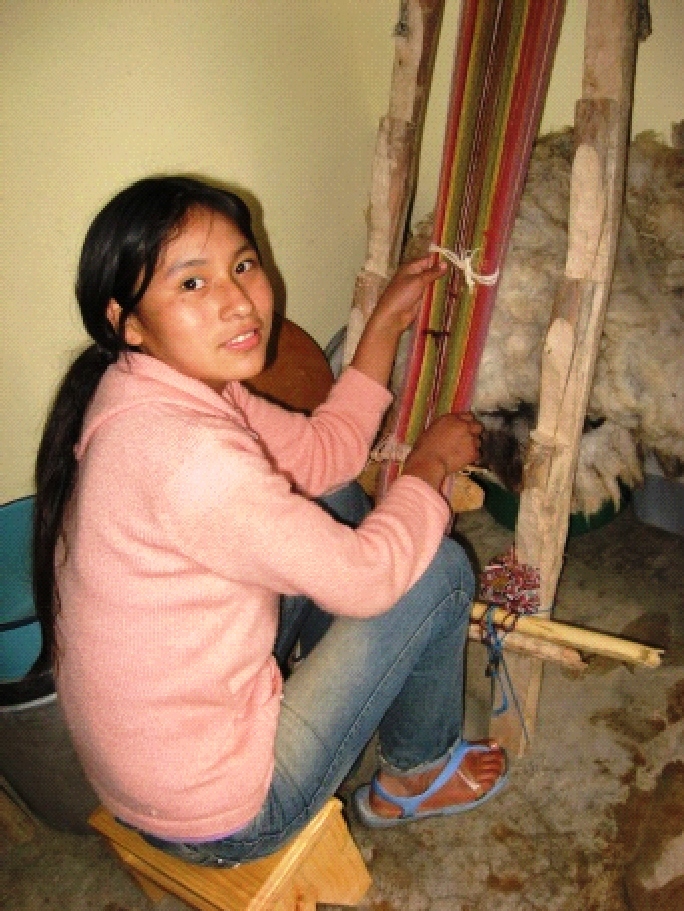
Gabriela Zenteno is 16 and has been part of the Handcraft Club since it began in 2010. She learned to weave from maxima with additonal help from her mother. Because the family lives in town instead of on the farn and Gaby goes to school, she did not learn to spin and weave at her mother's side which is integrated into the ancient farmer subsistence lifestyle.
Gabriela Zenteno is 16 and has been part of the Handicraft Club since it began in 2010. She learned to weave from Maxima with additional help from her mother. Because the family lives in town, instead of on the farm, and Gaby goes to school, she did not learn to spin and weave at her mother’s side which is integrated into the ancient farmer subsistence lifestyle.

Some of the bands were finished with four selvedges and I regretted not having told Dorinda when I ordered that I didn’t need that fourth selvedge. I know the work that is involved in that but, as my teacher Yanet from Pitumarca told us, the four-selvedge finish is “normal” for them. Some of the bands had been cut and then hand sewn to protect the edge.

terminal area supp warpMost had pebble-weave designs and I was delighted to see that two had patterns made with supplementary warps.

What was very interesting for me was noting that the way the women set up their warps to weave pebble weave varies even among communities that are relatively close together. This information is contained in the “termination” area of the band…the part where, on a four-selvedge piece, the weaver no longer has room to do pick-up and simply uses her two basic sheds to finish. There you can see the order of the colored threads in the two sheds.

You can see the termination area of one of the bands which has been patterned with supplementary warps at left.

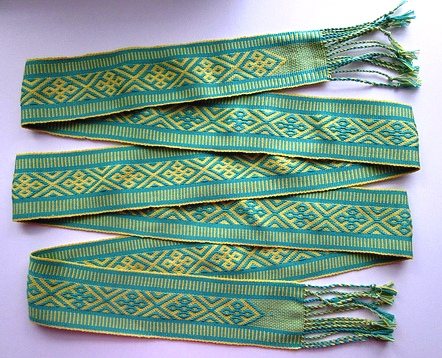
And, happily, among these bands I found my inspiration for the Year of the Snake Weave-along that Ghedrain proposed in the Ravelry Backstrap Weaving Group. The official start of the Weave-along (WAL) was last Friday March 1 but people are free to join in at any time. I expected to be a cheer leader and “Chief Sticky Beak” as I will be on the road as from tomorrow but, with this sudden source of  snaky inspiration, I warped up a narrow band to take with me which you can see on the left with its wooly backstrap.
??????????????????????

supplementary weft project for on the road

The other project that I am taking is a band using left over Guatemalan cotton from my recent scarf project. I plan to weave in some patterns with supplementary weft and am happy that the collection of spools of silk weighs very little. To tell the truth, I will be surprised if I actually find time to work on these but I really would like to participate in the WAL.

You may remember the lovely pick-up sticks that I brought back from Guatemala which I use on these supplementary-weft projects. Fortunately, I bought two as I was careless with my packing and the very tip of one broke in my luggage on the way home. It’s still useable but not as nice to work with as the other one.

The good news is that Terri from MagicalMoons is now making  pick-up sticks that would work beautifully for supplementary-weft patterning and they look gorgeous. Below, you can see my Guatemalan ones. The one on the left is the slighty damaged one.

Guatemalan pick up sticks

And here is one from Magical Moons made from Nicaraguan rosewood…

magical moons pick up stick rotated

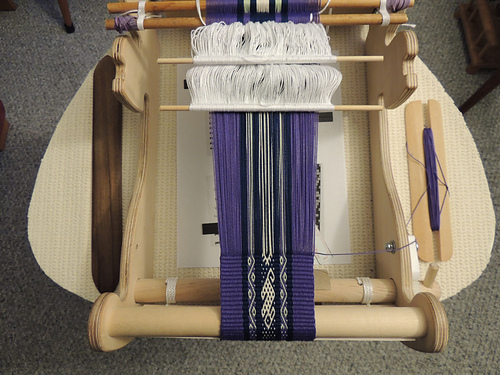
So, the Year of the Snake WAL is underway on Ravelry. Meanwhile, I have some  projects from Ravelry members to show you. This one is from Backstrap Group member CindyQ who has mounted her warp to weave a band with pebble-weave patterns on the frame of her rigid heddle loom. She is using the two-heddle method that I was taught by my Ayacucho weaving teachers which I explain in my first book Andean Pebble Weave….great-looking heddles and lovely weaving!

cindyq

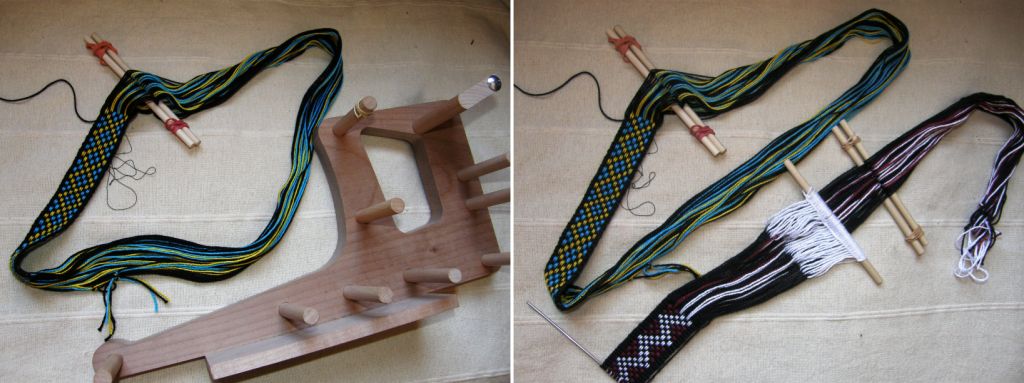
The second project is from Kara and was posted in the Warped Weavers group. You may remember that I posted a long time ago the following picture of some interlaced bands woven on an inkle loom by Yonat…

Yonat inkle bandsIt was such an eye-catching display that I decided to put something similar together myself with the odds and ends of sample bands that I wove for my second book…

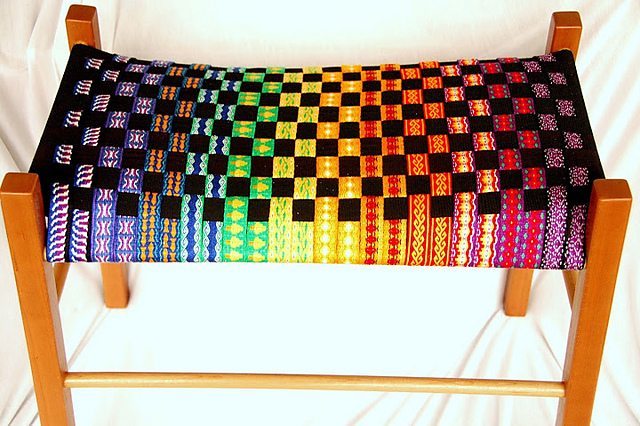
???????????????????????????????Now, back to Kara…she interlaced bands that she made especially for a project…a cover for the seat of her weaving bench. So, she has put together bands made on an inkle loom and with tablets to make not only a stunning display of her work, but also something wonderfully practical….

kara (1)

All those bright bands interlaced with black….WOW! Go gather up your bands now and start planning!! I can see pillow covers and other wonderful things using this idea!

Here is a picture of one of her bands in progress…

kara (3)

Enough inspiration?!


Backstrap Weaving – New Challenges: Wider, Longer, Finer.

While doing some house keeping in my album of weavings on Facebook, I came across a picture I took of the first red, black and white wall hanging I made entitled “Starry Night”. My caption read that I was weaving this in order to push myself beyond my current width comfort zone. That was a nice reminder as I am now on the third piece of similar width in this series and I have to say that I feel very comfortable with this width now! Seems that I need to go wider.

The first two pieces in the wall hanging series
The first two pieces in the wall hanging series.

Here is where I stand with piece number three. That snake continues to slither its way up the cloth.

O

The pick-up is a piece of cake now…really! There’s nothing like repetition to firmly embed a design in your head and fingers. It began with lots of tedious chart reading which was made a lot easier with the use of removable highlighter tape. Then I played a favorite game…read the cloth and guess what comes next. Then, before passing the weft, sneak a peek at the chart to see if you are correct. Next comes reading the cloth, deciding what comes next and going for it. Beat, pass the weft and then look at the cloth, not at the chart, to see if you were correct. Eventually you reach that chart-free happy place.

But then….you finish the weaving, you start something entirely new with a totally different structure and the fun begins again!

As for going wider….there are still quite a few more pieces I want to make in this current series, but when I do get to the point when I am ready to break out of the old comfort zone, I will need some new equipment…longer loom bars for a start. I already have some pretty long swords.  I would also love to have the kind of backstrap that some of the weavers in Peru use.

Chiclayo and Santiago Atitlan

With its two sets of straps, it was designed to accommodate different widths of weaving.

And, I would like to weave longer pieces. The scarf that I recently made had me extended to the limits of my weaving space. I rolled up part of the warp at the far loom bar but I really prefer to have the warp unrolled at full stretch.

backstrap warp for scarf project

There was just enough space to put my cushion and sit with my back against the closet door. So, if I am to go longer, it is a simple matter of using a circular warp. I have woven on these kinds of warps on a few occasions. Anyone who does inkle weaving certainly knows about circular warps.

circular-and-single-plane-warps

The pictures above show a band on which I was working on my inkle loom. The warp is a complete circle. The black band next to it has been warped in a single plane in the same way as the long black scarf warp. Once weaving is finished, the circular warp is cut apart and the band can be extended to its full length.

The Montagnard weavers with whom I studied use circular warps for their long blanket and skirt panels.

montagnard weaver opening heddle shedYou can see Ju Nie above weaving the top part of her circular warp.

Probably the most time I spent weaving on a circular warp was when I learned to weave the typical belt of Salasaca, Ecuador. My teacher, Felipe, wove on his narrow front porch and his way of setting up a circular warp allowed him to sit and weave the very long belt even in that small space.

dovetail warp Salasaca Ecuador

Felipe’s belt will not have to be cut once the weaving is finished. He has warped in what is known as “dovetail”  fashion.

dovetail warp set-up

The following diagram will show you how he is using five of the six sticks you can see in the above picture to wind the warp for the white ground weave. The stick marked with the red arrow is the one around which the warps “dovetail”. When weaving is finished, the stick will be removed and the belt can be opened out. You can see the dovetail stick in the photo of Felipe weaving. It is in the section of  band that lies along the porch post.

dovetail warping path

And, if you are wondering about the sixth stick…that stick is used to hold the colored supplementary warps. Salasacan belts are woven in a supplementary-warp technique.

my salasaca belt

The diagram above shows the path of the white warps in the ground weave. The following diagram shows the path of the colored supplementary warps. In Salasaca, the supplementary warps all go together in a heddle of their own rather than being split between the two ground weave sheds.

dovetail warp path 2

angela-and-hammock-loomYou can see that when the dovetail stick or cord is removed, the end loops of the warp will stay intact. The loops can be very useful for finishing the woven item.

Guaraní hammock weavers here in Santa Cruz use the dovetail warping method and use the intact end loops for attaching the cords from which the hammock will be suspended.

So, longer warps are on the drawing board for me which will mean building a new warping board or modifying my existing ones.

I would really like to have a set-up like Felipe’s. Too bad I don’t have a porch on which to sit (and, yes, the view was lovely from there). I have seen pictures and videos of many Asian weavers with similar “triangular” set-ups. I will have to see into which wall I can drill holes in a place where I can still get good light! The idea of raising my bed way up high to give myself more space is gaining more and more merit.

The third challenge is to use finer yarn and I am already in training for that with my scarf projects made from Guatemalan cotton. I have a ball of fabulous indigo-dyed silk that an English teaching colleague brought back for me from Japan years ago. It is heavier than the 60/2 silk that I have been using as supplementary weft and I think that it is a good weight for a first large silk weaving experiment.

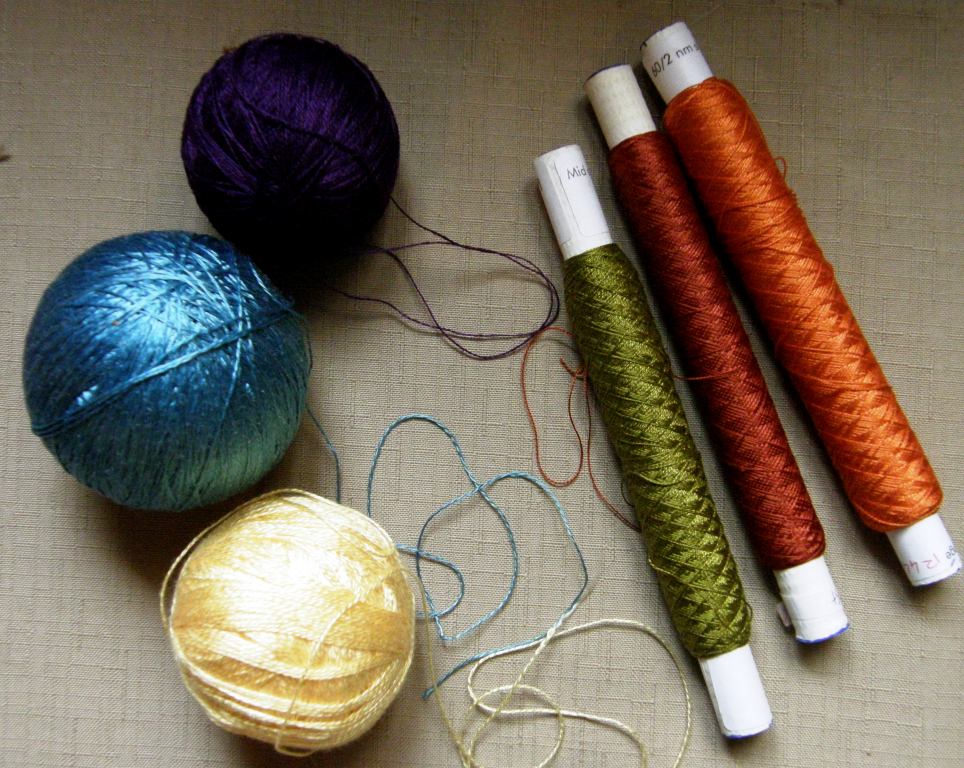
Light blue Japanese silk, spools of 60/2 silk, yellow 8/2 tencel and purple Guatemalan cotton.

pebble weave with silkHowever, this doesn’t mean an end to band weaving! I love weaving bands just for the pure fun of it and don’t care if I don’t have a particular use for them.

Narrow bands are a good way to test new yarn or check the proportions of a newly charted motif.

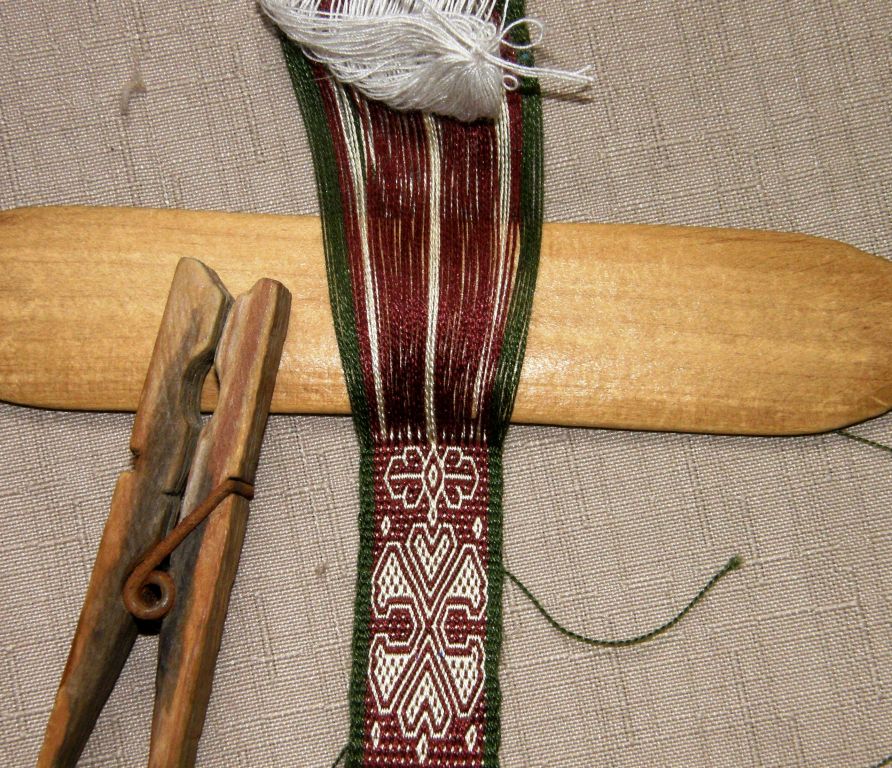
I love weaving miniatures too and have already used the 60/2 silk in a small pebble weave band (at left) to test the yarn, check how difficult it might be to see for doing pick-up as well as to try out a new pebble weave motif.

Band weaving for me is also a nice way to take a break from large pieces on which I might be working…only 16 threads to pick up rather than the 286 in my current project and I can attach to a toe and weave on the sofa.

Much of last year was spent finishing my second book which involved a lot of weaving of samples… mostly bands and a few larger pieces. I have buckets of bands here! They won’t be made into anything. Some of them are very useful in that they travel to my workshops and make good teaching tools.

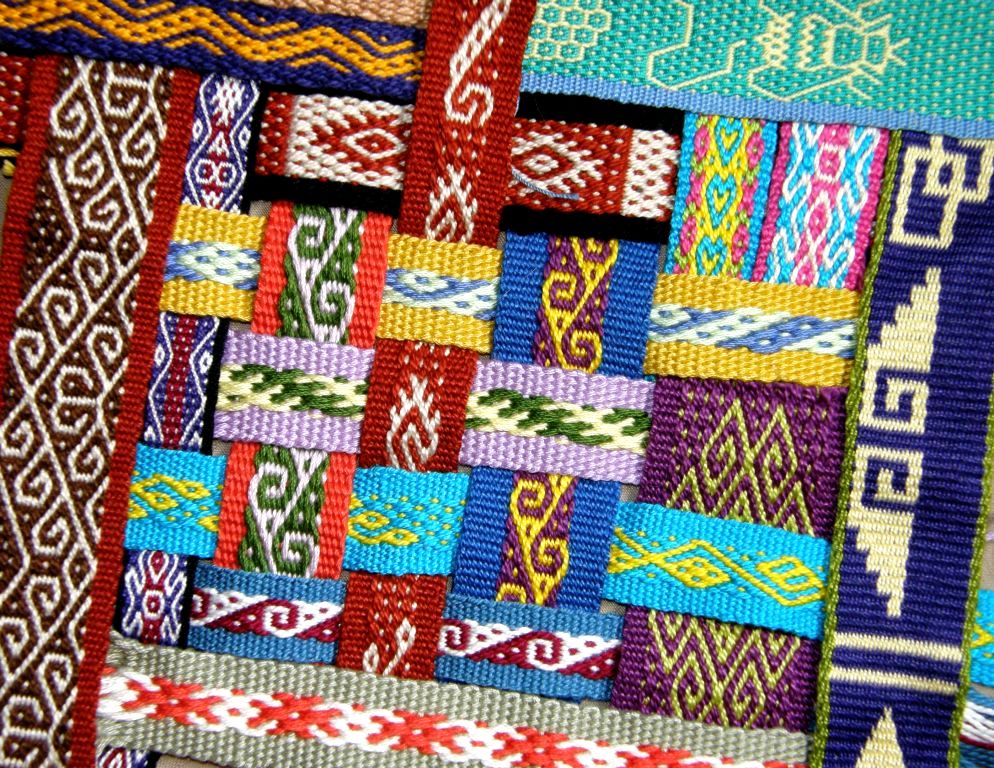
I took this next idea from my friend Yonat who put together a display of her inkle bands to photograph. I  put together a few of the bands that went into my book last year. They are of different widths and lengths…some barely two inches long… and so, my display is not as pretty and uniform and Yonat’s.

backsrap woven bands for book

The resulting book with yet more bands on the cover…

More adventures book cover dsz

You can download it from Patternfish.com.

ANWG 2013

The North West Weavers Conference, which will be held in Bellingham, Washington this June, recently opened its registrationI am going and hope to see you there!

To finish, here are some great projects from members of the Ravelry group…

carrie

Carrie wove this warp-faced band using the frame of her rigid heddle loom on which to extend her warp. She used string heddles and a shed rod rather than the rigid heddle. The patterns were created with supplementary warps. Gorgeous! We all love the soft colors she chose.

amandaAmanda kindly shared part of her band with her first attempt at creating patterns with supplementary wefts. She shows the difference that applying less tension to her warp made to the amount of coverage she achieved with the supplementary weft. She is using #10 crochet cotton for warp and embroidery floss as her supplementary weft.

janet

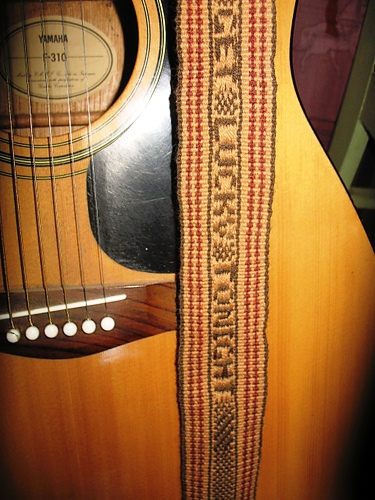
Janet wove this guitar strap for her husband with her own hand-spun and dyed wool. She used instructions for the pick-up patterns from Anne Dixon’s inkle weaving book.  She included words from a song which her husband wrote in the design and used guitar strap hardware made by our friend Annie MacHale to put it all together.

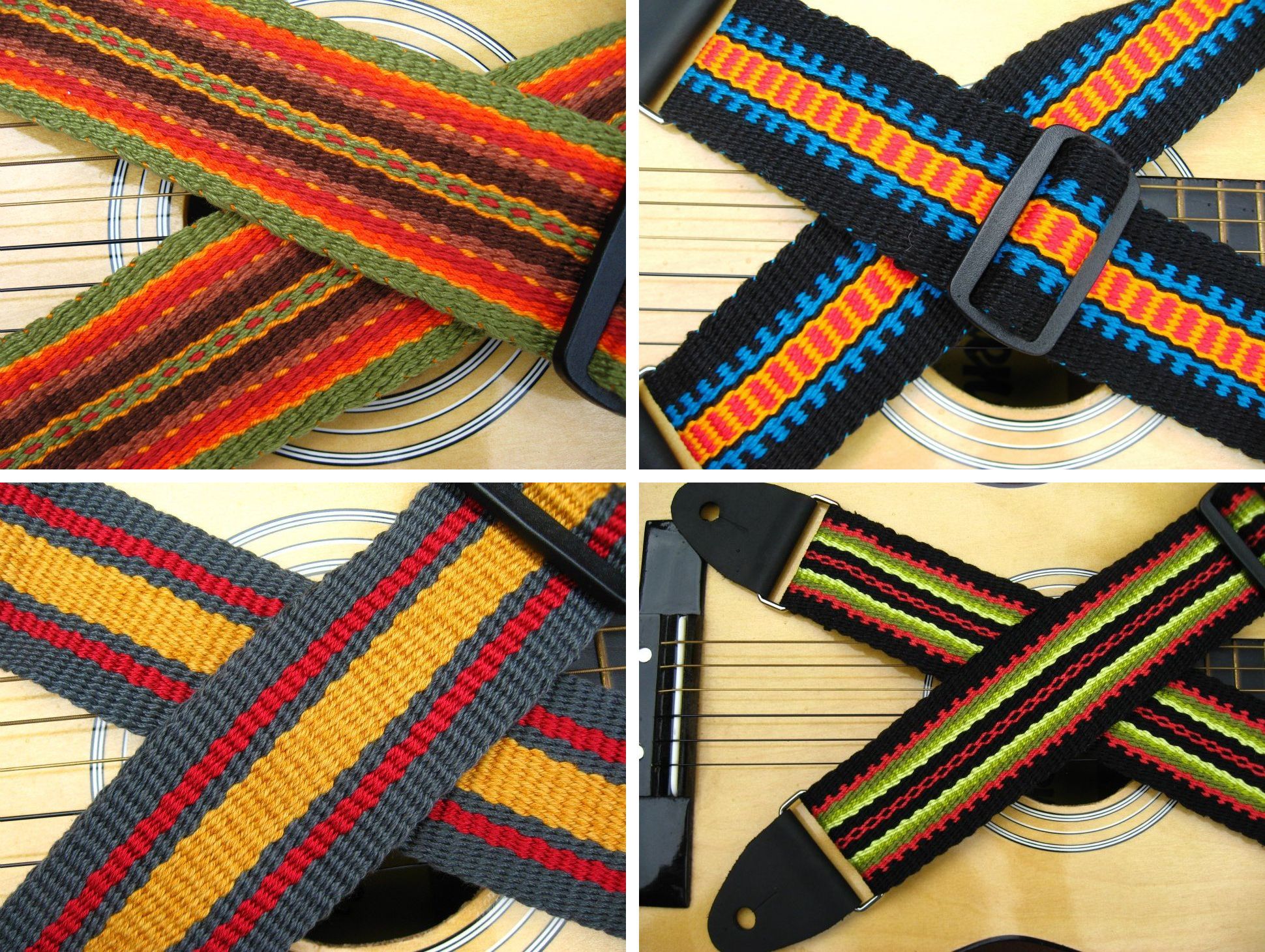
Speaking of Annie, she has been dazzling us on Facebook with the gorgeous straps she has been making on her inkle loom to sell at a big guitar show this weekend in California. Annie is all about color…I will leave you with just four examples of the more than forty guitar straps she will have for sale!

annies straps

So, my challenges are longer, wide, finer. What are yours?

Backstrap Weaving – Hands Full of Threads

The black neck wrap is done and I am already thinking about the next one.

I thoroughly enjoyed working with this fine Guatemalan cotton thread (you see how I have forgotten about all the woes in the beginning!). It was fun picking up threads with the delicate Guatemalan pick-up sticks and feeling the silk supplementary wefts slide through my fingers.

This will be the color scheme for the next one…

colors for next backstrap woven scarf

Maybe I will use some Guatemalan-inspired designs this time or perhaps I will invent some of my own.

cotton-spinnersI got the black piece off the loom and then I was faced with fringe twisting. Would you believe I have never done this before? I have left fringes on placemats and braided the ends of other pieces. I had read the grumblings about fringe twisting from those who regularly weave scarves in the weaving forums and seen pictures of the gadgets and gizmos that have been designed to make this task less tedious.

I even watched a video I had taken of my Montagnard weaving and twining teacher, Ju Nie (seen at left spinning cotton), twisting the ends of a piece she had recently taken off her backstrap loom. Ju had come to visit at friend Betsy’s house and, rather than sit idle while chatting in the living room, she pulled out a wad of stuff wrapped in paper and a woven piece of cloth and started working. The “stuff” turned out to be mushy, sticky over-cooked rice through which she drew the warp ends before rolling them on her leg and setting them in the twist.

Here is the video. Ju explains that doing it on her pants is “no good” and that it works much better on her bare leg. I am guessing that her bare shin makes the best rolling surface.


So, I twisted my fringe and it wasn’t as slow as I had thought…much faster than braiding, I can tell you! I added weft twining to the ends of the fabric before taking it off the loom. I think that made a nice finish.  See the countered weft twining tutorial here.

And then I found that scarves are kind of hard to photograph…way too long and flat and lifeless to try and stretch out in one shot so I gathered it up and threw it down many times, fiddled about and I felt that this was the best “pose” in the end.

bhutan scarf with border

And another shot that shows my favorite central motif…

finished bhutan scarf backstrap loom

Although I was mad keen to get into the Guatemalan purple thread and warp up another scarf, (especially since I think that I  already experienced, hopefully, all possible mishaps when weaving the black one), I decided that there was another project sitting in the closet that needed my attention…(plus I really need to ponder and plan the patterns I want to use on the purple scarf before rushing in and weaving it)…

wayuu_motif_with_twining

Remember this guy? I had just started the large main motif when I decided that I would not touch this until I was sure I would have enough time to stick with it and finish it. When doing pick-up, I think it is best to do a pattern all in one go rather than leave it sitting while I travel. If I leave a piece for a long period of time,  I can almost see the place where I left off and picked up again. Perhaps I sit a little differently, apply a little bit more or less tension, beat differently…I don’t know…something changes. So, now is the time to get down and finish this piece.

Usig a forked stick in the warpI welcome the opportunity to have my hands in there and full of threads again. I am not a pick-up stick kind of gal,  unless a particular technique or yarn really demands it. I like to hold and pick and drop threads with my hands. Perhaps it’s because that is the way my first Peruvian teachers showed me. I have been shown and I have willingly tried other ways but I always come back to just using my hands.

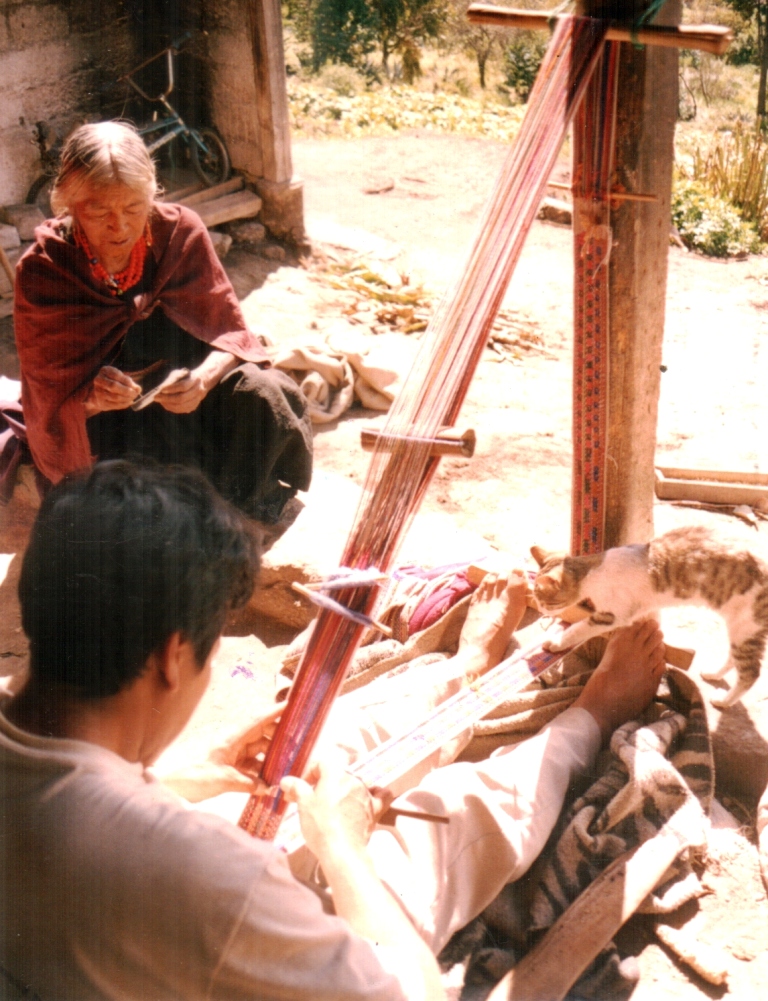
Here is a weaver creating a belt patterned with supplementary warps. It is a narrow piece and so it is easy for her to simply insert her hand between the warp layers to do the pick-up.

I was finally successful in uploading the video of this weaver at work. You can see how she does her pick-up as well as see the two-stick method she uses for opening the heddle shed. She has a forked stick in the warp….one prong is her shed rod and the other prong holds a second cross. Grasping and twisting the fork, while leaning forward to relax tension, helps her to smoothly open the heddle shed. 

These are the kinds of textiles she produces…

O

I watched a gentleman from Chahuaytire also weaving supplementary-warp patterns into a much wider piece of cloth. He uses a pick-up stick to hold all the threads in both the pattern and plain-weave sections as he works his way across the cloth…


This is his weaving…

chahuaytire backstrap weaving

Both weavers work equally fast, don’t you think?

So, on I go with hands full of threads. This is the third piece in my red-white-and-black wall hanging series. This one has patterns which have been inspired by the si’ira belts woven by the Wayuu people of Colombia and Venezuela. Since starting this project, I got to go to Holland and meet Mirja Wark who spent years studying, collecting and cataloging these belts as well as writing a book describing the weaving, braiding and twining techniques used.

si'ira belts wayuu mirja wark

wayuu project in progressThese are belts that Mirja herself wove while studying. You can see the “cow’s nose” pattern at the bottom of the blue, pink and green belt that I used in my wall hanging. The large motif that I will use in the center has been very much adapted to fit my piece and uses just certain elements of the Wayuu patterns as inspiration. There are a lot of threads to pick and, until I things get rolling, I am very much clinging to my pattern chart. Thank you, Terri, for introducing me to removable highlighter tape which works like a dream!

So I will be parked in front of that piece for some time while taking breaks to re-spin the Malabrigo yarn, plan supplementary-weft patterns for the discontinuous-warp piece for which the Malabrigo is destined, ball up that large skein of Guatemalan purple cotton, sketch some patterns for the purple scarf project, plan piece number four in the wall hanging series…maybe ikat??…do I dare?

And I am folding this sampler piece this way and that to see if something useful can be made of it. It’s still on the loom and there is room for more pattern experiments.

O

Let me show you some things that Ravelry members and students and friends have made. It is a strange coincidence that three people decided to edge pieces of clothing with woven bands. Janet decorated a pair of felted slippers that she made, Laura edged gloves (and also made a camera strap and headbands) and Julia edged a couple of tiny shadow-weave kimonos with a pebble weave band. Three gorgeous projects! (I am in love with that shadow-weave cloth, by the way…it takes four shafts…I would like to try it).

christmas_projects__2012_006_medium

laura xmas projects

kimono_baby_black___white2_mediumI will leave you with the happy twin recipients of the wee kimonos…Julia’s grand nieces!

ZellaHattieinKimono_medium2

######################################

Right before I was about to publish this post,  a question was posted in the Ravelry group by a weaver who is trying supplementary-weft patterning for the first time and not getting the rich satin-like finish  that she would like in her patterns. Instead, there are spaces and gaps between the rows of her design. I posted a reply in the group but am copying it here as I think that it may be useful for others who feel like trying this lovely technique…

There is no formula that will suit all weavers…that is, “x” number of strands of such-and-such a supp weft material will give sufficient coverage with such-and-such warp thread. All weavers are different in the way they handle their warps.

For example, some weavers put a lot more tension on their warp than others. This means that they have fewer picks per inch than others because the warps are pulled so tight that they can’t bend over and under the wefts as easily as they do for weavers who use less tension. This means that a certain amount of supplementary weft material won’t give the same amount of coverage for those weavers as it does for others who use less tension.

Another case…some people simply don’t beat hard enough when using supplementary wefts. I beat hard and really mash the weft into place…not “wham wham” beating…more like placing the beater right at the weaving line and pushing against the weft hard with a rocking motion.

Other people pull too tightly on the supplementary weft. It has to be fairly relaxed in the shed to allow it to spread and cover the surface. As an experiment, pull your supplementary weft tight once you have changed sheds and see what happens. It will flatten and narrow and not give good coverage. You have to find the balance between thread that is relaxed enough in the shed and bumps at the sides, where the weft turns, that are not too big and loose.

These are all things that come with trial and error and experience. It might be that you need to use more supp weft material or it could be one of the other factors I have mentioned here.

I often use thread that is similar to #3 and #10 crochet cotton. It is Brazilian cotton that I get here in Bolivia. I have used two strands of embroidery floss with the “#3” and one and a half with the “#10”. This gives people an idea of where to start and what to try but, as I said, every weaver is different.

Hope this helps.

ETA My first Guatemalan teacher combed the strands of her supp wefts with the point of her pick-up stick so that they lay next to rather than on top of each other. They didn’t move with handling…the floats are not long enough to cause that to happen. I did the same with the six strands of 60/2 silk on my current project.

Backstrap Weaving – Encuentro de Tejedores de las Americas – Part Two – the cloth and the looms.

Read Part One of this story here.

ARE YOU GOING TO WEAVE TODAY?

I probably make a thorough nuisance of myself at weaving events like the Encuentro de Tejedores in Cusco Peru earlier this month. I have so many questions and want to be into everything and not miss a thing.

Calm and serene despite being in the very heart of the city of Cusco, the venue for the conference was beautiful both by day and night. There were plenty of pillars to which looms could be attached for weaving displays and shaded areas under the arches where weavers could show their textiles.

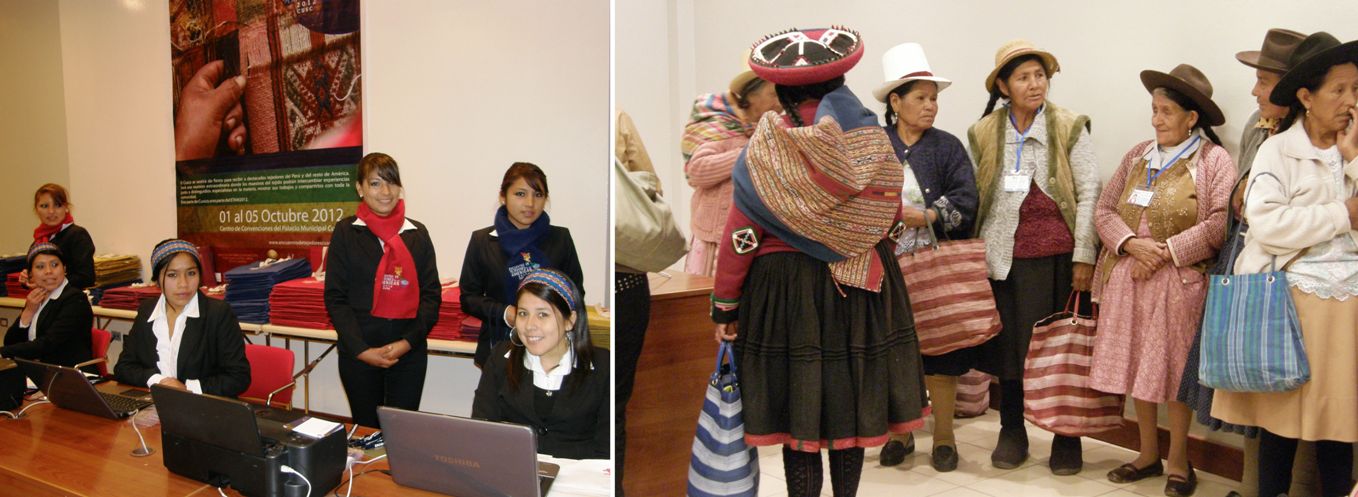
 Bright and early on day one, I registered along with other participants. The receptionists, looking smart in their uniforms with colored conference scarves and headbands, were efficient and clearly trained to be able to handle anything. The whole process was very slick and it was interesting to hear all the different Spanish accents and Quechua being spoken in the line-up of participants from all over Peru and South America. I recognized fondly the accent from Chile where I lived for five years as well as the song of the Argentinean-style of speaking used by my ex-boyfriend and the special way that Bolivian highlanders pronounce “rr”.

I then stepped outside to the courtyard to another world…a buzz of colorful activity… where I watched all the stands being assembled by weavers from all over Peru, Bolivia and Latin America, saw all the marvelous textiles emerging from travel sacks and being arranged and labeled, touched the fiber, tools and implements which were used to create the colorful cloth and spoke with the creators themselves. Some of them seemed somewhat overwhelmed by the high level of interest in and admiration for activities that are quite normal and commonplace, almost passing without remark, in the communities, villages and towns where they live.

Weavers and knitters from Taquile Island wearing and displaying their textiles and the creators of the wonderful ikat pañones of Tacabamba, Peru

The question that I really wanted to ask everyone right there and then is “Are you going to weave today?” Is today the day when we will get to sit by you and see how you created all these exquisite textiles? And all the while the  excitement is building as I see more and more gorgeous textiles and looms being extracted and arranged. I had already seen at least ten things that I wanted to explore further after having passed just once quickly by each of the twenty-two half-erected stands.

Weavers and spinners from the Navajo Nation, my friend from the Tinkuy, DY, and TahNibaa and Albina from San Ignacio de Loyola showing the crocheted “chullos” and the belt loom full of sticks which is typical of her community. 
The Chol Chol Foundation of Chile was present bringing with them textiles made by the Mapuche weavers that they support including a spectacular ikat- patterned “manta cacique”. Lowland areas of Peru were also well represented with a group of Matsigenka cotton spinners and weavers from Echarate, Bajo Urubamba.

The looms!……

A horizontal loom with a broad belt patterned with double weave and complementary-warp pick-up patterns of Taquile Island and a backstrap loom with a cotton warp-float piece in progress from Echarate.
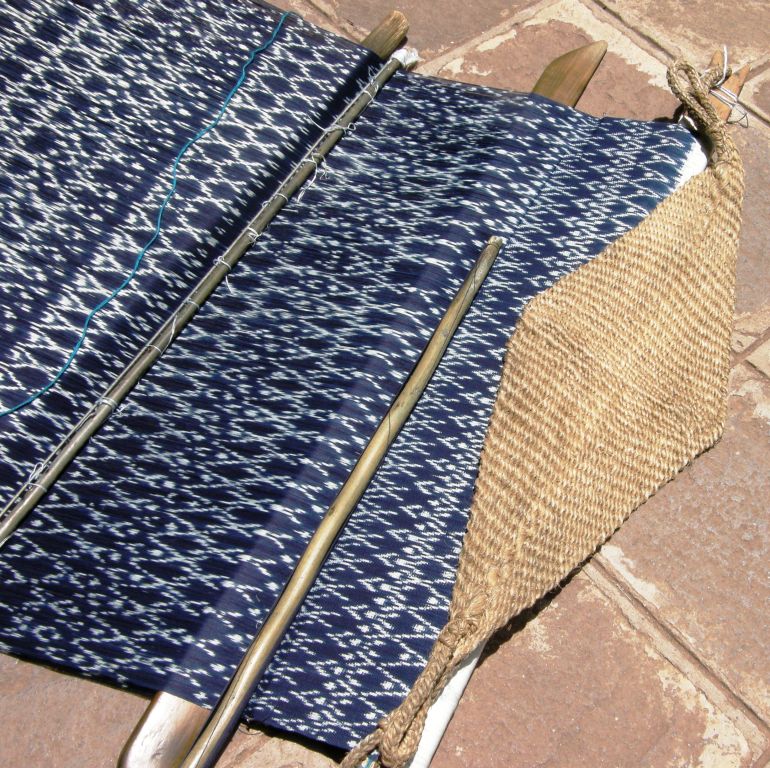
The simple backstrap loom of Tacabamba, Peru on which the indigo ikat-patterned “pañones” are woven.  The process of creating a pañon is anything but simple. They are up to one-meter wide, covered with tiny motifs and have patterns knotted into their fringes.
A floor loom from Ayacucho, Peru with a tapestry in progress and the leaning vertical loom of Tarabuco, Bolivia.
The cotton weavers of Chiclayo managed to preserve their native cotton despite the fact that its cultivation was banned for many years in Peru. The backstrap loom is used to weave their natural brown and white cotton into saddle bags, belts and table ware for their own use. The Guatemalan loom from Santiago Atitlan holds brocaded cotton cloth destined for the typical woman’s blouse or “huipil”. Panels are sewn together and the neckline embroidered with birds.

Wide warps, narrow warps and everything in between… A Tinkipaya weaver’s leaning vertical loom, holding fabric covered n complementary-warp pick-up patterns, rests on the ground. A weaver from Pitumarca speedily edges her finished woven lliclla with a tubular woven band using three sets of string heddles and a shed loop.

A backstrap weaver from Ayacucho, Peru, creates a belt patterned with supplementary warps. She uses a forked stick to hold a secondary cross, the manipulation of which helps her to open the heddle shed quickly and efficiently. The wide backstrap loom parked against the pillar is from Tanta, Peru where handspun alpaca yarn is often combined with bright synthetic threads to make shawls, ponchos and blankets.

And then there was that tantalizing backstrap loom with its twenty-four heddle sticks…Señora Araceli, are you going to weave today?

First Araceli has to make the twenty-four sets of heddles on this fresh warp. The pattern has already been picked up and saved on sticks.

Just before lunchtime one day when we were indoors listening to speakers, I got the uneasy feeling that I really needed to be somewhere. I got up and tip-toed out at the start of the morning’s final presentation by Manos del Uruguay to find Araceli seated and preparing her warp for an afternoon session of weaving.

Well, you know that I am fascinated by the entire process and so I was happy to be able to sit alone with her and watch her make her heddles. I was tickled to see that she makes her heddles with the extra security hitch just as I have chosen to do. I have seen and learned so many ways to make string heddles for backstrap and other kinds of weaving and this method is by far my current favorite. I always say “current” as who knows what cool new method I will find tomorrow.

Here is a short video clip of Araceli making her heddles. She certainly has a smooth and elegant way of doing so. I know some people don’t like making heddles and dread that part of the process…I like it!

And what about the woven cloth produced by these looms and the pieces produced by talented hands using knotting, braiding and crochet?

Head gear…Crocheted “chullo” from Peru and a woven hatband from Bolivia.

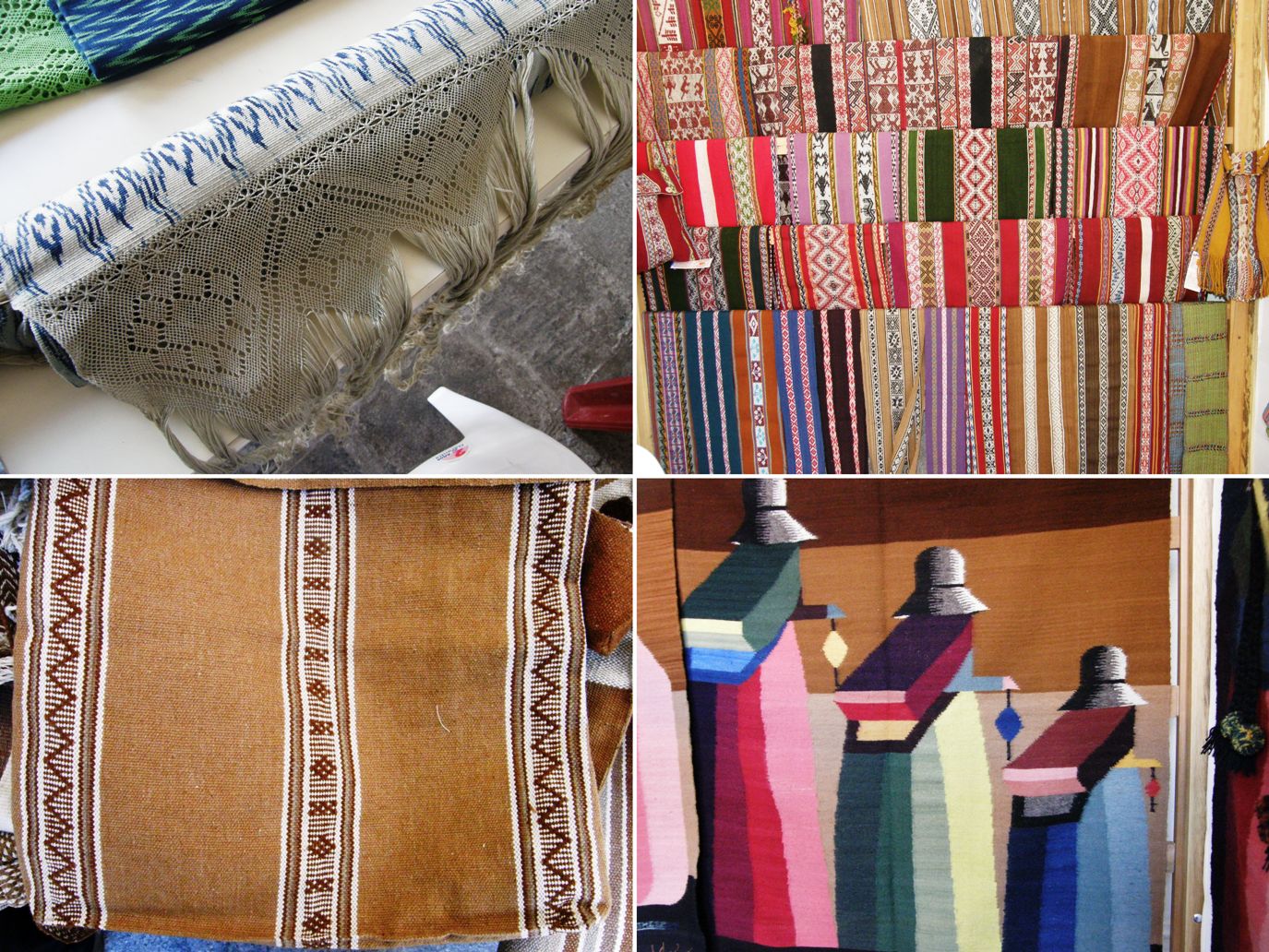
There are four countries represented here….cloth from Mapuche weavers in Chile,  Salasaca, Ecuador,  Taquile Island, Peru and Tinkipaya, Bolivia.

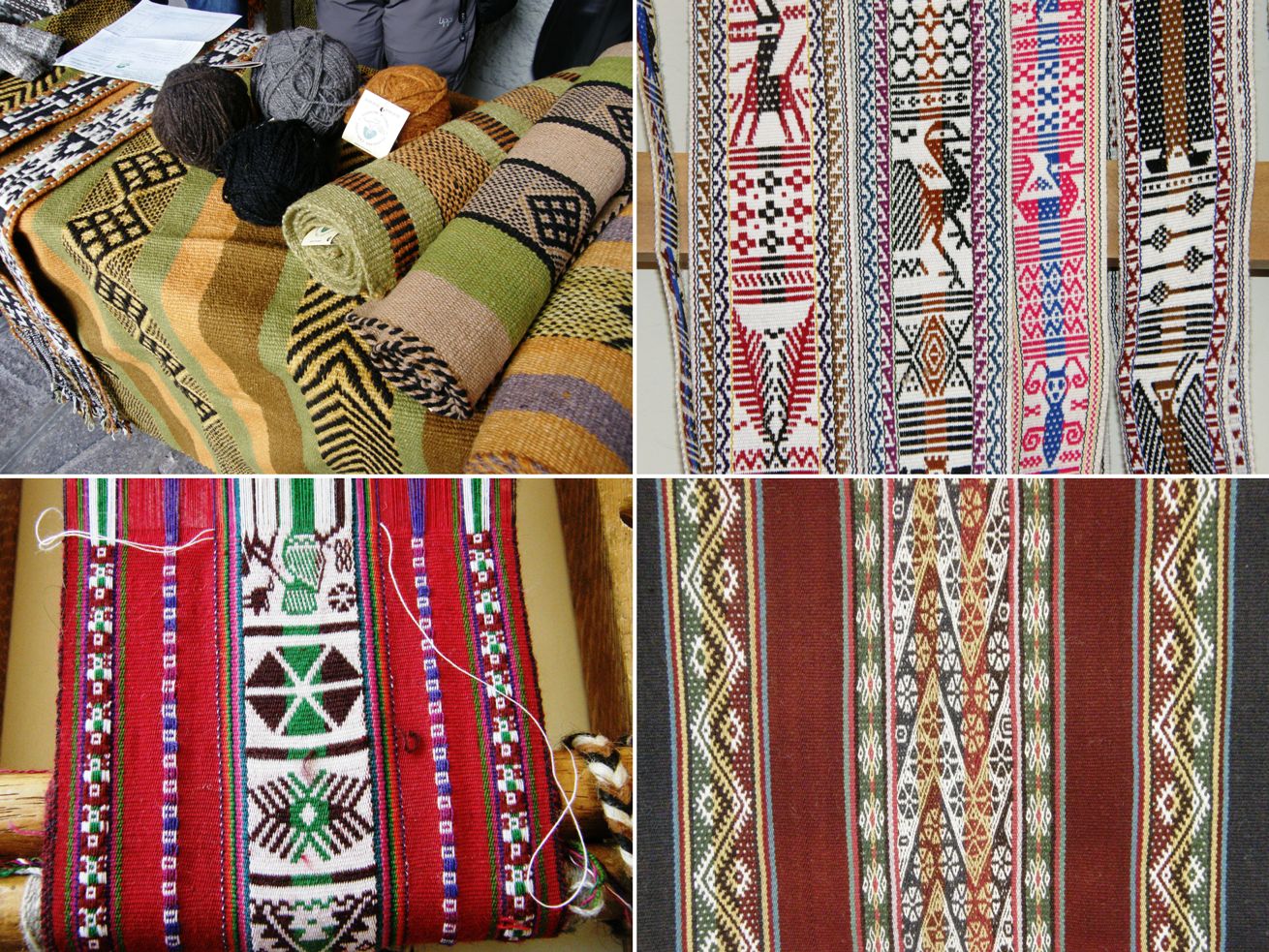
Cloth from different corners of Peru. The variety!

Of course, each piece has its story and it was those stories that we were told in the weavers’ own words in the seminar sessions that were held in the mornings and afternoons. The stories were very inspiring and educational, often with very personal touches which brought life and meaning to the fabric that simply could not be transmitted from the market stall or loom alone. All told of hope, perseverance, strengthening of ethnic identity and a revival of pride in oneself and culture and were often very moving.

The faja sara ( the one created with the twenty-four string heddles) has its own fascinating story. It is part of an unbroken weaving tradition that dates back at least 500 years to Incan times. The belt is described in the chronicles of Mercedarian Friar Martín de Murúa in 1590 A.D. and the knowledge of how to create one has been passed on ancestrally over all these years.

Lynn Meisch has written an article about her research on these belts here. We were told by the weavers that the name “sara’ comes from the verb ”sarear”, although I have never come across this verb before, which means to choose, or in a weaving context,  to pick-up.

Interesting to me from a structural point of view is the rolled edge of the belts which is surprisingly easy to create. I am guessing that it serves the same purpose as the woven bands I have seen added to other textiles in that it strengthens the edge. When I was in Holland, Marijke van Epen and I followed Mirja Wark’s explanation of the rolled edge used by the Wayuu people of the Guajira Peninsula in Colombia and Venezuela and the way the weavers of the sara belts create theirs is equally as interesting and practical.

Here is Araceli in action with a band of spectators. When doubt was expressed by the onlookers about the quality of the cloth since Araceli does not use a ruki, the llama bone tool, to beat in her weft, Araceli immediately invited them all to feel the belt. They were all surprised and impressed by the firmness of the weave. It is a very dense piece of weaving.

The poncho shown above is from Catamarca Argentina and represents the recovery of the exquisitely fine work done with handspun vicuña fiber on floor looms which has the made the poncho Catamarqueño famous for centuries.

Two people weave the pieces side by side and have to coordinate the strength of their beat perfectly to maintain a consistent weave. With the fine vicuña thread a piece that measures 2 meters by 1.30 meters weighs only 320 grams and takes up to eight months to complete.

Fine vicuña shawls are also woven and embroidered using designs copied from old colonial textiles.

We had a chance one afternoon to handle and clean pieces of vicuna fiber and everyone was invited to try their hand at spinning it on the  25cm spindles.

More cloth…..

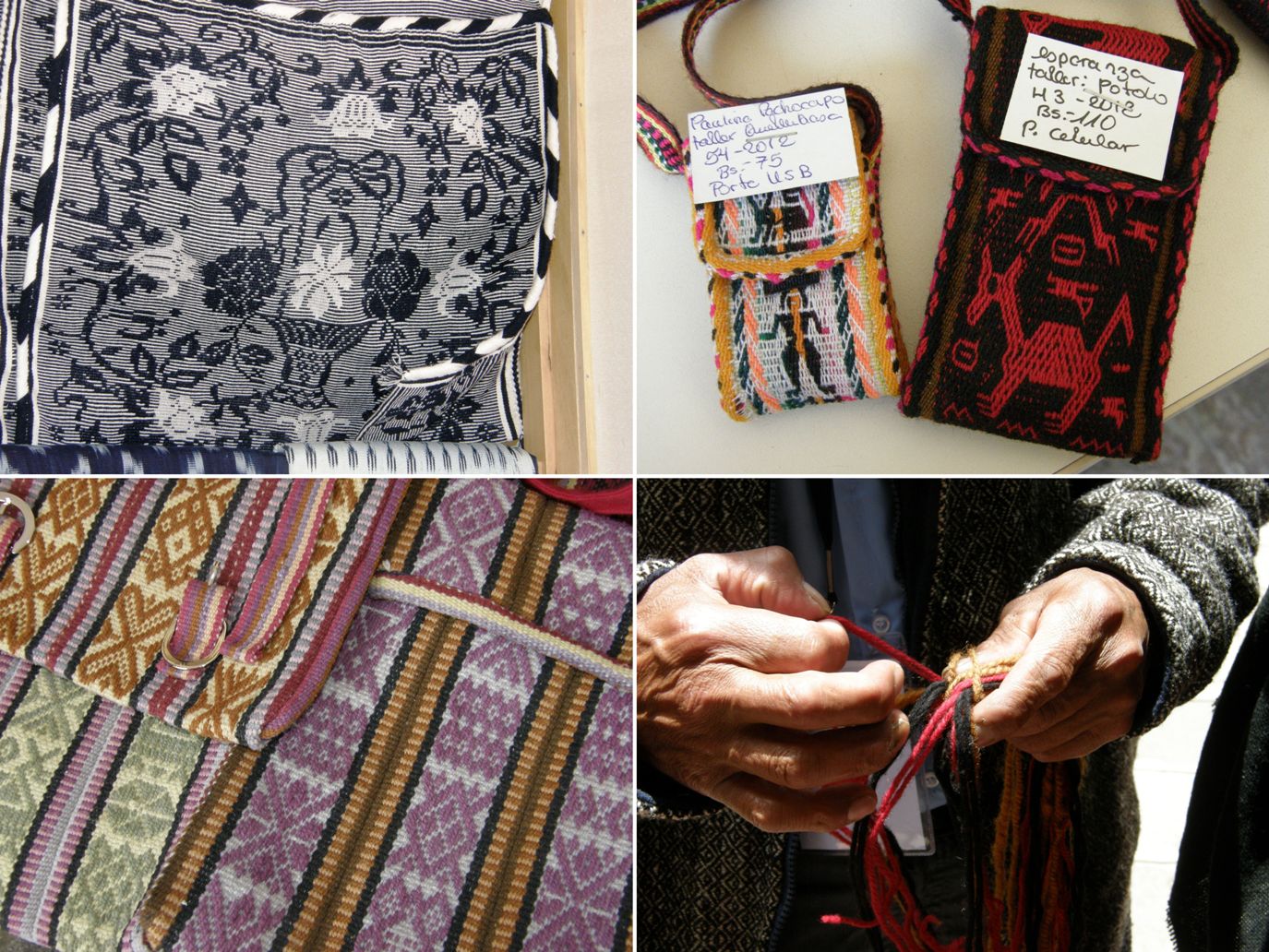
…. a bulsico , or cotton double-pocket saddle bag from San Ignacio de Loyola with beautiful patterns in simple warp floats worked in two colors. The weavers from Tarabuco and Potolo in Bolivia of course brought large fine examples of their textiles. I decided to show you here some very small and practical pieces that they also brought to sell. The tiny USB pouch is from Tarabuco and the cell phone pouch with its woven khuru figures is from Potolo.

The supplementary-warp patterned pieces in lovely pastel colors are from Ayacucho, Peru and the last shot is of an impromptu sling-braiding demonstration from one of the Peruvian presenters in the coffee break.

More lessons along the way…

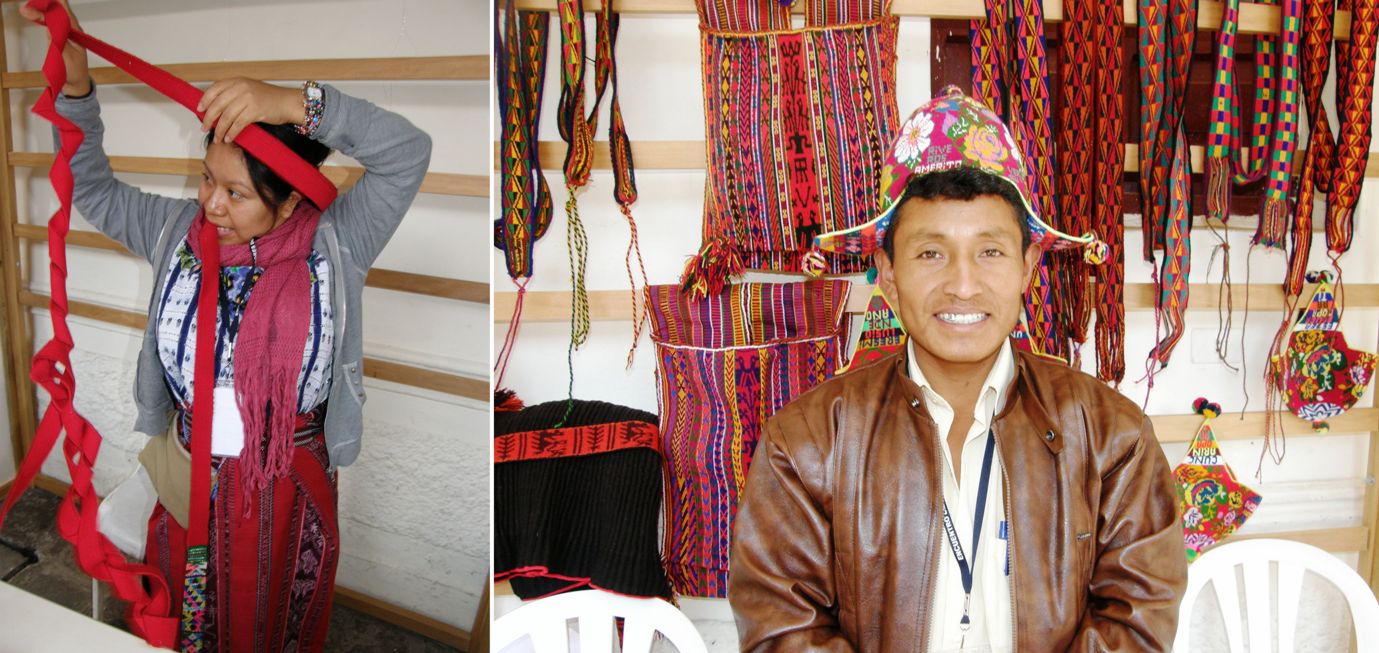
Diana from Santiago Atitlan in Guatemala showed me how to wrap her hair and head with a woven hair sash. You can see that most of the band is plain red with just the last part, which will be seen on the outside, decorated with pattern. Albina’s husband showed me how married men wear the typical chullo of his home…with the flaps standing out sideways. A single man will wear his with the flaps pointing out front and back.

So, now you have seen a selection of the stands, looms and textiles and heard a few backgroud tidbits about some of the weavings and the people who produce them. You are probably dying now to see the weavers in action, right?

ARE YOU GOING TO WEAVE TODAY?

Sorry, but I am saving that segment for the next blog post as uploading the video will be so much easier for me when I am in the US.

In the meantime I am packed and ready to leave tomorrow and I did manage to finish the discontinuous warp piece that I started in the workshop on the last day of the Encuentro. Handling alpaca fiber is not a nice business in this heat with sweaty hands, I can tell you!

Here is my ticlla piece off the loom and all curled up…

The overspun alpaca yarn made the grey and black panels curl in and the other two panels curl under. You can see my finish line on the white panel. I ended up removing one weft as I had packed too many in. I really need to remove two as now I have two wefts in the same shed. The finish line isn’t as noticeable on the other panels. I am really pleased with this!

I wove and sewed on a tubular band to the edges….… in the same way as the Pitumarca weaver that I showed earlier in this post, using three sets of string heddles and a shed loop. See how nicely the piece lies flat now? I hemmed the sides before applying the tubular band because I didn’t like the way the warp stripe at the edge was interfering with the color of the tubular band.

Here’s a better look at the tubular band and that lovely dovetail join of colors…

Done! I am keen to try this all again!

See you next time from the US 🙂