VIVID is the name of an annual festival of lights, music and entertainment that took place in Sydney at the end of May just in time for my visit. Colorful images are projected onto buildings and landmarks around Sydney harbour and the city center. My brother captured some of them with his camera when we went together to the festival one night….
The white sails of the famous Sydney Opera House were transformed to an amazing piece of crystal glowing in the dark…

And then adorned with butterflies…

I don’t know how to describe this next one!
 Other buildings along the waterfront were also used as giant screens onto which fantastic slithering images were projected…
 I have been enjoying a variety of landscapes and weather here in Sydney from the city to the country. I had a day out in the pretty rolling hills just west of Sydney…
 And a hike in the bush. It was tshirt weather in the middle of winter…
 I got rugged up on a cooler day for a trip to the city, the waterfront and Chinatown with my weaving friend, Emerald…

 Emerald and her family are from Burma and they invited me to come and stay with them in Sydney’s inner city for a couple of days of weaving. I had forgotten how exciting it is being there right in the heart of all that inner city action. Emerald has distant memories of having taken some weaving lessons in her younger days in Burma. Now she wants to learn more about the backstrap loom and the weaving culture of her homeland.
She showed me her beautiful collection of longyi, the long pieces of fabric that are worn by both men and women in Myanmar. They are wrapped about the lower half of the body. Some of these pieces were woven on floor looms but there are still backstrap weavers to be found in certain parts of the country.
The Wikipedia page on the longyi includes this saying…
Men who cannot read are like the blind; women who cannot weave are like the cripple
—an old Burmese saying at a time when every household had a handloom and the womenfolk wove all the longyis for the family.

VIVID colors against black….
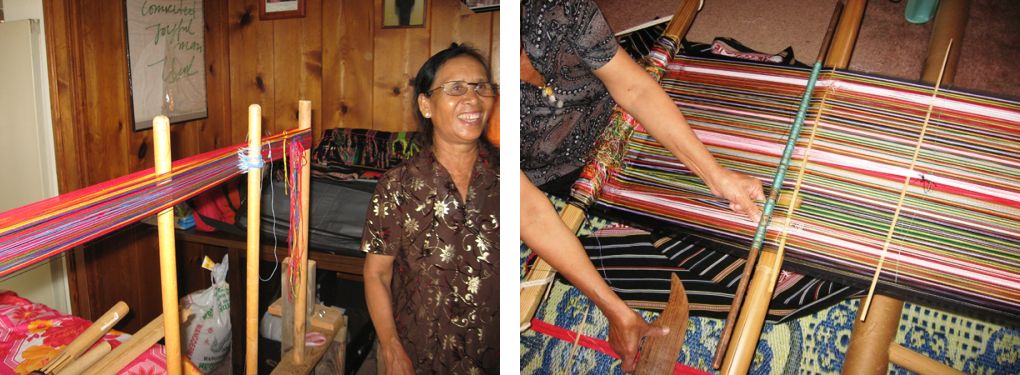
 We warped and set up her backstrap loom for an Andean Pebble Weave project. Emerald has placed hooks into the wall of her home and has created a very nice backstrap weaving space.

 I feel as happy as she looks here when I am seated in front of a fresh warp! Now it is time to get down to work and pick up the pebble sheds and create the string heddles….
 A lovely green warp for a lady named Emerald. I showed her how to operate the two sets of heddles on this wide warp and now she is all set up to weave a cell phone pouch and whatever else she may be able to squeeze out of this warp. Emerald first contacted me via this blog. You may have read her enthusiastic comments here. Then we became friends on Facebook. I wasn’t able to meet with her when I visited Australia last year but it worked out this time and we had two fun days together.
 Emerald showed me the book that she recently bought on Sazigyo ,by Ralph Isaacs. Sazigyo are very fine tablet-woven bands from Burma which were used to wrap palm leaf manuscripts. The book comes with its own silk tablet-woven book mark.
Images and lines of text are woven into the tapes themselves. This Facebook page contains many images of these woven tapes.
Emerald is very excited about learning about these and now wants to study tablet weaving so that she can also create bands of woven text in her native language.
It was a very educational experience being with Emerald! She also told me about Inle Lake in Burma where yarn is spun from lotus stems and woven into cloth.
Julie Hall has written a very interesting and image-packed blog post about her visit to Inle Lake and I appreciate her having given me permission to use some of her images here…


The following video from this page shows a small part of the process…
My weaving friend, Wendy Garrity, has also written about a visit to Inle Lake and includes images and video on her blog.
Meanwhile, back at my brother’s place, vivid colors are all around with evening visits by flocks of lorikeets to the backyard accompanied by the screeches of the sulphur crested cockatoos and laughter of the kookaburras at dusk…
 I met with weavers up in Springwood in the Blue Mountains in a lovely bushland setting for a weekend of backstrap weaving in the home of Helen Halpin, editor of the Weavers Forum newsletter. Last weekend I wove with folks in a pretty homestead on the suburban outskirts in front of fields of grazing sheep.

The second day was cold, blustery and very wintry. We could hear owners Jenny and Phil’s flock of sheep bleating outside but little did we know that two little black lambs were being born as we wove away warm and cosy indoors..
 The ladies who wove with me are part of a group whose name forms the fun acronym “EWES”. It stands for Epping Weavers Embroiderers and Spinners. It really seems like an extremely dynamic group. Sydney folk who read my blog might want to join. Here’s Brenda wearing a handknit sweater and her inkle woven EWES lanyard…
 Images of warmth and vivid colors have been arriving in my inbox from the other side of the world. Snuggled up under a blanket with a miniature poodle snoozing on my lap, I look at my friend Janet’s sister’s grandkids learning backstrap weaving in bikinis in summery USA. One of Janet’s own backstrap woven guitar straps, made from her own handspun, lies on the ground between the girls providing plenty of inspiration.

 Larisa, who is Russian but now lives in the UK, sent me a picture of a fabulous stole that she wove on a backstrap loom…such vivid colors and wonderful pick-up work!…
The image she sent me is of a low resolution and I hope she sends me a larger one soon so that we can all better appreciate the detailed pick-up in this beautiful piece of work.
Weavers who hung out with me on my recent US visit have been busy weaving in their summer months.
They are happy to be able to enjoy the portability of the backstrap loom which enables them to easily weave outdoors or even in the front seat of the car!
 Cheryl has a ”loom with a view” at her lake house. She is weaving pebble weave “hugs and kisses”.
I don’t know where Elizabeth was going but she took her loom on the road anchoring the warp in the glove compartment of the car…

 Anne has been working on her Andean Pebble Weave and is making great progress…
 Charlotte launched herself into a new band challenging herself to some mental gymnastics handling the color changes in the three columns of motifs. This is the same motif that appears on yurt bands of Central Asia. In Central Asia it is woven using a single-faced structure. Charlotte is using a complementary-warp structure . This means that her band is double-faced.
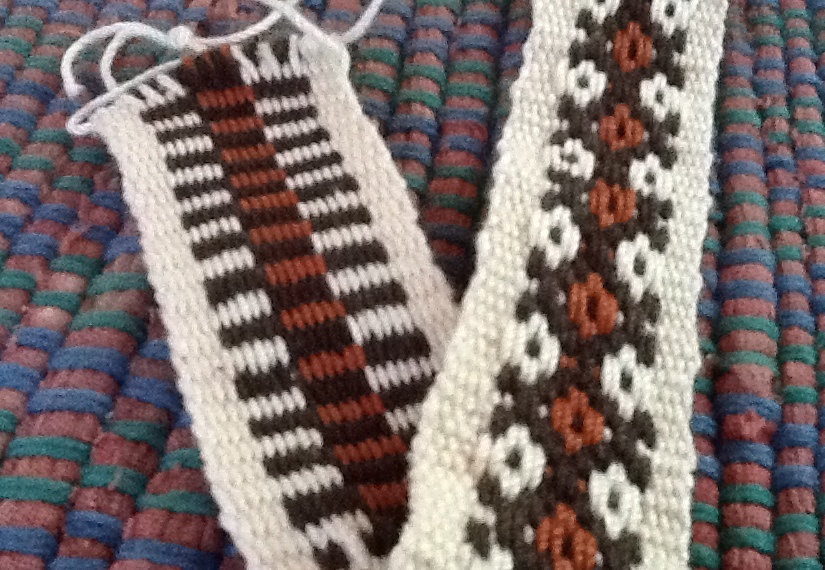 Julia found a good use for a pebble weave band that she had created over a year ago. She made a bag for her sister’s flute. As is always the way with Julia’s work, it has been woven and put together beautifully.
 Janet, who wove with me last year, has become an active member of the Ravelry group and has been sharing her latest experiments with supplementary-weft patterning.
  Sheila is a new member of the group and bought a Gilmore Wave loom for her studies of Andean Pebble Weave. She is working on adding extra string heddles to this two-shaft loom so that she can weave the structure as a semi loom-controlled one as I was taught to in Peru. It is much easier to operate the two sets of string heddles using a backstrap loom which enables you to freely and easily adjust tension on the warp with spontaneous body movements. Sheila is working with a ”fixed tension” loom which means that she needs to apply other strategies to achieve consistently clean sheds with her string heddles. It looks like she is succeeding!
 Above, you can see the two sets of string heddles which Sheila is using along with the loom’s own two shafts. She has unrolled her weaving for the picture. When she is weaving, the two sets of string heddles are positioned further away from the shafts than they are in this picture.
 She is weaving one of the knotwork designs that I have charted in my second book. The Andean Pebble Weave structure can be used for motifs not found in the Andes. Basically, any pattern that comprises diagonal lines can be adapted to this technique. A part of my second book is devoted to this idea and I show how motifs from various non-Andean cultures can be adapted to the Andean Pebble Weave structure.
I will leave you for now with some more VIVID colors…images of some very exotic neck pieces that I recently saw on Facebook. These have been created via a collaboration of three Peruvian textile artists, one of whom is tapestry weaver Maximo Laura. VIVID! You will probably recognize his contribution if you are at all familiar with his work. My backstrap weaving friend, Dorothy, is going to study tapestry weaving with him in Peru soon! According to the Facebook post, these artworks will be sold via the Puchka Peru website.

 My visit to Australia continues….I have a group of friends coming over to my brother’s place this week to weave and then I will head back to Bolivia shortly thereafter as my brother and wife will be taking off to Ayers Rock on their motorbike. Maybe I will squeeze in one more blog post before I leave….