Backstrap Weaving – The Curious Coil Rod

Are you ready for this week’s dose of red, black and white?

3 red black and white backstrap weaving hangingsI have quite a good selection of colors with which to work here in Santa Cruz. None of the colors go by fancy names. They are pretty much the basic tones. Therefore, when someone asked me to pass them the “chartreuse” yarn for their weft in one of my workshops, I had  no idea what they were talking about. Here, we get dark green and light green. But, I have to say that there are enough colors here to keep me happy.

Why then do I keep being drawn to black? I guess there is just something so clean and sharp about black and white.

Even the local Guaraní weavers can’t resist going back to this combination from time to time despite the fact that many of them use the same brand of colored cotton that I do…

guarani black and white weavingsThe third piece in my wall hanging series with the Wayuu-inspired design is an inch or so away from being finished. Naturally, as I have sat there these last few days picking up threads and heaving open the sheds, my thoughts have been turning to my next project. It will probably be a purple scarf decorated with supplementary wefts using cotton yarn from Guatemala and mostly silk supplementary wefts.

colors for next backstrap woven scarf
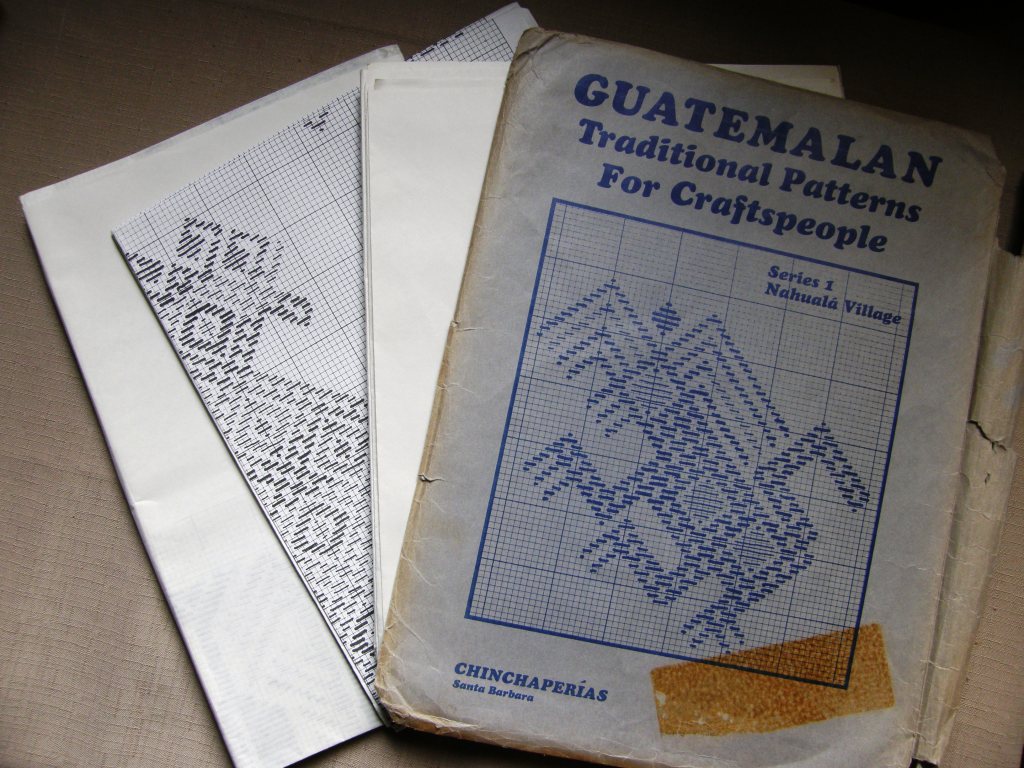
Guatemalan pattern chartsI am still planning the motifs and, while digging around at the book shelf, I unearthed a packet of patterns that was given to me by Sharon, a Weavolution weaving buddy, a year ago.

The packet contains three enormous sheets of detailed Guatemalan motifs. The front of the envelope states that this is Series 1 from Nahualá Village. Nothing on the packet or within indicates when these patterns were charted, by whom or how many packets comprise the entire set. Imagine if this person or people graphed patterns from dozens of villages!

Happily I tracked down another packet, series 3, on Ebay and it seems that there is a weaving guild that may have some others in their library.

However, I probably won’t use any of these motifs for my scarf. I have something quite specific in mind that I learned when I was studying in Guatemala but which also has a slight Bhutanese influence.

I told you about circular and dovetail warps last week and I have decided that I will make a circular one for my scarf. That will keep me in good foot-bracing distance from my bed. Winding a circular warp is straightforward enough. I was easily able to make some changes to my standard warping board to make this work well.

warping set up for circular warpThe two off-set stakes to hold the cross were all I needed. However, that picture is cropped and the following shows the complete set up…

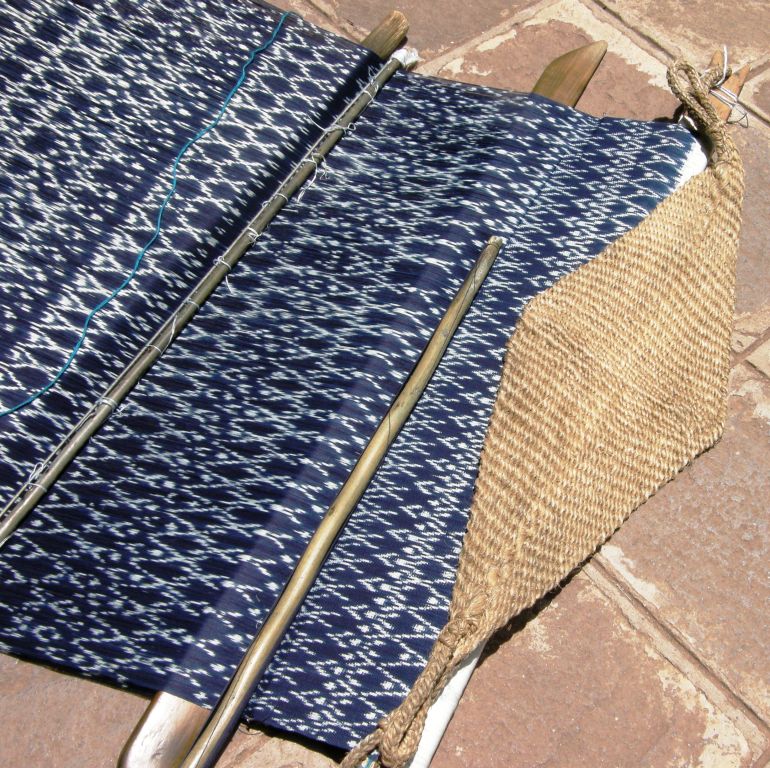
circular warp set up with coil rod stakeThe extra unnecessary stake was incorporated so that I can try to learn more about the mysterious coil rod. So far, I have not seen a coil rod being used in Bolivia and Peru. The first place that I came across one being used was Ecuador. It was in the ikat- weaving town of Bulcay and I had no idea at the time what this piece of equipment was.

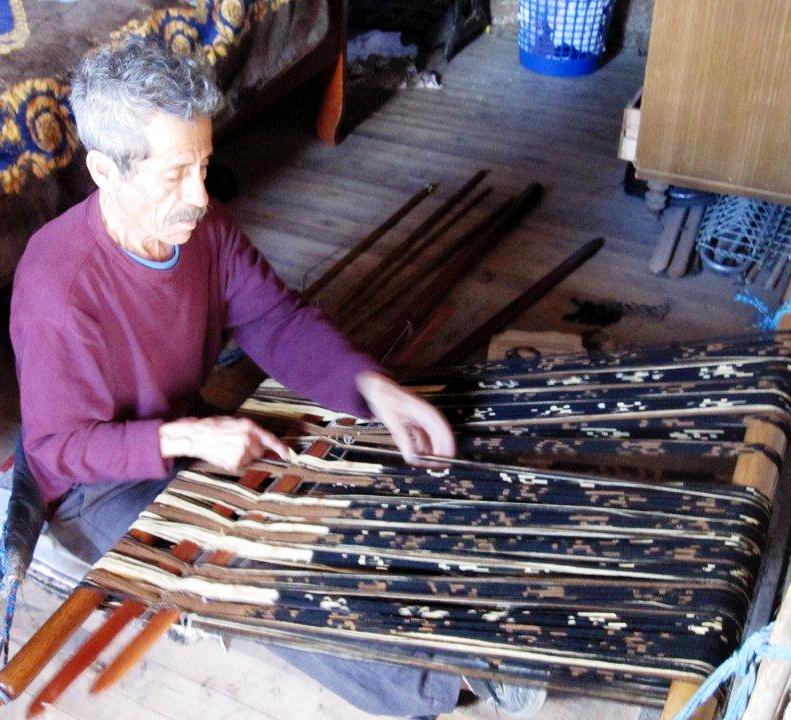
ikat weaving loom Bulcay Ecuador

There is a black arrow pointing to the coil rod in the above picture…the thin stick just below the upper beam.

ikat weaver Bulcay Ecuador

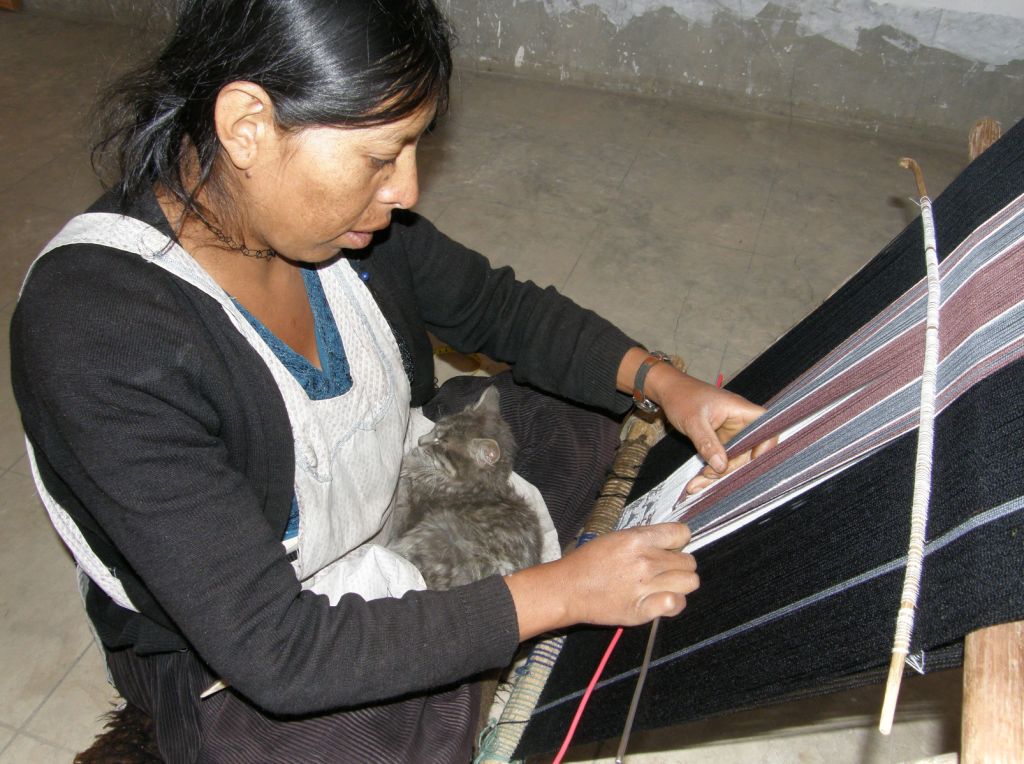
When I visited with this weaver, I was concentrating more on seeing how she prevented having the warps move out of alignment and excessively blur the ikat pattern. I suspected that the coil rod was her”secret weapon” but when I asked, she told me that it had nothing to do with it. Actually, I have to say that she was not very keen on answering my questions. Let’s face it…not everyone is fond of having strangers hang about pestering them with questions while they are trying to weave! She was nice enough to let me sit by and watch and take pictures.
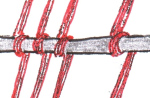
coil rodDennis Penley, author of Paños de Gualaceo, writes that the coil rod, (he calls it a “rolling stick”) in Gualaceo, one of Bulcay’s neighboring communities, is added once the warp has been placed on the loom. He says that the warp threads are wound around the stick in bunches of ten. The stick serves to stop the warp threads from slipping.

You can see how the warps have been grouped in the above photo and the way they are coiled about the stick at left.

Of course, as time went by, I discovered that coil rods are used by many backstrap weavers who work with circular warps and I have since seen many examples of weavers in Asia using them.

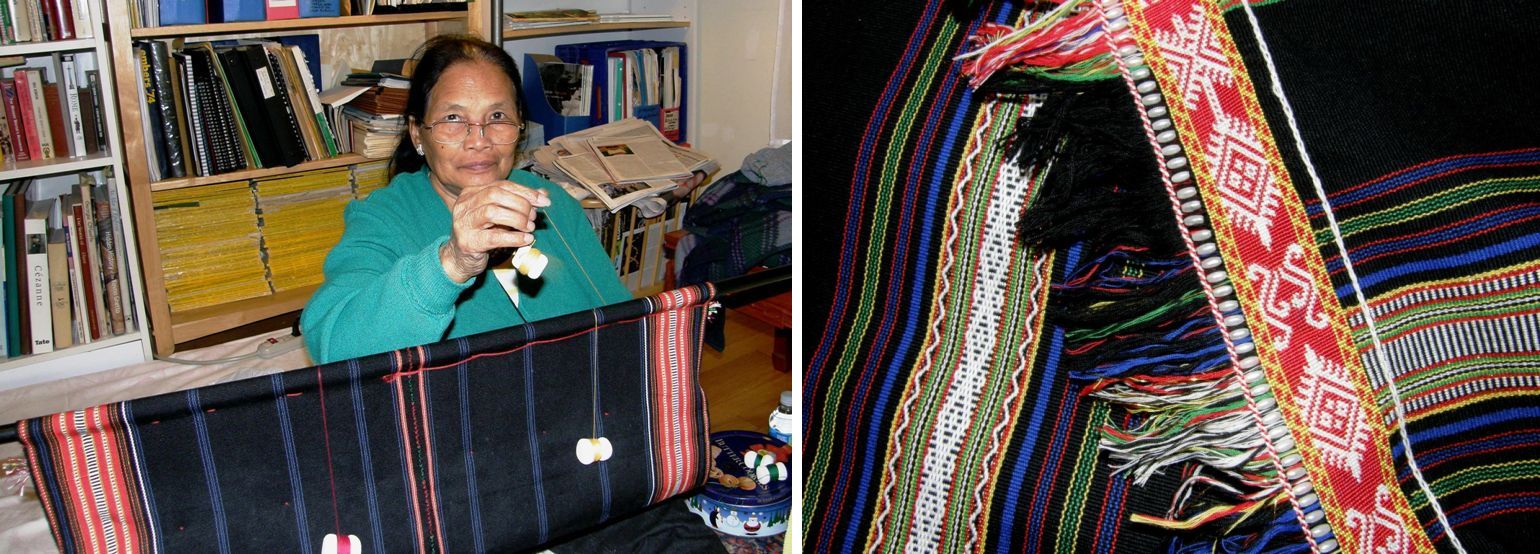
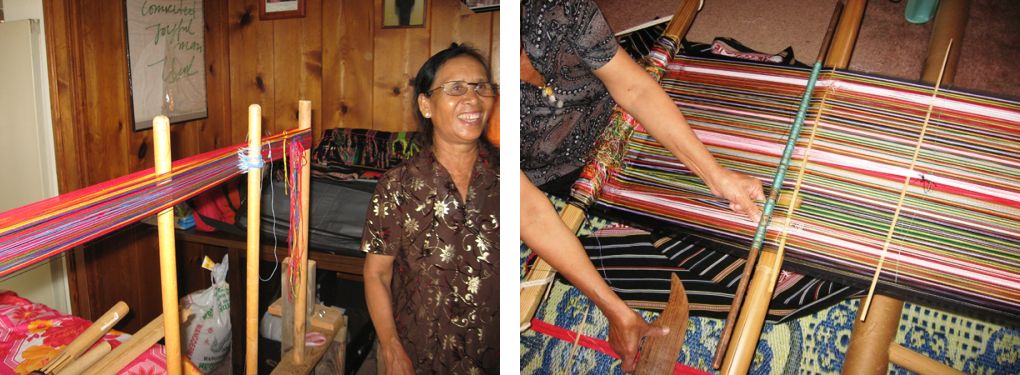
When I met and got to spend a little time with Burmese weaver Dar Ku in Massachusetts, I noticed the coil rod in her loom.

O

It is the rod furthest from the weaver in the picture. I didn’t think at the time to ask her if she added it after or during warping. I was concentrating more on her use of supplementary wefts to make her patterns and the fact that she was weaving her designs while looking at the wrong side of the cloth! Her heddle system was also very interesting. You see, there are just so many wonderful things to see and take in when you watch a backstrap weaver at work!…what is the shape of her sword, how does she open the heddles, how hard does she beat, what does she use to pick up her threads and much much more!

As she wasn’t weaving ikat and her warps could move without causing any harm, I assume that the function of the coil rod in this case is to help maintain width and keep the warps spread and in order in the potentially messy area beyond the heddles and shed rod.

The one time that I have seen a warp being made which incorporated  a coil rod was when I studied with the Montagnard weavers in North Carolina. Again, there was so much to see especially since this was also the first time I had watched a weaver add heddles as she warped. Naturally, much of my attention was focused on that.ju-warpingThis is what Ju Nie’s warping path looked like…
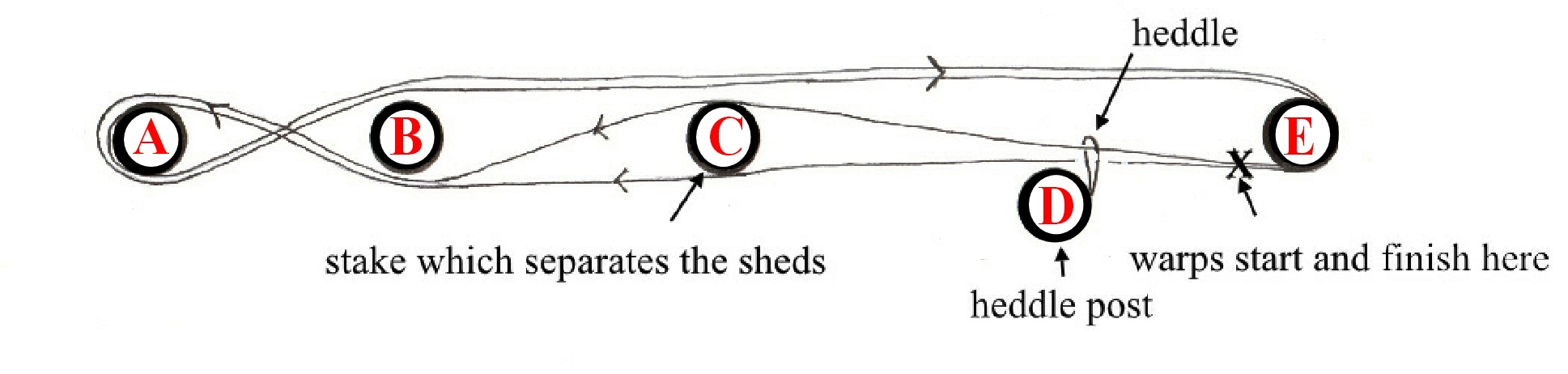
Rhade warping pathIf you flip this upside down, you will see that my new warping set up was designed to resemble this. Stake C on Ju’s set-up separates the threads into two sheds. Stake D  holds the heddles that Ju makes as she winds the warp. Stakes B and E will be replaced with the backstrap loom bars. Stake A will be replaced by the “curious” coil rod.

As I am not going to make heddles as I go, stakes C and D on my set-up will hold the cross.

circular warp set up with coil rod stake

Here is a diagram showing the two-revolution warping path to complete the cross in my set up…

warping path with coil rod cross

From left to right…loom bar 1 will replace the first stake. The next two stakes will be replaced with cross sticks….I used pencils. Loom bar 2 will replace the next stake and the last stake on the right will be replaced with the coil rod. Below you can see how it looks when taken off the warping board. I have just wound a tiny warp and used some random sticks for the sake of this demonstration.

circular warp with coil rod on loom

Below you can see the loom almost ready for use. What remains to be done is make the heddles and select a suitable shed rod.

O

The yellow and green pencils are holding the cross. Heddles will be made to raise the threads that pass over the yellow pencil and a shed rod will replace the green pencil to raise the other half of the threads.

The coil rod has been rolled from its original position, in the picture below left, over the loom bar into its new position as seen below right.

coil rod put in position

This is what it looks like on Ju Nie’s narrow warp.

ju nie's coil rodSo, I know how to wind a circular warp and put the coil rod into position now…yay. The question remains…what exactly is the purpose of this wee stick? I guess I will find out as I weave my purple scarf. I suppose I will have to weave with a coil rod for a while and then without one in order to note the differences.

In Weaving and Dyeing in Highland Ecuador, Anne Rowe notes that the coil rod, as used by the ikat weavers in Azuay Province, helps secure the slippery cotton warp and maintain an even width for the fabric. However, it is not used by cotton ikat shawl weavers in Rumipamba. I imagine that the resulting shawls in both areas are equally well made.

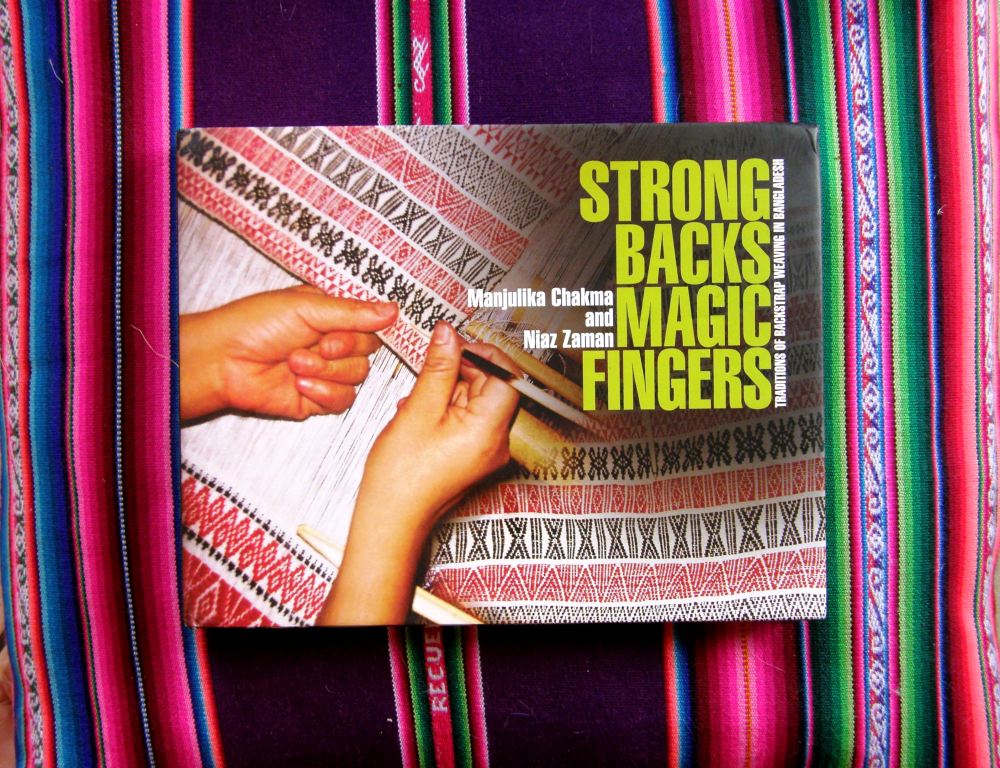
I have a book on backstrap weaving in Bangladesh, Strong Backs Magic Fingers, which describes the looms and textiles woven in twelve areas of that country. While the vast majority of the looms shown have coil rods,  some of them don’t. Certainly those that have the finest and silkiest looking thread always do. Yet, some weavers manage happily without them. It appears to be more of an aid than a necessity. Perhaps it is simply tradition that has some weavers using one.
Strong Backs Magic Fingers

I am kind of excited about having this new piece of equipment to experiment with!… a mere stick.

In Spiritual Fabric, Sadae Torimaru calls the coil rod that is placed in a body-tensioned loom used to weave narrow bands in China a ”temple stick” and says that it is used to keep yarns and width constant.

Some of you may like to read Maria Christou’s thesis An Ethnographic Study of the Loom and Weaving of the Sa’dan Toraja of To’barana’. Her research took place on the island of Sulawesi, Indonesia and on page 26 she ponders the coil rod and quotes the thoughts of other researchers on its purpose and use. It would seem that she found the answers to her questons in the course of her one year of study. I have to confess that I haven’t gotten that far in my reading of her paper to know for sure….printing out to read this weekend!

If you have made it this far in reading this post, thank you for bearing with me in my ramblings about a stick!

And so, let’s enjoy looking at some of the fruits of  these looms we have been talking about.

weavings Bangladesh Montagnard Burma

You can see a length of black skirt fabric with warp-float patterns woven by Ju Nie with a weft-twined edge added by her sister. The back cover of the book on weaving in Bangladesh shows the supplementary-weft patterned work of Chakma weavers and Dar Ku shows the white cotton fabric she wove for a dress as well as a richly patterned traditional blouse.

For those who may be curious about how Ju Nie adds heddles as she winds her warp, here is a video I made explaining it.   Ju Nie works way too fast in the video that I took of her doing it!

Wonderful, isn’t it? Maybe one day I will do this. For now, I find it very relaxing sitting at my loom and making my string heddles. There’s always something new to learn!

I will leave you with a video of Dar Ku weaving. She has such a beautiful peaceful way about her…

 

Backstrap Weaving – Encuentro de Tejedores de las Americas – Part Two – the cloth and the looms.

Read Part One of this story here.

ARE YOU GOING TO WEAVE TODAY?

I probably make a thorough nuisance of myself at weaving events like the Encuentro de Tejedores in Cusco Peru earlier this month. I have so many questions and want to be into everything and not miss a thing.

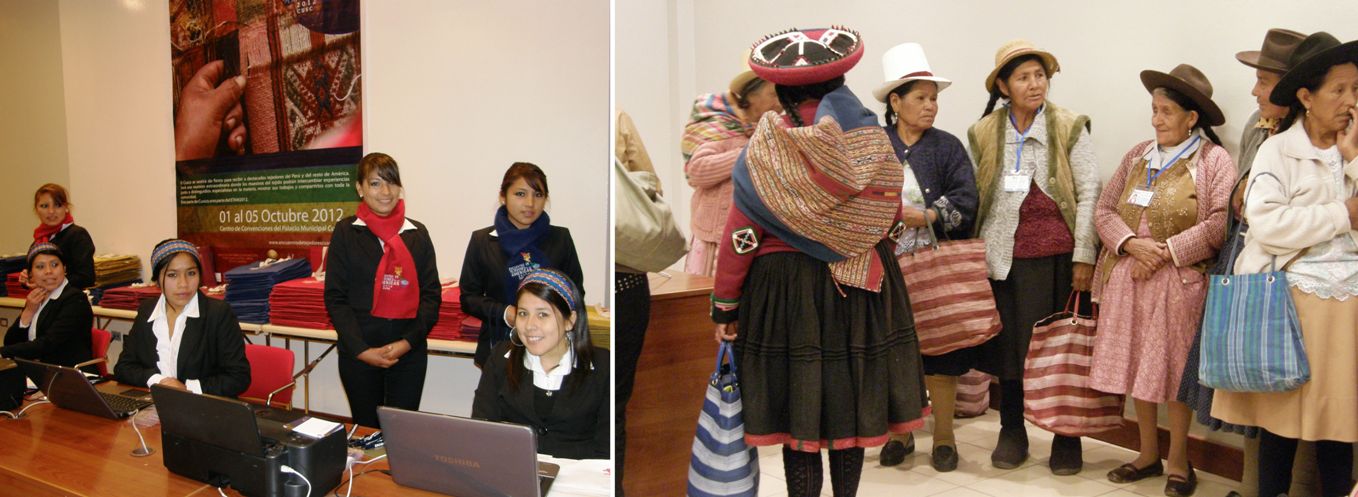
Calm and serene despite being in the very heart of the city of Cusco, the venue for the conference was beautiful both by day and night. There were plenty of pillars to which looms could be attached for weaving displays and shaded areas under the arches where weavers could show their textiles.

 Bright and early on day one, I registered along with other participants. The receptionists, looking smart in their uniforms with colored conference scarves and headbands, were efficient and clearly trained to be able to handle anything. The whole process was very slick and it was interesting to hear all the different Spanish accents and Quechua being spoken in the line-up of participants from all over Peru and South America. I recognized fondly the accent from Chile where I lived for five years as well as the song of the Argentinean-style of speaking used by my ex-boyfriend and the special way that Bolivian highlanders pronounce “rr”.

I then stepped outside to the courtyard to another world…a buzz of colorful activity… where I watched all the stands being assembled by weavers from all over Peru, Bolivia and Latin America, saw all the marvelous textiles emerging from travel sacks and being arranged and labeled, touched the fiber, tools and implements which were used to create the colorful cloth and spoke with the creators themselves. Some of them seemed somewhat overwhelmed by the high level of interest in and admiration for activities that are quite normal and commonplace, almost passing without remark, in the communities, villages and towns where they live.

Weavers and knitters from Taquile Island wearing and displaying their textiles and the creators of the wonderful ikat pañones of Tacabamba, Peru

The question that I really wanted to ask everyone right there and then is “Are you going to weave today?” Is today the day when we will get to sit by you and see how you created all these exquisite textiles? And all the while the  excitement is building as I see more and more gorgeous textiles and looms being extracted and arranged. I had already seen at least ten things that I wanted to explore further after having passed just once quickly by each of the twenty-two half-erected stands.

Weavers and spinners from the Navajo Nation, my friend from the Tinkuy, DY, and TahNibaa and Albina from San Ignacio de Loyola showing the crocheted “chullos” and the belt loom full of sticks which is typical of her community. 

The Chol Chol Foundation of Chile was present bringing with them textiles made by the Mapuche weavers that they support including a spectacular ikat- patterned “manta cacique”. Lowland areas of Peru were also well represented with a group of Matsigenka cotton spinners and weavers from Echarate, Bajo Urubamba.

The looms!……

A horizontal loom with a broad belt patterned with double weave and complementary-warp pick-up patterns of Taquile Island and a backstrap loom with a cotton warp-float piece in progress from Echarate.

The simple backstrap loom of Tacabamba, Peru on which the indigo ikat-patterned “pañones” are woven.  The process of creating a pañon is anything but simple. They are up to one-meter wide, covered with tiny motifs and have patterns knotted into their fringes.

A floor loom from Ayacucho, Peru with a tapestry in progress and the leaning vertical loom of Tarabuco, Bolivia.

The cotton weavers of Chiclayo managed to preserve their native cotton despite the fact that its cultivation was banned for many years in Peru. The backstrap loom is used to weave their natural brown and white cotton into saddle bags, belts and table ware for their own use. The Guatemalan loom from Santiago Atitlan holds brocaded cotton cloth destined for the typical woman’s blouse or “huipil”. Panels are sewn together and the neckline embroidered with birds.

Wide warps, narrow warps and everything in between… A Tinkipaya weaver’s leaning vertical loom, holding fabric covered n complementary-warp pick-up patterns, rests on the ground. A weaver from Pitumarca speedily edges her finished woven lliclla with a tubular woven band using three sets of string heddles and a shed loop.

A backstrap weaver from Ayacucho, Peru, creates a belt patterned with supplementary warps. She uses a forked stick to hold a secondary cross, the manipulation of which helps her to open the heddle shed quickly and efficiently. The wide backstrap loom parked against the pillar is from Tanta, Peru where handspun alpaca yarn is often combined with bright synthetic threads to make shawls, ponchos and blankets.

And then there was that tantalizing backstrap loom with its twenty-four heddle sticks…Señora Araceli, are you going to weave today?

First Araceli has to make the twenty-four sets of heddles on this fresh warp. The pattern has already been picked up and saved on sticks.

Just before lunchtime one day when we were indoors listening to speakers, I got the uneasy feeling that I really needed to be somewhere. I got up and tip-toed out at the start of the morning’s final presentation by Manos del Uruguay to find Araceli seated and preparing her warp for an afternoon session of weaving.

Well, you know that I am fascinated by the entire process and so I was happy to be able to sit alone with her and watch her make her heddles. I was tickled to see that she makes her heddles with the extra security hitch just as I have chosen to do. I have seen and learned so many ways to make string heddles for backstrap and other kinds of weaving and this method is by far my current favorite. I always say “current” as who knows what cool new method I will find tomorrow.

Here is a short video clip of Araceli making her heddles. She certainly has a smooth and elegant way of doing so. I know some people don’t like making heddles and dread that part of the process…I like it!

And what about the woven cloth produced by these looms and the pieces produced by talented hands using knotting, braiding and crochet?

Head gear…Crocheted “chullo” from Peru and a woven hatband from Bolivia.

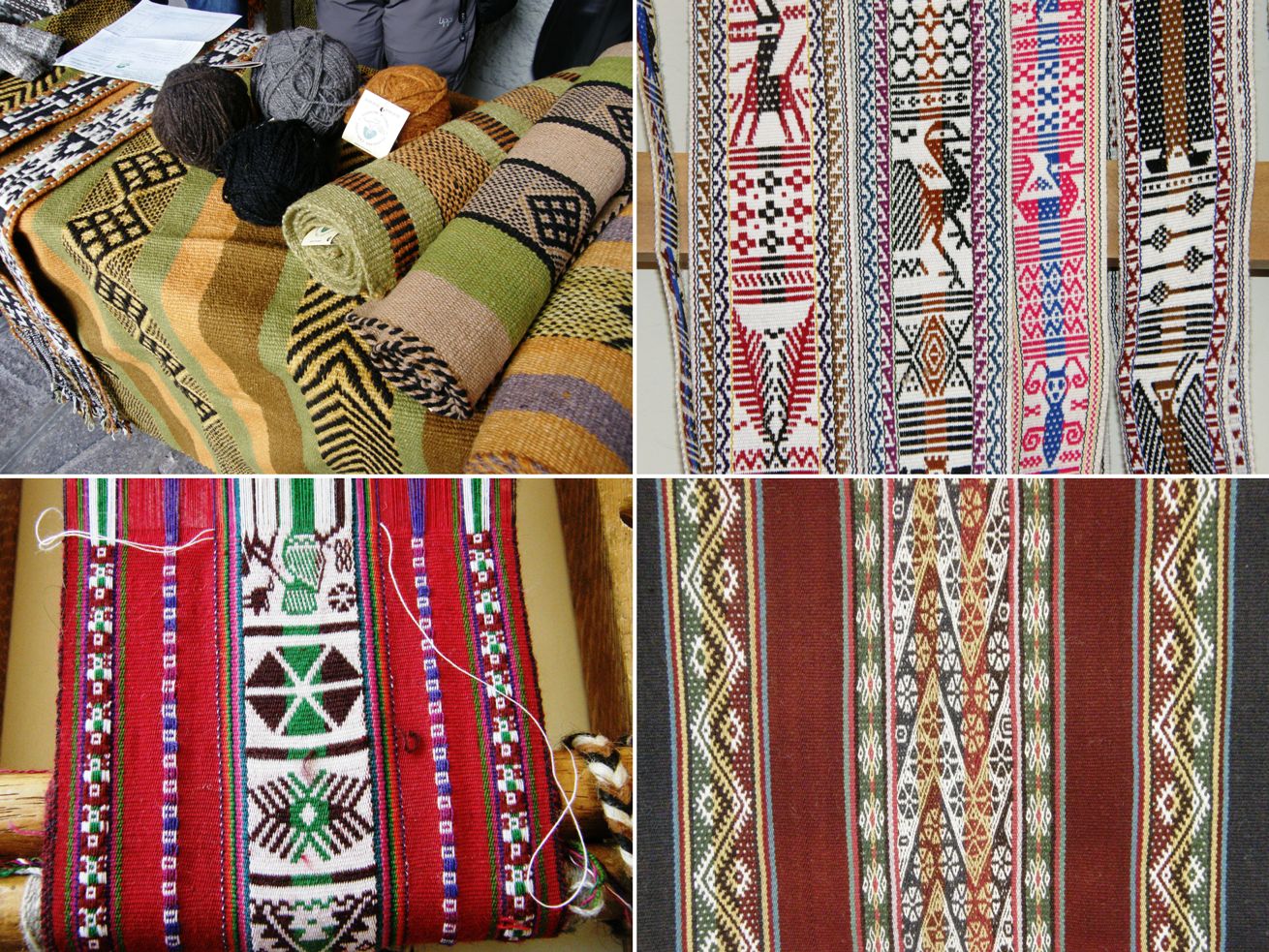
There are four countries represented here….cloth from Mapuche weavers in Chile,  Salasaca, Ecuador,  Taquile Island, Peru and Tinkipaya, Bolivia.

Cloth from different corners of Peru. The variety!

Of course, each piece has its story and it was those stories that we were told in the weavers’ own words in the seminar sessions that were held in the mornings and afternoons. The stories were very inspiring and educational, often with very personal touches which brought life and meaning to the fabric that simply could not be transmitted from the market stall or loom alone. All told of hope, perseverance, strengthening of ethnic identity and a revival of pride in oneself and culture and were often very moving.

The faja sara ( the one created with the twenty-four string heddles) has its own fascinating story. It is part of an unbroken weaving tradition that dates back at least 500 years to Incan times. The belt is described in the chronicles of Mercedarian Friar Martín de Murúa in 1590 A.D. and the knowledge of how to create one has been passed on ancestrally over all these years.

Lynn Meisch has written an article about her research on these belts here. We were told by the weavers that the name “sara’ comes from the verb ”sarear”, although I have never come across this verb before, which means to choose, or in a weaving context,  to pick-up.

Interesting to me from a structural point of view is the rolled edge of the belts which is surprisingly easy to create. I am guessing that it serves the same purpose as the woven bands I have seen added to other textiles in that it strengthens the edge. When I was in Holland, Marijke van Epen and I followed Mirja Wark’s explanation of the rolled edge used by the Wayuu people of the Guajira Peninsula in Colombia and Venezuela and the way the weavers of the sara belts create theirs is equally as interesting and practical.

Here is Araceli in action with a band of spectators. When doubt was expressed by the onlookers about the quality of the cloth since Araceli does not use a ruki, the llama bone tool, to beat in her weft, Araceli immediately invited them all to feel the belt. They were all surprised and impressed by the firmness of the weave. It is a very dense piece of weaving.

The poncho shown above is from Catamarca Argentina and represents the recovery of the exquisitely fine work done with handspun vicuña fiber on floor looms which has the made the poncho Catamarqueño famous for centuries.

Two people weave the pieces side by side and have to coordinate the strength of their beat perfectly to maintain a consistent weave. With the fine vicuña thread a piece that measures 2 meters by 1.30 meters weighs only 320 grams and takes up to eight months to complete.

Fine vicuña shawls are also woven and embroidered using designs copied from old colonial textiles.

We had a chance one afternoon to handle and clean pieces of vicuna fiber and everyone was invited to try their hand at spinning it on the  25cm spindles.

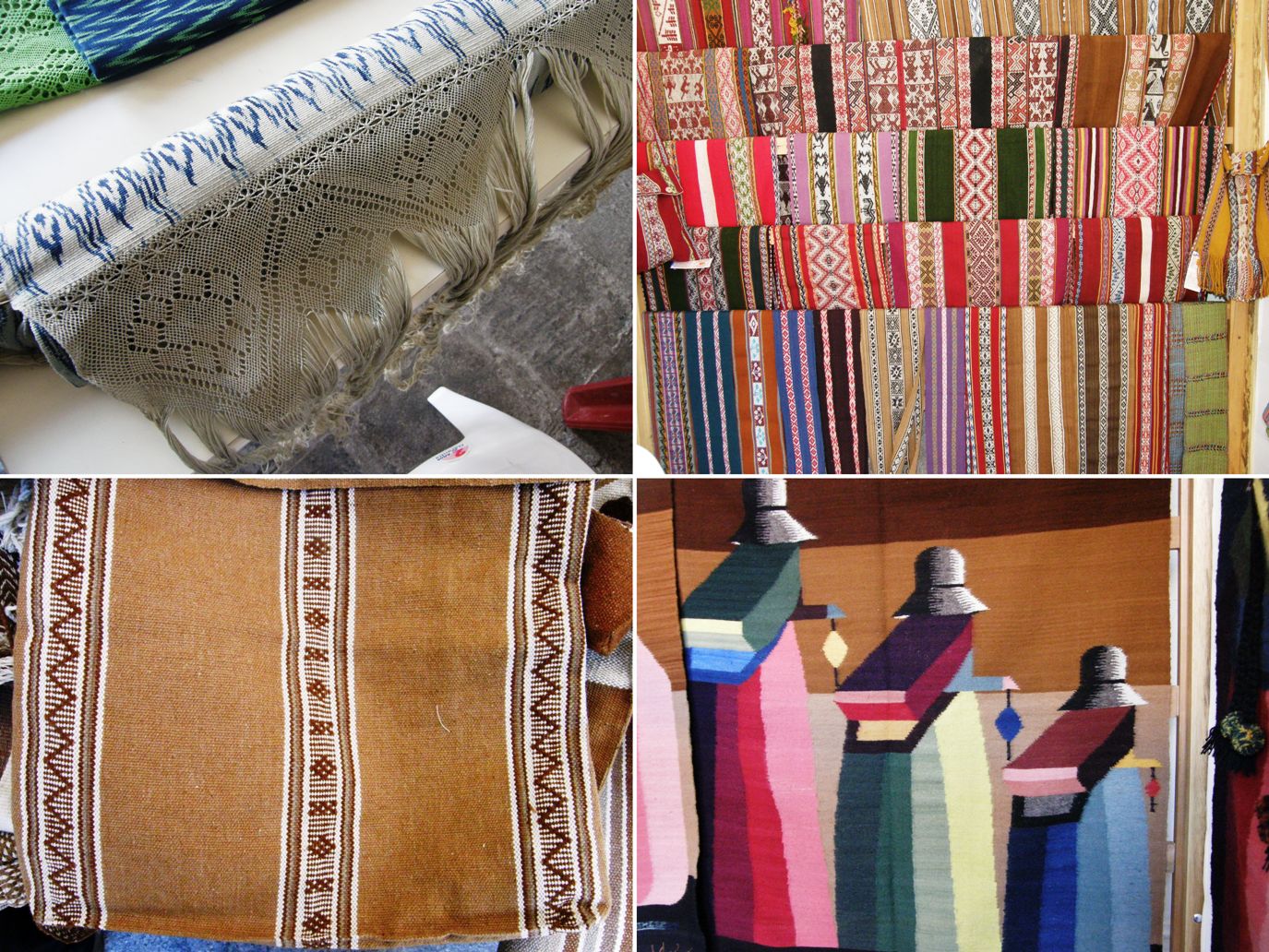
More cloth…..

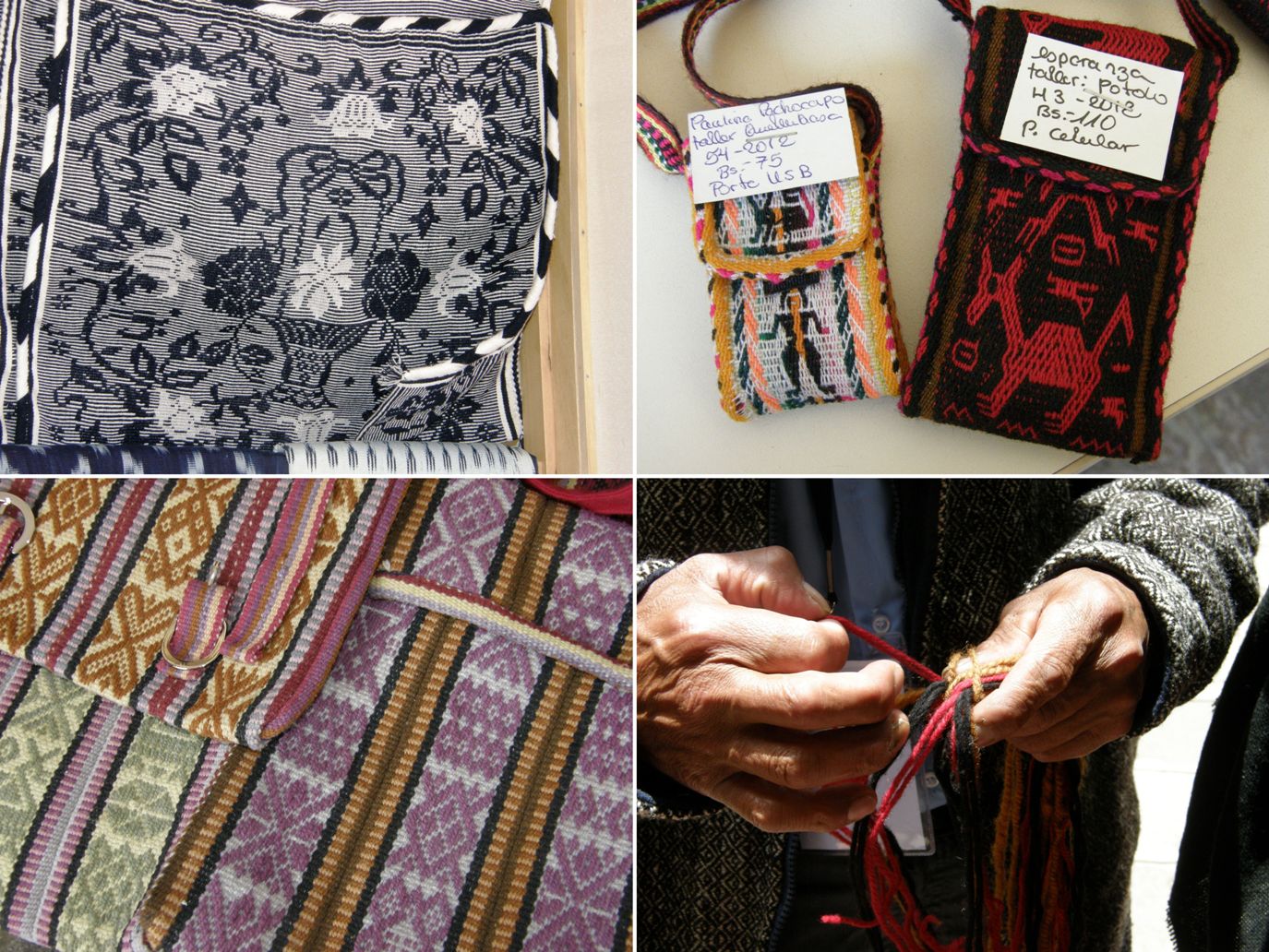
…. a bulsico , or cotton double-pocket saddle bag from San Ignacio de Loyola with beautiful patterns in simple warp floats worked in two colors. The weavers from Tarabuco and Potolo in Bolivia of course brought large fine examples of their textiles. I decided to show you here some very small and practical pieces that they also brought to sell. The tiny USB pouch is from Tarabuco and the cell phone pouch with its woven khuru figures is from Potolo.

The supplementary-warp patterned pieces in lovely pastel colors are from Ayacucho, Peru and the last shot is of an impromptu sling-braiding demonstration from one of the Peruvian presenters in the coffee break.

More lessons along the way…

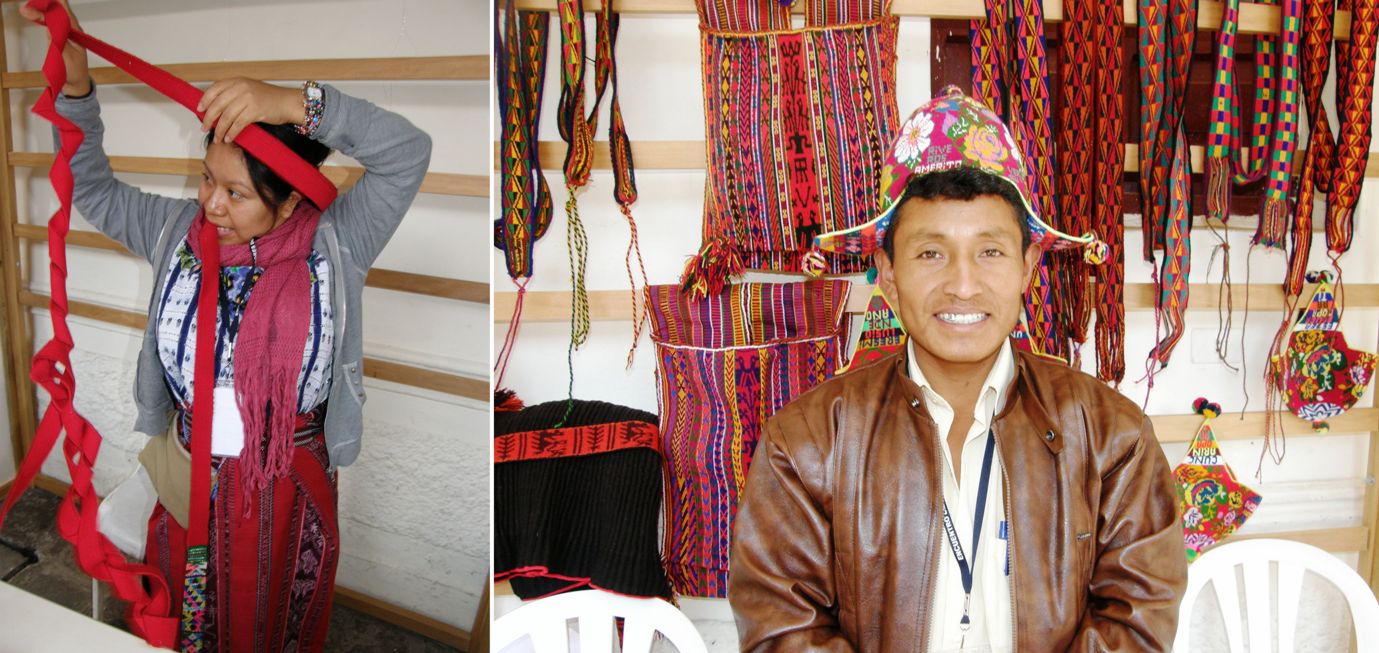
Diana from Santiago Atitlan in Guatemala showed me how to wrap her hair and head with a woven hair sash. You can see that most of the band is plain red with just the last part, which will be seen on the outside, decorated with pattern. Albina’s husband showed me how married men wear the typical chullo of his home…with the flaps standing out sideways. A single man will wear his with the flaps pointing out front and back.

So, now you have seen a selection of the stands, looms and textiles and heard a few backgroud tidbits about some of the weavings and the people who produce them. You are probably dying now to see the weavers in action, right?

ARE YOU GOING TO WEAVE TODAY?

Sorry, but I am saving that segment for the next blog post as uploading the video will be so much easier for me when I am in the US.

In the meantime I am packed and ready to leave tomorrow and I did manage to finish the discontinuous warp piece that I started in the workshop on the last day of the Encuentro. Handling alpaca fiber is not a nice business in this heat with sweaty hands, I can tell you!

Here is my ticlla piece off the loom and all curled up…

The overspun alpaca yarn made the grey and black panels curl in and the other two panels curl under. You can see my finish line on the white panel. I ended up removing one weft as I had packed too many in. I really need to remove two as now I have two wefts in the same shed. The finish line isn’t as noticeable on the other panels. I am really pleased with this!

I wove and sewed on a tubular band to the edges….… in the same way as the Pitumarca weaver that I showed earlier in this post, using three sets of string heddles and a shed loop. See how nicely the piece lies flat now? I hemmed the sides before applying the tubular band because I didn’t like the way the warp stripe at the edge was interfering with the color of the tubular band.

Here’s a better look at the tubular band and that lovely dovetail join of colors…

Done! I am keen to try this all again!

See you next time from the US 🙂

Backstrap Weaving – Weaving Wanderings and Wonderings

The Worldwide Weaving Web brought a new book into my home last year which has inspired my third wall hanging project.

If you can’t bear to look at yet another of my red, black and white warps on the loom ready to be woven, you had better look away now because here we go again!

There isn’t a whole lot to show for a week of work, is there? What you don’t see is the reading, sampling, un-weaving, re-warping, charting, erasing and Googling. In fact, as I sit in front of this warp, I have the uneasy feeling that I may be jumping the gun and launching into the big project too early. I have actually unwoven the first line of pattern twice and made adjustments. Clearly my sampling didn’t cover all I had in mind.

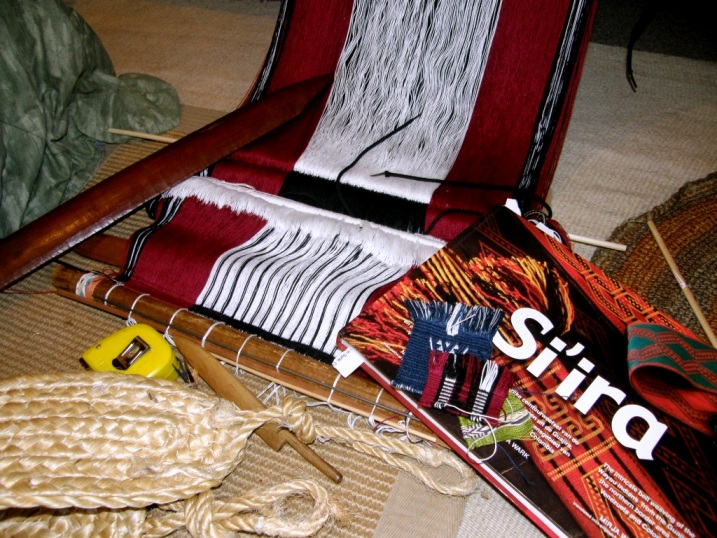
I am using the work of the Wayuu people of Venezuela and Colombia as my inspiration for this project through Dutch author Mirja Wark’s book Si’ira. A lady in one of the Ravelry weaving groups posted about the existence of this book in the middle of last year and I was on a mission to get hold of it. My friend Anna in Australia, who is from The Netherlands, took care of the local payment and then offered the book to me as a birthday gift. Thank you, Anna!

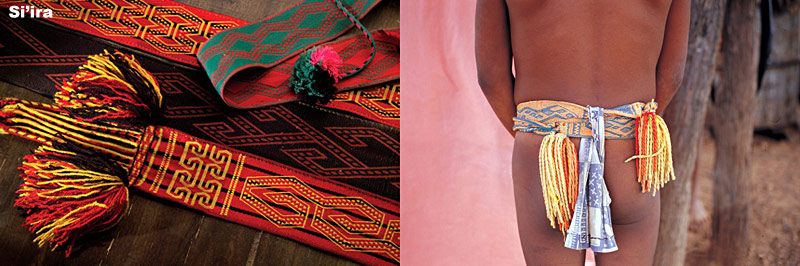
It is a beautiful hard cover book full of drawings and photos of the si’ira which are worn by men, their designs, the weavers and the vertical looms that are used to make them. The skills required to make a si’ira  include weaving, twining, braiding and tassel making.

This image is from Mirja Wark’s web page.

The Wayuu live on the Guajira peninsula which is the northernmost border between Colombia and Venezuela. Wark describes this area as a flat, dry semi-desert over which a continuous hot wind blows. It is always interesting to me to know more about the people, weaving and textiles of lowland regions of this continent.

Many different colors are used and I especially love the pictures of the si’ira in the book that comprise a red and black background on which yellow motifs have been woven. Other belts are black with red motifs…very striking…and so they are perfect for the color theme of my wall hanging project.

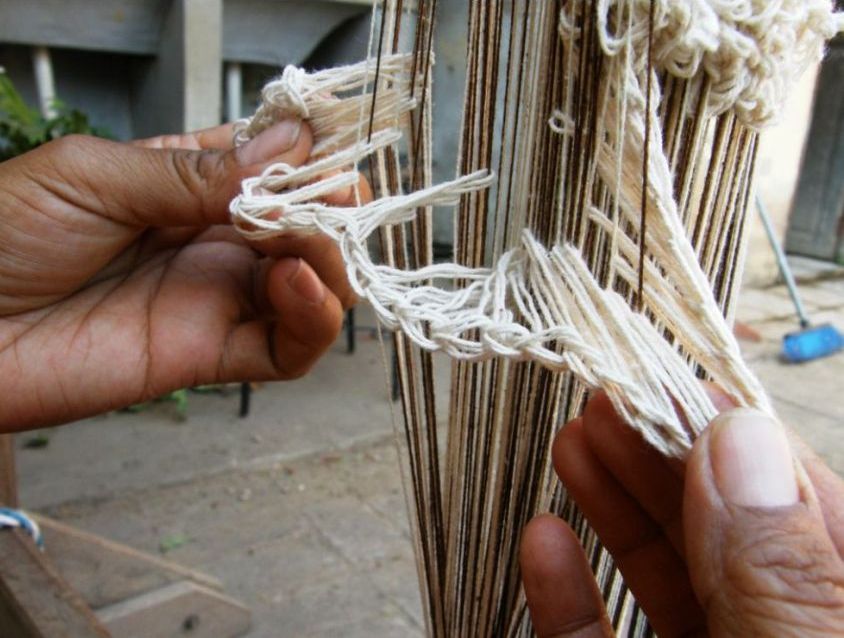
It is also interesting for me to see that the Wayuu weavers use the same style of joined loop heddles used by the Guaraní weavers, another group that inhabits lowland regions, here in Bolivia.

At left you can see my Guaraní teacher, Angela, showing me the unusual way her string heddles are chained together.

What I would like to see is how the Wayuu weavers manipulate the heddles and if it is the same method that Angela and other Guaraní weavers use.

Angela most often has three sets of string heddles on her loom which are required by the technique she employs for the kinds of structures that she weaves. Watching Angela do her pick-up work jumping between two sets of the string heddles is fascinating!

The Wayuu weavers use one set of these kinds of string heddles on their warps but I imagine that they would need to work them in a similar fashion to the way Angela does.

I can’t help but notice some small similarities in some of the motifs of the Wayuu and Guaraní people although the weaving structure employed is different.

So, this will be the basis for wall hanging number three in the red, white and black series.

Another of the many interesting things about the si’ira is that they are woven with what Wark calls a “hollow selvedge” which serves to strengthen the edge of the belt. It is funny that on a visit with my friend Pam in Massachusetts we had talked about a rolled selvedge that Harriet Tidball describes in Shuttlecraft Monograph 26. Pam was trying it out on a band of her own.

Tidball writes that it was used by the ancient Peruvians and that available evidence shows that it was used on bands and belts.

The rolled selvedge creates a thick tubular edge.

Separate tubular bands like the one on the edge of the purse pictured at left are often applied to Bolivian and Peruvian weavings  for various reasons, one of them being to strengthen and reinforce the edges of the textiles.

You may be able to make out the thick edge which is the hollow selvedge on this image from the cover of the Si’ira book.

How clever to think of a way to form the tubular edging from the band itself so that it forms as weaving progresses and does not need to be added later. I wonder why this technique fell out of use in Peru.

I love seeing how these things turn up here and there, disappear here, remain there, evolve further there, are replaced by something even more ingenious somewhere else…The fact that these heddles are used by the Wayuu in their arid lowland home and also by the Guaranì here in steamy jungly lowland Bolivia, so far away, fascinates me.

The Worldwide Weaving Web, about which I often speak, means that I can have a new online weaving friend in rural Turkey asking me about backstrap weaving and telling me about the catalog of woven Turkish motifs that his mother has while a weaver and clothing designer in Bangladesh shares with me what he knows about backstrap weaving in his country. Techniques and information are shared instantly across the globe. I wonder how in ancient times designs and techniques were transported and shared and adapted among the weavers of this continent.

And then you have weavers who live along the relatively short length of Ecuadorian coastline who apply bands to strengthen the edges of their cotton saddle bags. Different techniques are used to both set up the loom to create the patterns and finish the woven pieces in different areas along the coast.. I am familiar with the way the members of one family of weavers in Manabi province finish their work by applying a woven band using a home made rigid heddle which I have shown many times here before. Yet it is worth looking at again..it is so cool!

This picture, taken by Kathleen Klumpp, shows my weaving teacher Trinidad weaving and sewing a band to the edge of a small bag.

This is how the edging looks on the fabric.

And then I see from an article in the Textile Museum Journal that further north on the Ecuadorian coast, on the Santa Elena peninsula, weavers also apply bands to the edges of their saddle bags but use a very different method which requires an extra pair of hands.

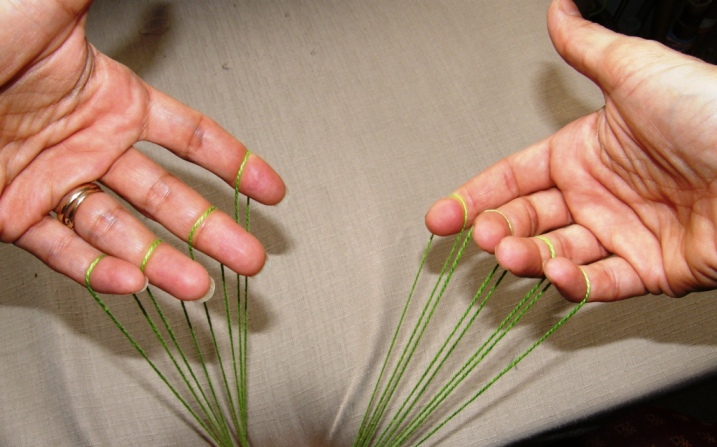
While one person sews the band to the fabric, another person manipulates the warp threads  passing the warps which are looped on the fingers of their two hands from one hand to the other. The extra pair of hands would look like mine above (modeled on a drawing in the Journal article).

These are two very different ways to add a reinforcement band to the edge of a woven textile and both are being used within a relatively small area.

Do similar techniques develop independently or do they travel and get shared and eventually adopted and adapted? Why do some methods remain so different within relatively small areas? I know there are people who devote themselves to studying just this kind of thing. Me? I sit here and ponder!

Something that seems common in certain areas of Asia is the addition of string heddles to the warp while the actual warping is in progress on the stakes. Was it developed simultaneously in various areas or did it travel and get adopted? It seems like such an ingenious and time-saving thing to me. However, it is not something I have ever seen in use in my part of the world.

I know how to do it as I watched the Montagnard weavers warp when I visited them in North Carolina and, more importantly, filmed the process so I could study it over and over when I got back home….it was all happening so fast!

Even though I say it is clever and time-saving, I have not adopted this technique for my own weaving. I stubbornly cling to my favorite way of making heddles with the extra hitch which has the heddle loops  held snugly on the heddle rod.

In the same way, perhaps the weavers of Manabi province in Ecuador and those on the peninsula further north are aware of each other’s techniques yet stick with their own methods believing them superior…who knows? My anthropologist friend Kathleen Klumpp no doubt can tell us that.

Here is the video I made of Ju Nie warping with two colors and making her heddles around one of the two as she goes. That is followed by a video I made in which I do it slowly and explain the process.


Angela, my Guaraní weaving teacher, certainly didn’t hesitate to ask to be taught how to make the kind of string heddles I use when she saw them on my loom and she started using them on her warp to replace one of her sets of chained string heddles straight away. She had seen string heddles on a stick before, wondered about them, but didn’t have anyone to show her how to make them.

And she was keen to learn how to do the three-color version of the technique she employs when an Aymara weaver visited from highland Chile.

And so, techniques and methods travel and get shared and then I guess one day no one will remember anymore how that particular technique managed to cross the Andean high plains and descend to the Bolivian jungle.

Well, enough pondering. Let’s see what has been happening in the Ravelry group where some weavers are still having fun with the Bedouin techniques.

Here’s Jennifer’s wall hanging which uses the al’ouerjan pattern and shajarah techniques. Many of the motifs in the central section were created and charted by Jennifer herself.

Traudi provided us with helpful pictures of her piece before and after washing. She made a placemat and had some tension issues and a bit of puckering, which didn’t all come out in the wash but, what is nice to see, is that the severe ridging that had formed in her cotton cloth disappeared with washing and pressing.

She used weft twining on both ends before leaving the fringe and her center pattern is the traditional Bedouin al’ouerjan design.

And to finish, I ‘ll just let you know that I put one more tidbit on my RESOURCES page this week. I am slowly but surely gathering up all those links.

Backstrap Weaving – A Feast of Knotted Fringes

This is a week in which I have been insanely busy with very little time spent at the loom. My pre-trip preparation has kept me busy at the keyboard making arrangements, digging through the closet to find the warm clothes, dragging out backpacks and bags, warping projects and gathering sticks to take on the road.


I washed and pressed my finnweave piece and was pretty happy with the result (wet finishing always makes me nervous). I wove a simple strap and now need to decide how to put it together. I also warped up a bright striped piece for a tote bag project but simply couldn’t live with the color arrangement. I have to confess that I hadn’t put a lot of thought into how I arranged the stripes and that has now come off the loom.

And then came an email from Eladio in Mexico sending me a link to a video showing the rebozo weavers of Santa María del Río, San Luis Potosí knotting designs in the warp ends of their shawls….stunning!

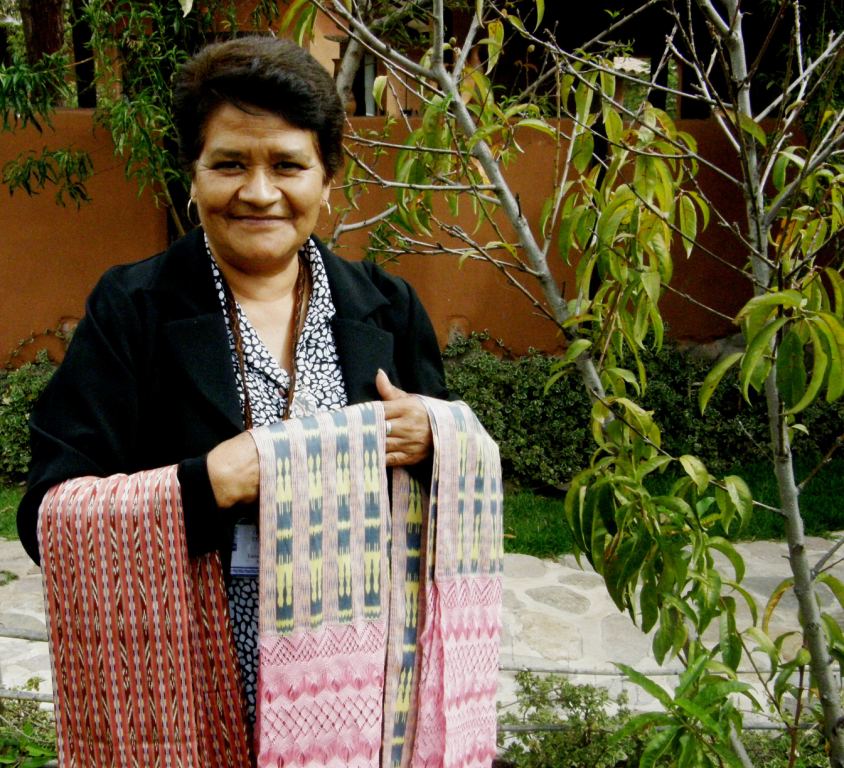
At the Tinkuy de Tejedores, in Urubamba Peru last year, one of the presenters was a weaver from this very place…Luisa Govea, pictured at left, with some of her work, is known as one of the most highly skilled weavers of silk ikat rebozos using designs from the 17th , 18th and 19th centuries.

Carol Ventura has a web page with pictures from the backstrap weaving school in Santa Maria del Rio where many of these shawls are made.

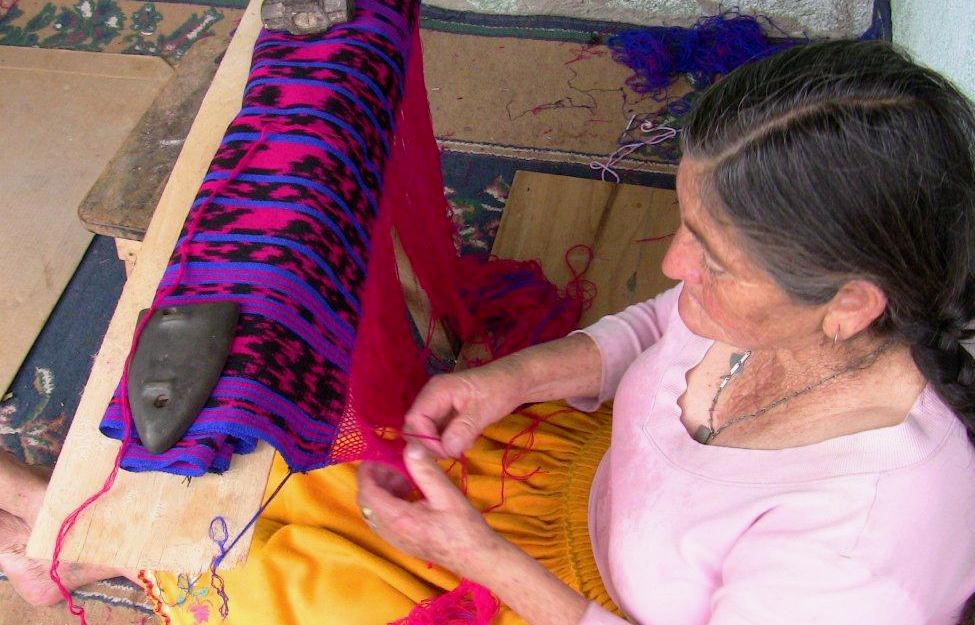
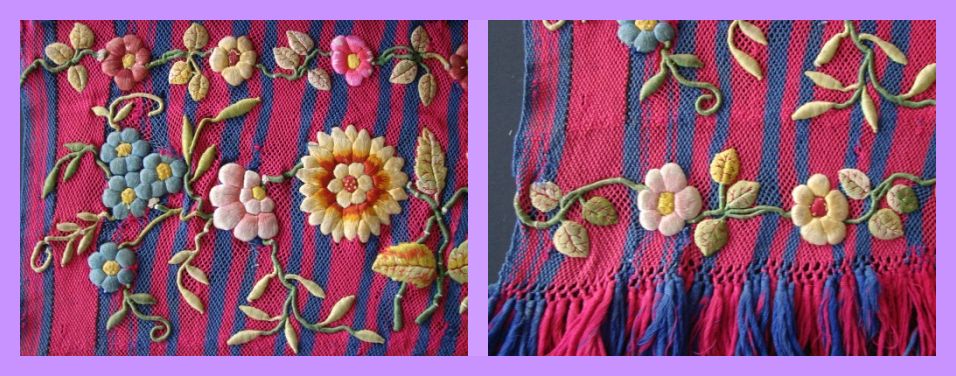
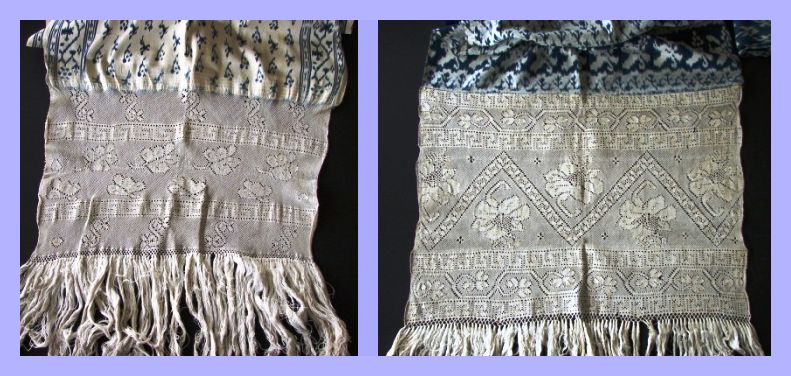
This reminded me that I also have a lot of photos which my online weaving friend, Phil sent me of ikat shawls in the collection of the late Dennis Penley. These also have magnificent designs which are created by knotting the warp ends and sometimes even embroidering on top of the knot work. These shawls are from the towns and villages around Cuenca in Ecuador.

Whether the knotting technique used by the weavers in Mexico and Ecuador are the same or similar, I can’t tell you. All I can do is watch the video in wonder and enjoy the images that Phil has sent me and hope one day that I may find out more about them on a return trip to Ecuador or, even better, on a first trip to Mexico.

Here ‘s the video….

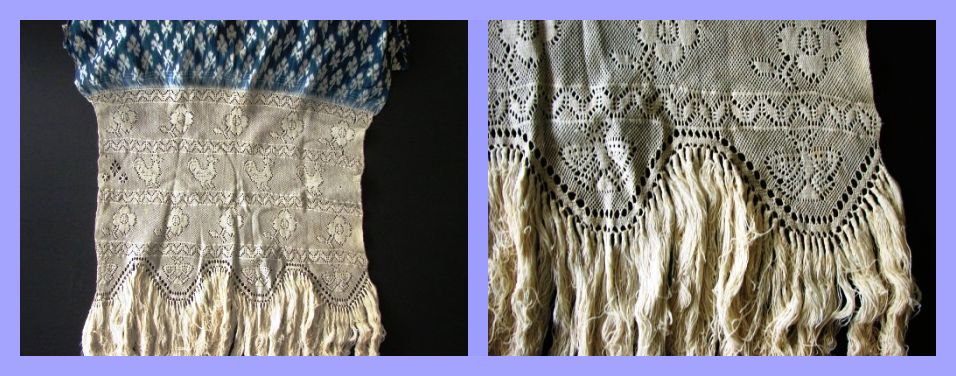
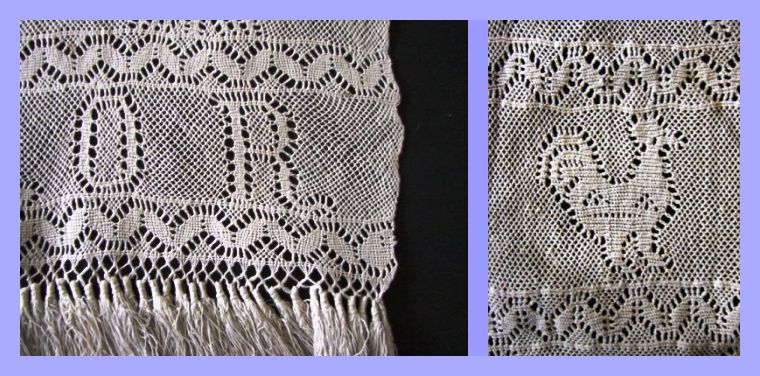
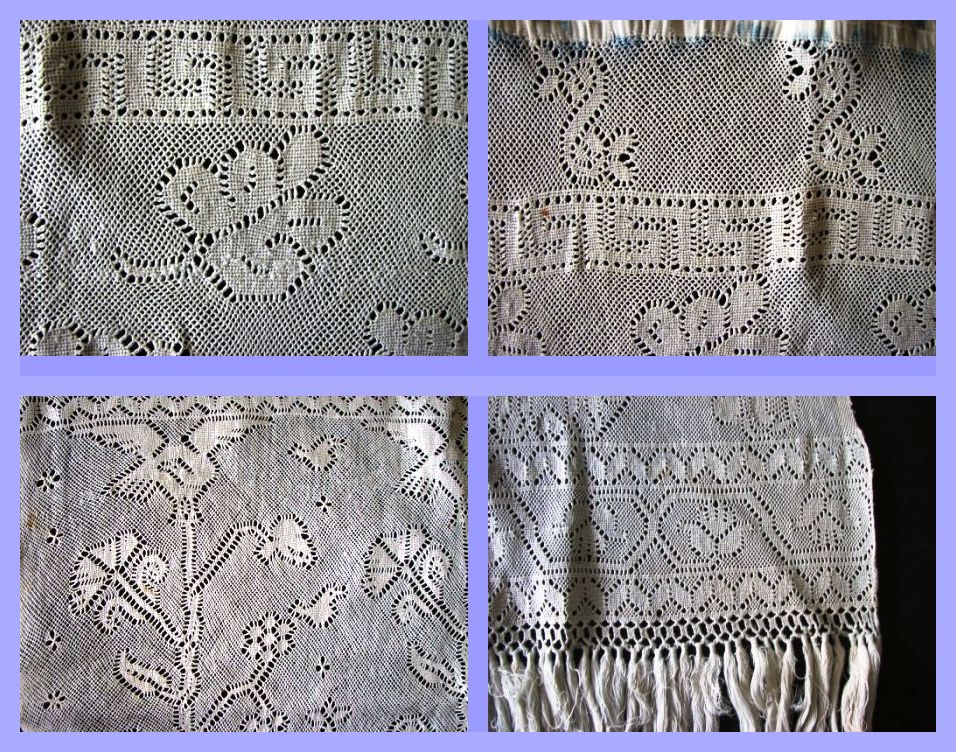
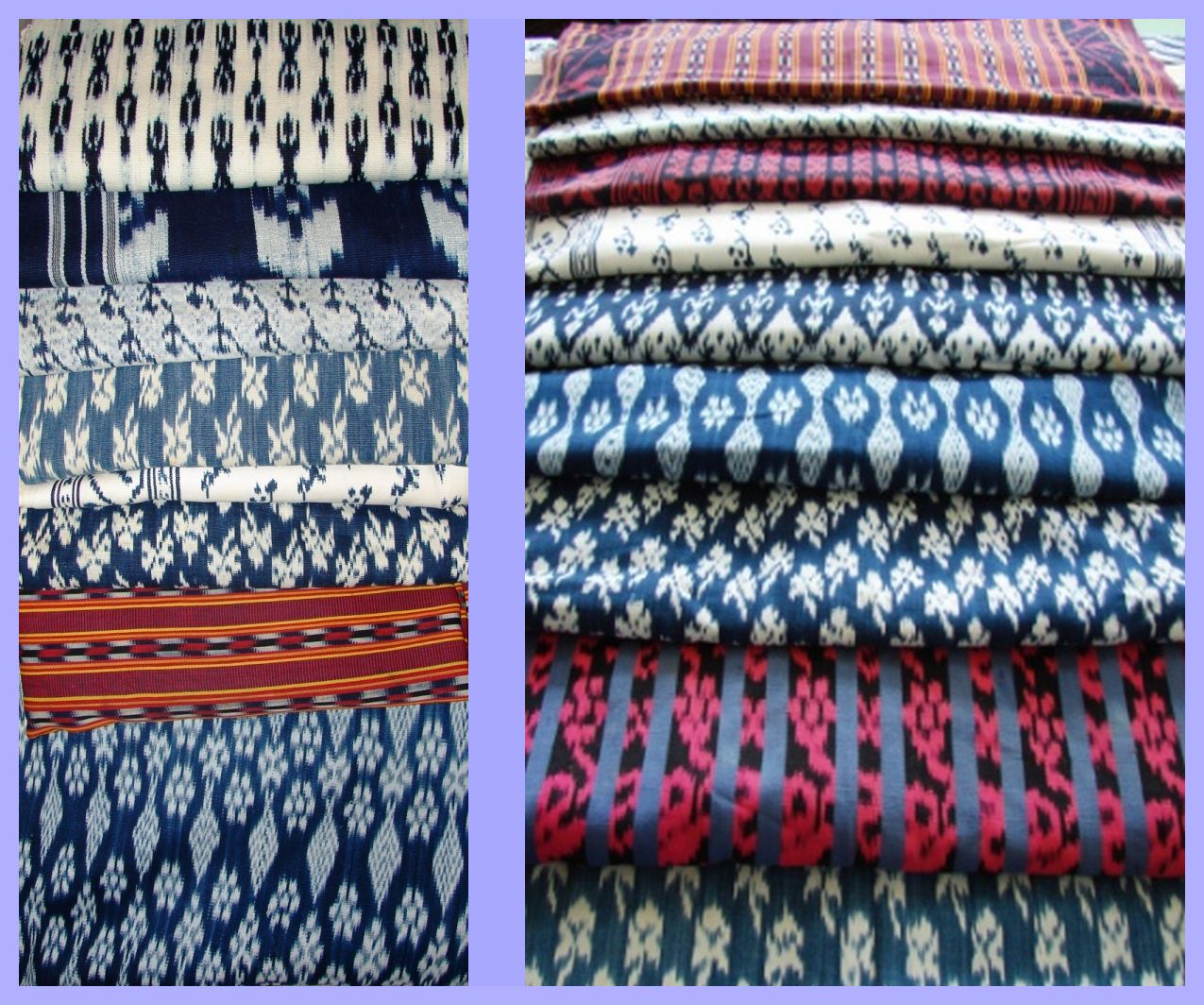
And now I can treat you to images of the designs on the fringes of ikat shawls of Gualaceo, Bulcay and other towns and villages around Cuenca in Ecuador….

Many thanks also go to Agaath who has allowed me to use her picture of a lady knotting the fringe on an ikat shawl in Ecuador…
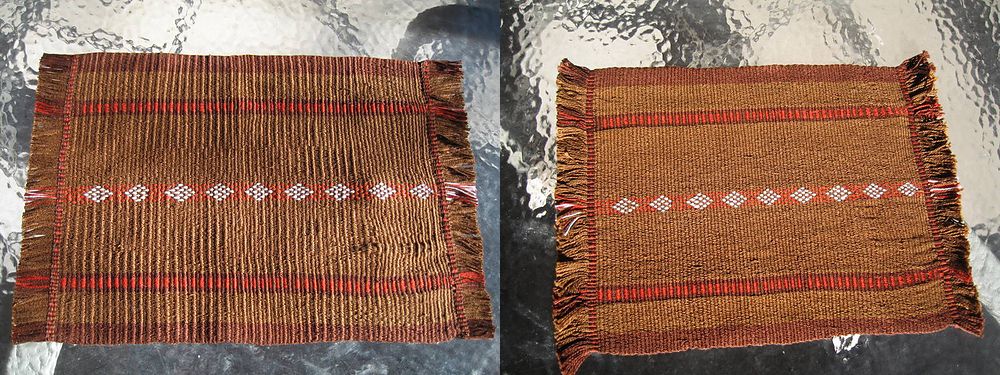
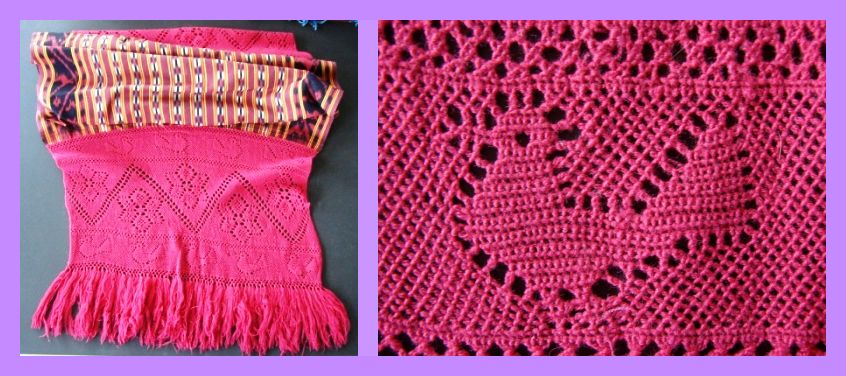
We can imagine that she is knotting a design something like the one seen below…

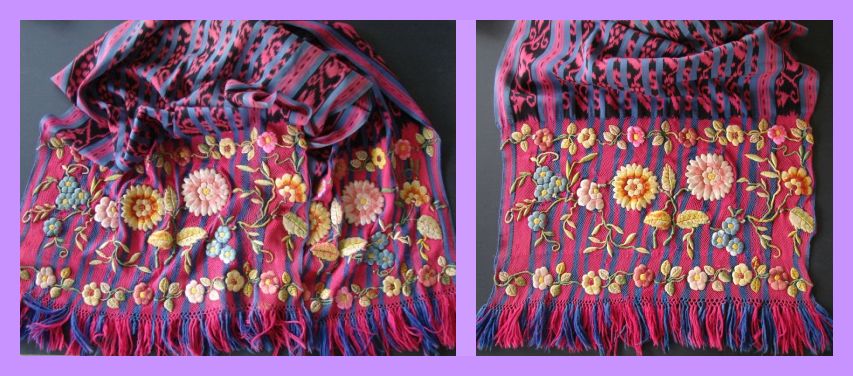
Or perhaps she is just knotting a fine mesh without designs onto which she will later embroider figures like these:

And a closer look…

And then there are the fine elegant white fringes. This one includes the Ecuadorian Coat of Arms…

If you can’t quite make out the patterns there, here are a few pictures of some of the details…

More knotted fringes with their intricate designs….

I love the shaping on this next example…

Sometimes the designs incorporate words….

And here are details from various pieces….

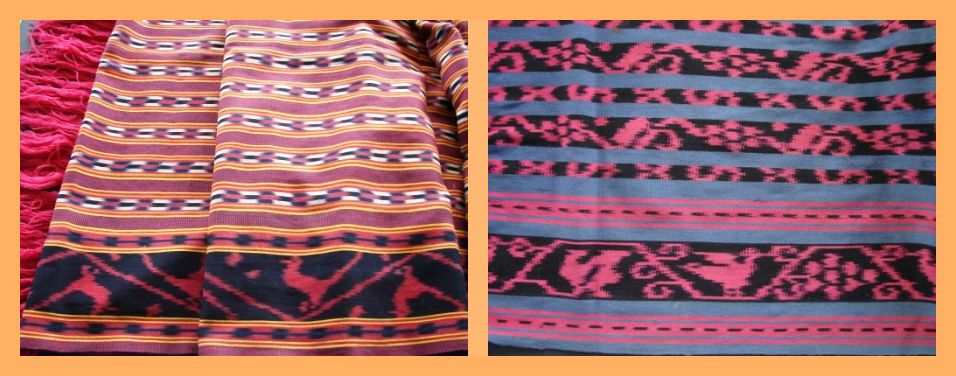
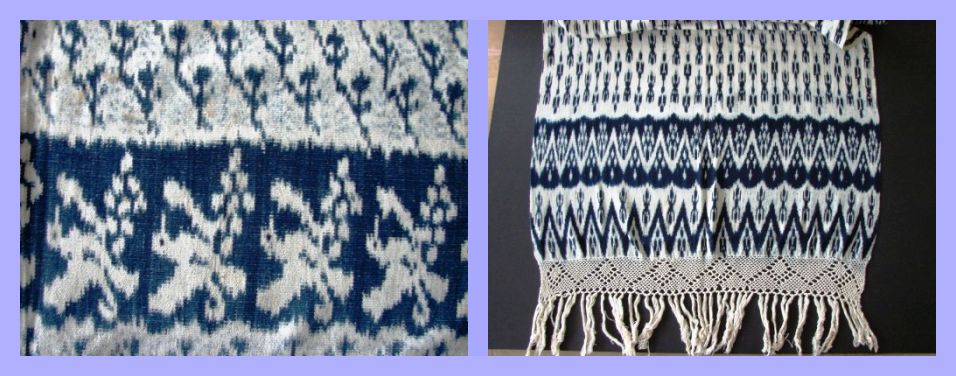
And what about the ikat pieces themselves which are woven on backstrap looms like these? (another picture courtesy of Agaath)…

Here are some more pictures, taken by Phil, of pieces in the Dennis Penley collection….

And these….wow!!

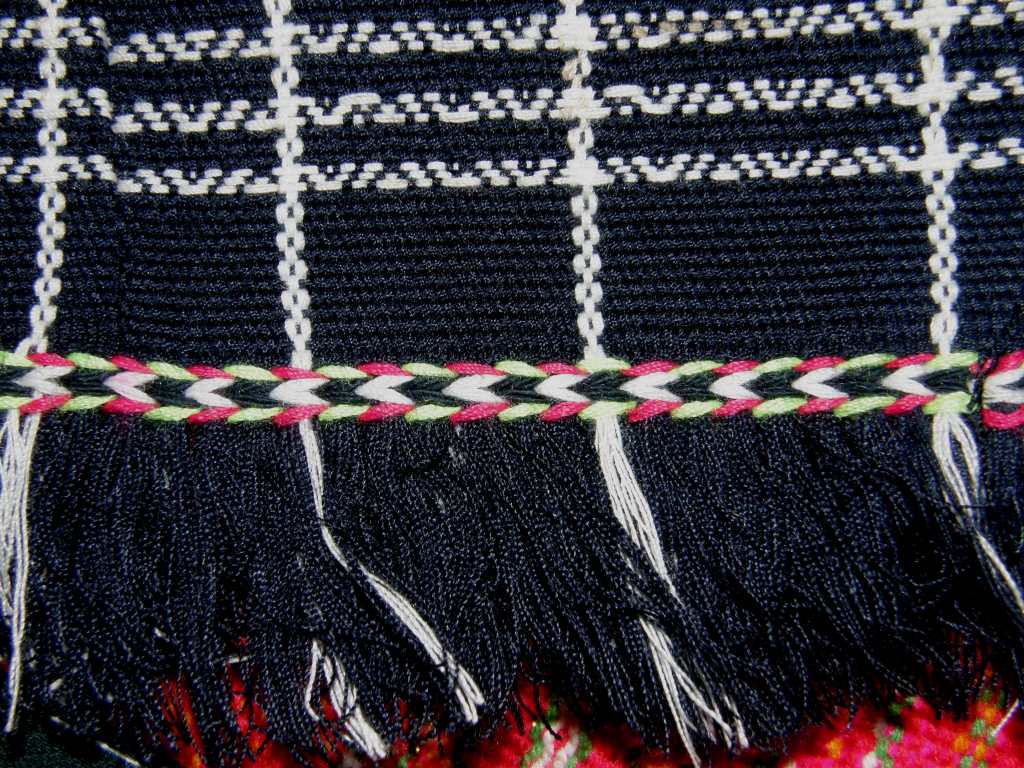
So, that’s it from me for this week. I wonder if any of you tried the weft twining that I showed in my instructional videos last week. I found a picture in my file of Montagnard weavings of some of the basic weft twining I showed in the videos…single rows of alternating colors and chevrons created by working four threads at once…simple but effective.

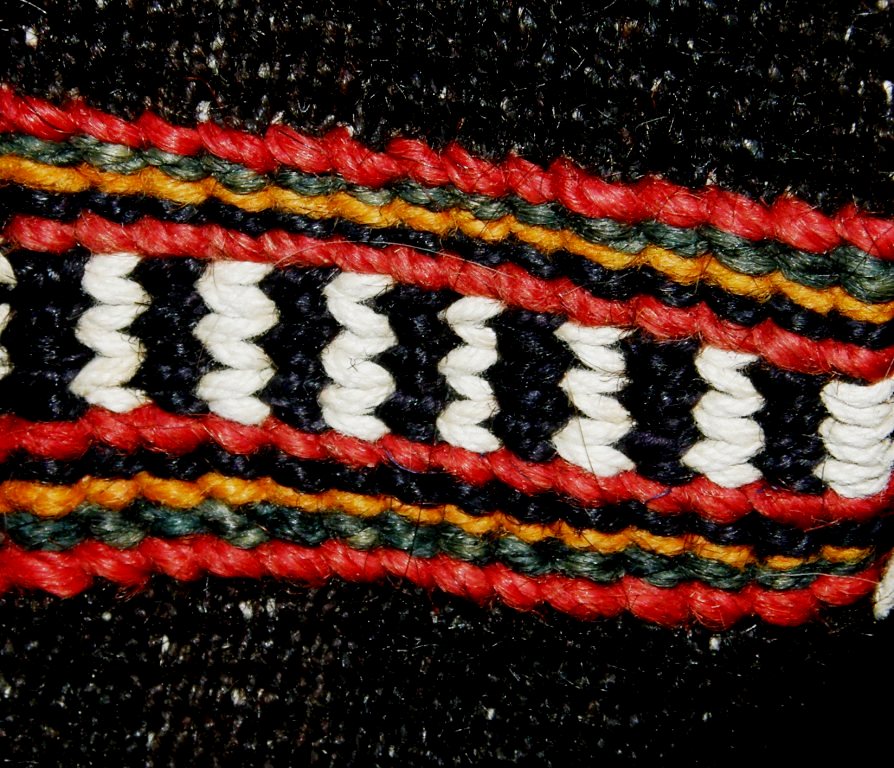
These stacked chevrons on the Bedouin weaving that Tracy in Qatar sent me are also very striking sandwiched between the multiple rows of single-color twining.

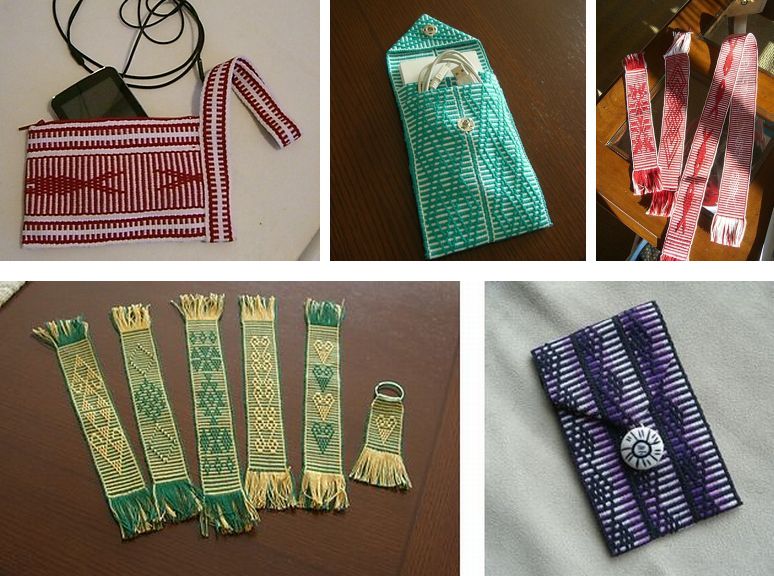
Maaike27 from Canada has been weaving up nice bands on a homemade inkle loom using many of the pattern charts that I have posted here on my blog. These bands have all been made with what I call the simple warp float technique and she has sewn them into a bunch of useful purses, key fobs, bookmarks and pouches.

There has been action in the Ravelry group both in and around the plain weave weave-along but I am saving all that for next week.

I will be leaving next week and hope to hit the northeast at the height of the fall colors. I arrived  a wee bit late for it last year. I will try to keep up the posts while I am away but they may be a bit erratic.

Backstrap Weaving – Oh, Those Sticky, Sticky Sheds.

Oh, those sticky, sticky sheds.

I am sure you all know what I am talking about if you have done warp-faced weaving with fiber like wool, llama or alpaca. I have not been heavily over-twisting my hand spun yarn and the advantage of that is a nice soft fabric but the disadvantage is hairy warps which make clearing the sheds a bit more challenging.

And it is not only the woolly stuff that can create this sticky problem. When I get into wide-ish warps with fine cotton, there is also a certain resistance, created by all those warps rubbing up closely against each other, to deal with too.  I had to apply a few different strategies to get the sheds to open on the warp pictured above.

So, this week I made a very short video on the “strumming” that I employ to help open the shed rod shed.

I am quite gentle with my strumming and just use my fingers for this width of warp.

After my video segment I have added a short clip of Felicia in Candelaria using the tip of her wooden tool to strum the warps on her oblique loom. When I start working on wider warps, I will need to use my wichuña (llama bone tool) to strum. For now I just like to use the ready-made tools that I have quite literally “on hand”.

I have added this video to the FAQ page on this topic. That page already has a video I made showing how to open the heddle shed on wide and/or sticky warps. Hopefully these tips will help you to create clean sheds without any kind of heddle wrestling and the pilling and possible warp breaks that that can cause.

I also added another thing to the FAQ pages behind the scenes in response to people who were having trouble rolling up their warps. There is an FAQ page here on my blog showing how to roll up your weaving as you advance so that you can always be in easy reach of the heddles and weaving line. The method I show is dependent on two things: the second stick which you use to roll up the weaving needs to be of similar girth to the loom bar and the cords on your backstrap loom need to be chunky.

However, some people just use string or twine for their backstrap cords and so I have put together some step-by-step pictures for another, and far more common, way to roll up the warp. You can see that here.

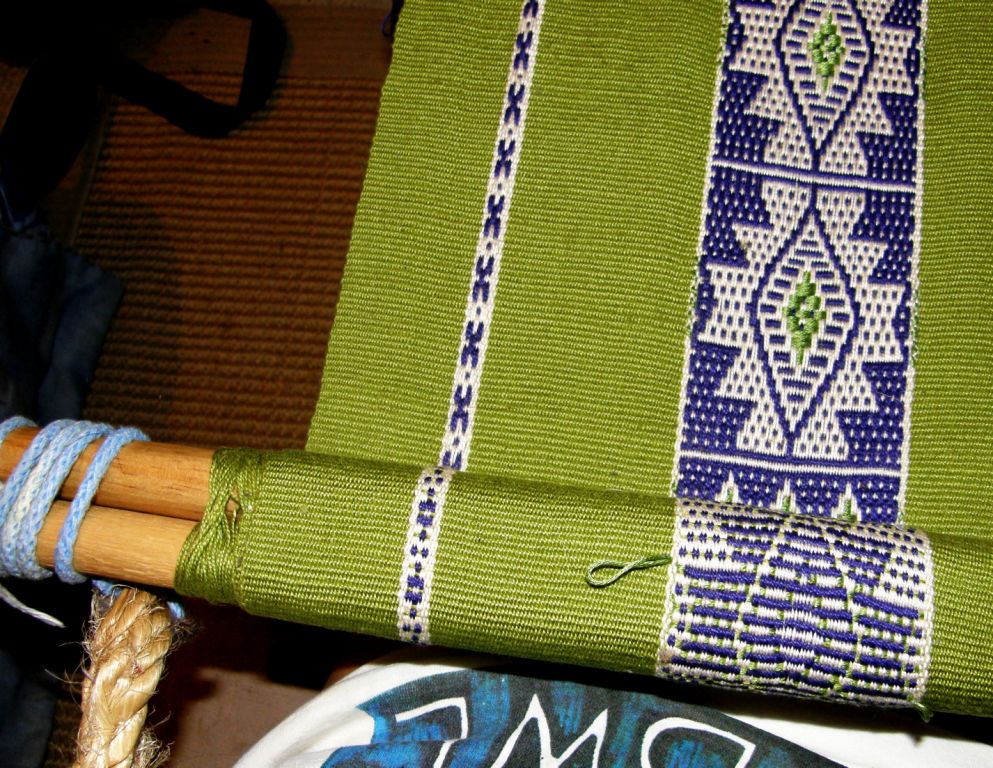
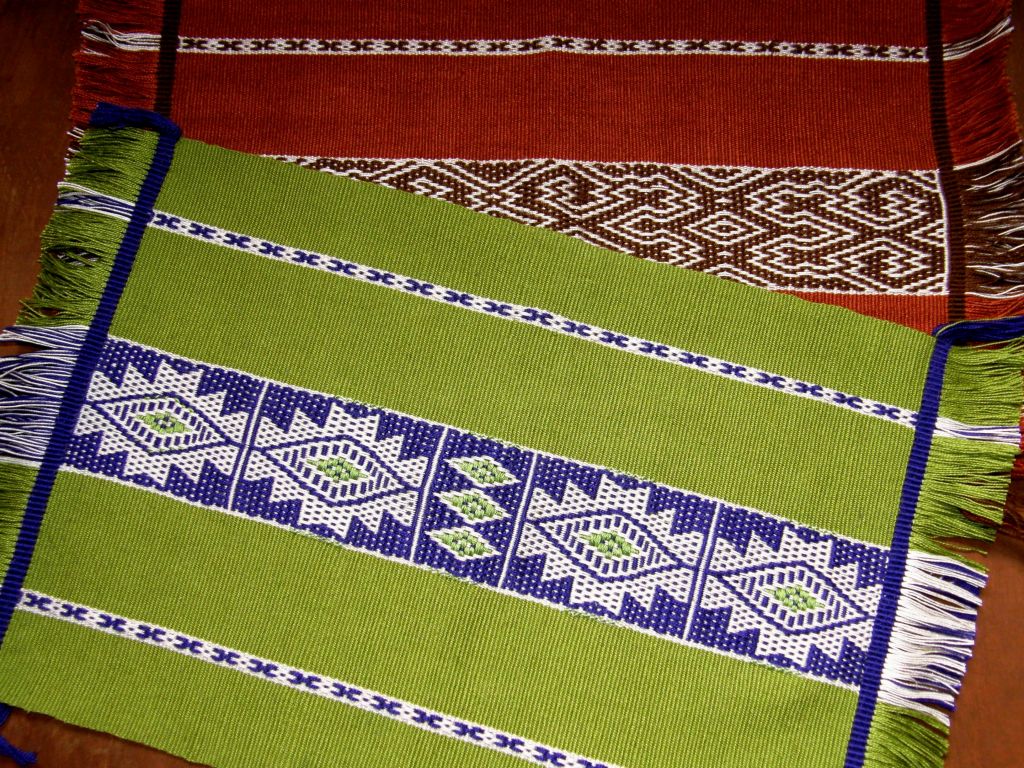
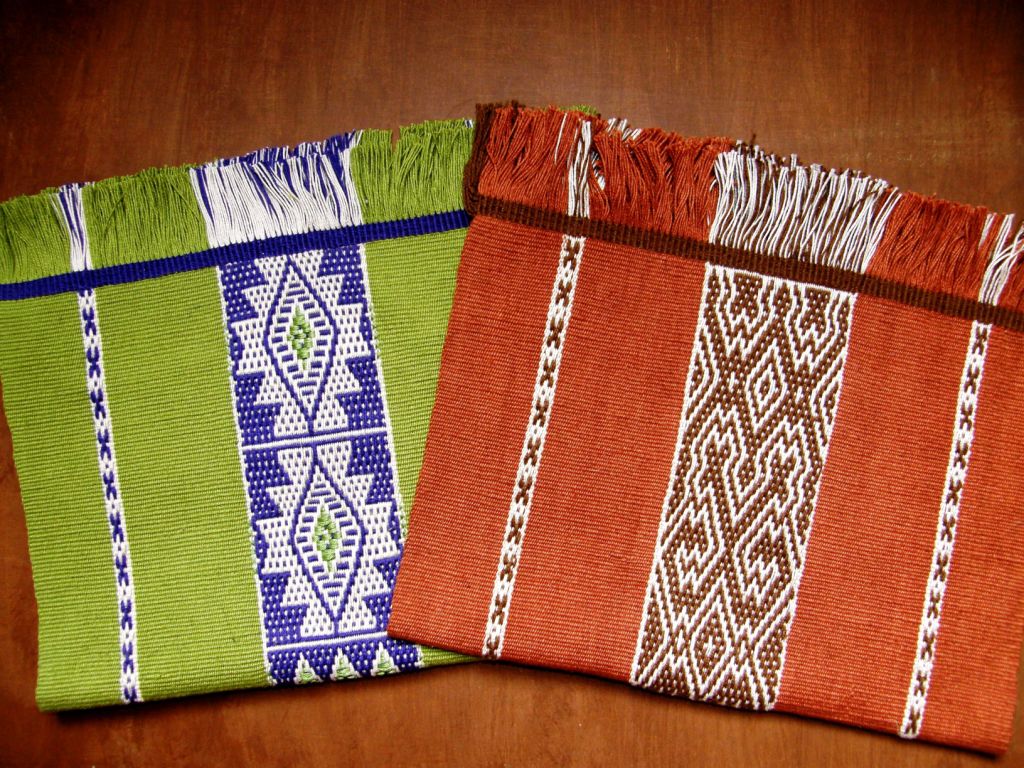
You may be wondering about this green apple and eggplant warp that keeps appearing in this post. That is the second place mat in the set of four that I am making.

The design is based on what I am assuming was a Mexican belt that I was shown when I was traveling in the US recently. The belt was also made in purple, green and white but the tones of purple and green were completely different to those I used and were subdued and worn with age. I used the same two-color alternating warp float technique. It all looks very pebbly but it isn’t pebble weave. This is not a complementary warp structure.

What I particularly liked about the Mexican belt was the weaver’s use of supplementary weft along with the warp floats to introduce a third color. Some of the supplementary wefts had in fact deteriorated thus exposing parts of the horizontal bars and I liked the way this looked and so incorporated a little of all these features in this place mat design.

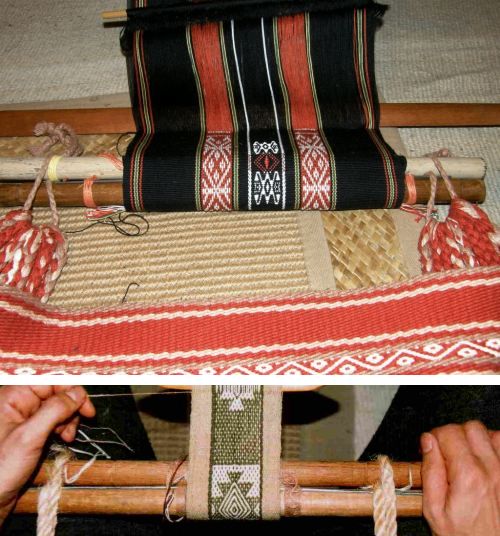
So, these two are part of a set. The first was influenced by Shipibo design of Peru. Could they be any more different?! I am looking forward to seeing a table with my four colorful and vastly different place mats and I am already planning the runner for the center. Actually, there are a few elements that tie these two pieces together. The pick-up technique in both is the same, that is, two-color alternating simple warp floats (or “warp floats galore” as I called it on my tutorials here). The little “X” design on the sides will be common to all as well as the weft-twined ends.

I have chosen the colors for the next one which are inspired by the culture from which I am taking its design…

I confess that I spent a lot more time at my loom this week than at the spindle. Maybe it’s because we have returned to our warm tropical splendor (although my Montagnard weaving teacher, Ju Nie, rolls up her warp for the summer and won’t touch it until cold winter weather once again keeps her indoors).

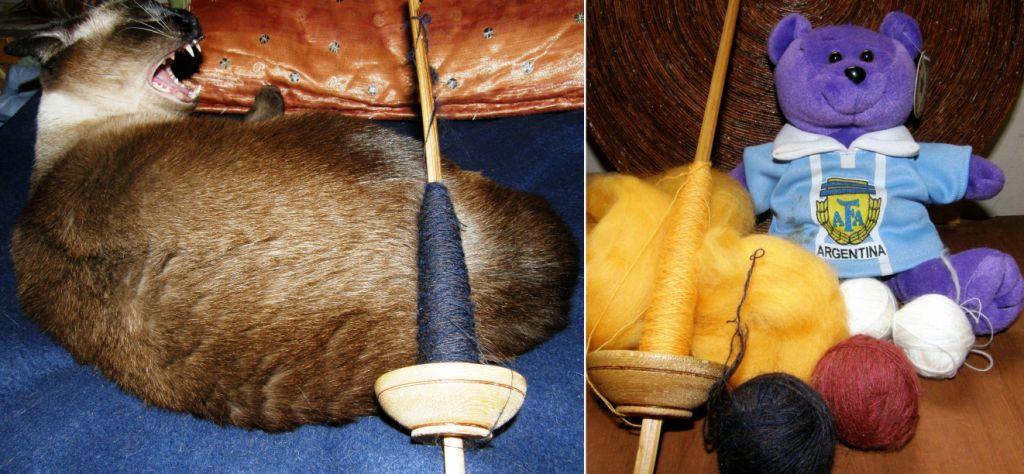
I did put in a bit of spinning everyday but have pretty much run out of colors in my Ashford prize package with which I would like to weave. Looks like I will need to do some dyeing which is always fun.

I don’t have access to this kind of prepared roving here in Santa Cruz and I really haven’t paid much attention to this stuff before.

I pulled out a strange blend of pink and brown from the package and was surprised to see the nice even kind of red that spinning it produced. Then there was an odd combination of what I am calling “Siamese cat brown” and “blankie blue” and that spun up into something rather nice too. Now you can see that I am into a straight yellow…a winner’s color in the Tour de Fleece. I can imagine combining all these colors in a piece.

The rest of the stuff in my bag will have to be dyed. As you may know, the Tour de Fleece is being run in conjunction with the Tour de France cycle race but there is very little interest in that over here when we have the Copa America in progress especially since I live with the Argentinean team’s number one fan.

I am very pleased about having woven this first Shipibo design in my place mat set as I would like to learn more about the textiles and the people who live in the lowland regions of South America and be able to show it all to you. Highland weaving, particularly that of the Cusco area, has been very well promoted and exposed to the world. It is a shame that not more is known by the general public about the textiles being produced by people in the lowland areas too.


Above are a few pieces I have made that have been influenced by textiles created by weavers living in the low-lying valleys, coastal regions or tropical interior of this continent.

These people include the Mapuche of central Chile and Argentina, the cotton weavers of coastal Ecuador, the Guarani of lowland Bolivia and the Huni Kuin, or Kene, of tropical lowland Brazil.

While I have used motifs of the Kene in my weavings, I have not used their technique and I give many thanks to Helena who introduced me to these people and their work.

Helena has woven pieces employing their techniques an example of which can be seen above. She also gave me a link to the following video showing the Kene at work.

I hope to be able to study one day with weavers of the Shipibo, Mapuche and other lowland cultures as I have with my weaving teachers here in lowland Bolivia and coastal Ecuador…thanks to Kathleen Klumpp who invited me to accompany her to Manabi province, Ecuador in 2007. And this is all just a tiny part of it.

And while I ponder the multitude of places  to see, weavers to meet and textiles to admire here in South America, where I have barely scratched the surface, I am forever grateful to have been able to meet and study with weavers from the other side of the planet like Ju Nie and Ngach from the highlands of Vietnam and Dar Ku of Myanmar.

Betsy Renfrew, who is working with backstrap weavers from various Vietnamese hilltribes who have now settled in the USA, has just put a new video on You Tube about the Montagnard weavers in her community in North Carolina.

Please take a moment to watch the video and I will also give you a glimpse here of Ju Nie and Ngach at work during my visits and the beautiful textiles that they now have the means and motivation to continue creating thanks to the work of people like Betsy. I also met Naomi Northrop of WRAP Weavers in Massachusetts who does similar work with weavers among communities of refugees from Myanmar.

And finally, here is Colleen’s (aka Pancha on Ravelry) daughter Kira Luna showing off “this key tool in her make-believe job as a fairy messenger”. Colleen wove the body of the messenger bag using the tutorial on a yurt band border in two-color warp floats and finished it with weft twining (I am so happy that folks are trying the weft twining!) The strap was woven in double weave with a Bolivian flower motif. How cute is this?! Maybe this fairy messenger will leave me a comment.