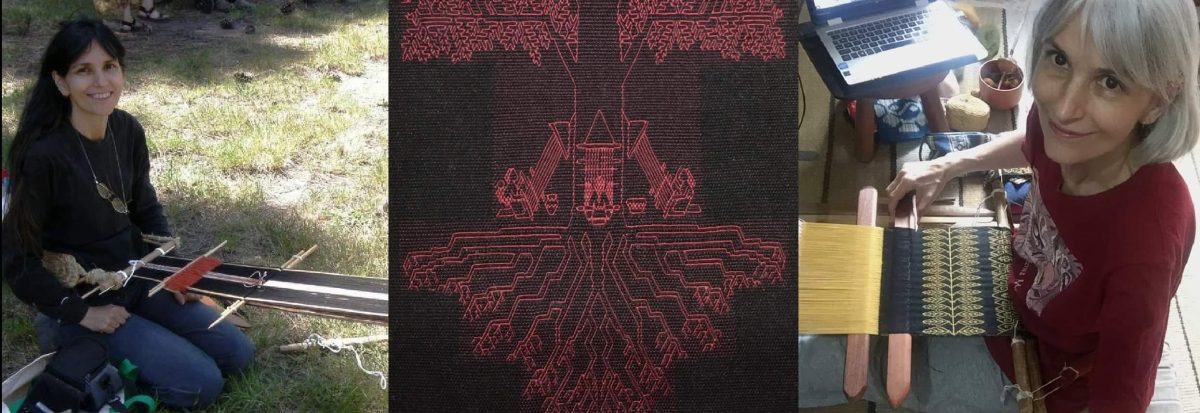
Here’s just a quick hello and update (as I’m typing with one finger of my left hand)…
I’m still in transition mode living on the mid-north coast with my brother and sister-in-law (and loving it!) while working on rehabilitating my hand. I did end up having a second surgery because it was all pretty messed up….tendons and a very irritated nerve were encased in scar tissue and stuck together. Another tendon had become adhered to the bone, plus the plate that was too bulky for my small frame was removed. I had been expecting a minor miracle after that but it was, in fact, a move back to square one rehabilitation-wise. Expectations were adjusted and I’m back to work exercising.
In the meantime, there have been several textile-related exhibits to visit at Port Macquarie’s fabulous Glasshouse. I was drawn to this piece by Hannah Garside called Book of Hands because of the hand theme. These well-used and worn gloves“darkened with age and use gently interlace evoking touch, intimacy and the presence of former wearers “
I managed to get one more key fob gift woven before being advised to stop weaving until I’ve recovered wrist rotation. It’s quite limited right now. I was kidding myself thinking I could manage weaving with my injured hand. I was, in fact, compensating with my shoulder and ended up injuring it.
This fob is for my hand therapist, an occupational rather than physio therapist, and has the name of her business. The name will only make sense if you understand that the last two letters are capitals and are pronounced Oh-tee.
So, weaving is on the back-burner once again and I am entertaining myself by designing a hand-themed triptych which will be a story of my Indian roots, my 32 years in South America and the new possibilities that will come to me now that I’m back in Australia.
I’ve joined an organisation here called the Fibre Artisans Network and am excited about being able to exchange ideas and share skills and perhaps exhibit some of my work alongside that of the other members one day. We’ve met up twice already and will do so again tomorrow. The first thing I’d love to learn more about is dyeing with eucalypts.
I’m going to leave you with something I’ve posted before but which brings me joy and makes me want to share it again. I hope the melody isn’t an ear-worm for you. I’ve added some bits since I last showed it to you.
MY FAVORITE THINGS (a few of)
Intricate patterns on bamboo and gourd, A beater, a shuttle, a small weaving sword, Plant fibers twisted and woven like string, These are a few of my favorite things.
Bone tools and wooden ones shaped just for picking, Others to strum across threads that are sticking, Laid out before me the pleasure they bring, These are a few of my favorite things.
Books that tell stories of teachers I’ve known, Covered with fabric and carefully sewn, They hold the memories to which I will cling, These are a few of my favorite things.
Spindles a-whirring turn fleece into thread, Dipped in a dye pot of cochineal red, Patterns of summer, fall, winter and spring, These are a few of my favorite things.
When I must wait, Cannot cre-ate, And I’m feeling sad. I simply remember my favorite things And then I don’t feel So bad.
Spring has sprung here and it’s glorious! The air is drenched with the aroma of jasmine and the sound of bees. An increasing number of surfers can be spotted bobbing about in the waves and it’s time to make friends with all the magpies I encounter on my walks lest they start swooping me at nesting time.
Until next time when maybe I can reveal some of my hand-themed patterns. I’ve made some good thrift store purchases of cotton (I love how thrift stores here in Australia are called “op shops”) which I’ll dye for this project…..or maybe I’ll use eucalypt-dyed wool. It’s exciting to think about.
Long time no see. A lot has been happening but at the same time not a lot has been happening.
In the “a lot has been happening” category I’ve undergone a dramatic change of scene:
It’s certainly dramatic for someone who has been living in a landlocked country for the last twenty-seven years. The following might give you a clue as to my whereabouts….
I pass this mural on my way to the shops.
Yes, I’m back in Australia for good after having talked about making this move for years. But I’m still in transition mode as I will be staying with my brother and sister-in-law in this beachy area on the mid north coast of NSW until mid November when I will then move to my own place in the Blue Mountains.
It’s a lovely area for strolling in bushland and by the shore. I walk around the block to a large open field where kangaroos come to graze in the late afternoon. They’re far too shy to allow me to photograph them. We stop still and stare at each other for a good five minutes after which they nervously return to their grazing. However, I only have to take one very cautious and almost imperceptible step closer and they’re off.
I have these guys waiting to greet me when I step out in the late afternoon to bring in the laundry.
Kookaburras create quite a racket when I take a stroll around the neighborhood but will instantly pipe down the moment I turn on my camera to record them.
I had long planned to fly out of Bolivia on April 28. I had my accident with the four-legged black torpedo that I described in my last post one month prior and it almost messed up everything. Needless to say it was tough leaving after thirty-two years in South America and all the fuss after the accident didn’t make it any easier. I was in need of both mental and physical therapy by the time I reached my brother’s place on May 4.
I’m alone now house-sitting for my brother and his wife who are away traveling for two months. I watched the bag I wove and sewed for my sister-in-law back in 2006 head out the door for yet another world adventure…
Here they are in Alaska on this current trip where Deb’s using it to hold her binoculars….
It’s always so nice to know that a gift has turned out to be so useful.
The best mental therapy during this newest transition period has come in the form of sitting on the beach in the sunshine, inhaling the sea air while listening to and watching the waves roll in. It reminds of this weaving I did some years ago….
I always like to see the white string heddles in this picture as foaming waves rolling onto a yellow sand beach. And there’s a big ol’ sun there in the foreground.
Now it’s humpback whale migration season and on the next clear day I’ll head to the lighthouse to see if I can spot them.
Other forms of therapy…..smelling eucalyptus leaves burning as folks rake the fallen ones up to burn in the cool evening air (such nostalgia!), walking along accompanied by all the magical birdsong that I recognize from my younger days in Australia, making new friends which has turned out to be super easy in this wonderfully friendly community.
Scenes from strolling around the neighborhood.
One such friend that I met at the weekly craft group happened to mention in conversation that she had lived in Papua New Guinea. I immediately asked her if she had seen the bilum bags that artisans there make from plant fiber. The stitch they use is exactly the same as that used by the Ayoreo people in Bolivia although the plant material used is different. I remember my Ayoreo teacher being fascinated by the fact that these people on the other side of the world are making bags using the same technique.
The main difference is that the bilum bags are stitched much more loosely. The looping is very much more open, even more open than the work by the Wichi artisans in Argentina. The bilums are also worked as a continuous round and are, therefore, seamless whereas the Ayoreo artisans work a row from left to right and then flip the work and return, once again working from left to right. Jey brought a bag to show me that she had collected fifty years ago. I’m guessing the colors are from natural sources and it’s amazing how vibrant they are after all these years.
The Ayoreo work is so much tighter that, when set next to the bilum, it’s very difficult to see that the looping technique used in both is indeed the same. It was very exciting for me to be able to see this work and I can’t wait to send a photo to my teacher in Bolivia. Jey tells me that she even used to have a small hammock made in this technique for one of her babies.
What do I do when I go along to these weekly craft group meet-ups with my rehabilitating hand? Well, I’m just about able to put enough twist into my takli spindle to spin some of my brown cotton. There’s progress because when I first arrived here I couldn’t do it at all…couldn’t even grip the spindle. It’s not the most comfortable thing in the world and I can’t do it forever and a day as I used to.
There are issues with my wrist and I’m not recovering the range of movement that I had hoped. It’s taken me this long to get an appointment with an orthopedist here and I’ll see him on Wednesday to find out what’s going on and if there’s any reason for concern.
My occupational therapist dresses up my hand in the most interesting ways! The tape pattern was designed by a Polynesian tatoo artist. While wearing this on my skin I’m thinking that maybe something like this will seep into my weaving one of these days…..a fun souvenir of this slow rehab.
BUT I have been able to weave! In my last post I showed how I had trained my left hand to operate the loom and do pick-up. In this way, the hatband I’d started before the accident slowly got finished and my friend did a fabulous job of attaching it to his hat after I had already left Bolivia.
Well, now I can do all that using my injured right hand. I’m able to wind a decent warp, make string heddles and weave narrow bands with pick-up using medium weight cotton thread. I’ve never before thought about what role each of my two hands plays in my weaving process. When I’m using two sets of heddles, it turns out that it’s my left hand that does the twisting and rolling action on one set while my right only needs to pull the other set straight up. It can manage that and do the pick-up!
So, I’ve been making some key fob thank-you gifts:
First one for Jey for lending me her bilum to play with.
This band got folded in half with its ends clamped between the jaws of the key fob hardware. Then I made another for one of my physiotherapists who I felt had gone above and beyond. I found out that she has two much-adored golden retrievers that have their own Instagram page and so I wove a fob with their names.
I used the structure that I call Andean Pebble Weave which produces a quirky kind of lettering.
I think it’s fun that the lettering matches the rather unsteady and quirky writing on my hand-written thank-you note! Fortunately, my former bank in Bolivia has been the only place so far that has insisted on my producing a perfect signature.
The other side of the band just has paw prints and is shown here sitting on top of a very rustic woolen backstrap that I got in Peru.
Alison Irwin created a chart of letters in this structure that I call Andean Pebble Weave which was published in the Winter ’22 edition of Little Looms magazine. I sometimes need to make adjustments to the letters in order to create the ideal spacing in the particular words I’m weaving. The chart for the paw prints can be found in my Complementary-warp Pattern Book along with two other versions.
There’s a long list of people to thank. I’ll be busy at the loom making gifts and that’s yet another form of therapy. Luckily the guest-room bed has a wooden base and I’ve been able to anchor my loom to it in much the same way as I did in Bolivia.
It might be a while before I can get into this though….
This just a part of the big box of luscious silk that weaving friend Laura sent me from her stash in Canada. Such generosity. She shipped it quite some time ago and I could hardly believe it when I got to Australia and finally got to see it.
Some of it is insanely fine but I do enjoy weaving with fine thread and…..silk! I can’t even imagine untying those skeins and winding the thread into balls. Actually, my hand could probably manage that but right now I can’t trust it to wind a good well-tensioned warp with such fine stuff. I wouldn’t be able to maintain a steady grip on the thread. That’s something to aspire to. I think I’ll have to take on working with increasingly fine material in slow steps as I slowly recover function in my right hand.
At craft group I also got to meet up with the lady who two years ago had given me a skein of gorgeous variegated silk. I’d sent her photos of what I’d made with it but now I could take the finished piece and show it to her in person. You might remember this project…..
Now she’s teaching me how to crochet winter slippers. Remember that it’s winter down here. I’m so slow though that I’m not sure I’ll have these finished in time! There’s wrist rotation involved in working the hook and I can’t do that yet. So, I hold the hook steady and move the work around instead. It seems to be working! We’re just using scrap wool for this initial sample while I get the hang of it.
I love that things that I’ve been weaving over the years are now coming out and being used on a daily basis. I never used this bag in Bolivia and now it goes with me everywhere!
When I tell people that I weave, at least I have something I can show as an example.
I was having a bit of a down day at the radiologist having my wrist x-rayed when the receptionist admired this bag that I happened to be using that day. She was quite bewildered when I explained that I’d made it myself…..from scratch. No, I hadn’t bought the fabric. I took yarn, tied a pattern onto it, put it into two different colored dye baths with more tying in between, removed all the ties, wove it into fabric on a simple loom of sticks, then sewed the cloth into a bag, wove a strap and edged the flap. Sometimes I forget what this must sound like to a non-fiber, non-weaver person! And then the inevitable question…how long did it take? After all that, she may have regretted having complimented my bag but that simple compliment had made my day ❤️.
So, while I’m excited about the fact that my hand can tolerate my making a couple of key fobs, the thing that has made me happiest is that there is a new backstrap weaver in the making here in Lake Cathie. Courtney, who comes along to every second session of our craft group meet-ups, showed up today with this….
She had just finished crocheting a stunning mochila bag when I first met her and was, as a never-ever weaver, busily researching how to weave a strap. Well, you know that I can’t help myself and I took one of my key fob warps along to show her. She was immediately hooked and went off with links to my Backstrap Basics article and my Basic Warping for Backstrap Looms video class which are both free and available here on my blog. What a great job she’s done rounding up the bits and pieces and getting herself set up. She made my day when she brought this this morning to show me. How I miss in-person teaching!
Do I miss Bolivia and the folks that I have left behind?…of course I do! Oh my aching heart. I had a teary moment on my way back here when I visited a mega supermarket in the States. I noted the rows and rows of neatly and attractively arranged goods, the lack of raucous cumbia music, the wide open spaces, the comfortable controlled temperature and immediately missed the chaos of the Santa Cruz street markets with their dirt, heat, crowds, odours and noise! (And prices, I might add. Phew, that has been an adjustment!) But, sigh, choices have to be made.
So, that’s all for this post. My hand is saying “enough!” (and unfortunately I had quite a painful and restless night as both hand and shoulder protested against my having typed all this at my laptop). They’re much happier weaving.
I’ll leave you with something I spotted at the beach the other day. Nope, I’m definitely not in Bolivia any more.
I’ve been up to the highlands and am now back again in the hot tropical lowlands. Yes, I’m still in Bolivia. Australia is there waiting for me and I’ll get there event-u-a-lly…..
I meant to write a blog post yesterday but once I got into sorting and editing the photos, I found myself completely overwhelmed. Lest that happens again today, I’ve decided to make this just an overview. Anything that doesn’t make it into this post will probably show up now and then in future ones as well as in my Facebook and Instagram accounts.
So, on this ten-day visit to Independencia , Cochabamba where my weaving teachers live and where Dorinda was also vacationing, here’s a run down of some of the things I did…..
I took the five-hour minivan route to Independencia from Cochabamba instead of the eight-hour one by coach. I’m guessing that the minivan is capable of traveling on roads that are perhaps unsuitable for the larger bus and that the bus remains in service because it’s required to service many tiny communities that are scattered along its longer path. The minivan route is no less scenic than the one I traveled last time by bus. In fact it may be even more so.
From the town of Quillacollo just outside Cochabamba city we head straight for the mountains and in under an hour we had zig-zagged our way up to around 3700m leaving the city of Cochabamba a mere blur in the distance on the valley floor.
From there it’s a journey along slopes of deep narrow valleys high above lively rivers (it’s wet season). Water cascades down the slopes above, crosses the dirt road ahead of us and continues tumbling its way down to the green valley floor. Then we go up over passes to continue along the next valley, up again and so on. I was sitting in the second last row and it was like riding a bucking bronco back there with every descent from the passes. I gave up trying to take photos and instead just tried to imprint the scene on my brain.
And then we stopped so that the driver could negotiate the carrying of some freight for a couple who had flagged us down and it was one of those perfect moments for getting a nice shot. We happened to be on a relatively flat and open area with the setting sun casting a golden glow on the hillsides and I was able to hold my phone steady for a change and get a photo of the peaceful scene. I thought that if I just get one nice photo from the five-hour trip, I’ll be happy.
So much for this just being an “overview”. I’ve already spent too much time just on the van trip! Back into overview mode….
On the surface, the town didn’t seem to have changed much since my last visit….
How such a wickedly steep street can look so mild in this photo is beyond me!
These rocky streets in town become slippery with mud after rain but dry up miraculously quickly.
However, some things had changed….Maxima was now living in a house of her own with a lovely view and even had wifi.
Charqui (jerky) on the washing line in the patio in front of a nice view across the valley.
With Dorinda, my teacher Maxima, (long time followers of my blog will know them), her daughter, Vilma and the grandbabes, we dyed a bunch of skeins of handspun yarn with indigo in a banana-based vat.
I mashed overripe bananas with Maxima and little Mayra for the indigo dye bath.
I think this was only the third time that Maxima was attempting to dye with indigo. The second time had apparently failed and so I spent a lot of time wondering…are we doing this right? Will it work this time? Well, it did and I got to keep one of the skeins. I can’t wait to use it in a project on my backstrap loom. The skeins are made up of the ladies’ doubled handspun wool singles. Once dyed, the doubled threads are then tightly plied. I’ll get to ply my own skein which pleases me because I’m not fond of weaving with the high amount of twist that these weavers typically put into their yarn.
Maxima and daughter, Vilma, showing off the aguayo (carrying cloth) Maxima wove for a custom order from the USA. Indigo-dyed yarn from the first attempt can be seen in the stripes. This cloth is gorgeous! The colors are so rich and Maxima has included a stunning variety of figures. It’s all Maxima’s work except for the tubular edging.
A close-up view of a small section of the center of the aguayo where you can see some of the indigo-dyed yarn in the decorative joining stitch.
We made skeins. I’d never made skeins just on my hands before and was happy not to have mine end up in a tangled mess. The singles yarn immediately kinks back on itself when not under tension and can make things difficult to control.
Immersing skeins in the indigo dye pot with Dorinda, granddaughter Emily and little Mayra always there in the mix. We wore gloves but still managed to get the dye on places where it didn’t belong.
First results once again against that lovely backdrop. One of those skeins became mine 🙂
On the following days, Maxima continued experimenting on her own and tried over-dyeing some naturally-dyed yellow to produce that pretty green.
And yet more on another day. This time over-dyeing a cochineal-dyed skein.
So, I came home with this (below). The mug is for scale more than anything else because those balls of yarn I bought are huge! I bought those two balls from one of the weavers from the outlying community of Huancarani that I visited on my last trip up here. The ladies from Huancarani come into town on the weekend to sell their produce in the market. We attempted a trip to Huancarani on the preceding Thursday for a weaving get together much as I had done on my last visit but it had rained heavily all through the night and a landslide had shut the road.
Plying all this yarn will keep me busy for a while. As if I need even more stuff to lug back to Australia but who in their right mind could resist?
Here’s a flashback to that Huancarani trip and the fun day we’d had all weaving together…
When not dyeing, I would visit with Max and weave with her as she had asked me to teach her some new patterns in the structure that I call Andean Pebble Weave.
When I was walking in the market street on the Saturday, I was stopped by one of the Huancarani ladies who asked “Where’s Berna?” That’s the name they know me by. No one calls me Laverne in Bolivia. Bs and Vs are pronounced virtually the same and they don’t recognise that the La is part of my name as La is often placed before any woman’s name when referring to her as a third person. So, here in the lowlands I’m Verny and up there I’ll always be Berna/Verna. The Huancarani ladies had been expecting my visit on the Thursday and so now that they were in town, they were looking for me. Of course they didn’t recognise me as the lady with long dark hair that had been to their community to teach patterns seven years ago!
Back in 2017 I went to Huancarani and can be seen here with that long dark hair guiding Maxima’s sister Narciza through the steps to weaving a pattern from my More Adventures with warp-faced Pick-up Patterns book. It’s a motif from a Central Asian textile that I had adapted to the structure that I call Andean Pebble Weave. It had caught Narciza’s eye and she was keen to learn it and not let me go until she had conquered one repeat.
We just managed to get through one repeat before it was time to leave and I left wondering if she would ever use the pattern. I did leave behind a woven sample just in case.
You can see the unique way weavers in these communities in this part of Bolivia manage their warps. They don’t attach them to their bodies with a string or backstrap. Instead, they have the warp suspended between an index finger and a toe. Together with the middle finger they form a picking cross of the two “pebble” sheds and then do all the pick-up and loom operation with just the one free hand. It’s amazing to see! I did this with Maxima back in 2011 when I visited her in Cochabamba. Even though the structure is the same as the one with which I am thoroughly familiar, this method of weaving it was completely foreign to me and it took me some time to get used to it.
So….back to the lady in the street market who stopped me. Once I told her that this white-haired person was indeed Berna, she pulled out a couple of bands to show me, one of which is pictured at left. Sadly, Narciza hadn’t been able to come to town that weekend as she has a herd to attend to but it seems that Narciza spread knowledge of the new pattern to other ladies in the community. How happy that made me!
And Maxima had taken advantage of the copy of my book that I’d left behind with her on my last visit.
Maxima and a group of weavers are seen here studying and discussing images in the book shortly after my visit.
Maxima showed me what she had woven from the book….
It’s a belt that she wove for daughter, Vilma, to wear on festival days. It’s woven in the bright tightly twisted acrylic yarn that the weavers here love to use.
The ladies love to be able to show off “new” patterns in items they use for special occasions.
On our first morning weaving together, Maxima chose to use some of the crochet cotton that I’d brought. I think her unfamiliarity with the material left her a little frustrated. These weavers create a very tight weave, squeezing the weft into place with a tremendous amount of pressure. The cotton thread just wasn’t behaving the way her handspun wool or re-spun acrylic thread would. Those materials have a certain amount of stretch which the cotton simply doesn’t. While she was able to weave the little motif she had chosen correctly, it just didn’t look right with that tight, tight beat.
Maxima preparing a cotton warp for our first session together. The end of the warp is temporarily tucked into the waistband of her skirt while she uses two hands to make heddles, Later the end will be suspended on her index finger. Anything that happens to be lying close by such as this comb can be called into use to hold the cross.
Starting with a little plain pebble weave.
Meanwhile Mayra and Ana who seem to see all forms of household chores as play, were happily washing their toys. At one point I saw them playing chop-the-head-off-the-chicken-for-the-pot with the cat!
My second session with Maxima was completely different. She used her re-spun acrylic thread this time and the results were completely different. She confidently chose larger and more complicated patterns from my Complementary-warp Pattern Book (all the patterns therein are in the structure that I call Andean Pebble Weave) and her joy at watching the figures appear and then reaching the stage where she could predict what was to come next, was apparent.
Starting with a fresh warp of respun acrylic thread for wider, more complicated patterns.
The young ladies on this morning were on chicken duty…..that is, keeping the chickens from wandering from the yard into the kitchen.
One of the four running-horse patterns that creator Deanna Johnson calls Elmy’s Mustangs, is almost complete.
Here’s a video clip of Maxima doing the last row of pick-up for the horse pattern….
She also selected the viscacha pattern from my book. I’d charted that pattern from a fragment of pre-columbian cloth that I’d seen online. I’d been able to track down the owner of the fragment and get him to send me close-ups so that I could decipher it.
The cat figure,also from pre-columbian textiles, that Maxima chose was not completely successful but I know it will be in her next attempt now that she has understood how to weave the eyes of the viscachas.
This is what I was doing in the evenings to entertain myself. I was using Alison Irwin’s idea for weaving letters in the structure that I call Andean Pebble Weave to make a key fob for the lady who ran the hotel in which I was staying. Inti means sun in the Quechua language and Wasi means house.
I also wove a bunch of patterns to leave behind for Maxima to study and attempt in her own time after I left. When I showed Maxima the hotel key fob, she loved it and so I offered to make one with her name as well as for her daughter. Her husband then laughingly asked why I wasn’t offering to make one for him. I was happy to oblige. Dorinda took this photo of Maxima after I left as I wove the fob on the last night and wasn’t able to deliver it in person.
I think she liked it!
And then it was my turn to learn some new weaving thing. I noticed that the large aguayo that Maxima had woven was edged with a patterned tubular band that is known in some parts as nawi awapa. The weavers here call it chichilla or simply nawi (nawi meaning eye). Maxima handed that task off to another weaver as she has forgotten how to weave these patterned tubular bands. She generally edges her carrying cloths with crochet. The customer in the U.S however, wanted the more traditional patterned tube. What I noticed in this particular tube was that the color arrangement would flip back and forth along its length. The zig-zag would change colors every now and then as would the inner eye color and I was mad keen to meet a weaver who would show me how ro do it. Maxima’s sister Narciza knows how to do it but she hadn’t come into town.
So, on Saturday market day I visited with the Huancarani ladies in the street and asked if any one of them knew how to do it and if they would be willing to teach me. Of course no one just happened to be carrying colored yarn and besides, all except Justina said that they didn’t know how it was done. I invited them to come up to the hotel so that I could show them a nawi awapa band that I had started and also show them some other bits and pieces that I thought they might find interesting.
Squeezed onto the balcony of the hotel, I showed the ladies any woven thing that I happened to have. Here they’re examining my double weave belt with its Bedouin patterns which are completely foreign to them.
I brought out my cotton spinning bag and everyone fell in love with the tiny takli spindle and wanted to take it home. Only Justina was “brave” enough to try spinning cotton with it and she did a great job.
Justina examined my ñawi awapa warp which was set up in the way I had been shown in Chinchero, Peru. It turns out that while the results are exactly the same, the weavers in this part of Bolivia set up their warp for the ñawi awapa in a slightly different way. It’s slightly different but different enough to be confusing to Justina who said that she wouldn’t be able to teach me using this warp. I was a disappointed but interested to know exactly what the difference was. Time didn’t allow further exploration but Justina returned the next day and agreed to teach me if we created a new warp from scratch. I was thrilled!
Gathered the next day in Vilma’s sewing workshop with Justina deciding that she had enough time to teach me if I could bring some yarn. So, out came the crochet cotton again to the rescue…not ideal, but good enough for learning.
Creating a fresh ñawi awapa warp while Maxima went out to look for a forked twig to use. It holds the cross….more about that later. On the floor you can see another stick that is used to save one of the picked-up sheds for later use. The weavers here call this stick “el muchacho“.
Justina guiding me. Yes, I learned it! Maxima and Vilma looked on. I wonder if Maxima absorbed enough by watching to be able to do it on her own. Wouldn’t surprise me. I offered to let her sit in my place and try but she declined.
When I got home of course I had to weave one straight away. I still have lengths of fabric that I bought from the ladies back in 2019 and I used some of Verna’s cloth to make a little pouch that I could edge using the Huancarani set-up and color-changing method.
Justina told me that they call the forked stick illawa, which is the same word used for string heddles. Perhaps these weavers use the word for any device that enables them to create sheds. I do love the name for the other stick….el muchacho, which strangely is in Spanish rather than in Quechua.
A closer look. You can see that the color arrangement in the tube along the base of the pouch is different from that along the side. This is a much nicer photo of the beautiful natural dye colors used by the ladies in these textiles. I used commercial wool from my workshop stash for the edging.
I can’t tell you how much I enjoyed this visit. On certain afternoons Dorinda and I would walk up and up and up above the town to get some exercise. I was suddenly very much aware of my calves. I was really pleased with the way I was dealing with the altitude.
One afternoon, Sandra, the hotel manager, took me down to her orchard. So that was a down, down, down walk with the harder part coming at the end of the day. I was happy to see custard apples growing for the first time and to be able to pick quinces which Dorinda later made into jam. We took back apples and Dorinda made a pie. How spoiled was I? The biggest thrill was seeing a hummingbird nest with two eggs in the orchard. The photo needs something for scale. The nest and eggs are tiny!
There was time first thing in the morning to hang out on the balcony with hotel cat, Garfield, and watch some young girls herding their flock of sheep onto the football field. Stray dogs would arrive to romp and freak out the sheep who would bolt out the gate and into town with the little girls running screaming behind them! It would happen pretty much every other day.
Got my nose burned on day one in the high altitude sun and so did not go out hatless ever again after that.
We got stuck in the mud on the way back to Cochabamba. The mud sucked the soles right off my sandals and I never saw them again. Then we got caught up in protest roadblocks as we neared Cochabamba and it was quite a saga getting from there to the airport. It involved walking with soleless sandals through shin deep water and taking the train that was packed to the gills. It was so difficult getting on and even more so getting off! If my flight had not been delayed, I might have just missed it. To be honest, if the road had been closed due to the landslides and I had been stuck in Independencia, I might have chosen to just stay on until Dorinda’s visit ends on the 10th. It was a glorious visit and I really had no need to leave when I did.
We all got filthy. The quiet sleepy group of passengers up to this point turned into a happy chatty group after successfully getting the van out of the mud and back on its way. How was I going to get on a plane with my feet in this filthy state? Never mind, there were flooded streets to walk through further along once we hit the outskirts of town and had to get out and walk due to the roadblocks. Feet were squeaky clean by the time I got to the airport.
And the scenery on the way back….could it get any better? Yes, it could. It was and had been raining a lot and in the red rock sections the waterfalls that had sprung up and started to flow down the other side of one of the valleys, were running bright pink! Mud and rain-streaked windows made decent photography impossible but I burned those images into my brain!
Back in Santa Cruz and once I’d woven and documented the color-changing nawi awapa, I turned to other projects. I’d taken some garabatá fiber to Independencia to toss into the indigo dyepot.
The top left bunch of thread was dyed in the indigo pot. At bottom right you can see a tiny pouch I made using the Dosapey pattern. That tiny bag holds a tiny booklet and mini pencil. Now to decide how to combine colors in a new project. Roció, my Ayoreo teacher, contacted me for a class while I was away. I’ll have to let her know that I’m back.
This is the start of a larger Dosapey pattern that I finished just before traveling to Independencia. I dyed the black for this project.
I just had enough garabatá thread to create one face of a pouch. I wove the other face in cotton and sewed the two together. This pouch held my passport, tickets and money purse and went with me on the trip. I used the edging stitch used by the Weenhayek artisans along the top.
And now I’m working on something a little unusual. An expat gentleman who runs wildlife tours here with a particular focus on the endangered jaguar asked me if it would be possible to weave a jaguar skin pattern. He would like to commission Guaraní weavers to produce small bags with the print to offer to his clients. He is and always has been keen on promoting the handwork of the artisans that live in this lowland part of Bolivia. He showed me a tapestry pattern that he’d found online and I took it as a challenge to try to reproduce it in one of the warp-faced structures that the Guaraní weavers use. With this I can show him how much pattern can fit into the dimensions he has in mind. He can sketch out his ideal pattern and then approach the weavers with a proposal. This way they won’t have to waste time and yarn sampling and experimenting. Besides, you know me….always looking for an excuse to weave.
Using the Moisy technique which is one of the two pick-up patterning structures that the Guaraní weavers use. I set this up all ready to go before I left on the highland holiday.
So, the overview grew somewhat as I settled into writing and felt less overwhelmed! I hope you’ve enjoyed these tales from the Highland Holiday.
I was recently asked to describe the kind of weaving that I do in an audio-only interview. Ummmmmm ….I was completely stumped and now I don’t even remember what kind of awkward response I made! When talking about my weaving, I’ve always been in settings in which I could basically just let the textiles do most of the talking for me. Although I ramble on in these blog posts, I always try to include lots of captioned images for those who just want the eye candy yet still want to get a general idea of what I’m talking about.
Even when I am away from home and on a plane, for example, chatting with a stranger and the topic of what we do comes up (it doesn’t always), I can just show them perhaps a wrist cuff, my belt or a purse I’ve made with my woven cloth to give them an idea.
Although I don’t typically wear four at once, I’m almost always wearing a wrist cuff when I’m traveling.
I remember the time I was at the CNCH conference in 2010. Inkle weaver Annie MacHale messaged me to see if we could meet up. We’d never seen each other and she spotted my woven belt first from behind and was immediately able to identify me. The weaving did the talking.
Wearing my woven work, such as these belts, is sometimes more effective at gatherings than wearing a name tag!
A more recent addition to my belt collection using both warp and weft-faced structures.
And then there are always my bags and purses. In the last few years I’ve gained more confidence in my hand-sewing and have created quite a few more but there was always one to carry to show to curious strangers.
Using my cotton-spinning bag as a purse on an outing with my friend Emerald in Australia. Multi-purpose items are a bonus when traveling with limited space in luggage.
I was never without my big camera in the earlier days of my travels and a camera strap is always a nice way to give folks an idea of what I do (not forgetting of course all the images stored in the camera). Of course we all prefer to be able to touch textiles, right? We see textiles online and want so much to be able to reach out and touch them. We have to imagine how they feel. What about when you can only hear about them in an audio-only context? Um, I hope I did a decent job of answering that question.
My updated camera strap woven in my own handspun wool and original hummingbird figure in three-color reversible pebble weave.
It was nice when I got my little iPod and was able to leave the bulky camera behind on trips. I would use it as my camera, wearing it around my neck in its special woven pouch. It was often a conversation starter because it was plain to see there hanging around my neck…
Backstrap loom weaving with camera at the ready. There was to need to let the pouch do the talking in this case as there was plenty going on there at my loom.
Which reminds me, there are also woven necklaces like the one I’m wearing above to do the talking on my behalf.
Wearing jewelry in the street here in Santa Cruz is not a good idea. I learned that the hard way in my first months here. Naturally, I do enjoy being able to do so when I’m away.
After the iPod, I got a phone to use as a camera but I found it hard to find a commercially-produced case for this Redmi brand. So of course I had to weave fabric to make a case instead which allowed me to show it as an example of some of my work with wool…
Fabric for the phone slip case on the loom. I only use it when I travel.
Perhaps when I complete my move to Australia and live in the cooler Blue Mountains, I’ll be able to use my scarves and neck gaiters when those “let the weaving do the talking” moments arise. I confess that those items have only very rarely been worn here in the tropics. Even putting up with their unwanted warmth in order to photograph them was a big ask.
Hurry up and get the shot before I melt!
So when I was faced with the question of having to describe my weaving just in words, it was a big “Ummmm” moment. Even given a second chance, I’m not sure I could do it. As I wrote in a previous blog post, I feel that I’ve drifted away from having a particular recognizable style…my style actually being the loom I use rather than the kind of cloth I produce. As I get more and more into creating my own original patterns and change my home to the other side of the world, maybe a whole new assortment of patterns and structures will emerge. Whatever happens, I hope there’s more growth.
Designs with SE Asian leanings have already been starting to appear.
Ikat, rep weave with pick-up, warp-faced double weave, open balanced plain weave with inlay, complementary-warp pick-up, supplementary weft patterning.
I put this collage together to show some of the different kinds of things that I do. But of course, if you’ve been following my blog (maybe there are some die-hards who’ve even been with me for the last 15 years!) you’ll already know. I guess my purpose in writing this post is to to see if I can in fact, by way of these ramblings, answer the question for myself in my head….how would you describe the kind of weaving you do? I often find myself pondering certain things at the time I’m writing a blog post and find a solution right here as I sit typing. That’s one of the reasons I keep writing this blog and am so grateful to all of you who follow along and “listen”. It really helps clear out the mental clutter.
Until next time…….long-time blog followers may remember this dearly loved one making appearances in various posts. Rest in peace sweet girl.
And so continues the journey of my Ashford Traditional spinning wheel….and I never once took a photo of it 🙁 I got it in the Falkland Islands (Islas Malvinas) back in the 90s and had it in my home in southern Chile. I wished I’d asked how it had made its way to the Falklands in the first place…directly from the manufacturer in New Zealand or perhaps via the UK or perhaps by some other more exotic and convoluted route?
Whie living in Chile and before I got the wheel, I had brought some alpaca back from my first trip to Peru to spin with a drop spindle that I’d also bought there. My inexperience meant that I made a mess of it and so, discouraged, I put spinning aside for a while!
Later, I turned to sheep. There were sheep galore down there in Patagonia and I was given a fleece. So, I got experience washing and carding it and my first project was knitting! I can hardy believe it as I can barely knit. But I designed a pattern, based on the shape of a cotton vest that I owned, and fumbled my way through knitting the front of a vest using wool that I had spun on the spindle.
By this time, I’d acquired the Traddy and I wove the back panel using my first wheel-spun yarn which I dyed brown in a balanced plain weave on my Navajo-style vertical loom…without a reed. I probably didn’t even know that reeds existed back then (you can just get a glimpse of the brown back on the far right in the photo above). Spinning yarn that worked well for this knitting and weaving was a complete fluke. I really had very little idea about what I was doing. The vest is edged with a triple cross-knit-looping stitch that I’d learned both from my sling-braiding teacher in Peru and one of my weaving teachers in Bolivia. And I also used a band I’d woven as an edging.
I used left-over scraps of that wheel-spun wool along with some of the wool I used for my Navajo-style weaving in natural dye experiments in Chile. They were wrapped around rolls of paper and coiled into what you see here which I used as the lid for a basket.
And that was all the action the poor Traddy got to see in my hands. I brought it up to Bolivia with me and it gathered dust in a corner for a while before I eventually dismantled it (my cat was finding it way too interesting) and it sat in the closet while I continued to spin on drop spindles. Now it’s gone to the Brazilian owners of my local yarn store. Maybe it will make a trip to Brazil one day.
Bye-bye Traddy. Enjoy your world travels. The rest of this post on spinning includes some sections that I’ve posted before and so you may find some parts familiar.
I am a “cheap spindler” in much the same way as I am a cheap drunk…it doesn’t take much to make me happy! Don’t waste the good wine on me. I do not have a refined palate. So, it is little wonder that I am content to use my humble Cusco drop spindle when I get the urge to spin. I just don’t have a refined palate for spinning tools.
The Cusco spindle was the second one I ever got, the first being from San Pedro de Atacama in northern Chile. The Cusco one that I got in 1996, being more robust, became my constant travel companion. It was practical. Although I have collected many more spindles on my weaving safaris since then, this Cusco one is the one I always use while the others hang on the wall behind the sofa as souvenirs of places I have been and people I have met.
The spindle I got in Cusco in 1996.
Some of the whorls from the spindles on the wall fell down behind the sofa only to be retrieved later when a friend helped me move it. Here are three that I found there among the cat toys.It’s so interesting seeing the various styles of whorl.
The very first spinning that I did for weaving on my backstrap loom was with some extremely dry, brittle, and filthy llama fiber that I had bought from a farmer while wandering about the back roads of Uyuni in the Bolivian highlands. I cleaned and prepared it. The dust and dirt would have me wheezing and my skin would crawl and eyes run every time I opened the bags to get more. It made for good spinning training. I gave the fiber a tremendous amount of twist because at that time I believed that this was the only way hand-spun yarn could possibly stand up to the abrasion of warp-faced weaving. I have since learned that this is not so. That kind of yarn produces durable, hard wearing cloth and in a tight warp-faced weave can make a garment highly water-resistant. Of course, that isn’t always the kind of cloth I want.
The natural colors of the llama I spun. I was always amazed at how nice it looked when woven. Warp-faced structures are very forgiving in that way.
When I was given a large bag of spearmint leaves by a friend, I decided to use it it to dye some of the llama yarn. One batch gave me a nice neutral taupe color. The second lot my friend gave me produced green. I also had some cochineal for red.
I was able to buy a lovely fine commercial yarn in Chile that was a blend of alpaca and wool and came in earthy colors. I would use my drop spindle to add extra twist as, again, I’d thought that yarn for warp-faced weaving simply must have that tightly spun characteristic. The green in this band I wove with this yarn is actually cotton.
The first time I was given prepared alpaca to spin by my friend Janet, I decided that I simply couldn’t put all that heavy amount of twist into that beautiful fiber. With a bit of extra care in the way I handled it on my backstrap loom, it made lovely warp. The yarn was quite balanced and didn’t kink up on itself.
You can see that this alpaca yarn that I spun lies flat and relaxed when not under tension.
You can see how my teacher Maxima’s handspun wool yarn behaves when not under tension. All the energy from the twist causes the warp lying on the ground to tightly spiral. The yarn will produce hard-wearing cloth.
After that experience with the alpaca, I never added extra twist to industrially-spun yarn again. Of course I had to choose yarn that had certain characteristics. I used the soft Knit Picks Palette straight out of the cake for this next piece. It was actually just a stash-busting exercise to use up odds and ends and I wasn’t convinced that it would work for warp-faced weaving in string heddles. It did with a little extra care. I wove this piece with four-selvedges and only had to be very careful when needle-weaving the end so as not to split the loose ply with the needle.
I really enjoy reading the online group forums about spinners and their spindles. The participants’ love and enthusiasm for their tools is wonderful….I totally get it but I just don’t share it. Some of the spindles they show are beautiful pieces of craftsmanship and I love seeing them. But when it comes down to it, I just want to get the job done. If you like your tools to be uniquely hand-carved pieces of art, take a look at Allen Berry’s work on Instagram (allenrberry). All his fiber tools are amazing.
It seems that when it comes to spinning I am totally product oriented which is kind of strange as it is quite the opposite when I weave. I just want to get this stuff done so I can go weave with it. In weaving I am all about enjoying the process. I probably would not have been willing to devote any great amount of time to spinning if not for the pandemic. The combination of needing to keep my hands busy during Zoom sessions as well as a dwindling stash had me happily spinning up all the wool I could find in my closet.
Weaving a small tubular band as a test for my handspun wool yarn to see if a) it would be suitable for my warp-faced weaving and b) if there was enough contrast between the three colors for use in a three-color pebble project.
It was strange that after all these years this would be my first time weaving on my backstrap loom with my own drop-spindle-spun sheep wool. Was I nervous about it? Yes!
The warp for a three-color pebble project with my handspun “pandemic” wool in purple, pale yellow and a rust.
And then I took on a new adventure…spinning cotton. As with my favored Cusco spindle for wool, I have taken the takli that Elizabeth gave me in Australia as my one and only tool for cotton. It is all I feel the need for right now. It makes for quiet, comfortable, and fuss-free Zoom spinning.
My first lot of Sea Island cotton and the gifted takli spindle. I was pleased with this first attempt but hadn’t known at the time that Sea Island cotton has a longer staple length than other varieties and is therefore easier to spin.
My collection of spindles that I have gathered in my travels includes a few that are used for cotton. Here are two from Guatemala and one that I bought from my Guaraní teacher here in Santa Cruz. The whorl on that one is a piece cut from the sole of a sandal.
Two spindles from Guatemala flank the Guaraní one.
I couldn’t believe my luck when one of the local museums here offered a workshop given by two Guaraní ladies on spinning cotton. We didn’t get to keep the spindles but the whorls on the ones we used were also made from pieces of rubber sole.
Workshop spindle.
I love the way we are all so focused on our teacher’s demonstration. As it turned out, she is left-handed and we were all righties. She got us all started one by one turning the spindle in one direction and we then proceeded to unspin what she had started for us!
I came up with some unconventional ways of my own for handling the spinning and processing, like using this wooden mortar as the support for the takli. I like that I can grip its neck between my knees while I’m seated to spin. It works really well and the sound of the metal spindle tip against the wood is quieter than when I used to use a ceramic dish.
Moving on here to Upland cotton.
And I found these mesh pencil cups useful as a way to hold my singles under tension when they were being boiled to set the twist.
It was fun seeing how the colored cottons deepened in tone when they were boiled.
The color called Mahogany in the center after being boiled. The pre-boil color is below to the right.
And of course, there is the horizontally-held spindle for cotton spinning that is used by my teachers in coastal Ecuador.
The cotton is draped on a wooden stand called the “rueca” for spinning. It has a notch cut into its top which grabs the cotton and allows the spinner to draw out the fibers under tension. A small basket is woven from plantain fiber underneath on which the spindle sits when not in use. This is a miniature version of the rueca which I made with my teachers’ help so that I could take an example back with me to Bolivia. I need to place something in the little basket to weigh it down because it is so small and light. The typical spindle can be seen at right with its wooden whorl. More often now you will see people using yo-yo halves and metal wheels as whorls.
Here are some tiny whorls from coastal Ecuador that the family had found while ploughing their fields. There were close to forty of them sitting in a bowl on a shelf, just like that.
My very first experience with spinning cotton had been in coastal Ecuador where I got to work almost from scratch, de-seeding, teasing apart, and fluffing up the cotton. It was difficult spinning it on the horizontally-held spindles compared to what I do now with the takli. Unfortunately, I didn’t spend much time on it while there, being much more interested in the weaving part of the process. My teachers already had plenty of spun singles that they doubled for warp so that I could learn how they weave their double-pocket saddle bags and hammocks. We would pass time in the evenings on cotton preparation.
My first attempts with the horizontally-held spindle in Ecuadorwith my teacher Trini and her mother Luz (rip).
I put in a little practice when I got back home but the loom soon called me away…
My cat got to the point eventually where she paid no attention to my fiber-y pursuits.
I may have never gone back to cotton if not for the pandemic. The loom was always pulling me one way yet my stash of gifted sliver in the closet was growing. Thank you to all those, especially Betty, who were so kind with their gifts when I was visiting in the States.
I have woven with my singles thread. It was an even freakier experience than the first time weaving with my handspun llama yarn all those years ago.I was surprised to see how well it tolerated the string heddles and the close sett on my backstrap loom.
I love the look of all these handspun cotton singles lined up on my backstrap loom.
I’ve used it in plain weave for ikat pieces as well as for pieces decorated with pick-up patterns that I’ve used in small purse and wallet projects.
Wallet project with pick-up patterning in the structure that I call Andean Pebble Weave.
Right now I’m spinning some more brown sliver that I just uncovered in the closet. I’ve yet to use the brown in a project.
Ikat projects in my handspun cotton singles. The lower one uses some of the natural green cotton in both its boiled and not-boiled versions. Most of what you see there is the not-boiled green.
No doubt when I return to Australia I’ll have lots of access to sheep fleeces and will wonder about my Traddy and how it’s being used on this side of the world. I won’t be buying another wheel though, and will slowly work my way through, as is my habit, with my drop spindle. I won’t be displaying my other spindles on the wall either and that might lead me to picking up one of the others for a spin and giving the Cusco one a rest.