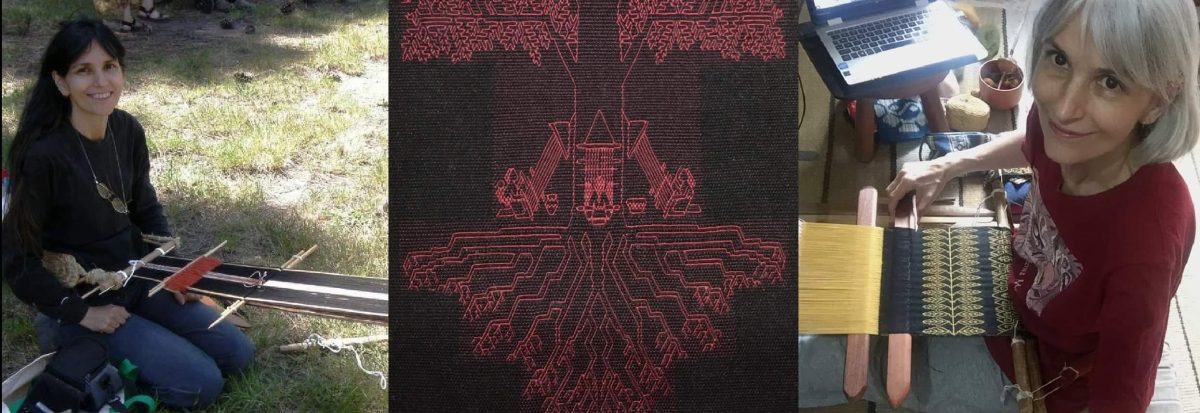
There’s been weaving happening at my backstrap loom but this has been a bit different from a standard band-weaving project. A recent incident turned this into an interesting challenge.
Regular readers of my blog may recall mentions now and then of the fact that I literally fell into weaving after taking a fall while out mountain biking in Colorado. That incident back in 1995, which left me on crutches for six weeks in a Colorado youth hostel, started a chain of events that created the backstrap weaver that I am today. If you’d like to know more, I can tell you that during the pandemic British weaver Stacey Harvey-Brown invited a few dozen weavers to tell the story of how they got into weaving for her Loom Room blog. It’s fascinating reading about the different paths the various invitees have taken to arrive at their looms. Here’s the link to mine.
The reason I’ve taken this little trip back in time to think about an accident thirty years ago that became a life-changing event is because a couple of weeks ago I once again found myself down on the ground thinking “Ouch!”
While in 1995 my first thoughts were about how all my plans to hike and camp in the Utah canyons had been ruined (hiking was my passion at that time), this time my first thoughts were about weaving and all the other fiber-related activities I do that require an intact dominant hand. Darn it, I had broken my right wrist and it required surgery. Was this also going to be a life-changing event?
This screen shot from security camera footage shows white-headed me walking away in the distance while a happy-go-lucky dog bears down on me. It kept going and ran right into the back of my legs taking me out like bowling ball hitting a pin!
Anyway, I’m determined not to let this slow me down too much while remaining sensible and giving myself time to heal. First up was a visit with my Ayoreo teacher, Rocío. She’s been teaching me about the traditional process of stitching bags using garabatá thread as well as about the patterns that identify the various Ayoreo clans.
Rocío showing me how she connects two lengths of thread without using a knot.
The last time I’d seen Rocío I had still been practicing the basic stitch using crochet cotton. Since then, and without Rocío’s knowledge, I’ve been scavenging bits of garabatá thread from various sources and working entirely with that material.
The most recent piece was this bag that I stitched during the Carnival break…
My indigenous weaving teachers have never been in the habit of expressing much enthusiasm when I show them my creations. Sometimes it’s a little crushing but I know it’s just their way. My current Guaraní teachers are particularly cool! So, of course I was glowing with pride when Rocío reacted so joyfully to the things I showed her. I think she was shocked. She particularly liked the red, black and white bag with the woven backing I used. I showed that in my last blog post.
She immediately called her husband to come and take photos.
The idea of my visit was to have her show me how to spin and ply the garabatá fiber that she had brought me. While I won’t be able to use my hand to do it myself for some time, at least I can turn it over in my mind in the meantime. A friend came with me and took video. The most valuable thing was seeing how Rocío joins lengths of spun and plied thread during the stitching process without having to use a knot. I hadn’t been successful doing it and had been resorting to using a dab of glue as backup. Rocío was not impressed when I confessed that! We really focused on it this time and I’ve learned a thing or two that had previously escaped me because I simply hadn’t been ready for it yet.
Showing Rocío some woven rather than stitched garabatá.
The fiber isspun and plied by rolling it along the upper leg. Both hands need to be involved so I’ll just have to be patient.
As for that hatband project, I decided that it was time to smarten up my left hand. I really needed to at least try.
It was a littlediscouraging at first because this is the distance I was able to weave after three consecutive days of spending one to two hours at the loom.
The gift project had a deadline and I didn’t see myself being able to complete it. But my left hand got smarter and faster and I found that once the cast had been switched to a brace, I could at least insert the pinky of my right hand into the shed to hold it open while I inserted the sword.
One-handed pick-up. I’m just holding the sword here for the photo. I couldn’t rotate my wrist to be able to insert it in the shed.
In progress on the loom and finished. I wish I could complete the gift by attaching it to my friend’s hat but I don’t think either hand is up for that kind of sewing right now.
And then came a visit with my Guaraní teacher, Eldina.
Eldina working on a warp just wide enough to be able to demonstrate for me the technique the Guaraní weavers call Moisi.
I forgot to bring my swords so we used scissors to separate the threads that needed to be heddled. Three sets of heddles are used for this structure. Eldina’s 5-month-old baby girl is never far away when she’s weaving and teaching.
Eldina had to call her mother to be reminded of how threads are selected to go into each set of heddles. Grandma Clara is the Moisi expert while Eldina tends to focus on Karakarapepo. According to Eldina, pick-up for the Moisi style is much more complicated than it is for Karakarapepo. If you’ve read my posts from long ago when I was studying with my very first Guaraní teacher, Angela, you might remember that I soon realized that the structure that I call Intermesh and which I first learned from an Ayacucho weaver in Peru in 1995, is the same as Moisi. This allowed me to easily replicate some of the lovely patterns that Angela had been weaving to make cell phone pouches. Replication is always one of my first steps in learning.
A cell phone pouch that I wove using the intermesh structure back in the days when phones were small and cute.
Hopefully, Eldina will eventually take on all of Clara’s skills and knowledge and maybe pass them on to her baby daughter some day.
Mother and baby busyat the loom!
Clara has been working on samples of jaguar skin print using the Moisi technique for a project that a wildlife photography guide is planning. While this sample is not exactly what the guide has in mind, I’m so in love with this Moisi piece. I think it’s stunning. Hopefully the guide will be able to communicate more precisely his vision for this project but he is, of course, paying for materials and compensating Clara for the time she has spent so far. Commissioned work is hard!
It’s really interesting for me to discover that the thread arrangement while warping and the thread selection for heddles is really different from the way I was taught in Peru. Once my hand is back in actIon, I’d like to set up a warp for my backstrap loom in the way Eldina and Clara set up on their vertical loom. I’d like to see if there’s perhaps some slight difference in the structure that I’m missing. The woven results certainly appear to be identical.
So, my backstrap loom is just a bunch of sticks now. I might give left-handed warping a go eventually to see if I can manage the Guaraní style of set-up for Moisi. But for the next two weeks at least I’ll be giving my wrist a chance to quietly heal. Maybe I’ll dig out the files in which I’ve started writing new books and get my thoughts reorganized on those. I’m in a transition period right now having sold my old apartment and not in a position to set up for photo shoots but at least I could work on the overall plan, chapter headings etc. A good introduction always gets the ball rolling. Let’s see….
And, speaking of my books….the hatband pattern, or at least something very similar, is in my More Andean Pebble Weave Patterns book. There are so many versions of the snake pattern which is basically an embellished zig-zag and I’m often adapting them to suit the number of threads with which I’m working.
If you’re a regular visitor to my blog and have at some point thought about perhaps buying one of my books, maybe you’d like to take the step to buying one now at taprootvideo.com. The accident and resulting surgery have been a significant financial blow and every little bit helps! I’d really appreciate it!
Heads-up: Much of this post is dedicated to the Ayoreo looped stitching that I’ve been studying with my teacher here but yes, there’s also a bit of backstrap loom weaving thrown in here and there.
I’ve been back in Santa Cruz for a while now after my trip to see my highland teachers. I got straight back to studying the textile crafts of the lowlands. While I still haven’t managed to get together with my Ayoreo teacher to learn how to spin the lovely bundle of garabatá fiber that she got for me, I’ve still been busily scavenging all the spun garabatá thread that I can find so that I can continue to practice, practice, practice.
There’s probably a few years of spinning in that bundle….for me, anyway, as a beginner.
You may remember that I’d taken a few lengths of spun garabatá thread with me to the highlands to throw into the indigo pot. It was such a small amount. I had to think carefully about how to best use it.
The bundles in the top left corner are the indigo-dyed ones.
I decided to try to copy the pattern on an Ayoreo bag that I’d bought which had been made with what looks to me to be a combination of Dosapey and Chiqueno pattern. The Chiqueno pattern is the fine-lined diamond shape. For all I know, this combination of figures has another name altogether and identifies another clan. I’ll have to ask Rocío next time I see her. So far, I only know the two patterns that identify the Dosapey and Chequeno clans. Rocío tells me that the techniques used to produce those two can be used in various combinations to create all the other patterns. Right now I have my eye on a pattern on a bag stitched by a Wichi artisan of Argentina which doesn’t seem to be one used by the Ayoreo here in Bolivia.
While it was interesting figuring out how to combine the two patterns, in the end I didn’t think it was the best way to showcase the indigo thread.
The finished pouch is on the right. I used the Dosapey pattern, or part thereof, in all these pieces.
Because of my limited supply of garabatá thread, I’ve been only stitching one face of the larger finished items and turning to my backstrap loom to weave the other face in cotton.
There’s something so nice about weaving just simple white cloth like this. I’m using the non-mercerized cotton that my Guaraní teachers call “crudo” and which does indeed have a very raw feel to it. The woven and stitched panels are quite easy to combine and I really like the result.
I still had indigo thread left over from that project and decided to try another project in which the color might play a larger role.
I love going to this little store that’s just a few blocks from my place here in the center of town. It’s on one of my regular evening walking routes. Carmen sells Guaraní and Ayoreo crafts and, as far as I can see, is the only one selling Ayoreo products in that entire handcraft market.
I drop by now and then to look at the products and be inspired. Occasionally, I can’t help but buy a little something.
This is one of the products that Carmen sells. It’s made from palm leaves by Guaraní artisans. It’s very firm and holds that lovely egg-like shape. It’s one of those things that just feels so good to cradle in the palm of your hand.
I bought a conveniently small Ayoreo bag from Carmen (convenient because it was one of the lowest priced bags due to its size) which had four rows of the Chiqueno pattern on a surprisingly bright turquoise background. This would inspire my next project…..multiple rows of half the Chiqueno pattern.
With this I added one more cuff to the collection. These are perfect projects for learning and practicing new patterns. I like the way the indigo is a bigger player in this piece.
What remained to be done was to continue that pattern to complete the full Chiqueno diamond. This was my hide-away-inside-during-the-Carnival-madness project.
I’m still working on the technique that allows the Ayoreo artisans to join two lengths of thread without using a knot. I’m not usually confident about my own attempts and end up adding a tiny drop of glue for extra security. Keep practicing!
This latest bag also got a woven back. This time I used the intermesh structure as I wanted to weave something that resembles the pattern on the front. The intermesh structure as I know it only allows me to use two colors, though.
At the backstrap loom once more. The structure that I’m calling intermesh uses two sets of string heddles alternated with rows of pick-up.
The diamond shapes are very easy to weave although I couldn’t match the scale of the pattern on the garabata piece.
Only after sewing the two pieces together and declaring it finished, did I have the idea of trying to copy the horizontal stripes on the edge of the garabatá piece. I could have woven them as vertical stripes and then turned the fabric sideways to sew. It would have looked pretty cool having the stripes continue from the edge of the garabatá piece across the back of the bag. Too late! But that idea no doubt is going to stick with me until I have a chance to try it out in another project.
Carmen told me that she often travels out to the communities to bring back new products and that she would look for garabatá thread for me on these visits. Because this particular conversation had taken place in December last year, I had given up hope that this would ever happen. However…. I was out on my evening stroll last week and bumped into Carmen in the street. She’d just closed up shop and told me that she had thread for me. The excitement!
An apple for scale. This will go a long way! I may have to save it to take back to Australia. I love just holding it in my hand and it has the most wonderful smell!
There’s been some activity with my Guaraní teachers too.
Now that I’ve learned the basics behind dressing and operating the Guaraní loom, I’ve been trying to focus on specific details rather than spending the entire time in class warping for a large project. It’s about process rather than product for me and my desire to do this is not something that my teacher quite understands. In this particular class, I could have happily spent the whole time just making string heddles in the Guaraní style over and over again until I felt less clumsy about it. The Guaraní style of heddle making is not like anything I’ve run across before. I think I have the hang of it now, though.
I think I disappoint Clara a little when I don’t want to put a large warp on the loom. She suggests making a placemat, for example, but no, I’m boring and weird and just want to make heddles…haha.
Below, you can see what the heddles look like at the end of the project when they’re removed from the loom. The warp above is a combination of colored Clea two-ply crochet cotton (roughly 8/2) and the heavier non-mercerized white. My teachers always use the heavier thread for heddles.
I wasn’t all that interested in weaving off that last narrow project. Like I said, I really only wanted to practice making heddles. But I did weave it and it was good practice in heddle operation using a method which also seems to be very unique to Guaraní weavers.
I grabbed this shot from a video I made many years ago with my first Guaraní teacher, Angela. You can see her using the heddles to create a shed.
Piecing together strips of that narrow piece to make another zippered purse. I modeled it on the one above that I wove years ago for a plain-weave weave-along that we ran on Ravelry and have been using ever since.
In the latest class I worked with an even narrower warp, only about 1 cm wide! Sorry, Clara, I still don’t want to weave a placemat.
In this class, I wanted to learn how to warp a checkerboard pattern that Clara and Eldina often use in their work and see the different ways it can be manipulated to create patterns both with and without doing pick-up. I’ve set up a warp with this pattern on my backstrap loom now for further study. I’ll show you the results next time.
After being cooped up for four days straight during Carnival, I decided to take a trip with a friend up to the foothills for a weekend about 2 hours out of Santa Cruz city. It was a nice way to escape the heat, do some walking, treat myself to some meals out and, most importantly, visit the hummingbird refuge!
Hills! Santa Cruz city is soooo flat!
This!
We went to the Refugio de Colibríes (hummingbird refuge) with very low expectations so as not to be disappointed. Maybe we’d see a couple of birds if we sat very still for an hour. Wrong! We saw loads of them. I’m not going to rattle off the various species but if you’re on Facebook you can visit the refugio’s page and see the photos taken by owner, Saúl, with accompanying descriptions.
I managed to get this shot by placing my phone over the eye piece of Saúl’s telescope. I could see the little guy’s chest moving to its heartbeat through the telescope. But the telescope was just an added bonus. The naked eye alone was enough to be able to enjoy the birds and be able to distinguish one species from the next. Owner-guide Saúl was fantastic. Goodness knows how many times he’s explained the same things to visitors but he does so with such enthusiasm.
Maybe there’ll be a hummingbird figure on my next Guaraní warp.
I’ve been up to the highlands and am now back again in the hot tropical lowlands. Yes, I’m still in Bolivia. Australia is there waiting for me and I’ll get there event-u-a-lly…..
I meant to write a blog post yesterday but once I got into sorting and editing the photos, I found myself completely overwhelmed. Lest that happens again today, I’ve decided to make this just an overview. Anything that doesn’t make it into this post will probably show up now and then in future ones as well as in my Facebook and Instagram accounts.
So, on this ten-day visit to Independencia , Cochabamba where my weaving teachers live and where Dorinda was also vacationing, here’s a run down of some of the things I did…..
I took the five-hour minivan route to Independencia from Cochabamba instead of the eight-hour one by coach. I’m guessing that the minivan is capable of traveling on roads that are perhaps unsuitable for the larger bus and that the bus remains in service because it’s required to service many tiny communities that are scattered along its longer path. The minivan route is no less scenic than the one I traveled last time by bus. In fact it may be even more so.
From the town of Quillacollo just outside Cochabamba city we head straight for the mountains and in under an hour we had zig-zagged our way up to around 3700m leaving the city of Cochabamba a mere blur in the distance on the valley floor.
From there it’s a journey along slopes of deep narrow valleys high above lively rivers (it’s wet season). Water cascades down the slopes above, crosses the dirt road ahead of us and continues tumbling its way down to the green valley floor. Then we go up over passes to continue along the next valley, up again and so on. I was sitting in the second last row and it was like riding a bucking bronco back there with every descent from the passes. I gave up trying to take photos and instead just tried to imprint the scene on my brain.
And then we stopped so that the driver could negotiate the carrying of some freight for a couple who had flagged us down and it was one of those perfect moments for getting a nice shot. We happened to be on a relatively flat and open area with the setting sun casting a golden glow on the hillsides and I was able to hold my phone steady for a change and get a photo of the peaceful scene. I thought that if I just get one nice photo from the five-hour trip, I’ll be happy.
So much for this just being an “overview”. I’ve already spent too much time just on the van trip! Back into overview mode….
On the surface, the town didn’t seem to have changed much since my last visit….
How such a wickedly steep street can look so mild in this photo is beyond me!
These rocky streets in town become slippery with mud after rain but dry up miraculously quickly.
However, some things had changed….Maxima was now living in a house of her own with a lovely view and even had wifi.
Charqui (jerky) on the washing line in the patio in front of a nice view across the valley.
With Dorinda, my teacher Maxima, (long time followers of my blog will know them), her daughter, Vilma and the grandbabes, we dyed a bunch of skeins of handspun yarn with indigo in a banana-based vat.
I mashed overripe bananas with Maxima and little Mayra for the indigo dye bath.
I think this was only the third time that Maxima was attempting to dye with indigo. The second time had apparently failed and so I spent a lot of time wondering…are we doing this right? Will it work this time? Well, it did and I got to keep one of the skeins. I can’t wait to use it in a project on my backstrap loom. The skeins are made up of the ladies’ doubled handspun wool singles. Once dyed, the doubled threads are then tightly plied. I’ll get to ply my own skein which pleases me because I’m not fond of weaving with the high amount of twist that these weavers typically put into their yarn.
Maxima and daughter, Vilma, showing off the aguayo (carrying cloth) Maxima wove for a custom order from the USA. Indigo-dyed yarn from the first attempt can be seen in the stripes. This cloth is gorgeous! The colors are so rich and Maxima has included a stunning variety of figures. It’s all Maxima’s work except for the tubular edging.
A close-up view of a small section of the center of the aguayo where you can see some of the indigo-dyed yarn in the decorative joining stitch.
We made skeins. I’d never made skeins just on my hands before and was happy not to have mine end up in a tangled mess. The singles yarn immediately kinks back on itself when not under tension and can make things difficult to control.
Immersing skeins in the indigo dye pot with Dorinda, granddaughter Emily and little Mayra always there in the mix. We wore gloves but still managed to get the dye on places where it didn’t belong.
First results once again against that lovely backdrop. One of those skeins became mine 🙂
On the following days, Maxima continued experimenting on her own and tried over-dyeing some naturally-dyed yellow to produce that pretty green.
And yet more on another day. This time over-dyeing a cochineal-dyed skein.
So, I came home with this (below). The mug is for scale more than anything else because those balls of yarn I bought are huge! I bought those two balls from one of the weavers from the outlying community of Huancarani that I visited on my last trip up here. The ladies from Huancarani come into town on the weekend to sell their produce in the market. We attempted a trip to Huancarani on the preceding Thursday for a weaving get together much as I had done on my last visit but it had rained heavily all through the night and a landslide had shut the road.
Plying all this yarn will keep me busy for a while. As if I need even more stuff to lug back to Australia but who in their right mind could resist?
Here’s a flashback to that Huancarani trip and the fun day we’d had all weaving together…
When not dyeing, I would visit with Max and weave with her as she had asked me to teach her some new patterns in the structure that I call Andean Pebble Weave.
When I was walking in the market street on the Saturday, I was stopped by one of the Huancarani ladies who asked “Where’s Berna?” That’s the name they know me by. No one calls me Laverne in Bolivia. Bs and Vs are pronounced virtually the same and they don’t recognise that the La is part of my name as La is often placed before any woman’s name when referring to her as a third person. So, here in the lowlands I’m Verny and up there I’ll always be Berna/Verna. The Huancarani ladies had been expecting my visit on the Thursday and so now that they were in town, they were looking for me. Of course they didn’t recognise me as the lady with long dark hair that had been to their community to teach patterns seven years ago!
Back in 2017 I went to Huancarani and can be seen here with that long dark hair guiding Maxima’s sister Narciza through the steps to weaving a pattern from my More Adventures with warp-faced Pick-up Patterns book. It’s a motif from a Central Asian textile that I had adapted to the structure that I call Andean Pebble Weave. It had caught Narciza’s eye and she was keen to learn it and not let me go until she had conquered one repeat.
We just managed to get through one repeat before it was time to leave and I left wondering if she would ever use the pattern. I did leave behind a woven sample just in case.
You can see the unique way weavers in these communities in this part of Bolivia manage their warps. They don’t attach them to their bodies with a string or backstrap. Instead, they have the warp suspended between an index finger and a toe. Together with the middle finger they form a picking cross of the two “pebble” sheds and then do all the pick-up and loom operation with just the one free hand. It’s amazing to see! I did this with Maxima back in 2011 when I visited her in Cochabamba. Even though the structure is the same as the one with which I am thoroughly familiar, this method of weaving it was completely foreign to me and it took me some time to get used to it.
So….back to the lady in the street market who stopped me. Once I told her that this white-haired person was indeed Berna, she pulled out a couple of bands to show me, one of which is pictured at left. Sadly, Narciza hadn’t been able to come to town that weekend as she has a herd to attend to but it seems that Narciza spread knowledge of the new pattern to other ladies in the community. How happy that made me!
And Maxima had taken advantage of the copy of my book that I’d left behind with her on my last visit.
Maxima and a group of weavers are seen here studying and discussing images in the book shortly after my visit.
Maxima showed me what she had woven from the book….
It’s a belt that she wove for daughter, Vilma, to wear on festival days. It’s woven in the bright tightly twisted acrylic yarn that the weavers here love to use.
The ladies love to be able to show off “new” patterns in items they use for special occasions.
On our first morning weaving together, Maxima chose to use some of the crochet cotton that I’d brought. I think her unfamiliarity with the material left her a little frustrated. These weavers create a very tight weave, squeezing the weft into place with a tremendous amount of pressure. The cotton thread just wasn’t behaving the way her handspun wool or re-spun acrylic thread would. Those materials have a certain amount of stretch which the cotton simply doesn’t. While she was able to weave the little motif she had chosen correctly, it just didn’t look right with that tight, tight beat.
Maxima preparing a cotton warp for our first session together. The end of the warp is temporarily tucked into the waistband of her skirt while she uses two hands to make heddles, Later the end will be suspended on her index finger. Anything that happens to be lying close by such as this comb can be called into use to hold the cross.
Starting with a little plain pebble weave.
Meanwhile Mayra and Ana who seem to see all forms of household chores as play, were happily washing their toys. At one point I saw them playing chop-the-head-off-the-chicken-for-the-pot with the cat!
My second session with Maxima was completely different. She used her re-spun acrylic thread this time and the results were completely different. She confidently chose larger and more complicated patterns from my Complementary-warp Pattern Book (all the patterns therein are in the structure that I call Andean Pebble Weave) and her joy at watching the figures appear and then reaching the stage where she could predict what was to come next, was apparent.
Starting with a fresh warp of respun acrylic thread for wider, more complicated patterns.
The young ladies on this morning were on chicken duty…..that is, keeping the chickens from wandering from the yard into the kitchen.
One of the four running-horse patterns that creator Deanna Johnson calls Elmy’s Mustangs, is almost complete.
Here’s a video clip of Maxima doing the last row of pick-up for the horse pattern….
She also selected the viscacha pattern from my book. I’d charted that pattern from a fragment of pre-columbian cloth that I’d seen online. I’d been able to track down the owner of the fragment and get him to send me close-ups so that I could decipher it.
The cat figure,also from pre-columbian textiles, that Maxima chose was not completely successful but I know it will be in her next attempt now that she has understood how to weave the eyes of the viscachas.
This is what I was doing in the evenings to entertain myself. I was using Alison Irwin’s idea for weaving letters in the structure that I call Andean Pebble Weave to make a key fob for the lady who ran the hotel in which I was staying. Inti means sun in the Quechua language and Wasi means house.
I also wove a bunch of patterns to leave behind for Maxima to study and attempt in her own time after I left. When I showed Maxima the hotel key fob, she loved it and so I offered to make one with her name as well as for her daughter. Her husband then laughingly asked why I wasn’t offering to make one for him. I was happy to oblige. Dorinda took this photo of Maxima after I left as I wove the fob on the last night and wasn’t able to deliver it in person.
I think she liked it!
And then it was my turn to learn some new weaving thing. I noticed that the large aguayo that Maxima had woven was edged with a patterned tubular band that is known in some parts as nawi awapa. The weavers here call it chichilla or simply nawi (nawi meaning eye). Maxima handed that task off to another weaver as she has forgotten how to weave these patterned tubular bands. She generally edges her carrying cloths with crochet. The customer in the U.S however, wanted the more traditional patterned tube. What I noticed in this particular tube was that the color arrangement would flip back and forth along its length. The zig-zag would change colors every now and then as would the inner eye color and I was mad keen to meet a weaver who would show me how ro do it. Maxima’s sister Narciza knows how to do it but she hadn’t come into town.
So, on Saturday market day I visited with the Huancarani ladies in the street and asked if any one of them knew how to do it and if they would be willing to teach me. Of course no one just happened to be carrying colored yarn and besides, all except Justina said that they didn’t know how it was done. I invited them to come up to the hotel so that I could show them a nawi awapa band that I had started and also show them some other bits and pieces that I thought they might find interesting.
Squeezed onto the balcony of the hotel, I showed the ladies any woven thing that I happened to have. Here they’re examining my double weave belt with its Bedouin patterns which are completely foreign to them.
I brought out my cotton spinning bag and everyone fell in love with the tiny takli spindle and wanted to take it home. Only Justina was “brave” enough to try spinning cotton with it and she did a great job.
Justina examined my ñawi awapa warp which was set up in the way I had been shown in Chinchero, Peru. It turns out that while the results are exactly the same, the weavers in this part of Bolivia set up their warp for the ñawi awapa in a slightly different way. It’s slightly different but different enough to be confusing to Justina who said that she wouldn’t be able to teach me using this warp. I was a disappointed but interested to know exactly what the difference was. Time didn’t allow further exploration but Justina returned the next day and agreed to teach me if we created a new warp from scratch. I was thrilled!
Gathered the next day in Vilma’s sewing workshop with Justina deciding that she had enough time to teach me if I could bring some yarn. So, out came the crochet cotton again to the rescue…not ideal, but good enough for learning.
Creating a fresh ñawi awapa warp while Maxima went out to look for a forked twig to use. It holds the cross….more about that later. On the floor you can see another stick that is used to save one of the picked-up sheds for later use. The weavers here call this stick “el muchacho“.
Justina guiding me. Yes, I learned it! Maxima and Vilma looked on. I wonder if Maxima absorbed enough by watching to be able to do it on her own. Wouldn’t surprise me. I offered to let her sit in my place and try but she declined.
When I got home of course I had to weave one straight away. I still have lengths of fabric that I bought from the ladies back in 2019 and I used some of Verna’s cloth to make a little pouch that I could edge using the Huancarani set-up and color-changing method.
Justina told me that they call the forked stick illawa, which is the same word used for string heddles. Perhaps these weavers use the word for any device that enables them to create sheds. I do love the name for the other stick….el muchacho, which strangely is in Spanish rather than in Quechua.
A closer look. You can see that the color arrangement in the tube along the base of the pouch is different from that along the side. This is a much nicer photo of the beautiful natural dye colors used by the ladies in these textiles. I used commercial wool from my workshop stash for the edging.
I can’t tell you how much I enjoyed this visit. On certain afternoons Dorinda and I would walk up and up and up above the town to get some exercise. I was suddenly very much aware of my calves. I was really pleased with the way I was dealing with the altitude.
One afternoon, Sandra, the hotel manager, took me down to her orchard. So that was a down, down, down walk with the harder part coming at the end of the day. I was happy to see custard apples growing for the first time and to be able to pick quinces which Dorinda later made into jam. We took back apples and Dorinda made a pie. How spoiled was I? The biggest thrill was seeing a hummingbird nest with two eggs in the orchard. The photo needs something for scale. The nest and eggs are tiny!
There was time first thing in the morning to hang out on the balcony with hotel cat, Garfield, and watch some young girls herding their flock of sheep onto the football field. Stray dogs would arrive to romp and freak out the sheep who would bolt out the gate and into town with the little girls running screaming behind them! It would happen pretty much every other day.
Got my nose burned on day one in the high altitude sun and so did not go out hatless ever again after that.
We got stuck in the mud on the way back to Cochabamba. The mud sucked the soles right off my sandals and I never saw them again. Then we got caught up in protest roadblocks as we neared Cochabamba and it was quite a saga getting from there to the airport. It involved walking with soleless sandals through shin deep water and taking the train that was packed to the gills. It was so difficult getting on and even more so getting off! If my flight had not been delayed, I might have just missed it. To be honest, if the road had been closed due to the landslides and I had been stuck in Independencia, I might have chosen to just stay on until Dorinda’s visit ends on the 10th. It was a glorious visit and I really had no need to leave when I did.
We all got filthy. The quiet sleepy group of passengers up to this point turned into a happy chatty group after successfully getting the van out of the mud and back on its way. How was I going to get on a plane with my feet in this filthy state? Never mind, there were flooded streets to walk through further along once we hit the outskirts of town and had to get out and walk due to the roadblocks. Feet were squeaky clean by the time I got to the airport.
And the scenery on the way back….could it get any better? Yes, it could. It was and had been raining a lot and in the red rock sections the waterfalls that had sprung up and started to flow down the other side of one of the valleys, were running bright pink! Mud and rain-streaked windows made decent photography impossible but I burned those images into my brain!
Back in Santa Cruz and once I’d woven and documented the color-changing nawi awapa, I turned to other projects. I’d taken some garabatá fiber to Independencia to toss into the indigo dyepot.
The top left bunch of thread was dyed in the indigo pot. At bottom right you can see a tiny pouch I made using the Dosapey pattern. That tiny bag holds a tiny booklet and mini pencil. Now to decide how to combine colors in a new project. Roció, my Ayoreo teacher, contacted me for a class while I was away. I’ll have to let her know that I’m back.
This is the start of a larger Dosapey pattern that I finished just before traveling to Independencia. I dyed the black for this project.
I just had enough garabatá thread to create one face of a pouch. I wove the other face in cotton and sewed the two together. This pouch held my passport, tickets and money purse and went with me on the trip. I used the edging stitch used by the Weenhayek artisans along the top.
And now I’m working on something a little unusual. An expat gentleman who runs wildlife tours here with a particular focus on the endangered jaguar asked me if it would be possible to weave a jaguar skin pattern. He would like to commission Guaraní weavers to produce small bags with the print to offer to his clients. He is and always has been keen on promoting the handwork of the artisans that live in this lowland part of Bolivia. He showed me a tapestry pattern that he’d found online and I took it as a challenge to try to reproduce it in one of the warp-faced structures that the Guaraní weavers use. With this I can show him how much pattern can fit into the dimensions he has in mind. He can sketch out his ideal pattern and then approach the weavers with a proposal. This way they won’t have to waste time and yarn sampling and experimenting. Besides, you know me….always looking for an excuse to weave.
Using the Moisy technique which is one of the two pick-up patterning structures that the Guaraní weavers use. I set this up all ready to go before I left on the highland holiday.
So, the overview grew somewhat as I settled into writing and felt less overwhelmed! I hope you’ve enjoyed these tales from the Highland Holiday.
Let’s start this post with the bit that is actually about weaving on a backstrap loom.
I’ve been studying with two Guaraní ladies and learning all about the style of loom that they use. It’s not a backstrap loom but rather a free-standing vertical frame.
A mini version of a typical Guaraní loom.
After weaving my second project on this loom, I decided to use the cloth I’d produced to cover a notebook in which I could record all I was learning with my Guaraní as well as Ayoreo teachers.
That’s where the backstrap loom came in. I wanted to weave bands with the titles of the book. One half would be for all the notes on the Guaraní loom. The book could then be flipped over so that other half could be used for the Ayoreo notes. I used Clea cotton (2-ply approx 35wpi) and embroidery floss for the supplementary weft.
For the book cover fabric I used a generic cotton from a large cone that my Guaraní teachers typically use and dyed some of it two shades of blue.
And then I had to refer to my drawings again to get back into the swing of dovetail warping.
Dovetail warping….LEFT: Warping the Guaraní loom. RIGHT: Warping the fixed vertical loom in coastal Ecuador. I was creating a warp for a miniature hammock under my teacher’s watchful eye just so that I could learn the technique. We used her handspun cotton.
I had encountered this dovetail style of warping in several places in Ecuador and had had the chance to observe it being done in both wool (Otavalo) and cotton and acrylic (Salasaca) but I only had the opportunity to try it myself when I studied with weavers in coastal Ecuador.
My teacher Felipe demonstrating the way he sets up a dovetail warp for his backstrap loom in Salasaca, Ecuador. The post nearest his left thumb is the dovetail post. He uses an additional post for separating colors. He’s just winding a mini warp to teach me and provide me with a sample to take home.
It can be a little confusing but when working with only one color, you soon get the hang of following this kind of warping path.
W= Warping stake. C=Cross posts. D=Dovetail stick
It creates what I call a discontinuous circle. The warp threads travel in one direction until they reach D and then turn and proceed in the opposite direction until they again reach D. The drawing above resembles the set-up that we used in coastal Ecuador and the one that better represents the Guaraní set-up is below.
When weaving has been completed, element D (which was a stick in Ecuador and a string on the Guaraní loom) is removed and the cloth can be opened out to its full length leaving the loops at the ends of the unwoven warp intact. These loops are then used by the weavers in coastal Ecuador as part of the construction of their hammocks. In a normal circular warp, the warp has to be cut in order to open out the cloth to its full length.
When you start trying to use two colors at once on slightly different paths things get a little mind bending. Two colors are used when the Guarani weavers are going to create patterns in pick-up or just horizontal bars. The first time I did this with my Guaraní teachers, I have to admit that I hadn’t quite wrapped my head around it and was just blindly following the path that they patiently pointed out to me. Only later, when I sat down at my notebook and made my drawings, did I get it all straightened out in my head. But even so, I’ll be needing to refer to my notes for a while until I’ve had more practice.
Here I am passing the thread around the dovetail string. The two upper strings hold the warp cross.
With this learning warp I wove a piece that was wide enough to make a coin purse. However, once the piece was off the loom, I decided to sew two pieces together side by side and make a wider purse that’s more suitable for tools.
Winding the two colors together produced the horizontal bars. A weaving class often starts with winding yarn into balls. That’s Clara above. She and her daughter Eldina are the teachers.
The style of string heddles that the Guaraní weavers use is very unique. They are chained together and not held on a stick.
You can get a better view of them here. This is my teacher Angela who used to allow me to visit and watch her at work many years ago.
Clara was not keen on allowing me to make the heddles and I had to insist on being allowed to make at least the last three on my own. It wasn’t enough and I definitely need more practice. I hope to make our next class all about heddle making. So, when I created the much wider warp for the book cover, I went with the heddles that I am more used to making and tied them off in small bunches. I find it a lot easier to work with these bunches of heddles rather than with heddles suspended on a stick when working on a fixed tension loom such as this, and especially when the piece is wider than band-width.
Several two-color sections in my second warp gave me a lot of practice in sticking to the correct warping path.
This shows the wedges of wood that are the warp-tensioning system. So simple! The lower piece is removed after warping and the upper one, which is shaped, is positioned in order to maintain just the right amount of tension. It gets gradually moved along to its tapered end as weaving progresses and take-up tightens the warp.
The finished cloth….enough for the book cover and a zippered purse. I didn’t need the loops at the ends of the warp around the dovetail string and cut them off.
The cover is on the book and there’s the zippered purse. You can also see the purse I made from the first warp that I’d wound with my teachers.
The two faces of the finished book.
Imagine winding the warp on one of these looms for a hammock! And then making all the heddles. This is the first time I met Angela way back in 2002.
As`for my studies with the Ayoreo looping technique, I made use of the small amounts of the remaining garabatá thread by dyeing it and creating another cuff. Because I only had quite short pieces left and I haven’t got the hang of the clever knotless way of joining two lengths of thread together, I created this cuff in a slightly different way. Instead of working a wide and short piece, I made a narrow and long piece. That way I never ran out of thread in the middle of a row.
I made it mostly about stripes and added a small Chiqueno pattern in the middle.
The thread takes up the dye beautifully!
Dyed garabatá thread and an idea for an arrangement of stripes.
And because my edges, which got hidden within the hems in my other cuffs, would be exposed on this one….and weren’t pretty!….I added a cotton tubular edging to conceal them. And that tubular band is another backstrap loom project to add to this post.
I have a handy piece of furniture that allowed me to improvise a warping board for the tubular band warp.
When I next meet with my teacher Rocío, I’ll have her show me the neat way she has of carrying colors along the edge. And then we’ll get into spinning the big wad of fiber that she got for me! (I showed it in my last post if you missed it and are curious).
The tubular edging makes the cuff hold its shape very nicely, conceals messy edges and adds a really nice finish. I used a button-and-loop closure.
In the meantime, I’ve been visiting a lovely outdoor artisan market that’s just a few blocks from my place. Señora Carmen has a very small stall there where she sells handwork of the indigenous peoples of this lowland part of Bolivia. There I discovered that there is another group here that works with the same fiber as the Ayoreo people. They’re called Weenhayek and they call the fiber caraguata. They work the looped stitch much more loosely but the finishing stitch that they use along the mouths of the bags is different (and I think nicer than the one used by the Ayoreo). I had to buy one of their bags so that I could figure it out (I managed to) and I’m wondering if Rocío knows how to do it.
You can see the difference in tightness in the two Ayoreo examples on the left and the Weenhayek on the right.
And there I’ll leave it for this post. I’ll be getting back to my classes once we’re into the new year. In the meantime there’s plenty to keep me busy with Guaraní, Ayoreo and backstrap loom projects.
Hopefully next time I’ll be able to show a bit about how the garabatá fiber is spun. Until then, sporting a cooling summer cut (the hottest days are yet to come!), I’ll wish you all from my “transition home” here in Santa Cruz, Bolivia a Happy New Year.
It’s been a long time since I last sat down to write a post. There’s been a lot going on and it’s been a bit overwhelming!
First of all, I sold my little one-bedroom apartment. I’d spent a large part of this year doing repairs and painting it, then slowly either selling or giving away my belongings. One of the last things to go was my backstrap weaving station, that is, the bed base to which I would attach my backstrap loom. It was quite sad cutting the straps off the base and dismantling the bed at which I’d sat and happily woven all these years and a little distressing not knowing when next I’d be able to sit at my loom again.
Many years have been spent in my bedroom-floor “studio”.
But that didn’t last long. I was soon occupied with other creative pursuits. In my last post I wrote about the short workshop I’d taken with an Ayoreo artisan learning about the looped stitch worked in plant fiber called garabatá that she uses to create the shoulder bags that both the men and women in this indigenous group carry about with them on a daily basis. The bags are almost a part of their clothing. They never seem to be without one.
My experience in the workshop hadn’t been as productive as I had hoped and while I’d finished it with a much greater amount of admiration for the work, I was also left quite disappointed in the limited amount we had been able to cover in that short time. I had been searching for an Ayoreo teacher for years and had actually given up on ever finding anyone who would be willing to take me on as a student. It seemed that I would have to content myself with buying examples of the bags to study while trying to replicate the stitch in cotton.
Well….I got lucky….so lucky! I was introduced to another teacher, Rocío, and she’s amazing! She’s not only been teaching me the basic stitch and the various patterning techniques but also has been very generous in telling me about the various clans and the origin of the patterns.
But we still had to work in cotton as Rocío explained that the recent fires (which, thank goodness, have now been finally extinguished) and drought either destroyed or weakened the plants meaning that the artisans haven’t been able to produce good quality thread from the extracted fiber.
Working the looped stitch with needle and cotton.
I did manage to scavenge a bit of garabatá fiber here and there so that I could start practicing with the real thing. Cotton really doesn’t do the trick. It behaves in a completely different way from the garabatá and in many ways is more difficult to work with. One nice thing about garabatá fiber is that you can join two strands together without having to tie a knot…a method which I have yet to perfect.
My initial projects will be wrist bands. I’d seen an Ayoreo lady at the International Folk Art Market in Santa Fe, NM many years ago wearing several and decided that these would make good learner projects that wouldn’t require huge amounts of thread. It’s always nice to have some kind of finished product rather than just endless samples and the thread was too precious to use only for sampling.
My first finished cuff with a pattern from the Chiqueno clan.
I then started a more complicated pattern from the Dosapay clan which has been stalled until I can find more fiber in these colors.
Sorry about the bare leg shot. As you can see, the project gets tied to the upper leg while the artisan sits crossed legged on the ground.
Rocío tells me that when the piece gets longer, the work is often tied to a bar instead, allowing the artisan to continue to work with the bulk of the piece in their lap. I am nowhere near that point yet!
This next cuff that I made is a two-color example of the Dosapay pattern. It’s hard to appreciate the form of the pattern because I could only fit half of it on the cuff.
As I said before, working with the garabatá fiber is in many ways easier than working in cotton. One disadvantage is the varying girth and stiffness of the handspun thread which can be thin and relatively loosely plied in some parts and therefore quite flexible, only to become much thicker and tightly plied in others.
I dyed some of the fiber black for the third example and used a small version of the Chiqueno pattern so that I could fit the whole thing onto the cuff.
So, there’s been a lot of cuff stuff going on. Rocío told me that there was a chance of perhaps being able to buy a whole ball of spun thread. Her family lives five hours away from us here in the city and maybe they could bring some the next time someone travels in or she travels out.
What happened in the meantime is that someone did come in from the communities bringing a big wad of the raw fiber. I got a call from Rocio asking if I was interested in buying it. I was! It hadn’t been my plan to learn how to spin the fiber but it looks like it’s going to happen! She assured me that this fiber is top quality and will be worth the effort.
A photo that Rocío sent me of the purchase. This cost $7. I can’t even imagine the amount of thread this will produce!
I haven’t had a class with Rocío since that purchase. I know from my experiences learning to spin wool and cotton that it’s going to be a long time before I’ll be able to spin anything usable. I will then surely have a greater understanding of how difficult it must be to produce thread of consistent girth and ply. The fiber is rolled along the upper leg to produce thread. I’m envisioning a very sore leg and hand! My upper leg is already riddled with the evidence of having stabbed myself with the needle multiple times while practicing the stitching.
An Ayoreo lady at the Folk Art market in Santa Fe demonstrating the spinning method.
Three garabatá and four cotton wrist cuffs.
As you can see above, I’ve been weaving as well. Yes, I did manage to get back to my backstrap loom fairly quickly. After selling my apartment, I moved into a fully furnished room still here in the center of Santa Cruz city. It’s in a very vibrant part of the city and just a couple of blocks away from an awesome street market. And hooray, the bed has a wooden base which made setting up a new weaving “studio” very easy! I brought a little piece of the old studio with me…a wool rug woven in the foothill communities 2-3 hours from Santa Cruz city.
I’ve been weaving cuffs…just small projects as I really don’t want to unpack everything in my new home. I have four large wheelie bags packed and ready to go for when I make the final move to Australia and I don’t want to touch anything in those if I can avoid it. I’m just in a transition phase now while I take advantage of the fact that I can study with Rocío.
So, when I found that I needed a shuttle for the wrist cuff projects, it was easier just to buy and eat an icecream than dig through those four wheelie bags in search of one.
And who wouldn’t want to stick around during the Santa Cruz summer when those big beautiful mangoes are filling the street markets at a cost of four for $1.50! Those are Guarani-made placemats on the table which are part of the furnishings in this rented room. I’ve settled in so easily here. I can easily live in one room. My little flat in Katoomba in Australia that awaits me will feel huge after this.
The first two cuffs I made from the same warp have button-and-loop closures. The ends have been turned twice and hemmed. The garabatá cuff has a sliding knot closure. This kind of closure is something that I want to play with more as I hope to weave and sell cotton cuffs at local craft markets once I’m back in Australia. I will be needing additional income sources in order to be able to afford to live there and selling at the markets will also be a good way to publicize classes. The sliding knot closure will allow the cuffs to be adjusted to fit different wrists.
I’m back to using the Brazilian-produced Clea cotton that was pretty much all that was available to me before I started traveling to the States and got thoroughly spoiled with all the choices. However, now with the current amigurumi craze here, there are several other options. Clea remains my favorite, though. It’s fine enough to allow hemmed ends that don’t create excessive bulk on the wrist bands.
The second cuff warp. I plan them to get two cuffs out of each warp. That length of warp fits nicely into my available space here without having to do any rolling up. I’m also avoiding opening those wheelie bags to get out what I would need to enable me to wind longer warps!
There are other reasons to stay on here and not jet off back to Australia immediately. One is the opportunity to study with two Guaraní weavers. I spent time with Angela, my first Guaraní teacher many years ago. We never had any formal classes. It was more a case of my visiting her and hanging out watching while she wove. She was always very generous in allowing me to take pictures and video and ask questions. We would come across each other every few years as she made her way back and forth between the city and her Isoseño community sometimes stopping and living here but then suddenly disappearing back to her community. I eventually lost touch with her. My new Guaraní teachers told me that Angela passed away six years ago. Such shocking and sad news.
Angela in the patio of her home here in the city when I used to visit her. She always had several projects on the go.
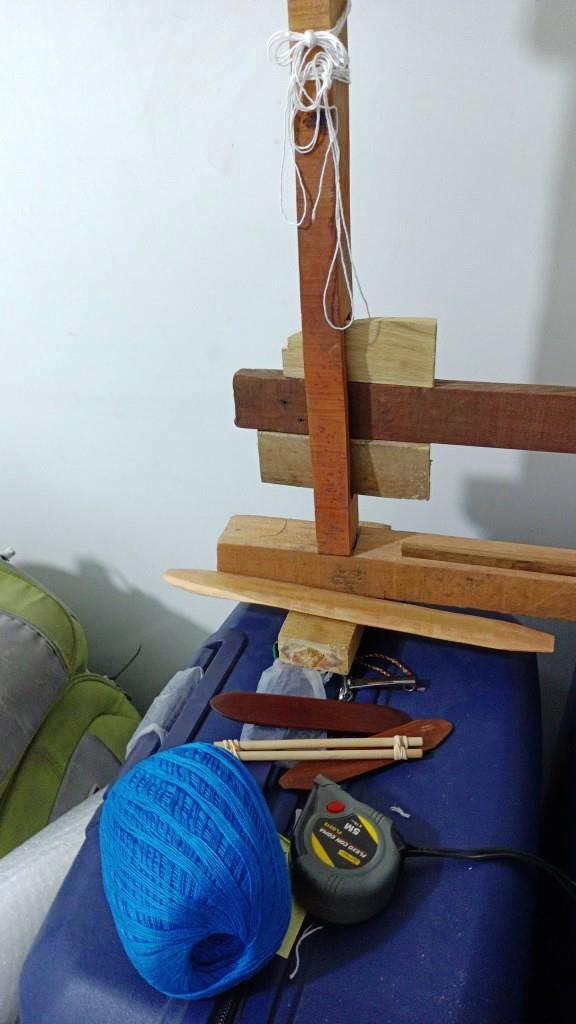
I will leave that part of my recent activities to another post. I have my very own Guaraní loom now in mini form which I can work on in my room. Of course, I won’t be carting it to Australia and will give it back to my teachers when it comes time to leave. I love its simplicity and particularly like the shaped wedges of wood which are moved within the slot to reduce the increased tension on the warp that results from take-up. It’s such a simple and effective system! Two of the strings hold the cross while warping. The third is the dovetail string which I’ll tell you more about in the next post.
Mini Guarani loom on top of my wheelie bags set up ready to be warped.
I’ll leave you with this picture of it and tell you all about it and the weaving in my next post, hopefully before Christmas. I’m nicely settled here now and should be able to get back into posting more often.