Backstrap Weaving – Cotton Tales

While scrolling through my Facebook feed last week I was surprised and excited to see an ad from the Museo ArteCampo here in Santa Cruz for a workshop being given by two Guaraní ladies on spinning cotton. There are three recognized groups of Guaraní people here in Bolivia living in the lowlands between the Chaco and the Andes. Artecampo has been working with people from the Isoseño group since 1984 helping them to recover and preserve dwindling knowledge of technique and motifs while providing a market for their handwoven hammocks, bags and wall hangings.

Examples of GuaranÍ textiles at the Museo ArteCampo.

The timing of this workshop couldn’t have been more perfect considering that I have only recently started to spend a serious amount of time spinning the stash of cotton sliver that I have accumulated in my closet…all generous gifts from my weaving friends. I haven’t seen anything like this being offered in all the years I have been here and who knows? I may not have considered taking the workshop if it had come along years ago.

Learning to spin cotton in Ecuador in 2007.

Two video classes on cotton spinning by Joan Ruane and Stephanie Gaustad as well as a short in-person demo with weaving friend Elizabeth in Australia (who had gifted me a takli spindle) had helped me to get started with using a takli. I am sure that some of what I had witnessed and tried during my stay with a family of cotton spinners and weavers in coastal Ecuador way back in 2007 also helped. I had really been way more focused on the weaving during that stay. Although I was curious and interested, cotton spinning at that point hadn’t captivated me. I just couldn’t see myself having the desire to do it or having a need for hand-spun cotton thread.

This was also true when I’d had the opportunity to study with Ju Nie, a Montagnard (Vietnamese hilltribe) weaver and spinner. She showed me how she first teased the cotton with a bow and then spun it on her spinning wheel. It was fascinating but I had considered that demonstration of such beautiful traditional skills and tools as just an interesting interlude during my studies of the beautiful patterned weft-twining that she was using on the fringes of her woven pieces. You can see the frame on which we were carrying out the twining work in the background. I recently learned that dear Ju Nie passed away last October.

And so, my time had finally come during the pandemic to focus more closely on cotton spinning. And then came this workshop. A miniature Guaraní loom sat on the table at the workshop with a piece of weaving in progress but I didn’t allow myself to get distracted!

Under a tree dripping with mangoes, fourteen of us gathered to learn how to spin cotton on the typical spindle used by the Guaraní ladies.

I already own a spindle that I had bought from my Guaraní weaving teacher many years ago. She only had a little cotton on hand and had given me a very brief demonstration. That had been enough to satisfy my curiosity as, again, I was much more interested in the weaving at that time. She did tell me at that time that cotton was being grown in the community of Isoso and that the inhabitants were not willing to give the seeds away to anyone….not that I had asked for any. I have nowhere to grow it. At the workshop, however, we were free to keep the seeds that we were removing from the cotton.

Angela back in 2010 giving me a short demonstration of how she spins cotton.

The spindle I bought from Angela as well as the ones we were given to use in the workshop, had thick pieces of rubber for whorls. The rubber pieces look like they have been cut from the soles of sandals. A simple groove is sliced into the end of the shaft.

The workshop spindle.
The spindle I bought from Angela in 2010 has a beautifully shaped end rather than just the simple cut groove.

We took the seeds out of the cotton and teased it apart with our fingers into a light airy sheet. Then we copied our teachers’ movements and rapidly lifted and dropped the sheets multiple times a few inches above the table before very gently forming them into loose rolls. One problem we faced was that Sabina, the teacher at my table, was left-handed. She loaded each spindle from scratch and then handed it off to us. As soon as we right-handed folks started turning the spindles, the thread was un-spun and subsequently broke. Not a big deal. We all laughed.

Sabina gets the spinning started while we prepare the cotton.

Although, I am very much used to the watch-and-copy style of teaching used by my teachers here, I had also had the benefit of lots of spinning explanations from my video and in-person experiences as well as lots of trial-and-error practice on my own. And so, I managed to get on just fine. I could understand very well the struggles of the other participants because it wasn’t so long ago that I was experiencing the same difficulties.

Clara worked with a group of participants at another table.

I really wanted to use this workshop as an opportunity to see how the Guaraní ladies manage to spin much heavier thread than I do. They weave hammocks with their plied thread and it is thick and sturdy and so I spent the workshop time trying to focus on that. I created thread that was just a bit thicker than what I have been creating at home but it was nowhere near as thick as Sabina’s and I wasn’t able to keep it consistent. Sabina kept laughing at my fine thread but also told me, with what seemed to me to be pride, that her grandmother had been able to spin very fine thread. My other interest in the workshop was to chat with the teachers about their experiences learning to spin and weave as children. Plus, I wanted to see if I could manage to spin decent thread from cotton I had prepared myself in such a basic way rather than with the beautifully prepared sliver that I had been given.

Cards had been placed on a table so that we could see the Guaraní words used for describing what we were doing. Our attempts to correctly pronounce the phrases brought on more laughter.

GuaranÍ spinning vocabulary and Spanish translation.

As for my cotton spinning at home, I am still working my way through the color labeled Cinnamon. I boiled the color labeled Mahogany and was astonished to see how much it changed its tone. I love it. Either some of the brown comes off in the water, or this cotton was particularly dirty…the water became a mucky, murky mess!

The boiled Mahogany in the center with the original color below right. Above is the original Cinnamon color with the boiled and not-boiled greens on the left.

Now for the latest ikat project using my hand-spun cotton. I might try this particular idea again some time, but not with my hand-spun cotton. It turned into quite a business! I wanted to have a white ikat pattern on a background of various tones of blue. You might remember a project I did a couple of years ago in which I used a multi-colored warp for ikat. This was industrially-spun and naturally-dyed silk and the project was relatively simple: tie the ikat tape on the multi-colored silk…the dyeing of the warp thread had already been done by someone else…and then dye the whole thing one solid color, in this case, black. I loved the result.

I am able to get quite sharp images when using using uniformly spun thread.
The color-inspiration picture.

The current project is more or less the opposite in that I wanted the ikat to be a single solid color, in this case, white, with a multi-colored background. I wanted the change in the blue tones to be fairly subtle. And so I had to tie the pattern and then split the warp into sections and dye two sections at a time separately so that the outer sections were very dark, gradually lightening toward the center. The very center section was dyed grey (which I now regret doing…I should have just gone with light blue) as I was using a picture of my choosing for color inspiration as part of a group weave-along and grey was part of it.

What a task it became! I was using my hand-spun cotton singles. The small individual sections totally twisted up on themselves in the dye bath and so the dye was not able to fully penetrate some parts. I had to repeatedly remove the thread from the bath and try to separate the individual threads and then poke and prod and pick at them in the water. The poor things took quite a beating. And then they would dry and I would find them to be too light and the contrast between the strips of blue too great and so back into the dye bath they would go. Yes, so next time I try this particular ikat idea, it will not be carried out with hand-spun singles. There was way too much picking and pulling and wrangling of the thread going on. I just knew that I was going to have a lot of shift in the pattern as a result. So much fuss over such a small piece. I had been planning to weave it after adding natural green cotton to the sides to make a piece wide enough for a pouch but I decided not to risk my precious green on a project that seemed doomed to fail. Perhaps it could be a wrist cuff instead.

Another goal of this project was to arrange the angle of the diagonals in the pattern so that the diamond shape was more curve-like. That part seemed to have worked out quite well. As always, I really enjoyed unwrapping the plastic ties to reveal the pattern and then sitting down to finally weave it. One of the center threads broke. That’s a problem when it’s ikat unless you have another tie-dyed thread to replace it. But everything else went smoothly. There was a lot of shift in the pattern but that was expected and I was happily weaving away at this point.

After looking at the finished piece for a few days, I decided that it wasn’t so bad after all. I decided to go ahead and weave the green sides separately so that I could piece together a useful item. Yes, another pouch. After all that work, the ikat piece really deserved to be made into something. I planned the layout combining the darker boiled and not-boiled green with a little blue that I had already dyed for a previous project.
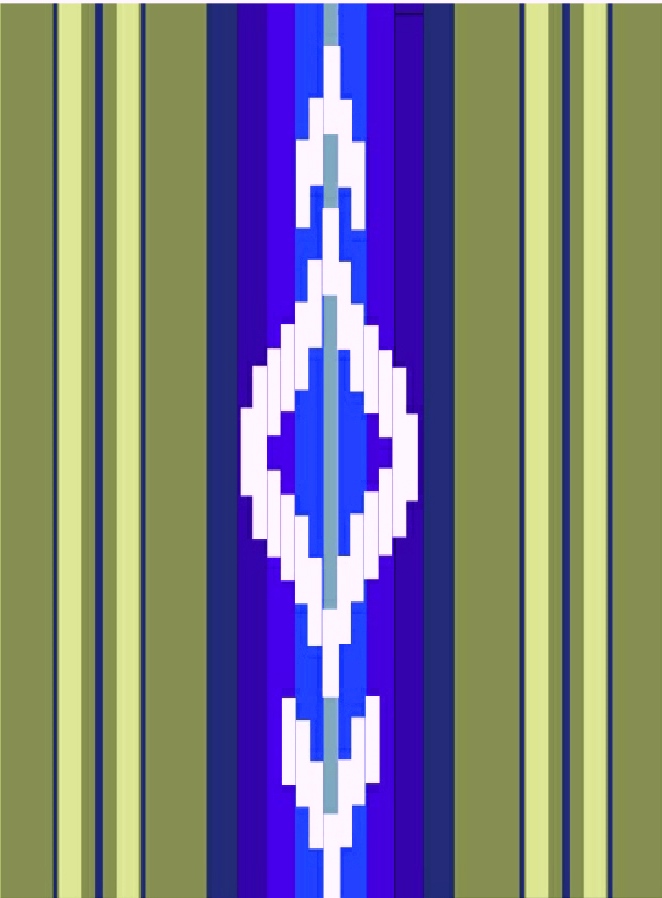
I wove the two strips separately but at the same time…if that makes sense. It fit better in my weaving space if I wove it this way rather than as one long strip cut in two. Besides, I could keep a better eye on matching width this way. Again, it was just lovely to be at the loom doing simple plain weave and enjoying the look and feel of the hand-spun cotton. Three broken threads were easily replaced…no tie-dye to worry about this time. The broken ones happened to be the not-boiled green…coincidence, or does that say something about a change that takes place during the boiling process? The threads broke when I was moving the coil rod. Note to self again…set up the coil rod right at the end of the warp and leave it there.

A first look. The sewing isn’t finished yet. I’ll just use a large snap at the mouth of the pouch. I am very happy with the curviness of the pattern.

Here’s the gang of hand-spun ikat projects all together.. The pattern of the latest one repeats on the back as I had folded the warp to halve its length and was therefore able to tie once and get two patterns.

I have another ikat idea developing using my 30/2 silk and reds…maybe cochineal? In the meantime, I will keep spinning cotton. I want to boil small amounts of the new Cinnamon color for different lengths of time to see if that produces different tones. Right now I have some 60/2 silk on the loom and am using double weave to create some jewelry pieces….experiments. I already have a nice ikat pouch in which to keep them…lol. I am thinking ahead to my eventual move back to Australia and considering the eye-wateringly high cost of living (compared with Bolivia). It will be helpful if I can perhaps sell some woven items at craft fairs.

One other thought that just popped into my head is to once again dye sections of pre-warped (but not ikat treated) hand-spun singles allowing them to twist on themselves. Perhaps the differences in dye penetration along the length and breadth will create interesting patterns. It’s hard to believe that this is me writing this….the one who likes everything to be controlled!

Until next time….

Backstrap Weaving – Another Lifetime

I recently realized that I have spent almost half my life here in South America. The first five years were spent in the Chilean Patagonia at the southernmost tip of the continent…a pristine, wild, cold and windswept landscape from which I could look across the Straits of Magellan to the island of Tierra del Fuego. It was a hiker’s paradise and I had to be careful to make sure that I took advantage of the windows of calm and pleasant weather to explore as much as I could of the various national parks in both Chile and southern Argentina.

The Torres and Paine massif in the Torres del Paine National Park. The Circuit is a popular multi-day hiking trip.
The Circuit trail runs alongside Grey Glacier on the western side of the Paine massif.
Adelie penguins on Paulette Island, the first first of several species of penguins that we saw.

I hiked in the parks – the lands of the guanaco – and kayaked the fjords, explored some parts by zodiac, traveled down to Antarctica and over to the Falkland Islands but also spent a great deal of time huddled indoors.

All that indoor time is what is responsible to a large degree for my having taken up weaving and it was from there that I started traveling to spend a few months away now and then in order to learn to weave with women in the highlands of Peru and Bolivia.

Weaving a four-color Andean Pebble Weave piece in wool on my Navajo-style loom in Chile. This was in the very early days before I had the confidence to try wide and complex pieces like this on a backstrap loom.

The rest of my time in South America, when not out and about on my weaving explorations, has been spent basking in the tropical warmth of lowland Bolivia. This has become so normal to me now that I forget to stop and appreciate all that makes his place so delightful. Of course, thoughts of the eventual return to Australia are what have mostly brought this on. I lived on and off for 30 years in Australia, another 30 here….are there 30 more years left for another total change of scene? The place where I am hoping to live when I return is in the Blue Mountains, just west of Sydney…a place in which I spent many a weekend in my late twenties climbing and hiking. It’s far from tropical! The Blue Mountains is a beautiful area. That’s me on an easy, yet exciting, rock climb. I think that I am still game for activities like these…probably just not physically able anymore.

I went for a stroll one afternoon last week to buy dye and ask for advice from my local yarn store. It’s just four blocks away. I took a slightly different route home through the street market and returned with this…all of this fruit plus the dye for around $5.50 total….The fruit stalls carried the strong aroma of a yellow, smooth-skinned fruit called maracuyá. It smells and tastes exactly like passionfruit but sure doesn’t look like the purple-skinned ones that I have always known. This is one of the delights that I take for granted here….living in easy walking distance of pretty much everything I could ever want or need and having it all affordable considering my low income. The fancy, expensive malls and entertainments are further away, but who needs those?

I know that the apples are not exotic for most of us but whenever my students and I would talk about our favorite fruit when I was teaching English here, they would name apples, oranges and strawberries as their favorites…not the magnificent mangoes and the luscious papayas and pineapples that I find so wonderful. In fact, people who have mango trees in their yards here consider them a nuisance. The fruit falls, rots, and attracts flies faster than they can be gathered and consumed. It’s pineapple season right now and the street corners have little carts where you can buy thick slices of fresh juicy pineapple to eat while walking around. There is no such thing as a bad pineapple. The same goes for papaya. There was a time when I ate so much of it that the palms of my hand took on an orange hue.

As for the dye that I bought, I was consulting the store owner on how best to get a certain pastel green with the available dye colors that he carries. His chart said to mix eight parts of yellow with one part black. You may remember from my last post that he had advised me to mix blue and black to get grey and that I had been skeptical. Imagine my thoughts about the yellow and black mix to get this particular green. The grey that resulted from my having followed his recommendation was quite nice and so I can only listen to him again and try a sample with the yellow and black mixture. Of course, the recommendations are not his personally…they come from the manufacturer of the Brazilian-made dyes that he sells.

The blue-grey that I created for my last ikat project.

The pastel green is one of the colors that I might want to use in my next ikat experiment. I am hoping to create a fairly narrow strip of ikat pattern using two dye colors…blue and green… and then weave it flanked by expanses of natural green cotton. This is just one of a couple of ideas that I have floating around. The fact that one of the groups on Ravelry is holding a weave-along based on colors inspired by a picture of one’s own choice, might send me off in another direction.

This painting by Paule Bernard Roussel inspired my silk paisley scarf project some years ago. I might use those various tones of blue to inspire an ikat project….perhaps a white ikat pattern on a background of various blues.
The silk paisley-patterned scarf in which I used four tones of blue to flank white.

Spinning the green cotton has been interesting. I had heard many a time that the natural green color darkens when the thread or woven item have been washed. I boiled my singles to help set the twist but was not prepared for the dramatic change in tone that resulted! Amazing.

This is the green cotton immediately after being boiled. It’s still wet and so looks darker than the color it took on when dry.
Now you can compare. The two balls lower right are the pre and post-boil colors.

Now I am wondering if I can somehow avoid boiling just a small amount of the green thread so that I can weave a piece that incorporates both versions of the green. I’ll just have to deal with the thread’s high energy. That is, after all, the point of these projects…experiment, explore the what-ifs, trial and error. I need another lifetime to fully explore the use of hand-spun thread and ikat.

Natural green alongside mahogany and white Sea island.

I have drawn a pattern that I want to use and I will fold the warp to halve its length this time. I could use this project to try folding in both directions but I think I will leave that particular challenge to a time when I am not using my handspun. My pattern is more or less a diamond but its sides curve outward ever so slightly. Let’s see if I can manage to make the curves work.

In my last post, I showed you my black, white and grey ikat piece off the loom.

Here’s a little picture summary of the process from spun thread to loom…

The warp was folded to halve its width and only half the pattern tied. The picture of the pink ikat tape, therefore, is a collage of the half pattern next to its mirror image.

I folded the finished cloth this way and that to see how best to make it into a pouch. You might remember that the pattern had been planned to be twice this length. The original idea was to fold the cloth at the half way point in the full pattern and form a pouch that way. But I had given up on that idea when I realized that my pattern tying wasn’t as precise as it needed to be and I abandoned tying at the halfway point. I modified the motif so that it could end there without, hopefully, looking too odd.

So, this is the pouch that I created in the end. It holds the surprising number of USBs that I have accumulated.

The brown thread that you see in the picture was labeled as “mahogany” in the bag of sliver that my friend Betty had given me. I found it challenging to spin with its very short fibers. Now I see that not all browns are equal. I have just started on another coil of sliver labeled ”cinnamon” and it is completely different in character. In yet another bag, I have more brown that is accompanied by a Fox Fiber card which calls it “Coyote Card Sliver organic ’89”. This color has a bit more warmth to it. The card says that the color will progressively darken the longer it is boiled so that “many shades of color unique to you can be created”. That’s pretty exciting. I shall have to experiment with that. Looking at the next picture, I am thinking that the takli’s hook could make a nice reed threader in the absence of a proper one, although I wouldn’t be able to insert it very far.

The paler cinnamon is on the spindle next to a ball of mahogany. I haven’t boiled the mahogany yet.

Spring is on its way. The weather is unsettled as hot and moist weather systems from the north east collide with cooler drier ones from the south. Sometimes they battle and it gets wild. We don’t have what you would call a classic coming of spring here as there are trees flowering all year ’round. In any case, I will acknowledge spring and show you my bands of spring flowers. I hesitate to say “celebrate” spring because the heat of coming summer (which can start as early as October) and the smoke that results from burning to clear land for the planting season are two of the few less delightful things about living here. But the mangoes will become larger and more varied and plentiful and even cheaper as the months go by…so who can complain?

Warp-faced double weave flowers in 60/2 silk.

And to finish, here are some amazing flowers that have been embroidered onto the knotted fringe of an ikat shawl from the Cuenca area of Ecuador. This shawl is one of the pieces collected by the late Dennis Penley (author of the book on jaspe shawls of Gualaceo that I showed you in my last post). The images are used with the kind permission of the current owner of the collection. Spectacular! If I had another lifetime, I would consider learning how to do this kind of fringe knotting.