Backstrap Weaving – Inspired by Nature

It’s that time of year again. The beautiful bands that I order every year from a group of spinners, dyers and weavers of Cochabamba in the central highlands of Bolivia have arrived….a box of color and rich aromas from the countryside.

Here are some of the ladies who spend months spinning, plying and dyeing their yarn with plants and cochineal before winding warps and weaving beautiful cloth on their simple leaning vertical looms…

faja weavers

These are also the ladies who are part of the team that took part in the 2014 global spinning event –Spinzilla.

I wonder if some of that Spinzilla thread was used for these bands. Dorinda Dutcher of PAZA Bolivia, lives in Independencia and devotes herself to promoting the recovery and revival of  these fiber and textile skills. She told me that the ladies were overjoyed to have the time of the Spinzilla event to spin, chat and laugh.
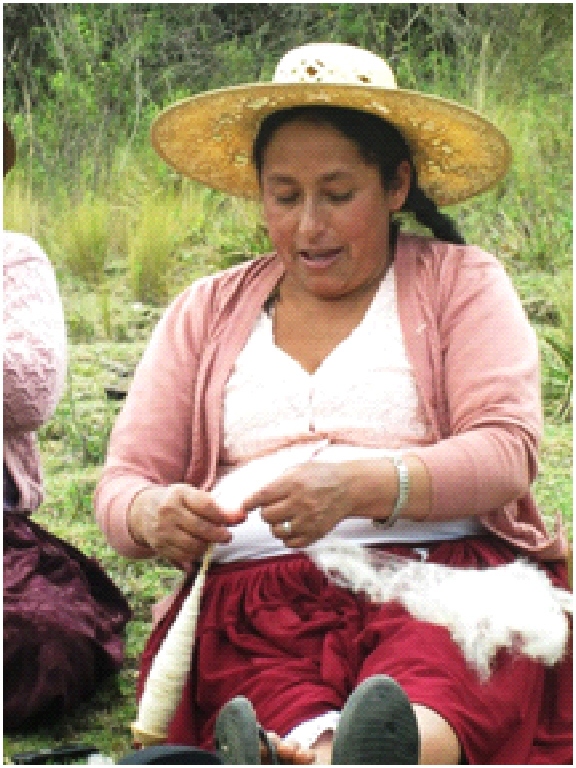
maxima It was exactly what they used to do as young teens. They would head out with the family flocks and meet up at a rendezvous point. 

The hottest topic of conversation would be the weaving advances they had made for the creation of their aguayos, the large pieces of cloth worn over the shoulders, that would be shown for the first time at Carnaval.

Because the ladies challenged and competed with each other, it was the time of their finest work. Now their daughters go to school and that particular tradition is no more.

Doña Máxima, at left,  is one of the few weavers whose daughters weave, most of the weavers’ daughters having migrated to the cities.

Here are the bands with all the stunning sun-soaked colors of the Bolivian hghlands…

weaving highland BoliviaI can’t help showing you picture after picture of individual pieces so that you can better see and enjoy the color arrangements. I love seeing how the varying amount of twist in the handspun yarn creates different textures  in the cloth and how each weaver has decided to arrange the colors that she has available from the latest days at the dye pot.

PAZA colors 1


??????????????????????

??????????????????????

??????????????????????

??????????????????????

??????????????????????

???????????????????????????????

??????????????????????All the patterns are Andean Pebble Weave.

And, we have our own talented spinners, dyers and weavers in the Backstrap Weaving Group on Ravelry as well as members who are brilliant at combining colors.

Here’s a cuff that Janet wove made from her own handspun Perendale wool which she dyed with indigo, cochineal and walnut…

janet cuff 2She made a series of wool cuffs and Wendy also showed one that she completed made from variegated cotton thread and finished so neatly with weft  twining…

cuffsJulia T in her home in tropical far north Queensland in Australia was inspired by the colors of nature and used fruit to inspire a set of bands for key fobs. She captured the essence of the fruit so well!

???????????????????????????????I contributed something cheery as well….a field of flowery “O” s amongst a lattice of ”X”s…

flowers both sidesCatharina joined our group to share with us her explorations in traditional Estonian patterns in the supplementary-warp structure and our minds have been blown.

llunallamaBut, back to the ky fob WAL which has been chugging along to its one-month anniversary…

pebble fobsJulia T, Arlene and Betsy worked on Andean Pebble Weave bands. After her first sample, Betsy added more twist to her handspun wool and is happier with this latest result. Arlene’s band, with its rope pattern, has an unusual and attractive tapered finish and Julia T used JoAnne’s original cat design along with her own heart composition and a knot work motif from my second book.

plain weaveI love that plain weave continues to be popular inspiring more and more creativity in combs and stripes. What I have dubbed ”Wendy’s Watermelon Warp” (center bottom left) inspired the idea for Julia T’s tropical fruit collection as well as Gwen’s comb combo, above right. WannaGTD wrapped the warp-ends for a neat finish on a her classic band of horizontal bars. The yellow stripes really give it a zing.
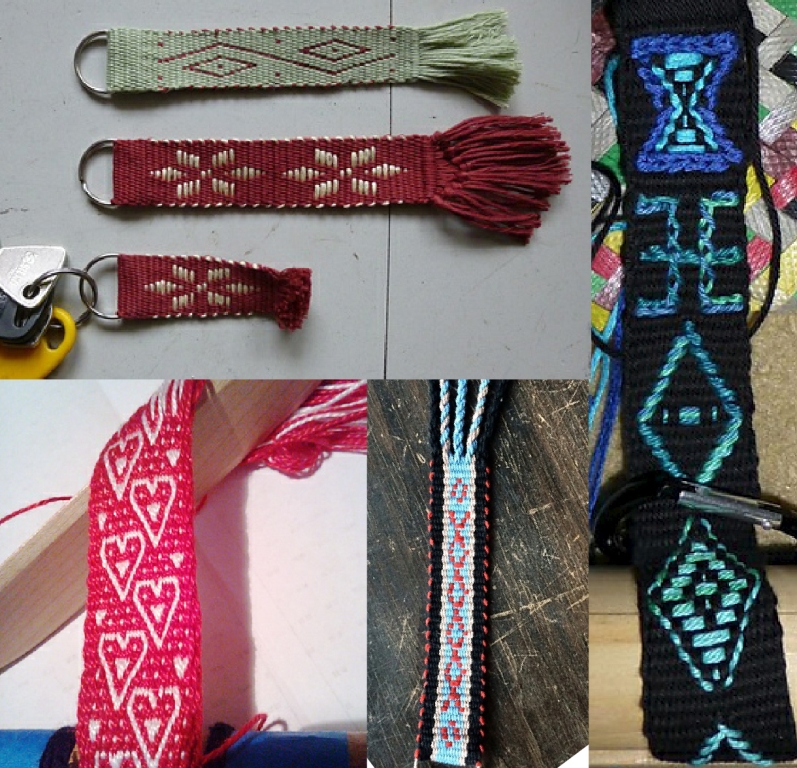
mixedSupplemental weft made another appearance in the work of Valtricot, above left, Linda, center bottom, and Wendy, bottom right. Wendy also put to use her considerable skills in Bhutanese supplemental weft technique. Susan celebrated Valentine’s Day with her own composition of hearts in Andean Pebble Weave. I like how she added the small heart spots betwen the large motifs…they really set it off.

sheep combo

??????????????????????I had been reading comments online about confusion in the English-speaking world about what exactly the animal is for this Chinese new year…a sheep, a goat, or…???? At the same time, I spotted Louise Ström’s sweet tablet-woven pouches (above left) with their animal motifs and decided that I would try something similar in Andean Pebble Weave (above center and right). The level of success of my attempt to create sheep will be left for you to decide!

I also played with beads, at left, in a plain-weave comb design band. I lined the edges with beads and popped couple up in the center just to see how they would hold there. I think I would like to use beads in the center of a band to form part of the pattern itself.

My large three-color Andean Pebble Weave/ikat bird  project is moving along at a snail’s pace with the workshop prep and key fob WAL having occupied my attention for the last few weeks.

And now I am going to warp to make covers for some small journals that I would like to take away and give as gifts. One of the key fobs I wove during the WAL will serve as my width sample for the Guatemalan thread that I want to use. I will use patterns inspired by nature…my little leaf motifs that I like so much.

supplementary weft leaf pattern journal cover backstrap weaving


Backstrap Weaving – Warping, warping….

I wound over 120 warps this week as prep for weaving with groups and friends and I am not even half way. I put on some music or the tv, make sure I have absolutely every thing I need on hand…scissors, rubber bands, cross sticks and string…and away I go. I have long sticks all over the room wedged between books on the book shelves and I hang the completed warps on those as I go. It’s very efficient. I always wind in the same direction with the balls of yarn in the same place. It has become so automatic and so much about feel that I have reached the point where I can wind two colors and separate them into sheds as I go without even looking to check if I am putting the right color on the right stake.

And then I decided to take a break and wind something for our Key Fob Weave-Along that is still buzzing along in the Ravelry Backstrap Weaving Group.

wal collage 1I decided to weave what is often called a ”threaded-in” pattern. Basically they are stripes, or ”dots” (tiny horizontals or single ends in a contrast color), or horizontal bars, or any combination of the three and can be as simple or as complex as you like.

??????????????????????Here is one that I did a couple of weeks ago for the key fob Weave-Along…

??????????????????????

Warping in pairs in my workshops helps makes the processa little less daunting.
Warping in pairs  helps makes the process for beginners a little less daunting.

And that is when I was reminded of how it feels when you are first learning to warp…trying to follow the path, handle two threads at once, remember which color goes where and when while trying to tie off ends and maintain tension. You feel like you are all thumbs.

I was remined of that beginner feeling because winding some of these kinds of threaded-in patterns from one stake to another and back, as I do for the backstrap loom, can be a little tricky. It is not always as beautifully straightforward as it is when winding them using a circular warp for an inkle loom, for example, where one circuit of the inkle frame gives you a single end. The way I warp, each ”circuit” gives two ends and often four if I am winding doubled threads.

Sometimes a half revolution is required, knots have to be tied at the other end of the warp and sometimes it works best if you reverse the winding direction after the halfway point. I am not used to having to stop and actually think about what comes next…about how to avoid spaces between the colored horizontal bars in each column, about which of the two central posts each color is supposed to pass around and how to make sure the pattern is balanced. I didn’t like having to get out paper and colored pencils when I got confused! I tell you, old habits and muscle memory are hard to break.

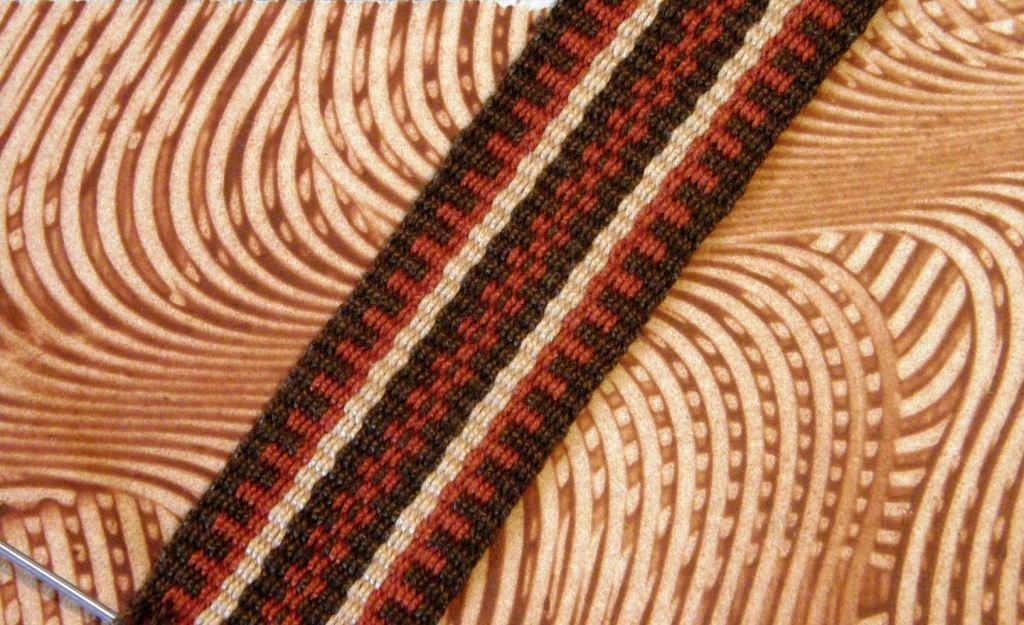
The idea of a threaded-in pattern is that it is created by the way you set up the warp and separate colors into the two sheds. Once that is done, all you have to do is weave it off in warp-faced plain weave…no pick-up or other manipulations are needed and the weaving moves along so quickly!

??????????????????????
??????????????????????So, if you are interested, here are the warping instructions for the fob at left. These instructions are for those who are already familiar with winding warps on four stakes/posts and separating colors into their sheds as they go….

I am calling the Start and End post ‘A’, the two posts in the middle ‘B’ and ‘C’ and the post at the other end ‘D’.

3 revs of purple
1 rev purple and yellow wound together and separated between posts B and C (yellow on C, purple on B)
1 rev yellow
1 rev yellow and green together (green on C, yellow on B)
1 rev only green
1 rev green and purple together (purple on C, green on B)
1 1/2 revs yellow and green together (green on C, yellow on B) you will stop at post D, cut the green and tie purple to the green end.
1 1/2 revs purple and yellow together starting at post D (yellow on C, purple on B) you finish at post A.
2 1/2 revs of purple finishing on post D. You need to tie the purple off to something. I tie it to the green and purple ends. I like to untie the knot in the green and purple and then tie all three ends off together.

###############

The only other key fob I wove this week required nice straightforward warping. I was inspired by Joyful’s use of a button on one of hers. Instead of sewing the folded woven band to itself to secure the ring, she created a slit, ot buttonhole, while weaving and used a button to make the connection. I wove a black plain-weave fob for my silver-color button.

??????????????????????The other small project I have been working on is a silk bookmark. It was originally planned as a keyfob for the WAL but I was enjoying weaving it so much and didn’t want to stop at key fob length. It is 60/2 silk and has a traditional motif of the Isoseño Guaraní people of lowland Bolivia. Many thanks to the people who commented last week with ways to make one’s hands silk-friendly. The piece on the right is a supplementary-warp band that I made ages ago in tencel which needs to be finished and used as a fob or bookmark.

sil cotton tencel bands backstrap weavingTerri, who very recently joined the WAL, showed us that simply knotting the warp ends is a very neat and time-efficient way to finish a band and this is how I finished the black fob rather than try a new braid.

Let me show you now what our other Weave-Alongers have been making…

simple warp floats supp warp and pebble weaveHer are three fobs made by three weavers using three different structures. Eska’s fob on the left uses the simple warp-float technique floating two colors to create a motif found in yurt bands and other Central Asian textiles. Ilze’s name band is woven in the supplementary-warp structure and Julia’s is in Andean Pebble Weave using a motif that I adapted from Central Asian weavings and which is charted in my second book.

combs and barsWendy, Terry and woolfancy were all  on the same wave length color-wise and designed with stripes, combs and bars. That D ring with the added split ring makes so much sense for wide bands that won’t sit well on the curve of a regular ring.

supp weft designsValtricot continues her studies in patterning with supplementary weft. Celticthreads made three fobs, two of which also have supplementary-weft motifs.I love the white plain-weave one with its colorful stripes and braids. Joyful, wove a rabbit figure in angora supplementary-weft. You can also see her use of a button as well as sprang in the unwoven warp-ends.

Our two Julias have been working on Andean Pebble Weave

andean pebble weave fobsJulia T wove a Valentine’s Day themed fob while Julia W wove one of the knotwork patterns from my second book.  Sarah’s completion of her first Andean Pebble Weave band and Lesson One in my first book shows that she is well on her way to starting her first patterns.

Gwen took a break from weaving the panels which she will sew together to make a cover for her weaving bench to join us in the WAL. Let me show you the two gorgeous panels she has made so far along with her first fob…

gwens fob and panelsSo, it is back to the warping board for me and the workshop prep. I have decided that I must finish this task before settling back into my big bird project.

???????????????????????????????While I wind my dozens of warps, my mind is on to the next big project and then the next and the next and I am thrilled to say that, thanks to something inspiring that showed up on my Facebook newsfeed recently, I have found the curvy shaped motif that I want to create in the ikat technique and then fill in with pick-up patterns. I can’t wait to work on it!

That has been the whole idea behind my recent ikat bird experiments. I want the ability to create curves and irregular shapes and fill them with pick-up patterns. I stand at the warping board and dream about that, plan out the steps and think about the wonderful opportunity that has recently come my way to study with an ikat artist while I am in the US this spring.

This city is vibrating to the rhythm of the coming Carnival. See you next week…


Backstrap Weaving – Life in the Yarn Forest

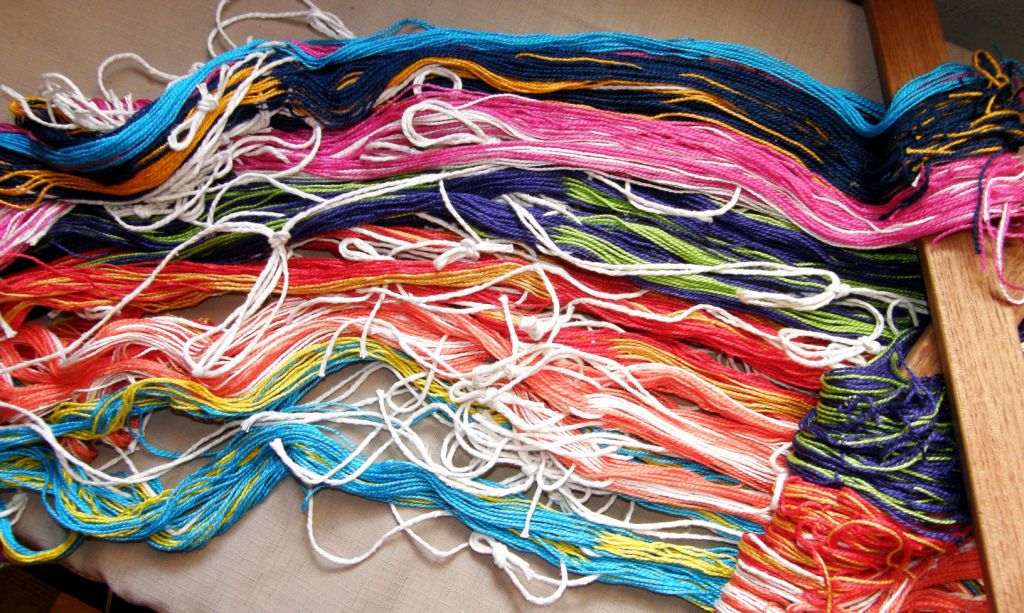
I was almost going to skip this week’s post. You see, I have been all tangled up in this stuff…This is about one-tenth of it!

warpsI am in the throes of warp preparation and, once I get the ball rolling, I don’t want to interrupt the flow in any way. The living room is a forest of colored thread. My cat is bored with it and just walks over the top as if it is all just some kind of new flooring. There is the risk, though, that she will bring down a lizard from the upstairs terrace and decide to play hide-and-seek with it in the yarn jungle.

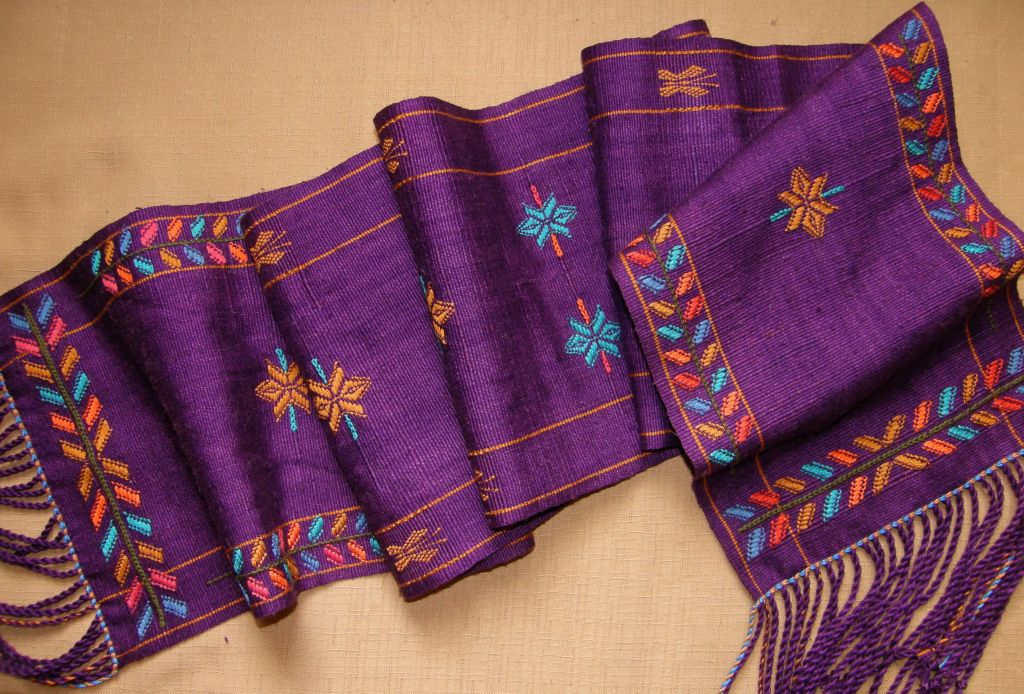
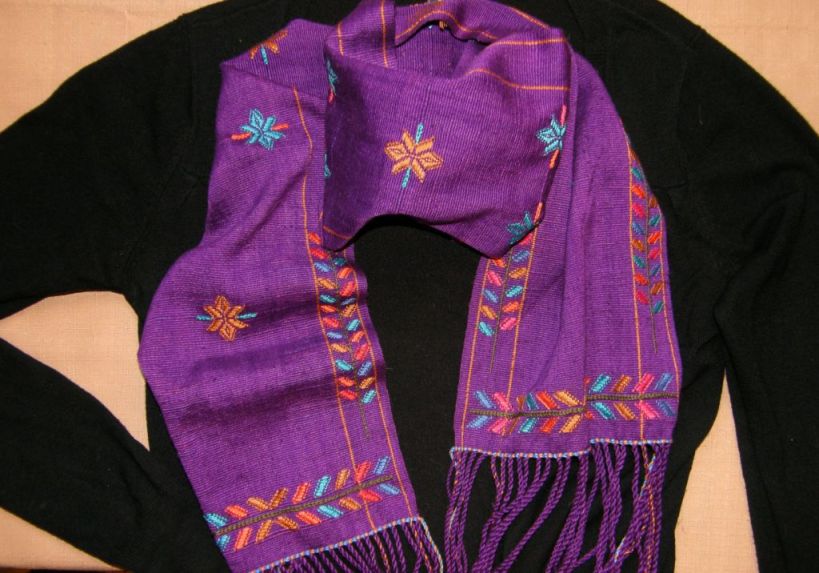
But, as I have been making good progress, I decided that I could part the branches and vines and step out for a bit so that I could post pictures of the finished purple scarf while I am still excited about it.

??????????????????????You will see that I decided not to add a few inches to start and finish. That is something that I had been pondering last week as I found myself with excess warp that I didn’t want to waste. The decision was made easier by the fact that I had just about run out of yarn for weft. That and the fact that the scarf really didn’t need any additional length, had me twining a two-color edging and cutting the circular warp apart earlier than expected. I am really happy with it.

And you can tell how excited I am as here I am playing fashion lady…(so NOT me!)

??????????????????????

I probably won’t have time to start another project before I get on the road but I have an idea developing for the next thing…a bandanna! which I will use as a kind of neckerchief.

The bandanna will be square, and wider than most things I weave, with supplementary-weft patterns scattered over it. I haven’t decided yet on the motifs…maybe something inspired by Mexican weaving or maybe something Indian for the Sanskrit origin of the word “bandanna”: बन्धन bandhana, “to tie”. I see many pictures on Facebook of the daughter of my Godmother, who still lives in India, dressed in luscious saris. Maybe something there can inspire this next project.

I have green and red left in the Guatemalan cotton with which I have been working and have chosen the red. I wish I had a really pale lilac in the silk for one of the supplementary wefts. Maybe I can pick up something on my trip.

??????????????????????So, I will have that idea percolating while I am traveling. If I do really well with my trip prep, maybe I will at least wind the warp so it will be good to go when I get back. Then it will be able to fight for first place among the many ideas which I usually bring home.

Along with my trip preparation, I have this project to finish….

finished baackstrap woven wall hangingsI won’t tell you how many warp ends there are in these three wall hanging panels that need to be twisted or braided or dealt with in some way. However, I kind of enjoy doing things like this. I like to find something that doesn’t really require my full attention on tv…like a movie or show I have seen and enjoyed before…and then sit with sweet snacks on hand and braid and twist away.

ANWG 2013I have lots of plans to add more panels to this wall hanging series. I can’t decide which project I will tackle next. I hope to have these three hung as part of an exhibit at ANWG in June.

It will be fun to see them up on a wall as there is certainly no room around here for them. The three pieces have structural and/or design influences from South American textiles I have seen. Some aspects were inspired by experiences I have had while on the road learning to weave.

Another reason I wanted to take a break and blog this week was to tell you about a weave-along in the Ravelry Backstrap Weaving group that Ghedrain is proposing starting March 1st.

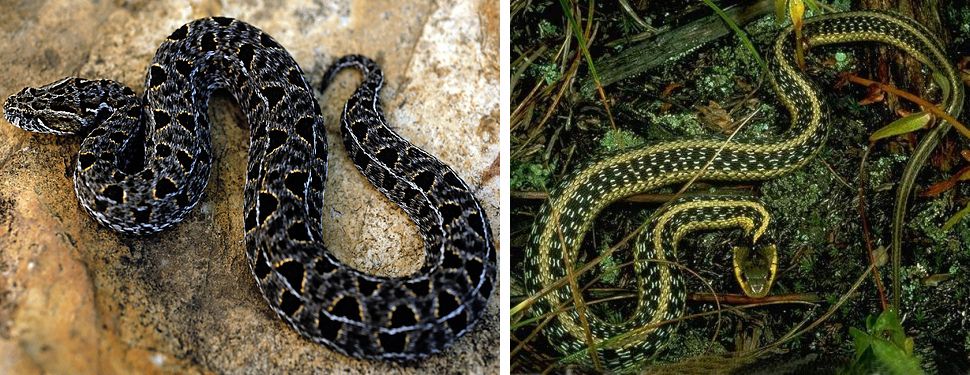
Considering that the Chinese Year of the Snake has just begun, Ghedrain has suggested creating projects that are inspired by snake-skin patterns or by the shape of the snake itself and has posted a number of pictures for ideas. Here are a couple: (the image on the right comes from this site.

snakes for WAL

Such amazing patterns!

The weave-along is open to all levels although it won’t be based on a tutorial of any kind. Any weave structure can be used…pebble weave, double weave, supplementary-weft inlay, to name a few….and we are particularly encouraging people to use plain weave with some creative colored warping to create snake-like warp-faced patterns. The inkle pattern generator is very helpful for experimenting with color arrangements.

Janet is planning to do a card-woven piece using a backstrap set-up. And it is not just limited to backstrap looms. We welcome the use of inkle looms or other looms on which warp-faced pieces can be woven.

Kateri, who wove with me in Massachusetts last year, showed the group what she has been up to lately using the pebble weave structure and patterns charted in my books

kateri pebble weave

It is nice to see Kateri venturing into wider pieces. The piece on the right became a study in how warp tension affects the elongation of the motifs…the more tension applied, the more elongated the motifs will be…something of which backstrap weavers need to be aware as they go rolling up and shortening the warp. The piece on the left has a favorite motif of mine which was taught to me by my dear teacher Maxima in Cochabamba. Kateri’s band is beautifully even and the motifs are nicely balanced the entire length of the band.

Ghedrain is set up to weave a scarf for her husband which is the project that lured her to backstrap weaving in the first place. After putting in some time to get acquainted with the loom and the warping process by weaving a few items, which I showed last week, the scarf project is now underway.

Ghedrain scarf