Backstrap Weaving – Inspired by Nature

It’s that time of year again. The beautiful bands that I order every year from a group of spinners, dyers and weavers of Cochabamba in the central highlands of Bolivia have arrived….a box of color and rich aromas from the countryside.

Here are some of the ladies who spend months spinning, plying and dyeing their yarn with plants and cochineal before winding warps and weaving beautiful cloth on their simple leaning vertical looms…

faja weavers

These are also the ladies who are part of the team that took part in the 2014 global spinning event –Spinzilla.

I wonder if some of that Spinzilla thread was used for these bands. Dorinda Dutcher of PAZA Bolivia, lives in Independencia and devotes herself to promoting the recovery and revival of  these fiber and textile skills. She told me that the ladies were overjoyed to have the time of the Spinzilla event to spin, chat and laugh.
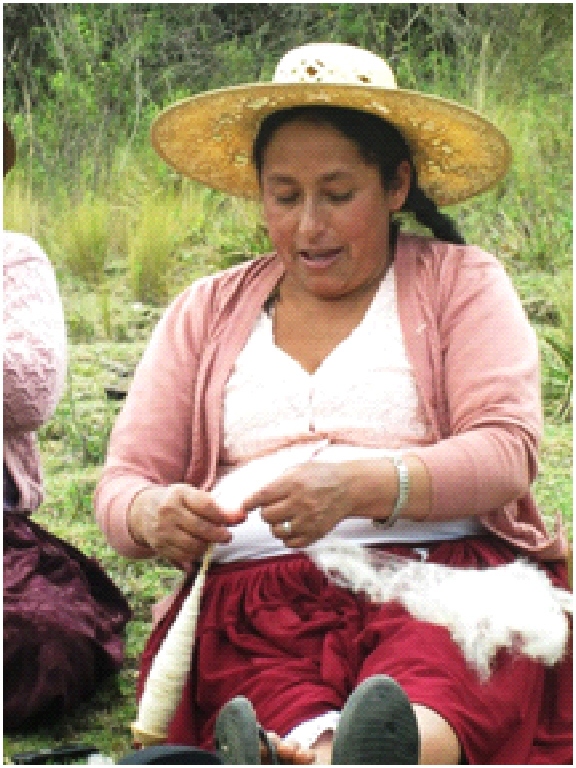
maxima It was exactly what they used to do as young teens. They would head out with the family flocks and meet up at a rendezvous point. 

The hottest topic of conversation would be the weaving advances they had made for the creation of their aguayos, the large pieces of cloth worn over the shoulders, that would be shown for the first time at Carnaval.

Because the ladies challenged and competed with each other, it was the time of their finest work. Now their daughters go to school and that particular tradition is no more.

Doña Máxima, at left,  is one of the few weavers whose daughters weave, most of the weavers’ daughters having migrated to the cities.

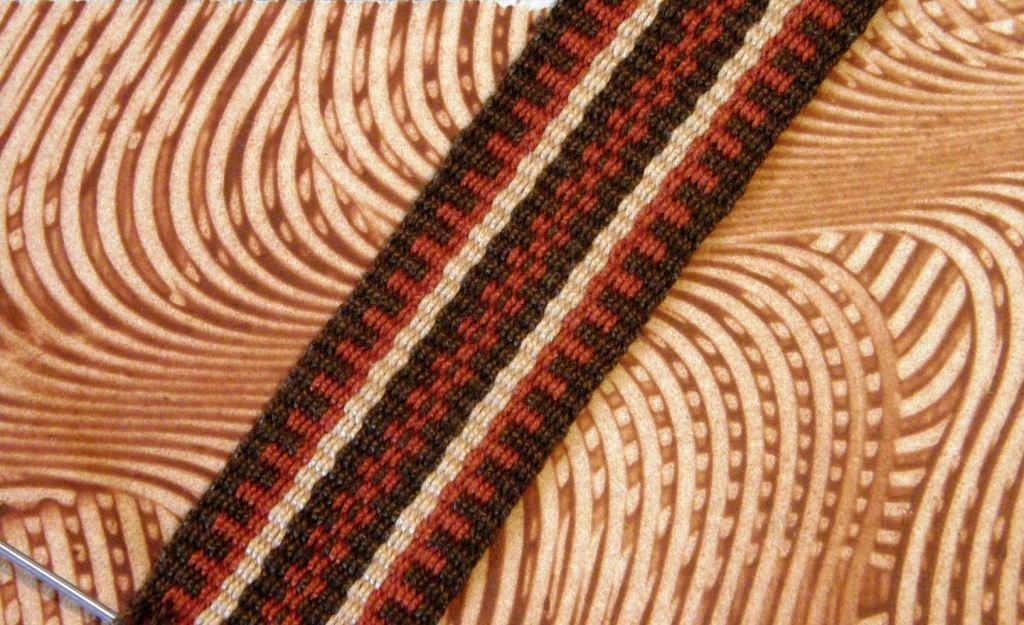
Here are the bands with all the stunning sun-soaked colors of the Bolivian hghlands…

weaving highland BoliviaI can’t help showing you picture after picture of individual pieces so that you can better see and enjoy the color arrangements. I love seeing how the varying amount of twist in the handspun yarn creates different textures  in the cloth and how each weaver has decided to arrange the colors that she has available from the latest days at the dye pot.

PAZA colors 1


??????????????????????

??????????????????????

??????????????????????

??????????????????????

??????????????????????

???????????????????????????????

??????????????????????All the patterns are Andean Pebble Weave.

And, we have our own talented spinners, dyers and weavers in the Backstrap Weaving Group on Ravelry as well as members who are brilliant at combining colors.

Here’s a cuff that Janet wove made from her own handspun Perendale wool which she dyed with indigo, cochineal and walnut…

janet cuff 2She made a series of wool cuffs and Wendy also showed one that she completed made from variegated cotton thread and finished so neatly with weft  twining…

cuffsJulia T in her home in tropical far north Queensland in Australia was inspired by the colors of nature and used fruit to inspire a set of bands for key fobs. She captured the essence of the fruit so well!

???????????????????????????????I contributed something cheery as well….a field of flowery “O” s amongst a lattice of ”X”s…

flowers both sidesCatharina joined our group to share with us her explorations in traditional Estonian patterns in the supplementary-warp structure and our minds have been blown.

llunallamaBut, back to the ky fob WAL which has been chugging along to its one-month anniversary…

pebble fobsJulia T, Arlene and Betsy worked on Andean Pebble Weave bands. After her first sample, Betsy added more twist to her handspun wool and is happier with this latest result. Arlene’s band, with its rope pattern, has an unusual and attractive tapered finish and Julia T used JoAnne’s original cat design along with her own heart composition and a knot work motif from my second book.

plain weaveI love that plain weave continues to be popular inspiring more and more creativity in combs and stripes. What I have dubbed ”Wendy’s Watermelon Warp” (center bottom left) inspired the idea for Julia T’s tropical fruit collection as well as Gwen’s comb combo, above right. WannaGTD wrapped the warp-ends for a neat finish on a her classic band of horizontal bars. The yellow stripes really give it a zing.
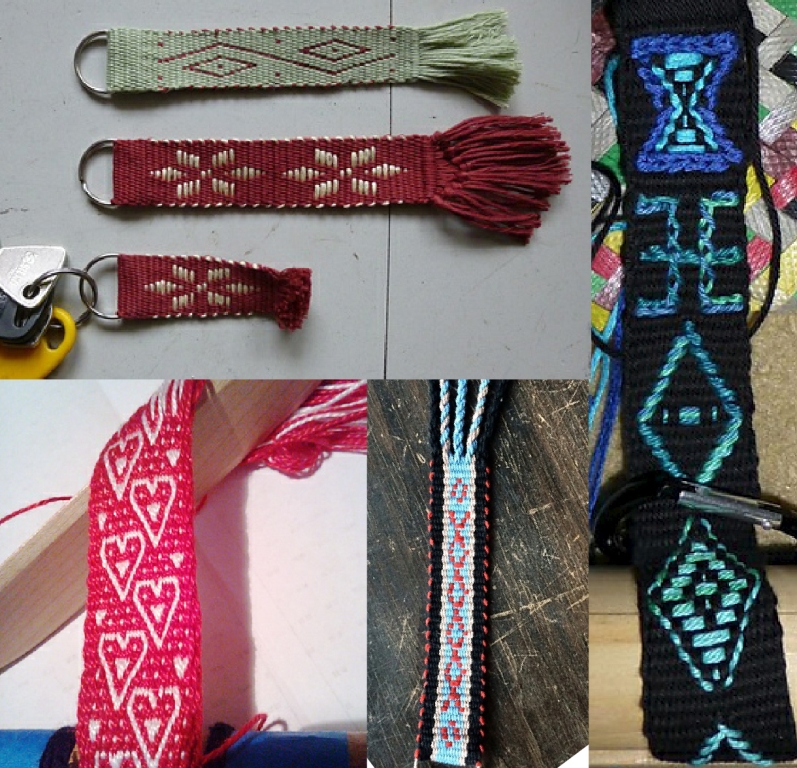
mixedSupplemental weft made another appearance in the work of Valtricot, above left, Linda, center bottom, and Wendy, bottom right. Wendy also put to use her considerable skills in Bhutanese supplemental weft technique. Susan celebrated Valentine’s Day with her own composition of hearts in Andean Pebble Weave. I like how she added the small heart spots betwen the large motifs…they really set it off.

sheep combo

??????????????????????I had been reading comments online about confusion in the English-speaking world about what exactly the animal is for this Chinese new year…a sheep, a goat, or…???? At the same time, I spotted Louise Ström’s sweet tablet-woven pouches (above left) with their animal motifs and decided that I would try something similar in Andean Pebble Weave (above center and right). The level of success of my attempt to create sheep will be left for you to decide!

I also played with beads, at left, in a plain-weave comb design band. I lined the edges with beads and popped couple up in the center just to see how they would hold there. I think I would like to use beads in the center of a band to form part of the pattern itself.

My large three-color Andean Pebble Weave/ikat bird  project is moving along at a snail’s pace with the workshop prep and key fob WAL having occupied my attention for the last few weeks.

And now I am going to warp to make covers for some small journals that I would like to take away and give as gifts. One of the key fobs I wove during the WAL will serve as my width sample for the Guatemalan thread that I want to use. I will use patterns inspired by nature…my little leaf motifs that I like so much.

supplementary weft leaf pattern journal cover backstrap weaving


Backstrap Weaving – Warping, warping….

I wound over 120 warps this week as prep for weaving with groups and friends and I am not even half way. I put on some music or the tv, make sure I have absolutely every thing I need on hand…scissors, rubber bands, cross sticks and string…and away I go. I have long sticks all over the room wedged between books on the book shelves and I hang the completed warps on those as I go. It’s very efficient. I always wind in the same direction with the balls of yarn in the same place. It has become so automatic and so much about feel that I have reached the point where I can wind two colors and separate them into sheds as I go without even looking to check if I am putting the right color on the right stake.

And then I decided to take a break and wind something for our Key Fob Weave-Along that is still buzzing along in the Ravelry Backstrap Weaving Group.

wal collage 1I decided to weave what is often called a ”threaded-in” pattern. Basically they are stripes, or ”dots” (tiny horizontals or single ends in a contrast color), or horizontal bars, or any combination of the three and can be as simple or as complex as you like.

??????????????????????Here is one that I did a couple of weeks ago for the key fob Weave-Along…

??????????????????????

Warping in pairs in my workshops helps makes the processa little less daunting.
Warping in pairs  helps makes the process for beginners a little less daunting.

And that is when I was reminded of how it feels when you are first learning to warp…trying to follow the path, handle two threads at once, remember which color goes where and when while trying to tie off ends and maintain tension. You feel like you are all thumbs.

I was remined of that beginner feeling because winding some of these kinds of threaded-in patterns from one stake to another and back, as I do for the backstrap loom, can be a little tricky. It is not always as beautifully straightforward as it is when winding them using a circular warp for an inkle loom, for example, where one circuit of the inkle frame gives you a single end. The way I warp, each ”circuit” gives two ends and often four if I am winding doubled threads.

Sometimes a half revolution is required, knots have to be tied at the other end of the warp and sometimes it works best if you reverse the winding direction after the halfway point. I am not used to having to stop and actually think about what comes next…about how to avoid spaces between the colored horizontal bars in each column, about which of the two central posts each color is supposed to pass around and how to make sure the pattern is balanced. I didn’t like having to get out paper and colored pencils when I got confused! I tell you, old habits and muscle memory are hard to break.

The idea of a threaded-in pattern is that it is created by the way you set up the warp and separate colors into the two sheds. Once that is done, all you have to do is weave it off in warp-faced plain weave…no pick-up or other manipulations are needed and the weaving moves along so quickly!

??????????????????????
??????????????????????So, if you are interested, here are the warping instructions for the fob at left. These instructions are for those who are already familiar with winding warps on four stakes/posts and separating colors into their sheds as they go….

I am calling the Start and End post ‘A’, the two posts in the middle ‘B’ and ‘C’ and the post at the other end ‘D’.

3 revs of purple
1 rev purple and yellow wound together and separated between posts B and C (yellow on C, purple on B)
1 rev yellow
1 rev yellow and green together (green on C, yellow on B)
1 rev only green
1 rev green and purple together (purple on C, green on B)
1 1/2 revs yellow and green together (green on C, yellow on B) you will stop at post D, cut the green and tie purple to the green end.
1 1/2 revs purple and yellow together starting at post D (yellow on C, purple on B) you finish at post A.
2 1/2 revs of purple finishing on post D. You need to tie the purple off to something. I tie it to the green and purple ends. I like to untie the knot in the green and purple and then tie all three ends off together.

###############

The only other key fob I wove this week required nice straightforward warping. I was inspired by Joyful’s use of a button on one of hers. Instead of sewing the folded woven band to itself to secure the ring, she created a slit, ot buttonhole, while weaving and used a button to make the connection. I wove a black plain-weave fob for my silver-color button.

??????????????????????The other small project I have been working on is a silk bookmark. It was originally planned as a keyfob for the WAL but I was enjoying weaving it so much and didn’t want to stop at key fob length. It is 60/2 silk and has a traditional motif of the Isoseño Guaraní people of lowland Bolivia. Many thanks to the people who commented last week with ways to make one’s hands silk-friendly. The piece on the right is a supplementary-warp band that I made ages ago in tencel which needs to be finished and used as a fob or bookmark.

sil cotton tencel bands backstrap weavingTerri, who very recently joined the WAL, showed us that simply knotting the warp ends is a very neat and time-efficient way to finish a band and this is how I finished the black fob rather than try a new braid.

Let me show you now what our other Weave-Alongers have been making…

simple warp floats supp warp and pebble weaveHer are three fobs made by three weavers using three different structures. Eska’s fob on the left uses the simple warp-float technique floating two colors to create a motif found in yurt bands and other Central Asian textiles. Ilze’s name band is woven in the supplementary-warp structure and Julia’s is in Andean Pebble Weave using a motif that I adapted from Central Asian weavings and which is charted in my second book.

combs and barsWendy, Terry and woolfancy were all  on the same wave length color-wise and designed with stripes, combs and bars. That D ring with the added split ring makes so much sense for wide bands that won’t sit well on the curve of a regular ring.

supp weft designsValtricot continues her studies in patterning with supplementary weft. Celticthreads made three fobs, two of which also have supplementary-weft motifs.I love the white plain-weave one with its colorful stripes and braids. Joyful, wove a rabbit figure in angora supplementary-weft. You can also see her use of a button as well as sprang in the unwoven warp-ends.

Our two Julias have been working on Andean Pebble Weave

andean pebble weave fobsJulia T wove a Valentine’s Day themed fob while Julia W wove one of the knotwork patterns from my second book.  Sarah’s completion of her first Andean Pebble Weave band and Lesson One in my first book shows that she is well on her way to starting her first patterns.

Gwen took a break from weaving the panels which she will sew together to make a cover for her weaving bench to join us in the WAL. Let me show you the two gorgeous panels she has made so far along with her first fob…

gwens fob and panelsSo, it is back to the warping board for me and the workshop prep. I have decided that I must finish this task before settling back into my big bird project.

???????????????????????????????While I wind my dozens of warps, my mind is on to the next big project and then the next and the next and I am thrilled to say that, thanks to something inspiring that showed up on my Facebook newsfeed recently, I have found the curvy shaped motif that I want to create in the ikat technique and then fill in with pick-up patterns. I can’t wait to work on it!

That has been the whole idea behind my recent ikat bird experiments. I want the ability to create curves and irregular shapes and fill them with pick-up patterns. I stand at the warping board and dream about that, plan out the steps and think about the wonderful opportunity that has recently come my way to study with an ikat artist while I am in the US this spring.

This city is vibrating to the rhythm of the coming Carnival. See you next week…


Backstrap Weaving – Key Notes


Key fobs in earthy colors

I have been wondering if the number of keys a person needs to carry about is some kind of indication of the complexity of their life. After making lots of key fobs in the Ravelry Backstrap Weaving Group’s Weave-Along, I realised that I only have one key! That’s the key to my front door and I have a spare hanging in the kitchen. I don’t have a car, so there’s no key for that.

And yes, life does become a bit more complex when I am on the road teaching. Then I carry eight little TSA padlock keys for my two big pieces of luggage and it is a nightmare keeping them in order. Plus there’s a spare set, so I have sixteen keys in all.

calcha flower design key fob

leaf pattern in double weave and 9 strand braidSo, why make all these key fobs?….well, it’s just plain fun. On top of that, as I mentioned last week, it gives me a chance to sample a new motif, new-to-me yarn and color combinations. And for people who are new to backstrap weaving, it is a chance to learn new techniques. Some of these key fobs will be gifts and some will remain with me as samples for weavers. One or two might actually be used for my keys. But, I think that they will mostly serve as guides when I come to use these motifs and yarn in bigger projects.

This week I made some new samples and also worked on finishing some of the bands from last week. I tried my leaf pattern in warp-faced double weave and enjoyed the very robust look of the motif in that structure.

I also received a nice message on my blog on how to extend the instructions for the five-strand flat braid to a nine-strand version and I used that on the beige band above left. It makes a tighter, more practical barid for this kind of thing and I love it.

woo fob and finishesI made the dark brown wool fob you see above and used the five-strand flat braid for that one. I was surprised to find how slippery the wool was with the silk supplemental weft and there are definitely things I would do differently next time when using that combination of fibers. I didn’t like the thin and spindly look of the four-strand round braids on the green fob and so I gathered and bound them together. The snowflake fob has a finish that was taught to me by my weaving friend, Chris. It is the first time I have tried it and I think it needs a bit more practice.

positive and negative space inlay in supplementary weft inlayRight now I am working with 60/2 silk. This is something that I have been wanting to do for a long long time…ever since I bought the little tubes of left-over silk when I was with Sue in England in 2012.

I have been happily using it as gorgeous supplemental weft in a lot of different projects, like the pouch at left, but what I really want to do is weave using it as warp.

I made a tiny sample with this silk a long time ago in Andean Pebble Weave…

pebble weave with silk….and found it very hard to handle the fine strands of silk that wanted to stick to and snag on any imperfections in the skin of my fingers.

I did manage to use it in a warp-faced double weave piece I was made for my nephew….

silk bookmark for ryan backstrap weavingBut I really want to use it for Andean Pebble Weave.

Ever since I wove this Guaraní design in a guitar strap many years ago, I have been wanting to use the motif again…(it’s charted in my second book)

Guarani star pebble weave guitar strapAnd so I decided I use the key fob WAL to create a two-fer….the Guaraní pattern in the 60/2 silk…

guarnai designin cotton and silkBut now that I am actually weaving it, I don’t think I will stop at key fob size. I will weave off the entire warp as I really want to get confident with this and use the silk for larger projects. You will notice I chose black…the hardest color to see. I figure if I can manage it in black, I will be able to manage it in any other color! I am just getting a handle on width and tension, for now. The silk feels so good!

???????????????????????????????The silk project and the big bird project have been keeping me busy. Plus, February 1st was the date I set to start my workshop prep. I have three distinct work stations set-up in the wee apartment now. The kitchen counter is Key Fob Land, the bedroom floor is Birdsville and the living room floor with warp hooked to the tv cabinet is Warping and set-up Mayhem Zone.

I did slow down a bit yesterday and today as I am suddenly one tooth less wise and will be probably be without another wisdom tooth after a visit to the dentist later today. That has made me feel a bit wonky.

Let me show you what other folks have been up to.

In Australia,  Susan has been making key fobs although she doesn’t do the online group thing that much. She sent me a picture of her progress so far and it is a nice sampling of different techniques….

SusanFrom left to right….Bedouin warp-subtitution technique, a threaded-in pattern, simple warp floats and Andean Pebble Weave.

Helen wove with me when I was in Australia last year. She went on to weave a piece in Andean Pebble Weave on her floor loom and created this lovely bag…

helen halpin pebble weave Wendy, over in Perth, Australia has joined us and showed us her warp and set-up. She has also been visiting the local yarn and craft stores and giving me good information about the different kinds of backstrap-friendly yarn she has been discovering in Australia.

wendy

Another Aussie, Julia T, designed two pieces using supplemental weft and made a great collage of pictures to show us the completed pieces along with their sources of inspiration…

julia t collageAfter completing her first-ever sample using a supplemental weft, she was able to make some necessary adjustments and then turn out these lovely pieces. She was also inspired to use beads along the edge of the paw-print piece by Joyful’s use of them in this band…

clippers-band-front_mediumOur ”other” Julia has been working up several of the small motifs in my second book in Andean Pebble Weave and other complementary-warp structures and has a lovely collection of key fobs in 5/2 perle cotton each with its neat weft-twined finish….

julia collageIt’s nice to see people trying patterning with supplementary-weft (below) and I hope we see more of it. Julia T made a key fob with her own design, Marsha is weaving a cuff on a vertical loom and Valtricot created her own design for a cellphone pouch. Each weaver shows a different way of handling the turns of the supplemental weft and I think that is really cool.

supp weft startersIt is normal for the patterning to come out a bit disjointed the first time around. Samples need to be woven to be able to figure out just how many strands of supplemental weft material will suit a certain weight of ground warp thread. It’s all a bit of guess-work at first. On top of that, you are counting threads and learning to create the pattern spaces and handle the extra weft etc. Quite often the need to adjust the way you are beating is not immediately apparent. The designs always look nicer if there is connection between the rows of weft. The motifs will look more like solid shapes that way. Knowing how your charted pattern will look when woven is another thing to consider. Sometimes the dimensions of the cells on the chart will not perfectly match your picks per inch/ends per inch ratio. And that’s the idea of this WAL…the opportunity to make tiny samples and figure all this out.

Betsy, who is away from home right now, is still determined to join us in our WAL and has come up with a clever way to wind her warp in her temporary home. She is using her own handspun as well as crochet cotton for her projects. She has come up with some nice patterns using only four ends of each color.

betsy warping handspun and cotton

week 2 variousEska made three fobs using the simple warp-float technique experimenting with floating just one and then two colors. JoAnne designed her own clever Andean Pebble Weave cats. Linda floated both colors in the simple warp-float technique to create this yurt band border pattern and knitnfrenzy reminded me just how striking ‘plain’ Andean Pebble Weave, that is, the basic structure without a motif,  can look.

We had some talk about cuffs. Janet mentioned her intention to weave some and I remembered having seen some in a Peruvian Connections catalog when I was in the US last fall. It seems that quite a few of us are not into jewelry but would consider wearing a hand woven cuff. Janet got to work with her naturally dyed handspun and showed us her work, complete with button holes….

janets cuffsThis pattern is charted in my second book.

I have been scratching around in the closet jumble and getting out some of the sample bands that I have woven all of which would be suitable for key fobs. And there are many many more. I know that I have a bunch of Bedouin-design bands somewhere and then there is a myriad of bands that I wove as samples for the second book.  

backstrap weaving key fobsAlthough I like the look of this colorful jumble of bands, and could make plenty of fobs, that’s not the point of the WAL…the idea is to try something NEW. So, for now, I will continue with my silk band and dream about the day when I can weave a large, fine, silk wall hanging on my backstrap loom with lots of pick-up patterning.

I will leave you with this Challenge Family Triathlon motivational poster which was put together after last Sunday’s Challenge race in Melbourne, Australia in which my nephew took part along with over 1200 other athletes. It was a nasty day with big seas, wild winds and cold. I followed it on Saturday afternoon in Bolivia all the while horrified by the poor weather conditions. That’s my nephew, Ryan, in the poster!

1947805_776160752419452_1849480686219816020_n