Oh give me a home,
Where the sheep roam,
And the yarn grows on trees…

 There have been two stops on my trip since I last wrote…one in Texas and another in Humboldt County in California. Above you can see luscious skeins of Janet’s handspun at her home in Humboldt that I strung up in a tree after a day of dyeing. Janet used these natural substances…
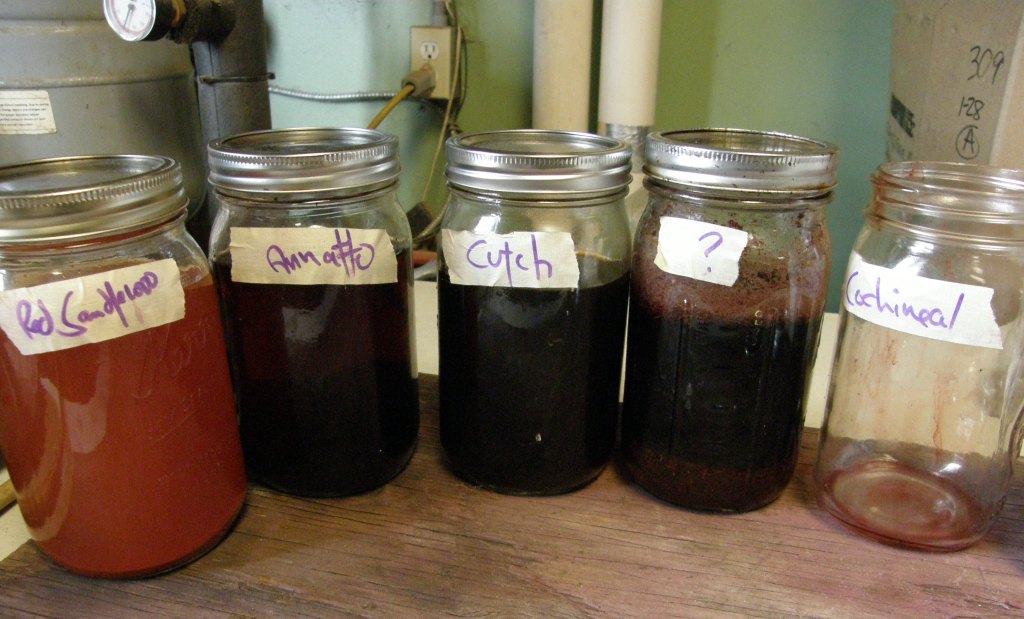 …as well as indigo in an old vat.
And then there is Lydia’s sculpture wich spans branches in her yarny yard in Texas. It is a patio and garden space that whispers serenity and begs for exploration with plenty of benches and seats tucked in shady spots around every corner on which to sit and simply ponder.
Here’s her garden loom dressed up to greet the spring…
 And she brings the colors of spring, the desert and the garden into her home covering her walls and banisters with her own woven art.

 That’s Lydia in the center with Eileen. I stayed with Eileen last year too and we met again in Manchester UK at Braids 2012.
Driving up to Lydia’s home, you get a hint of what is to come within the home and beyond when you see the weaving that stretches between the front porch posts. Lydia would love to have a group backstrap weaving in her home and I think that weaving in her garden would be heavenly!
Speaking of heavenly spots, here is a group of weavers from last weekend in northern California…
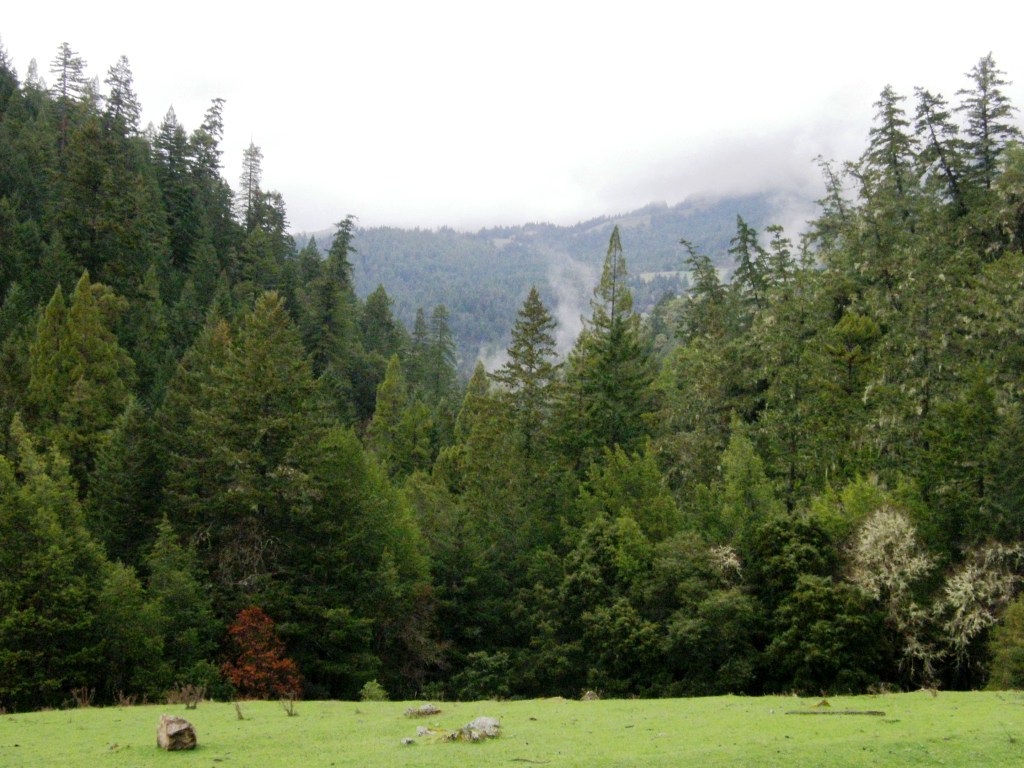
 Ace and Pam of Ace ‘n the Hole Romneys offered their home for our group. You can see that neither the weavers nor the weaving are the feature of this particular shot…instead, it’s that amazing view through the glass of the redwood forests and mountains!!
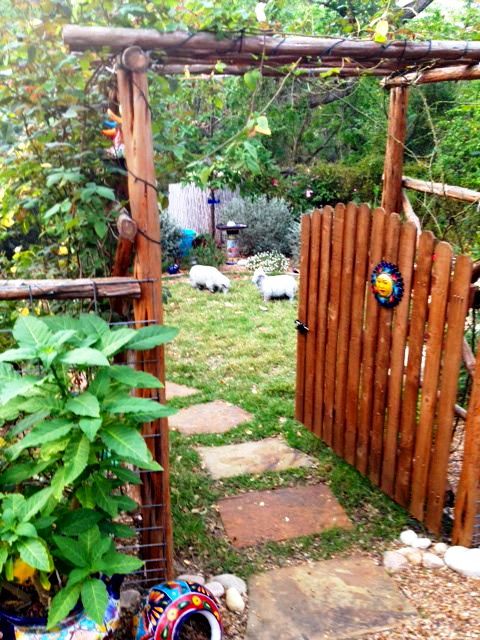
 And, while wee resin sheep figures roam in Lydia’s Texan garden…
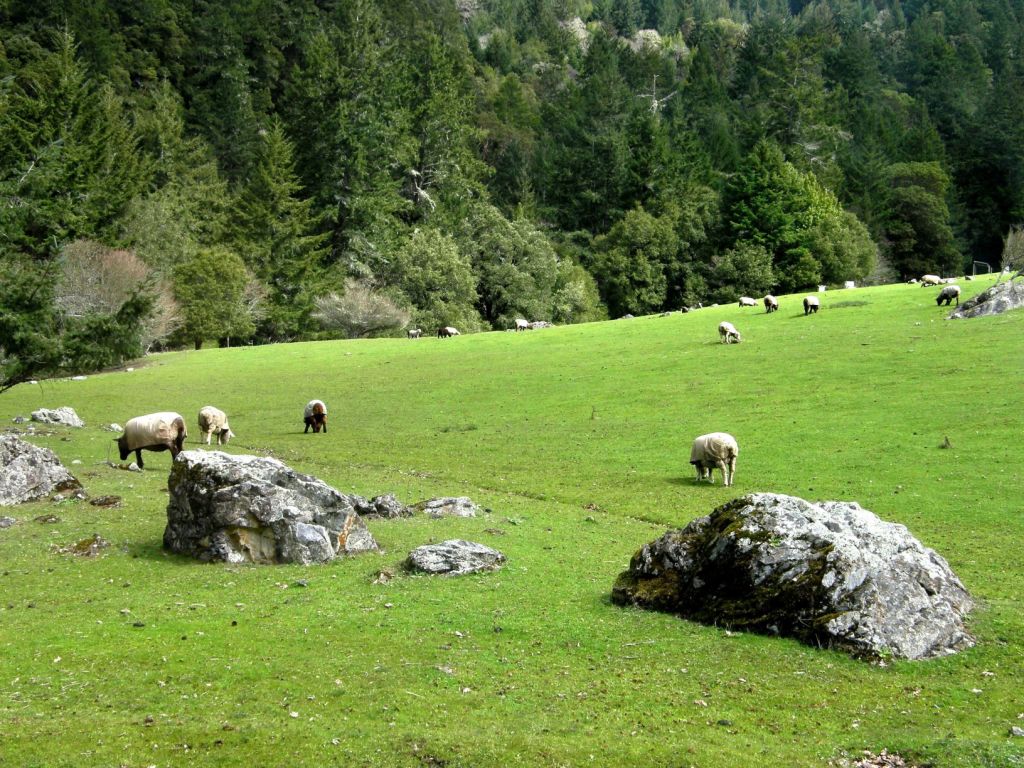
 Ace’s romneys, whose fleeces have won many ribbons at fairs on both the east and west coasts, roamed the hillsides. Meanwhile, indoors, we wove pebble weave on backstrap looms.
 Ace is a prolific spinner and is finally fulfilling his dream to weave with his handspun having just bought a pre-loved Glimakra counter-balance loom which we put together with Janet at the helm.
Ace and Janet playfully tease and compete with each other at local fiber fair speed spinning contests. I won’t tell you who wins.
There’s Janet seen through a curtain of heddles on the floor tying up “stuff” (you can tell that I know next to nothing about these kinds of looms!) to get Ace’s loom up and running.
Looking at these things I am amazed at how people sigh and roll their eyes at the masses of string heddles on my backstrap loom when floor loom weavers have to contend with all those heddles and shafts and treadles!
Nine weavers got together at Ace’s place. Two wooden pillars in the living room gave us the perfect places for attaching the looms. We had that beautiful view to enjoy while weaving and during breaks.
 It was fun to see the bevy of bands accumulating around the posts as the pick-up weaving skills developed and patterns started to take shape.


As our bands filled with motifs, the mist would eerily rise and fall over the trees and hills. The sheep would run and scatter at a sudden roll of thunder and the wild turkeys would come out to strut their stuff.
 The previous weekend had been spent with another group in Janet’s mill.
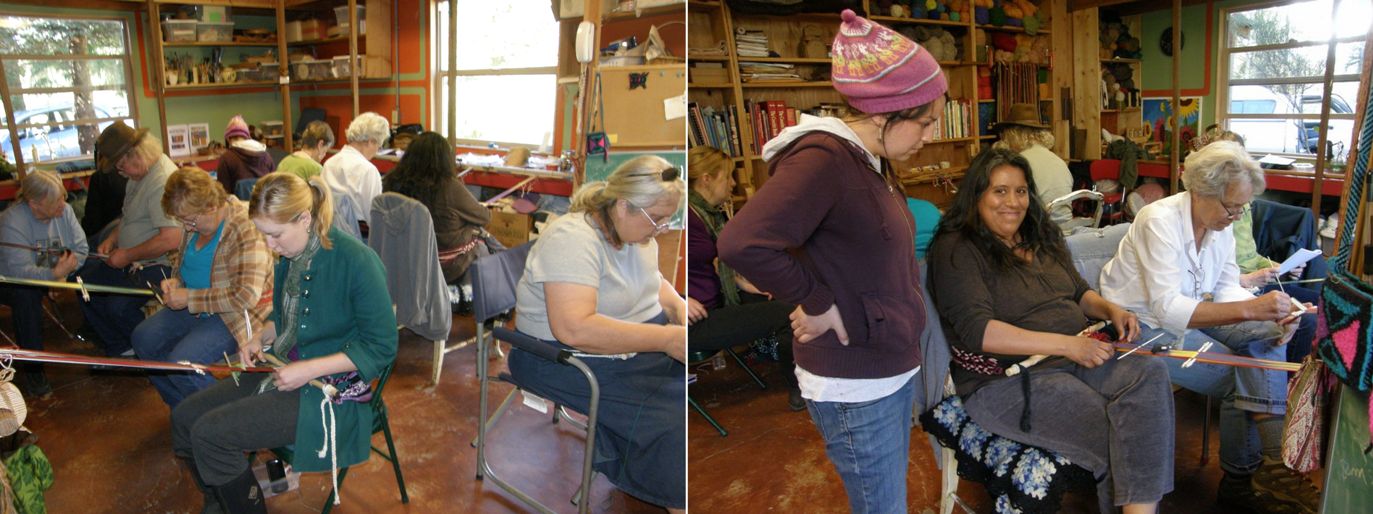 On the right you can see Priscilla and Rose whose families are from Ecuador and Peru. Both were excited about experiencing something which has its roots in their South American heritage. Some of these weavers also joined us at Ace’s for pebble weave the following weekend.
That left a week between to have fun in Janet’s mill.
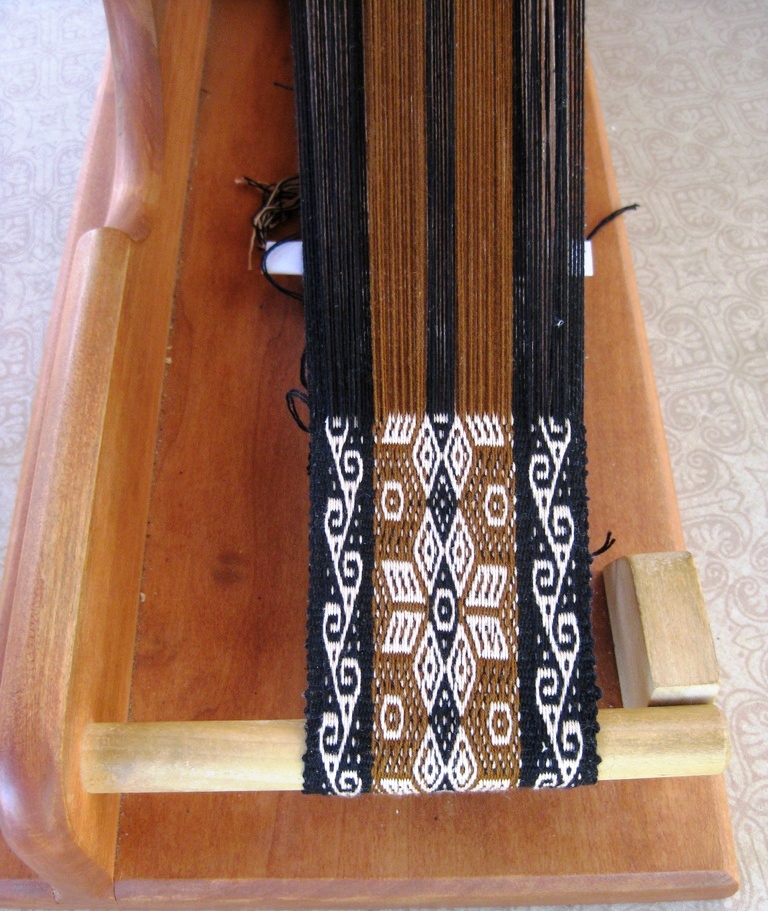
 Janet showed me what she is currently processing in her mill. While the machinery does its stuff, Janet and Betsy can spin and weave. Betsy learned to spin and weave with Janet and you can see the band she is weaving on her backstrap loom using her handspun. This band will participate in our Year of the Snake Weave-Along.
 Janet is just as much at home spinning fine and smooth yarn for backstrap bands, a different weight and quality for blankets and then something completely different yet again for rugs.
 While working in the mill she can jump from a backstrap loom to her huge Glimakra floor loom, from her wheels to drop spindles from wool to silk as the mood takes her. Pretty much every weaving project no matter what size or what loom, involves her own handspun.

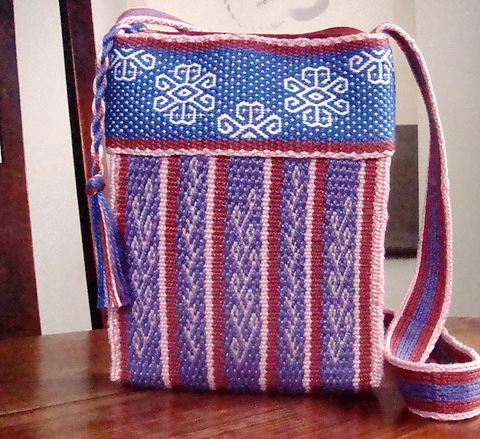
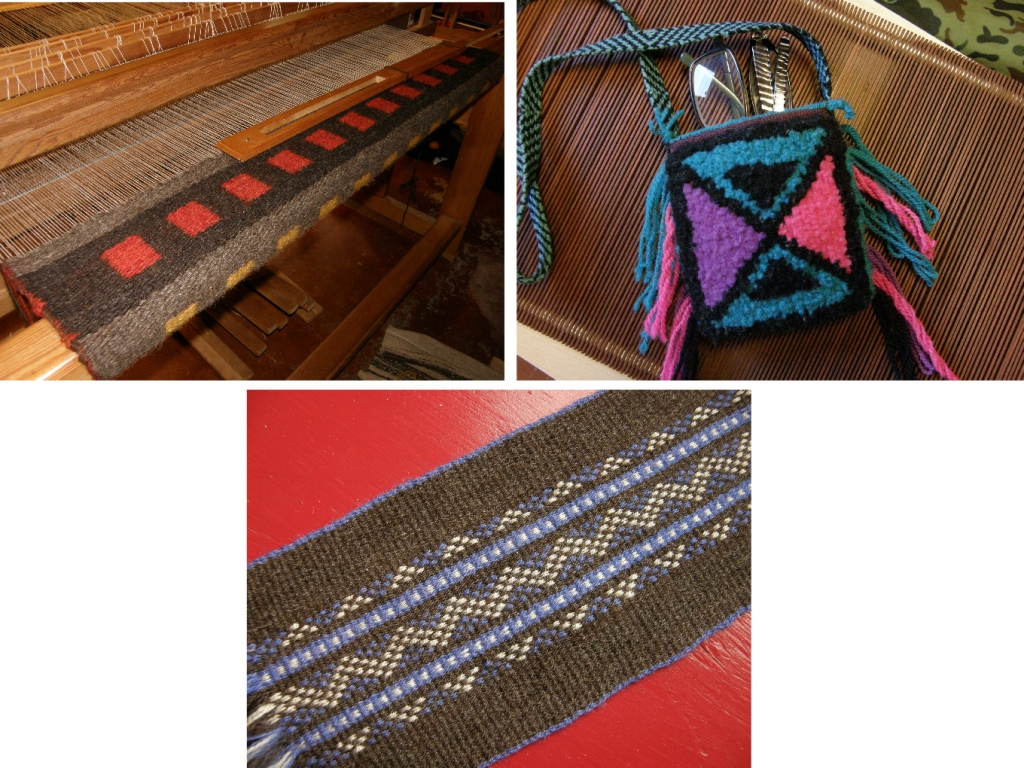 Betsy also creates beautiful pieces of fabric with her handspun which she sews into lined shoulder bags. She weaves the straps on on backstrap loom.
 I wove with Betsy and Janet doing an Andean pick-up pattern during the week and then Connie came over to weave intermesh with Janet.


 Connie weaves all kinds of bands and braids and brought her band box over to show her takadai work as well as her inkle loom-woven bands.

 There’s always something good and fibery going on in Janet’s mill and, with its heated floors, it is definitely the place to hang out on chilly mornings and evenings. Fleeces, handspun yarns, rolags and batts spill from the shelves. Half-woven backstrap bands dangle from shelves loaded with books on all kinds of fiber arts and crafts.
Every second Saturday night, the looms are pushed aside and chairs are pulled up all around for Honky Tonk evening. I was lucky to be there for one of those when eleven local musicians, including Janet and her husband Larry, gathered for an evening of jamming….two upright bass, a flute and clarinet, mandolins and guitars, an Irish drum, and spoons!
I got to help rescue a large handspun and naturally dyed ikat project that Janet had started on her backstrap loom. It had been left to languish on the UFO (unfinished object) pile when Janet got a little frustrated with trying to open the sheds.
 You can see the gorgeous colors she obtained from madder, onion skins and onion skins overdyed with madder. She wrapped the yarn to create rectangular ikat patterns. The problem was that she had pulled the weaving in too much and that was making the sheds almost impossible to open as the warps were pushed together so tightly. I was itching to get into this project!

 Once the width had been re-established and some broken warps repaired, I got out my wichuña, the llama bone tool which is used by weavers in Bolivia to strum the warps and separate them. This makes opening the shed-rod shed easier.
The wichuña is also used to push the weft into place. Janet will be able to use a deer antler that she has.
I found that standing to weave this piece made opening the sheds easier. I had seen weavers of wide warps in both wool and cotton standing to weave in Peru and thought that I would try it. I think that having the warp angled slightly upward as well as having one of the large butt-cradling backstraps that I saw the weavers using would have made things a little more comfortable. I am not saying the sheds now pop open magically. There is a technique to apply and you still have to work at getting the sheds cleared.
I was so happy to have had the opportunity to try this.
After all this wooliness, let’s go back to Texas with its vastly different climate. It isn’t one that begs for wool much the same as Santa Cruz, Bolivia where I live. I often look with envy at the lovely socks that people knit and thick wool scarves that they weave. But, who can complain when there is so much beautiful cotton to be played with!

 Here we are in Eileen’s home shopping for yarn during a break in weaving. We had Sue Ellen of Old Oaks Ranch Fiber Arts Center with us as an added bonus and I asked her to bring her skeins of Cascade Ultra Pima.
This cotton yarn comes from Peru and we called Cascade Yarns to check if it is mercerized. It has such a lovely sheen that we thought that it must be even though the label does not indicate so. It turns out that it is.
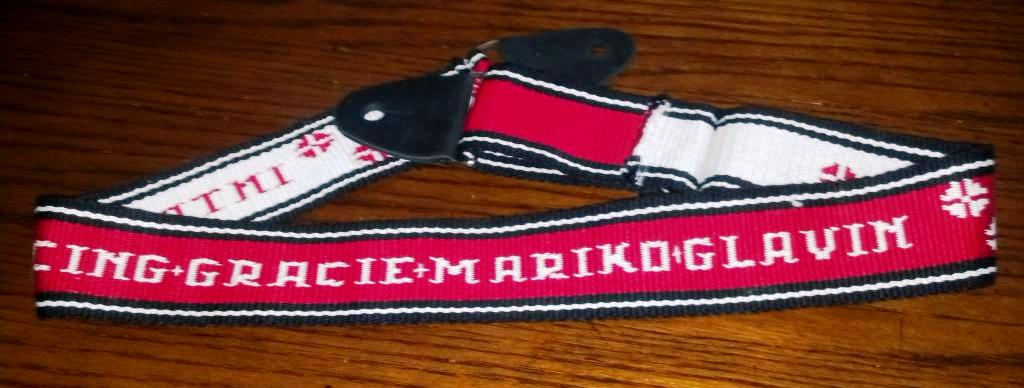
Eileen had used it to make her backstrap (pictured above) and it came out beautifully.
I am going back to Bolivia with three skeins to try out for myself.
 Of course, it wasn’t all shopping. Here we are weavingg.
 It was nice to see some familiar faces in the group. Karen, at left, had woven with me in Pennsylvania and just happened to have a business trip to San Antonio planned which happily coincided with this gathering. Susan, in the green top, had woven with me last year here. Penny was also a returning.. Mary, pictured next to Susan, was new to this group and backstrap weaving and has been brought up to speed by Eileen.
I was lucky to be here during Austin’s famous SXSW Music and Film Festival. I was astounded afterwards to look online and see all the big names that had been performing at the festival. Eileen and Guy took me out on Saturday evening to stroll through the downtown parks and soak up some of the festival atmosphere.
After visiting Lydia’s home and magical garden, Eileen took me to Old Oaks Ranch. The yarn store was lovely but it was the sculpture garden that really caught my eye.

An origami horse sculpture provides a spot of cool blue among the sandy ground and cactus.
 I love this shade-dappled woman astride her giraffe drawing you to gaze up at the tree tops just as she is doing.
 The sculpture garden is a soothing place to stroll or sit and chat as these chaps are doing while on a break from weaving class or yarn shopping at Old Oaks Ranch.
It’s almost time to leave Janet’s and head back to the cities. Next stop will be the state capital, Sacramento, where I will get to weave with long-time online weaving buddy Franco. I will get to meet Laura, another Ravelry group member, there too.
Let’s look at some Ravelry group projects before I leave you….
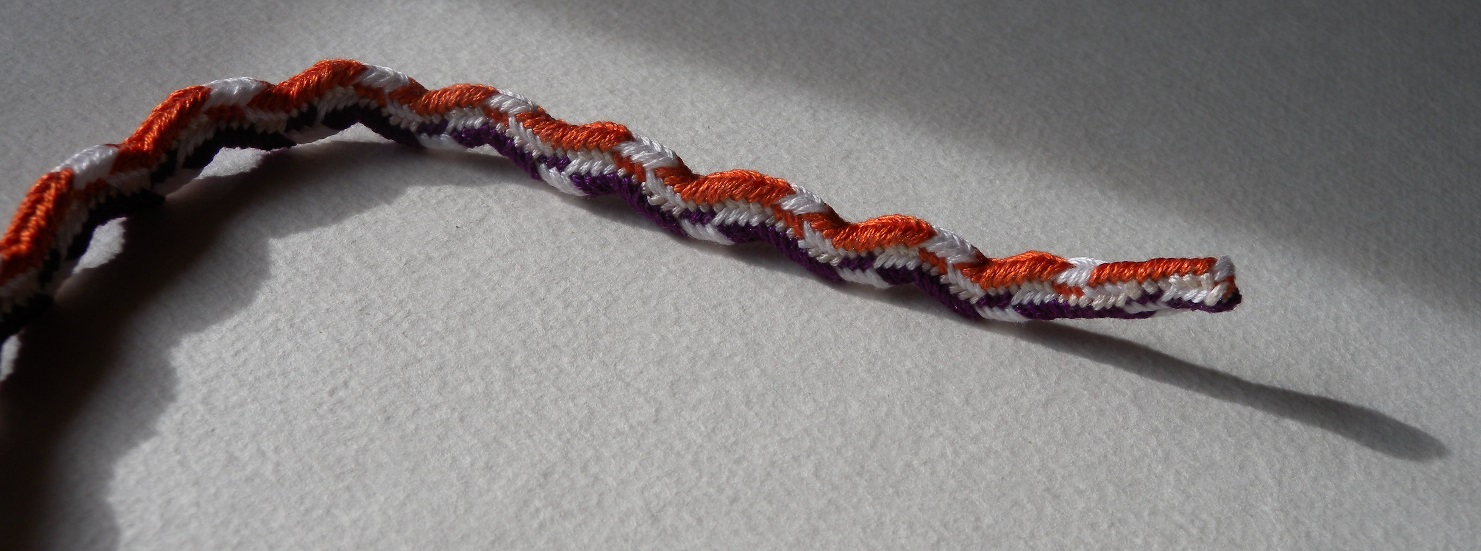
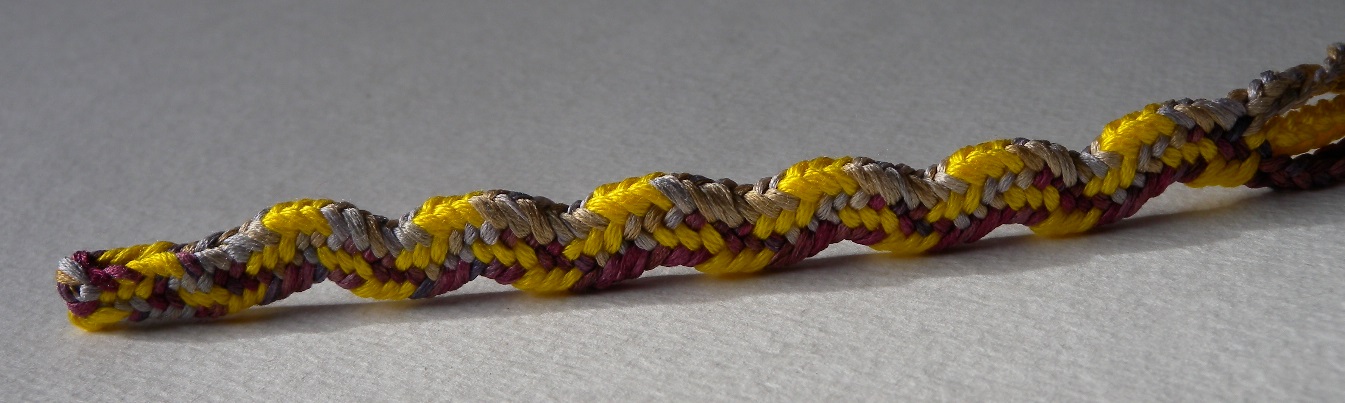
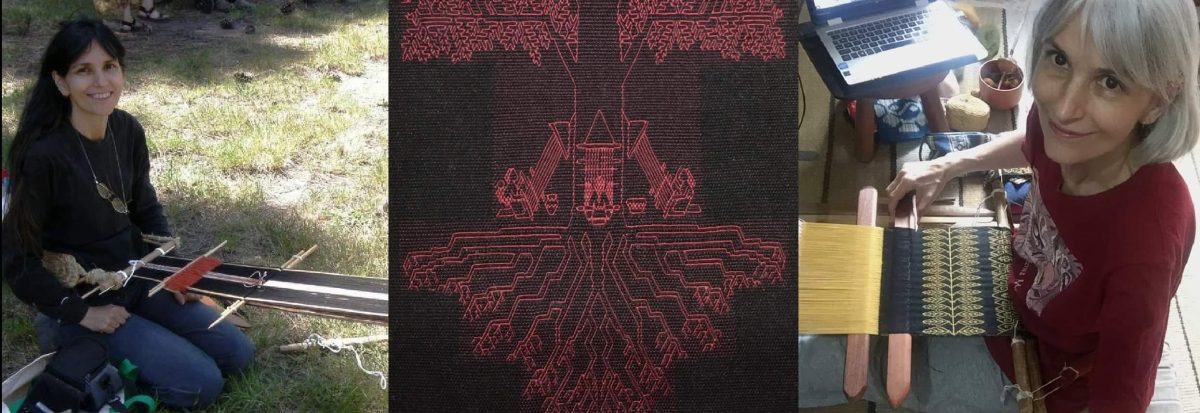
 That’s Hetty’s backstrap on the left decorated with pebble weave motifs from my Andean Pebble Weave book. Hetty wove with me when I visited the Netherlands last year and it is wonderful to see that she now has her own woven backstrap and is continuing to weave using a backstrap loom. On the right is Jennifer’s band on which she is weaving a pattern of Tinkipaya, Bolivia. This one is charted in my second book, More Adventures with Warp-faced Pick-up Patterns.
 CindyQ wove a stunning band also using pebble weave patterns charted in my first book while Julia is clearly having a wonderful time adapting traditional Japanese textile patterns to the pebble weave structure. This piece was woven on a floor loom. The instructions for weaving pebble weave on a four-shaft loom are included in the first book. (Edit: Julia has since told me that this piece was, in fact, woven on a backstrap loom) My second book guides and encourages weavers to draw their own pebble weave patterns and Julia has certainly taken up the challenge! She has even include some weft twining. (See the tutorial for this here)
So, it’s back to the mill for one last day with Janet and Betsy. We will weave tubular bands this afternoon. I can see Janet making pretty edgings for her handspun handwoven pieces with those.
 That’s Janet on the left weaving a ñawi awapa while Betsy on the right tries to squeeze as much as she can out of one of her pebble weave bands.
I was telling Janet about how weavers in Peru use a tanka, or forked stick, when they weave the ñawi awapa so, we decided to go out stick hunting in the late afternoon sun on this most gorgeous spring day.
 Who knew how difficult it can be to find the perfect forked stick?! I wanted a large, strong one to use in my warp for weaving bands like this weaver from Peru…

 Janet was the best spotter.
The one below, that Mikey has his eye on, turned out to the best one for me. What a nice weaving souvenir to take home from my visit up here. 🙂
 Hopefully I will squeeze in more posts before heading home. See you then!