Backstrap Weaving – Circles

circle 1I just learned how to cut out circles in my simple drawing program and have been messing around with that with some photos of my weaving.

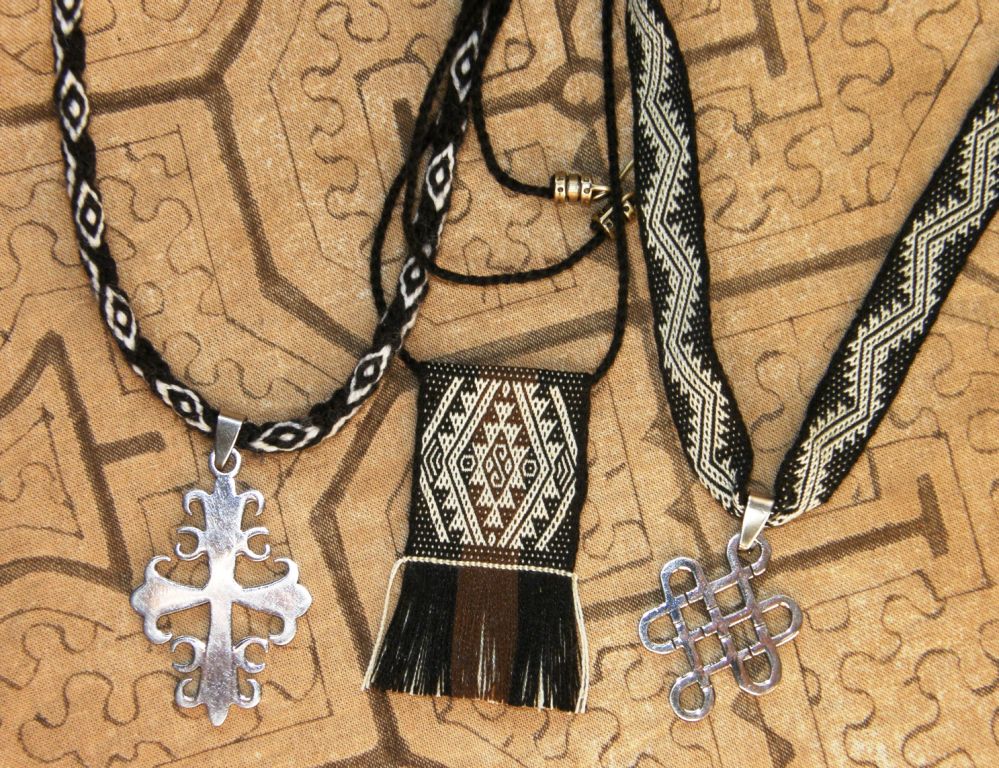
The pattern at left is one I used for a new necklace idea. This time I wove the actual pendant rather than just the cord or band on which pendants hang. It’s 60/2 silk and the pattern is an adpatation of the one that appears on a scrap of belt fabric that I bought in Cusco in 1996.

I wove this and will weave others as something to give me a bit of a change of pace as I sit for hours and hours applying ikat tape for my latest big project. I am hoping to make this ikat project a ”two-fer” ….a chance to practice creating circles and, if it is successful, a piece of fabric that can be made into a travel cover for my new laptop.

Making the photo circles in the drawing program was easy enough. If only it were that easy to create smooth curves and circles in warp-faced weaving. Choosing the right structure and using fine enough yarn does play a large role.

silk cuffs front and backIn the band in the center, I was trying to replicate the pattern on a button I had bought. It took a few attempts before I could get the proportions right and create a somewhat circular motif.

Here are the necklaces that I have made so far. The latest one with the pattern I placed in the round photo above is in the middle…
woven necklaces backstrap weavingThe cord is a cotton 4-strand braid. It was challenging putting that bit of weft twining along the bottom of the pendant using the 60/2 silk. It came out very sweetly.

Before settling down to tearing strips of plastic and wrap, wrap, wrapping for the ikat project, I made a bag with the wool fabric I showed you last week.

backstrap weaving woolI wanted to decorate the sides of the bag with a tubular band and planned something that would complement the twill lines in the main motif.

tubular band on wool bagI am fond of cutting bag flaps into curves and edging them with tubular bands but I decided to leave this one uncut and edge it with coil stiches instead. They are little coil-wrapped circles, or rings, that extend from the upper surface of the flap over the edge and to the inside. These decorative stitches are sometimes used by weavers here in Bolivia along the bottom edges of their woven ch’uspas…the small pouches in which they carry coca leaves. It’s a bit of a fiddly business.

I wove a simple, brown strap and used orange weft to liven it up a little and better match the bag. And this is where circles came into play again. I planned a 75-inch warp to be on the safe side and, as I simply do not have the room to stretch out a 75-inch warp in my room and am not a fan of rolling up the far end of the warp, I wound a circular warp instead.

circular warpingI ended up with 67 inches of woven band and 3 1/2 inches of unwoven warp. I didn’t really have to change my sitting position to scoot closer and closer to the back beam as the weaving rapidly progressed. That is one of the nice things about the circular warp. The distance the weavers sits from the end beam barely changes at all and so, something against which to brace one’s feet can be easily set up. Being so very narrow and in plain weave, the band was very quick to weave. It was fun watching the band turning over the front beam and growing below, then stretching itself out toward the back of the loom, turning up over the back beam and then inching its way back towards me to make a full circle.

Here is the finished bag…

I really like the look of the tubular band along those edges. The pattern reminds me of the carved wooden columns that are used here in Santa Cruz in the centuries-old Jesuit mission churches. They have thick jungly vines encircling their length. The piece was an exercise in several things which included creating a new tubular band pattern and applying coils stitches with very fine wool

This can now join the rather small collection of items I have woven using industrially-spun wool. Each time I have used wool, it has been with more than one goal in mind. The two pieces below were woven with the same kind of wool. I wanted to see how it would stand up to string heddles and warp-faced weaving as well as practice the discontinuous-warp technique that I had studied in Peru.

wool backstrap weaving discontinuous warpThis next wool piece was a chance to practice creating a fourth selvedge and use wool supplementary weft with wool warp…

This last one is an old piece that I wove back in 1997 just after I came back to my home in Chile from Peru where I had studied a supplemental-warp technique for the second time as well as the creation of four selvedges. I had also recently visited a sheep station in southern Argentina where the owners showed me a belt that the Mapuche wife of one of their former farmhands had woven and this had inspired the patterns and colors…

mapuche-bag-front-and-backSo, I haven’t done a whole lot with store-bought wool. Living in the tropics where wool cannot be bought just might have something to do with it.

I have more pendants in mind to weave this week and, if things go well, I will get to dye the ikat project.

Let me leave you here with some projects from friends and online weaving buddies Cheryl, Jan and Jane…three of the weavers who are taking part in a guild group project to create a bag for their county fair. Each weaver is to create a band of specified dimensions in red, black and white which will be put together to make a bag.  Jan’s (on the left) and Jane’s (on the right) bands were woven using backstrap looms and the Andean Pebble Weave structure. The patterns are in my books. Cheryl’s tablet-woven piece, with her own pattern, was created using a loom with weighted warps.

jan jane cherylHere’s the finished bag which, after the fair, will be raffled off amongst the contributing weavers. It was really hard for me to imagine how this bag was going to turn out. I think it’s amazing!11742664_10206985393054367_1959968408212876236_n

pick-up within an ikat circleAnd so, for me, it’s back to the ikat frame and those circles. I successfully created a nice small circle in ikat in my very first attempt some time ago. However, I am not entirely convinced that this was not just a fluke.  I’ll let you know how it goes.


Backstrap Weaving – ”Unnatural” Beauty

columnweftthreadsI always try to read my latest blog post the morning after having posted it. More often that not there is a typo or two that needs fixing and I seem to catch those more easily when fresh in the morning rather than at 10pm when I generally hit the ”publish” button.

What I noticed more than anything else when I did the morning-after review of last week’s post, was the way that the picture of Maxima’s ch’uspa gleefully jumped off the page. Those festive reds, oranges and pinks and joyful greens rang out as I scrolled down the page. It is not hard to understand why Maxima should want to use the synthetic thread in these bright colors for her husband’s outfit as Mayor of Huancarani as her aim is to create something festive. In the same way, she and other weavers in her co-operative have started working on their llicllas for Carnival next year and are using acrylic yarn in bright colors bought in the market. There is still work involved before the pieces can be warped as the bought yarn needs to have more twist added so that it will stand up to the abrasion of warp-faced weaving.

natural dye colors independencia Bolivia
While the weavers are able to obtain beautiful deep shades of red using natural substances like cochineal, most colors they get from natural sources tend to be much more muted. Natural whites are not as brilliantly white as the synthetic whites either and these weavers are not using indigo to obtain blues. The hairiness of the handspun wool creates slightly more ”subdued” motifs next to the sharp, crisp ones woven with synthetic yarn. However, we, in the western world, love those natural dye colors and the way they so perfectly blend and work together and we tend to choose handspun wool textiles from indigenous weavers over synthetics.

reversingfor2ndhalfIn the above picture, Maxima has just repositioned her ch’uspa piece on the loom so that she can start weaving from the other end. This will enable her to create a piece with four selvedges. (Picture courtesy of PAZA Bolivia.)

It is even easier to understand the weavers’ leanings towards these bright colors when you see the rather bleak and colorless landscapes at some of the higher altitudes of Bolivia.

When I studied with weavers in Potosi, Bolivia, I shopped with one of my teachers for the yarn that we would use. I had her make the color choices as I wanted something that represented her taste. Her sister, however, turned up her nose when we had finished warping! She might have liked the colors but she definitely didn’t like the way in which we had arranged them. You can see how the woven piece is a spot of cheery brightness against the hard baked dry earth and stone walls of the patio. Of course, there is lots of pink.

learning double weave potosiI remember the first time I visited Taquile Island on Lake Titicaca in Peru in 1996. I wanted to buy a textile from the market in the plaza and kept turning down pieces that were synthetic. Yet, these were the pieces that had the most beautiful work of all. The synthetic thread was extremely fine and allowed the weavers to create double weave motifs with an incredible amount of detail. The motifs in brilliant white stood out boldly and crisply against backgrounds of ruby red and green.

I absolutely love this Bolivian poncho made with exceptionally fine synthetic thread that a friend of mine bought in a textile store in California. The amount of design detail that has been packed into the narrow bands of color is extraordinary. The weaver has used some of the typical strong pinks and yellows alongside much softer tones in the columns of double weave.Bolivian poncho synthetic thread double weave

Sometimes, synthetic colors are used alongside undyed handspun wool such as in this piece from Peru….

tantaSynthetic dyes are sold in the highland street markets. It is lovely to see the mounds of colored powders in rows on the tables next to old weighing scales and sheets of paper for wrapping the purchases. Handspun wool can then be easily dyed for colorful woven bankets and carrying cloths….

synthetic dyes peruBolivian hatbands, decorated with colorful acrylic supplementary weft threads, are woven with warp thread that is finer than sewing thread. This fineness allows the weavers a lot of flexibility in their motifs with weft floats that can span up to 20 warp threads without being too long and cumbersome. I doubt that anyone is taking the trouble to spin yarn that fine anymore. The bright colors, tassels and pom poms give these bands a very festive look.

hatbands-aPebble Weave hatbands in Oruro and belts in Ayacucho are bright and eye catching…

oruro hatband

ayacucho beltWhen I show people examples of Peruvian and Bolivian weaving, I place this next piece of cloth alongside samples of handpsun wool, wool weavings and my own work. Many people are immediately attracted to this piece. It is, in fact, a machine-made acrylic version of traditional weaving patterns of Chinchero, Peru. The weavers of Chinchero, of course, weave with their handspun and naturally dyed wool yarn. I don’t know where this piece was made, having bought it in Santa Cruz airport.Craylic knock off chinchero patternYou all must know by now that I adore the use of red, black and white in textiles. For me it has a sort of ”tribal” flavor.  The inclusion of bright acrylic supplemental weft in this red, black and white saddle bag from northern Peru gives it a completely different flavor, I think.

As for me, I remain conservative in my color choices. I took a slight detour this week by using orange. I found a nice burnt orange wool on my last trip away and I wanted to try out this new wool yarn to see how it performed in the grip of string heddles and  warp-faced weaving. I used it, along with the other colors, straight off the skein.

It is wool. Therefore, it was hairy and gnarly in the heddles and sticky. That’s its nature. There are ways to deal with that. Each type of yarn calls on a different strategy for opening clean sheds and avoiding excess abrasion and breakages. I had to be careful to advance the warp often so that the heddles were not sitting too long on one spot and causing a lot of friction on that one part of the warp. No threads broke and the resulting cloth is gorgeously soft!

backstrap weaving woolI am currently planning and sampling a tubular band pattern that will suit the motif. The purpose of this weaving was to test the wool. It was a success and so, I shall make something with the cloth and, at the same time, try out my own tubular band pattern. Ths is the first time I have used the motif you see above besides the tiny sample I wove for my second book.

wool backstrap weaving tinkipaya motifWhen I look at all the colorful weavings in this post, I am reminded of the machine-knitting business I used to have in my skiing days. In Australia, for every colorful patterned wool ear-warmer band that I sold, I would sell ten plain navy blue ones! It was a totally different when I spent the other half of the year in Europe. The Swedes in particular would wear wildly colorful hats with pom-poms that erupted from the top and cascaded down the sides like fireworks! The more colorful, the better and they were a blast of color in the snow. It’s interesting to note the different attitudes to color. And my ski suit? Well, there were a few but my favorite was, of course, black (with some neon pink bands). This was back in the 1980s.

See you next week. I will leave you here with one more piece of bright jolliness….belts from Ayacucho…

ayacucho-belt-with-pom-poms


Backstrap Weaving – Braiding and Thinking

llama fiber and charque

spinning alpacaNo,  haven’t been spinning. I have been braiding and thinking about projects new and old. I am aware from my visits to Ravelry that the great annual Tour de Fleece is underway and, while I am not participating, I was motivated by all the excitement connected with the event to dig through the cupboard and pull out some old handspun projects which I have woven with the alpaca and llama fiber you can see above. If you are wondering what’s in that bowl, it’s llama jerky.

anna-spinningI had bought that llama fiber while wandering around a tiny country settlement in Uyuni, Bolivia back in 2002. It was coarse, dry and brittle but I knew no better.  I was thrilled just to have it as it is impossible to obtain down in the jungly lowlands where I live.

I had already learned to spin but I think that spinning that rough llama fiber was the best spinning training I could have had. It was awful to card. I had a wheezing attack each time I pulled the dusty stuff out of a bag and the memory of the smell of that dust still turns my stomach. The first things I wove with that spun llama fiber still sit framed on my wall. It had been such a business that I never thought I would do it again!

Later, when my friend Janet in the U.S gave me some prepared alpaca fiber, I couldn’t believe how easy it was to spin. It felt like cheating. Here’s one of the alpaca projects on the loom…

alpaca-project-on-loom

natural_dyes_medium2I dyed some of my yarn made from the llama fiber with cochineal and plants.

OLYMPUS DIGITAL CAMERAI ended up making quite a few pieces of coth which I sewed into shoulder bags and pouches. These are the things that I have been pulling out of my closet. They were obviously made in the days before I started weaving tubular bands and embellishing my pieces …there is not a single tubular band or tassel to be seen!
chahuaytire tubular bandThe long pouch had some forgotten tools in them. It was nice to unzip it and discover those. I decided that this whole lot needed some sprucing up. The black bag will get a new strap and have its flap edged with something decorative. The brown bag could also do with a more interesting strap.

I decided to edge the long zippered pouch with a tubular band. This would be my chance to apply the band that is used to edge cloth in the community of Chahuaytire. Although I have sewn this kind of tubular band to pieces of cloth in samples as you can see above, I had never used it in a real project and I had not woven it with wool.

Cloth from Chahuaytire, Peru edged with a tubular band in beautiful natural dye colors
Cloth from Chahuaytire, Peru edged with a tubular band in beautiful natural dye colors.

When I visited Marijke van Epen in The Netherlands in 2012,  I worked with her on figuring out this band from a picture. Almost immediately after that visit, I went to Peru and was lucky to be able to watch one being woven and buy a warp in progress to see how it was set up.

chahuaytire and chichero bandsWhile I have seen the patterned tubular band on the right, which I learned in Chinchero Peru, also woven here in Bolivia, I have never seen what I will call the ”Chahuaytire style’,’ on the left, here in Bolivia at all.

Maxima at the Tinkuy in 2913...photo by Dorinda Dutcher
Maxima at the Tinkuy in 2913…photo by Dorinda Dutcher

One of my weaving teachers in Bolivia, Maxima, has an older sister, Narciza, who knows how to weave the Chinchero style of tubular band and frequently attaches it to the edge of her woven coca-leaf bags.

Dorinda, who works with Maxima, recounted one of Maxima stories in which she told of how her mother did not know the figure on the tubular band to teach them and so bartered corn to have a neighbor teach her oldest daughter, Narciza. The neighbor had recently moved to the area from Oruro (also in Bolivia).

Maxima was not interested in asking her older sister to then teach her the pattern as Narciza was in the habit of giving her a smack when she made a mistake. I always wondered if my weaving teachers sometimes had the urge to give me a wee slap when I was learning! I can remember their frustration with me back in 1996 when I broke my warp threads while trying to operate the heddles.

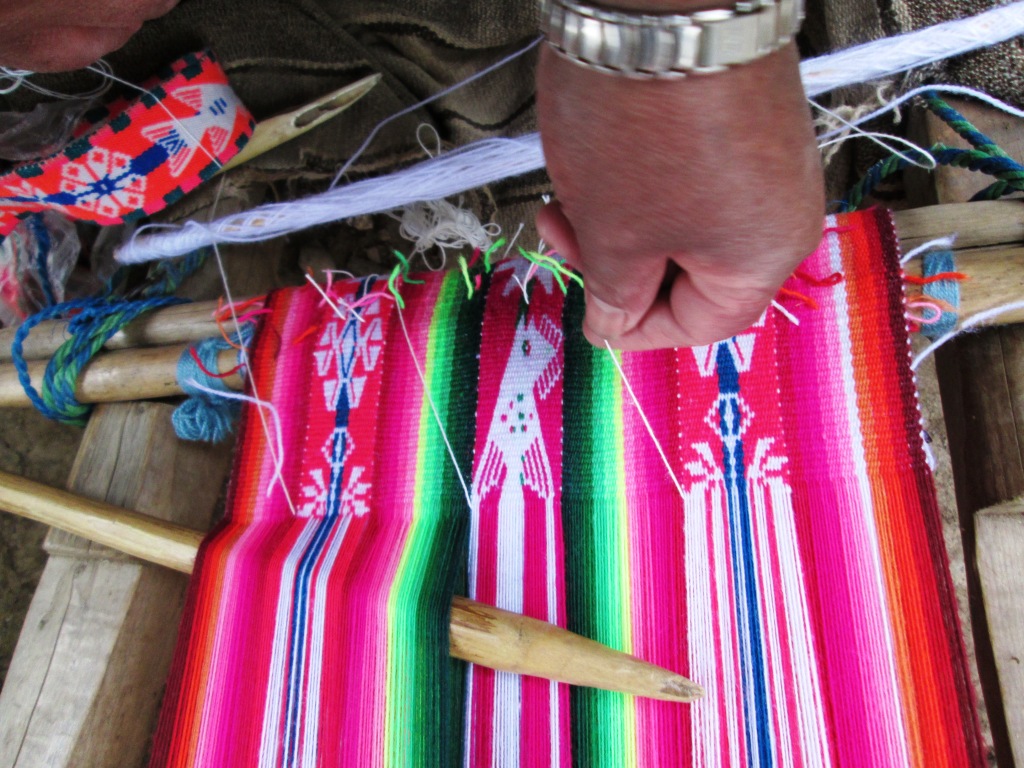
Maxma is currently weaving items for her husband in his new role as Mayor of Hucarani. There are several items that he and Maxima, as the Mayor;s wife, are required to have. Here Maxima is weaving a ch'uspa with columns of figures in double weave. The woven pieces need to be bright and festive and so she is using store bought acrylic rather than her own handpsun and naturally dyed wool.
Maxma is currently weaving items for her husband in his new role as Mayor of Huancarani. There are several woven items that he and Maxima, as wife of the Mayor, are required to have. Here Maxima is weaving a ch’uspa for her husband with columns of figures in double weave. The woven pieces need to be bright and festive and so she is using store bought acrylic rather than her own handpsun and naturally dyed wool.

And so, it was only in 2013 when Maxima had the chance to attend the Tinkuy de Tejedores in Cusco, Peru, that she had the opportunity to learn to weave the ñawi awapa pattern in much the same way I had in 2010.

However, Dorinda has since told me that Maxima seems to have forgotten how to weave the ñawi awapa band since returning to Bolivia.  She sends her weavings to her sister if she wants them to be edged with a ñawi awapa.

As with everything new like this, if it is not immediately put into practice, it can easily be forgotten. Ask any of my students!

One day I hope I can go out to Independencia and help refresh her memory.

I have had so much fun with the ñawi awapa since learning it, attaching it to so many things and, most recently, using it for jewelry.

nawi awapa jewelryBut, back to the ”Chahuaytire style”. I enjoyed weaving and sewing it to the edge of the pouch. It came out beautifully in wool.

pouch edged with chahuaytire tubular bandI added a braid to the zipper and I think the bag looks a lot more interesting now. There you can see all the swords and shuttles that I will be storing in it.

Not all tubular bands need to have pick-up patterns. I have often woven and attached them in just one solid color and have also used ”threaded-in” patterns, that is, ones that are created by the order of the colored threads in the warp rather than with pick-up.

These two pouches have solid color plain-weave tubular edgings.
The blue and green piece has a tubular edging with a simple thread-in pattern.
The blue and green piece has a tubular edging with a simple thread-in pattern. The pattern was warped off center to appear on the upper face of the fabric and show as solid green on the reverse.

Maxima often uses simple Andean Pebble Weave patterns in her tubular edgings using two sets of heddles and I have also seen weavers in Pitumarca weave tubular bands with the pattern set up in multiple heddles.

A weaver from Pitumarca weaving and sewing a tubular band edging
A weaver from Pitumarca weaving and sewing a tubular band edging.

Having learned the discontinuous-warp, or ticlla, technique with weavers from Pitumarca, I used the particular tubular band pattern used by weavers  in their community to edge my workshop piece when I got home and finished it. You can see how the edges of my cloth rolled when I took it off the loom. This was due to the high amount of twist in the handspun alpaca yarn that we were given to use. The cloth lay flat once the tubular band was applied.

discontinuous warp with tubular bandOf course, I didn’t spend my entire week on this one tubular band. As the title of this post implies, I was braiding and thinking…..braiding the enormous number of ends on my wall hangings at four minutes per braid. There are still plenty more to go.

And I was thinking about the shapes I want to weave on my next ikat ”sample”. Yes, I don’t feel ready yet to dive into the real project. I think that just one more sample with curved shapes needs to be done.

I also thought about the new slip cover I need to for my new laptop. This new one is slightly bigger than the notebook I have been using these last five years and so a new cover is needed.

Here’s the one I have been using so far with its pattern taken from Central Asian textiles…

central asoan design backstrap weaving

notebook-coverIt has been on many trips with me.

And, while I think, I pull out books, look online and make sketches. While going through the cupboard, I also pulled out a lot of fiber crying out to be spun. Maybe I will also set myself a wee spinning goal for the next months.

I will leave you for this week with this final picture of an event which is creating a lot of excitement here in Santa Cruz.

11698916_10153439643714530_8322870495067486430_nWe are on holiday today as the Pope is in Santa Cruz where he is celebrating his only Mass during his Bolivian visit. BoA, the Bolivian airline that transported him, has been posting pictures of the visit on Facebook and kindly gave me permission to show one here. Pope Francisco was presented with a handwoven souvenir of his visit when he landed and walks hand in hand with a boy who is dressed in the typical green and white outfit of Santa Cruz with his sombrero de sao.

See you next week…..


Backstrap Weaving – Cuffs and Stuff

silk cuff on loom backstrap weavingI left you last week with this silk cuff in Andean Pebble Weave still on the loom. I had wound a long enough warp to also be able to weave a few intermesh experiments. I was curious having never before used silk for this structure. And then, I was supposed to go on to my big ikat projects. Wrong.. I got stuck on silk and adornments…cuffs and other stuff… and have been fiddling around with those all week.

Coul stitches adorn the edges of a tiny case for the ipod that weaving friend, Gwen, gave me.
Coil stitches adorn the edges of a tiny case for the iPod that weaving friend, Gwen, gave me.

It is no secret that I like dressing up my weavings once they are off the loom. I like nothing better than to add tubular edgings, braids, pom-poms, decorative stitches and tassels to my little bags and pouches….no matter how tiny they are.

However, when it comes to dressing up myself, I have absolutely no interest at all. Clothes shopping is torture and I long ago gave up on wearing jewelry after having had several sentimental items yanked off my wrists and neck while walking down the streets of my home here in Bolivia. It’s funny that when I am traveling in South America, I am very careful not to display any ”riches”. Everything I have lost was taken when I was at home in Bolivia, feeling relatively secure, and with my guard down.

Nevertheless, I have decided that it would be nice to have some woven jewelry to wear while I am weaving with friends and showing them some techniques with all eyes are on my hands. That is what I worked on this week….cuffs, a couple of necklaces and a bracelet.

silk cuffs front and backHere are the two faces of the 60/2 silk piece. The pattern on the right is one I adapted to the Andean Pebble Weave structure from a piece of Kuba cloth. The other two are in the intermesh technique and I love the way intermesh looks in silk. The strip in the center was really only a sampler as I tried to get the proportions right to match the design on a button that I had bought. The other strip has a motif from Mexican tapestry. It is always hard to decide which face I prefer.

silk cuff backstrap weaving Andean Pebble WeaveThen I started on a silk ribbon to match the cuff I had made some time ago using a pattern of the Guaraní Isoseño weavers here in Santa Cruz. I wanted to use the ribbon as a necklace.

According to the legend told to me by my teacher, it was a snake that appeared in a dream and taught weaving patterns to the first Guaraní weaver.

While the Guarani weavers’ Moisy weavings depict colorful large trees, plants, butterflies, birds and flowers, the motifs on their Kara Pepo weavings are limited to snake skin patterns and stars. The weavers also think of the snake pattern as representing the life-giving Isoso river along which they have settled.

Although this piece is so very narrow and the pattern so very repetitive, it took longer to weave than you might expect…all those tiny silk threads to pick up. I have volunteered to weave some lanyards for the Braids 2016 conference. They will need to be much longer than this necklace piece..hmmm, I should perhaps get started on those soon!

silk cuff and necklace backstrap weavingThe pendant is one that I had bought, with this very project in mind, at the Northwest Folklife Festival while in Seattle last spring. In fact, I had bought two, and so I also wove a wool ñawi awapa band for the other. While visiting with Karen Huntoon in her kumihimo studio and store last year in Truckee, I got some small magnetic jewelry clasps. I suppose these kinds of projects have been on my mind for some time as Karen’s kumihimo necklaces were very inspiring.

nawi awapa necklace and pendant backstrap weavingWell, after that, I got a little ñawi awapa crazy and decided that a bracelet in this technique would be fun. I used fine wool to weave four of these patterned tubular bands and combined them. These are the tiniest ones I have made so far and I think they are really cute.

nawi awapa bracelet backstrap weavingFun!

So that was my week in weaving and playing. I still have more of the magnetic clasps. I wonder what else I will come up with. Maybe I will just get down to drawing my large ikat cartoons instead…but, wait a minute…I don’t have an ikat cuff, do I? or an ikat necklace…..

silk cuffs and necklaces backstrap weaving