 Clearly, I am not in Massachusetts anymore!
Here in Phoenix, Arizona, it is not uncommon to find a majestic Saguaro cactus, a silent Sonoran sentry, standing in a suburban yard. You look around and there they are, watching over you.
The sky looks a little threatening in that picture and the following day we did indeed experience a tremendous downpour at what is the very tail-end of the monsoon season. A seasonal change of wind direction brings moisture and storms to this normally dry part of the USA.
 We happily wove away on our backstrap looms indoors while fierce winds and rains lashed at the windows and cut power in many places across the city. However, October 1st marks the end of the monsoon season and not a drop of moisture has been seen since that first day of weaving.
People who left Arizona to escape the summer heat return to enjoy the mild winter. Flocks of Canada geese dot some roadsides. They haven’t just arrived to escape the coming Canadian winter. They have been here all year round having decided, apparently, that this is a pretty good place to live.
Certainly this is not like any Fall trip I have experienced so far…shorts and tshirts by day with refreshing swims in the late afternoons, watching the setting sun turn the sky from orange to pink to a deep dark velvety blue.
 The Southwest is where I really got started in weaving. A planned hiking and climbing trip in 1995 ended with me on crutches learning Navajo-style weaving instead. It is lovely to be back here.
And, if you start to tire of seeing buildings in dozens of shades of beige and terracotta (I haven’t yet!) and you are longing to see other colors, they are never far away in the cactus flowers and textiles as well as in the modern and traditional pieces of Native American art at the Heard Museum.
 The walls of my weaving friend, Virginia’s home are lined with beautiful Navajo rugs. It was a happy greeting walking down that hall to my guest bedroom. Shelves and niches hold colorful Hopi Katsina dolls.
 That’s Virginia’s home. Then, she took me to the Heard Museum…


Don’t be surprised if you think you recognize some faces in the painting by David P. Bradley a Chippewa artist. His acrylic on canvas piece was made to celebrate the Heard’s 50th annual Indian Fair and Market. In Bradley’s words, it pays homage to “some of the masters of Indian art who have contributed to the Indian and world art community. Their work still lives on and inspires all those who work in the arts.”
We created a cascade of color at Virginia’s place using the collection of bands that Sara brought to show from her travels in Mexico, Guatemala, Colombia and Ecuador…
 I really appreciated her also bringing a small loom that she had bought in Colombia. I know so little about the textiles and looms of that country.
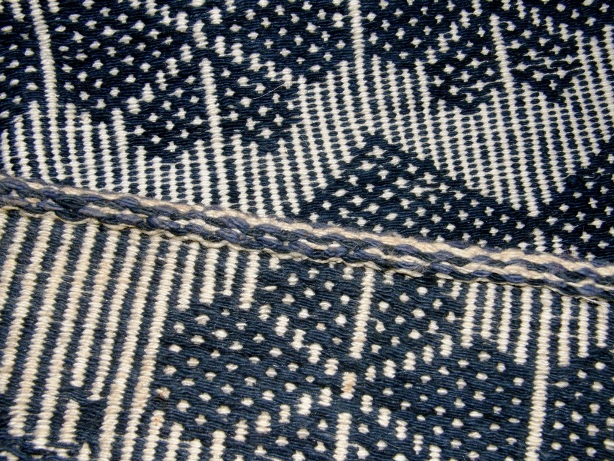
 And there was also this woven piece from Colombia, which is one of the most beautiful and finest pieces of wool four-selvedge work that I have been able to handle and examine…
 Virginia added her own splash of color by using a bright and beautiful woven belt with Andean Pebble Weave designs bought on Taquile Island in Peru as her backstrap during the gathering…

And, while we surrounded ourselves with all this beauty indoors, in the outside world we had this all around us!………
At high noon……
 And at sundown…
 There are always those silent sentries watching over you.
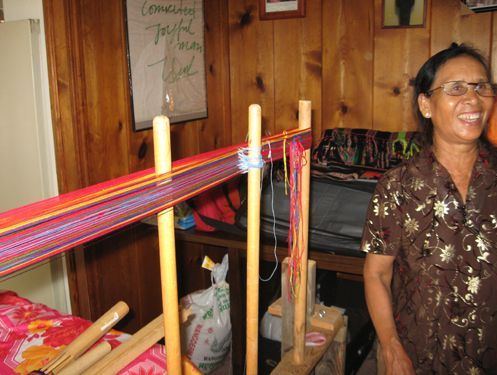
Back at Virginia’s house, where I wove with the first backstrap weaving group, I had Isabela’s eyes following me around the room… watching, watching… as I set up for the class….
 Virginia bought this enormous Shipibo pot at an auction in the US. Its previous owner had named the piece Isabela. You can see all the marvelous lines that are typically used in Shipibo work. You may remember that they inspired one of my wall hangings.The lines on this piece are squared off rather than being entirely curvy.
 It soon became clear that no matter where I stood, to the left, to the right, above or below, Isabela was going to be watching over me!
 A smaller and less decorated Shipibo pot sits to the right.
Now, in the second week of my visit to Arizona, I am staying with Collyer. Her husband, Steve, is a volunteer docente at the botanical gardens and I enjoyed a morning tour with them before the noon sun drove us indoors. The magnificent gardens have examples from North, Central and South America.
 There were stops to rehydrate with prickly pear iced tea and cool off in the shade as the sun got higher.
 It turns out that Collyer was at Braids 2012 in Manchester. We didn’t run into each other there which shows just how busy and absorbed we all were! She is an avid braider and also went to the previous conference in Kyoto. No doubt she will be at Braids 2016 in Seattle/Tacoma and I hope that I will get to go too. Braiders, keep your eyes open for news about this fabulous conference. There is a Facebook page where you can find the latest news.
 Now, here’s a wee bit of creepy trivia from the “land of scorpions”.
One of the more common kind of scorpion that livesin this part of Arizona is a reddish-brown color. I was told by Steve that if you shine black light on them, they will glow pale blue. Shining a special black-light flashlight under the bed at night might reveal glowing pale blue bodies and beady blue eyes watching you.
Then, you would have to spend the evening trying to remove them…at least I would…I wouldn’t be able to sleep peacefully knowing that scorpions were under the bed and so, I was never tempted to use the flashlight. What I don’t know won’t hurt me, right? I did however, carefully scan the walls and ceiling. I didn’t want any scorpions watching over me. And I also looked very carefully before placing my feet on the floor first thing in the morning.
 After a few days of scorpion talk and not a single scorpion appearance, I became quite brave and walked about with bare feet while weaving with a group of backstrap weavers.
I even stupidly stood with bare feet in the back patio to take the group photo, above,…(As an aside, I am thrilled to tell you that one of my group members was born 87 years ago. I came to the conclusion a while ago, and Iris certainly bears this out, that continuing to learn things with passion is what keeps you young.)
That very evening, a very lively reddish-brown scorpion scuttled across the living room carpet. You saw it, in the earlier picture, glowing prettily under the black light before being escorted out!
In my Cyber Universe, I have been hearing from students and contacts around the world as they start out and progress with their backstrap weaving…
From the USA, David Kent sent me pictures of his set-up for weaving a backstrap. You can see his warping, heddle making and weaving in progress…

Emerald, in Australia, is making bookmarks and is trying out a new technique…weaving reversed Andean Pebble Weave motifs while swapping colors. The little animal motif is charted in my second book.
 Ximena, in Chile, is also working on bookmarks. She calls the bird figure from my first book a condor (it is adpated from a piece I got on Taquile Island, Peru where the weavers called it picaflor, or hummingbird). It’s in the eye of the beholder, right?
 Ximena’s work shows how pretty ”plain” pebble weave is, too. Not all bands need to be covered with pick-up motifs.
In Canada, llunallama is weaving Andean Pebble Weave on a four-shaft loom. The motif is one she adapted from a pre-Colombian pattern and is adorable! Turn your head sideways and you will see the little viscacha figure in blue. She warped six yards and will be able to make many bookmarks with that.

It is fun to think of backstrap weavers with fingers flying and sticks clacking in various parts of the world and how we can come together via the internet. I am happy to have been able to work with Emerald in person and, who knows, I may get to meet David, Ximena and llunallama one of these days too. I like how people feel that perhaps they have someone to watch over them as they get started in backstrap weaving by communicating with other weavers in online forums. I often find myself online after a day of weaving answering questions by email and giving backstrap weaving advice, sometimes in English, sometimes in Spanish.
And it’s heart-warming to know how many people here in the US are watching over me too….people who are willing to open their homes to me and offer a place to stay even if they won’t actually be weaving with me on this trip…people who write and check up on me when I miss a blog post 🙂
I went to one local guild meeting last Saturday and get to go to another tomorrow night where Navajo weaver Gilbert Begay will be speaking. I am excited about that.
I am hoping to see the full moon rise this evening (although, clouds have moved in and it isn’t looking too promising) and I might even drag myself out to see the total lunar eclipse in the early hours of tomorrow morning.
See you all next time.