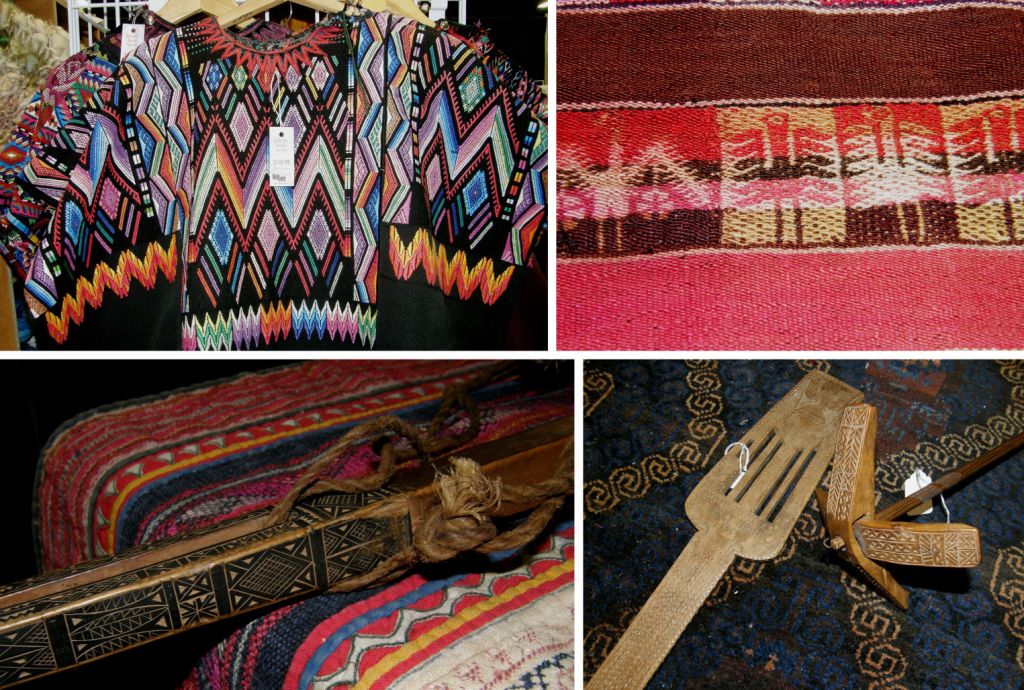
The colors and motifs of the Jarai and Rhade tribes of Vietnam have found their way into my work this week thanks to an amazing visit with two of these Montagnard weavers in North Carolina during the end of my US visit. Montagnard is the name that the French gave to the various hilltribes of Vietnam.
I have had to resist writing about all my fun fiber adventures with my good weaving buddies Lisa and Maurice during my stay in North Carolina and limit this post as much as I can to the two wonderful afternoons we spent with master weavers Ju Nie and Nach Rahlan.
Unfortunately on this trip I didn’t really have time to dawdle in North Carolina but we did manage to pack a whole lot of activity into my short time there.
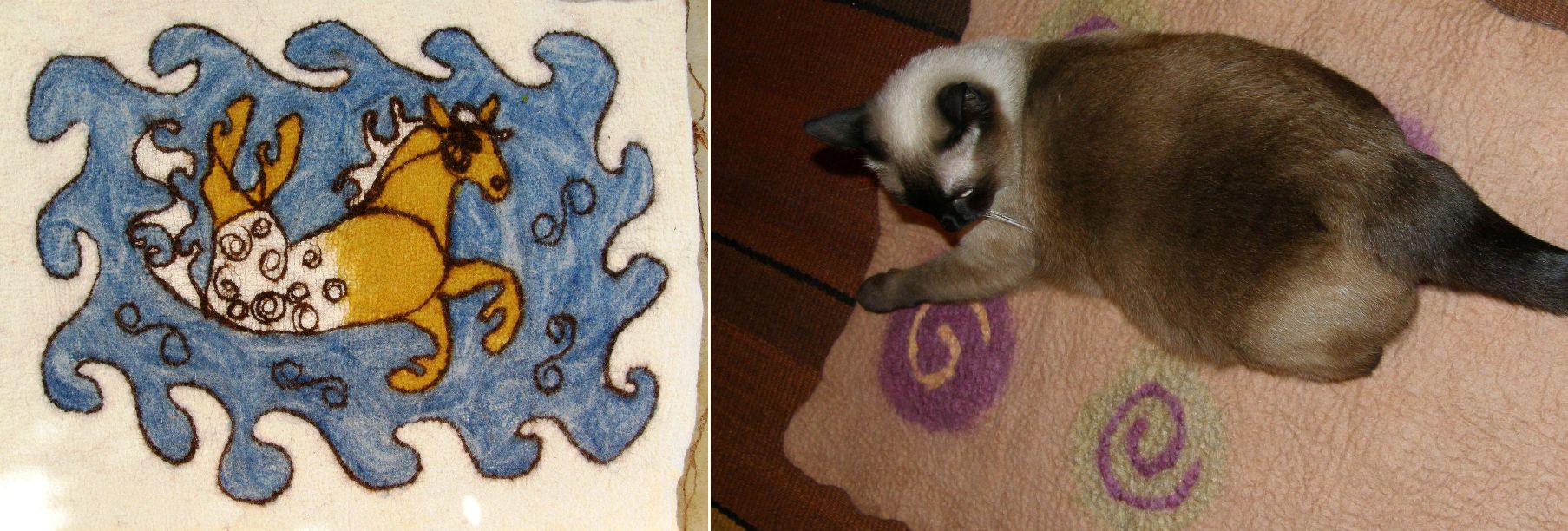
When not warping four-shaft looms, backstrap weaving, spinning and wrestling with sheets of felt, we went blueberry picking, hung out with the family, made s’mores (first time for me, okay they weren’t made over a campfire but they were still gooood!) and spent time with Maurice who made this warping board and beaters for us to play with.Lisa makes beautiful felt pieces like the one here on the left. She took me through the steps to making my own simple piece on the right. Mine has an animal on it too but not a felted one! I had made felt before when I lived in Chile. Now I realize, thanks to Lisa, that I hadn’t felted it enough and that explains why I have to give it a haircut every now and then. Photos of the fun and physically demanding process will be in next week’s blog post!!We gathered a group of friends for a day of backstrap weaving. Renate here is showing off her warp while Lisa works on a yurt band design in two-color simple warp floats.
We warped up Lisa’s four-shaft loom to weave a guitar strap patterned with designs in Andean pebble weave. I will have more pictures of this next week too.
And as if that wasn’t enough….
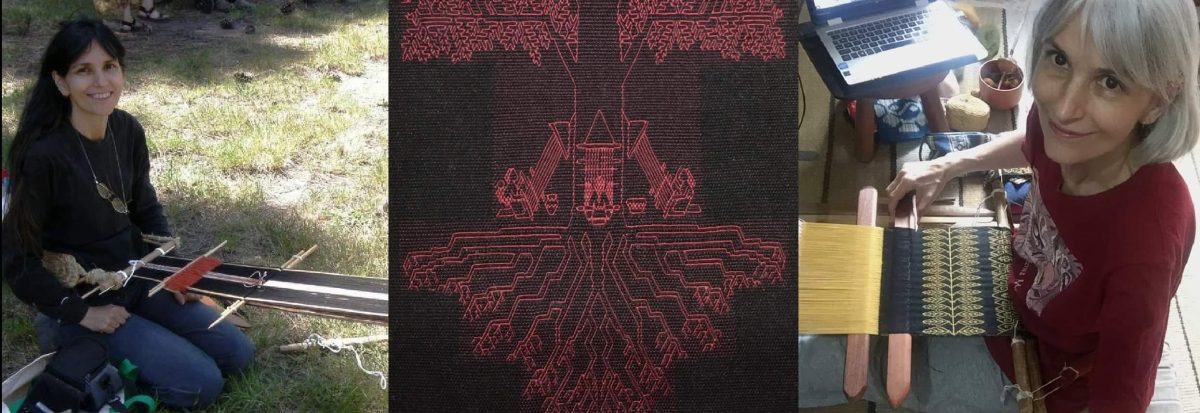
The highlight of this visit was the trip we made to spend time with the Montagnard weavers. I was lucky to have been able to make contact with Betsy Renfrew, at left with weaver Nach Rahlan, some weeks before leaving Bolivia for this US trip. She invited me to her home where she and her husband Andrew arranged for us to meet two of the Montagnard weavers with whom she has been working. Read about Betsy and Andrew and their goals for working with the weavers here.
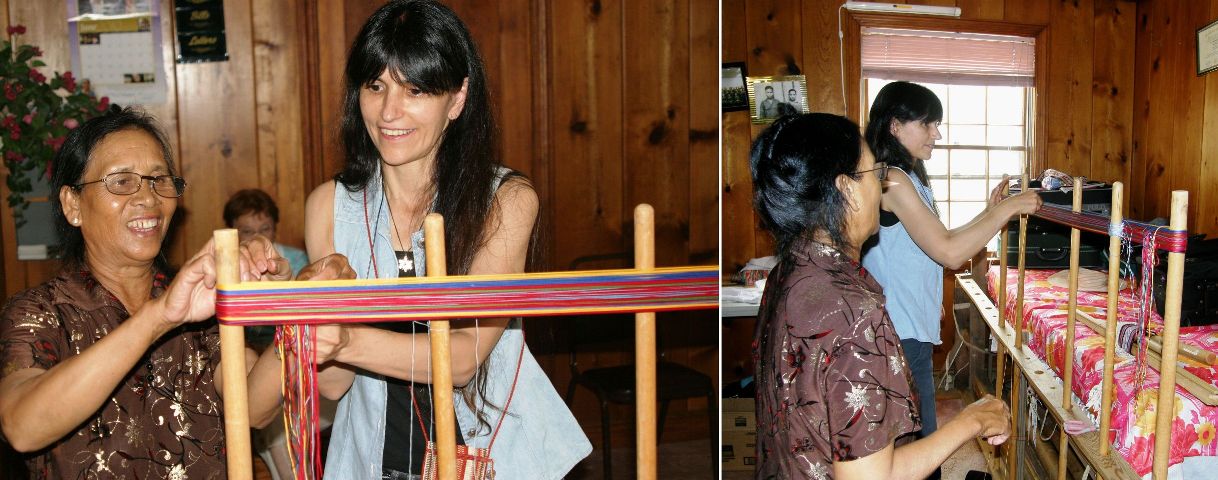
The first day was a “show and tell”. Maurice, Lisa and I took examples of our own fiber projects to share with weavers Ju Nie of the Rhade tribe and and Nach Rahlan of the Jarai tribe. Ju Nie’s husband Thomas Tlur Eban acted as Ju Nie’s translator at the times when she struggled to express herself in English while Nach’s English was a lot more fluent. I have to say that I was quite nervous on the drive there. Betsy had told me about Ju Nie’s lack of English fluency and had also mentioned that Ju and Nach were from two tribes that did not particularly get on. I envisioned a very awkward gathering with difficult communication and perhaps a cold stoniness between the two weavers. This couldn’t have been further from the truth!
The room virtually exploded from the very start with lots of excited chatter and movement. We were a group of weavers sharing our mutual passion!
I showed my backstrap loom, woven pieces and tools to a fascinated Ju. Lisa took her spindles and soon had both Nach and Thomas trying them out. Maurice showed several of his own floor loom pieces and explained shibori weaving.
And then it was our turn to be shown. The room that was already packed with eight people, filled to overflowing as enormous looms, blankets, skirts, carrying cloths, bags and straps were brought in to cover the floor and every available space. It was overwhelming and it was hard to concentrate on any one piece and hold back the urge to touch and examine everything at once.
Nach brought in her large loom and unravelled it to reveal one of the panels for a traditional skirt that she is weaving. The design panels on this piece are decorated with motifs woven with supplementary wefts.
The supplementary weft patterning technique used is the same as that described here. It is a single faced technique and both Ju and Nach were delighted to see Bolivian examples of this. Above you can see how panels of blankets and skirts are often joined using single columns of cross knit looping which I am used to seeing here in Bolivia in double and triple columns to edge coca leaf bags and other items. The lower picture shows simple warp float patterning where single warps are floated over a background of horizontal bars to create this striking pattern.
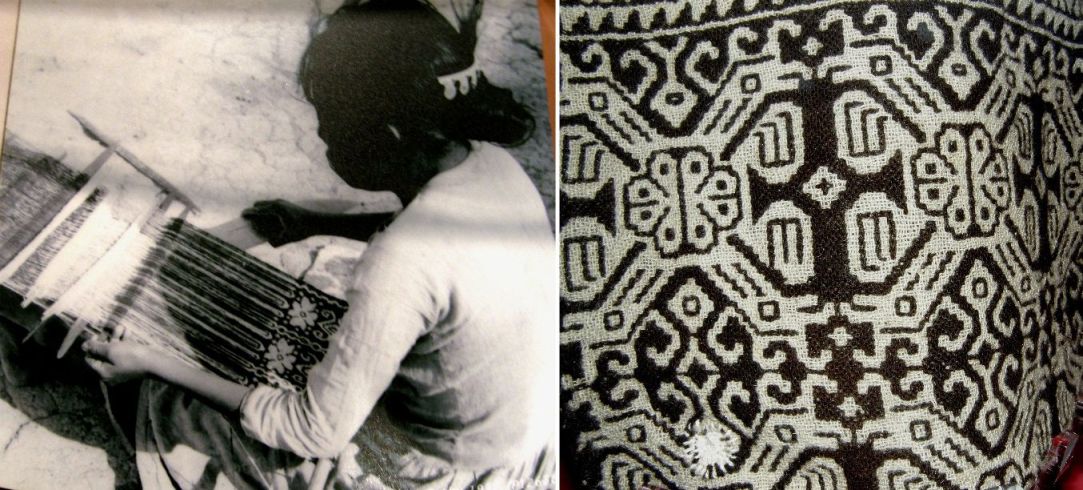
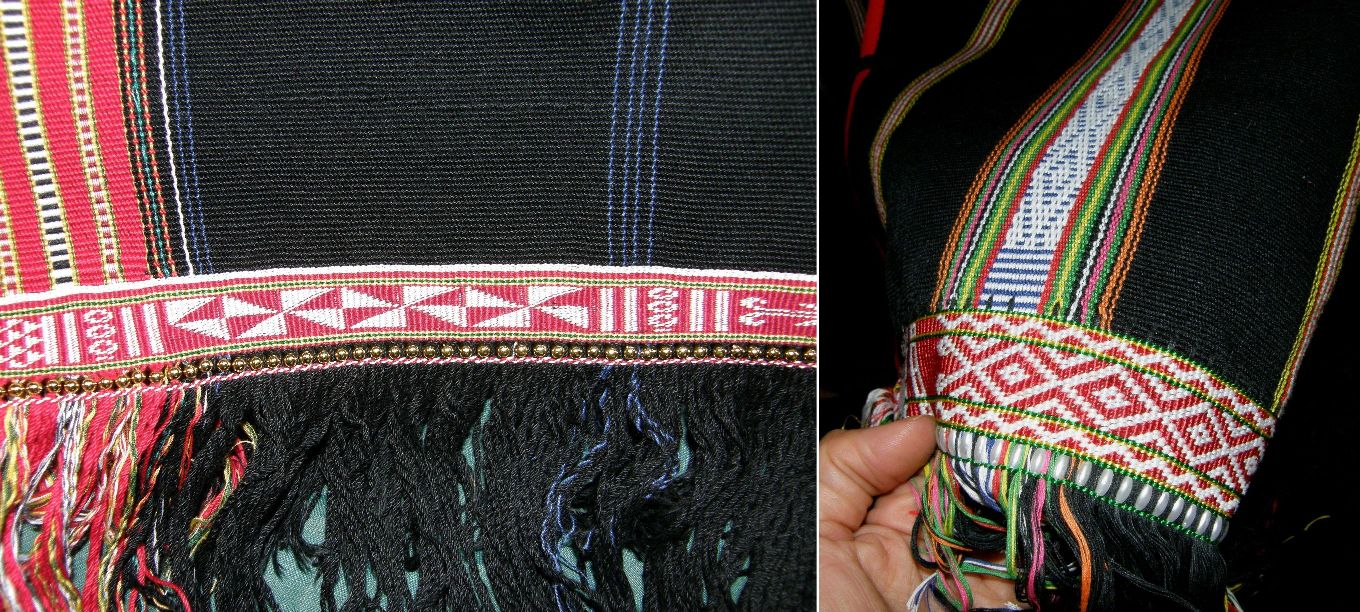
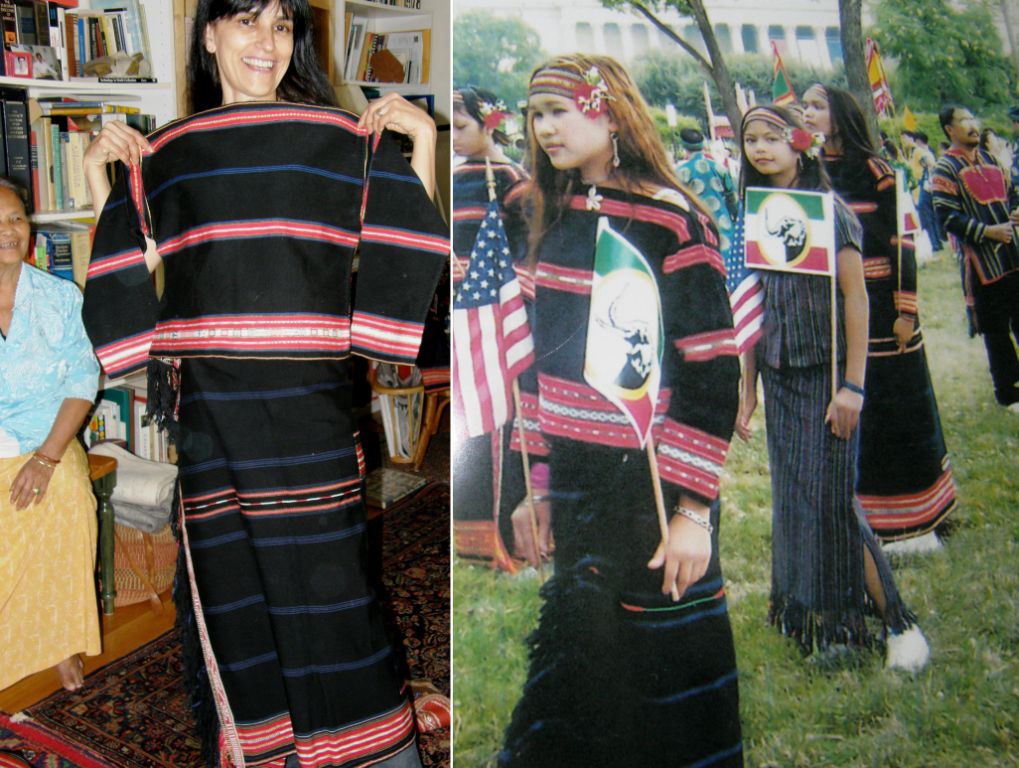
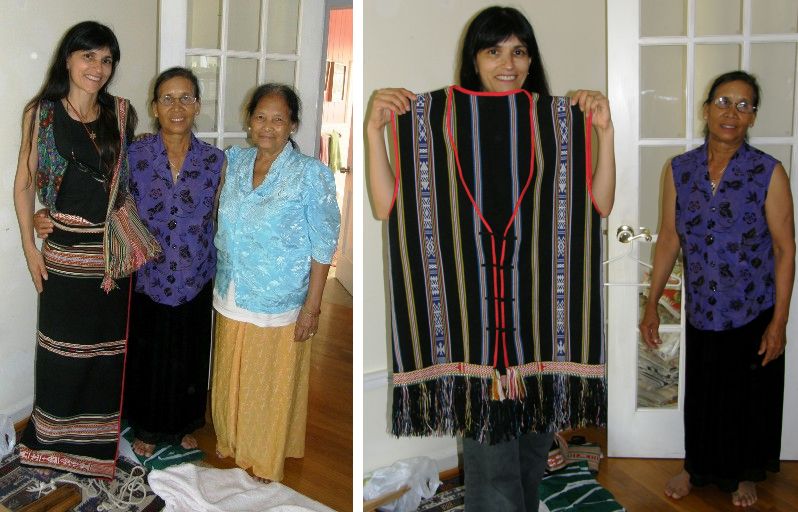
The most astonishing pieces for me were the ones decorated with a twining technique called kteh. Seen in the example on the right, red and white threads are twined around the fringes at the end of large woven pieces to form intricate patterns and then adorned with beads.On the left you can see gun and airplane motifs which often appear among geometric, human and animal figures.More fabulous examples of the kteh work.The weavers have lately been making shoulder bags to sell and experimenting with traditional and non traditional color combinations. They weave straps for the bags placing two warps on the loom at a time (picture at left) as they are not used to weaving such narrow pieces on their enormous looms. Having two bands on the loom at once helps balance things out. At left you can see the tiny temple fashioned from a piece of bamboo much the same as that used by the weavers in coastal Ecuador with whom I studied.Words and phrases are also woven into the bag straps. Some of these appear to be lines from scripture and a google translation turned up such words as “peace” and “wisdom”Ju here is showing us how to wrap the baby carrying cloth. This piece was more warp dominant than truly warp faced and profusely patterned with suplementary wefts.I was coaxed into donning the traditional skirt and blouse. At right is a photo in Ju’s home of young girls in similar costume wearing woven headbands.Ju, Nach and myself wearing one of the skirts. It felt beautiful on but it beats me how they manage to keep them up as they don’t wear a belt. It is simply gathered and tucked. And just in case you are wondering, I am not tall! At right another gorgeously patterned garment with warp float patterns and kteh edging.
So, that was day one! I have no idea how much time we spent there but the time just flew by and I arrived home thinking, why didn’t I take a closer photo of that and how did I forget to ask about this? I am very grateful to Maurice and Lisa who took photos when I was not able and allowed me to use some of theirs.
Are you ready for day two?
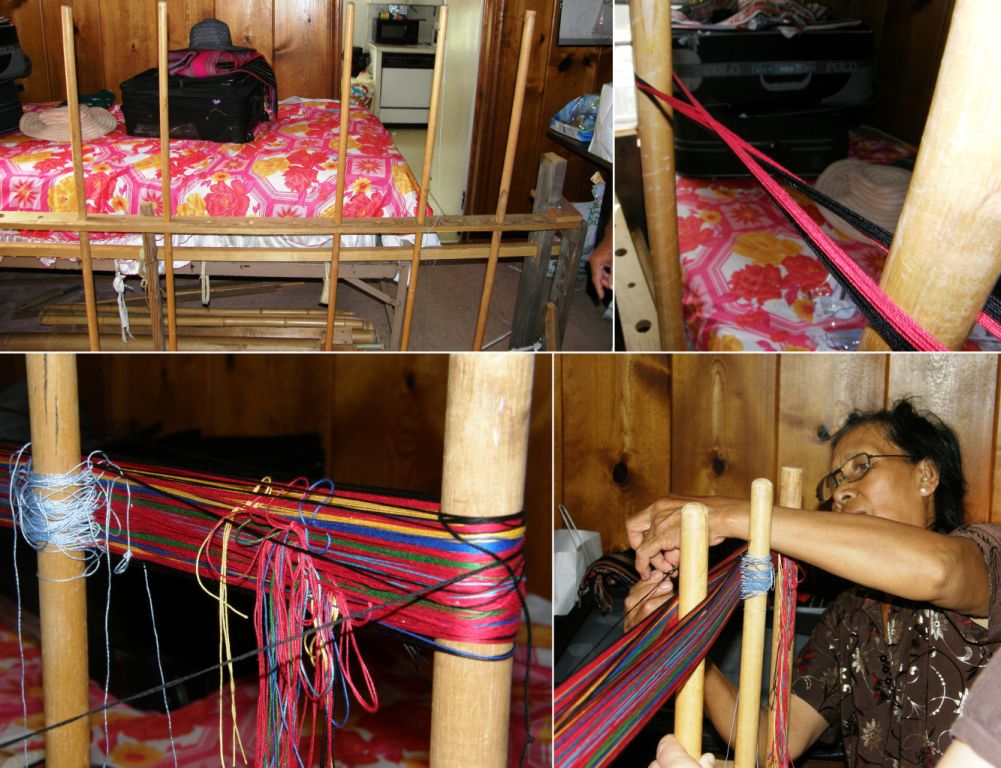
Day two found us at Ju Nie’s home where she was set up and ready to warp. Ju’s husband builds all her tools and he has made her a very nice warping arrangement which fits conveniently in the house beside the bed to which she attaches her backstrap loom. It reminds me of my situation here at home where I weave attached to my bed and warp on the floor nearby.
The warping set up. Five posts are used. One post, the second from the right, acts only as a measure around which the heddle strings are wound. Ju encloses the warps in continuous string heddles as she winds the warp. I was tickled to see that she uses Aunt Lydia’s number 10 mercerized crochet cotton as I have done and uses this same yarn for her string heddles.
In the blink of an eye Ju was off and warping and it was very hard to keep up. Not wanting to interrupt her, as I know how important it is to concentrate when warping, I struggled to follow her quick movements which at first weren’t making sense to me. I had mistakenly thought that the cross was that shown in the upper right hand photo but later realized that it wasn’t. My sketch of the process had to be frequently modified until I finally caught up with her.
Ju makes a circular warp and uses two strands of yarn at once much the same as I do in my four stake warping, separating out the doubled threads only around the cross post and at the place where she pulled the string heddles through. The cross shown above is made of doubled threads and serves as the place where she later inserts her “rolling stick” or “coil rod” as it is sometimes known.
Her movement with the string heddles was so quick that only after having studied the video I had made multiple times am I able to follow it and reproduce it on my warping board here at home. All the warp ends where color changes occur are tied in slip knots which are untied and retensioned once on the loom. This results in an intimidating mess of yarn ends and even the heddles looked loose, uneven and scary! Of course eveything was under control!
Ju was kind enough to let me try warping. I would never let anyone touch my warp!! She, however, took control of the heddle string at each pass but I was slowly coming to understand what was going on.Warping finished, safety ties were added to the warp and it was slipped off the warping stakes and the rolling stick was put in place. Ju closed the end “cross” around the rolling stick and then put the main loom bar in place which was attached to her bed, just like mine!
Ikat weavers that I have seen in Ecuador told me that the rolling stick helps stop their warps from slipping and blurring their design. I have seen other weavers use it to help space the warps. I imagine it also stops the warp threads from slipping in together as they often do on the far loom bar and keeps them in order.
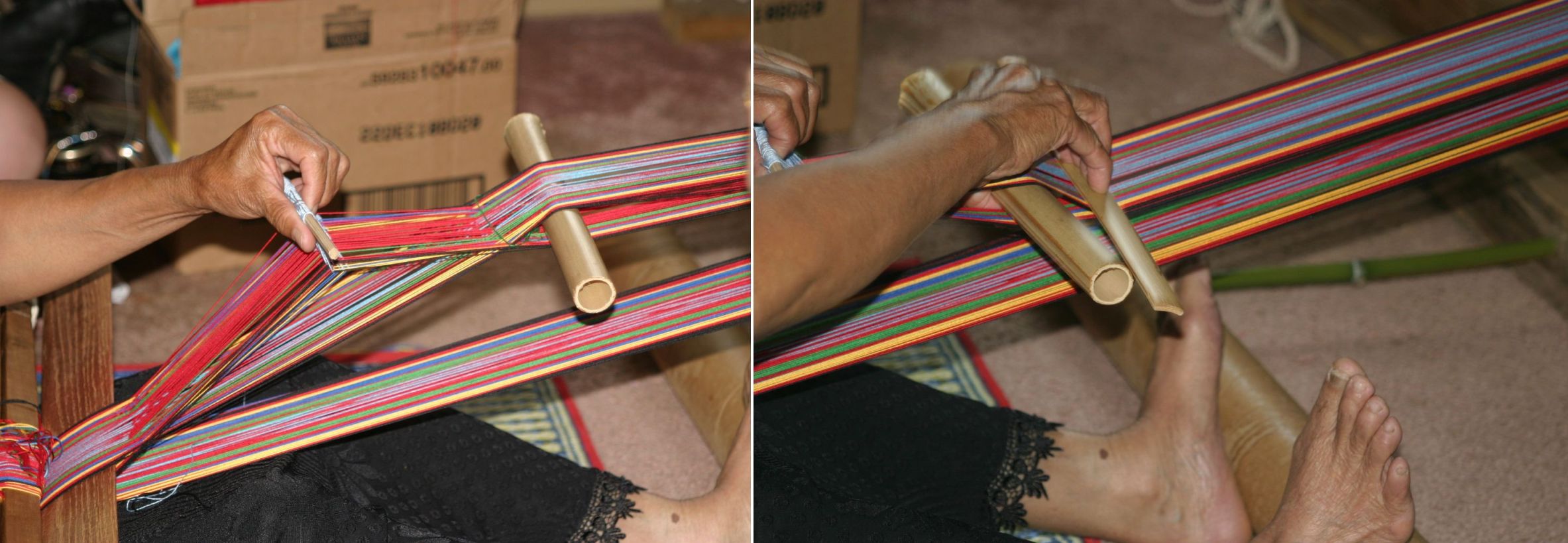
The weaver’s loom bar seen at left has prongs around which the backstrap cords pass. The sword has a hooked end which is used for picking up threads for patterning. All these pieces have been fashioned by Ju’s husband Thomas. Ju had warped a sample band for us to witness the process. Her loom is normally used for much wider pieces which explains how oversized and unwieldly everything looks.The thick roll against which Ju braces her feet then had to be placed at just the right distance. Having something against which to brace one’s feet is a big help. I have sheets of wood under my bed which serve this purpose and this helps spread the load of tensioning the warp between one’s back and legs. Once Ju had untied the knots in the warps ends and retensioned the warps, she sent Thomas out into the yard to cut some thin bamboo sticks which she inserted in the sheds to get the weaving underway. She then carefully moved each and every warp into place with the point of a stick before passing the first weft.Ju opens the heddles by grabbing hold of the shed roll and a bamboo slat which she places on top of the warp. She then rolls both away from her while pulling up on the heddles.When I use a second cross in my warp, I use this method by rolling the shed rod and the second cross stick together. I enjoyed showing Ju another way that I use to open my heddles by rolling them over my hand. At first she was anxious to show me that I was doing something wrong but then saw that it worked and laughed, pointing and saying “new way”. Her shuttle is a simple stick around which the weft yarn is wrapped. These photos were taken by Maurice Blackburn.
I was dying to get into the loom and finally asked Ju’s permission to do so.
What a wonderful birthday gift! A day spent with a master backstrap weaver! There I am happy as a baby. The picture at right shows my view up the warp!
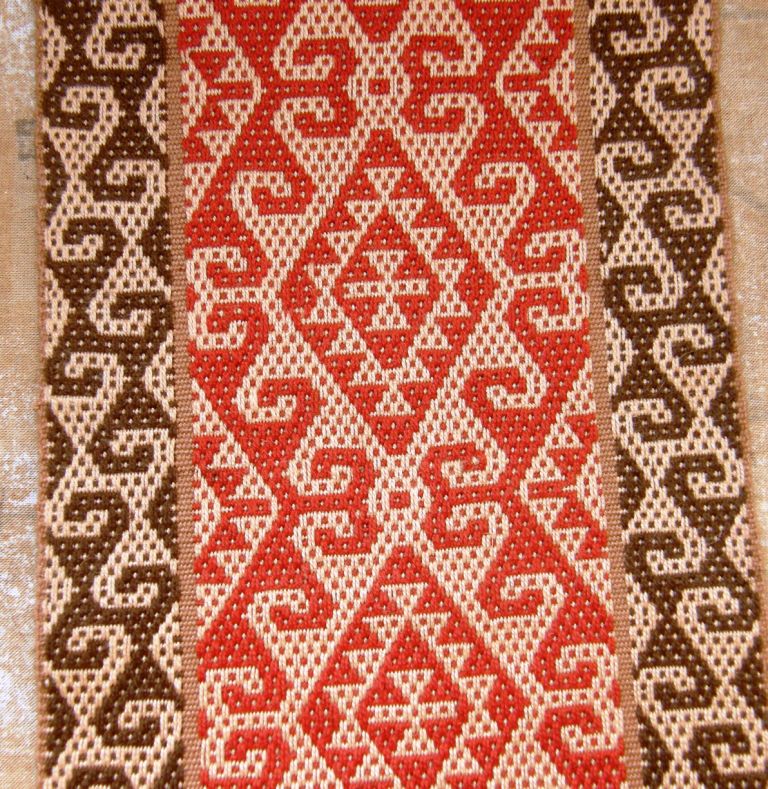
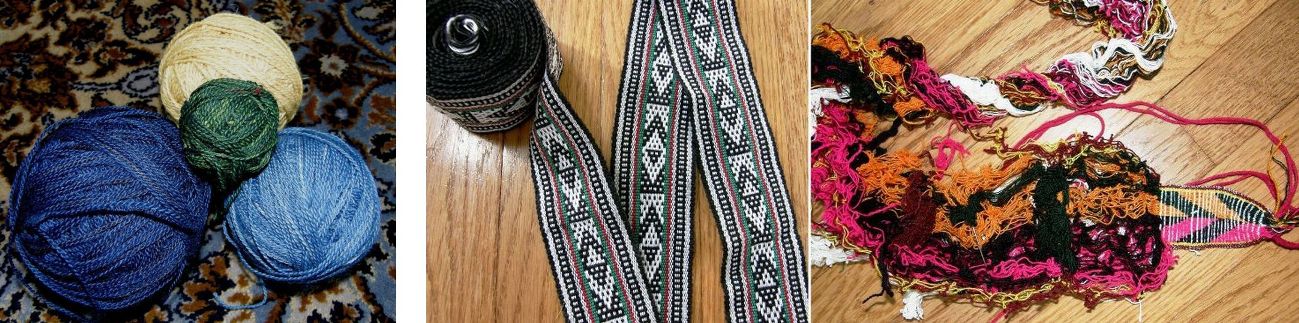
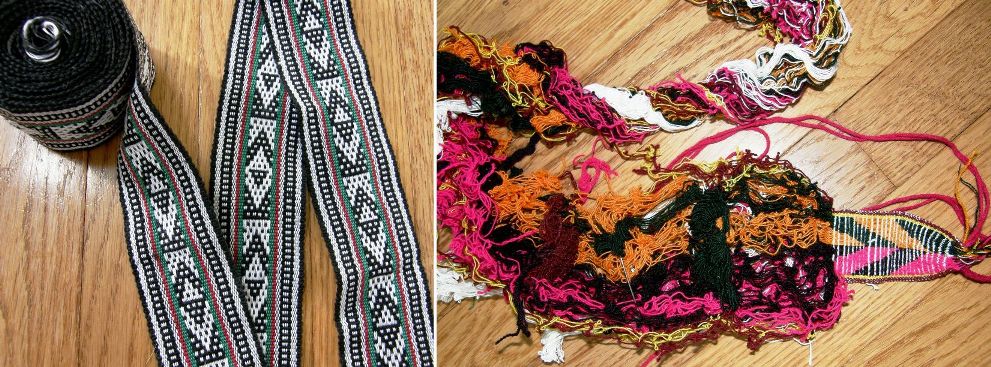
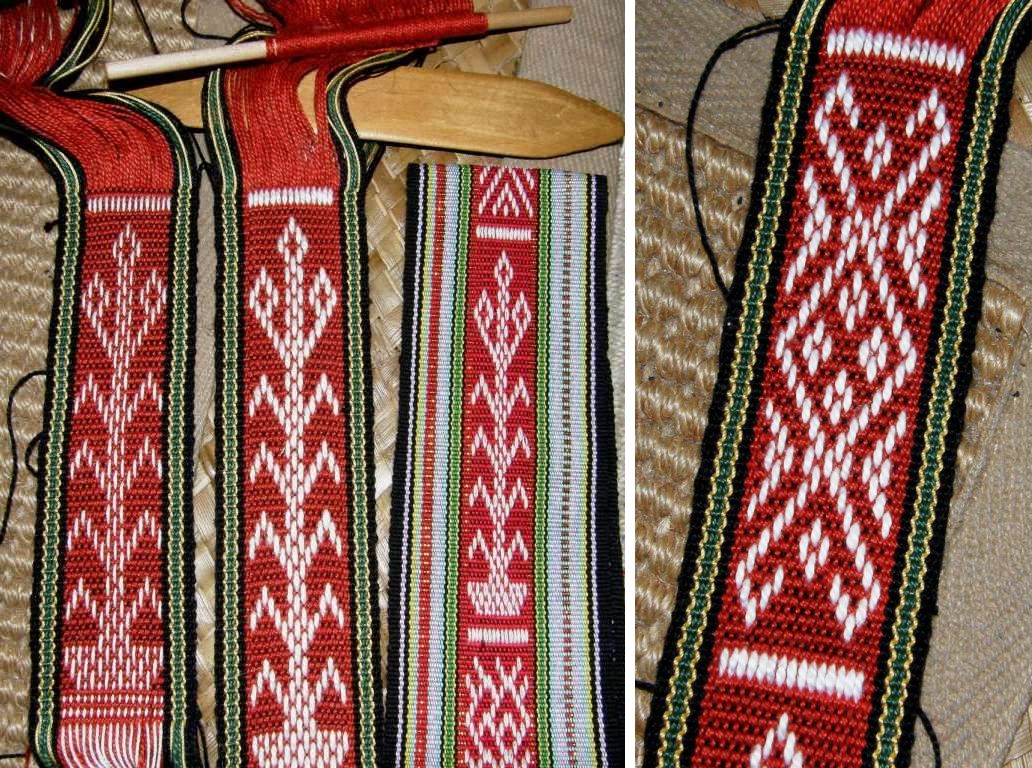
We went home with images spinning in our brains! It wasn’t until I got back to Bolivia that I sat down and went through my notes and sketches, watched the videos and managed to sort it all out. I bought a 12 ft long band from Ju that she had intended using as straps for many bags but was happy to part with. I liked this piece as it gave me many examples of the motifs that they weave with warp floats. I was able to examine it to figure out the technique. This is a new one for me! And so, to work. I wanted to reproduce the structure and make something useful.
First to sample. I could see that Ju’s white and red warps had a 3:2 weight ratio but I wanted to see if I could get away weaving it 1:1.
In the photo on the left, Ju’s band is the one on the right. My first 1:1 sample is on the left and my second sample, in the middle, where I also used a 3:2 weight ratio looked far better than my first attempt.
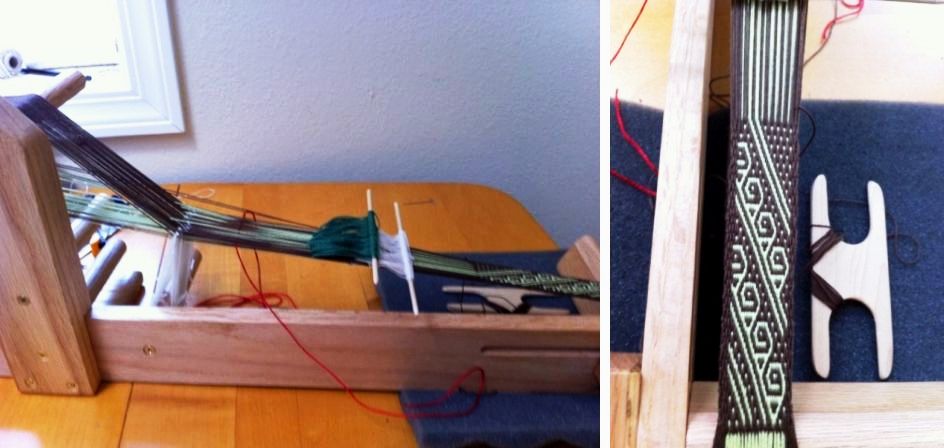
So I went ahead and wove more motifs on this sample band until I was convinced that I had the technique down. I decided to weave a wider piece so I could make a couple of zippered pouches and tried to copy the traditional colors used by my new weaver friends as much as possible. Here is the piece I made on the loom. By cutting between the two white horizontal bands in the center I woud have two pieces which I could fold and sew into bags.
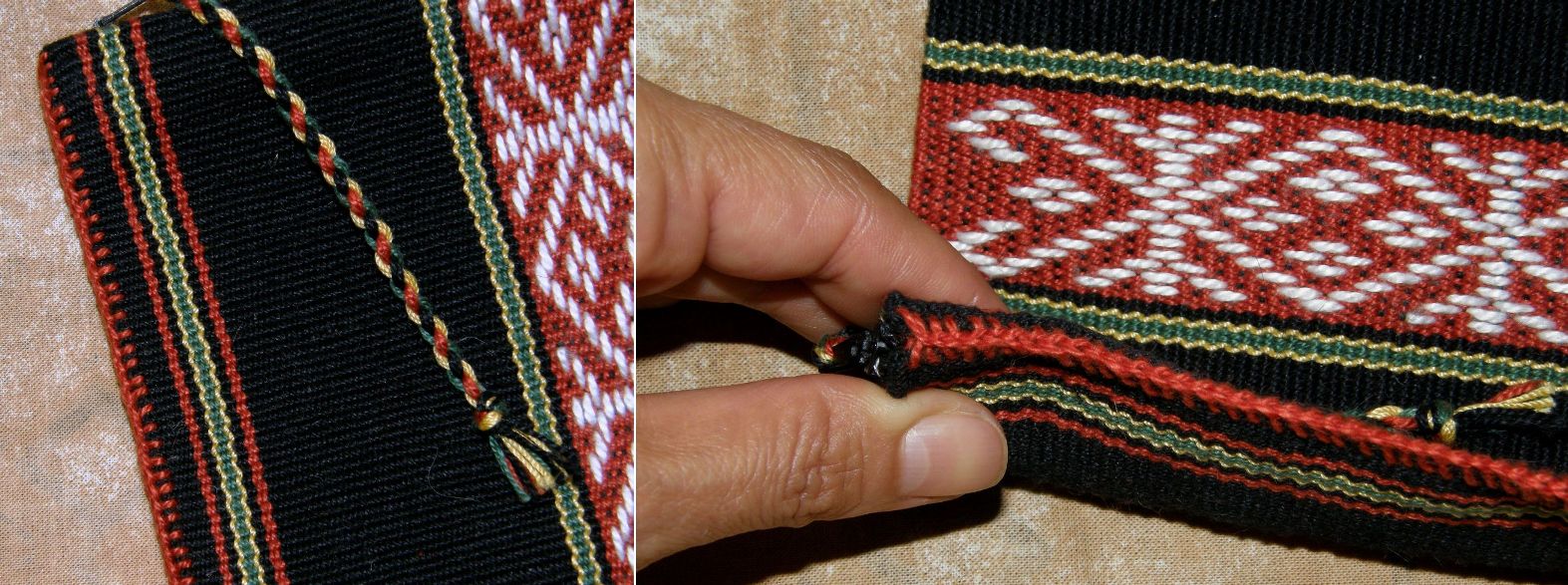
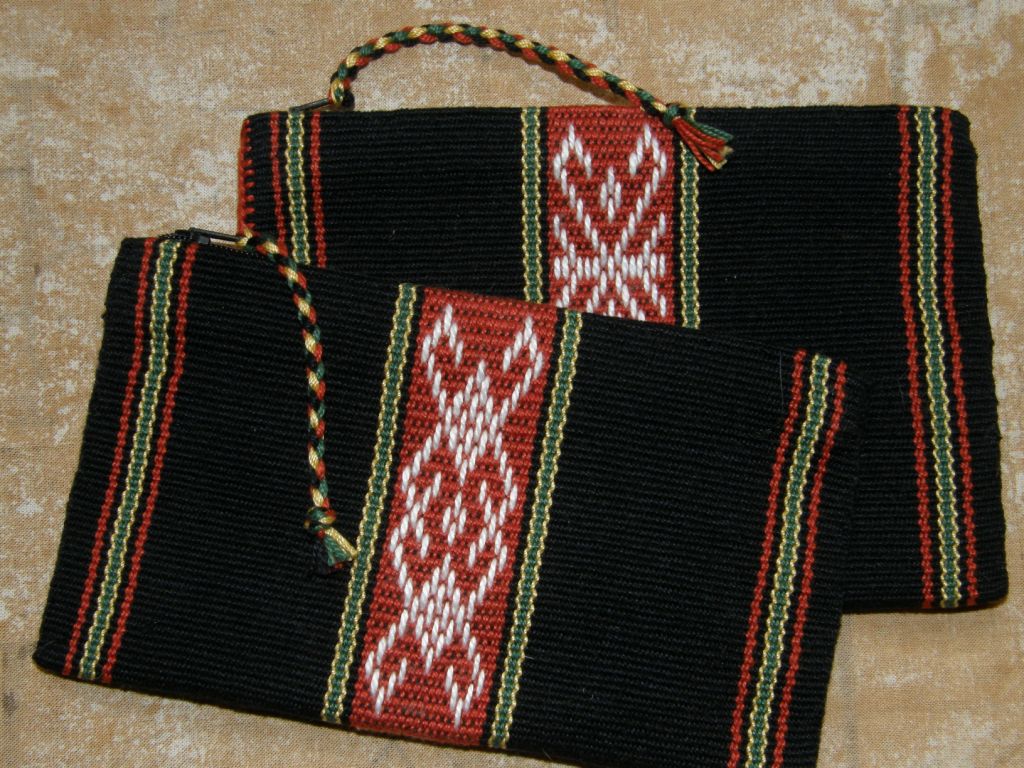
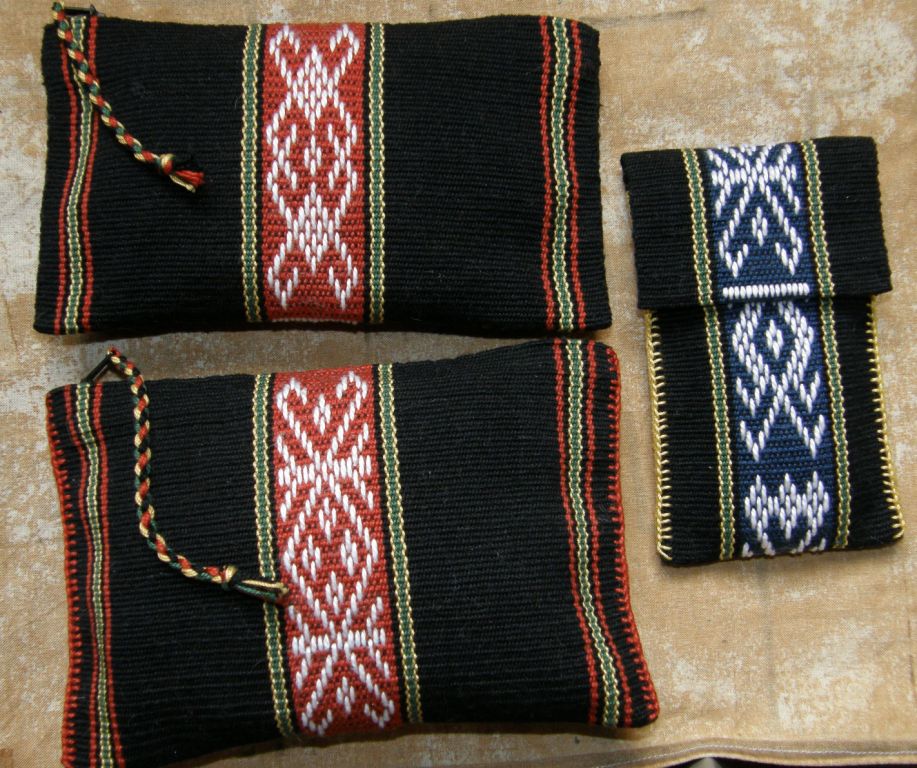
Here is the piece off the loom, then cut and folded. I sewed two lines of stitches in the center of the piece and cut between the two.I sewed a single column of cross knit looping along the edges of the larger of the two bags as Ju and Nach also use this for decorative finishes.Here are the two bags with zips in place and braided zip pulls. I had yet to sew the other edge of cross knit looping when I took this picture as I wasn’t convinced about using it at all.
Once the bags were made (I kept the cross knit looping in the end and really like it), I decided that I would try to make something using the blue and black color combination that Ju and Nach also use in a lot of their pieces. I warped up for a band in these colors wide enough to make a cellphone case and chose some motifs from my photos.
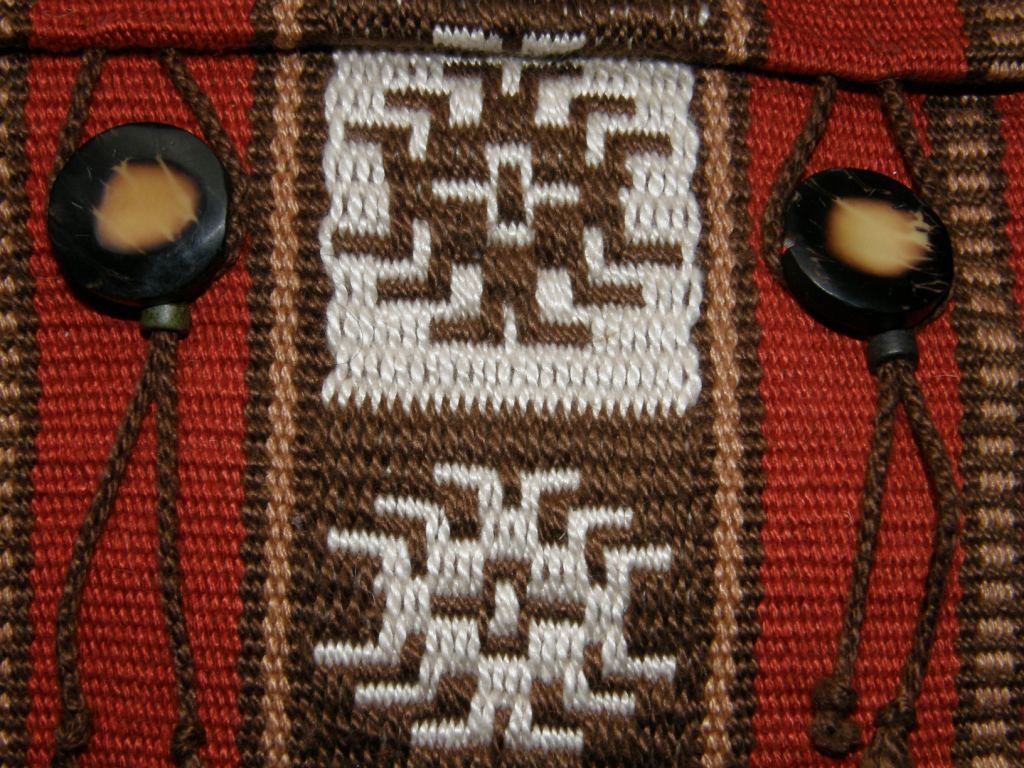
I had trouble settling on the colors for this band and had to pull out warps and replace them once it was on the loom. I decided to keep it very plain and dress it up later with cross knit looping.Here it is finished. I am not sure about working the cross knit looping on the flap as well.And here is the set almost finished. I would like to put a cord on the cell phone pouch but would like to ask Betsy if she knows if Ju and Nach use any particular kinds of braids in their work so I can use the same.
I can’t thank Betsy and Andrew enough for making this visit possible. The work they have done teaching English to the members of this community and documenting these traditional techniques and processes is wonderful. Together they are building a blog which will document this journey.
I hope that I will be able to contribute something to this project by perhaps helping with the documentation work or maybe helping to develop small woven products that the weavers can sell. This was part of my reason for experimenting with these bags. The other part of the reason was my insatiable curiosity and love of the backstrap loom and traditional techniques! Betsy hopes to inspire younger people in the community to want to learn the traditional weaving techniques.
This article gives further insight into Betsy’s work with Ju Nie and you can view a stunning photo essay on Jue Nie at her loom here.
And once again, the “worldwide weaving guild” that is the internet has led me to a new weaving acquaintance, Susan Stem, who lives in northern Thailand and who has generously allowed me to use this image of a Rhade loin cloth which has the twined kteh technique.
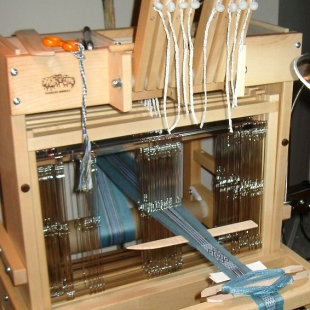
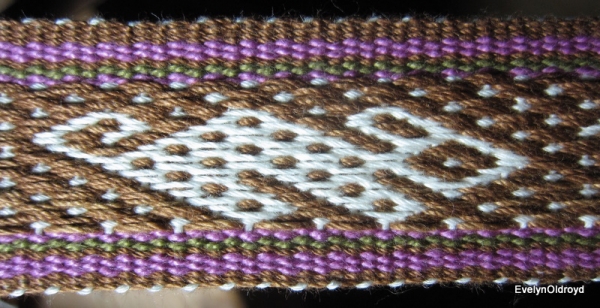
She has a really nice inkle loom which has plenty of space in front to have the two string heddles controlling the pebble sheds, allows her to use the saver cord and she uses the loom’s heddles to form her picking cross.
TEXTILE TRAVEL TALES FROM DC AND BEYOND
Well, I am back in Bolivia after an exciting month on the road in the US. This was supposed to be a three-week trip and I was aiming to be back home to celebrate my birthday on August 13th but…one thing led to another, as it invariably does, and there was so much to learn and do…
I spent an intense day in the nation’s capital revisiting the Textile Museum and the National Museum of the American Indian.
We checked the weather in Santa Cruz on the morning of my flight from Charlotte, North Carolina and it said…”smoky with temperature in the high 80s”. This is the Santa Cruz winter! Smoky? Well I know well enough that this time of year is the seasonal “slash and burn” period as farmers prepare their fields not only here but also in neighboring Brazil for planting and the October/November rains. All refuse from the previous harvest is burned which makes the days hazy and turns the moon blood red in the night sky. At the height of the burn off the smoke descends in the early morning hours and can be as thick as a London fog in the streets.
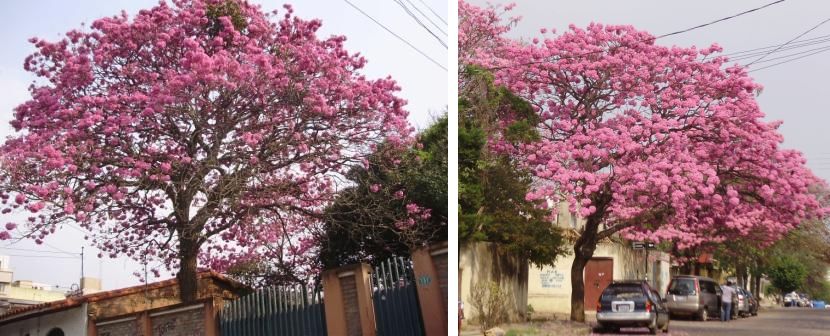
Perhaps this is not the best time to be in Santa Cruz but we are compensated somewhat by the fact that this is the time when the tajibos are in glorious bloom.
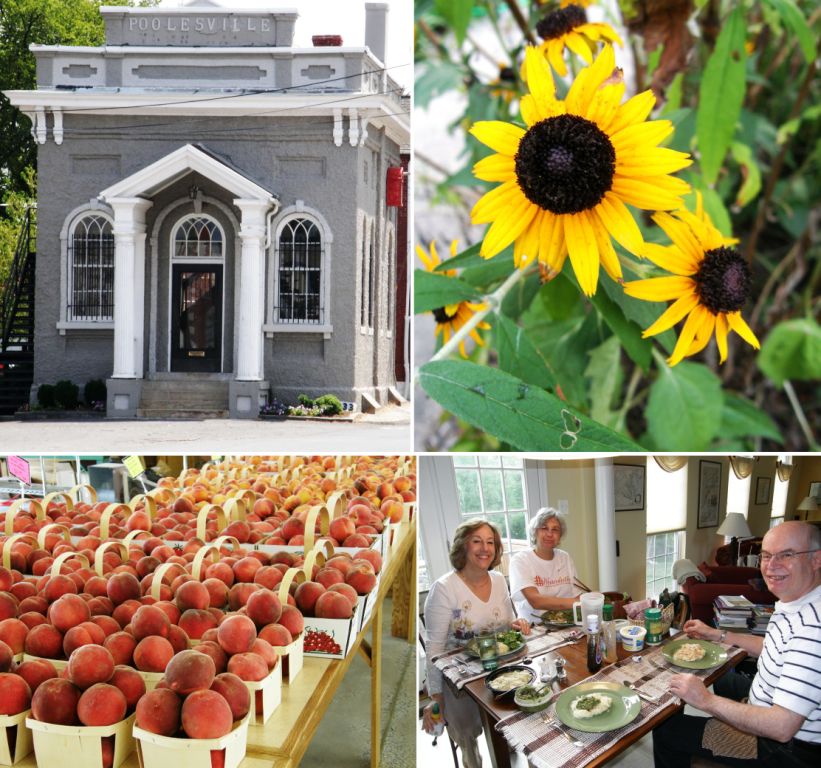
After Convergence in Albuquerque which I wrote about two weeks ago, I headed to Maryland to stay with weaving buddy and Weavolution co founder Claudia and her friends Janet and David. I was installed in luxury in their lovely home, after my humble digs in the Albuquerque hostel, surrounded by luscious Montgomery County farmland.
The original Poolesville bank still stands in this town of 5600 inhabitants. The black-eyed Susan is the state flower. Juicy peaches on sale at a local farm store and my three Maryland hosts.
Some of the gorgeous places we visited all in close reach of Poolesville…the Black Rock Mill (used in the Blair Witch Project 2 movie), part of the historical C and O canal system – idyllic! Typical picturesque farmland and the Great Falls which I am told are truly thunderous in the spring thaw.
The first few days had me catching up on much needed sleep after the Convergence frenzy. We toured the town and some local sights. Claudia has a comfortable air-conditioned basement studio with floor looms which make ideal tie up places for backstrap looms. Six of Claudia’s friends came over and we spent time playing with backstrap looms and the Andean pebble weave technique . It was a lot of fun and we were all exhausted by the end!
It was great to meet up with Kim again (at left) whose backstrap weaving skills are improving so much! We first met at the Weavoltuion meet-up at the Maryland Sheep and Wool Festival and then wove together at Claudia’s place last spring. Kim always brings lots of smiles and fun and she is one of my special weaving pals. I met JoCarol for the first time on this trip and this was her first backstrap weaving experience.Cameron is a tapestry weaver who wanted to give backstrap weaving a try and Kate took to it straight away. I am sure that she has gone home to weave way beyond the basics by now! Jill and Carol were also there and took home warps ready to put on dowels..
After the cool haven of Claudia’s air-conditioned home…did I mention that we were having days of ninety five degrees and up?…it was a bit of a shock to be out in the open the next day experiencing a bit of small town fun. Claudia and sell their handmade knitted, crocheted and woven goods online and often take stands at craft fairs. I was lucky to arrive at a time when the town was having a farmers’ market and got to sit on the grass and weave while they attended their stand.
I got my loom out in the morning and set up on Claudia’s deck to make sure all was in order but soon had to duck indoors as the temperature started to rise. At the farmers’ market, a couple of tent stakes driven into the ground served to hold the end of my loom although I did have to wriggle about a bit in order to relax and take up tension on the warp.
I set up my loom and weavings on the grass, Janet worked at her spinning wheel which attracted more little boys than girls while David and Claudia took care of business. It’s amazing how many winter woollies got sold on that hot summer day!
Nothing I can write here can quite capture the joy of this afternoon. We were out there in the relative cool of the late Friday afternoon. Families were out walking their dogs and toddlers ran and rolled in the grass. Bigger kids started an impromptu soccer game in the middle of the field, frisbees flew and a live band played. Friendly folk stopped by to look and chat. It was simple wholesome fun and all felt right with the world. I guess this is life in small-town America – just wonderful!! I am so happy to have been a part of it.
Saturday saw us hitting the road and heading to Adams County Pennsylvania to vist The Mannings. “The Mannings”…the very name inspires awe and I knew that I was in for a special treat. This was Claudia’s birthday yarn restash trip brought forward a week for my benefit.
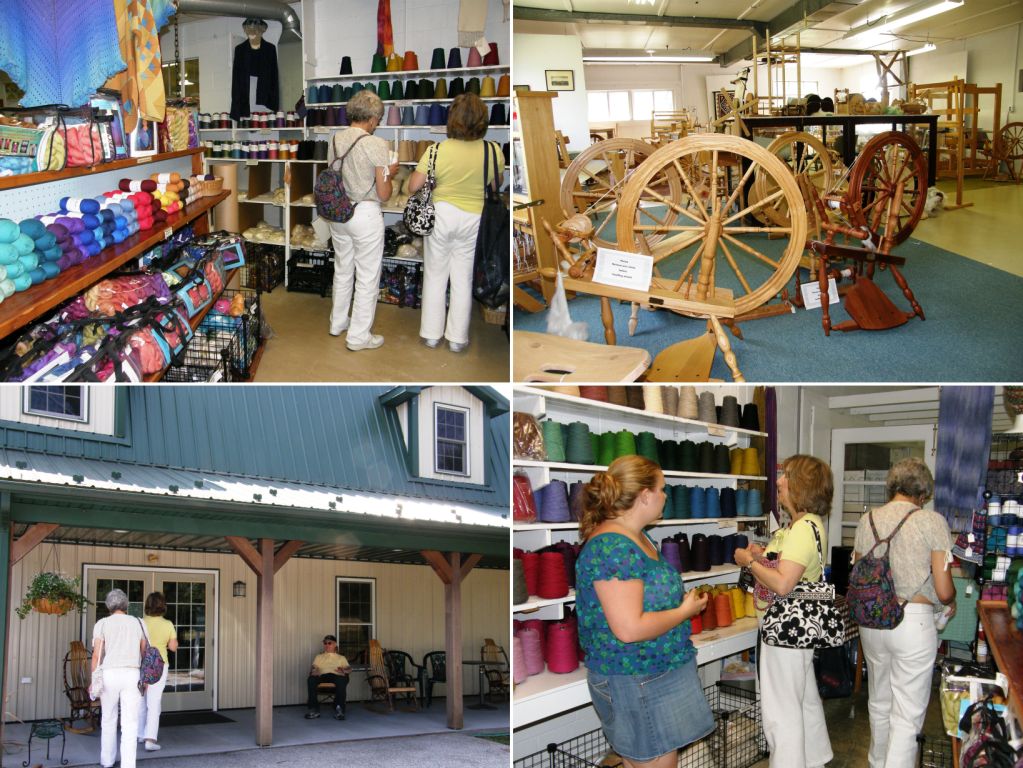
Kids in a candy store! The Mannings studio is housed in a beautiful old farmhouse. Rockers are provided on the porch so that those who are not fiber inclined can enjoy the serene setting. Above, Sara Knisely, one of the studio’s instructors, is helping Claudia and Janet with their purchases. I restrained myself and came away with just one ball of cream tencel to go with the two colors that a friend in Denmark had sent me a few months ago even though they had plenty of yarn that was perfectly suited to backstrap weaving. The Mannings also has a wonderful selection of weaving and other fiber arts books, beautifully and colorfully displayed with each book placed cover out. In fact, the entire store is so spacious and well set out with everything gorgeously displayed. It was lovely meeting Carol Woolcock who showed me about the enormous premises.
Above are some images from some of our other fun activities in the area. We took advantage of the proximity of Gettysburg to The Mannings to visit the battlefield. I told someone later about this visit and he shrugged and hmmphed and said “It’s just a field”. Well he could not have been further from the truth especially since we had Claudia’s friend David with us who is a history professor and, by acting a our personal guide, brought the entire battle to life for us.
I got to go to a baseball game…Nats versus the Phillies thanks to Kim who had an extra ticket. Lots of fun even though the Nats didn’t win. Janet lent me her Nats t-shirt. I visited a felt fiber artist, Zita Simutis at Visarts Fiber Studio in Rockville and she showed me the first steps of felting a hand warmer. She intended laminating a piece of silk to the felt, a technique which I believe is called nuno felting and has created several interestingly textured pieces with this technique. As we cruised from place to place ,we were forever passing fascinating buildings like this tremendous Victorian mansion in Buckeystown.
Shortly after I took myself off for a day alone in the big city! Well, this wasn’t my first time in DC. I had been through for a few days in 2007 suffering terribly from sleep deprivation after a particuarly horrendous standby flight experience starting in Sydney Australia. My memories of that visit are, therefore, somewhat bleary athough I will never forget meeting Ann Rowe at the Textile Museum and the exhibition of Central Asian yurt bands there. Little did I know at that time that I would end up studying these yurt bands a lot more closely and even start reproducing their structure and design.
I visited the museum bookstore and was happy sitting on the floor and perusing as many books as possible. Another kid in a candy store! I read that the hooked Central Asian design that I wove above is called ‘kaikalak” and that this particular warp float weaving technique is called ‘terme” in Kyrgyz. It is defined as a warp faced alternating float flatweave where the design is created by using two or more sets of differently colored warp yarns. A tutorial on this technique is here on my blog.
Another exciting discovery was an image of the Abba Yohanni card woven curtain in the cave church in Ethiopia. This was the first time that I had been able to see the actual curtain and, what’s more, an entire article on this and similar curtains! It is in one of the Textile Museum’s journals and I just had to buy it!
Above you can see the original card woven piece next to my double weave backstrap woven reproduction. This fourteen-page article by Martha Henze is full of black and white photos of both silk and cotton card woven curtains in various Ethiopian cave churches. The author states that ” for an extended period of time, probably in the middle of the eighteenth century, an unidentified group of artisans in northern Ethiopia produced large, exceedingly complex woven curtains by the nontraditional tablet-weaving technique for several churches in the region”…
The article serves to record the existence of the curtains and states that there is as yet insufficient data to explain how and why these curtains were woven.
I am happy to now have several more images of the curtains at my disposal to admire and whose motifs I may be able to reproduce in double weave. The pattern chart for the Abba Yohanni design is here.
I then had to drag myself away from the cool comfort of the bookstore floor as I wanted to spend the afternoon in the National Museum of the American Indian. I had also visited this museum in a bleary-eyed daze in 2007 and was looking forward to seeing it with fresh eyes and with a lot more weaving experience under my belt.
Several thrills awaited me there! I had photographed the piece at left on my visit in 2007 – one shot with my film camera which hadn’t turned out particularly well. I had no idea what the weaving structure was and simply liked the design which I adapted and incorporated into the red wall hanging at right along with a couple of invented motifs of my own.
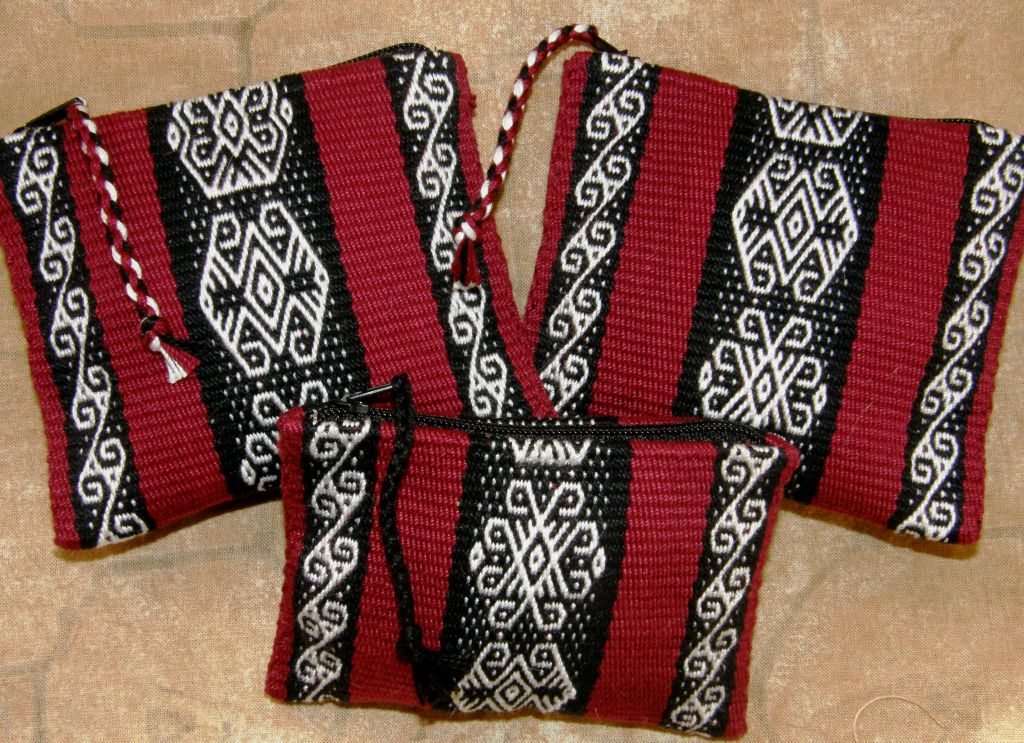
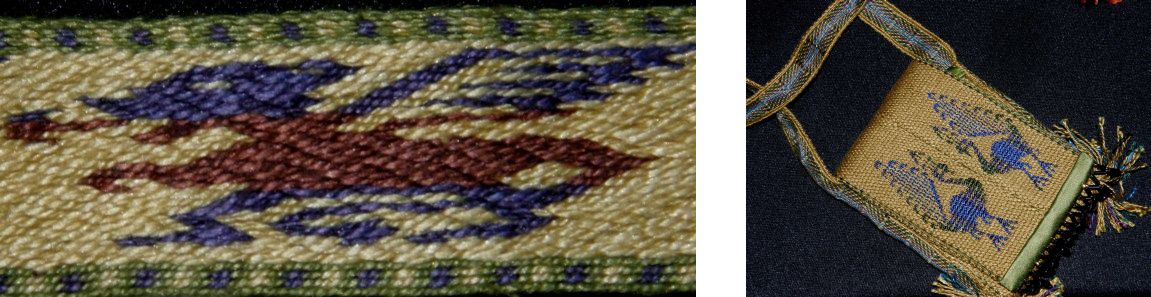
The motif appears again in the three little coin purses I wove above. These made nice gifts to friends on this trip. Now, three years later and three years wiser I immediately recognize the woven structure as balanced double weave. While investigating this technique when I wanted to reproduce a Peruvian pre Columbian piece, I discovered that the technique which is no longer practiced in Peru, is still used by the Huichol people of Mexico to create beautiful bags and belts.
Now the challenge I have set myself is to reproduce balanced double weave pieces with designs as complex as that seen above.
So far all I have made is the simple band with a sea bird motif at left woven on my backstrap loom using three sets of string heddles and a shed stick.
Coming up with an effective way to chart these designs will be the first step.
The Huichol people also produce these fabulously colorful yarn paintings.
Imagine my frustration, when attempting to find something on the internet about these yarn paintings, discovering that the Museum of Indian Arts and Culture in Santa Fe is currently exhibiting the work of the Huichol people! Argh! I was just down the road from Santa Fe when I was at Convergence!! Can’t win them all!
The museum does not have a lot of textiles in their permanent display but I think I managed to find them all :-).
I very much enjoyed seeing the photos, past and present, and textiles of the Mapuche people of central Chile and Argentina.
The textiles were a little difficult to capture behind their plexiglass protection but I am grateful that the museum does not in any way restrict photography. I expect they know what they are doing when they allow visitors to flash their cameras at the textiles.
Examples of compelementary warp, supplementary warp and ikat pieces of the Mapuche people. I love their big bold geometric ikat designs.The complementary warp technique employed in the brown and white Mapuche piece is the same that I used in this piece which has my adaptation of a traditional Mapuche motif.I was intrigued by this piece but strangely could not find any information nearby on its origin. It is a simple warp float technique and what I find most interesting is that the weaver has eliminated the appearance of the horizontal stripes on this piece by simply dropping those warps and allowing the weft to be exposed. As the weft is the same color as the non floated warps, it is hardly noticeable. I would have loved to have seen the back of this textile to see the resulting floats but, unfortunately, there it sat all rolled up.There weren’t any examples of the textiles woven by the Ka’apor people of Brazil but this display shows the very interesting shuttle they use to carry the weft for their woven hammocks and the photo shows it in use.
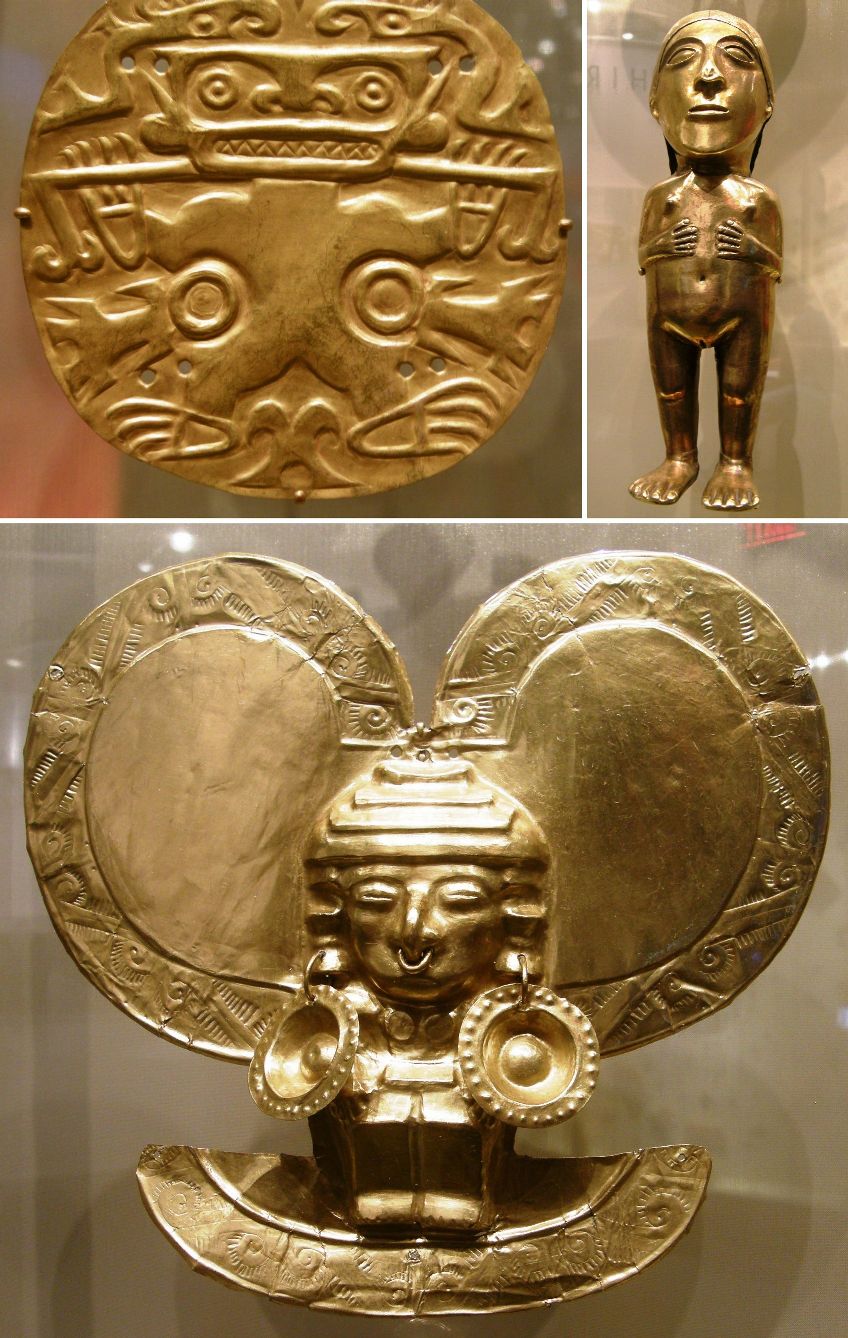
Some of the other breathtaking pieces that the museum has to offer. It was exciting to see these gold pieces, many of which I recognized from books I have here at home.
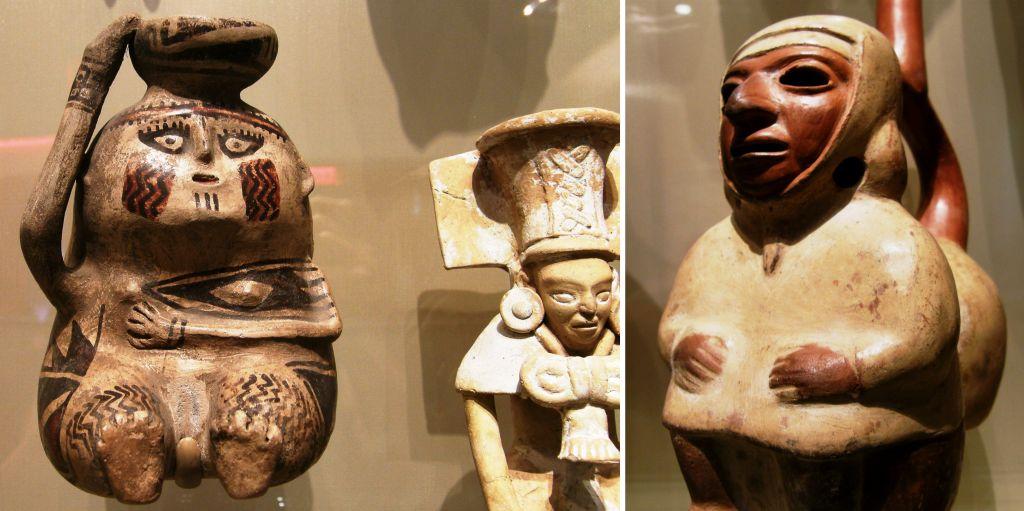
I was hoping to see some of the Moche ceramics which often show scenes of weaving in progress but didn’t find any (which doesn’t mean that the they don’t exist at the museum – there was so much to see!)
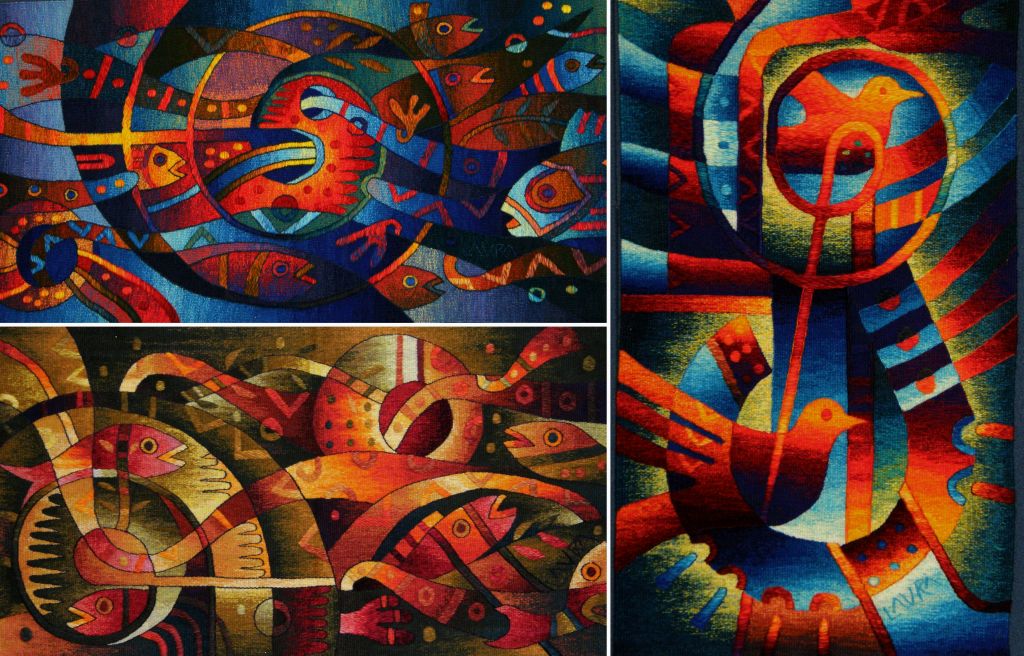
Unfortunately the museum shop didn’t have that much to offer in the way of books to interest me but I did enjoy seeing the weavings of Peruvian Maximo Laura. I was able to see one of his pieces in the Small Expressions exhibit at Convergence this year and I believe that his piece actually took first prize in the same exhibit at Convergence 2008.
So that was my intense and very satisfying day out in DC. This was followed by an evening out with my gracious Maryland friends at a Scottish pub for an evening of shanty singing! And if everything simply must have a textile twist, there were plenty of gorgeous tartans decorating the walls there.
I visited a store called “Ten Thousand Villages” on my day out in Rockville. This store supports the ideas of fair trade and sells crafts from cooperatives in developing countries all over the world. I spent well over an hour in this store looking at all the fantastic craft pieces and finally tracked down a piece from Bolivia – the above pictured bear! made from alpaca. This was the last thing I expected to see from Bolivia and am thinking that there must be some weaving cooperative with products that are more representative of Bolivian culture to sell.
Which brings me back to Bolivia and the present although….there is the whole North Carolina chapter of the trip and the time I spent with the Vietnamese backstrap weavers there.
I have a lot to show and tell you about that experience which happily coincided with my birthday but I still have some research to do on that before I can be ready to post.
At left you can see weavers Ju Nie and Ngach who dressed me in one of their typical backstrap woven skirts.
I would also like to show you the Andean pebble weave guitar strap which I was weaving on my friend Lisa’s four-shaft loom. After putting together the appendix with the instructions for pebble weave on this kind of loom in my book, I was eager to warp up for something wider than a narrow band and make something long and useful. We found some great yarn from Turkey in a local yarn store which has proved to be perfect for warp faced weaving and comes in great colors. More on that next week.
I have taken the warp off the loom and hope to get it set up on my backstrap loom to finish. Wish me luck as the whole warp now needs to be retensioned having been cut – yikes!
I have been getting more feedback on my Andean Pebble Weave e-book. I met Kim at Convergence and she went home and bought it and has been working her way through the lessons. She has been weaving on her upright Navajo style loom and producing beautiful bands. With her permission I am posting photos of her samples here.
And I also hear from weavers who need a little help and advice along the way as they venture into backstrap weaving. Cheryl contacted me on Yahoo as I provide my email address in the book and, after sending me photos of her warp in various stages, we were able to sort out her problem. This pleases me no end. I also heard from a couple of weavers who have been having trouble with excessive pilling on their heddles and so I am posting an excerpt from my WeaveZine video on opening the heddles on narrow warps.
What I would like to point out is that this problem of “pilly sticky” heddles is very common when one is starting out and is simply to due to inexperience with opening the heddles smoothly and efficiently. Try not to drag the heddles up and down the warp but rather lift them straight up. I actually sawed all the way through some of my warps from rough heddle handling when I was with my Peruvian teachers!
Next week I will post a video showing how to handle the two sets of heddles required for Andean pebble weave.
Here is a very short video of Pitumarca weaver Antonia, whom I met at Convergence, weaving on her backstrap loom. She is weaving a four-selvedge piece and is at that uncomfortable point where there is not much room left to manouver. You can see her doing the pick up using the point of her “ruki” ,or “wichuna”, as we call it in Bolivia. Then she is seen opening her heddle shed, working the sword into the shed and beating in the weft.
Just last night, I was contacted by Kathleen Klumpp, the American anthropologist with whom I worked in coastal Ecuador. Kathleen is with the weavers now and has invited me to join her and I just don’t know if I can fit this trip in. Let me tell you that I am SO tempted! She is working with the weavers trying to help them develop a product to sell which will enable them to continue weaving and practicing skills that are on the verge of being lost forever. Weaver Trini has been producing cotton saddlebags. As the market for these is now virtually non existent, she is now experimenting, with Kathleen’s help, in making shoulder bags with traditional designs. More about Trini and the coastal Ecuadorian weavers can be seen here and here.
Here is one of the first results!
I am so excited about this project and am so touched by Trini’s obvious joy in the above photo that I am making plans to go to Ecuador somehow as I write!!
Convergence is now long over and I can’t believe I have left it so long to write up this blog post. You have no idea how hard it was to skip that first post having gotten into the habit of regular Friday posts. Then the next Friday slipped by….The danger with waiting too long to write is that you risk losing that special feeling that you had associated with the event and even forget some of the important details. So here I will try to recreate some of that and I do hope that I don’t leave anything out. I was surprised to have some people at Convergence ask me to please stop posting for a while so that they could have the chance to catch up! I have been relieved to see that readership has only slightly dropped off during these two weeks of madness. So I hope you have, in fact, had time to catch up on things and perhaps revisit some pages because…. here we go with a bunch of new stuff…
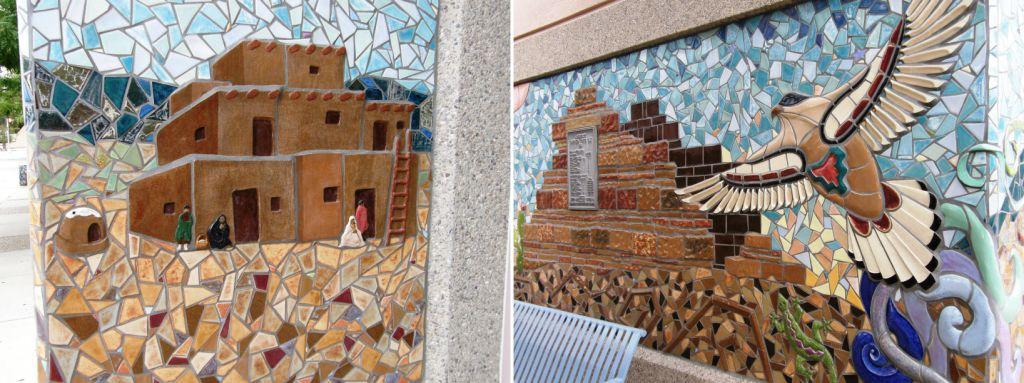
These are some of the colorful murals that decorate the outside walls of the Albuquerque Convention Center. These are probably all the “classic” New Mexico scenes you will see on this blog. Thankfully, this was my fourth visit to this beautiful state and so I was not overly concerned about not being able to get out and about. I glimpsed some hills on my shuttle ride in from the airport and then, as I was staying downtown 8 blocks from the Center, my only view on my walks to and fro were downtown buildings..
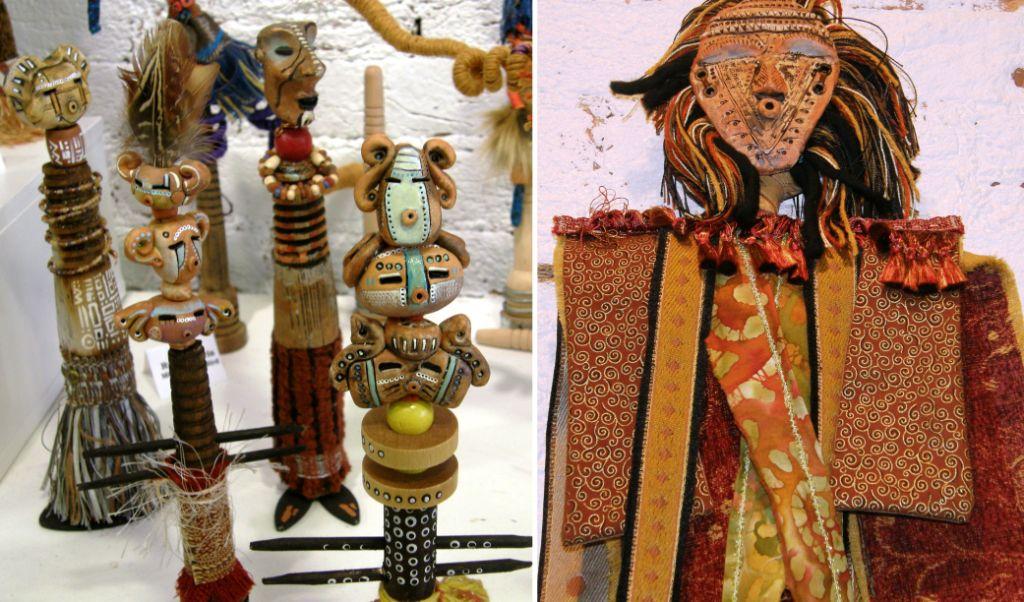
On my first day in town I did manage to get out to see a gallery of Joanne Moore’s double weave pieces downtown and I was fascinated by these wire dolls made by Ruth Morris.
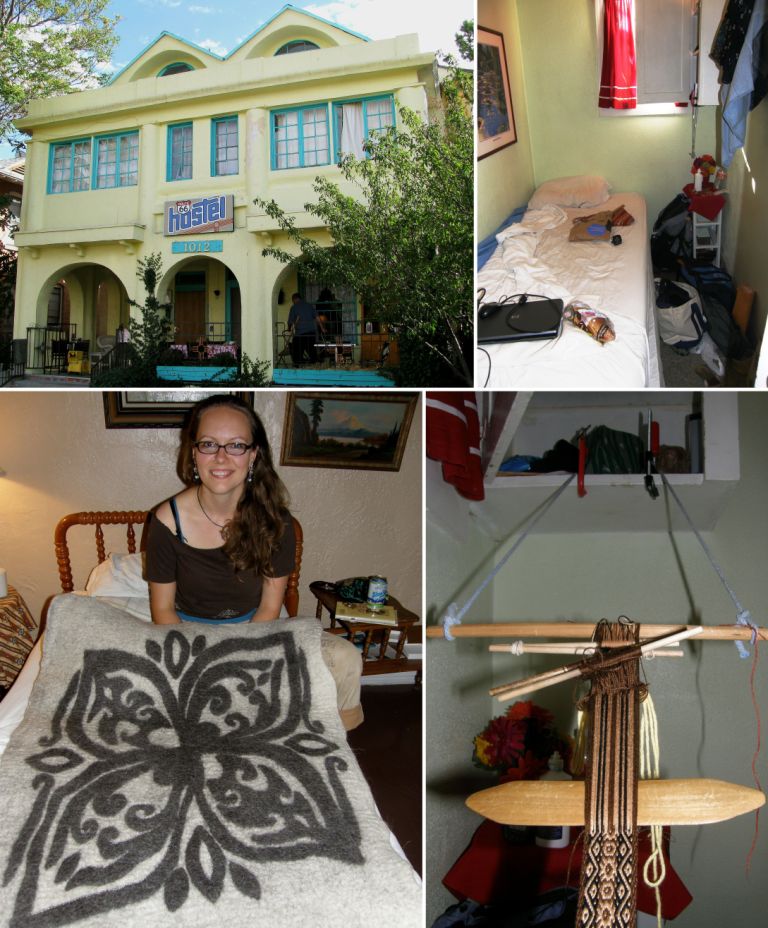
This was my home sweet home for the duration of my stay…Route 66 Hostel…a backpacker style place where I had a wee closet-like room with free wifi and breakfast and a very laid back family atmosphere. The only other Convergence participant there was Jasmine Johnson-Kennedy who had come all the way from Fairbanks Alaska – possible as far north as Bolivia is south! Jasmine took the felting class and produced this gorgeous piece. It was fun meeting up with her at night and seeing her work grow. She had just started outlining her design in stitching to give it a raised three dimensional effect on her last day of classes. Of course I had to find a place to tie up my backstrap loom in my wee abode and, as I had wisely brought clamps, I was able to do so on a little shelf unit on the wall.
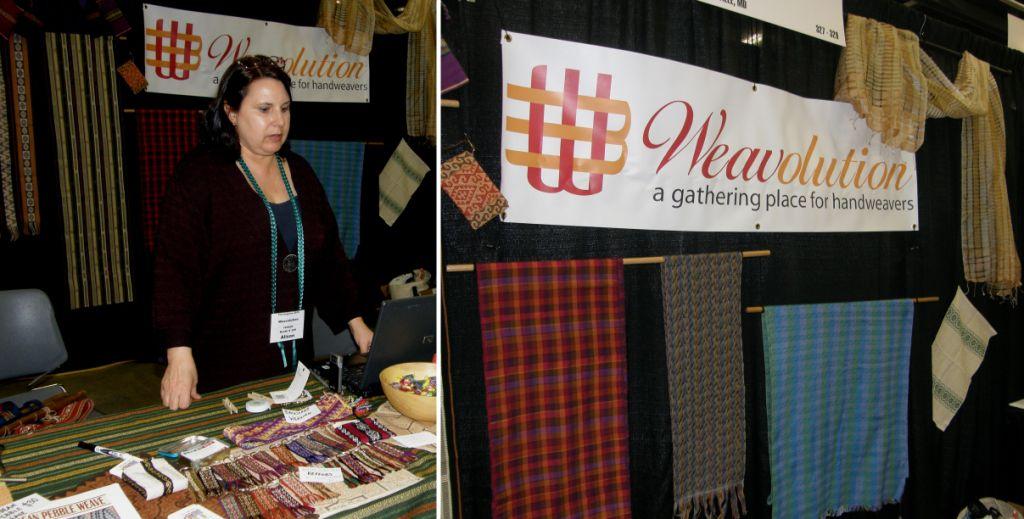
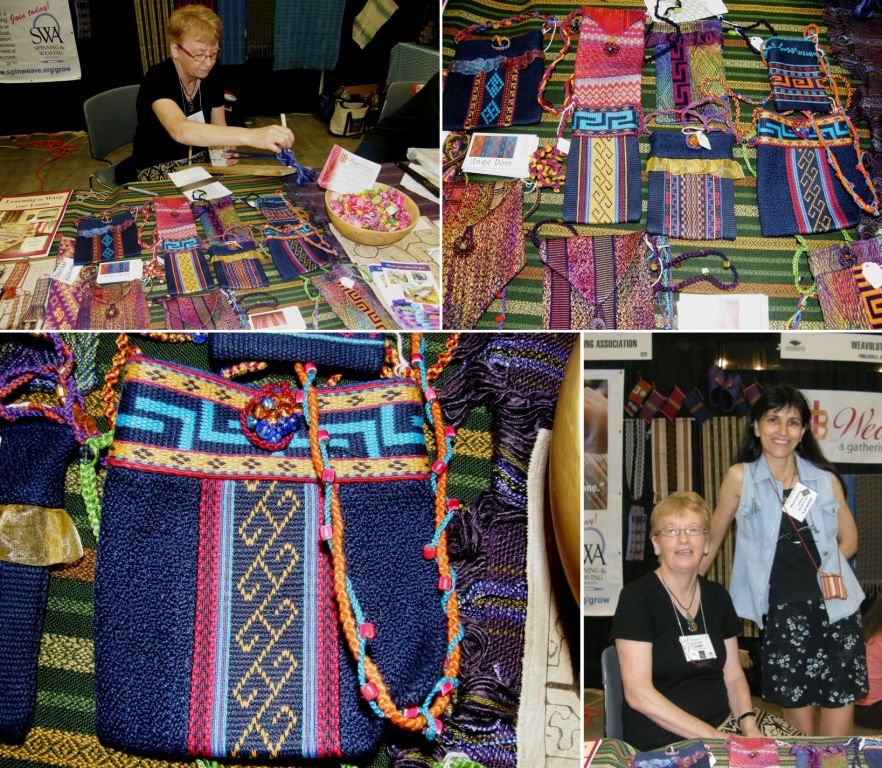
My goals for Convergence were to meet my online weaving friends and hang out and backstrap weave. I was sitting at the Weavolution booth between my wanderings just so that I could give Weavolution co-founder Alison Giachetti a break now and then. The booth was shared with SWA (Spinning and Weaving Association).
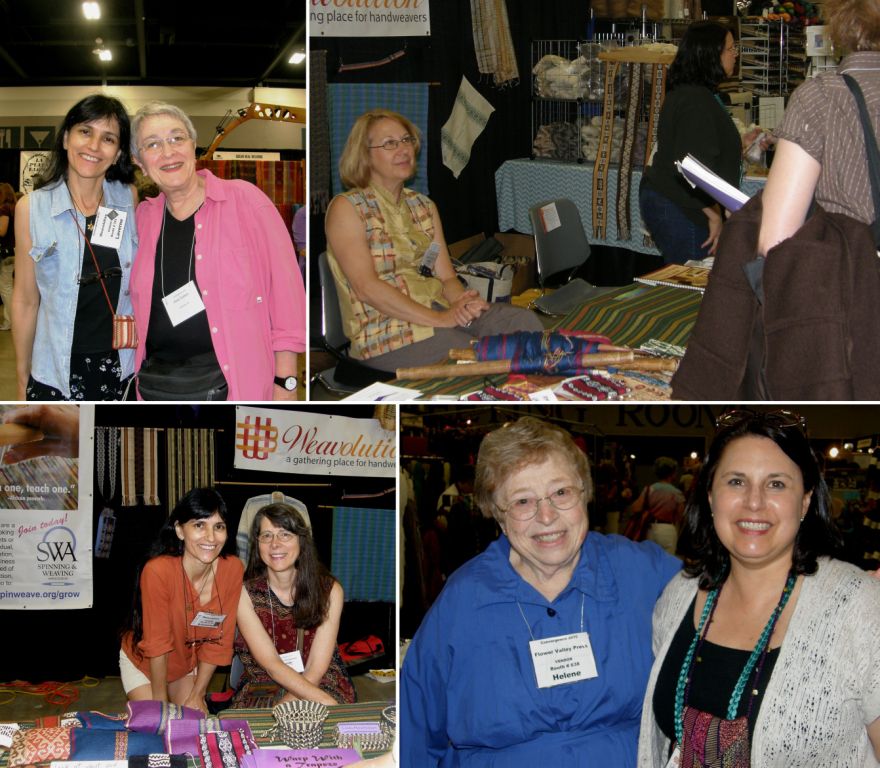
Here’s Madelyn van der Hoogt of Handwoven magazine visiting the Weavolution booth. You can see Madelyn above trying out a handwoven jacket she had seen on one of the stands. Tien Chu, one of Weavolution’s founders came by to show her latest project – a beautiful double weave shawl. Patty Graver of Interweave flew by to say hi and I was very happy to have a visit from John Mullarky of TWIST as we had met online at Weavolution while admiring each others’ bands on the Project Pages there.
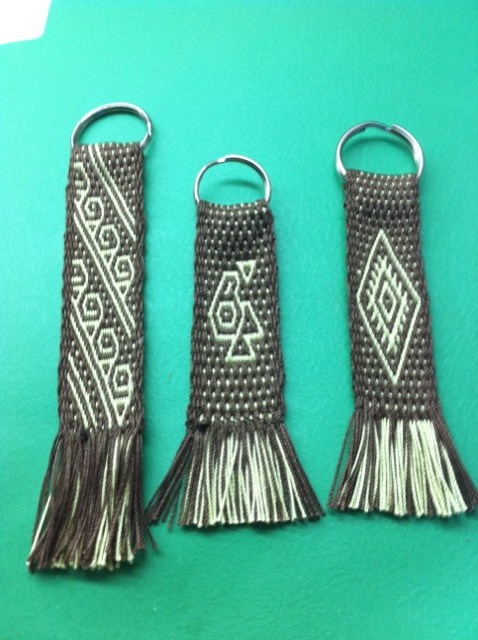
Day One was short as the vendor hall was only open from midday to five pm but it was a nice introduction to the routine we would be following for the next few days. Sally Ogren kindly allowed us to use some of her pieces to decorate the Weavolution stand and I hung a few of mine. Here you can see Alison with a display of my keyfobs and Weavolution goodies.
Day Two started for me with a wonderful surprise visit from my very first dear weaving teacher, Gladys Miller. Gladys taught me Navajo style weaving back in 1995 and had also taken me on two wonderful roadtrips through the Four Corners area in 1995 and 1996. I blogged about this here. Over the years we had lost touch until Gladys saw my name on the Backstrap Basics article in WeaveZine and emailed me. She had not told me that she was planning to come to Convergence and so it was a complete surprise. She stayed a day and we caught up and then she headed to Santa Fe to see the Spanish market with her granddaughter.
I was free to weave, visit some booths and be a bit more helpful on the Weavolution stand. It was a hard decision where to go and be sometimes. All I had to do if I wanted to meet all the wonderful weavers in attendance was stay put at the Weavolution booth. They all came by to say hi. It seemed that every time I stepped away to see something I would miss someone.
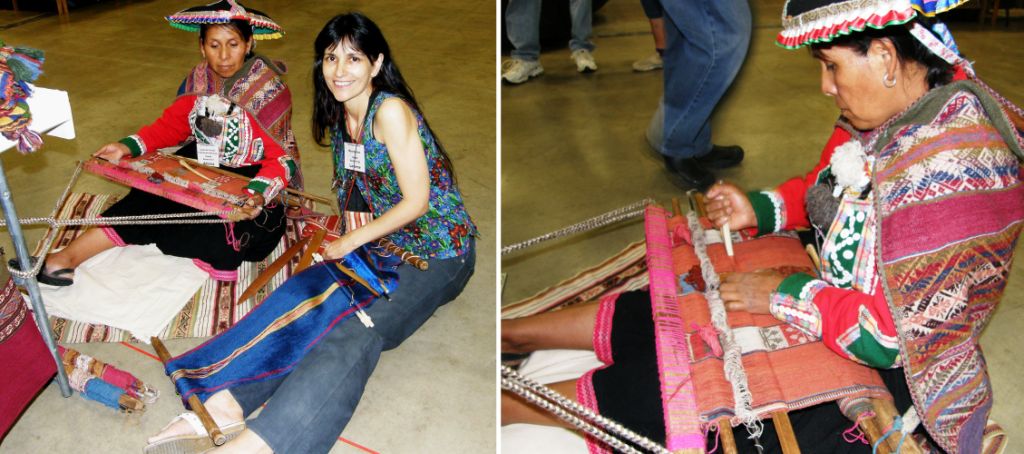
Later Antonia was working on a discontinuous warp piece, something I had never seen before, and a technique she says the weavers of Pitumarca are now trying to revive. Jenny and Antonia had brought several bone beating and pick up tools, called wichunas or ruki, which sold out in a couple of days.
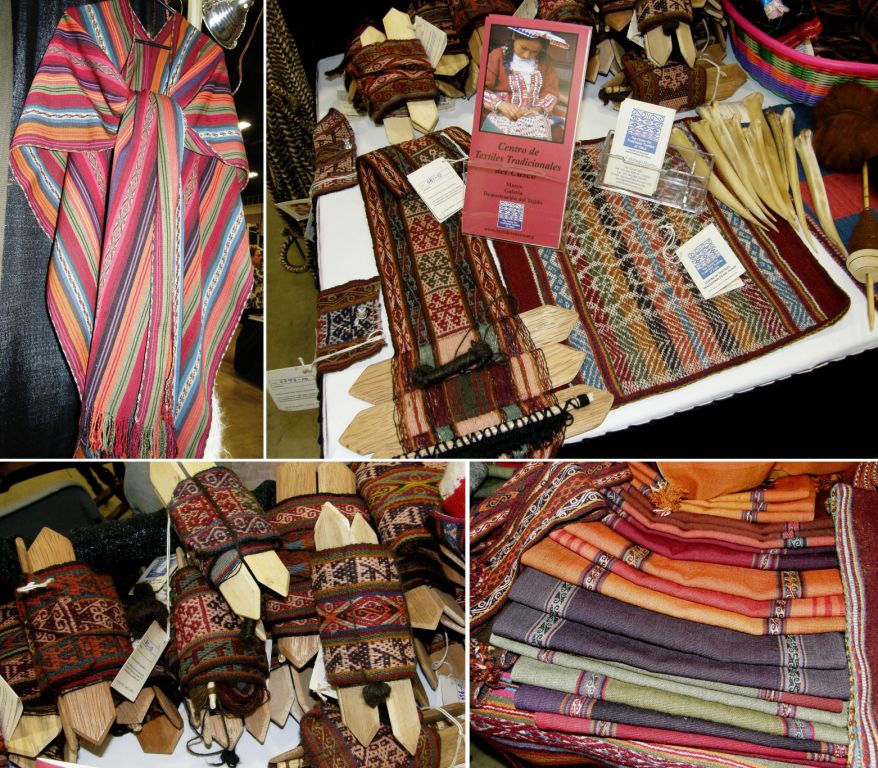
The CTTC (Centro de Textiles Tradicionales de Cusco) stand was a feast of colorful textiles….ponchos, cloths, bags, purses and woven belts still on their looms.
Meanwhile back at the Weavolution booth, we were being visited by Alice Schlein whom I had kind of met in “blog link land”, Daryl Lancaster who came to hang out and chat as well as to do a book signing, Linda Hendrickson, who thankfuly came back to visit several times ( I had gotten totally goofy on her first visit!) and dear Helene Bress.
We were privileged to have Inge Dam with us demonstrating her card weaving and selling some of her beautiful pieces.
Betty Davenport and I had connected online through my blog as Betty used to lead weaving trips to Bolivia in the 80s and 90s and enjoyed reading my tales about the places that she had visited and enjoyed. She has always been extremely supportive and especially helpful when I was first planning to write a book. She brought the new reprint of her Textures and Patterns book. It was wonderful to meet her in person. I got some impromptu ply split braiding tips from Betty’s roomie, Linda Hendrickson, and got to see some of the pieces she writes about in her up and coming book on the subject. She has certainly changed my mind about three dimensional pieces in this technique which had not previously attracted me although I must admit that the camel girths I have seen in ply split braiding are my favorite examples.
With Linda, I went along to the TWIST (tablet weavers) meeting as I recently joined this group. The TWIST newsletter was where I first read about the Hochdorf technique of tablet weaving which led me to weave Celtic knotwork in Andean pebble weave. I met Shirley Berlin of the Braid Society, another group of which, thanks to Rodrick Owen, I am now a member.
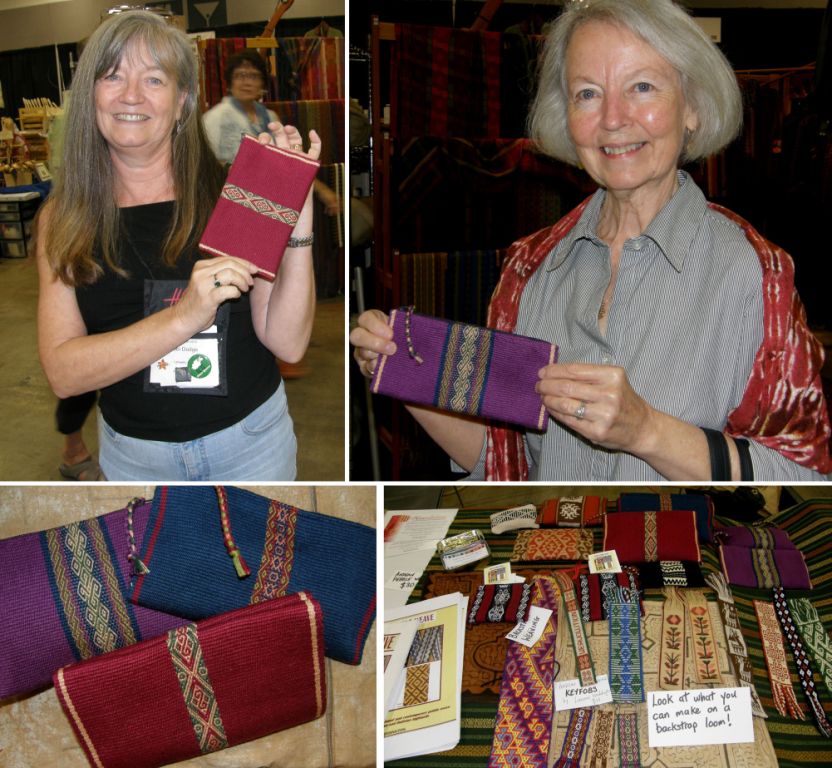
The TWIST meeting ended with a “show and tell”. John Mullarky showed some of his fine silk pieces and the piece above left and I loved the little purse made by Nancy Alegria using a design from one of Linda Hendrickson’s books.
And what about all those Weavolution folks?
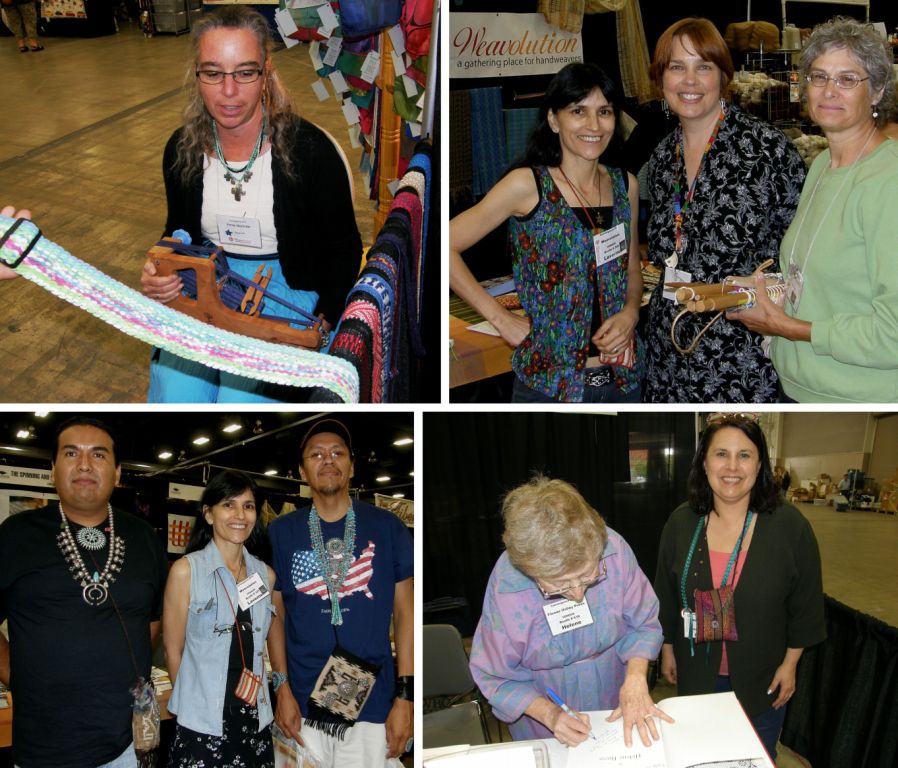
Here are some of our members! Annie MacHale (aspinnerweaver) at her inkle loom meets Helene Bress soon to be followed by an encounter with Richard Ashford who had spotted Annie’s inklette. Annie and I had met at CNCH and wove side by side at the Education Booth there. It was wonderful to meet Kathe Todd-Hooker again after our first meeting at CNCH where we had spent a lovely evening looking at her collection of Old Believer sashes. Kathe’s new book, So Warped. Warping aLoom for Tapestry which she wrote with Pat Sparks is now out and she joined us for a signing. It was wonderful to see Kathe’s tapestry take first place in the Small Expressions juried exhibit.
Tapestry weaver Tommye Scanlin, who also had a piece in the galleries, visited on more than one occasion and that’s John Mullarky, wearing his own hand woven jacket, who started the tablet weaver’s group at Weavolution.
One of our many SWA companions was John Colony of Harrisville Designs. I couldn’t have asked for a better booth mate as John is responsible for the Harrisville backstrap kit which I got to see for the first time. Not only that, he had also met and had classes from Ed Franquemont. Convergence offered what were called ArtSparks classes, one-hour introductory fiber classes, and John taught backstrap weaving to a group. The idea was to show adults how to to teach weaving on a simple loom to kids. The kit comes with a small rigid heddle segment and is quick to warp and get going. John allowed me to visit his group and take pictures and a couple of the students soon found their way over to the Weavolution booth to watch my demo.
More cool people passing by and stopping for a chat… Annie attracted weavers with her inkle woven guitar straps. Anita Osterhaug from Handwoven magazine dropped by and Pam Engberg. a Weavolution Backstrap Group member brought a warped up loom along to get some tips from me. I had Navajo, Pueblo and Hopi weavers stop to look at my loom and work. These two Navajo guys are weavers and wove the bags they are carrying. They shopped for churro fleece to spin. Helene Bress signed a copy of her coverlet double book set for Alison.
The stand with antique Indonesian textiles, Dancing Threads, was a great favorite of mine…
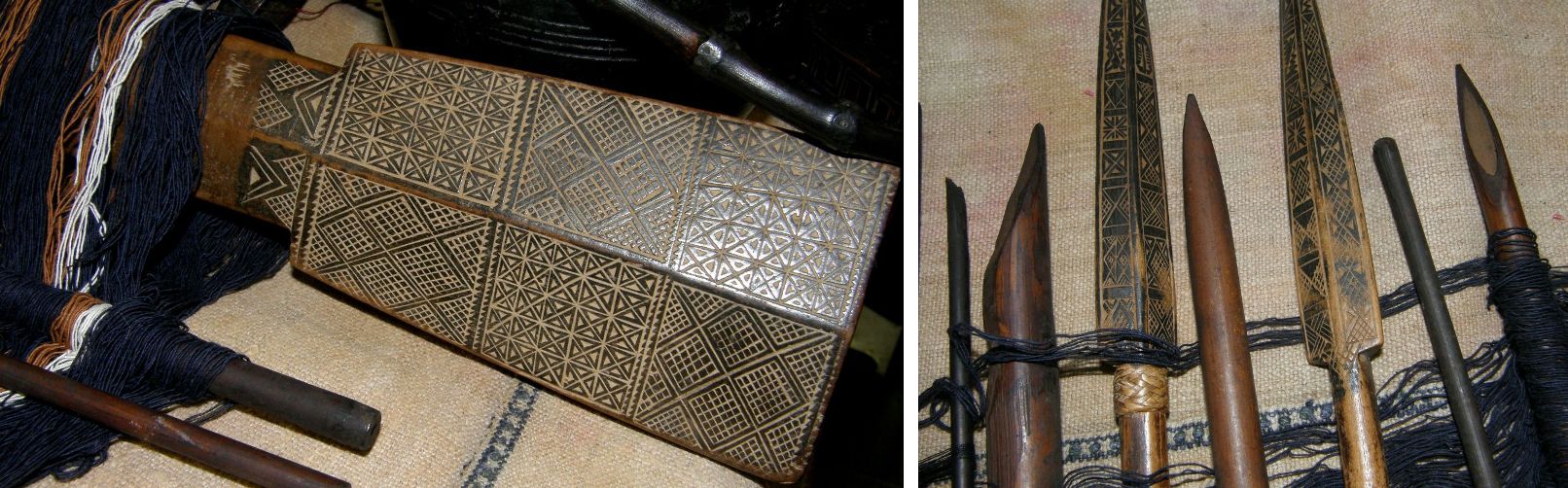
The stand with weavings and silver ornaments crafted by Chinese minorities and run by Pam Najdowski was a treasure trove and is where I did my spending. Pam was such an interesting person and gave a slide show on the main stage on her many trips to China.
I have been looking for bamboo reeds in a good size for my backstrap loom and thinking about having them specially made in Bolivia. Now I have these two beauties bought from Pam’s Textile Treasures booth. I also got the pair of string heddles which I may use on my loom but which will most likely go on the wall. I just love them!
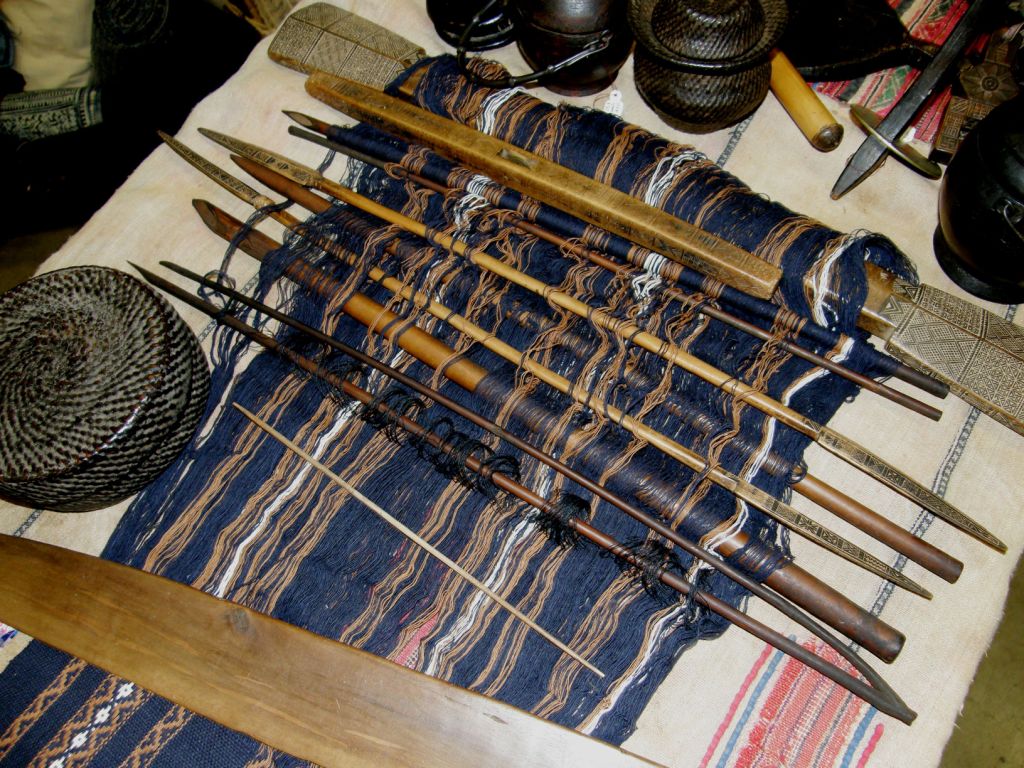
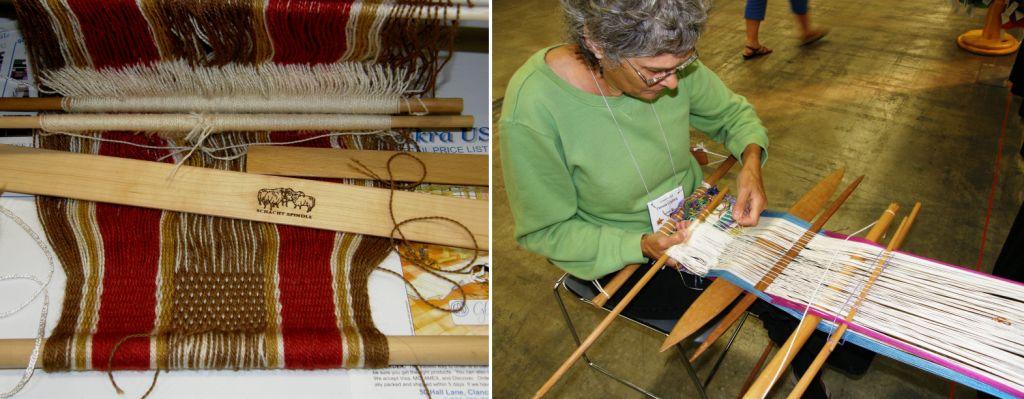
This backstrap loom, which the weaver tensions with her feet, blew me away. I had to go back and back again to see it. Below you can see the paddle-like pieces against which the weaver braces her feet. I would like to try this. Only once I tried tensioning the loom bar behind my toes but it wasn’t a position I could maintain for any length of time. The patterning on the woven piece was really quite simple and controlled by the several patterning sticks you can see there in the loom.
Another loom which Deb McClintock took me to see…
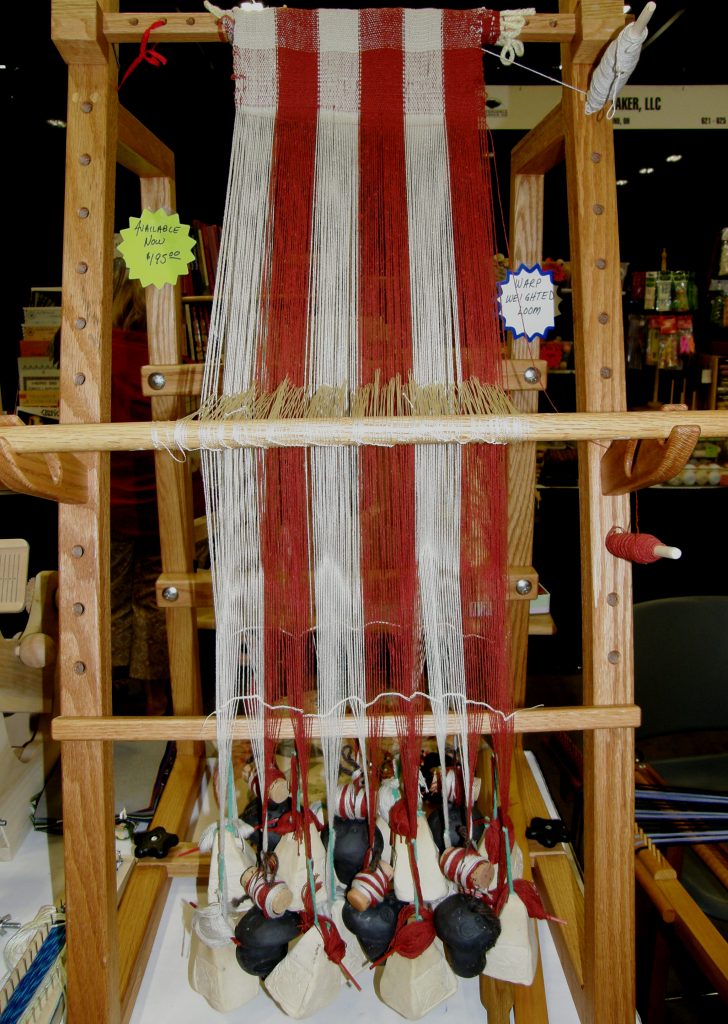
A warp weighted loom above…heard about them, read about them but had never seen one up close.
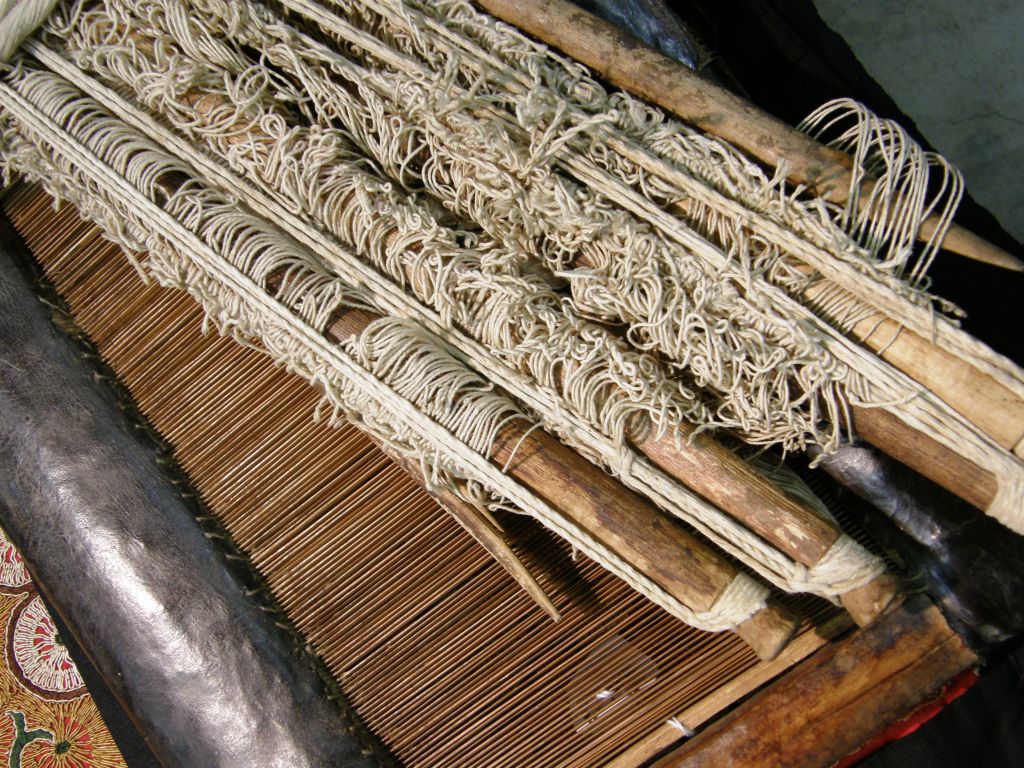
And one more curiosity at the Textile Treasure stand. I would love to have been able to see this one stretched out. Look at that beautiful reed!
I got some gifts! Kim Hamill of Weaving Southwest, who is also a backstrap weaver and teacher, gave me some yarn that she likes to use and which she dyed herself. Pam from the Textile Treasures stand, knowing my love of all things pebbly, gave me this belt which I am sure to have fun examining and reproducing when I get home. Betty Davenport gave me a crinkle weave warp that she got in Bolivia which I can finish weaving. I have never seen one of these before except in pictures. Above you can see how overspun the commercial yarns need to be before they can be used on a backstrap loom.
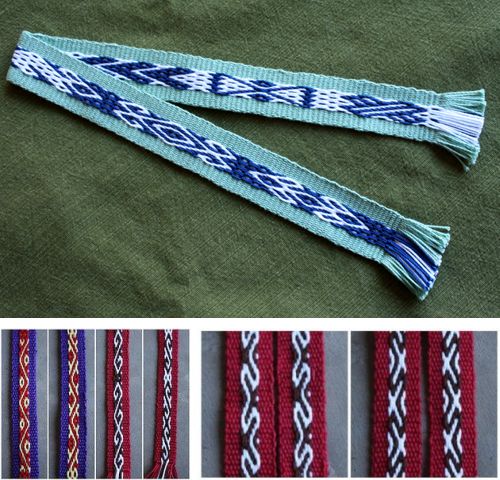
Then along came Martha Graham, an anthropologist who has been studying the belt weaves of the Tarahumara (Raramuri) weavers of Mexico. She spotted my display of my largely pebbled weavings and brought along, the next day, some Tarahumara belts that she just happened to have in her car! I got to photograph them and you can probably guess what is on the “to do” list for when I get home…reproductions and a comparison to Andean pebble weave. So this is the “new Mexican weave” that I refer to in the title to this blog post. I had never seen these belts before nor heard of the Tarahumara people and their weavings. Then lo and behold along came Annie MacHale the following day wearing one!! Hers is the one with the colored border above.
More Weavolutionaries!
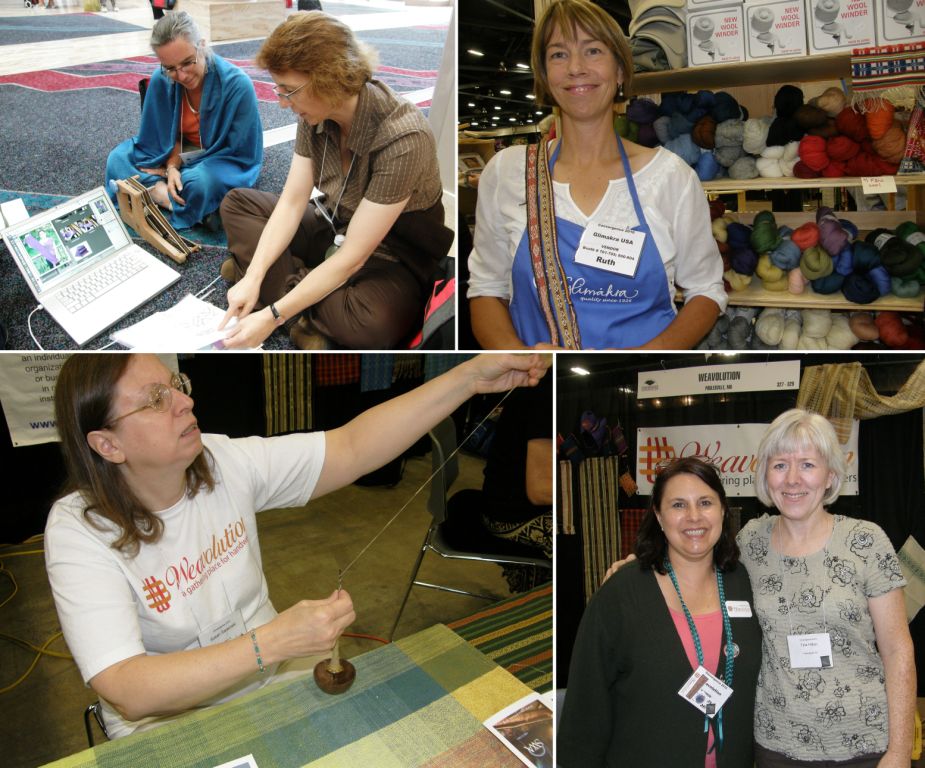
Annie and Sally Ogren at the meet-up deep in discussion about charting software and inkle bands. Ruth (Ruthie99) from the Glimakra stand has bravely branched out into weaving with wool on her backstrap loom and brought it along for me to tame! She is displaying here on her shoulder some of the pebble weave bands she made following the intructions in my monograph. Craftin’ Susan (Susan Sarwinski) spun silk while helping out at the Weavolution booth and Tina Hilton stopped by for a chat.
At left, Ruth’s wool warp which she dyed with all natural substances, now under control and ready for pebble weave patterning. Look at the fabulous red she gets from cochineal. She shared her dyeing secrets with me. It is lovely wool that she didn’t respin and it behaves very nicely – Henry’s Attic Crown Colony 2 ply. She uses a Schacht sword, pictured there with the warp, which works beautifully (I took this warp back to my hostel and worked on it) and I think it is a great tool for backstrap weaving if you are looking for a sword. Pam Engberg also brought a warp that needed some attention. She is trying out Guatemalan brocading for the first time and so I helped her improve her heddles and insert a second patterning stick to vary her designs.
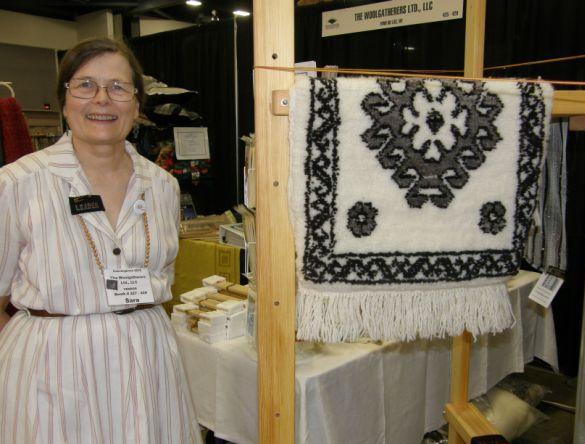
It really was a delight to meet our booth neighbors Hans and Sara Von Tresckow of The Woolgatherers. I have “known” Sara for some time as a fellow member of Weavolution and she has shown two of her knotted pile projects on the site. It was amazing to be able to see one of them up close. I got to drive one of her big looms – first time ever for me! Quite a treat!
Other cool stuff….marvelous huipiles at the Red Corn stand. Annie’s friend Joanne showed me a carrying cloth in her collection and I was surprised to see a double weave band on it which suddenly changed to pebble weave. I have never seen these two weaves combined like that before. The weaving tools at the Chinese minorities booth had me constantly sneaking back for more. Jeffrey Appleby’s stand had an intriguing array of textiles, books and artifacts including this Turkish spindle and distaff. I bought his book “Traditional Textiles of the Andes” which he signed for me and which contains his personal collection.
I didn’t register for Convergence nor take any workshops but I learned so much! The experience of being in the Vendor Hall and meeting all these wonderful people exceeded my expectations. In a way I was sorry for the people who only had a brief lunch break in which to come into the hall and mingle. As it was, there never seemed to be enough hours in a day for me to weave, look at booths and chat. I only saw a third of the Vendor Hall after 5 days!
It was such a sharing experience. Betty Davenport wove and gave me a pebbe weave piece and I was delighted that she accepted my Mapuche purse in return.
Meanwhile weavers have been warping up their four-shaft looms to try out Andean pebble weave using the instructions in my book...
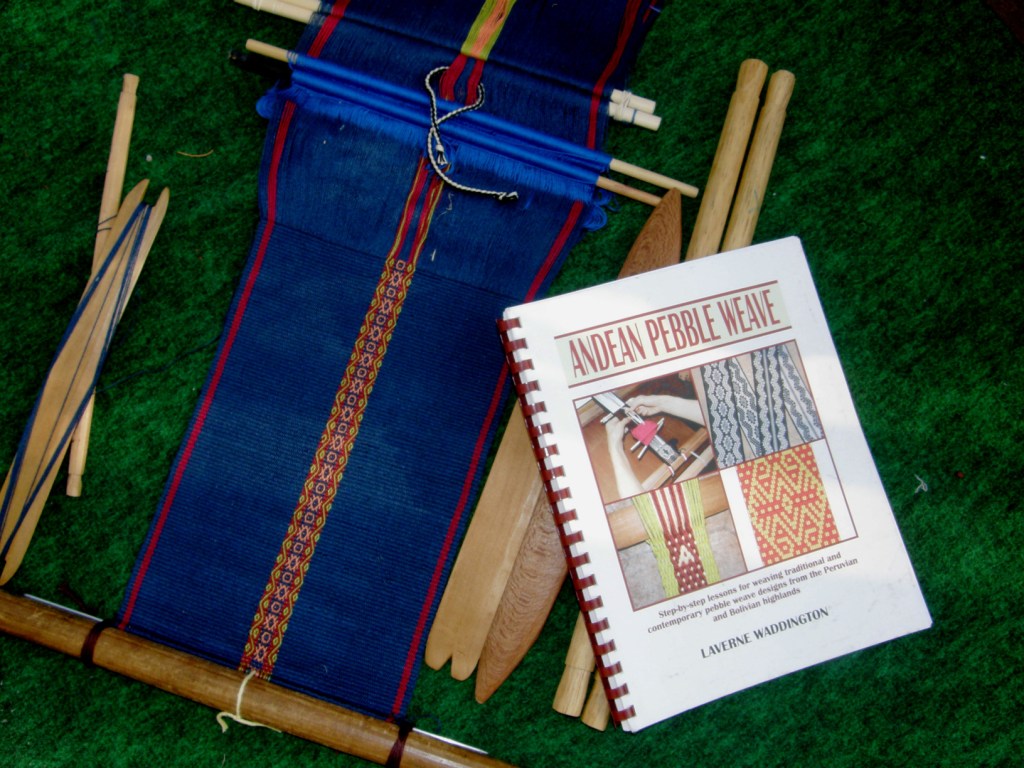
Jeanne from Weavolution is on her way and hopefully we will see this completed band soon and then a wider project. You can buy both the download version or the hard copy of my book Andean Pebble Weave which include the draft and instructions for pebble weave on a four-shaft loom here.
Evelyn wove this little guy using one of the pattern charts in the book. This is a “viscacha”, a small Andean animal with a long tail that resembles a rabbit.
Would you believe I have four tiny video segments of Antonia weaving to post here? I think I will leave those for another time! I am in Maryland now with my friend Claudia where I am being treated like royalty! But sadly it is time to move on and tomorrow I take the train to my friend Lisa’s place in North Carolina. More about the Maryland weaving adventures next week! 🙂


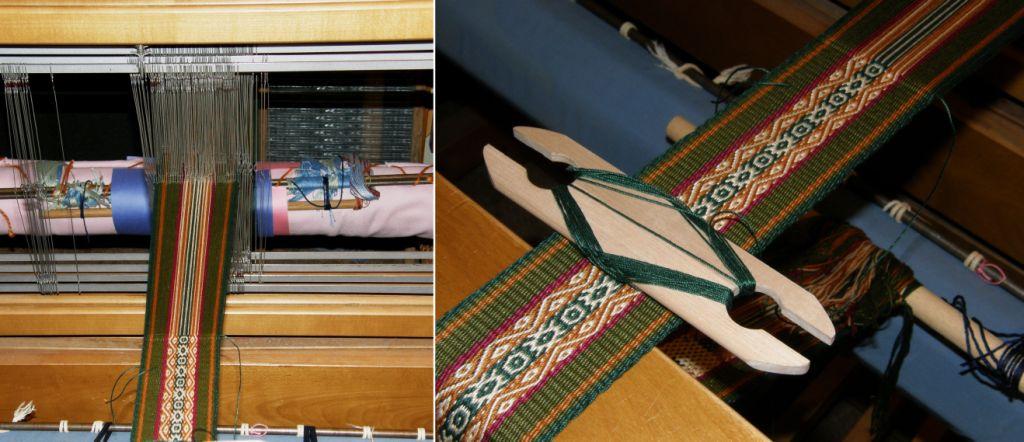 We warped up Lisa’s four-shaft loom to weave a guitar strap patterned with designs in Andean pebble weave. I will have more pictures of this next week too.
 The highlight of this visit was the trip we made to spend time with the Montagnard weavers. I was lucky to have been able to make contact with Betsy Renfrew, at left with weaver Nach Rahlan, some weeks before leaving Bolivia for this US trip. She invited me to her home where she and her husband Andrew arranged for us to meet two of the Montagnard weavers with whom she has been working. Read about Betsy and Andrew and their goals for working with the weavers here.
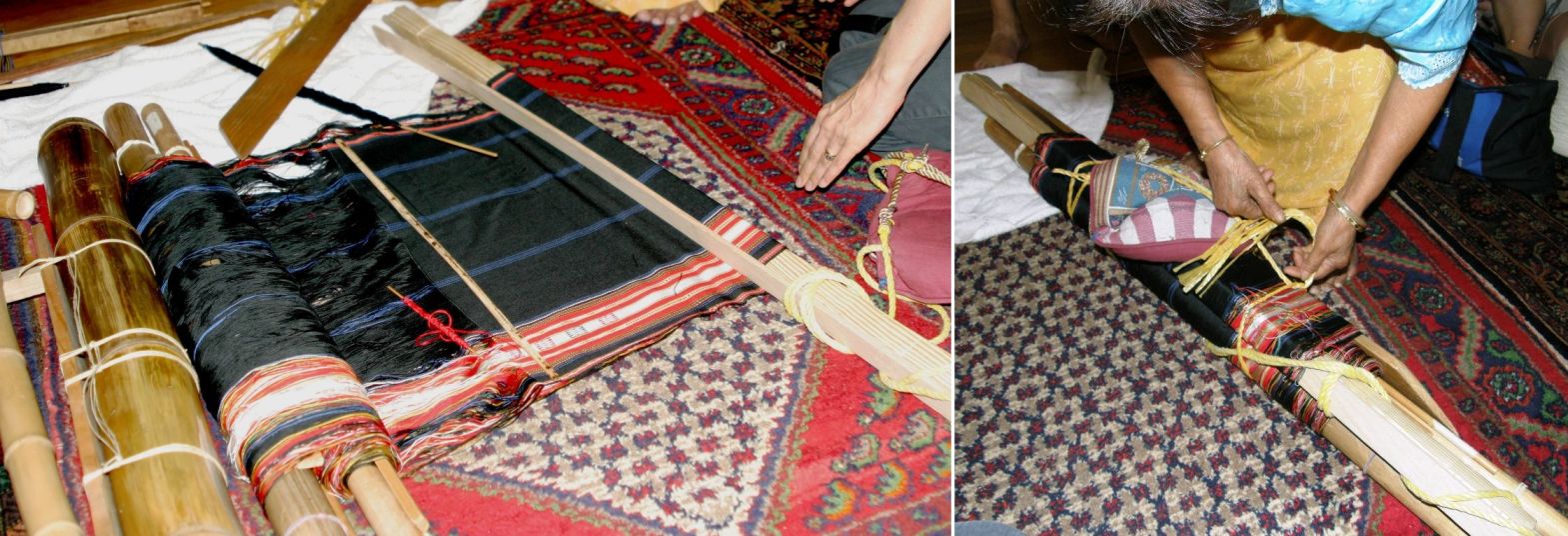
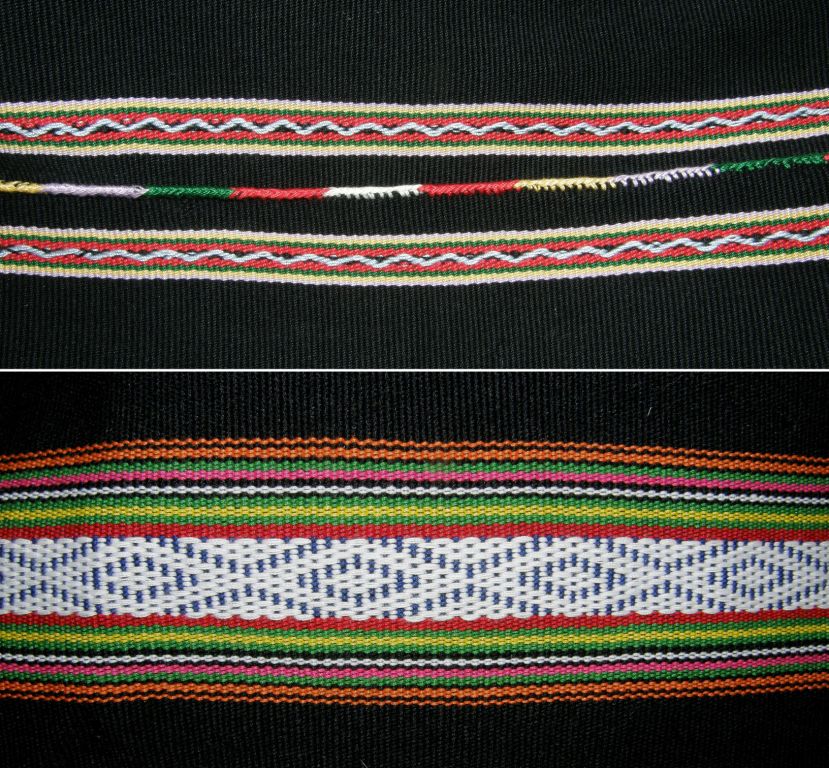 Above you can see how panels of blankets and skirts are often joined using single columns of cross knit looping which I am used to seeing here in Bolivia in double and triple columns to edge coca leaf bags and other items. The lower picture shows simple warp float patterning where single warps are floated over a background of horizontal bars to create this striking pattern.





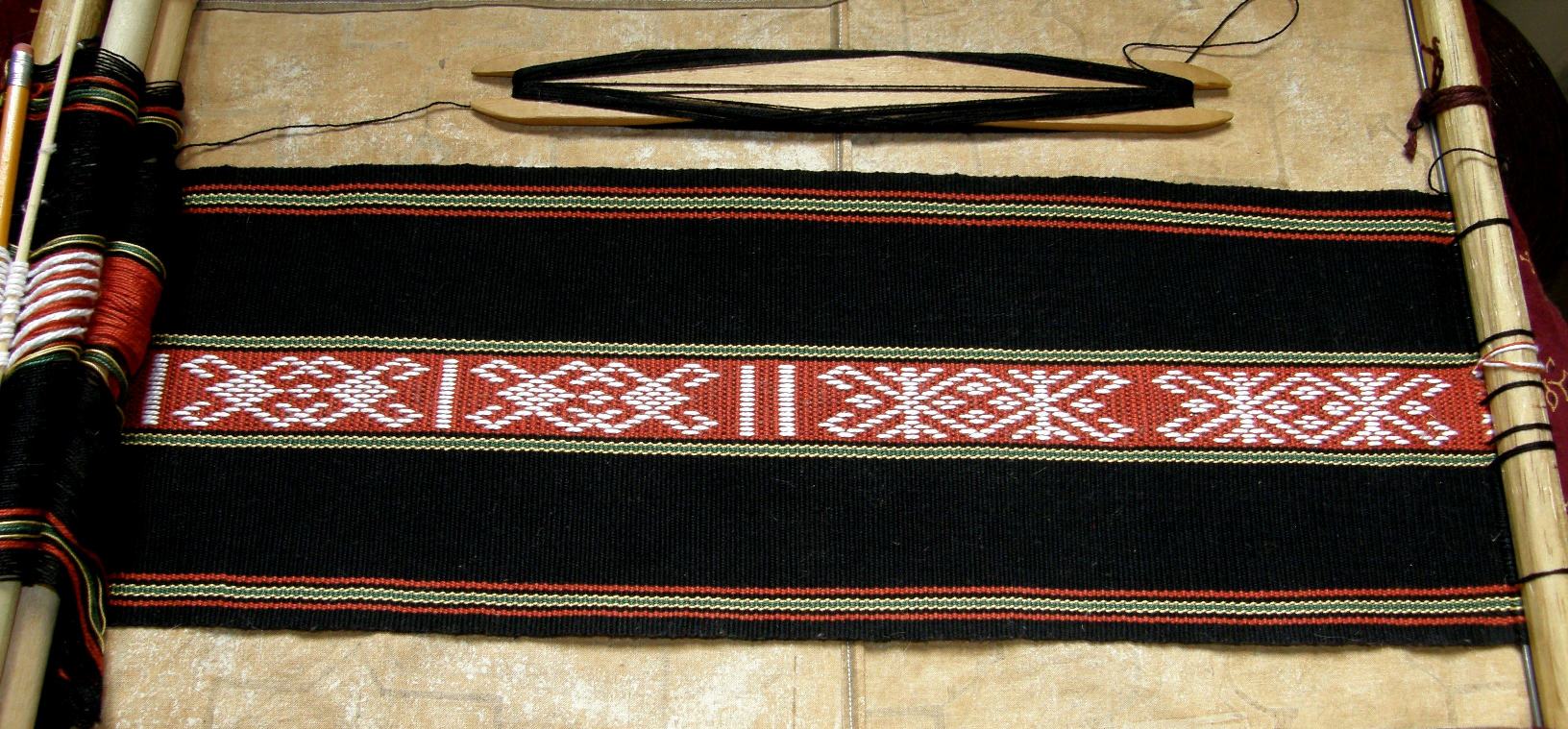 Here is the piece I made on the loom. By cutting between the two white horizontal bands in the center I woud have two pieces which I could fold and sew into bags.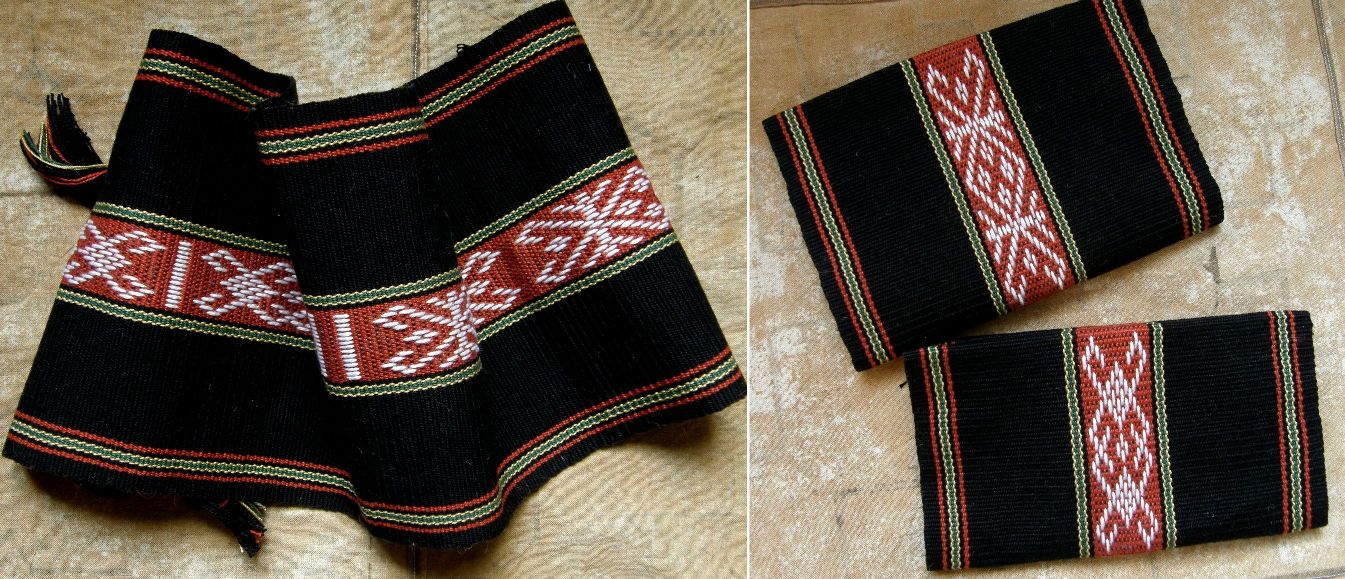



 Let me leave your here with what Jennifer has made on her inkle loom using Andean pebble weave technique.