First of all, I should point out that this post is not about anything woven on backstrap looms. I just always happen to start my titles with the term Backstrap Weaving.
The Ayoreo are a formerly nomadic indigenous people who live in the eastern lowland part of Bolivia known as the Gran Chaco. I’ve always admired the work they do making fabric using fiber from a plant in the pineapple family.

Information about the Ayoreo people is sketchy. Population estimates in different sources range from seventeen hundred to four thousand Ayoreo people, distributed amongst seven to ten clans. They use off-loom netting, twining and knotting techniques, sometimes with the aid of a needle, to make a type of shoulder bag called utebetai using a fiber called garabatá fino from the Bromelia Hieronymil plant. The fiber is twisted and plied by rolling it on the thigh using ashes to take away some of its stickiness. It may also be dyed before use.

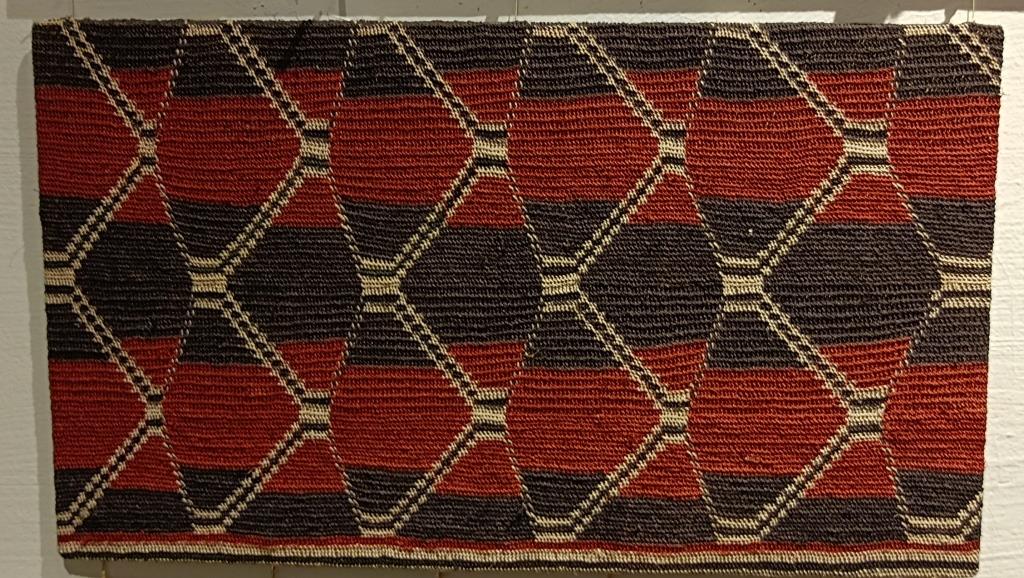
A special looped stitch is used by the women to create fabric which is then sewn into the utebetai bags that they use in their daily lives.

The bags are of different sizes according to their use and are named accordingly. Each of the clans has its own unique patterns but in recent years it’s said that new designs are being created along with modified versions of the traditional ones. According to a booklet put out by CANOB (Central Ayorea Nativa del Oriente Boliviano), the designs used include representations of the patterns on armadillo shells, clouds, snake skins and the eyes of a jaguar.
I did at one stage own a few of the bags. I had unpicked the seams so that I could display the fabric opened out at full length. Later, I gave them away to appreciative friends along with almost all the art and handcraft pieces that I had gathered during the years I’ve spent here in Santa Cruz. It’s what you have to do when you are planning to move to the other side of the globe.

I have always wanted to learn about this but gave up some time ago trying to find a willing teacher. I’d had many leads but they’d all ended in dead ends.
But then….just a few weeks ago I spotted an ad by the Arte Campo Museum here in Santa Cruz about a very short workshop in which an Ayoreo lady would be teaching the special looping stitch that they use to make the bags. I couldn’t believe my luck.
I can tell you that there’s nothing like having an experience like this to make you appreciate the tremendous skill that goes into making these pieces. I’ve always admired them and do so even more now that I know just a little bit about what goes into making them. I can only hope that the things I post online and the classes I give have had a similar effect on my students and readers in that they have a greater appreciation of the textiles that are created in the highlands and lowlands of these South American countries, the people who make them and the simple tools with which they work.
I can’t believe that I actually went to the class thinking that once I learned the “stitch”, I’d be able to make myself a little bag. Ha!
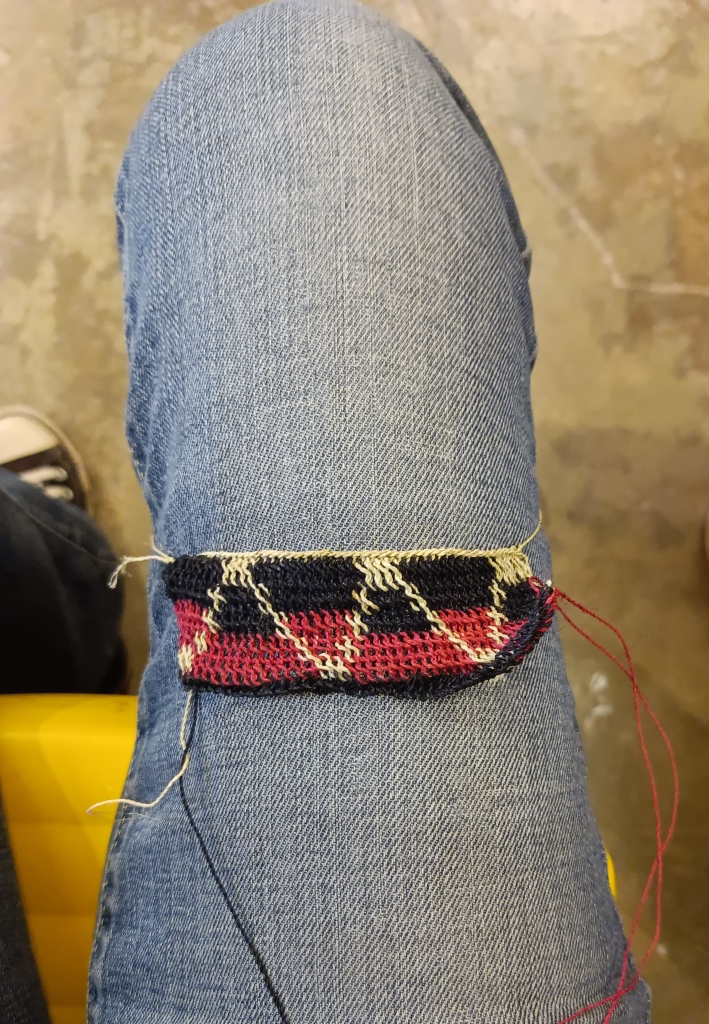
Samples were handed out to the ten participants. I was thrilled with mine as it was in one of my favorite color combinations. The idea was to have us stitch a couple of rows and then sew the little piece into a miniature bag that could be hung around the neck. Easier said than done!
I’m very much used to the “look-and-learn” style of teaching with all the experience I’ve had studying weaving techniques with my teachers here. There are no explanations….just watch. “You look, you know”, as my Vietnamese twining teacher would say to me. However, those were one-on-one experiences. It’s quite different when there are ten people battling to get a good view and capture every move on an iPad or cell phone…plus the garabatá thread was so fine! I didn’t even try to record it.
I soon realized that the row that I was supposed to looping onto was black and that I couldn’t make out a darn thing! Sadly, I swapped my beautiful sample for another so that I could stitch onto white. My active thread, however, was brown and that was very hard to see too. There were moments when I was thinking, Wow, maybe I’m getting too old for this!

So, much of the two-hour class was spent just trying to figure out the basic stitch. Mine were too dark and too tight to really tell although Teresa, the teacher, kept telling me that it was okay. I wasn’t convinced. She did point out that my work was too tight. I don’t know how she could see anything at all! No one got to make their little bag in the allotted time. We were all struggling! Some people got discouraged and left early. I stubbornly kept going. I don’t know how many times I ripped it all back to the beginning of the row. Now I can see that it’s actually a very very simple two-part process that was made complicated because ten people all wanted to be helped at once.
As with all these kinds of things, tension is key. You can have the stitch down, but it just won’t look right if it hasn’t been properly tensioned. The ends have to be pulled this way and that as the loops are tightened in order to position them correctly. I stitched along to finish the brown row and went home still not knowing if I was doing it right. I then changed to white which happened to be thicker than the brown and then quietly at home without the chaos of ten people all competing for attention, I started to get the hang of it.
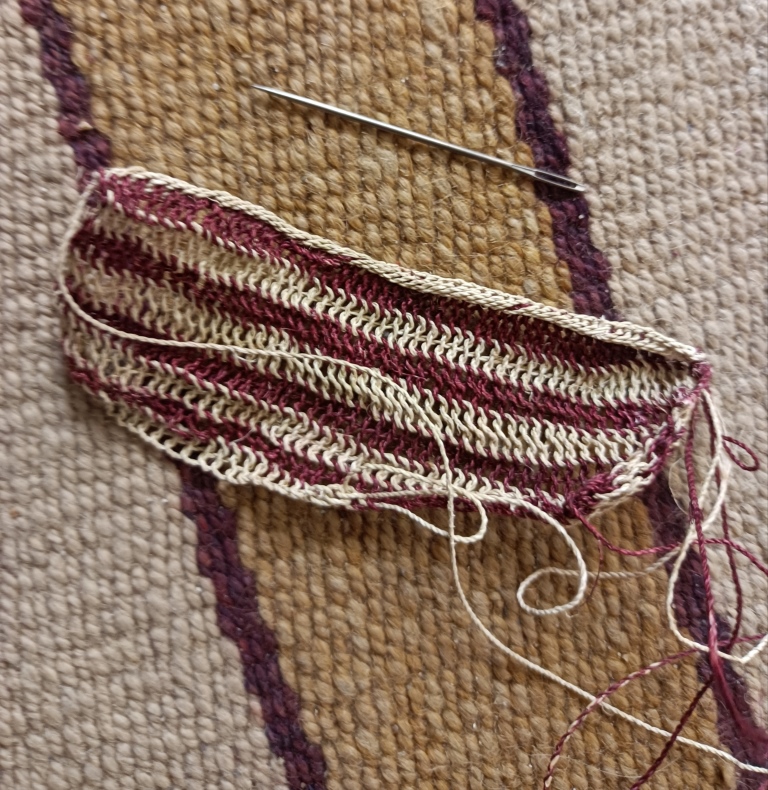
And now, I’ve run out of garabatá. I think it’s quite amazing that we were given the laboriously prepared and precious thread to work with in the class in the first place instead of some industrially prepared substitution and I really appreciate that.
I decided that I needed to get out some chunky stuff to continue practicing stitching with proper and even tension. I have to say, though, that here is absolutely nothing charming about the work in this size thread and in these colors!

I think I’ll go down in thread size now and continue practicing.
So I simply had to go back to the store and buy a bag and I was blown away by the quality of the work I saw there. The stitching is even tinier and more dense and beautifully even than the pieces I bought all those years ago. It actually makes the samples we were given in class look quite clumsy. I can’t get over how beautiful the bag that I bought is. Now I’m thinking that the teacher prepared the samples with larger, looser and more open stitches to make things easier for us.

The Ayoreo create their pieces flat and then sew the sides together. They work from left to right and then turn the piece over to work the next row so that they are always working in the same direction. In my thick-thread example above I was attempting to create it in a continuous circular form thinking that it would somehow look neater than having to create a seam. I have a vague memory of having read somewhere that the same looped stitch is used in Papua New Guinea to make bags but that the pieces there are worked in circular form.
However, the joining of the two sides in the piece that I just bought is so finely and beautifully done that the stitching is practically imperceptible. The sides don’t overlap. They are perfectly butted together. I’m so pleased to have this piece! It feels so good and has the most wonderful plant-y smell. And how in the world do the Ayoreo ladies go about adding in the colors to create those shapes is beyond me. That was actually one of my main motivations for buying a bag…I wanted to be able to study it and discover what was done with the start and end tails at the color changes. I can’t tell! It’s so expertly done. Mind blown.
Was I equally enthralled when I bought those three pieces twenty-four years ago? I wasn’t. I certainly admired them but then eventually gave them away. The difference has been having just that tiny introduction to the technique and that tiny amount of interaction with Teresa, our teacher.

So, if I never get to make a bag in this lovely looping technique, maybe I could aim at making a wrist cuff instead if I ever figure out those color changes. A simpler striped one may have to do for now. But maybe I’ll find another teacher before I have to move away.
I’ll finish with a photo I took recently of my cuffs in Fall colors, even though it’s Spring here. I happened to be in an Autumn kind of mood. I always get questions when I post these photos from people who’d like to know more about how I finish my cuffs. I might make my next blog post about that.