Backstrap Weaving – Seasons

I wove this with handspun cotton singles that I’d bought in Guatemala back in 2008. I used my bamboo reed to achieve the sheer open look and used the same cotton as supplementary weft to weave in patterns. It’s a style that I had been wanting to try ever since I bought a sample from the Coban area of Guatemala.
While I love spinning with a drop spindle, I can’t say the same for plying. I find it downright tedious and I just wanted the task to finish. I’d ply at my craft group gatherings, on the train, at the Arts Society gatherings, at the spinning and weaving group….it just seemed to go on and on.
I managed to squeeze in some time at the loom between hiking trips. It took two attempts to wind a warp to my liking from all those fabulous natural dye colors but I had to face the fact that I just wouldn’t be able to get them all into the one piece.
Four seasons motifs in progress. The heddle arrangement may look awkward but it works well. I had seen weavers in Bolivia use similar arrangements for their double weave pieces.
The figures as well as the colors are meant to represent the four seasons. The yarn I had dyed with cochineal just didn’t belong here. It can wait along with the greens for another project.
I didn’t want to use the handspun wool as weft for either of these pieces and used instead some unidentified soft and very loosely spun ”stuff’ that a friend had given me. It worked well except for the fact that it was somewhat slippery and wanted every now and then to slip out of the shed at the edges rather than lie there snugly. I’d had that very same experience with luscious alpaca yarn that I’d spun once upon a time.
The two faces.
I somehow always find myself on the floor at the planning stage. I didn’t have a choice in Bolivia but I’m in a bigger place now with table space. I still end up on the floor.
I’m in a couple of hiking groups and get to go out at least twice a week.
The “real” project will be much wider than this.
I couldn’t believe that after having admired the Indonesian ikat textiles for so many years, particularly the ones from Sumba, that I should run across these in an op shop?!
This photo was taken after one week. It has developed even further since.

Backstrap Weaving – Many welcomes

Weavers from various fiber guilds that belong to the north west association (ANWG) made great efforts to welcome us to their 2017 conference on the UVIC campus in Victoria B.C with two lovely banners. The conference theme was Treadle Lightly which meant that conference materials, guild booths and displays tended to focus on the use of natural, recycled, low impact and re-purposed materials….tread lightly on this earth.

Our conference neck pouches, which were created by my weaving friend Alison Irwin, were cleverly woven in strips of re purposed paper. Alison taught a class on this technique at the conference and created a wonderful piece in woven paper for the Instructors’ Exhibit which you can see later in this post.


I photographed Terri’s conference pouch when I dropped by to see her Saori weaving class….”Saori Weaving – Adventures in Weaving and Cloth Design”. I was happy to meet the famous Salt Spring saori artist about whom I had heard so much. All the instructors were extremely welcoming. We all offered an open house during the lunch break on Day 2 of the pre-conference workshops and several of my students volunteered not only to stay in the room to welcome visitors but also to weave on their backstrap looms so that people could learn a little about how they work.

The conference tote bag was really special. It was made from an old sail….that task must have required a lot of sail cloth as I heard that conference attendance exceeded 600! The bags were very practical and beautifully constructed. They contained a travel mug for water to reduce plastic water-bottle waste on the campus.

This first banner welcomed us and helped us easily locate the main meeting area and check-in building. It was created using local fleece from Parry Bay Sheep Farm in Metchosin, BC by a spinning/fibre group of the Victoria Handweavers and Spinners Guild.

Once inside the check-in area, this second colorful banner greeted us…

Rosie Kerschbaumer & Toby Smith wove it along with the other members of the GVWSG Block Study Group.

And then there was the First People’s House on the campus of UVIC building with its interesting Welcome Pole carvings…

The First People’s House sits on traditional territories of the Coast Salish and Strait Salish peoples. The site was once a village and holds great cultural and historical significance. The Welcome Post sculptures were created from red cedar by Coast Salish artisan Doug LaFortune. This Welcome Post is titled traditional Coast Salish Wife/Mother. My picture shows the child in the mother’s arms.

This second Welcome Post by the same artisan depicts the Traditional Coast Salish Man…

Victoria Harbor was set up for a warm welcome with pavilions in place to mark Canada’s 150th anniversary. I loved seeing the tiny water taxis zipping about. There was certainly a festive feel as our ferry pulled up at the dock.

The trip up from southern Washington state was long (on top of a 28-hour journey up from Bolivia!) but, who could complain with such scenery along the way?

It was an intense conference….aren’t they all?! I taught for four and a half days and finished with a half day free to cover ground and explore as much as I could of the campus. I wanted to see the totem poles, the conference exhibits, the guild booths and vendor hall. Of course, I had made several hasty and brief visits to the vendor hall whenever I had had the chance where the good people of Redfish Dye Works, Ellfe and Sandy, were happy to re-supply me with more of their luscious 60/2 silk for my next backstrap loom project. Somehow during the nights my ideas for the next project would evolve and I would find myself back at Redfish, maybe to exchange a color or pick out others. I hope to get this on the loom when I return to Bolivia in late August.

This conference had the most extraordinary variety of classes. My good backstrap weaving buddy, Yonat, selected some classes that best represented the local peoples, the local area and the natural materials that it has to offer. She posted a nice picture on Facebook of the various things that she learned. Can you imagine creating all this in the space of one conference? This was her class work but she also attended a seminar on research into a Salish textile. And, there was a class with John Mullarkey too. Cedar bark basketry, Salish color knit work and ply-split braiding!Here’s Yonat in the cedar bark basketry class she took with Joan Carrigan…

And all this in beautiful Victoria B.C with its mountain views and ”Canada 150” celebrations in full swing down at the harbor. We had six days of stunningly gorgeous weather with just the hint of an approaching change as we sailed out of the harbor on our way back to the USA.

There comes the ferry for our scenic 90-minute crossing. Whales were spotted on the return trip….not by me, though.On the trip over to Canada, one of my backstrap weaving buddies, Tracy spotted me on the ferry as I wandered about. She was arriving with another backstrap weaving friend of ours from Arizona, Kristin, with whom we had only had contact online.

You may remember that I showed Kristin’s silk piece in my last blog post.

Tracy and I have woven together before but this was the first time that we were meeting Kristin. There they were sitting together on the ferry spinning.

Those two were inseparable for the rest of the conference and I regret not being able to hang out more with them. They only stayed for a pre conference workshop, the class on making a traditional Japanese bamboo reed with instructor Bryan Whitehead, a Canadian, who has been living in Japan for decades.

Another backstrap weaving buddy from Arizona, Christine, with whom I manage to weave every fall, also took that class. I can’t imagine three people who were more suited to that reed-making class. Bryan Whitehead must have been so happy to have three such enthusiastic students. Of course, I am sure that all his students were just as deeply interested in learning that ancient skill.

I was lucky to be passing by Carol and Sharon’s dorm-room one evening. They heard my voice and called me in. While Sharon worked on the tablet weaving she was learning in John Mullarkey’s class, Carol worked on her bamboo reed and I was so pleased to be able to watch some of the process. Not that I will ever be able to do something like this on my own! I own some fine bamboo reeds and I now have an even greater appreciation for how they were made after watching Carol work and hearing from Tracy, Kristin, Christine and others about the tremendous amount of preparation Bryan put into this class. He cut and shaped hundreds, if not thousands, of slivers of bamboo…just amazing!

The slivers of bamboo are placed within the frame and cord is hitched around the posts to keep them in place. The cord also maintains even spacing between each sliver. Students could choose various epi-s for the reed from 15 to 24, I believe. The size of the cord they used determined the resulting spacing of the bamboo pieces. Each bamboo piece was placed and locked into position with the hitched cord. Then it would be gently tapped with the hammer you see on Carol’s table.

Here is one of the old Japanese reeds that Bryan brought to show to the class. Kristin was able to show it to me one day.

And here is Tracy’s finished reed. From what I could tell from watching the process, it really took some dedication to finish that in the three-day class!

This is an heirloom! There is no reason why this should not be still around and being used by a weaver two hundred years from now. That thought makes my hair stand on end. I can’t wait to pick up the old reeds I have at home (I got mine from a lady who sells textiles and implements from Chinese minorities) and examine them and think about the person who painstakingly prepared and put all those little pieces of bamboo in place. Imagine if they knew that the reed would end up in Bolivia. I will certainly take good care of them and use them. I already have a project in mind that will require the use of one of the reeds. It has been inspired by the conference.

THIS!…

This piece was part of the Instructors’ Exhibit and was woven by instructor Marilyn Robert. I ran into one of her students on the way back to my room. There on her loom was a gorgeous indigo-dyed strip of cloth with a lovely white cross of double ikat. I have dabbled in warp ikat and I think that if I ever have the courage to try double ikat, then these kinds of patterns might be a good place to start. Of course I won’t have the benefit of Marilyn’s knowledge, experience and instruction and I won’t use indigo, but I feel very inspired to try something like this. I will get to use my bamboo reeds to create the necessary balanced structure on my backstrap loom.

While I am showing you things from the exhibits, let me show you the piece that Carol James brought…an awesome sprang garment that just takes your breath away. It is draped with one of Carol’s finger-woven pieces. She taught both skills at the conference.

And look at the beautiful work her students were creating…

And here is the promised picture of Alison Irwin’s unique paper-woven chess pieces posed on her handwoven chess board…brilliant!

I was pleased to be able to see my friend Yonat’s weft-twined piece in the juried show. She showed it once on Facebook and it had blown me away. We had a group of very enthusiastic weft twiners sitting together at breakfast one morning and the idea of having our own little twining study retreat was born. I hope it happens! I love this piece by Yonat…

Alison Irwin took my 3-day pre-conference class on complementary-warp pick-up. She was also my volunteer helper. It was so nice to connect with her again after meeting her at Braids 2016 in Tacoma WA. We had a shared interest in the warp-faced double weave structure that is used in Bolivia and I was happy to be able to introduce her now to complementary-warp pick-up. And, it was nice to be able to inject some backstrap loom enthusiasm into my group of weavers from Canada, the USA and even New Zealand! It was great group of people.

If anyone needed more ideas on what to do with their woven patterned bands, Alison brought along a  pouch that she had made from a band she wove on her inkle loom and which I believe was recently included in an issue of Handwoven. This and her matching paper bracelet are gorgeous. The pouch uses a supplementary-warp technique. Both pieces are so elegantly finished and very inspiring. I love how the pattern on the folded flap so cleverly aligns with that on the body of the bag…all so clean and crisp!

I also taught a one-day class on the ñawi awapa tubular band and then a half-day backstrap loom ”taster”. In this half-day class I teach how to use the body to operate the sheds on a narrow warp and we then learn the basics of complementary-warp pick-up. We had a lovely pattern well underway by lunch time and everyone took home charts for at least five more. I have to say that this particular group was very vocal when I showed them how easy it is to open a clean heddle shed when you know how to move your body. It’s very rewarding and exciting for a teacher when you get reactions like that. I felt like I had pulled a rabbit out of hat or something! Well, yes, it is something like magic when you learn how to ”be the loom”!

I enjoyed my teaching…can you tell? My students are very focused here as they take their first steps in one of the more complex 16-thread patterns. Day 3 of the class has them almost unconsciously and automatically adjusting their body positions to operate the loom smoothly. They have become the loom. They are better able to spot mistakes quickly and deal with them and have developed good strategies for following charted patterns with long repeats.

I was happy to have Jen with her delightful Scottish accent in my class. We had met at the banquet at ANWG 2013. Who knew that we would meet again like this?

This picture is from the ANWG 2017 blog.

Quite a few classes were being held in the building in which I was teaching and on my floor and so I got to poke my head into several rooms on the way to the bathroom but that was just the tiniest fraction of all the conference had to offer. I actually didn’t get to see everything on my floor. I was so impressed that one of the conference organizers, Anita Salmon, with whom I had been corresponding for months before the conference, managed to pop her head inside my classroom every day to check if all was okay. She must have covered some ground! She even brought me a bag of Peruvian textiles that she had collected in the time she lived in Peru in the 1960’s and 70’s so that I could show them to my students…and enjoy them myself!

As always, Robyn Spady’s class was buzzing with energy as weavers took part in a round robin of ”Pictures, Piles, Potpourris and Perplexing Curiosities”. It was amazing for me to see corduroy being produced and it was fun to run from loom to loom and appreciate the tremendous variety of techniques and structures that were being covered in this class. Yes, I had to virtually trot as there was so little time and so much to see in all those classrooms. My eye was attracted to the following piece as it reminds me of the patterning on some pre-columbian fabrics I have seen in books…

Rebecca Mezoff’s classroom was very eye-catching as you were immediately met by a scrumptious display of colorful tapestry yarn.

Her topic, ”Predicting the Unpredictable. Color in Tapestry” sounded fascinating.

My friend Betty, with whom I traveled to ANWG, took a paper and book-making class from Velma Bolyard called ”Fiber, Paper, Textile, Book, Spirit”. Participants created a book using beautiful paper that they decorated with inks. Betty had the idea of the filling her book with the various book-binding and paper-making samples that she created in the class. Participants spun paper into thread and wove four-selvedge ”pages” on tiny pin looms they had made themselves. With the paper weft on a needle, the warp ends were picked up one by one…over, under, over, under… Betty immediately came up with the idea of using the coffee stirring stick that was part of her materials kit as a shed rod. That meant that only every second shed needed to be picked up with the needle. Betty has the Certificate of Excellence in weaving but it was her experience with primitive loom technologies that paid off this time. 🙂

Having seen Betty’s work with spun paper from her class, I am wondering if this has anything to do with the way Sandra Brooks from New Zealand created her extraordinary woven book which was part of the juried exhibit. This four-selvedge woven sheet was folded into pages which were full of interesting textured images and even words. I was really taken with this and I wish I could have done a better job of photographing it. I was happy to be able to spend a little time with Sandra as she had been a participant in my three-day workshop.

Sandra won one of the beautiful handwoven award ribbons for this piece…

My silk piece in the Instructors’ Exhibit made it onto the table next to the lovely cedar bark basketry of Polly Adams Sutton (at the back) and Joan Carrigan.

The guild booth displays were interesting and so varied with themes that closely followed the overall conference theme of ”Treadle Lightly”. The booths were judged by Jacquetta Nisbet and I was disappointed not to have been able to meet her. We exchanged some emails a few years ago and I would have loved to have met her in person.

The friends with whom I traveled to Victoria are from the Portland OR guild and I was pleased to see their booth receive several awards. Their pieces were based on the theme of recycling and my favorite part of their display was the fact that each piece had a card with a personal and entertaining story behind its loving creation. Apart from the visual appeal, those stories really drew me in and helped me get a sense of the people and personalities behind the work.

Here is Eugene Weavers Guild’s booth to show you just one example. Again, TIME!!…so little of it and so much to see!

The fashion show was wonderful. I have misplaced my program and so I can’t tell you how many pieces there were but the show lasted close to ninety minutes  and moved along at a good pace with several injections of good humor which included a troupe of hot male bods modeling what looked like colorful knitted boxer shorts. I do hope the creator of those eye-catching pieces will forgive my inadequate description. We were all somewhat distracted by the models!

Again, I will turn to the ANWG blog for a picture…

And then there was the great Shuttle Race which I caught by accident…yay! There was a nice pot of race entry fees at stake for the winner. I am again taking a picture of the entire field of entrants from the ANWG blog…

Competition was fierce with a number of very close finishes and one dead heat. I think I managed to capture some of the fun and energy in this shot.I believe the viking shuttle was the overall winner. Mindy Swamy, who was the race caller and time keeper, did a wonderful job and gave us all lots to laugh and smile about. She was just as highly energized in my half-day class and I really enjoyed meeting her.

On the final evening, key note speaker Charlotte Kwon of Maiwa Handprints Ltd took us on a journey to India via her superb videos so we could learn all about the concept of ”slow cloth”.

I hope that others write blogs about their ANWG 2017 experience as I feel that I have covered so little! If you do happen to run across other accounts, please let me know so that I can link to them from this post. Look for more pictures on the ANWG 2017 blog. Laura Fry was at ANWG as an instructor but she was also there to present the official invitation to ANWG 2019 in Prince George B.C. Many thanks to the conference organizers and all those wonderful volunteers who made this a conference of ”many welcomes”.

I will leave you with this picture of one of the poles that I found on the campus. It was designed and carved by Charles W Elliott, Coast Salish, and  is a ”History Pole” that depicts the Salish S’YEWE story.


Backstrap Weaving – Coasting Along

cincinnati from kentuckyOn the road again….from Florida, from which I just escaped before hurricane Matthew hit, to the golden leaves of western Massachusetts to the Ohio River and on to mission country in southern California. I have been covering some ground. Unfortunately, I spent a lot of this time with the most awful chest cold. It stopped me from doing some sightseeing but it didn’t keep me from weaving with lots of backstrap weaving buddies at every stop.

Janie’s daughter had had an interest in learning to pole dance. A pole was installed in the basement and now it makes the most perfect backstrap weaving post.

jane backstrap weavingJanie’s guild in Cincinnati has its own house! We were very comfortable there weaving Andean Pebble Weave for three days…

guild houseIt’s pretty cool when a weaver can arrive in the morning by bicycle with the potential to carry her loom, fold up the bike, stash it under the kitchen counter and then sit down to weave….

janie and karen with bikeI am afraid that I was far too ill in Cincinnati to think about taking more pictures. I enjoyed the chance to speak at the guild and weave with this lovely group of ladies but I simply had to crawl into bed at the end of each day. Taking it easy paid off…I am well again. 🙂

In western Massachusetts, the fall hadn’t quite taken over and we found that it was really very pleasant to be outside winding warps for Andean Pebble Weave in the sunny afternoon. I got to catch up with old weaving buddies here, put a face to an online weaving friend and meet a new backstrap weaving enthusiast.

warpingfor backstrap weaving outdoors in western massIt’s a close group of weavers here and they have started a monthly study gathering. The first one was on the weekend immediately after I left. They are keen! These kinds of get-togethers where weavers help each other through their planning, warping and weaving make such a difference and I know that  next time I see these weavers they will be more than ready to advance their backstrap weaving skills.

Jacquie, above left, is already confidently creating her own Andean Pebble Weave patterns and is planning a band with dancing figures and drums. I love this idea and can’t wait to see it.

backstrap-weaving-in-massachusettsJacquie sent me a picture of the first study group gathering. Amy, who didn’t weave with us this time, also came along to the study group. It seems that the backstrap weavers in western Massachusetts are very well connected! I hope they don’t lose momentum with the inevitable interruption over the holidays and that they continue gathering to weave on backstrap looms well into next year and until the next time I get to see them all again. We might have a study session by Skype some time if I decided to upgrade my internet connection in Bolivia this summer.

group-meeting-1Martha, pictured on the right, made some Andean Pebble Weave contributions to an Ethnic Weaving exhibit in which her guild is involved. Maybe you can go along to see it if you live in the area. You can see some of Martha’s work in this postcard that advertises the event…martha's pebble weaving

Back in Florida, I had left three of my weaving buddies working on wide warps. The width of their planned projects depended on how much experience they had with their chosen pick-up structure. As Cyndy had only just learned Andean Pebble Weave, she settled on a 2’’-wide band that is the perfect size for a guitar strap. She wants to gain confidence with this larger number of ends and finer thread.

Jennifer and Berna, who both have more experience with Andean Pebble Weave, spent most of the first day warping wider projects and dressing their warps. I think they are both planning some sort of bag and are confident that the project they warped in class will be more than a sample. Berna worked hard to prepare for this gathering by weaving a sample, pictured below, with her chosen yarn which she used to calculate the number of ends she needed for her larger project.

bernas-sampleHere’s the gorgeous warp that Jennifer created. There was much talk of Harry Potter house colors. I haven’t seen the movies so I wouldn’t know about that.

jennifer's backstrap warpShe has plans to weave bee and flower motifs in the center strip and plain pebble weave in the two outer ones. I like this idea of having strips of plain pebble weave as accents rather than having a strip of pick-up patterns.

Here’s Berna ready to weave after having picked up the threads for her two pebble sheds and then enclosing them in string heddles.

berna ready to start her backstrap weavingCyndy quickly installed her string heddles and was ready to weave. She had wound her warp before our get-together and was able to get underway well before the others.

cyndy heddled and ready to weaveHere’s Jennifer picking up the threads for her pebble sheds…

jennifer creating pebble shedsBerna shows us how she smoothly and cleanly opens a pebble shed using her heddles and adjustments to the amount of tension she applies to the warp with her body. She has got the moves down!

berna opening pebble shedsAt last the pattern starts to emerge. She has combined a Celtic knot motif with a classic Andean motif.

bernas backstrap pattern emerging

bernas celtic knot and Andean river patternsI love the small amounts of black she used to make those colors pop.

cyndy's sun moon and river patternCyndy chose a particular combination of motifs that I like to call ‘’The sun, the moon and the meandering river’’.

I hope I get progress pictures soon. These ladies get together regularly in Berna’s home to encourage and help each other and it is wonderful to see their progress. Study groups, people…hint, hint…if you have the chance to form one, do it!

close up circular warpCyndy gave me this wonderful example of a circular backstrap warp which has been set up for hanging. It was one of those miraculous thrift store-like purchases. We have no clue as to the origin of the piece but I love it as a super neat example of a circular warp with all its bits and pieces. There is a wonderful shaped sword and sweet shuttle sitting with in a shed. The coil rod is in place and you can see the split beams at the front of the loom which help secure the warp and allow the weaver to beat without having the warp slide around the beams.

The woven cloth is interesting with its simple warp-float pattern and strips of weft twining. It is the ideal size and weight to carry about and show people how a circular warp is typically set up.

I used to carry my own circular warp around to show people…


my example of a circular warp …but this new one is far more interesting…

circular warp and toolsJennifer brought her new backstrap loom. She had purchased the wooden pieces as a set online and then had a friend of hers burn beautiful patterns into the wood including the image of Ixchel, the Mayan goddess of weaving. What a special loom!

jennifers loom with burned decorations

jennifer-backstrap-loomCyndy also brought interesting tools to show…some lovely shuttles for band weaving that a craftsman in Estonia makes…

cyndy's shuttles from estoniaOver In southern California, we were back outdoors enjoying the mid-fall warmth. Out on Ginny’s lawn, we wove double weave for two days…both one-weft double weave and the two-weft embedded version.

14650616_10207682302997089_3010964772416597055_nThere’s some progress on Ginny’s one-weft double weave piece….

ginnys double weave band backstrap weaving

brown and blue wool jewely backstrap weavingOn the third day we wove a tubular band pattern.

I had woven the ñawi awapa tubular band with this group before and so we tackled a different pattern which involves the use of multiple string heddles. I saw this kind of band being woven by weavers from the community of Chahuaytire in Peru.

Recently I made a nice bangle to add to my woven jewelry collection using this particular tubular band pattern. You can see it at left on the left of the two brown flat bands.

I gave the group some magnetic barrel clasps so that they could do the same if they chose.

We also learned to weave and sew the band as an edging as it is used in Peru. We had to develop the skills necessary to be able to operate and keep track of multiple heddles on wool without excessive scraping or sawing.

We used up to 5 colors and the different color choices produced bands of vastly different character.

Yarn and samples ready for weaving the tubular band.

Judy joined us at this gathering. I had woven Andean Pebble Weave with her last spring. We started talking about horse hair and horse hair braiding and hitching. Melinda joined in as she too has experience with this craft. I had started looking about online for information about horse hair hitching after the BRAIDS 2016, the conference of the Braid Society in Tacoma WA last July. One of the instructors from the UK was teaching cylindrical braids in raw hide and told me about the work of the Argentine cowboys, or gauchos, who use braided raw hide to decorate their horse tack. He showed me pictures online of gorgeous examples of fine work. This led me to images of horse hair work and I was intrigued. My friend, Betty, showed me a hitched key fob that she had bought in Montana which had been made by prisoners. So, I ended up ordering a couple of technique books online which I will pick up later in this trip.

In the meantime, along comes Judy, who has owned and worked with horses all her adult life and she brought examples of horse hair braided key fobs and hat bands as well as decorative embellishments made with hitched horse hair for various pieces that she owns.

horse hair hitching

OLYMPUS DIGITAL CAMERAOLYMPUS DIGITAL CAMERAAnd here is something else I have picked up along the way….

wayuu ply split braidsThese are ply-split braided bands made by the Wayuu people of the Guajira Peninsula that straddles Colombia and Venezuela. They are used as the straps for the crocheted bags, or mochilas, that they make. I have included examples of these bags in several blog posts in the past particularly after I went to visit Mirja Wark in the Netherlands and got to see the bags she collected when she lived in Venezuela. My friend Dorothy has one of the bags, see below, that has a very similar strap to the one above right. You can see the tapestry crochet technique that is used to create the bags themselves.

close up of Dorothy's Wayuu mochilaI am thrilled to have these examples and will find a way to use them as straps for a backstrap woven bag that I plan to make one day. It’s amazing how similar the strap on the left is to the one I happened to see on a Wayuu bag in a beach-side boutique on my recent trip to Sydney…

wayuu mochilas in sydneyI am hanging out with my friends Ruth and Lise for a few days. Ruth captured me, the ”mop with a nose”, weaving some double weave motifs…

weaving-at-ruthsI got a lesson in the basics of power-tool use from Ruth and she is sending me home with a dremel-type tool!

OLYMPUS DIGITAL CAMERAWe gathered a group of friends to weave double weave for two days. After learning to weave some basic shapes by simply ”eyeballing” and not using charts, we moved on to more complex patterns. Ruth charted a sweet llama that would fit on our 12-thread warp and you can see me weaving it, starting with its four little legs.

weaving double weave backstrap loom

Here are Ruth and Cookie setting up their slightly wider and finer warps…

cookie-and-ruth-setting-upAnne and Dorothy are weaving patterns…

annes double weave

dorothys double weaveDorothy cleverly managed to keep the scroll pattern going while swapping the pattern and background colors. Kathy and Kathleen who have woven with me several times before were there too.

We looked at one-weft double weave and the two-weft or ”embedded” version as well as the technique used by some Bolivian weavers who set up additional sets of string heddles.

samples of double weave for backstrap weavingCookie works with all sorts of fiber crafts and brought her latest finished crochet piece to show…cookie's marilyn monroe crochetAnne brought a piece that she had woven with me years ago when we had studied Bedouin weaving techniques with my Santa Cruz friends. The upper face of a double weave band and that of a Bedouin Saha weaving are identical in structure. However, the bands as a whole are vastly different because the Bedouin weavers leave the long threads- those that are created by the substitution of one colored warp thread for another- floating on the back of the band. Bolivian weavers use those hanging threads to create a lower shed through which they pass weft. This creates the second layer of the double weave. Double weave bands have two ”good” faces. The pieces created by the Bedouin weavers have only one ”good” face as the other one comprises long floats, some of which are often startlingly long.

bedouin weaving and double weaveAfter weaving over the weekend with my friends, I found that Mary, a recent Facebook and Ravelry acquaintance, lives just a few blocks away from Ruth and so I visited and spent a day with her playing with the basics of backstrap loom operation. I gave her some tips on how to manage narrow and wide warps and I had a ball looking at her collection of zentangle books while she wove on the balcony. Just having those few hours to sit quietly and thumb through the zentangle and weaving books left me with my mind exploding with ideas!

mary and lola weaving a narrow project on the balconyAnd later, she learned how to change the basic set-up and modify her moves to weave wider warps. Here she is making string heddles on a stick…

mary making string heddles on a stick

The following day, Ruth, Lise and I went to the De Young Museum in San Francisco….

We went to see this exhibit…

The idea is to draw pieces from the museum’s textile arts collection which exhibit the characteristics normally associated with Minimalism…including regular, symmetrical, or gridded arrangements, repetition of modular elements, direct use and presentation of materials, and absence of ornamentation.

But for me, who has never been to the De Young before, there was plenty to be excited about in the museum’s permanent exhibit of pieces from its vast collection. As a result, we didn’t get to the Minimalism exhibit until after lunch.

Here’s a wee taste of the very old and not-so-old in the museum’s permanent display…

I emjoyed seeing this piece from the coastal province of Manabi in Ecuador as I have spent time there with cotton spinners and weavers.. This is a hollow figure from 1500-1300 B.C. The incised patterns on the figure's lower body are suggestive of textiles.
I enjoyed seeing this piece from the coastal province of Manabi in Ecuador as I have spent time there with cotton spinners and weavers.. This is a hollow female figure from 1500-1300 B.C. The incised patterns on the figure’s lower body are suggestive of textiles.

í

A burial offering for a high-ranking official.t A.D 600-900 Huari culture. The mosaic of colored shells, stone and bone represent teh motifs of a tapestry-woven tunic-feline heads, rectangular bars and concentric circles.
A burial offering for a high-ranking official A.D 600-900 Huari culture. The mosaic of colored shells, stone and bone on a wood and bitumen base represent the motifs of a tapestry-woven tunic suitable for a person of such high rank with feline heads, rectangular bars and concentric circles.

Limetone monument, or steal from the southern Mayan lowlands A.D 761 shows a Mayan queen proclaiming her legitimacy and power
Limestone monument, or stela, from the southern Mayan lowlands A.D 761 shows a Mayan queen proclaiming her legitimacy and power.

Seed jar Hopi Pueblo late 20th century by Jacob Koopee
Seed jar, Hopi Pueblo, late 20th century by Jacob Koopee

Looped wire sculpture by Ruth Asawa late 20th century. i loved the way the lighting in the museum cast shadows of her work on the cinder block walls.
Looped wire sculpture by Ruth Asawa late 20th century. We loved the way the lighting in the museum cast shadows of her work on the cinder block walls.

Very subdued lighting made it difficult to capture the often rich colors of the pieces in the Textiles and Minimalism exhibit. It was wonderful to see a few Aymara pieces included with their rich red, blue and brown stripes…incredibly fine pieces woven with four selvedges with subdued decorative edgings and often an absence of patterning along the joins of the panels. Ruth’s camera captured the colors better than mine. I like these simple late 19th century plain-weave Aymara pieces more than some of the intricately pick-up patterned pieces that we usually associate with Andean weaving.

Fingers were itching to touch the textiles and further appreciate their fineness. We bent over with our noses as close to the textiles as we dared without upsetting the security guard in order to better see the threads and study the patterns along the edges.

Once again, I feel it would be a shame to cram all the wonderful things my online friends have been weaving into the end of what has become a pretty long post. I think I will save them for next time when you will get a very large shot of inspiration all at once! I can tell you that Adem has finished a marvelous Mapuche-style piece in which he incorporated some traditional Turkish motifs. Tracy has been in Laos weaving on circular warps on foot-tensioned backstrap looms so, as you can imagine, there is plenty to share there. Julia W has not only been weaving but has also been piecing together bands she wove some time ago into lovely purses and bags. Julia T is back at the loom designing Andean Pebble Weave motifs after what feels like along absence and I have new online weaving friends who are making cuffs and balanced- weave cloth and all sorts of exciting things on their humble backstrap looms.

I’ll leave you with a few more pieces from the museum visit…

I lobe the detail of the facial scarification on this kneeling warrior. Maya, Jaina Island, Mexico A.D 600-800.
I love the detail of the facial scarification on this kneeling warrior. Maya, Jaina Island, Mexico A.D 600-800.

I could look at Moche pieces all day! The pre-columbian museum in Santiago, Chile has a wonderful collection. Moche, nortn coast Peru, 400B.C -550 A.D
I could look at Moche pieces all day! The pre-columbian museum in Santiago, Chile has a wonderful collection. Moche, north coast Peru, 400B.C -550 A.D.

And I really enjoyed Ruth Asawa's work and the way it has been displayed. What is real and what is shadow here?
And I really enjoyed Ruth Asawa’s work and the way it has been displayed. What is real and what is shadow here?

Until next time….


Backstrap Weaving – Strands

BRAIDS 2016 – Braids, Bands and Beyond. The conference at UPS Tacoma, Washington is over. What a week it was.

Let me quote my weaving friend Ruth Temple who was one of the 175 or so participants…

My soul is happy, my heart is full, my brain is jumping with excitement, and my fingers have been wonderfully well-tangled in strings all week.

The Proceedings of BRAIDS 2016 is available through the Braid Society, Braidershand and Giovanna Imperia Designs.
The Proceedings of BRAIDS 2016 containing articles by all 30 instructors is available through the Braid Society, Braidershand and Giovanna Imperia Designs.

If you are not already a member of the Braid Society, there are many reasons to join, one of which is the fabulous conferences.

But, even if you can’t attend one of those, the annual Journal  which is aptly named Strands, is alone well worth the price of admission. I had missed out on receiving my journals the last two years because I had lost my P.O Box. Debbie brought my copies for me with her from England. They are juicy!

Many of the instructors at Braids 2016 have authored the articles alongside other renowned braiders and band weavers. In the following photo, fans of Susan Foulkes will catch a glimpse of an article on Latvian bands in the 2015 issue with detailed instructions and photos.

strands journals braid society

Strands…after attending an event like this you start to see strands everywhere and in everything. Strands…wavy tentacles of glass at the Chihuly exhibit in Seattle. Strands…branches extending in all directions from the trunk of the massive sequoia on the UPS campus like strands of thread waiting to be worked into a braid.

At the conference, strands of yarn, wire, raw hide and even human hair were plied, split, twisted, turned, crossed and looped into beautiful braids and bands as well as exquisite pieces of jewelry like the brooch of braided hair below.

Ruth Macgregor and Carol James work on a Peruvian head band in Rodrick Owen's workshop.
Ruth MacGregor and Carol James work on a Peruvian head band braid in Rodrick Owen’s workshop.

I was lucky to have the chance not only to instruct but also to take Rodrick Owen’s class on Peruvian head band braids along with Ruth and Carol (above) and several other participants from the 14 countries and 6 continents that were represented at the conference. I was proud to be representing South America.

participants from Japan braids 2016

Rodrick owen's workshop at Braids 2016We spent the first morning setting up our looped strands to braid. I was determined not to miss anything and took lots of notes. I find that it is best to get things written down in my own hand and in my own way as a supplement to the instructions we received in our color handouts. That is what works best for me.

I really want to continue working on these kinds of braids and I have plans to try and make some wrist cuffs with them. I wanted to make sure that I was absolutely clear on the process. For that reason, I stayed with working on just the one braid for the two days rather than learn the second one that Rodrick presented on Day Two. I know that I will take the opportunity to learn that second braid in a class with Rodrick some other time in the future.

Sprang expert and instructor, Carol James, also took the class.
Sprang expert and instructor, Carol James, also took the class. I am sure that she felt, like me, that being a student now and then is a priceless and necessary experience for teachers.

Demonstrating the second braid on Day Two.
Rodrick demonstrates the second braid on Day Two.

My briad in progress...some mistakes and lumps and bumps while I get the hang of managing the tension...but I am very pleased with it!
My braid in progress…with some mistakes and lumps and bumps while I get the hang of managing the tension…but I am very pleased with it!

I bought some Valdani cotton at the conference in the Braiders’ Bazaar so that I can work on this braid while I am on the road. I am wondering how manageable it will be in cotton which doesn’t have the stretch and ”give” of wool.

I had met Rodrick Owen by chance at the Maryland Sheep and Wool festival back in 2010. It has taken me this long to take a class with him even though our paths have crossed many times since. All the wonderful things I had heard about him as an instructor were true.

rodrick owen's workshop braids 2016I love workshop tables with their chaos of yarn and sticks and tape and tools and this one which I shared with Jeanne, who kindly shared her photos with me, was no exception.

Outside of class time, Washington gave us some glorious weather and the campus gave us lots of opportunities to enjoy it with outdoor eating areas to hang with friends and maybe do some braiding for those who practice the more portable techniques.

John Whitley works on a ply-split piece of his own. I met him at Braids 2012 in Manchester and he and his wife Stacy have done some backstrap weaving with me on a couple of occasions.
John Whitley is always able to whip out one of his current projects and keep his skilled hands occupied. Here he is working on a ply-split piece of his own. I met him at Braids 2012 in Manchester and he and his wife Stacy have done some backstrap weaving with me on a couple of occasions since then.

Meeting new people and hanging out with old friends
Meeting new people and hanging out with old friends…6 of my backstrap weaving students from various parts of the USA are present in this picture.

The conference was a great opportunity to meet up with my weaving buddies from all over the USA as well as folks from Europe that I had met in Manchester in 2012. Even a blog follower from Capetown South Africa, Joel,  was there.

With Annie! You will know her as Aspinnerweaver, the weaver of unique colorful guitar straps. We haven't had much chance to hang out since she moved to New Mexico.
With Annie! You will know her as Aspinnerweaver, the weaver of unique colorful work-of-art guitar straps. We haven’t had much chance to hang out since she moved to New Mexico.

Tablet weaver John Mullarkey was at the table too (see below). He likes to tease inkle loom weavers about the supposed inferiority of their chosen equipment and technique to the tablets that he prefers. I think he met his match at that table of fierce inkle loom fans. Jennifer accused him of ”inkle envy”.

I got to wear my woven accessories…something I dare not do at home in Bolivia where I have had several things pulled off my neck and wrists in the past while walking down the street.

backstrap weaving accessoriesI had woven a neck pouch especially for the conference in which I could stash business cards and card keys. My sample for that project became a wrist cuff and I only realized later that my necklace and camera strap were also good matches.

You may remember that I was just one of many many people who had volunteered to weave lanyards for the conference. I contributed a mere 6 of them. There were 175  of them to be made!

lanyards for braids 216 backstrap weavingHaving arrived early at the conference with my friend Marilyn Romatka, I was able to enjoy scanning the lanyard table before the name tags were distributed, ooh-ing and ah-ing over the variety of techniques and patterns and colors represented there.

Marilyn taught bow-loom weaving. Here’s Marilyn ”dressed” in her looms entering our dorm building for the first time. And, if you are curious about these very cool bow looms, which are used by the Akha people of northern Thailand and Laos to weave narrow bands with beaded selvedges, here’s a closer look at them as Annie and I weave with them after the conference at Marilyn’s place…

with annie bow looms Here’s Robyn Jackson who did a fabulous job attaching the various clips that turned braids and bands into lanyards for our name tags. She chose to wear one of mine 🙂

It was fun playing ”spot the lanyard” trying to see which of the 175 participants got mine. It wasn’t until Day 3 that I found the last of the 6 I had made around the neck of Braid Society Chairperson Shirley Berlin. Unfortunately, I never found out who made the pretty purple lucet-worked lanyard that I was given.

conference lanyards braids 2012

supplement=ary weft and double weave class braids 2016The weather was perfect for outdoor weaving  and I wish I had thought of suggesting doing just that to my group of backstrap weavers above. There were certainly plenty of trees to tie to and lovely lawn in which to sit. We studied supplementary-weft patterning and double weave over two days.

Supplementary-weft patterns.

Brian and KarenBrian and Karen are working on their double weave here. It was lovely to meet up again with Brian who had woven with me at Vavstuga last fall, as well as Eileen, my host on several visits to Austin, Texas and Tracy with whom I have woven quite a few times in California. Karen is the first Alaskan weaver I have ever had in a class. She really took to backstrap weaving. It was nice to have two UK participants…Kay and ply-split expert and instructor Julie Hedges. Barbara had interesting stories of her travels in Peru with Martha Stanley.  Susan was there. I had worked on the Weavolution booth  with her at Convergence in Albuquerque 6 years ago. Beverly and Heidi were new backstrap weavers and I hope they enjoyed the class enough to continue their new skills at home.

When these weavers were happily settled into their double weave adventure, I took the opportunity to go out and briefly visit a few other classes that were in neighboring rooms.

Here are two of my dear backstrap weaving buddies. Braiding expert, Ingrid Crickmore, is instructing pick-up patterns on finger looped braids while inkle- weaving artist, Annie MacHale, watches. Dominic Taylor braids away in the background. I met Dom at Braids 2012 in Manchester and he was here in Tacoma to teach cylindrical braids in raw hide. I am grateful that he made me aware of some of the beautiful work in braided raw hide that is being done by the gauchos in Argentina.

Here are just a few of the pick-up patterned loop braid samples that Ingrid brought for her workshop.

pick up patterned loop braids by ingrid crickmore braids 2016Annie showed Marilyn and me something of what she had learned with Ingrid in the finger-loop braiding class. It was interesting after having just taught double weave on the backstrap loom to learn about these double layer braids that connect when colors are exchanged between layers and which allow motifs to be created through ”pick-up”. The braider can decide which way she wants to handle a dual-colored loop to bring one of the two colors to the upper face of the braid to form a pattern. Ingrid’s article in the conference proceedings goes on to explain more.

Carol James was just down the hall wearing one of her amazing sprang creations and watching over her group of happy sprang braiders. I saw some really sweet pouches come out of that class.

Here I can treat you to a closer look at Carol’s sprang garment while she advises one of her students.

Marilyn took this class and gave Annie and me a demonstration when we got back to her place after the conference. It was nice to see it in action on the frame. I had been at one of the fun kitchen parties at Braids 2012 where Carol had placed yarn in my hands and given me an impromptu class in the ”scissors and pinch” technique….so beautifully explained and something which I have never forgotten.

marilyn sprang

Mariyl set a piece with space-dyed yarn that looked anazing
Marilyn set up a piece with space-dyed yarn that looked amazing.

20160731_163044While I didn’t get to visit Anna Sparr’s class on braids made with human hair, or ”hair work”, I got to attend her evening lecture and see some of her jewelry pieces. It is a technique that dates back to at least the 17th Century. Anna’s family originates from Våmhus in Sweden, home of the traveling hair workers who would move from city to city all over northern Europe offering their work and providing a significant source of income for the village.

You can read much more about this in Anna’s contribution to the conference proceedings. Apparently whisperings were overheard on how some people would have liked to harvest Robyn Jackson’s and my hair for hair work. I decided to sleep with my dorm room door locked that night 😉hairwork Braids 2016

anna sparr hair braiderI dropped in quickly to another room where Ria from The Netherlands was busy braiding in Leigh Morris’ class on variations of zig zag braids for jewelry. Ria and I had met in Manchester and it was lovely to see her again. She even remembered the liking I had developed for Dutch stroopwafels when I had visited with Marijke van Epen and brought me a bag of them all the way from Holland.

There was a break from the talks and workshops mid week for an outing. I joined the group that visited the Burke Museum and the Mood Indigo exhibit at the Seattle Asian Museum. I had already seen Mood Indigo in the spring but these things are always worth a second look.

I guess one of the things I enjoyed most was the chance to see Maori twined and woven work at the Burke. When I had been exposed to kteh twining with my Montagnard backstrap weaving teachers, I had looked around online for more examples in other cultures and found information on Maori taniko, bought a book, and started playing. Here are my first experiments using Montagnard and  Bedouin motifs…

my-weft-twining

This was the first time I was able to see real Maori pieces. Of course, I very much wanted to get my hands on this skirt and look at the other face of the taniko wasitband. I have used weft twining here and there in my work and now I am inspired to do some more.

maori taniko waistband

There were also examples of local work in the form of a Salish mountain goat wool robe and coastal Salish clam basket and strap…

salish mountain goat wool robe

clam basket and carrying strap coastal salishIt was a lovely day out and about. We had lunch by the water and there were masses of blackberries nearby just asking to be picked. I couldn’t understand how they could just be left there for the taking until someone told me later that I had been stomping about in poison oak while I was happily picking. Fortunately, I did not suffer any effects….and the blackberries were delicious!

picking blackberriesMy eye was caught by Judy walking about with an interesting bag. She had taken a trip on the Silk Road and picked up this bag in Kyrgyzstan. I was struck by the fact that I had just posted about Kyrgyzstan textiles and looms in a blog post and welcomed the chance to be able to examine the textile.

judy and kyrgzstan bagThe conference ended with a banquet which I chose to miss. It had been a busy and exciting week and I felt that I needed a little down time. I walked out on a quest to find a good viewing spot to peacefully watch the sunset over Mt Rainier, or Tahoma. I found one perched on top of a wall and enjoyed the colors of the sunset from orange to pink to blue as the sun slipped from the sky. For me, it was a perfect ending to the week. I then met up with friends when all the banquet excitement had subsided who told me that the venue for the next Braids conference had been announced…Kyoto, Japan in 2019.

tahoma sunsetThe departure day at conferences is always bewildering. How did 5 days just slip by so quickly? You regret the pictures you didn’t manage to take and lament the fact that you didn’t get to hug certain people goodbye. This departure was softened for me as, rather than heading off alone, I was leaving with Annie to spend a few days at Marilyn’s place in Seattle. On the way home we had a frantic and fun time at Shipwreck Beads buying findings for jewelry making, I have lots of ideas for making more necklaces and bracelets from my woven bands. We bumped into other conference folk there which made it feel like the conference hadn’t really ended at all.

At Marilyn’s, between harvesting her figs, apples and Japanese plums, we spent time on the floor sharing the techniques we had learned in our conference workshops. That was an excellent way to reinforce what we had learned and for me to update and extend my notes.harvest
We watched the first rough edit of the little instructional movie that Marilyn’s husband is making with me on backstrap weaving. That’s just a little tease for now. I will tell you much more about that later 🙂

We visited the Chihuly Glass Museum which was breathtaking both inside and out. We strolled about the gardens soaking up the colors and shapes.

chihuly

Chihuly Garden and Glass

And then, from that strange world of glass, it was back to nature, strolling the wooded trails near Marilyn’s home to a special place that she calls ”Middle Earth”…more strands!

OLYMPUS DIGITAL CAMERAAnnie then headed back to New Mexico and I went south to my friend Betty’s place where there were blueberries to be picked. Have I mentioned that I love to pick and eat fruit straight from the trees?

Betty and Ladella took me out to meet with a group of Karen community backstrap weavers who get together every Thursday in a nearby community center. The ladies were not weaving and had not brought their looms but I got see some of their textiles and I was able to demonstrate some backstrap weaving of my own for them on a tiny narrow warp. I showed them how my loom is set up and operated to weave the Andean Pebble Weave structure. They were fascinated.

One lady, Ra-day, who I was told is the best weaver of the group, was so intrigued that I gave her my warp to take home to study. I am sure that she will quickly see how it all works and I would be thrilled if she started playing with the technique herself.

Isn’t it amazing how strands of yarn can connect people creating common ground and understanding and overcoming language barriers?

Ra-day on the left and one of the other Karen community weavers examine the picking cross in my warp.
Ra-day, on the left, and one of the other Karen community weavers examine the picking cross in my warp.

All the information needed for experienced backstrap weavers such as them selves to set up a warp like this is there. The examined the threads that were enclosed in the two sets of heddles.
All the information needed for experienced backstrap weavers such as these to set up a warp like this is there. They examined the threads that were enclosed in the two sets of heddles.

I admired one of their woven pieces for its colors and lovely warp-float pattern and, before I knew it, Betty had bought it for me as a rather early birthday gift :-). It was one of Ra-day’s pieces and I asked her to pose with it with me.

As always, I had a lovely time at Betty’s, talking textiles and yarn, visiting my first county fair, looking through her extensive collection of textiles, artefacts and  books and listening to stories of the textile and trekking tours she had led to Peru and Bolivia in the 1980s and 90s. And then, it was time to move on…

I left this behind…

and boarded one of those huge Airbus A380s for the long flight to……

…greet a glorious Sydney morning. Good morning Australia! If you look closely you will see Sydney Harbour Bridge and the Sydney Opera House beyond it.

61O9zUazlvL._SX386_BO1,204,203,200_Braids 2016 already feels like it was a long, long time ago….

Let the magic live on….you can buy the book of the conference proceedings from the Braid Society website or from Braidershand (where you can also buy Rodrick Owen and Terry Newhouse Flynn’s new book Andean Sling Braids: New Designs for Textile Artists), or from Giovanna Imperia Designs.


Backstrap Weaving – East and West 2…The West Side Story

EAST AND WEST 2 – THE WEST SIDE STORY….

THE HIGHLIGHTS.

This is what happens when you don’t blog for a while! You have to drop the details and limit yourself to the highlights. Since the conclusion of the “West Side Story’ on this trip, I have finished yet another chapter entitled: “Hooray Santa Fe!”. So, as I sit in Miami airport waiting for my flight back to Santa Cruz, Bolivia, I will attempt to capture some of the flavor of just my west coast adventures in this post.

ANWG 2013 logo tapestryThe West Side Story started at the ANWG  Conference in Bellingham, Washington.

It was followed by a stay at my friend Betty’s (author, weaver, traveler, trekking and textiles tour leader, mountain climber, tree farmer, blueberry farmer……!!)  home in Washington state. There I got to meet up with one of Betty’s friends, Judith, whom I had met at the Tinkuy in Peru in 2010, as well as with Bobbie who is in the Ravelry group.

This chapter finished in San Francisco after having spent about ten days at my backstrap weaving friend Janet’s farm in Humboldt County California. Janet arranged two get-togethers with weavers I had met last spring.

This trip has been about many things, one of which was meeting new people and putting faces to online acquaintances…

Here are some of the members of the ANWG Organizing Committee and ANWG instructors at a pre conference get-together. The group includes Marilyn and Linda who took my classes, Sheri, my Bellingham host and my wonderfu roommate, Marie. I am sure that you will recognize some familiar faces amongst the teachers. Here is where I got to meet the ladies with whom I had been corresponding all those months while the conference was being prepared. It was great to meet Holly, Jane, Patrice, Paula ad Marilyn at last.
Here are some of the members of the ANWG Organizing Committee at a pre-conference get-together. The group includes Marilyn and Linda, Sheri, with whom I stayed in Bellingham, and my wonderful roommate, Marie. I am sure that you will recognize some familiar faces amongst the teachers.  It was great to meet Holly, Jane, Patrice, Paula and Marilyn at last.

This was a wonderful conference. Apart from being in one place with over five hundred enthusiastic weavers, I loved the venue, the dorms, the food, our fourth floor weaving room with the view of Bellingham Bay, and all the fun details that the committee had gone to so much trouble to include. I can’t imagine that these events can get any better than this one!

Il oved the handwoven conference logo on the crocheted background which were hung on wondows to mark the rooms which were desgnated classrooms. I kept mine...not sure if I was supposed to...ssshhh! My roommate, Marie was part of teh team responsible for the handwoven pouch and name tag combo. That little piuch was such a cool idea. It held keys and meal card. My backstrap weaving students found it handy for parking their sword/beater. The fabric was so very pretty. Imagine having to make over 500 of these for all the participants!
I loved the handwoven conference logos on the crocheted backgrounds which were hung on windows to mark the rooms which were designated classrooms. My roommate, Marie, was part of the team responsible for the handwoven pouch and name tag combo. That little pouch was such a cool idea. It conveniently held keys and meal card. Backstrap weavers found it handy for parking their sword/beater. The fabric was so very pretty. Imagine having to make over 500 of these for all the participants.

photo (1) mini cropAnd of course, there are one or two special people amongst all those that you get to meet and chat with at such events with whom you have a particularly strong connection.

Marilyn was one of them.

She wove with me on several days, was a committee member, taught four classes and was a whirl of energy. She seems to have an endless collection of beautiful ethnic textiles to wear and I looked forward to seeing what she would be wearing  each day.

At the final banquet, we were asked to wear something handwoven. So, there you see Marilyn in a gorgeous Guatemalan huipil. I simply draped the  Bhutan-inspired scarf that I wove around my shoulders.

(And guess who I bumped into in the plaza in downtown Santa Fe last week as I stopped to buy a fajita?)

The West Side Story is also about meeting some of my online friends from the various backstrap weaving groups as well as reconnecting with weavers from past visits.

Ravelry member Cindy weaving a nawi awapa band in my class.
Ravelry member Cindy weaving a nawi awapa band..

Cindy was also responsible for my spending in the ANWG Vendor Hall. She unearthed some Guatemalan natural dyed cotton at the Mayan Hands booth (on sale) and refrained from buying all of it! She and I bought bags of two colors and swapped. I wonder what she is planning to do with hers.

My backstrap weaving friends from Humboldt County got together in a couple of sessions...Janet, Gina, Autumn, Aceand Linda. We tensioned our warps on poles, floor looms, toes and inkle looms.
My backstrap weaving friends from Humboldt County got together too…Janet, Gina, Autumn, Ace, Pam, Buffy and Linda. We tensioned our warps on poles, the beams of floor looms, toes and inkle looms.

It was about playing with WOOL, something that is not so accessible in my home in the lowlands of Bolivia. And, of course, when I am with Janet and her friends, it is about lots of spinning and plying.

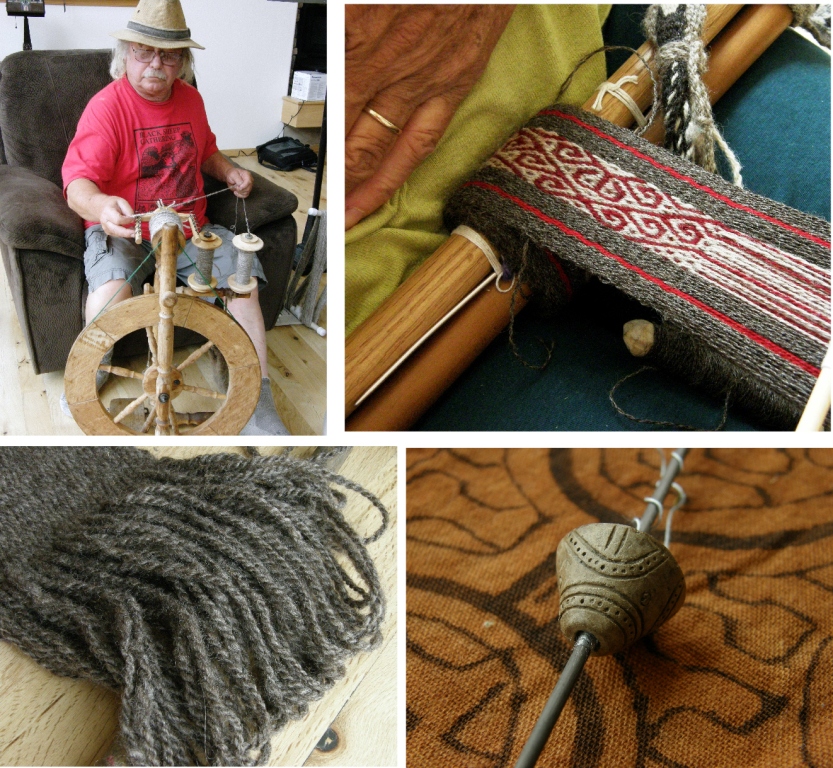
That's Ace at the wheel and below you can see the heavy grey yarn that he spun semi-worsted for his luxury backstrap...a lovely thick, cushy strap. You can see Janet working on a pebble weave band using her own handpsun and a pattern from my second book. And, on the right, there's the wee spindle whorl from coastal Ecuador that I gave Janet last spring. She has mounted it on a knitting needle and has been sponning with it.
That’s Ace at the wheel and below you can see the heavy grey yarn that he spun semi-worsted for his luxury backstrap…it made a lovely thick, cushy strap. You can see Janet working on a pebble weave band using her own handspsun worsted and a pattern from my second book. And, on the right, there’s the wee spindle whorl from coastal Ecuador that I gave Janet last spring. She has mounted it on a knitting needle and has been spinning with it.

Ace is new to backstrap weaving but not to spinning and I gave him a hand with that grey wool project. I have to admit it looked hairy and scary at first! but, it was a breeze to weave with. Who knew that it would weave up so well on a backstrap loom and in a warp-faced fabric? It all comes from the expert hands of the spinner and his/her preparation of the material.

???????????????????????????????I got so carried away with weaving and the enjoyment of working with that lovely thick and even handspun that I wove almost to the end forgetting that Ace would want several inches of unwoven warp ends from which to make braids for his backstrap. Once off the loom he braided the ends and braided a separate cord, from his handspun of course, for the straps.

Aces handspun yarn for backstrap

Some of Janet's beautiful naturally dyed handspun yarn which was destined for warp-faced weaving.
Some of Janet’s beautiful naturally dyed handspun yarn which was destined for warp-faced weaving….no overspin, no kinking!

It was about SUMMER, glorious summer…ripening grapes and berries, fireworks in the night sky, outdoor music, beaches and sunsets.

The view from my bed in Betty's studio looking out on her tree farm and ripening blueberries
The view while lying in bed in Betty’s studio looking out on her tree farm and bushes with ripening blueberries.

Sunset over the mountains in faraway Canada on the final evening of ANWG in Bellingham. The cool and enticing raspberry jungle at Janet's place. My poor, but kind- of -interesting, attempt at photographing the fireworks during my first 4th of July in the US. Beautiful patterns in light and dark sands on the beach at Shelter Cove near Janet's place....Humboldt County...sigh!
Sunset over the mountains in faraway Canada on the final evening of ANWG in Bellingham. The cool and enticing raspberry jungle at Janet’s place. My poor, but kind- of -interesting, attempt at photographing the fireworks during my first 4th of July in the US. Beautiful patterns in light and dark sands on the beach at Shelter Cove near Janet’s place….Humboldt County…sigh!

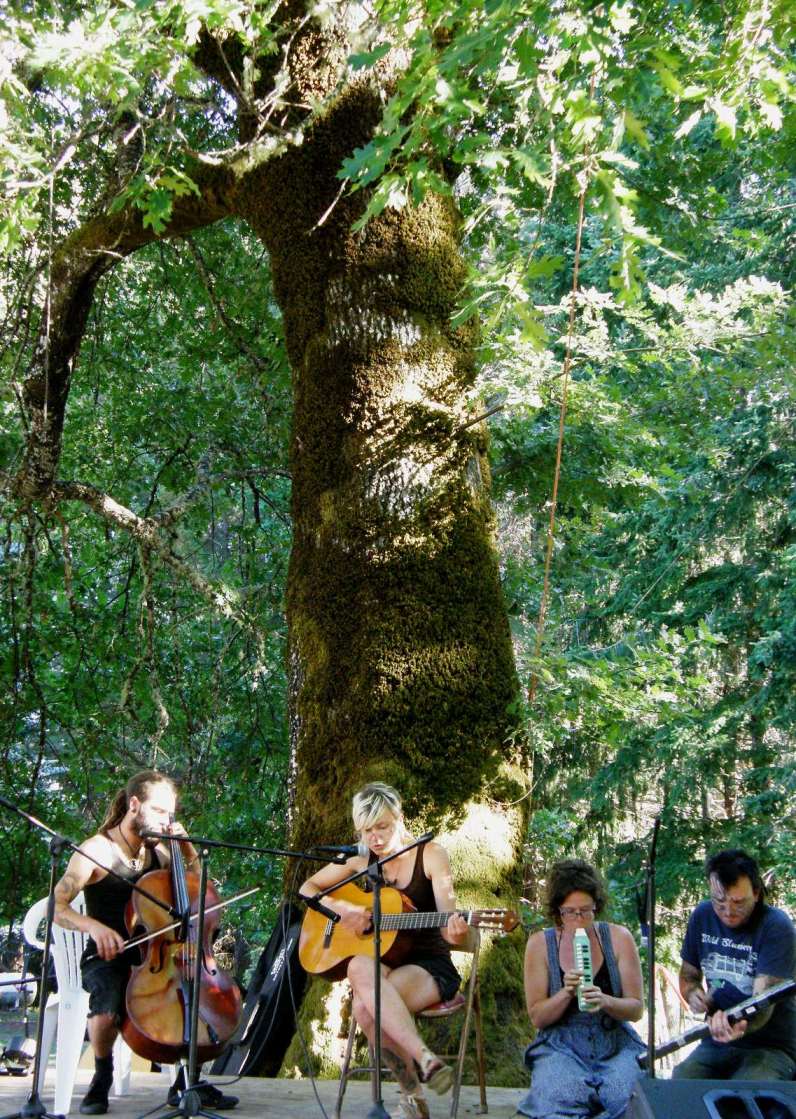
Music under the big ol' white oak...the annual"Strawberry Jam" at Janet's place. I hooked up a warp to my toe, wove and enjoyed the music.

Music under the big ol’ white oak…the annual”Strawberry Jam” at Janet’s place. I hooked up a warp to my toe, wove and enjoyed the music.

And there were textiles!! I was lucky that my visit with Betty coincided with a visit from Betty’s good friend Judith.She had come down from Canada to take a spinning class from Judith MacKenzie McCuin and stopped for a day to visit. She had brought with her the most exquisite textiles from a trip she had taken to Indonesia.

Judith lays out the textiles under the supervision of Trouble the cat.

Woven on a backstrap loom, this piece has both the warp and weft patterned ij the ikat technique. On top of that, the cotton thread was handspun. Judith tels me that this is known as "Magic Cloth" and comes the Tenganan Bali Agai Community in Bali, Indonesia.
Woven on a backstrap loom, this piece has both the warp and weft threads patterned using the ikat technique. The cotton thread is handspun. Judith tells me that this is known as “Magic Cloth” and comes from the Tenganan Bali Aga Community in Bali, Indonesia.

And, speaking of warp and weft ikat, I have to show you the jacket that Linda LaMay enetered in the juried show at ANWG. Linda wove with me over several days. She happened to be in the Gallery on my visit and allowed me to photograph her with her piece that was given the Complex Weavers Award. Her piece also won 1st prize for being the best representation of the conference theme: Crossing Threads, Crossing Borders.

Linda had bought a pre-tied and dyed ikat or, jaspe, warp in Guatemala...one which had been designed for warp faced fabric. Linda, however, wove it as a balanced weave, a twill and, in order to do this, had to dye the weft herself and then carefully place it to match the dyed pattern in the warp....she painstakingly transformed it into warp and weft ikat...amazing.
Linda had bought a pre-tied and dyed ikat or, jaspe, warp in Guatemala…one which had been designed for warp faced fabric. Linda, however, wove it as a twill exposing both warp and weft and, in order to do this, had to dye the weft herself and then carefully place it to match the dyed pattern in the warp….she painstakingly transformed it into warp and weft ikat…amazing.

Another textile in Judith's collection, this one from Sumba, Indonesia...all the stuff I love!...weft twining along the bottom, simple warp floats to create creatures that are mirrored in the central ikat section.
Another textile in Judith’s collection, this one from Sumba, Indonesia…all the elements that I love!…weft twining along the bottom and simple warp floats to create creatures that are mirrored in the central ikat section.

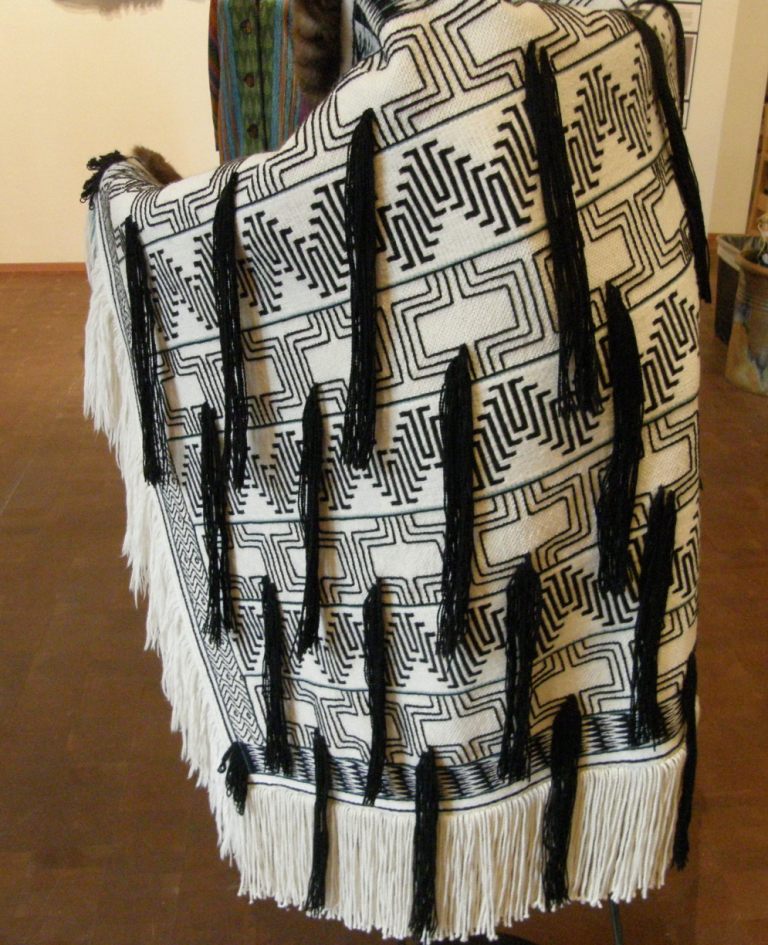
And, speaking of twining, let me show you the ravenstail work that John Beard showed in the Instructors’ Exhibit at ANWG. He kindly gave me permission to show it here….spectacular.

John Beard ravenstail

And, speaking of the warp floats in the Sumba textile, let me show you a textile that ANWG instructor and fellow Australian Kay Faulkner collected in her SE Asian travels. She brought this to ANWG to inform and inspire her students in her workshop entitled “East Meets West”.

We had fun comparing and contrasting spotty pebble-like structures and she came over to my classroom on the last day with Bhakti Ziek so that we could have even more "pebbly" conversation. If you look very carefully at the piece Kay brought you will see that there are weft floats amongst the warp floats.
Both faces of this textile have warp float patterns . Kay and I had fun comparing and contrasting spotty pebble-like structures and she came over on the last day with Bhakti Ziek so that we could have even more “pebbly” conversation.

I just gaze and gaze at this Selendang shoulder scarf of Batuisi, W Sulawesi from Judith’s collection. The colors all come from natural sources. The yarn used was heavier than that used in other Indonesian ikat pieces that I have seen. I really liked the feel of this piece.

selendang shoulder scarf

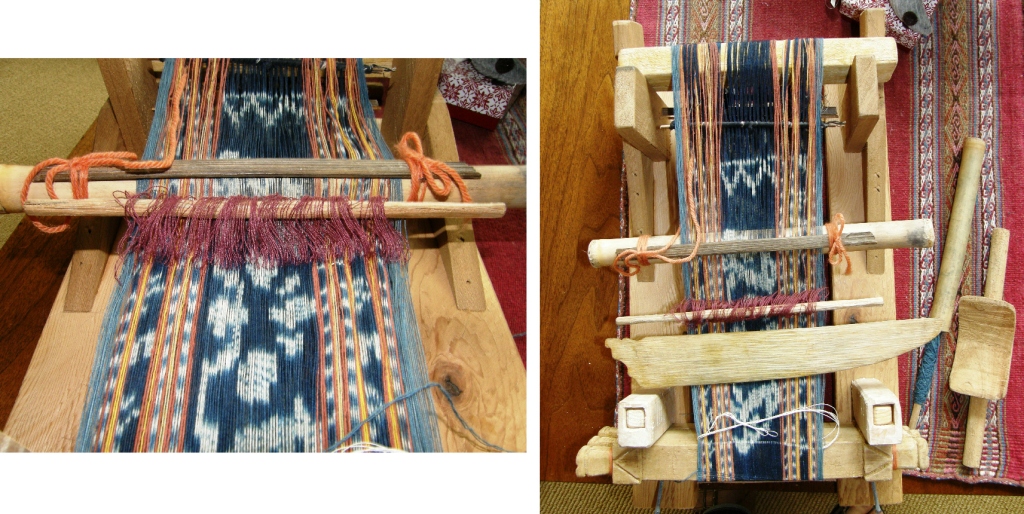
There are more of Judith’s textiles to show but I think I will save them for another post. Let’s look at the miniature backstrap loom that she got in Indonesia instead. I am always intrigued by new-to-me pieces of equipment that the various backstrap weavers aroud the world use and this loom included such a piece which may hold one of the many secrets of how backstrap weavers go about keeping the ikat-patterned warp threads reasonably aligned.

What a sweet little loom with its circular ikat warp in place. It was a great opportunity for me to take a close look at one of the Indonesain backstrap set-ups.
What a sweet little loom with its circular ikat warp in place. It was a great opportunity for me to take a close look at one of the Indonesian backstrap set-ups. The miniature wooden backstrap is so cute!

I love the carved pieces that serve to clamp the circular warp. Beyond the heddles and shed rod, the warps that had been tied and dyed were clamped between two sticks and wrapped. The wrappings seemed to separate the warps nto the sections that had been wrapped. I am wondering if the wraps also serve to squeeze the warp threads into groups and therefore help stop the from moving excessivley.and blurring the design too much.
I love the carved pieces that serve to clamp the circular warp. Beyond the heddles and shed rod, the warps that had been tied and dyed were separated along a stick which was wrapped. The wrappings seemed to separate the warps into the sections that had been tied for dyeing. I am wondering if the wraps also serve to squeeze the warp threads into groups and therefore help stop the from moving excessively and blurring the design too much.

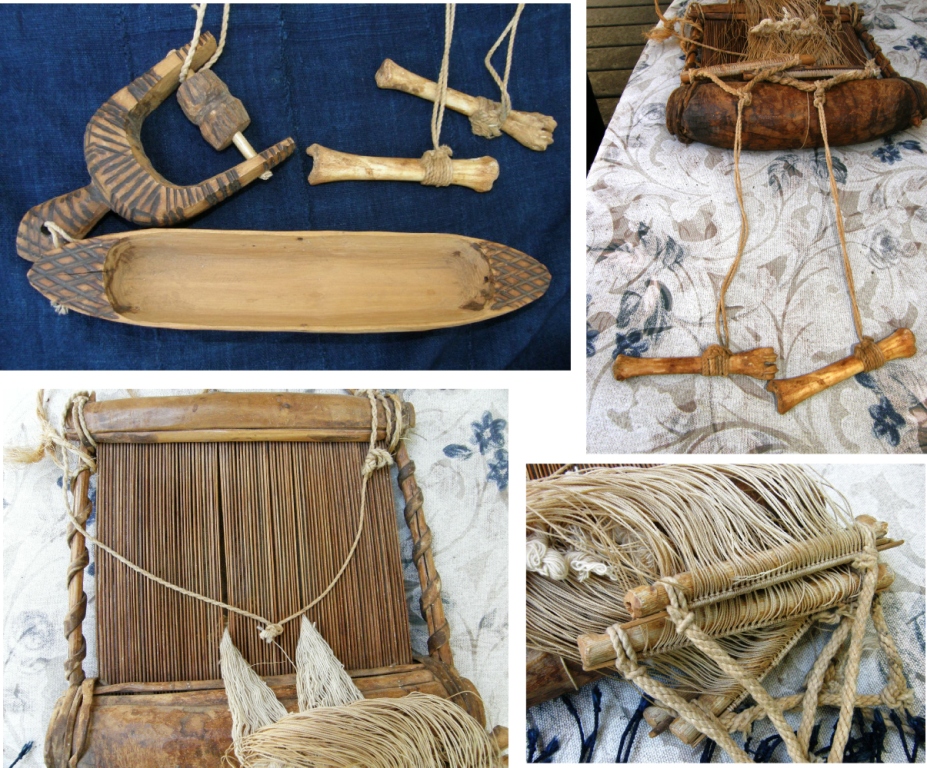
51eM0hePRnL._SX500_And, while on the subject of simple looms from far away places, let me show you a loom that a lady in Arcata, CA  showed us when our weaving get-together group went to the Farmers Market.  A friend had brought it back from Africa for her with accompanying postcards that showed how it was set up. The postcards said Upper Volta and were written in French. This, according to Wiki is today’s Burkina Faso and it seems that the people who use these looms are called the Mossi. The loom pictured at left is from this page.

It has some beautiful parts which include bone foot toggles for operating the shafts and a fine reed framed with what could be wood and horn. The carved wooden pulley system and shuttle were lovely as was the indigo-dyed cloth strips that had been sewn together. I used this as background for one of the pictures. It’s for sale…tempting!

mossi loom

??????????????????????Back at Janet’s I enjoyed a chance to do some weaving of my own.

I got to work on the two warps that I had brought with me.

I have to say  that I was happy to get this one off the loom as I do not care for it at all! I am going to use it to practice and learn some new sewing skills. Maybe I can shape it into some kind of interesting bag.

This is the warp that I wove while visiting at the Mannings’s annual Spinning Seminar last month. The pattern is one that I have woven many a time and observers’ reactions while I was weaving it inspired an addition to my FAQ pagesthis new one being about following and ceasing to follow pattern charts.

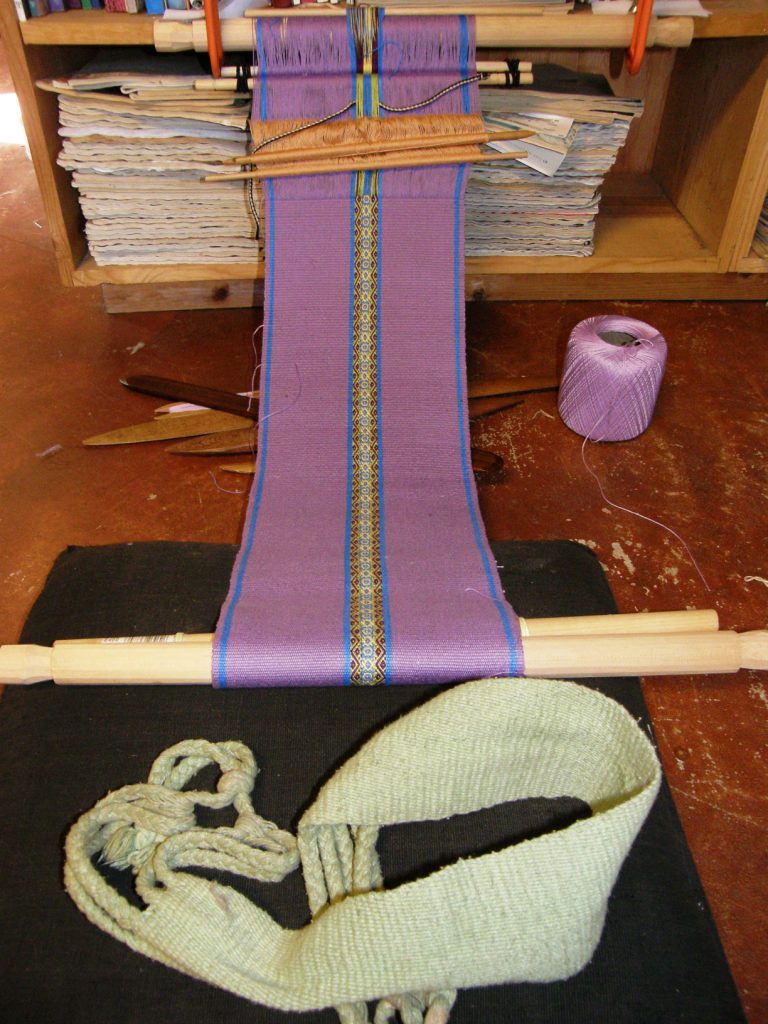
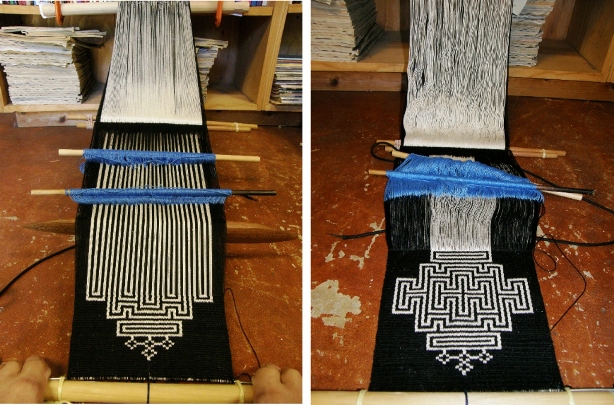
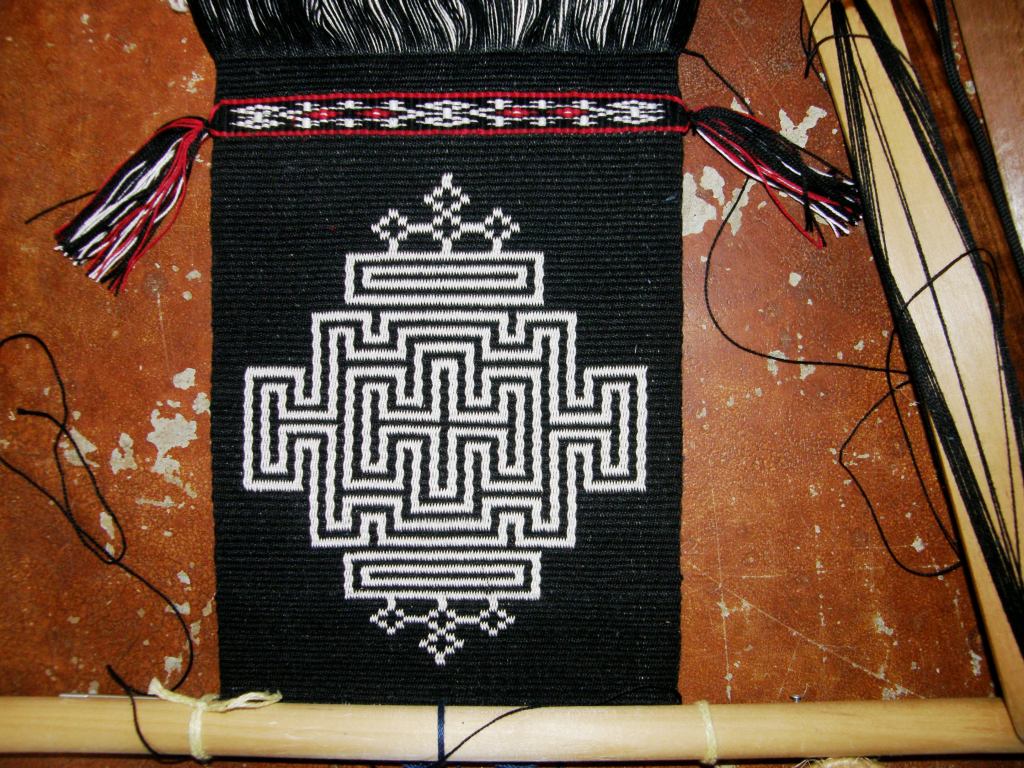
Next up was the piece on which I am weaving a Bhutanese design called “labyrinth”. I am weaving it using the two-heddle intermesh technique that I teach in my second book.

labyrinth design backstrap weavingThe pattern is from David K Barker’s first book of Bhutanese designs. Look at my RESOURCES page to see how you can download this free book. I never plan these ”traveling” warps to actually be anything knowing that my weaving on them is generally so interrupted and disjointed. However, I got to sit and weave on this quite a lot at Janet’s and had it set up in a very similar way to the way I usually like to weave. I lodged the far loom bar behind clamps on a low book shelf and moved the books and magazines around so I could extend my legs within. The angle was just right for me. With a pillow added on the floor, I was right at home.

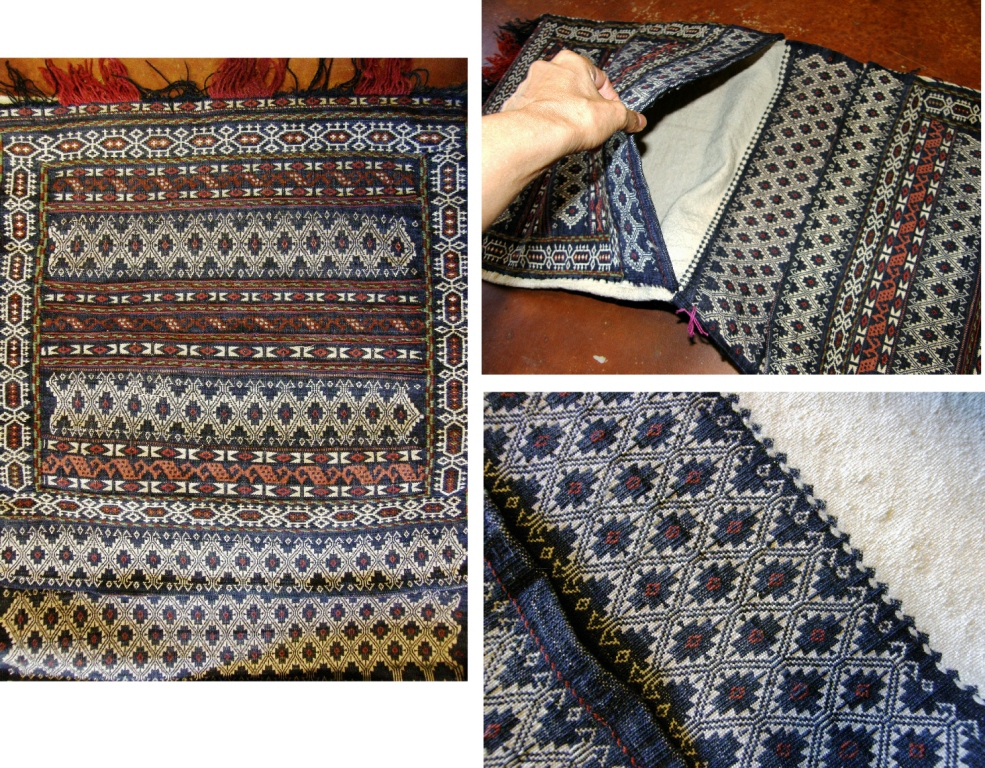
Once the first large motif was complete and I could see that this could actually become something, I had to decide what would come next. Inspiration came in the form of a double-pocket saddle bag quite likely from Afghanistan. Janet bought it in a local shop of ethnic artefacts and it is gorgeous! It is woven with wool and largely patterned using weft substitution technique which results in floats on the back. However, the kinds of  patterns used in this piece do not create overly long or unruly ones. There are all kinds of soumak and warp-wrapped patterns as well. The fabric is incredibly stiff and tight…made to last a long, long time, no doubt.

inspiration for new backstrap weavingThose reds and blues…love them! The back of the bag, which would be against the animal’s back, was not patterned. Janet and I were both astounded when we realized that the plain cloth was not a separate backing but, rather, a continuation of the weaving in an extremely tight and very well balanced plain weave. I would bet that this bag is waterproof.

saddle bagSo, this is pretty much where I am at so far with this latest piece of weaving. I just started some vertical warp-wrapping for the back side which I haven’t photographed yet and I have chosen a motif for the center of the back…it’s going to be a bag (of course!)…black, white and red (of course!) and it is going to get seriously dressed up with tassels and trims. This will be something nice to dive right into when I get back home (that will be soon, I hope. I am writing this in Miami airport).

??????????????????????

Next up on my blog…Santa Fe and the International Folk Art Market…it has been one of my dreams to see this. Visiting Santa Fe also gave me a chance to hang out with several weaving buddies that you will have already met here on my blog. I can’t imagine a better place to have gotten together with them and we are wondering how we can possibly top this!

Of course it inspired all of us but the funny thing is… one of my best ideas came  from something I saw in the American Airlines inflight magazine on the way to Miami…funny how these things work! See you next time.