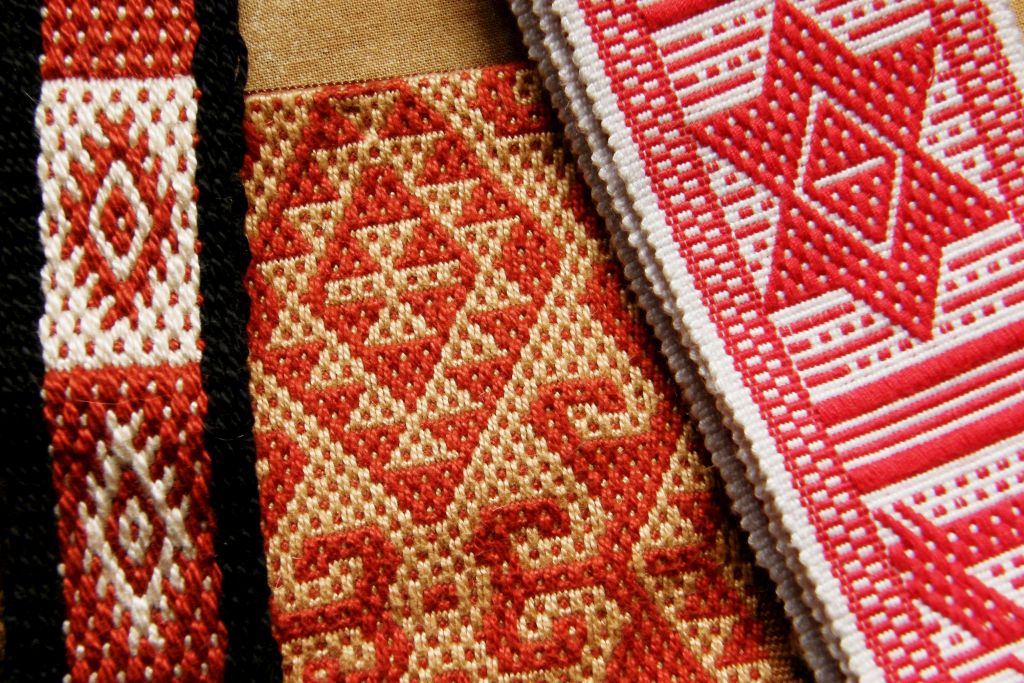
Backstrap Weaving – Cuffs and Stuff

silk cuff on loom backstrap weavingI left you last week with this silk cuff in Andean Pebble Weave still on the loom. I had wound a long enough warp to also be able to weave a few intermesh experiments. I was curious having never before used silk for this structure. And then, I was supposed to go on to my big ikat projects. Wrong.. I got stuck on silk and adornments…cuffs and other stuff… and have been fiddling around with those all week.

Coul stitches adorn the edges of a tiny case for the ipod that weaving friend, Gwen, gave me.
Coil stitches adorn the edges of a tiny case for the iPod that weaving friend, Gwen, gave me.

It is no secret that I like dressing up my weavings once they are off the loom. I like nothing better than to add tubular edgings, braids, pom-poms, decorative stitches and tassels to my little bags and pouches….no matter how tiny they are.

However, when it comes to dressing up myself, I have absolutely no interest at all. Clothes shopping is torture and I long ago gave up on wearing jewelry after having had several sentimental items yanked off my wrists and neck while walking down the streets of my home here in Bolivia. It’s funny that when I am traveling in South America, I am very careful not to display any ”riches”. Everything I have lost was taken when I was at home in Bolivia, feeling relatively secure, and with my guard down.

Nevertheless, I have decided that it would be nice to have some woven jewelry to wear while I am weaving with friends and showing them some techniques with all eyes are on my hands. That is what I worked on this week….cuffs, a couple of necklaces and a bracelet.

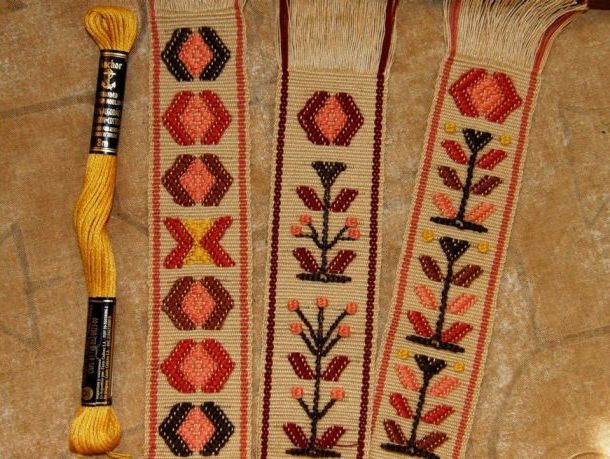
silk cuffs front and backHere are the two faces of the 60/2 silk piece. The pattern on the right is one I adapted to the Andean Pebble Weave structure from a piece of Kuba cloth. The other two are in the intermesh technique and I love the way intermesh looks in silk. The strip in the center was really only a sampler as I tried to get the proportions right to match the design on a button that I had bought. The other strip has a motif from Mexican tapestry. It is always hard to decide which face I prefer.

silk cuff backstrap weaving Andean Pebble WeaveThen I started on a silk ribbon to match the cuff I had made some time ago using a pattern of the Guaraní Isoseño weavers here in Santa Cruz. I wanted to use the ribbon as a necklace.

According to the legend told to me by my teacher, it was a snake that appeared in a dream and taught weaving patterns to the first Guaraní weaver.

While the Guarani weavers’ Moisy weavings depict colorful large trees, plants, butterflies, birds and flowers, the motifs on their Kara Pepo weavings are limited to snake skin patterns and stars. The weavers also think of the snake pattern as representing the life-giving Isoso river along which they have settled.

Although this piece is so very narrow and the pattern so very repetitive, it took longer to weave than you might expect…all those tiny silk threads to pick up. I have volunteered to weave some lanyards for the Braids 2016 conference. They will need to be much longer than this necklace piece..hmmm, I should perhaps get started on those soon!

silk cuff and necklace backstrap weavingThe pendant is one that I had bought, with this very project in mind, at the Northwest Folklife Festival while in Seattle last spring. In fact, I had bought two, and so I also wove a wool ñawi awapa band for the other. While visiting with Karen Huntoon in her kumihimo studio and store last year in Truckee, I got some small magnetic jewelry clasps. I suppose these kinds of projects have been on my mind for some time as Karen’s kumihimo necklaces were very inspiring.

nawi awapa necklace and pendant backstrap weavingWell, after that, I got a little ñawi awapa crazy and decided that a bracelet in this technique would be fun. I used fine wool to weave four of these patterned tubular bands and combined them. These are the tiniest ones I have made so far and I think they are really cute.

nawi awapa bracelet backstrap weavingFun!

So that was my week in weaving and playing. I still have more of the magnetic clasps. I wonder what else I will come up with. Maybe I will just get down to drawing my large ikat cartoons instead…but, wait a minute…I don’t have an ikat cuff, do I? or an ikat necklace…..

silk cuffs and necklaces backstrap weaving


Backstrap Weaving – Tying Up Loose Ends

It will be just a short post this week as I tie up loose ends on projects and get ready to travel.

unfinushed projects backstrap weavingThere are buttons to be sewn on cuffs, warp-ends to be braided on key fobs, books to be glued and weaving to be finished. I need to break down the two extra weaving stations that sprouted and grew during this latest homestay of mine…the ones in the living room and kitchen… which were needed for keeping up with  a weave-along while I worked on my usual large projects in the bedroom. I must clear away the various project piles with their balls of yarn, books with colored fingers of protruding Post-it notes, sketches and pattern charts so that all can be covered and kept dust-free in my absence.

The first thing I attacked was the journal-cover project. Once the weaving was done, the scary part, which involved gluing the cloth to the book covers, had to be faced. Fortunately, I had one rejected book cover piece which served as test fabric for the glue. You can see the rejected piece in the upper corner of the picture above. Would the glue soak through the cloth and appear as an ugly stain on the upper face? It didn’t! Now I can add a zipper to that test piece and turn it into a little pouch.

inside cvers of journals with backstrap weavingYou can see how I turned the end of the weaving over to the inside of the covers. The piece of cloth in the picture is still on the metal rod which I used to create a selvedge. I glued the fabric there and then used colored paper to completely cover the inside. Precisely positioning that colored paper while using a contact glue was probably the hardest part of the whole process. I also used a line of glue along the point where the book cover bends to open.

initials woven into spine of journalsI bought another journal and made a fourth cover. You can see the recipients’ initials on the spines. It is fun discovering that you can make recognizable letters with so few threads in such little space.

Here’s the fourth one set up and ready to go. I love seeing a fresh warp like this stretched out in front of me.

backstrap loom with two shed set up and coil rodI used a motif inspired by Guaraní textiles with snakes and a star…

backstrap weaving woven journal coversThen I settled into finishing the third panel in the Bird series with its ikat bird shapes filled in with three-color pebble weave. That was followed by a rather tedious session of sewing black on black as I lined the irregular edges of the ikat shapes with cross-knit looping…

ikat bird shapes filled with pick-upThese panels really fall into the category of ”samples” as I used them to learn much about tying warps for ikat. In the first panel, the dye leaked a lot under the ties, staining the threads within, which gave a surprisingly attractive softened look to the motif, especially around the edges, once the pick-up patterning had been finished. In the third panel, my tying skills had improved and the ikat shape had crisp, sharp outlines with the white threads within the ties completely untouched by dye. The bird shape in the third panel is brilliantly white as a result and leaves me wondering in the end which ”look” I actually prefer.

ikat bird shapes filled with pebble weave backstrap weavingWth this experience behind me, I shall have a lot of time in my travels to ponder the next ikat project that I want to start on my return. The aim has always been to create flowing curved shapes in ikat rather than the rigid block-like ones in the Bird samples. I want to fill beautiful curved shapes with pick-up patterns. I have two such shapes in mind and I will, no doubt, stumble across something while I am away that will inspire a third.

As you can see, the three panels above are still on their looms. So, I am not completely finished with this project. I have yet to decide how exactly I want to finish them in terms of weft twining, fringe or braids. Should I introduce some red in the first two panels? I will launch myself into that when I return.


Backstrap Weaving – A Change of Seasons

The change of seasons is barely noticeable here in Santa Cruz. There is a drop of perhaps a few degrees of temperature between summer and fall but nothing else here tells me that fall is on the way. That isn’t happening today as we rapidly make our way up to 30 degrees centigrade. I remember when I was teaching English here, the text books would use the classic pictures to represent the four seasons….snow, sun and beach, falling leaves and spring flowers….somewhat like the motifs I used on my Four Seasons ticlla piece. They meant nothing to my students. They found it especially hard to grasp that fall would be the “opposite” season to spring in the northern hemisphere. I couldn’t blame them.

discontinuous warp ticlla closing the gapAs my departure date for my US trip draws nearer, I am wondering if anything in the northeast is telling people that spring is on the way. Please, say “yes”! My friend in Massachusetts told me to bring boots presumably for stomping about in snow. I don’t own a pair! So, I am just about ready to do some kind of dance in order to try and will that northern winter away and bring on the spring.

Maybe I should fill this post with lots of spring imagery and put a springy vibe out into the universe instead. A change of season and cooler temperatures would be apprecited down here. Okay, so here goes…

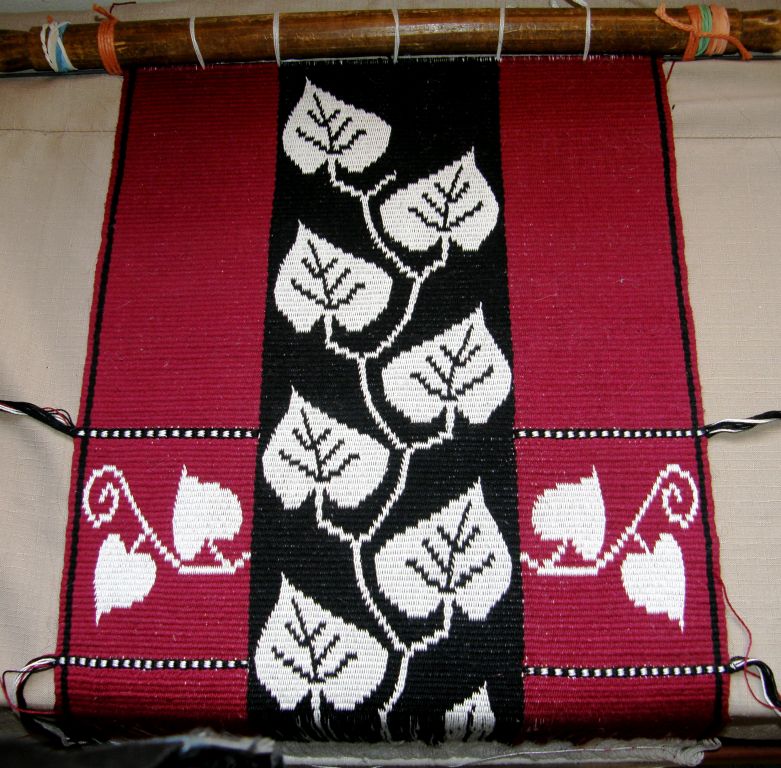
Leaves could represent the new growth of spring or the dying leaves of fall…either way, a change of season.

I suppose that blue leaves could be either!

circular warp backstrap

chamanto piece on progressThe leaves on my wall hanging, which were inspired by the chamantos woven in central Chile, are rather spring-like or even summery, I think. The motifs woven into the chamantos represent the agriculture and horse culture of that Chilean region. They are covered in patterns such as wheat stalks, flowers, horse hooves, grapes and vine leaves.

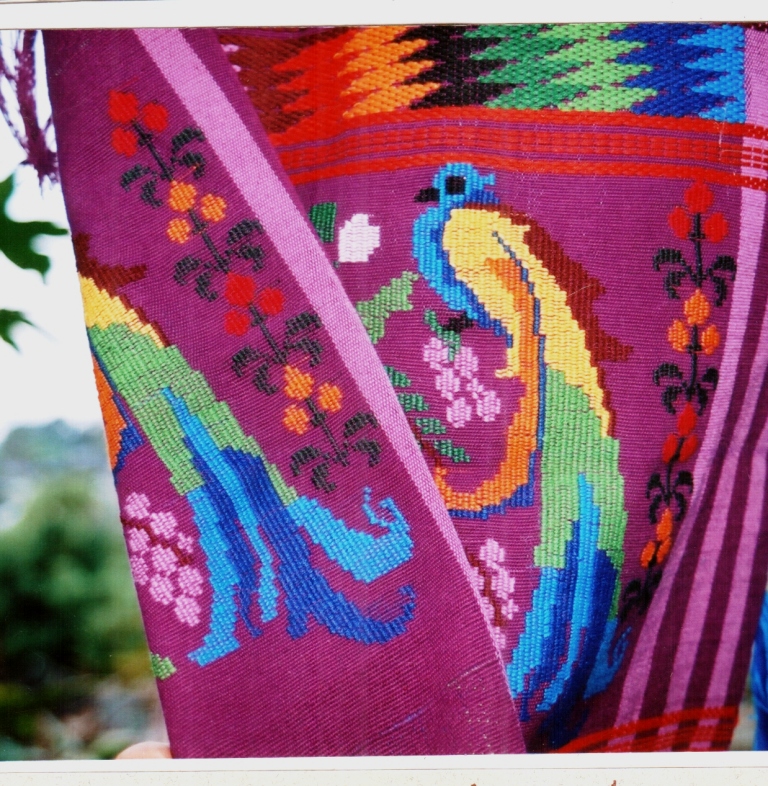
There is nothing cold or wintery about Guatemalan textiles with their flower and bird motifs in bright colors…                                                            double-faced

My Guatemalan teacher with whom I worked on the piece pictured below, taught me to just dip my hand into the basket of threads, pull out a color and go with it. You can see the rows of plants with their happy multi-colored leaves…

Guatemalan supplementary weft patterning

Those little plants and flowers are always fun to weave with supplementary weft even if my color choices once I was back home on my own were a lot more planned and conservative…

suppweft-tree-bookmarks

Crocheted hats and hat bands produced in the highlands, an area which can be quite colorless and bleak at times, provide a splash of colorful flowers and birds….

chullo-and-hatband

OLYMPUS DIGITAL CAMERAThe flowers on the hatband from Calcha, Bolivia inspired the design on the fourth of my red, black and white wall hangings…

???????????????????????????????

The Guaraní weavers who live in the eastern lowlands of Bolivia may not always use bright colors but their work certainly shows the rich plant and bird life of this region….nothing wintery about this…

Guarani Moisy technique

The above pieces were woven using what the Guaraní weaves call the moisy structure. They also use the kara pepo structure which we know as pebble weave.

Julia, from the Ravelry group has been weaving a piece for her guild’s color challenge. She is weaving Guaraní star motifs in pebble weave. It is always exciting or me to see people using the charts in my books. These star patterns are charted in my second book and the outline is a traditional Guarani pattern.. The basic star outline has its center filled with different shapes and it is an interesting exercise in designing to explore how many different kinds of “fillers” you can come up with for the space in the center of the stars. The Guaraní repertoire of star patterns is fairly small. While the patterns they weave using the moisy structure seem unlimited, the star is one of only very few motifs that they weave using the kara pepo structure. I came up with quite a few filler patterns for  the star for my book and Julia, of course, has been very creative in  inventing some of her own.

DSC04397_medium

Santa Cruz crochet cottonMy Guaraní teacher, Angela, buys the same Brazilian Clea brand thread as I do for her weaving. It was shocking seeing how suddenly and how quickly the price of this cotton went up as it did all over the world and sad knowing how it would effect the weavers and their ability to buy thread.

I am sure that they must be as happy as I am to find that cotton crochet thread is now being produced by TextiCruz here in Santa Cruz. While Santa Cruz used to be a major cotton producing region, cotton hasn’t been grown here for a long long time. I have no idea from where the raw material is coming. But, whatever the source, they are able to sell the finished product much more cheaply than the Brazilian thread!

“Camba” is the nickname for people from Santa Cruz and the label shows the sombrero de sao, straw hat, which is part of the typical festival costume for this area. I bought one ball to try out. You can see it here among a chaos of sample bands that I am gathering for my trip. I am  little suspicious about the color fastness. It sounds terrible but I have  to say that things produced here tend to be of inferior quality. They are well presented but you only have to scratch the surface and…..It is wise to be suspicious of something that seems too good to be true. That goes for everywhere, right? I notice that the label has the typical words of advice on buying from one dye lot to complete a project, yet there is no dye lot number to be seen anywhere.

Let me briefly slip back into the somber tones of winter as I would like to show you my progress on the squiggly Shipibo- inspired wall hanging panel. I would like to thank those who commented last week with words of encouragement. This week’s work on this included four hours of unweaving and re-weaving. I had forgotten to start one of the squiggles and I mistakenly thought that it wouldn’t matter so much. I was wrong. There was a large gaping hole of black space that I simply couldn’t live with. Four hours later I was back to where I had left off but much happier for it!

shipibo wall hanging panelWhen I was at the Encuentro de Tejedores in Cusco in 2012, a presentation was given on Shipibo art. We were told that parts of the patterns the Shipibo people paint and embroider represent their borders and rivers. One of the few times that I flew over Brazil in daylight on my way to Miami and could enjoy the view over the Amazon jungle from a cloudless sky, the 

jalq'a weavingrivers below looked very much like the squiggles I am weaving. I tried to guess which one of the squiggles might be the Amazon itself until I was completely blown away by the massive body of brown water that appeared and curved its way off to the horizon.

I have always been in complete awe of the weaving of the Jalq’a people of Potolo, Bolivia (at left). A complex mass of figures fills just about every space on the cloth. There is no break….no plain weave with which to relax between the concentration of pick-up patterning….a few rows to sit back and just open sheds, beat and pass weft…no, none of that.  While halfway through one motif, the weaver is finishing another nearby and starting the next.  Small motifs are even woven within larger ones. Plus there are warp floats to consider. The weaver must ensure that she ties down each and every one of the threads at just the right moment before the floats become too long. And  pattern charts, of course are not used. It’s mind boggling.

Although I am not weaving a warp-float structure and my patterning, therefore, is much easier, my current weaving with its squiggles starting and stopping and turning this way and that has given me an even greater appreciation of the work of the Jalq’a people. I have to remember to start the next squiggle while in the midst of one and finishing another.

Let me return to something bright and spring-like to finish this post and blow away the winter blues…

PAZA bands Cochabamba BoliviaHere are some of the beautiful bands woven with naturally-dyed handspun yarn from PAZA in Cochabamba. Cochabamba city is one of many I have come across in my travels in South America that is named a city of “primavera eterna”…eternal spring.

See you next week!
Backstrap Weaving – A Snaky Start to the New Year

A “snaky” start to the new year….”Snaky” isn’t one of those words I find myself writing very often and when I typed it into the title of this post, it was bugging the heck out of me…just didn’t look right. Spell-check wasn’t touching it, yet I wasn’t going to be happy until I had Googled it to make sure. It was then that I read that “snaky” in informal English in Australia and New Zealand  apparently means angry or bad-tempered.

So, I want to make it clear to the Aussies and Kiwis out there that I did not start this year angry or bad-tempered as the title of this post might imply. (This also reminds me that I am in my twentieth year here in South America…that’s a long time to have been away from Australia and any of the new expressions that may have been adopted into the local lingo.)

598638_479457965438891_897317545_n
supplementary weft samplerWhen I say “snaky” here, I am referring to the fact that the Chinese New Year, which will start on February 10, will herald the beginning of the Year of the Snake.

And why do I know this? Well, a Facebook friend shared the above image from a page called “The Journey to the Revelation of my Soul” and I saved it simply because….. I like the COLORS!
I am thinking that I must weave something with this color combination some time. Well, I kind of did in my sampler pictured above… but not quite. I want that rich burnt red background and that special shade of blue. Whoa…is this the structure and process person speaking?… now getting all excited about color?

OAnother reason the snake image appeals to me is that I happen to be starting the new year weaving a snake-like motif into my latest wall hanging project. I like to think of it as a boldly-patterned snake  winding its way back and forth across the cloth.

The pattern is based on one of the designs that Wayuu weavers work into their belts. Imagine my surprise when I got Mirja Wark’s book off the shelf, in which she describes and names the designs, to find that the particular pattern that I have been using as my inspiration is called pasatalo’ ouya which means “like the intestines of a cow”!

Okay…so, I am weaving a wall hanging with representations of cows’ noses and intestines. But, since I adapted the basic motif a lot so that it would be big and bold enough to fit the space in which I am working, I think I could allow myself to call it snaky instead. What do you think?

Sloooow going. I am not achieving the four finger widths which my teachers tell me is a good day’s work. Some days I am lucky if do three. It is, however, very exciting watching the pattern slither its way up the fabric.

It is giving me both a mental and physical workout, I can tell you! It is an extremely dense two-heddle complementary-warp structure and opening the heddles is hard work. While the tiny elements of pattern within the main shape are very repetitive and easy to read, there are just so many warps to handle! I feel that I deserve to get up and go eat mango after every pick!

O

I like to think of the figures on this sash that I wove a long time ago as snakes. I copied the design from a textile from pre- Colombian Peru. Who knows what the weavers of the original fabric were seeing when they created these motifs on their cloth.

books-2

The snake is an important figure in Guaraní weaving legends. My teacher tells me that it was a snake that appeared in the dreams of the first weaver and taught her the weaving designs. When Guaraní weavers of the Izoceña group weave the zig-zagging snake skin patterns in their cloth they are also representing the Isoso river along which they have settled. The snake and the river are one.

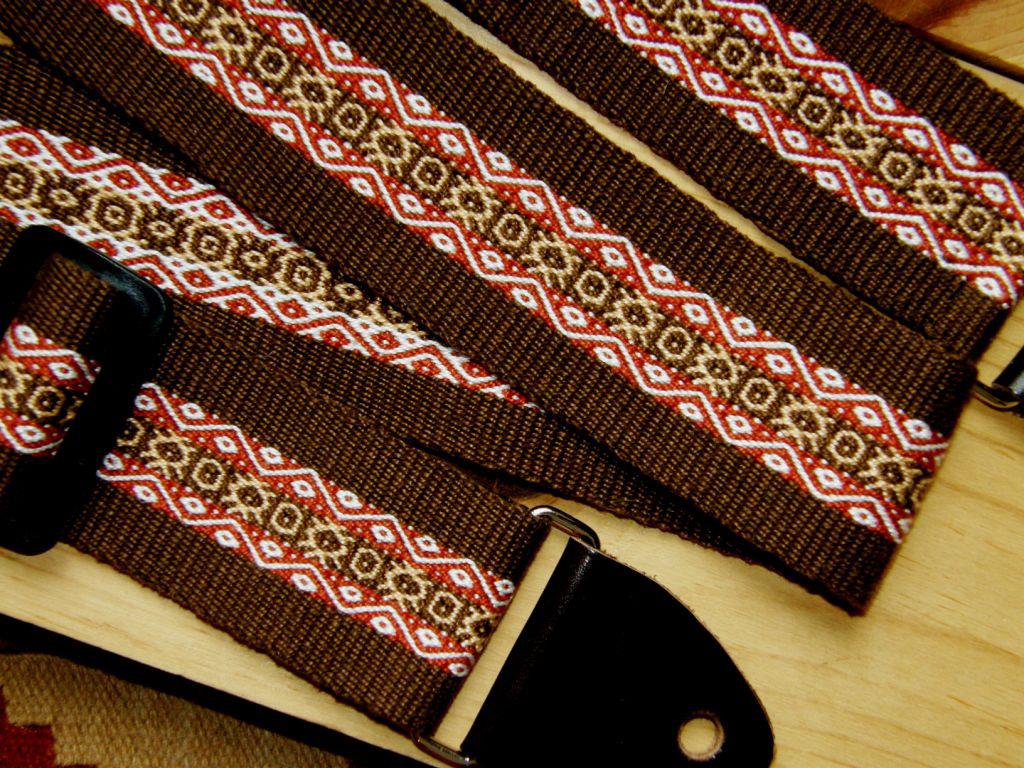
I wove Guarani inspired snake skin designs into this guitar strap.

The Mayan Goddess of Weaving, Ixchel, is most often depicted with a snake or snakes on her head or entwined in her hair…

ixchel 3 formsI was told that this is one of the reasons why many Guatemalan women weave richly colored sashes to wrap about their heads and around their hair. The sashes vary enormously, in width, length, color, design and weaving technique  from place to place. It is also interesting to see the different ways they are worn….

santiago atitlan hair sashby a lady from Santiago Atitlan above…

O

weaving a hair sash zunil guatemala…and by this sash weaver in Zunil.

##################################################

Wishing you all the very best for the new year surrounded by completely non-“snaky” (in the Australian sense of the word) folk!

##################################################


Backstrap Weaving – Seeing Stars, Short and Sweet

I am keeping this blog post short and sweet…well, at least I will try to. Life definitely got in the way of things this week with some major distractions and, unfortunately, they had nothing to do with weaving. I feel like I have been walloped and am, just like in the cartoons, seeing stars….

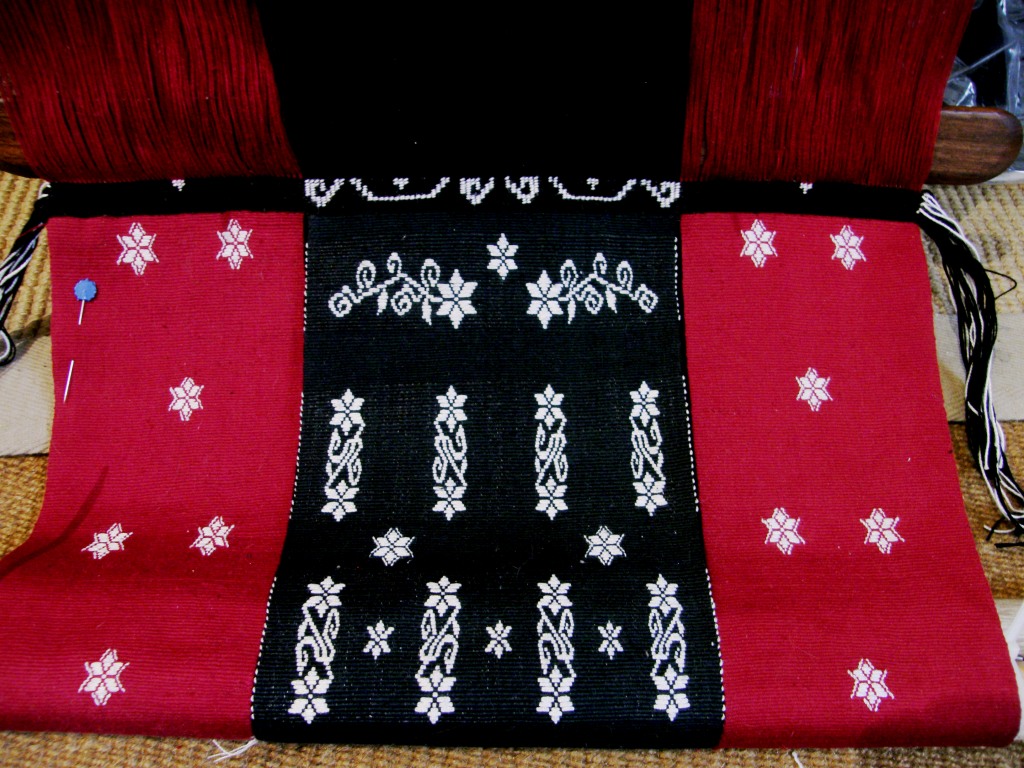
By coincidence the little bit of weaving I did this week just happened to involve stars. Following on with my new love affair with the weaving of Tinkipaya in Bolivia, I tried another of their pretty motifs, which I had thought were flowers, but which, according to Cereceda in her book which catalogs the designs on these textiles, are ch’askas, stars, and are a representation of the world above known as janaq pacha.

The small band I wove to test the pattern is pictured above with a couple of wooden tools I got in a market in Potosi, the province in which Tinkipaya is located. I was told that the tool on the left is used to push down the warps behind the heddle rod when the weaver is opening the heddle shed. I have never seen a weaver actually use one of these. The one I have has a red stain and I like to think that it might be cochineal from one day when its owner was preparing to dye. The other tool, of which you can only see the tip, is used for beating and strumming and I have seen these in use in several places in Bolivia.

So, sometimes I see flowers where the creators of the designs see the stars in the heavens and sometimes vice versa…

I saw stars when I first saw this pattern but its creator, Kurt Laitenberger who designed it for tablet weaving, calls them flowers. I wove them into what I call my ‘Starry Night” wall hanging. I remember stepping outside my little room on Taquile Island on Lake Titicaca to go to the bathroom on a clear and bitterly cold night and being stunned and almost knocked over by the brilliance and abundance of the stars in the black black sky over that dark little island.

In the pebble weave piece above I used star motifs from Guaraní textiles. I was pleased to recently find a story, translated from Guaraní to Spanish, in a book published by Artecampo, a craft cooperative store, here in Santa Cruz about a legend behind the use of the star motifs in Guaraní weaving…..it says that…

One day  the children were taken and placed  like stars in the heavens and this is why women cry out about stars in their weaving. The stars not only speak of the sky but also about the richness of nature because one woman, in an attempt to stop her child from being taken, grabbed hold of a finger (or toe, it is not clear in the Spanish translation which). As she pulled on the finger, unfortunately, a piece broke off and this piece was buried. From the burial of this piece a corn plant sprouted. In this way, weaving symbolizes abundance which comes from the piece of the child. And this is why food crops are not only considered elements that feed and sustain men, they are part of Man himself just as the stars are part of Man and Society. Songs name those who are living in the sky and those that sing wear woven cloth to show that they are still with them even though they are distant.

Wikipedia tells me that the stars on the flag of the United States represent the fifty States in the Union. Well, I knew that. I was hoping to find out why exactly stars had been chosen as opposed to some other figure. There doesn’t have to be a reason. I am  sure that we could all come up with some kind of symbolic meaning for a star. I swear that some weavers I have spoken to have made up things about the motifs they are using just to please or have a bit of fun with me…I have seen the twinkle in their eyes and the way they look sideways at each other!

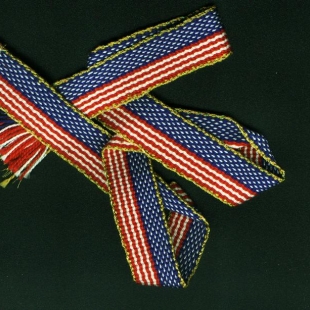
Gail from Weavolution wove this very patriotic collar for her dog on her inkle loom. She is forever coming up with clever designs for what must be the best-dressed dog in New York.

Speaking of flags and patriotic weaving, I assume that the next starry piece was made by someone who is proud to be Australian.

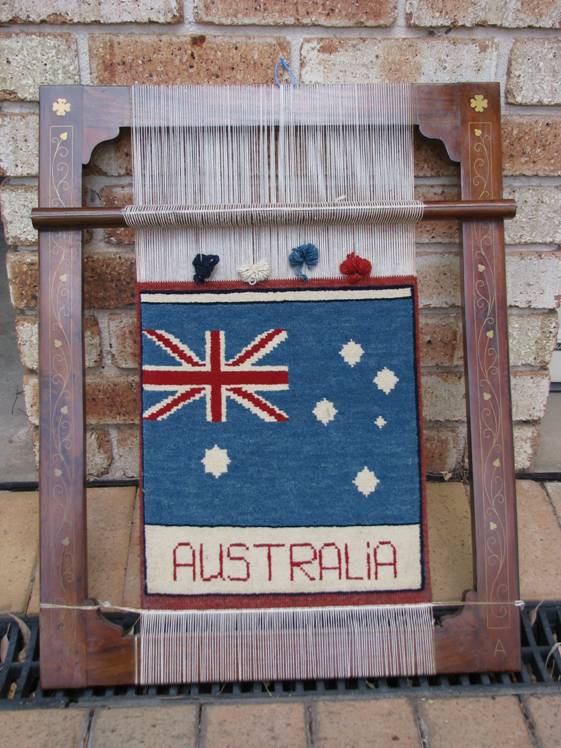
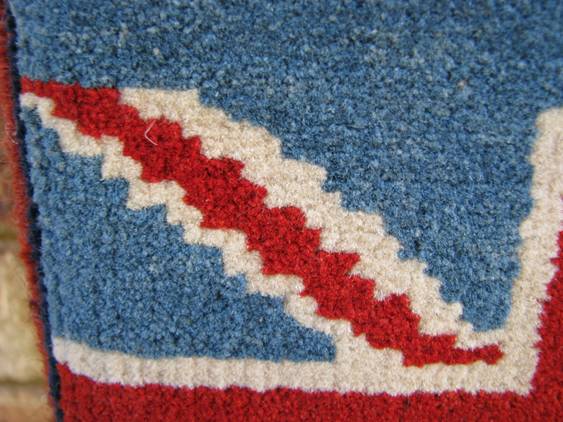
I have this very cool cut-pile weaving of a representation of the design on the Australian flag…

The group of stars is the Southern Cross constellation which really is a sight to behold there in the southern sky. I am so happy to be able to see it low on the Bolivian horizon and it makes me feel somehow connected to Australia and  the people I know and love so far away. It is little wonder we so love stars and choose to use them in our cloth.

The large single star, which should only have seven points, represents the Nation’s seven states and territories.

This cut pile piece on its beautiful frame is gorgeously dense and I would love to meet its creator.

It was given to my brother as compensation from the Indian owner of a furniture store who went out of business before he could supply all the chairs for my brother’s dining room setting. He then gave it to me. One day I will track him down and see if I can talk to him about this weaving technique.

I don’t know if the weaver intended to continue with the design. There is so little space at this point and the tension on the warp is so high I can hardly imagine being able to do so.

There are a lot of representations of stars in Andean weaving. I took one small motif  and combined it with others to make a guitar strap in colors reminiscent of the desert and canyons of the US southwest with a winding river, moon and stars. It took me back to clear, warm nights camping in the depths of Utah canyons with nothing between me and the stars, moonlight bouncing of red canyon walls and with dozens of frogs “ribbeting” away at the waters’ edge.

And then there are motifs that look like stars to our eyes and maybe one day I will find out what exactly they mean to the weaver. There’s an Andean ch’aska on the left with star-like motifs from Central Asian textiles and a motif on a belt from Ecuador on the right.

Enough star gazing…let me show you what Camilla in Sweden made with her pebble weave band…a hair band for a friend. She attached elastic to the ends and covered it. What a sweet project for a band.

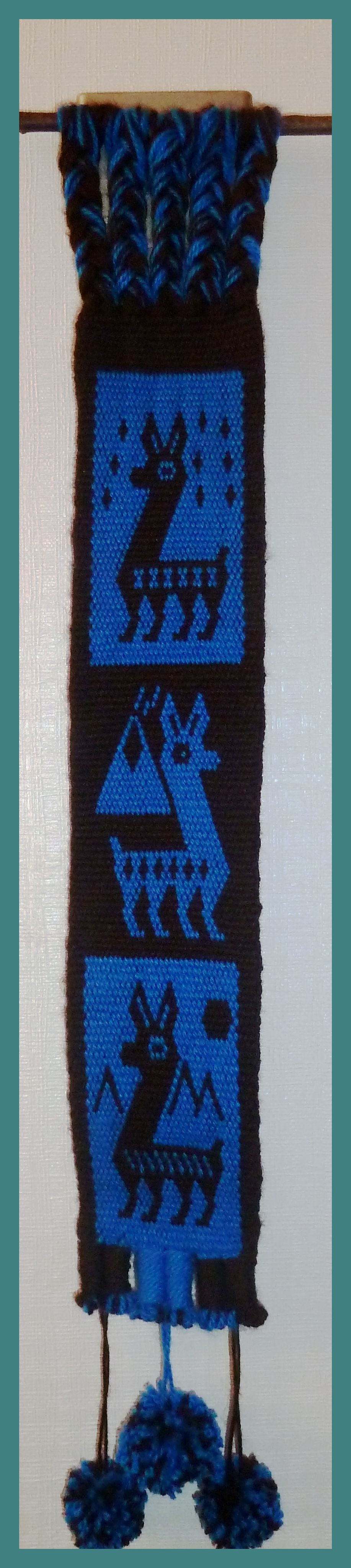
Ad here is what Karina in Chile wove using the Bolivian llama patterns that I embellished and charted. They are woven in warp-faced double weave the instructions for which, along with the llama pattern charts, are on this blog.

The uppermost llama is standing beneath a starry sky.

I love Karina’s clever wrapped-warp and pom-pom finish and the braids at the top are a nice touch too. It makes a lovely wall hanging.

It’s nice having these projects to show from people at opposite ends of the globe…how we all come together with this same love of weaving!

As for the thing that had me distracted this week….I have to keep my chin up or I won’t be able to see the stars.