Juggling! Yes, here I am juggling…weaving my wall hanging project, warping, writing and taking pictures for my new book, putting together the translated versions of my first book, planning articles, answering online questions from new backstrap weavers. I have had to come up with some new routines to fit all this in.
Most people roll their eyes and sigh in dismay at the word “routine”…dull, boring repetitive. I, on the other hand, am all for it, that is, if it is a routine of my own making and not one that is imposed. Having a fixed routine is the most efficient way in which I can operate.
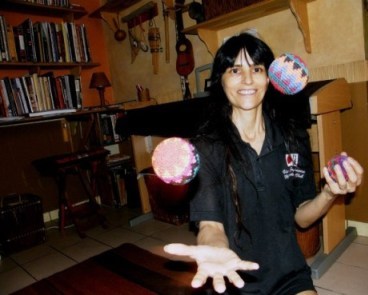
And I do take time out for a little mindless fun!
Juggling is both relaxing for the mind and a darn good work-out for the body…at least for an inexpert juggler as indeed I am….with lots of crawling around on the floor picking up dropped balls.
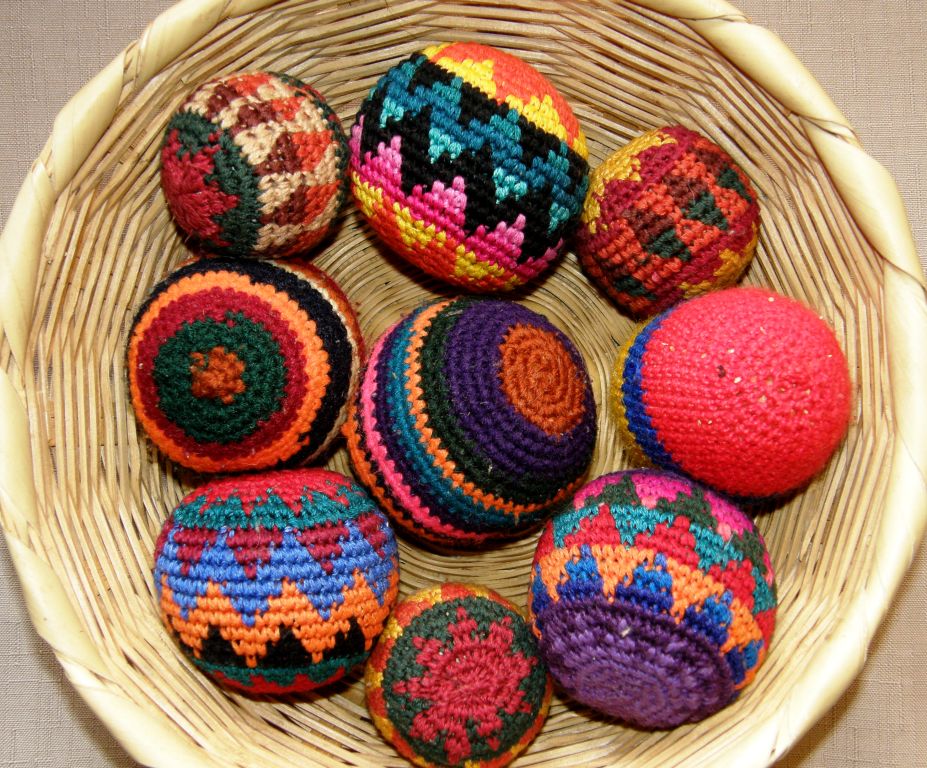
What prompted me to drag out the Guatemalan juggling balls from the depths of one of my woven storage bags?….They are crocheted and I wanted to take a look at how they had been made.
We talk about the simplicity of the backstrap loom and what can be achieved with a loom comprising just a few sticks, or sometimes no sticks at all.
What about the wonders that can be created with one small stick with a hook on the end?
And what led me to all this?… pictures in Mirja Wark’s book on the woven belts of the Wayuu people of northern Colombia and Venezuela. The designs on these belts are the inspiration for my latest wall hanging project. One picture shows a man wearing a belt with a small patterned bag at his side which Wark says is crocheted. She describes crocheted cotton bags that are used by both men and women. The women carry a medium-size bag called susu. Men have smaller crocheted money pouches called susuchon and other pouches which can hold tobacco, keys and amulets.
So it was off to Google and Youtube Land to learn more. I have decided to do without air conditioning and pay for a faster internet service instead so Youtube viewing does not make me want to tear out all my hair anymore! But, finding time to watch all those videos is yet another ball that must be added to the juggling mix.
These images of Wayuu susu, which are also sometimes referred to on these sites as mochilas, are from the online store of the Wayuu Taya Foundation.
I found that these traditional crocheted bags became very popular outside Colombia a couple of years ago and even prompted an article in the NY Times.
On many sites the bags are described as having been “woven”, “knitted” or “woven in crochet” but we have Mirja Wark who tells us that they are, in fact, crocheted. One article describes the straps as having been created on looms.
I love the big bold designs! The bag at left is from CordoBags.
The following is probably the nicest video I found in my alotted Youtube time showing the Wayuu people and their terribly harsh environment. A woman can be seen carrying her susu, there’s a little weaving showing those loose joined heddles that I talked about last week, some fast and efficient twining in progress (love that part!) and there are two brief segments showing the women crocheting bags.
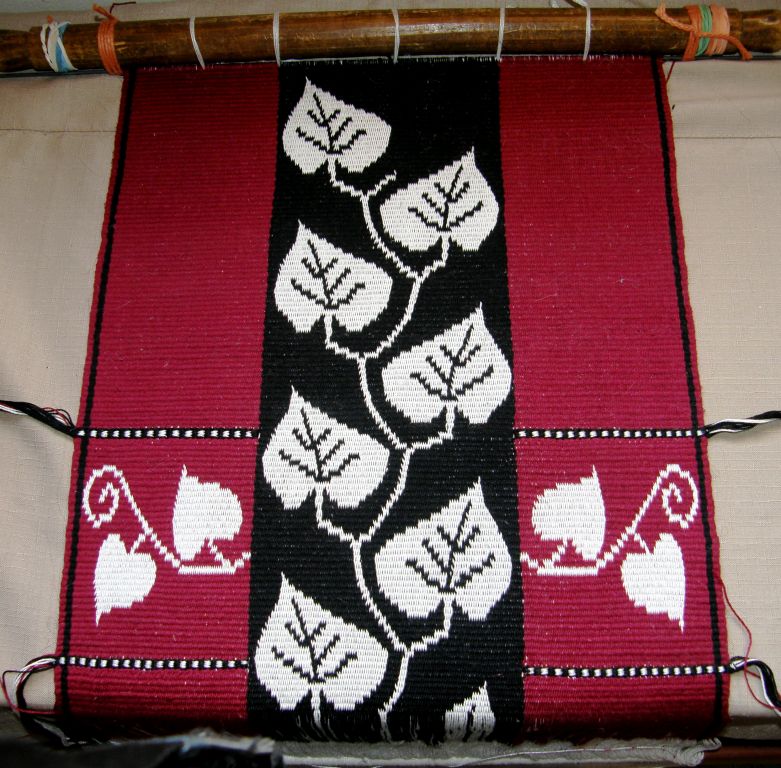
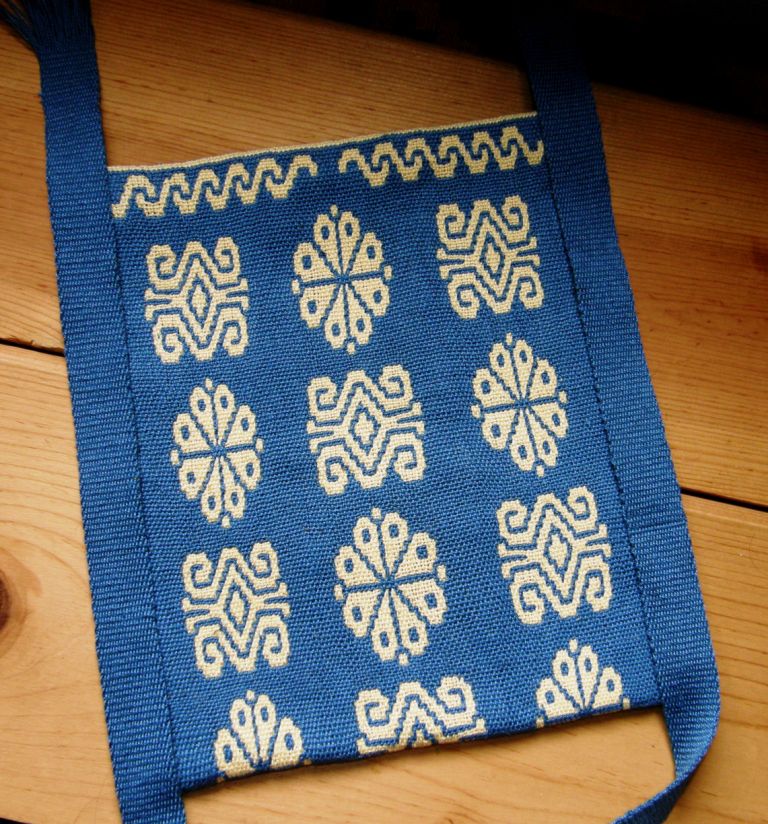
So, here is my latest project which has been inspired by the work of the Wayuu people and the beautiful designs on their woven si’ira which I have been able to see in Mirja Wark’s book.
I have made a few adaptations of my own. The triangular “border” design is my own pattern as I wanted something bolder than those shown in the book. The larger design is one of many “block patterns” as Wark calls them and, as I charted this one myself, I cannot be absolutely sure that it is faithful to the traditional design. It falls into a group of patterns called schichirujuna paa which means “like the nose of a cow” in which there are eleven variations.
I like how the herringbone design on the edges is similar to the weft-twined design I plan to do along the bottom edge.
This is slow work, I can tell you….lots of threads to count and pick up!! I was very unsure about this piece last week and was on the point of putting it aside for a while and working on something else to clear my head. But, I persevered and am now happy with the result.
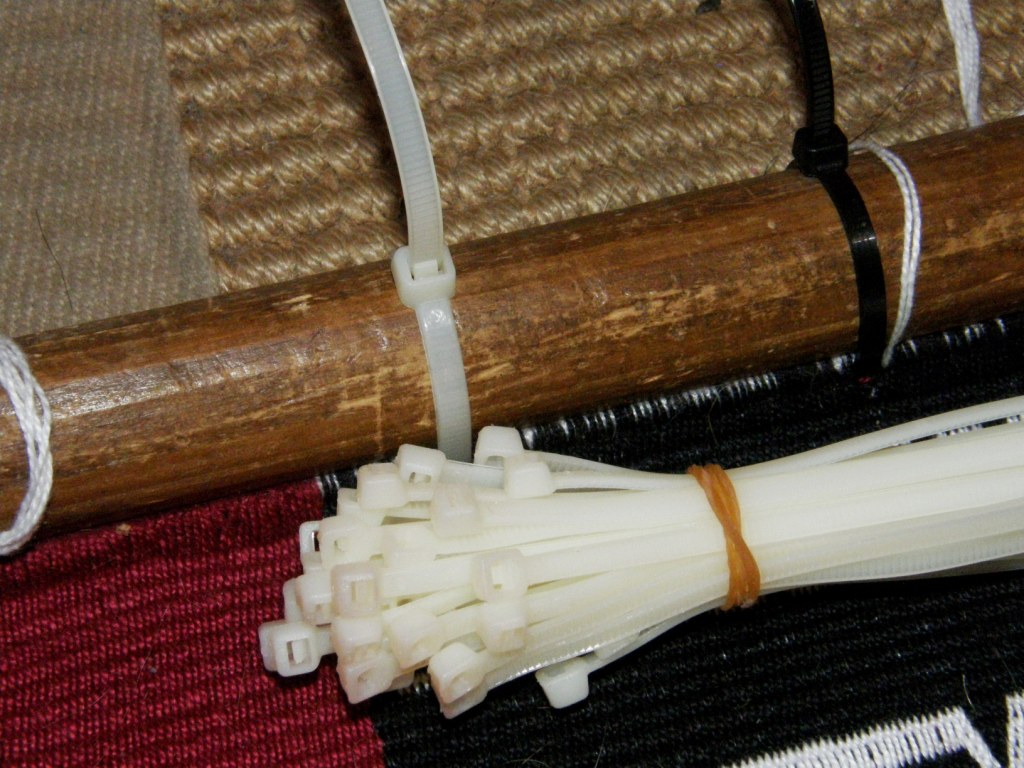
And you may have noticed my new favorite addition to the toolbox at left…cable ties.
These are absolutely brilliant for lashing the warp on its piano wire to the loom bar and creating a third selvedge. I was getting really fed up with my lashing cords on this project working their way loose.
They always do and I usually just wedge thin dowels between then and the loom bar to tighten them up. This time for some reason, nothing I did was solving the problem.
In my recent home de-clutter mission I found a bag full of these cable ties in the junk drawer in the kitchen. They are perfect for lashing but, unfortunately, can only be used for one project as they will have to be cut in order to remove the finished weaving. I wouldn’t use them to lash right from the start as they are wide and space the warps. I would only use them once the weaving has progressed an inch or so to replace the lashing string, which has probably already started to work its way loose.
Now back to the crochet. No, I am not about to add this to the juggling act! But, who knows, the next time I am thinking about some on-the-road projects, maybe I will toss a hook in my bag. I know the very basics of crochet. When I went to Ecuador and visited the artisans who work with cabuya fiber, I stayed with a lady who taught me how to crochet this little pouch.
She was kind enough to say that it wasn’t too bad for a first attempt. The button is made from the tagua nut and the dye for the cabuya fiber comes from natural sources.
I was happy to learn how to do color changes and carry the thread. Whether this color change technique is what is known as tapestry crochet, I do not know. I noticed that there is a group for tapestry crochet on Ravelry and another for fair-isle crochet. I am guessing that indicates that there are differences in techniques.
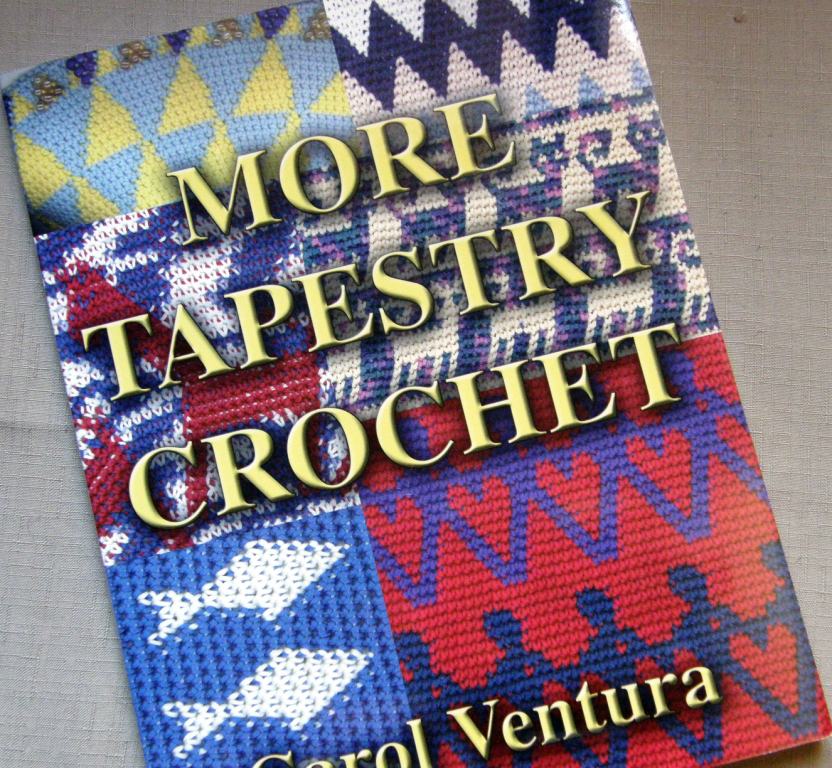
I was given Carol Ventura’s second book on the tapestry crochet technique many years ago and, although I have enjoyed looking through it, I haven’t used it yet. There are some beautiful projects in there for those of us who like imagery and bold geometrics in our handwork.
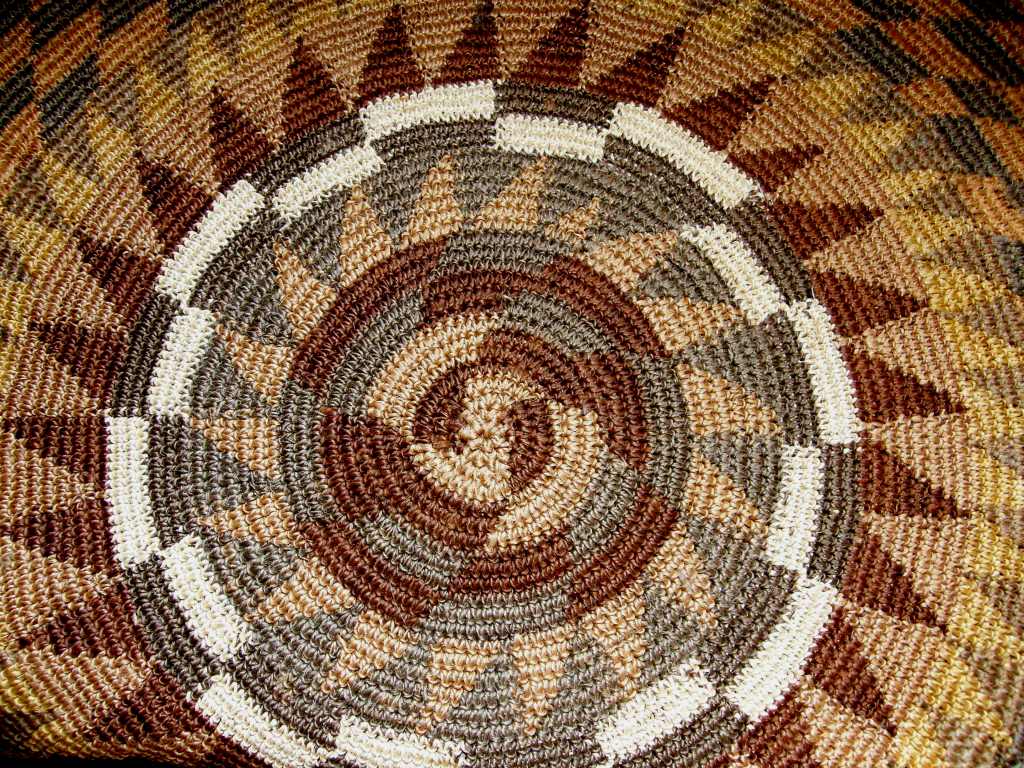
Here is some of the beautiful crochet work that the cabuya fiber artisans from the Intag valley of Ecuador do…a round mat on my bedroom floor…
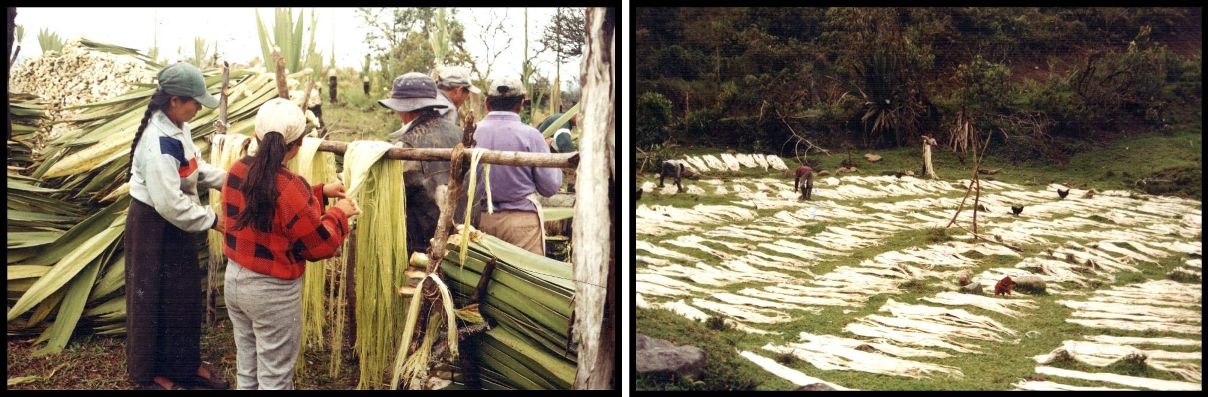
I wrote a post some time ago about the cabuya fiber and how it is processed if you would like to know more.
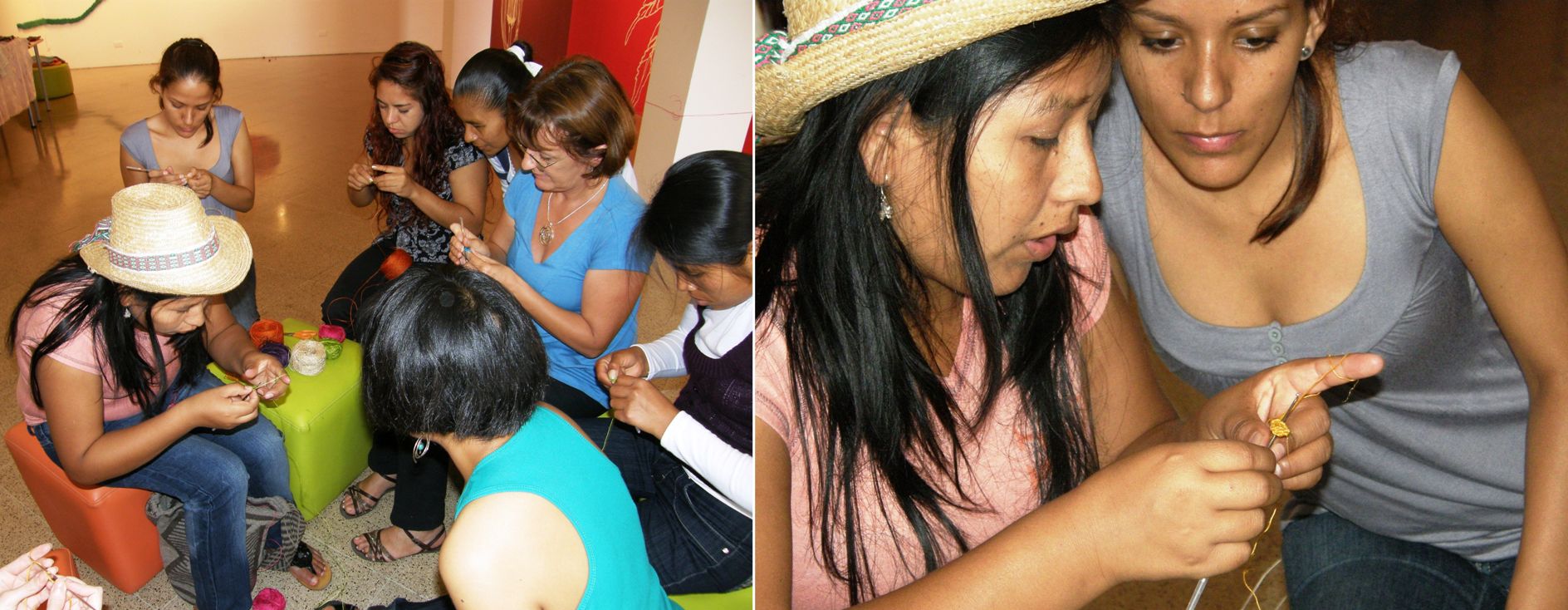
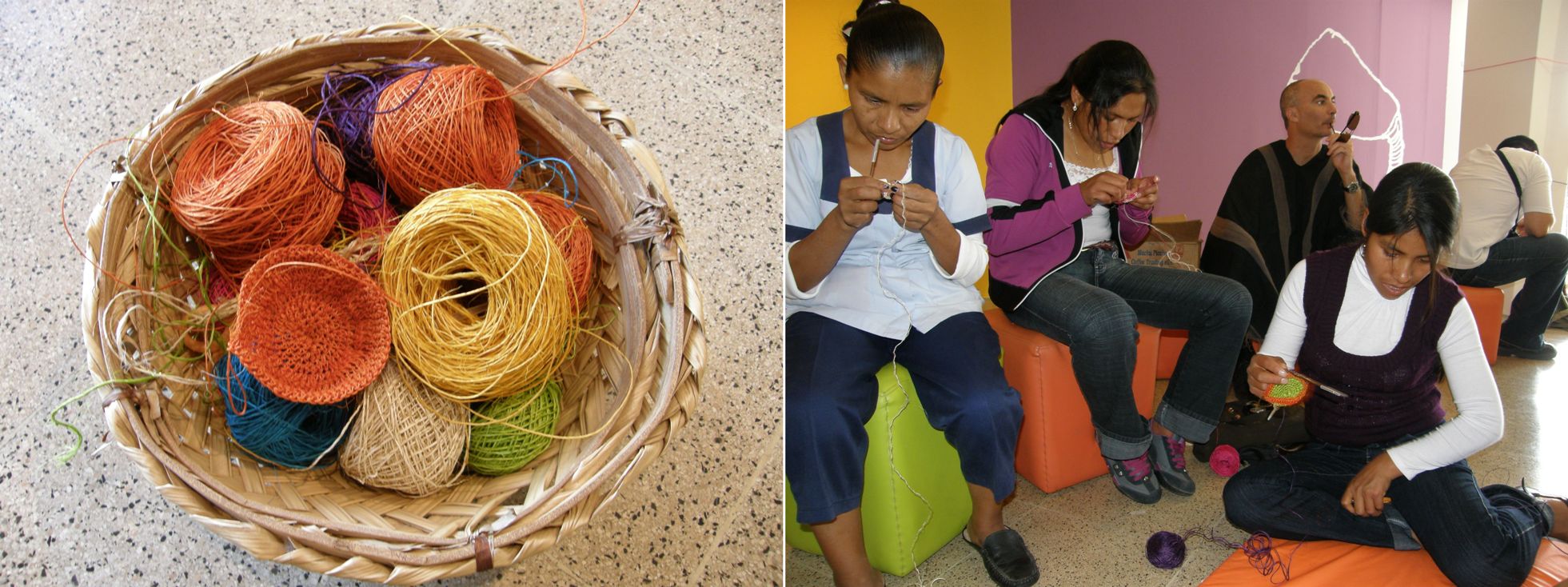
Last year we had a gathering of artisans here in Santa Cruz and Maritza came from Colombia to show us how to crochet with cabuya fiber. Weavers and craftspeople from Chinchero in the Peruvian highlands, coastal Ecuador, the highlands of northern Chile and lowland Bolivia as well as Santa Cruz locals joined in to learn.
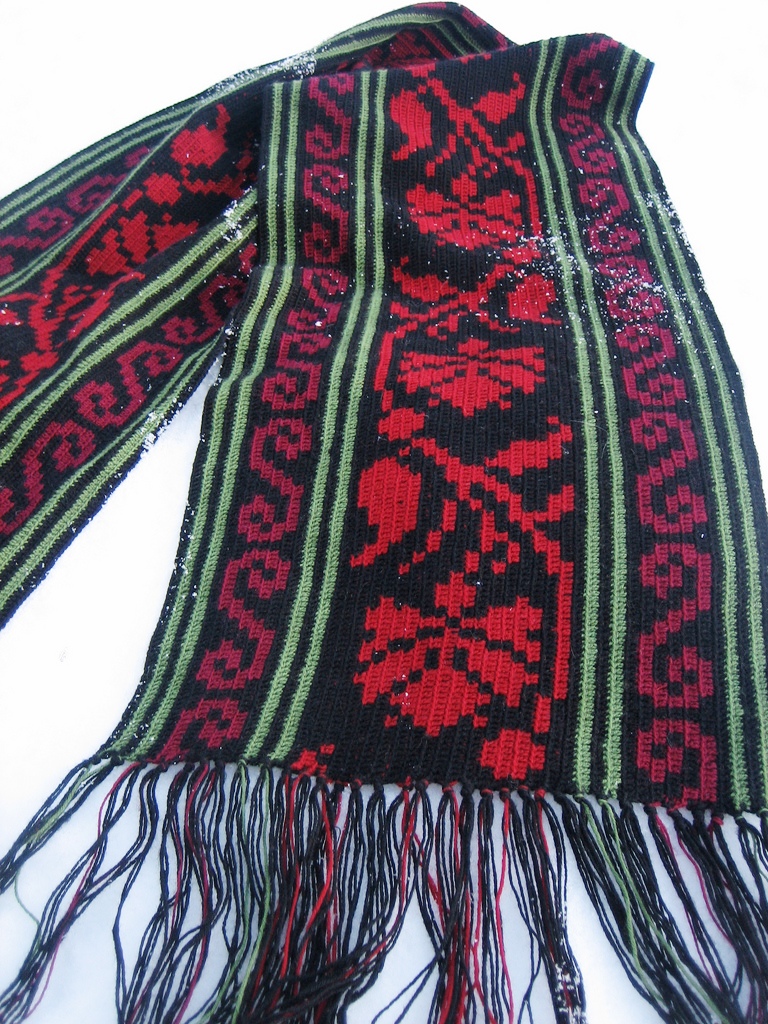
I think the thing that has most gotten me all charged up about crochet this week is the beautiful crocheted scarf that Marit from Norway, aka yarnjungle on Ravelry, recently finished and posted.
There’s that black and red again! Doesn’t this make you want to grab your hook?
In Marits’s own words…I saw a picture of a crocheted men’s scarf from Sweden in a magazine about nordic folk costumes. It had a flower pattern in tapestry crochet technique, worked lengthwise, but with double crochet stitches instead of single. Made my own version by throwing together some antique cross stitch patterns.
I have come across images online of belts in Mexico woven with flower designs that are quite similar to this. I notice them as, to my eye, they look “un Mexican”, if you know what I mean (funny how we form this idea of what “Mexican” should look like). Again, I wonder, as I was wondering last week, about how patterns may travel and turn up in unexpected places or how they may just develop independently on opposite sides of the globe. Some of the motifs in Huichol weavings are so similar to traditional Scandinavian finnweave ones.
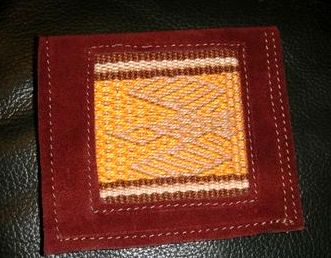
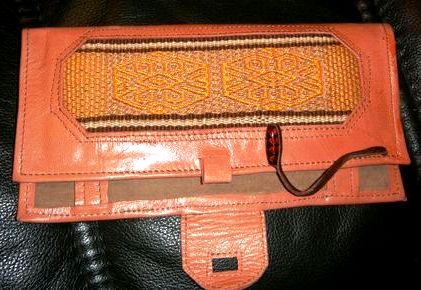
Well, I shall finish this week with some pictures of beautiful work that Sylvie in France has been doing combining her woven bands with leather to make a wallet and purse.
This bird motif in pebble weave is in my book and comes from the island of Taquile on the Peruvian side of Lake Titicaca. What a lovely job Sylvie has done.
This motif is also in the book and is one that I invented for a wall hanging. These are great projects and Sylvie definitely has the hang of pebble weave! As this motif is one of the last ones in my book, I expect that Sylvie may be wanting more….hold on, a second book is coming!
It seems that this is a shorter post than usual as I have finished early and so have a gap in my schedule…what shall I do? I think I’ll go and look for my crochet hooks and sit down and have a good read of Carol Ventura’s book. 🙂
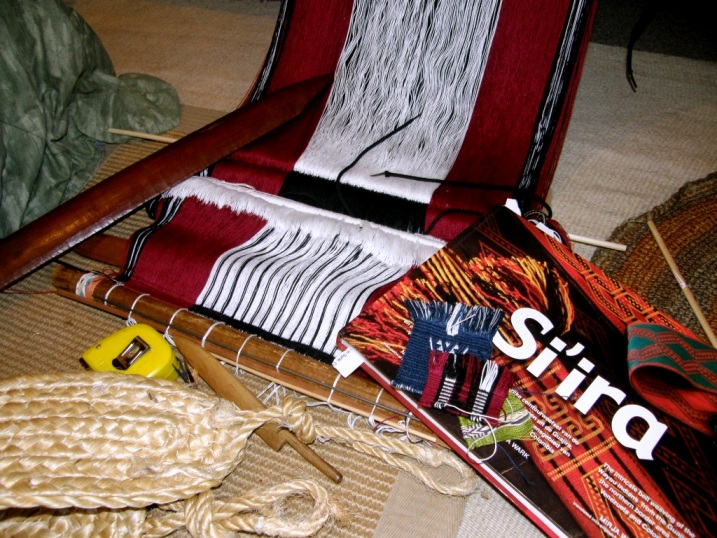
The Worldwide Weaving Web brought a new book into my home last year which has inspired my third wall hanging project.
If you can’t bear to look at yet another of my red, black and white warps on the loom ready to be woven, you had better look away now because here we go again!
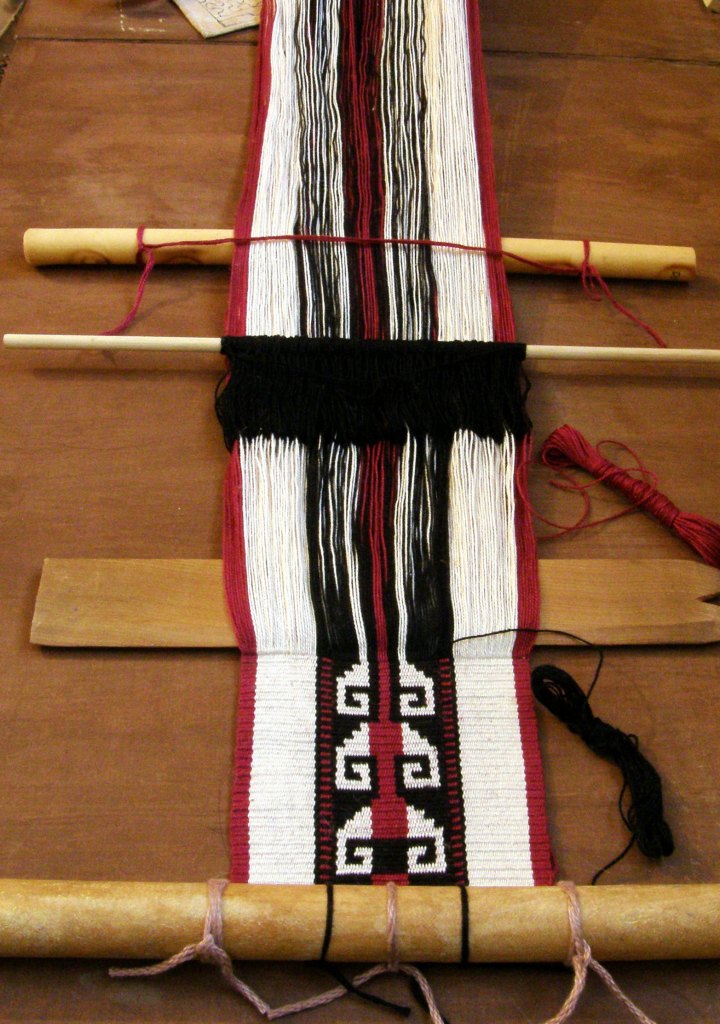
There isn’t a whole lot to show for a week of work, is there? What you don’t see is the reading, sampling, un-weaving, re-warping, charting, erasing and Googling. In fact, as I sit in front of this warp, I have the uneasy feeling that I may be jumping the gun and launching into the big project too early. I have actually unwoven the first line of pattern twice and made adjustments. Clearly my sampling didn’t cover all I had in mind.
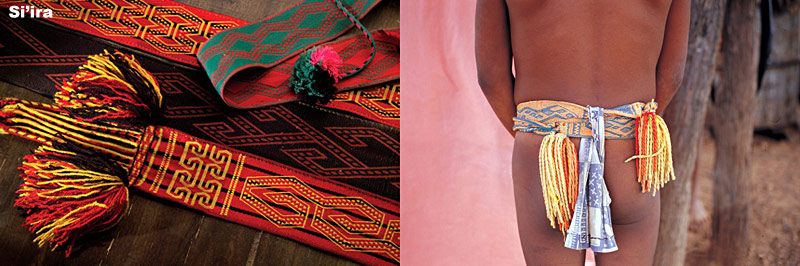
I am using the work of the Wayuu people of Venezuela and Colombia as my inspiration for this project through Dutch author Mirja Wark’s book Si’ira. A lady in one of the Ravelry weaving groups posted about the existence of this book in the middle of last year and I was on a mission to get hold of it. My friend Anna in Australia, who is from The Netherlands, took care of the local payment and then offered the book to me as a birthday gift. Thank you, Anna!
It is a beautiful hard cover book full of drawings and photos of the si’ira which are worn by men, their designs, the weavers and the vertical looms that are used to make them. The skills required to make a si’ira include weaving, twining, braiding and tassel making.
The Wayuu live on the Guajira peninsula which is the northernmost border between Colombia and Venezuela. Wark describes this area as a flat, dry semi-desert over which a continuous hot wind blows. It is always interesting to me to know more about the people, weaving and textiles of lowland regions of this continent.
Many different colors are used and I especially love the pictures of the si’ira in the book that comprise a red and black background on which yellow motifs have been woven. Other belts are black with red motifs…very striking…and so they are perfect for the color theme of my wall hanging project.
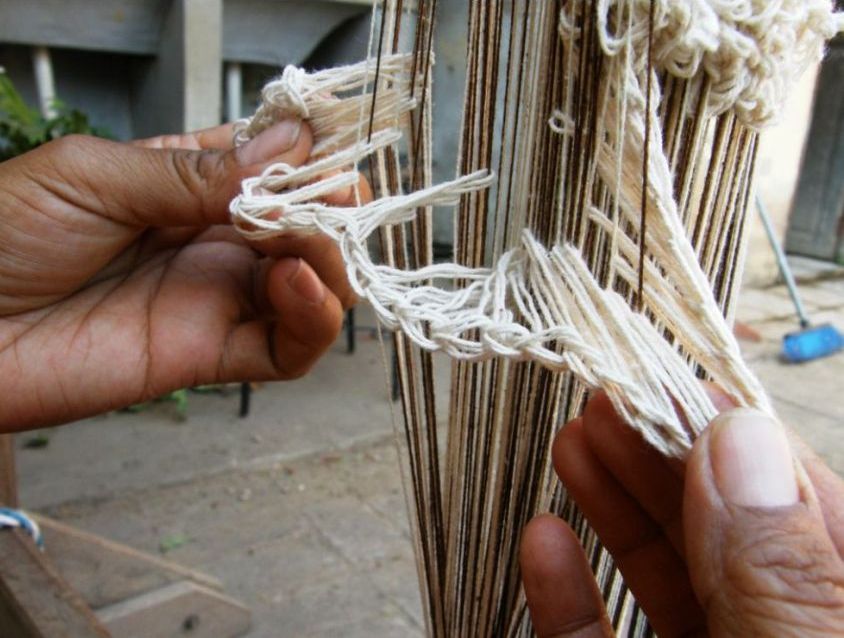
It is also interesting for me to see that the Wayuu weavers use the same style of joined loop heddles used by the Guaraní weavers, another group that inhabits lowland regions, here in Bolivia.
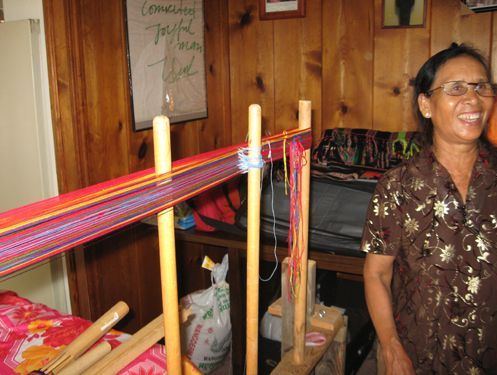
At left you can see my Guaraní teacher, Angela, showing me the unusual way her string heddles are chained together.
What I would like to see is how the Wayuu weavers manipulate the heddles and if it is the same method that Angela and other Guaraní weavers use.
Angela most often has three sets of string heddles on her loom which are required by the technique she employs for the kinds of structures that she weaves. Watching Angela do her pick-up work jumping between two sets of the string heddles is fascinating!
The Wayuu weavers use one set of these kinds of string heddles on their warps but I imagine that they would need to work them in a similar fashion to the way Angela does.
I can’t help but notice some small similarities in some of the motifs of the Wayuu and Guaraní people although the weaving structure employed is different.
So, this will be the basis for wall hanging number three in the red, white and black series.
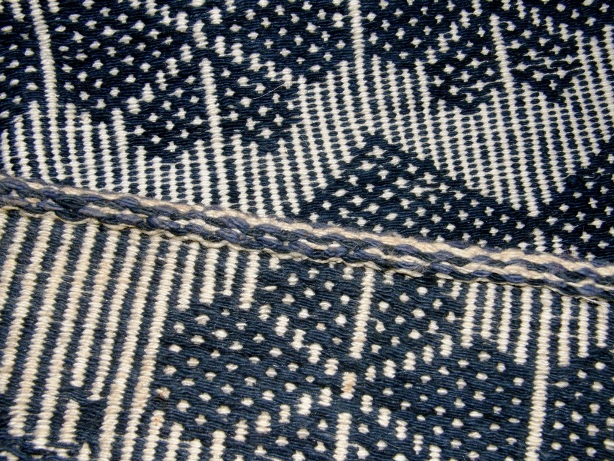
Another of the many interesting things about the si’ira is that they are woven with what Wark calls a “hollow selvedge” which serves to strengthen the edge of the belt. It is funny that on a visit with my friend Pam in Massachusetts we had talked about a rolled selvedge that Harriet Tidball describes in Shuttlecraft Monograph 26. Pam was trying it out on a band of her own.
Tidball writes that it was used by the ancient Peruvians and that available evidence shows that it was used on bands and belts.
The rolled selvedge creates a thick tubular edge.
Separate tubular bands like the one on the edge of the purse pictured at left are often applied to Bolivian and Peruvian weavings for various reasons, one of them being to strengthen and reinforce the edges of the textiles.
You may be able to make out the thick edge which is the hollow selvedge on this image from the cover of the Si’ira book.
How clever to think of a way to form the tubular edging from the band itself so that it forms as weaving progresses and does not need to be added later. I wonder why this technique fell out of use in Peru.
I love seeing how these things turn up here and there, disappear here, remain there, evolve further there, are replaced by something even more ingenious somewhere else…The fact that these heddles are used by the Wayuu in their arid lowland home and also by the Guaranì here in steamy jungly lowland Bolivia, so far away, fascinates me.
The Worldwide Weaving Web, about which I often speak, means that I can have a new online weaving friend in rural Turkey asking me about backstrap weaving and telling me about the catalog of woven Turkish motifs that his mother has while a weaver and clothing designer in Bangladesh shares with me what he knows about backstrap weaving in his country. Techniques and information are shared instantly across the globe. I wonder how in ancient times designs and techniques were transported and shared and adapted among the weavers of this continent.
And then you have weavers who live along the relatively short length of Ecuadorian coastline who apply bands to strengthen the edges of their cotton saddle bags. Different techniques are used to both set up the loom to create the patterns and finish the woven pieces in different areas along the coast.. I am familiar with the way the members of one family of weavers in Manabi province finish their work by applying a woven band using a home made rigid heddle which I have shown many times here before. Yet it is worth looking at again..it is so cool!
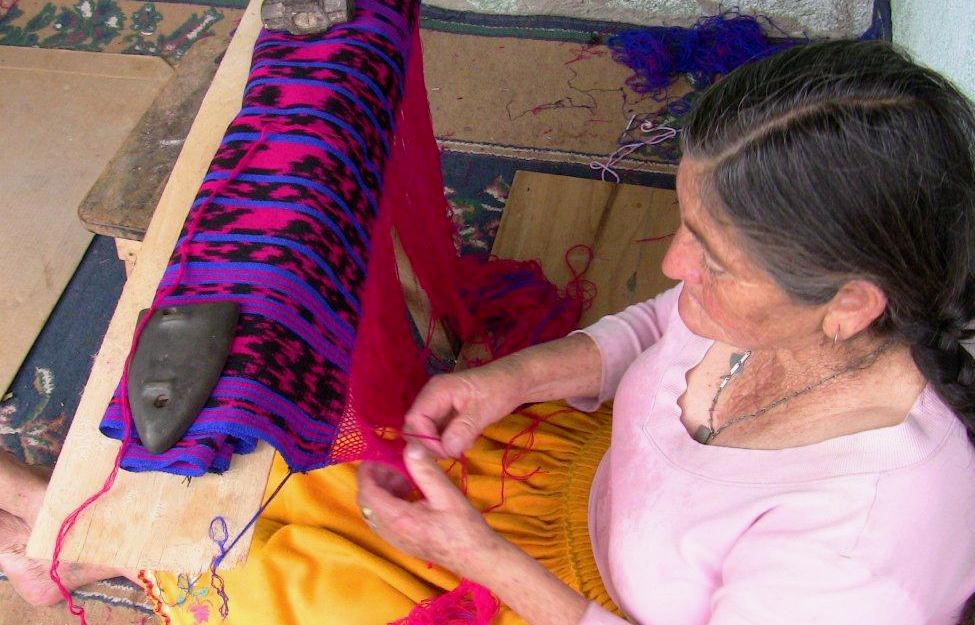
This picture, taken by Kathleen Klumpp, shows my weaving teacher Trinidad weaving and sewing a band to the edge of a small bag.
This is how the edging looks on the fabric.
And then I see from an article in the Textile Museum Journal that further north on the Ecuadorian coast, on the Santa Elena peninsula, weavers also apply bands to the edges of their saddle bags but use a very different method which requires an extra pair of hands.
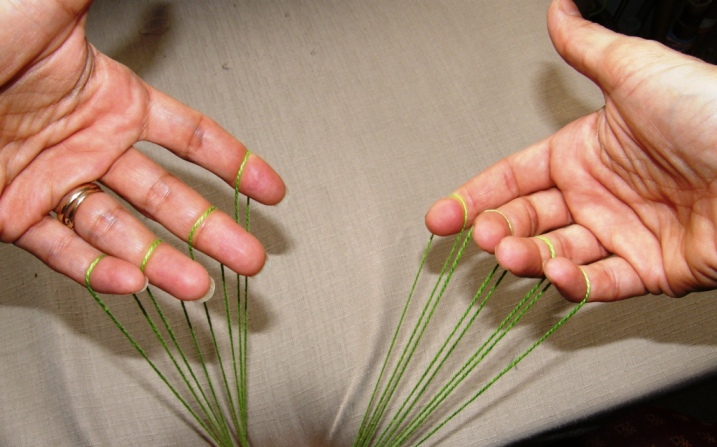
While one person sews the band to the fabric, another person manipulates the warp threads passing the warps which are looped on the fingers of their two hands from one hand to the other. The extra pair of hands would look like mine above (modeled on a drawing in the Journal article).
These are two very different ways to add a reinforcement band to the edge of a woven textile and both are being used within a relatively small area.
Do similar techniques develop independently or do they travel and get shared and eventually adopted and adapted? Why do some methods remain so different within relatively small areas? I know there are people who devote themselves to studying just this kind of thing. Me? I sit here and ponder!
Something that seems common in certain areas of Asia is the addition of string heddles to the warp while the actual warping is in progress on the stakes. Was it developed simultaneously in various areas or did it travel and get adopted? It seems like such an ingenious and time-saving thing to me. However, it is not something I have ever seen in use in my part of the world.
I know how to do it as I watched the Montagnard weavers warp when I visited them in North Carolina and, more importantly, filmed the process so I could study it over and over when I got back home….it was all happening so fast!
Even though I say it is clever and time-saving, I have not adopted this technique for my own weaving. I stubbornly cling to my favorite way of making heddles with the extra hitch which has the heddle loops held snugly on the heddle rod.
In the same way, perhaps the weavers of Manabi province in Ecuador and those on the peninsula further north are aware of each other’s techniques yet stick with their own methods believing them superior…who knows? My anthropologist friend Kathleen Klumpp no doubt can tell us that.
Here is the video I made of Ju Nie warping with two colors and making her heddles around one of the two as she goes. That is followed by a video I made in which I do it slowly and explain the process.
Angela, my Guaraní weaving teacher, certainly didn’t hesitate to ask to be taught how to make the kind of string heddles I use when she saw them on my loom and she started using them on her warp to replace one of her sets of chained string heddles straight away. She had seen string heddles on a stick before, wondered about them, but didn’t have anyone to show her how to make them.
And she was keen to learn how to do the three-color version of the technique she employs when an Aymara weaver visited from highland Chile.
And so, techniques and methods travel and get shared and then I guess one day no one will remember anymore how that particular technique managed to cross the Andean high plains and descend to the Bolivian jungle.
Well, enough pondering. Let’s see what has been happening in the Ravelry group where some weavers are still having fun with the Bedouin techniques.
Here’s Jennifer’s wall hanging which uses the al’ouerjan pattern and shajarah techniques. Many of the motifs in the central section were created and charted by Jennifer herself.
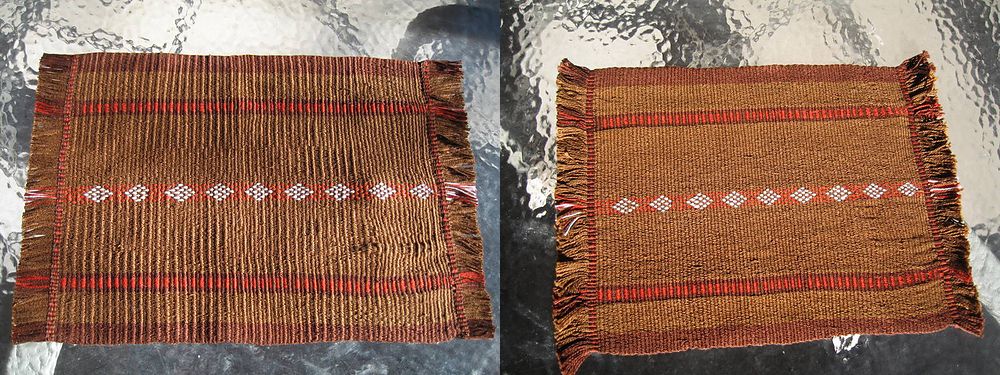
Traudi provided us with helpful pictures of her piece before and after washing. She made a placemat and had some tension issues and a bit of puckering, which didn’t all come out in the wash but, what is nice to see, is that the severe ridging that had formed in her cotton cloth disappeared with washing and pressing.
She used weft twining on both ends before leaving the fringe and her center pattern is the traditional Bedouin al’ouerjan design.
And to finish, I ‘ll just let you know that I put one more tidbit on my RESOURCES page this week. I am slowly but surely gathering up all those links.
I have been trying to resist the urge to warp up for an al’ouerjan project and join in on the fun in the Ravelry group. You may remember that a couple of weeks ago, after having posted the warping tutorial for these traditional Bedouin patterns, Tracy suggested a weekend warp-along. Now we are seeing the increasingly large and impressive results of all that warping practice. Take a look at the bag strap that Tracy made at left.
But…I am staying on track which means that I am sticking to my chamanto-style leaf-patterned wall hanging (although I couldn’t resist throwing in a bit of weft twining). I finished the first pebble weave hanging in this set with weft twining and so I decided that, apart from the common color scheme, the weft twining would be another theme that would tie all my planned wall hangings together.
While I sit and pass the shuttle, strum the warps, beat and coax the sheds open I think about what will be next in this series. I have no problem whatsoever in coming up with ideas…the problem is that I want to weave them all at once!
I stand back and look at this piece and I still can’t get used to it.
It’s not quite like anything I have done before but I have to say that I am having fun with it especially adding in that twined section with the motif within. I had to stop for a bit to chart those smaller leaves on their vine, sample them etc…It took a while to get them right.
I think that all my planned red, black and white pieces will look pretty nice when hung all together. The question is….where? Although I have been doing some major cleaning out, I still haven’t managed to uncover any significant amount of wall space.
Next on the clean up list is my dear old Ashford traditional wheel. Yes, I have a spinning wheel…who knew? It has been sitting there so long unnoticed, dusty and in desperate need of oil…poor thing. It was born in New Zealand and made its way all the way over to the Falkland Islands before finding its way into my home in southern Chile. I left a lot of stuff behind in Chile but the spinning wheel came up to Bolivia where it has sat in the corner for almost 14 years…shameful! I won’t take a picture of it now in its pitiful state. I will clean it up and get it back into shape. I have room to use it now!
I only had it for four months before leaving Chile and just got into using it and being able to turn out something consistent. I did, however, spin enough yarn to construct a vest, knitting the natural colored front and weaving the dyed brown back. The edging has been worked in cross knit looping.
This, too, sits neglected here in this hot steamy climate. It is a souvenir at least of the Patagonian sheep.
But, back to the al’ouerjan and let’s see what else the Ravelers have been up to…
So, there’s the strap that I showed you earlier on the gorgeous bag that Tracy made. She will line the bag to protect the warp floats on the inside. She used an additional weft to secure the floats on the strap. You can see details about how that is done here. One of Tracy’s other warp-along products is the pillow cover which includes some tapestry-style twining in the lower left hand corner and a striking and beautifully executed joining stitch.
Aunt Janet’s piece above left is in her own handspun wool. She has three sets of al’ouerjan patterning and that blue looks amazing.
Traudi so loved Tracy’s piece that she got into the act too using brown instead of black which looks fantastic. She twined along the bottom of the piece too. We are seeing more and more twining in this group…cool. Here is the tutorial for basic weft twining.
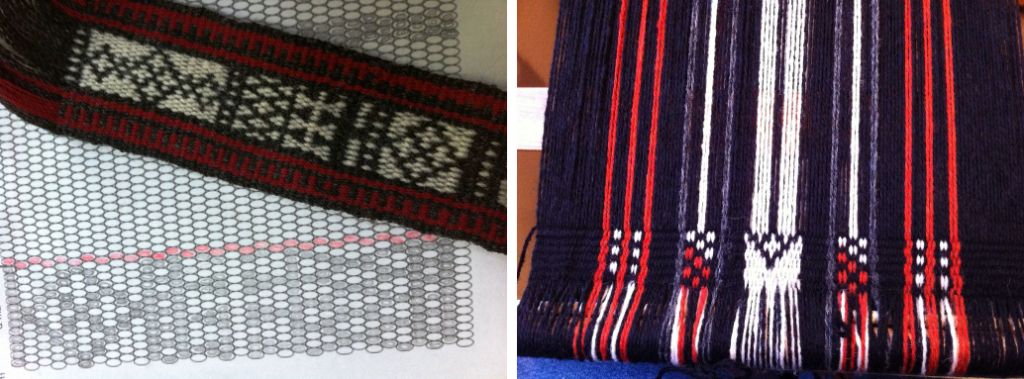
Jennifer did some charting and planning for the shajarah patterns before warping a wide piece that also includes an al’ouerjan design.
The charting paper with ovals which is useful for double weave, warp substitution and supplementary weft patterns can be found here. A tutorial for weaving these kinds of warp substitution patterns is here.
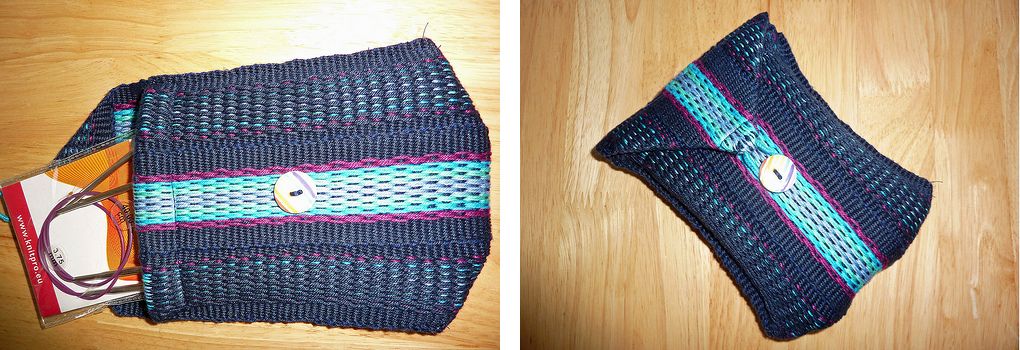
So, January has gotten off to a great start in the Ravelry group! Pantoffels has been wrangling with what she calles an ancient inkle loom and still managed to make this pretty needle pouch with plain pebble weave patterning.
And then she got a new inkle loom under the Christmas tree and will now try the pebble weave patterns in my book Andean Pebble Weave.
While I have been weaving my “leaf” piece based on the Chilean ponch known as a chamanto, I have been getting out other pictures of ponchos that I have to study the design layout that weavers use on these large pieces.
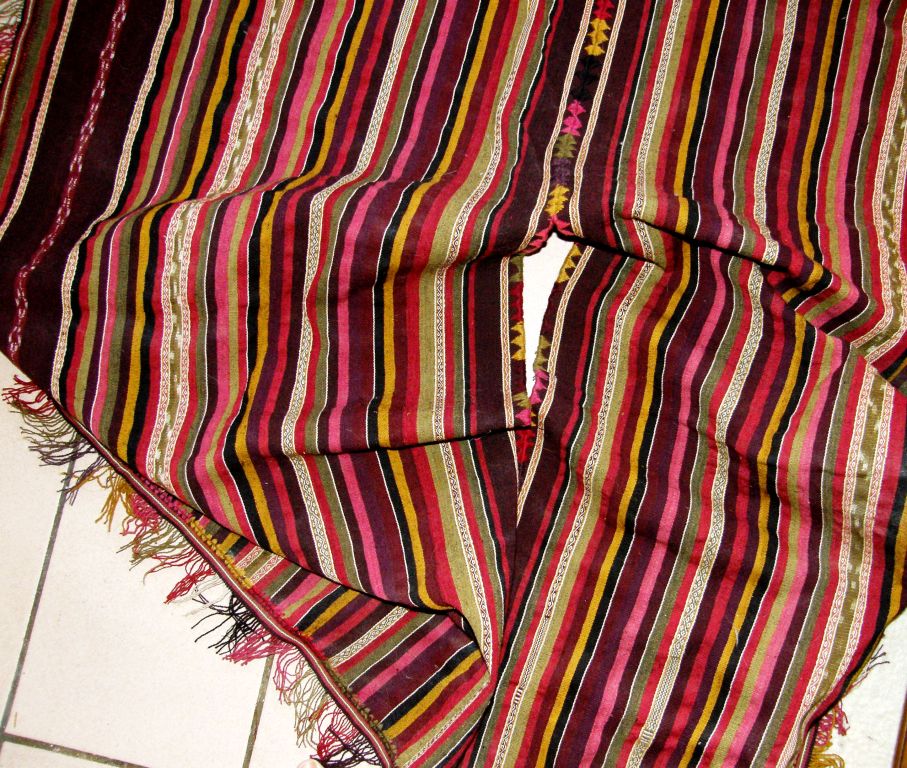
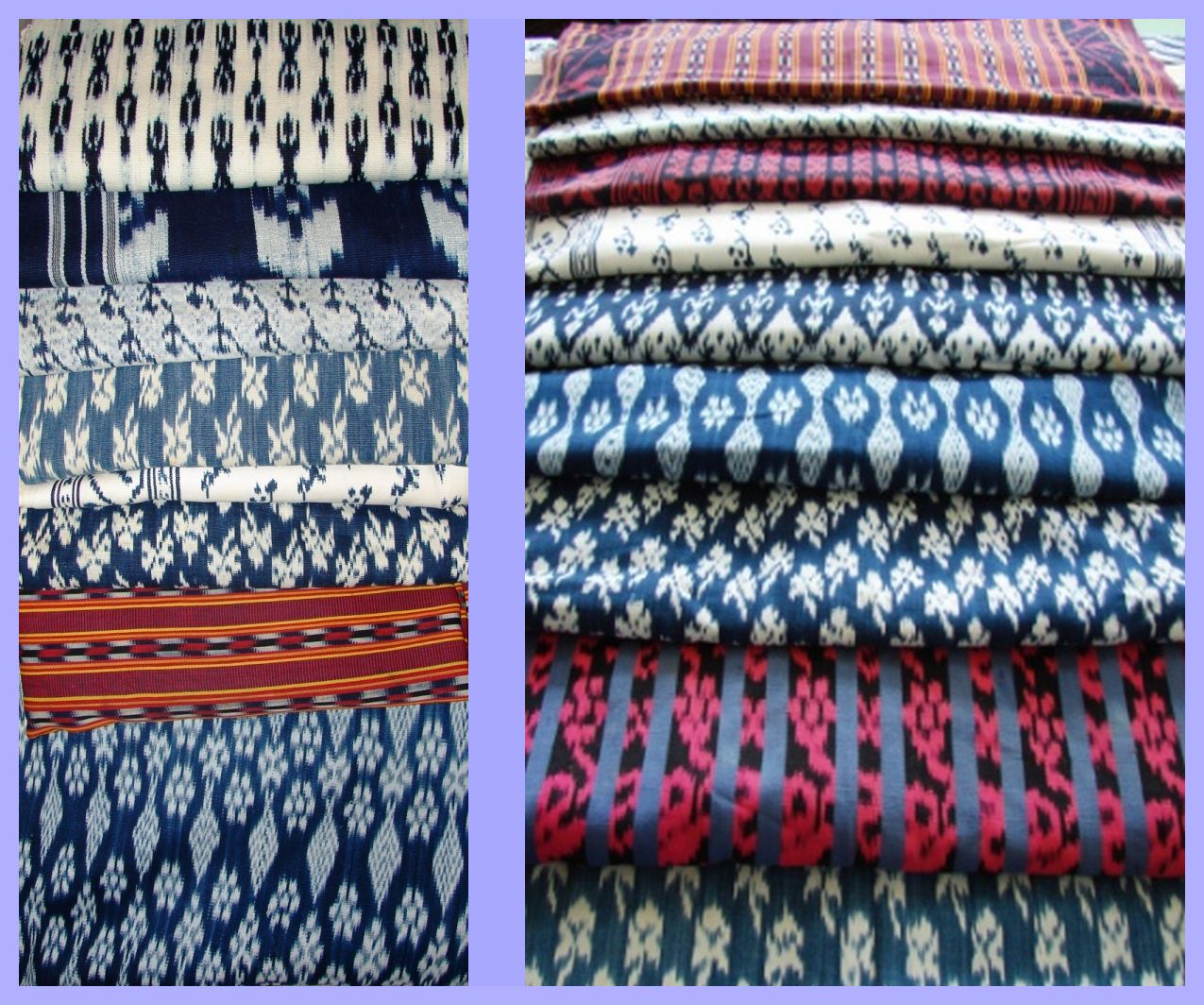
I own one poncho which I bought in Calcha, Bolivia many years ago. It is made from very fine handspun wool which has been colored with natural dyestuffs. It is patterned with simple stripes, some very narrow and simple ikat bands as well as several very narrow strips of pebble weave.
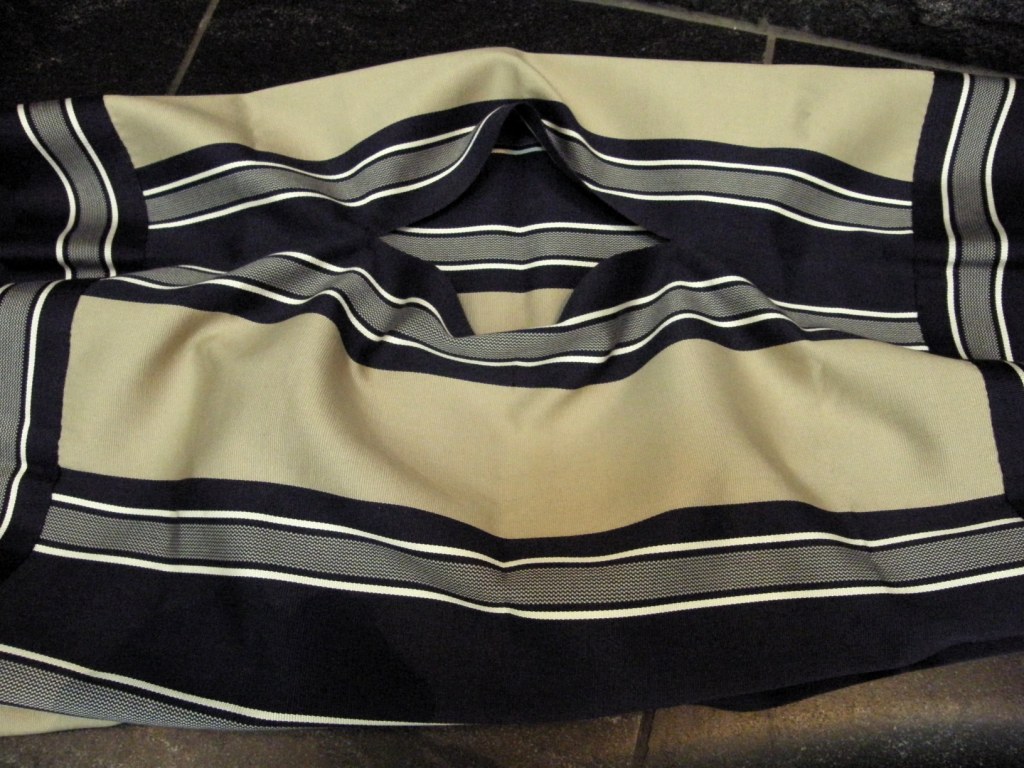
It has been woven as two panels with four selvedges each and a woven band has been sewn around the four edges with an added fringe. Don’t you love that decorative stitch that has been used to join the panels?
There is definitely an art to stripes. You can see the clever placement of fine white stripes to break up some of the richer colors.
An extremely fine and simply patterned manta from Chile. It is always interesting to see how the colors and stripes are distributed. As is typical, a broad band has been woven and sewn to the four edges of the piece and there is no fringe.
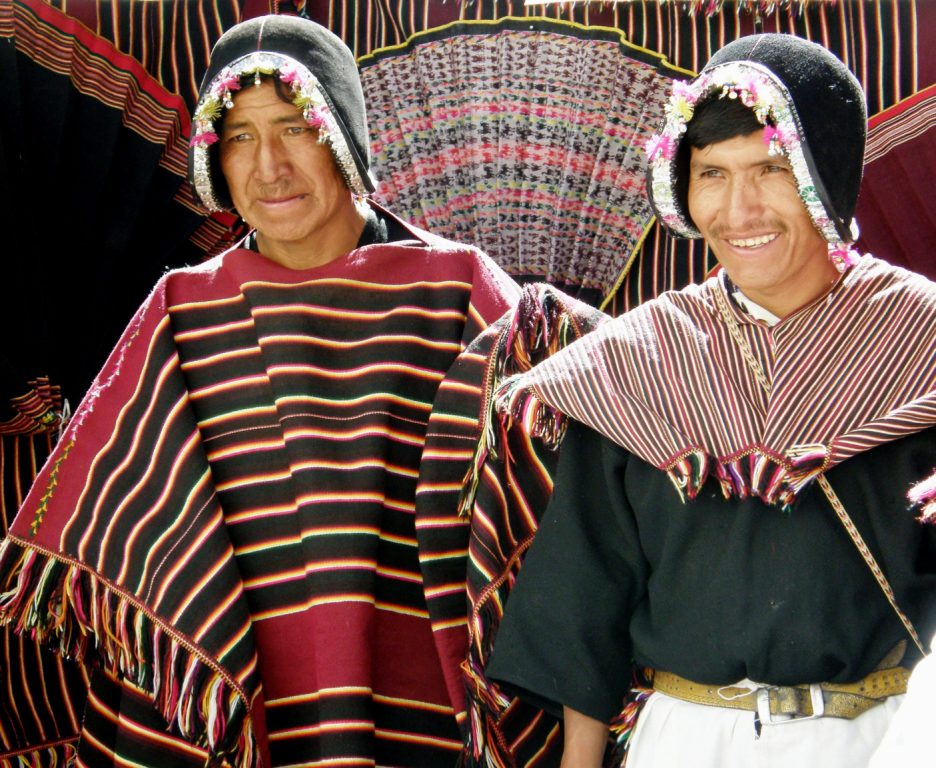
The typical poncho of Tarabuco and the smaller version known as unku can be seen above.
At a handcraft fair in Tarabuco I saw weavers making the long poncho panels. My friend, Anna, showed me the unku on the right that she had bought in Tarabuco when she came to visit me.
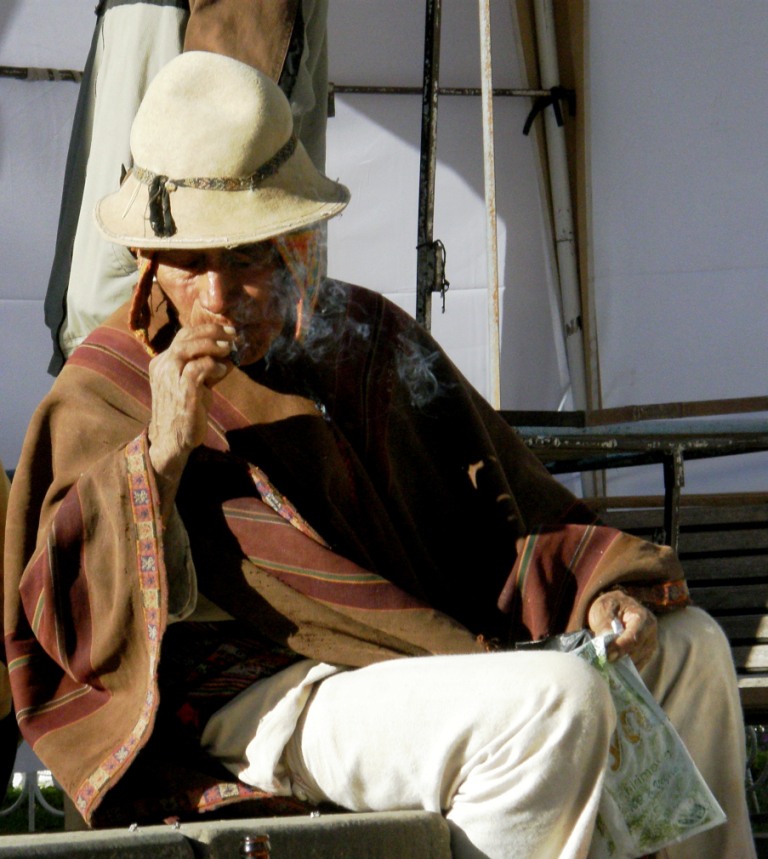
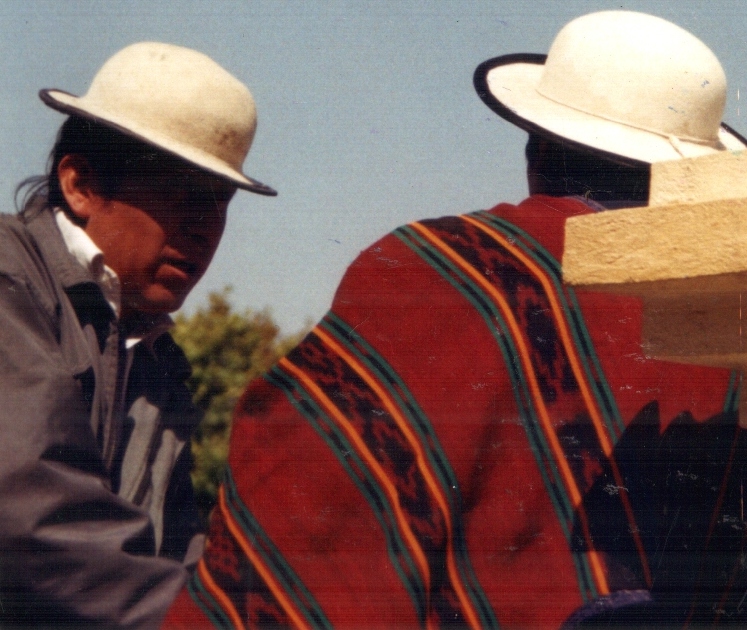
I spotted this gentleman in his much more subdued woolen poncho in a small plaza in Sucre. He was performing an offering to Pacha Mama in the early morning. How wonderfully simple and light the poncho looks although I am sure it is extremely warm and virtually waterproof.
And then you have the incredibly intricately patterned calf-length ponchos woven and worn by the men of Chahuaytire in the Cusco area of Peru.
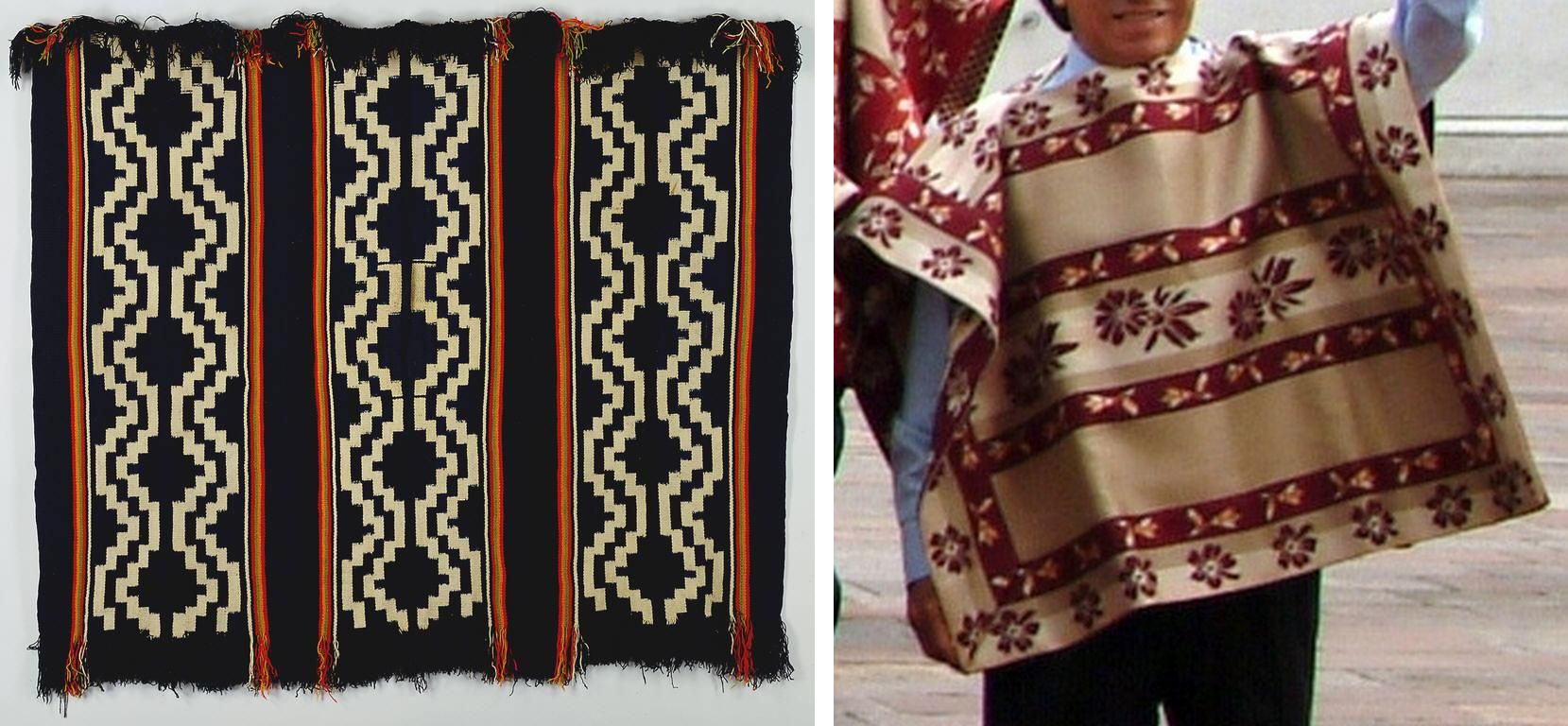
From Argentina and Chile we have the Mapuche makuñ with its ikat patterning technique executed in such a way that there is virtually no blurring of the design. The popularization of the poncho, from what I have read, is generally attributed to the Mapuche who wove them for their own use as well as for barter. On the right you see the chamanto of the Chilean huaso, with its leaf, fruit and floral motifs, which are said to have both indigenous and Spanish roots.
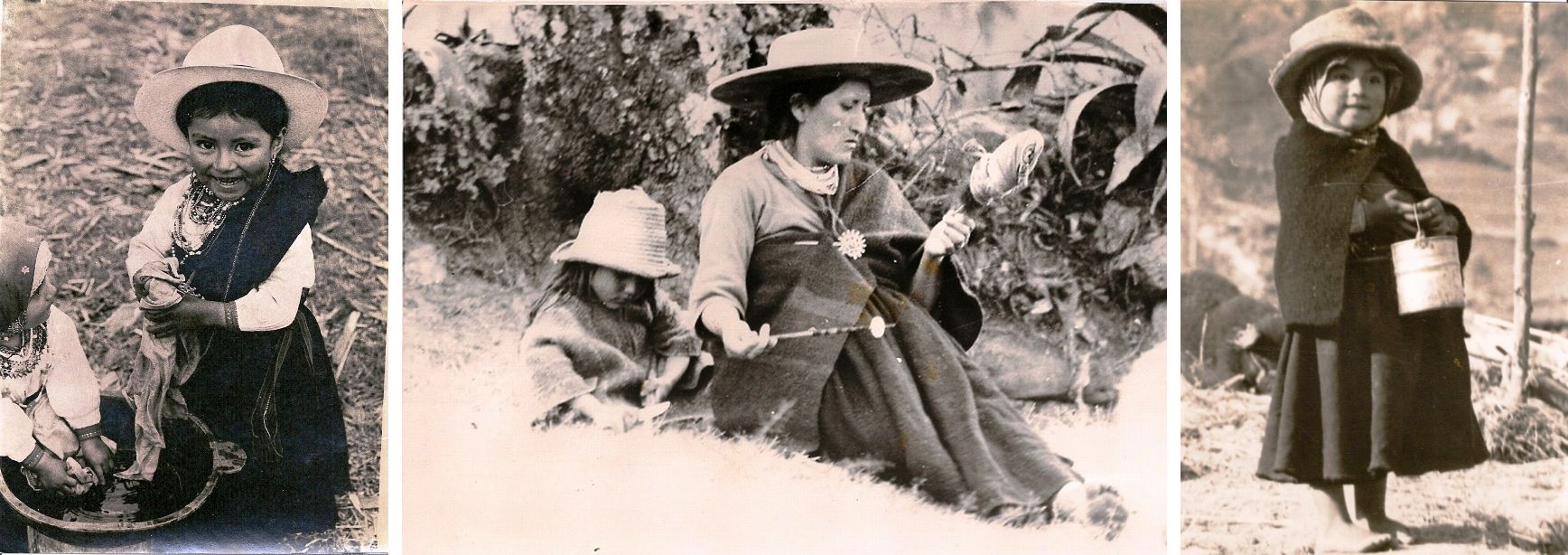
I have a few pictures from Ecuador too…scans of old prints…
This is the “jijon” poncho which is factory-made in Quito and worn by those men who can afford one in Otavalo. You can see it being worn with its grey plaid face showing by the gentlemen on the left and with its darker face outward on the right. These men were wearing their ponchos to the market on a regular day. Apparently there is a much more costly blue double-faced poncho which is woven on the backstrap loom made-to-order. The ownership of one of these special ponchos indicates wealth and high social status.
On Sunday, which was both market day and church day in Cañar, a very social time around the main square and surrounding streets, I saw quite a few ikat-patterned ponchos being worn.
And finally there’s Juan below, (my pebble weave student!) with his mother and neighbor. Juan put on his narrow, black fringe-less poncho and felt hat especially for this picture. On another visit during a festival all the men were wearing their ponchos for the occasion.
You can see the backstrap looms on which I was teaching Juan and Natalia pebble weave tied to the pole. In exchange Anita introduced me to her cousin on my next visit and he taught me to weave the typical supplementary warp patterned belts of Salasaca.
Okay, so I promised you some double weave edge samples this week, right? I am sorry, I didn’t get those done. I was busy trying to stay on track and not get “dis-track-ted” by all the goings-on in the Ravelry group. I want to finish my leafy hanging. but I must say that I have a bowl of tencel calling to me wanting to be made into a scarf…
That blue ball is indigo-dyed Japanese silk…a fabulously thoughtful gift brought to me from Japan by one of my old teaching colleagues here.
Hopefully I will get the leaf piece off the loom this week, plan and warp the next hanging, play a little with my tencel, get the Ashford Traddy up and running and do those double weave samples for the tutorial too….phew!
Oh, and I have started a new page for RESOURCES. You will see the tab for that on the header and I am slowly extracting all the links to interesting sites, articles and products that I have linked to in my 105 posts so far. This is quite a job but I hope to add two or three links to the page every week. I hope you find it useful.
This is a week in which I have been insanely busy with very little time spentat the loom. My pre-trip preparation has kept me busy at the keyboard making arrangements, digging through the closet to find the warm clothes, dragging out backpacks and bags, warping projects and gathering sticks to take on the road.
I washed and pressed my finnweave piece and was pretty happy with the result (wet finishing always makes me nervous). I wove a simple strap and now need to decide how to put it together. I also warped up a bright striped piece for a tote bag project but simply couldn’t live with the color arrangement. I have to confess that I hadn’t put a lot of thought into how I arranged the stripes and that has now come off the loom.
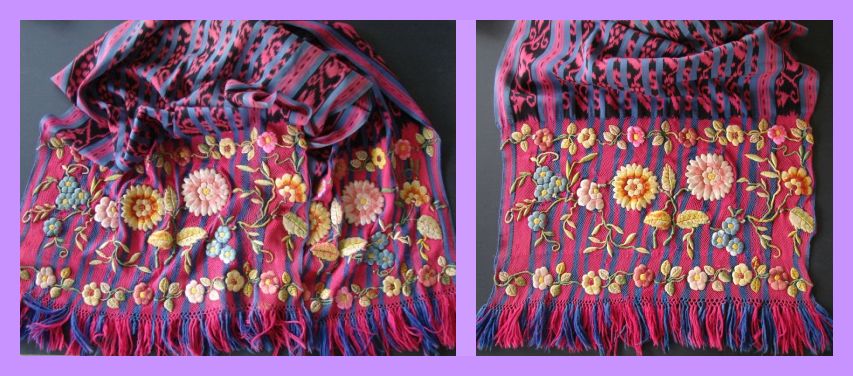
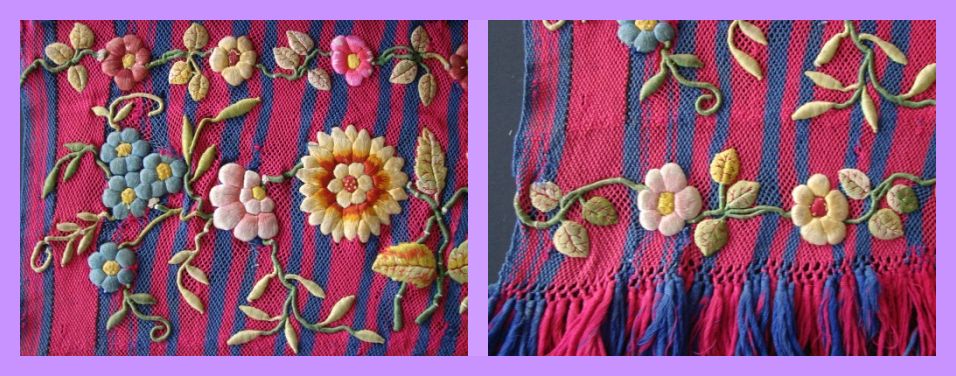
And then came an email from Eladio in Mexico sending me a link to a video showing the rebozo weavers of Santa María del Río, San Luis Potosí knotting designs in the warp ends of their shawls….stunning!
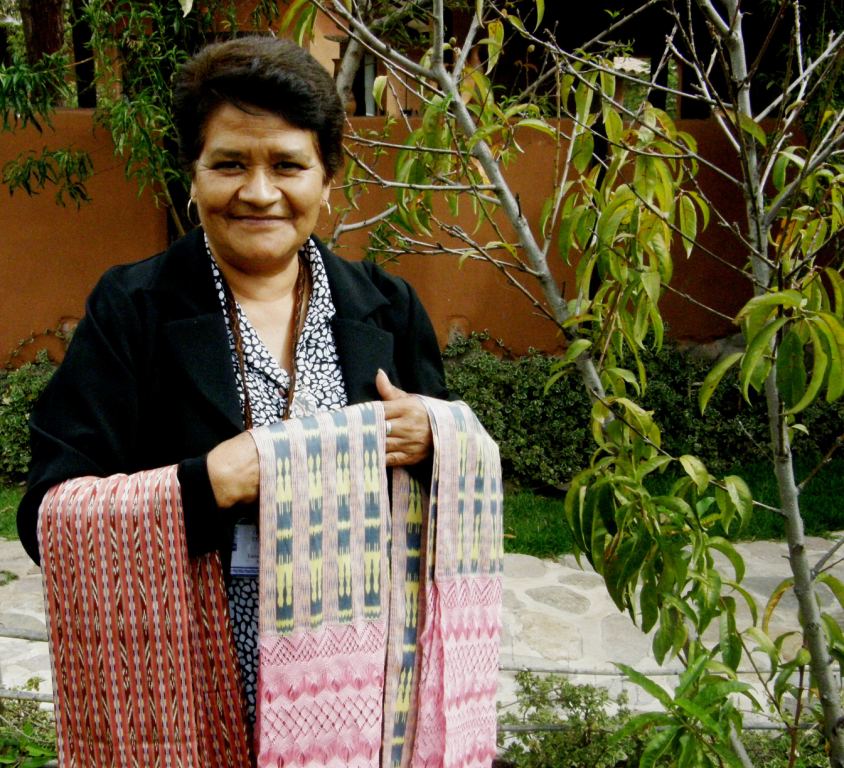
At the Tinkuy de Tejedores, in Urubamba Peru last year, one of the presenters was a weaver from this very place…Luisa Govea, pictured at left, with some of her work, is known as one of the most highly skilled weavers of silk ikat rebozos using designs from the 17th , 18th and 19th centuries.
Carol Ventura has a web page with pictures from the backstrap weaving school in Santa Maria del Rio where many of these shawls are made.
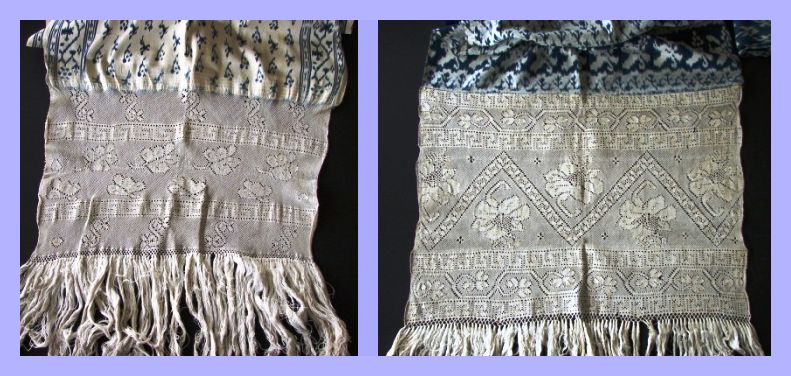
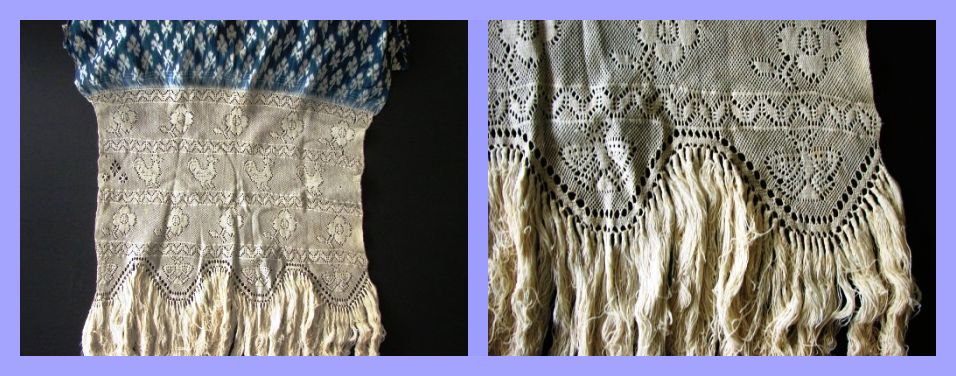
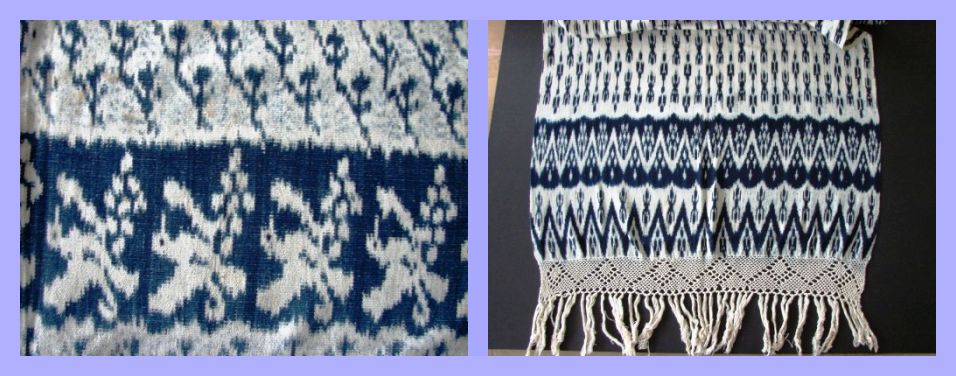
This reminded me that I also have a lot of photos which my online weaving friend, Phil sent me of ikat shawls in the collection of the late Dennis Penley. These also have magnificent designs which are created by knotting the warp ends and sometimes even embroidering on top of the knot work. These shawls are from the towns and villages around Cuenca in Ecuador.
Whether the knotting technique used by the weavers in Mexico and Ecuador are the same or similar, I can’t tell you. All I can do is watch the video in wonder and enjoy the images that Phil has sent me and hope one day that I may find out more about them on a return trip to Ecuador or, even better, on a first trip to Mexico.
Here ‘s the video….
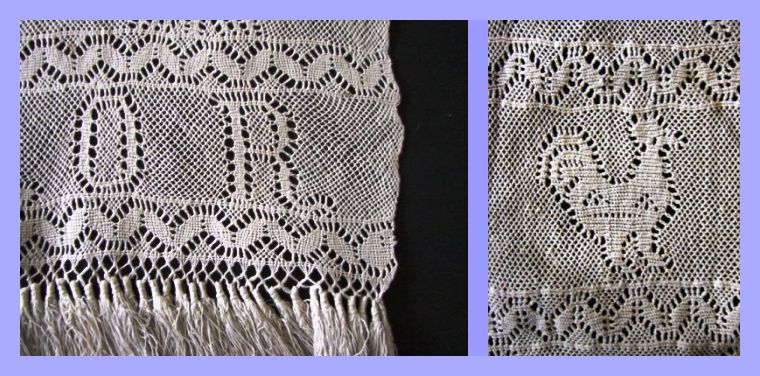
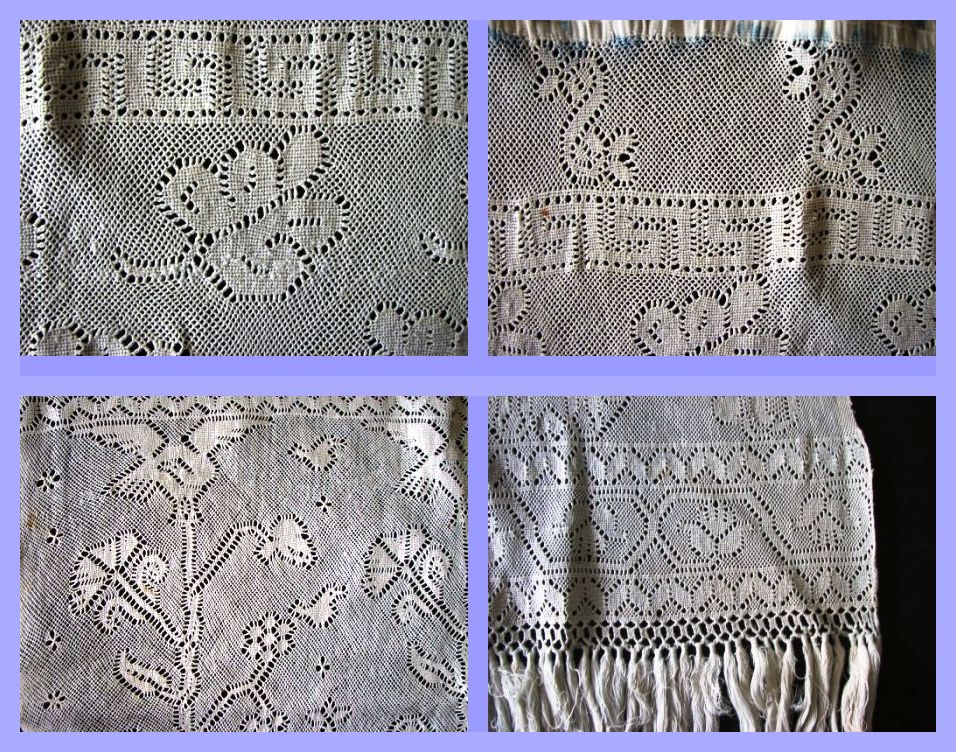
And now I can treat you to images of the designs on the fringes of ikat shawls of Gualaceo, Bulcay and other towns and villages around Cuenca in Ecuador….
Many thanks also go to Agaath who has allowed me to use her picture of a lady knotting the fringe on an ikat shawl in Ecuador…
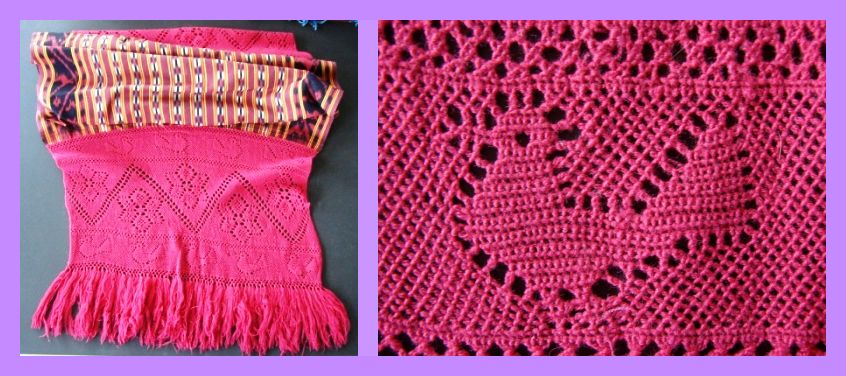
We can imagine that she is knotting a design something like the one seen below…
Or perhaps she is just knotting a fine mesh without designs onto which she will later embroider figures like these:
And a closer look…
And then there are the fine elegant white fringes. This one includes the Ecuadorian Coat of Arms…
If you can’t quite make out the patterns there, here are a few pictures of some of the details…
More knotted fringes with their intricate designs….
I love the shaping on this next example…
Sometimes the designs incorporate words….
And here are details from various pieces….
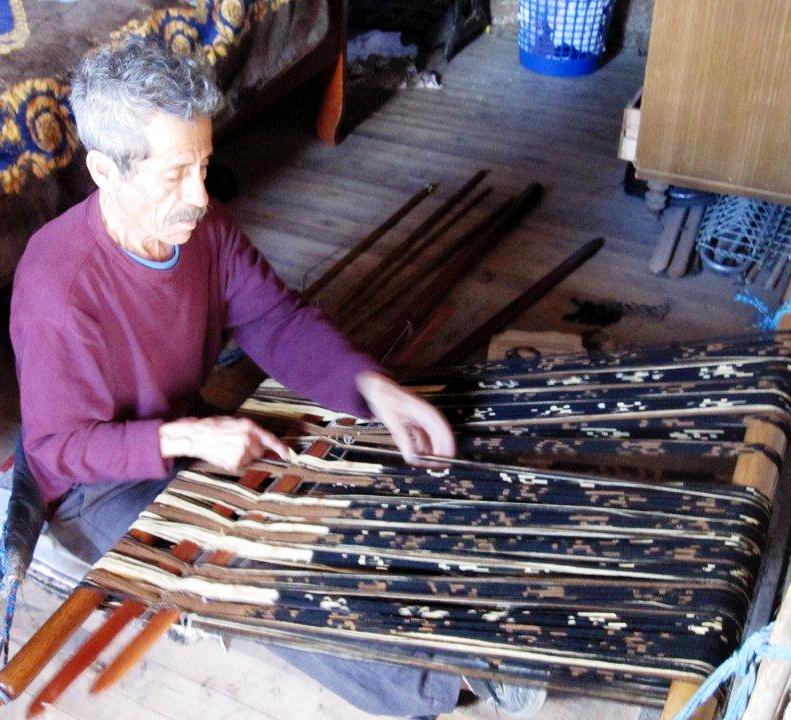
And what about the ikat pieces themselves which are woven on backstrap looms like these? (another picture courtesy of Agaath)…
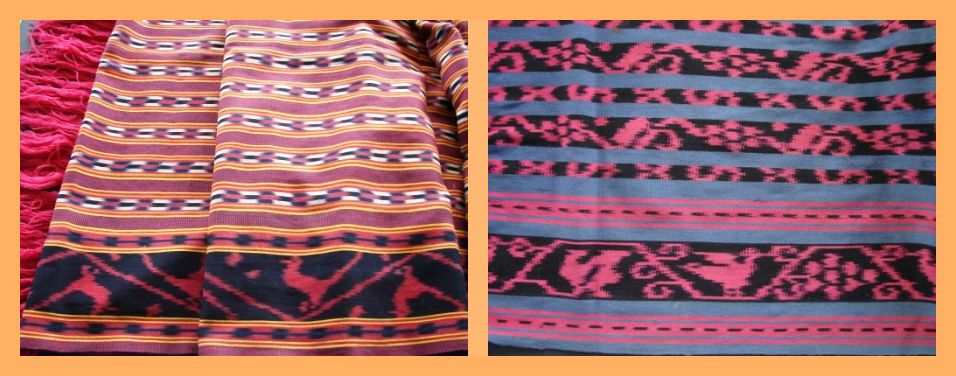
Here are some more pictures, taken by Phil, of pieces in the Dennis Penley collection….
And these….wow!!
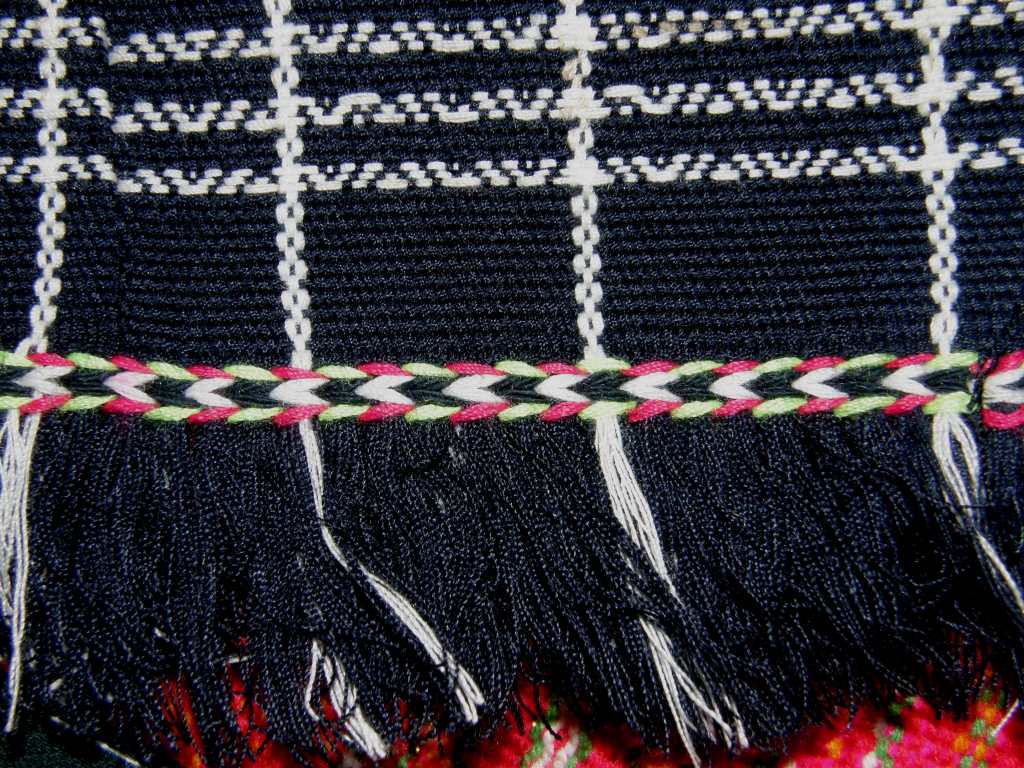
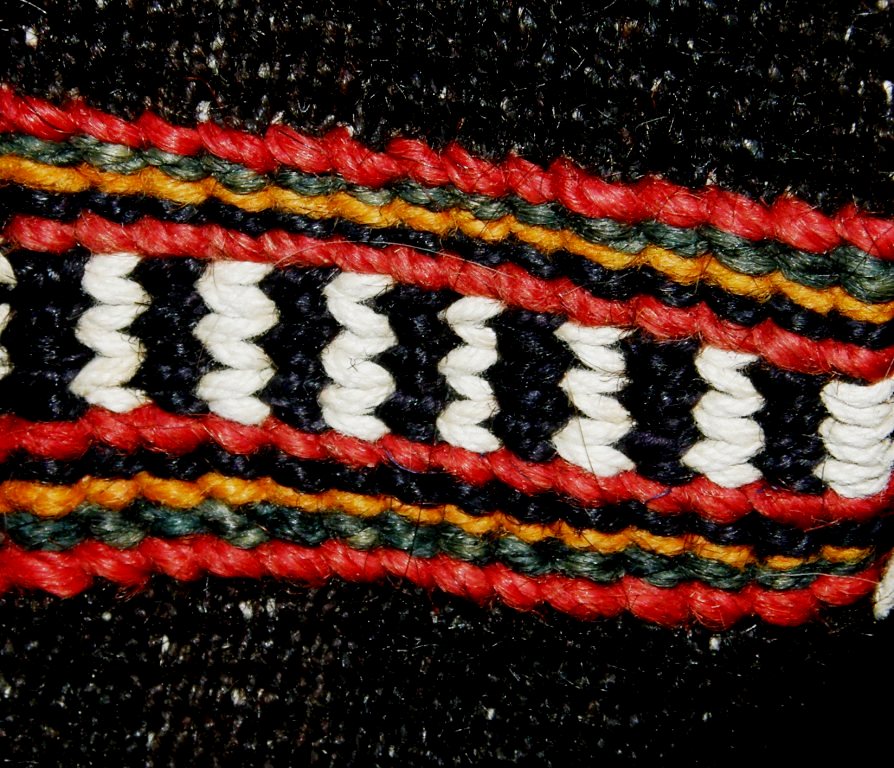
So, that’s it from me for this week. I wonder if any of you tried the weft twining that I showed in my instructional videos last week. I found a picture in my file of Montagnard weavings of some of the basic weft twining I showed in the videos…single rows of alternating colors and chevrons created by working four threads at once…simple but effective.
These stacked chevrons on the Bedouin weaving that Tracy in Qatar sent me are also very striking sandwiched between the multiple rows of single-color twining.
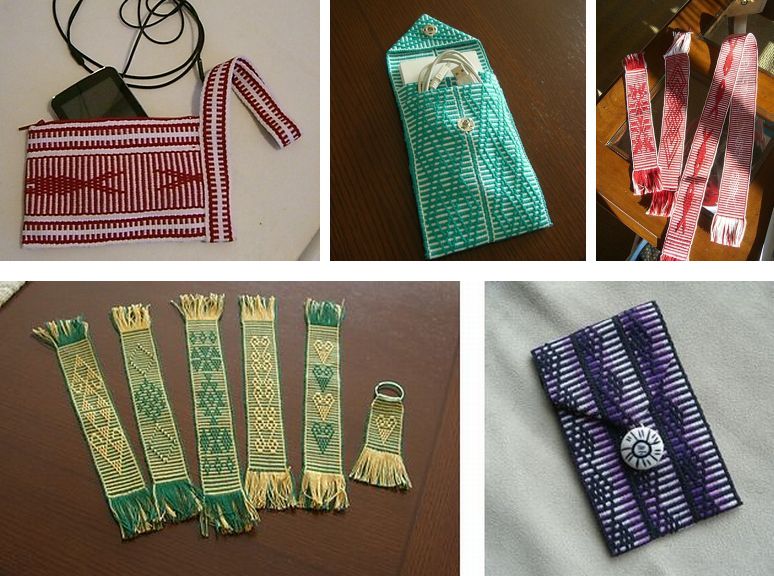
Maaike27 from Canada has been weaving up nice bands on a homemade inkle loom using many of the pattern charts that I have posted here on my blog. These bands have all been made with what I call the simple warp float technique and she has sewn them into a bunch of useful purses, key fobs, bookmarks and pouches.
There has been action in the Ravelry group both in and around the plain weave weave-along but I am saving all that for next week.
I will be leaving next week and hope to hit the northeast at the height of the fall colors. I arrived a wee bit late for it last year. I will try to keep up the posts while I am away but they may be a bit erratic.
I want to once again thank Syne Mitchell of WeaveZine, Julia Grunau of Patternfish and all my new customers who have made this transition to the new home so smooth and successful.
I have had a few things going on the loom this week…mostly bits and pieces that I will take along traveling with me…. gifts and such things.
I wanted to free up all my loom bars and have everything in order before the trip and, in doing so, unearthed one more old project that was lurking in the closet.
This was to try out a Mapuche double weave motif that is in the Taranto book. I wove it in two-weft double weave so that only the central section with the design is in double weave.
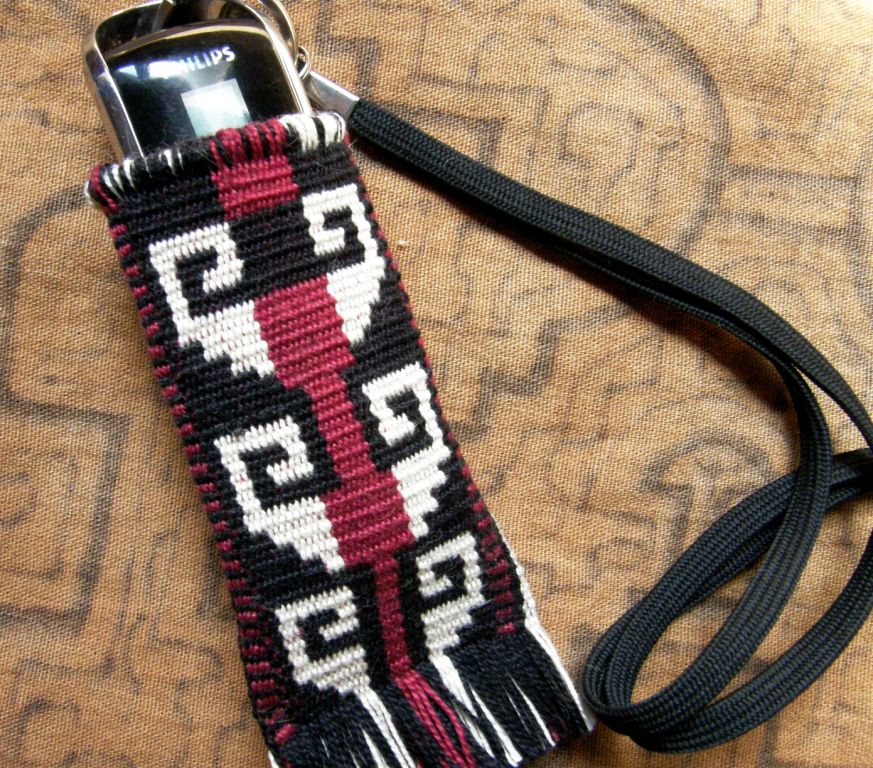
I really couldn’t see myself finishing it and so off it came. As the beige sides are just regular warp-faced plain weave, they folded very neatly and easily along the edge of the double weave section and I was able to just sew a join. Now the MP3 player has a fancy home.
I’ll braid a cord for it. Hmm, might even do one for the player itself. Now I don’t feel so bad about pulling this off the loom.
Then I was prompted to do a little further exploration in supplementary-warp bands, you know that technique that I have never been too excited about. I learned it in two places in Peru and in another in Ecuador but never quite took to it. Well, I have to tell you that I am loving it now!
First I tried a Sami pattern (in non-traditional colors and border in 24 wpi crochet cotton) and then dug out my handout from a Robyn Spady class and used her chart for a Celtic design (in tencel) and now I have reproduced a design from one of the Russian Old Believer belts that I photographed last year. There it is in the center.
This was a width sample with some 3/2 weaving thread that I hadn’t used before. The ground warp and weft is 35 wpi crochet cotton. When I do the “real” band, now that I have established the width, I will warp an edge of off-white so the weft won’t be seen as it is above.
As it so often seems to happen, just as I was thinking about the Russian Old Believer bands, I got a comment on my blog from a visitor. Natasha provided some links to a lovely site with gorgeous Russian bands and a three-holed wooden rigid heddle. I understand the way the two-holed version works and Grace Hatton has done a lovely job of explaining that in her article on WeaveZine, but I am not so sure about this three-holed variety.
Anyway, here is Natasha’s comment…(hopefully she will send pictures of the bands she made herself)
Hi Laverne, The design found on the belts from aRussian online storeis very close to what I see on the old believers’ belts. The weaver’s name is Svetlana. She lives and teaches weaving and other crafts in Moscow. You can see some pictures taken at thecraft exhibition last year. I recently purchased a wooden implement (not sure what the proper name is) from Svetlana that is used for belt weaving and wove my first two belts. It is called“berdo” in Russian. The interest in traditional crafts has grown in Russia too in the last ten years, at least as far as I can tell without being there. If you need anything translated from Russian I can help.
You may remember that I attended a weavers’ conference here in Santa Cruz a couple of weeks ago and dedicated a couple of blog posts to it.
As a participant from the general public, I got to meet and interact with weavers and other fiber artisans from the highlands and lowlands of various South American countries. Through workshops, videos and presentations we not only learned about the fibers and the techniques used to create the woven pieces, but also about the efforts of researchers, artists and academics to document the processes at the source and educate youngsters in the artisan communities themselves and the general public about these cultural treasures many of which are on the verge of disappearing forever.
This made me think of four people I know of who are working or have worked at this very thing and I thought that it would be nice to hear in their own words about their involvement and relationship with the artisans and what they see the future holds.
DORINDA DUTCHER
One such person is Dorinda Dutcher, a North American ex-PeaceCorps worker whom I met online and with whom I shared a room at the Tinkuy de Tejedores last year in Peru.
Dorinda works out in the field and is out of internet contact much of the time and so I was unable to get in touch with her for this blog post. I urge you however, to take a look at her blog and the wonderful programs she has going in the township of Independencia in Cochabamba, Bolivia.
Both Dorinda and Maxima, a local weaver who heads one of the weaving associations, were very much moved and influenced by their experience at the tinkuy. You can read all about it and how Dorinda is educating and involving youth in weaving and helping, very slowly but surely, to improve the lives of women in the community in her own words here.
#############################################
KATHLEEN KLUMPP
I was lucky to come into contact with Kathleen Klumpp through Ann Rowe who I met at the Textile Museum in 2007. Ann knew that Kathleen was planning a research trip to coastal Ecuador and could probably use an assistant. It was one of those “meant-to-be” things. But Kathleen’s involvement with the family of cotton weavers in Manabí Province, Ecuador goes back much much further than this 2007 trip. I will let her tell you in her own words…(photo captions by me, all photos except one by KK)
Kathleen with one of Luz’s daughters, Trinidad
My first contact with this family of weavers was in 1976 when I sat next to an elderly campesino man on one of those colorful open-sided country buses who was carrying a patterned saddlebag known as an alforja labrada.
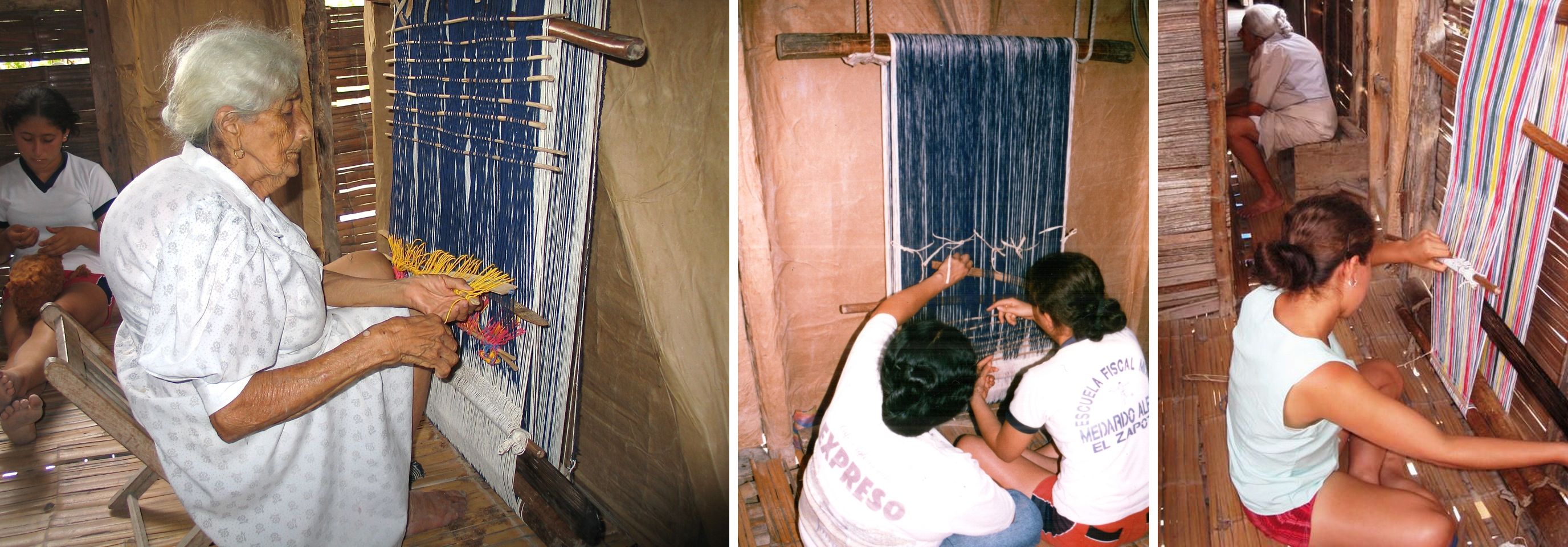
I admired his bag, and I soon found myself up at the home of its weaver, Doña Luz Párraga in the settlement of Zapote documenting their methods in writing and in still photography for preparing cotton, spinning it, and weaving it into alforjas and hammocks.
Spinning cotton and weaving on a native vertical loom is a millenarian coastal Ecuadorian artisan tradition that has been transmitted by peasant women from one generation to the next for at least four thousand years. Throughout much of the twentieth century, this craft flourished in the Rocafuerte valley region of central Manabí. In almost every settlement and small village situated between the city of Portoviejo, the capital of the Province and the city of Rocafuerte rural women spent hours hand-spinning cotton fiber and weaving double-pocket bags or saddlebags (alforjas) and hammocks intended for their own use as well as for that of other peasant families in the area. During much of the 20th century, the spinning and weaving of saddlebags and hammocks were part of a female peasant identity and part of their cultural heritage.
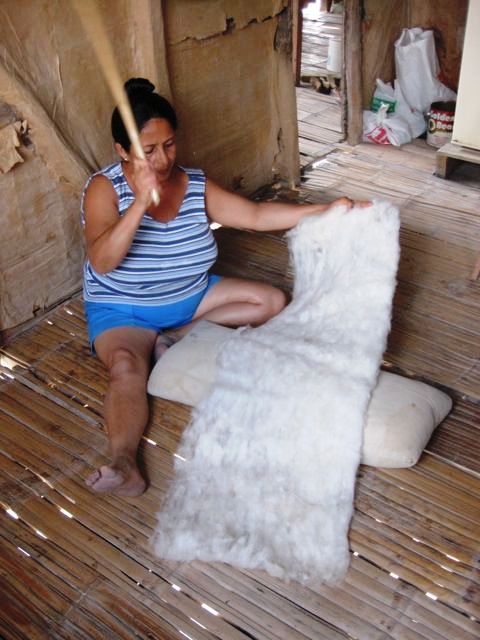
The finished patterned textile ready to be sewn into a saddlebag.Trini beats the cotton as part of its preparation for spinning.
In order to repay Doña Luz and her family for sharing their knowledge and skills with me, I made sure that they had copies of every photograph I took as well as doing some special portrait photography of this family at the request of Doña Luz. Even though the brief article that I wrote about this millenarian fiber art was published in Spanish in an Ecuadorian anthropological journal, nobody, other than non-Ecuadorian textile specialists took an interest as this activity has been invisible to the members of the dominant society for centuries.
I returned to Zapote in 2006, after a hiatus of 30 years only to find that this fiber art was on the verge of disappearing altogether. In fact, Trinidad and her sister Mariana were the last active weavers in the entire Province. But there was a problem: neither of Doña Luz’s daughters had learned how to pattern the fancy saddlebags, since the campesinos had stopped using them in preference for plastic bags.
In the face of an increasing globalization, the economic and social value of transmitting these skills and knowledge to the next generation has collapsed. Today’s cell phone carrying young ladies want nothing do to with this textile fiber art as it is considered “antiquated” and not suited for “modern times”. They would be embarrassed to be seen spinning or weaving—such is the stigma attached to this former female peasant identity—an identity now tenuously held onto only by their “old fashioned” grandmothers. In 2010, one young lady told Trinidad, as she was trying to recruit her as an apprentice, that she “rather starve” than to earn a living from this artisan activity.
My first priority was to insure the transfer of the full inventory of Doña Luz’s knowledge to her daughter, Trinidad, the one most interested in learning.
Now in 2011, I report on some recent encouraging signs that indicate that it is not yet totally moribund. These stirrings of life are, I believe, the end result of the steps that I initiated in 2006 to keep this craft alive and to insure that the necessary infrastructure would be in place for it to continue.
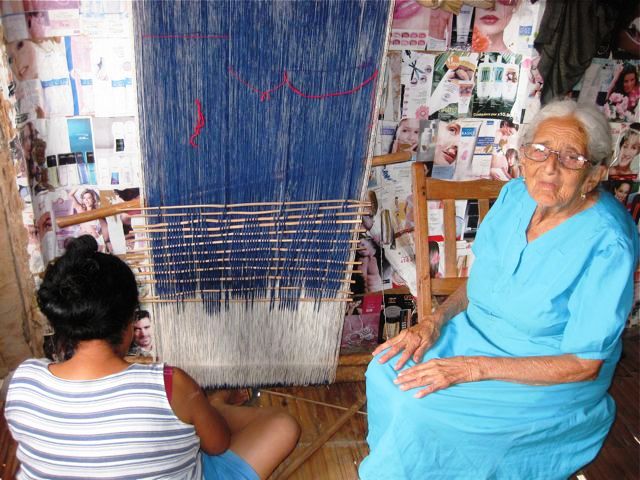
On my (Laverne’s) visit with this family accompanying Kathleen in 2007, Luz’s granddaughter Catalina would help with de-seeding and teasing the cotton (you can see her there in the background of the first picture). Grandmother, mother and aunt Trini would take care of the spinning and weaving process. On that same trip Catalina took only a very short-lived interest in learning to program the pattern warps but you can see her there in 2010 weaving a hammock on her own while 86-year old Luz sits by.
In 2007 when criollo cotton could no longer be purchased anywhere in the region, (cotton used to be a major cash crop of Manabí throughout the major part of the 20th century), I then suggested that they grow their own. Trinidad was able to locate a little old leftover cotton with its seed intact. We both selected the best looking seeds, and she planted them. Since then, she has about 75 viable cotton plants of two varieties of the native South American cotton Gossypium barbadense growing on land that this family owns on the top of the ridge.
We also have secured more macanas (the heavy swords or battens used to beat down each successive row of weft thread) from some old ladies in the village who no longer weave. These heavy swords are hand-hewed out of a dense hardwood with the wood of the chonta palm being the preferred material. We also found some old, abandoned fence posts of chonta wood near the town of Chone where this palm grows, just in case we have to fashion new macanas in the future for additional looms and weavers to use. You can’t weave without a macana—it is the essential piece of equipment!
I also encouraged Doña Luz’s 10 year old granddaughter, Melina, to learn how to spin. (by bribing her with 10 cents for each arm length of spun fiber!)
But, if despite my efforts, the knowledge of spinning dies out ( as today’s generation of young ladies have no incentive to learn it) I have located an excellent source of natural cotton yarn that takes dyes, both natural and aniline.
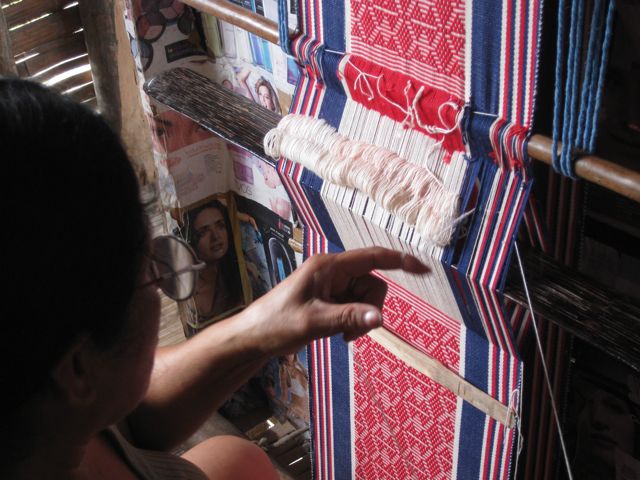
A new design being woven with suitable industrial spun cotton that Kathleen discovered in the area.
################################################
BETSY RENFREW and ANDREW YOUNG
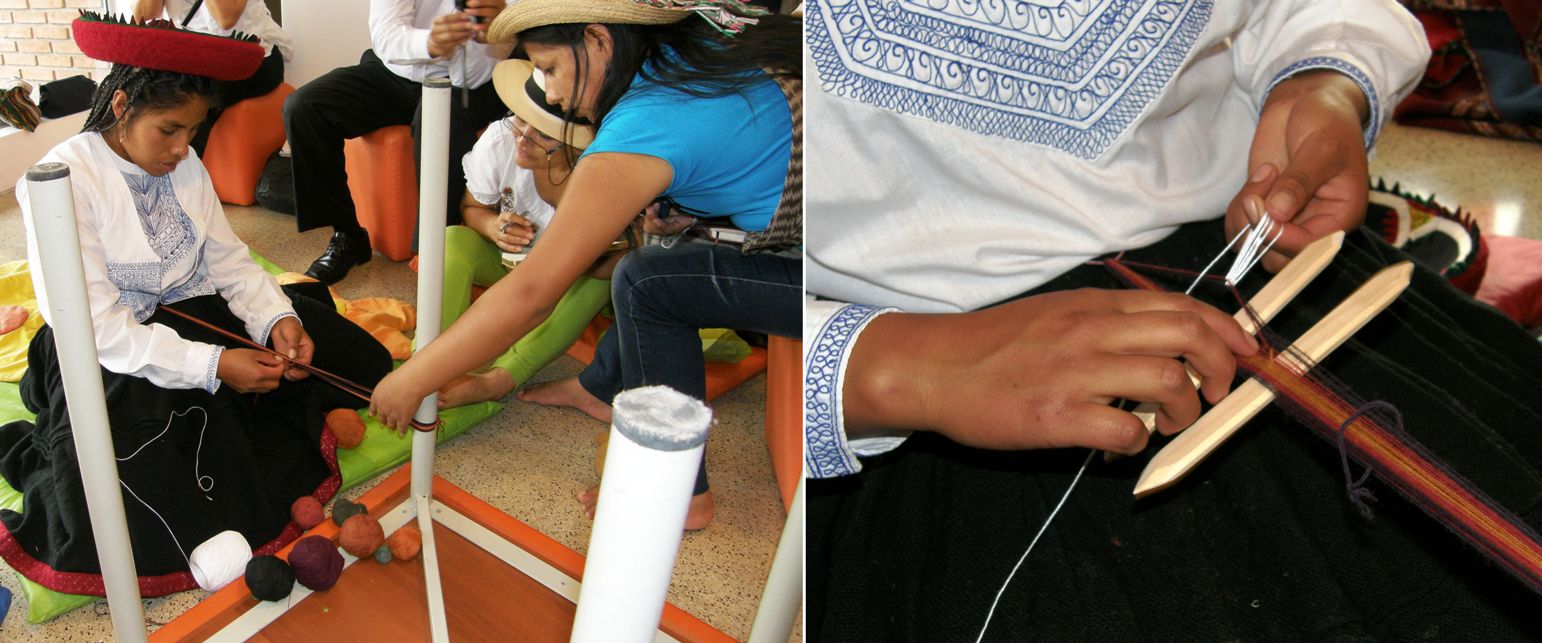
I met Betsy online when I ran into her blog on the Montagnard weavers who are living in North Carolina. We made contact and I organized to go and meet with her and Andrew and the weavers with whom they have been working. On a second occasion, Betsy welcomed me again and I was able to learn the weft twining process called kteh used to finish the ends of blankets and skirts from weavers Ju Nie and Ngach. On this trip I was also able to take part in some of the weaver gatherings that Betsy organizes.
One of my twining classes with Ngach and examples of the beautiful kteh work.
Here is Betsy writing about her project and its goals…
Betsy Renfrew with Montagnard weavers, from left to right H’ Wun Eban and H Ngach Rahlan (Jarai tribe), H-Tep Adrong (Bunong tribe) and Broih Fnu (Banhar tribe)
Since 2008 I have been meeting and interviewing Montagnard weavers in Greensboro, NC, in an effort to document their weaving traditions and understand why so little research had been done on these traditions.
My background is in the Fine Arts and I found this documentation to be an important segue from the world of painting and art history into a more folk/craft oriented project with a digital element. Recently I have received a grant and great encouragement from the Community Folklife Documentation Institute, a program spawned by the North Carolina Arts Council, North Carolina Folklife Institute, and the Center for Documentary Studies at Duke University.
North Carolina is eager to learn more about
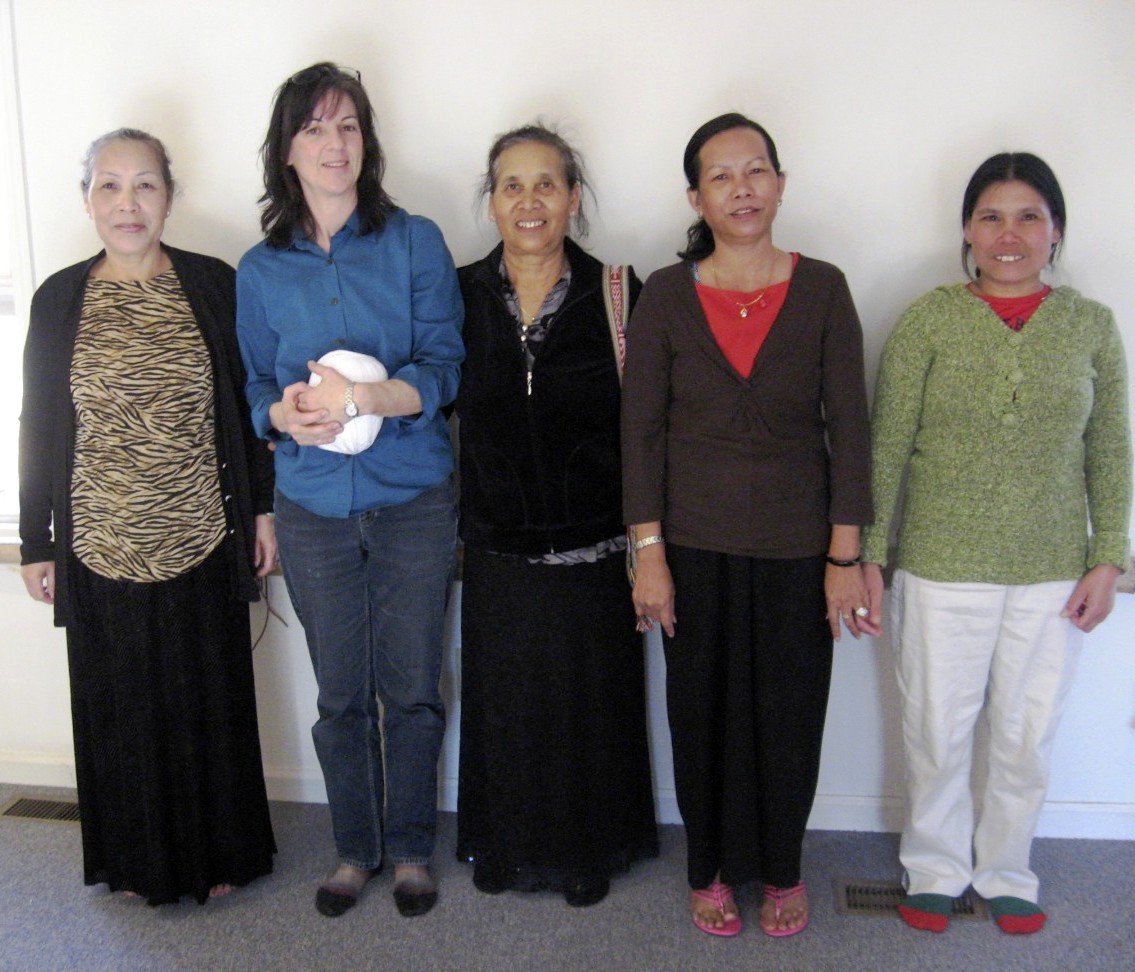
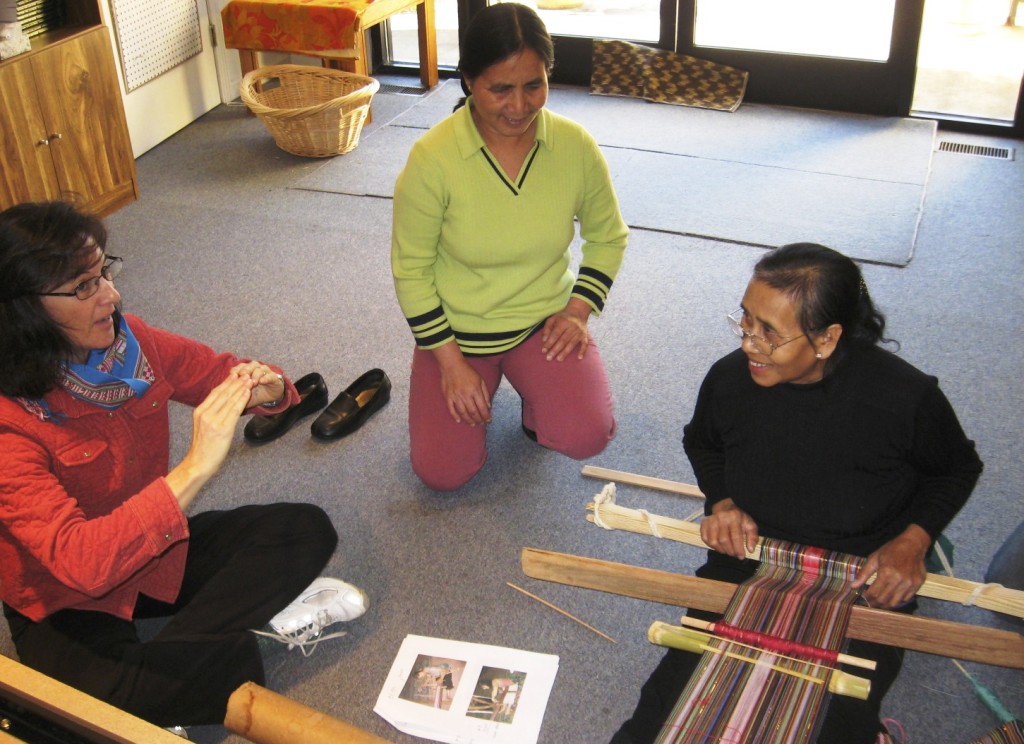
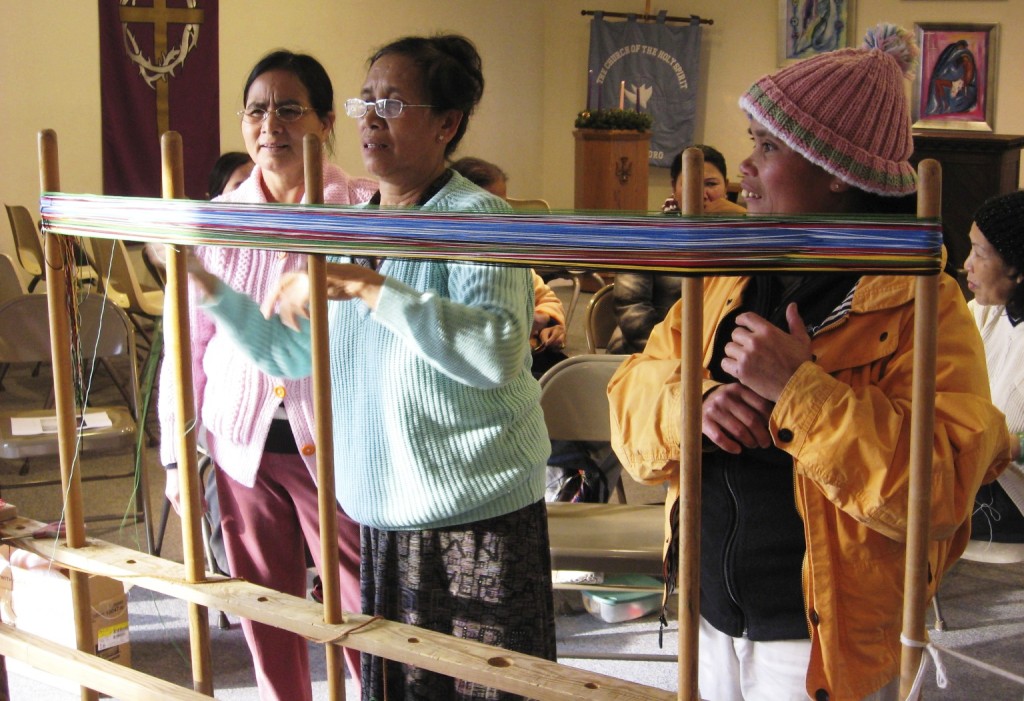
A local church has given space where Betsy can gather the ladies to weave, share skills and socialize. Here she also teaches them the English words for their looms and the weaving process.
Montagnard weaving and I am eager to share this knowledge with others. I have also partnered with a local Montagnard organization, the United Montagnard Christian Church, in receiving a grant from the United Arts Council of Greater Greensboro. With this grant I have organized women (now known as the Backstrap Weavers of Greensboro) that weave to help them learn some basic English to demonstrate their skills at local events, teach weaving to new students and learn how to market and sell what they weave.
We have good following of women coming to our meetings to share weaving knowledge. Most of the women are over the age of 50 and don’t speak English at all or have limited English. Most elderly traditional Montagnard women don’t interact with people outside their kinship group or church circle because they don’t drive, can’t read, or do not have a job. I found a certain level of low self esteem at first (because of the language barrier) but now I see these women not only enjoying themselves during our weaving time but interacting with people from different language groups (refugees from the Central Highlands speak five or six different languages) and other ethnicities. They have also come to trust me and to tell me what they love best of their culture.
Ju and Khin, both of the Jarai tribe, meet at the church to make a new warp.
One of my frustrations within the last year or so is a small turnover in attendees. Some of the women can’t come regularly because they care for grand children, have old injuries from working at textile mills, or poor vision. And there is the continual concern for sustainable income or funding for the project. Many of the women do not understand what a grant is or how it works! Despite these frustrations I have built a bond with what seems to be the last few practicing weavers in Greensboro. I teach them English, they cook me hablang, or cassava leaf soup. They teach me the words for their loom parts and I teach them how to teach others to weave. They are weaving with new supplies and beginning to make smaller purse type products to sell.
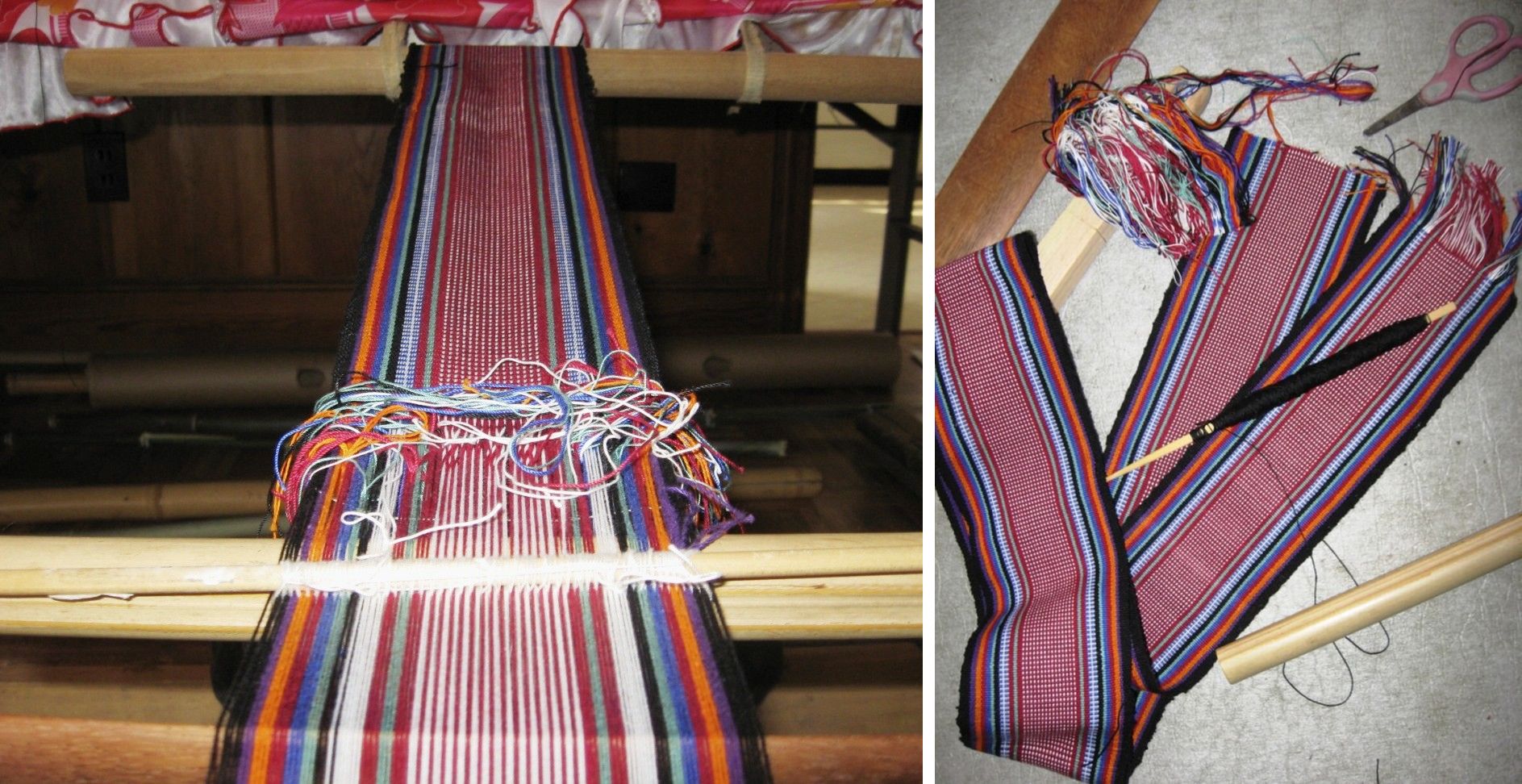
Betsy helps Ju an other weavers develop a way to teach their backstrap weaving art to others. This is Betsy’s first completed piece from her weekly classes with Ju.
Bunong weaver Tep showing one of her newly woven pieces.
And the future?
More aggressive fundraising tactics and creating an on-line market/gallery on our local arts websites.
I also will be widening my reach to Nepali speaking Bhutanese refugees, who also use backstrap looms.
I never had the pleasure of meeting Dennis Penley.
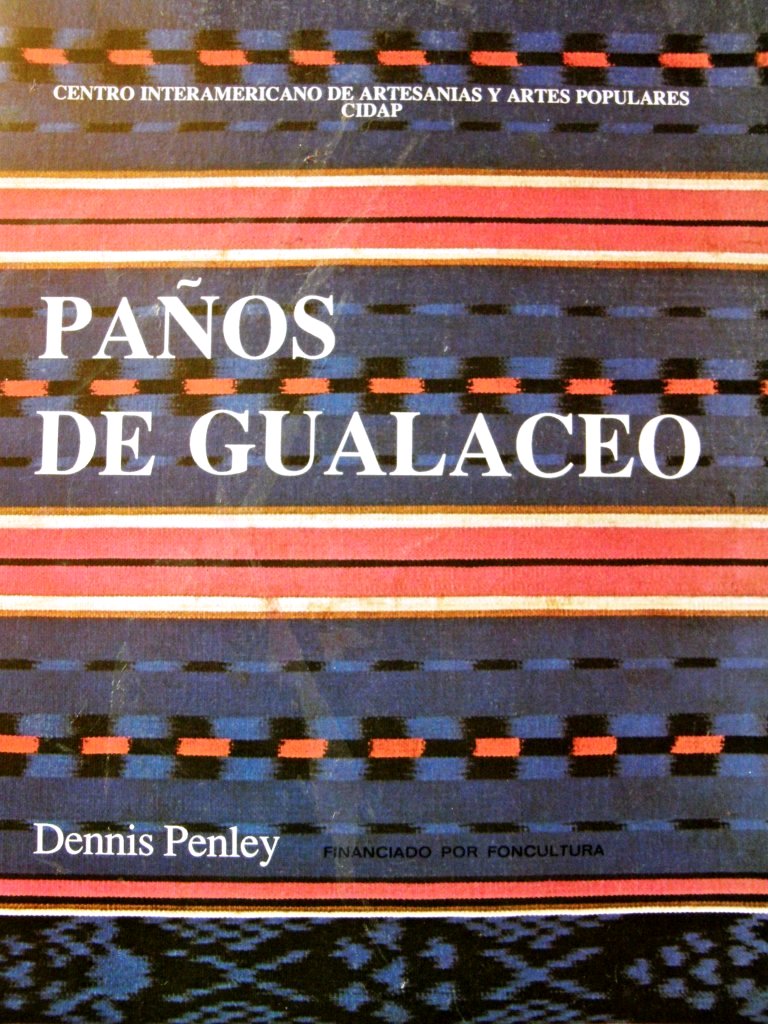
I bought the book he wrote on the ikat shawls or paños of Gualaceo, Ecuador on a visit there in 2005 knowing nothing about its author and the fascinating life he had led.
I have, however, been lucky to have become acquainted with Phil Willett, once again, on line, to whom Dennis Penley was a good friend and weaving mentor.
Mr Penley passed away the year after I bought his book and Phil wrote a short biography to accompany an exhibit of his collected textiles made as a tribute to him.
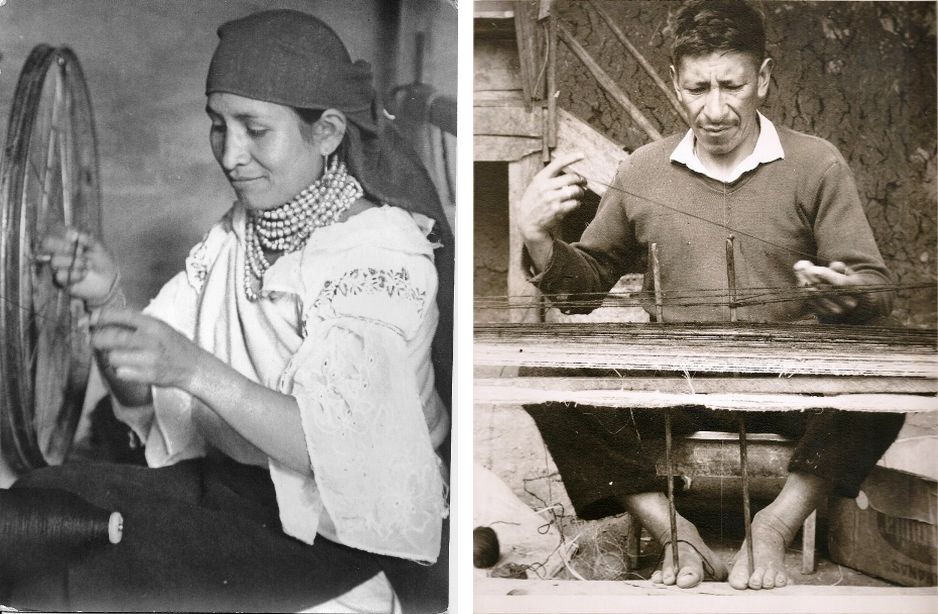
I won’t caption the photos, all of which (except the first in color) I understand were taken in Ecuador.
Here is the biography that Phil put together…
Dennis Penley, a life time of hand weaving enthusiasm.
From his early beginnings creating elaborate costumes for himself and the Arabian horses his family raised and trained, Dennis was a born textile enthusiast. He taught himself to weave as a teenager and utilized that interest to befriend many people through his life.
After high school he joined the Peace Corps and worked within the Ministry of Agriculture of Ecuador. Part of his job was researching the indigenous peoples weaving traditions.
Following his Peace Corps service he stayed in Ecuador to research and write a bilingual book on the shawls of Gualaceo.
He lived and worked among the indigenous mountain weavers, with a horse to travel by and a llama to spin wool from while it also carried extra gear.
When he returned to the USA Dennis received an honorary bachelor’s degree from San Francisco State for his work in Ecuador. Dennis not only photo documented the techniques of the weavers, he learned them by hand using a back-strap loom.
With all this weaving knowledge he had hopes, when young, of a lifetime of hand weaving. Based out of California he produced custom hand-woven yardage for designers, blankets and home accents.
All this was accomplished on a Swedish barn loom. His dream would not prove to be financially viable.
Dennis would, through his working career, excel and profit at many other endeavors. He was a master cabinetmaker and historic architecture restorer. He worked for many years for the city of Lexington, his final position as a code enforcement officer.
Dennis’ studies of non-western cultures, philosophy and textiles would be a passion for his entire life. He first became intrigued with ikat weaving in South America. He would later research its use throughout many cultures. After years of studying the textile traditions of Southeast Asia and Indonesia he traveled twice to the region to see the artisans and collect textiles.
The textiles within this collection are a testament to an inquisitive mind that had a tremendous respect not only for the craft but also the people who created them. They are works of art and expressions of cultural identity and diversity.
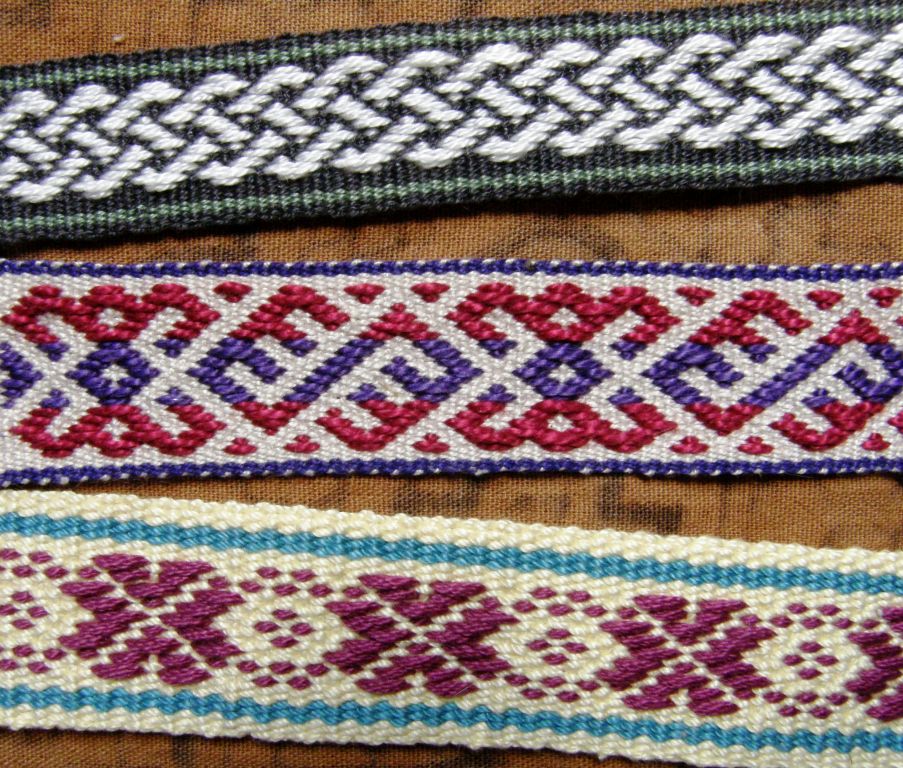
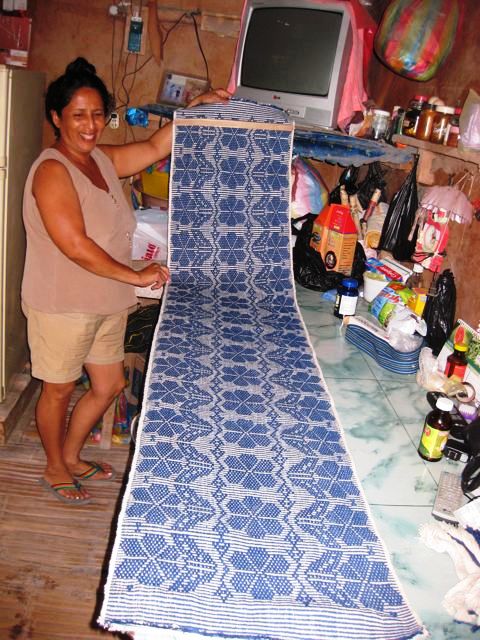
My goodness, people have been busy in the backstrap and inkle weaving groups at Ravelry this week. Check this out…
Marsha has been making all kinds of wonderful things with simple warp floats. The knot design on the left is charted here.
Bobbie is making a bag with pebble weave designs. Here we see the wide front and back panel and the side.
And some Spin-Along results are coming in…
Popsicletote is weaving with her handspun wool/silk blend. The hairiness is making life a little difficult but she is adapting and getting on with it. Her designs are pebble weave.
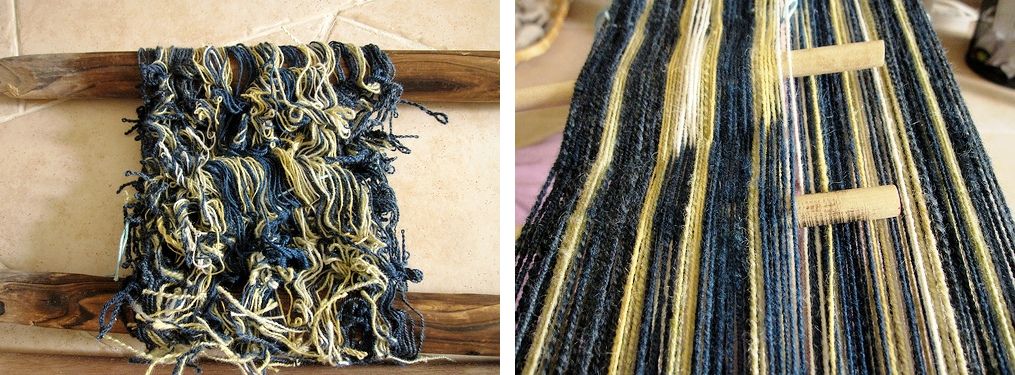
Tracy has just warped up her own handspun wool. Here you can see it curled up at rest and then tensioned on the loom bars.
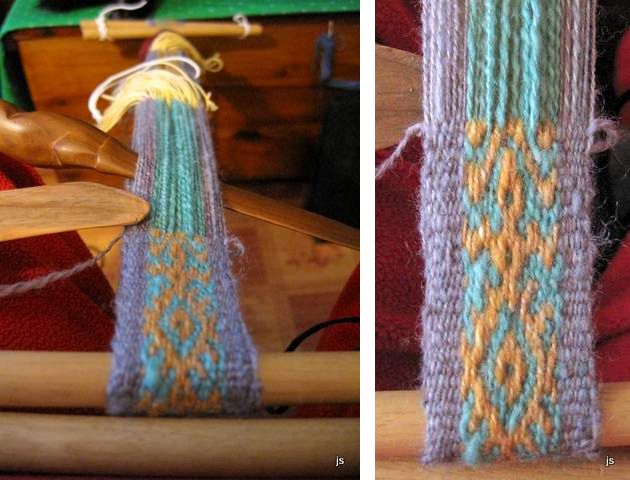
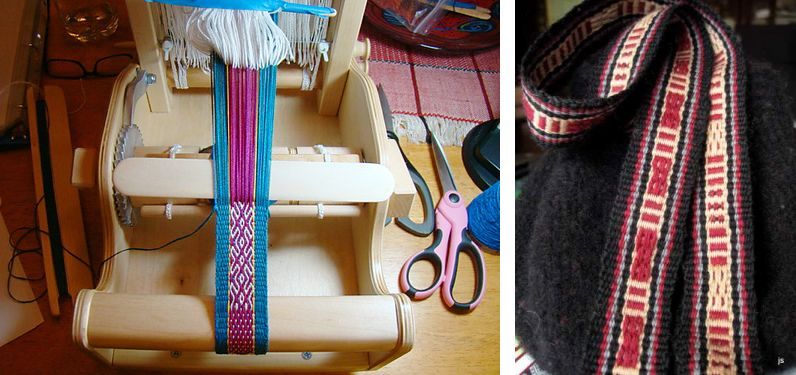
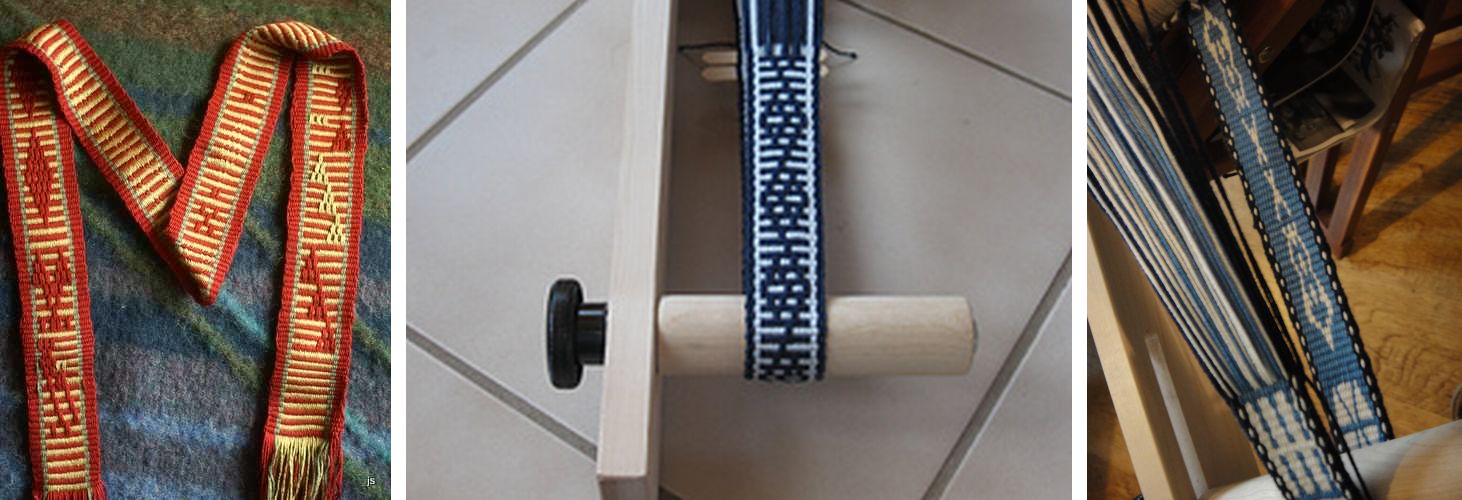
Another ‘waver’ has joined in the warp-faced fun (Waver= user of Gilmore Wave loom). That’s Michele’s pebble weave band on the left with one of my designs from my Andean Pebble Weavee-book. Popsicletote tried sock yarn for making a band and it turned out beautifully!
And here are some projects from a little while back from the online groups that I didn’t get a chance to post…
I LOVE all these different wool warps showing up…hand spun, re spun commercial yarn…all working differently and giving a variety of results. How lucky we are to have all these folks experimenting and creating and sharing with us. I am learning so much!
 And I do take time out for a little mindless fun!
 I found that these traditional crocheted bags became very popular outside Colombia a couple of years ago and even prompted an article in the NY Times.
 This is slow work, I can tell you….lots of threads to count and pick up!! I was very unsure about this piece last week and was on the point of putting it aside for a while and working on something else to clear my head. But, I persevered and am now happy with the result.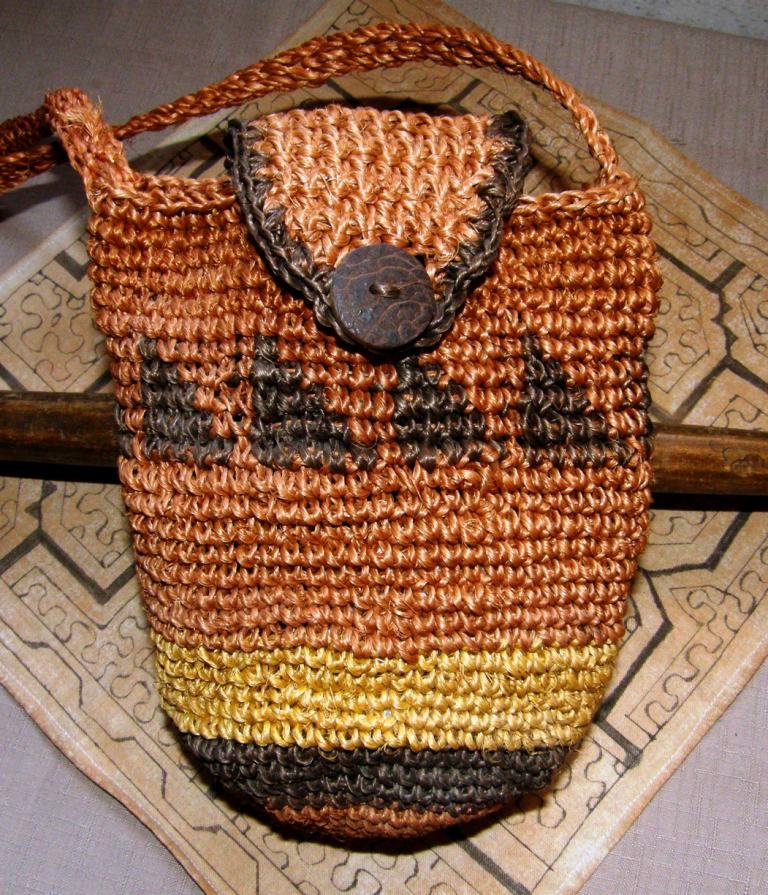
 She was kind enough to say that it wasn’t too bad for a first attempt. The button is made from the tagua nut and the dye for the cabuya fiber comes from natural sources.