Well, you all know that I am on the road and haven’t had time to put a proper post together but I couldn’t resist posting a bunch of pictures here so that you can ooh and ahh over something that I got see up close and personal today. I even got to take it back to my digs for the night to enjoy and photograph.
My digs is a wee cabin on my friend Janet’s cousin’s winery in Santa Cruz, California…yes, one of the other Santa Cruces…..fields of grape vines flowing downhill and out of sight amongst a background of cypreses and redwoods with a view of the gorgeous Pacific Ocean with Monterey across the bay. There’s a whole lot more to that story, of course, which will have to wait but I thought I would post these pictures which really do have me speechless.
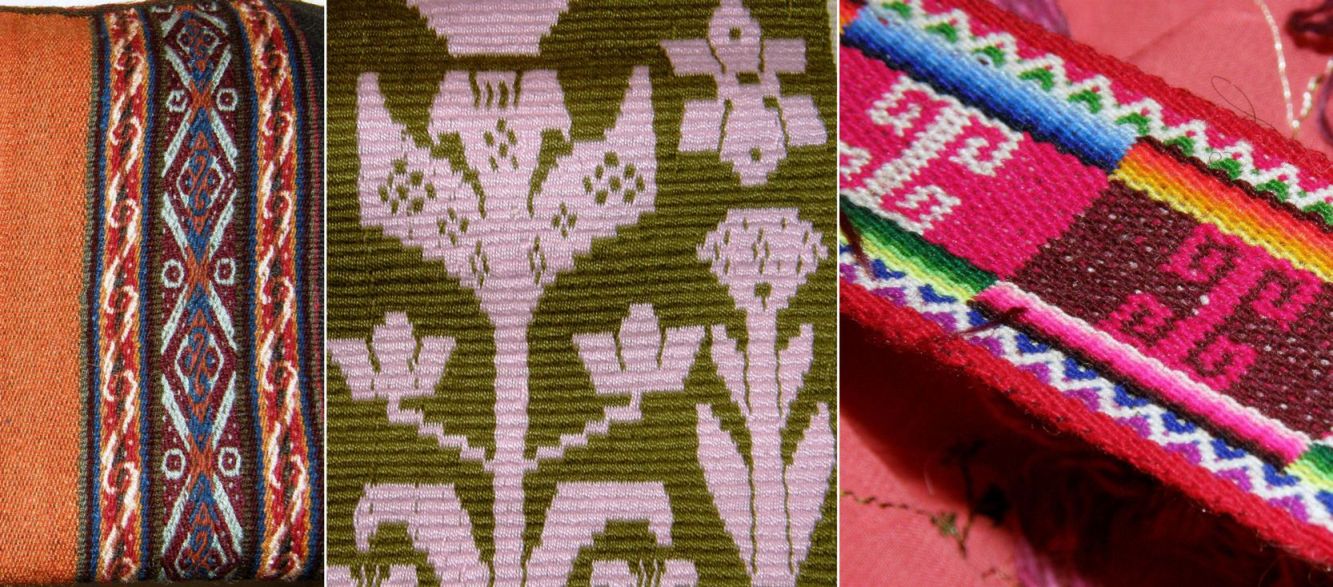
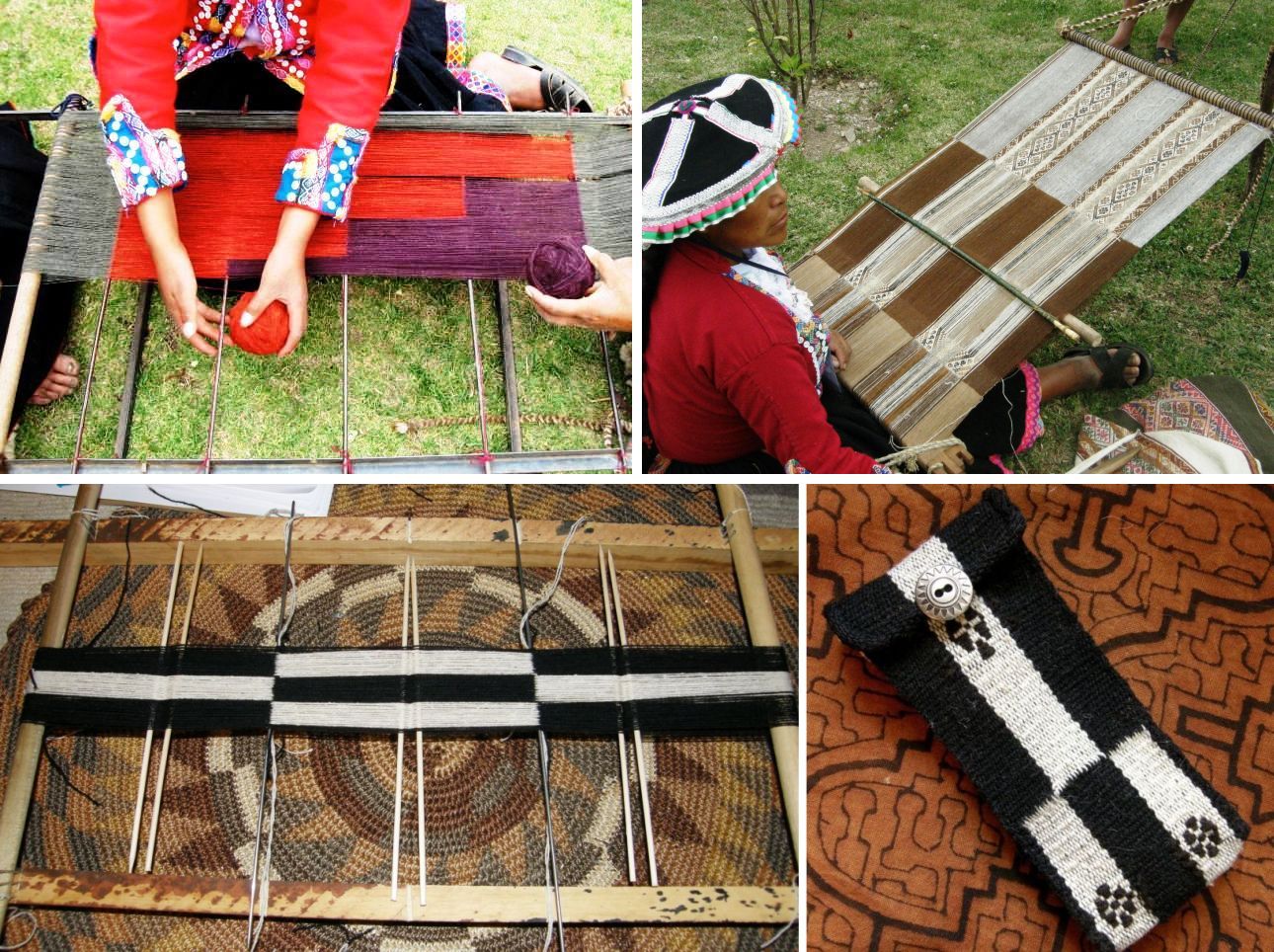
These pictures you have seen before if you follow my blog and you will, no doubt, remember that I became fascinated with the discontinuous warp technique when I met Pitumarca weaver Antonia at Convergence last year. There I got to see a piece being woven even though I didn’t fully understand at that stage what it was all about. At the Tinkuy de Tejedores in November in Peru I got to see more and even got to try out a plain weave piece of my own which I turned into the black and white eyeglass case above.
Well, now, I have gotten to see, touch and fully enjoy and appreciate, after having woven my own very ridiculously basic version, a finished piece…and what a piece! It was lent to me by Martha Stanley to take home overnight and really study. What a treat!
Okay, so I said I was speechless so, this is the point where I should really stop waffling on and just show you the piece!
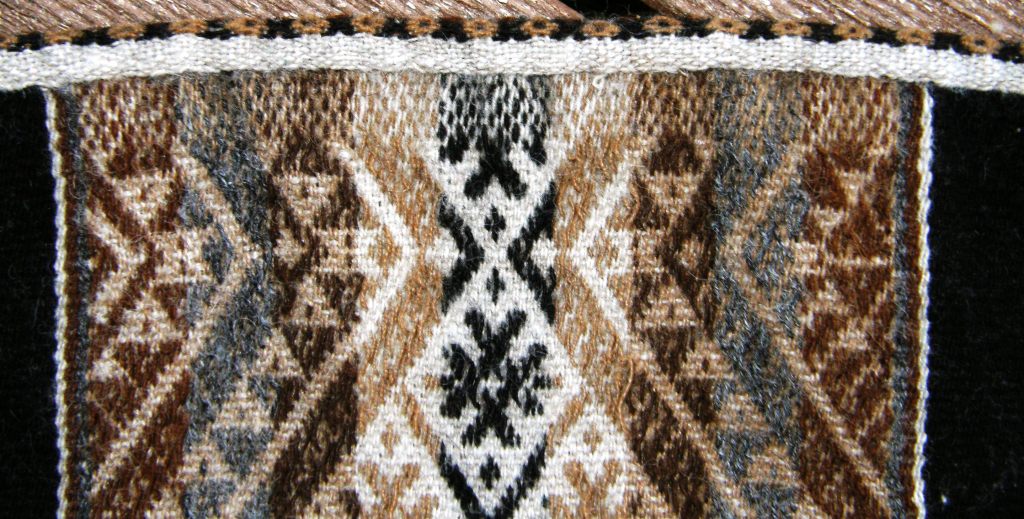
It has been woven in all natural alpaca with twelve panels of supplementary warp pick-up patterning, each one being a four-selvedged piece…incredible! There is the tiniest terminal area in the top and bottom panels, which you can see below, where the weaver simply could not weave any more pick-up due to lack of space to manipulate the warps.
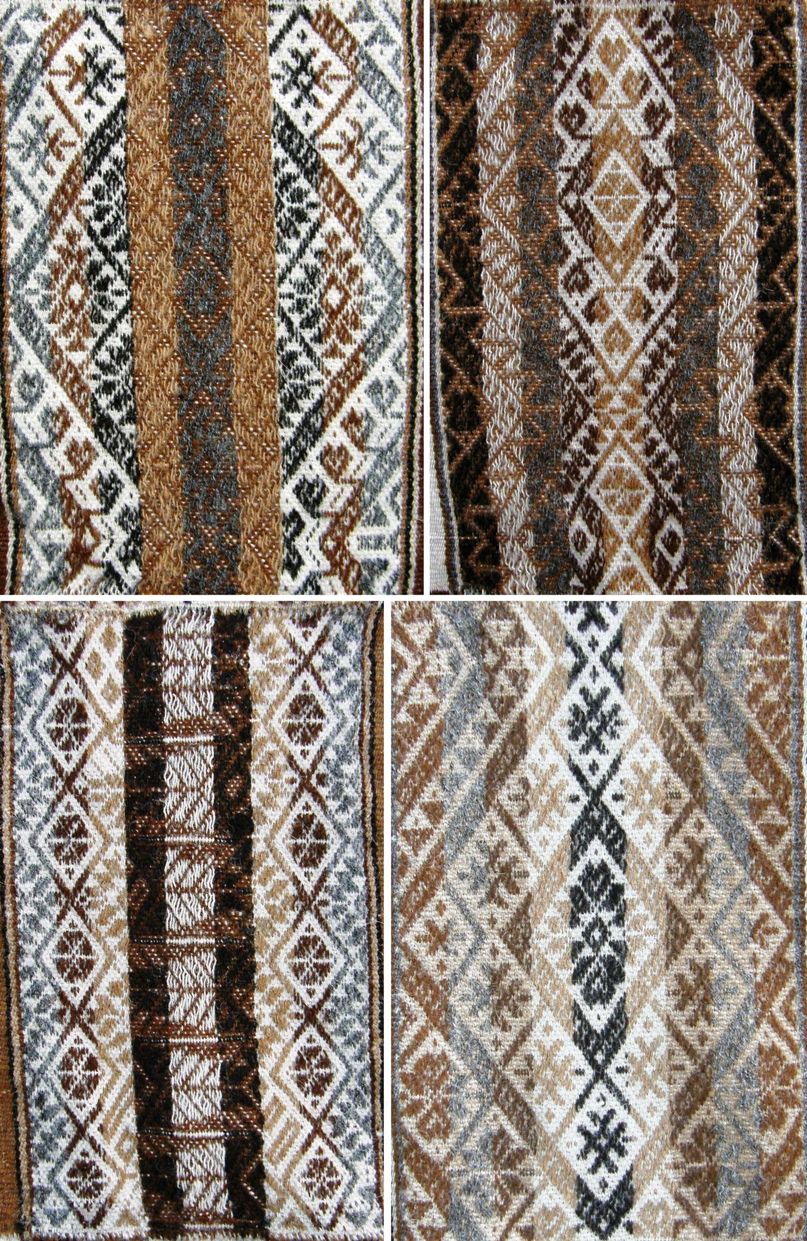
Each panel has a different traditional design of Pitumarca flanked by fields of either black, brown, grey or tan plain weave.
And, of course, it was woven as one entire piece on a backstrap loom.
There you have eight of the twelve panels of pick up patterning. Here are the last four…
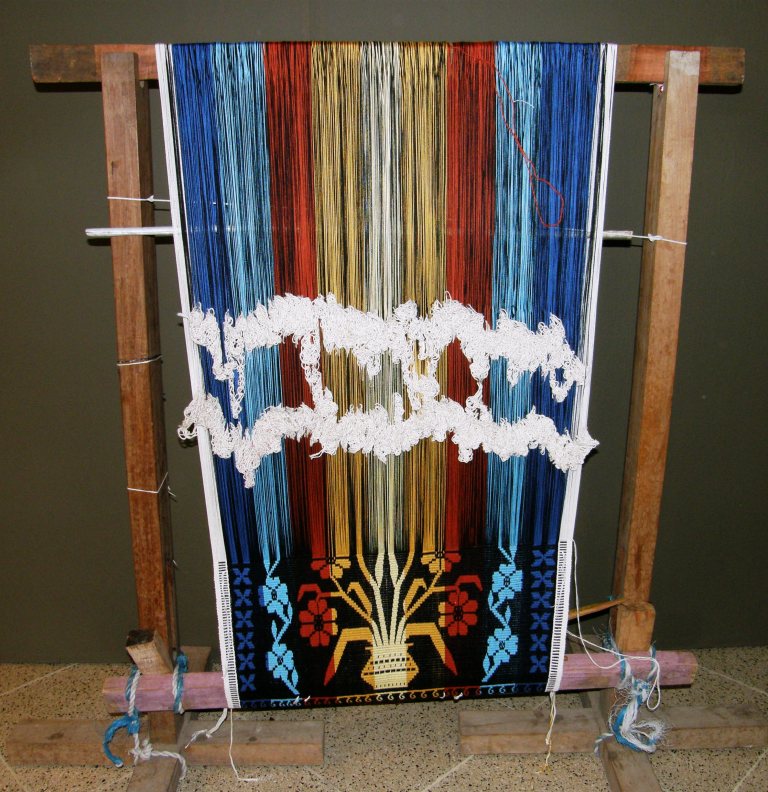
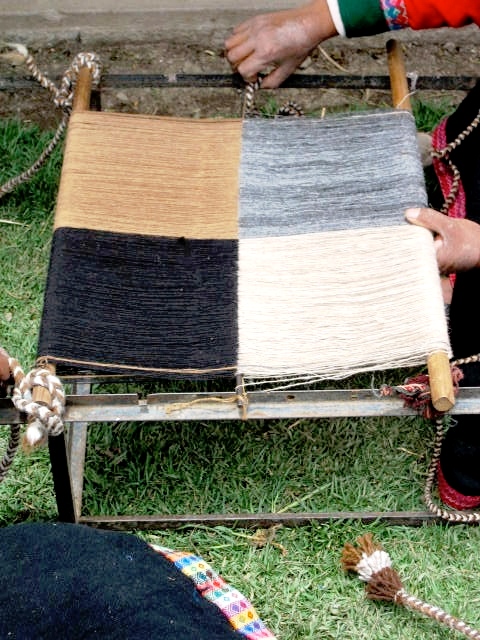
This is how a four-panel piece would look once warped…
And here you can see how the warps from each color panel dovetail around a metal rod during warping which is what enables the weaver to have all these warp color changes within the one piece. Yarn is lying parallel to the rod which will stay in place to hold the dovetailing once the rod is removed.
So, this is one of many cool things I have to show. I was given a entire bin of textiles to take back to winery and pour over…but that is all for this week!
Oh wait, I have to show you one more picture of the woven edging on the piece….
Tippity-tap at the computer for the most part this week trying to move some projects along before I go traveling in a couple of weeks….finger-dancing at the keyboard rather than at the loom but I have a couple of little things to show…
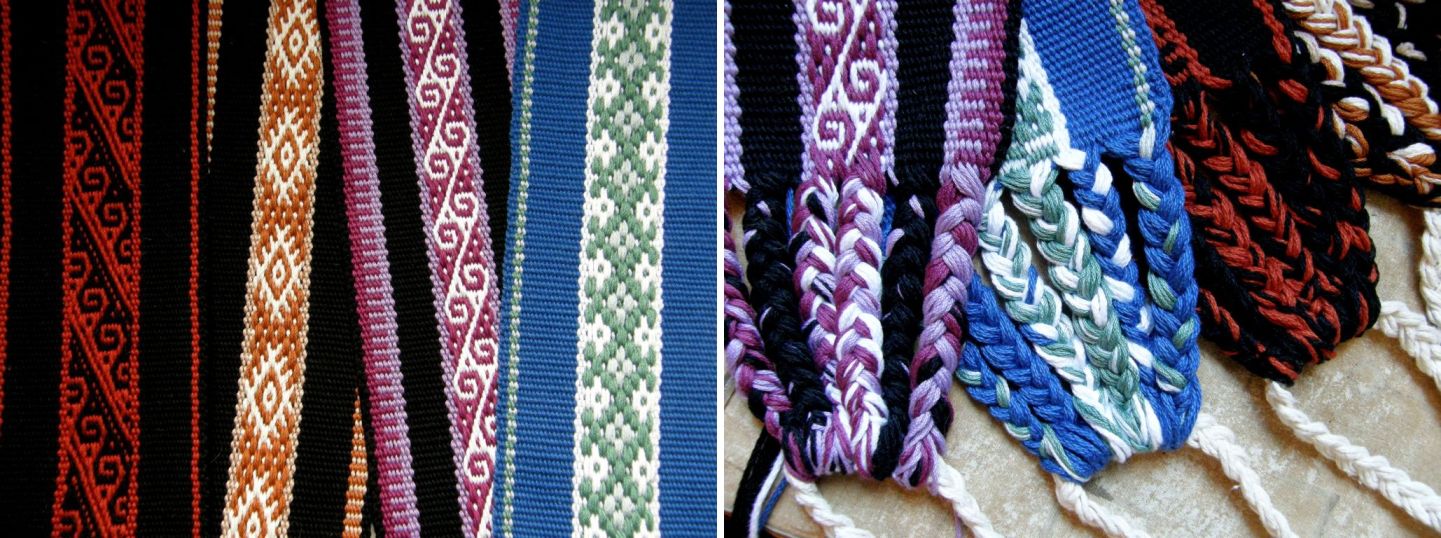
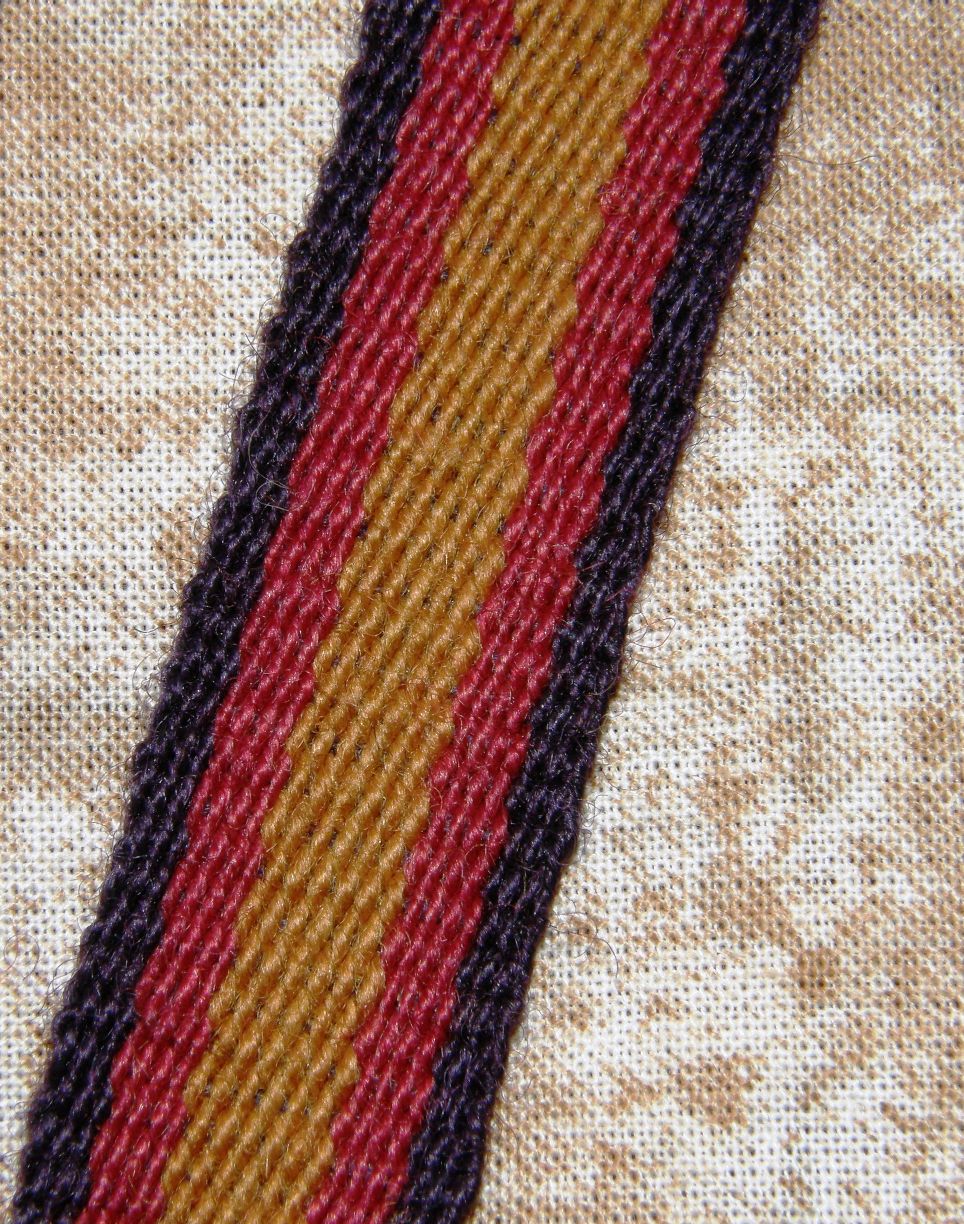
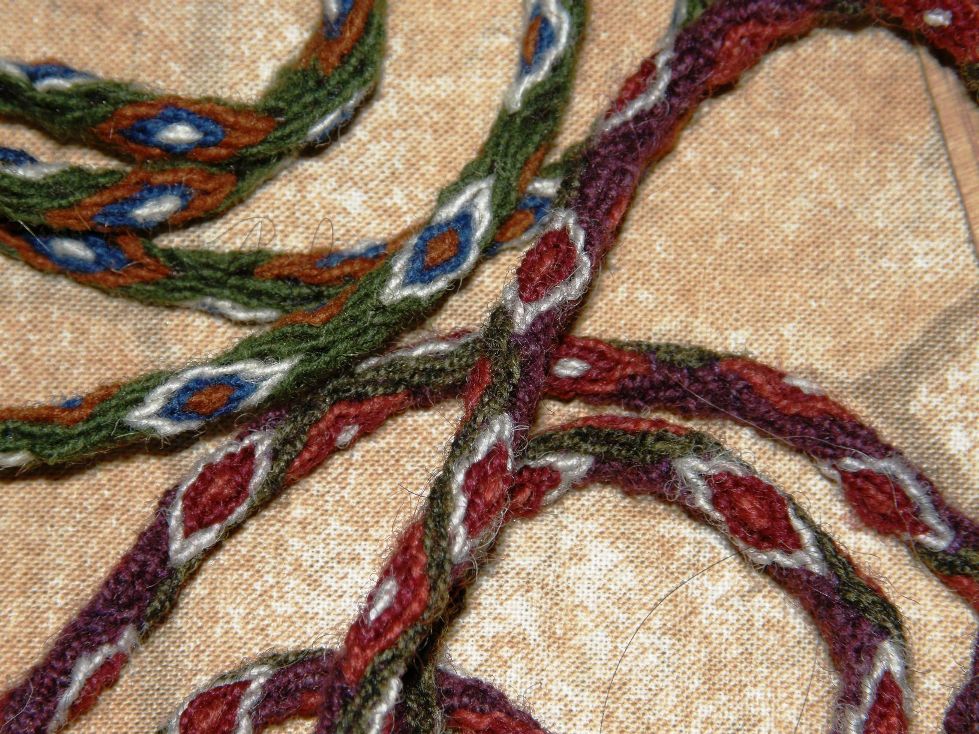
Well, I am cheating here…this is not loom work. I braided the friendly ends of my recent backstrap projects. Now I have to do the nasty ends…the other end with all the knots from the color changes.
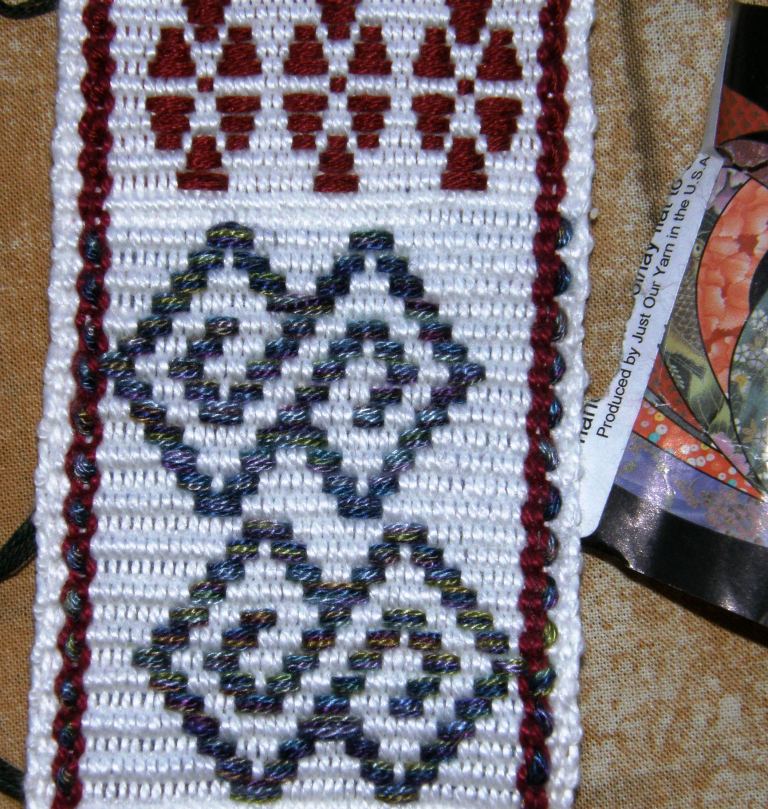
I also played a little with some tencel that my friend Lisa gave me last year when I was visiting her in North Carolina.
It is a multi-colored 10/2 from Just Our Yarn labeled “almaza” and it shimmers with mother-of-pearl colors!
I suddenly had the idea that this may make really nice supplementary weft for some of the inlay designs I have been doing lately and so I warped for a white band in my 24wpi cotton and tried it out.
I used six strands and I love the way it came out. I warped four ends of red in the band on either edge and turned the supplementary weft between the two red warps on the left side and then on the right of the two reds on the right to see which way looked nicer.
The red supplementary weft above this is doubled strands of embroidery floss. I would like to make something now using the tencel on a band of my #10 cotton. You can’t see it so much in the picture but the tencel almost looks like beads on the cloth from a distance. The multiple strands bunch together and give a more raised effect unlike the embroidery floss which tends to lie flat.
Now listen to me getting all goofy about textures and such things. This is very unlike me! Maybe it’s because at the weaving event I attended last week I was determined to pay more attention to the materials with which we were working rather than solely the techniques and so have been able to make what I am calling some “material gains” in my weaving data bank. Discussion in the Spin-Along that has been running on Ravelry has also turned my thoughts this way.
So here are some of the materials that we got to play with at the weavers’ gathering last week…
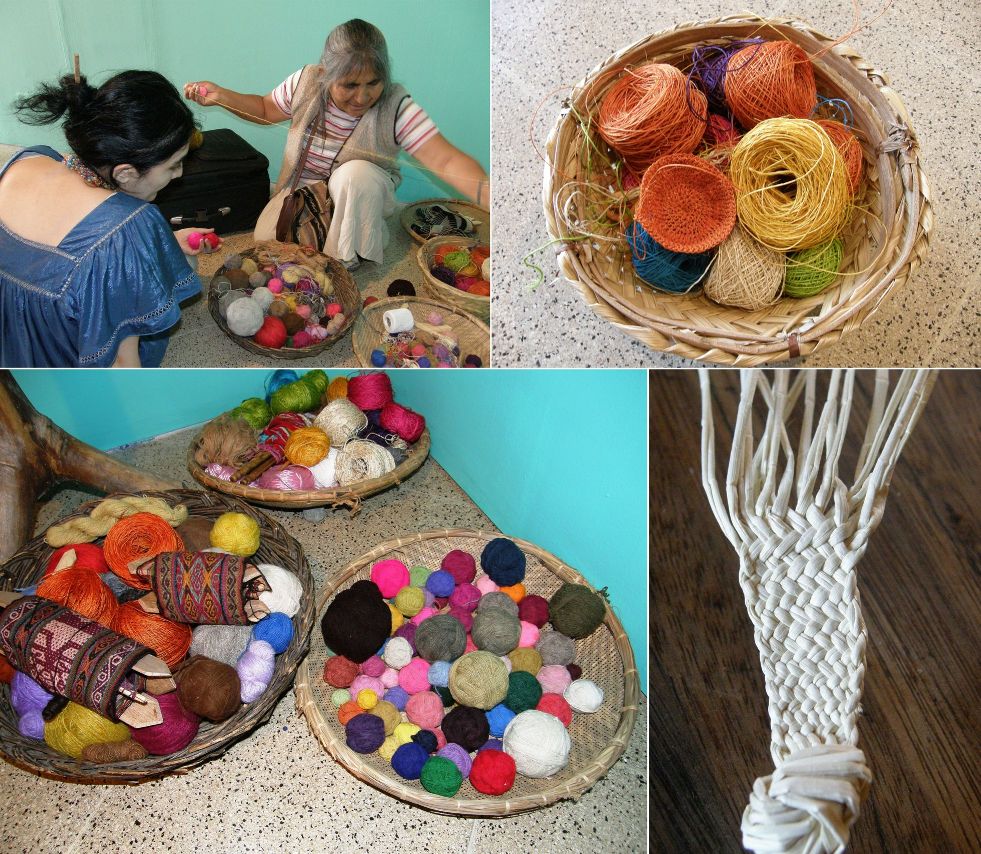
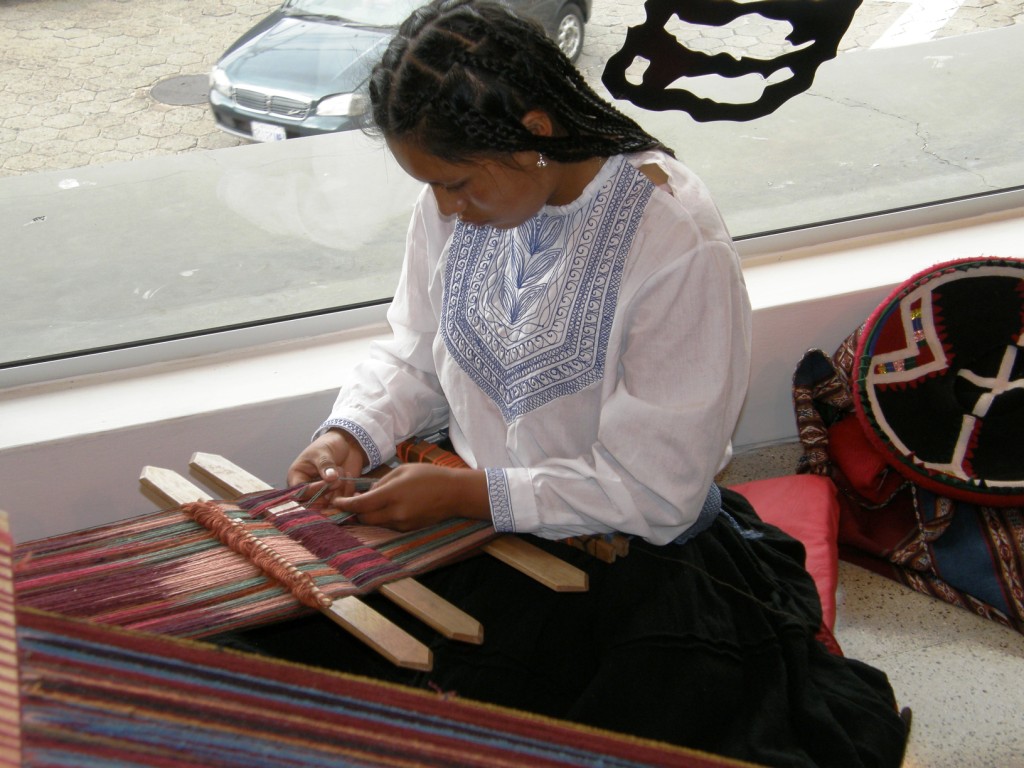
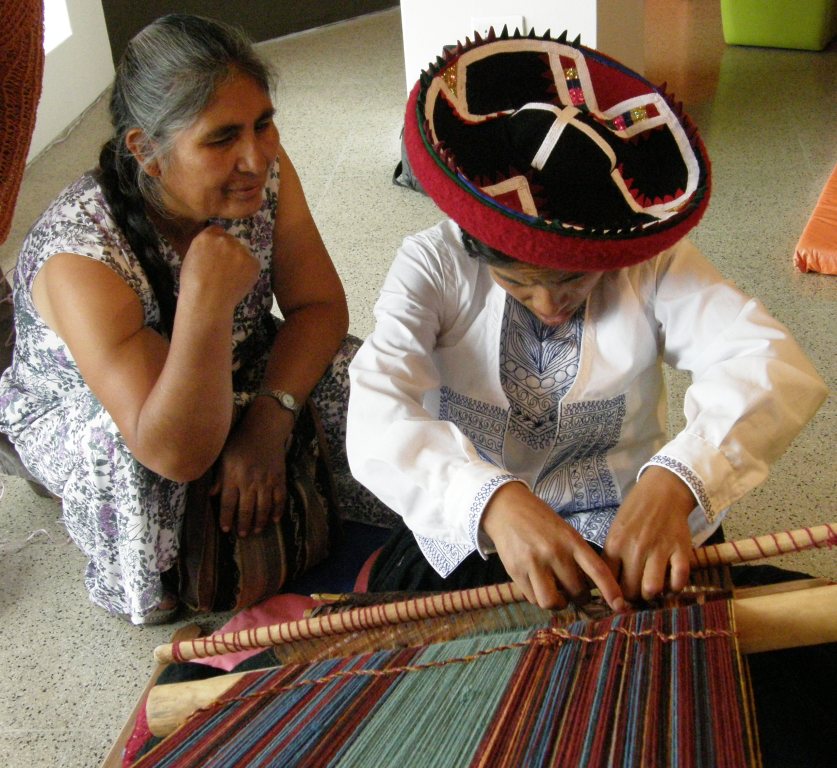
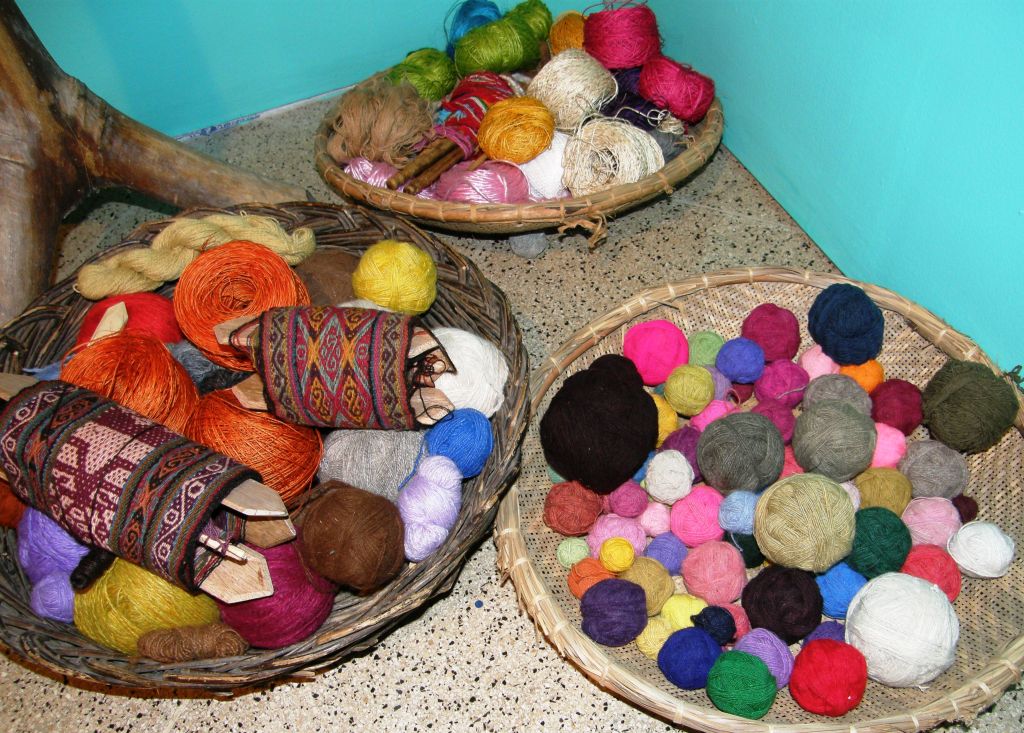
Celinda, an Aymara weaver from the northern Chilean high plains, is showing one of the participants handspun wool which she dyes with bright aniline colors. She also brought her handspun alpaca fiber in natural colors and I was able to keep some by swapping a couple of my handwovens. Zenaida and Sonia brought handspun wool from Chinchero which they left for educational purposes at the cultural center which sponsored the event. I noticed, however, that they use alpaca for weft in their wide weavings.
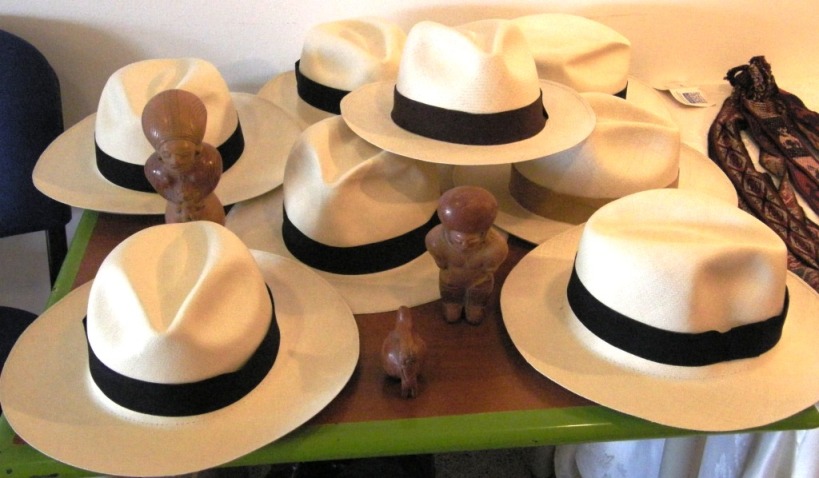
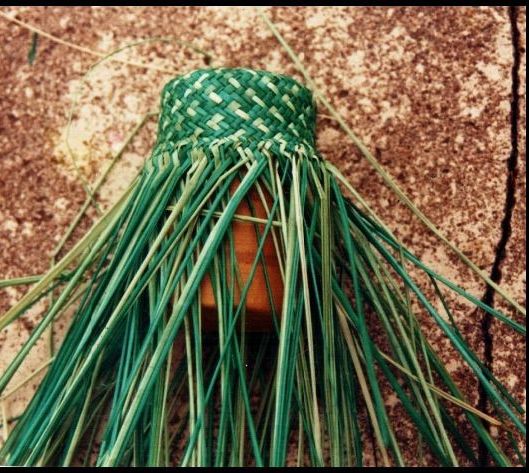
Domingo, a master weaver of the famed Panama hats of Ecuador brought the straw “paja toquilla” (above lower right) from which they are made. Maritza, from Colombia taught us how to work with the “cabuya” fiber that is extracted from the penco plant. (above upper right).
The Guarani weavers who attended, from the area in which I live in the Bolivian lowlands, are now using industrial cotton, the very same type that I use myself in my weavings.
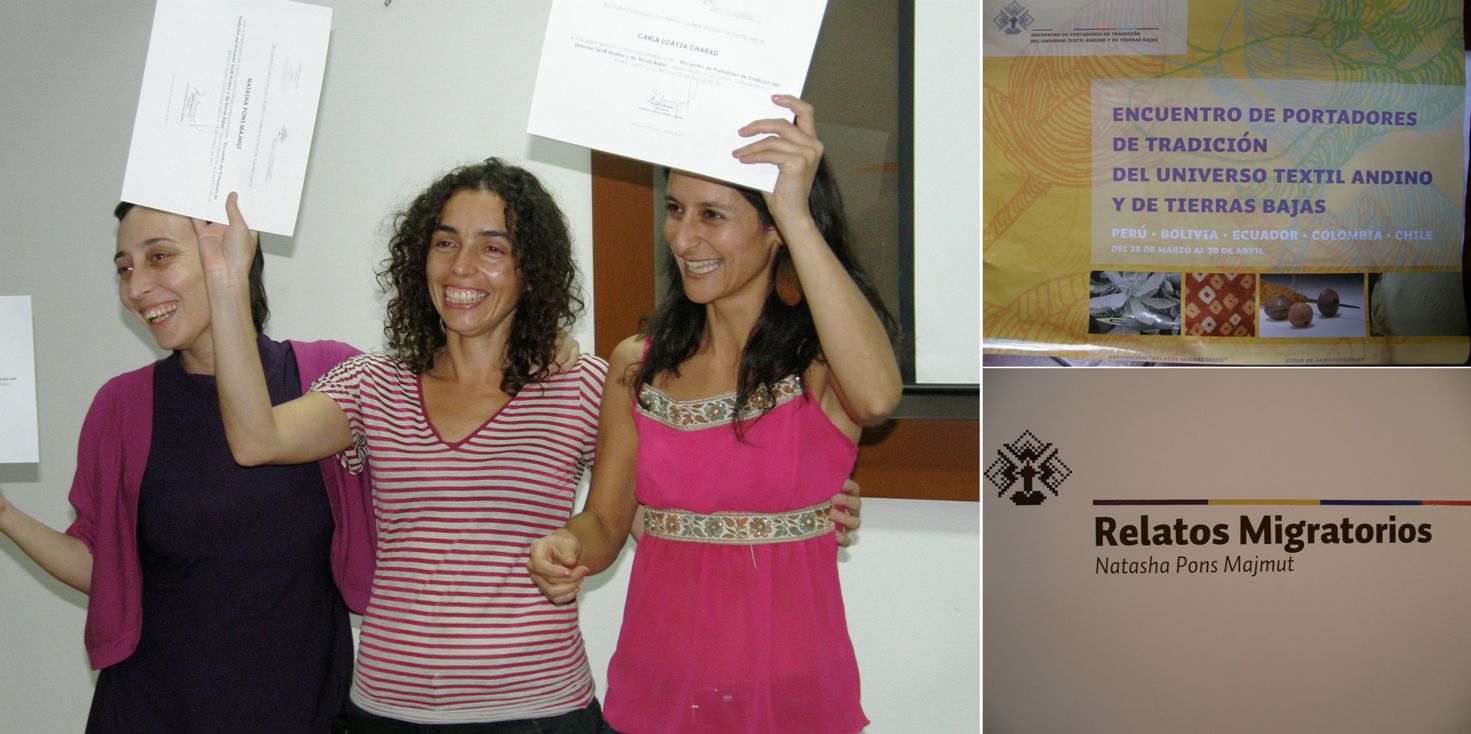
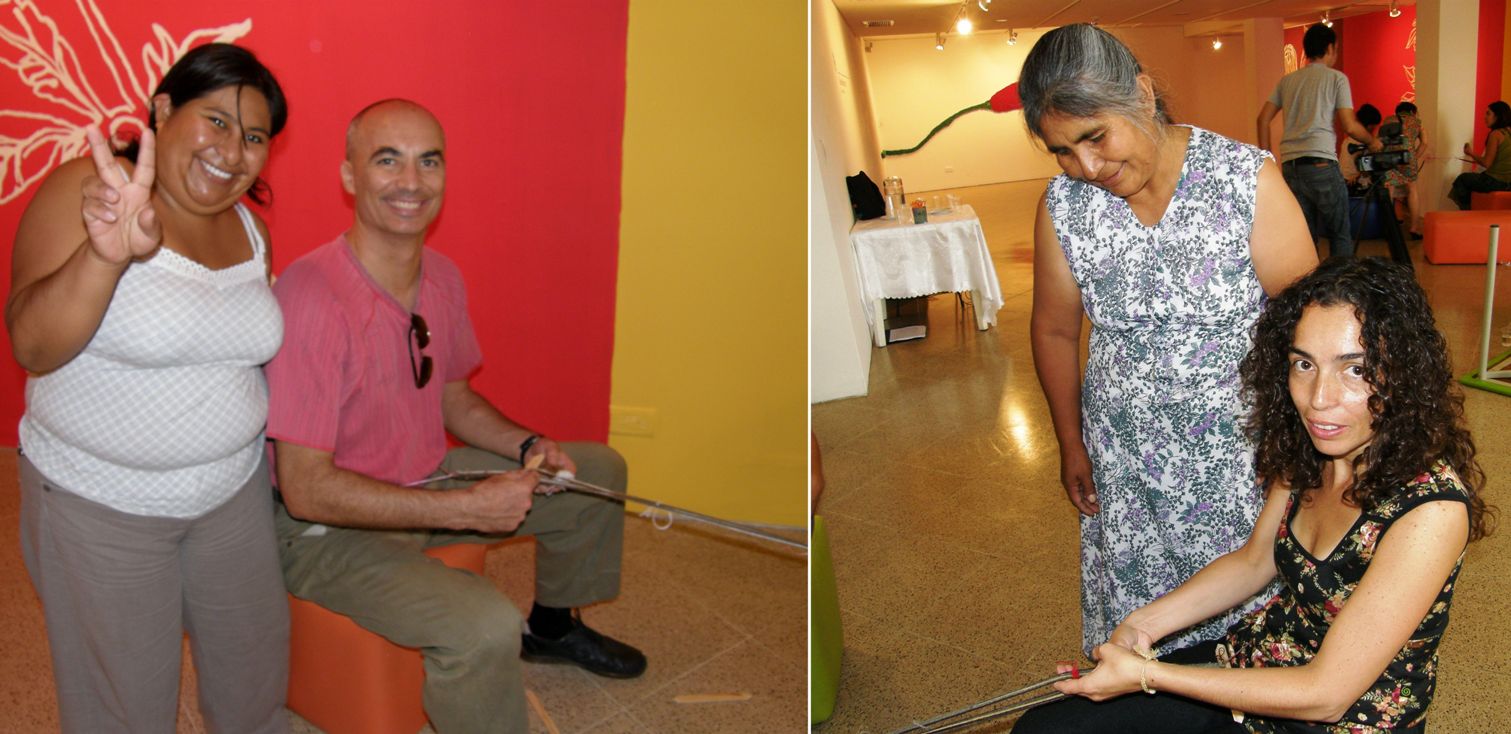
The event was organized and coordinated by the three Chilean ladies above…Cristina, Natasha and Carla who can be seen celebrating the end of a successful three days of interaction and sharing. Artisans from Colombia, Ecuador, Peru, Chile and Bolivia came together to show their work and exchange ideas and I was lucky to be a part of it.
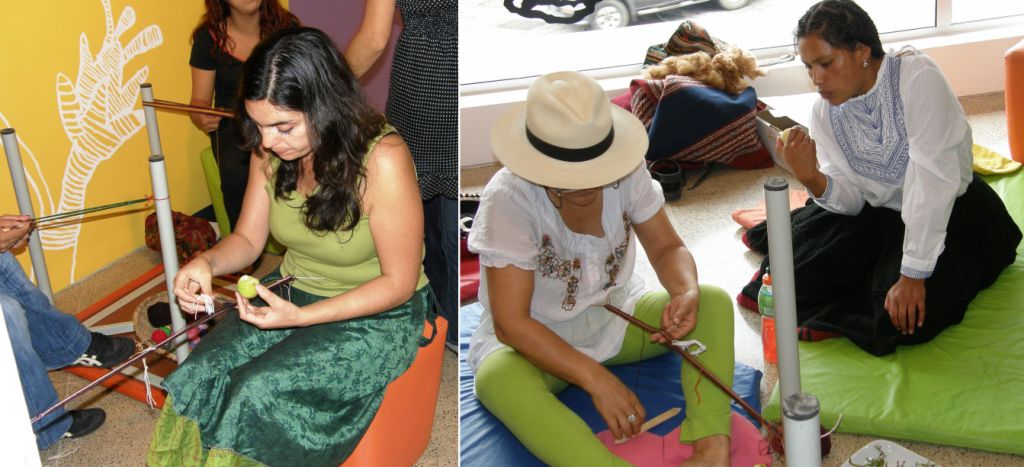
Day one had most of us barefoot and on the floor learning the fundamentals of backstrap weaving.
Okay, so I have already been backstrap weaving for fifteen years (which probably isn’t much in backstrap weaving terms) but there is always something to learn, right?
You can learn about the weaving traditions from a country, a region, a town, a community as well as from each and every individual weaver and this very small scale event was the perfect venue for sitting right by and having very close connection with the weavers themselves. And this interaction was not only possible as they showed and taught us their craft but also as they learned right alongside us the crafts of the other attending artisans.
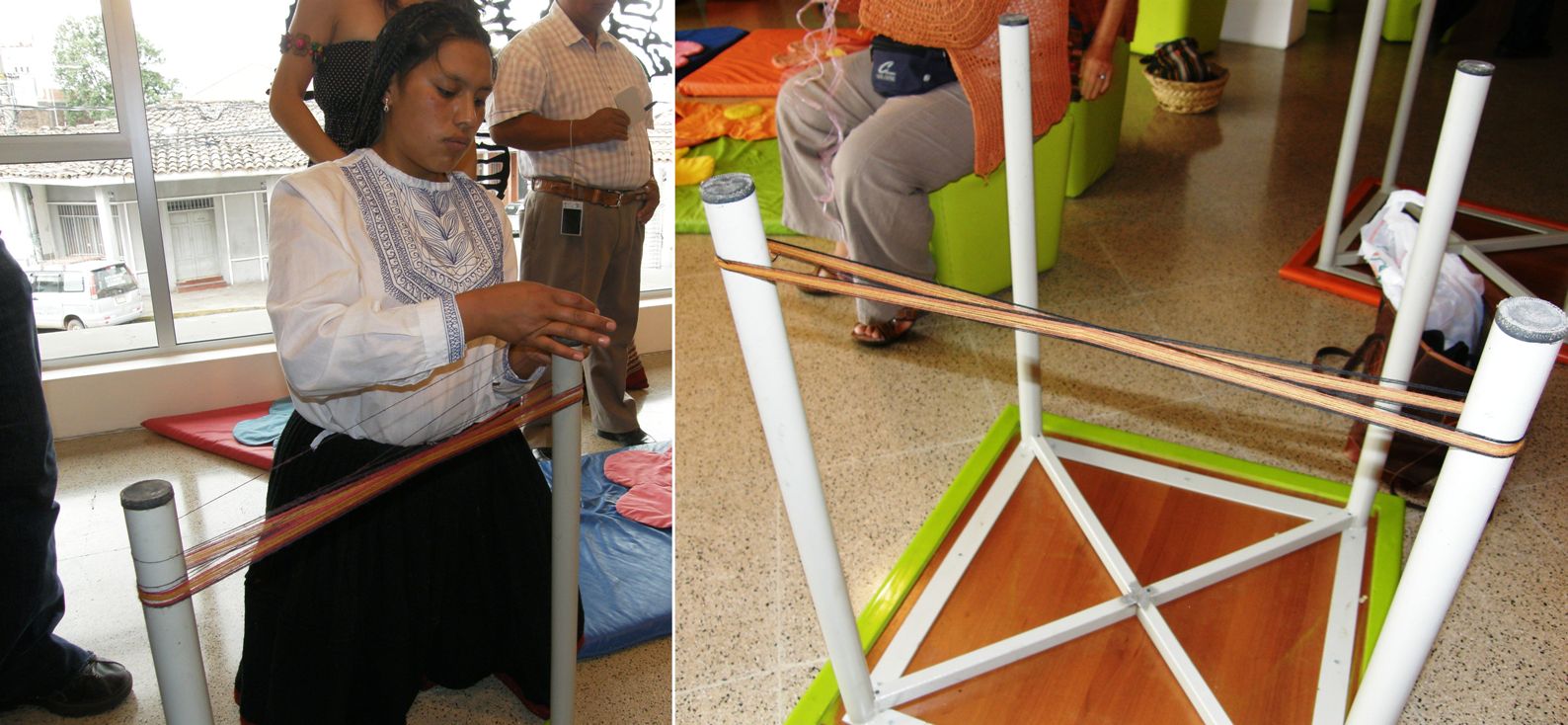
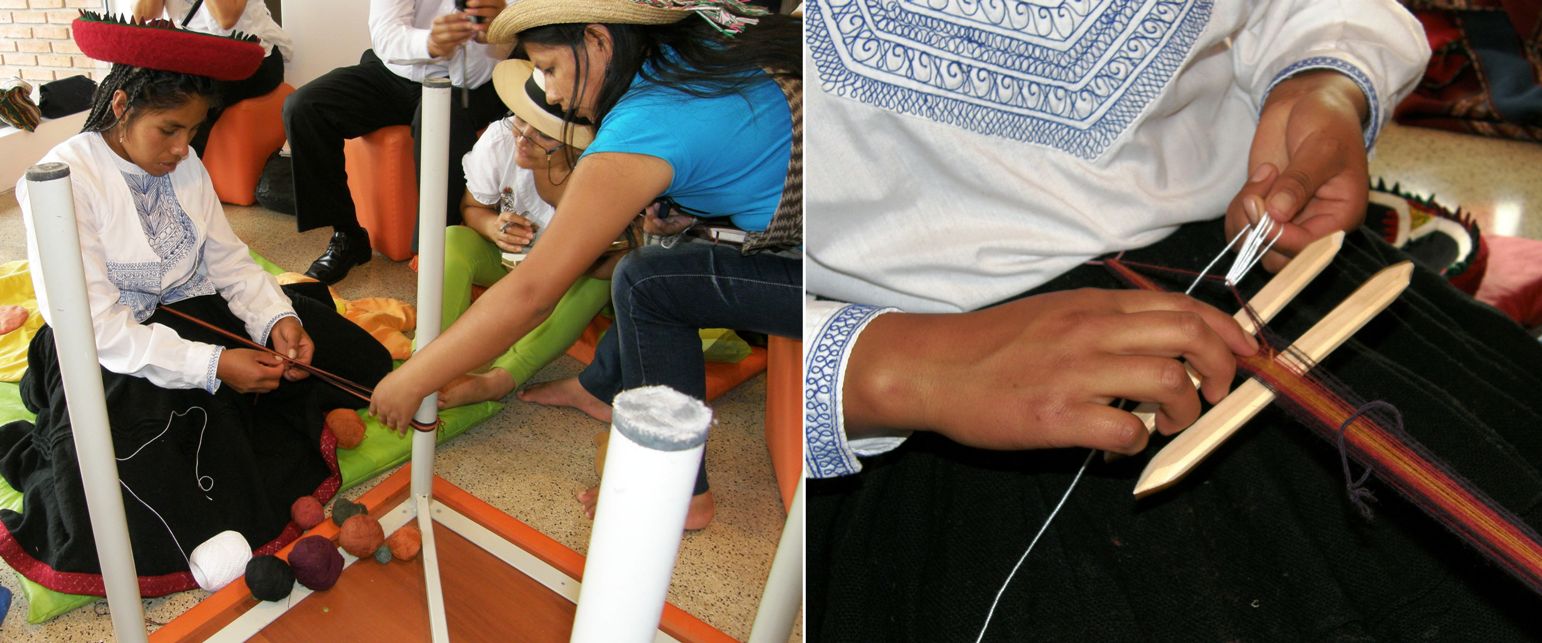
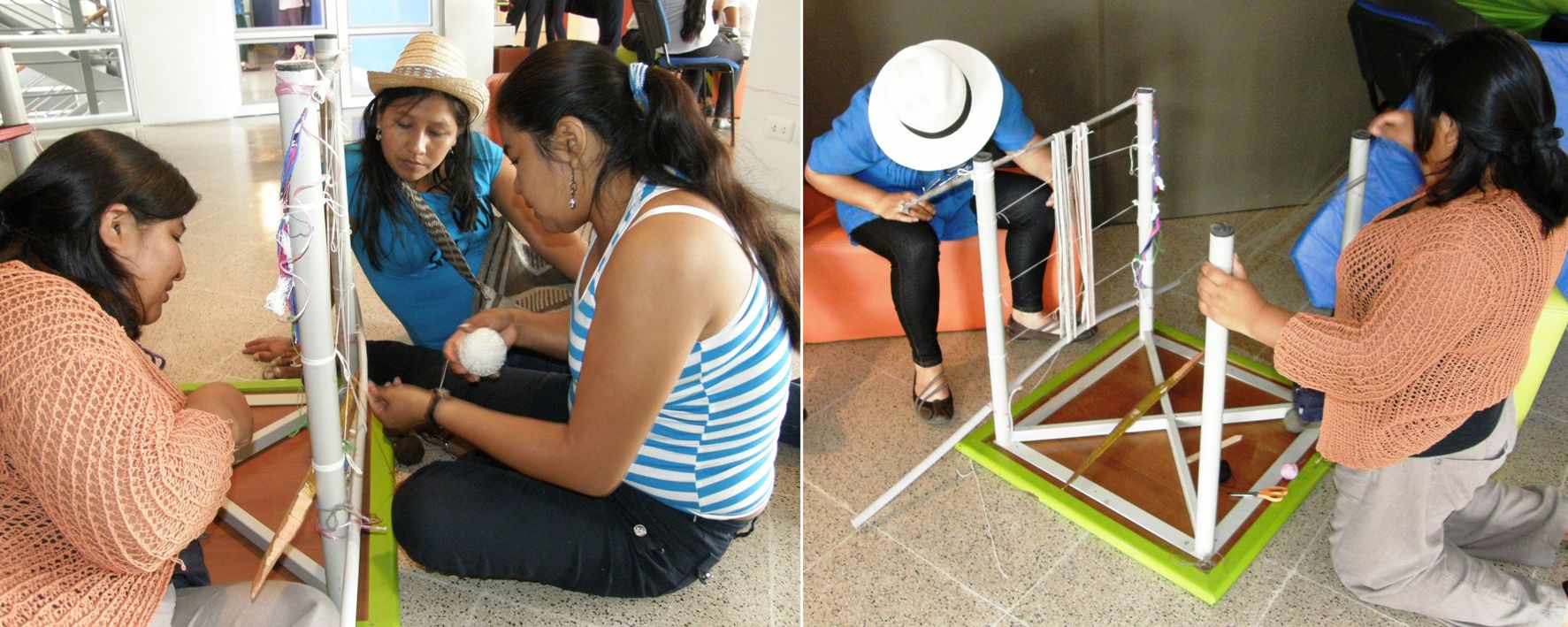
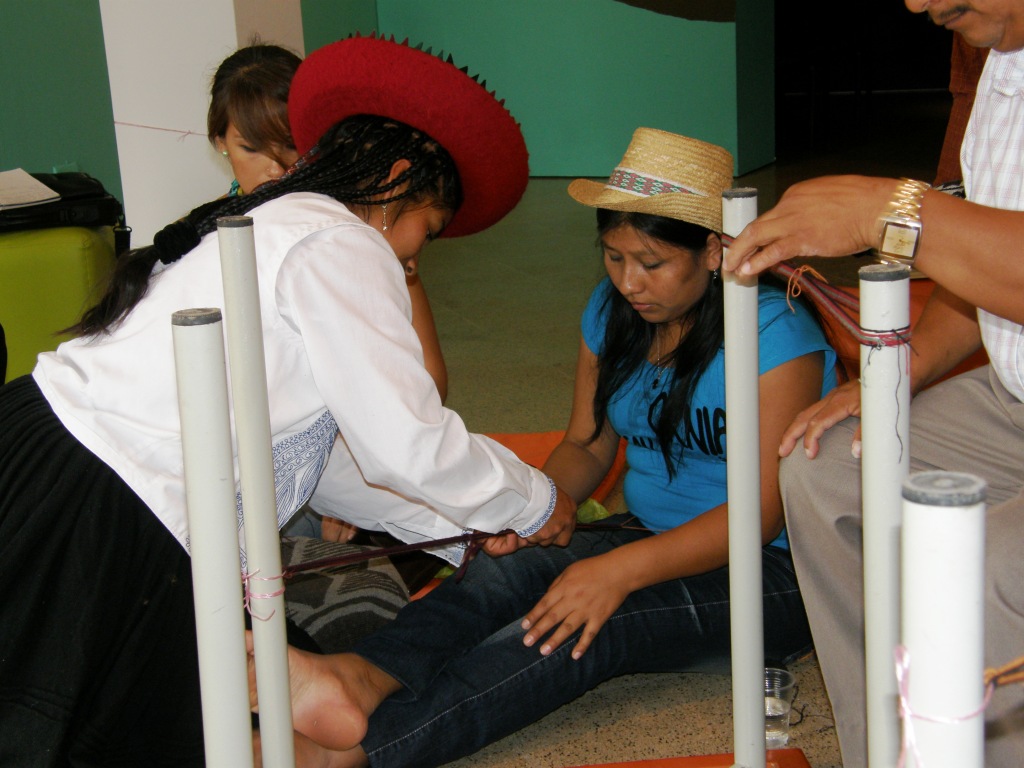
A lesson in warping…if your “stakes” are close together as these table legs are, you can simply hold your warp end against the stake (don’t tie a loop around the stake) and wind your figure-of-eight. When you are done with that narrow stripe of color, tie the end to your start end and then start your next color the same way. The advantages I can see of this…if one color has wonky tension, you can untie the knot and adjust without affecting the rest of the warp. If you warp a color that you decide later you can’t live with, you can chop it out easily without affecting the rest of the warp as it has been wound independently. Mind you, we were only warping narrow bands here of about 40 ends in five stripes of three colors and the warps were short which meant it was easy to anchor the warp end with one hand while winding with the other.
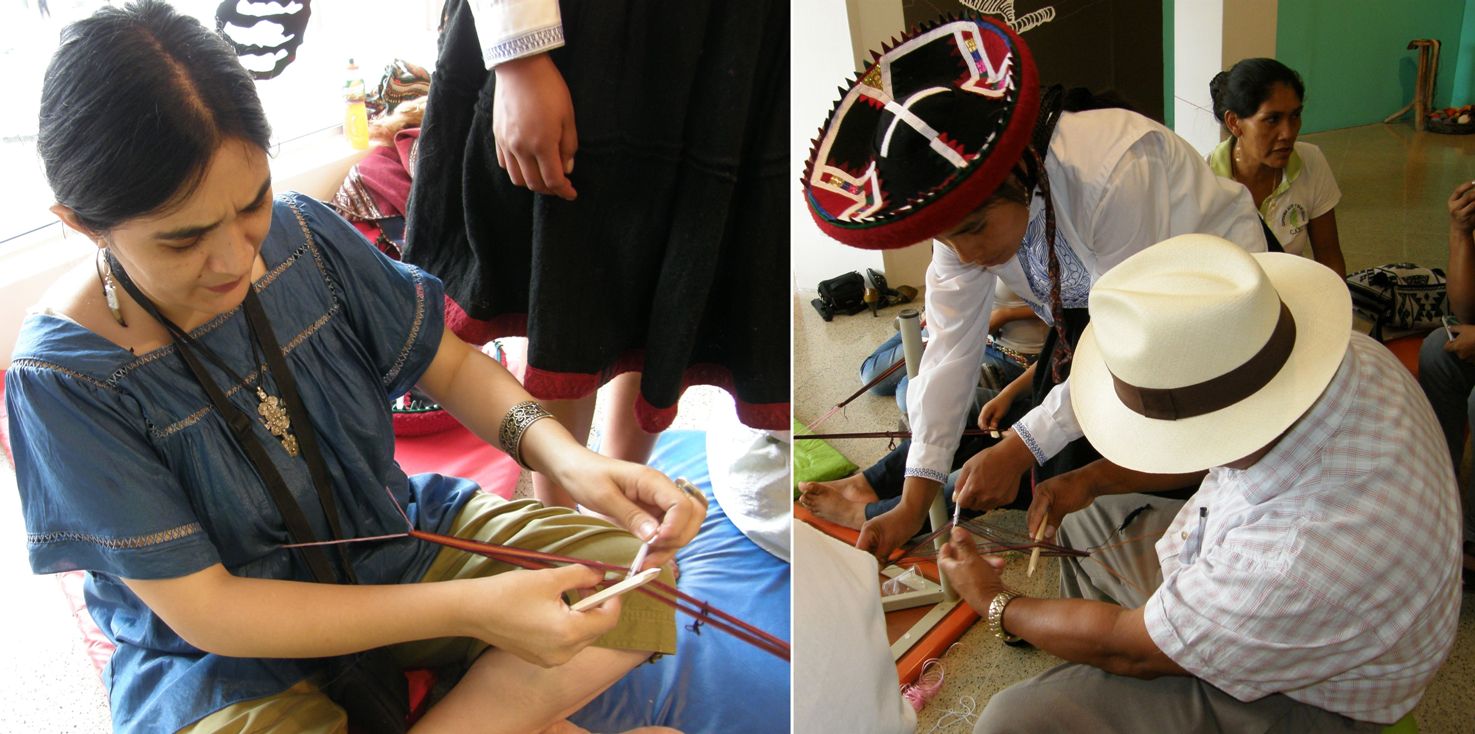
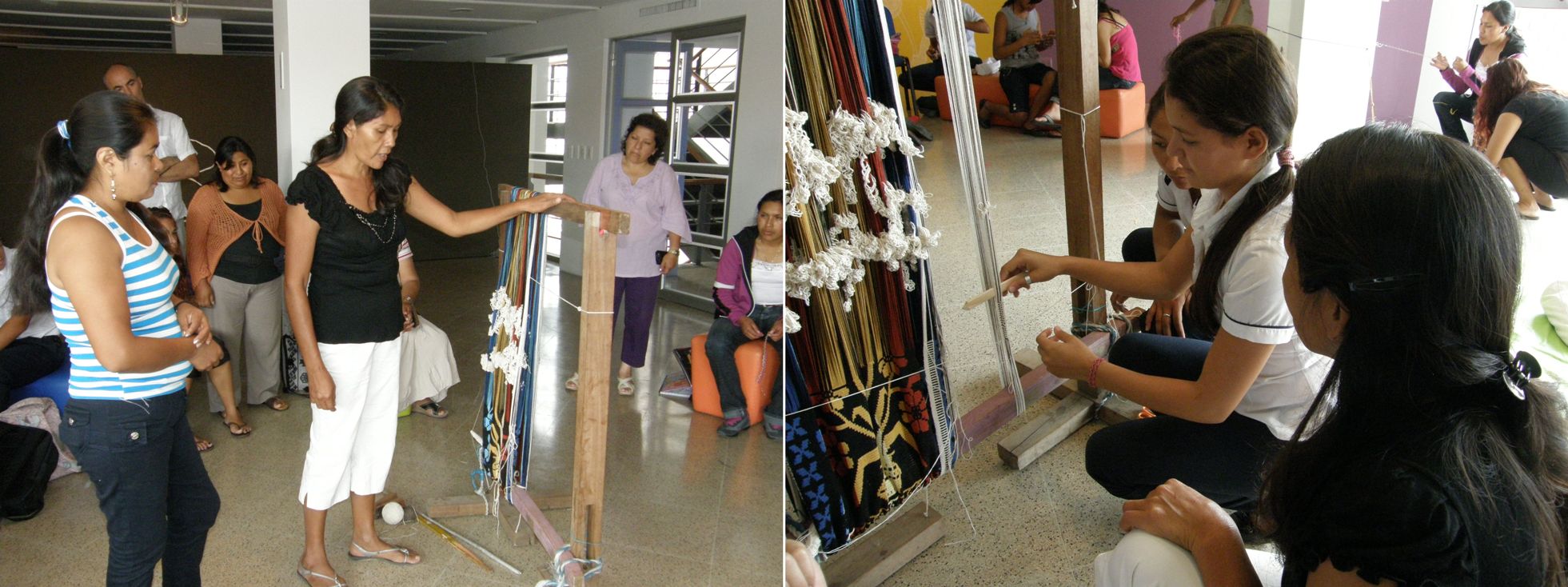
Next came strapping in, shed loop and heddle making, a demonstration of shed openings and weft management and then we all set about warping and weaving our own bands. Most problems arose, as can be expected, with opening the sheds smoothly and keeping the edges even.
As usual there is a certain period of silent concentration in the beginning interspersed with pleas for help. You can always identify the Ecuadoran contingent by their Panama hats! That’s Domingo, the Panama hat master, on the floor getting his first backstrap weaving lesson. This silent period is soon followed by excited chatter and cries of victory as everyone starts to get the hang of it and relax.
Snacks provided by the center….some participants are now so relaxed they figure they can even eat a peach and backstrap weave at the same time! That’s Mercedes from Mexico. Sonia has her students working away happily and can sit down too but is always keeping an eye on things as you can see. There she is watching over Libertad from…well, I don’t need to tell you where she’s from, do I!
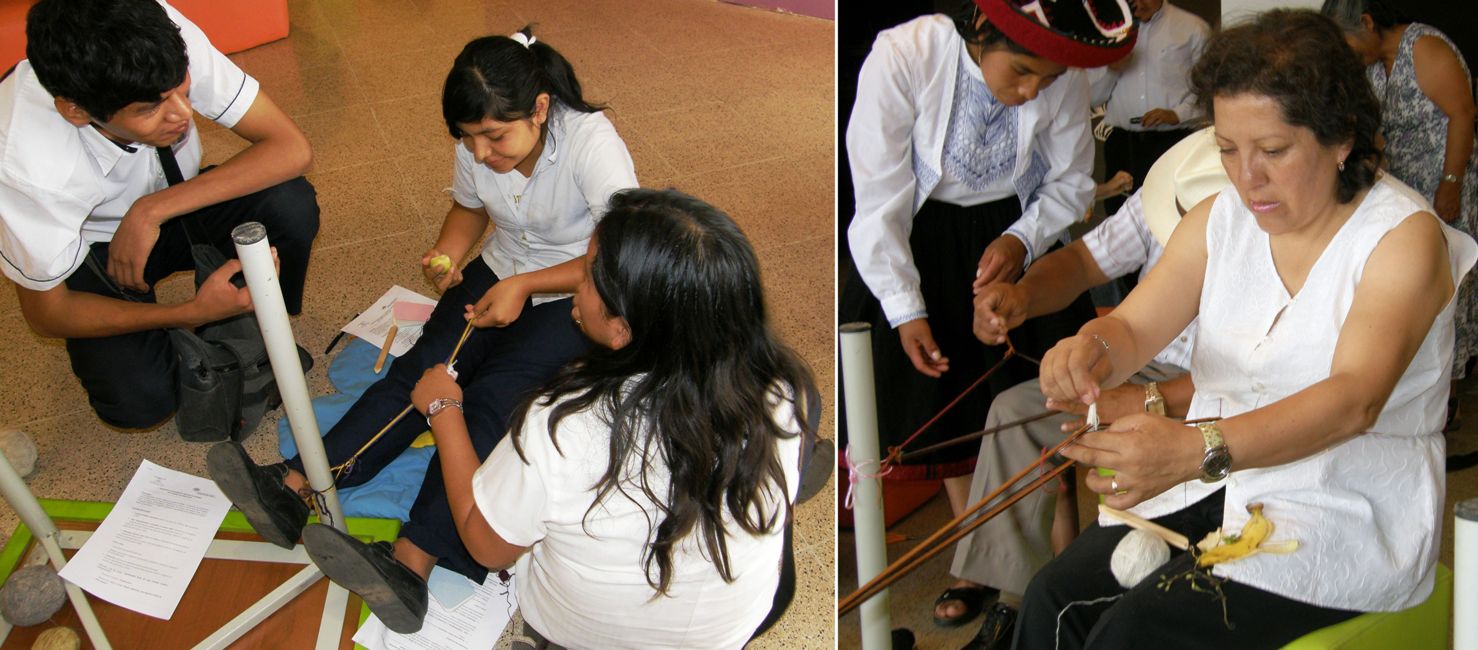
Some school kids dropped by and had some fun and there you can see Zenaida with members of her group getting acquainted with that tricky heddle shed. That’s Liliana from La Paz representing an organization called Nicobis which produces educational and cultural videos to promote intercultural dialog.
On the other side of the room, Aymara weavers Celinda and daughter Isobel were teaching backstrap weaving to another group.
Isobel, always smiling and sharp as a tack, tells me that she does not have much patience for teaching. It’s hard to believe!
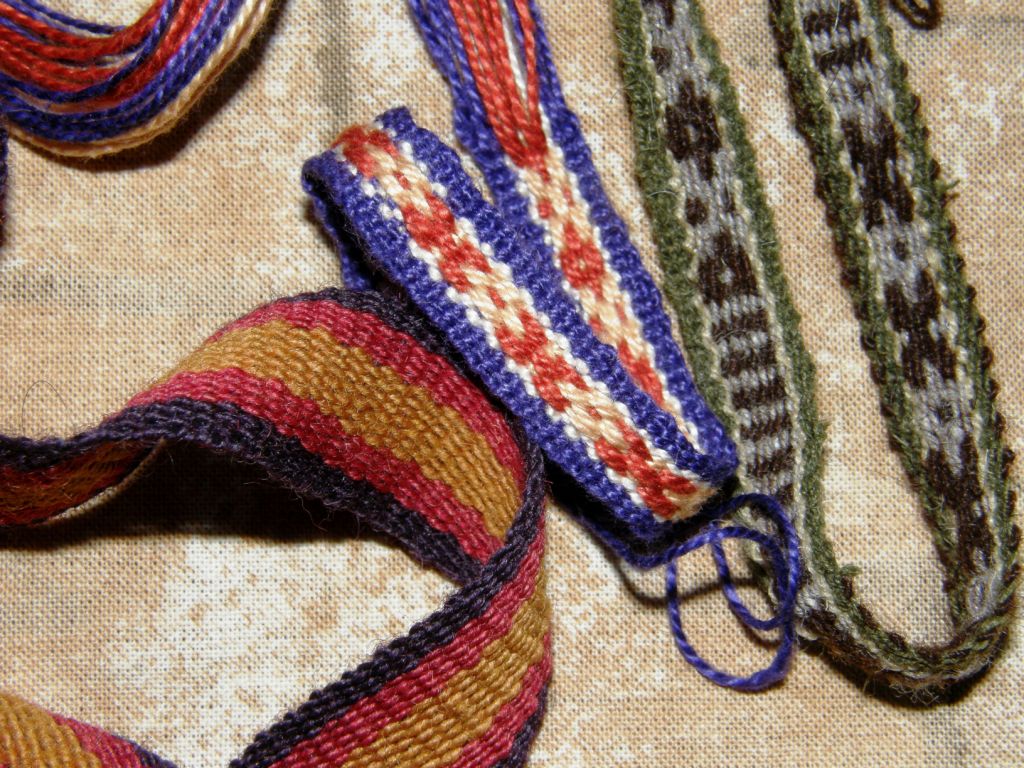
Materials!!
The twisty band above left is the one I made in Sonia’s class with the high twist wool warp and weft.
The one on the far right, I made with Celinda’s handspun alpaca fiber as both warp and weft. The green border is my own handspun llama fiber.
And of course, I wanted to have something made during the event from the material that the other group of weavers from Santa Cruz was using, Clea crochet cotton.
You can see the texture of the high twist wool on the surface of my little band at left which gives a slanted look which I quite like.
All the while, a table was set up with various woven products made by the participating artisans and the groups that they represented.
Here you can see cotton goods made by the Guarani weavers using the kara pepo, moisy and simple warp float techniques (I don’t know their name for this technique, in fact, this was the first time I had seen anything made by the Guarani weavers with it).
The next day was another of frenzied activity as we moved the focus to plant fiber…the paja toquilla and cabuya.
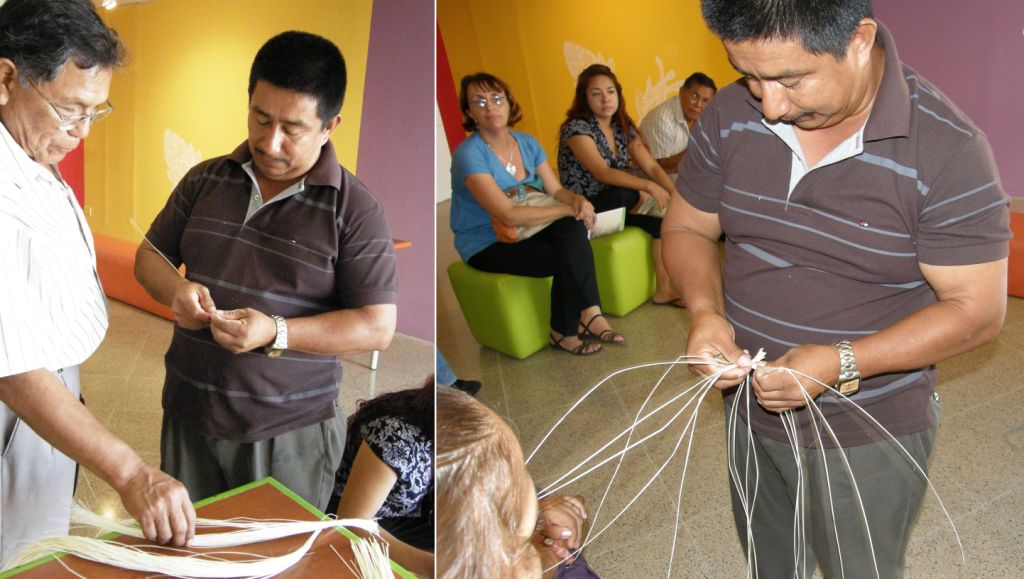
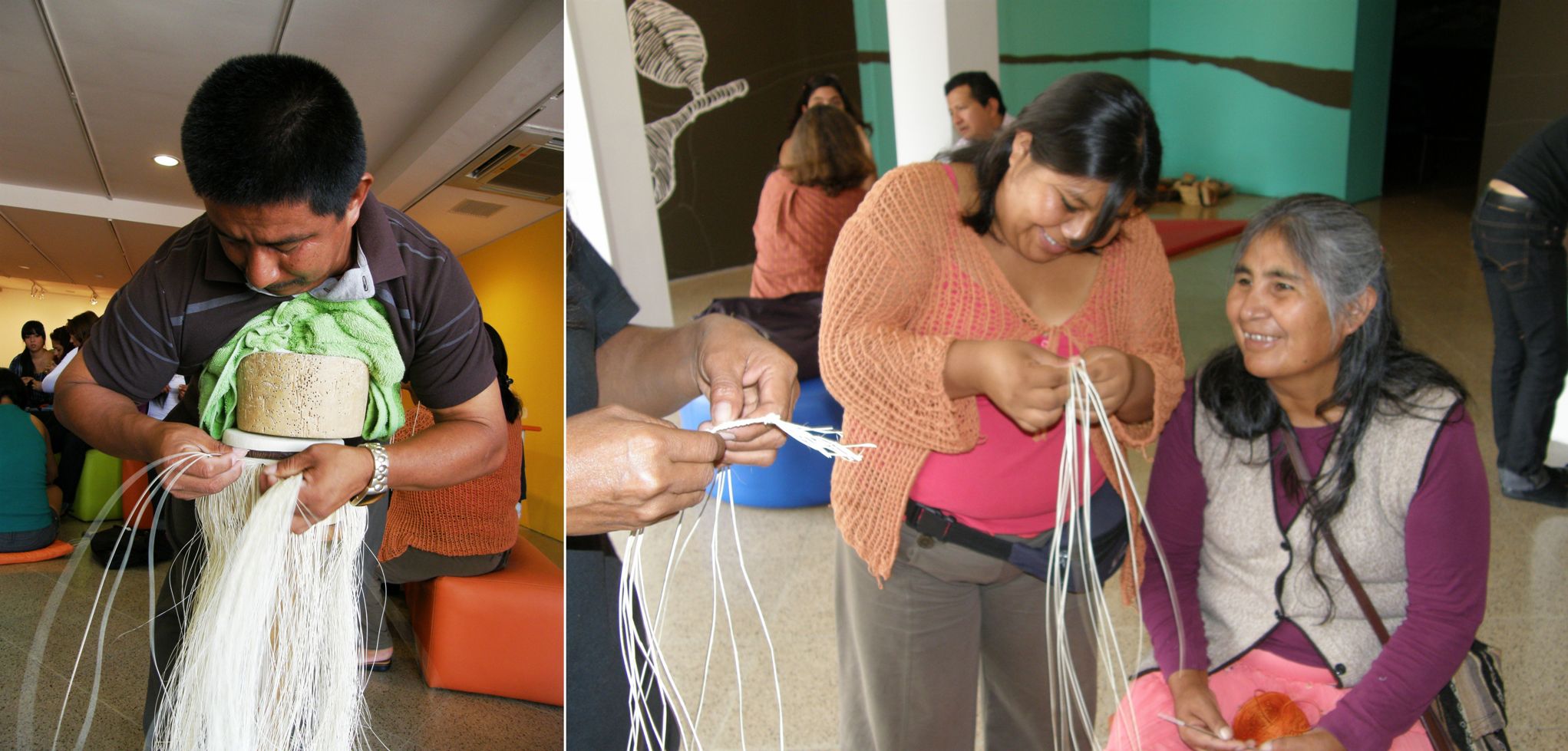
Domingo showed us how to produce the basic weave that is used in the spectacularly fine Panama hats which have their origin in Ecuador.
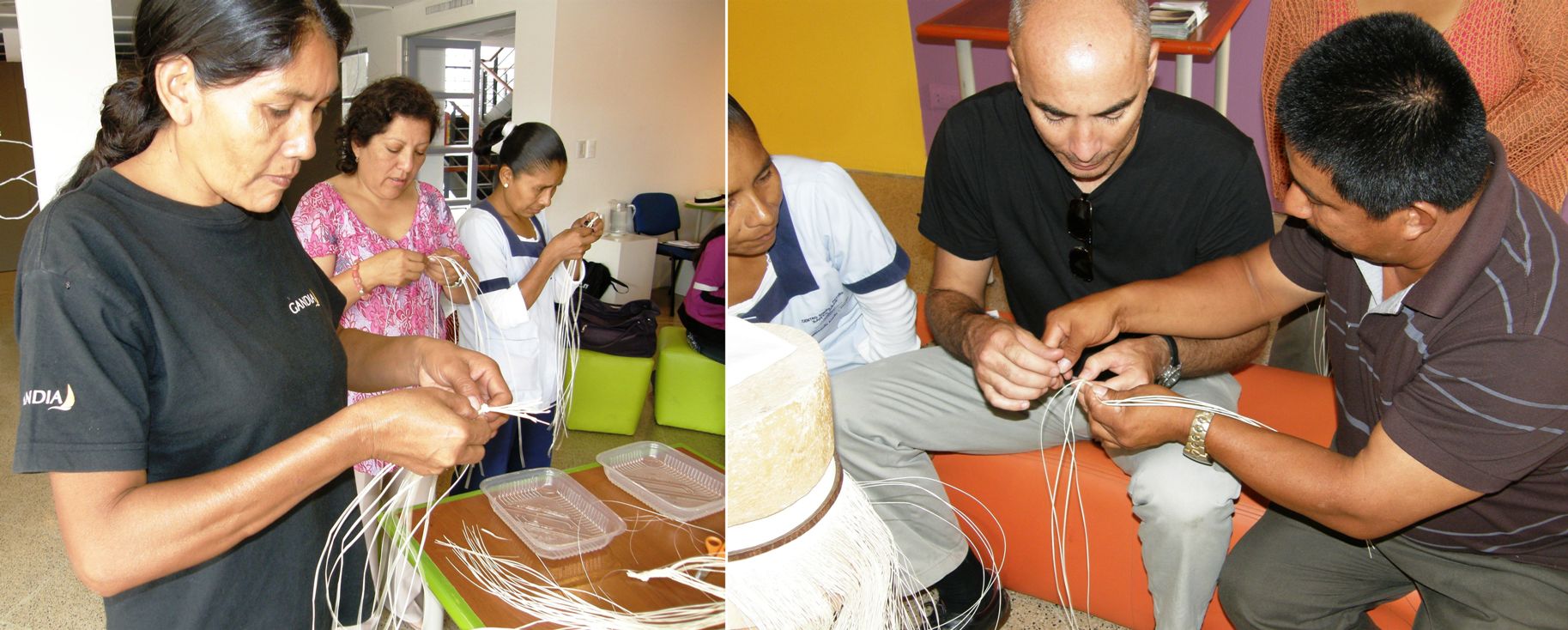
We soon learned that the basic weaving moves, while taking some time to grasp, were not all that difficult.
What was hard was maintaining good tension and Domingo patiently spent a lot of time trying to have each student position their hands as he does in order to produce a good tight weave.
Bundles of twelve pieces of straw were prepared for the students. “Es facilito” (it’s really easy) Domingo kept saying referring to the weaving moves but admitted that weaving with correct tension was something that could take one years to perform at an acceptable level let alone the master level at which he does it.
My Guarani weaving teacher, Angela was very keen on learning this. We have the paja toquilla here in Santa Cruz too where it is called “jipijapa” and so it made more sense to her to learn this craft rather than the cabuya work.
And here is the master at work…
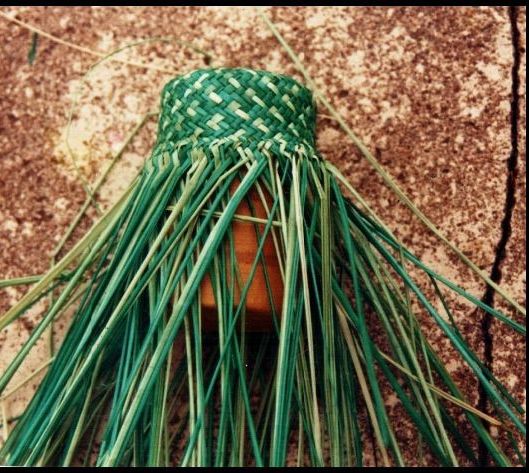
Above, you can see that Domingo, after weaving the flat top of the hat, is now weaving it down and around a mold to give it shape.
The picture at left of a miniature hat being worked over a mold will give you a clearer view of this. I spent an afternoon with a paja toquilla weaver in Gualaceo Ecuador and she showed the me whole process of making a hat in miniature.
Domingo stands bent over a post on which the mold and hat are propped, leaning on a wooden block and working with incredibly fine strands of straw. Maybe you thought sitting on the floor strapped into a backstrap loom looked a wee bit uncomfortable….
Above right, you can see Isobel, whom I told you is super sharp, working her fiber and showing her mum while exclaiming how “facilito” it is!
A few women in the Intag Valley in Ecuador still hand spin cabuya fiber.
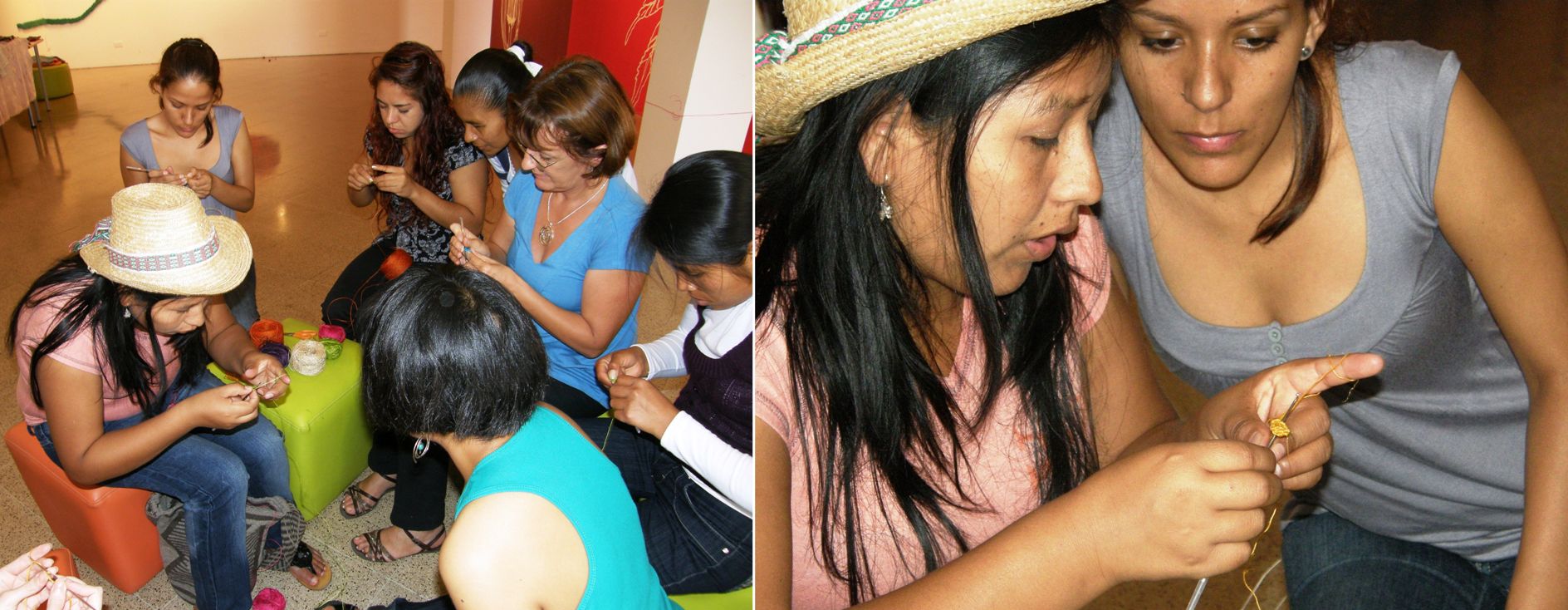
Meanwhile, the ladies from Chinchero, Sonia and Zenaida, not in their traditional clothes this day, opted for cabuya fiber classes. With Maritza from Colombia they learned to crochet bags. This cabuya fiber is machine spun and chemically dyed in bright and lively colors and Sonia really took to this and got to finish her bag, made in black, neon pink with all kinds of glittery additions which Maritza had brought, in one day. It pretty well matched the colors in her outfit.
This cabuya fiber is much finer than the fiber that I worked with when I stayed with members of a cooperative in Ecuador. There the fiber was dyed with natural substances, was coarser and all together more rustic looking.
The women in the cooperative, crocheted, knotted and wove the fiber into mats, bags and other accessories.
On the left is a crocheted mat I bought from the co-op, a woven bag that I was taught to make during my stay in Ecuador, and a piece I wove at home on my backstrap loom. All these colors are from natural substances.
The cabuya fiber brought by Maritza is fine, smooth and consistent, lovely to work with and the colors sing!
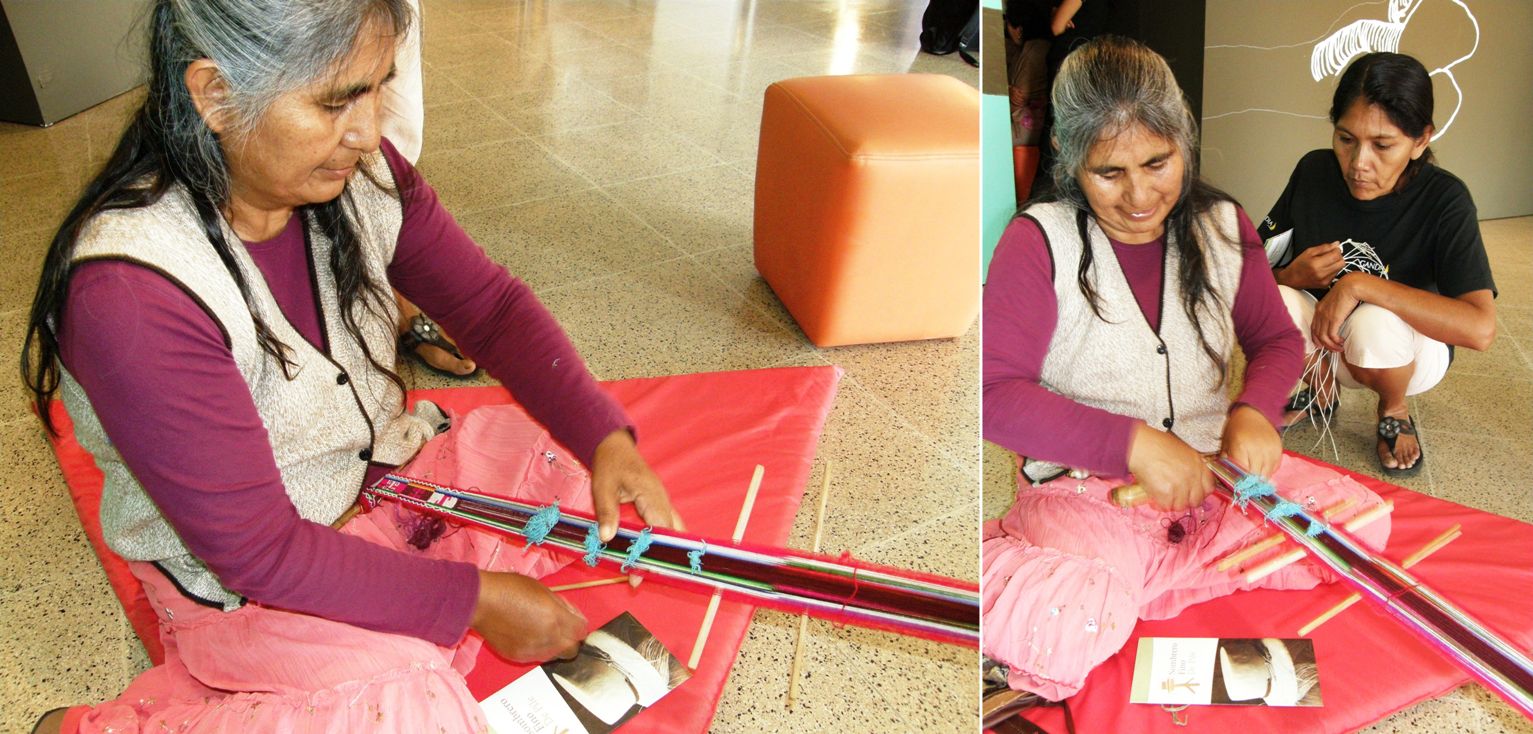
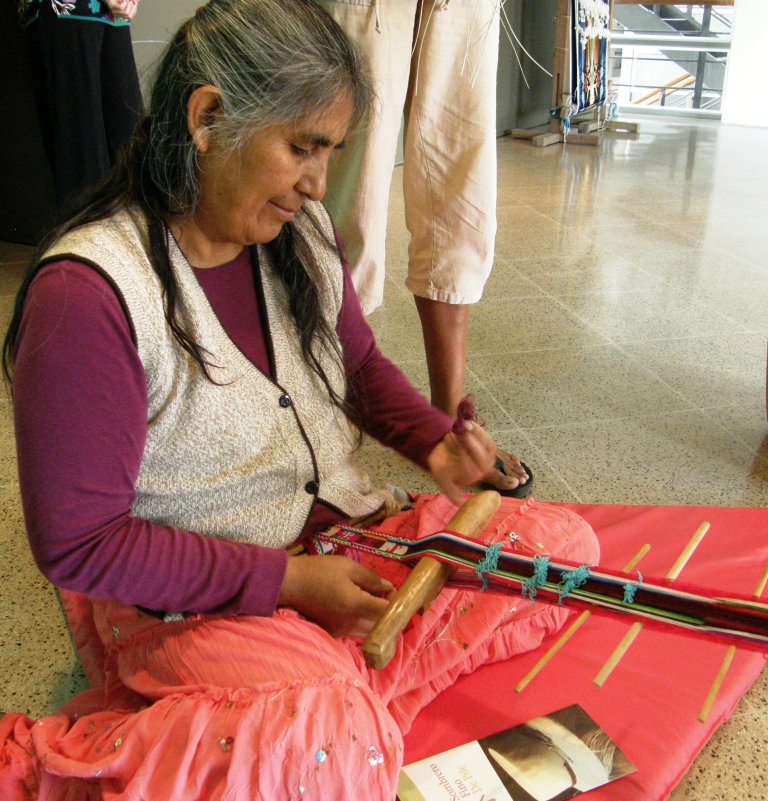
So, day two’s workshops were intense. In the midst of the madness, Ayamara weaver Celinda quietly took up her loom and started to weave and of course, I was immediately drawn to her as was Angela.
We got some nice relatively quiet time with Celinda and I got some good video of her on which you can hear all the noisy fun of the cabuya and paja toquilla weavers in the background!
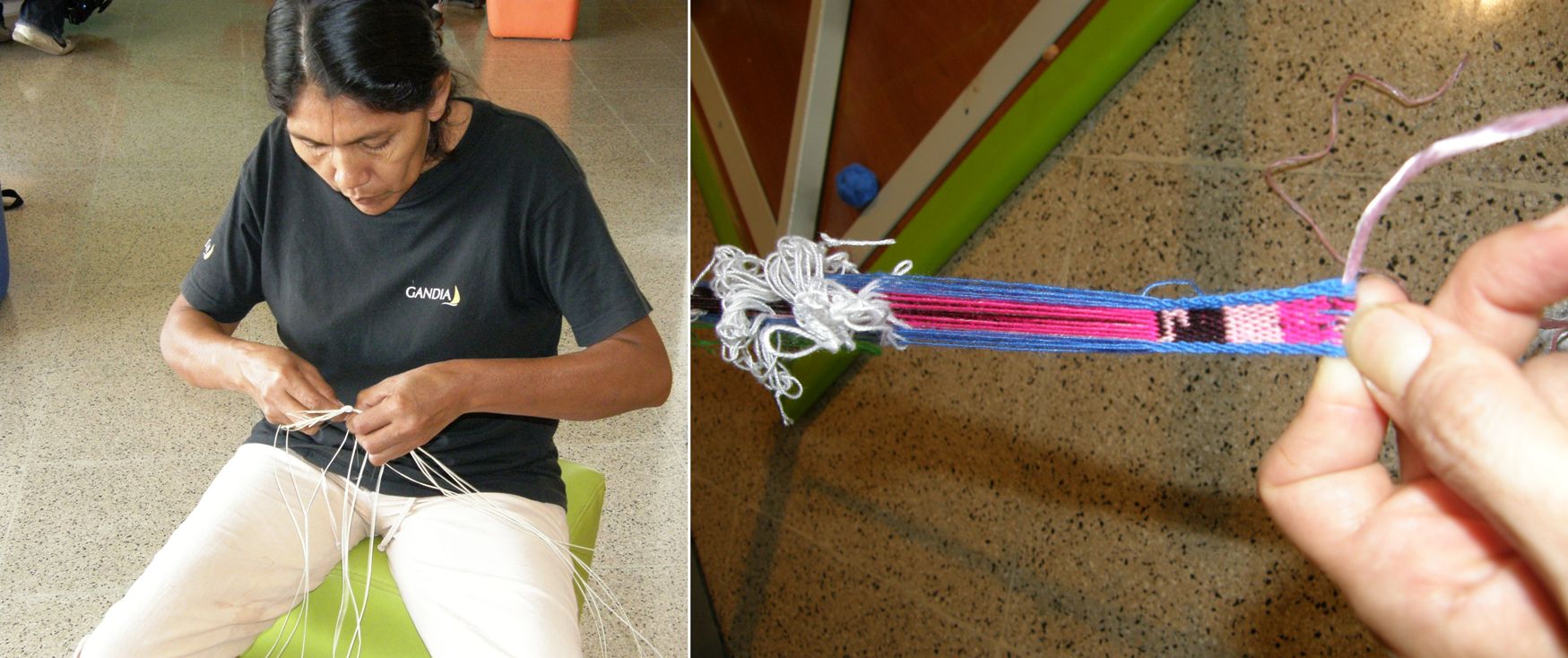
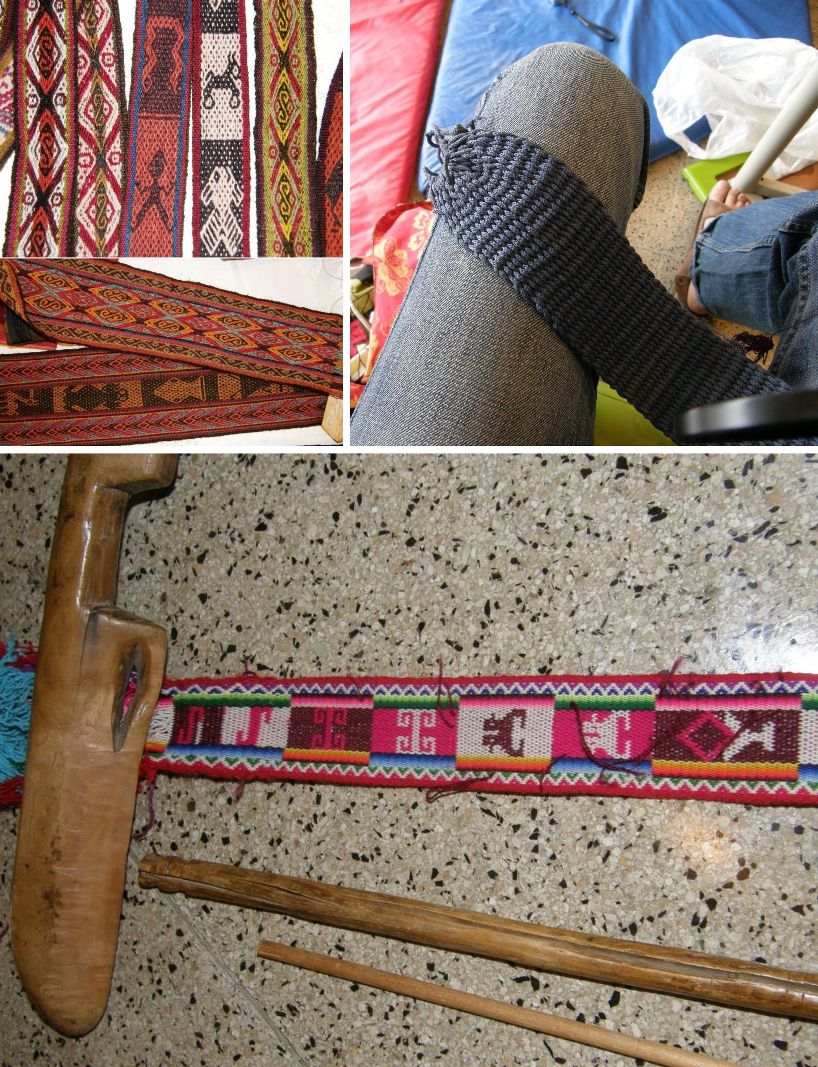
Two of Angela’s new skills…weaving straw and weaving a triple color band. The afternoons of this conference were reserved for interaction between the artisans and, that afternoon, Angela spent more time with Celinda and learned her triple color technique. The Guarani weavers have a very special way of making their string heddles joined by a chain and you can see Angela’s signature heddles on this Aymara style band….two cultures joining hands in the one piece.
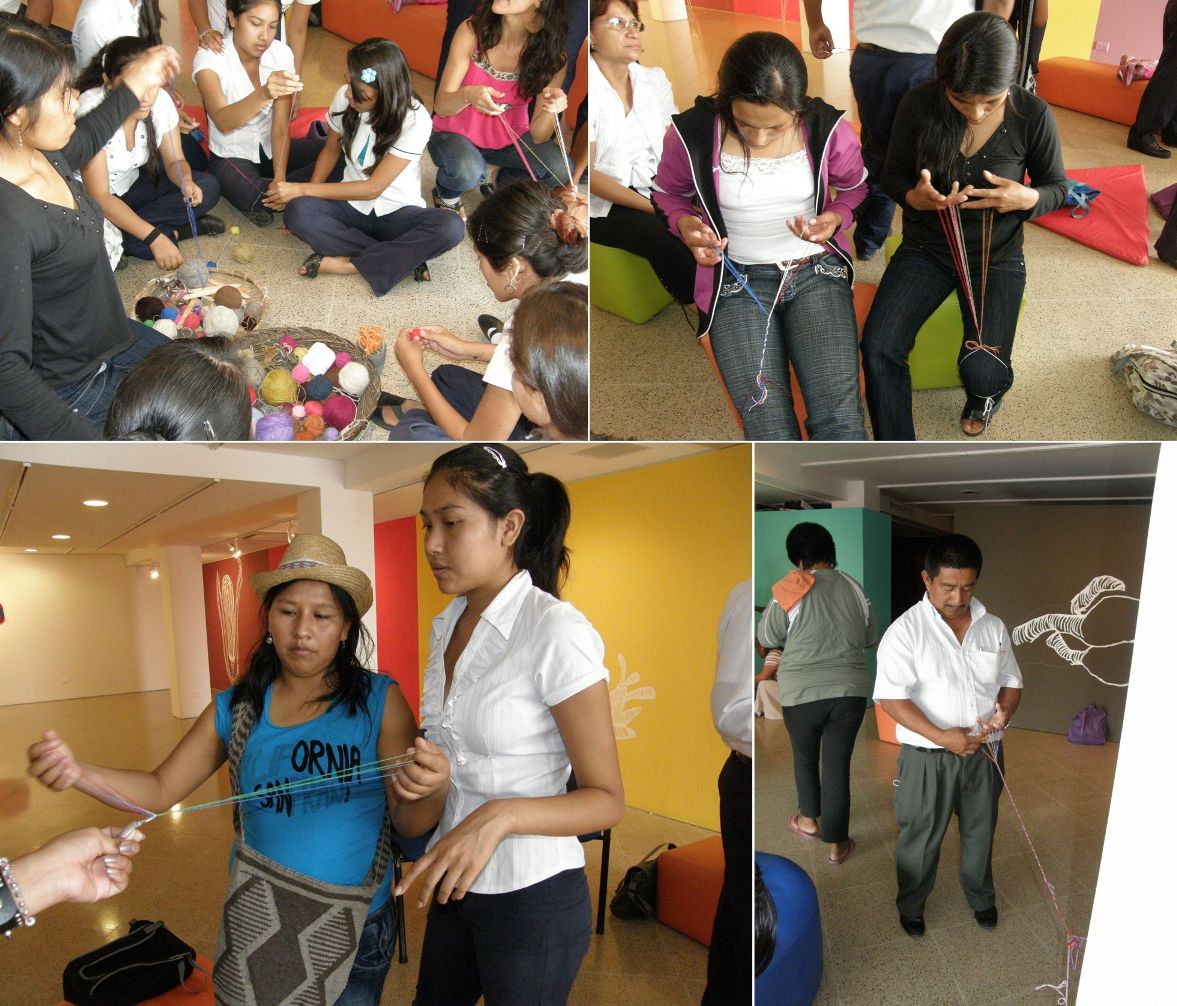
On day three, it was Angela’s turn to present and a class of teenagers was invited to see one of Santa Cruz’s own indigenous artisans at work. First, as a warm-up, Carla taught finger-loop braiding that she had learned in Chile. This was the first time that everyone participated in the same activity at once and, with all the enthusiastic kids there, it was explosive! This was a new braid for Sonia and Zenaida and I hope they will have fun teaching it to their friends in Chinchero.
Domingo particularly enjoyed the braiding and was braiding all evening during the conference presentations.
Then it was Angela’s turn to show how she warps a band using the dovetail warping method and the school kids were keen to try their hand at weaving.
Over in the corner and away from all the riotous enthusiasm, Guarani weaver Marioly showed Maritza from Colombia and Isobel from Chile the dove tail warping system using the table legs as an improvised vertical loom.
Maritza is from the Nasa ethnic group of Cauca in Colombia. It is terrible how little I know about Colombia. After Maritza’s evening presentation at least I can say that I know that in Colombia there are 102 indigenous groups and 64 languages amongst them. One of the most important woven items for the Nasa woman is the chumbe, a belt which is used amongst other things to strap a baby to its mother’s body so it can be carried about and/or comforted. Maritza herself is not a weaver of cloth but has dedicated herself to working with the cabuya fiber instead.
A new online friend, who is from Colombia, shared this link with me for a page of beautiful images of people of the Guambiano ethnic group of Colombia who are from the same area of Cauca as Maritza. I really need to adjust my mental image of Colombia!
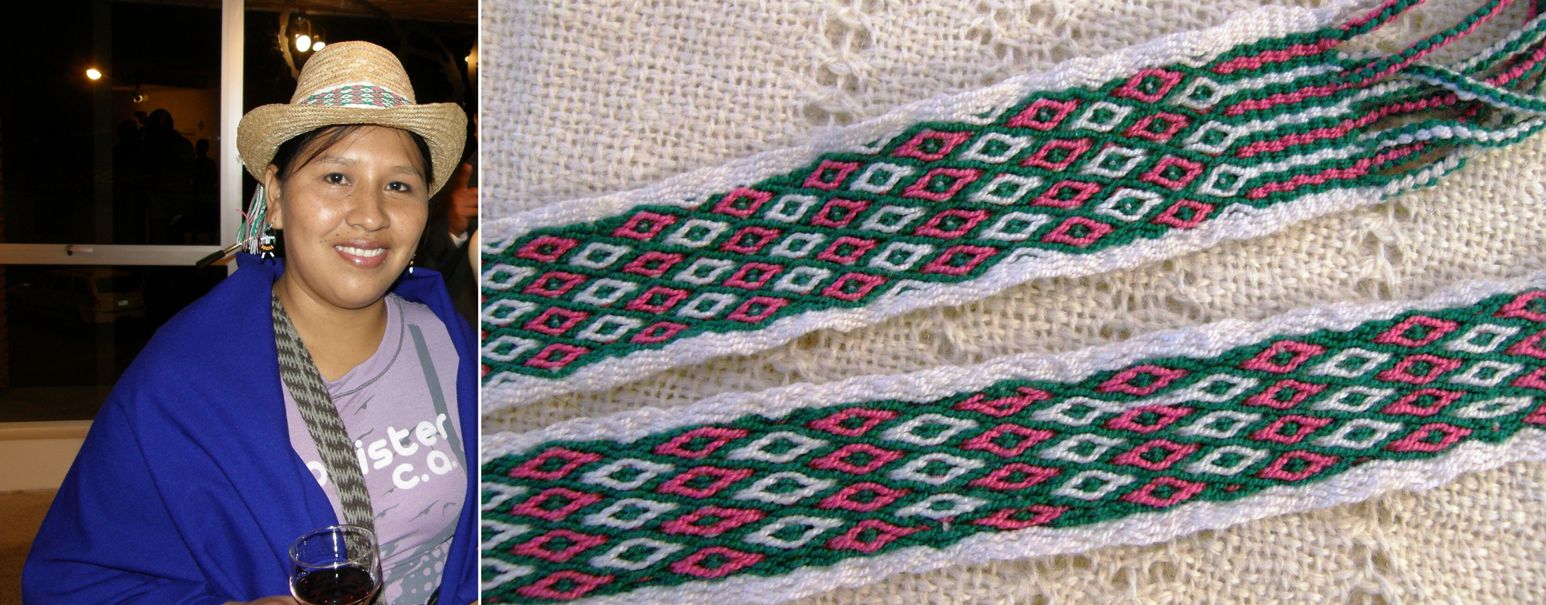
She told me that many narrow items, like the band which adorns her hat, are woven on a very simple loom which comprises little more than a forked branch.
Business and pleasure…it was all pleasure for me! Sonia and Zenaida took to the podium on the final evening to tell us about the work of the CTTC (Centro de Textiles Tradicionales de Cusco) and answer questions. Jean Paul of Ecuador and Mercedes of Mexico serenaded us with harmonized Cuban songs.
I really enjoyed meeting Maria Elena, above left, from Peru, who gave a lecture on her research into the bags made from garabatá fiber in Peru (a fiber that is also used by the Ayoreo people here in Santa Cruz). We discovered we have some mutual acquaintances in the weaving world.
A last look at some of the textiles…
Chinchero textiles at top left, an Aymara triple color belt below and Sonia’s simple and practical backstrap! Of all the textiles there, the backstrap is the one I would have liked to have bought! I would USE it.
So now I am wondering… Will a finger loop braid or two soon be adorning a Panama hat!?…just a fun thought…but, more importantly, will some school kids in Santa Cruz now be able to recognize a Guarani woven bag if they see one in the street and will they be able to tell people something about how they are made? And this I don’t need to wonder about…I know for a fact that Angela will have a three-color band underway on her loom and most likely finished the next time I see her!
The Weave-Along is over on Ravelry, the Spin-Along is going but, naturally, is slower to give results. In the meantime we are all still weaving along and finding it hard to drag ourselves away from the loom!
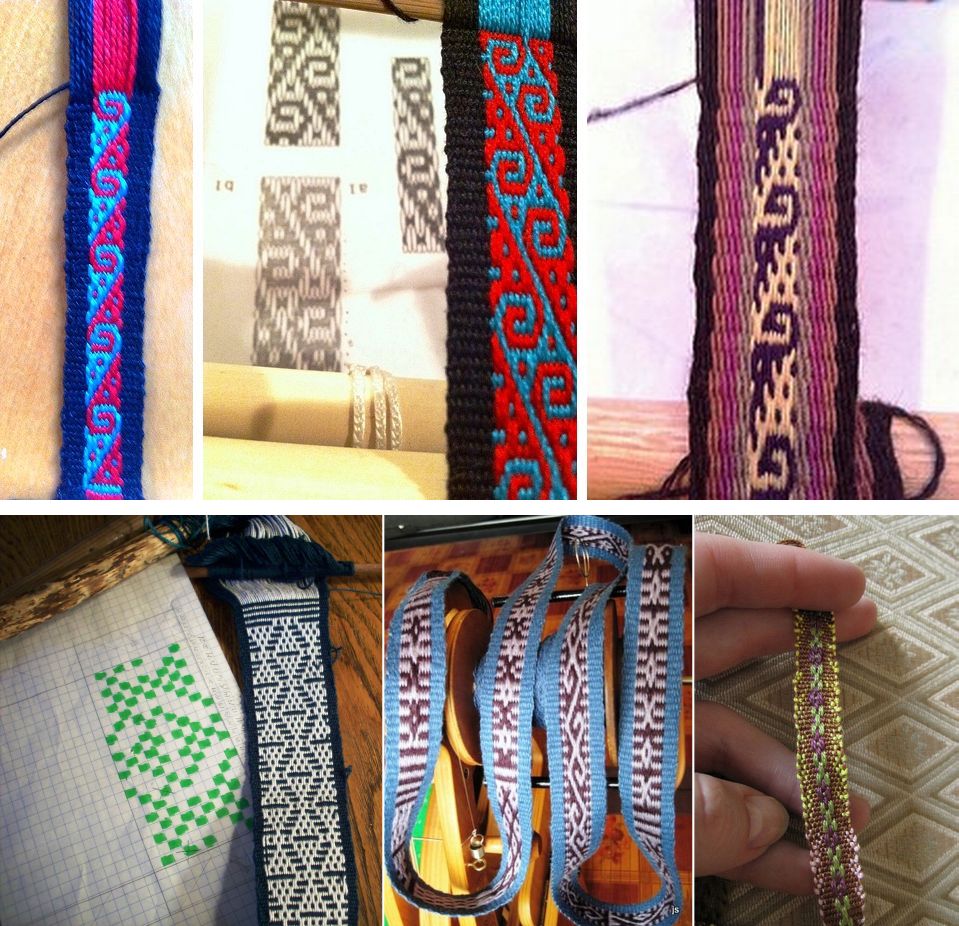
At the top, Jennifer has been producing swirls and curls of traditional, as well as her own, design. Linda wove a traditional design of coastal Ecuador into a bookmark using simple warp floats. The chart is here. Both popsicletote and Tracy have been exploring the tanka choro motif of Chinchero Peru. And I know that there is a lot of spinning going on there behind the scenes too.
My apologies to those to whom I promised some information on links and articles on the woven belts of the Russian Old Believers this week. I think this week’s post has gone on long enough and I would rather do the topic more justice in a separate post next week. See you then!
I have been kept from my loom at home this week. Normally this would have left me very agitated but it has been for a very good reason.
I spent my Friday goof-off day and all weekend working on a slide presentation and then woke up on Monday morning to my boyfriend reading to me from the newspaper over breakfast about an Encuentro de Tejedores (gathering of weavers) that was going to happen right here in my home Santa Cruz.
Oh darn I thought with a sinking heart, I bet it’s on when I am due to be away in the US. So, when does it start? I asked, dreading what would surely be a disappointing response.
TOMORROW!
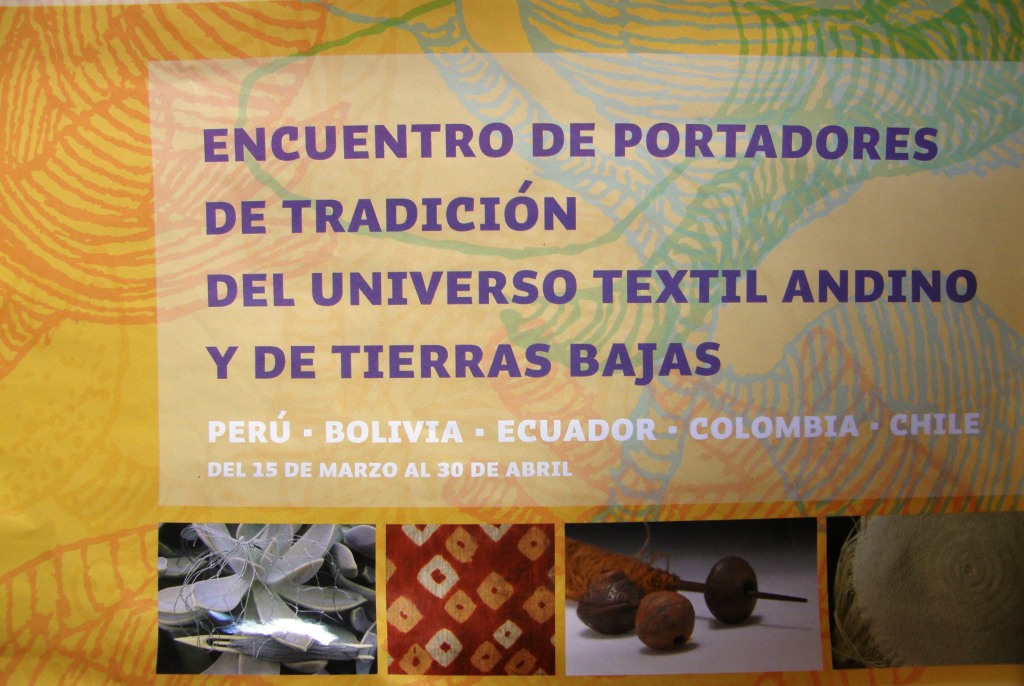
was the shocking reply. Maybe we just missed all the previous announcements. I really had no idea and so there was a mad rush to gather information and make sure that I could be a part of it. The conference is officially entitled…
ENCUENTRO DE PORTADORES DE TRADICION DEL UNIVERSO TEXTIL ANDINO Y DE TIERRAS BAJAS
(A meeting of the bearers of the traditions of the Andean and lowland textile universe)
which brought weavers, artisans, anthropologists and academics from Colombia, Ecuador, Peru, Argentina and other parts of Bolivia to my lowland home. Now this sounds like an enormous gathering but it wasn’t really. Only two to four people came from each place which has made it an extremely intimate experience with plenty of space and time to spend chatting with and getting to know people.
Only a handful of outsiders such as myself have attended which makes me feel even more privileged but at the same time alarmed and saddened although not totally surprised by the apparent lack of local interest in this event. Perhaps it wasn’t widely advertised in order to preserve this intimacy and make it more possible for the weavers themselves to interact more closely. Either way I feel extremely blessed to have been able to participate.
Weavings from highland Peru, lowland Bolivia and the Chilean high plains.
So, this means that this week’s blog post will be rather short as there are still two more evenings and one more day of conference to go. I will give you a few tidbits here to whet your appetite for a full report next week. I am still in the process of gathering information, facts, etc…and would hate to get anything wrong and I apologize if I have misspelled names.
I will tell you now that this whole event was organized by three wonderful Chilean ladies, the idea for which had its roots in an exhibit by Chilean artist Natasha Pons, which will run here for a month, called “Relatos Migratorios”. The Centro Cultural Simon I Patiño made it possible for people like me to experience all this for free. I still haven’t gotten over this fact!
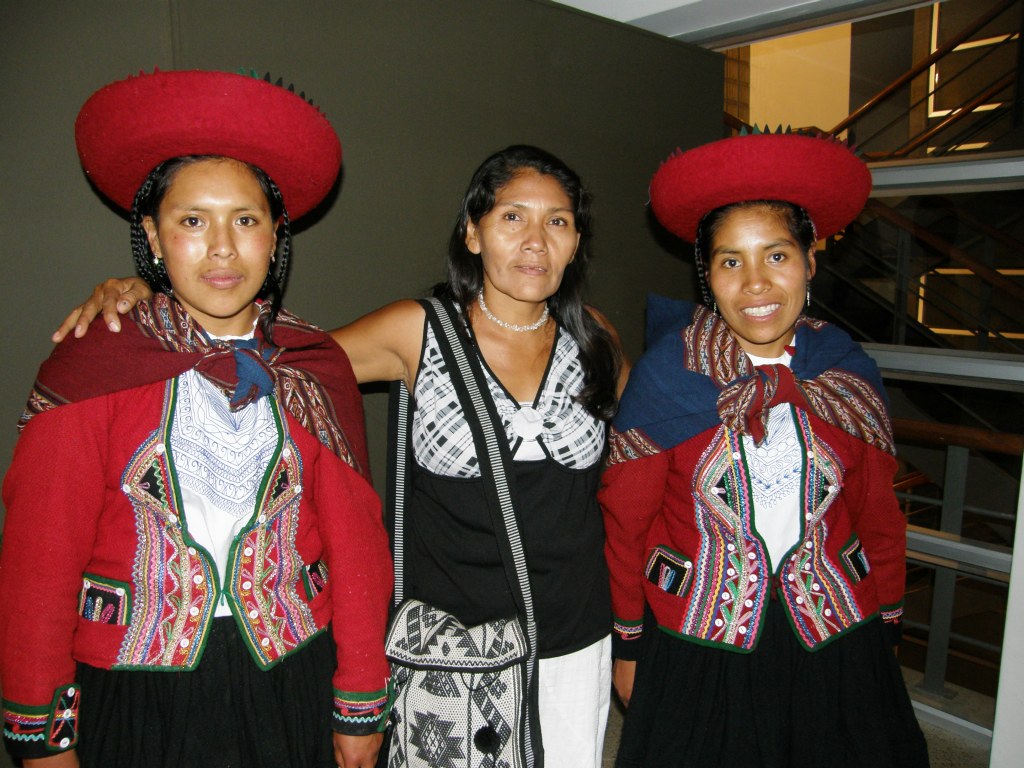
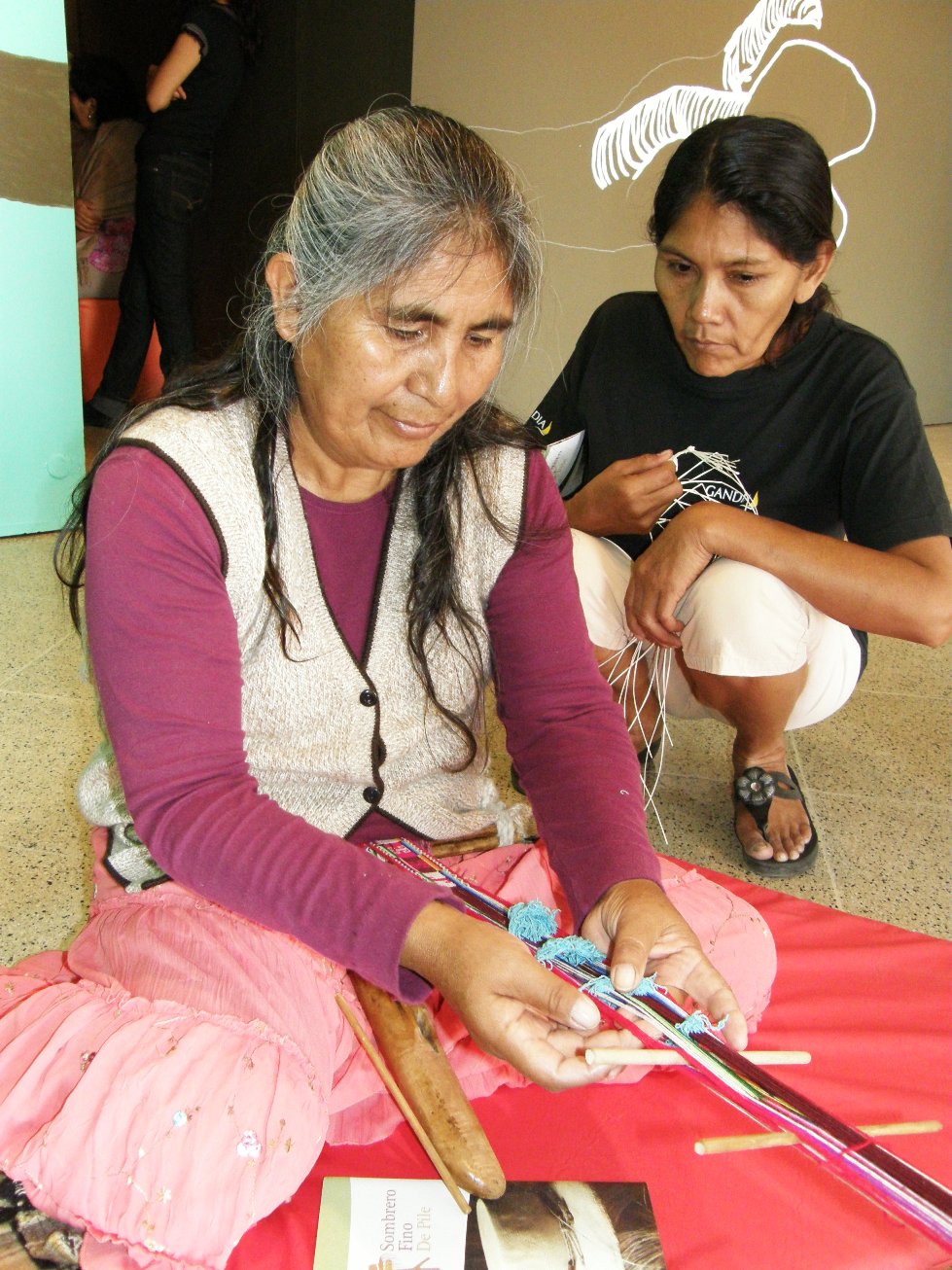
Angela Suarez, a Guarani weaver of the Bolivian lowlands met Chinchero weavers Sonia and Sanaida(sp) at the inauguration gathering.
The inauguration of the conference and exhibit took place on Tuesday. I went along and met up with my Guarani weaving teacher Angela. Walking up the stairs at the cultural center, my heart skipped a beat when I saw two ladies from Chinchero, Peru right behind me.
Last November after a little weaving class with Angela we had to part for some time as I was leaving for the Tinkuy de Tejedoresin Peru and she was going to her home of Isoso to organize the weavers to make an enormous order of woven Christmas cards. I had told her about the exciting event in Cusco all the time wishing that I could have gotten my act together and taken her with me although I doubt that she would have gone with the extra responsibilty she was carrying at that time to fulfill the Christmas weaving orders.
So, here now was a little part of Peru coming to her instead! along with Colombia, Chile and Ecuador. And, on top of the beautiful pebble weave bag that she is carrying in the picture above, she brought one her wonderful works-in-progress in the Moisy technique to show to the highland weavers.
The program comprises three mornings of four-hour workshops along with audio-visual presentations and conferences in the evenings. The first day’s workshop was backstrap weaving which was offered by the ladies from Chinchero along with Celinda and daughter Isobel, Aymara weavers from the northern Chilean highlands.
Organizer Cristina introduced the workshop and put it very well when she explained that there are many roads that can lead to a single destination and many ways of achieving the same objective. The warping, set up and weaving techniques used by the Aymara and Quechua weavers teaching us here side by side have their differences but our goal, she explained, would be to learn to weave narrow bands, called jakimas in the Quechua language of Chnichero, and what the Chilean weavers call cintillos.
Aymara weaver Celinda watches with fascination as Chinchero weaver Sanaida works on her pick up weaving.
Cabuya fiber artisan Maritza from Colombia receives help from Sanaida while one of the Ecuadoran gentlemen prepares his warp around a pair of table legs.
Well, you can imagine that this had me wanting to hop from one group to the next so as not to miss a thing! but I settled finally with Sonia and wove my first flat band with the gorgeous Chinchero handspun (I had used this fiber before to make tubular bands at the tinkuy).
My experience with my own handspun has been almost exclusively with llama fiber and so there were quite a few interesting things to note about this wool warp, the behaviour of the weft, the appearance of the woven surface from the high twist yarn and the different kinds of weft that Sonia and Sanaida were using.
Having the backstrap weaving moves down, I was able to focus very much on the material rather than on the technique. So, I did get to weave this week after all.
Cabuya fiber from Colombia and handspun wool from Chile and Peru along with other random bits of cord and twine that we used to tie up the warps.
The artisans from Ecuador, Colombia and Oruro in Bolivia joined in enthusiastically as well as a small group of outsiders such as myself and staff from the cultural center. Most outsiders were non weavers and were terrified to beat hard and pull at the warps fearing they would break. The handspun wool was of course wonderfully resistant which was a good thing as there was the usual amount of beginner heddle-sawing going on.
I didn’t have to worry too much about missing out on Celinda and Isobel’s (the Chilean weavers) instruction on day one as today Angela and I got to spend a lot of time with Celinda as she wove. I found her very tranquil and lovely to watch. Daughter Isobel, on the other hand, is a live wire! You will see and hear more about her next week.
The technique that Celinda was demonstrating is a variation of the Moisy that Angela weaves except with three patterning colors which requires a fourth set of string heddles to manage. This does not create a double faced textile but there are no long floats on the back of the band either.
Angela noted that Celinda’s heddle order arrangement was quite different to hers and asked many questions. I could see her soaking it all up.
Finally she wasn’t asking questions but rather pointing things out to confirm that she did indeed understand. I wouldn’t be surprised to see her adding this to her repetoire and you can be sure that if she believes that any of Celinda’s ways are better she will adopt them. She is already using a stick for her lower set of heddles on her narrow bands after asking me to teach her how to make them on a stick – something she said she had always wanted to learn.
Well, I really must stop here as there are more events to attend tonight and one more day of this conference to go. No doubt there will be much to tell and show next week.
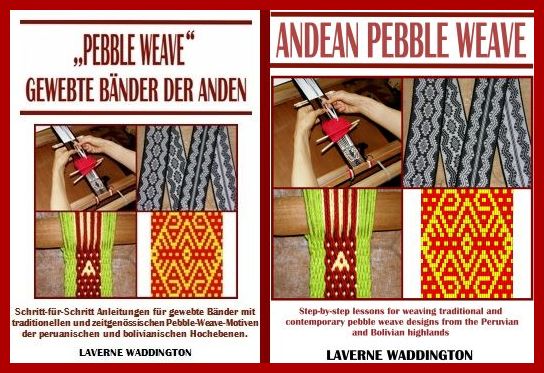
I can’t go without giving my thanks to my online weaving friend Kristina Krenzer who has worked hard to translate my e-book Andean Pebble Weave to German. It is now available on Patternfish. It looks so weird and, at the same time, so great in another language! Of course you can get the English version on Patternfish too.
Ich danke Kristina Krenzer für die Übersetzungsarbeit. Meine Monographie über die Stippenweb-Technik der Anden, auch bekannt als “Pebble Weave”, ist nun auch in deutscher Sprache bei Patternfish erhältlich .
The Tinkuy de Tejedores 2010 is over and I am back home in Bolivia wondering what hit me! There were four intense days of colors, sounds and new experiences… meeting up with old acquaintances, putting faces to online user names and making new friends while trying to absorb everything around me and learn as much as I could with a head spinning from a combination of altitude and information overload.
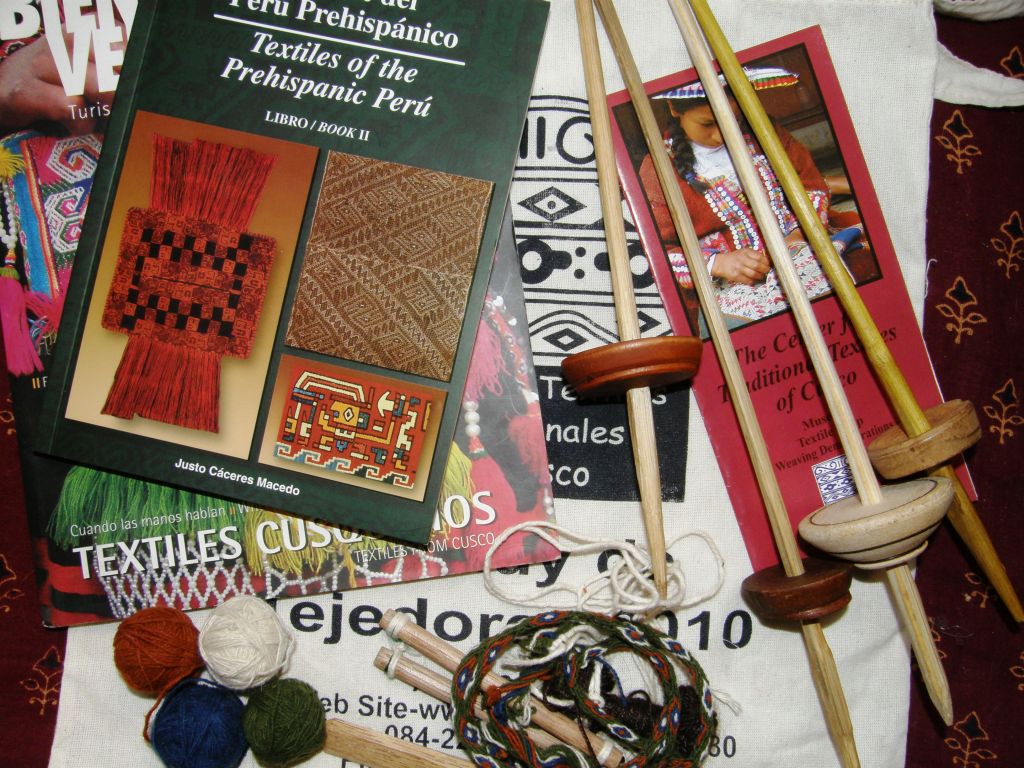
I didn’t bring back much in the way of physical souvenirs…the shoulder bag which was part of our registration package, a couple of spindles that I got in the Cusco market, two more which I swapped for one of my amulet bags with Maxima, a Bolivian weaver from Cochabamba, a locally published book on textiles which I bought at the airport while trying to use my leftover Peruvian Soles and some balls of handspun yarn left over from the workshop I took.
I didn’t buy any textiles but I did come back with a new weaving skill and lots of ideas about making textiles with discontinuous warps. I plan to warp for a very narrow plain warp faced piece with discontinuous warps in the next few days which I hope to decorate with supplementary wefts as this will be the easiest technique to start with. If that is a success, I will attempt a complementary warp technique. It was great having the opportunity to get a close look at some of the discontinuous warp pieces on the loom being woven by the ladies of Pitumarca. From what I can tell, the grey and brown warps dovetail around a metal rod when the loom is being warped. The pick-up pattern appears to cover the entire length of the grey panel with no terminal area – mind boggling, really! I wish I had spent more time with this weaver. This was the most amazing thing I saw at the tinkuy.
This piece has one of its four color panels complete. Done in all natural wool colors it is going to be spectacular. The unfinished areas are those that have been rolled up on the loom bar nearest the weaver.
It’s interesting that she has woven the grey panel, turned the loom around, and now seems to be working her way back. She has just started the bottom of panel three. Perhaps she will then turn the loom around once again to weave the other end of this panel and then go filling in the space in between. There are so many questions that I forgot to ask this weaver, like, at what point the metal bars around which the discontinuous warps dovetail, are removed and replaced with yarn. Well I shall just have to experiment and see for myself.
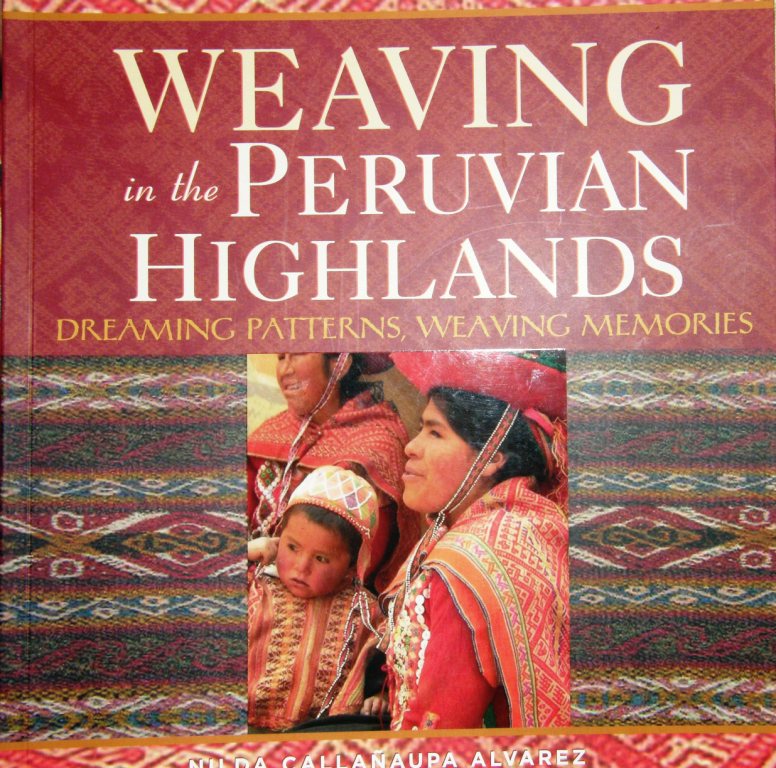
I am constructing a warping board for myself for my piece based on a picture in Nilda Callañaupa’s book pictured above.
So, as far as weaving skills go, I brought back ideas about the aforementioned discontinuous warp pieces and I learned the tubular woven bands of Chinchero and Patabamba in the workshop I took. If you have read my last two blog posts you will know that I recently learned how to make these tubular bands or ñawi awapa from instructions in Adele Cahlander’s book. I strongly suspect that Adele Cahlander figured these bands out by pulling them apart and studying the structure rather than by learning from the weavers themselves and she has been able to give instructions so that one can reproduce them.
EDIT: I have since been pointed to an article which says that Cahlander based her instructions on a partly woven specimen that had a complex arrangement of string heddles and shed loop so obviously the tubular woven bands were or are woven somewhere using this set up. As I said recently in a previous post…”There is no one “right” way”.
I find it amazing that she was able to analyze the specimen, compile excellent instructions for its reproduction and share all that with those who can’t travel to Peru and learn it themselves from the weavers.
However, the way we were taught in Chinchero by Nilda is SO MUCH easier!!
I took a partly woven band which I had warped up according to the Cahlander instructions with its string heddles to show the weavers and they were quite astonished by this strange set up. The green band above is the one I started in the workshop and finished at home. The red one was a gift for the workshop participants.
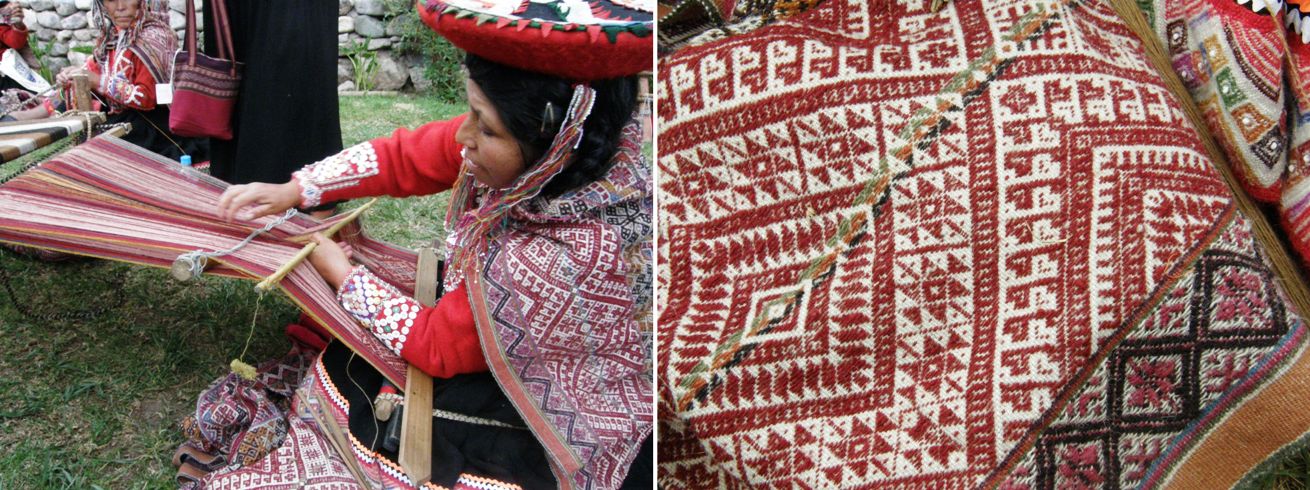
Another thing I took away from the tinkuy for my own weaving was lots of inspiration for color and design as well as a new respect for supplementary warp patterning (a technique of which I have never been a big fan) after having seen the amazing ponchos of the Chahuaytire and Accha Alta communities. A weaver from Accha Alta with her piece profusely patterned with supplementary warp patterns can be seen below. She is rolling the heddle stick towards her while pushing down on the warps behind in order to open the heddle shed.
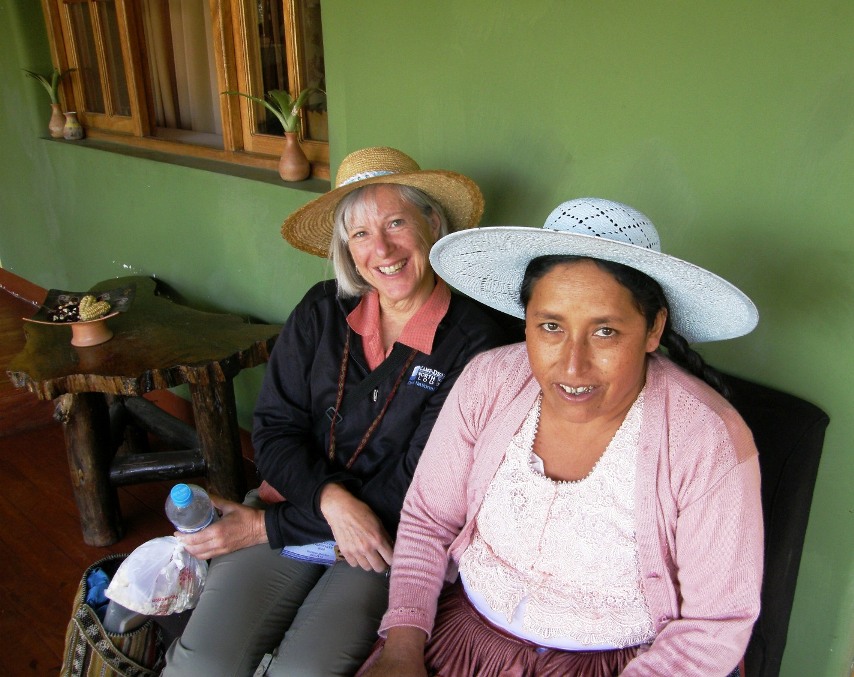
I can’t believe that I am sitting here now at home in the tropical heat of the Bolivian lowlands while just one week ago I was making my way to Urubamaba at 2863 meters in the Peruvian highlands. I would say that of all the trips made by international visitors to the tinkuy mine was probably the shortest…just a one-hour flight from Santa Cruz to La Paz with enough time to stroll around outside the airport and take pictures of impressive Mount Illimani. In La Paz I met up with Dorinda and Maxima who were to be my roommates in Urubamba. I had met Dorinda Dutcher through WARP connections over a year ago and had corresponded with her by email. This was our first face-to-face meeting. Dorinda founded PAZA (Project Artesania Zona Andina) in the town of Independencia, Aypopaya province, an organization which she describes as “a Peace Corps project which became life’s calling”. She raised funds to be able to bring master weaver and PAZA coordinator Maxima Cortez with her to the tinkuy. The non-profit organization KURMI in Cochabamba also provided funding for a group of weavers to attend so we traveled from La Paz to Urubamba as a group of fourteen.
Witnessing the group’s reactions to all they experienced on this trip and at the tinkuy was another wonderful aspect of this whole journey. Please read Dorinda’s reports on the PAZA blog to learn more about her goals, challenges as well as volunteer opportunities with PAZA.
These ladies had been traveling literally for days! First, an eight-hour bus trip to Cochabamba followed by an overnight bus trip to La Paz before they could even get on the fifty-minute flight to Cusco. Then came the inevitable mess of paperwork on landing in Peru but no one’s spirit was dampened.
Are we there yet?
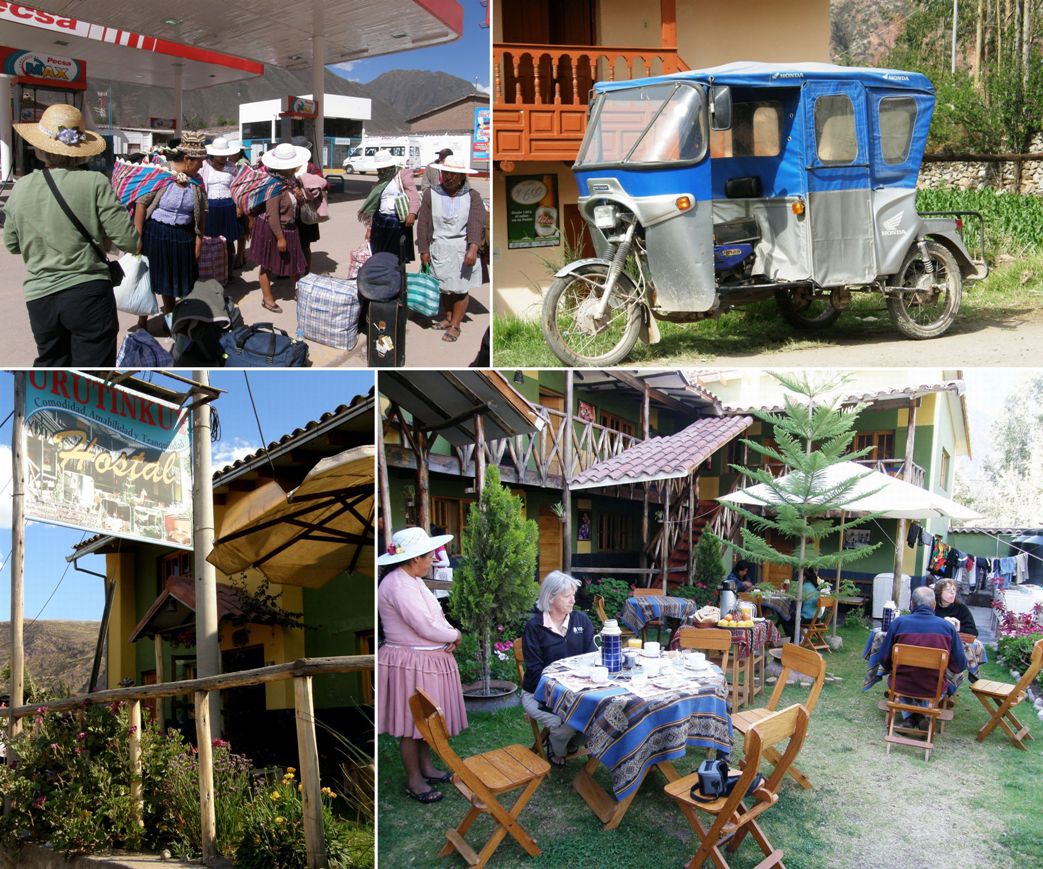
So when we got to Urubamba and made the mistake of getting off the bus too early, the ladies just took it in their stride, wrapped their luggage in their carrying cloths, hauled them onto their backs and took off up the road while I struggled along with bags in hand and dangling off my shoulder. Below you can see us lost at the gas station at the wrong end of town.
A hot, dusty and wind-tousled group finally arrived at the Hostal Urutinkuy that afternoon.
At the hostal I met lovely D.Y Begay, a Navajo weaver who had been invited to present at the conference. D.Y and I had been corresponding by email for some months and it was great to finally meet her. She was slated to be the first presenter of the conference and was a little inconvenienced by the fact that her luggage had not shown up.
The tinkuy comprised two days of conference with an incredibly heavy schedule of talks and presentations with breaks for drinks and snacks and weaving demonstrations. Lunch was followed by more weaving demonstrations and opportunities to buy textiles. If you were wise enough to arrive early in the morning you had the chance to mingle in a bit more leisurely way with the local weavers and spinners and avoid a bit of the chaos.
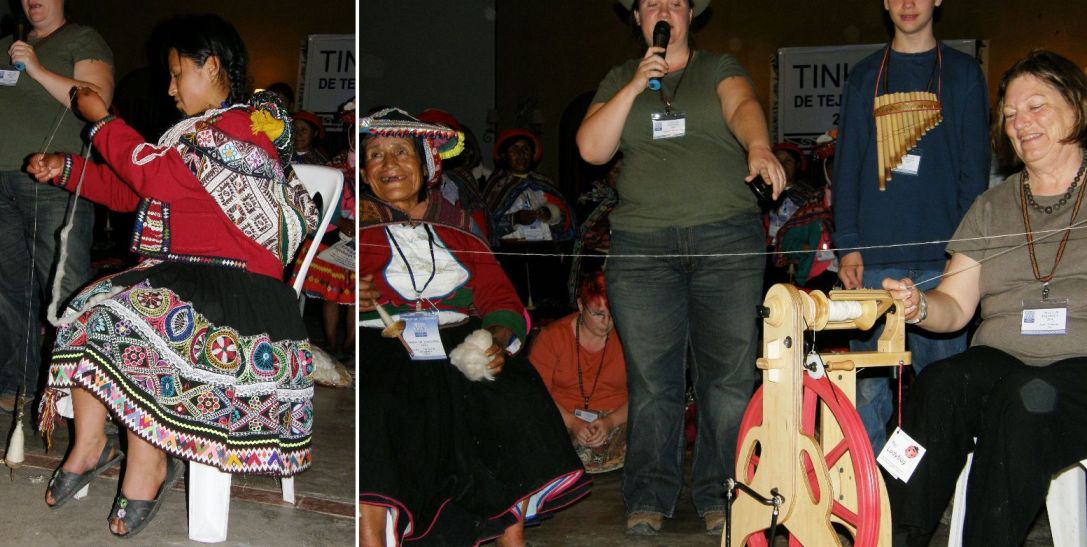
We gathered in the evenings in the conference auditorium for dancing, music, singing, spinning competitions, which were narrated by Abby Franquemont, and lots of laughter. Beth’s (of The Spinning Loft) young daughter competed on her wheel with a local spinner on a drop spindle as did Judith MacKenzie. I honestly don’t remember who won but I do remember that the Bolivian ladies from Cochabamba really strutted their stuff in speed spinning the following night and my roommate Maxima took home a prize having spun over six meters in two minutes.
I am just going to show you here now a selection of captioned photos which, I hope, will give you a feel for what went on in those two days and just how much we managed to pack in!
It all started with a ceremonial offering to Pachamama performed by an Andean priest accompanied by the sounds of the pututus, (conch shells), which were also blown to announce the start and finish of each guest speaker’s presentation. Everything was translated into three languages – Quechua, Spanish and English and the Quechua translator with his strong, clear dramatic tone of voice was a joy to hear.
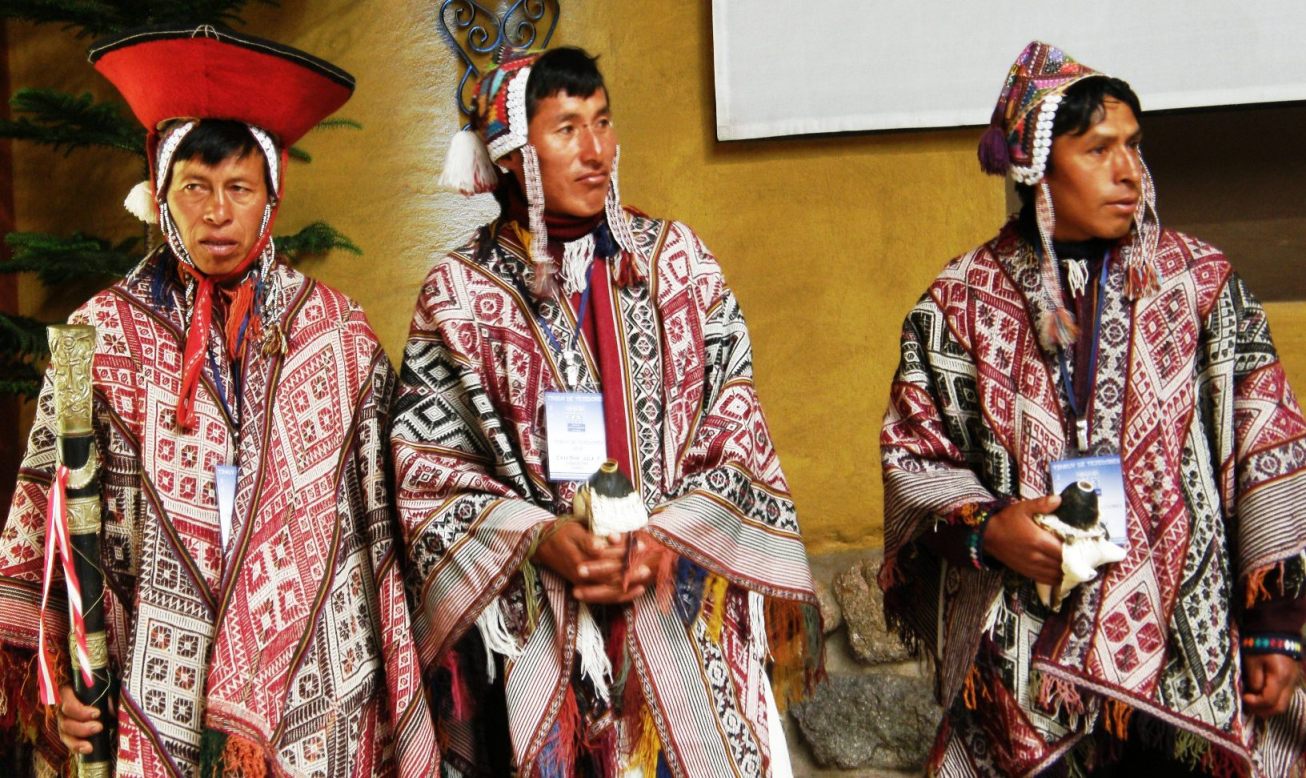
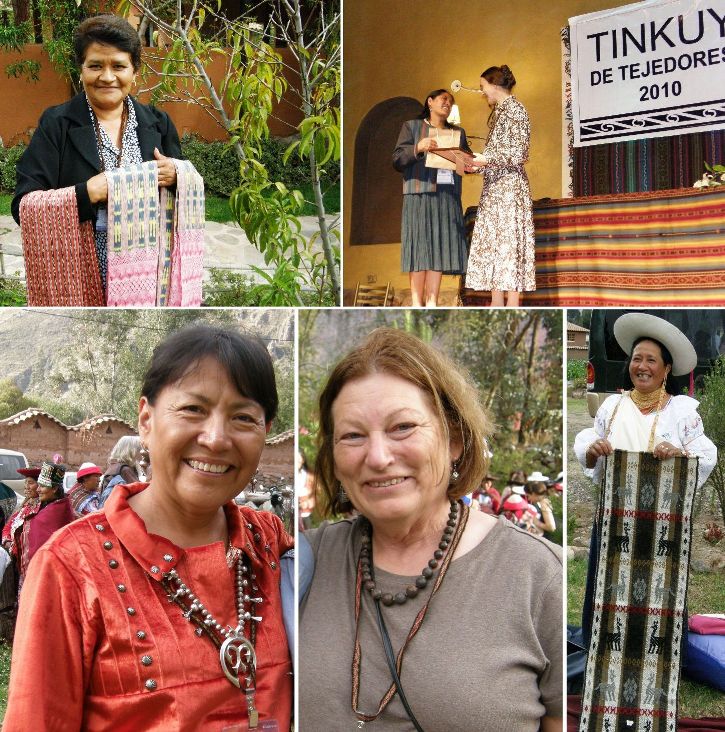
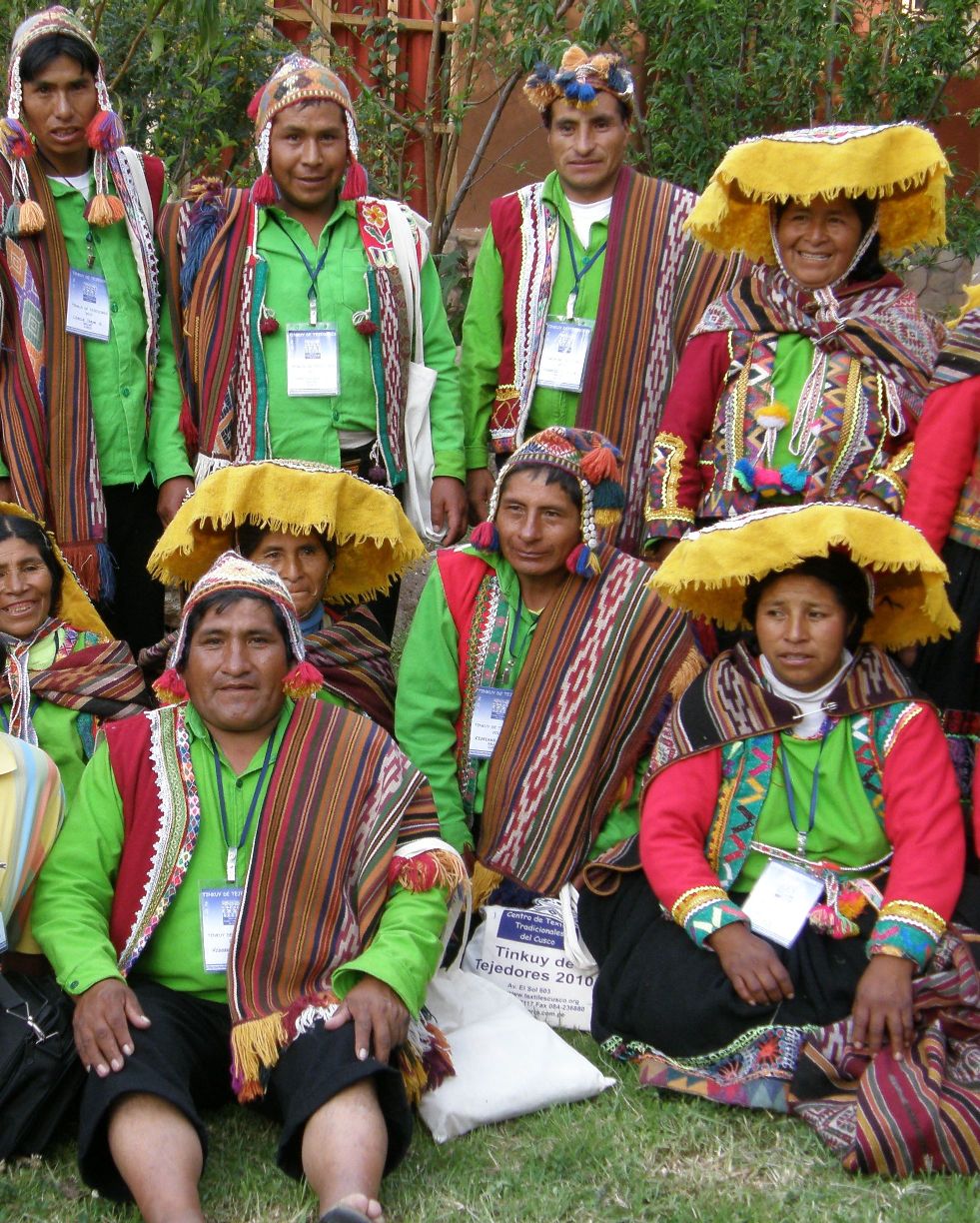
High-ranking community members with conch shells in hand took part in the opening ceremony.Just a few of the foreign invited guest speakers: Luisa Govea of San Luis Potosi, Mexico, weaver of fine silk ikat shawls using designs from the 17th, 18th and 19th centuries. Ann Pollard Rowe - I met her in 2007 at the Textile Museum in Washington, a meeting which led me to a wonderful weaving and spinning adventure in coastal Ecuador and it was lovely to have the opportunity to see her again. She gave a presentation entitled "Looms of the Americas". D.Y Begay who spoke on the traditions and practices of Navajo weaving. Judith MacKenzie's talk was entitled "Fibers of the Americas". Luz Maria Andrango of Otavalo, Ecuador demonstrated the Great Wheel and brought textiles to show from the workshop of her famous father, Miguel Andrango.
There were at least two dozen national and international presenters over the two days. I was especially pleased to have been able to meet Mary Frame who spoke about Inca geometric figures called tukapu. I am determined to learn three color double weave so I can use some of those designs in my pieces.
In the talks we were taken on journeys from Mexico and Guatemala to Bolivia and around Peru from pre Incan and pre Hispanic times to present and taught about techniques from weaving and dyeing to administration and marketing.
Maiwa Productions showed us a wonderful video on indigo dyeing in India.
Some of the presentations I most enjoyed were those by the weavers in the communities that are involved in the Centro de Textiles Tradicionales de Cusco (CTTC). They spoke of their lives before and after their experience with CTTC, their struggles, successes, accomplishments, frustrations and failures while trying to revive their lost weaving traditions. The talk I enjoyed most of all was that given by a group of weavers who described the impact of weaving competitions on their motivation to continue weaving and improving, their self esteem and ability to solve problems and work as a team.
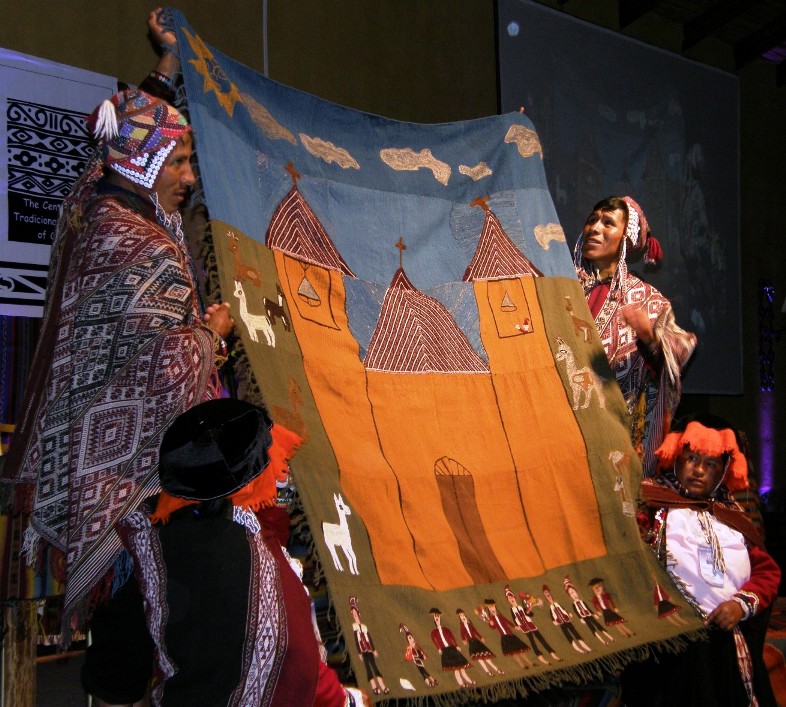
We witnessed the winning weavings and the prize-giving ceremony for the 2010 weaving competition.
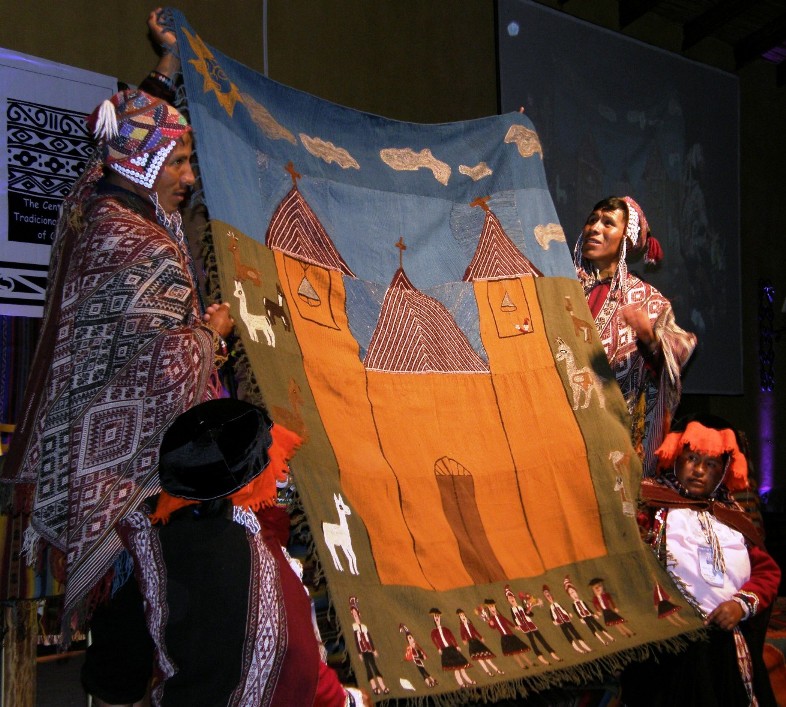
This is the winning piece by the weavers of Chahauytire community and is entitled "matrimonio". I have to admit that this had me scratching my head at first wondering about something so relatively plain from weavers renowned for their intricate pick up patterns until I realized that this piece is made up of thirty-six individual squares of thirty by thirty centimeters, each woven by a different weaver. Imagine!! I can't even begin to imagine how difficult it would be to create a four-selvedge piece that came out exactly thirty cm long. And thirty-six weavers had to turn out pieces with the same level of exactitude so that they could be pieced together with no puckering or stretching...AMAZING!! How difficult it must have been to match the diagonal lines on the two panels that form the church roof!!
Two other prize-winning pieces are shown below. All pieces had to meet the same requirements and have their thirty six panels of thirty centimeter squares. Every weaver has their own tension which means that no standard warp length can guarantee a thirty-centimeter finished length. The weavers who gave the presentation about the competitions let us in on some of the difficulties and disappointments they had to deal with in these projects and the problems they faced and overcame working as a groups rather than as individual weavers.
The following pictures were taken during the coffee and lunch break demonstrations and first thing in the morning when the weavers would be arriving early from their communities.
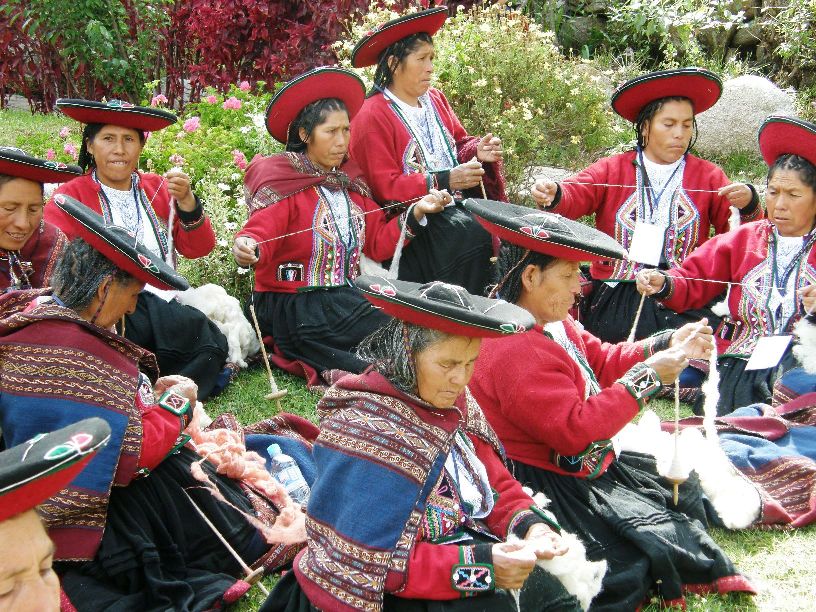
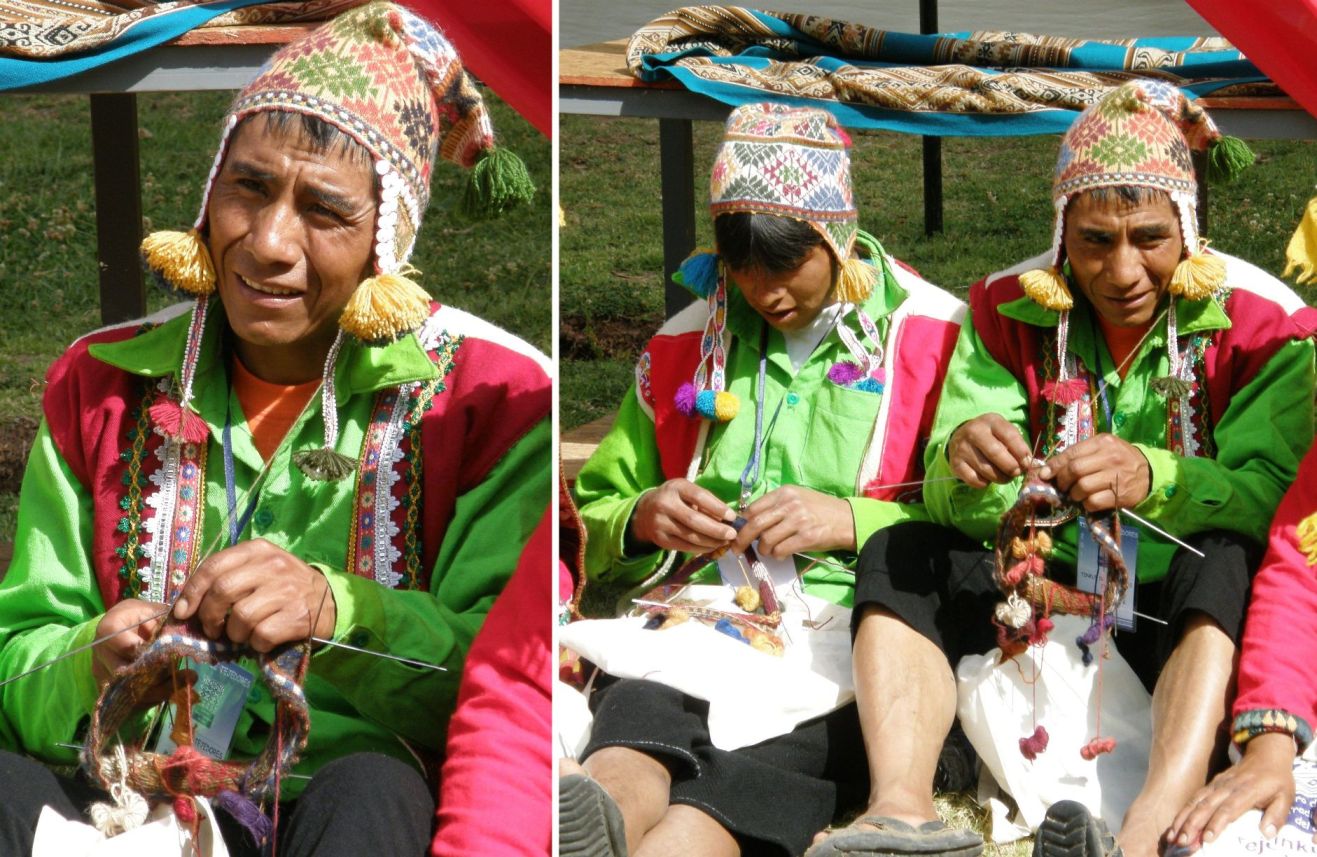
There was plenty to fascinate everyone...not only the foreign visitors but also the local Peruvian weavers. During this lunch break many couldn't take their eyes off the loom and weaving of a Bolivian weaver from Tinkipaya, near Macha, in Potosi, Bolivia. They stood and watched her from every possible vantage point and some were just as camera happy as we were.The weavers, spinners and knitters would arrive by bus early in the morning, some coming from communities as far as five hours distance from Urubamba (and some maybe even further). Time was easily passed by sitting in groups spinning, knitting and chatting.Knitters from Sallac community pass the time before the start of the conference.
There were many kinds of looms and weaving techniques to be seen….
A Guatemalan weaver from Santiago Atitlan on the left makes designs with supplementary wefts and a Bolivian weaver from AAA, la Asociacion de Artesanos Andinos from Cochabamba, Bolivia props her loom against a low wall to weave complementary warp pick up patterns.
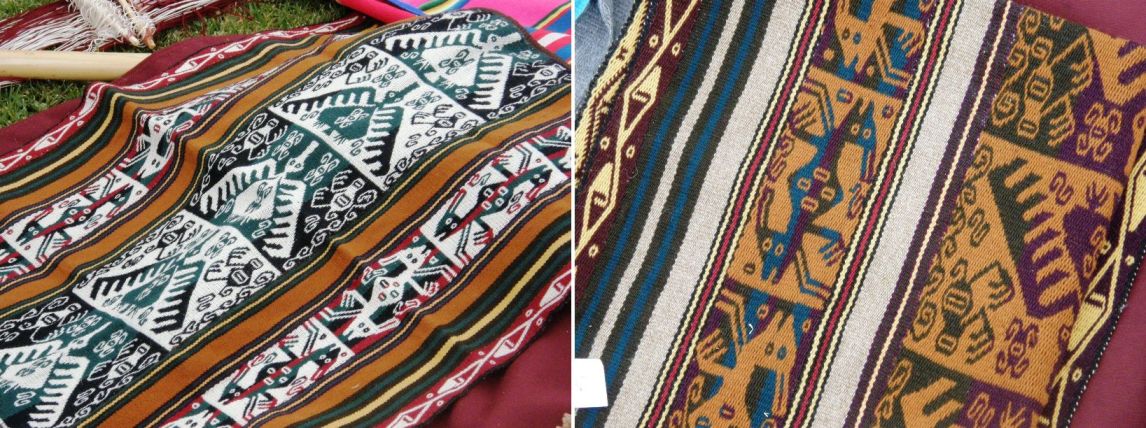
A group of weavers who work with ASUR in Sucre came including this Jalq'a woman from Potolo. At right is a weaver from Accha Alta weaving a supplementary warp technique.Tapestry techniques from South and North America. I am sorry that I didn't find out which community this gentleman is from but it was wonderful seeing him weaving tapestry on a backstrap loom. At right, D.Y Begay demonstrates Navajo weaving on her vertical loom.Weavers from Accha Alta on the left and Santo Tomas on the right. While the weaver from Accha Alta uses a stick to pick up his warps I noticed that quite a few weavers pick up the threads with their hands as I prefer doing. I have just updated this post to add this photo not originally included as I did not know from which communities these two weavers are from. Now I see in a magazine that I picked up in a street book fair in Cusco that the lady on the left is most likely from Ccachin. I don't know about the weaver on the right. The colors in their outfits are so intense!Luz Maria Andrango of Otavalo, Ecuador created a lot of interest with her demonstration of spinning on a Great Wheel (walking wheel?).Ten year-old Juan Miguel of Acopia community started weaving in August and is doing pebble weave here while his grandma watches. The wee girl on the right is even younger I think and is weaving a tapestry on a floor loom where her little legs can barely reach the peddles.Watching the watchers...while the weavers gathered around to watch the demonstrations, I stood back and admired their gorgeous outfits. On the left is a group of ladies from Sallac community and on the right from Chahuaytire.Bolivian textiles...a jalq'a weaving with its strange khurus, double weave belts in handspun and naturally dyed yarns made by the weavers of PAZA, Cochabamba, a weaver from Tarabuco adds a woven edging to a finished weaving, a bag made with the typical zig zag and "eye" motif of Tinkipaya and Macha in the Potosi area.Rosa Choque, an Aymara weaver, gave a presentation at the conference on projects in which she is involved which aim to preserve the textile traditions of Moquegua, Peru. I think that these are some of the textiles which she brought but I could be mistaken. I would love it of someone would confirm this for me.
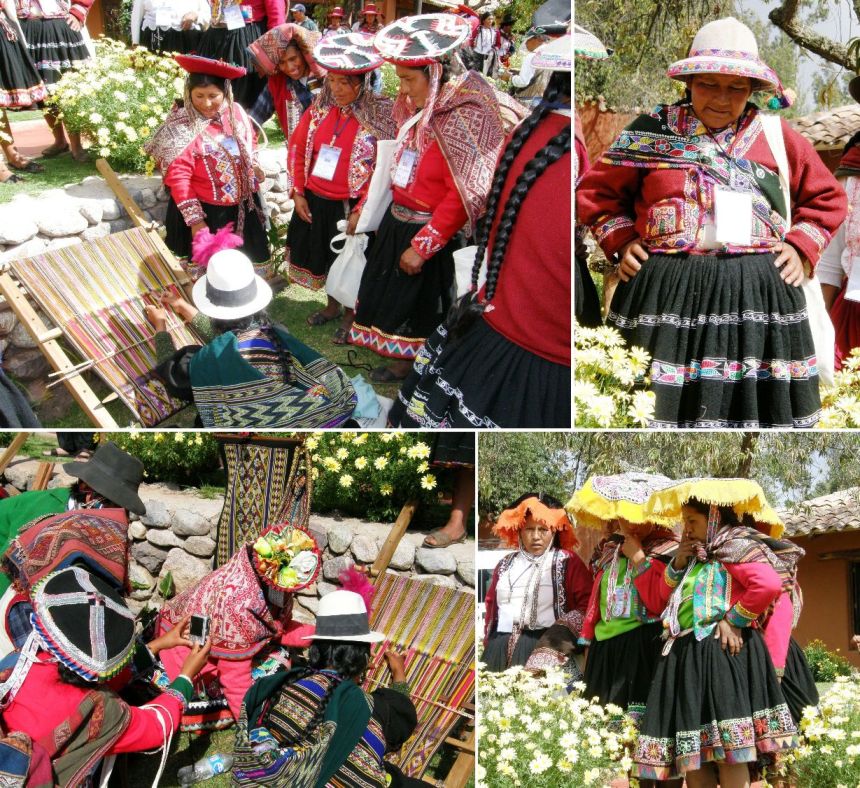
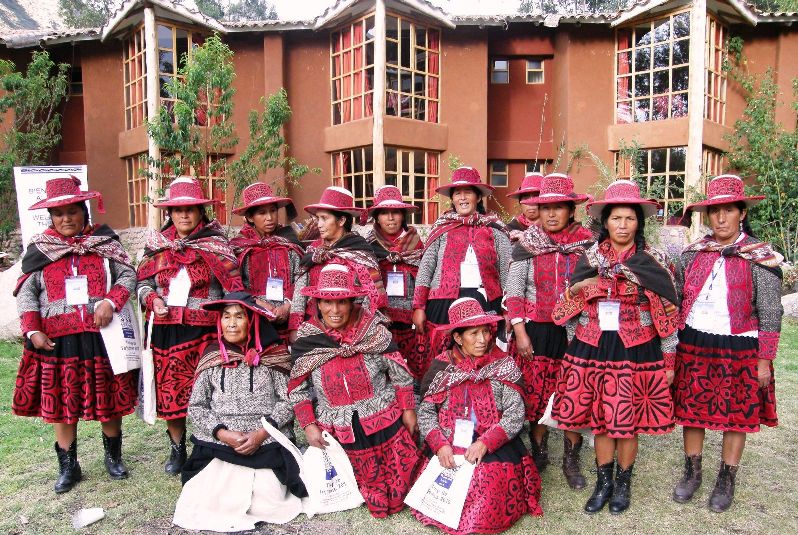
On both days during the afternoon break, the local weavers gathered in groups which gave us all plenty of nice photo opportunities as well as a good chance to learn the names of the different communities and, therefore, be better able to recognize their members by their outfits.
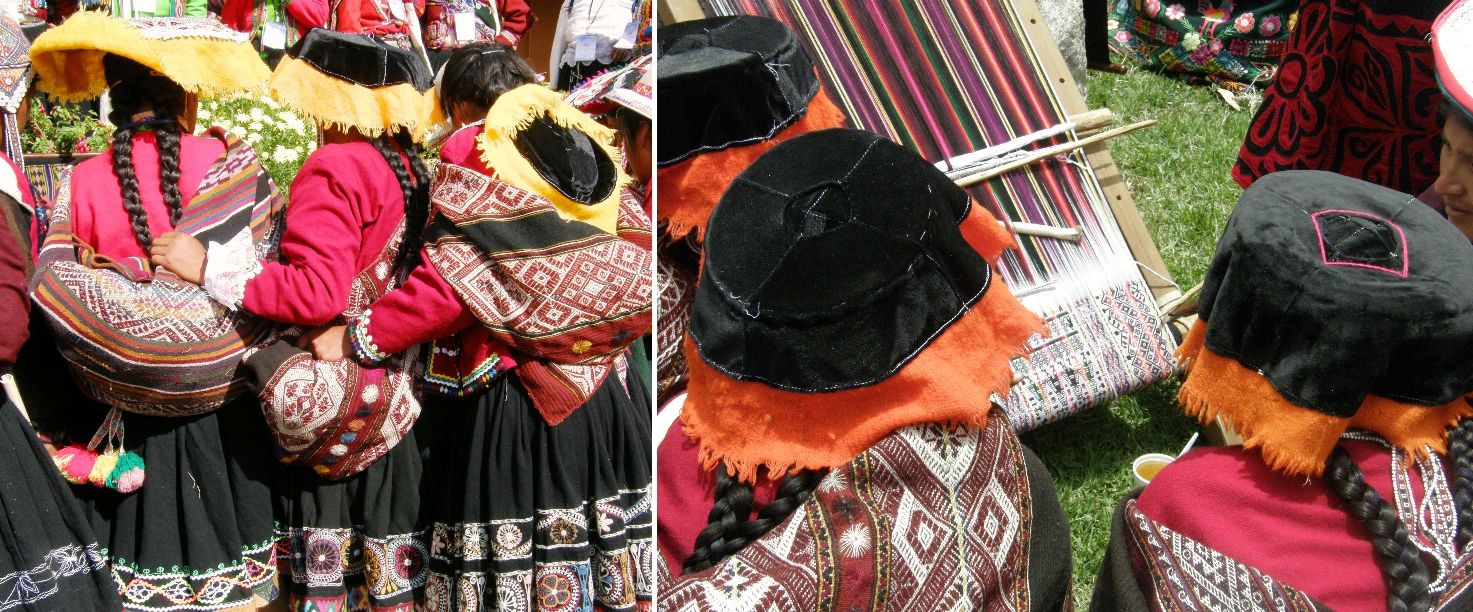
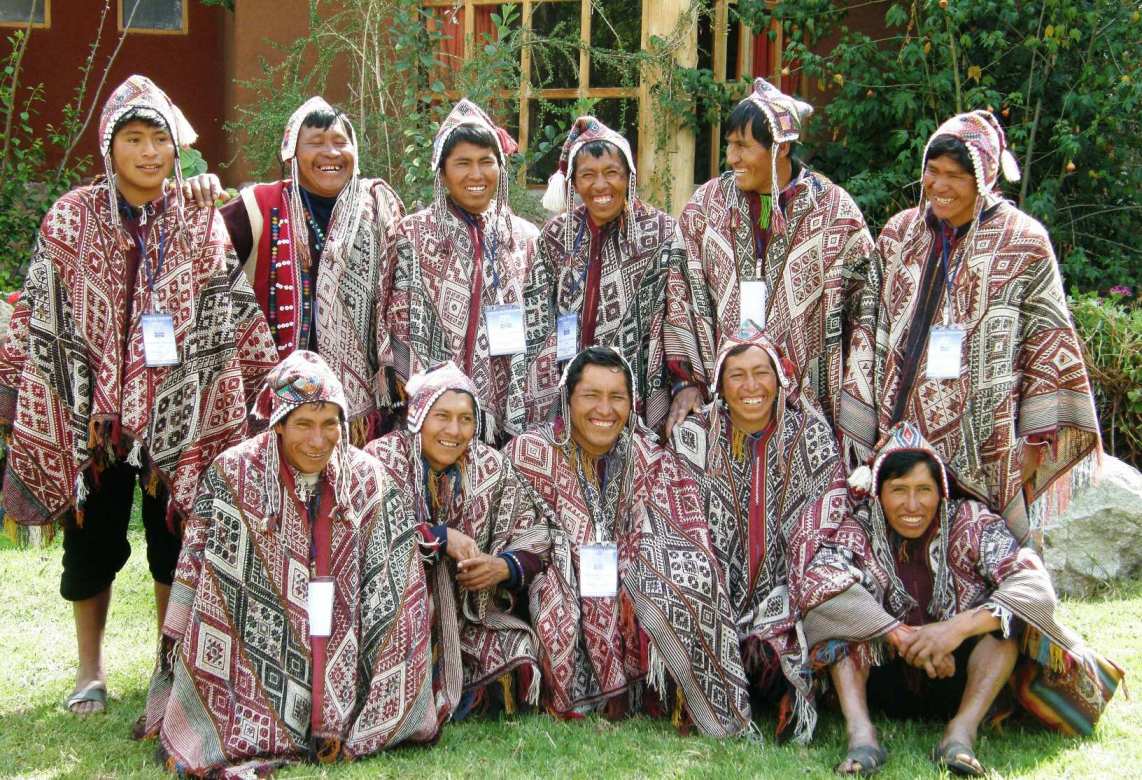
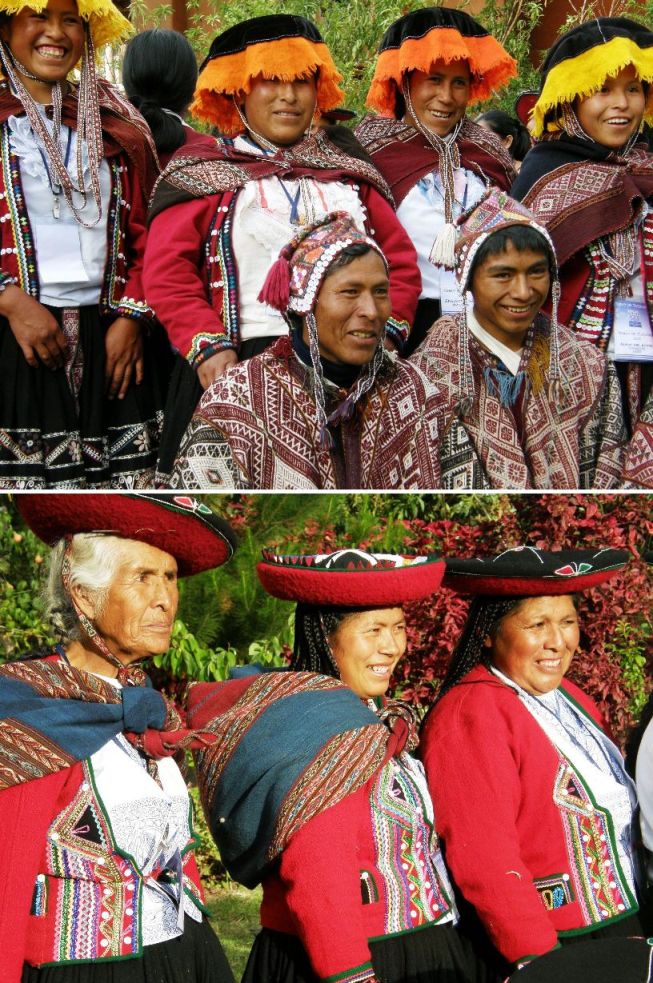
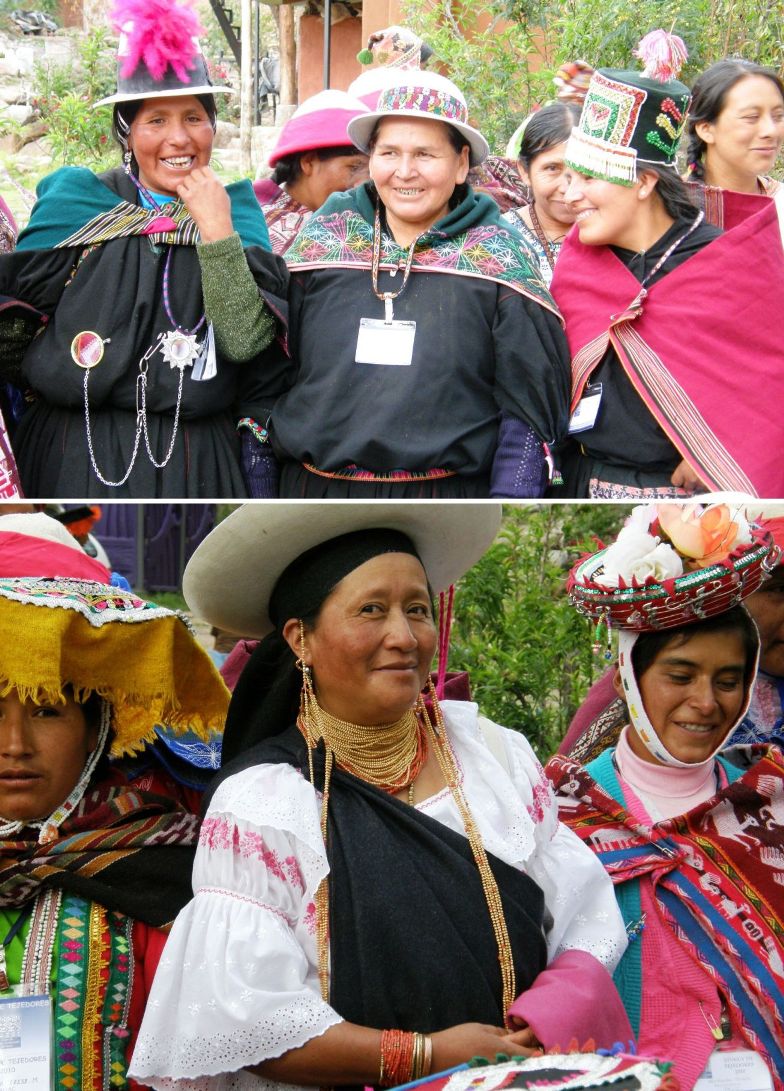
Men from Chahuaytire.Women from Santo Tomas - we all loved their boots.A group from Chahuaytire above and from Chinchero below. I believe, but I could be mistaken, that the distinguished lady on the left is Nilda's mother, Doña Guadalupe.Three weavers from Bolivia above. Luz Maria Andrango of Ecuador below with two Peruvian ladies.
Artisans of Sallac. Their ponchos include panels of patterns created with resist dyeing techniques.
A young weaver-to-be and a little fellow with his pututu
Well that was a “taste” of the daytime activities. The nightime dancing and spinning competitions were a little harder to capture on film with the dim lighting but I did get some video. All the video I shot of weaving, spinning, braiding and dancing will be on next week’s blog.
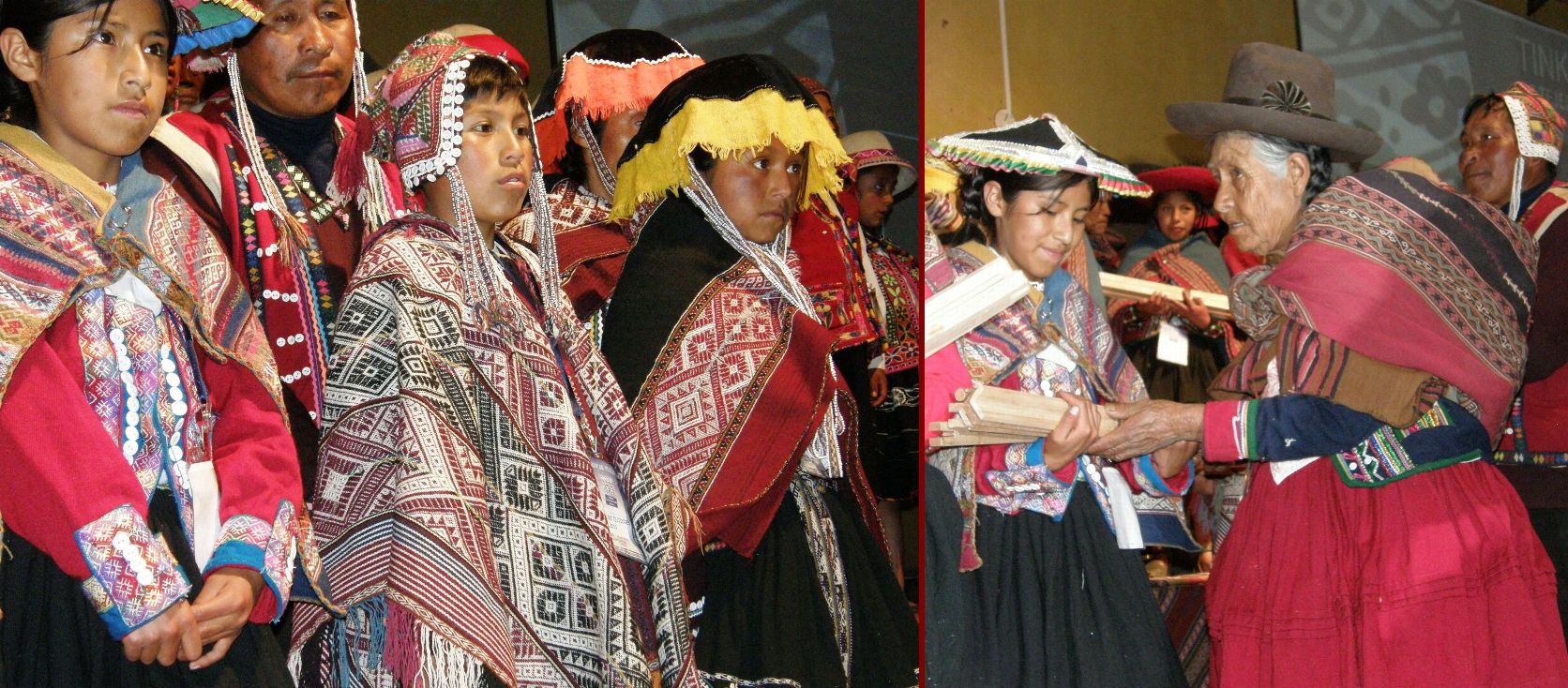
The conference closed with a very emotional ceremony which served to honor all the elders of the various communities who were given certificates and medals of recognition as well as gifts.
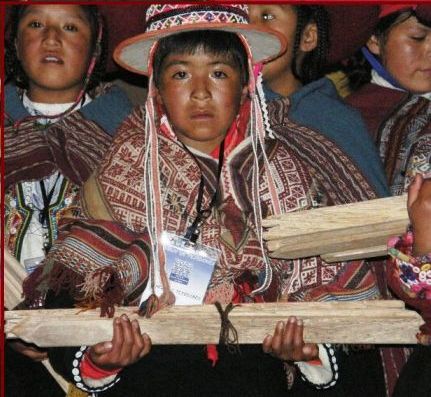
This was preceded by another ceremony in which the elders were invited to hand over sets of weaving tools to the youngsters in their communities.
Youngsters lined up waiting to receive their weaving tools. An elderly weaver passes a set of new weaving tools to a young girl in her community. The young girl's smile says it all.
So that was the two days of conference. Then came the workshops which I am saving for next week’s blog post along with the videos. And next week I will tell you about the other folks I met up with, some of whom I have been corresponding with by email or through my blog and others whom I met at Convergence. Betty Davenport, who is always lots of fun, was my companion in the little “down” time we had and we took the same workshop. Folks from Interweave were there too. The workshop days were more intimate and gave a lot of us a chance to chat and catch up. More about that next week.
And here is the amazing woman with the brilliant smile who is behind this unique event. It was not an ideal situation to meet Nilda for the first time. She was so busy and I don’t believe she stood still for a moment. Yet I learned a lot by watching her in action and seeing the warm affection she has for those who are lucky to be her friends, her passion for the CTTC and its goals and her love for her country and her people. Hopefully I will be able to go back one day to meet her again.
My Backstrap Basics article is now on the WeaveZine site in Spanish. The videos remain in English but are, hopefully, self explanatory.
Mi articulo “Backstrap Basics” (El Telar de Cintura) ya se puede leer en español en la pagina deWeaveZine. El audio de los videos sigue en ingles pero las imagenes son suficientes para entender.
 These pictures you have seen before if you follow my blog and you will, no doubt, remember that I became fascinated with the discontinuous warp technique when I met Pitumarca weaver Antonia at Convergence last year. There I got to see a piece being woven even though I didn’t fully understand at that stage what it was all about. At the Tinkuy de Tejedores in November in Peru I got to see more and even got to try out a plain weave piece of my own which I turned into the black and white eyeglass case above.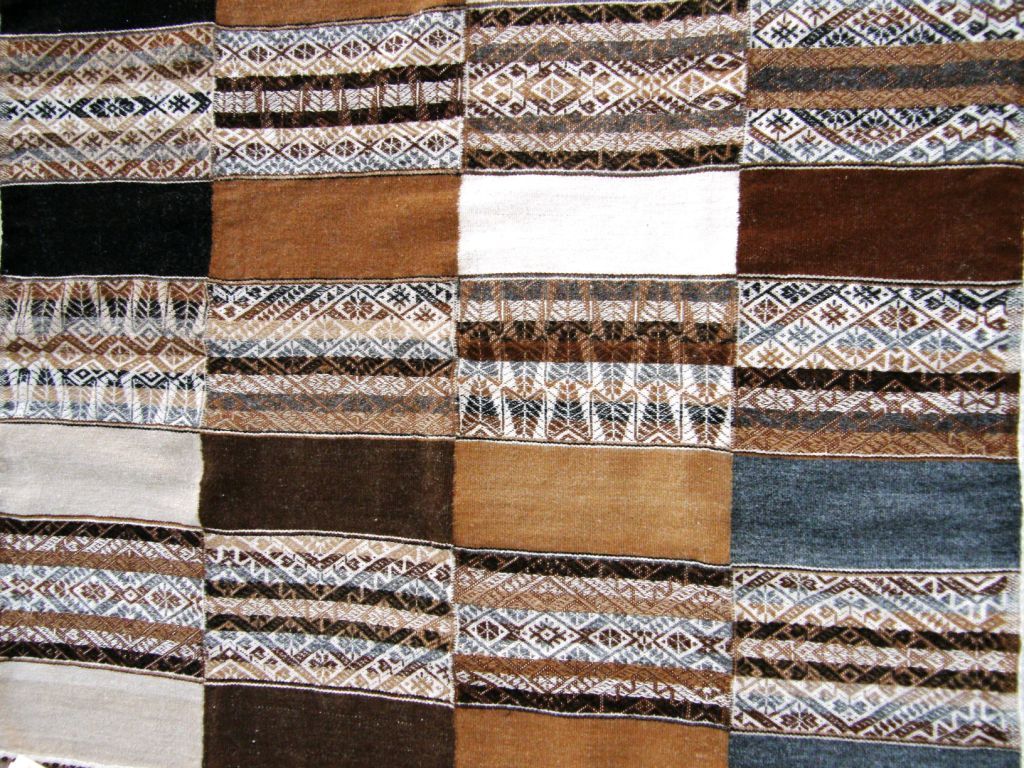
 Each panel has a different traditional design of Pitumarca flanked by fields of either black, brown, grey or tan plain weave.
 And, of course, it was woven as one entire piece on a backstrap loom.
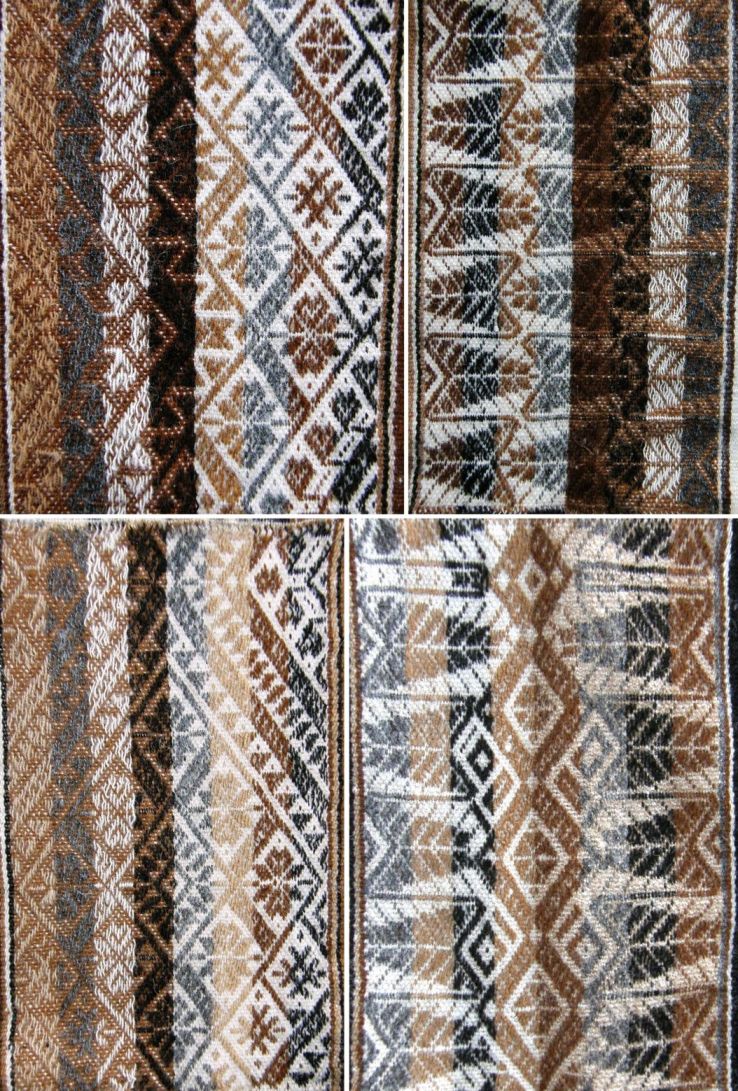 There you have eight of the twelve panels of pick up patterning. Here are the last four…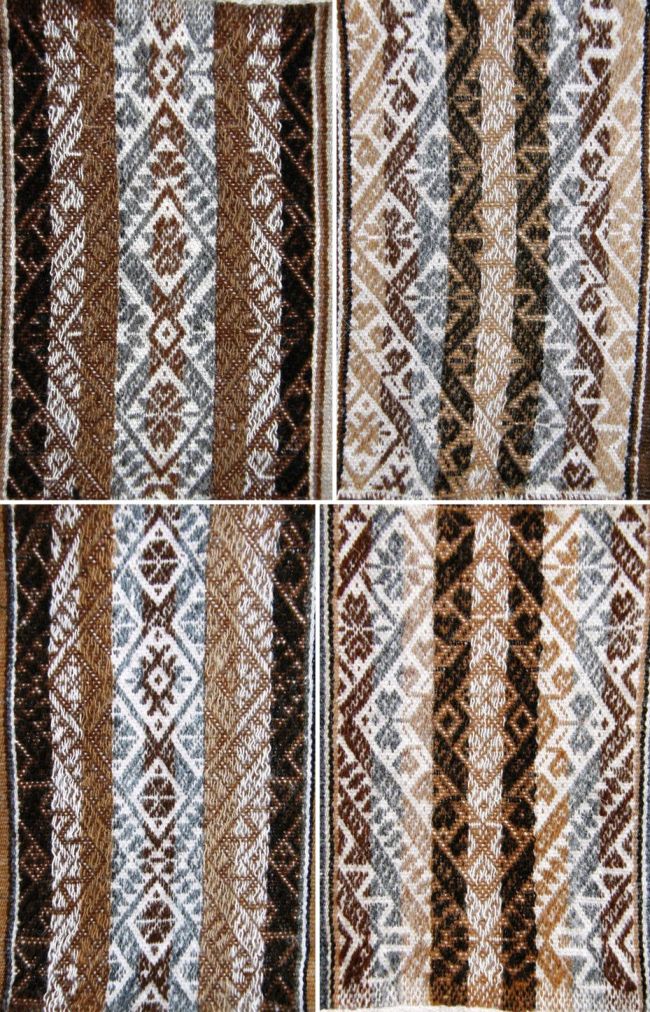

 And now I am out of here 🙂