Backstrap Weaving-Coca leaves, chuspas and more double weave

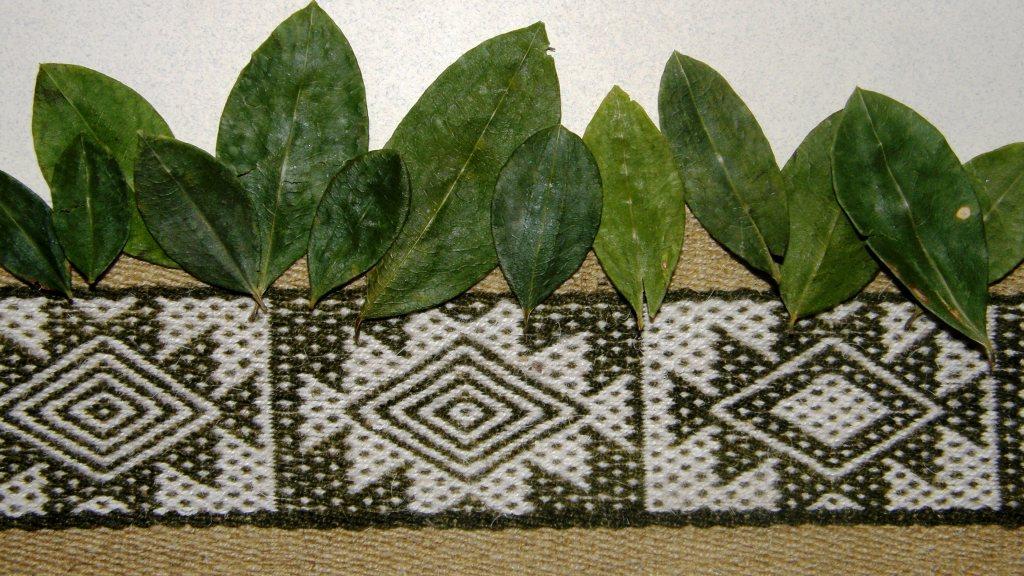
The coca leaf – I have enjoyed it brewed in tea, chewed it on hiking trips and used it to dye my handspun llama fiber above.  However, a  foreigner like myself can not even begin to understand the role that this humble leaf plays in Bolivian life and culture.

Lately there has been a lot more talk than usual about this piece of Bolivian cultural heritage as Bolivian President Evo Morales has recently announced plans to launch a new carbonated energy drink on the market which has the beloved coca leaf as one of its main ingredients. It should make an appearance in the next four months and will be called “Coca Colla” (the ‘olla’ in Colla being pronounced like the ‘oy’ in boy). “Colla” is the word commonly used to describe people from the altiplano of indigenous origins. This is President Morales’s attempt to erradicate coca’s unfortunate association with cocaine and drug trafficking, increase its cultivation and have it  recognized instead, as stated in the new Constitution, as  “cultural heritage, a natural and renewable resource of biodiversity in Bolivia and a factor of social cohesion”.
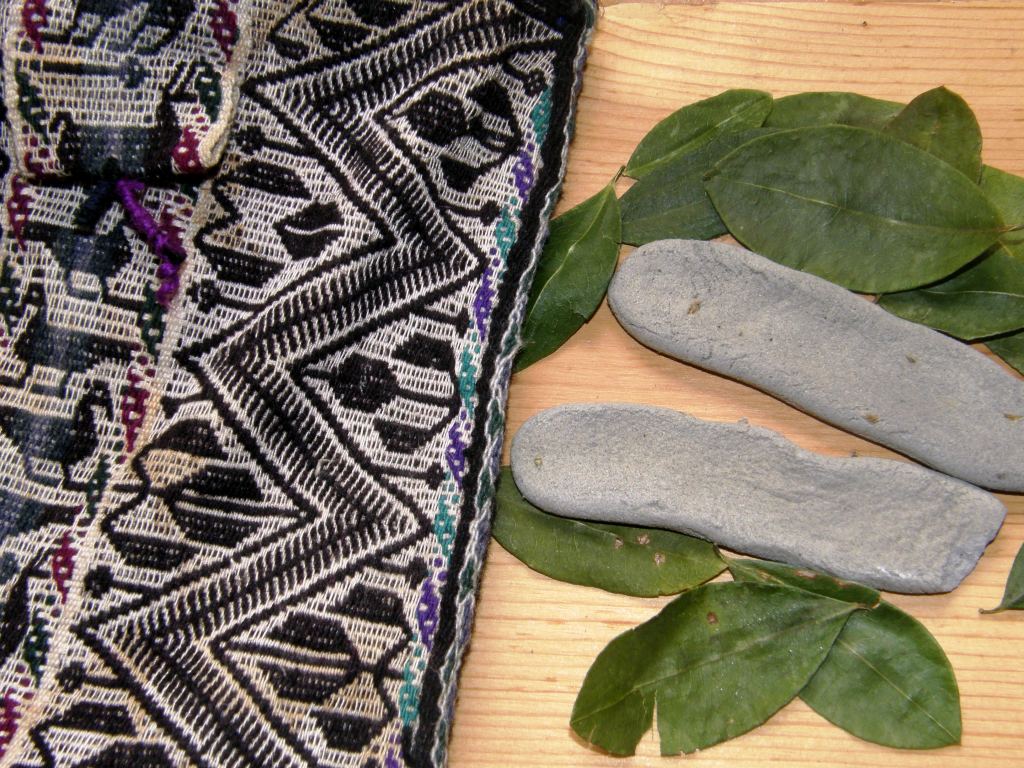
Coca is used to make tea, plays a part in religious rituals and is chewed in order to suppress hunger, thirst and fatigue as well as to alleviate the symptoms of altitude sickness. I have chewed it myself on hiking trips and I have to tell you that there is knack to getting a wad of it tucked neatly away in your cheek and not all over your teeth thus completely ruining your smile for the day! Bags of coca leaves are sold with lejia-the gray colored bar seen at left, comprising compressed ash and other substances, which is chewed along with the leaves and acts as a catalyst.

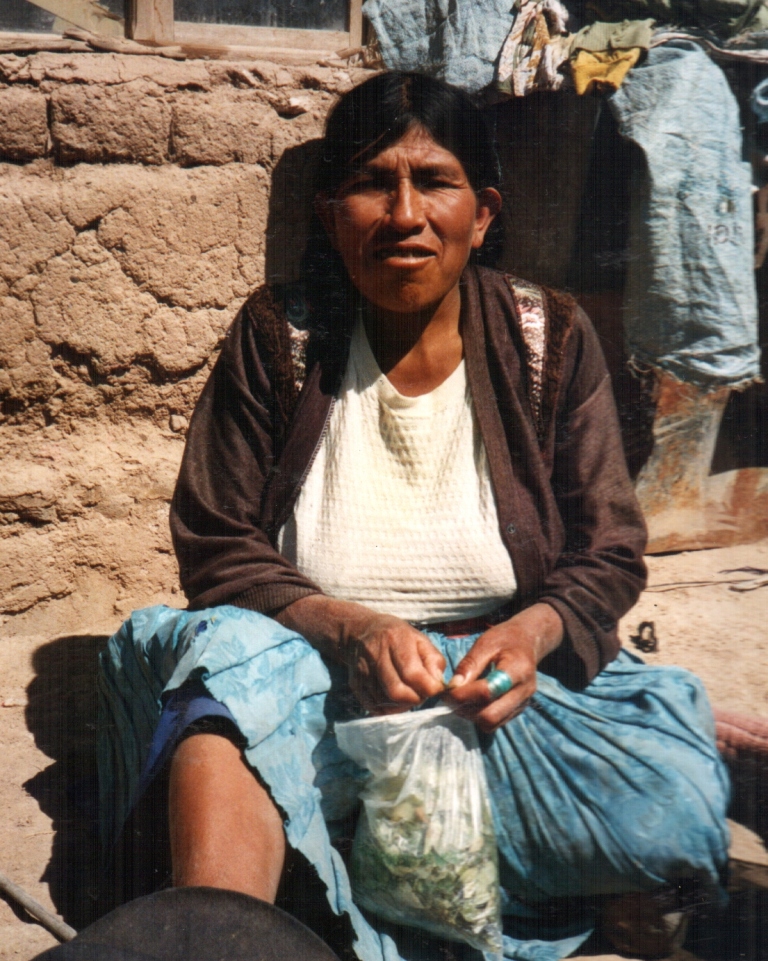
A special woven bag called a chuspa is used to carry coca leaves but I have only seen these in use at festivals and other celebrations. On a normal day, it is more usual to see people taking their coca leaves directly from a regular plastic bag. My weaving teacher, Julia, at right, is taking a break from classes to enjoy some coca.
While Julia and her sister Hilda both know how to weave a chuspa, strangely neither of them actually owns one. When I expressed interest in learning to weave one, they had to consult with each other in order to remember how to wind the warp. What is special about warping for a chuspa is the fact that most chuspas include a small pocket which is designed to carry a piece of the lejia or perhaps a few coins and allowance must be made for this in the length of the warp.
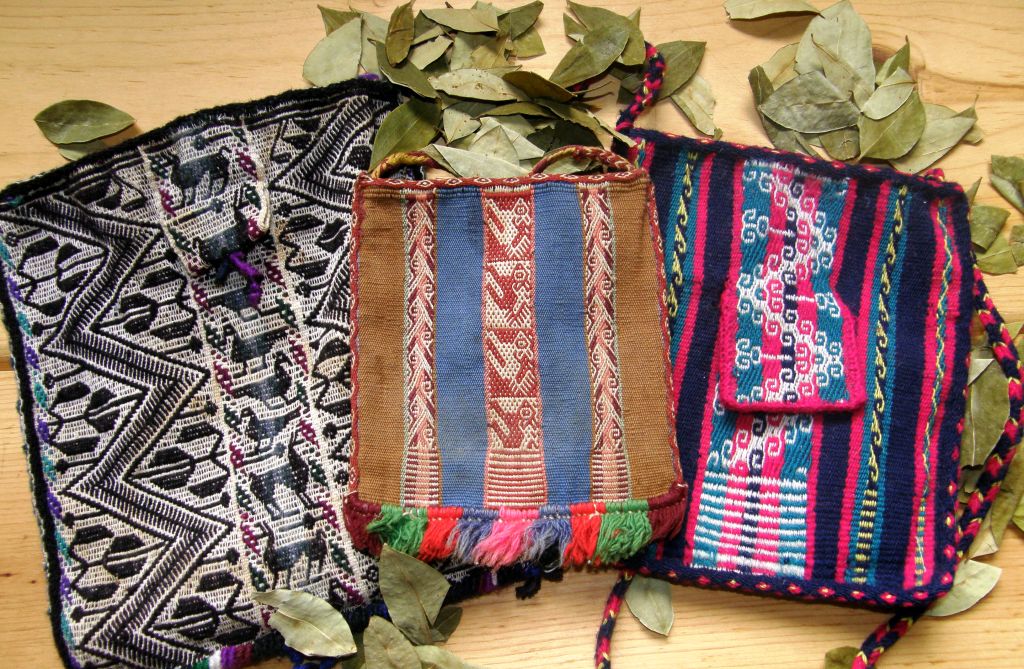
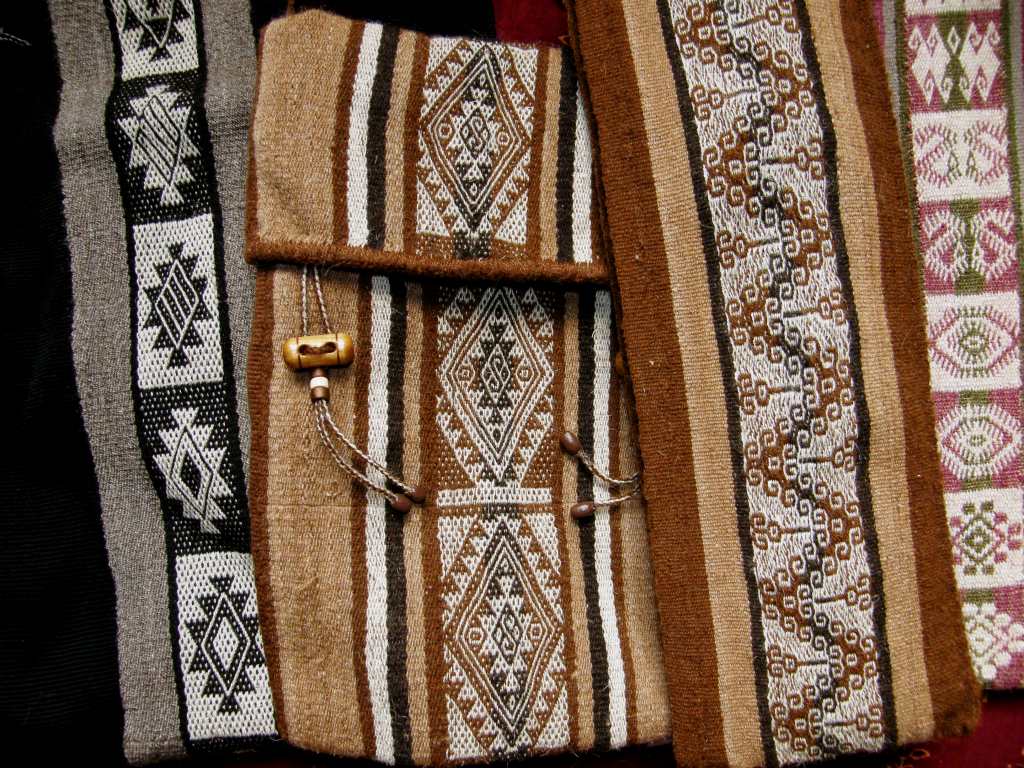
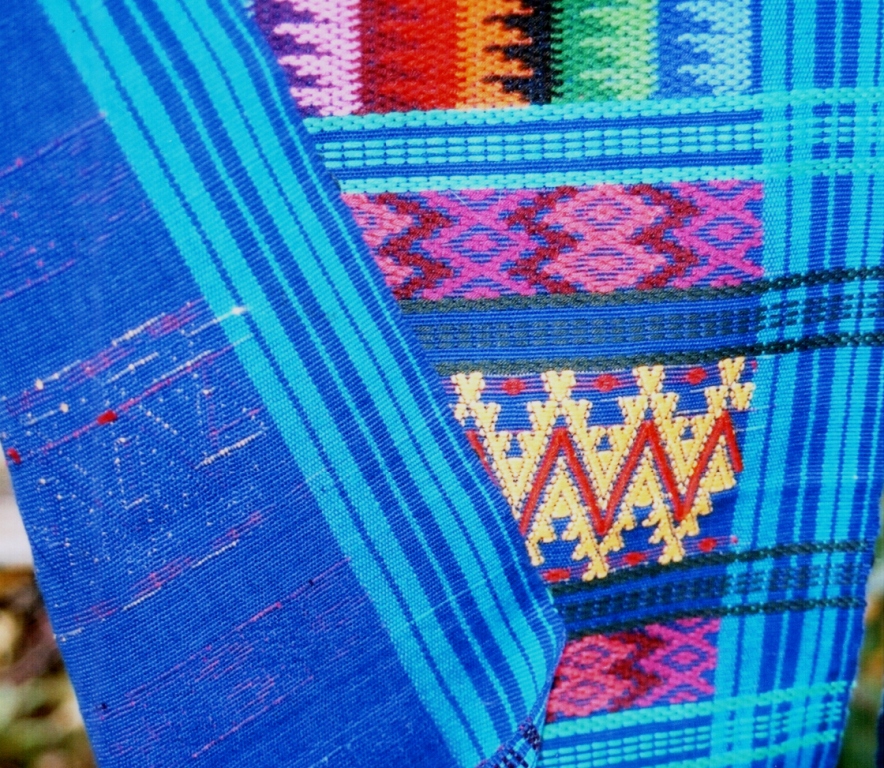
Three Bolivian chuspas, each woven with a different complementary warp technique. The one on the left was made by my weaving teacher in Candelaria and has a pocket. While the one in the middle was bought in Potosi,  I am not sure of its exact origin. It does not have a pocket. The one on the right with a pocket is the one I made in Potosi under Julia and Hilda’s instruction.
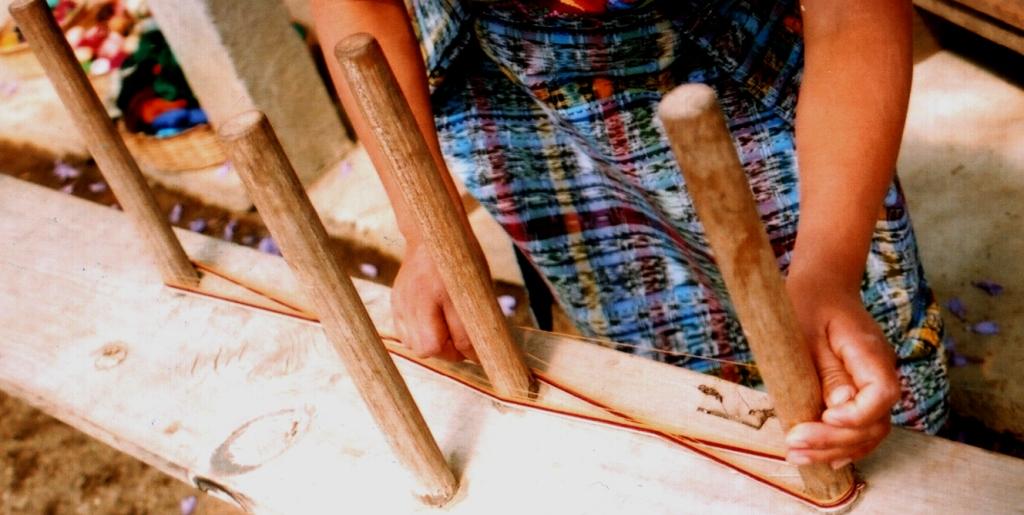
Julia and Hilda are preparing the warp for my chuspa. You can see the extended piece of warp on an extra stake which will become the pocket. We are using the brightly colored respun acrylic yarns that are very popular in this area. 
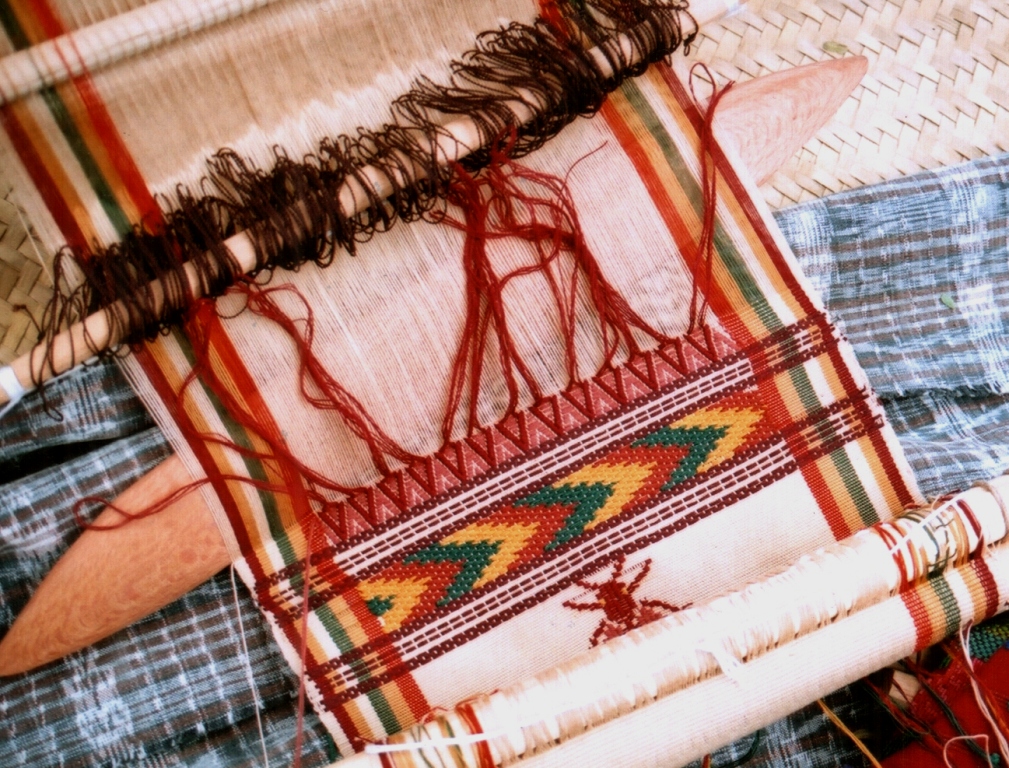
We are all at work here. I am working on my chuspa, Hilda is backstrap weaving a band while Julia, in the background, is cutting fleece to spin. My chuspa is a four-selvedge piece so I wove from one end, turned the piece around and wove from the other end and then had the usual agony of trying to squeeze weft into those last few rows to close the gap.
Hilda taught me to weave the ”rolling river”design into my chuspa. Once off the loom, the sides and pocket are joined using a variety of decorative techniques.We used triple crossed knit looping to edge and sew the sides of the pocket. This is a very pretty technique that not only binds the sides but also completely curls over and covers the edges.
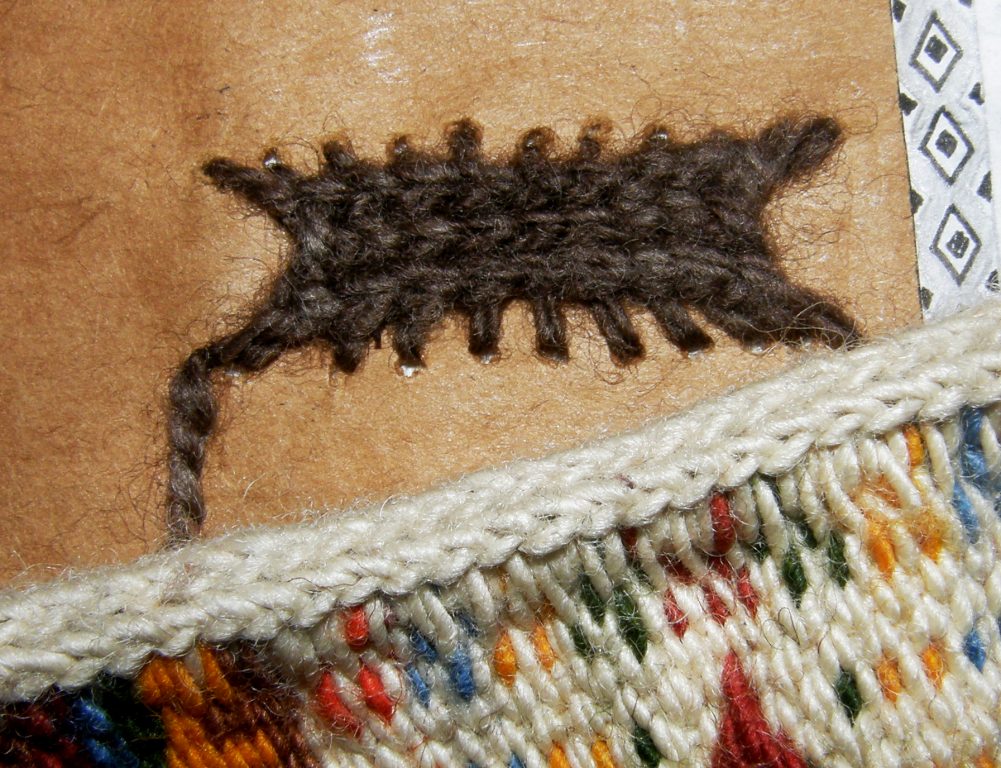
You may be able to see the crossed knit looping more closely here on the edge of another bag that I wove. The brown sample shows how it would look worked flat rather than curled over an edge.
A tubular band was woven with the weft being used to sew it to the sides and base of the bag as it was woven.  A six-strand flat braid was made for the bag strap. The chuspas that I have seen being used in festivals are highly embellished with pom poms, tassels and multi colored fringes.
A small selection from the variety of braids, bands and tassels used to decorate Bolivian chuspas
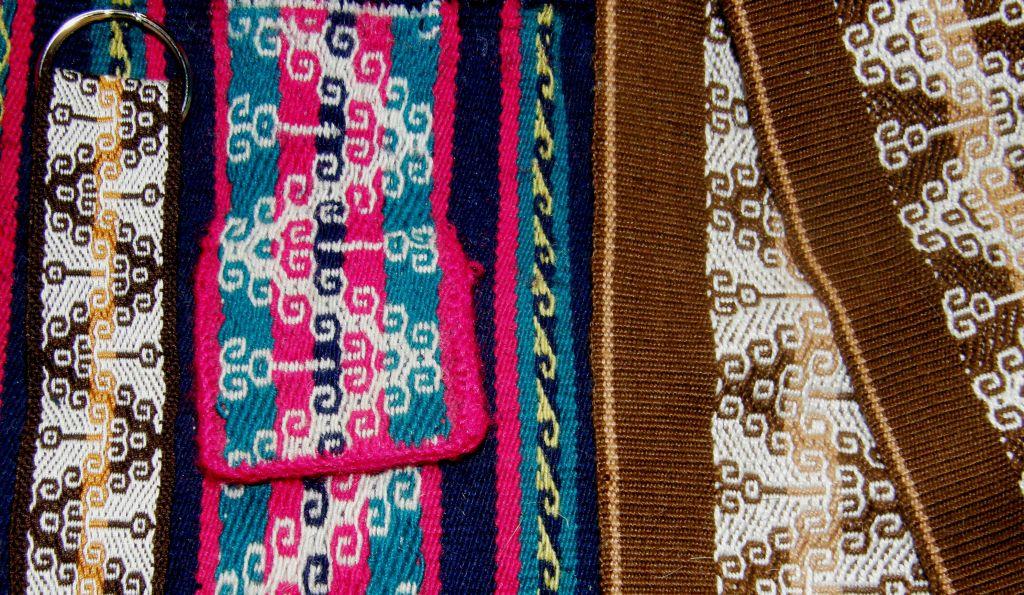
The ”rolling river” design has since become a great favorite of mine and I have woven it into tool bags, sashes and key fobs on my backstrap loom.

In 1998, I spent some time with a weaver in the village of Candelaria near Tarabuco and learned the weaving technique that is used in their chuspas and carrying cloths.

A Tarabuco style chuspa made by my teacher Felicia . The pocket is so small it is hard to see it being of any real use. The other piece is a small purse which has been woven specifically to be sold to tourists. Note the cute strolling llamas along the bottom.

I returned to Candelaria last year. Felicia is no longer there but the first person I met as I entered the village was Felicia’s cousin-also called Felicia! who took me to her home and graciously allowed me to film her weaving on her oblique loom. The next day I went to the market in Tarabuco where there was a cultural festival and was able to capture a small piece of video of a weaver warping for a chuspa. She was constantly being interrupted by ladies asking her questions so the clip is very short.  I don’t know how well that warp could have turned out with all those pauses. When I warp, no one can speak to me!

So here is the short video (yippy! I have finally figured a way to get around my erratic internet service and upload heavier videos). The first part is the weaver warping for a chuspa with two colors around four stakes. You will see the extra stick she uses on which to warp the extra long part for the pocket.

The second piece is Felicia-keep an eye out for the kitty snuggled in her lap while she picks up those warps with lightning speed!


WHAT’S ON THE LOOM?-AN UPDATE

I have been working away on my Abba Yohanni inspired piece and have decided that I am going to make a table set to take as a gift on my next visit to Australia. So, the piece you saw last week will be a table runner. I have made some progress on that and have reversed the design and am just starting the final motif. In the meantime I couldn’t resist seeing how the motif would turn out in 12wpi cotton and so wove it into a (rather large) hot pad using one-weft double weave technique and then wove a small portion of the motif into a mug rug. I am thinking about weaving four placemats to go with the set with a piece of the motif woven with a supplementary weft in the center of each.
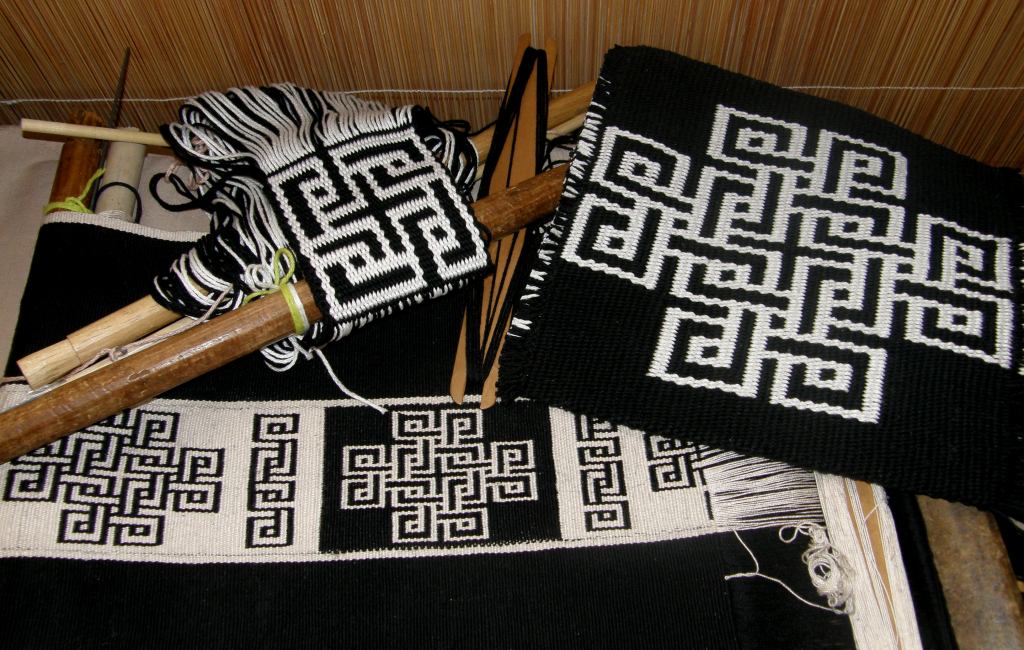
Abba Yohanni inspired set in progress


Backstrap Weaving-Backstrapped Bookmarks and the Lovely Llama

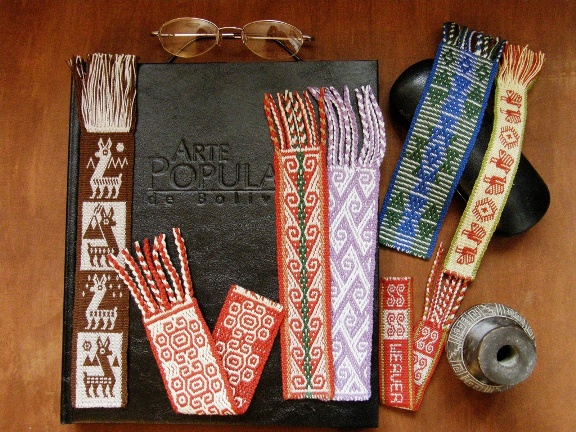
A bevy of backstrapped bookmarks

My favorite ”on the road”  project is weaving bookmarks. Many times I find myself at night in a deserted hostel in some small town with no internet access and nothing to do so I entertain myself by weaving bookmarks. There always seems to be a bed rail or something to tie my loom up to.  I make bookmarks, key fobs and sometimes small coin purses to give away to fellow travelers and weavers that I meet along the way. Often I swap coin purses with weavers and spinners for interesting spindle whorls, small tools or other bits and pieces. I take all my loom rods with me in my backpack as well as a nifty little warping board that I made which was inspired by my very first weaving teacher in  Huancayo, Peru. My teacher, Margarita and her daughter used to come into town everyday with their little warping board to teach me.
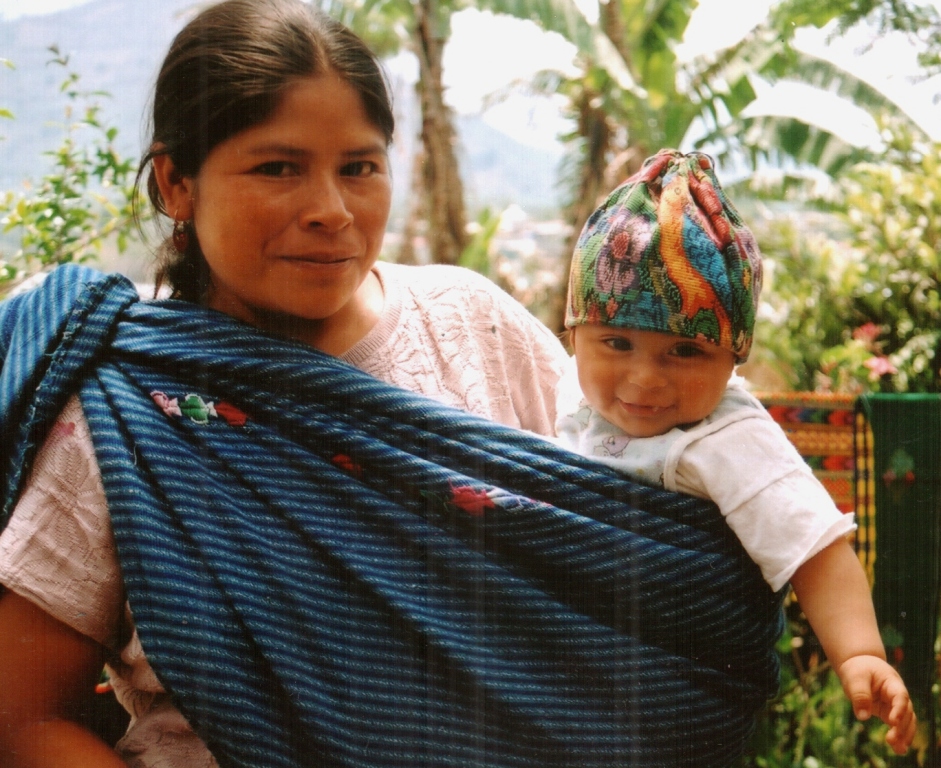
Warping with a board and nails in Huancayo

My warping board is even smaller than this one. It is basically a flat narrow stick about the thickness of a ruler and I use long screws in place of nails as I can secure them to the board with the nut-no leaning warping stakes. It gives me a warp just long enough to make one bookmark or two key fobs. I use two or three widths of warp from this board to make a coin purse.

I like to start my woven pieces with a smooth edge-that means one less hem, braid or fringe to worry about- and I achieve this by threading a steel needle through the warp ends and lashing that to the loom bar. You need to lash it firmly so it won’t bend when you put tension on the warp. Once off the loom, the needle is removed and I pass the first weft tail through the end loops back and forth two or three times on a large sewing needle.  Then I braid the other end or sew over the end and leave a fringe. The book mark sits within the pages of the book with fringe or braids protruding.

Part of my mini warping board. I wrap the screws with paper to stop the warps from catching in the screw threads.
Steel knitting pins and lengths of piano wire that I use to create a smooth start for my weavings.
Finishing the smooth start by passing the weft tail on a large sewing needle.
Finishes for bookmark ends-one has a sewn over edge with fringe and the other has 4-strand braids.
Two weavers from Yanque in Peru chose my bookmarks over the coin purses. Even the little guy got one!

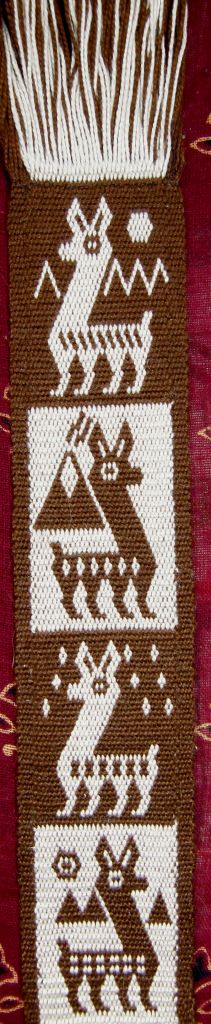
For a nice thin bookmark that is not too bulky within a book, I use a 35wpi crochet cotton and recently used it to make a double woven bookmark with a cute llama motif.

The llama is a much loved symbol of Bolivia and Peru but you certainly don’t need to be trekking down to South America to see this lovely animal anymore. There seem to be more than enough of them being successfully raised in many other countries around the world. I saw many on the outskirts of the city on my last visit to Sydney. There was even a llama festival on at the time.

Here in Bolivia and Peru the llamas have many uses. They are used as  pack animals for transporting grains in sacks, often woven from their own fiber, from villages to markets. Their fiber is woven into blankets, coca bags , belts and other accessories as well as braided into slings and ropes.

Their dung is used as a fuel for cooking fires and their meat is often enjoyed as charque-dried meat similar to jerky. The bone from a llama’s lower leg is shaped into a pick up tool and beater-the wichuna-part of a weaver’s basic tool kit. Enterprising locals pose with their beautiful animals for tourists and they are irresistible!

Dried llama fetuses are sold at the market stalls that sell homemade remedies. The llama fetus is buried at the cornerstone of a new house as an offering to PachaMama in the hope that she will bring prosperity to the home owners.

Ladies posing with their llamas near Cusco, Peru
Llamas carrying produce on the road near Yanque, Peru
Produce at an agricultural festival is displayed in sacks made from llama fiber and wool.
You can see the dried llama fetuses hanging up high in this market stall. On the table are drop spindles, llama fiber and wichunas.
A closer look at llama ”charque”, llama fiber and two ”wichunas”.
Slings, which are beautifully braided from llama fiber, are used, among other things, to hurl stones to help control animals wandering from the herd.

As there are no llamas here in lowland Bolivia where I live, I bought bags and bags of their fiber many years ago when I was in the highlands-enough to keep me occupied spinning and weaving for many years to come. I am no spinning expert and just do as I was taught here. The fiber needs to be spun very firmly to stand up to the weaving of warp faced textiles on the backstrap loom. All the weavers that I have studied with weave with a two-ply yarn and all spinning and plying is done on drop spindles.

From left to right-two shoulder bags, a tool bag and a band that I used for a journal cover-these are all made from my handspun llama fiber. The yarn for the band was dyed after plying with cochineal, coca leaves and spearmint leaves. The designs are inspired by designs of, from left to right, lowland Bolivia, highland Peru, and highland Bolivia.
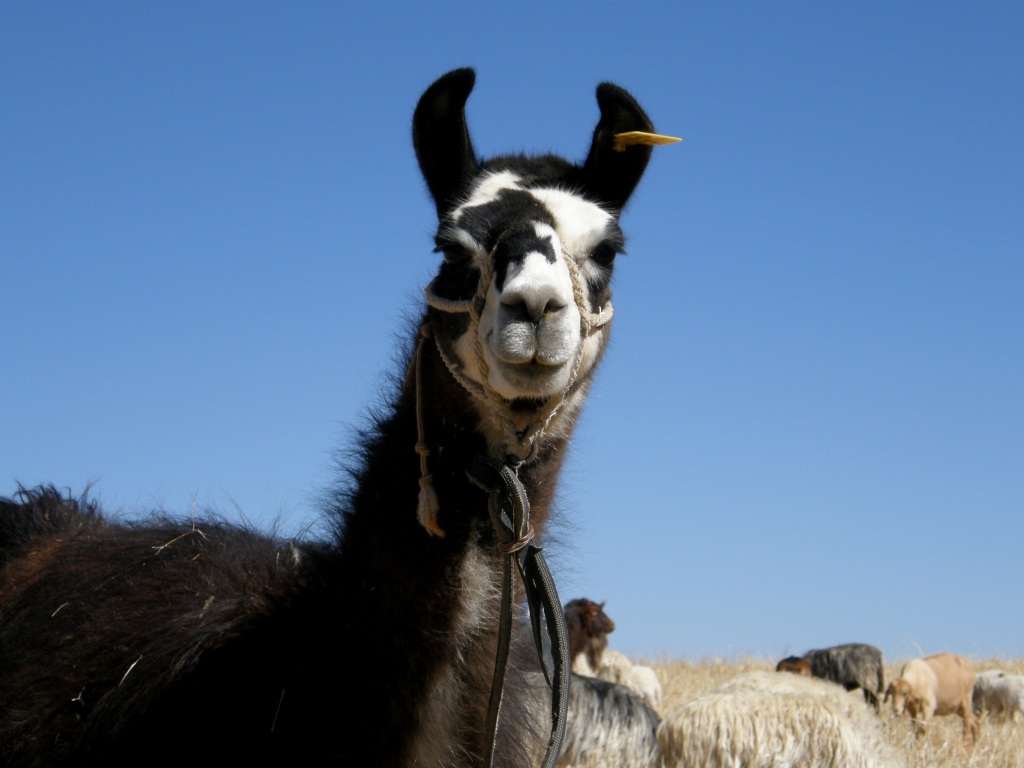
On the road near Tarabuco, Bolivia grazing alongside sheep, goats and cattle.


A full-page drawing by Guaman Poma de Ayala depicting part of a llama festival where a man is singing to a llama and, apparently the llama is singing back!

Finally, I would like to share with you all a spectacular web site with hundreds of beautiful drawings like the one above.. This is the offiicial site of the chronicles of Guaman Poma de Ayala, an indigenous Peruvian of a noble family who became disillusioned with the treatment of the native peoples of the Andes by the Spanish after the Conquest.

His  nearly 1200-page chronicle, written between 1600 and 1615,  is addressed to King Philip III of Spain and outlines the injustices of colonial rule. The 398 pages of drawings capture many aspects of daily life in pre and post Conquest Peru-festivals, costume, weaving, spinning, agricultural cycles,  Inca royalty, government……..

You can view digital facsimiles of all the pictures in this chronicle here.


Backstrap Weaving-Supplementary weft patterning and learning to weave in Guatemala

SUPPLEMENTARY WEFT PATTERNING

Lately I have been playing with supplementary weft patterning and, once again, have been inspired by Weavolution members. One member joined my Backstrap Group as she is interested, amongst other things, in reproducing a Central Asian yurt band. She has introduced me to many beautiful Central Asian designs and often sends me photos of pieces she has seen at reenactmant events that she attends.

Together we figured out the technique on a yurt band she had bought and even wove it simultaneously- all coordinated by email!

When she sent me this photo (at left) of a Central Asian piece she had photographed at one of the historical events, I couldn’t wait to weave the design into something. The technique wasn’t clear in the photo and, as I wasn’t concerned with reproducing the original technique,  I decided to weave it in either double weave or supplementary weft patterning. I chose the latter as, since studying this technique in Guatemala in 2008, I hadn’t put it to much use.

In this technique, it is really important to get the right balance between the weight of the warp yarn and that used for the supplementary weft and so I quickly wove a sample and then went ahead and made the table runner below in 4/2 cotton (24wpi) warp with 6 strands of the patterning thread that I had brought back from Guatemala as the supplementary weft. You can see that I added a little embellishment of my own to the pattern.

My colors are rather bland compared with the original. I love that orange zigzag next to the main design. Perhaps I will be more adventurous with color next time!

My table runner with a Central Asian inspired design

My other source of inspiration has been a Brazilian member of Weavolution who has generously shared what she knows about the weavings of the Huni Kuin people who live in the tropical forest of Brazil and Peru. They weave with backstrap looms using cotton that they spin and dye themselves. You can see a video of their work here and a photo of a Huni Kuin weaver here. Although they do not use  the supplementary weft technique, I chose to use this method to weave one of their designs into a bag.

A small bag with supplementary weft patterning inspired by a traditional Huni Kuin design.

Here in Bolivia, the supplementary weft technique is used by women to weave bands to decorate their hats. It is in these hatbands that I have seen the widest variety of woven designs. Except for in Calcha, where it seemed that the women had decided on one hatband design to represent their village, I have never seen two hatbands alike.

This Potolo woman is using three hatbands at once.
Hatbands from Bolivia

Sometimes the supplementary weft is used to form the motif as in the small condors on the upper half of the center band above. At other times, it is used to fill the negative space to outline the motif on the ground weave.

From having purchased some hatbands here, I was able to see how they were woven. I made a few sample bands but, as I didn’t get the right warp to weft ratio, I wasn’t too pleased with the results and never really went on to explore this technique further- that is, until I went to Guatemala in 2008 and studied weft patterning with three teachers there. It was my first time in Guatemala and an absolute explosion of color and inspiration was awaiting!

The traditional hair sash of the women of Aguacatan, Guatemala

So I would like to spend the rest of this post introducing you to my first teacher in Guatemala and showing you how I learned supplementary weft patterning with her.

Lidia lives in the very small town of Santa Catarina Barahona near San Antonio Aguas Calientes in Guatemala. The typical blouse, or huipil of the area has designs woven in single and double faced supplementary weft patterning. The large areas of double faced patterning are those that most distinguish the huipiles of this area.

Typical huilpil of San Antonio Aguas Calientes.
Single faced weft patterning. The patterns can’t be seen on the back of the textile.
This double faced patterning looks very much like embroidery. The national bird, the quetzal, is a very popular motif.
Day 1-Lesson 1. I have chosen my colors for my piece and am winding the thread into balls prior to warping
Making a small warp for my lessons
Once the loom was tensioned, the heddles were made.
Lidia’s sister Carmelita showed me how the warps, under which the patterning wefts would be placed, are picked and stored on two additional sticks. The resulting designs are called ”pepenado”.
The first design lesson-Lidia is weaving the ”tijera” (scissors) pattern. She uses a pointed stick to hook theweft tails and pass them under the raised patterning warps.
The finished tijera pattern
Double faced ”abeja”-bee
Three ”abejas” that I wove when I got home

The ”abeja” was topped off with another section of ”tijera” and that completed my second day of classes. Finally, on day three, I learned the ”arcos” (arches) pattern. This is a combination of weft inlay and warp wrapping.

Weaving the ”arcos” designs
The finished ”arcos” design

It looks like my teachers did all the weaving and I just stood around and snapped pictures! Well, I can tell you  that it wasn’t so. Lidia was a very ”hands-on” teacher and she would take over only when I got up to stretch and take photos.

But it wasn’t all hard work. Other family members and neighbors came to visit, we paused to make and eat tortillas, chatted and played with the nieces and nephews in Lidia’s shady yard and walked to town to go yarn shopping.

Snack time. While making my way around Guatemala I learned to recognize the ”slap slap slapping” sound of tortillas being prepared.
Small rectangular pieces are covered with double faced designs and closed with a drawstrig to make a baby’s hat.
Whne I got back to Bolivia I finished off the piece that I had been making with lidia and then wove another sampler to consolidate the weft patterning techniques I had learned.
And I used my lesson piece in the lid of my weaving toolbox.

I went on from Lidia’s home to study with two other weavers in Guatemala but, more about that in another post!

Lidia’s daugther Sara and her cousins

I will be doing a tutorial on suplementary weft patterning with lots of step-by-step photos here on my blog in the following weeks so that you can add designs like the Central Asian and Huni Kuin ones, that I showed you above, to your projects.

I hope you enjoyed this little trip from Central Asia, to Brazil, to Bolivia and onward to my teacher’s home in Guatemala. If you did, I would love to hear from you 🙂

Backstrap Weaving-seasons greetings from Bolivia

A little ”taste” of Bolivian Christmas fare……….

Paneton and cola de mono

Instead of Christmas cake or pudding we have paneton, or Christmas bread. This is a mini paneton-they usually come much larger than this!

The drink is cola de mono-literally ”monkey’s tail” and is a traditional Christmas drink in Chile. During my five years in Chile we had this every Christmas but it was always home made and, therefore, always slightly different as everyone seemed to have their own recipe. The typical ingredients are coffee, milk, vanilla, cinnamon or nutmeg and cloves and a white alcohol, like white rum, pisco or aguardiente. I managed to find a bottle of it made here in Bolivia for this Christmas.

Those festive little llamas are bread dough figures that I bought in Ecuador. The town of Calderon, near Quito, is famous for these handmade figures. Bread dough baby figures were originally made and the practice has pre- Columbian origins when the figures were associated with death and burial rituals. The rituals were modified with the arrival of the Spanish and mixed with Christian traditions and are now made for All Souls’ Day ceremonies in November each year. Originally fashioned from corn, pumpkin, honey and beeswax, the figures are now made from wheat flour and heavily varnished for durability. All kinds of figures are now  made  and sold all year round.

Bread dough figures from Ecuador

Finally, they are all seated on a little pinwheel cloth that I have been making with a rigid heddle on my backstrap loom.

Salud! and happy holidays to all!!

Laverne