Before I get into the Pick-up Vs Wrap Up question, I’ll show you the completed expandable folder that I was constructing in my last post. All that was left to do was find some buttons and braid some loops. Rather than go out hunting for buttons, I stole one, a good heavy one, from one of my many wrist cuffs. I then I found two small ones lurking in my sewing box purse. I had originally been planning to use them on that little purse but ended up going with snaps instead.
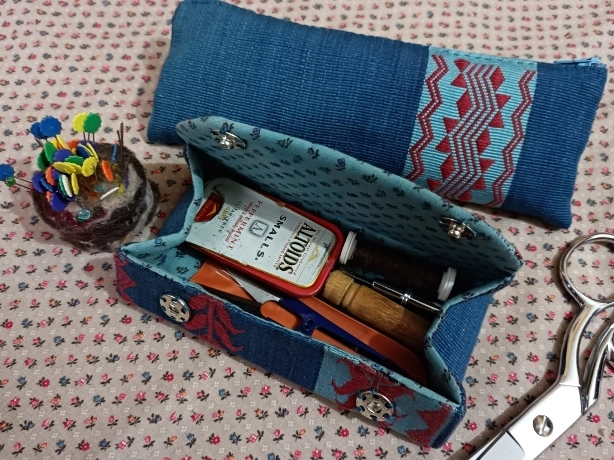

I guess I’m in a weave-and-construct phase and have had the idea to create a wallet. I just use a simple plain-weave zippered purse here for notes and coins (it’s still pretty much a cash society here) but upgrade to a proper leather wallet when I am traveling and need to carry more stuff like Yellow Fever vaccination card, public transport passes, credit and debit cards etc.

I want to use some of my handspun cotton singles for the wallet project. It won’t take much to create such a small piece of fabric and there’ll be plenty of thread left over for other more ambitious things. I finally got all the white handspun boiled and ready for use.

So far, I’ve only used my handspun cotton singles in plain-weave ikat projects….three small pieces, a zippered purse, a draw-string bag and a slip case. The cotton stood up well and I love how the simple warp-faced plain weave shows it off.

I have another ikat project in mind using a soft butter yellow, burgundy and black and thought that this would make a nice wallet. But then I thought that perhaps I should use the cotton in another way this time. I’ve already tried it in ikat and know that I like it. Maybe it’s more interesting to try something new? It would be good to know how well the singles thread stands up to a pick-up technique like the structure that I call Andean Pebble Weave, for example.
The process of creating both options is pretty intense! Ikat involves plain weave. That sounds so simple. However, it’s all that goes into the creation of the warp before it even hits the loom that makes it so complex. There’s the winding of the warp, the sectioning, folding and wrapping. Then comes the dyeing, more wrapping (if you’re dyeing more than one color) and dyeing again. This is followed by unwrapping, the careful settling on the loom and heddle making. Then you get to the weaving part which goes relatively quickly.

I’ve always liked these kinds of time consuming projects. These days I like them even more. They give me a whole lot of satisfying creative mileage out of just small amounts of materials.
As for pick-up, well that can be super intense as well, depending on the kind of pattern that I choose. As I’ve never used my handspun cotton for the Andean Pebble Weave structure, I needed to weave a decent-sized sample to gauge width. First, I dyed a small quantity black and wound a short warp of 320 ends.

I thought that I may as well go with a very busy pattern and give the thread, my fingers (and my brain) a good workout. Two threads broke. I’m quite used to working with black in pick-up and am pleased that these older eyes can still manage, although I think that my left one is doing most of the work.
Lately, I’ve been looking at textiles and basketry from the other side of the world….East Timor, Indonesia, Borneo…I guess with the idea of perhaps spending time in that area when I return to live in Australia. The pattern that I created for the cover of my folder was inspired by the shapes I have been seeing and in the same way, so was the pattern that I drew for this current project. It’s very busy!

It was a good call weaving a sample (it always is) as I’d started off slightly too wide. It soon settled into a consistent width. I used the method that I was taught by my very first teachers from Ayacucho which involves two sets of heddles with pick-up being done at a permanent cross. I used the “saver cord” which they taught me to use (although, to be honest, I had no idea at the time what purpose it served!) I soon learned that it is the instrument that helps me to read the pattern and saves me from having to handle and count each thread one by one. Having a permanent picking cross (rather than constantly creating and re-creating a temporary one) saves the warp from a considerable amount of wear and tear.
I figure that if the singles thread can stand up to this amount of handling, it should be okay with any other less complex pattern that I happen to choose. Hopefully, I’m not getting too cocky here. If I were to use this pattern on the wallet, it would be aligned sideways like this.

I changed the last part of the pattern (on the right) as an experiment to see what it looked like with a bit more open space.
I’m very satisfied with this sample. It’s answered my question about the suitability of my handspun for working with this structure but I still have the urge to create the aforementioned ikat piece. I haven’t come up with a pattern for that yet, just the three colors. So the question remains…Pick-up or Wrap Up? Of course, the solution is to make two wallets! Why not? That will certainly keep me out of trouble for a while.
In the meantime, I’m doing something I’ve never done before…I’m using up leftover scraps from other projects. I usually can’t bear to throw them away immediately after completing a project. They hang around until I turn them up six months later and think… why the heck am I keeping this?…and throw them away. But these I’ve kept. Perhaps I’ve been watching too many HandyMum videos (she often uses the tiniest scraps of fabric from her vast stash of commercial fabric to make sweet projects). I’m making a sample wallet with them so that I can test my ideas for putting one together. It might even be good enough to keep and use.

I have bits left over from ikat projects using my handspun cotton (that black scrap, for example, is the end of the ikat drawstring bag project). There’s a bit from the ikat cross-body purse that I wove in 20/2 cotton. You’ll recognize the stitched shibori leftovers from my folder project. The other side of the stitched shibori rectangle that you see in the picture (which is the inside of the wallet) is leftover plain blue Andean Pebble Weave fabric from this project….

I thought I’d finish this post with a little bit of book promotion, which I haven’t done for a while! The structure that I used for my latest project is the one that I call Andean Pebble Weave. This structure creates patterns that are double-faced. Of course all cloth has two faces. What I mean by double-faced patterns is that both faces of the cloth are structurally identical with colors reversed. That’s how I created one face that has a white pattern on black with the same pattern on the back in black on white.
This is a characteristic of a larger category of structures that are known as Complementary-warp. The structure that I call Andean Pebble Weave is just one variety that sits within this category.

In the picture, above, you can see at top left both faces of a pattern in the structure that I call Andean Pebble Weave with its “spotty” surface. The image top right shows another complementary-warp structure which is known as intermesh. It gives a very smooth, solid color appearance. In some places it is woven more open so that it does indeed have a very mesh-like appearance. However, my Guarani teacher here in the Bolivian lowlands weaves a very dense version which closes all the spaces between the warp threads. At bottom left, you can see the two faces of another variety with its characteristic diagonal twill lines. The image bottom right shows how a pattern can sometimes employ multiple structures, in this case, both pebble (center) and twill structures have been used side by side.
As for my books, here are two that I can recommend to those who would like to learn how to do this kind of pick-up. I wrote them for those who are already competently and confidently weaving warp-faced plain-weave bands and who would like to try one of the many kinds of pick-up patterning structures.
If you use what I call a standard inkle loom (the Schacht and Ashford models are examples), this is the book for you…..Andean Pebble Weave on Inkle Looms…

If you use any other kind of loom or set-up that allows you to create two sheds and weave warp-faced bands (including standard inkle looms) this is the book for you….Complementary-warp Pick-up…

Once you’ve learned the methods in either of these two books, you’ll be able to weave the patterns that I offer in both my follow-up pattern books… Complementary-warp Pattern Book and More Andean Pebble Weave Patterns. All my books are available as PDFs or as spiral-bound books (shipped from Washington state, USA) at Taproot Video.
I wish you all the best for your celebrations and will see you in the new year with, hopefully, at least one new wallet.
 RSS - Posts





You constantly amaze me. Your work is phenomenal, beautiful and so beyond what I could do. Thanks for sharing and a Happy Holidays!
By: Susan Kesler Simpson on December 16, 2023
at 1:45 pm
Happy Holidays to you too, Susan and thank you so much for the lovely comment.
By: lavernewaddington on December 21, 2023
at 10:42 am