Let’s start this post with the bit that is actually about weaving on a backstrap loom.
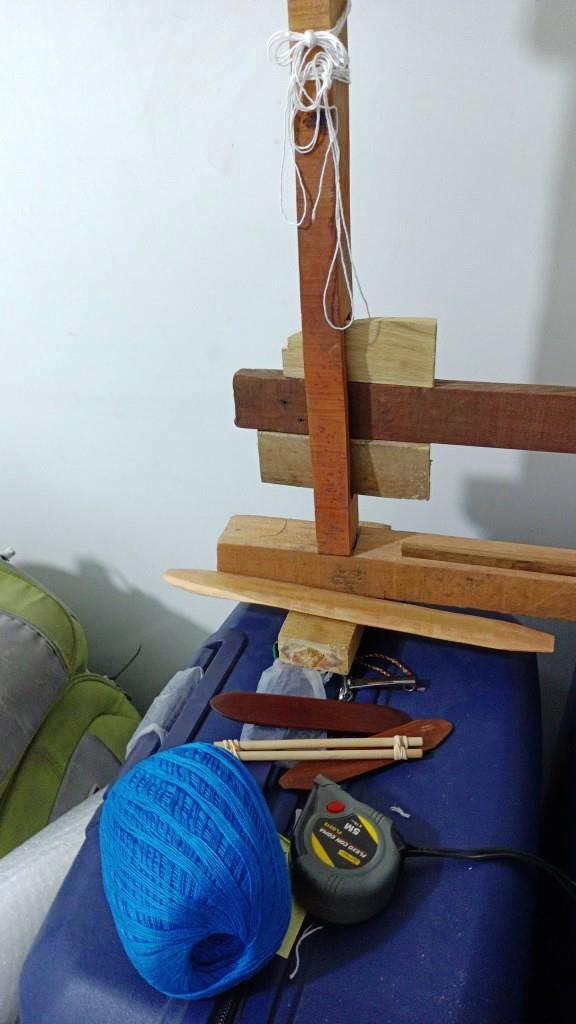
I’ve been studying with two Guaraní ladies and learning all about the style of loom that they use. It’s not a backstrap loom but rather a free-standing vertical frame.

After weaving my second project on this loom, I decided to use the cloth I’d produced to cover a notebook in which I could record all I was learning with my Guaraní as well as Ayoreo teachers.

That’s where the backstrap loom came in. I wanted to weave bands with the titles of the book. One half would be for all the notes on the Guaraní loom. The book could then be flipped over so that other half could be used for the Ayoreo notes. I used Clea cotton (2-ply approx 35wpi) and embroidery floss for the supplementary weft.
For the book cover fabric I used a generic cotton from a large cone that my Guaraní teachers typically use and dyed some of it two shades of blue.

And then I had to refer to my drawings again to get back into the swing of dovetail warping.

I had encountered this dovetail style of warping in several places in Ecuador and had had the chance to observe it being done in both wool (Otavalo) and cotton and acrylic (Salasaca) but I only had the opportunity to try it myself when I studied with weavers in coastal Ecuador.

It can be a little confusing but when working with only one color, you soon get the hang of following this kind of warping path.

It creates what I call a discontinuous circle. The warp threads travel in one direction until they reach D and then turn and proceed in the opposite direction until they again reach D. The drawing above resembles the set-up that we used in coastal Ecuador and the one that better represents the Guaraní set-up is below.

When weaving has been completed, element D (which was a stick in Ecuador and a string on the Guaraní loom) is removed and the cloth can be opened out to its full length leaving the loops at the ends of the unwoven warp intact. These loops are then used by the weavers in coastal Ecuador as part of the construction of their hammocks. In a normal circular warp, the warp has to be cut in order to open out the cloth to its full length.
When you start trying to use two colors at once on slightly different paths things get a little mind bending. Two colors are used when the Guarani weavers are going to create patterns in pick-up or just horizontal bars. The first time I did this with my Guaraní teachers, I have to admit that I hadn’t quite wrapped my head around it and was just blindly following the path that they patiently pointed out to me. Only later, when I sat down at my notebook and made my drawings, did I get it all straightened out in my head. But even so, I’ll be needing to refer to my notes for a while until I’ve had more practice.

With this learning warp I wove a piece that was wide enough to make a coin purse. However, once the piece was off the loom, I decided to sew two pieces together side by side and make a wider purse that’s more suitable for tools.


Clara was not keen on allowing me to make the heddles and I had to insist on being allowed to make at least the last three on my own. It wasn’t enough and I definitely need more practice. I hope to make our next class all about heddle making. So, when I created the much wider warp for the book cover, I went with the heddles that I am more used to making and tied them off in small bunches. I find it a lot easier to work with these bunches of heddles rather than with heddles suspended on a stick when working on a fixed tension loom such as this, and especially when the piece is wider than band-width.



As`for my studies with the Ayoreo looping technique, I made use of the small amounts of the remaining garabatá thread by dyeing it and creating another cuff. Because I only had quite short pieces left and I haven’t got the hang of the clever knotless way of joining two lengths of thread together, I created this cuff in a slightly different way. Instead of working a wide and short piece, I made a narrow and long piece. That way I never ran out of thread in the middle of a row.
I made it mostly about stripes and added a small Chiqueno pattern in the middle.
The thread takes up the dye beautifully!

And because my edges, which got hidden within the hems in my other cuffs, would be exposed on this one….and weren’t pretty!….I added a cotton tubular edging to conceal them. And that tubular band is another backstrap loom project to add to this post.

When I next meet with my teacher Rocío, I’ll have her show me the neat way she has of carrying colors along the edge. And then we’ll get into spinning the big wad of fiber that she got for me! (I showed it in my last post if you missed it and are curious).

In the meantime, I’ve been visiting a lovely outdoor artisan market that’s just a few blocks from my place. Señora Carmen has a very small stall there where she sells handwork of the indigenous peoples of this lowland part of Bolivia. There I discovered that there is another group here that works with the same fiber as the Ayoreo people. They’re called Weenhayek and they call the fiber caraguata. They work the looped stitch much more loosely but the finishing stitch that they use along the mouths of the bags is different (and I think nicer than the one used by the Ayoreo). I had to buy one of their bags so that I could figure it out (I managed to) and I’m wondering if Rocío knows how to do it.

And there I’ll leave it for this post. I’ll be getting back to my classes once we’re into the new year. In the meantime there’s plenty to keep me busy with Guaraní, Ayoreo and backstrap loom projects.
Hopefully next time I’ll be able to show a bit about how the garabatá fiber is spun. Until then, sporting a cooling summer cut (the hottest days are yet to come!), I’ll wish you all from my “transition home” here in Santa Cruz, Bolivia a Happy New Year.

 RSS - Posts





Very interesting! and I love the loom and book covers and little purses! Always good to learn about new techniques!
By: kathyo on December 27, 2024
at 5:23 am
Thank you very much. 😊 As someone who often teaches, it’s a very good experience being back in the student seat again.
By: lavernewaddington on December 28, 2024
at 10:12 am
As long as we are learning, We will never be Bored…. ❤️
By: kathyo on December 28, 2024
at 5:30 pm
Beautiful work! I am a new weaver and appreciate all the work.
By: adventuresofhappyandnan on December 27, 2024
at 8:42 am
Thank you so much!
By: lavernewaddington on December 28, 2024
at 10:13 am
Will your book, “More Adventures with Warp-faced Pick-up Patterns” be available for purchase in book form again? I looked on Taproot Video and it said it is only avalible as a PDF. Your books are amazing, thank you so much.
By: thebutterflygirl316 on December 28, 2024
at 7:46 pm
Hi. Thank you! Unfortunately, not. It’s become too expensive to print and I’ve had to give priority to my more recent publications in my budgeting. You are able to print a copy of the PDF for your own personal use if that’s an option for you.
By: lavernewaddington on December 28, 2024
at 8:58 pm
I have been your reader for many years, thanks for sharing so much over the years through your blog. I wish you a happy and healthy new year 2025, cheers!
By: Maggie on December 31, 2024
at 5:23 pm
The very warmest New Year wishes to you too, Maggie
Thank you so much.
By: lavernewaddington on January 10, 2025
at 5:23 pm
Absolutely Lovely!
Glorious Golden Light To You!
The Adventure Continues!
✨🌅💛🌅✨
By: Asher T. Sinclaire on January 16, 2025
at 8:11 pm
Thank you, Asher. I’m up in the beautiful Bolivian highlands right now and have lots to share about that in my next post.
By: lavernewaddington on January 26, 2025
at 12:40 pm
✨🌞✨
By: Asher T. Sinclaire on January 26, 2025
at 7:52 pm