Backstrap Weaving – Show and Tell

Show and Tell and tell and tell…get the word out, spread the obsession. It is exciting to be all the way over here in Australia and run across this…
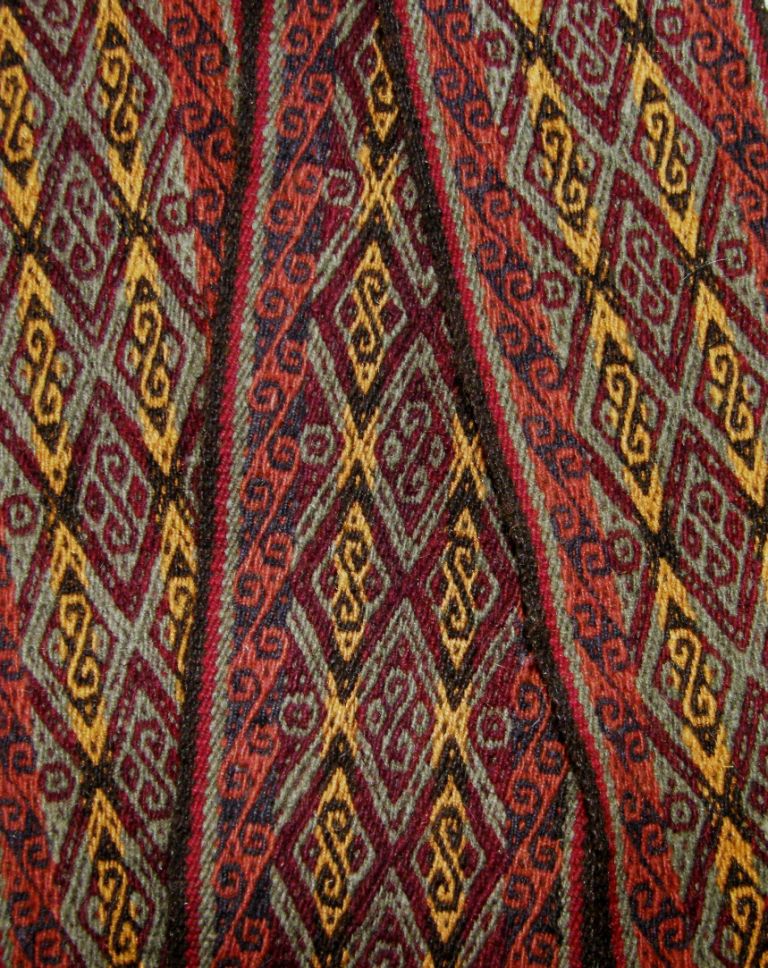
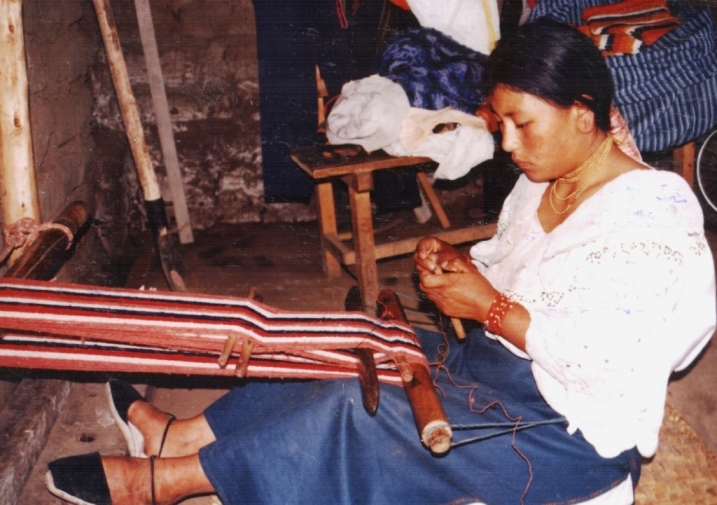
??????????????????????The Center for Traditonal Textiles in Cusco (CTTC) reaches across the world, showing and telling, promoting and sustaining the work of  weavers on simple looms in remote communities of highland Peru. This piece was bought from founder Nilda Callañaupa herself when she visited Bothwell, Tasmania in 2007. One of the people who came to weave with me a few weeks ago here in Sydney had been to Peru and came with  bags and pieces still on the loom with those distinctive Chinchero patterns woven with handspun naturally dyed yarn. One of the other ladies immediately picked up her smartphone and started searching for the site from which she could buy these items. Show and Tell…spread the word!

From the CTTC's Facebook page
From the CTTC’s Facebook page

One of the greatest Show and Tell events in my world of weaving was held last month in Cusco. The CTTC hosted its second Tinkuy de Tejedores, a gathering of weavers from across the Americas and even from as far away as Asia.

I couldn’t go this time but have heard a few reports from friends.

Dorinda, who works with weavers in Cochabamba, Bolivia went with one of my weaving teachers, Maxima. Maxima took workshops and learned three new figures in a backstrap weaving class as well as the ñawi awapa edging. It was something she had been wanting to learn for years. Her sister knew how to do it but I guess she hasn’t been nearby to teach it to Maxima. Finally, the curiosity has been satisfied and I look forward to seeing Maxima put it to use.

Maxima and a group of Bolivian weavers at Tinkuy 2010

Dorinda’s PAZA website is currently down but she tells me that she has four blog posts prepared with details of the trip ready to go up once the problem is fixed.

???????????????????????????????Who doesn’t like Show and Tell? In the guild meetings that I have attended so far in the US and Australia, this has always been my favorite part. I am a member of several online weaving groups and we do our share of show and tell on a daily basis. Some of the larger groups, like Warped Weavers on Ravelry, can have dozens of projects presented in a single day. There is always something to learn. But, of course there is nothing like being able to actually handle the fabrics and yarns and listen to the weavers and spinners’ enthusiastic descriptions and explanations.

I spent a nice Saturday  in the lower Blue Mountains last Saturday at the home of weaver Helen (author of the electronic newsletter, Weavers Forum). Helen has a nice group of about fifteen mountain weavers and spinners who regularly meet at her home for fiber talk, lots of laughter, occasional workshops and, of course, show and tell. That’s yet another reason for me to consider settling in the mountains should I ever come back to Australia to live permanently….the aromas and colors of the bush, the bird song, the cicadas, the coolness,….and a lovely community of weavers!

Lorette with knotted pile on backstrap loomLorette brought along a backstrap loom that she and a few friends had put together some years ago with its unfinished project. Just when I am taking home tools for knotted pile weaving and wondering if I am mad to be thinking about doing it on a backstrap loom, along comes Lorette with her Show and Tell. She showed me that yes, it is do-able and that she was able to produce nice firm and well beaten rows of cut pile. I wonder if she has found the inspiration to finish this project now.

I was happy to receive the most beautiful gift from Helen as I left after a fun day spent with her weaving friends…

??????????????????????My camera has somewhat softened the pretty tones of green in this scarf but I hope that it gives you an idea of its wonderful flowing liquid silkiness. This was made by Helen in an advancing twill structure. This was Show and Tell and  I got to keep it! It is just the kind of light weight scarf that I can really use. Beautiful!

??????????????????????Yesterday I went out to Dace’s home. Dace had invited me to her home for a morning of dyeing.

The Mission: take home cotton yarn that had been dyed with native Australian plants.

I would like to weave something that represents my trip and this seemed like a good way to start. Fortunately, I had taught myself from an experience many years ago that cotton and wool take color very differently. I had been wooed by the sight of the most amazing shade of orange that Dace had achieved when dyeing wool with leaves from a certain kind of eucalyptus (see left). I knew not to expect anything like this kind of intensity from cotton.

Two of the ladies at the gathering at Helen’s house advised me to mordant my thread with diluted soy milk which I did. Dace’s home filled with the gorgeous aroma of eucalyptus as the pots boiled on the stove. It drove her husband and cat away for the day! You can see the tree from which Dace took leaves and bark below right. She told me that it is one of the “box” varieties of eucalypt.

eucalyptus for dyeingAs the pots, one with bark and the other with  leaves boiled away, we did a lot of Show and Tell. Dace showed me some yarn that she dyed with the same variety of eucalypt…

spun yarn by daceAgain, that gorgeous orange! And again I reminded myself that I was not expect anything like that result. Still, I couldn’t help hoping…
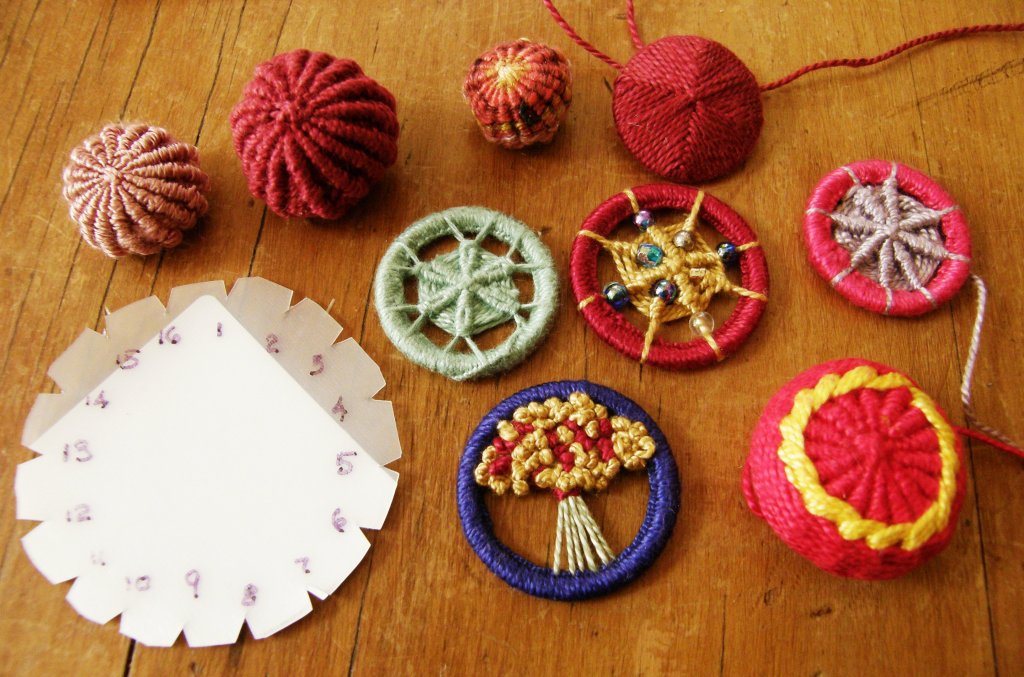
??????????????????????This was another fascinating piece of Show and Tell. Dace had taken the NSW guild’s summer school class lat January on buttons and produced all these over the course of four days. I was especially interested in the ball-like buttons upper left which so resembled the little coil stitch pom-poms that Bolivian weavers sometimes have dangling form their ch’uspas, coca leaf bags. Dace gave me enough information to be able to come home and make one…fun! The Bolivian pom poms can be made in multiple colors whereas these ball-like buttons cannot.

???????????????????????????????There you can see my button (made with wool) nestled between my dyed skeins. The skens on the left came from the leaf pot and the other from the bark. Okay, so they are not the most brilliant tones in the world but…mission accomplished. I have cotton dyed with native Australian plant material. And I will take home the happy smells of the Austraian bush which have not faded after rinsing. Dace told me to use vinegar with the rinse but I didn’t, not wanting to lose the eucalyptus smell.

Those buttons! I am on a road trip to Canberra tomorrow to watch my nephew compete in a triathlon. Guess what I’ll be doing in the car and probably during the race!

Dace is Latvian and, while talking about both our backgrounds, she came out with some Latvian bands that she had bought on a trip to her homeland in 2011. These are all woven with supplemental warps (and now I realize that we are probably not looking at the “good” face of the one on the left).

??????????????????????I love the simple border on the third band from the left…so simple and so very effective.
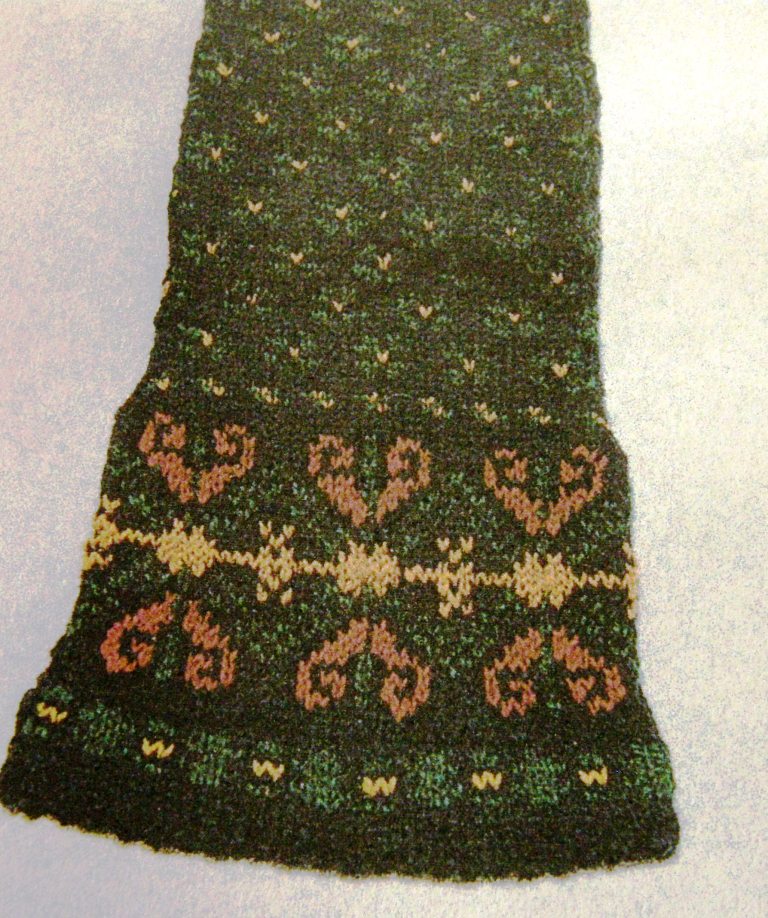
Latvian mitten patternDace showed me pictures of Latvian mittens and I loved this one with its hook design…a hook and its reflection…so like a classic Andean weaving motif which I am sure that many of you will recognize.

Speaking of Latvian bands, I  made contact online with Sanita who very recently started a blog on Latvian band weaving. She is slowly constructing it and it promises to be very informative. So far, she has included pictures of bands with pick-up patterns using supplemental warps as well as (and this make me very excited) those which have used what I call the Andean Pebble Weave structure.

Sanita confirmed the stucture by sending me charts of some of the patterns. I think I am edging a little closer to finding an answer to my questions about the use of this structure in the belts of the Russian Old Believers.

Keep an eye on Sanita’s site.

Well, I am off to make some more button/pom poms and can’t wait to have some dangling from my next woven pouch. I miss my loom and my big weaving…this is the next best thing until I get back to Bolivia.

knitted hat with south american birdSpeaking of pom poms, I will leave you with one last picture. I uncovered a relic from my past while going through boxes of “stuff” here in Australia. This is possibly the only surviving piece from the little knitting machine endeavor I had in my early 20s. I used to make hats and headbands by the dozens for skiers. It seems like I might have been trying to use up odds and ends of left over colors in this one! The thing that I like is the little South American-like bird motif that I chose to include. I have no idea about the origin of that motif but I think it is fun to see that many many years before South America and weaving became a part of my life, I had a definite interest in these kinds of patterns.

See you next week! (possibly from Bolivia)

Backstrap Weaving – Hands Full of Threads

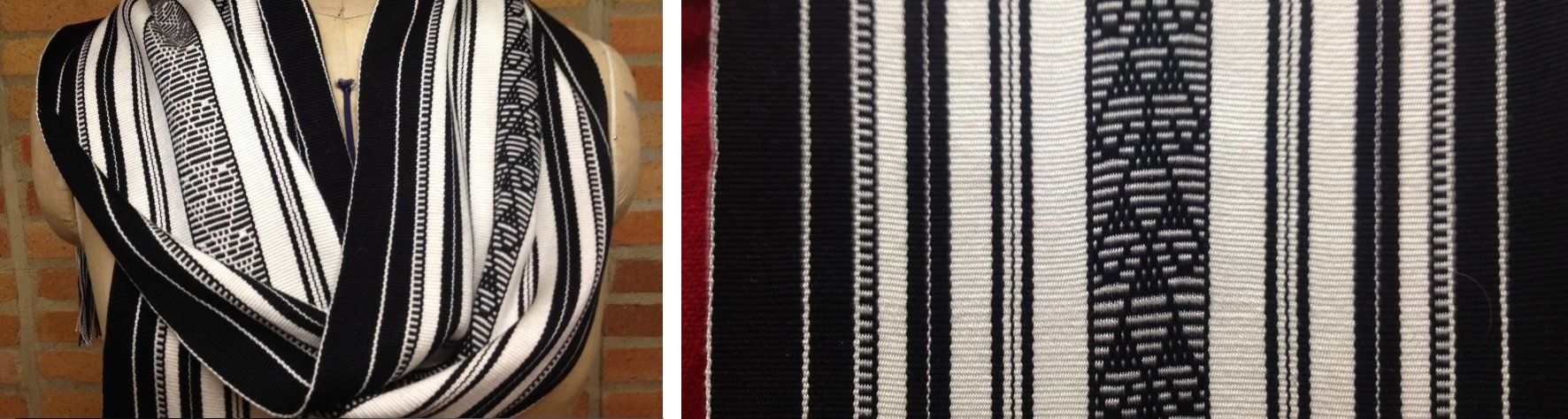
The black neck wrap is done and I am already thinking about the next one.

I thoroughly enjoyed working with this fine Guatemalan cotton thread (you see how I have forgotten about all the woes in the beginning!). It was fun picking up threads with the delicate Guatemalan pick-up sticks and feeling the silk supplementary wefts slide through my fingers.

This will be the color scheme for the next one…

colors for next backstrap woven scarf

Maybe I will use some Guatemalan-inspired designs this time or perhaps I will invent some of my own.

cotton-spinnersI got the black piece off the loom and then I was faced with fringe twisting. Would you believe I have never done this before? I have left fringes on placemats and braided the ends of other pieces. I had read the grumblings about fringe twisting from those who regularly weave scarves in the weaving forums and seen pictures of the gadgets and gizmos that have been designed to make this task less tedious.

I even watched a video I had taken of my Montagnard weaving and twining teacher, Ju Nie (seen at left spinning cotton), twisting the ends of a piece she had recently taken off her backstrap loom. Ju had come to visit at friend Betsy’s house and, rather than sit idle while chatting in the living room, she pulled out a wad of stuff wrapped in paper and a woven piece of cloth and started working. The “stuff” turned out to be mushy, sticky over-cooked rice through which she drew the warp ends before rolling them on her leg and setting them in the twist.

Here is the video. Ju explains that doing it on her pants is “no good” and that it works much better on her bare leg. I am guessing that her bare shin makes the best rolling surface.


So, I twisted my fringe and it wasn’t as slow as I had thought…much faster than braiding, I can tell you! I added weft twining to the ends of the fabric before taking it off the loom. I think that made a nice finish.  See the countered weft twining tutorial here.

And then I found that scarves are kind of hard to photograph…way too long and flat and lifeless to try and stretch out in one shot so I gathered it up and threw it down many times, fiddled about and I felt that this was the best “pose” in the end.

bhutan scarf with border

And another shot that shows my favorite central motif…

finished bhutan scarf backstrap loom

Although I was mad keen to get into the Guatemalan purple thread and warp up another scarf, (especially since I think that I  already experienced, hopefully, all possible mishaps when weaving the black one), I decided that there was another project sitting in the closet that needed my attention…(plus I really need to ponder and plan the patterns I want to use on the purple scarf before rushing in and weaving it)…

wayuu_motif_with_twining

Remember this guy? I had just started the large main motif when I decided that I would not touch this until I was sure I would have enough time to stick with it and finish it. When doing pick-up, I think it is best to do a pattern all in one go rather than leave it sitting while I travel. If I leave a piece for a long period of time,  I can almost see the place where I left off and picked up again. Perhaps I sit a little differently, apply a little bit more or less tension, beat differently…I don’t know…something changes. So, now is the time to get down and finish this piece.

Usig a forked stick in the warpI welcome the opportunity to have my hands in there and full of threads again. I am not a pick-up stick kind of gal,  unless a particular technique or yarn really demands it. I like to hold and pick and drop threads with my hands. Perhaps it’s because that is the way my first Peruvian teachers showed me. I have been shown and I have willingly tried other ways but I always come back to just using my hands.

Here is a weaver creating a belt patterned with supplementary warps. It is a narrow piece and so it is easy for her to simply insert her hand between the warp layers to do the pick-up.

I was finally successful in uploading the video of this weaver at work. You can see how she does her pick-up as well as see the two-stick method she uses for opening the heddle shed. She has a forked stick in the warp….one prong is her shed rod and the other prong holds a second cross. Grasping and twisting the fork, while leaning forward to relax tension, helps her to smoothly open the heddle shed. 

These are the kinds of textiles she produces…

O

I watched a gentleman from Chahuaytire also weaving supplementary-warp patterns into a much wider piece of cloth. He uses a pick-up stick to hold all the threads in both the pattern and plain-weave sections as he works his way across the cloth…


This is his weaving…

chahuaytire backstrap weaving

Both weavers work equally fast, don’t you think?

So, on I go with hands full of threads. This is the third piece in my red-white-and-black wall hanging series. This one has patterns which have been inspired by the si’ira belts woven by the Wayuu people of Colombia and Venezuela. Since starting this project, I got to go to Holland and meet Mirja Wark who spent years studying, collecting and cataloging these belts as well as writing a book describing the weaving, braiding and twining techniques used.

si'ira belts wayuu mirja wark

wayuu project in progressThese are belts that Mirja herself wove while studying. You can see the “cow’s nose” pattern at the bottom of the blue, pink and green belt that I used in my wall hanging. The large motif that I will use in the center has been very much adapted to fit my piece and uses just certain elements of the Wayuu patterns as inspiration. There are a lot of threads to pick and, until I things get rolling, I am very much clinging to my pattern chart. Thank you, Terri, for introducing me to removable highlighter tape which works like a dream!

So I will be parked in front of that piece for some time while taking breaks to re-spin the Malabrigo yarn, plan supplementary-weft patterns for the discontinuous-warp piece for which the Malabrigo is destined, ball up that large skein of Guatemalan purple cotton, sketch some patterns for the purple scarf project, plan piece number four in the wall hanging series…maybe ikat??…do I dare?

And I am folding this sampler piece this way and that to see if something useful can be made of it. It’s still on the loom and there is room for more pattern experiments.

O

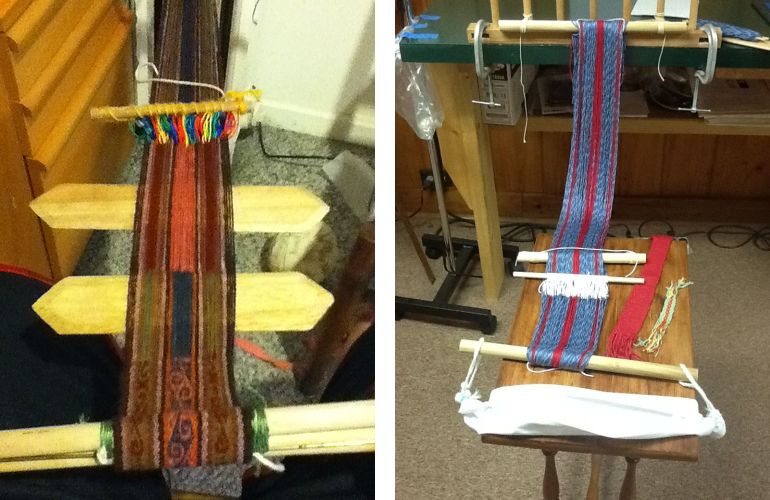
Let me show you some things that Ravelry members and students and friends have made. It is a strange coincidence that three people decided to edge pieces of clothing with woven bands. Janet decorated a pair of felted slippers that she made, Laura edged gloves (and also made a camera strap and headbands) and Julia edged a couple of tiny shadow-weave kimonos with a pebble weave band. Three gorgeous projects! (I am in love with that shadow-weave cloth, by the way…it takes four shafts…I would like to try it).
christmas_projects__2012_006_medium

laura xmas projects

kimono_baby_black___white2_mediumI will leave you with the happy twin recipients of the wee kimonos…Julia’s grand nieces!

ZellaHattieinKimono_medium2

######################################

Right before I was about to publish this post,  a question was posted in the Ravelry group by a weaver who is trying supplementary-weft patterning for the first time and not getting the rich satin-like finish  that she would like in her patterns. Instead, there are spaces and gaps between the rows of her design. I posted a reply in the group but am copying it here as I think that it may be useful for others who feel like trying this lovely technique…

There is no formula that will suit all weavers…that is, “x” number of strands of such-and-such a supp weft material will give sufficient coverage with such-and-such warp thread. All weavers are different in the way they handle their warps.

For example, some weavers put a lot more tension on their warp than others. This means that they have fewer picks per inch than others because the warps are pulled so tight that they can’t bend over and under the wefts as easily as they do for weavers who use less tension. This means that a certain amount of supplementary weft material won’t give the same amount of coverage for those weavers as it does for others who use less tension.

Another case…some people simply don’t beat hard enough when using supplementary wefts. I beat hard and really mash the weft into place…not “wham wham” beating…more like placing the beater right at the weaving line and pushing against the weft hard with a rocking motion.

Other people pull too tightly on the supplementary weft. It has to be fairly relaxed in the shed to allow it to spread and cover the surface. As an experiment, pull your supplementary weft tight once you have changed sheds and see what happens. It will flatten and narrow and not give good coverage. You have to find the balance between thread that is relaxed enough in the shed and bumps at the sides, where the weft turns, that are not too big and loose.

These are all things that come with trial and error and experience. It might be that you need to use more supp weft material or it could be one of the other factors I have mentioned here.

I often use thread that is similar to #3 and #10 crochet cotton. It is Brazilian cotton that I get here in Bolivia. I have used two strands of embroidery floss with the “#3” and one and a half with the “#10”. This gives people an idea of where to start and what to try but, as I said, every weaver is different.

Hope this helps.

ETA My first Guatemalan teacher combed the strands of her supp wefts with the point of her pick-up stick so that they lay next to rather than on top of each other. They didn’t move with handling…the floats are not long enough to cause that to happen. I did the same with the six strands of 60/2 silk on my current project.

Backstrap Weaving – Everywhere an Eye-Eye

Here an eye, there an eye….

I have been casting my eyes over Veronica Cereceda’s beautiful book on the weaving of the people of Tinkipaya, Bolivia marveling at the complexity of the patterns and the use of certain combinations of color to create light and shadow. According to Cereceda, the colors most used, and this is immediately evident from the many stunning photos in the book, are white, yellow, orange, black, light green, dark green, bright blue, bright pink, dark red and purple. I have yet to find any reference to the type of yarn used and whether it is bought in these colors or dyed by the weavers themselves, but as I said, I have only had the time to simply leaf through the book at this point.

I have to say that it is refreshing to find these bright, obviously synthetic colors in use in these gorgeous textiles.

The bright pinks, lime greens and strong yellows so often favored by the women of the highlands can quite often be jarring to our “Western” eyes.

When one sees the dry, bleak landscape of  the high plains, it is easy to appreciate the desire to create brightly colored cloth.

However, I think that it is the certain placement of these colors on the cloth of Tinkipaya to create the bands of light and shade that make these textiles so attractive.

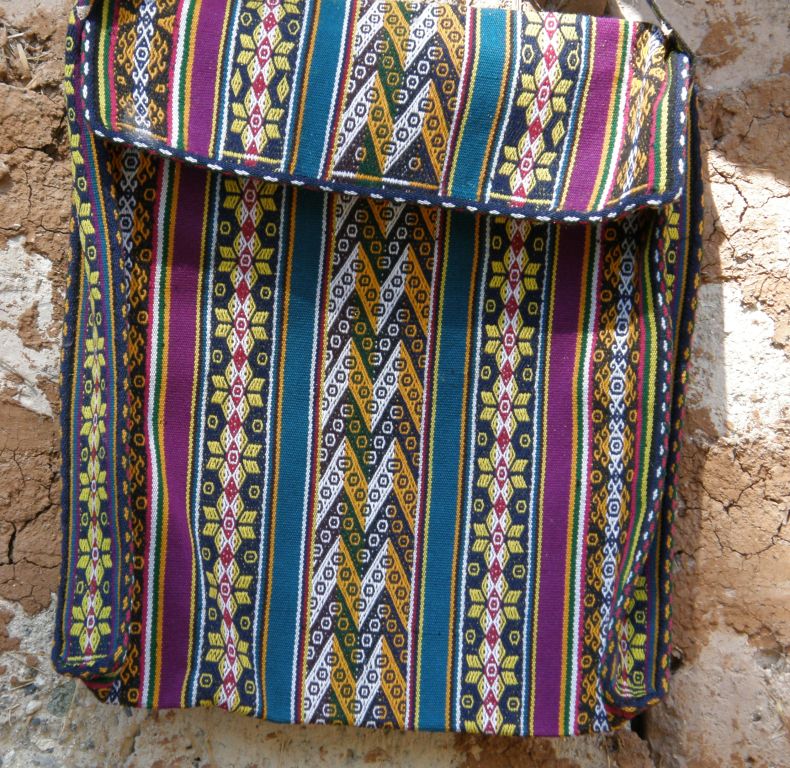
The piece above from Tinkpaya was most likely made for sale to tourists and may have been adapted slightly color-wise for this purpose. I don’t see anything with that particular shade of blue among the many pictures in Cereceda’s book and the colors generally are a little bit toned down compared to the pieces I see on the pages.

I can actually get a little tired of muted natural dye colors in the same way that I get tired of  wandering from booth to booth of hand painted skeins at fiber festivals. I have always said that I am not a “yarny’ person. Don’t get me wrong, I do love the natural dye colors, but it is very nice now and then, just for a change, to see the brighter and more “acid’ colors used so nicely.

When I learned to weave in Potosi, the same province of Bolivia in which Tinkpaya is located, I had my teacher choose the colors for my second learning piece as I wanted to weave something that was to her taste. My teachers were not from Tinkipaya and the placement of the colors in the pieces I wove with them has nothing to do with the style of textile from Tinkipaya. Yet it is interesting to see the kinds of colors, pictured above, that they favor when we in the west are so drawn to the softer earthy tones achieved when using natural dyes.

The design that I wove with my teachers on the ch’uspa, the smaller of the two bags pictured above, is woven in Tinkipaya where it is known as ch’uritos,  spirals. I have been told by other weavers that the pattern represents the swirling waters of a fast running river. It is normal in my experience to hear different interpretations of the same designs from different weavers.

The small “circles” on the Tinkipaya textile are very typical and are called ñawis, eyes, according to Cereceda. Weavers that I have met have generally told me the name in Spanish…ojitos. The zig zags on which the ñawis sit, known as kutinaku, are also very typical and are one of the principal identifying elements of textiles of Macha and Tinkipaya.

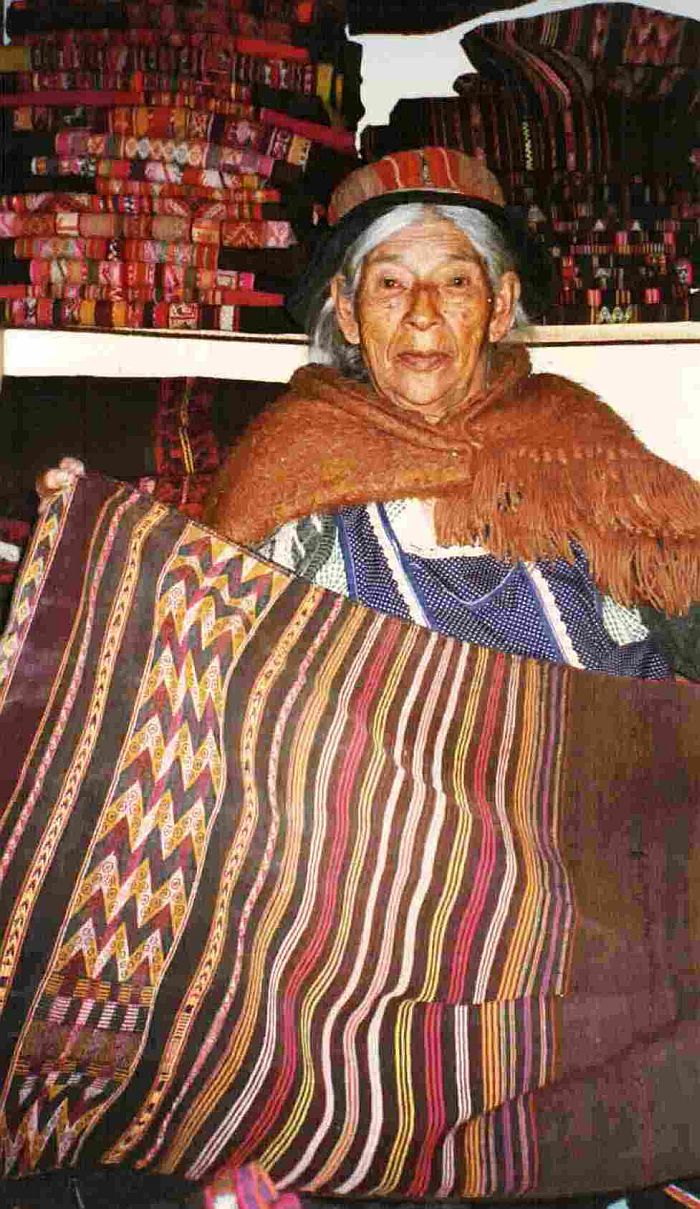
Here is Dona Maxima in her tiny store in Sucre in 1997 showing my friend Ulla and I a weaving from Macha with its kutinaku and ñawis.

I wanted to try weaving  just a small slice of the eye design from one of the Tinkipaya textiles so that was one of my projects this week.

There it is on the purple pouch which has a nice lilac zip from the bag of assorted zips that were given to me by Sharon and Betty. I am always bound to find just the right color in that bag. And I added some more eyes in the form of a ñawi awapa to the perimeter of the bag and braided a zip pull.

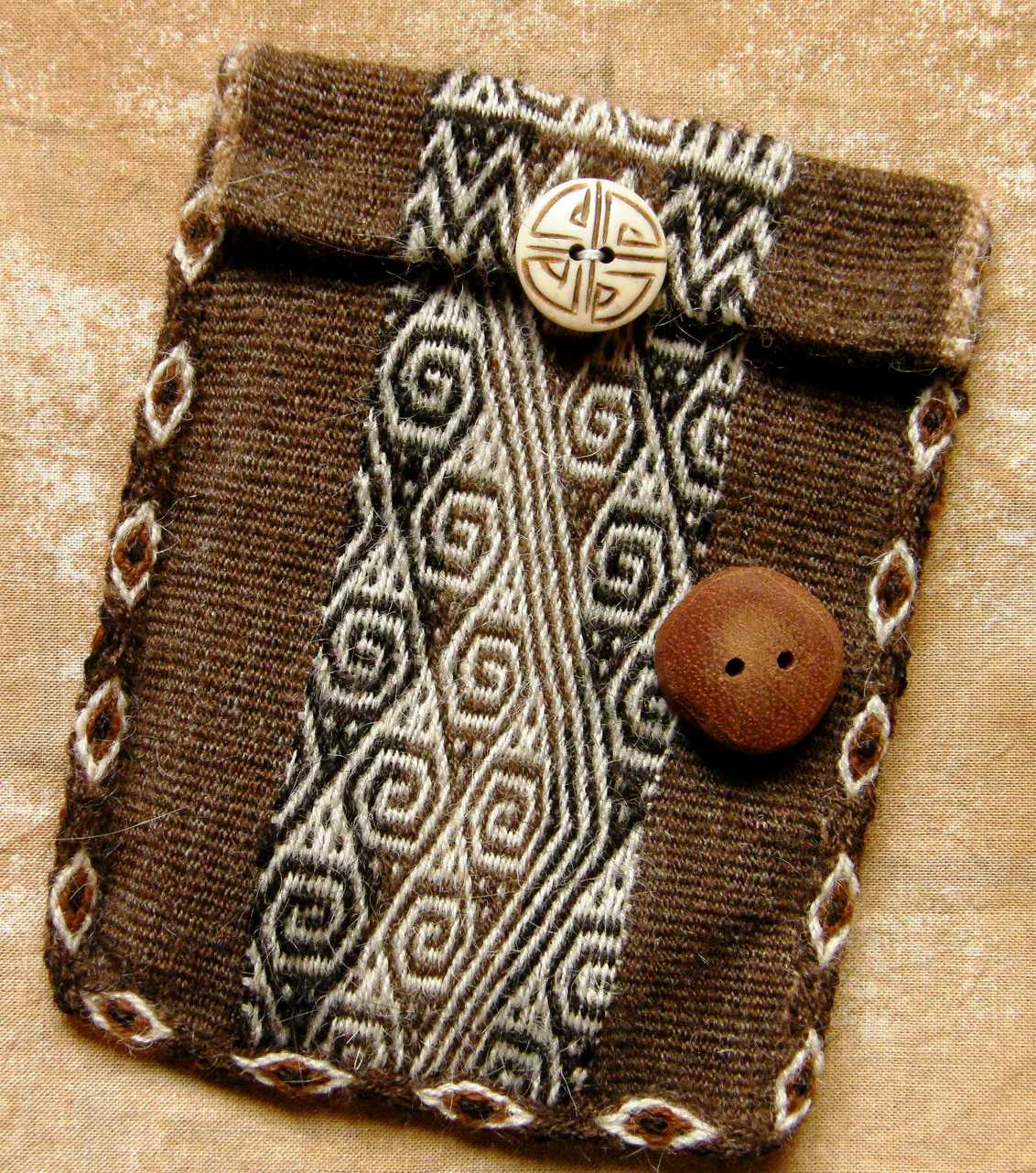
And, as the Tour de Fleece is in full swing over on Ravelry (this is a spinning event run in conjunction with the Tour de France cycle race), I pulled out my handspun alpaca pouch with its spiraly eye-like Tarahumara design (now everything looks like eyes to me!) to remind myself that yes, I can and do spin and weave with my yarn and yes, I should contribute something to the Backstrap Weaving group’s Tour de Fleece team.

So far only Janet and Jennifer are doing their bit.

But I mainly got that alpaca pouch out as I found a nice button for it while I was away….bone with a cool etched design and so I wanted to sew that on and fasten some snap closures to the inside (I had been using velcro on the inside of the flap…urrrgh!)

It was a toss-up between the bone button and the sweet wooden one which was made by a gentleman in the town where my weaving teacher Maxima lives. The wooden one is a bit on the bulky side for such a small pouch but boy, does it smell good!
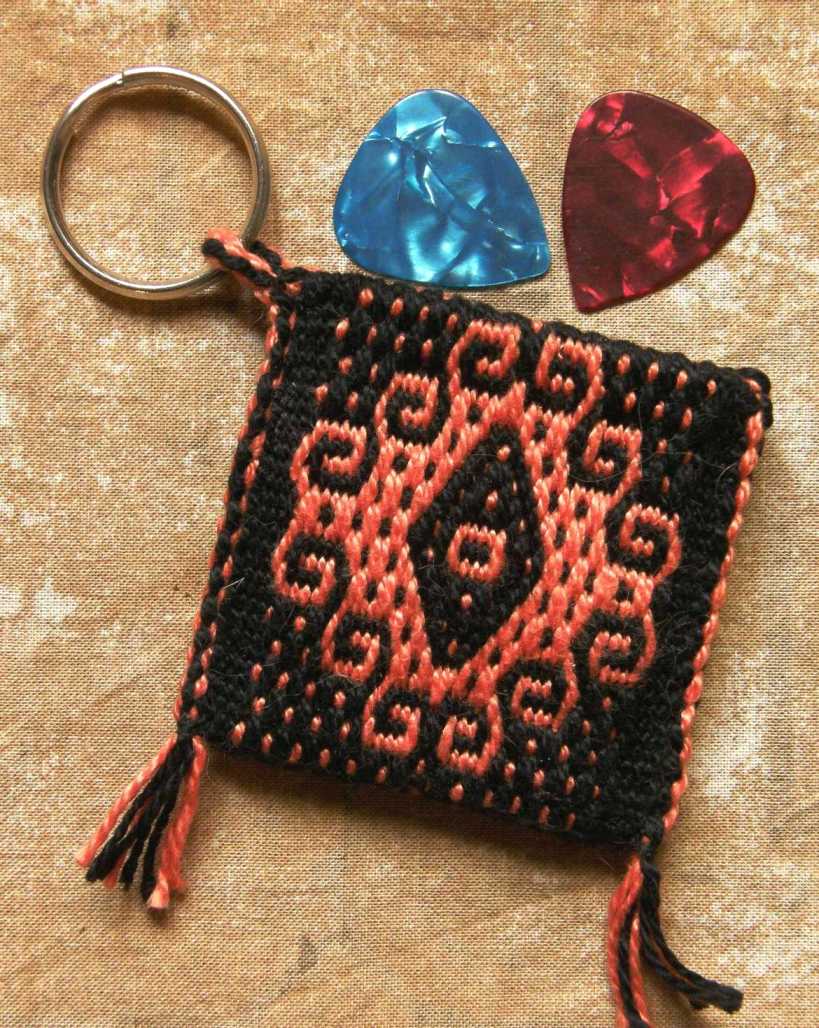
Then there is the wee black and orange bag-let also pictured above…another sample band that got turned into a pouch for guitar picks. My guitar-playing friend spotted it and came up with that idea.

So, a snap closure, braid, tassels and ring was added and off that goes to its new owner.

If you are wondering about the raw edge (I made three selvedges), I had enough band to turn to the inside and all the way to the bottom of the bag.

When I showed the Bedouin bag on Facebook last week, someone said that I should use the brand name CLT (Cute Little Things). Yes, I do like things in miniature and while I still have the eyes for such work I like to go tiny sometimes…

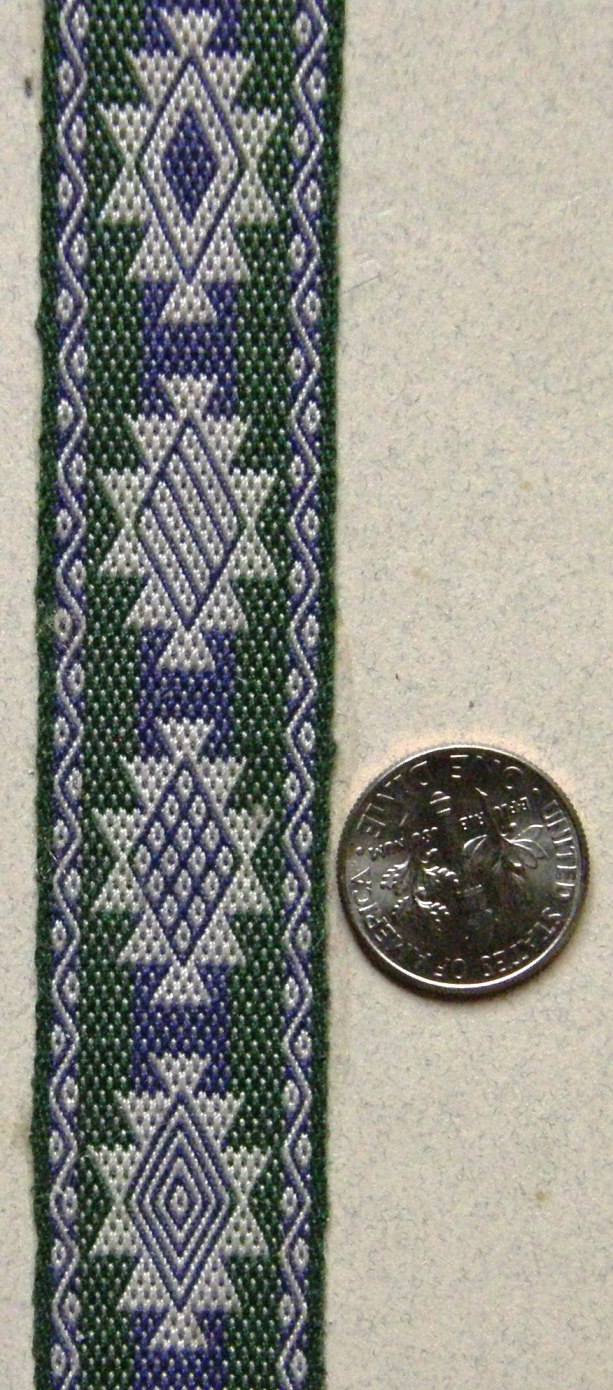
The pebble weave band at left, pictured next to a dime, is made from sewing thread and features stars that were inspired by Bolivian lowland weavings placed within a  highland design.

Poking around among my books is what unearthed the one on the textiles of Tinkipaya which has become a distraction from the other projects on which I have been working…a delightful distraction, I might add. I also came across some other forgotten gems squeezed in between the larger volumes.

I like trying to find locally published books when I am traveling and have a few of those from my collection that I would like to show you…

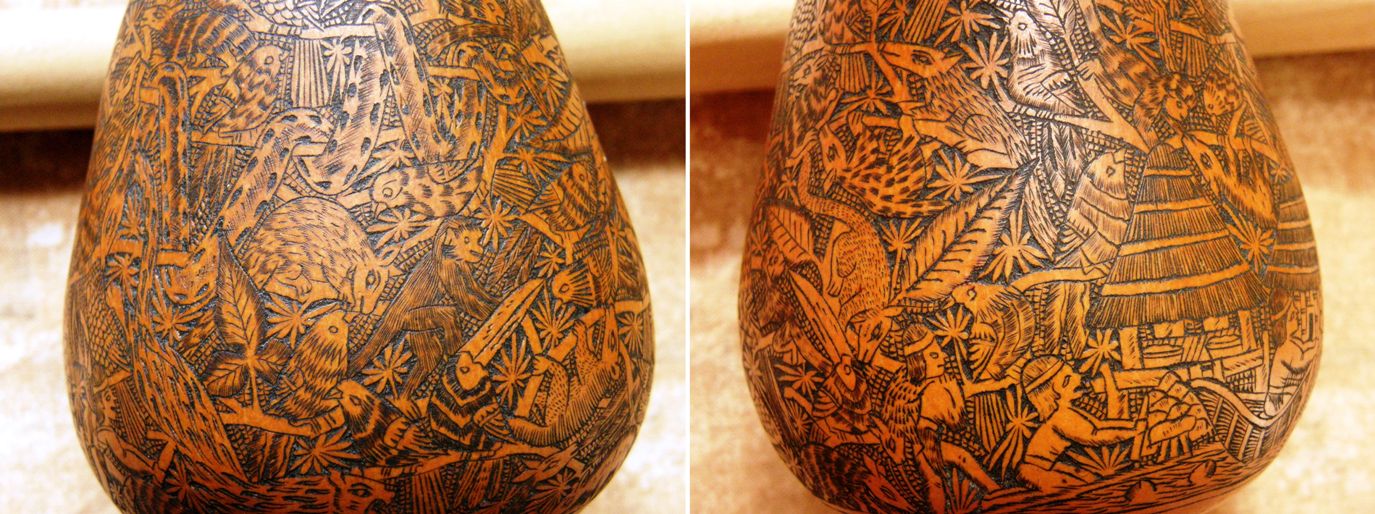
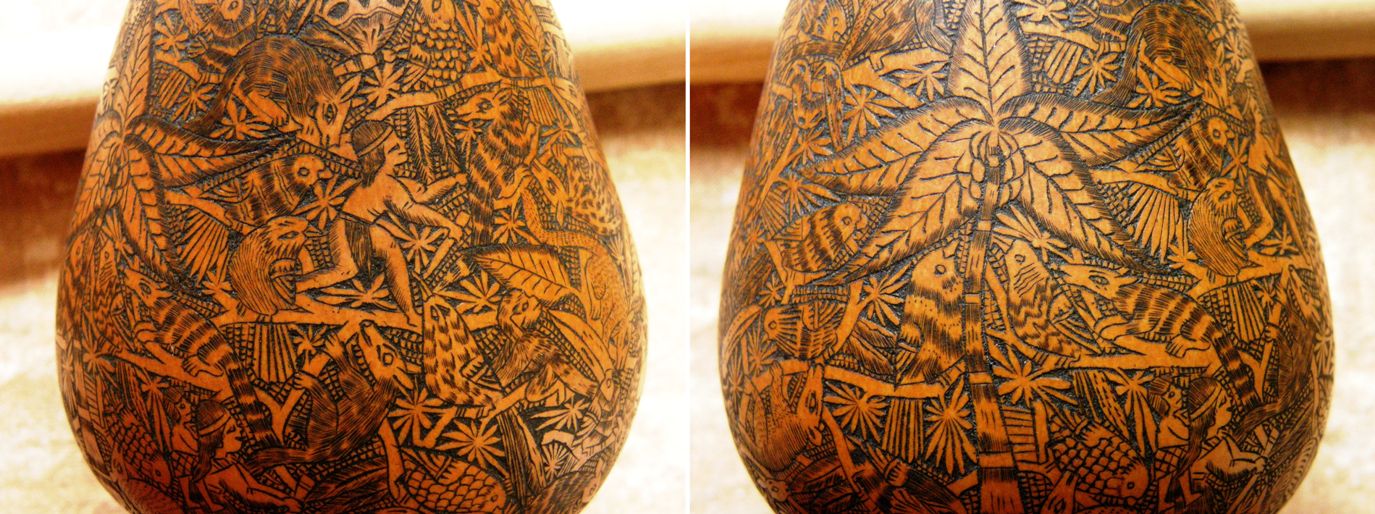
This is a book on natural dyes that I bought in Huancayo, Peru back in 1996. It is very simply made with very much a hand- made look about it and is full of plant and mordant samples in little plastic packages and dyed wool. The processes are explained with charming drawings making  almost unnecessary the ability understand Spanish or even read for that matter. It’s a treasure. The style of drawings reminds me very much of the style of designs that you find etched on the gourds which are also sold in towns around Huancayo….

I bought the gourd, pictured below with its scenes of tropical lowland Peru, in a store in Quito, Ecuador and although I know it is from Peru, I can’t be sure that it is from the towns of Cochas Grande and Cochas Chico near Huancayo which are famous for this particular handcraft. But, in any case, I would like to show you the amazing complexity of the designs etched into its surface.

I think every time I pick this up I see something new in it. Today I noticed the thick snake winding its way among the tree limbs for the first time.

But, back to the book…Here is part of one page with plant samples, dyed wool samples, the local names for the plants and a glimpse of the instructional drawings.

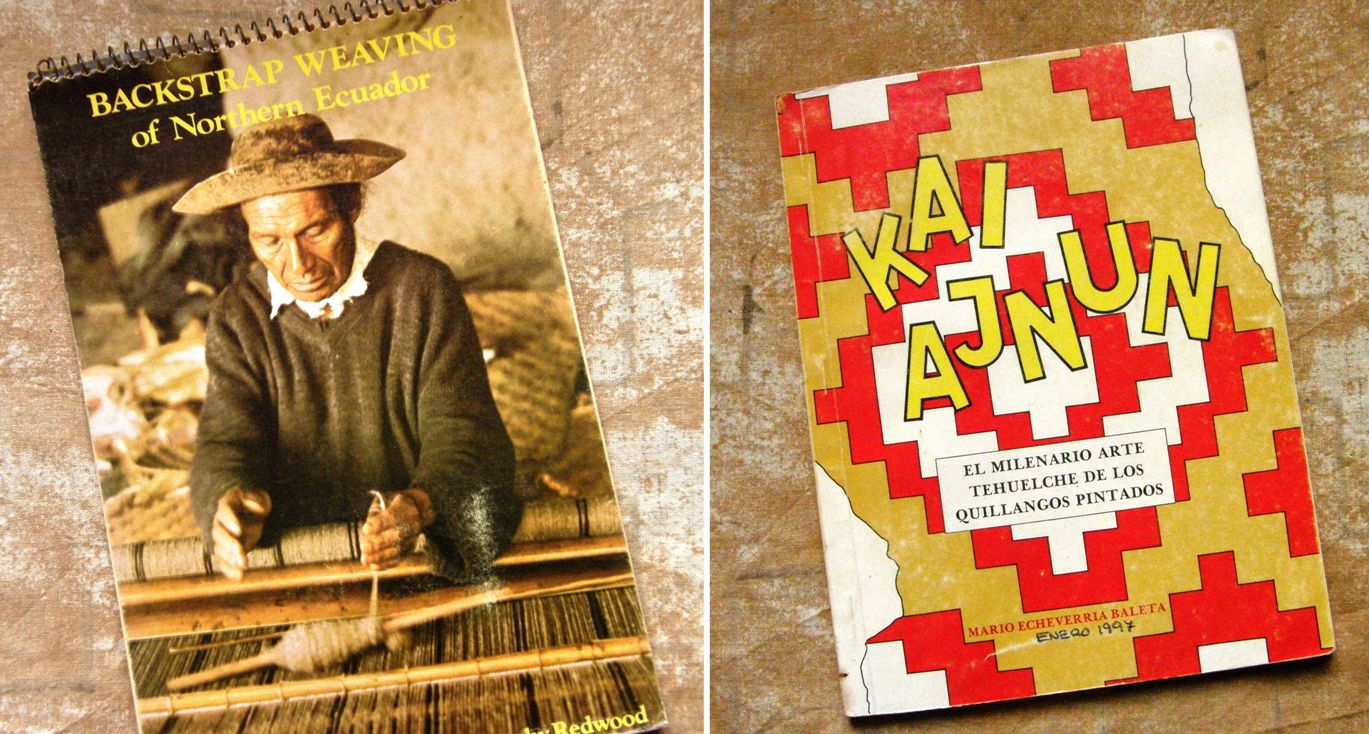
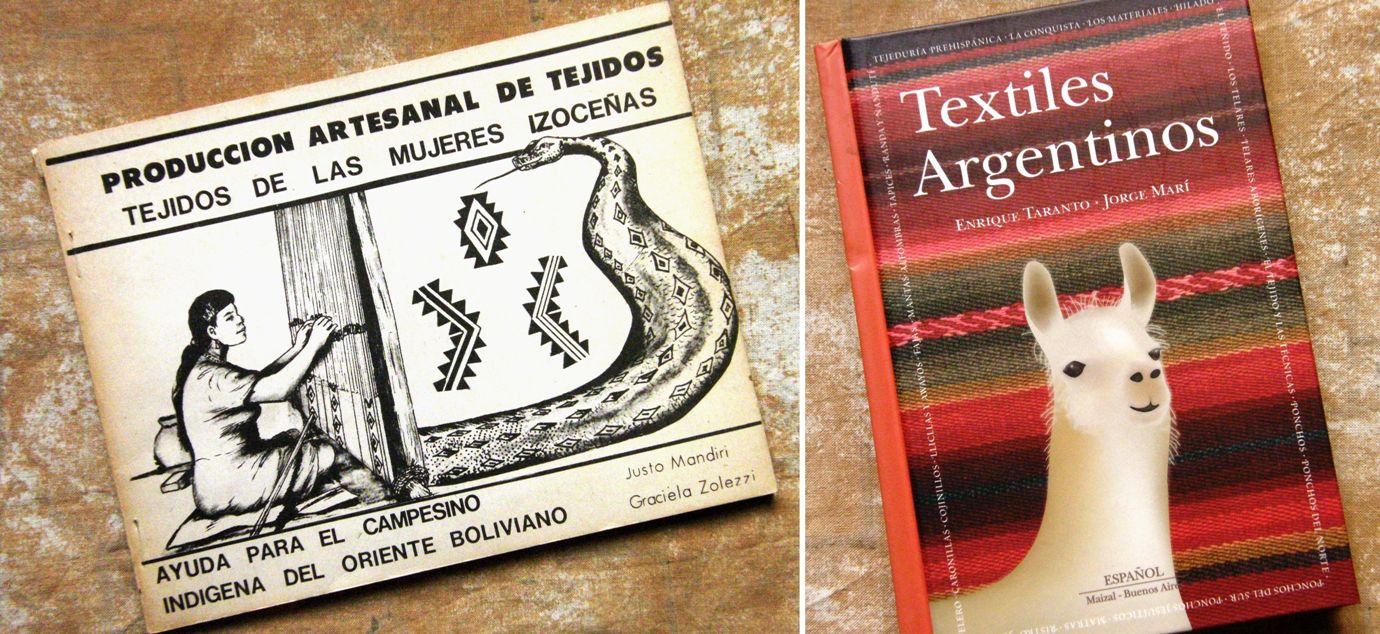
The first book on the left is what I consider a gem of self publishing and was one of the books that most encouraged me to “just do it!”, that is, go ahead and self-publish my own book on the pebble weave structure that I learned in Huancayo. It describes the process of constructing and setting up the kind of backstrap loom used in northern Ecuador and it, too, is filled with hand drawings and even yarn samples.

The differences in the way that warps are wound and looms are set up throughout the South American highlands can be very different…the way heddles are made, the number of crosses that are used, the number of stakes used in warping. These differences are what makes this whole thing so intriguing and interesting to me. It would be ridiculous to think that there is only one proper way to do things.

I was fortunate to be able to spend some time with a poncho weaver and his daughter in San Roque, near Otavalo, Ecuador and see the process described so beautifully in Redwood’s booklet, in action. In the picture above the weaver is preparing to make string heddles. Ms. Redwood, wherever you are, I would love to meet you!

The book on the right is not about weaving but catalogs the designs on painted animal skins made by the Tehuelche people of southern Patagonia. This was given to me by a lady from one of the old British families who own many of the large sheep stations on the pampa of southern Argentina. She owned one of the skins described in the book and has donated it to a local museum. One thing is the thrill of looking at the books, another is remembering how I acquired them. There is a a whole rush of memories associated with the visit to that farm on the pampa.

Another wonderfully simple self-published book was given to me by an elderly gentleman in Huancayo who was simply thrilled by my interest in the textiles of his home. The pictures and diagrams are all hand-drawn, it has been written on a typewriter and the paper is grainy and rustic. It includes meticulous step-by-step instructions on the construction of a floor loom and spinning wheel as well as an overview of the weaving tradition in San Pedro de Cajas.

I remember effortlessly finding the book on the left in a store a couple of days after I arrived in Santa Cruz back in 1998. I thought that I must have arrived in a fiber and weaving paradise until I went to the market and had a hard time making people understand that I wanted to buy a spindle…no one knew what that was!  That is the one and only book I have found on the topic and it was only after a few years had passed that I met my first Guaraní weaver from Isoso here in the city.

The other small book above, published in Argentina, is also available in English and can be bought online. It is a lovely miniature book with lots of great pictures of Mapuche textiles and woven items used by the Argentinian gaucho, belts and ponchos from the north and south…many of which I have not seen in other publications. It also includes lithographs and paintings from the colonial period and I love those.

And last of all, at least for this blog post, I want to show you some story books about children that I have collected that describe their daily lives in communities of weavers in South and Central America. One is from Bolivia, one from Ecuador and the other, Guatemala.

Dragging myself away from the book shelves, I will finish by showing you some work by Ravelry and other online weaving friends.

Karren was inspired by a Mexican rebozo to make her own black and white rebozo on her four-shaft floor loom in 8/2 tencel with a  pattern in simple warp floats. The rebozo that inspired her had varying widths of pink and white stripes along with fine horizontal bars that accompany the simple warp float technique. The fringe, like those on many of these rebozos, is a mass of intricately knotted figures.

If you feel inspired to try something similar, the pattern chart for this particular design is here…and I am sure you know where to find the tutorial on my blog.

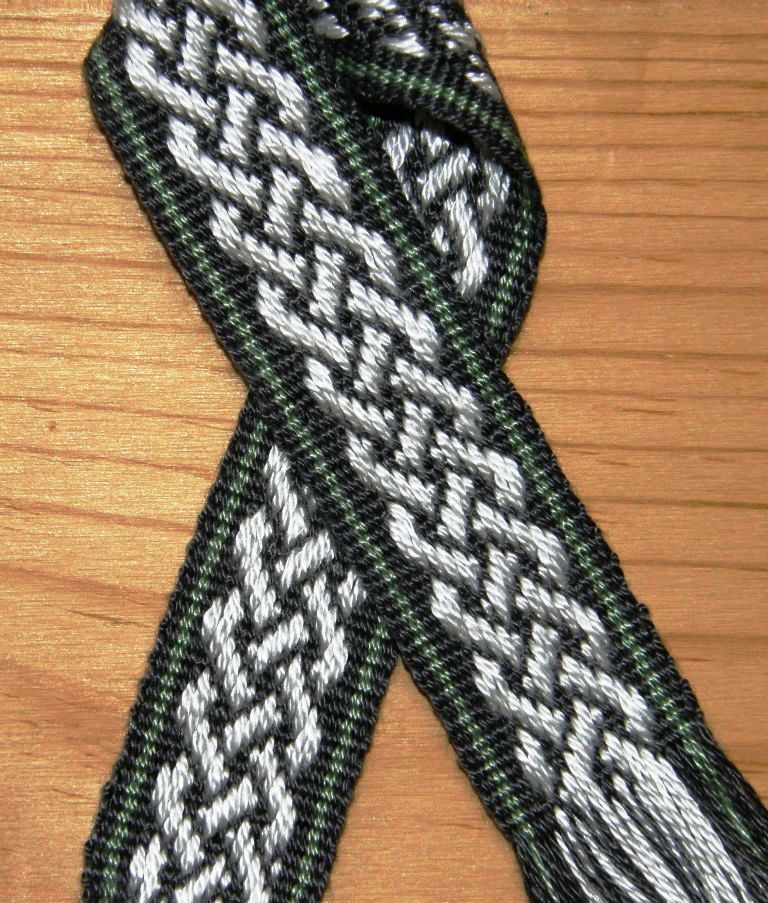
It is hard to believe it’s warp-faced with that beautiful drape. Karren’s project has inspired and encouraged me to use my tencel for warp-faced weaving. I have not been very brave and have only made a small supplementary-warp band with a celtic knot design using my tencel so far.

Jane, who has recently returned from a trip to Peru where she studied weaving at the CTTC in Cusco, showed us the band that she is weaving at home. It was warped for her by her weaving teacher using the wonderful handspun and naturally dyed wool yarn of Chinchero while she watched the process and she made the string heddles herself when she got home. She is using the two swords to create a temporary picking cross which will enable her to pick up the threads for the complementary-warp patterns.

On the right, Isabel sent me a picture of her warp set up to make a backstrap following the instructions in my article on WeaveZine. On the table you might be able to make out her first small pebble weave sample which she made using my book.

So, I am off  now to get my favorite spindle and make a plan for spinning this weekend and put the books that I photographed back on the shelf while trying not to get sucked back into to book browsing land….I have way too many other things that need doing!

Backstrap Weaving – Books and Blessings

I don’t do Christmas. I don’t have any family here and so it seems kind of pointless but it seems that Christmas does me! And all my Christmases came at once, as they say, this month when four packages were waiting for me at the post office this week on top of a couple that I had received the week before. Two were purchases that I had made some time around Christmas and the rest were gifts.

One was from Argentina, another from Morocco via Australia, one from Bangladesh, one from Sweden, one from the UK, one from India and yet another from Australia. Luckily, I now have space for all this new stuff!

I can’t decide which one produced the biggest smile.

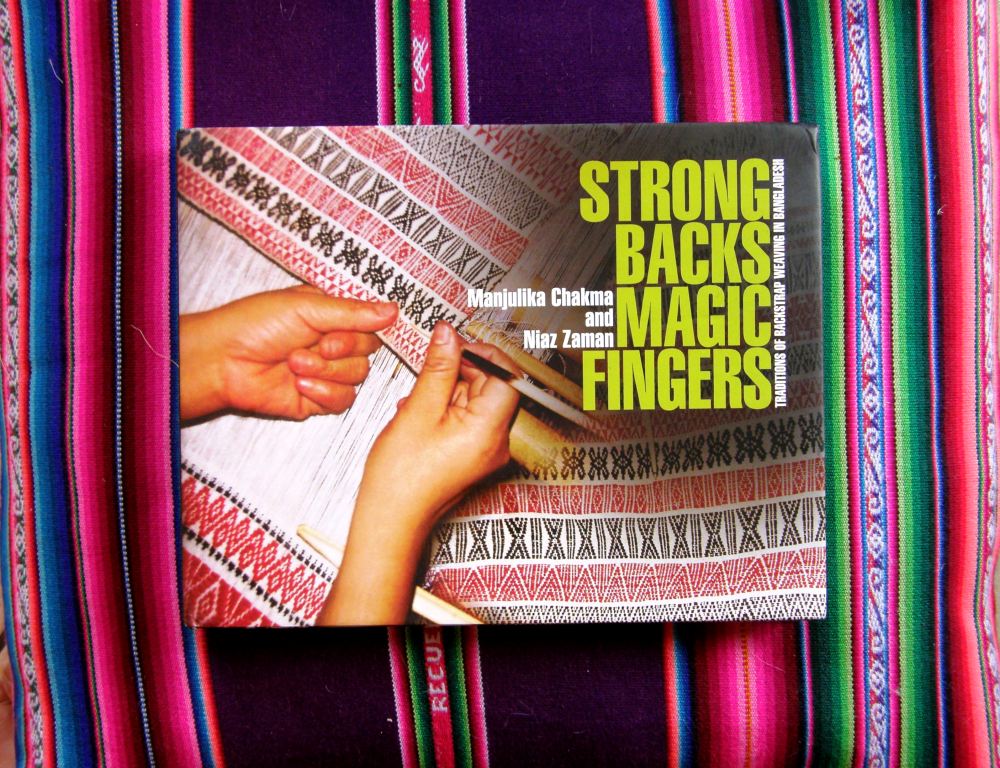
Let’s start with the book from Bangladesh on backstrap weaving. I suppose this is the one about which I feel most triumphant.

I have been trying to get this book since the middle of 2010 when I ran across a newspaper article about it online. Letters to the publisher didn’t produce any response. I tracked down an Australian journalist who had written a review on it but she couldn’t help. I asked my Godmother in India to try through some friends of hers in Bangladesh…no luck there either. I met a teacher from Spain on Ravelry who is working in Bangladesh who offered to try and get it…she couldn’t manage it… and finally, a Facebook acquaintance, Ananda, who works as a fashion designer in Bangladesh, came through.

He had heard of one of the authors, Manjulika Chakma and seen the book at a book fair. He managed to find the author, go to her house, where he said he enjoyed seeing her collection of tribal textiles, buy the book from her, tease me by posting a picture of it on Facebook and then send it to me! We were both very nervous about the mail as we both live in countries in the developing world where things often don’t work quite the way they should.

Well, I have been blessed because here I have it in my hands and it is really lovely.

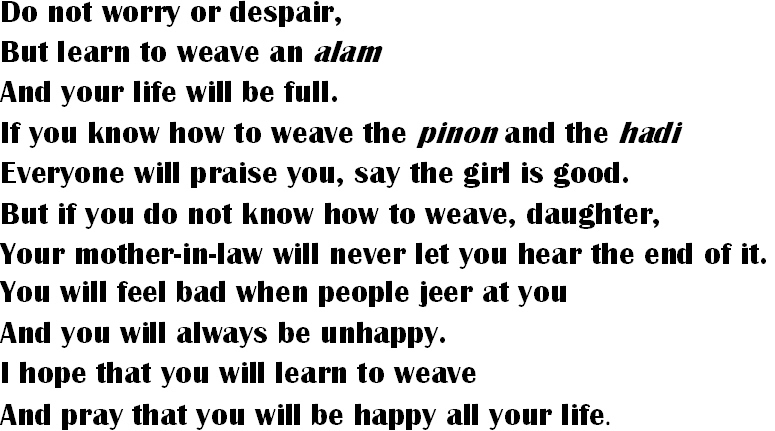
I have only read the first few pages of Chapter Two which is about the Chakma weavers and it starts with a lovely story of how, in order to encourage the tribal backstrap weavers to start weaving again the traditional sampler known as alam as well as to see just how many of the 210 designs could be recovered, a competition was organized among twenty weavers to see who could produce the best example. And the story goes on from there telling about the preparation for the weaving, the loom, the process. I can’t wait to read more.

One thing I would like to share with you are some lines from The Song of the Loom by Chiranjib Chakma translated by Niaz Zaman which appears at the very start of the book. This is just a part of the song:

How I wish I could hear this sung in its original language!

Twelve chapters in the book deal with twelve different tribes and their work. One disappointment is that the index promises a bibliography on page 164 but my book ends at page 160! Too bad…I love bibliographies. 

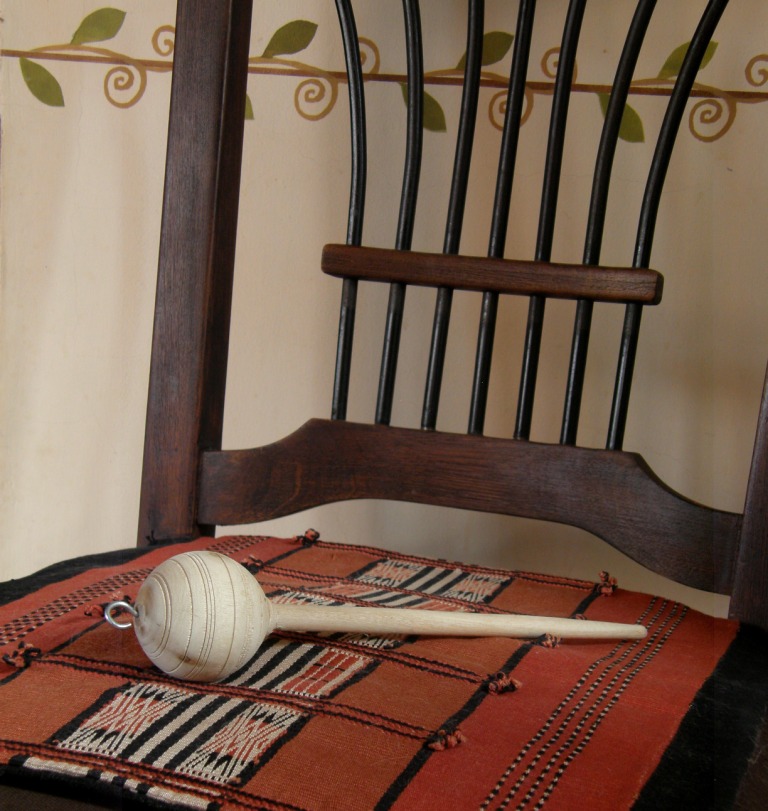
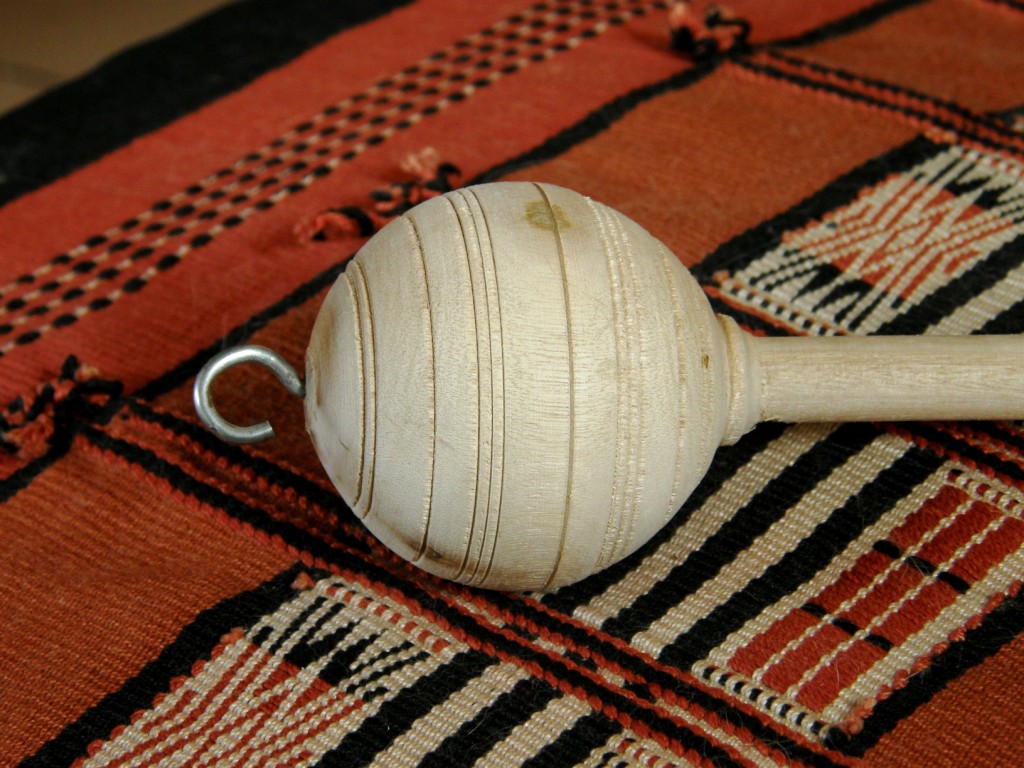
From Morocco via Australia came this spindle…

A friend of mine in Australia, Linda, went to Morocco last December and I asked her to get me a typical spindle. I have since decided to make this a gift for my friend Lisa in North Carolina. It isn’t for me anymore after my recent de-clutter campaign…books will always be welcome but I have enough spindles!

I actually had no idea what a typical Moroccan spindle looked like and Linda is not a spinner and told me that she had quite a difficult time finding one in the markets. Eventually an elderly gentleman told her that, if she came back the next day,  he would have one for her. Linda thinks that he had this specially made for her.

I asked the ladies in the Spindle Lore group about this particular kind of spindle and got many helpful responses.

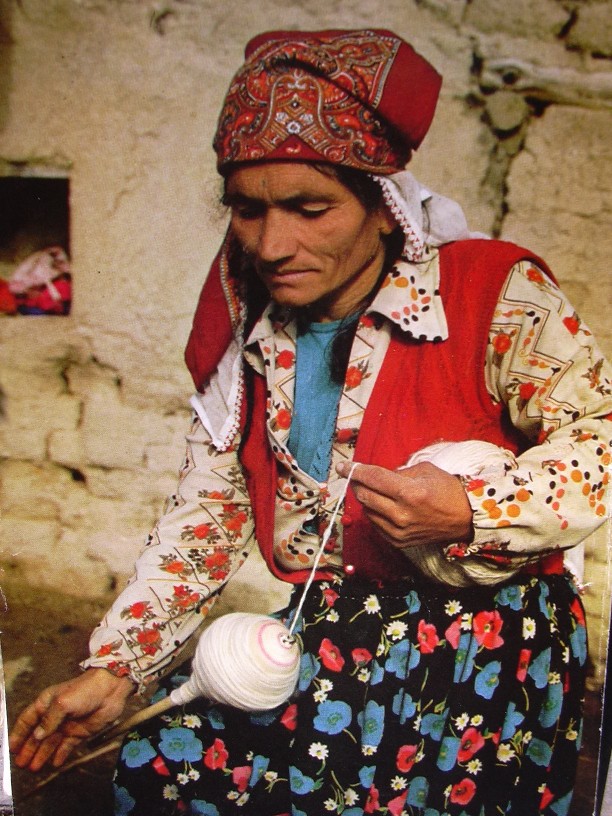
Tracy sent me a link to this site about Turkish tribal textiles which has this image of a woman using a very similar spindle.

I know that Lisa will use and enjoy this spindle. If it stays here with me, it will be left hanging on the wall. I am happy to see it, handle it and take pictures of it and learn a bit about it in the process.

To Think With a Good Heart…Wixárika Women, Weavers and Shamans by Stacy B Schaefer came to me as a used copy from the UK (copies for under $3 are out there!) after having been recommended to me by Hopi weaver Luis Garcia. Luis and I met online through a mutual interest in Huichol, or Wixárika double weaving.  Here is one of Luis’s pieces in progress. He is weaving almost exactly the same motif as I chose for my bag above.

The book is described as being …”a fascinating journey into a realm of ancient beliefs and traditions woven into the story of a way of life constantly threatened by the outside world…..(It) addresses both the technology of weaving as well as the dramas and personalities in a community.”

In the words of Stacy B Schaefer herself…

A woman’s weavings reflect the changes and transformations she undergoes as she follows her life’s path, and her rites of passage from childhood to adolescence and marriage are marked by her abilities as a weaver. As a wife and mother, she is the provider of woven items for her family until she is physically no longer able to weave. But, never idle for long, she takes up spinning to help the younger women in the family carry on the weaving tradition. A woman’s life is so integrally tied to her identity as a weaver that she carries her loom to the grave, where it is buried with her.

In this book, I hope to bring Wixarika women into visibility by focusing on the medium of loom weaving. I present a descriptive ethnography of Wixárika women’s lives in chapters organized in interconnected sections that discuss gender roles, the life cycle, economics, religion and cosmology.

The book is the result of Schaefer’s having apprenticed with master weavers in two Wixárika families but it is not a how-to book.

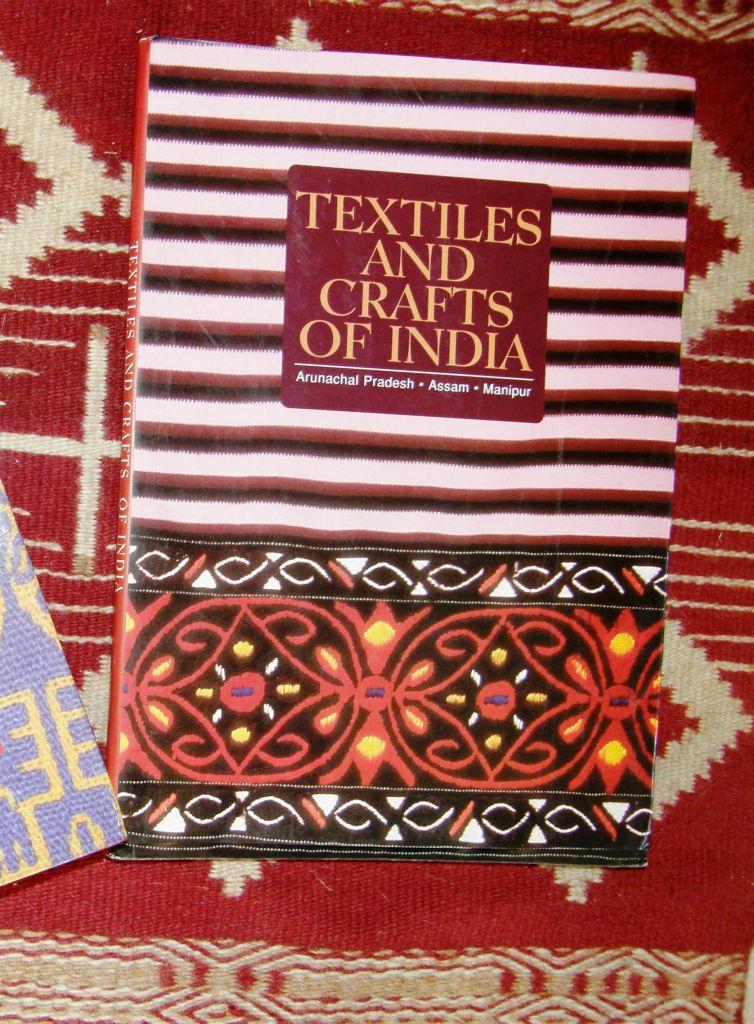
From India I received a book that was recommended by a weaving friend in Canada who just returned from a trip to the northern states of India.

Beautiful pictures and plenty of luscious inspiration! One particular textile jogged my memory from back in 2007 of a bag that one of my Youth Hostel roomies in the Washington DC Youth Hostel had. She said that a friend in Sri Lanka had given it to her.

What a great color scheme! I think I need to try something like this.

From Argentina…

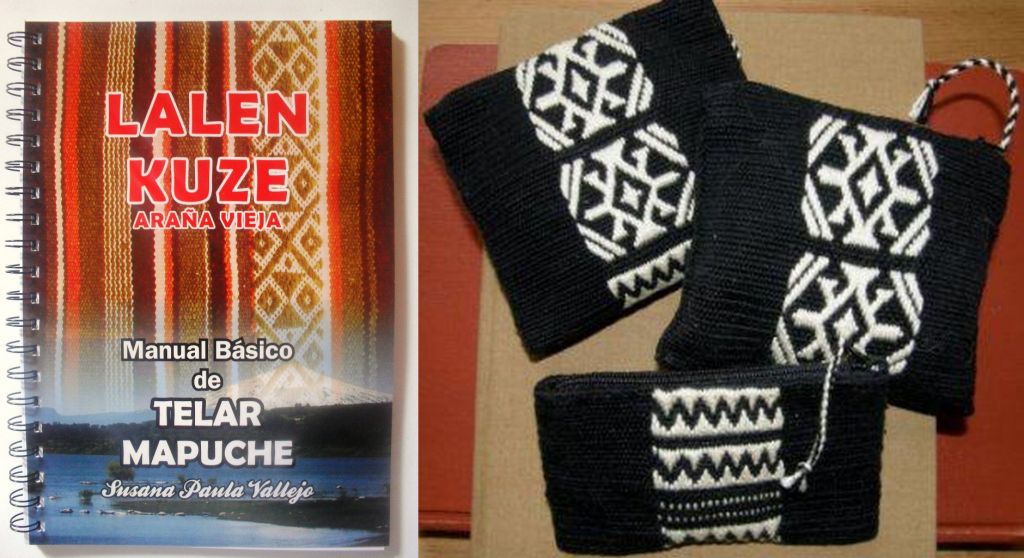
This is Susana Vallejo’s updated edition of her Manual Básico de Telar Mapuche. This revised edition has many more beautifully taken step-by-step photos than the original. Susana and I are online weaving buddies and we swap our books and ideas. I first swapped my Andean Pebble Weave book for a copy of her first edition. I will send her a copy of my next book in exchange for this copy of hers. She lives in Mar del Plata, Argentina where she runs a very active weaving school and I find her always buzzing with energy and so wonderfully charming!

Here is a picture that Susana herself put online to show what her new edition looks like…

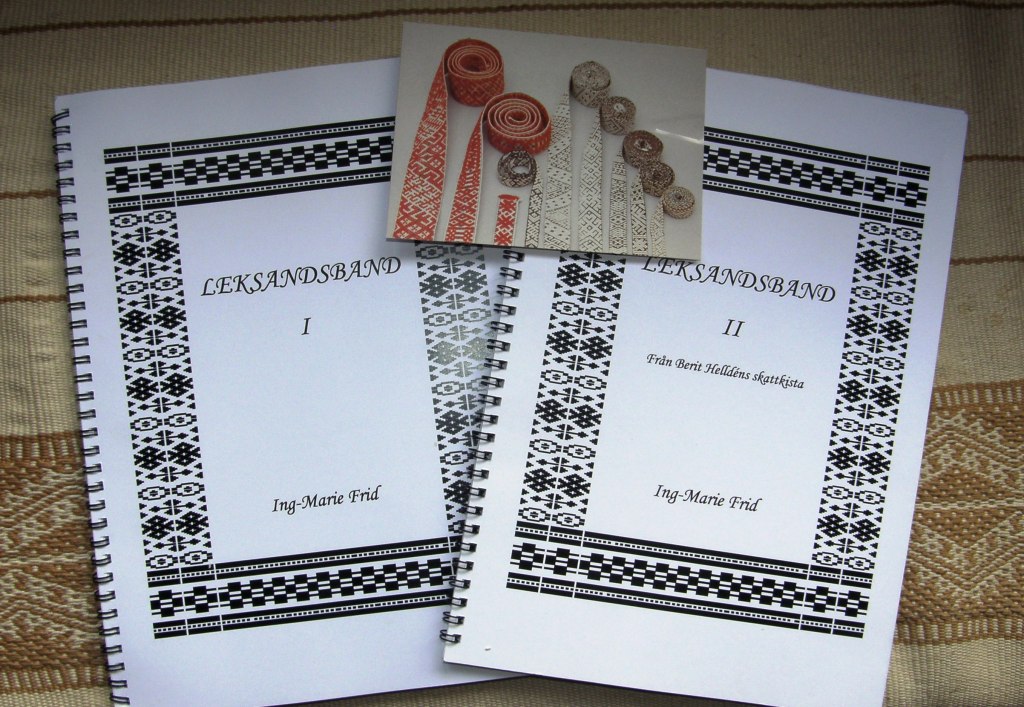
Two gifts from Sweden via my online weaving friend Olle-Petter…

What a beautiful piece of work author Ing-Marie Frid has made with page after page of meticulously charted designs from these wonderful traditional bands. Photos of the original bands accompany every chart and they are simply stunning.

It wasn’t all about opening packages and playing with all my gifts and purchases this week. I did some preparation for future weaving projects too.

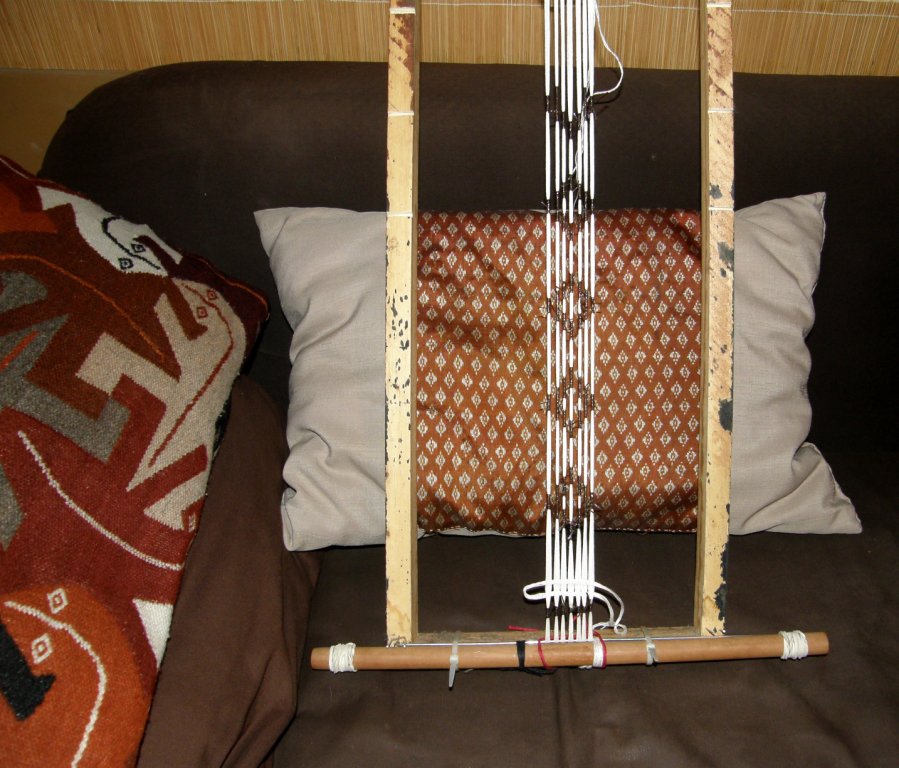
I am preparing a sample ikat warp putting into practice some thoughts and theories that I have on how to keep the threads better aligned. I am still not being terribly brave or adventurous about this and am using a simple diamond motif and keeping things small. I wrap the warps for one diamond a day, slowly and methodically while I think about different strategies for successfully weaving it.

I have the warp set up on a frame for now as I wrap and here it is sitting in front of a silk piece, with a similar simple ikat pattern, from Cambodia. I am using cassette tape to wrap.

I was pretty happy about my last attempt at ikat, which was just narrow strips within a larger textile, but I would  like to make some improvements…

The ikat is part of our new weave-along and we have Janet and Tracy so far wrapping away as well.

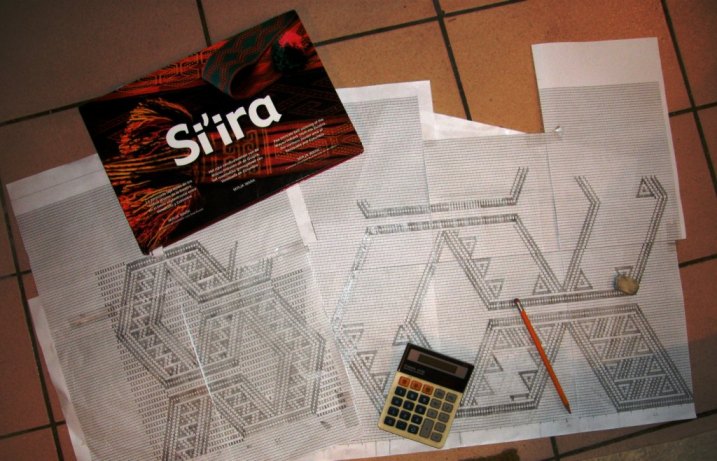
The other preparation project which was really taking a long time to get off the ground was the charting for the continuation of my Wayuu inspired wall hanging. Well, dither no more, it is going and appears to be successful! (although the proof will be in the weaving).

Mirja Wark has charted the traditional design in her book but it is not entirely symmetrical as that is the way the Wayuu weavers choose to weave it. I, however, have this need for symmetry and so I adapted and recharted it only to weave it and find it too small and delicate for my wall hanging and the thread I am using. Now I am changing it yet again to be big and bold enough for my piece. I kind of like the fact that I am changing it so much as there are now several  pieces of “me” in the design!

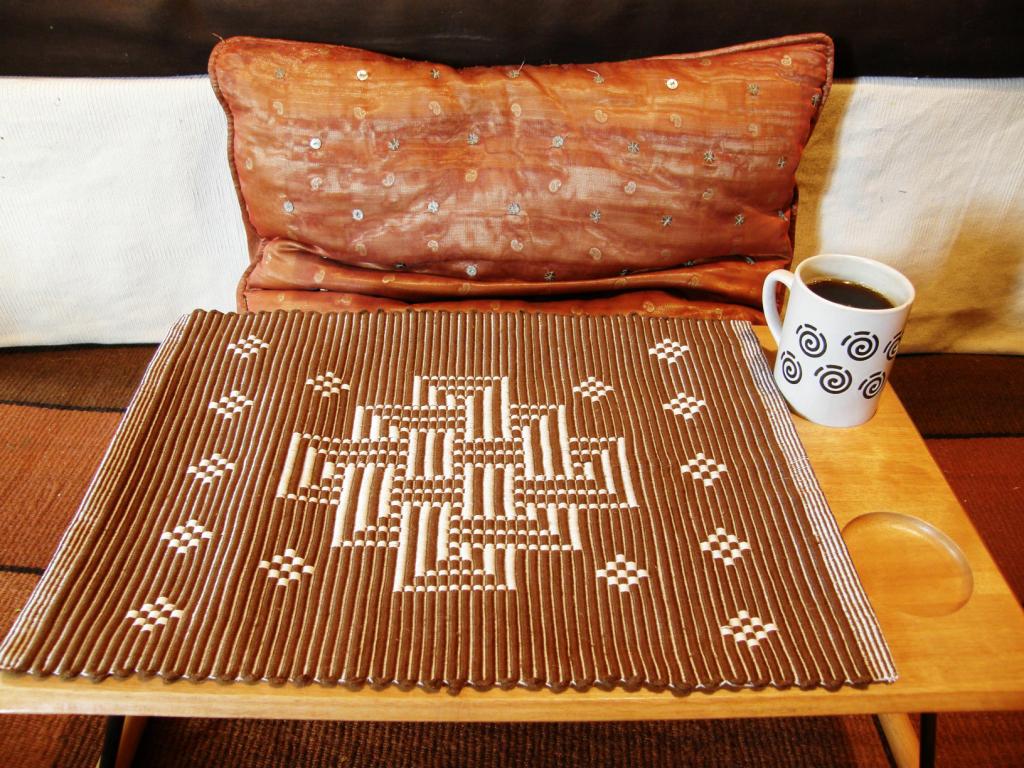
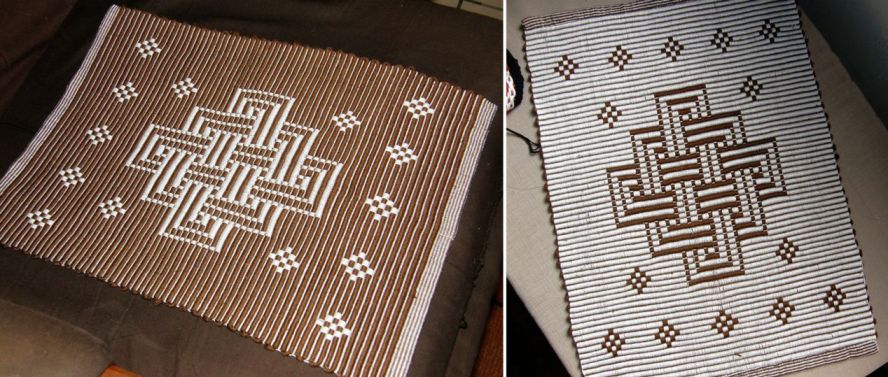
The rep weave sample came off the loom and got hemmed. I had some width issues so this definitely goes in the “sample” category. It fits my tray table perfectly though and will certainly be put to use to stop my bowls from sliding about.

And then Jorge came and said that he preferred the other side…not terribly practical white side up… but now I can’t decide which side I prefer! Thank you Marijke for your card woven  knot pattern!

Some Bedouin activity from online weaving friends…

Bobbie, from the Ravelry group is weaving this lovely piece using that yummy Dylon Cold Water terrcaotta dye on her cotton. She is weaving one of the al’ouerjan variations. Yonat wove Bedouin Warp Substitution  with me last fall and is weaving this band with many variations of the al’ouerjan pattern on her inkle loom. It is a sample band of the different patterns and she is practicing her weft twining along the way. She says that she is not crazy about the colors she chose but I love them!

We have exciting news from Tracy Hudson in the backstrap group who lives in Doha Qatar. She has written an article on Bedouin spinning which will be in the spring issue of Spin Off.

And that brings to me to wrapping this up with the unwrapping of the last “Christmas-comes-late” gift.

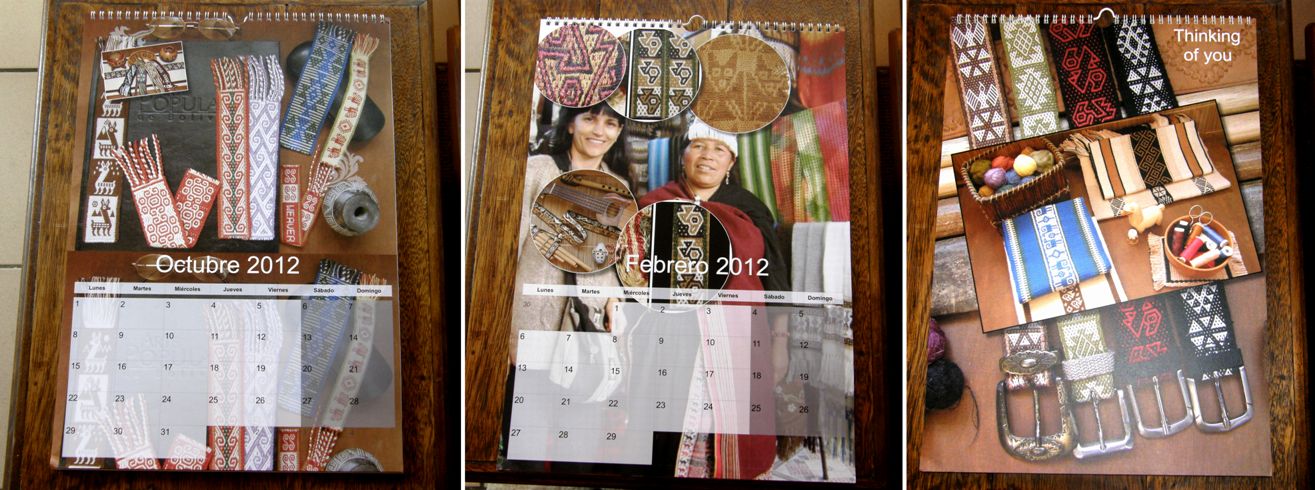
My dear sister-in-law made me an amazing calendar with pictures of some of my weavings mixed in with Navajo and other bits and pieces that she saw on her recent trip to south-west USA.  She didn’t have many pictures of my stuff to work with…just a handful of pictures I had sent to my brother for editing about two years ago but she did a tremendous job putting it all together.

And, wise and clever woman that she is, she left January 2012 off the calendar and replaced it with January 2013 at the end knowing that I probably wouldn’t get this until February. I don’t get to see Deb and the family very often and am way overdue on a visit to Australia. She blew me away with this!

And finally, I have to tell you that my book Andean Pebble Weave will soon be speaking French! I am very close to getting this e-edition up on the Patternfish website. And don’t worry, I didn’t translate it! It has been translated by a weaver in France about whom I shall tell you more once the e-book is ready for sale. Here’s a sneak peek at the cover…


Backstrap Weaving – Summery New Year Wishes

Well, it’s that time of year again…that feeling of endings and beginnings and my own personal need to do some serious downsizing. My policy is usually “new stuff in, old stuff out” which means that if I return from a trip with something new, something has to go. The new policy is “old stuff out, out, OUT”. Wow, how liberating. I have space again! And the spaces are not, repeat NOT to be filled again…ever.

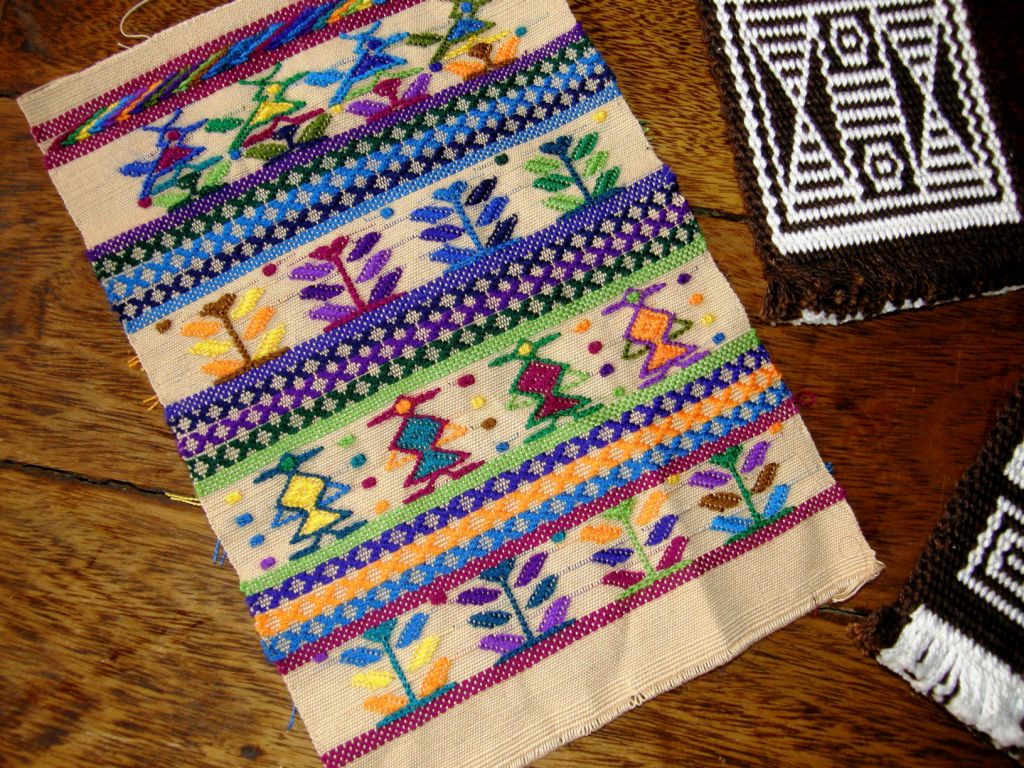
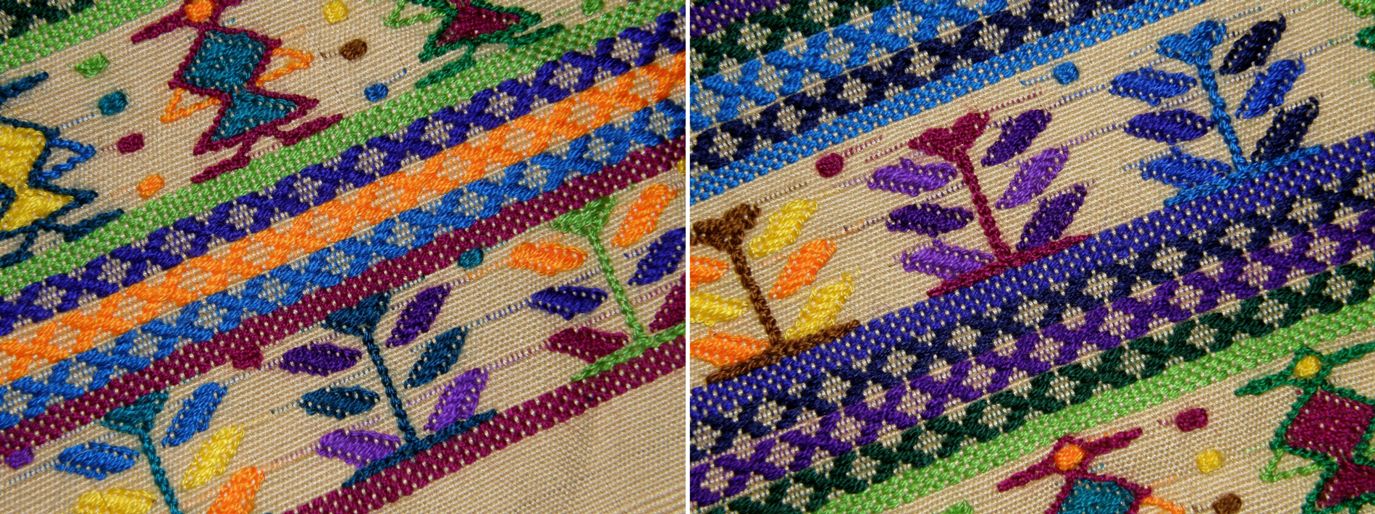
I uncovered some long forgotten stuff in the recesses of the closet like this Guatemalan sampler that I made not long after I returned from my trip there. At the time I could hardly stand looking at it. It was way over-the-top too colorful for me but the purpose had been to practice my newly learned supplementary weft patterning techniques and use the thread I had purchased from my teachers.

Now I kind of like it. After looking at the red, white and black of my current projects for so long, this is so joyful, and refreshing…very summery, as I sit here in temperatures up in the high nineties and fan myself with a condor feather. (I should explain that I used to live near a condor nesting site when I lived in southern Chile and I picked up a feather or two from the base of the cliffs…something else that I have uncovered in the downsizing spree). I am without air conditioning at the moment…long story.

Here are some more detailed shots of the supplementary weft patterns….

The uppermost pattern technique in the next shot, above the birds, is soumak, something which I really want to explore more.

All the figures, the birds, the ladies and the plants are worked on a warp-faced ground weave. Two sheds are programmed on pattern sticks under which the supplementary wefts are passed to form the motifs. This means that threads do not have to be picked or dropped each time the wefts are wrapped around warps or simply laid in to form the designs. You can see the warps that are raised in each of the two patterning sheds in the speckled brick-like design that is woven immediately above and below each row of figures.

There is a tutorial here on my blog in which I show how to set up the patterning sticks and then use them to create these kinds of motifs.

The three  rows of “X” design are temporarily programmed on two additional pattern sticks which are then removed so that the other motifs can be woven.

So, back to the present and my current project…the chamanto inspired wall hanging.

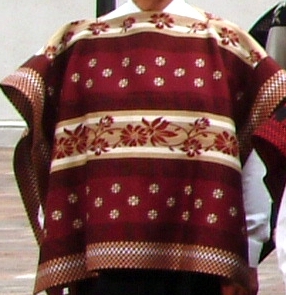
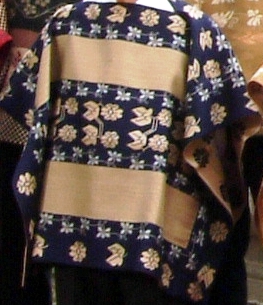
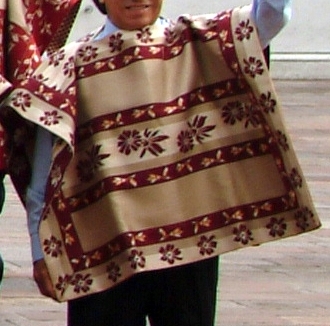
My piece won’t look anything like the gorgeous Chilean ponchos, not even a miniature version of one.

I have just taken the idea of the big, bold solid motifs that speak of the rich, green, temperate central Chilean valleys and vineyards.

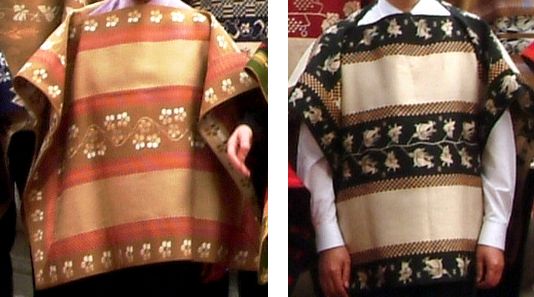
I was lucky this week to find the official APEC site which invites one to download a high resolution image of all the leaders attending the 2004 conference in their beautiful ponchos. This has enabled me to cut to just the chamantos and get quite a nice view of the pattern layouts and color combinations. It’s like my mind was read! Just last week I was saying how I would love to see all the ponchos at the APEC meeting up close.

So let’s enjoy looking at some of those…

Here is the piece I am working on…

This is to be one of a series of wall hangings all in the same color combination but I have a feeling that this one will be the sampler as I have had thoughts about the layout and size since starting it and would like to change quite a few things….or maybe not! I hope to weave a patterned band and sew it to the four edges so that the construction resembles that of the Chilean poncho.

As for the nylon string heddles that I mentioned last week…I made them, used them and hated them….took them off and made cotton ones…what can I say?

In the meantime, I uncovered something else in my downsizing frenzy…

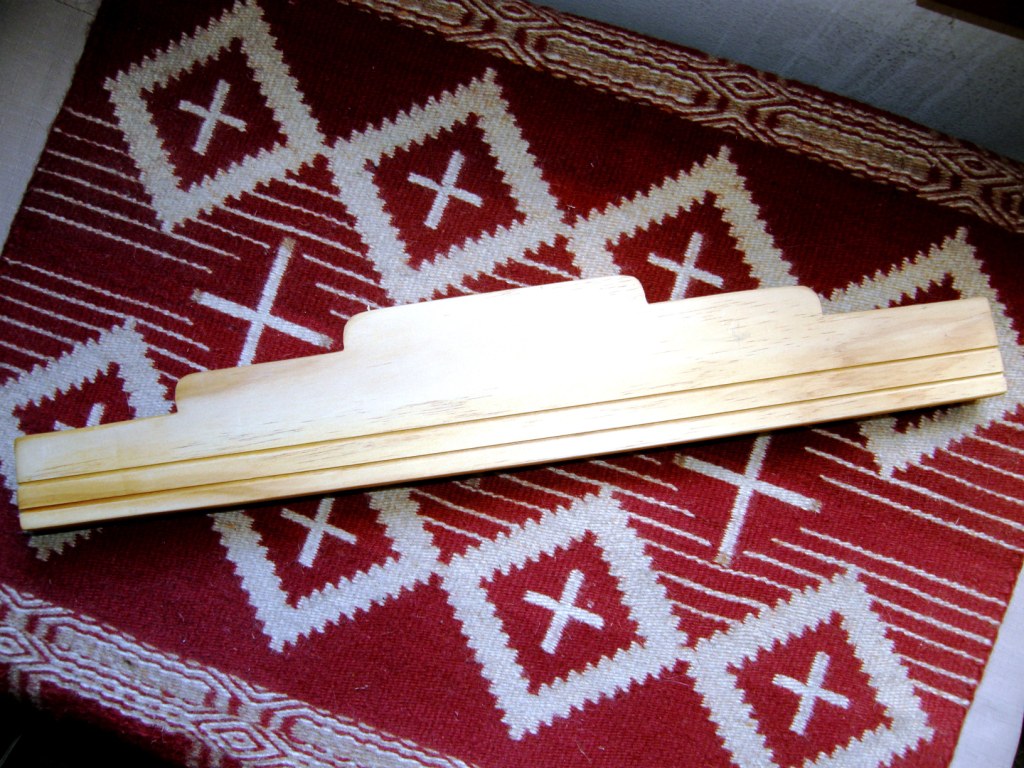
This lovely tapestry hanger was given to me by its maker at Convergence last year and it will give me a very nice way to hang my Starry Night piece once I have that completely finished…I am still pondering that fringe. The hanger works by clamping the top edge of the woven piece between two pieces of wood. Justin Adams makes them in various lengths in his home in New Mexico. He doesn’t have a website that I know of and you can contact me for his phone number if you would like to know more about his work.

The hanger is posed on a Navajo-style weaving that I did many many years ago dyeing and using up as best I could all my left over odds and ends of Navajo wool. There’s that red again. I started it with a twill saddle blanket weave until I realized I didn’t have enough yarn in the three colors to complete it. So, I wove the top and bottom in the saddle blanket structure and filled in the center in plain weave.

What else have I been up to?

Well I am still messing about with weaving nice curved figures in warp-faced double weave but don’t have anything worth showing design-wise this week. However, I have a nice tip to give you for how to get really nice edges in this double weave technique.

In the picture below you will see one of my double weave mug rugs made with a 12wpi cotton. The edges are pretty good but you can see how the weft is exposed on the sides as it travels from the upper layer to the lower layer of the double weave. I have inserted a toothpick under a couple of the wefts to make this clearer. This is very exaggerated with this heavy yarn.

While this doesn’t look bad and the edges are still neat, I have found that when working with finer yarn, the edge warps tend to want to “roll off” the edge along with the weft as it travels the distance from the upper to lower layer and this can give the edge a bumpy look. My weaving teachers here did not show me any other way to do this and it was frustrating looking at other double woven pieces from here and seeing beautifully even and rounded edges and not knowing how they had been created. In the end I had to cut and pull apart a belt I have.

The Bolivian double weave belts above left have smooth two-color rounded edges. My camera strap, on the other hand, has slightly bumpy edges as some of the edge warps are pulled out of alignment by the weft as it turns down to weave the lower layer.

So, here is what I believe is the secret: If you have read or worked your way through my double weave tutorial you will know that both borders and pattern area are warped with doubled threads.

If you start and finish your warping with two revolutions of single threads in your border color, you will create a rounded edge and the gap between upper and lower layers will be beautifully bridged. (Two revolutions give a more rounded edge, one revolution also works well and gives a flatter edge with a little bit of exposed weft but it’s enough to keep the edge warps in check. The method you choose will depend on the appearance you prefer).

Pictures next week! I am working on samples now so that I can show you how these two options look next week and will add all this new information to the tutorial page.

So, enough of my experiments. What have the Ravelry weavers been up to this week? I have a couple of things to show. All of you who are currently in the throes of winter will appreciate these…

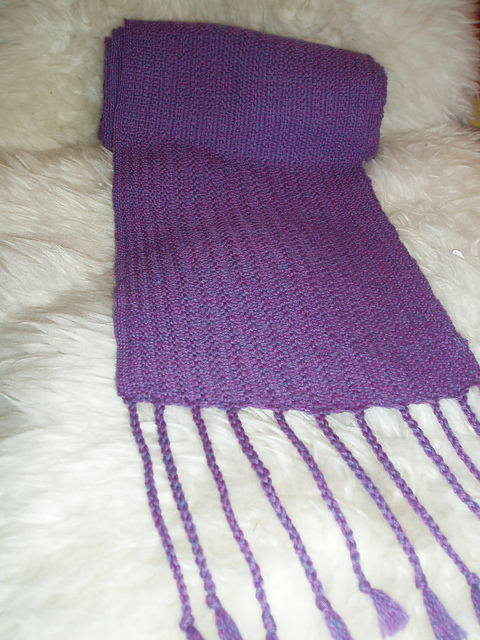
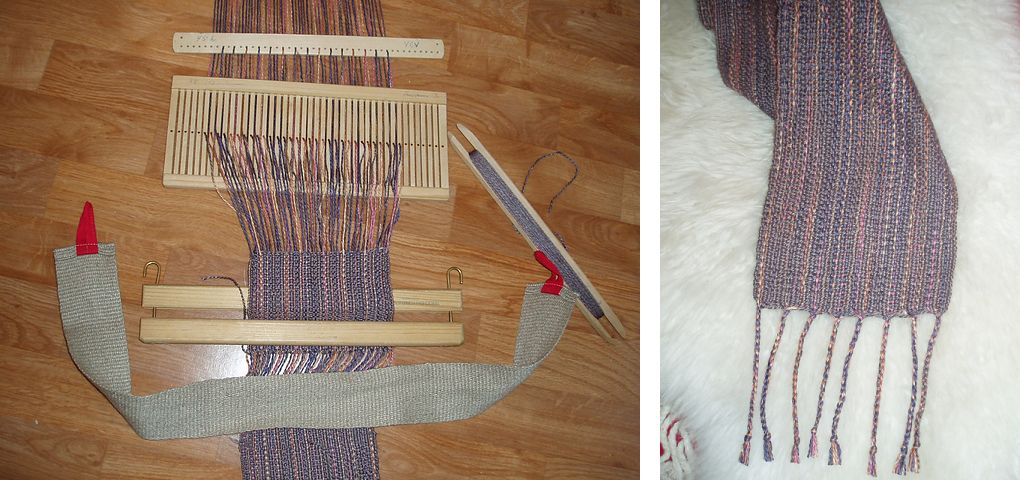
Heidai has been making scarves using the set-up known as grindvev in her native Norwegian. There she has a wooden rigid heddle on her backstrap loom and there is even an extra wooden piece that serves to raise certain warps according to the structure she has chosen to weave. What a neat little collection of pieces!

So, we have agreed to add “weave a scarf using a rigid heddle on your backstrap loom” as part of the new year’s weave-along activity. We don’t have an official start date yet which will gives us time to put some thought into the ikat and other project proposals we have been discussing. I could probably do with a scarf or two if I am to make more fall visits to the US.

Down in the summery southern hemisphere, Luchita in Argentina showed us the gorgeous pillow cover she made by sewing together three bands she had woven with Mapuche inspired patterns using supplementary warps. I love this!

I can’t think of a better way to finish this post…as it started…with uplifting, vibrant, exciting colors inspiring strong positive thoughts and wishes for you all for the coming new year. Happy New Year to you all and thank you for all your support!