Backstrap Weaving – East and West 2…The West Side Story

EAST AND WEST 2 – THE WEST SIDE STORY….

THE HIGHLIGHTS.

This is what happens when you don’t blog for a while! You have to drop the details and limit yourself to the highlights. Since the conclusion of the “West Side Story’ on this trip, I have finished yet another chapter entitled: “Hooray Santa Fe!”. So, as I sit in Miami airport waiting for my flight back to Santa Cruz, Bolivia, I will attempt to capture some of the flavor of just my west coast adventures in this post.

ANWG 2013 logo tapestryThe West Side Story started at the ANWG  Conference in Bellingham, Washington.

It was followed by a stay at my friend Betty’s (author, weaver, traveler, trekking and textiles tour leader, mountain climber, tree farmer, blueberry farmer……!!)  home in Washington state. There I got to meet up with one of Betty’s friends, Judith, whom I had met at the Tinkuy in Peru in 2010, as well as with Bobbie who is in the Ravelry group.

This chapter finished in San Francisco after having spent about ten days at my backstrap weaving friend Janet’s farm in Humboldt County California. Janet arranged two get-togethers with weavers I had met last spring.

This trip has been about many things, one of which was meeting new people and putting faces to online acquaintances…

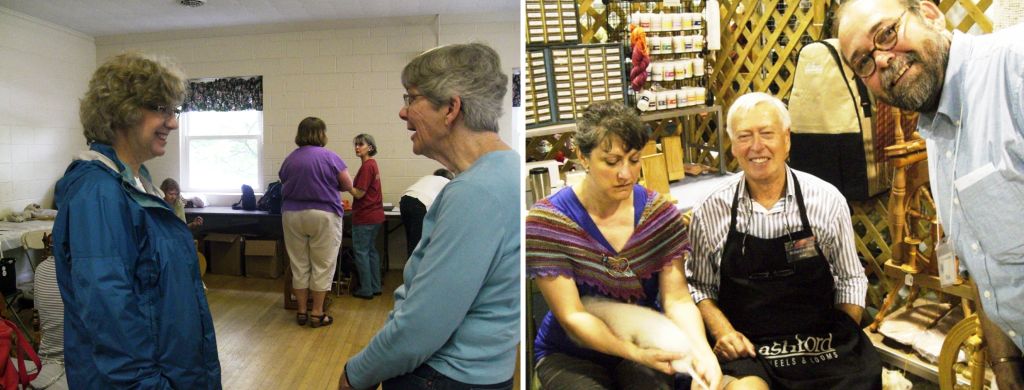
Here are some of the members of the ANWG Organizing Committee and ANWG instructors at a pre conference get-together. The group includes Marilyn and Linda who took my classes, Sheri, my Bellingham host and my wonderfu roommate, Marie. I am sure that you will recognize some familiar faces amongst the teachers. Here is where I got to meet the ladies with whom I had been corresponding all those months while the conference was being prepared. It was great to meet Holly, Jane, Patrice, Paula ad Marilyn at last.
Here are some of the members of the ANWG Organizing Committee at a pre-conference get-together. The group includes Marilyn and Linda, Sheri, with whom I stayed in Bellingham, and my wonderful roommate, Marie. I am sure that you will recognize some familiar faces amongst the teachers.  It was great to meet Holly, Jane, Patrice, Paula and Marilyn at last.

This was a wonderful conference. Apart from being in one place with over five hundred enthusiastic weavers, I loved the venue, the dorms, the food, our fourth floor weaving room with the view of Bellingham Bay, and all the fun details that the committee had gone to so much trouble to include. I can’t imagine that these events can get any better than this one!

Il oved the handwoven conference logo on the crocheted background which were hung on wondows to mark the rooms which were desgnated classrooms. I kept mine...not sure if I was supposed to...ssshhh! My roommate, Marie was part of teh team responsible for the handwoven pouch and name tag combo. That little piuch was such a cool idea. It held keys and meal card. My backstrap weaving students found it handy for parking their sword/beater. The fabric was so very pretty. Imagine having to make over 500 of these for all the participants!
I loved the handwoven conference logos on the crocheted backgrounds which were hung on windows to mark the rooms which were designated classrooms. My roommate, Marie, was part of the team responsible for the handwoven pouch and name tag combo. That little pouch was such a cool idea. It conveniently held keys and meal card. Backstrap weavers found it handy for parking their sword/beater. The fabric was so very pretty. Imagine having to make over 500 of these for all the participants.

photo (1) mini cropAnd of course, there are one or two special people amongst all those that you get to meet and chat with at such events with whom you have a particularly strong connection.

Marilyn was one of them.

She wove with me on several days, was a committee member, taught four classes and was a whirl of energy. She seems to have an endless collection of beautiful ethnic textiles to wear and I looked forward to seeing what she would be wearing  each day.

At the final banquet, we were asked to wear something handwoven. So, there you see Marilyn in a gorgeous Guatemalan huipil. I simply draped the  Bhutan-inspired scarf that I wove around my shoulders.

(And guess who I bumped into in the plaza in downtown Santa Fe last week as I stopped to buy a fajita?)

The West Side Story is also about meeting some of my online friends from the various backstrap weaving groups as well as reconnecting with weavers from past visits.

Ravelry member Cindy weaving a nawi awapa band in my class.
Ravelry member Cindy weaving a nawi awapa band..

Cindy was also responsible for my spending in the ANWG Vendor Hall. She unearthed some Guatemalan natural dyed cotton at the Mayan Hands booth (on sale) and refrained from buying all of it! She and I bought bags of two colors and swapped. I wonder what she is planning to do with hers.

My backstrap weaving friends from Humboldt County got together in a couple of sessions...Janet, Gina, Autumn, Aceand Linda. We tensioned our warps on poles, floor looms, toes and inkle looms.
My backstrap weaving friends from Humboldt County got together too…Janet, Gina, Autumn, Ace, Pam, Buffy and Linda. We tensioned our warps on poles, the beams of floor looms, toes and inkle looms.

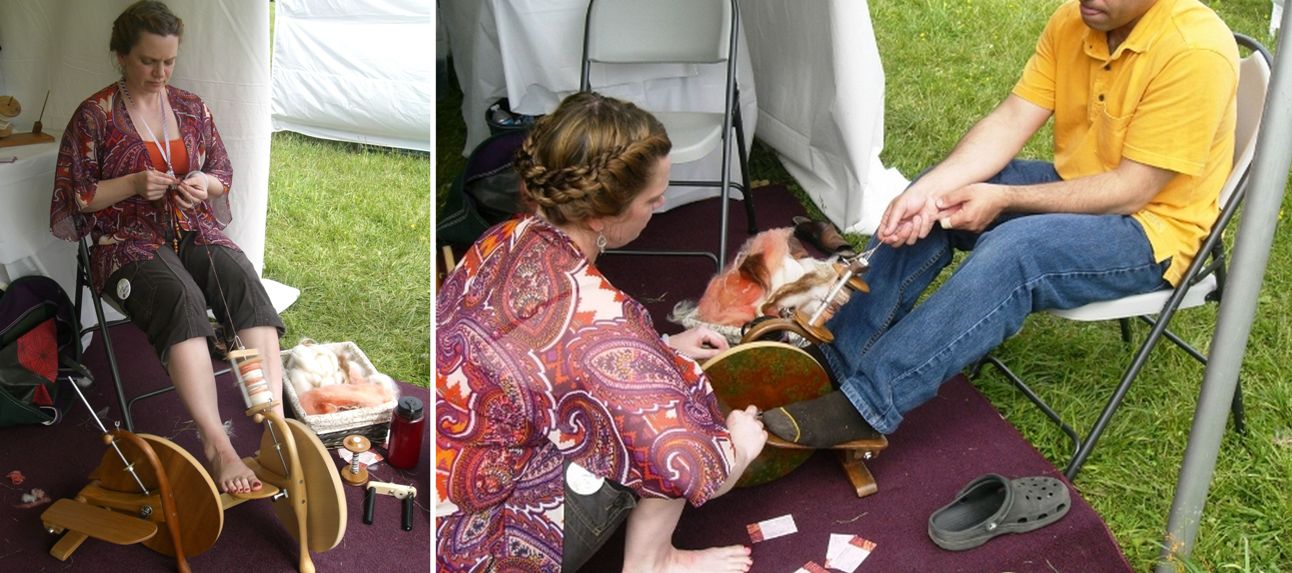
It was about playing with WOOL, something that is not so accessible in my home in the lowlands of Bolivia. And, of course, when I am with Janet and her friends, it is about lots of spinning and plying.
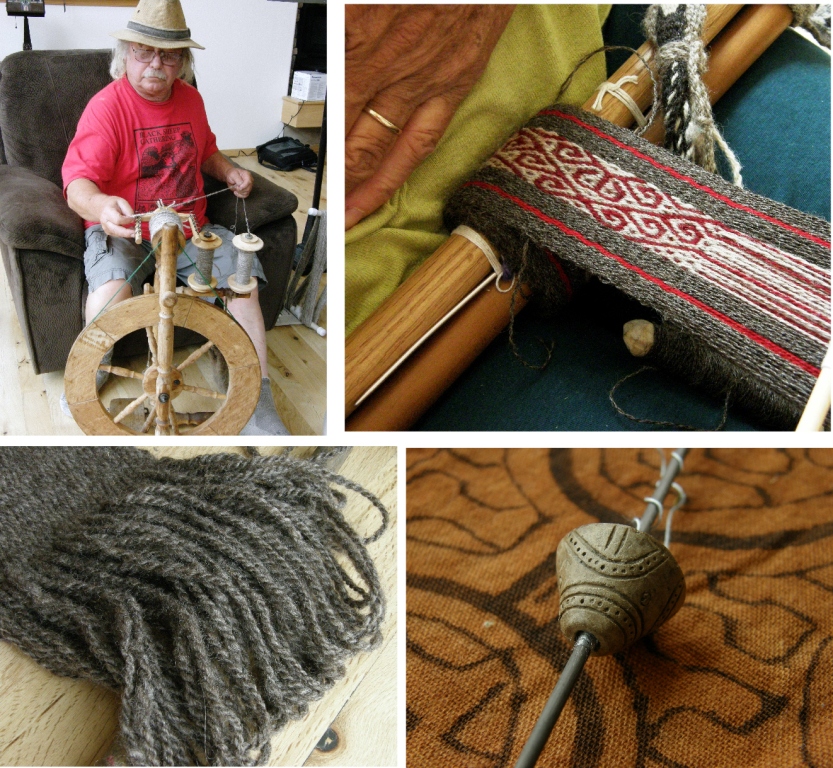
That's Ace at the wheel and below you can see the heavy grey yarn that he spun semi-worsted for his luxury backstrap...a lovely thick, cushy strap. You can see Janet working on a pebble weave band using her own handpsun and a pattern from my second book. And, on the right, there's the wee spindle whorl from coastal Ecuador that I gave Janet last spring. She has mounted it on a knitting needle and has been sponning with it.
That’s Ace at the wheel and below you can see the heavy grey yarn that he spun semi-worsted for his luxury backstrap…it made a lovely thick, cushy strap. You can see Janet working on a pebble weave band using her own handspsun worsted and a pattern from my second book. And, on the right, there’s the wee spindle whorl from coastal Ecuador that I gave Janet last spring. She has mounted it on a knitting needle and has been spinning with it.

Ace is new to backstrap weaving but not to spinning and I gave him a hand with that grey wool project. I have to admit it looked hairy and scary at first! but, it was a breeze to weave with. Who knew that it would weave up so well on a backstrap loom and in a warp-faced fabric? It all comes from the expert hands of the spinner and his/her preparation of the material.

???????????????????????????????I got so carried away with weaving and the enjoyment of working with that lovely thick and even handspun that I wove almost to the end forgetting that Ace would want several inches of unwoven warp ends from which to make braids for his backstrap. Once off the loom he braided the ends and braided a separate cord, from his handspun of course, for the straps.

Aces handspun yarn for backstrap

Some of Janet's beautiful naturally dyed handspun yarn which was destined for warp-faced weaving.
Some of Janet’s beautiful naturally dyed handspun yarn which was destined for warp-faced weaving….no overspin, no kinking!

It was about SUMMER, glorious summer…ripening grapes and berries, fireworks in the night sky, outdoor music, beaches and sunsets.


The view from my bed in Betty's studio looking out on her tree farm and ripening blueberries
The view while lying in bed in Betty’s studio looking out on her tree farm and bushes with ripening blueberries.
Sunset over the mountains in faraway Canada on the final evening of ANWG in Bellingham. The cool and enticing raspberry jungle at Janet's place. My poor, but kind- of -interesting, attempt at photographing the fireworks during my first 4th of July in the US. Beautiful patterns in light and dark sands on the beach at Shelter Cove near Janet's place....Humboldt County...sigh!
Sunset over the mountains in faraway Canada on the final evening of ANWG in Bellingham. The cool and enticing raspberry jungle at Janet’s place. My poor, but kind- of -interesting, attempt at photographing the fireworks during my first 4th of July in the US. Beautiful patterns in light and dark sands on the beach at Shelter Cove near Janet’s place….Humboldt County…sigh!

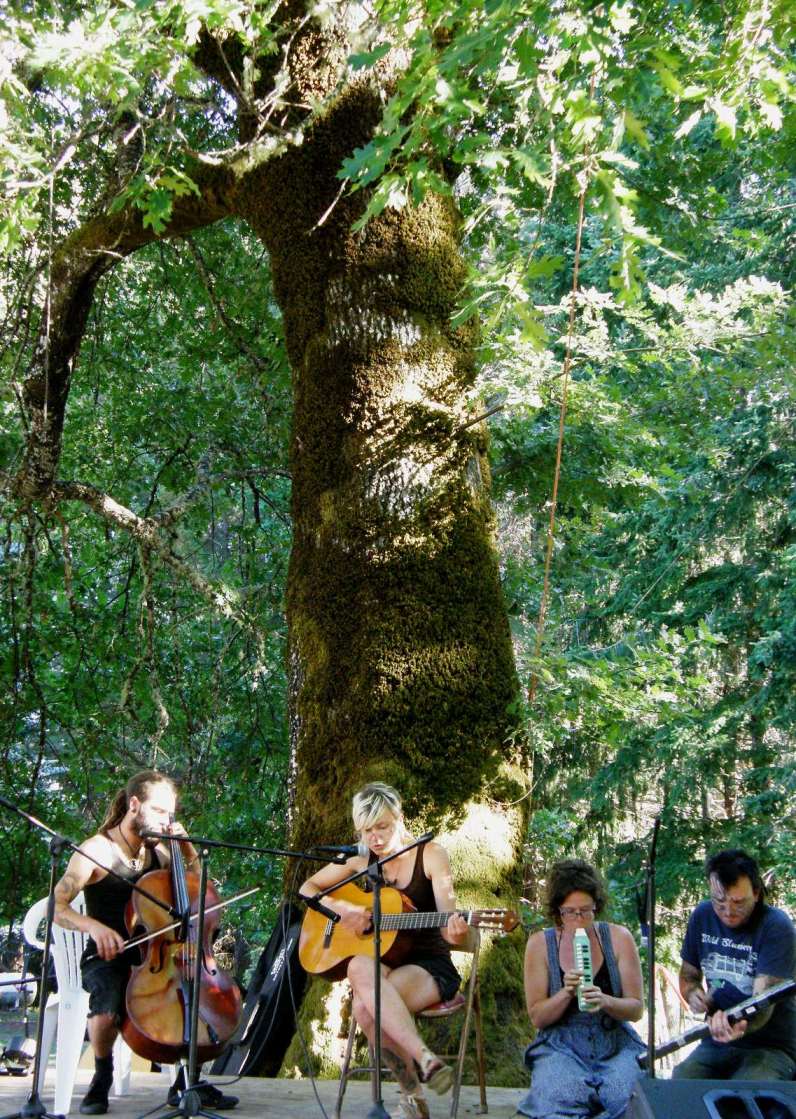
Music under the big ol' white oak...the annual"Strawberry Jam" at Janet's place. I hooked up a warp to my toe, wove and enjoyed the music.

Music under the big ol’ white oak…the annual”Strawberry Jam” at Janet’s place. I hooked up a warp to my toe, wove and enjoyed the music.

And there were textiles!! I was lucky that my visit with Betty coincided with a visit from Betty’s good friend Judith.She had come down from Canada to take a spinning class from Judith MacKenzie McCuin and stopped for a day to visit. She had brought with her the most exquisite textiles from a trip she had taken to Indonesia.

Judith lays out the textiles under the supervision of Trouble the cat.
Woven on a backstrap loom, this piece has both the warp and weft patterned ij the ikat technique. On top of that, the cotton thread was handspun. Judith tels me that this is known as "Magic Cloth" and comes the Tenganan Bali Agai Community in Bali, Indonesia.
Woven on a backstrap loom, this piece has both the warp and weft threads patterned using the ikat technique. The cotton thread is handspun. Judith tells me that this is known as “Magic Cloth” and comes from the Tenganan Bali Aga Community in Bali, Indonesia.

And, speaking of warp and weft ikat, I have to show you the jacket that Linda LaMay enetered in the juried show at ANWG. Linda wove with me over several days. She happened to be in the Gallery on my visit and allowed me to photograph her with her piece that was given the Complex Weavers Award. Her piece also won 1st prize for being the best representation of the conference theme: Crossing Threads, Crossing Borders.

Linda had bought a pre-tied and dyed ikat or, jaspe, warp in Guatemala...one which had been designed for warp faced fabric. Linda, however, wove it as a balanced weave, a twill and, in order to do this, had to dye the weft herself and then carefully place it to match the dyed pattern in the warp....she painstakingly transformed it into warp and weft ikat...amazing.
Linda had bought a pre-tied and dyed ikat or, jaspe, warp in Guatemala…one which had been designed for warp faced fabric. Linda, however, wove it as a twill exposing both warp and weft and, in order to do this, had to dye the weft herself and then carefully place it to match the dyed pattern in the warp….she painstakingly transformed it into warp and weft ikat…amazing.
Another textile in Judith's collection, this one from Sumba, Indonesia...all the stuff I love!...weft twining along the bottom, simple warp floats to create creatures that are mirrored in the central ikat section.
Another textile in Judith’s collection, this one from Sumba, Indonesia…all the elements that I love!…weft twining along the bottom and simple warp floats to create creatures that are mirrored in the central ikat section.

And, speaking of twining, let me show you the ravenstail work that John Beard showed in the Instructors’ Exhibit at ANWG. He kindly gave me permission to show it here….spectacular.
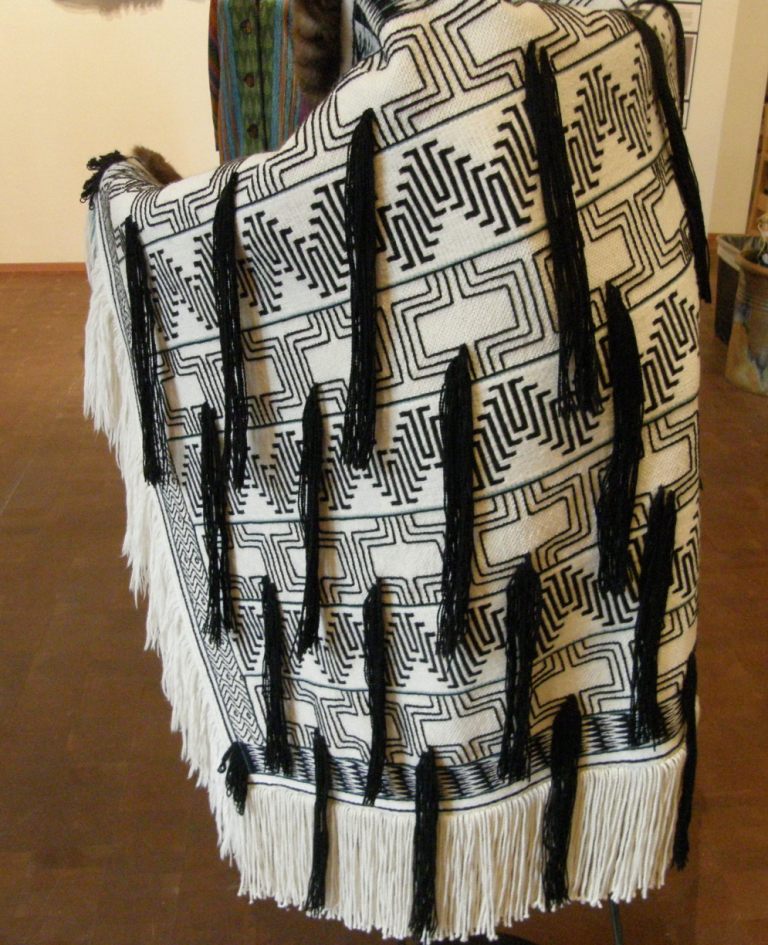
John Beard ravenstail

And, speaking of the warp floats in the Sumba textile, let me show you a textile that ANWG instructor and fellow Australian Kay Faulkner collected in her SE Asian travels. She brought this to ANWG to inform and inspire her students in her workshop entitled “East Meets West”.

We had fun comparing and contrasting spotty pebble-like structures and she came over to my classroom on the last day with Bhakti Ziek so that we could have even more "pebbly" conversation. If you look very carefully at the piece Kay brought you will see that there are weft floats amongst the warp floats.
Both faces of this textile have warp float patterns . Kay and I had fun comparing and contrasting spotty pebble-like structures and she came over on the last day with Bhakti Ziek so that we could have even more “pebbly” conversation.

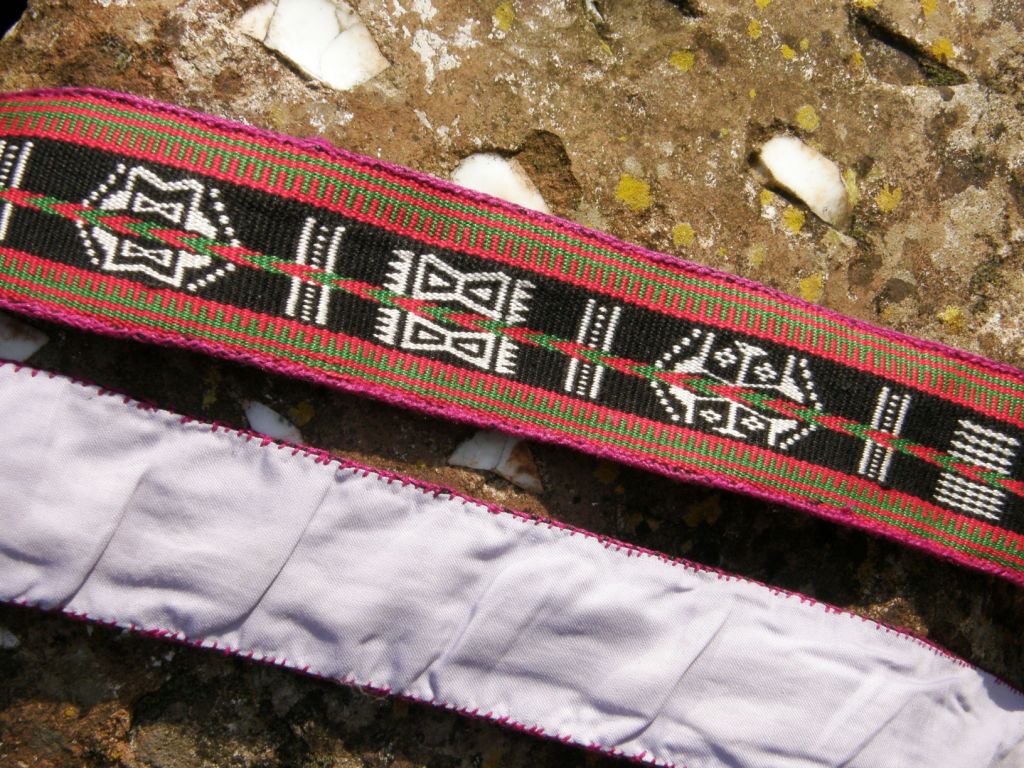
I just gaze and gaze at this Selendang shoulder scarf of Batuisi, W Sulawesi from Judith’s collection. The colors all come from natural sources. The yarn used was heavier than that used in other Indonesian ikat pieces that I have seen. I really liked the feel of this piece.

selendang shoulder scarf

There are more of Judith’s textiles to show but I think I will save them for another post. Let’s look at the miniature backstrap loom that she got in Indonesia instead. I am always intrigued by new-to-me pieces of equipment that the various backstrap weavers aroud the world use and this loom included such a piece which may hold one of the many secrets of how backstrap weavers go about keeping the ikat-patterned warp threads reasonably aligned.
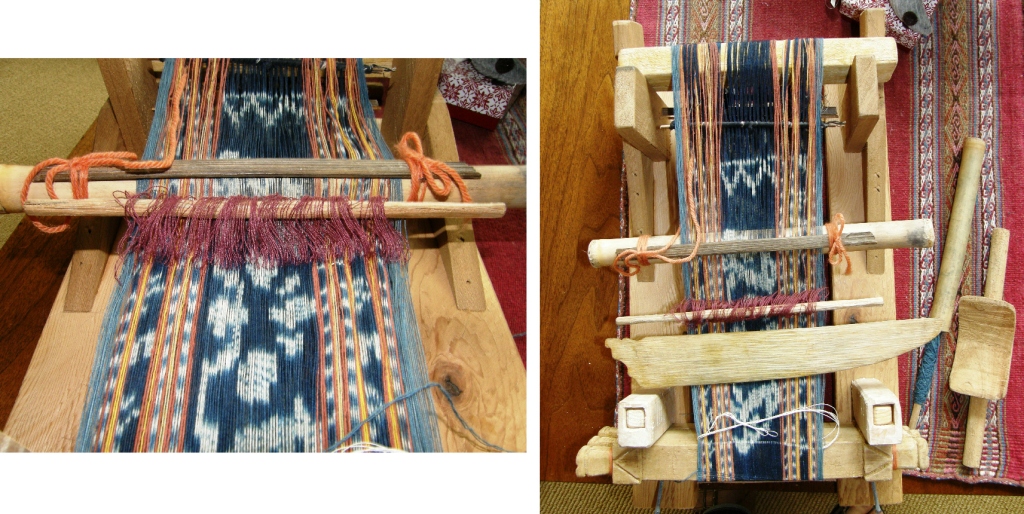
What a sweet little loom with its circular ikat warp in place. It was a great opportunity for me to take a close look at one of the Indonesain backstrap set-ups.
What a sweet little loom with its circular ikat warp in place. It was a great opportunity for me to take a close look at one of the Indonesian backstrap set-ups. The miniature wooden backstrap is so cute!
I love the carved pieces that serve to clamp the circular warp. Beyond the heddles and shed rod, the warps that had been tied and dyed were clamped between two sticks and wrapped. The wrappings seemed to separate the warps nto the sections that had been wrapped. I am wondering if the wraps also serve to squeeze the warp threads into groups and therefore help stop the from moving excessivley.and blurring the design too much.
I love the carved pieces that serve to clamp the circular warp. Beyond the heddles and shed rod, the warps that had been tied and dyed were separated along a stick which was wrapped. The wrappings seemed to separate the warps into the sections that had been tied for dyeing. I am wondering if the wraps also serve to squeeze the warp threads into groups and therefore help stop the from moving excessively and blurring the design too much.

51eM0hePRnL._SX500_And, while on the subject of simple looms from far away places, let me show you a loom that a lady in Arcata, CA  showed us when our weaving get-together group went to the Farmers Market.  A friend had brought it back from Africa for her with accompanying postcards that showed how it was set up. The postcards said Upper Volta and were written in French. This, according to Wiki is today’s Burkina Faso and it seems that the people who use these looms are called the Mossi. The loom pictured at left is from this page.

It has some beautiful parts which include bone foot toggles for operating the shafts and a fine reed framed with what could be wood and horn. The carved wooden pulley system and shuttle were lovely as was the indigo-dyed cloth strips that had been sewn together. I used this as background for one of the pictures. It’s for sale…tempting!
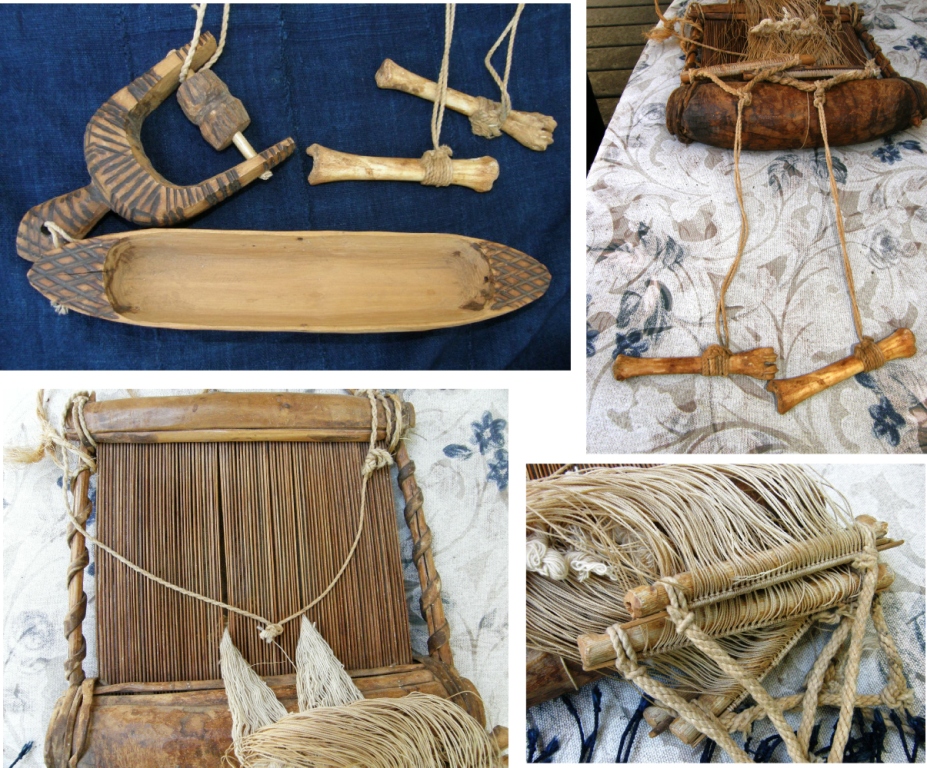
mossi loom

??????????????????????Back at Janet’s I enjoyed a chance to do some weaving of my own.

I got to work on the two warps that I had brought with me.

I have to say  that I was happy to get this one off the loom as I do not care for it at all! I am going to use it to practice and learn some new sewing skills. Maybe I can shape it into some kind of interesting bag.

This is the warp that I wove while visiting at the Mannings’s annual Spinning Seminar last month. The pattern is one that I have woven many a time and observers’ reactions while I was weaving it inspired an addition to my FAQ pagesthis new one being about following and ceasing to follow pattern charts.

Next up was the piece on which I am weaving a Bhutanese design called “labyrinth”. I am weaving it using the two-heddle intermesh technique that I teach in my second book.
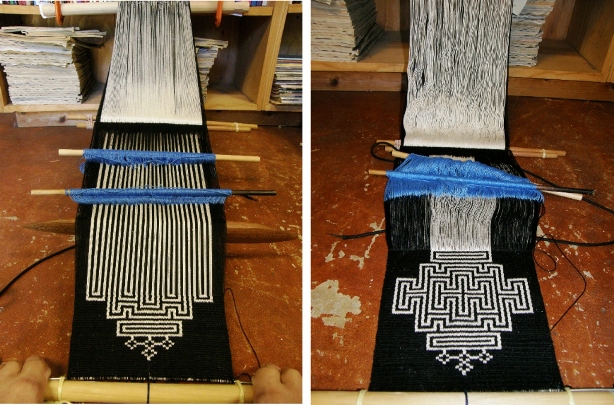
labyrinth design backstrap weavingThe pattern is from David K Barker’s first book of Bhutanese designs. Look at my RESOURCES page to see how you can download this free book. I never plan these ”traveling” warps to actually be anything knowing that my weaving on them is generally so interrupted and disjointed. However, I got to sit and weave on this quite a lot at Janet’s and had it set up in a very similar way to the way I usually like to weave. I lodged the far loom bar behind clamps on a low book shelf and moved the books and magazines around so I could extend my legs within. The angle was just right for me. With a pillow added on the floor, I was right at home.

Once the first large motif was complete and I could see that this could actually become something, I had to decide what would come next. Inspiration came in the form of a double-pocket saddle bag quite likely from Afghanistan. Janet bought it in a local shop of ethnic artefacts and it is gorgeous! It is woven with wool and largely patterned using weft substitution technique which results in floats on the back. However, the kinds of  patterns used in this piece do not create overly long or unruly ones. There are all kinds of soumak and warp-wrapped patterns as well. The fabric is incredibly stiff and tight…made to last a long, long time, no doubt.

inspiration for new backstrap weavingThose reds and blues…love them! The back of the bag, which would be against the animal’s back, was not patterned. Janet and I were both astounded when we realized that the plain cloth was not a separate backing but, rather, a continuation of the weaving in an extremely tight and very well balanced plain weave. I would bet that this bag is waterproof.
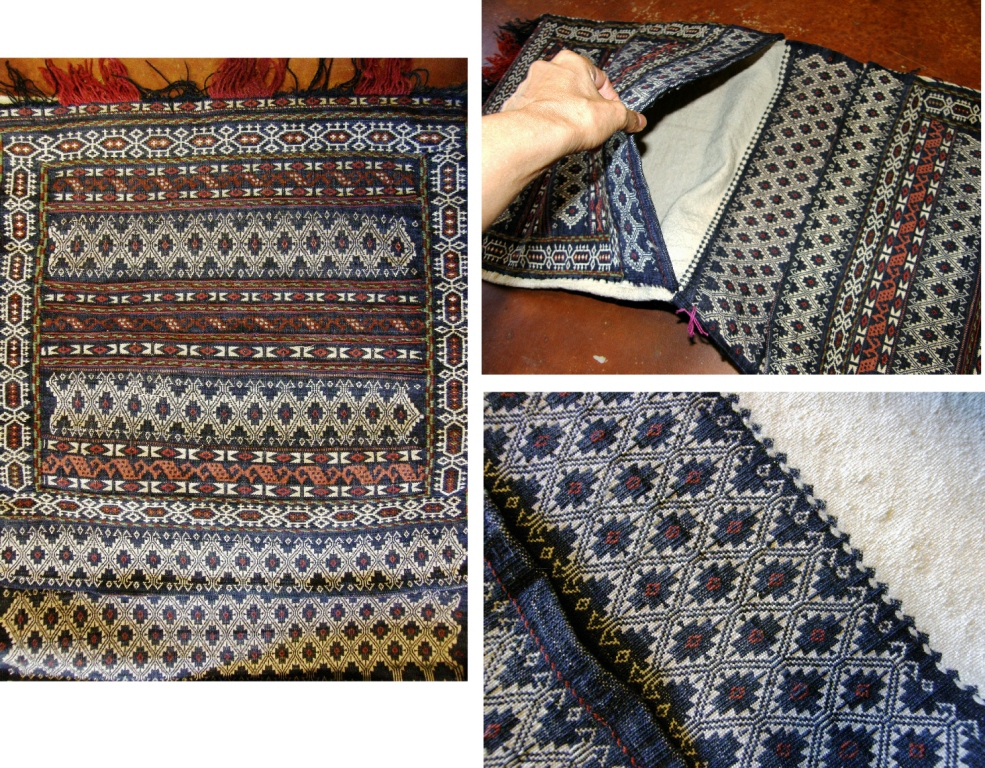
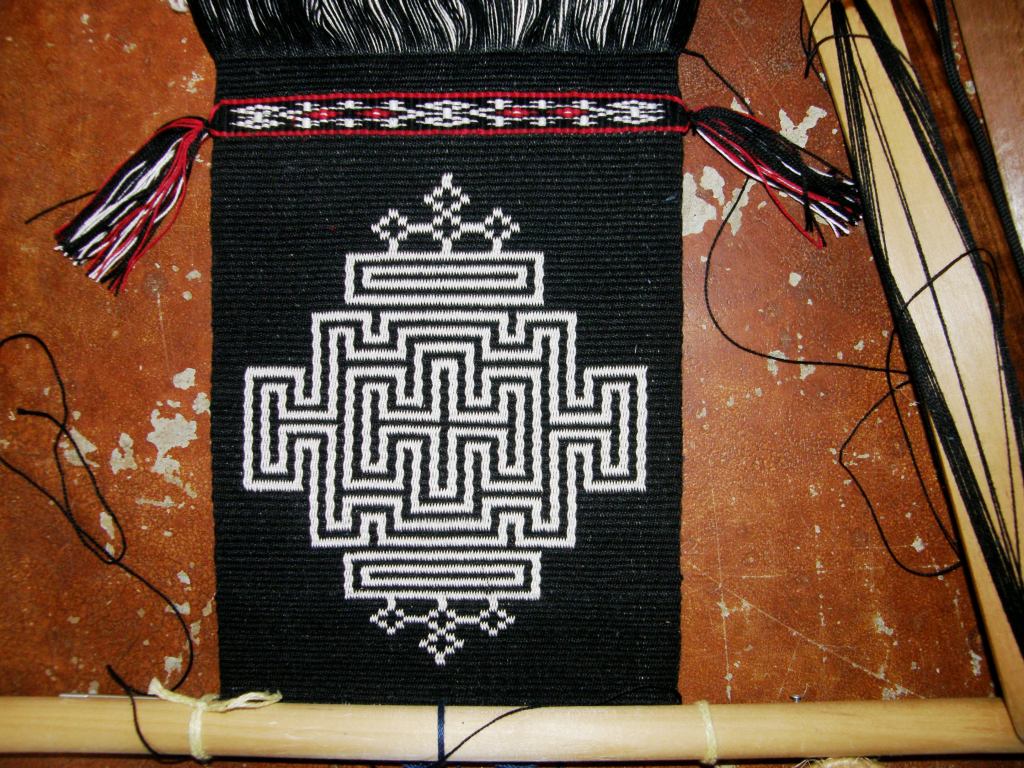
saddle bagSo, this is pretty much where I am at so far with this latest piece of weaving. I just started some vertical warp-wrapping for the back side which I haven’t photographed yet and I have chosen a motif for the center of the back…it’s going to be a bag (of course!)…black, white and red (of course!) and it is going to get seriously dressed up with tassels and trims. This will be something nice to dive right into when I get back home (that will be soon, I hope. I am writing this in Miami airport).
??????????????????????

Next up on my blog…Santa Fe and the International Folk Art Market…it has been one of my dreams to see this. Visiting Santa Fe also gave me a chance to hang out with several weaving buddies that you will have already met here on my blog. I can’t imagine a better place to have gotten together with them and we are wondering how we can possibly top this!

Of course it inspired all of us but the funny thing is… one of my best ideas came  from something I saw in the American Airlines inflight magazine on the way to Miami…funny how these things work! See you next time.

Backstrap Weaving – Hands Full of Threads

The black neck wrap is done and I am already thinking about the next one.

I thoroughly enjoyed working with this fine Guatemalan cotton thread (you see how I have forgotten about all the woes in the beginning!). It was fun picking up threads with the delicate Guatemalan pick-up sticks and feeling the silk supplementary wefts slide through my fingers.

This will be the color scheme for the next one…

colors for next backstrap woven scarf

Maybe I will use some Guatemalan-inspired designs this time or perhaps I will invent some of my own.

cotton-spinnersI got the black piece off the loom and then I was faced with fringe twisting. Would you believe I have never done this before? I have left fringes on placemats and braided the ends of other pieces. I had read the grumblings about fringe twisting from those who regularly weave scarves in the weaving forums and seen pictures of the gadgets and gizmos that have been designed to make this task less tedious.

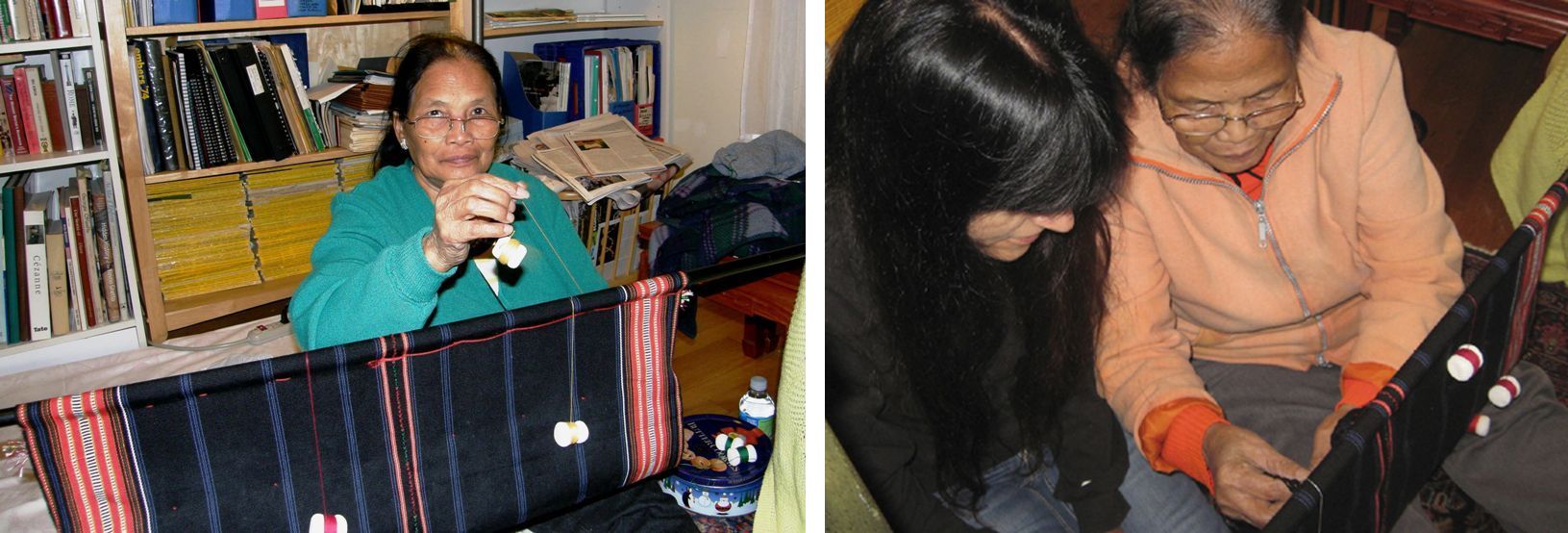
I even watched a video I had taken of my Montagnard weaving and twining teacher, Ju Nie (seen at left spinning cotton), twisting the ends of a piece she had recently taken off her backstrap loom. Ju had come to visit at friend Betsy’s house and, rather than sit idle while chatting in the living room, she pulled out a wad of stuff wrapped in paper and a woven piece of cloth and started working. The “stuff” turned out to be mushy, sticky over-cooked rice through which she drew the warp ends before rolling them on her leg and setting them in the twist.

Here is the video. Ju explains that doing it on her pants is “no good” and that it works much better on her bare leg. I am guessing that her bare shin makes the best rolling surface.


So, I twisted my fringe and it wasn’t as slow as I had thought…much faster than braiding, I can tell you! I added weft twining to the ends of the fabric before taking it off the loom. I think that made a nice finish.  See the countered weft twining tutorial here.

And then I found that scarves are kind of hard to photograph…way too long and flat and lifeless to try and stretch out in one shot so I gathered it up and threw it down many times, fiddled about and I felt that this was the best “pose” in the end.

bhutan scarf with border

And another shot that shows my favorite central motif…

finished bhutan scarf backstrap loom

Although I was mad keen to get into the Guatemalan purple thread and warp up another scarf, (especially since I think that I  already experienced, hopefully, all possible mishaps when weaving the black one), I decided that there was another project sitting in the closet that needed my attention…(plus I really need to ponder and plan the patterns I want to use on the purple scarf before rushing in and weaving it)…

wayuu_motif_with_twining

Remember this guy? I had just started the large main motif when I decided that I would not touch this until I was sure I would have enough time to stick with it and finish it. When doing pick-up, I think it is best to do a pattern all in one go rather than leave it sitting while I travel. If I leave a piece for a long period of time,  I can almost see the place where I left off and picked up again. Perhaps I sit a little differently, apply a little bit more or less tension, beat differently…I don’t know…something changes. So, now is the time to get down and finish this piece.

Usig a forked stick in the warpI welcome the opportunity to have my hands in there and full of threads again. I am not a pick-up stick kind of gal,  unless a particular technique or yarn really demands it. I like to hold and pick and drop threads with my hands. Perhaps it’s because that is the way my first Peruvian teachers showed me. I have been shown and I have willingly tried other ways but I always come back to just using my hands.

Here is a weaver creating a belt patterned with supplementary warps. It is a narrow piece and so it is easy for her to simply insert her hand between the warp layers to do the pick-up.

I was finally successful in uploading the video of this weaver at work. You can see how she does her pick-up as well as see the two-stick method she uses for opening the heddle shed. She has a forked stick in the warp….one prong is her shed rod and the other prong holds a second cross. Grasping and twisting the fork, while leaning forward to relax tension, helps her to smoothly open the heddle shed. 

These are the kinds of textiles she produces…

O

I watched a gentleman from Chahuaytire also weaving supplementary-warp patterns into a much wider piece of cloth. He uses a pick-up stick to hold all the threads in both the pattern and plain-weave sections as he works his way across the cloth…


This is his weaving…

chahuaytire backstrap weaving

Both weavers work equally fast, don’t you think?

So, on I go with hands full of threads. This is the third piece in my red-white-and-black wall hanging series. This one has patterns which have been inspired by the si’ira belts woven by the Wayuu people of Colombia and Venezuela. Since starting this project, I got to go to Holland and meet Mirja Wark who spent years studying, collecting and cataloging these belts as well as writing a book describing the weaving, braiding and twining techniques used.

si'ira belts wayuu mirja wark

wayuu project in progressThese are belts that Mirja herself wove while studying. You can see the “cow’s nose” pattern at the bottom of the blue, pink and green belt that I used in my wall hanging. The large motif that I will use in the center has been very much adapted to fit my piece and uses just certain elements of the Wayuu patterns as inspiration. There are a lot of threads to pick and, until I things get rolling, I am very much clinging to my pattern chart. Thank you, Terri, for introducing me to removable highlighter tape which works like a dream!

So I will be parked in front of that piece for some time while taking breaks to re-spin the Malabrigo yarn, plan supplementary-weft patterns for the discontinuous-warp piece for which the Malabrigo is destined, ball up that large skein of Guatemalan purple cotton, sketch some patterns for the purple scarf project, plan piece number four in the wall hanging series…maybe ikat??…do I dare?

And I am folding this sampler piece this way and that to see if something useful can be made of it. It’s still on the loom and there is room for more pattern experiments.

O

Let me show you some things that Ravelry members and students and friends have made. It is a strange coincidence that three people decided to edge pieces of clothing with woven bands. Janet decorated a pair of felted slippers that she made, Laura edged gloves (and also made a camera strap and headbands) and Julia edged a couple of tiny shadow-weave kimonos with a pebble weave band. Three gorgeous projects! (I am in love with that shadow-weave cloth, by the way…it takes four shafts…I would like to try it).

christmas_projects__2012_006_medium

laura xmas projects

kimono_baby_black___white2_mediumI will leave you with the happy twin recipients of the wee kimonos…Julia’s grand nieces!

ZellaHattieinKimono_medium2

######################################

Right before I was about to publish this post,  a question was posted in the Ravelry group by a weaver who is trying supplementary-weft patterning for the first time and not getting the rich satin-like finish  that she would like in her patterns. Instead, there are spaces and gaps between the rows of her design. I posted a reply in the group but am copying it here as I think that it may be useful for others who feel like trying this lovely technique…

There is no formula that will suit all weavers…that is, “x” number of strands of such-and-such a supp weft material will give sufficient coverage with such-and-such warp thread. All weavers are different in the way they handle their warps.

For example, some weavers put a lot more tension on their warp than others. This means that they have fewer picks per inch than others because the warps are pulled so tight that they can’t bend over and under the wefts as easily as they do for weavers who use less tension. This means that a certain amount of supplementary weft material won’t give the same amount of coverage for those weavers as it does for others who use less tension.

Another case…some people simply don’t beat hard enough when using supplementary wefts. I beat hard and really mash the weft into place…not “wham wham” beating…more like placing the beater right at the weaving line and pushing against the weft hard with a rocking motion.

Other people pull too tightly on the supplementary weft. It has to be fairly relaxed in the shed to allow it to spread and cover the surface. As an experiment, pull your supplementary weft tight once you have changed sheds and see what happens. It will flatten and narrow and not give good coverage. You have to find the balance between thread that is relaxed enough in the shed and bumps at the sides, where the weft turns, that are not too big and loose.

These are all things that come with trial and error and experience. It might be that you need to use more supp weft material or it could be one of the other factors I have mentioned here.

I often use thread that is similar to #3 and #10 crochet cotton. It is Brazilian cotton that I get here in Bolivia. I have used two strands of embroidery floss with the “#3” and one and a half with the “#10”. This gives people an idea of where to start and what to try but, as I said, every weaver is different.

Hope this helps.

ETA My first Guatemalan teacher combed the strands of her supp wefts with the point of her pick-up stick so that they lay next to rather than on top of each other. They didn’t move with handling…the floats are not long enough to cause that to happen. I did the same with the six strands of 60/2 silk on my current project.

Backstrap Weaving – Falling into Spring

Back home in Bolivia!

September is the first month of spring. Big rains extinguished all the fires that normally choke the skies with smoke at this time of the year, the green and white flag flies proudly and Santa Cruz celebrates its beginnings.

September 24 is the big day of celebrations and above you can see one of my English teaching colleagues, Lalenya, wearing the tipoy, the typical dress of Santa Cruz (only worn on such fiesta days) with some students from the instutute wearing the light white cotton outfits and sombrero de sao which complete the typical man’s costume for these days of celebration.

Lalenya’s tipoy is patterned with images of the patuju flower which is one of two Bolivian national flowers. One flower represents the lowlands where we live and another the highlands.

Next week the US will be celebrating Spinning and Weaving week (is this an international celebration?) and I will be spending the week in Cusco, Peru at a weavers’ gathering…yay!

I got to enjoy some wonderful late summer/early fall days in Europe. After what I am told was a wet and horrid summer, I was treated to day after day of sun and perfect temperatures in both Holland and the UK.

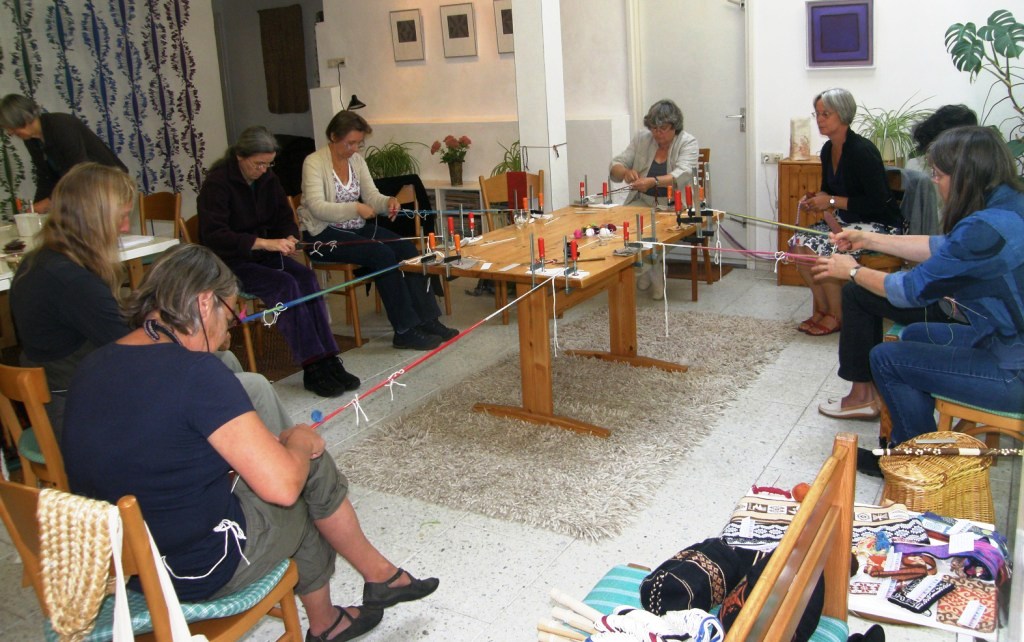
Here is part of the group that came to meet and weave with me in the Netherlands. Artist, author and tablet-weaver Marijke van Epen, is just behind me. In the chaos that typically accompanies packing up at the end of a weaving day, two people left before I remembered to get a posed group shot but here they all are  weaving…

We wove in the workshop and exhibit area in Marijke’s lovely home, a beautiful light and airy space with walls covered in Marijke’s stunning tablet-woven art.

This rainbow piece covers an entire wall and comprises tablet-woven linen spiral bands with twisted paper weft. The slightest movement nearby will set the pieces in motion,  gracefully turning. Standing by the green bands as they gently twirled reminded me of being in a forest with dappled light. I can imagine this hanging in a bedroom accompanied by the sound of a gurgling stream and breeze…how relaxing that would be!

Other walls were adorned with smaller tablet-woven pieces. Being behind glass, it wasn’t possible to photograph all of these well.

Yes, these have  been woven with tablets!

One of my favorite pieces is Marijke’s reproduction of  a tablet-woven band which belonged to  Bathilde, Queen of the Franks  (7th Century) which was found among other textile fragments in Chelles Abbey. Look at the little “pebbly” figures that run along the bottom edge of the band. They could be woven using the Andean Pebble Weave structure.

And then, upstairs  in the loom room where I slept, I had these to keep me company…

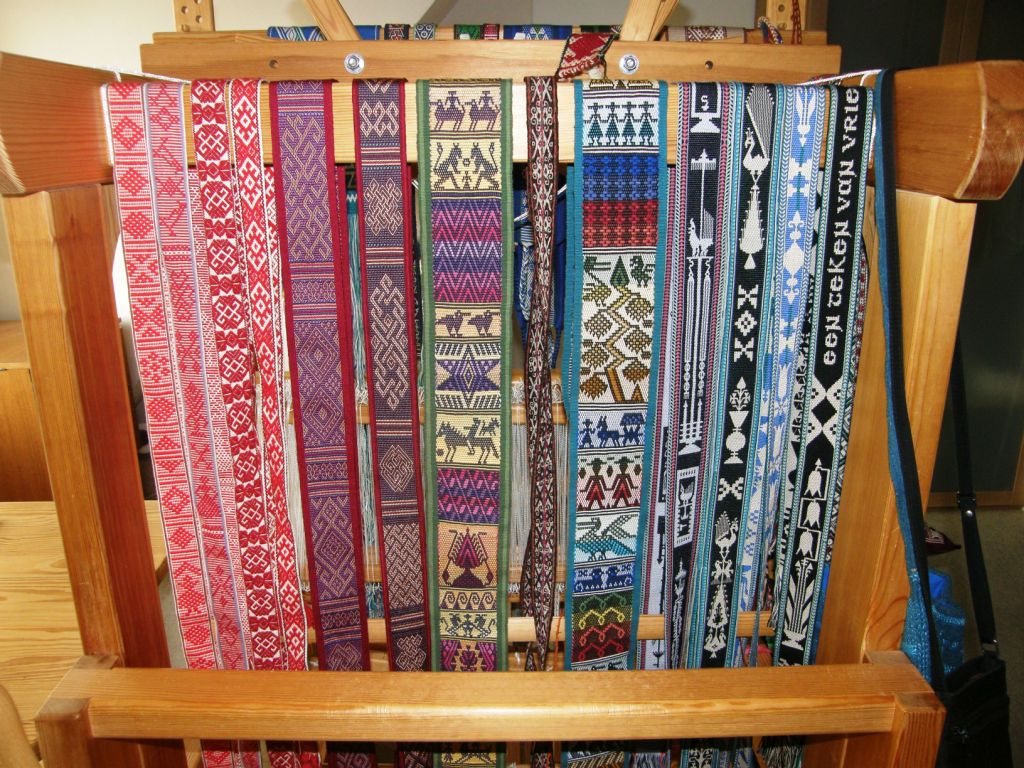
This is just a handful of the bands that reflect Marijke’s love of ethnic textiles and motifs. She has dedicated a lot of time to figuring out how to reproduce the structure of pieces, which have been created with pick-up techniques on backstrap looms, using tablets instead. In this way she has been able to create multi-colored pebble weave bands instead of just limiting herself to two and three-colored bands as are most often seen in the Andes these days. At times she found that she couldn’t find an efficient way to reproduce a certain structure with tablets and so she would weave the piece doing pick-up with a backstrap loom. She is just as skilled at doing pick-up with her backstrap loom as she is with using tablets.

And, as you can see, she also loves to cover her woven pieces with finishes and embellishments…braids, pom poms, tassels, straps, edging bands. All her pieces are impeccably finished down to the very last detail. That is an inspiration for me as I sometimes don’t take as much care with finishing the inside of my pieces as I do with the outside. Above you can see Marijke practicing her ñawi awapa tubular band. She had learned how to make this beautiful band from the writings of Adele Cahlander and I was able to show her how I was taught to make it in Peru.

It was a lovely week in the small village of Gelselaar, village of geese, in eastern Holland. Much time was spent indoors with Marijke as we  poured over weaving books, discovered the many similarities in our interests,  peered at photos and tried to figure out structures. We wove the special rolled tubular edging used by the Wayuu weavers on their si’ira belts described by weaver and author Mirja Wark. Together we also figured out how to weave a new tubular band from Chahuaytire…what fun! And then there were evening strolls around the village…breakfasts of typical Dutch treats, Hagelslag – chocolate sprinkles which you have on toast rounds – and morning coffee break with stroopwafel,  my favorite!

Two of Marijke’s friends offered to drive us north to spend the day with Mirja Wark. It was a lovely drive with lots of horizon to be seen! Mirja has her home in a remote area on a large piece of property on which she has her weaving school and studio. How tranquil and inviting is that? Students are invited to pitch their tents, if they like, in the orchard that lies on this side of the pool.

It was another glorious early fall day. We sat outside while Mirja brought us the si’ira belts which she collected and catalogued while living in Venezuela. We also saw three reproductions that she herself has made.

There is a whole lot involved with the creation of one of these belts. Firstly, there is all that pick-up to make the pattern (I know! I am in the midst of weaving a wall hanging using an adaptation of these designs), there is the special rolled hollow edging which you might be able to make out in the picture, there is a weft twined finish at both ends, loop braids and tassels….all of which are beautifully explained in Mirja’s book.

Mirja showed us how the belt is worn by men to secure their loin cloths. The pom poms sit right on the hips and jiggle about as the wearer walks. Below is one of the belts made by a Wayuu weaver. No one is weaving these any more and most of the belts that Mirja collected are quite old with many signs of wear, deterioration and multiple repairs.

Then we saw the typical embroidered cotton dress used by Wayuu women.

A belt concealed inside the dress allows the wearer to pull the dress in and around the front of her waist to give it some form. The back of the dress, however, hangs and flows freely. Mirja says that it is a lovely sight on the notoriously windy Guajira Peninsula to see the women with their dresses billowing behind as they walk.

Mirja was able to collect this young girl’s blouse and a chief’s ceremonial headdress. The patterned woven band of the headdress is almost completely obscured by the pink tassels.

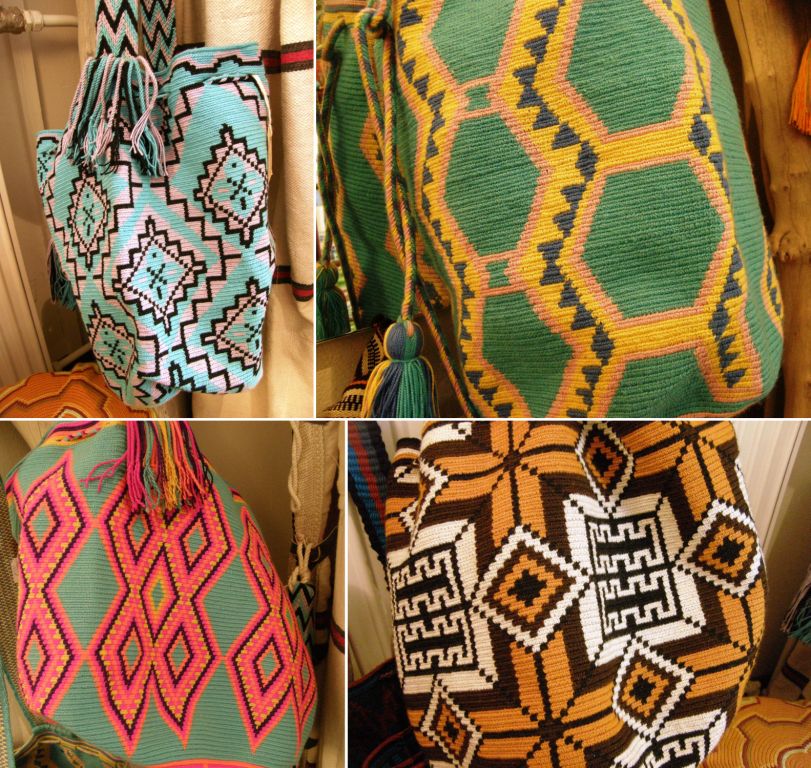
And then there were the susu, or mochilas, the crocheted bags which come in many sizes. Large ones are carried by the Wayuu women while small ones, which are used for coins, hang from the mens’ waists. A crocheter I am not. Well, I do know a few stitches (are they even called “stitches”?) and this in spite of owning Carol Ventura’s wonderful books on tapestry crochet. So, for all the crocheters out there,  I have taken a close up shot of the structure so you can see what’s going on.

Mirja has one of  the very tiny crochet hooks that the women use to make these bags but in all the excitement of the showing and examining and photographing I didn’t get to see it. However, I found this very short segment on Youtube of a Wayuu woman making a mochila.

Now let’s look at more of these gorgeous bags that Mirja has in her studio…

And for the ply-splitters out there, some of the straps of the bags are made in this technique.

The bottoms of the bags, which probably are not seen very often when the bags are being carried, are also beautifully patterned (I have read online that this is one of the features that distinguish a real Wayuu bag from inferior imitations).

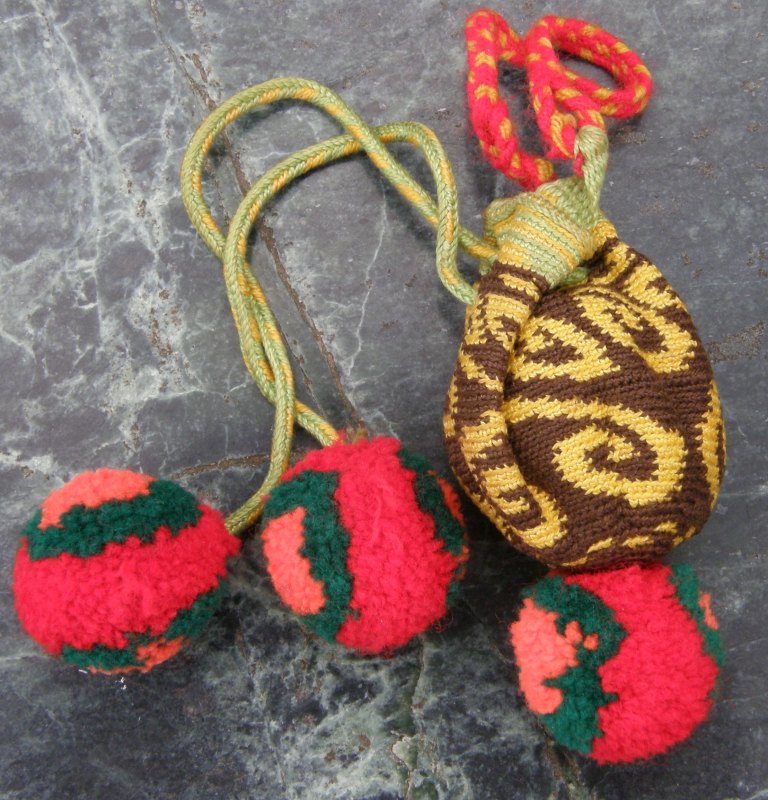
Here is something for the loop-braiders…one of the tiny coin susu that men dangle at the hip….

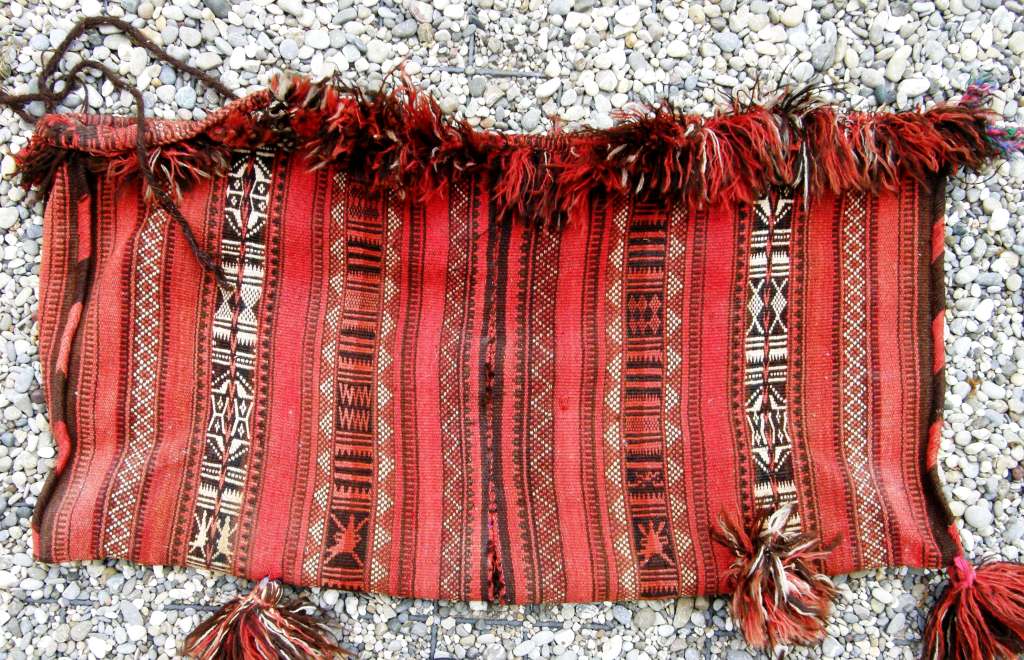
There was so much to see! Mirja has also lived in the Middle East and there were many textiles that she has collected, studied and reproduced throughout her studio. I will refrain from posting everything as I need to get some of the details sorted…so much information. However, I will show you this woman’s camel bag (the woman’s version apparently has only one pocket) from Oman as we have seen these kinds of Bedouin textiles here on my blog before.

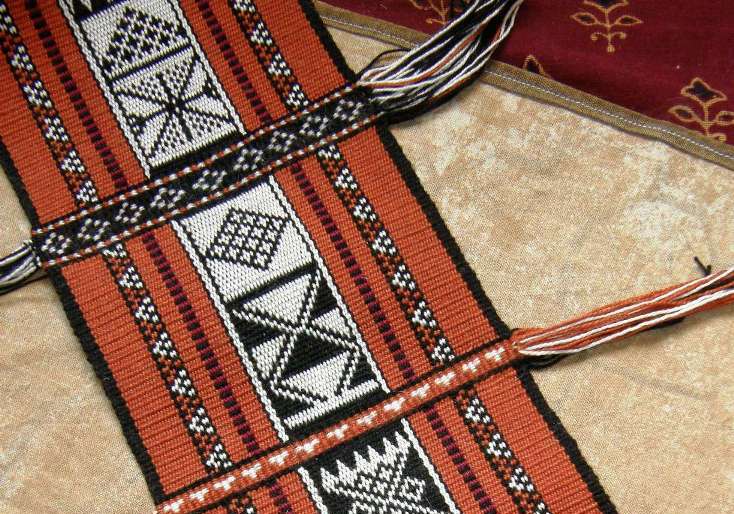
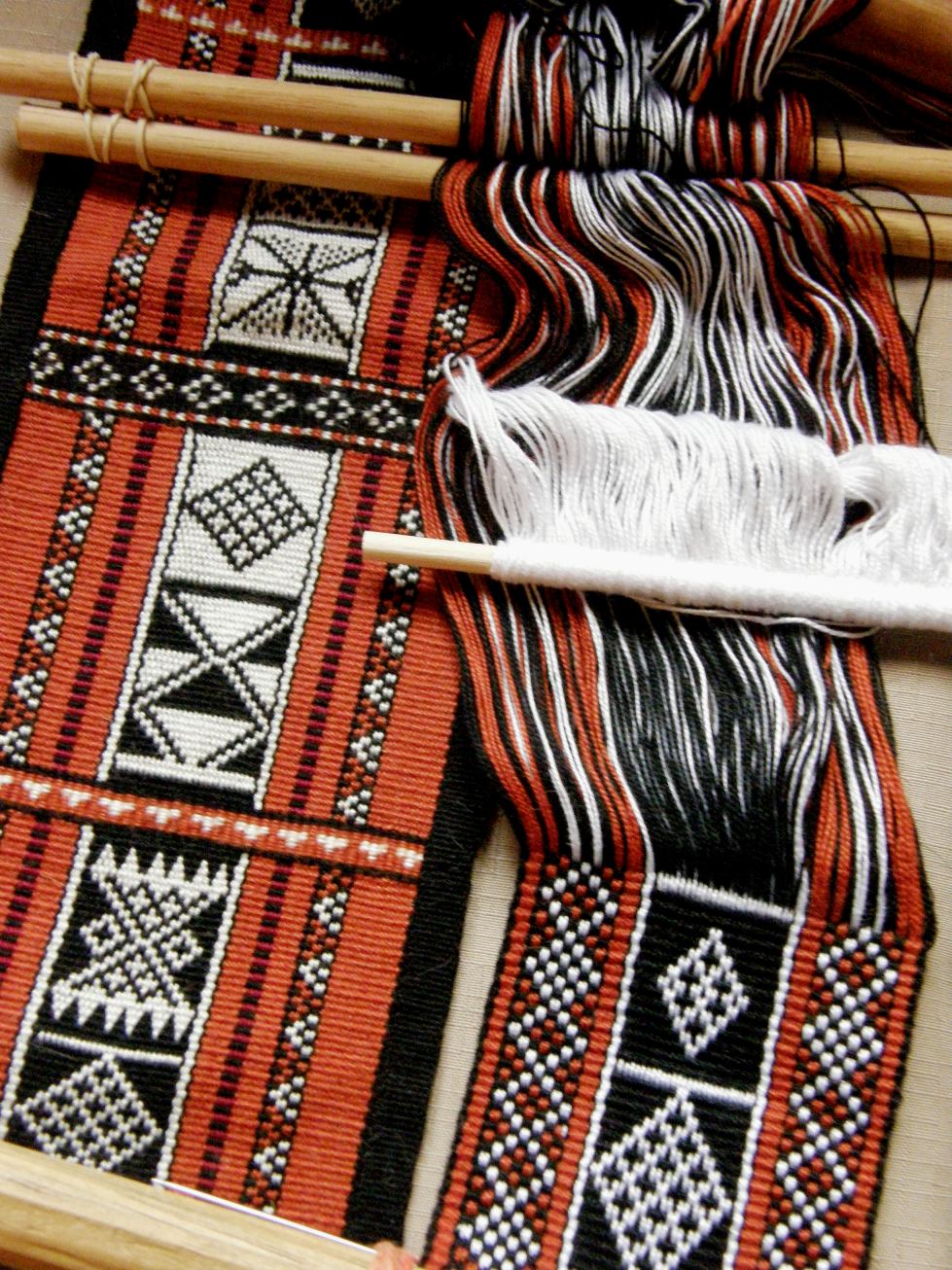
Recognize this style of weaving?…the warp-substitution shajarah  and the checkerboard al’ouerjan patterns (both these techniques produce long warp floats on the back). I love the red on black patterns! There is plenty to look at on this piece…all those marvelous finishes and embellishments. What a treat to be able to handle a textile like this!

This next piece that Mirja bought on an island off the east coast of Oman is interesting in that the weavers have tied down the warp floats on the back of the piece.

In a previous discussion about this in the Ravelry group we had  assumed that this was done simply to make a textile more attractive for tourists and was not a traditional practice. However, Mirja assured me that this piece was not intended for tourists. The island was the only place that she saw traditional textiles woven this way. In other places the long warp floats are often hidden under fabric, as shown below, or  left exposed.

So, that was the Netherlands…and two fabulously talented and generous weavers, writers and teachers.

Back in the UK I had one more day with Sue on the farm…ah, the peace, the sunsets, the walks with the dogs, the gorgeous garden… and then I headed down with Sue to Weybridge where I stayed with a Braid Society friend, Norma.

On the way we stopped at the Handweavers Studio and Gallery. Owner Wendy Morris was away at Complex Weavers in the US so I didn’t get to meet her. I went a bit mad and bought a bunch of 60/2 silk with no project in mind. A little voice keeps telling me to “make do with what you can get in Bolivia!” and not to have longings for these other kinds of thread but I have an urge to weave some very fine things with something other than the cotton sewing thread that I get in Santa Cruz.

Sue bought some beautiful handspun and naturally dyed singles yarn form Ayacucho, Peru.

A flyer in the store told the story behind this yarn and it was funny recognizing archaeologist Barbara Wolff’s, name there. I met her at Maryland Sheep and Wool this year where she was promoting and selling weaving of Ayacucho – tapestries and pebble weave pieces. She has been organizing the spinners in the area to produce this yarn and Handweavers Studio is now one of the stores that carries it. Barbara tells me that they are in the process of preparing another shipment so I guess that it is all going very well.

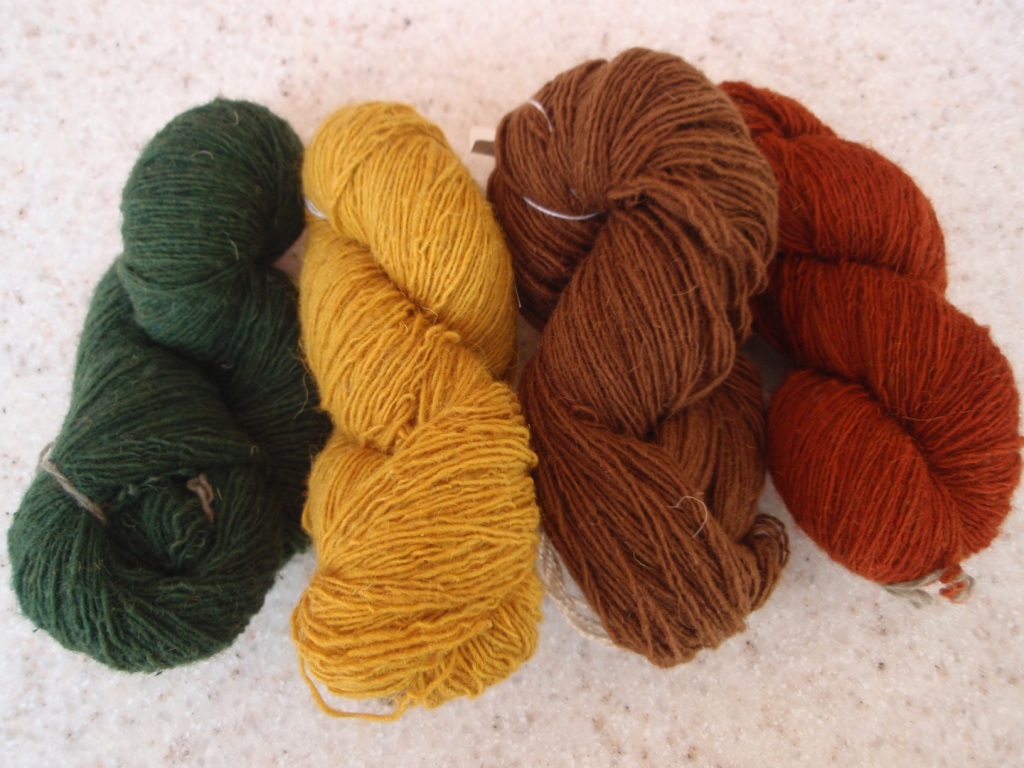
Sue bought four colors with which to make ñawi awapa tubular bands. According to the swing tags and information in-store, the terracotta color comes from masacopa root, the yellow from the chilca bush, brown from nogal (walnut) and the green from tara pod.

Being a Braid Society member Norma is of course passionate about all kinds of narrow band weaving, ply splitting, tablet weaving, loop braiding, kumihimo etc…and I gave her some lessons in Andean pebble weave and tubular bands while I stayed with her in Weybridge. She showed me her collection of textiles including the gorgeous ply split camel girth above.

Norma’s family is from India as am I, and so, I had a week of authentic home-cooked delicious Indian meals…south Indian curries and sweets! We went to Southhall to an enormous Indian supermarket where Norma and her family helped me choose a few bits and pieces to take back to Bolivia. I am afraid that I cheat and use the prepared curry powders.

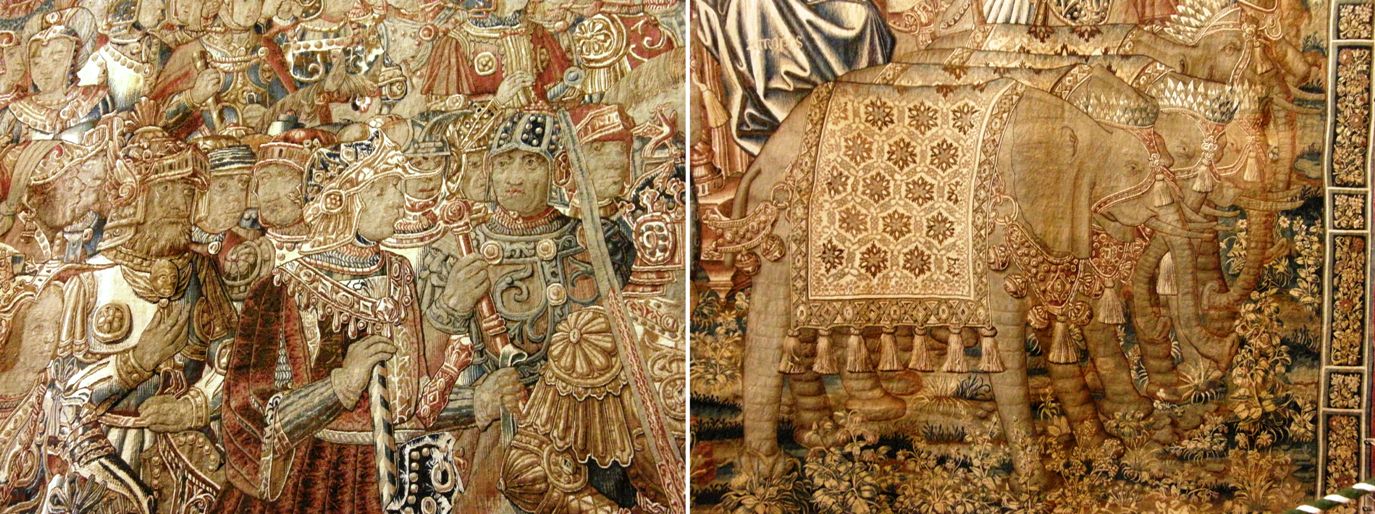
The following day Norma and I went to nearby Hampton Court Palace, residence of Henry VIII. My gosh, I have loads of pictures to show you from there…the Tudor and Baroque architecture, the interiors, the gardens, courtyards, squares, paintings, tapestries, furniture, chapel and kitchens. However, in an attempt to keep this post mostly textile-focused I will just show you one tapestry…two small segments of one of my favorites…

Such detail in this!  It is entitled The Triumph of Fame over Death and hangs in the Great Watching Chamber.

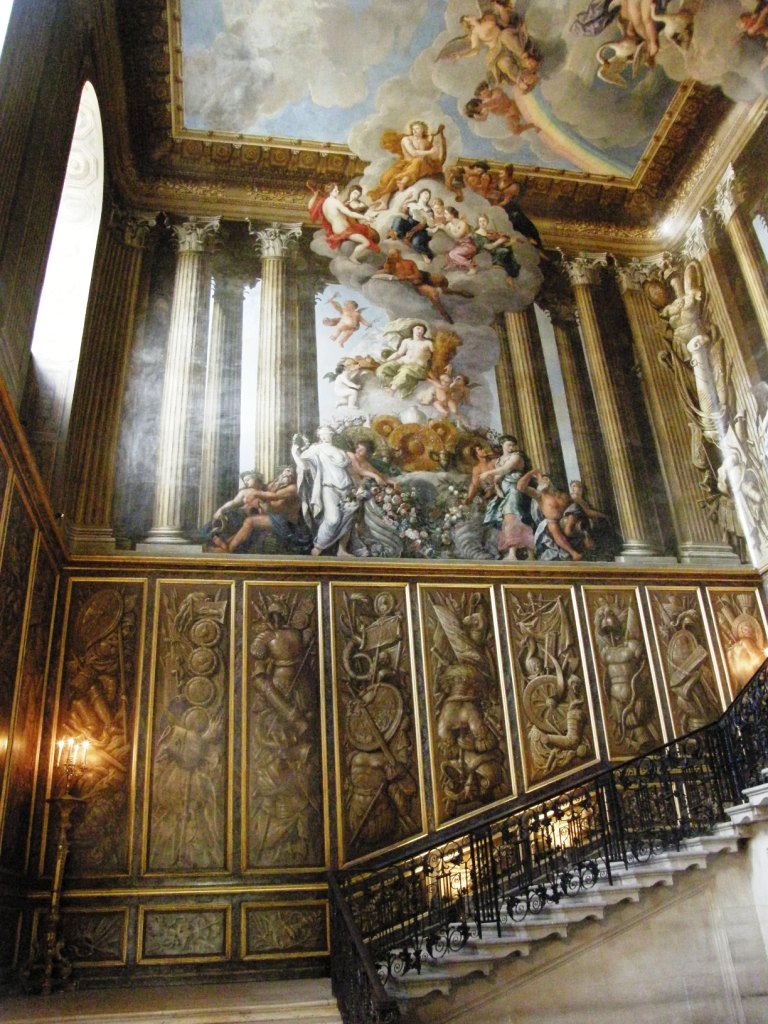
Well, okay, just one more picture from the palace…I can’t resist. This is from the Apartments of William III….

Every inch of ceiling, wall and all that lies between is decorated.

My last day was spent very nicely with Norma on a visit to Rodrick Owen in his home in Oxford where we were able to sit and chat at ease after all the rushing about at the Braids conference. We saw some of his large works…interlaced wall hangings and even clothing!… and  had the chance to examine some pieces in his South American study collection.

On the way back to the strain station, Rodrick led us on a short walking tour of Oxford. It was another gorgeous late afternoon with the rowers training on the Thames among the ducks and swans, youngsters playing rugby against a backdrop of the magnificent Oxford colleges with the sun casting a lovely golden glow over everything.  It was a beautiful last day.

It was just cool enough to have us wearing light sweaters…fall is on its way over there while over here in Bolivia spring has taken its hold. However, I have to say that we don’t really have a spring….just two seasons really…hot-and-humid and warm-and-humid and “hot ” is definitely starting to push “warm” out of the way. Ah well, I will be heading to the highlands this Saturday and an overnight bus trip from La Paz to Cusco will certainly cool things down.

A couple of things to show before I go…

I am happy to have received the first woven feedback from my new book!

Bobbie in the US is weaving the first panel for a bag project using the knot work patterns that are charted on pages 43 and 44.

Camilla in Sweden is doing one of the things that I hope many people will do with my book, that is, she is using the designs charted in my book as inspiration for her own unique patterns. Camilla has allowed the hook design that is woven in various parts of the Andes to inspire her work arranging and  placing them on both pebbled and twill backgrounds.

I am looking forward to seeing more projects from people who are using the book.

Finally, CraftDesignOnline has put up what they are calling an Interactive Grid Designer on their website. They say that this is the first of a new range of design tools they are planning. It allows you to create patterns by filling in and coloring squares which can then be printed. This style of grid is perfect for warp-faced pick-up pattern structures that incorporate warp floats like Simple Warp-floats,  Pebble Weave and other complementary-warp structures.  Note that Double Weave, Warp Substitution or Supplementary-weft patterns are best done on charts in which the cells are staggered rather than stacked one above the other.

In my next post I will tell you about the Cusco event, hopefully while still in Cusco. Fingers crossed that my cheapo hostel has wifi service.

Backstrap Weaving – The Weaving Melting Pot

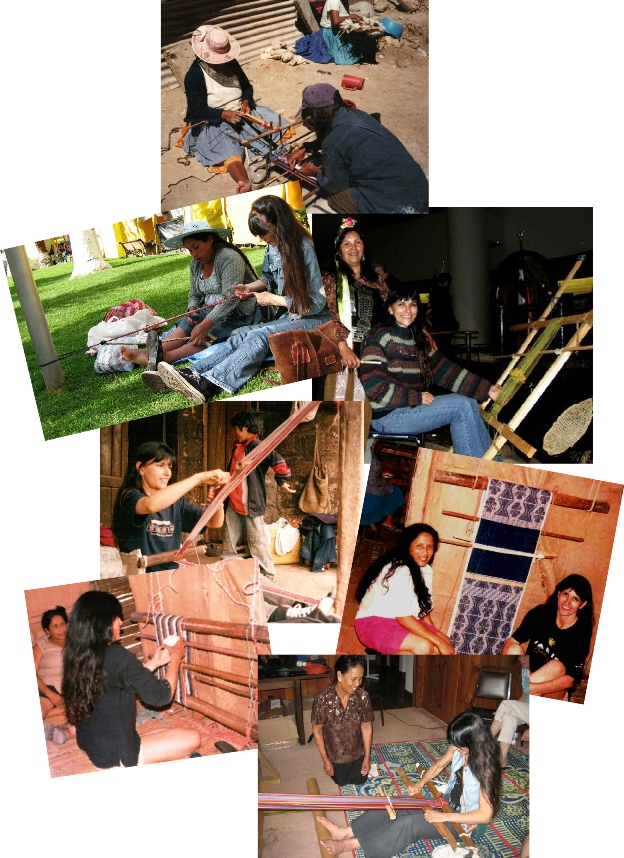
The Weaving Melting Pot….that is what I have bubbling away here. Every time I start a new piece on my backstrap loom I am so aware of the vast array of sources from which I have drawn technique and inspiration. I have studied weaving on a variety of simple looms here in  South America, in Central America and even in North America  and bring a little of everything to my work when I set up to weave on my loom of choice…the backstrap loom.

I even draw inspiration from the online weavers who work on floor looms…a handy tip about how to handle the two wefts in rep weave from Tom Knisely, ideas about finishing pieces from shadow weave weave-alongs, lessons in handling floating selvedges from discussions on twill, or from card-woven and inkle loom-woven warp patterned bands…all far removed from the Bolivian weaving environment in which I live.

They all go into the pot….stir, stir, stir….add a dash of ideas I have developed from my own experiments and onto the loom it goes. Some of my ideas having nothing to do with the traditional way of doing things……..

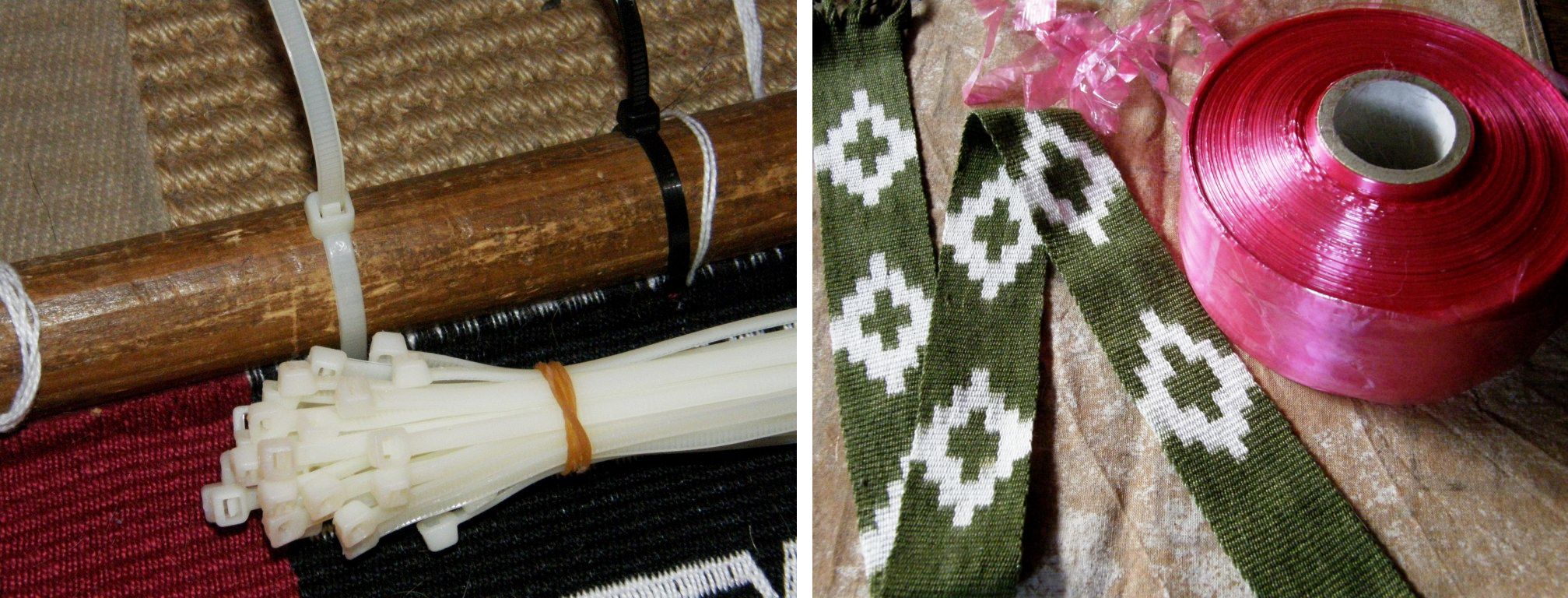
like using cable ties to lash my warp to the loom bar and a bicycle spoke instead of a yarn header cord. I was using cassette tape to wrap my warps for ikat until I was given “proper” ikat tape which seems acceptable in place of cabuya fiber and other natural materials in many “traditional” settings these days.

Plastic and metal??? One of the weavers I met in Candelaria found using what looked like a steel railway spike far more efficient than the traditional llama bone tool for beating in her weft. PVC pipe often replaces wooden shed rods.  It’s like the time I had a lovely wooden Navajo weaving loom made for me when I lived in southern Chile and used rope to tension the warp only to find that a lot of the Navajo weavers are using metal looms and turnbuckles for tensioning. After weaving for some time on that Navajo loom I found that copper pipe for the loom bars worked much better than wood anyway.

I travel from place to place and see things and bring back ideas to add to the ingredients that go into my weaving melting pot.

And now I am about to apply some Bolivian highland weaving technology to a weaving tradition on the other side of the world.

I am jumping the gun this week by sampling for the next piece in my red, black and white wall hanging series and I am concocting quiet a brew in the old melting pot.. I say jumping the gun as I am nowhere near finished the third piece which is coming along veeeeery slowly! The other two pieces while off the loom are not yet completely finished. But the temptation to  put an idea into action once it develops and starts churning in my head is irresistible!

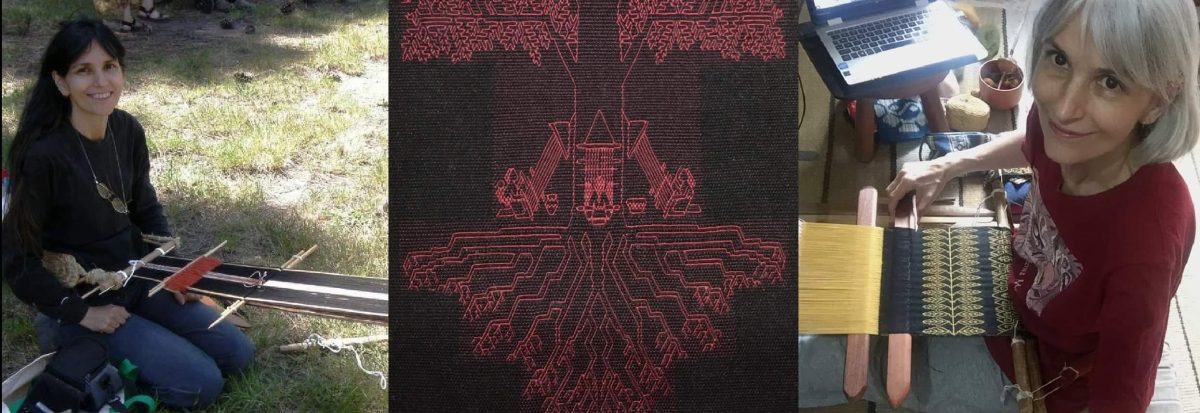
You can see the melting pot at work in the above pieces…I took a motif designed by a German weaver for tablet weaving and wove it in an Andean technique, Chilean ponchos called chamantos influenced the leaf design hanging to which I added weft twining which has nothing to do with Chilean ponchos and the piece inspired by si’ira  weavings of northern Columbia and Venezuela has more than a few of my own added touches.

Some of the traditional colors of Bedouin weaving make that the perfect influence for what will be in the fourth piece in the wall hanging series… in red, black and white, of course.

It was a weird and wonderful path that led me to Bedouin weavings way back in October 2010. I was Googling weft twining techniques after having seen the twined work of Montagnard (Vietnamese hilltribe) backstrap weavers in North Carolina in August 2010.

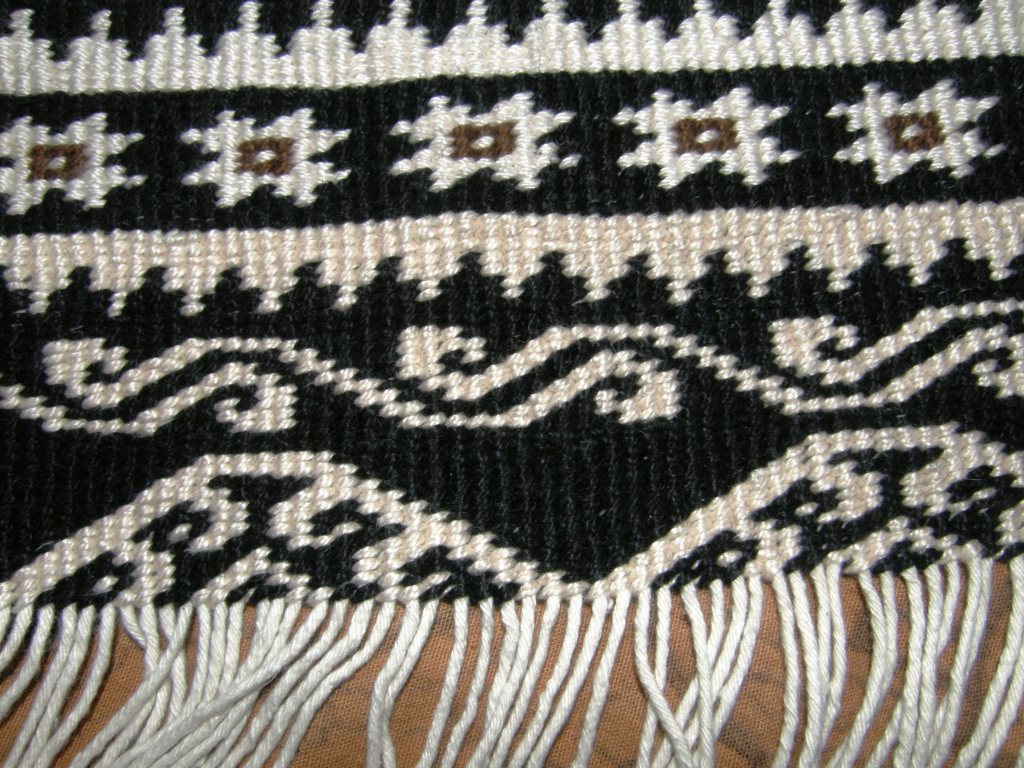
A book on the Taaniko twining practiced by the Maoris of New Zealand helped me to get started on my own off-loom experiments…. a Maori technique for Vietnamese patterns…straight out of the melting pot!

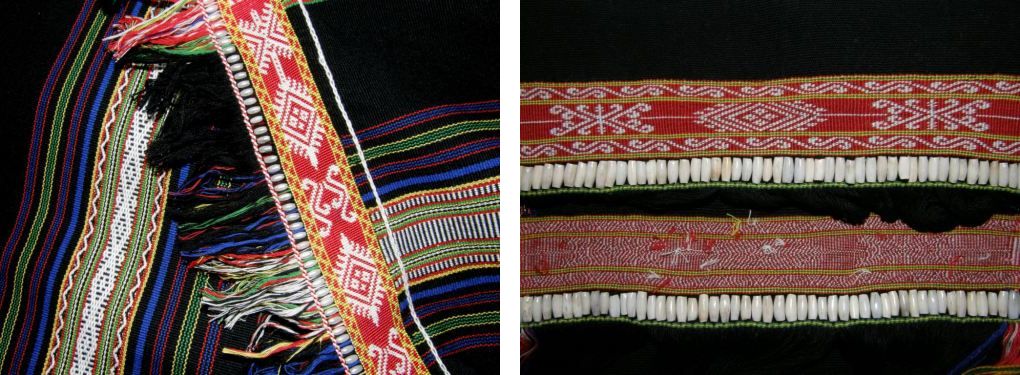
This piece has Montagnard designs as well as motifs found in both Bedouin weaving and twining. My Google searches led me to sites with Bedouin weaving and I was in love! I bought Joy Totah Hilden’s book on Bedouin weaving after finding her website and was pleased to be able to see images of the back of the woven pieces making the technique easy to identify as warp substitution which I already knew how to do. There is a link to a pdf  on Bedouin weaving by Hilden on my RESOURCES page.

It was clear from the book that the Bedouin do their twining  both on and off the loom and so I was interested in trying it on the loom…it’s so much easier when the warp is under tension, as far as I am concerned, and that enabled me to use much finer yarn than I had used for the off-loom piece.

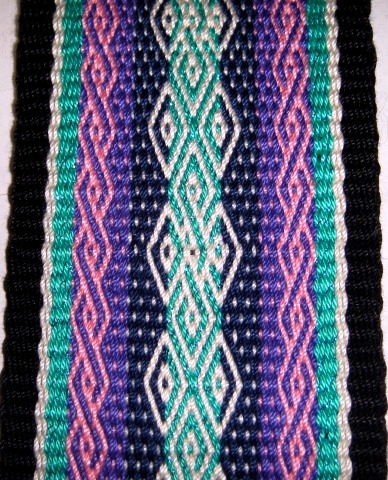
Here is the first piece with its al’ouerjan (in which I had made a warping mistake) and shajarah patterns. The al’ouerjan pattern is the checkerboard type design on the sides.

The twined sections are sometimes worked in the middle of the woven piece as well as at both ends.

I then dove into the melting pot and added a finish of wrapped warp ends…

I enjoyed the process and I wanted to know more…both about weft twining in general and about Bedouin weaving.

I was especially curious as I found out from Betsy, who works with the Montagnard weavers in North Carolina, that their weft twining technique is done off-loom and this astonished me as the yarn they use for their designs is so very fine (Cebelia #20 or finer). I had to see and learn this! Betsy was happy to have me visit and I was able to learn from Jarai weaver, Ngach.

And in the meantime, Tracy, a member of the Backstrap Weaving Group on Ravelry, started showing us gorgeous pictures of Bedouin textiles from the souk in Doha Qatar where she currently lives and telling us about her experiences watching a Bedouin weaver at work.

From books and images on the internet to suddenly finding myself seated next to Ngach, watching her bobbins twirl as she gracefully applied weft twined patterns to her large blanket piece off the loom, listening to her stories about her desire and determination as a young girl to learn to make the traditional kteh patterns. It was a dream come true.

Once back home, I stirred the tricks and tips I had witnessed with Ngach about color changes, hiding the ”bump” and other details into the pot and made my own kteh designs on my backstrap woven piece which you can see above.

I did it on the loom as my off-loom techniques still really needed some work! The advantage with off-loom twining is that several backstrap woven pieces once off the loom can be joined together and then the weft twining can be added along the edge of the entire piece. I have yet to do that and will definitely do so one of these days. I have my bobbins and thread ready!

Much later, the following year, came a golden gift in the form of  bag made from pieces of Bedouin weaving that Tracy sent to me through a friend who was visiting Bolivia.

Once again, imagine the thrill of getting to feel and smell the real thing…forgive me but that coarse handspun wool is just begging to be smelled! The bag is pictured above on the right next to the cotton piece that I made.

As you can see below, the floats that form in in the shajarah pattern area (the black and white design strip) are really very long! Some of them are even broken from possibly having gotten caught on things.

Now back to the sample I am weaving for the fourth wall hanging. I want to do a Bedouin-style piece but I do not want the long floats on the back. Tracy showed us images of pieces from a co-operative in Oman in which the weavers had found a way to tie down the floats  in the al’ouerjan parts (the checkerboard patterns) of their weaving possibly to make the pieces more attractive to foreign customers. It didn’t take long for me to see that they were using a  second fine weft to do so. This makes the woven cloth more practical too.

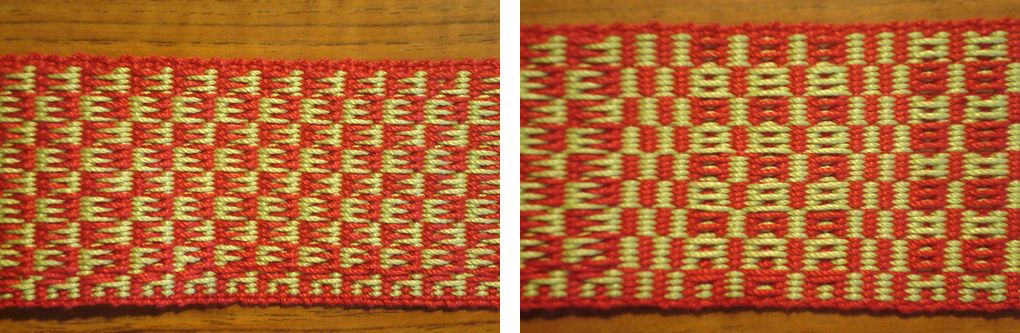
You can see the long floats that you typically get on the back of the fabric in the lower right hand corner of the image on the right and see how the appearance improves when the second fine weft is used. Unfortunately the second fine weft does not do much for improving the appearance of the shajarah patterns (the larger back and white patterns).
The solution to that is to go once more to the ingredients on the shelf and add some of the Bolivian highland weaving technology that I mentioned earlier to the mix. So I added embedded double weave to my sample, a technique I learned while studying with weavers in Potosi, Bolivia.

This technique allows you to weave sections of double weave alongside plain weave in the one piece. It is essentially the same warp substitution technique but with an extra step or two which basically insures, with the use of a second weft, that all the warps are interlaced with none left to float on either face.

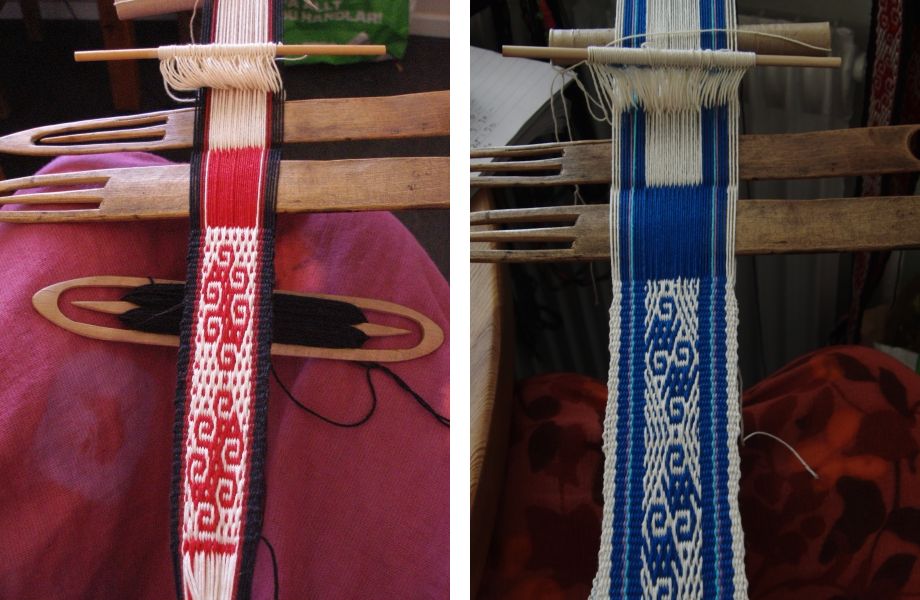
The two-color center section of the band at left is double weave alongside a plain-weave single-color border.

What I sometimes don’t like about the embedded double weave technique is the obvious transition in the fabric from plain weave to double…the climb from single layer to double layer and back again which naturally has to occur….it is sometimes more obvious than at other times depending quite often on the kind of yarn used, and I have been experimenting with various things to help soften that. I don’t want to make the entire piece double weave either.(The three-color double weave that would be required to weave the al’ouerjan pattern is bulky and unattractive).  And that is where I throw my very own bit of spice into the melting pot!

It is still in the experimental stage but what I am trying to do is combine double weave with plain weave, add the thin weft for tying down the al’ouerjan warp floats and make the transition from plain to  double weave section as subtle as possible with a trick I am trying out.

There is my first Bedouin piece on the left and the new sample on the right. The upper surfaces of both look the same and I don’t think you can tell that the center of the new sample is double weave.

The big difference is the back side of the fabric. My embedded double weave sample is on the left and my first sample with its long floats on the right. If this goes along well, I shall use this technique for my fourth wall hanging using the deeper shade of red that I have used for the other piece and incorporating more traditional Bedouin patterns.

So, enough red, black and white for goodness sake! Bring on some other colors. Here are projects from Ravelry group members and other online friends to save the day…

Oops! My bicycling friend Anna in Australia just happens to be using the same colors in a double weave piece. This is a Mapuche design from the book in Spanish by Enrique Taranto.

A new member to the Raverly group, Rob, showed us what he has been doing with simple warp floats inspired by a Guatemalan piece that Jennifer found on the Education and More website. You may remember that Bobbie wove a very large version of this in naturally dyed Guatemalan cotton thread that she bought from Education and More. Rob has added his own twist to the pattern at left.

Here are some of his other bands with simple warp floats and supplementary wefts. He used two supplementary wefts in different colors at the same time and says that one color stands out more than the other depending on the angle at which you view the piece….

Another new member, Tracy, blew us away with her first ever piece made from her own handspun wool…we love her loom set-up!

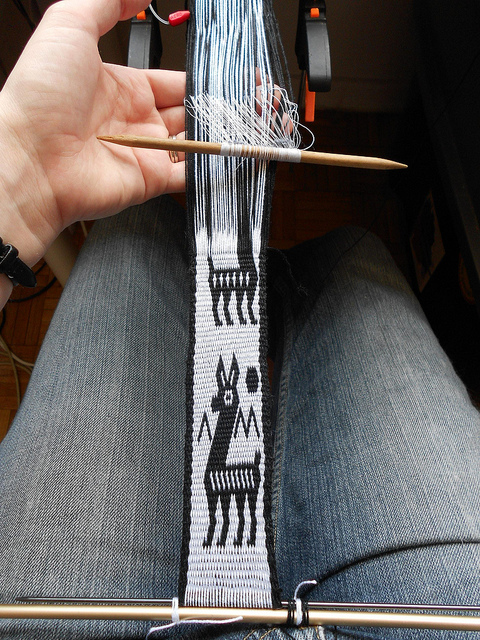
And Xav dove straight into double weave and the llama figures that I have charted here on the blog…her first ever backstrap woven band!

Jeen used her pebble weave experiments as embellishments on a couple of bags she completed. I love what she calls her “ball bag” and I think her use of variegated yarn for the border of her plain pebble weave band is so cool.

From Sweden Camila sent me pictures of her bands….

Some fun and clever designs with simple warp floats….she wove a pattern which is traditionally woven in a complementary- warp technique in the two-color simple warp float technique instead and it looks great!! On the right she has a pebble weave design from my book on her backstrap loom.

Well, I am off to continue my small sample as I think I can make something with it, weave a few rows on the third big wall hanging piece and see what unusual combination of ingredients might inspire the next piece on the loom…..

Backstrap Weaving – A Little Weaving Therapy

I guess that two months isn’t really such a long time to be away from home. It’s just that I haven’t done an extended trip like that in a long time. I am reminded of the times when I lived at the southernmost tip of continental Chile and used to go up to Peru and Bolivia for the winters. I would spend months away wandering about, only going home when I had become too skinny and undernourished (I always traveled on a typical backpacker’s budget!). It is always bewildering after you have seen so much, experienced so many different things, met so many cool people and learned so much to go home and find that everything is the same!

How could this be when you feel so different?! However, returning home this time was a little different because things had changed. Stuff happened, people disappeared, things accumulated….one of them being DUST…two months of the wretched stuff!

But now I am back into the old routine. Yes, here I am blogging away on Thursday in socks and sweaters. Fifty-five degrees…that’s COLD for Santa Cruz. The palm trees look rather forlorn against the grey sky.

Time for some weaving therapy!

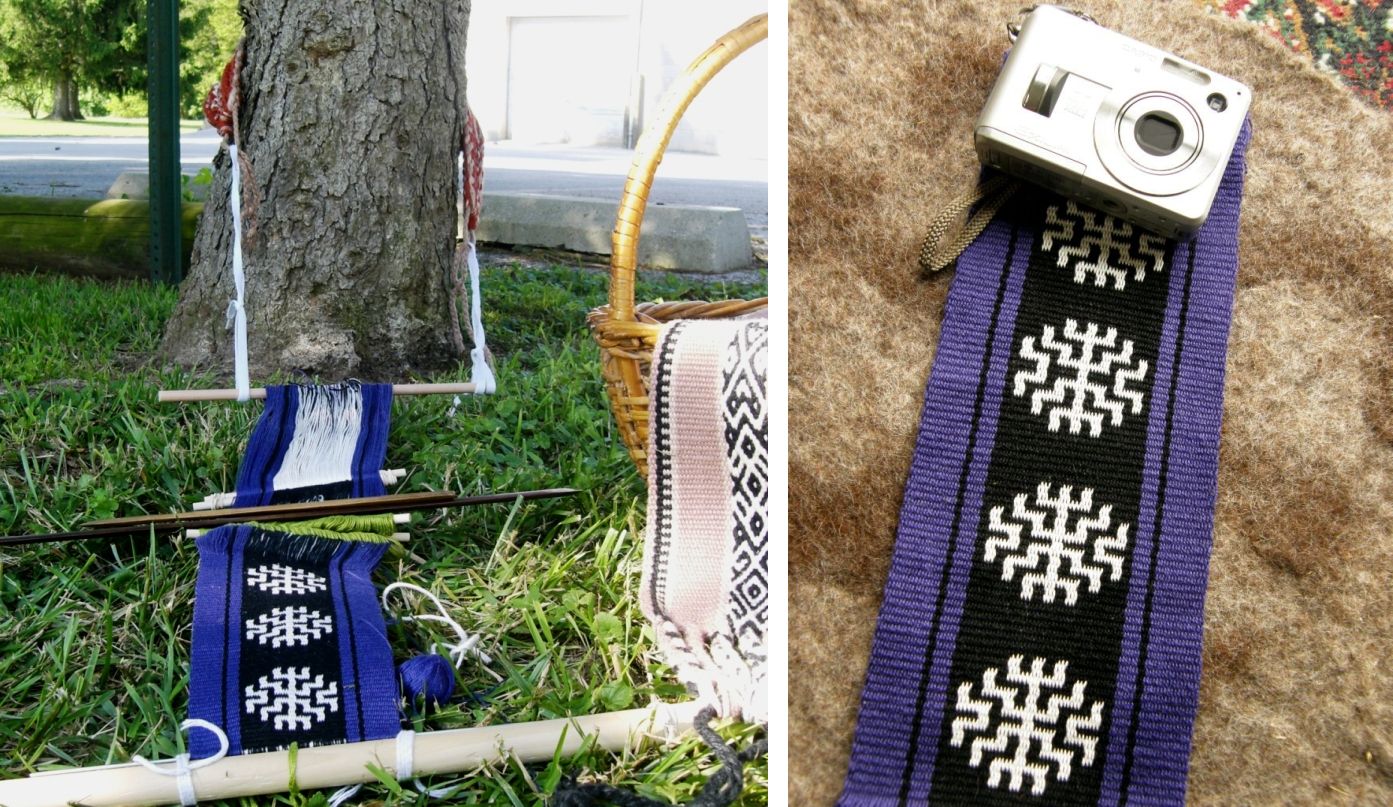
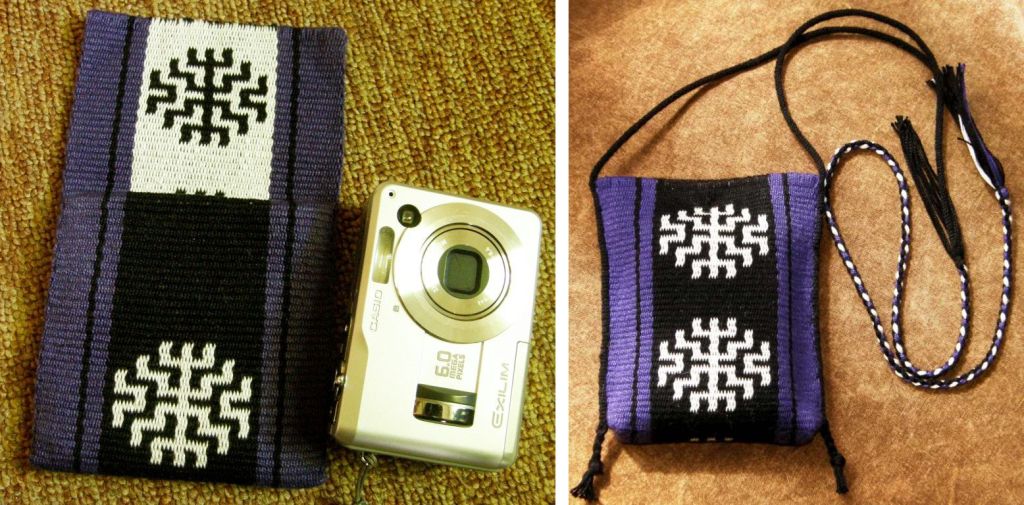
I made up the bag for the wee Casio camera.

This project accompanied me on the road and was hitched to numerous places along the way. I finished the weaving while I was up in Massachusetts. The pattern is one from Bhutanese textiles. Now, how to sew it up?

The first idea was the one on the left…a bag with a flap which I would cut and shape and edge with a tubular band. However, the motifs were not ideally placed for that and so I ended up with the style on the right.

I squared off the bottom of the bag and added a single large  snap closure on the inside. It is edged with a sixteen-end black plain-weave tubular band. I continued weaving the tubular band after covering the edge so that I could also use it as a strap and then added a four-strand braid to that for extra length.

The transition from tubular band to four-strand braid is covered by a tassel…a trick I learned from my sling braiding teacher in Peru.

I think these tubular bands are very cool and so handy. I have been playing with some other plain-weave ones in different materials. The one on my bag is in #10 crochet cotton and here are a couple of others that I made in wool.

The yellow and blue one is woven with a DK weight wool I love the way the simple stripes spiral.

The other one is in a lighter weight wool and you can see that even a lightly twisted yarn works. As the warps are so narrow, the problems of stickiness that usually occur when using wool in warp-faced projects are not a big deal. The warps did not break but my weft did once from pulling it very tightly but that was not a  problem.

Another cool thing about tubular bands is that it does not matter what the lower face of the band looks like. That gets hidden within the tube.

I wove a ñawi awapa band (see some ñawi awapa bands pictured on the left) as an experiment as a flat rather than tubular band and saw the chunky chaos of crossed and twisted floats that is created on the back side of the band from all the strange warp crossings and manipulations.

But that does that matter? No! All that gets hidden within the tube.

Now what other technique do I know that has a pretty “right” side and a messy “wrong” side of awkwardly long floats?…the warp subsitution technique, of course!

Actually, any warp-faced band whether it be plain or patterned with any kind of pick-up can be made into a tubular band but, since the warp substitution technique is often overlooked because of the long floats that are created on the reverse of the fabric, why not use it for tubular bands where none of that matters?

So, the other band pictured above has three-color horizontal bars which I was able to create with the warp substitution technique.

All the cumbersome long floats are hidden within the tube.

These bands are fast and fun to weave, quick to warp and can be stretched between a toe and finger to weave.

If that doesn’t suit you, you can attach one end to your waist with a cord through the end loops.

If you don’t fancy using your big toe, as the weaver from Tarabuco pictured at left is doing, a cord can be passed through the end loops at the other end of the warp which can then be wedged inside a drawer or looped over a “C” clamp.

I am going to use these tubular bands as pretty ties for my loom and any other time I need cord for my weaving projects and I hope to experiment a lot more with designs and colors.

So, that was one on-the-road project finished. My other demo warp is something quite different. A big white canvas looking at me and asking to be decorated…

There is something very lovely and somehow “earthy” about creating this plain and simple warp-faced white cloth and I want to make any patterning minimal. I have added a couple of weft-twined sections. Perhaps I will do some more weft-twining or maybe some soumak with a bit of added patterning with supplementary wefts. I left a lot of unwoven warp at the start in case I want to add a large weft-twined pattern later. As usual I don’t have plans for the finished piece. I will just see what happens.

Then there was time to do something with a sample piece that I had completed shortly before leaving.

You may remember the ikat weave-along that we were having on Ravelry.

My friend Betty in the US gave me a huge roll of ikat wrapping tape so there will be many more ikat experiments in my future!

I have been using cassette tape until now and had a small “oopsy” in my last project when my dye solution was too hot for the tape.

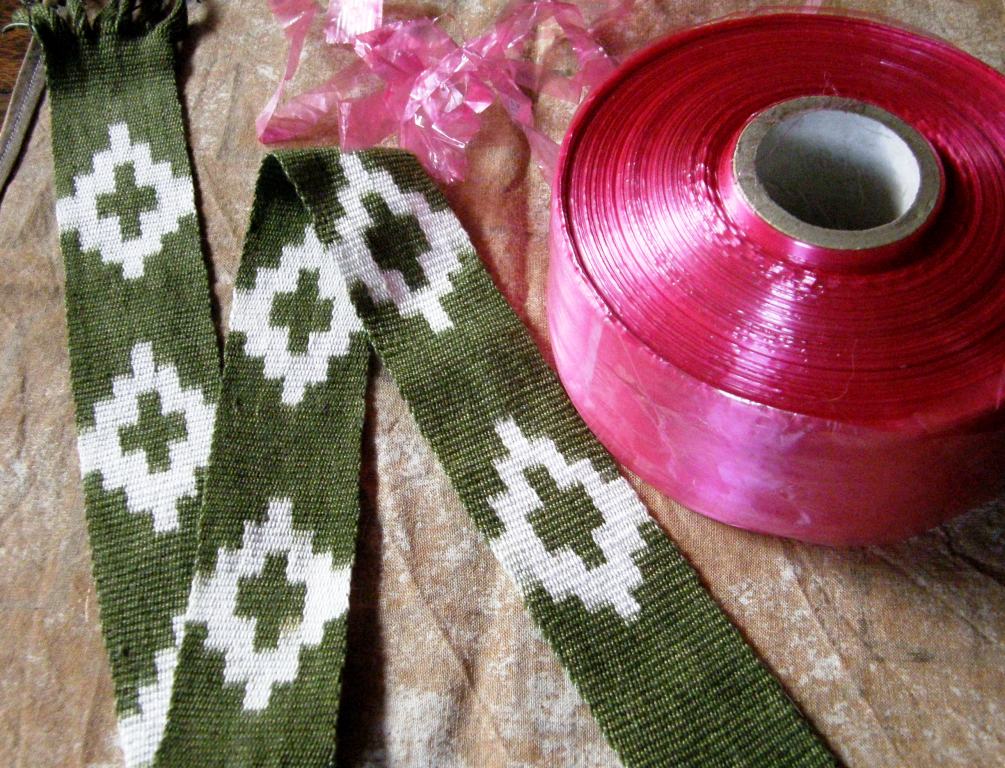
I am sure that this special tape has been designed to stand up to being boiled in dye baths. It is very wide but tears easily into perfectly straight narrower strips…what a dream!

Here is the second warp which I tried after the green one above. This was my first time trying over-dyeing with a second color and spot dyeing.

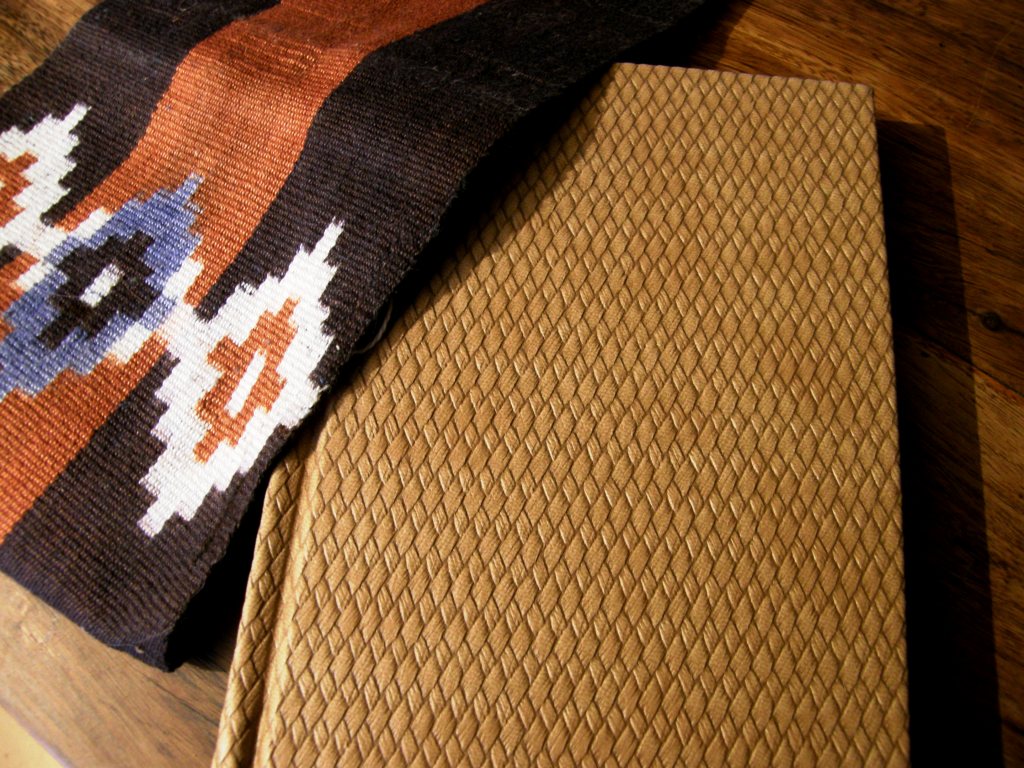
My friend Jeen in the US gave me a lovely travel journal and, even though its cover is very beautiful, I decided that my experimental ikat piece would make a wonderful jacket for this book.

I have to admit I was a little nervous. Was I about to ruin both sample and journal?

I used contact cement which is pretty strong stuff. Would it eat into the material on the journal’s cover and destroy it? Would I mess up and glue it on crookedly?

I have done that before with contact cement when gluing cork sheets to a table top. Once that stuff is ready to go you are pretty much committed and it won’t forgive any mistakes! Fortunately it all came together and I am very happy with the result.

The little vessel in the picture was a gift from a friend in Ecuador. The pen is made from sandalwood and was brought to me from India over forty years ago! Goodness knows how I have managed to hang onto it after all these years of moving around and having to abandon possessions along the way. The mug rug on the far right is part of a set inspired by African designs that I made on my backstrap loom in double weave.

My new-to-me used camera got a dressing up too with a new strap. I was happy to have a chance to weave that bird design again…the one on the old fragment that Tom Knisely showed me…

Here it is off the loom and on the camera…

And here it is on my backstrap loom. I love the way the bird motif changes from black to white along the length of the band.

And now I have a new strap to study which was lent to me by Susan  who visited me when I was traveling. She brought it along and I was delighted to be able to see both sides of it. There are so many pictures online of these bands from Oaxaca, Mexico but you never get to see the back side. There are many more examples of these on Teyacapan’s Flickr page of Mexican textiles.

Perhaps this structure is woven somewhere here in South America too but I have never come across it so this is a great opportunity to take a good look. Maybe it was woven here in pre-Columbian times. She urged me to take it home and just send it back to her when I am done. How cool is that?

I have this urge to go back to some simpler things and explore them more…like the white plain-weave piece I am doing, some more very simple ikat motifs which again involves just plain weave and I have been also looking again at simple warp floats.

One of my weaving friends in the US wove this cool backstrap after having woven simple warp floats with me.

We just played a little with floating both colors and she went on and ran with it.

At left you can see various parts of Kristi’s backstrap which is patterned with floats in two colors. She used it the second time we wove together.

When I was at Maryland Sheep and Wool I got to see many people of all ages being introduced to fiber activities.

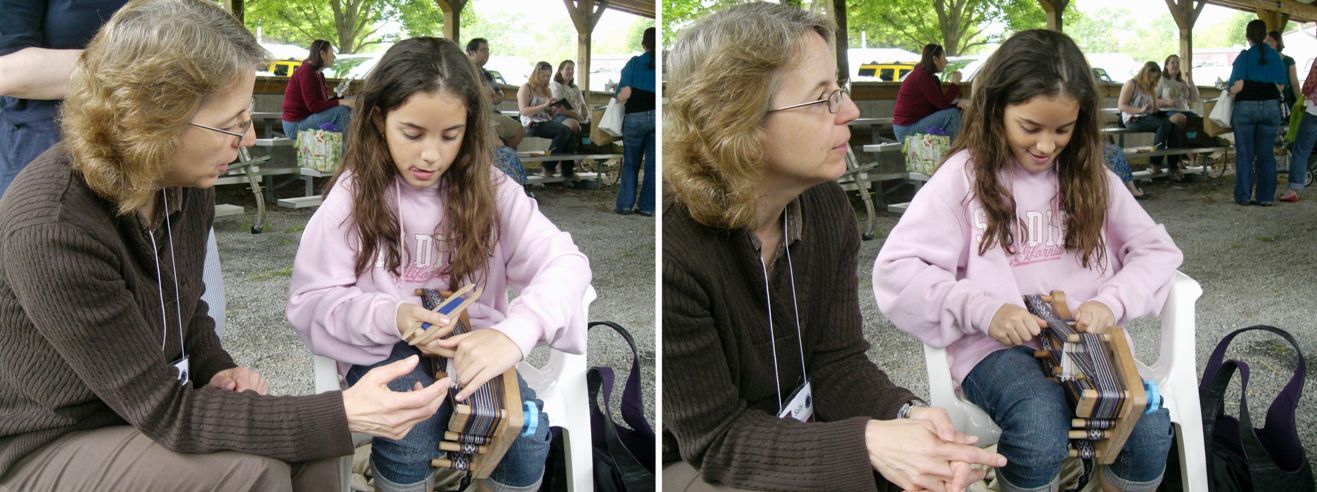
Elisabeth Hill, who I have known some time online and whose fabulous work on deflected double weave I always follow on her Flickr page (she’ll be teaching it at Convergence), came to Sheep and Wool with her niece Kylie. Kylie got a class in inkle weaving from Sally Orgren on her famous and well-traveled loom when we had a Weavolution meet-up at midday. Look at that smile. It looks like a new weaver has been born.

One of Elisabeth’s deflected double weave pieces won first prize in the exhibit at Sheep and Wool. I don’t think the picture I took does it justice so please take a look at her Flickr page to see all her beautiful creations.

Some lessons, like the one Kylie had, were completely impromptu. I wonder if as Kylie grows and continues to weave (and what wonderful inspiration she has in her aunt Lisa) she will remember her very first lesson there in the Rabbit Barn at Sheep and Wool on Sally’s “Inky”. Other classes were more formal…

There’s my friend Claudia chatting with spinning teacher Maggie Casey before class and Richard Ashford was at The Mannings booth giving spinning tips with Tom Knisely looking on.

And the guys were into it too. Here is a gentleman having a spinning class on the ”Pocket Wheel” which was a big hit.

It was fun to see the team of young guys and gals who entered the Sheep to Shawl Competition this year.

Some things I saw at Sheep and Wool inspired this little project this week…

A simple little pebble weave band, right? But wait until you see the band that inspired this…

Isn’t that spectacular! Now you can see where my little purple and yellow band fits in! This was woven in Ayacucho, Peru and is probably from the same area or at least very close to the place from which my pebble weave teachers originated. Although they taught me in Huancayo, they are natives of Ayacucho and the little animal motifs on this band are very much like the ones they taught me. I would guess that this band was woven with the same two-heddle method that I learned in Huancayo with some additions for the third color.

The quality of the weaving is superb. Sadly it probably won’t be “popular” with some tourists who generally seem to prefer handspun wool and natural dyes. There is so much weaving in Peru that we just don’t get to see and coming across these bands at the Sheep and Wool festival was such a treat for me especially since I have not seen anything like the motifs I was taught back in 1996 in the books I have on Peruvian weaving.

Except for the purple and yellow section, it is a three-color pebble weave. Aren’t those braids and pom poms beautiful?!

Here is a little something I picked up from the same stand. I was tipped off by braider Rodrick Owen that these were available there….a sweet braid with tassels from Ayacucho being sold as a keyfob.

And finally, here is a wonderful display of bands made by Yonat. Yonat feels more comfortable on an inkle loom and so takes what she weaves with me and transfers it to her loom. Not everything here was originally backstrap weaving. Some bands, for example, are from the workshop on Sami weaving by Susan Foulkes and others are Yonat’s original creations.

See you next time. I hope that all of you can take some time off for a little weaving therapy this week.