Backstrap Weaving – Hooked!

I was on the lookout for a simple pattern to continue my sampler of supplementary-weft patterns and the positive/negative space studies that I have been writing about these past two weeks.

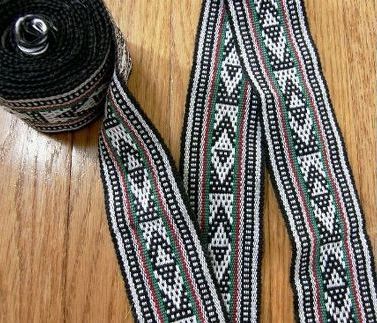
After weaving some patterns based on Bolivian hatbands where the weft is used to fill the space surrounding the motif rather than the motif itself, as seen below, I wanted to weave a motif where the same shape appeared as both motif and background

supplementary weft in negative space

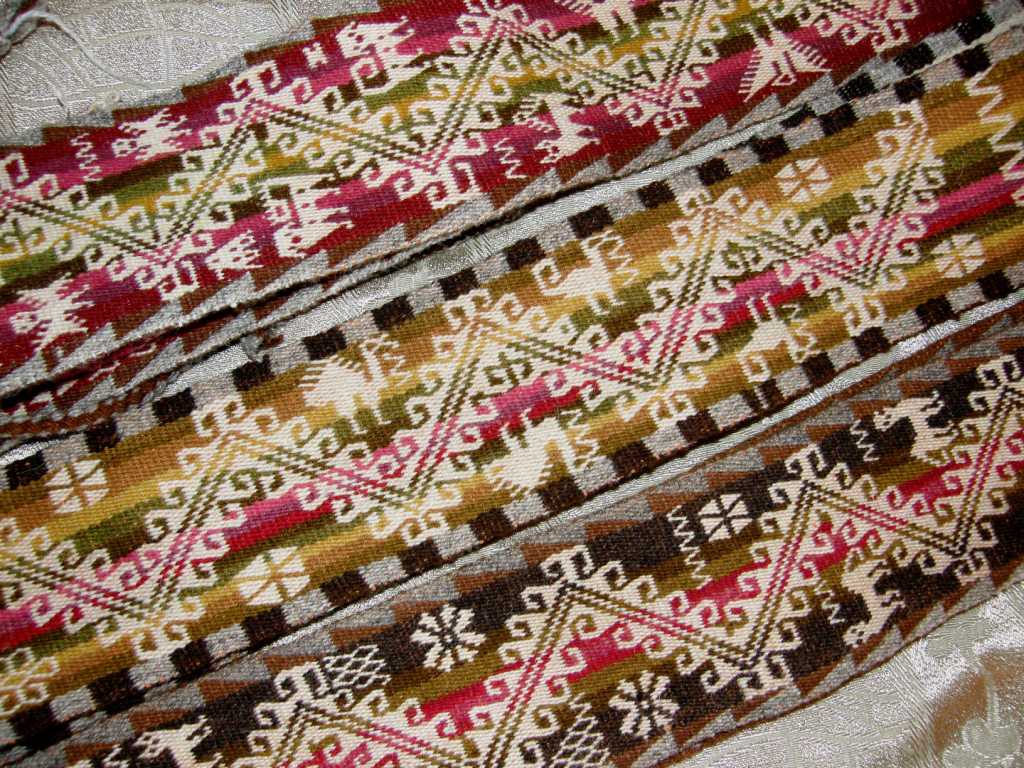
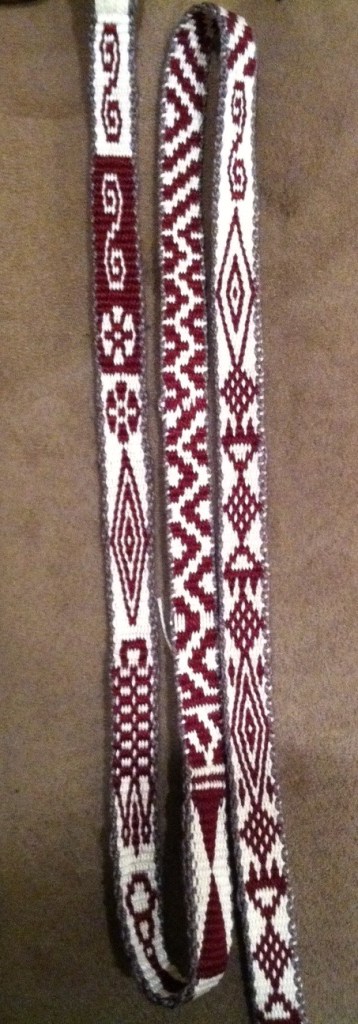
hook motif of peru and boliviaSeveral of the classic warp-float designs found in the Peruvian and Bolivian highlands have this very characteristic. In the hook motif pictured at left, it makes no sense to talk about “motif” and “background” as the same hook shape flips and turns and dances along the band changing from red to white and back again. Is it a  series of white hooks on a red background or vice versa or none of the aforementioned?

This was the kind of thing that I wanted to weave with supplementary wefts. So, I set about trying to adapt it to the structure with which I have been working.

As it turns out, it wasn’t that straightforward.

So, I spent a lot of time with paper and pencil and eraser (I still like the old fashioned way). The only way I could get the shapes to interlink well was to make several changes to the basic shape and, even then, the black version of the hook is not exactly the same as the gold one. The gold has an extra warp or two in a couple of places. There was a fair bit of weaving and unweaving involved too. But that’s what “sampling” is all about, right? I had to remind myself about that as I was starting to regret having set myself this challenge as I seemed to be spending more time planning out the design than actually sitting at my loom.

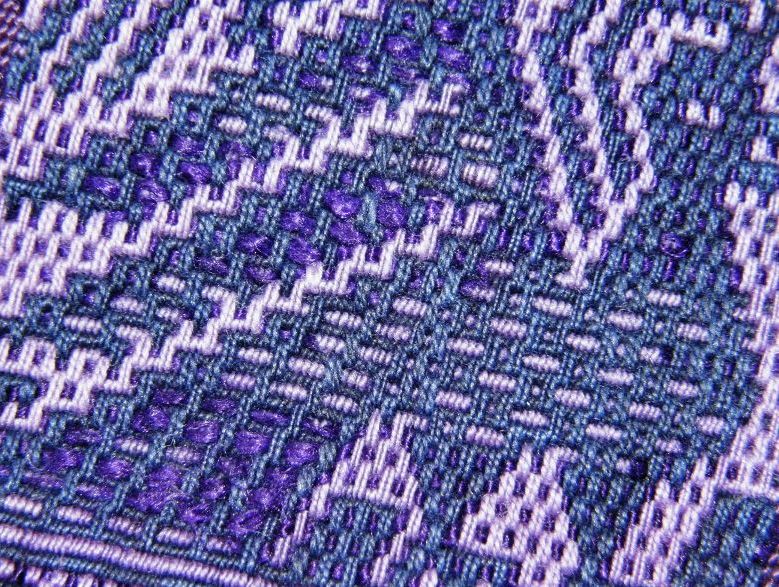
supplementary weft study with hook motifsSo, there it is. Two sets of gold hooks surround and expose black hooks in the ground weave. I am pretty happy with the way it turned out and hope to play a lot more with this hooky shape.
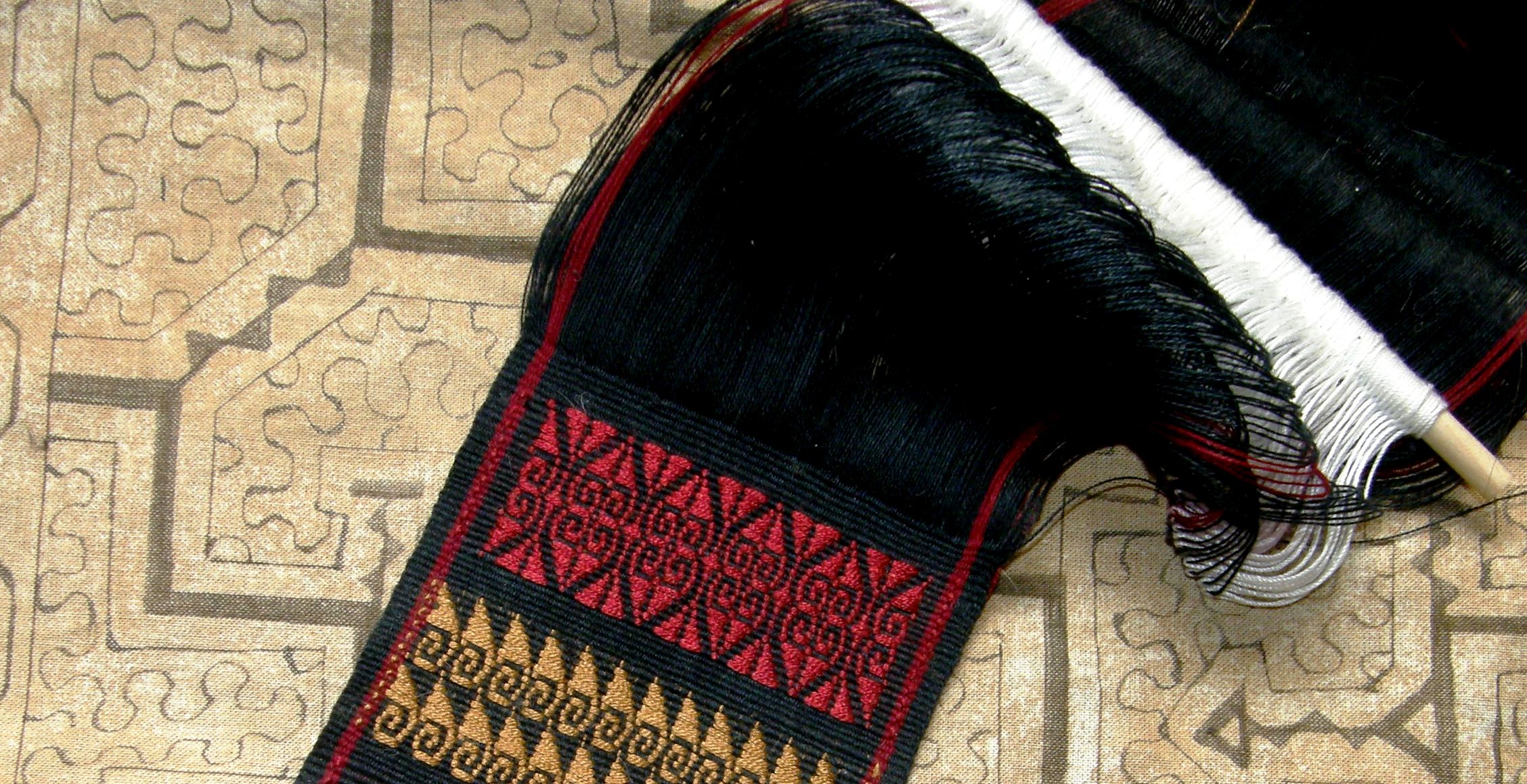
red hooks relected anf flipped in supplementary weft Where to go from there and how to best use all the work I put into figuring out those hooks? Chris Buckley writes about pattern building in traditional textiles in his article on warp-ikat weaving of SE Asia:

A further important feature of ikat, and indeed of most traditional textiles, is that weavers tend to use a narrow repertoire of simple shapes such as dashes, hooks and curls, in a ‘building block’ fashion to create their designs. This approach makes understanding and copying complex designs manageable for the weaver, and aids their transmission from generation to generation. Recognition of this repertoire of basic shapes (which I call primitives) is also of considerable help to the researcher with analyzing and comparing motifs between traditions,…..

So, I took one of my many discarded charts of the hook motif and used it as a “building block” for a new design, joining hooks together, reflecting them and flipping them upside down in the same way that many Andean weavers do with their warp-float motifs. The result is the band of red pattern above the gold in which there are four red hooks with just the hint of a black hook outline around them.

What had brought me, yet again, to Chris Buckley’s interesting article was a romp across the internet in search of hook patterns when my initial attempts at charting something suitable for supplementary-weft patterning were not working out. It is so interesting to see how the hooks show up in all sorts of woven structures and cultures. Of course, certain structures only allow a fairly limited repertoire of shapes to be produced and so, regardless of the culture, it is inevitable that a hook motif will appear if those particular structures are in use. Techniques like ikat,  on the other hand, can be used to produce a limitless variety of shapes and patterns.

hook-motifs-in-southeast-asian-textilesThese pictures by Chris Buckley show hook motifs in various SE Asian warp-ikat textiles.

I have woven the hook motifs used in yurt bands of Central Asia…

??????????????????????I wove the  pieces above and below using the same single-faced warp float structure as the yurt bands. You can see how the basic hook motif can be placed in different ways to create patterns and how dark and light hooks interlink so beautifully…

central asian yurtI have also woven patterns in pebble weave that are loosely based on Central Asian hook motifs…

central-asia-all-stitched-wih-borderas well as in supplementary-weft, double weave and supplementary-warp structures…

central asian motifs in various techniquesI enjoy the challenge of adapting a motif woven in one structure to others.

Chris Buckley writes that Indonesian ikat weavers sometimes copy designs, for example, from imported luxury textiles, particularly those from India…

When copying a design from a foreign source, weavers are likely to re-interpret the copied motif in terms of their own vocabulary of basic shapes rather than produce an exact copy. This is analogous to linguistic borrowing, where the pronunciation of a borrowed word may change from one language to another according to the repertoire of sounds available.

My own particular “weaving vocabulary” comprises the various structures that I am able to produce rather than a group of shapes. I have not dedicated myself completely to a study of the patterns of any one weaving region and so have not developed a vocabulary that is limited to certain shapes.

I love it when I see the Bolivian highland design that I call “rolling river” woven by indigenous weavers in both complementary-warp-float and double weave structures. Perhaps a weaver saw and admired this pattern when she traveled to another region and returned home to interpret it in her own weaving vocabulary which, in this case, happened to be a completely different structure. I can only speculate.

I taught Juan to do pebble weave when I was studying in Salasaca, Ecuador. No one in the area was using this structure. It was part of the deal…I teach pebble weave and they teach me to weave their supplementary-warp patterned traditional belts. Eighteen months later when I returned, Juan showed me his finished pebble weave band. Until then, he had not known how to weave at all. His final motif is a rooster which he took from one of the traditional supplementary-warp belts of Salasaca and interpreted in the only weaving “language” he knew…pebble weave. I thought that was brilliant!

juan pebble weave bandBack to the hooks…I like to think of the following  motifs, that I copied from a belt of the Tarahumara people of Mexico, as a “swirling” hooks…
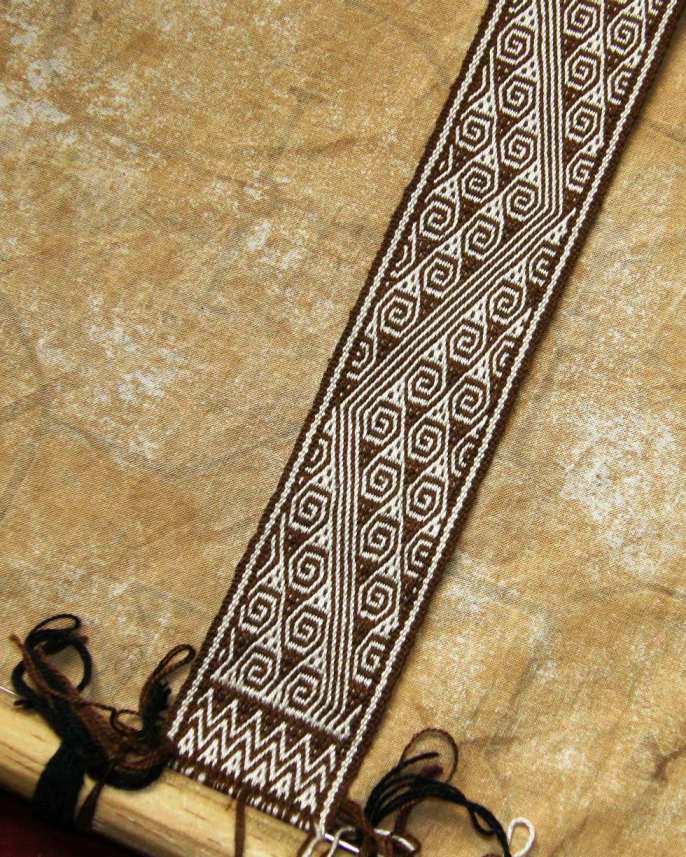
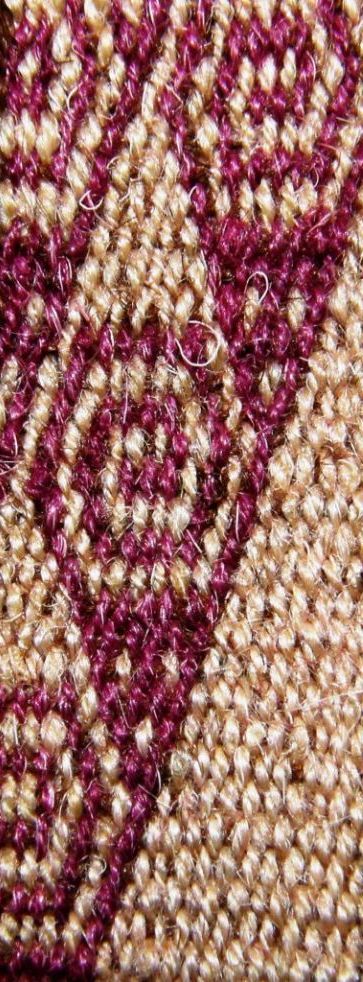
Tarahumara patternI had not become completely familiar with that swirly hook and made it a part of my vocabulary, as skilled Tarahumara weavers surely would have, before attempting this piece and, as a result, it was very tricky to weave! Just as I got a grip on the swirls going in one direction, they changed to the other direction. It was much easier to weave it using another structure in my weaving vocabulary…double weave…in which it is generally much easier to “read” the cloth. However, I don’t think the pattern is as pretty in double weave….maybe slightly more so in my handspun llama fiber on the right (spearmint leaf and cochineal dye).

5892932496_f074da5701_m

handspun llama cochineal dyed

And so I go playing with structures and shapes. Even as I sit and look at the last red supplementary-weft hook pattern that I wove on my most recent sampler, I see the motif on the very right hand edge and think…hmmm….wouldn’t that look good on a narrow double-weave band?

By the way, many of the patterns I have shown in this post are charted in my second book.

Pebble_Leaves_on_a_Band_medium2Here’s one final bit of lovely hookiness before I go. Julia has been using the tutorials in my second book on creating and charting one’s own or adapted patterns in pebble weave.

Here is one of her bands in which she has adapted a tablet weaving pattern to pebble weave and…yes…there are hooks!

Backstrap Weaving – The Weft-Patterned “Neck Wrap”

I suppose that it is normal to want to look back a bit as the end of the year approaches. This time I decided to jump back to the end of my blog years in 2011, 2010 and 2009 and take a look at what was going on. It is interesting to see that supplementary-weft patterning was a part in some way of all those December posts.

This time last year I was in a downsizing phase and rummaging through my closet to see what could be tossed. That was when I came across this wildly colorful supplementary-weft sampler that I made after having studied some of the patterning techniques in a few different communities in Guatemala. I included it in my blog post…(no, I didn’t toss it!)

supplementary-weft-pattern-detailYou can see that all the patterning elements that I am using in my current supplementary-weft project are present in this piece and this is barely the tip of the iceberg when it comes to all the different ways to create patterns with supplementary wefts that are used by Guatemalan weavers.

In December 2010, I was posting about the practice piece I made after studying with the Montagnard (Vietnamese hilltribe) weavers in North Carolina.  While the piece is mostly about the warp float patterning technique that they use, it also includes twined ends and a couple of their traditional motifs woven with supplementary wefts.

O

And finally, back in December 2009, when I had been blogging only a few weeks, I wrote a post on weaving wider projects which included this…

OLYMPUS DIGITAL CAMERAI included a tiny bit of supplementary-weft patterning  in the center of this placemat and mug rug set. I gave the pattern a thin striped look instead of a richer satin-like finish so that it would mimic the stripes in the two outer bands. The simplicity of the outer bands were inspired by a Guaraní textile.

So, this wonderfully fun patterning technique, which allows quite a lot of spontaneity, (the patterns on both the Montagnard and placemat projects were not planned and could have been just as easily cut out and removed if I had decided that I didn’t like them) has been in my weaving skills kit for quite some time.

hatbands of PotoloI remember the first time I saw a Bolivian highland weaver sitting in the street of Santa Cruz making a hatband only days after I had arrived here in 1998. The base weave was off-white sewing thread-weight cotton and she was creating patterns with bright acrylic threads. I crouched and chatted with her, watched what she was doing, and noted the name of the street so that I could return the next day and watch some more. I never found her again nor have I ever seen another weaver making a hatband since! I have seen plenty of beautiful hatbands but never one being woven again.

The hatbands above adorn the hat of a weaver from Potolo in the Bolivian highlands….bright colors on a black ground, much the same as the color scheme I have chosen for my scarf project. I have decided to call it a “neck wrap” as it is not going to be all drapey and flowing as one would normally expect a scarf to be. As long as I don’t have to actually bend and fold it around my neck, I will be happy!

start of Bhutan design scarf

Here it is, a little bit further along from the little I showed you last week, after all the messing around and lesson-learning. I am trying to think if I learned any more lessons from this wicked warp this week….I think I probably just convinced myself even more that I love putting in a second cross stick behind the shed rod and using those two sticks to help open the heddle shed. (Of course, this is just one of many ways that backtrap weavers operate their looms).

Second cross stick backstrap loom

Above you can see the second cross stick and shed rod in place. The third shorter stick sitting between them is the pattern stick.

If you watched the video of the Tacabamaba weaver in last week’s post, you will have seen how she places her sword on top of the warp and rolls that together with her shed rod to help open the heddle shed. Below, you can see Montagnard backstrap weaver, Ju Nie, doing the same using a bamboo slat instead of her sword.

montagnard weaver opening heddle shedI have a video on my page about sticky sheds showing this system in action.

I prefer to have the second stick permanently in the warp. One of the weavers that I met at the recent conference in Cusco used this system, with the second stick permanently in the warp, to open her heddle shed.

Her set-up is so cool. I wish I had a forked stick like that…must go out and look for one. The prong of the fork nearer the weaver holds the stick shed open while the other prong sits within a second cross.

Usig a forked stick in the warpShe would simply grip the place on the fork where both prongs join and twist the fork away from her while relaxing tension and pulling up on the heddles.

In the picture above, she is about to slide her sword under the warps raised by the shed rod. She will then turn the sword and clear those threads through the heddles and down to the weaving line. I have wonderful video of this weaver operating her loom and doing very fast supplementary-warp pick-up and I had every intention of showing it to you. Too bad my internet would not behave and allow me to upload it.

So, my warp has been behaving like a dream…sticky threads have been defeated and no more have broken. The odd loose ones here and there have been dealt with smoothly and calmly.

The center of Bhutan scarf project bacckstrap loomI decided to make the long motif the center of the scarf and work from there on repeating the designs from the first half of the project. However, I am not repeating the  motifs in the side bands as there are still plenty of those that I want to try!  I have no discipline sometimes!…I should just keep it simple and symmetrical…

starting the other half of the Bhutan scarf projectHere starts the other half….

I managed to almost squeeze in one more green motif before it was time to stop and write this blog post. It’s addictive and I don’t want to stop! The motifs are new and I am anxious to see how they turn out. Plus, I can’t weave it at night so, I really try to make the most of daylight hours. All that black thread is just too much at night and I am on an economy drive so, no super high powered lamps allowed!

one more green motif bhutan scarf

In the evenings, I have been spinning away tightening up the twist on the Malabrigo wool singles I bought while in the US. I am hoping to then ply them and weave a discontinuous-warp piece. As I am not confident about trying any warp float patterns on one of those yet, I will decorate the panels with some wool supplementary-weft designs.

respinning wool for discontinuous warp projectWhat has been happening in the Ravelry group?  ”It’s dead in here!” exclaimed Bobbie recently but she livened things up a little by posting her recently finished guitar strap made for her granddaughter…

bobbie guitar strap intermesh

This was made using the instructions for the two-heddle intermesh technique from my second book. Bobbie used Annie’s guitar strap kit to convert her beautifully woven band to a guitar strap.

Rob has been using my first book to weave some lovely bands with Andean patterns but we may have lost him to a four-shaft loom which recently appeared in his life. Now he is also turning out beautiful towels on that. Here are some of his latest backstrap, inkle and four-shaft loom projects….

rob's weaving projects

There have also been some mutterings in the group about using the 24 sets of string heddles to weave one of the fabulous fajas saras after I showed a picture of some of the belts of San Ignacio de Loyola Peru…

fajas saras san ignacio de loyola peruThat could be a fun weave-along but I don’t think I will join them on that one. While I do love making string heddles, I enjoy doing pick-up even more!

ikat textiles of the AndesOn another topic, a couple of interesting ikat resources came my way recently in my internet ramblings…

Quite by chance I discovered an e-book byMarguerite Gritli Pfyffer entilted “Ikat Textiles of the Andes”.

The book is the result of the author’s two years spent traveling in the Andes researching ikat patterned textiles. There is one section devoted to the pañones of Tacabamba that we saw last week.

From the other side of the world in China, Chris Buckley sent me the link to his recently finished paper entitled Investigating Cultural Evolution Using Phylogenetic Analysis: The Origins and Descent of the Southeast Asian Tradition of Warp Ikat Weaving.

The paper can be viewed online here.

Chris has always been very generous with his resources and, on several occasions, has allowed me to use images of textiles in his collections in these blog posts and for my charting.

Christmas will be done by the time I come to write my next blog post. I don’t do Christmas but I wish all of you the very best for whatever you get up to in the coming week. Now, back to that “neck wrap” thingy….

Backstrap Weaving – Encuentro de Tejedores de las Americas – Part Three…and more….

Before I get into Part 3 of my report on the Encuentro de Tejedores de las Americas (see Part 1 and Part 2 here and here), let me show you how I have been getting on with my latest experiment with supplementary-weft patterns.

Bhutanese supplementary weft pattern samplerYou may remember from last week’s post that I was inspired by seeing textiles from Bhutan with their  gorgeous motifs created by using supplementary wefts.

I was happy to see that I could decorate my own woven cloth with similar patterns using techniques that I had learned in Guatemala.

At left is the sampler I made to practice the techniques and experiment with the spacing of the pattern warps. I had some fine cotton from Guatemala that my friend Betty had bought about 30 years ago. How nice that this cotton could finally find its purpose.

The black cotton disintegrated as soon as I pulled it out of the closet. I guess that there is something in the black dye that causes the yarn to rot quickly. The other colors…red, green and purple….were just fine and, fortunately, there was plenty of white to dye black. I had my heart set on a black scarf.

There were a lot of ends to wind to make 7 inches…672!!

OThe cotton is kind of sticky and I can see why Guatemalan weavers very often choose to size their yarn with a kind of corn starch wash.

I am using it as is and need to be very gentle. I broke one warp before even getting started and my heart sank but it turns out that it was due to my clumsy handling of the pick-up stick…phew! No more breaks so far but there is still a looooong way to go.

Of course I made a wee sample before diving in to see how many ends I would need to make an inch. I also needed to test the ideal number of strands of tencel to use for the weft patterns.

In the picture you can see my tiny warp with its string heddles and shed loop . The two sticks are the pattern sticks that I talked about in my last post. Of course, the yarn was already showing signs of stickiness even on this tiny project but I decided to go ahead undaunted 🙂

Sample done…width calculations made. Now, how long should a scarf be? Seems like a silly question, but I have never made a scarf before. Fortunately, I do own just ONE. After all those years spent skiing and then living in Patagonia you would think that I would be more scarf-wise.

OThere is the warp and I am ready to make the 336 string heddles. I like making heddles…time to put on a cd and sing! and I didn’t cross or double up any warps…phew!

O

I have lots of pictures that I have taken of Bhutanese textiles in friends’ collections for inspiration and David K Barker’s books are wonderful too. (See my RESOURCES page for information on how to download his books for free.) However, I decided to play it safe to start with and weave one of the patterns that I had already tested on my sampler.

So, I sat down to weave and that is when it hit me…wow, this yarn is really FINE….and….it’s black! All the clues that I usually use to make the pick-up easier for supplementary-weft patterning are dependent on actually being able to see the threads!!

Boy, had I made things hard for myself but, believe it or not, I got used to it and came up with other ways to eyeball the placement of the patterns without having to become a slave to pattern charts and endless counting. It became a very cool learning experience and, as with all things new and experimental, much un-weaving was done and all with my heart in my mouth as I don’t think that this yarn will take much “backing and forthing”!

Bhutan pattern backstrap loom scarf

Here is the first pattern under way. I placed several thin pieces of cardboard in alternate sheds in the warp beyond the cross sticks. This gave me a place to make quick adjustments to loose warps within arm’s reach and with the warp under tension rather than having to get out of my backstrap and crawl up to the end of the loom.

cat on backstrap loom BhutanSometimes you don’t get to choose when to weave. I would come back in from a break to find Her Highness reclining in what was, apparently, the most comfortable spot in the house. Would you dare disturb someone with a look like that on their face? You can see the next set of patterns in progress here.

second Bhutanese design finishedOAnd this is where it stands for now. I am just getting past the first warp break and have my fingers crossed that there won’t be more. I watched a gentleman from Chahuaytire weaving on his backstrap loom when I was in Cusco. A warp broke and I loved the calm and cool way he went about fixing it like he had done it hundreds of times before (well, of course, he probably had). He didn’t need to have anyone tensioning the warp while he leaned forward to fix the break. That is the part I find hardest.

Be prepared to see a lot more of this project in the weeks to come. Unless, of course, those warps start a- snapping, and then you will most likely see it finished really soon as a zippered pouch or journal cover!

#########################################

ENCUENTRO DE TEJEDORES DE LAS AMERICAS  – PART THREE – SPINNERS AND WEAVERS IN ACTION

The Encuentro…it was over two months ago now and I am finding it hard to sum up here but I will try!

It was about yarn being created with the simplest tools…

Handspun cotton by the Matsigenka weavers of the Amazonian region of Bajo Urubamba, Peru
Fine and incredibly even handspun cotton by the Matsigenka weavers of the Amazonian region of Bajo Urubamba, Peru
The "malacate", spindle used in Mexico to spin silk with its horn whorl.
The spindle known as “malacate” used in Oaxaca, Mexico to spin silk. Its whorl is made of horn.
The traditional "sig sig" spindle of Salasaca, Ecuador made from pampas grass.
The traditional “sig sig” spindle of Salasaca, Ecuador made from pampas grass stems. A small piece of thin solid stem is inserted into the soft interior of the large stem section to suspend the wool yarn as it is spun.

OA spinner from Chiclayo, Peru showed me how she spins the natural brown cotton that is cultivated in the region. She told me that a heavy stone is usually placed on top of the cotton as she draws out the fiber to be spun. Not having one handy, she used the bottle of water that you see in the video. The spindle whorl is a piece of avocado seed.

It was about sticks…lots of sticks!

Sticks used by the weavers of Bajo Urubamba to create their warp-float patterns.
Twenty-four heddle sticks are used to weave the traditional pattern on the "faja sara" of San Ignacio de Loyola.
Multiple heddle sticks are used to weave the traditional pattern on the “faja sara” of San Ignacio de Loyola.

It was about threads being strung together in a stunning display of color and texture…

An ikat warp ready to be woven into the traditional shawl of Tacabamba, Peru
An ikat warp ready to be woven into the traditional shawl of Tacabamba, Peru. The ties on the sections of threads were the only means I could see to keep the threads aligned for the ikat patterns.
Threads are stretched on the typical leaning vertical loom of Tarabuco, Bolivia
Threads are stretched on the typical leaning vertical loom of Tarabuco, Bolivia. Multi-colored figures depicting ceremonies and scenes of daily life in the community will sit on a white mesh-like background. The colored threads are generally thicker than the white ones which gives the figures relief.
The backstrap loom with its cotton warp from Chiclayo, Peru.
The backstrap loom with its cotton warp from Chiclayo, Peru. A single-faced cloth decorated with warp-float patterns is created.
Bunches of string heddles control the colored layers of warps on the horizontal loom of Taquile Island, Peru
Small bunches of string heddles control the colored layers of warps on the horizontal loom of Taquile Island, Peru.
A floor loom holds the warp on which a weaver from Ayacucho, Peru will create a beautiful tapestry.
A floor loom holds the warp on which a weaver from Ayacucho, Peru is creating a beautiful tapestry.

And it was about the wonderful hands and spirits of the talented craftspeople and artists who use sticks and fiber to create beautiful cloth….such an amazing variety of people from across the Americas!

Weaver Natividad Machaca Quispe of Taquile Island, Peru creates a sash with bands of warp-faced double weave motifs and complementary-warp patterns.
Weaver, Natividad, of Taquile Island, Peru creates a sash with bands of warp-faced double weave motifs and complementary-warp patterns. This piece had six bands of pick-up patterns.
A weaver of panones of Tacabamba, Peru, puts the finshing touch on hher woven ikat shawl by knotting an intricate pattern into the the fringe.
A weaver of Tacabamba, Peru, puts the finshing touch on her woven ikat shawl by knotting an intricate pattern into the fringe.

knotwork on Tacabamba shawlHere is a short video of  Nila at work knotting the fringe of her woven ikat pañon…

And what about that belt loom with its twenty-four sets of string heddles? Araceli shows us how it is done…

A Matsigenka weaver from tropical lowland Peru creates warp-float patterns in cotton on her backstrap loom.
A woven tubular band in progress...putting the finishing touch on a woven piece from Pitumarca, Peru.
A woven tubular band in progress…putting the finishing touch on a woven piece from Pitumarca, Peru. The tubular band had been set up with three sets of string heddles and a shed loop and, therefore, did not require any pick-up.

And cloth comes off the loom and comes to life when draped around shoulders…

cloth comes to life

wearing the Tacabamba shawl

and wrapped around waists and heads…

taquile island peru and santiago atitlan guatemala

Diana from Guatemala, pictured above, wore this spectacular fine, ikat-patterned corte, or skirt…
O

There was time to watch and chat and share….

watching, chatting, sharing at ETAM 2012

Time to look and learn from Navajo weavers and spinners and an alpaca fiber weaver from Tanta, Peru…

looking and learning ETAM 2012

Time to sit or stand and ponder…

pondering ETAM 2012

Time to listen to weavers talk about their communities and textile traditions and meet new leaders in the field of textile research…

Bolivian Elvira Espejo shows the two most recent books she has written with British/ Bolivian Denise Arnold on weaving in the Andes. Representatives of the textile community on Taquile Island, Peru spoke about weaving and knitting traditions and the 547 families that are part of their textile co-operative which had begun in 1971 with only 7 families. Taquile Island has become an enormously popular tourist spot over the years. One point which created a bit of fun was their comment that "Taquile fashion" was being worn and loved around the world despite the fact that it was not appreciated in their own country of Peru. "Taquile fashion" then became one of the catch phrases of the conference and made us all smile.
Bolivian Elvira Espejo shows the two most recent books she has written with British/ Bolivian Denise Arnold on weaving in the Andes. Representatives of the textile community on Taquile Island, Peru spoke about weaving and knitting traditions and the 547 families that are part of their textile co-operative which had begun in 1971 with only 7 families. Taquile Island has become an enormously popular tourist spot over the years. One point which created a bit of fun was their response to a question about how they felt when a hat that was created to be worn by a high-ranking official was bought and worn by a tourist completely out of context. They said laughingly that they were proud that “Taquile fashion” was being worn and loved around the world despite the fact that it was not appreciated in their own country of Peru. “Taquile fashion” then became one of the catch phrases of the conference and made us all smile.

And time to just stand in complete awe…time and time again!

A weaving of the Jalq'a people of Potolo, Bolivia.
A weaving of the Jalq’a people of Potolo, Bolivia depicting Ukhu Pacha, the underworld, with its khuru figures.

Organizers ETAM 2012

Well, I hope that this gives you just a taste of what the week of ETAM was like. Thank you Maria Elena del Solar, Paula Trevisan and Luis Masa for organizing this event. And thank you Mara Elena for pushing me to go when I was dithering over the cost of getting there. It was the best birthday gift to myself ever!

Thank you Centro de Textiles Tradicionales de Cusco for the fabulous exhibit of textiles from your nine member communities that you organized in the Convention Center to coincide with this event and for providing outstanding teachers for the workshops.

As for Elvira Espejo and Denise Arnold’s books about which I know you will be curious, I have to find out if they are available in English and from where…stay tuned.

OOf course, you do know that the CTTC is having its second Tinkuy this coming year, don’t you?! 🙂 Are you coming?

Backstrap Weaving – The Bizarre and the Beautiful

Wow, I hit California with a splash rather than a bang…flights delayed due to the awful weather and dreary wet highways to travel  but, on the up side, everything is so incredibly green! And now we have been treated to several days in the row of gorgeous, calm, sun-soaked blue skies and leafy greens.

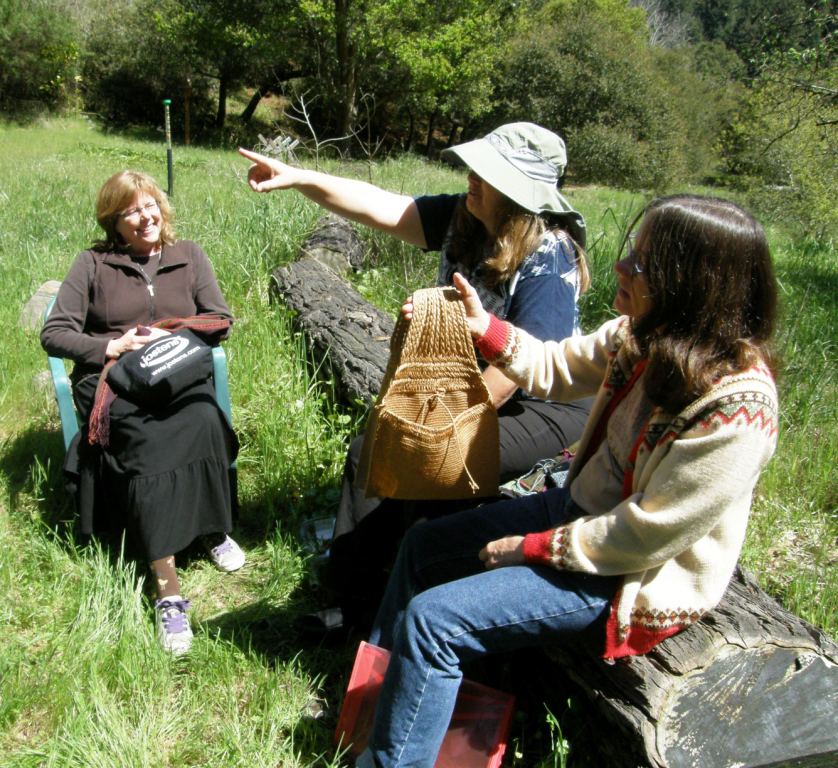
Lazy spring lunchtimes while weaving with friends…a good time to look at some of the woven treasures in  Martha’s collection.

Blue skies and green – colors to inspire a new weaving? No…my mind is reeling with the mixture of bizarre and beautiful cloth I have seen in the last few days and what has jumped out to inspire me is simple black and natural white wool in a new-to-me technique…..weft substitution….more on that later.

Before I left Bolivia, I was hurrying to finish up my two-color ikat experiment and practicing some “damage control” to salvage an ‘oopsy’.

I dyed all three panels of my ikat warp terracotta with the cassette tape ties that you see above.. That all went beautifully.

Then I added more ties to the center section of the two outer panels and dyed just those two panels dark blue…..perfect! The result was a terracotta-centered white diamond on a blue background. I wanted the reverse for the center panel and so needed to dye the center dark blue. And this is where things went wrong.

I prepared a small dye solution dissolving the Dylon cold water dye in hot water, added salt and then applied it to just the center part of the warp, which was suspended over a shallow dish, with a syringe. I then let the warp sit in the shallow solution.

I actually thought that I was cheating by doing this but now that I am at my friend Annie’s home, I have had a chance to read her copy of IKAT by Lydia Van Gelder and find that this is a bona fide technique that even has a name-  ”spot dyeing”. In the book, the author is seen applying dye to a small section of warp with a squirt bottle.

But here was my big ‘oopsy’. I had completely forgotten that the reason I am using Dylon cold water dyes in the first place is that I did not think that the cassette tape would stand up to being submerged in very hot water for the dyeing process and I suppose I should be pleased to find that I was right! The hot water in which I dissolved the dye did not lose its temperature in the shallow dye bath. The cassette tape did not like the heat and so, there were major leaks…ugly blue streaks on the white parts under the tape….much cursing ensued…

So, you can see that the damage control involved evening out the streaky blue so that the entire area would be tinted and that was the best I could do to rescue the mess. Well, that was a good lesson to learn. Other lessons learned…don’t wrap the warp in the evening in semi darkness. That accounts for some of the spottiness in the white areas from less then perfect wrapping. And I know that when I get around to making a ”real ” project in ikat, it will be worth taking extra care to make sure that the wraps are all the same length and made more precisely.

I was very pleased with the weaving part. The threads stayed pretty much in alignment and I love the way the terracotta and dark blue look together.

So, that was another project off the loom. My Wayuu inspired wall hanging was retired to the closet. I have been too busy with other things preparing this trip and decided that it should wait until my return. It is not something that I can just pick up and work on for a few minutes a day. I am more likely to ruin it that way…

So, it is there waiting for me to come back.

And then there was just enough time to go shopping and pick up a few requested woven items to take away with me for people with whom I will be staying on my trip…nice representations of Bolivian lowland fiber cultures…

This is an example of the looped bags that the Ayoreo people make and this is a particularly fine example. A cooperative store in Santa Cruz sells these and you can often see the ladies sitting in the street making them. The quality of the work varies and I was pleased to be able to get this stunningly fine one.

These placemats are woven in cotton by the Guaraní weavers. They, too, most often sell their products through the same cooperative store that is just one block from my home. As usual, the motifs they choose represent the abundance of vegetation and flowers in this jungly lowland area.

First stop is Santa Cruz, California staying with my sash weaver friend, Annie for some pebble weaving.

Loop braider Ingrid Crickmore  was up to midnight putting her newly acquired pebble weave skills into practice. Above you can see one of her bands on the left. We practiced drawing pebble weave designs from fabric directly onto charts and then weaving them and Ingrid took advantage of that skill to weave the two designs you can see above. On the right you can see Annie’s tubular band on which she did a beautiful job. Later we practiced weaving and sewing a tubular band onto the edge of fabric.

What was fun was that many of the guys in this group also braid with Ingrid and are avid loop braiders. They couldn’t resist finishing their bands with fancy looped braids. Below you can see Ingrid braiding away. You might notice that she even has loops on her thumbs!!

Some people like to stand and backstrap weave, like Anne above, while others prefer to be down low on the floor like Sawyer…some do a little of everything.  Some people put down their looms and take a walk and stretch while others simply change position so they can just keep on weaving.

Annie looks completely engaged and comfortable sitting at her loom. Annie wears a different hand woven item everyday, usually a huipil or part of a huipil from Guatemala.

This is a group that has woven with me on three occasions and we know each other better than most groups. Most only see each other when they come to weave with me so, there is a lot of chat and catching up to do! But there’s nothing like pick-up weaving to create pin drop silence while everyone settles in to concentrate.

There’s Yonat above left, who usually has us rolling on the floor laughing, in a rare moment of quiet concentration. She picks up things so quickly! I expect to see her Facebook page covered in tubular bands soon. You can see that even the dog has enough sense to keep quiet while everyone concentrates. On the right Sawyer is sitting up off the floor to get stuck into her first tubular band.

We wove, as we always do, in the Martha’s studio  and, as usual,  she brought out some of the beautiful pieces from her collection to show us while we ate lunch. Yonat also brings us some of her latest acquisitions and those pieces are the ”beautiful” part of this blog post.

But first, let me take a little detour at this point to show you some the “bizarre’ things that I mention in this post’s title….

Annie took me on a trip downtown to a clothing store to show me how “ethnic” and “tribal” seem to be the current themes in fashion. We had a lot of fun digging through the store and pulling out items of clothing and home furnishing trying to identify the weaving culture on which the designs had been based.

Some things were very “been there, done that” for me…the kinds of things that you would find in any South West USA or Guatemalan or Mexican souvenir store perhaps…

But other things were, quite frankly, “bizarre”!….

…like these tiny stretch knit shorts with their designs that imitate ikat. Can you see yourself in a pair of those?

This pillow imitates the patterns that are woven with supplementary wefts in some areas of Guatemala. Certain towns are known for these large multicolored flower motifs on black backgrounds.

On the pillow cover above, it seems that they have taken an image and enlarged it so that it has become pixelated and then printed that. In many areas in Guatemala the backs of these fabrics will have all the ends of the supplementary wefts hanging out in colorful chaos but it is never seen as it is on the inside of the garment.

The creators of this pillow fabric, however, have tried to imitate that by attaching fabrics ends to the back face of the pillow….it is not hidden on the inside of the cushion but rather facing out on the back side! Bizarre! Those loose ends are not part of the textile structure at all but have been added on purpose to mimic the original ethnic fabric.

Admittedly some of the fabrics were not quite so bizarre and were, in fact, very pretty but had obviously been fashioned into garments for people way way younger than myself.  The mini skirt fabric is reminiscent of Central Asian ikat and I just might have worn something like that twenty five years ago!

But this was the one that brought the biggest smile to my face….

Back in my ”ski bum” days I would have been perfectly happy prancing around in these leggings. Lime green and black and neon pinks were the colors we sought in those times, but apart from the colors, one of the printed designs in particular caught my eye. It is a motif with which I have been very familiar after having photographed it on a Huichol belt in the National Museum of the American Indian in DC in 2007.

Those of you who have been following my blog may even remember this motif from several of my posts.

It was very bizarre seeing this motif on these wild leggings. I can imagine the designers going off to the museum and taking pictures or making sketches from all the beautiful pieces there or maybe they only need to do a search on the internet these days.

I tried to reproduce the design when I learned how to do balanced double weave and I also translated elements of the main motif to pebble weave. Now, I can even wear the motif on lime green and black leggings if I am so inclined!

From there, let’s go to the beautiful textiles that I refer to in the title of this post and the new technique that I am itching to try. I have seen and heard about textiles made in the weft substitution technique but have not been tempted to try it because of the long floats that are created on the back of the fabric. Marla Mallett writes about it on her website and in her book Woven Structures.

Of course it is a different story when you are actually touching and holding the fabrics in your hands. The designs that I saw in these structures were ones that did not actually create exceedingly long and cumbersome floats. They were not like the Bedouin motifs in warp substitution which result in what many consider long ugly floats.

Yonat brought a Moroccan rug that she had recently purchased to show us…

I could show you image after image of the rows of the weft substitution patterns on this gorgeous rug. Only a few of them are repeated and this is what has me looking for white and black wool (which pretty much doesn’t exist where I live in Bolivia) so I can go home and play with this technique. The rows of alternating red and mustard between the motifs really set off the patterns.

The back of the rug is covered in tufts of wool which didn’t seem to have anything to do with the woven structure. It seemed that these tufts were added to give the rug a more plush feel on the floor. You can see between the tufts that the floats created by the weft substitution technique are not very long. There was one small row of countered weft twining along the bottom. Weft twining always catches my eye.

And here’s the whole rug….beautiful!

One day, Martha brought out a couple of bags in her collection which also show this weft substitution technique from Baluchistan (I had to run to Wikipedia to find out where that is having never heard of it before). She did not know that we had been admiring the Moroccan rug which had the same patterning technique and it so it was pure luck that I was able to have yet another chance to see fabric decorated with this technique.

Baluchistan includes parts of southeastern Iran, southwestern Afghanistan and western Pakistan and is home to the Balochi people.

There are those fabulous sun bleached reds and blues again that I adore! It was fun to see the upper weft substitution motif, a variation of which I have used in my own weaving in a variety of structures…

Above you can the motif woven with supplementary weft, in double weave, pebble weave and supplementary warp.

Above is the other side of the bag and below are a few details on this and other pieces that Martha brought out for us….

The closure system on this bag was particularly fascinating and I neglected to photograph it! It comprised a series of slits through which goat hair loops were passed. Each loop passed through the previous one to create a chain…a little tedious to close the bag but to open the bag you would only have to pull on one end to have all the loops pop open. Someone said that they have seen similar closure systems on canvas tents so some of you may know what I am trying to describe.

Back at Annie’s house, there is also plenty to inspire….like this Chamayo rug on her wall…

The weft-faced stripe patterns on each end of the rug would look right at home in a warp-faced band. And there are walls of colorful sashes to admire. I am struggling to find the time to take them down to examine and photograph before I leave for Oregon on the train tonight. I also have a pile of books that I borrowed from the guild library to peruse.

As for Oregon, I have told my friends up there to hold the rain, please!

I am excited about the prospect of a mini Ravelry meet up while there in Portland. Two members of the Ravelry Backstrap Weaving Group will be coming to spend a couple of days weaving with me. Jennifer and Bobbie have been very active members of the Ravelry group for a long time and I have shown many of their projects here. I am looking forward to seeing first hand Bobbie’s latest piece where she is using fine naturally dyed Guatemalan cotton. I showed a few pictures of that a few weeks ago so we will be able to get an update.

Pantoffels, also in the Ravelry group, recently adapted the techniques I teach in my Andean Pebble Weave book to her inkle loom. She is planning to sew the pieces of her band side by side into a wide piece. It looks great.

I am always happy to see this on inkle looms as it opens up the technique to those who are just not into being attached to a backstrap loom.

My book is now available as a download in four languages on Patternfish if Pantoffels has inspired you to try pebble weave too.

See you next time in Oregon…..

Backstrap Weaving – Long, flowing, luxurious….sashes.

I have had belts on the brain after my post last week where I was thinking about which examples of my weaving I can manage to take away with me on my trip next week given the very limited space that I have for such things in my luggage.

I had my woven cell phone pouches, cosmetics bags, computer cases, pouches for sewing kits and passport and tool bags on my list…all handy things for travel which could be useful as well as serve as examples of different pick-up techniques when I meet people and tell them about my weaving….certainly not the kind of things that weavers here in South America are making for their own personal use. Then there were my colorful woven backstraps…would you believe I have only met one or two indigenous weavers here who have actually woven their own backstrap? It’s just not the done thing.  Generally, a flour or rice sack with rope on its ends will do as a backstrap. Sometimes a piece of leather or some braided fiber like agave is used.

And then there were belts…something I can wear AND show as a woven examples. Belts and sashes are certainly things that indigenous weavers weave for themselves. There are few weavers that I have worked with that have not had belt weaving as part of their textile tradition. They can sometimes have symbolic significance, perhaps a purely ceremonial use or they can be simply practical.

So, I thought I would take a look at some of the belts and sashes that I have gathered over the years and I was surprised at how many examples I have given that I have made a conscious effort to stop purchasing these things when I travel…sometimes you just can’t resist, you know, but I really do try these days to just take photos and move on. I will include some of the beautiful things I have photographed too.

These are not belts but rather, hair sashes. I am thinking that one of these years I will let my hair go completely grey, keep it long and wear spectacular hair sashes like these!

These are all from Guatemala.

The one at the top is from Zunil and I learned that style of weaving there.

The center one is from Jacaltenango and is the style about which Carol Ventura has written a book. The lower one is from Aguacatan. It is wide, long and has the most amazing tassels on the end. I was only in Aguacatan for a day and I didn’t feel that I could ask any of the ladies to pose for a picture. I would so like to show you what this sash looks like when it is worn. I have read that women wear these hair sashes in imitation of Ixchel the Mayan goddess of weaving who has coiled snakes holding up her hair.

I love sashes. I love their length, their drape. I like pulling them through my fingers or laying them in a crazy coil of color on the floor.

From the very same town of Aguacatan comes this complete contrast in a simple black and white belt.

This is my weaving teacher Clara at her hybrid four-shaft/backstrap loom wearing and weaving one of the typical hair sashes of Zunil.

This belt still on its backstrap loom from Viques, Peru is probably one of my favorite things. It is made with yarn that wraps about sixty times to the inch and is covered in fine patterns. The weft is tripled and the belt has been beaten to an incredible stiffness. This belt is the main reason I have stopped buying these things. I have had this piece for almost sixteen years and the yarn is now so fragile that it is difficult to touch the piece now without having threads break. These things need to be stored and cared for in ways that I am not able..

I can hear voices saying “Well, bring it here to me, I’ll take care of it!” Maybe I will….

This belt is worn by the men of Cañar in Ecuador and is made with what looks to me like sewing thread. It is wonderfully smooth and slinky. Hanging out in the plaza of Cañar on a Sunday morning is a great way to see men and women out and about in their best clothes. When I was there many of the men were wearing ponchos with ikat patterned sections and these gorgeous belts most of which had far more motifs than the example that I purchased.

These sturdy double weave belts worn by women in Potosi, Bolivia seemed to be very fashionable as far away as Otavalo in Ecuador. When I was there in 2005 I saw a few young ladies wearing these instead of the chumbis that are typical of their costume. I wonder if they are still a fashion trend now. Quite likely something else will have taken over in popularity by now.

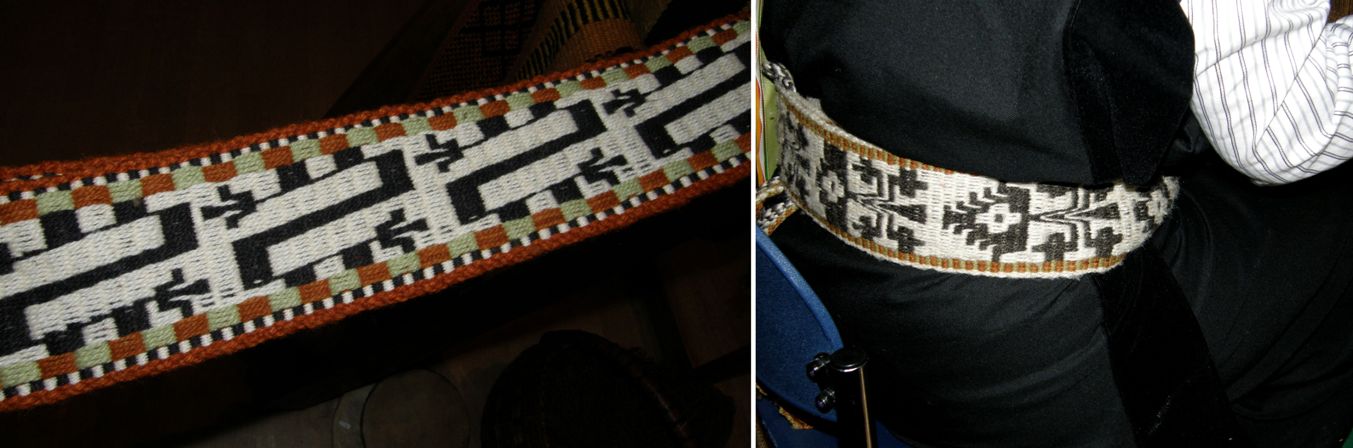
This one with its bold, beautiful design isn’t mine and was shown to me by a gentleman in the US who had spent some years on the Argentinean pampa working as a gaucho (Argentinean cowboy). He told me that it was probably woven by a Mapuche weaver and that it forms part of the traditional gaucho costume.

The Mapuche women themselves weave and wear a belt called ñimintraruwe as seen above.

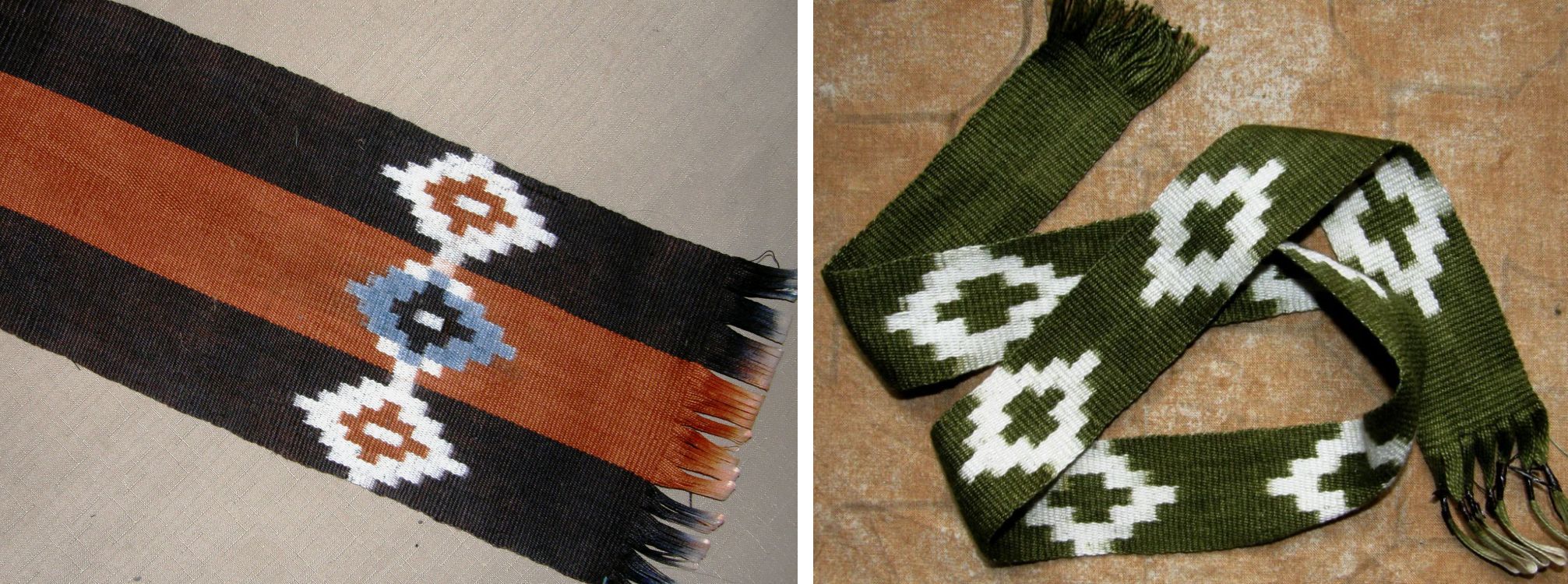
This is the belt woven by men and worn by the ladies of Salasaca, Ecuador. A Salasaca belt is on the left and my reproduction of one of the designs on the right.

I tried very hard to buy one of these belts as I had learned to weave them and wanted a sample of all the designs. There simply wasn’t one to be had although I noticed that the family with whom I had been staying had their pig tethered with an old belt! So, I took lots of pictures instead. Some of the younger ladies were keen for me to make them a pebble weave belt. Like the ladies from Otavalo, they were interested in having something different in order to stand out from the crowd. They took the little photo album that I carry with pictures of my weaving and used it as a shopping catalog pointing out the designs and colors that they wanted!

I ended up teaching one of the ladies and another young fellow pebble weave instead…now you can make your own belt!!

A belt weaver of Salasaca at work at his loom. (this picture courtesy of Teyacapan)

These belts are woven and worn by the Tarahumara people of Mexico. I was lucky to be able to see and photograph them when an anthropologist showed me her collection at Convergence in 2010. The one at bottom right belongs to Annie MacHale who has a large collection of sashes which she loves to wear.

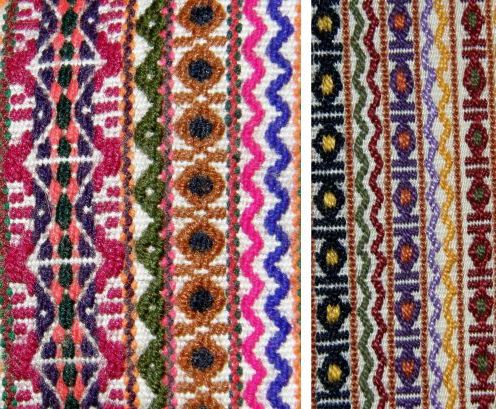
These pieces from the Cusco area have a mind-boggling amount of pick-up patterning.

These broad double weave belts from the central Bolivian highlands show the progress that organizations such as PAZA Bolivia are making in helping weavers to recover natural dyeing techniques. These wool belts have a distinctive smell that I can only describe as campo (the country).. a mixture of wool, the natural dye material and smoke….I love it!

I love this sash that I bought on my first trip to Peru before I even knew what pebble weave was. You may recognize a couple of motifs from my book.

Here’s a beautiful three-color belt of the northern Chilean highlands. I may not want to buy the textiles, but think I will always want to buy tools as I will definitely use those. Isn’t that beater wonderful slick and shiny with use?!

Knowing my love of pebbled things, Pam Nadjowski gave me this belt at Convergence. It is one that she collected from the Dong minority group of China. It is very long and must wrap at least three times around the waist.

These are part of Kathe Todd-Hooker’s extensive collection of belts of the Russian old Believers. Taking plenty of pictures, albeit not particularly sharp ones, has enabled me to reproduce some of the designs. Kathe says that the belt around the body has the symbolic purpose of creating a visual cross as well as representing the encircling arms of the church.

So, we weave bands to encircle our waists and then some people weave them to encircle their homes…

Yurt bands! I love them but what would I do with all forty-eight feet of one? My friend Lisa’s owns this beauty and owns a yurt on which to use it.

Sometimes just photographing a small part of a belt is enough to get me motivated for the next experiment. This belt with its combination of simple warp floats and supplementary wefts was very intriguing.

This Huichol belt that I originally photographed in the National Museum of the American Indian back in 2007 has been on my mind all these years and has influenced a few projects. Then I finally learned how to do the balanced double weave technique in which it is made.

I love sashes and belts…the long flowing loveliness!. They have prompted me to make a few of my own. These would be pretty dull wrapped around my hair. I must make some much more colorful ones.

This next one is more like it. It has been with me for years. It is a sample I wove when I still lived in Chile and I intend to make a full sash with this design one of these days…

And more sash inspiration and ideas come along every day…

This study sample of the sprang technique used to make Hopi wedding sashes made by the late Nora Rogers was given to me last year.

There’s more! But that’s enough don’t you think? Just think…I will be  at sash-weaver Annie MacHale’s home next week swimming in long gorgeous sashes…not only the beautiful ones that she has collected but the fantastic ones that she weaves herself on her inkle looms.
I will finish with a quick report on what I have been up to on the loom.

Apart from samples for my next book which I am not showing yet (!), I have launched  the second ikat experiment. This means that I didn’t actually spend that much time at the loom. It was more about tying cassette tape to form the design, dyeing and re-dyeing as I wanted to have three colors. I chose terracotta and navy blue after hearing about the chocolate and blue ikat textiles of Guatemala that Karen from the Ravelry group likes.

Tied and ready to be dyed…. I am afraid that I am not being very brave as this is the first experiment with dyeing two colors and so I only wrapped one motif on each of the three sections.

Dyeing done. There will, hopefully be white diamonds on blue with terracotta centers on the two outer sections with a white diamond on terracotta with a blue center on the middle one. Like I said before, this for me is the easy part. Now to weave and have it all stay more or less together. I have woven the first two inches of plain weave and am about to hit the wrapped section and will show you next week how it went. I am using a fine weft again as I really like the way the resulting fabric looks and feels.

This next piece started off as an experiment but now I think it will be one of the key fobs for my muddle of luggage keys on the trip…Too bad I didn’t start it with a third selvedge.

I am weaving this in what I call the “embedded double weave” technique, that is, plain weave alongside double weave. The green borders are plain weave. This is the technique I learned in Potosi, Bolivia and this way of including strips of patterned double weave in plain weave fabric is used in a few places in Bolivia. Two wefts are used. I have, however, been trying something new in the material I use for the second weft and in the way I handle the two wefts and I love the way it is turning out.

The new way I am trying makes the transition from double weave to plain weave on the upper face less obvious and harsh and on the lower face it is, amazingly, not apparent at all…completely smooth! I will fill in the details next week. I thought I would save something for next blog day as I will be just arriving in California with perhaps not a whole lot of time to put things together to post. My posts will probably start getting erratic.

For next week I am also saving pictures of Bobbie’s progress on the gorgeous naturally dyed Guatemalan warp that I showed you last week.

We can take a look at the pattern she is weaving and see how she set up her loom to create it.

Naseen on Ravelry has finished a sash (in my favorite colors of the moment) and shared her pictures with the group…

She used the tutorial on the yurt band border pattern here.

Yonat has been playing with the double weave technique she learned in our workshop last fall on her inkle loom. The technique transfers perfectly to this kind of loom and you will find pictures of the set-up on the inkle loom on the tutorial page here. Here’s her sample band with Andean and Bedouin motifs as well as others that she invented herself.

Andean Pebble Weave is now available in Italian on the Patternfish website. Many thanks to Lidia Guffanti who did the translation.

Now that it’s in four languages, I can tell you:

Happy weaving! Buona tessitura! Bon tissage ! Viel Spaß beim Weben!

See you next week in California!