Backstrap Weaving – Color fom the Cochabamba “campo”

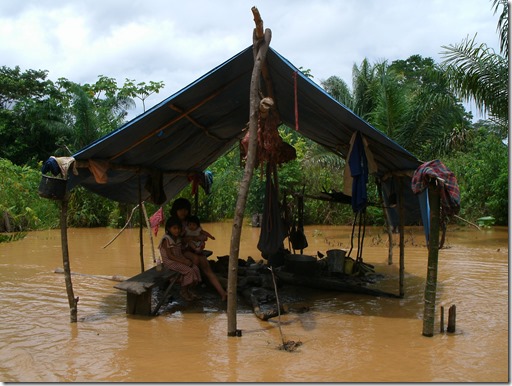
The big rains have more or less stopped here in Santa Cruz. We get a shower about twice a day. Each one has has me holding my breath. The outer wall of my bedroom has been hacked out so that it can dry out  and then be filled and repaired and made watertight, we hope. The huge wooden wall unit in my bedroom had one side on the point of collapse when the water soaked through. Now it is being supported by my large weaving sticks. Whine , whine, whine… a picture like this from this blog soon makes you stop. Such is the situation in the province of Beni in Bolivia. No walls at all and  sticks support the roof.
AguaYaku

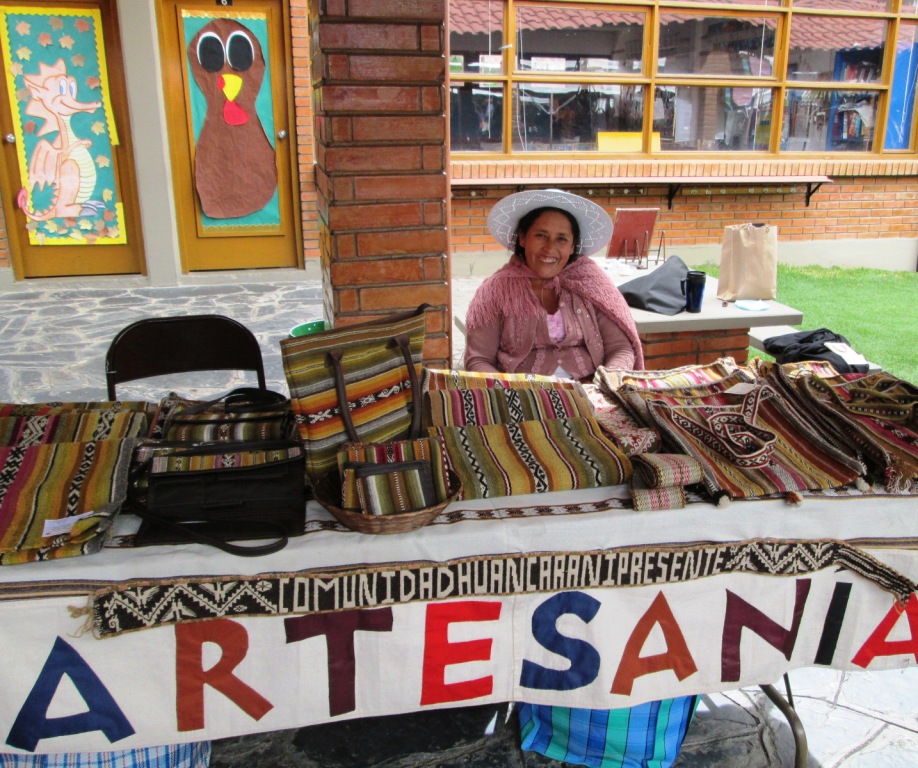
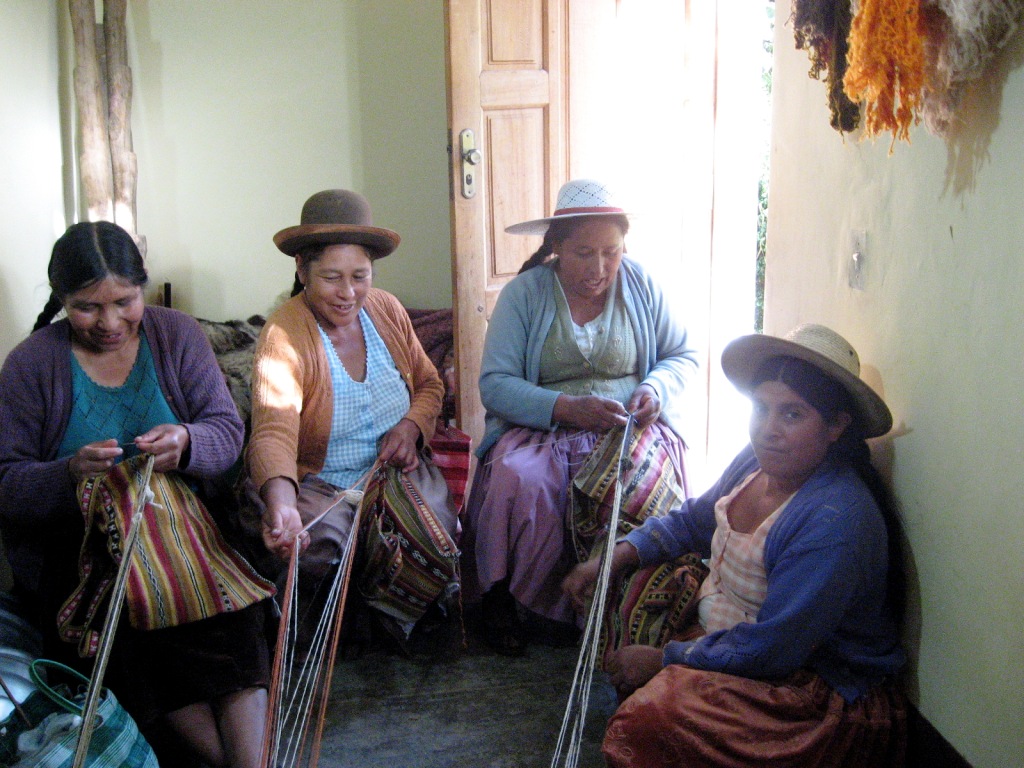
I heard from my friend Dorinda up in the highlands in the province of Cochabamba, another of the effected areas, but she did not mention the rains and I am guessing that they are okay. Dorinda had written to let me know that she had mailed the box of woven bands that I had ordered from the weaving cooperative that my teacher Maxima heads. Dorinda blogs about her work with Maxima and the weavers of Huancarani at PAZA Bolivia.

Exciting! As the post office box I use is in someone else’s name, I had to be patient and wait for my treasure to be picked up.
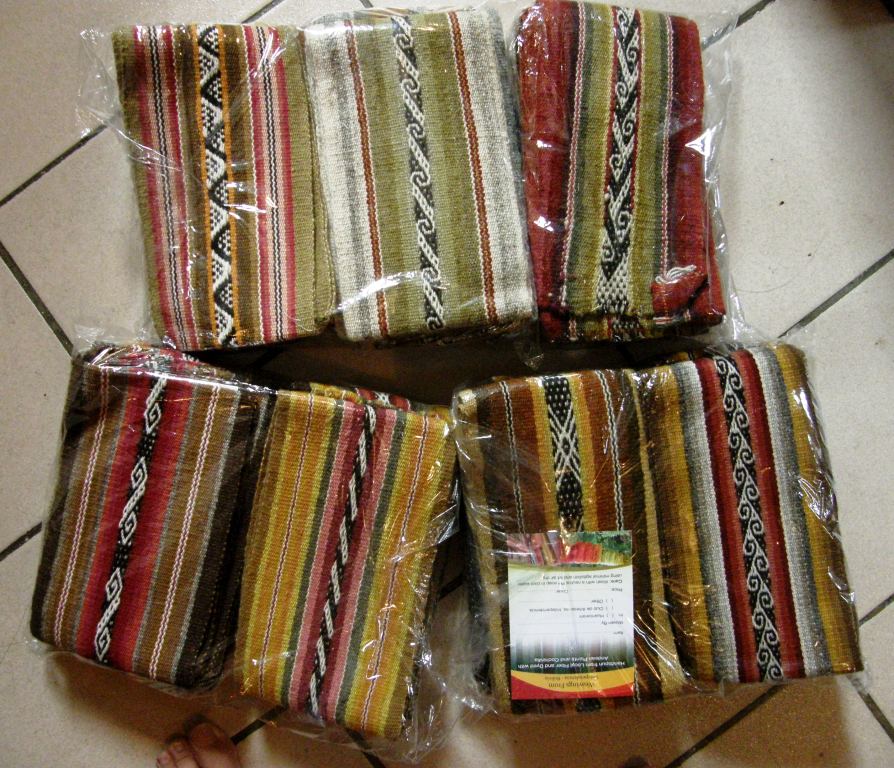
packagedbands from CochabambaMy home is a disaster of warps, yarn and sticks right now. I really had to resist opening the packages straight away, unfolding the luscious bands, and laying them out to view on every available space. Dorinda included a list of the weavers and each band is tagged with the weaver’s name. She also sent me a document with a short story on each of the ladies. It so nice to handle one of the bands, look at the picture of the weaver and read her story.

Cochabamba bands in boxOnce I had put things in order, two days later, I opened the packages and  released all those lovely aromas of wool, dyestuffs, and “campo”.

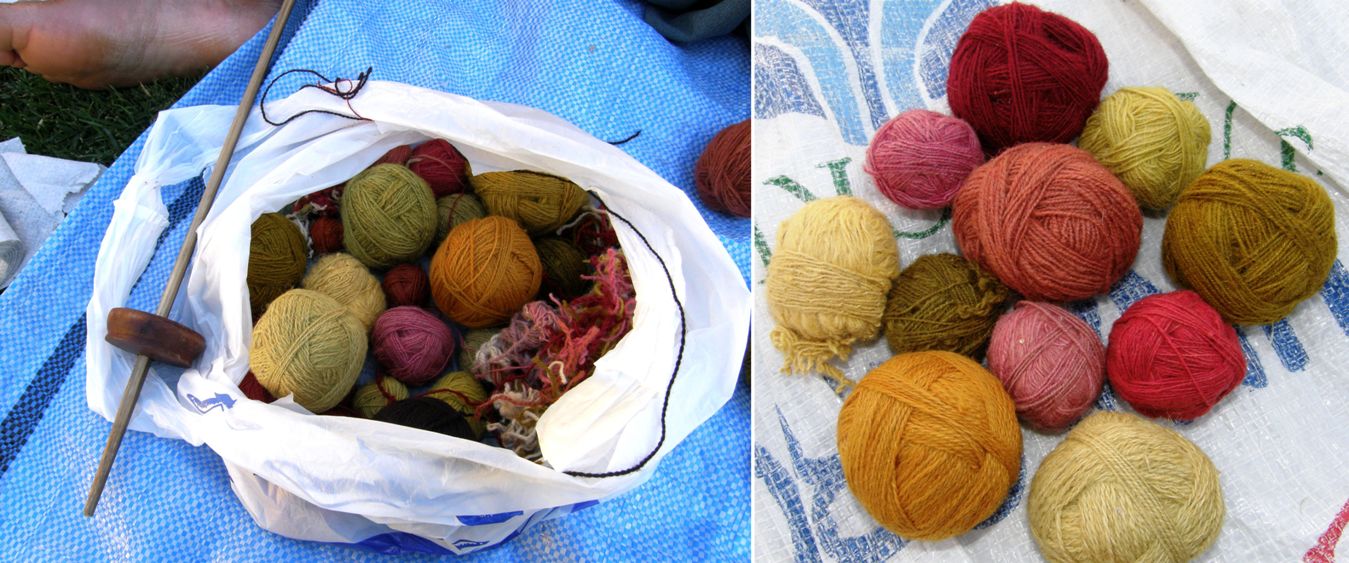
I like to feel the cloth. The yarn is the weavers’ own handspun, most often made with fleece from their own flocks. The colors are all natural and were created from cochineal and local plants.

Which weaver would be considered the best amongst her peers, I wonder. Whose cloth is the stiffest? This seems to be one of the things that the weavers themselves appreciate. I wonder which pattern they would consider the most complex. What different effects did they achieve in their use of warp and weft colors? Who matched the weft color to the edge color and who used a contrast color to create attractive little dots along the edge? Whose color combination was vastly different to everyone else’s?

Did they all get together and decide not to duplicate the patterns or was that just a happy coincidence? Were any made by the teenagers who are still in training?

Without unfolding them, I picked out two which I considered my favorites. I was happy to see that one of the two had been woven my Maxima. I wondered if I had simply recognized her style.

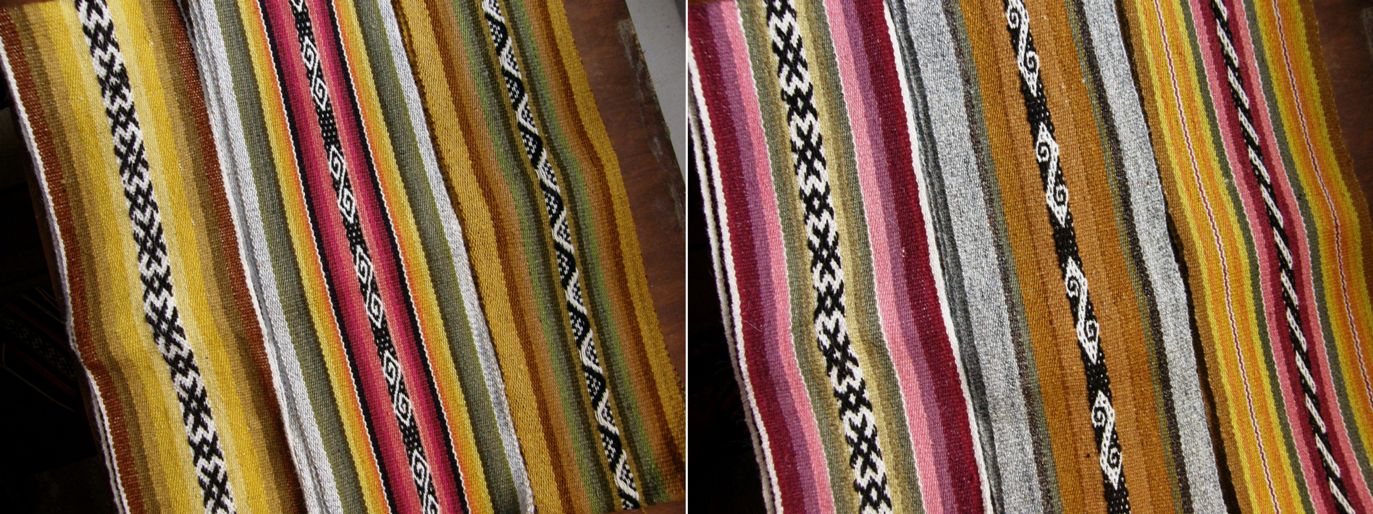
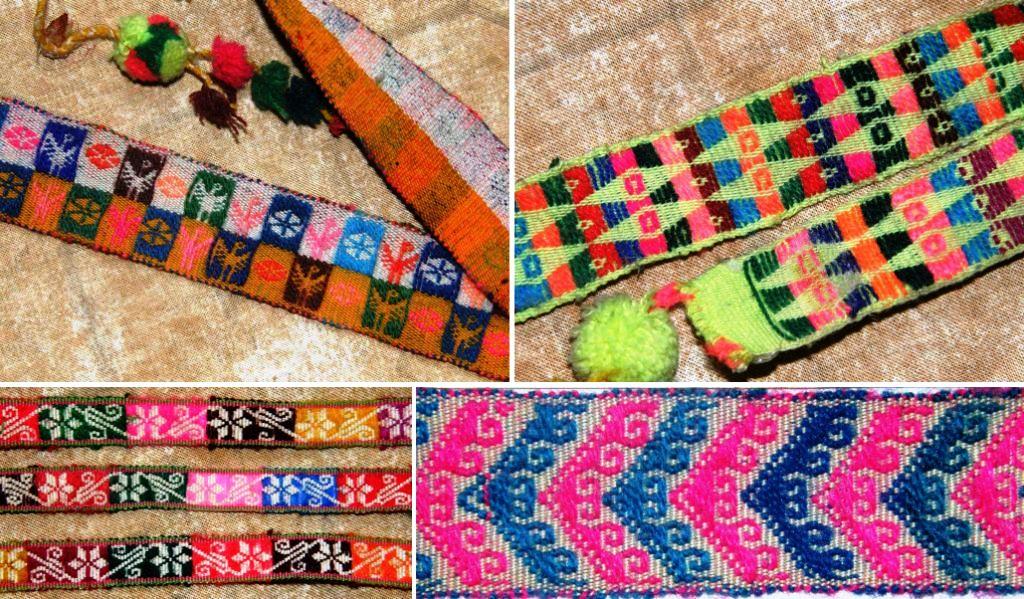
Fifteen different weavers had made the bands with no repetition of color arrangement and just two patterns duplicated. The width of the stripes of color ,and the narrow strips of threaded-in pattern that sometimes separate them, was in a form that was often repeated and could be characteristic of certain communities or even families.

???????????????????????????????Seventeen bands were patterned with complementary-warp designs and three used a supplementary-warp structure.
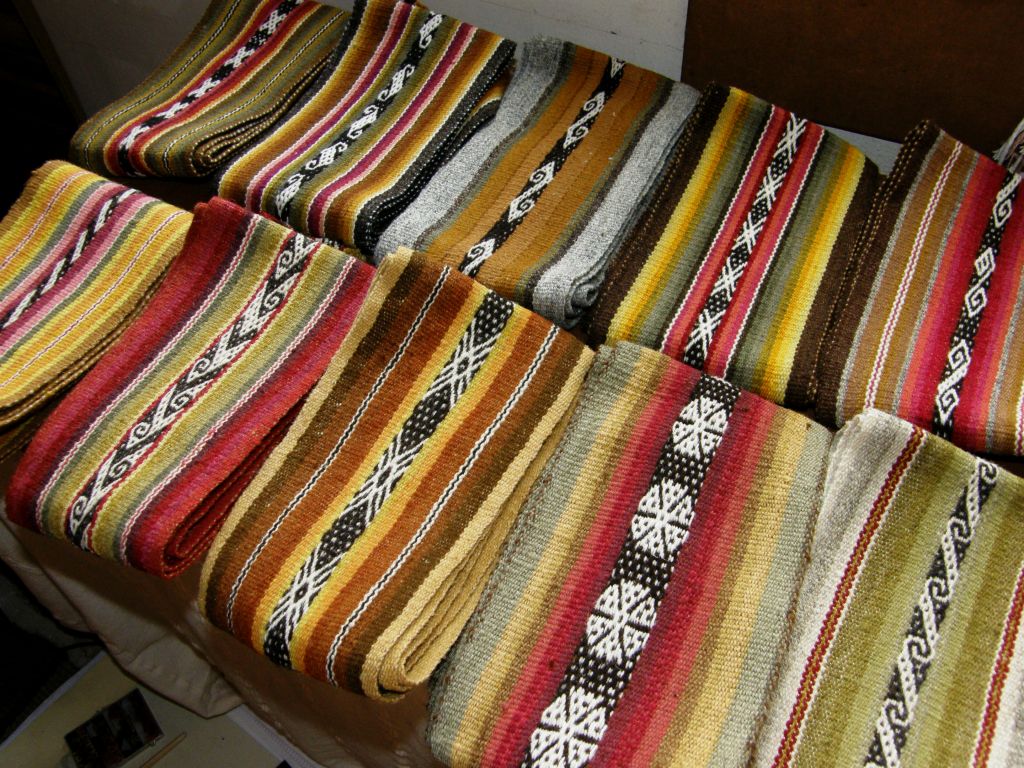
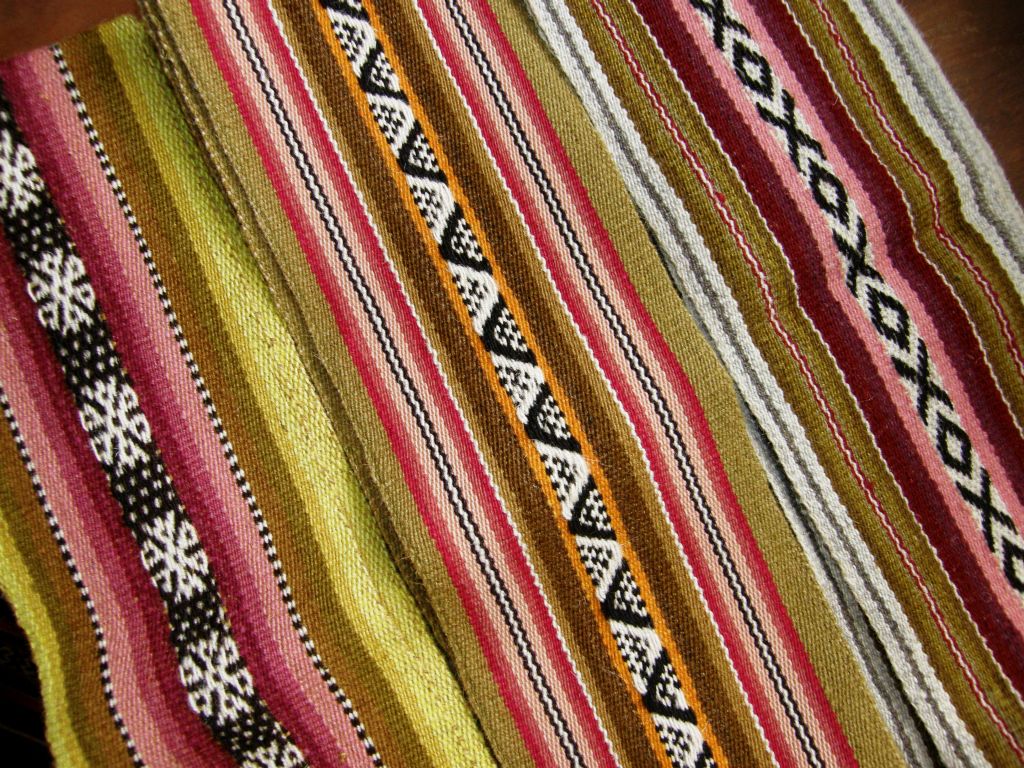
The weavers used a complementary-warp structure to create the patterns on these bands.
One of the bands with pattern created with supplementary warps is on the right.
The band on the right is one of those which was patterned with supplementary warps.

The second of the two bands that I had picked out as favorites was made by Narciza, Maxima’s older sister. I just love Narciza’s color combinations. Below you can see her adding a tubular border to one of her woven pieces. As is done in Peru, she uses a forked stick to hold the cross for this particular type of patterned tubular band. Strangely, younger sister Maxima never learned to weave this kind of tubular band with its distinctive eye pattern and only recently learned it at the Tinkuy in Cusco last year.

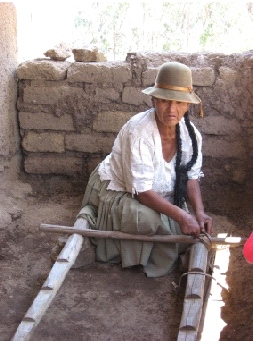
Narciza Cortez

DioniciaDionicia Crespo is the oldest weaver in Hauncarani still weaving to sell at 82 years old!

Of course, her fading eyesight plays a role in the straightness of her edges, Dorinda tells me.

She doesn’t have glasses. Somebody told me the women are embarrassed to try out reading glasses because glasses are associated with education and the Huancarani weavers are illiterate (Dorinda)

Her edges look good to me!

You can see her at left preparing her frame for warping.

???????????????????????????????

advianaBands that represent three stages of life….you can see 82-year old  Dionicia’s band above on the left. A piece by Vilma, Maxima’s eldest daughter, is in the middle and the band created by the youngest weaver of this collection of bands, 18-year old Adviana, is on the right.

Dorinda tells me that Adviana is one of the few of the younger generation who has learned how to weave. 

When she began weaving to sell through PAZA she relied on her grandmother´s assistance, but now weaves on her own. (Dorinda)

???????????????????????????????Family traits? The band on the left is Maxima’s, daughter Vilma’s is in the middle and older sister Narciza’s is on the right.
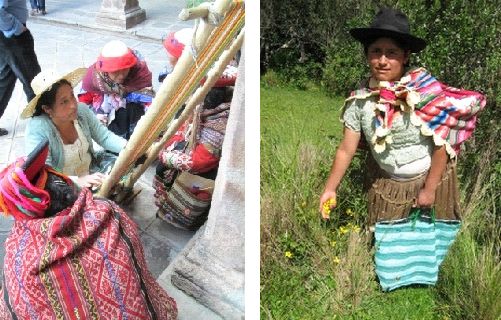
Mxima demonstrating at Tinkuy 2013 and daughter Vilma collecting flowers for the dyepot.
Maxima demonstrating at Tinkuy 2013 and daughter Vilma collecting flowers for the dyepot.

A couple more pictures to finish before I put the bands back in their box….

Cochabamba bands 1

Cochabamba bands 2Enough color? Let me calm things down a bit now with some black and white.

A question was asked in one of the forums this week about what kind of weaving software people use. There are still quite a lot of good old fashioned paper-and-pencil people around amongst those who were excitedly discussing all the ins and outs of the various available programs.
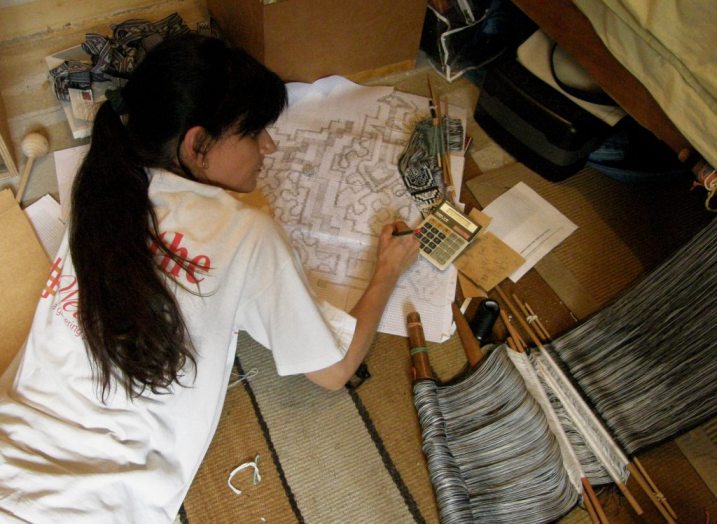
charting for backstrap weaving

black panel for all hanging backstrap weavingMe? I am a paper-and-pencil gal. That’s the new panel for the wall hanging over which I have been dithering. I love charting this way. It makes me feel like a kid again and it is very relaxing. While a young fellow dangled from a cage outside my window and hacked away at my wall, I calmy colored in cells on my graph paper. Prior to that, I had just as calmly sat and  made four sets of string heddles of 353 ends each on that black and white cotton warp.

If you are thinking that that is a weird-looking pattern, you are right! I really have no idea what this will end up looking like even after sampling! I just need to dive in and do it. I fussed over it more than usual….measuring, shifting things about, uncrossing warps, measuring again and finally got the first weft shot in. That always feels good. I am weaving this in double weave. It is embedded double weave as there is a very narrow plain-weave border on either side.

???????????????????????????????I finished the silk bookmark that was part of the Ravelry event but I am calling it a sample for now. There are several things about it with which I am not pleased and, as I have plenty of warp left, I will start it again with improvements.

The silk is lovely to work with! Using the four sets of string heddles and a pick-up stick I never have to actually touch the threads. I worked with this same silk as supplementary weft last summer and it was horrid to handle with sweaty hands.

The bookmark is light and supple…just the right thickness to slip between pages. I am pleased with all that. Now to fix that other stuff that I don’t like as much.

While on the subject of double weave, Scott has allowed me to show pictures that he posted of his double-weave sample band. He is studying the one-weft version from my tutorial here and has done a really good job.
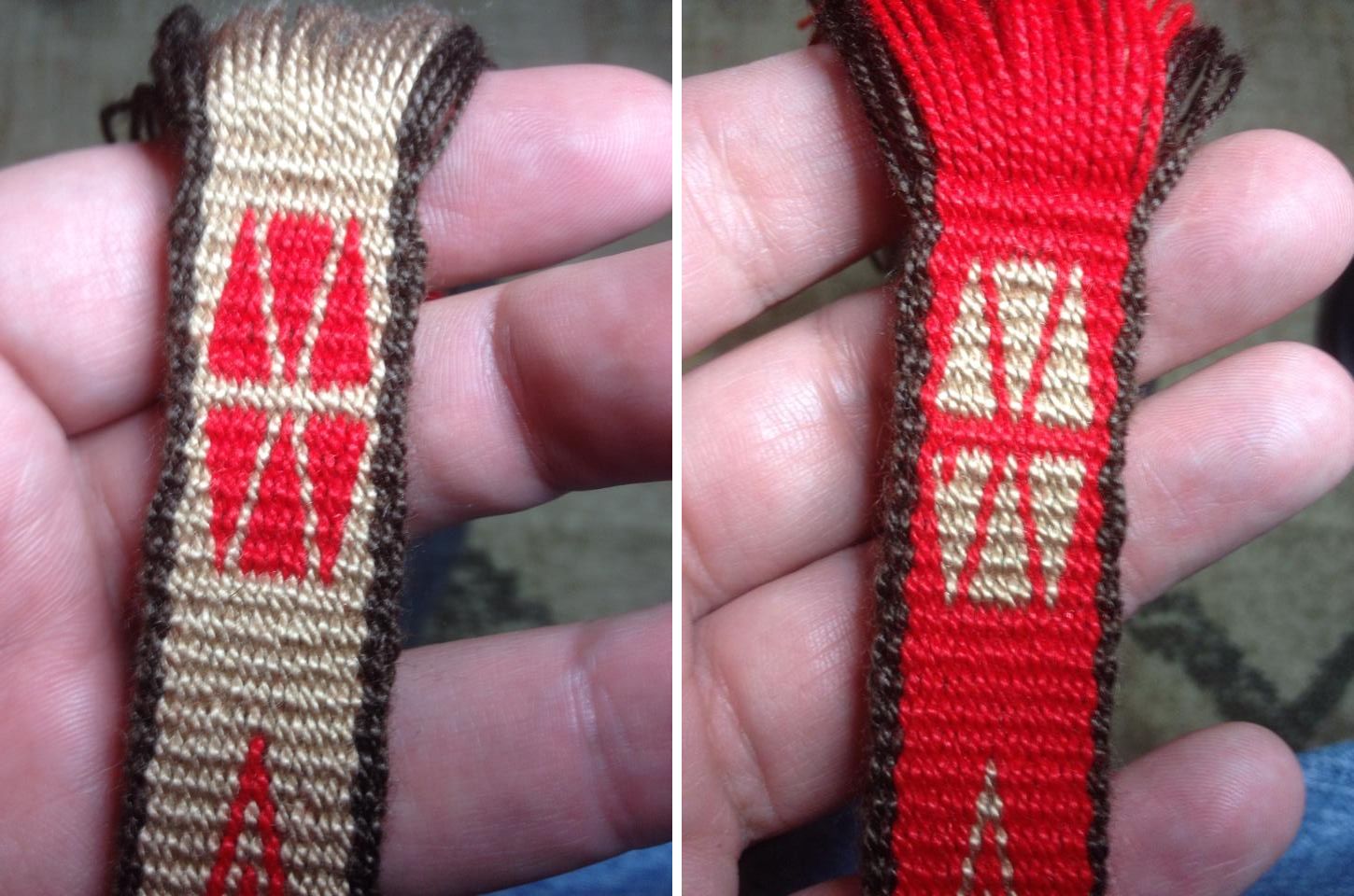
scott double weaveRavelry projects have been coming in as we approach the end of the Sochi Games…
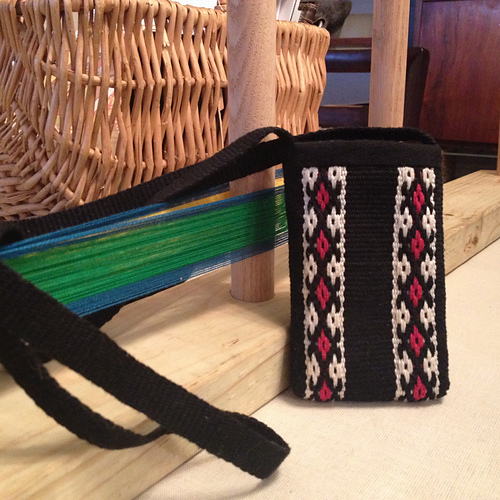
kim's bagKim finished her piece and sewed int a small bag for which she also wove a strap. Now she is on the lookout for a button to close it.
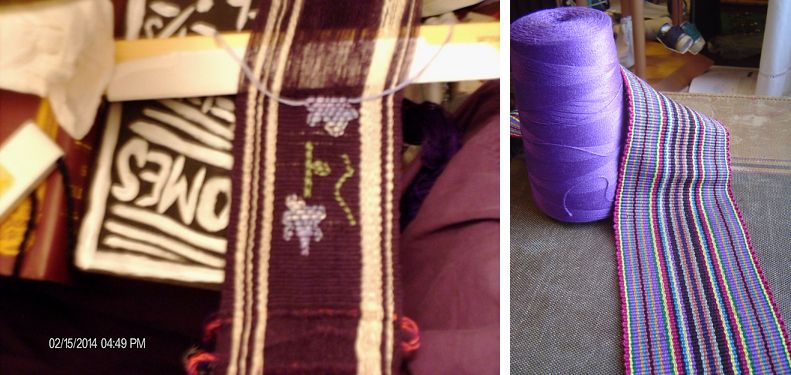
joyful and juliaJoyful has been converting her flowere doodles into patterns using embroidery floss as supplementary weft on her plain-weave band. Julia will use purple cloth with her finished piece along with her sewing talents to create something useful.

Another week comes to a close.  I try and mix it up…a little warping, a little charting, a little weaving for myself. I hope to make some good progress on the wall hanging this coming week.

Bye for now.

Backstrap Weaving – The Positive and the Negative

I have been working a lot with wool this week as I sew pieces of woven wool bands from Cochabamba into little pouches and dress them up with all kinds of pretty finishing techniques. Some of the finishing stitches are easy but they require precision and doing this work increases my admiration for those who do fine embroidery work. I am using wool for my stitching thread.

Working with wool is wonderful but, above all, working with wool is forgiving! This is one of this fiber’s big positive features for me. It fluffs out happily and fills in tricky spaces. Never mind if you didn’t insert the needle the exact same distance from the edge of the woven piece every single time…wool will forgive this…it has a certain rustic look that forgives even if it doesn’t always hide the imperfections. I love it. I am glad that I have spent years getting my “training” using cotton for these sewing techniques. When you switch to wool, it is all so much easier. My indigenous teachers used acrylic when they taught me these things.

??????????????????????I added multi-color cross knit looping to the top edge of this little pouch and wove a strap. You can just see the grey cross knit looped stitch along the right hand edge.

??????????????????????Here you can see the bottom edges of the two pouches on which I have been working this week. The one on the right has been edged with a tubular band and I added what I am calling a “coil stitch” to the bottom of the other…lots of fun to do albeit rather fiddly. I made a braid with a couple of pom poms for one pouch and added tassels to the other. It was fun weaving the strap. I am using just regular knitting wool for these finishes and am not re-spinning or treating it in any way. It stood up wonderfully well for weaving the straps which were woven on 72-inch circular warps.

Note to the pebble weavers out there: can you see the “blip” in the pattern on the pouch on the right? The weaver used the same pebble shed twice instead of alternating them. You see, even the experts get caught sometimes!

finishing techniques on bolivian pouchesAnd then I played with some decorative joining stitches on some of the left over pieces. That’s where wool really was my friend. It was really hard to count the warps and place the needle accurately on that variegated grey wool. If I had tried this with cotton, it would have looked awful. Wool is Cool! (Too bad that doesn’t really rhyme. But try making it rhyme…it’s kind of funny. Ah, the English language!)

tinkuy 2010Weaving with wool, on the other hand, is a different story. It can be rather unfriendly depending, of course, on your level of expertise in preparing wool for warp-faced weaving.

If not well prepared, each warp will extend its little hairy fingers to grasp its neighbor and protest loudly as you try to open a shed. Worse still, they will start to break. But, you can learn to deal with that stickiness.

Even if you haven’t learned how to prepare the wool to the state of fine, smooth, even, perfection like the spinners in Chinchero do, there  are strategies for dealing with those sticky warps. It can slow things down, and I guess you could call this one of this fiber’s negative aspects. The results, however, are always worth the effort.

Maxima in Cochabamba adds extra twist to her hanspun yarn before winding a warp for a pebble weave band.

Connie's pebble weave1Speaking of beauiful handspun, Janet, Ace, Connie and Gina from the Humboldt backstrap weaving gang got together at Ace’s place in amongst the gorgeous redwoods for a weave-along.

It was a chance to practice among friends and lend a hand to those with a little less experience.

Janet and Connie helped Gina and Ace remember how to make string heddles. Ace is working with his own handspun wool and Gina is using Tahki Cotton Classic to make a backstrap. Janet gave Ace tips on how to handle the wool warp and open the sheds smoothly.

Janet and Connie worked on pebble weave projects. Janet, of course, is using her handspun while Connie used 8/2 tencel to make the lanyard for her name tag for CNCH (pictured at left). I imagine that must feel gorgeously silky in that tencel.

And there they were on Ace’s balcony with their warps attached to the railing calling me to join them from Bolivia via Skype! How cool is that?

Ace and ConnieAbove you can see Ace with his wool warp and freshly installed heddles next to Connie’s latest tencel warp…yummy colors!

Jnet weaving her handspun wool1Janet gets to work on her wool warp while Gina installs heddles on her cotton one. I love that this group is finding time to get together and do this and support each other and I hope that they Skype me every time!

Back at my own loom, I have been sampling supplementary-weft inlay while playing with positive and negative spaces. I showed you in the last blog post how I want to try covering the negative space on a band with supplementary wefts leaving the ground weave exposed to form the motif. So, I have been sampling away and have made some useful discoveries about the changes in weaving width that happen when you do that. This will be something to keep in mind when planning bigger projects later. I have to say that I am loving the way this looks! I am using the 60/2 silk on the Guatemalan cotton warp.

suppleemntary weft in negative spaceI think I will still try to sew this in to something despite the width inconsistencies. I will just keep on sampling and see when I am done what can be made with it. I am keen on dressing it up as I did the wool pouches but I will use cotton instead of wool for that.

positive and negative space inlay in supplementary weft inlay??????????????????????I continued and added a bit of “positive” pattern just to compare.

Now I would like to adapt some Andean warp patterns where both the positive and negative spaces form the same motif and weave those with supplementary wefts.

There are certainly many of those to choose from and I am sure that I can find many on textiles from other cultures too. If you are not sure what I mean, take a look at the motif at left which is from the edge of a belt woven and used by Russian Old Believers.

I will leave you this week with a couple of pebble weave projects.

Larisa has been writing to me via my Andean Pebble Weave Facebook page and sent me pictures of her first pebble weave band using some of the 4 rev patterns from my first book on a wider band. I like the way the hearts look with the border around them. She is going to use this band as the tie for her end loom bar.

larisa pebble weaveAnd Julia continues to adapt traditional Japanese embroidery patterns to pebble weave. She uses the spotted charting system that I show in my second book to sketch the patterns ready to be woven using the pebble weave structure. Inspiring! Background, pattern, positive and negative spaces merge into a spectacular pattern.

julia pebble weave adaptation japanese embroidery

See you next week….

Backstrap Weaving – Re-defining “fine”

Internet fail yesterday kept me from blogging. All kinds of crazy specials and offers by the phone company here have the whole system on the point of complete saturation. Goodness knows how long it will all keep running before everything comes crashing down. Of course, the phone company tells me that everything is just “fine”.  So, I couldn’t write my blog but, never mind, there is always plenty to do.

Once again I was immersed in the warm woolly smells and happy colors of the highlands as I took out the beautiful bands made by the weavers in Independencia, Bolivia  from their handspun yarn colored with natural dyes.

yarn

?????????????????????? You know how much I love to dress up little bags and pouches. I am cutting up the bands just as the weavers themselves are doing in Independencia to make cell phone pouches and other such things to sell. So, I have been weaving and sewing tubular bands, braiding and embellishing away and having fun.

embellished wool pouch???????????????????????????????Here is one partly dressed-up pouch with a brown and red tubular band, braids and tassels. These projects give me the perfect opportunity to put into practice the many little finishing techniques that my weaving teachers and sling braiding instructor have shown me over the years.

The two-color edging stitch that my sling teacher in Peru taught me for decorating the cradle section of the sling looks lovely along the edge of fabric. I have used it to edge a table runner.

Now that it is not so hot here, it is really nice to feel the wool in my hands. It is also nice to have something off-loom to play with.

On the loom, I have the black warp that I took on my last spring trip away. I am using the fine Guatemalan cotton which I recently wove into black and purple scarves decorated with supplementary-weft patterns.

As I am still in my supplementary-weft phase, I have been thinking about what to do with this black demo warp. I created it with nothing in particular in mind…just something to show one of the ways in which a warp can be put together for backstrap weaving.

supplementary weft patterned scarf backstrap loom

Now I am thinking that since I used patterns based on Bhutanese motifs on the black scarf and Guatemalan inspired patterns on the purple one, I should base the designs on this new project on supplementary-weft patterns from another weaving culture….either Bolivian hatband motifs or the designs used by the Montagnard weavers with whom I studied in the US.

I have a few hatbands that I have gathered over the years. The problem with studying the motifs on these supplementary-weft patterned bands is that the thread that Bolivian weavers use for these is so incredibly FINE!!

supplementary weft project for on the road

hatbands-aWhat I like about some of the Bolivian hatbands that I have seen is that the supplementary weft is used to fill the negative spaces.

Look at the flower pattern at bottom left on the hatband from Calcha, Bolivia. The ground weave is white and the colored supplementary wefts fill the negative spaces so that the ground weave below is exposed in the shape of a flower. The thread used in that flower band is unbelievably fine….almost like strands of hair! I can’t count the threads and will need to get a magnifying glass to do so. The fineness of the thread means that the weaver has been able to get away with making some very long floats of supplementary weft. As the piece was designed to be worn around a hat, long floats  are not really a problem as it is unlikely that they will catch on things and get pulled.

sample for Bolivian hatband designFor my sample piece I have had to modify the pattern to eliminate some of the long floats as my Guatemalan cotton, as fine as it is, is nowhere near as fine as the Bolivian thread.

You can just see the top half of the flower head in my sample as I weave to check the proportions. Look at the difference in size between my sample with my “fine” cotton and the Bolivian band. I think that I will have to re-define “fine”!

The Bolivian weaver has used a colored stripe to border the pattern so that the colored wefts don’t just end “in space”. Besides looking good, this also saves her the trouble of having to count threads to see where the wefts need to dip back down within the shed. I was trying to just eyeball it when I was doing it and found myself one warp thread off the mark many times. So, to weave this, I really need to make a new warp with stripes included or….maybe I can come up with another plan by doing some more sampling.

Hopefully the  sampling will become something acceptable and I will be able to make this little black piece into a pouch with lots of embellishments.

In the Ravelry group, Cindy has been doing pebble weave on a Gilmore Wave loom making what might become a backstrap. The pattern is one that my teacher Maxima taught me and is charted in my second book.

cindy pebble weaveBetsy is making guitar straps on her backstrap loom with her own handspun. Janet is her spinning teacher and Betsy works hard at her spinning every day, so you can imagine that her handspun is really lovely and works beautifully for backstrap weaving.

betsy guitar strap handspunJennifer demonstrated how using a coil rod eliminated the annoying corrugated look in her cotton warp and gave a new life to this abandoned project. She then used the warp to create a really interesting solid-color warp-float pattern using a pattern stick and heddles to raise the warps for the floats.

jennifer coil rod and warp float patternWell, it’s back to sampling on the cotton warp, embellishing the wool pouches and playing some more on the inklette project for the article. My internet is running again and all is “fine”.

922915_10151577057823866_898758942_nThanks to everyone who wrote with suggestions about the embroidery stitch on the pillow cover from Peru. I think that it would make a nice cover stitch for joins and hope to experiment with it soon.

In the meantime I have also found out that the word used by Spanish speakers for tatting is frivolité….love that word!…and that a few of my online friends do it. I follow the Textile Museum of Oaxaca on Facebook and they are even giving a workshop on it. Let’s see how I can add a bit of frivolité to my weaving!

Backstrap Weaving – The Stories Within the Cloth

I am all packed and I  leave tomorrow which leaves me with a day to wander around in circles and wonder about what I have forgotten. So, before I drive myself crazy, I think I should sit down and write a blog post.

Late last week I picked up from the post office a box of ten fajas, belts, that I had ordered from Maxima and the weavers in the communities in and around Independencia in Cochabamba. (All photos of the weavers except for the first one, are taken from the PAZA webpage with the kind permission of Dorinda Dutcher).

??????????????????????These are the ladies with whom American Dorinda Dutcher has been working for years, helping them to recover and pass on their spinning, dyeing and weaving skills and market their woven goods. If you follow my blog, you will have seen pictures of and heard stories about Maxima Cortez, one of the women with whom Dorinda has most closely worked. She is the coordinator of the various Handicraft Group activities. Maxima is one of my weaving teachers and was my roommate at the Tinkuy in Peru.

Maxima, daughter Soraida and granddaughter Nilda were my weaving companions for my three-day stay in Cochabamba.

???????????????????????????????

CdCWeave

???????????????????????????????
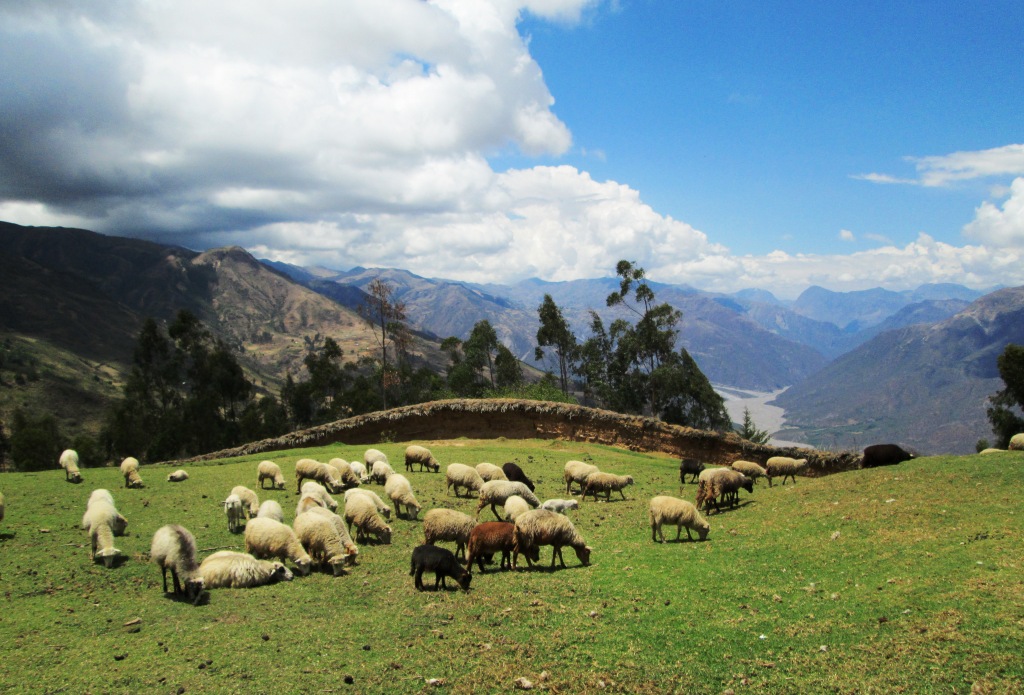
The flock belonging to Casimira, one of the spinners and weavers who made the bands in my order.

I opened the box of  fajas and saw the two colorful packages of neatly folded and stacked bands each with a label detailing the name of the weaver and her community.

It was such a happy sight but, what really hit me, was that wonderful aroma of wool mixed with the various smells of the natural dye substances that are used to create the colors.

It was such a strong fragrance that my cat immediately awoke and had to come over to roll in the bands.

And then there were the textures. Each weaver and spinner has their own style and beat and the bands varied from those that were smooth and taut to those which had more dimension and drape.

???????????????????????????????I counted eight different tones from cochineal dye and even more shades of green and then closer inspection helped me to see which ones were most likely made by the younger members of the communities…the ones where the weaver jumped a little erratically from pattern to pattern spoke of a youngster who was keen to try out her entire newly acquired repertoire in the one piece.

Perhaps the ones that have some little flaws are from the youngsters too or maybe they are from mothers who were distracted for a moment by one of their little ones.

Each one tells a story and it is strange sitting here in this tropical heat and imagining the sounds of the looms, the cool green slopes and valleys and music of the highland region in which they were made.

grphuancarani

Dorinda shared some pictures and a little information about each and every weaver with me. Here are just a few…

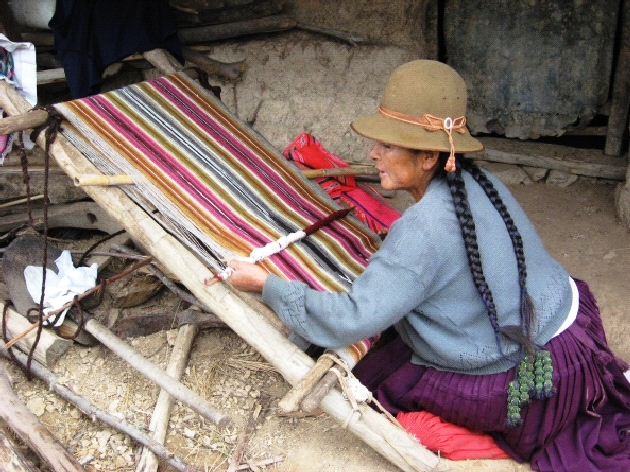
Here is Casimira Calcina working on the leaning verticalloom which is typical of the region. She lives in the rural community of Huancarani. Being widowed and with her children having migrated, she works hard alone to run her farm and tend her flock.
Here is Casimira Calcina working on the leaning vertical loom which is typical of the region. She lives in the rural community of Huancarani. Being widowed and with her children having migrated, she works hard alone to run her farm and tend her flock.
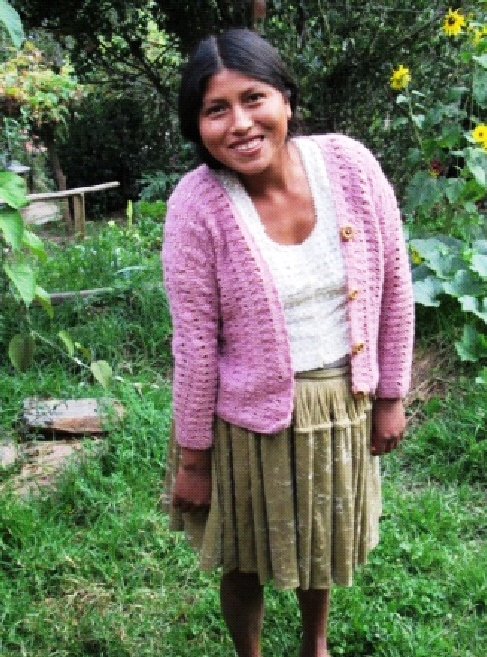
Adviana Vargas is 18 and still considered a "chica". Howevere, she weaves with the women's group as she lives with teh father of her 16-month old son and is expecting another child. She is showing the cardigan that she made after a visting volunteer opened up the mystery of the patterns and instructions in magazines that had been in the group's possession for years. Unitl then no onehad had the skills to read and interpret them.
Adviana Vargas is 18 and still considered a “chica”. However, she weaves with the  adult group as she lives with the father of her 16-month old son and is expecting another child. She is wearing the cardigan that she made after a visiting volunteer opened up the mystery of the patterns and instructions in magazines that had been in the group’s possession for years. Until then no one had had the skills to read and interpret them.
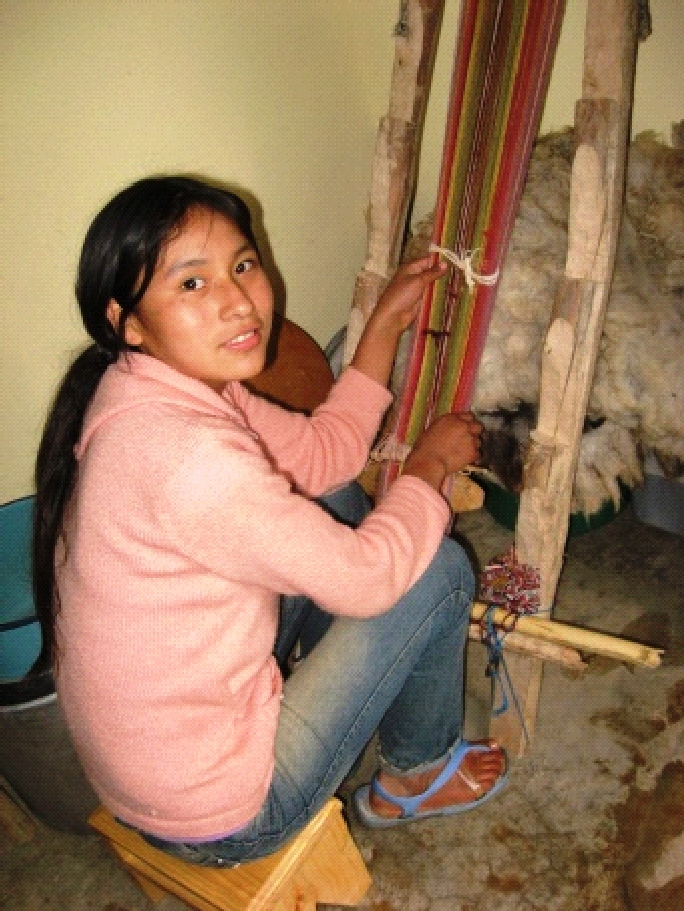
Gabriela Zenteno is 16 and has been part of the Handcraft Club since it began in 2010. She learned to weave from maxima with additonal help from her mother. Because the family lives in town instead of on the farn and Gaby goes to school, she did not learn to spin and weave at her mother's side which is integrated into the ancient farmer subsistence lifestyle.
Gabriela Zenteno is 16 and has been part of the Handicraft Club since it began in 2010. She learned to weave from Maxima with additional help from her mother. Because the family lives in town, instead of on the farm, and Gaby goes to school, she did not learn to spin and weave at her mother’s side which is integrated into the ancient farmer subsistence lifestyle.

Some of the bands were finished with four selvedges and I regretted not having told Dorinda when I ordered that I didn’t need that fourth selvedge. I know the work that is involved in that but, as my teacher Yanet from Pitumarca told us, the four-selvedge finish is “normal” for them. Some of the bands had been cut and then hand sewn to protect the edge.

terminal area supp warpMost had pebble-weave designs and I was delighted to see that two had patterns made with supplementary warps.

What was very interesting for me was noting that the way the women set up their warps to weave pebble weave varies even among communities that are relatively close together. This information is contained in the “termination” area of the band…the part where, on a four-selvedge piece, the weaver no longer has room to do pick-up and simply uses her two basic sheds to finish. There you can see the order of the colored threads in the two sheds.

You can see the termination area of one of the bands which has been patterned with supplementary warps at left.

And, happily, among these bands I found my inspiration for the Year of the Snake Weave-along that Ghedrain proposed in the Ravelry Backstrap Weaving Group. The official start of the Weave-along (WAL) was last Friday March 1 but people are free to join in at any time. I expected to be a cheer leader and “Chief Sticky Beak” as I will be on the road as from tomorrow but, with this sudden source of  snaky inspiration, I warped up a narrow band to take with me which you can see on the left with its wooly backstrap.

??????????????????????

supplementary weft project for on the road

The other project that I am taking is a band using left over Guatemalan cotton from my recent scarf project. I plan to weave in some patterns with supplementary weft and am happy that the collection of spools of silk weighs very little. To tell the truth, I will be surprised if I actually find time to work on these but I really would like to participate in the WAL.

You may remember the lovely pick-up sticks that I brought back from Guatemala which I use on these supplementary-weft projects. Fortunately, I bought two as I was careless with my packing and the very tip of one broke in my luggage on the way home. It’s still useable but not as nice to work with as the other one.

The good news is that Terri from MagicalMoons is now making  pick-up sticks that would work beautifully for supplementary-weft patterning and they look gorgeous. Below, you can see my Guatemalan ones. The one on the left is the slighty damaged one.

Guatemalan pick up sticks

And here is one from Magical Moons made from Nicaraguan rosewood…

magical moons pick up stick rotated

So, the Year of the Snake WAL is underway on Ravelry. Meanwhile, I have some  projects from Ravelry members to show you. This one is from Backstrap Group member CindyQ who has mounted her warp to weave a band with pebble-weave patterns on the frame of her rigid heddle loom. She is using the two-heddle method that I was taught by my Ayacucho weaving teachers which I explain in my first book Andean Pebble Weave….great-looking heddles and lovely weaving!

cindyq

The second project is from Kara and was posted in the Warped Weavers group. You may remember that I posted a long time ago the following picture of some interlaced bands woven on an inkle loom by Yonat…

Yonat inkle bandsIt was such an eye-catching display that I decided to put something similar together myself with the odds and ends of sample bands that I wove for my second book…

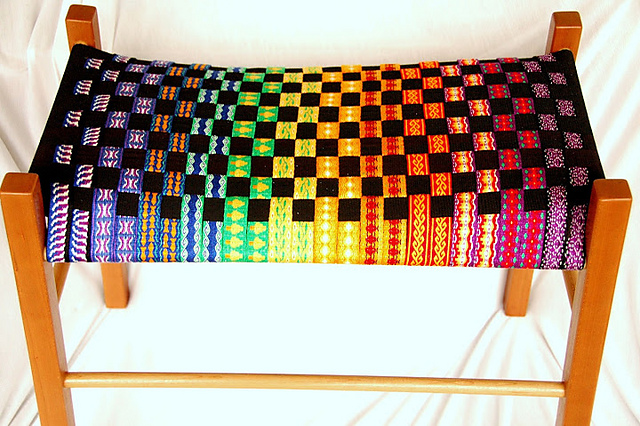
???????????????????????????????Now, back to Kara…she interlaced bands that she made especially for a project…a cover for the seat of her weaving bench. So, she has put together bands made on an inkle loom and with tablets to make not only a stunning display of her work, but also something wonderfully practical….

kara (1)

All those bright bands interlaced with black….WOW! Go gather up your bands now and start planning!! I can see pillow covers and other wonderful things using this idea!

Here is a picture of one of her bands in progress…

kara (3)

Enough inspiration?!


Backstrap Weaving – Encuentro de Tejedores de las Americas – Part Three…and more….

Before I get into Part 3 of my report on the Encuentro de Tejedores de las Americas (see Part 1 and Part 2 here and here), let me show you how I have been getting on with my latest experiment with supplementary-weft patterns.

Bhutanese supplementary weft pattern samplerYou may remember from last week’s post that I was inspired by seeing textiles from Bhutan with their  gorgeous motifs created by using supplementary wefts.

I was happy to see that I could decorate my own woven cloth with similar patterns using techniques that I had learned in Guatemala.

At left is the sampler I made to practice the techniques and experiment with the spacing of the pattern warps. I had some fine cotton from Guatemala that my friend Betty had bought about 30 years ago. How nice that this cotton could finally find its purpose.

The black cotton disintegrated as soon as I pulled it out of the closet. I guess that there is something in the black dye that causes the yarn to rot quickly. The other colors…red, green and purple….were just fine and, fortunately, there was plenty of white to dye black. I had my heart set on a black scarf.

There were a lot of ends to wind to make 7 inches…672!!

OThe cotton is kind of sticky and I can see why Guatemalan weavers very often choose to size their yarn with a kind of corn starch wash.

I am using it as is and need to be very gentle. I broke one warp before even getting started and my heart sank but it turns out that it was due to my clumsy handling of the pick-up stick…phew! No more breaks so far but there is still a looooong way to go.

Of course I made a wee sample before diving in to see how many ends I would need to make an inch. I also needed to test the ideal number of strands of tencel to use for the weft patterns.

In the picture you can see my tiny warp with its string heddles and shed loop . The two sticks are the pattern sticks that I talked about in my last post. Of course, the yarn was already showing signs of stickiness even on this tiny project but I decided to go ahead undaunted 🙂

Sample done…width calculations made. Now, how long should a scarf be? Seems like a silly question, but I have never made a scarf before. Fortunately, I do own just ONE. After all those years spent skiing and then living in Patagonia you would think that I would be more scarf-wise.

OThere is the warp and I am ready to make the 336 string heddles. I like making heddles…time to put on a cd and sing! and I didn’t cross or double up any warps…phew!

O

I have lots of pictures that I have taken of Bhutanese textiles in friends’ collections for inspiration and David K Barker’s books are wonderful too. (See my RESOURCES page for information on how to download his books for free.) However, I decided to play it safe to start with and weave one of the patterns that I had already tested on my sampler.

So, I sat down to weave and that is when it hit me…wow, this yarn is really FINE….and….it’s black! All the clues that I usually use to make the pick-up easier for supplementary-weft patterning are dependent on actually being able to see the threads!!

Boy, had I made things hard for myself but, believe it or not, I got used to it and came up with other ways to eyeball the placement of the patterns without having to become a slave to pattern charts and endless counting. It became a very cool learning experience and, as with all things new and experimental, much un-weaving was done and all with my heart in my mouth as I don’t think that this yarn will take much “backing and forthing”!

Bhutan pattern backstrap loom scarf

Here is the first pattern under way. I placed several thin pieces of cardboard in alternate sheds in the warp beyond the cross sticks. This gave me a place to make quick adjustments to loose warps within arm’s reach and with the warp under tension rather than having to get out of my backstrap and crawl up to the end of the loom.

cat on backstrap loom BhutanSometimes you don’t get to choose when to weave. I would come back in from a break to find Her Highness reclining in what was, apparently, the most comfortable spot in the house. Would you dare disturb someone with a look like that on their face? You can see the next set of patterns in progress here.

second Bhutanese design finishedOAnd this is where it stands for now. I am just getting past the first warp break and have my fingers crossed that there won’t be more. I watched a gentleman from Chahuaytire weaving on his backstrap loom when I was in Cusco. A warp broke and I loved the calm and cool way he went about fixing it like he had done it hundreds of times before (well, of course, he probably had). He didn’t need to have anyone tensioning the warp while he leaned forward to fix the break. That is the part I find hardest.
Be prepared to see a lot more of this project in the weeks to come. Unless, of course, those warps start a- snapping, and then you will most likely see it finished really soon as a zippered pouch or journal cover!

#########################################

ENCUENTRO DE TEJEDORES DE LAS AMERICAS  – PART THREE – SPINNERS AND WEAVERS IN ACTION

The Encuentro…it was over two months ago now and I am finding it hard to sum up here but I will try!

It was about yarn being created with the simplest tools…

Handspun cotton by the Matsigenka weavers of the Amazonian region of Bajo Urubamba, Peru
Fine and incredibly even handspun cotton by the Matsigenka weavers of the Amazonian region of Bajo Urubamba, Peru
The "malacate", spindle used in Mexico to spin silk with its horn whorl.
The spindle known as “malacate” used in Oaxaca, Mexico to spin silk. Its whorl is made of horn.
The traditional "sig sig" spindle of Salasaca, Ecuador made from pampas grass.
The traditional “sig sig” spindle of Salasaca, Ecuador made from pampas grass stems. A small piece of thin solid stem is inserted into the soft interior of the large stem section to suspend the wool yarn as it is spun.

OA spinner from Chiclayo, Peru showed me how she spins the natural brown cotton that is cultivated in the region. She told me that a heavy stone is usually placed on top of the cotton as she draws out the fiber to be spun. Not having one handy, she used the bottle of water that you see in the video. The spindle whorl is a piece of avocado seed.

It was about sticks…lots of sticks!

Sticks used by the weavers of Bajo Urubamba to create their warp-float patterns.
Twenty-four heddle sticks are used to weave the traditional pattern on the "faja sara" of San Ignacio de Loyola.
Multiple heddle sticks are used to weave the traditional pattern on the “faja sara” of San Ignacio de Loyola.

It was about threads being strung together in a stunning display of color and texture…

An ikat warp ready to be woven into the traditional shawl of Tacabamba, Peru
An ikat warp ready to be woven into the traditional shawl of Tacabamba, Peru. The ties on the sections of threads were the only means I could see to keep the threads aligned for the ikat patterns.
Threads are stretched on the typical leaning vertical loom of Tarabuco, Bolivia
Threads are stretched on the typical leaning vertical loom of Tarabuco, Bolivia. Multi-colored figures depicting ceremonies and scenes of daily life in the community will sit on a white mesh-like background. The colored threads are generally thicker than the white ones which gives the figures relief.
The backstrap loom with its cotton warp from Chiclayo, Peru.
The backstrap loom with its cotton warp from Chiclayo, Peru. A single-faced cloth decorated with warp-float patterns is created.
Bunches of string heddles control the colored layers of warps on the horizontal loom of Taquile Island, Peru
Small bunches of string heddles control the colored layers of warps on the horizontal loom of Taquile Island, Peru.
A floor loom holds the warp on which a weaver from Ayacucho, Peru will create a beautiful tapestry.
A floor loom holds the warp on which a weaver from Ayacucho, Peru is creating a beautiful tapestry.

And it was about the wonderful hands and spirits of the talented craftspeople and artists who use sticks and fiber to create beautiful cloth….such an amazing variety of people from across the Americas!

Weaver Natividad Machaca Quispe of Taquile Island, Peru creates a sash with bands of warp-faced double weave motifs and complementary-warp patterns.
Weaver, Natividad, of Taquile Island, Peru creates a sash with bands of warp-faced double weave motifs and complementary-warp patterns. This piece had six bands of pick-up patterns.
A weaver of panones of Tacabamba, Peru, puts the finshing touch on hher woven ikat shawl by knotting an intricate pattern into the the fringe.
A weaver of Tacabamba, Peru, puts the finshing touch on her woven ikat shawl by knotting an intricate pattern into the fringe.

knotwork on Tacabamba shawlHere is a short video of  Nila at work knotting the fringe of her woven ikat pañon…

And what about that belt loom with its twenty-four sets of string heddles? Araceli shows us how it is done…

A Matsigenka weaver from tropical lowland Peru creates warp-float patterns in cotton on her backstrap loom.
A woven tubular band in progress...putting the finishing touch on a woven piece from Pitumarca, Peru.
A woven tubular band in progress…putting the finishing touch on a woven piece from Pitumarca, Peru. The tubular band had been set up with three sets of string heddles and a shed loop and, therefore, did not require any pick-up.

And cloth comes off the loom and comes to life when draped around shoulders…

cloth comes to life

wearing the Tacabamba shawl

and wrapped around waists and heads…

taquile island peru and santiago atitlan guatemala

Diana from Guatemala, pictured above, wore this spectacular fine, ikat-patterned corte, or skirt…
O

There was time to watch and chat and share….

watching, chatting, sharing at ETAM 2012

Time to look and learn from Navajo weavers and spinners and an alpaca fiber weaver from Tanta, Peru…

looking and learning ETAM 2012

Time to sit or stand and ponder…

pondering ETAM 2012

Time to listen to weavers talk about their communities and textile traditions and meet new leaders in the field of textile research…

Bolivian Elvira Espejo shows the two most recent books she has written with British/ Bolivian Denise Arnold on weaving in the Andes. Representatives of the textile community on Taquile Island, Peru spoke about weaving and knitting traditions and the 547 families that are part of their textile co-operative which had begun in 1971 with only 7 families. Taquile Island has become an enormously popular tourist spot over the years. One point which created a bit of fun was their comment that "Taquile fashion" was being worn and loved around the world despite the fact that it was not appreciated in their own country of Peru. "Taquile fashion" then became one of the catch phrases of the conference and made us all smile.
Bolivian Elvira Espejo shows the two most recent books she has written with British/ Bolivian Denise Arnold on weaving in the Andes. Representatives of the textile community on Taquile Island, Peru spoke about weaving and knitting traditions and the 547 families that are part of their textile co-operative which had begun in 1971 with only 7 families. Taquile Island has become an enormously popular tourist spot over the years. One point which created a bit of fun was their response to a question about how they felt when a hat that was created to be worn by a high-ranking official was bought and worn by a tourist completely out of context. They said laughingly that they were proud that “Taquile fashion” was being worn and loved around the world despite the fact that it was not appreciated in their own country of Peru. “Taquile fashion” then became one of the catch phrases of the conference and made us all smile.

And time to just stand in complete awe…time and time again!

A weaving of the Jalq'a people of Potolo, Bolivia.
A weaving of the Jalq’a people of Potolo, Bolivia depicting Ukhu Pacha, the underworld, with its khuru figures.

Organizers ETAM 2012

Well, I hope that this gives you just a taste of what the week of ETAM was like. Thank you Maria Elena del Solar, Paula Trevisan and Luis Masa for organizing this event. And thank you Mara Elena for pushing me to go when I was dithering over the cost of getting there. It was the best birthday gift to myself ever!

Thank you Centro de Textiles Tradicionales de Cusco for the fabulous exhibit of textiles from your nine member communities that you organized in the Convention Center to coincide with this event and for providing outstanding teachers for the workshops.

As for Elvira Espejo and Denise Arnold’s books about which I know you will be curious, I have to find out if they are available in English and from where…stay tuned.

OOf course, you do know that the CTTC is having its second Tinkuy this coming year, don’t you?! 🙂 Are you coming?