Backstrap Weaving – The Curious Coil Rod

Are you ready for this week’s dose of red, black and white?

3 red black and white backstrap weaving hangingsI have quite a good selection of colors with which to work here in Santa Cruz. None of the colors go by fancy names. They are pretty much the basic tones. Therefore, when someone asked me to pass them the “chartreuse” yarn for their weft in one of my workshops, I had  no idea what they were talking about. Here, we get dark green and light green. But, I have to say that there are enough colors here to keep me happy.

Why then do I keep being drawn to black? I guess there is just something so clean and sharp about black and white.

Even the local Guaraní weavers can’t resist going back to this combination from time to time despite the fact that many of them use the same brand of colored cotton that I do…

guarani black and white weavingsThe third piece in my wall hanging series with the Wayuu-inspired design is an inch or so away from being finished. Naturally, as I have sat there these last few days picking up threads and heaving open the sheds, my thoughts have been turning to my next project. It will probably be a purple scarf decorated with supplementary wefts using cotton yarn from Guatemala and mostly silk supplementary wefts.

colors for next backstrap woven scarf
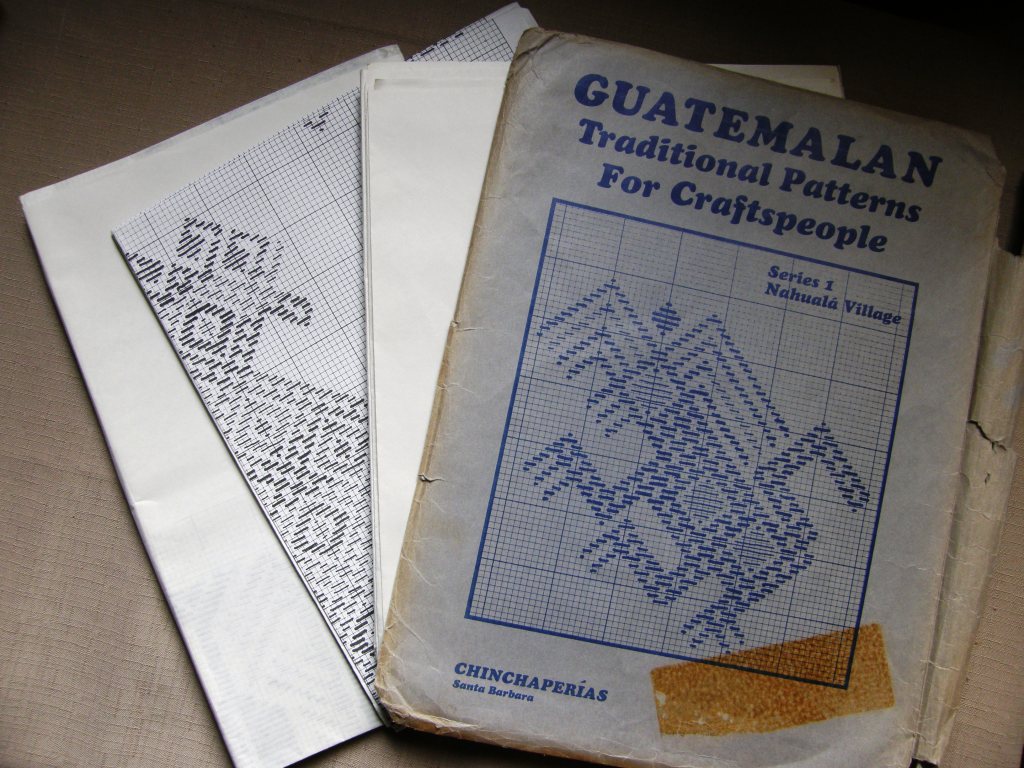
Guatemalan pattern chartsI am still planning the motifs and, while digging around at the book shelf, I unearthed a packet of patterns that was given to me by Sharon, a Weavolution weaving buddy, a year ago.

The packet contains three enormous sheets of detailed Guatemalan motifs. The front of the envelope states that this is Series 1 from Nahualá Village. Nothing on the packet or within indicates when these patterns were charted, by whom or how many packets comprise the entire set. Imagine if this person or people graphed patterns from dozens of villages!

Happily I tracked down another packet, series 3, on Ebay and it seems that there is a weaving guild that may have some others in their library.

However, I probably won’t use any of these motifs for my scarf. I have something quite specific in mind that I learned when I was studying in Guatemala but which also has a slight Bhutanese influence.

I told you about circular and dovetail warps last week and I have decided that I will make a circular one for my scarf. That will keep me in good foot-bracing distance from my bed. Winding a circular warp is straightforward enough. I was easily able to make some changes to my standard warping board to make this work well.

warping set up for circular warpThe two off-set stakes to hold the cross were all I needed. However, that picture is cropped and the following shows the complete set up…

circular warp set up with coil rod stakeThe extra unnecessary stake was incorporated so that I can try to learn more about the mysterious coil rod. So far, I have not seen a coil rod being used in Bolivia and Peru. The first place that I came across one being used was Ecuador. It was in the ikat- weaving town of Bulcay and I had no idea at the time what this piece of equipment was.

ikat weaving loom Bulcay Ecuador

There is a black arrow pointing to the coil rod in the above picture…the thin stick just below the upper beam.

ikat weaver Bulcay Ecuador

When I visited with this weaver, I was concentrating more on seeing how she prevented having the warps move out of alignment and excessively blur the ikat pattern. I suspected that the coil rod was her”secret weapon” but when I asked, she told me that it had nothing to do with it. Actually, I have to say that she was not very keen on answering my questions. Let’s face it…not everyone is fond of having strangers hang about pestering them with questions while they are trying to weave! She was nice enough to let me sit by and watch and take pictures.
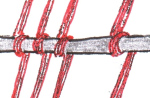
coil rodDennis Penley, author of Paños de Gualaceo, writes that the coil rod, (he calls it a “rolling stick”) in Gualaceo, one of Bulcay’s neighboring communities, is added once the warp has been placed on the loom. He says that the warp threads are wound around the stick in bunches of ten. The stick serves to stop the warp threads from slipping.

You can see how the warps have been grouped in the above photo and the way they are coiled about the stick at left.

Of course, as time went by, I discovered that coil rods are used by many backstrap weavers who work with circular warps and I have since seen many examples of weavers in Asia using them.

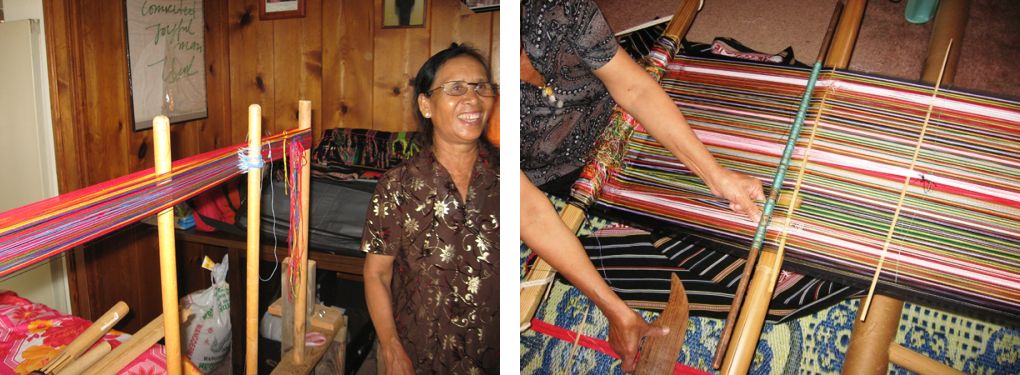
When I met and got to spend a little time with Burmese weaver Dar Ku in Massachusetts, I noticed the coil rod in her loom.

O

It is the rod furthest from the weaver in the picture. I didn’t think at the time to ask her if she added it after or during warping. I was concentrating more on her use of supplementary wefts to make her patterns and the fact that she was weaving her designs while looking at the wrong side of the cloth! Her heddle system was also very interesting. You see, there are just so many wonderful things to see and take in when you watch a backstrap weaver at work!…what is the shape of her sword, how does she open the heddles, how hard does she beat, what does she use to pick up her threads and much much more!

As she wasn’t weaving ikat and her warps could move without causing any harm, I assume that the function of the coil rod in this case is to help maintain width and keep the warps spread and in order in the potentially messy area beyond the heddles and shed rod.

The one time that I have seen a warp being made which incorporated  a coil rod was when I studied with the Montagnard weavers in North Carolina. Again, there was so much to see especially since this was also the first time I had watched a weaver add heddles as she warped. Naturally, much of my attention was focused on that.ju-warpingThis is what Ju Nie’s warping path looked like…
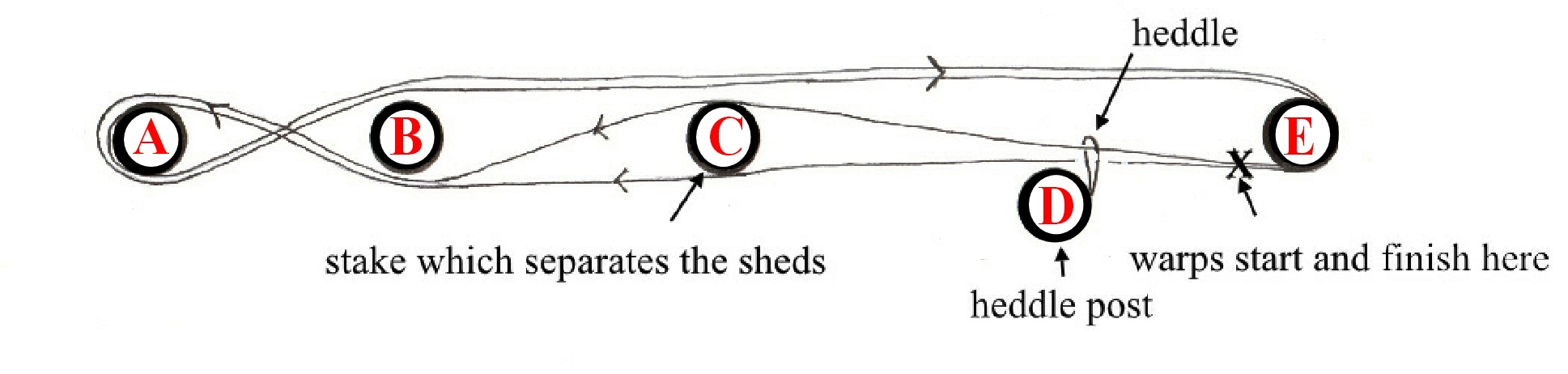
Rhade warping pathIf you flip this upside down, you will see that my new warping set up was designed to resemble this. Stake C on Ju’s set-up separates the threads into two sheds. Stake D  holds the heddles that Ju makes as she winds the warp. Stakes B and E will be replaced with the backstrap loom bars. Stake A will be replaced by the “curious” coil rod.

As I am not going to make heddles as I go, stakes C and D on my set-up will hold the cross.

circular warp set up with coil rod stake

Here is a diagram showing the two-revolution warping path to complete the cross in my set up…

warping path with coil rod cross

From left to right…loom bar 1 will replace the first stake. The next two stakes will be replaced with cross sticks….I used pencils. Loom bar 2 will replace the next stake and the last stake on the right will be replaced with the coil rod. Below you can see how it looks when taken off the warping board. I have just wound a tiny warp and used some random sticks for the sake of this demonstration.

circular warp with coil rod on loom

Below you can see the loom almost ready for use. What remains to be done is make the heddles and select a suitable shed rod.

O

The yellow and green pencils are holding the cross. Heddles will be made to raise the threads that pass over the yellow pencil and a shed rod will replace the green pencil to raise the other half of the threads.

The coil rod has been rolled from its original position, in the picture below left, over the loom bar into its new position as seen below right.

coil rod put in position

This is what it looks like on Ju Nie’s narrow warp.

ju nie's coil rodSo, I know how to wind a circular warp and put the coil rod into position now…yay. The question remains…what exactly is the purpose of this wee stick? I guess I will find out as I weave my purple scarf. I suppose I will have to weave with a coil rod for a while and then without one in order to note the differences.

In Weaving and Dyeing in Highland Ecuador, Anne Rowe notes that the coil rod, as used by the ikat weavers in Azuay Province, helps secure the slippery cotton warp and maintain an even width for the fabric. However, it is not used by cotton ikat shawl weavers in Rumipamba. I imagine that the resulting shawls in both areas are equally well made.

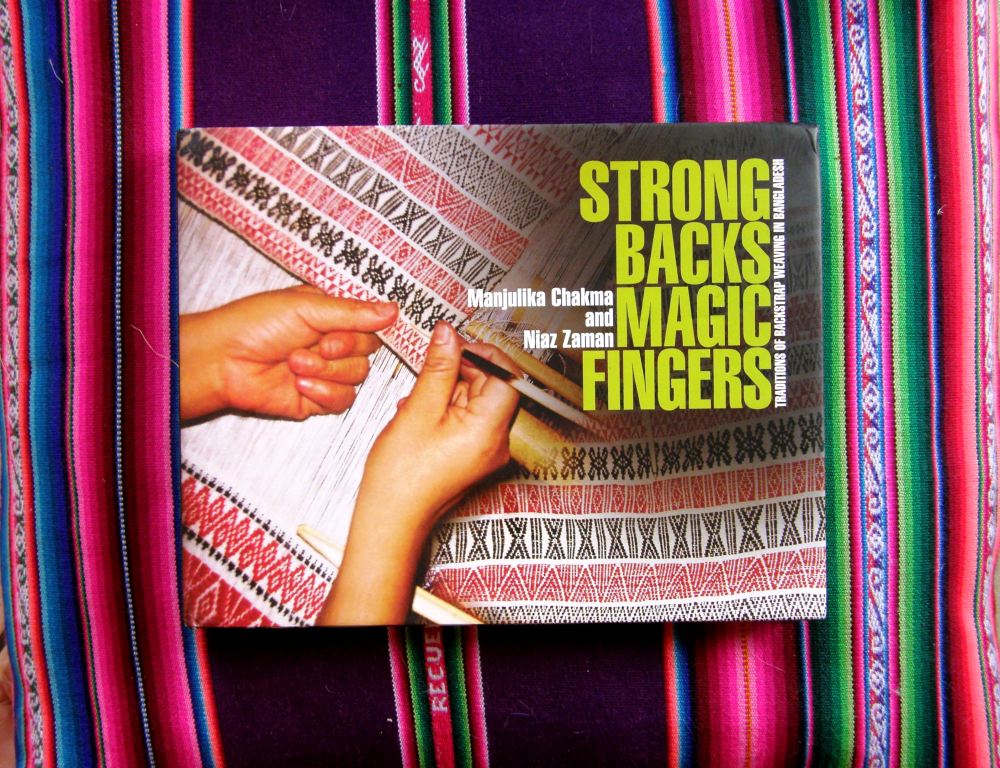
I have a book on backstrap weaving in Bangladesh, Strong Backs Magic Fingers, which describes the looms and textiles woven in twelve areas of that country. While the vast majority of the looms shown have coil rods,  some of them don’t. Certainly those that have the finest and silkiest looking thread always do. Yet, some weavers manage happily without them. It appears to be more of an aid than a necessity. Perhaps it is simply tradition that has some weavers using one.
Strong Backs Magic Fingers

I am kind of excited about having this new piece of equipment to experiment with!… a mere stick.

In Spiritual Fabric, Sadae Torimaru calls the coil rod that is placed in a body-tensioned loom used to weave narrow bands in China a ”temple stick” and says that it is used to keep yarns and width constant.

Some of you may like to read Maria Christou’s thesis An Ethnographic Study of the Loom and Weaving of the Sa’dan Toraja of To’barana’. Her research took place on the island of Sulawesi, Indonesia and on page 26 she ponders the coil rod and quotes the thoughts of other researchers on its purpose and use. It would seem that she found the answers to her questons in the course of her one year of study. I have to confess that I haven’t gotten that far in my reading of her paper to know for sure….printing out to read this weekend!

If you have made it this far in reading this post, thank you for bearing with me in my ramblings about a stick!

And so, let’s enjoy looking at some of the fruits of  these looms we have been talking about.

weavings Bangladesh Montagnard Burma

You can see a length of black skirt fabric with warp-float patterns woven by Ju Nie with a weft-twined edge added by her sister. The back cover of the book on weaving in Bangladesh shows the supplementary-weft patterned work of Chakma weavers and Dar Ku shows the white cotton fabric she wove for a dress as well as a richly patterned traditional blouse.

For those who may be curious about how Ju Nie adds heddles as she winds her warp, here is a video I made explaining it.   Ju Nie works way too fast in the video that I took of her doing it!

Wonderful, isn’t it? Maybe one day I will do this. For now, I find it very relaxing sitting at my loom and making my string heddles. There’s always something new to learn!

I will leave you with a video of Dar Ku weaving. She has such a beautiful peaceful way about her…


Backstrap Weaving – The Weft-Patterned “Neck Wrap”

I suppose that it is normal to want to look back a bit as the end of the year approaches. This time I decided to jump back to the end of my blog years in 2011, 2010 and 2009 and take a look at what was going on. It is interesting to see that supplementary-weft patterning was a part in some way of all those December posts.

This time last year I was in a downsizing phase and rummaging through my closet to see what could be tossed. That was when I came across this wildly colorful supplementary-weft sampler that I made after having studied some of the patterning techniques in a few different communities in Guatemala. I included it in my blog post…(no, I didn’t toss it!)

supplementary-weft-pattern-detailYou can see that all the patterning elements that I am using in my current supplementary-weft project are present in this piece and this is barely the tip of the iceberg when it comes to all the different ways to create patterns with supplementary wefts that are used by Guatemalan weavers.

In December 2010, I was posting about the practice piece I made after studying with the Montagnard (Vietnamese hilltribe) weavers in North Carolina.  While the piece is mostly about the warp float patterning technique that they use, it also includes twined ends and a couple of their traditional motifs woven with supplementary wefts.

O

And finally, back in December 2009, when I had been blogging only a few weeks, I wrote a post on weaving wider projects which included this…

OLYMPUS DIGITAL CAMERAI included a tiny bit of supplementary-weft patterning  in the center of this placemat and mug rug set. I gave the pattern a thin striped look instead of a richer satin-like finish so that it would mimic the stripes in the two outer bands. The simplicity of the outer bands were inspired by a Guaraní textile.

So, this wonderfully fun patterning technique, which allows quite a lot of spontaneity, (the patterns on both the Montagnard and placemat projects were not planned and could have been just as easily cut out and removed if I had decided that I didn’t like them) has been in my weaving skills kit for quite some time.

hatbands of PotoloI remember the first time I saw a Bolivian highland weaver sitting in the street of Santa Cruz making a hatband only days after I had arrived here in 1998. The base weave was off-white sewing thread-weight cotton and she was creating patterns with bright acrylic threads. I crouched and chatted with her, watched what she was doing, and noted the name of the street so that I could return the next day and watch some more. I never found her again nor have I ever seen another weaver making a hatband since! I have seen plenty of beautiful hatbands but never one being woven again.

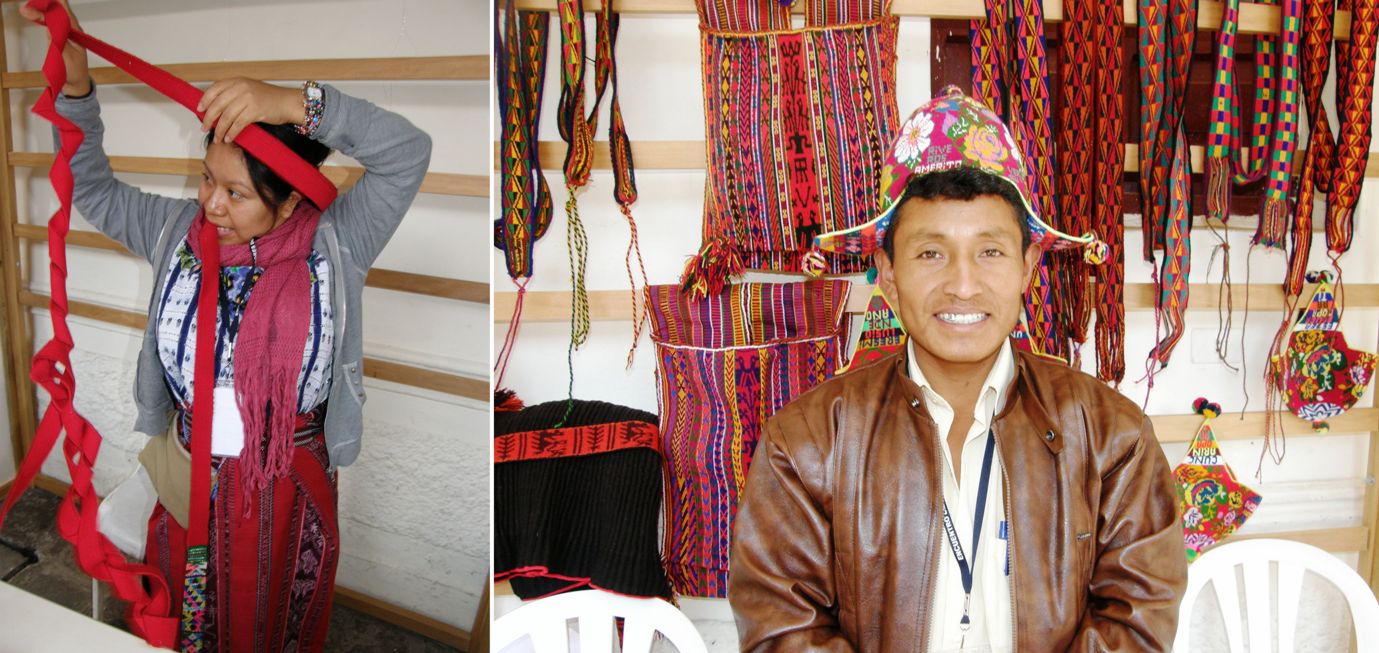
The hatbands above adorn the hat of a weaver from Potolo in the Bolivian highlands….bright colors on a black ground, much the same as the color scheme I have chosen for my scarf project. I have decided to call it a “neck wrap” as it is not going to be all drapey and flowing as one would normally expect a scarf to be. As long as I don’t have to actually bend and fold it around my neck, I will be happy!

start of Bhutan design scarf

Here it is, a little bit further along from the little I showed you last week, after all the messing around and lesson-learning. I am trying to think if I learned any more lessons from this wicked warp this week….I think I probably just convinced myself even more that I love putting in a second cross stick behind the shed rod and using those two sticks to help open the heddle shed. (Of course, this is just one of many ways that backtrap weavers operate their looms).

Second cross stick backstrap loom

Above you can see the second cross stick and shed rod in place. The third shorter stick sitting between them is the pattern stick.

If you watched the video of the Tacabamaba weaver in last week’s postyou will have seen how she places her sword on top of the warp and rolls that together with her shed rod to help open the heddle shed. Below, you can see Montagnard backstrap weaver, Ju Nie, doing the same using a bamboo slat instead of her sword.

montagnard weaver opening heddle shedI have a video on my page about sticky sheds showing this system in action.

I prefer to have the second stick permanently in the warp. One of the weavers that I met at the recent conference in Cusco used this system, with the second stick permanently in the warp, to open her heddle shed.

Her set-up is so cool. I wish I had a forked stick like that…must go out and look for one. The prong of the fork nearer the weaver holds the stick shed open while the other prong sits within a second cross.

Usig a forked stick in the warpShe would simply grip the place on the fork where both prongs join and twist the fork away from her while relaxing tension and pulling up on the heddles.

In the picture above, she is about to slide her sword under the warps raised by the shed rod. She will then turn the sword and clear those threads through the heddles and down to the weaving line. I have wonderful video of this weaver operating her loom and doing very fast supplementary-warp pick-up and I had every intention of showing it to you. Too bad my internet would not behave and allow me to upload it.

So, my warp has been behaving like a dream…sticky threads have been defeated and no more have broken. The odd loose ones here and there have been dealt with smoothly and calmly.

The center of Bhutan scarf project bacckstrap loomI decided to make the long motif the center of the scarf and work from there on repeating the designs from the first half of the project. However, I am not repeating the  motifs in the side bands as there are still plenty of those that I want to try!  I have no discipline sometimes!…I should just keep it simple and symmetrical…

starting the other half of the Bhutan scarf projectHere starts the other half….

I managed to almost squeeze in one more green motif before it was time to stop and write this blog post. It’s addictive and I don’t want to stop! The motifs are new and I am anxious to see how they turn out. Plus, I can’t weave it at night so, I really try to make the most of daylight hours. All that black thread is just too much at night and I am on an economy drive so, no super high powered lamps allowed!

one more green motif bhutan scarf

In the evenings, I have been spinning away tightening up the twist on the Malabrigo wool singles I bought while in the US. I am hoping to then ply them and weave a discontinuous-warp piece. As I am not confident about trying any warp float patterns on one of those yet, I will decorate the panels with some wool supplementary-weft designs.

respinning wool for discontinuous warp projectWhat has been happening in the Ravelry group?  ”It’s dead in here!” exclaimed Bobbie recently but she livened things up a little by posting her recently finished guitar strap made for her granddaughter…

bobbie guitar strap intermesh

This was made using the instructions for the two-heddle intermesh technique from my second book. Bobbie used Annie’s guitar strap kit to convert her beautifully woven band to a guitar strap.

Rob has been using my first book to weave some lovely bands with Andean patterns but we may have lost him to a four-shaft loom which recently appeared in his life. Now he is also turning out beautiful towels on that. Here are some of his latest backstrap, inkle and four-shaft loom projects….

rob's weaving projects

There have also been some mutterings in the group about using the 24 sets of string heddles to weave one of the fabulous fajas saras after I showed a picture of some of the belts of San Ignacio de Loyola Peru…

fajas saras san ignacio de loyola peruThat could be a fun weave-along but I don’t think I will join them on that one. While I do love making string heddles, I enjoy doing pick-up even more!

ikat textiles of the AndesOn another topic, a couple of interesting ikat resources came my way recently in my internet ramblings…

Quite by chance I discovered an e-book byMarguerite Gritli Pfyffer entilted “Ikat Textiles of the Andes”.

The book is the result of the author’s two years spent traveling in the Andes researching ikat patterned textiles. There is one section devoted to the pañones of Tacabamba that we saw last week.

From the other side of the world in China, Chris Buckley sent me the link to his recently finished paper entitled Investigating Cultural Evolution Using Phylogenetic Analysis: The Origins and Descent of the Southeast Asian Tradition of Warp Ikat Weaving.

The paper can be viewed online here.

Chris has always been very generous with his resources and, on several occasions, has allowed me to use images of textiles in his collections in these blog posts and for my charting.

Christmas will be done by the time I come to write my next blog post. I don’t do Christmas but I wish all of you the very best for whatever you get up to in the coming week. Now, back to that “neck wrap” thingy….

Backstrap Weaving – One Warp, Many Lessons

Guatemalan pick up sticksI have been playing with my black scarf warp for a week now and feel that, at last, I am slowly getting to know the “beast”. There have been some adventures along the way.

I am not so nervous now about the fineness of the threads. While broken warp threads are a major nuisance, they really aren’t that hard to fix once you have a system. Having said that, I haven’t broken many. As it turns out this Guatemalan cotton is surprisingly resilient. I like it.

I have learned to slowly and softly strum the warps with the blunt end of my pretty Guatemalan pick-up sticks (pictured at left) as I open the sheds. I insert the sword and shuttle carefully. Hitting a thread  along the way will either loosen or break it. I think that loose threads are possibly even more annoying and more difficult to remedy than broken ones.

In the meantime I enjoy sitting back now and then to look at the smooth silky curtain of unwoven thread in front of me. It is impossible to see each individual thread. They all merge into a black glossy sheet of loveliness which I have tried without success to capture in a photograph. Is this warp a black beast or a black beauty?

sample for Guatemalan cottonYou may be surprised to find that I have not really advanced at all since I showed you the piece last week. While I haven’t advanced in terms of inches happily woven, I have advanced in lessons learned. There were, in fact, many inches woven….and then sadly un-woven, woven and un-woven yet again….before I could feel happy with what I was producing. And that showed me more than anything how much abuse this cotton thread could stand.

Firstly I had to give in to the fact that it was useless trying to weave a 7-inch piece of fabric on a warp that clearly wanted to be wider.

Lesson 1: Sometimes a “wee” sample just isn’t going to do the trick! The teeny tiny band that I hastily wove to test this new-to-me yarn simply did not have enough ends to give me a true reading of the width I could expect. So, after un-weaving and starting to weave the black beast once again, I let it settle into the width it was yearning to be.

Lesson 2: Don’t get so caught up in happily playing with the supplementary-weft patterns, that you neglect to keep a close eye on what is happening to the ground weave. Yes, I was having a lovely time playing with the soumak technique and didn’t notice how much the ground weave, or the “canvas” on which I was placing the patterns, was becoming distorted. This was a sign that I was stuffing too much supplementary-weft into the sheds. The material that I was using for the supplementary weft, 8/2 tencel, was not appropriate.

Lesson 3: Several strands of fine yarn work better as a supplementary weft than just two strands of a thicker yarn. I already knew this!! but, I was in really new territory with this fine yarn and again, my sample had “lied” to me!  So, it was out with the 8/2 tencel and, yippee, I got to use my new 60/2 silk.

60/2 silk

So, instead of two 8/2 tencel sausage-like strands, I used six to eight strands of the 60/2 silk which emerged from the ground weave to lie side by side like a glossy satin sheet on the surface of the fabric.

Lesson 4: Not everything that is labeled as 60/2 silk in the bargain basket at the yarn store is, in fact, 60/2. Imagine the frustration…. I kept doing my sampling with six strands the off-white silk pictured above as I have more of that than the colors. Then I would weave the “real thing” with the colors. But things just weren’t working out. Why? The off-white 60/2 is at least twice as thick as the colored 60/2’s!…go figure.

Lesson 5: Slow down! A little extra planning goes a long way. It was beautiful to see a video of  Bhutanese weaver Leki Wangmo at work on an incredibly richly patterned piece of fabric. It was as if she had cast her arm across the warp and scattered seeds.  Then we got to watch as the the seeds sprouted and flourished into patterns. It all seemed so random but, without a doubt, it was all carefully thought through and planned from the moment the first warp thread wound its way about the warping stakes. The strategic placement of the stripes and the placement of the particular patterns within them was all part of the overall plan.

backstrap loom Bhutan

It was hard for me, having so many photos and books with images of designs to use on my scarf, to carefully select and plan the layout of my piece. I wanted to weave and try everything at once! Result…mess! Un-weave and start again!

Scarf project with supplementary weft patterns backstrap loom

So, here it is. It may look much the same to you as what I showed you last week but it is, in fact, a little wider, the colors are slightly different and I am using silk weft instead of tencel. Funny how some of the small skeins of white thread dyed in the one black dye bath came out more intensely black than others…another “go figure”. I need to even up the length of the exit points of the supplementary wefts so they look neater and more consistent.

Now I am taking it all more slowly…enjoying rather than fearing the fineness of the cotton warp threads, appreciating the smoothness of the silk weft. I no longer think “Aargh!…sticky warp”. I gently strum and the sheds open cleanly. Now to sit down and map out a design.

While I sit and feel pleased with my seven-and-a-bit-inch piece of cloth as it takes shape on the loom, I remember the backstrap weavers from Tacabamba, Peru that I met in Cusco with their equally fine cotton ikat-patterned shawls measuring up to a meter in width  Humbling!! Oh so very humbling!!

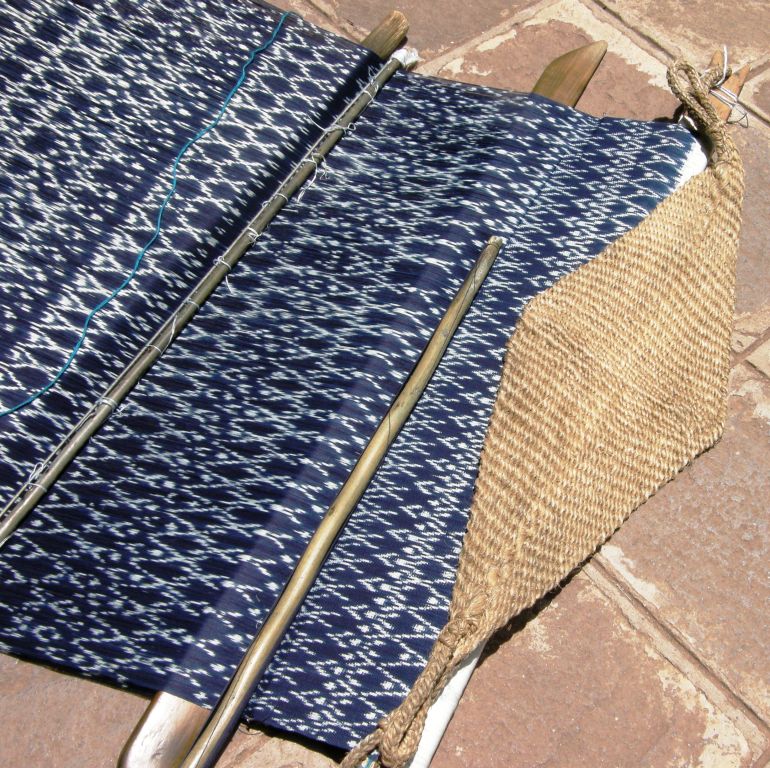
The simple backstrap loom of Tacabamba, Peru on which the indigo ikat-patterned "panones" are woven. They are up to one-meter wide, covered with tiny motifs and have patterns knotted into their fringes.
The simple backstrap loom of Tacabamba, Peru on which the indigo ikat-patterned “panones” are woven. They are up to one-meter wide, covered with tiny motifs and have patterns knotted into their fringes.

Of course, the warp lying idle on the ground attracted many admirers all anxious to see it spring to life.
Of course, the warp lying idle on the ground attracted many admirers, all anxious to see it spring to life.

Nila sits while she prepares the loom for weaving. Weaving is done standing up.
Nila sits while she prepares the loom for weaving. The weaving itself is done standing up.

A few final adjustments are made before weaving can begin. Then Nila asked the crowd to give her more room and we all understood why when she raised the very long sword and shuttle to be placed within the sheds.
A few final adjustments were made before weaving could begin. Then Nila asked the crowd to stand back and give her more room and we all understood why when she raised the very long sword and shuttle to be placed within the sheds.

Now you can watch Nila at work!…The video starts with laughter as Nila nearly clobbers an onlooker, who got too close, with her sword! I love the way she gently pats the warp to separate the threads. That is her way of dealing with any stickiness. I love her balance…one arm outstretched to help her stay centered while the other reaches to pass the shuttle. It’s like a dance.

wearing the Tacabamba shawl

Here’s Tacabamba weaver Laura wearing one of the shawls…something to aspire to??? So, I head back to my wee 7-inch piece hoping that I will end up with something that has at least some of the lovely drape that those warp-faced shawls have!

Backstrap Weaving – Encuentro de Tejedores de las Americas – Part Three…and more….

Before I get into Part 3 of my report on the Encuentro de Tejedores de las Americas (see Part 1 and Part 2 here and here), let me show you how I have been getting on with my latest experiment with supplementary-weft patterns.

Bhutanese supplementary weft pattern samplerYou may remember from last week’s post that I was inspired by seeing textiles from Bhutan with their  gorgeous motifs created by using supplementary wefts.

I was happy to see that I could decorate my own woven cloth with similar patterns using techniques that I had learned in Guatemala.

At left is the sampler I made to practice the techniques and experiment with the spacing of the pattern warps. I had some fine cotton from Guatemala that my friend Betty had bought about 30 years ago. How nice that this cotton could finally find its purpose.

The black cotton disintegrated as soon as I pulled it out of the closet. I guess that there is something in the black dye that causes the yarn to rot quickly. The other colors…red, green and purple….were just fine and, fortunately, there was plenty of white to dye black. I had my heart set on a black scarf.

There were a lot of ends to wind to make 7 inches…672!!

OThe cotton is kind of sticky and I can see why Guatemalan weavers very often choose to size their yarn with a kind of corn starch wash.

I am using it as is and need to be very gentle. I broke one warp before even getting started and my heart sank but it turns out that it was due to my clumsy handling of the pick-up stick…phew! No more breaks so far but there is still a looooong way to go.

Of course I made a wee sample before diving in to see how many ends I would need to make an inch. I also needed to test the ideal number of strands of tencel to use for the weft patterns.

In the picture you can see my tiny warp with its string heddles and shed loop . The two sticks are the pattern sticks that I talked about in my last post. Of course, the yarn was already showing signs of stickiness even on this tiny project but I decided to go ahead undaunted 🙂

Sample done…width calculations made. Now, how long should a scarf be? Seems like a silly question, but I have never made a scarf before. Fortunately, I do own just ONE. After all those years spent skiing and then living in Patagonia you would think that I would be more scarf-wise.

OThere is the warp and I am ready to make the 336 string heddles. I like making heddles…time to put on a cd and sing! and I didn’t cross or double up any warps…phew!

O

I have lots of pictures that I have taken of Bhutanese textiles in friends’ collections for inspiration and David K Barker’s books are wonderful too. (See my RESOURCES page for information on how to download his books for free.) However, I decided to play it safe to start with and weave one of the patterns that I had already tested on my sampler.

So, I sat down to weave and that is when it hit me…wow, this yarn is really FINE….and….it’s black! All the clues that I usually use to make the pick-up easier for supplementary-weft patterning are dependent on actually being able to see the threads!!

Boy, had I made things hard for myself but, believe it or not, I got used to it and came up with other ways to eyeball the placement of the patterns without having to become a slave to pattern charts and endless counting. It became a very cool learning experience and, as with all things new and experimental, much un-weaving was done and all with my heart in my mouth as I don’t think that this yarn will take much “backing and forthing”!

Bhutan pattern backstrap loom scarf

Here is the first pattern under way. I placed several thin pieces of cardboard in alternate sheds in the warp beyond the cross sticks. This gave me a place to make quick adjustments to loose warps within arm’s reach and with the warp under tension rather than having to get out of my backstrap and crawl up to the end of the loom.

cat on backstrap loom BhutanSometimes you don’t get to choose when to weave. I would come back in from a break to find Her Highness reclining in what was, apparently, the most comfortable spot in the house. Would you dare disturb someone with a look like that on their face? You can see the next set of patterns in progress here.

second Bhutanese design finishedOAnd this is where it stands for now. I am just getting past the first warp break and have my fingers crossed that there won’t be more. I watched a gentleman from Chahuaytire weaving on his backstrap loom when I was in Cusco. A warp broke and I loved the calm and cool way he went about fixing it like he had done it hundreds of times before (well, of course, he probably had). He didn’t need to have anyone tensioning the warp while he leaned forward to fix the break. That is the part I find hardest.

Be prepared to see a lot more of this project in the weeks to come. Unless, of course, those warps start a- snapping, and then you will most likely see it finished really soon as a zippered pouch or journal cover!

#########################################

ENCUENTRO DE TEJEDORES DE LAS AMERICAS  – PART THREE – SPINNERS AND WEAVERS IN ACTION

The Encuentro…it was over two months ago now and I am finding it hard to sum up here but I will try!

It was about yarn being created with the simplest tools…

Handspun cotton by the Matsigenka weavers of the Amazonian region of Bajo Urubamba, Peru
Fine and incredibly even handspun cotton by the Matsigenka weavers of the Amazonian region of Bajo Urubamba, Peru

The "malacate", spindle used in Mexico to spin silk with its horn whorl.
The spindle known as “malacate” used in Oaxaca, Mexico to spin silk. Its whorl is made of horn.

The traditional "sig sig" spindle of Salasaca, Ecuador made from pampas grass.
The traditional “sig sig” spindle of Salasaca, Ecuador made from pampas grass stems. A small piece of thin solid stem is inserted into the soft interior of the large stem section to suspend the wool yarn as it is spun.

OA spinner from Chiclayo, Peru showed me how she spins the natural brown cotton that is cultivated in the region. She told me that a heavy stone is usually placed on top of the cotton as she draws out the fiber to be spun. Not having one handy, she used the bottle of water that you see in the video. The spindle whorl is a piece of avocado seed.

It was about sticks…lots of sticks!

Sticks used by the weavers of Bajo Urubamba to create their warp-float patterns.

Twenty-four heddle sticks are used to weave the traditional pattern on the "faja sara" of San Ignacio de Loyola.
Multiple heddle sticks are used to weave the traditional pattern on the “faja sara” of San Ignacio de Loyola.

It was about threads being strung together in a stunning display of color and texture…

An ikat warp ready to be woven into the traditional shawl of Tacabamba, Peru
An ikat warp ready to be woven into the traditional shawl of Tacabamba, Peru. The ties on the sections of threads were the only means I could see to keep the threads aligned for the ikat patterns.

Threads are stretched on the typical leaning vertical loom of Tarabuco, Bolivia
Threads are stretched on the typical leaning vertical loom of Tarabuco, Bolivia. Multi-colored figures depicting ceremonies and scenes of daily life in the community will sit on a white mesh-like background. The colored threads are generally thicker than the white ones which gives the figures relief.

The backstrap loom with its cotton warp from Chiclayo, Peru.
The backstrap loom with its cotton warp from Chiclayo, Peru. A single-faced cloth decorated with warp-float patterns is created.

Bunches of string heddles control the colored layers of warps on the horizontal loom of Taquile Island, Peru
Small bunches of string heddles control the colored layers of warps on the horizontal loom of Taquile Island, Peru.

A floor loom holds the warp on which a weaver from Ayacucho, Peru will create a beautiful tapestry.
A floor loom holds the warp on which a weaver from Ayacucho, Peru is creating a beautiful tapestry.

And it was about the wonderful hands and spirits of the talented craftspeople and artists who use sticks and fiber to create beautiful cloth….such an amazing variety of people from across the Americas!

Weaver Natividad Machaca Quispe of Taquile Island, Peru creates a sash with bands of warp-faced double weave motifs and complementary-warp patterns.
Weaver, Natividad, of Taquile Island, Peru creates a sash with bands of warp-faced double weave motifs and complementary-warp patterns. This piece had six bands of pick-up patterns.

A weaver of panones of Tacabamba, Peru, puts the finshing touch on hher woven ikat shawl by knotting an intricate pattern into the the fringe.
A weaver of Tacabamba, Peru, puts the finshing touch on her woven ikat shawl by knotting an intricate pattern into the fringe.

knotwork on Tacabamba shawlHere is a short video of  Nila at work knotting the fringe of her woven ikat pañon…

And what about that belt loom with its twenty-four sets of string heddles? Araceli shows us how it is done…

A Matsigenka weaver from tropical lowland Peru creates warp-float patterns in cotton on her backstrap loom.

A woven tubular band in progress...putting the finishing touch on a woven piece from Pitumarca, Peru.
A woven tubular band in progress…putting the finishing touch on a woven piece from Pitumarca, Peru. The tubular band had been set up with three sets of string heddles and a shed loop and, therefore, did not require any pick-up.

And cloth comes off the loom and comes to life when draped around shoulders…

cloth comes to life

wearing the Tacabamba shawl

and wrapped around waists and heads…

taquile island peru and santiago atitlan guatemala

Diana from Guatemala, pictured above, wore this spectacular fine, ikat-patterned corte, or skirt…
O

There was time to watch and chat and share….

watching, chatting, sharing at ETAM 2012

Time to look and learn from Navajo weavers and spinners and an alpaca fiber weaver from Tanta, Peru…

looking and learning ETAM 2012

Time to sit or stand and ponder…

pondering ETAM 2012

Time to listen to weavers talk about their communities and textile traditions and meet new leaders in the field of textile research…

Bolivian Elvira Espejo shows the two most recent books she has written with British/ Bolivian Denise Arnold on weaving in the Andes. Representatives of the textile community on Taquile Island, Peru spoke about weaving and knitting traditions and the 547 families that are part of their textile co-operative which had begun in 1971 with only 7 families. Taquile Island has become an enormously popular tourist spot over the years. One point which created a bit of fun was their comment that "Taquile fashion" was being worn and loved around the world despite the fact that it was not appreciated in their own country of Peru. "Taquile fashion" then became one of the catch phrases of the conference and made us all smile.
Bolivian Elvira Espejo shows the two most recent books she has written with British/ Bolivian Denise Arnold on weaving in the Andes. Representatives of the textile community on Taquile Island, Peru spoke about weaving and knitting traditions and the 547 families that are part of their textile co-operative which had begun in 1971 with only 7 families. Taquile Island has become an enormously popular tourist spot over the years. One point which created a bit of fun was their response to a question about how they felt when a hat that was created to be worn by a high-ranking official was bought and worn by a tourist completely out of context. They said laughingly that they were proud that “Taquile fashion” was being worn and loved around the world despite the fact that it was not appreciated in their own country of Peru. “Taquile fashion” then became one of the catch phrases of the conference and made us all smile.

And time to just stand in complete awe…time and time again!

A weaving of the Jalq'a people of Potolo, Bolivia.
A weaving of the Jalq’a people of Potolo, Bolivia depicting Ukhu Pacha, the underworld, with its khuru figures.

Organizers ETAM 2012

Well, I hope that this gives you just a taste of what the week of ETAM was like. Thank you Maria Elena del Solar, Paula Trevisan and Luis Masa for organizing this event. And thank you Mara Elena for pushing me to go when I was dithering over the cost of getting there. It was the best birthday gift to myself ever!

Thank you Centro de Textiles Tradicionales de Cusco for the fabulous exhibit of textiles from your nine member communities that you organized in the Convention Center to coincide with this event and for providing outstanding teachers for the workshops.

As for Elvira Espejo and Denise Arnold’s books about which I know you will be curious, I have to find out if they are available in English and from where…stay tuned.

OOf course, you do know that the CTTC is having its second Tinkuy this coming year, don’t you?! 🙂 Are you coming?

Backstrap Weaving – Encuentro de Tejedores de las Americas – Part Two – the cloth and the looms.

Read Part One of this story here.

ARE YOU GOING TO WEAVE TODAY?

I probably make a thorough nuisance of myself at weaving events like the Encuentro de Tejedores in Cusco Peru earlier this month. I have so many questions and want to be into everything and not miss a thing.

Calm and serene despite being in the very heart of the city of Cusco, the venue for the conference was beautiful both by day and night. There were plenty of pillars to which looms could be attached for weaving displays and shaded areas under the arches where weavers could show their textiles.

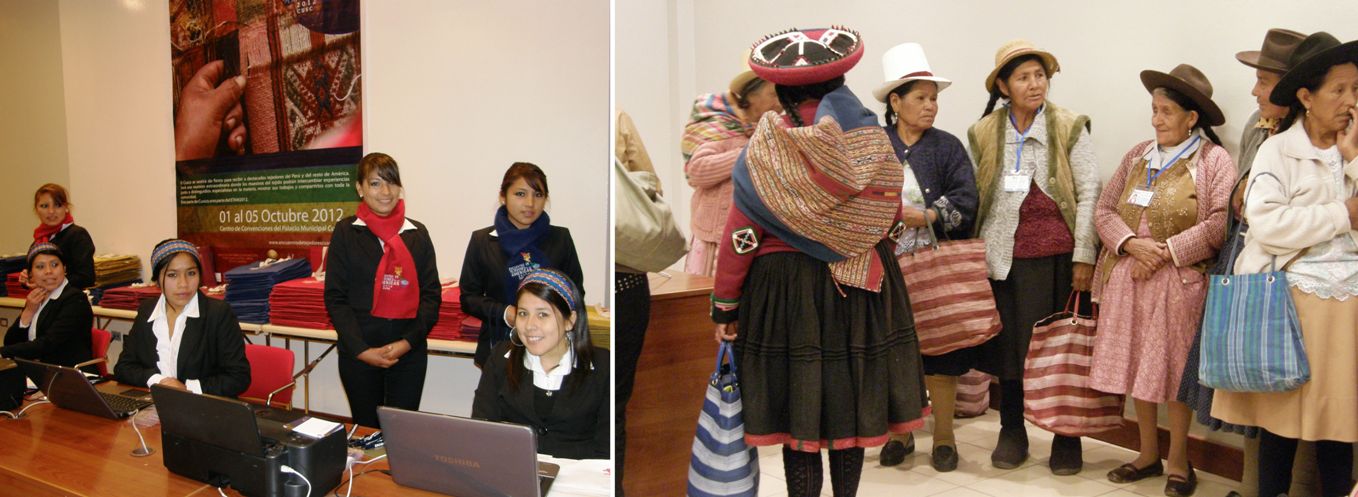
 Bright and early on day one, I registered along with other participants. The receptionists, looking smart in their uniforms with colored conference scarves and headbands, were efficient and clearly trained to be able to handle anything. The whole process was very slick and it was interesting to hear all the different Spanish accents and Quechua being spoken in the line-up of participants from all over Peru and South America. I recognized fondly the accent from Chile where I lived for five years as well as the song of the Argentinean-style of speaking used by my ex-boyfriend and the special way that Bolivian highlanders pronounce “rr”.

I then stepped outside to the courtyard to another world…a buzz of colorful activity… where I watched all the stands being assembled by weavers from all over Peru, Bolivia and Latin America, saw all the marvelous textiles emerging from travel sacks and being arranged and labeled, touched the fiber, tools and implements which were used to create the colorful cloth and spoke with the creators themselves. Some of them seemed somewhat overwhelmed by the high level of interest in and admiration for activities that are quite normal and commonplace, almost passing without remark, in the communities, villages and towns where they live.

Weavers and knitters from Taquile Island wearing and displaying their textiles and the creators of the wonderful ikat pañones of Tacabamba, Peru

The question that I really wanted to ask everyone right there and then is “Are you going to weave today?” Is today the day when we will get to sit by you and see how you created all these exquisite textiles? And all the while the  excitement is building as I see more and more gorgeous textiles and looms being extracted and arranged. I had already seen at least ten things that I wanted to explore further after having passed just once quickly by each of the twenty-two half-erected stands.

Weavers and spinners from the Navajo Nation, my friend from the Tinkuy, DY, and TahNibaa and Albina from San Ignacio de Loyola showing the crocheted “chullos” and the belt loom full of sticks which is typical of her community. 

The Chol Chol Foundation of Chile was present bringing with them textiles made by the Mapuche weavers that they support including a spectacular ikat- patterned “manta cacique”. Lowland areas of Peru were also well represented with a group of Matsigenka cotton spinners and weavers from Echarate, Bajo Urubamba.

The looms!……

A horizontal loom with a broad belt patterned with double weave and complementary-warp pick-up patterns of Taquile Island and a backstrap loom with a cotton warp-float piece in progress from Echarate.

The simple backstrap loom of Tacabamba, Peru on which the indigo ikat-patterned “pañones” are woven.  The process of creating a pañon is anything but simple. They are up to one-meter wide, covered with tiny motifs and have patterns knotted into their fringes.

A floor loom from Ayacucho, Peru with a tapestry in progress and the leaning vertical loom of Tarabuco, Bolivia.

The cotton weavers of Chiclayo managed to preserve their native cotton despite the fact that its cultivation was banned for many years in Peru. The backstrap loom is used to weave their natural brown and white cotton into saddle bags, belts and table ware for their own use. The Guatemalan loom from Santiago Atitlan holds brocaded cotton cloth destined for the typical woman’s blouse or “huipil”. Panels are sewn together and the neckline embroidered with birds.

Wide warps, narrow warps and everything in between… A Tinkipaya weaver’s leaning vertical loom, holding fabric covered n complementary-warp pick-up patterns, rests on the ground. A weaver from Pitumarca speedily edges her finished woven lliclla with a tubular woven band using three sets of string heddles and a shed loop.

A backstrap weaver from Ayacucho, Peru, creates a belt patterned with supplementary warps. She uses a forked stick to hold a secondary cross, the manipulation of which helps her to open the heddle shed quickly and efficiently. The wide backstrap loom parked against the pillar is from Tanta, Peru where handspun alpaca yarn is often combined with bright synthetic threads to make shawls, ponchos and blankets.

And then there was that tantalizing backstrap loom with its twenty-four heddle sticks…Señora Araceli, are you going to weave today?

First Araceli has to make the twenty-four sets of heddles on this fresh warp. The pattern has already been picked up and saved on sticks.

Just before lunchtime one day when we were indoors listening to speakers, I got the uneasy feeling that I really needed to be somewhere. I got up and tip-toed out at the start of the morning’s final presentation by Manos del Uruguay to find Araceli seated and preparing her warp for an afternoon session of weaving.

Well, you know that I am fascinated by the entire process and so I was happy to be able to sit alone with her and watch her make her heddles. I was tickled to see that she makes her heddles with the extra security hitch just as I have chosen to do. I have seen and learned so many ways to make string heddles for backstrap and other kinds of weaving and this method is by far my current favorite. I always say “current” as who knows what cool new method I will find tomorrow.

Here is a short video clip of Araceli making her heddles. She certainly has a smooth and elegant way of doing so. I know some people don’t like making heddles and dread that part of the process…I like it!

And what about the woven cloth produced by these looms and the pieces produced by talented hands using knotting, braiding and crochet?

Head gear…Crocheted “chullo” from Peru and a woven hatband from Bolivia.

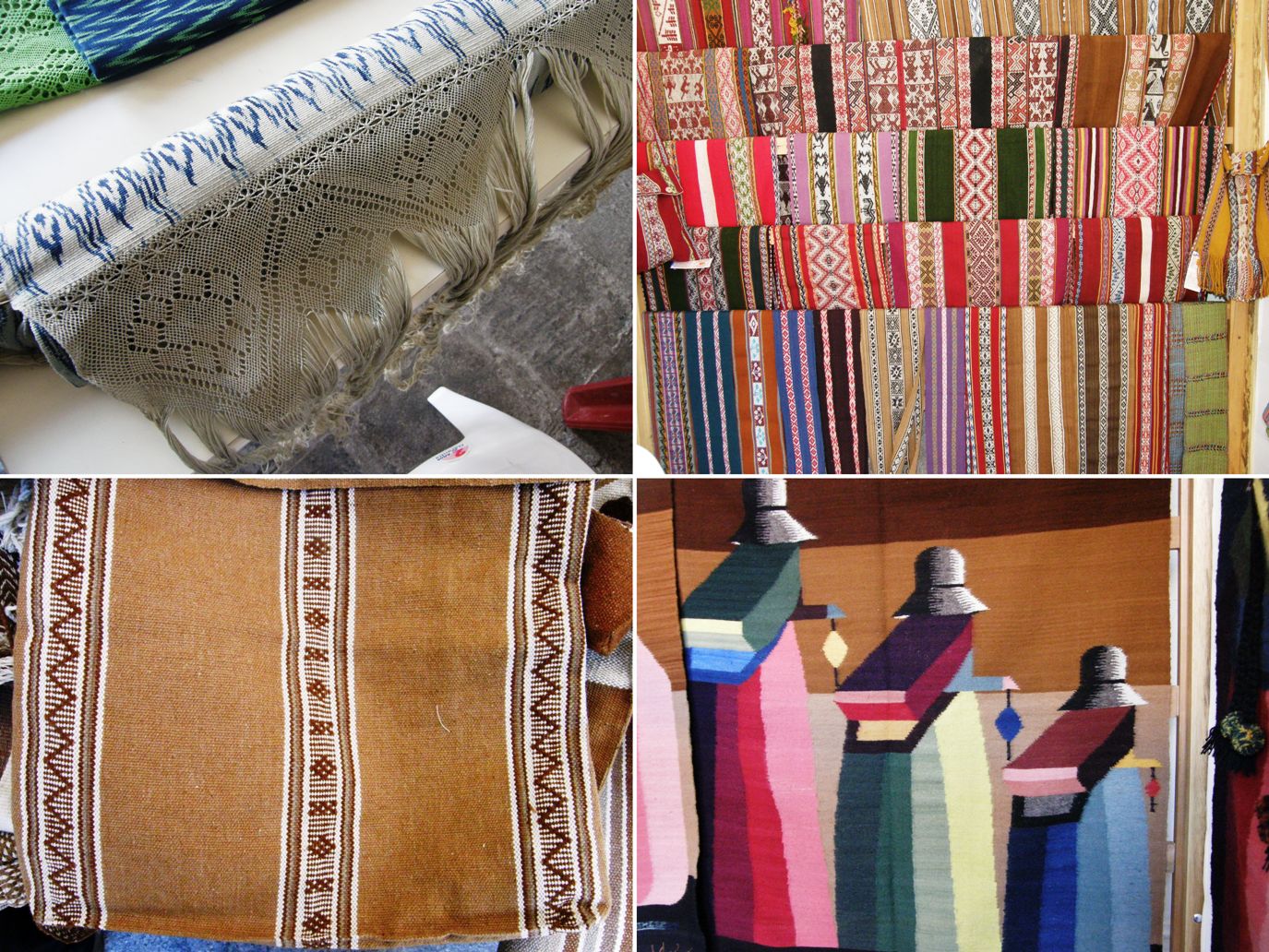
There are four countries represented here….cloth from Mapuche weavers in Chile,  Salasaca, Ecuador,  Taquile Island, Peru and Tinkipaya, Bolivia.

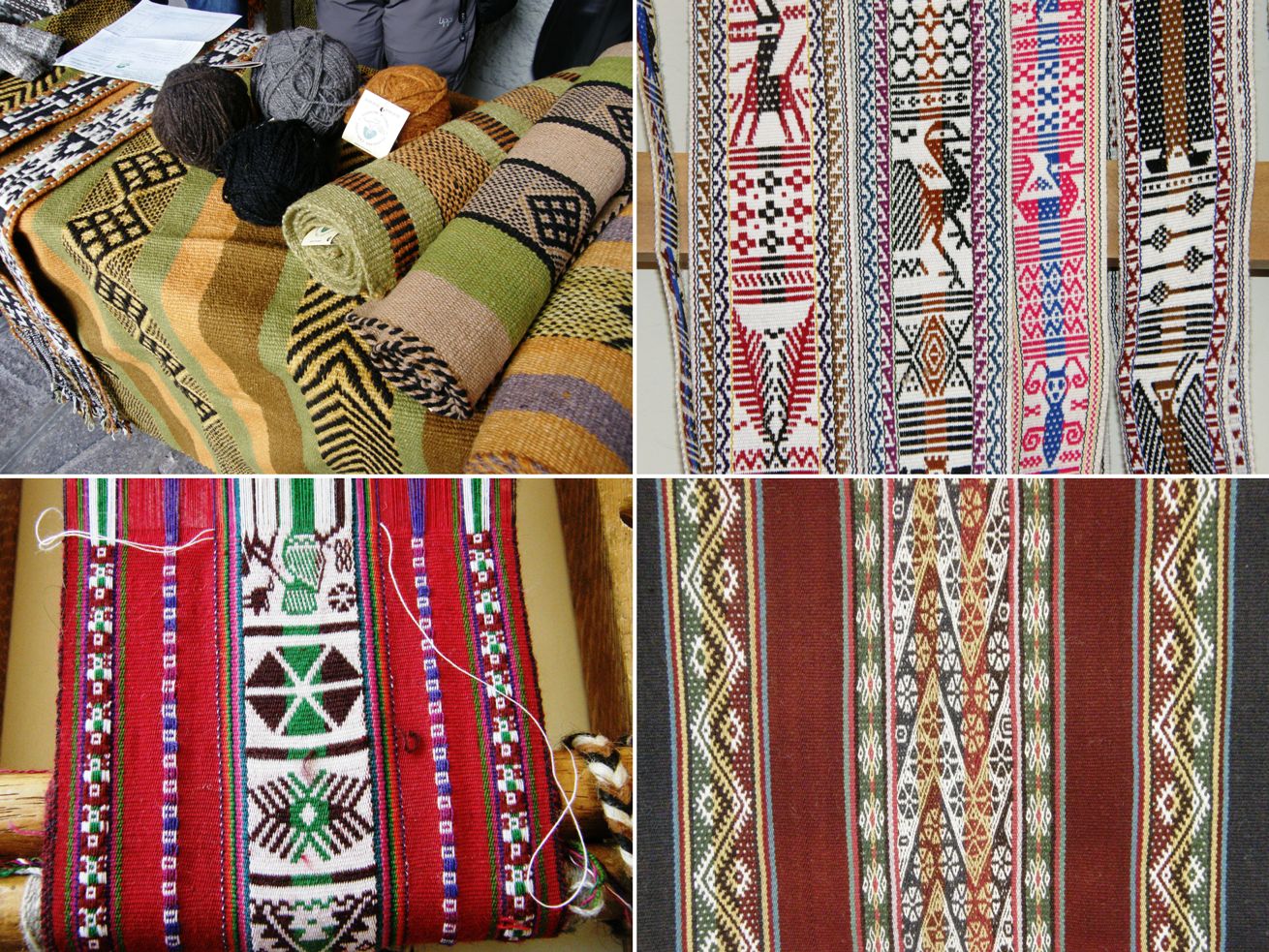
Cloth from different corners of Peru. The variety!

Of course, each piece has its story and it was those stories that we were told in the weavers’ own words in the seminar sessions that were held in the mornings and afternoons. The stories were very inspiring and educational, often with very personal touches which brought life and meaning to the fabric that simply could not be transmitted from the market stall or loom alone. All told of hope, perseverance, strengthening of ethnic identity and a revival of pride in oneself and culture and were often very moving.

The faja sara ( the one created with the twenty-four string heddles) has its own fascinating story. It is part of an unbroken weaving tradition that dates back at least 500 years to Incan times. The belt is described in the chronicles of Mercedarian Friar Martín de Murúa in 1590 A.D. and the knowledge of how to create one has been passed on ancestrally over all these years.

Lynn Meisch has written an article about her research on these belts here. We were told by the weavers that the name “sara’ comes from the verb ”sarear”, although I have never come across this verb before, which means to choose, or in a weaving context,  to pick-up.

Interesting to me from a structural point of view is the rolled edge of the belts which is surprisingly easy to create. I am guessing that it serves the same purpose as the woven bands I have seen added to other textiles in that it strengthens the edge. When I was in Holland, Marijke van Epen and I followed Mirja Wark’s explanation of the rolled edge used by the Wayuu people of the Guajira Peninsula in Colombia and Venezuela and the way the weavers of the sara belts create theirs is equally as interesting and practical.

Here is Araceli in action with a band of spectators. When doubt was expressed by the onlookers about the quality of the cloth since Araceli does not use a ruki, the llama bone tool, to beat in her weft, Araceli immediately invited them all to feel the belt. They were all surprised and impressed by the firmness of the weave. It is a very dense piece of weaving.

The poncho shown above is from Catamarca Argentina and represents the recovery of the exquisitely fine work done with handspun vicuña fiber on floor looms which has the made the poncho Catamarqueño famous for centuries.

Two people weave the pieces side by side and have to coordinate the strength of their beat perfectly to maintain a consistent weave. With the fine vicuña thread a piece that measures 2 meters by 1.30 meters weighs only 320 grams and takes up to eight months to complete.

Fine vicuña shawls are also woven and embroidered using designs copied from old colonial textiles.

We had a chance one afternoon to handle and clean pieces of vicuna fiber and everyone was invited to try their hand at spinning it on the  25cm spindles.

More cloth…..

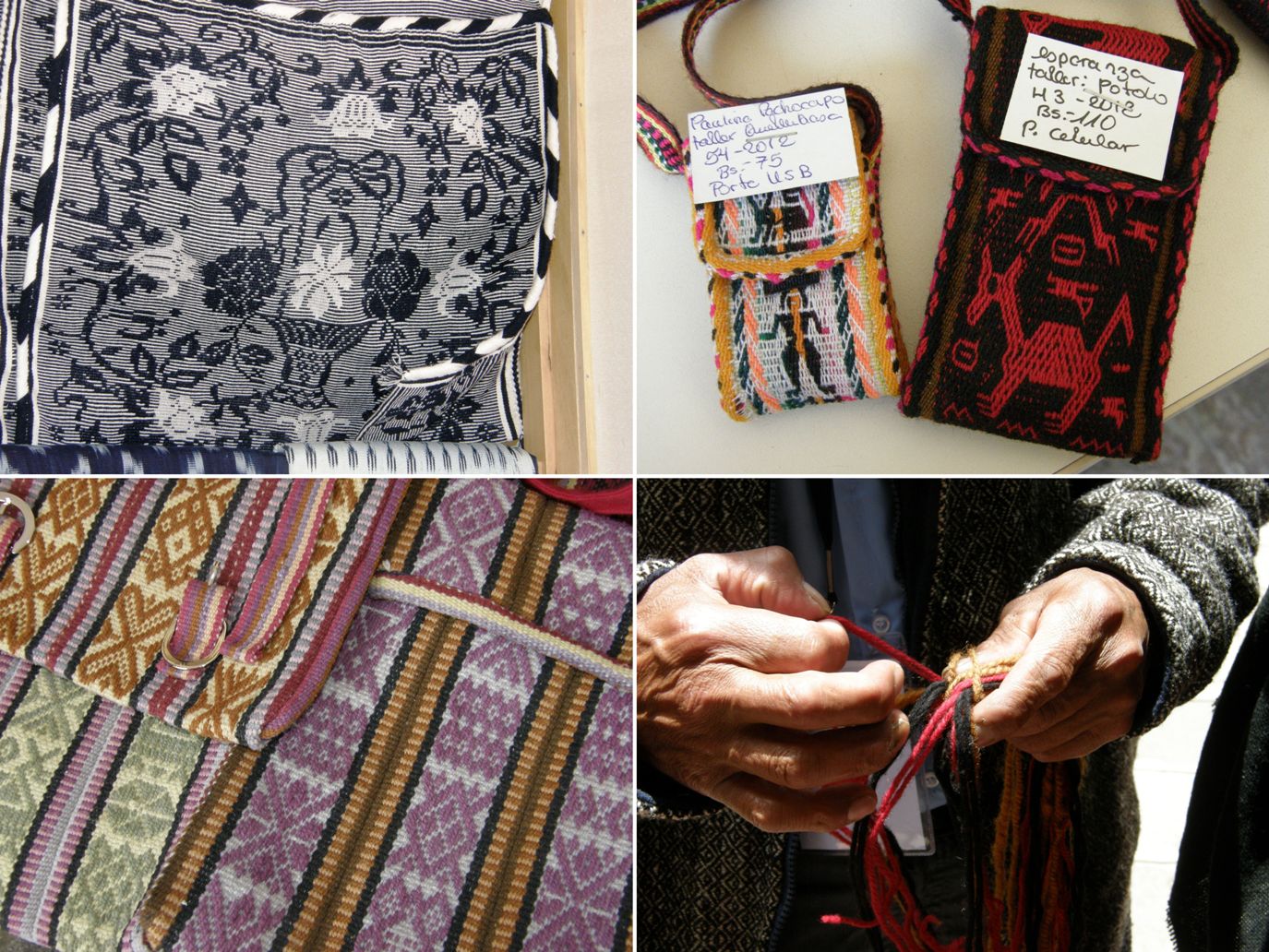
…. a bulsico , or cotton double-pocket saddle bag from San Ignacio de Loyola with beautiful patterns in simple warp floats worked in two colors. The weavers from Tarabuco and Potolo in Bolivia of course brought large fine examples of their textiles. I decided to show you here some very small and practical pieces that they also brought to sell. The tiny USB pouch is from Tarabuco and the cell phone pouch with its woven khuru figures is from Potolo.

The supplementary-warp patterned pieces in lovely pastel colors are from Ayacucho, Peru and the last shot is of an impromptu sling-braiding demonstration from one of the Peruvian presenters in the coffee break.

More lessons along the way…

Diana from Santiago Atitlan in Guatemala showed me how to wrap her hair and head with a woven hair sash. You can see that most of the band is plain red with just the last part, which will be seen on the outside, decorated with pattern. Albina’s husband showed me how married men wear the typical chullo of his home…with the flaps standing out sideways. A single man will wear his with the flaps pointing out front and back.

So, now you have seen a selection of the stands, looms and textiles and heard a few backgroud tidbits about some of the weavings and the people who produce them. You are probably dying now to see the weavers in action, right?

ARE YOU GOING TO WEAVE TODAY?

Sorry, but I am saving that segment for the next blog post as uploading the video will be so much easier for me when I am in the US.

In the meantime I am packed and ready to leave tomorrow and I did manage to finish the discontinuous warp piece that I started in the workshop on the last day of the Encuentro. Handling alpaca fiber is not a nice business in this heat with sweaty hands, I can tell you!

Here is my ticlla piece off the loom and all curled up…

The overspun alpaca yarn made the grey and black panels curl in and the other two panels curl under. You can see my finish line on the white panel. I ended up removing one weft as I had packed too many in. I really need to remove two as now I have two wefts in the same shed. The finish line isn’t as noticeable on the other panels. I am really pleased with this!

I wove and sewed on a tubular band to the edges….… in the same way as the Pitumarca weaver that I showed earlier in this post, using three sets of string heddles and a shed loop. See how nicely the piece lies flat now? I hemmed the sides before applying the tubular band because I didn’t like the way the warp stripe at the edge was interfering with the color of the tubular band.

Here’s a better look at the tubular band and that lovely dovetail join of colors…

Done! I am keen to try this all again!

See you next time from the US 🙂