Backstrap Weaving – A Little Weaving Therapy

I guess that two months isn’t really such a long time to be away from home. It’s just that I haven’t done an extended trip like that in a long time. I am reminded of the times when I lived at the southernmost tip of continental Chile and used to go up to Peru and Bolivia for the winters. I would spend months away wandering about, only going home when I had become too skinny and undernourished (I always traveled on a typical backpacker’s budget!). It is always bewildering after you have seen so much, experienced so many different things, met so many cool people and learned so much to go home and find that everything is the same!

How could this be when you feel so different?! However, returning home this time was a little different because things had changed. Stuff happened, people disappeared, things accumulated….one of them being DUST…two months of the wretched stuff!

But now I am back into the old routine. Yes, here I am blogging away on Thursday in socks and sweaters. Fifty-five degrees…that’s COLD for Santa Cruz. The palm trees look rather forlorn against the grey sky.

Time for some weaving therapy!

I made up the bag for the wee Casio camera.
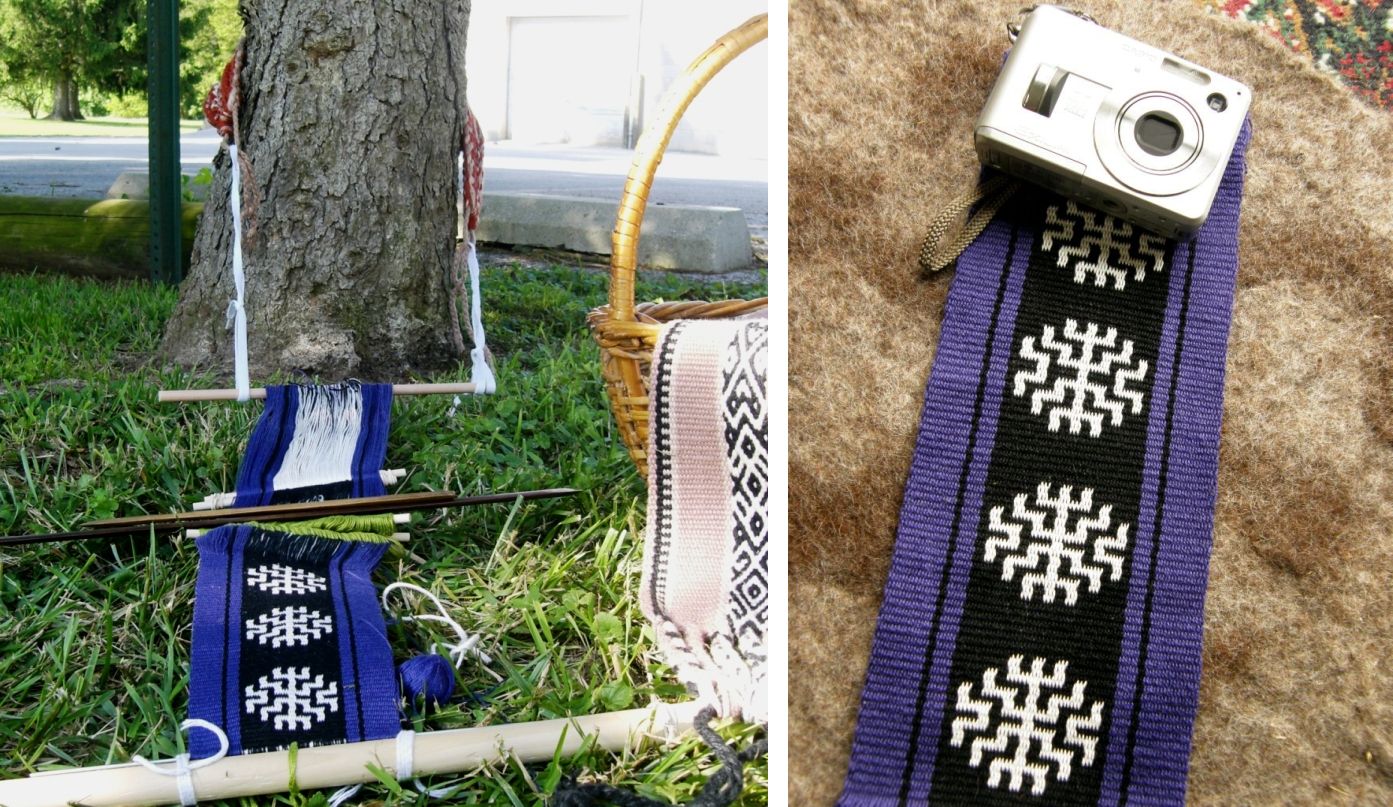
This project accompanied me on the road and was hitched to numerous places along the way. I finished the weaving while I was up in Massachusetts. The pattern is one from Bhutanese textiles. Now, how to sew it up?
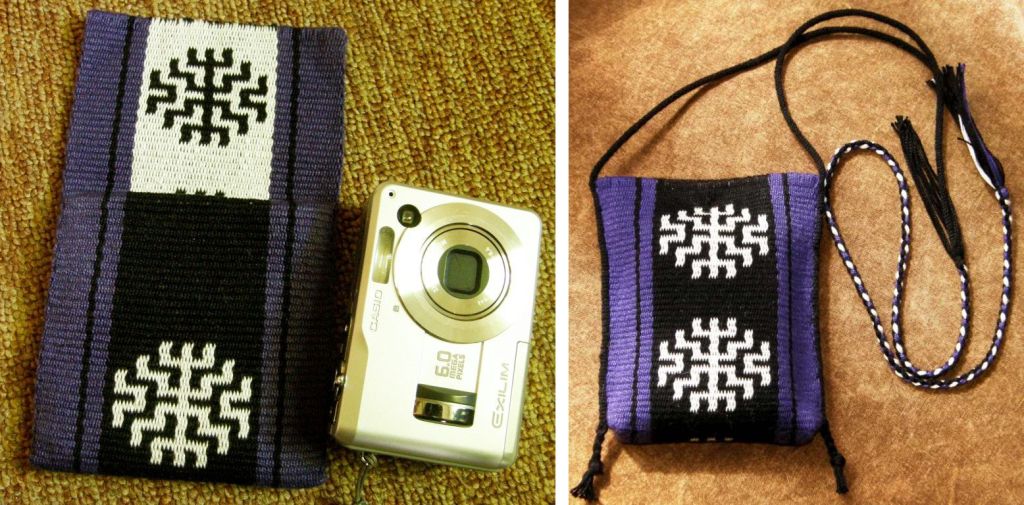
The first idea was the one on the left…a bag with a flap which I would cut and shape and edge with a tubular band. However, the motifs were not ideally placed for that and so I ended up with the style on the right.

I squared off the bottom of the bag and added a single large  snap closure on the inside. It is edged with a sixteen-end black plain-weave tubular band. I continued weaving the tubular band after covering the edge so that I could also use it as a strap and then added a four-strand braid to that for extra length.

The transition from tubular band to four-strand braid is covered by a tassel…a trick I learned from my sling braiding teacher in Peru.

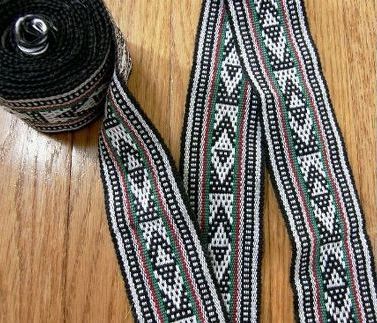
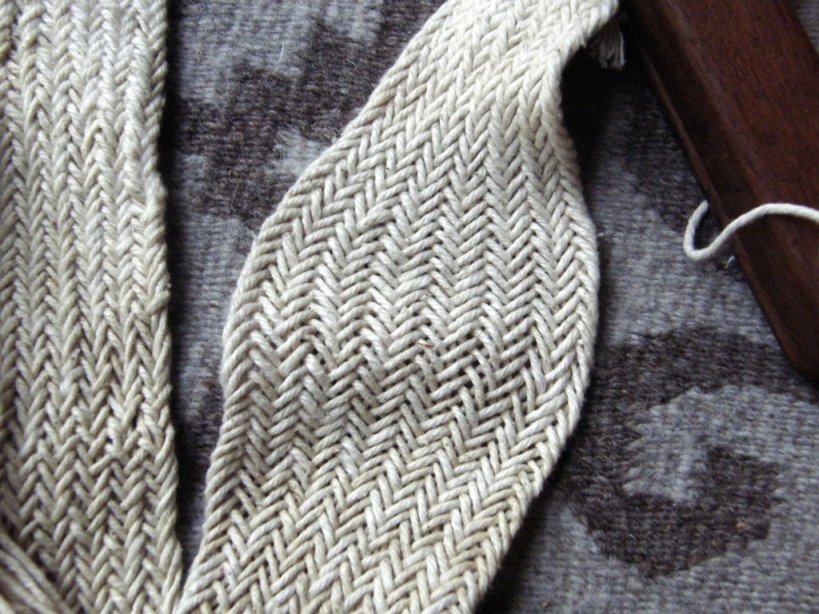
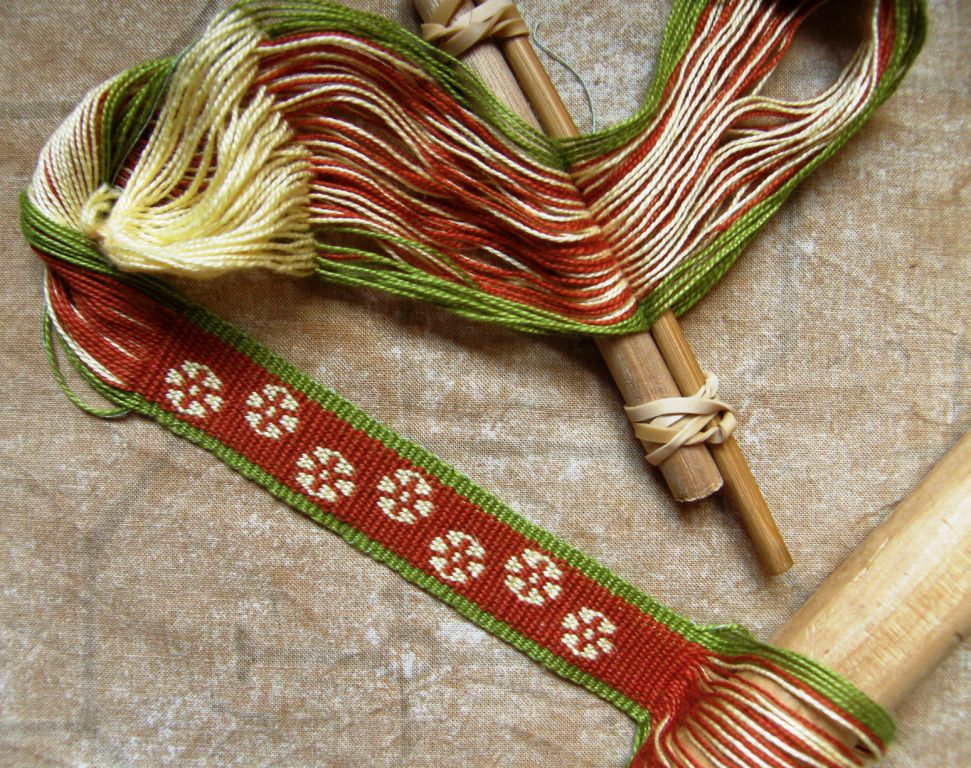
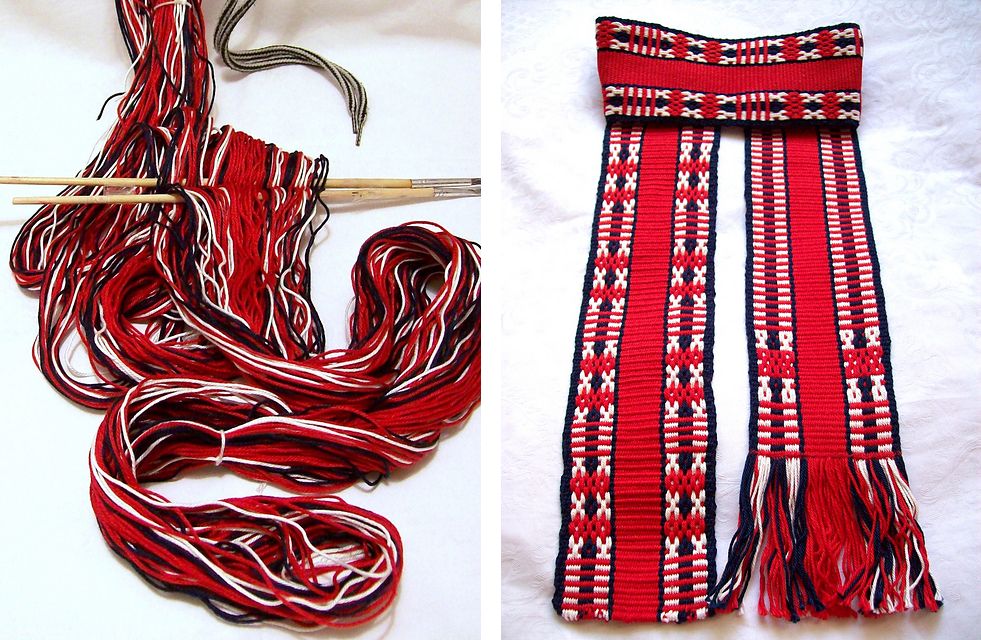
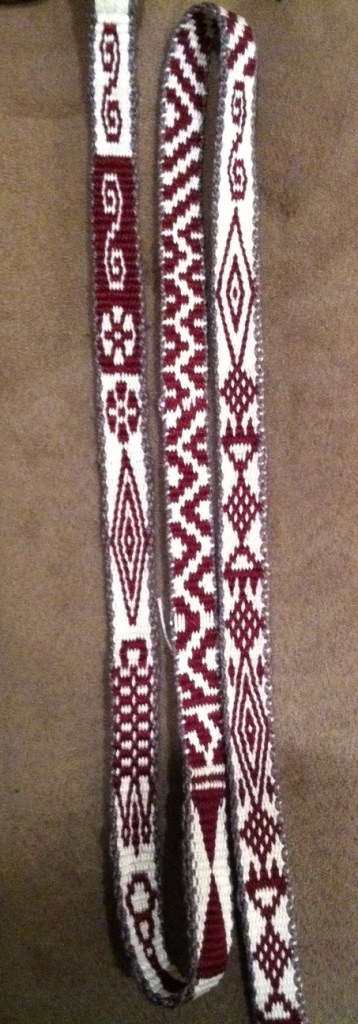
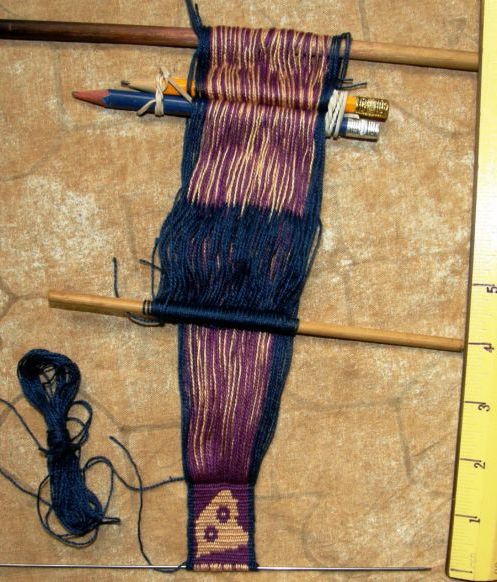
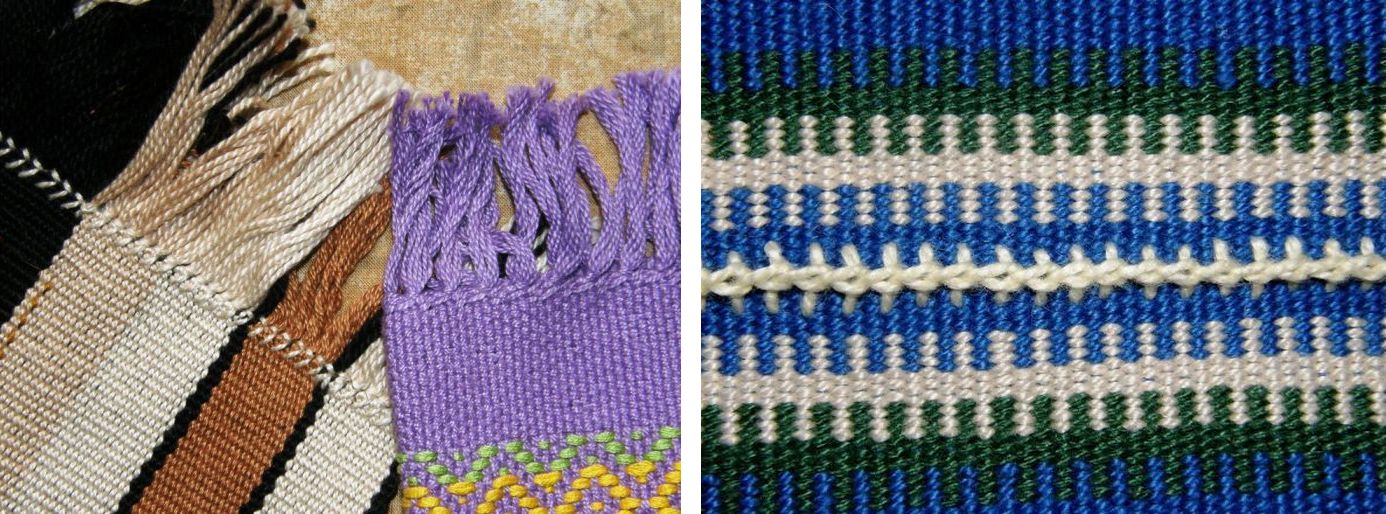
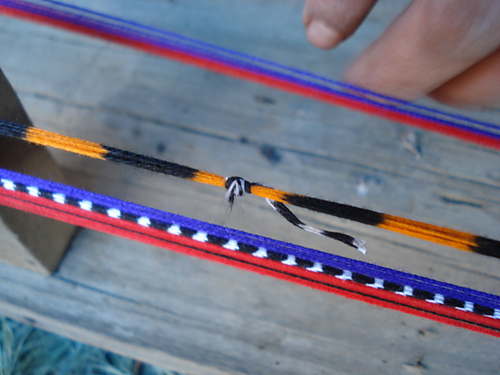
I think these tubular bands are very cool and so handy. I have been playing with some other plain-weave ones in different materials. The one on my bag is in #10 crochet cotton and here are a couple of others that I made in wool.

The yellow and blue one is woven with a DK weight wool I love the way the simple stripes spiral.

The other one is in a lighter weight wool and you can see that even a lightly twisted yarn works. As the warps are so narrow, the problems of stickiness that usually occur when using wool in warp-faced projects are not a big deal. The warps did not break but my weft did once from pulling it very tightly but that was not a  problem.
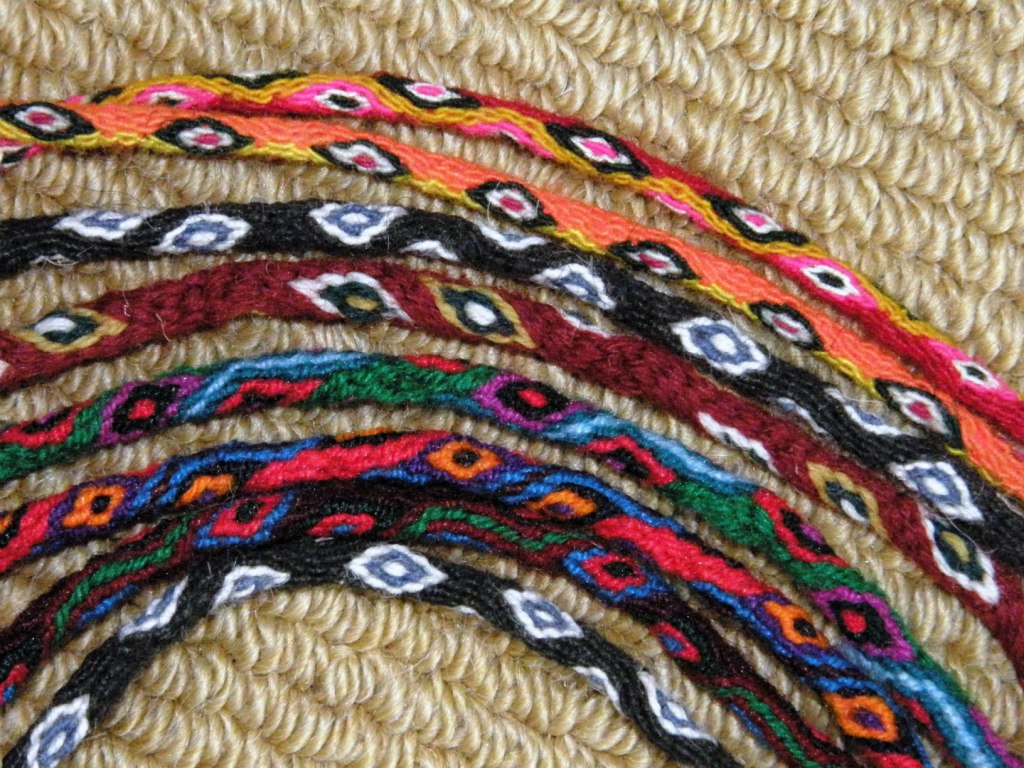
Another cool thing about tubular bands is that it does not matter what the lower face of the band looks like. That gets hidden within the tube.

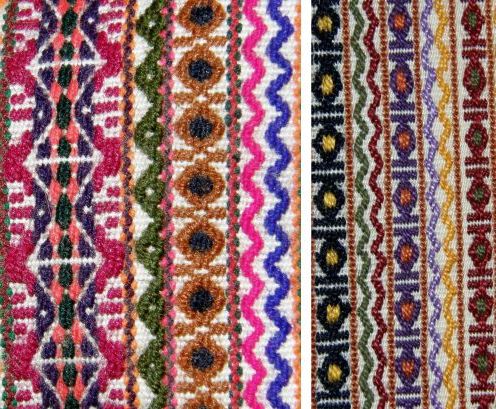
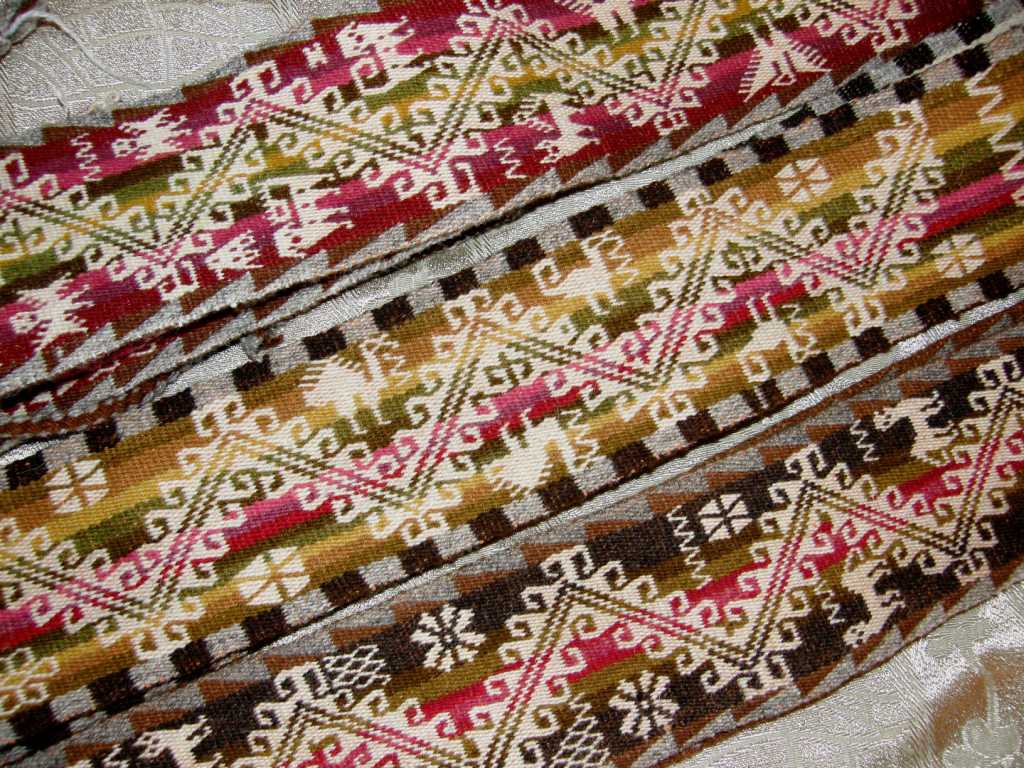
I wove a ñawi awapa band (see some ñawi awapa bands pictured on the left) as an experiment as a flat rather than tubular band and saw the chunky chaos of crossed and twisted floats that is created on the back side of the band from all the strange warp crossings and manipulations.

But that does that matter? No! All that gets hidden within the tube.

Now what other technique do I know that has a pretty “right” side and a messy “wrong” side of awkwardly long floats?…the warp subsitution technique, of course!

Actually, any warp-faced band whether it be plain or patterned with any kind of pick-up can be made into a tubular band but, since the warp substitution technique is often overlooked because of the long floats that are created on the reverse of the fabric, why not use it for tubular bands where none of that matters?

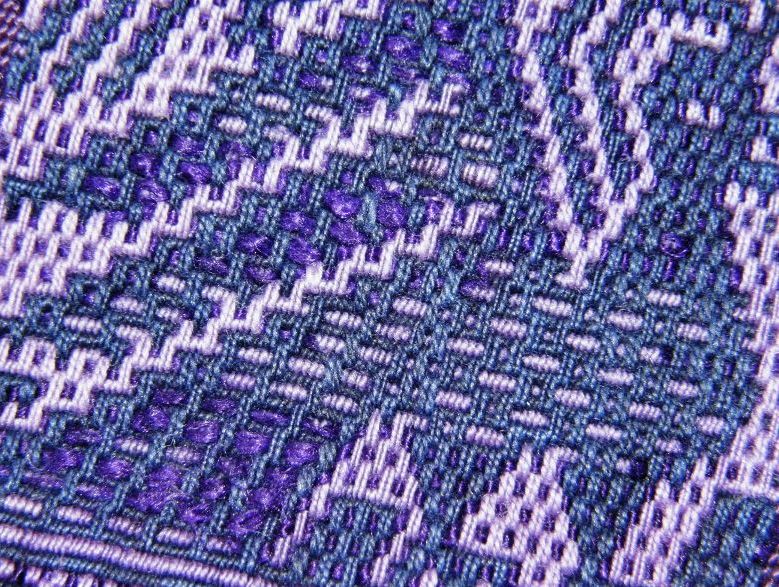
So, the other band pictured above has three-color horizontal bars which I was able to create with the warp substitution technique.

All the cumbersome long floats are hidden within the tube.

These bands are fast and fun to weave, quick to warp and can be stretched between a toe and finger to weave.

If that doesn’t suit you, you can attach one end to your waist with a cord through the end loops.

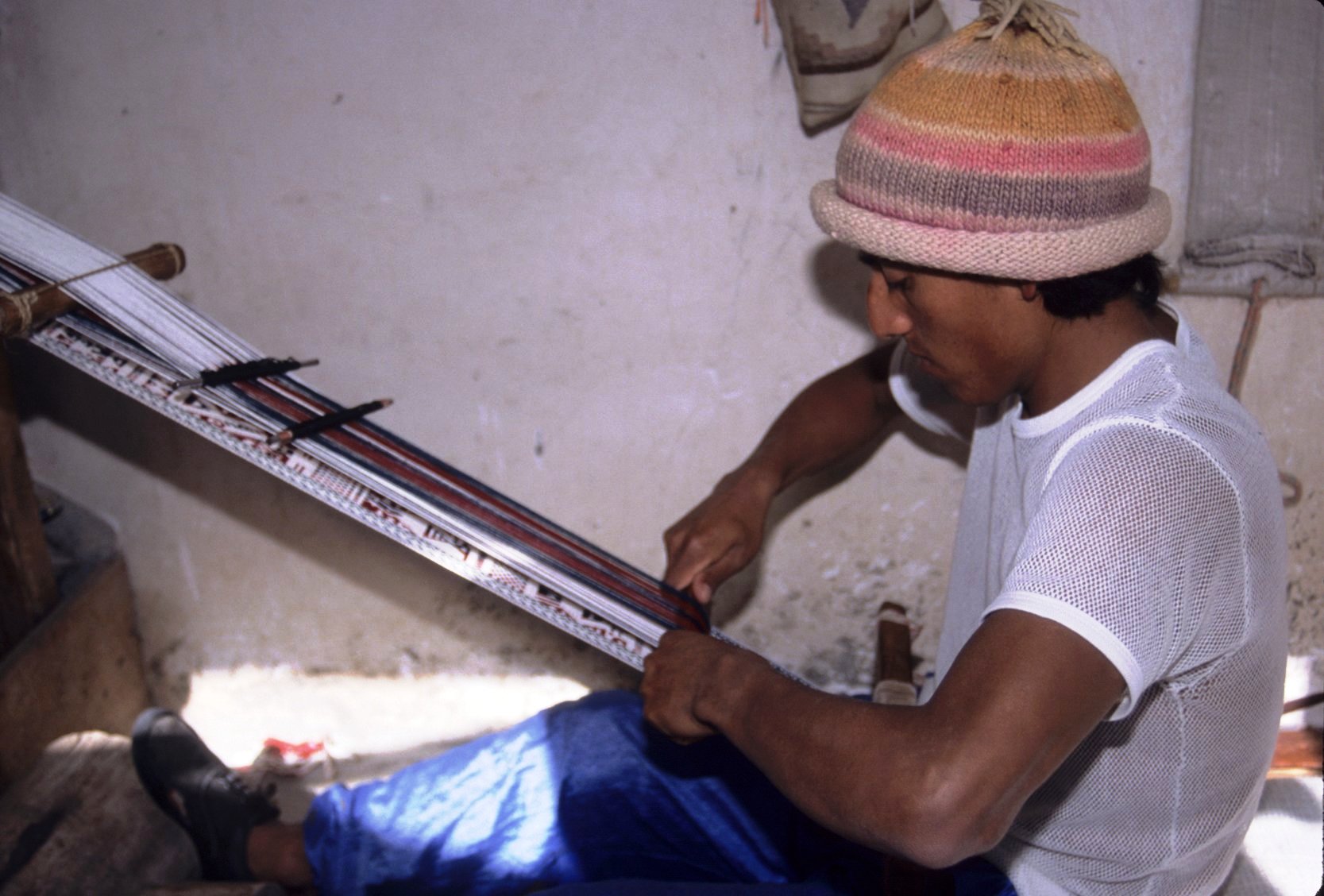
If you don’t fancy using your big toe, as the weaver from Tarabuco pictured at left is doing, a cord can be passed through the end loops at the other end of the warp which can then be wedged inside a drawer or looped over a “C” clamp.

I am going to use these tubular bands as pretty ties for my loom and any other time I need cord for my weaving projects and I hope to experiment a lot more with designs and colors.

So, that was one on-the-road project finished. My other demo warp is something quite different. A big white canvas looking at me and asking to be decorated…
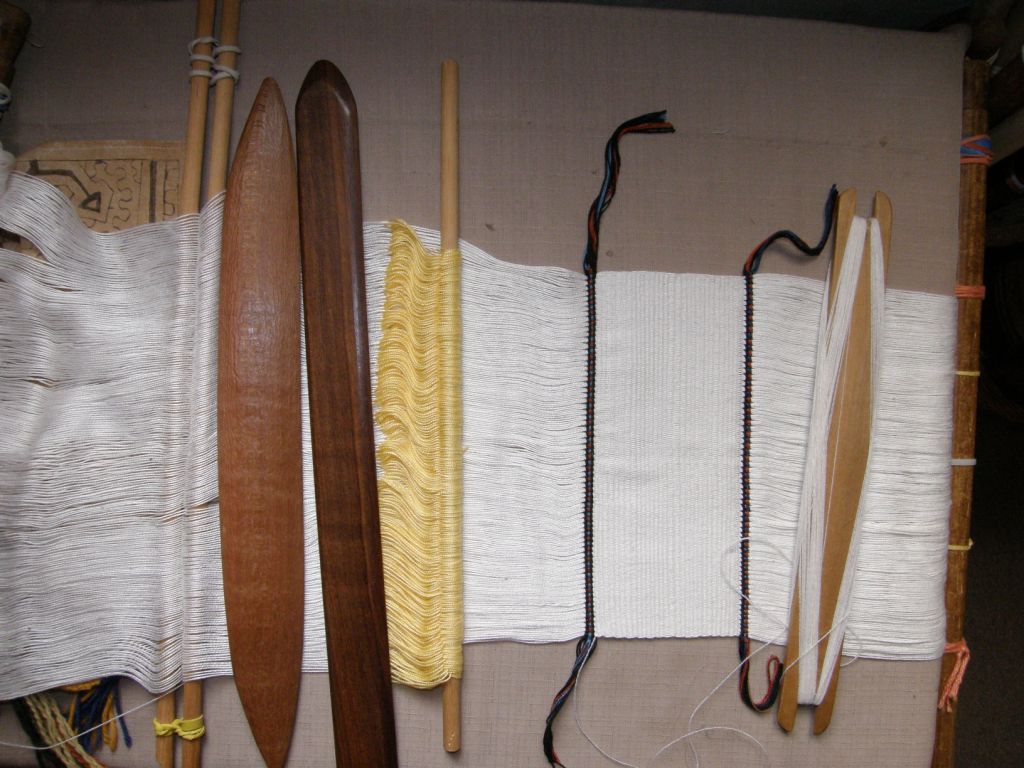
There is something very lovely and somehow “earthy” about creating this plain and simple warp-faced white cloth and I want to make any patterning minimal. I have added a couple of weft-twined sections. Perhaps I will do some more weft-twining or maybe some soumak with a bit of added patterning with supplementary wefts. I left a lot of unwoven warp at the start in case I want to add a large weft-twined pattern later. As usual I don’t have plans for the finished piece. I will just see what happens.
Then there was time to do something with a sample piece that I had completed shortly before leaving.

You may remember the ikat weave-along that we were having on Ravelry.

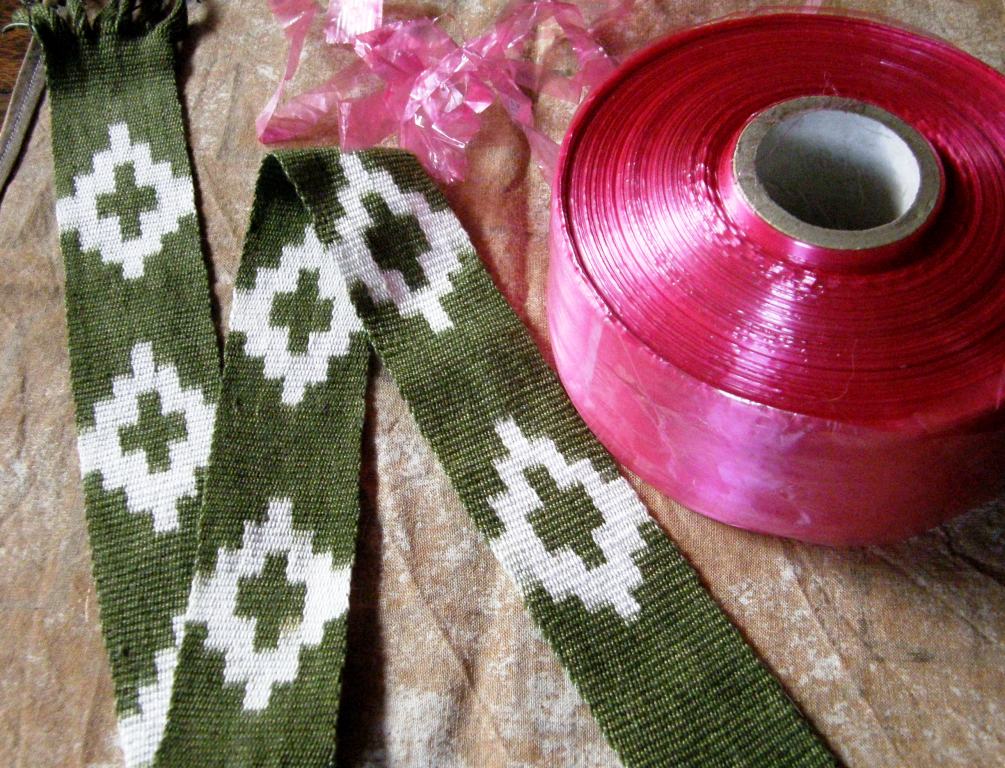
My friend Betty in the US gave me a huge roll of ikat wrapping tape so there will be many more ikat experiments in my future!

I have been using cassette tape until now and had a small “oopsy” in my last project when my dye solution was too hot for the tape.

I am sure that this special tape has been designed to stand up to being boiled in dye baths. It is very wide but tears easily into perfectly straight narrower strips…what a dream!

Here is the second warp which I tried after the green one above. This was my first time trying over-dyeing with a second color and spot dyeing.

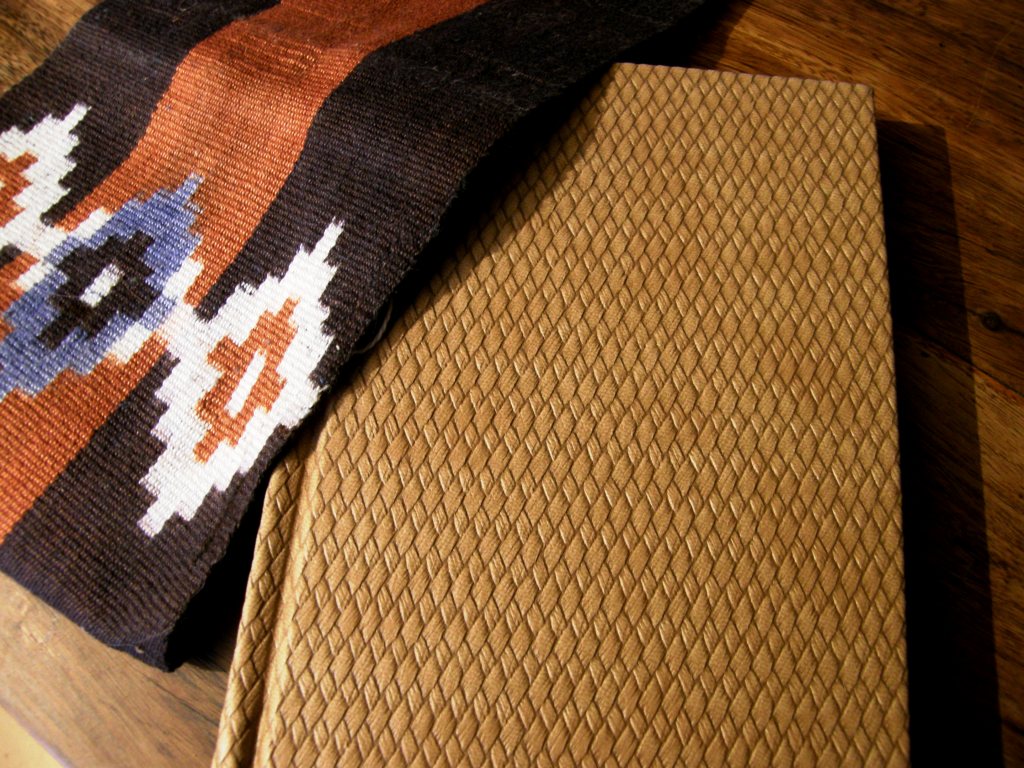
My friend Jeen in the US gave me a lovely travel journal and, even though its cover is very beautiful, I decided that my experimental ikat piece would make a wonderful jacket for this book.

I have to admit I was a little nervous. Was I about to ruin both sample and journal?

I used contact cement which is pretty strong stuff. Would it eat into the material on the journal’s cover and destroy it? Would I mess up and glue it on crookedly?

I have done that before with contact cement when gluing cork sheets to a table top. Once that stuff is ready to go you are pretty much committed and it won’t forgive any mistakes! Fortunately it all came together and I am very happy with the result.

The little vessel in the picture was a gift from a friend in Ecuador. The pen is made from sandalwood and was brought to me from India over forty years ago! Goodness knows how I have managed to hang onto it after all these years of moving around and having to abandon possessions along the way. The mug rug on the far right is part of a set inspired by African designs that I made on my backstrap loom in double weave.

My new-to-me used camera got a dressing up too with a new strap. I was happy to have a chance to weave that bird design again…the one on the old fragment that Tom Knisely showed me…
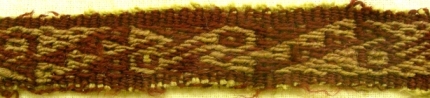
Here it is off the loom and on the camera…

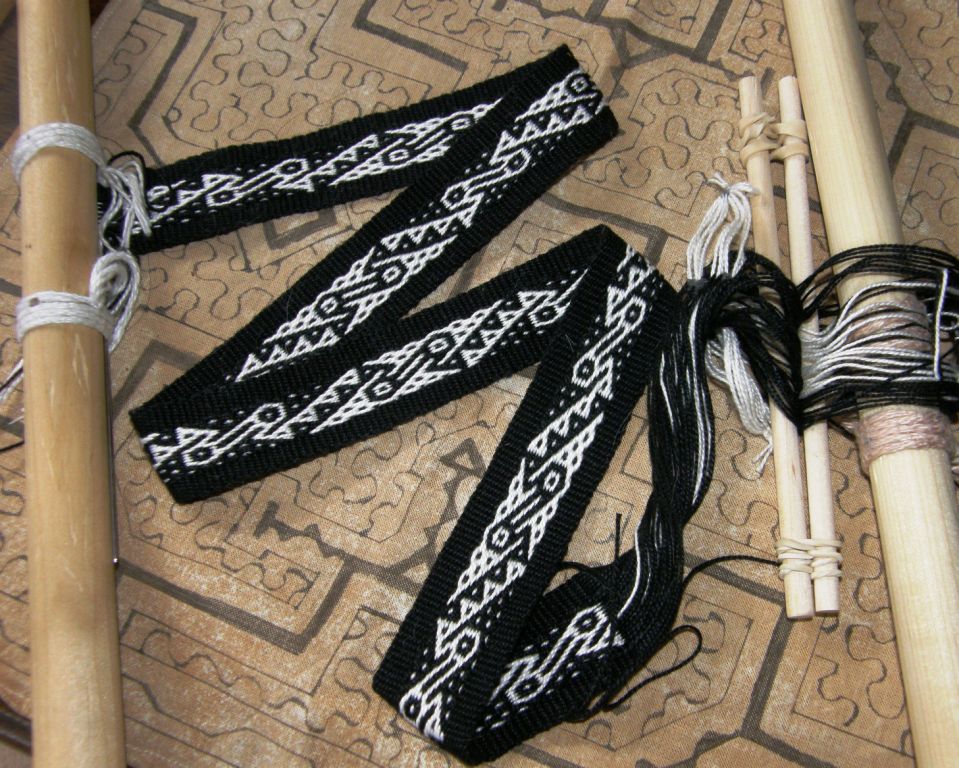
And here it is on my backstrap loom. I love the way the bird motif changes from black to white along the length of the band.
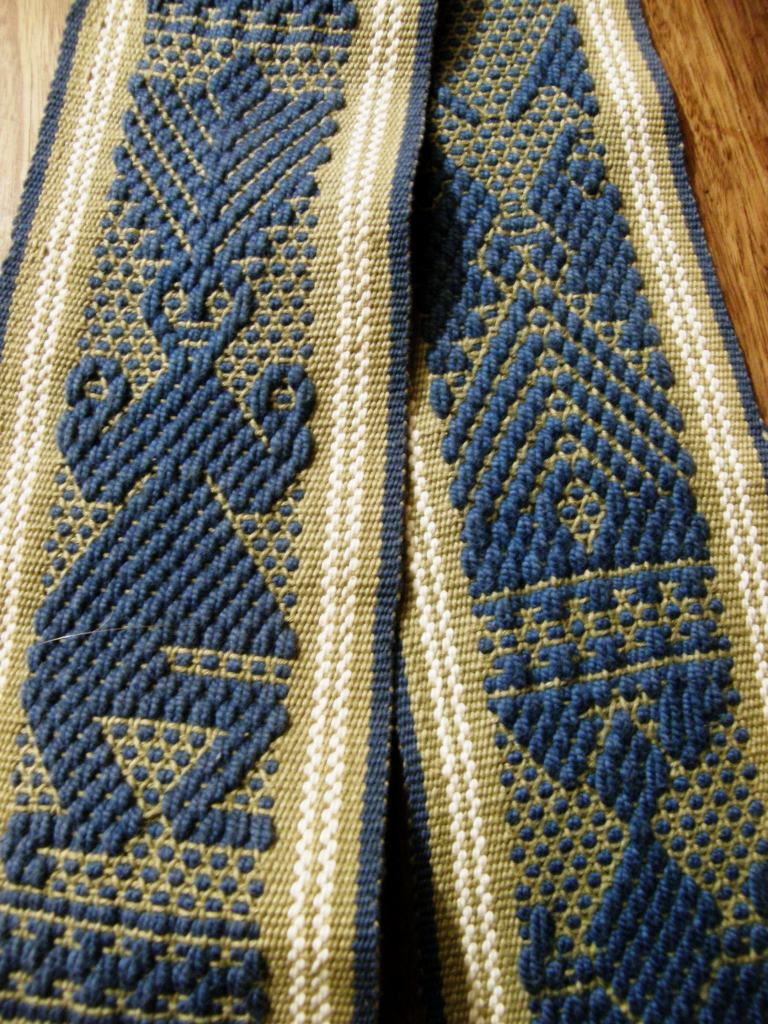
And now I have a new strap to study which was lent to me by Susan  who visited me when I was traveling. She brought it along and I was delighted to be able to see both sides of it. There are so many pictures online of these bands from Oaxaca, Mexico but you never get to see the back side. There are many more examples of these on Teyacapan’s Flickr page of Mexican textiles.

Perhaps this structure is woven somewhere here in South America too but I have never come across it so this is a great opportunity to take a good look. Maybe it was woven here in pre-Columbian times. She urged me to take it home and just send it back to her when I am done. How cool is that?
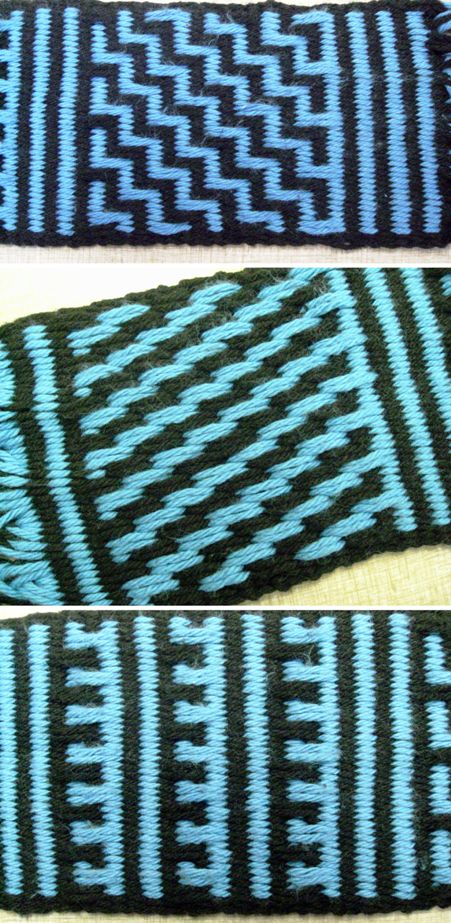
I have this urge to go back to some simpler things and explore them more…like the white plain-weave piece I am doing, some more very simple ikat motifs which again involves just plain weave and I have been also looking again at simple warp floats.

One of my weaving friends in the US wove this cool backstrap after having woven simple warp floats with me.

We just played a little with floating both colors and she went on and ran with it.

At left you can see various parts of Kristi’s backstrap which is patterned with floats in two colors. She used it the second time we wove together.

When I was at Maryland Sheep and Wool I got to see many people of all ages being introduced to fiber activities.

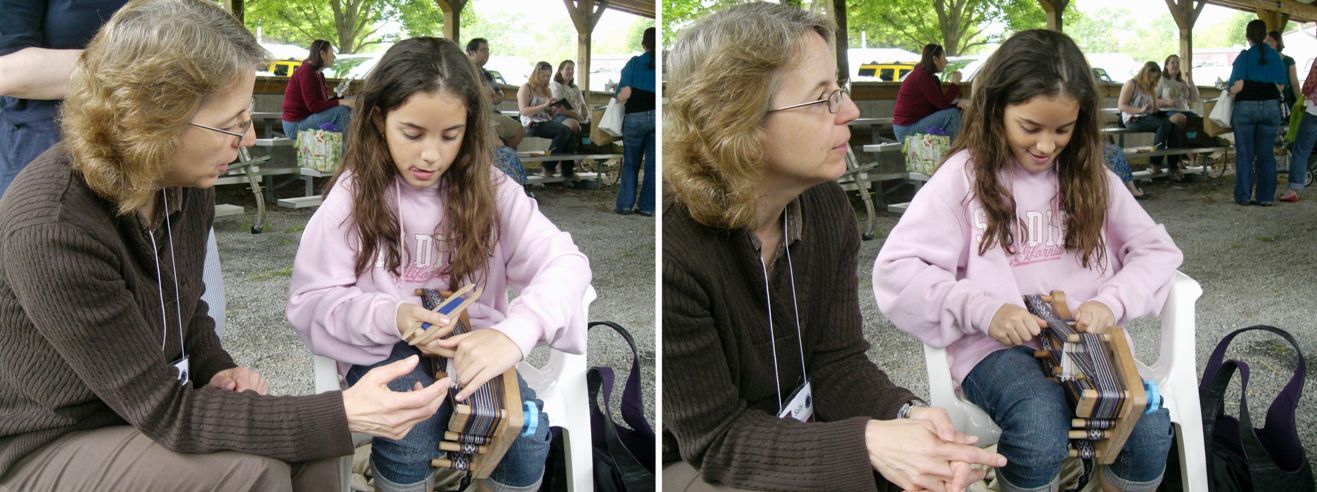
Elisabeth Hill, who I have known some time online and whose fabulous work on deflected double weave I always follow on her Flickr page (she’ll be teaching it at Convergence), came to Sheep and Wool with her niece Kylie. Kylie got a class in inkle weaving from Sally Orgren on her famous and well-traveled loom when we had a Weavolution meet-up at midday. Look at that smile. It looks like a new weaver has been born.
One of Elisabeth’s deflected double weave pieces won first prize in the exhibit at Sheep and Wool. I don’t think the picture I took does it justice so please take a look at her Flickr page to see all her beautiful creations.

Some lessons, like the one Kylie had, were completely impromptu. I wonder if as Kylie grows and continues to weave (and what wonderful inspiration she has in her aunt Lisa) she will remember her very first lesson there in the Rabbit Barn at Sheep and Wool on Sally’s “Inky”. Other classes were more formal…
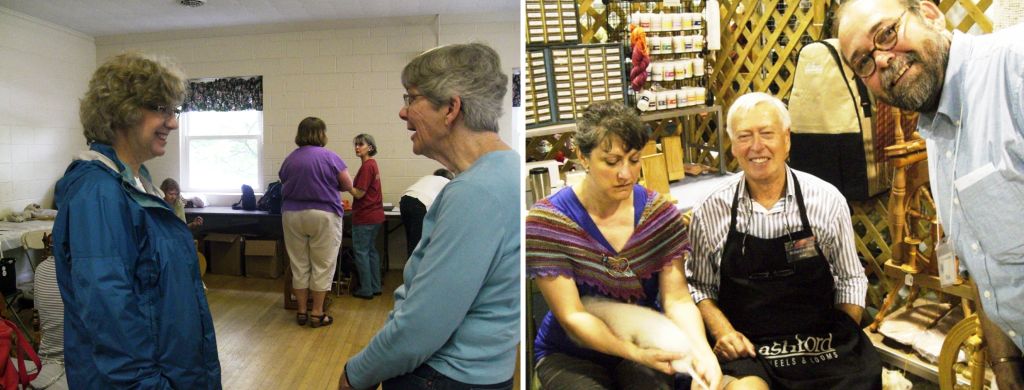
There’s my friend Claudia chatting with spinning teacher Maggie Casey before class and Richard Ashford was at The Mannings booth giving spinning tips with Tom Knisely looking on.

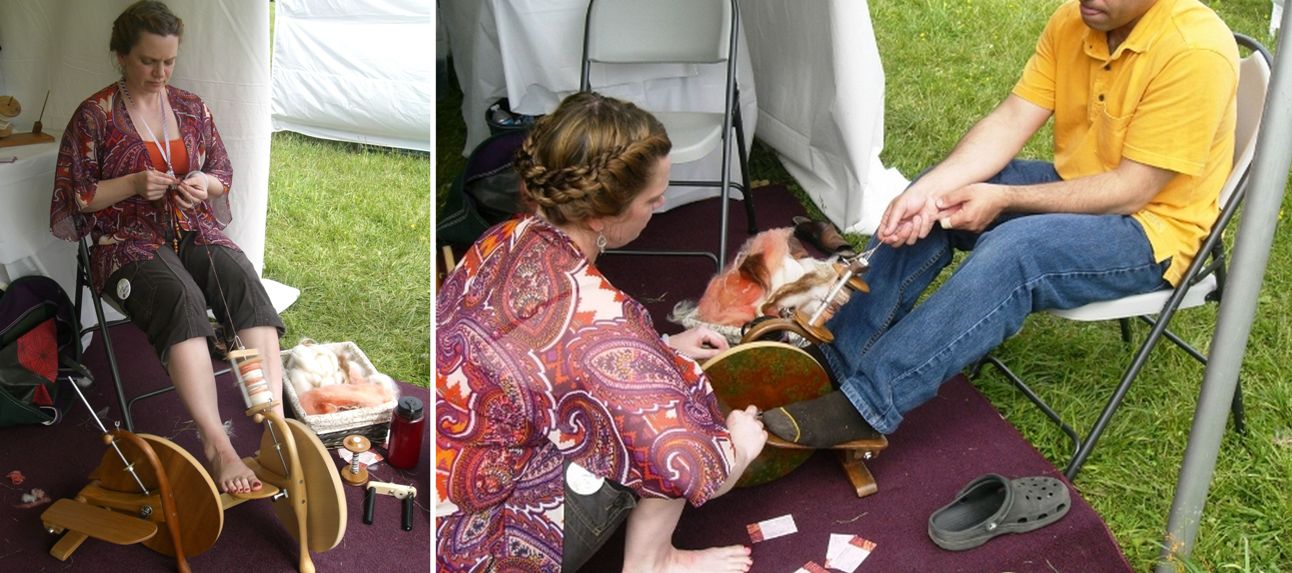
And the guys were into it too. Here is a gentleman having a spinning class on the ”Pocket Wheel” which was a big hit.
It was fun to see the team of young guys and gals who entered the Sheep to Shawl Competition this year.

Some things I saw at Sheep and Wool inspired this little project this week…

A simple little pebble weave band, right? But wait until you see the band that inspired this…

Isn’t that spectacular! Now you can see where my little purple and yellow band fits in! This was woven in Ayacucho, Peru and is probably from the same area or at least very close to the place from which my pebble weave teachers originated. Although they taught me in Huancayo, they are natives of Ayacucho and the little animal motifs on this band are very much like the ones they taught me. I would guess that this band was woven with the same two-heddle method that I learned in Huancayo with some additions for the third color.

The quality of the weaving is superb. Sadly it probably won’t be “popular” with some tourists who generally seem to prefer handspun wool and natural dyes. There is so much weaving in Peru that we just don’t get to see and coming across these bands at the Sheep and Wool festival was such a treat for me especially since I have not seen anything like the motifs I was taught back in 1996 in the books I have on Peruvian weaving.

Except for the purple and yellow section, it is a three-color pebble weave. Aren’t those braids and pom poms beautiful?!

Here is a little something I picked up from the same stand. I was tipped off by braider Rodrick Owen that these were available there….a sweet braid with tassels from Ayacucho being sold as a keyfob.

And finally, here is a wonderful display of bands made by Yonat. Yonat feels more comfortable on an inkle loom and so takes what she weaves with me and transfers it to her loom. Not everything here was originally backstrap weaving. Some bands, for example, are from the workshop on Sami weaving by Susan Foulkes and others are Yonat’s original creations.

See you next time. I hope that all of you can take some time off for a little weaving therapy this week.

Backstrap Weaving – Long, flowing, luxurious….sashes.

I have had belts on the brain after my post last week where I was thinking about which examples of my weaving I can manage to take away with me on my trip next week given the very limited space that I have for such things in my luggage.

I had my woven cell phone pouches, cosmetics bags, computer cases, pouches for sewing kits and passport and tool bags on my list…all handy things for travel which could be useful as well as serve as examples of different pick-up techniques when I meet people and tell them about my weaving….certainly not the kind of things that weavers here in South America are making for their own personal use. Then there were my colorful woven backstraps…would you believe I have only met one or two indigenous weavers here who have actually woven their own backstrap? It’s just not the done thing.  Generally, a flour or rice sack with rope on its ends will do as a backstrap. Sometimes a piece of leather or some braided fiber like agave is used.

And then there were belts…something I can wear AND show as a woven examples. Belts and sashes are certainly things that indigenous weavers weave for themselves. There are few weavers that I have worked with that have not had belt weaving as part of their textile tradition. They can sometimes have symbolic significance, perhaps a purely ceremonial use or they can be simply practical.

So, I thought I would take a look at some of the belts and sashes that I have gathered over the years and I was surprised at how many examples I have given that I have made a conscious effort to stop purchasing these things when I travel…sometimes you just can’t resist, you know, but I really do try these days to just take photos and move on. I will include some of the beautiful things I have photographed too.

These are not belts but rather, hair sashes. I am thinking that one of these years I will let my hair go completely grey, keep it long and wear spectacular hair sashes like these!

These are all from Guatemala.

The one at the top is from Zunil and I learned that style of weaving there.

The center one is from Jacaltenango and is the style about which Carol Ventura has written a book. The lower one is from Aguacatan. It is wide, long and has the most amazing tassels on the end. I was only in Aguacatan for a day and I didn’t feel that I could ask any of the ladies to pose for a picture. I would so like to show you what this sash looks like when it is worn. I have read that women wear these hair sashes in imitation of Ixchel the Mayan goddess of weaving who has coiled snakes holding up her hair.

I love sashes. I love their length, their drape. I like pulling them through my fingers or laying them in a crazy coil of color on the floor.

From the very same town of Aguacatan comes this complete contrast in a simple black and white belt.

This is my weaving teacher Clara at her hybrid four-shaft/backstrap loom wearing and weaving one of the typical hair sashes of Zunil.

This belt still on its backstrap loom from Viques, Peru is probably one of my favorite things. It is made with yarn that wraps about sixty times to the inch and is covered in fine patterns. The weft is tripled and the belt has been beaten to an incredible stiffness. This belt is the main reason I have stopped buying these things. I have had this piece for almost sixteen years and the yarn is now so fragile that it is difficult to touch the piece now without having threads break. These things need to be stored and cared for in ways that I am not able..

I can hear voices saying “Well, bring it here to me, I’ll take care of it!” Maybe I will….

This belt is worn by the men of Cañar in Ecuador and is made with what looks to me like sewing thread. It is wonderfully smooth and slinky. Hanging out in the plaza of Cañar on a Sunday morning is a great way to see men and women out and about in their best clothes. When I was there many of the men were wearing ponchos with ikat patterned sections and these gorgeous belts most of which had far more motifs than the example that I purchased.

These sturdy double weave belts worn by women in Potosi, Bolivia seemed to be very fashionable as far away as Otavalo in Ecuador. When I was there in 2005 I saw a few young ladies wearing these instead of the chumbis that are typical of their costume. I wonder if they are still a fashion trend now. Quite likely something else will have taken over in popularity by now.

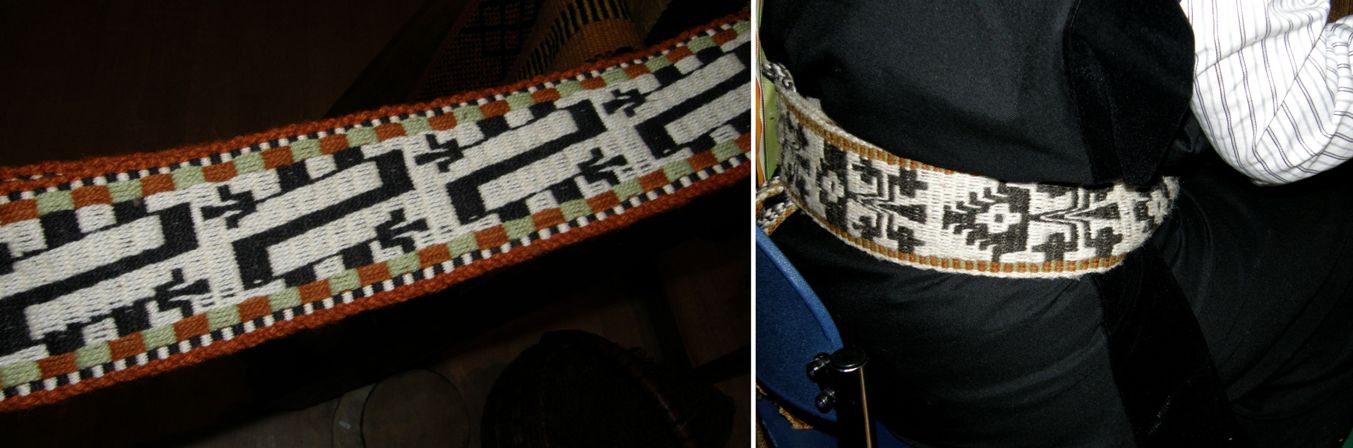
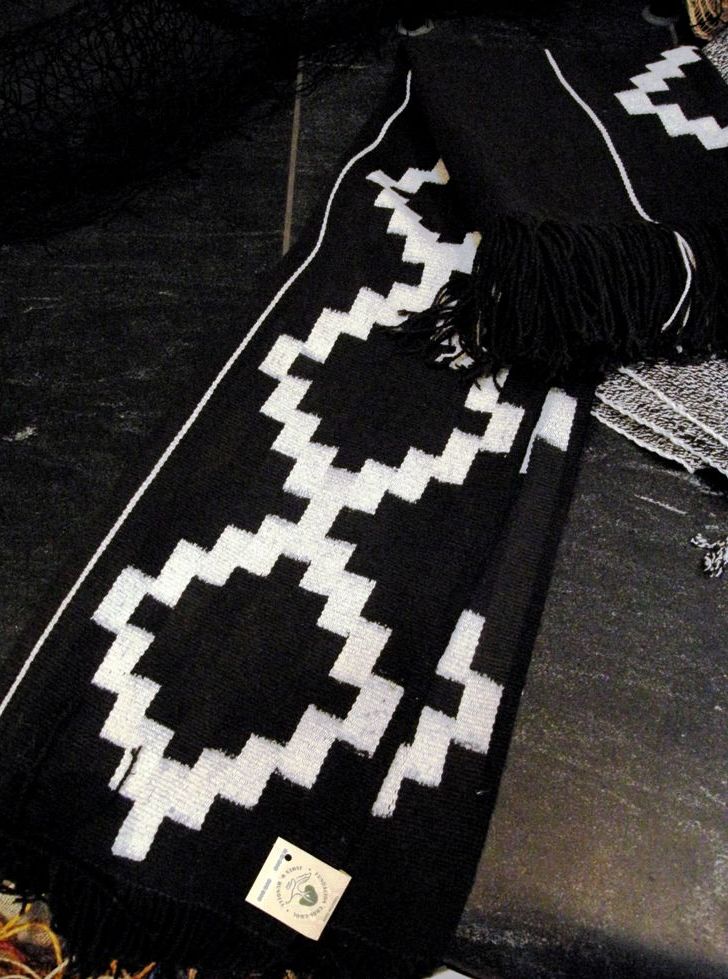
This one with its bold, beautiful design isn’t mine and was shown to me by a gentleman in the US who had spent some years on the Argentinean pampa working as a gaucho (Argentinean cowboy). He told me that it was probably woven by a Mapuche weaver and that it forms part of the traditional gaucho costume.

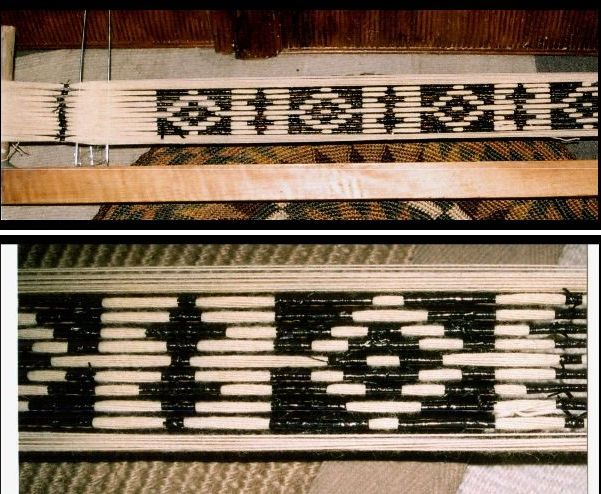
The Mapuche women themselves weave and wear a belt called ñimintraruwe as seen above.

This is the belt woven by men and worn by the ladies of Salasaca, Ecuador. A Salasaca belt is on the left and my reproduction of one of the designs on the right.

I tried very hard to buy one of these belts as I had learned to weave them and wanted a sample of all the designs. There simply wasn’t one to be had although I noticed that the family with whom I had been staying had their pig tethered with an old belt! So, I took lots of pictures instead. Some of the younger ladies were keen for me to make them a pebble weave belt. Like the ladies from Otavalo, they were interested in having something different in order to stand out from the crowd. They took the little photo album that I carry with pictures of my weaving and used it as a shopping catalog pointing out the designs and colors that they wanted!

I ended up teaching one of the ladies and another young fellow pebble weave instead…now you can make your own belt!!

A belt weaver of Salasaca at work at his loom. (this picture courtesy of Teyacapan)

These belts are woven and worn by the Tarahumara people of Mexico. I was lucky to be able to see and photograph them when an anthropologist showed me her collection at Convergence in 2010. The one at bottom right belongs to Annie MacHale who has a large collection of sashes which she loves to wear.

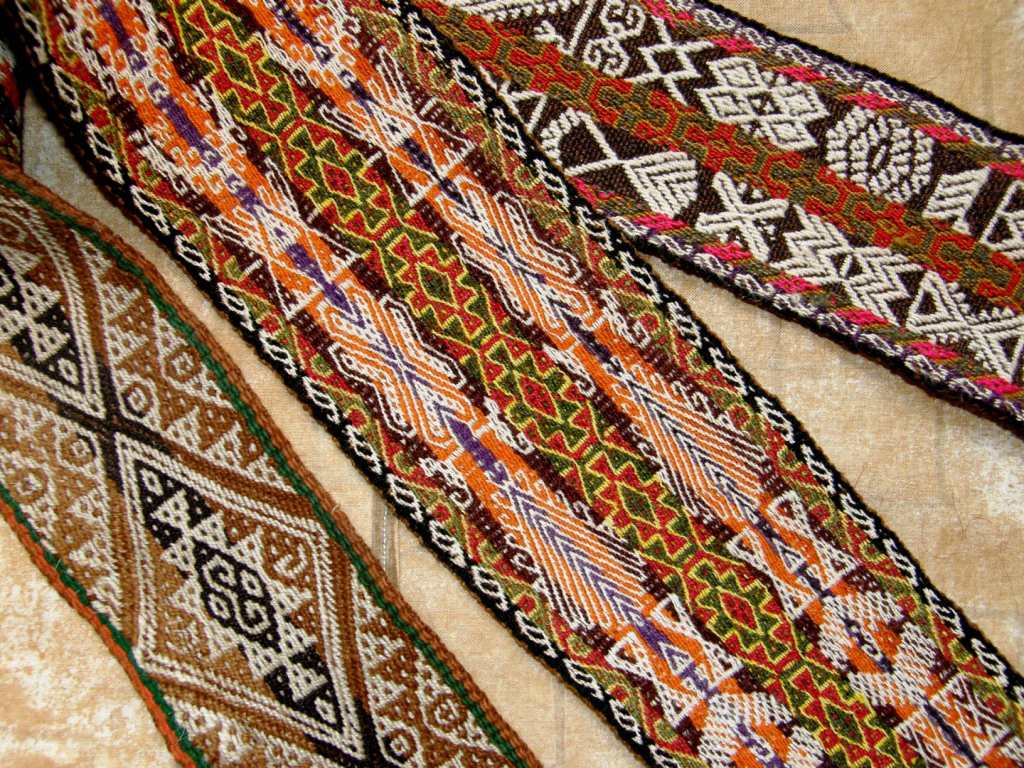
These pieces from the Cusco area have a mind-boggling amount of pick-up patterning.

These broad double weave belts from the central Bolivian highlands show the progress that organizations such as PAZA Bolivia are making in helping weavers to recover natural dyeing techniques. These wool belts have a distinctive smell that I can only describe as campo (the country).. a mixture of wool, the natural dye material and smoke….I love it!

I love this sash that I bought on my first trip to Peru before I even knew what pebble weave was. You may recognize a couple of motifs from my book.

Here’s a beautiful three-color belt of the northern Chilean highlands. I may not want to buy the textiles, but think I will always want to buy tools as I will definitely use those. Isn’t that beater wonderful slick and shiny with use?!

Knowing my love of pebbled things, Pam Nadjowski gave me this belt at Convergence. It is one that she collected from the Dong minority group of China. It is very long and must wrap at least three times around the waist.

These are part of Kathe Todd-Hooker’s extensive collection of belts of the Russian old Believers. Taking plenty of pictures, albeit not particularly sharp ones, has enabled me to reproduce some of the designs. Kathe says that the belt around the body has the symbolic purpose of creating a visual cross as well as representing the encircling arms of the church.

So, we weave bands to encircle our waists and then some people weave them to encircle their homes…

Yurt bands! I love them but what would I do with all forty-eight feet of one? My friend Lisa’s owns this beauty and owns a yurt on which to use it.

Sometimes just photographing a small part of a belt is enough to get me motivated for the next experiment. This belt with its combination of simple warp floats and supplementary wefts was very intriguing.

This Huichol belt that I originally photographed in the National Museum of the American Indian back in 2007 has been on my mind all these years and has influenced a few projects. Then I finally learned how to do the balanced double weave technique in which it is made.

I love sashes and belts…the long flowing loveliness!. They have prompted me to make a few of my own. These would be pretty dull wrapped around my hair. I must make some much more colorful ones.

This next one is more like it. It has been with me for years. It is a sample I wove when I still lived in Chile and I intend to make a full sash with this design one of these days…

And more sash inspiration and ideas come along every day…

This study sample of the sprang technique used to make Hopi wedding sashes made by the late Nora Rogers was given to me last year.

There’s more! But that’s enough don’t you think? Just think…I will be  at sash-weaver Annie MacHale’s home next week swimming in long gorgeous sashes…not only the beautiful ones that she has collected but the fantastic ones that she weaves herself on her inkle looms.

I will finish with a quick report on what I have been up to on the loom.

Apart from samples for my next book which I am not showing yet (!), I have launched  the second ikat experiment. This means that I didn’t actually spend that much time at the loom. It was more about tying cassette tape to form the design, dyeing and re-dyeing as I wanted to have three colors. I chose terracotta and navy blue after hearing about the chocolate and blue ikat textiles of Guatemala that Karen from the Ravelry group likes.

Tied and ready to be dyed…. I am afraid that I am not being very brave as this is the first experiment with dyeing two colors and so I only wrapped one motif on each of the three sections.

Dyeing done. There will, hopefully be white diamonds on blue with terracotta centers on the two outer sections with a white diamond on terracotta with a blue center on the middle one. Like I said before, this for me is the easy part. Now to weave and have it all stay more or less together. I have woven the first two inches of plain weave and am about to hit the wrapped section and will show you next week how it went. I am using a fine weft again as I really like the way the resulting fabric looks and feels.

This next piece started off as an experiment but now I think it will be one of the key fobs for my muddle of luggage keys on the trip…Too bad I didn’t start it with a third selvedge.

I am weaving this in what I call the “embedded double weave” technique, that is, plain weave alongside double weave. The green borders are plain weave. This is the technique I learned in Potosi, Bolivia and this way of including strips of patterned double weave in plain weave fabric is used in a few places in Bolivia. Two wefts are used. I have, however, been trying something new in the material I use for the second weft and in the way I handle the two wefts and I love the way it is turning out.

The new way I am trying makes the transition from double weave to plain weave on the upper face less obvious and harsh and on the lower face it is, amazingly, not apparent at all…completely smooth! I will fill in the details next week. I thought I would save something for next blog day as I will be just arriving in California with perhaps not a whole lot of time to put things together to post. My posts will probably start getting erratic.

For next week I am also saving pictures of Bobbie’s progress on the gorgeous naturally dyed Guatemalan warp that I showed you last week.

We can take a look at the pattern she is weaving and see how she set up her loom to create it.

Naseen on Ravelry has finished a sash (in my favorite colors of the moment) and shared her pictures with the group…

She used the tutorial on the yurt band border pattern here.

Yonat has been playing with the double weave technique she learned in our workshop last fall on her inkle loom. The technique transfers perfectly to this kind of loom and you will find pictures of the set-up on the inkle loom on the tutorial page here. Here’s her sample band with Andean and Bedouin motifs as well as others that she invented herself.

Andean Pebble Weave is now available in Italian on the Patternfish website. Many thanks to Lidia Guffanti who did the translation.

Now that it’s in four languages, I can tell you:

Happy weaving! Buona tessitura! Bon tissage ! Viel Spaß beim Weben!

See you next week in California!

Backstrap Weaving – Announcing….Events, Books, Resources!

It’s been one of those weeks again…hands occupied at the computer keyboard and eyes peering through the camera lense with plenty of small projects going on and off the loom bars but no “real” weaving getting done.

It is sample-weaving time for my next book and, as always, I just love my backstrap loom when it comes to knocking out wee samples for photographing. I can have several going at once on my twenty-six loom bars and even the smallest scraps of yarn can make enough warp to make my test successful.

At left you can see an old sample I made to check the proportions of the motif I was charting in double weave. I could put some safety strings in that warp, roll it up and put it in my pencil pouch.

The only real weaving I did this week was one more motif on my ikat band but then, that really is just another sample.  I do plan to use it for something when it is done. I made some sketches for the next ikat experiment and would like to get that going this weekend as an incentive to finish the sample band.

Karen in the Ravelry group told us about how blue and chocolate colored ikat pieces are her favorites from Guatemala and I have had that color combination in my head ever since. I have terracotta brown and navy blue dyes and I think I shall have to try something with those.

So while I have been tapping away at the keyboard and doing gymnastics with the tripod and self-timer on my camera, (12 seconds is NOT long enough!) one corner of my mind has still been occupied with new ideas for the my next weaving projects.

While I don’t have any new weaving to show you, I do have a few nice announcements.

Firstly, David K Barker’s first volume and first part of his third volume of textile designs of Bhutan are now available as downloads in addition to the second volume which I wrote about here some months ago.

The links are on the RESOURCES page. What will we do with all these motifs?! I have a few ideas. 🙂

I have also included on the RESOURCES page links to videos on a couple of my favorite finishing techniques for my backstrap woven pieces. Thanks to Tracy for this idea. She was just mentioning today how hard it is to find the video for the Van Dyke stitch that I embedded in a post a long time ago.

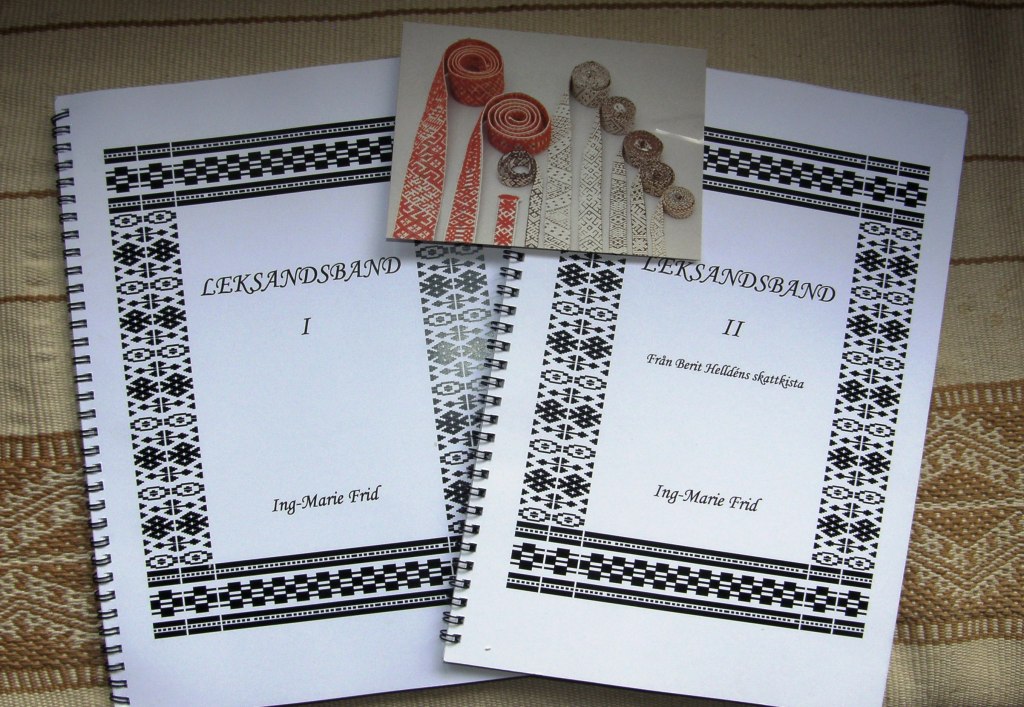
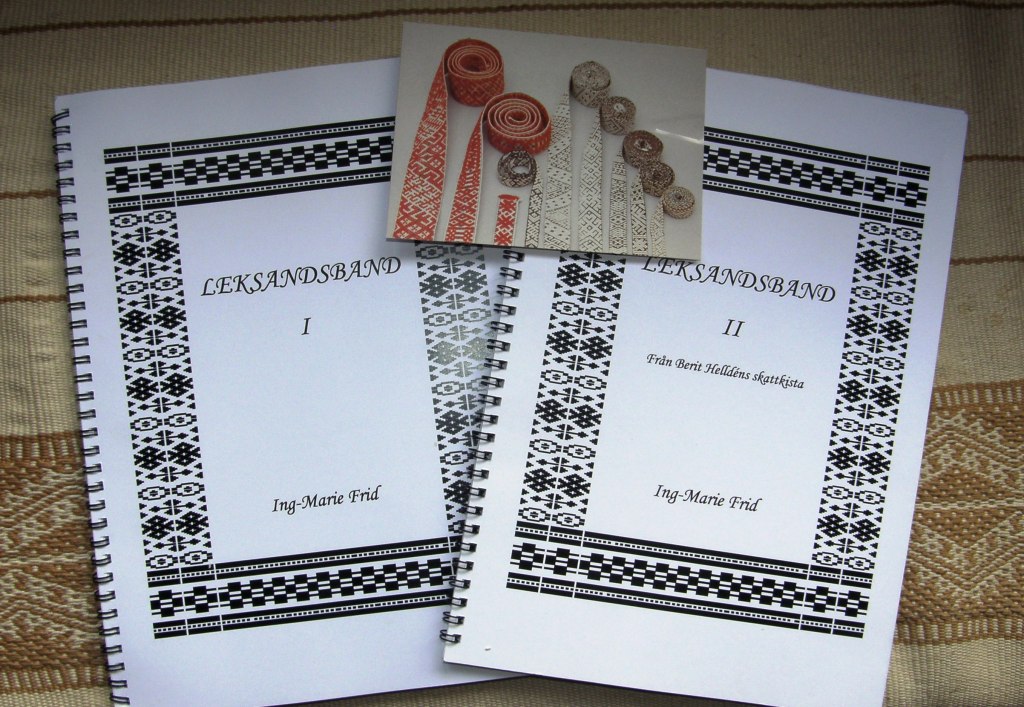
A couple of weeks ago, I showed two books on Leksandsband by Ing-Marie Frid which were sent to me by a weaving friend in Sweden. Some people have asked me about how to buy these books and I have put this information on the RESOURCES page too. Ing-Marie was kind enough to write a comment on my blog with a contact email address.

The books are not about teaching the band weaving technique, but are catalogs of patterns which have been beautifully and meticulously charted alongside photos of the original bands.

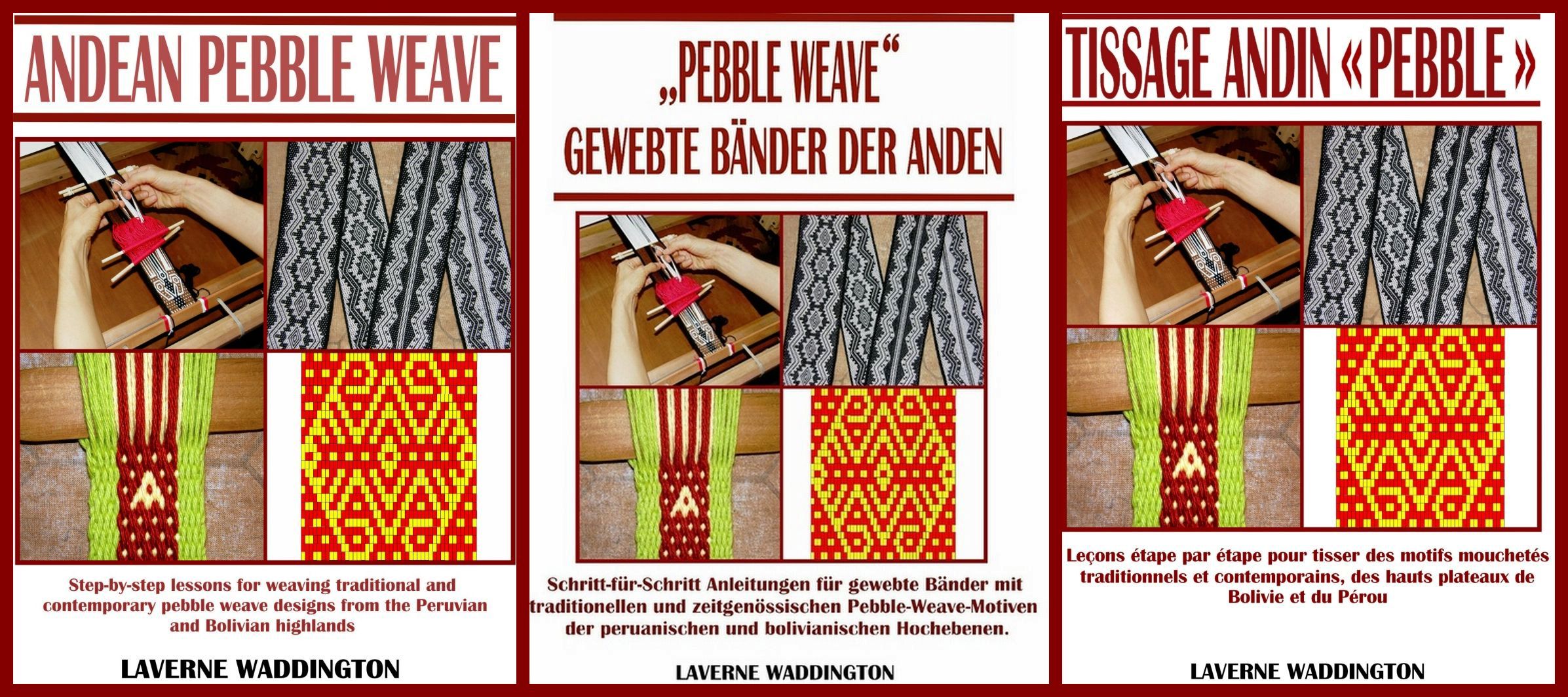
And, speaking of books…my e-book  Andean Pebble Weave is now available in French as Tissage Andin < Pebble> on Patternfish.com.  It went up on the Patternfish site a couple days ago and has been bought by two people in France and another in Switzerland so far….exciting! It will be fun to see how many French-speaking countries it reaches.

I guess I feel I have a small connection to France and Switzerland having spent five entire ski seasons in Val d’isere with my French boyfriend at that time as well as having done some wonderful summer hiking in the Pyrenees. And then there’s my aunt who left India as a young girl to work taking care of an elderly woman in Italy. She met and married a Swiss man and has lived in Switzerland ever since. We tend to wander about a bit, my family!

I am very grateful to Sandrine de Tricofolk who translated the book for me. Sandrine created the online forum for French-speakers known as forum filage for enthusiasts of all textile crafts. She also blogs about her various textile hobbies. And she also translated the following for me:

Je suis heureuse de vous annoncer que le livre “Andean Pebble Weave” a > été traduit par Sandrine de Tricofolk, et qu’il est maintenant > disponible en version française ici. Sandrine est à l’origine du forum 
 filage, un forum francophone pour tous  les passionnés d’artisanat textile, et partage également ses diverses > réalisations textiles sur son blog.

This week brought an interesting email to my inbox from Maria Elena Del Solar a Peruvian anthropologist whom I met at a weavers’ gathering that took place here in Santa Cruz, Bolivia last year.

That’s Maria Elena on the left with two other participants at the gathering from Chile and Ecuador.

Maria Elena is a member of an association called ANDESMANTA which is organizing what they call the first Meeting of Weavers of the Americas, ETAM2012, in the city of Cusco Peru October 1-4, 2012. 

She has asked all the recipients of her email to circulate this information and direct people to the website which has been set up with the first announcement.

I do not know very much about the exact nature of this gathering. The Tinkuy de Tejedores that was held in Urubamba, Peru in 2010 (in blog posts here and here) and the Encuentro de Portadores de Tradición del Universo Textil Andino y de Tierras Bajas (in blog posts here and here) which Maria Elena attended and which took place where I live in Santa Cruz, Bolivia were two quite different events. For one thing, the former was conducted in Quechua, Spanish and English and had a large attendance of people from outside Latin America. The latter was conducted entirely in Spanish, was a much smaller affair, and was attended only by residents of Latin America. However, the web page for the proposed ETAM2012 conference has a version in English.

Early morning pre-conference activities at the Tinkuy de Tejedores in Urubamba, Peru in 2010
Guaraní weaver, Angela, from lowland Bolivia meets and learns from Celinda, an Aymara weaver from highland Chile at the Encuentro held in Santa Cruz in 2011.

I will be staying tuned for more information and am very relieved to see that my calendar is clear for those dates.

Well, I think that that is it for the announcements. For this week there is just one more thing I would like to share with you.

A Facebook friend sent me a link to a Knitpicks knitting kit for an Altiplano Satchel which is described as having been inspired by Peruvian motifs.

Isn’t that gorgeous? My friend sent it to me as she thought that it might inspire a weaving project for me. I love, LOVE how people keep me in mind for these things! She said that she thought that it would look even better as a weaving. Actually, I doubt it. I think the bag as it is is pretty hard to beat!

I was tickled to see the “S” motif along the bottom and the sides which I have actually already woven.

I didn’t find that motif in Peru but rather on a yurt band from Central Asia. In fact it is charted and appears in its own tutorial here on my blog (sorry, but this one is not for beginners).

So, I have a head start on that part of the pattern! Certainly I could replicate the layout of that satchel design in weaving and would probably choose warp-faced double weave to do so. I have had success with translating warp float patterns to double weave before but I like that knitted bag just the way it is and envy knitters who will be able to sit on a train (or at a tribute concert to Frank Zappa as a friend of mine did!) or ANYWHERE with their two sticks and create something so beautiful!

Here is the “S” pattern doubled and mirrored on a belt I wove using the same technique as that used on the yurt band that inspired it.

We talk about the wonderful things that can be created with the backstrap loom with its simple sticks and a few weeks ago I blogged about the lovely Wayuu bags in tapestry crochetlike the one at left, made with one simple stick with a hook on its end.

Now, what about two simple pointed sticks otherwise known as knitting needles? According to the Knitpicks page, the body and strap of the bag are knitted in the round and steeked (steeked?! I know as little about knitter-speak as I do about crochet terminology).

I have some more gorgeous knitted things to show you including some images of stunning traditional outfits from Sweden made in twined knitting that a collector sent me with some background information which is really interesting (I say that as if I know what twined knitting is…I don’t really!). Of course there is a Ravelry group for twined knitters. The traditional outfits are red with gorgeous black motifs. You know I am a sucker for red and black and I am sure that those knits will inspire a weaving project!

I am going to save all that for another post.

So, I will close this page early for this week and use the extra time to dive back into my book. Hopefully, I will be able to make time for my weaving projects this coming week.

Backstrap Weaving – Ikat – Turning “Blips” into Beauty

IKAT! Ikat can be a little hard to deal with for someone like me who is into planning, charting and precision. I count my warps carefully…this one needs to be floated, this one doesn’t and, oh no, I made a mistake and must un-weave and…. darn!, the design is not looking as I thought it would…better un-weave and re-chart. I am not one for “winging” it or just throwing a warp on the loom and seeing where it takes me. I am even less crazy about letting a “blip” become a “design element” although my work often has such blips!

When I have tried ikat, the tie-dyed warps wandered off as they pleased once I started weaving, blurring the design to the extent that the original planned pattern became totally unrecognizable! You can wrench the warps about and try to get them to behave or just let them go and appreciate the beauty in the “blips”. You can probably guess which one I am more inclined to do.

Way back when I first tried ikat on the above warp I thought that it was all about the tying and dyeing and I was so nervous. Had I used the right wrapping material? It took me a while to settle on cassette tape after trying cabuya fiber (a kind of agave) and then strips cut from plastic supermarket bags. Had I tied tight enough? Was I using the right kind of dye (answer: NO…I used cotton dye on wool which gave me a wishy washy pink instead of  the Mexican red promised on the package). Would the wrapping allow the dye to seep?

Once I had dyed the warp and unwrapped part of it to see my lovely crisp and sharp pattern I was delighted. Now to get to the weaving…the easy part, right? Just plain weave, a piece of cake. And that is when everything went quite mad. The warps slipped around out of position with every move I made, the parts of the design wouldn’t line up and I was terribly disappointed.

Then came this….

On my trip to Guatemala in 2008 I bought this…a prepared ikat warp ready to go on the loom. “Ikat the easy way”! I exclaimed. This warp had been prepared by the experts and surely it would turn out nicely. I took just one section of it and put it on my loom….it was coming out even worse than my own experiment. At least on mine the first motif looked kind of okay. I put it aside very quickly. I just couldn’t bear the thought that someone had gone to all the trouble to tie and dye this warp only to have me come along and mess it up. It’s still there in the closet.

Once you have had an ikat disappointment, it is not really something that you feel like launching into again in a big hurry…all that time spent tying, dyeing, waiting for it to dry. In any case, I felt that I hadn’t really learned anything from the exercise to warrant another attempt. I needed to do some thinking about what needed to change about the way I was handling the warps.

But I did take something away from the experience – a growing awe and respect for the ikat weavers around the world! My gosh, the work they do creating those amazing images in their cloth. The motifs  have that wonderful fuzziness in their outlines which is what makes the technique so attractive.

This is a piece from Indonesia from a collection  of textiles owned by Phil Willett that he and the late  Dennis Penley collected. Of course the warps move out of alignment but not so much that the image is completely lost as mine was. Just the right amount of shifting is what makes this piece beautiful.

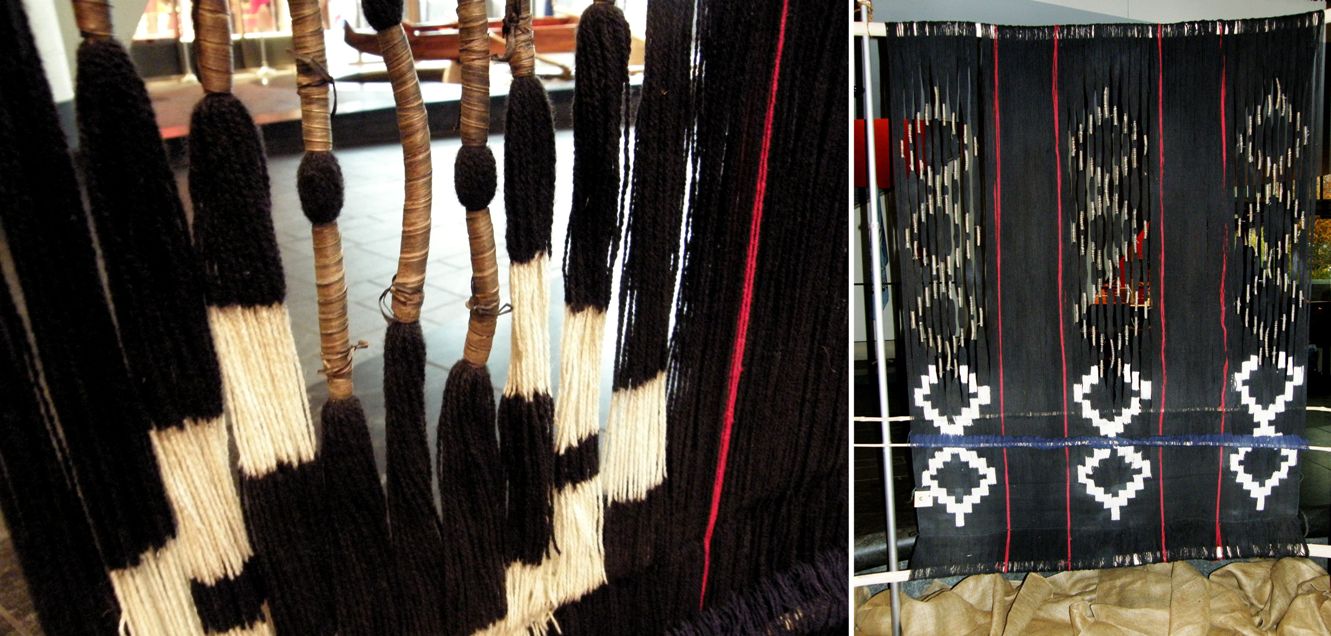
I saw an ikat bed cover that my weaving teacher in Candelaria was weaving with both hers and her husband’s names spelled out in the tie-dye technique, watched ikat weavers with their backstrap looms in the towns around Cuenca in Ecuador, saw ikat warps being prepared for floor looms in Salcaja in Guatemala, gazed at the amazing Central Asian ikat robes at the recent exhibit at the Textile Museum in DC and got to touch and examine a Mapuche ikat warp for a poncho on the loom at an exhibit at the National Museum of the American Indian in DC late last year.

The Mapuche ikats are known for the minimal shifting of the warps in the design and the relatively clean and crisp outlines the patterns have as a result.

Ikat! Sigh! I read an article here just today that describes it as “as trendy as anything ancient can ever claim to be”. I am not trendy by any stretch of the imagination and wasn’t aware that it was so. In any case, the “trend” does not appear to have reached Santa Cruz, Bolivia. The article says that “this kind of pattern now lends interiors a kind of dressed up Bohemian vibe”.

Let’s hope that this is good news for the artisans and that people are aware of the incredible amount of time and skill that goes into the pieces and will be prepared to pay fair prices accordingly.

This video, which was embedded on Ravelry recently, shows one group’s enterprising way of mimicking the appearance of ikat. They produce large lengths of cloth with large fuzzy-outlined ikat-like images without the long tying and dyeing process….

Schumacher – Darya Ikat Weaving Process from Schumacher on Vimeo.

And I have seen other interesting ways to imitate the look of ikat in the online weaving groups…the “faux ikat” using painted warps. Weaver Bonnie Tarses has a video here that shows how to set up for what she calls “almost ikat”.

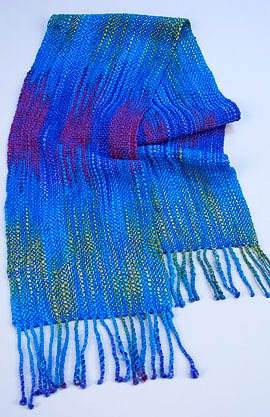
In this WeaveZine article Syne Mitchell shows how to create an ikat effect with painted skeins on a rigid heddle loom.

The beauty of the piece is all about the very misalignment of the colored warps that I have been struggling to avoid.

See how the “blips” are turned into beauty!

I would love to weave something like that but I know that I would spend the whole time fussing with the warps and trying to get them to line up! I just wouldn’t be able to stop myself!

Ravelry member jtellier wove a faux ikat scarf on her rigid heddle loom, which you can see below, and shared it with us for inspiration when we were planning  our plain weave weave-along in the Backstrap Group.

Now we are doing an ikat weave-along and have four participants so far.

In this current weave-along we are trying to do true ikat by tying and dyeing the warps. We recognized that we needed to go into it with the right attitude. I didn’t want people to end up as disappointed and frustrated as I did after my first attempt and so we are all participating with the idea that we will definitely create something “interesting” if not exactly what we had in mind in the planning stage.

I have got some ideas and theories together about how to create my ikat pattern with a minimum of blurring in the design. My weaving friend Tracy and I discussed how the Mapuche weavers appear to leave all their ties in place on the warp and only unwrap enough of a bundle to give them the minimum of space in which to open the sheds and pass the weft. I have tried weaving without unwrapping everything beforehand (the warps still slipped) but not to the extent that the Mapuche weavers do.

I was also intrigued by this picture on the Education and More website, on their backstrap weaving page, of a warp in Guatemala which has been glued to the loom bar with corn masa. (Karen from Education and More tells us that it is used as a paste to secure the threads).

Hmmm… I thought. Maybe I can use diluted white glue to do the same.

Karen from Education and More shared this image with us in the Raverly Backstrap Weaving Group:

It shows how some ikat weavers, with whom she works in Guatemala, tie cotton around the sections of dyed warps to stop the warps from moving. I suspect that cotton against cotton holds well and does not slip. I have tried doing that with the cassette tape. The tape is far too slick to be effective. Doesn’t that warp look gorgeous!

And the final inspiration came from a Chilean lady on Facebook. A Facebook friend of mine “liked” her picture which is what allowed me to see her at work on an ikat piece on a wooden frame loom. I so wish I could have posted the picture here but I have not yet made contact with the weaver and, if I do, I will post the picture next week. I saw that she too was working in a very small space between the partly unwrapped ties and the weaving line.

She had a separate bar which appeared to part of the frame loom which was her shed rod. Unfortunately only a very small part of the loom can be seen. What interested me was that she had multiple sets of small heddles around  the groups of warps that she had wrapped. Each group had its own string heddle rather than having one large string heddle across the entire warp.

So I decided to use all these tactics in my project. As an experiment, it is not a very well conducted one as I will never be sure which of the new tactics will be responsible for the result…one or any combination of all of them.  Ah well.

First came the warping and wrapping. I set up the warp on a frame to wrap with cassette tape…still my favorite medium. I did not get carried away with the size of the warp. I guess that tells you something about my confidence, or lack thereof, in the success of the project! This is a cotton warp.

Here it is after dyeing with Dylon Olive Green cold water dye. I had dyed a skein of Plymouth Yarn with the green and this warp got tossed in at the end. The color is a little uneven and I kind of like the sort of washed-out look.

So here is the first motif. I was very pleased but still reserved in my excitement as I know from experience that the first motif generally works quite well. Things tend to go mad after the frst one.

My friend Annie will recognize the business card that she gave me back in 2010 which I am using to start the weaving and as a wee shuttle. I still have it, Annie and I hope you will give me a new one when I see you in March!

The warp at the loom bar is stiff with white glue which never entered the dye bath. The cassette tape ties down there are fairly ineffective. The warps just slide right through those but I like to think that they help a little. Cotton ties like the Guatemalan use would have been better. You can just see the bunches of white string heddles.

And I used a very fine weft. The warp is similar to a #10 crochet cotton. Of course I forgot to dye yarn for weft. I wove with this fine weft to start and finish the rep weave piece I showed last week and I really liked the feel of the fabric it produced.

Here are three finished motifs and all is well. The motifs are all a little different. I was not precise in my measuring and wrapping of the segments. The space in which I open the sheds is tiny and I am thankful for the fine sword that came with a Guatemalan backstrap loom that Linda in California gave me. I am using shed loops for the non-heddled shed. One shed loop for each section.

Three more motifs to go and I will be done…short and sweet! Very sweet! I am pretty happy with this. Now, which tactic or tactics produced these pleasing results? Good question!

What about the backstrap weavers who just go and unwrap all the ties, throw the warp on the loom and weave away producing beautiful results?…no “glue” or teeny tiny weaving spaces with teeny tiny bunches of heddles. I am completely in awe of these people.

And what about the ikat weavers in Uzbekistan?

My friend Pam took this picture in Uzbekistan and has allowed me to show it here. The ikat Master marks the mordanted warp and the ladies do the tying. Often the warp is mounted in layers on the frame so that multiple layers can be included in each wrap to repeat the patterns along the length of the entire warp. I got the idea of mounting my warp on a frame to wrap from seeing this picture.

The Education and More site which I linked to above and Flickr page have lots of beautiful pictures of Guatemalan weavers and textiles including many images of ikat weavings.

Did you know that Education and More is selling naturally dyed cotton from Guatemala on their website now?


Bobbie who is in the Ravelry group is not joining us for the ikat WAL.

She has just received her shipment of naturally dyed cotton yarn and has launched herself into a new project which has been inspired by this Guatemalan piece.

It is from the Education and More page and Jennifer discovered and shared it with us. It is the simple warp float technique and very effective.

I am sure Bobbie is going to do a beautiful job with it. Look at the Bedouin piece that she just finished:

As for ikat….will I go to all this trouble again? Yes! Now I am thinking multiple colors and trying to figure out how best to do the layering….it will be another sample. I will probably sew the current piece onto a piece of woven fabric. It is fine enough to do so, I think, and I would really like to use it.

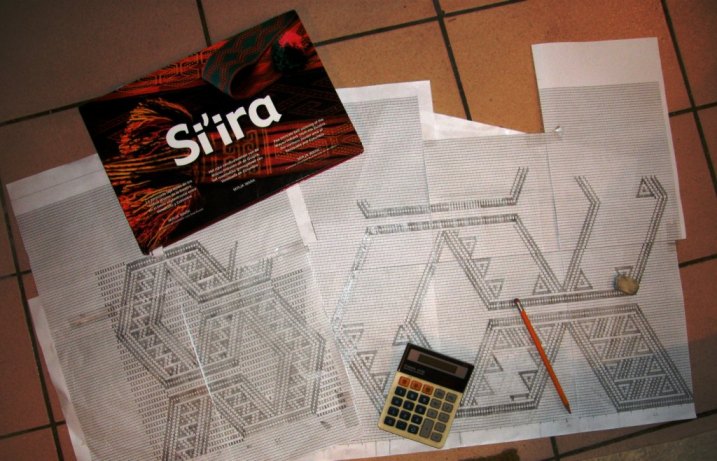
In the meantime, I have started the next part of the si’ira inspired piece. All that counting had me procrastinating I am afraid…576 ends in the pattern area. The first row of pick-up is crucial. All other rows are picked up relative to that one and I can tell you that it is not fun to discover on row 20 that the lines in the motif are not meeting as they should because the first row was picked up incorrectly! So I really have to be in the right frame of mind to work on that first row…check and re-check.

And, it is done! and I am off and running.

Backstrap Weaving – Books and Blessings

I don’t do Christmas. I don’t have any family here and so it seems kind of pointless but it seems that Christmas does me! And all my Christmases came at once, as they say, this month when four packages were waiting for me at the post office this week on top of a couple that I had received the week before. Two were purchases that I had made some time around Christmas and the rest were gifts.

One was from Argentina, another from Morocco via Australia, one from Bangladesh, one from Sweden, one from the UK, one from India and yet another from Australia. Luckily, I now have space for all this new stuff!

I can’t decide which one produced the biggest smile.

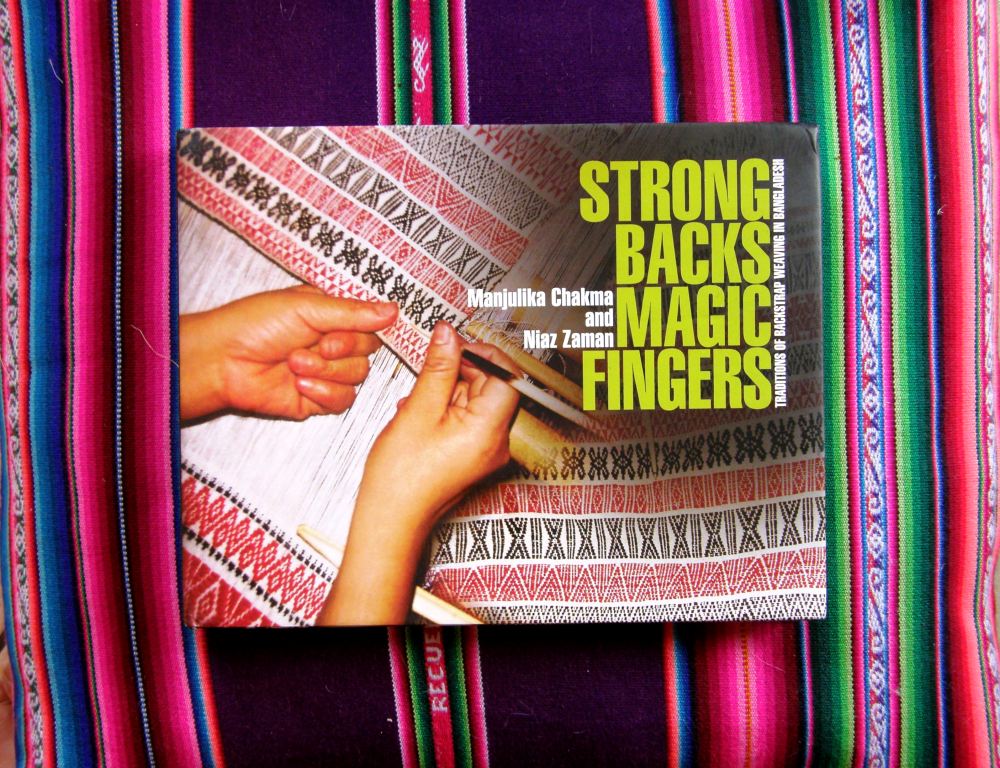
Let’s start with the book from Bangladesh on backstrap weaving. I suppose this is the one about which I feel most triumphant.

I have been trying to get this book since the middle of 2010 when I ran across a newspaper article about it online. Letters to the publisher didn’t produce any response. I tracked down an Australian journalist who had written a review on it but she couldn’t help. I asked my Godmother in India to try through some friends of hers in Bangladesh…no luck there either. I met a teacher from Spain on Ravelry who is working in Bangladesh who offered to try and get it…she couldn’t manage it… and finally, a Facebook acquaintance, Ananda, who works as a fashion designer in Bangladesh, came through.

He had heard of one of the authors, Manjulika Chakma and seen the book at a book fair. He managed to find the author, go to her house, where he said he enjoyed seeing her collection of tribal textiles, buy the book from her, tease me by posting a picture of it on Facebook and then send it to me! We were both very nervous about the mail as we both live in countries in the developing world where things often don’t work quite the way they should.

Well, I have been blessed because here I have it in my hands and it is really lovely.

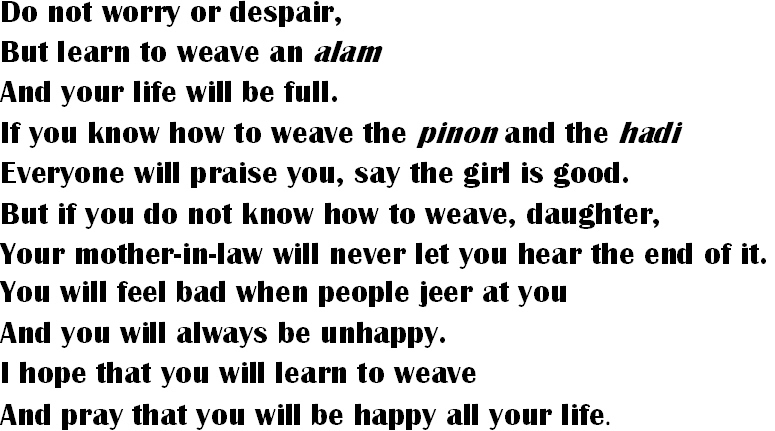
I have only read the first few pages of Chapter Two which is about the Chakma weavers and it starts with a lovely story of how, in order to encourage the tribal backstrap weavers to start weaving again the traditional sampler known as alam as well as to see just how many of the 210 designs could be recovered, a competition was organized among twenty weavers to see who could produce the best example. And the story goes on from there telling about the preparation for the weaving, the loom, the process. I can’t wait to read more.

One thing I would like to share with you are some lines from The Song of the Loom by Chiranjib Chakma translated by Niaz Zaman which appears at the very start of the book. This is just a part of the song:

How I wish I could hear this sung in its original language!

Twelve chapters in the book deal with twelve different tribes and their work. One disappointment is that the index promises a bibliography on page 164 but my book ends at page 160! Too bad…I love bibliographies. 

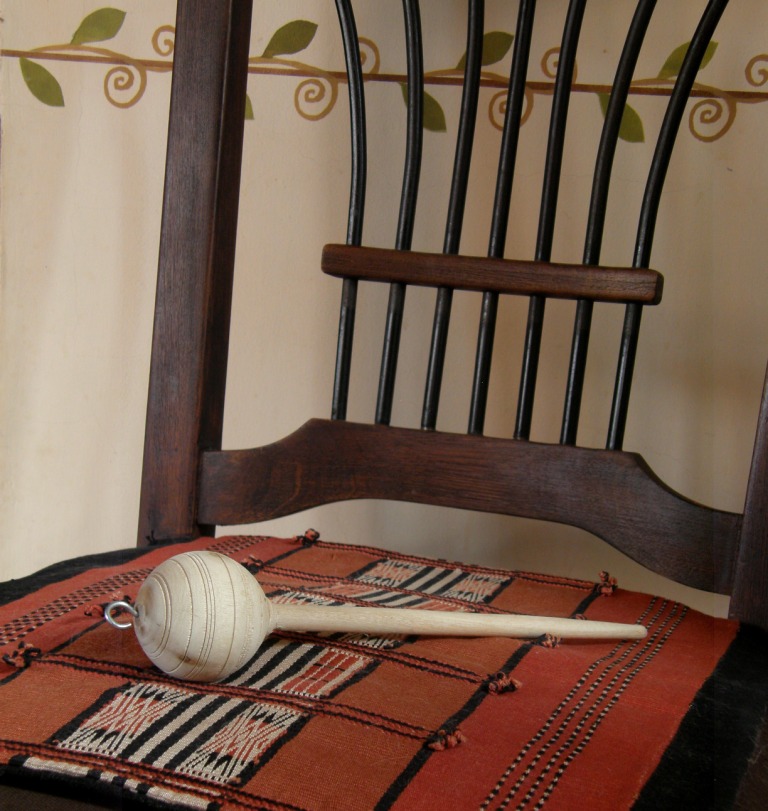
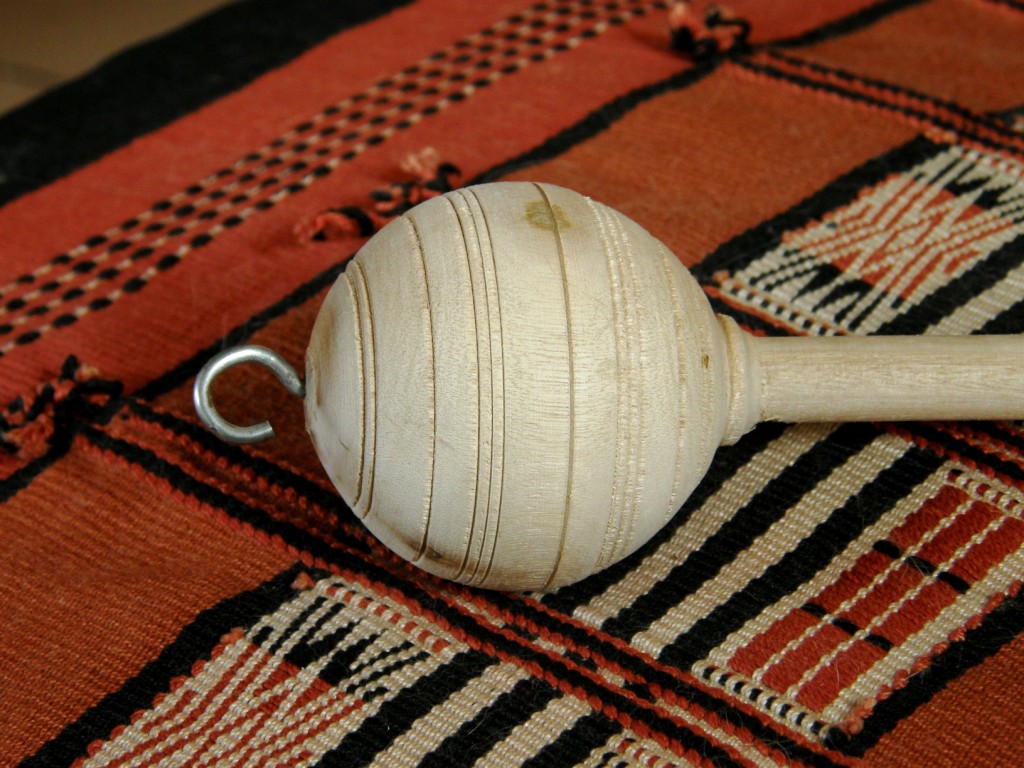
From Morocco via Australia came this spindle…

A friend of mine in Australia, Linda, went to Morocco last December and I asked her to get me a typical spindle. I have since decided to make this a gift for my friend Lisa in North Carolina. It isn’t for me anymore after my recent de-clutter campaign…books will always be welcome but I have enough spindles!

I actually had no idea what a typical Moroccan spindle looked like and Linda is not a spinner and told me that she had quite a difficult time finding one in the markets. Eventually an elderly gentleman told her that, if she came back the next day,  he would have one for her. Linda thinks that he had this specially made for her.

I asked the ladies in the Spindle Lore group about this particular kind of spindle and got many helpful responses.

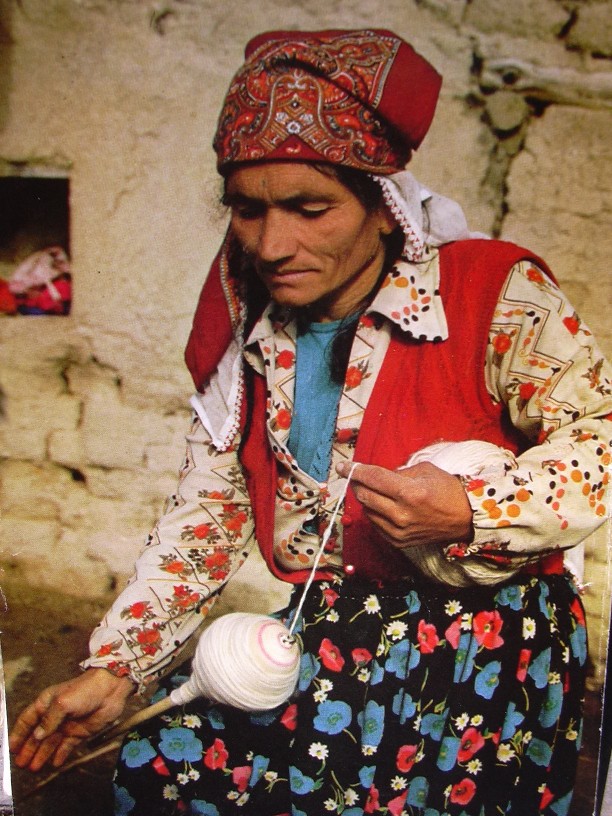
Tracy sent me a link to this site about Turkish tribal textiles which has this image of a woman using a very similar spindle.

I know that Lisa will use and enjoy this spindle. If it stays here with me, it will be left hanging on the wall. I am happy to see it, handle it and take pictures of it and learn a bit about it in the process.

To Think With a Good Heart…Wixárika Women, Weavers and Shamans by Stacy B Schaefer came to me as a used copy from the UK (copies for under $3 are out there!) after having been recommended to me by Hopi weaver Luis Garcia. Luis and I met online through a mutual interest in Huichol, or Wixárika double weaving.  Here is one of Luis’s pieces in progress. He is weaving almost exactly the same motif as I chose for my bag above.

The book is described as being …”a fascinating journey into a realm of ancient beliefs and traditions woven into the story of a way of life constantly threatened by the outside world…..(It) addresses both the technology of weaving as well as the dramas and personalities in a community.”

In the words of Stacy B Schaefer herself…

A woman’s weavings reflect the changes and transformations she undergoes as she follows her life’s path, and her rites of passage from childhood to adolescence and marriage are marked by her abilities as a weaver. As a wife and mother, she is the provider of woven items for her family until she is physically no longer able to weave. But, never idle for long, she takes up spinning to help the younger women in the family carry on the weaving tradition. A woman’s life is so integrally tied to her identity as a weaver that she carries her loom to the grave, where it is buried with her.

In this book, I hope to bring Wixarika women into visibility by focusing on the medium of loom weaving. I present a descriptive ethnography of Wixárika women’s lives in chapters organized in interconnected sections that discuss gender roles, the life cycle, economics, religion and cosmology.

The book is the result of Schaefer’s having apprenticed with master weavers in two Wixárika families but it is not a how-to book.

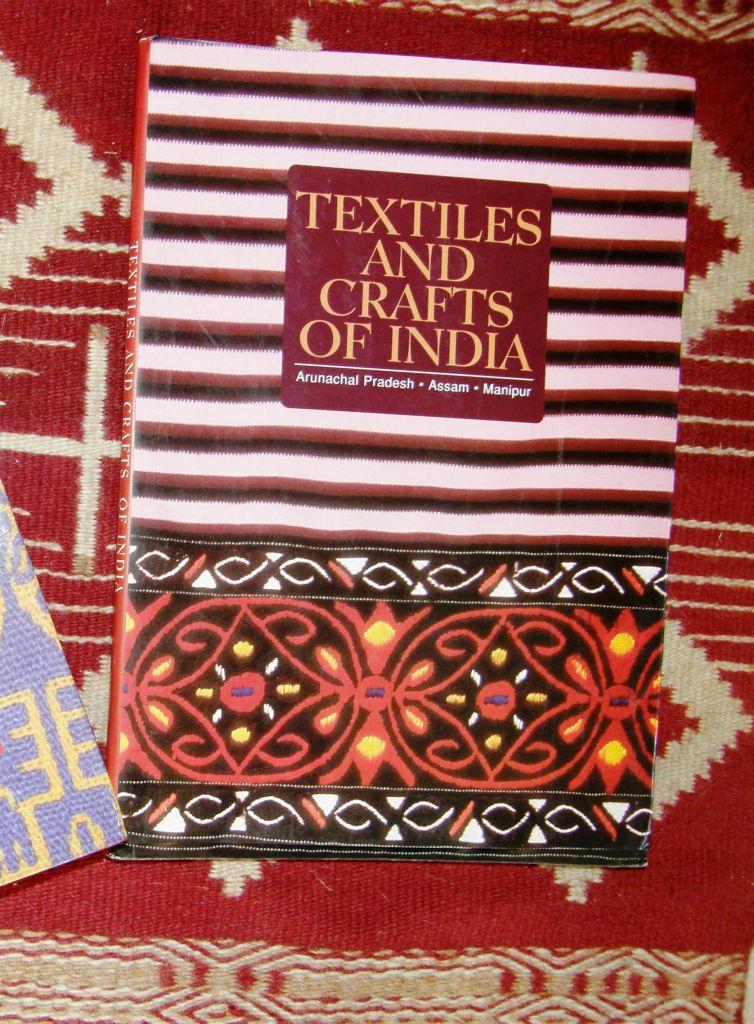
From India I received a book that was recommended by a weaving friend in Canada who just returned from a trip to the northern states of India.

Beautiful pictures and plenty of luscious inspiration! One particular textile jogged my memory from back in 2007 of a bag that one of my Youth Hostel roomies in the Washington DC Youth Hostel had. She said that a friend in Sri Lanka had given it to her.

What a great color scheme! I think I need to try something like this.

From Argentina…

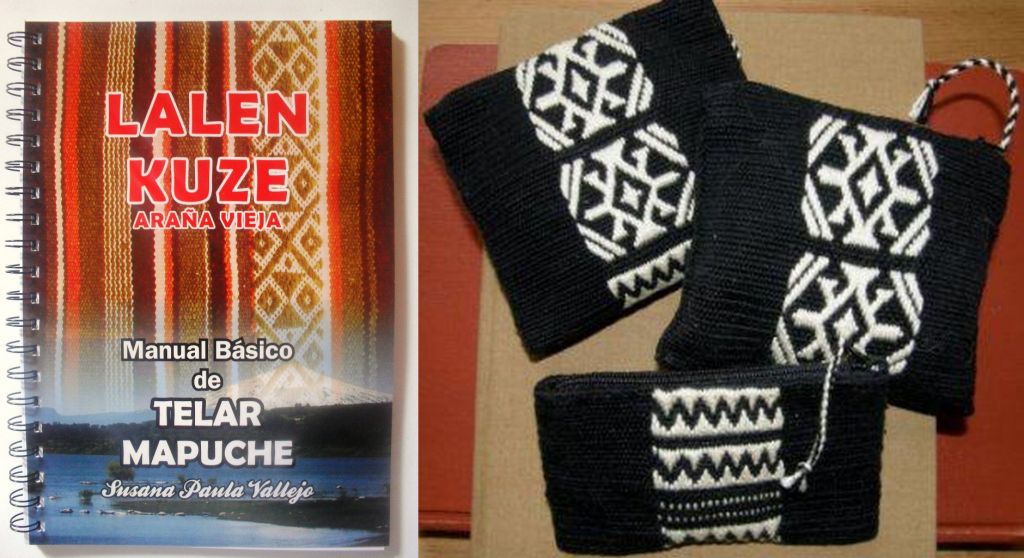
This is Susana Vallejo’s updated edition of her Manual Básico de Telar Mapuche. This revised edition has many more beautifully taken step-by-step photos than the original. Susana and I are online weaving buddies and we swap our books and ideas. I first swapped my Andean Pebble Weave book for a copy of her first edition. I will send her a copy of my next book in exchange for this copy of hers. She lives in Mar del Plata, Argentina where she runs a very active weaving school and I find her always buzzing with energy and so wonderfully charming!

Here is a picture that Susana herself put online to show what her new edition looks like…

Two gifts from Sweden via my online weaving friend Olle-Petter…

What a beautiful piece of work author Ing-Marie Frid has made with page after page of meticulously charted designs from these wonderful traditional bands. Photos of the original bands accompany every chart and they are simply stunning.

It wasn’t all about opening packages and playing with all my gifts and purchases this week. I did some preparation for future weaving projects too.
I am preparing a sample ikat warp putting into practice some thoughts and theories that I have on how to keep the threads better aligned. I am still not being terribly brave or adventurous about this and am using a simple diamond motif and keeping things small. I wrap the warps for one diamond a day, slowly and methodically while I think about different strategies for successfully weaving it.

I have the warp set up on a frame for now as I wrap and here it is sitting in front of a silk piece, with a similar simple ikat pattern, from Cambodia. I am using cassette tape to wrap.

I was pretty happy about my last attempt at ikat, which was just narrow strips within a larger textile, but I would  like to make some improvements…

The ikat is part of our new weave-along and we have Janet and Tracy so far wrapping away as well.

The other preparation project which was really taking a long time to get off the ground was the charting for the continuation of my Wayuu inspired wall hanging. Well, dither no more, it is going and appears to be successful! (although the proof will be in the weaving).

Mirja Wark has charted the traditional design in her book but it is not entirely symmetrical as that is the way the Wayuu weavers choose to weave it. I, however, have this need for symmetry and so I adapted and recharted it only to weave it and find it too small and delicate for my wall hanging and the thread I am using. Now I am changing it yet again to be big and bold enough for my piece. I kind of like the fact that I am changing it so much as there are now several  pieces of “me” in the design!

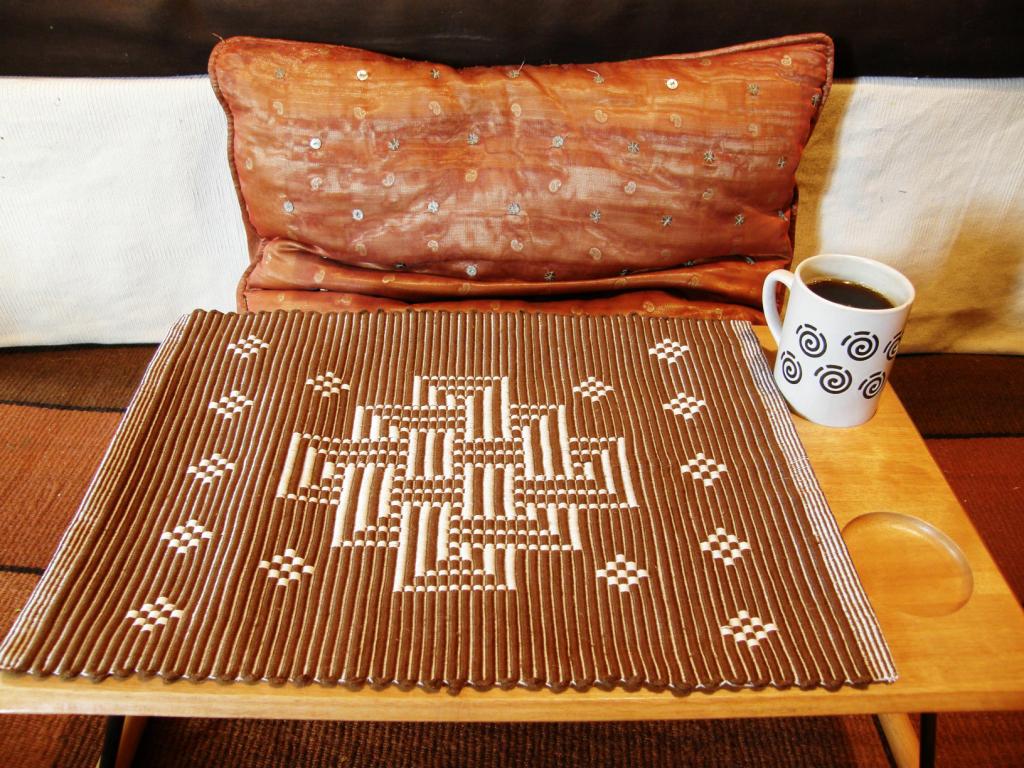
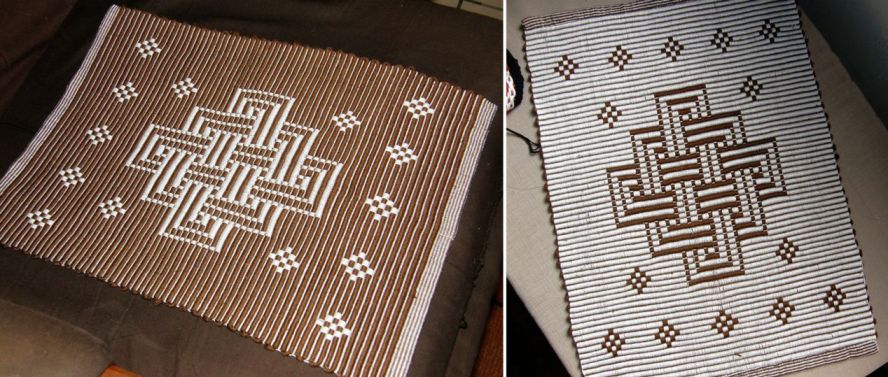
The rep weave sample came off the loom and got hemmed. I had some width issues so this definitely goes in the “sample” category. It fits my tray table perfectly though and will certainly be put to use to stop my bowls from sliding about.

And then Jorge came and said that he preferred the other side…not terribly practical white side up… but now I can’t decide which side I prefer! Thank you Marijke for your card woven  knot pattern!

Some Bedouin activity from online weaving friends…

Bobbie, from the Ravelry group is weaving this lovely piece using that yummy Dylon Cold Water terrcaotta dye on her cotton. She is weaving one of the al’ouerjan variations. Yonat wove Bedouin Warp Substitution  with me last fall and is weaving this band with many variations of the al’ouerjan pattern on her inkle loom. It is a sample band of the different patterns and she is practicing her weft twining along the way. She says that she is not crazy about the colors she chose but I love them!

We have exciting news from Tracy Hudson in the backstrap group who lives in Doha Qatar. She has written an article on Bedouin spinning which will be in the spring issue of Spin Off.

And that brings to me to wrapping this up with the unwrapping of the last “Christmas-comes-late” gift.

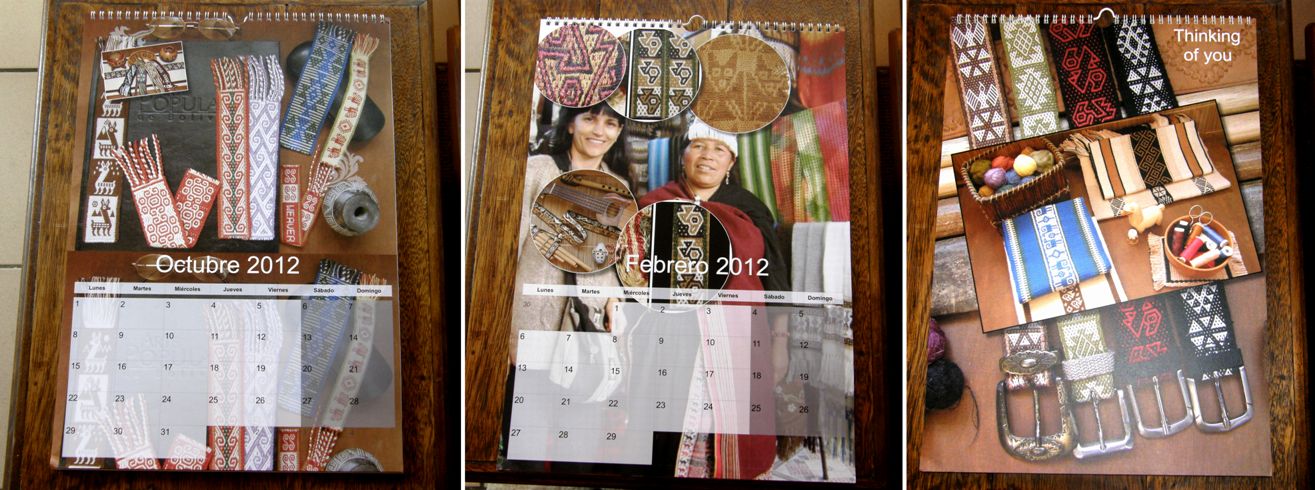
My dear sister-in-law made me an amazing calendar with pictures of some of my weavings mixed in with Navajo and other bits and pieces that she saw on her recent trip to south-west USA.  She didn’t have many pictures of my stuff to work with…just a handful of pictures I had sent to my brother for editing about two years ago but she did a tremendous job putting it all together.

And, wise and clever woman that she is, she left January 2012 off the calendar and replaced it with January 2013 at the end knowing that I probably wouldn’t get this until February. I don’t get to see Deb and the family very often and am way overdue on a visit to Australia. She blew me away with this!

And finally, I have to tell you that my book Andean Pebble Weave will soon be speaking French! I am very close to getting this e-edition up on the Patternfish website. And don’t worry, I didn’t translate it! It has been translated by a weaver in France about whom I shall tell you more once the e-book is ready for sale. Here’s a sneak peek at the cover…