Backstrap Weaving – Tropical Themes and Tools

Santa Cruz,  Bolivia has almost all the lovely things that the tropics typically have to offer…swaying palm trees, avenues lined with mango trees dripping with fruit, exotic plant and birdlife and tremendous afternoon downpours of cooling rain (sadly few and far between these days). Too bad there aren’t any beaches in this country to complete the picture of tropical paradise. For those of you in the wintery whiteness of the northern hemisphere, here is a bit of tropical Bolivian color to brighten your day.

tropical color

And, on a similar colorful and cheery note, here is my newest scarf project still on the loom…

supplementary weft patterned scarf backstrap loom

Carmen at her loom

The main inspiration for the patterns has come from a particular Guatemalan plant motif woven using supplementary wefts. Carmen, pictured at left, taught me to weave this in her home of Santa Catarina Palopó on the shores of Lake Atitlan.

The small plant motif uses inlaid supplementary wefts for the leaves and various warp wrapping techniques to create the stem and plant base.

I took the leaf pattern, changed it a little to fit my working space, and used it in the side panels of the scarf. I also expanded it into an imaginary tropical flower. The tiny butterfly motif was adapted from one on a Mexican backstrap-woven textile that I saw online.

I love the way the turquoise and gold supplementary wefts look together in the flowers on this purple background….visions of tropical seas and golden mangoes! I have to admit that I have been dying to combine those two colors somehow ever since I saw the following shawl by Elisabeth Hill on her Flickr page…

Elisabeth Hill shawl

How is that for inspiration?! And I got to meet Lisa and see this piece in person at Maryland Sheep and Wool last year where the shawl took Best of Show. Lisa has done some backstrap weaving  with me so maybe that will somehow influence one of her projects. Take a look at her Flickr page to see more amazing creations in deflected double weave.

yarn from 2012 trips

I like how my purple scarf doesn’t really scream “me” at all…at least I don’t think it does.

I once had someone on Weavolution say that she could immediately spot a project of mine before clicking on the image to see who the weaver was. It’s nice in a way to know that you have developed a sort of weaving “character and style” that can be recognised.On the other hand, it’s nice to branch out and do something completely different and I have realised that, in order for me to do so, it is helpful to have access to yarn that I have never used before. So, I think that along with my “wider, longer, finer” weaving goal for this year, I will add “new fiber”. I intend to quieten the little voice that tells me to “keep it simple and just make do with what you can get locally” and take advantage of my trips to the US to gather up new-to-me fiber and a greater range of colors.

Above you can see alpaca, wool, hemp and bamboo (?…this was a gift and I am not sure what it is) yarn from a recent US trip….much of it gifts from weaver friends.
coil rod and other toolsNow, back to the current project. What about that coil rod…what has it been doing for me? I roll it along the warp as my weaving progresses and the fabric gets rolled around the loom bars. It is definitely a handy width guide. Beyond the coil rod the warp tends to spread and fan out as it stretches away toward the far loom bar.

The rod also ensures that there is always beautifully consistent tension between it and the weaving line. It locks the warps into place and gives me even tension with which to work no matter how many stretched and loosened warps may be gathering beyond it and on the lower layer of warp beyond the far loom bar. In short…I like it! It is a great little tool.

You can see the coil rod in place in the above picture. Other “tools” that I am using on this project are several ties of colored yarn along the shed rod and in the heddles.  Because my patterns are not wide enough to warrant the insertion of pattern sticks to raise the warps under which the supplementary wefts pass, I am using little ties to raise the appropriate warps instead. There are some that go around the warps themselves in the shed-rod shed and others which are tied around certain heddle strings. I simply pull on these to raise the pattern warps in the heddle shed. They save time and prevent eyesight strain!

As far as tools go, sometimes the simplest are the best…

Montagnard backstrap loom with suttes and double band

It always delights me to see that the use of simple sticks to carry the weft is common to many backstrap weavers around the globe….no fancy tool required! You have seen in my pictures that I use a specially shaped shuttle. Three of these were made for me when I lived in Chile and they have a kind of sentimental value. I enjoy using them and they double as beaters and swords sometimes so they are pretty nifty.

The Montagnard backstrap loom above has two bands in progress and you can see the two simple shuttles. The looms are so large that it quite cumbersome to balance them when only weaving one narrow band. They are designed for weaving large panels of cloth which are used for skirts, shirts and blankets.

I must admit that I have been often pulled towrad buying teeny tiny shuttles at fiber fairs purely for their cuteness factor. I have on occasion used them but had to turn my closet upside down just now to find them to photograph as they have been idle for a long time…
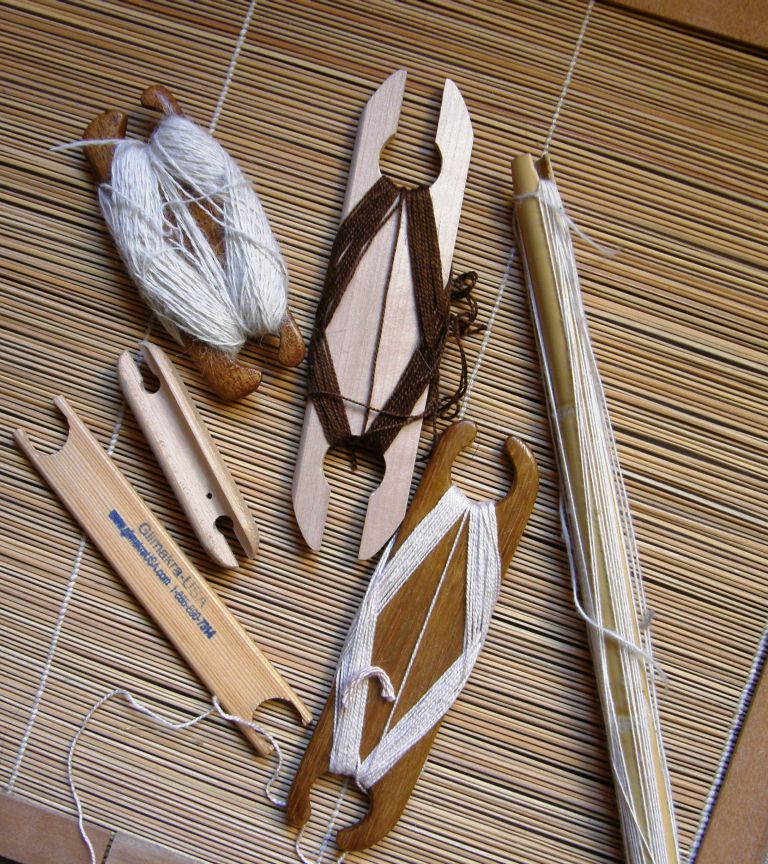
small band weaving shuttles

The long thin shuttle on the right is one that one of my Guatemalan weaving teachers used. All my other teachers have used simple sticks about which the yarn is wound or, for narrow pieces, simple “mummy”-like butterfly bundles. Below you can see two such weft bundles. The yarn feeds off the outside rather than from the center and a hitch is put in place to stop the bundle from unravelling when it hangs freely. These two examples are of handspun wool and alpaca fiber from the Cusco area.

yarn bitterflies used in backstrap weaving

For narrow work my Guaraní teacher uses short lengths of scrap yarn for weft. This way she never wastes a thing! The weft lengths are so short that she does not even need to wind a butterfly. For wide pieces a simple stick shuttle is used as seen below.
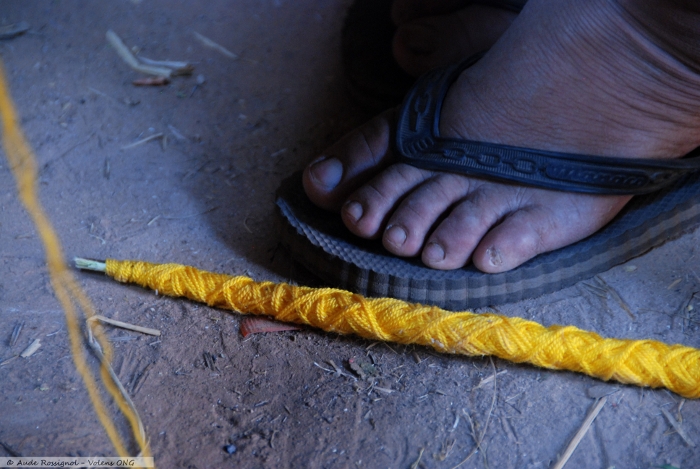
Aude Rossignol

Permission to use this image was kindly given by Aude Rossignol.

Here is a video showing my Montagnard weaving teacher, Ju Nie, loading yarn onto her shuttle. You can see that her shin is a very useful piece of equipment as, in a previous post, I showed you how she also uses it to help twist the fringes of her woven projects. The video has two segments with a short pause between. Wait for the second part which shows a weaver from the Cusco area loading her large shuttle.


One of the most charming ways of passing the weft is one in which the weaver has her weft rolled into a ball. She places the ball within the shed and then tilts her body to angle the loom so that the ball rolls through to the other side!

And finally, here is my teacher Trini in coastal Ecuador loading one of the three shuttles for the mini hammock she is preparing to teach me to weave. It was a balanced weave using three weft colors.
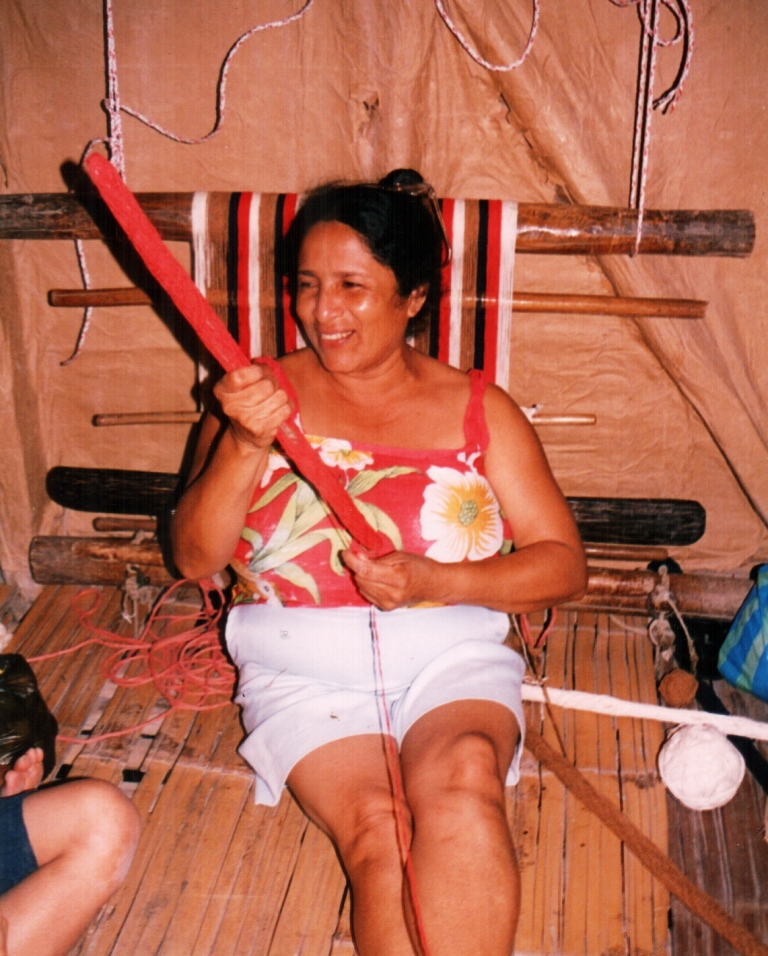
Trini with shuttle

In the Ravelry Backstrap Weaving Group, Marge and Julia showed what they have been working on lately. Marge has been trying out Tahki Cotton Classic Light. I have not tried the Light version but I did see it at WEBS when I visited and the color range is wonderful. Marge used an online inkle pattern generator to help her design the color arrangement. The result is gorgeous!
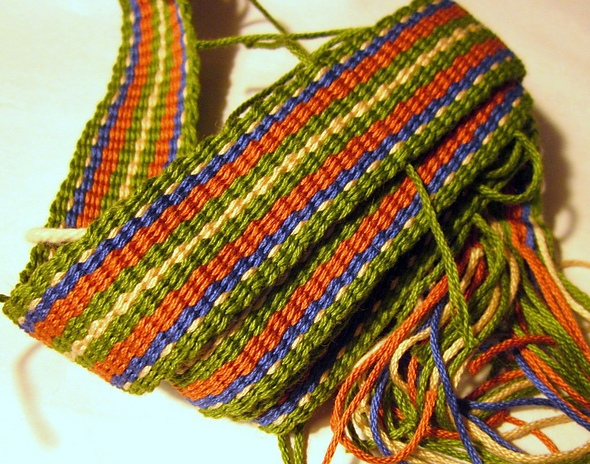
marge

Julia used two different color ways for the same pebble weave motif (charted in my second book) on two different looms…a four-harness and a Seidel Band Loom.

julia pebble weave on two loomsI will be visiting the Mannings this summer. If you want to come and weave, maybe we can spend a little time outside hitched to some shady trees down by the creek….on the ground or on chairs..that will be up to you.  How cool would that be?!

the-mannings-stream

Backstrap Weaving – The Music of Weaving

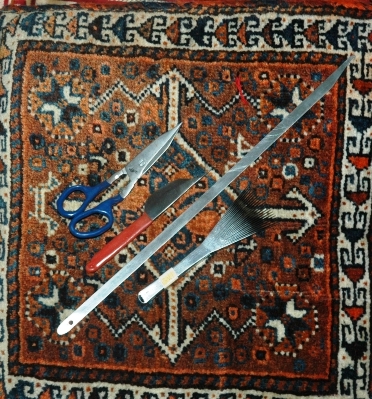
tools01A weaver posted something on Weavolution recently that stuck with me. An Australian gentleman, Hakim, is learning to make cut pile knotted rugs with an Iranian teacher in Australia. He said that when he is at home working on his practice piece, he can tell that the tension of the warps is correct if they make the same sound  when he handles them as they do when he is working on his learning piece with his teacher in class.

Priceless knowledge!

(At left you can see an example of a set of tools that I hope that Hakim can get for me for the day when I try this technique! It’s on that long, long to-do list).

Hakim’s comment made me think about the different sounds that are connected with weaving on simple looms and how much I enjoy them.

I am not one for placing things in my ears and listening to music while busy with something else. I can’t stand that. I like to be in touch with the sounds around me. They form a very important part of my memories of places and experiences.

In my skiing days, I would wonder at people who skied with headphones on. I would never give up the pleasure of hearing the wind and the swish of the skis on the snow, or the sudden change of sound as snow turned to ice giving me time to react and adjust position.

I learned to fly a glider when I was 19. There is nothing like the sound of an engine-less craft rushing through the air. There was so much with which to be occupied while learning (especially for someone like me who was so utterly un-coordinated at the time!) but I could always simply rely on my ears for certain information. For example, if the sound of the rushing air suddenly disappeared it was a sure sign that I had the nose up too high and that told me that I had better do something quickly before the glider stalled!

As for sounds while weaving, I love using multiple big swords. I so enjoy the musical tok tok sound they make as they knock together in the sheds. And I love the chuckling chatter of all the sticks on the loose as they fall together when I release tension and roll up the warp at the end of the day. You can see below the sticks used in the last wall hanging piece….many different kinds of wood making interesting sounds. It can become quite a collection!

O

Then there’s the plink plink sound as the tip of a delicate Guatemalan pick-up stick slides from one taut warp to the next as the weaver counts out threads for supplementary-weft inlay.

weaving-tijera

The dancing dangling bobbins used in weft twining go clackity clack as they twist and jiggle.

final-twining-sessionI love the opportunity to drag the llama bone tool across strong highly-twisted wool threads…scritch, scritch, as I strum to help separate the warps.

OListen to my teacher doing it…

If you stroll around a  village of weavers in the central highlands of Bolivia, you will know in which houses a weaver is at work by the LOUD THWACK!! THWACK!! of the llama bone hitting the sword as the wefts are slammed into place. That sound is one that  is not really pleasant, at least to my ear, when I am seated right next to my teacher. Here is one of my teachers in Candelaria at work at her loom:

When I stayed in the stilt-house home of my weaving teacher in Ecuador, I was often awoken by the muffled thump, thump and accompanying vibrations as Trini drew down her heavy beater while working at her vertical loom. This was combined with various house shaking and creaking sounds as the loom was connected to floor and ceiling beams…a part of the house itself. You can see that big sword/beater lying across Trini’s leg below and get an idea of the muscle that goes into operating this particular set-up!

trini-opening-shed1

The sound of threads in a warp-faced weaving rubbing past each other as a shed is opened can range from a soothing smooth swish to a painful tearing protest depending on the yarn being used and how it has been prepared.

when weaving with new backstrap weavers, we even learn to be amused by the constant clatter of swords jumping out of their sheds and hitting the floor. Each sword has its own musical tone…nowhere near as much fun on a rug! A cement floor greatly enhances the melody!

Joan following a pattern chart at the Mannings.

By the way, I am in charge of picking up the fallen swords….gives me something to do. It is funny that as time goes by we have people weaving in silence. What happened to our musical accompaniment? Well, new weavers, without even realizing it, get a feel for the right amount of tension and the sweet spot in the warp where the sword will sit happily upright and not leap to the floor. Or…they just get rather good at catching the sword on its way down!

Maybe one of the nicest sounds for me is the fwip fwip fwip fwip in rapid succession as I pull my heddle string quickly but carefully (or else it will tangle miserably!) off its heddle stick. This means that the piece is finished!

Speaking of finishing…the wall hanging is off the loom and away in the closet until another time when I can face braiding all the warp ends. I will show it to you when that is done.

In the meantime I am circular-warped and coil-rodded in my purple scarf project! Thank you teachers Felipe and Ju Nie.

purple sacrf project backstrap loom

facebook postCheck out that coil rod! If you are wondering what all that fuss is about, read last week’s post. I am using my studies with Guatemalan teachers to weave the supplementary weft patterns.

The pattern you see above will appear at both ends. I am resisting the temptation to fill the middle with designs and hope to weave one long continuous pattern in the narrow area bordered by gold along both outside edges. I may place very widely-spaced small individual motifs in the center panel as I go.

I am inspired by the colors in the  above picture that appeared on my Facebook news feed. I do hope to be able to give you its source later. I can’t find it for the time being.

I like the circular warp. It took a while to clamp it well enough so that it wouldn’t just slip around the loom bars with every movement. I am not yet sure what role the coil rod is playing but it isn’t getting in the way of anything so there it shall stay.

dovetail warp Salasaca EcuadorI can see the merit of the triangular set-up that my belt weaving teacher in Ecuador uses with his circular warp.

That set-up opens out the circular warp (into a triangular shape) separating the lower layer from the upper. I am not using the triangular set-up and I find it a little off-putting seeing the lower layer immediately below where I am weaving. The unwoven threads fan out a bit wider than the woven fabric and makes it a bit harder for me to clearly see and control what is happening at the edges of the upper layer. It is also more difficult to get to the back of the weaving, which is necessary when dealing with the tails of the supplementary wefts. I have to work my hand between the two layers to do so.

But, I have just started and will, no doubt, get used to this just as I am now used to the fineness of the thread with which I am working.

As I get used to this I am hoping to find out more about the coil rod and what it is doing. Until next week….


Backstrap Weaving – A Snaky Start to the New Year

A “snaky” start to the new year….”Snaky” isn’t one of those words I find myself writing very often and when I typed it into the title of this post, it was bugging the heck out of me…just didn’t look right. Spell-check wasn’t touching it, yet I wasn’t going to be happy until I had Googled it to make sure. It was then that I read that “snaky” in informal English in Australia and New Zealand  apparently means angry or bad-tempered.

So, I want to make it clear to the Aussies and Kiwis out there that I did not start this year angry or bad-tempered as the title of this post might imply. (This also reminds me that I am in my twentieth year here in South America…that’s a long time to have been away from Australia and any of the new expressions that may have been adopted into the local lingo.)

598638_479457965438891_897317545_n
supplementary weft samplerWhen I say “snaky” here, I am referring to the fact that the Chinese New Year, which will start on February 10, will herald the beginning of the Year of the Snake.

And why do I know this? Well, a Facebook friend shared the above image from a page called “The Journey to the Revelation of my Soul” and I saved it simply because….. I like the COLORS!

I am thinking that I must weave something with this color combination some time. Well, I kind of did in my sampler pictured above… but not quite. I want that rich burnt red background and that special shade of blue. Whoa…is this the structure and process person speaking?… now getting all excited about color?

OAnother reason the snake image appeals to me is that I happen to be starting the new year weaving a snake-like motif into my latest wall hanging project. I like to think of it as a boldly-patterned snake  winding its way back and forth across the cloth.

The pattern is based on one of the designs that Wayuu weavers work into their belts. Imagine my surprise when I got Mirja Wark’s book off the shelf, in which she describes and names the designs, to find that the particular pattern that I have been using as my inspiration is called pasatalo’ ouya which means “like the intestines of a cow”!

Okay…so, I am weaving a wall hanging with representations of cows’ noses and intestines. But, since I adapted the basic motif a lot so that it would be big and bold enough to fit the space in which I am working, I think I could allow myself to call it snaky instead. What do you think?

Sloooow going. I am not achieving the four finger widths which my teachers tell me is a good day’s work. Some days I am lucky if do three. It is, however, very exciting watching the pattern slither its way up the fabric.

It is giving me both a mental and physical workout, I can tell you! It is an extremely dense two-heddle complementary-warp structure and opening the heddles is hard work. While the tiny elements of pattern within the main shape are very repetitive and easy to read, there are just so many warps to handle! I feel that I deserve to get up and go eat mango after every pick!

O

I like to think of the figures on this sash that I wove a long time ago as snakes. I copied the design from a textile from pre- Colombian Peru. Who knows what the weavers of the original fabric were seeing when they created these motifs on their cloth.

books-2

The snake is an important figure in Guaraní weaving legends. My teacher tells me that it was a snake that appeared in the dreams of the first weaver and taught her the weaving designs. When Guaraní weavers of the Izoceña group weave the zig-zagging snake skin patterns in their cloth they are also representing the Isoso river along which they have settled. The snake and the river are one.

I wove Guarani inspired snake skin designs into this guitar strap.

The Mayan Goddess of Weaving, Ixchel, is most often depicted with a snake or snakes on her head or entwined in her hair…

ixchel 3 formsI was told that this is one of the reasons why many Guatemalan women weave richly colored sashes to wrap about their heads and around their hair. The sashes vary enormously, in width, length, color, design and weaving technique  from place to place. It is also interesting to see the different ways they are worn….

santiago atitlan hair sashby a lady from Santiago Atitlan above…

O

weaving a hair sash zunil guatemala…and by this sash weaver in Zunil.

##################################################

Wishing you all the very best for the new year surrounded by completely non-“snaky” (in the Australian sense of the word) folk!

##################################################


Backstrap Weaving – Encuentro de Tejedores de las Americas – Part Three…and more….

Before I get into Part 3 of my report on the Encuentro de Tejedores de las Americas (see Part 1 and Part 2 here and here), let me show you how I have been getting on with my latest experiment with supplementary-weft patterns.

Bhutanese supplementary weft pattern samplerYou may remember from last week’s post that I was inspired by seeing textiles from Bhutan with their  gorgeous motifs created by using supplementary wefts.

I was happy to see that I could decorate my own woven cloth with similar patterns using techniques that I had learned in Guatemala.

At left is the sampler I made to practice the techniques and experiment with the spacing of the pattern warps. I had some fine cotton from Guatemala that my friend Betty had bought about 30 years ago. How nice that this cotton could finally find its purpose.

The black cotton disintegrated as soon as I pulled it out of the closet. I guess that there is something in the black dye that causes the yarn to rot quickly. The other colors…red, green and purple….were just fine and, fortunately, there was plenty of white to dye black. I had my heart set on a black scarf.

There were a lot of ends to wind to make 7 inches…672!!

OThe cotton is kind of sticky and I can see why Guatemalan weavers very often choose to size their yarn with a kind of corn starch wash.

I am using it as is and need to be very gentle. I broke one warp before even getting started and my heart sank but it turns out that it was due to my clumsy handling of the pick-up stick…phew! No more breaks so far but there is still a looooong way to go.

Of course I made a wee sample before diving in to see how many ends I would need to make an inch. I also needed to test the ideal number of strands of tencel to use for the weft patterns.

In the picture you can see my tiny warp with its string heddles and shed loop . The two sticks are the pattern sticks that I talked about in my last post. Of course, the yarn was already showing signs of stickiness even on this tiny project but I decided to go ahead undaunted 🙂

Sample done…width calculations made. Now, how long should a scarf be? Seems like a silly question, but I have never made a scarf before. Fortunately, I do own just ONE. After all those years spent skiing and then living in Patagonia you would think that I would be more scarf-wise.

OThere is the warp and I am ready to make the 336 string heddles. I like making heddles…time to put on a cd and sing! and I didn’t cross or double up any warps…phew!

O

I have lots of pictures that I have taken of Bhutanese textiles in friends’ collections for inspiration and David K Barker’s books are wonderful too. (See my RESOURCES page for information on how to download his books for free.) However, I decided to play it safe to start with and weave one of the patterns that I had already tested on my sampler.

So, I sat down to weave and that is when it hit me…wow, this yarn is really FINE….and….it’s black! All the clues that I usually use to make the pick-up easier for supplementary-weft patterning are dependent on actually being able to see the threads!!

Boy, had I made things hard for myself but, believe it or not, I got used to it and came up with other ways to eyeball the placement of the patterns without having to become a slave to pattern charts and endless counting. It became a very cool learning experience and, as with all things new and experimental, much un-weaving was done and all with my heart in my mouth as I don’t think that this yarn will take much “backing and forthing”!

Bhutan pattern backstrap loom scarf

Here is the first pattern under way. I placed several thin pieces of cardboard in alternate sheds in the warp beyond the cross sticks. This gave me a place to make quick adjustments to loose warps within arm’s reach and with the warp under tension rather than having to get out of my backstrap and crawl up to the end of the loom.

cat on backstrap loom BhutanSometimes you don’t get to choose when to weave. I would come back in from a break to find Her Highness reclining in what was, apparently, the most comfortable spot in the house. Would you dare disturb someone with a look like that on their face? You can see the next set of patterns in progress here.

second Bhutanese design finishedOAnd this is where it stands for now. I am just getting past the first warp break and have my fingers crossed that there won’t be more. I watched a gentleman from Chahuaytire weaving on his backstrap loom when I was in Cusco. A warp broke and I loved the calm and cool way he went about fixing it like he had done it hundreds of times before (well, of course, he probably had). He didn’t need to have anyone tensioning the warp while he leaned forward to fix the break. That is the part I find hardest.

Be prepared to see a lot more of this project in the weeks to come. Unless, of course, those warps start a- snapping, and then you will most likely see it finished really soon as a zippered pouch or journal cover!

#########################################

ENCUENTRO DE TEJEDORES DE LAS AMERICAS  – PART THREE – SPINNERS AND WEAVERS IN ACTION

The Encuentro…it was over two months ago now and I am finding it hard to sum up here but I will try!

It was about yarn being created with the simplest tools…

Handspun cotton by the Matsigenka weavers of the Amazonian region of Bajo Urubamba, Peru
Fine and incredibly even handspun cotton by the Matsigenka weavers of the Amazonian region of Bajo Urubamba, Peru
The "malacate", spindle used in Mexico to spin silk with its horn whorl.
The spindle known as “malacate” used in Oaxaca, Mexico to spin silk. Its whorl is made of horn.
The traditional "sig sig" spindle of Salasaca, Ecuador made from pampas grass.
The traditional “sig sig” spindle of Salasaca, Ecuador made from pampas grass stems. A small piece of thin solid stem is inserted into the soft interior of the large stem section to suspend the wool yarn as it is spun.

OA spinner from Chiclayo, Peru showed me how she spins the natural brown cotton that is cultivated in the region. She told me that a heavy stone is usually placed on top of the cotton as she draws out the fiber to be spun. Not having one handy, she used the bottle of water that you see in the video. The spindle whorl is a piece of avocado seed.

It was about sticks…lots of sticks!

Sticks used by the weavers of Bajo Urubamba to create their warp-float patterns.
Twenty-four heddle sticks are used to weave the traditional pattern on the "faja sara" of San Ignacio de Loyola.
Multiple heddle sticks are used to weave the traditional pattern on the “faja sara” of San Ignacio de Loyola.

It was about threads being strung together in a stunning display of color and texture…

An ikat warp ready to be woven into the traditional shawl of Tacabamba, Peru
An ikat warp ready to be woven into the traditional shawl of Tacabamba, Peru. The ties on the sections of threads were the only means I could see to keep the threads aligned for the ikat patterns.
Threads are stretched on the typical leaning vertical loom of Tarabuco, Bolivia
Threads are stretched on the typical leaning vertical loom of Tarabuco, Bolivia. Multi-colored figures depicting ceremonies and scenes of daily life in the community will sit on a white mesh-like background. The colored threads are generally thicker than the white ones which gives the figures relief.
The backstrap loom with its cotton warp from Chiclayo, Peru.
The backstrap loom with its cotton warp from Chiclayo, Peru. A single-faced cloth decorated with warp-float patterns is created.
Bunches of string heddles control the colored layers of warps on the horizontal loom of Taquile Island, Peru
Small bunches of string heddles control the colored layers of warps on the horizontal loom of Taquile Island, Peru.
A floor loom holds the warp on which a weaver from Ayacucho, Peru will create a beautiful tapestry.
A floor loom holds the warp on which a weaver from Ayacucho, Peru is creating a beautiful tapestry.

And it was about the wonderful hands and spirits of the talented craftspeople and artists who use sticks and fiber to create beautiful cloth….such an amazing variety of people from across the Americas!

Weaver Natividad Machaca Quispe of Taquile Island, Peru creates a sash with bands of warp-faced double weave motifs and complementary-warp patterns.
Weaver, Natividad, of Taquile Island, Peru creates a sash with bands of warp-faced double weave motifs and complementary-warp patterns. This piece had six bands of pick-up patterns.
A weaver of panones of Tacabamba, Peru, puts the finshing touch on hher woven ikat shawl by knotting an intricate pattern into the the fringe.
A weaver of Tacabamba, Peru, puts the finshing touch on her woven ikat shawl by knotting an intricate pattern into the fringe.

knotwork on Tacabamba shawlHere is a short video of  Nila at work knotting the fringe of her woven ikat pañon…

And what about that belt loom with its twenty-four sets of string heddles? Araceli shows us how it is done…

A Matsigenka weaver from tropical lowland Peru creates warp-float patterns in cotton on her backstrap loom.
A woven tubular band in progress...putting the finishing touch on a woven piece from Pitumarca, Peru.
A woven tubular band in progress…putting the finishing touch on a woven piece from Pitumarca, Peru. The tubular band had been set up with three sets of string heddles and a shed loop and, therefore, did not require any pick-up.

And cloth comes off the loom and comes to life when draped around shoulders…

cloth comes to life

wearing the Tacabamba shawl

and wrapped around waists and heads…

taquile island peru and santiago atitlan guatemala

Diana from Guatemala, pictured above, wore this spectacular fine, ikat-patterned corte, or skirt…
O

There was time to watch and chat and share….

watching, chatting, sharing at ETAM 2012

Time to look and learn from Navajo weavers and spinners and an alpaca fiber weaver from Tanta, Peru…

looking and learning ETAM 2012

Time to sit or stand and ponder…

pondering ETAM 2012

Time to listen to weavers talk about their communities and textile traditions and meet new leaders in the field of textile research…

Bolivian Elvira Espejo shows the two most recent books she has written with British/ Bolivian Denise Arnold on weaving in the Andes. Representatives of the textile community on Taquile Island, Peru spoke about weaving and knitting traditions and the 547 families that are part of their textile co-operative which had begun in 1971 with only 7 families. Taquile Island has become an enormously popular tourist spot over the years. One point which created a bit of fun was their comment that "Taquile fashion" was being worn and loved around the world despite the fact that it was not appreciated in their own country of Peru. "Taquile fashion" then became one of the catch phrases of the conference and made us all smile.
Bolivian Elvira Espejo shows the two most recent books she has written with British/ Bolivian Denise Arnold on weaving in the Andes. Representatives of the textile community on Taquile Island, Peru spoke about weaving and knitting traditions and the 547 families that are part of their textile co-operative which had begun in 1971 with only 7 families. Taquile Island has become an enormously popular tourist spot over the years. One point which created a bit of fun was their response to a question about how they felt when a hat that was created to be worn by a high-ranking official was bought and worn by a tourist completely out of context. They said laughingly that they were proud that “Taquile fashion” was being worn and loved around the world despite the fact that it was not appreciated in their own country of Peru. “Taquile fashion” then became one of the catch phrases of the conference and made us all smile.

And time to just stand in complete awe…time and time again!

A weaving of the Jalq'a people of Potolo, Bolivia.
A weaving of the Jalq’a people of Potolo, Bolivia depicting Ukhu Pacha, the underworld, with its khuru figures.

Organizers ETAM 2012

Well, I hope that this gives you just a taste of what the week of ETAM was like. Thank you Maria Elena del Solar, Paula Trevisan and Luis Masa for organizing this event. And thank you Mara Elena for pushing me to go when I was dithering over the cost of getting there. It was the best birthday gift to myself ever!

Thank you Centro de Textiles Tradicionales de Cusco for the fabulous exhibit of textiles from your nine member communities that you organized in the Convention Center to coincide with this event and for providing outstanding teachers for the workshops.

As for Elvira Espejo and Denise Arnold’s books about which I know you will be curious, I have to find out if they are available in English and from where…stay tuned.

OOf course, you do know that the CTTC is having its second Tinkuy this coming year, don’t you?! 🙂 Are you coming?

Backstrap Weaving – Supplementary-Weft Patterning from Two Continents

I have had so much fun playing with supplementary wefts this week on my white warp!

This is the start of my blank canvas…an off-white plain warp-faced piece of fabric into which I can weave patterns with tencel supplementary weft. My inspiration came from several textiles from Bhutan that I saw during my recent trip to the US and I was able to use patterning skills that I learned in Guatemala to set up the warp and lay in the wefts. It has been fun to be able to apply the skills learned on one continent to weave designs from another.

First came the insertion of the two patterning sticks. From what I have seen on Bhutanese backstrap looms that I have examined and from videos, the warps under which the supplementary wefts will be passed are selected from those in the stick shed and then from the heddle shed and stored on two patterning sticks.

This is the warp that I used for the Bhutanese designs. The two sticks bound together with rubber bands are the stick shed stick and the stick which holds a second cross. The darker of the two sticks in front of those holds the patterning warps from the stick shed and the other holds the patterning warps from the heddle shed. You can see my video tutorial of how these sticks are placed in a warp destined for Guatemalan patterns here.

The spacing of the warp threads that are selected and stored depends on the kind of pattern being woven and, to a certain extent, the kind of yarn.  Within Guatemala, this can vary a lot from region to region. The warp pictured above from San Antonio Aguas Calientes in Guatemala shows the two patterning sticks in place (the two thinnest sticks). These will be used to raise the warps under which the supplementary wefts are passed saving the weaver the work of having to pick them up from every shed.

My weaving teacher in San Antonio Aguas Calientes has just selected the warps from the stick shed for her first patterning stick and is about the store them on a stick which will sit between sticks 2 and 3.

Lydia will draw the patterning sticks toward her to raise the selected warps to weave patterns like the ones she taught me to weave above right. The patterns in the upper and lower bands were woven using the warps stored on the two patterning sticks. The flower patterns in the center band, however, require the weaver to select different warps for every pick and so, patterning sticks cannot be used in this case. Naturally, weaving those flower patterns was a much slower process.

Here are some bookmarks that I wove using Guatemalan patterns. Most of these designs are based on those that I was taught in Santa Catarina Polopo. My teacher in that part of Guatemala also uses the two patterning sticks but the warps that are selected are spaced differently to those in San Antonio Aguas Calientes and you can immediately see how different the patterns are from these two weaving communities.

Above, you can see how the warps are spaced in one of the pattern sheds. I have just placed the supplementary weft which will allow me to weave the stem and base of the plant.

Here are some more patterns that I wove with my teacher in Santa Catarina Polopo. All the patterns except for the ‘X” design which separates some of the motifs were woven using the same two patterning sheds.

On the above piece which I wove in Guatemala alongside my teacher, you can see all the patterning techniques that I used in my latest Bhutan-influenced sampler…the horizontal and diagonal “chain stitch” lines  and the solid “stitches” that serve to fill in the outlined shapes.

The question was, how do the Bhutanese weavers space the warps that they select for their patterning sheds?

Frustrating!! I had a Bhutanese loom in my hands when I was in the US with unfinished weaving and sticks in place. I took lots of photos of it but did I think to look for that crucial piece of information? No!!

Thankfully, Wendy Garrity’s wonderful website came to the rescue.

Pictures and sketches that she has there gave me the answer. As I said, it is quite likely that the spacing varies from region to region within Bhutan as it does in Guatemala but, I used the spacing that I saw in the pictures, and it seems to have worked.

Here is the piece growing on the loom. I didn’t use the patterning sticks with their pre-selected warps for the designs in the foreground. The sheds for those patterns had to be created manually for every pick.

Things to work on…making the supplementary-weft turn “bumps” neater and of a more consistent size, making a smoother transition from horizontal to diagonal line…I messed that up…, calculating better the amount of weft needed for a particular design…I wasted too much yarn!

I think of how accurate the Guatemalan weavers are. They know exactly how much weft they need for each of their patterns and waste nothing!

Some of it has been trial and error…finding a neat way to start the chain stitch took quite a few attempts. My Guatemalan teachers work that stitch one thread at a time whereas the Bhutanese weavers have a very cool way of working it using both threads at once. The end result is the same but it is these little differences that are so fascinating.

I look at Leki Wangmo’s magnificent work (above) and sigh!

Here are more gorgeous Bhutanese textiles that Ute left for me to examine while I was in Massachusetts…bands of supplementary-weft patterns on a ground of extremely fine tablet-woven cloth. I was told that the tablets used to weave the ground fabric had to be cut from X-Ray film to achieve such fineness!

He he :-)…one more shot of the whole lot so far. Can you tell I have been having fun with this?

Now on to much finer yarn. I have some cotton that my friend Betty got in Guatemala about 30 years ago…much finer stuff and I am thinking about making a very light-weight scarf with it with supplementary-weft patterns using the techniques I have been practicing on the sampler this week. The motifs will be smaller using this finer thread and the whole thing will hopefully look a lot more delicate than the sampler with its large kind of clumsy motifs. I can use it on my spring and fall trips  in the US. I am thinking black with lots of small colorful motifs.

Another thing with which I have just begun to play this week…

This is my first sample using the 60/2 silk that I got at Handweavers Studio in London (it was a splurge and one of my souvenirs of the UK trip!). I saw this pebble weave design on a textile in a book and  found it quite unusual. The picture’s caption states that it was most likely woven during the colonial period. The silk weaves up beautifully and yes, it is hard to see! All the little nicks and chips in my finger nails become immediately apparent as the fine silk catches on them. Now I just have to wait for THE project for this silk to come to mind.

In the meantime I am getting the third post on the Encuentro de Tejedores de las Americas ready…yes, I know I keep promising it.! I look at those pictures now and can hardly believe I was there among all that magic!

In the meantime, I will leave you with some Cusco magic fit for the coming season from the CTTC (Centro de Textiles Tradicionales de Cusco)…

Look at these gorgeous ornaments made from narrow woven bands! If you “Like” the CTTC on Facebook you can see many more beautiful images and news updates that don’t appear on their website.

Off to dye that cotton and start planning my scarf!