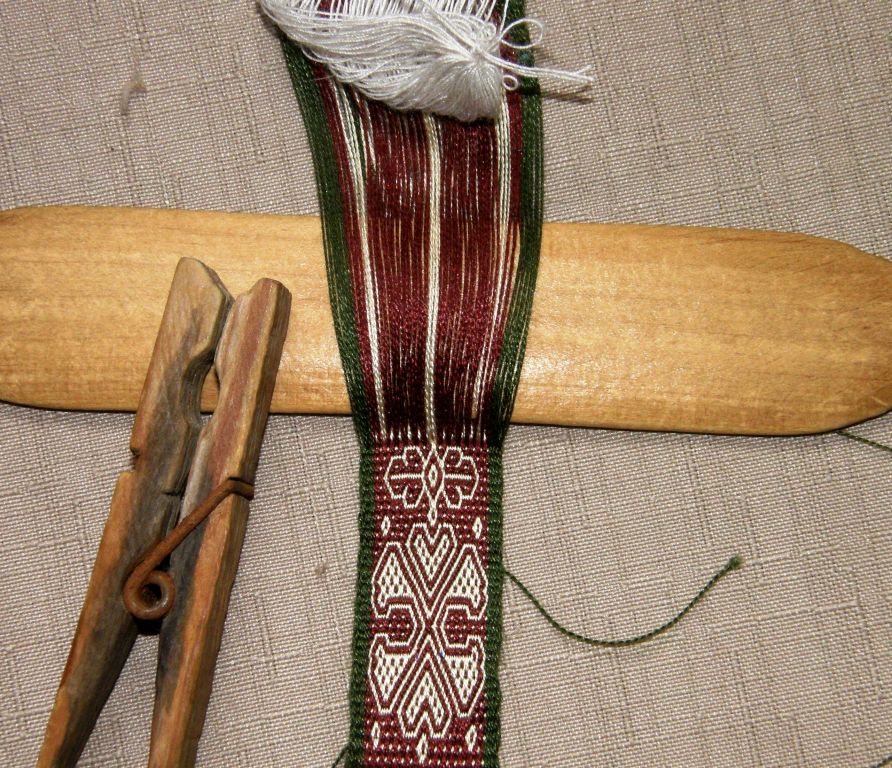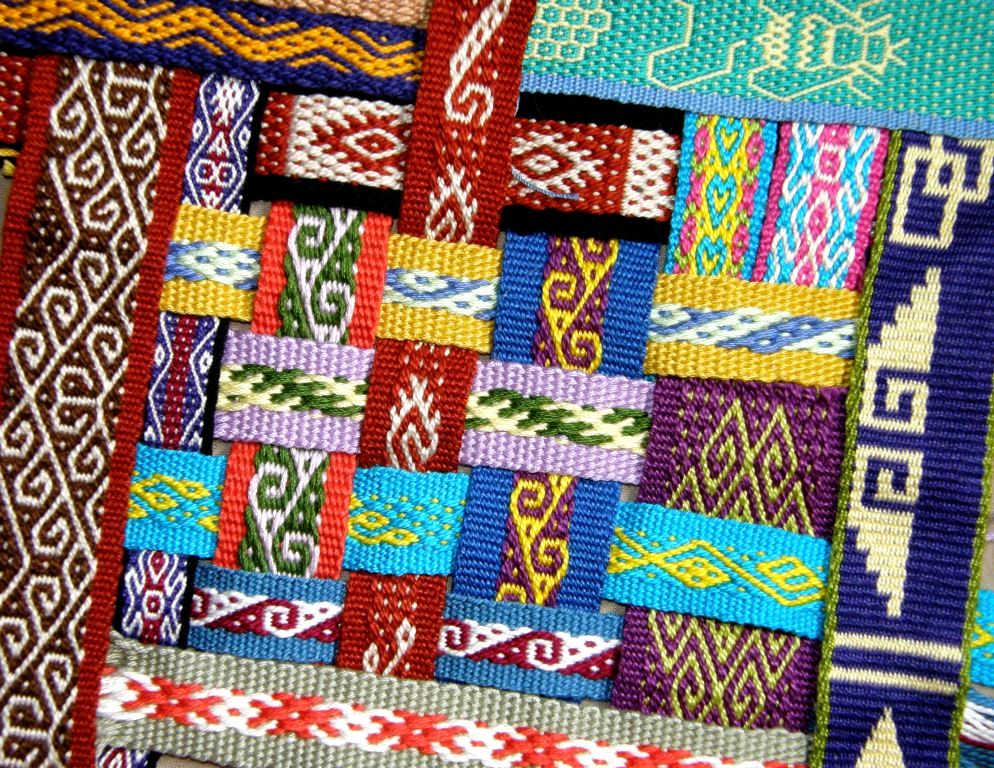
Backstrap Weaving – East and West

IMG_0010EAST AND WEST: THE EASTERN CHAPTER

The problem with not blogging…stuff builds up!! But not as much stuff as you might think this time.

Not blogging indicates that I have  been way too busy having too much fun.

But that also means that I haven’t been able to take as many pictures as I would have liked. Can you believe it? There I am with camera in hand ready to shoot anything that moves but, on this trip, I have been moving too much to keep up.

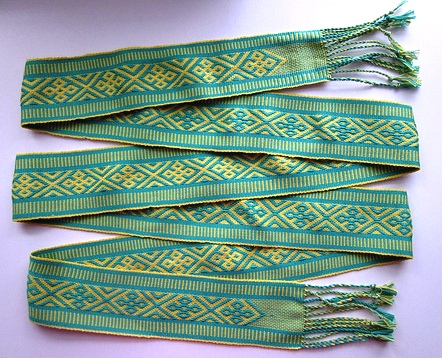
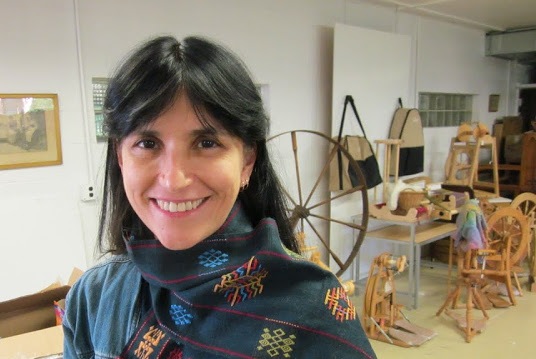
Fortunately people have sent me pictures and allowed me to use theirs. The one above was taken by Marge on a visit. I am modeling the Bhutanese inspired scarf that I wove recently using supplementary wefts to create the patterns.

indonesian textile ikat backstrapEAST AND WEST…the title of this post.

This refers to the fact that I started “back east”, as people in here on the west coast say, in Pennsylvania and then headed over to the west coast, or the “wet” coast, as some people say, to Washington and now, California.

It also refers to the  flow of wonderful eastern textiles that has occurred during this trip into my western hemisphere area of study…textiles from Timor, Laos and Indonesia as well as Central Asia. I have pictures of amazing textiles to show. They have me thinking about tripping off to Asia when next I visit Australia but, every time I think about that, one word pops into my head

 :MEXICO:

and I realize that there is a lifetime’s worth of things yet to be seen on this side of the world.

Above is a picture of a backstrap-woven ikat (yes! that’s ikat) piece from Indonesia, a shoulder scarf from Batuisi, West Sulawesi from friend Judith’s collection. That is just a wee tease and hint of things to come in my next post.

So, here I am in a west coast heat wave on my backstrap weaving friend Janet’s berry farm…

berries

Blueberries! Lovely to be out picking in the cool of the morning. Yes, those are strawberries on top of that pizza. That was brought to the recipe competition by a neighbor who attended the annual Strawberry Jam party that Janet and husband Larry throw. I arrived just in time for that. As you can imagine, there was lots of strawberry based foods and lots of jamming by local musicians. But… more about all that in the next post.

For now, let’s stay EAST.

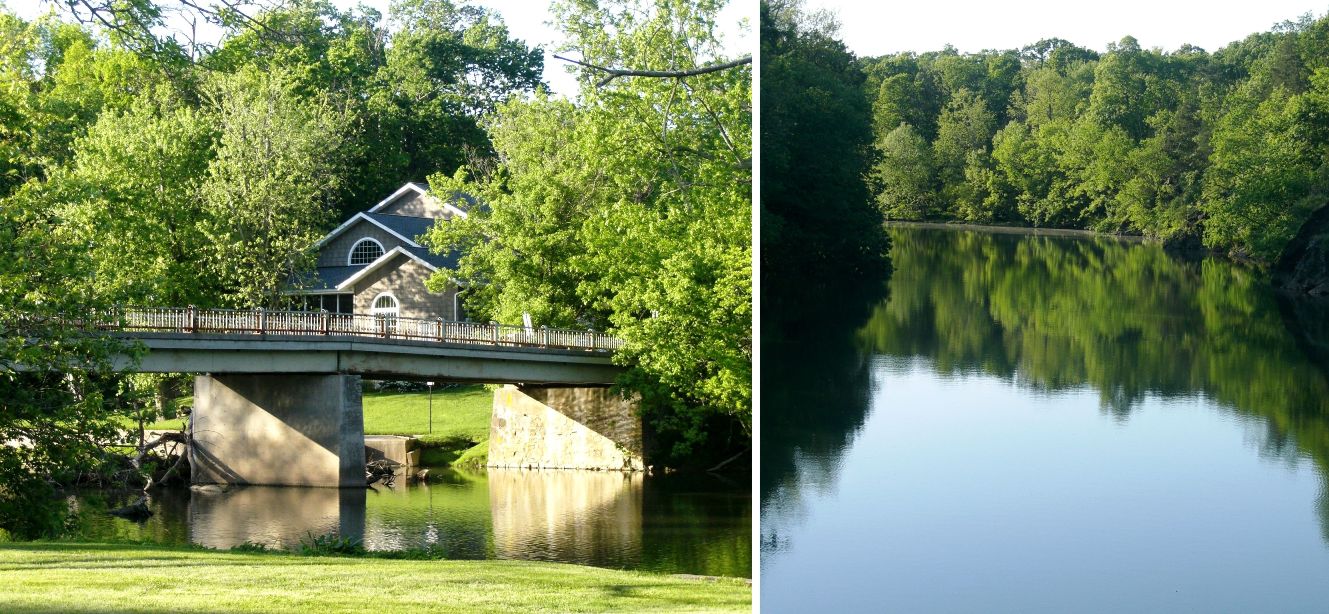
It all started at the Mannings in Pennsylvania with their annual Spinning Seminar…the 45th one, no less!! I have been to the Mannings in the spring….ah, idyllic!
the-mannings-stream

and in the fall….

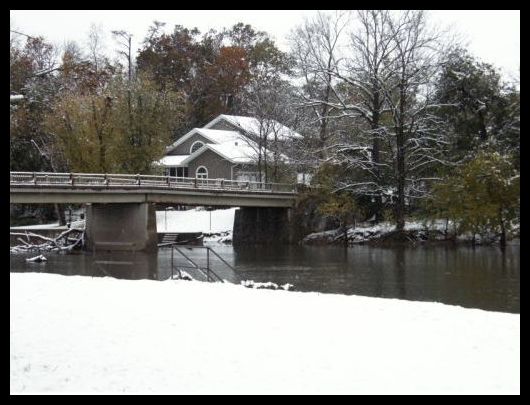
mannings snow borderedwoven inside and outside on the beautiful lawn down by the creek…

backstrap weaving at The ManningsHere was a first…a chance to set up my backstrap loom in a shady spot down by the creek on a lovely summer’s day and just hang out chatting with people.

Ravelry and Weavolution friends dropped by. I have known Trisha, aka Coolsticks, from the early days of Weavolution back in 2009 and we finally got to meet…

trisha and april at the mannings spinning seminarThere is Trisha on the left with guild buddy April .

Down by the creek things were pretty laid back! I had lots of time to spend with people.

amanda backstrap weaving at the manningsThat’s Amanda having a go at the basics of backstrap loom operation on a narrow band. The tree was adorned with straps and bands and one of my wide projects. Several people could be weaving with warps extended spoke-like from the tree. l liked over-hearing hushed comments while I wove on the big warp…”she isn’t using a chart!” (I smile thinking how I have woven items with that particular motif at least 50 times and goodness knows how many repeats of it there are in this one piece I am currently weaving!) And then there was…”Oh. So, it’s slooooow!”

spinners at the creek mannings spinning seminarSpinners set up camp, grabbing shady spots by the cool water to enjoy a day of spinning and conversation.

Picture by Pinar Miski

And for those who wanted to be in the heart of all the action, there was room to park a whole gaggle of wheels on the shaded front porch of the Mannings store.

Picture by Pinar Miski
One of my sample tables. Picture by Pinar Miski

And, at his point, I am going to hand over to the pictures of Pinar Miski who got to visit almost everybody and took the most wonderful pictures. She has allowed me to share them here. It was late in the day when I finally managed to make my way uphill to the shop to see what was going on. Shadows were long over the outdoor demo area at that hour and the crowds had thinned in the dying day. My pictures didn’t come out well. So, thank you, Pinar for sharing your shots!

Things were anything but laid back up at the store…happy shopping and browsing in yarn paradise. Pinar subtitled her photo album …”and then I died and went to heaven”! I think that says it all.

But, apart from the shopping, there were oodles of things to be touched, explored, and experienced with a wonderful selection of fiber artists and educators both indoors and out. I demand a do-over! I didn’t get a chance to see much of it!! But, I was having a lot of fun chatting with people about my passion…the backstrap loom.

It all starts with fiber. There was this…

Photo by Pinar Miski

Ron Bostek demonstrated sheep shearing. He brought Border Leicester and Cormo sheep to the Seminar.

Picture by Pinar Miski

Here is cotton spinner and teacher (and my fun roommate), Joan Ruane, showing one of many implements with which she spins cotton with ease. For me, who goes to the store to buy cotton for my backstrap weaving, Joan’s comment when she saw me at work at my loom was pretty funny…”oh my god, it’s WORSE than tapestry!”…a comment on the slowness of my weaving. And there she is patiently creating cotton thread!

Pictures by Pinar Miski

Yet another fiber on display ..Mandi Elliott Bird used antique tools to show how to process flax to the point where it can be spun.

Picture by Pinar Miski

Ron Tyler spun wool on a Great Wheel or, Walking Wheel, hoping to encourage people to take the beautiful inherited piece that may be sitting and simply decorating a corner of a room and actually use it.

Picture by Pinar Miski

One of my neighbors creek-side was Carol Ireland with her hip spindle.

Picture by Pinar Miski

This table was a-buzzin’ at day’s end when I went for my walk. It seemed that folks were invited to grab a bit of this and that and create their own batt. That looked like lots of fun. It was Sally Jenkins who demonstrated fiber blending with drum carders.

And boy, does this look like fun. I bet there were people jostling to get a position for this…

Picture by Pinar Miski

I am copying and pasting the description from the Mannings’s newsletter for this one…

Tartan, Tweeds & Waulking the Wool – When wool tweed or blanketing comes off the loom, it is not yet ready to use. The traditional Scottish method of finishing woolen cloth was a social occasion involving a group of neighbors, a large table and probably a little whiskey! The cloth was wetted and passed from hand to hand in a thumping rhythm kept going by suitable songs. We will skip the whiskey at our wool waulking but have lots of songs! Melissa Weaver Dunning will also have a display of her many woven tartans and tweeds.

Apparently it takes three songs to finish the process. Here is inspection time after the first song…

Picture by Pinar Miski

Again, Pinar captures a great moment!

Picture by Pinar Miski

Ah, now here is something a little closer to my heart. Susan Weaver brought along a large selection of tape looms on which she encouraged people to weave. I believe that all the tape looms for sale in the Mannings store went home with new owners that day. Susan and I know each other. She wove with me a while ago and lent me a Mexican band to study from her collection. So, I was eager to connect with her to catch up and return the band.

Picture by Pinar Miski

Mushroom dyeing! Hmmm…wondering what kind of aroma is coming from that pot. This is fascinating. Who knew that you could get such a range of colors from mushrooms and now I know that someone who studies mushrooms is called a mycologist. Susan Hopkins’s interest expanded from mushroom identification to dyeing.

Look at the colors…

Picture by Pinar Miski

Susan’s face says it all…she’s passionate about dyeing with mushrooms. Check out her t-shirt.

Anne Marie Decker was probably not around at the particular moment when Pinar went by. As Pinar says in her album caption, she still doesn’t know what nalbinding is, and neither do I! I have to say that it looks like something I would enjoy.

Picture by Pinar Miski

Indoors, Ron Woolcock gathered spinners to tell them how to keep their wheels happy and there was a display of the stages of silk production and processing. Thanks again, Pinar  for the use of your pictures! Take a look at the entire album here. Pinar’s concise captions are fun.

coil stitch ad pom pomsOne day to rest, and then my Ravelry friend, Julia, came by to weave and sew..

We wove a lot!. I was starting to crash by 4pm with all the things we got into. It’s so much fun putting those finishing touches on things!

We wove tubular bands, sewed and wove tubular bands to edges, sewed coiled stitches, edged and lined pieces with decorative stitches, warped for more bands….phew!

But, rather than get into all that now that she is home, Julia has been practicing the supplementary-weft inlay techniques which I show in tutorials on this blog.

Here are a couple of her projects…

julias supp weft backstrap weaving

The butterfly is one that I charted from an inlay motif on a Huave weaving of Mexico. The pattern on the right is one that I adapted from a motif woven with weft substtution, if I remember correctly, on a textile of Central Asia. I think that it is charted here on my blog. Loving the soothing colors Julia used.

Caroline also used weft inlay techniques to decorate her backstrap. I love how people are taking to this technique!

caroline sacramento supplementary weft inlay backstrap weavingI adapted this particular motif from one on an Indonesian piece of fabric. The backstrap itself is beautifully woven and put together!

More fun weaving with friends that I have met online…Bands got finished with ends braided and all.  Here’s Kathy practicing the four-strand braid on her warp ends.

Kathy braiding backstrap weaving class the mannings

If you have been following my blog, you will know about my recent experiments with weft inlay where I have been filling negative spaces with weft to outline patterns in the ground cloth. Some of the weavers were keen to try this. Another fun thing was combining strands of different colors for the supplementary weft which created interesting effects. Kathy and Bettes put together blues and other jewel-like colors while Nancy put together a very festive, sunny Mexican type of combination.

supp weft class mannings backstrap weaving

Marge came over for a day to weave and try a bit of double weave on her inklette and a touch of intermesh on the backstrap loom…

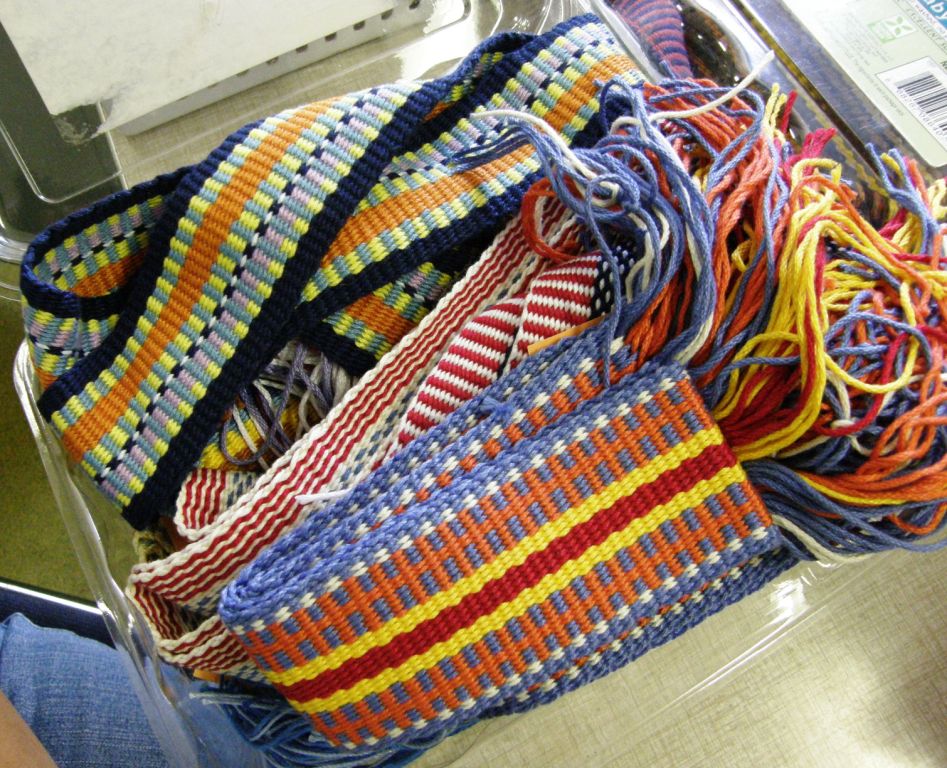
She brought her band box to show some of the things that she has been weaving on her inkle loom…straps for her musician friends. She plays in a band called Tater Patch and gave me a cd!
Marges bands

marge and her bands backstrap weaving class manningsThere’s the double weave band that we started on the inklette next to a nice knot-work pattern in pebble weave. And then we did a wee bit of intermesh.

Marge went home to finish that double weave sampler with some of her own designs. Guess what instrument she plays in Tater Patch?!

marges double weave bandMeanwhile over in Tom Knisely’s Mannings teaching studio, there was lots of overshot loveliness coming off the looms. Here are a few examples. It is nice to be able to stay on the premises and get to see the weavers working late at night on these pieces.

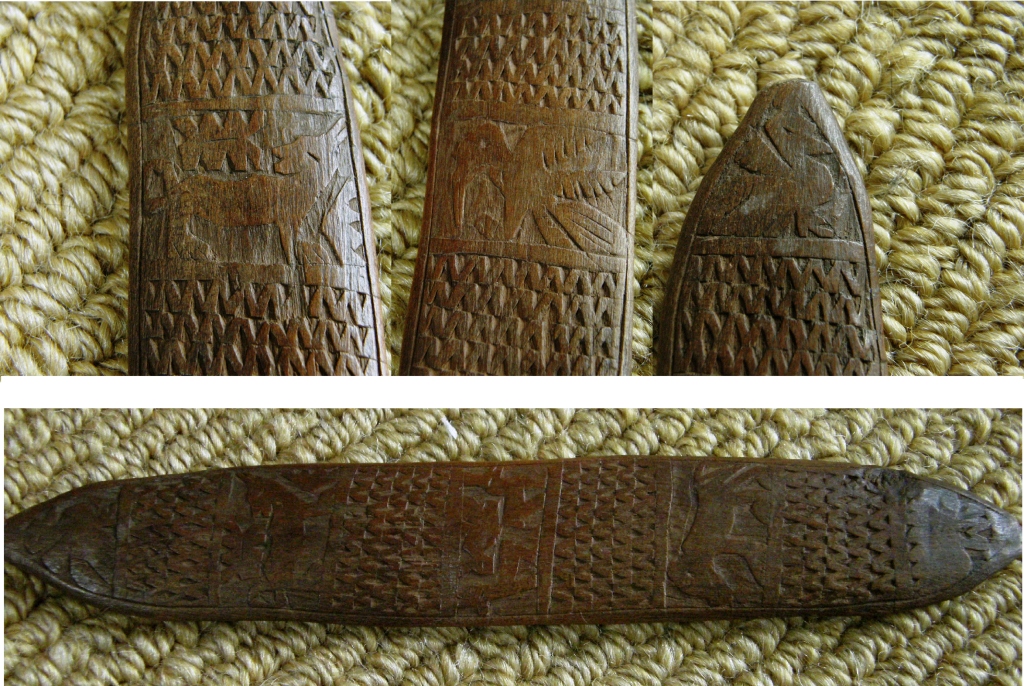
overshot class manningsSpeaking of Tom, he gave me a wee gifty. You may have seen this before on this blog. Tom showed me this on one of my visits last year and  has now decided that it really needs to belong to me :-)!!
sword

More Ravelry group projects to show…

Cindy tried out the “palma” braid…nice job!
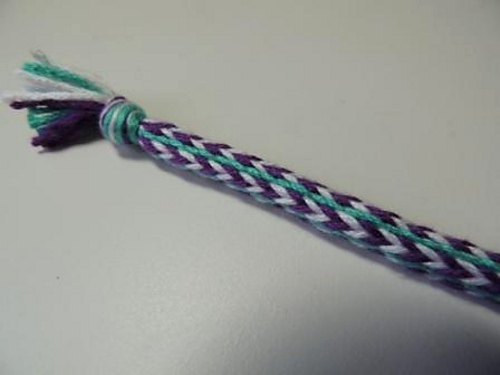
cindyI finally got to meet Cindy on this trip. More about that next time…that’s a “west side story”.

Laura has been practicing pebble weave…
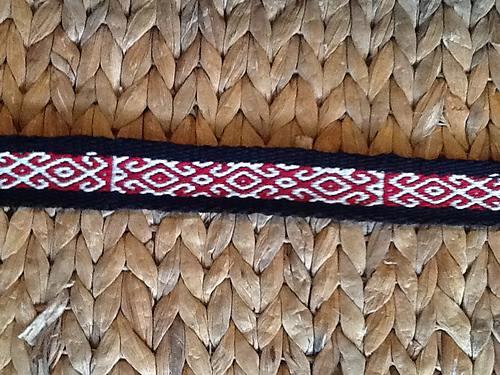
lauraI love the color flips and how she has joined the three single motifs into one long continuous one.

And just to finish and lead into Chapter 2: “West Side Story”, which is largely based on the ANWG conference in Bellingham, Washington followed by fun with my friend Betty at her home in WA and then with my friend Janet in northern CA, let me show you the weavings that I submitted to one of the conference exhibits.

This series is a work in progress. I have many more panels in mind to add. It is entitled “Textile Trails” and each has its little “traily” story to tell. It won the Committee’s Choice Award at the conference. I was thrilled! Thank you to Linda for taking this picture. The beautiful black wooden hangers were made by Terri of Magical Moons. Terri makes the custom swords and other implements that I often show on my blog. By the way, she is making spindles now. They look exquisite.

backstrap weaving Laverne WaddingtonThe fact that I am wearing a black top and a red jacket is just a happy coincidence, I swear!

Here’s the lovely handwoven ribbon…
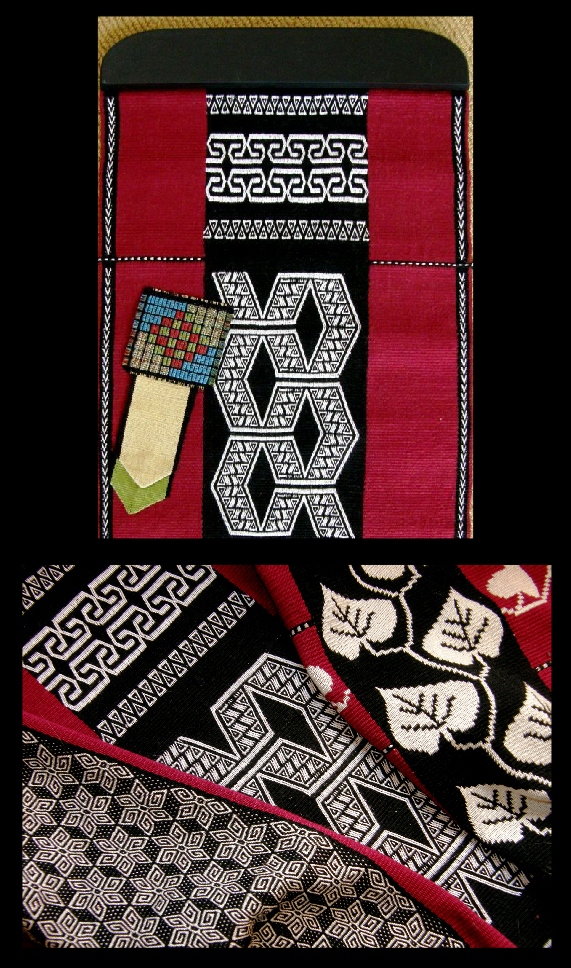
hangings backstrap weaving Laverne Waddington

See you next week. I am back on top of the blogging now…I hope!

Backstrap Weaving – Hooked!

I was on the lookout for a simple pattern to continue my sampler of supplementary-weft patterns and the positive/negative space studies that I have been writing about these past two weeks.

After weaving some patterns based on Bolivian hatbands where the weft is used to fill the space surrounding the motif rather than the motif itself, as seen below, I wanted to weave a motif where the same shape appeared as both motif and background

supplementary weft in negative space

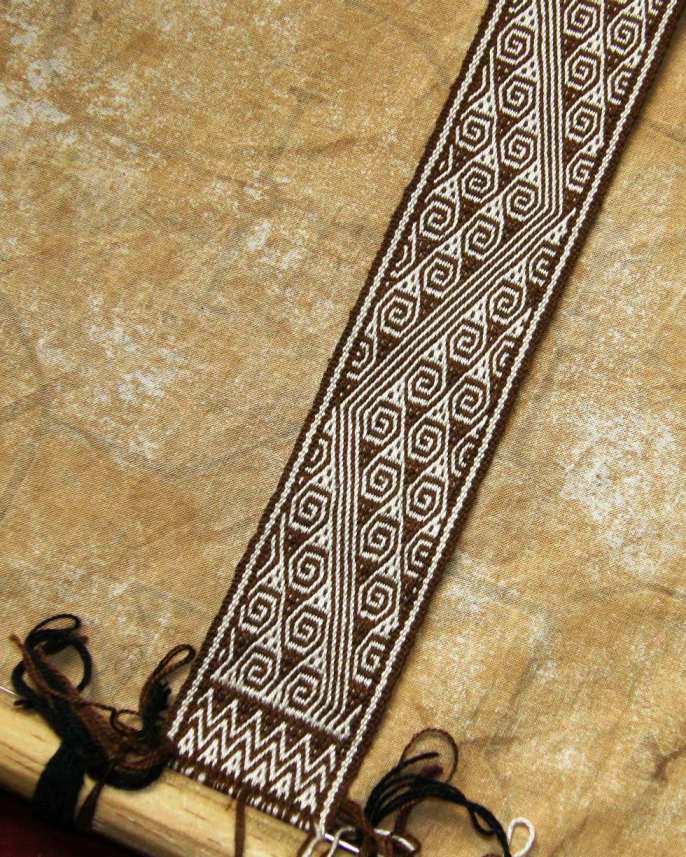
hook motif of peru and boliviaSeveral of the classic warp-float designs found in the Peruvian and Bolivian highlands have this very characteristic. In the hook motif pictured at left, it makes no sense to talk about “motif” and “background” as the same hook shape flips and turns and dances along the band changing from red to white and back again. Is it a  series of white hooks on a red background or vice versa or none of the aforementioned?

This was the kind of thing that I wanted to weave with supplementary wefts. So, I set about trying to adapt it to the structure with which I have been working.

As it turns out, it wasn’t that straightforward.

So, I spent a lot of time with paper and pencil and eraser (I still like the old fashioned way). The only way I could get the shapes to interlink well was to make several changes to the basic shape and, even then, the black version of the hook is not exactly the same as the gold one. The gold has an extra warp or two in a couple of places. There was a fair bit of weaving and unweaving involved too. But that’s what “sampling” is all about, right? I had to remind myself about that as I was starting to regret having set myself this challenge as I seemed to be spending more time planning out the design than actually sitting at my loom.

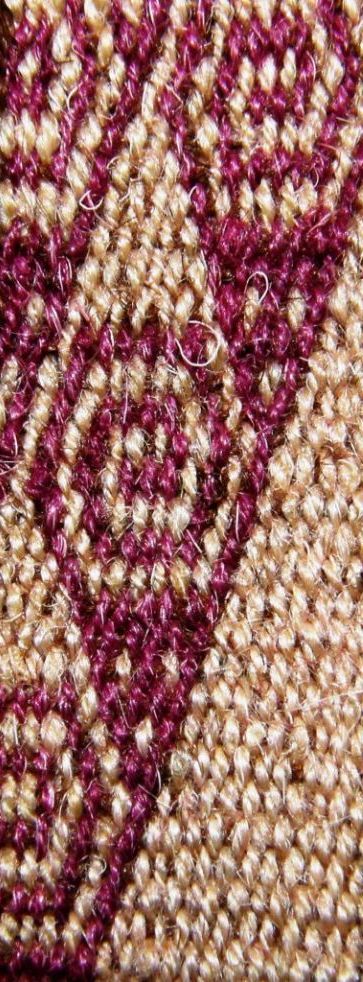
supplementary weft study with hook motifsSo, there it is. Two sets of gold hooks surround and expose black hooks in the ground weave. I am pretty happy with the way it turned out and hope to play a lot more with this hooky shape.

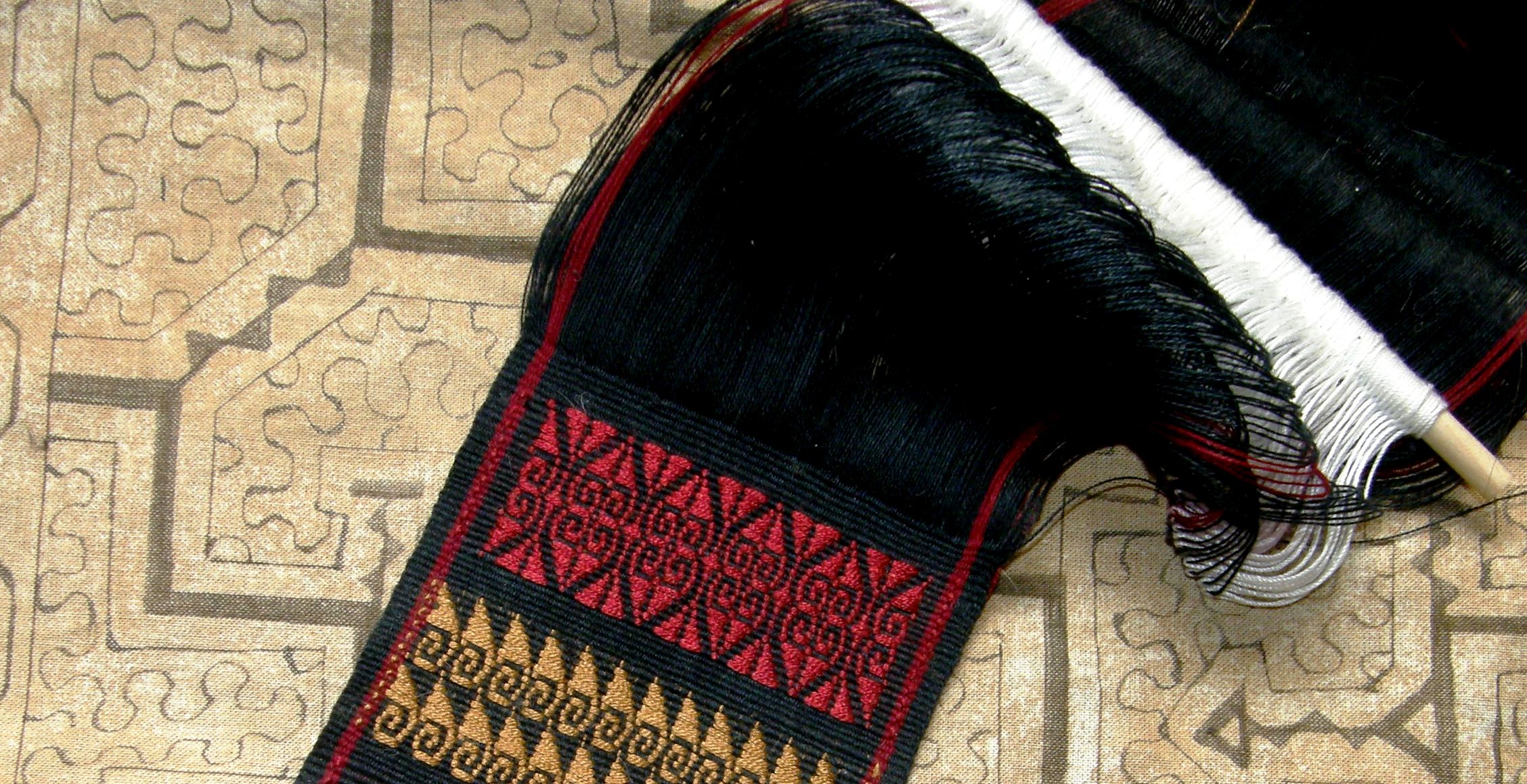
red hooks relected anf flipped in supplementary weft Where to go from there and how to best use all the work I put into figuring out those hooks? Chris Buckley writes about pattern building in traditional textiles in his article on warp-ikat weaving of SE Asia:

A further important feature of ikat, and indeed of most traditional textiles, is that weavers tend to use a narrow repertoire of simple shapes such as dashes, hooks and curls, in a ‘building block’ fashion to create their designs. This approach makes understanding and copying complex designs manageable for the weaver, and aids their transmission from generation to generation. Recognition of this repertoire of basic shapes (which I call primitives) is also of considerable help to the researcher with analyzing and comparing motifs between traditions,…..

So, I took one of my many discarded charts of the hook motif and used it as a “building block” for a new design, joining hooks together, reflecting them and flipping them upside down in the same way that many Andean weavers do with their warp-float motifs. The result is the band of red pattern above the gold in which there are four red hooks with just the hint of a black hook outline around them.

What had brought me, yet again, to Chris Buckley’s interesting article was a romp across the internet in search of hook patterns when my initial attempts at charting something suitable for supplementary-weft patterning were not working out. It is so interesting to see how the hooks show up in all sorts of woven structures and cultures. Of course, certain structures only allow a fairly limited repertoire of shapes to be produced and so, regardless of the culture, it is inevitable that a hook motif will appear if those particular structures are in use. Techniques like ikat,  on the other hand, can be used to produce a limitless variety of shapes and patterns.

hook-motifs-in-southeast-asian-textilesThese pictures by Chris Buckley show hook motifs in various SE Asian warp-ikat textiles.

I have woven the hook motifs used in yurt bands of Central Asia…

??????????????????????I wove the  pieces above and below using the same single-faced warp float structure as the yurt bands. You can see how the basic hook motif can be placed in different ways to create patterns and how dark and light hooks interlink so beautifully…

central asian yurtI have also woven patterns in pebble weave that are loosely based on Central Asian hook motifs…

central-asia-all-stitched-wih-borderas well as in supplementary-weft, double weave and supplementary-warp structures…

central asian motifs in various techniquesI enjoy the challenge of adapting a motif woven in one structure to others.

Chris Buckley writes that Indonesian ikat weavers sometimes copy designs, for example, from imported luxury textiles, particularly those from India…

When copying a design from a foreign source, weavers are likely to re-interpret the copied motif in terms of their own vocabulary of basic shapes rather than produce an exact copy. This is analogous to linguistic borrowing, where the pronunciation of a borrowed word may change from one language to another according to the repertoire of sounds available.

My own particular “weaving vocabulary” comprises the various structures that I am able to produce rather than a group of shapes. I have not dedicated myself completely to a study of the patterns of any one weaving region and so have not developed a vocabulary that is limited to certain shapes.

I love it when I see the Bolivian highland design that I call “rolling river” woven by indigenous weavers in both complementary-warp-float and double weave structures. Perhaps a weaver saw and admired this pattern when she traveled to another region and returned home to interpret it in her own weaving vocabulary which, in this case, happened to be a completely different structure. I can only speculate.

I taught Juan to do pebble weave when I was studying in Salasaca, Ecuador. No one in the area was using this structure. It was part of the deal…I teach pebble weave and they teach me to weave their supplementary-warp patterned traditional belts. Eighteen months later when I returned, Juan showed me his finished pebble weave band. Until then, he had not known how to weave at all. His final motif is a rooster which he took from one of the traditional supplementary-warp belts of Salasaca and interpreted in the only weaving “language” he knew…pebble weave. I thought that was brilliant!

juan pebble weave bandBack to the hooks…I like to think of the following  motifs, that I copied from a belt of the Tarahumara people of Mexico, as a “swirling” hooks…

Tarahumara patternI had not become completely familiar with that swirly hook and made it a part of my vocabulary, as skilled Tarahumara weavers surely would have, before attempting this piece and, as a result, it was very tricky to weave! Just as I got a grip on the swirls going in one direction, they changed to the other direction. It was much easier to weave it using another structure in my weaving vocabulary…double weave…in which it is generally much easier to “read” the cloth. However, I don’t think the pattern is as pretty in double weave….maybe slightly more so in my handspun llama fiber on the right (spearmint leaf and cochineal dye).

5892932496_f074da5701_m

handspun llama cochineal dyed

And so I go playing with structures and shapes. Even as I sit and look at the last red supplementary-weft hook pattern that I wove on my most recent sampler, I see the motif on the very right hand edge and think…hmmm….wouldn’t that look good on a narrow double-weave band?

By the way, many of the patterns I have shown in this post are charted in my second book.

Pebble_Leaves_on_a_Band_medium2Here’s one final bit of lovely hookiness before I go. Julia has been using the tutorials in my second book on creating and charting one’s own or adapted patterns in pebble weave.

Here is one of her bands in which she has adapted a tablet weaving pattern to pebble weave and…yes…there are hooks!

Backstrap Weaving – Coincidences and Connections

It’s funny how some dangling threads in my weaving life can be unexpectedly connected by a wonderful coincidence.

I had just finished weaving  a structure that I call “two-heddle intermesh” with a group of backstrap weaving friends in California. If you have been following my blog for some time, you may even recognize some familiar faces from this group who weave with me every year. Certainly you will remember some of the names from projects I have shown here over the years.

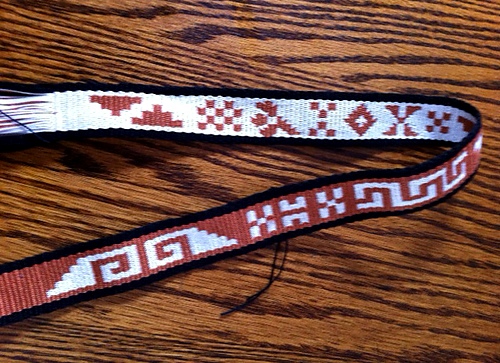
??????????????????????I have included this complementary-warp structure in my second book and chose to use designs that comprise only horizontal and vertical lines as a simple way to introduce the patterning technique. While looking through Joanne Hall’s book on Mexican Tapestry Weaving I saw that Mexican tablero and greca patterns were perfectly suited for this as were many of the motifs used by Bhutanese weavers on their tablet woven belts.

Joanne Hall writes that the tablero patterns represent  indigenous designs as well as those introduced by the Spanish. Many of the greca patterns appear in the structures and tombs at Mitla, Oaxaca and are used by tapestry weavers of that region.

yonat and ingridAbove left, you can see Yonat weaving one of the greca patterns while Ingrid, on the right, completes a second Bhutanese influenced motif. The patterns with their simple heavy lines are bold and beautiful in this structure. As we were using a complementary-warp structure, the bands are double faced with striking red designs on a light background on the other side.

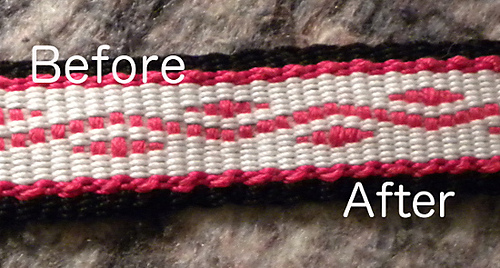
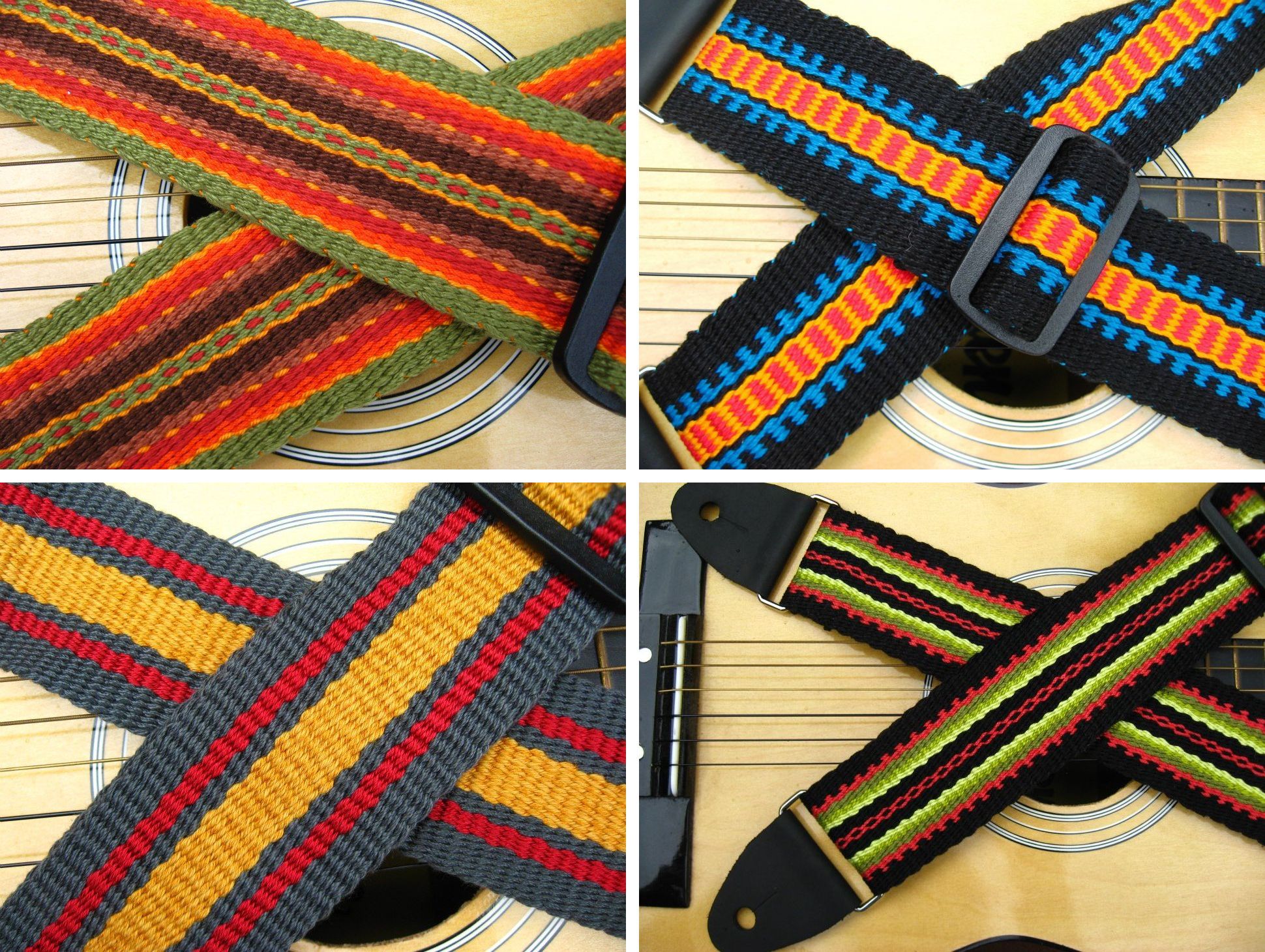
Annie's intermesh bandAnnie seemed to sense, knowing my love of red, black and white, that at least some of these colors would come into play, and dressed to match! She is weaving one of the tablero influenced patterns and made a beautiful band by repeating the one motif along the entire length rather than creating a sampler of a  variety of patterns. Maybe we will see something like this appear on one of the famed and fabulous woven guitar straps which Annie creates on her inkle looms. Yonat, too, is a fond of making bands on inkle looms and I expect to see her intermesh creations soon.

annies guitar strapAnnie has been so busy lately setting up her new sub-brand for hand woven guitar straps, I was lucky that she still had some energy left to have me stay at her place and weave!

In the evenings, she would sit at her inkle loom and turn out yet another original piece. I saw her start a new one using hemp. It was lovely to touch.

Even if you don’t own a guitar, check out Annie’s weaverguitarstraps.com for lots of colorful inspiration for your next band project.

And if you would rather weave your own band, Annie makes the hardware that will enable you to turn your woven creation into a guitar strap.

Jennifer from Oregon, had woven with me last spring when I visited her state and she showed on Ravelry, a couple of weeks ago, what she had made with an intermesh sampler.

jennifer 's intermesh band

You can see her finished greca pattern and other shapes she played with while learning about the characteristics of this structure. It is what I call a “partly loom-controlled structure”, that is, the weaver does not need to do pick-up for every weft pass. The loom does part of the work needed to create the motifs. This, along with some other little tips and tricks that I talk about in my book which help reduce the amount of time spent doing pick-up, allows the weaver to create patterns relatively quickly.

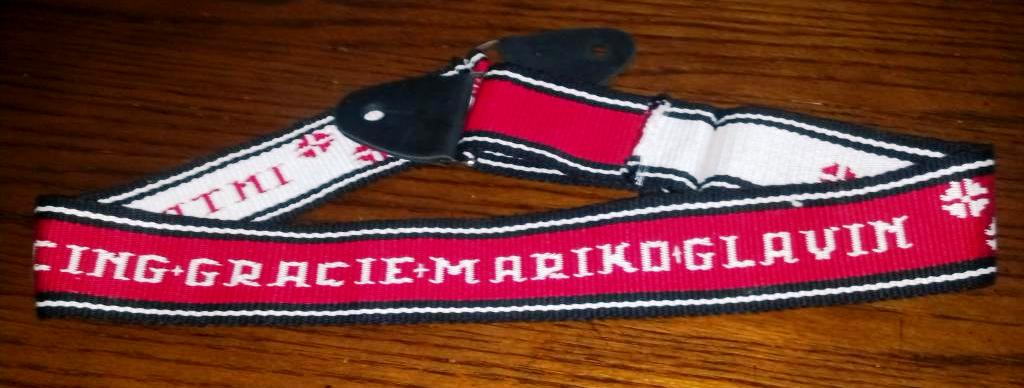
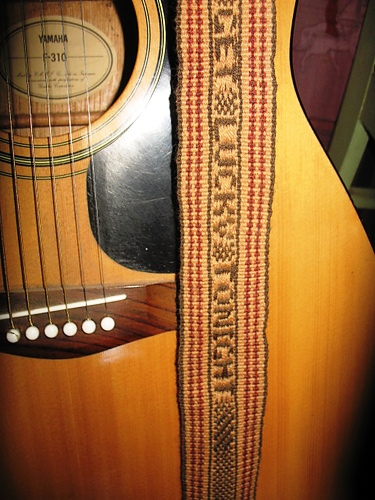
bobbie guitar strap intermeshYou may remember Bobbie’s guitar strap with names and a Mexican tablero motif made using the intermesh structure.

Now, what about that coincidence I mentioned? I am getting there. I have a couple of other things to tell.

??????????????????????Anne, who also wove with me  in Santa Cruz invited me to come and stay with her and her husband in their hilltop home near Saratoga, Califormia.

I now have a much better idea of the layout of the land with the spectacular views from Anne’s house and can understand why Santa Cruz people talk about distances from one place to another by mentioning the number of hills one must go over to get there.

Anne took me to one of the meetings of her weaving group where I got to tell people about weaving on simple looms in South America. I met the Bolivian owners from La Paz of her local Mexican restaurant who are planning to move back to Santa Cruz, Bolivia where I live and are excited about perhaps doing some weaving with me. That was one fun coincidence.

I enjoyed touring Anne’s cabin studio in the garden. This is one of many projects that caught my eye…

anne's inkle band bagThis is made up of two bands, woven on the inkle loom with patterns in supplementary warps, sewn together. You can’t tell that there are two bands, can you?! …the join is perfect. Another narrow band forms the sides and strap….so pretty.

The following day Anne took me to meet an eighth generation Zapotec weaver, Jaime and his  equally talented and skilled partner, Joey. Jaime’s father Zenon Hipolito, who taught him to weave, was not present but we got to see some of his work in progress on his hand-built looms. There was evidence of his craftsmanship to be seen everywhere…works created with his own hands but also pieces that have resulted from his having patiently and expertly passed his knowledge and skills to the next generation.

joey with zenon's latest piece

The looms themselves are absolutely beautiful…three in the living room on which Joey and Jaime work to fill custom orders, and another downstairs for Zenon. Zenon even made the bamboo reeds, combs and shuttles as well as the spinning wheel.

bamboo hand made reed

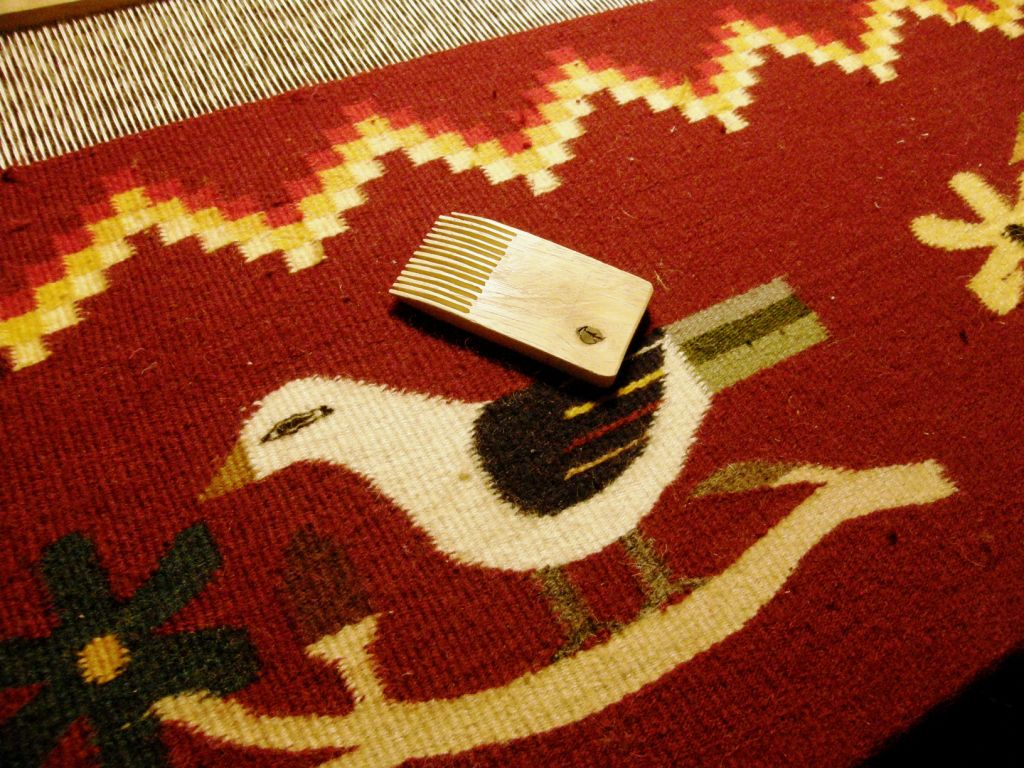
tapestry comb beater

spinnig wheel made by zenon

??????????????????????

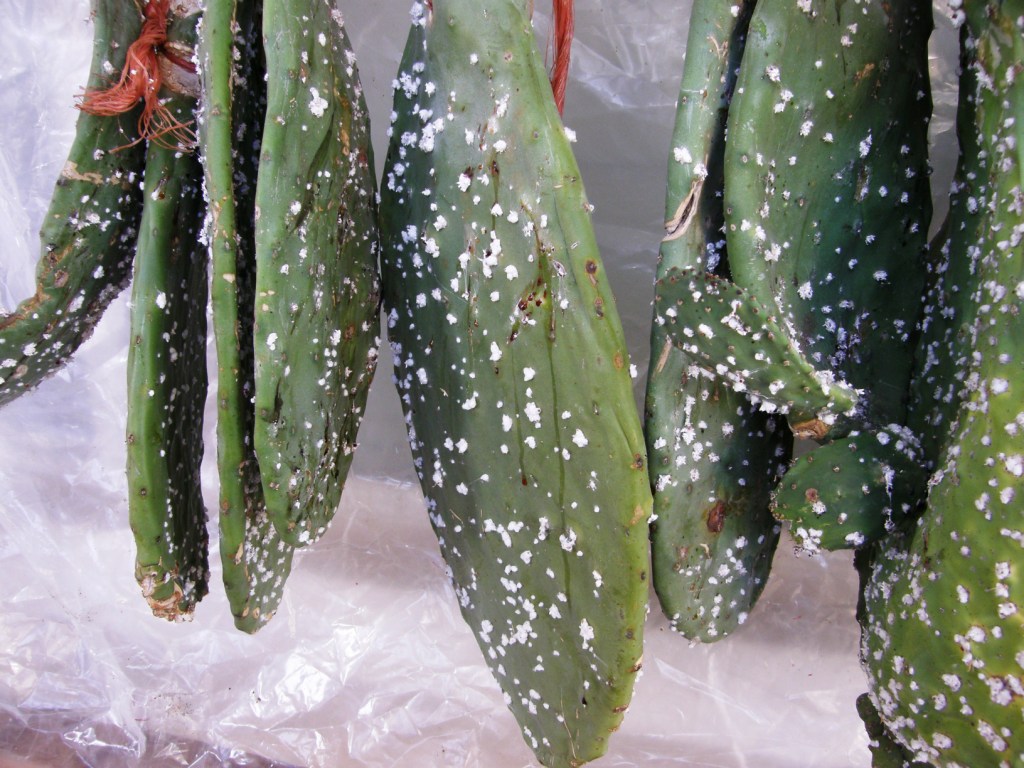
cochineal bugsJoey seems to be the one who finds most time to spin and many of his pieces include some of his handspun yarn. He experiments with different fibers.

A lot of the yarn they use has been dyed by them with natural substances. They even raise their own cochineal bugs on the front porch.

They experiment with different kinds of warp, some are more successful than others. Joey described his struggles to finish a piece where he had used an unsuitable yarn for warp. It was a custom order and once he had cut his first full attempt off the loom he had to start all over. Of course, to Anne and myself, the piece looked faultless but, it wasn’t up to Joey’s standards of perfection.

Both Joey and Jaime’s love for weaving and the motifs and fibers was apparent in the way they  touched and talked about the rugs as they lay them out one by one on the floor for us to see. They have recently returned from a trip to Oaxaca (Joey’s first) where they had been invited to take part in an exhibit which included several other master tapestry weavers from the US as well as weavers from the Oaxaca valley, the home of the Zapotec people. Jaime spoke about the thrill of getting to visit the Mitla ruins which hold in their stonework many of the motifs which he was taught to weave by his father. Joey mentioned walking around the villages and recognizing the familiar sound of the beater hitting the edge of the fabric emanating from almost every house they passed.

While they talked about the fatigue that comes from weaving standing up all day, they also mentioned the difficulty to resist weaving at least a little almost every single day in their home/studio where they stand surrounded by rows and rows of colorful skeins and their own woven pieces covering the walls and floors.

Here are the pieces that were in progress on their looms during our visit…

joey and jaimes workAnd here is just a handful of the pieces that they lay out for us to see…

zapotec jaguar weaving

zapotec weaving by jaime and joey

zapotec weavings by jaime joey and zenon

bird tapestry zapotec Zenon Hipolito

Older pieces that have been in the family for a few generations, and show evidence of the passage of time, adorn the walls and floors of their home…

older zapotec weavings

When I was admiring the rich red and black piece, Joey mentioned his love of  red, grey, black and white combinations and so I had to share my own love for that and showed him online images of my wall hanging pieces in which I have used some of those colors. While they are aware of the use of the backstrap loom by many weavers in the Oaxaca Valley, they have not had any personal experience with one. I regretted not having taken one of mine to show and have them use. I then showed Jaime what we had woven in the workshop just two days earlier and he was happy to point out the designs from his culture which are woven by Zapotec weavers in their rugs.

You will recognize below a version of the greca pattern that we were using in my class in very similar colors! I found many wonderful motifs in the rugs that we were shown that will work beautifully in the intermesh technique. I only wish I had met Jaime and Joey before I finished my book so I could have included pictures of their work. The unexpected meeting with them was a wonderful way to tie everything together for me. From the pages of Joanne’s book to my own book to a workshop and, from there, on to an eighth generation weaver who continues to incorporate these traditional patterns in his work….I am grateful for all I learned from the book by Joanne Hall and her kind permission to use some of the designs she had charted in my own book and give many thanks to Anne,  Joey and Jaime who made this get-together possible.

greca design on a pillow cover

From the home of the Zapotec weavers, Anne and I headed to Gilmore Looms. I was keen to see some of the looms that weavers in the Backstrap Weaving Group on Ravelry have been using to create warp-faced bands so successfully. Not everyone, after all, is going to love being strapped to their warp! It was fun meeting the lovely people at Gilmore who told us about having busier months so far this year than they have had for a long time. Lots of looms are finding homes…that’s good news for the weaving world.

Here are the Gilmore Wave looms in two sizes….

Gilmore wave loomsIt was Marsha Knox who first brought these looms to my attention as she used one to make a lot of wonderful projects using the patterning techniques that I teach in my tutorials here.

Here is a beautiful lined bag that Marsha made by joining several bands together.

Marsha Knox bag

I am not sure which of the two looms she used. I like the larger as I prefer the larger amount of space it has between the front beam and the heddles. This would allow the placement of extra string heddles that are used for pebble weave and intermesh. The more space you have for those, the easier they are to use.

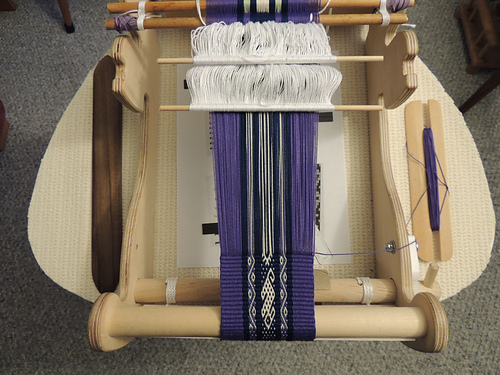
Mullarkey loom at Janet'sNow, that I am with my friend Janet, I have seen the loom that she used in her tablet weaving class with John Mullarkey and I think that this is a little beauty too.

John has these made to his specifications. They are basically a frame with adjustable tension on which to support a long band for warp-faced weaving. John, of course, has designed it specifically for tablet-woven bands. I think this little loom, perhaps clamped to a table, would work nicely for the kinds of narrow projects that I often do on my backstrap loom. The loom does not have any shedding devices of its own so, you would be using a shed rod and set of string heddles just as you would on a backstrap loom. However,I haven’t used it myself for this purpose yet and am just guessing at this stage that it would work well used in this way.

Of course, I much prefer my backstrap loom as, among its many advanatges, it is good to be able to freely and rapidly adjust tension at will with simple body movements. However, I do like to look for possible alternatives for those who simply aren’t able to use a backstrap loom.

The loom is pictured above next to what I call Janet’s “grab-and-go’ basket…a bunch of prepared warps for backstrap weaving that she can pick up and  take along with her to weave any time.

synergo arts ergonomic benchNow, let me tell you some great news about the ergonomic weaving bench that Synergo Arts has been introducing to backstrap weavers in Guatemala. I have posted about these before.

My friend Anne, with whom I stayed in Saratoga, has been involved in this project. Many backstrap weavers in the Ravelry group expressed interest in having one of these benches themselves but they were not available in the US.

Now, Anne tells me that Synergo Arts has decided to make all the plans and instructions for these benches available to the public. So, if you are handy with wood and tools or know someone who is, there is nothing stopping you from making one of these benches yourself.

The Synergo Arts page that I linked above will only be available until the end of summer 2013. After that, you will still be able to access the files here. These pages contain the plans for making the bench, instructions for using it and video of the bench in use. I never got to see one in use when I was in Guatemala or use one myself. It certainly looks very good. I particularly like the opportunity it gives for the weaver to brace her feet.

If you build one, please let me know and send pictures!

To finish, let’s see what the Ravelry guys have been up to….

julia pebble weave bag

This is Julia’s Lavender Field pebble weave bag. Her weaving group challenged themselves to weave something inspired by a gorgeous painting of fields of lavender. I am not sure if I would have permission to show the painting itself, unfortunately. Julia used both her backstrap and Seidel band looms to weave the various parts of the bag project. It’s stunning!!

carol

Carol took a liking to the Tinkipaya star design from the central highlands of Bolivia, which is charted in my second book, and added an Andean motif to the sides to create this piece.

Jennifer, who is a backstrapper all the way, also chose the star motif for her latest project…

jennifer's tinkipaya starDawn is a relative new-comer to our group and wove a band with horizontal bars while getting acquainted with the loom and fine tuning her skills…look at those beautiful edges!

dawn

If you have any interest at all in finger-loop braiding you most likely know of Ingrid Crickmore and her loopbraider blog. Ingrid is always part of my weaving groups when I visit California. Ingrid brought some of her braids to show, some of which were particularly snakey, and she has written a great blog post about them.

I thought that I would show them here as we are doing snakey things in our Ravelry Year of the Snake weave-along.

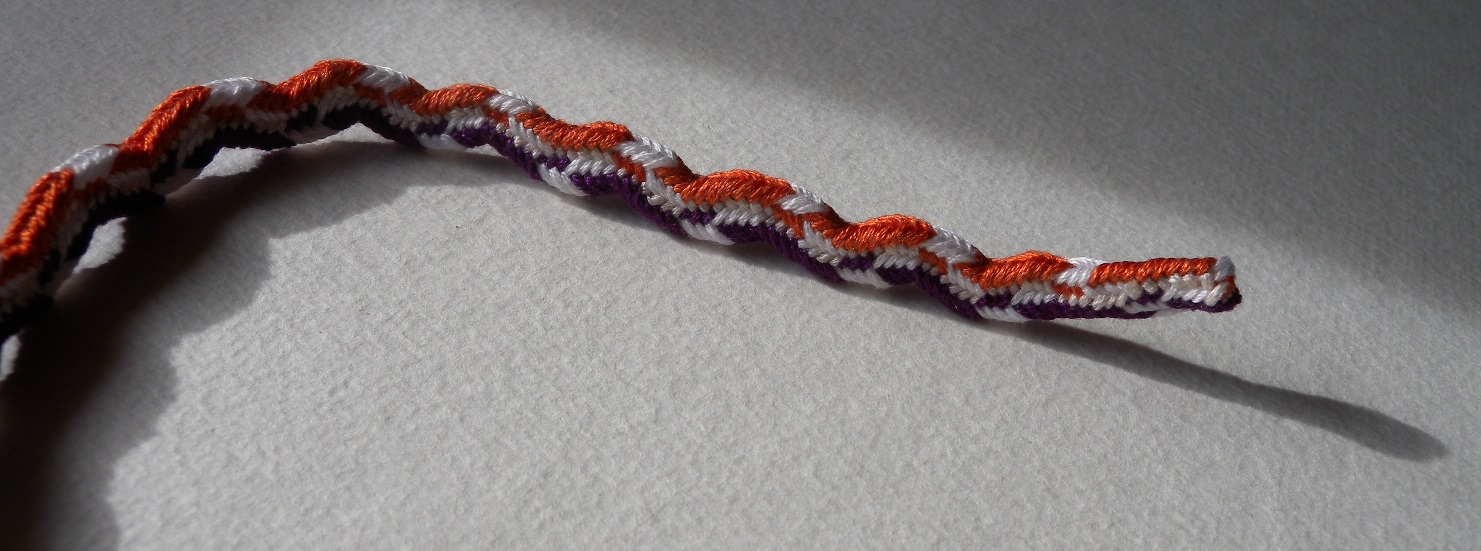
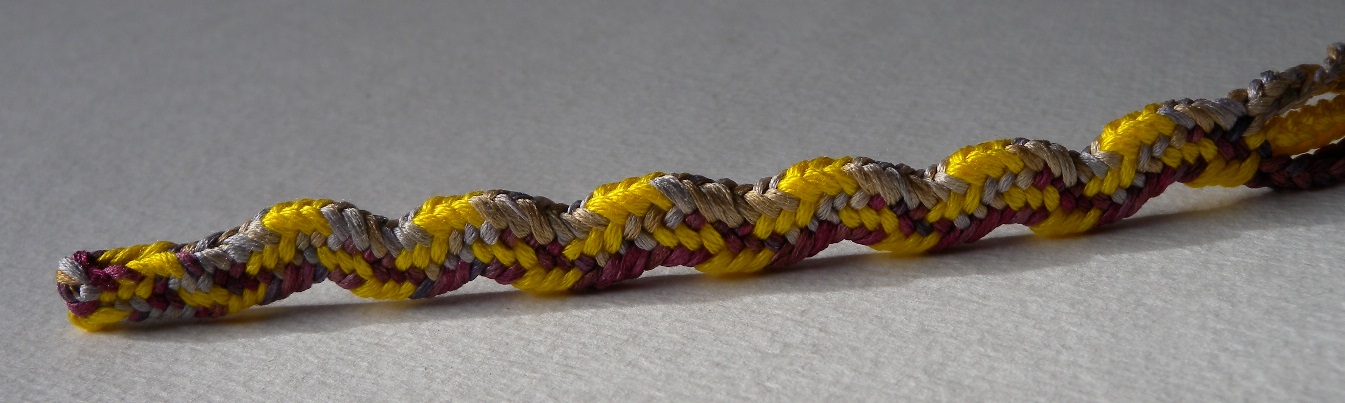
ingrid's snake braid 1

ingrid's snake barid 2

You will be forgiven for taking a detour from backstrap weaving and wandering off and getting lost in Ingrid’s site! Those finger-looped braids make nice finishes for backstrap woven projects and are so much fun to make.

I made some progress on my own Year of the Snake project. This pattern comes from one of several bands that was sent to me by weavers in Cochabamba (see my last post for stories about these ladies). I was immediately struck by its snakiness and had to try it.

My on-the-road projects tend to have a hard life. They get hooked up and woven all over the place, anchored on toes, under heavy luggage, started and stopped and started again. This one is doing okay so far and is not showing signs of the ravages of the road yet!  There it is weaving its way through the grass alongside the Bolivian band with the original pattern.

snake patterns Bolivan band backstrap weaving

I just got an email from Dorothy who just went to a lecture entitled Weavers’ Stories from Island Southeast Asia. She sent me a link to a webpage about the exhibit that has video interviews with various weavers and batik arists who talk about their creative process in times of changing social and economic situations. I have not even had time to see the videos myself so we can all watch them together here.

That’s all for this post. See you next time with tales from Texas and the Humboldt redwoods.

Backstrap Weaving – The Stories Within the Cloth

I am all packed and I  leave tomorrow which leaves me with a day to wander around in circles and wonder about what I have forgotten. So, before I drive myself crazy, I think I should sit down and write a blog post.

Late last week I picked up from the post office a box of ten fajas, belts, that I had ordered from Maxima and the weavers in the communities in and around Independencia in Cochabamba. (All photos of the weavers except for the first one, are taken from the PAZA webpage with the kind permission of Dorinda Dutcher).

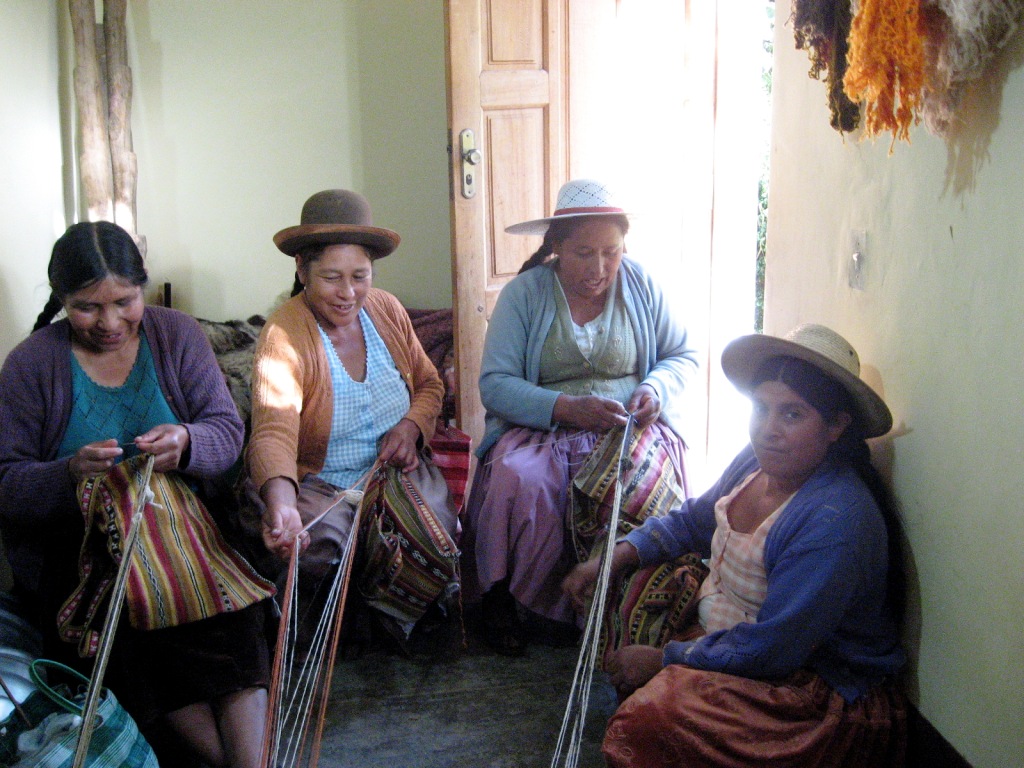
??????????????????????These are the ladies with whom American Dorinda Dutcher has been working for years, helping them to recover and pass on their spinning, dyeing and weaving skills and market their woven goods. If you follow my blog, you will have seen pictures of and heard stories about Maxima Cortez, one of the women with whom Dorinda has most closely worked. She is the coordinator of the various Handicraft Group activities. Maxima is one of my weaving teachers and was my roommate at the Tinkuy in Peru.

Maxima, daughter Soraida and granddaughter Nilda were my weaving companions for my three-day stay in Cochabamba.

???????????????????????????????

CdCWeave

???????????????????????????????
The flock belonging to Casimira, one of the spinners and weavers who made the bands in my order.

I opened the box of  fajas and saw the two colorful packages of neatly folded and stacked bands each with a label detailing the name of the weaver and her community.

It was such a happy sight but, what really hit me, was that wonderful aroma of wool mixed with the various smells of the natural dye substances that are used to create the colors.

It was such a strong fragrance that my cat immediately awoke and had to come over to roll in the bands.

And then there were the textures. Each weaver and spinner has their own style and beat and the bands varied from those that were smooth and taut to those which had more dimension and drape.

???????????????????????????????I counted eight different tones from cochineal dye and even more shades of green and then closer inspection helped me to see which ones were most likely made by the younger members of the communities…the ones where the weaver jumped a little erratically from pattern to pattern spoke of a youngster who was keen to try out her entire newly acquired repertoire in the one piece.

Perhaps the ones that have some little flaws are from the youngsters too or maybe they are from mothers who were distracted for a moment by one of their little ones.

Each one tells a story and it is strange sitting here in this tropical heat and imagining the sounds of the looms, the cool green slopes and valleys and music of the highland region in which they were made.

grphuancarani

Dorinda shared some pictures and a little information about each and every weaver with me. Here are just a few…

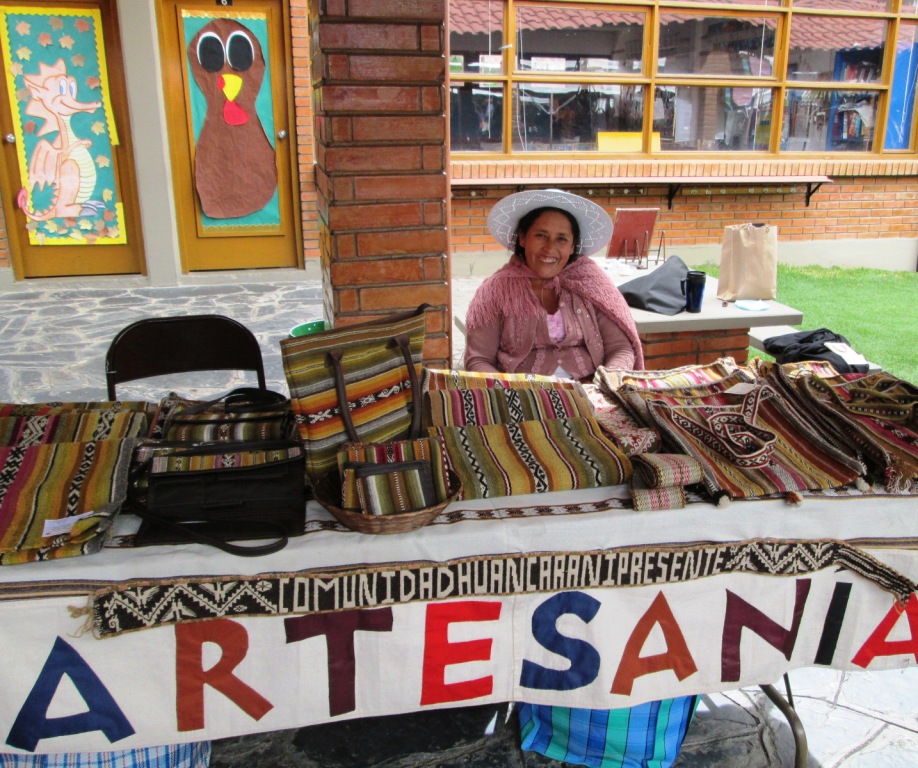
Here is Casimira Calcina working on the leaning verticalloom which is typical of the region. She lives in the rural community of Huancarani. Being widowed and with her children having migrated, she works hard alone to run her farm and tend her flock.
Here is Casimira Calcina working on the leaning vertical loom which is typical of the region. She lives in the rural community of Huancarani. Being widowed and with her children having migrated, she works hard alone to run her farm and tend her flock.
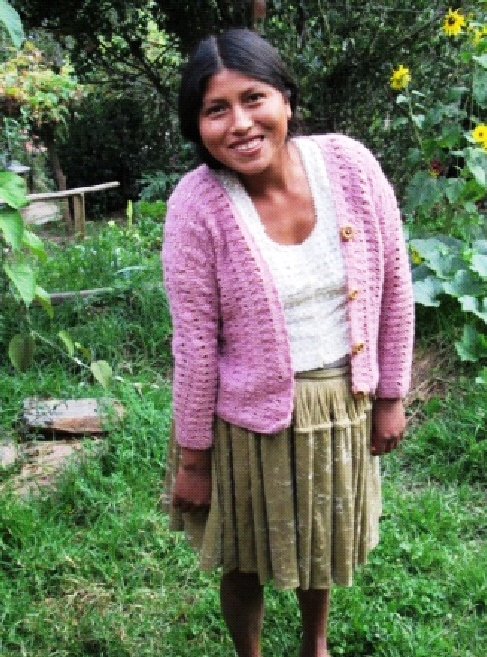
Adviana Vargas is 18 and still considered a "chica". Howevere, she weaves with the women's group as she lives with teh father of her 16-month old son and is expecting another child. She is showing the cardigan that she made after a visting volunteer opened up the mystery of the patterns and instructions in magazines that had been in the group's possession for years. Unitl then no onehad had the skills to read and interpret them.
Adviana Vargas is 18 and still considered a “chica”. However, she weaves with the  adult group as she lives with the father of her 16-month old son and is expecting another child. She is wearing the cardigan that she made after a visiting volunteer opened up the mystery of the patterns and instructions in magazines that had been in the group’s possession for years. Until then no one had had the skills to read and interpret them.
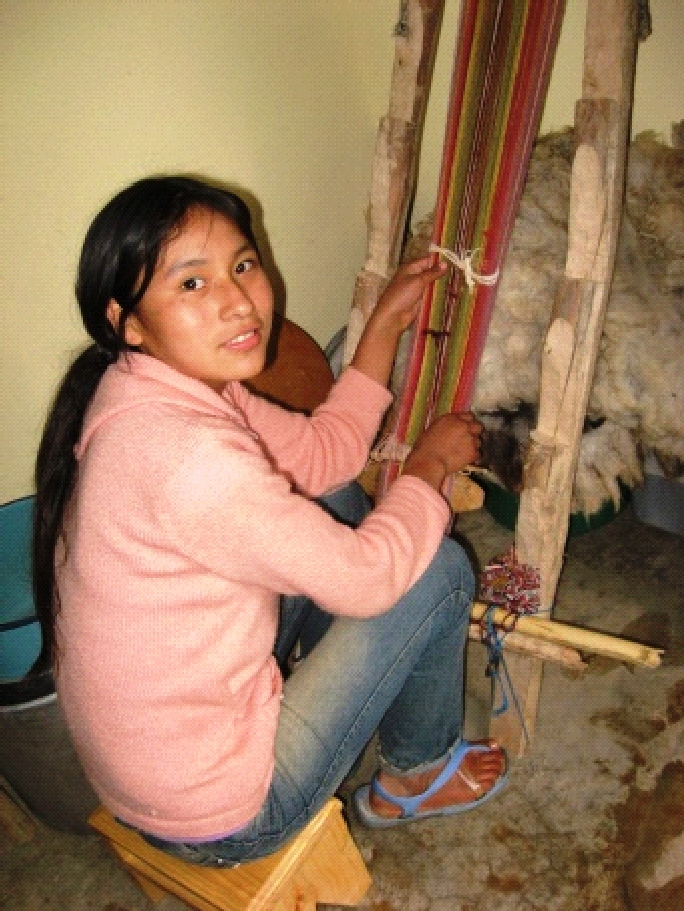
Gabriela Zenteno is 16 and has been part of the Handcraft Club since it began in 2010. She learned to weave from maxima with additonal help from her mother. Because the family lives in town instead of on the farn and Gaby goes to school, she did not learn to spin and weave at her mother's side which is integrated into the ancient farmer subsistence lifestyle.
Gabriela Zenteno is 16 and has been part of the Handicraft Club since it began in 2010. She learned to weave from Maxima with additional help from her mother. Because the family lives in town, instead of on the farm, and Gaby goes to school, she did not learn to spin and weave at her mother’s side which is integrated into the ancient farmer subsistence lifestyle.

Some of the bands were finished with four selvedges and I regretted not having told Dorinda when I ordered that I didn’t need that fourth selvedge. I know the work that is involved in that but, as my teacher Yanet from Pitumarca told us, the four-selvedge finish is “normal” for them. Some of the bands had been cut and then hand sewn to protect the edge.

terminal area supp warpMost had pebble-weave designs and I was delighted to see that two had patterns made with supplementary warps.

What was very interesting for me was noting that the way the women set up their warps to weave pebble weave varies even among communities that are relatively close together. This information is contained in the “termination” area of the band…the part where, on a four-selvedge piece, the weaver no longer has room to do pick-up and simply uses her two basic sheds to finish. There you can see the order of the colored threads in the two sheds.

You can see the termination area of one of the bands which has been patterned with supplementary warps at left.

And, happily, among these bands I found my inspiration for the Year of the Snake Weave-along that Ghedrain proposed in the Ravelry Backstrap Weaving Group. The official start of the Weave-along (WAL) was last Friday March 1 but people are free to join in at any time. I expected to be a cheer leader and “Chief Sticky Beak” as I will be on the road as from tomorrow but, with this sudden source of  snaky inspiration, I warped up a narrow band to take with me which you can see on the left with its wooly backstrap.

??????????????????????

supplementary weft project for on the road

The other project that I am taking is a band using left over Guatemalan cotton from my recent scarf project. I plan to weave in some patterns with supplementary weft and am happy that the collection of spools of silk weighs very little. To tell the truth, I will be surprised if I actually find time to work on these but I really would like to participate in the WAL.

You may remember the lovely pick-up sticks that I brought back from Guatemala which I use on these supplementary-weft projects. Fortunately, I bought two as I was careless with my packing and the very tip of one broke in my luggage on the way home. It’s still useable but not as nice to work with as the other one.

The good news is that Terri from MagicalMoons is now making  pick-up sticks that would work beautifully for supplementary-weft patterning and they look gorgeous. Below, you can see my Guatemalan ones. The one on the left is the slighty damaged one.

Guatemalan pick up sticks

And here is one from Magical Moons made from Nicaraguan rosewood…

magical moons pick up stick rotated

So, the Year of the Snake WAL is underway on Ravelry. Meanwhile, I have some  projects from Ravelry members to show you. This one is from Backstrap Group member CindyQ who has mounted her warp to weave a band with pebble-weave patterns on the frame of her rigid heddle loom. She is using the two-heddle method that I was taught by my Ayacucho weaving teachers which I explain in my first book Andean Pebble Weave….great-looking heddles and lovely weaving!

cindyq

The second project is from Kara and was posted in the Warped Weavers group. You may remember that I posted a long time ago the following picture of some interlaced bands woven on an inkle loom by Yonat…

Yonat inkle bandsIt was such an eye-catching display that I decided to put something similar together myself with the odds and ends of sample bands that I wove for my second book…

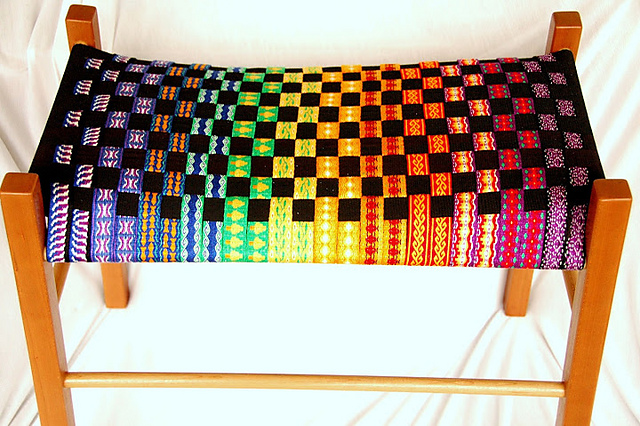
???????????????????????????????Now, back to Kara…she interlaced bands that she made especially for a project…a cover for the seat of her weaving bench. So, she has put together bands made on an inkle loom and with tablets to make not only a stunning display of her work, but also something wonderfully practical….

kara (1)

All those bright bands interlaced with black….WOW! Go gather up your bands now and start planning!! I can see pillow covers and other wonderful things using this idea!

Here is a picture of one of her bands in progress…

kara (3)

Enough inspiration?!


Backstrap Weaving – New Challenges: Wider, Longer, Finer.

While doing some house keeping in my album of weavings on Facebook, I came across a picture I took of the first red, black and white wall hanging I made entitled “Starry Night”. My caption read that I was weaving this in order to push myself beyond my current width comfort zone. That was a nice reminder as I am now on the third piece of similar width in this series and I have to say that I feel very comfortable with this width now! Seems that I need to go wider.

The first two pieces in the wall hanging series
The first two pieces in the wall hanging series.

Here is where I stand with piece number three. That snake continues to slither its way up the cloth.

O

The pick-up is a piece of cake now…really! There’s nothing like repetition to firmly embed a design in your head and fingers. It began with lots of tedious chart reading which was made a lot easier with the use of removable highlighter tape. Then I played a favorite game…read the cloth and guess what comes next. Then, before passing the weft, sneak a peek at the chart to see if you are correct. Next comes reading the cloth, deciding what comes next and going for it. Beat, pass the weft and then look at the cloth, not at the chart, to see if you were correct. Eventually you reach that chart-free happy place.

But then….you finish the weaving, you start something entirely new with a totally different structure and the fun begins again!

As for going wider….there are still quite a few more pieces I want to make in this current series, but when I do get to the point when I am ready to break out of the old comfort zone, I will need some new equipment…longer loom bars for a start. I already have some pretty long swords.  I would also love to have the kind of backstrap that some of the weavers in Peru use.

Chiclayo and Santiago Atitlan

With its two sets of straps, it was designed to accommodate different widths of weaving.

And, I would like to weave longer pieces. The scarf that I recently made had me extended to the limits of my weaving space. I rolled up part of the warp at the far loom bar but I really prefer to have the warp unrolled at full stretch.

backstrap warp for scarf project

There was just enough space to put my cushion and sit with my back against the closet door. So, if I am to go longer, it is a simple matter of using a circular warp. I have woven on these kinds of warps on a few occasions. Anyone who does inkle weaving certainly knows about circular warps.

circular-and-single-plane-warps

The pictures above show a band on which I was working on my inkle loom. The warp is a complete circle. The black band next to it has been warped in a single plane in the same way as the long black scarf warp. Once weaving is finished, the circular warp is cut apart and the band can be extended to its full length.

The Montagnard weavers with whom I studied use circular warps for their long blanket and skirt panels.

montagnard weaver opening heddle shedYou can see Ju Nie above weaving the top part of her circular warp.

Probably the most time I spent weaving on a circular warp was when I learned to weave the typical belt of Salasaca, Ecuador. My teacher, Felipe, wove on his narrow front porch and his way of setting up a circular warp allowed him to sit and weave the very long belt even in that small space.

dovetail warp Salasaca Ecuador

Felipe’s belt will not have to be cut once the weaving is finished. He has warped in what is known as “dovetail”  fashion.

dovetail warp set-up

The following diagram will show you how he is using five of the six sticks you can see in the above picture to wind the warp for the white ground weave. The stick marked with the red arrow is the one around which the warps “dovetail”. When weaving is finished, the stick will be removed and the belt can be opened out. You can see the dovetail stick in the photo of Felipe weaving. It is in the section of  band that lies along the porch post.

dovetail warping path

And, if you are wondering about the sixth stick…that stick is used to hold the colored supplementary warps. Salasacan belts are woven in a supplementary-warp technique.

my salasaca belt

The diagram above shows the path of the white warps in the ground weave. The following diagram shows the path of the colored supplementary warps. In Salasaca, the supplementary warps all go together in a heddle of their own rather than being split between the two ground weave sheds.

dovetail warp path 2

angela-and-hammock-loomYou can see that when the dovetail stick or cord is removed, the end loops of the warp will stay intact. The loops can be very useful for finishing the woven item.

Guaraní hammock weavers here in Santa Cruz use the dovetail warping method and use the intact end loops for attaching the cords from which the hammock will be suspended.

So, longer warps are on the drawing board for me which will mean building a new warping board or modifying my existing ones.

I would really like to have a set-up like Felipe’s. Too bad I don’t have a porch on which to sit (and, yes, the view was lovely from there). I have seen pictures and videos of many Asian weavers with similar “triangular” set-ups. I will have to see into which wall I can drill holes in a place where I can still get good light! The idea of raising my bed way up high to give myself more space is gaining more and more merit.

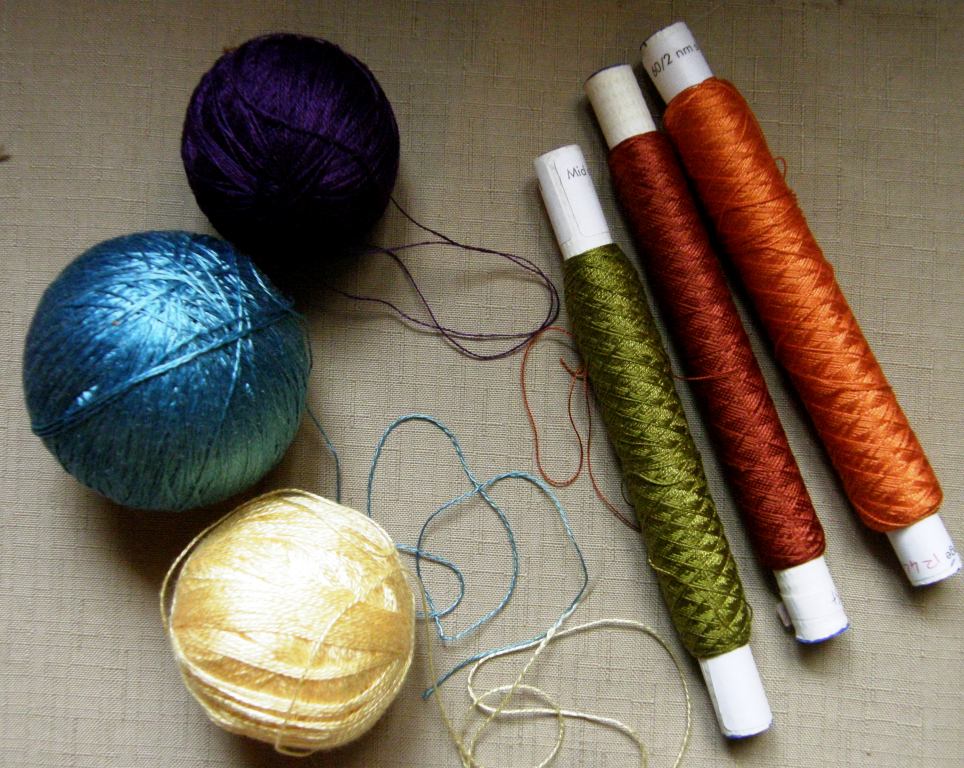
The third challenge is to use finer yarn and I am already in training for that with my scarf projects made from Guatemalan cotton. I have a ball of fabulous indigo-dyed silk that an English teaching colleague brought back for me from Japan years ago. It is heavier than the 60/2 silk that I have been using as supplementary weft and I think that it is a good weight for a first large silk weaving experiment.

Light blue Japanese silk, spools of 60/2 silk, yellow 8/2 tencel and purple Guatemalan cotton.

pebble weave with silkHowever, this doesn’t mean an end to band weaving! I love weaving bands just for the pure fun of it and don’t care if I don’t have a particular use for them.

Narrow bands are a good way to test new yarn or check the proportions of a newly charted motif.

I love weaving miniatures too and have already used the 60/2 silk in a small pebble weave band (at left) to test the yarn, check how difficult it might be to see for doing pick-up as well as to try out a new pebble weave motif.

Band weaving for me is also a nice way to take a break from large pieces on which I might be working…only 16 threads to pick up rather than the 286 in my current project and I can attach to a toe and weave on the sofa.

Much of last year was spent finishing my second book which involved a lot of weaving of samples… mostly bands and a few larger pieces. I have buckets of bands here! They won’t be made into anything. Some of them are very useful in that they travel to my workshops and make good teaching tools.

I took this next idea from my friend Yonat who put together a display of her inkle bands to photograph. I  put together a few of the bands that went into my book last year. They are of different widths and lengths…some barely two inches long… and so, my display is not as pretty and uniform and Yonat’s.

backsrap woven bands for book

The resulting book with yet more bands on the cover…

More adventures book cover dsz

You can download it from Patternfish.com.

ANWG 2013

The North West Weavers Conference, which will be held in Bellingham, Washington this June, recently opened its registration. I am going and hope to see you there!

To finish, here are some great projects from members of the Ravelry group…

carrie

Carrie wove this warp-faced band using the frame of her rigid heddle loom on which to extend her warp. She used string heddles and a shed rod rather than the rigid heddle. The patterns were created with supplementary warps. Gorgeous! We all love the soft colors she chose.

amandaAmanda kindly shared part of her band with her first attempt at creating patterns with supplementary wefts. She shows the difference that applying less tension to her warp made to the amount of coverage she achieved with the supplementary weft. She is using #10 crochet cotton for warp and embroidery floss as her supplementary weft.

janet

Janet wove this guitar strap for her husband with her own hand-spun and dyed wool. She used instructions for the pick-up patterns from Anne Dixon’s inkle weaving book.  She included words from a song which her husband wrote in the design and used guitar strap hardware made by our friend Annie MacHale to put it all together.

Speaking of Annie, she has been dazzling us on Facebook with the gorgeous straps she has been making on her inkle loom to sell at a big guitar show this weekend in California. Annie is all about color…I will leave you with just four examples of the more than forty guitar straps she will have for sale!

annies straps

So, my challenges are longer, wide, finer. What are yours?