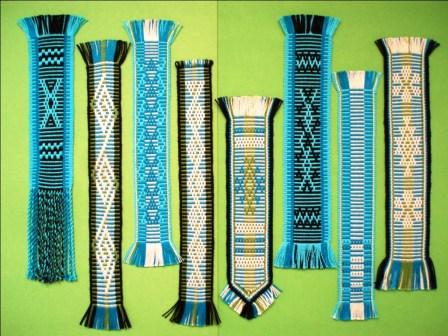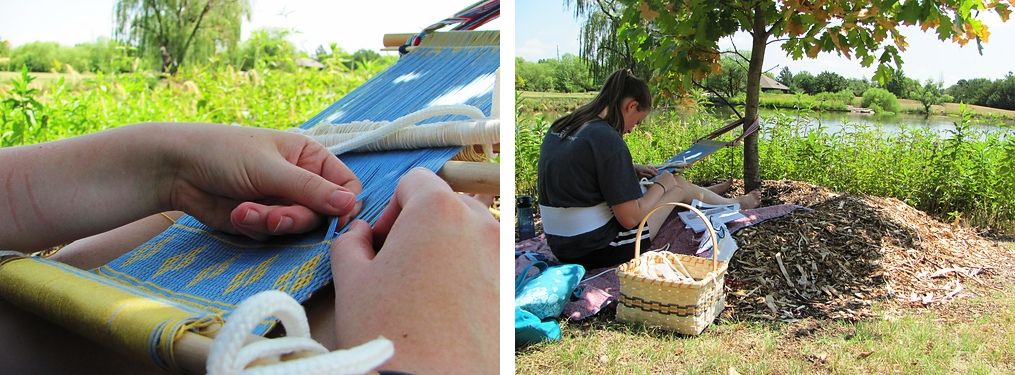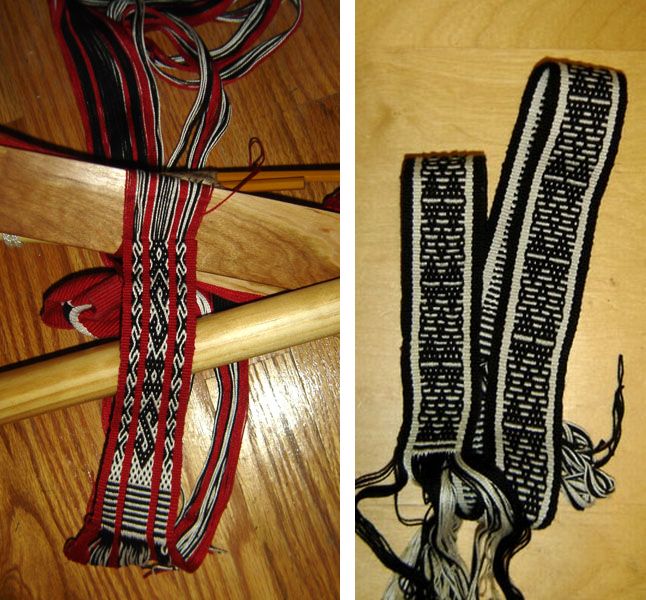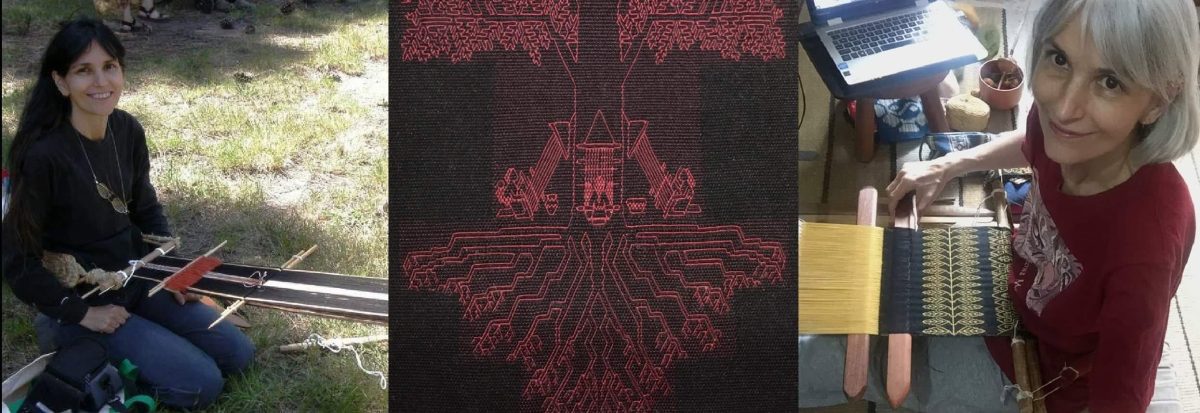
Backstrap Weaving – The Stories Within the Cloth

I am all packed and I  leave tomorrow which leaves me with a day to wander around in circles and wonder about what I have forgotten. So, before I drive myself crazy, I think I should sit down and write a blog post.

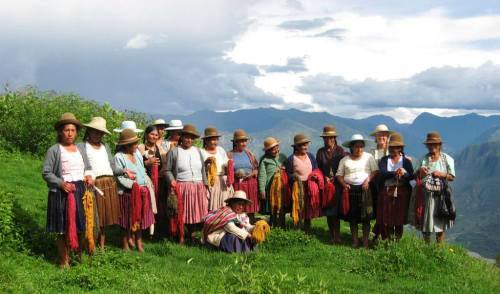
Late last week I picked up from the post office a box of ten fajas, belts, that I had ordered from Maxima and the weavers in the communities in and around Independencia in Cochabamba. (All photos of the weavers except for the first one, are taken from the PAZA webpage with the kind permission of Dorinda Dutcher).

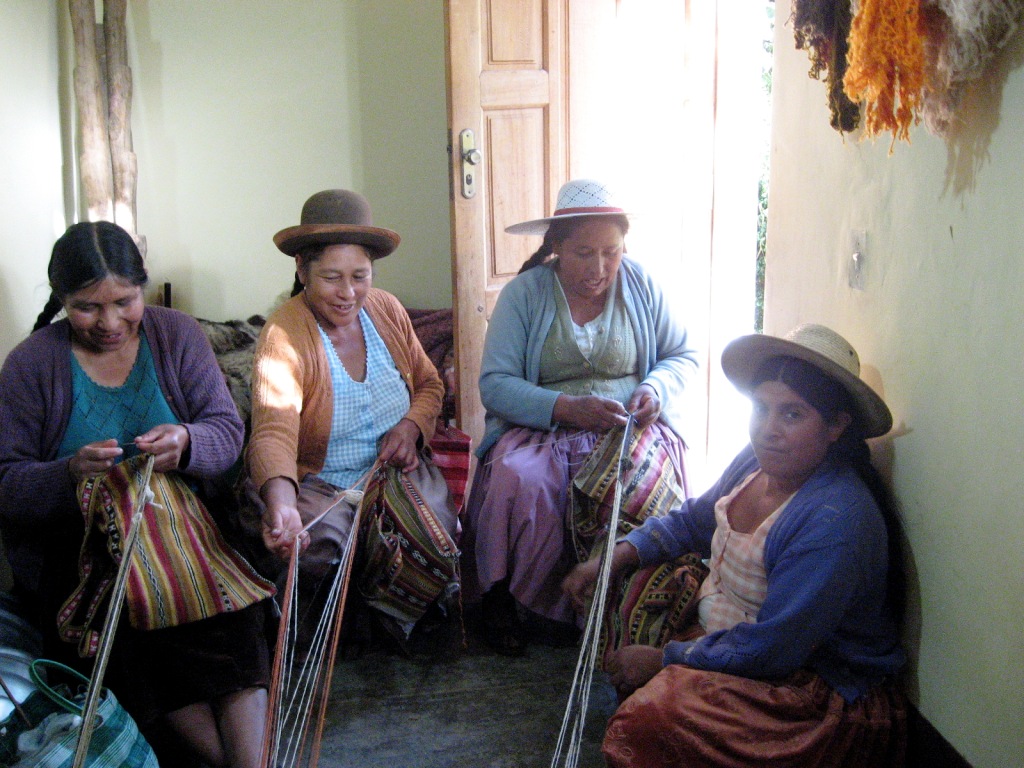
??????????????????????These are the ladies with whom American Dorinda Dutcher has been working for years, helping them to recover and pass on their spinning, dyeing and weaving skills and market their woven goods. If you follow my blog, you will have seen pictures of and heard stories about Maxima Cortez, one of the women with whom Dorinda has most closely worked. She is the coordinator of the various Handicraft Group activities. Maxima is one of my weaving teachers and was my roommate at the Tinkuy in Peru.

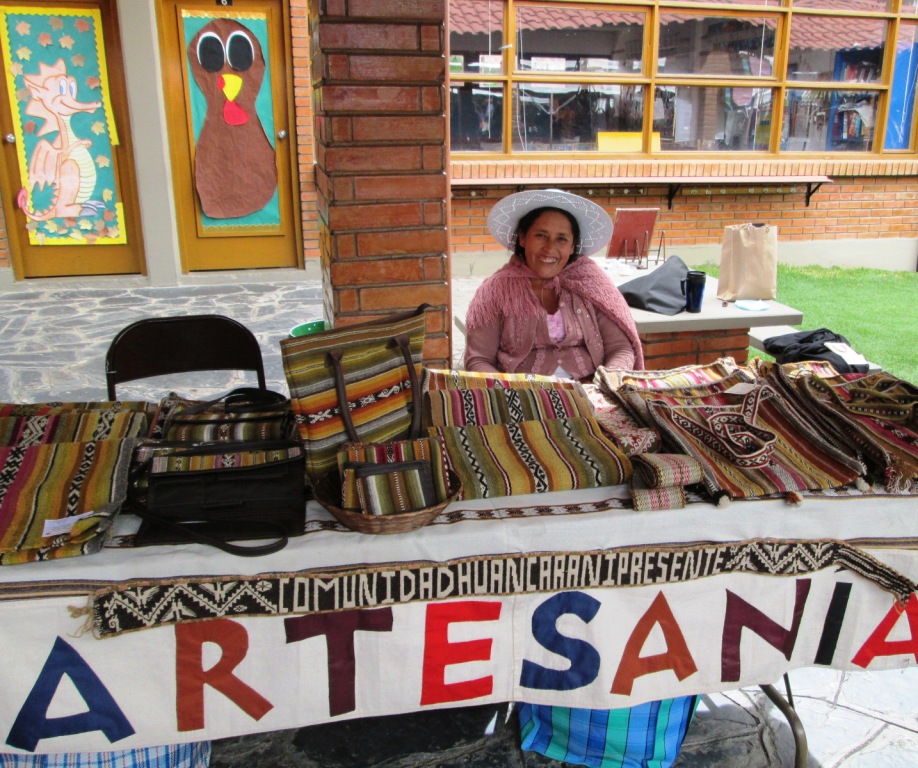
Maxima, daughter Soraida and granddaughter Nilda were my weaving companions for my three-day stay in Cochabamba.

???????????????????????????????

CdCWeave

???????????????????????????????
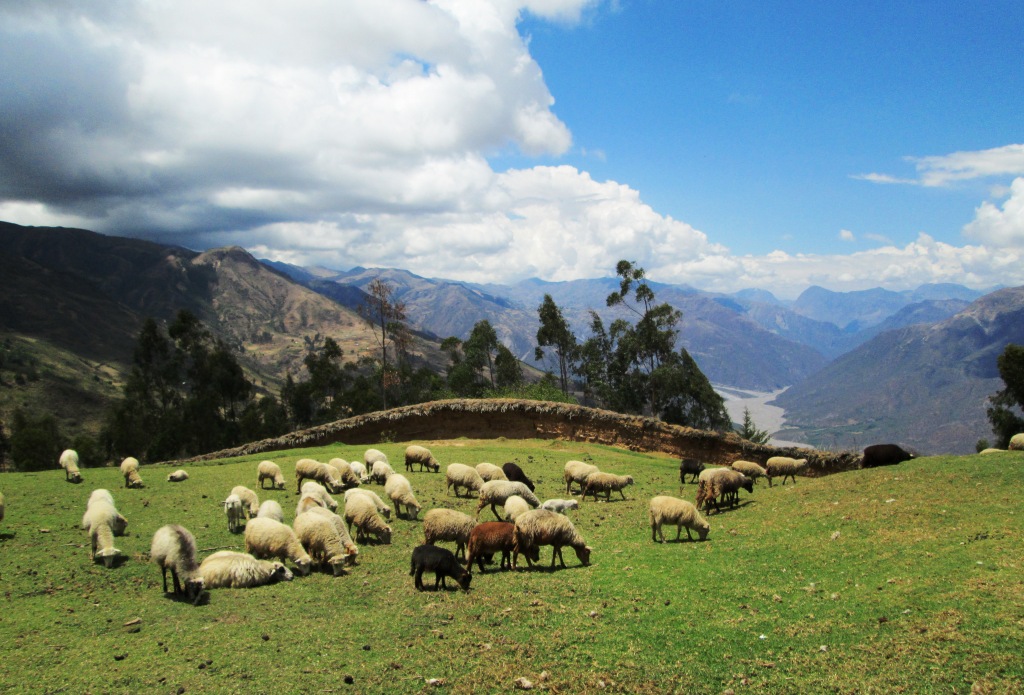
The flock belonging to Casimira, one of the spinners and weavers who made the bands in my order.

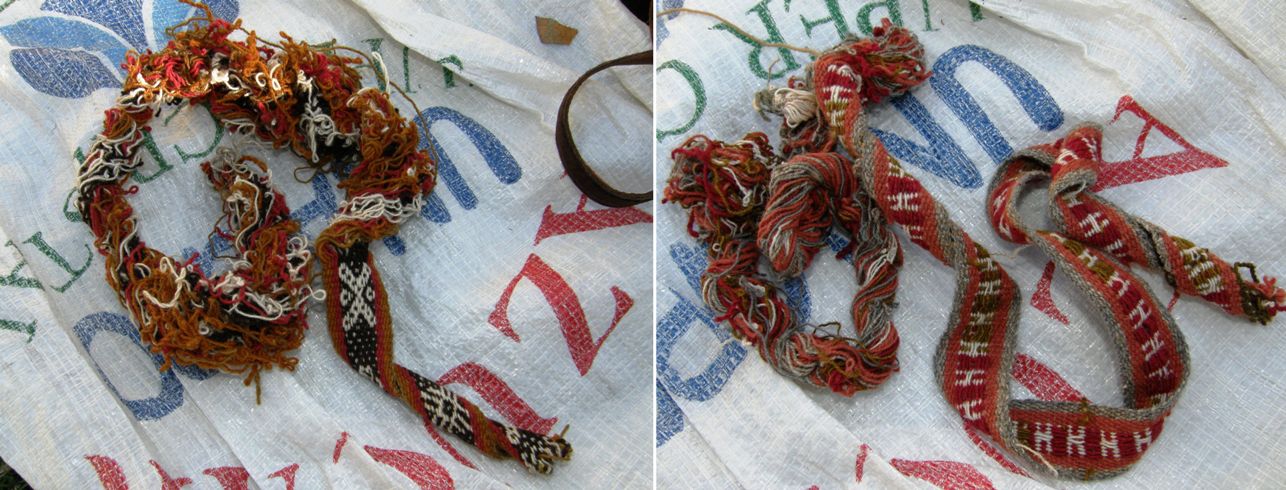
I opened the box of  fajas and saw the two colorful packages of neatly folded and stacked bands each with a label detailing the name of the weaver and her community.

It was such a happy sight but, what really hit me, was that wonderful aroma of wool mixed with the various smells of the natural dye substances that are used to create the colors.

It was such a strong fragrance that my cat immediately awoke and had to come over to roll in the bands.

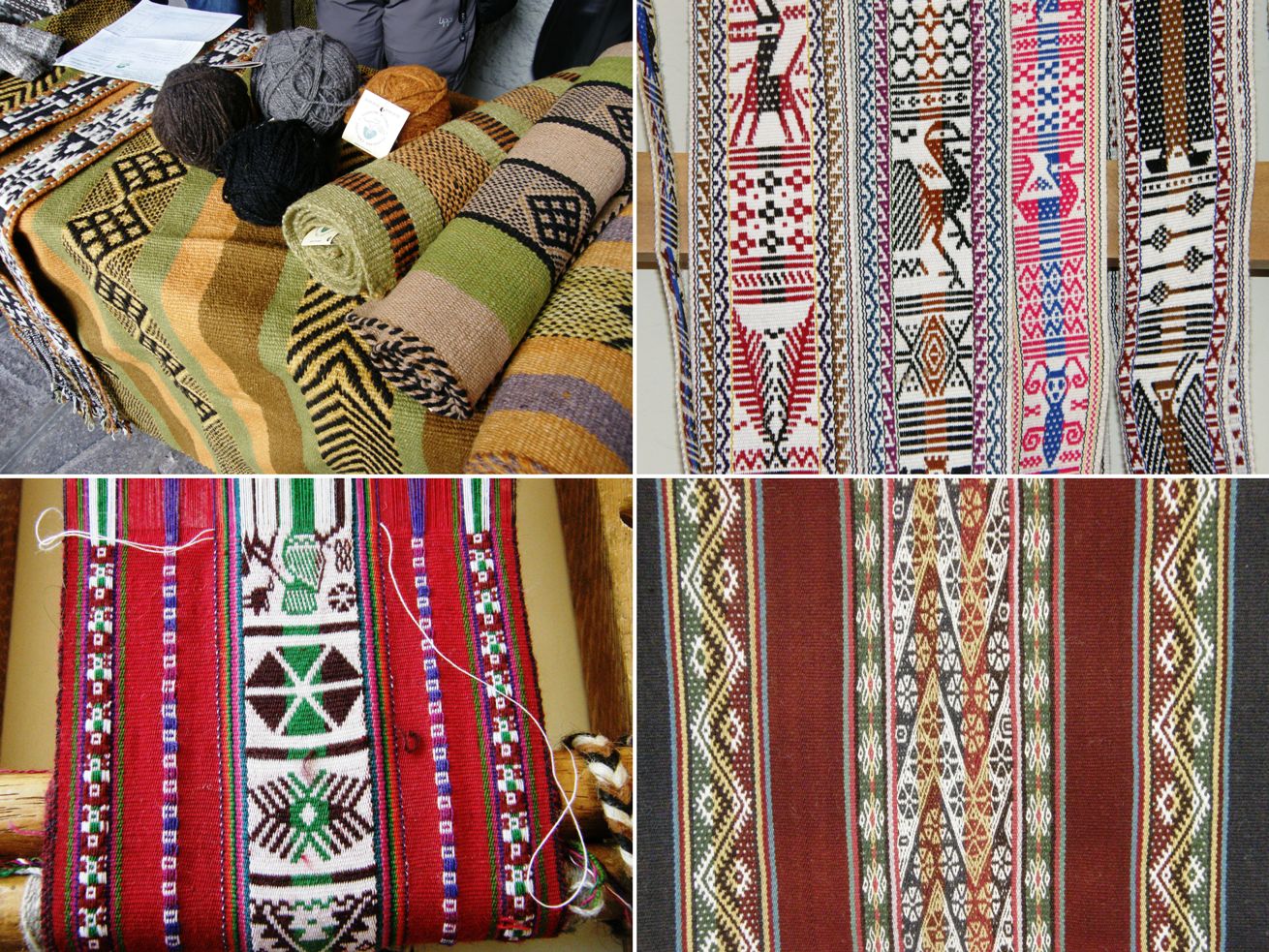
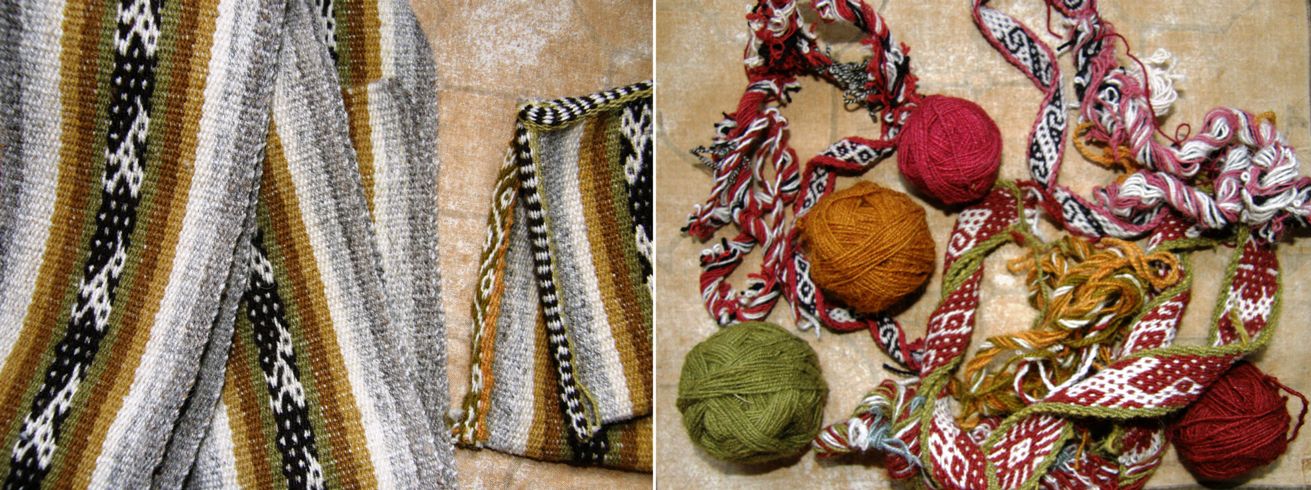
And then there were the textures. Each weaver and spinner has their own style and beat and the bands varied from those that were smooth and taut to those which had more dimension and drape.
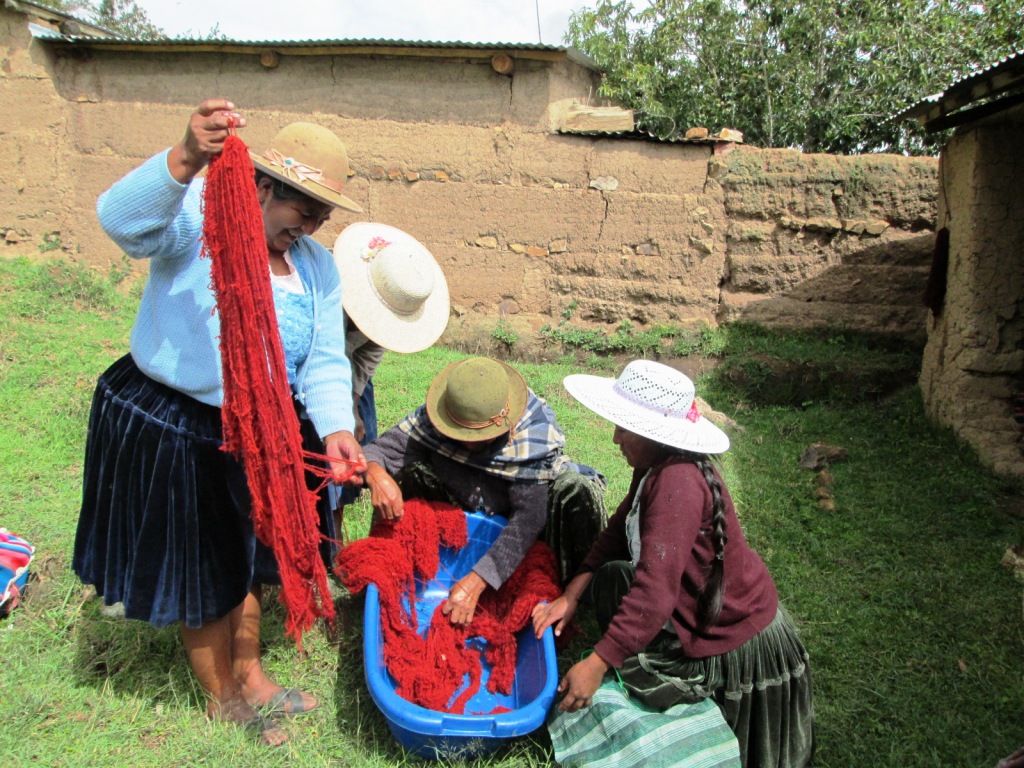
???????????????????????????????I counted eight different tones from cochineal dye and even more shades of green and then closer inspection helped me to see which ones were most likely made by the younger members of the communities…the ones where the weaver jumped a little erratically from pattern to pattern spoke of a youngster who was keen to try out her entire newly acquired repertoire in the one piece.

Perhaps the ones that have some little flaws are from the youngsters too or maybe they are from mothers who were distracted for a moment by one of their little ones.

Each one tells a story and it is strange sitting here in this tropical heat and imagining the sounds of the looms, the cool green slopes and valleys and music of the highland region in which they were made.
grphuancarani

Dorinda shared some pictures and a little information about each and every weaver with me. Here are just a few…
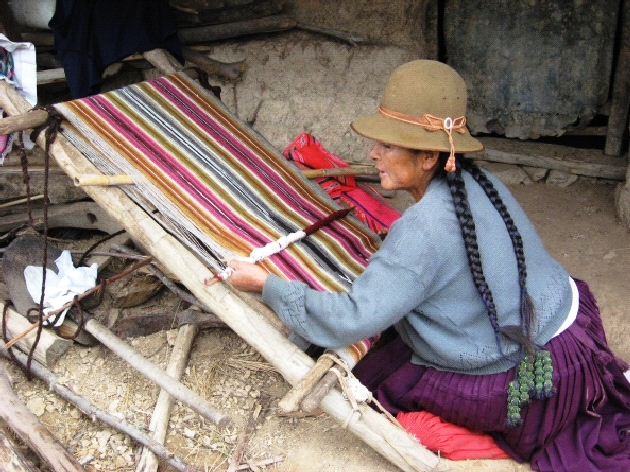
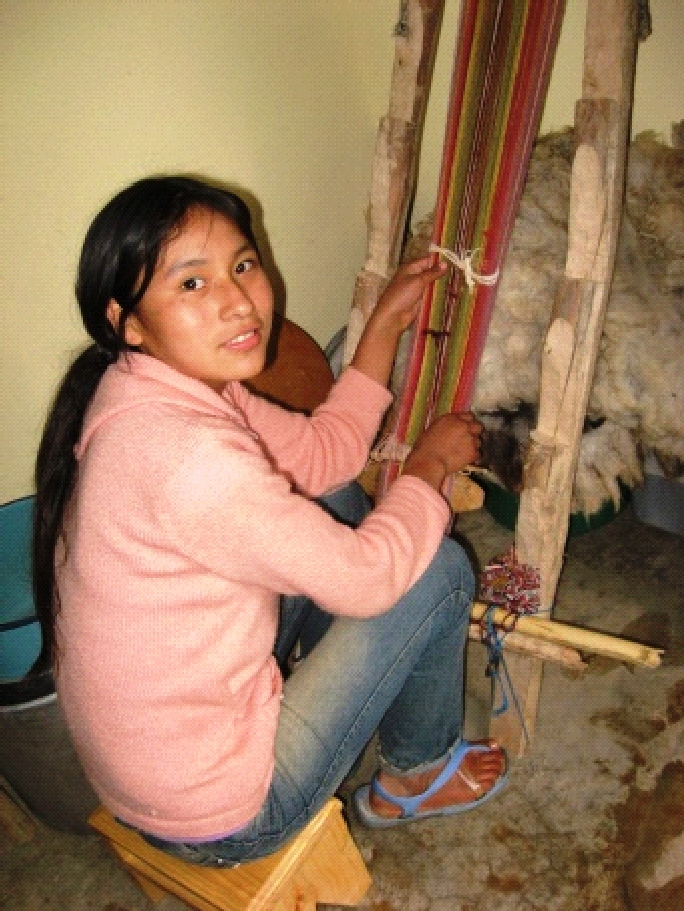
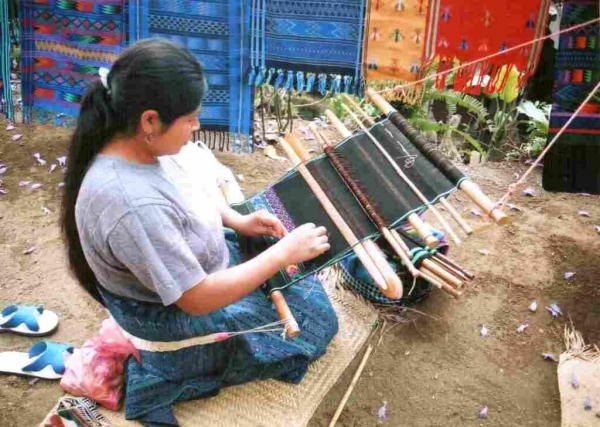
Here is Casimira Calcina working on the leaning verticalloom which is typical of the region. She lives in the rural community of Huancarani. Being widowed and with her children having migrated, she works hard alone to run her farm and tend her flock.
Here is Casimira Calcina working on the leaning vertical loom which is typical of the region. She lives in the rural community of Huancarani. Being widowed and with her children having migrated, she works hard alone to run her farm and tend her flock.
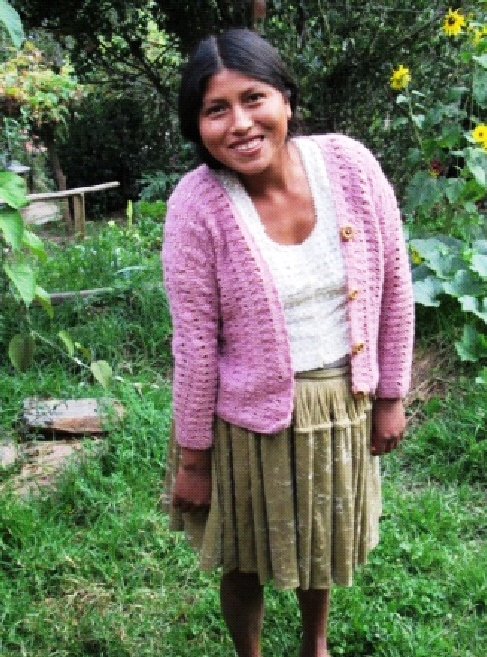
Adviana Vargas is 18 and still considered a "chica". Howevere, she weaves with the women's group as she lives with teh father of her 16-month old son and is expecting another child. She is showing the cardigan that she made after a visting volunteer opened up the mystery of the patterns and instructions in magazines that had been in the group's possession for years. Unitl then no onehad had the skills to read and interpret them.
Adviana Vargas is 18 and still considered a “chica”. However, she weaves with the  adult group as she lives with the father of her 16-month old son and is expecting another child. She is wearing the cardigan that she made after a visiting volunteer opened up the mystery of the patterns and instructions in magazines that had been in the group’s possession for years. Until then no one had had the skills to read and interpret them.
Gabriela Zenteno is 16 and has been part of the Handcraft Club since it began in 2010. She learned to weave from maxima with additonal help from her mother. Because the family lives in town instead of on the farn and Gaby goes to school, she did not learn to spin and weave at her mother's side which is integrated into the ancient farmer subsistence lifestyle.
Gabriela Zenteno is 16 and has been part of the Handicraft Club since it began in 2010. She learned to weave from Maxima with additional help from her mother. Because the family lives in town, instead of on the farm, and Gaby goes to school, she did not learn to spin and weave at her mother’s side which is integrated into the ancient farmer subsistence lifestyle.

Some of the bands were finished with four selvedges and I regretted not having told Dorinda when I ordered that I didn’t need that fourth selvedge. I know the work that is involved in that but, as my teacher Yanet from Pitumarca told us, the four-selvedge finish is “normal” for them. Some of the bands had been cut and then hand sewn to protect the edge.

terminal area supp warpMost had pebble-weave designs and I was delighted to see that two had patterns made with supplementary warps.

What was very interesting for me was noting that the way the women set up their warps to weave pebble weave varies even among communities that are relatively close together. This information is contained in the “termination” area of the band…the part where, on a four-selvedge piece, the weaver no longer has room to do pick-up and simply uses her two basic sheds to finish. There you can see the order of the colored threads in the two sheds.

You can see the termination area of one of the bands which has been patterned with supplementary warps at left.

And, happily, among these bands I found my inspiration for the Year of the Snake Weave-along that Ghedrain proposed in the Ravelry Backstrap Weaving Group. The official start of the Weave-along (WAL) was last Friday March 1 but people are free to join in at any time. I expected to be a cheer leader and “Chief Sticky Beak” as I will be on the road as from tomorrow but, with this sudden source of  snaky inspiration, I warped up a narrow band to take with me which you can see on the left with its wooly backstrap.

??????????????????????

supplementary weft project for on the road

The other project that I am taking is a band using left over Guatemalan cotton from my recent scarf project. I plan to weave in some patterns with supplementary weft and am happy that the collection of spools of silk weighs very little. To tell the truth, I will be surprised if I actually find time to work on these but I really would like to participate in the WAL.

You may remember the lovely pick-up sticks that I brought back from Guatemala which I use on these supplementary-weft projects. Fortunately, I bought two as I was careless with my packing and the very tip of one broke in my luggage on the way home. It’s still useable but not as nice to work with as the other one.

The good news is that Terri from MagicalMoons is now making  pick-up sticks that would work beautifully for supplementary-weft patterning and they look gorgeous. Below, you can see my Guatemalan ones. The one on the left is the slighty damaged one.

Guatemalan pick up sticks

And here is one from Magical Moons made from Nicaraguan rosewood…

magical moons pick up stick rotated

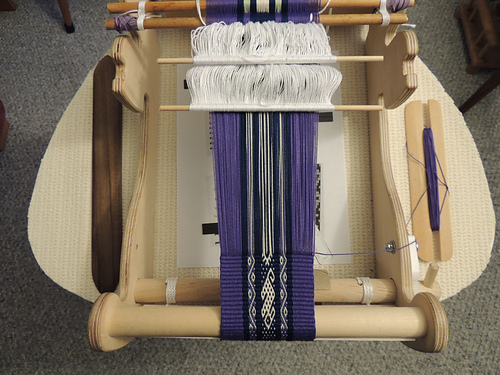
So, the Year of the Snake WAL is underway on Ravelry. Meanwhile, I have some  projects from Ravelry members to show you. This one is from Backstrap Group member CindyQ who has mounted her warp to weave a band with pebble-weave patterns on the frame of her rigid heddle loom. She is using the two-heddle method that I was taught by my Ayacucho weaving teachers which I explain in my first book Andean Pebble Weave….great-looking heddles and lovely weaving!
cindyq

The second project is from Kara and was posted in the Warped Weavers group. You may remember that I posted a long time ago the following picture of some interlaced bands woven on an inkle loom by Yonat…

Yonat inkle bandsIt was such an eye-catching display that I decided to put something similar together myself with the odds and ends of sample bands that I wove for my second book…

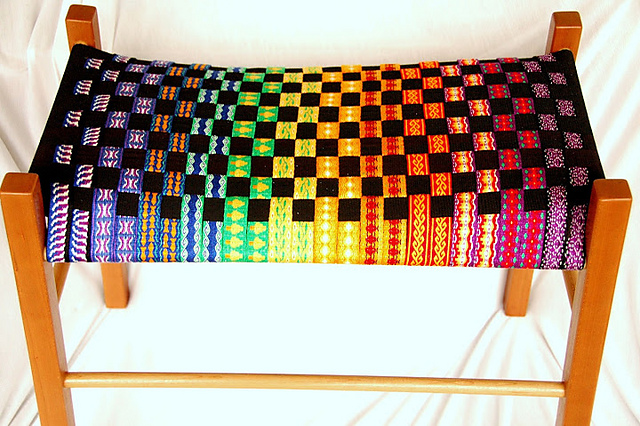
???????????????????????????????Now, back to Kara…she interlaced bands that she made especially for a project…a cover for the seat of her weaving bench. So, she has put together bands made on an inkle loom and with tablets to make not only a stunning display of her work, but also something wonderfully practical….
kara (1)

All those bright bands interlaced with black….WOW! Go gather up your bands now and start planning!! I can see pillow covers and other wonderful things using this idea!

Here is a picture of one of her bands in progress…
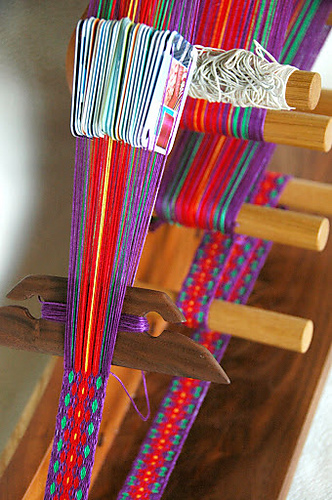
kara (3)

Enough inspiration?!


Backstrap Weaving – Encuentro de Tejedores de las Americas – Part Two – the cloth and the looms.

Read Part One of this story here.

ARE YOU GOING TO WEAVE TODAY?

I probably make a thorough nuisance of myself at weaving events like the Encuentro de Tejedores in Cusco Peru earlier this month. I have so many questions and want to be into everything and not miss a thing.

Calm and serene despite being in the very heart of the city of Cusco, the venue for the conference was beautiful both by day and night. There were plenty of pillars to which looms could be attached for weaving displays and shaded areas under the arches where weavers could show their textiles.

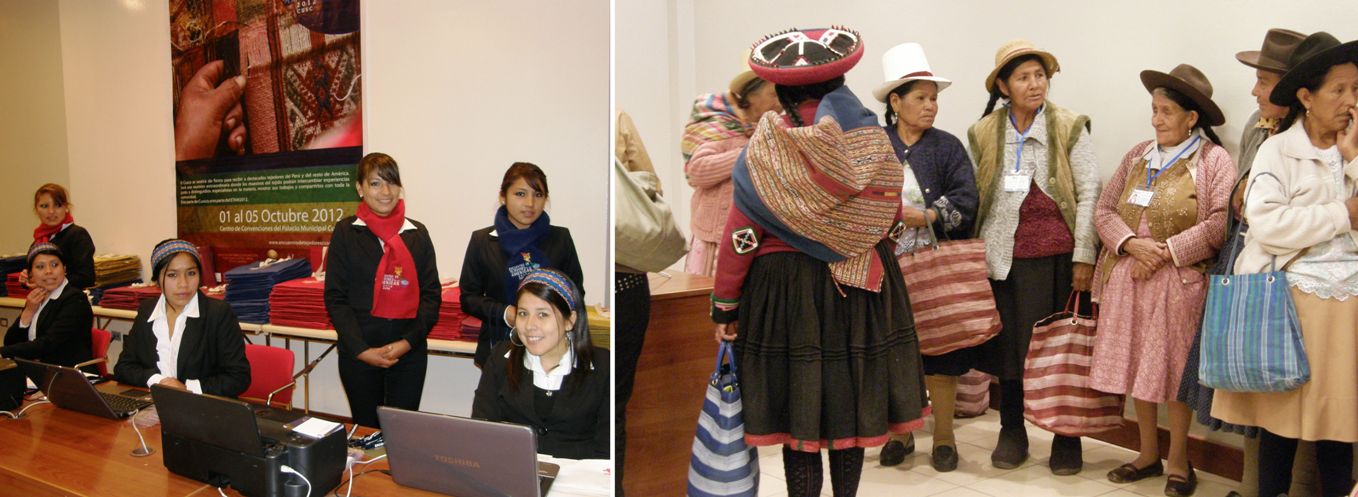
 Bright and early on day one, I registered along with other participants. The receptionists, looking smart in their uniforms with colored conference scarves and headbands, were efficient and clearly trained to be able to handle anything. The whole process was very slick and it was interesting to hear all the different Spanish accents and Quechua being spoken in the line-up of participants from all over Peru and South America. I recognized fondly the accent from Chile where I lived for five years as well as the song of the Argentinean-style of speaking used by my ex-boyfriend and the special way that Bolivian highlanders pronounce “rr”.

I then stepped outside to the courtyard to another world…a buzz of colorful activity… where I watched all the stands being assembled by weavers from all over Peru, Bolivia and Latin America, saw all the marvelous textiles emerging from travel sacks and being arranged and labeled, touched the fiber, tools and implements which were used to create the colorful cloth and spoke with the creators themselves. Some of them seemed somewhat overwhelmed by the high level of interest in and admiration for activities that are quite normal and commonplace, almost passing without remark, in the communities, villages and towns where they live.

Weavers and knitters from Taquile Island wearing and displaying their textiles and the creators of the wonderful ikat pañones of Tacabamba, Peru

The question that I really wanted to ask everyone right there and then is “Are you going to weave today?” Is today the day when we will get to sit by you and see how you created all these exquisite textiles? And all the while the  excitement is building as I see more and more gorgeous textiles and looms being extracted and arranged. I had already seen at least ten things that I wanted to explore further after having passed just once quickly by each of the twenty-two half-erected stands.

Weavers and spinners from the Navajo Nation, my friend from the Tinkuy, DY, and TahNibaa and Albina from San Ignacio de Loyola showing the crocheted “chullos” and the belt loom full of sticks which is typical of her community. 
The Chol Chol Foundation of Chile was present bringing with them textiles made by the Mapuche weavers that they support including a spectacular ikat- patterned “manta cacique”. Lowland areas of Peru were also well represented with a group of Matsigenka cotton spinners and weavers from Echarate, Bajo Urubamba.

The looms!……

A horizontal loom with a broad belt patterned with double weave and complementary-warp pick-up patterns of Taquile Island and a backstrap loom with a cotton warp-float piece in progress from Echarate.
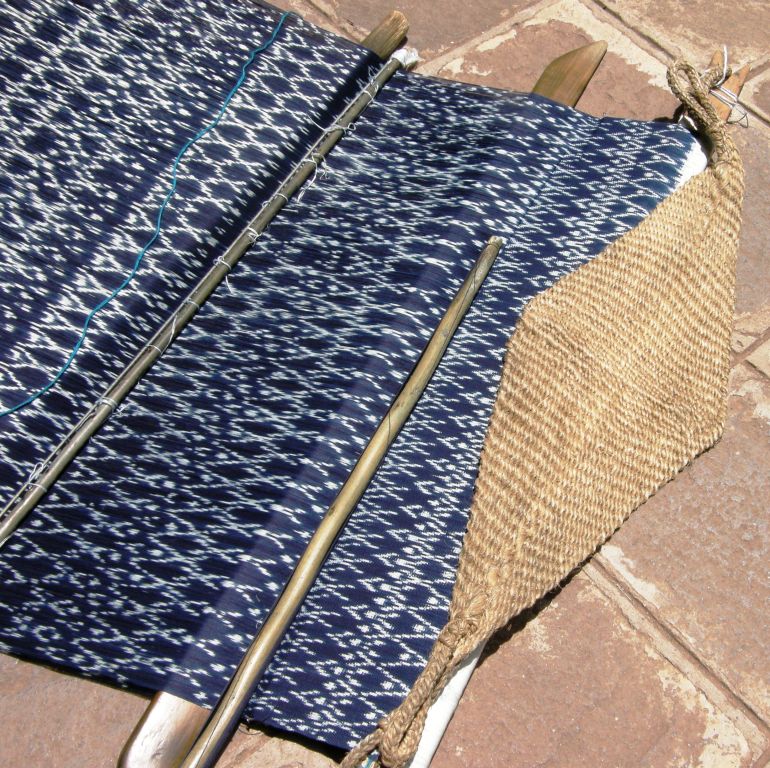
The simple backstrap loom of Tacabamba, Peru on which the indigo ikat-patterned “pañones” are woven.  The process of creating a pañon is anything but simple. They are up to one-meter wide, covered with tiny motifs and have patterns knotted into their fringes.
A floor loom from Ayacucho, Peru with a tapestry in progress and the leaning vertical loom of Tarabuco, Bolivia.
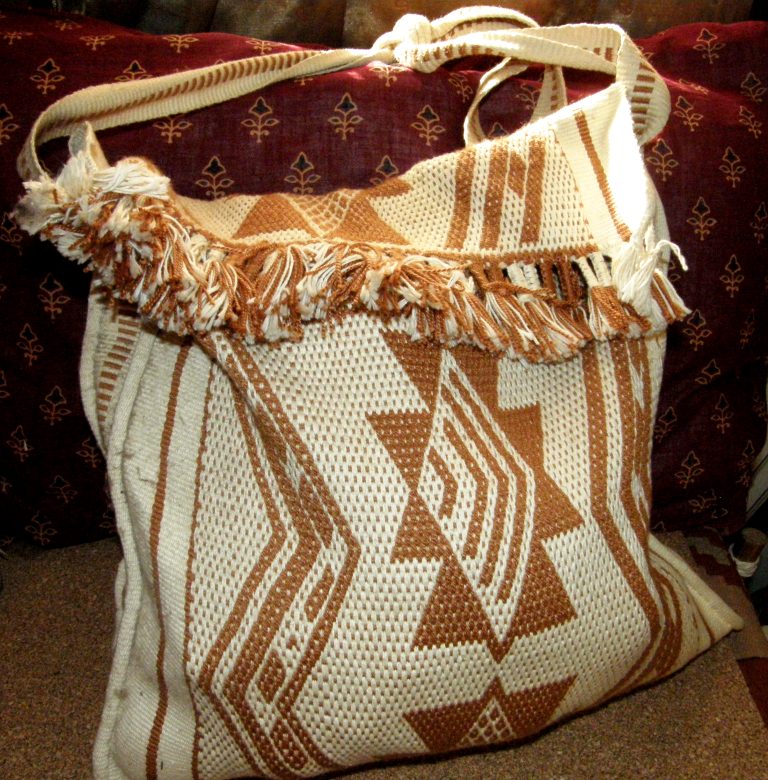
The cotton weavers of Chiclayo managed to preserve their native cotton despite the fact that its cultivation was banned for many years in Peru. The backstrap loom is used to weave their natural brown and white cotton into saddle bags, belts and table ware for their own use. The Guatemalan loom from Santiago Atitlan holds brocaded cotton cloth destined for the typical woman’s blouse or “huipil”. Panels are sewn together and the neckline embroidered with birds.

Wide warps, narrow warps and everything in between… A Tinkipaya weaver’s leaning vertical loom, holding fabric covered n complementary-warp pick-up patterns, rests on the ground. A weaver from Pitumarca speedily edges her finished woven lliclla with a tubular woven band using three sets of string heddles and a shed loop.

A backstrap weaver from Ayacucho, Peru, creates a belt patterned with supplementary warps. She uses a forked stick to hold a secondary cross, the manipulation of which helps her to open the heddle shed quickly and efficiently. The wide backstrap loom parked against the pillar is from Tanta, Peru where handspun alpaca yarn is often combined with bright synthetic threads to make shawls, ponchos and blankets.

And then there was that tantalizing backstrap loom with its twenty-four heddle sticks…Señora Araceli, are you going to weave today?

First Araceli has to make the twenty-four sets of heddles on this fresh warp. The pattern has already been picked up and saved on sticks.

Just before lunchtime one day when we were indoors listening to speakers, I got the uneasy feeling that I really needed to be somewhere. I got up and tip-toed out at the start of the morning’s final presentation by Manos del Uruguay to find Araceli seated and preparing her warp for an afternoon session of weaving.

Well, you know that I am fascinated by the entire process and so I was happy to be able to sit alone with her and watch her make her heddles. I was tickled to see that she makes her heddles with the extra security hitch just as I have chosen to do. I have seen and learned so many ways to make string heddles for backstrap and other kinds of weaving and this method is by far my current favorite. I always say “current” as who knows what cool new method I will find tomorrow.

Here is a short video clip of Araceli making her heddles. She certainly has a smooth and elegant way of doing so. I know some people don’t like making heddles and dread that part of the process…I like it!

And what about the woven cloth produced by these looms and the pieces produced by talented hands using knotting, braiding and crochet?

Head gear…Crocheted “chullo” from Peru and a woven hatband from Bolivia.

There are four countries represented here….cloth from Mapuche weavers in Chile,  Salasaca, Ecuador,  Taquile Island, Peru and Tinkipaya, Bolivia.

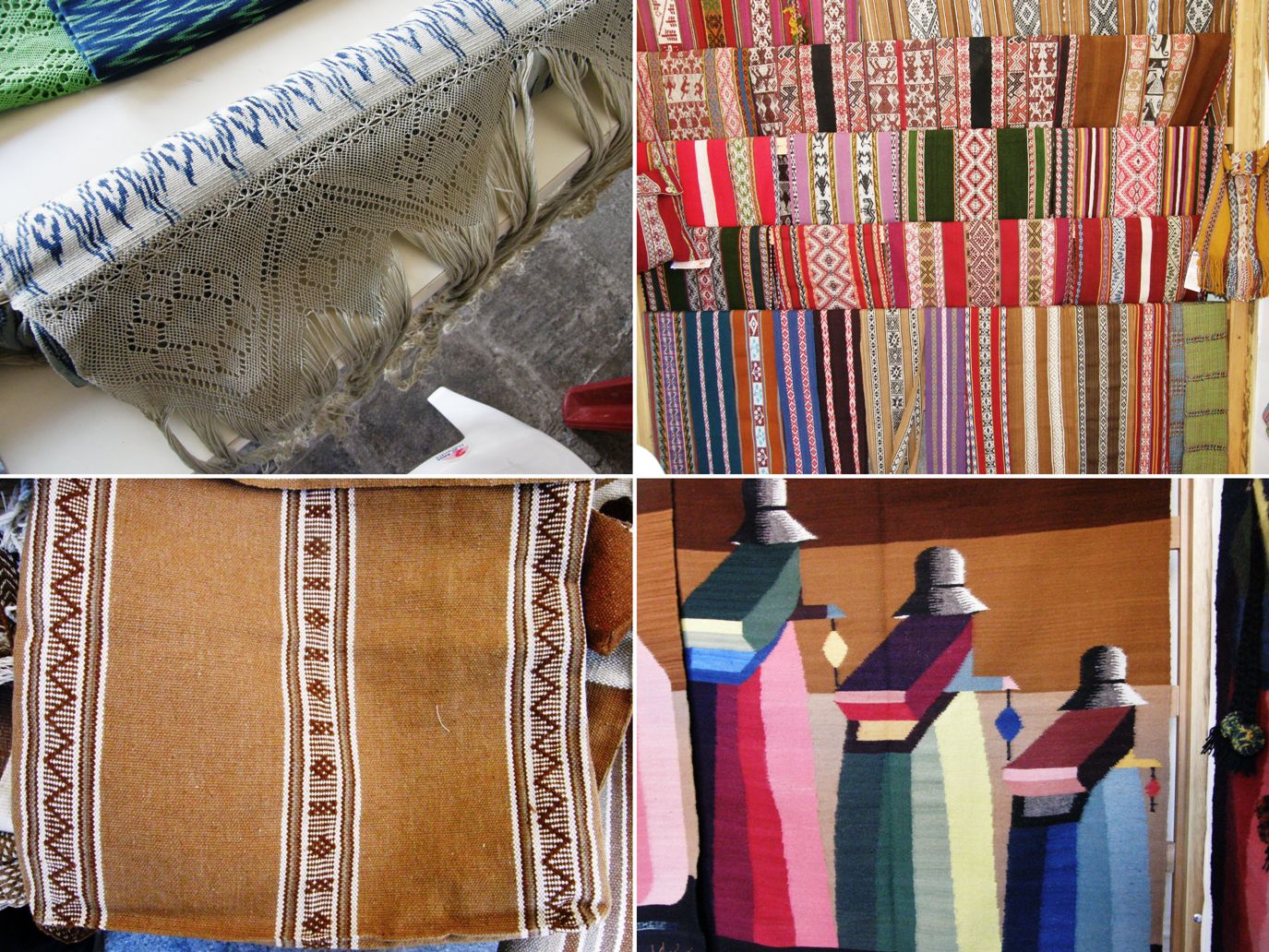
Cloth from different corners of Peru. The variety!

Of course, each piece has its story and it was those stories that we were told in the weavers’ own words in the seminar sessions that were held in the mornings and afternoons. The stories were very inspiring and educational, often with very personal touches which brought life and meaning to the fabric that simply could not be transmitted from the market stall or loom alone. All told of hope, perseverance, strengthening of ethnic identity and a revival of pride in oneself and culture and were often very moving.

The faja sara ( the one created with the twenty-four string heddles) has its own fascinating story. It is part of an unbroken weaving tradition that dates back at least 500 years to Incan times. The belt is described in the chronicles of Mercedarian Friar Martín de Murúa in 1590 A.D. and the knowledge of how to create one has been passed on ancestrally over all these years.

Lynn Meisch has written an article about her research on these belts here. We were told by the weavers that the name “sara’ comes from the verb ”sarear”, although I have never come across this verb before, which means to choose, or in a weaving context,  to pick-up.

Interesting to me from a structural point of view is the rolled edge of the belts which is surprisingly easy to create. I am guessing that it serves the same purpose as the woven bands I have seen added to other textiles in that it strengthens the edge. When I was in Holland, Marijke van Epen and I followed Mirja Wark’s explanation of the rolled edge used by the Wayuu people of the Guajira Peninsula in Colombia and Venezuela and the way the weavers of the sara belts create theirs is equally as interesting and practical.

Here is Araceli in action with a band of spectators. When doubt was expressed by the onlookers about the quality of the cloth since Araceli does not use a ruki, the llama bone tool, to beat in her weft, Araceli immediately invited them all to feel the belt. They were all surprised and impressed by the firmness of the weave. It is a very dense piece of weaving.

The poncho shown above is from Catamarca Argentina and represents the recovery of the exquisitely fine work done with handspun vicuña fiber on floor looms which has the made the poncho Catamarqueño famous for centuries.

Two people weave the pieces side by side and have to coordinate the strength of their beat perfectly to maintain a consistent weave. With the fine vicuña thread a piece that measures 2 meters by 1.30 meters weighs only 320 grams and takes up to eight months to complete.

Fine vicuña shawls are also woven and embroidered using designs copied from old colonial textiles.

We had a chance one afternoon to handle and clean pieces of vicuna fiber and everyone was invited to try their hand at spinning it on the  25cm spindles.

More cloth…..

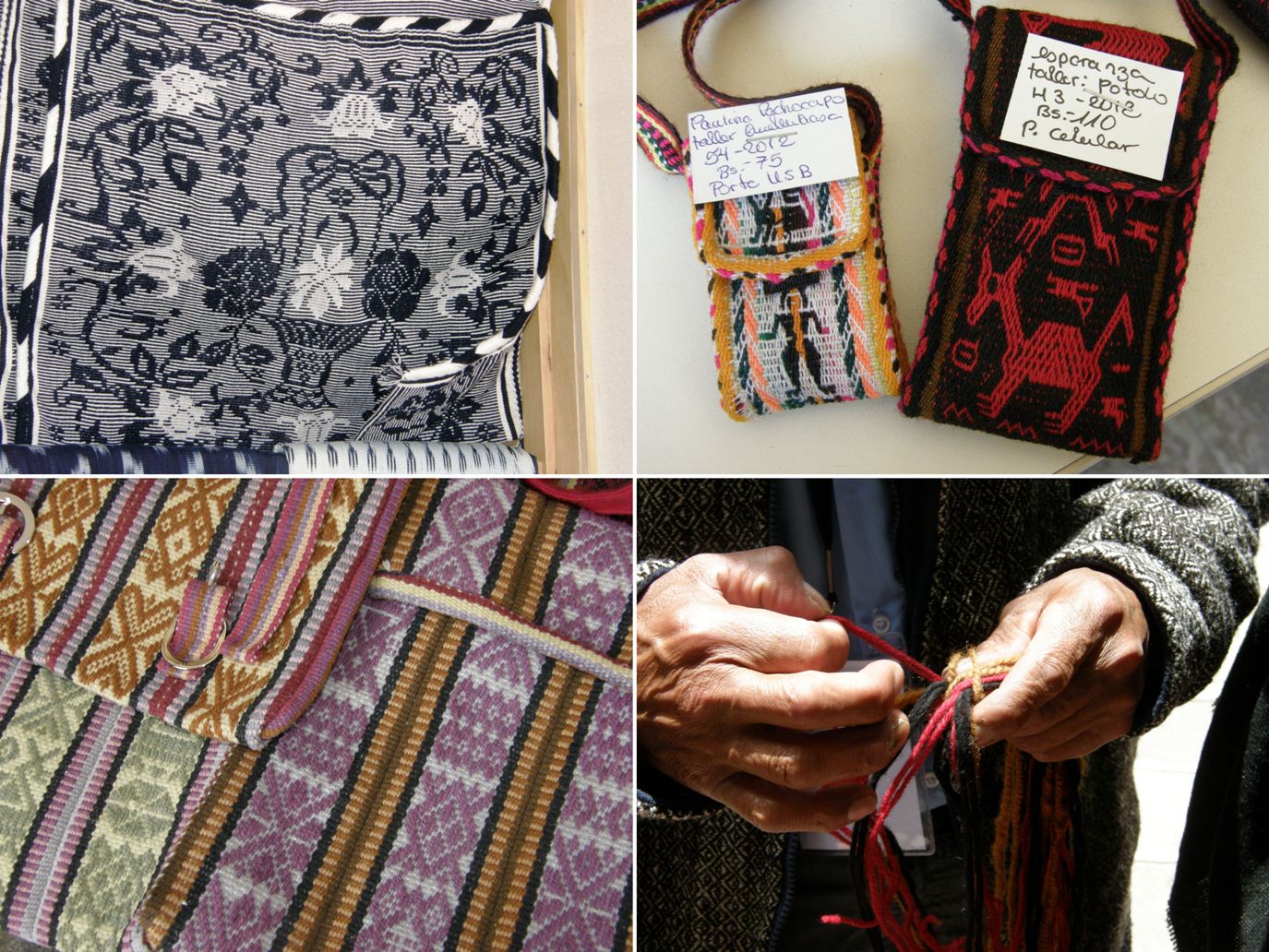
…. a bulsico , or cotton double-pocket saddle bag from San Ignacio de Loyola with beautiful patterns in simple warp floats worked in two colors. The weavers from Tarabuco and Potolo in Bolivia of course brought large fine examples of their textiles. I decided to show you here some very small and practical pieces that they also brought to sell. The tiny USB pouch is from Tarabuco and the cell phone pouch with its woven khuru figures is from Potolo.

The supplementary-warp patterned pieces in lovely pastel colors are from Ayacucho, Peru and the last shot is of an impromptu sling-braiding demonstration from one of the Peruvian presenters in the coffee break.

More lessons along the way…

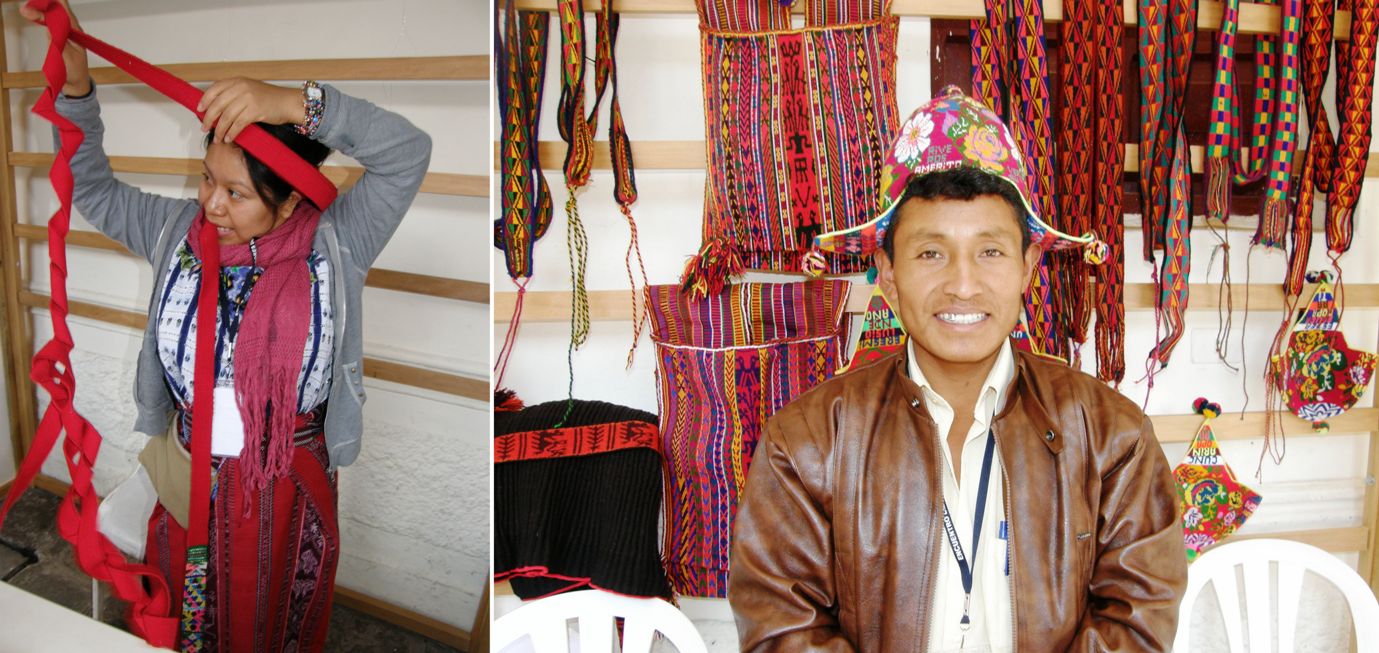
Diana from Santiago Atitlan in Guatemala showed me how to wrap her hair and head with a woven hair sash. You can see that most of the band is plain red with just the last part, which will be seen on the outside, decorated with pattern. Albina’s husband showed me how married men wear the typical chullo of his home…with the flaps standing out sideways. A single man will wear his with the flaps pointing out front and back.

So, now you have seen a selection of the stands, looms and textiles and heard a few backgroud tidbits about some of the weavings and the people who produce them. You are probably dying now to see the weavers in action, right?

ARE YOU GOING TO WEAVE TODAY?

Sorry, but I am saving that segment for the next blog post as uploading the video will be so much easier for me when I am in the US.

In the meantime I am packed and ready to leave tomorrow and I did manage to finish the discontinuous warp piece that I started in the workshop on the last day of the Encuentro. Handling alpaca fiber is not a nice business in this heat with sweaty hands, I can tell you!

Here is my ticlla piece off the loom and all curled up…

The overspun alpaca yarn made the grey and black panels curl in and the other two panels curl under. You can see my finish line on the white panel. I ended up removing one weft as I had packed too many in. I really need to remove two as now I have two wefts in the same shed. The finish line isn’t as noticeable on the other panels. I am really pleased with this!

I wove and sewed on a tubular band to the edges….… in the same way as the Pitumarca weaver that I showed earlier in this post, using three sets of string heddles and a shed loop. See how nicely the piece lies flat now? I hemmed the sides before applying the tubular band because I didn’t like the way the warp stripe at the edge was interfering with the color of the tubular band.

Here’s a better look at the tubular band and that lovely dovetail join of colors…

Done! I am keen to try this all again!

See you next time from the US 🙂

Backstrap Weaving – Seeing Stars, Short and Sweet

I am keeping this blog post short and sweet…well, at least I will try to. Life definitely got in the way of things this week with some major distractions and, unfortunately, they had nothing to do with weaving. I feel like I have been walloped and am, just like in the cartoons, seeing stars….

By coincidence the little bit of weaving I did this week just happened to involve stars. Following on with my new love affair with the weaving of Tinkipaya in Bolivia, I tried another of their pretty motifs, which I had thought were flowers, but which, according to Cereceda in her book which catalogs the designs on these textiles, are ch’askas, stars, and are a representation of the world above known as janaq pacha.

The small band I wove to test the pattern is pictured above with a couple of wooden tools I got in a market in Potosi, the province in which Tinkipaya is located. I was told that the tool on the left is used to push down the warps behind the heddle rod when the weaver is opening the heddle shed. I have never seen a weaver actually use one of these. The one I have has a red stain and I like to think that it might be cochineal from one day when its owner was preparing to dye. The other tool, of which you can only see the tip, is used for beating and strumming and I have seen these in use in several places in Bolivia.

So, sometimes I see flowers where the creators of the designs see the stars in the heavens and sometimes vice versa…

I saw stars when I first saw this pattern but its creator, Kurt Laitenberger who designed it for tablet weaving, calls them flowers. I wove them into what I call my ‘Starry Night” wall hanging. I remember stepping outside my little room on Taquile Island on Lake Titicaca to go to the bathroom on a clear and bitterly cold night and being stunned and almost knocked over by the brilliance and abundance of the stars in the black black sky over that dark little island.

In the pebble weave piece above I used star motifs from Guaraní textiles. I was pleased to recently find a story, translated from Guaraní to Spanish, in a book published by Artecampo, a craft cooperative store, here in Santa Cruz about a legend behind the use of the star motifs in Guaraní weaving…..it says that…

One day  the children were taken and placed  like stars in the heavens and this is why women cry out about stars in their weaving. The stars not only speak of the sky but also about the richness of nature because one woman, in an attempt to stop her child from being taken, grabbed hold of a finger (or toe, it is not clear in the Spanish translation which). As she pulled on the finger, unfortunately, a piece broke off and this piece was buried. From the burial of this piece a corn plant sprouted. In this way, weaving symbolizes abundance which comes from the piece of the child. And this is why food crops are not only considered elements that feed and sustain men, they are part of Man himself just as the stars are part of Man and Society. Songs name those who are living in the sky and those that sing wear woven cloth to show that they are still with them even though they are distant.

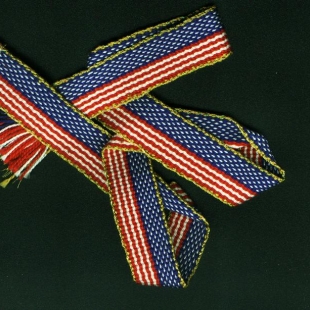
Wikipedia tells me that the stars on the flag of the United States represent the fifty States in the Union. Well, I knew that. I was hoping to find out why exactly stars had been chosen as opposed to some other figure. There doesn’t have to be a reason. I am  sure that we could all come up with some kind of symbolic meaning for a star. I swear that some weavers I have spoken to have made up things about the motifs they are using just to please or have a bit of fun with me…I have seen the twinkle in their eyes and the way they look sideways at each other!

Gail from Weavolution wove this very patriotic collar for her dog on her inkle loom. She is forever coming up with clever designs for what must be the best-dressed dog in New York.

Speaking of flags and patriotic weaving, I assume that the next starry piece was made by someone who is proud to be Australian.

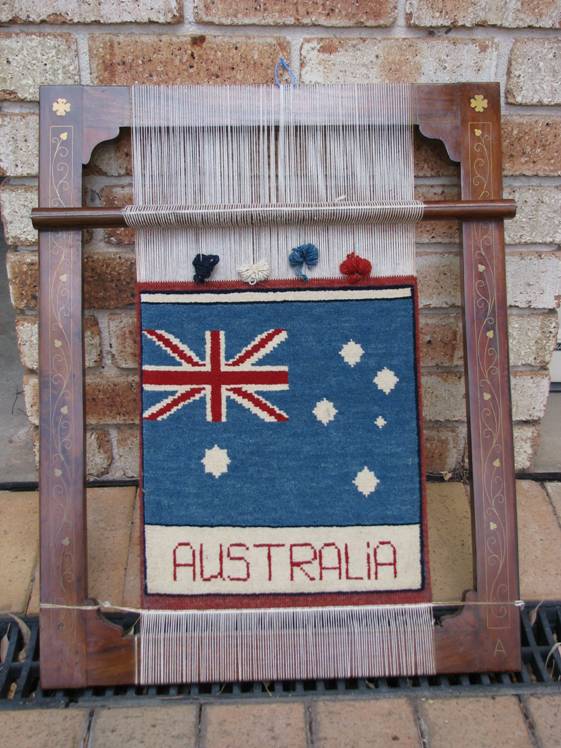
I have this very cool cut-pile weaving of a representation of the design on the Australian flag…

The group of stars is the Southern Cross constellation which really is a sight to behold there in the southern sky. I am so happy to be able to see it low on the Bolivian horizon and it makes me feel somehow connected to Australia and  the people I know and love so far away. It is little wonder we so love stars and choose to use them in our cloth.

The large single star, which should only have seven points, represents the Nation’s seven states and territories.

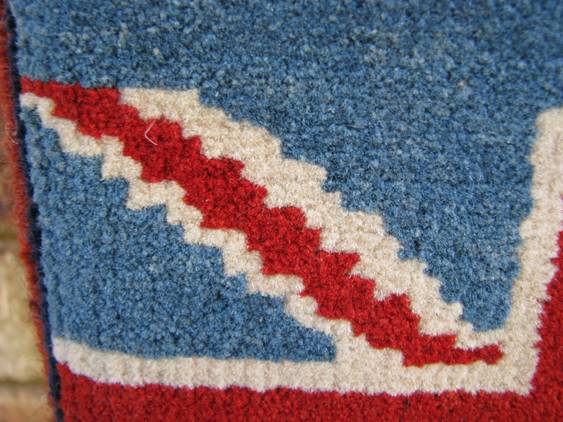
This cut pile piece on its beautiful frame is gorgeously dense and I would love to meet its creator.

It was given to my brother as compensation from the Indian owner of a furniture store who went out of business before he could supply all the chairs for my brother’s dining room setting. He then gave it to me. One day I will track him down and see if I can talk to him about this weaving technique.

I don’t know if the weaver intended to continue with the design. There is so little space at this point and the tension on the warp is so high I can hardly imagine being able to do so.

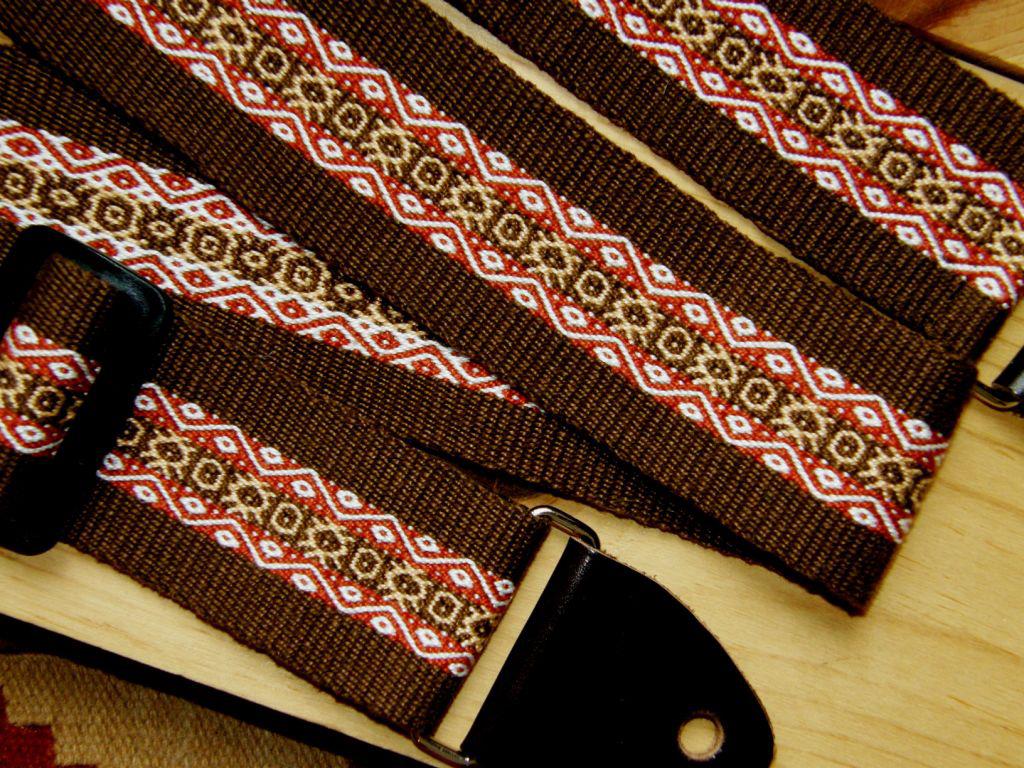
There are a lot of representations of stars in Andean weaving. I took one small motif  and combined it with others to make a guitar strap in colors reminiscent of the desert and canyons of the US southwest with a winding river, moon and stars. It took me back to clear, warm nights camping in the depths of Utah canyons with nothing between me and the stars, moonlight bouncing of red canyon walls and with dozens of frogs “ribbeting” away at the waters’ edge.

And then there are motifs that look like stars to our eyes and maybe one day I will find out what exactly they mean to the weaver. There’s an Andean ch’aska on the left with star-like motifs from Central Asian textiles and a motif on a belt from Ecuador on the right.

Enough star gazing…let me show you what Camilla in Sweden made with her pebble weave band…a hair band for a friend. She attached elastic to the ends and covered it. What a sweet project for a band.

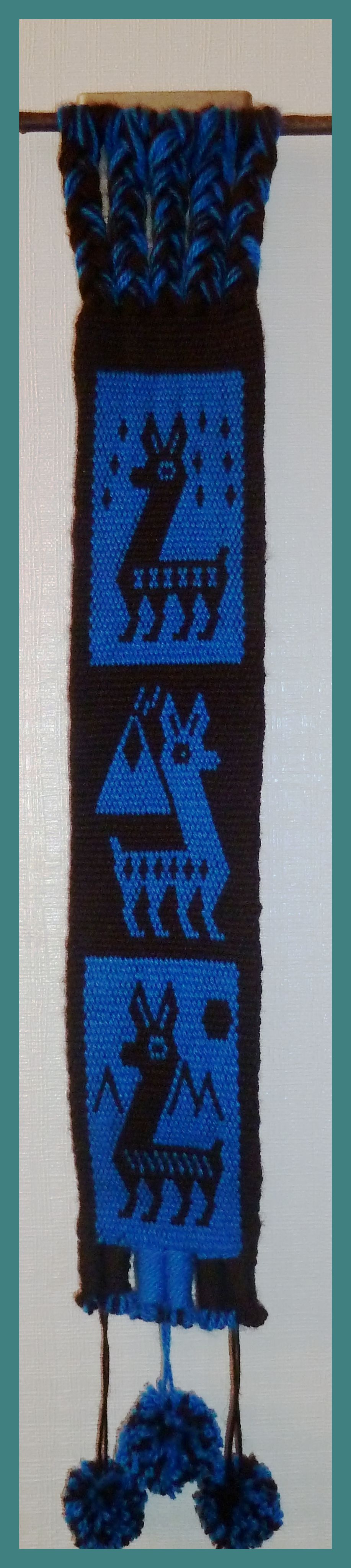
Ad here is what Karina in Chile wove using the Bolivian llama patterns that I embellished and charted. They are woven in warp-faced double weave the instructions for which, along with the llama pattern charts, are on this blog.

The uppermost llama is standing beneath a starry sky.

I love Karina’s clever wrapped-warp and pom-pom finish and the braids at the top are a nice touch too. It makes a lovely wall hanging.

It’s nice having these projects to show from people at opposite ends of the globe…how we all come together with this same love of weaving!

As for the thing that had me distracted this week….I have to keep my chin up or I won’t be able to see the stars.

Backstrap Weaving – Prototypes, Samples and Keepers


It’s been a week of bits and pieces…trying out new patterns, practicing new techniques, making width samples and prototypes and then putting everything together into something I can keep and use.

Cochabamba and my teacher Maxima seem far away now as I sit here in shorts with the temperature and humidity rising. Only two nights ago I had the down sleeping bag on the bed. It makes me yearn for the “eternal spring” weather of the Cochabamba valleys but, then again, today I walked outside to the street and bought big glorious golden dripping slices of pineapple, saw tiny green mangoes up high in the trees and realized that the markets will soon be brimming with the tangy achachairú. I read recently that this fruit is now being grown in tropical areas of Australia with its name changed to the more manageable achacha.

This week I tried out a supplementary warp design that was on a bag at the PAZA stand in Cochabamba. This piece had not been woven by Maxima who seems to specialize in pebble weave. I hadn’t even noticed the pattern when I was there. It was, as usual, a bit of a case of information overload…a very intense three days of weaving, sights, colors and sounds.

It is fun for me now to slowly review the videos I had taken of Maxima weaving and listen to the birdsong and the melodies made famous by the Cochabamba band Kjarkas playing in the background…details that were obscured by my concentration on all that Maxima was teaching me. For that reason I did not see the lovely supplementary warp design until I came home and went through my photos.

You can just see the design on the bag on the ground in the picture above left. Supplementary warp is not one of my favorite techniques and I guess that is why I had not paid much attention to it but I was quite struck by the pattern when I got home and had time to examine my pictures. If I had run across this design on the internet I would never have thought that it was Andean.

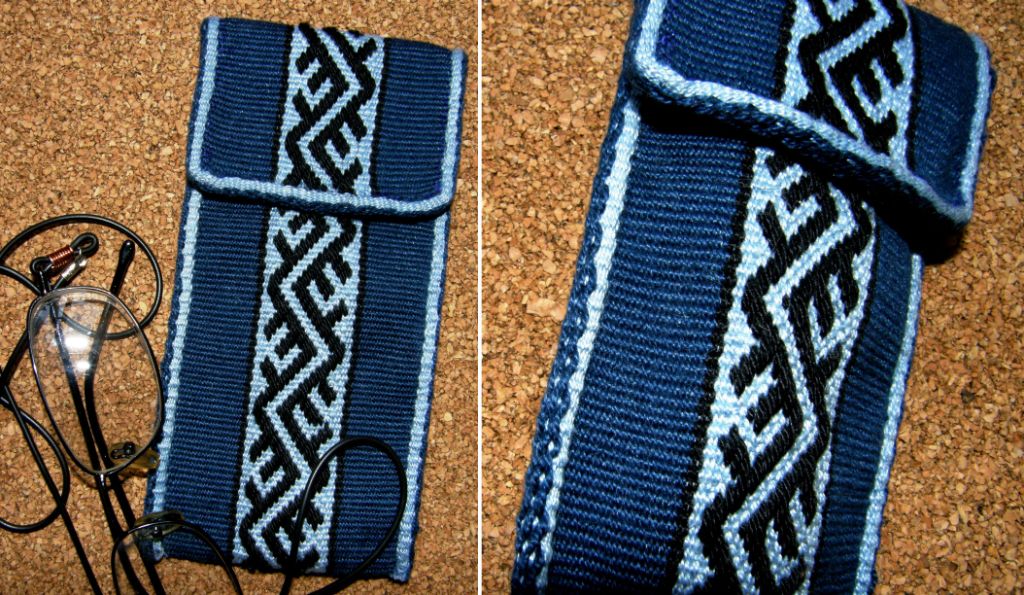
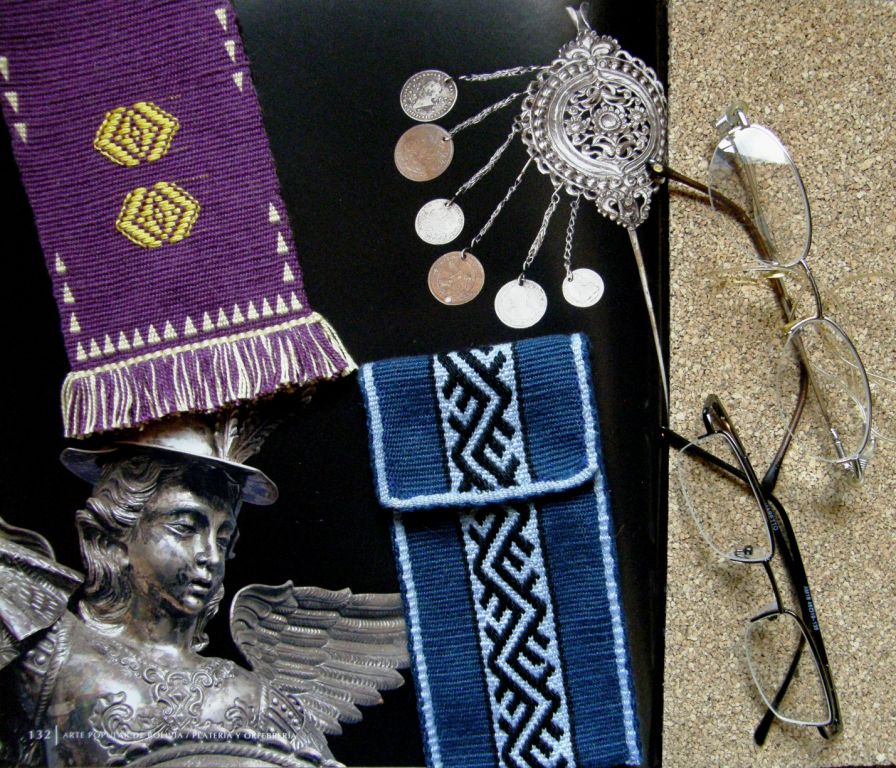
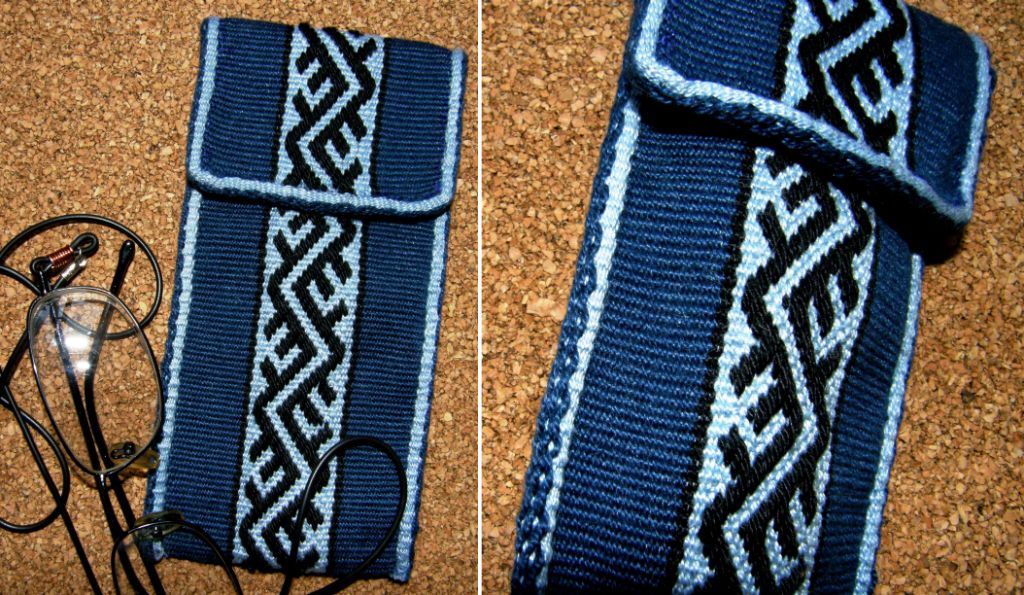
I wove it into a small piece which I sewed into an eye glass case and then used it as an opportunity to practice a tubular band in pebble weave. Not wanting to complicate things too much, I just did plain pebble weave (that is, a pebbled background with no motif) for this band setting up the warp as I was taught in Peru and thus avoiding having to do any pick-up.

Maxima’s way of doing pebble weave would have her picking up threads even for a plain pebble band. The advantage of her method is that it can be worked more easily using just finger tension rather than having the band attached to the body by way of a backstrap. No doubt I will discover other advantages as I delve further into her method.

Here is the chart for the supplementary warp design if you would like to try it yourself. I have no idea if there is a standard way for charting these supplementary warp designs but this way works for me. I have also started a new page here where I will put charts for designs in this technique.

I have not done a tutorial on this pick-up method as there are plenty of good resources out there already. I believe that most inkle weaving books include it and Sue Foulkes recently did an online workshop in the Yahoo braids_and_bands group on Sami band weaving which uses the same technique.

If you would prefer to have a “real live” teacher with whom you can interact, Daryl Lancaster will be teaching an online class on this pick-up method for inkle loom weavers on Weavolution. Check out the details here.


You can just see the pebbles on the tubular band in the picture above.

So,  this particular sample found a use. I would like to weave this design again having the pattern extend right to the edge of the dark blue section. I think that would look even nicer.

This meant that two of my three pairs of glasses were nicely accommodated in woven pouches. I had made an eye glass case from a discontinuous warp experiment many months ago. I figured that I may as well make the third one which would give me a chance to try out another experiment.

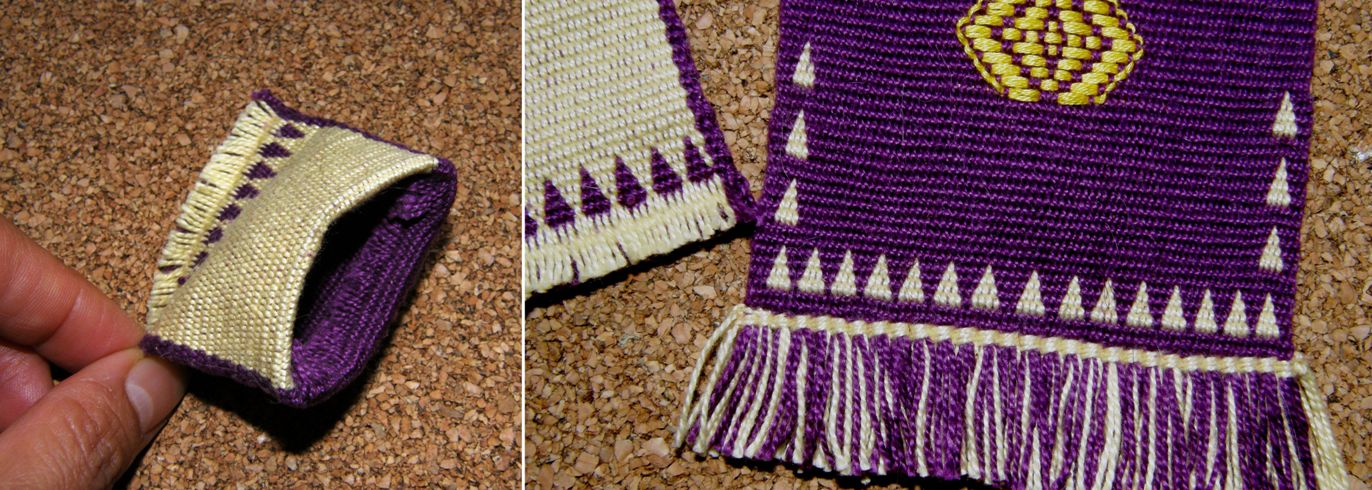
I wanted to make a pouch taking advantage of the fact that weaving a warp-faced double weave piece that doesn’t have motifs woven into it will create a tube. This meant that I could weave the front and back of the pouch simultaneously as two layers of cloth joined at the edges…..”instant pouch”!

It’s no big deal really! All this meant is that I would be saving a bit of seam sewing but I thought it would be fun to see what I could do with this. The tube, of course, is beautifully seamless! You can see, above left, a little sample I made a few weeks ago with some left over warp. There is no motif in that piece and so what I have created is two layers of cloth joined at the edges…a tube.

I sealed the bottom of the tube by weaving a pattern of triangles. Weaving motifs is what bonds the two layers in warp-faced double weave.

Although there was no need to do so, I decided to try to weave the triangles up the sides as well but soon discovered that the difference in take-up between the patterned and plain areas was considerable and that I would not be able to continue with that.

So I threw in a couple of supplementary weft figures woven in one of the ways I was taught in Guatemala with the turns of the weft outlining the motif. Then I just managed to get away with squeezing in three more triangles to balance things out. I was really just making it all up as I went…not like me at all!

I created another row of triangles at the top with a supplementary weft (next time I will put the weft turns on the inside of the tube so they won’t be seen). I couldn’t weave them in double weave as they would have sealed up my tube. Finally, I twined along the bottom to secure the weft and then I cut a fringe.

Probably the most fun part was creating the “flex” closure and I have my online weaving buddy Bobbie to thank for that.

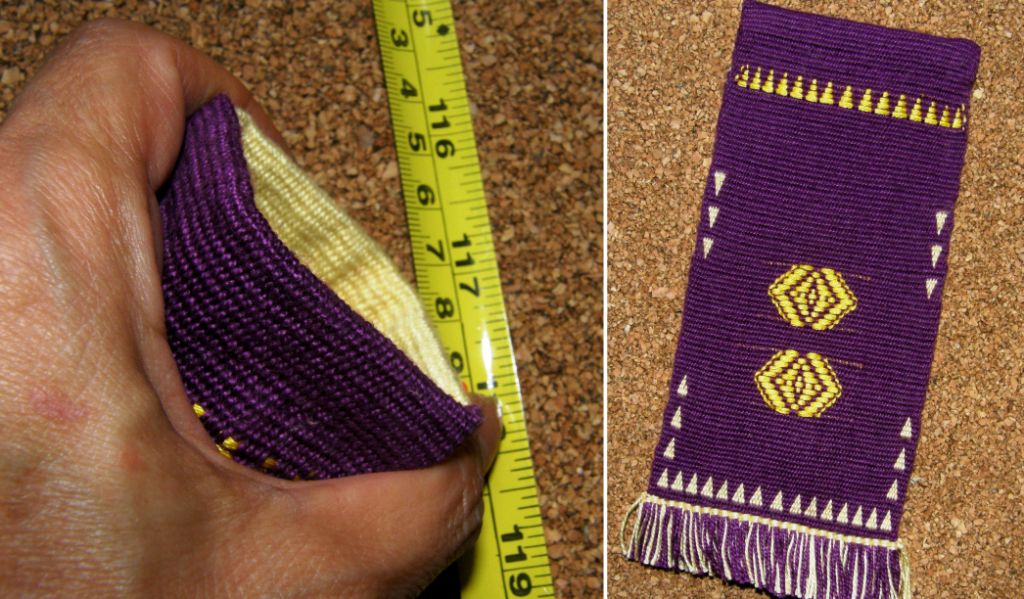
When I met her in Portland last year, she showed me a bag made by a friend in which a closure had been created using pieces of an old tape measure. You probably know this kind of closure….you squeeze the sides of the bag and the top pops open. I am trying to show that in the picture above left.

My boyfriend patiently dismantled our tape measure, cut off a length from the inside end, wound the tape back up and put the case back together. No harm done. We didn’t need all ten feet!

I cut two pieces of the tape a little shorter than the width of my pouch. I then cut them down to about two thirds of their original width and rounded the ends. I turned down the top edges of the pouch and sewed them with the lengths of tape within and yes, it works! Above you can see a picture of a commercially available and far more sophisticated version and one of our Ravelry group members provided this link to various sources of these “flex frames”.

That was another experiment that can be used. Nevertheless I think I will make another taking into account lessons learned and with much more planning in the design.

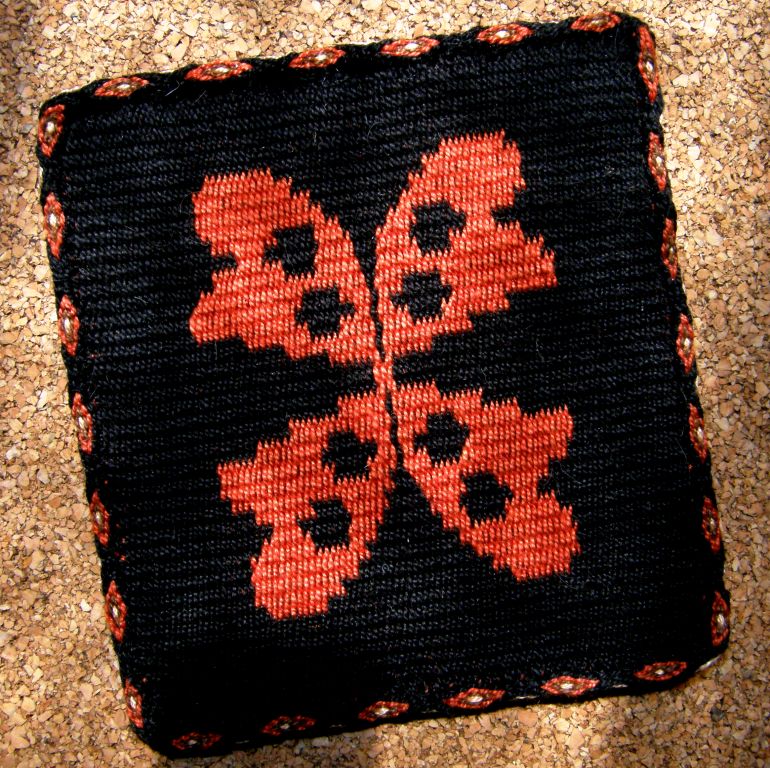
I resisted starting on that straight away as I had another idea bouncing around and so, this is a prototype for a new set of mug rugs that I would like to make…seen here dappled with sunlight…

Actually the prototype turned out pretty well and so it may be a keeper.

I edged my little 4 x 4 1/2″ piece with a tubular ñawi awapa. I am thinking of mounting the mug rugs on cork as the reverse color combination on the back doesn’t really work alongside the other colors in the tubular edging.

The cork will also serve to hide the raw end of the tubular band.

It was so nice being able to sit beside Maxima in Cochabamba last week and weave tubular bands. I had already learned how to weave and sew them but mostly through various brief observations of indigenous weavers over the years as well as through a large group class I took at the Tinkuy last year.

It was wonderful being able to have this one-on-one experience and watch how Maxima held her work, placed her sewing needle and tensioned the warp, smoothly coordinating all the moves. I was so absorbed that the sewing part was the one part of my instruction that I completely neglected to video or photograph! (although you can see a Bolivian and Peruvian weaver doing so in my videos here).

However, I did take video of many other things and have put some bits and pieces together for this post.

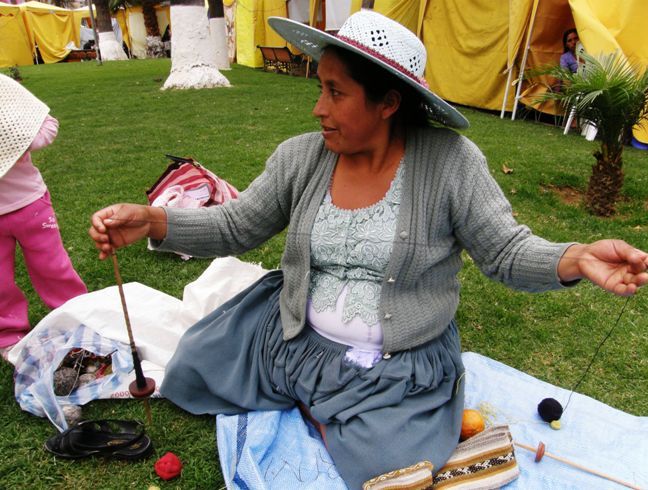
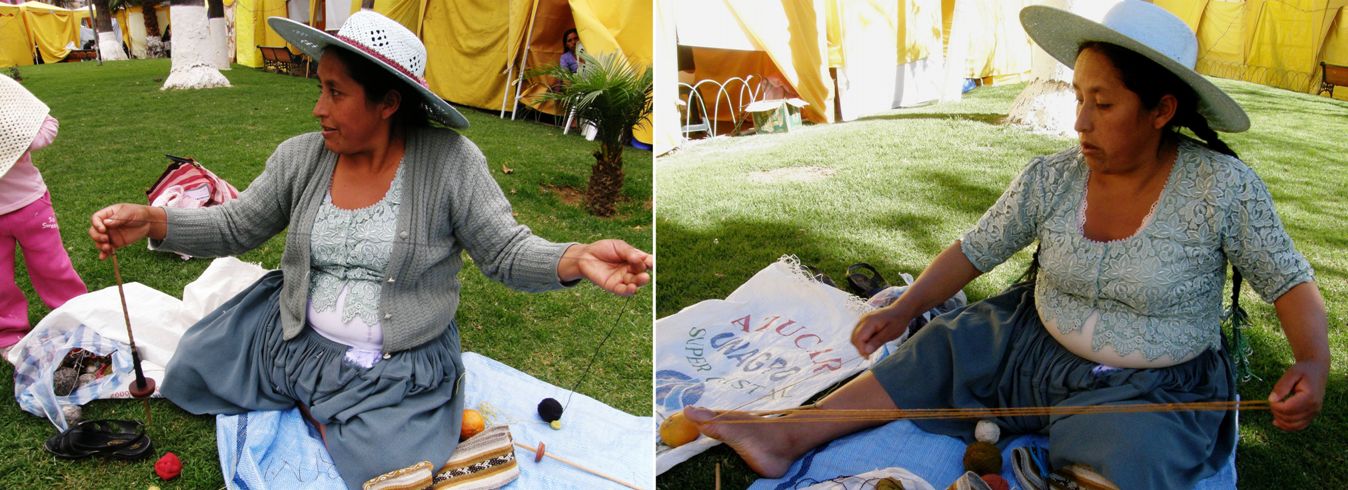
This first clip shows Maxima using her spindle to put extra twist into some plied yarn so that we would be able to weave with it.

I had been complaining during the Tour de Fleece of an aching thumb which developed from the way I was turning my spindle for plying. I really need to practice the Andean way of setting the spindle in motion for plying or respinning commercial yarn.

Maxima tied for first place with a Peruvian lady in the speed spinning contest which was held one night during the Tinkuy de Tejedores in Urubamba, Peru last year. The two ladies spun over six meters in two minutes.

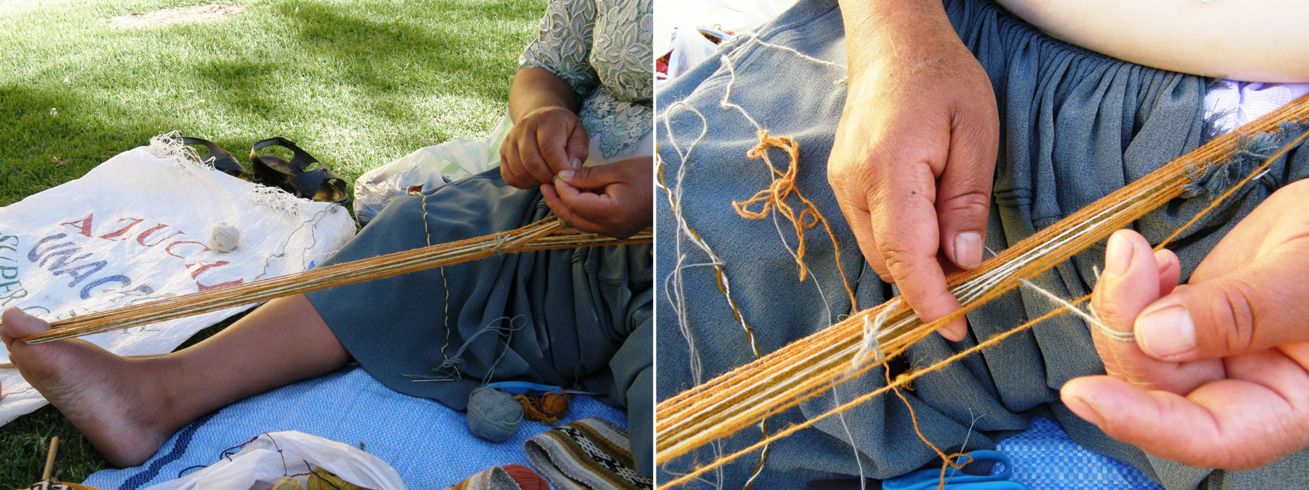
The various segments in the next video show the stages of setting up a warp for weaving. Maxima winds a warp using her finger and big toe as warping stakes. You can see her winding two colors together with which she will pick her designs and then the final single edge warps. After tucking the end of the warp into her waist band she rearranges the warp cross separating the two colors into different sheds. Then she makes her heddles.

This final piece of video shows how Maxima opens her sheds and then forms a picking cross from which she selects the colored warps for her pattern. Not a stick in sight!!

If you would like to hear more of the music that can be faintly heard in the background of some of the video segments, check out this powerful live version of Wayayay by Kjarkas.

Before we leave Cochabamba, I would like to pass on Dorinda’s thanks to all those who visited the PAZA blog last week some of whom helped out with donations. Postscript: I see that Dorinda has just posted a thank you note on the PAZA site.

#########################################

The Ravelry Backstrap Group Weave-Along starts next week. We have a good bunch of people all ready to go. I am especially happy to see an old online weaving buddy Franco joining in.

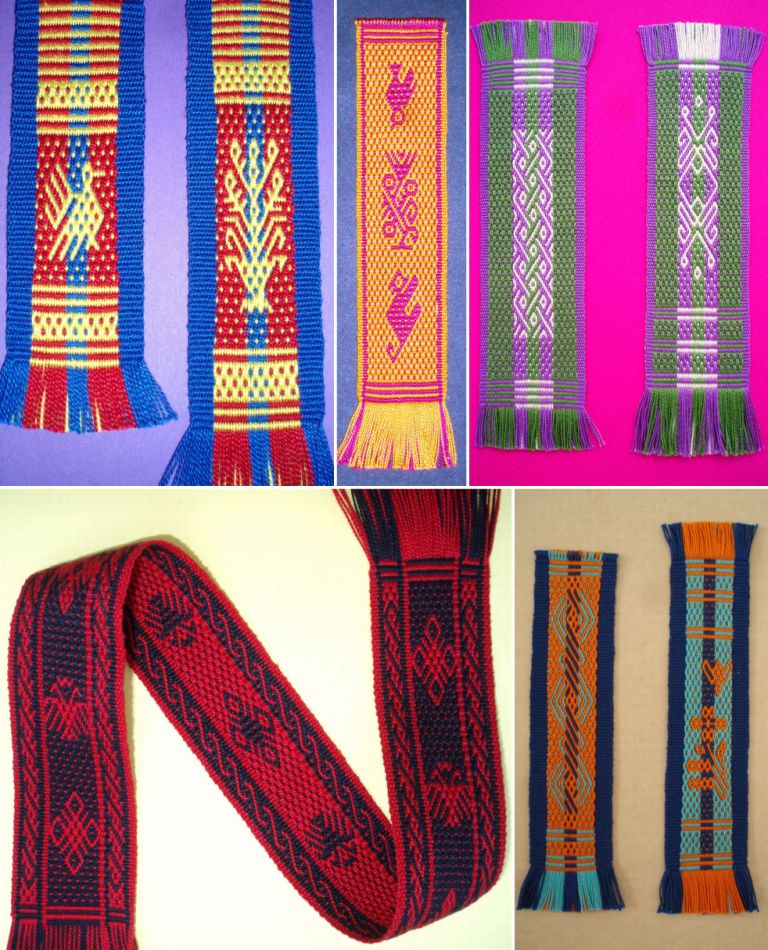
Sharon aka Fiberaholic1 wove a bunch of 8-rev patterns from my Andean Pebble Weave book and did a beautiful job but this is a pre weave-along project as there will be no pick-up patterning in this latest weave-along. We are going to play with stripes and color.

And here are some more pieces to inspire our Weave-Alongers….my online weaving friend Caroline, in Australia, sent me this picture of a striped and ikat patterned textile from East Timor and JaQueline Keller on Weavolution allowed me to show her cheery bag made by sewing several plain-weave inkle bands, made with yarns of various weights, onto canvas. Such wonderful things can be made with plain warp-faced weaving!

And to finish I was just given this link from a Ravelry member to a book by Mirja Wark of The Netherlands about the weaving of a special belt called the si’ira  by the Wayuu people of Colombia and Venezuela. Colombia seems to be making its way bit by bit into my life…a little contact, a little information from here and there. I wonder where all this may lead?!
Backstrap Weaving – Cool Tools and Implements

“All those sticks! Where in the world do they go and what do they all do?”
I have written posts about all those mysterious sticks and wooden implements, from the basic loom bars to the heddle sticks, shed rods, coil rods, stabilizing rods, shuttles, beaters, swords, pick-up sticks, even “poking sticks” (my own name for an implement my Guatemalan teachers used to create inlaid brocade).

Last weekend I went to the highlands to the city of Cochabamba to experience the ultimate in “stickless” weaving – what I named “barefoot weaving” in a previous post and am now able to add yet another handy dandy tool to my backstrap weaving kit….my humble big toe!

I used to have rather fierce-looking, blister-proof ready-for-anything feet in my old trekking days. They carried me up and down mountains in many places across the globe but I am ashamed to say that they have now gone “soft” on me even though I rarely wear shoes in this climate that I find myself in. So, I didn’t last long with the hard-spun coarse wool chafing my toes and I shall have to put them into training for barefoot weaving.

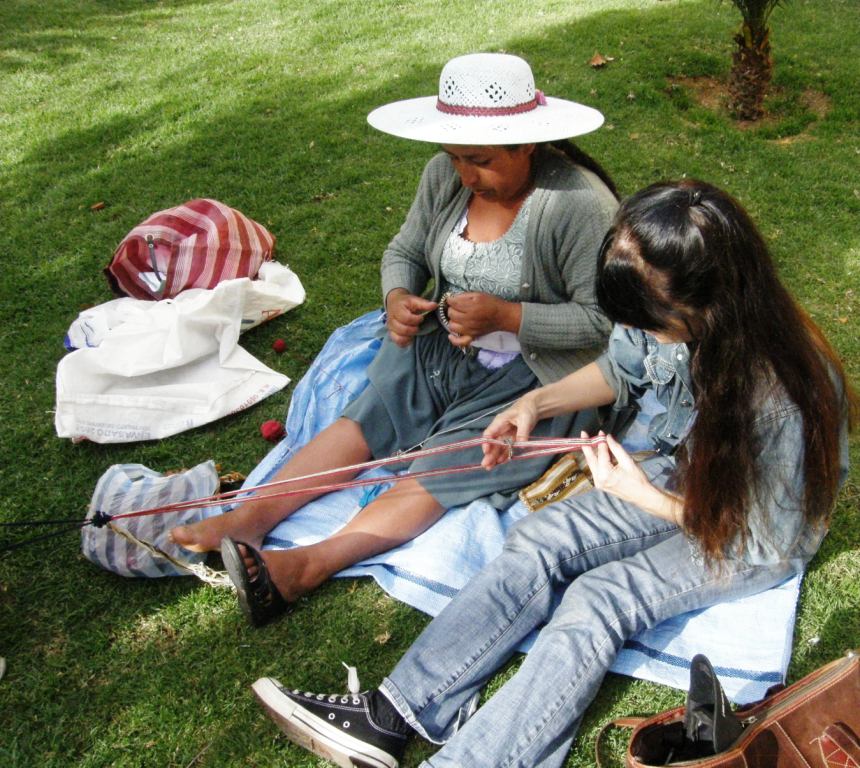
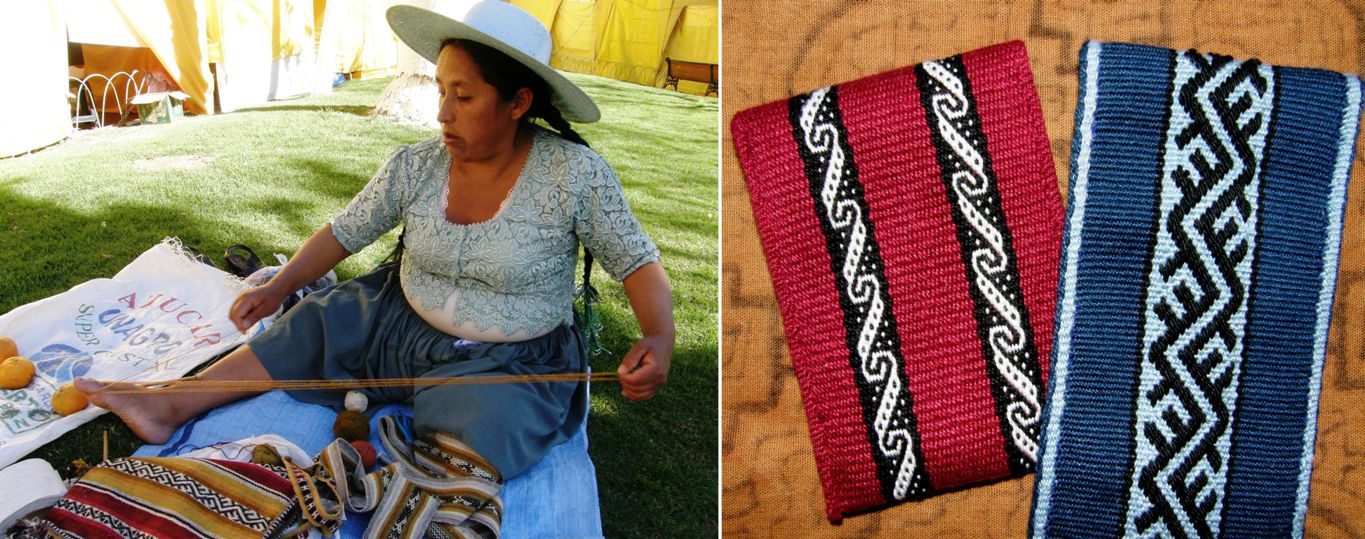
Maxima, daughter Zoraida and granddaughter Zuni were my weaving companions for my three-day stay in Cochabamba. Maxima was my teacher while little Zuni played at spinning on her "pushka". Zoraida was making a hat for daughter Zuni in tapestry crochet.

I met Maxima at the Tinkuy de Tejedores in Urubamba, Peru last year. She was my roommate along with American  ex-Peace Corps worker Dorinda Dutcher. Dorinda, who lives and works with the weavers in the town of Independencia here in Bolivia, had raised funds which had enabled her to take Maxima to the event. You can read about Dorinda’s work and her PAZA foundation here.

Dorinda, Maxima, Zoraida and Zuni were in the city last weekend selling weavings from their cooperative at a handcraft fair and this was a great opportunity for me to make a quick visit and have some classes.

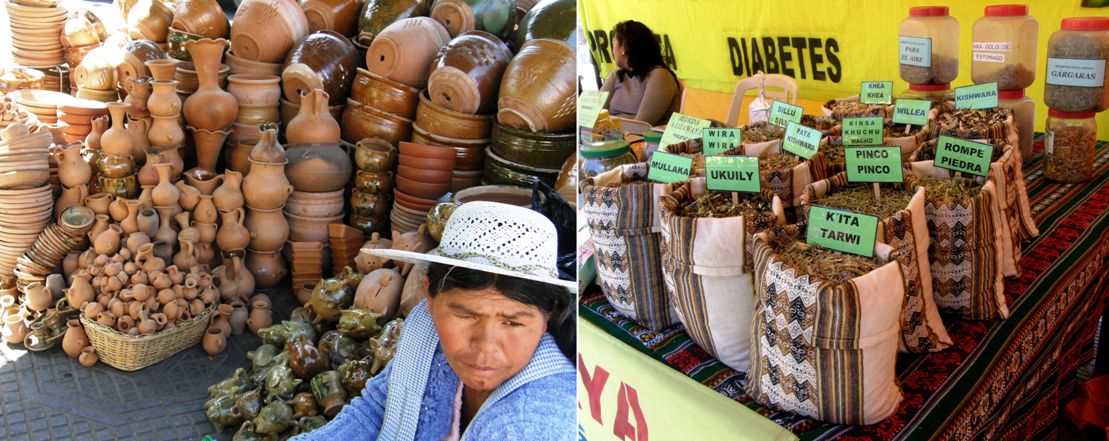
The fair included all manner of handcrafted items as well as grains, and medicinal plants of the famous Kallawaya healers of Charazani.
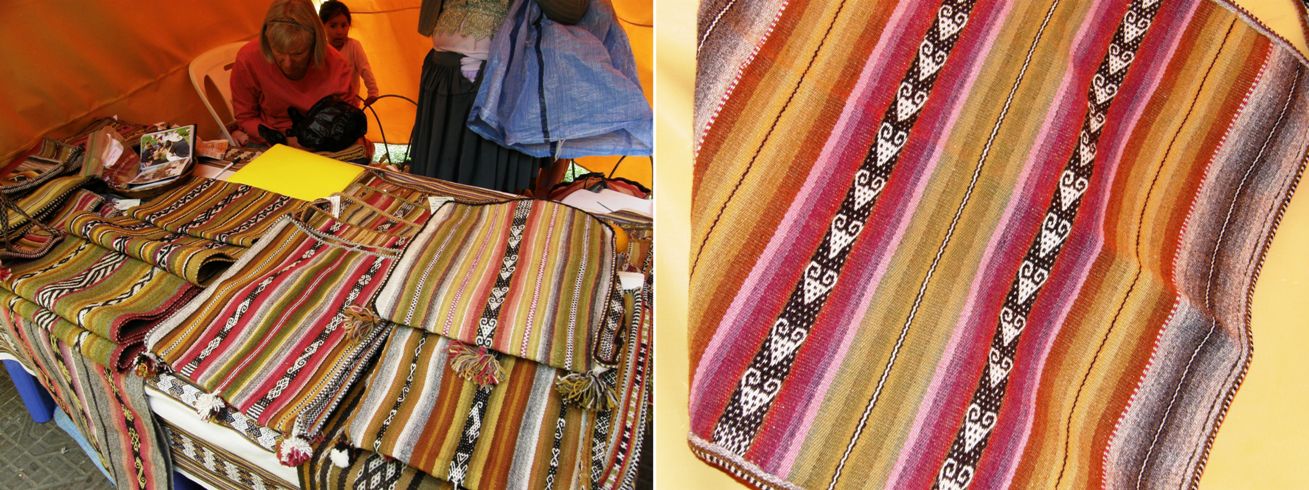
The weavers are recovering the art of dyeing their handspun wool with natural substances and creating large and small bags, pillow covers, hair bands, belts and other woven items which they sell at three such craft fairs that are held in Cochabamba each year.
I was excited to be able to buy almost a kilo of handspun and plied alpaca yarn from a neighboring booth at a very nice price . As it has been spun for knitting, I will need to respin it for warp-faced weaving on my backstrap loom. I hope to be able to dye a lot of it too.
I spent the mornings walking around the city on this my first ever visit to Cochabamba. I went up the hill to see the Christ the Redeemer statue which is just that little bit higher than the more famous one in Rio de Janeiro. Although the location is not quite as exotic as Rio, there was a nice view of the city in its pleasant valley surrounded by mountains.

That left the afternoons for weaving classes. Our only tools were our fingers and toes, scissors (am I the only one who uses her teeth when no one is looking?!) and a needle for sewing the tubular bands or bordes that we made.

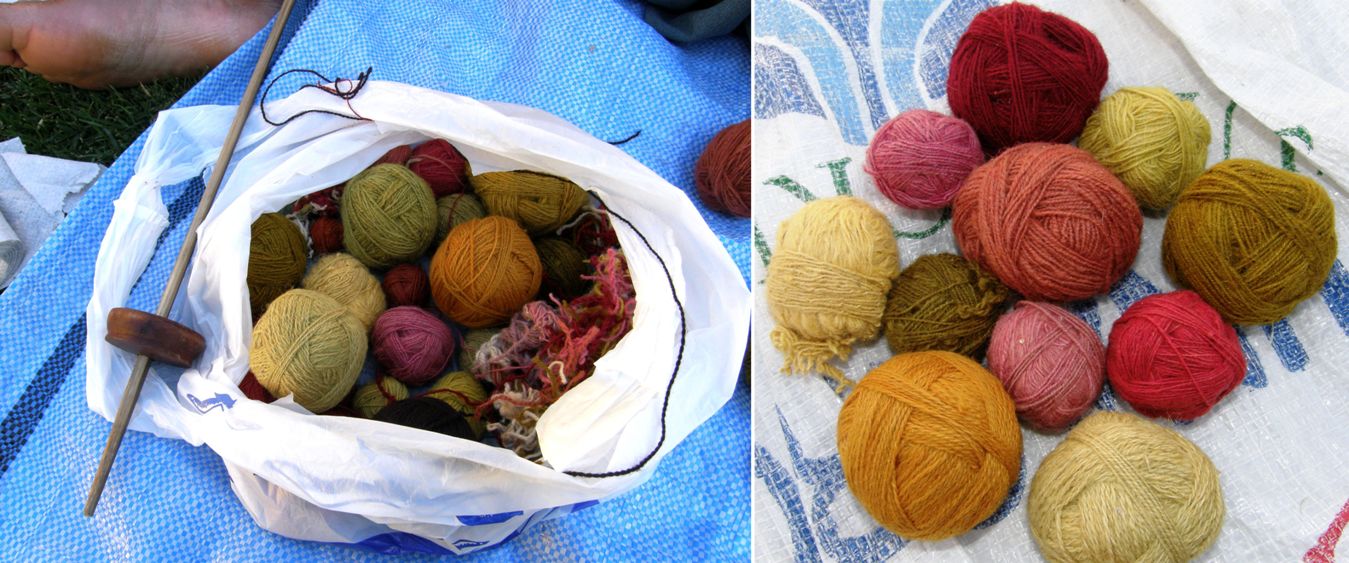
Here are the lovely yarns we got to play with…handspun and dyed with natural substances. A few of the colors were not ready to weave with yet as they had only been lightly plied and so Maxima picked up her large plying spindle and gave the yarn the extra twist needed for weaving. I have some nice video of Maxima doing this seated on the ground using that typical sweeping motion between her two hands to set the spindle in motion. I will show the videos in a future post once I have edited them.

You can see the very high amount of twist in this yarn. The bands, when not under tension, will spiral and the unwoven yarn curls up on itself in an alarming mass.

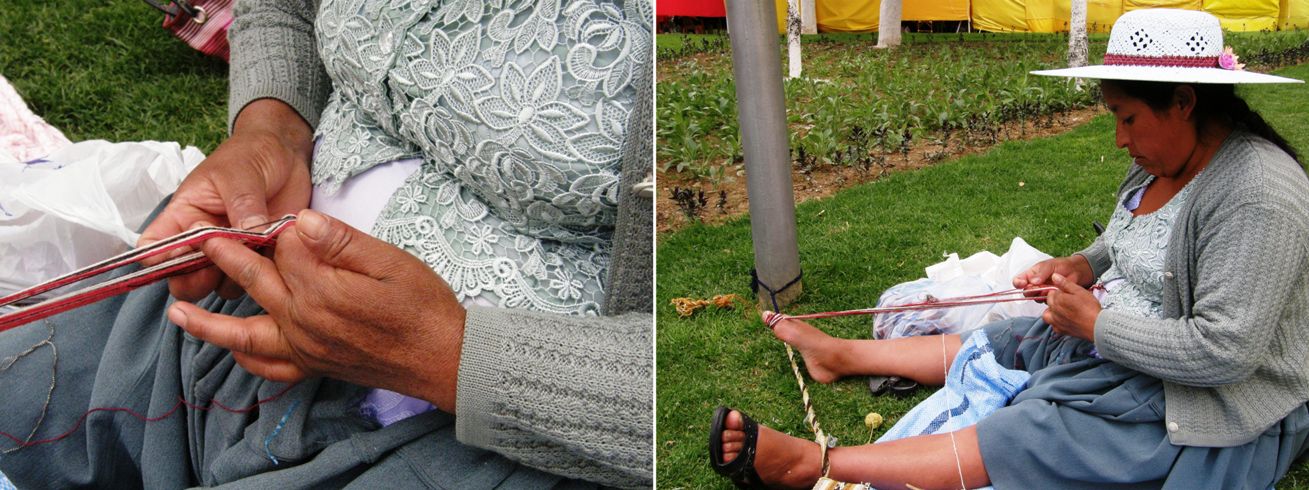
Above left, Maxima is twisting the yarn and on the right she has started warping for a tubular band using her forefinger and big toe as her warping stakes. As she does not have two central stakes around which to separate her colors, she winds her two colors together as doubled strands and then rearranges the cross once she is done. She tucks one end of the warp into the waist band of her skirt while the other ends stays wrapped around her toe. This leaves her two hands free to rearrange the warps into their two sheds.

Maxima then secured one side of the cross in a shed loop and made simple string heddles around the warps on the other side. Once the set up was complete, she removed the warp from her waistband and tensioned it between her forefinger and her toe…no backstrap or waist string was used.

On the first afternoon, I asked to learn tubular bands. I was so absorbed with filming, photographing and noting everything down that I didn't realize that the first band she taught me was actually pebble weave! Her set up and way of doing the pick-up is so completely different to the way I had been taught in the western part Peru. It threw me off at first and I got really confused! Fortunately we started with the design which is known in the Cusco area as "mayo k'enko" and which Maxima calls "linquito" and so it wasn't all totally foreign to me and I was then able to pick it up quite quickly. Maxima's method definitely has its advantages for weaving pebble weave as a finger-tensioned tubular band.

You can see the first pebble weave edging we made in the picture above left. The yarn was way too chunky for the little bag we were edging but it served as a learning exercise. Then we made a much simpler style for the second project. Above right you can see the three pebble weave bands, or huatos,  on which we worked on the second and third days of classes, starting narrow and gradually working up to wider designs.

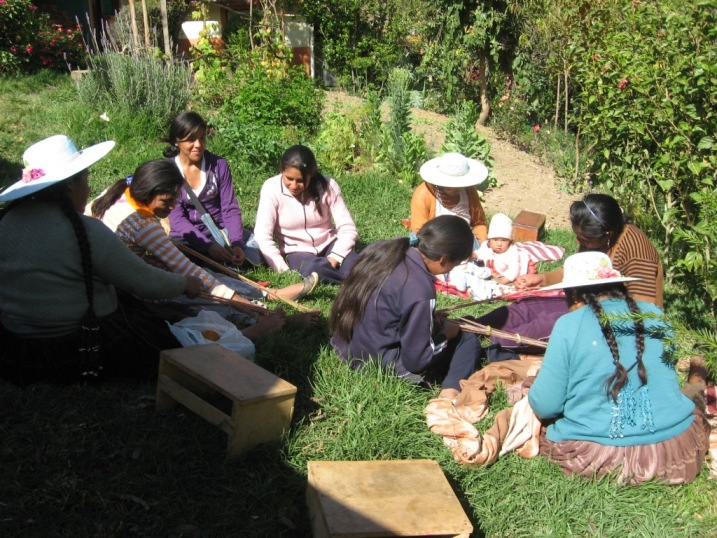
Weaving together on the grassy area behind the market stalls was cool and peaceful. Last Saturday was my birthday and this was a lovely way to spend it. There is a reason why these sensible ladies always wear hats. My poor lips are now a swollen mass of blisters from the dryness and high altitude sun.

While Maxima finishes off my edged pouch, I am weaving the first narrow pebble weave band. You can see how Maxima taught me to use my two fingers in the warp as my “picking cross” (I explained a little about the picking cross in last week’s post).

Maxima has made a picking cross and is selecting the warps from each side of the cross for her design. Her warp is attached to her toe and for a while so was mine. Then I also attached my warp to her toe when mine had had enough! Finally we moved to the post to tie my warp up and later Maxima did likewise.
On the left Maxima is using her fingers as cross sticks to rearrange the warp cross. I took my bands back to my hostel to do my homework...yes, there was homework! My bed had a convenient bar to which I could tie up and there would always be my toe if I hadn't been able to find anything that would do. On the third day we worked on wider motifs on the band pictured on the right. Some of the motifs were completely new to me and fun to learn with this "new" way of doing the pick-up.

In my Andean Pebble Weave book I show how I was taught to create a border for pebble weave of the same thickness as the design area. Maxima also creates a thick border but in a completely different manner. This is the fourth way that I have seen pebble weave being woven…all so VERY interesting!

Maxima with the Club de Chicas. This photo is from the PAZA Bolivia blog written by Dorinda Dutcher.


Maxima was a wonderful teacher. When I asked her if she enjoyed teaching she laughed and told me that when she had taught her daughters she would lose patience and want to slap them! Now she says that she is used to teaching and enjoys starting the young girls in the “Club de Chicas” in Independencia on their first weavings. I have made a tentative date to visit her in Independencia next March during the peach season.

I gave her a couple of key fobs, one of which was in double weave and I think she would like me to teach her that when I visit. I was surprised as there were double weave belts on sale in her stall but she told me that they had been made by other weavers. I have come across this before…weavers learn what their mothers and grandmothers can teach them but are unwilling to ask non-related weavers and their weaving peers to teach them other techniques.

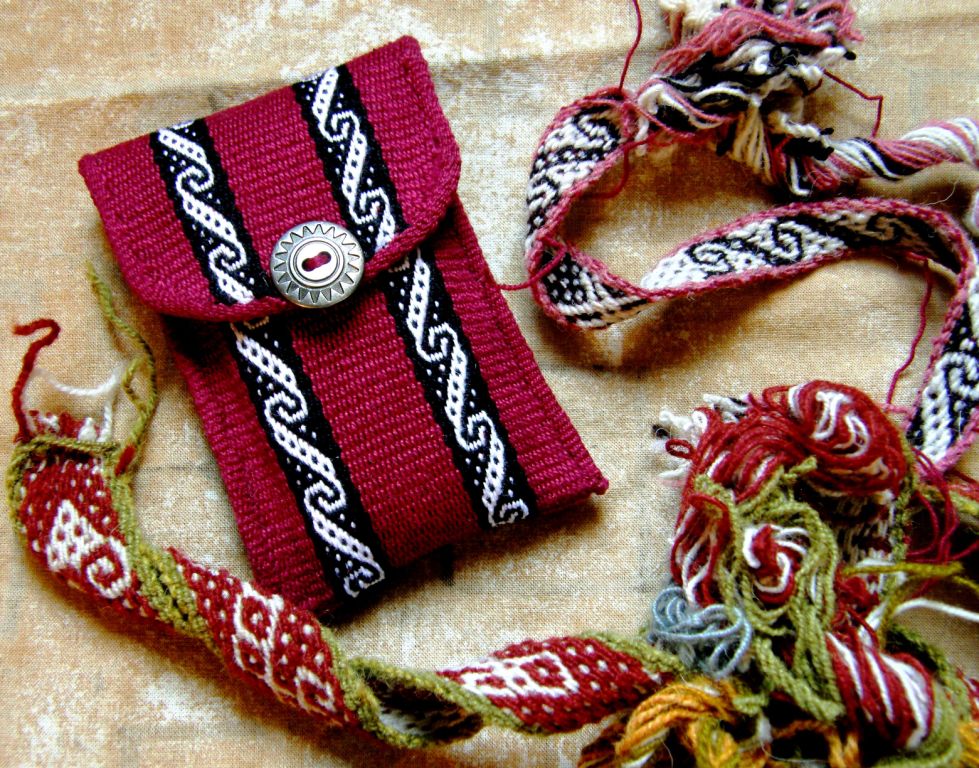
Back at home I wanted to put things I learned into practice but I started off slowly by simply using one of the new designs I had learned in a cell phone pouch. I have made many cell phone pouches and realized that not one of them has been made with a pebble weave design which is, after all, my favorite technique.

Here is my latest cell phone pouch with the new design. You can see it on the pink bordered huato. I wove and sewed a red tubular edging and used a snap closure. I know that we like to apply nice names to these motifs but, of all the designs that Maxima taught me over the three days, only one had a name, the aforementioned linquito and she had no name for pebble weave either to distinguish it from the other weaving techniques practiced in the area.

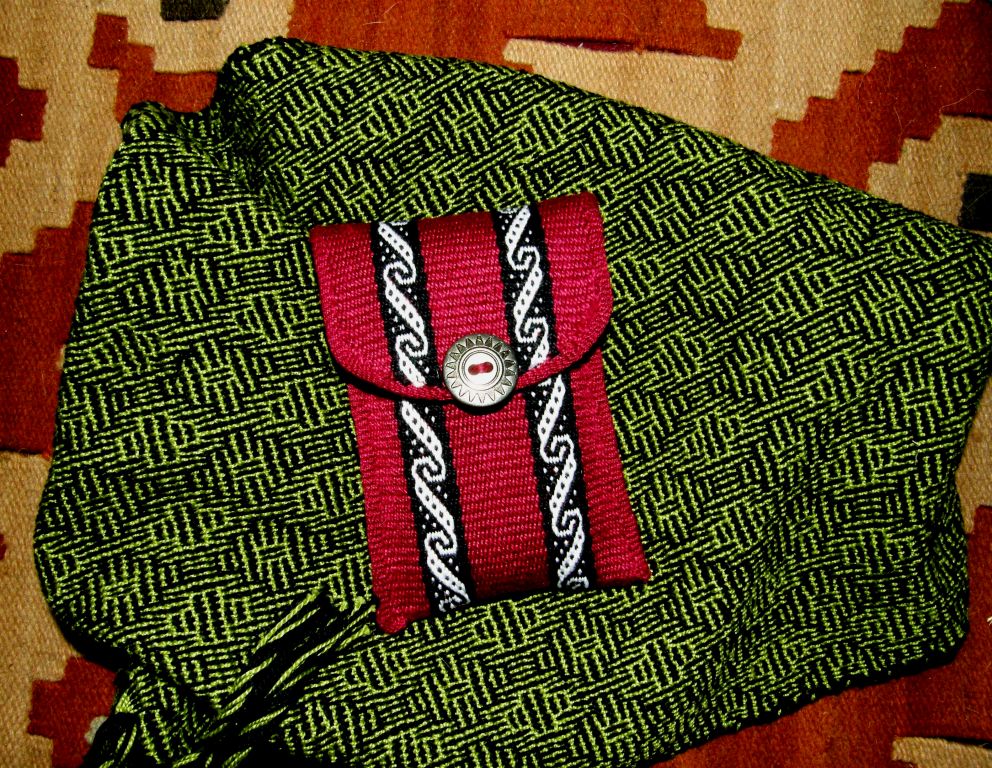
Here is the cell phone pouch on my other finished project for this week - the shadow weave piece.

The shadow weave piece also came off the loom this week. You might remember that I had only wound a one-yard warp as it was an experiment. I am ridiculously pleased with it! However, no matter how I tried to photograph it I couldn’t get the shadowy three-dimensional effect to show up so, here it is looking rather flat.

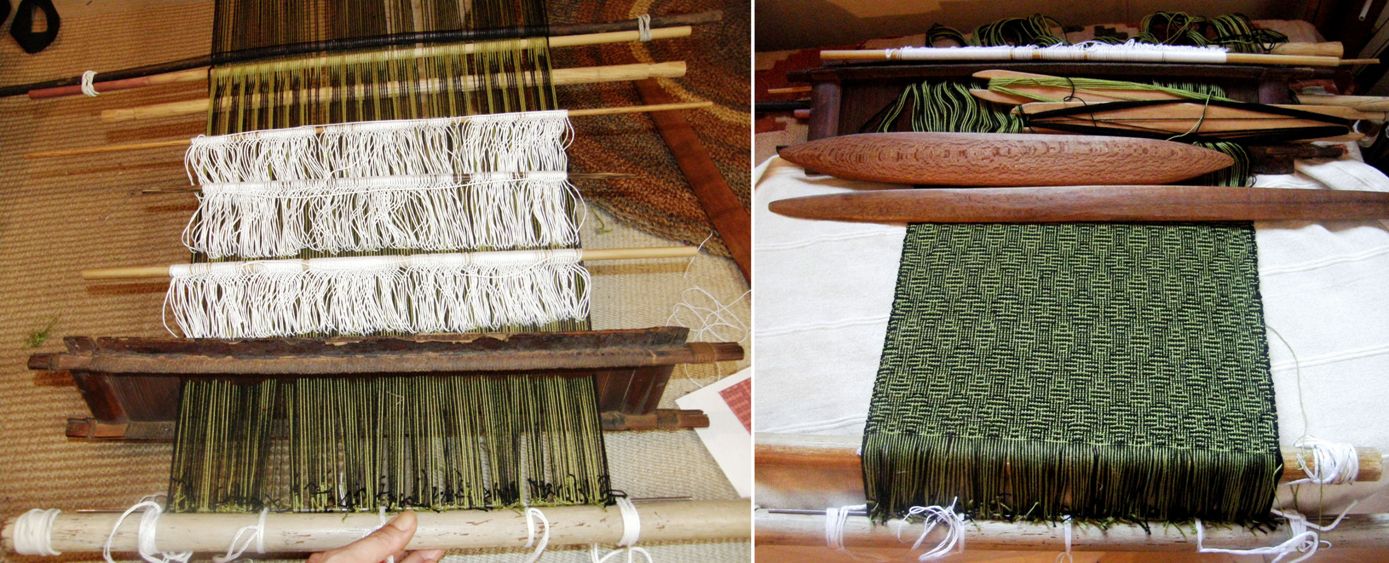
Here is the warp on my backstrap loom with its bamboo reed, three sets of string heddles and shed rod and on the right you can see it in progress.
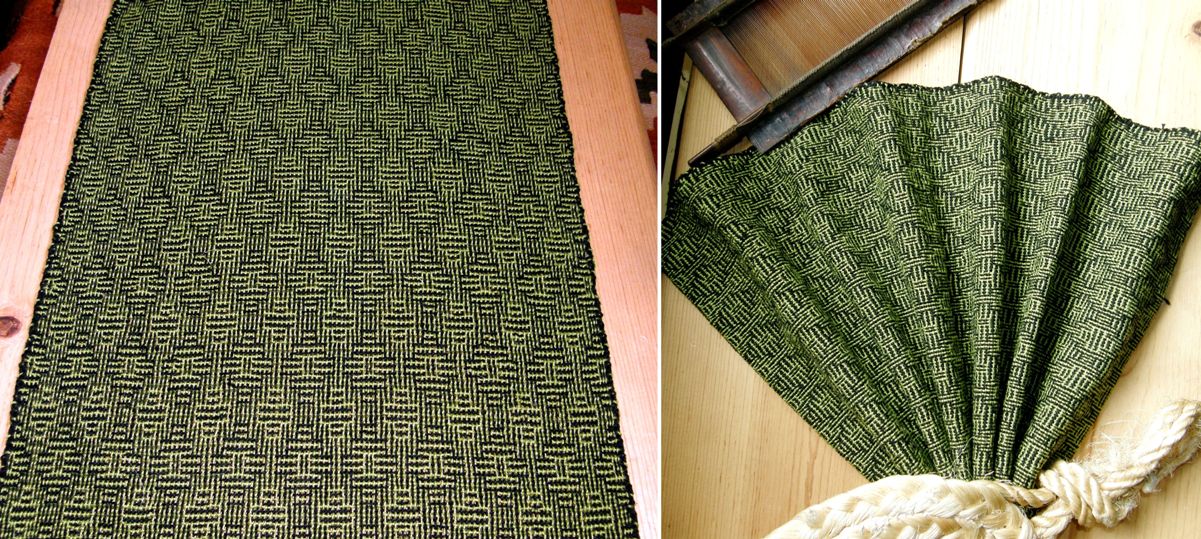
On the left you can see it as it came off the loom and on the right after having been wet finished.

The two doubled black edge ends I used looked a lot better after wet finishing but I am still not sure if doing that was such a good idea. Now, what do I use this piece of cloth for? I am actually thinking of using it as the lining for a bag…would that be nuts?

I LOVED making this! I have another four-shaft draft that I might tackle and then there is the eight-shaft one that has been calling to me for some time now…do I dare?

We are less than two weeks away from the start of our Ravelry group weave-along and I found some wonderfully inspiring pictures today from the Education and More site. Kareanni who works as a volunteer for this organization is in our backstrap group on Ravelry.

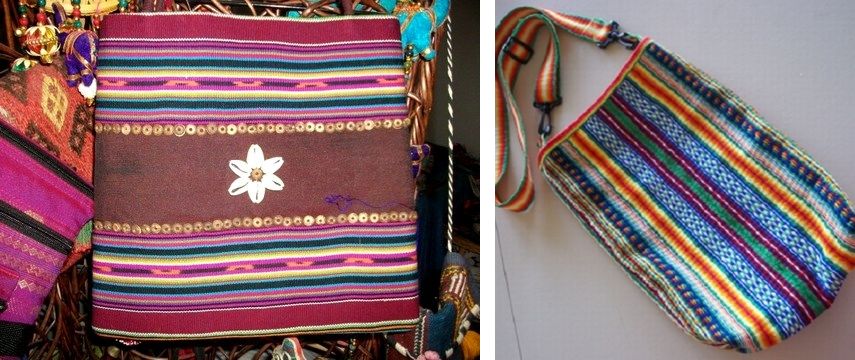
These bags are just a few of the latest fair trade products from Guatemalan weavers being offered by Education and More and are wonderful inspiration for our weave- along which will be all about using color and stripes in plain-weave.

I have had a wonderful array of completed backstrap projects coming into my inbox as well as posted in the Ravelry group this week. Where do I start?

Andreas in Greece emailed me telling me that he has been weaving from the tutorials on this blog and from my Andean Pebble Weave book. Not only has he picked up the pebble weave technique, but he has also gone on to make his own terrific designs.

And here are his simple warp float pieces…beautiful!!

You will recognize some of these designs from my tutorial while others were designed by Andreas. I do hope that we keep in touch as it would be great to learn about traditional weaving in Greece. Andreas told me that there is no warp-faced tradition. How in the world did he shape the bottom of that center band?? That is so cool!

Amber aka lavitaaj on Ravelry has been weaving outdoors making a renaissance design pouch for her sister using the “warp floats galore” technique.

And I am happy to see that she has just posted the finished pouch so I can share it this week…

All that is left to add is the toggle. She has edged it with a tubular band and I love the tassels she has added.

Here is what Jerome aka HeyZ has shown us in his first appearance in the group…a great combination of small pebble weave motifs and a simple and very effective warp float design of his own invention.

Anne and Kateri are working their way successfully through the first lessons in pebble weave while Yonat, who wove with me in Santa Cruz California last spring, has been doing a study in simple warp float patterns with beautiful results.

Speaking of simple warp floats, I received some pictures this week of the weaver who taught me this technique in coastal Ecuador. Kathleen Klumpp, who continues to work with Trinidad and her family to document the ancient spinning, dyeing and weaving techniques used in the coastal region and find markets for their products, sent me these pictures of Trini’s latest work.

In addition to the large satchel-like shoulder bags that Trini has been making she is now producing these cute purses using tagua nut buttons as closures. You can see her on the right weaving and sewing the edging band to the finished textile using her mother's handmade rigid heddle. I would so love to have Maxima see this way of making the "bordes"!

To finish,  I would like to make an appeal on behalf of Dorinda, Maxima, Zoraida and little Zuni and the weavers of the Independencia area in Bolivia. The PAZA project is currently experiencing a funding crisis. Sales at the fair last weekend were disappointingly low. I would love for you to visit the PAZA site and see for yourselves that this is a project worthy of support. Even the smallest donation will be very much appreciated. If you have used any of the tutorials here on my blog and enjoyed reading my posts, remember that all the information I am providing comes via weavers like Maxima and Trinidad and this is one small way that we can all give back a little.

Thank you! 🙂