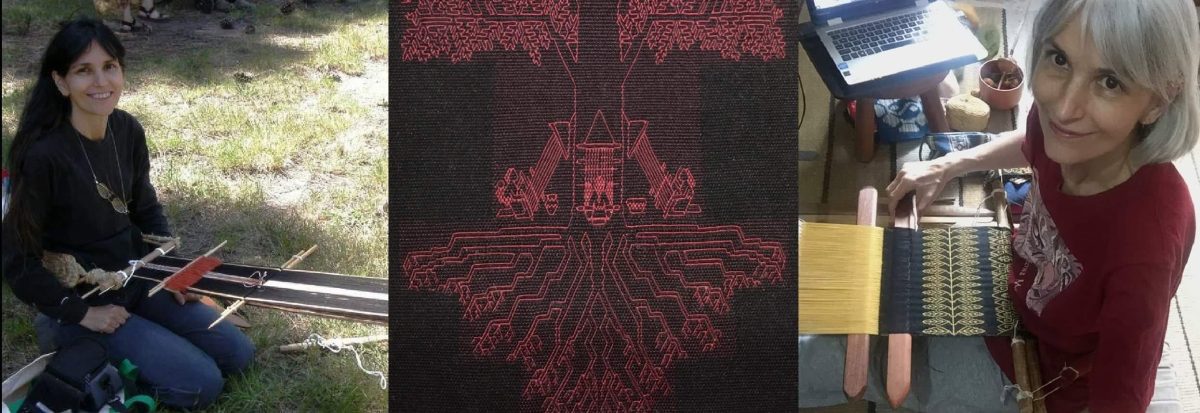
I have been kept from my loom at home this week. Normally this would have left me very agitated but it has been for a very good reason.
I spent my Friday goof-off day and all weekend working on a slide presentation and then woke up on Monday morning to my boyfriend reading to me from the newspaper over breakfast about an Encuentro de Tejedores (gathering of weavers) that was going to happen right here in my home Santa Cruz.
Oh darn I thought with a sinking heart, I bet it’s on when I am due to be away in the US. So, when does it start? I asked, dreading what would surely be a disappointing response.
TOMORROW!
was the shocking reply. Maybe we just missed all the previous announcements. I really had no idea and so there was a mad rush to gather information and make sure that I could be a part of it. The conference is officially entitled…
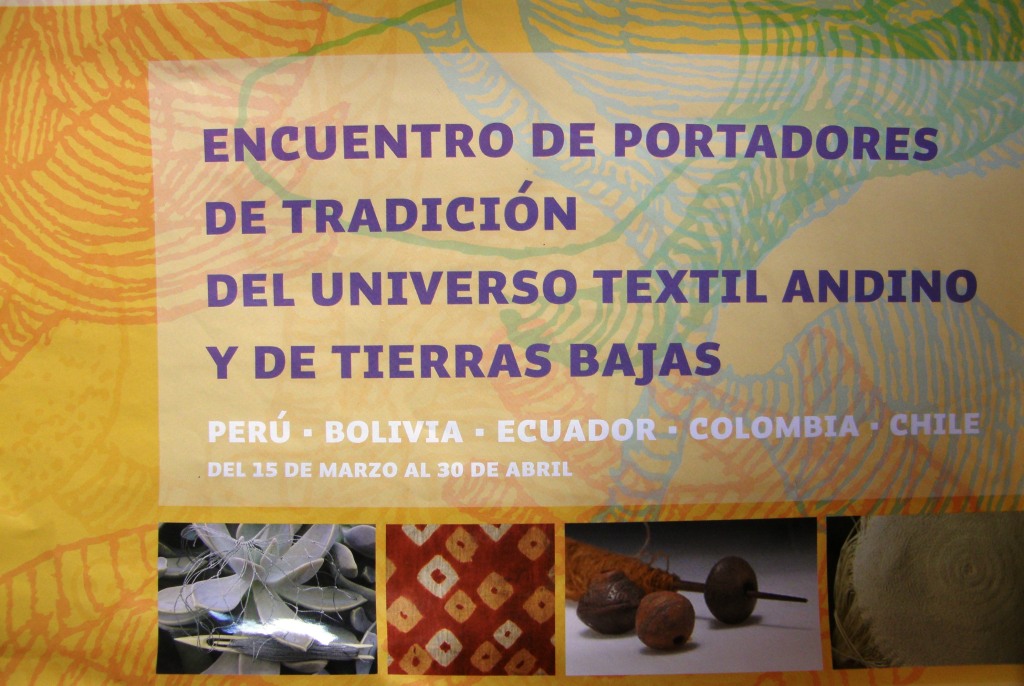
ENCUENTRO DE PORTADORES DE TRADICION DEL UNIVERSO TEXTIL ANDINO Y DE TIERRAS BAJAS
(A meeting of the bearers of the traditions of the Andean and lowland textile universe)
which brought weavers, artisans, anthropologists and academics from Colombia, Ecuador, Peru, Argentina and other parts of Bolivia to my lowland home. Now this sounds like an enormous gathering but it wasn’t really. Only two to four people came from each place which has made it an extremely intimate experience with plenty of space and time to spend chatting with and getting to know people.
Only a handful of outsiders such as myself have attended which makes me feel even more privileged but at the same time alarmed and saddened although not totally surprised by the apparent lack of local interest in this event. Perhaps it wasn’t widely advertised in order to preserve this intimacy and make it more possible for the weavers themselves to interact more closely. Either way I feel extremely blessed to have been able to participate.
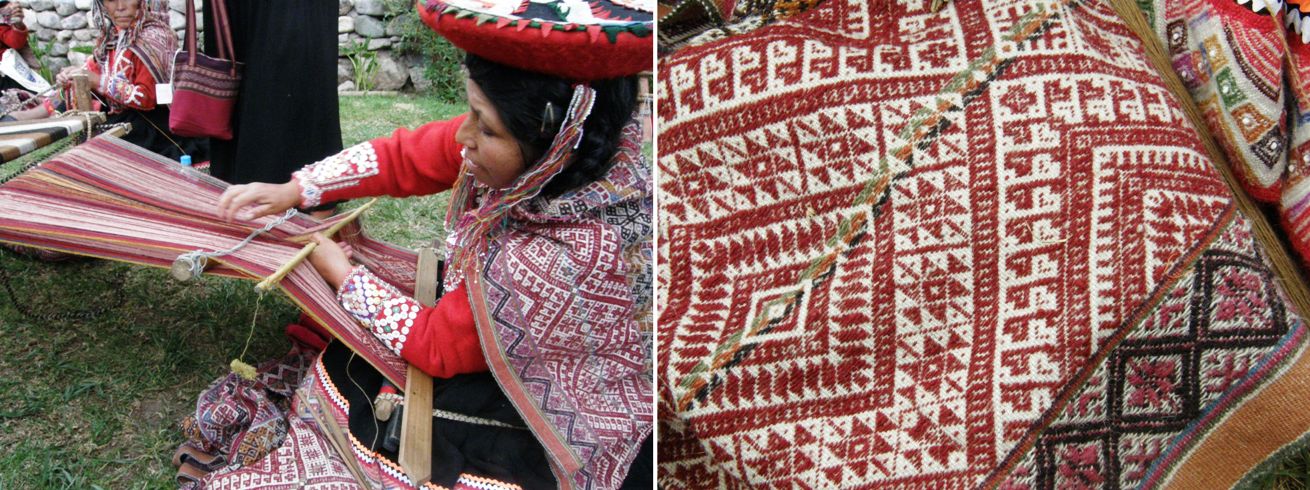
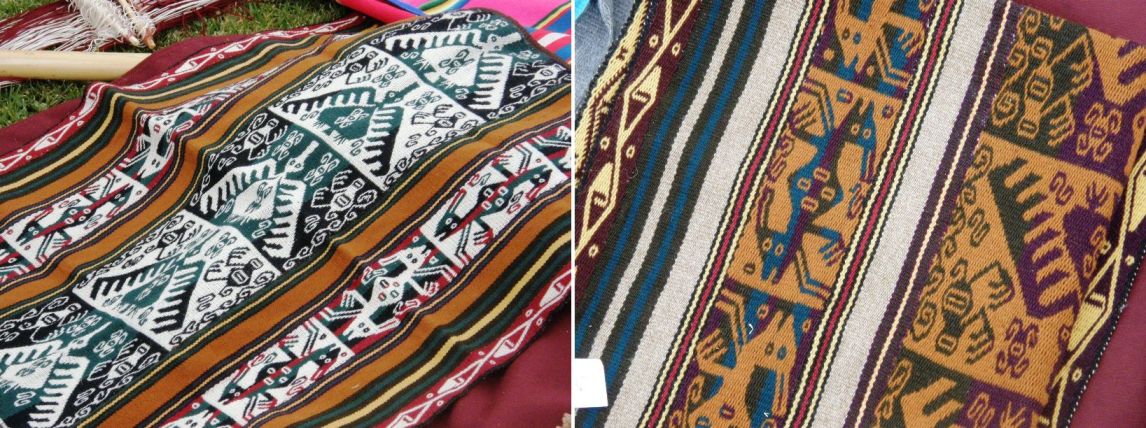
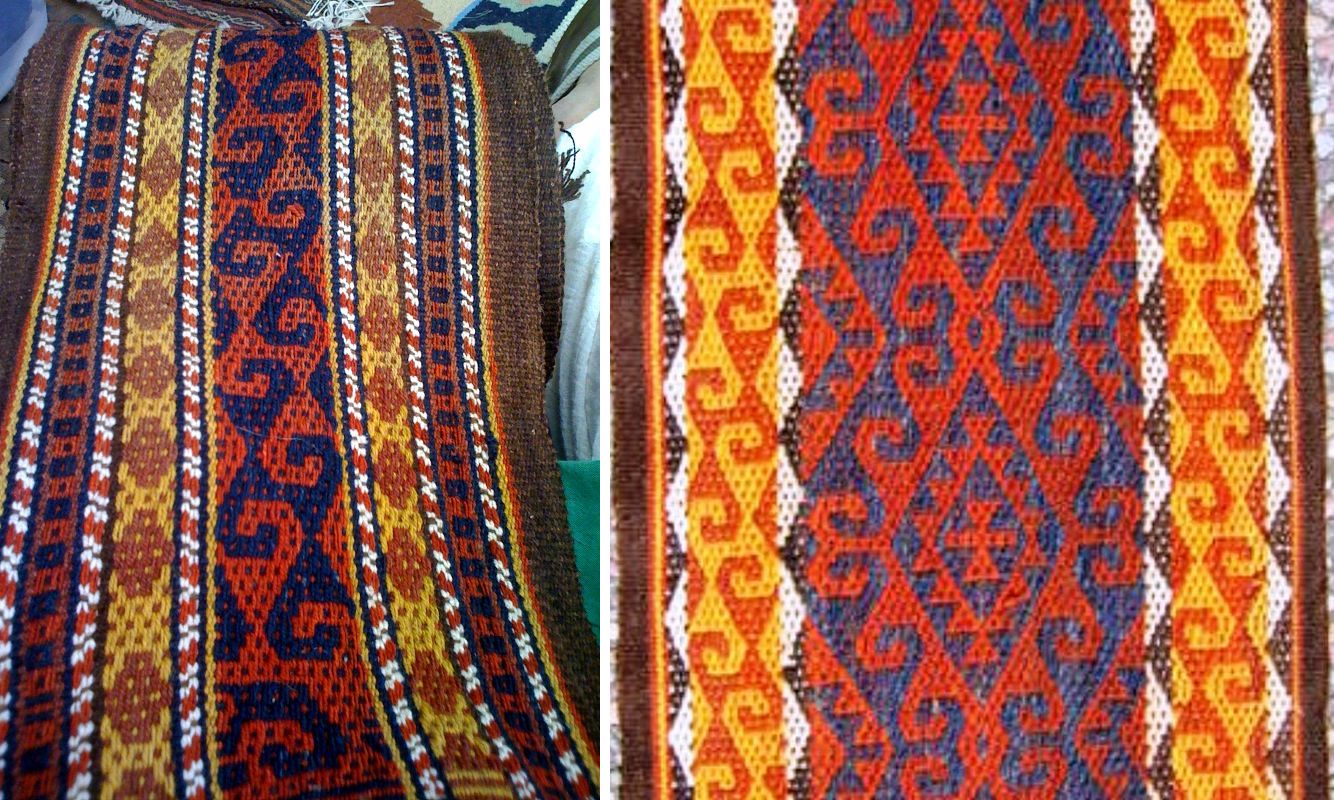
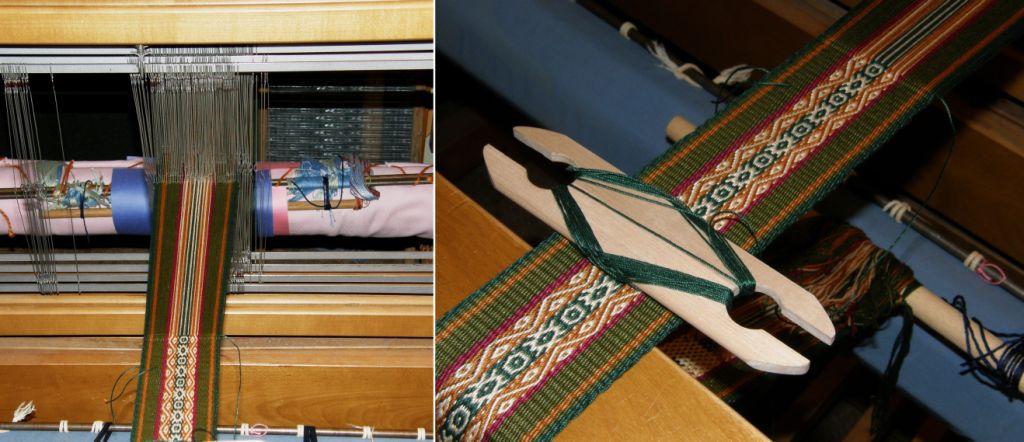
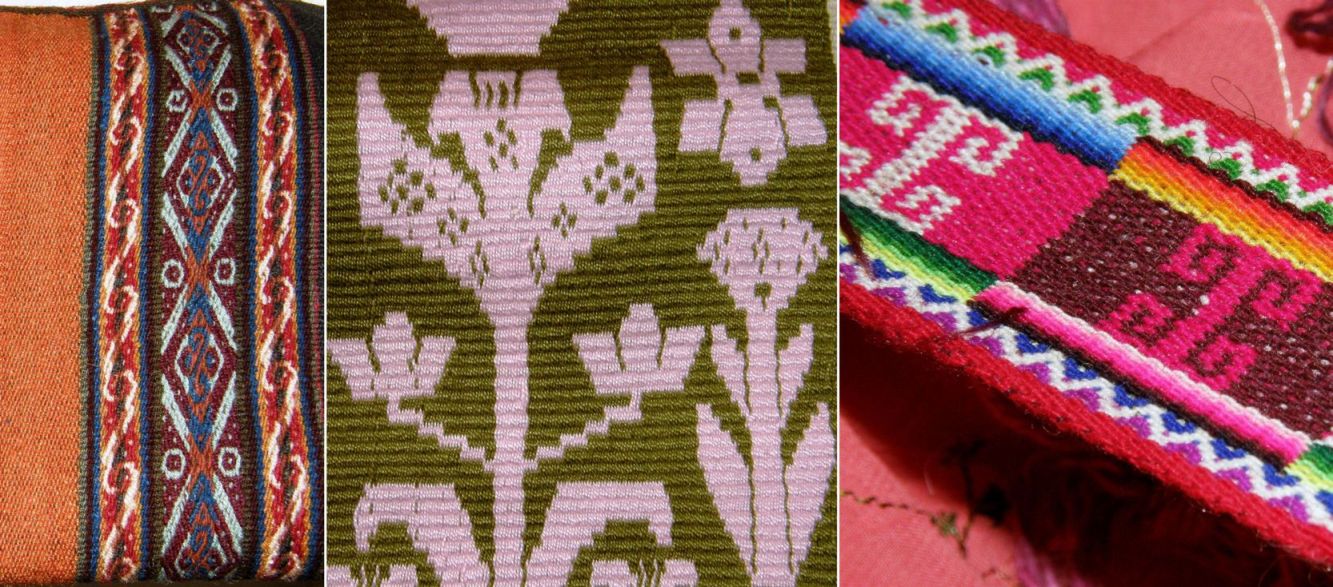
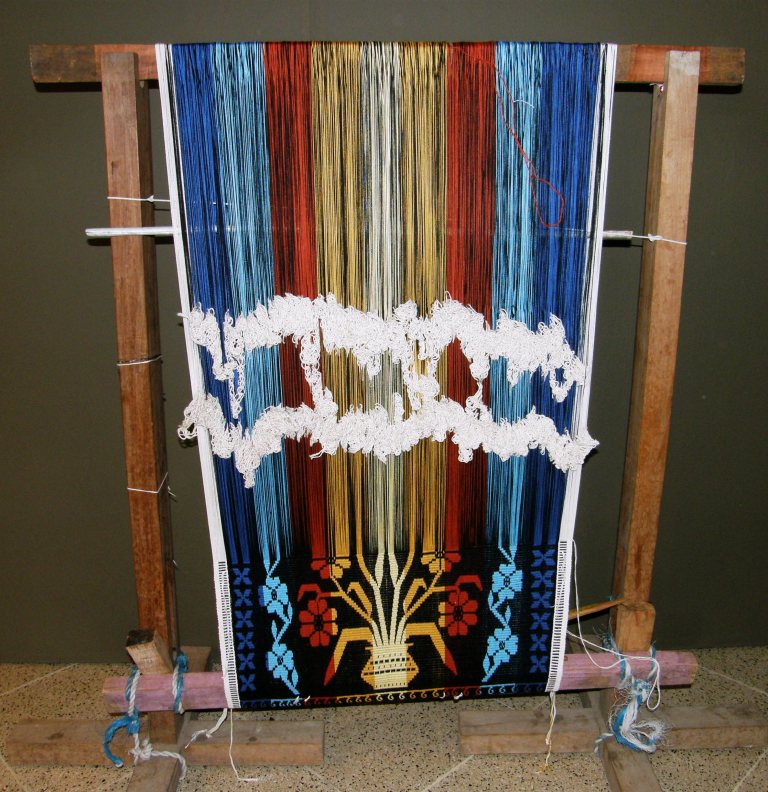
Weavings from highland Peru, lowland Bolivia and the Chilean high plains.
So, this means that this week’s blog post will be rather short as there are still two more evenings and one more day of conference to go. I will give you a few tidbits here to whet your appetite for a full report next week. I am still in the process of gathering information, facts, etc…and would hate to get anything wrong and I apologize if I have misspelled names.
I will tell you now that this whole event was organized by three wonderful Chilean ladies, the idea for which had its roots in an exhibit by Chilean artist Natasha Pons, which will run here for a month, called “Relatos Migratorios”. The Centro Cultural Simon I Patiño made it possible for people like me to experience all this for free. I still haven’t gotten over this fact!
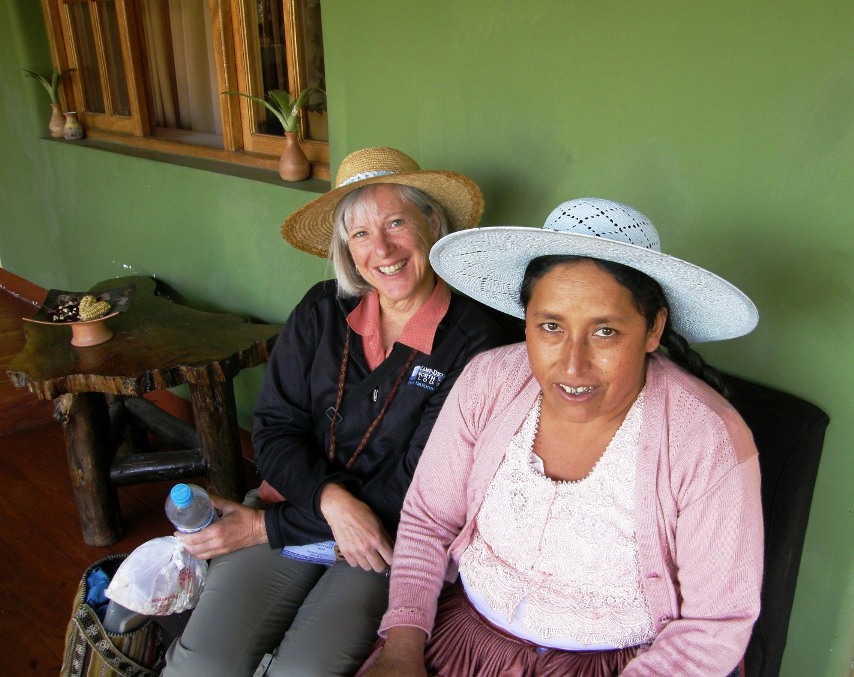
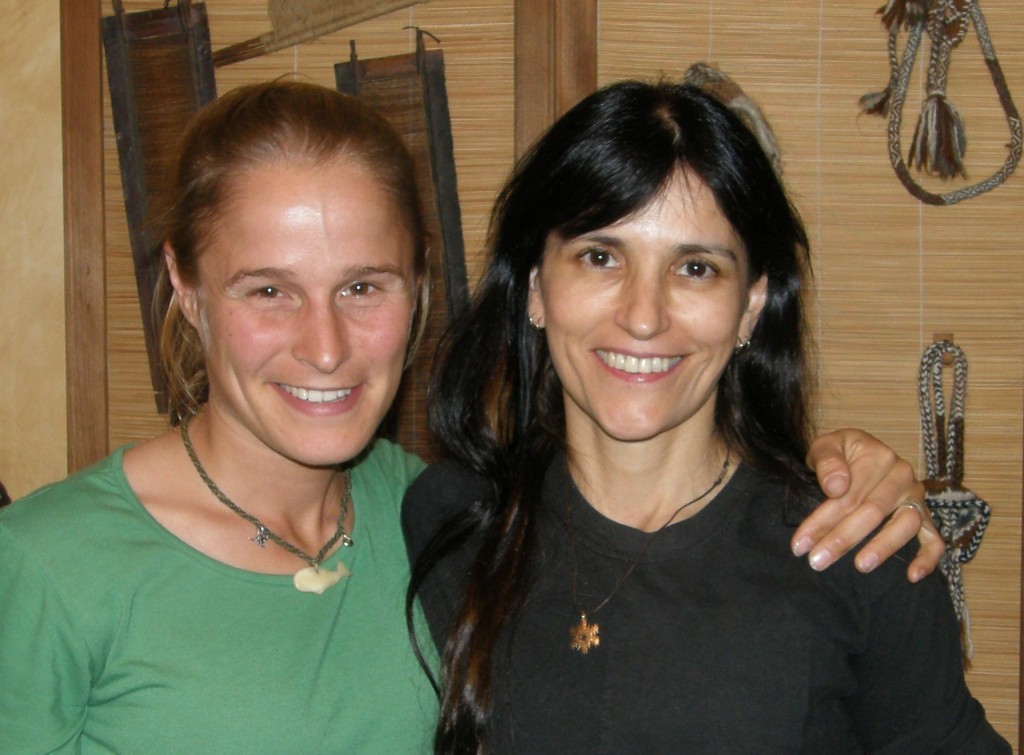
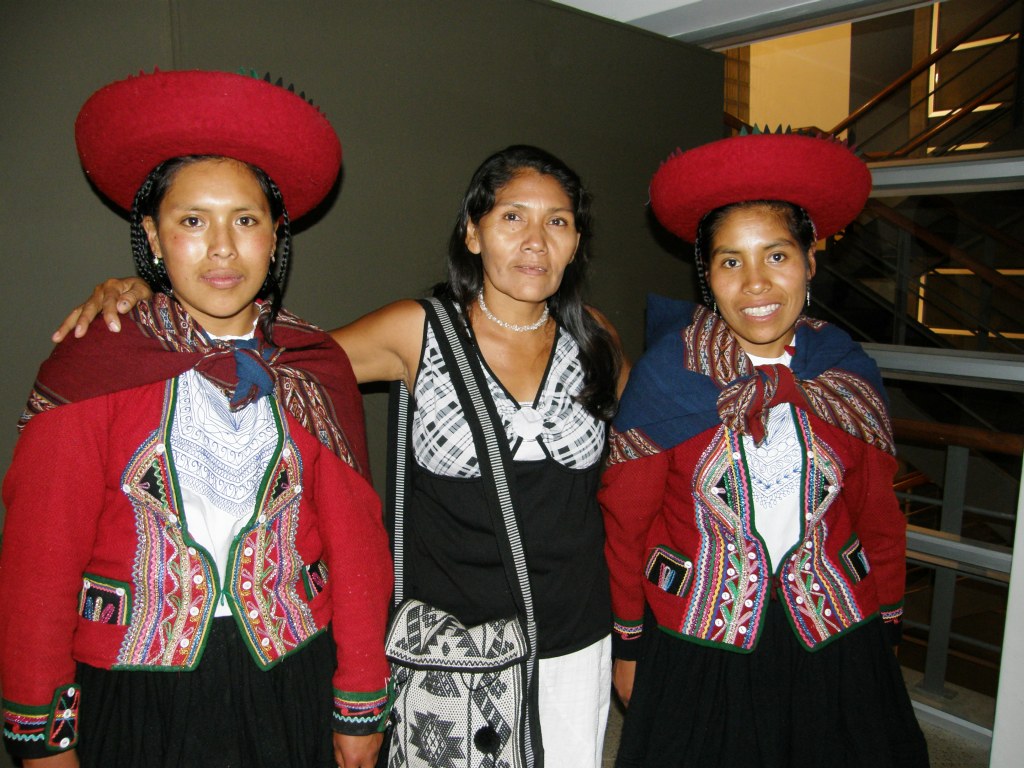
Angela Suarez, a Guarani weaver of the Bolivian lowlands met Chinchero weavers Sonia and Sanaida(sp) at the inauguration gathering.
The inauguration of the conference and exhibit took place on Tuesday. I went along and met up with my Guarani weaving teacher Angela. Walking up the stairs at the cultural center, my heart skipped a beat when I saw two ladies from Chinchero, Peru right behind me.
Last November after a little weaving class with Angela we had to part for some time as I was leaving for the Tinkuy de Tejedoresin Peru and she was going to her home of Isoso to organize the weavers to make an enormous order of woven Christmas cards. I had told her about the exciting event in Cusco all the time wishing that I could have gotten my act together and taken her with me although I doubt that she would have gone with the extra responsibilty she was carrying at that time to fulfill the Christmas weaving orders.
So, here now was a little part of Peru coming to her instead! along with Colombia, Chile and Ecuador. And, on top of the beautiful pebble weave bag that she is carrying in the picture above, she brought one her wonderful works-in-progress in the Moisy technique to show to the highland weavers.
The program comprises three mornings of four-hour workshops along with audio-visual presentations and conferences in the evenings. The first day’s workshop was backstrap weaving which was offered by the ladies from Chinchero along with Celinda and daughter Isobel, Aymara weavers from the northern Chilean highlands.
Organizer Cristina introduced the workshop and put it very well when she explained that there are many roads that can lead to a single destination and many ways of achieving the same objective. The warping, set up and weaving techniques used by the Aymara and Quechua weavers teaching us here side by side have their differences but our goal, she explained, would be to learn to weave narrow bands, called jakimas in the Quechua language of Chnichero, and what the Chilean weavers call cintillos.
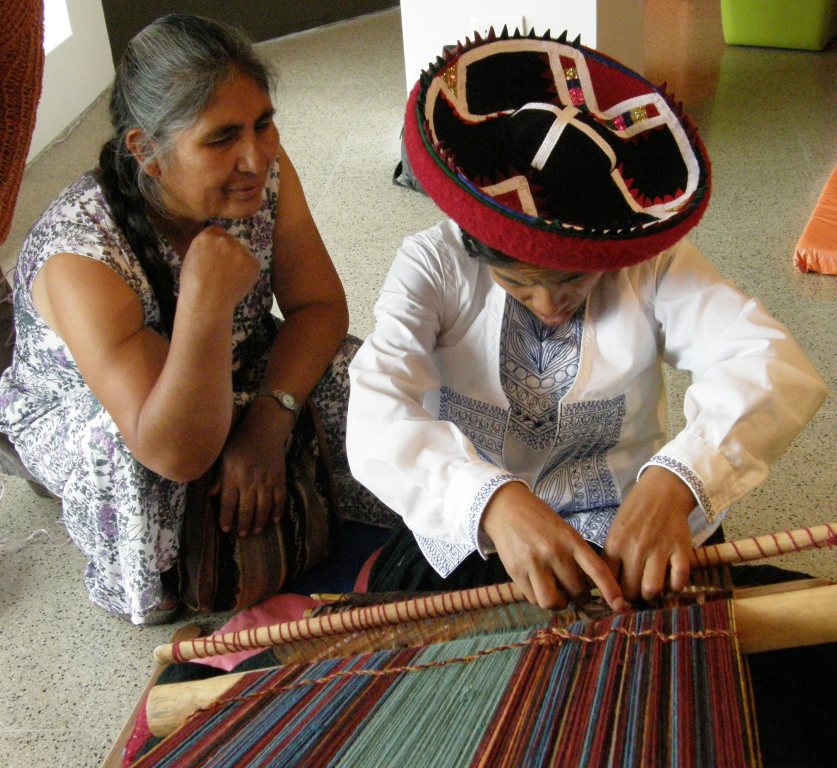
Aymara weaver Celinda watches with fascination as Chinchero weaver Sanaida works on her pick up weaving.
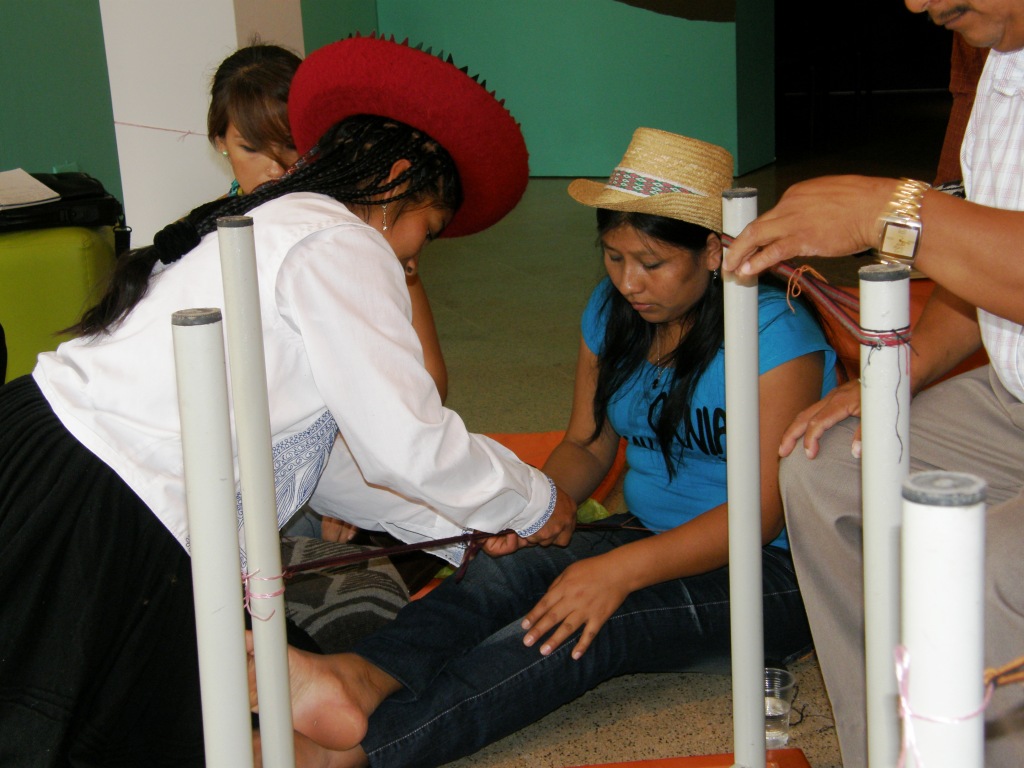
Cabuya fiber artisan Maritza from Colombia receives help from Sanaida while one of the Ecuadoran gentlemen prepares his warp around a pair of table legs.
Well, you can imagine that this had me wanting to hop from one group to the next so as not to miss a thing! but I settled finally with Sonia and wove my first flat band with the gorgeous Chinchero handspun (I had used this fiber before to make tubular bands at the tinkuy).
My experience with my own handspun has been almost exclusively with llama fiber and so there were quite a few interesting things to note about this wool warp, the behaviour of the weft, the appearance of the woven surface from the high twist yarn and the different kinds of weft that Sonia and Sanaida were using.
Having the backstrap weaving moves down, I was able to focus very much on the material rather than on the technique. So, I did get to weave this week after all.
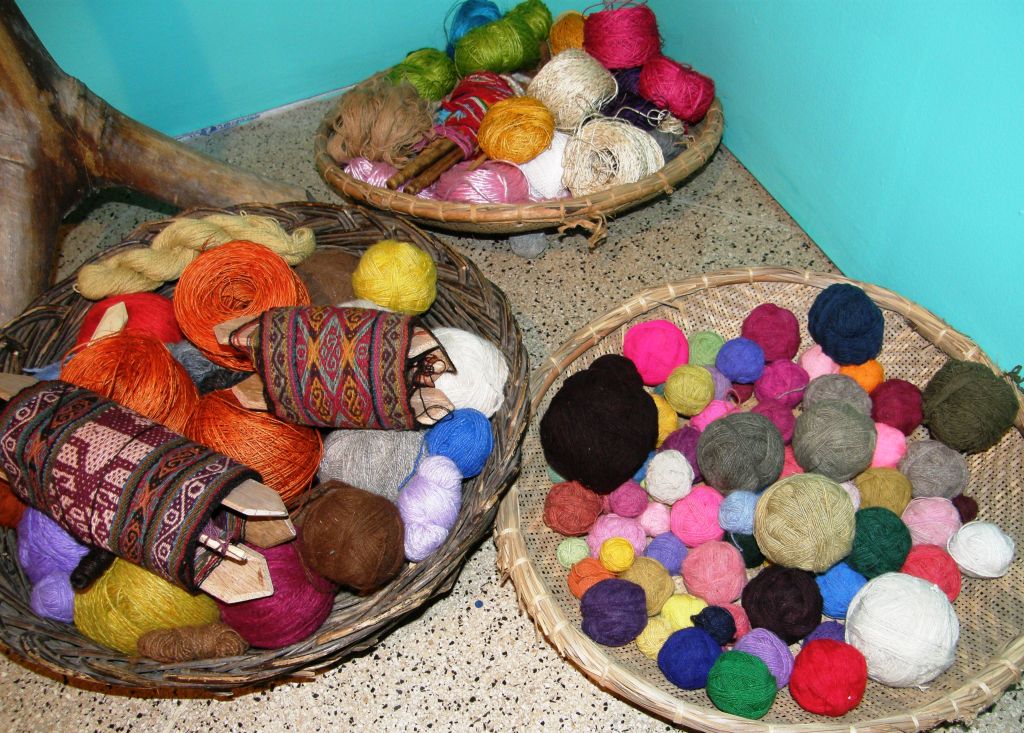
Cabuya fiber from Colombia and handspun wool from Chile and Peru along with other random bits of cord and twine that we used to tie up the warps.
The artisans from Ecuador, Colombia and Oruro in Bolivia joined in enthusiastically as well as a small group of outsiders such as myself and staff from the cultural center. Most outsiders were non weavers and were terrified to beat hard and pull at the warps fearing they would break. The handspun wool was of course wonderfully resistant which was a good thing as there was the usual amount of beginner heddle-sawing going on.
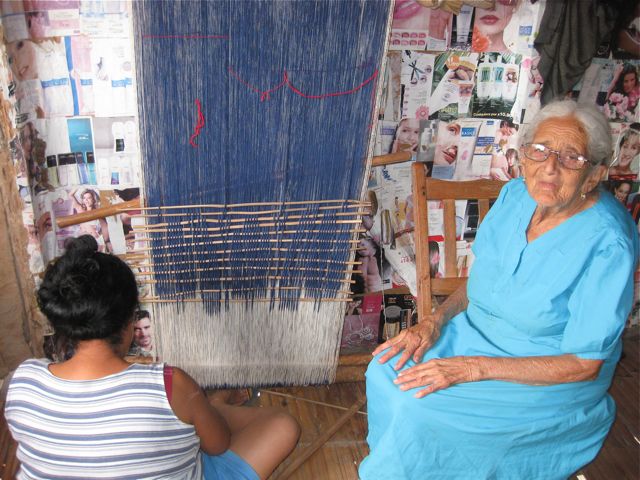
I didn’t have to worry too much about missing out on Celinda and Isobel’s (the Chilean weavers) instruction on day one as today Angela and I got to spend a lot of time with Celinda as she wove. I found her very tranquil and lovely to watch. Daughter Isobel, on the other hand, is a live wire! You will see and hear more about her next week.
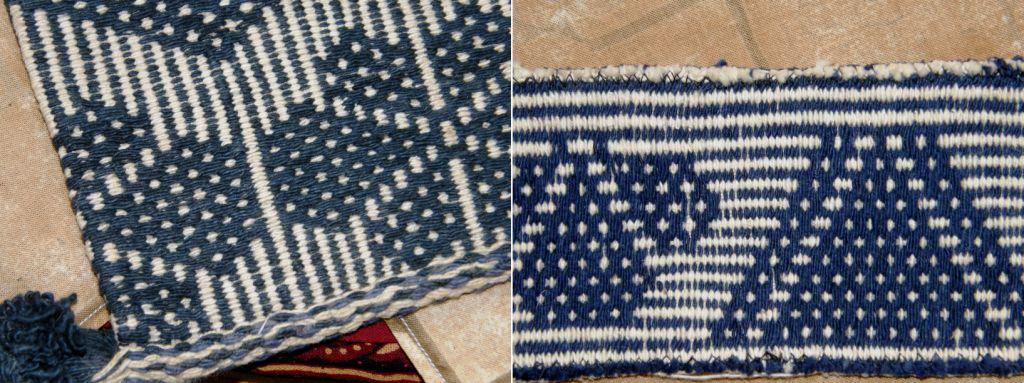
The technique that Celinda was demonstrating is a variation of the Moisy that Angela weaves except with three patterning colors which requires a fourth set of string heddles to manage. This does not create a double faced textile but there are no long floats on the back of the band either.
Angela noted that Celinda’s heddle order arrangement was quite different to hers and asked many questions. I could see her soaking it all up.
Finally she wasn’t asking questions but rather pointing things out to confirm that she did indeed understand. I wouldn’t be surprised to see her adding this to her repetoire and you can be sure that if she believes that any of Celinda’s ways are better she will adopt them. She is already using a stick for her lower set of heddles on her narrow bands after asking me to teach her how to make them on a stick – something she said she had always wanted to learn.
Well, I really must stop here as there are more events to attend tonight and one more day of this conference to go. No doubt there will be much to tell and show next week.
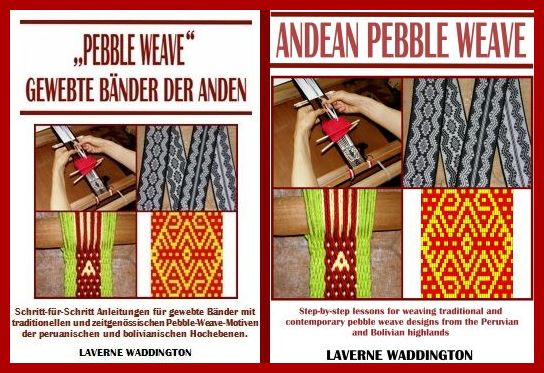
I can’t go without giving my thanks to my online weaving friend Kristina Krenzer who has worked hard to translate my e-book Andean Pebble Weave to German. It is now available on Patternfish. It looks so weird and, at the same time, so great in another language! Of course you can get the English version on Patternfish too.
Ich danke Kristina Krenzer für die Übersetzungsarbeit. Meine Monographie über die Stippenweb-Technik der Anden, auch bekannt als “Pebble Weave”, ist nun auch in deutscher Sprache bei Patternfish erhältlich .
The Tinkuy de Tejedores 2010 is over and I am back home in Bolivia wondering what hit me! There were four intense days of colors, sounds and new experiences… meeting up with old acquaintances, putting faces to online user names and making new friends while trying to absorb everything around me and learn as much as I could with a head spinning from a combination of altitude and information overload.
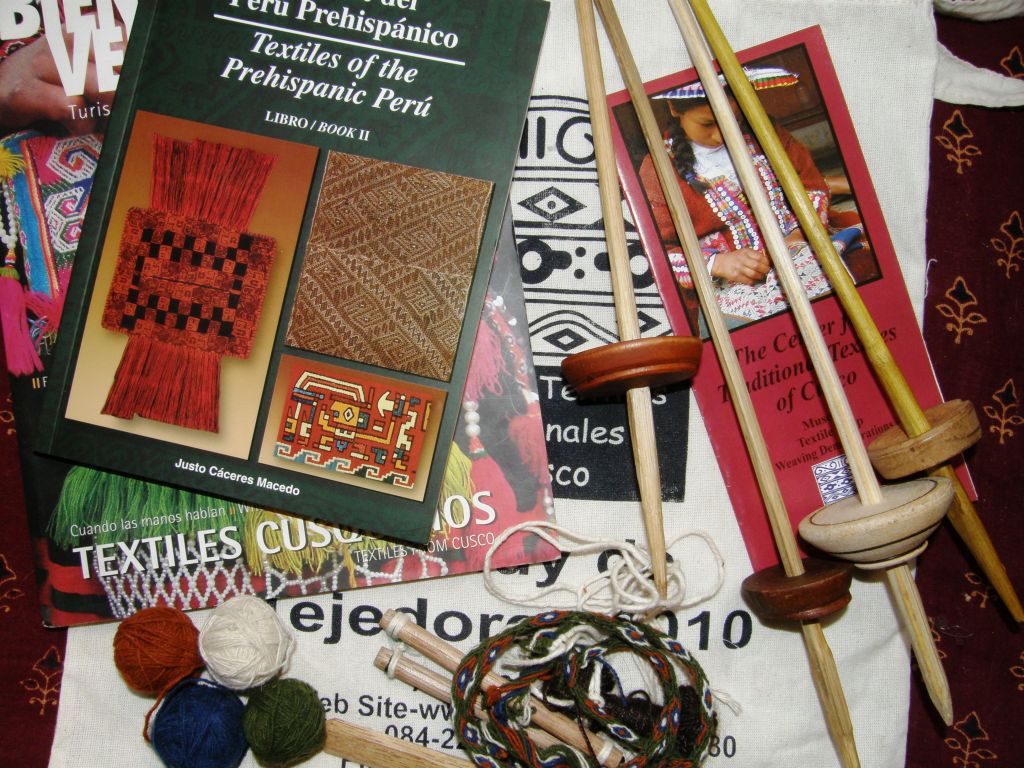
I didn’t bring back much in the way of physical souvenirs…the shoulder bag which was part of our registration package, a couple of spindles that I got in the Cusco market, two more which I swapped for one of my amulet bags with Maxima, a Bolivian weaver from Cochabamba, a locally published book on textiles which I bought at the airport while trying to use my leftover Peruvian Soles and some balls of handspun yarn left over from the workshop I took.
I didn’t buy any textiles but I did come back with a new weaving skill and lots of ideas about making textiles with discontinuous warps. I plan to warp for a very narrow plain warp faced piece with discontinuous warps in the next few days which I hope to decorate with supplementary wefts as this will be the easiest technique to start with. If that is a success, I will attempt a complementary warp technique. It was great having the opportunity to get a close look at some of the discontinuous warp pieces on the loom being woven by the ladies of Pitumarca. From what I can tell, the grey and brown warps dovetail around a metal rod when the loom is being warped. The pick-up pattern appears to cover the entire length of the grey panel with no terminal area – mind boggling, really! I wish I had spent more time with this weaver. This was the most amazing thing I saw at the tinkuy.
This piece has one of its four color panels complete. Done in all natural wool colors it is going to be spectacular. The unfinished areas are those that have been rolled up on the loom bar nearest the weaver.
It’s interesting that she has woven the grey panel, turned the loom around, and now seems to be working her way back. She has just started the bottom of panel three. Perhaps she will then turn the loom around once again to weave the other end of this panel and then go filling in the space in between. There are so many questions that I forgot to ask this weaver, like, at what point the metal bars around which the discontinuous warps dovetail, are removed and replaced with yarn. Well I shall just have to experiment and see for myself.
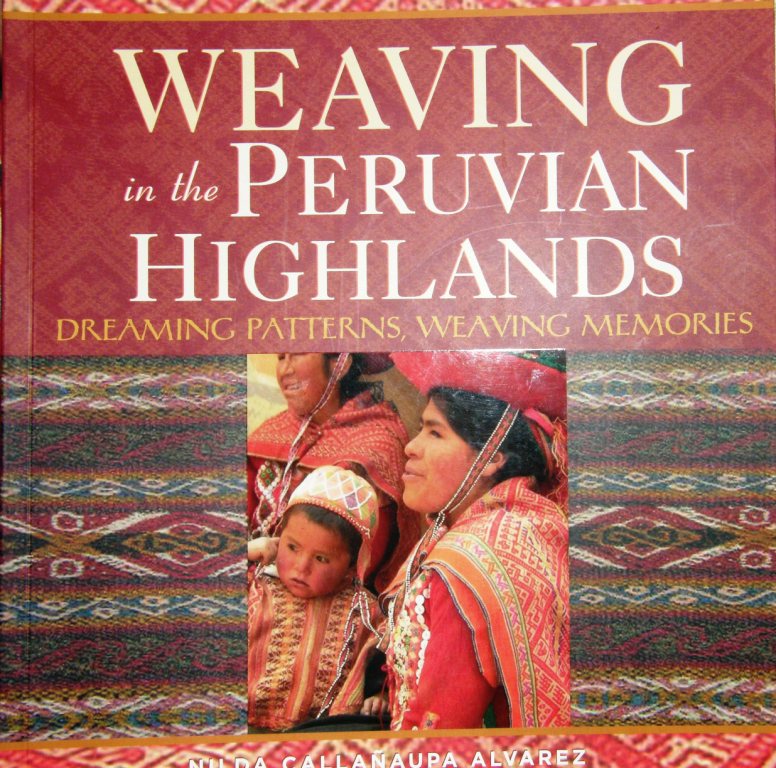
I am constructing a warping board for myself for my piece based on a picture in Nilda Callañaupa’s book pictured above.
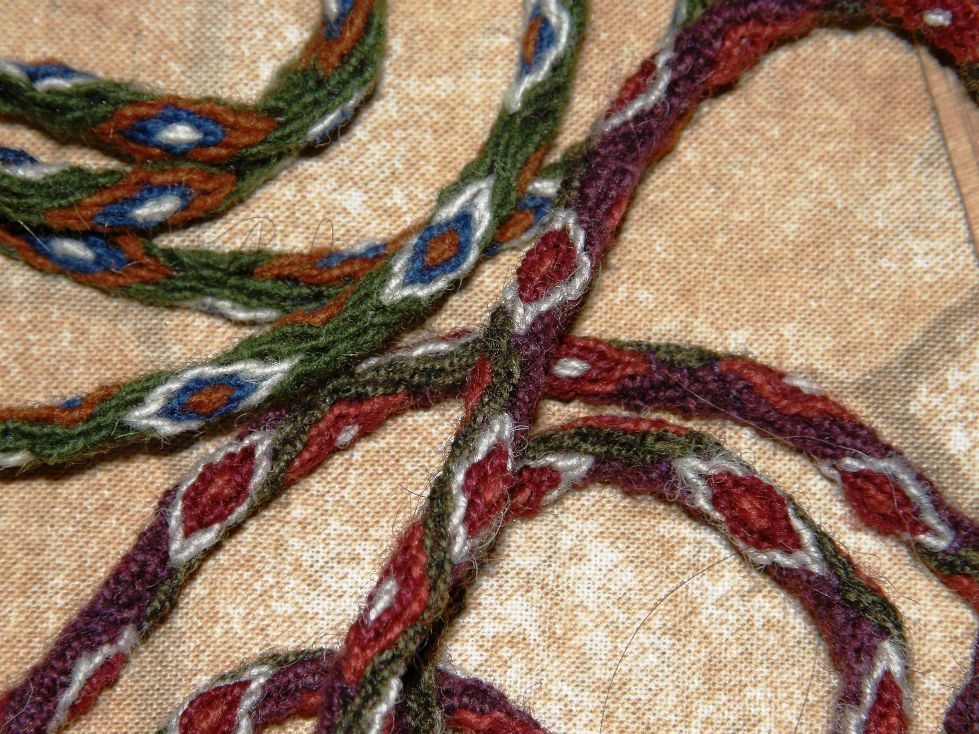
So, as far as weaving skills go, I brought back ideas about the aforementioned discontinuous warp pieces and I learned the tubular woven bands of Chinchero and Patabamba in the workshop I took. If you have read my last two blog posts you will know that I recently learned how to make these tubular bands or ñawi awapa from instructions in Adele Cahlander’s book. I strongly suspect that Adele Cahlander figured these bands out by pulling them apart and studying the structure rather than by learning from the weavers themselves and she has been able to give instructions so that one can reproduce them.
EDIT: I have since been pointed to an article which says that Cahlander based her instructions on a partly woven specimen that had a complex arrangement of string heddles and shed loop so obviously the tubular woven bands were or are woven somewhere using this set up. As I said recently in a previous post…”There is no one “right” way”.
I find it amazing that she was able to analyze the specimen, compile excellent instructions for its reproduction and share all that with those who can’t travel to Peru and learn it themselves from the weavers.
However, the way we were taught in Chinchero by Nilda is SO MUCH easier!!
I took a partly woven band which I had warped up according to the Cahlander instructions with its string heddles to show the weavers and they were quite astonished by this strange set up. The green band above is the one I started in the workshop and finished at home. The red one was a gift for the workshop participants.
Another thing I took away from the tinkuy for my own weaving was lots of inspiration for color and design as well as a new respect for supplementary warp patterning (a technique of which I have never been a big fan) after having seen the amazing ponchos of the Chahuaytire and Accha Alta communities. A weaver from Accha Alta with her piece profusely patterned with supplementary warp patterns can be seen below. She is rolling the heddle stick towards her while pushing down on the warps behind in order to open the heddle shed.
I can’t believe that I am sitting here now at home in the tropical heat of the Bolivian lowlands while just one week ago I was making my way to Urubamaba at 2863 meters in the Peruvian highlands. I would say that of all the trips made by international visitors to the tinkuy mine was probably the shortest…just a one-hour flight from Santa Cruz to La Paz with enough time to stroll around outside the airport and take pictures of impressive Mount Illimani. In La Paz I met up with Dorinda and Maxima who were to be my roommates in Urubamba. I had met Dorinda Dutcher through WARP connections over a year ago and had corresponded with her by email. This was our first face-to-face meeting. Dorinda founded PAZA (Project Artesania Zona Andina) in the town of Independencia, Aypopaya province, an organization which she describes as “a Peace Corps project which became life’s calling”. She raised funds to be able to bring master weaver and PAZA coordinator Maxima Cortez with her to the tinkuy. The non-profit organization KURMI in Cochabamba also provided funding for a group of weavers to attend so we traveled from La Paz to Urubamba as a group of fourteen.
Witnessing the group’s reactions to all they experienced on this trip and at the tinkuy was another wonderful aspect of this whole journey. Please read Dorinda’s reports on the PAZA blog to learn more about her goals, challenges as well as volunteer opportunities with PAZA.
These ladies had been traveling literally for days! First, an eight-hour bus trip to Cochabamba followed by an overnight bus trip to La Paz before they could even get on the fifty-minute flight to Cusco. Then came the inevitable mess of paperwork on landing in Peru but no one’s spirit was dampened.
Are we there yet?
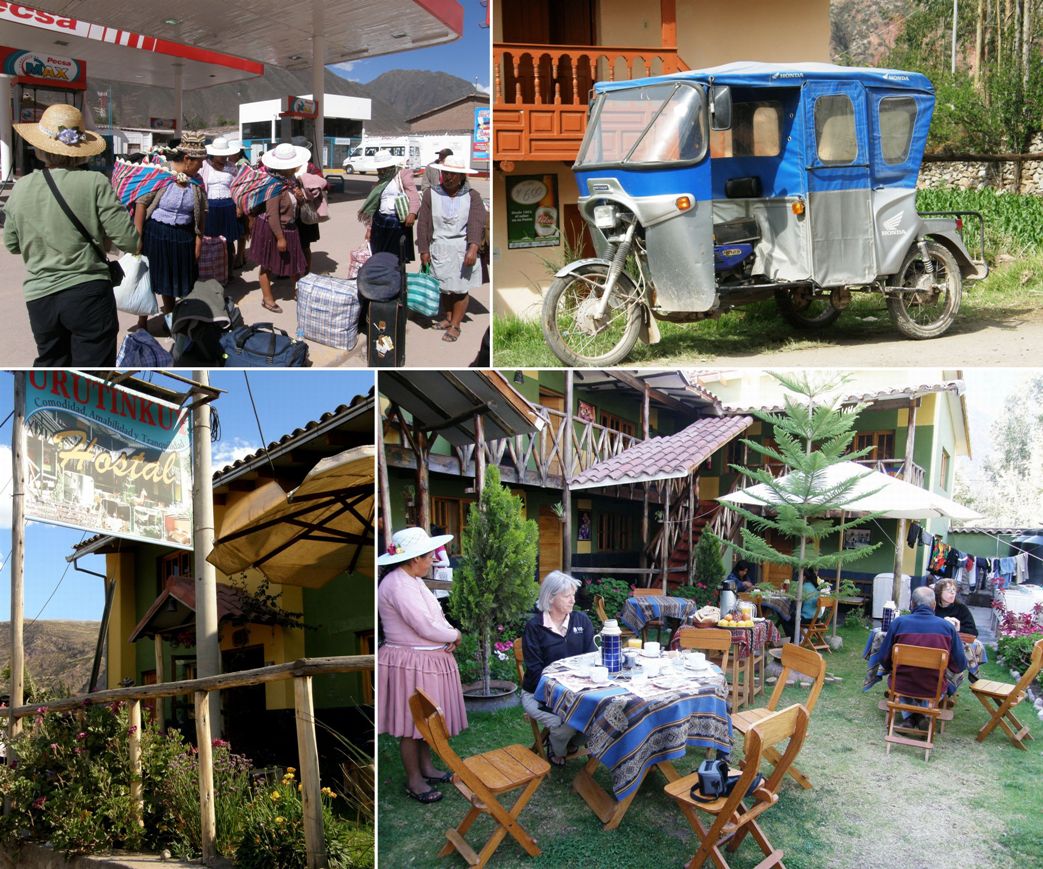
So when we got to Urubamba and made the mistake of getting off the bus too early, the ladies just took it in their stride, wrapped their luggage in their carrying cloths, hauled them onto their backs and took off up the road while I struggled along with bags in hand and dangling off my shoulder. Below you can see us lost at the gas station at the wrong end of town.
A hot, dusty and wind-tousled group finally arrived at the Hostal Urutinkuy that afternoon.
At the hostal I met lovely D.Y Begay, a Navajo weaver who had been invited to present at the conference. D.Y and I had been corresponding by email for some months and it was great to finally meet her. She was slated to be the first presenter of the conference and was a little inconvenienced by the fact that her luggage had not shown up.
The tinkuy comprised two days of conference with an incredibly heavy schedule of talks and presentations with breaks for drinks and snacks and weaving demonstrations. Lunch was followed by more weaving demonstrations and opportunities to buy textiles. If you were wise enough to arrive early in the morning you had the chance to mingle in a bit more leisurely way with the local weavers and spinners and avoid a bit of the chaos.
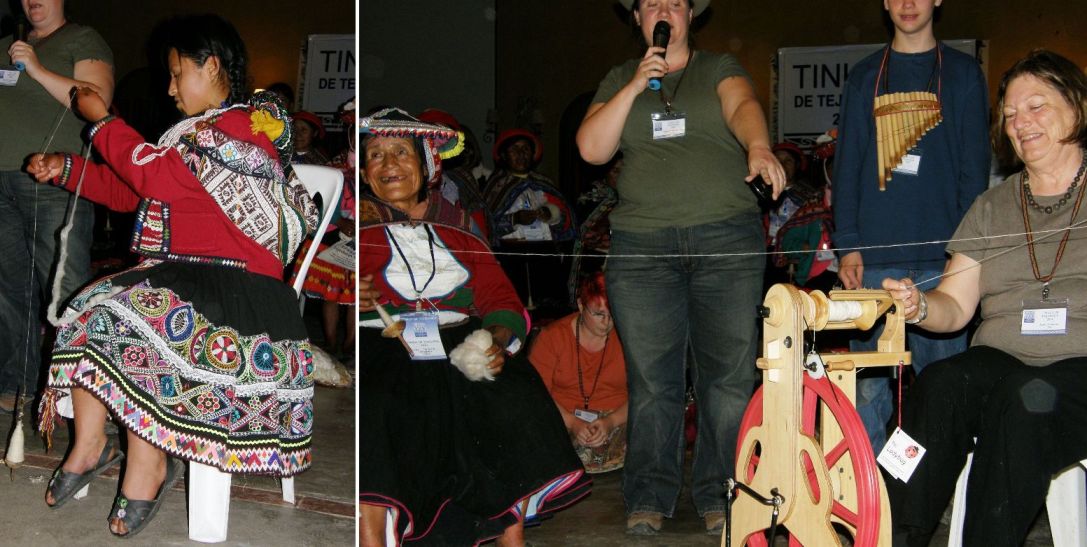
We gathered in the evenings in the conference auditorium for dancing, music, singing, spinning competitions, which were narrated by Abby Franquemont, and lots of laughter. Beth’s (of The Spinning Loft) young daughter competed on her wheel with a local spinner on a drop spindle as did Judith MacKenzie. I honestly don’t remember who won but I do remember that the Bolivian ladies from Cochabamba really strutted their stuff in speed spinning the following night and my roommate Maxima took home a prize having spun over six meters in two minutes.
I am just going to show you here now a selection of captioned photos which, I hope, will give you a feel for what went on in those two days and just how much we managed to pack in!
It all started with a ceremonial offering to Pachamama performed by an Andean priest accompanied by the sounds of the pututus, (conch shells), which were also blown to announce the start and finish of each guest speaker’s presentation. Everything was translated into three languages – Quechua, Spanish and English and the Quechua translator with his strong, clear dramatic tone of voice was a joy to hear.
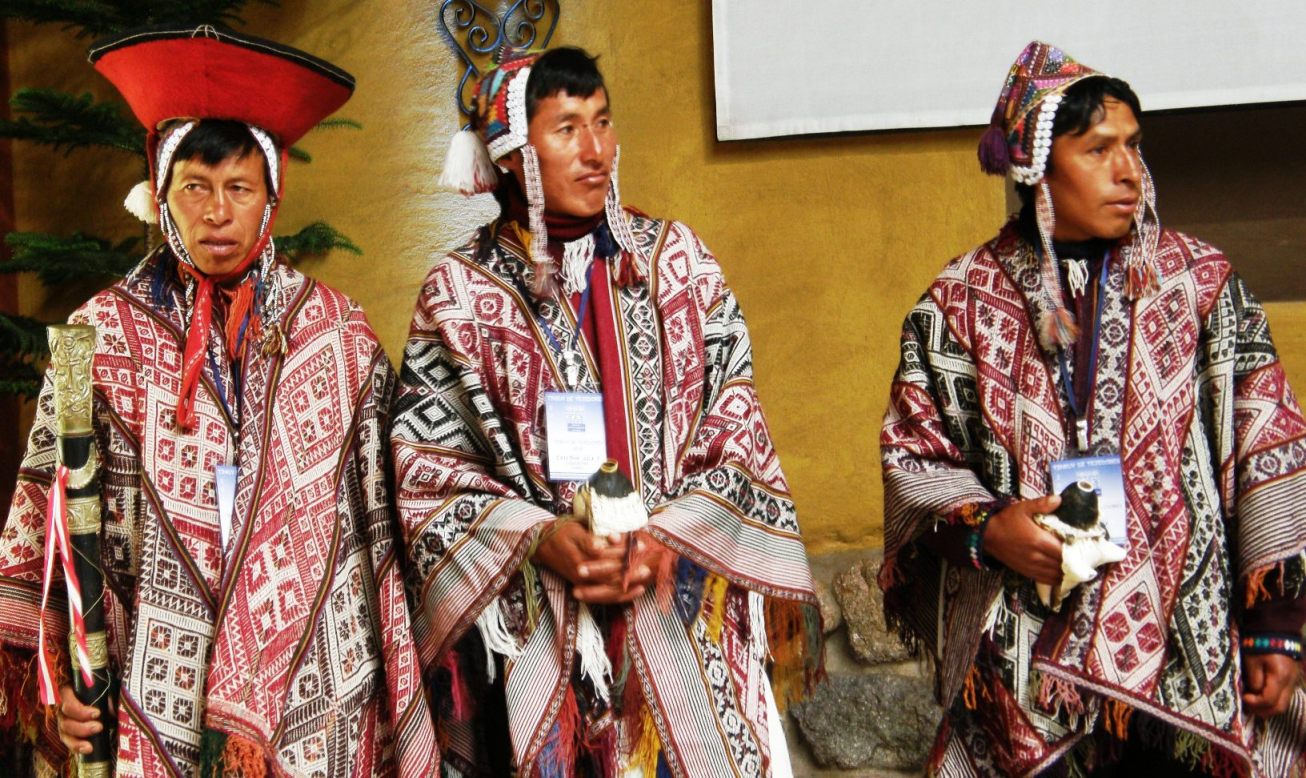
High-ranking community members with conch shells in hand took part in the opening ceremony.Just a few of the foreign invited guest speakers: Luisa Govea of San Luis Potosi, Mexico, weaver of fine silk ikat shawls using designs from the 17th, 18th and 19th centuries. Ann Pollard Rowe - I met her in 2007 at the Textile Museum in Washington, a meeting which led me to a wonderful weaving and spinning adventure in coastal Ecuador and it was lovely to have the opportunity to see her again. She gave a presentation entitled "Looms of the Americas". D.Y Begay who spoke on the traditions and practices of Navajo weaving. Judith MacKenzie's talk was entitled "Fibers of the Americas". Luz Maria Andrango of Otavalo, Ecuador demonstrated the Great Wheel and brought textiles to show from the workshop of her famous father, Miguel Andrango.
There were at least two dozen national and international presenters over the two days. I was especially pleased to have been able to meet Mary Frame who spoke about Inca geometric figures called tukapu. I am determined to learn three color double weave so I can use some of those designs in my pieces.
In the talks we were taken on journeys from Mexico and Guatemala to Bolivia and around Peru from pre Incan and pre Hispanic times to present and taught about techniques from weaving and dyeing to administration and marketing.
Maiwa Productions showed us a wonderful video on indigo dyeing in India.
Some of the presentations I most enjoyed were those by the weavers in the communities that are involved in the Centro de Textiles Tradicionales de Cusco (CTTC). They spoke of their lives before and after their experience with CTTC, their struggles, successes, accomplishments, frustrations and failures while trying to revive their lost weaving traditions. The talk I enjoyed most of all was that given by a group of weavers who described the impact of weaving competitions on their motivation to continue weaving and improving, their self esteem and ability to solve problems and work as a team.
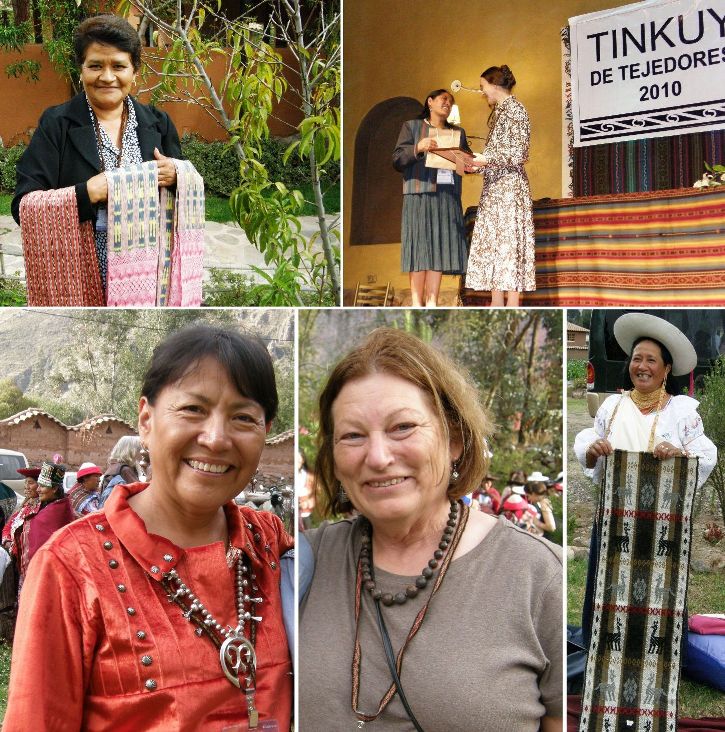
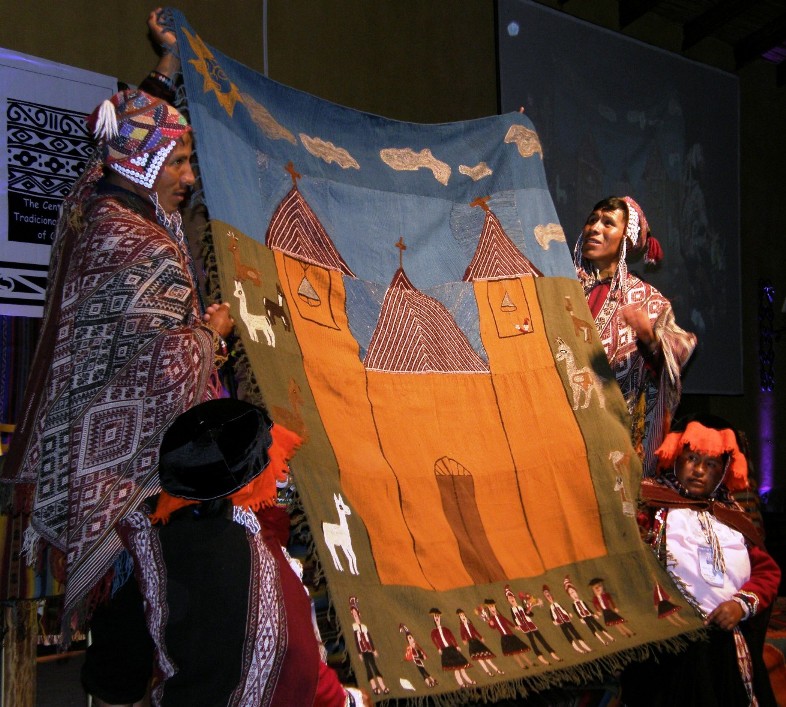
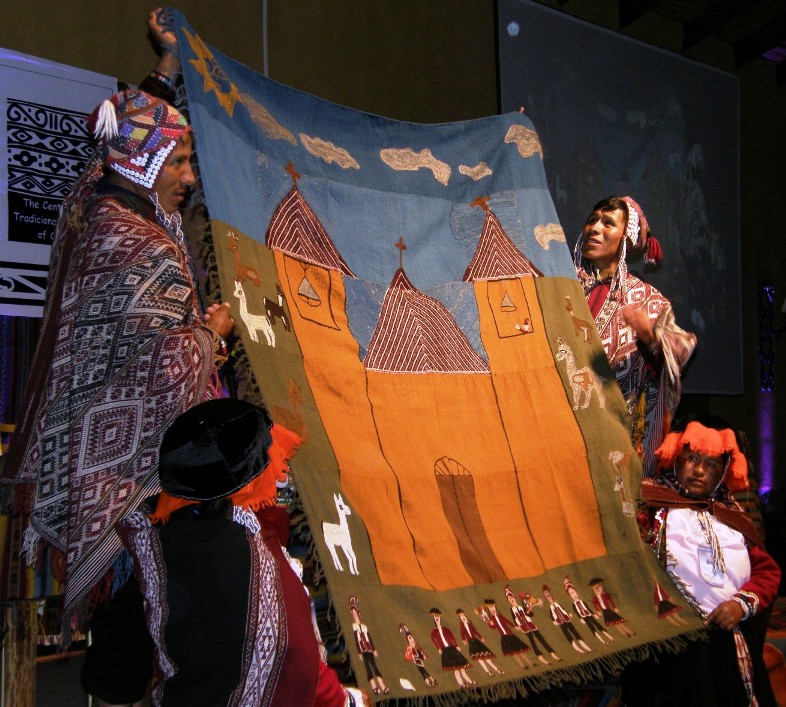
We witnessed the winning weavings and the prize-giving ceremony for the 2010 weaving competition.
This is the winning piece by the weavers of Chahauytire community and is entitled "matrimonio". I have to admit that this had me scratching my head at first wondering about something so relatively plain from weavers renowned for their intricate pick up patterns until I realized that this piece is made up of thirty-six individual squares of thirty by thirty centimeters, each woven by a different weaver. Imagine!! I can't even begin to imagine how difficult it would be to create a four-selvedge piece that came out exactly thirty cm long. And thirty-six weavers had to turn out pieces with the same level of exactitude so that they could be pieced together with no puckering or stretching...AMAZING!! How difficult it must have been to match the diagonal lines on the two panels that form the church roof!!
Two other prize-winning pieces are shown below. All pieces had to meet the same requirements and have their thirty six panels of thirty centimeter squares. Every weaver has their own tension which means that no standard warp length can guarantee a thirty-centimeter finished length. The weavers who gave the presentation about the competitions let us in on some of the difficulties and disappointments they had to deal with in these projects and the problems they faced and overcame working as a groups rather than as individual weavers.
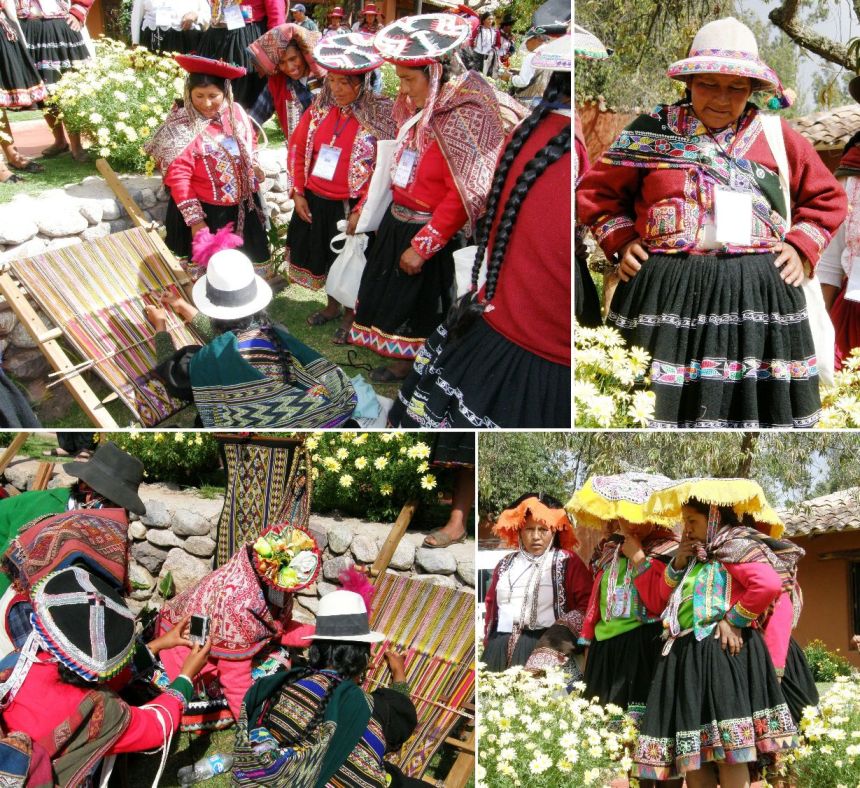
The following pictures were taken during the coffee and lunch break demonstrations and first thing in the morning when the weavers would be arriving early from their communities.
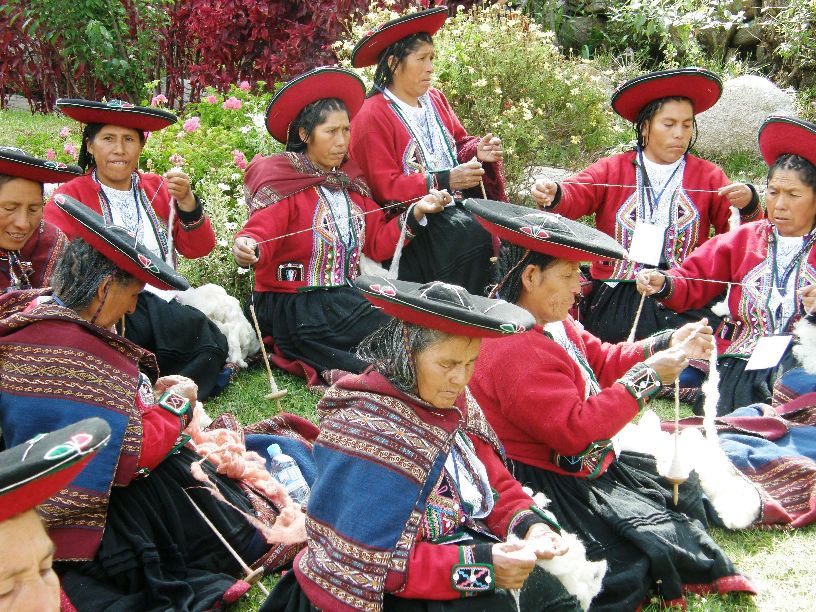
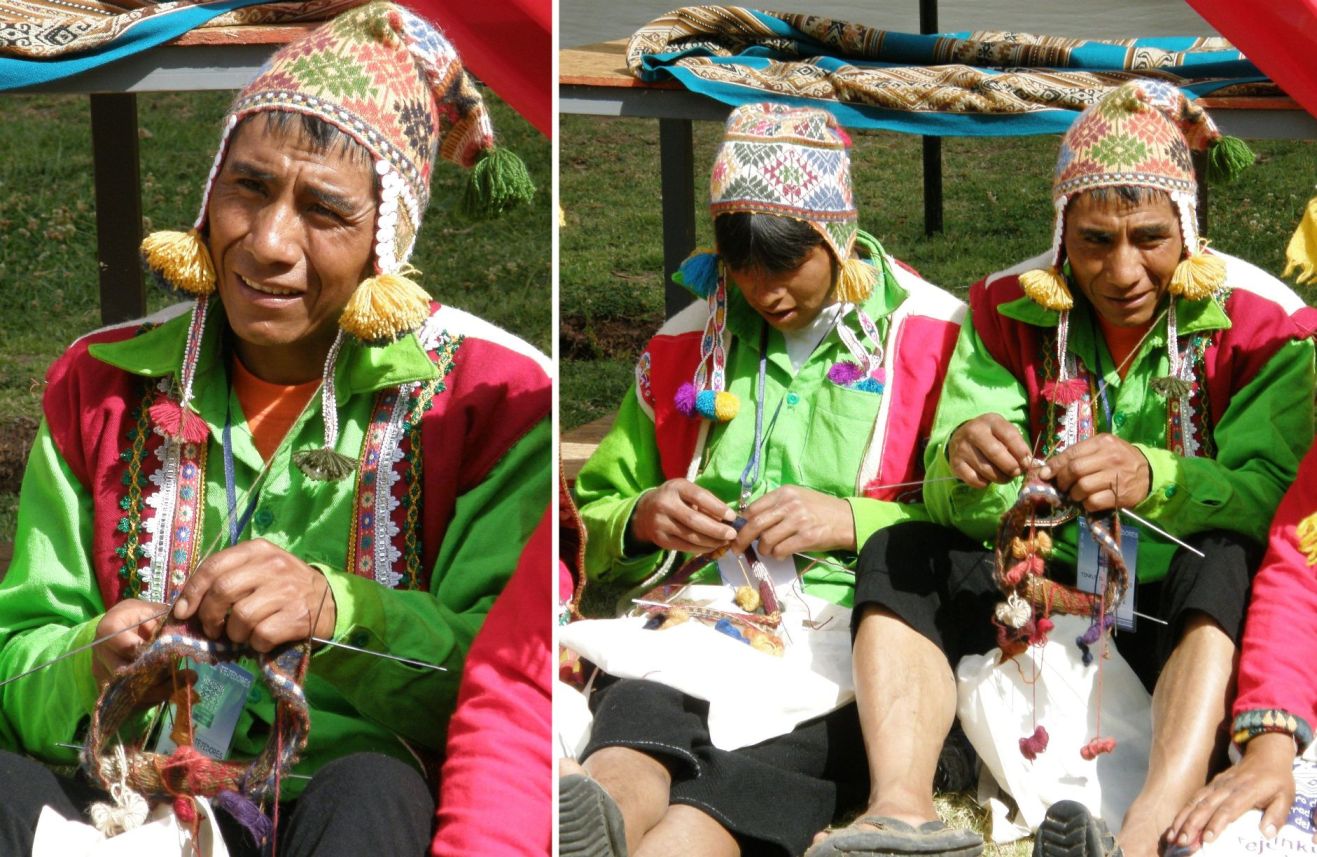
There was plenty to fascinate everyone...not only the foreign visitors but also the local Peruvian weavers. During this lunch break many couldn't take their eyes off the loom and weaving of a Bolivian weaver from Tinkipaya, near Macha, in Potosi, Bolivia. They stood and watched her from every possible vantage point and some were just as camera happy as we were.The weavers, spinners and knitters would arrive by bus early in the morning, some coming from communities as far as five hours distance from Urubamba (and some maybe even further). Time was easily passed by sitting in groups spinning, knitting and chatting.Knitters from Sallac community pass the time before the start of the conference.
There were many kinds of looms and weaving techniques to be seen….
A Guatemalan weaver from Santiago Atitlan on the left makes designs with supplementary wefts and a Bolivian weaver from AAA, la Asociacion de Artesanos Andinos from Cochabamba, Bolivia props her loom against a low wall to weave complementary warp pick up patterns.
A group of weavers who work with ASUR in Sucre came including this Jalq'a woman from Potolo. At right is a weaver from Accha Alta weaving a supplementary warp technique.Tapestry techniques from South and North America. I am sorry that I didn't find out which community this gentleman is from but it was wonderful seeing him weaving tapestry on a backstrap loom. At right, D.Y Begay demonstrates Navajo weaving on her vertical loom.Weavers from Accha Alta on the left and Santo Tomas on the right. While the weaver from Accha Alta uses a stick to pick up his warps I noticed that quite a few weavers pick up the threads with their hands as I prefer doing. I have just updated this post to add this photo not originally included as I did not know from which communities these two weavers are from. Now I see in a magazine that I picked up in a street book fair in Cusco that the lady on the left is most likely from Ccachin. I don't know about the weaver on the right. The colors in their outfits are so intense!Luz Maria Andrango of Otavalo, Ecuador created a lot of interest with her demonstration of spinning on a Great Wheel (walking wheel?).Ten year-old Juan Miguel of Acopia community started weaving in August and is doing pebble weave here while his grandma watches. The wee girl on the right is even younger I think and is weaving a tapestry on a floor loom where her little legs can barely reach the peddles.Watching the watchers...while the weavers gathered around to watch the demonstrations, I stood back and admired their gorgeous outfits. On the left is a group of ladies from Sallac community and on the right from Chahuaytire.Bolivian textiles...a jalq'a weaving with its strange khurus, double weave belts in handspun and naturally dyed yarns made by the weavers of PAZA, Cochabamba, a weaver from Tarabuco adds a woven edging to a finished weaving, a bag made with the typical zig zag and "eye" motif of Tinkipaya and Macha in the Potosi area.Rosa Choque, an Aymara weaver, gave a presentation at the conference on projects in which she is involved which aim to preserve the textile traditions of Moquegua, Peru. I think that these are some of the textiles which she brought but I could be mistaken. I would love it of someone would confirm this for me.
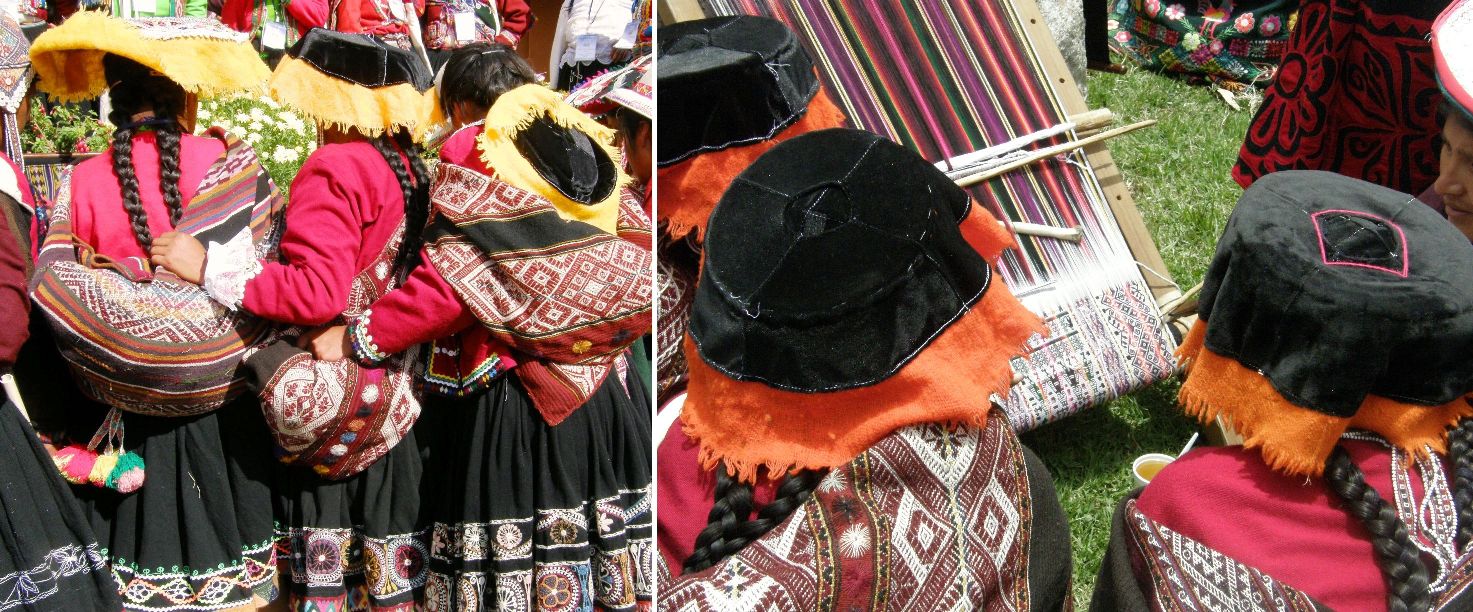
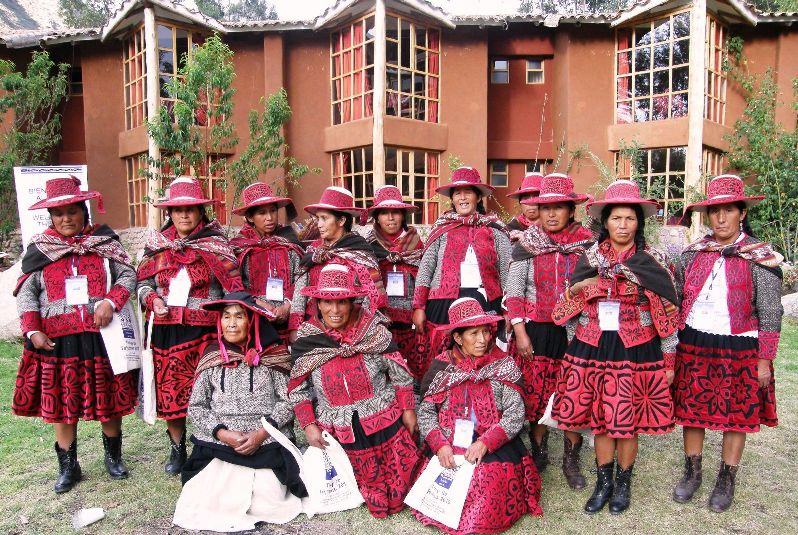
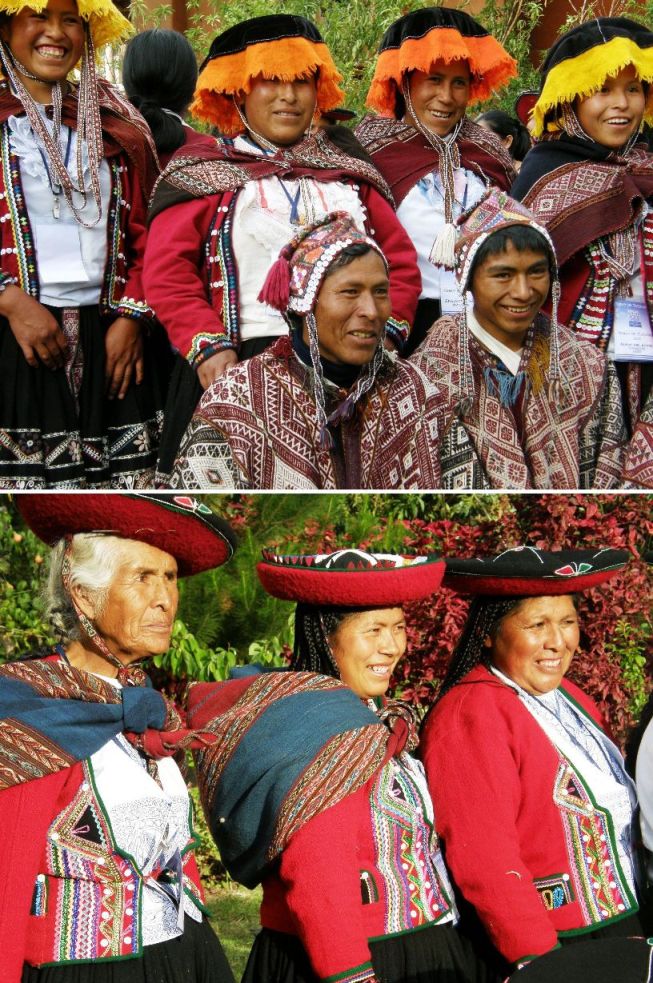
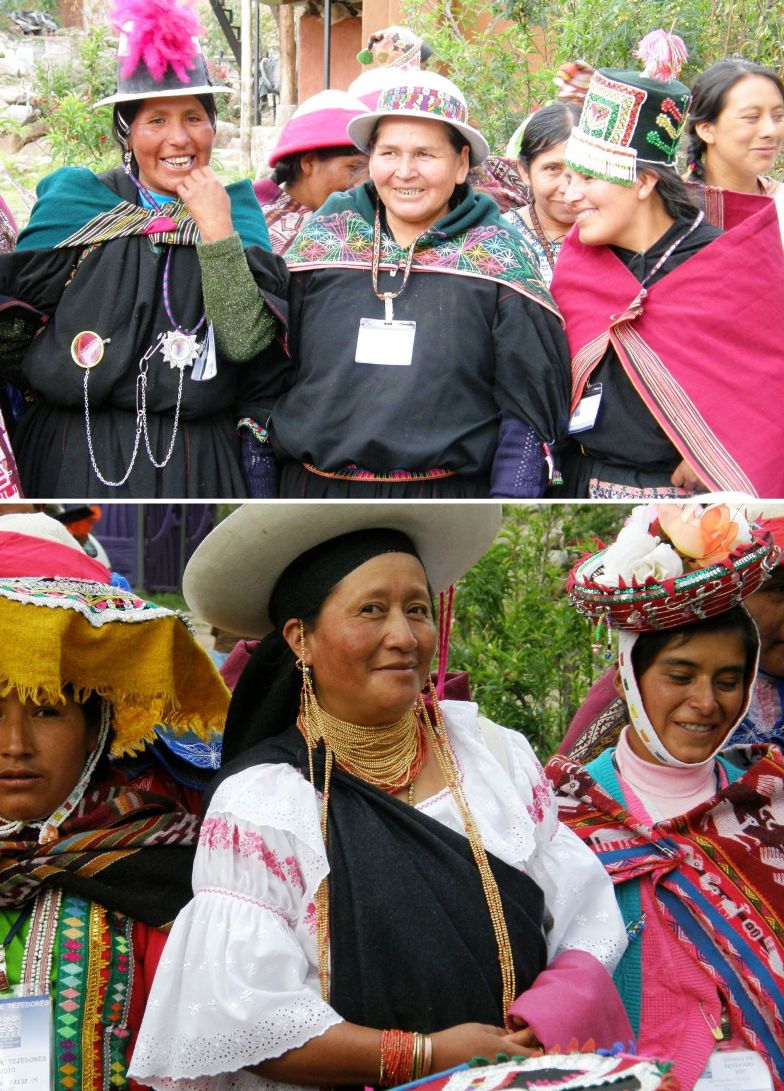
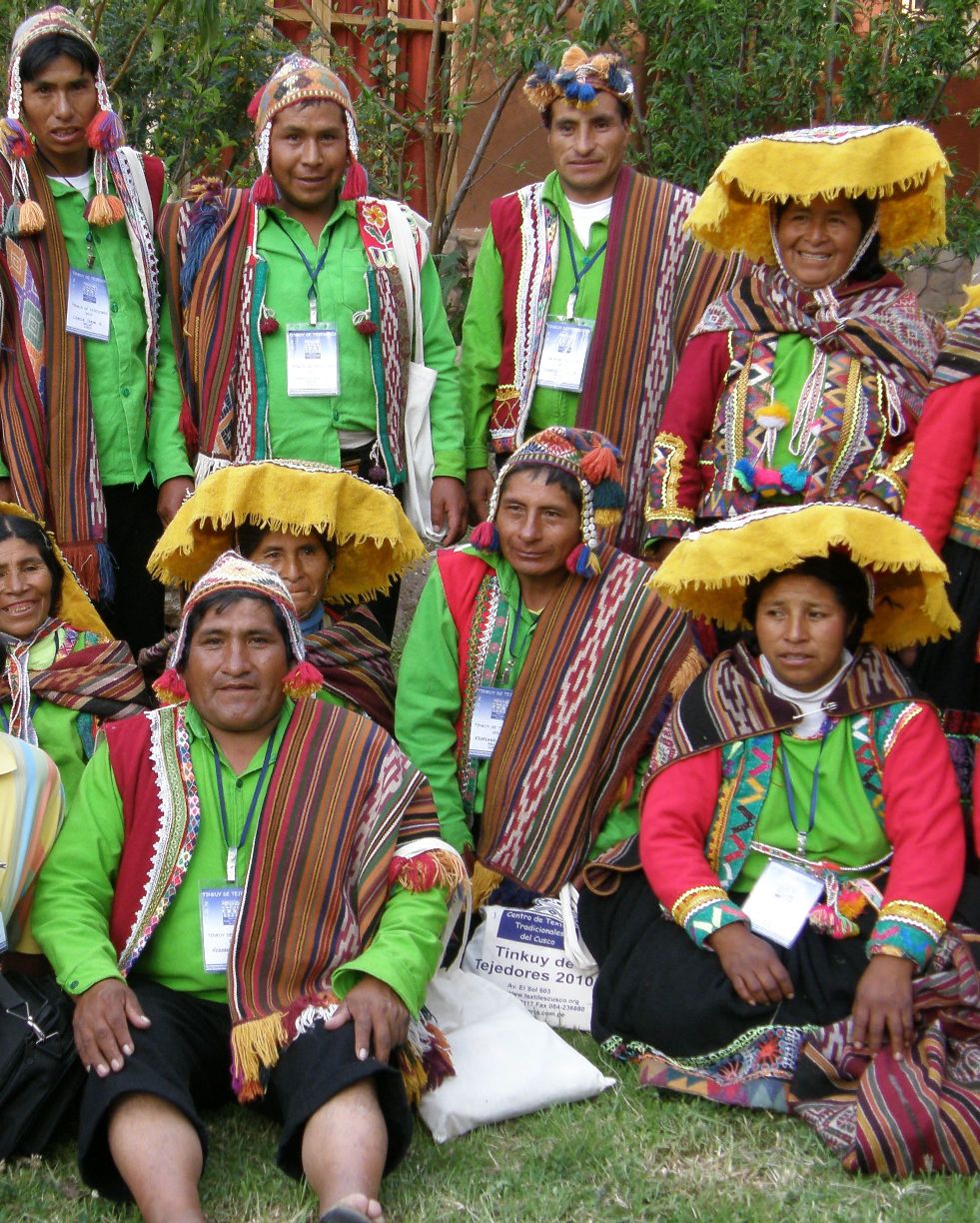
On both days during the afternoon break, the local weavers gathered in groups which gave us all plenty of nice photo opportunities as well as a good chance to learn the names of the different communities and, therefore, be better able to recognize their members by their outfits.
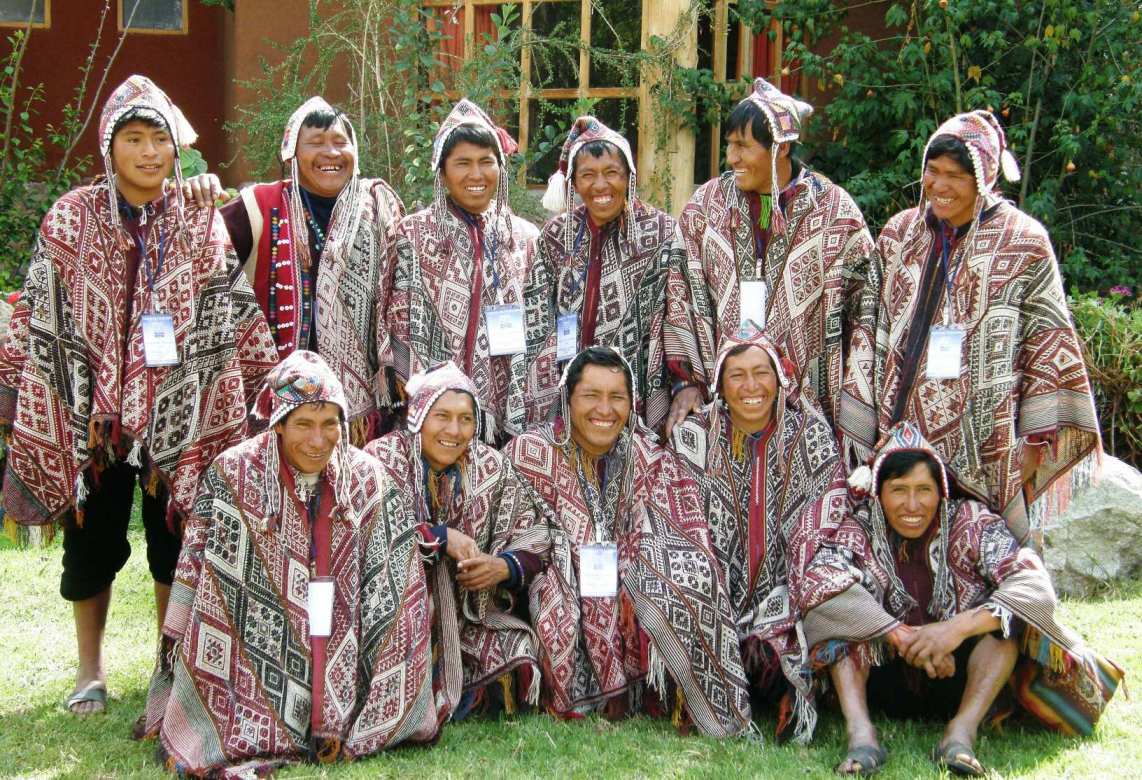
Men from Chahuaytire.Women from Santo Tomas - we all loved their boots.A group from Chahuaytire above and from Chinchero below. I believe, but I could be mistaken, that the distinguished lady on the left is Nilda's mother, Doña Guadalupe.Three weavers from Bolivia above. Luz Maria Andrango of Ecuador below with two Peruvian ladies.
Artisans of Sallac. Their ponchos include panels of patterns created with resist dyeing techniques.
A young weaver-to-be and a little fellow with his pututu
Well that was a “taste” of the daytime activities. The nightime dancing and spinning competitions were a little harder to capture on film with the dim lighting but I did get some video. All the video I shot of weaving, spinning, braiding and dancing will be on next week’s blog.
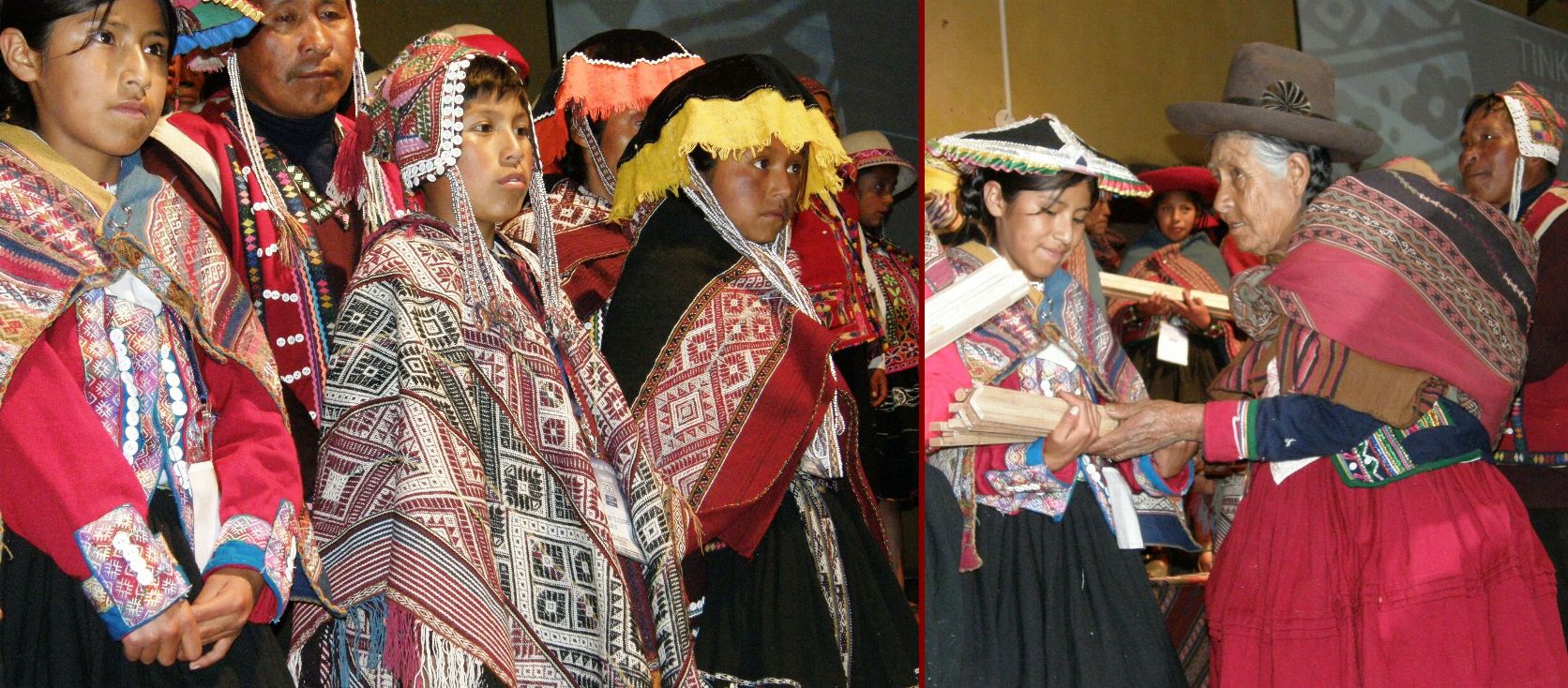
The conference closed with a very emotional ceremony which served to honor all the elders of the various communities who were given certificates and medals of recognition as well as gifts.
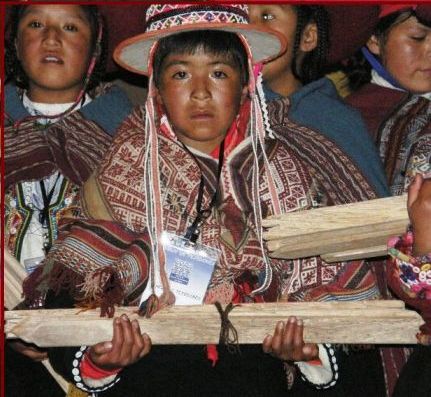
This was preceded by another ceremony in which the elders were invited to hand over sets of weaving tools to the youngsters in their communities.
Youngsters lined up waiting to receive their weaving tools. An elderly weaver passes a set of new weaving tools to a young girl in her community. The young girl's smile says it all.
So that was the two days of conference. Then came the workshops which I am saving for next week’s blog post along with the videos. And next week I will tell you about the other folks I met up with, some of whom I have been corresponding with by email or through my blog and others whom I met at Convergence. Betty Davenport, who is always lots of fun, was my companion in the little “down” time we had and we took the same workshop. Folks from Interweave were there too. The workshop days were more intimate and gave a lot of us a chance to chat and catch up. More about that next week.
And here is the amazing woman with the brilliant smile who is behind this unique event. It was not an ideal situation to meet Nilda for the first time. She was so busy and I don’t believe she stood still for a moment. Yet I learned a lot by watching her in action and seeing the warm affection she has for those who are lucky to be her friends, her passion for the CTTC and its goals and her love for her country and her people. Hopefully I will be able to go back one day to meet her again.
My Backstrap Basics article is now on the WeaveZine site in Spanish. The videos remain in English but are, hopefully, self explanatory.
Mi articulo “Backstrap Basics” (El Telar de Cintura) ya se puede leer en español en la pagina deWeaveZine. El audio de los videos sigue en ingles pero las imagenes son suficientes para entender.
My weaving explorations seem to be taking me further and further afield these days…outside my city, my country (Bolivia) and even outside the continent and I have found myself visiting SE Asian weavers in the USA and learning about weavers in the Middle East from books.
Sometimes I forget about the treasures that are here right in my own backyard.
I wrote about the Ayoreo people who live in this area and their looped bags in a post a couple of weeks ago and the difficulties I have had in winning their trust so that I could learn more about them and their crafts. I have given up on that for now but hope that I can pursue it again some day. In the same way I was reminded of a Guarani weaver with whom I made contact here over six years ago.
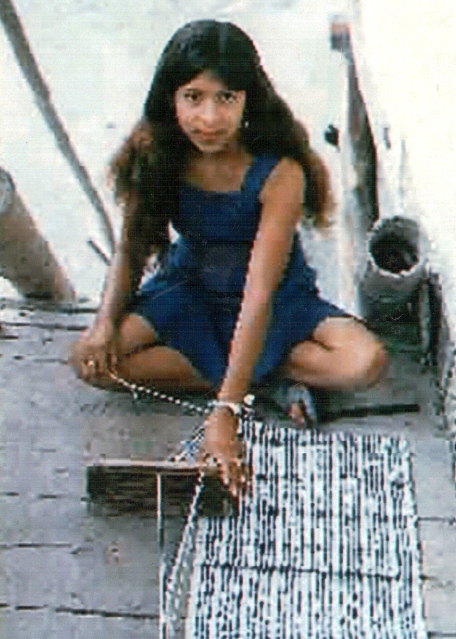
I used to visit Angela, a Guarani weaver, every Saturday morning over a period of a couple of months about six years ago. She had her loom set up in a handcraft store and was warping to make a hammock.
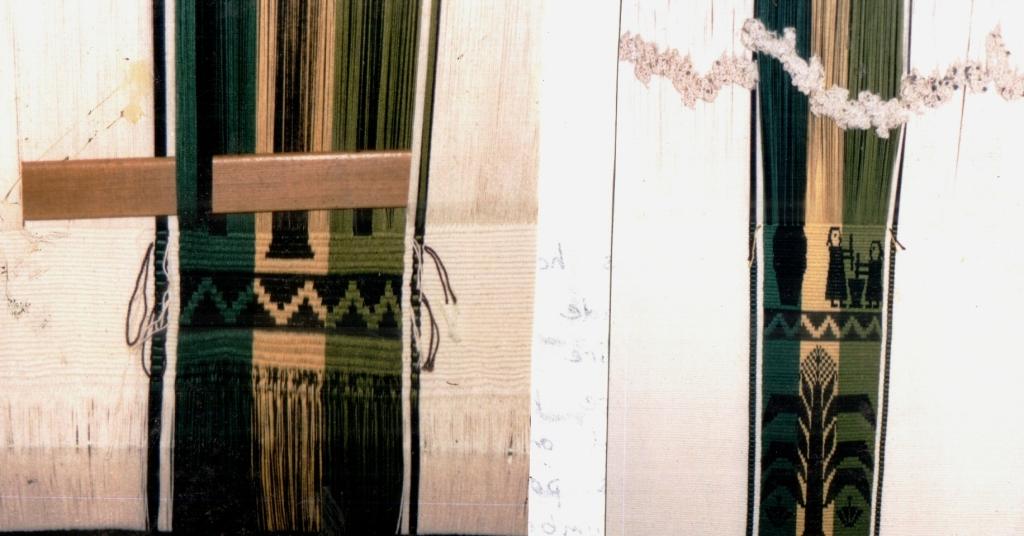
It was such an opportunity to meet up with Angela like this as it is very difficult to find weavers right here in the city let alone a weaver who has a loom and a place in which to use it . Angela’s hometown of Isoso is about twelve hours drive away from here. Angela would weave in the store twice a week. On my Saturday visits I got to see her warp most of the loom, but missed seeing her setting up the heddles. I saw her start the weaving and part of the designs. The white cotton hammock had three bands of green, yellow and black pick up designs. Angela’s motifs included flowers, geometrics, pineapple plants and scenes of people in their typical daily routine.
The motifs are hard to see on my scanned photos. On the right you may be able to make out two ladies “machucando”, that is, pounding plaintains, in order to make “masaco”, a typical Santa Cruz snack.
I would ask Angela where she lived hoping that I could maybe visit her at home and have some lessons. She had told me that she had a small loom in her house. She would stretch out her arm and say “leeeejos” (“lejos” means far) as if to discourage me from visiting. Unfortunately, her son fell ill before we could really bond and she stopped coming to the store. Eventually the loom disappeared and now even the store is closed. I did manage to give her a copy of the photo of herself and her baby boy before I lost touch with her.
After Angela’s disappearance, I found bits and pieces about Guarani weaving in books and found that the technique she was using to weave her hammock is called Moisy. They also use a pebble weave which in the Guarani language is called Karapepo. I bought a hammock and bag in the Karapepo technique
I was able to copy the deigns from the hammock using Andean pebble weave technique and make this guitar strap.
From books I learned that the earth and the cosmos are represented by the star and snake skin designs. These are pretty much the only designs you will see woven in the pebbled Karapepo technique. In the Moisy technique, however, the weavers have a far greater repertoire and the designs are not like any others that you will see any where else in Bolivia. They speak of the lush tropical fruitiness of Santa Cruz! Leaves, flowers, vines, butterflies, animals and people involved in their daily routines or dancing and celebrating carnival are depicted on the hammocks, wall hangings and bags.
Cell phone pouches made with the Moisy technique with flower and butterfly motifs. A band of horizontal bars serves as the strap and velcro has been sewn on as a closure. A black band was woven and sewn simultaneously to the edges using the weft as the sewing thread to give a very nice neat finish.
And here is the best part of the story…I bought the above cell phone pouches from Angela last weekend at her home. Yes, I found her again, was invited to her home and got to spend the afternoon with her looking at her looms and weaving. The little fellow pictured with her above is now 8 years old and she has since had another son – that makes five sons in all now! Her eldest is married with his own family.
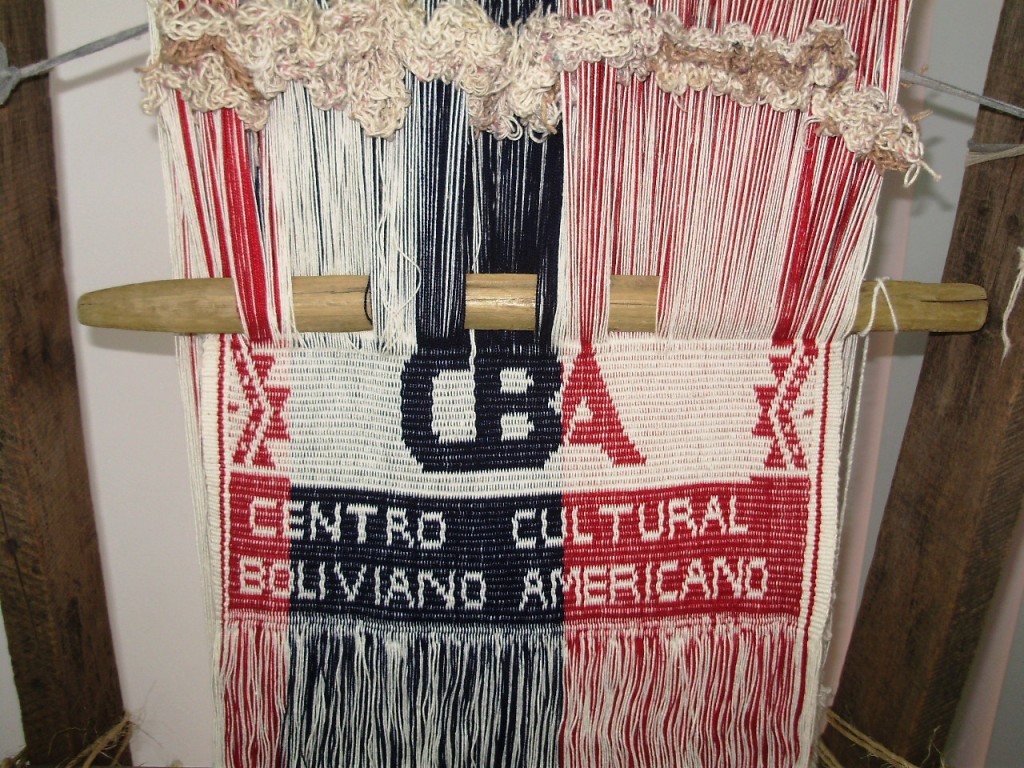
How did I find her? Very much by chance. The English institute where I taught English for eleven years started offering classes in the Guarani language shortly after I left. I recently noticed the loom and weaving pictured at left in the library which had been made and placed there to celebrate the start of the new Guarani program. I asked the receptionists about it they showed me the lovely cell phone pouches that a Guarani weaver had sold them. Fortunately, they had the weaver’s number and it turned out to be none other than Angela.
One of the karapepo cellphone pouches that Angela made for the receptionists – quite a different style to the blue and black ones she made using the Moisy technique.
I was very keen to see how Angela sets up and weaves her pebble weave as well as to learn how to do the Moisy. I was pleased to see that she uses the very same crochet cotton to weave as I do. When I visited her last Saturday, she had just warped up to make a colorful wall hanging on the smaller of her two looms, had just finished a book bag for a university student and was also in the middle of weaving a belt with fighting roosters which had been ordered by a Brazilian business man who mounts the woven pieces on leather and then apparently sells them for a very good price in Brazil. Angela’s enormous hammock loom is there in her patio and she can warp up several small projects on it at a time. She seems to have enough orders to keep her very busy.
She showed us one of her hammocks, the finished book bag, her cell phone pouches, greeting cards depicting carnival celebrations in her hometown of Isoso, pillow covers, belts and purses.
At left, the smaller loom warped for a wall hanging in Moisy technique and at right Angela is warping a narrow band to show me how she sets up for Karapepo technique.
She stretches a cord across the loom around which the start and end loops of the warp dovetail. Except for when she is weaving a hammock, she usually creates a third selvedge by starting her weaving right at the dovetail string.
I filmed her warping, making heddles and weaving the Moisy technique. As usual when I have the camera in front of my face. I find it hard to really absorb what is going on and so I had to come home and watch the movies over and over before I could grasp completely what she had been doing.
I like the way she makes her string heddles chaining them together. You will see her doing this in the video.
Angela’s chained heddles.
She, on the other hand, loved my heddles on their sticks (I had taken my backstrap loom, which she found very amusing, with a double weave piece on it to show her) and so I taught her my way of making heddles.
Here are two short clips of Angela warping using the dovetail string and making heddles. As she makes the heddles she is explaining to me the meaning of the designs on my guitar strap and telling me about the snake skin and how the snake that taught the first Guarani woman to weave in a dream is also embodied in the Parapeti River. Her little boys can be heard chattering in the background in the Guarani language.
In the next video, she is weaving the belt with the fighting roosters in Moisy technique. She has three sets of string heddles and another shed above the cross string. You must see the way she does her pick up. It is quite unique!
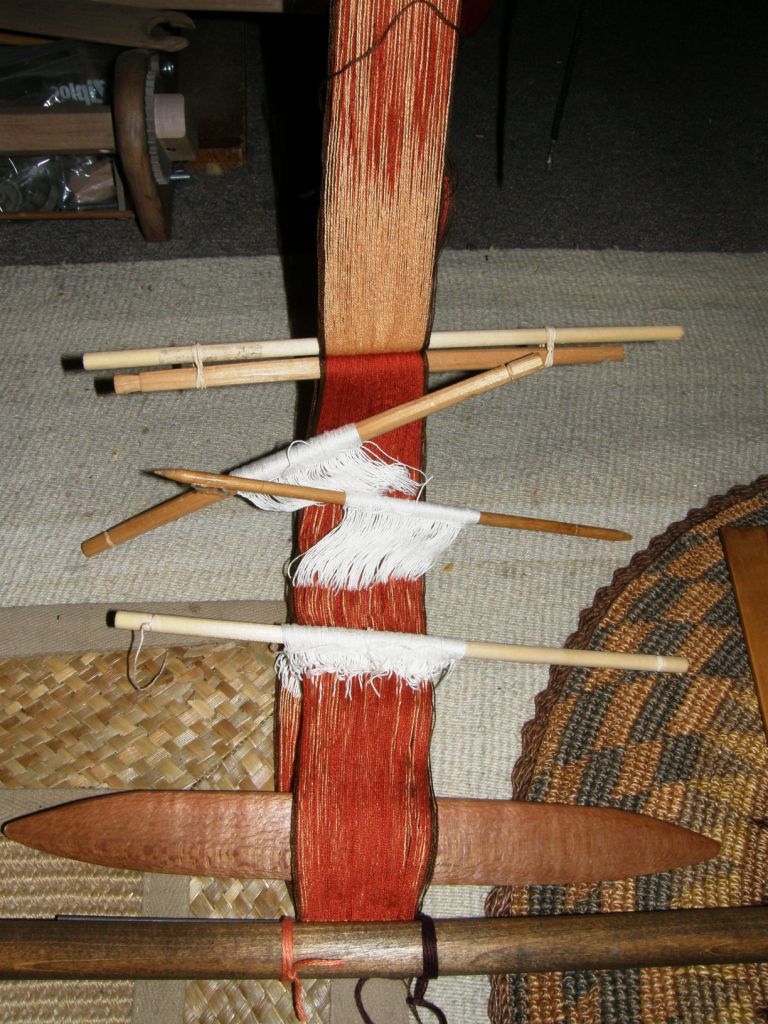
The lower of the three string heddles holds a shed through which she simply passes the weft without having to do any pick-up. The two upper heddles hold the separated colors. She pulls on those two heddles working her way from left to right to pick out the colors she needs. Watch her left hand gathering up the selected warps. Her eyes are down at the weaving line watching the design so she knows which colors to pick. Then she opens the shed which the lower string heddle controls. Then she does another row of pick up before opening the shed above the cross string, through which she can pass the weft without having to pick up warps. This shed is a little difficult to open as the warps have become entangled in the string heddles.
So I had to go home and see if I could figure out the Moisy! The best way was to try and reproduce one of her woven motifs. I found that I had to pull the weft really tightly through the shed to have my design look like hers. It makes a very, very sturdy fabric. For those of you who have my Andean Pebble Weave book, I would compare it to the thickness you achieve when you use the three-shed border. In fact, I quickly realized that the three-shed border is the very same structure.
There is my attempt to reproduce the flower on the cell phone pouch. It really helped a lot knowing that we both use the same thread so I knew what width to expect right from the start. I really had to pull the weft tight and force it into that width.
The motif is not exactly the same but I understand the technique.
I tried to chart it and then found my chart was wrong and so ended up just reading it directly off the cell phone pouch which was a really good exercise.
I did notice that Angela is weaving the rooster belt a lot more loosely. .
I confess that, although I started out with my warp set up as Angela showed me with the three string heddles, I found it quite uncomfortable simply because it was so foreign to me…impatient!… and so I changed to another set-up after a while with which I felt more at home. I would like to try Angela’s pick-up technique on her vertical loom and hope to visit her again soon. She has invited me to come and see her floral designs on the colorful wall hanging she is making.
In the meantime I will work on my charting as I would like to make a collection of these uniquely Cruceño designs.
###################################
What else have I been up to?
Well I started my double-weave belt using the Bedouin designs that I wove into my wall hanging.
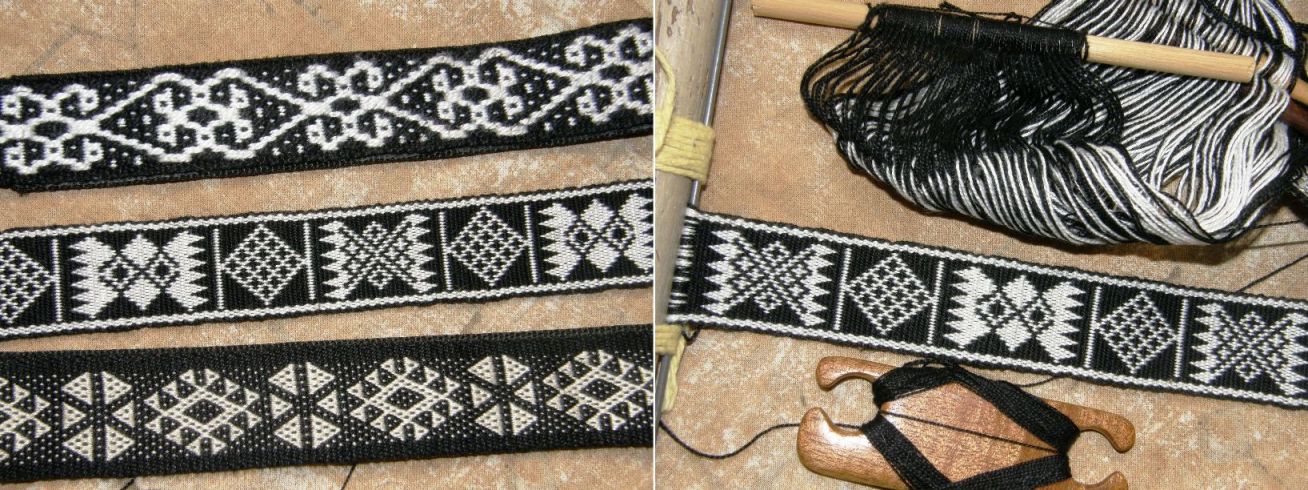
I seem to be gathering a collection of black belts. At least they are all in different techniques with designs from different cultures. The uppermost one is two-color alternating warp floats (my made-up name for it…we could use the Kyrgyz word “terme” for it). The center one is the yet-to-be-finished double woven example with Bedouin designs and the lower one is, as you must all know by now, Andean pebble weave as taught to me by weavers from Ayacucho, Peru.
I have also been weft twining but using floats this time to make a textured design in one color which is inspired by the alpargatas worked in ply-split darning that I showed you last week.
I am totally unimpressed with the results so far!
I’ll keep at it. Who knows, it may look better as I progress. Maybe I should overlap the floats by two warps instead of just one. What do you think?
What have my online weaving buddies been up to?
Anna, who is cycling down to Tierra del Fuego has turned up in Salta, Argentina and has added braiding to her skills following my instructions for the Margarita braid.
This is one of the two braids that was taught to me by my sling-making teacher in Peru.
I usually advise people to start with the Palma braid first as a skills builder but she jumped right in and, as you can see, has done really well!
I have gathered up all the information on the Palma and Margarita braids that is embedded in various posts here on my blog and put it all together on one page here.
Zacarias in Yanque Peru taught me these two braids which are used to make the typical slings of the area.
Marsha Knox of Pandula Arts Creations has been playing with simple warp floats in two-color alternating pairs on her Gilmore Wave loom and has created some great designs of her own. More designs like these can be seen on the Guatemalan belt in this post.
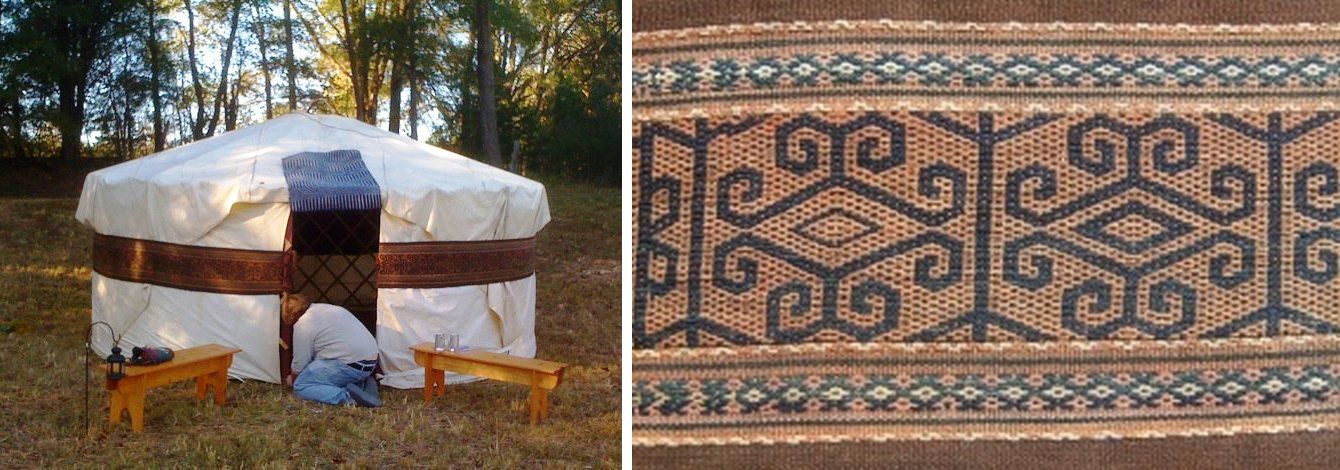
Lisa has been up to her eyeballs in dyeing but took some time out to enjoy a night in her yurt. You will probably recognize the band encircling the yurt that she was lucky enough to purchase at a reenactment event and which I have shown off many times here on my blog. It is woven in the “terme” technique.
######################################
Finally…you may remember my posting a video some time ago, which had been made in March this year, showing little Melina learning to spin cotton from her aunt in coastal Ecuador. This is the family with whom I stayed in 2007 and learned about the process of weaving cotton saddlebags and the simple warp float technique. I accompanied anthropologist Kathleen Klumpp on this trip and Kathleen has just returned from another trip there with a new video of Melina’s improved skills seven months down the track.
Kathleen tells me that Melina is not yet able to support the weight of the spindle and so rests it on her thigh.
The original video of Melina’s first steps can be seen here. How quickly she has picked up the skills! Aunt Trini and Grandma Luz are master spinners and she is lucky to have such skilled teachers but I think that Melina’s success is largely due to Kathleen’s encouragement. How wonderful too that Kathleen has made and shared these videos so we can all follow this story.
And I have been inspired by a very sweet recent comment from Graciela here on the blog. I don’t know where she is from but she has inspired me to get my act together and put up the tutorials translated into Spanish that I have been promising. Another task for this weekend and I will try try try not to get distracted!
Pssst! There’s a Spotlight article about my backstrap weaving in the latest issue of Handwoven…
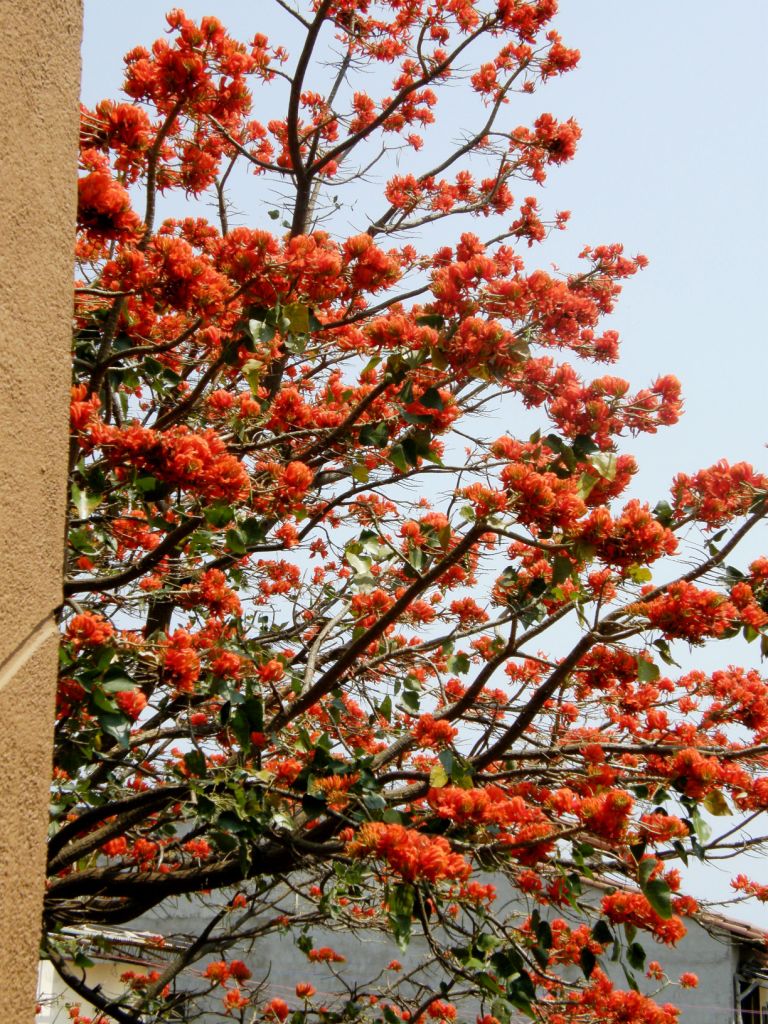
The tajibos have finished blooming and now the city is splashed with the red flowers of the ceibo, the national flower of Argentina, which grows equally well here in Santa Cruz attracting all kinds of small birds to noisily feast on its nectar.
And once again we are experiencing heat, smoke and humidity after a five-day lull where rain preceded low temperatures and provided perfect conditions for Anna from The Netherlands and her boyfriend Alistair to come down from the highlands to visit.
Many backpackers abandon the cold and dry highlands for a few days of sun, swimming pools and lazy afternoons swinging in hammocks in jungly lowland Santa Cruz but Anna and Alistair were quite relieved to find cooler more pleasant conditions. They have been riding their bicycles since May 2008 starting in Alaska and plan to finish their journey in Tierra del Fuego at the very end of the Pan American Highway in February next year.
Occasionally they leave their bikes behind for a side trip here and there and so, after having crossed the Salar de Uyuni by bicycle and taken some spectacular photos including some of their campsite on the salt on the night of a full moon, they took a bus to Potosi and on to Sucre before flying in to Santa Cruz.
Anna had taken backstrap weaving classes in Huancayo, and after having found my blog, we started corresponding. She proposed getting together to weave. She seemed so unsure of her route and movements…one moment she was coming from La Paz and then the next from Salta, Argentina… that I really didn’t believe she would make it.
But I know how it is. I am guilty of making grand plans to visit many people when I go to the US only to run out of time and money. I also know how difficult it is to keep to a schedule when one is backpacking. So, of course, I was pleased and surprised when I got her mail saying that they were on their way. It was a four-day visit and we crammed as much fiber fun as we could into that time and my small living space while Alistair, who happens to be Australian, went to the stadium to see a football game with my boyfriend and educated him on the finer points of Australian Rules football.
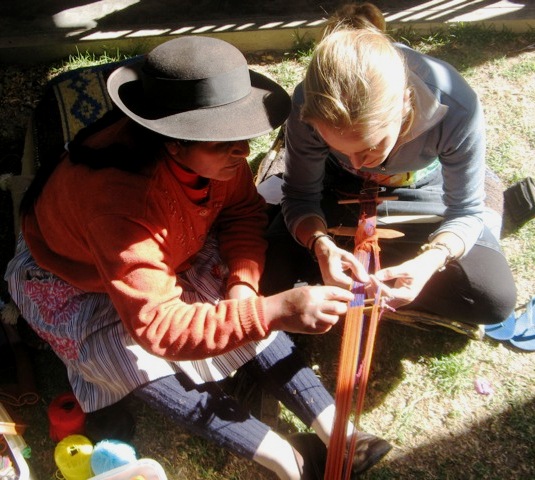
Day one was a chance to brush up on warping and shed making for Andean pebble weave. Anna’s teacher in Huancayo, at her urging, had warped up a long band and so Anna had only had the opportunity to see the warping process once. When I had studied there, I came away with at least four short bands and so had been able to practice warping quite a lot. I was tickled to see that Anna had downloaded my Andean Pebble Weave book and had been carrying its pages in her bicycle panniers.
Anna learns how to pick up the warps to form patterns in pebble weave.
The band on which she learned in Huancayo just happened to have been set up for eight revolution motifs and so she was able to weave many of the patterns from my book while on the road. While with me she practiced making the sheds the “Huancayo” way that I show in the appendix in my book.
Now she has several warps to take along for the rest of her trip and I supplied her with wider patterns to weave. She now has the technique totally under control and I am expecting to see pictures of some beautiful bands and especially of her weaving in some spectacular places between here and Ushuaia.
They are heading to beautiful southern Chile and Argentina and will probably pass through or very near to Punta Arenas on the southern tip of the continent where I spent my first five years in South America.
Anna brought some colorful weavings that she had bought in Sucre and Tarabuco – a tapestry weave bag, another in a complementary warp weave and a striped warp faced plain weave unku, a short poncho-like man’s garment only worn now for festivals.
She also bought a bag with the typical red and black weavings of Potolo as well as a double weave belt which prompted her to want to learn this technique.
Above she is learning the basic steps of double weave while weaving some simple triangles. We made some more warps and copied some more complex charts for her to take away.
At my request, Anna had gone to the campesino market in Sucre and got me some drop spindles and llama bone beaters called wichuñas here in Bolivia and rukis in Peru. In the picture on the right you can see a “new” wichuña after having been boiled and cleaned on the right. The middle one has had some use and is already changing color from having been handled a lot and the one on the left has taken on a nice dark polished sheen from many years of use.
When first bought in the market, the wichuñas are really quite disgusting with scraps of meat and sinew still attached. They are not so bad in the very dry atmosphere of the high plains but once down here in humid Santa Cruz, they are not at all pleasant and need to go into a pot and be boiled before they can be considered tolerable!
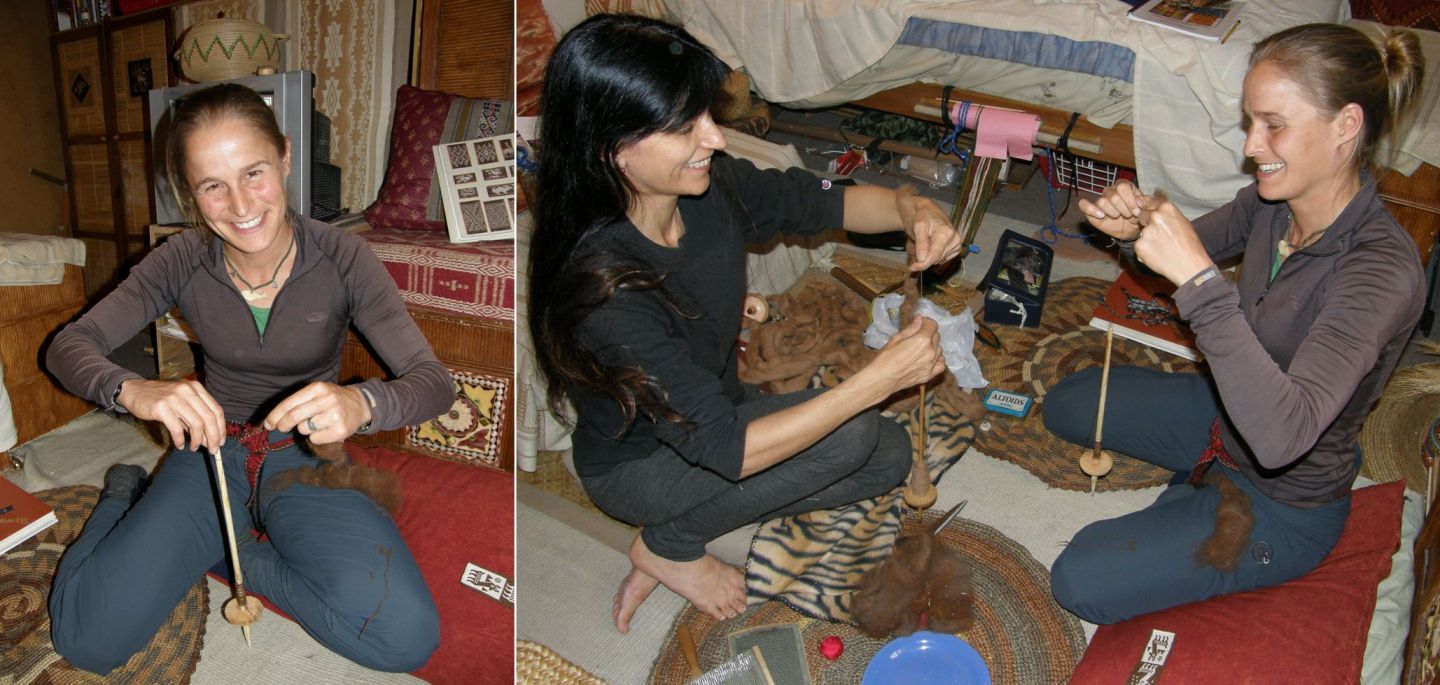
I have a lot of llama fiber here at home and recently got some alpaca from the US so, of course, Anna got a quick lesson in spinning on a drop spindle and took some fiber away for the trip.
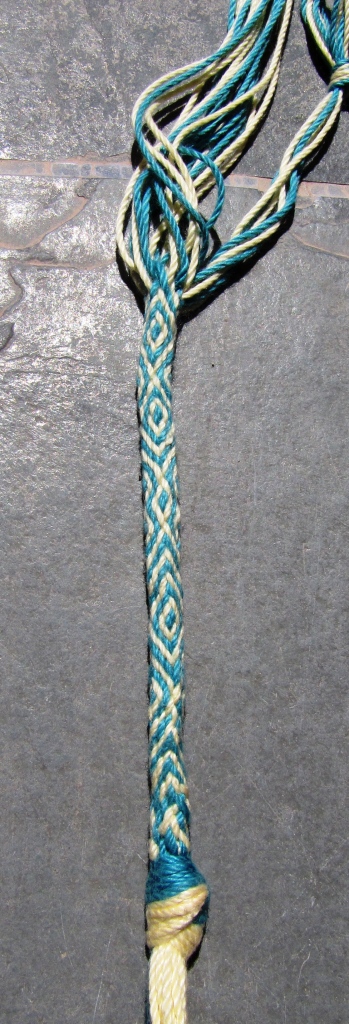
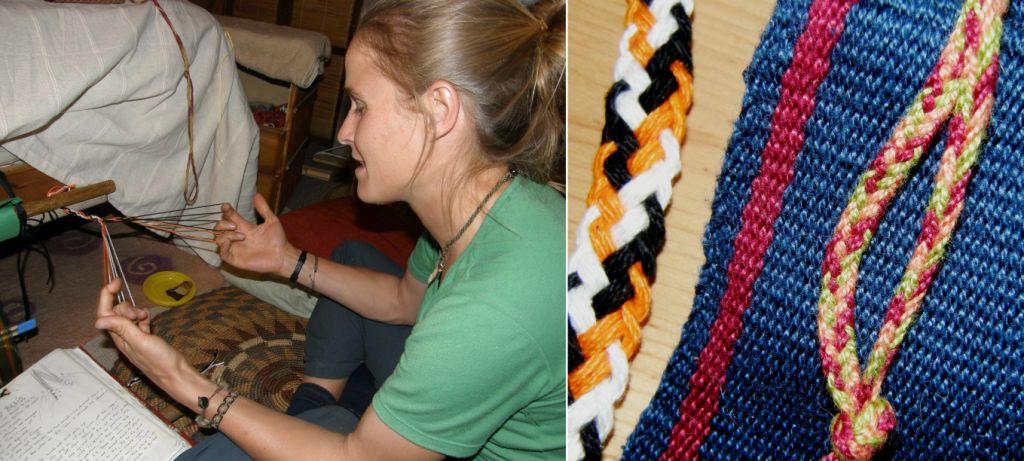
And…to finish it all off we did some braiding so that Anna could put a nice finish on her Huancayo band. I dragged out my journal to teach her a six-strand flat braid that I hadn’t made for a long time. Thank goodness I have recorded everything I have learned with diagrams and directions.
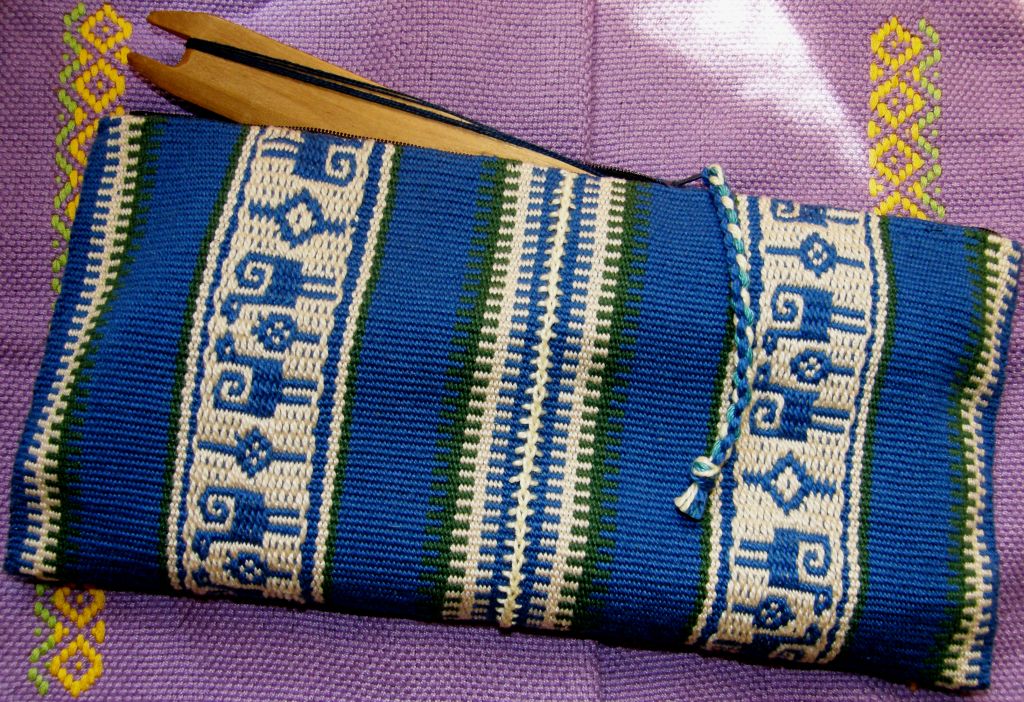
I had forgotten about this braid and decided to revive it by using it as the zipper pull on my new blue tool bag.
It was a fun few days of weaving, spinning, braiding and chatting. I lived ten months in a backpacker hostel when I first came to live in Santa Cruz and used to teach weaving to many foreigners who were passing through town. It has been many years since I have done that. We learned from each other and this is one of the things that Anna taught me…
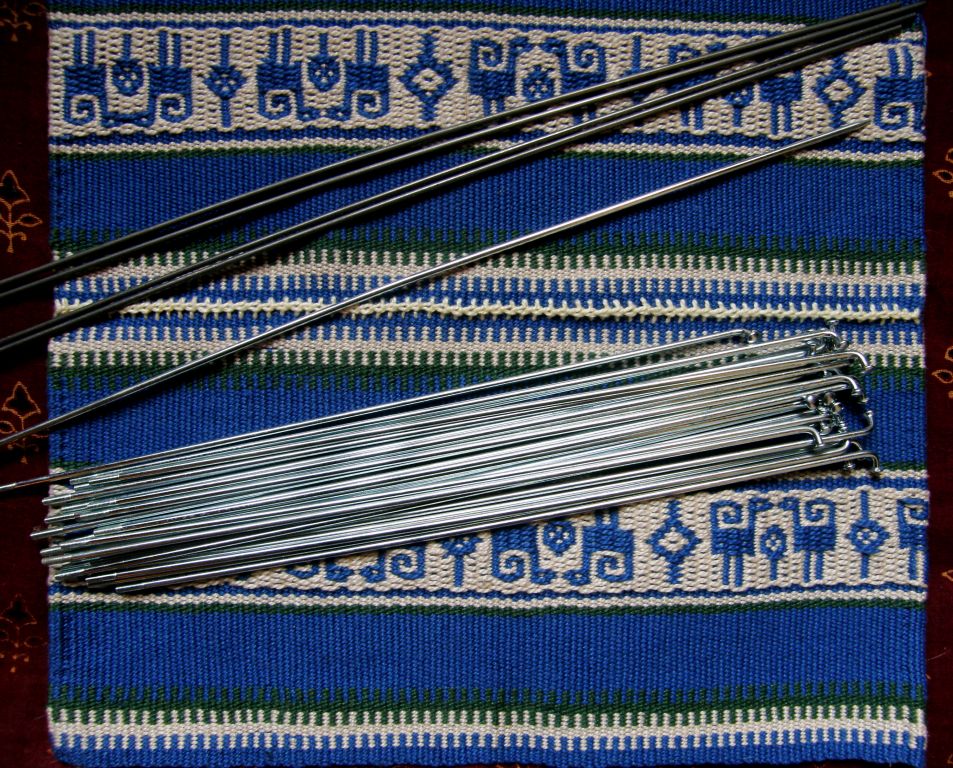
One of Anna’a gifts to me…a bunch of bicycle spokes! I have been using steel knitting needles and piano wire (in the upper part of the photo) to create my third selvedge on my weavings and struggling to find things that weavers can easily get hold of and use. I used to suggest cut down coat hanger wire which is really a bit on the thick side, but bicycle spokes are perfect!! I think that even the smallest town must have a bicycle repair place or somewhere where spokes can be purchased.
Anna and Alistair are back on the road now and riding, if I am not mistaken, by back roads into Argentina. You can start reading about their adventures and enjoying their photos here.
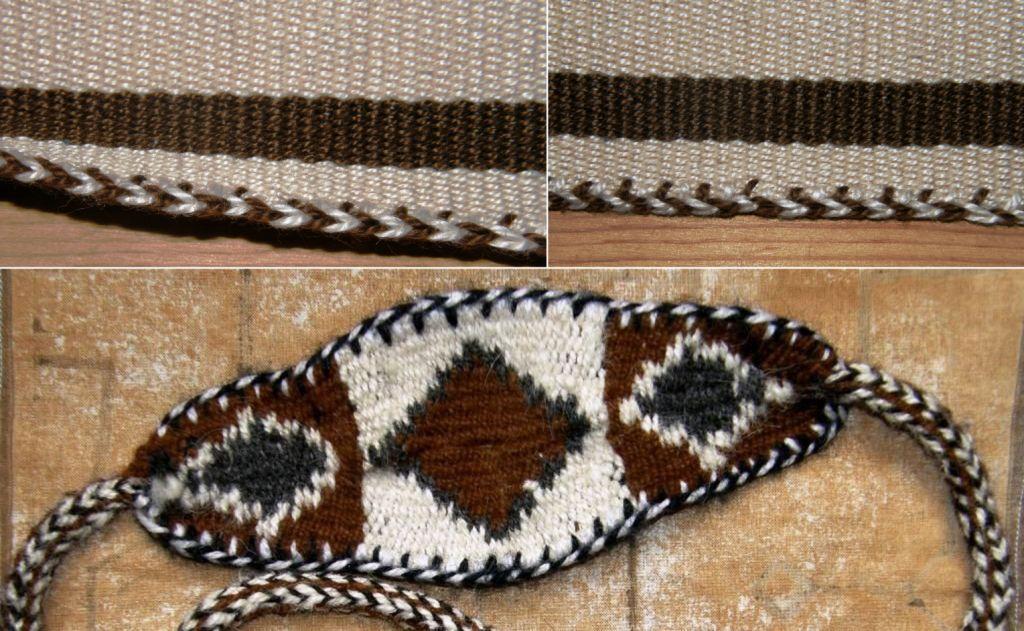
So I had dug the old journal out to brush up on the six-strand finger loop braid and while flicking through stopped on the page with my cross knit looping diagrams and instructions for other edgings and finishes and decided it was time to brush up on some of these forgotten techniques. So you will be seeing some of those appearing in my projects in the next few weeks.
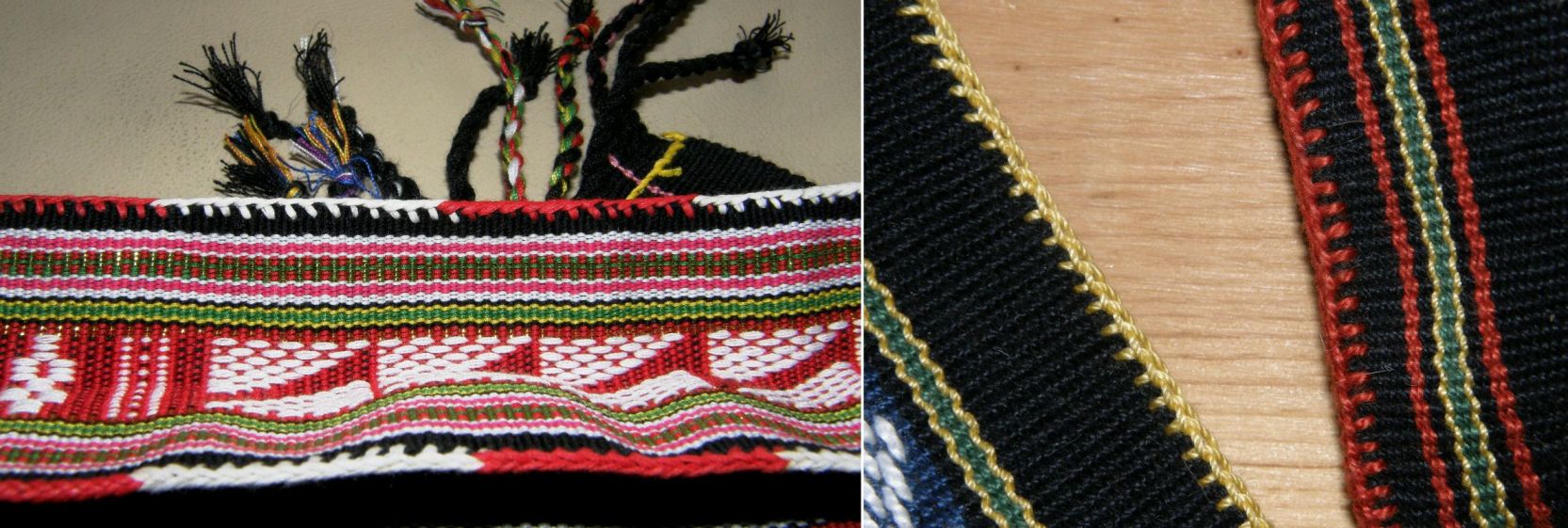
It seems that I had gone a little cross knit looping mad after I first learned the technique in Potosi back in 1997. The woven cover of my journal is edged with it and even some of the pages within. Pretty much anything with an edge got looped!
Triple columns of cross knit looping on the edge of a felt pouch I made many years ago. The button is piece of gourd from Peru. On the right is a page from my journal where I describe different bands, braids and finishes and have worked cross knit looping along the edge.
I always did triple columns as that is what I had been taught in Potosi and never thought to experiment with any other way until recently when I saw that the Montagnard weavers use single columns of this looping to decorate edges as well as to join two pieces of fabric together.
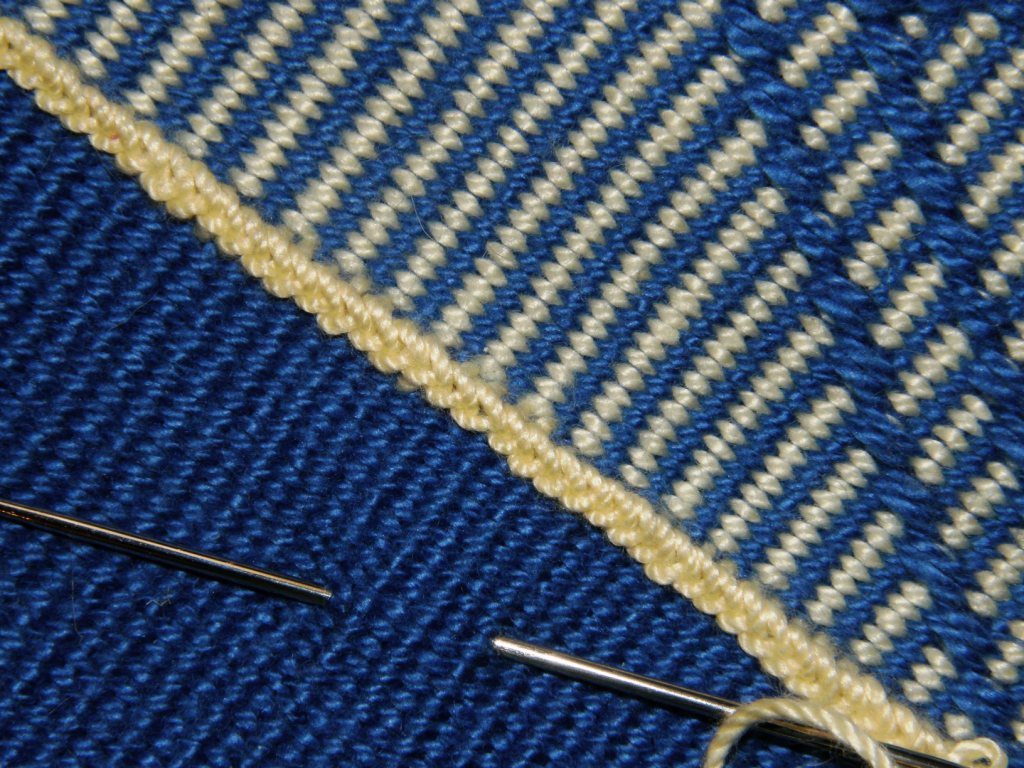
At left, the Montagnard weavers have used this technique to join the side of a bag to the main body. They work it in sections of various colors. I used it in the same way to decorate the edges of some small pouches I recently made.
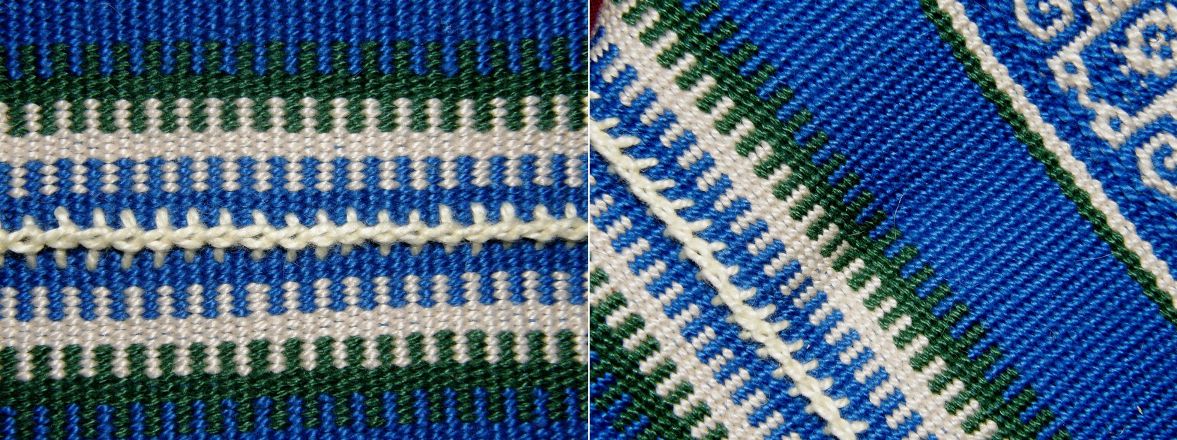
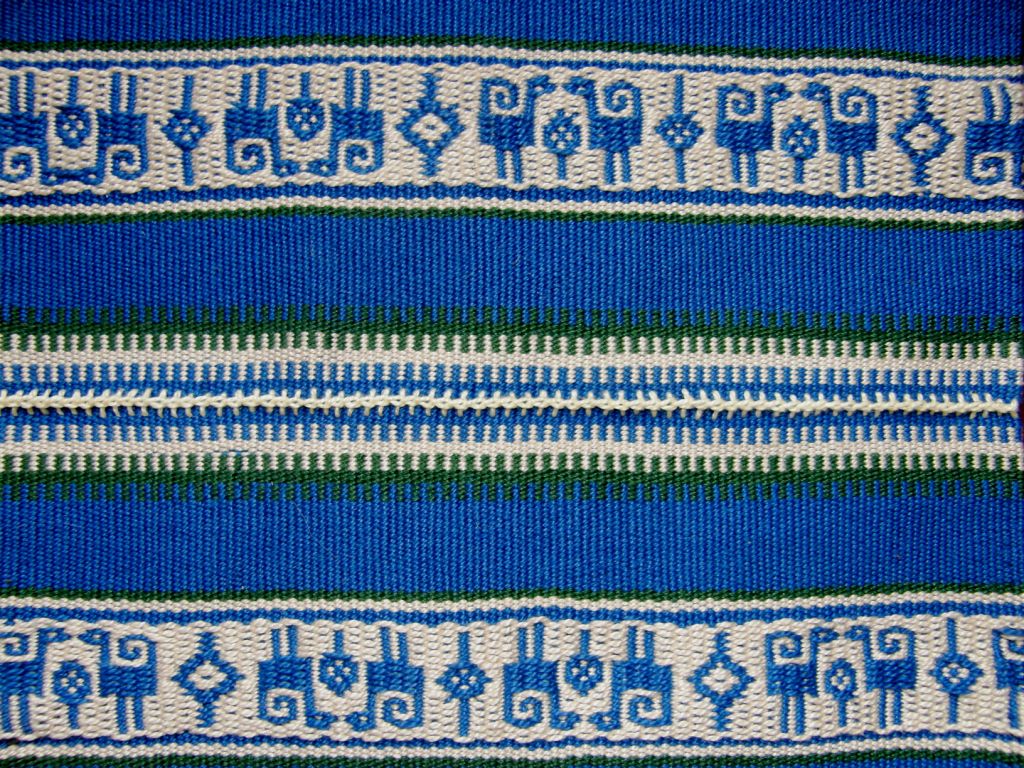
I was keen to try it as a joining stitch to join two pieces of fabric side by side. I had woven a narrow table runner some time ago and, as it wasn’t being used, I decided to cut it in half and use it for my joining stitch experiment.
I think the joining stitch goes well as its form mimics the comb design that I had originally woven into this piece of fabric.
Above left is the front of the fabric. At first, I ended up with a not particularly attractive column of diagonal stitches on the back. Unless the diagonal stitches are exactly the same length and at the same angle they just look untidy and I unhappily pulled out the stitching and redid it several times. I then looked at an article by Lila O’Neale which contained a diagram showing how the looping can be worked simultaneously on the back of the fabric and so that is what I did. The photo above right shows the back with its row of looped stitches and I am much happier with the way that looks.
And now…finally a tool bag long enough to fit my longest shuttles and a few of my medium sized beaters.
Then I wanted to try it out as a decorative stitch in the middle of a piece of fabric rather than along the edge…
Here it has a different appearance to the work on my tool bag. On the tool bag the looping had to hold two pieces of fabric together and so the “legs” of the stitches had to be spaced widely in order to span the two pieces of cloth. In the example above, they did not.
I have to thank Sue Prior of the Online Guild of Weavers Spinners and Dyers for kindly giving me the link to the Lila M O’Neale article on Peruvian needle knitting which proved to be so very helpful. Sue is part of a Peruvian Textile Study Group in the Cambridgeshire Guild in the UK and a very interesting article about the group’s studies was published in the Journal for Weavers Spinners and Dyers this summer. In this group Sue has managed, amongst other things, to needle knit some three-dimensional figures using this looping technique. An article on this technique also appeared in the September/October 1993 issue of Interweave’s Piecework magazine and was more recently re printed in Interweave’s Knitting Traditions magazine.
My aim is to be able to work many columns of stitches flat incorporating color changes and pre Columbian patterns.
While investigating on the net I found this short slide show of the work being done by a Chilean artist to make jewelry with this looping technique – beautiful!
And on re reading the artcile on the Peruvian Textile Study Group I see that Peruvian knitters are also using the versatile bicycle spokes, in this case as knitting needles.
After some more rummaging through my gigantic journal, I found my directions for a nice two-color edging that I was taught by my sling braiding teacher in Peru and so out came another table runner for a refresher on this technique.
The cradle of the sling that I made with my teacher in Peru is edged with a two color looped stitch. Above that you can see the stitch on the edge of my table runner.I think it makes a really nice finish for this table runner. The central band is a balanced double weave piece.
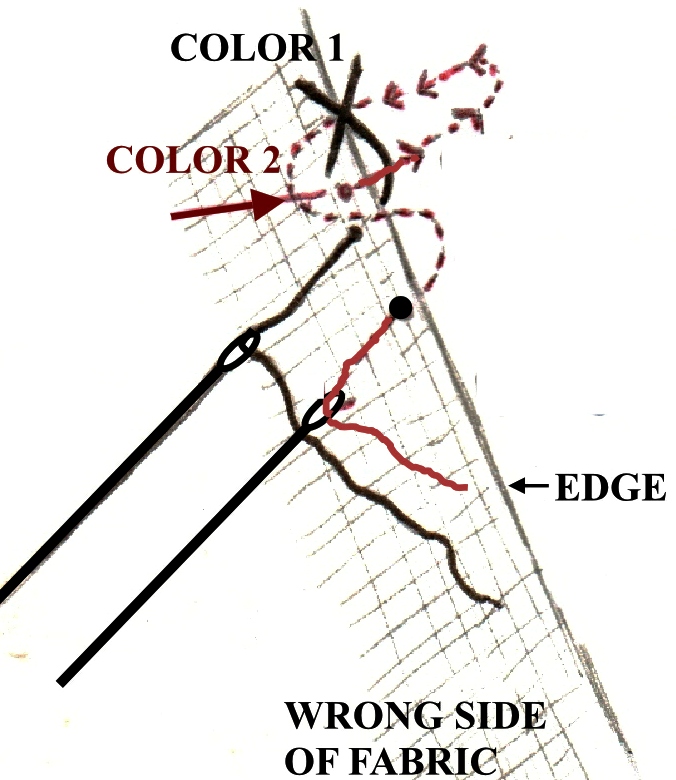
Some instructions for this two-color edging…
I am right handed and was taught to hold the fabric wrong side up with the edge on the right. The two threads will be on two needles.
With color one sew an “X” which sits along the edge and bring your needle and thread back up to the wrong side of the fabric as shown.
Sew a small stitch into the wrong side of the fabric with color two to anchor the thread before passing it under the “X” formed by color one (the needle does not pierce the fabric as it passes under the “X”) and bring it back out to the wrong side as shown.
Color two will have formed an “X” in this path. Color one then passes under the “X” formed by color two and so on.
My mind is swirling with ideas….! Now I am thinking that I might decorate the piece of felt that I made with my friend Lisa on my last visit to North Carolina with this looping technique. I just have to find the right design.
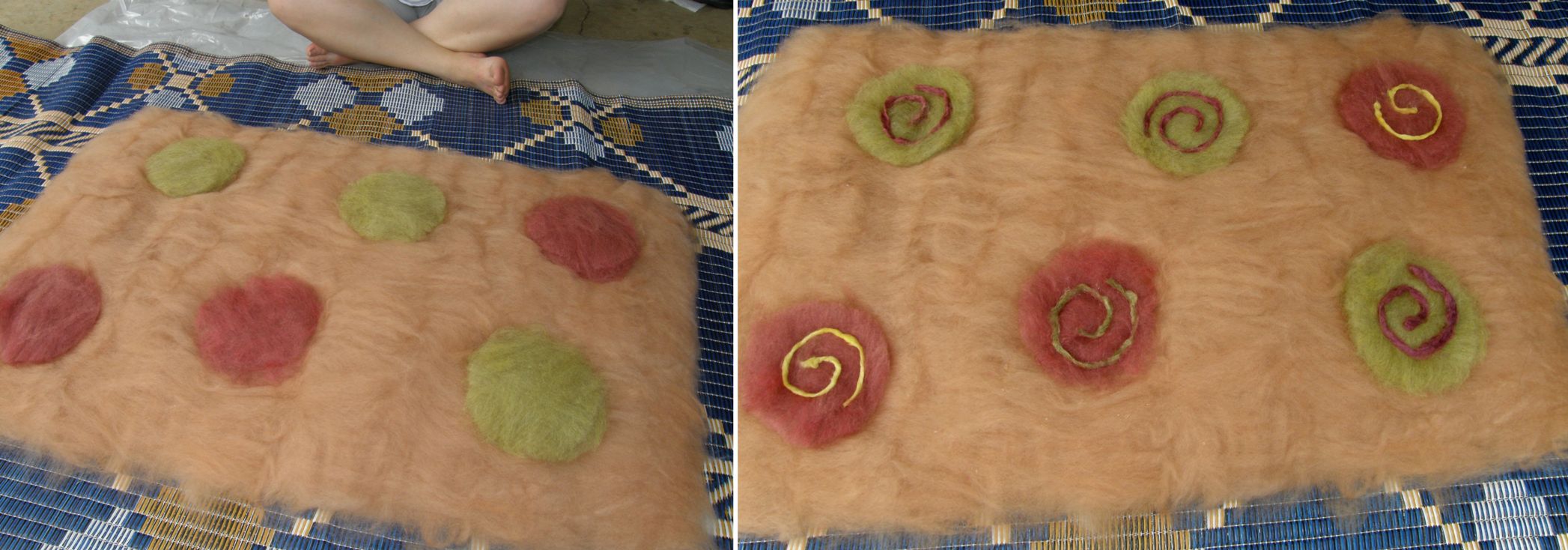
Lisa is a skilled felter and was kind enough to give me a chance to learn a little about the technique when I was visiting her. I had made felt many years ago in Chile, following instructions in the Ashford spinning book, rolling it around on the kitchen floor and taking all the color out of the plastic tile! I had not felted my piece enough and had no idea about what a physical activity it was!
First we chose colors and laid out the wool in five or six thin layers. As there wasn’t enough colored wool we used a white base.Shapes are cut and placed and then the whole thing gets covered with a piece of tulle and sprayed with hot water and detergent. We then rubbed the surface through the tulle adding more hot soapy water as needed.
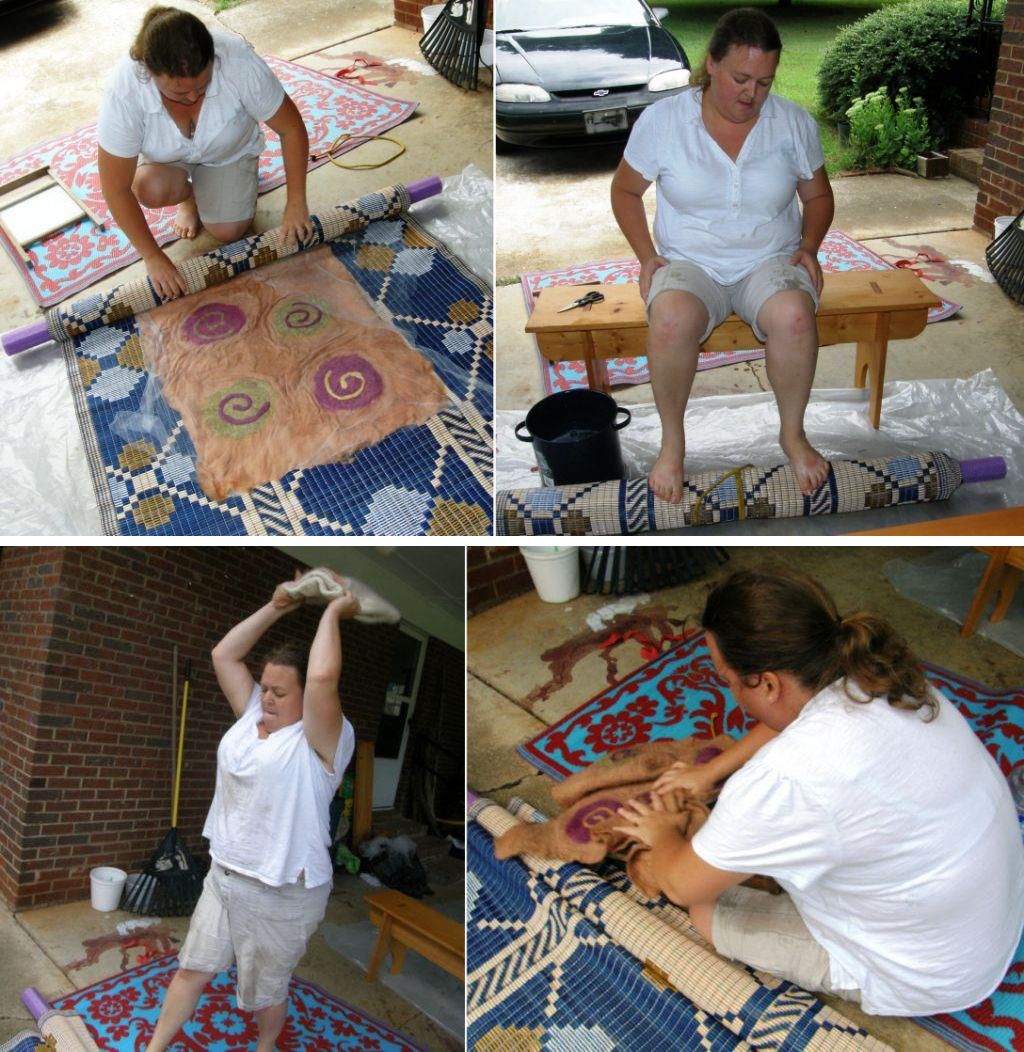
When we were satisfied that felting was underway and that the various design elements were clinging sufficiently to each other and the base, the fun began!
The piece had to be rolled so we both sat on benches facing each other, put on some jolly music by the Carolina Chocolate Drops and rolled away stopping now and then to unroll, turn the piece and re roll. Then came a lot of folding, slamming and pummeling. The piece was rinsed and tossed onto the roof of the shed to dry. Back home in Bolivia, my cat has still not decided if she wants to let this luxurious felt piece go. I am not particularly in love with the design I made and so will most likely turn it over and use the white side to create some kind of applique and embroidered design – something inspired by a South American textile no doubt!
I have just about caught up on all pending projects. The guitar strap came off the backstrap loom, all six feet of it and so there will definitely be some left overs to sew up into something.
And here are those blue bags again. I sold the original two and made up two more from the piece I warped up for demonstrations at Convergence. My belt shuttles and sticks once again have a home. You can see the six-strand finger loop braid on the left that I used for the zipper pull. My weaving teacher in Potosi taught me this braid which we used to make a strap for the chuspa I wove with her.
Online weaving friends have been posting pictures in the forums…
Amber has been studying simple warp float techniques weaving both single and two-color motifs and inventing some patterns of her own. I like her two color “S” on the background of horizontal bars.
Amber dove into the deep end earlier this year and wove mug rugs on a backstrap loom following my one-weft double weave tutorial as her first backstrap weaving project and is now weaving simple warp float bands on an inkle loom which allows her to weave in a more confined space.
Marydargie is continuing to follow the lessons in my Andean Pebble Weave book and is also working on an inkle loom producing great-looking bands.
I have a new project in mind for next week which involves charting, which, fortunately, I love so I will be down on the floor once again with paper and colored pencils to see what I can work out. I am very excited about a design I have found and can’t wait to weave it.
Finally, helloooooo out there to Anna and Alistair. I hope you are enjoying smooth riding where ever you are!
Alistair is from Adelaide and Anna now makes her home there too so perhaps we will meet again on my next trip to Australia.
I will leave you all with some gorgeous shots from Anna and Alistair’s time in the hotspring and salt lake region on the Chilean/Bolivian border…The little animal is a viscacha and is one of the motifs in my pebble weave book.
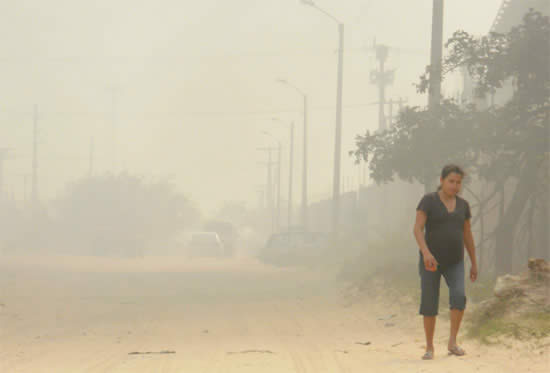
Widespread scrub fires in the countryside here in Bolivia got a dousing recently so that the atmosphere here in Santa Cruz, which looked like that pictured at left during the height of the fires about a week ago, is once again relatively clean.
And just in time for the month of September which is a month of celebration in Santa Cruz.There will be all sorts of cultural activities and fiestas culminating in the Feria Expo, an annual international event, and September 24th, Santa Cruz Day which marks the day of the initial call to take up arms against the Spanish in the fight for independence. This year will be particularly festive as the city celebrates the bicentennial of this event. Along the way the first day of spring will be marked on the 21st which is also Students Day as well Bolivia’s answer to Valentine’s Day.
This week I have been studying the letters worked into the bag strap woven by the Montagnard weavers of Vietnam that I met while in the US. Once again I marvel at the possibilities that the simple warp float technique presents and the way it has been used by different weavers around the world.
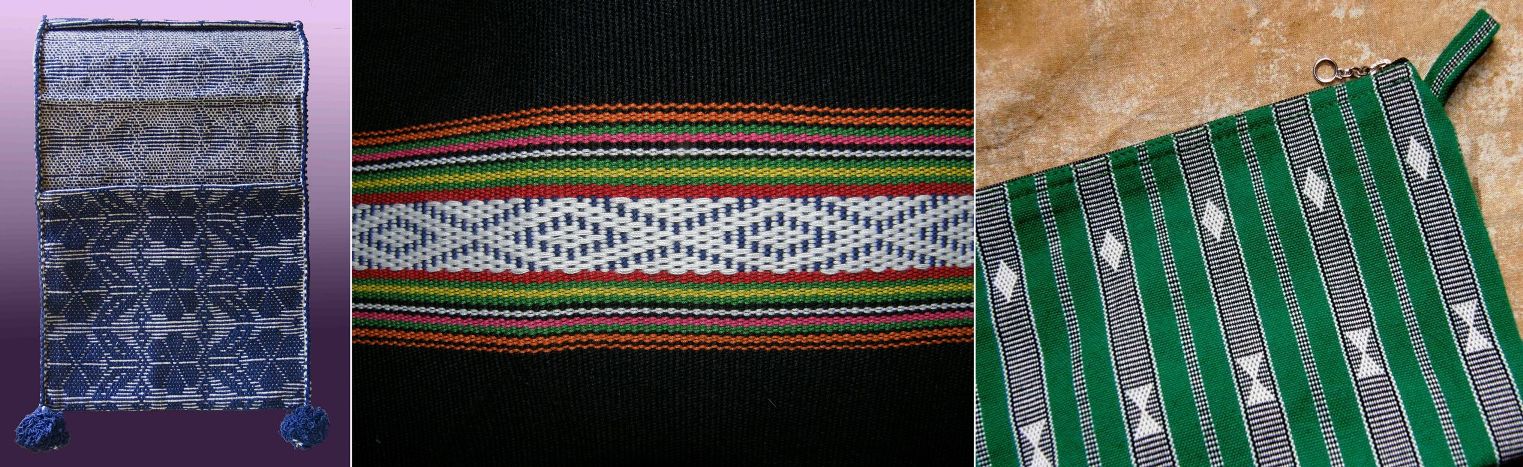
From left to right: simple warp floats decorate a cotton saddle bag from Manabi province in coastal Ecuador, the same patterning technique on a blanket woven made by Montagnard weavers of Vietnam and a simple but very effective piece made in Sagada, Mt. Province in The Philippines. The latter was sent to me by Trish who lives in The Philippines. We met and spent many hours together in Los Angeles airport on one of my standby flight sagas.
In the examples above, the technique is seen in its very simplest form, floating single or paired warps of one color over horizontal bars of alternating light and dark warps.
As we have seen here before, the technique can be taken a step further by floating both the light and dark warps in succession, filling in the background to the main motif and thus covering the horizontal bars completely.
This technique is employed to pattern one style of yurt bands made in Kyrgystan where the technique is called "terme". I wove this sample piece to check if my charting was correct and made it into a small bag.
While doing a bit of a desktop clean up this week I came across an image of a Central Asian piece that Lisa had photographed at one of her reenactment events and sent me about which I had completely forgotten.
The photo on the right is the one that inspired the small bag that I wove. The picture on the left is the new buried desktop discovery and it is nice to see the same hook design that I copied on this piece too.
Here is a quick summary of the difference between the single color and two-color versions of this simple warp float technique.
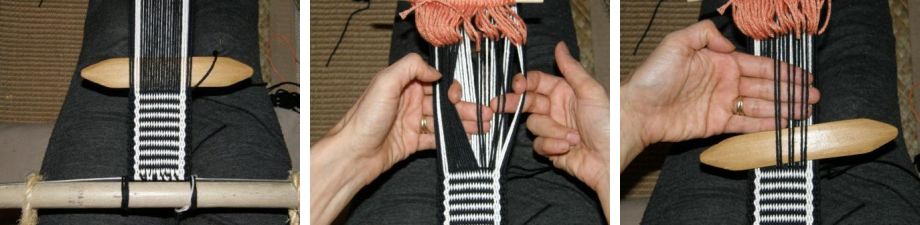
Basically, when you weave the single color version, the weaving sequence can be summarised with four “S”s:
Shed….Open the dark shed and pass the weft
Select..Choose the dark warps that you wish to have floating and forming a pattern
Save….Save these chosen warps on a stick
Shed….Open the light shed, add the saved warps to this shed and pass your weft
We could even add a fifth “S” to the sequence which would be Start again.
Here it is again with pictures…
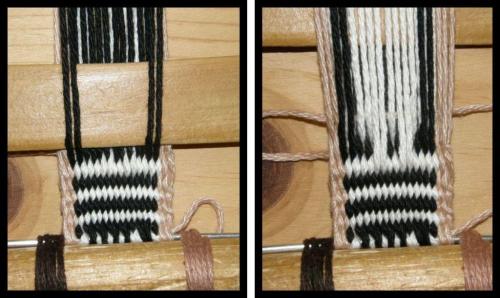
The dark Shed has been opened and the weft has been passed. The dark warps to be floated have been Selected. The selected warps have been Saved on a stick.
The light Shed has been opened and the dark selected warps added to it. The weft is then passed. Then you Start again, that is, open the dark shed etc etc…
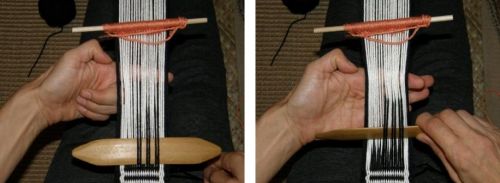
Moving on to the two color simple warp float technique, the sequence changes to: (this time I start with the light shed for no particular reason)
Shed…..Open the light shed and pass the weft
Select…Select the light warps that you want to float to form your pattern
Save…..Save the chosen warps on a stick
Shed…..Open the dark shed and add the saved light warps to it. Pass the weft
Select…Select warps from the dark shed which will float and form the design
Save…..Save the selected dark warps on a stick
Shed…..Open the light shed and add the saved dark warps to it. Pass the weft. From here move on to the second step: Select.
In pictures:
After passing the weft through the light Shed, two pairs of light warps are Selected, Saved and added to the dark Shed.
Dark pairs are then Selected from the dark shed, Saved and added to the light Shed.
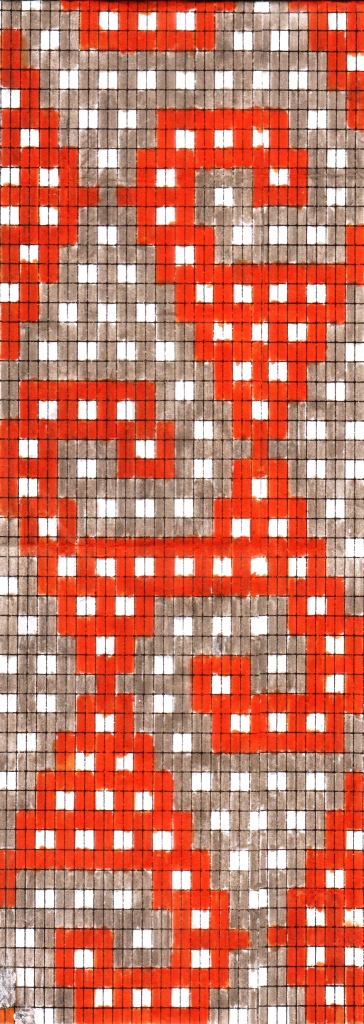
Here is the pattern chart for the hook design taken from the yurt band and woven piece that Lisa photographed.
Full tutorials for both the single and two color warp float techniques are here on my blog.
The single color version has videos too.
Click on the TUTORIALS tab at the top of any blog page here and scroll through the list of tutorial links.
As always, things should be taken in steps and so, before attempting this hook design, I suggest weaving samples in single color floats first. There are so many possibilities for this simple technique using a single floated color and so there is no need to rush into the two-color version until you are good and ready.
With some experience in the single color version under your belt, you can then try the two-color “S” design for which a full step-by-step tutorial is provided here.
I wove the above pouches in order to reproduce some of the motifs woven by the Montagnard weavers with whom I got to spend some time in North Carolina. The technique is a twist on the basic simple warp float technique. Their way of arranging the sheds and selecting the warps produces warp floats on the back of the weaving and exposed weft on the front but the basic steps in the weaving sequence are the same. The resulting bands of pattern are more flexible than those produced by the Philippine and coastal Ecuadoran weavers as they are not truly warp faced.
This week I worked on extracting and charting all the woven letters that I found in the photos I had taken during the visit. I then wove up a sample band.
There are a few unorthodox moves that they use to form nicer curves for the letters. Betsy Renfrew who is working with the Montagnard weavers tells me that someone wove a banner with the words Montagnard-Dega Association for their office. I am looking forward to seeing that as the letter “s” is amongst the five or six that I am missing. I have been wanting to weave nice letters ever since I saw Linda Hendrickson’s beautiful book on card-woven letters Please Weave a Message. All I have done so far myself is devise a simple stick alphabet which I sometimes weave in double weave. Now I have another alphabet for my repetoire.
Another source for beautiful woven letters is Annie MacHale (aspinnerweaver) who weaves a line from musicians’ favorite songs on the guitar straps she makes for them on her inkle loom.
Some weavers who employ the simple warp float technique choose to float single warps, others pairs. As the weavers in coastal Ecuador are weaving with their homespun cotton, they float pairs of doubled strands of cotton to form their designs.
This photo was taken by anthropologist Kathleen Klumpp and shows one of the completed saddle bags or "alforjas" . This particular design is called "rosa y hoja de naranja", rose and orange leaf. The piece was woven on a vertical loom using a circular warp.
Kathie is with the weavers right now and has been urging me to go and join her with Doña Luz and her family whom I met on a three-week visit back in 2007. Knowing the amount of laughter that shakes their stilt house every evening when the extended family gets together, I know that they must be all having a wonderful time. Unfortunately I could not get my program to fit with Kathie’s and I am unable to accept her invitation.
In 2007, sharing prints of photos from the 1976 visit.
Kathie has enjoyed a long, close and warm relationship with this family over the last four years visiting them to document the entire process that takes them from cotton boll to finished woven saddle bag and commissioning pieces to encourge them to continue weaving.
However, the story of her contact with these talented weavers started back in 1976 when Kathie was in Manabi province collecting data on village pottery making. She happened to see a gentleman on one of the rural buses carrying a most unusual saddle bag. It immediately stood out from other saddlebags that she had seen which were patterned with simple warp stripes as it was covered with geometric designs in indigo blue.
Her enquiries led her to Doña Luz Parraga and her family, master spinners and weavers in the settlement of Zapote and a friendship was formed.
At left you can see Luz’s daughter Trinidad, at fourteeen years of age in 1976, weaving and sewing an edging onto a finished saddle bag using a wooden rigid heddle fashioned by Luz herself.
After this visit, life interrupted, as it often does, and Kathie had to put her anthropological work aside. It wasn’t until her retirement that she was able to return, thirty years later, to the very same family, rekindle her friendship and continue her research.I would have loved to have been a fly on the wall of that stilt house when Kathie emerged from the vehicle and walked up the dusty slope to meet once again with her old dear friends. The following year I was able to join her.
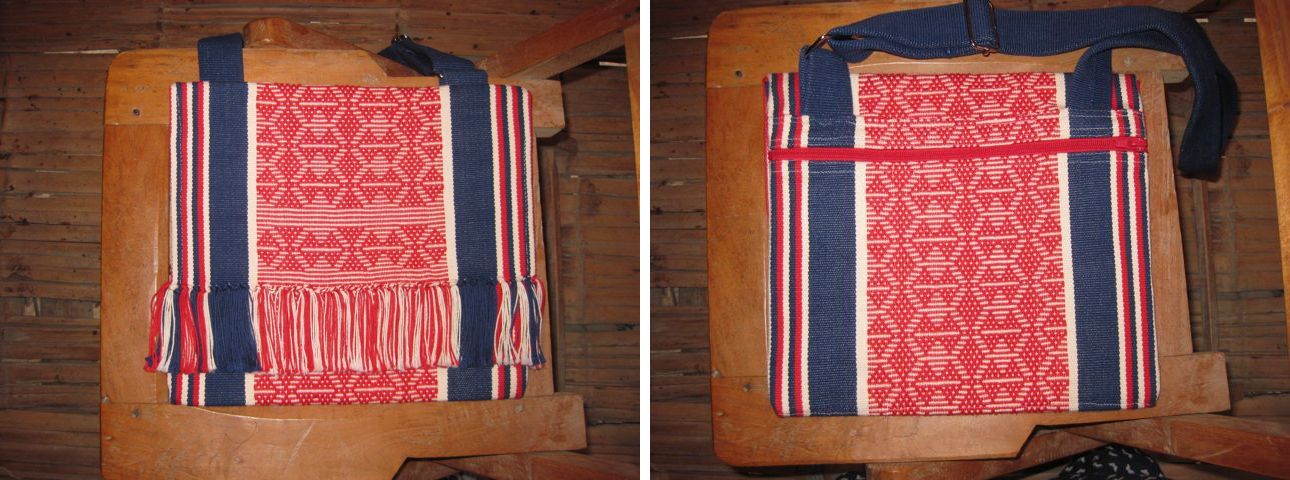
Photos taken by Kathie of Luz in 1976 and during her return visit in 2006.Here we are in 2010 with Luz and Trini at the loom. They have set up the warps which will go into twelve heddles to weave the orange leaf design after several days of studying the samples and struggling with the warps. This is a design which they had not woven for some time and were on the point of forgetting. Luz's eyesight is at the point where it is almost impossible for her to select the warps and Trini had great difficulty at first relating what was on her woven sample to the loom. Her perseverance paid off and, thanks to Kathie's encouragement, this design has been revived.The rose and chalice design at left is probably the one that is most often woven. This design requires eleven heddle sticks. The warps which are programmed into each of the eleven heddle sticks are recorded on the woven sample at right.On this latest visit Kathie is helping Trini to develop new products as the market for traditional cotton saddlebags is now virtually non existent. This shoulder bag with a zippered outside compartment and made with factory cotton, has an adaptation of another traditional design of the coastal area. With Kathie's help the family members have planted and are raising 150 cotton plants on their property so that eventually they will once again be able to use their own handspun and pass on the spinning traditions to future generations.
Here is an edited version of a video that Kathie has made during this visit showing Trini making her string heddles and weaving a piece. You will see how she uses a flat stick to help ensure that all her heddles are made the same length. Those of you who have studied the simple warp float tutorial will recognize the moves when she starts weaving although she doesn’t have to select her warps to float as they are already in the heddles. The full version of the video can be viewed here.
I love the way she opens the heddles! They open relatively easily as she is using a smooth factory cotton.
It was never so easy when I was with them in 2007 and we were using their homespun thread.
At left is a flashback to 2007 when I was with the family. I wove quite a lot of this piece as part of my “training” so here you see the two proud weavers in front of their finished work!
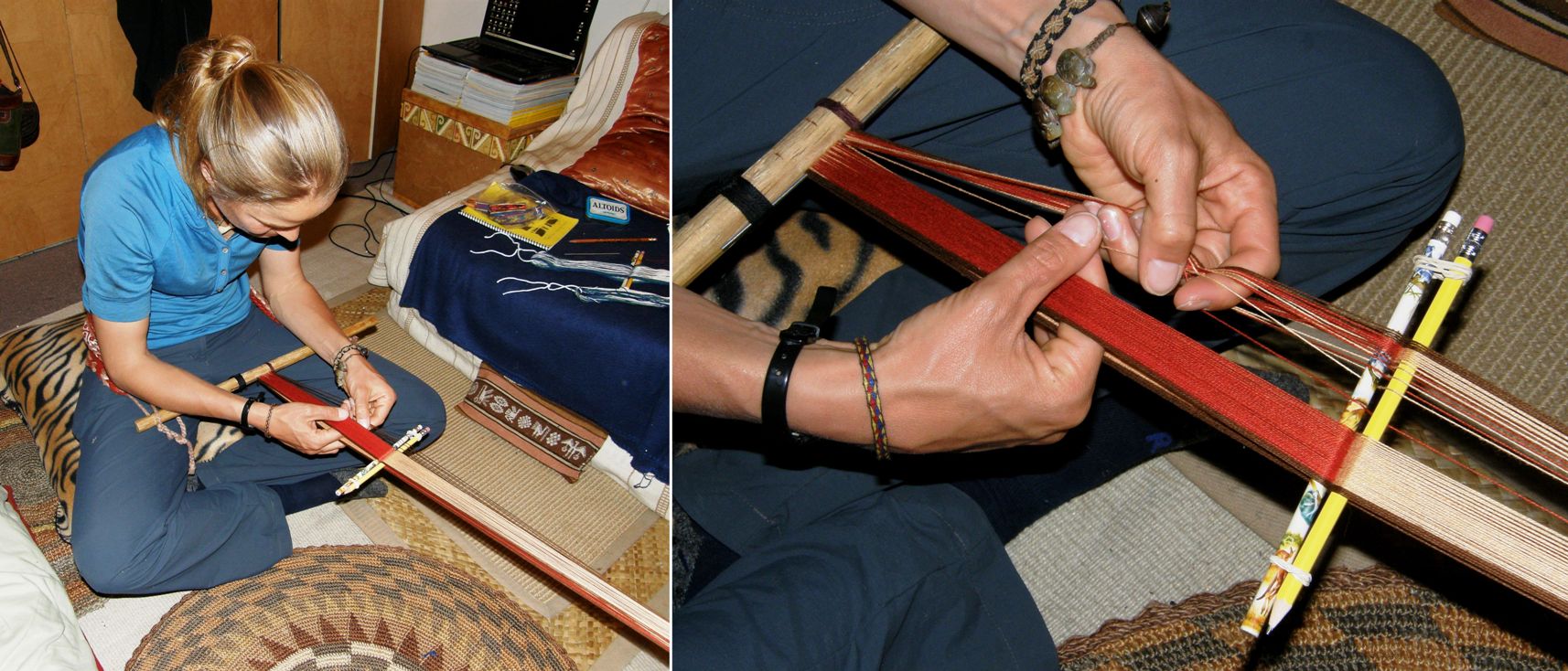
Speaking of opening heddle sheds, I have put together a video of my own this week to show a couple of ways that I use to open a sticky shed as well as how I open each of the two sheds when doing Andean pebble weave.
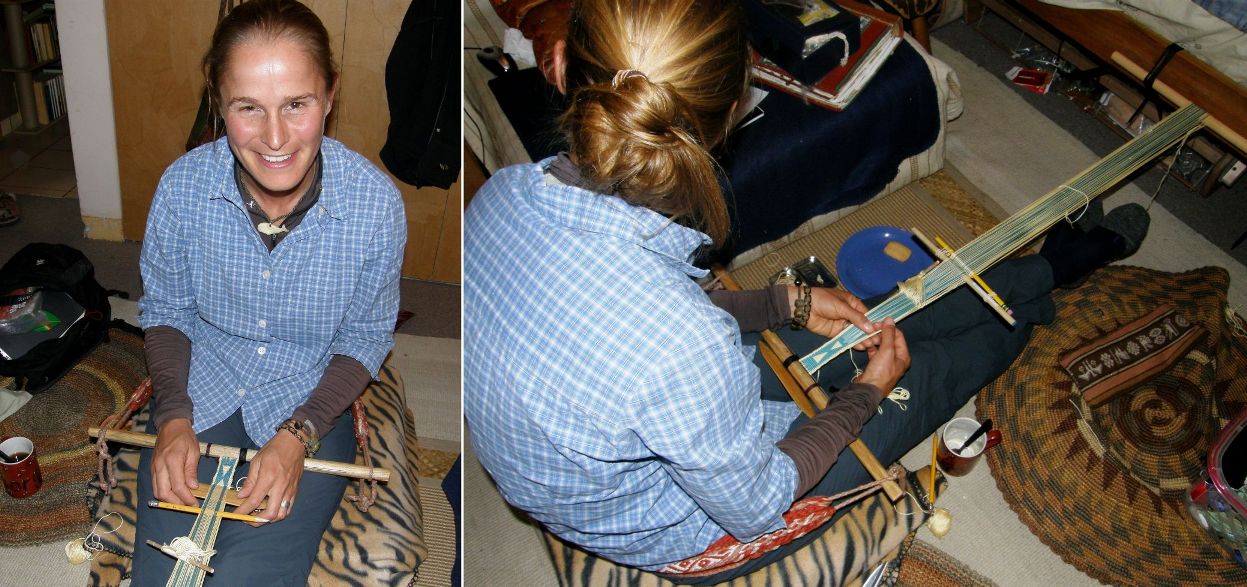
The warp in the Andean pebble weave segment of the video is the one that Maurice, Lisa and I set up on Lisa’s four-shaft loom in North Carolina. I had intended doing something a lot wider but had not anticipated the amount of warp length that was required for the four-shaft loom and so had not bought enough yarn. So I ended up with a piece that happens to be just the right width for a guitar strap and I already know a guitar player who will love it.
As you can see, it ended up back here in Santa Cruz on my backtrap loom and wasn’t as difficult to retension as I had imagined.
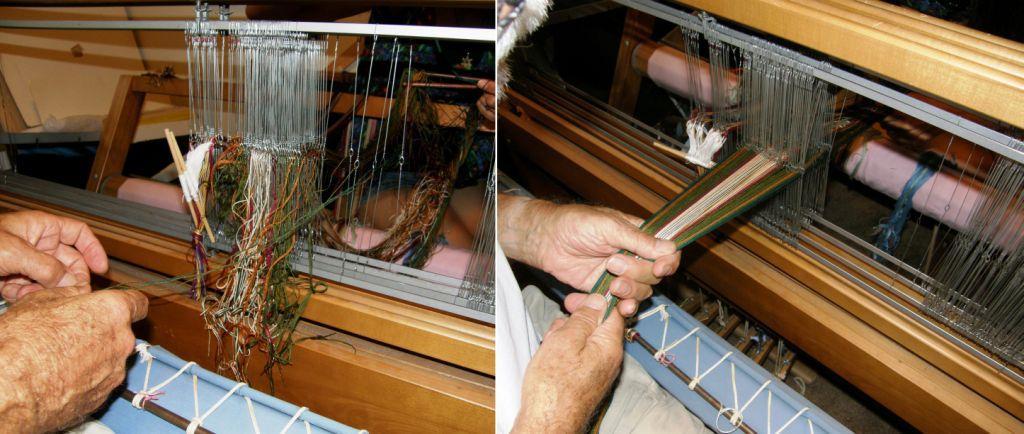
Setting up on the four-shaft loom was a bit freaky. Maurice, however, was completely unphased by this mess and soon tamed it into submission. The two dowels you see at left in the picture are part of a previous abandoned project and were later cut out.Weaving underway...
Using that big loom to weave a narrow band may seem a bit strange but, if this is the only loom you have, you are not keen on trying backstrap weaving but really want to try Andean pebble weave, then all I can say is, why not?
What’s in the mail and the inbox?
Speaking of Andean pebble weave on other looms, Jennifer is weaving another pebble weave band on her inkle loom and has sent me pictures..
Inspired by Jennifer's progress, Marydargie on Ravelry warped up her inkle loom to weave the band in lesson one in my book.
In a discussion in the inkle weaving group on Ravelry we all agreed that mini inkle looms are not well suited to weaving pebble weave. A heavy-ish with a lot of room in front works well for this technique. My Ashford Inklette needed to be clamped to a table as it was too light and felt very cramped. Although I managed to weave a band on it in pebble weave, it was not very comfortable.
Francois in California, who has been following this blog, sent me a picture of his finger weaving, at left. I dabbled in finger weaving many years ago attracted by the Peruvian bands Ifound in a book and was surprised to see the enormous piece that he has created. I imagine that this comprises several bands sewn together. Another great technique requiring few or no tools.
Another small discussion on Ravelry was started when someone asked about whether people preferred backstrap or inkle looms in general. I could find advantages for both, naming as one of the inkle loom’s advantages the fact that the heddles are put in place as the warp is wound but…now I have learned a cool way to do that while winding the warp for backstrap weaving thanks to the Montagnard weavers…
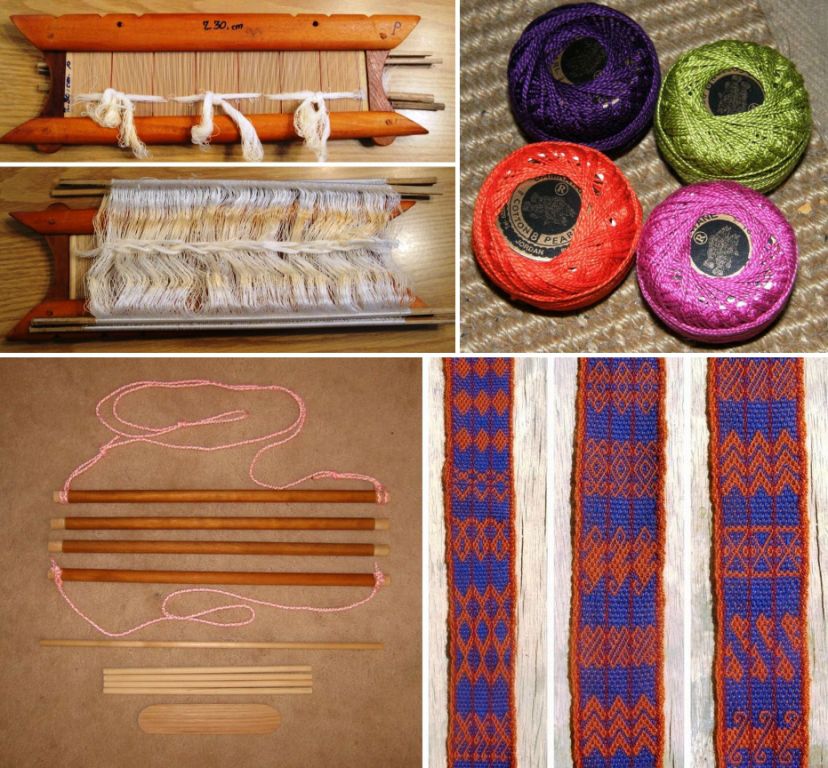
I made a video of Montagnard weaver Ju Nie making these heddles, at left, as she warped and, after watching it many many times was finally able to catch her quick movements and make sense of it. On the right are the heddles I made this way using thick yarn so that I could photograph the process for my journal. I have also made step-by-step diagrams and a video of my own showing the process very slowly just in case I forget! I doubt, however, that I will ever use this technique on my own warps as I am a big fan of the extra hitch on the heddle stick bteween heddle loops. From the inbox and the mail box...Quiltparalegal sent me this picture of a loom that her son bought for her in Laos with its incredibly fine bamboo reed and string heddles. It amazes me that these bamboo reeds are still being made. What a piece of work! Weave2, sent me a lot of thread made in Jordan where she lives. Here are some examples of the rich colors she chose. AJM showed me a backstrap loom he made for a friend even before he can get one for himself finished! Anna, who is cycling from Alaska to Ushuaia, is weaving on the road after having classes in Huancayo. She downloaded my book along the way and has been weaving some of the motifs from it wich you can see on the right. The designs on the left were woven with her Peruvian teacher. She is now in Santa Cruz and is coming to weave with me tomorrow!
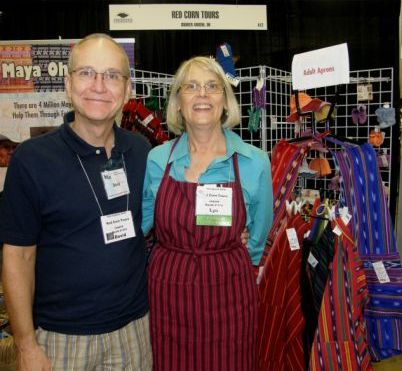
Above you see vivacious, no, REALLY vivacious Lyn Lucas and David Anderson of Red Corn whom I met at Convergence. I showed you one of the beautiful huipiles of Chichcastenango that they had on their stand in a previous post. Recently I discoverd their Facebook page and I highly recommend taking a look and “liking” their page. There they post two to three videos on Guatemalan weaving every week. It is a real treat!
And to finish, I have created a new tab at the top of the page named FAQ INDEX. That is all it is at the moment…an index. What you will find there along with the index is the following notice….
It will take some time to put this together but I am really looking forward to having all this information which I have posted in various places online all in the one place once and for all! Curious about the questions? Hit the FAQ INDEX tab at the top of the page. Maybe you have some questions to add.
 I have been kept from my loom at home this week. Normally this would have left me very agitated but it has been for a very good reason.
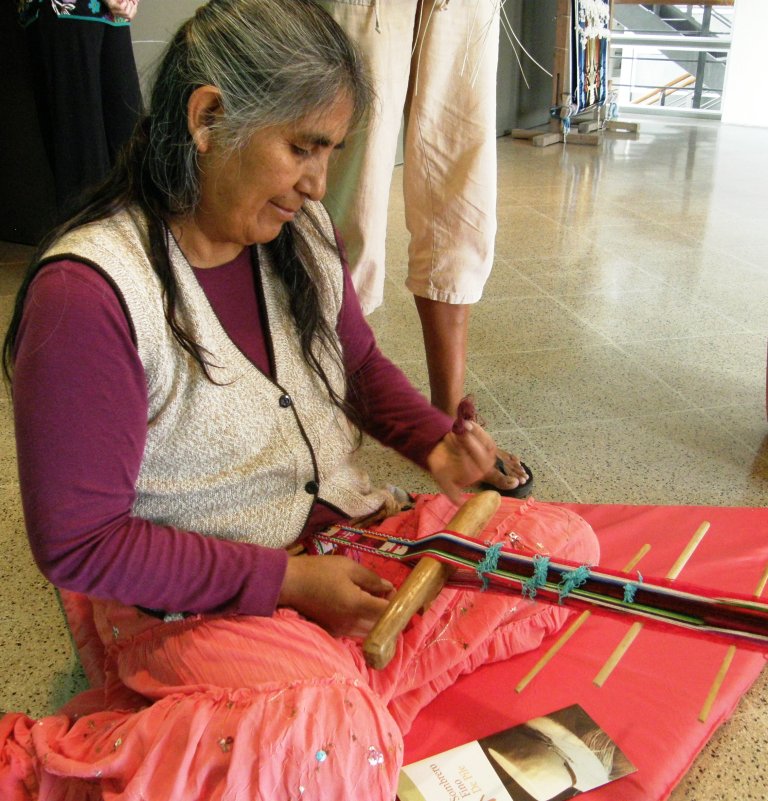 I didn’t have to worry too much about missing out on Celinda and Isobel’s (the Chilean weavers) instruction on day one as today Angela and I got to spend a lot of time with Celinda as she wove. I found her very tranquil and lovely to watch. Daughter Isobel, on the other hand, is a live wire! You will see and hear more about her next week.
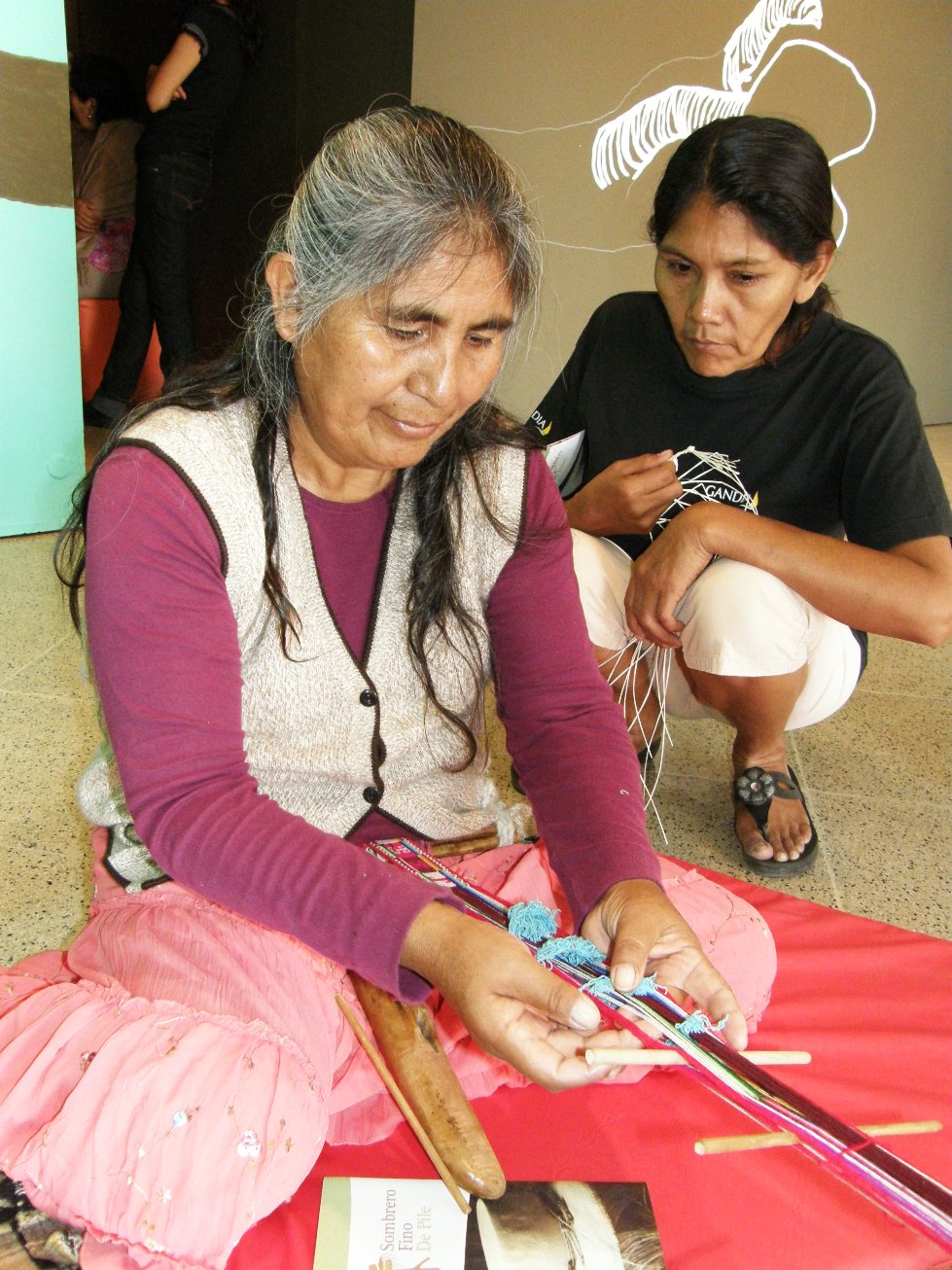 Well, I really must stop here as there are more events to attend tonight and one more day of this conference to go. No doubt there will be much to tell and show next week.