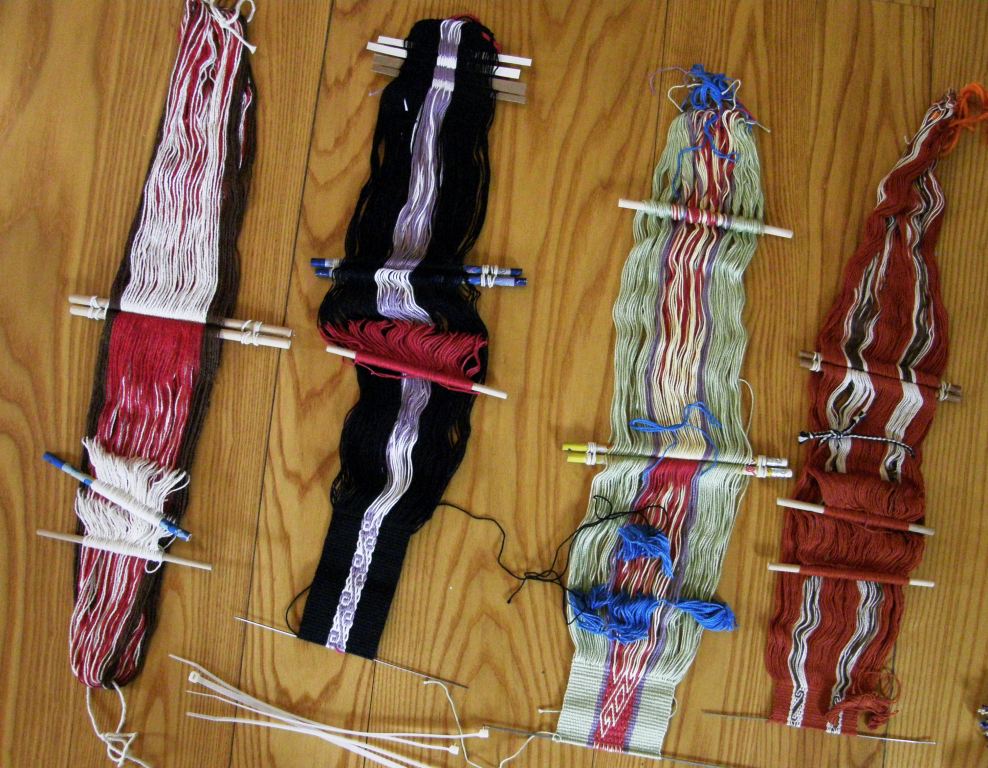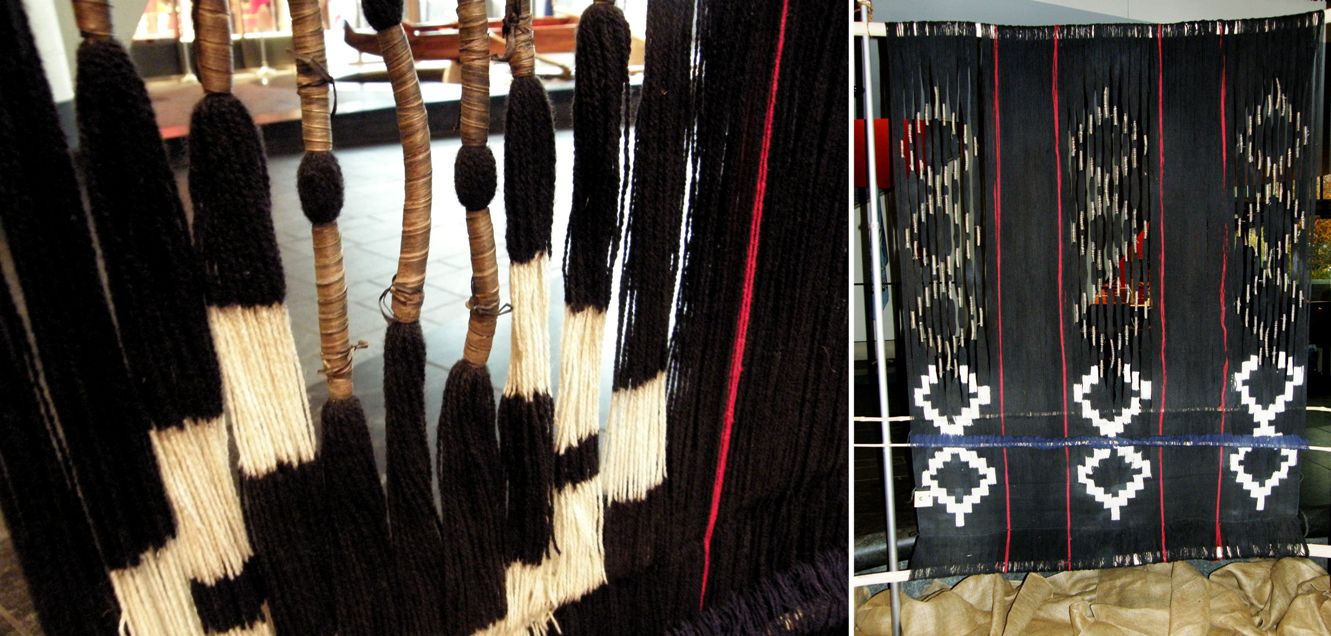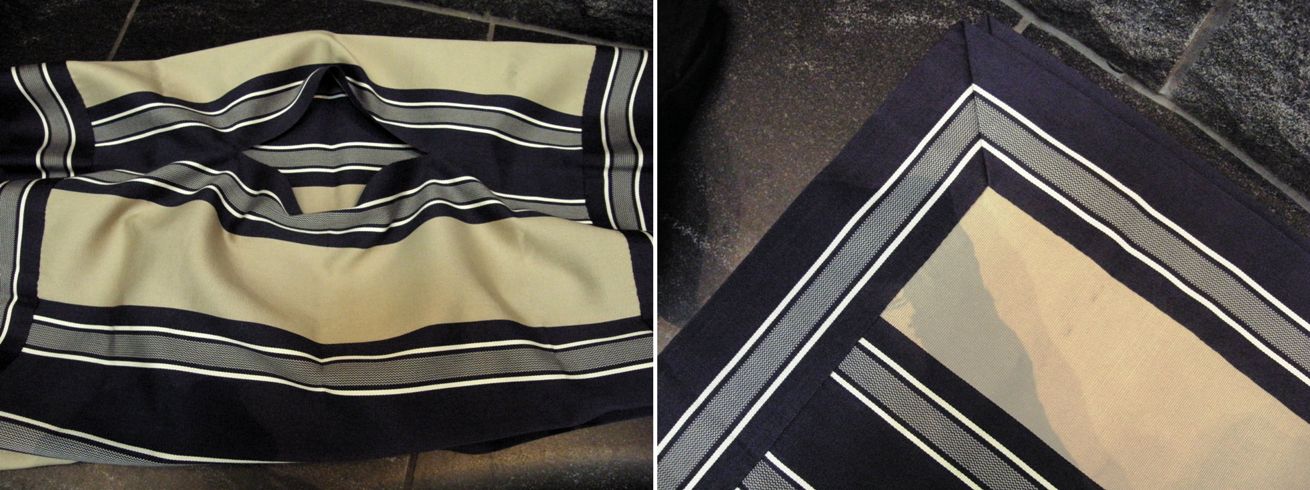
Backstrap Weaving – ”Unnatural” Beauty

columnweftthreadsI always try to read my latest blog post the morning after having posted it. More often that not there is a typo or two that needs fixing and I seem to catch those more easily when fresh in the morning rather than at 10pm when I generally hit the ”publish” button.

What I noticed more than anything else when I did the morning-after review of last week’s post, was the way that the picture of Maxima’s ch’uspa gleefully jumped off the page. Those festive reds, oranges and pinks and joyful greens rang out as I scrolled down the page. It is not hard to understand why Maxima should want to use the synthetic thread in these bright colors for her husband’s outfit as Mayor of Huancarani as her aim is to create something festive. In the same way, she and other weavers in her co-operative have started working on their llicllas for Carnival next year and are using acrylic yarn in bright colors bought in the market. There is still work involved before the pieces can be warped as the bought yarn needs to have more twist added so that it will stand up to the abrasion of warp-faced weaving.

natural dye colors independencia Bolivia
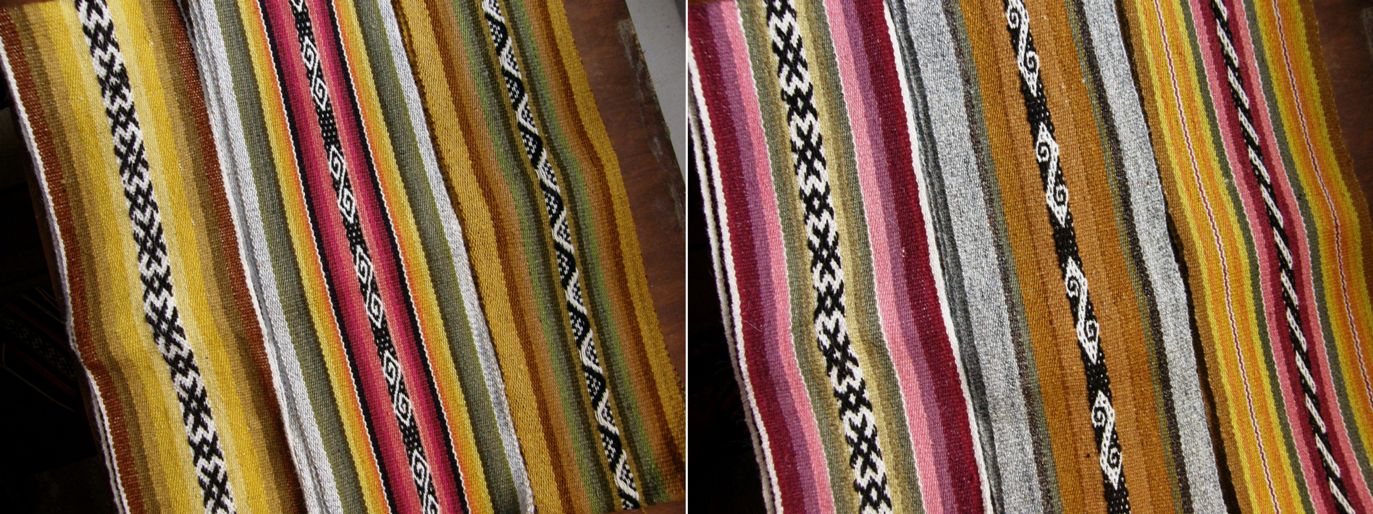
While the weavers are able to obtain beautiful deep shades of red using natural substances like cochineal, most colors they get from natural sources tend to be much more muted. Natural whites are not as brilliantly white as the synthetic whites either and these weavers are not using indigo to obtain blues. The hairiness of the handspun wool creates slightly more ”subdued” motifs next to the sharp, crisp ones woven with synthetic yarn. However, we, in the western world, love those natural dye colors and the way they so perfectly blend and work together and we tend to choose handspun wool textiles from indigenous weavers over synthetics.

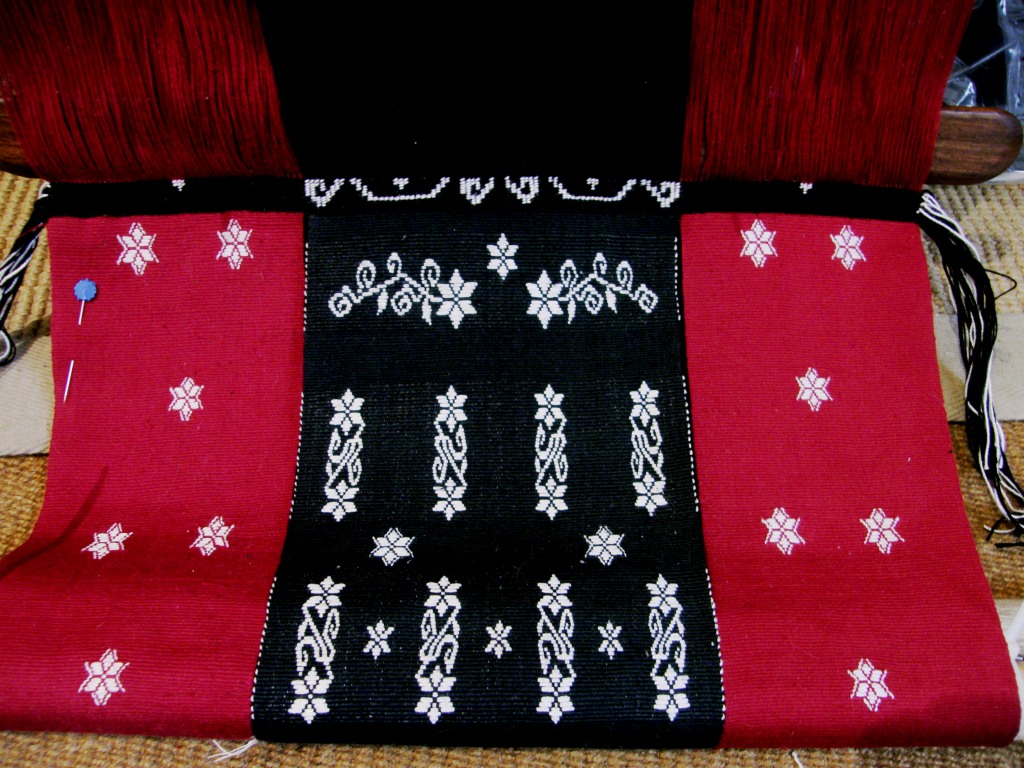
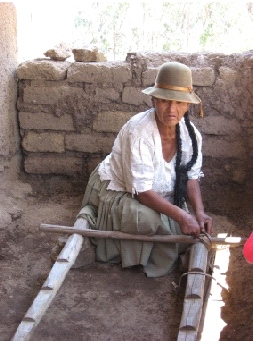
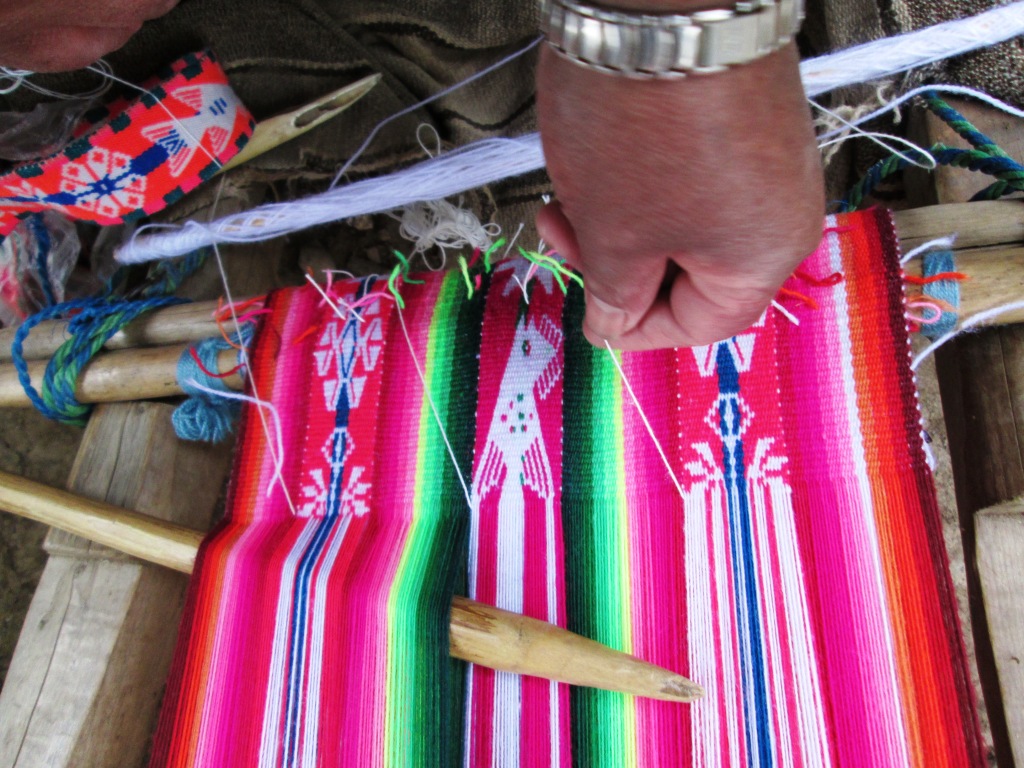
reversingfor2ndhalfIn the above picture, Maxima has just repositioned her ch’uspa piece on the loom so that she can start weaving from the other end. This will enable her to create a piece with four selvedges. (Picture courtesy of PAZA Bolivia.)

It is even easier to understand the weavers’ leanings towards these bright colors when you see the rather bleak and colorless landscapes at some of the higher altitudes of Bolivia.

When I studied with weavers in Potosi, Bolivia, I shopped with one of my teachers for the yarn that we would use. I had her make the color choices as I wanted something that represented her taste. Her sister, however, turned up her nose when we had finished warping! She might have liked the colors but she definitely didn’t like the way in which we had arranged them. You can see how the woven piece is a spot of cheery brightness against the hard baked dry earth and stone walls of the patio. Of course, there is lots of pink.

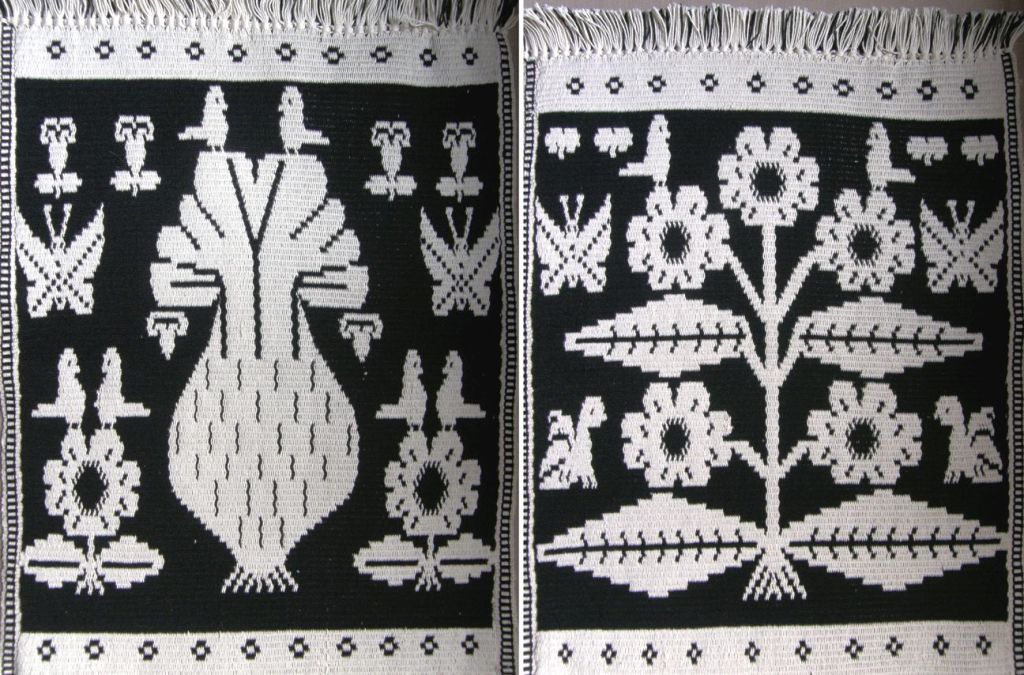
learning double weave potosiI remember the first time I visited Taquile Island on Lake Titicaca in Peru in 1996. I wanted to buy a textile from the market in the plaza and kept turning down pieces that were synthetic. Yet, these were the pieces that had the most beautiful work of all. The synthetic thread was extremely fine and allowed the weavers to create double weave motifs with an incredible amount of detail. The motifs in brilliant white stood out boldly and crisply against backgrounds of ruby red and green.

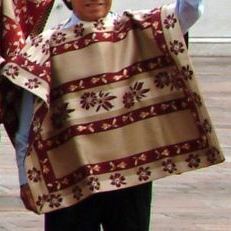
I absolutely love this Bolivian poncho made with exceptionally fine synthetic thread that a friend of mine bought in a textile store in California. The amount of design detail that has been packed into the narrow bands of color is extraordinary. The weaver has used some of the typical strong pinks and yellows alongside much softer tones in the columns of double weave.Bolivian poncho synthetic thread double weave

Sometimes, synthetic colors are used alongside undyed handspun wool such as in this piece from Peru….

tantaSynthetic dyes are sold in the highland street markets. It is lovely to see the mounds of colored powders in rows on the tables next to old weighing scales and sheets of paper for wrapping the purchases. Handspun wool can then be easily dyed for colorful woven bankets and carrying cloths….

synthetic dyes peruBolivian hatbands, decorated with colorful acrylic supplementary weft threads, are woven with warp thread that is finer than sewing thread. This fineness allows the weavers a lot of flexibility in their motifs with weft floats that can span up to 20 warp threads without being too long and cumbersome. I doubt that anyone is taking the trouble to spin yarn that fine anymore. The bright colors, tassels and pom poms give these bands a very festive look.

hatbands-aPebble Weave hatbands in Oruro and belts in Ayacucho are bright and eye catching…

oruro hatband

ayacucho beltWhen I show people examples of Peruvian and Bolivian weaving, I place this next piece of cloth alongside samples of handpsun wool, wool weavings and my own work. Many people are immediately attracted to this piece. It is, in fact, a machine-made acrylic version of traditional weaving patterns of Chinchero, Peru. The weavers of Chinchero, of course, weave with their handspun and naturally dyed wool yarn. I don’t know where this piece was made, having bought it in Santa Cruz airport.Craylic knock off chinchero patternYou all must know by now that I adore the use of red, black and white in textiles. For me it has a sort of ”tribal” flavor.  The inclusion of bright acrylic supplemental weft in this red, black and white saddle bag from northern Peru gives it a completely different flavor, I think.

As for me, I remain conservative in my color choices. I took a slight detour this week by using orange. I found a nice burnt orange wool on my last trip away and I wanted to try out this new wool yarn to see how it performed in the grip of string heddles and  warp-faced weaving. I used it, along with the other colors, straight off the skein.

It is wool. Therefore, it was hairy and gnarly in the heddles and sticky. That’s its nature. There are ways to deal with that. Each type of yarn calls on a different strategy for opening clean sheds and avoiding excess abrasion and breakages. I had to be careful to advance the warp often so that the heddles were not sitting too long on one spot and causing a lot of friction on that one part of the warp. No threads broke and the resulting cloth is gorgeously soft!

backstrap weaving woolI am currently planning and sampling a tubular band pattern that will suit the motif. The purpose of this weaving was to test the wool. It was a success and so, I shall make something with the cloth and, at the same time, try out my own tubular band pattern. Ths is the first time I have used the motif you see above besides the tiny sample I wove for my second book.

wool backstrap weaving tinkipaya motifWhen I look at all the colorful weavings in this post, I am reminded of the machine-knitting business I used to have in my skiing days. In Australia, for every colorful patterned wool ear-warmer band that I sold, I would sell ten plain navy blue ones! It was a totally different when I spent the other half of the year in Europe. The Swedes in particular would wear wildly colorful hats with pom-poms that erupted from the top and cascaded down the sides like fireworks! The more colorful, the better and they were a blast of color in the snow. It’s interesting to note the different attitudes to color. And my ski suit? Well, there were a few but my favorite was, of course, black (with some neon pink bands). This was back in the 1980s.

See you next week. I will leave you here with one more piece of bright jolliness….belts from Ayacucho…

ayacucho-belt-with-pom-poms


Backstrap Weaving – Venturing Outside the Comfort Zone

Venturing Outside the Comfort Zone

???????????????????????????????It’s always nice in my travels to return to known places. There is something very comforting in the midst of all the “what-ifs” and unknowns of travel to meet once again familiar faces and landscapes.

However, there are always new people and places to add and I have enjoyed visiting new guilds and new US states on this trip. This was my first time visiting New Jersey, for example, and now I am about to venture into Nevada for my first ever visit there. There are new experiences, like trying to navigate the New York Port Authority with loads of luggage for the first time, going flying in a Cessna over Cape Cod on a perfect spring day, and being made very much aware of the rather “shaky” nature of the California coastline! (see picture above).

The mysteries and trepidation of going to new places are always short-lived. The new landscapes are exciting and the new weaving groups without exception are warm and welcoming.

The western part of this trip has take me through a variety of landscapes….from the beaches of lovely Santa Cruz to the big cityscape of Oakland and the forested high passes and lakes of the Sierra Nevada range.

Walking the paths of West Cliff Santa Cruz was a wonderful way to unwind after a day of teaching. We watched surfers, pelicans and sea otters at play in the light of the setting sun.
Walking the paths of West Cliff Santa Cruz was a wonderful way to unwind after a day on the move. We watched surfers, pelicans and sea otters at play in the light of the setting sun.
The view from the 19th floor room that I shared with Jennifer Moore at CNCH 2014.
This is the view from my 19th floor bedroom at CNCH 2014 last weekend. It was fun sharing with Jennifer Moore whom I had met and spent time with backstrap weaving and at the opera in Santa Fe last year.
One of the beautiful peaks on the way to Truckee California.
One of the beautiful peaks of the Sierra Nevada on the way to Truckee California.
Yonat weaving amongst the Redwoods in my Santa Cruz class.
Yonat weaving among the Redwoods in Santa Cruz.
A new venue and new faces in Grass Valley California...backstraps in position and ready for action!
A new place and new faces in Grass Valley California…backstraps in position and ready for action!

I like to call my Santa Cruz group my “firsties and besties”. As it was my fifth time visiting and weaving with them, I decided that it was time to push ourselves outside our comfort zones. The challenge was to take one of the structures that we had woven together on the last four visits and use it in something wide and/or fine. Some group members warped up something much wider than anything they had attempted before while others used much finer thread than they had ever used on a backstrap loom. The results were wonderful!

First we tried different ways to set up warps for wider projects, for example, using multiple swords for creating picking crosses instead of fingers.

Jane uses a mulitple sword technique to pick up a pattern for her backstrap project.
Jane uses a multiple sword technique to pick up a pattern for her backstrap project.

Jane is not actually one of the original “firstie-bestie” group but she has put in so much time and effort since her very first time weaving with us, that she was able to fit in perfectly with the skill level of this group. She has woven an impressive array of Andean Pebble Weave bands since we met only six months ago.

Jane makes exquisite baskets and brought along one of her creatios filled wih her Andean Pebble Weave bands. Ripples the cat had to get in on the act.
Jane makes exquisite baskets and brought along one of her creations filled with her Andean Pebble Weave bands. Ripples the cat had to get in on the act.

Here’s a closer look at the pretty bands and Jane’s basket without the giant cat-head distraction!….

Jane Milner's basket and pebble weave bands.
Jane Milner’s basket and pebble weave bands.

Jane has tried patterns from both my first and second books…

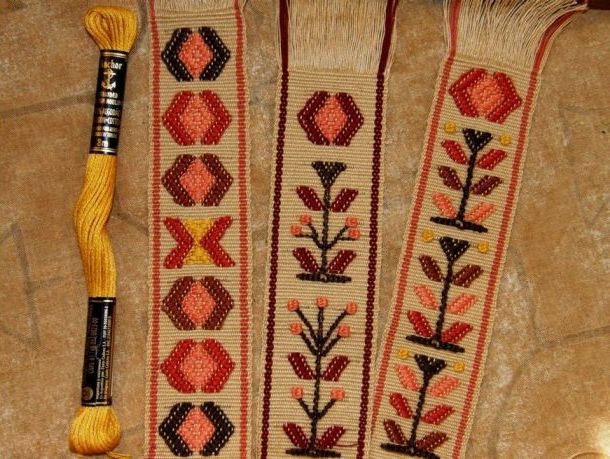
Andean Pebble Weave bands woven by Jane using Omega Sinfonia yarn.

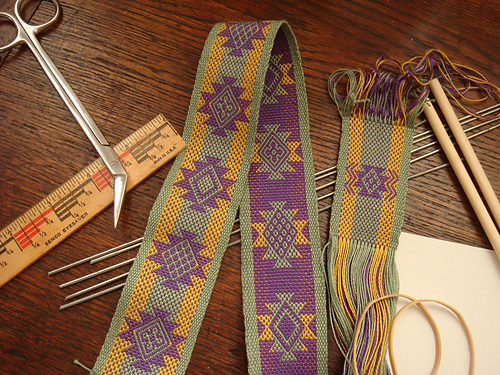
The upper band is an adaptation of a pattern that was woven by Louise Ström using tablets. Many tablet weaving motifs can be easily adapted to the Andean Pebble Weave structure and I have charted some of these in my second book. The lower motif is a doodle I made in the second book where I am showing how people can go about creating their own pebble weave patterns. The hook motifs placed in various diagonal arrangements are, of course, classic Andean patterning.

On the first day at Yonat’s place, I found myself just “hanging out” as my weaving friends wove and planned their projects with increasing independence.

weaving at yonats place

In the afternoon, we did a little “round robin” activity on my prepared warps to brush up on structures and techniques that we seen in other gatherings and help in the decision making and planning process for the next days’ projects…

round robin backstrap weaving

Dorothy's wode project included three columns of Anean Pebble Weave motifs. As she was only able to take two of the three-day workshop, she had to leave with her heddles installed and just a handful of picks in place. As she is heading to Peru to study with tapestry master Maximo Laura this summer, I am wondering when she will find time to sit and finish her project.
Dorothy’s wide project included three columns of Andean Pebble Weave motifs using Tahki Cotton Classic yarn. As she was only able to weave with us for two days, she had to leave with her heddles installed and just a handful of picks in place. As she is heading to Peru to study with tapestry master Maximo Laura this summer which will lead to a whole new world of weaving, I am hoping that she will find time to sit and finish her project soon.
Peggy used Reynold's Saucy yarn (now discontinued) to create a warp for a backstrap . She liked my "Rolls Royce" backstrap...the thick and cushy one and so, chpse a pebble weave motif along with the intermesh structure to produce thick fabric.
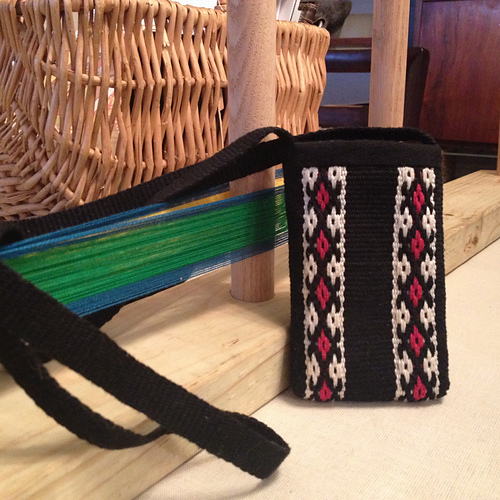
Peggy used Reynold’s Saucy yarn (now discontinued) to create a warp for a backstrap. She liked my “Rolls Royce” backstrap…the thick and cushy one…. and so, chose a pebble weave motif along with the intermesh structure to produce thick fabric. Anne went the other way and used fine thread to make a cell phone pouch. She will use two sets of string heddles to make the process partly loom-controlled and decorate the pouch with an Andean Pebble Weave motif.
Here is Yonat's backstrap warp rolled up at the end of the day with just a couple of inches left to go. Yonat found taht weaving outdoors seated on the ground with her warp angled steeply was much more comfortable for her.
Here is Yonat’s backstrap warp rolled up at the end of the day with just a couple of inches left to go. Yonat found that weaving outdoors seated on the ground with her warp angled steeply was much more comfortable for her.
Barbara's challenge involved weaving her favorite "viscacha" motif in fine thread (Aunt Lydia's #10) and swapping the colors for the motif and background while creating beautifully straight edges.
Barbara’s challenge involved weaving her favorite “viscacha” motif in fine thread (Aunt Lydia’s #10) and swapping the colors for the motif and background while creating beautifully straight edges.

The following day, after having looked at images and watched online videos of the cute Andean viscacha, Barbara brought in a tapestry piece  which had been woven on a backstrap loom in Pitumarca, Peru. She had just realized that the critter at the bottom of the piece was the same as the one which she was weaving into her fine backstrap band.

??????????????????????

When not weaving, there was also lots of fun to be had. Yonat and I looked at experiments that the late Nora Rogers, former member of the Santa Cruz guild,  had been performing on backstrap looms. Here is another kindred spirit and it was amazing and almost eerie to see how closely my backstrap weaving experiments have been following the path of her own carried out years before I came to be involved in this.

Here is Nora's experiment in the white-on-white patterning technique using supplementary weft on a light, open cotton ground cloth. I bought a piece like this at the Santa Fe International Folk Art Market last year in the hope of studying and trying to replicate it myself.
Here is Nora’s experiment in the white-on-white Guatemalan patterning technique using supplementary weft on a light, open cotton ground cloth. I bought a piece like this at the Santa Fe International Folk Art Market last year in the hope of studying and trying to replicate it myself.

And then there were various beauties to be examined created by Yonat’s own hands…from tapestries to handmade beads to Ravenstail twining. I saw one of this set of Ravenstail leggings finished on my last visit. This time I got to see the completed pair….

???????????????????????????????Yonat and I also went to a local store that buys and sells ethnic textiles from around the world. We had a super time digging through loads of pieces to find some special treasures. Some pieces were long and large and required no digging at all….

It seems so long agao now since my friend Lisa sent me a picture of a yurt band she had bought and I becane fascintaed with the simple warp-float technique thathad been used to create it. Here in the store was a gorgeous example in those lovely sun bleached reds and blues that I adore!
It seems so long ago now that my friend Lisa sent me a picture of a yurt band she had bought and I became fascinated with the simple warp-float technique that had been used to create it. Here in the store was a gorgeous example in those lovely sun bleached reds and blues that I adore! This technique produces a pattern of warp-floats on one face and areas of exposed weft on the other.

The warp-substitution technique is another one on which I have spent some time experimenting. We had to resist completely unrolling this band to see how the motifs changed along its enormous length. The designs are crisp on the upper face in warp-faced plain weave. Colors are warped doubled and the weaver simply substitutes one for the other to create the patterns. The unused colored warps float on the reverse side of the textile until they are once again called into use.

???????????????????????????????

Here are three bands from across the globe….from Bhutan patterned with supplementary weft….a three-color double weave belt from Bolivia and a supplemental-warp patterned band from Mexico.

???????????????????????????????

But the jaw-dropper as far as I was concerned was this poncho from Bolivia (see below) patterned with strips of warp-faced double weave. Yonat uncovered this one at the bottom of a pile of mixed textiles on a shelf.

I call this technique “embedded” double weave as the strips of double weave with pick-up patterning are flanked by warp faced plain weave. The yarn is very fine synthetic thread and the weaving was superb! It is a beautifully finished four-selvedged poncho. I know from experience how maddeningly difficult it is to finish a double weave piece with four selvedges and the thread used in this piece does not have the advantage of the springiness of wool which can make the task somewhat less difficult. How I would love to sit by the weaver who created this!!!

???????????????????????????????


???????????????????????????????The visit to Santa Cruz also included a few get-togethers with my dear friend Annie.

If you are a regular reader of this blog, you will know Annie as creator of guitar straps and custom bands and sashes on inkle looms. She gave me the lovely strap, at left, to use on my camera bag.  It is as much fun seeing what wonderful combination of colors she has come up with for her one-of-a-kind pieces as hearing the personal and inspiring stories behind her custom projects.

One of her latest challenges is to create a sash similar to one used by Johnny Depp in the Lone Ranger movie!

I shall leave you here for now. I am in Truckee now and grateful to my friends Suzanne and David for their patience while I bury my head in photo editing and blog writing. I’ll be weaving by the shores of Lake Tahoe in a couple of days and can’t wait to see it!

I shall probably write from Portland, Oregon next with further tales of  the Grass Valley group, the CNCH conference in Oakland and weaving at Lake Tahoe. Bye for now!


Backstrap Weaving – Poncho Envy

I am posting a bit early this week as I will be on the road for the next couple of days making my way to the cold north-east of the US and hoping that the latest dump of snow that DC just had will be the last. It seems like the kind of weather where a poncho would be of good use. What wonderful things are ponchos. I could use one as a blanket, roll it up to make a nice pillow, lay it out and sit on it or just wear it as it was meant to be.

I don’t have any desire to own one here in steamy Santa Cruz but, if my dreams come true and I can one day live in the Blue Mountains just outside Sydney, I think that I could make good use of one there. It even snows there sometimes. The question is, should I weave my own or buy one here in South America?

ponchis1-214x275I am excited about a new book that has recently been published on ponchos of Bolivia. One day before I am due to leave I find out about this treasure. I will have to wait until my return to hunt it down.

This article tells how Oscar Barriga spent 40 years collecting and studying over 250 ponchos in Bolivia.

He sold his collection to a museum in La Paz and has written a book which includes information he has gathered on their symbols, messages and their religious, civil and military roles. Barriga says that the poncho does not have any one country of origin.

I have certainly seen varieties of this item of clothing in the highland, lowland and low valley areas in the South American countries in which I have traveled. My friend Kathie, who works with weavers in the tropical lowland coastal areas of Ecuador, took the most wonderful picture of one of the gentleman there on horseback wearing a handwoven cotton poncho.

ponchos 1I was lucky to have been able to attend a talk on ponchos and rebozos given by Anne Rowe at the Textile Museum in DC some years ago. I am looking at my scribbled notes from the lecture in which I have written that poncho-type clothing  existed in the pre-hispanic times but the poncho, as we know it, was popularized by the Mapuche of central Chile and Argentina. The earliest known image of one dates back to 1648. The Mapuche people wove ponchos for themselves but also to sell. During the Conquest they adopted Spanish customs including riding horses. Ponchos proved to be very useful for this activity.

An image from the 1730s that we were shown during the lecture shows a Spaniard wearing a poncho while watercolors from Peru in the 1780s depict both Spanish and indigenous horsemen and musicians wearing them. During the War of Independence in the early 1800s ponchos were worn by Generals to indicate that they were South American and not Spanish. Some of the designs were Spanish-like while others were more Mapuche-like.

mapuche-ikat-2The black and white ikat ponchos woven by the Mapuche people are worn by those who hold positions of great power and prestige. I imagine that they are quite a weight to carry around as I was able to feel the rather thick and coarsely spun wool in the example in progress above.

It was wonderful to see and touch the incredibly fine vicuña ponchos that were brought from Belen, Catamarca in Argentina to the Encuentro de Tejedores in Cusco in 2012.

poncho-of-catamarca-argentinaThe handspun vicuña fiber has to be carefully selected to find tones of equal value for each piece. The ponchos are woven on floor looms and the fabric measures 2 meters by 1.30 meters and weighs only 320gms.Two people swing the beater and they need to make sure that they beat with exactly the same amount of pressure on this fine, light fabric.

An image on Facebook from this page shows a stunning poncho being made in Londres, Catamarca on a floor loom. This Facebook page shows other beautiful examples of Graciela Salvatierra’s work.

1463897_479549392162132_910966833_nThe Salasaca family with whom I stayed in Ecuador had their son dress up in the typical poncho that he would use for special occasions for a photo. I like this simple black wool poncho. Juan would otherwise be dressed in jeans and tshirt. The Salasaca ladies, on the other hand, wear their traditional outfits every day although they have other “everyday” hats that they use rather than the rock hard ones that you see in the picture.

salasacan-ponchoI managed to sneak a snap of a Cañari gentleman in Ecuador out in his Sunday best ikat-patterned poncho in the town plaza.

canar-poncho-and-beltsMantas and chamantos are made by weavers in the town of Doñihue, Chile and worn by the Chilean horsemen known as huasos. They are silky smooth and tightly woven. It is easy to believe that they could be virtually water proof.

mantaI imagine that the striped mantas provide an more economical alternative to the pick-up patterned chamantos, like the one below, which I am told sell for up to $3000 each.

chamanto

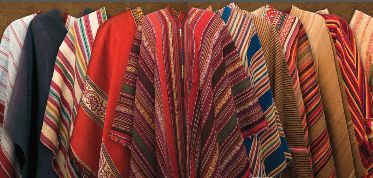
I love simple striped ponchos….so elegant. You will see that many of the examples in the picture from Barriga’s book above are patterned with stripes in  wonderful arrangements of widths and colors. The weavers of Tarabuco in Bolivia create cloth covered with tiny intricate figures which the women use for overskirts and bags in which to carry their coca leaves. However, the cloth that they weave for the men’s ponchos is beautifully simple…(you can see the pick-up patterned cloth in the background.)

Trabuco ponchoAnd of course, there is nothing wrong with a poncho that has been covered with pick-up patterning. Men in the Peruvian community of Chahuaytire in the Cusco region of Peru weave their own cloth for ponchos decorating them with motifs using supplementary warps.

chahuaytire ponchisThe more I read about Oscar Barriga’s book the more I want it but at the same time, the more I am convinced that its price tag will be very high. In fact, it is not clear to me whether the book will even be made available to the public. A more affordable option, if you would like to know more about ponchos in South America, is this book which was published in Argentina  and is available in English…..

??????????????????????In the meantime, I will think about my poncho and how I would lke to weave it. Yes, while writing this post I have decided that I should weave my own…one of these days. I have many hours of airport waits and bus rides coming up in the next few months in which I can sketch some ideas. 


Backstrap Weaving – A Change of Seasons

The change of seasons is barely noticeable here in Santa Cruz. There is a drop of perhaps a few degrees of temperature between summer and fall but nothing else here tells me that fall is on the way. That isn’t happening today as we rapidly make our way up to 30 degrees centigrade. I remember when I was teaching English here, the text books would use the classic pictures to represent the four seasons….snow, sun and beach, falling leaves and spring flowers….somewhat like the motifs I used on my Four Seasons ticlla piece. They meant nothing to my students. They found it especially hard to grasp that fall would be the “opposite” season to spring in the northern hemisphere. I couldn’t blame them.

discontinuous warp ticlla closing the gapAs my departure date for my US trip draws nearer, I am wondering if anything in the northeast is telling people that spring is on the way. Please, say “yes”! My friend in Massachusetts told me to bring boots presumably for stomping about in snow. I don’t own a pair! So, I am just about ready to do some kind of dance in order to try and will that northern winter away and bring on the spring.

Maybe I should fill this post with lots of spring imagery and put a springy vibe out into the universe instead. A change of season and cooler temperatures would be apprecited down here. Okay, so here goes…

Leaves could represent the new growth of spring or the dying leaves of fall…either way, a change of season.

I suppose that blue leaves could be either!

circular warp backstrap

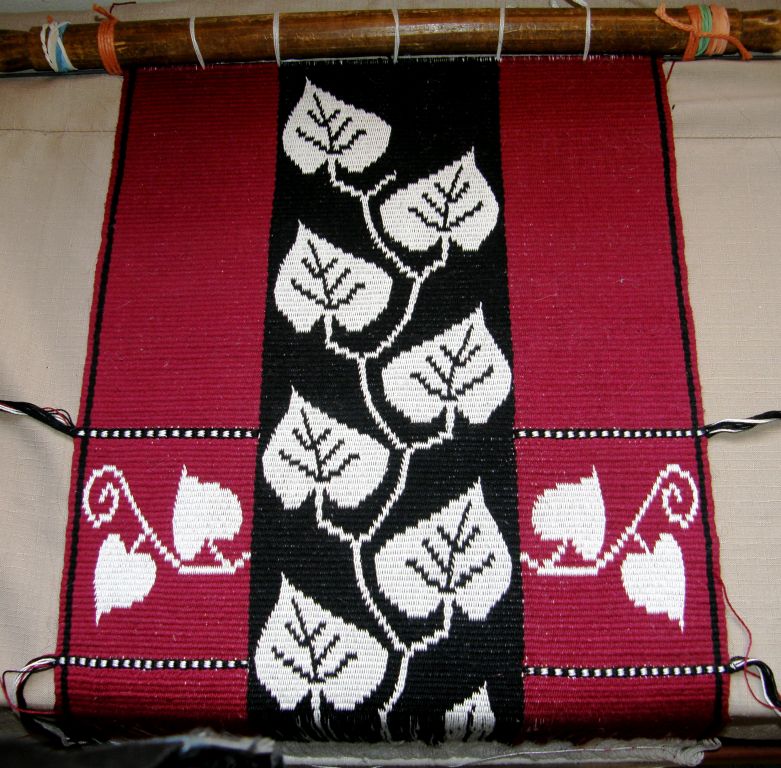
chamanto piece on progressThe leaves on my wall hanging, which were inspired by the chamantos woven in central Chile, are rather spring-like or even summery, I think. The motifs woven into the chamantos represent the agriculture and horse culture of that Chilean region. They are covered in patterns such as wheat stalks, flowers, horse hooves, grapes and vine leaves.

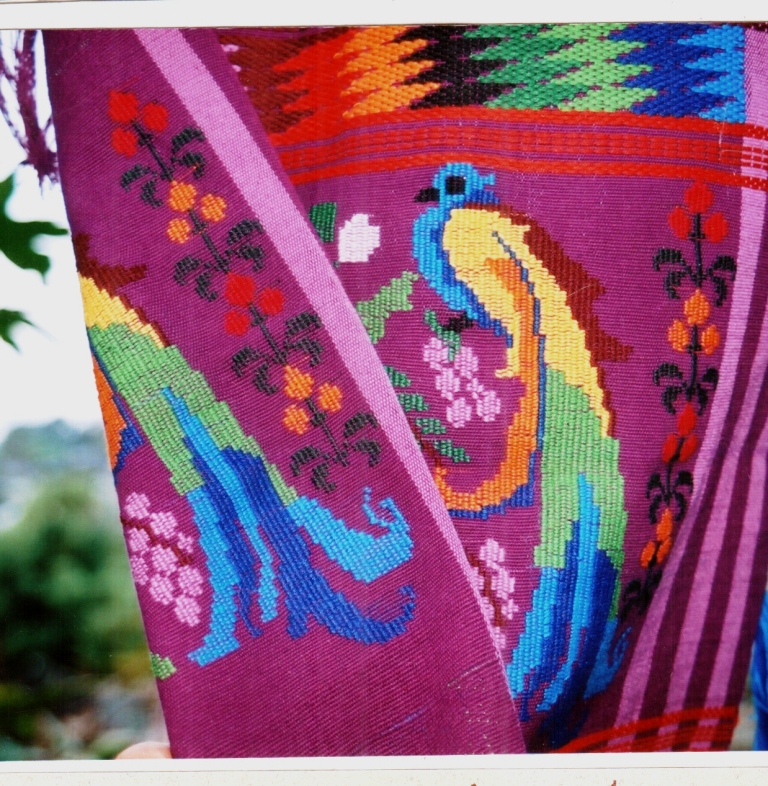
There is nothing cold or wintery about Guatemalan textiles with their flower and bird motifs in bright colors…                                                            double-faced

My Guatemalan teacher with whom I worked on the piece pictured below, taught me to just dip my hand into the basket of threads, pull out a color and go with it. You can see the rows of plants with their happy multi-colored leaves…

Guatemalan supplementary weft patterning

Those little plants and flowers are always fun to weave with supplementary weft even if my color choices once I was back home on my own were a lot more planned and conservative…

suppweft-tree-bookmarks

Crocheted hats and hat bands produced in the highlands, an area which can be quite colorless and bleak at times, provide a splash of colorful flowers and birds….

chullo-and-hatband

OLYMPUS DIGITAL CAMERAThe flowers on the hatband from Calcha, Bolivia inspired the design on the fourth of my red, black and white wall hangings…

???????????????????????????????

The Guaraní weavers who live in the eastern lowlands of Bolivia may not always use bright colors but their work certainly shows the rich plant and bird life of this region….nothing wintery about this…

Guarani Moisy technique

The above pieces were woven using what the Guaraní weaves call the moisy structure. They also use the kara pepo structure which we know as pebble weave.

Julia, from the Ravelry group has been weaving a piece for her guild’s color challenge. She is weaving Guaraní star motifs in pebble weave. It is always exciting or me to see people using the charts in my books. These star patterns are charted in my second book and the outline is a traditional Guarani pattern.. The basic star outline has its center filled with different shapes and it is an interesting exercise in designing to explore how many different kinds of “fillers” you can come up with for the space in the center of the stars. The Guaraní repertoire of star patterns is fairly small. While the patterns they weave using the moisy structure seem unlimited, the star is one of only very few motifs that they weave using the kara pepo structure. I came up with quite a few filler patterns for  the star for my book and Julia, of course, has been very creative in  inventing some of her own.

DSC04397_medium

Santa Cruz crochet cottonMy Guaraní teacher, Angela, buys the same Brazilian Clea brand thread as I do for her weaving. It was shocking seeing how suddenly and how quickly the price of this cotton went up as it did all over the world and sad knowing how it would effect the weavers and their ability to buy thread.

I am sure that they must be as happy as I am to find that cotton crochet thread is now being produced by TextiCruz here in Santa Cruz. While Santa Cruz used to be a major cotton producing region, cotton hasn’t been grown here for a long long time. I have no idea from where the raw material is coming. But, whatever the source, they are able to sell the finished product much more cheaply than the Brazilian thread!

“Camba” is the nickname for people from Santa Cruz and the label shows the sombrero de sao, straw hat, which is part of the typical festival costume for this area. I bought one ball to try out. You can see it here among a chaos of sample bands that I am gathering for my trip. I am  little suspicious about the color fastness. It sounds terrible but I have  to say that things produced here tend to be of inferior quality. They are well presented but you only have to scratch the surface and…..It is wise to be suspicious of something that seems too good to be true. That goes for everywhere, right? I notice that the label has the typical words of advice on buying from one dye lot to complete a project, yet there is no dye lot number to be seen anywhere.

Let me briefly slip back into the somber tones of winter as I would like to show you my progress on the squiggly Shipibo- inspired wall hanging panel. I would like to thank those who commented last week with words of encouragement. This week’s work on this included four hours of unweaving and re-weaving. I had forgotten to start one of the squiggles and I mistakenly thought that it wouldn’t matter so much. I was wrong. There was a large gaping hole of black space that I simply couldn’t live with. Four hours later I was back to where I had left off but much happier for it!

shipibo wall hanging panelWhen I was at the Encuentro de Tejedores in Cusco in 2012, a presentation was given on Shipibo art. We were told that parts of the patterns the Shipibo people paint and embroider represent their borders and rivers. One of the few times that I flew over Brazil in daylight on my way to Miami and could enjoy the view over the Amazon jungle from a cloudless sky, the 

jalq'a weavingrivers below looked very much like the squiggles I am weaving. I tried to guess which one of the squiggles might be the Amazon itself until I was completely blown away by the massive body of brown water that appeared and curved its way off to the horizon.

I have always been in complete awe of the weaving of the Jalq’a people of Potolo, Bolivia (at left). A complex mass of figures fills just about every space on the cloth. There is no break….no plain weave with which to relax between the concentration of pick-up patterning….a few rows to sit back and just open sheds, beat and pass weft…no, none of that.  While halfway through one motif, the weaver is finishing another nearby and starting the next.  Small motifs are even woven within larger ones. Plus there are warp floats to consider. The weaver must ensure that she ties down each and every one of the threads at just the right moment before the floats become too long. And  pattern charts, of course are not used. It’s mind boggling.

Although I am not weaving a warp-float structure and my patterning, therefore, is much easier, my current weaving with its squiggles starting and stopping and turning this way and that has given me an even greater appreciation of the work of the Jalq’a people. I have to remember to start the next squiggle while in the midst of one and finishing another.

Let me return to something bright and spring-like to finish this post and blow away the winter blues…

PAZA bands Cochabamba BoliviaHere are some of the beautiful bands woven with naturally-dyed handspun yarn from PAZA in Cochabamba. Cochabamba city is one of many I have come across in my travels in South America that is named a city of “primavera eterna”…eternal spring.

See you next week!

Backstrap Weaving – Color fom the Cochabamba “campo”

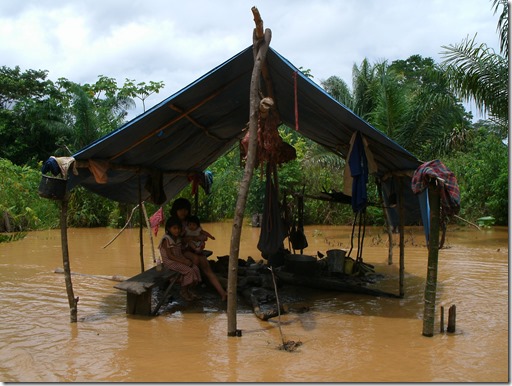
The big rains have more or less stopped here in Santa Cruz. We get a shower about twice a day. Each one has has me holding my breath. The outer wall of my bedroom has been hacked out so that it can dry out  and then be filled and repaired and made watertight, we hope. The huge wooden wall unit in my bedroom had one side on the point of collapse when the water soaked through. Now it is being supported by my large weaving sticks. Whine , whine, whine… a picture like this from this blog soon makes you stop. Such is the situation in the province of Beni in Bolivia. No walls at all and  sticks support the roof.

AguaYaku

I heard from my friend Dorinda up in the highlands in the province of Cochabamba, another of the effected areas, but she did not mention the rains and I am guessing that they are okay. Dorinda had written to let me know that she had mailed the box of woven bands that I had ordered from the weaving cooperative that my teacher Maxima heads. Dorinda blogs about her work with Maxima and the weavers of Huancarani at PAZA Bolivia.

Exciting! As the post office box I use is in someone else’s name, I had to be patient and wait for my treasure to be picked up.

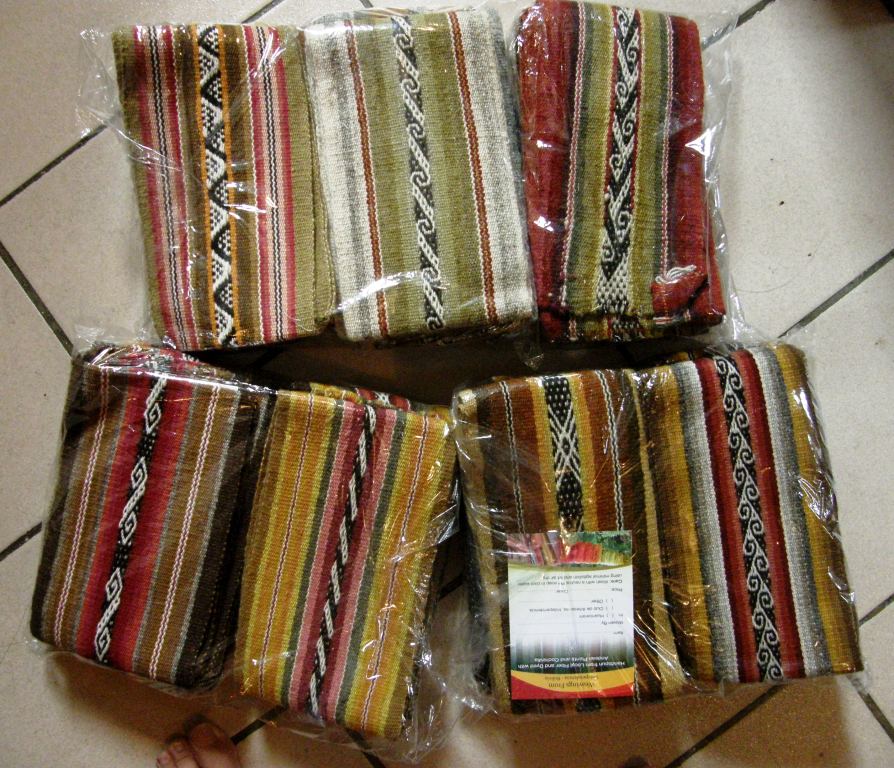
packagedbands from CochabambaMy home is a disaster of warps, yarn and sticks right now. I really had to resist opening the packages straight away, unfolding the luscious bands, and laying them out to view on every available space. Dorinda included a list of the weavers and each band is tagged with the weaver’s name. She also sent me a document with a short story on each of the ladies. It so nice to handle one of the bands, look at the picture of the weaver and read her story.

Cochabamba bands in boxOnce I had put things in order, two days later, I opened the packages and  released all those lovely aromas of wool, dyestuffs, and “campo”.

I like to feel the cloth. The yarn is the weavers’ own handspun, most often made with fleece from their own flocks. The colors are all natural and were created from cochineal and local plants.

Which weaver would be considered the best amongst her peers, I wonder. Whose cloth is the stiffest? This seems to be one of the things that the weavers themselves appreciate. I wonder which pattern they would consider the most complex. What different effects did they achieve in their use of warp and weft colors? Who matched the weft color to the edge color and who used a contrast color to create attractive little dots along the edge? Whose color combination was vastly different to everyone else’s?

Did they all get together and decide not to duplicate the patterns or was that just a happy coincidence? Were any made by the teenagers who are still in training?

Without unfolding them, I picked out two which I considered my favorites. I was happy to see that one of the two had been woven my Maxima. I wondered if I had simply recognized her style.

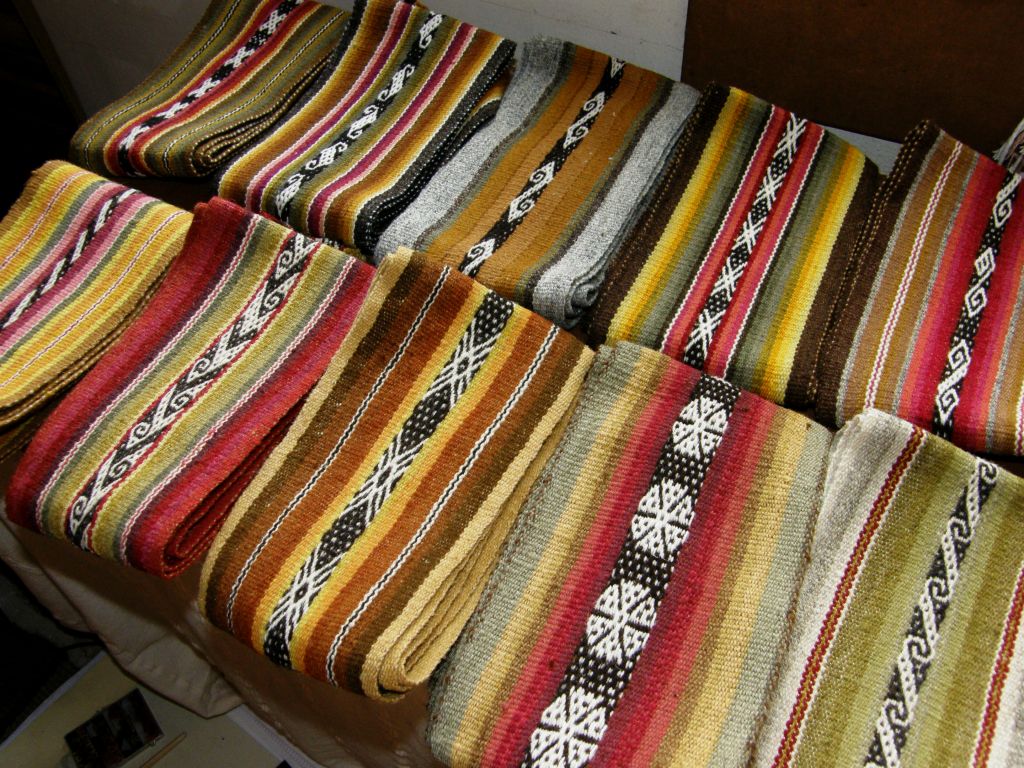
Fifteen different weavers had made the bands with no repetition of color arrangement and just two patterns duplicated. The width of the stripes of color ,and the narrow strips of threaded-in pattern that sometimes separate them, was in a form that was often repeated and could be characteristic of certain communities or even families.

???????????????????????????????Seventeen bands were patterned with complementary-warp designs and three used a supplementary-warp structure.

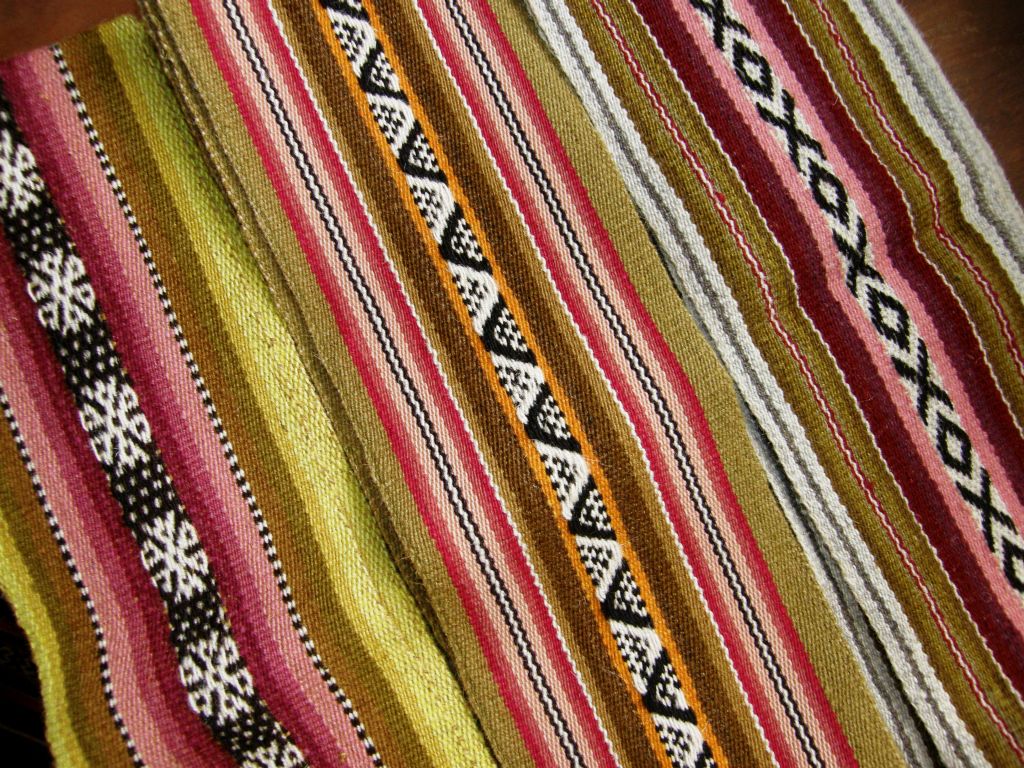
The weavers used a complementary-warp structure to create the patterns on these bands.
One of the bands with pattern created with supplementary warps is on the right.
The band on the right is one of those which was patterned with supplementary warps.

The second of the two bands that I had picked out as favorites was made by Narciza, Maxima’s older sister. I just love Narciza’s color combinations. Below you can see her adding a tubular border to one of her woven pieces. As is done in Peru, she uses a forked stick to hold the cross for this particular type of patterned tubular band. Strangely, younger sister Maxima never learned to weave this kind of tubular band with its distinctive eye pattern and only recently learned it at the Tinkuy in Cusco last year.

Narciza Cortez

DioniciaDionicia Crespo is the oldest weaver in Hauncarani still weaving to sell at 82 years old!

Of course, her fading eyesight plays a role in the straightness of her edges, Dorinda tells me.

She doesn’t have glasses. Somebody told me the women are embarrassed to try out reading glasses because glasses are associated with education and the Huancarani weavers are illiterate (Dorinda)

Her edges look good to me!

You can see her at left preparing her frame for warping.

???????????????????????????????

advianaBands that represent three stages of life….you can see 82-year old  Dionicia’s band above on the left. A piece by Vilma, Maxima’s eldest daughter, is in the middle and the band created by the youngest weaver of this collection of bands, 18-year old Adviana, is on the right.

Dorinda tells me that Adviana is one of the few of the younger generation who has learned how to weave. 

When she began weaving to sell through PAZA she relied on her grandmother´s assistance, but now weaves on her own. (Dorinda)

???????????????????????????????Family traits? The band on the left is Maxima’s, daughter Vilma’s is in the middle and older sister Narciza’s is on the right.

Mxima demonstrating at Tinkuy 2013 and daughter Vilma collecting flowers for the dyepot.
Maxima demonstrating at Tinkuy 2013 and daughter Vilma collecting flowers for the dyepot.

A couple more pictures to finish before I put the bands back in their box….

Cochabamba bands 1

Cochabamba bands 2Enough color? Let me calm things down a bit now with some black and white.

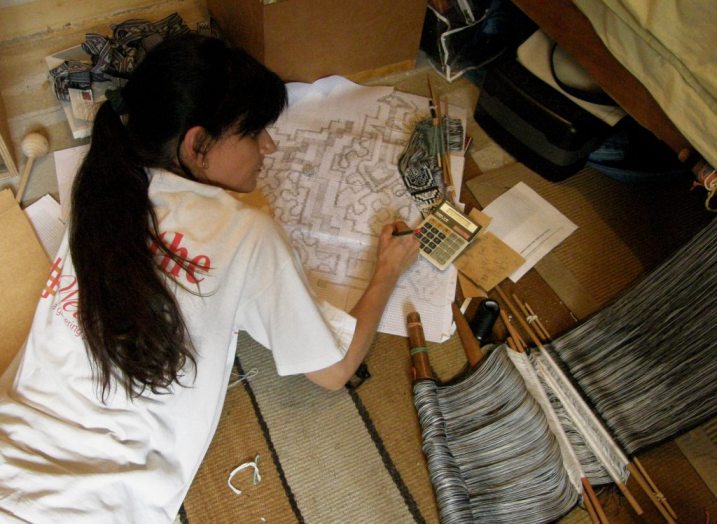
A question was asked in one of the forums this week about what kind of weaving software people use. There are still quite a lot of good old fashioned paper-and-pencil people around amongst those who were excitedly discussing all the ins and outs of the various available programs.

charting for backstrap weaving

black panel for all hanging backstrap weavingMe? I am a paper-and-pencil gal. That’s the new panel for the wall hanging over which I have been dithering. I love charting this way. It makes me feel like a kid again and it is very relaxing. While a young fellow dangled from a cage outside my window and hacked away at my wall, I calmy colored in cells on my graph paper. Prior to that, I had just as calmly sat and  made four sets of string heddles of 353 ends each on that black and white cotton warp.

If you are thinking that that is a weird-looking pattern, you are right! I really have no idea what this will end up looking like even after sampling! I just need to dive in and do it. I fussed over it more than usual….measuring, shifting things about, uncrossing warps, measuring again and finally got the first weft shot in. That always feels good. I am weaving this in double weave. It is embedded double weave as there is a very narrow plain-weave border on either side.

???????????????????????????????I finished the silk bookmark that was part of the Ravelry event but I am calling it a sample for now. There are several things about it with which I am not pleased and, as I have plenty of warp left, I will start it again with improvements.

The silk is lovely to work with! Using the four sets of string heddles and a pick-up stick I never have to actually touch the threads. I worked with this same silk as supplementary weft last summer and it was horrid to handle with sweaty hands.

The bookmark is light and supple…just the right thickness to slip between pages. I am pleased with all that. Now to fix that other stuff that I don’t like as much.

While on the subject of double weave, Scott has allowed me to show pictures that he posted of his double-weave sample band. He is studying the one-weft version from my tutorial here and has done a really good job.

scott double weaveRavelry projects have been coming in as we approach the end of the Sochi Games…

kim's bagKim finished her piece and sewed int a small bag for which she also wove a strap. Now she is on the lookout for a button to close it.

joyful and juliaJoyful has been converting her flowere doodles into patterns using embroidery floss as supplementary weft on her plain-weave band. Julia will use purple cloth with her finished piece along with her sewing talents to create something useful.

Another week comes to a close.  I try and mix it up…a little warping, a little charting, a little weaving for myself. I hope to make some good progress on the wall hanging this coming week.

Bye for now.