I am posting a bit early this week as I will be on the road for the next couple of days making my way to the cold north-east of the US and hoping that the latest dump of snow that DC just had will be the last. It seems like the kind of weather where a poncho would be of good use. What wonderful things are ponchos. I could use one as a blanket, roll it up to make a nice pillow, lay it out and sit on it or just wear it as it was meant to be.
I don’t have any desire to own one here in steamy Santa Cruz but, if my dreams come true and I can one day live in the Blue Mountains just outside Sydney, I think that I could make good use of one there. It even snows there sometimes. The question is, should I weave my own or buy one here in South America?
I am excited about a new book that has recently been published on ponchos of Bolivia. One day before I am due to leave I find out about this treasure. I will have to wait until my return to hunt it down.
This articletells how Oscar Barriga spent 40 years collecting and studying over 250 ponchos in Bolivia.
He sold his collection to a museum in La Paz and has written a book which includes information he has gathered ontheir symbols, messages and their religious, civil and military roles. Barriga says that the poncho does not have any one country of origin.
I have certainly seen varieties of this item of clothing in the highland, lowland and low valley areas in the South American countries in which I have traveled. My friend Kathie, who works with weavers in the tropical lowland coastal areas of Ecuador, took the most wonderful picture of one of the gentleman there on horseback wearing a handwoven cotton poncho.
I was lucky to have been able to attend a talk on ponchos and rebozos given by Anne Rowe at the Textile Museum in DC some years ago. I am looking at my scribbled notes from the lecture in which I have written that poncho-type clothing existed in the pre-hispanic times but the poncho, as we know it, was popularized by the Mapuche of central Chile and Argentina. The earliest known image of one dates back to 1648. The Mapuche people wove ponchos for themselves but also to sell. During the Conquest they adopted Spanish customs including riding horses. Ponchos proved to be very useful for this activity.
An image from the 1730s that we were shown during the lecture shows a Spaniard wearing a poncho while watercolors from Peru in the 1780s depict both Spanish and indigenous horsemen and musicians wearing them. During the War of Independence in the early 1800s ponchos were worn by Generals to indicate that they were South American and not Spanish. Some of the designs were Spanish-like while others were more Mapuche-like.
The black and white ikat ponchos woven by the Mapuche people are worn by those who hold positions of great power and prestige. I imagine that they are quite a weight to carry around as I was able to feel the rather thick and coarsely spun wool in the example in progress above.
It was wonderful to see and touch the incredibly fine vicuña ponchos that were brought from Belen, Catamarca in Argentina to the Encuentro de Tejedores in Cusco in 2012.
The handspun vicuña fiber has to be carefully selected to find tones of equal value for each piece. The ponchos are woven on floor looms and the fabric measures 2 meters by 1.30 meters and weighs only 320gms.Two people swing the beater and they need to make sure that they beat with exactly the same amount of pressure on this fine, light fabric.
An image on Facebook fromthis pageshows a stunning poncho being made in Londres, Catamarca on a floor loom. This Facebook page shows other beautiful examples of Graciela Salvatierra’s work.
The Salasaca family with whom I stayed in Ecuador had their son dress up in the typical poncho that he would use for special occasions for a photo. I like this simple black wool poncho. Juan would otherwise be dressed in jeans and tshirt. The Salasaca ladies, on the other hand, wear their traditional outfits every day although they have other “everyday” hats that they use rather than the rock hard ones that you see in the picture.
I managed to sneak a snap of a Cañari gentleman in Ecuador out in his Sunday best ikat-patterned poncho in the town plaza.
Mantas and chamantos are made by weavers in the town of Doñihue, Chile and worn by the Chilean horsemen known as huasos. They are silky smooth and tightly woven. It is easy to believe that they could be virtually water proof.
I imagine that the striped mantas provide an more economical alternative to the pick-up patterned chamantos, like the one below, which I am told sell for up to $3000 each.
I love simple striped ponchos….so elegant. You will see that many of the examples in the picture from Barriga’s book above are patterned with stripes in wonderful arrangements of widths and colors. The weavers of Tarabuco in Bolivia create cloth covered with tiny intricate figures which the women use for overskirts and bags in which to carry their coca leaves. However, the cloth that they weave for the men’s ponchos is beautifully simple…(you can see the pick-up patterned cloth in the background.)
And of course, there is nothing wrong with a poncho that has been covered with pick-up patterning. Men in the Peruvian community of Chahuaytire in the Cusco region of Peru weave their own cloth for ponchos decorating them with motifs using supplementary warps.
The more I read about Oscar Barriga’s book the more I want it but at the same time, the more I am convinced that its price tag will be very high. In fact, it is not clear to me whether the book will even be made available to the public. A more affordable option, if you would like to know more about ponchos in South America, is this book which was published in Argentina and is available in English…..
In the meantime, I will think about my poncho and how I would lke to weave it. Yes, while writing this post I have decided that I should weave my own…one of these days. I have many hours of airport waits and bus rides coming up in the next few months in which I can sketch some ideas.
HOME! While I am settling into my visit to my “other home” here in Australia, I would like to share with you three cool websites I found while on my US trip.
1. PROJECT GUTENBERG: Perhaps I am one of only a few people who knew nothing about the Project Gutenberg site and its thousands of free e-books. It seems that everyone I excitedly tell about it discovered it a long time ago. I ran across it while looking for a used copy of Silas Marner to buy. There it was free to enjoy as part of the Gutenberg Project.
As is The Wind in the Willows andthat was meaningful to me because…
On my final night in the US I spent time with a weaver friend who had a copy of The Wind in the Willows from which she has been reading aloud each evening. I was reminded of the part about HOME that had touched me deeply even as an eight-year old child reading the book for the first time. It seemed so appropriate to re-read that part as my US trip ended and my thoughts turned to the home in Australia that I hadn’t seen for four years (a collection of people, memories and experiences rather than a structure) and the one I had left twenty years ago to venture to South America. I faced the trip with very mixed emotions as my mother, my “anchor”, had died in September.
I wanted a copy of the book so I could sit quietly on my own and read the passages about home. And then Ruth wrote to me later to tell me that The Wind in the Willows too could be enjoyed for free via the Gutenberg Project site.
I’ll quote the part about home here. All you travelers out there will surely have felt like this at some point.
From “The Wind in the Willows” by Kenneth Grahame:
Home! That was what they meant, those caressing appeals, those soft touches wafted through the air, those invisible little hands pulling and tugging, all one way! Why, it must be quite close by him at that moment, his old home that he had hurriedly forsaken and never sought again, that day when he first found the river! And now it was sending out its scouts and its messengers to capture him and bring him in. Since his escape on that bright morning he had hardly given it a thought, so absorbed had he been in his new life, in all its pleasures, its surprises, its fresh and captivating experiences. Now, with a rush of old memories, how clearly it stood up before him, in the darkness! Shabby indeed, and small and poorly furnished, and yet his, the home he had made for himself, the home he had been so happy to get back to after his day’s work. And the home had been happy with him, too, evidently, and was missing him, and wanted him back, and was telling him so, through his nose, sorrowfully, reproachfully, but with no bitterness or anger; only with plaintive reminder that it was there, and wanted him.
The call was clear, the summons was plain. He must obey it instantly, and go.
……………………………………………………………………………………………………..
The weary Mole………soon had his head on his pillow, in great joy and contentment. But ere he closed his eyes he let them wander round his old room, mellow in the glow of the firelight that played or rested on familiar and friendly things which had long been unconsciously a part of him, and now smilingly received him back, without rancour…..
…….He saw clearly how plain and simple— how narrow, even— it all was; but clearly, too, how much it all meant to him, and the special value of some such anchorage in one’s existence. He did not at all want to abandon the new life and its splendid spaces, to turn his back on sun and air and all they offered him and creep home and stay there; the upper world was all too strong, it called to him still, even down there, and he knew he must return to the larger stage. But it was good to think he had this to come back to; this place which was all his own, these things which were so glad to see him again and could always be counted upon for the same simple welcome.
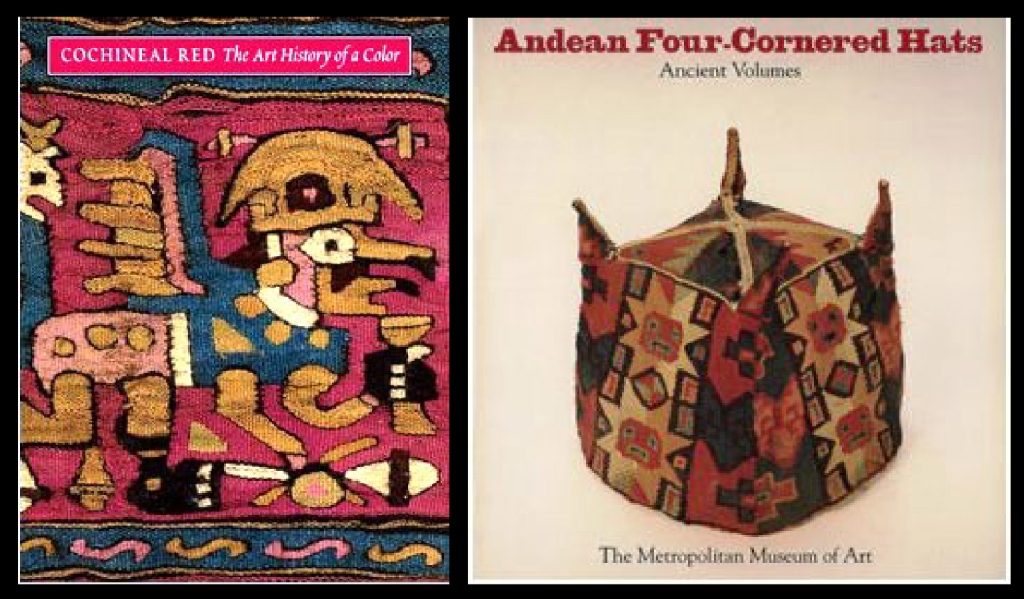
On to the next cool website….2.THE METROPOLITAN MUSEUM of ART’S PUBLICATIONS PAGE…..Many thanks to Kathleen for telling me about this site which has five decades of Met publications on art history, available to read, download, and/or search for free!!! Kathleen had downloaded and was enjoying a book on African textiles. There are hundreds of titles.
Images byInstituto de Lengua y Cultura Aymara, ILCA, La Paz Bolivia
The Weaving Communities of Practice website is the result of a project funded by the Arts and Humanities Research Council . The project focuses on textiles, culture and identity in the Andes.
I was happy to see that Elvira Espejo, pictured at left, worked on this project as the ILCA’s Textile Expert. I got to meet Elvira at the Encuentro de Tejedores de las Americas in Cusco last year where she was presenting the books she wrote with British anthropologist Denise Arnold: Ciencia de Tejer en los Andes:estructuras y tecnicas de faz de urdimbreand Ciencia de las Mujeres: Experiencias en la cadena textile desde los ayllus de Challapata.
Amongst other things, the site contains video segments of various aspects of backstrap weaving which accompany information about the stages of learning for young weavers-in-training in the Quechua and Aymara cultures. I have only just begun exploring the site and have barely scratched the surface. It is an amazing resource and there we have it at our finger tips,
Image by ILCA La Paz, Bolivia
From the site’s front page…..
The project is based at the Centre for Iberian and Latin American Visual Studies (CILAVS) and the Department of Computer Science and Information Systems at Birkbeck, University of London, with the Instituto de Lengua y Cultura Aymara (ILCA), in La Paz, Bolivia, in partnership with museums in the UK, Bolivia, Peru and Chile.
The principal feature of this website is a database of Andean textiles. There is also a detailed guide to processes of textile manufacture, including images and video clips of techniques, instruments and structures; a glossary of textile-related terms in English, Spanish and Andean languages; an introduction to textile heritage; and bibliography.
And so the sun sank on my final days in Santa Cruz, California. It was time to follow those birds west across the Pacific Ocean to Australia. Time to think back on the six weeks that had passed and “all its pleasures, its surprises, its fresh and captivating experiences” many of which I have already reported here on this blog.
One such captivating experience…Annie and I got to visit with Joy Totah Hilden, author of Bedouin Weaving of Saudi Arabia and its Neighbours, in her home in California.
It was a thrill to be able to meet Joy and sit on the sofa amongst the richly patterned pillows and beneath that enormous woven tent divider listening to her stories.
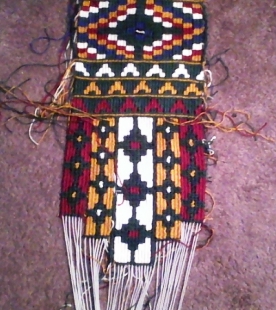
Then we got to touch and examine the textiles that I had been admiring online on her website and in her book…textiles that had inspired me on several occasions to weave pieces of my own (at left) using the traditional Bedouin colors and patterning techniques.
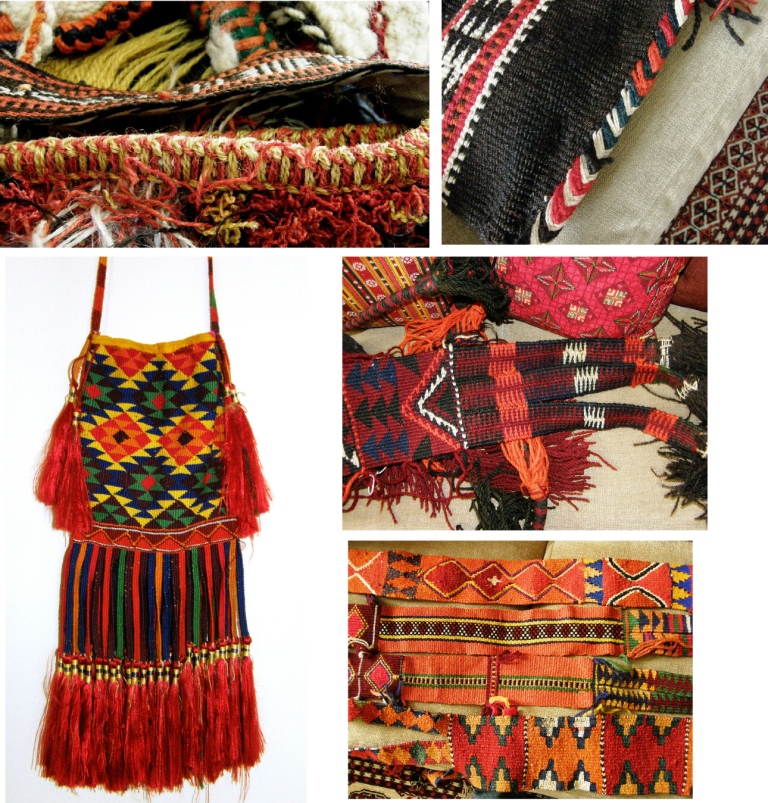
Camel adornments and all kinds of bags decorated the walls of her home. Many more treasures were carefully stored away and Joy was happy to unpack and bring many of them out one by one to show us.
Twining, weaving, braiding, wrapping, stitching…all sorts of bands and tassels and ineresting edgings….colors!!!….heaven! It was particularly interesting for me to be able to examine the pieces from Oman where the weavers cleverly use a second weft to tie down the long floats that are typically created by the warp substitution technique on the back side of the fabric. Having experimented with this with the guidance of images of Omani textiles that Tracy Hudson had provided, it was a wonderful opportunity to at last be able to examine the textiles themselves.
Happy with Annie MacHale and Joy Hilden surrounded by gorgeous textiles.
Moving on….Here are some of the books and publications that I picked up on this trip…
I had my issues of the Complex Weavers Journal all delivered at once so that I could take them back to Bolivia with me.
Bue Eye/Prayer Flags by Miryam-Chavah
After searching online many times over the last years for a reasonably-priced copy of the out-of-print Soumak Workbook, I finally found one and snapped it up. I have been admiring the creations of Julia Miryam-Chavah online, many of which have been done using the soumak technique. She has often named the Soumak Workbook as a resource and so, I am excited to have been able to get a copy.
I got the One Needle, One Thread book from Pam Nadjowski at Textile Treasures in Santa Fe NM when I was there in July but left it behind at my friend DY’s house by mistake. Now that I finally have it in my hands, I will be able to read about some of the wealth of braiding and embroidery techniques used in Chinese textiles that this book covers and maybe incorporate some in my work.
And, finally and surprisingly , I managed to get a copy of Faces of Tradition: Weaving Elders of the Andes by Nilda Callañaupa and Christine Franquemont. The book details interviews conducted with elders from various communities in the Cusco region of Peru. The importance and urgency of this project is underlined by the fact that some of the elders that were interviewed died before the book could be published. And before I could even open the book’s cover I was shocked and saddened to learn of the very recent death of Christine Franquemont in Cusco.
My last days in the US were spent in Santa Cruz, California with some weaving friends. Here are some of the ladies working on decorating their plain-weave bands with supplementary wefts….
This is my fifth visit to Martha’s studio and, as usual, we were dazzled by the interesting pieces in Martha’s collection that she would bring out to share with us….
This double-pocket saddle bag, made from what I am guessing is agave fiber, was collected somewhere in Latin America and given to Martha many years ago. It has an interesting combination of weaving, braiding and sprang work. The sprang and braid work has created a springy, stretchy and open area that would lie over the back of the pack animal. It contrasts with the stiff and rigid nature of the woven pockets. I have not seen anything like this in my travels in South America and I would love to know its place of origin.
I loved the simplicity of the discontinuous-warp piece that Janette brought to show with its combination of natural and dyed colors. The join where the two colors dovetail, seen on the right, was so incredibly smooth.
My final night in the US had me dozing in San Francisco airport beneath stunning woven tapestries which were designed by local artist Mark Adams. These had apparently been stored away for a couple of decades shortly after their creation in the early 80’s and are now on display behind glass. It was a peaceful place to spend the night before my early morning flight to Los Angeles and so unlike many other airports where I have spent the night slumped outside Dunkin’ Donuts!.
Meanwhile, news of backstrap woven projects arrived in my inbox…
Fr Kyriakos and Lausanne sent me pictures of their backstrap weaving pursuits. Fr Kyriakos has a pebble weave pattern in progress and he started his band with a nice bit of weft twining. Lausanne shows how she has set up a comfortable way to weave in her home while still giving attention to her furry companion.
Here is a silk ribbon with pebble weave patterns that Lausanne made for her husband.
Noreen Horak sent me a picture of bands she wove on her inkle loom using a variety of patterning techniques. The darkest one is a sampler of pebble weave patterns that are charted in my first book.
Rosemary Thomas shows that backstrap weaving isn’t only about warp-faced structures.
Joanne’s band is also a nice sampler of the various 4-rev designs that are charted in the Andean Pebble Weave book and shows her experiments with using two and three colors in her designs.
And to finish, I would like to tell you about my friend Wendy Garrity, a fellow Australian weaver. Here I am in Australia and so is she, but it isn’t really a chance to meet up as she is oh, so far far away over on the other side of the country, in Perth!
Wendy has put together a wonderful blog in which she writes about textiles she has encountered on her travels through Asia and particularly about her experience learning to weave in Bhutan.
That is how I found her. I was trying to reproduce Bhutanese patterns based on textiles that I had had the opportunity to examen. Wendy’s site provided some vital information that was missing and preventing me from getting started. Once I had found Wendy’s site, I just had to write and thank her and, with that, we started corresponding across the miles. She was in Bhutan and, later India and I was in Bolivia.
We got to meet in person at last when she came to South America and I taught her some Andean pick-up techniques in my home.
It was during that visit that we discovered that we both had plans to go to the International Folk Art Market in Santa Fe NM….another chance for a fun meet-up and, even better, my friend Annie was there too.
From there, Wendy headed home to Perth. I wonder if she had those same feelings I experienced when she returned home after several years away.
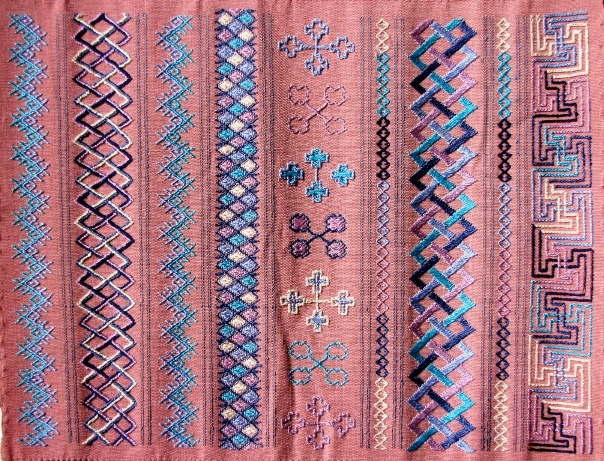
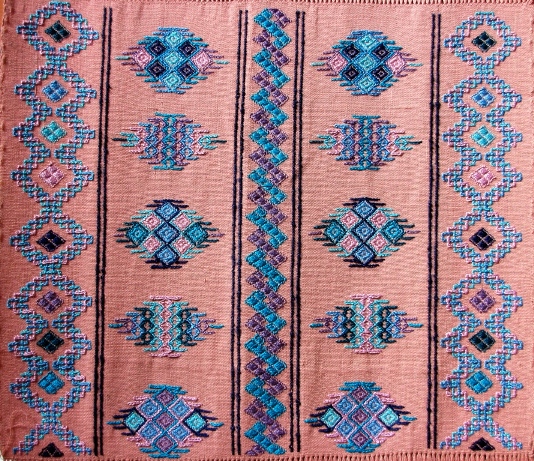
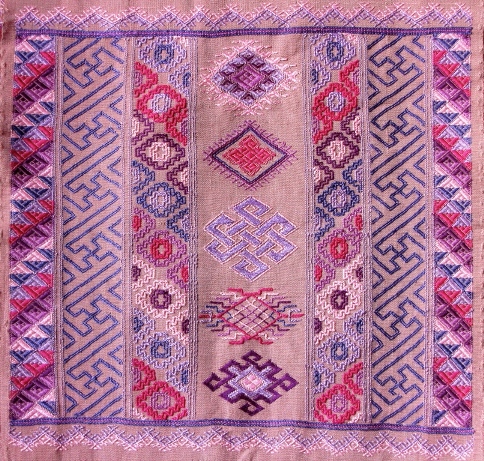
Wendy is planning a trip to the US in the fall of 2015 and would like to share what she learned during her stay in Bhutan. She will be available for workshops and presentations at guilds and I asked her to write a little about what she has to offer for inclusion in this post. All the pictures that accompany the text are Wendy’s own work. These are the samplers that she wove with her weaving teachers in Bhutan.
Hi everyone, I am planning to visit north America in the fall of 2015, and would like to hear from guilds or groups interested in hosting a workshop in Bhutanese kushutara techniques, used to weave gorgeous brocaded festival dresses.
Kushutara means brocaded dress, and refers to cloth decorated with the intricate kushu techniques, involving discontinuous supplementary wefts.
Bhutanese refer to two types of kushu techniques: Thrima and Sapma. Both are woven by lifting selected threads with a pickup stick before inserting the supplementary weft threads in such a way that the stitches only show on the front of the fabric.
Thrima means “to coil” and involves twining the pattern threads around the warp threads. This produces a beautiful textured effect, with the pattern threads creating a raised surface. In fact, when the first Bhutanese textiles were examined by experts in the west, there was much debate over whether their designs had been produced by embroidery or were woven into the fabric!
I learnt to weave kushutara when I was living in Thimphu, Bhutan for a year teaching music. I was given a loom next to a master weaver in the local weaving centre, and for 8 months I went before and after school and on weekends to weave. Word spread, as it does in Bhutan, and I often used to find I had local weavers stopping in to see for themselves the spectacle of the foreigner who had learned to weave as well (if not as fast) as the Bhutanese.
In addition to weaving on a Bhutanese backstrap loom, I have adapted these techniques to western looms, so classes can include weavers more comfortable on rigid heddle or shaft looms. Participants would need to be familiar with their looms and comfortable with plainweave, but the work would also extend experienced weavers who may have experience with weft twining from other cultures such as Guatemala (Bhutanese twining is a related structure, but the techniques of execution differ).
Wendy can be contacted through her blog or through me on this blog. Who knows? I just might get myself over to Perth on this trip to see her.
I don’t have any Aussie pictures to post yet! Imagine…after weeks and weeks of fabulous weather in the US, the weather has not been kind so far here in Sydney. I will hopefully have plenty to show in the next post. See you soon.
I suppose that it is normal to want to look back a bit as the end of the year approaches. This time I decided to jump back to the end of my blog years in 2011, 2010 and 2009 and take a look at what was going on. It is interesting to see that supplementary-weft patterning was a part in some way of all those December posts.
This time last year I was in a downsizing phase and rummaging through my closet to see what could be tossed. That was when I came across this wildly colorful supplementary-weft sampler that I made after having studied some of the patterning techniques in a few different communities in Guatemala. I included it in my blog post…(no, I didn’t toss it!)
You can see that all the patterning elements that I am using in my current supplementary-weft project are present in this piece and this is barely the tip of the iceberg when it comes to all the different ways to create patterns with supplementary wefts that are used by Guatemalan weavers.
In December 2010, I was posting about the practice piece I made after studying with the Montagnard (Vietnamese hilltribe) weavers in North Carolina. While the piece is mostly about the warp float patterning technique that they use, it also includes twined ends and a couple of their traditional motifs woven with supplementary wefts.
And finally, back in December 2009, when I had been blogging only a few weeks, I wrote a post on weaving wider projects which included this…
I included a tiny bit of supplementary-weft patterning in the center of this placemat and mug rug set. I gave the pattern a thin striped look instead of a richer satin-like finish so that it would mimic the stripes in the two outer bands. The simplicity of the outer bands were inspired by a Guaraní textile.
So, this wonderfully fun patterning technique, which allows quite a lot of spontaneity, (the patterns on both the Montagnard and placemat projects were not planned and could have been just as easily cut out and removed if I had decided that I didn’t like them) has been in my weaving skills kit for quite some time.
I remember the first time I saw a Bolivian highland weaver sitting in the street of Santa Cruz making a hatband only days after I had arrived here in 1998. The base weave was off-white sewing thread-weight cotton and she was creating patterns with bright acrylic threads. I crouched and chatted with her, watched what she was doing, and noted the name of the street so that I could return the next day and watch some more. I never found her again nor have I ever seen another weaver making a hatband since! I have seen plenty of beautiful hatbands but never one being woven again.
The hatbands above adorn the hat of a weaver from Potolo in the Bolivian highlands….bright colors on a black ground, much the same as the color scheme I have chosen for my scarf project. I have decided to call it a “neck wrap” as it is not going to be all drapey and flowing as one would normally expect a scarf to be. As long as I don’t have to actually bend and fold it around my neck, I will be happy!
Here it is, a little bit further along from the little I showed you last week, after all the messing around and lesson-learning. I am trying to think if I learned any more lessons from this wicked warp this week….I think I probably just convinced myself even more that I love putting in a second cross stick behind the shed rod and using those two sticks to help open the heddle shed. (Of course, this is just one of many ways that backtrap weavers operate their looms).
Above you can see the second cross stick and shed rod in place. The third shorter stick sitting between them is the pattern stick.
If you watched the video of the Tacabamaba weaver in last week’s post, you will have seen how she places her sword on top of the warp and rolls that together with her shed rod to help open the heddle shed. Below, you can see Montagnard backstrap weaver, Ju Nie, doing the same using a bamboo slat instead of her sword.
I have a video on my page about sticky sheds showing this system in action.
I prefer to have the second stick permanently in the warp. One of the weavers that I met at the recent conference in Cusco used this system, with the second stick permanently in the warp, to open her heddle shed.
Her set-up is so cool. I wish I had a forked stick like that…must go out and look for one. The prong of the fork nearer the weaver holds the stick shed open while the other prong sits within a second cross.
She would simply grip the place on the fork where both prongs join and twist the fork away from her while relaxing tension and pulling up on the heddles.
In the picture above, she is about to slide her sword under the warps raised by the shed rod. She will then turn the sword and clear those threads through the heddles and down to the weaving line. I have wonderful video of this weaver operating her loom and doing very fast supplementary-warp pick-up and I had every intention of showing it to you. Too bad my internet would not behave and allow me to upload it.
So, my warp has been behaving like a dream…sticky threads have been defeated and no more have broken. The odd loose ones here and there have been dealt with smoothly and calmly.
I decided to make the long motif the center of the scarf and work from there on repeating the designs from the first half of the project. However, I am not repeating the motifs in the side bands as there are still plenty of those that I want to try! I have no discipline sometimes!…I should just keep it simple and symmetrical…
Here starts the other half….
I managed to almost squeeze in one more green motif before it was time to stop and write this blog post. It’s addictive and I don’t want to stop! The motifs are new and I am anxious to see how they turn out. Plus, I can’t weave it at night so, I really try to make the most of daylight hours. All that black thread is just too much at night and I am on an economy drive so, no super high powered lamps allowed!
In the evenings, I have been spinning away tightening up the twist on the Malabrigo wool singles I bought while in the US. I am hoping to then ply them and weave a discontinuous-warp piece. As I am not confident about trying any warp float patterns on one of those yet, I will decorate the panels with some wool supplementary-weft designs.
What has been happening in the Ravelry group? ”It’s dead in here!” exclaimed Bobbie recently but she livened things up a little by posting her recently finished guitar strap made for her granddaughter…
This was made using the instructions for the two-heddle intermesh technique from my second book. Bobbie used Annie’s guitar strap kitto convert her beautifully woven band to a guitar strap.
Rob has been using my first book to weave some lovely bands with Andean patterns but we may have lost him to a four-shaft loom which recently appeared in his life. Now he is also turning out beautiful towels on that. Here are some of his latest backstrap, inkle and four-shaft loom projects….
There have also been some mutterings in the group about using the 24 sets of string heddles to weave one of the fabulous fajas saras after I showed a picture of some of the belts of San Ignacio de Loyola Peru…
That could be a fun weave-along but I don’t think I will join them on that one. While I do love making string heddles, I enjoy doing pick-up even more!
On another topic, a couple of interesting ikat resources came my way recently in my internet ramblings…
The book is the result of the author’s two years spent traveling in the Andes researching ikat patterned textiles. There is one section devoted to the pañones of Tacabamba that we saw last week.
From the other side of the world in China, Chris Buckley sent me the link to his recently finished paper entitled Investigating Cultural Evolution Using Phylogenetic Analysis: The Origins and Descent of the Southeast Asian Tradition of Warp Ikat Weaving.
Chris has always been very generous with his resources and, on several occasions, has allowed me to use images of textiles in his collections in these blog posts and for my charting.
Christmas will be done by the time I come to write my next blog post. I don’t do Christmas but I wish all of you the very best for whatever you get up to in the coming week. Now, back to that “neck wrap” thingy….
Before I get into Part 3 of my report on the Encuentro de Tejedores de las Americas (see Part 1 and Part 2 here and here), let me show you how I have been getting on with my latest experiment with supplementary-weft patterns.
You may remember from last week’s postthat I was inspired by seeing textiles from Bhutan with their gorgeous motifs created by using supplementary wefts.
I was happy to see that I could decorate my own woven cloth with similar patterns using techniques that I had learned in Guatemala.
At left is the sampler I made to practice the techniques and experiment with the spacing of the pattern warps. I had some fine cotton from Guatemala that my friend Betty had bought about 30 years ago. How nice that this cotton could finally find its purpose.
The black cotton disintegrated as soon as I pulled it out of the closet. I guess that there is something in the black dye that causes the yarn to rot quickly. The other colors…red, green and purple….were just fine and, fortunately, there was plenty of white to dye black. I had my heart set on a black scarf.
There were a lot of ends to wind to make 7 inches…672!!
The cotton is kind of sticky and I can see why Guatemalan weavers very often choose to size their yarn with a kind of corn starch wash.
I am using it as is and need to be very gentle. I broke one warp before even getting started and my heart sank but it turns out that it was due to my clumsy handling of the pick-up stick…phew! No more breaks so far but there is still a looooong way to go.
Of course I made a wee sample before diving in to see how many ends I would need to make an inch. I also needed to test the ideal number of strands of tencel to use for the weft patterns.
In the picture you can see my tiny warp with its string heddles and shed loop . The two sticks are the pattern sticks that I talked about in my last post. Of course, the yarn was already showing signs of stickiness even on this tiny project but I decided to go ahead undaunted 🙂
Sample done…width calculations made. Now, how long should a scarf be? Seems like a silly question, but I have never made a scarf before. Fortunately, I do own just ONE. After all those years spent skiing and then living in Patagonia you would think that I would be more scarf-wise.
There is the warp and I am ready to make the 336 string heddles. I like making heddles…time to put on a cd and sing! and I didn’t cross or double up any warps…phew!
I have lots of pictures that I have taken of Bhutanese textiles in friends’ collections for inspiration and David K Barker’s books are wonderful too. (See my RESOURCES page for information on how to download his books for free.) However, I decided to play it safe to start with and weave one of the patterns that I had already tested on my sampler.
So, I sat down to weave and that is when it hit me…wow, this yarn is really FINE….and….it’s black! All the clues that I usually use to make the pick-up easier for supplementary-weft patterning are dependent on actually being able to see the threads!!
Boy, had I made things hard for myself but, believe it or not, I got used to it and came up with other ways to eyeball the placement of the patterns without having to become a slave to pattern charts and endless counting. It became a very cool learning experience and, as with all things new and experimental, much un-weaving was done and all with my heart in my mouth as I don’t think that this yarn will take much “backing and forthing”!
Here is the first pattern under way. I placed several thin pieces of cardboard in alternate sheds in the warp beyond the cross sticks. This gave me a place to make quick adjustments to loose warps within arm’s reach and with the warp under tension rather than having to get out of my backstrap and crawl up to the end of the loom.
Sometimes you don’t get to choose when to weave. I would come back in from a break to find Her Highness reclining in what was, apparently, the most comfortable spot in the house. Would you dare disturb someone with a look like that on their face? You can see the next set of patterns in progress here.
And this is where it stands for now. I am just getting past the first warp break and have my fingers crossed that there won’t be more. I watched a gentleman from Chahuaytire weaving on his backstrap loom when I was in Cusco. A warp broke and I loved the calm and cool way he went about fixing it like he had done it hundreds of times before (well, of course, he probably had). He didn’t need to have anyone tensioning the warp while he leaned forward to fix the break. That is the part I find hardest.
Be prepared to see a lot more of this project in the weeks to come. Unless, of course, those warps start a- snapping, and then you will most likely see it finished really soon as a zippered pouch or journal cover!
#########################################
ENCUENTRO DE TEJEDORES DE LAS AMERICAS – PART THREE – SPINNERS AND WEAVERS IN ACTION
The Encuentro…it was over two months ago now and I am finding it hard to sum up here but I will try!
It was about yarn being created with the simplest tools…
Fine and incredibly even handspun cotton by the Matsigenka weavers of the Amazonian region of Bajo Urubamba, PeruThe spindle known as “malacate” used in Oaxaca, Mexico to spin silk. Its whorl is made of horn.The traditional “sig sig” spindle of Salasaca, Ecuador made from pampas grass stems. A small piece of thin solid stem is inserted into the soft interior of the large stem section to suspend the wool yarn as it is spun.
A spinner from Chiclayo, Peru showed me how she spins the natural brown cotton that is cultivated in the region. She told me that a heavy stone is usually placed on top of the cotton as she draws out the fiber to be spun. Not having one handy, she used the bottle of water that you see in the video. The spindle whorl is a piece of avocado seed.
It was about sticks…lots of sticks!
Sticks used by the weavers of Bajo Urubamba to create their warp-float patterns.Multiple heddle sticks are used to weave the traditional pattern on the “faja sara” of San Ignacio de Loyola.
It was about threads being strung together in a stunning display of color and texture…
An ikat warp ready to be woven into the traditional shawl of Tacabamba, Peru. The ties on the sections of threads were the only means I could see to keep the threads aligned for the ikat patterns.Threads are stretched on the typical leaning vertical loom of Tarabuco, Bolivia. Multi-colored figures depicting ceremonies and scenes of daily life in the community will sit on a white mesh-like background. The colored threads are generally thicker than the white ones which gives the figures relief.The backstrap loom with its cotton warp from Chiclayo, Peru. A single-faced cloth decorated with warp-float patterns is created.Small bunches of string heddles control the colored layers of warps on the horizontal loom of Taquile Island, Peru.A floor loom holds the warp on which a weaver from Ayacucho, Peru is creating a beautiful tapestry.
And it was about the wonderful hands and spirits of the talented craftspeople and artists who use sticks and fiber to create beautiful cloth….such an amazing variety of people from across the Americas!
Weaver, Natividad, of Taquile Island, Peru creates a sash with bands of warp-faced double weave motifs and complementary-warp patterns. This piece had six bands of pick-up patterns.A weaver of Tacabamba, Peru, puts the finshing touch on her woven ikat shawl by knotting an intricate pattern into the fringe.
Here is a short video of Nila at work knotting the fringe of her woven ikat pañon…
And what about that belt loom with its twenty-four sets of string heddles? Araceli shows us how it is done…
A Matsigenka weaver from tropical lowland Peru creates warp-float patterns in cotton on her backstrap loom.A woven tubular band in progress…putting the finishing touch on a woven piece from Pitumarca, Peru. The tubular band had been set up with three sets of string heddles and a shed loop and, therefore, did not require any pick-up.
And cloth comes off the loom and comes to life when draped around shoulders…
and wrapped around waists and heads…
Diana from Guatemala, pictured above, wore this spectacular fine, ikat-patterned corte, or skirt…
There was time to watch and chat and share….
Time to look and learn from Navajo weavers and spinners and an alpaca fiber weaver from Tanta, Peru…
Time to sit or stand and ponder…
Time to listen to weavers talk about their communities and textile traditions and meet new leaders in the field of textile research…
Bolivian Elvira Espejo shows the two most recent books she has written with British/ Bolivian Denise Arnold on weaving in the Andes. Representatives of the textile community on Taquile Island, Peru spoke about weaving and knitting traditions and the 547 families that are part of their textile co-operative which had begun in 1971 with only 7 families. Taquile Island has become an enormously popular tourist spot over the years. One point which created a bit of fun was their response to a question about how they felt when a hat that was created to be worn by a high-ranking official was bought and worn by a tourist completely out of context. They said laughingly that they were proud that “Taquile fashion” was being worn and loved around the world despite the fact that it was not appreciated in their own country of Peru. “Taquile fashion” then became one of the catch phrases of the conference and made us all smile.
And time to just stand in complete awe…time and time again!
A weaving of the Jalq’a people of Potolo, Bolivia depicting Ukhu Pacha, the underworld, with its khuru figures.
Well, I hope that this gives you just a taste of what the week of ETAM was like. Thank you Maria Elena del Solar, Paula Trevisan and Luis Masa for organizing this event. And thank you Mara Elena for pushing me to go when I was dithering over the cost of getting there. It was the best birthday gift to myself ever!
Thank you Centro de Textiles Tradicionales de Cusco for the fabulous exhibit of textiles from your nine member communities that you organized in the Convention Center to coincide with this event and for providing outstanding teachers for the workshops.
As for Elvira Espejo and Denise Arnold’s books about which I know you will be curious, I have to find out if they are available in English and from where…stay tuned.
Of course, you do know that the CTTC is having its second Tinkuy this coming year, don’t you?! 🙂 Are you coming?
Hello from Manchester, England! Sorry to have disappeared these last two weeks. It was all book, book, book and preparation for this trip and now I can hardly believe I am here.
Braids 2012, Manchester England! What a beautifully organized event by Debbie Richardson and all her helpers at the Braid Society. Today was registration, key note speech and welcome and all the big action starts tomorrow bright and early. Not that there hasn’t been any action so far….you will get a full report later as I am still in a mist of jet lag. That was a heck of a trip from Santa Cruz to here with something like 30 hours door to door. But I am a lucky gal. A surprise upgrade on British Airways gave me a very comfortable night flight into London from Miami.
Now I am trying to sort through names and faces…people whose books I own, whose work I have admired, people who have become familiar from online contact but whom I have never seen. All very exciting!
But what I am really here to tell you all is that my new book is now up on the Patternfish.com site and ready to buy! It was my goal to have it finished before the Braids Conference and I just scraped it in. I came back to my room after a busy day to find the link in my inbox and several copies already purchased!
If you are an experienced “Andean Pebble Weaver”, get ready to use all the skills that you acquired by working through the step-by-step lessons in my first book. With those under your belt you will be ready to weave and enjoy over 150 new patterns. Over 100 are for pebble weave and there are new techniques and new charts covering other patterns from the highlands and lowlands of South America and beyond.
Maybe you bought my first book but haven’t used it yet….well, it’s time to go get it out, dust it off, or find it on your desktop, and get to work so you can then enjoy all the patterns, tips and techniques in the new book!
My next post will have lots of pictures and news from the conference. It should be an intense week. And now it is bedtime on this side of the world just when I feel like celebrating!
 I am excited about a new book that has recently been published on ponchos of Bolivia. One day before I am due to leave I find out about this treasure. I will have to wait until my return to hunt it down.
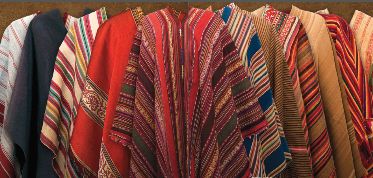 I was lucky to have been able to attend a talk on ponchos and rebozos given by Anne Rowe at the Textile Museum in DC some years ago. I am looking at my scribbled notes from the lecture in which I have written that poncho-type clothing existed in the pre-hispanic times but the poncho, as we know it, was popularized by the Mapuche of central Chile and Argentina. The earliest known image of one dates back to 1648. The Mapuche people wove ponchos for themselves but also to sell. During the Conquest they adopted Spanish customs including riding horses. Ponchos proved to be very useful for this activity.
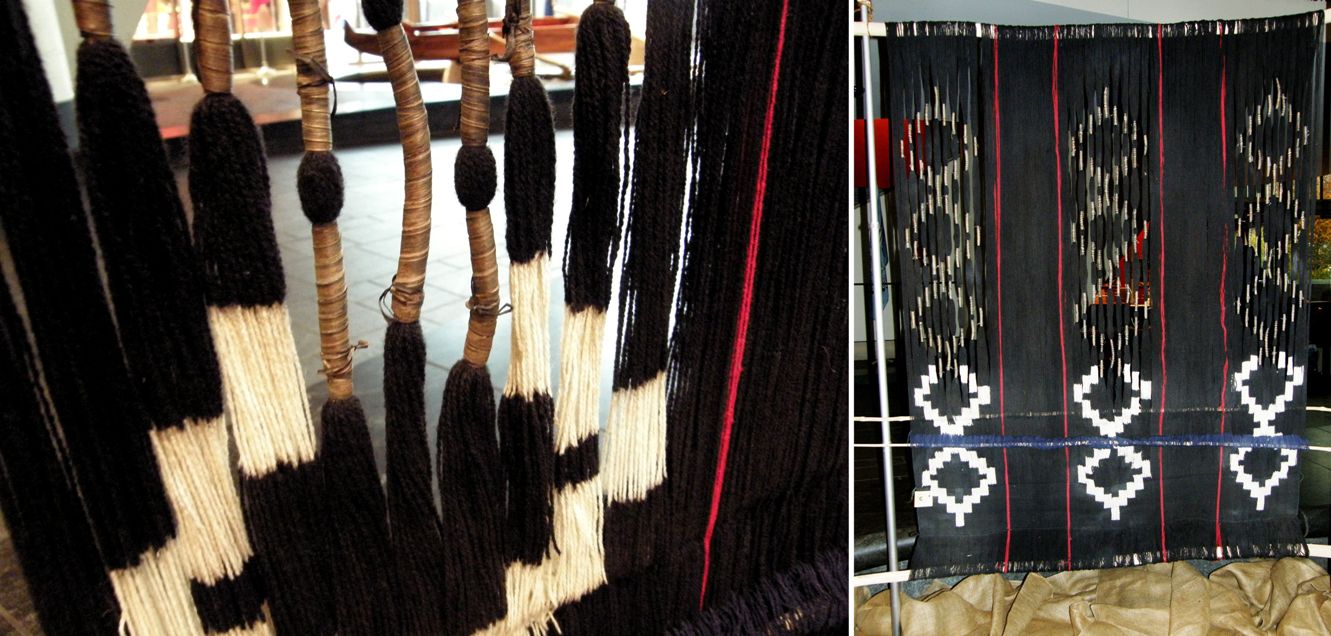 The black and white ikat ponchos woven by the Mapuche people are worn by those who hold positions of great power and prestige. I imagine that they are quite a weight to carry around as I was able to feel the rather thick and coarsely spun wool in the example in progress above.
 The handspun vicuña fiber has to be carefully selected to find tones of equal value for each piece. The ponchos are woven on floor looms and the fabric measures 2 meters by 1.30 meters and weighs only 320gms.Two people swing the beater and they need to make sure that they beat with exactly the same amount of pressure on this fine, light fabric.
 The Salasaca family with whom I stayed in Ecuador had their son dress up in the typical poncho that he would use for special occasions for a photo. I like this simple black wool poncho. Juan would otherwise be dressed in jeans and tshirt. The Salasaca ladies, on the other hand, wear their traditional outfits every day although they have other “everyday” hats that they use rather than the rock hard ones that you see in the picture.
 I managed to sneak a snap of a Cañari gentleman in Ecuador out in his Sunday best ikat-patterned poncho in the town plaza.
 Mantas and chamantos are made by weavers in the town of Doñihue, Chile and worn by the Chilean horsemen known as huasos. They are silky smooth and tightly woven. It is easy to believe that they could be virtually water proof.
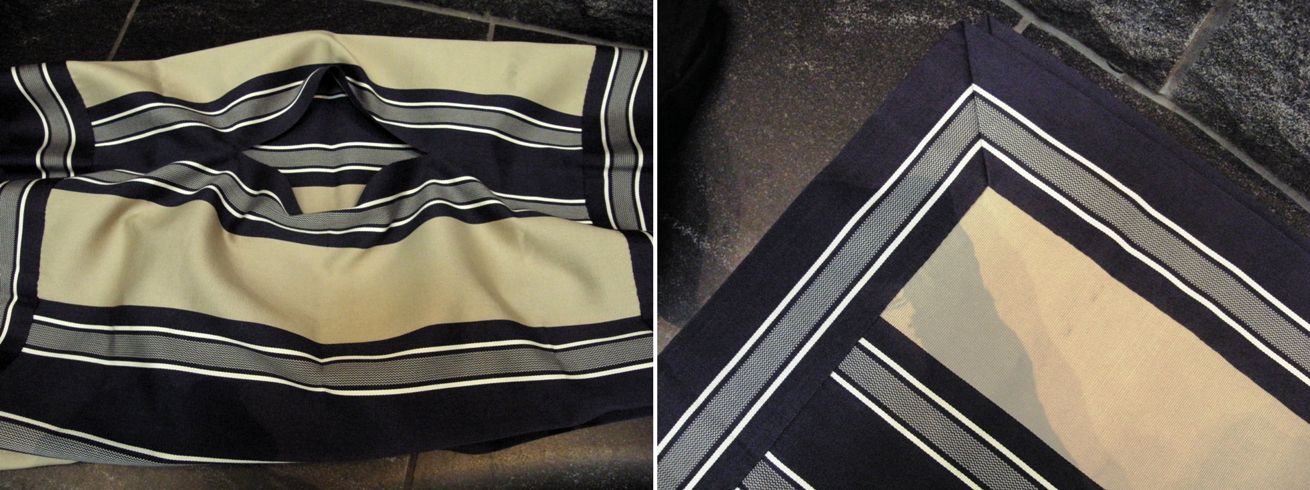 I imagine that the striped mantas provide an more economical alternative to the pick-up patterned chamantos, like the one below, which I am told sell for up to $3000 each.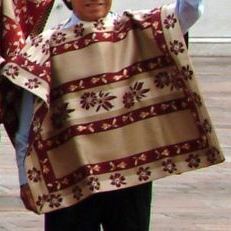
 And of course, there is nothing wrong with a poncho that has been covered with pick-up patterning. Men in the Peruvian community of Chahuaytire in the Cusco region of Peru weave their own cloth for ponchos decorating them with motifs using supplementary warps.
 The more I read about Oscar Barriga’s book the more I want it but at the same time, the more I am convinced that its price tag will be very high. In fact, it is not clear to me whether the book will even be made available to the public. A more affordable option, if you would like to know more about ponchos in South America, is this book which was published in Argentina and is available in English…..
 In the meantime, I will think about my poncho and how I would lke to weave it. Yes, while writing this post I have decided that I should weave my own…one of these days. I have many hours of airport waits and bus rides coming up in the next few months in which I can sketch some ideas.