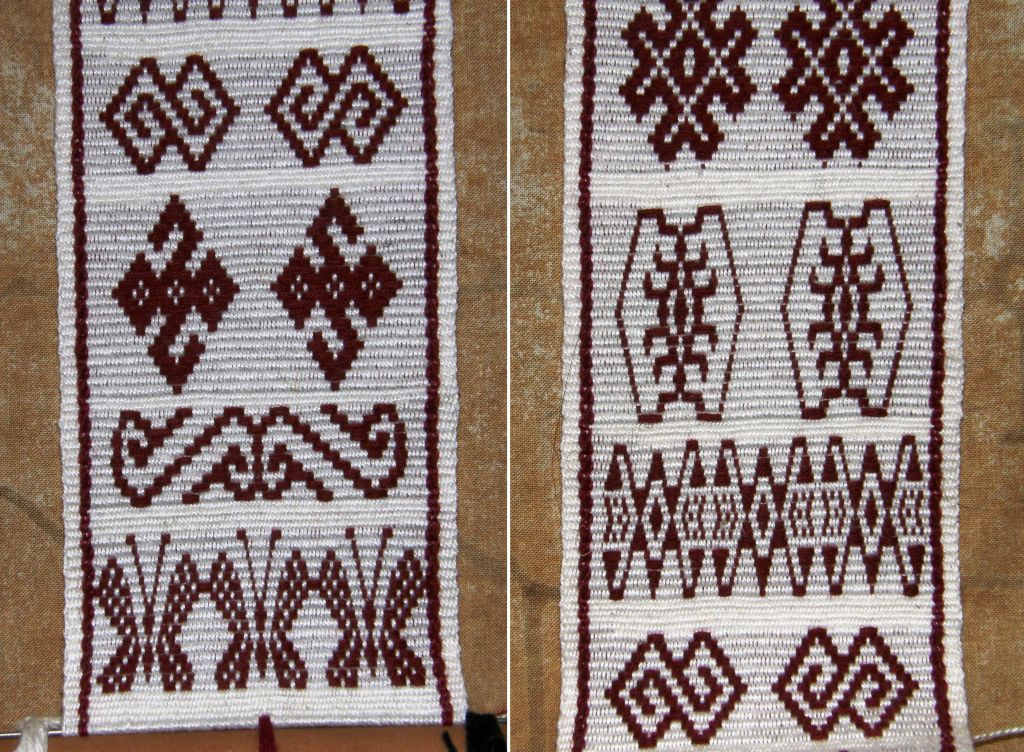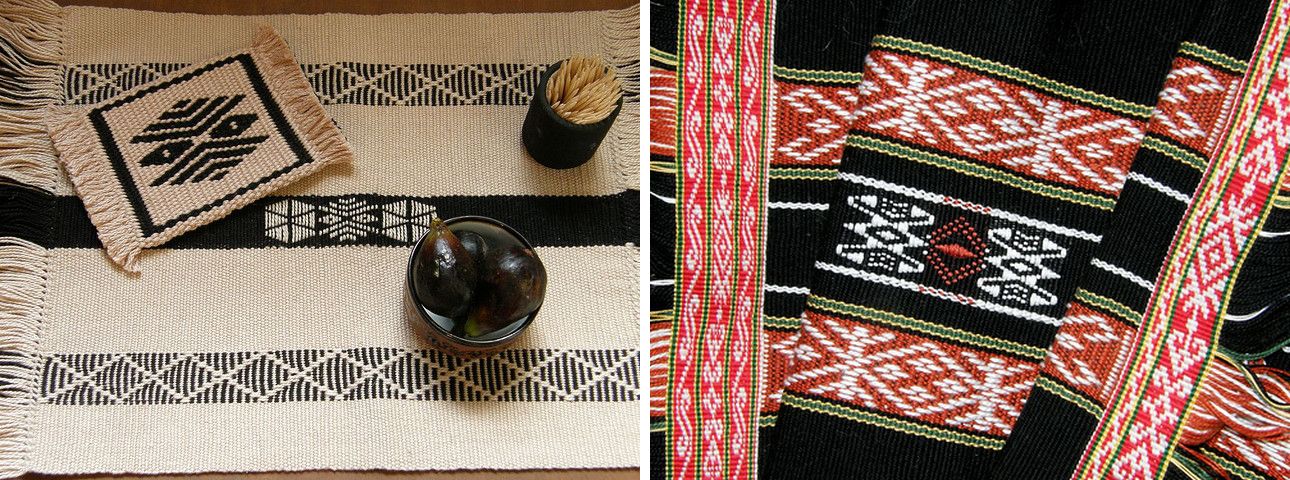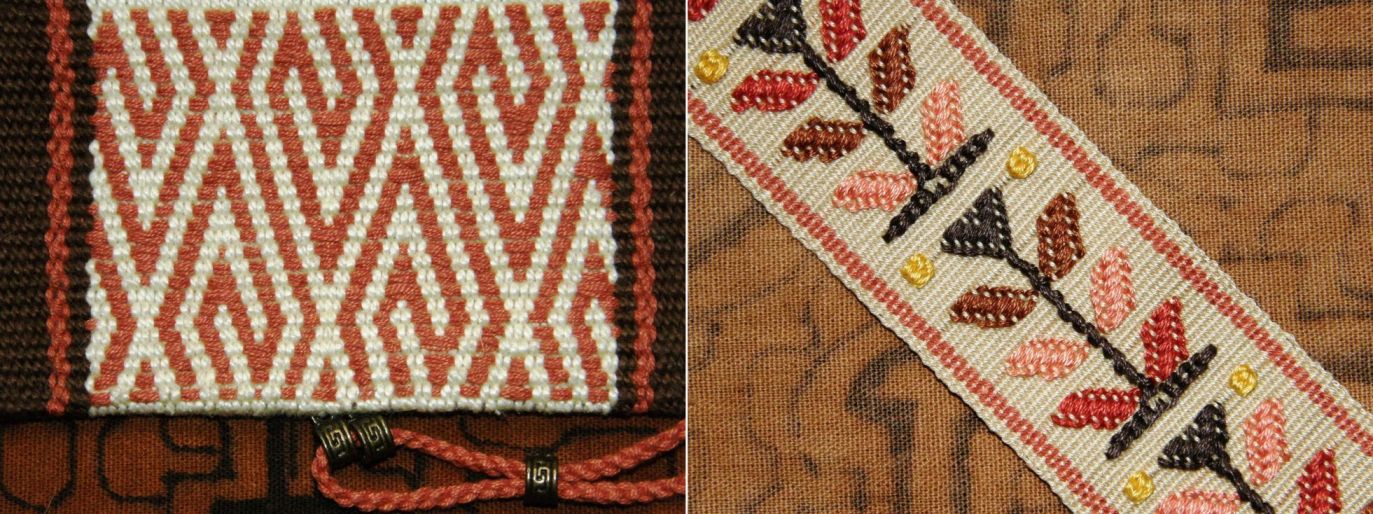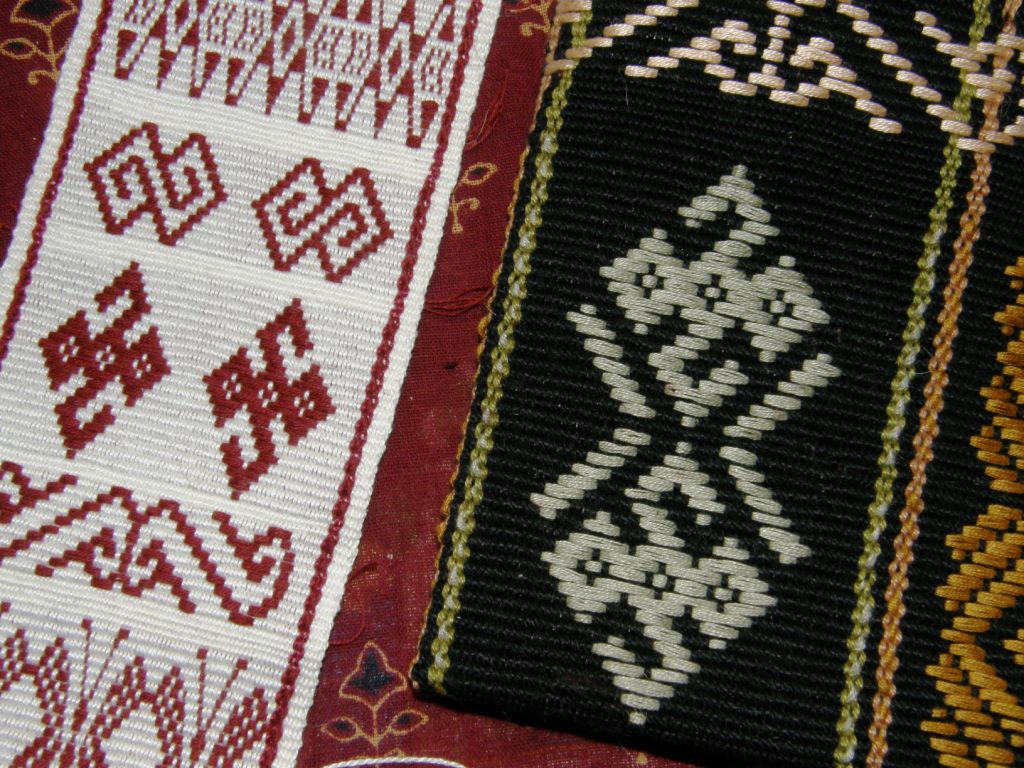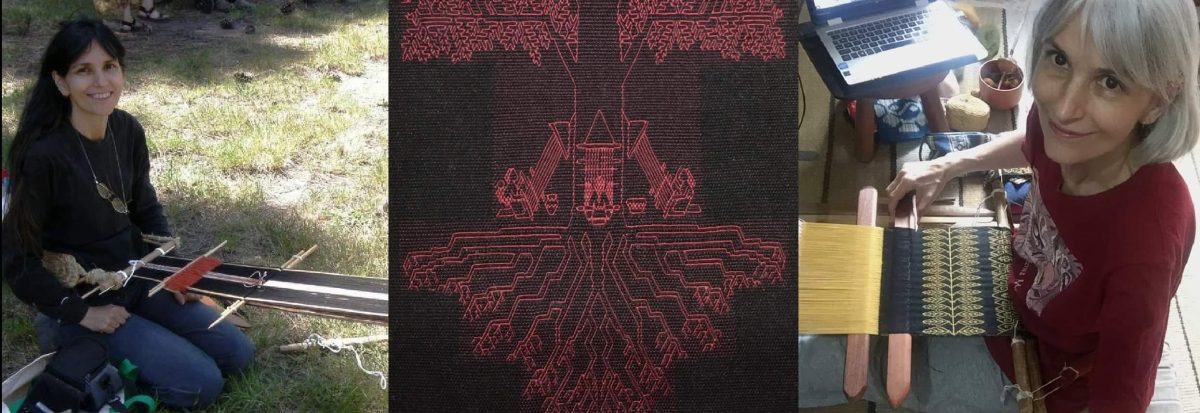
Backstrap Weaving – From Santa Cruz to Santa Cruz

Guess where…

I seem to be really lucky when I go to San Francisco and get mist-free morning views of the bridge.
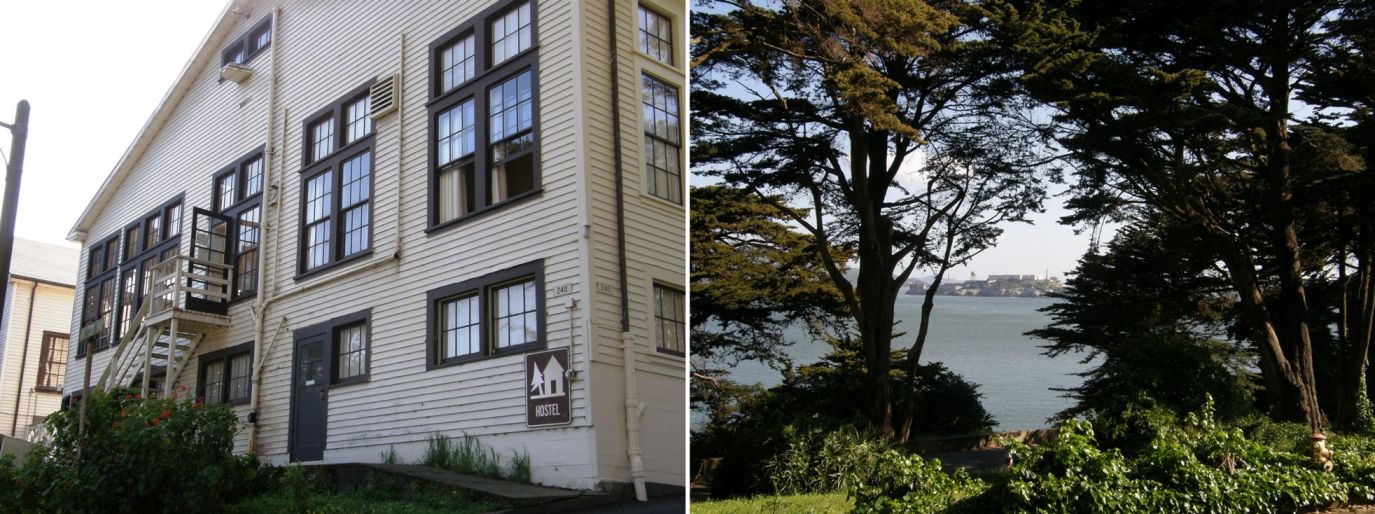
 I spent a night here at the Fort Mason Youth Hostel…what a great place, quite a change from the downtown hostel where I have stayed before. Actually, I stayed at this same hostel way back in 1992 on the first day of a 7-month backpacking and hiking tour of the US. Phew! That takes me back!

My friend Janet picked me up and we headed down south to Santa Cruz (yep, from Santa Cruz Bolivia to Santa Cruz CA) to stay with Janet’s cousin on the winery that she and her husband own. Lucky us, except that neither Janet nor I are wine drinkers! But we got to enjoy the beautiful landscape.The winery is perched on a hill surrounded by Redwood forest and has sweeping views down to the ocean and across the bay to Monterey which are especially nice when viewed from the hot tub 🙂
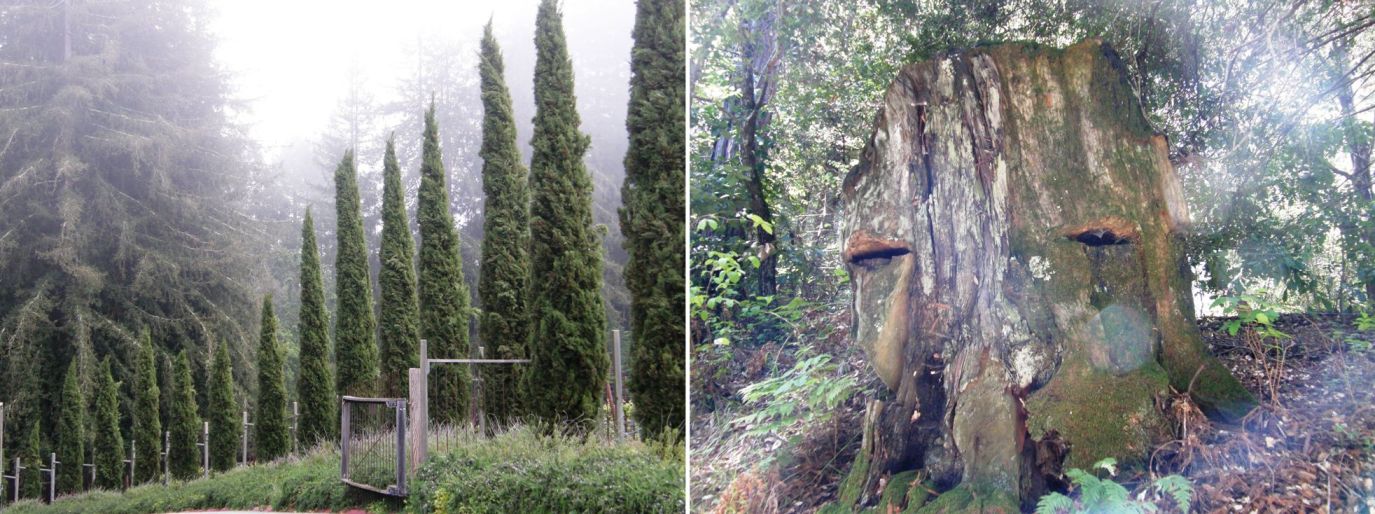
Eerie morning mists with weird faces emerging from the Redwoods.

The mists would rise to reveal Suzie’s pretty flower-laden patio which had a lovely Mediterranean feel. (or at least what I would imagine it to be. It is one of my dreams to be on the Mediterranean, perhaps Malta or some place like that).
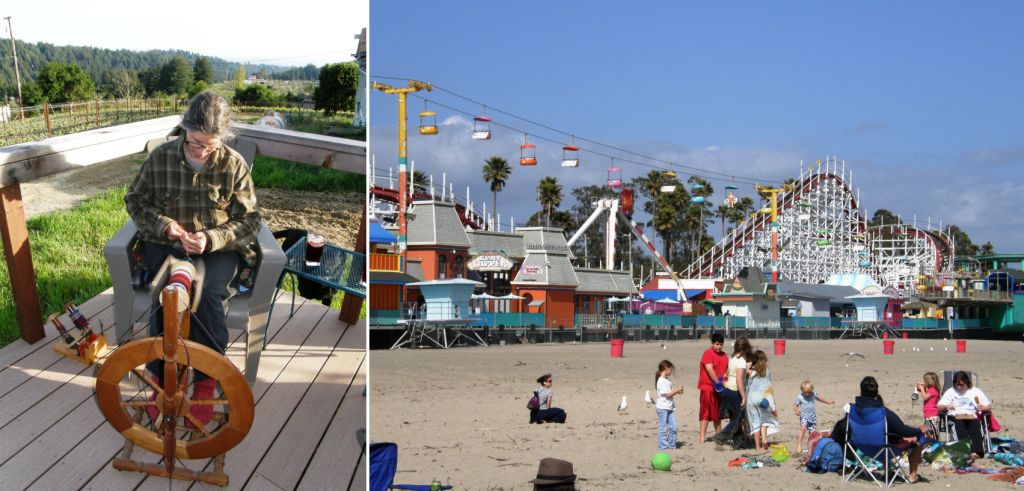
Sunny afternoons were spent spinning and lazing on the porch or hanging out  at the beach and Santa Cruz Boardwalk. The Boardwalk has a fantastic old carousel.
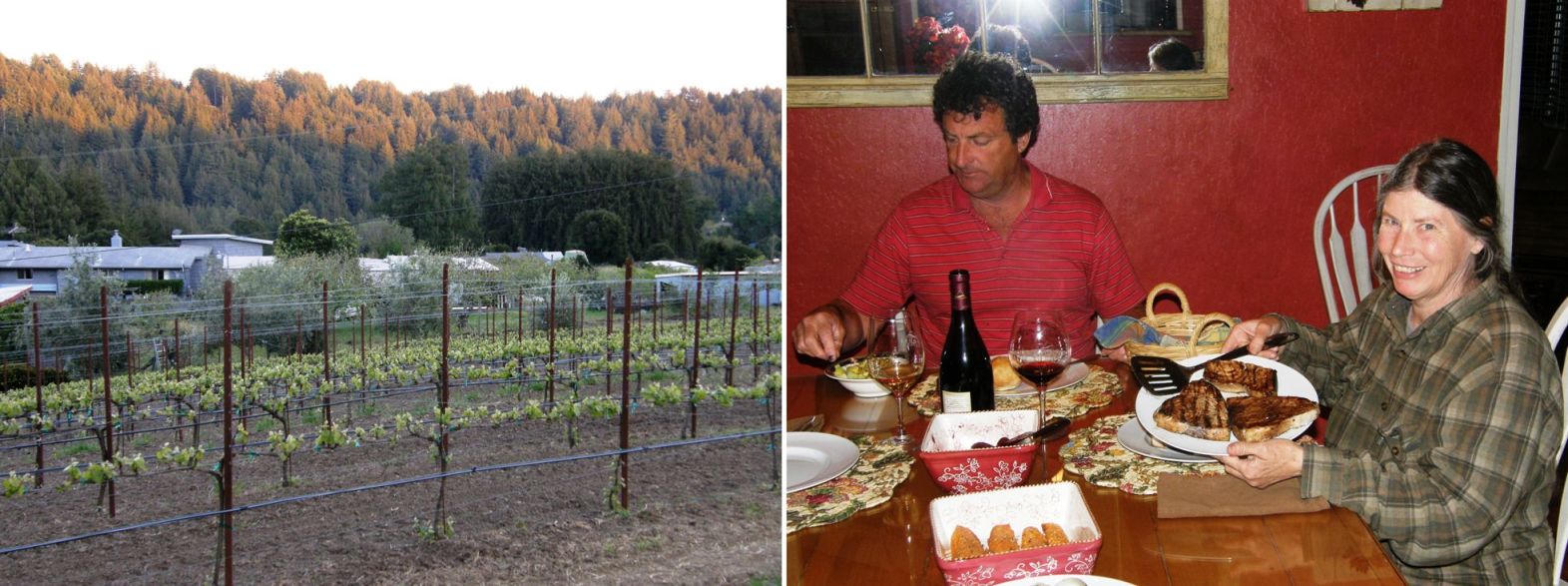
The sunsets brought a gentle glow and we sure enjoyed the swordfish steaks.

Forgive me but I just had to include this next picture. I am a cat person and usually don’t care at all for the small yappy dogs but these two guys were just adorable!

Then it was on to a visit with the Santa Cruz Handweavers Guild for a show-and-tell by members and a slide show by me.
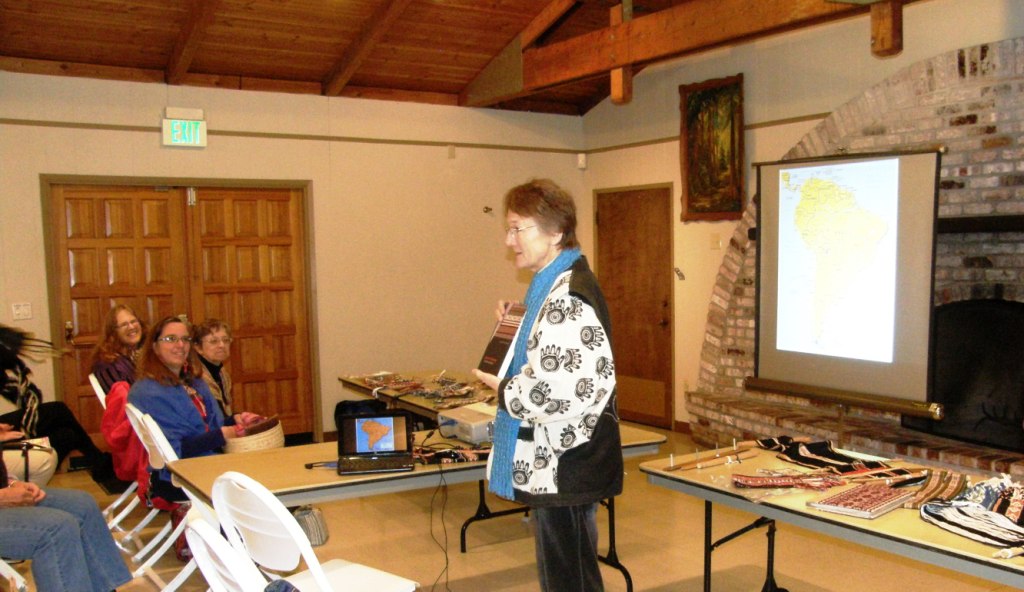
Here, guild president Gudrun is showing her husband’s newly published book called “Quantum Computing” for which he chose to use images of her beautiful card-woven bands on the cover.

My slide presentation took people on a wee tour of the Bolivian high and lowlands, around the continent and then deep into the textiles, and my experiences learning to weave them. At the same time I got the chance to get reacquainted with some people I had met at CNCH last year as well as meet a lot of new folks.
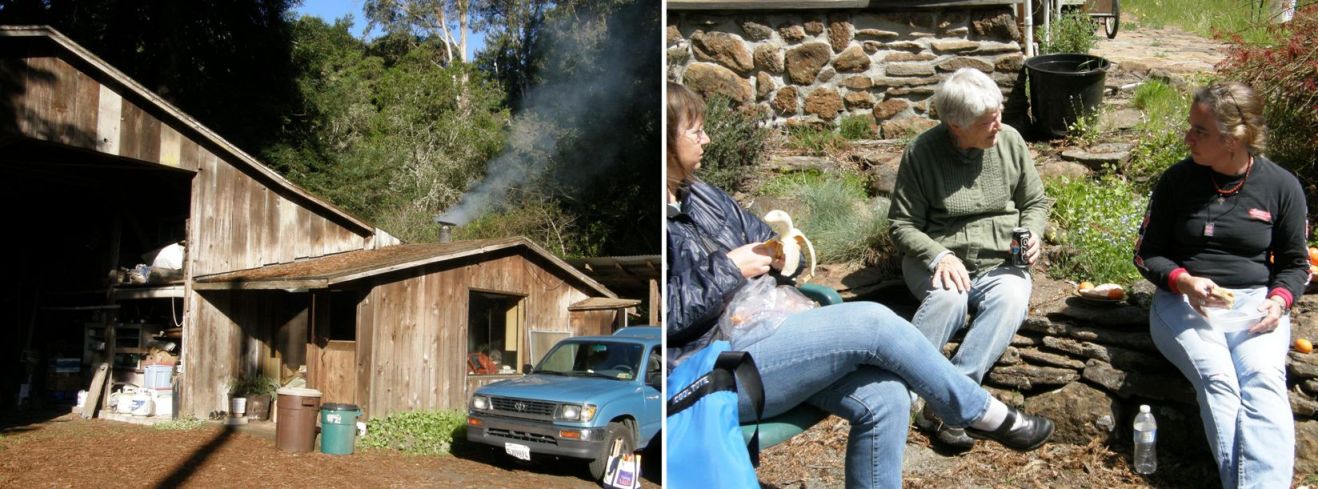
The following three days were spent weaving at Martha’s beautiful cabin in the woods. That little cabin with the smoke curling out of the chimney warmly greeted us each morning. Martha would join us and entertain us with her tales in her sunny garden for our lunch breaks.

And here’s the gang of backstrap weavers and then with Martha popping in to make a matching bookend with me.
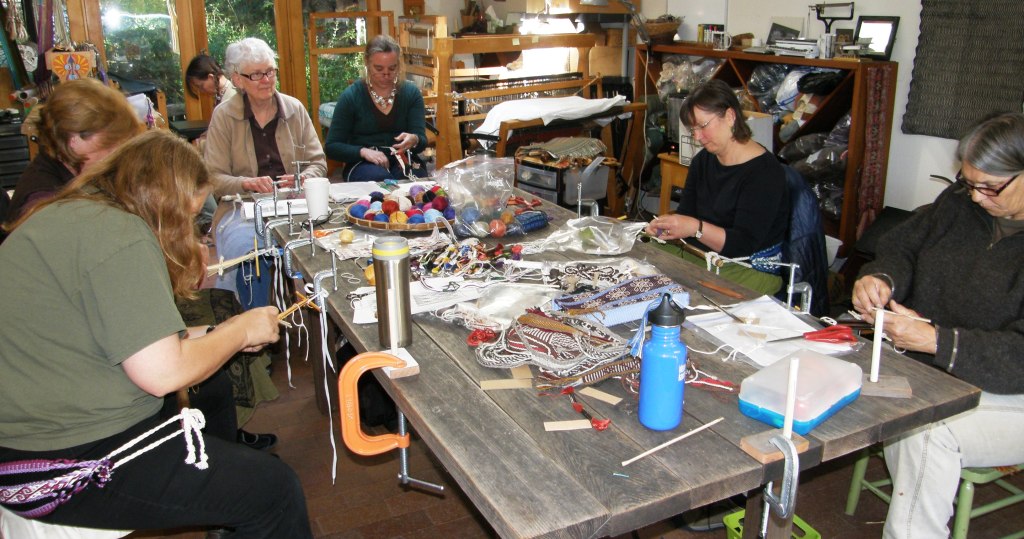
And yes, we did some weaving too. There is everyone “banding together”.
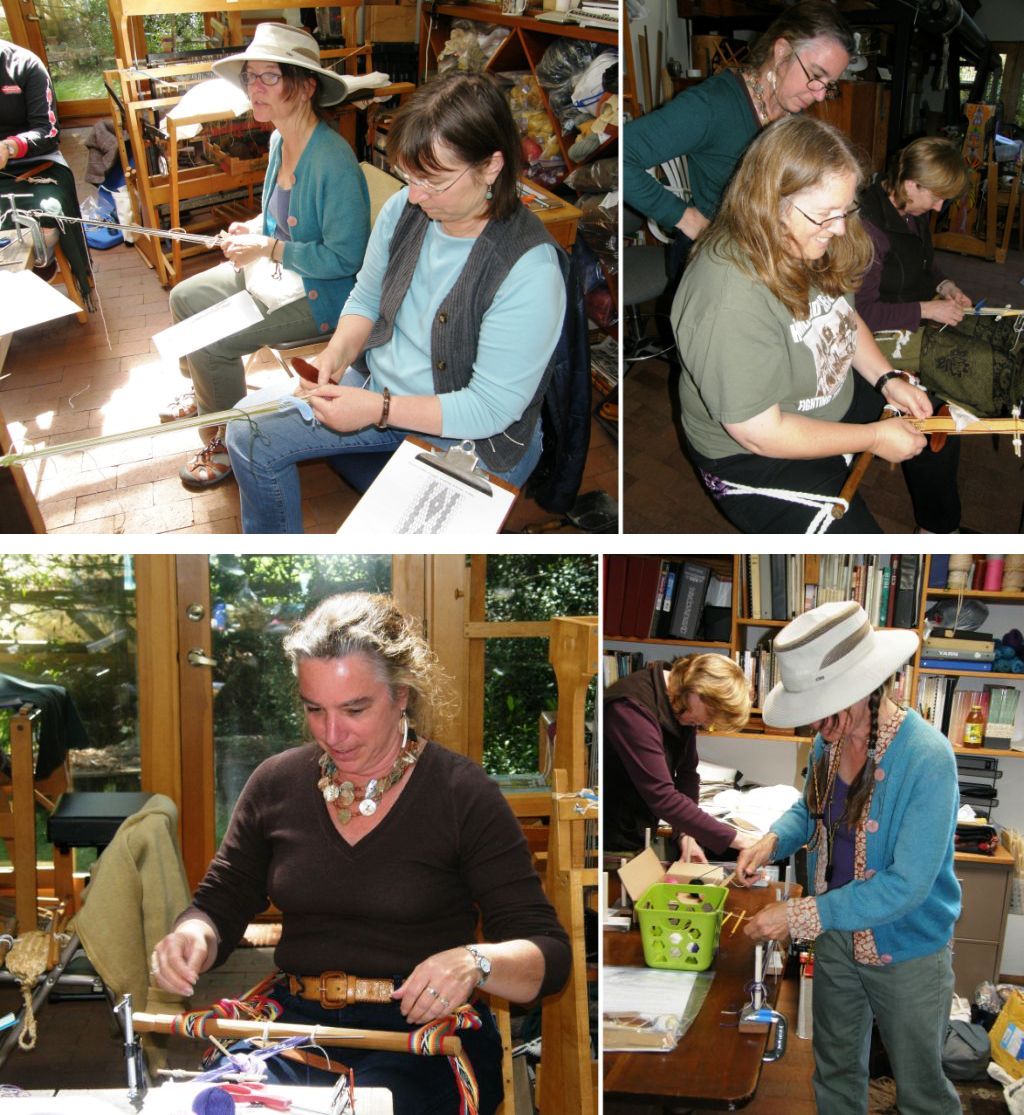
We wove “barefoot“-style and later with loom bars. Annie was happy to get to use a loom that she had bought in Guatemala as well as one of her own woven sashes as a backstrap.  Yonat, above right, dove straight in and warped up for the widest motif. Ingrid, with hat, is practicing four-stake warping. That’s Ingrid Crickmore whom I met at CNCH last year. Ingrid is into all things braided and was using her pieces as loom ties during the workshop. The best news is that she has a blog with tutorials on loop braiding and will soon be adding video.
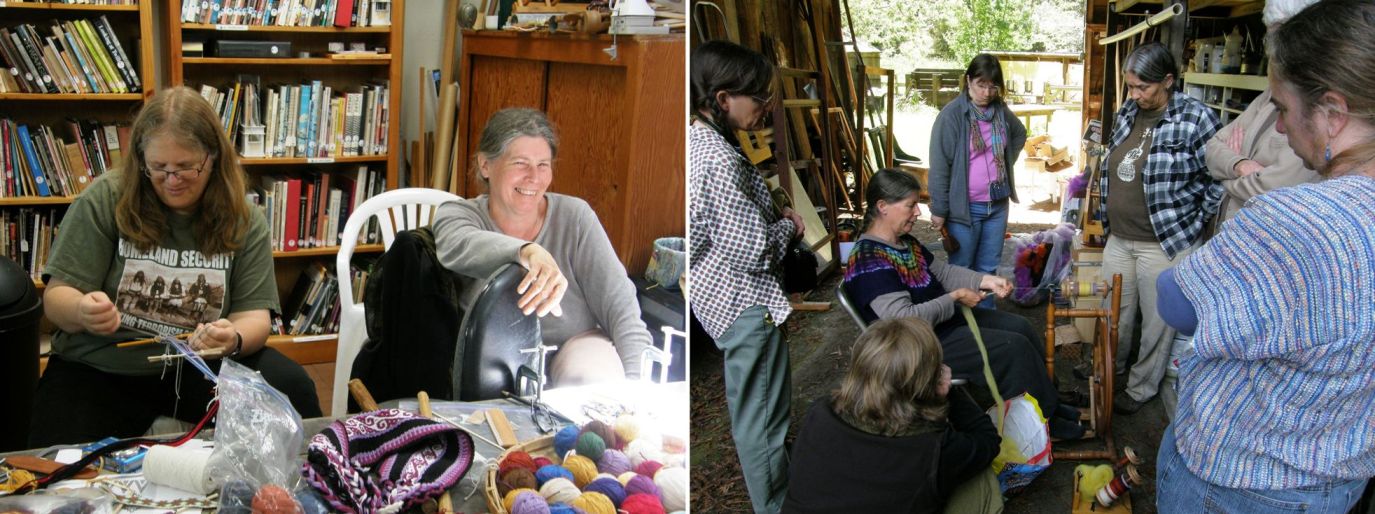
There’s Yonat on the left and Janet. We got to work with Janet’s handspun on day three when she also gave a combing and spinning demo with special tips for spinning for backstrap weaving and everyone loved her yarn.

Smiles from Dorothy and Annie, some “aha”s and a brow furrowed with concentration.
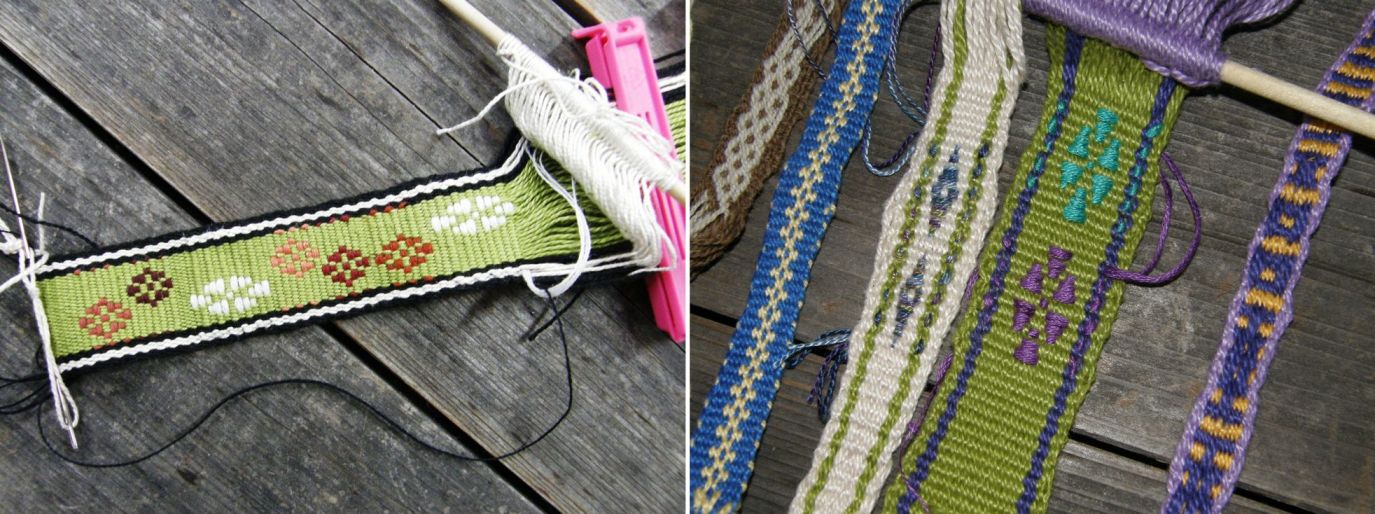
What was interesting and educational for me was the way people chose their colors and placed their designs…no two were alike. I get to learn too in these situations and I have some new color combinations circling in my mind. A friend had asked me to make him a guitar strap with southwest colors and, thanks to Janet, I now have the perfect combo.
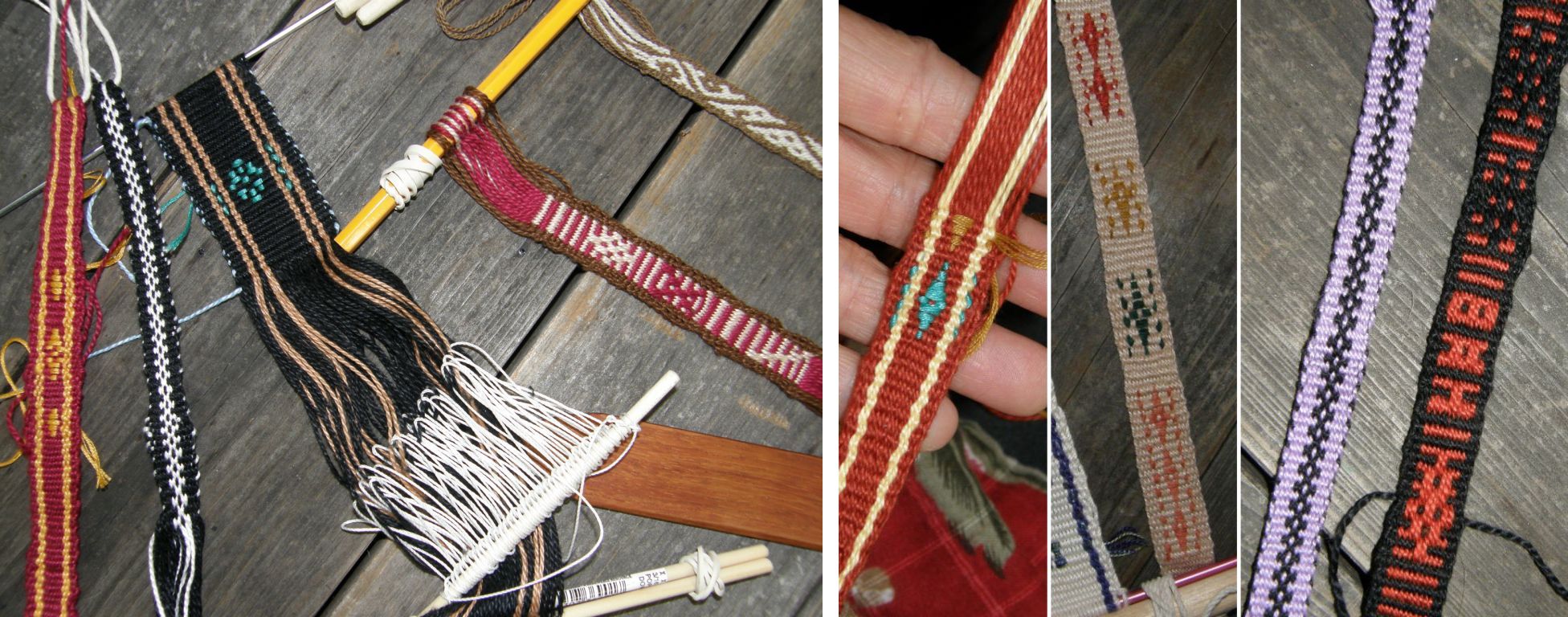
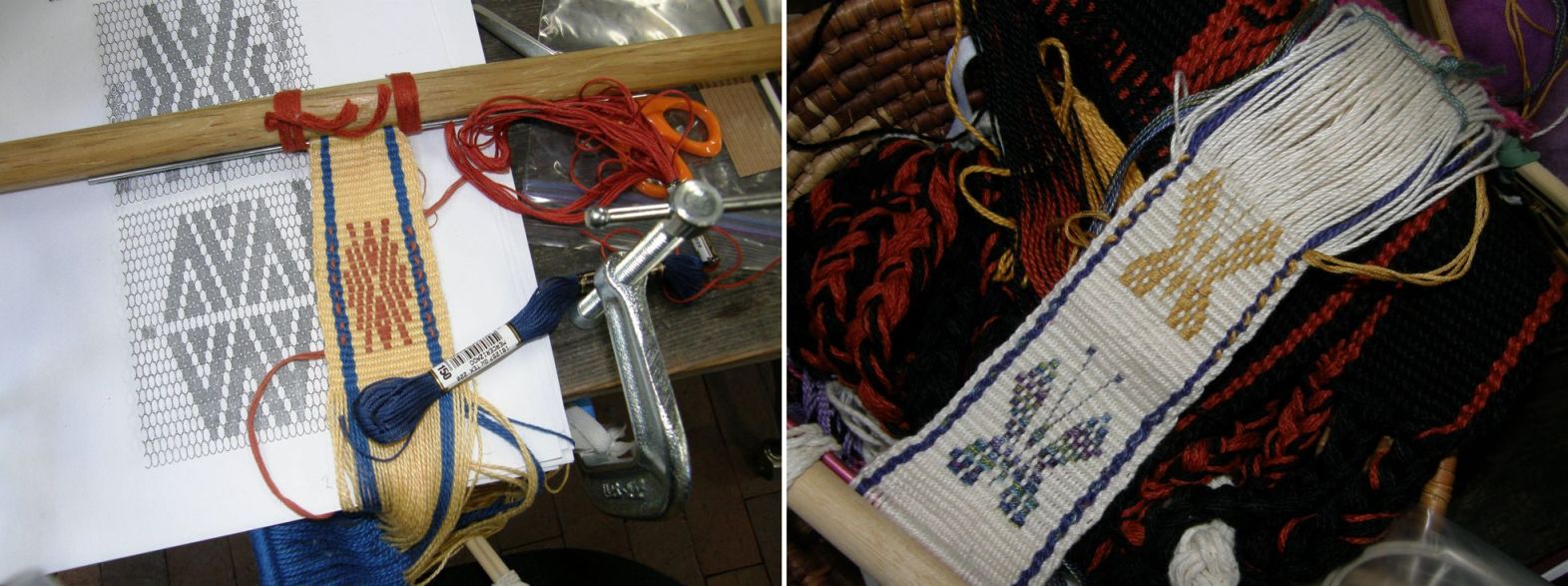
Plain weave bands patterned with warp stripes and supplementary wefts, simple warp floats in cotton and pebble weave in handspun wool.
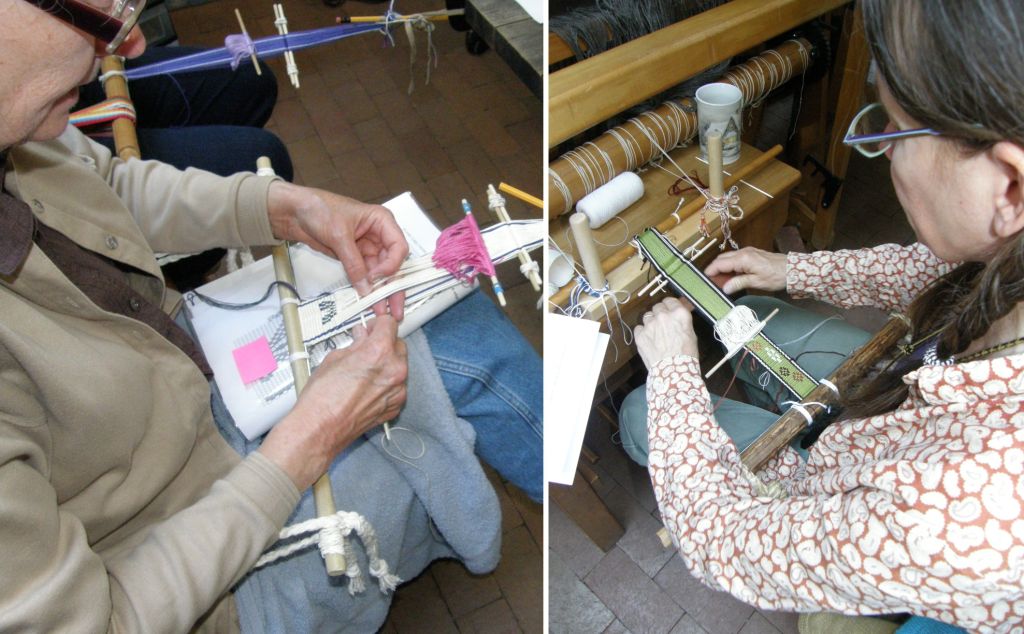
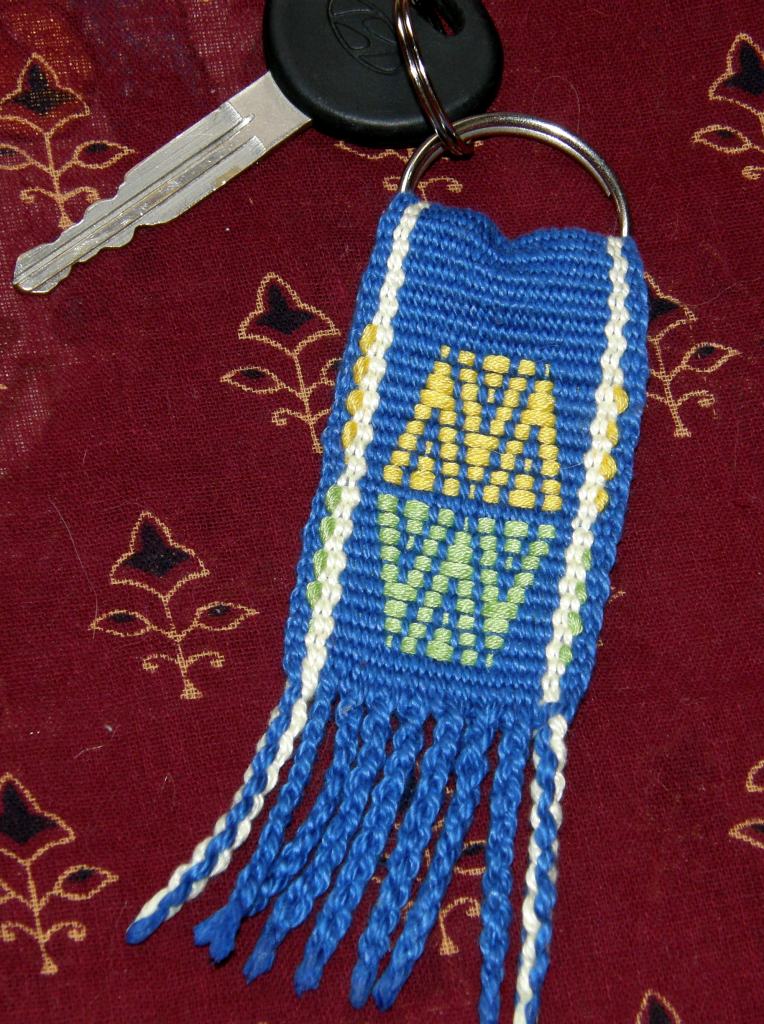
Barbara and Ingrid are at work above showing one of the many cool things about backstrap weaving…you can make short warps quickly and easily for the tiniest projects like a one-of-a-kind key fob or book mark.

During lunch break there was much to see as Martha would bring out textiles from her South American collection. Here is THE textile which I blogged about last week

Read more about it here.

But, what I didn’t know was that she was saving the best for the last day….

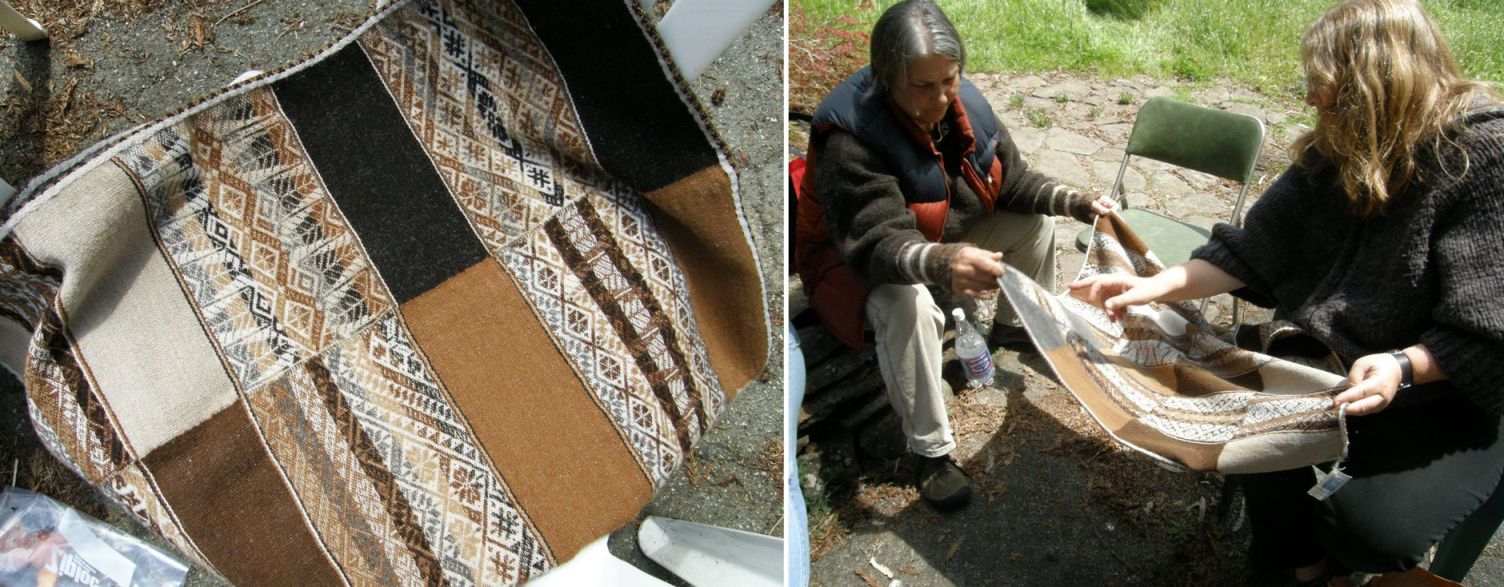
This is another one of those spectacular discontinuous warp pieces from Pitumarca, Peru. From what I have seen, Pitumarca specializes in supplementary warp patterning on these discontinuous warp, or scaffolded, pieces but this one has been done with three colors in the pattern and it is doubled faced. Wow.

There are four panels, red, blue, green and yellow, each with its triple color supplementary warp pattern.

I should have just saved this for a blog post of its own entitled “Even more Speechless”. It’s hard to take your eyes off it, right?

I told you last week that Martha gave me two tubs full of textiles to take back to the winery and peruse. I will show you bits from those tubs in future blog posts but here is just a taste…
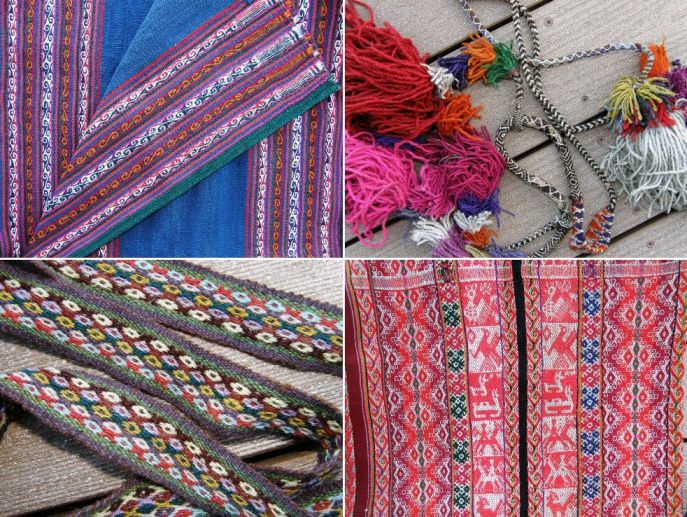
I really like the bag strap with the multiple tanka choros and those braids….!!

But best of all we got to see what Martha herself has been working on…
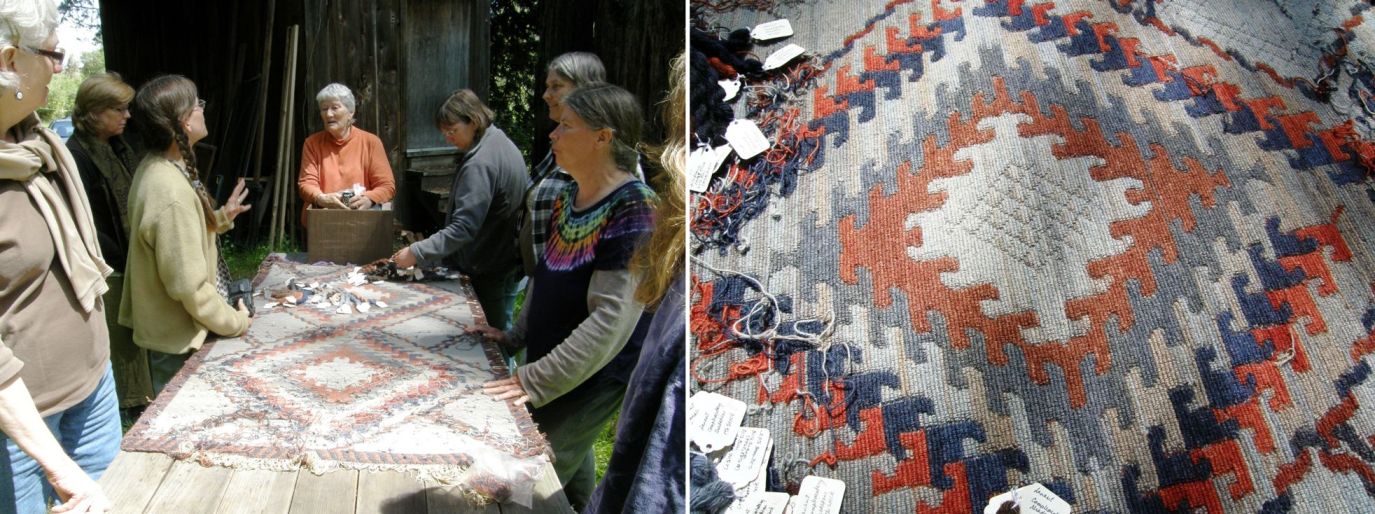
Firstly, the colors! I have been admiring the yurt bands of Central Asia and wishing that I could somehow use those dusty sun-bleached tones of red and blue that evolve after years of having been stretched around the yurt and exposed to the elements. Well, Martha has just gone ahead and dyed her own. The colors are just gorgeous!
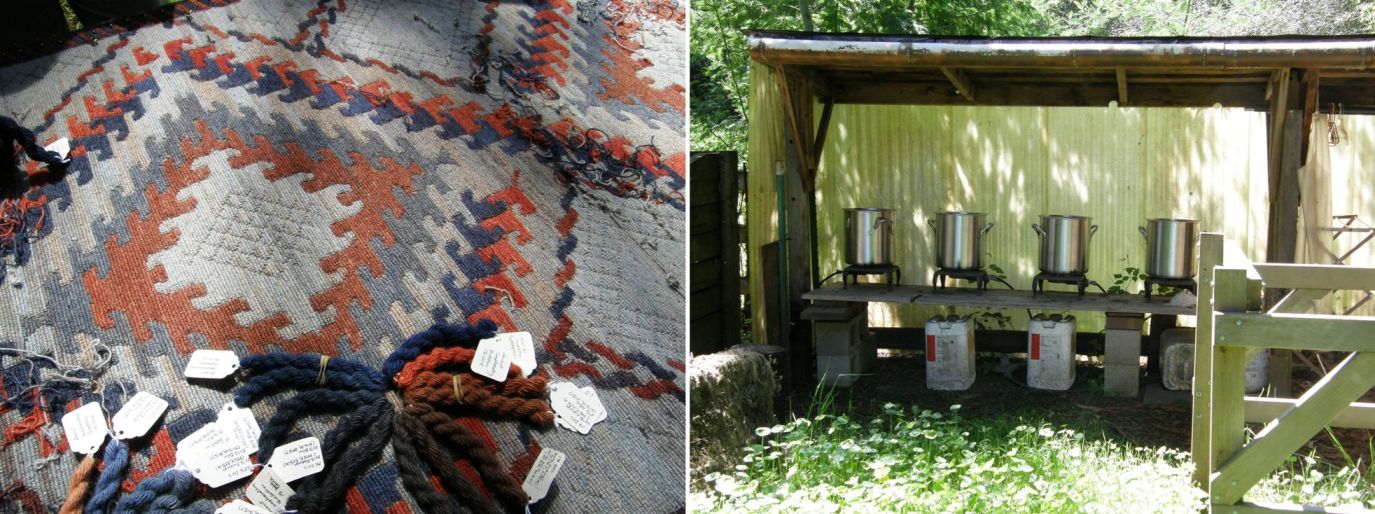
With a lot of patience, dedication and know-how she has come up with just the right hues. I was SO envious! The rug above is her latest work. It is a combination of weft twining and wrapping. One of the twined strands wraps around the other to give a raised surface on a flat ground of twining. I think I understood how it works. That’s on the list to play with when I get home.

As for the colors…I’ll keep dreaming. Maybe I will get into that kind of precision dyeing one day.

One of the highlights of this trip was spending more time with Annie MacHale. You may know her as ASpinnerweaver and she is on my blogroll but I think of her as the Queen of Sashes. She is one creative lady with an irresistible bubbly laugh.

Janet and I got to see her sash collection and hear the stories that go with them, rummage through her yarn stash and go from one inkle loom to the next in her living room/studio checking out her works-in-progress…and the books!!

One thing I have been wanting to promote while on this US tour is the lesser known weavings of the lowland areas of South America. We have all become so familiar with the textiles of one  particular region of highland Peru through the hard work of Nilda Callañaupa and the CTTC. I have had the fortune to study with weavers in lowland areas too most notably in Santa Cruz where I live and in coastal Ecuador. The weaving may not be as technically sophisticated as the work being done in the Cusco area but is every bit as note worthy and often sadly neglected.
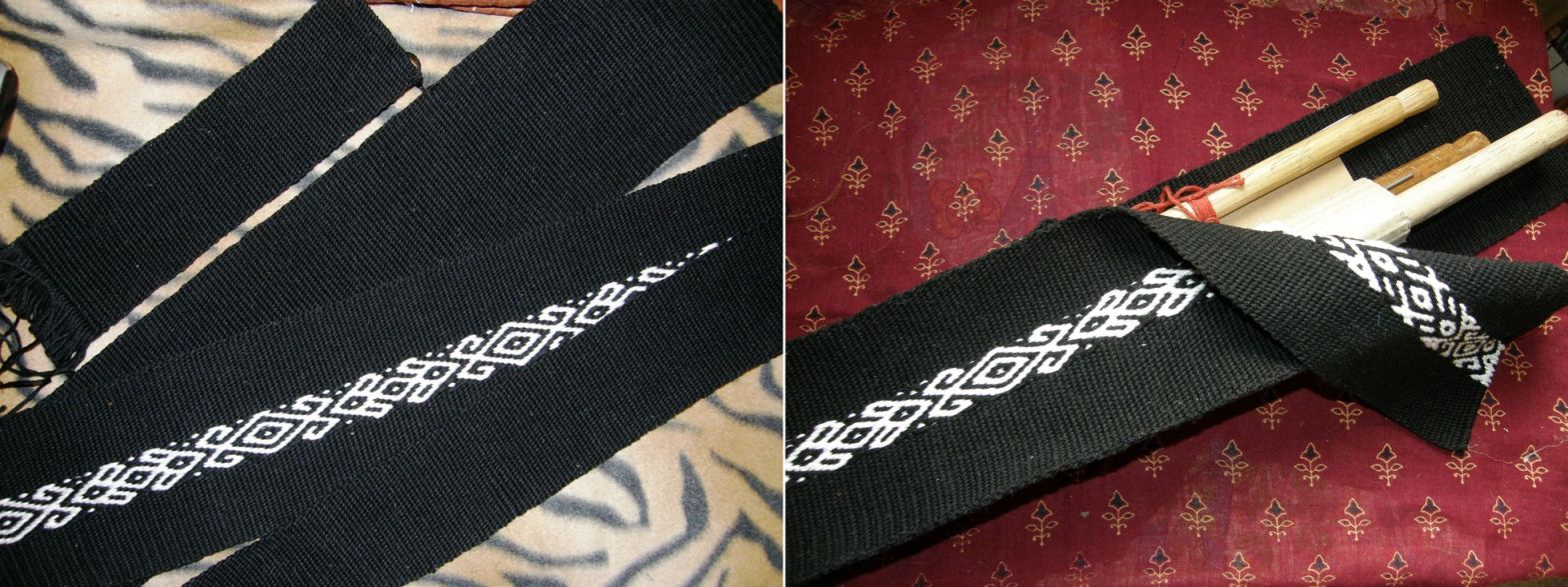
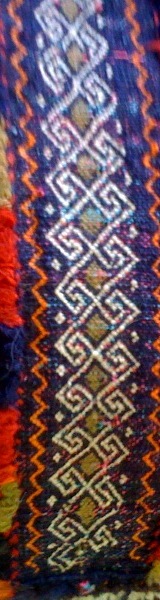
It seems that the work of the Shipibo people is calling to me from various sources. Just before I left home I found an image of a textile which the photographer had bought in Ecuador but which she believes was made by the Shipibo people of the lowland jungle areas of Peru and this is something I would like to investigate. It is woven with a technique that I have only seen used in South American textiles in images in books of textiles of northern Argentina that are no longer produced.

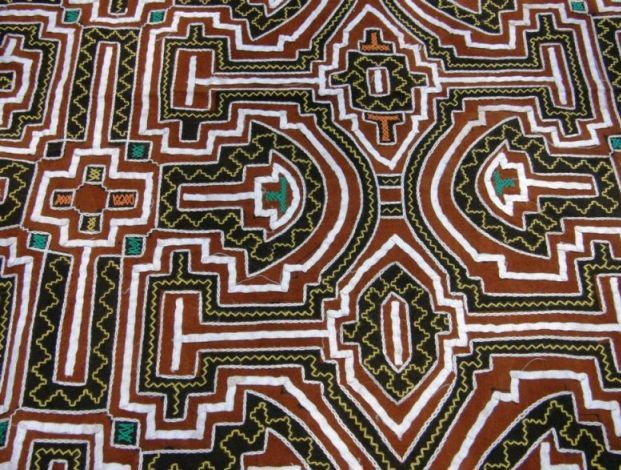
At the weaving get-together Yonat brought, amongst other things, Shipibo textiles to show that she has in her own personal collection…beautiful embroidered and appliqued pieces (above) with very distinctive designs. I only have some small painted pieces of Shipibo cloth at home. This is what Yonat brought…

And then Martha showed me this…
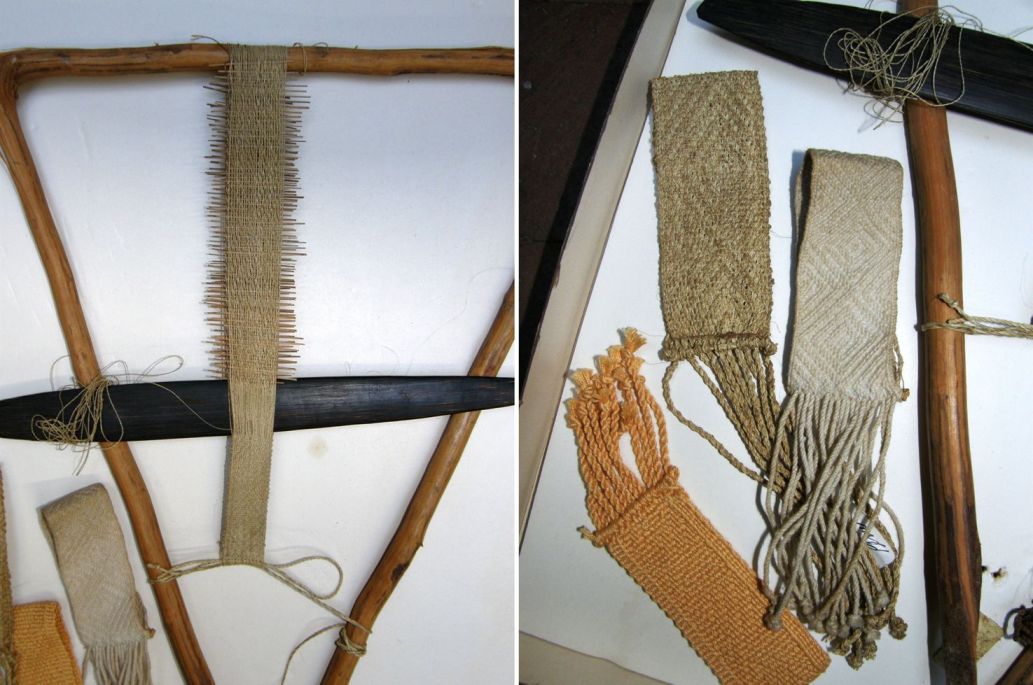
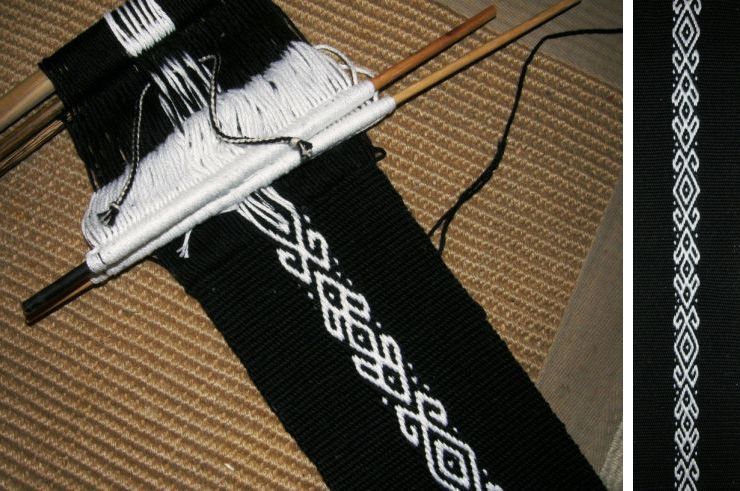
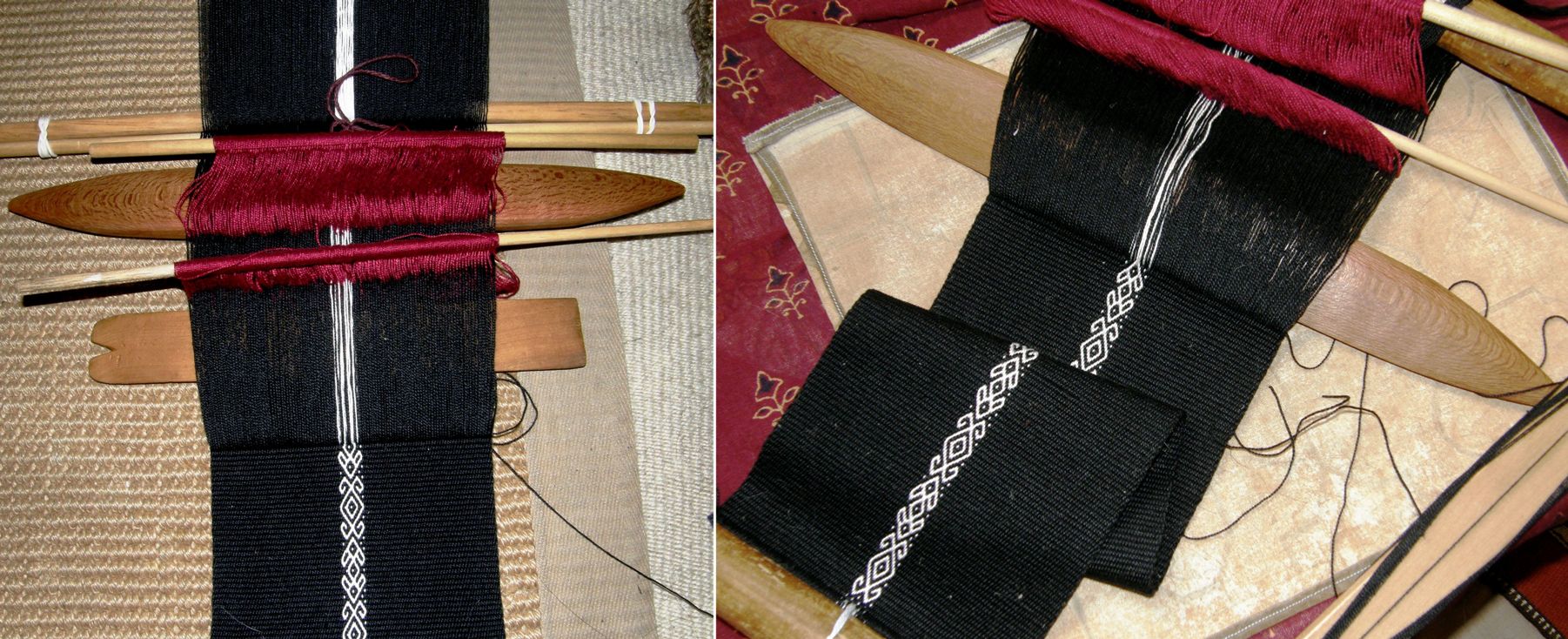
This too is a Shipibo piece and  part of the late Anne Blinks’s collection and something which she had studied. The wonderfully simple branch loom holds a piece of fabric which was probably destined to be a wristlet. The completed woven pieces around it are wristlets, some of which are Anne Blinks’s reproductions. You can see the enormous quantity of fine patterning sticks that have been inserted in the warp to program the design. This was amazing! I love the fact that it is just one color and that the pattern shows as a fine texture. I love the sword/beater too.

See all the fun stuff I got into!

A million thanks to everyone who brought textiles and so willingly shared them with me and the group. There was always a frantic effort on my part to take photos of everything. Peggy also brought some interesting bands that she had bought in Oaxaca.
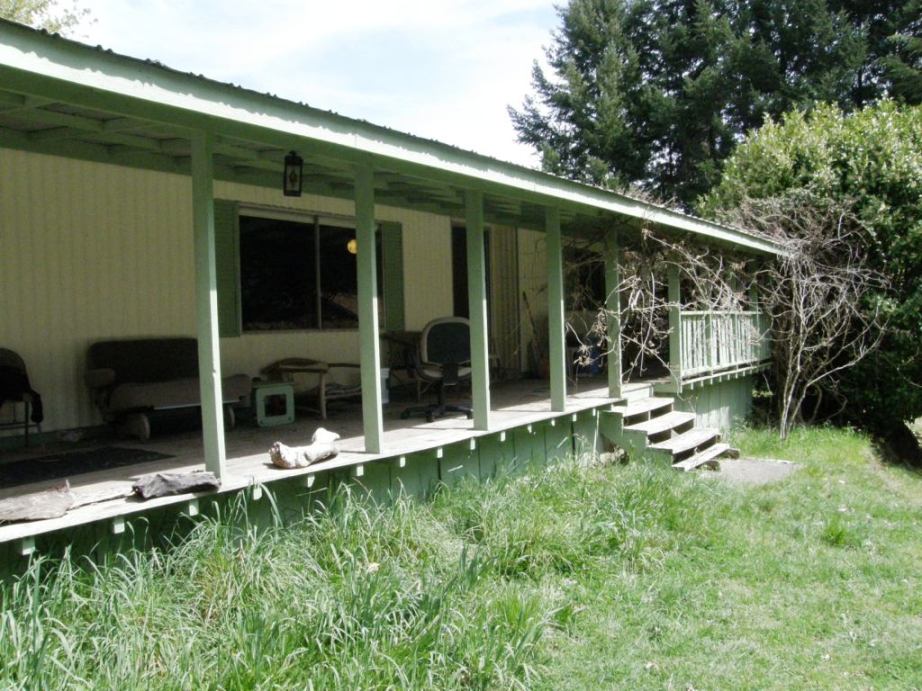
Now I am up on Janet’s farm in Humboldt County and we are planning a weavers’ gathering here. Take a look at that porch…isn’t that the most perfect backstrap weaving site? I put a cushion on the floor and tied up to one of those posts, nicely shaded while I got to wiggle my toes in the sun. For warping I clamped pegs to the edge of the porch and stood down in the garden. Perfect!

Janet’s husband has a family heirloom coverlet. This was especially thrilling to me as I had seen these in the Folk Art Museum in Williamsburg last year behind glass. I read how they were made with both cotton and wool, the white being cotton and the blue wool and could make out the balanced double weave. Now I have had the chance to touch one and drape it across my lap…a whole different experience.

So that is where I am at so far. We are off to Eureka tomorrow to meet some other weavers and do some backstrap weaving and so I have been able to squeeze in this blog post. Before I go I wanted to show you some things that have been going on in the Ravelry Backstrap Weaving Group…
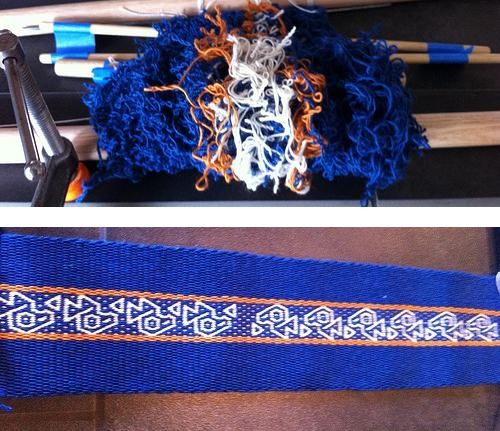

The Spin Along is still going and Jennifer respun some commercial wool and showed us its ‘kinkiness” before it could be stretched out on her backstrap loom and woven into this lovely piece.


Marsha and Carinefile are both doing Double weave. Marsha’s piece on the left is a guitar strap with the musician’s name woven in and Carinefile has made the sampler that goes with the tutorial here.

Jentide and Melisende made Sami bands. These are traditionally woven on backstrap looms using a small rigid heddle but, as you can see, they can be perfectly adapted to inkle looms.

And Bobbie completed a pebble weave bag…

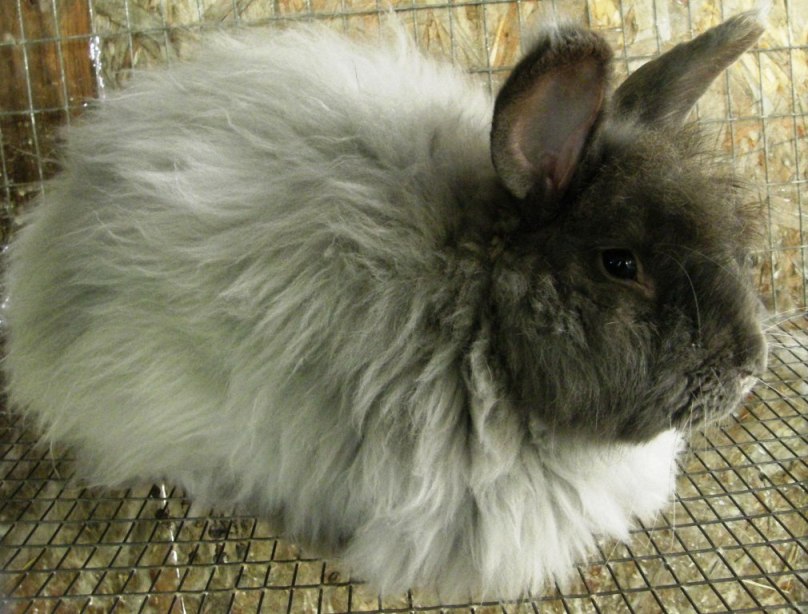
And if you are in an “Eastery” mood from looking at one of Janet’s bunnies, I wrote a post for Easter last year about a colorful Semana Santa, or Holy Week, that I spent in Guatemala in ’08 in three different areas, full of color and beautiful people and textiles.
You can see it here.
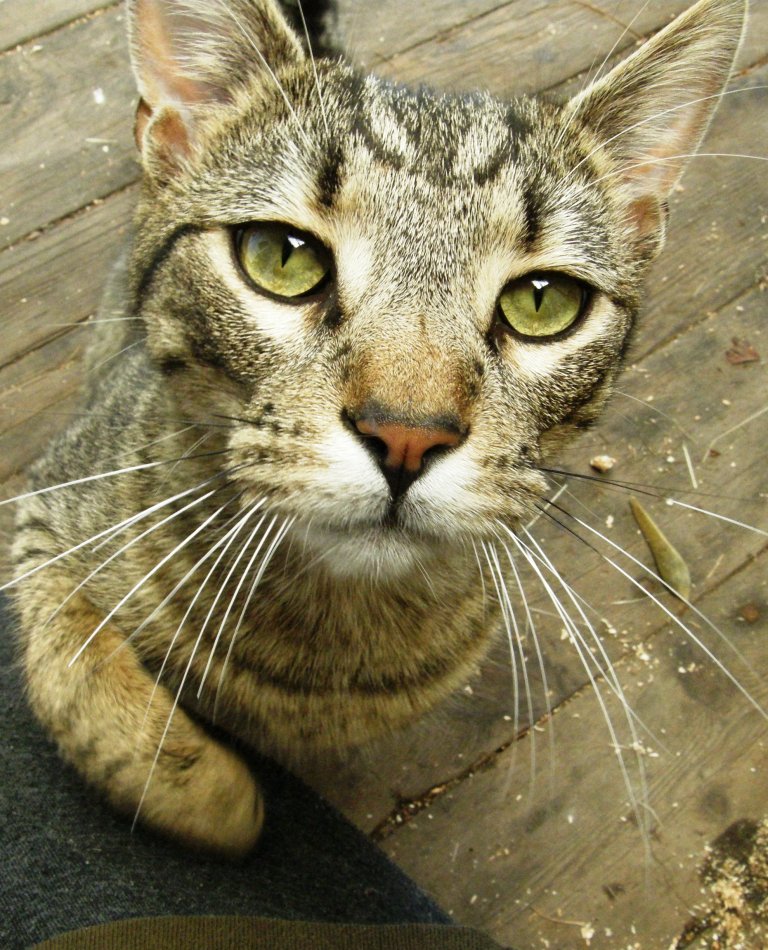

Meanwhile, Mike the Mouser is kindly helping me deal with pet withdrawals.
 

Backstrap Weaving – Variations on a Theme and a New Tutorial

I have been all over the place this week…sewing, braiding, twining and weaving four different patterning techniques. Keeps me on my toes!

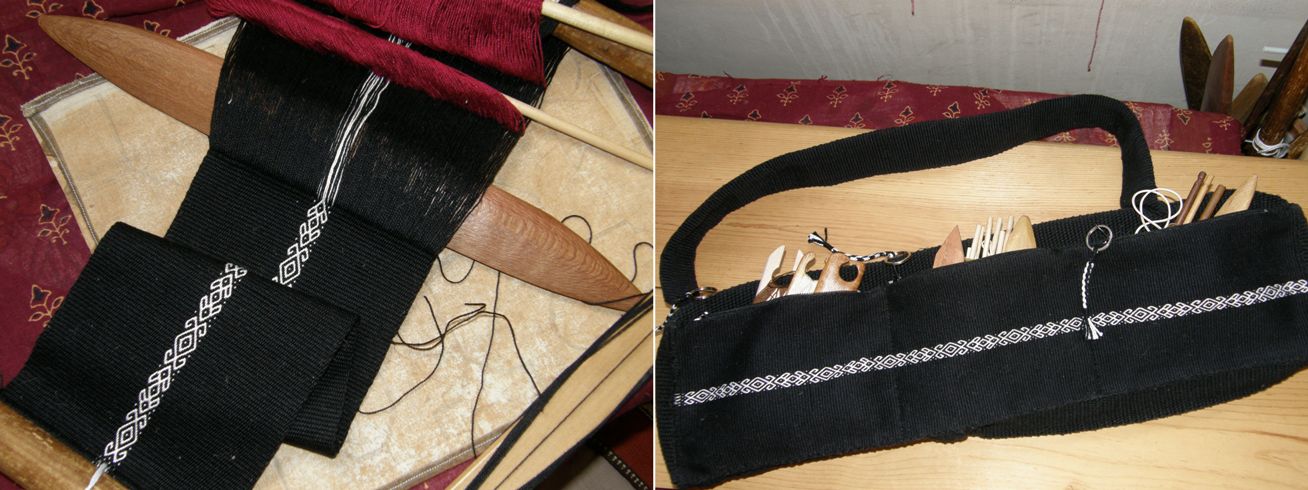
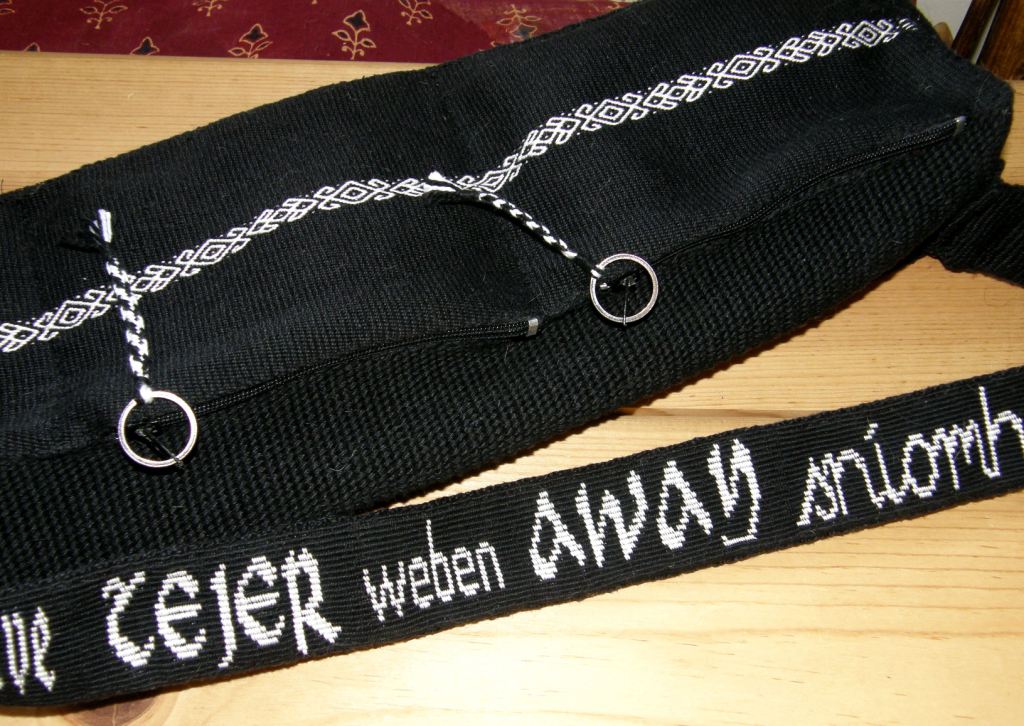
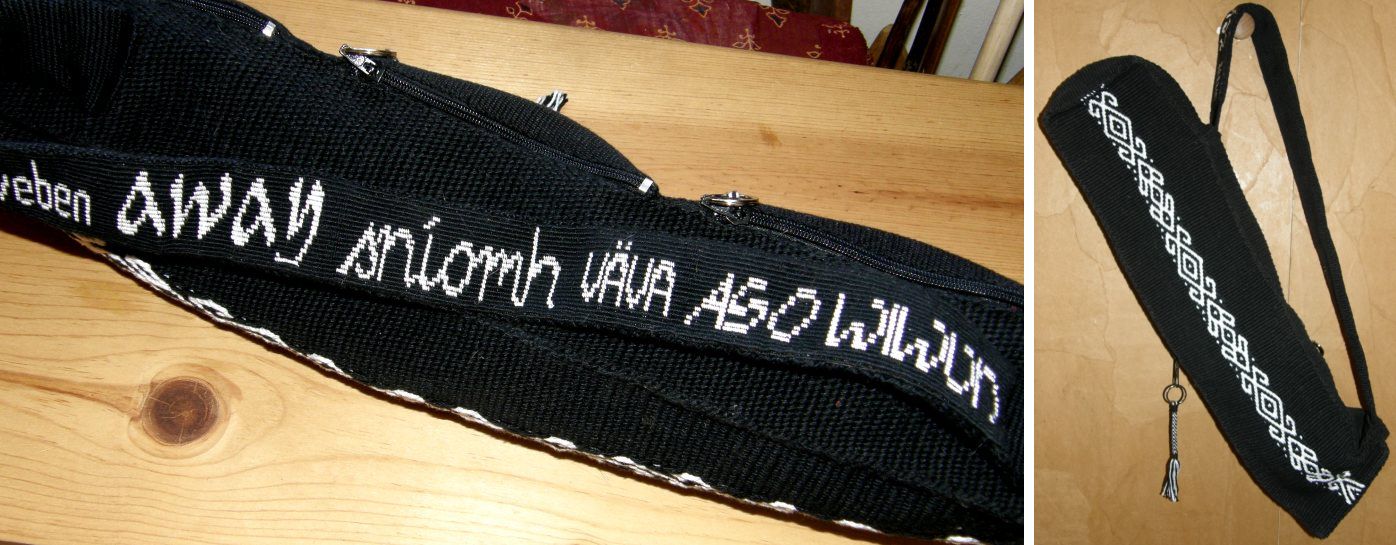
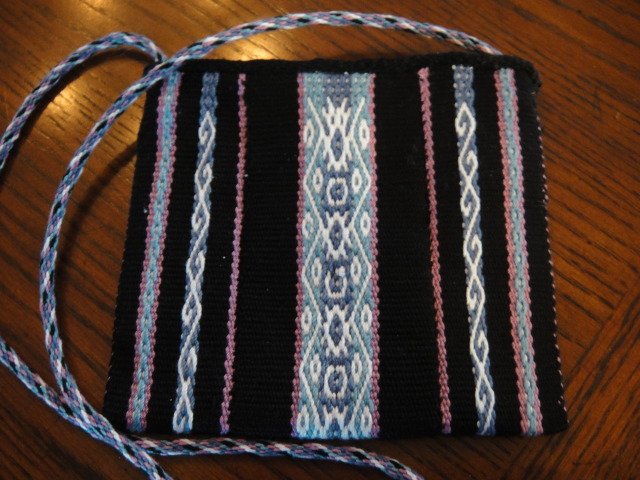
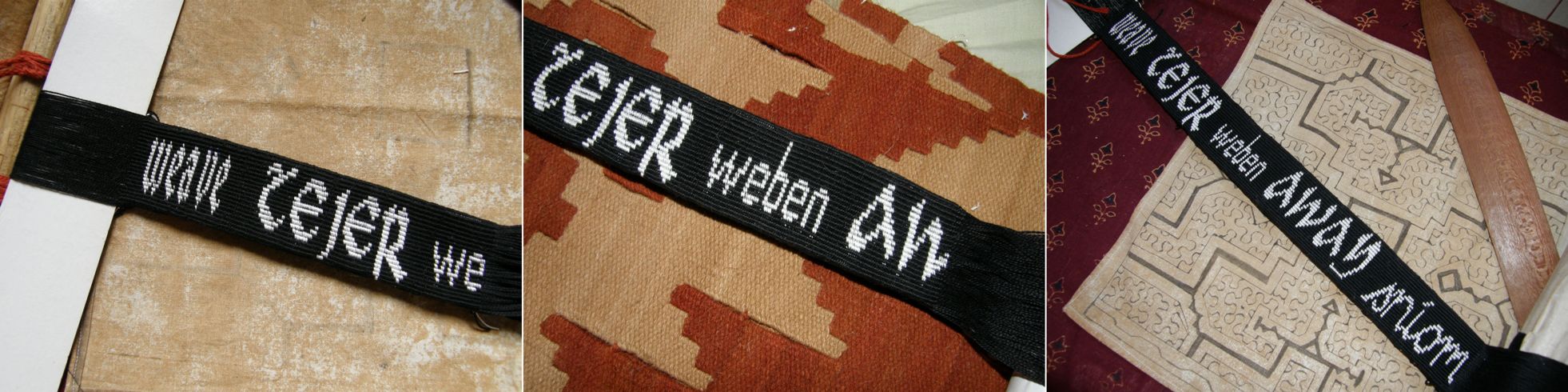
There was a lot of sewing as I finished the loom bag finally! This has been a long project mostly because I chose to twine the strap for the bag and that was slow slow slow. I decided to twine the word “weave” in different languages into the strap and, although I managed to gather a lot of words from different online buddies, I could only use a handful on the strap. I will save the others for another project.

There is some of the twining as it progressed. I used the English, Spanish, German, Quechua, Gaelic, Swedish and Nigerian words. As for putting the bag itself together, I am not much of a seamstress and so just made it up as I went along using a camera tripod bag as the model. First I made the front panel with a pebble weave design.

Then came the sides and the panels between which the zip would sit all woven in plain warp faced weave..

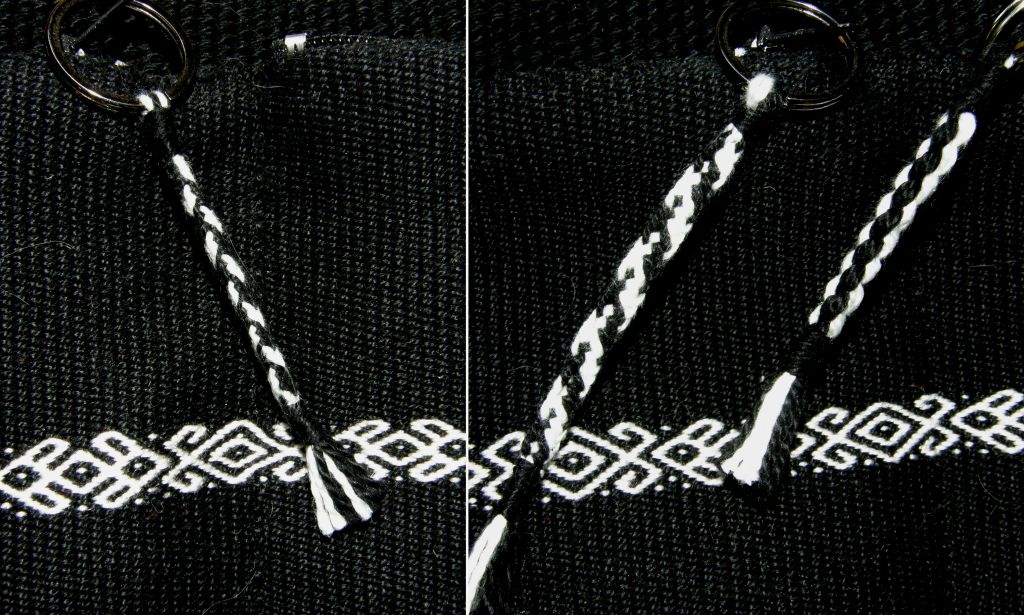
Once the zip was in I added a zip pull made using an Andean sling braiding technique.

Meanwhile I was still slogging away at the twining.

Then I decided it would be more practical to have pockets for all the smaller items like belt shuttles, pick up sticks and small swords and so I wove another thinner panel with the same pebble weave pattern.

The thin panel was sewn to the back of the bag. I have received two donations of large bags of assorted zips from online buddies so it was just a matter of diving into those and finding three small black zips the same size and I was set. I am getting pretty darn good at sewing these in!

Of course I couldn’t resist adding braided zip pulls. I made a square, flat-ish and round-ish braid for the the three pockets. I must do a tutorial here on that flat braid one of these days. I learned it for making straps for chuspas in Potosi.

Last of all was the strap. the last word to be twined was the Nigerian one which had been provided by a Facebook friend.The problem with twining is all the weft ends that are left hanging at the sides. I had to weave yet another plain weave band to sew to the back of the twined strap under which to hide all those ends. Actually it gives the strap quite a cushioned feel – quite appropriate for something that will be hanging off one’s shoulder.

There’s the last Nigerian word below (two words actually)…

DONE!!

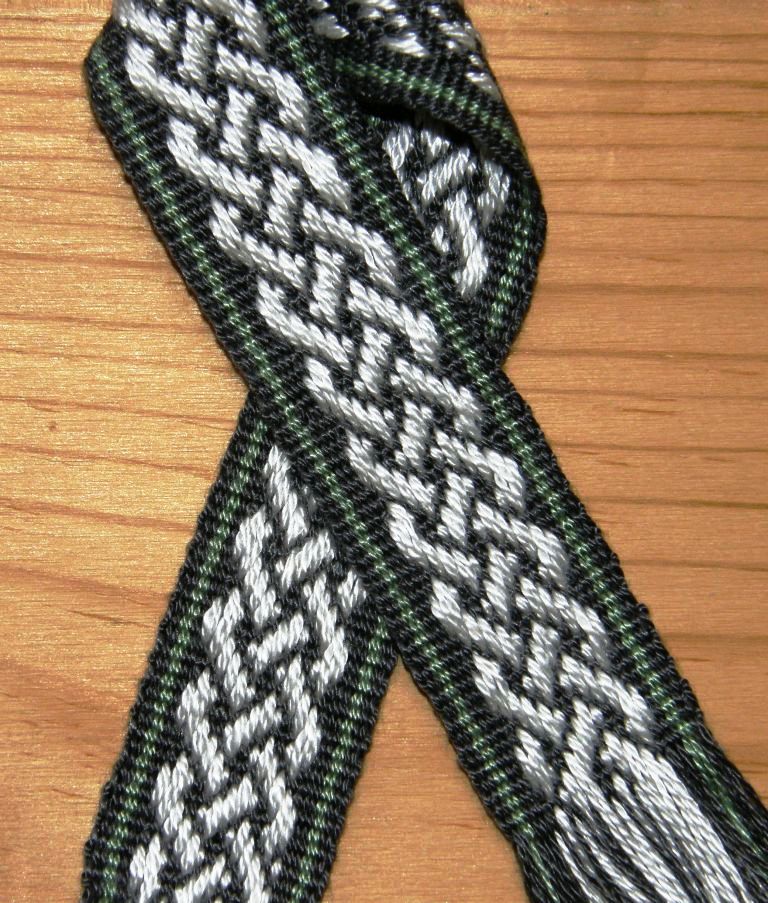
I wove a bit more on the tencel supplementary warp patterned band with its Celtic knot motif…


And I played a bit with a design I got from a Central Asian woven piece.

My friend Lisa photographed this piece at a reenactment event some time ago and sent me the image.

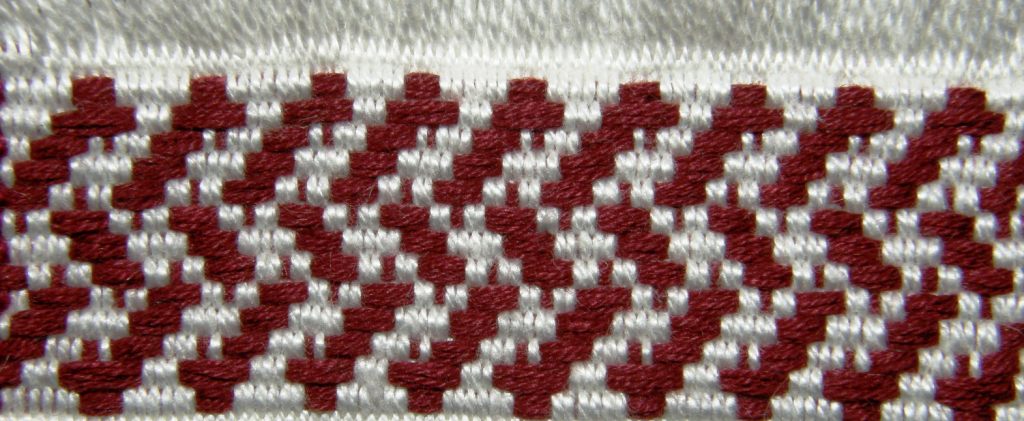
There was not enough detail to see what technique had been employed and I decided that it would look good anyway woven with a supplementary weft. The design is charted here.

Last weekend one of my online buddies sent me this same image saying that she had found it on her desktop and had forgotten from where it had originated and that she thought I might like to weave it in pebble weave. After I reminded her that it was actually from my blog, we both had a laugh and then I thought, “Huh, I wonder how this would look in pebble weave?” And then another “huh”. How would it look in other techniques?

Hence the title of this weeks’s blog post…Variations on a Theme.

Here is how it looked when I originally wove it using a supplementary weft…

I guess I am very lucky to have been able to travel so much here in South America and learn so many different techniques and designs. I have often met weavers here in my travels who are masters at two techniques and have been weaving them all their lives and who are delighted and bubbling with curiosity when I show them motifs woven in the same technique from another region within their own country. Others see a technique in my samples that they don’t know and plead to be taught it. Sometimes I have to push back my desire to learn from them in order to teach them. They are always so happy to have an “edge” over their other weaving companions with this new knowledge.

So, just for the fun of it I celebrated the fact that I have had access to many patterning methods and I adapted the Central Asian motif to three other techniques. There are still several more to try.


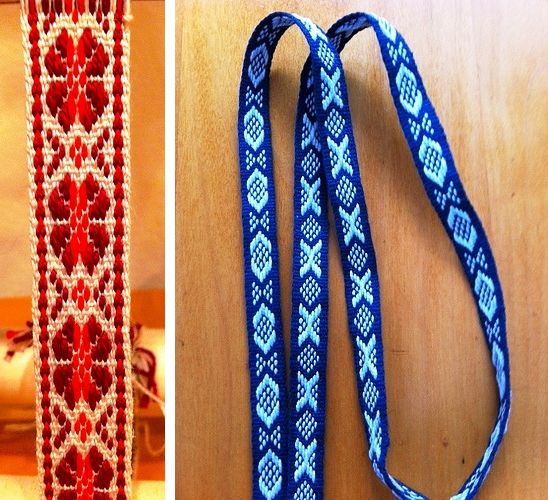
From left to right…in the same supplementary weft technique but in finer yarns (35 wpi ground), in double weave, the original supplementary weft (24 wpi ground), pebble weave and supplementary warp. I love them all!

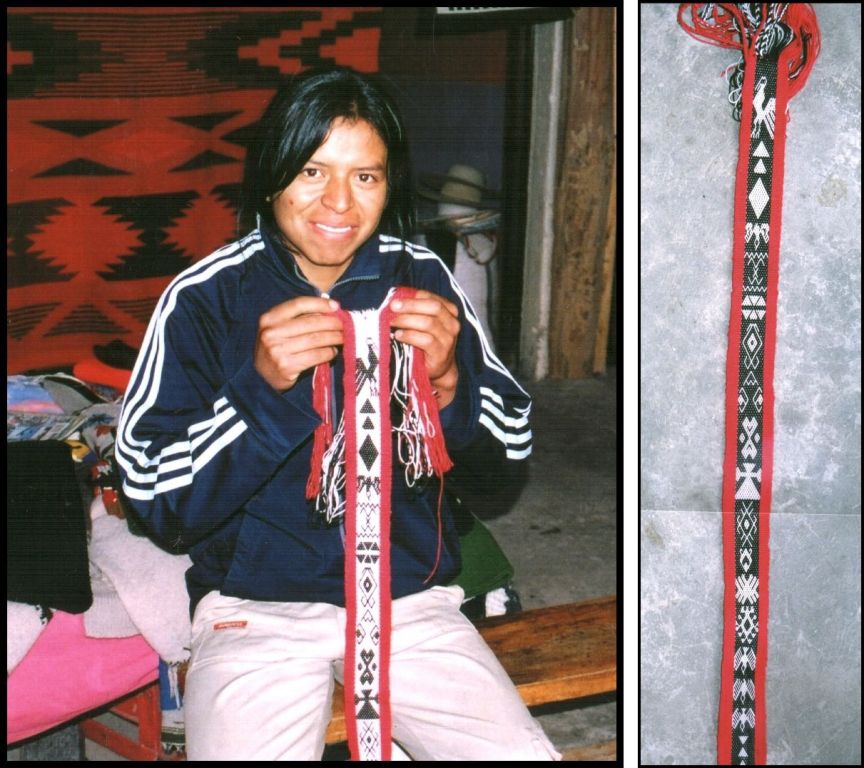
I once taught pebble weave to a weaver in Ecuador. The weavers in his community weave with tapestries and belts patterned with supplementary warps. The pebble weave technique is not known. I left him with drawings of various Bolivian and Peruvian motifs to copy if he wished as I didn’t have woven samples to give him. Eighteen months later I returned to see his band with his attempts to duplicate the drawings but there was also a rooster motif which he had adapted from the typical supplementary warp belts and embroideries of his community.

And Juan definitely wanted to have an edge over the other weavers. He wouldn’t even teach the pebble weave to his brothers!

I shared a room at the tinkuy with a weaver from Cochabamba who was dying to learn the design on one of my pebble weave amulet bags. She already knew pebble weave but not this particular design. As there simply wasn’t time to learn it at the tinkuy I swapped my amulet bag for one of her spindles. I wonder if she has woven it and if her new design is envied by the other weavers in her community.

###############################

The Weave-Along in the backstrap group on Ravelry is coming to its end on March 6th with what we are calling the “big bang”. There seems to be a lot of weaving going on by the handful of weave-alongers and we have even been hearing from a lurker or two. Projects are still being posted…

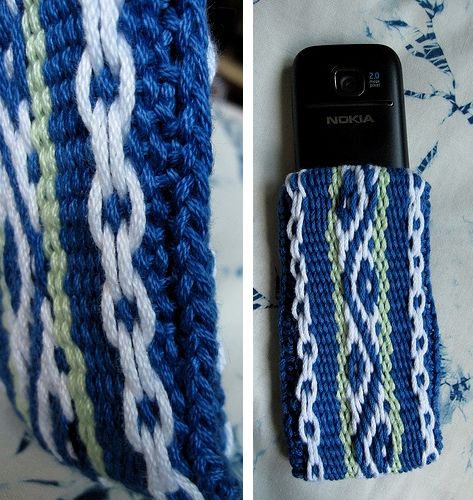
Tracy made one of her pebble weave bands into a cell phone pouch. She edged it with a single row of cross knit looping or Van Dyke stitch as it is in known in embroidery. (See the video in this post for instructions). Check out Tracy’s latest blog post on the textiles she saw in Syria.

Marsha (PandulaArts) wove these pieces on the left patterned with simple warp floats and then dabbled in a little double weave.

Toby, who is not participating in the weave along, but who is a regular contributor to the backstrap weaving group on Weavolution, has been trying warp substitution technique (on the left) using a Bedouin motif and double weave (on the right). The warp substitution technique is a very good introduction to the basic pick up patterning method which is also used to produce patterns in double weave. It is a good idea to start with this technique before advancing to double weave. As you can see, one of the disadvantages of the warp substitution technique is that it produces long floats on the back of the piece. The length of the floats can be reduced by carefully choosing designs and spacing. Toby’s design on the right is his own invention.

Tanyabe has been making her first steps in pebble weave on the left and Tracy is now weaving a Chinchero design in pebble weave. This design is charted in my book.

Jennifer’s Sami bands are gorgeous!! She has been doing these on her rigid heddle and inkle looms and I believe that she has one going in wool on her backstrap loom too. Once again I remind you that you can access instructions and patterns for these bands on the Yahoo Bands and Braids Group or by buying Sue Foulkes’s book here.

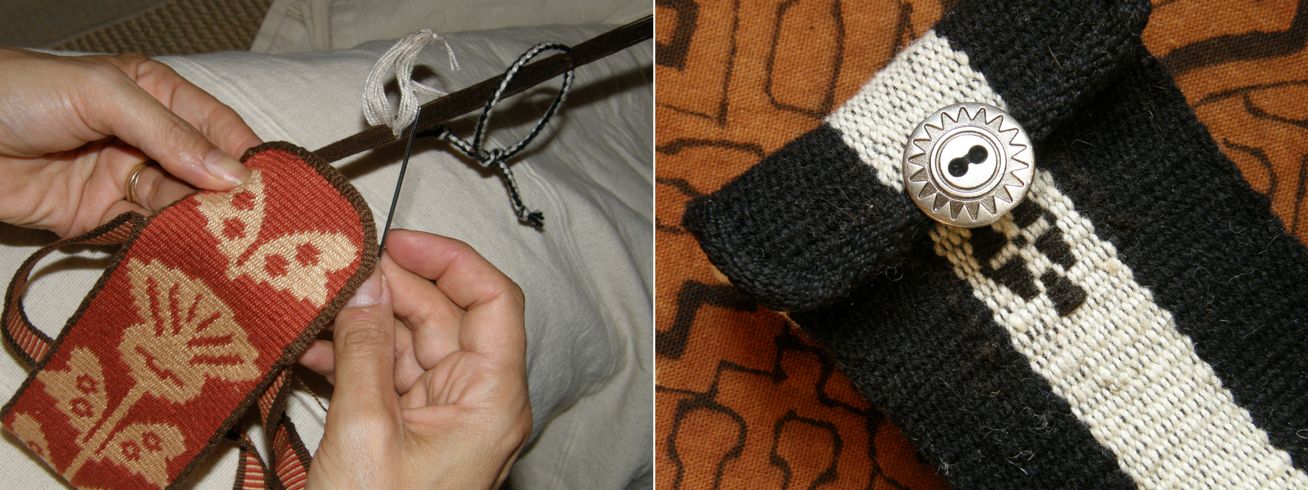
As folks finish off their projects for big bang Sunday, a couple have asked for a tutorial on the tubular bands that are often used here as decorative edgings for finished woven pieces. These are bands that are woven and sewn simultaneously to the edge of a piece of fabric using the weft as the sewing thread. There are several kinds of bands. Some are in plain weave and this is probably the easiest place to start learning about these.

I have put together a tutorial here with photos and a short video. I have also put a video there that I shot at the Tinkuy de Tejedores in Peru of a Bolivian weaver attaching a band to the edge of one of her bags.

These bands can be used to cover the raw edge of a weaving as I did with the edge of the cell phone pouch above. However, I would not attempt to do this until you have practiced the technique many times on the selvedges of your woven fabrics. It is far easier to learn to apply these bands to edges that are not threatening to unravel!

You can see above that a narrow warp is wound and set up with simple string heddles and a shed loop. I use a tapestry needle to carry the weft and sew the band to the fabric.

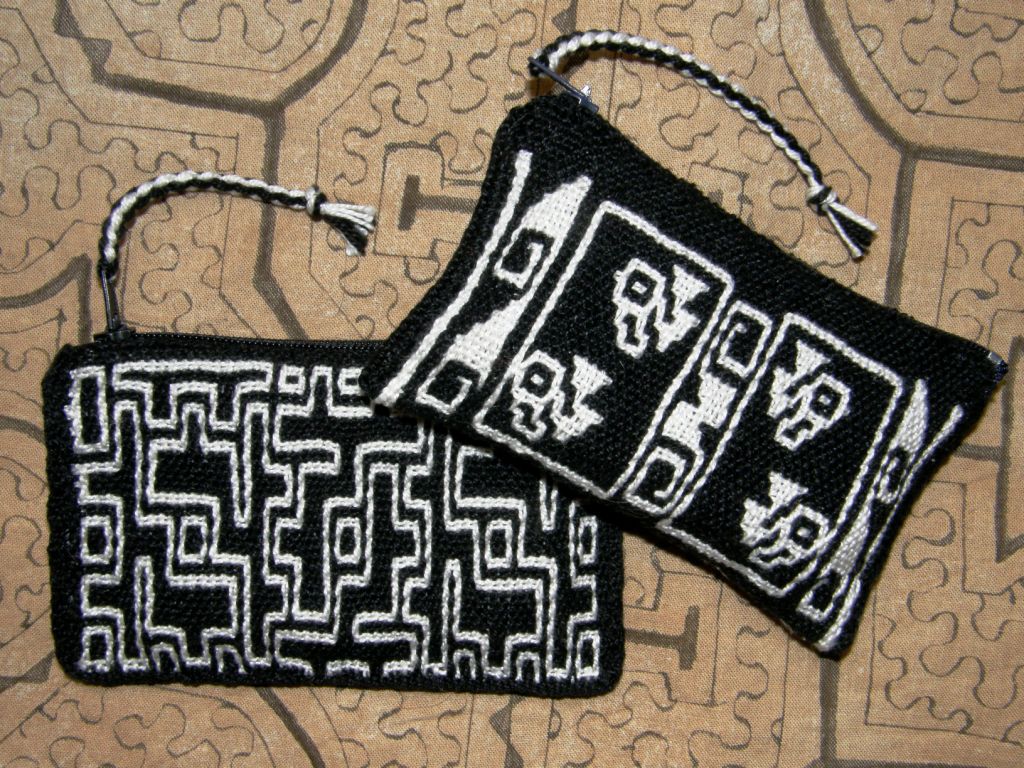
The purse on the left has been edged on three sides with one of these bands. See the full tutorial here.

#######################################

Greetings come from “bicycle Anna” this week who is now down in the Chilean city where I spent my first five years in South America. Punta Arenas is the southern most city on the South American continent. From the city you can see the island of Tierra del Fuego across the Straits of Magellan.

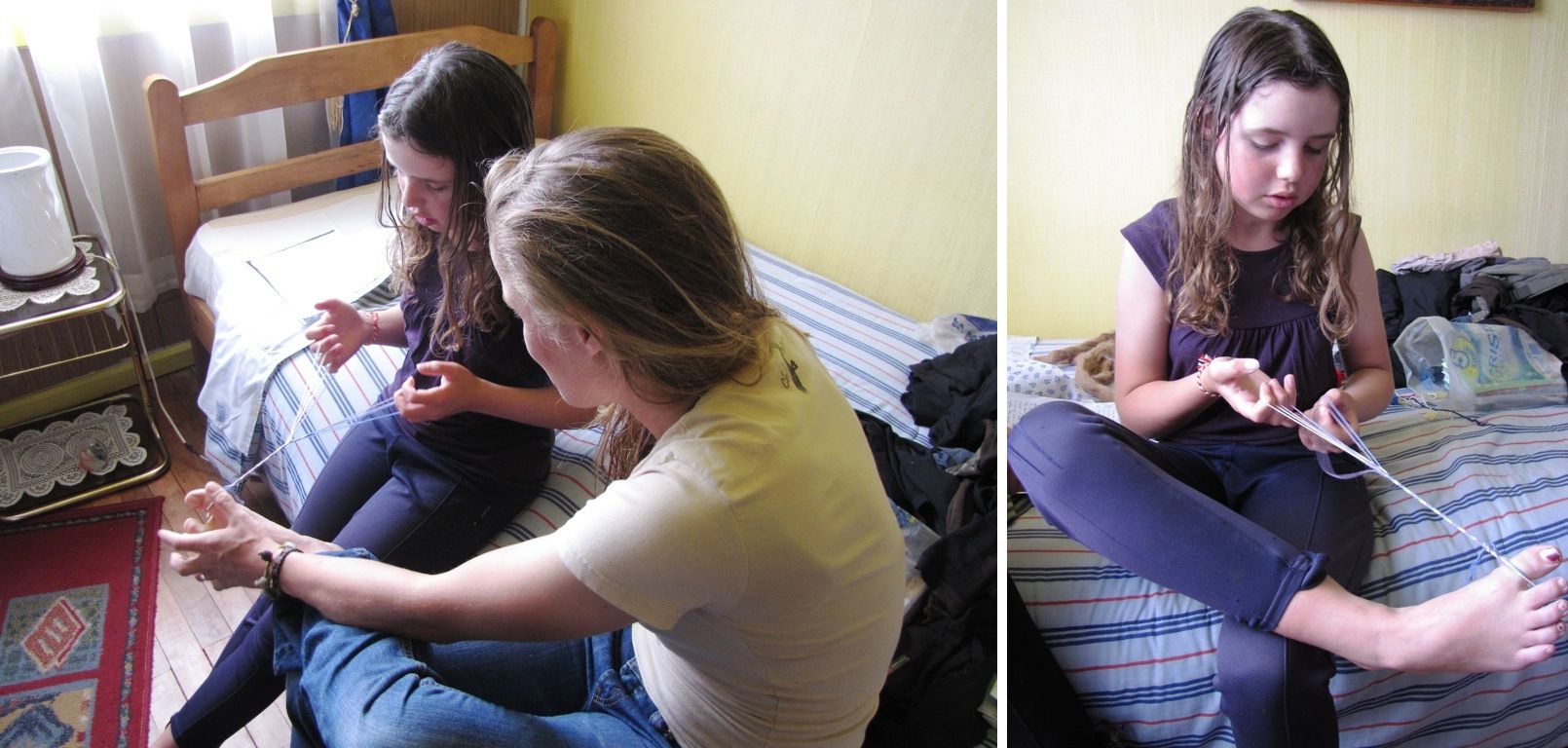
Anna stopped by to see me at home and have some weaving lessons. She is now in the land of sheep…tens of thousands of them and her new drop spindling skills are being honed. She is carrying llama and alpaca fiber that I gave her along with a Bolivian spindle and I am sure that she will be adding Patagonian wool to her fiber stash.

And look how she is getting on with her pebble weave with her loom tied to her bike! It’s summer down there…you wouldn’t think so from the gear she has on. The days are looong and if you get one without wind it can be heavenly.

Anna has been spreading the fiber love by teaching young fellow cyclist Kate to make the six-strand finger loop braid that I learned in Potosi (one of the ones on my new loom bag).

I must warn you now that this is pretty much the end for this post of anything related to weaving or fiber as I indulge in a little nostalgia trip to the place I called home for five years…the wild Chilean Patagonia. Some of these pictures are Anna’s.

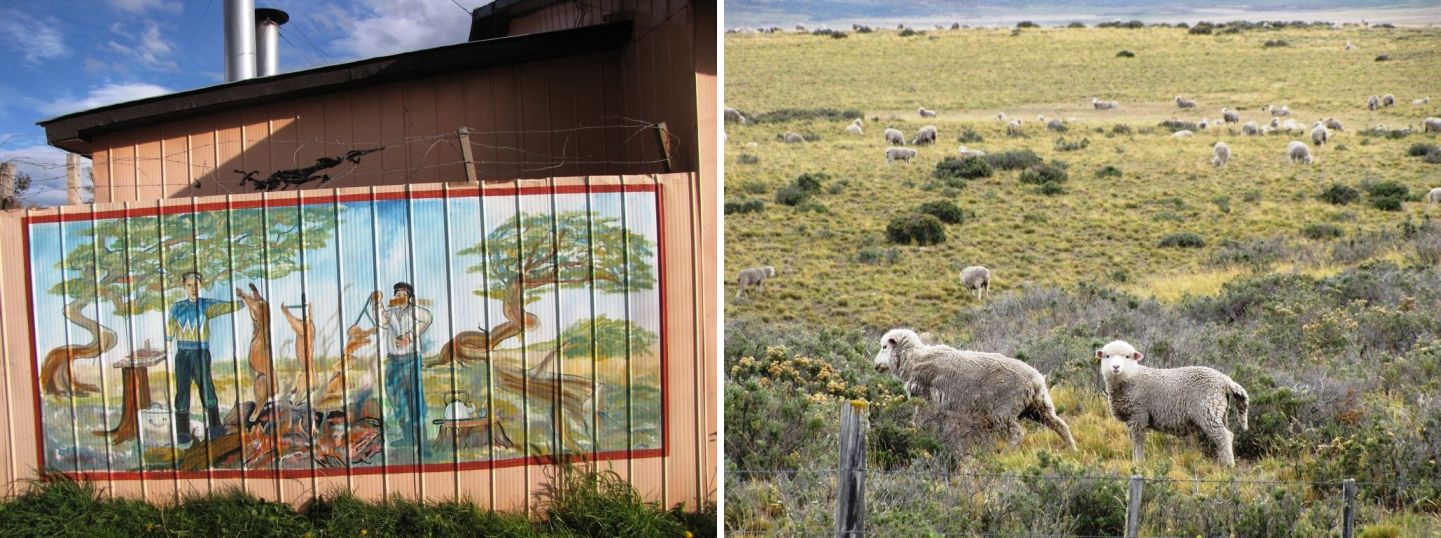
A house at left is painted with a scene depicting the famous southern Chilean lamb barbecue – asado al palo.

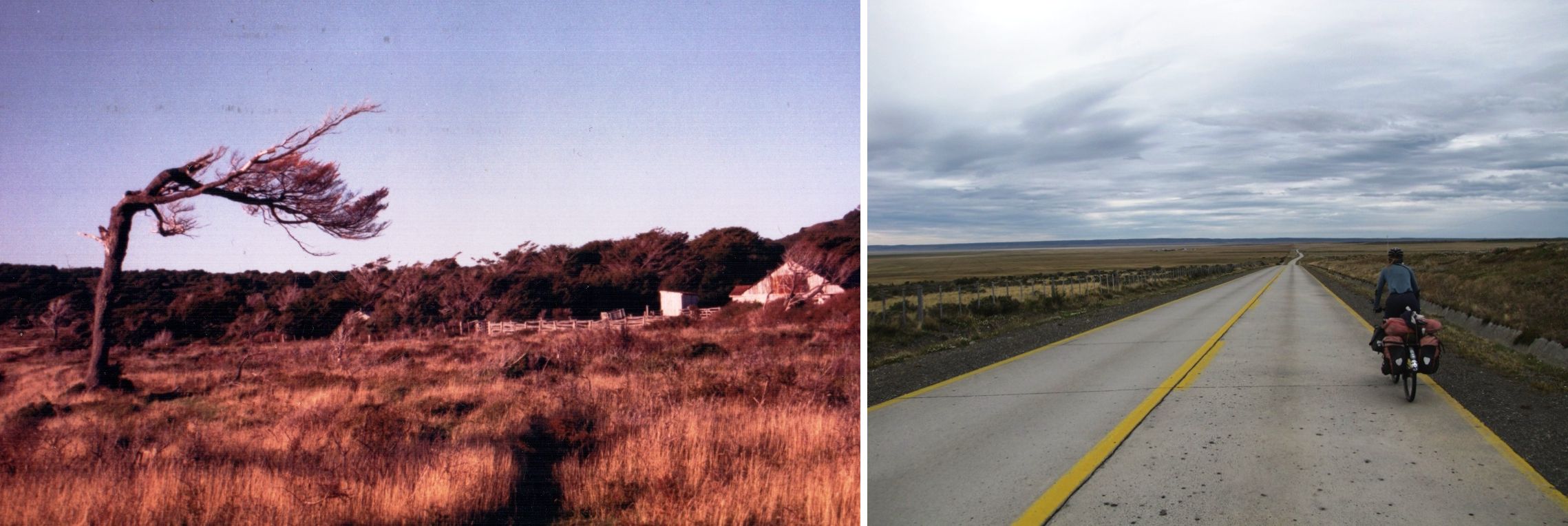
The Andes dip down into the sea before reaching this part of the world creating a series of islands, fjords and sounds. The land is scrubby and flat and rather colorless. Trees grow sideways with the constant winds.

Punta Arenas is a city of houses walled with corrugated sheeting. Rather than let it all run to rust residents paint with soft pastel shades, splashes of color in the bleak landscape.

This statue of an Ona indian is in the Plaza de Armas in the city center. The toe shines as visitors rub it to insure their return to Punta Arenas one day. Puerto Natales futher north is located on Ultima Esperanza Sound and is the gateway to the spectacular Torres del Paine National Park.

Craggy mountain peaks, fjords and wildlife in and around Torres del Paine…a rhea or ñandu walks with her chicks.

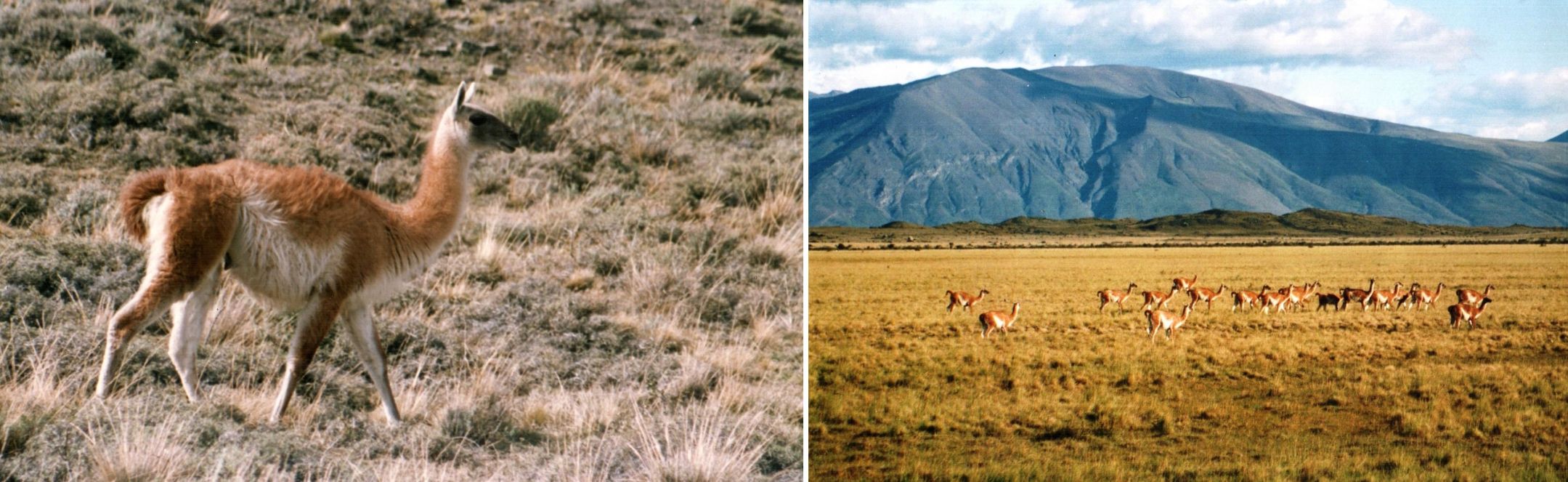
Herds of Guanaco roam  the park.

The hiking and scenery are superb but be prepared for a good battering by the wind! I got to go to Antarctica twice when I was there and thus add the seventh continent to my list. After all it is just across the Drake Passage! I will leave you with some shots from there.


Penguins, albatross and seals. This Albatross is in the Falkland Islands. Lots of whales too which I could never quite catch on film. And yes, I was weaving between all this!
They tell you to not to get within ten feet of the wildlife but if you just sit still on the beach long enough, the penguins all come to you!

Ah well, back to jungly steamy Santa Cruz. It’s time for coca tea and a mango!


Backstrap Weaving – When the Weft Struts its Stuff

In the kind of weaving that I like to do on my backstrap loom, that is, warp faced weaving with pick up patterns, the poor old weft thread rarely makes an appearance. When it does, it usually means that something has gone wrong…a warp did not get raised in one of the sheds thus exposing the weft in its place, the warps haven’t been well spaced to completely cover the weft or the selvedges have been poorly woven.  I even use weft colors that match the edge of the fabric so that the tiny turns of weft at the edge blend in with the warp color and are, therefore, less visible.

This week I have been playing with a technique that gives one weft at least, the starring role…the supplementary weft. (See the tutorial on this technique here). In some backstrap weaving cultures, everything is about brocade which is created with supplementary wefts, and it is the warp threads that take a back seat.

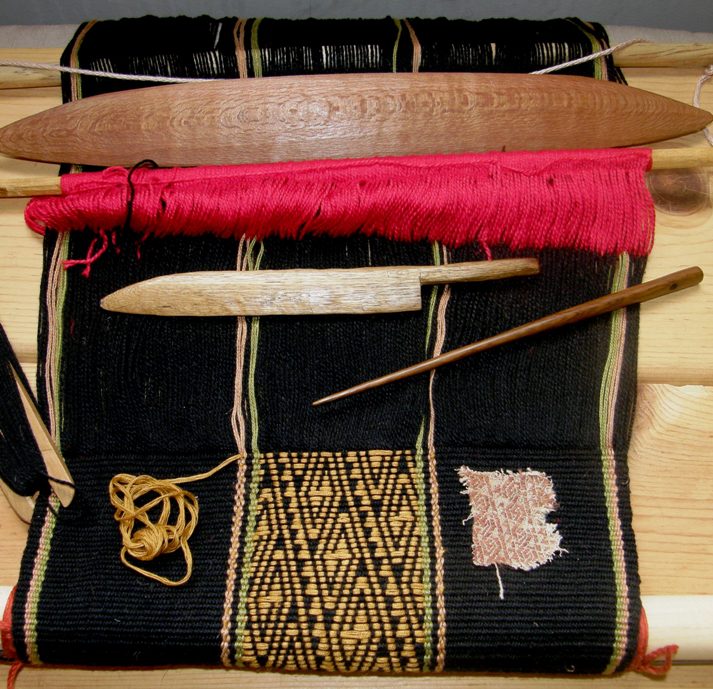
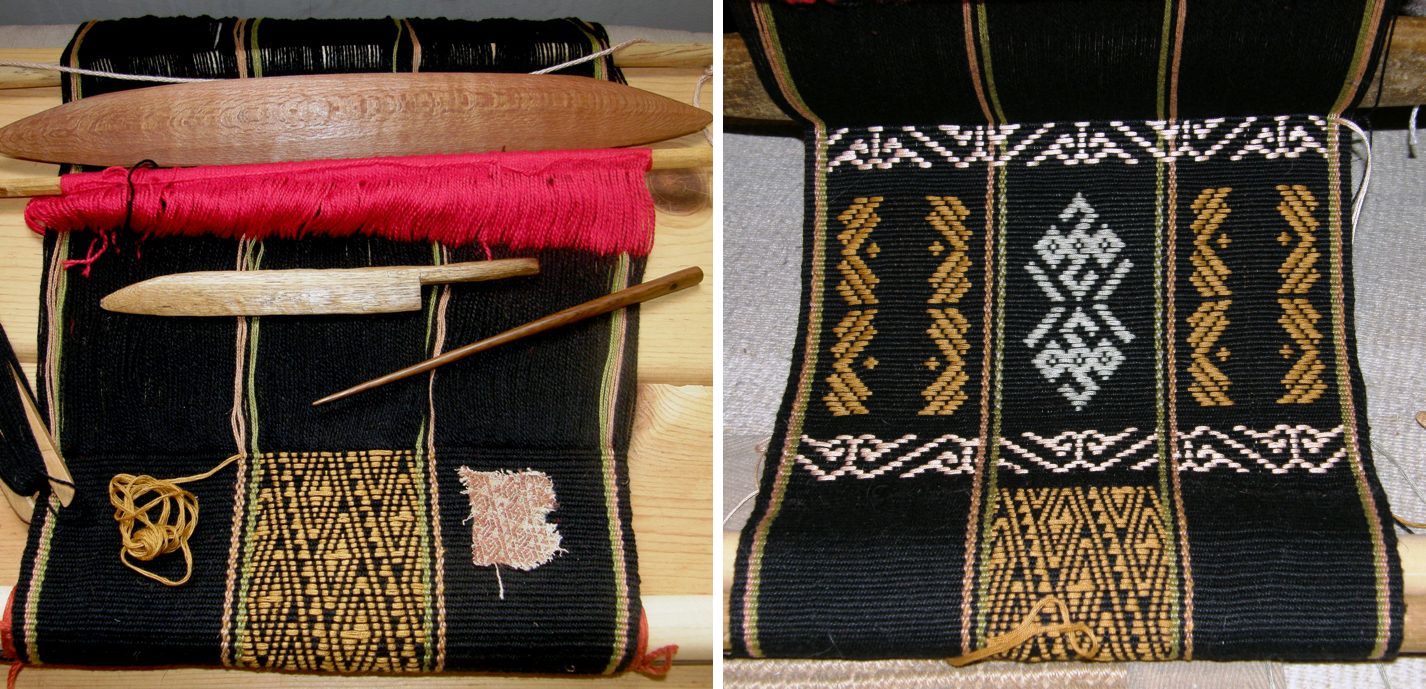
This all started when I uncovered a project lurking in the closet. I wove this supplementary weft piece as an attempt to reproduce a design on an old textile fragment that I have – the only one which has a design in a supplementary weft. I took this loom to show at CNCH last April so it has been hanging about here untouched for some time. Not feeling inclined to continue with this design as the exercise had served its purpose, I decided to use the rest of the warp to sample other traditional designs  which I had been saving in a folder.

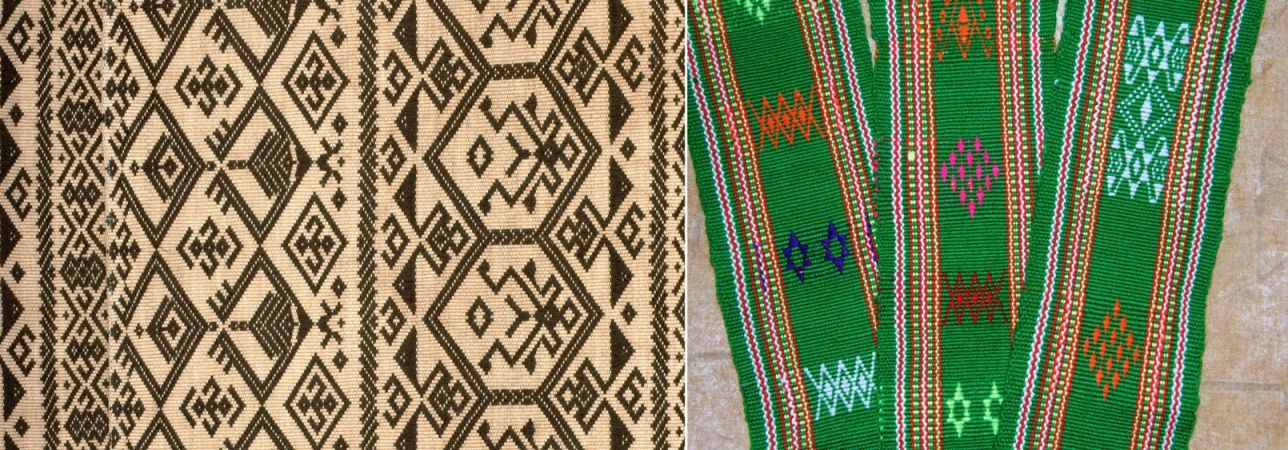
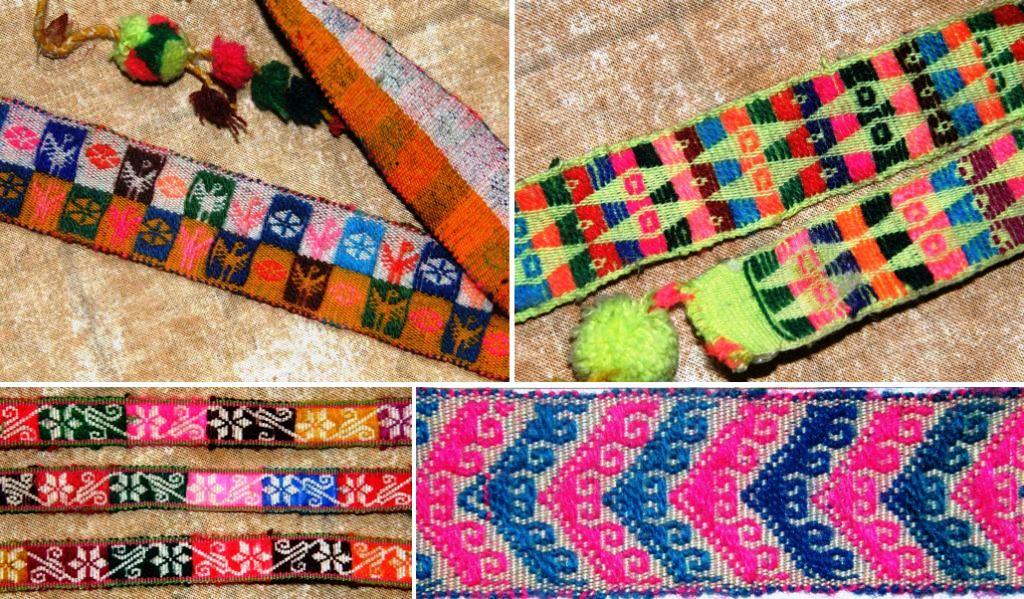
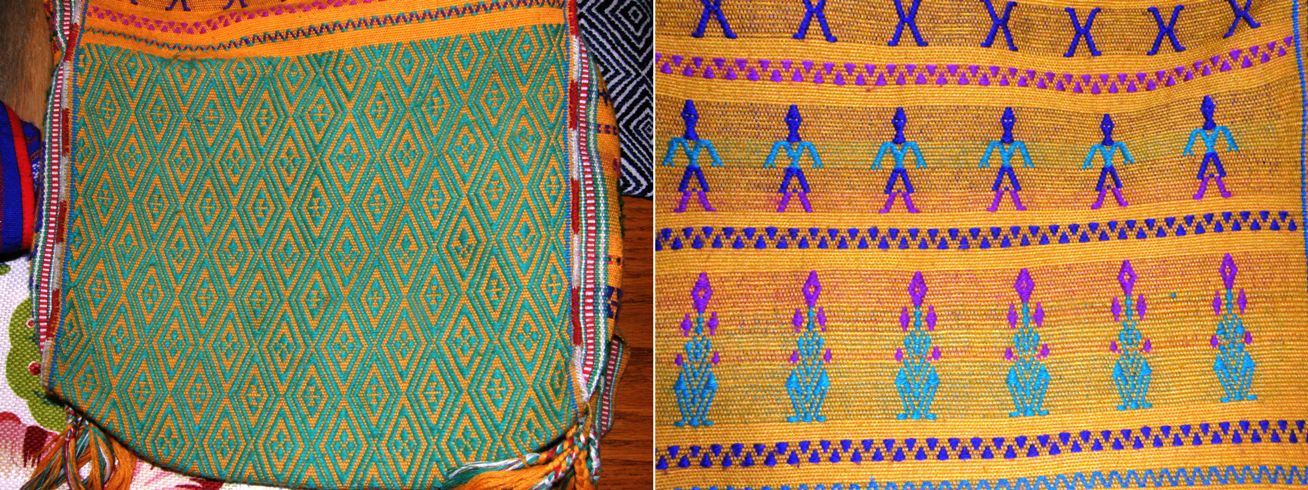
Here are some of the textiles that inspired this project…

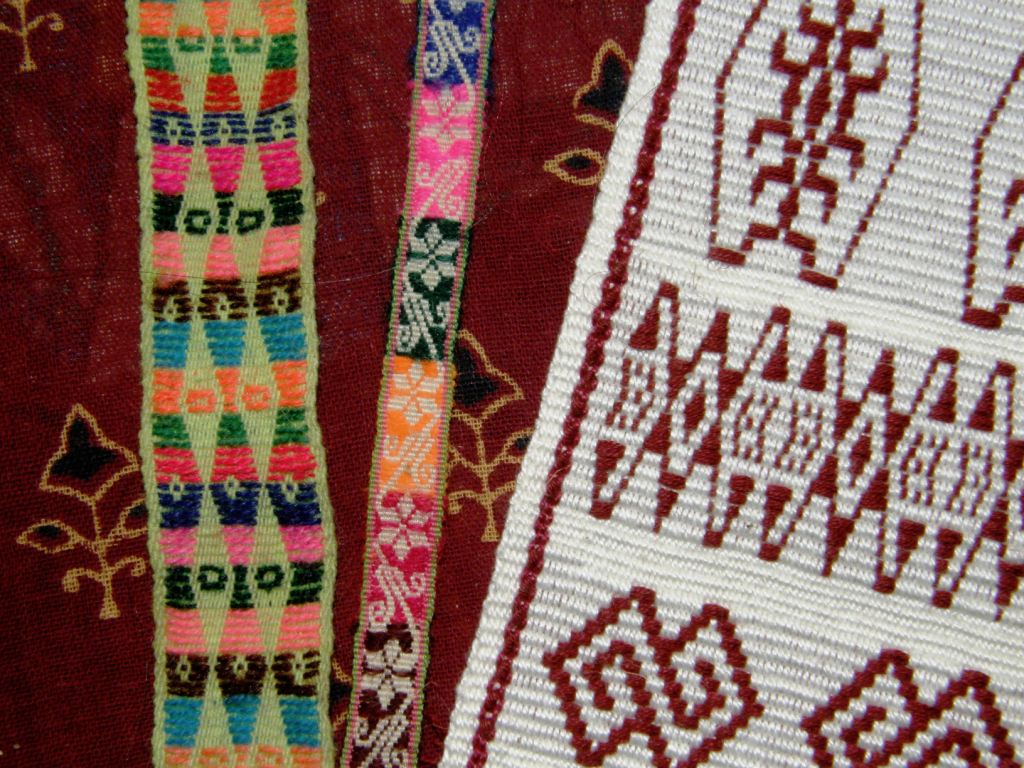
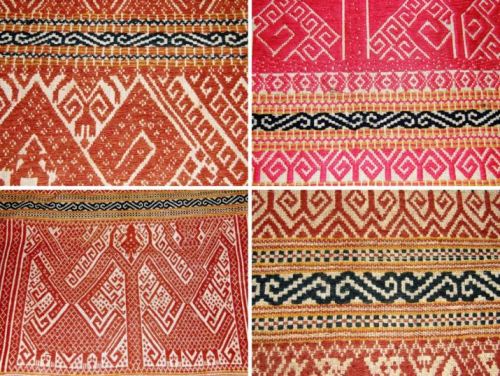
On the left, Chris Buckley had sent me this image of a blanket made by a Li weaver of Hainan Island. Montagnard weaver Ju Nie made this Rhade head band with many small motifs woven with supplementary wefts.

These are some of the many gorgeous Indonesian pieces that I admired at the Dancing Threads stand at Convergence last year.

Ladies wearing hats decorated with weft patterned hat bands can sometimes be seen in the streets here and I have managed to purchase a few of the bands in my travels in the highlands.

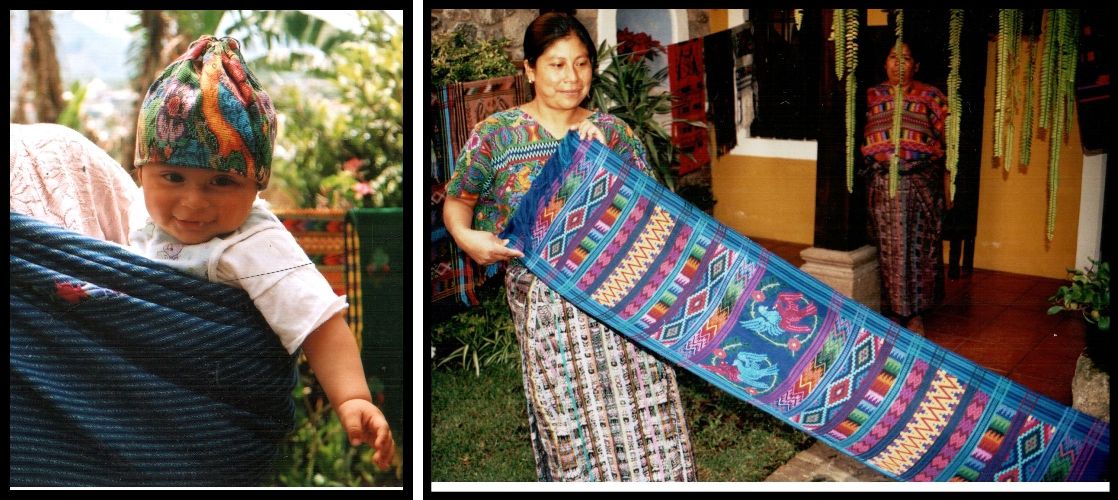
I will never forget the beautiful Guatemalan textiles and the weft patterning techniques I learned with my teachers there.

I even uncovered these cotton Indian pillow covers that my aunt had brought back from Chennai. I had had to put them away as my cat was chewing the twisted ends of the weft twined sections. Here supplementary weft patterns have been combined with small sections of weft twining. The little warp float section is interesting too as very thick and thin warps have been combined, the thick black warp pushing aside the white to expose the white weft.

On my last visit with Betsy Renfrew and the Montagnard weavers I got to see these Bunong weft patterned textiles for the first time.

Of course, Karen Elwell’s fabulous Flickr page of Mexican textiles will always inspire me. Someone pointed out to me the other day some Huave pieces with their little suppementary weft figures woven in what appears to be natural white and brown cotton – quite a contrast to the bright and lively colors in most of the pieces above.

So I took a bit of this and that and wove some samples.

The stripes that I had included in the warp kind of got in the way. First I took an Indonesian motif and tried to weave it in behind the stripes and decided I didn’t like that. Then I put it on top of the stripes…nope, I didn’t care for that either. It was time to move on to a new warp. The designs in between are taken from the Li blanket with some changes of my own.

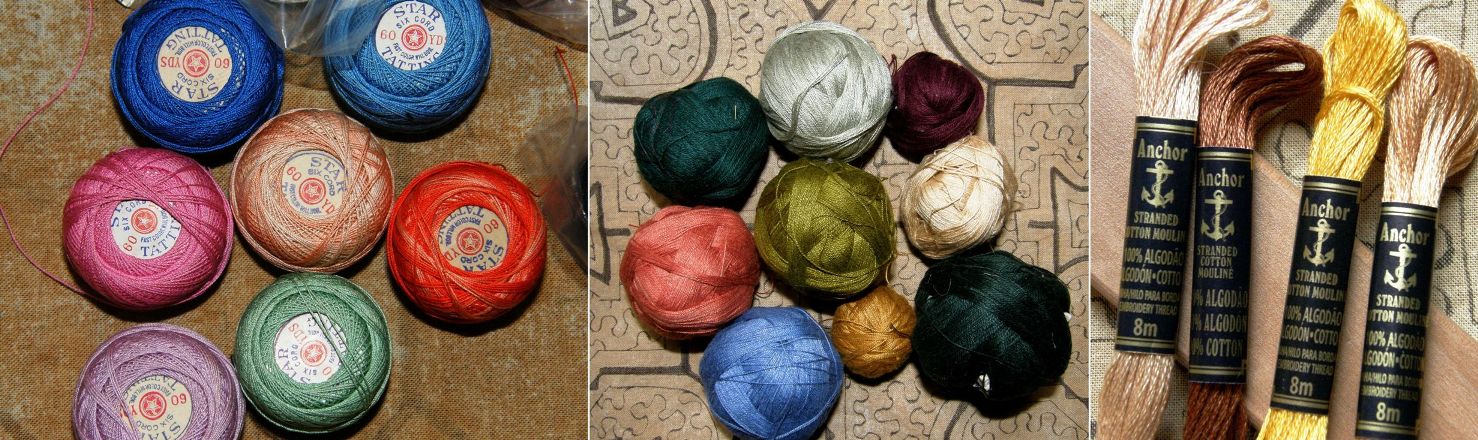
The ground warp is a 24 wpi crochet cotton with two different kinds of thread for the supplementary wefts.

24 wpi ground warp and weft patterned with doubled strands of embroidery floss.

For the textile fragment reproduction I used 6 strands of cotton patterning thread that I bought in Guatemala (center picture). The thread is sold in skeins of single strands. It is easy putting the six threads together and they work well as they lie flat on the surface of the weaving. I used doubled lengths of the embroidery floss (pictured on the right) for the first band of pattern above that. This works well but, as the lengths are ever so slightly twisted, the two pieces tend to separate in the longer floats. If I had no other option, I would pull out each of the individual strands and put them back together again without the twist.

One day my Guatemalan thread will run out and I am thinking that the tatting thread pictured above left  might do the trick.

My friend Sharon in the US sent me an enormous bag of tatting thread recently and it is very similar in size to the Guatemalan stuff although stiffer.

The black warp got cut off the loom and will be a sample piece. I gathered up all the designs I wanted to weave and made a new warp, this time with 35 wpi crochet cotton as the ground warp and weft.

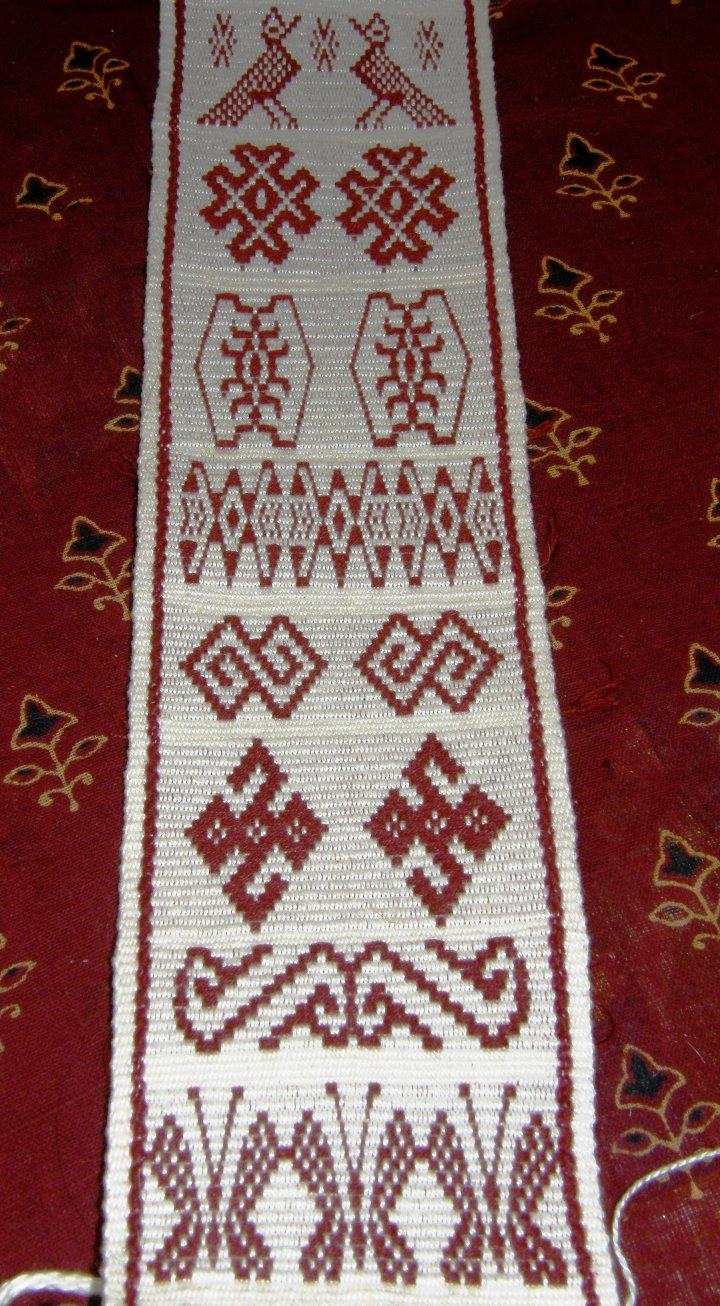
I collected Huave butterflies, Indonesian borders, Central Asian supplementary warp motifs which I adapted to supplementary weft, patterns from Montagnard and Li textiles,  Guatemalan birds, brocade designs from Lithuanian sashes as well as one of my own inventions. I still have some Mexican and Miao motifs to play with and am looking about for more ideas from other cultures.

One thing that I wasn’t quite so aware of was the different kinds of supplementary weft patterning techniques and the ways in which they are classified. I have always wondered about the precise definitions of brocade, inlay and supplementary weft patterning and if, in fact, all three terms refer to the same thing.

Fortunately I have Marla Mallett to put me straight. In her book Woven Structures  A Guide to Oriental Rug and Textile Analysis she says:

Brocading uses extra yarns – supplementary weft yarns – to ornament a ground fabric, with floats on at least one face…….If we want to be fancy, we can call brocading, “extra weft patterning”. But the simple word brocading is adequate.

She then decribes different kinds of brocading: overlay-underlay, underlay, overlay, reciprocal and inlaid, the latter being the kind that I am playing with here. She also notes that in oriental textiles inlaid brocade yarns and knotting often share the same pattern row which makes my head spin with new possibilites!

Another look at my sampler…

With this 35 wpi ground warp I used six strands of the Guatemalan thread. Once I have finished all my planned designs, I will start experimenting with the tatting thread. What I like about this kind of patterning is that your warp is basically a blank canvas on which you are free to change colors and place designs as you please.

Here are a couple of examples of warps that I prepared for warp float patterning to which I decided to add supplementary weft motifs pretty much as an afterthought. On the piece on the right I used one and half strands of embroidery floss. On the piece on the left I used single strands of the ground weft which left gaps and gave the design the same striped effect as the outer columns of warp float designs.

A couple of other brocaded pieces that I wove using the Guatemalan thread on the left and embroidery floss on the right. The piece on the right combines the inlay technique with wrapping to create the long horizontal and fine vertical lines that would not be practical using the inlay method.

Here is a view of the two samplers showing the difference in the weight of the threads I used.

Why didn’t I do any of the Bolivian hat band designs, you ask? Those have been done in super fine thread which allows them to have very long floats in their supplementary weft. You simply would not get away with such long floats in heavier thread as they would be long, cumbersome and unsightly. You can be sure that another warp in sewing thread will be coming soon so that I can indeed do these designs. I am also looking forward to doing designs where the supplementary weft actually fills in the negative rather than the positive spaces.

Here you can compare the size of the hat band thread with my 35 wpi thread. And don’t get me started on the mind boggling fineness and complexity of the brocades from Laos!!

From supplementary wefts to supplementary warps….you may recall from last week’s post that I wove my first Sami pattern band in a supplementary warp technique. I want to explore and use this technique more as a supplementary warp patterned sash will be part of my big “sash project”. This is actually one of the techniques where you could allow the weft to play a role if you chose to.

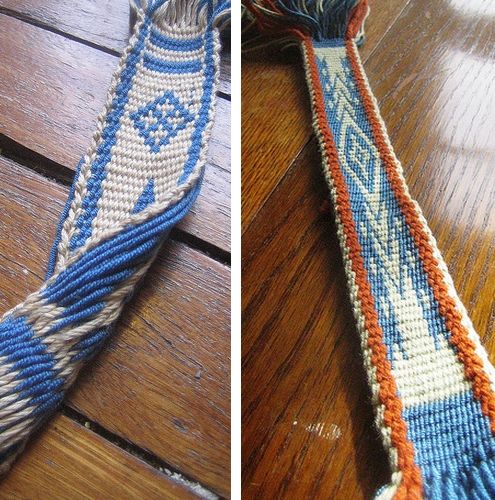
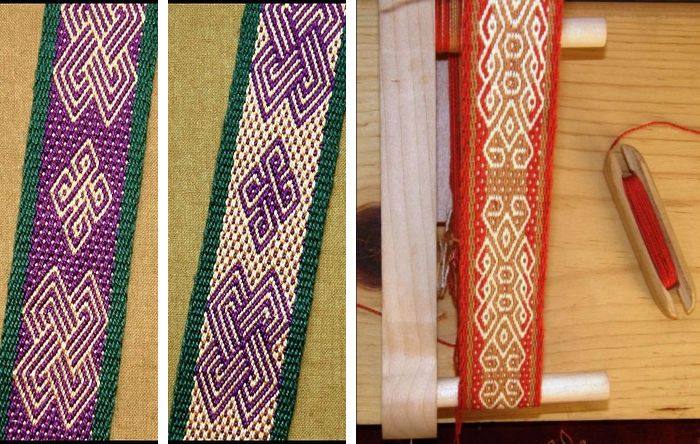
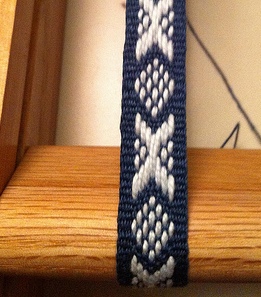
In the examples at left you can see the little orange weft spots showing through as orange weft has been used to match the edges. If yellow weft had been used the background would appear to be a solid color. My weaving teacher liked the decorative effect of the weft spots. The band on the right appears to have a solid background of white as white weft has been used. You can just see the white weft turns on the edge.

For my next supplementary warp experiment I used the handout that we had been given in Robin Spady’s inkle weaving presentation at CNCH last year.

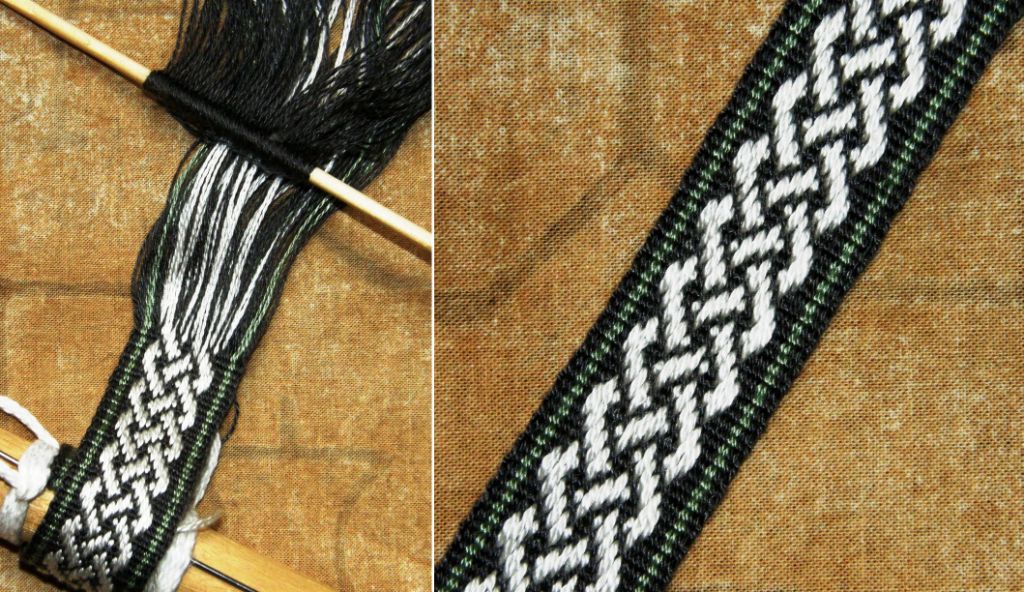
Included is a pattern for a Celtic knot. This experiment served two purposes as I also wanted to try out some tencel that I had received in a swap with a weaving friend in Denmark last year. I really wanted to see how the colors would look together…a light green and a gray-ish purple along with an off-white that I bought at the Mannings. I have never used tencel before and was looking forward to see how it looked and felt when woven. I made this on my backstrap loom.

Just as everyone says, it has a lovely sheen and is very sleak. The weft did want to wiggle out a little and I found I had to put it back in place each time I changed sheds but I love everything about this…the colors, the pattern, the texture and the sheen!

This is a thirteen-pattern-thread design which Robyn calls “my all-time favorite pick-up pattern”.

Karen Madigan gives the pattern for a twelve-thread Celtic knot (which she says is based on a design from Sara Lamb) on her Curious Weaver blog. By the way, I know a lot of people have Sara Lamb’s Woven Treasures book.  Sara teaches this supplementary warp technique right there in her book… just in case you missed it.

Take a look at a different version (the pink one) on Annie MacHale’s blog here.

I couldn’t resist tipping this Celtic knot pattern sideways and trying it in a supplementary weft.

I know that I can improve on this if I decrease the spacing and have the edges curling over more. That’s something to work on further this week.

I thought that I would pull out some older pictures of other knotty-like designs I have woven…

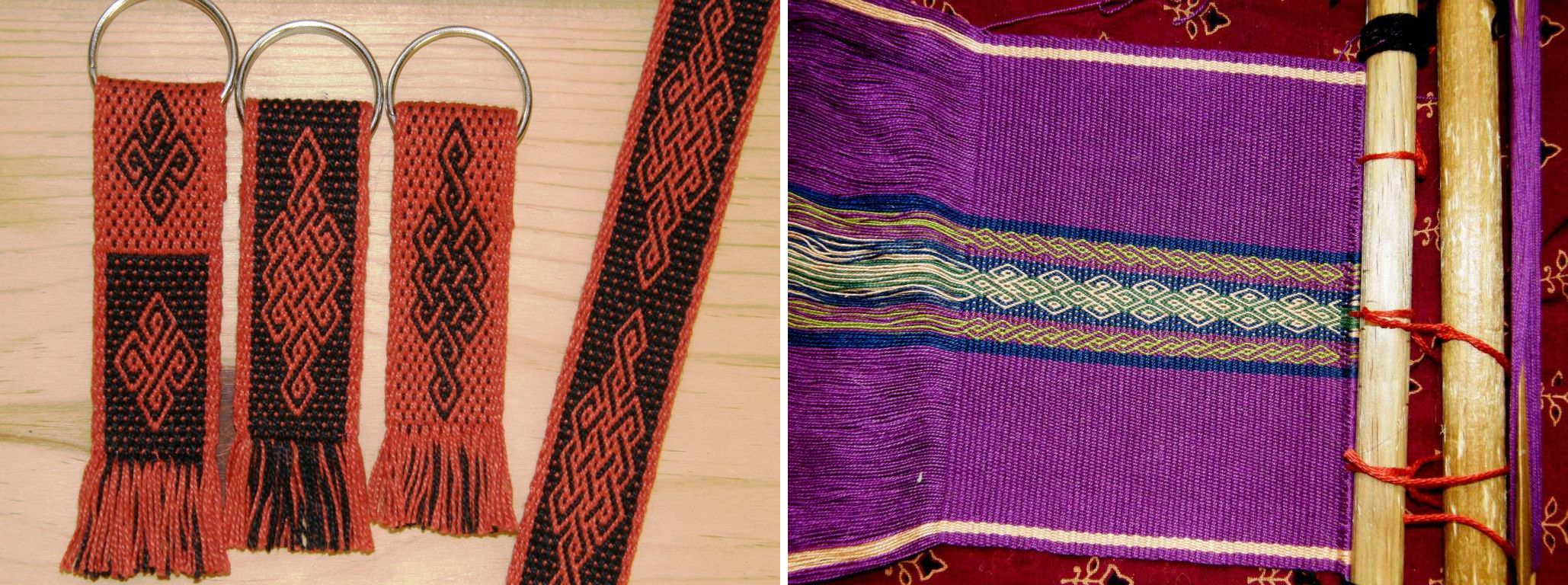
The designs above and below were taken mostly from tablet-woven bands and I wove them using the Andean pebble weave technique that I teach in my book.

Jennifer from the Weave Along group made her first Sami band on her inkle loom this week (at left) as well as Tanyabe who says that she actually has a drop or two of Sami blood in her. Hopefully we shall see her pictures soon.

The Weave-Along has become rather quiet. I suspect that folks are working on their “secret” project for the grand finale. I also like to think that the Weave-Along has helped create confident independent weavers who are trouble shooting, experimenting and problem solving on their own….let’s see!

And the loom bag project continues. This loom bag will weigh a ton by the time I have all the bits in place!

This piece of fabric with its pebble weave design will be used to  make the three zippered pockets on the back of the bag for holding belt shuttles, elastic bands, scissors, tapestry needles and all that stuff.

Finally, I got a nice note from Kathleen on Ravelry with all this information on other articles in the Weaver’s Journal which are available to download free from the online digital archives at arizona.edu

Kathleen says:

Thanks for the references re the Andean braids in Weaver’s Journal. (Actually, we all have Jennifer to thank for these references).I didn’t know they were all available on line. I have some but was happy to find the others.

There are quite a number of other interesting articles that might also be of interest to you or other members of the backstrap weaving groups.

Issue 4 – A Tubular Edge Braiding from Bolivia by Adele Cahlander and Marjorie Cason.

23 – A Special Andean Tubular Trim woven without Heddles by Adele Cahlander, Ed Franquemont and Barbara Bergman (color!)

24 – A Guatemalan Brocade Border

25 – A Braided Strap from Columbia by Adele Cahlander

28 – Gifts from Ancient Peru by Ulla Nass

35 – A unique Finish from an Amazonian Bracelet by Micheline Thabet

37 – Unraveling the Mystery of a 7 – loop Braid by Adele Cahlander

42 – Embellishment of the Rain Scarf (Hopi) by Suzanne Baizerman

45 – Peruvian Technique for Dimensional Knotting by Monica Bravo

46 – Color and Design in Andean Fabrics by Blenda Femenias

Thank you Kathleen!

The downloading takes too too long for me but considering the topic of this week’s post, I think I must look at issue # 24!