Backstrap Weaving – ‘Tok-Tok’

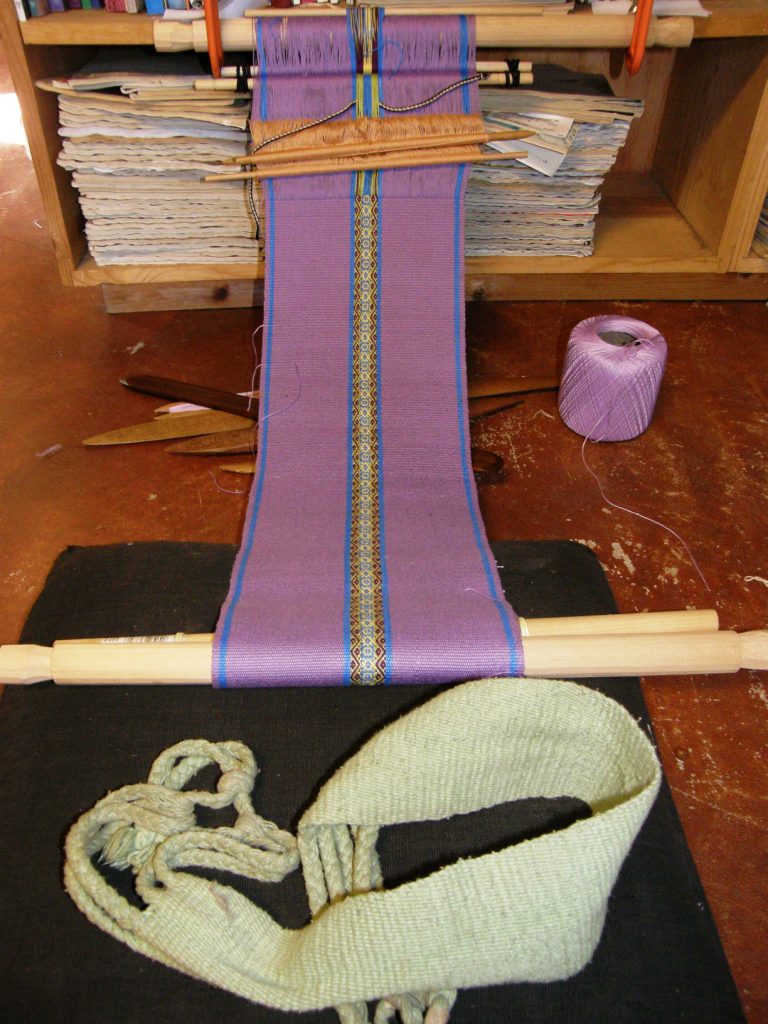
I love weaving wider pieces for many reasons, one of which is the chance to get out the big sticks. I use multiple swords, especially when I am doing Andean Pebble Weave with its two sets of string heddles. I often have to open a shed and walk it down to the weaving line in baby steps, using a sword to clear the first heddle while inserting another to clear the next and then inserting another. The swords smack against each other from time to time with a pleasant ‘tok tok’ sound. I love placing them on their pile on the ground when I am done with each part of the process and hearing them rattling and clacking together.

I have gathered together quite a few swords over the years. I have no concept of what makes the one perfect sword and have never sought swords with certain characteristics when I have picked them up in my travels. I take one when I can get one if it looks like it might serve a purpose or if it holds memories of time spent with a weaver. I guess I prefer not to have the swords highly polished….the grippier the better. Different weights and shapes serve different purposes for me. swords for latest backstrap project Andean Pebble Weave warpThese are the four that I used on my latest project. I bought the lower one at Maryland Sheep and Wool Festival a couple of years ago for no particular reason. It reminds me of the fun two days I spent there with Claudia and Janet.

I guess I liked its length and width. It is just the right width for the length that I make my string heddles. When I am using multiple string heddles, as in the example at left of a warp set up for Andean Pebble Weave, I use the sword to help me raise them. You need to work one set of heddles against the other.

I wrap one set of heddles around the sword and roll it. This increases tension on the threads that are held in those heddles. Then I lean forward and relax tension on the warp which slackens the threads in the other heddle. Then I pull up the other set of heddles. Works like a charm. It helps if your sword is just the right width to suit your heddle length.

That is probably a lot to ask you visualize so you can watch a weaver from San Ignacio de Loyola, Peru doing it in this short video clip…..

Returning to the picture of the swords, the next one up is what I suspect was meant to be lease stick and was made by a weaving friend’s husband. I like that it is very narrow. Apart from that, it reminds me of Barbara when I use it. I use it when I need to do some warp manipulations right down at the weaving line and there is little space between it and the first set of heddles. The sword is narrow enough to create the space I need in order to get my hands in without taking up too much room.

chichi market guatemalaI know that the next two swords up are from Guatemala. I bought the narrower one when I was there in 2008 at the fabulous market stall pictured at left.

As for the larger, very well used one….I don’t remember from where or from whom that one came but it looks like a Guatemalan one to me and it’s a beauty!

The narrower one has a nice pointed nose which is handy when the space held open by the shed rod has become very narrow and I need to insert a sword with a fine pointy nose to work it back open again.

The large sword is the big beast that I need to use to clear the threads in the second set of heddles through the first set. I lean back, strum and then let the big guy, turned on its side, do its thing. So here is what those swords have been helping me create…. two of three pre columbian bird panels backstrap weavingI made a two-color panel to go with ikat pre-columbian bird that I showed you last week.

The all-black panel comprises the bird motif made with ikat and then filled with pick-up patterning. The new piece is all Andean Pebble Weave. The birds are larger on this one because the dimensions were determined by the structure of the weave rather than by the size of the motif that was fixed by the ikat. The stepped diagonal line is edged with stitching to sort of carry over the theme of the stitched edges on the ikat piece.

The third one in this set will be all white with the ikat motif in black filled in with pick-up patterning. The challenge will be to make this second ikat bird motif as close as possible in size to the first. It’s time to set up the ikat frame again and get used to walking about with bits of ikat tape stuck to my legs and turning up everywhere.

Here are some more swords… swords for backstrap weavingwayuu motif with twiningThese are all Guatemalan and all came from a lady in California who had traveled in Guatemala in the 1970s. She wanted to find a good home for the loom that she had been given by her weaving teachers at that time and she sent me all her equipment while I was in the US as well as her journals that tell the tale of that visit back in the 70s….treasures!

The loom bars that I have been using on my current bird project were also hers…good, sturdy, nicely shaped pieces of wood.

That very fine sword is a beauty to use when closing the gap on a four-selvedge weaving and that very hefty one was excellent when I did the wide intermesh piece at left. Intermesh is quite dense and I needed the heft of that sword to clear the sheds. ??????????????????????These two are from a set of six of various sizes from Salasaca, Ecuador which form part of every weaver’s set of equipment. The large one is from one of the ladies to whom I taught pebble weave and the small one, which is the smallest in the set, is from the gentleman (Anita’s cousin) who taught me the supplementary-warp technique that weavers there use to decorate belts.

We used the smaller one for doing pick-up and one of the large ones to beat…it was a violent slamming beating motion on the steeply angled warp. You held it by the handle in your right hand and, as the beater was so much wider than the band, you had to make sure your left hand was well out of the way.

Here’s one that I don’t own and I want to show it to you so that you can see just how different some swords can be… sword for backstrap weaving Aymara weaver northern chileIt was being used by an Ayamara backstrap weaver of northern Chile who came to Santa Cruz for a weaving event…. Aymara backstrap weaver northern chileThere’s quite a difference between this and the slim tiny sword that I used with my first-ever teacher in Peru… backstrap weaving swordsThat’s the tiny one there in this picture…the first sword I ever got. I have been using it since 1996 and it has lost its original straight edge. I can’t seem to let it go, though!

In this picture you can see swords from various sources. The upper one is a brand new one from the market in Guatemala. It has very sharp edge…too sharp for my liking and I haven’t used it much. Below the tiny one is a very odd one that I got in Peru. It was lying about in a cooperative store and I asked if I could buy it. I am sure that it could tell some stories! It is so very misshapen and has obviously had a lot of use. There are indentations in the wood from years of having warp threads pass over it. There is a little red staining which might be from the cochineal dyepot.

thread indentations in backstrap swordThe next sword down is from a weaver I visited in San Roque, Ecuador. This sword has also seen a lot of action. It has lost its straight edge and has developed some very deep indentations from warp threads.

The lower one is from the ticlla class that I took at the Encuentro de Tejedores in Cusco.

I will leave you with another old faithful of mine…a very humble and ordinary piece of wood. This was made for me by the furniture maker who lived two doors down when I lived in southern Chile. It was originally a very long shuttle for my Navajo loom. When I returned from my first trip to Peru I had it cut down and beveled an edge to make a sword. The rest of the shuttle was made into a portable warping board that I used to take on my travels so that I could warp and weave key fobs along the way. sword made from old shuttleI love this sword. There is nothing pretty about it but it is just the right width for that rolling action I was describing to you when I do two-heddle structures like Andean Pebble Weave and intermesh.

ikat pre columbian birdI love going to my big bins of sticks and selecting my tools for a new project. I usually end up sitting on the floor with a pile of sticks around me…picking up each one and examining it. I usually discover one, long forgotten, that had been lost in the depths of the bin….sometimes it is one that would have been ‘just perfect’ for the project I had just completed.

But for now, I don’t need sticks. I probably have a week of this kind of ikat wrapping ahead after I wind my new warp. This one will be quite different as the area that I wrapped last time in the picture at left will be the only exposed part this time.

See you next week….

Backstrap Weaving – Sheds, Sticks, and Simplicity

SHEDS, STICKS, AND SIMPLICITY.

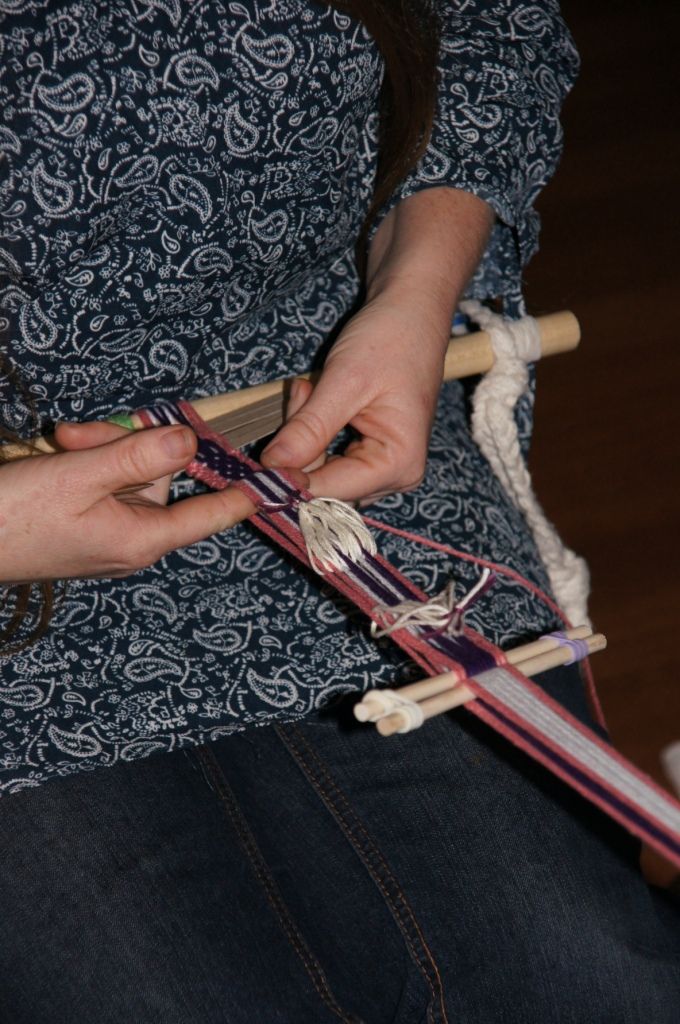
The simplest form of set-up on a backstrap loom is one that is based on the basic warp cross and which enables the weaver to create two sheds.warping in Salasaca Yarn is wound around stakes in a figure-eight path. Two beams/sticks/ rods are placed within the warp to replace the warping stakes. One beam is attached to a fixed object which could be a tree, a railing, a heavy piece of furntiture or a stake driven into the ground. The other end is attached to the weaver’s body by way of a strap that passes around the weaver’s hips. Heddles are applied to the warp ends on one side of the cross to enable the weaver to lift one half of the warp threads and create a shed. A stick, which I call the shed rod, is placed to allow the weaver access to the other half of the warps.

Simplicity! backstrap loom sheds

The blue object in the above picture represents a sword placed within the shed.  heddle shedAbove, you can see Montagnard weaver, Ju Nie, raising the heddled warps to create one of the two sheds on her simple circular warp. shed rod shedAnd here, you can see her sword placed within the shed created from the threads held on her bamboo shed rod. It’s a beautifully simple set-up for creating warp-faced plain weave. One of my Guatemalan teachers used the terms “crossed” and uncrossed”  to distinguish the two sheds possibly to simplify things even further for gringa teaching! You can clearly see the crossed form of the warp and the uncrossed one in the two pictures above.

Maxima, Cochabamba, Bolivia making heddles.

One of the most interesting things for me is the different ways in which this marvel of simplicity is achieved…

How do weavers place and secure their stakes for warping?

Do they create circular or single-plane warps?

How do they secure the cross?

Do they add heddles while they warp or after?

How do they make the heddles and what material do they use for them?

What do they use to hold the warps in the other shed?

And, how do they operate the sheds?

And this is all before I can even see what kind of cloth they produce with these simple looms.

Yes, it’s simple but that doesn’t mean that the same methods are used everywhere. It can be oh, so very different and there is no single correct way of doing things. My way of doing things is an ever changing mixture of all the wonderful techniques that I have experienced and seen. Right now I am using what I call my “current favorite” way of setting up and operating the loom. This could change at any time when I am shown something new that I want to try.

And that is why I was so excited about the backstrap looms in use in Taiwan by the Atayal people that I showed last week. I haven’t yet been able to find out a great deal about the cloth they produce and am busily collecting information and images.. In the meantime, I can simply enjoy seeing the looms and the weavers at work operating them. a_modern_atayal_woman_weaviI love everything about this Atayal loom (picture by John G Kreifeldt), the way it has been set up and the way it is operated. And, while I am not rushing out to have one of those tipping boxes made for me, I am very much in love with that shed rod.

Shed rods can come in a variety of forms. Some weavers like theirs to be of very large girth. The problem is finding a piece of wood that can be that thick without being very heavy. A common solution these days is to use pvc pipe as it rovides the girth without the weight. Of course, bamboo does the job beautifully. I have some thick rods from Guatemala made from a wood that must be extremely porous. They are surprisingly light for their size. pvc shed rodThe thicker the shed rod, the easier it is to raise those warp threads and have them clear through the heddles to the front of the loom. A lot of weavers will simply draw the shed rod down to the heddles. If the yarn is smooth and friendly, that alone will cause the threads to pass through the heddles. If using sticky yarn, like handspun wool,  the weaver will need to strum the warps to encourage them to separate and clear. Sometimes a lot of strumming is needed. I have watched weavers strum away on wool threads on wide warps for quite some time before the threads will release their hairy grip on each other.

The thicker the shed rod, the more work you have to put into opening the heddle shed. I am not a big fan of  large shed rods. In fact,mine are often quite thin. I prefer to place my sword under the warps and use the size of the sword rather than the size of the shed rod to clear the threads through the heddles. The Atayal shed rod is cool becuase of the extra stick that is slotted into it which sits on top of the warp. Atayal shed rod Here’s another kind in this picture of the various Atayal loom parts taken by John G Kreifeldt. Atayal loom parts John G KreifeldtThe shed rod is the one closest to the box. The stick splits into two. One part would sit within the warp while the other rested on top. The weaver uses these kinds of shed rods to help raise the heddles. The rod is grasped and twisted away while the body moves to relax tension on the warp and the heddle rod is pulled up. If you watched the video I embedded in last week’s post, you would have seen this in action.

I use such a system but I have two separate sticks that are both placed within the warp…one is a shed rod and the other is placed behind it within a second cross. Here is a part of a video I made with a particularly sticky warp showing how this works…

In the following picture of a weaver in Peru, you can see the forked stick that she has in her warp that acts in the same way as the two dowels in mine in the video. See how she twists the forked sticks, leans forward to take tension off the warp (see how slack the threads are behind the forked stick) and pulls up on her heddle rod. forked stickNow, if you can’t be bothered setting up that second cross for placing a second stick, (although, it’s really very easy and I have an FAQ on it here on the blog) you can just attach a second stick to your shed rod and have it sitting on top of the warp just as the Atayal weaver has. I tried it on my current ikat warp and it works every bit as well. It is just a little bit less stable and that is just something that I had to get used to. There are ugly rubber bands and my set-up is nowhere near as pretty as the Atayal one, but, hey, it works. It also means that my shed rod is free to move and I can slide it up and down the warp if I want to better clear the space into which I insert the sword. new sed rod set upSome weavers, rather than having a second stick in or on top of the warp, have a separate stick which they pick up and apply only when they want to open the heddles. Ju Nie, for example,  uses a bamboo slat. She places it on top of the warp and then grasps it and the shed rod in one hand and twists. When not in use, it just sits on the floor her side. montagnard-weaver-opening-heddle-shedOther weavers simply use their sword as their second stick. Ju Nie’s sword is so incredibly large and long that it would be too awkward to use on a narrow warp like this one. The following pictures are shots that I captured from videos that I have taken and are blurry as a result. Pitumarca weaver opening heddle shedThis weaver from Pitumarca, Peru has placed her enormous sword on top of the warp behind the shed rod. She is grasping both and will roll them while she pulls up on the hedde rod. Taking a few steps forward helps her relax tension. She is using a very smooth warp of fine industrially spun cotton. Cusco weaver opening heddle shedThis weaver from the Cusco region is about to do the same. She had to get right up on her knees in order to relax tension while she did this. It is a sticky wool warp. You should have seen the strumming that went on to get the warps to separate in the other shed. Chahuaytire weaver opening heddle shedThis weaver from Chahuaytire in the Cusco region is using a fine aplaca warp. He has moved his sword back beyond the shed rod and is about the grasp the two. With his other hand he will pull up on the heddle rod. He is seated in a chair to weave and stands up to relax tension on the warp.

So, what is the idea behind twisting/rolling these two sticks? What exactly is happening? The following pictures, once again, are shots captured from a demo video I made and are, therefore, quite blurry…I think you can see what’s going on. twisting sticks my demo (2)This warp is way too narrow to be bothering with a shed rod. Normally I would use a simple shed loop on a warp like this but have used sticks just for the sake of the demonstration. In the warp above, the blue threads are controlled by the string heddles and the white ones are held on the shed rod. I have a second stick placed within a second cross and that and the shed rod have been connected with rubber bands. I have grasped both sticks and am rolling them away. You can see that this action tightens the layer of white warps while the blue ones, (the ones I am attempting to raise via the heddles) behind the shed rod have become slack. My legs are straight in this picture as I have not yet moved forward to relax tension on the warp. twisting sticks my demo (1) raising the heddlesNow a knee is bent as I come forward. Look how slack the blue threads are now while the white ones remain taut. This is what will enable me to pull straright up on the heddles and raise the blue threads creating a nice big shed.

As I pointed out before, there are many methods that backstrap weavers use to operate their looms and this is just one of them. It is good to have many techniques up one’s sleeve to use in different situations. Often the stickiness of the warp threads will determine the method I choose to use.

I am grateful for having had the chance to weave with, observe, and learn from backstrap weavers from many regions and countries and try out their various methods.

I get very excited about all these details. I hope I haven’t bored you all with this! I am not sure how many people share my enthusiasm for these kinds of things! Here’s what I have been weaving this week… ???????????????????????????????These are the two red panels that will accompany the black and white ikat and brocade panel I have been working on lately. I have just started a simple warp-float pattern on it and am using two sweet shuttles that Father Kyriakos made and gave me when I was in Australia. Yes, I have gone back to using a shed rod and a second stick in a second cross.

Whether I keep the ikat panel or start over will be decided when I get back from my fall trip with a new supply of black dye. I wove the seven tabs last week and will show you those once all the messy stray weft ends have been put away.

Julia posted a picture of her latest band that has a complementary-warp motif from the Peruvian highlands…part of a series of motifs that I charted in my second book…a complex technique resulting in simple beauty! She has based her color choices on a piece of weaving from the Cusco region. DSC04864_mediumThe summer heat has hit here in a big way and it isn’t even officially spring yet. I am looking forward to some fall coolness in the US. See you next week…

Backstrap Weaving – Making Way for Things to Come

airport world cup 2014If you read my Boomerang Effect blog post a few weeks ago you will know that my first attempt to get back home to Bolivia after my Sydney visit was not successful. On the second attempt the boomerang sailed over the Pacific Ocean and all the way across the USA, showing no signs of returning to its place of origin, until… it hit a palm tree in Miami and got hung up there swinging around in circles.

I can think of worse place to get stuck for a few days but when you have been away for three months all you want to do is get home! The airport was lively and colorful with large tv screens showing Wimbeldon and the FIFA World Cup. Enthusiastic crowds of all nationalities gathered around. It passed the time. Of course, it would have been a whole lot jollier if the USA hadn’t lost its football match.

I tried to be productive, sat down with my laptop, and poured out the entire Table of Contents for my third book. That felt like an enormous hurdle. Then came a list of all the pictures that need to be taken for each chapter. That done, I was all the more eager to get home and get stuck into it.

???????????????????????????????In the end, I bought a ticket on the Bolivian airline BoA (Boliviana de Aviacion) who had recently added Miami to its system and was offering very good fares, free checked bags, and some of the best Economy Class airplane food I have had in ages.

The coolest thing about BoA was the flight attendant uniform.

They each had a handwoven warp-faced cotton pick-up patterned band made by weavers from the Bolivian lowlands sewn to their pants…very cool!

I had left my brother’s place in Sydney at 9am on Monday and got to my door at 9pm Thursday (Sydney time). It was quite a trip! The jet lag was huge. I have finally reached the point where I can eat lunch without falling asleep in my plate.

The BoA uniforms with their woven bands had stirred me into a longing to be home and back at my loom.

Killing time in the souvenir and Duty Free stores in Sydney airport had already given me guilty reminders of the abandoned project on my backstrap loom at home awaiting my return….here’s one item…

aboriginal art souvenirThis Aboriginal Art souvenir reminded me of the squiggly lines in my Shipibo-inspired project which was the last thing on which I had been working before leaving home in March…

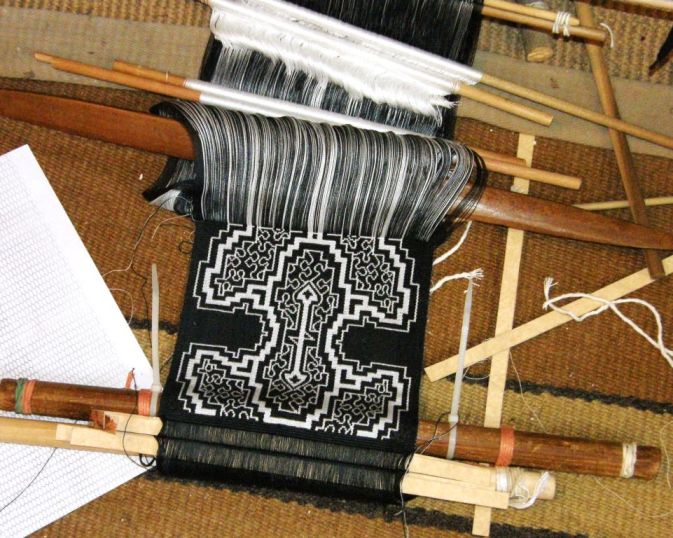
Shipibo inspired wall hanging backstrap weavingI hadn’t packed it away and had simply covered it over wth a sheet. There it lay on the floor with the various shuttles, swords and pick-up sticks that I had been using to weave this double weave with its multiple heddles. It took a me a little while to get back into the rhythm to follow the sequence in which I had been putting all those tools to use…

finishing the shipibo backstrap pieceNow I have finished the main design and am weaving a “‘fringe” of sorts. I divided the fringe into seven sections and am weaving each separately in double weave. I need seven inches of  ”fringe” to complete the panel and have just reached halfway. Each section will be a different length with the center one being the longest and the two outer ones the shortest, creating a stepped effect. Years ago, my brother had sent me a picture of a Native American piece in a London museum that had been finished this way and I have been wanting to do that myself ever since.

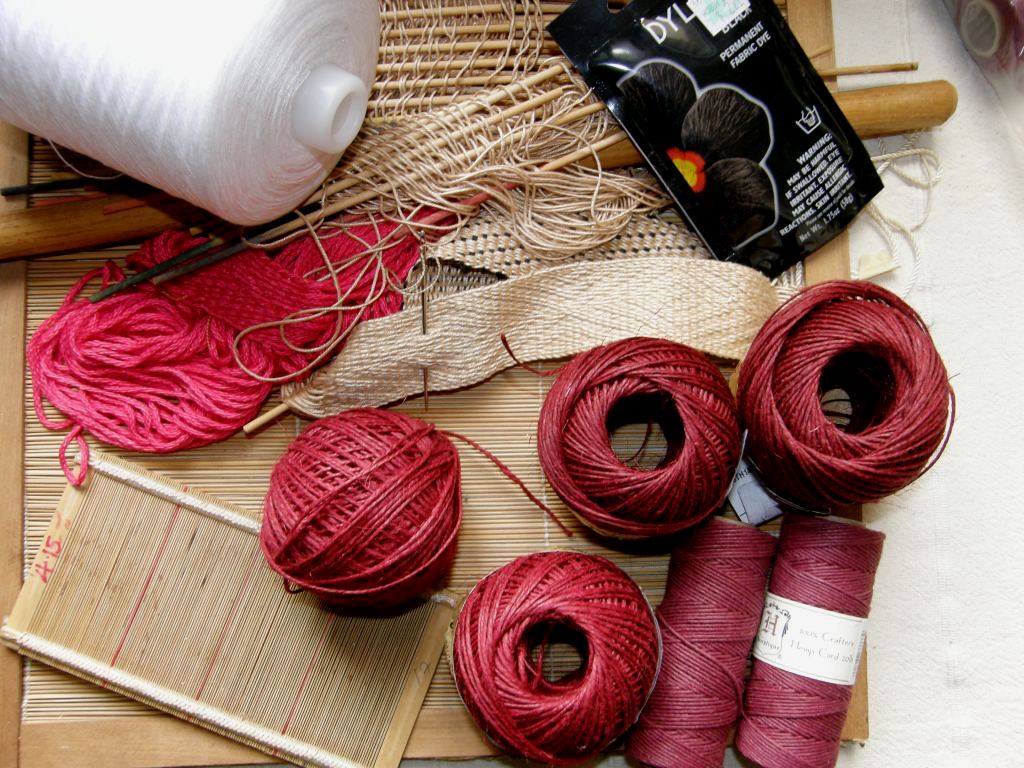
twining on backstrap wall hangingThe picture above shows two balls of dark red hemp twine alongside the woven panel.

I hope to create two outer panels with this twine using a structure that includes warp-twining that is used by lowland weavers in Peru to make wristlets. The outer panels will be a quiet solid dark red so as not to clash with the crazy busy-ness of the center panel. The three panels will then be joined together across the top with weft twining. There is a long way to go before I get to that point. Much sampling with the hemp twine needs to be done first.

This will be the second piece of three in the second series of red-black-and-white hangings. That’s the first piece above left.

???????????????????????????????Things to come…exciting! There are a couple of varieties of hemp twine in this picture along with an example of the wristlet structure. You can also see the super fine bamboo reed that I bought at CNCH, now removed from its heavy frame and ready to be used on my backstrap loom. I can’t wait to try it out with some silk. The cone of white thread is the 20/2 perle cotton that I want to use for the third wallhanging…an ikat piece…and there’s some of the black dye that I’ll use for that. I am not sure if I will have time to get that started before I have to leave again but I am happy to have more time in which to ponder that one. I seem to get some of my best ideas while sitting on planes!

???????????????????????????????Then there’s the gorgeous 60/2 silk that I got at CNCH waiting to be used as supplementary weft. The large skeins of silk were given to me by my friend Susan in Sydney. It’s a heavier weight silk than the Redfish Dyeworks skeins and I am thinking of using it as the warp for a brocade project.

The project ideas go piling up. You can probably tell that I am pretty excited about being home again.

My weaving friends in Sydney remain in mind. Emerald has been sending me updates on her progress as she weaves off all the projects that we started in our two days together…

emeralds pebble weave collageThat lovely green warp is now a piece of Andean Pebble Weave patterned fabric ready to be made into a cell phone pouch. That’s my second book that she has opened on the floor. I was showing her how to read the spotted charts. That particular motif also appears in the first book.

sewing and weaving tuular band emeraldHere she is weaving and sewing a tubular edging to the pouch.

emeralds cell phone pouch and intermeshThere’s the finished pouch along with her intermesh sample band.

One of the good things about having to stay longer in Sydney than expected was that I got to visit with the Springwood group of weavers again up in the Blue Mountains at Helen Halpin’s place. What a lively and enthusiastic group of weavers! They meet once a month and there is always a lot of show-and-tell.

Yvonne, who had woven with me a couple of weeks earlier, brought in a band that she had since warped and woven. She had played about and created some of her own patterns. I love that! What was also interesting was that she had used bamboo thread. I have never considered using it as I had always thought that it would be too soft. Yvonne’s band felt lovely.

???????????????????????????????In the Ravelry group, Kim has been progressing with the two-color simple warp-float technique while copying as well as adapting motifs from Central Asian textiles. This piece is beautifully woven and I love the combination of colors. I am surprised at how well that green stands out from that background color….inspiration to be more adventurous with color choices.

kimberley swfKeith has formed a South American band weaving study group at the Weavers’ Guild of Minnesota. One of the members wove with me on one of my trips and it is nice that they can now study some pick-up weaving techniques together and support each other. Keith posted this picture of some of the first bands with some thoughts of what could be improved. He won me over right from the start with his color choice!

keithScott, a Facebook buddy, posted this striking double weave piece that he started some time ago and just finished…

scottSo, here I am back at home. I unpack and put away the yarn and other goodies that I have brought back on this trip. As is my policy when new things come in, old things have to go out…out went the rocking chair this time which opened up a whole lot of space! Even so, the “stick corner” in my bedroom gets increasingly crowded. I brought back a whole bunch of dowels that were being discarded and a couple of shuttles. I need sticks of all kinds of lengths for all kinds of warp widths…cross sticks, heddle rods and coil rods…shuttles and swords. I don’t weave a limited variety of traditional items as many backstrap weavers do and so, I need sticks that are suitable for a vast range of woven widths.

???????????????????????????????It’s a lot of stuff and I wouldn’t part with any of it!   Would you believe that there are still times when I can’t find just the right length of stick with the right girth?!

But, the equipment you use can be as complex or simple, as rustic or sophisticated as you want it to be. And it’s always nice to know how to improvise a set-up when there simply isn’t any “equipment” to be found..

???????????????????????????????Or when you just couldn’t be bothered fishing all the gear out of a packed bag…

??????????????????????????????? ….in which case a pencil will do for a front beam and a piece of string for a backstrap. The elastic bands will stop the string from sliding off the pencil.

For narrow bands, no equipment is required if you have a good set of “magic fingers and toes”!

??????????????????????Maxima tensions the warp between her index finger and big toe. Her fingers are used as cross sticks to form the picking cross and fast flying fingers and thumbs select the colored threads to form her patterns. Her hand is her sword and beater.

When sticks specifically for backstrap weaving are simply not to be found, as is often the case in the very highest parts of the Bolivian highlands, all kinds of other things can be called into play…like the spindles that Hilda is using in place of cross sticks while setting up a warp for double weave. Hilda’s large sticks and rods are saved for her horizontal ground loom.

hilda preparing backstrap warpIf I am home and have access to my collection of sticks in their handy bins at the end of my bed, I like to use them. I feel more comfortable with a wide breast beam and a backstrap…a nice wide cushy backstrap….no matter how narrow the warp.

This Mexican weaver from Santo Tomas Jalieza, Oaxaca seems to feel the same way!

Picture from Teyacapan's Flickr page
Picture from Teyacapan’s Flickr page.

So, I will never able to resist grabbing a good stick that comes within reach while I am traveling and bringing it home with me. While there are still things that can be removed from my little home to make space, there will always be room for more sticks!

Finally, I would like to thank everyone so very much  who went over to Facebook and ”liked” my nephew Ryan’s triathlete page at my request last week. Someone even posted a “Weavers for Waddington” comment. That was so cool 🙂 Ryan was very pleased to see all the new “likes”.  It really made a difference and he got a new sponsor last week…

1176105_696156010456849_9156188001071593550_nYep, that was THE best thing about being held back in Sydney…I got to hang out with Ryan some more.

If you didn’t get over to Facebook last week to “like’ his page, please help him out by going over now. More “likes” mean more sponsorship appeal, I am sure. I was happy to see so many familiar names there as well as some names I didn’t recognize…people who read my blog but with whom I have not yet connected…many thanks to all of you.


Backstrap Weaving – The Boomerang Effect

I am supposed to be in Miami airport right now awaiting my flight back to Bolivia. I have had a wonderful month in Australia and it is time to go to my home (the real home in Bolivia).

Off I went to Sydney airport yesterday to get my flight to the US. I put on a brave face after sad goodbyes to family. But here I sit today back in my brother’s Sydney home…it’s a long story!!

Orange banksia give a warm glow to the bush in mid-winter.

The Boomerang Effect! It is common in Australia when lending someone something, to hand the item over while emphasising that it is “a boomerang”. That is to say, it is expected that the item will return to its owner in the same way that a properly thrown boomerang will.

Well, I am feeling rather boomerang-ish today having bounced from home to airport and back again.

Looking on the bright side, this unexpected turn of events means that I can spend more time with my nephew as well as write a blog post today.

It also means that I can go back to the Blue Mountains tomorrow for the gathering of weavers at Helen’s place in Springwood. Yay! All her floor loom weaving friends will be there in the morning for Show and Tell.. I wasn’t expecting to see any of these weavers again on his trip, yet here I am boomerang-ing back there!

I love the Blue Mountains! I got to spend even more time up there this last week exploring 4wd back roads and doing a bit of hiking through the beautiful Australian bush.

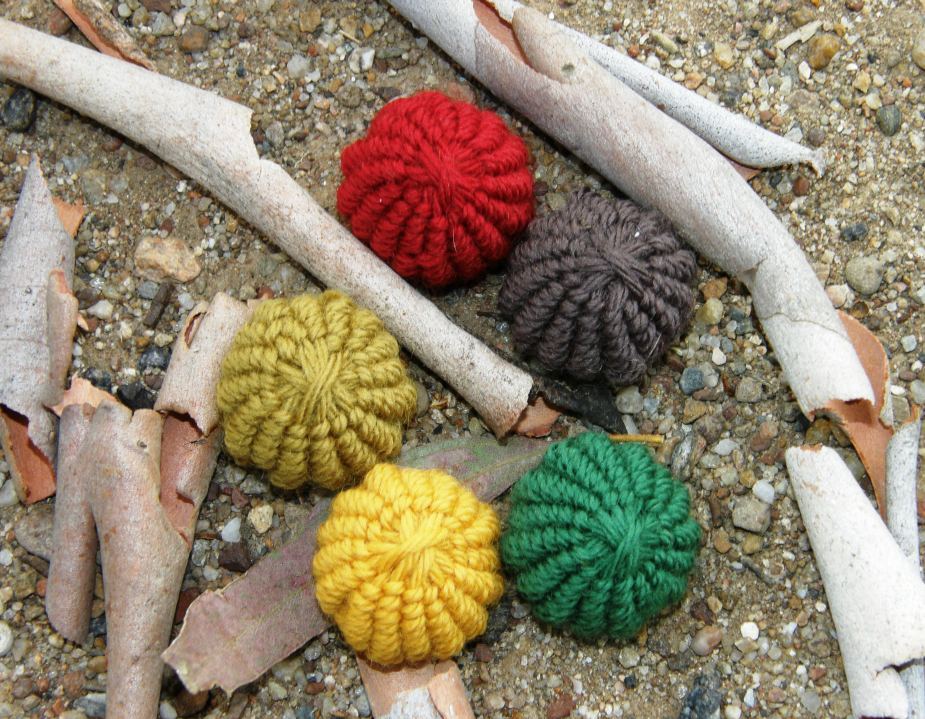
The banksias that we saw that day make me think of the little ridged baubles that I learned to make with a Guild friend the last time I was here in Sydney…

???????????????????????????????

We walked to lookouts with lovely over Lake Burragorang.

blue mountains sydney

Perched on the end of that rock, I felt like I was sitting in the tree tops…

bush walking in the blue mountainsThe real winter suddenly set in and it was cold!

Last weekend it was still warm enough to take things outside for a bit of warping. I had a group over to my brother’s home for two days of Andean Pebble Weave. We enjoyed the chance to stretch our legs in the fresh air while winding some more warps for sampling and designing.

warping for backsrap weaving sydney


Kelcie gets a new band started with palin pebble weave.
Kelcie gets a new band started with plain pebble weave.

fr-kyriakos-pebble-weaveThe group comprised Kelcie and Jen, who had woven with me last November, Pam, whom I have known online for years and who had come over from southern New Zealand (Sydney weather was relatively balmy for her!) and father Kyriakos who came up from the monastery in Bombala.

We wove together for two days.

Father Kyriakos, as you may know from having seen his work in previous blog posts, had more than just dabbled in Andean Pebble Weave and has been designing and weaving his own pebble weave patterns. I am so glad he came. We have been corresponding for some time and I really wanted to meet him as well as see his projects “in person”. He said that…While your videos have always been a big help and enabled me to do as much as I have so far, having personal demonstrations and answers to my own questions has already helped me to be more efficient and have more understanding of what this weaving is about.

Above,you can see his partly woven backstrap from a photo that he sent me some time ago. The design is one that Julia had created and father Kyriakos added his own elements to it at start and finish. He brought the finished piece along to Sydney to show along with narrower and samples and examples of his own “sotis” work of East Timor that he had studied on floor looms with Australian weaver Kay Faulkner.

???????????????????????????????Kelcie had brought examples of East Timorese weaving when we had woven together last year…

???????????????????????????????Father Kyriakos also brought a Latvian belt, woven using a supplemental-warp technique, that a friend had bought in Latvia and brought back for him. I have seen plenty of pictures of these but never one “in person”…

latvian beltJen brought in pieces that she had bought on a trip to Peru where she had studied tapestry techniques with Maximo Laura. This is a striking embroidered belt that had been made for the tourist market in Arequipa…

embroidered belt from arequipa peruI love the color ideas that these pieces give…I would never think to combine those colors!

Father Kyriakos has been working on and refining a kangaroo motif using the Andean Pebble Weave structure for some time. He also brought along his progress with that to share and I thought that it would make a nice project as a souvenir of my Australian vsit.
One of the tasks that I had set myself for this trip was to investigate the kind of cotton that is available in Sydney stores that would be suitable for warp-faced weaving on backstrap looms. I bought what is labeled as “4-ply” thread at Lincraft. I was told that the name 4-ply in Australia actually refers to the size of the thread rather than to the number of plied strands. In the USA any weight of yarn could comprise four plied strands. It’s a little confusing! I also bought 8-ply versions of this cotton thread at Spotlight and I will give report on this and other available thread in future blog posts.
So, here is the “Kyriakos Kangaroo” woven by me using the Lincraft 4-ply…

???????????????????????????????

barefoot warping for backstrap weavingFather Kyriakos says that he still has some refinements in mind. I played around a bit with the mountains under the kangaroo. They made me think of the southern highlands…the “Australian Alps”…where I had lived and worked for many years.Kangaroos could be spotted now and then on the drive up to the ski fields.

The Lincraft thread is not mercerized but is fairly tightly twisted. It will pill if the heddles are wrenched about and needs to be handled with care. I really like the way it feels. Lincraft has a pretty good range of colors on its shelves.

I set this band up in a very “barefoot” manner.I had already packed all my backstrap weaving gear away and did not feel like fishing out my warping stakes and loom bars.

I warped around my index finger and big toe as my Bolivan weaving teacher, Maxima, does. This is probably the widest thing I have warped this way and, as the threads piled up around my finger, I figured that I was bound to have some tension issues. As it turns out, I didn’t!

When it came time to weave,  you can see, I only got out my sword and used pencils for cross sticks and loom bars. A piece of string is my backstrap. The front beam is a pen onto which I attached rubber bands so that the “backstrap” would not slip off. It was pretty comfortable!

Normally, I would use heddles spread along a stick for a piece of this width but I chose to just tie them in a bunch rather than to search for more pencils.

barefoot backstrap weavingSomeone else who is getting into barefoot weaving is my student, Emerald. You may remember that I stayed with Emerald in her home in Ultimo a couple of weeks ago and wove with her. One of the things we did was the intermesh technique and, although she has a nice set up for backstrap weaving in her living room, she decided to try to include her entire body in the loom…

emerald backstrap weavingThere are chopsticks and a pencil in her set-up. She also finished off a short and narrow pebble weave band barefoot. This was an exercise in weaving without a chart.

emerald (2)In the meantime, in other parts of the world, Diane, one of the ladies who wove with me when I visited Yale university, was inspired enough to apply for a grant to go and weave in Guatemala during her summer break. My friend Barbara, who is in contact with her, sent me this picture of something Diane wove with her Guatemalan teachers…

diane yale guatemalan weavingCheryl, who wove with me last spring, is sampling for a camera strap project…
cheryl pebble weave backstrap


And now… a wee favor to ask of all of you. You may have noticed that I have sometimes mentioned my nephew here in past blog posts and the fact that he is a triathlete. I am staying with him now in Sydney and get to watch his rigorous training schedule. He is up and out and swimming laps or biking and then getting home before I can even get out of bed.

During the Ravellenic Games that ran alongside the Winter Olympics this year, I wove one of his favorite inspirational sports quotes into a silk bookmark for him..

??????????????????????I guess that I haven’t had much of a chance to be a big part of his life. After seeing him a few times in his very early months and years, I headed off to live in South America. I returned for a visit when he was 3 during which I watched Jurassic Park with him and he offered to sit by me in case I got scared. I didn’t see him again until he was 12. He wrote to me when he was 8 to ask me if I lived in a hut in the jungle. Fortunately, I visited Australia more often when he was in his teens and the internet kept us in good touch. He taught me to juggle and we did a great trip,  just the two of us, to Ayers Rock in 2006.

1531560_610507969021654_2085106992_nNow he is a traithlete studying to be a teacher (like me!) and will be representing Australia in the ITU World Championships in Weihai, China in September. He took part in ITU World Championships in the USA and Spain winning the silver medal in his age group in both. It was quite a blow when he was injured for the championships in France last year. So…he is going for gold this time…his last amateur event before turning pro.

His trip to China, as with all the other trips to the World Championships, must be self- funded and he is looking for sponsors. What I would ask you to do for me, as a big favor, please…. is simply to go over to Facebook and “like” his page. More “likes” will show potential sponsors  that he has the loyalty of a good-sized audience and could make all the difference.

I haven’t told him I am doing this and would love to surprise him with a small boost to his fan page tomorrow. I hope that you can take a moment to help out.

???????????????????????????????

And now to see if I can make it on a flight out soon….wish me luck!

Backstrap Weaving – Worth the Wait

I had wanted to call this post simply “Waiting” but then had a funny feeling that I had used this title before. It didn’t surprise me. We tend to do a lot of waiting here in Bolivia. It’s a part of life and, after 15 years here (plus 5 more in Chile), I can hardly be annoyed or too put out by it. I Googled to check my use of this title and, yep, there it was in August 2012. I went back to see what all the waiting had been about back then. It was nothing to do with Bolivia at all…I had been waiting for some technical help with my second book and impatiently awaiting some exciting weaving events…all good stuff, as you can see below, and worth waiting for.

Some events from 2012

This week has been about a different kind of waiting. It involved getting up every day at 4am and trekking out to the SEGIP office to stand in line and…..wait. SEGIP issues visas and ID cards for foreigners. My ID card had expired and I have been trying since the end of December to move the paper work along. The office opens at 7am. You have to be there in a queue at 4.30am to get one of the 80 daily appointments. You wait in the street in the pouring rain or sun…we had both… and there’s no shelter.  I only wish I could entertain you with some nice shots of the sunrise or my fellow “waiters”. The sunrise was happening behind buildings and it was too dark most of the time for people shots. Today I succeeded! I was #46. I got to speak to someone.

OLYMPUS DIGITAL CAMERAAfter the Monday morning failure to gain admission, it was kind of fun greeting and seeing my fellow “rejects” the following days.

….the Brazilian medical students…always in large groups, always jolly, fun loving, even in the rain, and very, very loud.

…the Argentinians…recognizable by the thermoses that they carried and the little pots of yerba mate which they passed around and sipped and, of course, their gorgeous accent.

…the Mennonite gentlemen with their denim overalls and baseball caps, the ladies with their head scarves, print aprons and straw hats.

…the Russian Old Believer gentlemen with their long beards, piercing blue eyes and long, loose belted shirts. You have no idea how much I wanted to look more closely at those belts! They leaned on a fence with the Mennonites and talked about the recent rains on their land. There were some Mormon missionaries from the US looking so terribly young to be so far away from home.

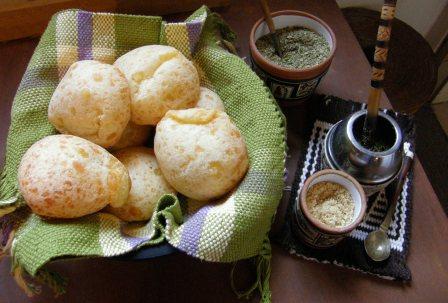
It was strange having so many foreigners gathered in one small place like that. Bolivian life is influenced in many ways by the cultures of its neighboring countries. Above, you can see the baked Brazilian snack called cuñape that is very much enjoyed here, and a pot of Argentinian yerba mate sitting on some of my backstrap woven pieces….a nice piece of Mennonite cheese or a pot of Mennonite honey would make it the perfect tea time picture.

The good thing is that, despite the wait and rejection on three days in a row, I managed to get home every day by 8.30am ready to face and enjoy a whole morning at the loom. That way, the pre-dawn expedition didn’t feel so much like wasted time.

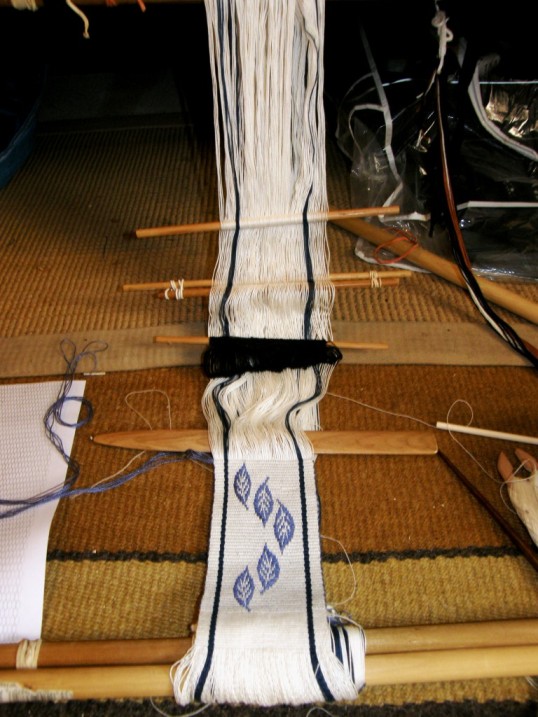
circular warp backstrapThis is one of the things on which I have been working this week. It’s the circular  warp that I took on my last US trip. I use it to show friends the different parts of a backstrap loom including the coil rod.  It’s been sitting here as just a white plain weave piece of cloth. I decided that it needed to have some pattern.

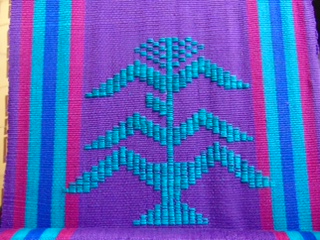
That is one of the things I love about patterning with supplementary weft . You can just add pattern to your plain white “canvas” at any time without a whole lot of planning. This warp had previously held a butterfly motif which I pulled out and replaced with this leafy design.

It’s interesting how different the same motif can look when woven with different materials. I created the leaf motif very recently for my discontinuous-warp experiment in heavy-ish wool. On that piece I had used wool as the supplementary weft.

My circular warp is fine cotton and I used tencel for the patterning weft. I also used a closer sett than I usually do so that the fine white cotton would cover the dark patterning weft well. The leaves that had looked so robust in wool  were thin and sickly looking in tencel on cotton so, I had to make adjustments to the original chart. The good thing about the finer warp thread is that you can use longer floats in the pattern and that allows more flexibility and options in the designing. I could use longer floats than the five-span maximum I used in the wool project. On the other hand, the single-span floats I used on the wool piece would  barely show up in the fine cotton. So, several adjustments had to be made to “fatten” the leaves and make the finer details more visible.

???????????????????????????????I don’t know exactly where this pattern is going from here,  but that is enough weaving for this warp for now. I placed the turns of the supplementary weft on the edge of the cloth rather than trying to conceal or camouflage the turns within the blue stripe as I usually do. I wanted to challenge myself to make consistently neat and attractive turns on the edge that would resemble little beads. I also turned the weft on the edge of the wool cloth. Those rather chunky turns are now hidden within the tubular edging.

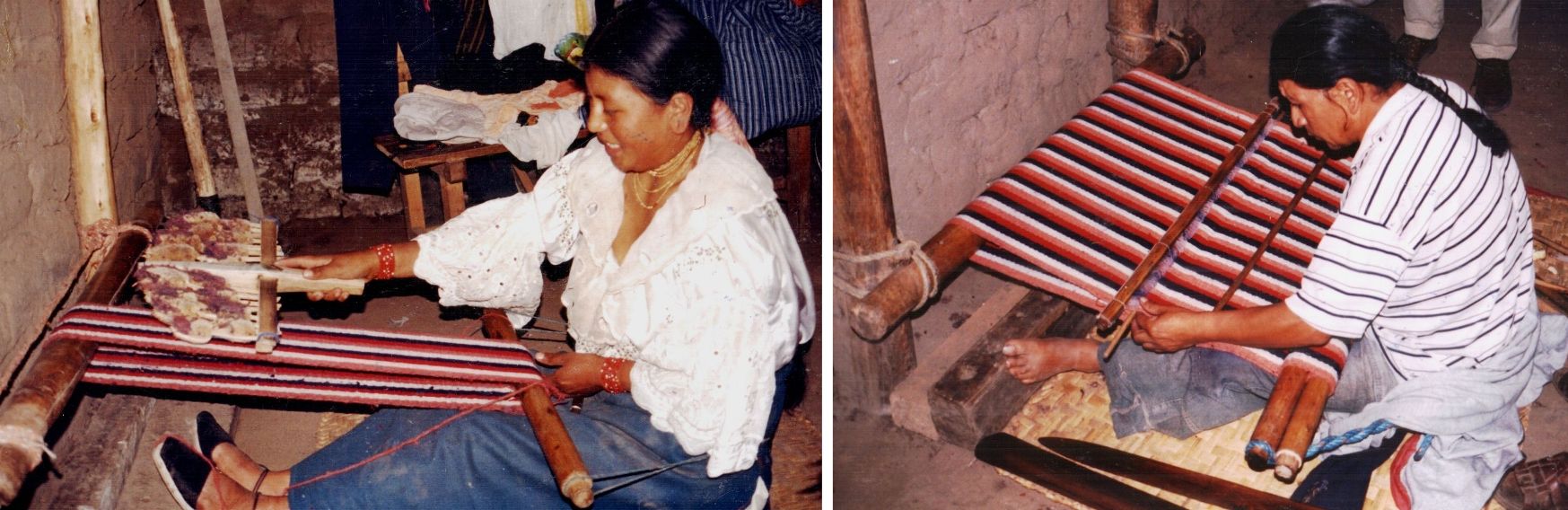
circular warp backstrapAbove, you can get more of an idea of the circular nature of this warp and see the coil rod in position. The biggest difference I notice between weaving on a circular warp like this one and one in a single plane, is the ability to apply tension. There is a certain “springiness” to this circular warp which makes me feel like I can’t tension or beat as hard. This has me pushing with my feet (something I rarely do these days) in an attempt to apply more tension. Maybe that is why the majority of indigenous weavers I have seen using circular warps brace their feet against something as they weave. It is interesting to be able to compare the feel of the two kinds of warp set-ups this way.

Weavers in Ecuador using circular warps brace their feet against piece of wood to help apply tension to the warp.
Weavers in Ecuador using circular warps brace their feet against blocks of wood to help apply tension to the warp.

At first, I decided that it would be an interesting challenge to just chart and weave one leaf and then see if, by reading from the one motif woven into the cloth, I could flip the design both horizontally and vertically. The challenge wasn’t met as it gave me a big headache! and so I decided to chart the four versions and go from there. I wrote a page some time ago which I added to my list of FAQs on my thoughts about the use or non-use of charts.

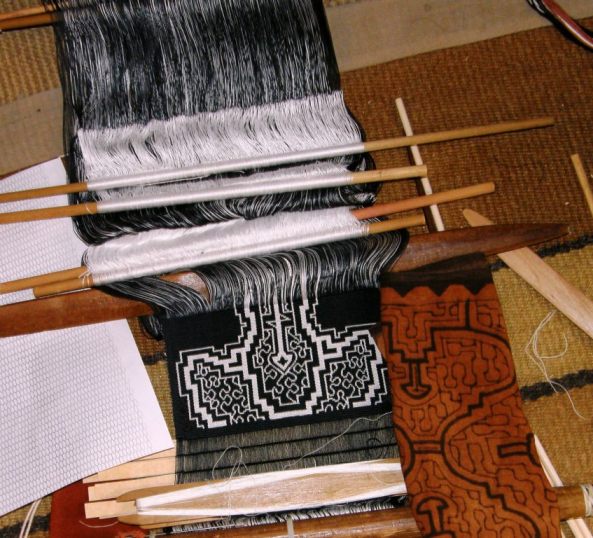
shipibo inspired wall hagnging panelMy latest wall hanging project uses a design I created and charted myself which is, for the most part, not symmetrical. It is a row- by-row slog working with an enormous pattern chart and was inspired by designs painted on cloth  by the Shipibo people of tropical lowland Peru.

Fortunately, for me, warp-faced double weave is one of the easier structures for reading the pattern  on the cloth because there are no warp-float lengths to be considered. Once a base line of pattern has been woven, it is easy and straightforward placing subsequent rows by referring to the preceding one without having to do a great deal of counting.  However, there are no small design elements within the large one that get repeated and which can, therefore, be eventually memorized.

The pattern is not one with which I am all together comfortable yet. What I mean to say, is that I am not sure that I like it yet! My eyes long for symmetry! I keep telling myself that I just need to WAIT (I have had plenty of practice with that this week!), weave a bit more, walk away, stand back, weave some more and allow it to develop. It is a design that has a lot of wiggly chaos within a rigid symmetrical outline. That’s the best I can do to decribe it for now. I just need to put a bit more of that heavy symmetrical outline into place to help me deal with the chaos!

I will wait. I won’t unweave. I feel confident that it will be just what I wanted in the end.

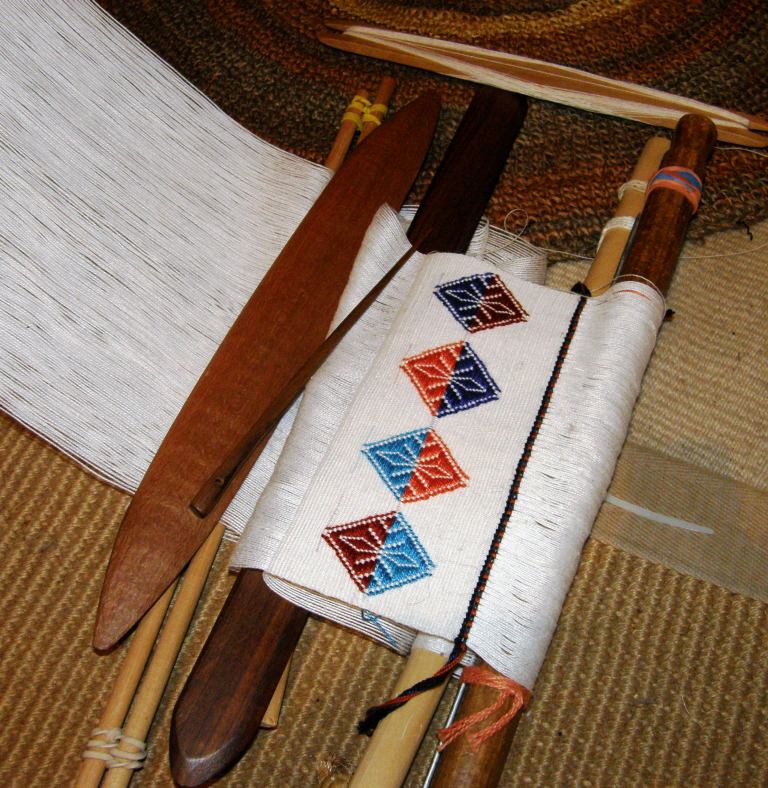
I was Googling some images this past week and came across some of my own things such as this…

Bhutanese motf supplementary weftI thought….wow, I remember that. I wove it at the start of my studies of Bhutanese patterns. Now, what in the world did I do with that? A quick search in the closet turned up nothing. And then I remembered…oh yeah, I unwove it because I didn’t much care for it at the time…too colorful or something like that. Maybe I should have WAITED. At least I took a picture of it before unweaving.

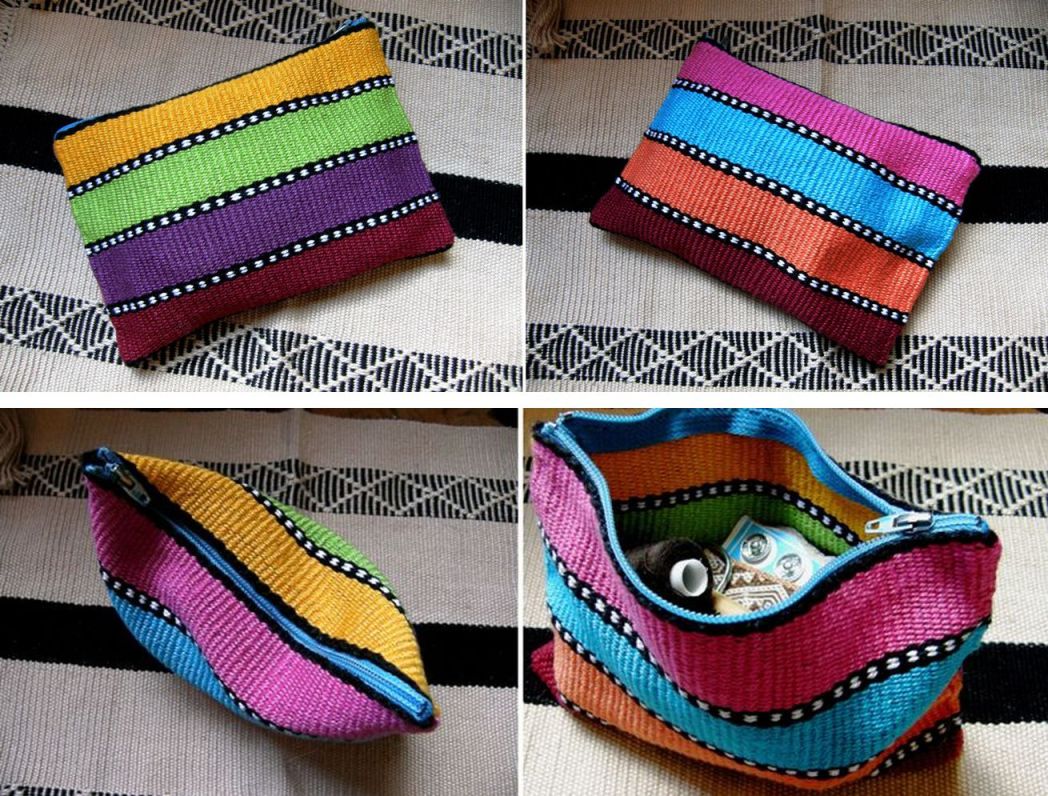
striped-pouch-x-4This had been a very hastily put together demo warp . I disliked the color combination so much that I didn’t even want to put it out to be seen. Nevertheless, I wove it off and sewed it into a pouch. Time has passed and now I just love my happy colorful sewing bag.

I am still waiting for this one to grow on me…

??????????????????????It was another travel warp into which I hadn’t put much thought. I was pleased to at least be able to use the finished fabric from the above warp for a tutorial on edgings.

Let’s see what online weaving friends have been up to…

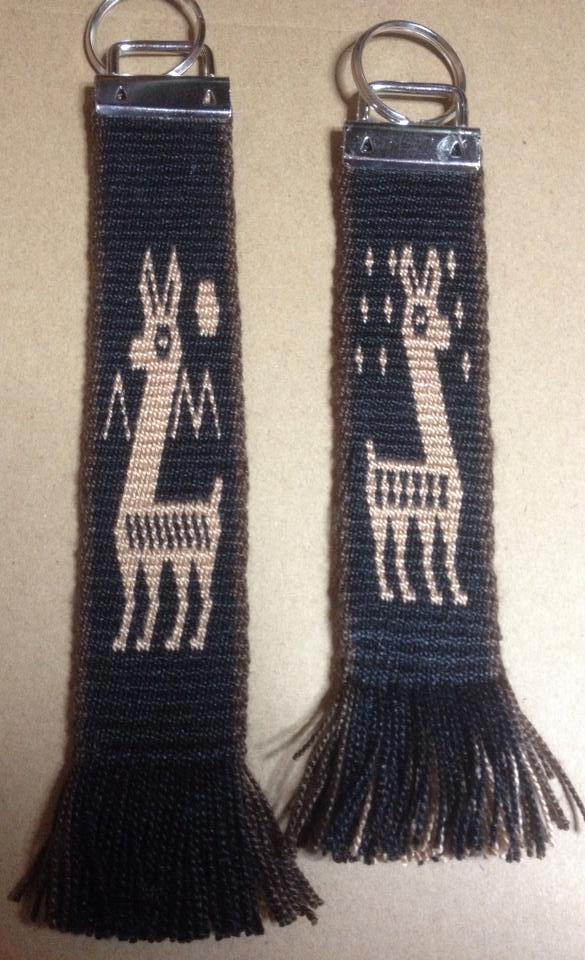
Scott is really getting into double weave and is now charting his own motifs. After working through my tutorial, he used the llama patterns to make keyfobs. I like those grippy keyfob ends…no sewing needed at that end. They are especially suitable for double weave which can be too bulky when folded and passed through a key ring.

scott (1) llamasNext he charted and wove the Norse Valknut motif…love it!

Scott's norse valknut motifI can’t wait to see what he comes up with next.

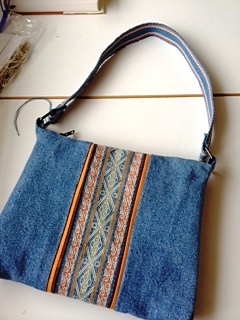
Jennifer finished her bag from our Ravelry Games weave-along…

Jennifer bag with chinchero patternsWhat a superb piece of work. She used denim which so perfectly matched the washed-out blue of her indigo-dyed hemp. Other pieces of colored fabric were used to frame the woven section. She finished it with a zip. 

lausanne pebble weave bandLausanne’s band is a lovely example of how simple 2 and 4-revolution Andean Pebble Weave motifs can be placed together to make new designs…something that I discuss and encourage in my second book. I love the way she has photographed it. It is so nice seeing lots and lots of band length like that.

Teresa in Chile sent me pictures of her first backstrap loom pieces using the tutorials on my blog for creating plain-weave bands with solid colors, comb patterns, and stripes. In this way she wisely develops and practices her skills in managing the backstrap loom with simple, fun, plain-weave projects. Now she is taking her first steps in creating patterns with warp floats.

teresa

I am glad that I didn’t have to keep you waiting for this blog post. Blog day is usually a strictly “at home” day for me consumed with taking photographs, editing and writing. I am just happy that I don’t have to get up at 4am again tomorrow!

See you next week.