Backstrap Weaving – Waiting….

I can’t believe that two weeks from today I will be on my way to the UK. Needless to say, this next fortnight will be mayhem! I will be off to Braids 2012 in Manchester followed by a visit to Cambridge, a short spell in the Netherlands (first time!) and then a little time in London before heading back home.

Hopefully all the Olympic madness will be over. Maybe I can pick up a nice souvenir at a post-Olympic sale. I know that I will meet lots of weavers and fiber folks. There will be familiar faces…Rodrick Owen, Robyn Spady, Ingrid Crickmore who will be teaching but who is also one of my regular backstrap weaving students and Eileen Thompson with whom I stayed during my visit to Texas last spring. Despite that, this UK trip feels a  bit on the scary side…don’t ask me why! I spent time in London in 1982. I was there right when the whole Falkland Islands, Las Islas Malvinas crisis erupted. It seems I was not as fond of taking pictures back then and one of the few I have is one of my very bedraggled self feeding pigeons in Trafalgar Square on a drizzly day.

I will be back in September with time to think about a couple of other textile events….

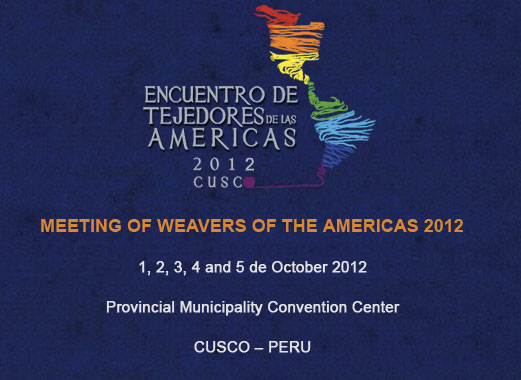
This event will be held in Cusco in the first week of October. Right now it doesn’t look like I will be attending. For some reason there are no direct flights between La Paz, Bolivia and Cusco, Peru like there used to be and the only option via Lima costs more than  ticket to the US! However, there is always a chance that something will come up between now and then so I will leave that up to the gods. One of the organizers of this event is a Peruvian anthropologist that I met at a similar gathering here in Santa Cruz last year. It was a very nice low key and intimate event. Somehow I think that this one in Cusco will be much larger.

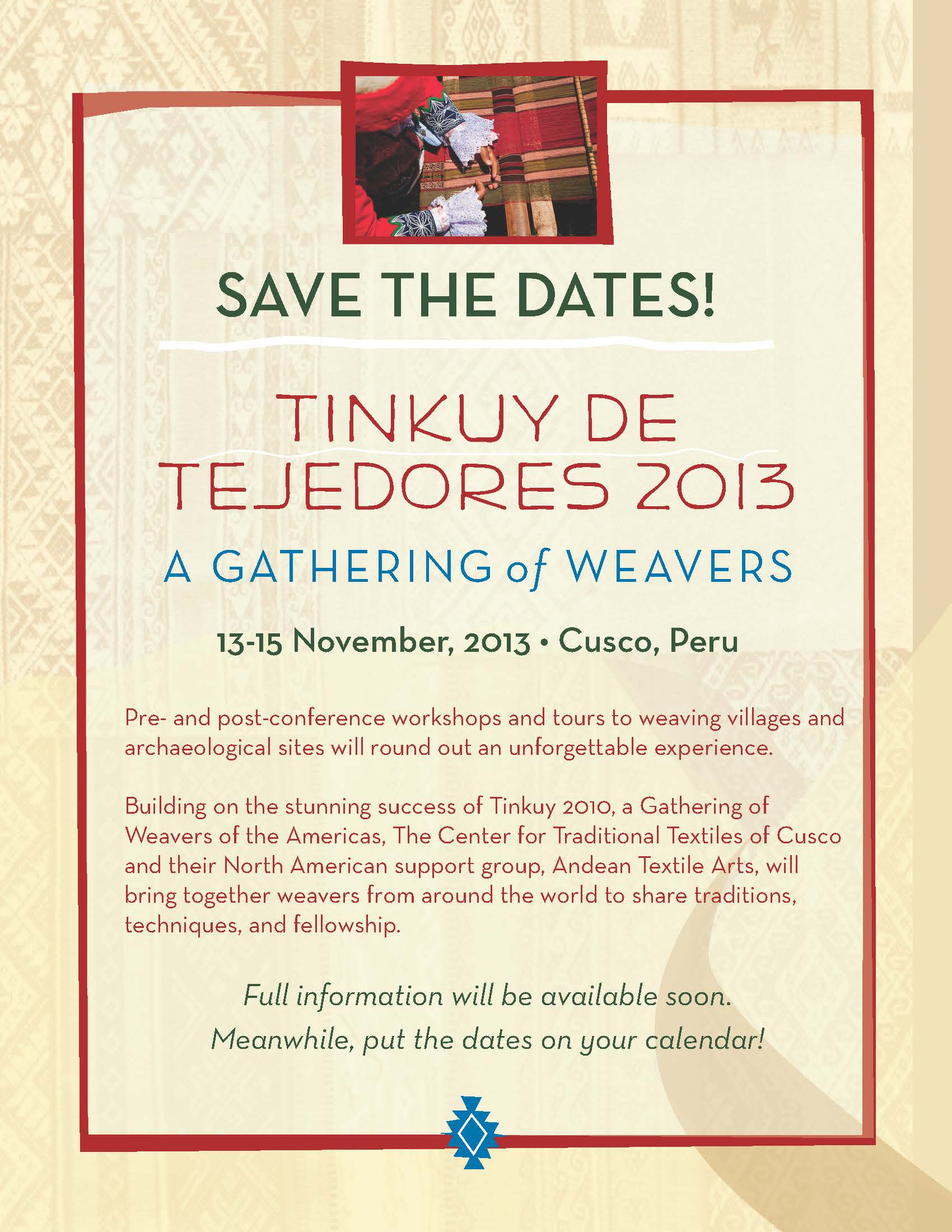
And then, planning way ahead to 2013 there will be this….

Exciting! It seems so long to wait….but that is how I felt about Braids 2012 and here it is almost on top of me now.

As for my book, well, that’s a waiting game now. There is some technical stuff that I am simply not equipped to deal with and so I have had to hand over to some kind helpers and will wait and see what happens. Actually, I have to admit that it is nice NOT to be able to work on the book today as I am, quite frankly, exhausted from peering at the 10″ screen of this mini computer! However, it makes me all fidgety and I find myself shuffling through pattern charts and books when there really isn’t anything productive that can be done at this point.

What is the solution for that? WEAVE!

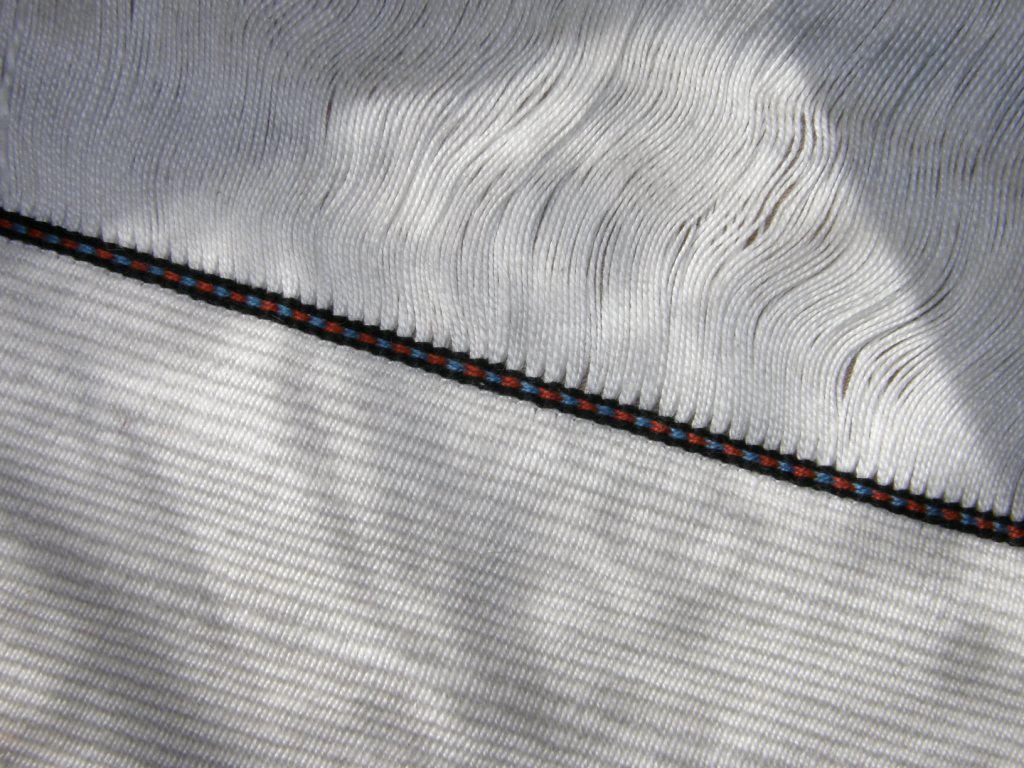
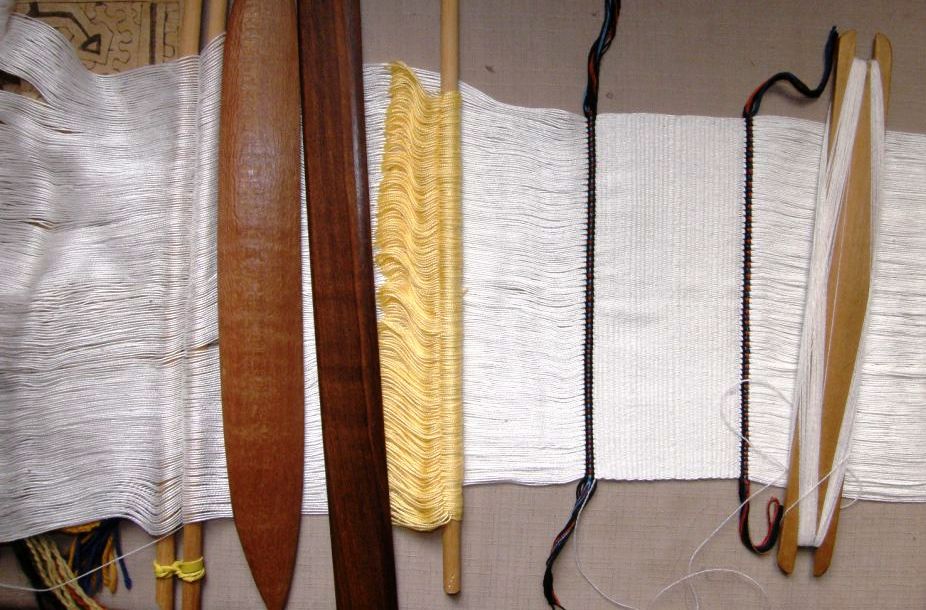
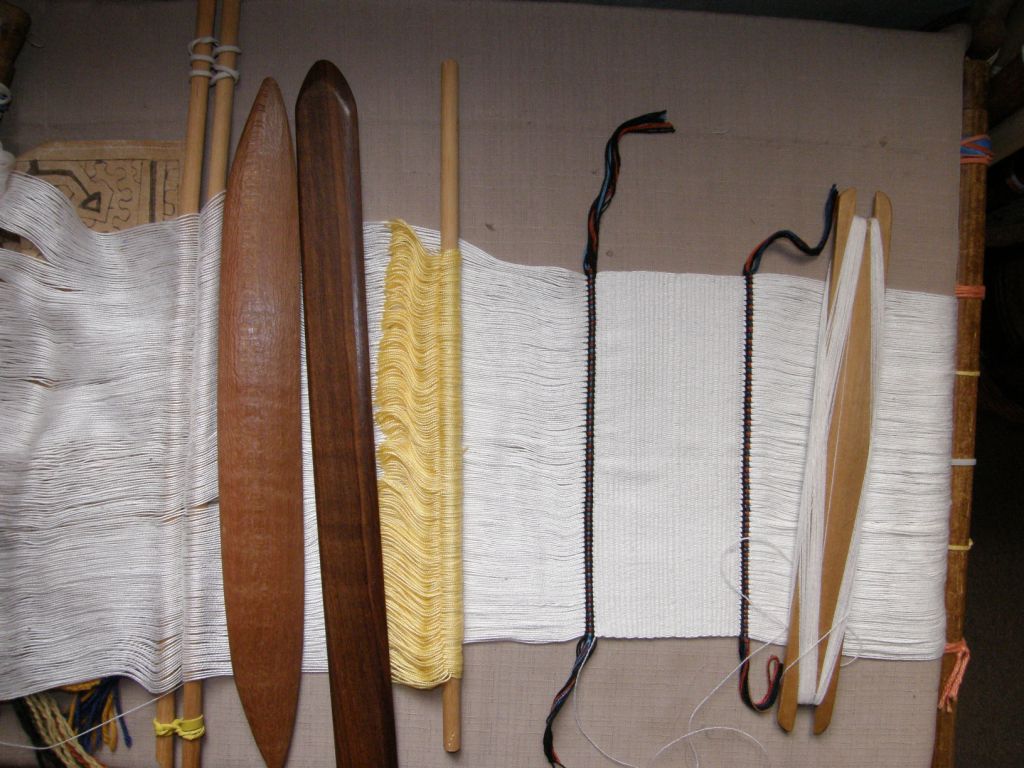
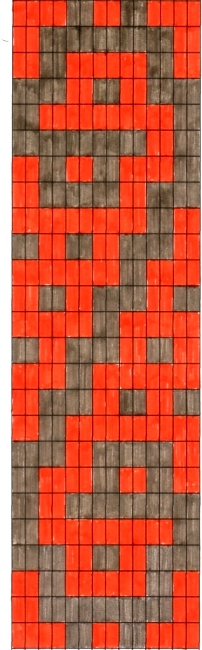
I just got an idea about what to do with the white demo warp that I carted about the US last spring. It is warp-faced plain weave and white…can’t get any simpler than that. I added some twining in red, blue and black and there it has sat waiting…..waiting for inspiration. Well, I think it has come in the form of this….

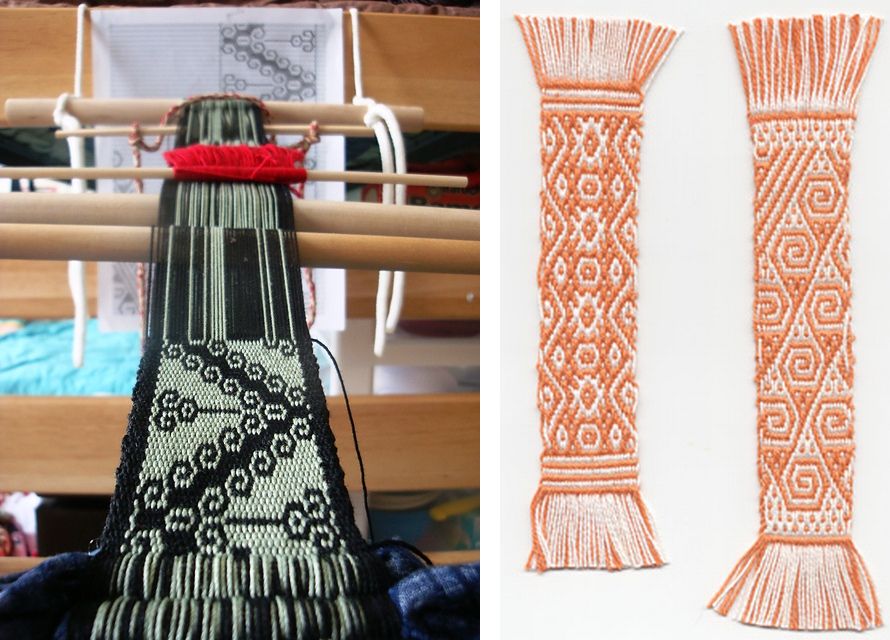
This is the back cover of  a beautiful book on backstrap weaving in Bangladesh, Strong Backs, Magic Fingers. It shows an alam which is the traditional sampler that girls in the Chakma ethnic group are supposed to weave in order to master 210 designs and show their weaving skill.

Authors Manjulika Chakma and Niaz Zaman write that…

Most alam designs are drawn from nature: from flowers, trees, reptiles, birds, and animals. Some of the names suggest the source of the image; other designs are simply called by the number of lines of weft needed to make up the design.

The last part I found interesting as Maxima, one of my weaving teachers from Cochabamba, also gave some of designs in her pebble weave repertoire simple numerical names according to the number of pairs required to weave them. She had a set that she would refer to simply as tawa chinito meaning four pairs.

The older alams, according to the book, are woven in black, red and white yarn.

Those colors sound right up my alley, right?  The ground cloth is a balanced weave.

I will take some of the 210 possible alam designs and use them as inspiration for my white warp-faced piece, creating patterns with red and dark blue supplementary wefts.

On the other hand, I just love this simple white with its intervals of basic twining and wonder if it is a mistake to add pattern…

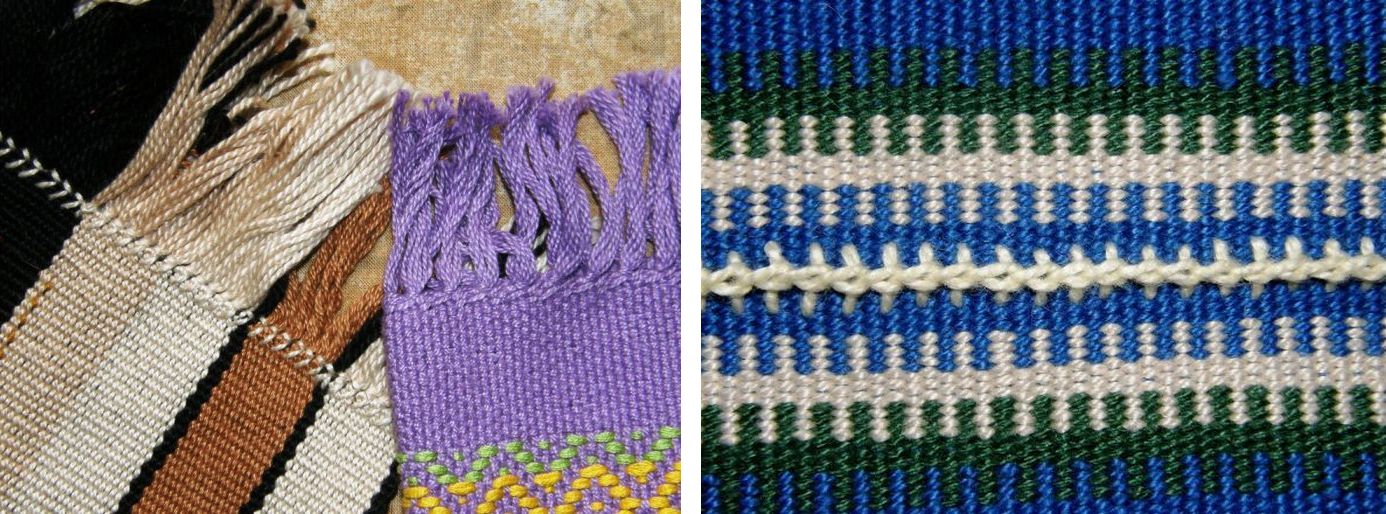
Speaking of color and lack thereof, I had fun weaving samples for my book and put together this fun collage of colors that I would never dream in a million years of ever placing in the one piece….

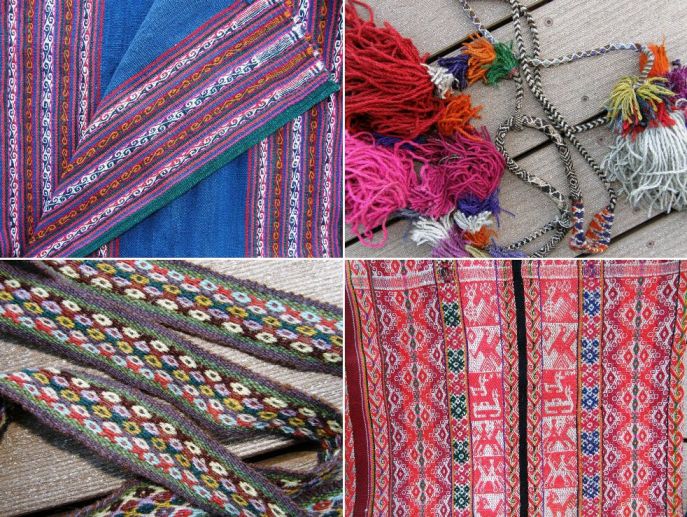
It’s just two bands with both their faces photographed and put together. I think the result is very exotic! and can imagine pillows covered with fabric like this scattered about on the floor of a tent on the high plains of Central Asia…The pattern is indeed inspired by those I have seen on Central Asian textiles woven in various structures and I have adapted it to pebble weave. This is what one part of my book is about…adaptations of traditional textile designs from other far flung cultures to the pebble weave structure. I had a lot of fun with that. After a while you start seeing the potential for pebble weave in everything!

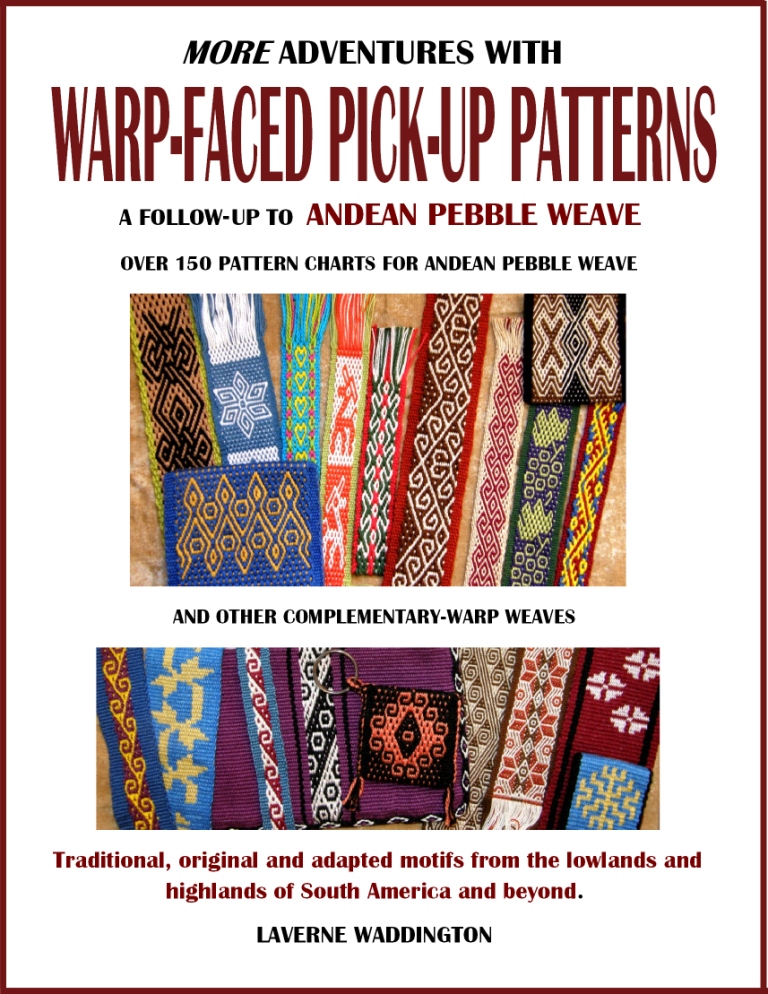
So, while I wait for my tech-wise friend to advise me on the next step in the process, I can show you the cover of the book. It is rather wordy, but, hopefully, will not leave you with any doubts about its contents…

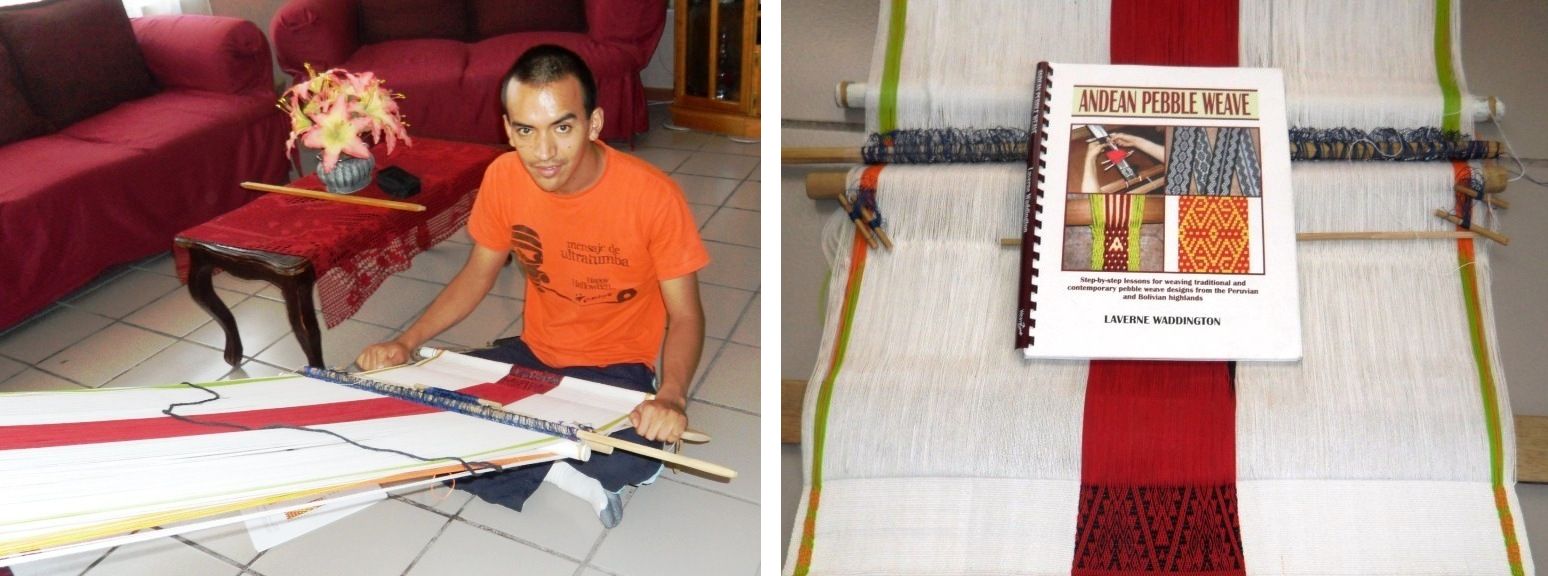
A follow-up to Andean Pebble Weave, it says. As I mentioned in a previous blog post, this book does not stand alone as a how-to type of book. It builds on skills and know-how to which you will have been exposed in my first book and then goes beyond with instructions for other complementary-warp pick up weaves with lots of pattern charts.

So now I am going to step away from the computer with its book files, pictures and charts and head to the loom, stepping over all the charts and sketches on the floor, ignoring the tempting pile of books open on the table…time to dig out that supplementary weft yarn.

Backstrap Weaving – A Little Weaving Therapy

I guess that two months isn’t really such a long time to be away from home. It’s just that I haven’t done an extended trip like that in a long time. I am reminded of the times when I lived at the southernmost tip of continental Chile and used to go up to Peru and Bolivia for the winters. I would spend months away wandering about, only going home when I had become too skinny and undernourished (I always traveled on a typical backpacker’s budget!). It is always bewildering after you have seen so much, experienced so many different things, met so many cool people and learned so much to go home and find that everything is the same!

How could this be when you feel so different?! However, returning home this time was a little different because things had changed. Stuff happened, people disappeared, things accumulated….one of them being DUST…two months of the wretched stuff!

But now I am back into the old routine. Yes, here I am blogging away on Thursday in socks and sweaters. Fifty-five degrees…that’s COLD for Santa Cruz. The palm trees look rather forlorn against the grey sky.

Time for some weaving therapy!

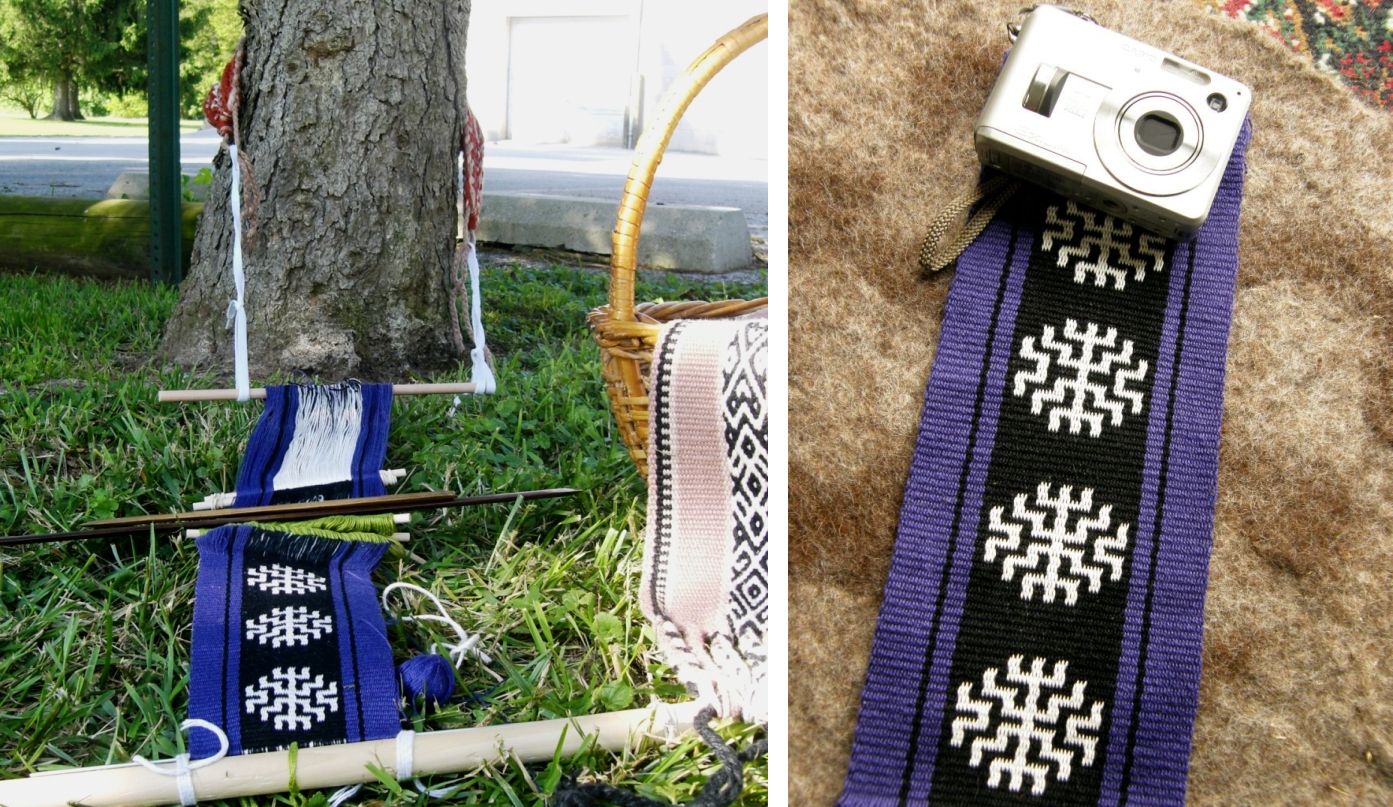
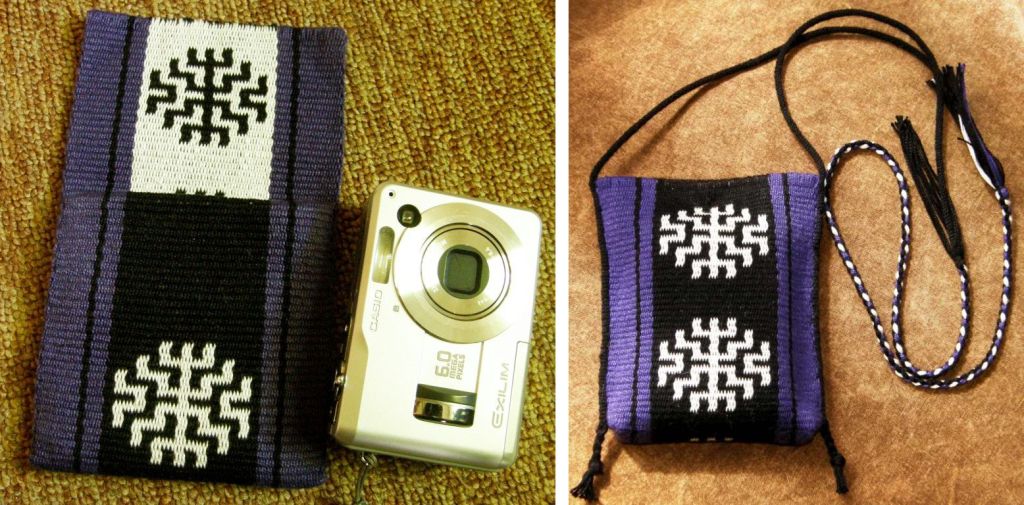
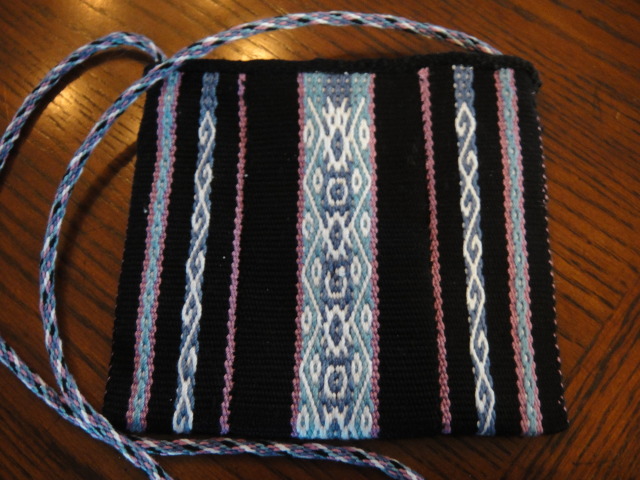
I made up the bag for the wee Casio camera.

This project accompanied me on the road and was hitched to numerous places along the way. I finished the weaving while I was up in Massachusetts. The pattern is one from Bhutanese textiles. Now, how to sew it up?

The first idea was the one on the left…a bag with a flap which I would cut and shape and edge with a tubular band. However, the motifs were not ideally placed for that and so I ended up with the style on the right.

I squared off the bottom of the bag and added a single large  snap closure on the inside. It is edged with a sixteen-end black plain-weave tubular band. I continued weaving the tubular band after covering the edge so that I could also use it as a strap and then added a four-strand braid to that for extra length.

The transition from tubular band to four-strand braid is covered by a tassel…a trick I learned from my sling braiding teacher in Peru.

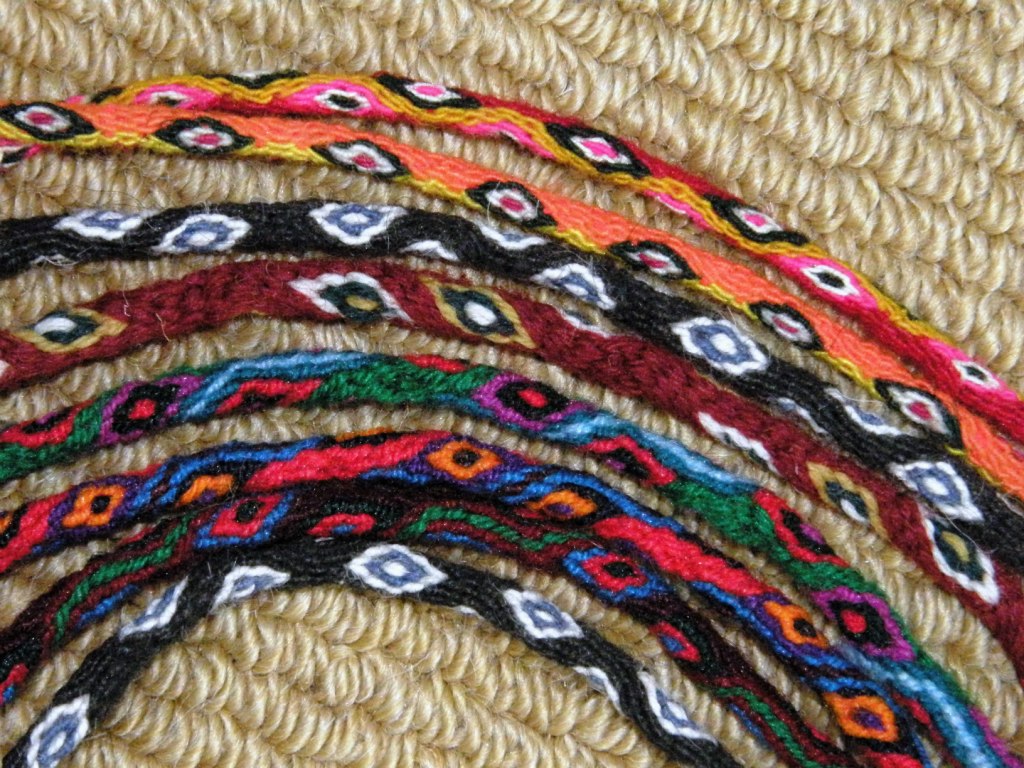
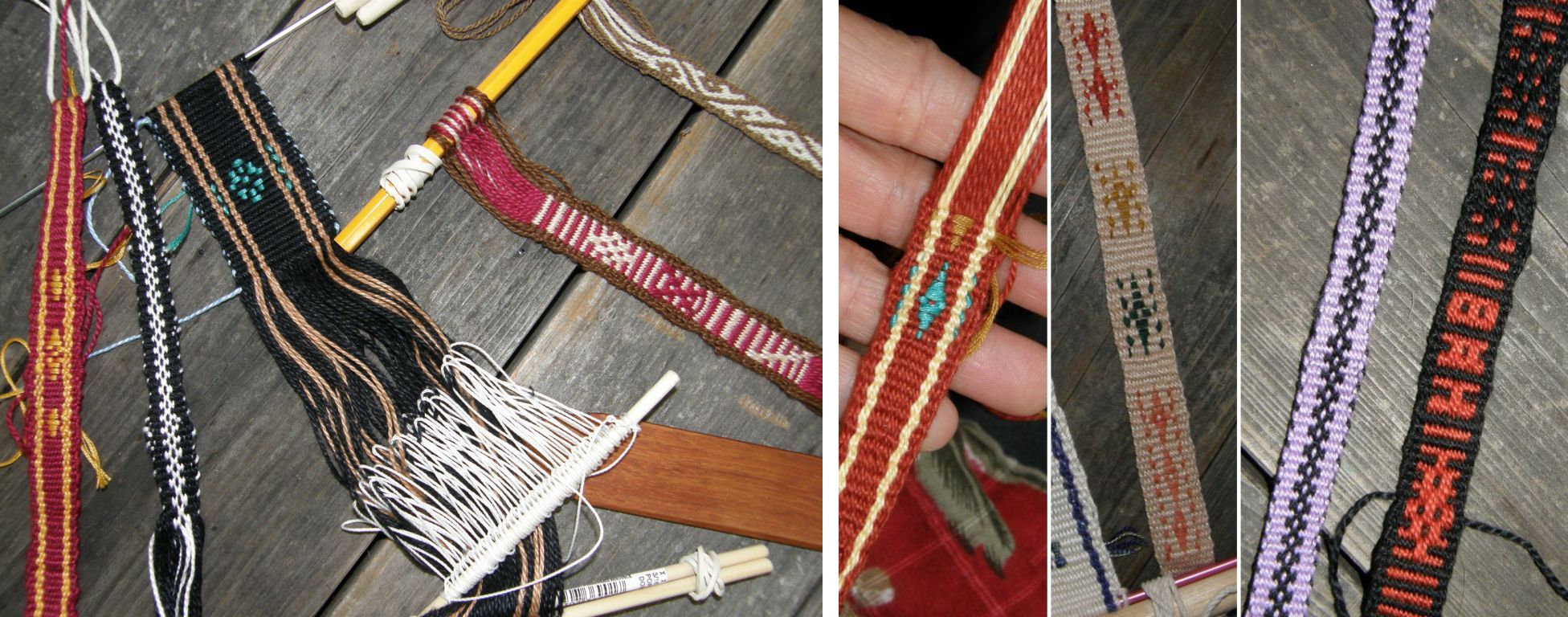
I think these tubular bands are very cool and so handy. I have been playing with some other plain-weave ones in different materials. The one on my bag is in #10 crochet cotton and here are a couple of others that I made in wool.

The yellow and blue one is woven with a DK weight wool I love the way the simple stripes spiral.

The other one is in a lighter weight wool and you can see that even a lightly twisted yarn works. As the warps are so narrow, the problems of stickiness that usually occur when using wool in warp-faced projects are not a big deal. The warps did not break but my weft did once from pulling it very tightly but that was not a  problem.

Another cool thing about tubular bands is that it does not matter what the lower face of the band looks like. That gets hidden within the tube.

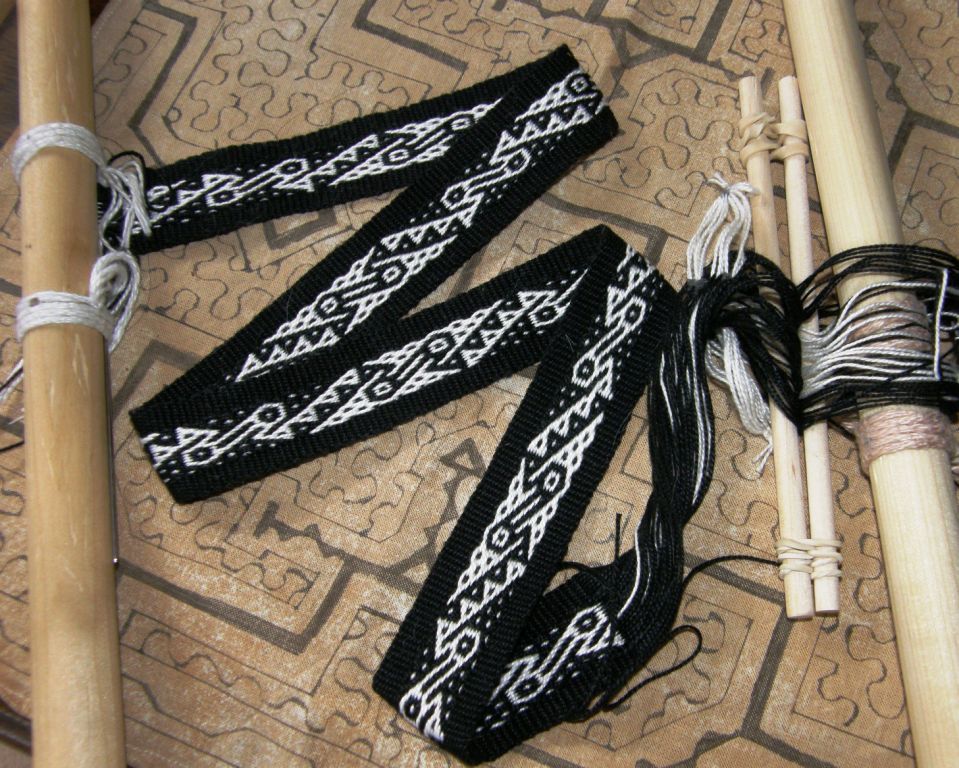
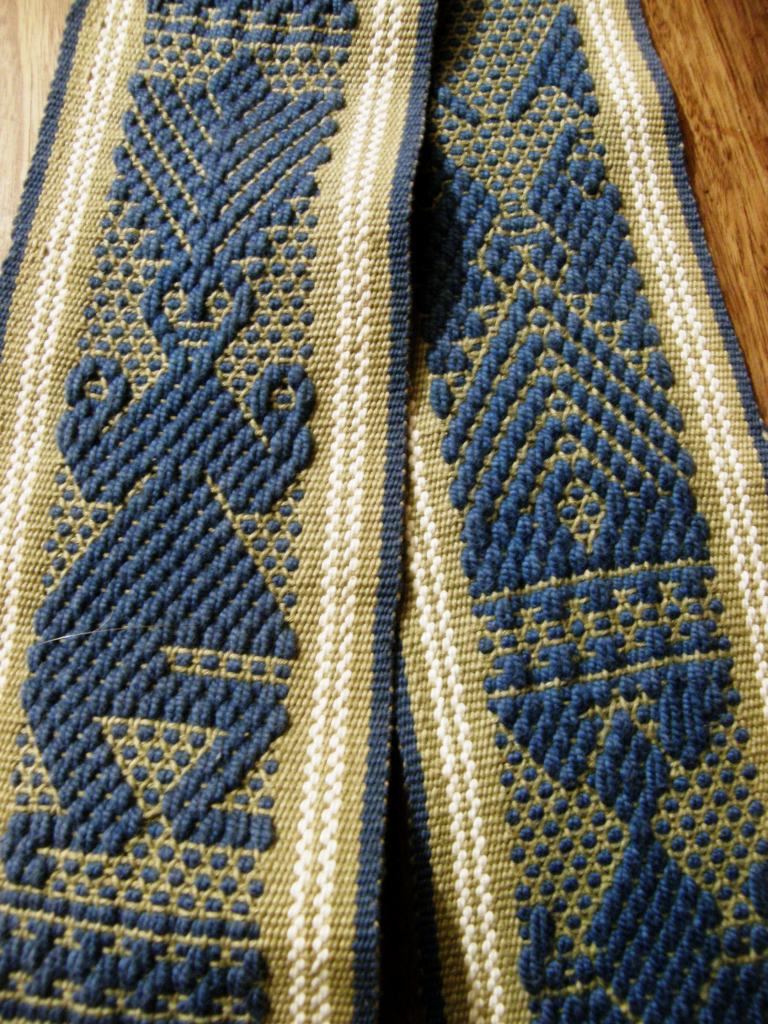
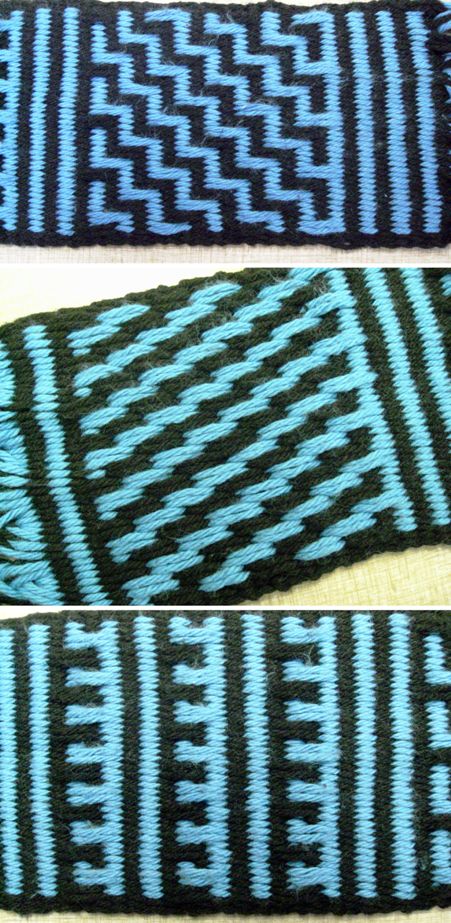
I wove a ñawi awapa band (see some ñawi awapa bands pictured on the left) as an experiment as a flat rather than tubular band and saw the chunky chaos of crossed and twisted floats that is created on the back side of the band from all the strange warp crossings and manipulations.

But that does that matter? No! All that gets hidden within the tube.

Now what other technique do I know that has a pretty “right” side and a messy “wrong” side of awkwardly long floats?…the warp subsitution technique, of course!

Actually, any warp-faced band whether it be plain or patterned with any kind of pick-up can be made into a tubular band but, since the warp substitution technique is often overlooked because of the long floats that are created on the reverse of the fabric, why not use it for tubular bands where none of that matters?

So, the other band pictured above has three-color horizontal bars which I was able to create with the warp substitution technique.

All the cumbersome long floats are hidden within the tube.

These bands are fast and fun to weave, quick to warp and can be stretched between a toe and finger to weave.

If that doesn’t suit you, you can attach one end to your waist with a cord through the end loops.

If you don’t fancy using your big toe, as the weaver from Tarabuco pictured at left is doing, a cord can be passed through the end loops at the other end of the warp which can then be wedged inside a drawer or looped over a “C” clamp.

I am going to use these tubular bands as pretty ties for my loom and any other time I need cord for my weaving projects and I hope to experiment a lot more with designs and colors.

So, that was one on-the-road project finished. My other demo warp is something quite different. A big white canvas looking at me and asking to be decorated…

There is something very lovely and somehow “earthy” about creating this plain and simple warp-faced white cloth and I want to make any patterning minimal. I have added a couple of weft-twined sections. Perhaps I will do some more weft-twining or maybe some soumak with a bit of added patterning with supplementary wefts. I left a lot of unwoven warp at the start in case I want to add a large weft-twined pattern later. As usual I don’t have plans for the finished piece. I will just see what happens.

Then there was time to do something with a sample piece that I had completed shortly before leaving.

You may remember the ikat weave-along that we were having on Ravelry.

My friend Betty in the US gave me a huge roll of ikat wrapping tape so there will be many more ikat experiments in my future!

I have been using cassette tape until now and had a small “oopsy” in my last project when my dye solution was too hot for the tape.

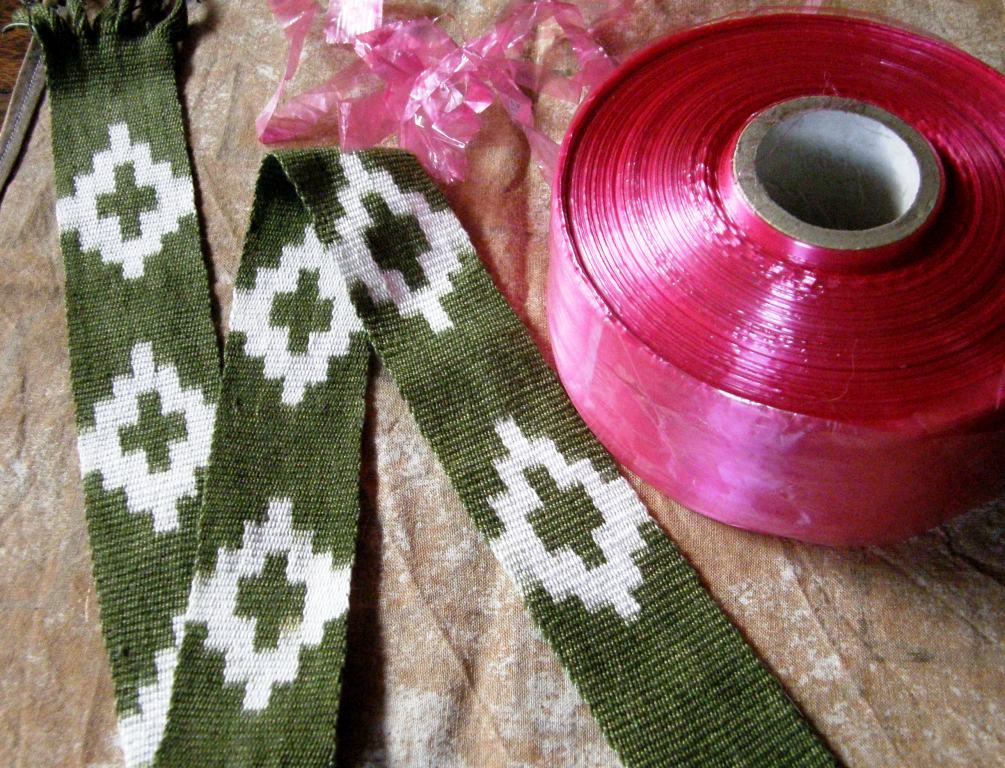
I am sure that this special tape has been designed to stand up to being boiled in dye baths. It is very wide but tears easily into perfectly straight narrower strips…what a dream!

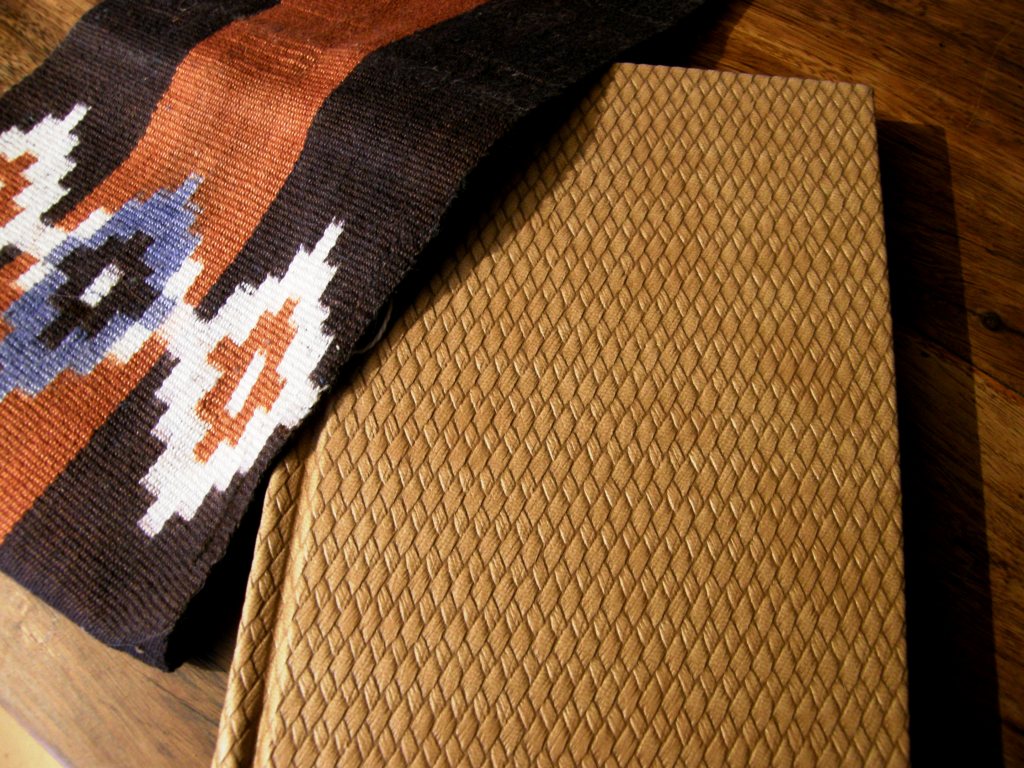
Here is the second warp which I tried after the green one above. This was my first time trying over-dyeing with a second color and spot dyeing.

My friend Jeen in the US gave me a lovely travel journal and, even though its cover is very beautiful, I decided that my experimental ikat piece would make a wonderful jacket for this book.

I have to admit I was a little nervous. Was I about to ruin both sample and journal?

I used contact cement which is pretty strong stuff. Would it eat into the material on the journal’s cover and destroy it? Would I mess up and glue it on crookedly?

I have done that before with contact cement when gluing cork sheets to a table top. Once that stuff is ready to go you are pretty much committed and it won’t forgive any mistakes! Fortunately it all came together and I am very happy with the result.

The little vessel in the picture was a gift from a friend in Ecuador. The pen is made from sandalwood and was brought to me from India over forty years ago! Goodness knows how I have managed to hang onto it after all these years of moving around and having to abandon possessions along the way. The mug rug on the far right is part of a set inspired by African designs that I made on my backstrap loom in double weave.

My new-to-me used camera got a dressing up too with a new strap. I was happy to have a chance to weave that bird design again…the one on the old fragment that Tom Knisely showed me…

Here it is off the loom and on the camera…

And here it is on my backstrap loom. I love the way the bird motif changes from black to white along the length of the band.

And now I have a new strap to study which was lent to me by Susan  who visited me when I was traveling. She brought it along and I was delighted to be able to see both sides of it. There are so many pictures online of these bands from Oaxaca, Mexico but you never get to see the back side. There are many more examples of these on Teyacapan’s Flickr page of Mexican textiles.

Perhaps this structure is woven somewhere here in South America too but I have never come across it so this is a great opportunity to take a good look. Maybe it was woven here in pre-Columbian times. She urged me to take it home and just send it back to her when I am done. How cool is that?

I have this urge to go back to some simpler things and explore them more…like the white plain-weave piece I am doing, some more very simple ikat motifs which again involves just plain weave and I have been also looking again at simple warp floats.

One of my weaving friends in the US wove this cool backstrap after having woven simple warp floats with me.

We just played a little with floating both colors and she went on and ran with it.

At left you can see various parts of Kristi’s backstrap which is patterned with floats in two colors. She used it the second time we wove together.

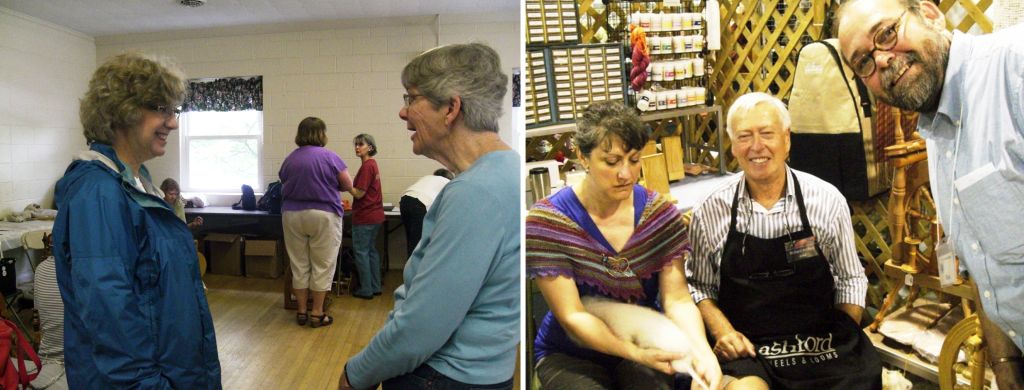
When I was at Maryland Sheep and Wool I got to see many people of all ages being introduced to fiber activities.

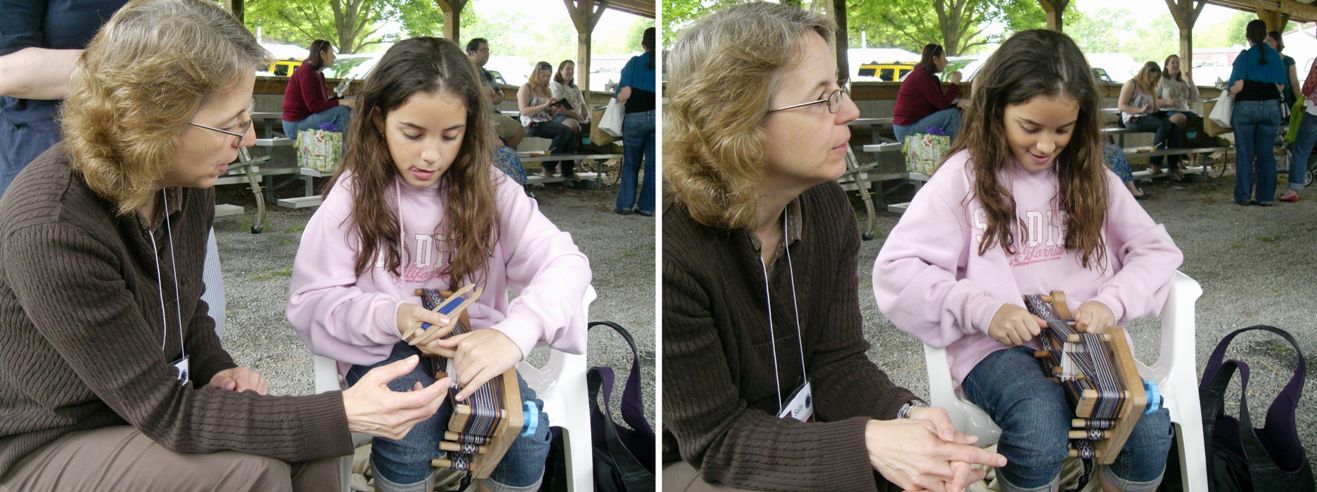
Elisabeth Hill, who I have known some time online and whose fabulous work on deflected double weave I always follow on her Flickr page (she’ll be teaching it at Convergence), came to Sheep and Wool with her niece Kylie. Kylie got a class in inkle weaving from Sally Orgren on her famous and well-traveled loom when we had a Weavolution meet-up at midday. Look at that smile. It looks like a new weaver has been born.

One of Elisabeth’s deflected double weave pieces won first prize in the exhibit at Sheep and Wool. I don’t think the picture I took does it justice so please take a look at her Flickr page to see all her beautiful creations.

Some lessons, like the one Kylie had, were completely impromptu. I wonder if as Kylie grows and continues to weave (and what wonderful inspiration she has in her aunt Lisa) she will remember her very first lesson there in the Rabbit Barn at Sheep and Wool on Sally’s “Inky”. Other classes were more formal…

There’s my friend Claudia chatting with spinning teacher Maggie Casey before class and Richard Ashford was at The Mannings booth giving spinning tips with Tom Knisely looking on.

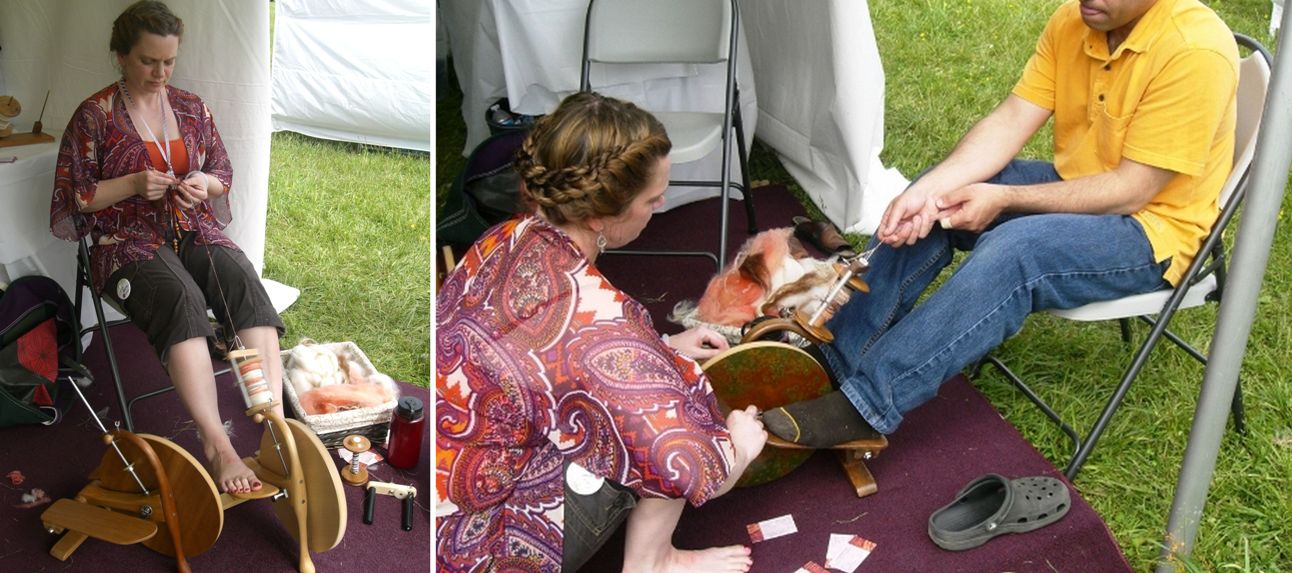
And the guys were into it too. Here is a gentleman having a spinning class on the ”Pocket Wheel” which was a big hit.

It was fun to see the team of young guys and gals who entered the Sheep to Shawl Competition this year.

Some things I saw at Sheep and Wool inspired this little project this week…

A simple little pebble weave band, right? But wait until you see the band that inspired this…

Isn’t that spectacular! Now you can see where my little purple and yellow band fits in! This was woven in Ayacucho, Peru and is probably from the same area or at least very close to the place from which my pebble weave teachers originated. Although they taught me in Huancayo, they are natives of Ayacucho and the little animal motifs on this band are very much like the ones they taught me. I would guess that this band was woven with the same two-heddle method that I learned in Huancayo with some additions for the third color.

The quality of the weaving is superb. Sadly it probably won’t be “popular” with some tourists who generally seem to prefer handspun wool and natural dyes. There is so much weaving in Peru that we just don’t get to see and coming across these bands at the Sheep and Wool festival was such a treat for me especially since I have not seen anything like the motifs I was taught back in 1996 in the books I have on Peruvian weaving.

Except for the purple and yellow section, it is a three-color pebble weave. Aren’t those braids and pom poms beautiful?!

Here is a little something I picked up from the same stand. I was tipped off by braider Rodrick Owen that these were available there….a sweet braid with tassels from Ayacucho being sold as a keyfob.

And finally, here is a wonderful display of bands made by Yonat. Yonat feels more comfortable on an inkle loom and so takes what she weaves with me and transfers it to her loom. Not everything here was originally backstrap weaving. Some bands, for example, are from the workshop on Sami weaving by Susan Foulkes and others are Yonat’s original creations.

See you next time. I hope that all of you can take some time off for a little weaving therapy this week.

Backstrap Weaving – Announcing….Events, Books, Resources!

It’s been one of those weeks again…hands occupied at the computer keyboard and eyes peering through the camera lense with plenty of small projects going on and off the loom bars but no “real” weaving getting done.

It is sample-weaving time for my next book and, as always, I just love my backstrap loom when it comes to knocking out wee samples for photographing. I can have several going at once on my twenty-six loom bars and even the smallest scraps of yarn can make enough warp to make my test successful.

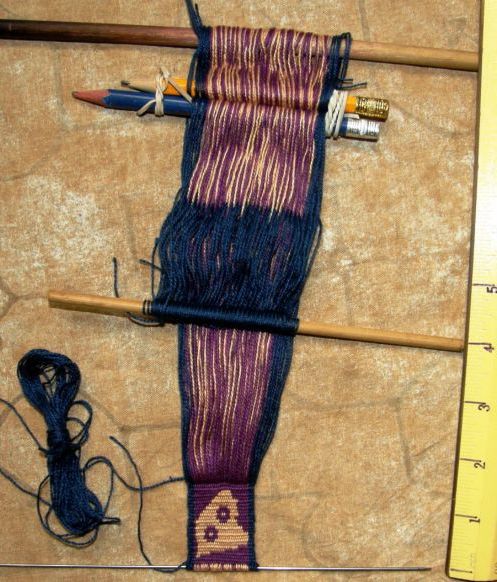
At left you can see an old sample I made to check the proportions of the motif I was charting in double weave. I could put some safety strings in that warp, roll it up and put it in my pencil pouch.

The only real weaving I did this week was one more motif on my ikat band but then, that really is just another sample.  I do plan to use it for something when it is done. I made some sketches for the next ikat experiment and would like to get that going this weekend as an incentive to finish the sample band.

Karen in the Ravelry group told us about how blue and chocolate colored ikat pieces are her favorites from Guatemala and I have had that color combination in my head ever since. I have terracotta brown and navy blue dyes and I think I shall have to try something with those.

So while I have been tapping away at the keyboard and doing gymnastics with the tripod and self-timer on my camera, (12 seconds is NOT long enough!) one corner of my mind has still been occupied with new ideas for the my next weaving projects.

While I don’t have any new weaving to show you, I do have a few nice announcements.

Firstly, David K Barker’s first volume and first part of his third volume of textile designs of Bhutan are now available as downloads in addition to the second volume which I wrote about here some months ago.

The links are on the RESOURCES page. What will we do with all these motifs?! I have a few ideas. 🙂

I have also included on the RESOURCES page links to videos on a couple of my favorite finishing techniques for my backstrap woven pieces. Thanks to Tracy for this idea. She was just mentioning today how hard it is to find the video for the Van Dyke stitch that I embedded in a post a long time ago.

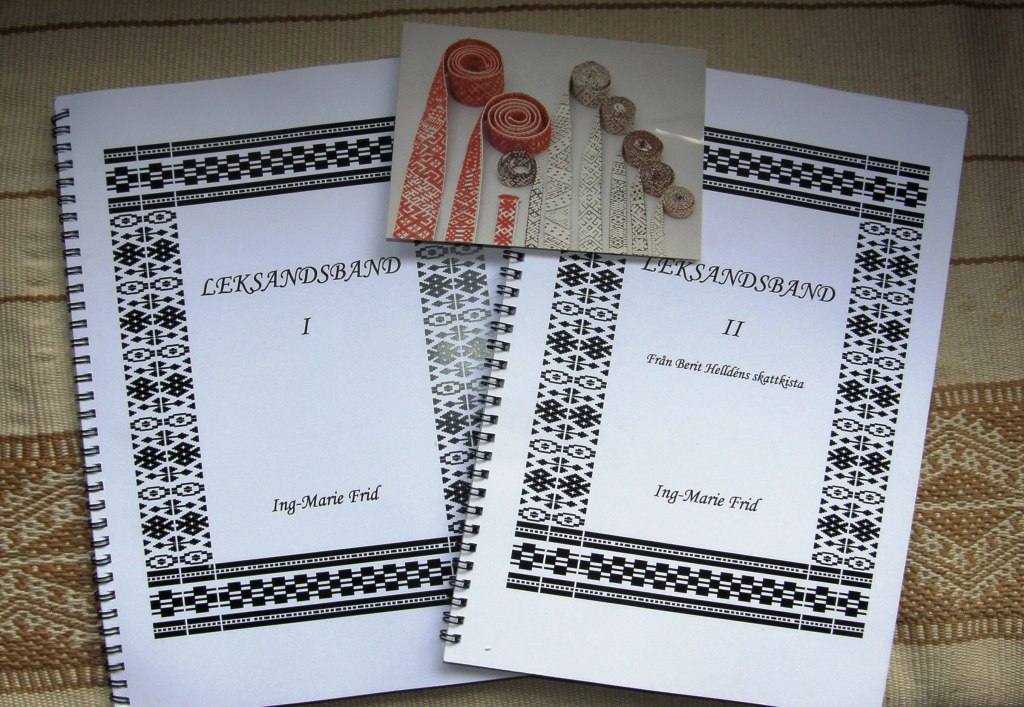
A couple of weeks ago, I showed two books on Leksandsband by Ing-Marie Frid which were sent to me by a weaving friend in Sweden. Some people have asked me about how to buy these books and I have put this information on the RESOURCES page too. Ing-Marie was kind enough to write a comment on my blog with a contact email address.

The books are not about teaching the band weaving technique, but are catalogs of patterns which have been beautifully and meticulously charted alongside photos of the original bands.

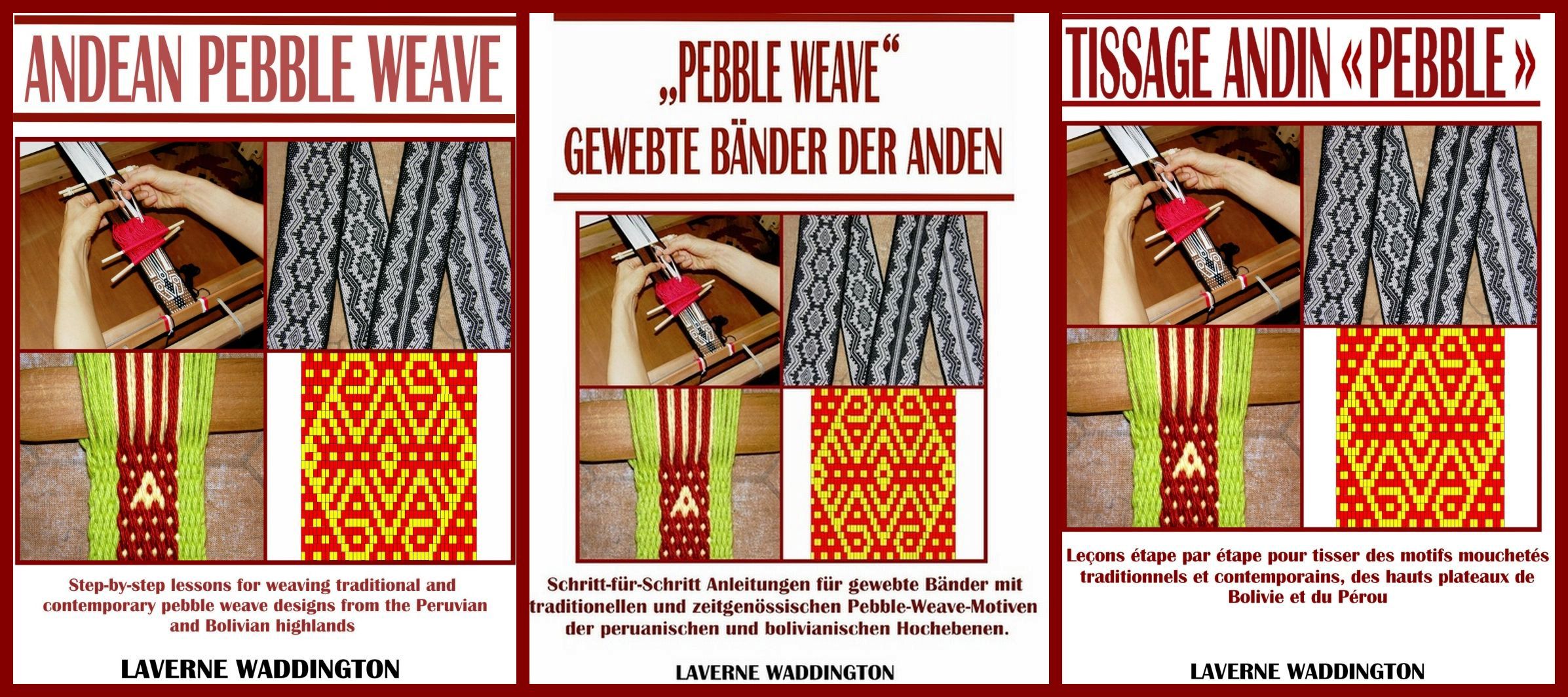
And, speaking of books…my e-book  Andean Pebble Weave is now available in French as Tissage Andin < Pebble> on Patternfish.com.  It went up on the Patternfish site a couple days ago and has been bought by two people in France and another in Switzerland so far….exciting! It will be fun to see how many French-speaking countries it reaches.

I guess I feel I have a small connection to France and Switzerland having spent five entire ski seasons in Val d’isere with my French boyfriend at that time as well as having done some wonderful summer hiking in the Pyrenees. And then there’s my aunt who left India as a young girl to work taking care of an elderly woman in Italy. She met and married a Swiss man and has lived in Switzerland ever since. We tend to wander about a bit, my family!

I am very grateful to Sandrine de Tricofolk who translated the book for me. Sandrine created the online forum for French-speakers known as forum filage for enthusiasts of all textile crafts. She also blogs about her various textile hobbies. And she also translated the following for me:

Je suis heureuse de vous annoncer que le livre “Andean Pebble Weave” a > été traduit par Sandrine de Tricofolk, et qu’il est maintenant > disponible en version française ici. Sandrine est à l’origine du forum 
 filage, un forum francophone pour tous  les passionnés d’artisanat textile, et partage également ses diverses > réalisations textiles sur son blog.

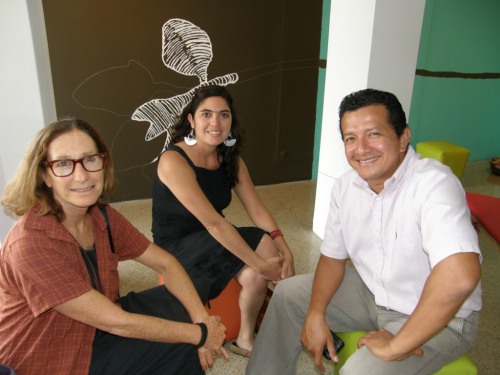
This week brought an interesting email to my inbox from Maria Elena Del Solar a Peruvian anthropologist whom I met at a weavers’ gathering that took place here in Santa Cruz, Bolivia last year.

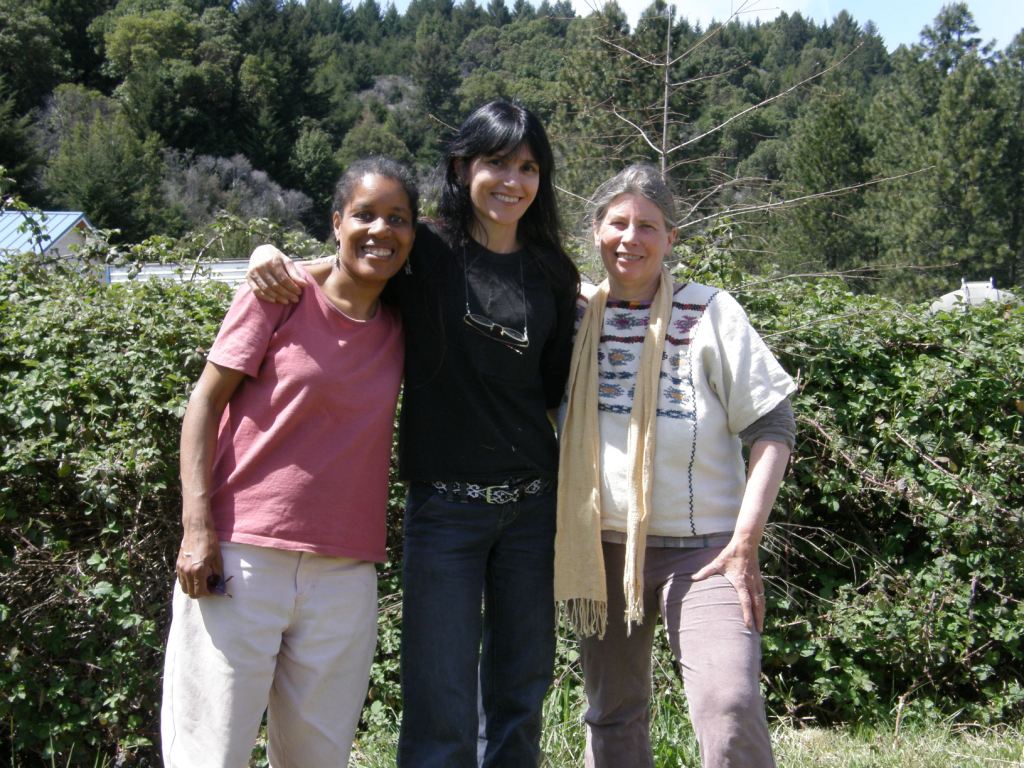
That’s Maria Elena on the left with two other participants at the gathering from Chile and Ecuador.

Maria Elena is a member of an association called ANDESMANTA which is organizing what they call the first Meeting of Weavers of the Americas, ETAM2012, in the city of Cusco Peru October 1-4, 2012. 

She has asked all the recipients of her email to circulate this information and direct people to the website which has been set up with the first announcement.

I do not know very much about the exact nature of this gathering. The Tinkuy de Tejedores that was held in Urubamba, Peru in 2010 (in blog posts here and here) and the Encuentro de Portadores de Tradición del Universo Textil Andino y de Tierras Bajas (in blog posts here and here) which Maria Elena attended and which took place where I live in Santa Cruz, Bolivia were two quite different events. For one thing, the former was conducted in Quechua, Spanish and English and had a large attendance of people from outside Latin America. The latter was conducted entirely in Spanish, was a much smaller affair, and was attended only by residents of Latin America. However, the web page for the proposed ETAM2012 conference has a version in English.

Early morning pre-conference activities at the Tinkuy de Tejedores in Urubamba, Peru in 2010
Guaraní weaver, Angela, from lowland Bolivia meets and learns from Celinda, an Aymara weaver from highland Chile at the Encuentro held in Santa Cruz in 2011.

I will be staying tuned for more information and am very relieved to see that my calendar is clear for those dates.

Well, I think that that is it for the announcements. For this week there is just one more thing I would like to share with you.

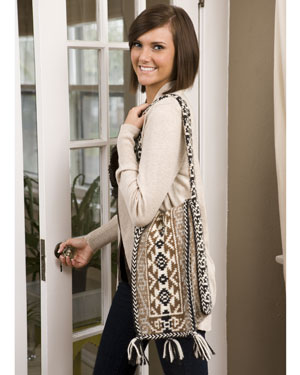
A Facebook friend sent me a link to a Knitpicks knitting kit for an Altiplano Satchel which is described as having been inspired by Peruvian motifs.

Isn’t that gorgeous? My friend sent it to me as she thought that it might inspire a weaving project for me. I love, LOVE how people keep me in mind for these things! She said that she thought that it would look even better as a weaving. Actually, I doubt it. I think the bag as it is is pretty hard to beat!

I was tickled to see the “S” motif along the bottom and the sides which I have actually already woven.

I didn’t find that motif in Peru but rather on a yurt band from Central Asia. In fact it is charted and appears in its own tutorial here on my blog (sorry, but this one is not for beginners).

So, I have a head start on that part of the pattern! Certainly I could replicate the layout of that satchel design in weaving and would probably choose warp-faced double weave to do so. I have had success with translating warp float patterns to double weave before but I like that knitted bag just the way it is and envy knitters who will be able to sit on a train (or at a tribute concert to Frank Zappa as a friend of mine did!) or ANYWHERE with their two sticks and create something so beautiful!

Here is the “S” pattern doubled and mirrored on a belt I wove using the same technique as that used on the yurt band that inspired it.

We talk about the wonderful things that can be created with the backstrap loom with its simple sticks and a few weeks ago I blogged about the lovely Wayuu bags in tapestry crochet, like the one at left, made with one simple stick with a hook on its end.

Now, what about two simple pointed sticks otherwise known as knitting needles? According to the Knitpicks page, the body and strap of the bag are knitted in the round and steeked (steeked?! I know as little about knitter-speak as I do about crochet terminology).

I have some more gorgeous knitted things to show you including some images of stunning traditional outfits from Sweden made in twined knitting that a collector sent me with some background information which is really interesting (I say that as if I know what twined knitting is…I don’t really!). Of course there is a Ravelry group for twined knitters. The traditional outfits are red with gorgeous black motifs. You know I am a sucker for red and black and I am sure that those knits will inspire a weaving project!
I am going to save all that for another post.
So, I will close this page early for this week and use the extra time to dive back into my book. Hopefully, I will be able to make time for my weaving projects this coming week.

Backstrap Weaving – Suddenly Spring

And suddenly it was spring!

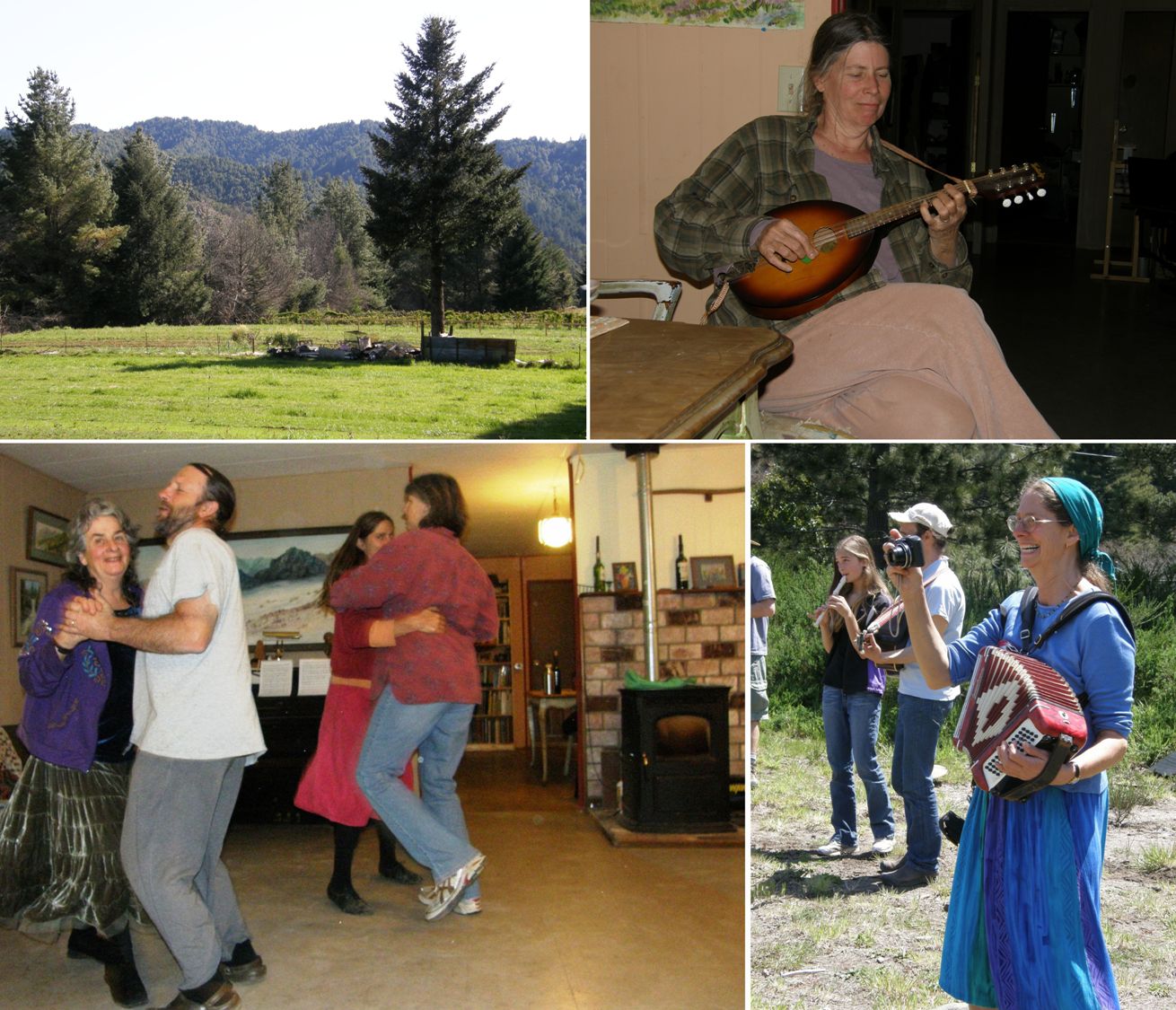
May Day…spring is here and a lovely day was spent outdoors at a couple of festivals around my friend Janet’s home in Humboldt County, California. I was happy to be out with my toes in the grass.

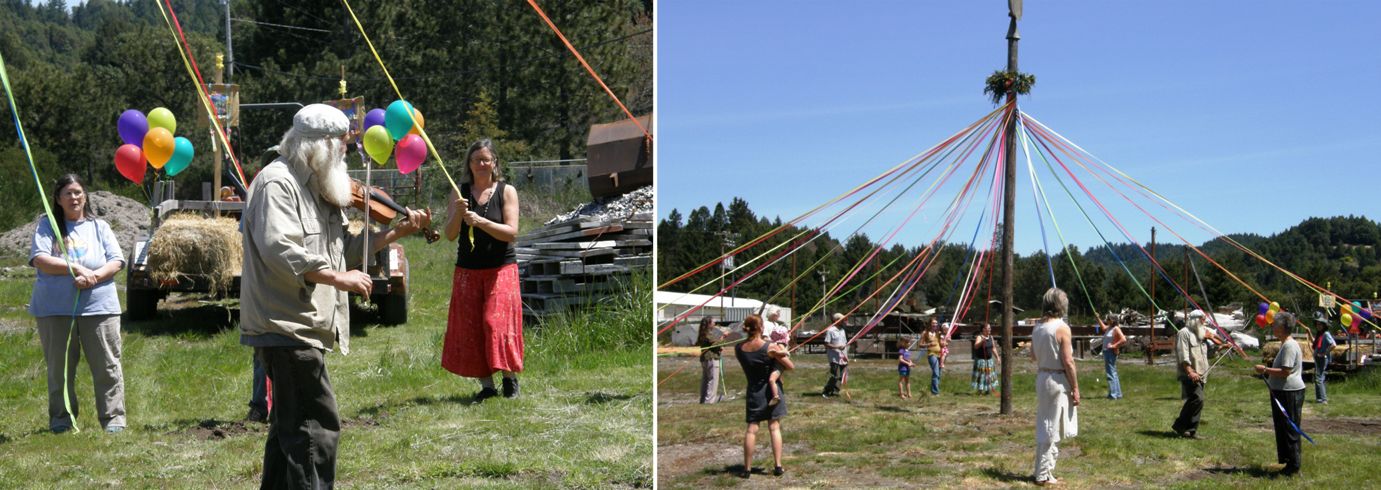
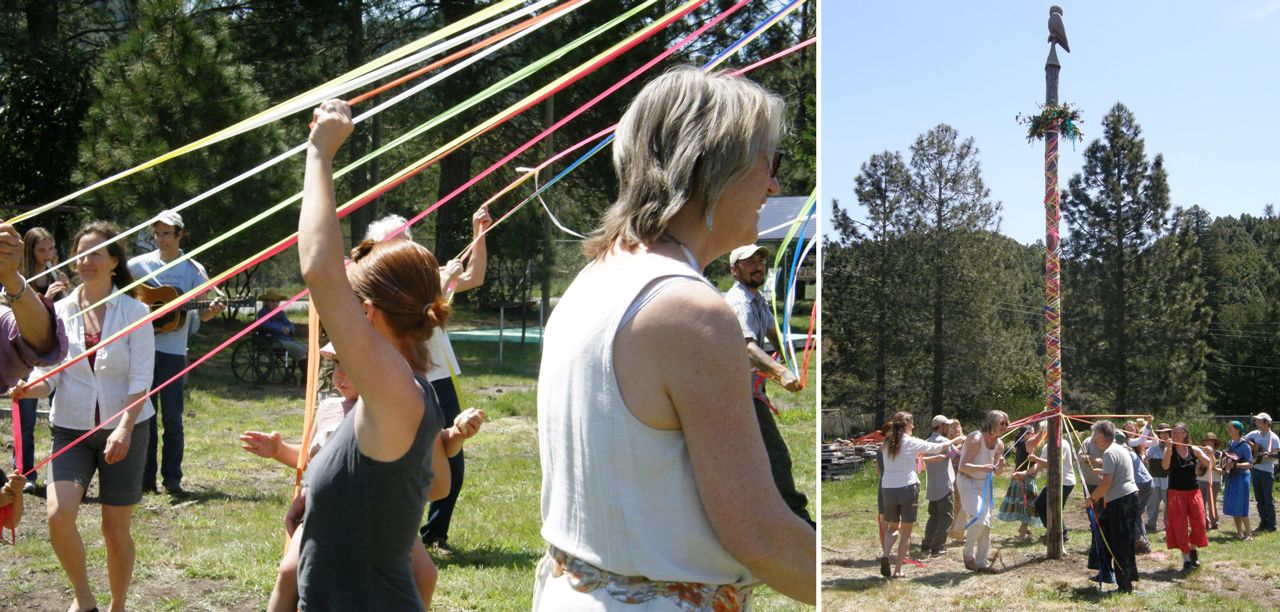
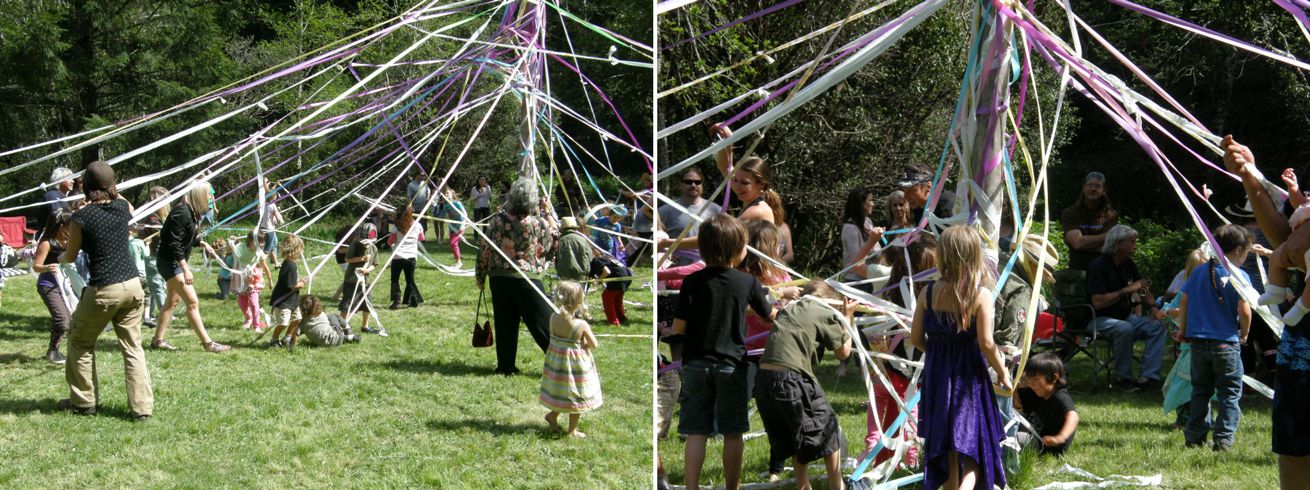
I had never attended a May Day festival before. I got to see the Maypole dance with participants of all ages weaving their colored ribbons as they danced around the pole.

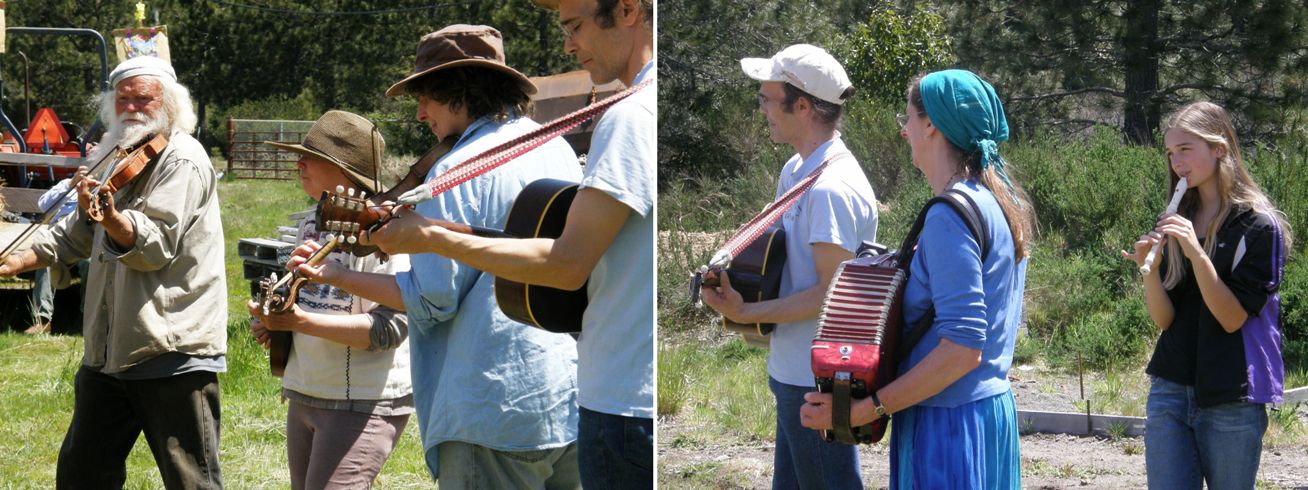
Everyone was “fiddled” into action by Joseph and a group of local musicians made up of Janet’s neighbors with Janet herself on mandolin kept the weavers’ feet moving. Janet’s neighborhood is full of talented musicians and singers.

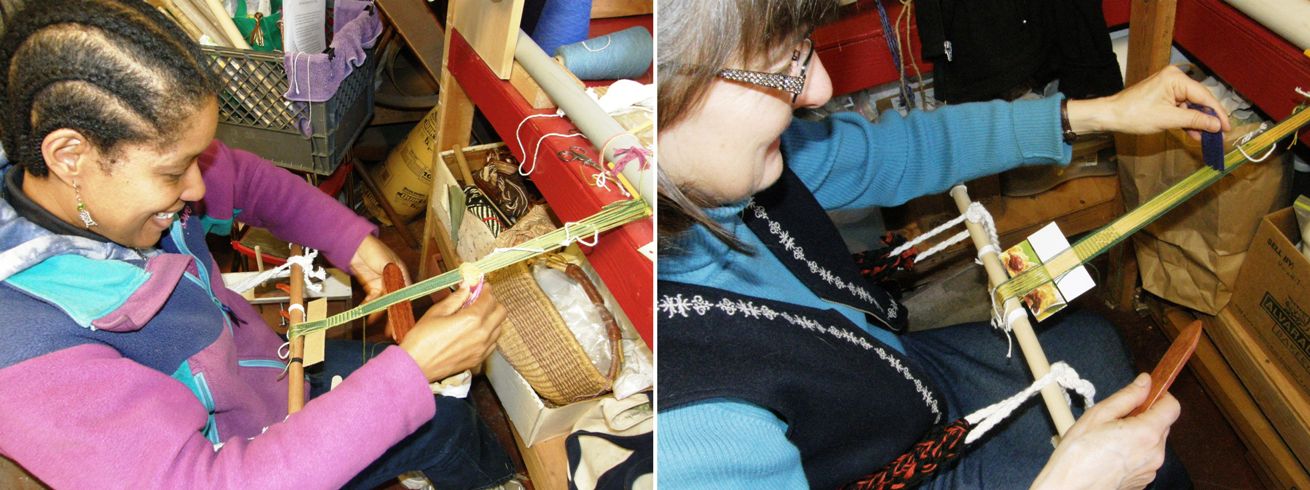
My online backstrap weaving friend Cookie, who had come up from the Bay area to weave with the group at Janet’s Mill, also took part and I was the photographer.

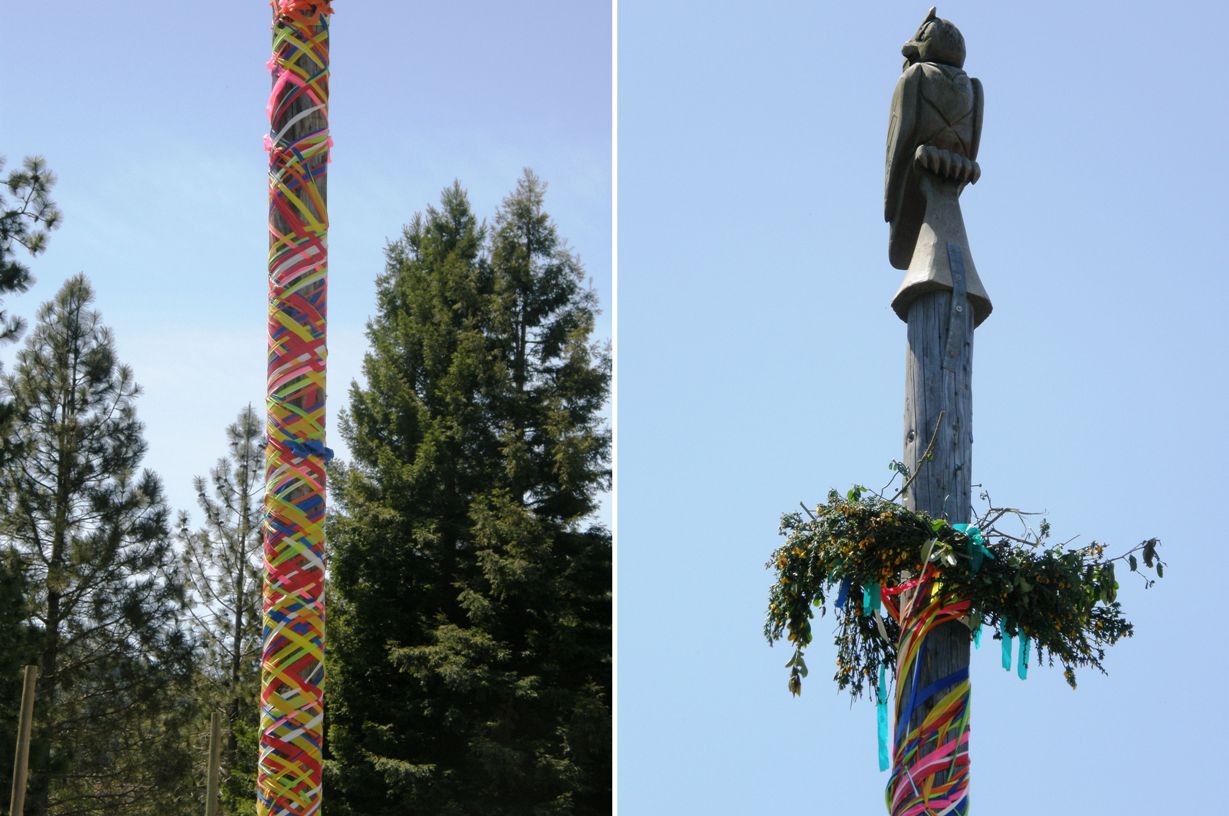
It was a very well organized dance and the weavers made a pretty wrapping for the Maypole.

Here is the “weaving” (or should it be called a braid?) that the dancers created.

I don’t know the origin of this tradition or what it is all supposed to mean and I don’t think anyone else did either…it was just a lot of fun and we couldn’t have asked for a more perfect day.

From there we took a hayride to a pond where we set little boats of lighted candles afloat and sang a song about a “river growing and flowing down to the sea” before enjoying the potluck lunch.

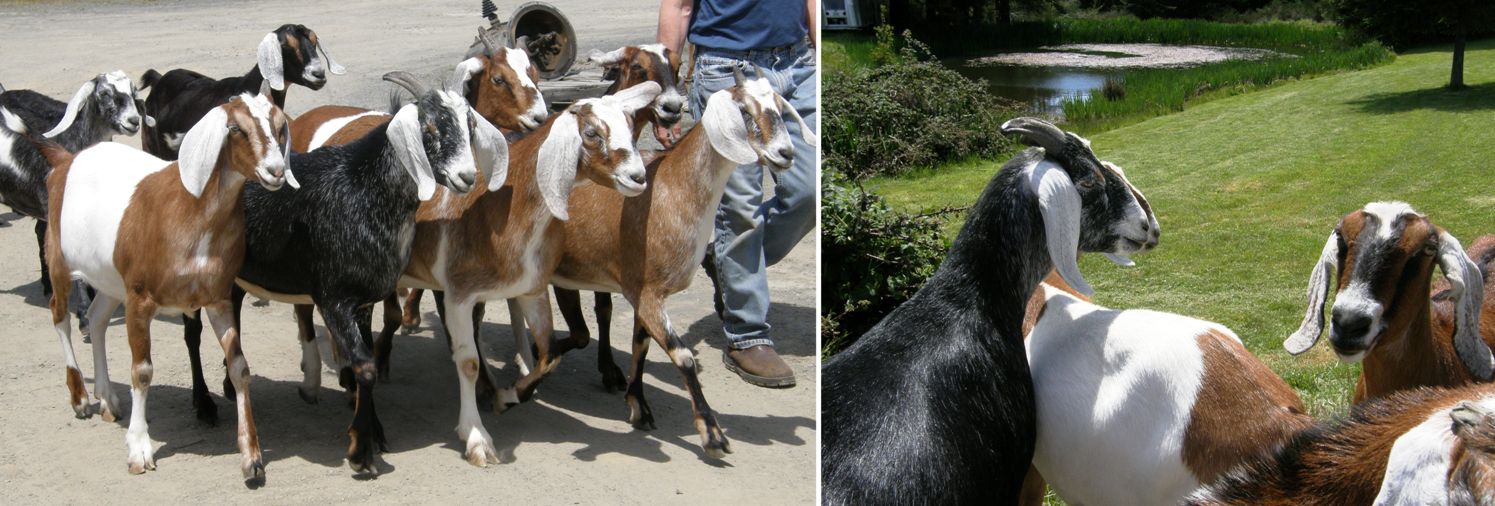
We had some unexpected visitors…these sleek, glossy and very friendly goats were out for an afternoon stroll and enjoyed nibbling the blackberry bushes while we lunched.

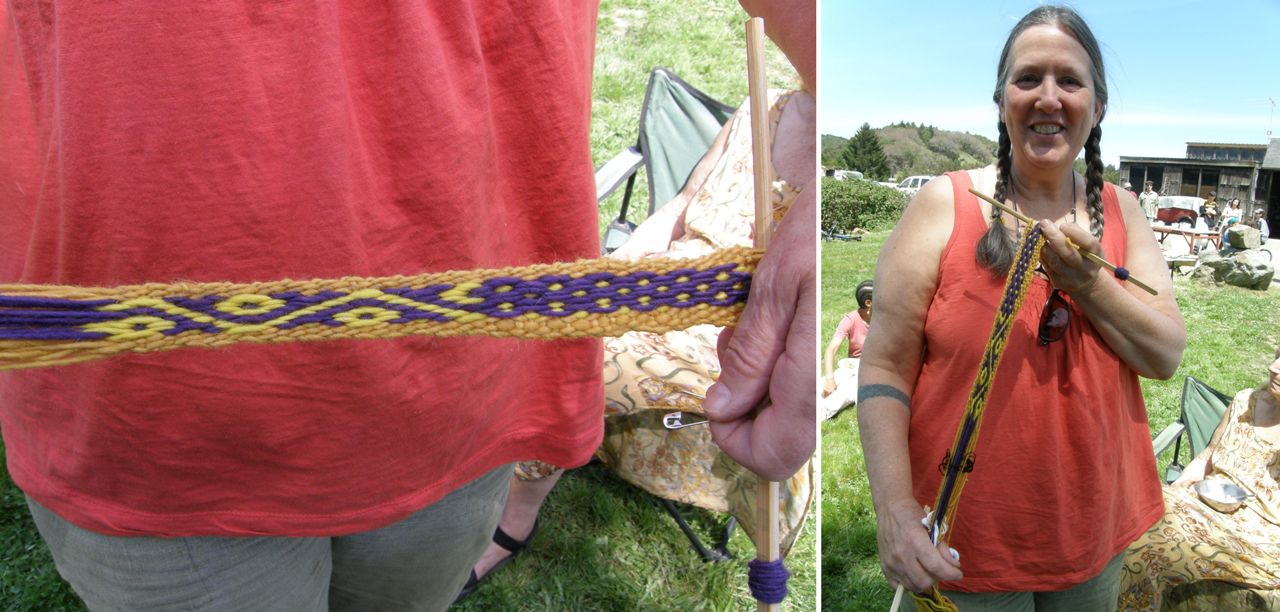
Most of the people from the backstrap weaving group were there and Gail brought the pebble weave band that she had gone straight home to weave after our time together had concluded. Now there’s a keen weaver and backstrap convert!

 Here Janet and I said goodbye to Cookie. She went home with the bands she had made in the weaving group and a lot of roving which she purchased from Janet to spin and weave into a backstrap.

From there we headed to another May Day festival with yet another Maypole dance. This one was something else all together! The musical instruments were somewhat different…

That’s Dennis at the bass. He was in our backstrap weaving group.
And the Maypole dancers/weavers, who were mostly little guys, started out chaotically and finished in a giggling heap with many of the weavers finding themselves bound to the Maypole and loving it!

Marimbas, flutes, upright bass, violins, guitars and mandolins…kids and dogs frolicking, good food and lots of sunshine.

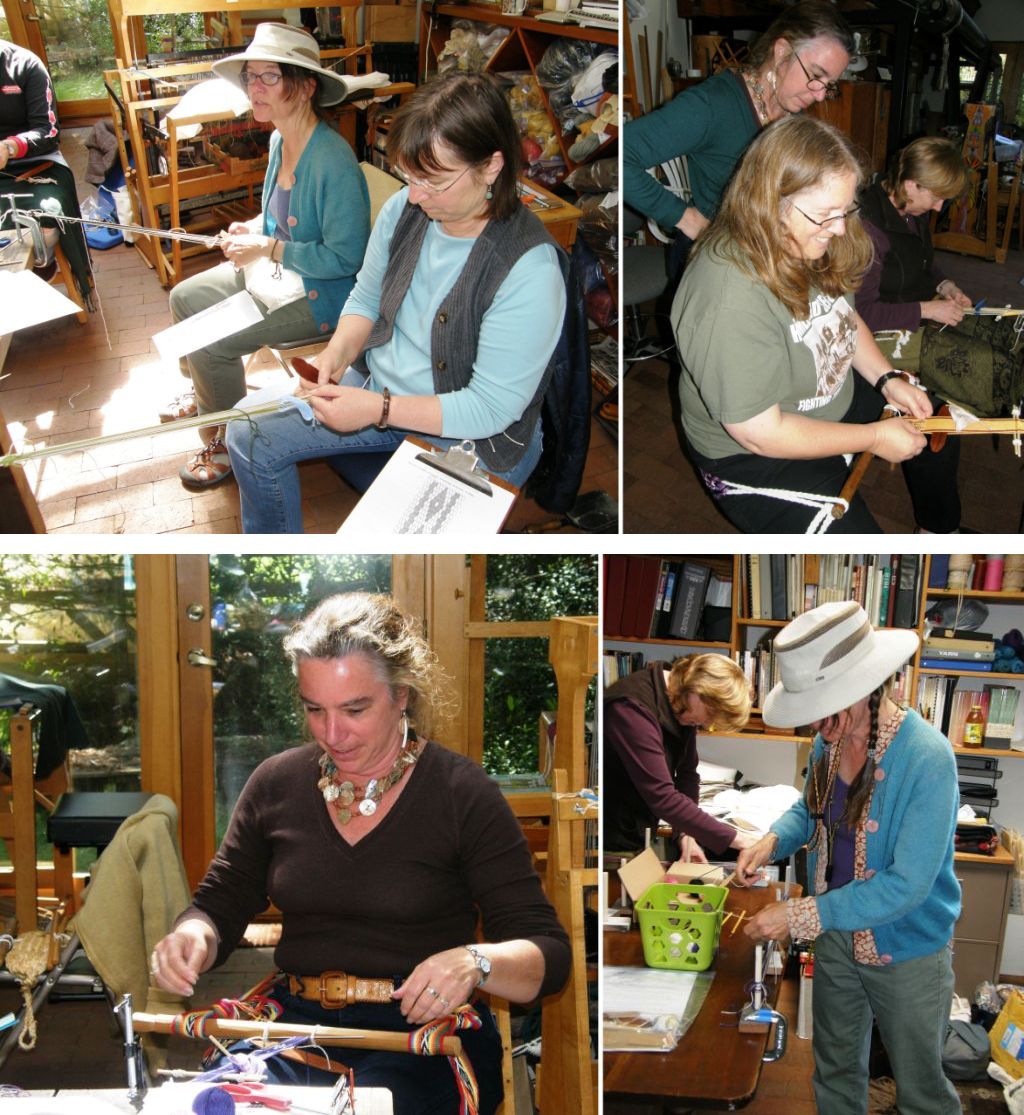
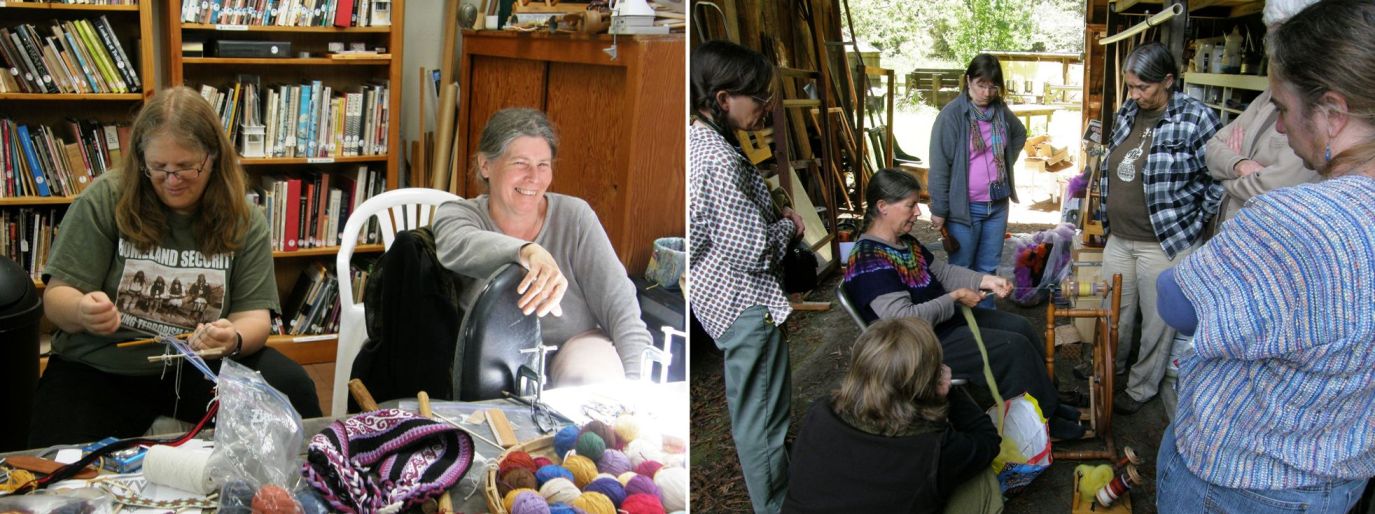
It was a nice day and a nice end to the three weeks that Janet and I had spent together backstrap weaving with folks from southern to northern California.

The following day we drove up to Grant’s Pass in Oregon and parted ways. I took the bus to Portland and am staying just over the state line, over the Columbia River, in Washington at the home of Betty Davenport.

The weaving group at Janet’s Mill was fun. We had people come to weave for three days and a few day trippers came by too.

All of them were Janet’s friends, farmhands or neighbors. I had already woven with a couple of  them on my visit last year….neighbor Yani and Karen who just happens to be Bolivian and who lives at the Redwood Monastery.

It was fun to see those two again. Janet’s Mill was just the best place to weave in. We anchored the warps to shelves or to her floor loom.

Cookie and Janice are working here on warp float patterns.

Trying out four-stake warping.

Gail shows off her warp float band to Janet and that’s Tracy’s work on the right.

Janet warped a band in her own gorgeous handspun and wove in patterns using silk supplementary weft. It was beautiful!

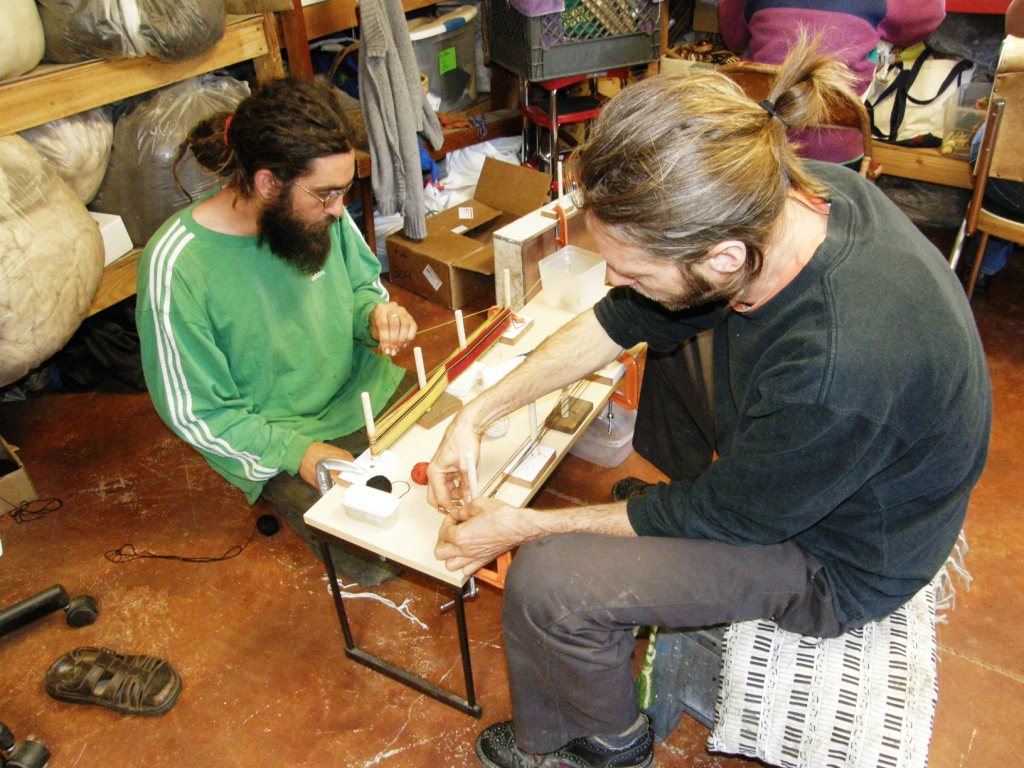
Some unusual color combinations and warp arrangements were used. There are Dennis and Bev weaving together hooked up to Janet’s floor loom.

Getting the hang of those string heddles…..

Cookie was mad keen to make herself a new backstrap with her own handspun so she bought roving from Janet and started spinning straight away.

That spindle accompanied her everywhere and she had already spun and plied a good lot by the time she had to leave.

We took a stroll on the farm to pick asparagus for dinner. What a wonderful thing to be able to pick and eat food like that. Asparagus is great raw too!

There’s Cookie with spindle and asparagus in hand.

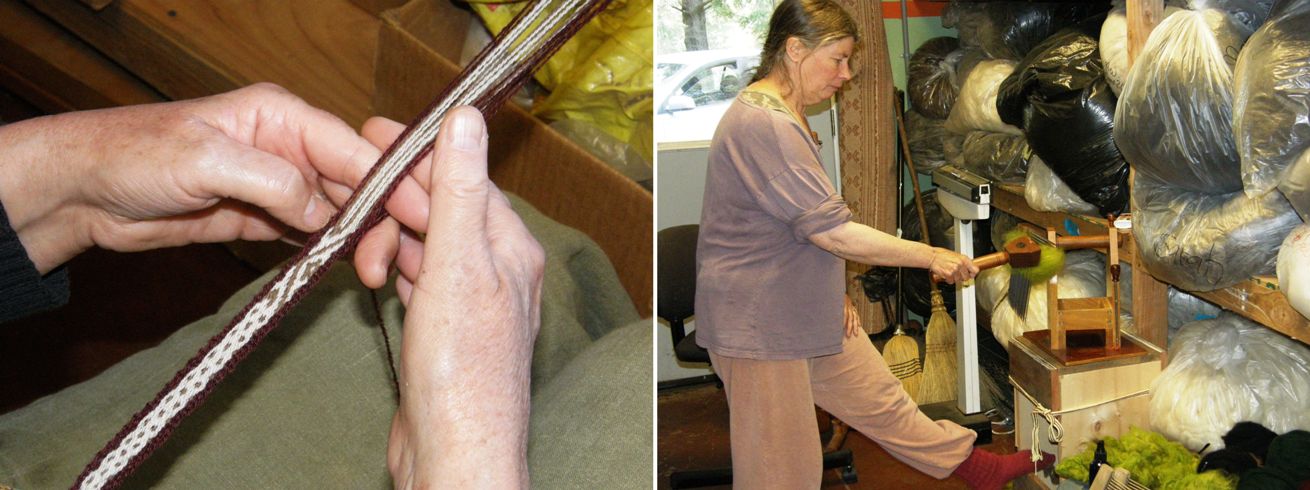
On the last day we got to use Janet’s handspun for pebble weave and we got to see how she combs and prepares for worsted spinning.

Her supplementary weft patterned piece turned out so well and she is spinning right now in preparation for Sara Lamb’s workshop on knotted pile at CNCH. Look at those gorgeous colors!

And with the final day came spring, the day before May Day. We got to stretch out on the grass for lunch and take a little extra time to admire some things that people had brought along to show.

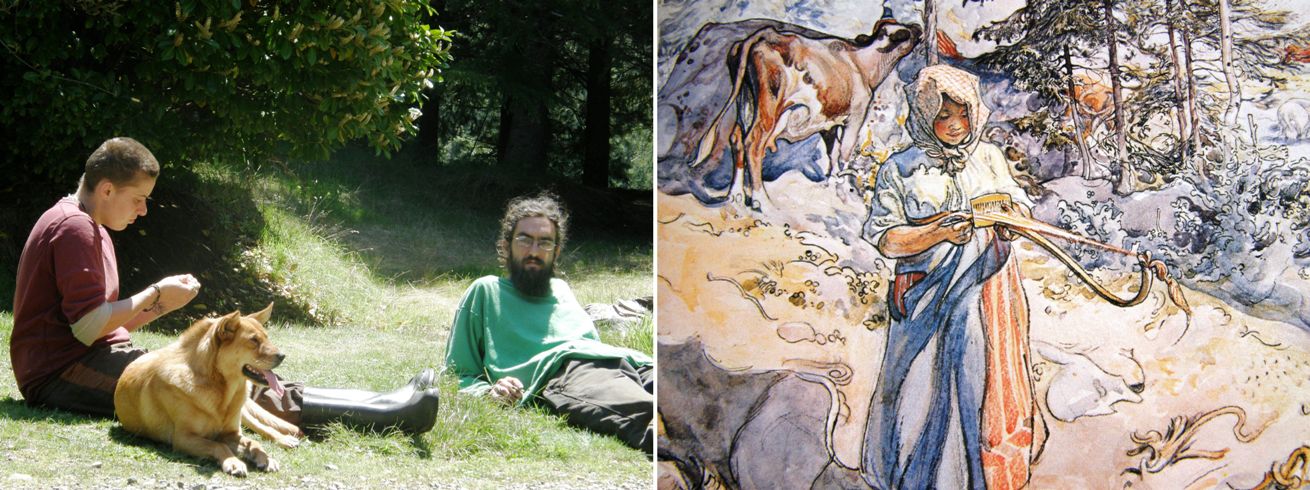
Tracy brought a book by Swedish artist Carl Larsson which included this great painting of a young weaver and her unusual loom. Having since Googled Carl Larsson, I see that he often included weavers in his artwork.

Janice brought a bag that she had made in needlepoint using an Anazasi design and Tracy showed a wonderful piece of tartan that she had made on her floor loom. Tracy is often commissioned to reproduce historical pieces but this is a new tartan that she has created which will be registered.

The time comes to move on and say goodbye to the farm, the fiber, the fun people, the music and the Irish dancing (yes!, I got to join in on the Tuesday night Irish dancing!).

Now I am up in Washington State…not my first visit here.

I spent three weeks in Seattle in 1992 on my way to Banff and Jasper National Parks. I got to Seattle on the Memorial Day weekend, went to the Folk Life Festival which was amazing and ended up staying! I never made it to the parks and got, what I later learned to be, three very rare weeks of dry weather.

As I speak it is raining hard outside and the wood is crackling in the fireplace. The spring sun hasn’t quite made it up here yet but I am enjoying Betty’s beautiful home on her tree farm in the woods.

And guess who is back in the backstrap loom? I am staying in Betty’s gorgeous studio flooded with natural light with a wall of windows looking over her blueberry field. We have Bolivian music playing and a woven treasure on every wall space. You can imagine I have been having a nice time and I will share all that with you next week. But let me introduce my new pet-withdrawal buddy – “Frank Sinatra” is his official shelter name but he is better known as “Trouble”.

Yesterday I gave a slide show for the Portland Handweavers Guild and got to meet two online backstrap weaving buddies from the Ravelry group who came along as guests…Bobbie and Jennifer with her husband Doug. We have a really nice warm community there in the Bcakstrap Weaving Group and both Jennifer and Bobbie have had a big hand in creating and maintaining that welcoming fun atmosphere. It was fun seeing some of their backstrap woven pieces in person. That’s Jennifer there in the middle.

Now Sally has come to stay at Betty’s place and we are  heading off to Linda Hendrickson’s studio tomorrow to backstrap weave. Sally brought along her pieces of Raven’s Tail and Chilkat weaving…yes! weft twining! How cool is that? But this is just a teaser as you will have to wait until next week for details. I also got to visit a wonderful Native American Art museum called “End of the Trail” on the way up to Oregon (thank you Janet and Larry!) and got to see my first Chilkat blanket up close and some amazing basketry, hats and other craft pieces…all being saved for next week, sorry!

Let me end by showing you what the Ravelry guys and online friends have been up to…

Amber, aka lavitaaj, is weaving the “rolling river’ design in double weave. I learned it in a complementary warp-float weave but it works beautifully in double weave. This is charted in Adele Cahlander’s book on Bolivian weaving. Helena in Brazil has woven a couple of bands using patterns she has seen on my blog…one is a pebble pattern that I put together for key fobs and the other is based on a Tarahumara design.

Dyggvi who is a new participator in the Ravelry group is weaving a balanced weave piece on her backstrap loom using tshirt strips as weft. Yonat sent me a picture of her progress on the sample bands we wove down in Santa Cruz.

Marsha completed a backstrap on her backstrap loom and has been teaching her friend Dana to weave on a backstrap loom…spreading the obsession! That’s Dana’s learning piece on the right.

Reetta in Finland has been weaving traditional Chinchero designs on narrow bands just as the young girls in the Cusco region of Peru learn to do.

And Eladio in Mexico used my book to get himself started in Andean pebble weave and has now gone on to chart and weave his own designs on wide warps! What a stunning pattern.

How amazing is that! Red and black are always so spectacular together.

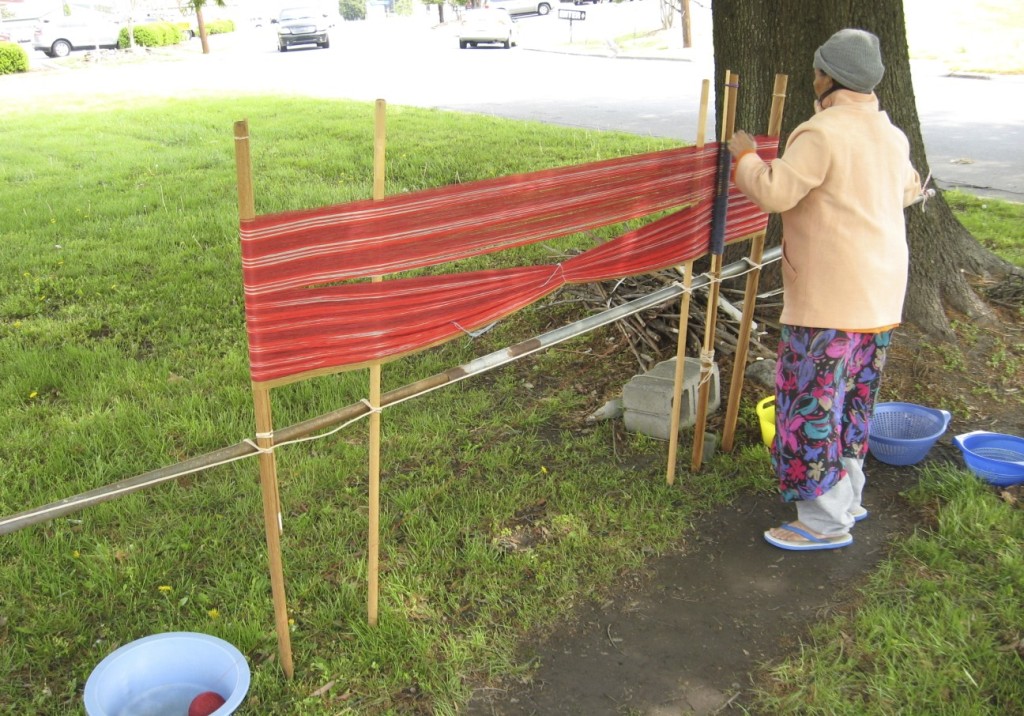
Betsy Renfrew sent me a picture of my Montagnard weaving teacher Ngach warping outside her home in North Carolina. Betsy arranged for the weavers to do a demonstration on the May Day weekend and I am looking forward to hearing how that went.

And finally, I ran across a nice video put together by Synergo Arts showing the ergonomic bench that they are having built in Guatemala for backstrap weavers to enable then to work at their backstrap looms more comfortably. Until now I had only seen pictures of this bench. It’s great to see it in action.

I am saving a lot of great stuff for next week’s blog post. See you then 🙂

Backstrap Weaving – From Santa Cruz to Santa Cruz

Guess where…

I seem to be really lucky when I go to San Francisco and get mist-free morning views of the bridge.

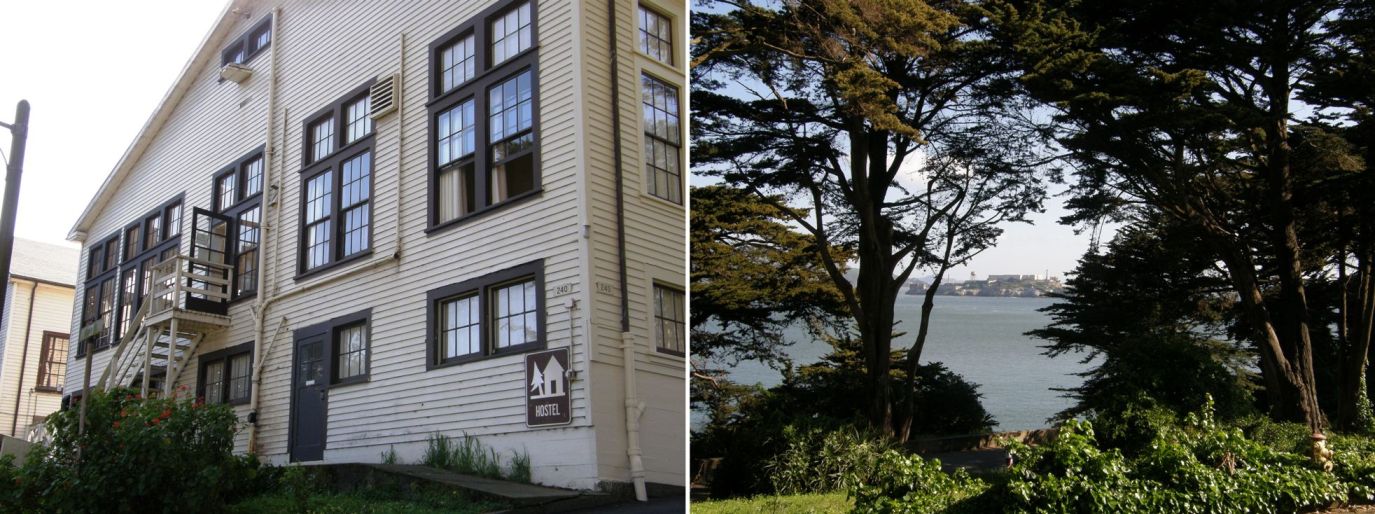
 I spent a night here at the Fort Mason Youth Hostel…what a great place, quite a change from the downtown hostel where I have stayed before. Actually, I stayed at this same hostel way back in 1992 on the first day of a 7-month backpacking and hiking tour of the US. Phew! That takes me back!

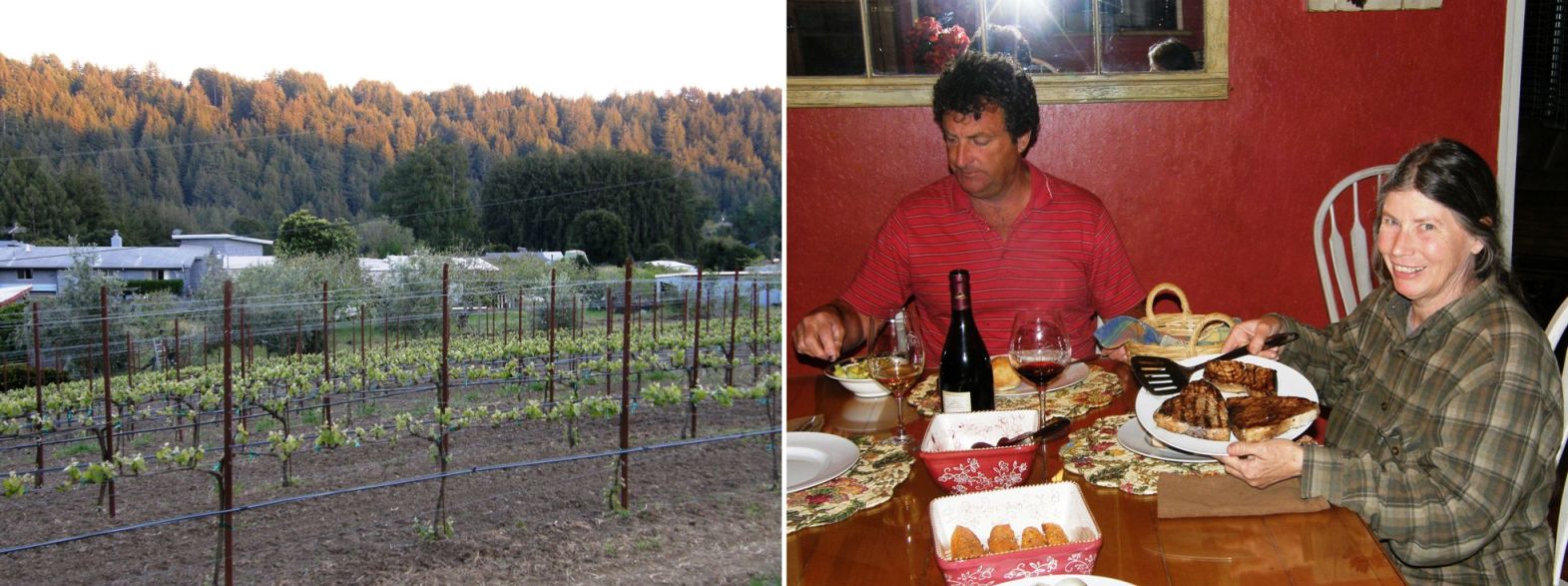
My friend Janet picked me up and we headed down south to Santa Cruz (yep, from Santa Cruz Bolivia to Santa Cruz CA) to stay with Janet’s cousin on the winery that she and her husband own. Lucky us, except that neither Janet nor I are wine drinkers! But we got to enjoy the beautiful landscape.The winery is perched on a hill surrounded by Redwood forest and has sweeping views down to the ocean and across the bay to Monterey which are especially nice when viewed from the hot tub 🙂

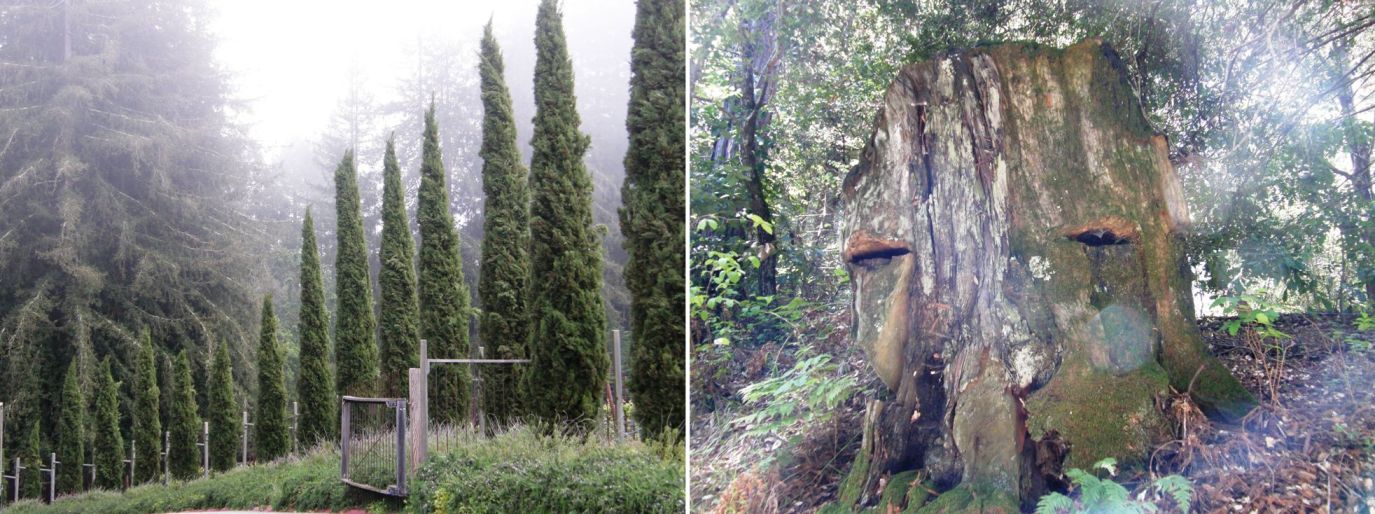
Eerie morning mists with weird faces emerging from the Redwoods.

The mists would rise to reveal Suzie’s pretty flower-laden patio which had a lovely Mediterranean feel. (or at least what I would imagine it to be. It is one of my dreams to be on the Mediterranean, perhaps Malta or some place like that).

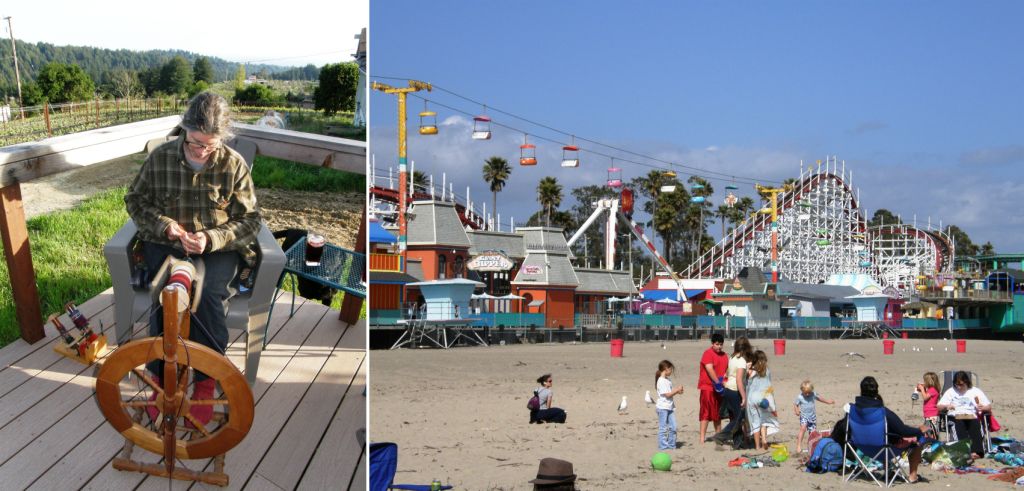
Sunny afternoons were spent spinning and lazing on the porch or hanging out  at the beach and Santa Cruz Boardwalk. The Boardwalk has a fantastic old carousel.

The sunsets brought a gentle glow and we sure enjoyed the swordfish steaks.

Forgive me but I just had to include this next picture. I am a cat person and usually don’t care at all for the small yappy dogs but these two guys were just adorable!

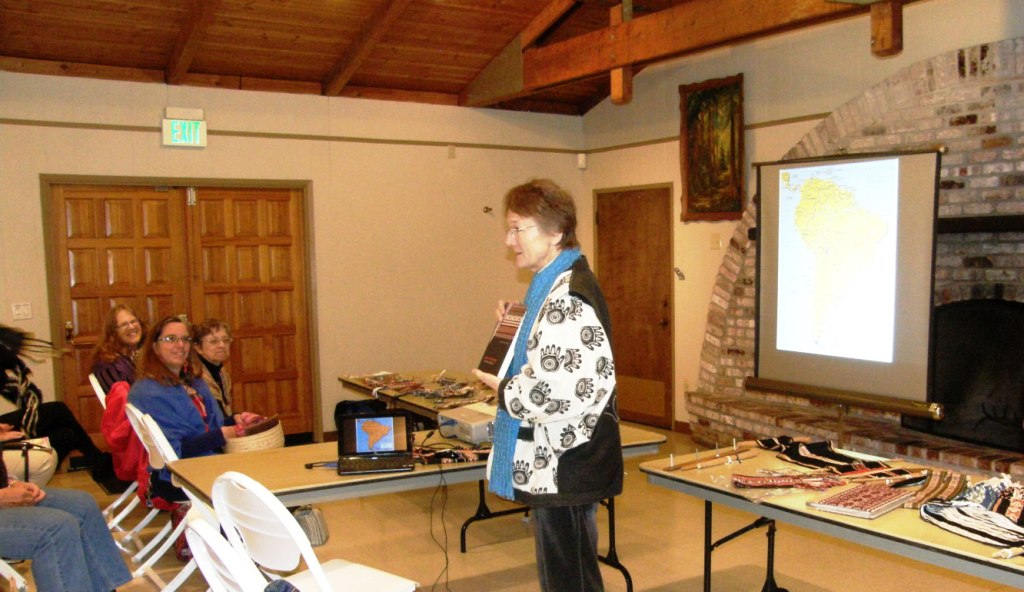
Then it was on to a visit with the Santa Cruz Handweavers Guild for a show-and-tell by members and a slide show by me.

Here, guild president Gudrun is showing her husband’s newly published book called “Quantum Computing” for which he chose to use images of her beautiful card-woven bands on the cover.

My slide presentation took people on a wee tour of the Bolivian high and lowlands, around the continent and then deep into the textiles, and my experiences learning to weave them. At the same time I got the chance to get reacquainted with some people I had met at CNCH last year as well as meet a lot of new folks.

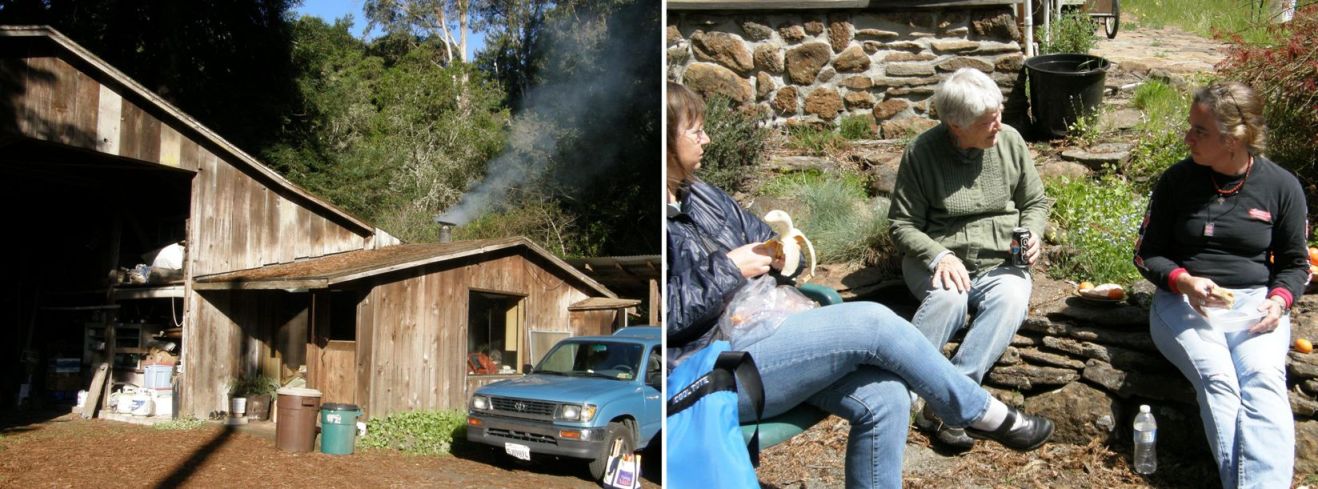
The following three days were spent weaving at Martha’s beautiful cabin in the woods. That little cabin with the smoke curling out of the chimney warmly greeted us each morning. Martha would join us and entertain us with her tales in her sunny garden for our lunch breaks.

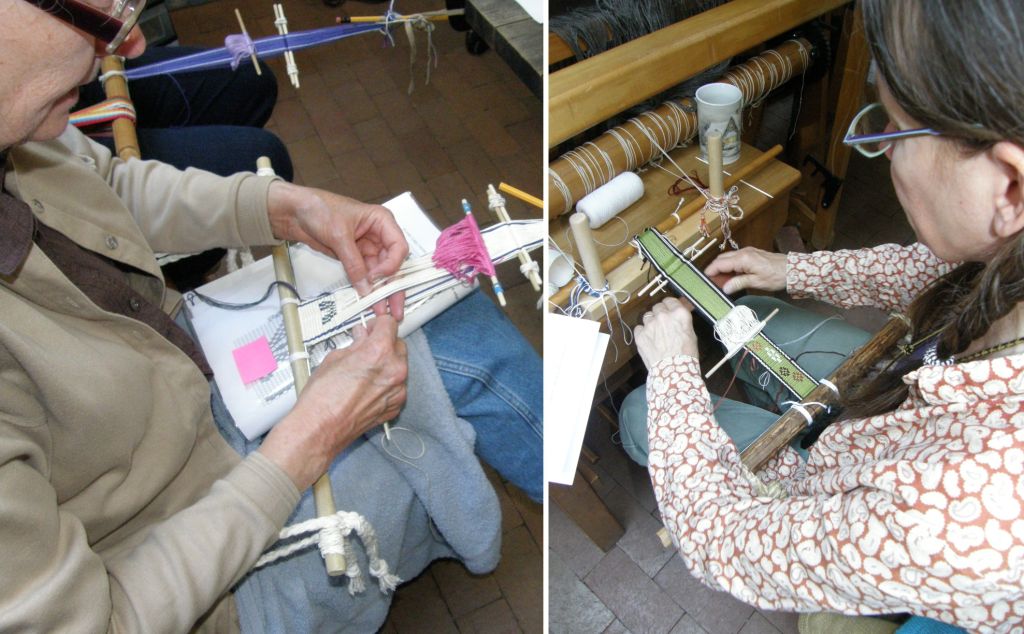
And here’s the gang of backstrap weavers and then with Martha popping in to make a matching bookend with me.

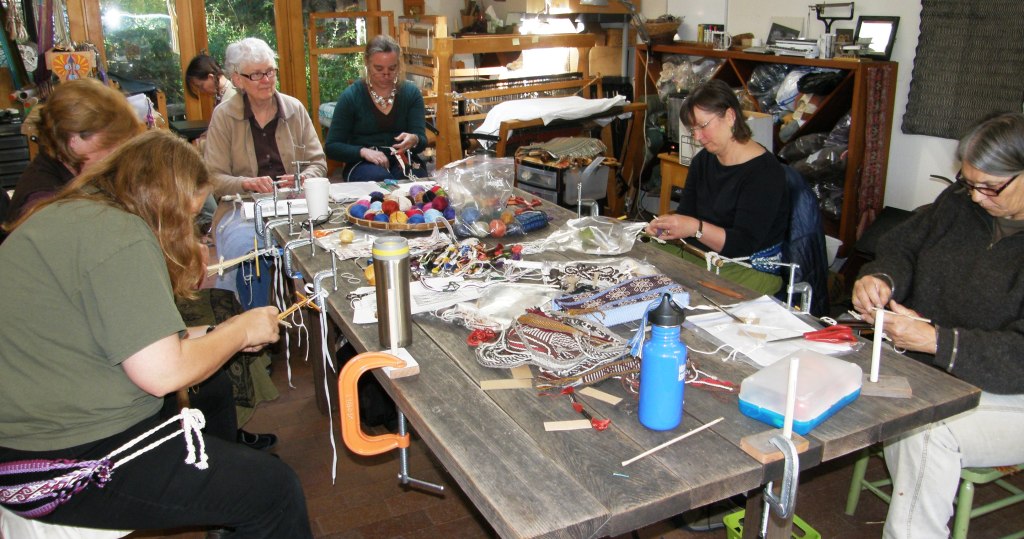
And yes, we did some weaving too. There is everyone “banding together”.

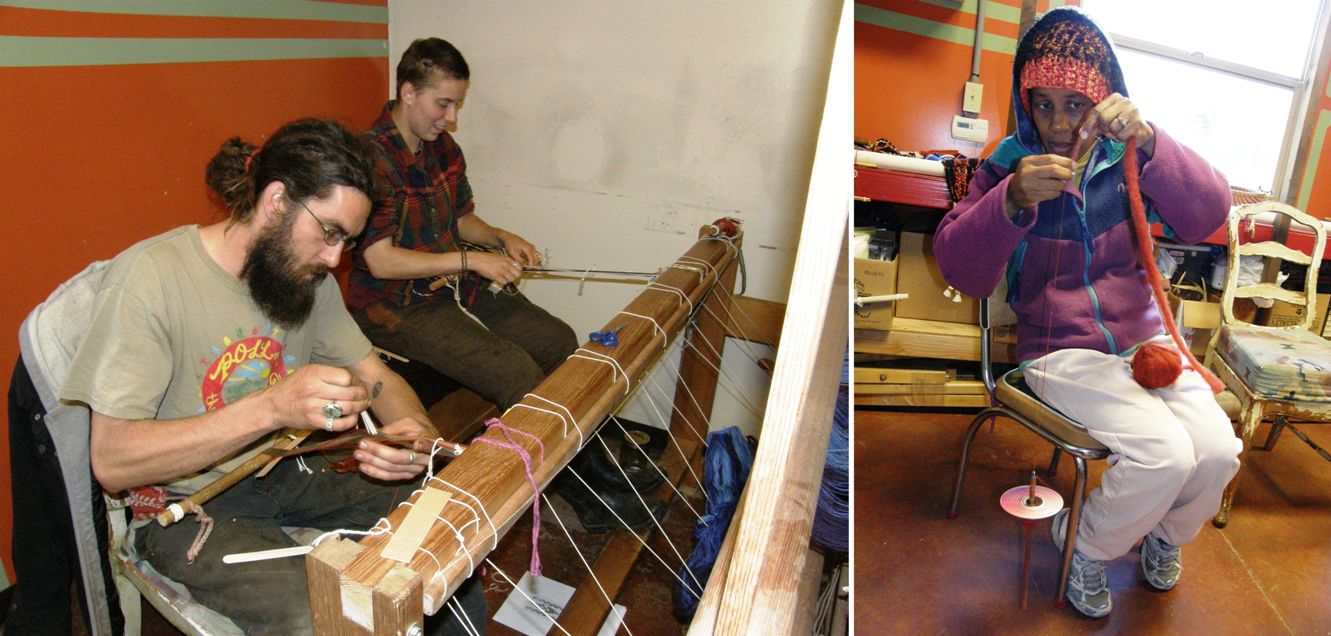
We wove “barefoot“-style and later with loom bars. Annie was happy to get to use a loom that she had bought in Guatemala as well as one of her own woven sashes as a backstrap.  Yonat, above right, dove straight in and warped up for the widest motif. Ingrid, with hat, is practicing four-stake warping. That’s Ingrid Crickmore whom I met at CNCH last year. Ingrid is into all things braided and was using her pieces as loom ties during the workshop. The best news is that she has a blog with tutorials on loop braiding and will soon be adding video.

There’s Yonat on the left and Janet. We got to work with Janet’s handspun on day three when she also gave a combing and spinning demo with special tips for spinning for backstrap weaving and everyone loved her yarn.

Smiles from Dorothy and Annie, some “aha”s and a brow furrowed with concentration.

What was interesting and educational for me was the way people chose their colors and placed their designs…no two were alike. I get to learn too in these situations and I have some new color combinations circling in my mind. A friend had asked me to make him a guitar strap with southwest colors and, thanks to Janet, I now have the perfect combo.

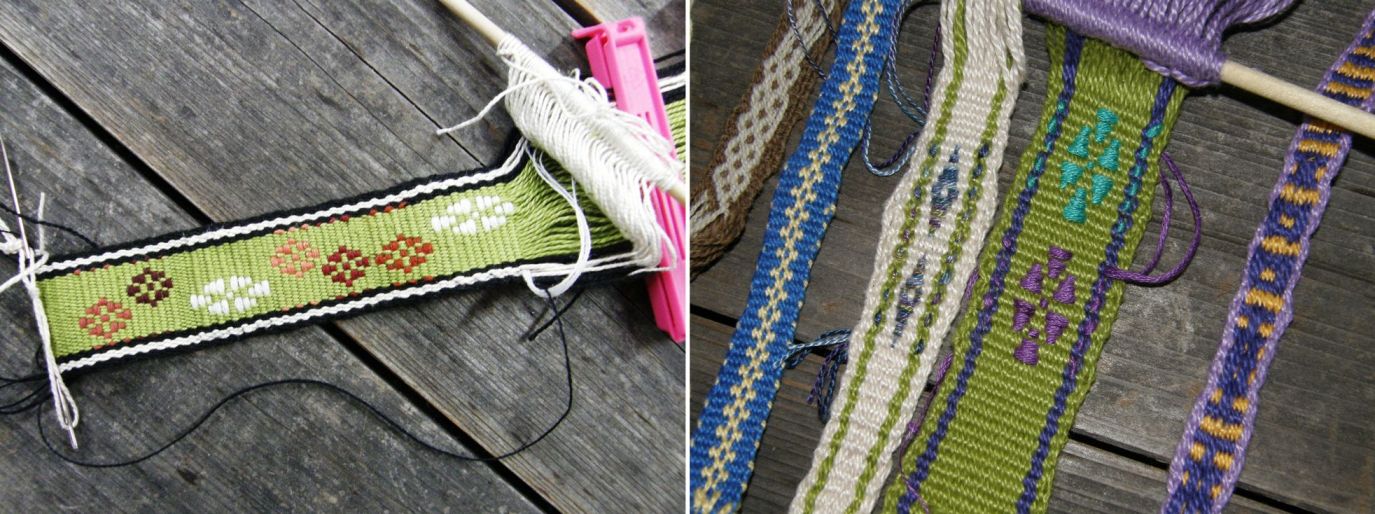
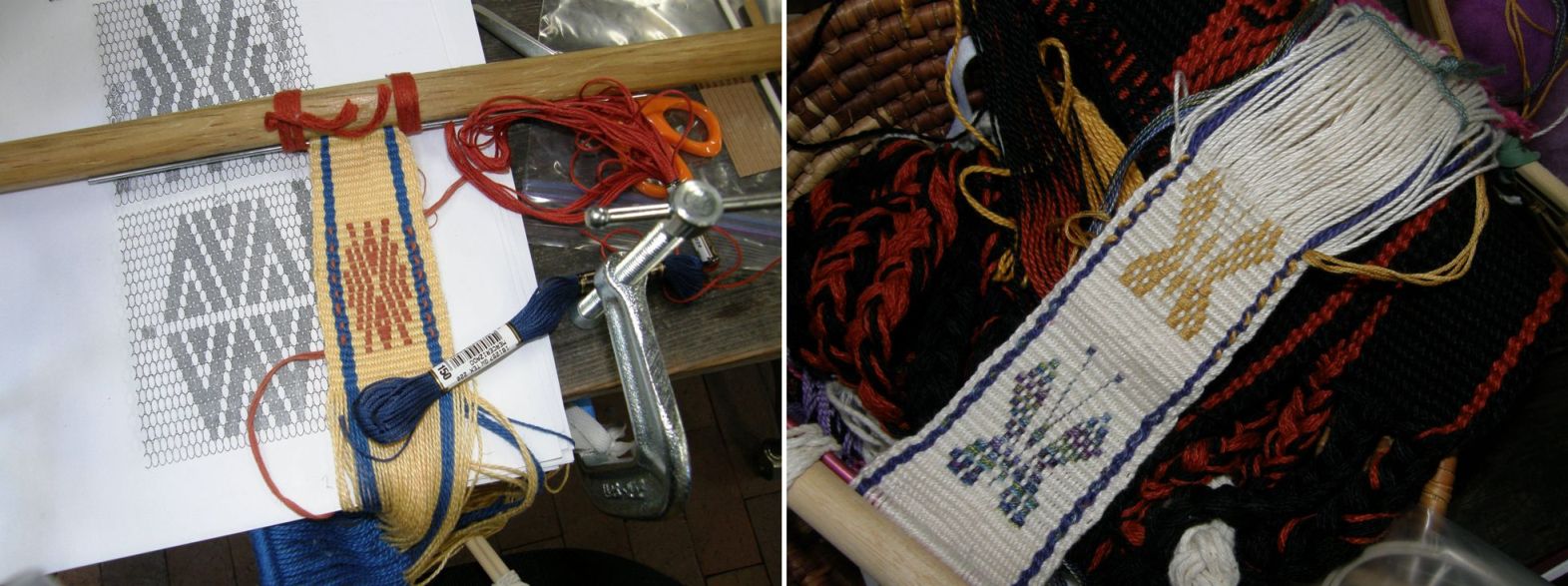
Plain weave bands patterned with warp stripes and supplementary wefts, simple warp floats in cotton and pebble weave in handspun wool.

Barbara and Ingrid are at work above showing one of the many cool things about backstrap weaving…you can make short warps quickly and easily for the tiniest projects like a one-of-a-kind key fob or book mark.

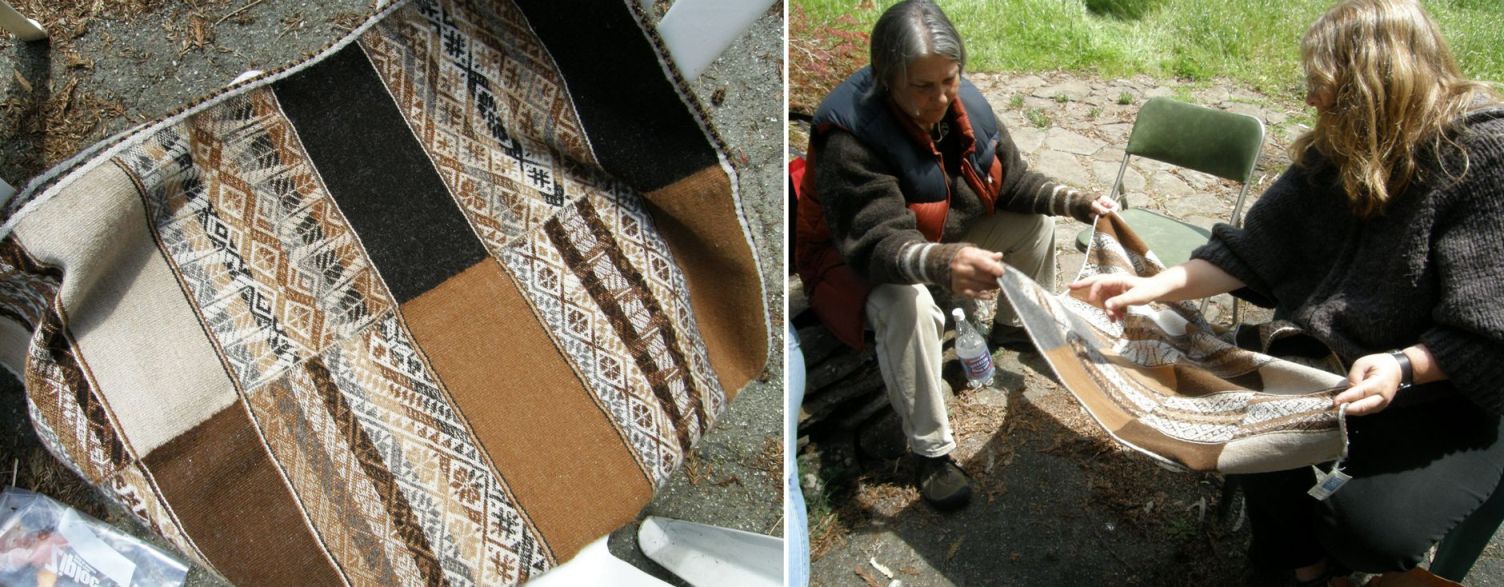
During lunch break there was much to see as Martha would bring out textiles from her South American collection. Here is THE textile which I blogged about last week…

Read more about it here.

But, what I didn’t know was that she was saving the best for the last day….

This is another one of those spectacular discontinuous warp pieces from Pitumarca, Peru. From what I have seen, Pitumarca specializes in supplementary warp patterning on these discontinuous warp, or scaffolded, pieces but this one has been done with three colors in the pattern and it is doubled faced. Wow.

There are four panels, red, blue, green and yellow, each with its triple color supplementary warp pattern.

I should have just saved this for a blog post of its own entitled “Even more Speechless”. It’s hard to take your eyes off it, right?

I told you last week that Martha gave me two tubs full of textiles to take back to the winery and peruse. I will show you bits from those tubs in future blog posts but here is just a taste…

I really like the bag strap with the multiple tanka choros and those braids….!!

But best of all we got to see what Martha herself has been working on…

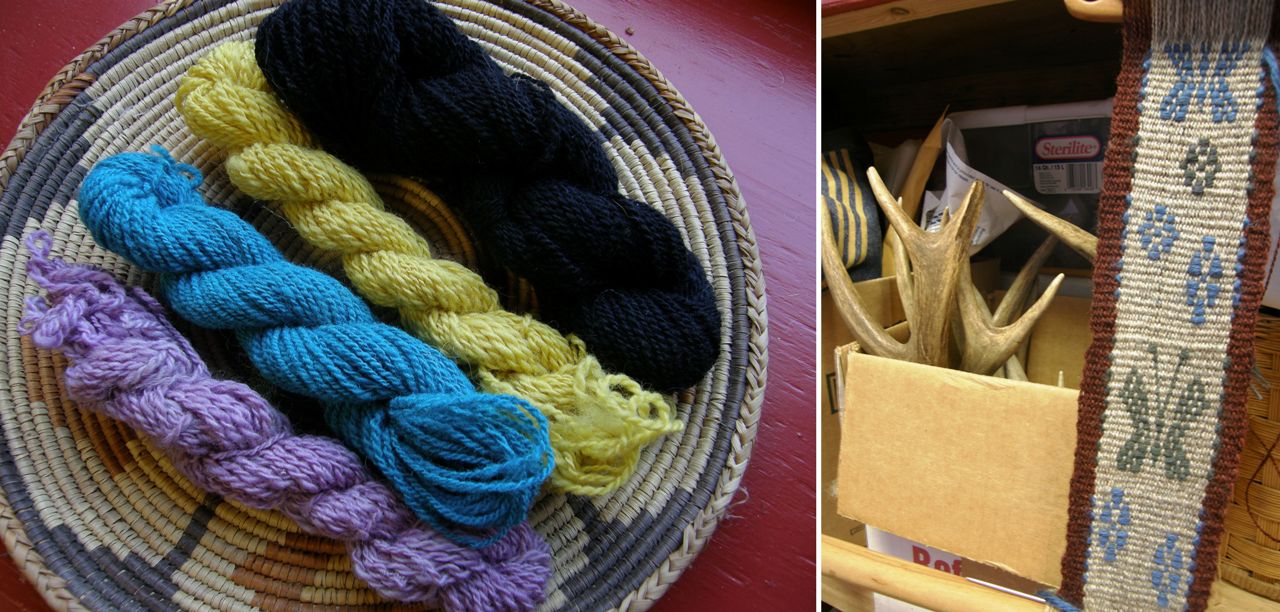
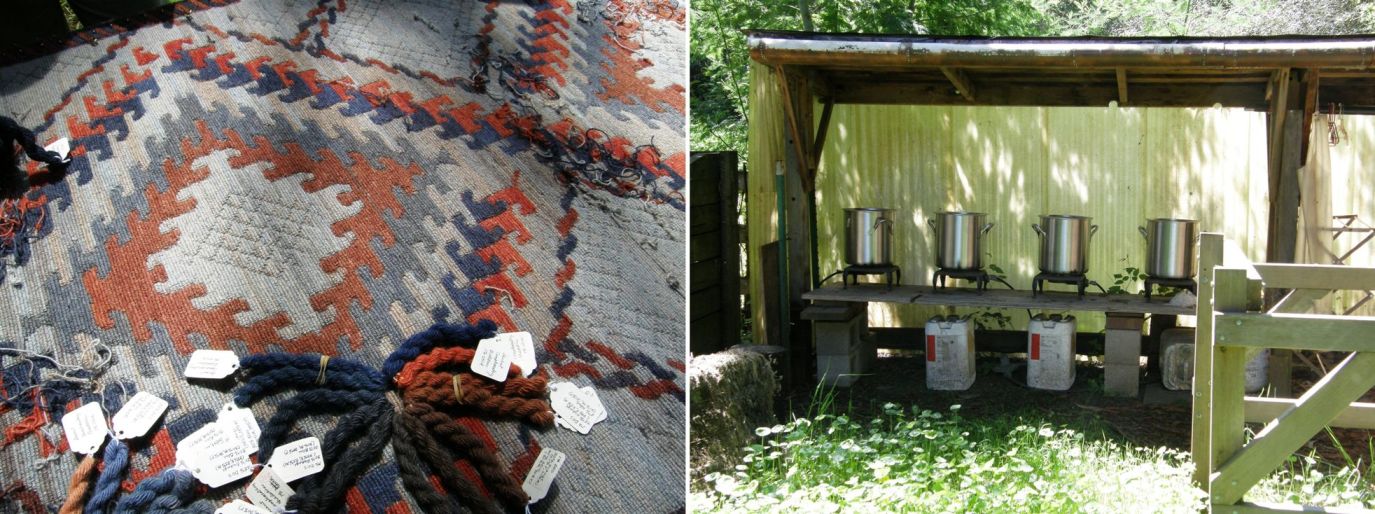
Firstly, the colors! I have been admiring the yurt bands of Central Asia and wishing that I could somehow use those dusty sun-bleached tones of red and blue that evolve after years of having been stretched around the yurt and exposed to the elements. Well, Martha has just gone ahead and dyed her own. The colors are just gorgeous!

With a lot of patience, dedication and know-how she has come up with just the right hues. I was SO envious! The rug above is her latest work. It is a combination of weft twining and wrapping. One of the twined strands wraps around the other to give a raised surface on a flat ground of twining. I think I understood how it works. That’s on the list to play with when I get home.

As for the colors…I’ll keep dreaming. Maybe I will get into that kind of precision dyeing one day.

One of the highlights of this trip was spending more time with Annie MacHale. You may know her as ASpinnerweaver and she is on my blogroll but I think of her as the Queen of Sashes. She is one creative lady with an irresistible bubbly laugh.

Janet and I got to see her sash collection and hear the stories that go with them, rummage through her yarn stash and go from one inkle loom to the next in her living room/studio checking out her works-in-progress…and the books!!

One thing I have been wanting to promote while on this US tour is the lesser known weavings of the lowland areas of South America. We have all become so familiar with the textiles of one  particular region of highland Peru through the hard work of Nilda Callañaupa and the CTTC. I have had the fortune to study with weavers in lowland areas too most notably in Santa Cruz where I live and in coastal Ecuador. The weaving may not be as technically sophisticated as the work being done in the Cusco area but is every bit as note worthy and often sadly neglected.

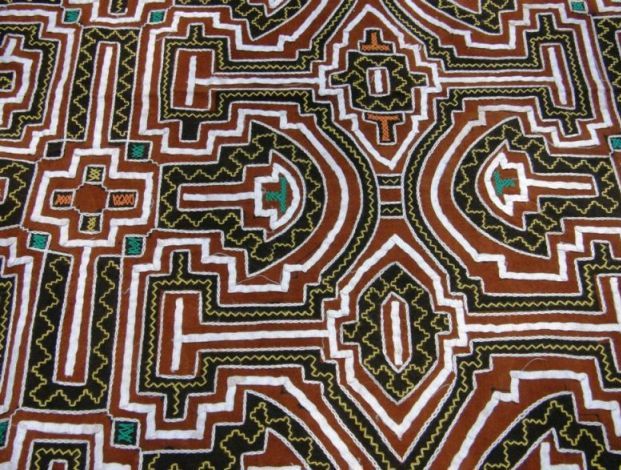
It seems that the work of the Shipibo people is calling to me from various sources. Just before I left home I found an image of a textile which the photographer had bought in Ecuador but which she believes was made by the Shipibo people of the lowland jungle areas of Peru and this is something I would like to investigate. It is woven with a technique that I have only seen used in South American textiles in images in books of textiles of northern Argentina that are no longer produced.

At the weaving get-together Yonat brought, amongst other things, Shipibo textiles to show that she has in her own personal collection…beautiful embroidered and appliqued pieces (above) with very distinctive designs. I only have some small painted pieces of Shipibo cloth at home. This is what Yonat brought…

And then Martha showed me this…

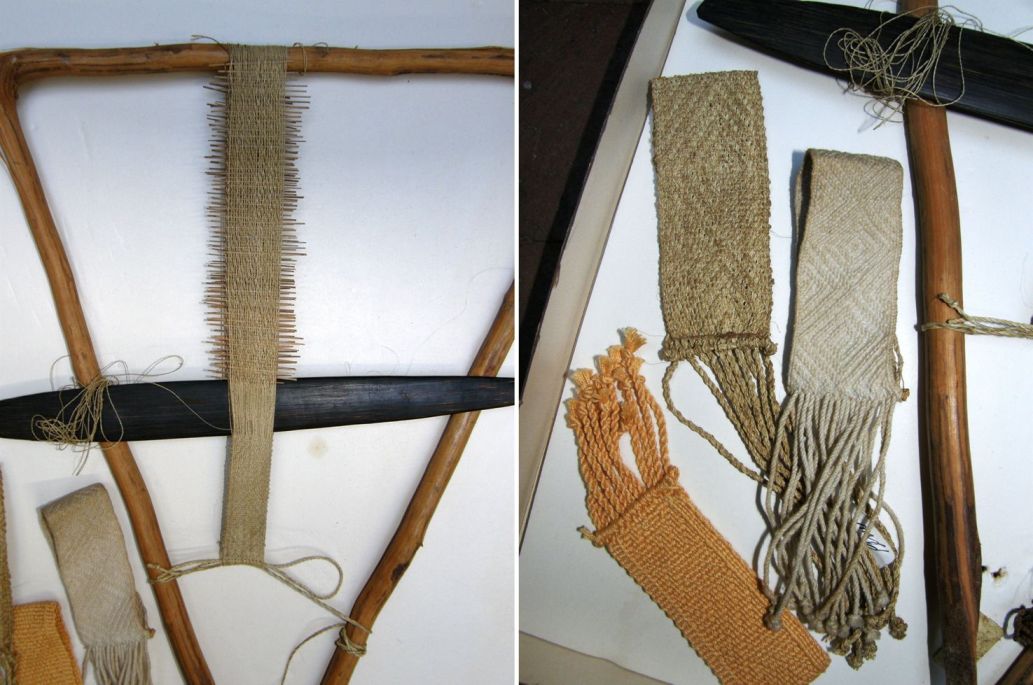
This too is a Shipibo piece and  part of the late Anne Blinks’s collection and something which she had studied. The wonderfully simple branch loom holds a piece of fabric which was probably destined to be a wristlet. The completed woven pieces around it are wristlets, some of which are Anne Blinks’s reproductions. You can see the enormous quantity of fine patterning sticks that have been inserted in the warp to program the design. This was amazing! I love the fact that it is just one color and that the pattern shows as a fine texture. I love the sword/beater too.

See all the fun stuff I got into!

A million thanks to everyone who brought textiles and so willingly shared them with me and the group. There was always a frantic effort on my part to take photos of everything. Peggy also brought some interesting bands that she had bought in Oaxaca.

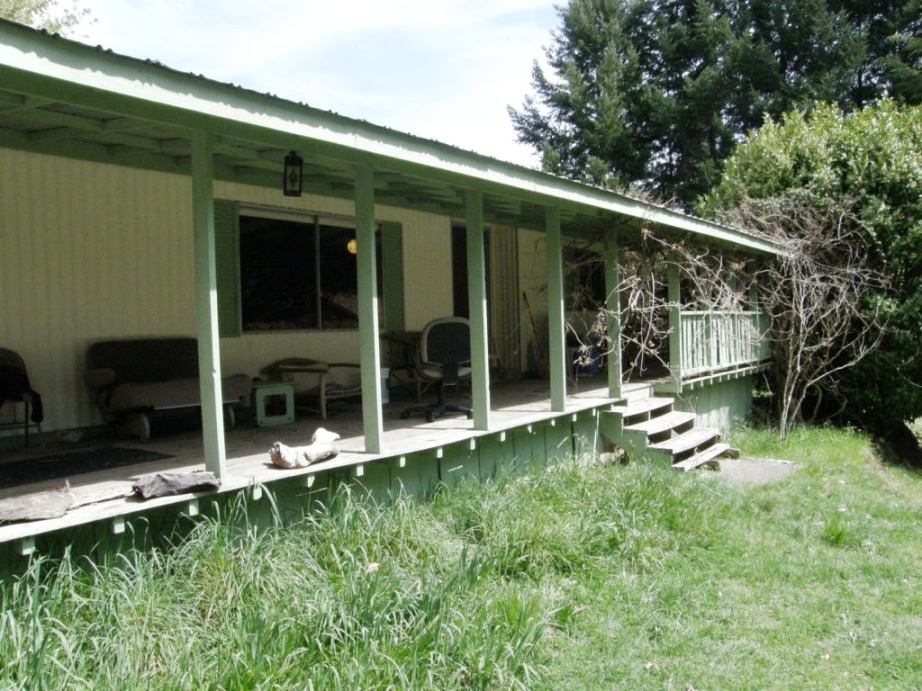
Now I am up on Janet’s farm in Humboldt County and we are planning a weavers’ gathering here. Take a look at that porch…isn’t that the most perfect backstrap weaving site? I put a cushion on the floor and tied up to one of those posts, nicely shaded while I got to wiggle my toes in the sun. For warping I clamped pegs to the edge of the porch and stood down in the garden. Perfect!

Janet’s husband has a family heirloom coverlet. This was especially thrilling to me as I had seen these in the Folk Art Museum in Williamsburg last year behind glass. I read how they were made with both cotton and wool, the white being cotton and the blue wool and could make out the balanced double weave. Now I have had the chance to touch one and drape it across my lap…a whole different experience.

So that is where I am at so far. We are off to Eureka tomorrow to meet some other weavers and do some backstrap weaving and so I have been able to squeeze in this blog post. Before I go I wanted to show you some things that have been going on in the Ravelry Backstrap Weaving Group…


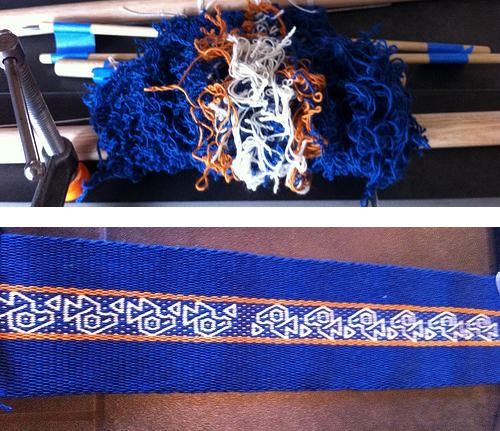
The Spin Along is still going and Jennifer respun some commercial wool and showed us its ‘kinkiness” before it could be stretched out on her backstrap loom and woven into this lovely piece.


Marsha and Carinefile are both doing Double weave. Marsha’s piece on the left is a guitar strap with the musician’s name woven in and Carinefile has made the sampler that goes with the tutorial here.

Jentide and Melisende made Sami bands. These are traditionally woven on backstrap looms using a small rigid heddle but, as you can see, they can be perfectly adapted to inkle looms.

And Bobbie completed a pebble weave bag…


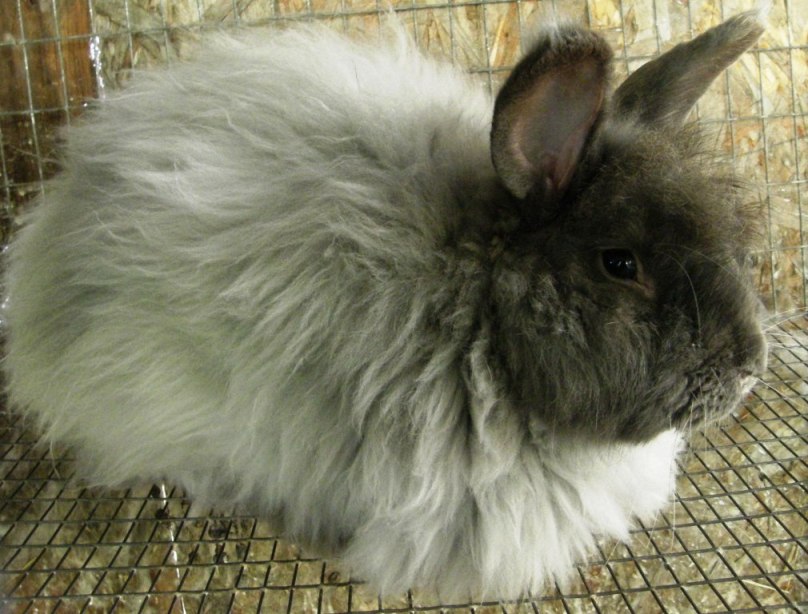
And if you are in an “Eastery” mood from looking at one of Janet’s bunnies, I wrote a post for Easter last year about a colorful Semana Santa, or Holy Week, that I spent in Guatemala in ’08 in three different areas, full of color and beautiful people and textiles.

You can see it here.


Meanwhile, Mike the Mouser is kindly helping me deal with pet withdrawals.