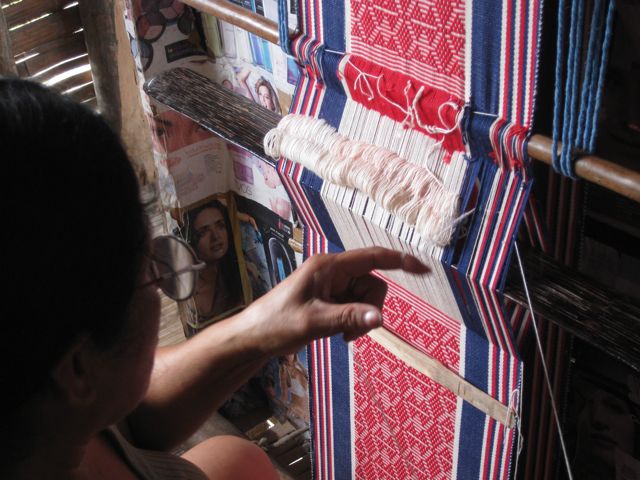

Backstrap Weaving – Great Lengths for Good Results


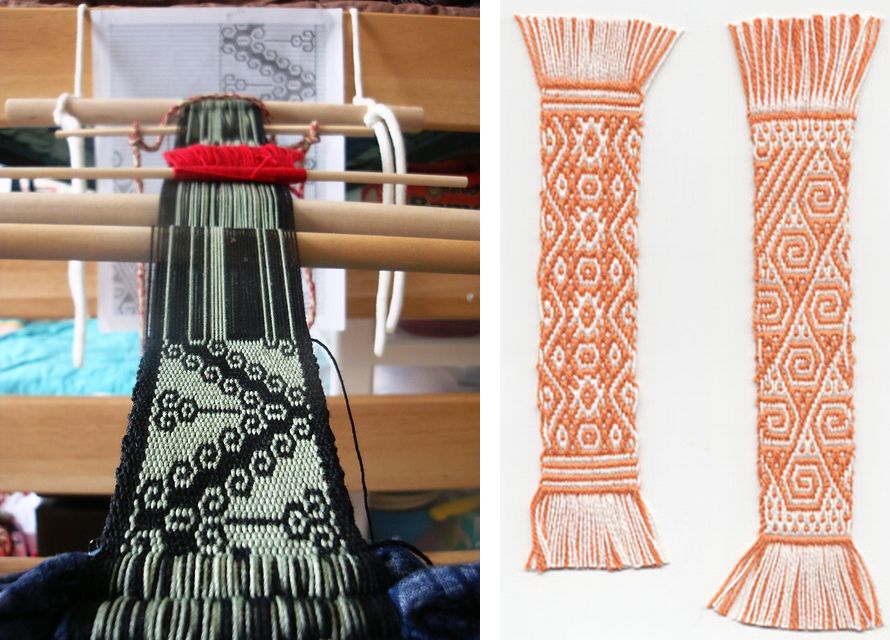
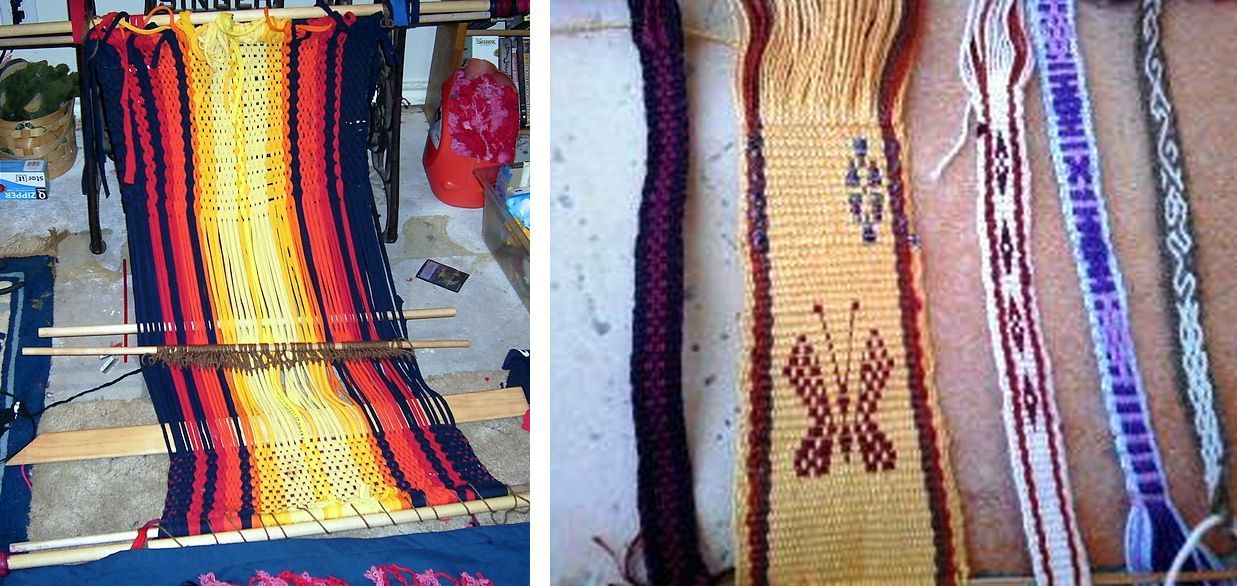
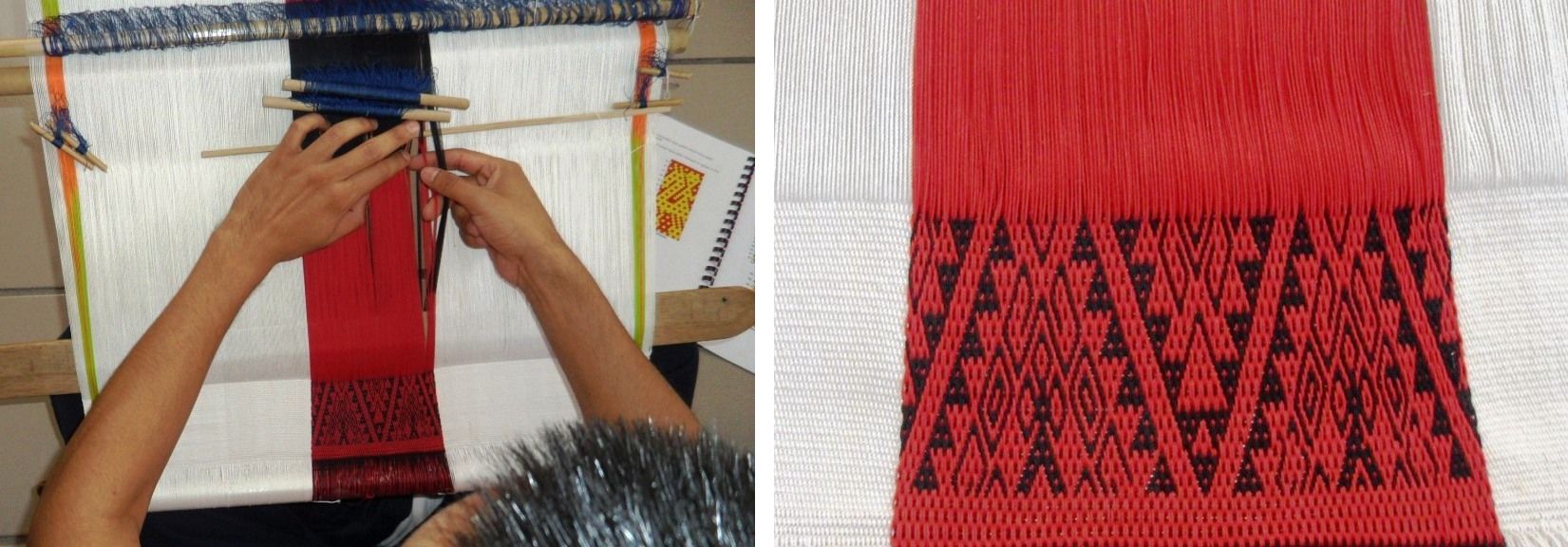
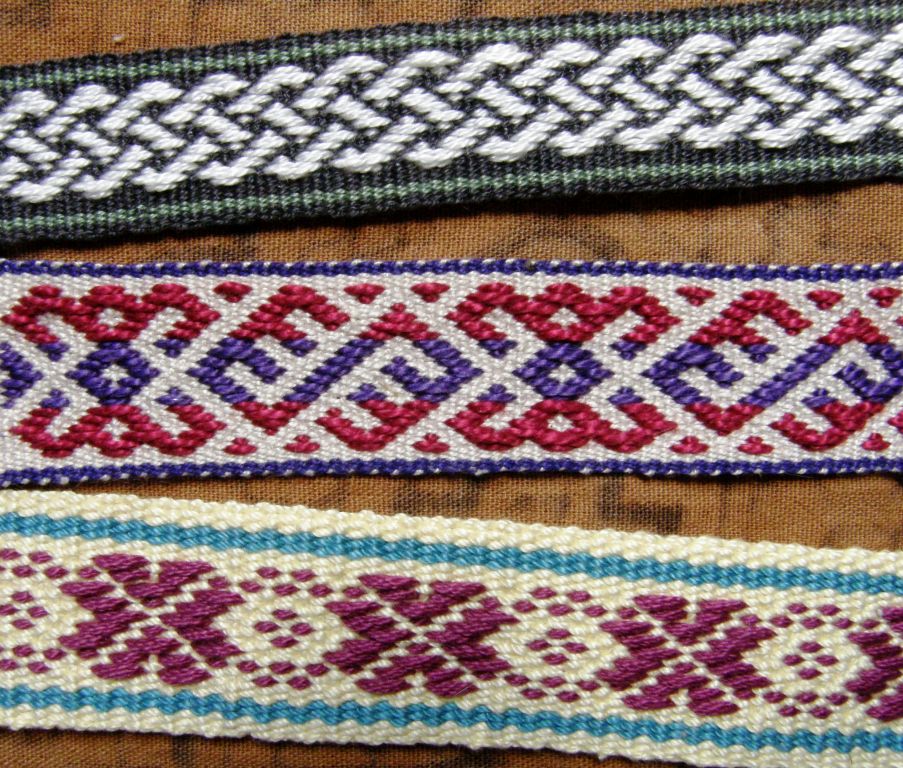
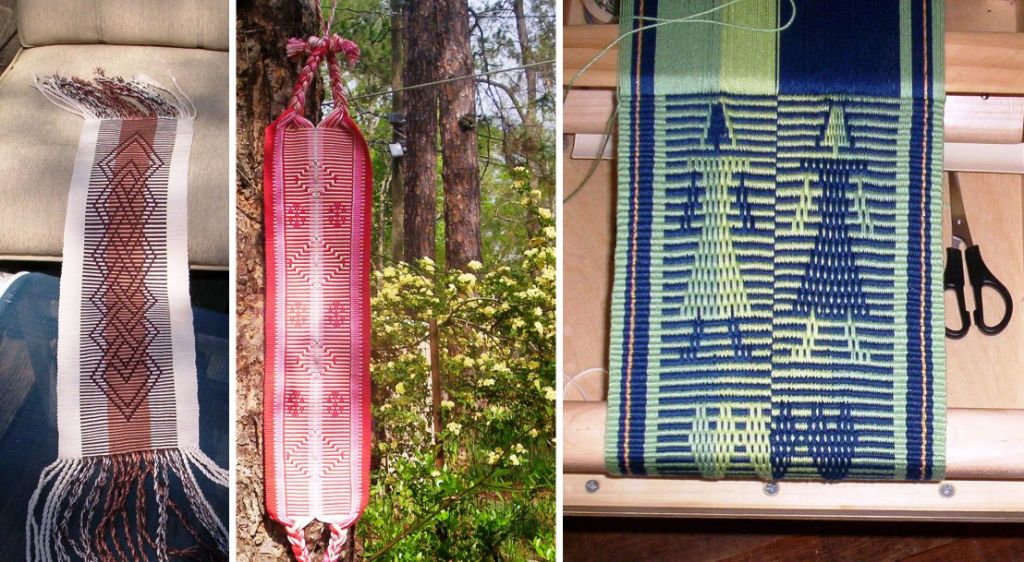
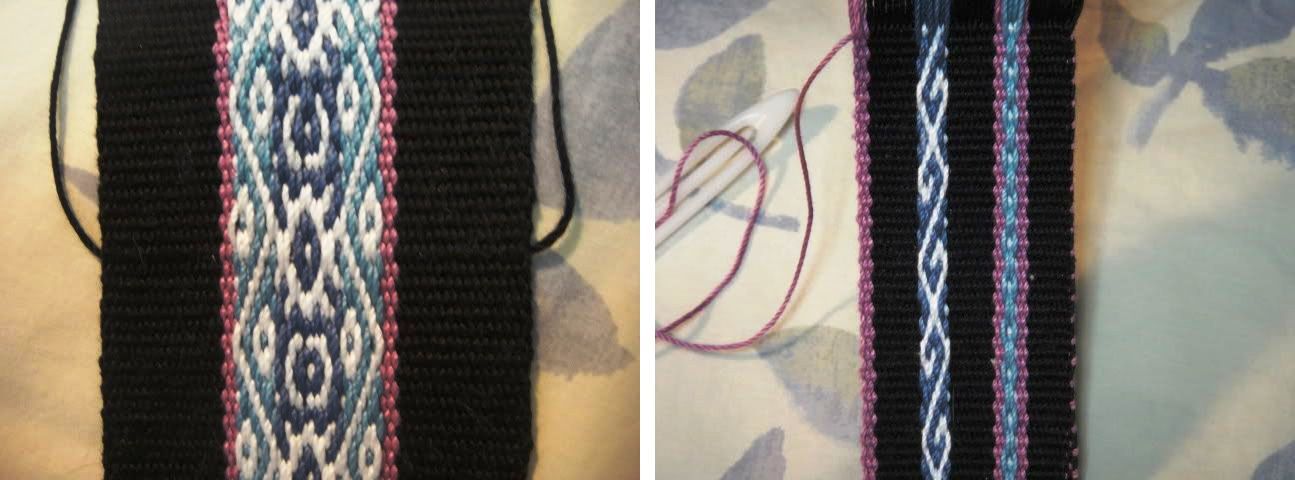
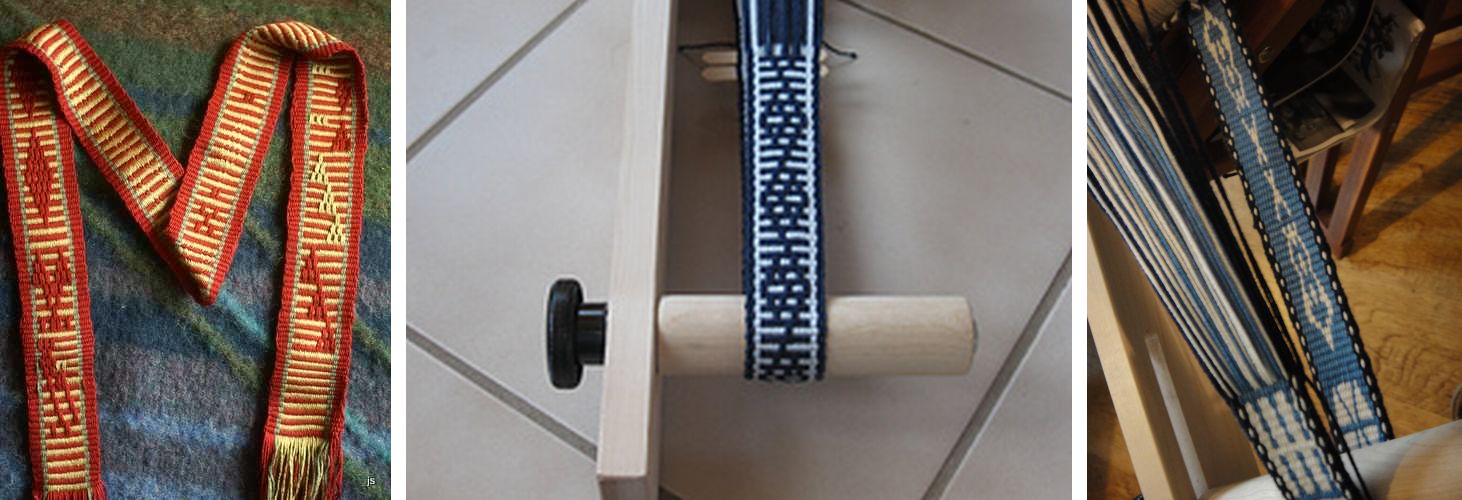
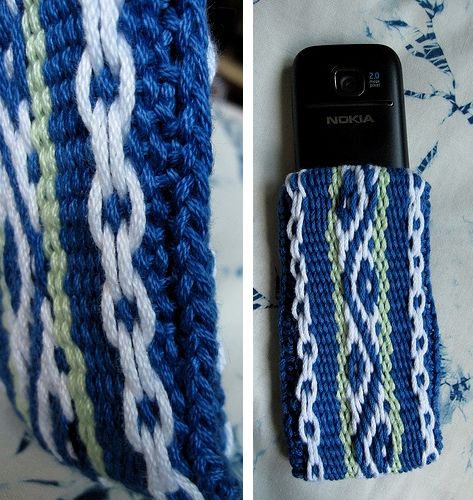
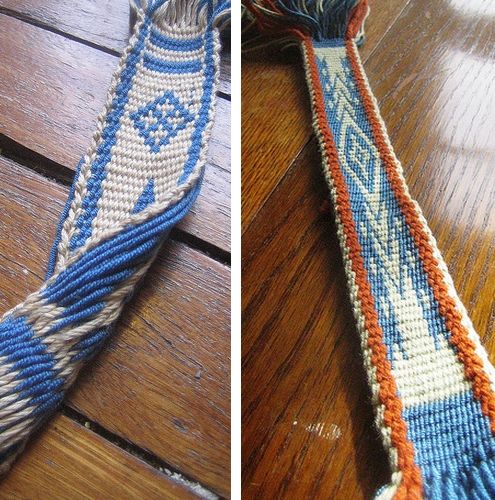
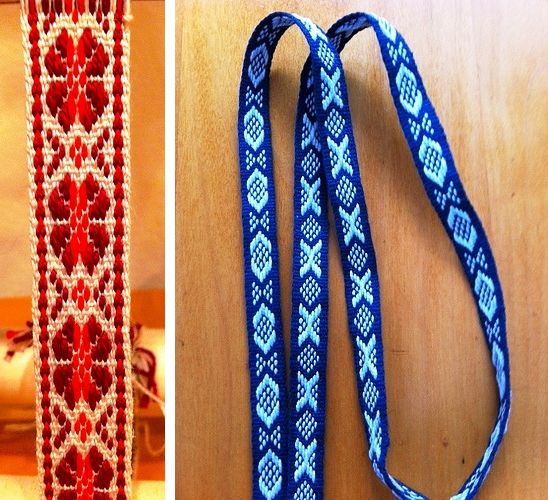
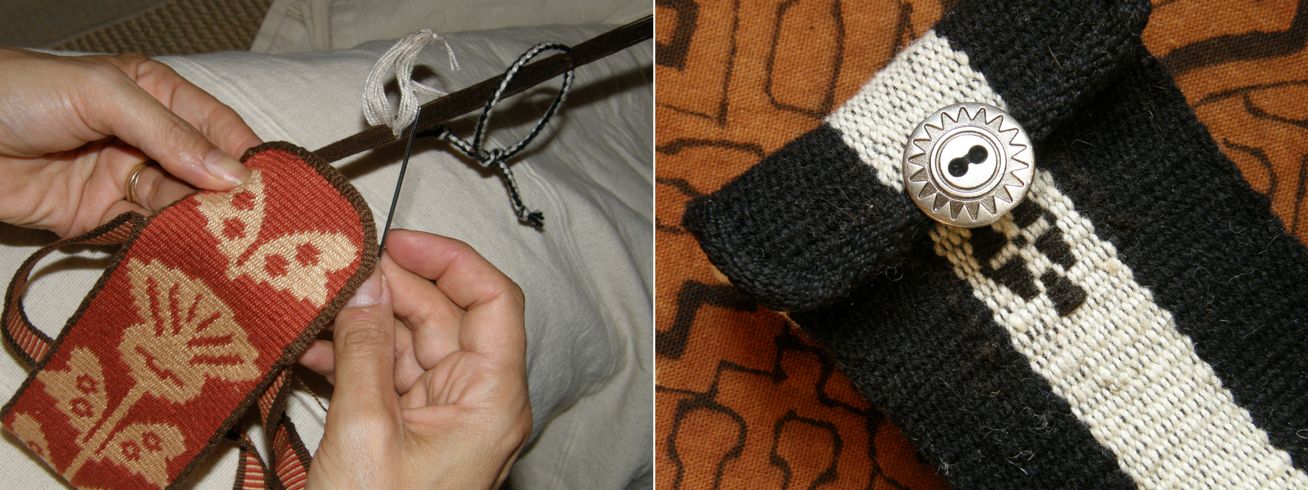
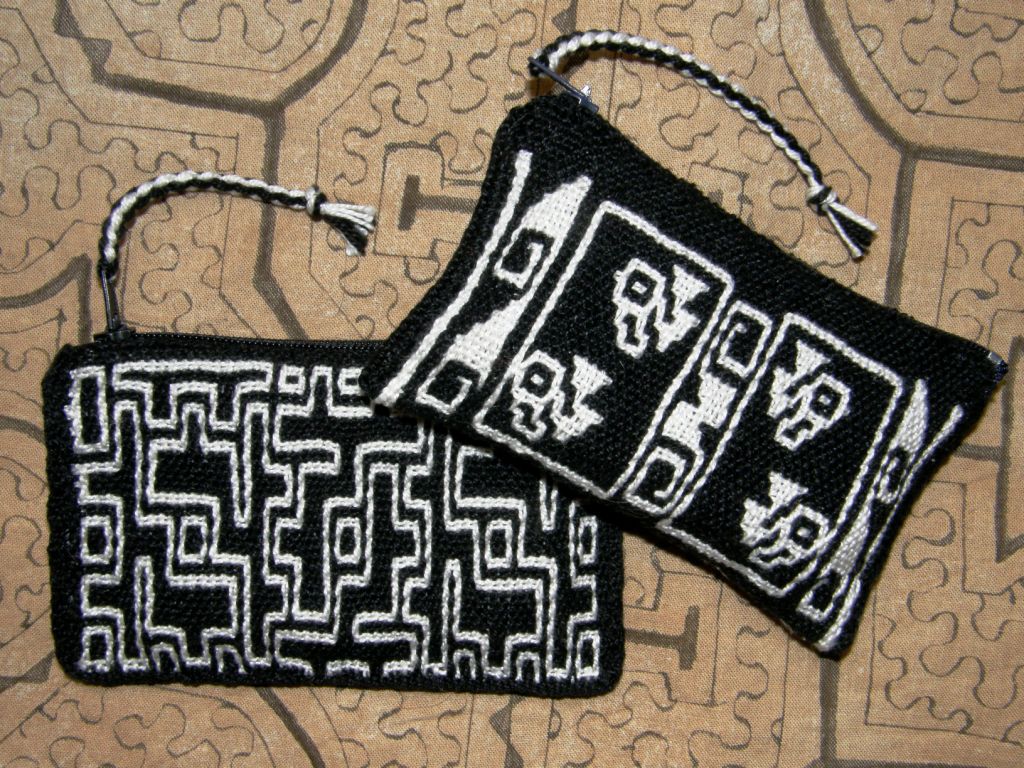
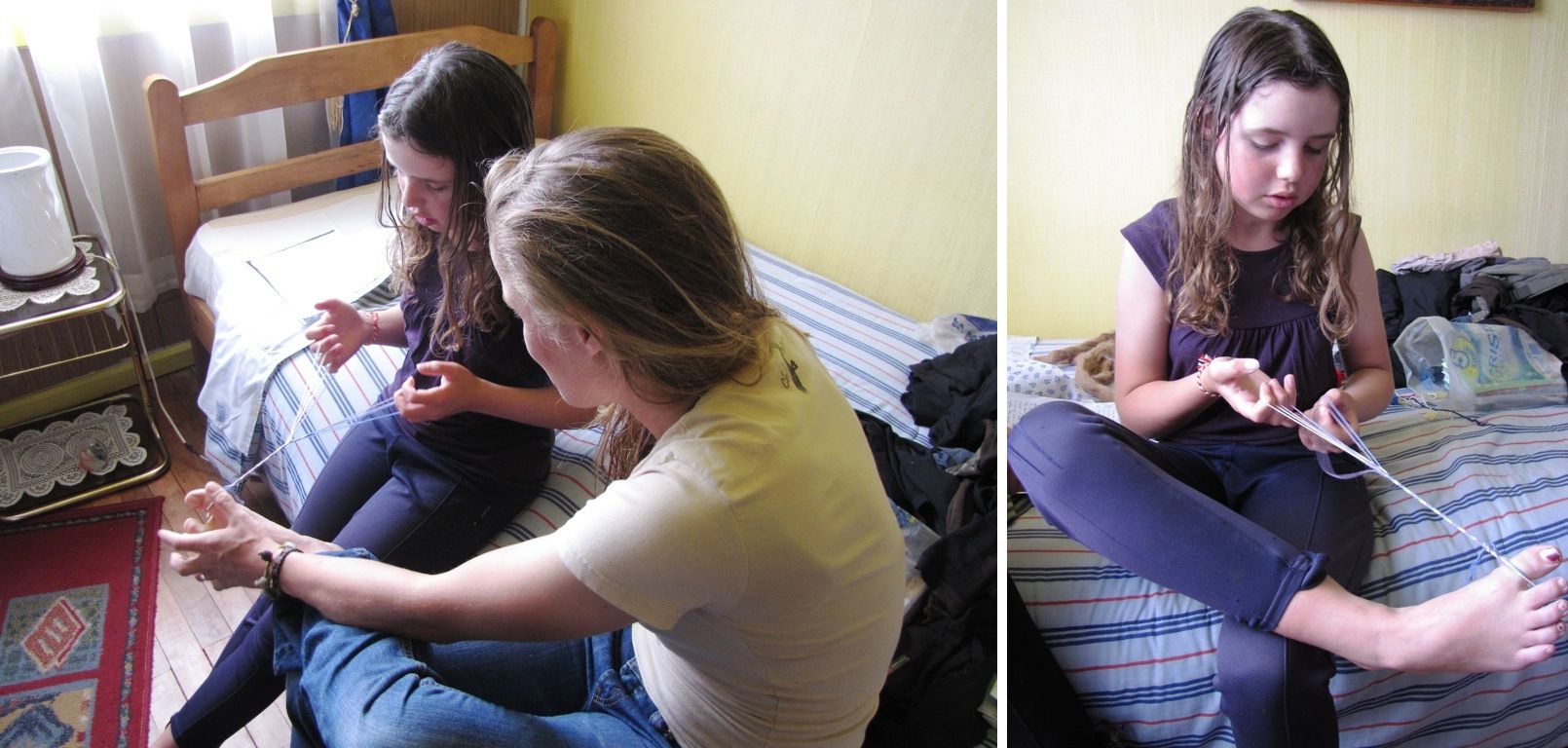
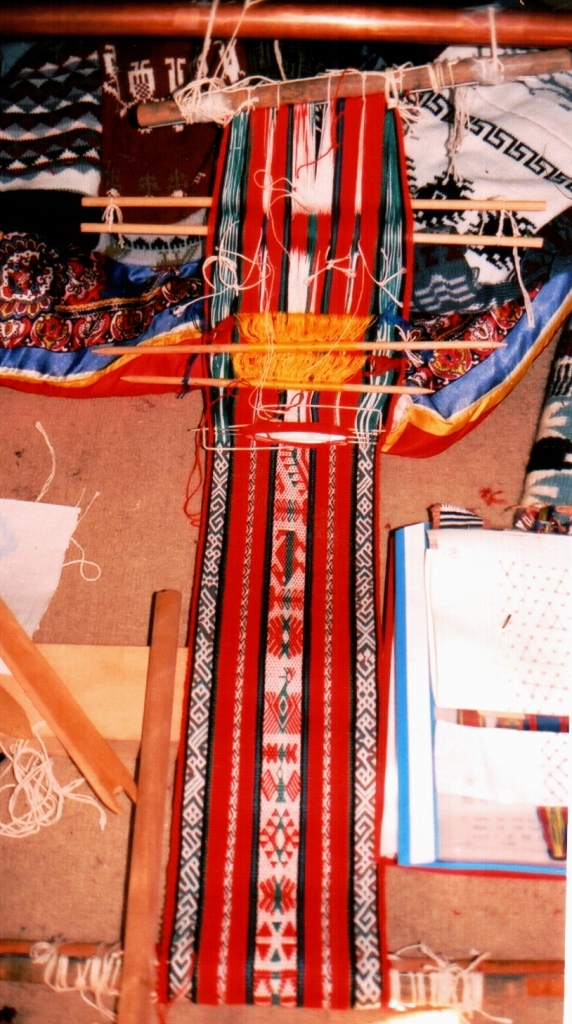
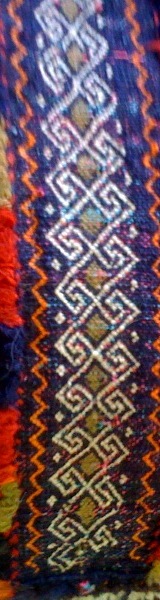
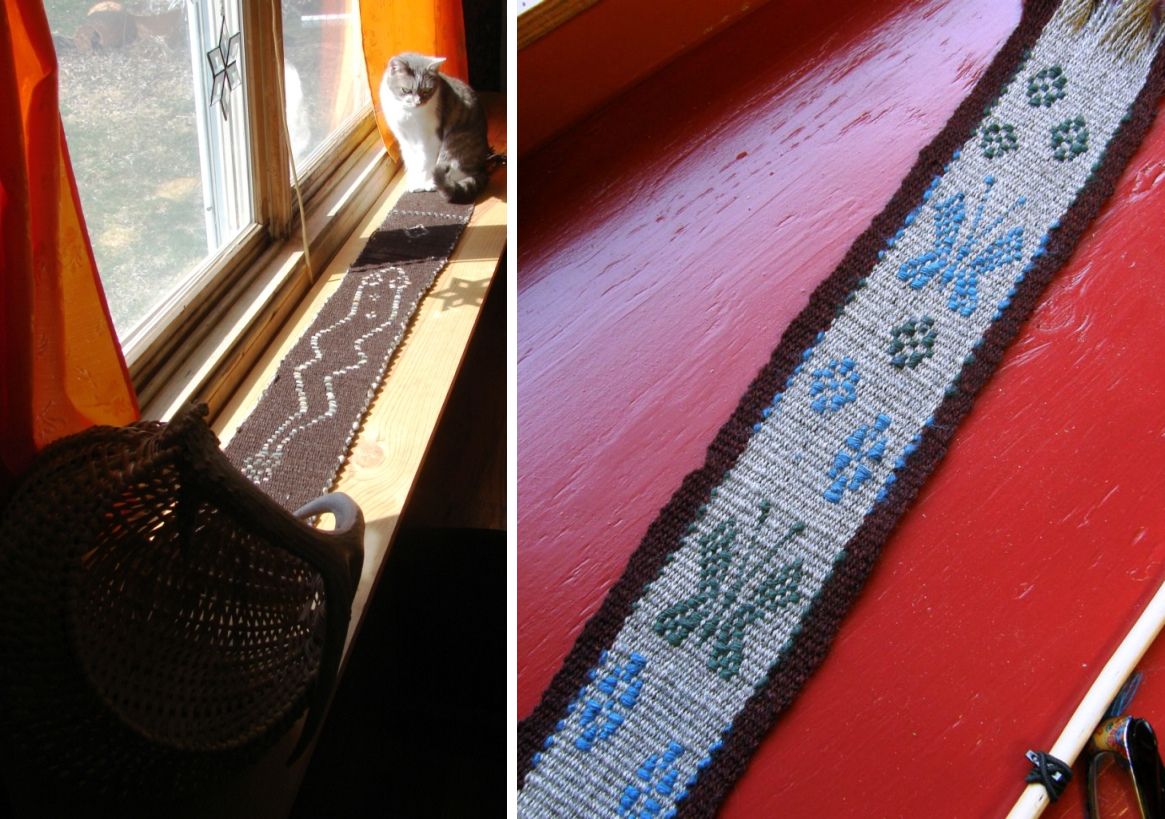
The more you weave on a backstrap loom, the more you come to realize the importance of good warping. I so wish I had photographed the great lengths I had gone to to warp for the four-color pebble weave piece above. It was a mad never-to-be-repeated combination of knitting machine tension rods planted in bottles, planks, toes and stakes! It was the time when I lived in southern Chile with little experience or materials on hand. All I knew was that good even tension was essential to a successful project and I was determined to achieve that. Well it worked and I was pleased with the results.

There are so many parts and tools for the backstrap loom that can be made from bits and pieces that one already has lying around the house. And even a warping set up can be easily constructed…just whack a few stakes into the ground in the backyard….and in one’s enthusiasm to get a warp onto the loom and start weaving one may be tempted to ignore the fact that the stakes leaned inward ever so slightly while the warp was being wound.

You learn after that first wonky warp that it is worth going to great lengths to make a suitable warping board if you want to have good results. I consider this the most important part of your backstrap weaving kit.

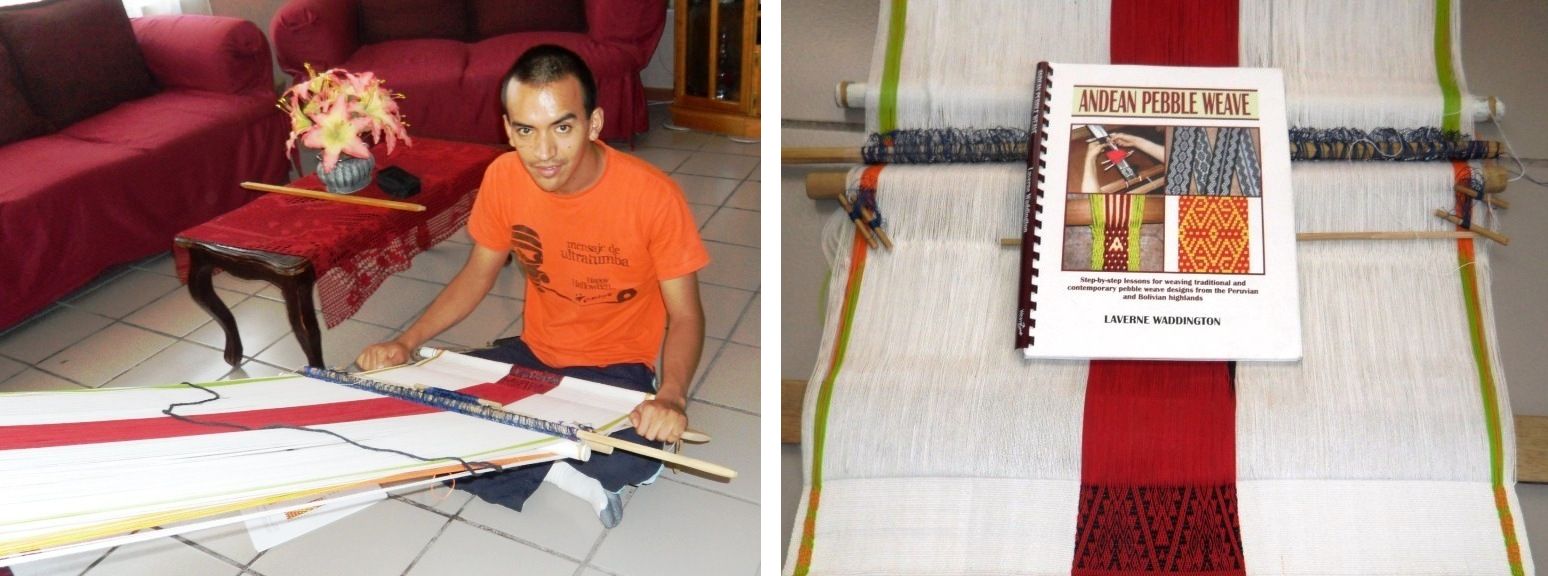
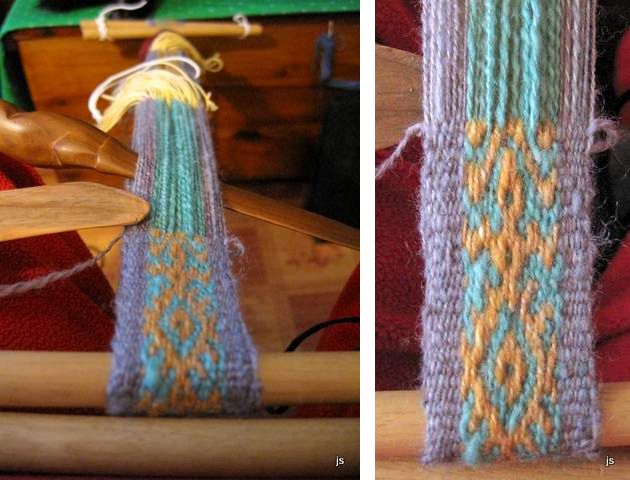
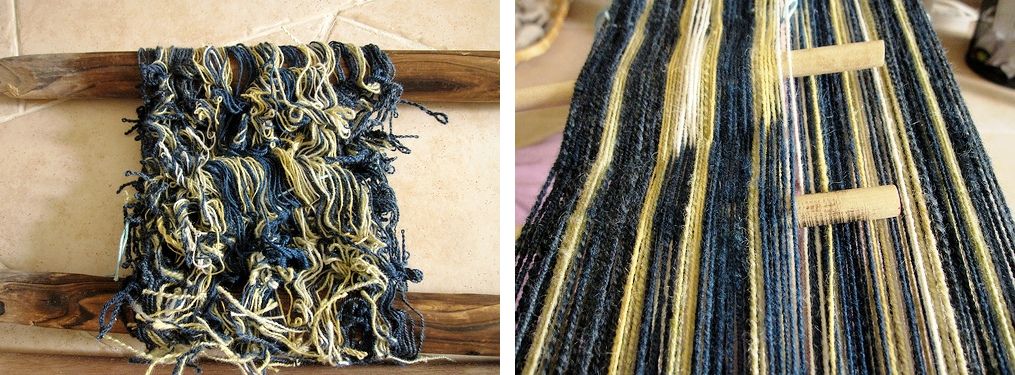
You can see at left my first warping attempt in Chile after returning from my first backstrap weaving lessons in Peru. Look at that crooked end! I had been warping successfully for Navajo weaving until then and tried to adapt that system to four-stake warping for pebble weave….didn’t work!

Even though that was fifteen years ago, I haven’t come up with any terribly sophisticated ways to warp. Sophistication isn’t necessary. I just make sure that my stakes are well grounded and cannot move or lean in.
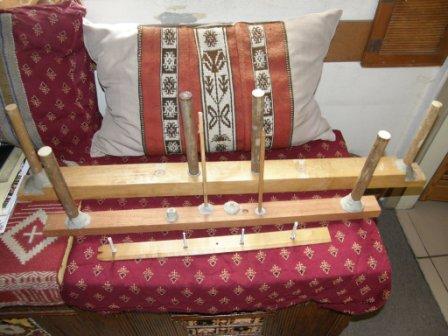
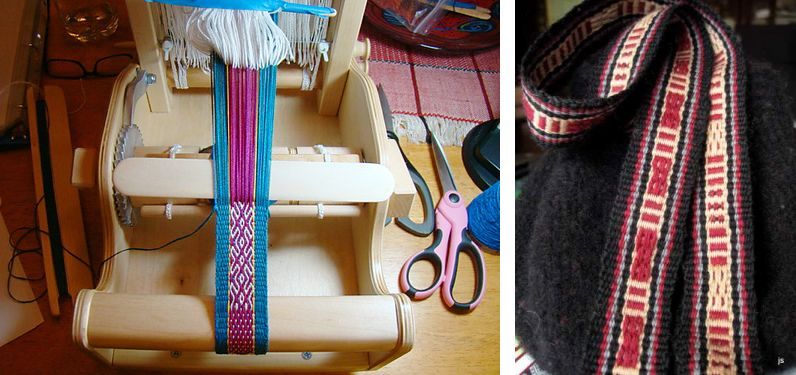
This family of simple warping boards has served me well over the years. Even when I need a longer warp for a belt or guitar strap I manage to combine the boards somehow to fit the bill. I made the middle board to accommodate the multiple sticks that are needed to warp for the supplementary warp technique that I studied in Salasaca Ecuador. The mini board in the foreround is the one that goes traveling with me. The ”stakes” are long screws which are bolted to the wood and can be removed for travel. I also use it at home for keyfobs and bookmarks.

It seemed that all my needs were met with these three simple boards. However, recently I have been weaving with my handspun alpaca yarn. All you spinners out there will understand my desire to not waste a single inch of this stuff!

Last week I showed you the passport pouch I made with my first lot of handspun. I warped it on the middle warping board and it was tough cutting the project off and “wasting” all that handspun. Normally I warp longer than the project requires…there is always that “just in case” factor and so what if a little cotton gets thrown away? But not my precious handspun!

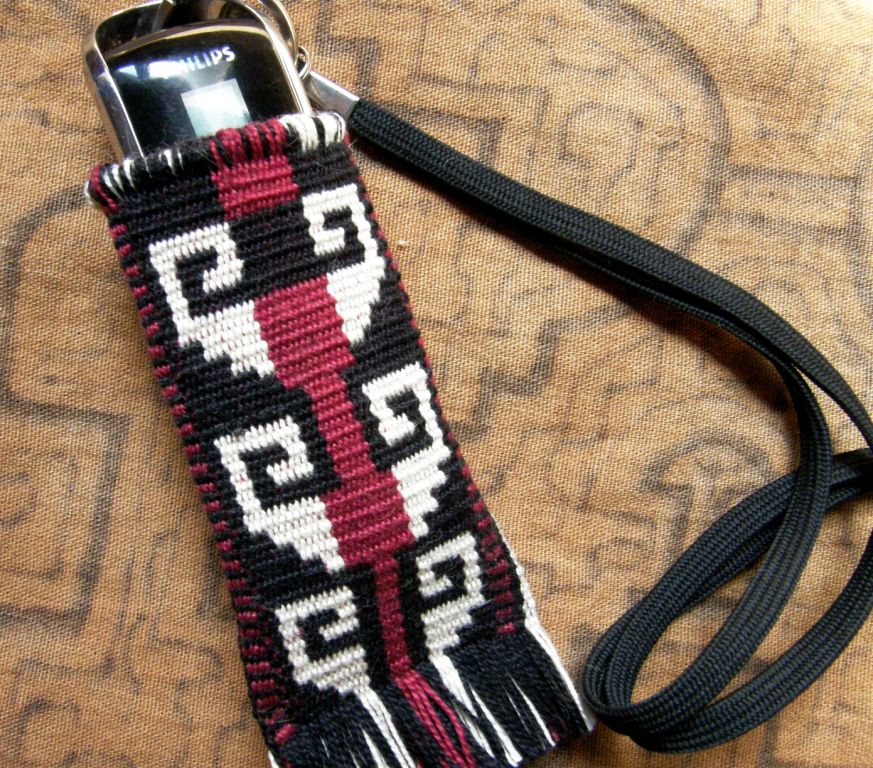
So, I kept all the cut off alpaca yarn thinking I would use it as supplementary weft and that is just what I did this week. I had just enough handspun left to make a cell phone pouch. The dilemma was that I did not have a warping board that would allow me to warp just the right amount for this project. There wasn’t enough yarn to get the right width on the larger warping boards and the mini was too small for a cell phone pouch.

And then I remembered the nifty single warping pegs that my friend Janet and her husband Larry made for me. These can be clamped to a table to warp any length. My problem is that there isn’t a free table here to do that but I managed to use the tray table on which my computer sits and that was the perfect length.
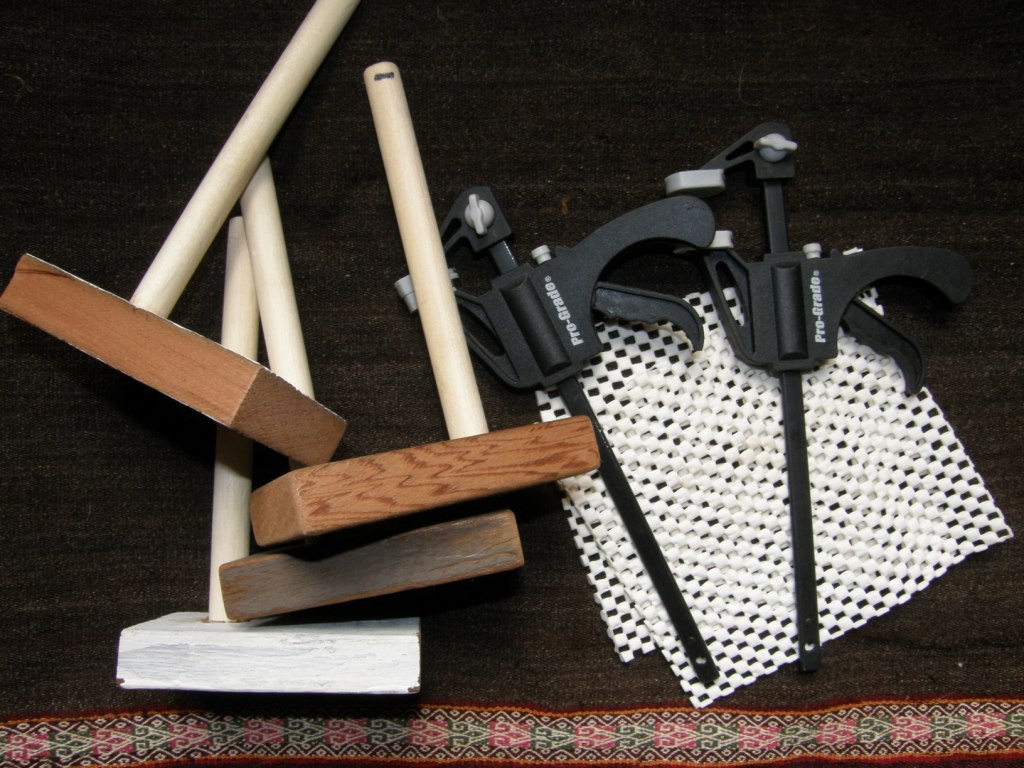
This worked like a dream. I must warn you that clamps can slip while you are warping, quite often imperceptibly, and it won’t be until your warp is on the loom that you notice that one side is hanging slack while the other side is taut. I solved this problem by using that rubbery draw liner stuff that you see pictured above on both the top and bottom surfaces of the table…no slipping…beautiful warp.

I have a lot more about warping and the different ways my indigenous weaving teachers warp in this previous post and also here.

As I told you last week, I put only the slightest amount of overtwist in this yarn so you can see here that the warp can lie quite flat and not go curling up on itself. It is hairy, though, and I did have to work to clear my sheds. I had to put glue on the knots at the color changes after having the knots in this sleek fiber work their way undone multiple times and drive me nuts!

So, this was to be a cellphone pouch with supplementary weft patterning. I would never have thought of doing a piece in wool or fiber with this technique had it not been for Phil in our backstrap weaving Weave-Along on Ravelry who wove a band with his handspun which he decorated with a snake motif using his handspun as the supplementary weft. Then when I was staying with my friend Janet, who is an awesome spinner, I was further inspired when she wove a band with her handspun with silk supplementary wefts.
So, many thanks to Phil and Janet for giving me this idea.

And here is the finished cell phone pouch…

All the other pouches I have made have had flap closures. I decided on something different for this one and added a drawstring instead – an alpaca drawstring, of course!

The design is actually Indonesian. It was a scroll that repeated itself across the width of a piece that I saw at Convergence last year. I stacked the scroll and inverted it to make this new design.

The turns of the supplementary wefts are on the face of the weaving but are quite well camouflaged in the darker warp color. I dabbed glue on the supplementary weft ends as they exited on the back side of the piece. Again, the yarn is so sleek, I didn’t feel secure just cutting and leaving short ends as I would if I were working in cotton.

I am very happy with the way this turned out!

And that was the end of my alpaca yarn…now back to the spindle to make some more and just in time for the Tour de Fleece that starts this weekend.

I have quite a collection of cell phone pouch projects now influenced by Vietnamese hilltribe weavings, Central Asian yurt bands, Guarani designs and Indonesian textiles. Half of them have been given away. Hmmm…as I type I am getting ideas for a couple more!

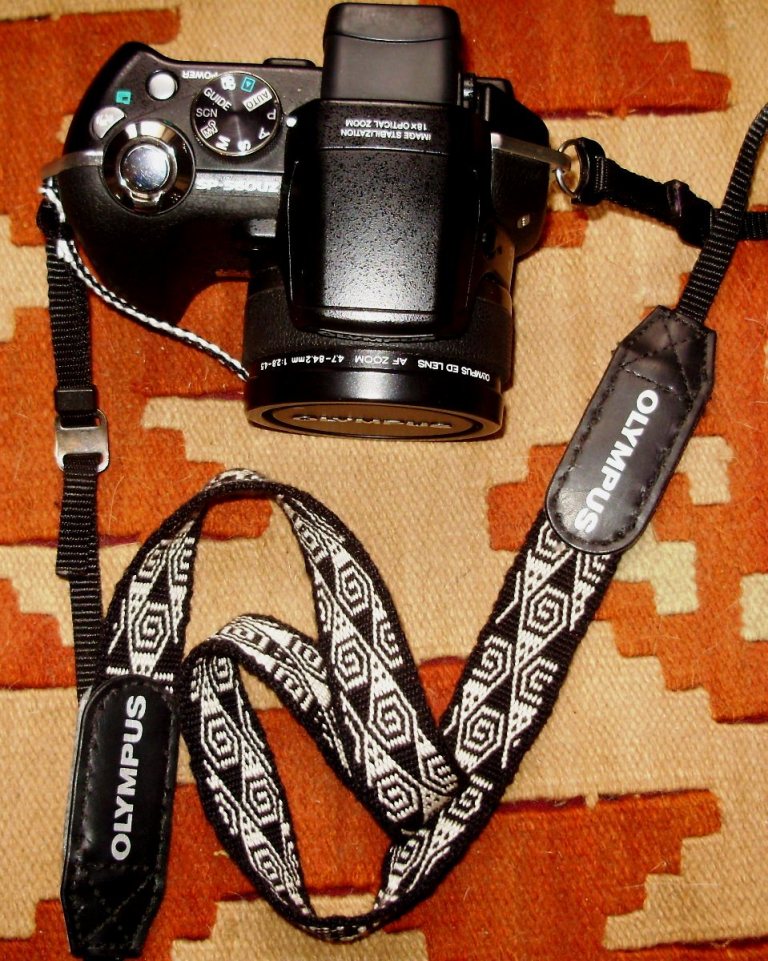
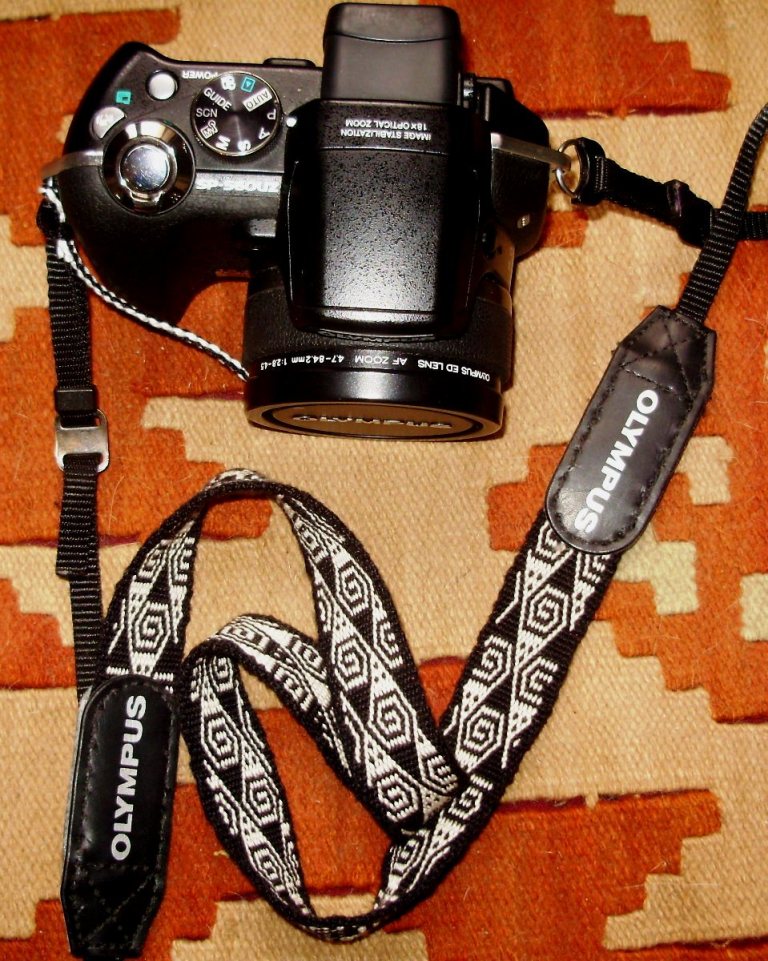
Last weekend I completely ignored my to-do list and launched myself into a new project. What brought this on? Some friends sent me pictures from my recent visit to the US and I realized that in almost every picture of me I was clutching my camera. I decided that my camera needs a bit of dressing up…well, to tell the truth, I probably do too but that ain’t gonna happen!

So, I wove a strap and braided a tie for the lense cap.
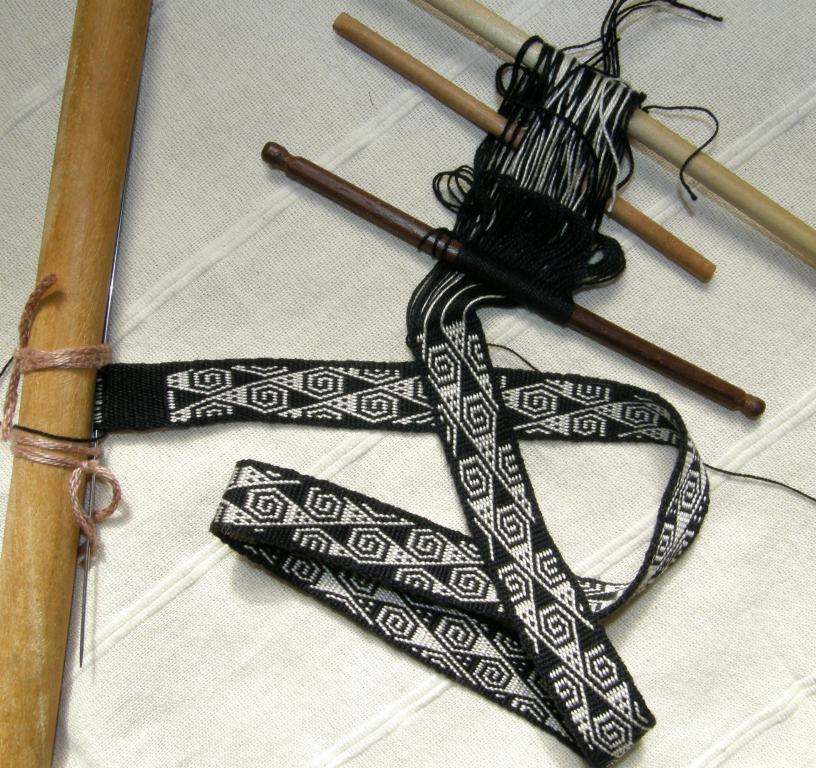
 I wove this in one-weft double weave and you can see that it is based on the float pattern that I used on the passport pouch I wove last week. I think that this design would also make a good project for warp substitution. Those of you  who have dabbled in warp substitution will know that one of the technique’s drawbacks is that you end up with long floats on the back but, if you are weaving an item where the back of the piece won’t be seen (unlike my camera strap project), the floats won’t matter.
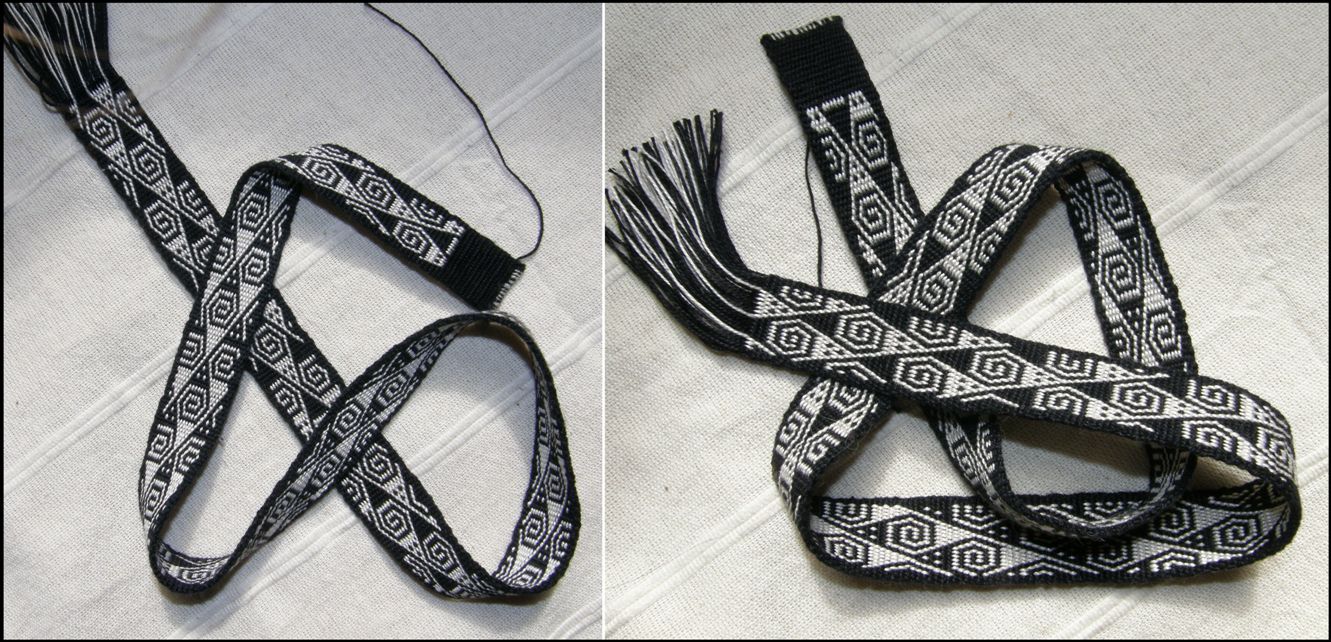
Here is my dressed up camera…


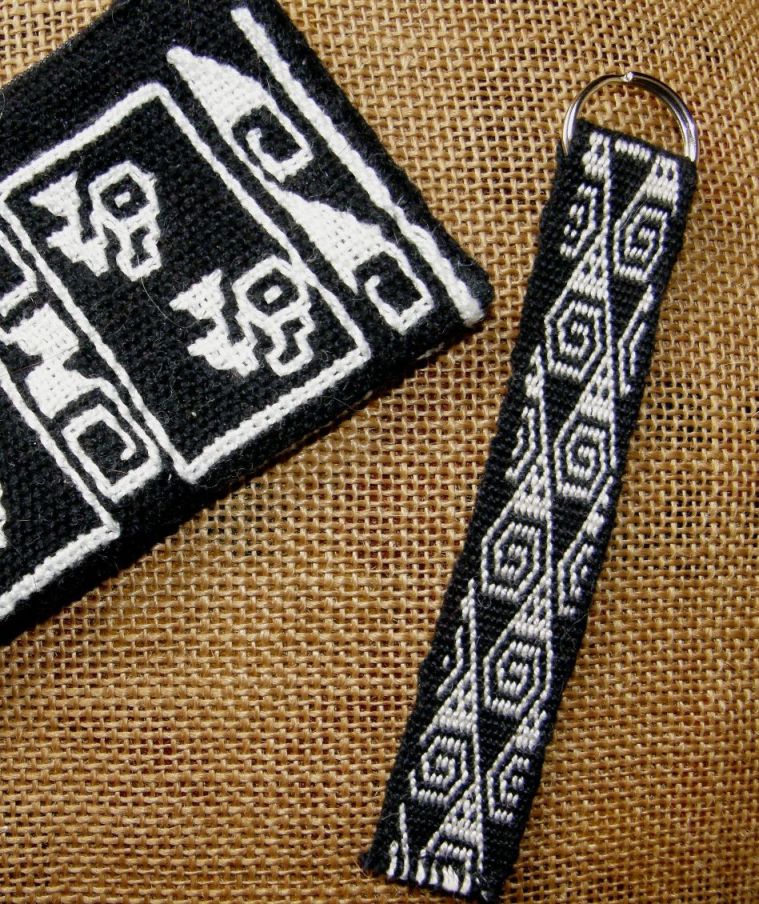
I wove more length than I needed for this strap and so made a keyfob from the left overs and you can see above that not much warp was wasted.

Actually I could have woven more but I had had enough of these swirls by that time!

I have added this double weave pattern chart to this page. Take my advice and extend the chart if you plan on weaving it.

The design did not repeat at all for the entire length of the band and it is easy to go on weaving and forget when to start weaving the design as it enters from the right edge. You need to weave a fair bit before the design starts sinking in.

I just hand stitched across the bottom to seal the end.

Let’s go back now to the original topic to show you a couple of nifty warping ideas from some of my online weaving buddies.

Sometimes you have to get creative according to your budget, your lifestyle or living situation…lack of space and considerations like that. Above left is Marsha’s new warping set up using long screws and drilled holes and segments that can be joined together to accommodate a variety of warp lengths. It all comes apart for travel. Marsha is a terrific DIY-er and is also making lovely beaters and pick up sticks so, you know where to go if you would like to have some made.

And now you will see what I mean about going to great lengths…

Tracy and her husband lugged a bed frame onto the roof of their home in Qatar. That looks like a great sturdy set up and adding extra stakes to that for four-stake warping should be easy. The two extra stakes don’t need to be firmly grounded. In fact, I have seen a picture of a weaver warping seated on the ground with the two extra stakes lodged between his toes.

This set up was spotted today, by Dyggvi (from the Ravelry group) on this blog (it wasn’t wound for backstrap weaving)…Not sure about this being a good option as the legs look curved.
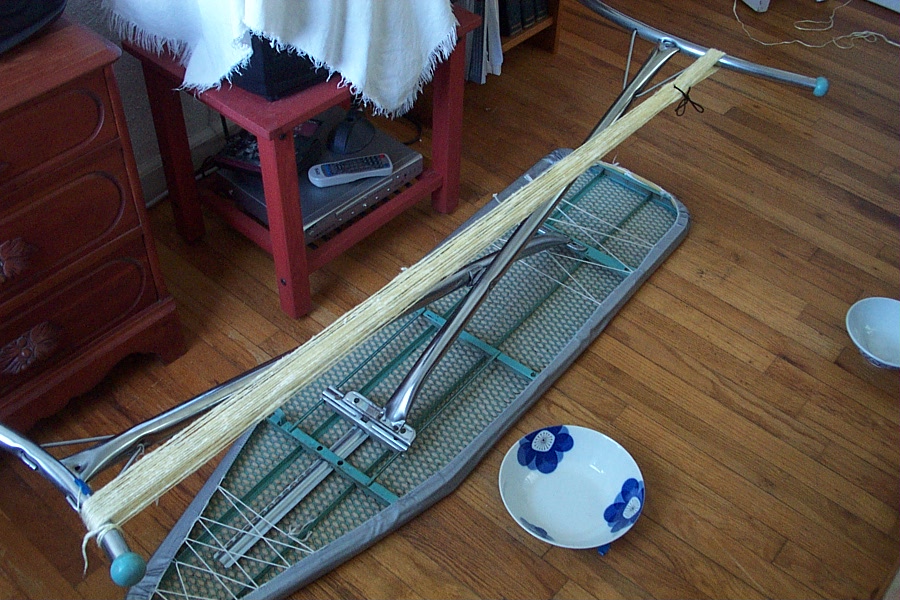
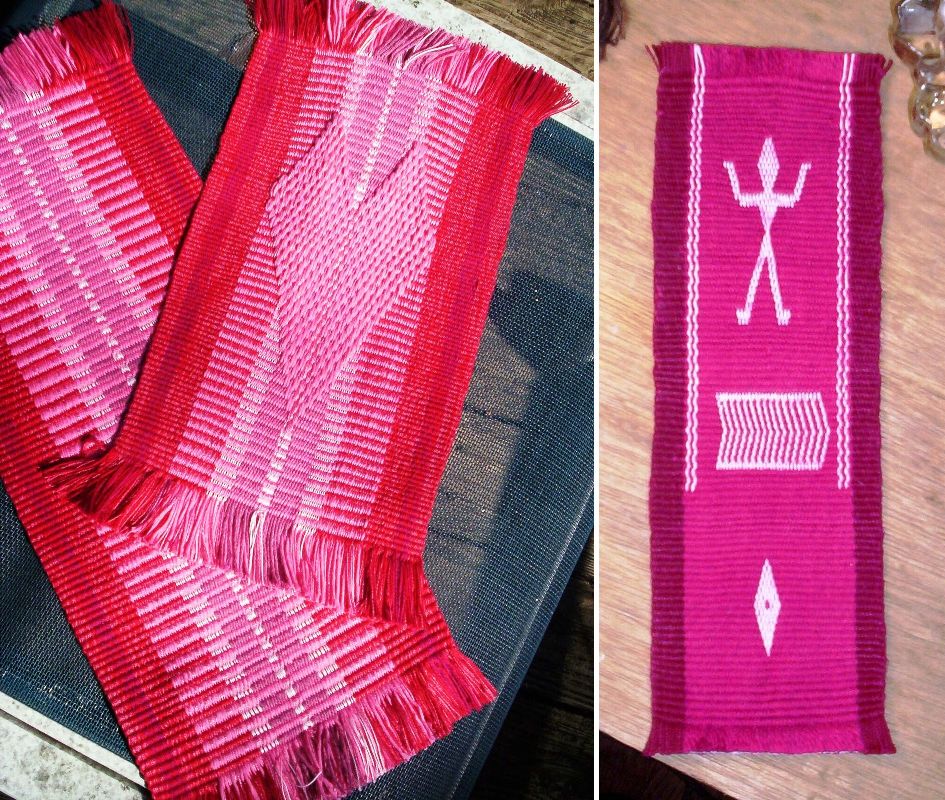
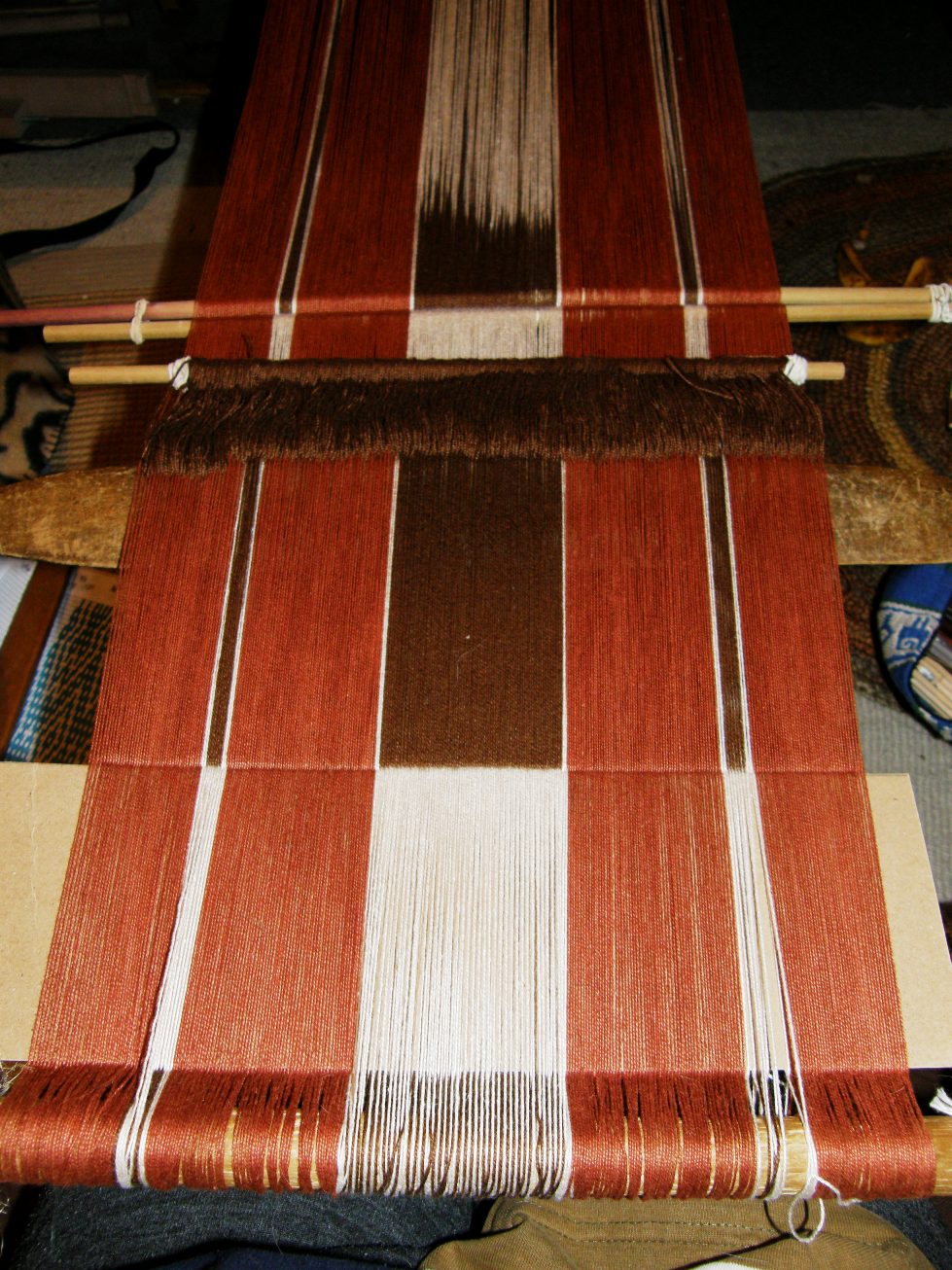
I warped up the widest piece I have done for a long time yesterday. It was warped in two sections and transferred to the loom bars. This will hopefully be the first of a set of four placemats all using the two-color warp float technique. Each one will be in a different color with a motif from a different culture.
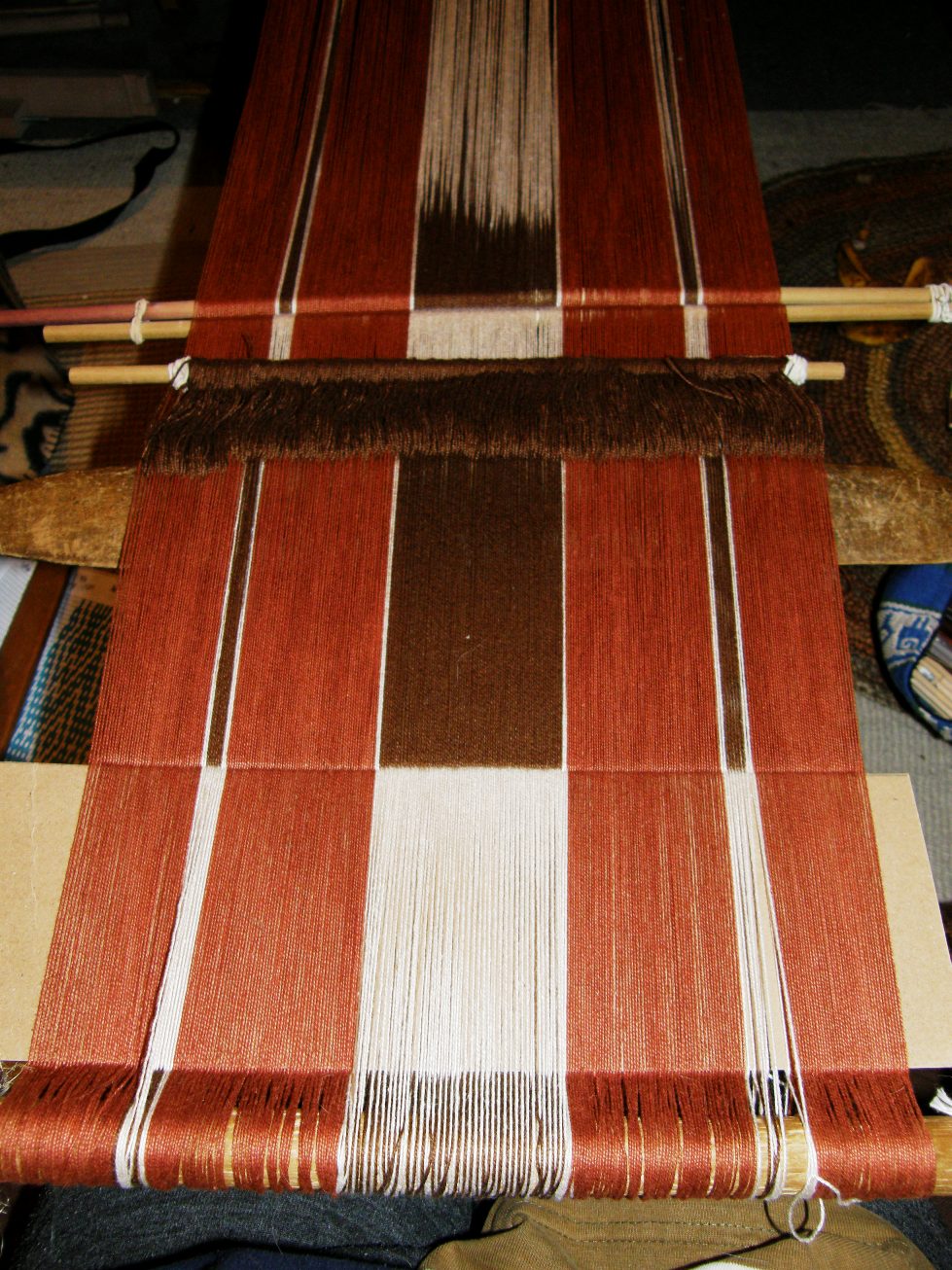

I am leaving a pretty big fringe as I plan to twine a design on each end and will dye some of my Cebelia #20 thread brown for that (doesn’t seem to come in brown, does anyone know if that is a fact?)
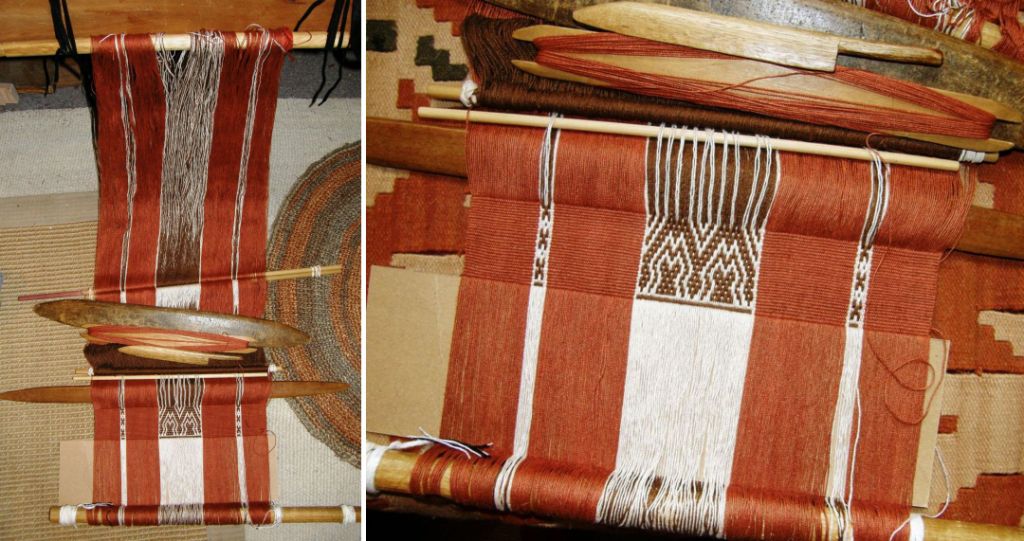
I am using that gorgeous terracotta brown color that I dyed last week which I wanted to have resemble the color of the Shipibo cloth pictured below left. The design is from what I am pretty sure is a Shipibo bag woven using the same technique. I have not seen many Shipibo textiles and have not traveled to the area of Peru where these people live but I have bought a few small pieces of their painted cloth and was shown some of their embroidered work by Yonat who has some of their textiles in her collection.
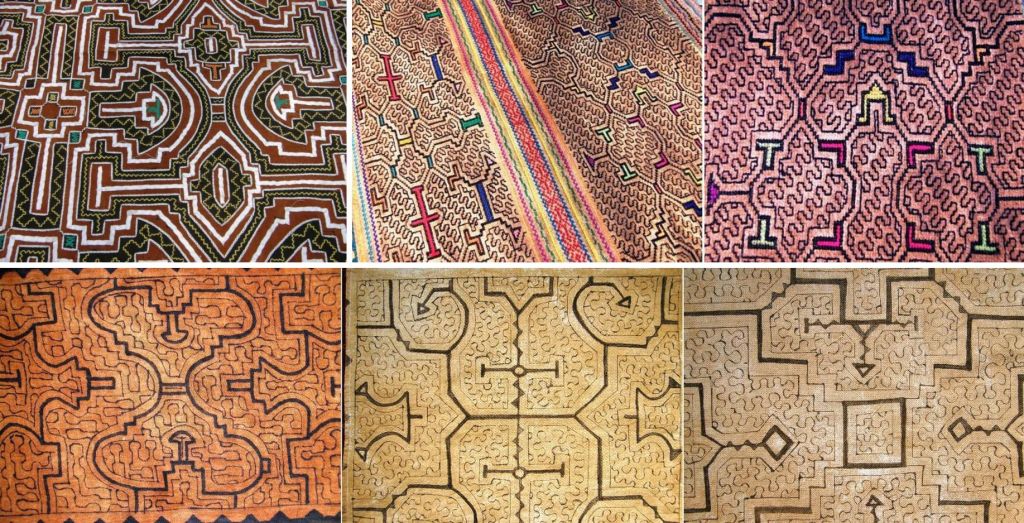
I would love to go and learn more about the Shipibo people and their work with textiles as these days I feel quite drawn to the weavings of the people of the lowland areas of this great continent which is very often neglected.

I would like to share a link with you which was sent to me by Yonat after the inclusion of some braids and Andean and Tibetan slings in my post last week. I definitely want to try some of those braids.

Also, Dyggvi, one of the group members on Ravelry, shared a couple of interesting links to images of backstrap weavers in Taiwan and their very unusual loom set up. The first picture in this link is of an Atayal weaver but there are backstrap weavers from other countries on that page too.

Tracy has written a blog post about the al’ouerjan weaving that is practiced by Bedouin weavers. It is a warp substutition technique and her post shows lots of lovely variations of the design.

I will leave you here with some outdoor backstrap weaving shots from both sides of the equator….
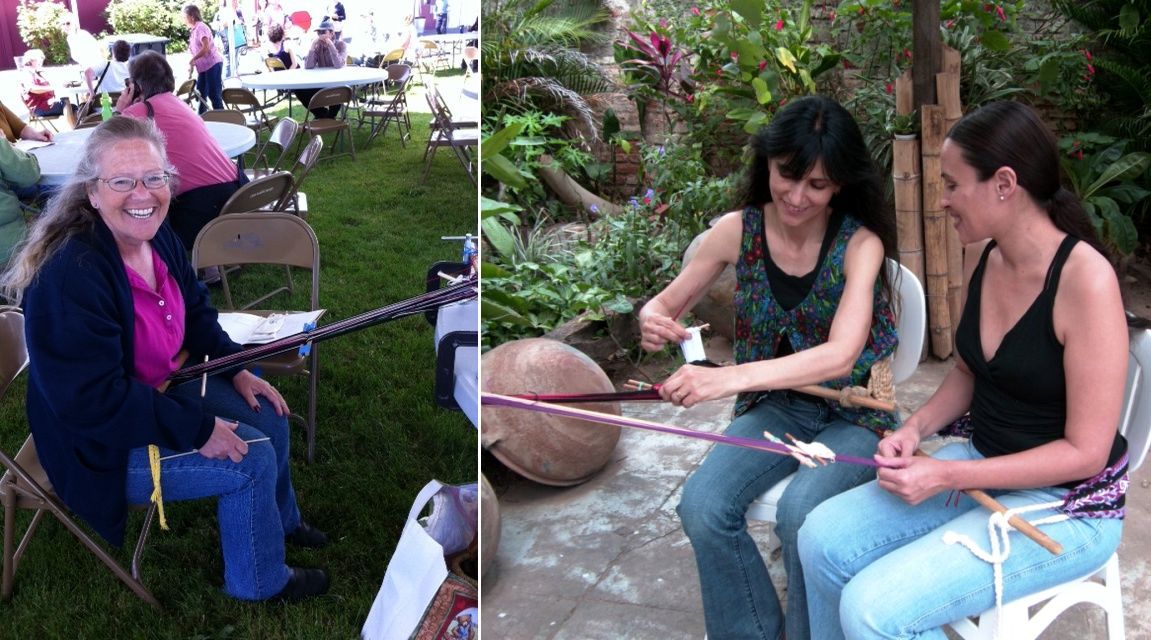
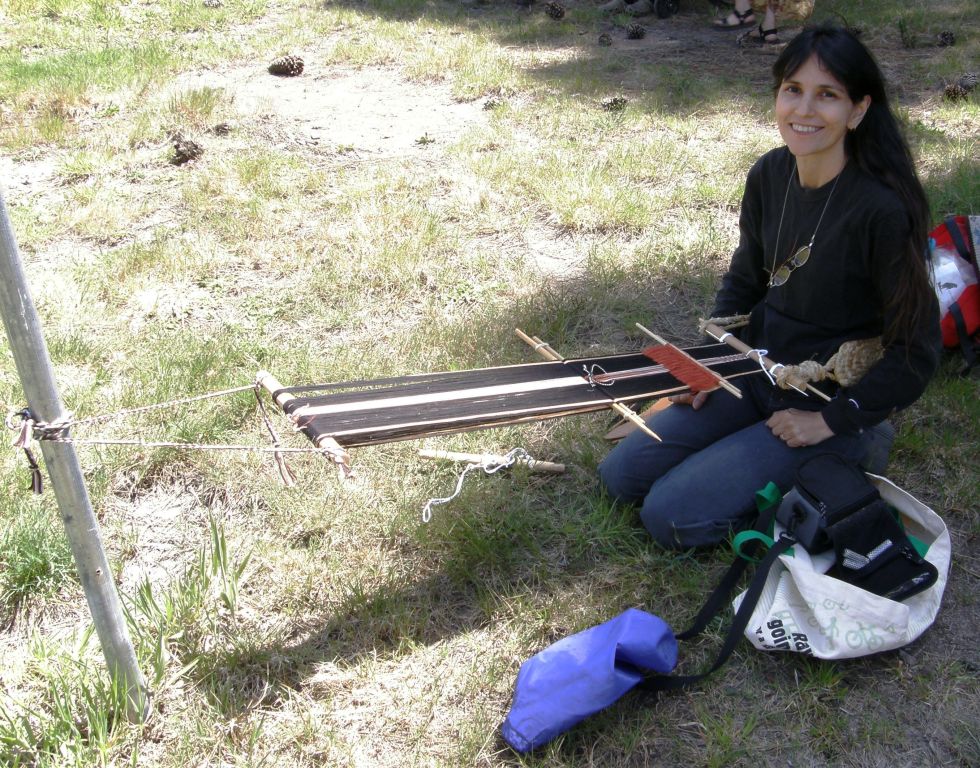
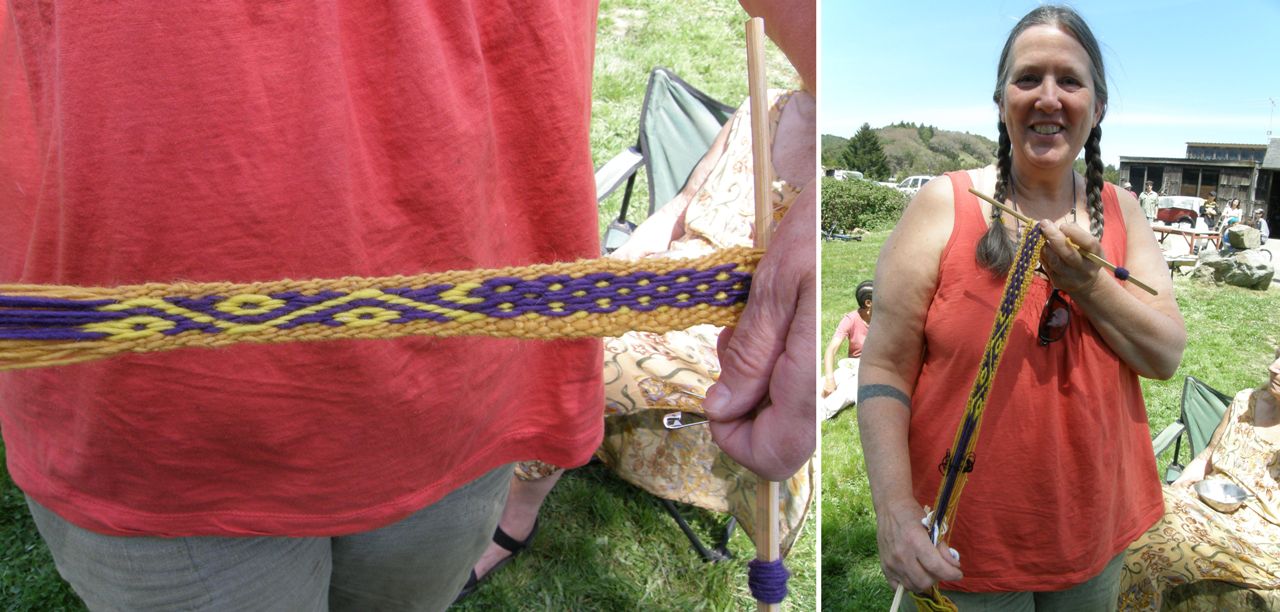
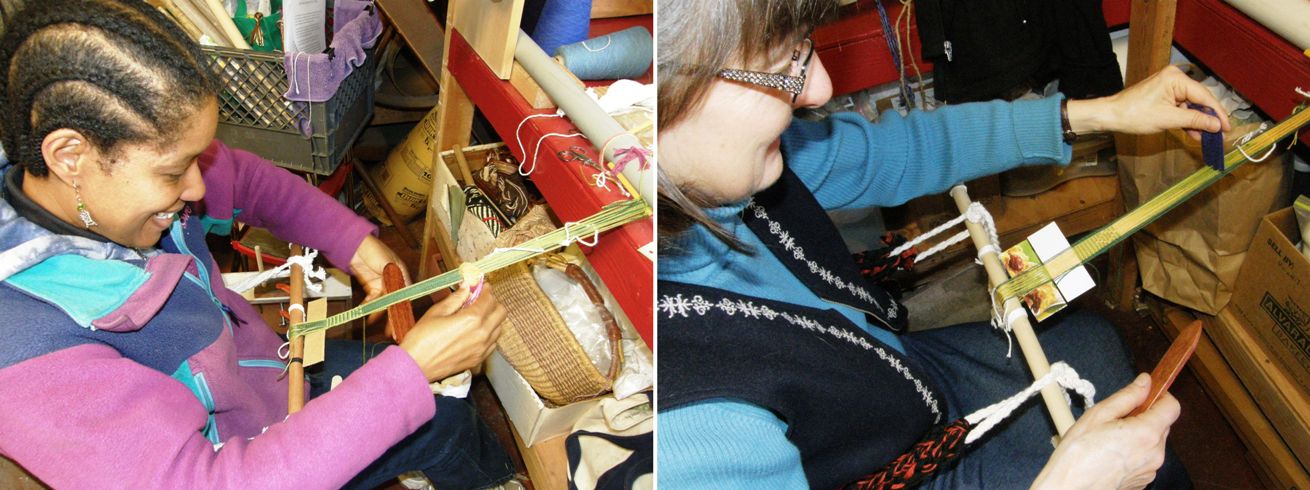
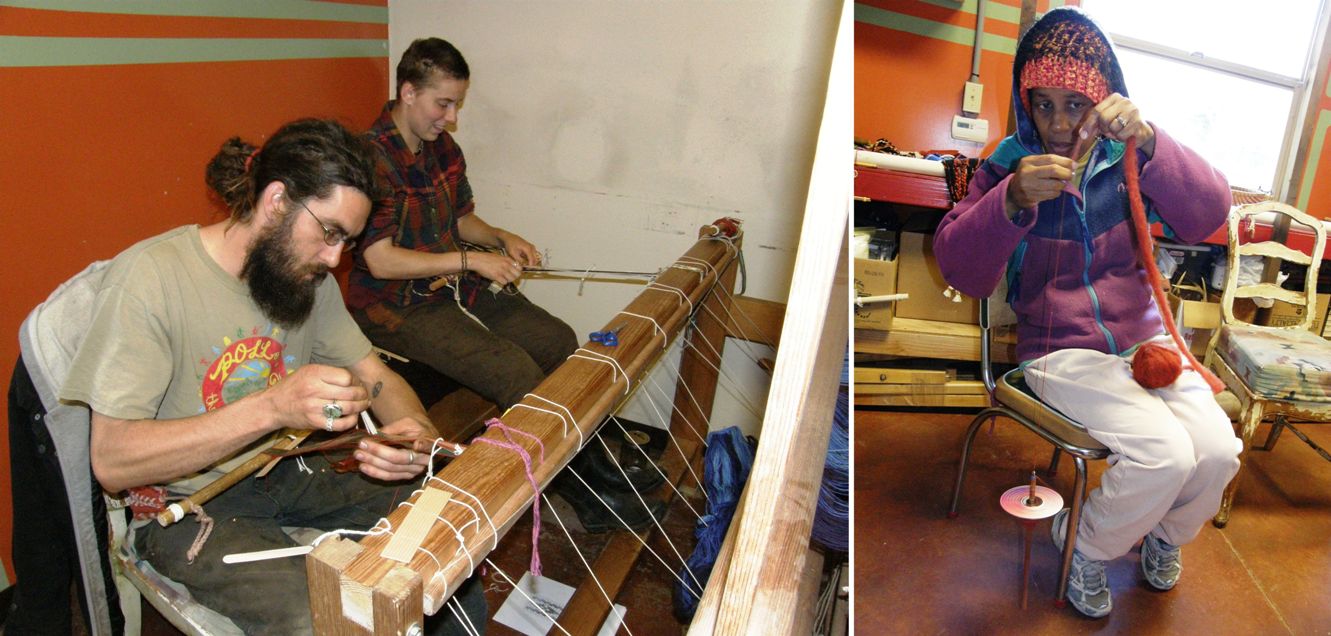
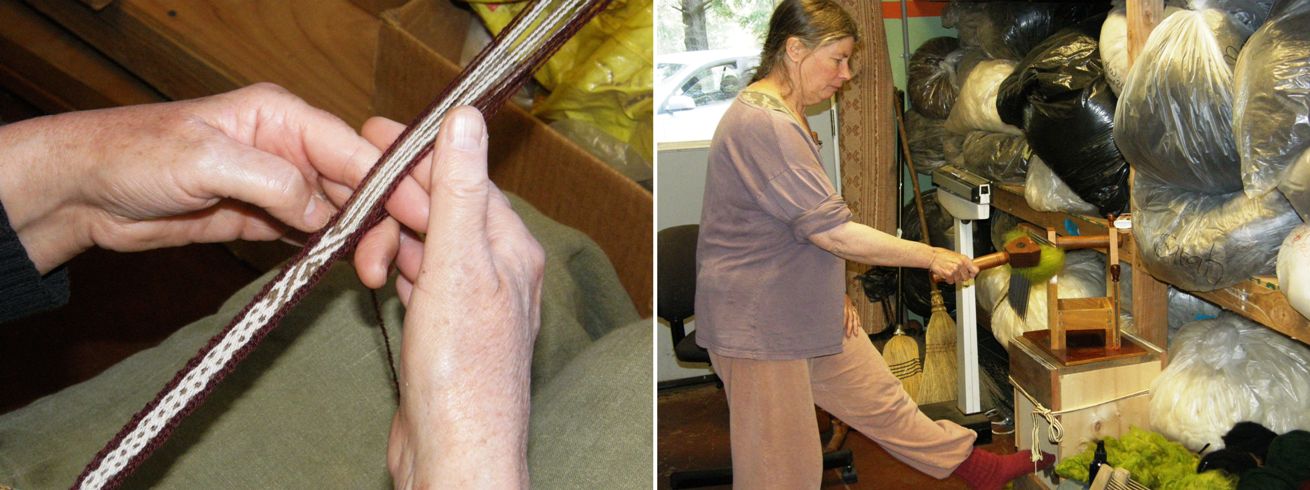
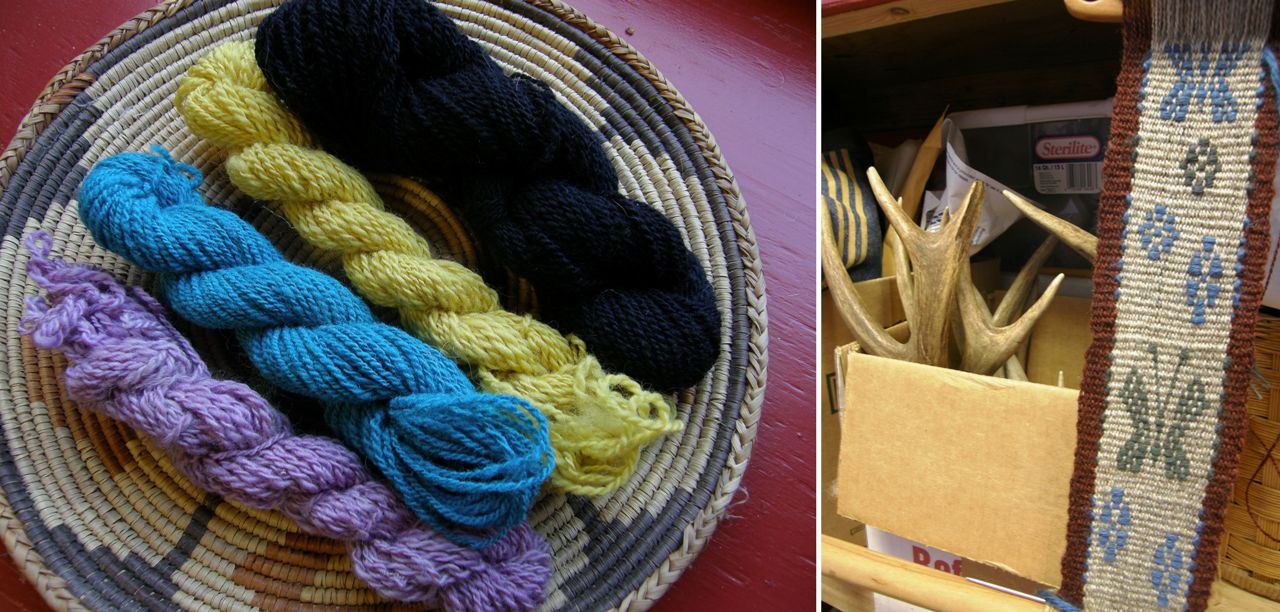
That’s Bobbie at the Black Sheep Gathering in Eugene Oregon last weekend. She met up with Jennifer and Janet, a couple of other Ravelry backstrap weavers and they were able to spend some time together weaving. That’s the early Oregon summer, still a little cool in the shade. Here in Santa Cruz Bolivia we are in the depths of winter as you can see on the right! I spent an afternoon weaving in the patio at my friend Lalenya’s house. There are only about ten cold days in winter here and that wasn’t one of them!

Thanks to everyone who visited my Andean Pebble Weave Facebook page. I am constantly posting photos and bits and pieces there. I hope you will continue to drop by and hit the “like” button.
Backstrap Weaving – The Final Stretch

The final stretch of my travels involved a relaxing week with friends in Maryland but has come to an abrupt halt in Miami airport.

I am, however, well on the way to being a seasoned standby traveler and am quite well prepared for such things although I have to say that I was pretty confident about getting my flight to Bolivia last night and, therefore, left a couple of essentials out of my carry-on luggage.

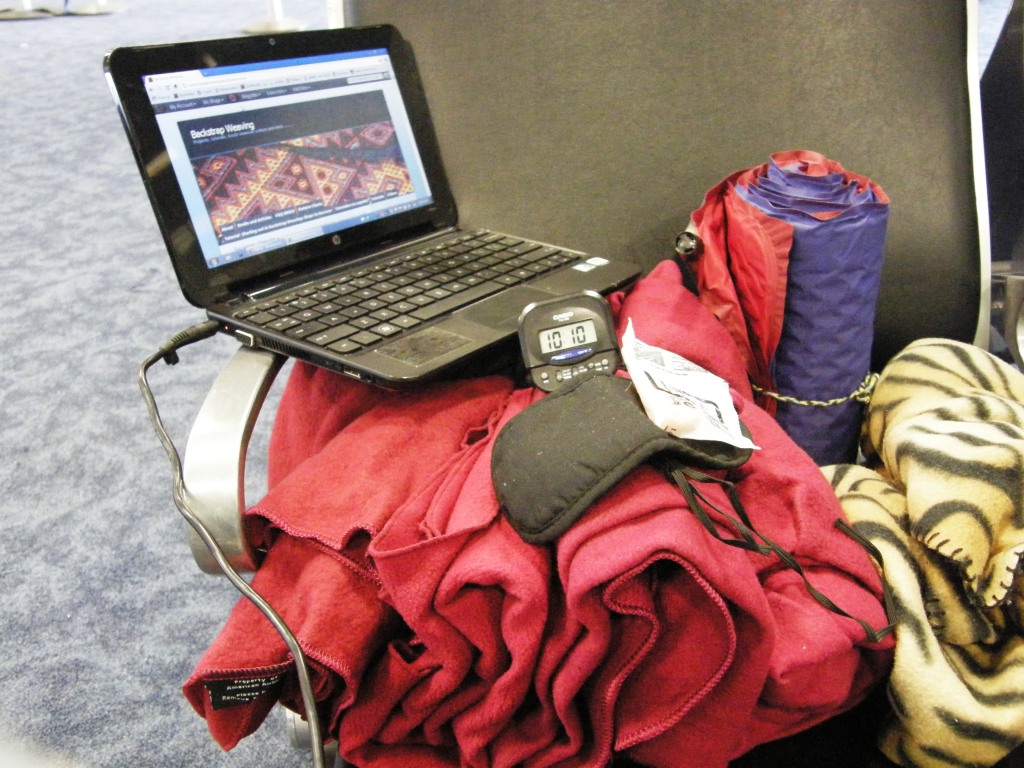
You can see my stranded-stand-by-traveler kit…mini Thermarest self inflating mattress, eye shades and ear plugs, a blankee from home, alarm clock and notebook. The airline gave me six blankets too as this airport is cooled to 60 degrees for some reason yet it is still full of goose-bumped ladies in strapless sun-dresses determined to show off their newly acquired Florida tans.

Once when returning from Guatemala I spent three very restful nights in this airport but MIA admin has come up with a kind of  torture in the meantime which has me desperately crossing all my fingers and toes in the hope that I will be out of here on tonight’s flight. Perhaps in an attempt to stop people like me who choose to use the gates as motel rooms, they have chosen to broadcast at ultra high volume the “current local time” every fifteen minutes but only during the night. This means you get to doze for a maximum ten minutes before being jolted awake by the announcement which is preceded by Big Ben-like “bongs”. I may have missed the 4.45am one but that is the only one! So, that alarm clock in my kit…didn’t really need that…and the ear plugs didn’t make a jot of difference. Ah well, all part of the adventure! At least I was warm.

So, let’s catch up…My last wove with my last group of friends in Pennsylvania enjoying the hospitality of Ron and Carol.

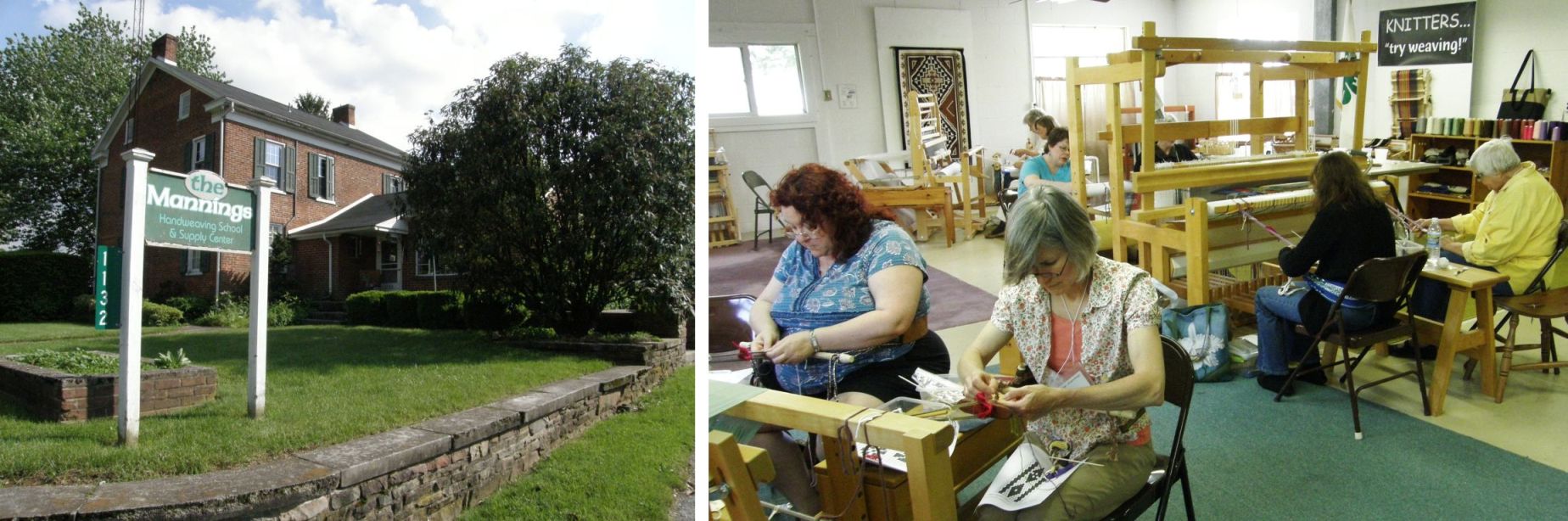
They found a great selection of yarns at the Mannings and went home planning to make their own backstraps using Tahki Cotton Classic (which should be used doubled for a sturdy backstrap) and Plymouth Yarn’s Fantasy Natural and also took a selection of luscious colors in the UKI 3/2 mercerized cotton which is a great general-purpose weight for backstrap weaving. We found belt shuttles that make good beaters too and I restocked my “poking stick” supply (the people who wove with me will know what those are!).

I made the three backstraps on the left from Tahki Cotton Classic.The blue used in the one on the right is Plymouth Fantasy Natural yarn..


Here are the ladies having fun and some of the nice color combos that they put together using the UKI yarn.

It was a fun visit at the Mannings and I plan to go back at the end of October.

From there I was whisked away by my friend in lovely Maryland, where there is still a member of the original family after whom the town is named running the local post office. I have a flashback to my first visit with Claudia last year during and after the Maryland Sheep and Wool Festival. I can’t believe a whole year has gone by since then.

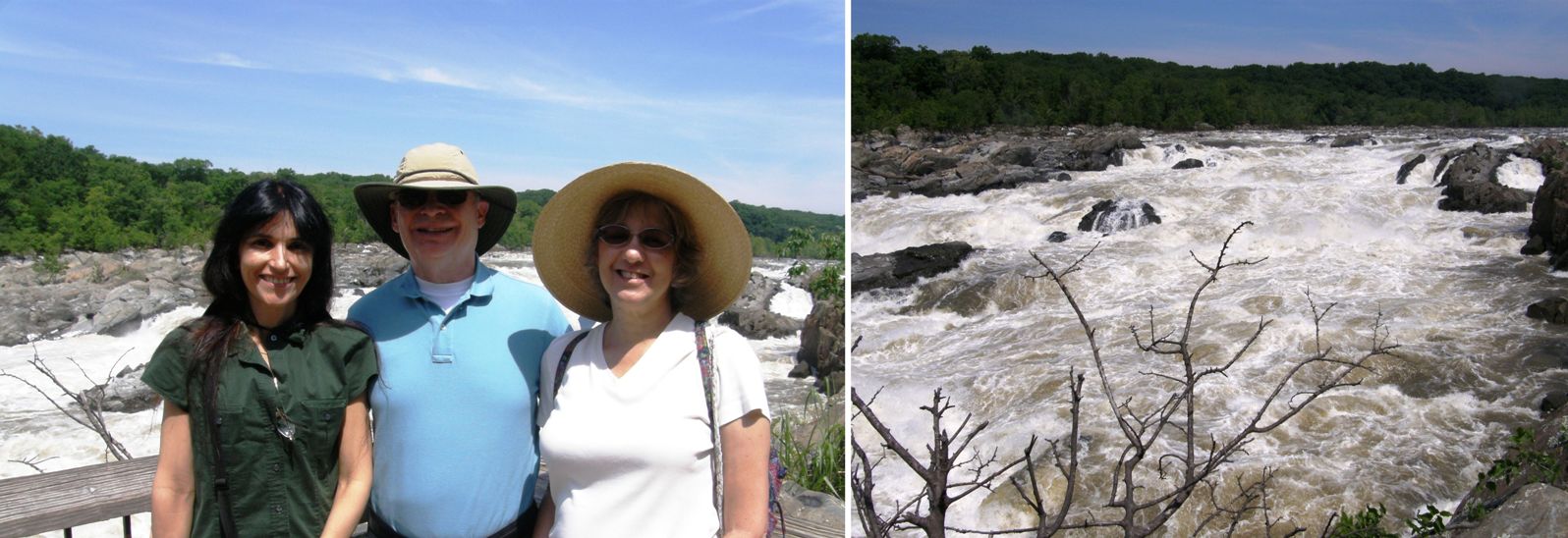
And there’s another flashback to last summer when I visited after Convergence. Claudia and David had taken me to see Great Falls which weren’t so “great” at that dry time of year but which were pounding mightily on this visit after snow melt and a particularly wet spring.

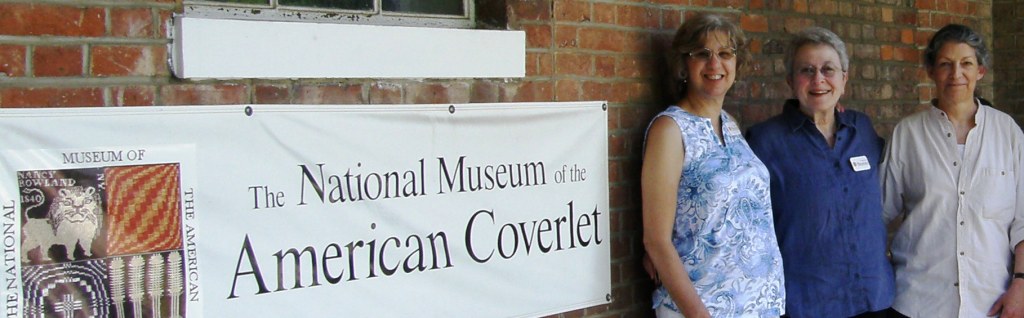
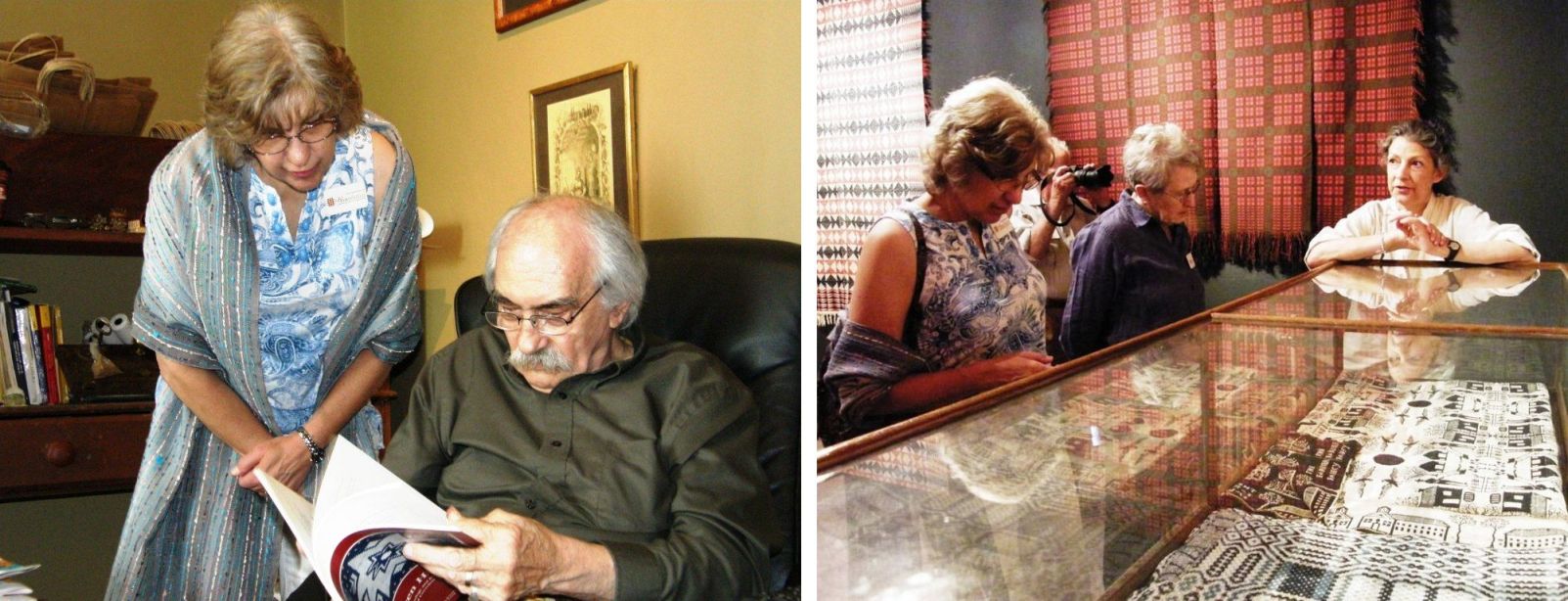
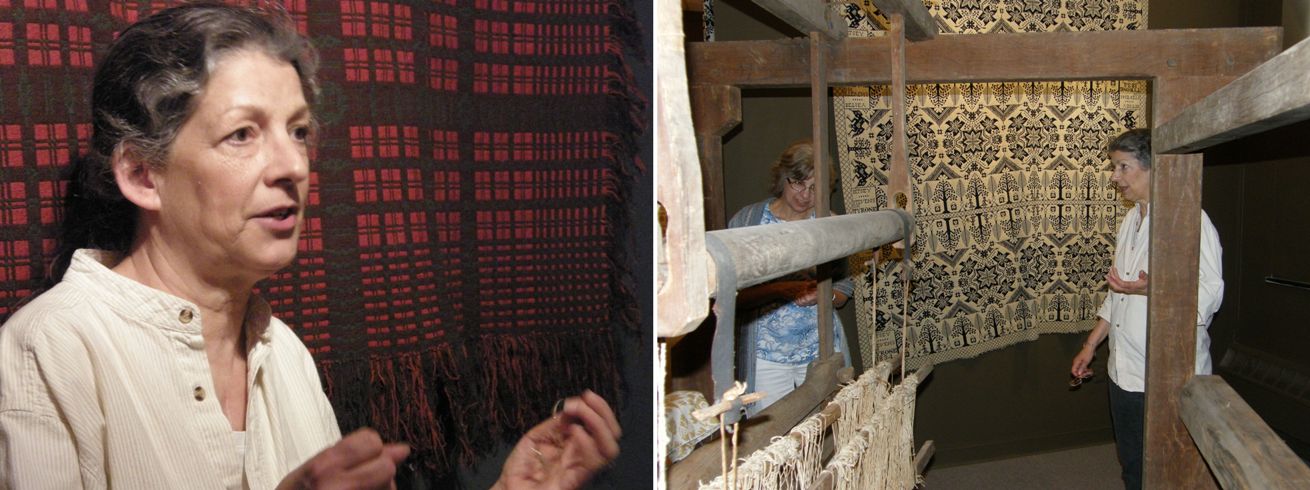
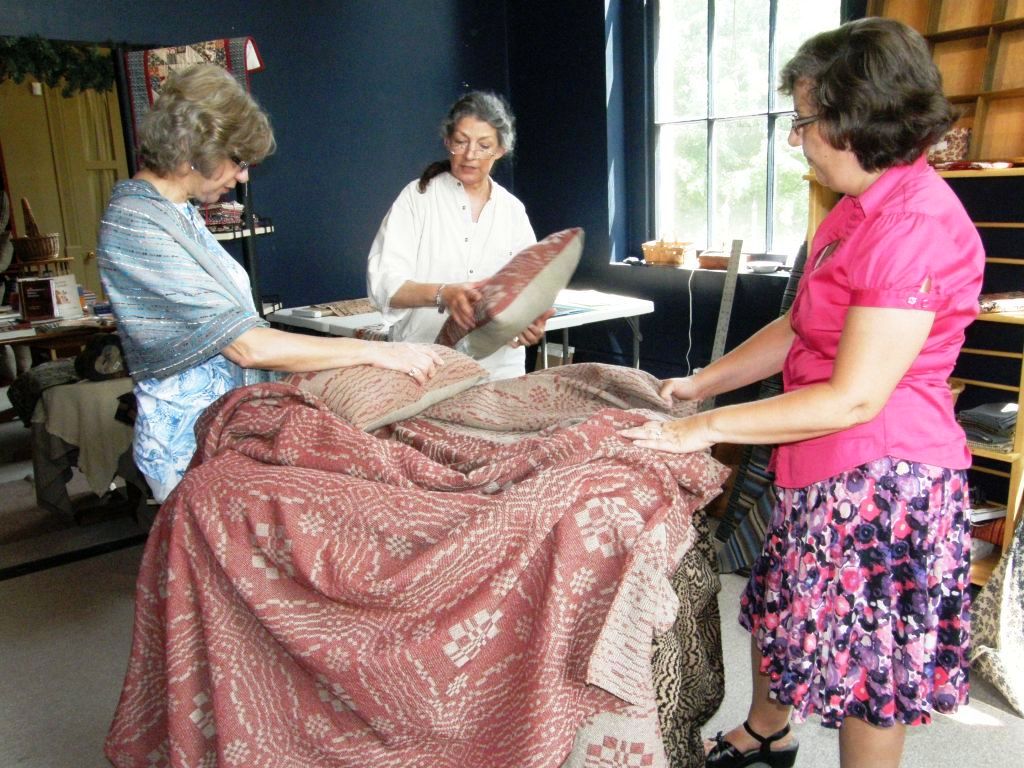
Last Thursday we had  a little Weavolution meet-up at The National Museum of the American Coverlet owned and run by Melinda and Laszlo in Bedford, Pennsylvania. If you are wondering what exactly a coverlet is, I will allow Melinda and Laszlo to walk you through all that on their website.

Last summer’s issue of Shuttle, Spindle & Dyepot (the one with my article :-)) featured an article on this museum.

Little did I know then that I would get to visit it with Claudia and knitting guild friend Karen, Dave Holly of 4-shaft pvc loom fame and weaver Alice Schlein with husband and photographer Bruce. It was fun meeting Karen and also Dave, whom I had seen online talking about his pvc loom. I had met Alice briefly at Convergence but we know each other online through our blogs and Weavolution.

Melinda gave us a personal tour and Laszlo provided some back stories from his post in the museum gift shop.

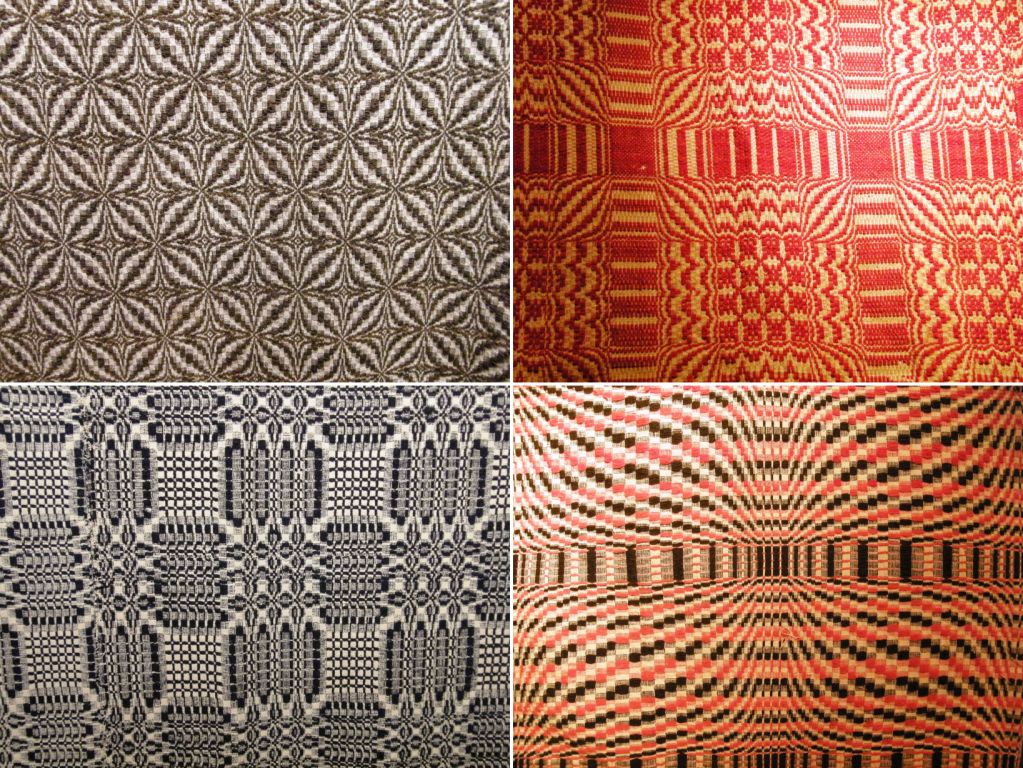
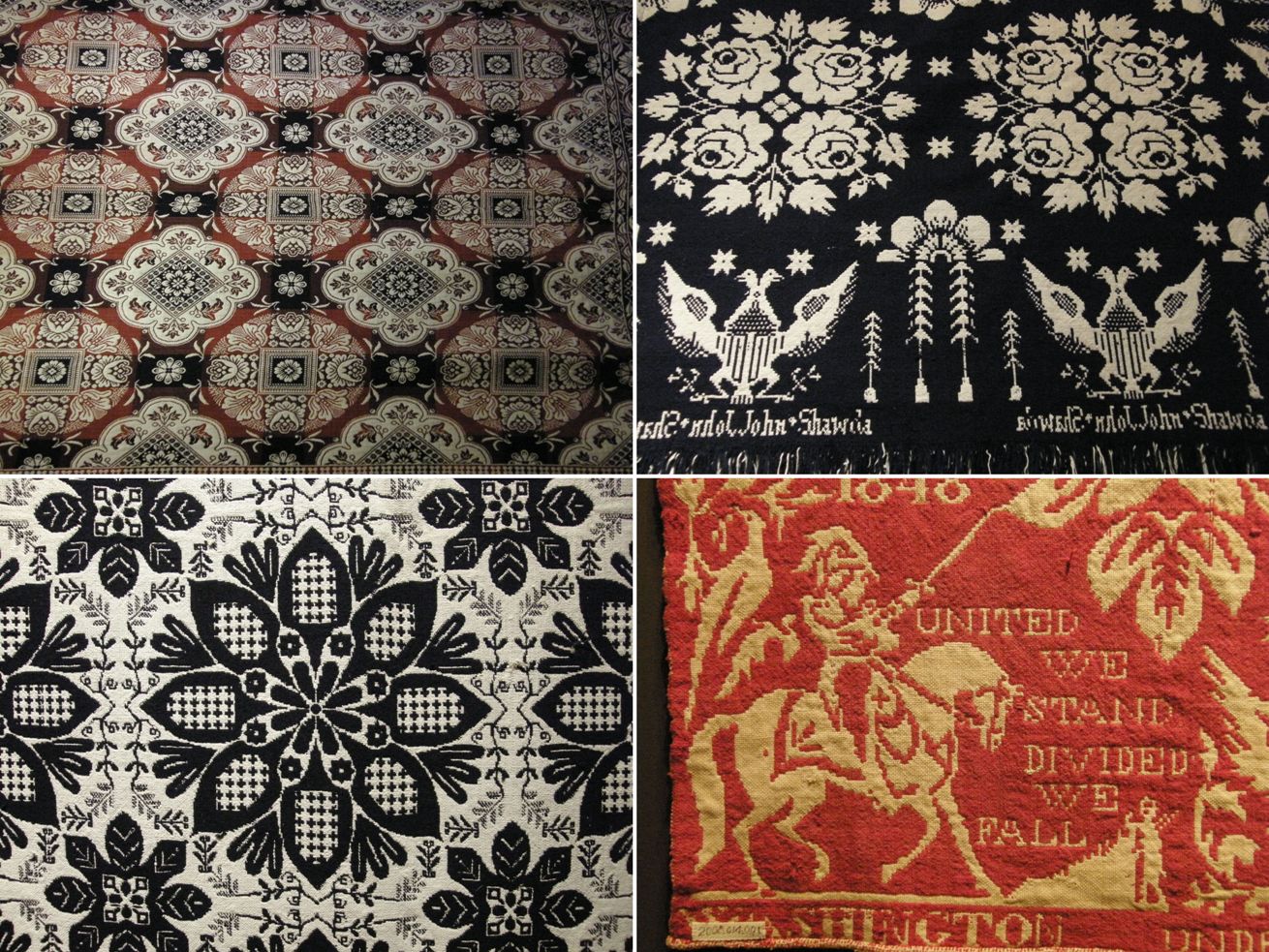
Let me dazzle you with some of the geometrics in the collection:

And here are some examples of what are categorized as “figured and fancy”:

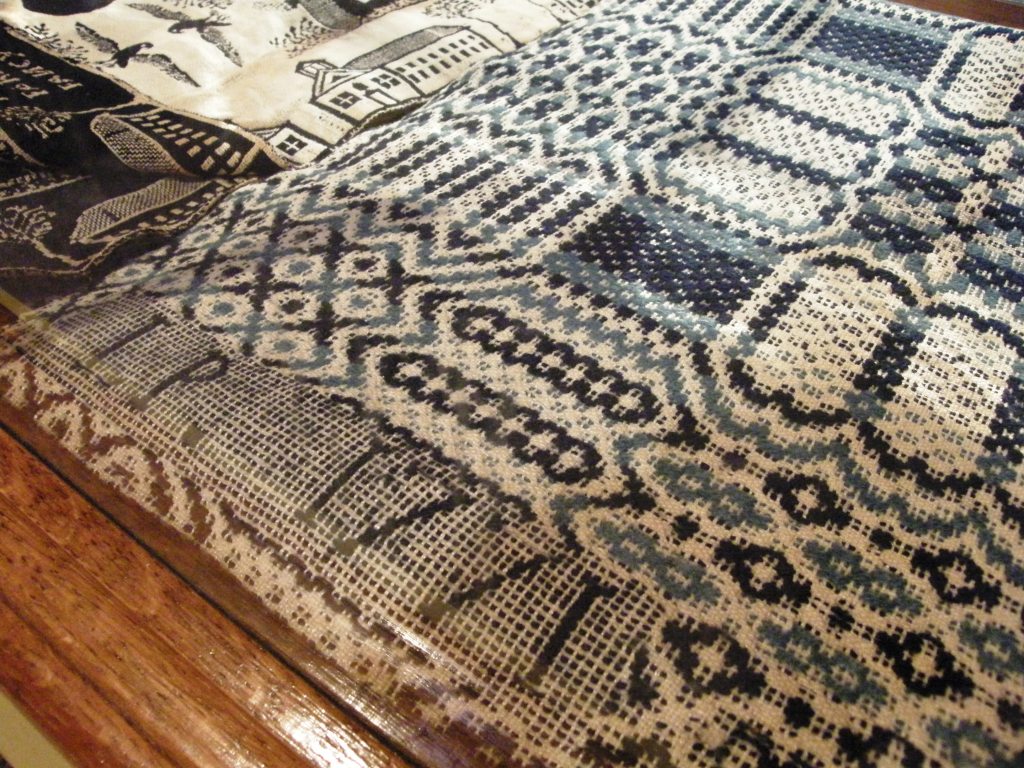
The oldest piece in the collection, pictured below, is dated 1771. The collection ranges from this year to 1889.


It was interesting to learn about the introduction of the Jacquard loom which made the “figured and fancy” designs possible. The designs are controlled by punched cards…

The pile of cards on the left in the picture above left, for example, was used by David Kline in 2010 to weave just the corner section of a coverlet with Melinda’s name. It is nice to see the names and inscriptions woven into the old coverlets which the Jacquard looms made possible and wonder about the weavers and the women for whom the pieces were made. As the coverlets were created by sewing two or three woven panels together, it was also interesting to see the extent of each weaver’s skill in aligning the designs on the pieces when they were joined.

Double weave coverlets have the names woven in such a way that when the coverlet is turned over to show its reverse face, the names can still be read on one of the panels.

Melinda with the Jaquard card attachment for a loom. The museum also has a collection of spinning wheels and looms.

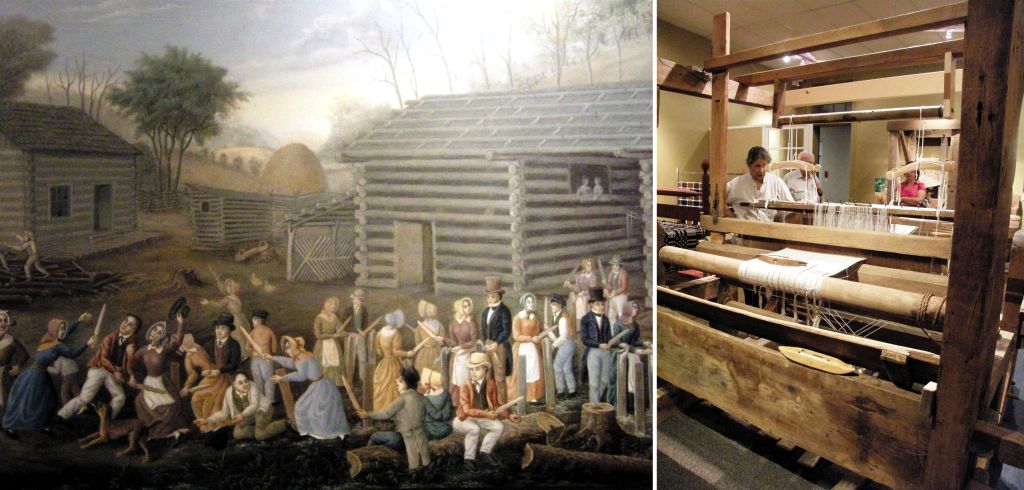
One room has been devoted to the processing of flax into linen.

The flurry of activity depicted in the above painting is a “Flax Scutching Bee” and the cantilever loom on the right dates back to 1760.

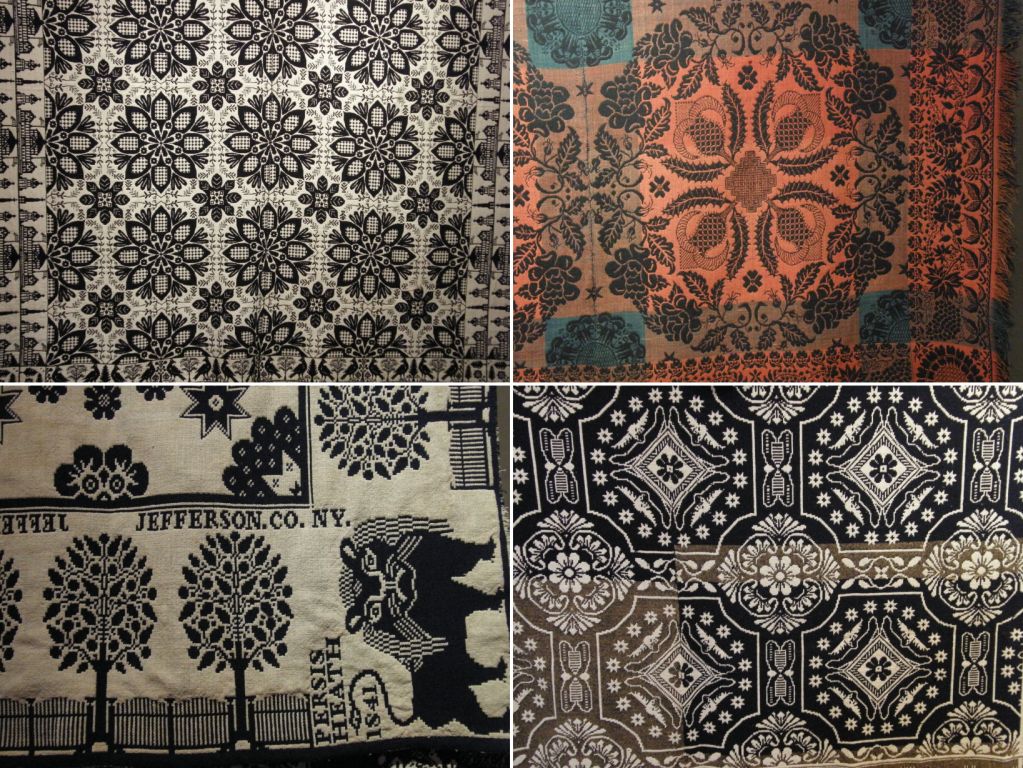
And more of those beautiful coverlets…

Melinda was a wonderful guide and her passion for the subject and this relatively new museum was apparent. Melinda would have stayed and talked with us there all afternoon if we had had the time, but many of us has long trip homes. Dave had traveled three hours to get there on what was his second visit. Lucky that Karen had shopped for a beautiful coverlet, pillow and throws before the tour. Claudia added to her book collection.

There was one more chance to enjoy the spring before heading back to “wintry” Santa Cruz. Of course I am kidding…there is no such thing as winter in Santa Cruz. The weather gets quite pleasant at this time of year…less hot and humid but never wintry.

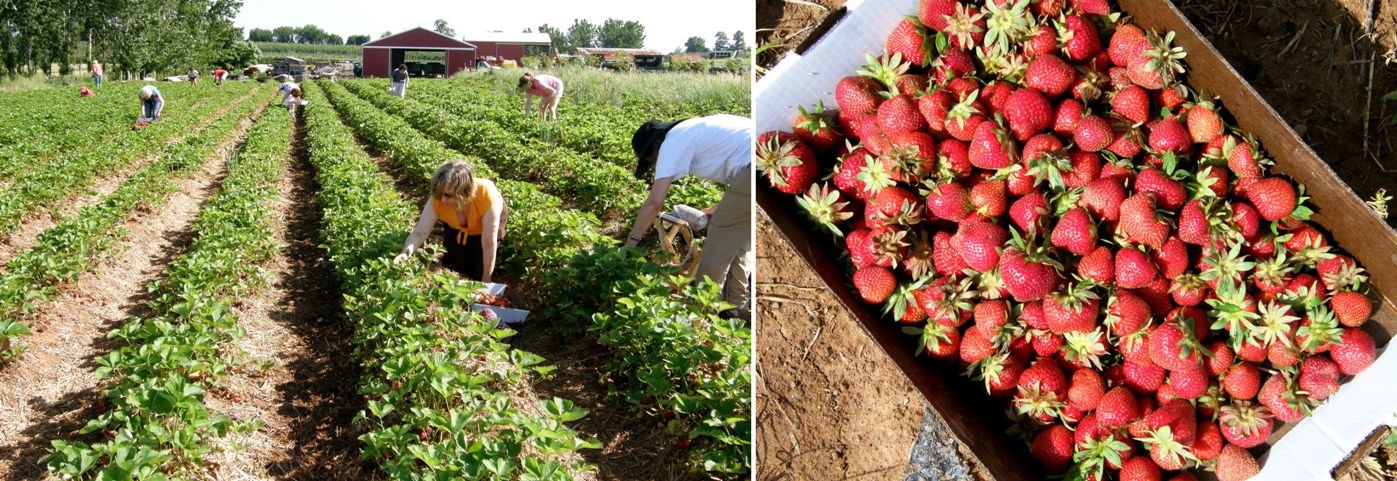
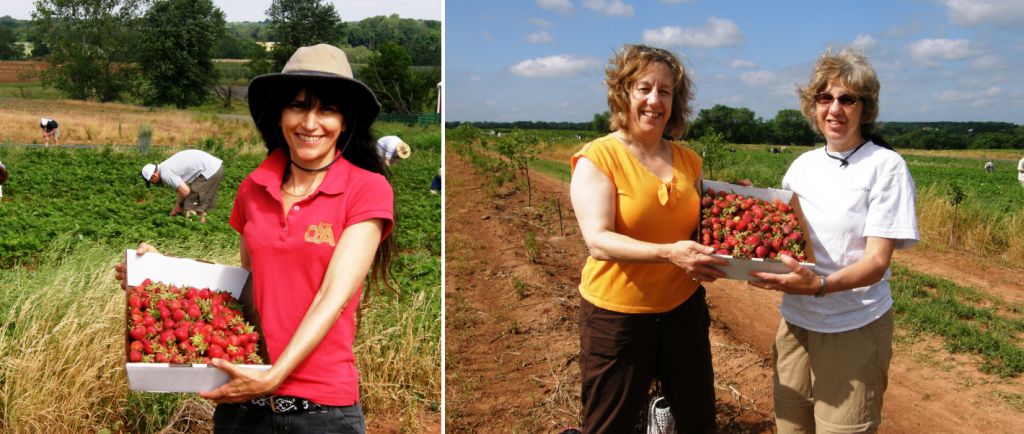
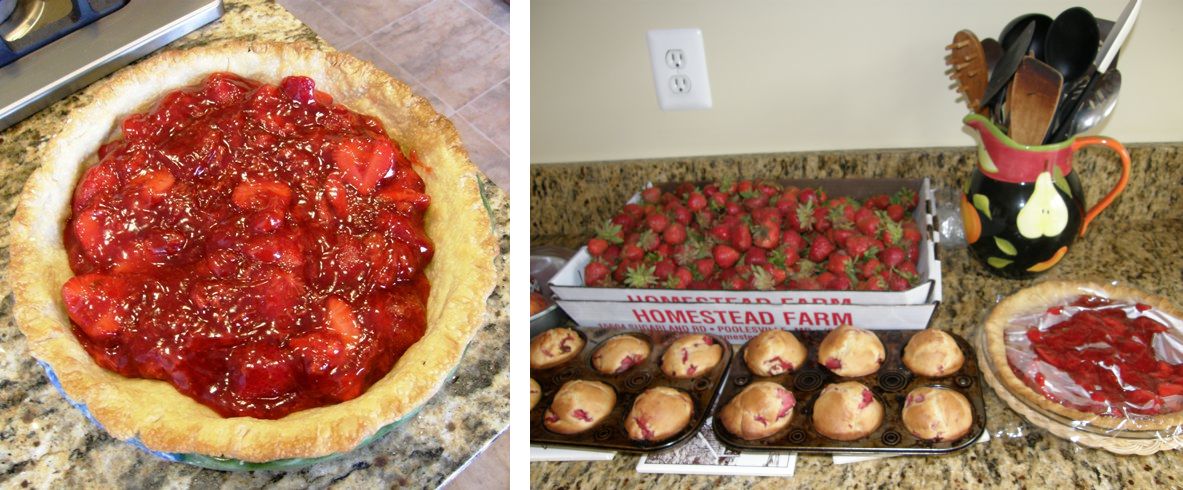
I had missed out on my friend Janet’s organically grown strawberries in Northern California as they were not yet ripe but there were ripe strawbs galore here. Claudia, Janet and I got up early on a perfect Saturday morning to pick with strawberry pie and muffins on the menu. Would you believe I had never picked strawberries before? We were done by the time the hoards started arriving and the sun started biting.

And the delicious results courtesy of Janet and Claudia…

So here I sit in Miami airport at the gate with two hours or so before my flight. Will I get on this time? My trip is done and I just want to get home to the loved ones and the loom! I haven’t woven for myself in about six weeks. Last night I made a list of all the things I want to get into and investigate as soon as the bags are unpacked. I got some wool from Knit Picks called Telemark that I want to play with too.

Thanks to Kim, whom I met through Claudia last year, I got to see a lot of different Knit Picks yarns and found that the Telemark variety which is a Peruvian Highland sport weight wool seemed to have a higher twist than the others.

I would like to see if I can weave with it on my backstrap loom without any re spinning at all but with the appropriate heddle management skills. It is described as having sturdy durability and sounds like it might do the trick.

I also have some really fine wool yarn that Ingrid from the Santa Cruz CA guild kindly sent me and I can’t wait to experiment with that too.

Note that I haven’t yet tried the Telemark yarn and I am not sure if this experiment will be successful. I will report on that soon.

In the meantime I can enjoy a couple of projects from online backstrap weaving friends….

Helena in Brazil made the pebble weave piece on the left using my book and patterns she has seen here on my blog while Sylvie in France is making the yurt band border using the simple warp float technique in alternating colors. The step-by-step instructions, which you can see she has printed, can be seen here on my blog.

Finally, I finished my time with my three dear Maryland friends with a lively Italian meal in Frederick followed by a stroll in the balmy evening, for that very last stretch of my trip, along the creek that runs right through the downtown area topped off by pistachio gelato…my favorite.

The creek is crossed in several places by bridges, some of which have been cleverly painted to resemble stone. Some are actually stone and we found ourselves walking up to touch them to see if the stone was real or a painting. It is quite likely that the difference is more obvious in broad daylight with heads not fuzzied by wine! I will leave you with this last image and you can decide…real stone or not?

Backstrap Weaving – Suddenly Spring

And suddenly it was spring!

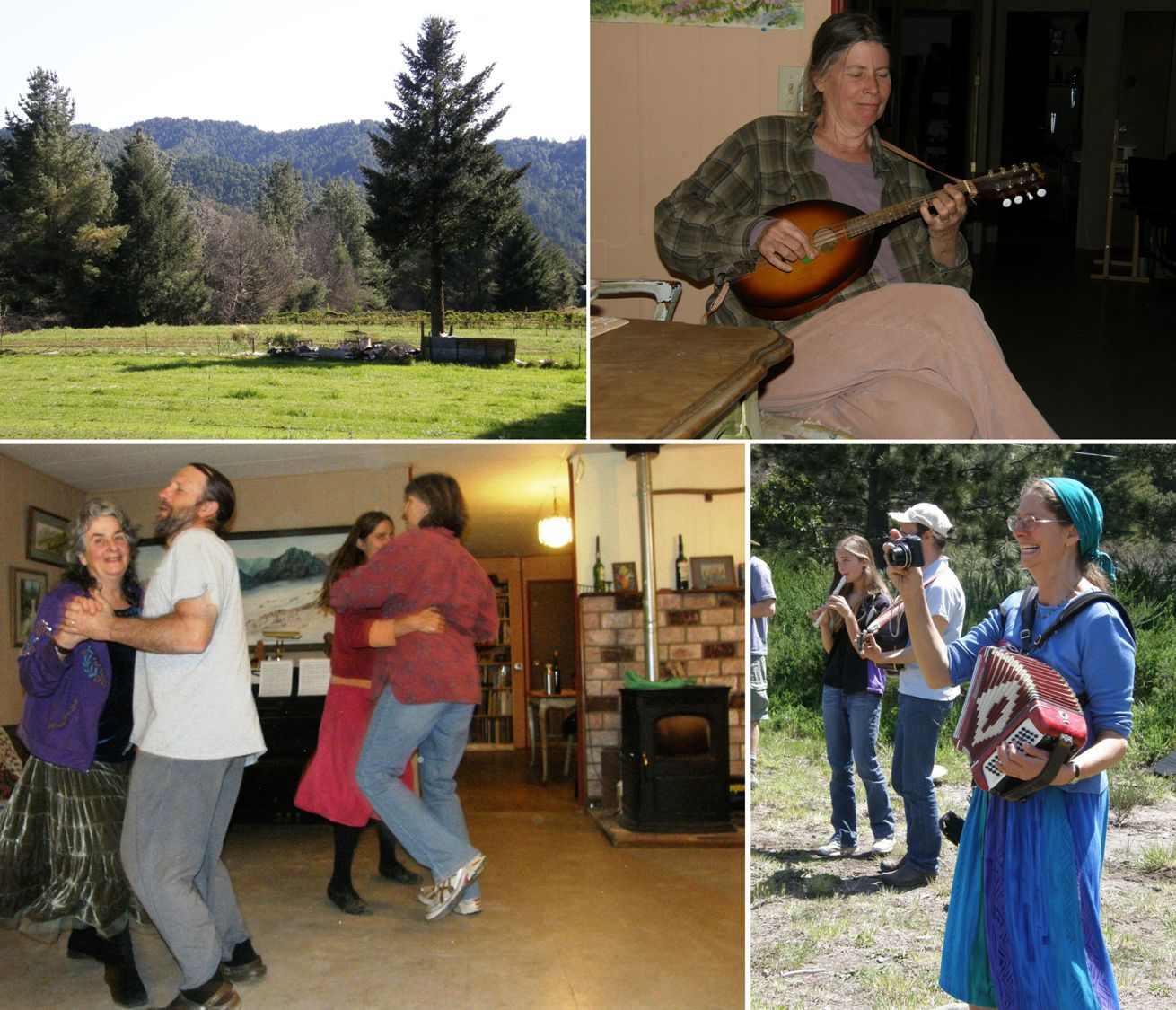
May Day…spring is here and a lovely day was spent outdoors at a couple of festivals around my friend Janet’s home in Humboldt County, California. I was happy to be out with my toes in the grass.

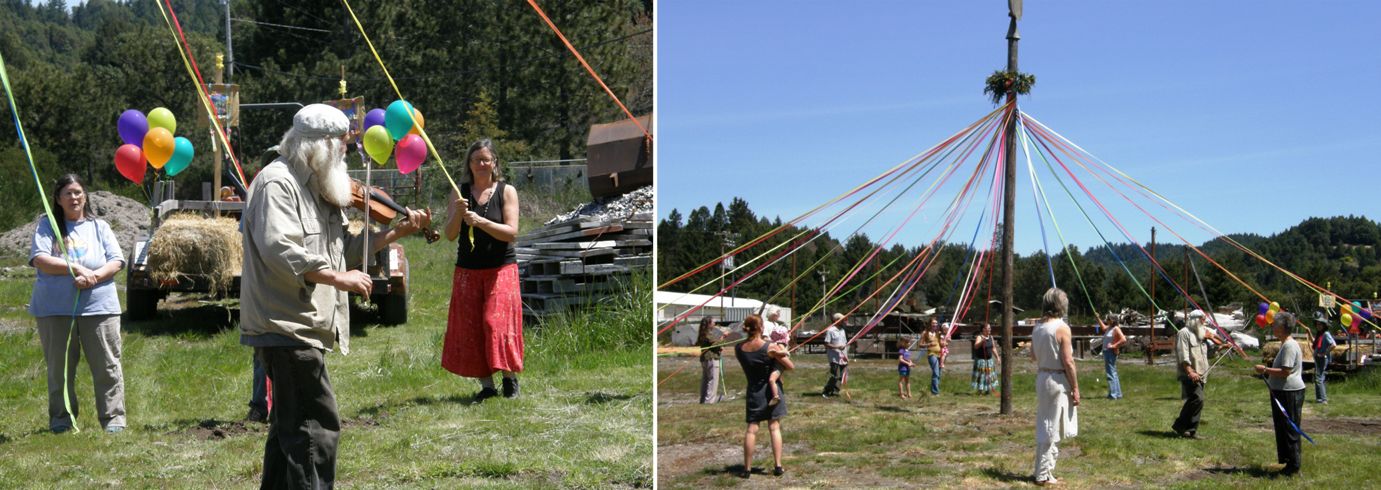
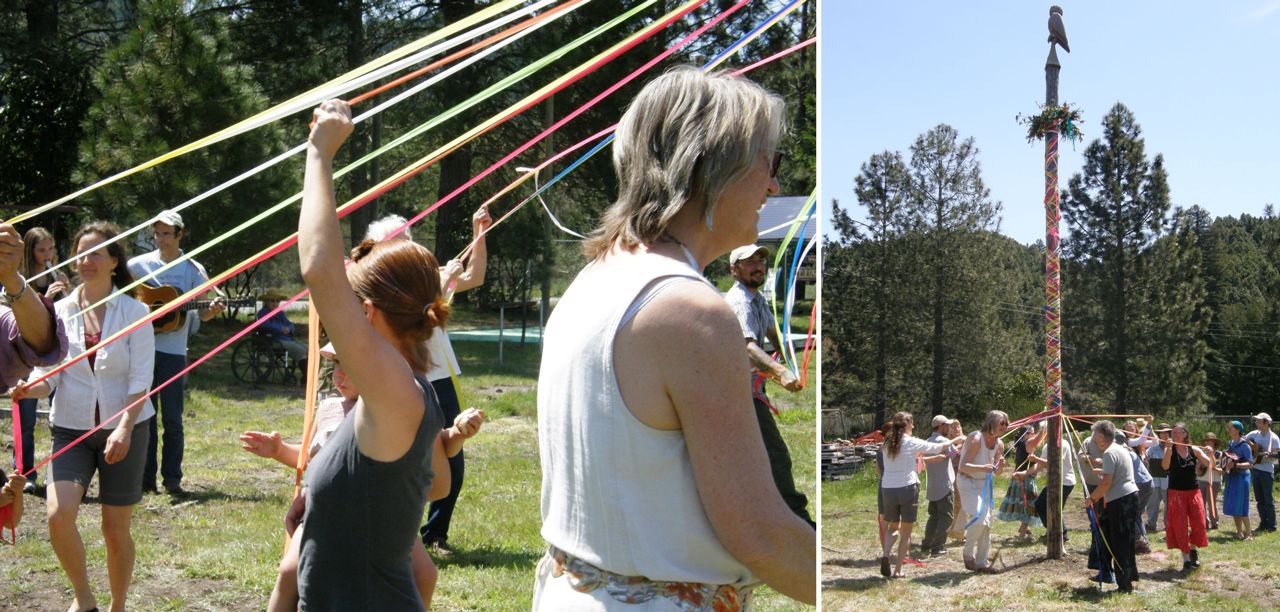
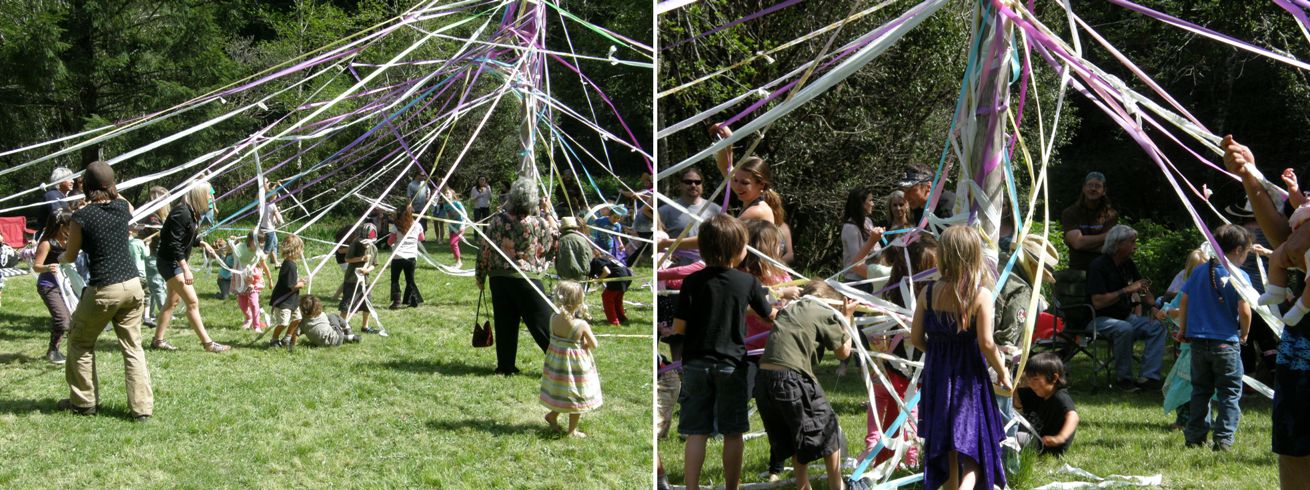
I had never attended a May Day festival before. I got to see the Maypole dance with participants of all ages weaving their colored ribbons as they danced around the pole.

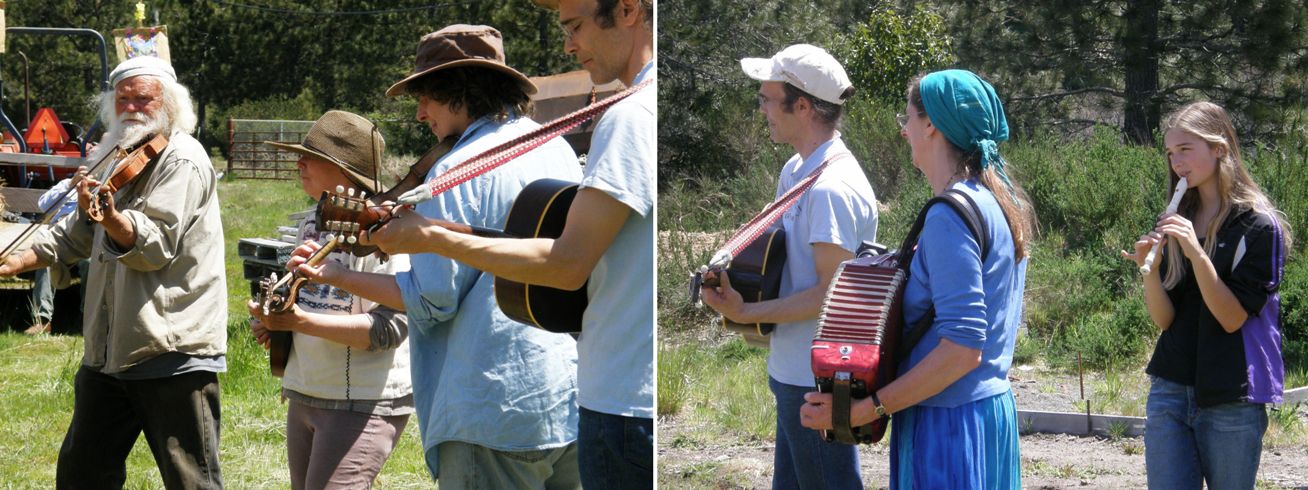
Everyone was “fiddled” into action by Joseph and a group of local musicians made up of Janet’s neighbors with Janet herself on mandolin kept the weavers’ feet moving. Janet’s neighborhood is full of talented musicians and singers.

My online backstrap weaving friend Cookie, who had come up from the Bay area to weave with the group at Janet’s Mill, also took part and I was the photographer.

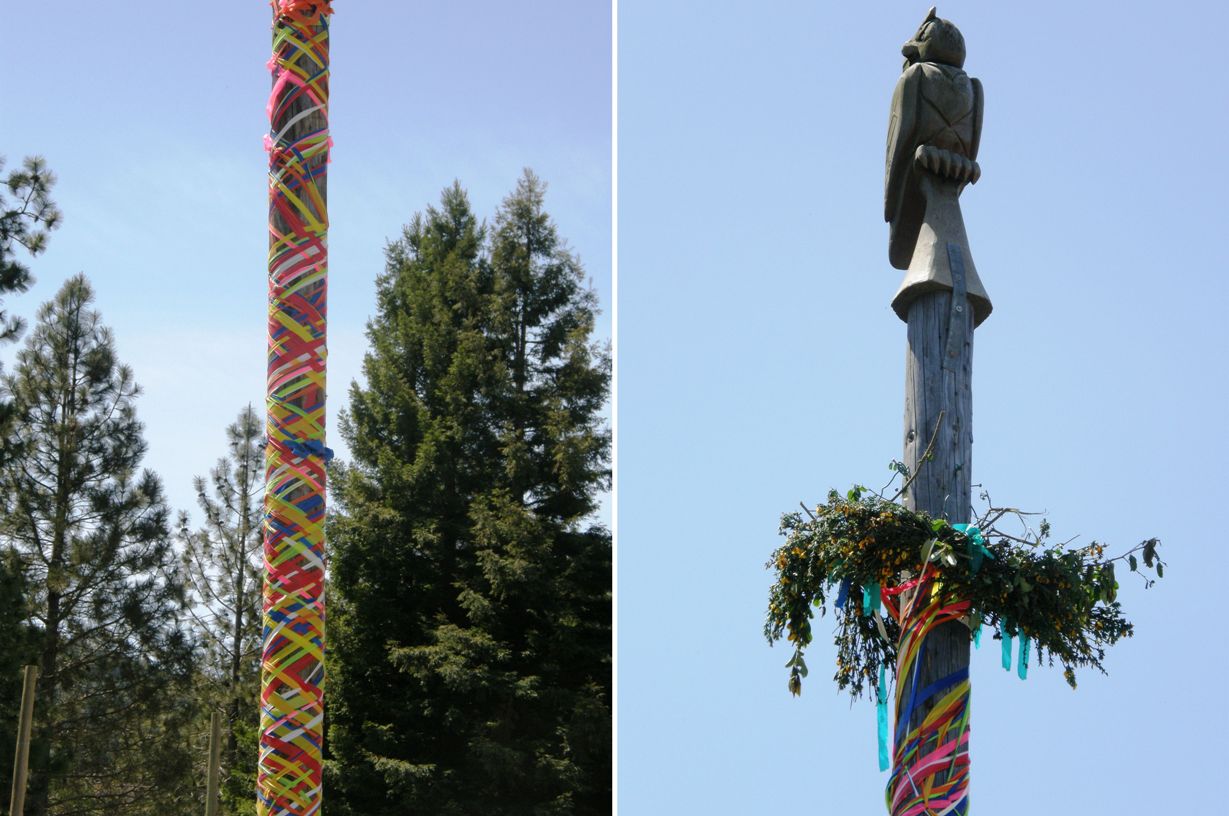
It was a very well organized dance and the weavers made a pretty wrapping for the Maypole.

Here is the “weaving” (or should it be called a braid?) that the dancers created.

I don’t know the origin of this tradition or what it is all supposed to mean and I don’t think anyone else did either…it was just a lot of fun and we couldn’t have asked for a more perfect day.

From there we took a hayride to a pond where we set little boats of lighted candles afloat and sang a song about a “river growing and flowing down to the sea” before enjoying the potluck lunch.

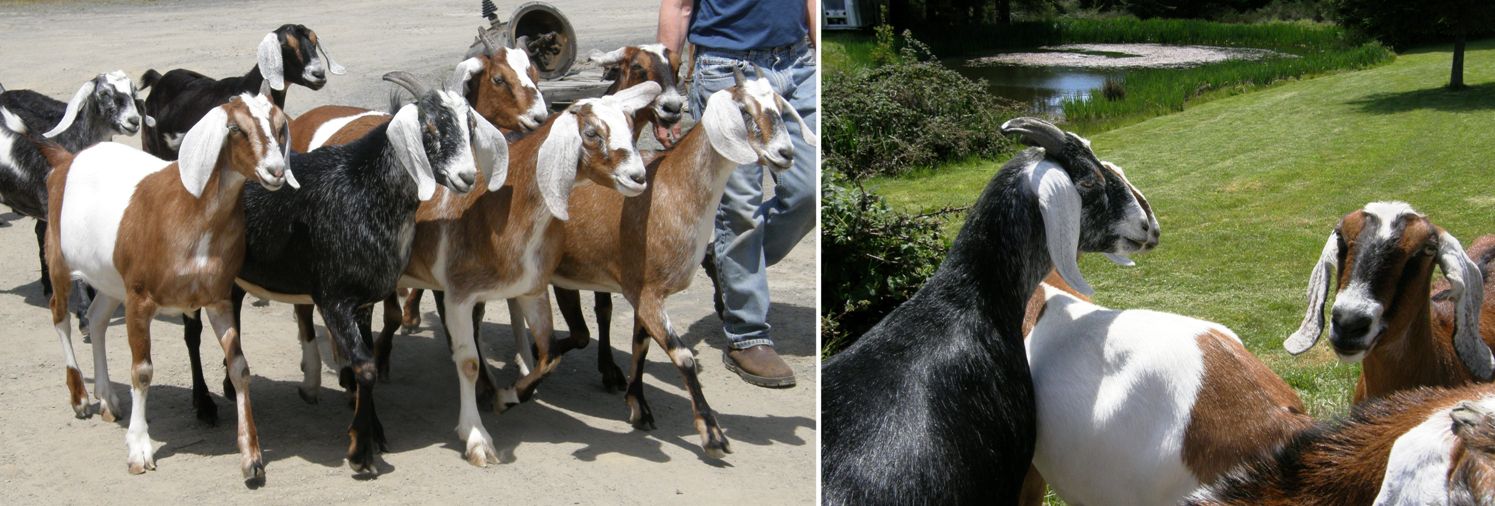
We had some unexpected visitors…these sleek, glossy and very friendly goats were out for an afternoon stroll and enjoyed nibbling the blackberry bushes while we lunched.

Most of the people from the backstrap weaving group were there and Gail brought the pebble weave band that she had gone straight home to weave after our time together had concluded. Now there’s a keen weaver and backstrap convert!

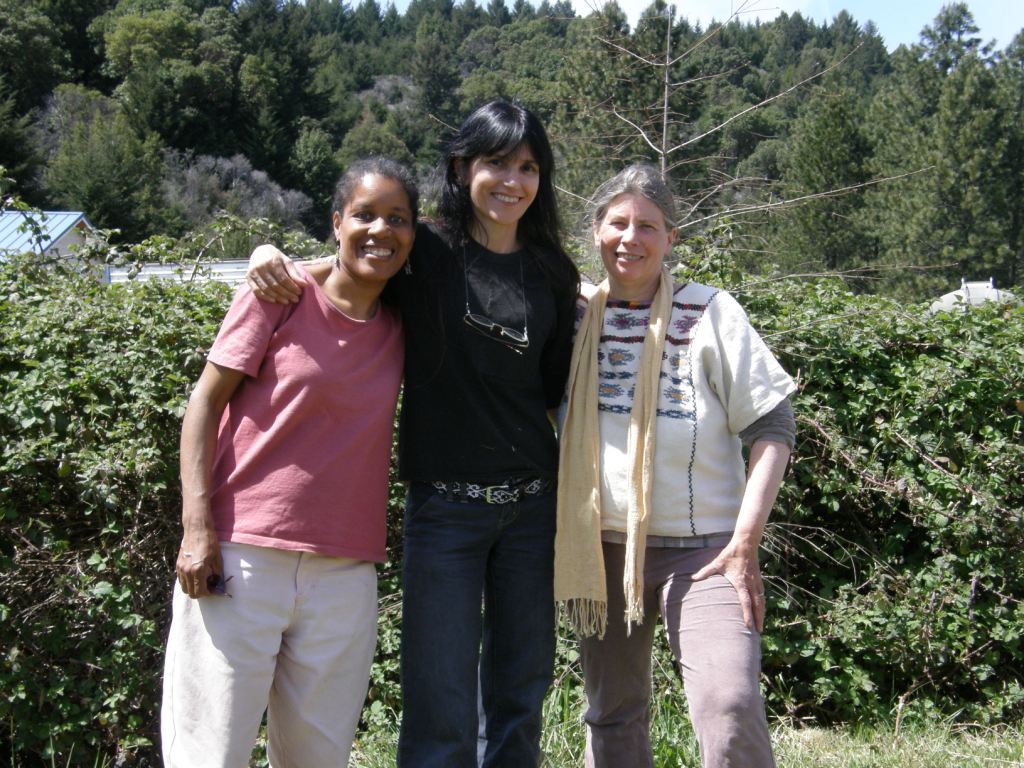
 Here Janet and I said goodbye to Cookie. She went home with the bands she had made in the weaving group and a lot of roving which she purchased from Janet to spin and weave into a backstrap.

From there we headed to another May Day festival with yet another Maypole dance. This one was something else all together! The musical instruments were somewhat different…

That’s Dennis at the bass. He was in our backstrap weaving group.

And the Maypole dancers/weavers, who were mostly little guys, started out chaotically and finished in a giggling heap with many of the weavers finding themselves bound to the Maypole and loving it!

Marimbas, flutes, upright bass, violins, guitars and mandolins…kids and dogs frolicking, good food and lots of sunshine.

It was a nice day and a nice end to the three weeks that Janet and I had spent together backstrap weaving with folks from southern to northern California.

The following day we drove up to Grant’s Pass in Oregon and parted ways. I took the bus to Portland and am staying just over the state line, over the Columbia River, in Washington at the home of Betty Davenport.

The weaving group at Janet’s Mill was fun. We had people come to weave for three days and a few day trippers came by too.

All of them were Janet’s friends, farmhands or neighbors. I had already woven with a couple of  them on my visit last year….neighbor Yani and Karen who just happens to be Bolivian and who lives at the Redwood Monastery.

It was fun to see those two again. Janet’s Mill was just the best place to weave in. We anchored the warps to shelves or to her floor loom.

Cookie and Janice are working here on warp float patterns.

Trying out four-stake warping.

Gail shows off her warp float band to Janet and that’s Tracy’s work on the right.

Janet warped a band in her own gorgeous handspun and wove in patterns using silk supplementary weft. It was beautiful!

Some unusual color combinations and warp arrangements were used. There are Dennis and Bev weaving together hooked up to Janet’s floor loom.

Getting the hang of those string heddles…..

Cookie was mad keen to make herself a new backstrap with her own handspun so she bought roving from Janet and started spinning straight away.

That spindle accompanied her everywhere and she had already spun and plied a good lot by the time she had to leave.

We took a stroll on the farm to pick asparagus for dinner. What a wonderful thing to be able to pick and eat food like that. Asparagus is great raw too!

There’s Cookie with spindle and asparagus in hand.

On the last day we got to use Janet’s handspun for pebble weave and we got to see how she combs and prepares for worsted spinning.

Her supplementary weft patterned piece turned out so well and she is spinning right now in preparation for Sara Lamb’s workshop on knotted pile at CNCH. Look at those gorgeous colors!

And with the final day came spring, the day before May Day. We got to stretch out on the grass for lunch and take a little extra time to admire some things that people had brought along to show.

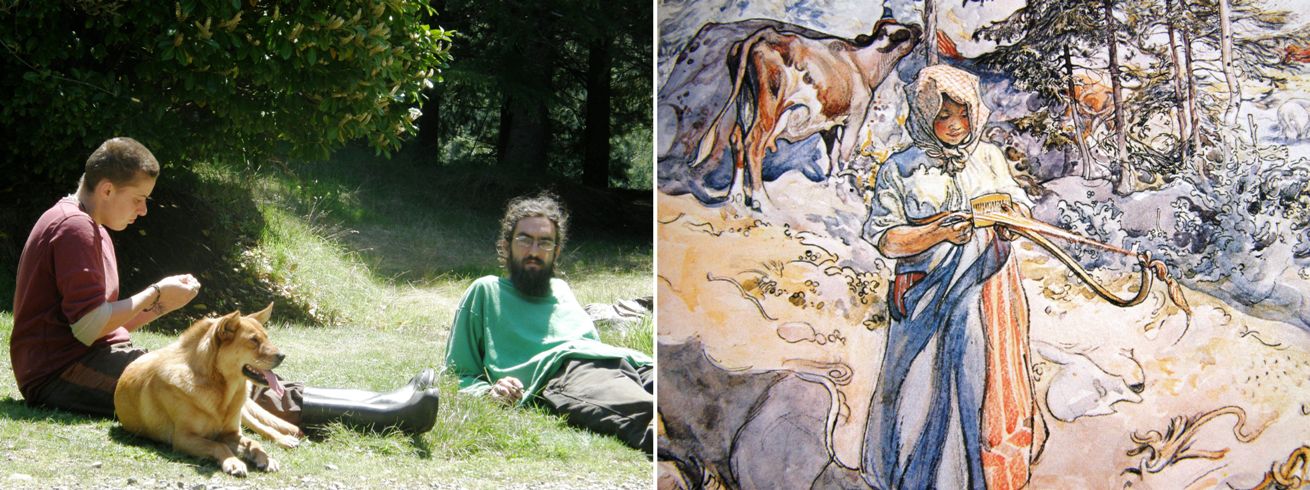
Tracy brought a book by Swedish artist Carl Larsson which included this great painting of a young weaver and her unusual loom. Having since Googled Carl Larsson, I see that he often included weavers in his artwork.

Janice brought a bag that she had made in needlepoint using an Anazasi design and Tracy showed a wonderful piece of tartan that she had made on her floor loom. Tracy is often commissioned to reproduce historical pieces but this is a new tartan that she has created which will be registered.

The time comes to move on and say goodbye to the farm, the fiber, the fun people, the music and the Irish dancing (yes!, I got to join in on the Tuesday night Irish dancing!).

Now I am up in Washington State…not my first visit here.

I spent three weeks in Seattle in 1992 on my way to Banff and Jasper National Parks. I got to Seattle on the Memorial Day weekend, went to the Folk Life Festival which was amazing and ended up staying! I never made it to the parks and got, what I later learned to be, three very rare weeks of dry weather.

As I speak it is raining hard outside and the wood is crackling in the fireplace. The spring sun hasn’t quite made it up here yet but I am enjoying Betty’s beautiful home on her tree farm in the woods.

And guess who is back in the backstrap loom? I am staying in Betty’s gorgeous studio flooded with natural light with a wall of windows looking over her blueberry field. We have Bolivian music playing and a woven treasure on every wall space. You can imagine I have been having a nice time and I will share all that with you next week. But let me introduce my new pet-withdrawal buddy – “Frank Sinatra” is his official shelter name but he is better known as “Trouble”.

Yesterday I gave a slide show for the Portland Handweavers Guild and got to meet two online backstrap weaving buddies from the Ravelry group who came along as guests…Bobbie and Jennifer with her husband Doug. We have a really nice warm community there in the Bcakstrap Weaving Group and both Jennifer and Bobbie have had a big hand in creating and maintaining that welcoming fun atmosphere. It was fun seeing some of their backstrap woven pieces in person. That’s Jennifer there in the middle.

Now Sally has come to stay at Betty’s place and we are  heading off to Linda Hendrickson’s studio tomorrow to backstrap weave. Sally brought along her pieces of Raven’s Tail and Chilkat weaving…yes! weft twining! How cool is that? But this is just a teaser as you will have to wait until next week for details. I also got to visit a wonderful Native American Art museum called “End of the Trail” on the way up to Oregon (thank you Janet and Larry!) and got to see my first Chilkat blanket up close and some amazing basketry, hats and other craft pieces…all being saved for next week, sorry!

Let me end by showing you what the Ravelry guys and online friends have been up to…

Amber, aka lavitaaj, is weaving the “rolling river’ design in double weave. I learned it in a complementary warp-float weave but it works beautifully in double weave. This is charted in Adele Cahlander’s book on Bolivian weaving. Helena in Brazil has woven a couple of bands using patterns she has seen on my blog…one is a pebble pattern that I put together for key fobs and the other is based on a Tarahumara design.

Dyggvi who is a new participator in the Ravelry group is weaving a balanced weave piece on her backstrap loom using tshirt strips as weft. Yonat sent me a picture of her progress on the sample bands we wove down in Santa Cruz.

Marsha completed a backstrap on her backstrap loom and has been teaching her friend Dana to weave on a backstrap loom…spreading the obsession! That’s Dana’s learning piece on the right.

Reetta in Finland has been weaving traditional Chinchero designs on narrow bands just as the young girls in the Cusco region of Peru learn to do.

And Eladio in Mexico used my book to get himself started in Andean pebble weave and has now gone on to chart and weave his own designs on wide warps! What a stunning pattern.

How amazing is that! Red and black are always so spectacular together.

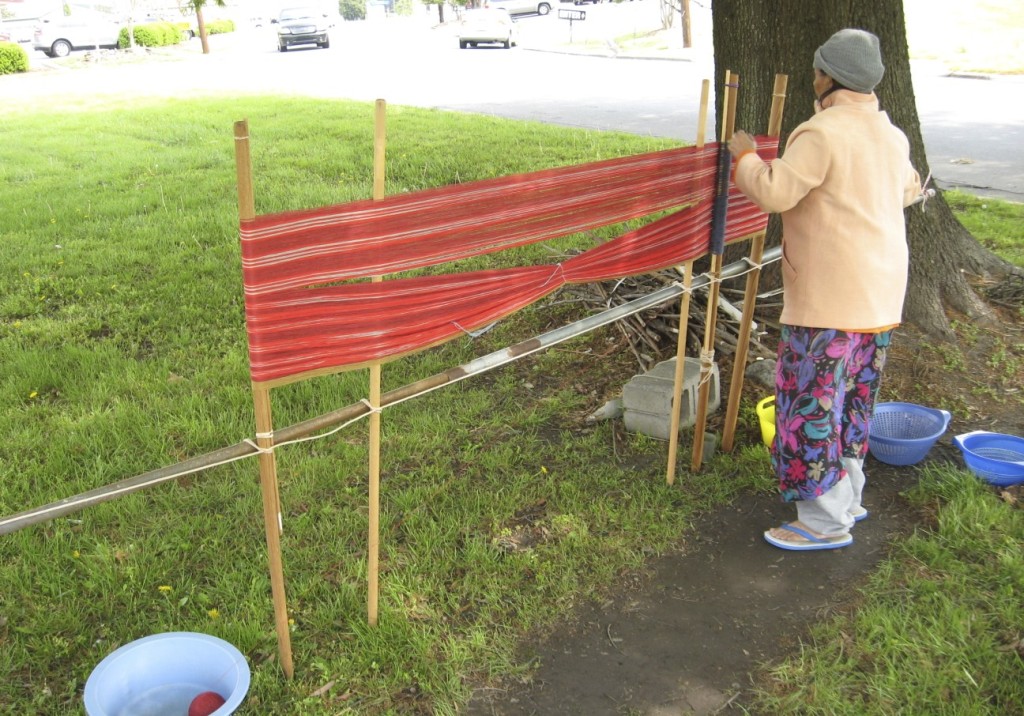
Betsy Renfrew sent me a picture of my Montagnard weaving teacher Ngach warping outside her home in North Carolina. Betsy arranged for the weavers to do a demonstration on the May Day weekend and I am looking forward to hearing how that went.

And finally, I ran across a nice video put together by Synergo Arts showing the ergonomic bench that they are having built in Guatemala for backstrap weavers to enable then to work at their backstrap looms more comfortably. Until now I had only seen pictures of this bench. It’s great to see it in action.

I am saving a lot of great stuff for next week’s blog post. See you then 🙂

Backstrap Weaving – In Their Own Words

As March rolls to a close, so ends the first month for my e-book Andean Pebble Weave in its new home at Patternfish along with its German companion Pebble Weave – Gewebte Bänder der Anden.

I want to once again thank Syne Mitchell of WeaveZine, Julia Grunau of Patternfish and all my new customers who have made this transition to the new home so smooth and successful.

I have had a few things going on the loom this week…mostly bits and pieces that I will take along traveling with me…. gifts and such things.

I wanted to free up all my loom bars and have everything in order before the trip and, in doing so, unearthed one more old project that was lurking in the closet.

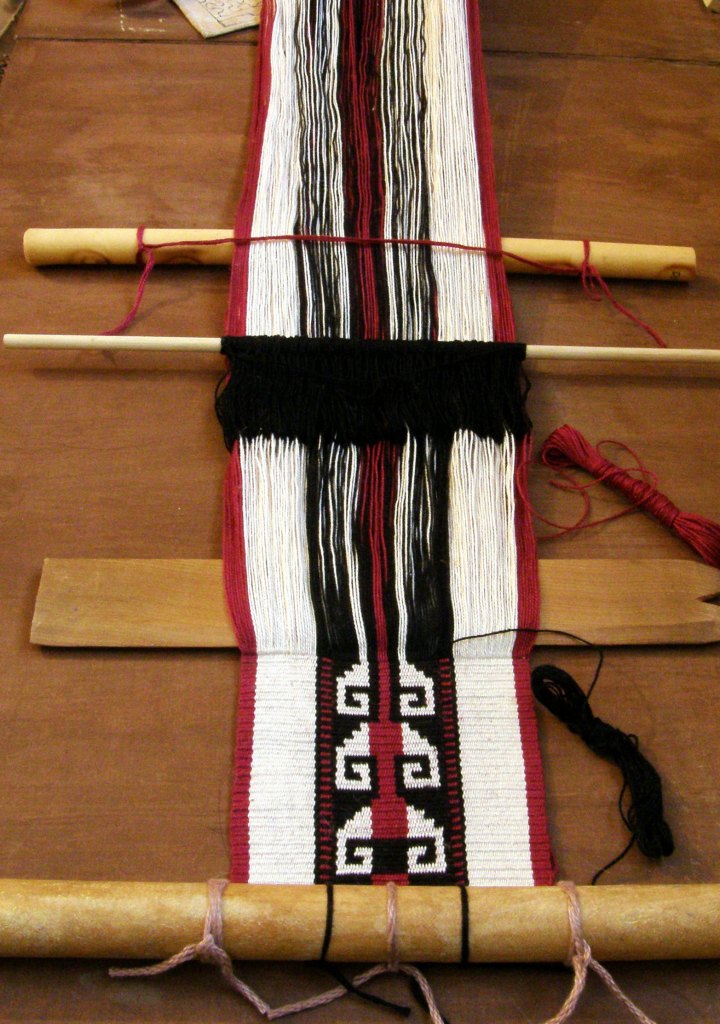
This was to try out a Mapuche double weave motif that is in the Taranto book. I wove it in two-weft double weave so that only the central section with the design is in double weave.

I really couldn’t see myself finishing it and so off it came. As the beige sides are just regular warp-faced plain weave, they folded very neatly and easily along the edge of the double weave section and I was able to just sew a join. Now the MP3 player has a fancy home.


I’ll braid a cord for it. Hmm, might even do one for the player itself. Now I don’t feel so bad about pulling this off the loom.

Then I was prompted to do a little further exploration in supplementary-warp bands, you know that technique that I have never been too excited about. I learned it in two places in Peru and in another in Ecuador but never quite took to it. Well, I have to tell you that I am loving it now!

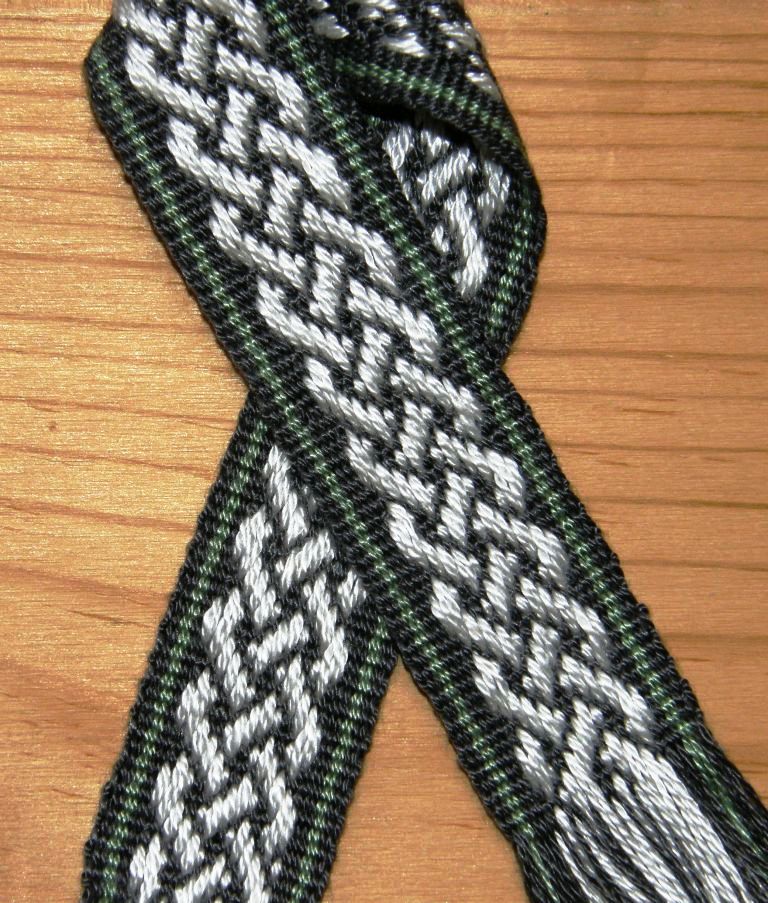
First I tried a Sami pattern (in non-traditional colors and border in 24 wpi crochet cotton) and then dug out my handout from a Robyn Spady class and used her chart for a Celtic design (in tencel) and now I have reproduced a design from one of the Russian Old Believer belts that I photographed last year. There it is in the center.


This was a width sample with some 3/2 weaving thread that I hadn’t used before. The ground warp and weft is 35 wpi crochet cotton. When I do the “real” band, now that I have established the width, I will warp an edge of off-white so the weft won’t be seen as it is above.

As it so often seems to happen, just as I was thinking about the Russian Old Believer bands, I got a comment on my blog from a visitor. Natasha provided some links to a lovely site with gorgeous Russian bands and a three-holed wooden rigid heddle. I understand the way the two-holed version works and Grace Hatton has done a lovely job of explaining that in her article on WeaveZine, but I am not so sure about this three-holed variety.

Anyway, here is Natasha’s comment…(hopefully she will send pictures of the bands she made herself)

Hi Laverne,
The design found on the belts from a Russian online store is very close to what I see on the old believers’ belts.
The weaver’s name is Svetlana. She lives and teaches weaving and other crafts in Moscow. You can see some pictures taken at the craft exhibition last year. I recently purchased a wooden implement (not sure what the proper name is) from Svetlana that is used for belt weaving and wove my first two belts. It is called berdo in Russian. The interest in traditional crafts has grown in Russia too in the last ten years, at least as far as I can tell without being there. If you need anything translated from Russian I can help.

Natasha.

########################################################

You may remember that I attended a weavers’ conference here in Santa Cruz a couple of weeks ago and dedicated a couple of blog posts to it.

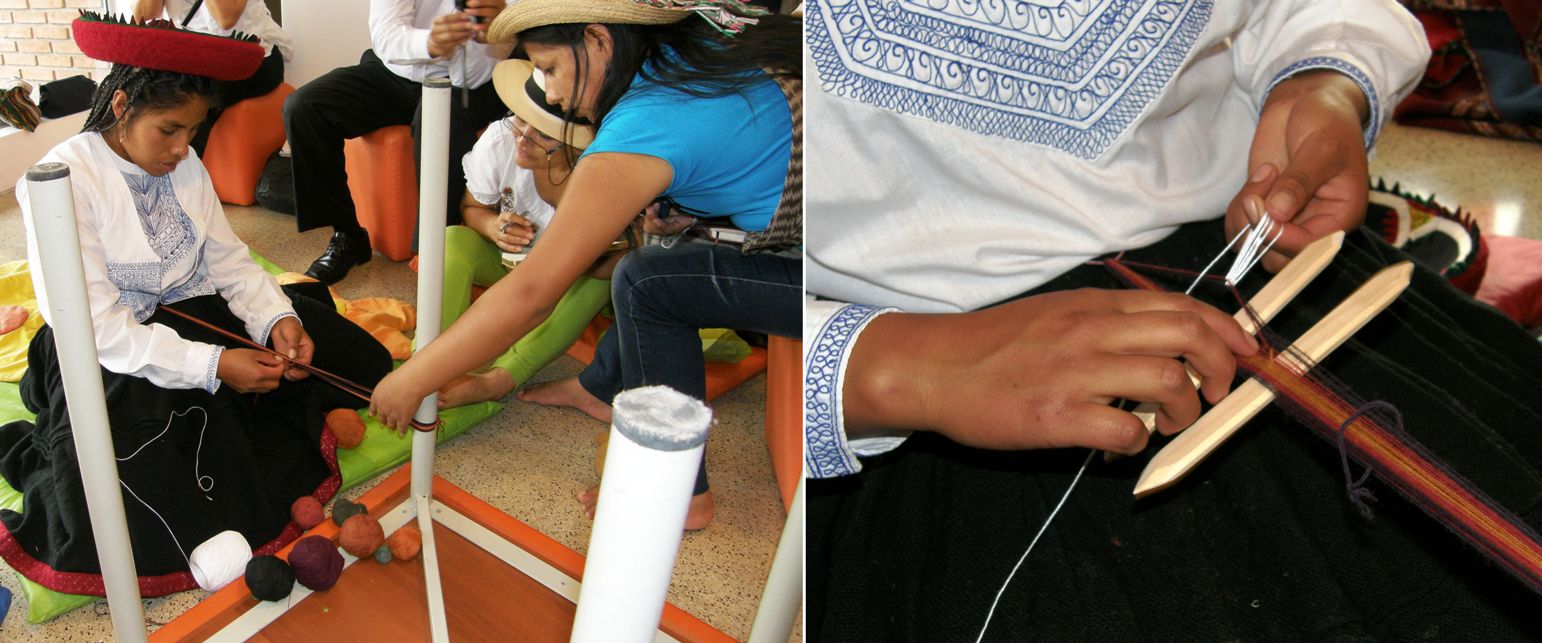
As a participant from the general public, I got to meet and interact with weavers and other fiber artisans from the highlands and lowlands of various South American countries. Through workshops, videos and presentations we not only learned about the fibers and the techniques used to create the woven pieces, but also about the efforts of researchers, artists and academics to document the processes at the source and educate youngsters in the artisan communities themselves and the general public about these cultural treasures many of which are on the verge of disappearing forever.

This made me think of four people I know of who are working or have worked at this very thing and I thought that it would be nice to hear in their own words about their involvement and relationship with the artisans and what they see the future holds.

DORINDA DUTCHER

One such person is Dorinda Dutcher, a North American ex-PeaceCorps worker whom I met online and with whom I shared a room at the Tinkuy de Tejedores last year in Peru.

Dorinda works out in the field and is out of internet contact much of the time and so I was unable to get in touch with her for this blog post. I urge you however, to take a look at her blog and the wonderful programs she has going in the township of Independencia in Cochabamba, Bolivia.

Both Dorinda and Maxima, a local weaver who heads one of the weaving associations, were very much moved and influenced by their experience at the tinkuy. You can read all about it and how Dorinda is educating and involving youth in weaving and helping, very slowly but surely, to improve the lives of women in the community in her own words here.

#############################################

KATHLEEN KLUMPP

I was lucky to come into contact with Kathleen Klumpp through Ann Rowe who I met at the Textile Museum in 2007. Ann knew that Kathleen was planning a research trip to coastal Ecuador and could probably use an assistant. It was one of those “meant-to-be” things. But Kathleen’s involvement with the family of cotton weavers in Manabí Province, Ecuador goes back much much further than this 2007 trip. I will let her tell you in her own words…(photo captions by me, all photos except one by KK)


Kathleen with one of Luz’s daughters, Trinidad

My first contact with this family of weavers was in 1976 when I sat next to an elderly campesino man on one of those colorful open-sided country buses who was carrying a patterned saddlebag known as an alforja labrada.

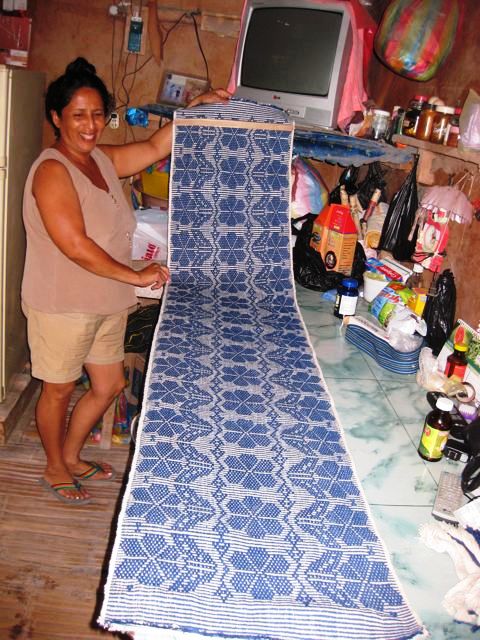
I admired his bag, and I soon found myself up at the home of its weaver, Doña Luz Párraga in the settlement of Zapote documenting their methods in writing and in still photography for preparing cotton, spinning it, and weaving it into alforjas and hammocks.

Spinning cotton and weaving on a native vertical loom is a millenarian coastal Ecuadorian artisan tradition that has been transmitted by peasant women from one generation to the next for at least four thousand years. Throughout much of the twentieth century, this craft flourished in the Rocafuerte valley region of central Manabí.   In almost every settlement and small village situated between the city of Portoviejo, the capital of the Province and the city of Rocafuerte rural women spent hours hand-spinning cotton fiber and weaving double-pocket bags or saddlebags (alforjas) and hammocks intended for their own use as well as for that of other peasant families in the area. During much of the 20th century, the spinning and weaving of saddlebags and hammocks were part of a female peasant identity and part of their cultural heritage.

The finished patterned textile ready to be sewn into a saddlebag.
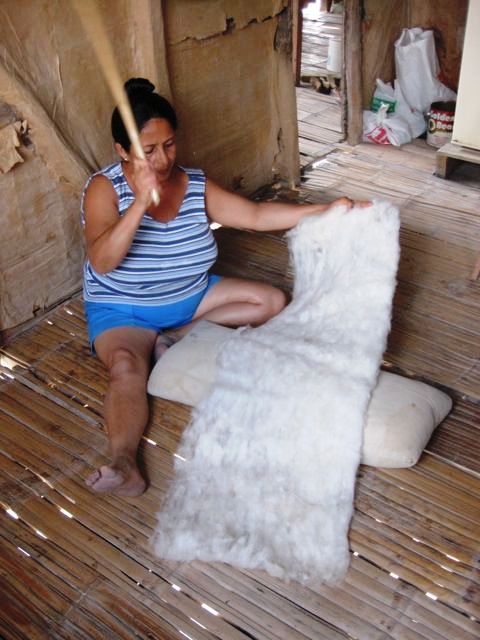
Trini beats the cotton as part of its preparation for spinning.

In order to repay Doña Luz and her family for sharing their knowledge and skills with me, I made sure that they had copies of every photograph I took as well as doing some special portrait photography of this family at the request of  Doña Luz.   Even though the brief article that I wrote about this millenarian fiber art was published in Spanish in an Ecuadorian anthropological journal, nobody, other than non-Ecuadorian textile specialists took an interest as this activity has been invisible to the members of the dominant society for centuries.

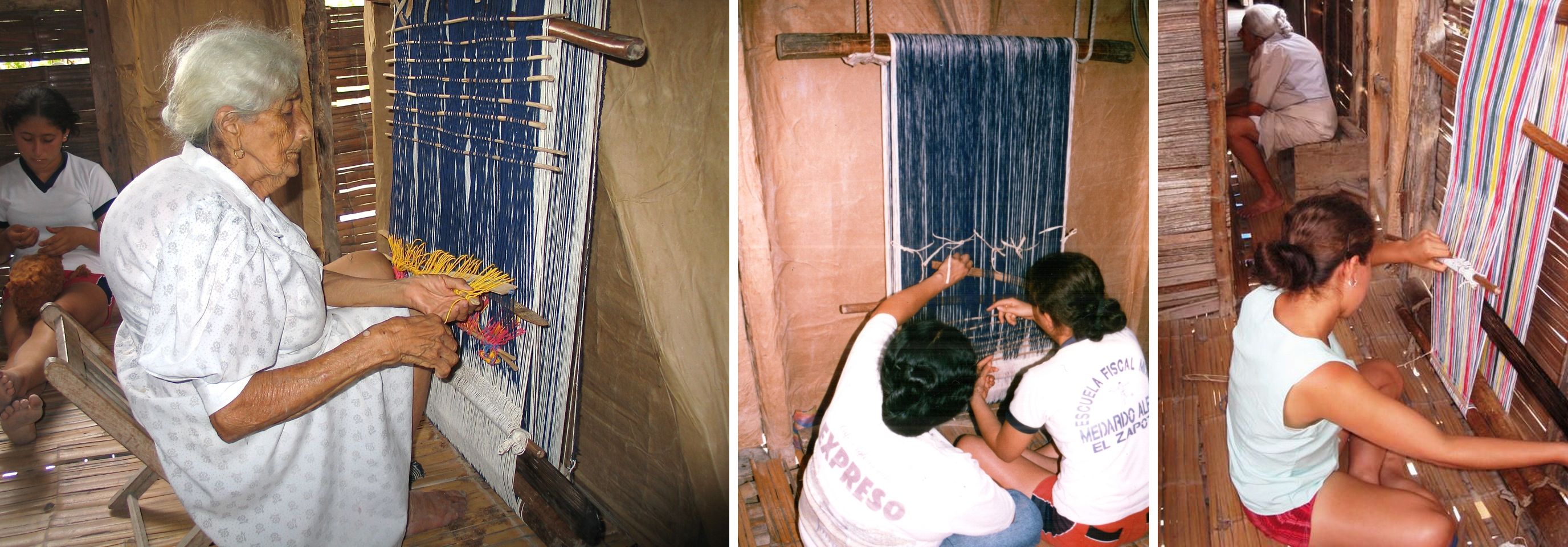
I returned to Zapote in 2006, after a hiatus of 30 years only to find that this fiber art was on the verge of disappearing altogether.  In fact, Trinidad and her sister Mariana were the last active weavers in the entire Province.  But there was a problem: neither of Doña Luz’s daughters had learned how to pattern the fancy saddlebags, since the campesinos had stopped using them in preference for plastic bags.

In the face of an increasing globalization, the economic and social value of transmitting these skills and knowledge to the next generation has collapsed. Today’s cell phone carrying young ladies want nothing do to with this textile fiber art as it is considered “antiquated” and not suited for “modern times”.  They would be embarrassed to be seen spinning or weaving—such is the stigma attached to this former female peasant identity—an identity now tenuously held onto only by their “old fashioned” grandmothers.  In 2010, one young lady told Trinidad, as she was trying to recruit her as an apprentice, that she “rather starve” than to earn a living from this artisan activity.

My first priority was to insure the transfer of the full inventory of Doña Luz’s knowledge to her daughter, Trinidad, the one most interested in learning.

Now in 2011, I report on some recent encouraging signs that indicate that it is not yet totally moribund. These stirrings of life are, I believe, the end result of the steps that I initiated in 2006  to keep this craft alive and to insure that the necessary infrastructure would be in place for it to continue.


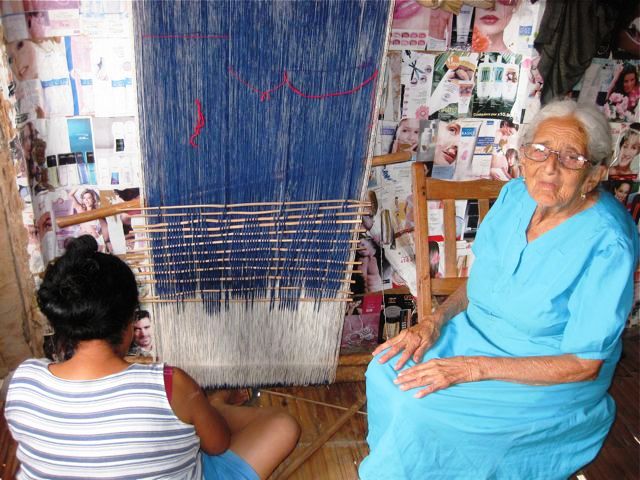
On my (Laverne’s) visit with this family accompanying Kathleen in 2007, Luz’s granddaughter Catalina would help with de-seeding and teasing the cotton (you can see her there in the background of the first picture). Grandmother, mother and aunt Trini would take care of the spinning and weaving process. On that same trip Catalina took only a very short-lived interest in learning to program the pattern warps but you can see her there in 2010 weaving a hammock on her own while 86-year old Luz sits by.

In  2007 when criollo cotton could no longer be purchased anywhere in the region, (cotton used to be a major cash crop of Manabí throughout the major part of the 20th century), I then suggested that they grow their own. Trinidad was able to locate a little old leftover cotton with its seed intact. We both selected the best looking seeds, and she planted them.  Since then, she has about 75 viable cotton plants of two varieties of the native South American cotton Gossypium barbadense growing on land that this family owns on the top of the ridge.

We also have secured more macanas (the heavy swords or battens used to beat down each successive row of weft thread) from some old ladies in the village who no longer weave.  These heavy swords are hand-hewed out of a dense hardwood with the wood of the chonta palm being the preferred material.   We also found some old, abandoned fence posts of chonta wood near the town of Chone where this palm grows, just in case we have to fashion new macanas in the future for additional looms and weavers to use.  You can’t weave without a macana—it is the essential piece of equipment!

I also encouraged  Doña Luz’s 10 year old granddaughter, Melina, to learn how to spin. (by bribing her with 10 cents for each arm length of spun fiber!)


But, if despite my efforts, the knowledge of spinning dies out ( as today’s generation of young ladies have no incentive to learn it) I have located an excellent source of natural cotton yarn that takes dyes, both natural and aniline.


A new design being woven with suitable industrial spun cotton that Kathleen discovered in the area.

################################################

BETSY RENFREW and ANDREW YOUNG

I met Betsy online when I ran into her blog on the Montagnard weavers who are living in North Carolina. We made contact and I organized to go and meet with her and Andrew and the weavers with whom they have been working. On a second occasion, Betsy welcomed me again and I was able to learn the weft twining process called kteh used to finish the ends of blankets and skirts from weavers Ju Nie and Ngach. On this trip I was also able to take part in some of the weaver gatherings that Betsy organizes.


One of my twining classes with Ngach and examples of the beautiful kteh work.

Here is Betsy writing about her project and its goals…

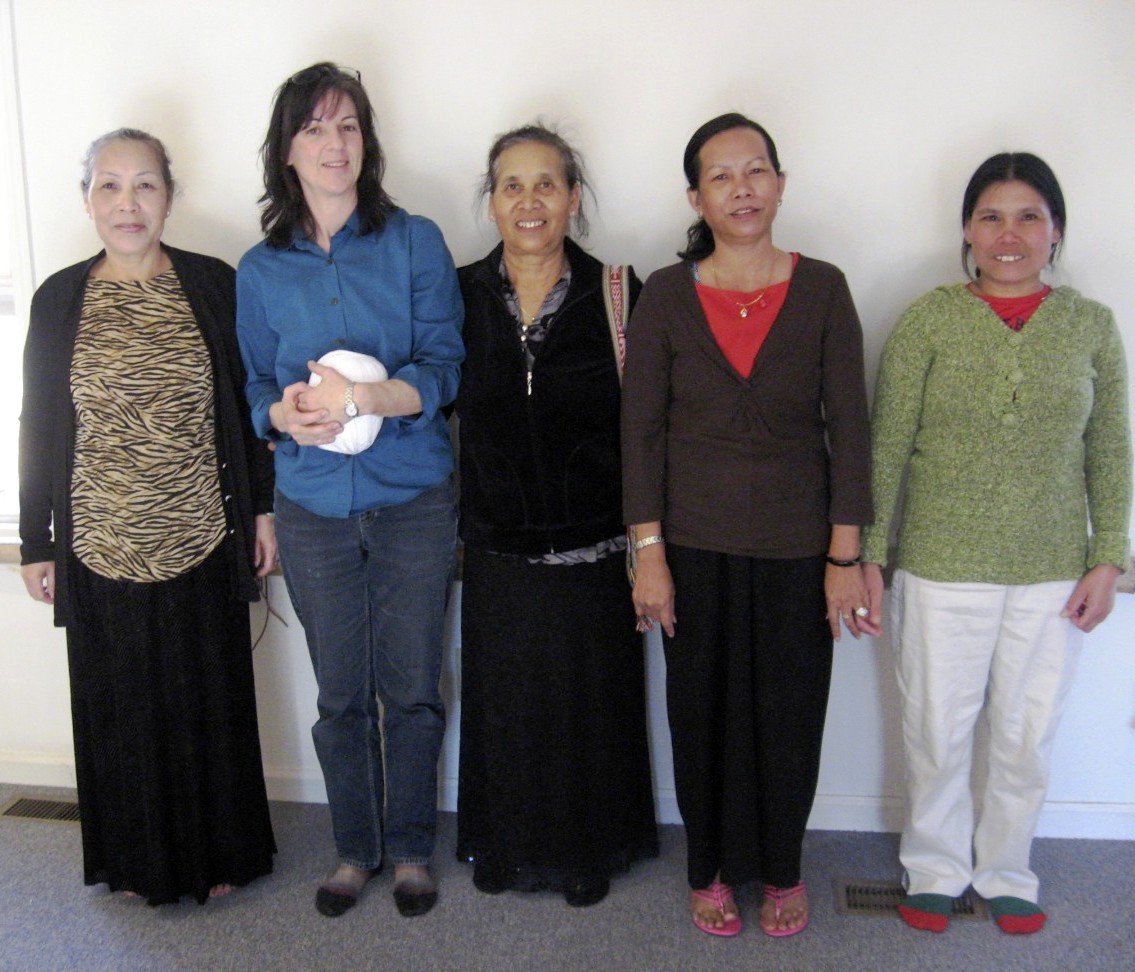
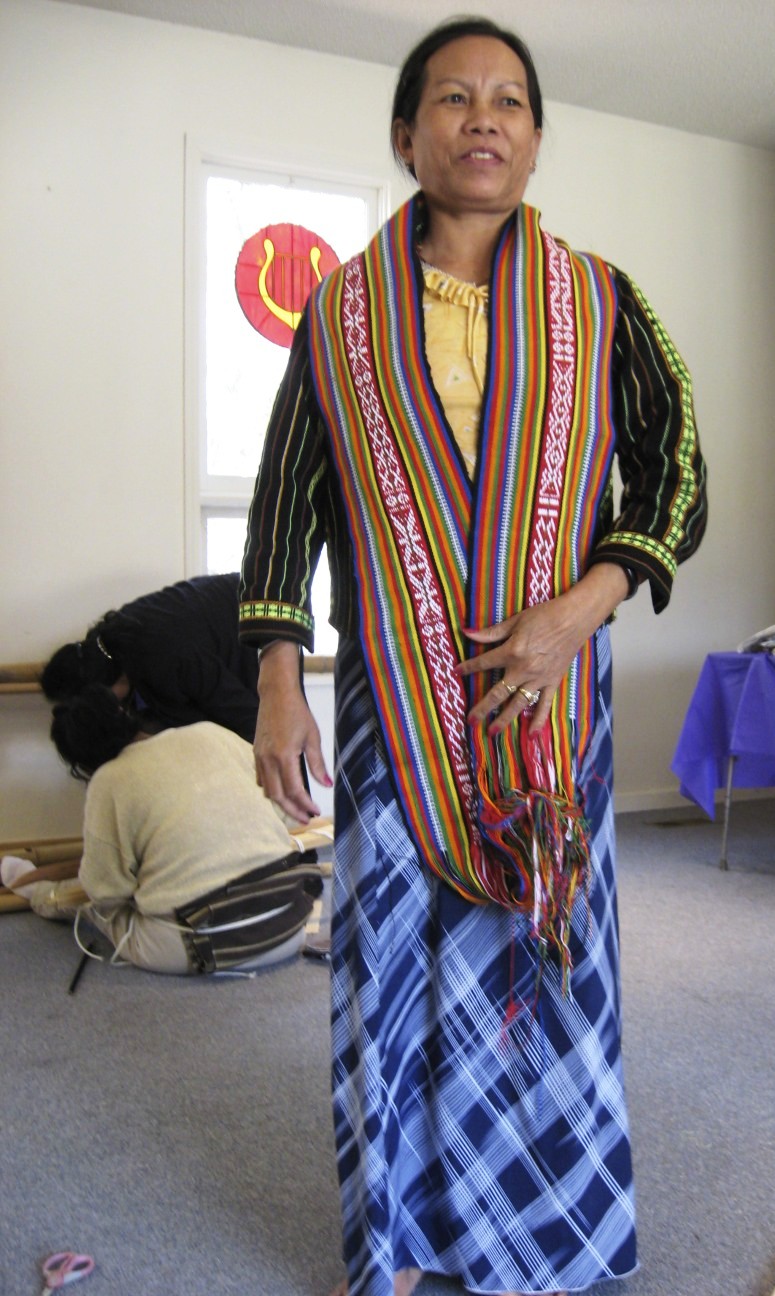
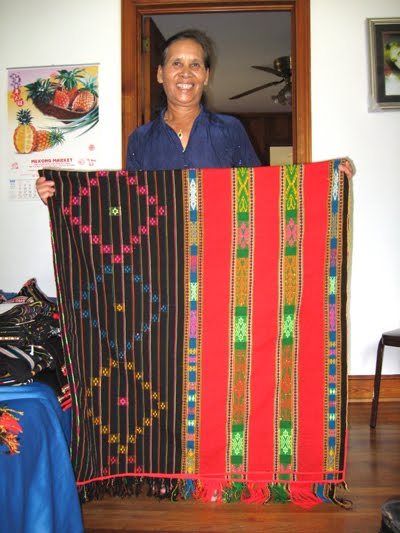
Betsy Renfrew with Montagnard weavers, from left to right  H’ Wun Eban and H Ngach Rahlan (Jarai tribe), H-Tep Adrong (Bunong tribe) and Broih Fnu (Banhar tribe)

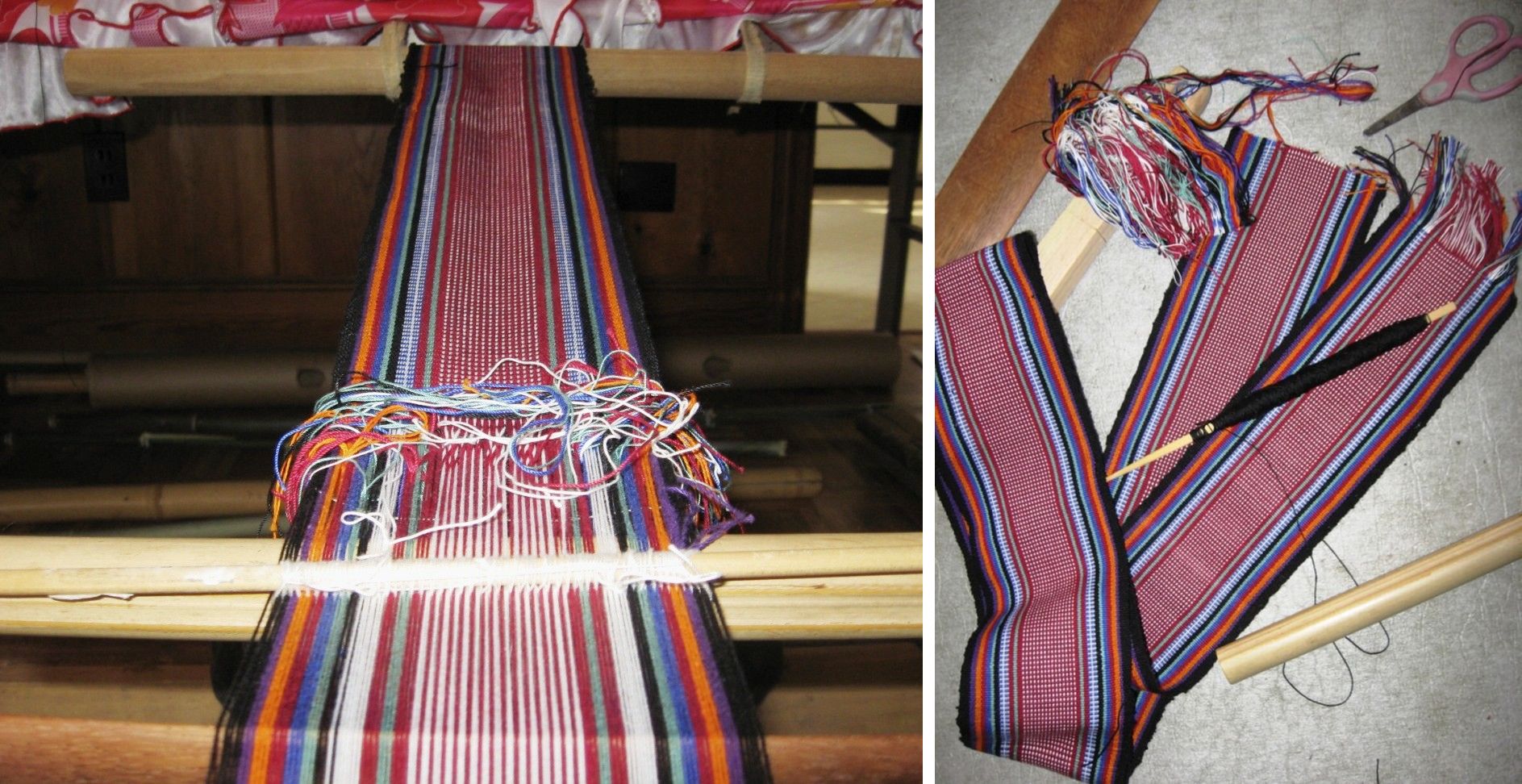
Since 2008 I have been meeting and interviewing Montagnard weavers in Greensboro, NC, in an effort to document their weaving traditions and understand why so little research had been done on these traditions.

My background is in the Fine Arts and I found this documentation to be an important segue from the world of painting and art history into a more folk/craft oriented project with a digital element. Recently I have received a grant and great encouragement from the Community Folklife Documentation Institute, a program spawned by the North Carolina Arts Council, North Carolina Folklife Institute, and the Center for Documentary Studies at Duke University.

North Carolina is eager to learn more about

A local church has given space where Betsy can gather the ladies to weave, share skills and socialize. Here she also teaches them the English words for their looms and the weaving process.

Montagnard weaving and I am eager to share this knowledge with others. I have also partnered with a local Montagnard organization, the United Montagnard Christian Church, in receiving a grant from the United Arts Council of Greater Greensboro. With this grant I have organized women (now known as the Backstrap Weavers of Greensboro) that weave to help them learn some basic English to demonstrate their skills at local events, teach weaving to new students and learn how to market and sell what they weave.

We have good following of women coming to our meetings to share weaving knowledge. Most of the women are over the age of 50 and don’t speak English at all or have limited English. Most elderly traditional Montagnard women don’t interact with people outside their kinship group or church circle because they don’t drive, can’t read, or do not have a job. I found a certain level of low self esteem at first (because of the language barrier) but now I see these women not only enjoying themselves during our weaving time but interacting with people from different language groups (refugees from the Central Highlands speak five or six different languages) and other ethnicities. They have also come to trust me and to tell me what they love best of their culture.


Ju and Khin, both of the Jarai tribe, meet at the church to make a new warp.

One of my frustrations within the last year or so is a small turnover in attendees. Some of the women can’t come regularly because they care for grand children, have old injuries from working at textile mills, or poor vision. And there is the continual concern for sustainable income or funding for the project. Many of the women do not understand what a grant is or how it works! Despite these frustrations I have built a bond with what seems to be the last few practicing weavers in Greensboro. I teach them English, they cook me hablang, or cassava leaf soup. They teach me the words for their loom parts and I teach them how to teach others to weave. They are weaving with new supplies and beginning to make smaller purse type products to sell.
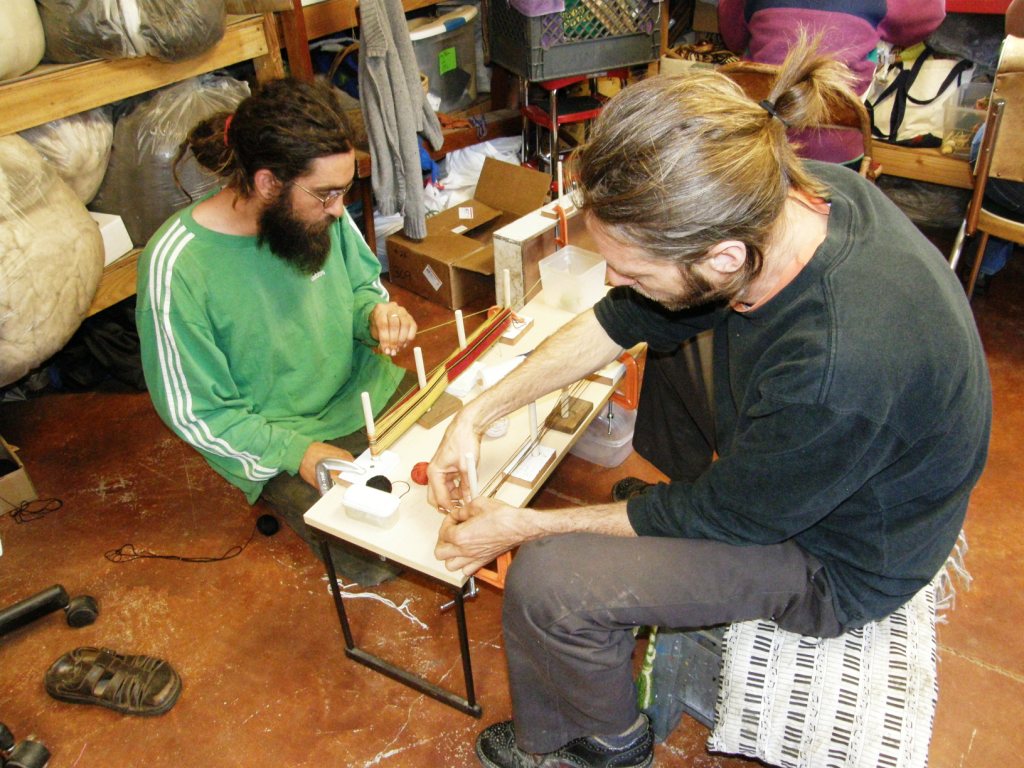
 

Betsy helps Ju an other weavers develop a way to teach their backstrap weaving art to others. This is Betsy’s first completed piece from her weekly classes with Ju.


Bunong weaver Tep showing one of her newly woven pieces.

And the future?

More aggressive fundraising tactics and creating an on-line market/gallery on our local arts websites.

I also will be widening my reach to Nepali speaking Bhutanese refugees, who also use backstrap looms.

Please follow what we are doing on our blog.


##############################################

DENNIS PENLEY by Phil Willett

I never had the pleasure of meeting Dennis Penley.

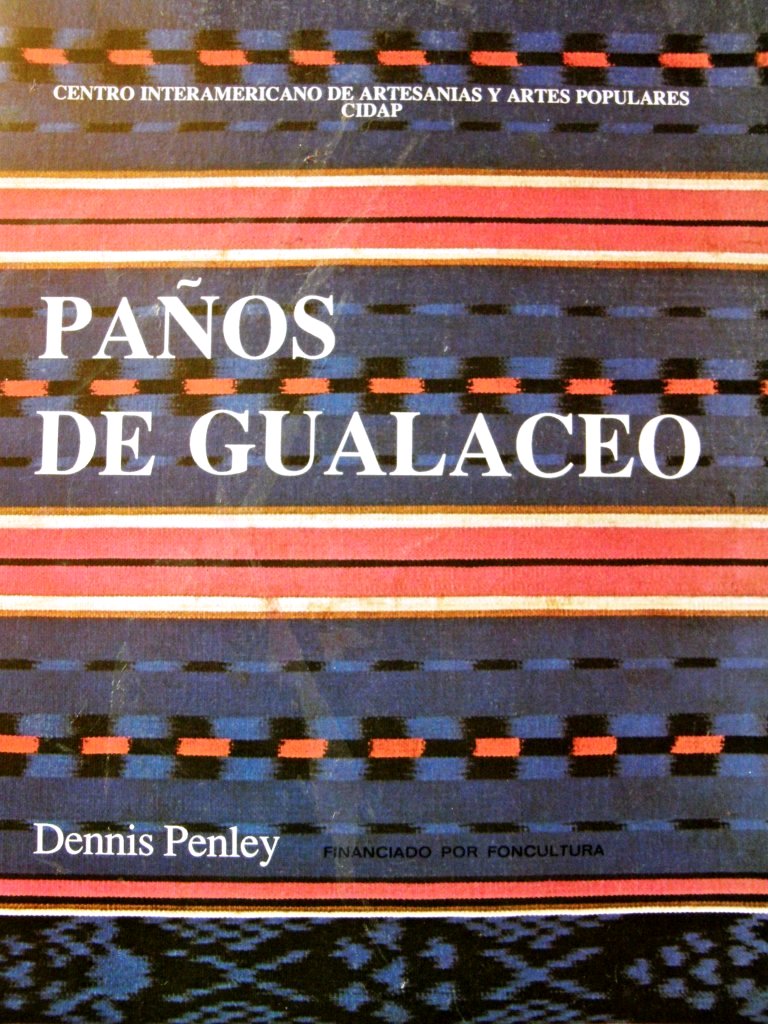
I bought the book he wrote on the ikat shawls or paños of Gualaceo, Ecuador on a visit there in 2005 knowing nothing about its author and the fascinating life he had led.

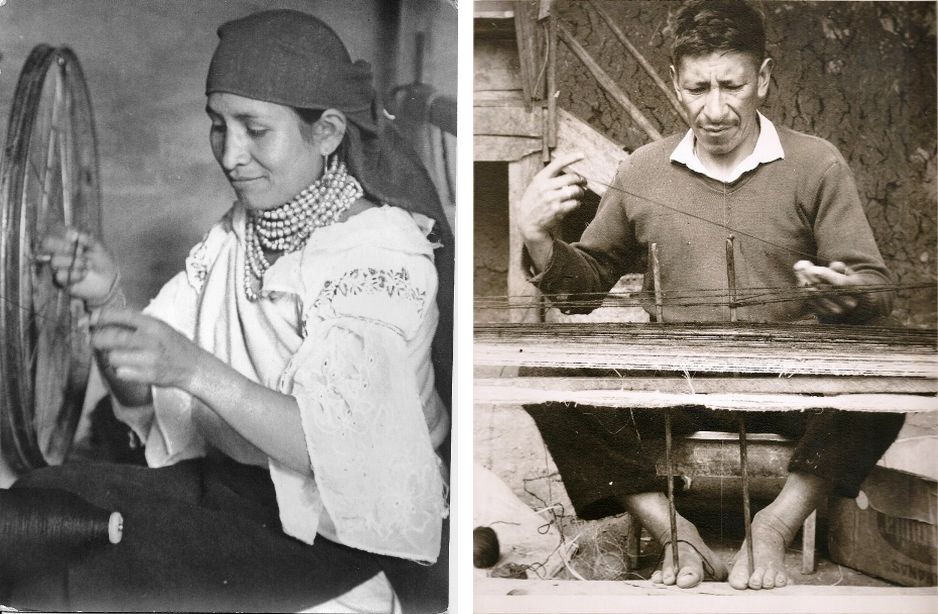
I have, however, been lucky to have become acquainted with Phil Willett, once again, on line, to whom Dennis Penley was a good friend and weaving mentor.

Mr Penley passed away the year after I bought his book and Phil wrote a short biography to accompany an exhibit of his collected textiles made as a tribute to him.

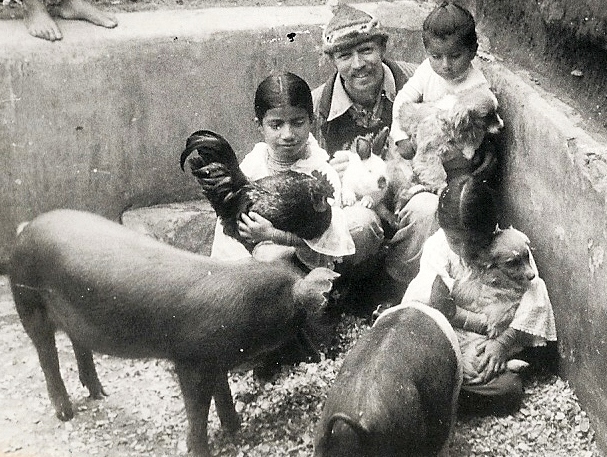
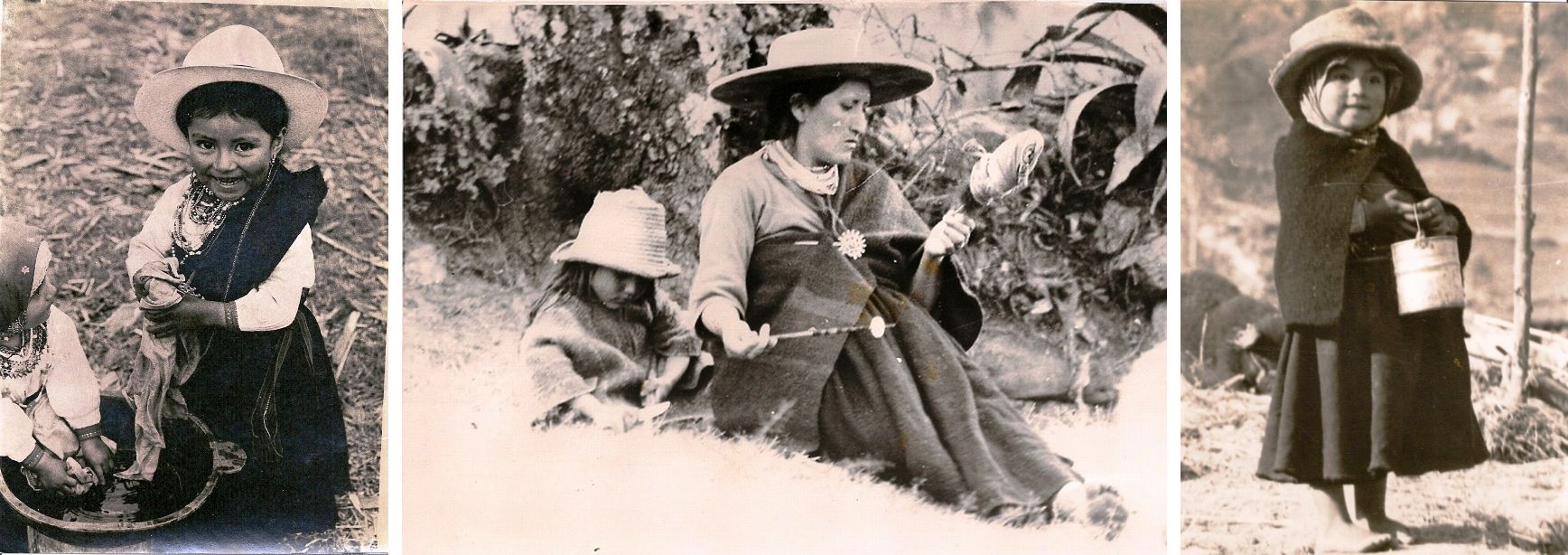
I won’t caption the photos, all of which (except the first in color) I understand were taken in Ecuador.

Here is the biography that Phil put together…

Dennis Penley, a life time of hand weaving enthusiasm.


From his early beginnings creating elaborate costumes for himself and the Arabian horses his family raised and trained, Dennis was a born textile enthusiast. He taught himself to weave as a teenager and utilized that interest to befriend many people through his life.

After high school he joined the Peace Corps and worked within the Ministry of Agriculture of Ecuador. Part of his job was researching the indigenous peoples weaving traditions.

Following his Peace Corps service he stayed in Ecuador to research and write a bilingual book on the shawls of Gualaceo.

He lived and worked among the indigenous mountain weavers, with a horse to travel by and a llama to spin wool from while it also carried extra gear.

When he returned to the USA Dennis received an honorary bachelor’s degree from San Francisco State for his work in Ecuador.  Dennis not only photo documented the techniques of the weavers, he learned them by hand using a back-strap loom.

With all this weaving knowledge he had hopes, when young, of a lifetime of hand weaving. Based out of California he produced custom hand-woven yardage for designers, blankets and home accents.

All this was accomplished on a Swedish barn loom. His dream would not prove to be financially viable.

Dennis would, through his working career, excel and profit at many other endeavors. He was a master cabinetmaker and historic architecture restorer. He worked for many years for the city of Lexington, his final position as a code enforcement officer.


Dennis’ studies of non-western cultures, philosophy and textiles would be a passion for his entire life. He first became intrigued with ikat weaving in South America. He would later research its use throughout many cultures. After years of studying the textile traditions of Southeast Asia and Indonesia he traveled twice to the region to see the artisans and collect textiles.

The textiles within this collection are a testament to an inquisitive mind that had a tremendous respect not only for the craft but also the people who created them. They are works of art and expressions of cultural identity and diversity.


####################################################

My goodness, people have been busy in the backstrap and inkle weaving groups at Ravelry this week. Check this out…

Marsha has been making all kinds of wonderful things with simple warp floats. The knot design on the left is charted here.

Bobbie is making a bag with pebble weave designs. Here we see the wide front and back panel and the side.

And some Spin-Along results are coming in…

Popsicletote is weaving with her handspun wool/silk blend. The hairiness is making life a little difficult but she is adapting and getting on with it. Her designs are pebble weave.

Tracy has just warped up her own handspun wool. Here you can see it curled up at rest and then tensioned on the loom bars.

Another ‘waver’ has joined in the warp-faced fun (Waver= user of Gilmore Wave loom). That’s Michele’s pebble weave band on the left with one of my designs from my Andean Pebble Weave e-book. Popsicletote tried sock yarn  for making a band and it turned out beautifully!

And here are some projects from a little while back from the online groups that I didn’t get a chance to post…

These are simple warp float bands by popsicletote and Sharon and a double weave band by Sylvie.

I LOVE all these different wool warps showing up…hand spun, re spun commercial yarn…all working differently and giving a variety of results. How lucky we are to have all these folks experimenting and creating and sharing with us. I am learning so much!


Backstrap Weaving – Variations on a Theme and a New Tutorial

I have been all over the place this week…sewing, braiding, twining and weaving four different patterning techniques. Keeps me on my toes!

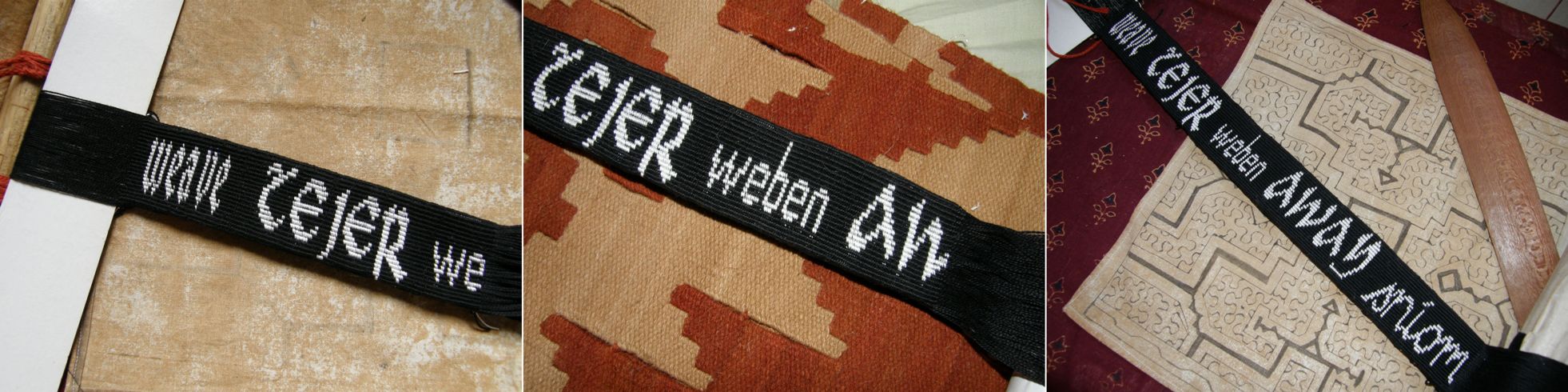
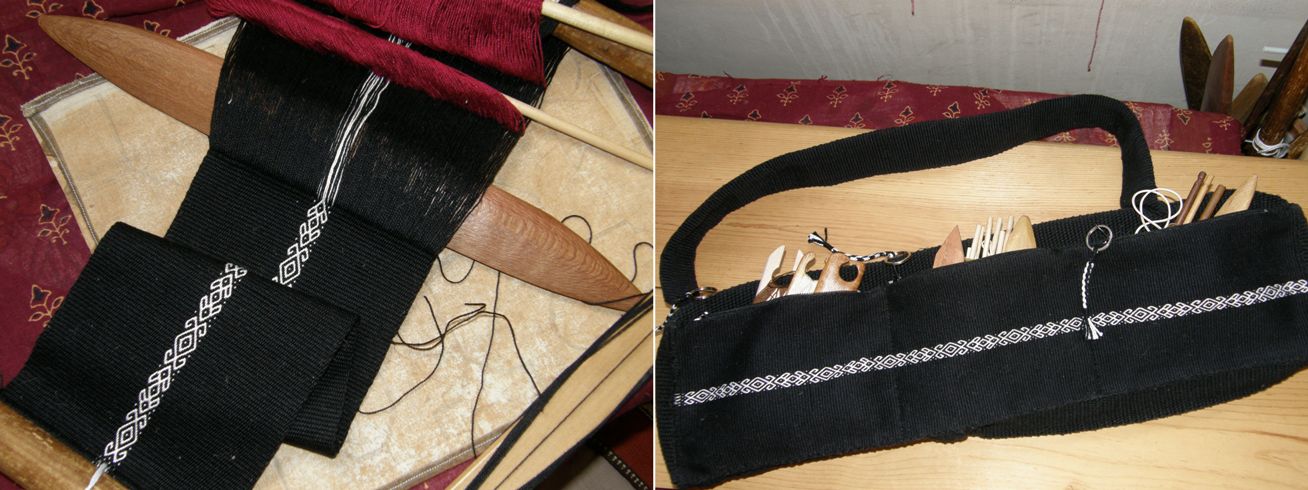
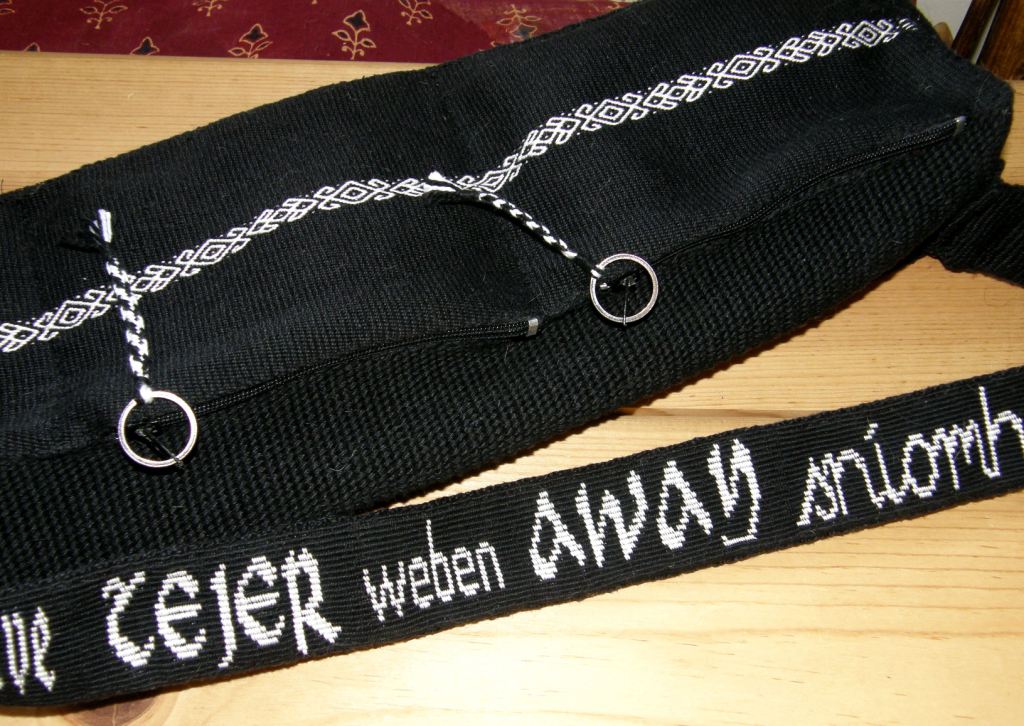
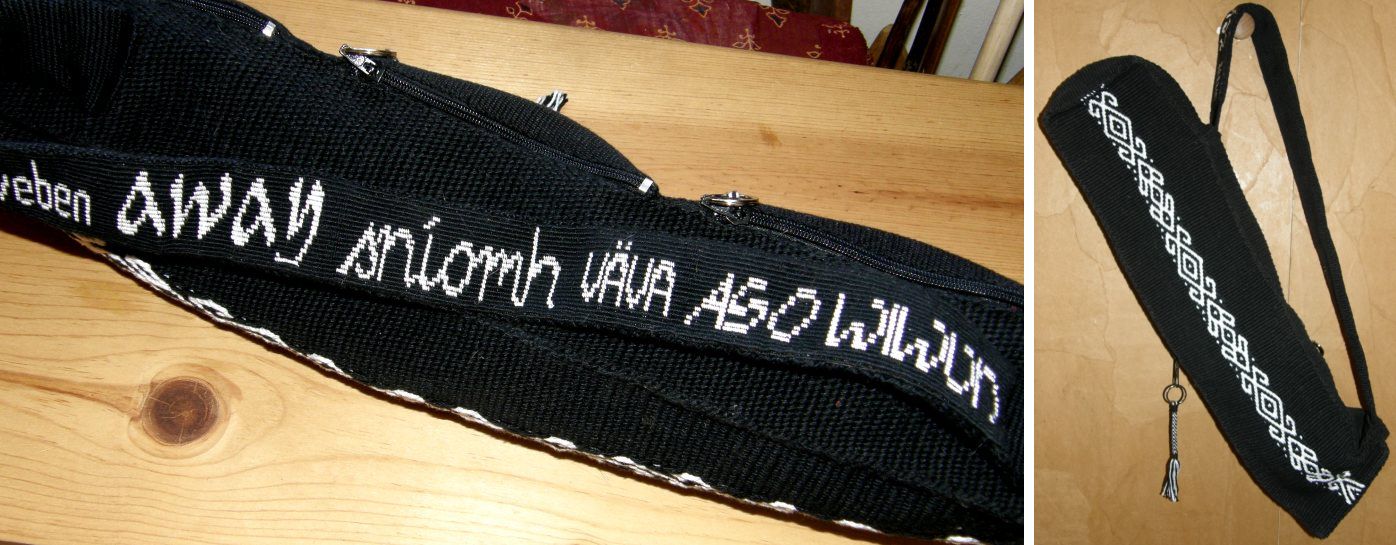
There was a lot of sewing as I finished the loom bag finally! This has been a long project mostly because I chose to twine the strap for the bag and that was slow slow slow. I decided to twine the word “weave” in different languages into the strap and, although I managed to gather a lot of words from different online buddies, I could only use a handful on the strap. I will save the others for another project.

There is some of the twining as it progressed. I used the English, Spanish, German, Quechua, Gaelic, Swedish and Nigerian words. As for putting the bag itself together, I am not much of a seamstress and so just made it up as I went along using a camera tripod bag as the model. First I made the front panel with a pebble weave design.

Then came the sides and the panels between which the zip would sit all woven in plain warp faced weave..

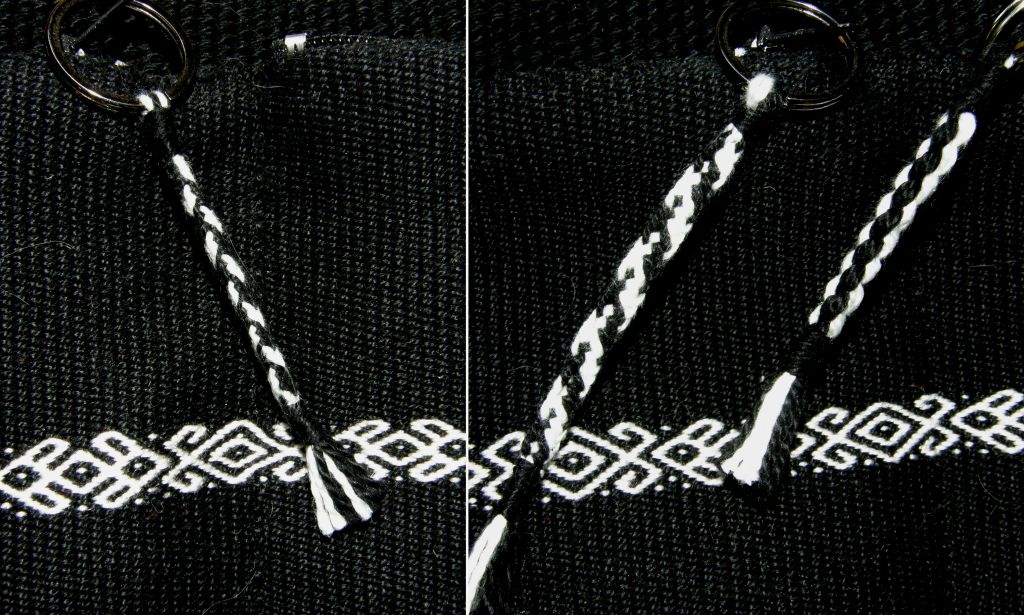
Once the zip was in I added a zip pull made using an Andean sling braiding technique.

Meanwhile I was still slogging away at the twining.

Then I decided it would be more practical to have pockets for all the smaller items like belt shuttles, pick up sticks and small swords and so I wove another thinner panel with the same pebble weave pattern.

The thin panel was sewn to the back of the bag. I have received two donations of large bags of assorted zips from online buddies so it was just a matter of diving into those and finding three small black zips the same size and I was set. I am getting pretty darn good at sewing these in!

Of course I couldn’t resist adding braided zip pulls. I made a square, flat-ish and round-ish braid for the the three pockets. I must do a tutorial here on that flat braid one of these days. I learned it for making straps for chuspas in Potosi.

Last of all was the strap. the last word to be twined was the Nigerian one which had been provided by a Facebook friend.The problem with twining is all the weft ends that are left hanging at the sides. I had to weave yet another plain weave band to sew to the back of the twined strap under which to hide all those ends. Actually it gives the strap quite a cushioned feel – quite appropriate for something that will be hanging off one’s shoulder.

There’s the last Nigerian word below (two words actually)…

DONE!!

I wove a bit more on the tencel supplementary warp patterned band with its Celtic knot motif…


And I played a bit with a design I got from a Central Asian woven piece.

My friend Lisa photographed this piece at a reenactment event some time ago and sent me the image.

There was not enough detail to see what technique had been employed and I decided that it would look good anyway woven with a supplementary weft. The design is charted here.

Last weekend one of my online buddies sent me this same image saying that she had found it on her desktop and had forgotten from where it had originated and that she thought I might like to weave it in pebble weave. After I reminded her that it was actually from my blog, we both had a laugh and then I thought, “Huh, I wonder how this would look in pebble weave?” And then another “huh”. How would it look in other techniques?

Hence the title of this weeks’s blog post…Variations on a Theme.

Here is how it looked when I originally wove it using a supplementary weft…

I guess I am very lucky to have been able to travel so much here in South America and learn so many different techniques and designs. I have often met weavers here in my travels who are masters at two techniques and have been weaving them all their lives and who are delighted and bubbling with curiosity when I show them motifs woven in the same technique from another region within their own country. Others see a technique in my samples that they don’t know and plead to be taught it. Sometimes I have to push back my desire to learn from them in order to teach them. They are always so happy to have an “edge” over their other weaving companions with this new knowledge.

So, just for the fun of it I celebrated the fact that I have had access to many patterning methods and I adapted the Central Asian motif to three other techniques. There are still several more to try.


From left to right…in the same supplementary weft technique but in finer yarns (35 wpi ground), in double weave, the original supplementary weft (24 wpi ground), pebble weave and supplementary warp. I love them all!

I once taught pebble weave to a weaver in Ecuador. The weavers in his community weave with tapestries and belts patterned with supplementary warps. The pebble weave technique is not known. I left him with drawings of various Bolivian and Peruvian motifs to copy if he wished as I didn’t have woven samples to give him. Eighteen months later I returned to see his band with his attempts to duplicate the drawings but there was also a rooster motif which he had adapted from the typical supplementary warp belts and embroideries of his community.

And Juan definitely wanted to have an edge over the other weavers. He wouldn’t even teach the pebble weave to his brothers!

I shared a room at the tinkuy with a weaver from Cochabamba who was dying to learn the design on one of my pebble weave amulet bags. She already knew pebble weave but not this particular design. As there simply wasn’t time to learn it at the tinkuy I swapped my amulet bag for one of her spindles. I wonder if she has woven it and if her new design is envied by the other weavers in her community.

###############################

The Weave-Along in the backstrap group on Ravelry is coming to its end on March 6th with what we are calling the “big bang”. There seems to be a lot of weaving going on by the handful of weave-alongers and we have even been hearing from a lurker or two. Projects are still being posted…

Tracy made one of her pebble weave bands into a cell phone pouch. She edged it with a single row of cross knit looping or Van Dyke stitch as it is in known in embroidery. (See the video in this post for instructions). Check out Tracy’s latest blog post on the textiles she saw in Syria.

Marsha (PandulaArts) wove these pieces on the left patterned with simple warp floats and then dabbled in a little double weave.

Toby, who is not participating in the weave along, but who is a regular contributor to the backstrap weaving group on Weavolution, has been trying warp substitution technique (on the left) using a Bedouin motif and double weave (on the right). The warp substitution technique is a very good introduction to the basic pick up patterning method which is also used to produce patterns in double weave. It is a good idea to start with this technique before advancing to double weave. As you can see, one of the disadvantages of the warp substitution technique is that it produces long floats on the back of the piece. The length of the floats can be reduced by carefully choosing designs and spacing. Toby’s design on the right is his own invention.
Tanyabe has been making her first steps in pebble weave on the left and Tracy is now weaving a Chinchero design in pebble weave. This design is charted in my book.

Jennifer’s Sami bands are gorgeous!! She has been doing these on her rigid heddle and inkle looms and I believe that she has one going in wool on her backstrap loom too. Once again I remind you that you can access instructions and patterns for these bands on the Yahoo Bands and Braids Group or by buying Sue Foulkes’s book here.

As folks finish off their projects for big bang Sunday, a couple have asked for a tutorial on the tubular bands that are often used here as decorative edgings for finished woven pieces. These are bands that are woven and sewn simultaneously to the edge of a piece of fabric using the weft as the sewing thread. There are several kinds of bands. Some are in plain weave and this is probably the easiest place to start learning about these.

I have put together a tutorial here with photos and a short video. I have also put a video there that I shot at the Tinkuy de Tejedores in Peru of a Bolivian weaver attaching a band to the edge of one of her bags.

These bands can be used to cover the raw edge of a weaving as I did with the edge of the cell phone pouch above. However, I would not attempt to do this until you have practiced the technique many times on the selvedges of your woven fabrics. It is far easier to learn to apply these bands to edges that are not threatening to unravel!

You can see above that a narrow warp is wound and set up with simple string heddles and a shed loop. I use a tapestry needle to carry the weft and sew the band to the fabric.

The purse on the left has been edged on three sides with one of these bands. See the full tutorial here.

#######################################

Greetings come from “bicycle Anna” this week who is now down in the Chilean city where I spent my first five years in South America. Punta Arenas is the southern most city on the South American continent. From the city you can see the island of Tierra del Fuego across the Straits of Magellan.

Anna stopped by to see me at home and have some weaving lessons. She is now in the land of sheep…tens of thousands of them and her new drop spindling skills are being honed. She is carrying llama and alpaca fiber that I gave her along with a Bolivian spindle and I am sure that she will be adding Patagonian wool to her fiber stash.

And look how she is getting on with her pebble weave with her loom tied to her bike! It’s summer down there…you wouldn’t think so from the gear she has on. The days are looong and if you get one without wind it can be heavenly.

Anna has been spreading the fiber love by teaching young fellow cyclist Kate to make the six-strand finger loop braid that I learned in Potosi (one of the ones on my new loom bag).

I must warn you now that this is pretty much the end for this post of anything related to weaving or fiber as I indulge in a little nostalgia trip to the place I called home for five years…the wild Chilean Patagonia. Some of these pictures are Anna’s.

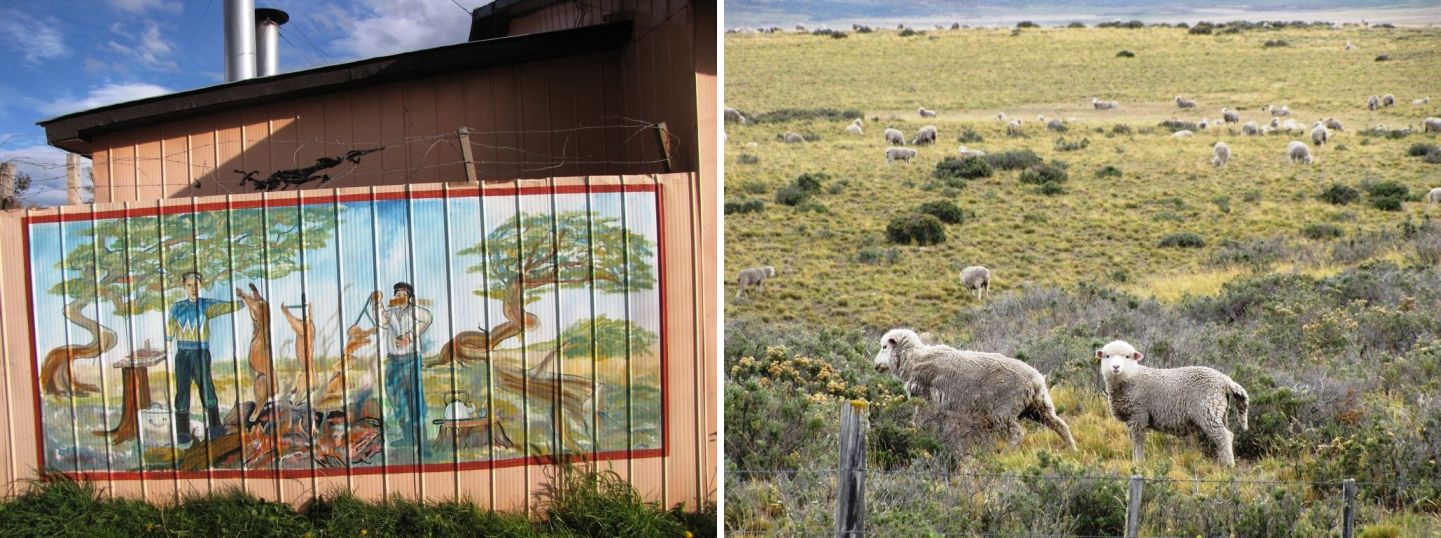
A house at left is painted with a scene depicting the famous southern Chilean lamb barbecue – asado al palo.

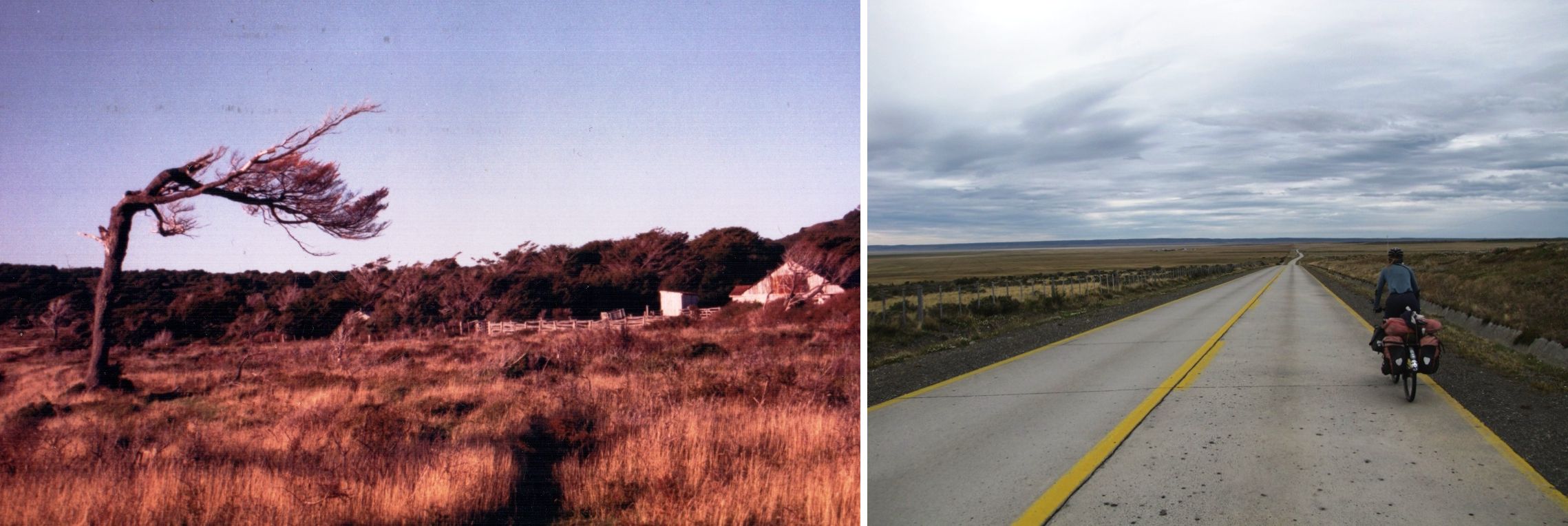
The Andes dip down into the sea before reaching this part of the world creating a series of islands, fjords and sounds. The land is scrubby and flat and rather colorless. Trees grow sideways with the constant winds.

Punta Arenas is a city of houses walled with corrugated sheeting. Rather than let it all run to rust residents paint with soft pastel shades, splashes of color in the bleak landscape.

This statue of an Ona indian is in the Plaza de Armas in the city center. The toe shines as visitors rub it to insure their return to Punta Arenas one day. Puerto Natales futher north is located on Ultima Esperanza Sound and is the gateway to the spectacular Torres del Paine National Park.

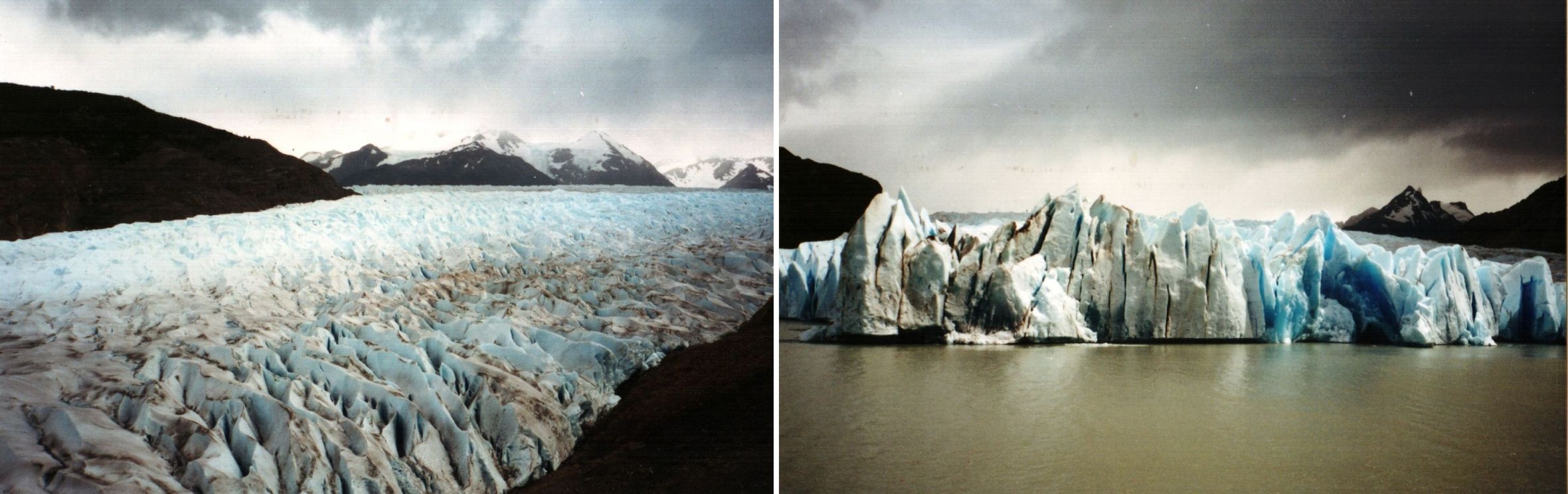
Craggy mountain peaks, fjords and wildlife in and around Torres del Paine…a rhea or ñandu walks with her chicks.

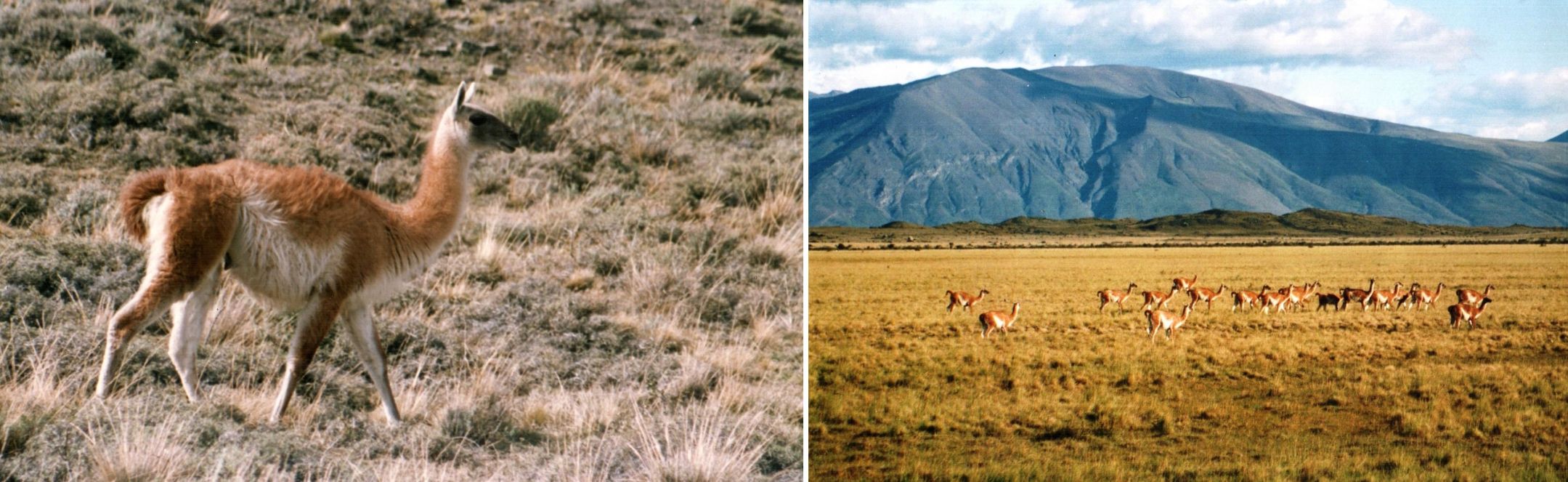
Herds of Guanaco roam  the park.

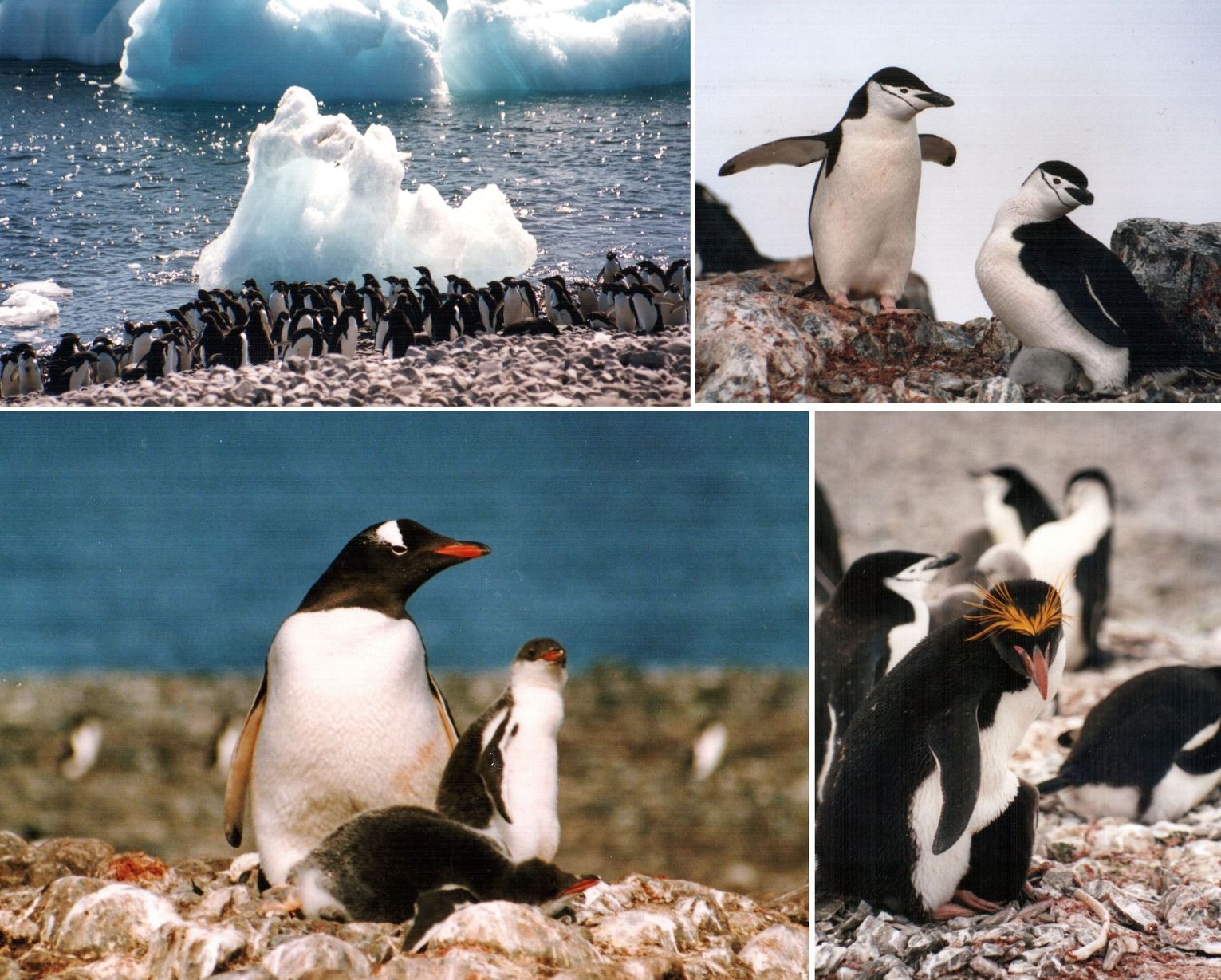
The hiking and scenery are superb but be prepared for a good battering by the wind! I got to go to Antarctica twice when I was there and thus add the seventh continent to my list. After all it is just across the Drake Passage! I will leave you with some shots from there.


Penguins, albatross and seals. This Albatross is in the Falkland Islands. Lots of whales too which I could never quite catch on film. And yes, I was weaving between all this!

They tell you to not to get within ten feet of the wildlife but if you just sit still on the beach long enough, the penguins all come to you!

Ah well, back to jungly steamy Santa Cruz. It’s time for coca tea and a mango!