Backstrap Weaving – Little Things, Big Smiles

I was going to name this post “Taming the Tube” and that would have possibly been one of the weirdest titles I have come up with for a blog post so far but I decided to go with “Little Things, Big Smiles” as I have had a few things to smile about this week. They reminded me that it is often the little things that bring us most joy. Like the fact that my friends are on a road trip in Colorado and Wyoming and post pictures of every step of the way on Facebook so that I can be with them and share a little of the experience. And it seems that the Santa Cruz winter is over and I am back in shorts and tshirts before I can even run out of clean socks.

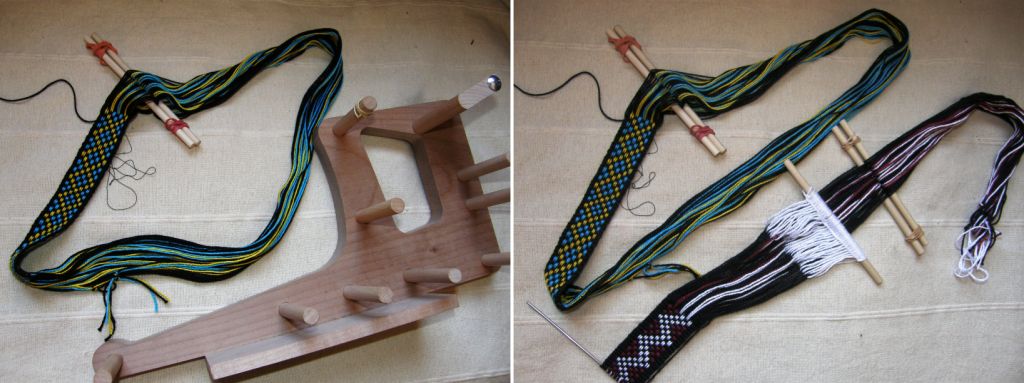
As for the tube that needed taming, well, I am talking about tubular bands. I have been following on with the experiments I was doing last week. These little things have brought a smile to my face as I figured out at last how to stop them from spiraling. Yes, it’s just a small thing but it gave me quite a kick!

Of course some bands look great when they spiral and that is precisely the effect that you want.

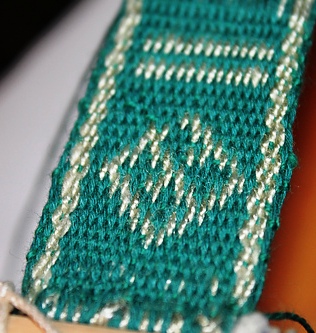
But that wasn’t what I wanted when I made a pebble weave tubular band. I wanted the woven design to lie straight along the tube so that it could be seen if the band was worn as a wristlet.

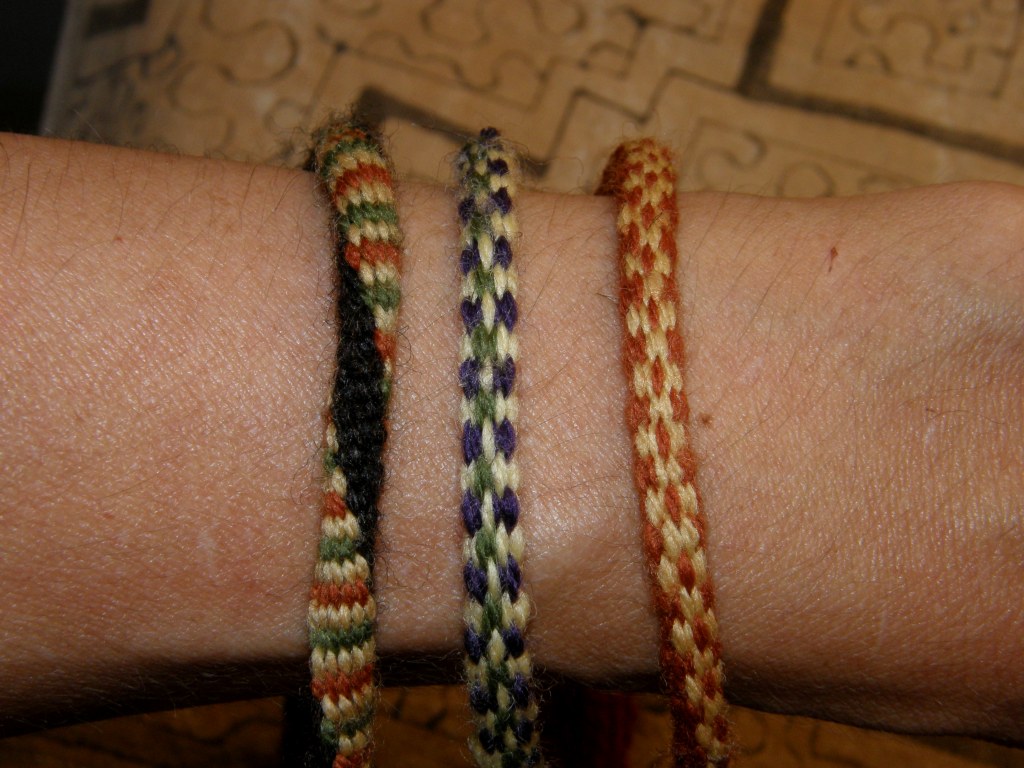
I am forcing the design to lie straight in the upper picture. As soon as I let it go, it spirals. I suppose the spiral version has its own charm but that is not what I wanted.
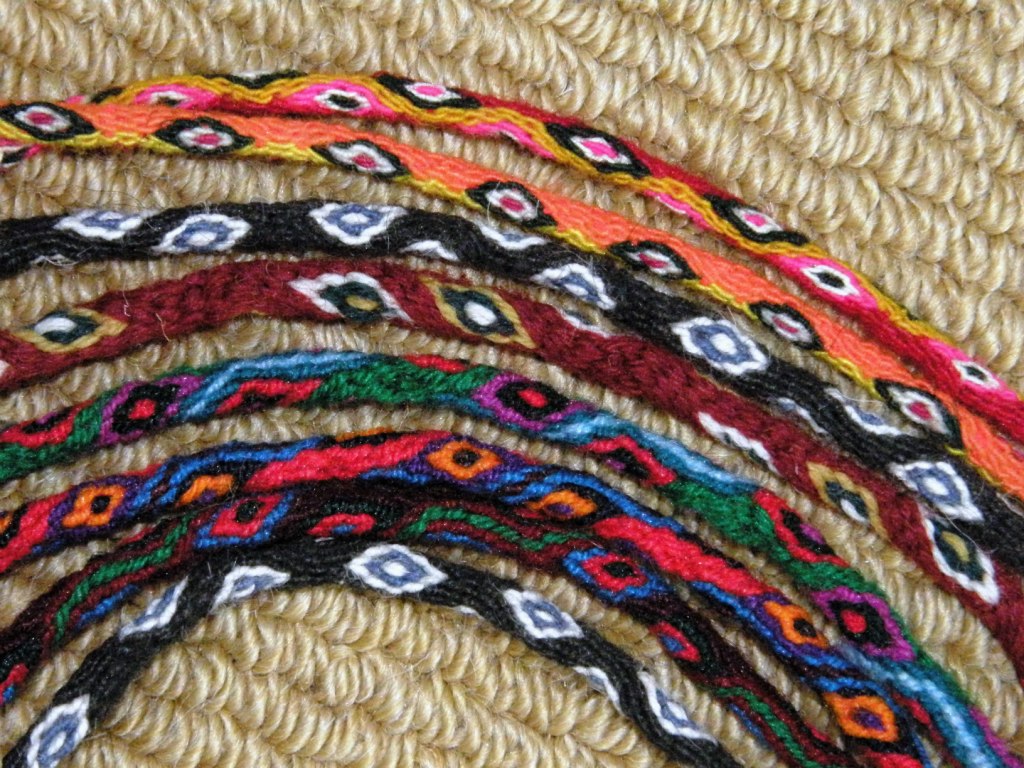
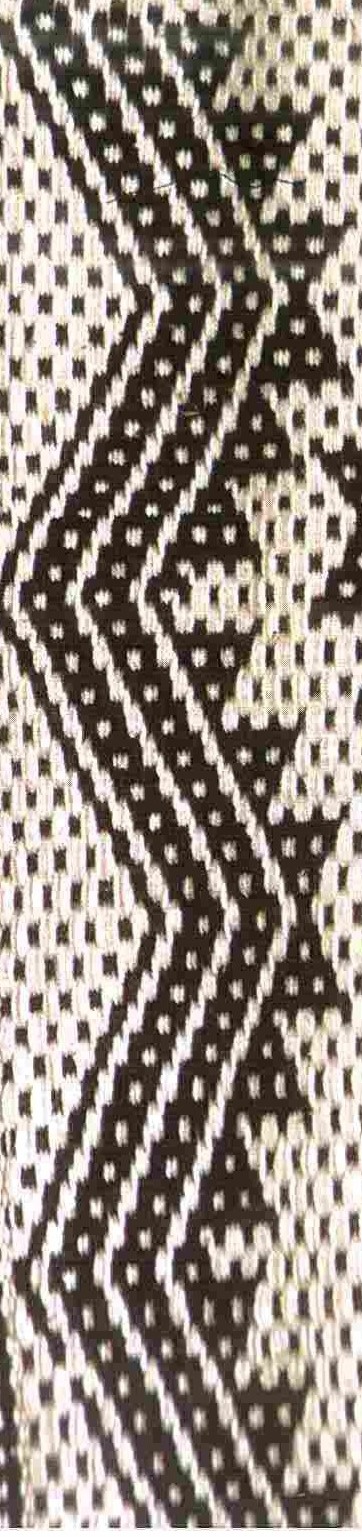
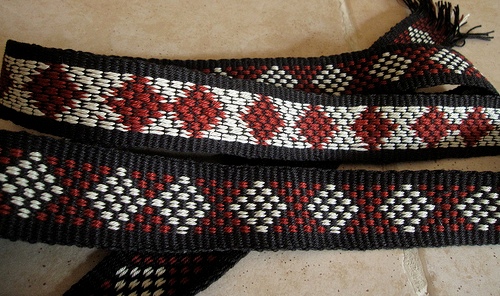
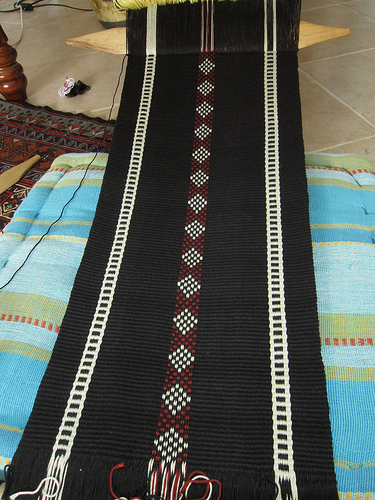
Most ñawi awapa bands that I have seen spiral…some to a lesser degree than others but there are some that pretty much don’t at all as you can see above. The more colorful ones in the center of the group spiral a lot while those above and below them have little or no twist. I LOVE that black one! So, clearly, there is a trick to getting them to lie straight.

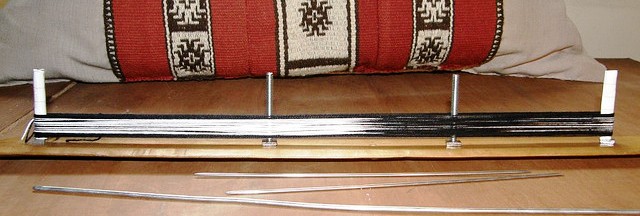
I fiddled with this and that. Many warps went into the trash. Luckily I have my mini warping board and so was able to quickly and easily set up tiny two and four-stake warps so not a whole lot of yarn was wasted. And then I got it! He he…big smile.
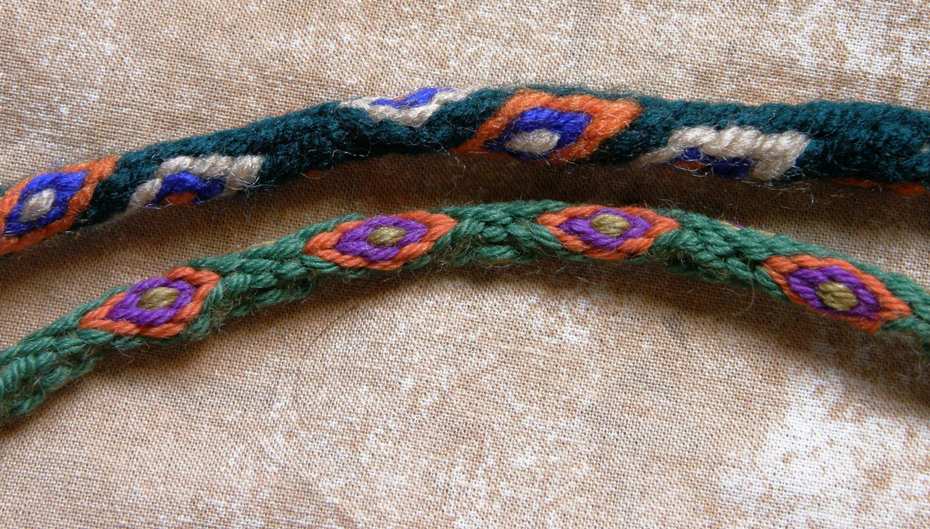
So there’s a spiraling ñawi awapa band that I made ages ago and, below it, one I made this week that behaves nicely and lies straight. Again, I say that both types have their charms…it just depends what you want and now I have options.

Of course, when tubular bands are sewn to cloth as in this example from Peru, they are forced to lie straight. I was told by Nilda Callañaupa in Peru that tubular bands are sewn to pieces of cloth to help stabilize the edges and corners which tend to curl due to the highly overtwisted wool warp yarn that is used. Now I am wondering if the spiraling in the tube counteracts the curling in the cloth and is what allows the fabric to then lie flat.

I have always sewn my tubular bands to very sturdy material…edges of bags which are doubled pieces of woven cloth so the spiraling nature of the band has not had any effect on the finished piece….no twisting or distortion of the fabric has resulted.

So, after that, I just had to play with my new discovery and make some more tubular bands.

Thick ones, thin ones, in cotton and wool. The wool ones are much smoother and prettier….ñawis with their diverted and twisted warps, plain-weave, pebble weave and warp substitution tubular bands.

Maybe next time I am in the US I will get some caps and clasps and make some wristlets with these although maybe I should just go down to the Buckle Land  store in the street market here and see what I can find.
However, if I am going to wear a wristlet, I think that I would rather make one of these…
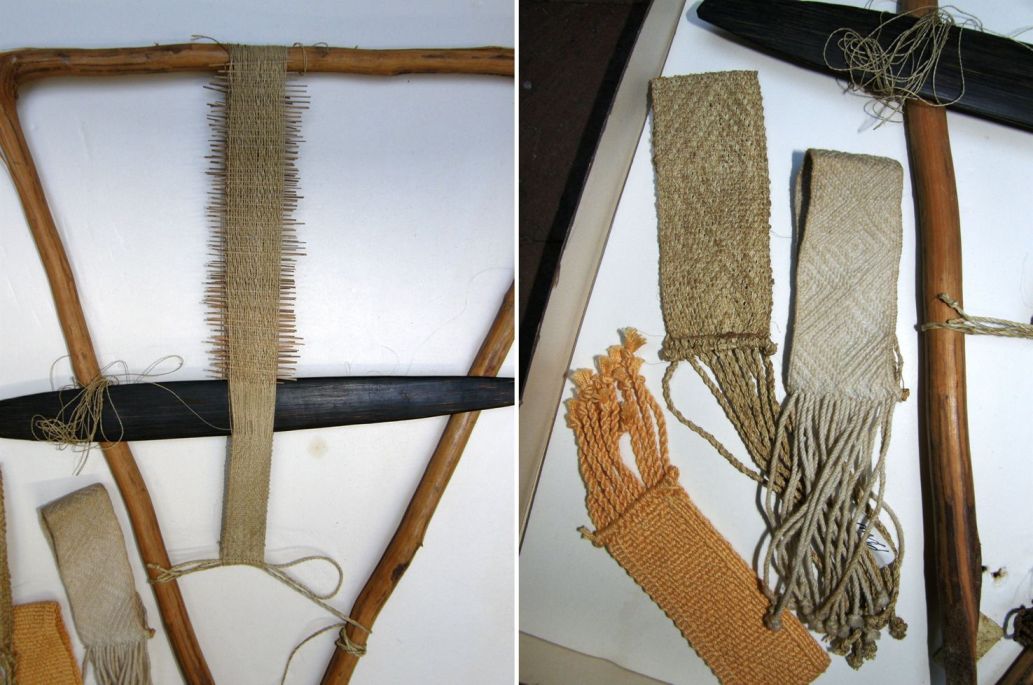
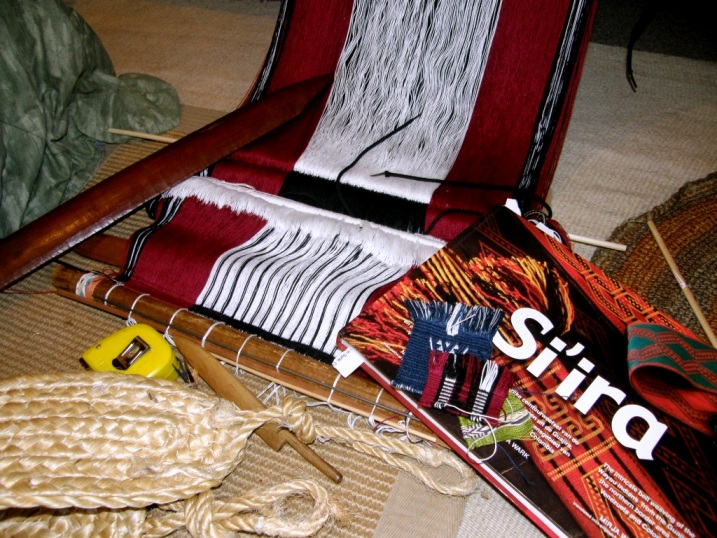
These were collected and also reproduced by Anne Blinks and Nora Rogers and now form part of Martha Stanley’s collection. I believe that they were made by the Mayoruna Indians of Peru who live in the same region as the Shipibo in the Upper Amazon Basin. I was given one of Nora Rogers’s pieces in progress on the loom as well as a booklet on the technique from my friend Betty’s vast collection of resources on ethnic weaving techniques.
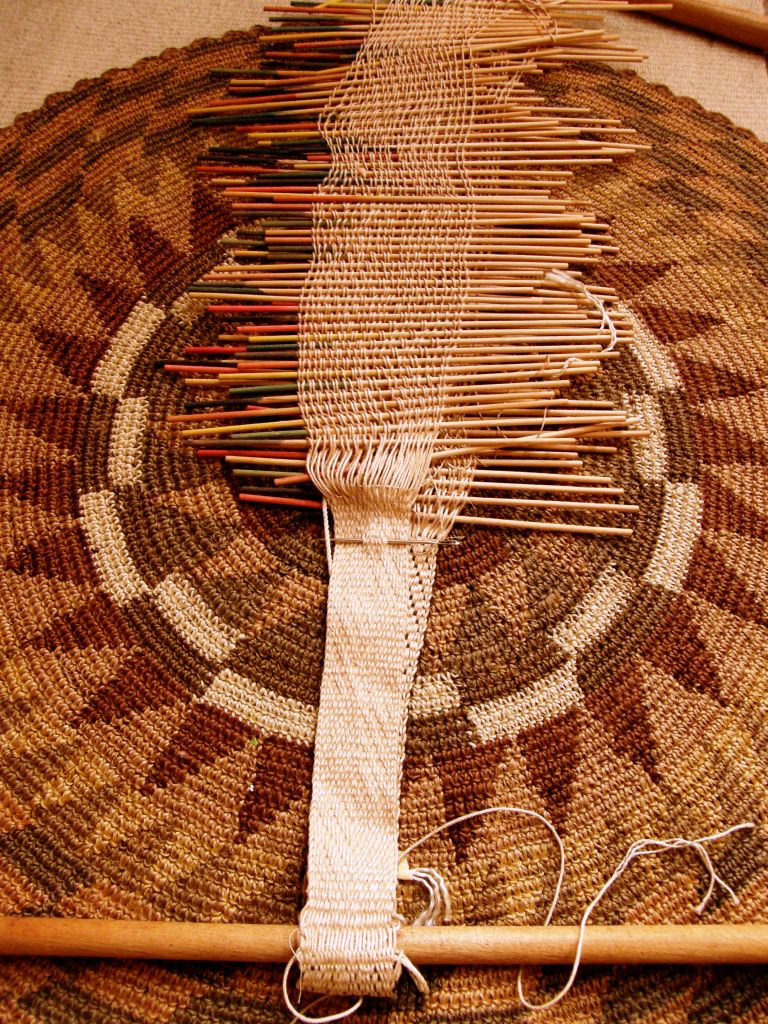
There it is all ready to be studied!

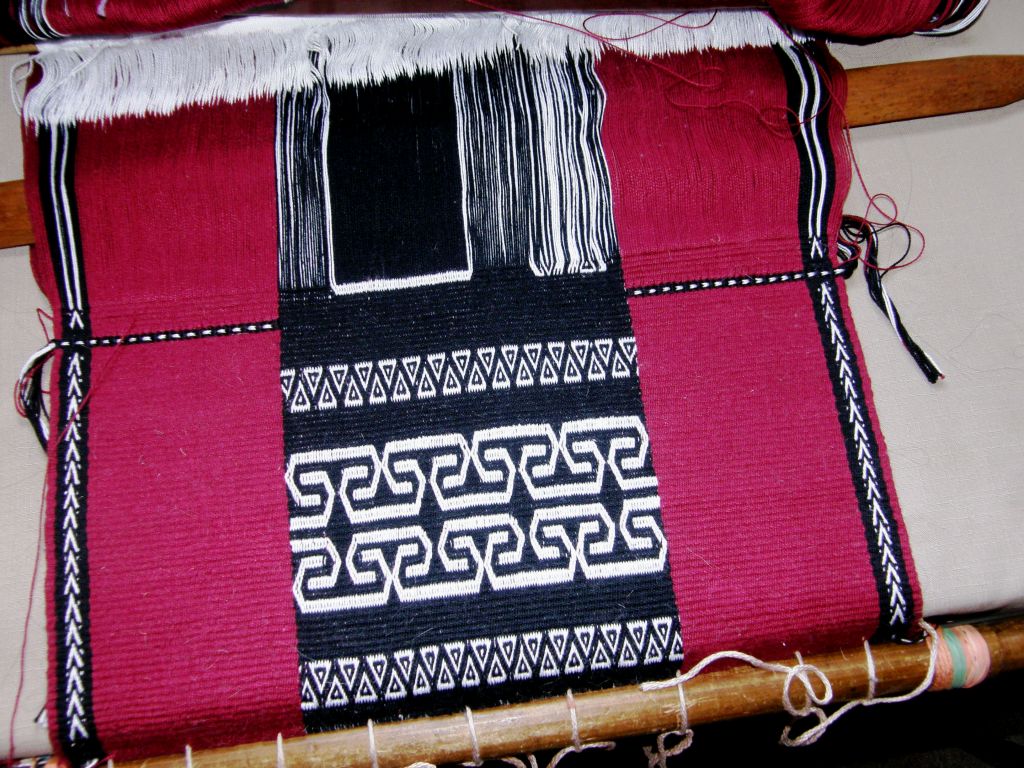
From tiny to tremendous, I pulled out this monster project this week too….
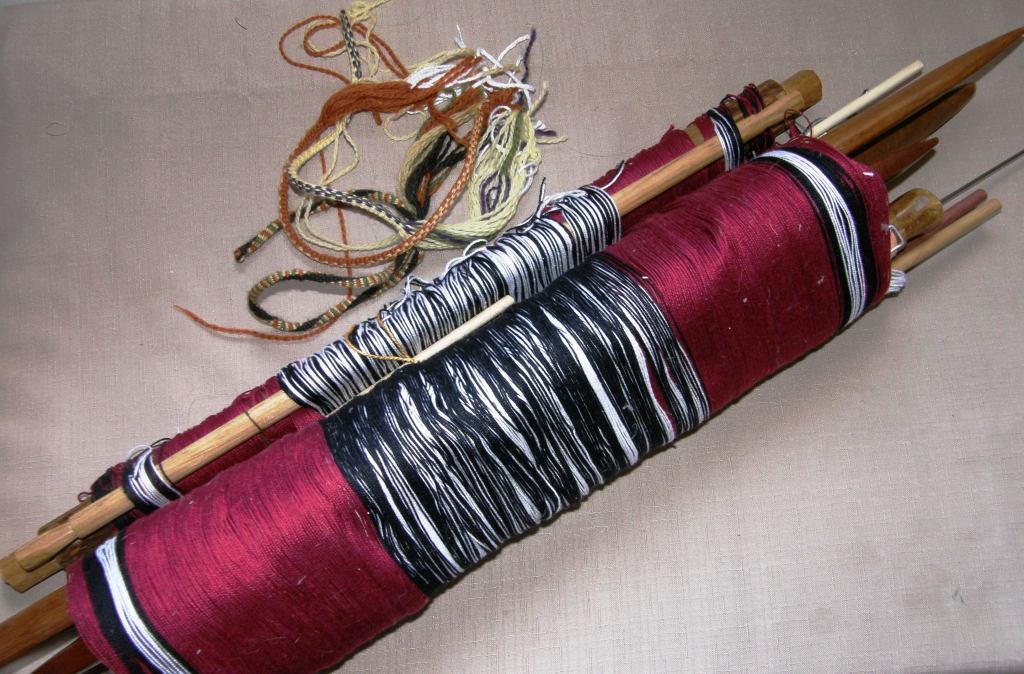
My tubular bands look quite ridiculous next to it!

That thing is heavy! It is was very weird sitting down to it after not having touched it for so long. It took me a while to get back into the rhythm…which swords do I use when and what sequence of moves had I decided were the most efficient?

Once I was back into it, the first thing I noticed was a mistake in the new pick-up pattern I am weaving which would have had very sad results further down the track. That meant that my first task was to un-weave….sigh! but I am smiling about having caught it in time.

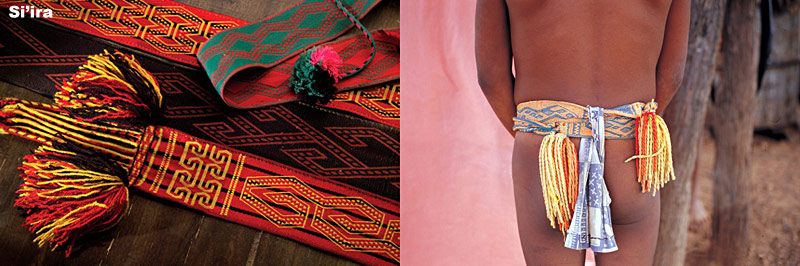
Yes, progress is slow on this piece but if you are thinking that I am getting nowhere, let me show you that I have least gotten the design established. Most of the major scary counting is now over as each row of pick-up is now done based on the last, if  you know what I mean….simply moving a little to the right or the left as the diagonal lines form. It is always exciting to be doing a new design and especially this one as it is my own adaptation of a traditional si’ira pattern of the Wayuu people from Mirja Wark’s book. After all the adjustments I made to have it fit my piece, it now has a lot of my own touches and so I am curious to see just how it will turn out.

So, this week I “tamed the tube” and smiled at many things…like seeing  Jeen zooming on after having woven with her and enjoying herself with my pebble weave book  using her rigid heddle loom. She is now an active member of the Ravelry group.
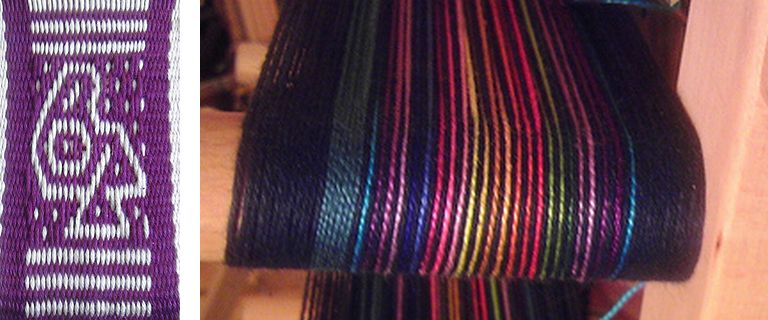
Now that she has woven the bird motif, she plans to try it with that gorgeous multi-color warp.

And Marge, who also wove with me, is trying warp substitution with Bedouin patterns as a warm-up to double weave.

She was a bit dismayed by the long floats on the back until we  assured her that that is what happens with warp substitution.

She will be able to take the skills she learns from this experience a step further when she tries double weave.

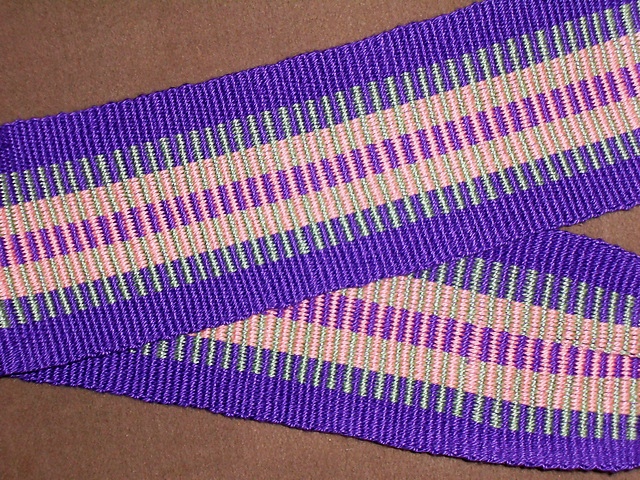
Alison wove a backstrap with a striking pattern and beautiful edges…
And then made a pebble weave band on her inkle loom using many of the motifs from my book.
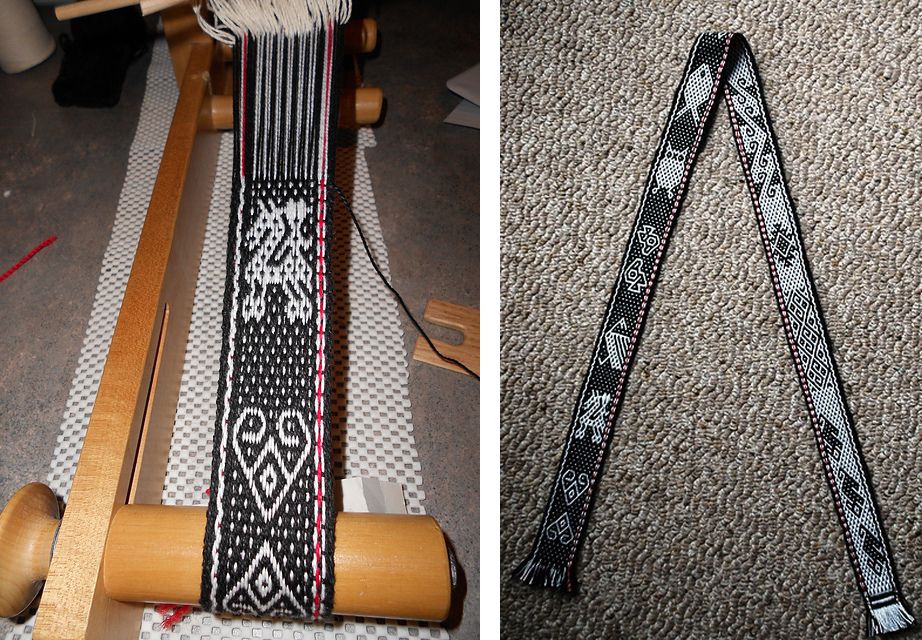
Jenibug blew me away by taking the llama patterns that I have charted here for warp-faced weaving and adapting them to balanced double weave pick-up on her floor loom…

Here they are in warp-faced double weave…the little llama heads come from a Bolivian band. I added the body embellishments and backgrounds.
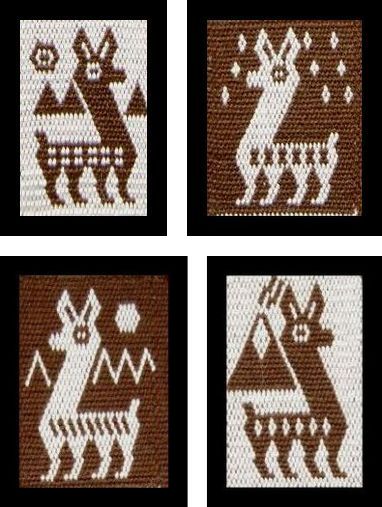
And here is Jenibug’s balanced weave project…How neat is that?!
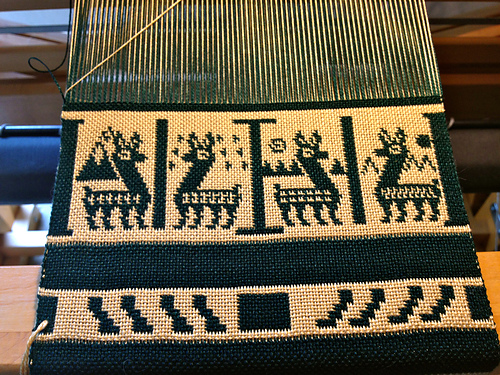
And here it is off the loom and wet finished. Are you sitting down???
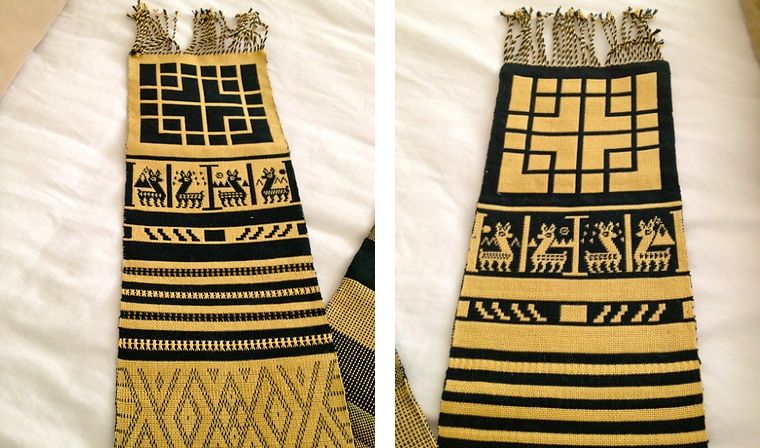
Isn’t that spectacular? She took my charts and translated them to balanced weave pick-up…blows me away!

And here are Loli’s pebble weave projects…beautiful bands!
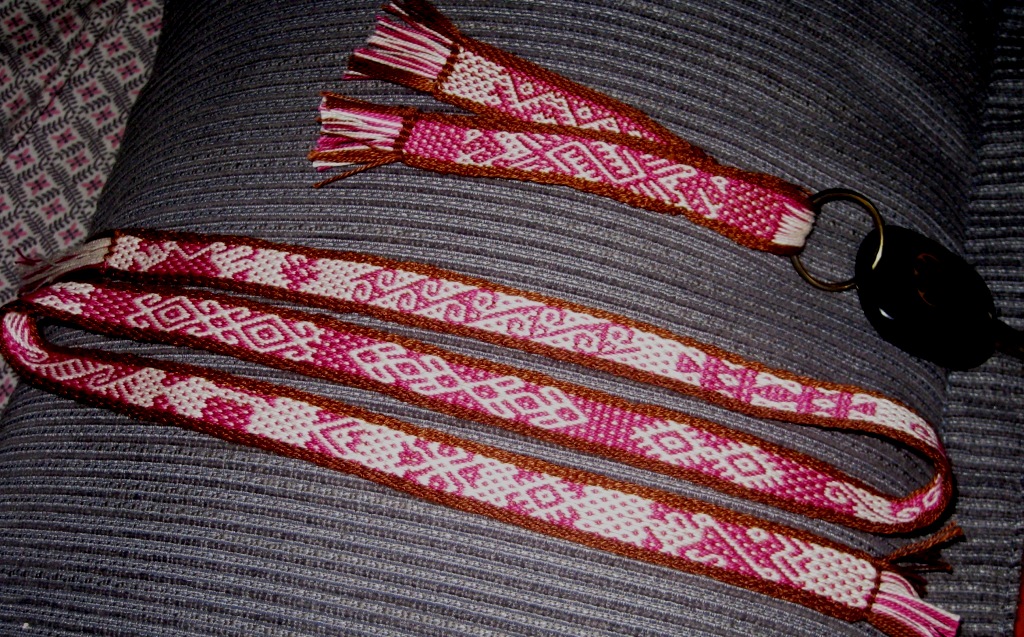
Now can you understand why I am smiling big smiles?!! My experiment with tubular bands brought a smile but seeing cool stuff being made by the Ravelry folks is the best weaving therapy of all.

And just in case your socks are still on after seeing all that, I will leave you with another picture of one of the stunning bands from Ayacucho, Peru that I saw at Maryland Sheep and Wool Festival. I will leave you with bright cheerful colors and these playful figures, one of which is so similar to the ones I was taught when I studied pebble weave in Peru.
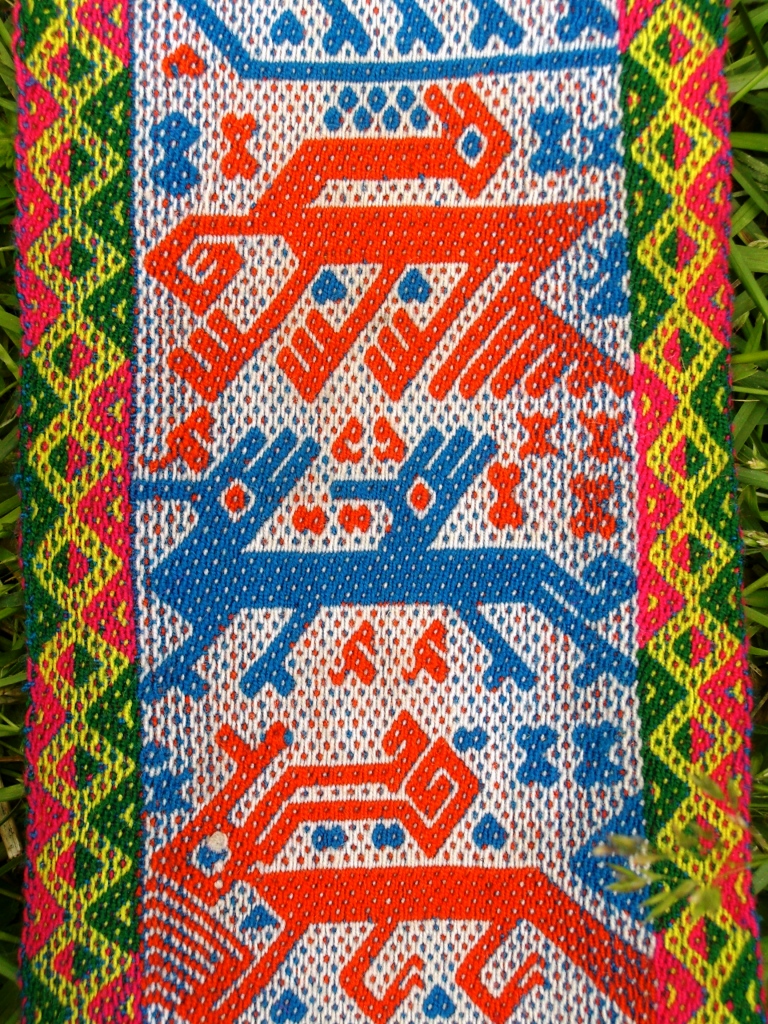
Backstrap Weaving – Weaving Wanderings and Wonderings

The Worldwide Weaving Web brought a new book into my home last year which has inspired my third wall hanging project.

If you can’t bear to look at yet another of my red, black and white warps on the loom ready to be woven, you had better look away now because here we go again!

There isn’t a whole lot to show for a week of work, is there? What you don’t see is the reading, sampling, un-weaving, re-warping, charting, erasing and Googling. In fact, as I sit in front of this warp, I have the uneasy feeling that I may be jumping the gun and launching into the big project too early. I have actually unwoven the first line of pattern twice and made adjustments. Clearly my sampling didn’t cover all I had in mind.

I am using the work of the Wayuu people of Venezuela and Colombia as my inspiration for this project through Dutch author Mirja Wark’s book Si’ira. A lady in one of the Ravelry weaving groups posted about the existence of this book in the middle of last year and I was on a mission to get hold of it. My friend Anna in Australia, who is from The Netherlands, took care of the local payment and then offered the book to me as a birthday gift. Thank you, Anna!

It is a beautiful hard cover book full of drawings and photos of the si’ira which are worn by men, their designs, the weavers and the vertical looms that are used to make them. The skills required to make a si’ira  include weaving, twining, braiding and tassel making.

This image is from Mirja Wark’s web page.

The Wayuu live on the Guajira peninsula which is the northernmost border between Colombia and Venezuela. Wark describes this area as a flat, dry semi-desert over which a continuous hot wind blows. It is always interesting to me to know more about the people, weaving and textiles of lowland regions of this continent.

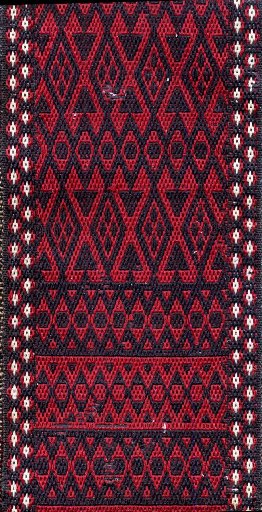
Many different colors are used and I especially love the pictures of the si’ira in the book that comprise a red and black background on which yellow motifs have been woven. Other belts are black with red motifs…very striking…and so they are perfect for the color theme of my wall hanging project.

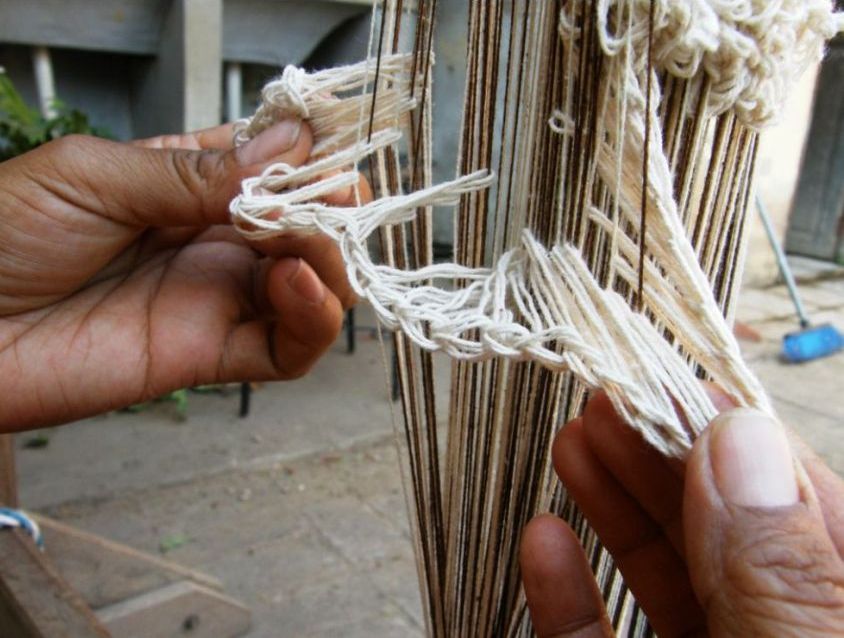
It is also interesting for me to see that the Wayuu weavers use the same style of joined loop heddles used by the Guaraní weavers, another group that inhabits lowland regions, here in Bolivia.

At left you can see my Guaraní teacher, Angela, showing me the unusual way her string heddles are chained together.

What I would like to see is how the Wayuu weavers manipulate the heddles and if it is the same method that Angela and other Guaraní weavers use.

Angela most often has three sets of string heddles on her loom which are required by the technique she employs for the kinds of structures that she weaves. Watching Angela do her pick-up work jumping between two sets of the string heddles is fascinating!

The Wayuu weavers use one set of these kinds of string heddles on their warps but I imagine that they would need to work them in a similar fashion to the way Angela does.

I can’t help but notice some small similarities in some of the motifs of the Wayuu and Guaraní people although the weaving structure employed is different.

So, this will be the basis for wall hanging number three in the red, white and black series.

Another of the many interesting things about the si’ira is that they are woven with what Wark calls a “hollow selvedge” which serves to strengthen the edge of the belt. It is funny that on a visit with my friend Pam in Massachusetts we had talked about a rolled selvedge that Harriet Tidball describes in Shuttlecraft Monograph 26. Pam was trying it out on a band of her own.

Tidball writes that it was used by the ancient Peruvians and that available evidence shows that it was used on bands and belts.

The rolled selvedge creates a thick tubular edge.

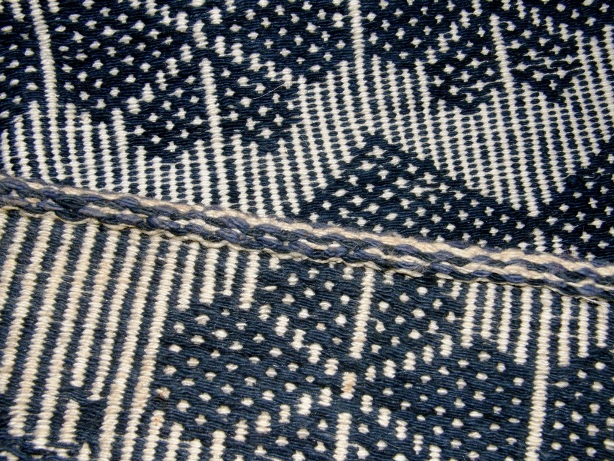
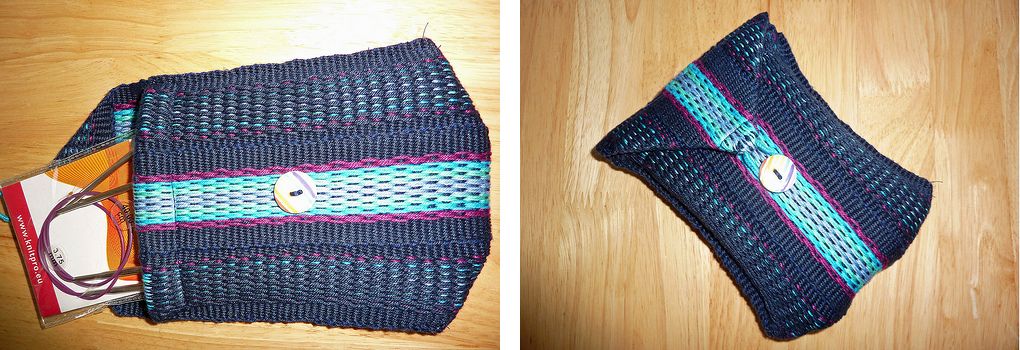
Separate tubular bands like the one on the edge of the purse pictured at left are often applied to Bolivian and Peruvian weavings  for various reasons, one of them being to strengthen and reinforce the edges of the textiles.

You may be able to make out the thick edge which is the hollow selvedge on this image from the cover of the Si’ira book.

How clever to think of a way to form the tubular edging from the band itself so that it forms as weaving progresses and does not need to be added later. I wonder why this technique fell out of use in Peru.
I love seeing how these things turn up here and there, disappear here, remain there, evolve further there, are replaced by something even more ingenious somewhere else…The fact that these heddles are used by the Wayuu in their arid lowland home and also by the Guaranì here in steamy jungly lowland Bolivia, so far away, fascinates me.

The Worldwide Weaving Web, about which I often speak, means that I can have a new online weaving friend in rural Turkey asking me about backstrap weaving and telling me about the catalog of woven Turkish motifs that his mother has while a weaver and clothing designer in Bangladesh shares with me what he knows about backstrap weaving in his country. Techniques and information are shared instantly across the globe. I wonder how in ancient times designs and techniques were transported and shared and adapted among the weavers of this continent.

And then you have weavers who live along the relatively short length of Ecuadorian coastline who apply bands to strengthen the edges of their cotton saddle bags. Different techniques are used to both set up the loom to create the patterns and finish the woven pieces in different areas along the coast.. I am familiar with the way the members of one family of weavers in Manabi province finish their work by applying a woven band using a home made rigid heddle which I have shown many times here before. Yet it is worth looking at again..it is so cool!

This picture, taken by Kathleen Klumpp, shows my weaving teacher Trinidad weaving and sewing a band to the edge of a small bag.

This is how the edging looks on the fabric.

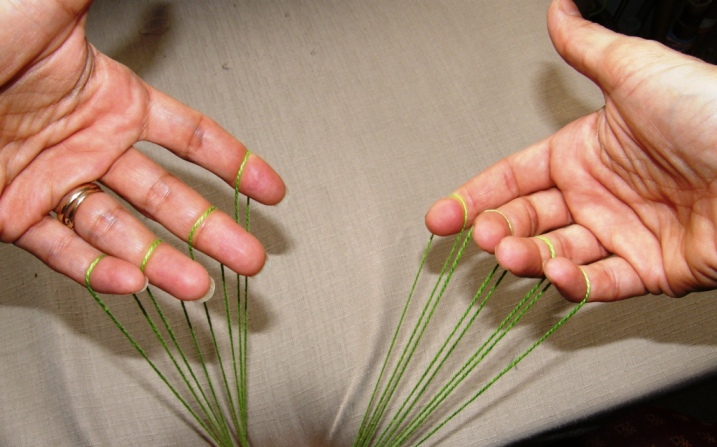
And then I see from an article in the Textile Museum Journal that further north on the Ecuadorian coast, on the Santa Elena peninsula, weavers also apply bands to the edges of their saddle bags but use a very different method which requires an extra pair of hands.

While one person sews the band to the fabric, another person manipulates the warp threads  passing the warps which are looped on the fingers of their two hands from one hand to the other. The extra pair of hands would look like mine above (modeled on a drawing in the Journal article).

These are two very different ways to add a reinforcement band to the edge of a woven textile and both are being used within a relatively small area.

Do similar techniques develop independently or do they travel and get shared and eventually adopted and adapted? Why do some methods remain so different within relatively small areas? I know there are people who devote themselves to studying just this kind of thing. Me? I sit here and ponder!

Something that seems common in certain areas of Asia is the addition of string heddles to the warp while the actual warping is in progress on the stakes. Was it developed simultaneously in various areas or did it travel and get adopted? It seems like such an ingenious and time-saving thing to me. However, it is not something I have ever seen in use in my part of the world.

I know how to do it as I watched the Montagnard weavers warp when I visited them in North Carolina and, more importantly, filmed the process so I could study it over and over when I got back home….it was all happening so fast!

Even though I say it is clever and time-saving, I have not adopted this technique for my own weaving. I stubbornly cling to my favorite way of making heddles with the extra hitch which has the heddle loops  held snugly on the heddle rod.

In the same way, perhaps the weavers of Manabi province in Ecuador and those on the peninsula further north are aware of each other’s techniques yet stick with their own methods believing them superior…who knows? My anthropologist friend Kathleen Klumpp no doubt can tell us that.

Here is the video I made of Ju Nie warping with two colors and making her heddles around one of the two as she goes. That is followed by a video I made in which I do it slowly and explain the process.


Angela, my Guaraní weaving teacher, certainly didn’t hesitate to ask to be taught how to make the kind of string heddles I use when she saw them on my loom and she started using them on her warp to replace one of her sets of chained string heddles straight away. She had seen string heddles on a stick before, wondered about them, but didn’t have anyone to show her how to make them.

And she was keen to learn how to do the three-color version of the technique she employs when an Aymara weaver visited from highland Chile.

And so, techniques and methods travel and get shared and then I guess one day no one will remember anymore how that particular technique managed to cross the Andean high plains and descend to the Bolivian jungle.

Well, enough pondering. Let’s see what has been happening in the Ravelry group where some weavers are still having fun with the Bedouin techniques.

Here’s Jennifer’s wall hanging which uses the al’ouerjan pattern and shajarah techniques. Many of the motifs in the central section were created and charted by Jennifer herself.

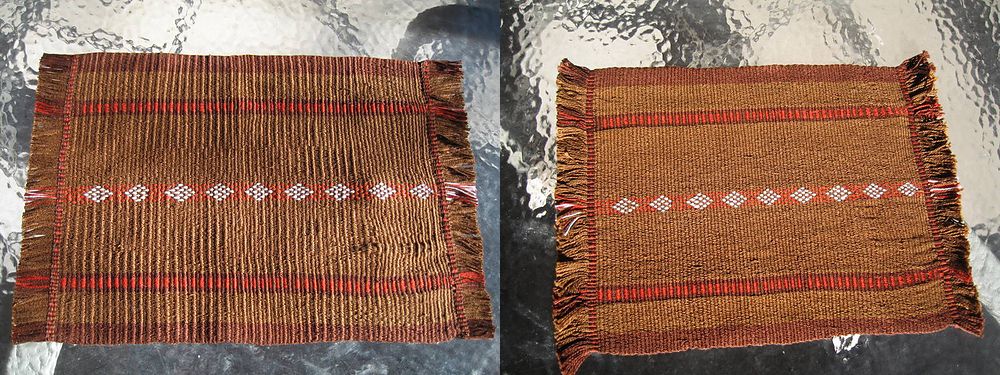
Traudi provided us with helpful pictures of her piece before and after washing. She made a placemat and had some tension issues and a bit of puckering, which didn’t all come out in the wash but, what is nice to see, is that the severe ridging that had formed in her cotton cloth disappeared with washing and pressing.

She used weft twining on both ends before leaving the fringe and her center pattern is the traditional Bedouin al’ouerjan design.

And to finish, I ‘ll just let you know that I put one more tidbit on my RESOURCES page this week. I am slowly but surely gathering up all those links.

Backstrap weaving – Staying on Track

I have been trying to resist the urge to warp up for an al’ouerjan project and join in on the fun in the Ravelry group. You may remember that a couple of weeks ago, after having posted the warping tutorial for these traditional Bedouin patterns, Tracy suggested a weekend warp-along. Now we are seeing the increasingly large and impressive results of all that warping practice. Take a look at the bag strap that Tracy made at left.

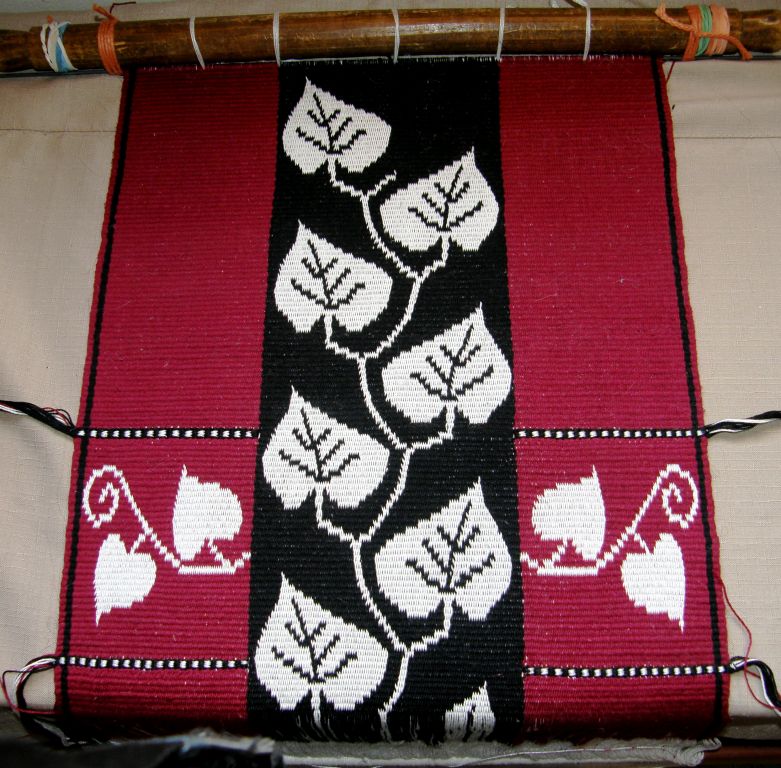
But…I am staying on track which means that I am sticking to my chamanto-style leaf-patterned wall hanging (although I couldn’t resist throwing in a bit of weft twining). I finished the first pebble weave hanging in this set with weft twining and so I decided that, apart from the common color scheme, the weft twining would be another theme that would tie all my planned wall hangings together.

While I sit and pass the shuttle, strum the warps, beat and coax the sheds open I think about what will be next in this series. I have no problem whatsoever in coming up with ideas…the problem is that I want to weave them all at once!

I stand back and look at this piece and I still can’t get used to it.

It’s not quite like anything I have done before but I have to say that I am having fun with it especially adding in that twined section with the motif within. I had to stop for a bit to chart those smaller leaves on their vine, sample them etc…It took a while to get them right.

I think that all my planned red, black and white pieces will look pretty nice when hung all together. The question is….where? Although I have been doing some major cleaning out, I still haven’t managed to uncover any significant amount of wall space.

Next on the clean up list is my dear old Ashford traditional wheel. Yes, I have a spinning wheel…who knew? It has been sitting there so long unnoticed, dusty and in desperate need of oil…poor thing. It was born in New Zealand and made its way all the way over to the Falkland Islands before finding its way into my home in southern Chile. I left a lot of stuff behind in Chile but the spinning wheel came up to Bolivia where it has sat in the corner for almost 14 years…shameful! I won’t take a picture of it now in its pitiful state. I will clean it up and get it back into shape. I have room to use it now!

I only had it for four months before leaving Chile and just got into using it and being able to turn out something consistent. I did, however, spin enough yarn to construct a vest, knitting the natural colored front and weaving the dyed brown back. The edging has been worked in cross knit looping.

This, too, sits neglected here in this hot steamy climate. It is a souvenir at least of the Patagonian sheep.

But, back to the al’ouerjan and let’s see what else the Ravelers have been up to…

So, there’s the strap that I showed you earlier on the gorgeous bag that Tracy made. She will line the bag  to protect the warp floats on the inside. She used an additional weft to secure the floats on the strap. You can see details about how that is done here. One of Tracy’s other warp-along products is the pillow cover which includes some tapestry-style twining in  the lower left hand corner and a striking and beautifully executed joining stitch.

Aunt Janet’s piece above left is in her own handspun wool. She has three sets of al’ouerjan patterning and that blue looks amazing.

Traudi so loved Tracy’s piece that she got into the act too using brown instead of black which looks fantastic. She twined along the bottom of the piece too. We are seeing more and more twining in this group…cool. Here is the tutorial for basic weft twining.

Jennifer did some charting and planning for the shajarah patterns before warping a wide piece that also includes an al’ouerjan design.

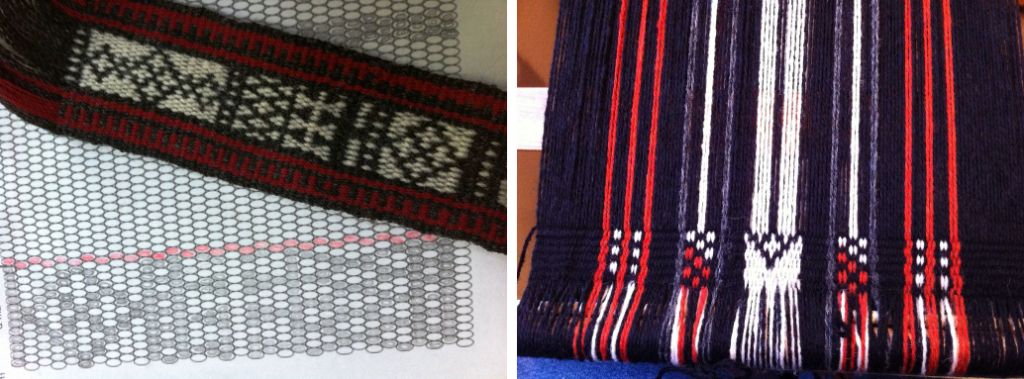
The charting paper with ovals which is useful for double weave, warp substitution and supplementary weft patterns can be found here. A tutorial for weaving these kinds of warp substitution patterns is here.

So, January has gotten off to a great start in the Ravelry group! Pantoffels has been wrangling with what she calles an ancient inkle loom and still managed to make this pretty needle pouch with plain pebble weave patterning.

And then she got a new inkle loom under the Christmas tree and will now try the pebble weave patterns in my book Andean Pebble Weave.

While I have been weaving my “leaf” piece based on the Chilean ponch known as a chamanto, I have been getting out other pictures of ponchos that I have to study the design layout that weavers use on these large pieces.

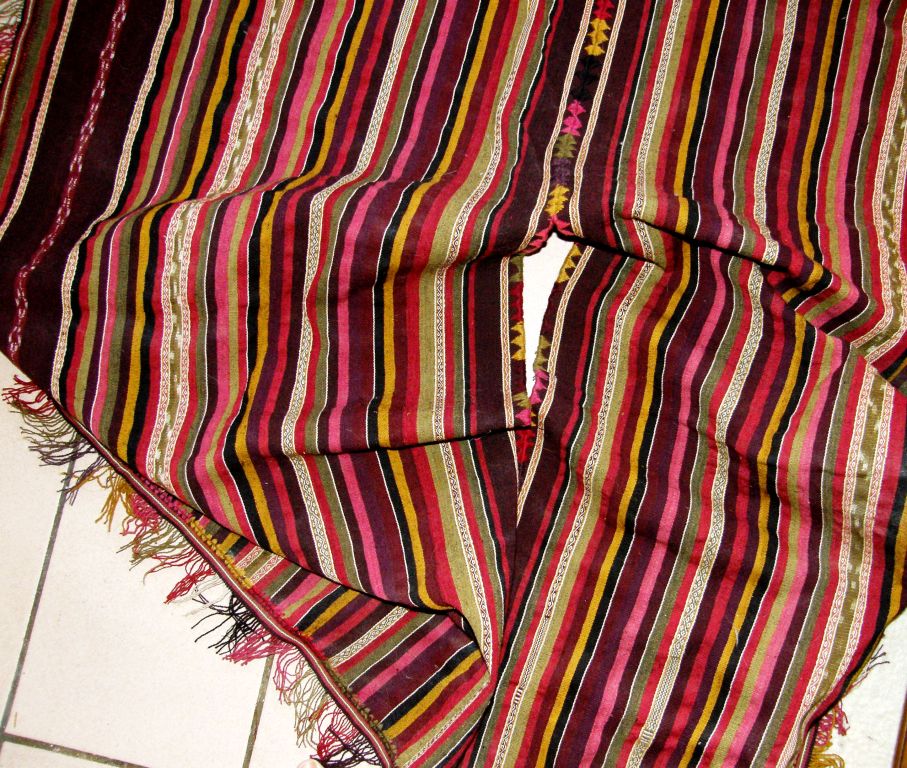
I own one poncho which I bought in Calcha, Bolivia many years ago. It is made from very fine handspun wool which has been colored with natural dyestuffs. It is patterned with simple stripes, some very narrow and simple ikat bands as well as several very narrow strips of pebble weave.

It has been woven as two panels with four selvedges each and a woven band has been sewn around the four edges with an added fringe. Don’t you love that decorative stitch that has been used to join the panels?

There is definitely an art to stripes. You can see the clever placement of fine white stripes to break up some of the richer colors.

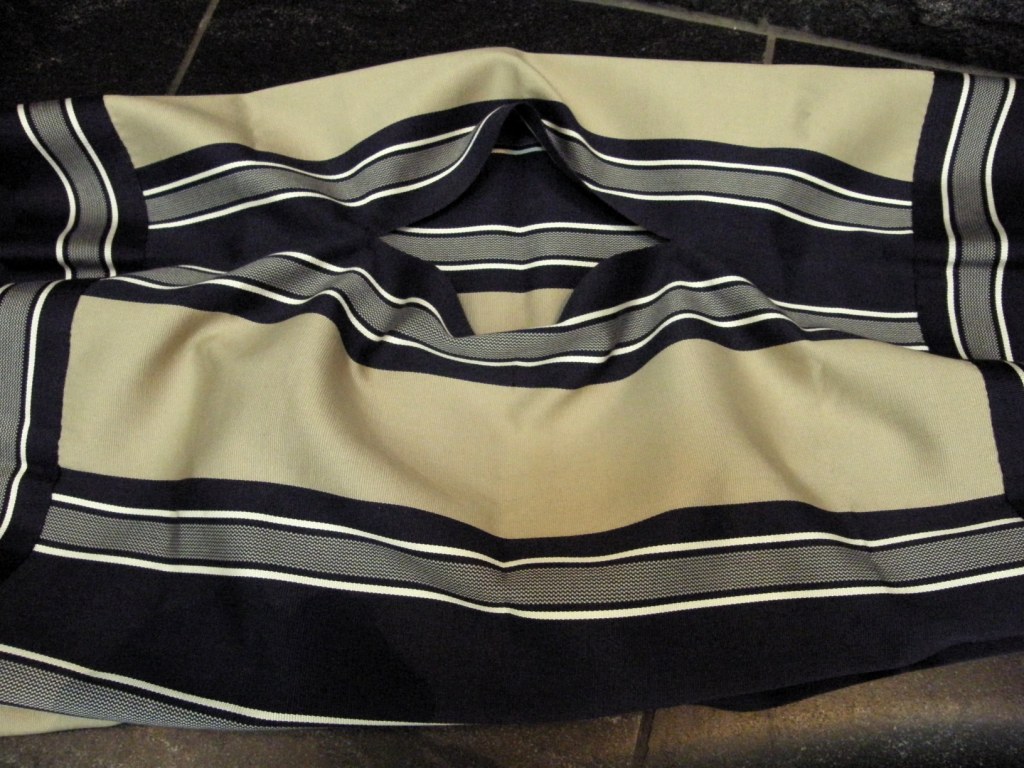
 An extremely fine and simply patterned manta from Chile. It is always interesting to see how the colors and stripes are distributed. As is typical, a broad band has been woven and sewn to the four edges of the piece and there is no fringe.

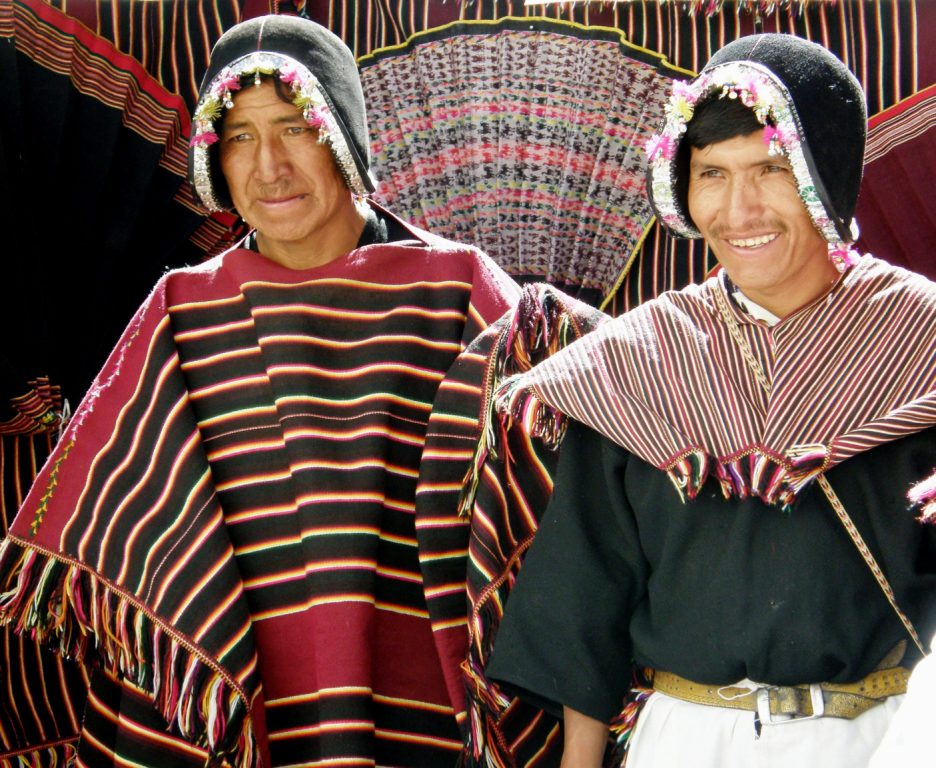
The typical poncho of Tarabuco and the smaller version known as unku can be seen above.

At a handcraft fair in Tarabuco I saw weavers making the long poncho panels. My friend, Anna, showed me the unku on the right that she had bought in Tarabuco when she came to visit me.

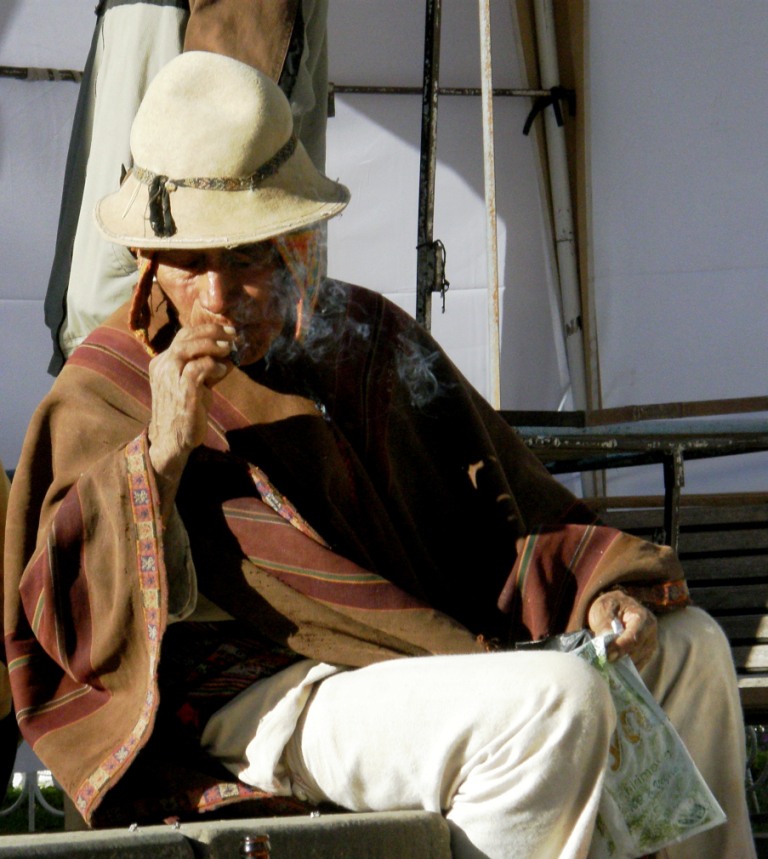
I spotted this gentleman in his much more subdued woolen poncho in a small plaza in Sucre. He was performing an offering to Pacha Mama in the early morning. How wonderfully simple and light the poncho looks although I am sure it is extremely warm and virtually waterproof.

And then you have the incredibly intricately patterned calf-length ponchos woven and worn by the men of Chahuaytire in the Cusco area of Peru.

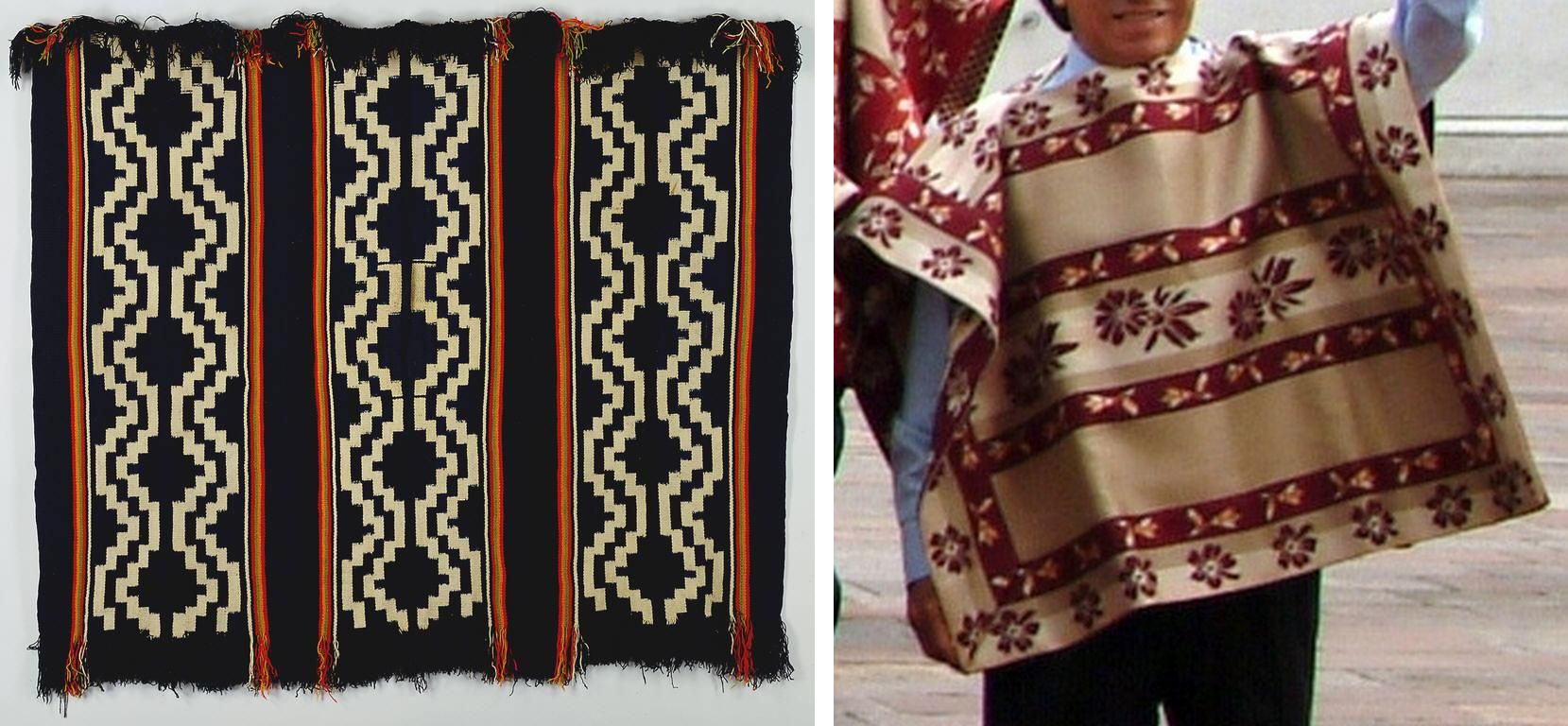
From Argentina and Chile we have the Mapuche makuñ with its ikat patterning technique executed in such a way that there is virtually no blurring of the design. The popularization of the poncho, from what I have read, is generally attributed to the Mapuche who wove them for their own use as well as for barter. On the right you see the chamanto of the Chilean huaso, with its leaf, fruit and floral motifs, which are said to have both indigenous and Spanish roots.

I have  a few pictures from Ecuador too…scans of old prints…

This is the “jijon” poncho which is factory-made in Quito and worn by those men who can afford one in Otavalo. You can see it being worn with its grey plaid face showing by the gentlemen on the left and with its darker face outward on the right. These men were wearing their ponchos to the market on a regular day. Apparently there is a much more costly blue double-faced poncho which is woven on the backstrap loom made-to-order. The ownership of one of these special ponchos indicates wealth and high social status.

On Sunday, which was both market day and church day in Cañar, a very social time around the main square and surrounding streets, I saw quite a few ikat-patterned ponchos being worn.

And finally there’s Juan below, (my pebble weave student!) with his mother and neighbor. Juan put on his  narrow, black fringe-less poncho and felt hat especially for this picture. On another visit during a festival all the men were wearing their ponchos for the occasion.

You can see the backstrap looms on which I was teaching Juan and Natalia pebble weave tied to the pole. In exchange Anita introduced me to her cousin on my next visit and he taught me to weave the typical supplementary warp patterned belts of Salasaca.

Okay, so I promised you some double weave edge samples this week, right? I am sorry, I didn’t get those done. I was busy trying to stay on track and not get “dis-track-ted” by all the goings-on in the Ravelry group. I want to finish my leafy hanging. but I must say that I have a bowl of tencel calling to me wanting to be made into a scarf…

That blue ball is indigo-dyed Japanese silk…a fabulously thoughtful gift brought to me from Japan by one of my old teaching colleagues here.

Hopefully I will get the leaf piece off the loom this week, plan and warp the next hanging, play a little with my tencel, get the Ashford Traddy up and running and do those double weave samples for the tutorial too….phew!

Oh, and I have started a new page for RESOURCES. You will see the tab for that on the header and I am slowly extracting all the links to interesting sites, articles and products that I have linked to in my 105 posts so far. This is quite a job but I hope to add two or three links to the page every week. I hope you find it useful.

.


Backstrap Weaving – “Al Sadu” and Warping a Bedouin Pattern

I would like to share something that Alaa wrote in the Ravelry Backstrap Weaving Group this evening quoting from the book published in Kuwait  Al Sadu: The Techniques of Bedouin Weaving.

“The word Al Sadu in Ibn son of Mandhurs’ Lissan* Al Arab* The Tongue Language of the Arabone of the earliest known encyclopedia dictionaries of the 13 C denotes the extension of the hand towards an object, as when camels move forward with their forelegs. The word Sadu equally implies the movement of the head as in the way camels and horses move their heads thrust forward. Earlier, Al Jawhari (d. 398 Hijri) in his book Al Sahah also means the long and gentle stride of the camels. Al Sadu is the term used for warping and means what is extended.

In its widest linguistic meaning Al Sadu means: to extend or to stretch and spread, and, as used by Bedouin of Kuwait it means the process of wool weaving, the actual woven objects as well as the loom itself. Thus, it is an old Arabic term that evokes images and meanings derived from the desert environment and the Bedouin traditions.”

Extending, stretching and spreading…fitting words to have in mind when one thinks about the process of warping or even to apply to this idea of the Worldwide Weaving Web that I often refer to…which allows designs and textile techniques from people thousands of miles away in a dry sandy desert to enter the home of someone in humid jungly lowland Bolivia.

I read so many comments in the online weaving groups about the “joys and traumas” of warping. I don’t think I will ever think of it in quite the same way after that lovely description of the meaning of Al Sadu….that graceful extension of head and limb and thread….beautiful!

Some people love warping and see it as relaxing, some detest it, while others fear it.  And then there’s the old “back-to-front” versus “front-to-back” debate…that’s floor loom talk…I have little idea of what all that means but I do know that there usually isn’t just one right way to do things.

I love learning about the way warps are created for the simple looms I see in use here in South America and around the world, whether they be for backstrap weaving, or for the horizontal, vertical loom or leaning loom.

Sometimes all it takes is a toe and a forefinger…two points around which the threads can turn and measure out the length of the warp with a simple cross between.

For certain woven structures a startling amount of stakes are required so that the weaver can carefully place all the threads in their correct positions before the warp is transferred to the loom. Of course it also depends on whether the weaver is creating a circular, dovetailed, discontinuous or single-plane warp.

For those not familiar with circular warps, think of the inkle loom. You can see above left the very short sample warp I wound on my inklette and removed for this picture. When the band on the inkle loom has been woven, it is cut and opened up to its full length. Above right you see the same circular warp next to a warp that was created in a single plane for my backstrap loom. The finished inkle band will open out to be longer than the other one. Both kinds of warp are commonly used for backstrap weaving. A circular warp provides a practical way for long pieces to be woven on a backstrap or other loom without needing a large space in which to work.

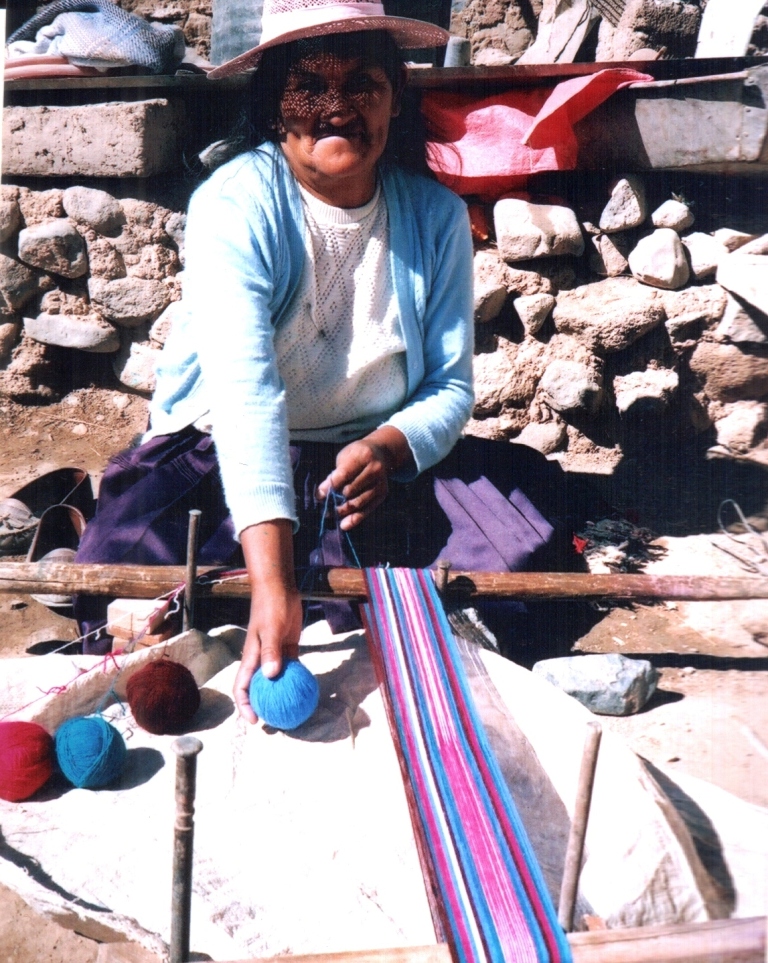
Warping for a large single-plane warp-faced piece may require two very long stakes between which the weaver walks carrying the thread. The weaver who was creating this warp in Chinchero was working alone. I have been told that often two weavers will sit, one at at each stake, and roll the ball of yarn to each other.

A belt with a complementary-warp pattern might need four stakes for its warp with the weaver sitting and carrying the threads at full stretch…

Some weavers, like my Montagnard teachers in the US, have a permanent warping set-up that stands on its own which they can pick up and transport from place to place. Below, Ju Nie is teaching other Montagnard ladies to make a circular warp in a community center. (picture by Andrew Young)

Her process will create the circular warp that you can see here…

The warp end nearest the weaver must be clamped or stabilized, as you can see, so that it won’t slide around the loom bar as the weaver beats.

I love the improvised warping set-ups…

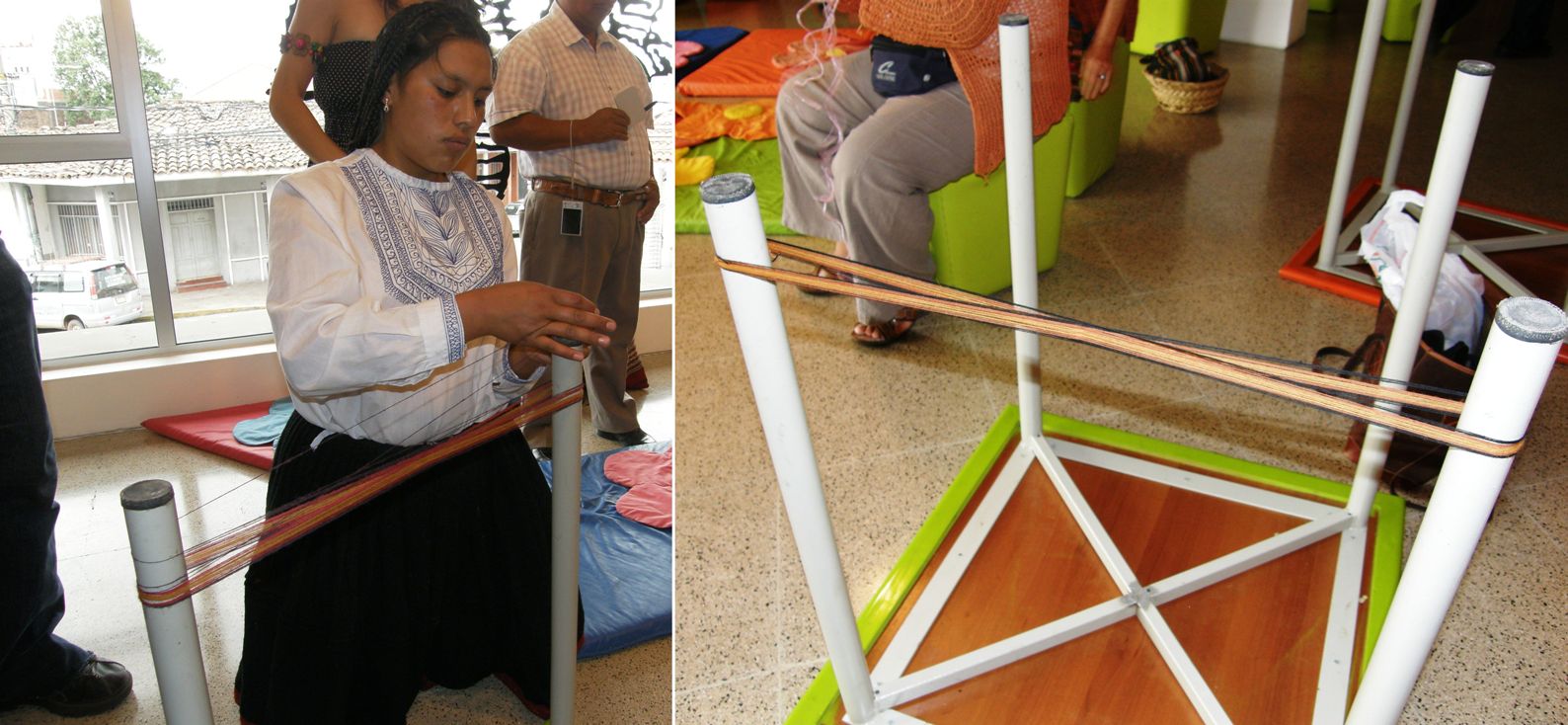
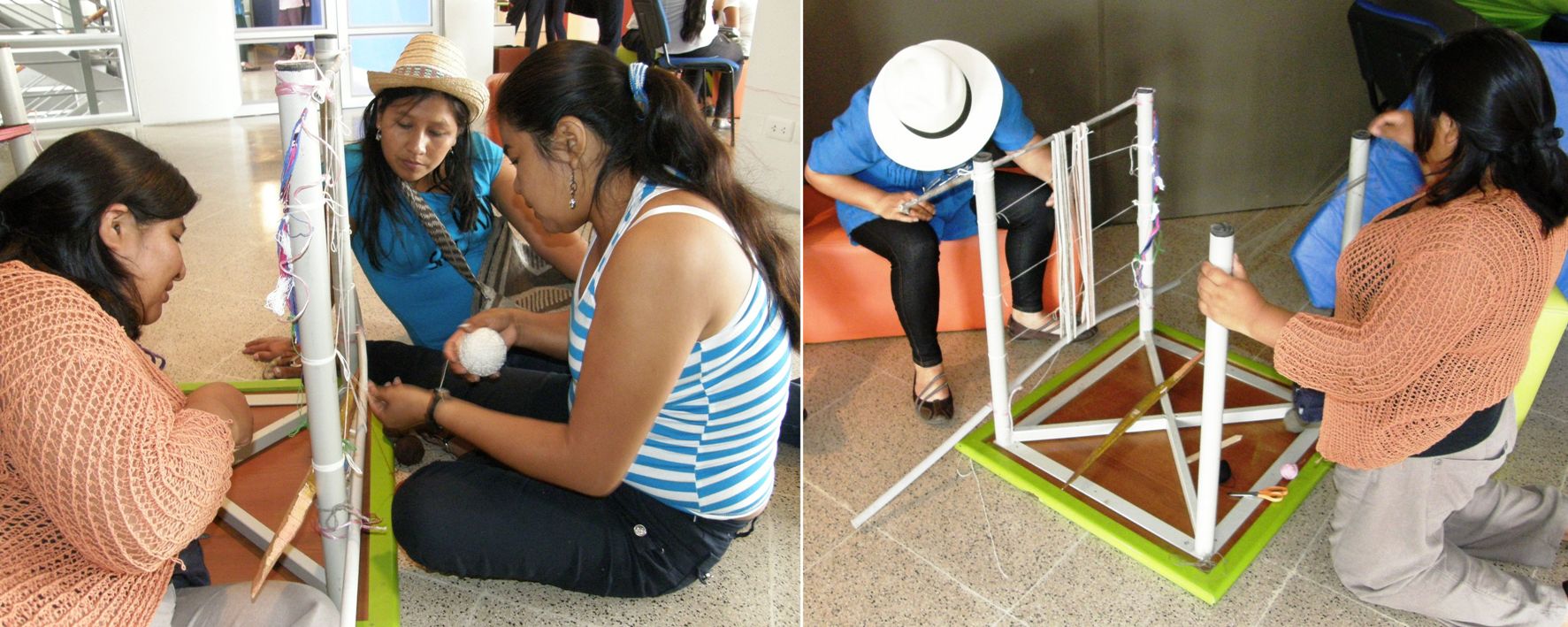
Indoors at a gathering of weavers in Santa Cruz, Bolivia, Chinchero weavers used table legs around which to warp practice bands.

The same table was even used by a Guarani weaver to demonstrate the dovetailed warp that she uses on her vertical loom. The dovetail warp occupies one end of the table while an Aymara weaver from Chile winds her single-plane warp on the other.

Often warping can involve more than one person. Above, Hilda and I in Potosi Bolivia, are warping the horizontal loom for warp-faced double weave embedded in plain weave. She is about to roll the ball of yarn to me so that I can turn it around the loom bar before rolling it back to her.

Mapuche weaver Marta and I warped together at the recent exhibit in DC which meant I couldn’t get a video of the process but warping with her rather than filming was much more fun!

Beth from Beer Sheva in Israel gave us a link to a wonderful set of videos on Bedouin weavers in Lakiya village in Israel. One of the videos shows how it takes three people and a lot of walking to warp their long horizontal looms for the making of warp-faced carpets.

You may remember the next video that I posted some time ago of the poncho weaver from Paraguay warping her tremendously long single-plane backstrap warp, carrying the thread up and down on her own for three hours.

I love watching that weaver at work!

Which all brings me to the warping tutorial I promised this week for the Bedouin al’ouerjan patterns which are woven with the warp substitution technique.

Tracy in Qatar and Helena in Brazil have been playing with these patterns as well as a couple of other members in the Ravelry backstrap group. You can see Tracy and Helena’s work above. We have all fallen in love with these patterns.

We had fun playing with one of the many versions of this pattern when I wove with friends in California. We combined the technique with weft twining.

And look at Tracy’s latest project!!

You will find the tutorial on warping the al’ouerjan patterns here. The weaving technique (warp substitution), which you will need to learn first, is detailed in a tutorial here. A tip for securing the warp floats that are typically created on the backs of pieces woven in this technique is within this blog post.

And, thanks to Alaa in Jordan and several other people who pointed out to me the Interweave newsletter this week that included a link to a  video on Bedouin weaving on the UNESCO site which is definitely worth watching. UNESCO were kind enough to give me the embed code but WordPress doesn’t like it! So, here’s the linkI just love how the loom is perched over mounds of desert sand. Nothing could be further removed from this moist jungly place in which I live.

Earlier I mentioned a link that Beth in Israel provided which leads to a page with several videos on the Bedouin weavers of the Lakiya Negev Weaving Project.

The one on finishing techniques is very nice. And here’s the link to the page with all eight videos.

I have a feeling we will be seeing many more projects inspired by Bedouin textiles in the Ravelry Backstrap Weaving group…a lot of black, red and white which also happens to be the color scheme of my latest pebble weave project. It is coming along…

Here it is all rolled up and reaching the end. It will be a wall hanging so it doesn’t need to be any specific length but I would like to weave as much as I can on it. I will change those thick cross sticks for thin ones and replace the end loom bar with piano wire and then lash that to the loom bar. That will give me more working space. I am still thinking about twining a design into the end.

In the meantime I am itching to warp up the next wide piece in these same colors…another wall hanging inspired by the Chilean chamantos.

And more things come into my inbox to inspire future pieces in this color scheme…

Roman K sent me this image of this beautiful man’s wool sash that he owns which is from western Podilia which Wikipedia tells me is in south-western Ukraine.

This sash has been woven in the simple two-color warp float technique but we are not sure as yet what kind of loom was used. Roman is a great resource for information on traditional folk clothing and embroidery. My online friend Sharon first sent me a link to his post on Central Asian embroideries and, while looking around his extensive website, it occurred to me that he may know something about the origin of the complementary warp weaving technique on some of the Russian Old Believer belts that I have been studying.

He has sent me pictures of other gorgeous sashes and belts which I will save for another post.

I know that my weaving friend Annie will be eyeing that sash. She is building a nice collection of sashes from around the world which I got to admire when I stayed with her this last fall. On top of that she weaves guitar straps and sashes of her own design on her inkle looms…emphasis on the plural…I think she has about seven inkle looms and is forever creating new and unique patterns.

It really seemed to me that her creative process was completely natural and effortless. There was no charting and not a calculator in sight. She just seems to pick up this color and that, move her skeins and balls of yarn around and then come up with something fabulous.

I think it is a wonderful opportunity to add a splash of color to the end of this blog post by showing you some of the guitar straps that Annie, aka AspinnerWeaver, creates and sells in her Etsy store.

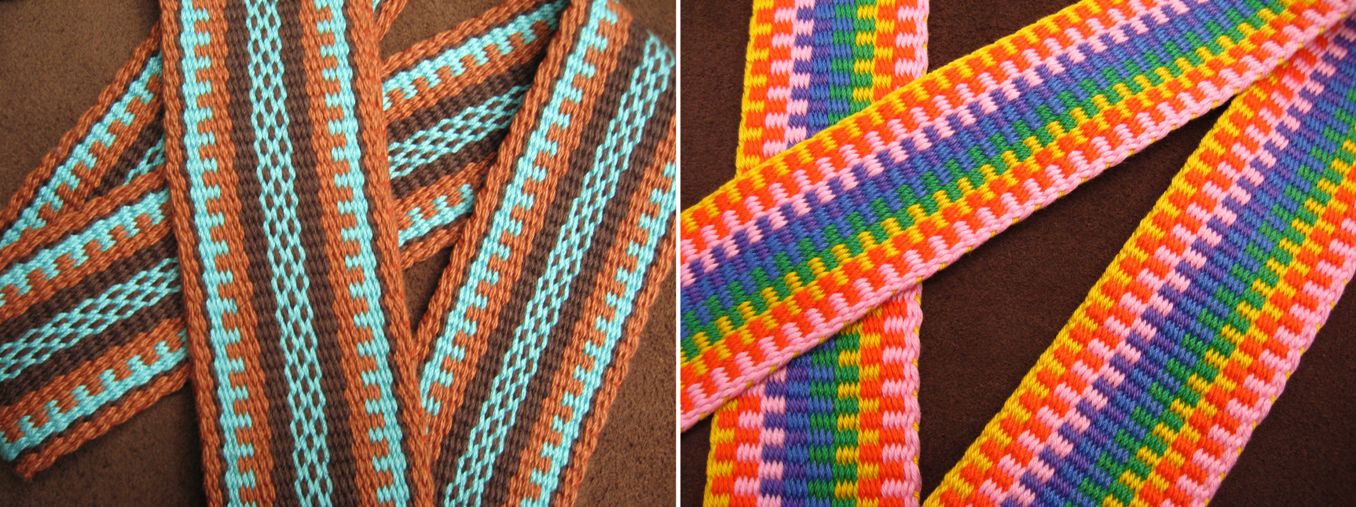
These are done in plain weave with all the patterning created in the warping, letting the colors do the talking.

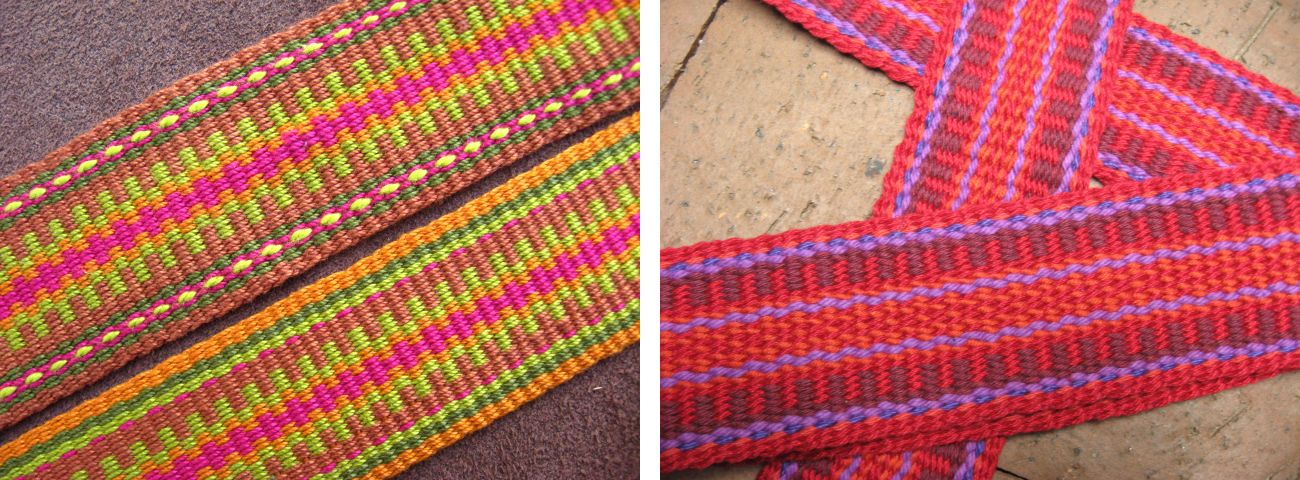
She has taken the supplementary warp technique and really run far with it working it into her own unique patterns.

Color!! She has made minimal but very effective use of the simple warp floats technique in these next two straps and turned out two gorgeous designs.

Mental note: never fear the half revolution on the warping board…a lot of these clever warp designs that Annie has created require half revolutions when winding a single-plane warp which is something I usually just don’t bother with to avoid having knots at my starting end (not a problem with circular warps)but, then again, not really a problem with single-plane warps either especially if you plan on starting with a fringe.

More plain-weave beauties…

And  one last supplementary warp color burst and a two-color warp float strap that is one of my favorites.

Have this got you all keen to warp up something on for your inkle or backstrap looms? If you are in need of even more inspiration check out Annie’s Flickr guitar strap album.

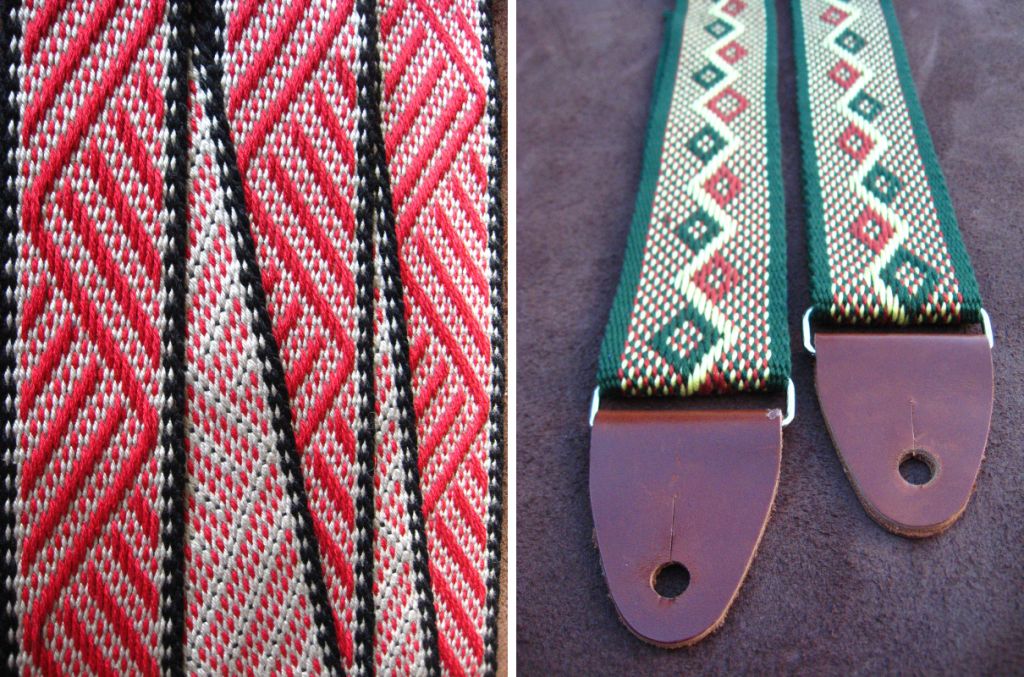
I was asked recently to make a guitar strap for a friend. I chose to make it in my favorite pick-up technique…you guessed it, pebble weave. I added in a couple of extra heddles which made it quite fast to weave.

 I happened to mention to Annie that I had to make a guitar strap and the fact that I would need to buy the hardware to finish it. In the mail arrived a package from her with all the pieces necessary to complete my project. What I didn’t realize at the time is that she actually cut the leather pieces and put it all together herself. Better still, she is selling this now here so you can weave your own guitar strap and have everything you need to finish it off beautifully.

I definitely owe my boyfriend a new guitar strap. The pebble weave one I made him is constantly being confiscated and taken with me on the road to show friends.

There has been some buzz in the inkle and backstrap groups about Anne Dixon’s book which is due out next summer I believe.

I am happy that I will get to meet her at the Braids 2012 conference in Manchester next August….400 warp-faced weaves. Imagine!

It seems so far away now but time is bound to fly. And what about Convergence and Maryland Sheep and Wool? Are you planning to go? I hope I will meet some of you at at least one of these events.

Well, back to my red, black and white pebbly Starry Night piece and hopefully I will have the start of piece number two in this series to show you next week.