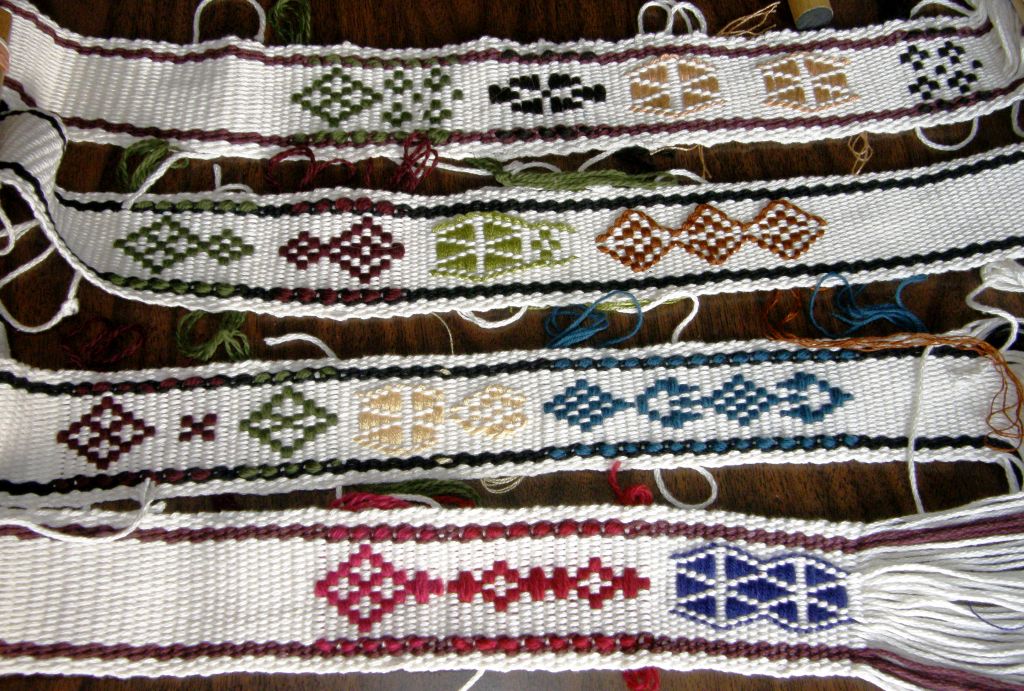
Backstrap Weaving – Vermont!!

Dare I say that Vermont is now my favorite of the US states that I have visted so far? No, it would be impossible to choose a favorite. I was so in love with Utah and its canyons in my hiking days in the 1990s. It isn’t fair to compare the two….so different and so incredibly beautiful in their own way.

sunset from Mt Philo VTThis is just one of the lovely sunsets we had last week from Mt Philo overlooking Lake Champlain. Lausanne took me up there 15 minutes before the park closed. We were told it would take 7 minues to get to the top….I figured 7 minutes up, 5 down and 3 left over to enjoy the view. About thirty minutes later we still couldn’t peel ourselves away from the spectacle and the park guard finally had to come and coax us to leave so he could end his day.

Vermont foliage over lakeI don’t know if the fall foliage colors have yet to reach their peak and that there are even better things to come. It is hard to imagine it getting better than this!

Photo by Lausanne Allen

Walking in the woods with the dogs on a bed of fallen leaves of all colors…..

And this has been my home for the last ten days or so…

???????????????????????????????

???????????????????????????????Here, in the home of Lausanne and Brian, I wove with two groups of backstrap weavers…friends and neighbors of Lausanne’s as well as a lady I know from one of the Ravelry groups.

Apart from one crazily wild rain storm which knocked out the power one evening, we had day after day of warmth and sunshine in which to explore the area. And who can begrudge a power outage when you get to enjoy Brian and Lausanne’s home in the glow of the wood stove and candlelight….

Candlelight in the wooden cottageThe sun filled Lausanne’s living room with light and warmth as we settled down to play with backstrap looms. The wood stove provided a little early morning warmth while the afternoons had us opening windows and doors to enjoy the freshness of the beautiful day.

tie up spo for backstrap loomsThis plant rack by the window turned out  to be a handy place for anchoring some of the backstrap looms. A sturdy table was the anchor for others.
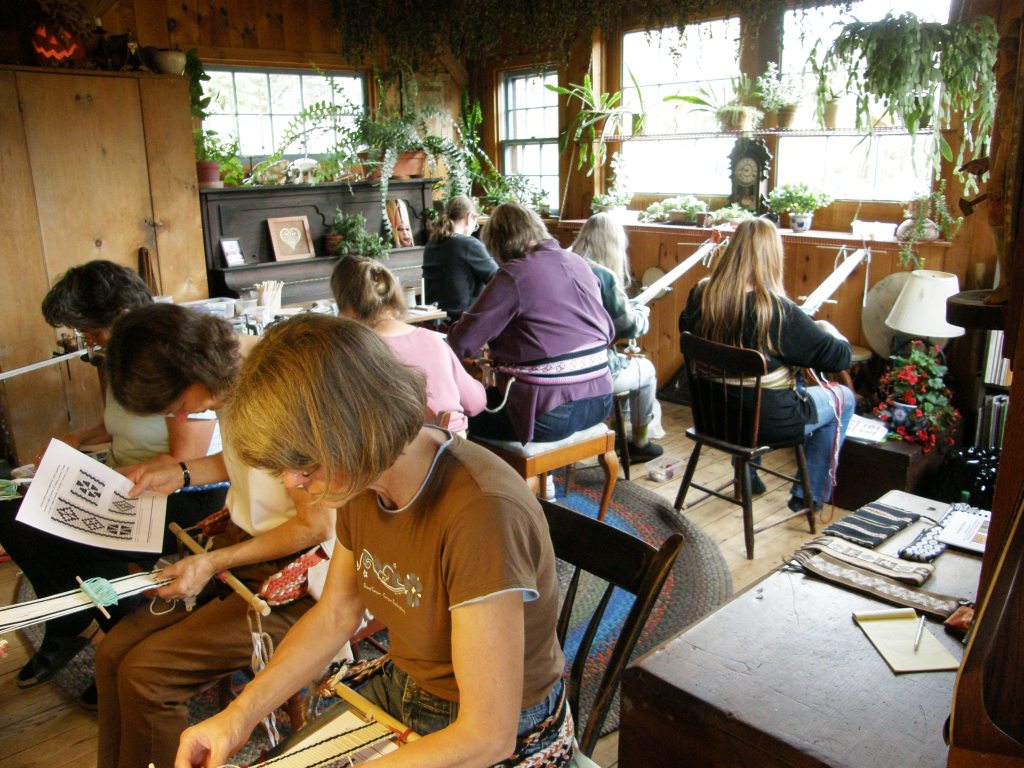
???????????????????????????????And the back of the sofa provided one more ideal spot for weavers to attach their warps.

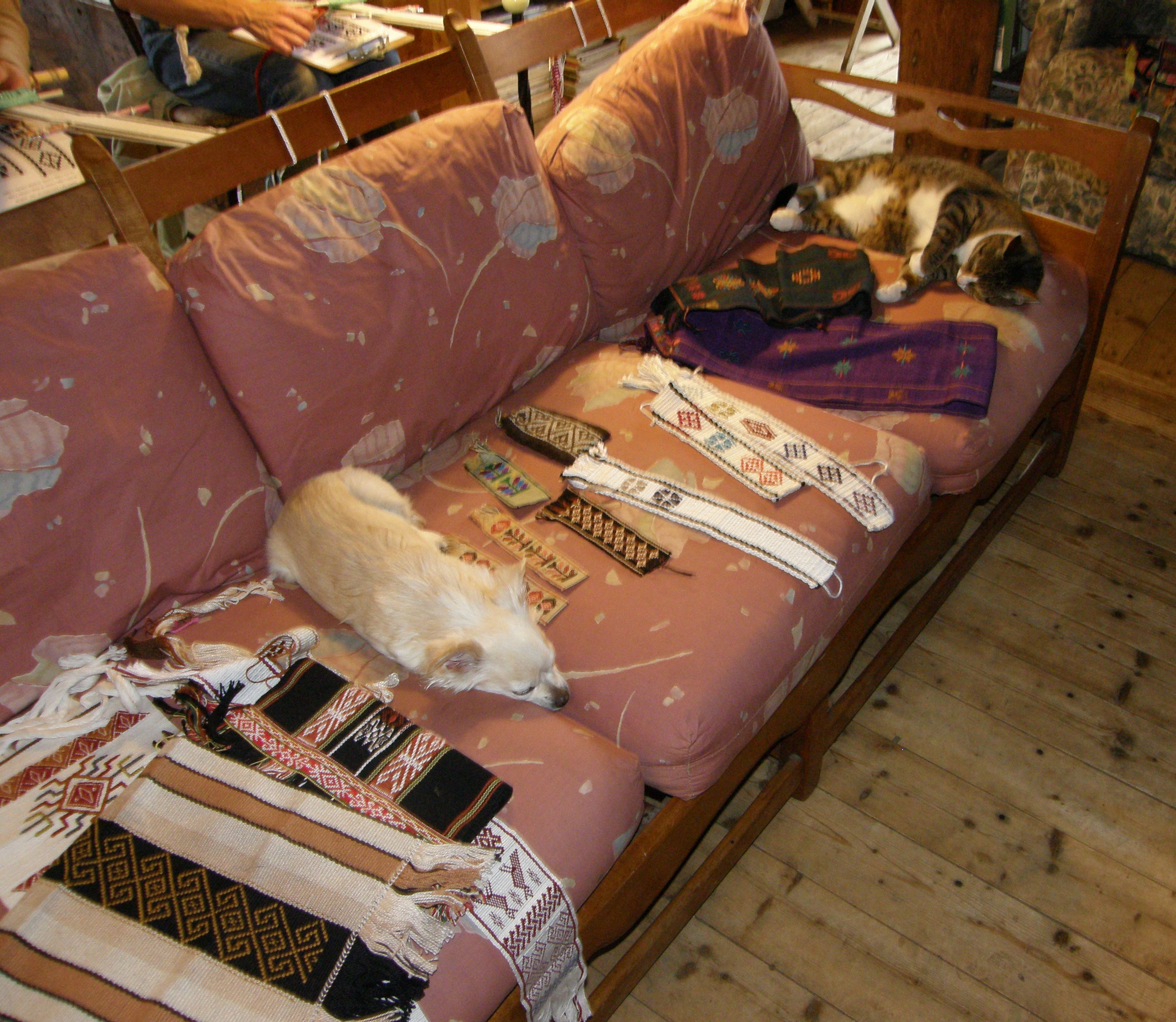
anchoring backstrap looms to the back of the sofaThe pets helped in their own way, adding their weight to the sofa snoozing among my weaving samples so that the sofa woudn’t be dragged away with the weavers’ vigorous beating or over-zealous tensioning of the warps.
???????????????????????????????

Candace and Kathy backstrap weavingCandace and Nancy pause for a smile while taking their first steps in backstrap weaving. Candace is flanked by Lisa and Julia.

Annie learning to open the heddlesAnnie starts to get the hang of coordinating the moves which allow her to open the heddle shed smoothly.

The cats stretched out between us on Lausanne’s many very large, and richly colored homemade braided rugs that adorn the wooden floors.

??????????????????????

???????????????????????????????The bench of the grand old barn loom in the corner served as one of our warping stations.

Lunch breaks provided strolling and recharging time through this kind of thing!….

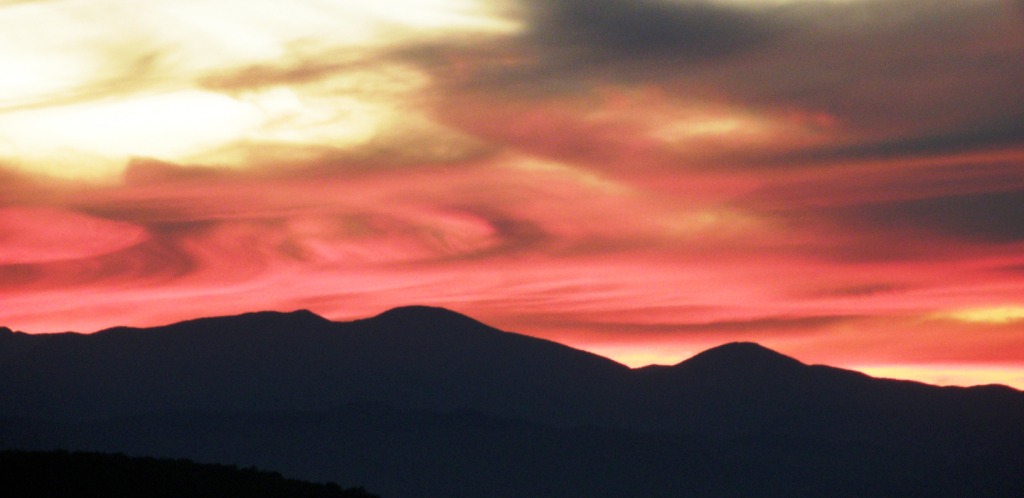
???????????????????????????????And, climbing up the ladder to Lausanne’s cupula in the evening gave views to distant hills and eerie red sky sunsets.
??????????????????????

And then, in amongst  all this natural Vermont beauty, came this…

peruvian ceremonial chuspa

and this….

finger wovwn sash L'AssomptionThe chuspa, (coca leaf bag) from the Cusco area of Peru, came to me as a gift from the collection of Libby van Buskirk. I had met Libby on Facebook via an introduction from Lausanne and Lausanne took me to visit her and her husband, Dave, in her Vermont home one evening. There was so much to see and talk about in so little time! I was shocked when she offered me the gorgeous chuspa. As much as I like the fine, high quality weavings made with naturally dyed handspun yarn that the Cusco Center for Traditional Textiles has been ecouraging weavers in the Cusco communitues to produce, nothing can beat these slightly older and more rustic pieces, in my eye.

??????????????????????I love the twin pockets for the lejia (catalyst in powder or solid form) that you can see in the first picture. Those little pockets are woven along with the main bag. Narrow extensions are created for the pockets as the pieces are being warped. This construction is something I studied with my teachers in Potosi, Bolivia and you can see our warp for a single pocket chuspa underway below, the narrow extension being what will form the pocket.

warping-for-chuspaWhat I really enjoyed seeing was the tubular band that edged the bag and the two pockets…

???????????????????????????????It looks to be the same kind as that is used by weavers in Chahuaytire to edge their woven pieces (Libby does not recall the community in which the chuspa originated).It has quite a different appearance when woven with the heavier more rustic wool and acrylic. Look at band that lines the recently woven alpaca piece from Chahuaytire below.

chahuaytire-tubular-band-on-chahuaytire-fabric1

Libby van Buskirk lausanne and LaverneAbove you see the three “L”s….Libby, Lausanne and Laverne looking over some of the Peruvian bands in the van Buskirk collection. I have my chuspa happily clapsed in my lap. It was exciting to listen to Libby talk about her book which Thrums, llc is publishing and which will come out in December…..US$19.95

1175168_436391443140740_426276318_nThe book includes three folk tales as well as six of Libby’s own original stories of Inca life. Lausanne and I got a preview and the book is simply gorgeous, designed by Ann Douden, and beautifully illustrated with paintings by Angel Callañaupa (you will recognize that last name I am sure). Those of you who have Nilda’s first book will know Angel Callañaupa’s work. That first book includes his painting of a young girl dreamng  her weaving memories.

Here are some paintings by Angel that Libby has been sharing along with her descriptions on her Facebook page. She has kindly allowed me to post them here…

787_398287400284478_1997943343_nThe flying vicuña, fox and frog all seeking the moon.

946419_404916749621543_107816142_nInca children working together to wind a warp to make a narrow loom.

528260_319725568140662_1708481245_nThis one is from Libby’s personal collection.

Libby talked of her connection over many many years with Nilda Callañaupa, founder of the Center of Traditonal Textiles in Cusco, Peru.. She is godmother to one of Nilda’s children and she and Dave helped found the Club de Jakimas where young girls are encouraged to learn to weave and continue the weaving traditions of their communities in the Cusco region.

Laverne and France finger weavingThe other textile that I showed above is an exquisitely fine old finger woven sash from the L’Assomption tradition.

Lausanne, Brian and I took a road trip up to Quebec to the town of L’Assomption and met with two ladies who are carrying on the tradition of creating finger woven sashes. What a treat!

It was exciting being in a place where French was spoken after many many years of not experiencing that (and realizing that all the French that I had strived to learn in the 1980s was well and truly gone!). Meeting with France and Jocelyne was wonderful.

Between the two ladies who welcomed us into their homes, we learned about the history of the sashes, saw their work and pieces from exhibits, watched a demonstration the weaving, listened to explanations of the natural dyeing process and saw the substances and learned about the yarn preparation process they use, It was a lot of information in one afternoon!

naturally dyed yarn for finger weavingA suitcase of respun naturally dyed yarn ready for finger weaving by Jocelyne.

Lausanneand Jocelyne with examples of Jocelyne's work
Lausanne and Jocelyne with examples of Jocelyne’s work.

I took along examples of my backstrap weaving and Jocelyne in particular was very keen to learn. Who knows…one day….

Both ladies were so generous with their time and information. I think back to the early 90s when I first arrived in Chile. I had that small manual on finger weaving/ Indian braiding by Alta R Turner and had a lot of fun working my way through the book. Then came Navajo weaving, a bit of card weaving and then backstrap and all that got left behind.

France demonstarted finger weaving with LausanneFrance demonstrates finger weaving as Lausanne looks on.

France finger weaving

Two of Jocelyne's pieces in progress.
Two of Jocelyne’s pieces in progress.

France exchanged threads below with those above as she worked her way across the warp saying “below,, above, below, above” etc as she went, in French of course, which is ‘”au-dessous, au-dessus, au-dessous, au-dessus”. I think I might go crazy trying to follow those directions as, to my non-French ear, those two words sound so much alike!

I imagine myself as her student constantly reaching for the thread below when she was telling me to take the one above and vice versa.

I guess it’s like the difference in pronunciation in the English words “ship” and “sheep” which Spanish speakers find very hard to hear.

I have a very funny story about the embarrassing result of one of my Bolivian male teaching colleagues confusing the words “kiss” and “keys” because he had difficulty hearing the difference in pronunciation.

The beaded sashes were particularly striking. This one was made by a gentleman in the study group that was formed in L’Assomption in the 1980s and to ensure the continuation of the art.

???????????????????????????????Then it was back to the USA and back to Vermont and some Andean pebble weave. Most of the folks from the first group came for this second gathering.

Lausanne tried her hand at the ñawi awapa band, we roamed about seeing local towns, lakes and vistas of fall foliage and I even got to go to one of the dances at which she called. And, with all that activity, time has simply flown by!

My bedroom during my stay has been Lausanne’s sweet and cosy weaving studio which is in a separate cottage. The studio lies above her husband’s black smith workshop…such a talented pair these two! Lausanne is currently a musician, teacher and dance-caller (and has an abundance of other skills) and Brian creates practical and decorative pieces at his forge and in his workshop and has a  list of commissioned pieces on which he is working.

Below you can see just one of what is surely hundreds of pieces created by Brian Anderson which adorn the cottage in the woods. This is the handle of the door which opens to the stairway up to “my” room. The designs are those of the indigenous peoples of the pacific northwest.  And when Lausanne needed a hook from which to suspend her backstrap warp, Brian created one for her….and not just any old hook…a work of art in itself.

???????????????????????????????

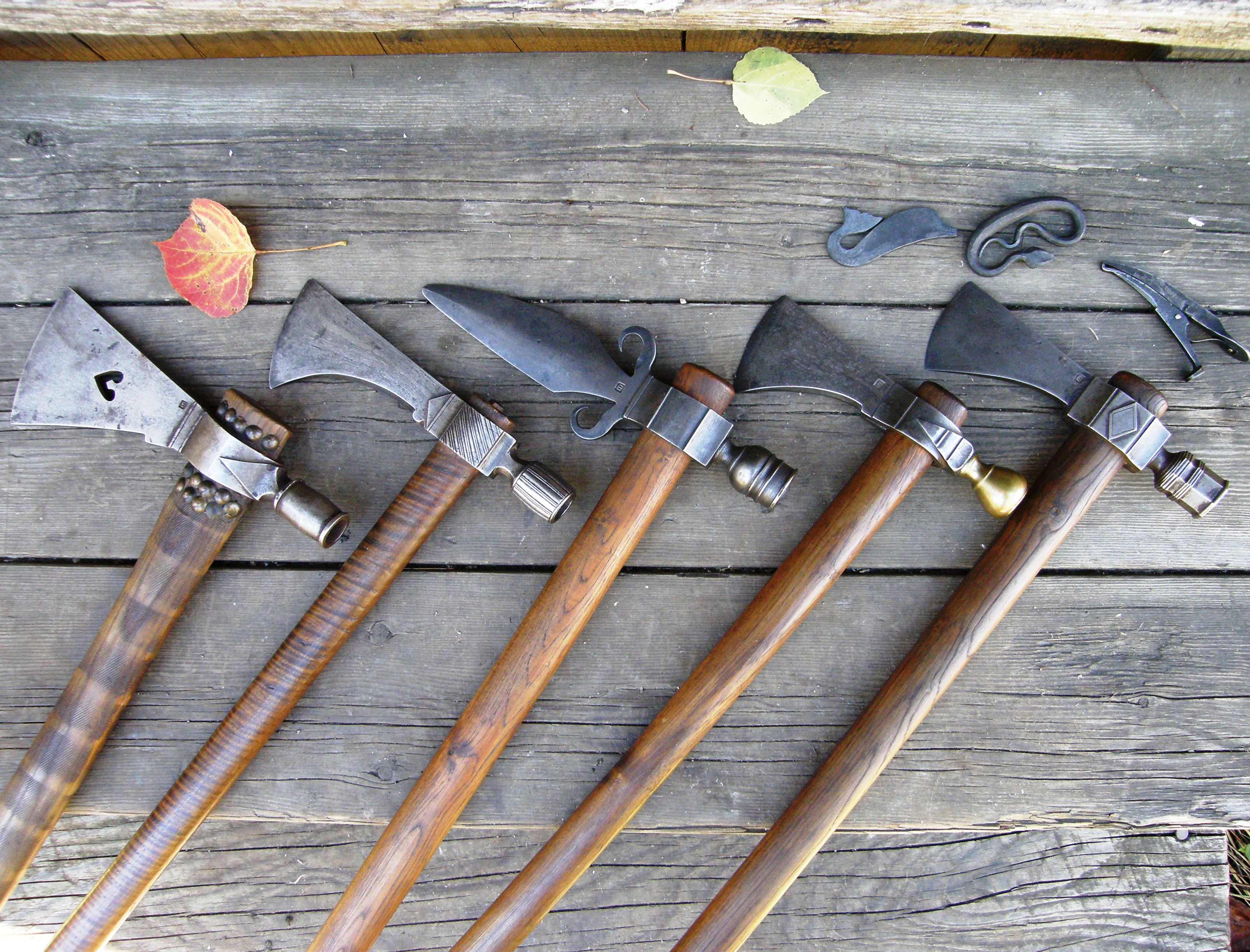
???????????????????????????????Here is a set of of some of the tomahawks that Brian has made.  The four on the right are replicas of mid 18th century pieces and double, as they did back then, as smoking pipes. The one on the left is a replica of a 19th century piece. I loved the small piece up in the upper right corner…the “smokers’s companion”…pincers with which to hold a coal for lighting the pipe and other parts for tamping down the tobacco and cleaning the pipe. The other small figures are for striking against flint.

brian anderson at workThere are so many little treasures around and about in Lausanne and Brian’s home. i could spend days and days examining them all and each piece has a story. When I brought in my little spindle whorls from Ecuador to show, Brian brought out this beauty that he got from Mexico many years ago….

spindle whorl from mexicoI have loved my stay here. I hope that I can come back to Vermont again. Lausanne is organizing a study group and I hope the weavers that I met these two weekends will get together to weave and support each other. I am looking forward to seeing what they create.

Nancy, who wasn’t able to weave with us the second time, went out and got some Plymouth yarn in a closing down sale and had a backstrap woven within days.nancyMeanwhile, on the other side of the US, Janet has been weaving with her handspun and teaching various people who stop by at her farm and mill.
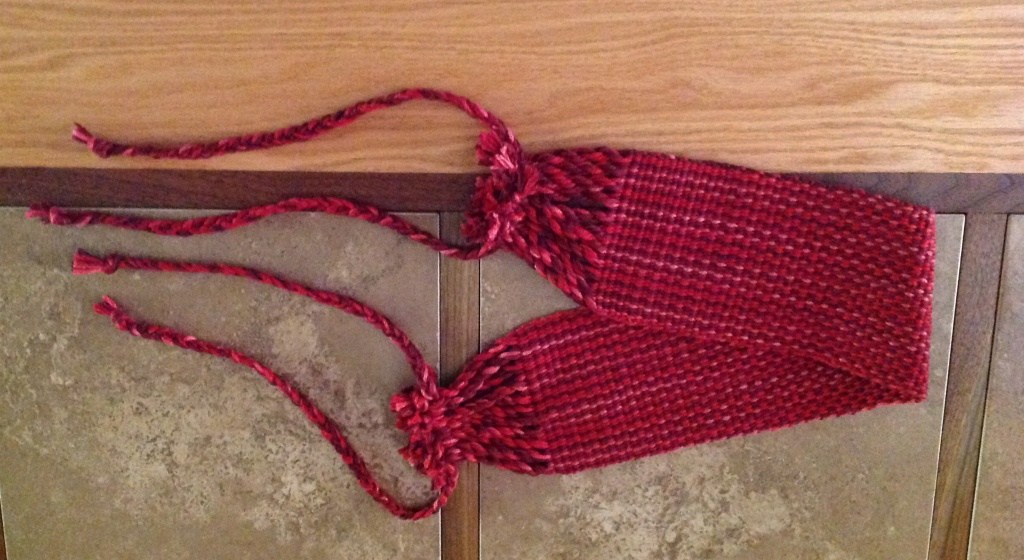
Here’s one of her most recent students, Eric, about to start weaving on a fresh warp…
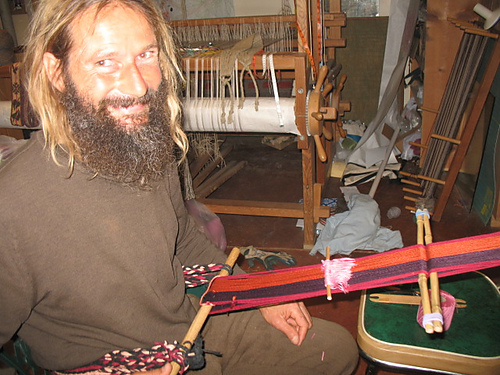
Erik backstrap weaving at Janet'sJanet promised a picture showing both sides of her guitar strap she wove in the intermesh structure (I teach it in my second book!). The guitar strap is SO amazing!….woven with Janet’s handspun naturally dyed wool.
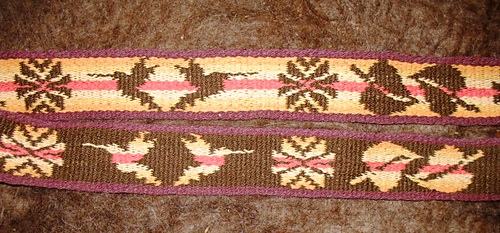
intermesh guitar strap by janet finchAmd here’s what is on her loom right now…a pebble weave piece…

janets latest pebble weave pieceI love how she uses her tiny woven bands in her loom…. there’s a tanka choro saver cord and she is using a pebble weave band and a ñawi awapa as ties. What a gorgeous combination of colors.

The ever-creative Julia has used her pebble weave band that I showed on the blog recently on a pair of slippers that she made herself…

julias slippersShe used Plymouth Yarn Fantasy Naturale for the band. It is a heavy-weight mercerized cotton which is great for making backstraps and which was the perfect weight for this project too. What a cool project. If only I lived some place where I could wear slippers.

Larisa, who corresponds with me via my Andean Pebble Weave Facebook page, sent me pictures of her own creation in warp-faced double weave. She followed this tutorial on my blog to learn the technique. She calls this design “Tribal Mask”.

tribal mask by larisaSo…..I am heading south to Connecticut and then up to Massachusetts to weave and weave. I think that I will get even more doses of lovely fall colors as I head south. Today in Vermont it is wet and a little dreary (a good day to stay in and write my blog post) and we are noticing that trees that had their colors when I arrived are now bare.

 

violets 4 mum

Backstrap Weaving – Hooray Santa Fe!

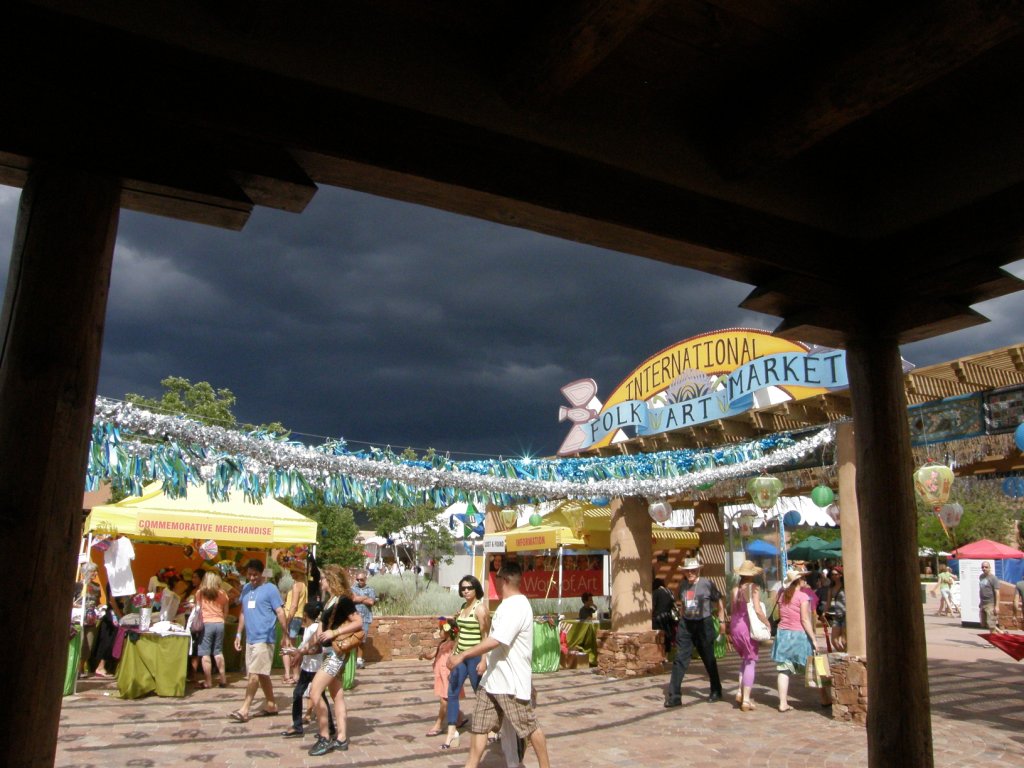
??????????????????????????????????????????????????????????????The last part of my US summer trip was spent in Santa Fe, New Mexico.

It had been a dream of mine for some time to visit the city’s annual International Folk Art Market and this year everything just fell beautifully into place.

My friend Annie and I had talked about the vague possibility of this visit months and months ago. Neither of us knew back then whether it really would happen. I couldn’t think of a better person with whom to visit the market.

Even when weaver friend Wendy visited me in Bolivia back in May and I found out that, by coincidence,  she was also planning on going, it was still pretty iffy.

And then, when Marilyn, whom I met at ANWG in June, said that she too was going, I knew that it just HAD to happen.

I had met textile artist DY Begay at the Tinkuy in Cusco in 2010 and again last year at the weaving Encuentro. She now lives in Santa Fe and extended an invitation to come visit. And that is how it all came to be.

santa fe downtown collageI arrived a few days before the market and had a chance to stroll around the downtown area. When I arrived at Santa Fe airport I was surprised to see the adobe airport building…hmmm, a little over the top, I thought at the time.

However, after taking a look around and seeing the downtown area, where even the parking stations are adobe and getting a feel for the place,  it all just felt so very right. I love the smooth curviness of the structures and how the colors change from pink to gold as the sun moves across the sky. And that sky! …the deep blue of dry desert air that would suddenly be covered by enormous black thunderheads that brought refreshing afternoon deluges.

???????????????????????????????And it was hot… but not Santa Cruz hot…the low humidity made the high temperatures quite tolerable. Yet, after a full day of strolling the market, it was a relief to sit down in a shady spot and wait for the rain to start. Below you can see Annie and Wendy at the end of day one.

There were thousands of people at the market yet I just knew that I would run into Wendy and Marilyn there. I had already bumped into Wendy by chance at the Travelers’ Market and Marilyn in the plaza downtown and at the pre market procession. It was like we were all magnets drawn to each other.

???????????????????????????????Another person I met by chance was double weave expert Jennifer Moore who was helping out Nilda Callañaupa at the CTTC booth. She and I then arranged to spend a day together while I showed her how to set up a backstrap loom for double weave pick-up. I got to see all her amazing double weave samples, the ingenious things she has made and the limits to which she has pushed this structure. It was impossible to pick favorites from the array of samples she showed me but here are just two of the many things that caught my eye…(these are Jennifer’s pictures).

I loved the completely seamless bag Jennifer created for the Checkers pieces.Even the bnarrw sleeve for the drawstring was created on the loom. The twill double weave pick-up is gorgeous.
I loved the completely seamless bag Jennifer created for the Checkers pieces. I believe that the checkerboard was woven as a double width piece….woven folded and then opened to its full width once off the loom. Even the narrow sleeve on the bag for the drawstring was created on the loom. The twill double weave pick-up is gorgeous.

??????????????????????Jennifer and I then went on to spend a magical final evening going to the opera, La Traviata, with DY and DY’s neighbor Alana, who had offered us the tickets.

I had no idea what to expect and it was amazing!

Santa Fe has an outdoor theater. It’s covered but has open sides. The sets are minimal and the backdrop is the beautiful Santa Fe sky which changes colors as evening fades into night. Desert nights get rather cold! The theater ushers certainly knew about that as they were all dressed in long handwoven ponchos.

And, speaking of cold, here I am back in Santa Cruz in the one cold wave that hits here per year. I just happened to arrive back the day before it hit…48 degrees…this is not normal. I managed to get in one day at the loom in shorts before the long pants and socks had to come out. Well, it IS winter after all.

back at my backstrap loomThis is where I was at with my weaving when I left Janet’s place in northern California. You can see that I had just started some warp wrapping having been inspired by the saddle bag, from Afghanistan, (we think) that Janet had bought. However, after going on with that for half the afternoon, (bags still unpacked in the living room!) I decided that I didn’t like it. I think that I need to practice the wrapping using wool, which fluffs out and fills space, before trying it with the unforgiving cotton.

So, the other half of the afternoon was spent unweaving and unwrapping (not so much fun) and then….unpacking  (even less fun).

Then I got back on track. Janet’s saddle bag inspired the wrapped design above the main motif. Bhutanese motifs form the basis of the rest. This had me calling the project “Tales from the Sub-continent”.

sub continent bag projectHowever, now something from Central Asia is about to creep into the mix because of bands that I saw at the Folk Art Market. I am so happy to be able to add something from that event as that means that this project will comprise a few pieces of inspiration from my summer trip. That’s one of the best souvenirs I could have.

It’s off the loom and is going to be a bag. You can see how it will be folded on the right…that’s the back.

As for the Central Asian influence, you might remember that I went to the Central Asian ikat exhibit, Colors of the Oasis, at the Textile Museum in Washington DC in 2010. The ikat pieces were stunning. In fact, I had to go twice beacuse it was too much to take in.

I was interested at that time in the bands that edged some of the coats. As the exhibit was focused on the ikat patterning and process, no one at the museum could tell me anything about those bands. They looked like they had been card woven but someone also suggested that they had been braided using finger loops. You simply could not get close enough to see anything helpful.

uzbek ikat folk art market santa feHowever, at the Folk Art Market we got to touch all the gorgeous ikat patterned coats from Uzbekistan and look as closely as we pleased at the edging bands. Yes, there were wefts, they were woven, and one of the representatives did confirm that they were tablet woven.

So, here is where I am at….

tablet weaving a strap

red and green card weaveI dug out my tablets. These are the ones that my dear friend Gladys Miller gave me way back in 1995.

They pre-date my Navajo-style weaving activity and my first backstrap learning trip to Peru.

Gladys sent me back to Chile with these tablets and Rachel Brown’s book. Later I got more books and made the piece at left. After that, I had my Navajo loom built and immersed myself in tapestry weaving.

Then came the first trip up north to Peru….and the rest is history!

So, I made a wee sample to see if I could remember the basics of threading. I want the strap of my bag to be the same design as the bands that edge the Central Asian ikat robes. Most of the bands are very similar in design and very simple.

It is interesting that on page 71 of  the Snows’ Step by Step Tablet Weaving, there is a picture of a Russian apron band that looks almost exactly the same. I was lucky to be able to buy a wristlet at the market (you can see it sitting on my weaving above) as an inexpensive example of the weave.

ikat robe at folk art marketI know that you will all be looking at the price tag on the above piece and sighing. Let’s all go to the market together next year! I only bought one other thing. It was another sample type thing to study…Guatemalan gauze, white on white on a miniature loom.

It was fun to see how the tablet woven bands are also being used as tubes for bag straps. I would say that they were sewn into tubes after being woven and stuffed with something. Mine, however, will be flat.

???????????????????????????????I did include a tubular band on my current bag project as an edging. I so enjoy weaving and sewing those tubular bands and they make such nice finishes. Using a tubular band to edge enabled me to cover and stabilize the cut raw edge that was created when I cut the flap into a rounded shape to make it more attractive.

???????????????????????????????Speaking of tubular bands, DY and I had some weaving time together at her place. DY had learned to make the ñawi awapa with me at the Tinkuy but had not put it into practice since then. Of course, all she needed was a little refresher and soon she was  on her way. It would be great to see her incorporate something like this in one of her tapestries.

DY weavingIt was nice waking up in the morning hearing DY’s fork beating the wefts into place as she creates her latest tapestry using her own handspun and natural dyed wool. Her home has lovely solid wooden posts which are convenient for backstrap weaving.

Now I shall proceed to bombard you with images from the International Folk Art Market to give you a wee taste of all that Annie and I got to see over those two days of market…

ayoreo bags and clans??????????????????????It was great to see the Ayoreo people of the lowland region in which I live in Bolivia represented. This the fifth time that they have been invited to attend the Market and sell their looped bags.

The fiber that is used for the bags is extracted from a wild bromeliad which in the Ayoreo language is called dajudie (elsewhere known as garabatá). The thread spun from this fiber is called dajua.

New Mexico Summer 2013 006One of the craftswomen was twisting three strands of thread into one on her thigh but, unfortunately, I was never present when they were making the actual bags.

I have quite often seen the women making these in the streets of Santa Cruz but they are very reserved and not comfortable with people examining what they are doing or asking questions.

I was, therefore, happy to be able to take the opportunity at the market to talk to the ladies (picture at left by Annie).

The traditional patterns belong to the seven clans of the Ayoreo society but some women have created their own new patterns inspired by their surroundings. Mostly natural dye substances are used but some artificial colors are being used in response to the demand for brighter colors by customers.

From Uzbekistan, which probably had more representatives than any other country…

uzbekistan crafts

selection of art and craft santa fe folk art market

Bright colors and simple black and white: pictures made from colored sequins from Haiti, beadwork from the Ukraine, paintings from Cuba and baskets from Panama.

myanmar backstrap weavingKhun Shwe, a backstrap weaver from Myanmar, was happy to open up her rolled up backstrap loom and show me her work in progress. Her circular warp held a piece of equipment that I had not seen before. She told me that the notched stick was used to help spread the warps. Her work with supplementary wefts was fine and beautiful. She was so friendly and happy to meet someone so interested in her loom. I would love to study with her! I think she was doing well at the market. Quite a few people were trying on garments at her booth including Annie.

The variety…

variety of crafts santa fe folk art market...from Peru, Laos, India and Mongolia.

There was this on the Hungarian stand…

???????????????????????????????It was only $25 and no, I didn’t buy it. A lady was walking around with one and I decided to ask her about her band weaving interests. It turns out that she doesn’t weave and had no idea what the piece was. She simply found it interesting and bought it.

And the people came and came and looked and spent… When we were arriving at around 10am on Saturday, there were already early birds leaving with their purchases! I spent some time on Sunday afternoon with a very happy vendor from East Timor who had sold everything.

???????????????????????????????

???????????????????????????????Nilda was opening out this very large piece for an admiring couple when I was walking by and yes, they bought it! She couldn’t hide her pleasure at the sale. Of course, the ladies from Chinchero were seated at their looms and Nilda had a corner booth so they would have room to sit away from the crowded aisles in the shade and weave. That attracted a lot of people to the booth I am sure.

artisans at work santa fe folk art marketAn artisan from Pakistan creates a piece using applique and reverse applique techniques while another from Nepal works on a painting.

Everything about the Huichol artists from Mexico creating their yarn paintings was fascinatiing….all those woven bands and belts and straps to look at.

???????????????????????????????

huichol artsists at santa feThere is more….much more. Remember that there were over 150 artisans there! This is just a taste of the color, and excitement. I am saving the vast majority of pictures of textiles decorated with supplementary wefts for another post. When I have finished my bag project, I will start the next in the red, black and white wall hanging series and this piece will be all about supplementary weft patterning. I will show more market pieces as I progress on that as well as pieces from Nagaland that were on display at the Travelers’ Market in Santa Fe. They have all kinds of interesting ways to decorate using supplementary wefts.

Here are some finished projects from Ravelry group members and friends…

julia's supp weft projectJulia and I got to weave together and she has been captivated by supplementary- weft techniques.  She sewed a band onto fabric and made a bag and then cleverly made a square braid for a strap, fanned out the ends and wove a balanced weave shoulder pad and then finished the braid for the other half of the strap (much the same as one would do when making an Andean sling).

Cindy wove tubular band with me and is now making several slim bands to wear as a necklace, She is experimenting with making the bands in cotton. I find that it is harder to get an even finish with cotton than it is with wool. Her band looks great.

cindy

Gmp set me a picture of her latest band.. She simply added rings to the end so that it can be used as a belt. The pattern is charted in my second book.

???????????????????????????????I saw the handmade book made by Betty at ANWG. It was her contribution to the Portland Handweavers Guild study of  Japanese textile techniques. The paper is handmade and from Nepal. Betty used a traditional binding for the book and wove the cover. She wove a warp-faced double-weave band on a backstrap loom with Japanese characters to decorate the cover.

bettys book with warp faced double weave bandThat’s all for this week.

From hooray Santa Fe to hooray Santa Cruz….the weather is supposed to warm up any day now to a pleasant coolness…perfect weaving weather. I have come home with lots of ideas from this trip and am happy to be back at the loom for a few months.

My cat has gone to a new home. I spend too much time away and it is not good for her. It’s sad after ten years together but I know she is happy in her new place…she even caught her first mouse!

Here are DY and I and Drey, DY’s cat, one of my many kitty companions on this trip…

dy and drey

Backstrap Weaving – East and West

IMG_0010EAST AND WEST: THE EASTERN CHAPTER

The problem with not blogging…stuff builds up!! But not as much stuff as you might think this time.

Not blogging indicates that I have  been way too busy having too much fun.

But that also means that I haven’t been able to take as many pictures as I would have liked. Can you believe it? There I am with camera in hand ready to shoot anything that moves but, on this trip, I have been moving too much to keep up.

Fortunately people have sent me pictures and allowed me to use theirs. The one above was taken by Marge on a visit. I am modeling the Bhutanese inspired scarf that I wove recently using supplementary wefts to create the patterns.

indonesian textile ikat backstrapEAST AND WEST…the title of this post.

This refers to the fact that I started “back east”, as people in here on the west coast say, in Pennsylvania and then headed over to the west coast, or the “wet” coast, as some people say, to Washington and now, California.

It also refers to the  flow of wonderful eastern textiles that has occurred during this trip into my western hemisphere area of study…textiles from Timor, Laos and Indonesia as well as Central Asia. I have pictures of amazing textiles to show. They have me thinking about tripping off to Asia when next I visit Australia but, every time I think about that, one word pops into my head

 :MEXICO:

and I realize that there is a lifetime’s worth of things yet to be seen on this side of the world.

Above is a picture of a backstrap-woven ikat (yes! that’s ikat) piece from Indonesia, a shoulder scarf from Batuisi, West Sulawesi from friend Judith’s collection. That is just a wee tease and hint of things to come in my next post.

So, here I am in a west coast heat wave on my backstrap weaving friend Janet’s berry farm…

berries

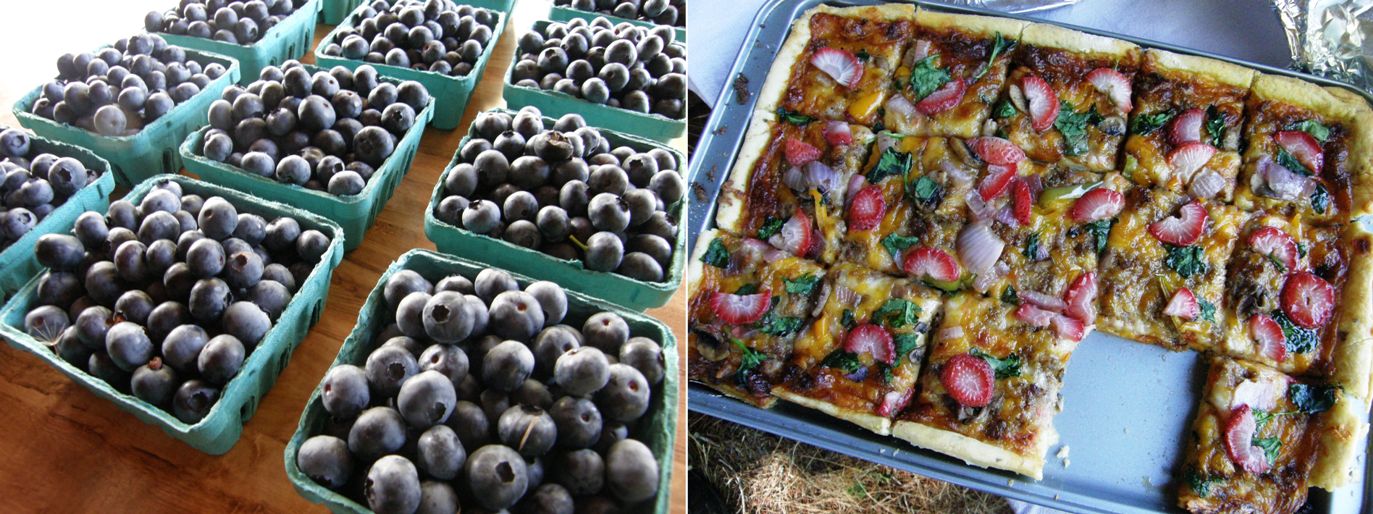
Blueberries! Lovely to be out picking in the cool of the morning. Yes, those are strawberries on top of that pizza. That was brought to the recipe competition by a neighbor who attended the annual Strawberry Jam party that Janet and husband Larry throw. I arrived just in time for that. As you can imagine, there was lots of strawberry based foods and lots of jamming by local musicians. But… more about all that in the next post.

For now, let’s stay EAST.

It all started at the Mannings in Pennsylvania with their annual Spinning Seminar…the 45th one, no less!! I have been to the Mannings in the spring….ah, idyllic!

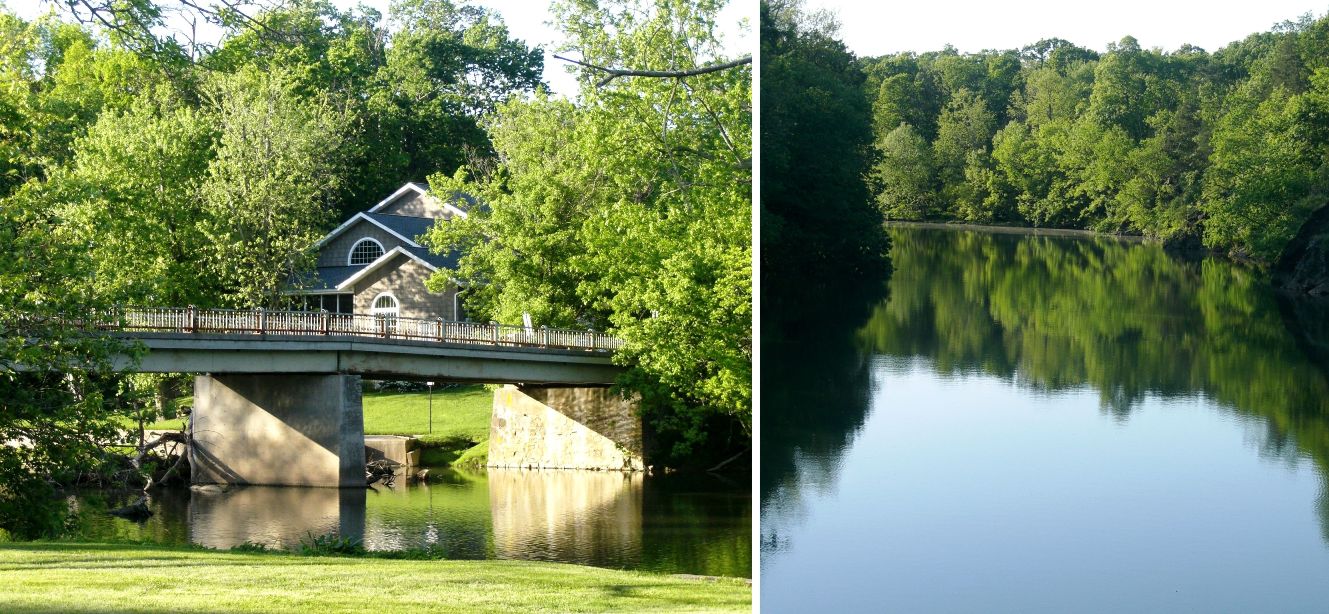
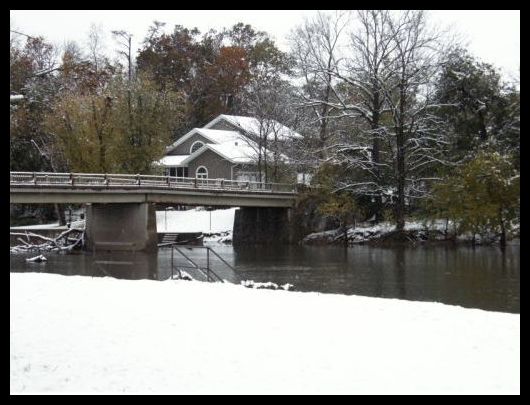
the-mannings-stream

and in the fall….

mannings snow borderedwoven inside and outside on the beautiful lawn down by the creek…

backstrap weaving at The ManningsHere was a first…a chance to set up my backstrap loom in a shady spot down by the creek on a lovely summer’s day and just hang out chatting with people.

Ravelry and Weavolution friends dropped by. I have known Trisha, aka Coolsticks, from the early days of Weavolution back in 2009 and we finally got to meet…

trisha and april at the mannings spinning seminarThere is Trisha on the left with guild buddy April .
Down by the creek things were pretty laid back! I had lots of time to spend with people.

amanda backstrap weaving at the manningsThat’s Amanda having a go at the basics of backstrap loom operation on a narrow band. The tree was adorned with straps and bands and one of my wide projects. Several people could be weaving with warps extended spoke-like from the tree. l liked over-hearing hushed comments while I wove on the big warp…”she isn’t using a chart!” (I smile thinking how I have woven items with that particular motif at least 50 times and goodness knows how many repeats of it there are in this one piece I am currently weaving!) And then there was…”Oh. So, it’s slooooow!”

spinners at the creek mannings spinning seminarSpinners set up camp, grabbing shady spots by the cool water to enjoy a day of spinning and conversation.

Picture by Pinar Miski

And for those who wanted to be in the heart of all the action, there was room to park a whole gaggle of wheels on the shaded front porch of the Mannings store.

Picture by Pinar Miski
One of my sample tables. Picture by Pinar Miski

And, at his point, I am going to hand over to the pictures of Pinar Miski who got to visit almost everybody and took the most wonderful pictures. She has allowed me to share them here. It was late in the day when I finally managed to make my way uphill to the shop to see what was going on. Shadows were long over the outdoor demo area at that hour and the crowds had thinned in the dying day. My pictures didn’t come out well. So, thank you, Pinar for sharing your shots!

Things were anything but laid back up at the store…happy shopping and browsing in yarn paradise. Pinar subtitled her photo album …”and then I died and went to heaven”! I think that says it all.

But, apart from the shopping, there were oodles of things to be touched, explored, and experienced with a wonderful selection of fiber artists and educators both indoors and out. I demand a do-over! I didn’t get a chance to see much of it!! But, I was having a lot of fun chatting with people about my passion…the backstrap loom.

It all starts with fiber. There was this…

Photo by Pinar Miski

Ron Bostek demonstrated sheep shearing. He brought Border Leicester and Cormo sheep to the Seminar.

Picture by Pinar Miski

Here is cotton spinner and teacher (and my fun roommate), Joan Ruane, showing one of many implements with which she spins cotton with ease. For me, who goes to the store to buy cotton for my backstrap weaving, Joan’s comment when she saw me at work at my loom was pretty funny…”oh my god, it’s WORSE than tapestry!”…a comment on the slowness of my weaving. And there she is patiently creating cotton thread!

Pictures by Pinar Miski

Yet another fiber on display ..Mandi Elliott Bird used antique tools to show how to process flax to the point where it can be spun.

Picture by Pinar Miski

Ron Tyler spun wool on a Great Wheel or, Walking Wheel, hoping to encourage people to take the beautiful inherited piece that may be sitting and simply decorating a corner of a room and actually use it.

Picture by Pinar Miski

One of my neighbors creek-side was Carol Ireland with her hip spindle.

Picture by Pinar Miski

This table was a-buzzin’ at day’s end when I went for my walk. It seemed that folks were invited to grab a bit of this and that and create their own batt. That looked like lots of fun. It was Sally Jenkins who demonstrated fiber blending with drum carders.

And boy, does this look like fun. I bet there were people jostling to get a position for this…

Picture by Pinar Miski

I am copying and pasting the description from the Mannings’s newsletter for this one…

Tartan, Tweeds & Waulking the Wool – When wool tweed or blanketing comes off the loom, it is not yet ready to use. The traditional Scottish method of finishing woolen cloth was a social occasion involving a group of neighbors, a large table and probably a little whiskey! The cloth was wetted and passed from hand to hand in a thumping rhythm kept going by suitable songs. We will skip the whiskey at our wool waulking but have lots of songs! Melissa Weaver Dunning will also have a display of her many woven tartans and tweeds.

Apparently it takes three songs to finish the process. Here is inspection time after the first song…

Picture by Pinar Miski

Again, Pinar captures a great moment!

Picture by Pinar Miski

Ah, now here is something a little closer to my heart. Susan Weaver brought along a large selection of tape looms on which she encouraged people to weave. I believe that all the tape looms for sale in the Mannings store went home with new owners that day. Susan and I know each other. She wove with me a while ago and lent me a Mexican band to study from her collection. So, I was eager to connect with her to catch up and return the band.

Picture by Pinar Miski

Mushroom dyeing! Hmmm…wondering what kind of aroma is coming from that pot. This is fascinating. Who knew that you could get such a range of colors from mushrooms and now I know that someone who studies mushrooms is called a mycologist. Susan Hopkins’s interest expanded from mushroom identification to dyeing.

Look at the colors…

Picture by Pinar Miski

Susan’s face says it all…she’s passionate about dyeing with mushrooms. Check out her t-shirt.

Anne Marie Decker was probably not around at the particular moment when Pinar went by. As Pinar says in her album caption, she still doesn’t know what nalbinding is, and neither do I! I have to say that it looks like something I would enjoy.

Picture by Pinar Miski

Indoors, Ron Woolcock gathered spinners to tell them how to keep their wheels happy and there was a display of the stages of silk production and processing. Thanks again, Pinar  for the use of your pictures! Take a look at the entire album here. Pinar’s concise captions are fun.

coil stitch ad pom pomsOne day to rest, and then my Ravelry friend, Julia, came by to weave and sew..

We wove a lot!. I was starting to crash by 4pm with all the things we got into. It’s so much fun putting those finishing touches on things!

We wove tubular bands, sewed and wove tubular bands to edges, sewed coiled stitches, edged and lined pieces with decorative stitches, warped for more bands….phew!

But, rather than get into all that now that she is home, Julia has been practicing the supplementary-weft inlay techniques which I show in tutorials on this blog.

Here are a couple of her projects…

julias supp weft backstrap weaving

The butterfly is one that I charted from an inlay motif on a Huave weaving of Mexico. The pattern on the right is one that I adapted from a motif woven with weft substtution, if I remember correctly, on a textile of Central Asia. I think that it is charted here on my blog. Loving the soothing colors Julia used.

Caroline also used weft inlay techniques to decorate her backstrap. I love how people are taking to this technique!

caroline sacramento supplementary weft inlay backstrap weavingI adapted this particular motif from one on an Indonesian piece of fabric. The backstrap itself is beautifully woven and put together!

More fun weaving with friends that I have met online…Bands got finished with ends braided and all.  Here’s Kathy practicing the four-strand braid on her warp ends.

Kathy braiding backstrap weaving class the mannings

If you have been following my blog, you will know about my recent experiments with weft inlay where I have been filling negative spaces with weft to outline patterns in the ground cloth. Some of the weavers were keen to try this. Another fun thing was combining strands of different colors for the supplementary weft which created interesting effects. Kathy and Bettes put together blues and other jewel-like colors while Nancy put together a very festive, sunny Mexican type of combination.

supp weft class mannings backstrap weaving

Marge came over for a day to weave and try a bit of double weave on her inklette and a touch of intermesh on the backstrap loom…

She brought her band box to show some of the things that she has been weaving on her inkle loom…straps for her musician friends. She plays in a band called Tater Patch and gave me a cd!

Marges bands

marge and her bands backstrap weaving class manningsThere’s the double weave band that we started on the inklette next to a nice knot-work pattern in pebble weave. And then we did a wee bit of intermesh.

Marge went home to finish that double weave sampler with some of her own designs. Guess what instrument she plays in Tater Patch?!

marges double weave bandMeanwhile over in Tom Knisely’s Mannings teaching studio, there was lots of overshot loveliness coming off the looms. Here are a few examples. It is nice to be able to stay on the premises and get to see the weavers working late at night on these pieces.

overshot class manningsSpeaking of Tom, he gave me a wee gifty. You may have seen this before on this blog. Tom showed me this on one of my visits last year and  has now decided that it really needs to belong to me :-)!!

sword

More Ravelry group projects to show…

Cindy tried out the “palma” braid…nice job!

cindyI finally got to meet Cindy on this trip. More about that next time…that’s a “west side story”.

Laura has been practicing pebble weave…

lauraI love the color flips and how she has joined the three single motifs into one long continuous one.

And just to finish and lead into Chapter 2: “West Side Story”, which is largely based on the ANWG conference in Bellingham, Washington followed by fun with my friend Betty at her home in WA and then with my friend Janet in northern CA, let me show you the weavings that I submitted to one of the conference exhibits.

This series is a work in progress. I have many more panels in mind to add. It is entitled “Textile Trails” and each has its little “traily” story to tell. It won the Committee’s Choice Award at the conference. I was thrilled! Thank you to Linda for taking this picture. The beautiful black wooden hangers were made by Terri of Magical Moons. Terri makes the custom swords and other implements that I often show on my blog. By the way, she is making spindles now. They look exquisite.

backstrap weaving Laverne WaddingtonThe fact that I am wearing a black top and a red jacket is just a happy coincidence, I swear!

Here’s the lovely handwoven ribbon…

hangings backstrap weaving Laverne Waddington

See you next week. I am back on top of the blogging now…I hope!

Backstrap Weaving – Embroidery, Tatting, Quilting and, oh yes, the Backstrap Weaving :-)

Back home in Bolivia! My cat seems to have enjoyed her stay away in my absence in a home of Death Metal music fans… a noisy and action-packed home which also includes two kids and two parrots. She appears to need to sleep off all that excitement and has spent much of the last two days flat on her back with legs in the air, dead to the world.

Picture by Annie MacHale

Black Sheep backstrap weaving groupAs for me…I need a rest after all the excitement too! Was it really a whole seven weeks ago that I arrived in California and wove with my friends there? We had a very productive time weaving supplementary-weft patterns and the intermesh technique and spent one relaxing afternoon looking at my images and videos of South American backstrap weavers.

My trip ended in the same area. It was great to meet up with my Ravelry friend, Cookie, once again. She had woven with me at Janet’s place up north two years ago and brought along the pebble weave backstrap that she had woven for herself in the meantime.

Cookie's backstrap with pebble weave

This is a great example of taking one of the simple 4-revolution patterns from my first book and expanding it by weaving it side by side as a reflection of itself. Cookie also added some other small elements which made the pattern unique. It was almost impossible to recognize the orignal 4-revolution motif. I love it when people create their own pebble weave designs. This is a great way to approach it – with baby steps – first adapt and enhance an existing design and from there go on to create a motif that is entrely your own.

We used sticks to help pick up threads and pass the supplementary wefts. Cookie saw my Guatemalan pick-up stick and went on to create her own from chopsticks! See the original chopsticks on the right and then several versions of the pick-up stick that Cookie made.

Cookie's pick-up sticks from chop sticks

Days were spent weaving in Barbie’s home and I enjoyed my evenings staying with Kathleen. I got to stay in her cottage weaving studio in the garden and listen to the soothing sound of  the waterfall in the forest below. Kathleen’s home is decorated with textiles from Hungary, her husband’s homeland. Here are just a few of them.

hungarian embroidery and feltThe felt piece at top left comprises layers of wafer-thin pieces of felt using applique and reverse applique techniques. A Google search result tells me that this particular design falls into the category of Great Plain motifs, the Great Plain being the central plain of the Carpathian Basin. The motif dates back to the 18th century where it was first seen on the wool cloaks of the Hungarian shepherds.

I then uncovered a website which is a gold mine of information on embroidery techniques when I googled about Hungarian embroidery. This site is amazing! I will leave you to explore it. I will certainly be returning to it to learn more.

wood block for textile printsI can see myself doing embroidery one day should there come a time when I can’t weave with a backstrap loom anymore. As long as my eyesight is up to it!

I spent a fun afternoon with my weaving friend Dorothy. We went to an exhibit of Indian textiles at the San Jose Museum of Quilts and Textiles. It was a hands-on afternoon where we got to learn a little about Kantha embroidery. It was  an introductory session that any embroidery novice could handle just to get a taste as it is based on a simple running stitch. I attempted to embroider a classic paisley motif which is a mango shape. If I ever get it finished I shall show it to you.

We also got to play a little with hand-cut Indian wood blocks which are used to print designs on cloth. You can see the paisley pattern above. I think the wood blocks are a work of art in themselves. I also learned that you need to put some thought into the layout of the deisgn before stamping away like mad. I made a chaotic horrid mess!

I would love to know what embroidery stitch was used to create this piece that Dorothy bought from a Peruvian handcraft website.

dorothy's peruvian embroidery

The yarn was so fluffy that it was very difficult to isolate the path of the threads. The stitch had a braided look to it. I would love to know how to do it. Can anyone help?

dorothy's peruvian embroidery 1

palestinian cross stitch embroideryAt Gloria and Terese’s home, on my last night in the US, I saw this piece of Palestinian cross stitch embroidery that they had collected. I would love to know about the motif in the center. One pattern has been repeated from top to bottom while being rotated 90 degrees. Does anyone know about this motif and what it might represent? For more about these embroideries and the women who create them, take a look at this beautifully made site which has been put together with the support of the Red Cross of Iceland.

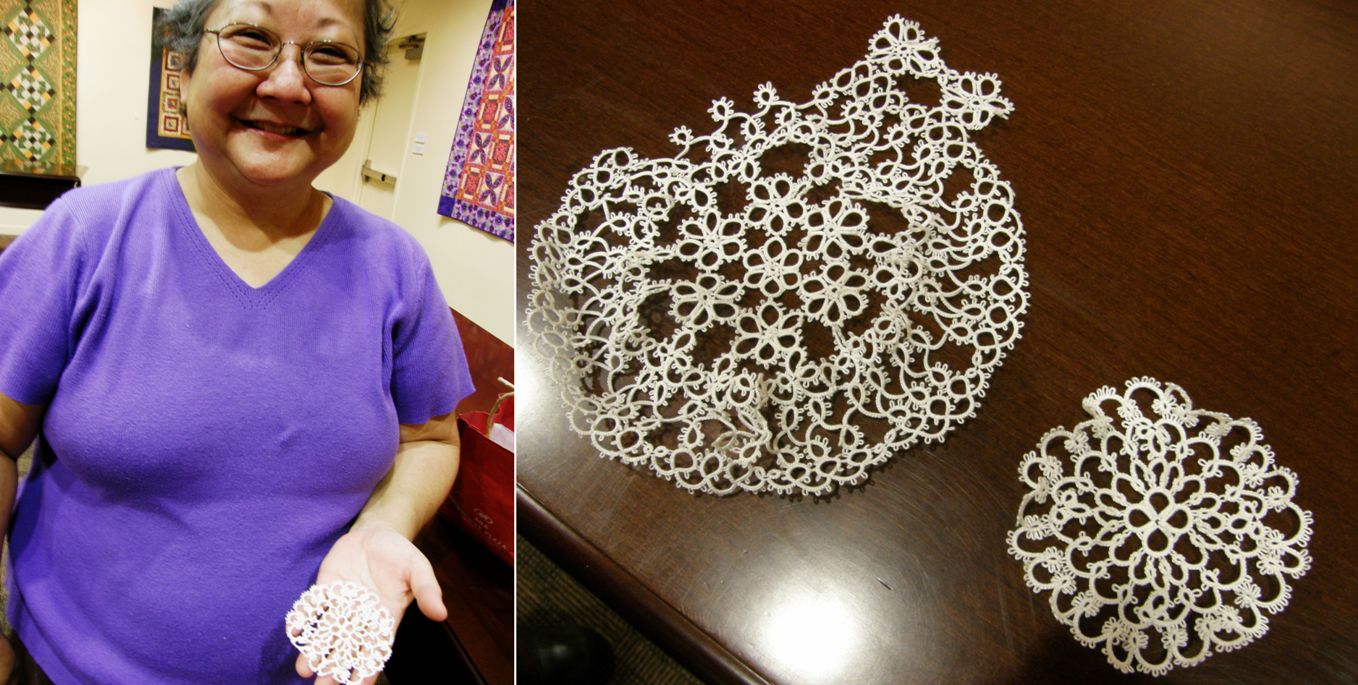
And, as always happens, when I learn a little about a new craft, examples of it seem to just fall out of the sky into my hands where ever I go! Not embroidery….tatting! One of the participants in the Indian texiles workshop was a tatter and showed me her work in progress. The larger of the two pieces will be a baby’s cap. I am in awe! Thank you, Vonnie, for teaching me to tatt.

tatting

And then I was chatting with Rachel, the barber, in an old barber shop in downtown Santa Cruz California while staying with my weaving friend Annie (I had created a bangs emergency when I got over enthusiastic while cutting my own). The result of that encounter is this…

tatting shuttlesRachel had recently got these as part of a big purchase of sewing supplies at an estate sale and was happy to pass them on to me. I think I had better get a-tatting! I like the metal one the best with the wee hook on its ponited end. Now the challenge is to see how simple tatting can be applied to my weaving. My online weaving friend Carol, who lives in Nicaragua, told me that this same idea also recently occurred to her. I would probably use wool instead of the super fine thread that is usually used for tatting.

dovetailing of two color warpsFrom embroidery to tatting and now back to a bit of backstrap weaving.

You may remember the discontinuous-warp piece that I got to play on. I wrote about it in my last post and have written several posts, like this one, about the technique.

I need to point out that this warp is not mine to keep. I was simply put in charge of transporting it from Yonat to Dorothy, its new owner, and my fee for the service was being allowed to play on it a bit! In any case, Dorothy needed a hand getting it going and I was happy to be of help.

This warp was used in a workshop on the ticlla technique that was given by Nilda Callañaupa in the US in 1997 and the project was never finished. Dorothy and I both had a lot of fun playing with it.

I wove from the end that had been started in the workshop and got the weaving on the other end established so that Dorothy could continue. Of course all the sticks are really too long for this project but this was the way it had been set up in the workshop and we didn’t see any reason to change things.

dorothy weaving the ticlla pieceYou can see that the warp has been turned around and there is Dorothy with the llama bone tool in hand beating in the weft.

dovetail section of discontinuous warp projectDorothy was kind enough to have me stay for a few days and there was precious little time to weave this together as Dorothy teaches art during the day. Coming home from a tiring day teaching art to children is not really a good way to face a tricky piece of weaving. So, while Dorothy was at work, I removed the dovetail stick in the center that holds everything together. A thick piece of thread remained behind in place of the stick. Then the join had to be stabilized by weaving on each side of it as you can see above. It is now up to Dorothy to finish the piece.

discontinuous warp piece stabilizedShe will continue to weave until it is impossible to open the sheds any more using the shed rod and heddles. Before she gets to that point she will be able to make things a little easier by using a thinner shed rod and passing the weft on a needle. The final stage will have her needle-weaving, picking up every other thread on the blunt end of the needle so that she can create a shed and pass the final wefts shots. She will have to do this on both sides of the center as each panel is a separate four-selvedge piece connected by the central dovetail join.

I enjoyed the chance to weave with the beautiful, beautiful handspun yarn that Nilda brought with her from Peru. It was so lovely to be able to bring this weaving back to life again sixteen years after it had been started. Yonat, who has been holding this warp since the workshop, wrote to me to tell me about its owner who has since passed away…

I thought I would tell you about the loom:

The name of the previous owner was Jean Davidson.  She was an amazing artist, curious to no end with an amazing sense of color and structure.

Her unique talent was her chenille-style quilts. She was an awesome lady, and I just feel like her energy is bubbling in that project that you guys are playing with.

Yonat also gave me a link to a site which shows the quilts that were part of an exhibit held in Santa Cruz in 2008 called Dreaming the Earth in which Jean participated.

The pieces in the show were inspired by creation stories from 
the indigenous peoples of Australia to honor the Arboretum’s Australian 
garden.  Most of the stories upon which they based their quilts were drawn
from a collection of Australian Aborigonal folklore by K. Langloh Parker 
(Australian Legentary Tales, 1997) available online (http://www.sacred-
texts/aus/alt/index.htm)  Abbreviated versions of these stories may be found next to the photographs of each of the quilts.


The quilts are beautiful and the stories delightful. It is really worth taking a look at the site. How nice to be able to weave on this piece that Jean started.


seat for backstrap weaving
If you are wondering about Dorothy’s set-up for weaving that I showed earlier, let me tell you more.


She had that built following instructions by my online friend Sharon on her blog. Sharon is really talented when it comes to DIY and improvisation and she told me about a cool seat, foot rest and warp hitching post that she made so that she could sit on the floor with her back against the sofa and weave. I posted the link here, Dorothy saw it and had it made. I got to try it and it is very cool. I like being able to brace my feet against something although I am wondering about the strength of the foot brace. There it is again above with one of my demo warps in place and a cushion on the seat for extra comfort.
synergo arts ergonomic benchMeanwhile, Bobbie from the Ravelry Backstrap Weaving Group reports that she has bought, for around $30, all the parts necessary for making the ergonomic bench  for backstrap weavers according to the plans put online by Synergo Arts.


We all looking forward to seeing how that turns out.
You can find plans for the bench with instructions on how to use which include a video here.


Other interesting textiles that I saw on this trip…
Mark showed me a woven cotton saddlebag. It is from the Piura region of Peru and I had never seen anything like it before…the jaw-dropping diversity of Peruvian weaving!


The red and black designs are warp patterns. The other colors that fill in parts of the main motifs are supplementary wefts. I love it when warp float patterns and supplementary wefts are combined this way and have only seen that once in an old Mexican belt. The tails of the supplementary wefts were left hanging out on the inside of the saddlebag pockets. There is a similar piece on this site which is dated at 1930-39.
saddle bag piura peru
 And, this is a four-selvedge piece!
four selvedge cotton weaving
If you look very closely a little way above the paper label you will see where the very last weft shot would have been needle woven into place. Thinking about doing a four-selvedge piece with cotton makes my hair stand on end! I tried it once….maybe one day I will try again!


I have more to show but will leave it here for this week. Let me end with Jennifer taking up the love of the curious coil rod. She placed one on a band which had started its life on her inkle loom. After transferring it to her backstrap loom she was disappointed to see that it had developed a serious ridging problem…that old corrugated cardboard thing that I have discussed here many times and have finally managed to conquer.

Coil rod to the rescue! More about that next week…

jennifer
This is going to be a beautiful guitar strap!


Well, it’s back to cleaning seven weeks of accumulated dust and getting things in order. Hopefully, I will be back at my loom soon.

Backstrap Weaving – What I love about sharing backstrap weaving

What do I like about sharing my weaving?   One of the best things for me is how much I manage to learn myself from my interaction with my weaving friends. And, there are many other things about it that I love, both tangible and intangible. Let me try to list at least some of the things that make this such a wonderful  experience…..

1.Receiving a picture like this via email shortly after weaving with a group:

Karen's pebbel weave bands backstrap weavingKaren, who wove Andean Pebble Weave with me,  sent this picture to show me what she has been up to since then. She completed the bands that we started together and wove more bands as she continues to work her way through my book. Not that many people rush home and weave and get to this point so quickly but it is just the simple fact that she wanted to show me what she has been doing and keep in touch that makes me really happy.

2.Getting a picture from an onlooker who captures the interest and delight on people’s faces while I am busy showing samples and talking:

134demoThis picture of (from left to right) Karen, Nan, Laura and Stephanie was taken by Franco. I miss some of these little moments while I have my eyes on the textiles.

3.Getting to spend “fiberholic” evenings with my friends, while chatting and cluttering up the place with WEAVING STUFF:

vonnie backstrap weavingMy friend, Vonnie, sits back at home with a very interested onlooker to weave a little on the band that we started itogether.

Vonnie showed me how she makes her tablet weaving a “weave anywhere any time” craft. As always, I am happiest on the floor.

tablet weaving at vonnie's houseI have a stretchy hair band around my neck to which the band is attached (this is just in case you are not wearing a belt to which you can attach) and the other end is hooked to my shoe lace. It was very comfortable!

4.Reconnecting with people I met on previous visits who have now become dear friends:

annie and barbara in santa cruzThat’s Annie and Barbara tackling a skein of hemp (next to Ginna). I  am here to just hang out for a few days with them. We will probably see that beautiful rusty red hemp woven into one of Annie’s gorgeous one-of-a-kind inkle woven guitar straps soon.

5.Meeting lots of fun and enthusiastic people who are interested in something about which I am passionate – backstrap weaving and South American textiles – and helping them to perhaps realize a dream or simply enjoy spending some time trying something completely different:

???????????????????????????????Stephanie, Betsy and Vonnie have just made their first set of string heddles and are putting their newly acquired skills to work  on a narrow band.

6.Having the opportunity to spend time with long-time online friends who have been so helpful, supportive and fun for years. If you are part of any fiber-related online weaving group, you are bound to know Franco Rios!:

franco backstrap weaving7.Putting faces to my more recent online acquaintances:

laura and nan backstrap weavingLaura is a fairly new member of the Ravelry Backstrap Weaving Group and we look forward to seeing more of her. She and her mother, Nan, came to weave together with me.

8.Exchanging ideas and learning new skills:

???????????????????????????????Vonnie knows tatting and now…., so do I! The picture above is, of course, of Vonnie’s fine work. However, I am rather proud of the way mine is coming along in both fine cotton and wool.

my tattingVonnie gave me a shuttle to take away and showed me how pospsicle sticks can do the trick nicely as well. When practicing with the heavier wool yarn, it is very easy to use the yarn straight off the ball rather than place it on any kind of shuttle. However, you can’t help enjoying looking elegant holding the wee shuttle daintily between thumb and forefinger.

lucet cord and braidVonnie taught me to make cord using a lucet (the wooden instruments seen on the left) and I taught her to make a braid using a piece of cardboard and the fill-the-gap technique, something I learned thanks to the ladies of the Braid Society that I met while in the UK. Here is a close-up of my cord and Vonnie’s braid:

lucet cord and vonnie's braidAnd, there are also surprising connections to other Ravelry group members. Vonnie showed me the sweetest homemade rigid heddle that group member Janet had made for her using a sushi mat. It is touching to see how many firm behind-the-scenes friendships form between members of the Ravelry groups.

jenat's heddle and my lucet giftAnd that is the pretty lucet that Vonnie gave me!

9.Coming to weave on a second morning and finding that people had woven at home on their own: 

admiring backstrap bands on day two of classLaura, Caroline, Vonnie and Betsy admire bands on the morning of our second day together that had grown in length overnight. Some of the patterns the ladies wove were of their own invention without the use of charts. Seeing that skill develop makes me exceedingly happy!

supplementary weft patterned bands10.Meeting someone new who shows me what she has managed to learn at home, either by using the free tutorials on this blog, or by following my books:

carolines pebble weave bandThat’s Caroline with a pebble weave band she has been weaving at home.

11.The trust and support that develops among the weavers as they work together. Folks applaud and encourage each other and, with this support, are able to accept little mistakes and mishaps with good humor: 

warping for backstrap weavingTeam warping: that’s Janet on the left with Caroline in the center warping under the watchful eye of her warping partner, Stephanie. This is where I get a chance to stand right back and enjoy watching how people work and solve problems together.

12.Seeing a first-time-ever weaver being nurtured by the rest of the group, taking to it and having fun and seeing the movements used by everyone…experienced weavers and beginners alike… to open the sheds and operate the loom become increasingly automatic and relaxed:

karen new weaverThere’s new weaver Karen working at opening the sheds. She soon learned that a sweater on her lap made a great tool tray.

backstrap weaving group sacramentoHere’s “Team Backstrap” enjoying the sun. We had some spectacular spring weather for us. Many thanks to Betsy and Franco for inviting everyone. Franco kept us entertained with various bird-spottings. We were working right by a large open door and could enjoy the outdoors without being out in the harsh sunlight.

13.Understanding a little more about people’s different learning styles.

14.All the cool stuff I get to do and see and the cool people I get to hang out with. Like…

redwoods sant cruz california…a) roaming around the redwoods….

santa cruz mission…b) admiring and exploring local sites such as the only building left of the mission in Santa Cruz established in 1791. That building would look very much at home in downtown Santa Cruz, Bolivia with its white adobe walls, wooden pillars and red tile roof. Many buildings where I live resemble this one although most are in a state of advanced decay with tropical greenery threatening to take them over….

tapestry in progress by Zapotec weaver sergio martinez…c) seeing other kinds of weaving and sometimes meeting their makers. I had the wonderful luck of being able to examine a tapestry in progress by Zapotec weaver Sergio Martinez. He weaves and shows his work in Old Folsom just down the road from Vonnie’s place. Unfortunately, Sergio had just left for the day when we arrived but I wrote to him to ask permission to show his weaving here and we have been corresponding. The piece in progress is an image from the Aztec codices. Sergio’s woven themes, as far as I could see, are very different to those used by Zenon and Jaime Hipolito whom I visited earlier in this trip. It was very interesting to see how widely the work of  Zapotec weaving artists can vary.

stitched shibori samples by rachelle weissshibori-like fabric in fasion…d) learning about other textile arts such as the art of stitched shibori at a workshop give by Rachelle Weiss at the Santa Cruz Handweavers Guild. Dyeing expert Kris Nardello assisted. It is a technique that historically was largely practiced in Japan and is a way to decorate cloth using dye-resist techniques.

The workshop was very well attended. Rachelle’s instruction and inspiring samples created a lot of excitement and chatter which made it a really fun morning. Participants learned three kinds of stitching techniques, some of which also involved folds, for creating wood grain, undulating lines and circular patterns. Everyone will return in June to complete their projects by pulling the stitiches to ruffle and pucker the cloth and then placing the pieces of fabric in the dye bath. I will have to take my kit home and play with it there….

It was fun to go on from there and find shibori-like fabric (at least to me eye!)  used for a dress in one of the trendy clothing stores along the main street of downtown Santa Cruz (pictured above).

A couple of days later, I visited with Barbara  and she showed me a gorgeous piece of shibori cloth that she had created and sewn into a garment.

barbaras shiboriShe had used techniques that we had not seen with Rachelle. Rather than creating areas of resist and then dyeing the fabric, she applied bleach. You can see how leaves were placed on the black fabric and then bleach was sprayed around creating the reddish background. Pieces were clamped to the cloth to create the bar-like patterns which I think look like sticks of bamboo.

The fabric has been used to create a jacket with simple twisted yarn ties for closures. That was in Barbara’s pre-braiding days. Now she will be able to replace those simple ties with some kind of fabulous braided tie using her takadai or marudai skills. Here are some of her examples created on the marudai and takadai…

barara's tkadai and marudai samplesMy day spent at Barbara’s was her regular twining get-together with Yonat. Both Yonat and Barbara weave with me on every visit and it was nice to see what they had learned when Ravenstail twining expert Cheryl Samuel visited the area. You know how much I love twining! A Google search tells me that Ravenstail is a type of twining and surface braiding that was used by native Americans along the Pacific Northwest coast to create dance aprons, blankets and robes.

Barbara had obviously been very much absorbed with this since last fall as she has already made these three adorable pouches…

??????????????????????I learned a few tricks while Yonat and Barbara worked for making the ending of the twining neater. The basic technique of twisting the “wefts” and changing colors is the same as the technique I use to create the twined patterns that I use on my backstrap weavings. However, there are many specialised moves involved with creating the patterns that you see above with their outlines and embellishments.

yonat's ravenstail leggings??????????????????????Yonat and Barbara are each working on a project to make traditional leggings. This is Yonat’s piece. The working frame alone is a thing of beauty. Barbara’s husband made hers and Peggy’s husband made a few for various members of the group.

ravenstail frameLook at the  inlay work created by Peggy’s husband! What you are seeing there is the lid of a tool box that he cleverly incorporated into the basic framework. The frame comes apart easily so that Yonat can pick up her work and take it home at the end of her study day with Barbara.

And, while the ladies were twining, I got to weave on a discontinuous-warp project that was part of a workshop given to members of the Santa Cruz guild by Nilda Callañaupa way back in 1997! This particular piece was not touched after the workshop and its owner has since passed away. Yonat has been keeping it and is now passing on to another of our backstrap group members, Dorothy. On its way to Dorothy, it fell into my lap and I just had to weave on it! I will be spending this weekend with Dorothy and we will get to play with this together.

discontinuous warp backstrap loomI hadn’t taken a backstrap to Barbara’s place and so just used a piece of cord. It was pretty comfortable, believe it or not! The wool yarn was quite friendly and I got quite a bit woven before lunch. What was unusual for me to see was that this had been warped to include complementary-warp pick-up patterning. All the discontinuous-warp pieces that I have had the luck to examine so far have been either plain warp-faced weaving or patterned with supplementary warps.

discontinuous warp backstrap weavingThe horizontal bars that you see above tell us that the piece was warped for complementary-warp pick-up. Yonat, who also took the workshop back in 1997 remembers having woven a double-faced hooked “s” pattern on her piece. Barbara was also in that workshop and neither of them have worked on their pieces since. I am happy to report that they now feel those unfinished pieces calling to them and, hopefully, they will get motivated to get back to work on them with confidence sixteen years after the original workshop. (By the way, the piece is posed on top of Yonat’s latest clasped weft project in which she used the technique to create a beautiful landscape.)

dovetailing of two color warpsIt was interesting to see how the two colored warp threads in the pattern area were carried while warping. You can see that they were wound together as one thread. They were then separated into two sheds when the heddles were installed.

So….on one short visit with a couple of my now, very dear weaving friends I learned about SO much!…shibori techniques, ravenstail techniques and a bit more about warping for discontinuous-warp projects.

tablet woven wool bands…e) getting ideas from weaving friends and the fun stuff they have lying around.

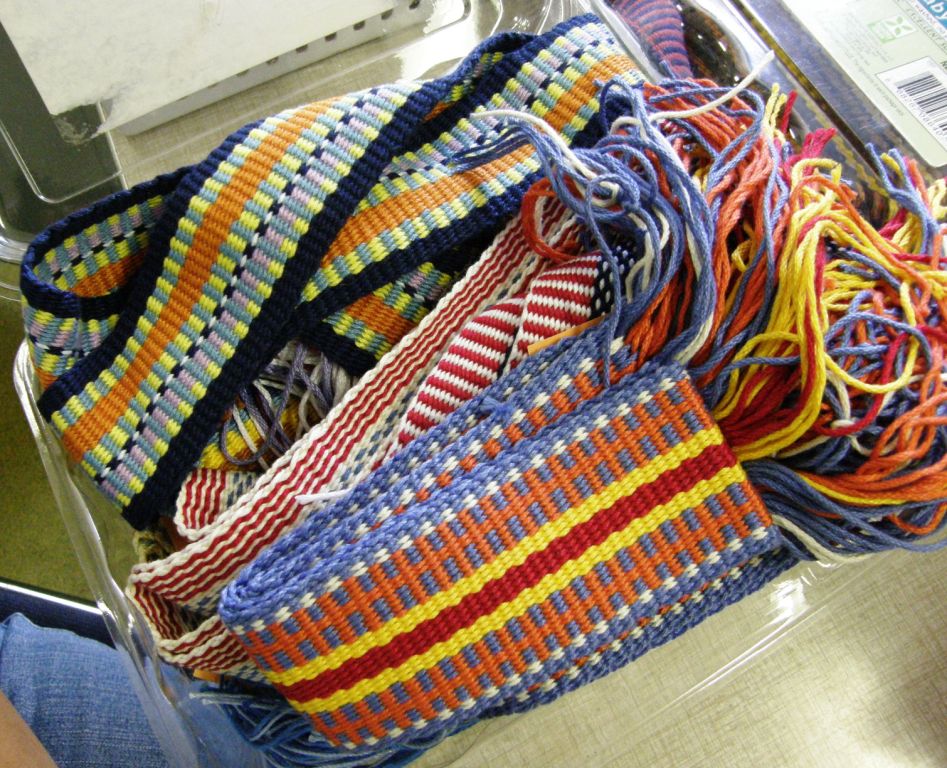
I saw a bunch of very long wool tablet-woven bands overflowing from a basket in Annie’s living room. Annie acquired these after a deceased guild member’s belonging were given away at a meeting. Each band is ten feet long. Who knows what the weaver’s intention was for these but I am seeing some kind of interlaced project along the lines of the fabulous weaving bench cover I showed here some weeks ago.

The colors are so rich and appealing. What if these were laid out vertically and interlaced with sandy colored bands running horizontally….oh, yes!

Let me show you what Jennifer Williams, aka inkledpink, made by interlacng some inkle-woven bands…

Jennifer williams inkledpink

So, what do I love about sharing backstrap weaving with people? What’s NOT to love?!