Backstrap Weaving – If I were to do it over….

“If I were to do it over”….

I know that I am trouble if I find myself sitting in front of a warp and saying that phrase before I can even throw the first shot of weft or, in the case of my current ikat project, before I can apply the first tie to the area that will resist the dye. As I set the warp on the loom bars, I was thinking that I would warp it slightly differently “if I were to do it over”.

As I wrapped the warp threads, I was wondering why I had automatically started placing the knots at the edge of the wrap rather than in the center as I had  in past ikat projects where I used cassette tape. Would it make any difference? Yes it did. “If I were to do it over”, I would put the knots in the middle of the wrap. There is far less chance of nicking or cutting a warp thread with scissor tips when unwrapping if the knot is in the center rather than at the edge.

wraps for new ikat project?The wrapping part didn’t take as long as I had thought. It was fun watching the design appear and satisfying seeing it take on the same proportions as my sketches. I had calculated and measured corrrectly…yay. No thoughts about do-overs there.

ikat motif backstrap weaving“If I were to do it over”, I would wash the thread in hot water before starting the project. I have dyed a lot of cotton in my time. I guess it has all been knitting yarn and crochet thread. Those have all dyed beautifully with the Dylon cold water dyes that I buy in small packets. However, my supplier of  the UKI 20/2 weaving yarn that I am using in this project told me that this yarn is finished with a coating of wax. I only found this out by contacting them after my failed attempt to dye the warp black.

That explains the medium shade of blue I got with navy blue dye last week more than the fact that I had used a very watery solution. With this new warp, all I could turn out was an ugly steely grey instead of the black at which I had been aiming. What a waste of dye. I then overdyed it with far more dye than was necessary to ensure that I got black the second time around….another waste.  So, that’s the end of my black dye supply…no do-overs possible for that part of the process.

spots of dye under ikat tapeAs the ikat tape was close to transparent, I was able to see dark spots under the tape before I could even start removing it. That was very disheartening.

Clearly, the dye had seeped under the tape in several places.

However, it wasn’t that bad after all. A very noticeable concentrated spot of color on a group of threads all squished together and tied, turns into a vague smudge when the individual threads are untied and fanned out. It is not like the marks disappeared, but they were something with which I could live. I couldn’t see why those particular parts had allowed dye to seep in, and so it is not a problem that I would expect to be able to eliminate “if I were to do it over”.

ikat motif on backstrap loomIt was time to make heddles, put the shed rod in place and then unwrap. The unwrapping part was nerve-racking….take it easy and don’t snip a warp thread for goodness sake!  And then it was time to weave! And this is where the “if I were to do it over” turned to “when I do it over” and there are several reasons for that.

woven ikat motif backstrap weavingI placed many…too many… thin strips of cardboard within successive sheds to start with. I can see now that not all those strips were perfectly straight and the accumulation of this flaw had the effect of having me start the weaving with a slightly askew weaving line.

I didn’t notice. Iwas concentrating so hard on the ikat motif and the alignment of the warps that I didn’t even notice until the whole motif had been woven. I had to weave in some short rows to get things straightened out for the supplementary weft patterning…NOT GOOD. It looked awful. Then I noticed that the ikat motif itself had also been thrown slightly off center. Oh well.

Maybe only I can see it but it just isn’t good enough. It was time to start the list headed “When I do this over” and get used to the fact that this will go on the sample pile.

However, I have to say that I am really pleased with the way the ikat pattern turned out. I didn’t get any of the dreaded “railway tracks” (my name for repeated single rows of lines and spots of undyed thread that get completely detached from the main motif.) There is fuzziness…perhaps more like a raggedness…it looks like ikat! Yay!

When I fished out my silk thread for the supplementary-weft patterning, it was plain to see that there are many levels of off-white-ness. The UKI thread is closer to white and the silk weft closer to cream. They weren’t going to look good together but I wove some patterns anyway. This piece is now a sampler and I may as well use it to learn as much as I can.

ikat figure with supplementary weft patterning backstrap weavingIn the picture above, I have flipped the loom around and made new heddles so that I can add the supplementary-weft patterns to the other side of the ikat motif. More short rows had to be added to get things straightened out….stupid cardboard strips! grumble, grumble.

So, WHEN I do this again, I shall adopt some different ways of doing things, starting with the warping. Add to the list….don’t forget to dye the weft!! Weft went into the steely grey bath but not the black one which wasn’t such a problem until I broke two warp threads while weaving and had nothing with which to replace them.

ikat tapeI have loads of thread, a lifetime supply of ikat tape, and I think that I could probably get some embroidery floss here to match more closely the color of the UKI thread. What is missing is enough black dye…darn. Do you think that mixing navy blue and dark brown would work?

In the midst of this I had visitors who had not seen my weaving before.

I hate having to feel all squirmish about showing my work to people because I know what kind of questions and reactions I always get from local Santa Cruz people when I do so.

They are fascinated and delighted at first until they eventually ask how much time I spend on this kind of thing. And, when they find out that I don’t intend selling my work, and won’t even be hanging my wall hangings in this home (I am saving them for some vague future home-of-my-dreams!), well, that is the end of the story. Heads are shaken in bewilderment and I am left feeling a little deflated and almost foolish. My explanation of the ikat process was sheer madness to them!

painted tshirt ethnic motifWhich had me thinking once again about process versus product.

Of course this and pretty much all my projects are all about the process.

I want to experience the ikat process and not merely create a large solid white motif on a solid black background. I could, after all,  paint a white motif on black woven  fabric if that is all I wanted,  like my friend Sharon did when she hand-cut stencils and painted a beautiful set of tshirts for me with ethnic motifs.

Or, I could use the warp-faced double-weave stucture which would allow me so much freedom to create motifs on solid-color backgrounds…made up of straight lines that can be put together to resemble curves, like those in my last Shipibo-inspired wall hanging and other projects.

Below, you can see an experiment with curves and Celtic motifs that I made a long time ago.

first-curve-experiments-in-double-weave

abba-yohanni-curtain-and-reproAnd another not-so-curvy one from the archives at left…

Double weave, of course, creates a thick fabric when what you might really be after is something finer and more flowing.

It also does not favor the use of a lot of unpatterned area. The parts of the double-weave fabric that do not have pick-up patterning will sit as separate layers of cloth simply joined at the edges. This can create a sort of ballooning effect over large areas.

The simpler little brother of the warp-faced double weave technique is warp substitution. With this structure, you won’t have to worry about layer separation in large unpatterned areas but most people do not like the awkwardly long floats that  form on the back of the cloth.

Another structure that allows motifs to sit on solid-color backgrounds is intermesh….

bhutan-collage-11It’s a warp-float structure that creates rather dense fabric….not something I would describe as light and flowing. The motifs can be very linear or curvy like the ones below.

intermesh with curved designPatterning with supplementary weft allows you to have a light piece of solid-color fabric patterned with soild motifs. The drawback is that in order to make the woven piece practical, the length of the weft floats needs to be limited and that will restrict the kinds of motifs you can create. Large solid-color areas will need to be broken down into segments of short weft floats.

tubular_band_on_ticlla_pieceAnd then, leaving warp-faced options aside all together, there is always tapestry technique…

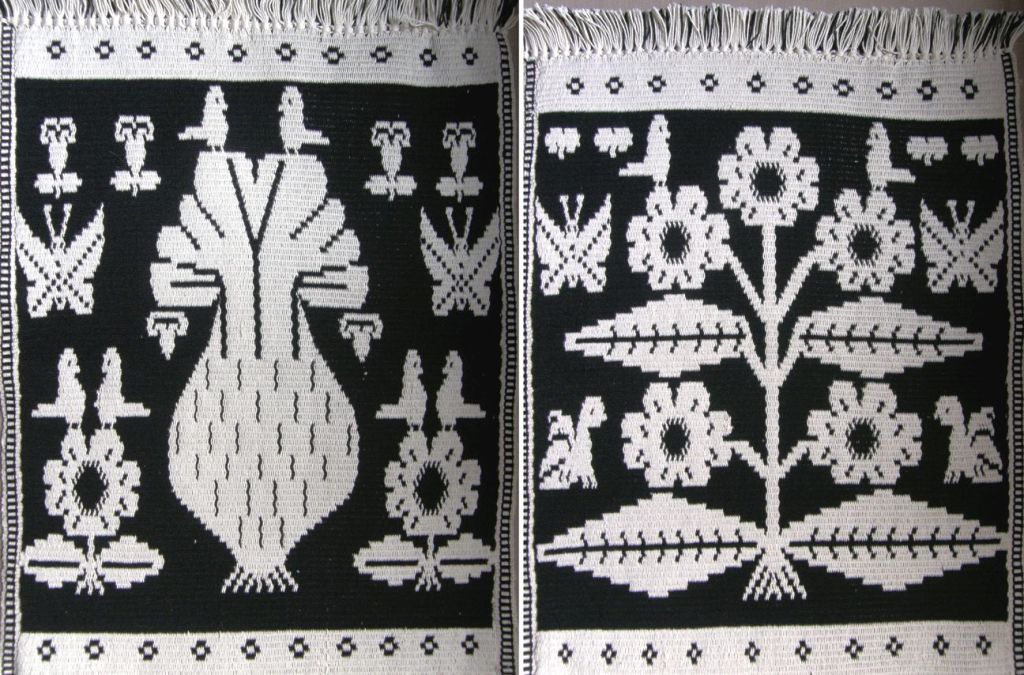
greca design on a pillow coverThis is a pillow cover woven on a floor loom by a  member of the Hipolito family of Zapotec tapestry weavers in California. (Which reminds me…my weaving friend Dorothy is currently in Peru studying tapestry techniques with master weaver Maximo Laura… can’t wait to hear more about it).

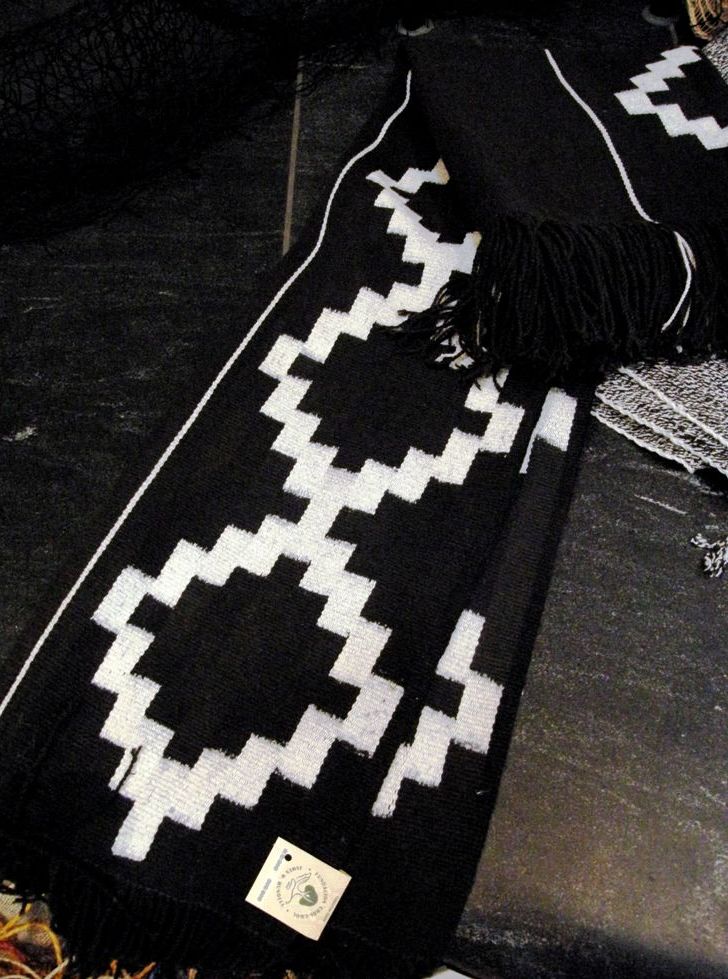
I love comparing the fine double-weave belt from Argentina, below, with its bold black and white pattern, to the precise black and white ikat work done by the Mapuche weavers of Argentina and Chile…two completely different processes that create superficially similar results.

OLYMPUS DIGITAL CAMERA

mapuche-ikat-11And so, I will finish this post this week by showing you a fabulous ikat poncho created by Argentinean master weaver, Guillermina Cabral, from Victorica, La Pampa province and thank the Ministerio de Cultura de la Nación Argentina, to whom the image belongs, for allowing me to show it to you here. I found it on the Facebook page of MATRA (Mercado Internacional de Artesanías Tradicionales de la Argentina). The page has other images of beautiful ikat work along with other exquisite handcrafts of Argentina.

10564839_1546978602191639_385201088_nSo, it’s all about process for me. But, concentrating too much on one particular part of the process can mean carelessness in others which are of equal importance…stupid pieces of cardboard! 😉


Backstrap Weaving – Simply Red (and Black and White)!

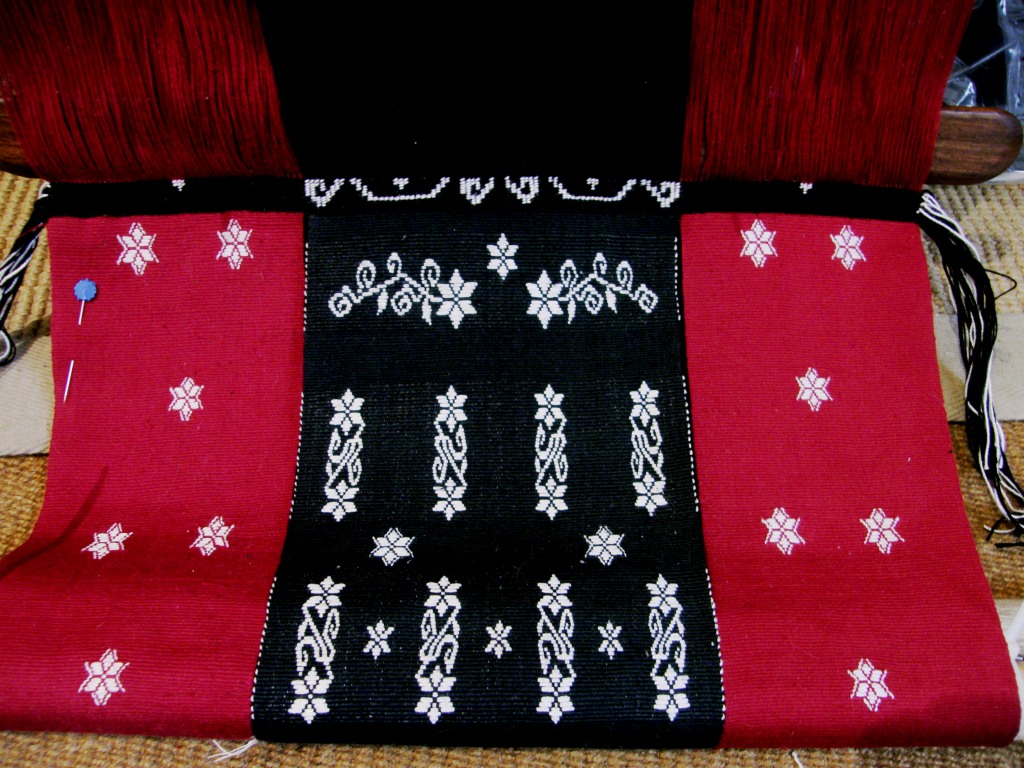
These are the best light conditions I could find for photographing the red-on-red pattern on the two side panels of my wall hanging.

The late, low, winter sun was drifting in through my bedroom window and I looked up from my weft twining to discover how well the light and shadow brought out the relief pattern. I have posed these pieces all over the place…on the floor, on the table, in this room and that…used natural light and flash, held the camera in my hand, and used a tripod, and was not happy with any of the results. All I got was a flat red mass.

And then, there I was, happily seated with my backstrap in place and the warp stretched out before me. The light came to me through the window and gave me the shot at last.

sunlight on red panels backstrap weavingIt was great after all this time to be able to see how the red panels looked beside the center one. The tricky part was lining the three panels up precisely and have them suspended under the same amount of tension so that I could twine across the top of all three at the same time.

I still can’t decide which face of the double weave looks better…

back of double weave panelI used the solid stepped lines and the arrow motif as part of the weft-twined pattern in much the same way as I had in the red panels…

finished weft twining on backstrap loomI need to do a bit more solid black twining to finish. That will be the part that gets clamped within the wooden hanger. Once off the loom, I will decide how to finish the ends of the twined wefts and how I will cut the fringe around those long woven tabs at the other end (see below).I need to contemplate that for a while. Once cut, that will be that, and I want to get it right!

finishing the shipibo backstrap pieceSo, it is time to move on to the next project….a clean slate and a bunch of sticks…exciting!

I bought a large cone of UKI 20/2 cotton for the next project with which I have never woven before. That means it is time to sample the yarn while I play with ideas for the ikat  in the next wall hanging. I’ve been at the sketch book creating hooky designs. Whether I am creating a design that is way beyond my limited wrapping skills, remains to be seen.

First, I need to get an idea of what kind of width I can get with X number of ends in the 20/2 cotton and so I wound a short-ish warp as a sample.

To make it more interesting, I decided that I could play a bit with the silk that I recently bought at CNCH and try a new-to-me supplementary-weft technique that is used for decorating hair sashes from Jacaltenango in Guatemala. Dr Carol Ventura has written a book about the Jacaltenango hair sashes. I have owned this book for years and once dabbled with the technique many, many years ago. As is always the case when using supplemental weft, the success of the project is very much dependent on finding the right kind of material for the supplemental weft for the weight of the ground cloth. While I understood the technique, my sample was downright ugly because my supplemental weft was too “light” for the ground cloth and there were large gaps between the rows of pattern. Then, I got distracted and wandered off in another direction.

I don’t even know where that sample is now. It was obviously not worth keeping. However, seeing a Jacaltenango hair sash that one of my students brought to class in Seattle last spring re-ignited my desire to try this technique….

jacaltenango hair sashI have made mistakes in my new sample and my count is off. I will un-weave this and start again now that I have a better feel for handling and counting these fine warp threads.  Hopefully the next attempt will be better. In the meantime,  this 20/2 white sample will give me a good idea of how many ends I will need to wind for my next wall hanging panel. I like two-fers.

backstrap sample with new cottonAnd, do I feel confident about this next ikat project? No, not at all! My experience with ikat has been quite limited but I figure that I may as well just jump in there. I do know from my own experience that the wrapping and dyeing part, although painfully slow, is relatively easy. For me, the hardest part has been keeping the warps well enough aligned while weaving so that my motif remains recognizable. Yet, I don’t want them to be so rigidly aligned that I lose the feathery outlines that make ikat so charming. This is one of my tiny attempts…

three ikat motifsHere are some narrow strips of ikat that I placed in a piece that includes supplementary-weft patterns…

strips of ikat backstrap weavingAnd finally, this experiment involved dyeing and then removing some of the wraps to dye again for a second color.

ikat book coverWay back in 1998, my weaving teacher in Candelaria, Bolivia showed me the first piece of ikat I had ever been able to handle. It was a  bedspread on which she had been working on and off for several years. This was something she was weaving for herself rather than the usual pieces that she weaves for the store in the museum in Sucre.  She was weaving with rather coarse handspun wool and her name and her husband’s had been worked in amongst the flower motifs..

stitched-ikatI’ve examined the wrapped warps, the finished cloth, and watched the weavers at work in many different places in my travels in South and Central America, trying to capture the secret of limiting the amount of  movement of the warp threads and the resulting image distortion. Below are examples from Chile, Ecuador and Peru.

mapuche-ikat-2

ikat weaver Bulcay Ecuador

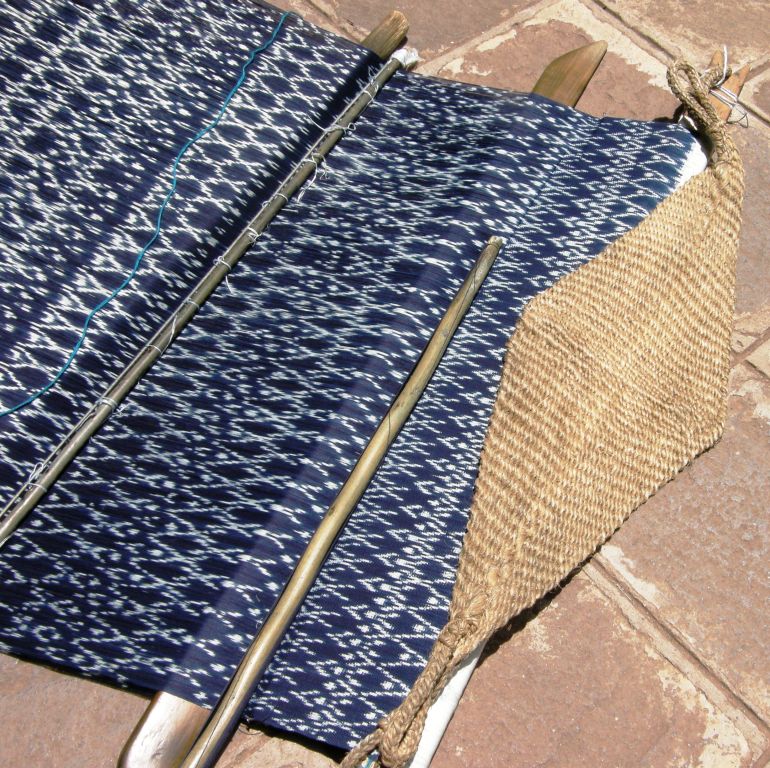
The simple backstrap loom of Tacabamba, Peru on which the indigo ikat-patterned "panones" are woven. They are up to one-meter wide, covered with tiny motifs and have patterns knotted into their fringes.
The simple backstrap loom of Tacabamba, Peru on which the indigo ikat-patterned “panones” are woven. They are up to one-meter wide, covered with tiny motifs and have patterns knotted into their fringes.

So, that is what I have been up to this last week….

Meanwhile, there has been a fair bit of red, black and white appearing online in the various places where band weavers hang out.

Cheryl wove with me last spring and now she is already designing her own motifs and weaving more than just samples.

cheryl (3)She designed the gecko figure and I love the arrow motifs at the bottom which remind me of little boomerangs. This will be a strap for her camera. I showed you some weeks ago the sample bands that she wove in preparation for this project. Here is the completed weaving…

cheryl finished camera strap pebble weave backsrapThe center motif is charted in my second book and is a pattern that I adapted from tablet-woven band by Louise Ström.

Ann Mester created this enticing warp for backstrap weaving which could be used for complementary-warp pick-up techniques like Andean Pebble Weave, or simple warp floats, or just to create attractive horizontal bars of black and white…

ann mester fb (2)Rufio, the kitten (who would look very stylish with a red collar) was rescued from Pet Rescue of Mercer.

Susan AndersonAnd, if you are wondering about what I call “simple warp floats, the technique that I used on the red-on-red panels, Susan Anderson’s example. above, very clearly shows the single-faced nature of this pick-up technique. Susan has floated the warp threads singly. For me, this gives a more delicate yet solid look to the motifs than that which is achieved by floating pairs. The pattern is from Anne Dixon’s The Weaver’s Inkle Pattern Directory. Susan wove this on an inkle loom and has done a beautiful job.

So, it will most likely be all about winding the warp and then finding a comfortable position and set-up for wrapping many many threads for ikat this coming week…

cropped-ikatThis was my first ever attempt, around eight years ago, I would guess. It’s wool warp…Navajo warp…wrapped with cassette tape. The wrapping and dyeing were successful…the weaving was not! This is another sample that has disappeared!…nothing to show for those hours of work except this picture and “experience”.  And I am sure that there will be much more experience to be gained and  many more lessons to be learned in this coming week.

See you next week…


Backstrap Weaving – Vivid!

VIVID is the name of an annual festival of lights, music and entertainment that took place in Sydney at the end of May just in time for my visit. Colorful images are projected onto buildings and landmarks around Sydney harbour and the city center. My brother captured some of them with his camera when we went together to the festival one night….

The white sails of the famous Sydney Opera House were transformed to an amazing  piece of crystal glowing in the dark…

vivid w waddington 3

And then adorned with butterflies…

vivid w waddington

I don’t know how to describe this next one!

vivid w waddington 1Other buildings along the waterfront were also used as giant screens onto which fantastic slithering images were projected…

vivid w waddington 2I have been enjoying a variety of landscapes and weather here in Sydney from the city to the country. I had a day out in the pretty rolling hills just west of Sydney…

???????????????????????????????And a hike in the bush. It was tshirt weather in the middle of winter…

???????????????????????????????I got rugged up on a cooler day for a trip to the city, the waterfront and Chinatown with my weaving friend, Emerald…

chinatown crop

???????????????????????????????Emerald and her family are from Burma and they invited me to come and stay with them in Sydney’s inner city for a couple of days of weaving. I had forgotten how exciting it is being there right in the heart of all that inner city action. Emerald has distant memories of having taken some weaving lessons in her younger days in Burma. Now she wants to learn more about the backstrap loom and the weaving culture of her homeland.

She showed me her beautiful collection of longyi, the long pieces of fabric that are worn by both men and women in Myanmar. They are wrapped about the lower half of the body. Some of these pieces were woven on floor looms but there are still backstrap weavers to be found in certain parts of the country.

The Wikipedia page on the longyi includes this saying…

Men who cannot read are like the blind; women who cannot weave are like the cripple

—an old Burmese saying at a time when every household had a handloom and the womenfolk wove all the longyis for the family.

???????????????????????????????


VIVID colors against black….

emerald longyiWe warped and set up her backstrap loom for an Andean Pebble Weave project. Emerald has placed hooks into the wall of her home and has created a very nice backstrap weaving space.

???????????????????????????????

???????????????????????????????I feel as happy as she looks here when I am seated in front of a fresh warp! Now it is time to get down to work and pick up the pebble sheds and create the string heddles….

???????????????????????????????A lovely green warp for a lady named Emerald. I showed her how to operate the two sets of heddles on this wide warp and now she is all set up to weave a cell phone pouch and whatever else she may be able to squeeze out of this warp. Emerald first contacted me via this blog. You may have read her enthusiastic comments here. Then we became friends on Facebook. I wasn’t able to meet with her when I visited Australia last year but it worked out this time and we had two fun days together.

??????????????????????Emerald showed me the book that she recently bought on Sazigyo ,by Ralph Isaacs. Sazigyo are very fine tablet-woven bands from Burma which were used to wrap palm leaf manuscripts. The book comes with its own silk tablet-woven book mark.

Images and lines of text are woven into the tapes themselves. This Facebook page contains many images of these woven tapes.

Emerald is very excited about learning about these and now wants to study tablet weaving so that she can also create bands of woven text in her native language.

It was a very educational experience being with Emerald! She also told me about Inle Lake in Burma where yarn is spun from lotus stems and woven into cloth.

Julie Hall has written a very interesting  and image-packed blog post about her visit to Inle Lake and I appreciate her having given me permission to use some of her images here…

Textile weavings made from lotus and silk, a specialty of Inle Lake, by Koh Than Laing
Lotus flower on Inle Lake…image by Julie Hall used with her permission.
xxxxx
Pulling apart a group of cut lotus stems to extract fiber for spinning…image by Juile Hall used with her permission.

The following video from this page shows a small part of the process…

My weaving friend, Wendy Garrity, has also written about a visit to Inle Lake and includes images and video on her blog.

Meanwhile, back at my brother’s place, vivid colors are all around with evening visits by flocks of lorikeets to the backyard accompanied by the screeches of the sulphur crested cockatoos and laughter of the kookaburras at dusk…

??????????????????????I met with weavers up in Springwood in the Blue Mountains in a lovely bushland setting for a weekend of backstrap weaving in the home of Helen Halpin, editor of the Weavers Forum newsletter. Last weekend I wove with folks in a pretty homestead on the suburban outskirts in front of fields of grazing sheep.

Part of theVirginia Farm group getting serious about pebble weave!
Part of the group getting very serious about pebble weave!

The second day was cold, blustery and very wintry. We could hear owners Jenny and Phil’s flock of sheep bleating outside but little did we know that two little black lambs were being born as we wove away warm and cosy indoors..

???????????????????????????????The ladies who wove with me are part of a group whose name forms the fun acronym “EWES”. It stands for Epping Weavers Embroiderers and Spinners. It really seems like an extremely dynamic group. Sydney folk who read my blog might want to join. Here’s Brenda wearing a handknit sweater and her inkle woven EWES lanyard…

???????????????????????????????Images of warmth and vivid colors have been arriving in my inbox from the other side of the world. Snuggled up under a blanket with a miniature poodle snoozing on my lap, I look at my friend Janet’s sister’s grandkids learning backstrap weaving in bikinis in summery USA. One of Janet’s own backstrap woven guitar straps, made from her own handspun, lies on the ground between the girls providing plenty of inspiration.

janets sister grandkids

larisa (1)Larisa, who is Russian but now lives in the UK, sent me a picture of a fabulous stole that she wove on a backstrap loom…such vivid colors and wonderful pick-up work!…

The image she sent me is of a  low resolution and I hope she sends me a larger one soon so that we can all better appreciate the detailed pick-up in this beautiful piece of work.

Weavers who hung out with me on my recent US visit have been busy weaving in their summer months.

They are happy to be able to enjoy the portability of the backstrap loom which enables them to easily weave outdoors or even in the front seat of the car!


10366148_10203782422742111_554034780892193392_nCheryl has a ”loom with a view” at her lake house. She is weaving pebble weave “hugs and kisses”.

I don’t know where Elizabeth was going but she took her loom on the road anchoring the warp in the glove compartment of the car…

elizabeth

santa cruz backstrap weaversAnne has been working on her Andean Pebble Weave and is making great progress…

10350538_10201018377261098_4865296949662558862_nCharlotte launched herself into a new band challenging herself to some mental gymnastics handling the color changes in the three columns of motifs. This is the same motif that appears on yurt bands of Central Asia. In Central Asia it is woven using a single-faced structure. Charlotte is using a complementary-warp structure . This means that her band is double-faced.

charlotteJulia found a good use for a pebble weave band that she had created over a year ago. She made a bag for her sister’s flute. As is always the way with Julia’s work, it has been woven and put together beautifully.

julia flute bagJanet, who wove with me last year,  has become an active member of the Ravelry group and has been sharing her latest experiments with supplementary-weft patterning. janet supplementary weftSheila is a new member of the group and bought a Gilmore Wave loom for her studies of Andean Pebble Weave. She is working on adding extra string heddles to this two-shaft loom so that she can weave the structure as a semi loom-controlled one as I was taught to in Peru. It is much easier to operate the two sets of string heddles using a backstrap loom which enables you to freely and easily adjust tension on the warp with spontaneous body movements. Sheila is working with a ”fixed tension” loom which means that she needs to apply other strategies to achieve consistently clean sheds with her string heddles. It looks like she is succeeding!

gilmore wave loom set up for andean pebble weaveAbove, you can see the two sets of string heddles which Sheila is using along with the loom’s own two shafts. She has unrolled her weaving for the picture. When she is weaving, the two sets of string heddles are positioned further away from the shafts than they are in this picture.

sheilaShe is weaving one of the knotwork designs that I have charted in my second book. The Andean Pebble Weave  structure can be used for motifs not found in the Andes. Basically, any pattern that comprises diagonal lines can be adapted to this technique. A part of my second book is devoted to this idea and I show how motifs from various non-Andean cultures can be adapted to the Andean Pebble Weave structure.

I will leave you for now with some more VIVID colors…images of some very exotic neck pieces that I recently saw on Facebook. These have been created via a collaboration of three Peruvian textile artists, one of whom is tapestry weaver Maximo Laura. VIVID! You will probably recognize  his contribution if you are at all familiar with his work. My backstrap weaving friend, Dorothy, is going to study tapestry weaving with him in Peru soon! According to the Facebook post, these artworks will be sold via the Puchka Peru website.

10175947_774636085881885_6728107276994461639_n

1798714_774635892548571_4144007971210964607_nMy visit to Australia continues….I have a group of friends coming over to my brother’s place this week to weave and then I will head back to Bolivia shortly thereafter as my brother and wife will be taking off to Ayers Rock on their motorbike. Maybe I will squeeze in one more blog post before I leave….


Backstrap Weaving – Scattered Drops in the Ocean

Sometimes I am fooled into thinking that just because I am in several online weaving groups, whose forums I read, contribute to, or simply lurk in on a fairly regular basis, I am seeing a good representation of what is going on in weaving in the USA , Europe and other regions of the developed world. Of course, what I am seeing online are mere drops in the ocean. Consider this blog post a peek at a scattering of drops in the ocean as I try to gather the bits and pieces that have come my way, both online and off, whilst on the road.

Let me first show you some pictures of beautiful textures of ocean currents and sand alongside quilt-like patches of color in the Massachusetts landscape. I went flying with my friend Pam’s husband in his Cessna to Cape Cod, over Nantucket and Martha’s Vineyard on a perfect spring day. We had hoped to do such a flight on my visits in previous years but the weather had always been against us.

massachusetts sea and landDrops in the ocean….a corridor of  islands stretch along a bed of blue and green ocean. Those patches of deep red are the cranberry bogs amongst the various tones of green in forests, lakes and fields.

river and ocean and sandSquiggly lines on the ocean floor and across the land make me think of my “Shipibo songs” woven piece at home on my backstrap loom which is awaiting  my return.

???????????????????????????????I have managed to visit three fiber guilds so far on this trip. Some are devoted to all kinds of fiber arts while others are exclusively about weaving. I see the items in the Show and Tell sessions and am astounded by the variety and beauty of the cloth and the humility of their creators.
Many of the weavers simply do not use the internet as a way to connect with other weavers. Their guilds provide a wealth of kindred spirits with whom they can share their projects, ask questions and supply answers. …more drops in the vast sea of weaving.
I like to hear the personal stories behind the woven items from people who are more at ease with sharing within a small group of people with whom they have become well acquainted over many years rather than posting things online for all the world of friends and complete strangers to see. And, of course, the added bonus at  the guild meetings is that we all get to touch and examine the pieces.
We heard the story of Pam’s wool/silk  tallit, or should I say, tallits. You can see two being passed around in the picture. It was only after having twisted the fringe and completed the piece that she realized, on folding it, that the stripes didn’t match on the two halves. One colored band had been woven slightly differently and had, therefore, thrown all the others off. I can imagine that sinking feeling in her gut as she discovered the error. It was back to the warping board to start all over again. She told us of the kindness of the person for whom she had woven the piece and why it was so important to her to have the piece come out just right. He received it in its handwoven bag in tears and says that it wll now be a family heirloom.
??????????????????????
At the same Show and Tell session I was pleased to see a piece of warp and weft ikat from Thailand that a  member had brought along just after I had mentioned this technique in a blog post.
???????????????????????????????
Again, I wonder how many lifetimes I will need to try out these techniques. I may perhaps try weft ikat one day when I am done with experimenting with the warp version and then, if I have a decade to spare, I might get to try warp and weft ikat!
It was nice to see another kindred spirit of mine, Ute, at the Springfield meeting. Ute is part of a group with whom I have woven in Northampton and her sharing of  her collection of Bhutanese textiles and her encounter with Bhutanese backstrap weaver Leki Wangmo were great sources of inspiration to me.
Meanwhile, back in the internet world, with its blogs and weaving forums, my friends Claudia and Janet  showed off their latest custom designed handwoven baby wrap, the colors of which were based on a photograph of a Hawaiian sunrise supplied by the mom. Unlike most internet encounters with beautiful cloth, I have been able to touch this piece ansd heard the story about its creation from concept to fulfillment when I visited with Claudia a couple of weeks ago. Janet took the picture. I think that yardage is difficult to photograph and Janet has found a very effective way to show off the cloth.
lots aknots
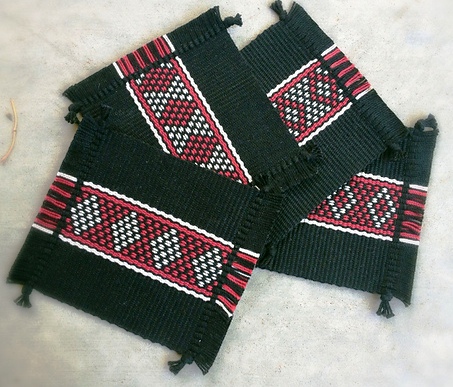
Ravelry friends have been at their backstrap looms. Kim is currrently exploring the world of the Bedouin weavers using their striking red, black and white al’ouerjan patterns for a set of mini rugs. These designs are traditionally woven using a warp-substitution technique which means that the back of the cloth will have very long warp floats. One of our group members, Tracy Hudson, showed us Bedouin examples where the weavers had cleverly used an extra weft to tie down the excessively long floats and create a much neater, more attractive and practical “wrong” side. I have tutorials on the technique and these kinds of patterns here and here on this blog.
kim
And, while on the subject of red black and white, from which I never seem to stray too far, I got to see once again the stunning looped bag made by the Ayoreo people of lowland Bolivia that I had given to Pam some years ago. I often visit the co-operative store which sells the work of the various indigenous artisans in the region of Santa Cruz where I live and I have yet to find another example of the looped bags where the work is quite as fine as this one. Perhaps the best pieces are being taken to the International Folk Art Market in Santa Fe (although, I have to say that I don’t remember seeing pieces this fine there either). I am hoping that the quality of the work is not deteriorating as older more skilled artisans die and younger ones sacrifice a little quality as they strive to produce pieces quickly for international markets.
???????????????????????????????
More from the Ravelry group…Julia is celebrating the arrival of spring (although rumor has it that it will snow here tomorrow as I make my way to California) with a double weave piece inspired by her blossoming garden.
DSC04534_medium
She has framed the flower with vertical stripes and weft twining and I can’t wait to see where she goes from here. I am wondering if she will create a series of flowers, each within a little frame.
Here in Pennsylvania, the daffodils are in full bloom. It got warmer and warmer as I traveled from Massachusetts to Pennsylvania, staying with Susan, then Beth along the way and now with Ron and Carol.. It was interesting to attend the guild meeting in Boston….more like a mini conference than a guild meeting with four well attended workshops running side by side in the morning followed by a guest speaker after lunch.
Founded in 1922, it is the oldest guild in the USA and the book that they published to celebrate their 90th anniversary is a treasure. The meeting was the largest I have attended with a surprising amount of familiar faces…online backstrap weavers and people I have met at other guilds. It was nice to see Laurie Autio again and meet Deb Watson.
On the way to the Mannings I spent an evening in Beth’s home accompanied by the work of Jason Collingwood….well, what do you know….red and black! (with some white wall space between to complete the favorite color combo)….
??????????????????????
I had a fun weekend with a group of backstrap weavers…
???????????????????????????????
Laura is a natural and quickly found that “sweet spot” where the sword would sit up nicely in the shed without constantly clattering to the floor. You can see how she is practicing controlling the edge warps to make nice even edges.
Julia was back for a second time. Jeanne, whom I had met at the Spinning Seminar last year, was there too as was Karthika..
Julia has a lovely collection of old Guatemalan textiles that she collected in the 1970s. It was very nice to have these textiles on hand to look at. They show examples of both single and double-faced techniques.
??????????????????????
This panel from a huipil of San Antonio Aguas Calientes is well used and very faded. The bird motifs were executed in the double-faced technique and the colors on the reverse are bold and bright.
??????????????????????
This piece, which is covered in double-faced motifs, would have been a baby’ cap. A string along the top would have been drawn to close the top. What is most likely the baby’s name has been worked in. It is so incredibly fine!
??????????????????????
This hair sash is a lovely example of single-faced techniques. The back of the sash is solid red with a  few very fine stripes. We don’t know the exact origin of this sash.
I had two days to wander the Mannings store, see what’s new and catch up with staff including resident weaving instructors Tom Knisely and Sara Bixler. The ladies from Just Our Yarns came in to give a two-day class on weaving with their fabulous hand painted tencel.
??????????????????????
I have been using one of their handpainted varieties as supplementary weft for years…a little goes a long, long way… and now I have several more of their color combinations to add to my stash. The first was given to me by my friend Lisa before I even knew what tencel was. Using it for weft inlay creates motifs that look as if they were made from mother of pearl.
There was also work to be seen by other past instructors and I discovered that rug hooking is not the same as latch hooking…
??????????????????????
Debra Smith, editor of Rug Hooker’s magazine teaches at the Mannings and has created a small gallery of her work amongst the tools and other supplies for this craft that the Mannings sells.
??????????????????????
This last piece ,with its colored vertical lines on black, reminds me of the reverse applique molas of Panama and Colombia…
??????????????????????
nawi awapa tubular bandsSo, I am off to California tomorrow. It has been a wonderful visit meeting new people and old on this east side of the US. It is always sad to leave the Mannings. This visit was too short.
I got to play around with some of my tubular bands trying to devise ways to finish the ends. I found that I could make a neat blunt finish on the blue band and I could also finish the end with a sizeable knob, as on the gold band,which could be used along with a loop to close the band into a bracelet. I am still working on making that as neat and compact as possible. I need to keep practicing.
I will leave you here with a beautiful video that showed up in my Facebook newsfeed. I mentioned this to Karthika, who was born in India like me, and she knew straight away about the famed Jamdani weaving of Bangladesh. The incredibly fine and almost transparent fabric is woven on traditional looms with two weavers seated side by side. It is decorated with supplementary wefts. Watch as they prepare the yarn, warp, thread the fine yarn through the reed and then watch the speed with which they create string heddles!

See you next time from California.


Backstrap Weaving – A Change of Seasons

The change of seasons is barely noticeable here in Santa Cruz. There is a drop of perhaps a few degrees of temperature between summer and fall but nothing else here tells me that fall is on the way. That isn’t happening today as we rapidly make our way up to 30 degrees centigrade. I remember when I was teaching English here, the text books would use the classic pictures to represent the four seasons….snow, sun and beach, falling leaves and spring flowers….somewhat like the motifs I used on my Four Seasons ticlla piece. They meant nothing to my students. They found it especially hard to grasp that fall would be the “opposite” season to spring in the northern hemisphere. I couldn’t blame them.

discontinuous warp ticlla closing the gapAs my departure date for my US trip draws nearer, I am wondering if anything in the northeast is telling people that spring is on the way. Please, say “yes”! My friend in Massachusetts told me to bring boots presumably for stomping about in snow. I don’t own a pair! So, I am just about ready to do some kind of dance in order to try and will that northern winter away and bring on the spring.

Maybe I should fill this post with lots of spring imagery and put a springy vibe out into the universe instead. A change of season and cooler temperatures would be apprecited down here. Okay, so here goes…

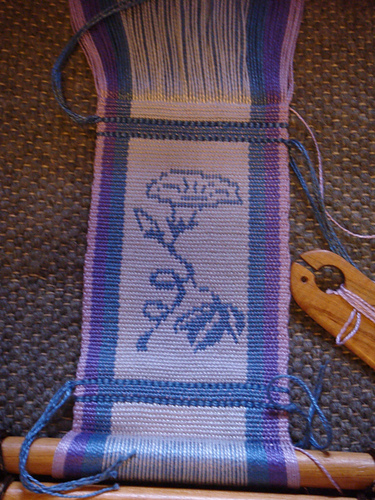
Leaves could represent the new growth of spring or the dying leaves of fall…either way, a change of season.

I suppose that blue leaves could be either!

circular warp backstrap

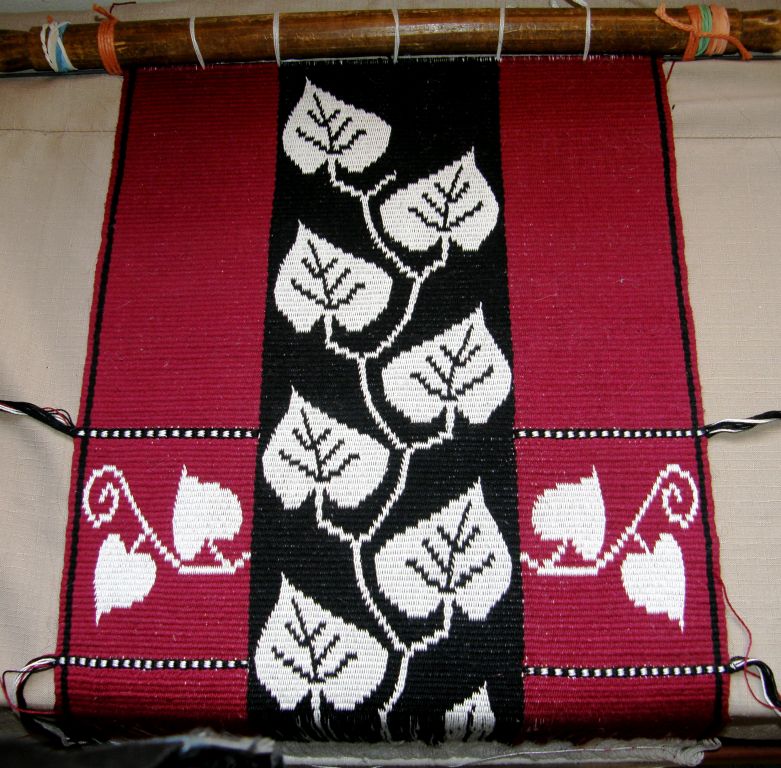
chamanto piece on progressThe leaves on my wall hanging, which were inspired by the chamantos woven in central Chile, are rather spring-like or even summery, I think. The motifs woven into the chamantos represent the agriculture and horse culture of that Chilean region. They are covered in patterns such as wheat stalks, flowers, horse hooves, grapes and vine leaves.

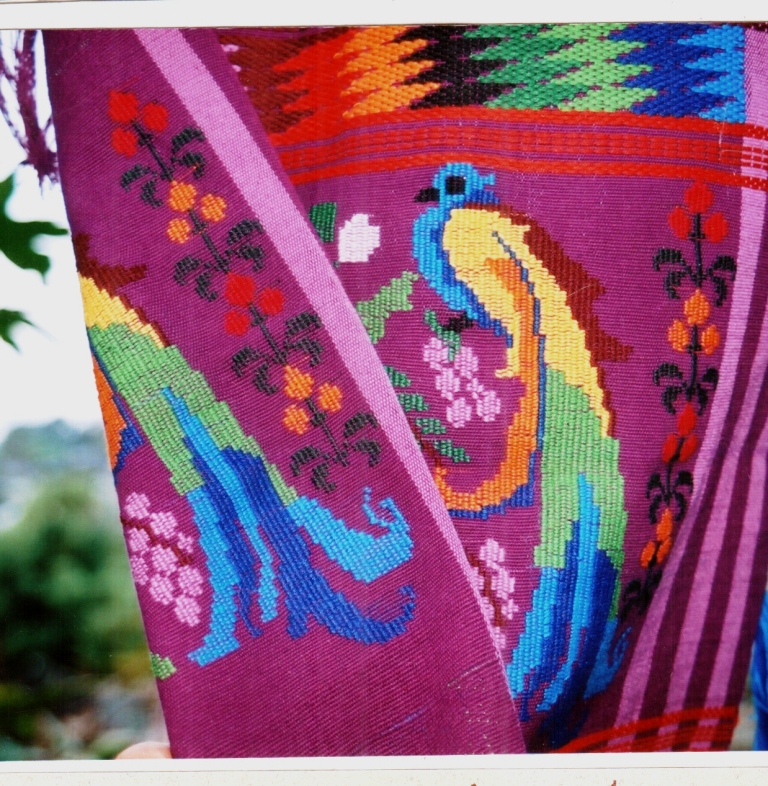
There is nothing cold or wintery about Guatemalan textiles with their flower and bird motifs in bright colors…                                                            double-faced

My Guatemalan teacher with whom I worked on the piece pictured below, taught me to just dip my hand into the basket of threads, pull out a color and go with it. You can see the rows of plants with their happy multi-colored leaves…

Guatemalan supplementary weft patterning

Those little plants and flowers are always fun to weave with supplementary weft even if my color choices once I was back home on my own were a lot more planned and conservative…

suppweft-tree-bookmarks

Crocheted hats and hat bands produced in the highlands, an area which can be quite colorless and bleak at times, provide a splash of colorful flowers and birds….

chullo-and-hatband

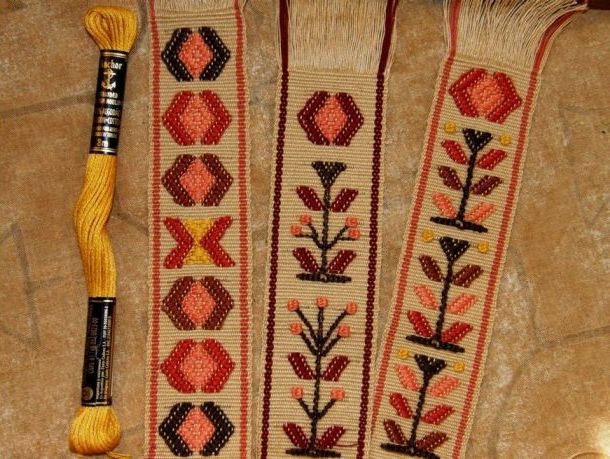
OLYMPUS DIGITAL CAMERAThe flowers on the hatband from Calcha, Bolivia inspired the design on the fourth of my red, black and white wall hangings…

???????????????????????????????

The Guaraní weavers who live in the eastern lowlands of Bolivia may not always use bright colors but their work certainly shows the rich plant and bird life of this region….nothing wintery about this…

Guarani Moisy technique

The above pieces were woven using what the Guaraní weaves call the moisy structure. They also use the kara pepo structure which we know as pebble weave.

Julia, from the Ravelry group has been weaving a piece for her guild’s color challenge. She is weaving Guaraní star motifs in pebble weave. It is always exciting or me to see people using the charts in my books. These star patterns are charted in my second book and the outline is a traditional Guarani pattern.. The basic star outline has its center filled with different shapes and it is an interesting exercise in designing to explore how many different kinds of “fillers” you can come up with for the space in the center of the stars. The Guaraní repertoire of star patterns is fairly small. While the patterns they weave using the moisy structure seem unlimited, the star is one of only very few motifs that they weave using the kara pepo structure. I came up with quite a few filler patterns for  the star for my book and Julia, of course, has been very creative in  inventing some of her own.

DSC04397_medium

Santa Cruz crochet cottonMy Guaraní teacher, Angela, buys the same Brazilian Clea brand thread as I do for her weaving. It was shocking seeing how suddenly and how quickly the price of this cotton went up as it did all over the world and sad knowing how it would effect the weavers and their ability to buy thread.

I am sure that they must be as happy as I am to find that cotton crochet thread is now being produced by TextiCruz here in Santa Cruz. While Santa Cruz used to be a major cotton producing region, cotton hasn’t been grown here for a long long time. I have no idea from where the raw material is coming. But, whatever the source, they are able to sell the finished product much more cheaply than the Brazilian thread!

“Camba” is the nickname for people from Santa Cruz and the label shows the sombrero de sao, straw hat, which is part of the typical festival costume for this area. I bought one ball to try out. You can see it here among a chaos of sample bands that I am gathering for my trip. I am  little suspicious about the color fastness. It sounds terrible but I have  to say that things produced here tend to be of inferior quality. They are well presented but you only have to scratch the surface and…..It is wise to be suspicious of something that seems too good to be true. That goes for everywhere, right? I notice that the label has the typical words of advice on buying from one dye lot to complete a project, yet there is no dye lot number to be seen anywhere.

Let me briefly slip back into the somber tones of winter as I would like to show you my progress on the squiggly Shipibo- inspired wall hanging panel. I would like to thank those who commented last week with words of encouragement. This week’s work on this included four hours of unweaving and re-weaving. I had forgotten to start one of the squiggles and I mistakenly thought that it wouldn’t matter so much. I was wrong. There was a large gaping hole of black space that I simply couldn’t live with. Four hours later I was back to where I had left off but much happier for it!

shipibo wall hanging panelWhen I was at the Encuentro de Tejedores in Cusco in 2012, a presentation was given on Shipibo art. We were told that parts of the patterns the Shipibo people paint and embroider represent their borders and rivers. One of the few times that I flew over Brazil in daylight on my way to Miami and could enjoy the view over the Amazon jungle from a cloudless sky, the 

jalq'a weavingrivers below looked very much like the squiggles I am weaving. I tried to guess which one of the squiggles might be the Amazon itself until I was completely blown away by the massive body of brown water that appeared and curved its way off to the horizon.

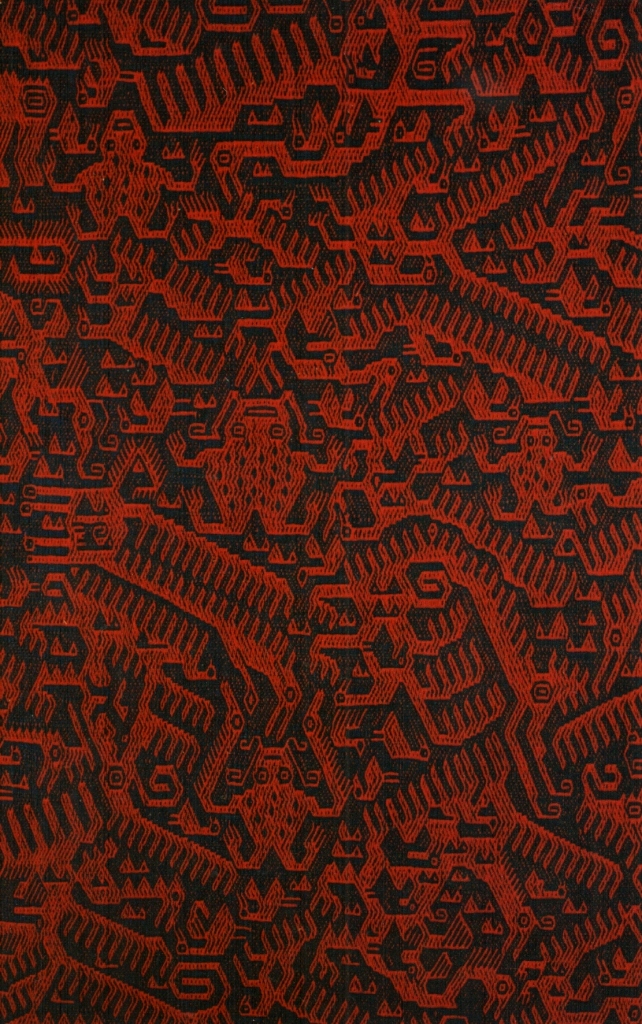
I have always been in complete awe of the weaving of the Jalq’a people of Potolo, Bolivia (at left). A complex mass of figures fills just about every space on the cloth. There is no break….no plain weave with which to relax between the concentration of pick-up patterning….a few rows to sit back and just open sheds, beat and pass weft…no, none of that.  While halfway through one motif, the weaver is finishing another nearby and starting the next.  Small motifs are even woven within larger ones. Plus there are warp floats to consider. The weaver must ensure that she ties down each and every one of the threads at just the right moment before the floats become too long. And  pattern charts, of course are not used. It’s mind boggling.

Although I am not weaving a warp-float structure and my patterning, therefore, is much easier, my current weaving with its squiggles starting and stopping and turning this way and that has given me an even greater appreciation of the work of the Jalq’a people. I have to remember to start the next squiggle while in the midst of one and finishing another.

Let me return to something bright and spring-like to finish this post and blow away the winter blues…

PAZA bands Cochabamba BoliviaHere are some of the beautiful bands woven with naturally-dyed handspun yarn from PAZA in Cochabamba. Cochabamba city is one of many I have come across in my travels in South America that is named a city of “primavera eterna”…eternal spring.

See you next week!