Backstrap Weaving – Scattered Drops in the Ocean

Sometimes I am fooled into thinking that just because I am in several online weaving groups, whose forums I read, contribute to, or simply lurk in on a fairly regular basis, I am seeing a good representation of what is going on in weaving in the USA , Europe and other regions of the developed world. Of course, what I am seeing online are mere drops in the ocean. Consider this blog post a peek at a scattering of drops in the ocean as I try to gather the bits and pieces that have come my way, both online and off, whilst on the road.

Let me first show you some pictures of beautiful textures of ocean currents and sand alongside quilt-like patches of color in the Massachusetts landscape. I went flying with my friend Pam’s husband in his Cessna to Cape Cod, over Nantucket and Martha’s Vineyard on a perfect spring day. We had hoped to do such a flight on my visits in previous years but the weather had always been against us.

massachusetts sea and landDrops in the ocean….a corridor of  islands stretch along a bed of blue and green ocean. Those patches of deep red are the cranberry bogs amongst the various tones of green in forests, lakes and fields.

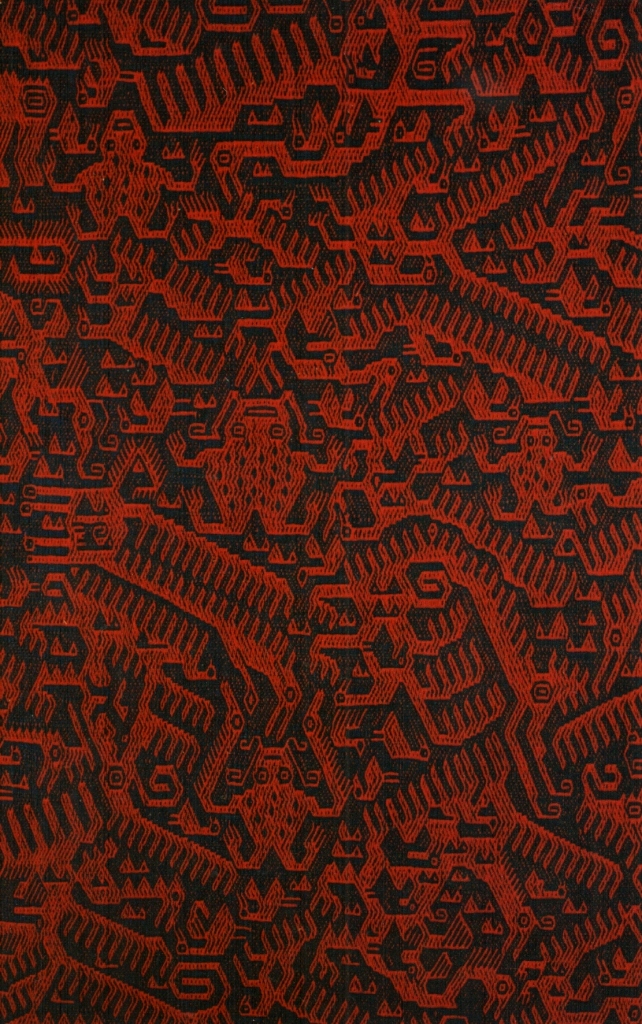
river and ocean and sandSquiggly lines on the ocean floor and across the land make me think of my “Shipibo songs” woven piece at home on my backstrap loom which is awaiting  my return.

???????????????????????????????I have managed to visit three fiber guilds so far on this trip. Some are devoted to all kinds of fiber arts while others are exclusively about weaving. I see the items in the Show and Tell sessions and am astounded by the variety and beauty of the cloth and the humility of their creators.
Many of the weavers simply do not use the internet as a way to connect with other weavers. Their guilds provide a wealth of kindred spirits with whom they can share their projects, ask questions and supply answers. …more drops in the vast sea of weaving.
I like to hear the personal stories behind the woven items from people who are more at ease with sharing within a small group of people with whom they have become well acquainted over many years rather than posting things online for all the world of friends and complete strangers to see. And, of course, the added bonus at  the guild meetings is that we all get to touch and examine the pieces.
We heard the story of Pam’s wool/silk  tallit, or should I say, tallits. You can see two being passed around in the picture. It was only after having twisted the fringe and completed the piece that she realized, on folding it, that the stripes didn’t match on the two halves. One colored band had been woven slightly differently and had, therefore, thrown all the others off. I can imagine that sinking feeling in her gut as she discovered the error. It was back to the warping board to start all over again. She told us of the kindness of the person for whom she had woven the piece and why it was so important to her to have the piece come out just right. He received it in its handwoven bag in tears and says that it wll now be a family heirloom.
??????????????????????
At the same Show and Tell session I was pleased to see a piece of warp and weft ikat from Thailand that a  member had brought along just after I had mentioned this technique in a blog post.
???????????????????????????????
Again, I wonder how many lifetimes I will need to try out these techniques. I may perhaps try weft ikat one day when I am done with experimenting with the warp version and then, if I have a decade to spare, I might get to try warp and weft ikat!
It was nice to see another kindred spirit of mine, Ute, at the Springfield meeting. Ute is part of a group with whom I have woven in Northampton and her sharing of  her collection of Bhutanese textiles and her encounter with Bhutanese backstrap weaver Leki Wangmo were great sources of inspiration to me.
Meanwhile, back in the internet world, with its blogs and weaving forums, my friends Claudia and Janet  showed off their latest custom designed handwoven baby wrap, the colors of which were based on a photograph of a Hawaiian sunrise supplied by the mom. Unlike most internet encounters with beautiful cloth, I have been able to touch this piece ansd heard the story about its creation from concept to fulfillment when I visited with Claudia a couple of weeks ago. Janet took the picture. I think that yardage is difficult to photograph and Janet has found a very effective way to show off the cloth.
lots aknots
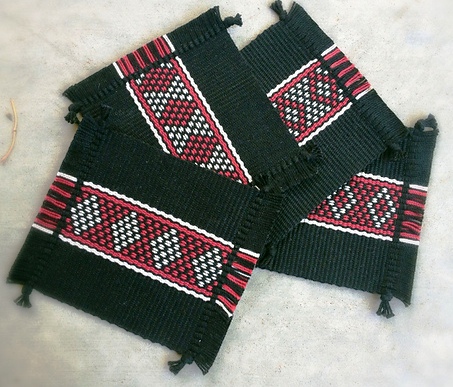
Ravelry friends have been at their backstrap looms. Kim is currrently exploring the world of the Bedouin weavers using their striking red, black and white al’ouerjan patterns for a set of mini rugs. These designs are traditionally woven using a warp-substitution technique which means that the back of the cloth will have very long warp floats. One of our group members, Tracy Hudson, showed us Bedouin examples where the weavers had cleverly used an extra weft to tie down the excessively long floats and create a much neater, more attractive and practical “wrong” side. I have tutorials on the technique and these kinds of patterns here and here on this blog.
kim
And, while on the subject of red black and white, from which I never seem to stray too far, I got to see once again the stunning looped bag made by the Ayoreo people of lowland Bolivia that I had given to Pam some years ago. I often visit the co-operative store which sells the work of the various indigenous artisans in the region of Santa Cruz where I live and I have yet to find another example of the looped bags where the work is quite as fine as this one. Perhaps the best pieces are being taken to the International Folk Art Market in Santa Fe (although, I have to say that I don’t remember seeing pieces this fine there either). I am hoping that the quality of the work is not deteriorating as older more skilled artisans die and younger ones sacrifice a little quality as they strive to produce pieces quickly for international markets.
???????????????????????????????
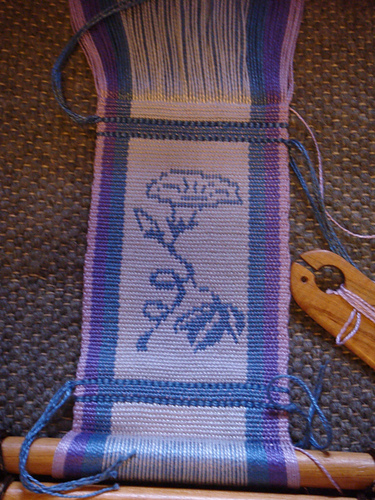
More from the Ravelry group…Julia is celebrating the arrival of spring (although rumor has it that it will snow here tomorrow as I make my way to California) with a double weave piece inspired by her blossoming garden.
DSC04534_medium
She has framed the flower with vertical stripes and weft twining and I can’t wait to see where she goes from here. I am wondering if she will create a series of flowers, each within a little frame.
Here in Pennsylvania, the daffodils are in full bloom. It got warmer and warmer as I traveled from Massachusetts to Pennsylvania, staying with Susan, then Beth along the way and now with Ron and Carol.. It was interesting to attend the guild meeting in Boston….more like a mini conference than a guild meeting with four well attended workshops running side by side in the morning followed by a guest speaker after lunch.
Founded in 1922, it is the oldest guild in the USA and the book that they published to celebrate their 90th anniversary is a treasure. The meeting was the largest I have attended with a surprising amount of familiar faces…online backstrap weavers and people I have met at other guilds. It was nice to see Laurie Autio again and meet Deb Watson.
On the way to the Mannings I spent an evening in Beth’s home accompanied by the work of Jason Collingwood….well, what do you know….red and black! (with some white wall space between to complete the favorite color combo)….
??????????????????????
I had a fun weekend with a group of backstrap weavers…
???????????????????????????????
Laura is a natural and quickly found that “sweet spot” where the sword would sit up nicely in the shed without constantly clattering to the floor. You can see how she is practicing controlling the edge warps to make nice even edges.
Julia was back for a second time. Jeanne, whom I had met at the Spinning Seminar last year, was there too as was Karthika..
Julia has a lovely collection of old Guatemalan textiles that she collected in the 1970s. It was very nice to have these textiles on hand to look at. They show examples of both single and double-faced techniques.
??????????????????????
This panel from a huipil of San Antonio Aguas Calientes is well used and very faded. The bird motifs were executed in the double-faced technique and the colors on the reverse are bold and bright.
??????????????????????
This piece, which is covered in double-faced motifs, would have been a baby’ cap. A string along the top would have been drawn to close the top. What is most likely the baby’s name has been worked in. It is so incredibly fine!
??????????????????????
This hair sash is a lovely example of single-faced techniques. The back of the sash is solid red with a  few very fine stripes. We don’t know the exact origin of this sash.
I had two days to wander the Mannings store, see what’s new and catch up with staff including resident weaving instructors Tom Knisely and Sara Bixler. The ladies from Just Our Yarns came in to give a two-day class on weaving with their fabulous hand painted tencel.
??????????????????????
I have been using one of their handpainted varieties as supplementary weft for years…a little goes a long, long way… and now I have several more of their color combinations to add to my stash. The first was given to me by my friend Lisa before I even knew what tencel was. Using it for weft inlay creates motifs that look as if they were made from mother of pearl.
There was also work to be seen by other past instructors and I discovered that rug hooking is not the same as latch hooking…
??????????????????????
Debra Smith, editor of Rug Hooker’s magazine teaches at the Mannings and has created a small gallery of her work amongst the tools and other supplies for this craft that the Mannings sells.
??????????????????????
This last piece ,with its colored vertical lines on black, reminds me of the reverse applique molas of Panama and Colombia…
??????????????????????
nawi awapa tubular bandsSo, I am off to California tomorrow. It has been a wonderful visit meeting new people and old on this east side of the US. It is always sad to leave the Mannings. This visit was too short.
I got to play around with some of my tubular bands trying to devise ways to finish the ends. I found that I could make a neat blunt finish on the blue band and I could also finish the end with a sizeable knob, as on the gold band,which could be used along with a loop to close the band into a bracelet. I am still working on making that as neat and compact as possible. I need to keep practicing.
I will leave you here with a beautiful video that showed up in my Facebook newsfeed. I mentioned this to Karthika, who was born in India like me, and she knew straight away about the famed Jamdani weaving of Bangladesh. The incredibly fine and almost transparent fabric is woven on traditional looms with two weavers seated side by side. It is decorated with supplementary wefts. Watch as they prepare the yarn, warp, thread the fine yarn through the reed and then watch the speed with which they create string heddles!

See you next time from California.


Backstrap Weaving – A Change of Seasons

The change of seasons is barely noticeable here in Santa Cruz. There is a drop of perhaps a few degrees of temperature between summer and fall but nothing else here tells me that fall is on the way. That isn’t happening today as we rapidly make our way up to 30 degrees centigrade. I remember when I was teaching English here, the text books would use the classic pictures to represent the four seasons….snow, sun and beach, falling leaves and spring flowers….somewhat like the motifs I used on my Four Seasons ticlla piece. They meant nothing to my students. They found it especially hard to grasp that fall would be the “opposite” season to spring in the northern hemisphere. I couldn’t blame them.

discontinuous warp ticlla closing the gapAs my departure date for my US trip draws nearer, I am wondering if anything in the northeast is telling people that spring is on the way. Please, say “yes”! My friend in Massachusetts told me to bring boots presumably for stomping about in snow. I don’t own a pair! So, I am just about ready to do some kind of dance in order to try and will that northern winter away and bring on the spring.

Maybe I should fill this post with lots of spring imagery and put a springy vibe out into the universe instead. A change of season and cooler temperatures would be apprecited down here. Okay, so here goes…

Leaves could represent the new growth of spring or the dying leaves of fall…either way, a change of season.

I suppose that blue leaves could be either!

circular warp backstrap

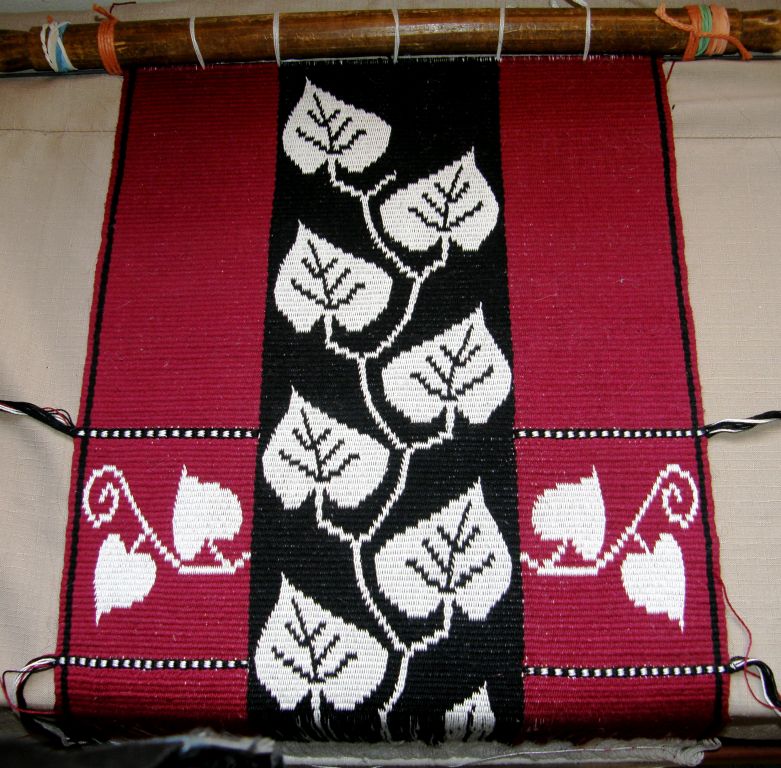
chamanto piece on progressThe leaves on my wall hanging, which were inspired by the chamantos woven in central Chile, are rather spring-like or even summery, I think. The motifs woven into the chamantos represent the agriculture and horse culture of that Chilean region. They are covered in patterns such as wheat stalks, flowers, horse hooves, grapes and vine leaves.

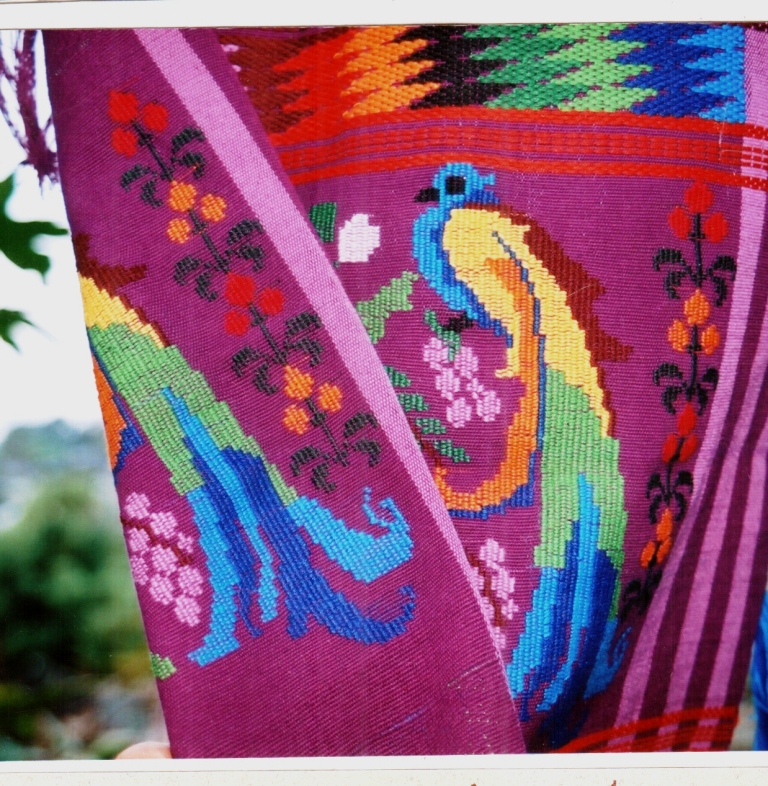
There is nothing cold or wintery about Guatemalan textiles with their flower and bird motifs in bright colors…                                                            double-faced

My Guatemalan teacher with whom I worked on the piece pictured below, taught me to just dip my hand into the basket of threads, pull out a color and go with it. You can see the rows of plants with their happy multi-colored leaves…

Guatemalan supplementary weft patterning

Those little plants and flowers are always fun to weave with supplementary weft even if my color choices once I was back home on my own were a lot more planned and conservative…

suppweft-tree-bookmarks

Crocheted hats and hat bands produced in the highlands, an area which can be quite colorless and bleak at times, provide a splash of colorful flowers and birds….

chullo-and-hatband

OLYMPUS DIGITAL CAMERAThe flowers on the hatband from Calcha, Bolivia inspired the design on the fourth of my red, black and white wall hangings…

???????????????????????????????

The Guaraní weavers who live in the eastern lowlands of Bolivia may not always use bright colors but their work certainly shows the rich plant and bird life of this region….nothing wintery about this…

Guarani Moisy technique

The above pieces were woven using what the Guaraní weaves call the moisy structure. They also use the kara pepo structure which we know as pebble weave.

Julia, from the Ravelry group has been weaving a piece for her guild’s color challenge. She is weaving Guaraní star motifs in pebble weave. It is always exciting or me to see people using the charts in my books. These star patterns are charted in my second book and the outline is a traditional Guarani pattern.. The basic star outline has its center filled with different shapes and it is an interesting exercise in designing to explore how many different kinds of “fillers” you can come up with for the space in the center of the stars. The Guaraní repertoire of star patterns is fairly small. While the patterns they weave using the moisy structure seem unlimited, the star is one of only very few motifs that they weave using the kara pepo structure. I came up with quite a few filler patterns for  the star for my book and Julia, of course, has been very creative in  inventing some of her own.

DSC04397_medium

Santa Cruz crochet cottonMy Guaraní teacher, Angela, buys the same Brazilian Clea brand thread as I do for her weaving. It was shocking seeing how suddenly and how quickly the price of this cotton went up as it did all over the world and sad knowing how it would effect the weavers and their ability to buy thread.

I am sure that they must be as happy as I am to find that cotton crochet thread is now being produced by TextiCruz here in Santa Cruz. While Santa Cruz used to be a major cotton producing region, cotton hasn’t been grown here for a long long time. I have no idea from where the raw material is coming. But, whatever the source, they are able to sell the finished product much more cheaply than the Brazilian thread!

“Camba” is the nickname for people from Santa Cruz and the label shows the sombrero de sao, straw hat, which is part of the typical festival costume for this area. I bought one ball to try out. You can see it here among a chaos of sample bands that I am gathering for my trip. I am  little suspicious about the color fastness. It sounds terrible but I have  to say that things produced here tend to be of inferior quality. They are well presented but you only have to scratch the surface and…..It is wise to be suspicious of something that seems too good to be true. That goes for everywhere, right? I notice that the label has the typical words of advice on buying from one dye lot to complete a project, yet there is no dye lot number to be seen anywhere.

Let me briefly slip back into the somber tones of winter as I would like to show you my progress on the squiggly Shipibo- inspired wall hanging panel. I would like to thank those who commented last week with words of encouragement. This week’s work on this included four hours of unweaving and re-weaving. I had forgotten to start one of the squiggles and I mistakenly thought that it wouldn’t matter so much. I was wrong. There was a large gaping hole of black space that I simply couldn’t live with. Four hours later I was back to where I had left off but much happier for it!

shipibo wall hanging panelWhen I was at the Encuentro de Tejedores in Cusco in 2012, a presentation was given on Shipibo art. We were told that parts of the patterns the Shipibo people paint and embroider represent their borders and rivers. One of the few times that I flew over Brazil in daylight on my way to Miami and could enjoy the view over the Amazon jungle from a cloudless sky, the 

jalq'a weavingrivers below looked very much like the squiggles I am weaving. I tried to guess which one of the squiggles might be the Amazon itself until I was completely blown away by the massive body of brown water that appeared and curved its way off to the horizon.

I have always been in complete awe of the weaving of the Jalq’a people of Potolo, Bolivia (at left). A complex mass of figures fills just about every space on the cloth. There is no break….no plain weave with which to relax between the concentration of pick-up patterning….a few rows to sit back and just open sheds, beat and pass weft…no, none of that.  While halfway through one motif, the weaver is finishing another nearby and starting the next.  Small motifs are even woven within larger ones. Plus there are warp floats to consider. The weaver must ensure that she ties down each and every one of the threads at just the right moment before the floats become too long. And  pattern charts, of course are not used. It’s mind boggling.

Although I am not weaving a warp-float structure and my patterning, therefore, is much easier, my current weaving with its squiggles starting and stopping and turning this way and that has given me an even greater appreciation of the work of the Jalq’a people. I have to remember to start the next squiggle while in the midst of one and finishing another.

Let me return to something bright and spring-like to finish this post and blow away the winter blues…

PAZA bands Cochabamba BoliviaHere are some of the beautiful bands woven with naturally-dyed handspun yarn from PAZA in Cochabamba. Cochabamba city is one of many I have come across in my travels in South America that is named a city of “primavera eterna”…eternal spring.

See you next week!

Backstrap Weaving – News and Novelties from Down Under.

A report from Down Under with some news and novelties….

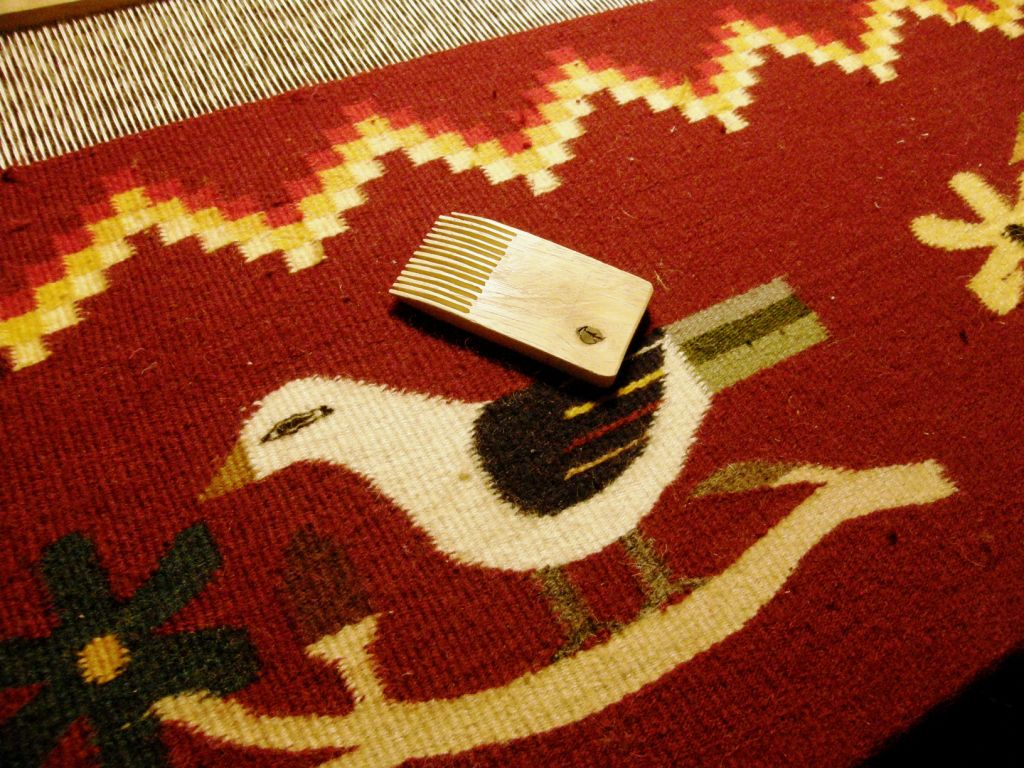
tools ofr knotted pile weavingMy brother has been keeping this piece of knotted pile weaving for me for many years. How it came into his hands is a long story which I have told on this blog before. All we need to know is that there is a weaver out there somewhere in Sydney who created this piece of amazingly dense cut pile weaving and I wish I knew who it was. On top of the piece you can see the  tools which are used for this weaving technique.  I got them some time ago from a gentleman in South Australia who was studying the cut pile technique with an Afghani weaver. Through him I was able to buy the tools from his teacher.  They have been on quite a journey….from Afghanistan to Australia and now on to Bolivia.

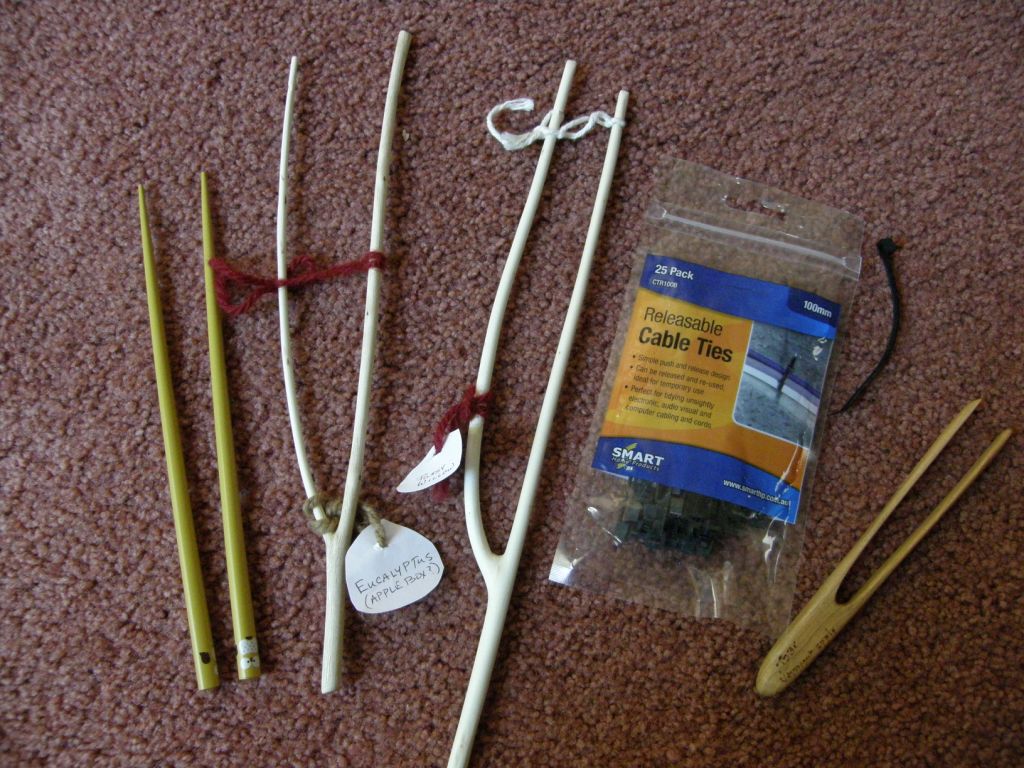
???????????????????????????????Some other “stuff”that backstrap weavers may find interesting…I discovered that Japanese chopsticks make pretty good pick-up sticks for lifting warps when doing weft inlay as well as for hooking the supplementary weft and pulling it through the shed as my teacher, Lydia, is doing below.

using pick up stick in Guatemala

opening the heddle shedFr Kyriakos, who lives here in Australia, cut and beautifully finished some forked sticks for me so I can take back some pieces of Australia to use in my backstrap weaving. Forked sticks are sometimes used by weavers in Peru, as seen at left, as an aid to opening the hedddle shed. The weaver is twisting the forked stick (which acts to tighten the upper layer of threads), leaning forward to relax tension on the lower layer of threads and lifting the heddles.

I have been hunting for just the right forked stick! The implement on the right in the picture above is actually a  pair of wooden tongs that I found in a knick knack shop in Vermont. Lausanne gave it to me as a gift. It seemed like a good useful souvenir and will serve well as my tanka (Quechua for fork) when I weave the ñawi awapa tubular band.

It seems that a good forked stick is not that easy to come by even for the Andean weavers….

tanka for nawi awapaThis weaver told me that she had broken her tanka while weaving her ñawi awapa and, rather than hunt for another, had simply bandaged it up.

The other little novelty seen above is releasable cable ties. I have recenly taken to using cable ties to lash my warp to the loom bar and the fact that the ties can now be easy to release and, therefore, reuse is great news.

As usual, when I am traveling, textiles from near and far just seem to fall into my lap. Kind folks bring these things along to guild meetings and other gatherings and thus give me the opportunity to examine and enjoy them.

Guatemalan supplementary weft open weaveThis is the second time in recent months that a piece like this has come my way…gorgeous light cotton open weave with motifs created with supplementary weft ….from Guatemala. This is just like the little sample piece that I bought on its loom at the Santa Fe market. It was even more impressive in this larger version.Panels of this cloth are sewn together to make huipiles (blouses). Weavers in the community from which this fabric came, embroider the edges of the neckline and sleeves.

Guatemalan huipil embroidered and with supp weft motifs

???????????????????????????????The thread on the loom was sized and was quite stiff. It was lovely to be able to feel the softness of the cloth in the finished huipil and see how much the open airy weave had closed after washing.

So, here I am in Australia looking at Guatemalan weaving. But, I also got to look at backstrap woven fabric from one of Australia’s near neighbors….Timor Leste, East Timor. Kelcie came to weave with me at home and brought along just a few of the textiles that she bought on a tour she recently took on  the island of East Timor.

???????????????????????????????

Picture from the Wikipedia page on "tais"
Picture from the Wikipedia page on “Tais”

The pieces were all warp-faced and were either ikat or patterned with warp floats on one face.

The Alola Foundation, in the capital city of Dili, was estabished to help improve the lives of women and childern in Timor Leste and marketing products made from handwoven cloth is just one of their activities.

Traditional cloth that is used for men and women’s clothing is known as tais. Take a look at the Wikipedia page on Tais to read more about the use and significance of this cloth in Timorese culture.

???????????????????????????????This piece depicts a crocodile in ikat, the creature on which the creation legend of the island is based.

Kelcie’s collection included several long narrow pieces, like the one below with yellow warp float  patterns, known as selandang which are worn around the neck.

???????????????????????????????The ETWA Foundation website has pages that cover the weaving processes starting with the preparation and spinning of the cotton, the futus (ikat process), warping and weaving.

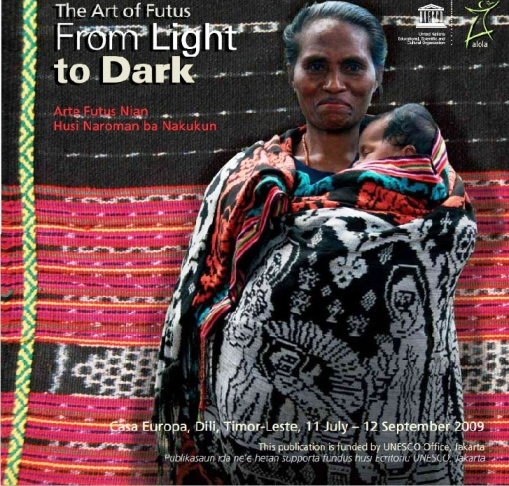
futusThis book, which was produced by Alola and UNESCO to accompany an exhibit of textiles woven with the futus technique, is available as a free download here. 

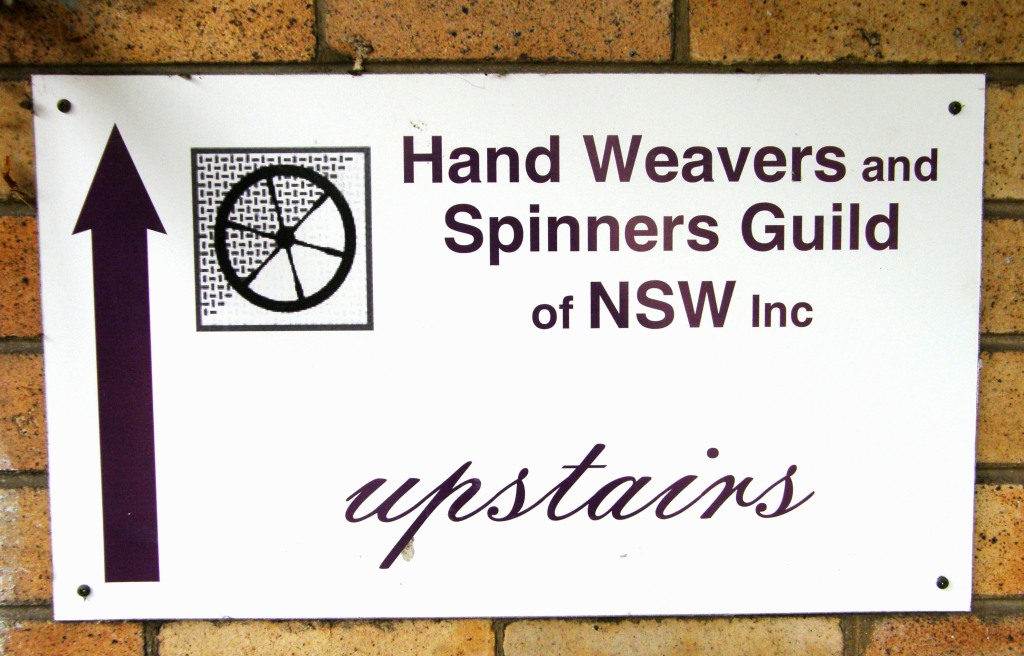
??????????????????????????????????????????????????????????????The folks at the Handweavers and Spinners Guild of NSW have been wonderful.

This has been my first visit to Australia since trying to become a full-time weaver  and my first contact with the guild.

I was invited to a gathering of spinners the day after I arrived in Sydney and I took myself along before jet lag could set in. It was a dreary rainy day in Sydney and I thought that no one was going to show up as I sat alone in the church hall. What I hadn’t found was the clear sign that indicated that all the fibery folk were atually upstairs happily carding, spinning, chatting, drinking mimosas! showing-and-telling and celebrating the last meeting of the year.

jenThere I met Dace and I had the sudden idea of weaving something to commemorate my Australian visit. I asked her if there was any fabric or material or weave structure that would be considered classically Australian. It was hard to come up with something. And then Dace had the  idea of dyeing some of my yarn with native Australian trees, instead. Brilliant idea! And so I will be off to Dace’s place for a dyeing session next week.

Next came a small gathering of weavers at home. Space would only allow four.. We spent two days playing with the ways that weavers in Peru and Bolivia set up their looms to weave complementary-warp pick-up patterns. You can see Jen at left using the two-finger method.

The pool table was a great piece of furniture for anchoring the warps. You need very large  clamps. That table was not going anywhere!

????????Taking a break to chart some patterns and look at books and Kelcie’s Timorese textiles…..

backstrap weaving class in sydneyOur get-together was followed by the monthly (and end-of-year) guild meeting at which I showed some slides. It was a wonderful, warm and jovial audience full of Christmas cheer for the coming holidays. I was delighted to meet so many people who  had never encountered South American weaving and who then expressed so much enthusiasm for it. 

In the mail box….

Fr Kyriakos (who just happened to have joined Kelcie as a student in one of Kay Faulkner’s classes…it’s a small world in this big country,of Australia!) sent me pictures of the Andean Pebble Weave band that he is weaving using a pattern inspired by a piece I showed here some time ago woven by Julia.

fr kyriakos pebble weaveLausanne in Vermont showed me what she is working on. She’s having a little trouble with sticky sheds as she is using respun tapestry wool. Working the two sets of heddles used in the Andean Pebble Weave  takes practice. I sawed my way through my warps while trying to perfect the moves in my lessons back in 1996. My teachers performed them so quickly and without any explanation. It was difficult to identify the individual movements that needed to be combined into one smooth operation.

lausannes celticpattern andean pebble weaveLausanne is weaving a Celtic knotwork pattern that I adapted to Andean Pebble Weave from tablet-woven bands. It is charted in my second book, More Adventures with Warp-faced Pick-up Patterns.

After the guild meeting last Saturday, I couldn’t help noticing with a smile the contrast in my Saturday and  Sunday activities.

On Saturday it was all about Girls and Their Toys: 

???????????????????????????????An interested group gathers around the table after Show and Tell time to get a closer look at the novelty yarn that had been presented. (Of course there are several male members of the guild…they are just not visible in this particular shot).

And on Sunday it was a day with Boys and Their Toys: (of course, there was also a female present, namely, ME.

??????????????????????For those who are familar with Sydney, my brother took me on a ride with his vintage motorcycle club up to the mountains…Mt Victoria and the Bell’s Line of Road. It is such a beauiful area and could well be where I would choose to live should I ever come back to Australia for good.

??????????????????????Yes, we are on the correct side of the road. It’s Australia, remember?

And this is where we were heading…

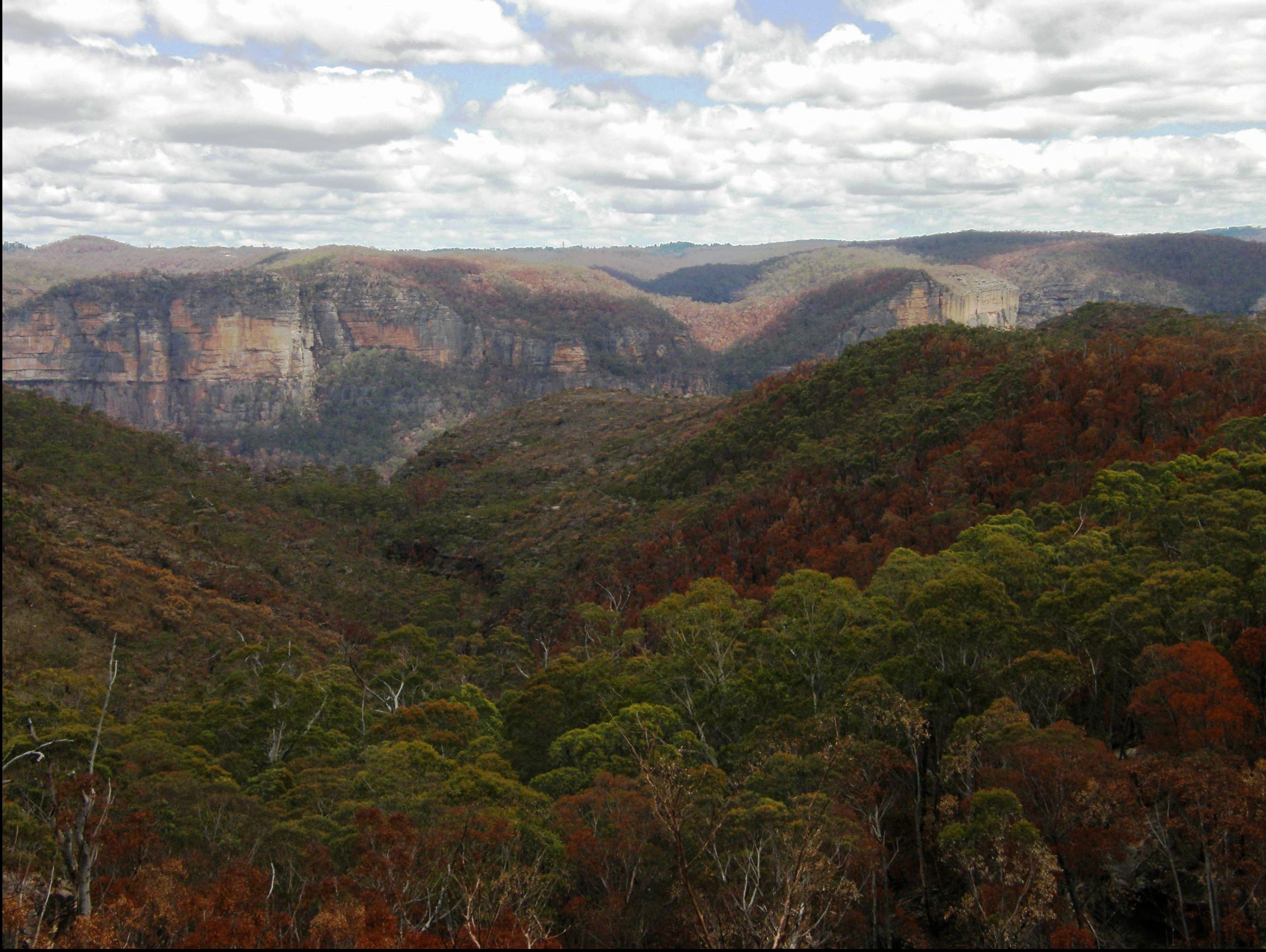
bush with borderThe colors in this bush scene look almost like the early fall  in the US that I saw recently but, sadly, all those orangey-red tones that you see there are burnt bush from the recent fires that ravaged the area. Those cliff faces and bushland are some of my favorite parts of Sydney. Who needs the beach?!

This Saturday I will be heading back to the mountains for a small weavers’ gathering in the home of Helen Halpin, this time by train. I have been receiving Helen’s monthly news letter of weaving and other fiber events in Australia, Weavers Forum, for some years now and was pleased to have been able to finally meet her at the guild meeting last Saturday. I certainly won’t let four years slip by before I am back in Sydney again.

See you next week.

Backstrap Weaving – Coincidences and Connections

It’s funny how some dangling threads in my weaving life can be unexpectedly connected by a wonderful coincidence.

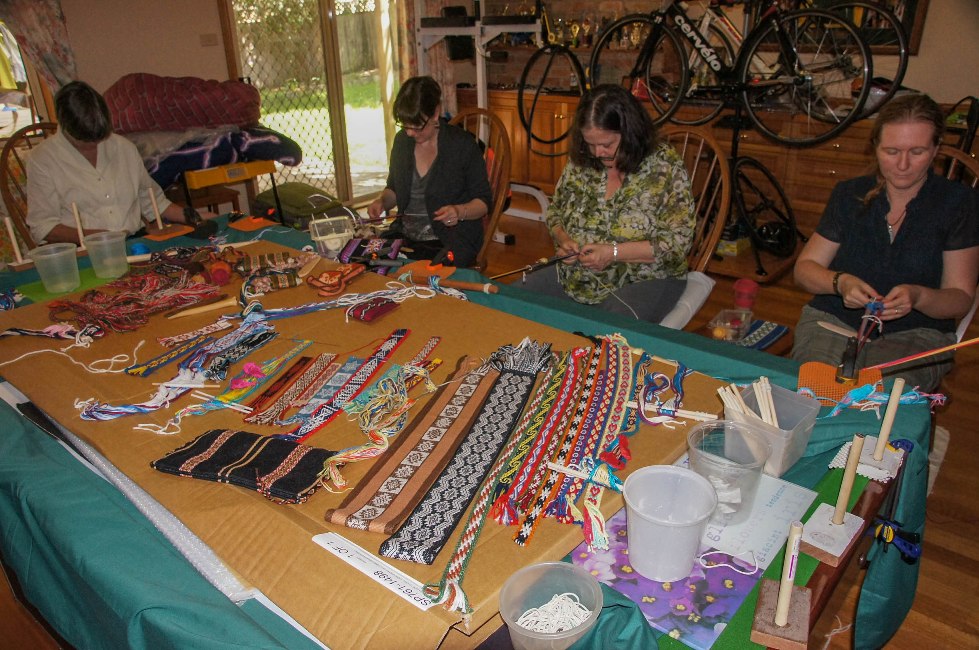
I had just finished weaving  a structure that I call “two-heddle intermesh” with a group of backstrap weaving friends in California. If you have been following my blog for some time, you may even recognize some familiar faces from this group who weave with me every year. Certainly you will remember some of the names from projects I have shown here over the years.

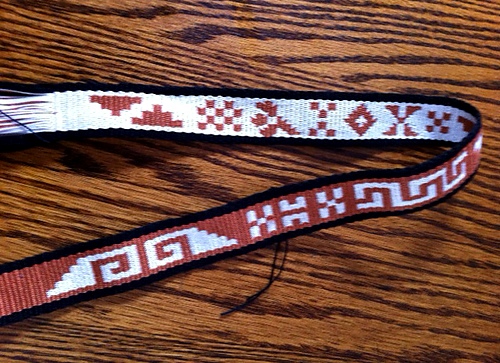
??????????????????????I have included this complementary-warp structure in my second book and chose to use designs that comprise only horizontal and vertical lines as a simple way to introduce the patterning technique. While looking through Joanne Hall’s book on Mexican Tapestry Weaving I saw that Mexican tablero and greca patterns were perfectly suited for this as were many of the motifs used by Bhutanese weavers on their tablet woven belts.

Joanne Hall writes that the tablero patterns represent  indigenous designs as well as those introduced by the Spanish. Many of the greca patterns appear in the structures and tombs at Mitla, Oaxaca and are used by tapestry weavers of that region.

yonat and ingridAbove left, you can see Yonat weaving one of the greca patterns while Ingrid, on the right, completes a second Bhutanese influenced motif. The patterns with their simple heavy lines are bold and beautiful in this structure. As we were using a complementary-warp structure, the bands are double faced with striking red designs on a light background on the other side.

Annie's intermesh bandAnnie seemed to sense, knowing my love of red, black and white, that at least some of these colors would come into play, and dressed to match! She is weaving one of the tablero influenced patterns and made a beautiful band by repeating the one motif along the entire length rather than creating a sampler of a  variety of patterns. Maybe we will see something like this appear on one of the famed and fabulous woven guitar straps which Annie creates on her inkle looms. Yonat, too, is a fond of making bands on inkle looms and I expect to see her intermesh creations soon.

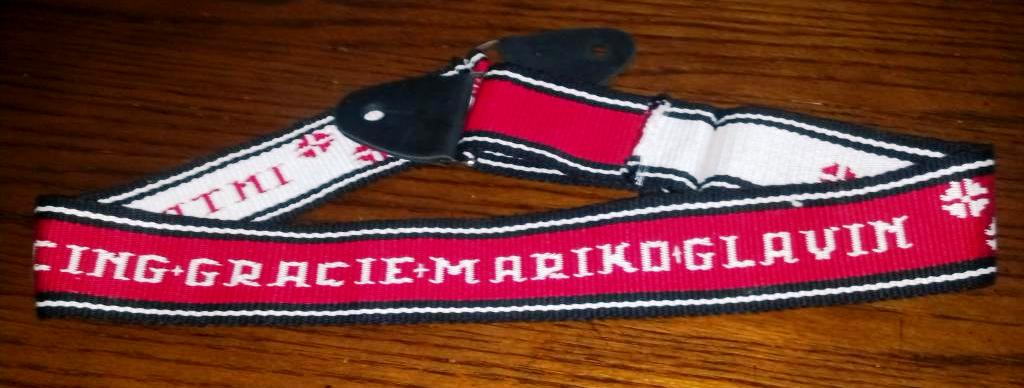
annies guitar strapAnnie has been so busy lately setting up her new sub-brand for hand woven guitar straps, I was lucky that she still had some energy left to have me stay at her place and weave!

In the evenings, she would sit at her inkle loom and turn out yet another original piece. I saw her start a new one using hemp. It was lovely to touch.

Even if you don’t own a guitar, check out Annie’s weaverguitarstraps.com for lots of colorful inspiration for your next band project.

And if you would rather weave your own band, Annie makes the hardware that will enable you to turn your woven creation into a guitar strap.

Jennifer from Oregon, had woven with me last spring when I visited her state and she showed on Ravelry, a couple of weeks ago, what she had made with an intermesh sampler.

jennifer 's intermesh band

You can see her finished greca pattern and other shapes she played with while learning about the characteristics of this structure. It is what I call a “partly loom-controlled structure”, that is, the weaver does not need to do pick-up for every weft pass. The loom does part of the work needed to create the motifs. This, along with some other little tips and tricks that I talk about in my book which help reduce the amount of time spent doing pick-up, allows the weaver to create patterns relatively quickly.

bobbie guitar strap intermeshYou may remember Bobbie’s guitar strap with names and a Mexican tablero motif made using the intermesh structure.

Now, what about that coincidence I mentioned? I am getting there. I have a couple of other things to tell.

??????????????????????Anne, who also wove with me  in Santa Cruz invited me to come and stay with her and her husband in their hilltop home near Saratoga, Califormia.

I now have a much better idea of the layout of the land with the spectacular views from Anne’s house and can understand why Santa Cruz people talk about distances from one place to another by mentioning the number of hills one must go over to get there.

Anne took me to one of the meetings of her weaving group where I got to tell people about weaving on simple looms in South America. I met the Bolivian owners from La Paz of her local Mexican restaurant who are planning to move back to Santa Cruz, Bolivia where I live and are excited about perhaps doing some weaving with me. That was one fun coincidence.

I enjoyed touring Anne’s cabin studio in the garden. This is one of many projects that caught my eye…

anne's inkle band bagThis is made up of two bands, woven on the inkle loom with patterns in supplementary warps, sewn together. You can’t tell that there are two bands, can you?! …the join is perfect. Another narrow band forms the sides and strap….so pretty.

The following day Anne took me to meet an eighth generation Zapotec weaver, Jaime and his  equally talented and skilled partner, Joey. Jaime’s father Zenon Hipolito, who taught him to weave, was not present but we got to see some of his work in progress on his hand-built looms. There was evidence of his craftsmanship to be seen everywhere…works created with his own hands but also pieces that have resulted from his having patiently and expertly passed his knowledge and skills to the next generation.

joey with zenon's latest piece

The looms themselves are absolutely beautiful…three in the living room on which Joey and Jaime work to fill custom orders, and another downstairs for Zenon. Zenon even made the bamboo reeds, combs and shuttles as well as the spinning wheel.

bamboo hand made reed

tapestry comb beater

spinnig wheel made by zenon

??????????????????????

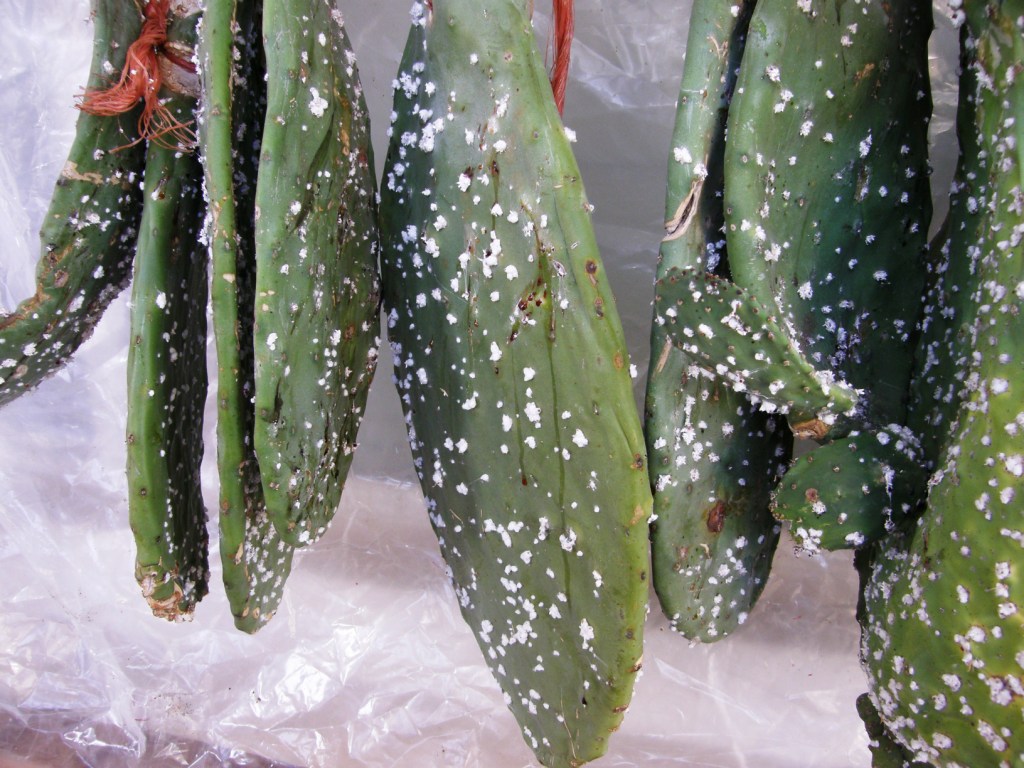
cochineal bugsJoey seems to be the one who finds most time to spin and many of his pieces include some of his handspun yarn. He experiments with different fibers.

A lot of the yarn they use has been dyed by them with natural substances. They even raise their own cochineal bugs on the front porch.

They experiment with different kinds of warp, some are more successful than others. Joey described his struggles to finish a piece where he had used an unsuitable yarn for warp. It was a custom order and once he had cut his first full attempt off the loom he had to start all over. Of course, to Anne and myself, the piece looked faultless but, it wasn’t up to Joey’s standards of perfection.

Both Joey and Jaime’s love for weaving and the motifs and fibers was apparent in the way they  touched and talked about the rugs as they lay them out one by one on the floor for us to see. They have recently returned from a trip to Oaxaca (Joey’s first) where they had been invited to take part in an exhibit which included several other master tapestry weavers from the US as well as weavers from the Oaxaca valley, the home of the Zapotec people. Jaime spoke about the thrill of getting to visit the Mitla ruins which hold in their stonework many of the motifs which he was taught to weave by his father. Joey mentioned walking around the villages and recognizing the familiar sound of the beater hitting the edge of the fabric emanating from almost every house they passed.

While they talked about the fatigue that comes from weaving standing up all day, they also mentioned the difficulty to resist weaving at least a little almost every single day in their home/studio where they stand surrounded by rows and rows of colorful skeins and their own woven pieces covering the walls and floors.

Here are the pieces that were in progress on their looms during our visit…

joey and jaimes workAnd here is just a handful of the pieces that they lay out for us to see…

zapotec jaguar weaving

zapotec weaving by jaime and joey

zapotec weavings by jaime joey and zenon

bird tapestry zapotec Zenon Hipolito

Older pieces that have been in the family for a few generations, and show evidence of the passage of time, adorn the walls and floors of their home…

older zapotec weavings

When I was admiring the rich red and black piece, Joey mentioned his love of  red, grey, black and white combinations and so I had to share my own love for that and showed him online images of my wall hanging pieces in which I have used some of those colors. While they are aware of the use of the backstrap loom by many weavers in the Oaxaca Valley, they have not had any personal experience with one. I regretted not having taken one of mine to show and have them use. I then showed Jaime what we had woven in the workshop just two days earlier and he was happy to point out the designs from his culture which are woven by Zapotec weavers in their rugs.

You will recognize below a version of the greca pattern that we were using in my class in very similar colors! I found many wonderful motifs in the rugs that we were shown that will work beautifully in the intermesh technique. I only wish I had met Jaime and Joey before I finished my book so I could have included pictures of their work. The unexpected meeting with them was a wonderful way to tie everything together for me. From the pages of Joanne’s book to my own book to a workshop and, from there, on to an eighth generation weaver who continues to incorporate these traditional patterns in his work….I am grateful for all I learned from the book by Joanne Hall and her kind permission to use some of the designs she had charted in my own book and give many thanks to Anne,  Joey and Jaime who made this get-together possible.

greca design on a pillow cover

From the home of the Zapotec weavers, Anne and I headed to Gilmore Looms. I was keen to see some of the looms that weavers in the Backstrap Weaving Group on Ravelry have been using to create warp-faced bands so successfully. Not everyone, after all, is going to love being strapped to their warp! It was fun meeting the lovely people at Gilmore who told us about having busier months so far this year than they have had for a long time. Lots of looms are finding homes…that’s good news for the weaving world.

Here are the Gilmore Wave looms in two sizes….

Gilmore wave loomsIt was Marsha Knox who first brought these looms to my attention as she used one to make a lot of wonderful projects using the patterning techniques that I teach in my tutorials here.

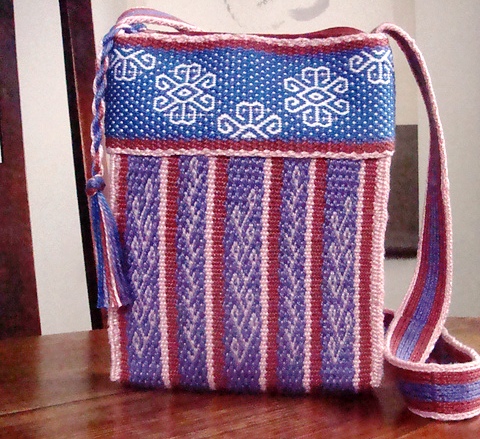
Here is a beautiful lined bag that Marsha made by joining several bands together.

Marsha Knox bag

I am not sure which of the two looms she used. I like the larger as I prefer the larger amount of space it has between the front beam and the heddles. This would allow the placement of extra string heddles that are used for pebble weave and intermesh. The more space you have for those, the easier they are to use.

Mullarkey loom at Janet'sNow, that I am with my friend Janet, I have seen the loom that she used in her tablet weaving class with John Mullarkey and I think that this is a little beauty too.

John has these made to his specifications. They are basically a frame with adjustable tension on which to support a long band for warp-faced weaving. John, of course, has designed it specifically for tablet-woven bands. I think this little loom, perhaps clamped to a table, would work nicely for the kinds of narrow projects that I often do on my backstrap loom. The loom does not have any shedding devices of its own so, you would be using a shed rod and set of string heddles just as you would on a backstrap loom. However,I haven’t used it myself for this purpose yet and am just guessing at this stage that it would work well used in this way.

Of course, I much prefer my backstrap loom as, among its many advanatges, it is good to be able to freely and rapidly adjust tension at will with simple body movements. However, I do like to look for possible alternatives for those who simply aren’t able to use a backstrap loom.

The loom is pictured above next to what I call Janet’s “grab-and-go’ basket…a bunch of prepared warps for backstrap weaving that she can pick up and  take along with her to weave any time.

synergo arts ergonomic benchNow, let me tell you some great news about the ergonomic weaving bench that Synergo Arts has been introducing to backstrap weavers in Guatemala. I have posted about these before.

My friend Anne, with whom I stayed in Saratoga, has been involved in this project. Many backstrap weavers in the Ravelry group expressed interest in having one of these benches themselves but they were not available in the US.

Now, Anne tells me that Synergo Arts has decided to make all the plans and instructions for these benches available to the public. So, if you are handy with wood and tools or know someone who is, there is nothing stopping you from making one of these benches yourself.

The Synergo Arts page that I linked above will only be available until the end of summer 2013. After that, you will still be able to access the files here. These pages contain the plans for making the bench, instructions for using it and video of the bench in use. I never got to see one in use when I was in Guatemala or use one myself. It certainly looks very good. I particularly like the opportunity it gives for the weaver to brace her feet.

If you build one, please let me know and send pictures!

To finish, let’s see what the Ravelry guys have been up to….

julia pebble weave bag

This is Julia’s Lavender Field pebble weave bag. Her weaving group challenged themselves to weave something inspired by a gorgeous painting of fields of lavender. I am not sure if I would have permission to show the painting itself, unfortunately. Julia used both her backstrap and Seidel band looms to weave the various parts of the bag project. It’s stunning!!

carol

Carol took a liking to the Tinkipaya star design from the central highlands of Bolivia, which is charted in my second book, and added an Andean motif to the sides to create this piece.

Jennifer, who is a backstrapper all the way, also chose the star motif for her latest project…

jennifer's tinkipaya starDawn is a relative new-comer to our group and wove a band with horizontal bars while getting acquainted with the loom and fine tuning her skills…look at those beautiful edges!

dawn

If you have any interest at all in finger-loop braiding you most likely know of Ingrid Crickmore and her loopbraider blog. Ingrid is always part of my weaving groups when I visit California. Ingrid brought some of her braids to show, some of which were particularly snakey, and she has written a great blog post about them.

I thought that I would show them here as we are doing snakey things in our Ravelry Year of the Snake weave-along.

ingrid's snake braid 1

ingrid's snake barid 2

You will be forgiven for taking a detour from backstrap weaving and wandering off and getting lost in Ingrid’s site! Those finger-looped braids make nice finishes for backstrap woven projects and are so much fun to make.

I made some progress on my own Year of the Snake project. This pattern comes from one of several bands that was sent to me by weavers in Cochabamba (see my last post for stories about these ladies). I was immediately struck by its snakiness and had to try it.

My on-the-road projects tend to have a hard life. They get hooked up and woven all over the place, anchored on toes, under heavy luggage, started and stopped and started again. This one is doing okay so far and is not showing signs of the ravages of the road yet!  There it is weaving its way through the grass alongside the Bolivian band with the original pattern.

snake patterns Bolivan band backstrap weaving

I just got an email from Dorothy who just went to a lecture entitled Weavers’ Stories from Island Southeast Asia. She sent me a link to a webpage about the exhibit that has video interviews with various weavers and batik arists who talk about their creative process in times of changing social and economic situations. I have not even had time to see the videos myself so we can all watch them together here.

That’s all for this post. See you next time with tales from Texas and the Humboldt redwoods.
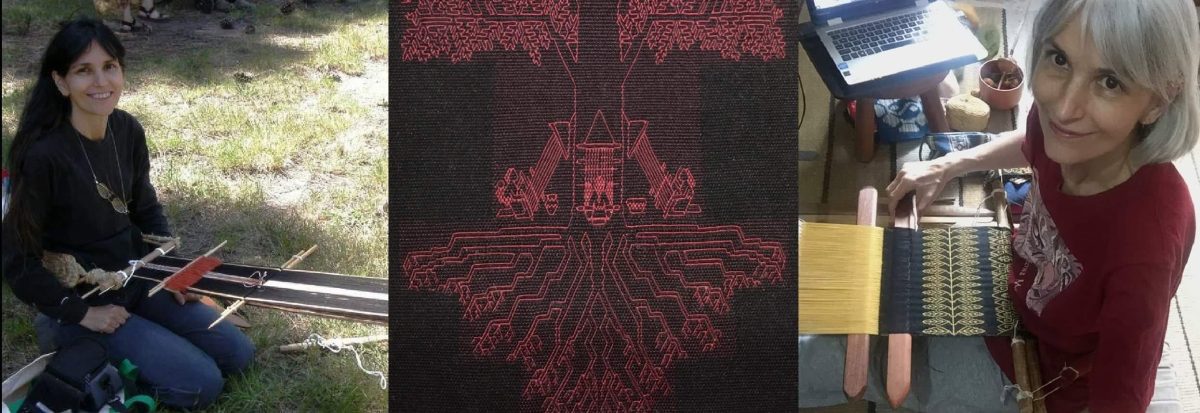
Backstrap Weaving – Tropical Themes and Tools

Santa Cruz,  Bolivia has almost all the lovely things that the tropics typically have to offer…swaying palm trees, avenues lined with mango trees dripping with fruit, exotic plant and birdlife and tremendous afternoon downpours of cooling rain (sadly few and far between these days). Too bad there aren’t any beaches in this country to complete the picture of tropical paradise. For those of you in the wintery whiteness of the northern hemisphere, here is a bit of tropical Bolivian color to brighten your day.

tropical color

And, on a similar colorful and cheery note, here is my newest scarf project still on the loom…

supplementary weft patterned scarf backstrap loom

Carmen at her loom

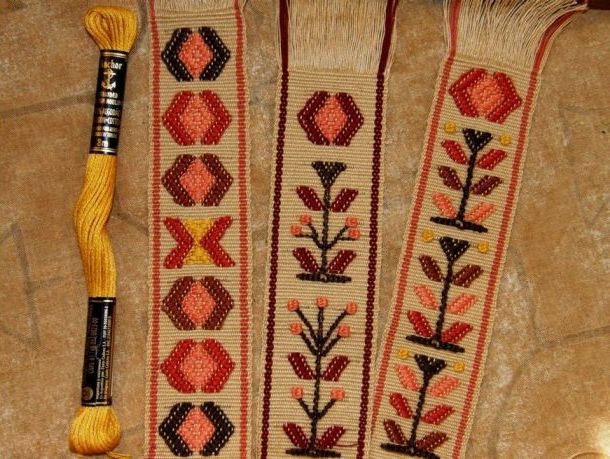
The main inspiration for the patterns has come from a particular Guatemalan plant motif woven using supplementary wefts. Carmen, pictured at left, taught me to weave this in her home of Santa Catarina Palopó on the shores of Lake Atitlan.

The small plant motif uses inlaid supplementary wefts for the leaves and various warp wrapping techniques to create the stem and plant base.

I took the leaf pattern, changed it a little to fit my working space, and used it in the side panels of the scarf. I also expanded it into an imaginary tropical flower. The tiny butterfly motif was adapted from one on a Mexican backstrap-woven textile that I saw online.

I love the way the turquoise and gold supplementary wefts look together in the flowers on this purple background….visions of tropical seas and golden mangoes! I have to admit that I have been dying to combine those two colors somehow ever since I saw the following shawl by Elisabeth Hill on her Flickr page…

Elisabeth Hill shawl

How is that for inspiration?! And I got to meet Lisa and see this piece in person at Maryland Sheep and Wool last year where the shawl took Best of Show. Lisa has done some backstrap weaving  with me so maybe that will somehow influence one of her projects. Take a look at her Flickr page to see more amazing creations in deflected double weave.

yarn from 2012 trips

I like how my purple scarf doesn’t really scream “me” at all…at least I don’t think it does.

I once had someone on Weavolution say that she could immediately spot a project of mine before clicking on the image to see who the weaver was. It’s nice in a way to know that you have developed a sort of weaving “character and style” that can be recognised.On the other hand, it’s nice to branch out and do something completely different and I have realised that, in order for me to do so, it is helpful to have access to yarn that I have never used before. So, I think that along with my “wider, longer, finer” weaving goal for this year, I will add “new fiber”. I intend to quieten the little voice that tells me to “keep it simple and just make do with what you can get locally” and take advantage of my trips to the US to gather up new-to-me fiber and a greater range of colors.

Above you can see alpaca, wool, hemp and bamboo (?…this was a gift and I am not sure what it is) yarn from a recent US trip….much of it gifts from weaver friends.
coil rod and other toolsNow, back to the current project. What about that coil rod…what has it been doing for me? I roll it along the warp as my weaving progresses and the fabric gets rolled around the loom bars. It is definitely a handy width guide. Beyond the coil rod the warp tends to spread and fan out as it stretches away toward the far loom bar.
The rod also ensures that there is always beautifully consistent tension between it and the weaving line. It locks the warps into place and gives me even tension with which to work no matter how many stretched and loosened warps may be gathering beyond it and on the lower layer of warp beyond the far loom bar. In short…I like it! It is a great little tool.

You can see the coil rod in place in the above picture. Other “tools” that I am using on this project are several ties of colored yarn along the shed rod and in the heddles.  Because my patterns are not wide enough to warrant the insertion of pattern sticks to raise the warps under which the supplementary wefts pass, I am using little ties to raise the appropriate warps instead. There are some that go around the warps themselves in the shed-rod shed and others which are tied around certain heddle strings. I simply pull on these to raise the pattern warps in the heddle shed. They save time and prevent eyesight strain!

As far as tools go, sometimes the simplest are the best…

Montagnard backstrap loom with suttes and double band

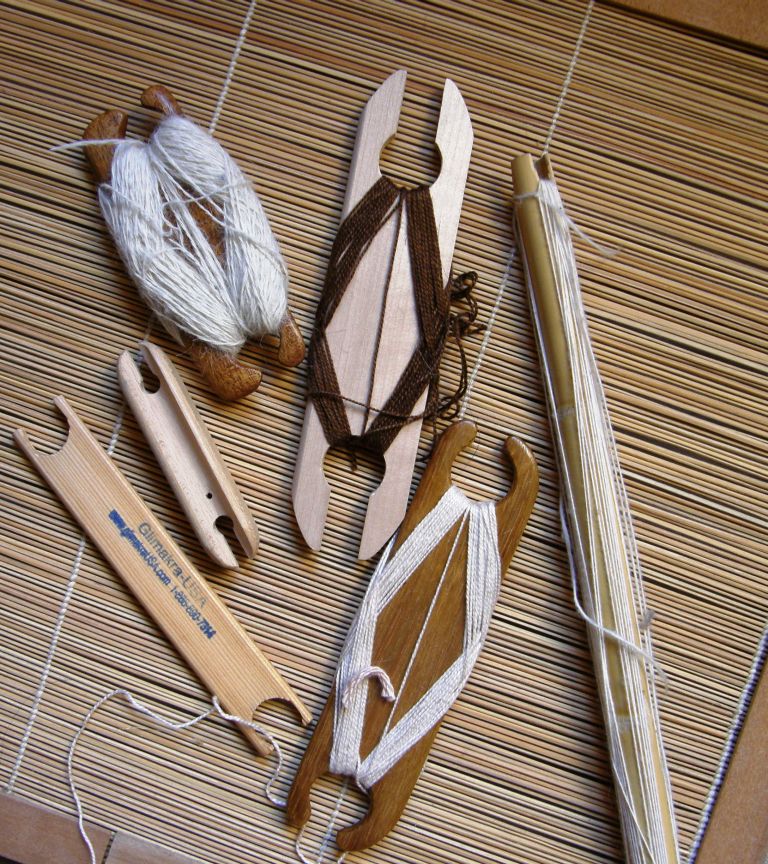
It always delights me to see that the use of simple sticks to carry the weft is common to many backstrap weavers around the globe….no fancy tool required! You have seen in my pictures that I use a specially shaped shuttle. Three of these were made for me when I lived in Chile and they have a kind of sentimental value. I enjoy using them and they double as beaters and swords sometimes so they are pretty nifty.

The Montagnard backstrap loom above has two bands in progress and you can see the two simple shuttles. The looms are so large that it quite cumbersome to balance them when only weaving one narrow band. They are designed for weaving large panels of cloth which are used for skirts, shirts and blankets.

I must admit that I have been often pulled towrad buying teeny tiny shuttles at fiber fairs purely for their cuteness factor. I have on occasion used them but had to turn my closet upside down just now to find them to photograph as they have been idle for a long time…

small band weaving shuttles

The long thin shuttle on the right is one that one of my Guatemalan weaving teachers used. All my other teachers have used simple sticks about which the yarn is wound or, for narrow pieces, simple “mummy”-like butterfly bundles. Below you can see two such weft bundles. The yarn feeds off the outside rather than from the center and a hitch is put in place to stop the bundle from unravelling when it hangs freely. These two examples are of handspun wool and alpaca fiber from the Cusco area.

yarn bitterflies used in backstrap weaving

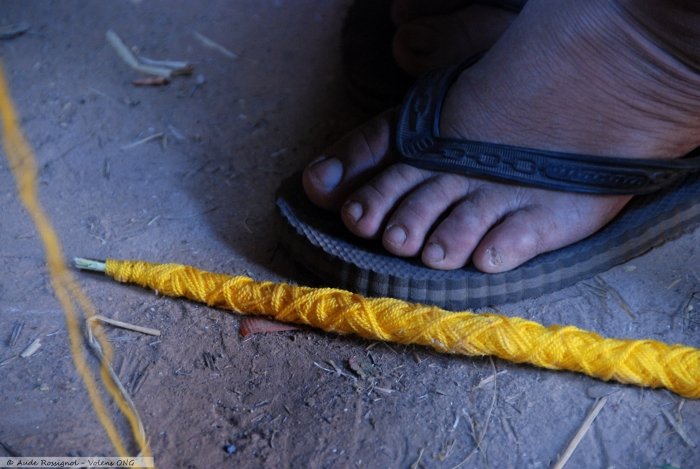
For narrow work my Guaraní teacher uses short lengths of scrap yarn for weft. This way she never wastes a thing! The weft lengths are so short that she does not even need to wind a butterfly. For wide pieces a simple stick shuttle is used as seen below.

Aude Rossignol

Permission to use this image was kindly given by Aude Rossignol.

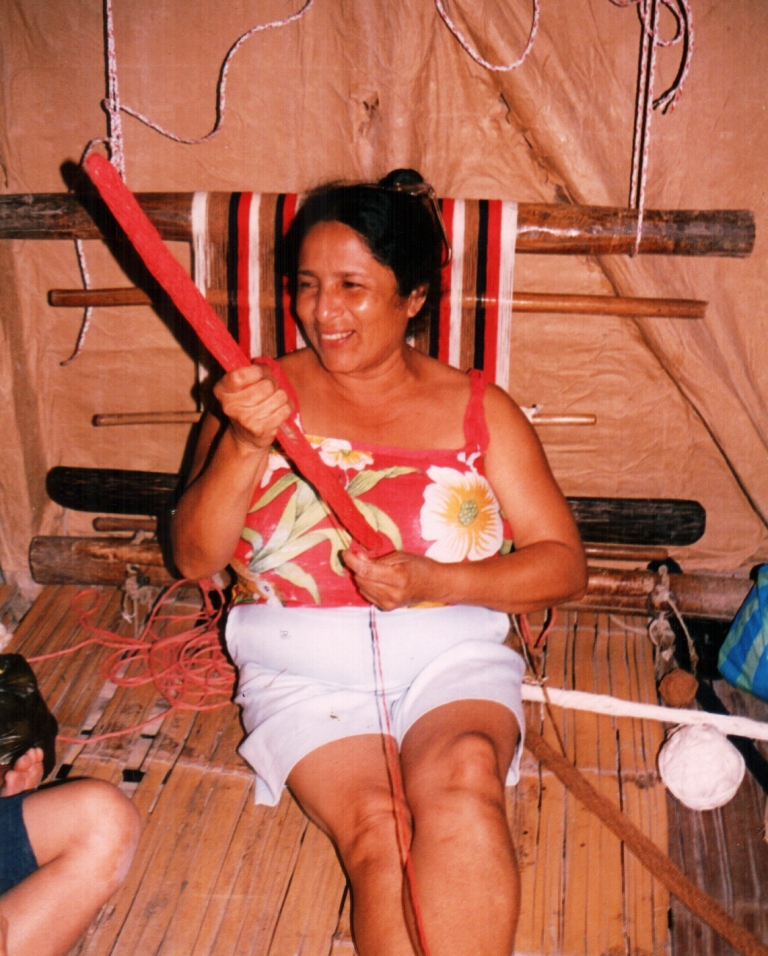
Here is a video showing my Montagnard weaving teacher, Ju Nie, loading yarn onto her shuttle. You can see that her shin is a very useful piece of equipment as, in a previous post, I showed you how she also uses it to help twist the fringes of her woven projects. The video has two segments with a short pause between. Wait for the second part which shows a weaver from the Cusco area loading her large shuttle.


One of the most charming ways of passing the weft is one in which the weaver has her weft rolled into a ball. She places the ball within the shed and then tilts her body to angle the loom so that the ball rolls through to the other side!

And finally, here is my teacher Trini in coastal Ecuador loading one of the three shuttles for the mini hammock she is preparing to teach me to weave. It was a balanced weave using three weft colors.

Trini with shuttle

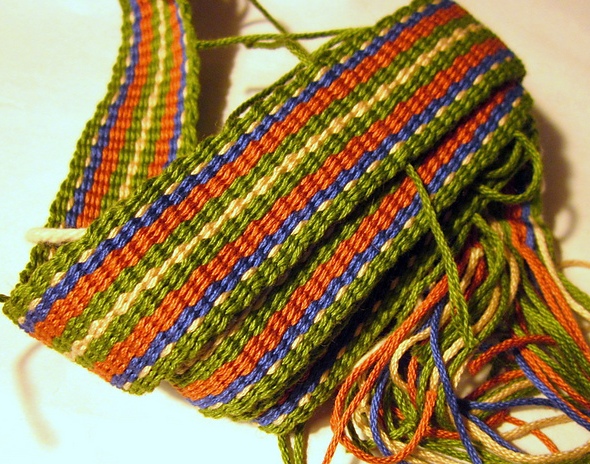
In the Ravelry Backstrap Weaving Group, Marge and Julia showed what they have been working on lately. Marge has been trying out Tahki Cotton Classic Light. I have not tried the Light version but I did see it at WEBS when I visited and the color range is wonderful. Marge used an online inkle pattern generator to help her design the color arrangement. The result is gorgeous!

marge

Julia used two different color ways for the same pebble weave motif (charted in my second book) on two different looms…a four-harness and a Seidel Band Loom.

julia pebble weave on two loomsI will be visiting the Mannings this summer. If you want to come and weave, maybe we can spend a little time outside hitched to some shady trees down by the creek….on the ground or on chairs..that will be up to you.  How cool would that be?!

the-mannings-stream