Backstrap Weaving – The Boomerang Effect

I am supposed to be in Miami airport right now awaiting my flight back to Bolivia. I have had a wonderful month in Australia and it is time to go to my home (the real home in Bolivia).

Off I went to Sydney airport yesterday to get my flight to the US. I put on a brave face after sad goodbyes to family. But here I sit today back in my brother’s Sydney home…it’s a long story!!

Orange banksia give a warm glow to the bush in mid-winter.

The Boomerang Effect! It is common in Australia when lending someone something, to hand the item over while emphasising that it is “a boomerang”. That is to say, it is expected that the item will return to its owner in the same way that a properly thrown boomerang will.

Well, I am feeling rather boomerang-ish today having bounced from home to airport and back again.

Looking on the bright side, this unexpected turn of events means that I can spend more time with my nephew as well as write a blog post today.

It also means that I can go back to the Blue Mountains tomorrow for the gathering of weavers at Helen’s place in Springwood. Yay! All her floor loom weaving friends will be there in the morning for Show and Tell.. I wasn’t expecting to see any of these weavers again on his trip, yet here I am boomerang-ing back there!

I love the Blue Mountains! I got to spend even more time up there this last week exploring 4wd back roads and doing a bit of hiking through the beautiful Australian bush.

The banksias that we saw that day make me think of the little ridged baubles that I learned to make with a Guild friend the last time I was here in Sydney…
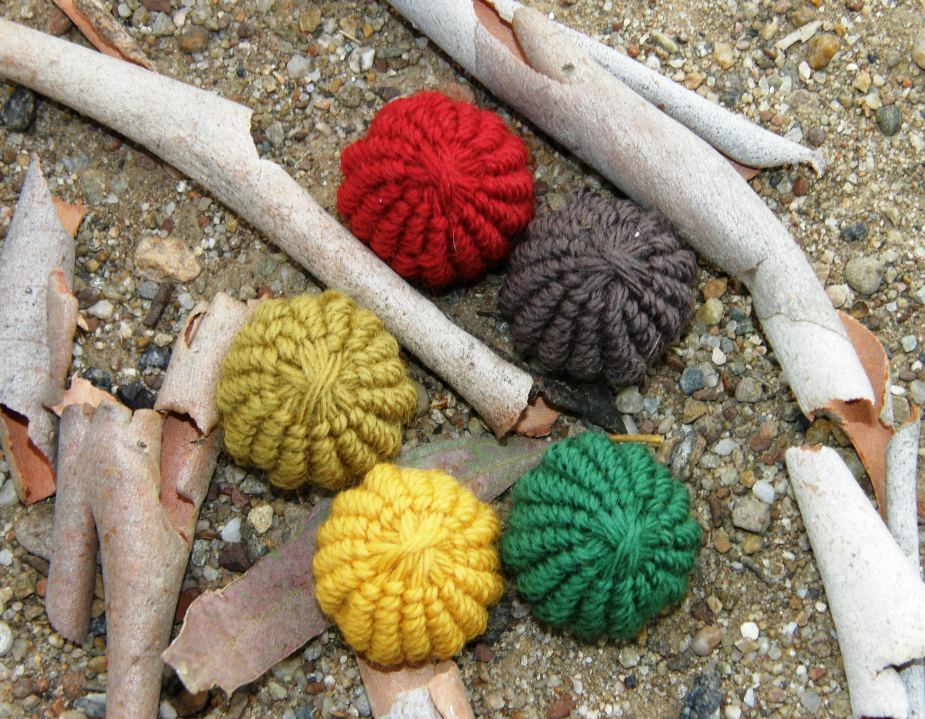
???????????????????????????????

We walked to lookouts with lovely over Lake Burragorang.

blue mountains sydney

Perched on the end of that rock, I felt like I was sitting in the tree tops…

bush walking in the blue mountainsThe real winter suddenly set in and it was cold!

Last weekend it was still warm enough to take things outside for a bit of warping. I had a group over to my brother’s home for two days of Andean Pebble Weave. We enjoyed the chance to stretch our legs in the fresh air while winding some more warps for sampling and designing.

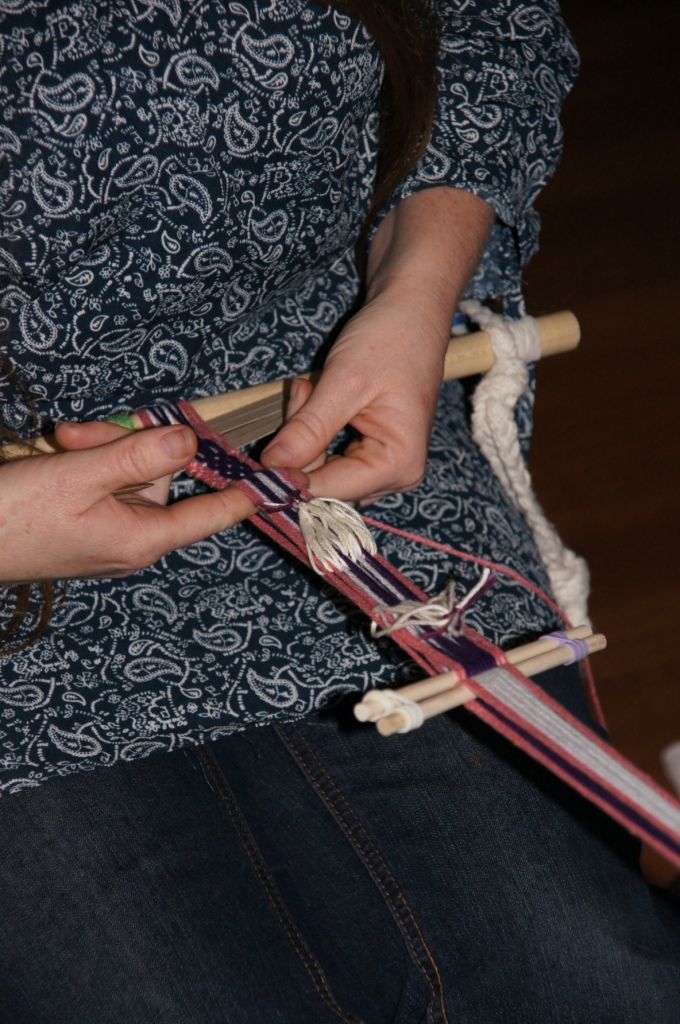
warping for backsrap weaving sydney


Kelcie gets a new band started with palin pebble weave.
Kelcie gets a new band started with plain pebble weave.

fr-kyriakos-pebble-weaveThe group comprised Kelcie and Jen, who had woven with me last November, Pam, whom I have known online for years and who had come over from southern New Zealand (Sydney weather was relatively balmy for her!) and father Kyriakos who came up from the monastery in Bombala.

We wove together for two days.

Father Kyriakos, as you may know from having seen his work in previous blog posts, had more than just dabbled in Andean Pebble Weave and has been designing and weaving his own pebble weave patterns. I am so glad he came. We have been corresponding for some time and I really wanted to meet him as well as see his projects “in person”. He said that…While your videos have always been a big help and enabled me to do as much as I have so far, having personal demonstrations and answers to my own questions has already helped me to be more efficient and have more understanding of what this weaving is about.

Above,you can see his partly woven backstrap from a photo that he sent me some time ago. The design is one that Julia had created and father Kyriakos added his own elements to it at start and finish. He brought the finished piece along to Sydney to show along with narrower and samples and examples of his own “sotis” work of East Timor that he had studied on floor looms with Australian weaver Kay Faulkner.

???????????????????????????????Kelcie had brought examples of East Timorese weaving when we had woven together last year…

???????????????????????????????Father Kyriakos also brought a Latvian belt, woven using a supplemental-warp technique, that a friend had bought in Latvia and brought back for him. I have seen plenty of pictures of these but never one “in person”…

latvian beltJen brought in pieces that she had bought on a trip to Peru where she had studied tapestry techniques with Maximo Laura. This is a striking embroidered belt that had been made for the tourist market in Arequipa…

embroidered belt from arequipa peruI love the color ideas that these pieces give…I would never think to combine those colors!

Father Kyriakos has been working on and refining a kangaroo motif using the Andean Pebble Weave structure for some time. He also brought along his progress with that to share and I thought that it would make a nice project as a souvenir of my Australian vsit.
One of the tasks that I had set myself for this trip was to investigate the kind of cotton that is available in Sydney stores that would be suitable for warp-faced weaving on backstrap looms. I bought what is labeled as “4-ply” thread at Lincraft. I was told that the name 4-ply in Australia actually refers to the size of the thread rather than to the number of plied strands. In the USA any weight of yarn could comprise four plied strands. It’s a little confusing! I also bought 8-ply versions of this cotton thread at Spotlight and I will give report on this and other available thread in future blog posts.
So, here is the “Kyriakos Kangaroo” woven by me using the Lincraft 4-ply…

???????????????????????????????

barefoot warping for backstrap weavingFather Kyriakos says that he still has some refinements in mind. I played around a bit with the mountains under the kangaroo. They made me think of the southern highlands…the “Australian Alps”…where I had lived and worked for many years.Kangaroos could be spotted now and then on the drive up to the ski fields.

The Lincraft thread is not mercerized but is fairly tightly twisted. It will pill if the heddles are wrenched about and needs to be handled with care. I really like the way it feels. Lincraft has a pretty good range of colors on its shelves.

I set this band up in a very “barefoot” manner.I had already packed all my backstrap weaving gear away and did not feel like fishing out my warping stakes and loom bars.

I warped around my index finger and big toe as my Bolivan weaving teacher, Maxima, does. This is probably the widest thing I have warped this way and, as the threads piled up around my finger, I figured that I was bound to have some tension issues. As it turns out, I didn’t!

When it came time to weave,  you can see, I only got out my sword and used pencils for cross sticks and loom bars. A piece of string is my backstrap. The front beam is a pen onto which I attached rubber bands so that the “backstrap” would not slip off. It was pretty comfortable!

Normally, I would use heddles spread along a stick for a piece of this width but I chose to just tie them in a bunch rather than to search for more pencils.

barefoot backstrap weavingSomeone else who is getting into barefoot weaving is my student, Emerald. You may remember that I stayed with Emerald in her home in Ultimo a couple of weeks ago and wove with her. One of the things we did was the intermesh technique and, although she has a nice set up for backstrap weaving in her living room, she decided to try to include her entire body in the loom…

emerald backstrap weavingThere are chopsticks and a pencil in her set-up. She also finished off a short and narrow pebble weave band barefoot. This was an exercise in weaving without a chart.

emerald (2)In the meantime, in other parts of the world, Diane, one of the ladies who wove with me when I visited Yale university, was inspired enough to apply for a grant to go and weave in Guatemala during her summer break. My friend Barbara, who is in contact with her, sent me this picture of something Diane wove with her Guatemalan teachers…
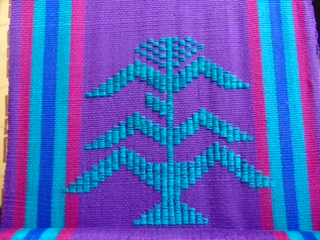
diane yale guatemalan weavingCheryl, who wove with me last spring, is sampling for a camera strap project…
cheryl pebble weave backstrap


And now… a wee favor to ask of all of you. You may have noticed that I have sometimes mentioned my nephew here in past blog posts and the fact that he is a triathlete. I am staying with him now in Sydney and get to watch his rigorous training schedule. He is up and out and swimming laps or biking and then getting home before I can even get out of bed.

During the Ravellenic Games that ran alongside the Winter Olympics this year, I wove one of his favorite inspirational sports quotes into a silk bookmark for him..

??????????????????????I guess that I haven’t had much of a chance to be a big part of his life. After seeing him a few times in his very early months and years, I headed off to live in South America. I returned for a visit when he was 3 during which I watched Jurassic Park with him and he offered to sit by me in case I got scared. I didn’t see him again until he was 12. He wrote to me when he was 8 to ask me if I lived in a hut in the jungle. Fortunately, I visited Australia more often when he was in his teens and the internet kept us in good touch. He taught me to juggle and we did a great trip,  just the two of us, to Ayers Rock in 2006.

1531560_610507969021654_2085106992_nNow he is a traithlete studying to be a teacher (like me!) and will be representing Australia in the ITU World Championships in Weihai, China in September. He took part in ITU World Championships in the USA and Spain winning the silver medal in his age group in both. It was quite a blow when he was injured for the championships in France last year. So…he is going for gold this time…his last amateur event before turning pro.

His trip to China, as with all the other trips to the World Championships, must be self- funded and he is looking for sponsors. What I would ask you to do for me, as a big favor, please…. is simply to go over to Facebook and “like” his page. More “likes” will show potential sponsors  that he has the loyalty of a good-sized audience and could make all the difference.

I haven’t told him I am doing this and would love to surprise him with a small boost to his fan page tomorrow. I hope that you can take a moment to help out.

???????????????????????????????

And now to see if I can make it on a flight out soon….wish me luck!

Backstrap Weaving – Two-fers

One of the things I like about the discontinuous-warp technique I have been playing with lately is that it gives me not one, but two opportunities to practice creating four selvedges….a two-fer. So, with the new piece that I warped this week I get two more chances, which makes five in total these last few weeks. I think my skills are improving. At the very least the process is becoming much less intimidating to me. I wonder if one day I will shrug it off and say that it is “normal” as my young teacher  from Pitumarca, Peru did.

Four-selvedge bands woven by Bolivian teenagers-in-training.
Four-selvedge bands woven by relatively new weavers…Bolivian teenagers-in-training.
The first piece on which I learned the four-selvedge technique in Potosi, Bolivia
The first piece on which I learned the four-selvedge technique in Potosi, Bolivia.

discontinuous warp ticlla closing the gapHere’s where I was at last week when I wrote my blog post. I still had the heddles in place and and had just removed the shed rod from the left hand side.

??????????????????????And here is the piece with the gaps closed. There are a few wobbles here and there but I am pretty pleased with it. Next came the tubular edging band and it took me five attempts to settle on the pattern and size. Part of the problem is that I don’t have much of a wool stash and the colors are very limited so, in the end I had to go with a heavier tubular band than I would have liked.

sewing tubular bandLate night weaving and sewing with poor lighting…not a good idea! I had to unpick a fair bit next day. You can just see near the upper left corner the end of the tubular band. I was left with the problem of what to do with all those warps ends. They are easier to deal with when you sew a tubular band to a bag. The band can be continued down into the bag, its end sewn over and hidden away inside. When you look at an Andean textile that has been finished this way, you have to look  hard to find the start and finish of the tubular edging. On all the pieces I have seen, the end has been sewn over and over and the unwoven warps cut. It has been done so neatly that you can barely tell that the resulting blunt end is there. This is something on which I need to work!

So, I wrapped the place where the start and finish of my band collided. It was obvious and ugly and I wanted to hide it. The small bit of  wrapping looked pretty awful. My solution was then to extend the wrapping to about an inch and wrap all four corners  the same way. This would  transform the wrapping into what we weavers like to call, with tongue in cheek, a ”design element”. You can see two of the wrapped parts below.

threaded in tubular band patternI created a threaded-in pattern for the tubular band rather than do something with pick-up. I warped the pattern off center so you can see the whole design sitting next to the upper face of the cloth rather than having to tip the edge to view it. The band on the back side of the cloth is in a solid color. Underneath all  that you can see this week’s new discontinuous-warp project…another two-fer.  It looks like I will be able to use that discarded tubular band warp from last week after all. I think the colors match this new project well.

What am I going to do with these pieces? Nothing! They are samples, practice pieces, notes and lessons in cloth. I would like to have one of the pieces in my wall hanging series represent the ticlla, or discontinuous warp technique, and so, the pieces I am currently weaving are part of my warm-up for that.

???????????????????????????????I so love sitting in front of a fresh warp like this!…terracotta and natural discontinuous warp in the same Navajo wool warp yarn that I used for the Four Seasons piece. This time I warped for a tiny strip of simple pick-up down the center and re-spun some brown wool to match the twist of the Navajo warp to use as the border color. I wanted to use a complementary-warp technique.

I wanted to decorate this one with supplementary-weft patterns again but I chose a “discontinuous” method this time in that the weft does not travel all the way across the warp to turn at the edge. The weft-turns shadow, or outlines, the motif.

discontinuous supplementary weft weft turnsThe terracotta supplementary-weft yarn that I used could have been thicker. I didn’t get as good  coverage with it as I did with the lighter color. The light bumps at the edge of the terracotta half of the cloth are the main weft turns. I had to go back and forth between white and terracotta weft as I didn’t have enough of either alone to complete the project. Those contrast color weft-turns will get covered by the tubular band later. The turns of the supplementary weft lie beside the motifs in a nice outline.

I wove the pick-up pattern wondering if there was a way I could close the gap between the two woven ends without interrupting the pattern. It was a four-shed pattern and I hoped that I would be able to fix things so that I would be in just the right shed for the last weft pass. I think a lot of it came down to luck in the end. The weaving fairies were with me :-).

gap closed on oe side of discontinuous warpIt worked! Now, let’s see if I can manage it on the other side. Hey, weaving fairies, don’t go away yet. I am disappointed with how noticeable the change from white to terracotta weft is in the white section…oh well.

I am very happy with my wee bit of pick-up on this piece but, before I get too carried away, here’s a reminder of what the Pitumarca weavers achieve as far as pick-up is concerned….

Pitumarca ticlla with supplementary warp pick upGranted it is a little easier to weave supplementary-warp pick-up in the small space at the finish of a four-selvedge piece but, oh my gosh, look at that! I would say, and this is just my guess, that the weaver closed the gap at the outer edges where you can see the tiniest fraction of an inch that is without pattern. The natural alpaca colors are so gorgeous. I don’t remember where the start and finish of the tubular band is located on this piece but your eye is certainly not drawn to any obvious spot where the weaver may have finished.

finishing-backstrap-weavingsAbove you can see a weaver from Pitumarca, Peru nearing the end of the warp. You can see how small the space in which she  picks up the patterns and operates the heddles is. One the right you can see how a four-selvedge piece with supplementary- warp patterns (part of a discontinuous-warp piece) has been finished.

While waiting for the brown yarn to dry and have its twist set, I thought about other possible ways to hide the join in tubular bands on these flat woven pieces. Maybe some cross knit looping? I practiced on one of the braided keyfobs that I have been making, the first one which was bit on the loose side. It could be sacrificed for this experiment.

OLYMPUS DIGITAL CAMERAI am not convinced but I will keep it up my sleeve just in case. I think it looks cute, as if I had knitted a wee wool sweater for the braid! I added another Margarita braid to the collection in red and black. 

Jennifer finished her stunning hemp piece with pick-up patterns of Chinchero, Peru. I have charted these in my second book. I like to think of complementary-warp structures as two-fers…one weft shot produces pattern on two beautiful faces.

jennifers chinchero pattern finishedNow she has to choose which face with be the outside of the bag she is planning. I am afraid that none of us in the Ravelry group were helpful when she asked us for opinions. We all liked both sides equally, of course! 

And speaking of bags, Julia once again wowed us with her weaving, piecing together and sewing skills….her creativity!

Julias bag with tubular band strapThe main fabric was woven on her floor loom and is stunning in itself. CindyQ, also in the Ravelry group, wove the blue supplementary-warp pick-up band and had given it to Julia as a gift. Julia’s idea for making a shoulder pad for the slim tubular band strap is so clever. She wove the band for the strap in tubular form and then wove it as a flat band for a while. She braided the flat band  to form the shoulder pad. How cool is that?

Kim varland rabbitbrushstudio dot blogspot dot com(2)Kim Varland, yet another Ravelry weaving buddy, has been playing with the yurt band border pattern that I have charted and explained in one of my tutorials. I love her color combination and she shows more examples on her blog.

Kim has used what I call a simple warp-float technique. While the pattern on the back side of the band is attractive and interesting, it is not truly double-faced. I have shown these patterns to weavers who all love the way it looks on the back.

The other day I was explaining to one of our new Ravelry group members what was meant by a “complementary-warp structure”. I was thinking that surely I had put a description of this somewhere on my blog with lots of pictures. I found it in a post back in 2011 which I had written just before going to Cochabamba to weave with my teacher Maxima. I had promised to start a tutorial page on my return which explained some of these terms which are used for some of the common structures woven by backstrap weavers here in South America.

pebble a and bIt turns out that I never did and so , I will copy that portion of the blog post to a new page and will add some other structures to it this week….only two and a half years overdue! Above you can see the double-faced, or two-fer nature of complementary-warp structures.

Backstrap Weaving – Think like a Bird

I love that “big picture” feeling you get from the airplane window. It’s been a long time since I have been able to get a window seat on a coast to coast USA flight in daylight to enjoy the view. The picture below was taken somewhere between Dallas and San Francisco last week.

The view reminded me of the months in the early 90s when I would be sometimes rambling about on top of  the Sangre de Cristo Mountains on a peak bagging trip or dropping by rope into the depths of the Utah canyons. From the air you feel so carefree floating over the ever changing landscape like a bird while trying to imagine the thousands of specks of people  down there below like ants and what they might be up to.

??????????????????????

??????????????????????In a similar way, I made myself step back and admire the big picture before zooming in on the details when Ute brought in a piece of Uzbek silk ikat cloth for me to examine and admire during a visit with her in Northampton.

I got to see the exhibit of Uzbek ikat robes at the Textile Museum in DC a few years ago. Of course, that was a strictly “hands off” affair. And even though I had the opportunity to touch similar fabric from Uzbekistan at the International Folk Art Market in Santa Fe this year, the market simply had far too many interesting things to be able to stop and focus on any one item for any meaningful length of time.

Thanks to Ute, I had time alone with the cloth at left and could examine it to my heart’s content although I found it difficult to capture its true colors on camera.

Ikat fabric at the Santa Fe International Folk Art Market
Ikat fabric I saw at the Santa Fe International Folk Art Market

When I then zoomed in to get an ant’s persepective, I saw what I had named many times, in despair and frustration,  during my own ikat experiments on my backstrap loom, the ” dreaded railroad tracks”…

??????????????????????

I took extreme measures to keep my warp threads aligned on this piece...that was my goal at the time.
I took extreme measures to keep my warp threads aligned on this piece…that was my goal at the time.

I am talking about those horizontal bars that show that the warp threads have shifted from the original positions into which they had been locked during the tying and dyeing process.

It was always so disheartening for me to be weaving and approaching with excitement the first wrapped area on my ikat warp, eagerly waiting to see how my carefully tied and dyed pattern would appear only to see first, the little specs and then the growing rows of lines of un-dyed thread appearing….those dreaded railway tracks. They told me that the threads had been displaced too much and that my design had been ruined.

But, walk away to the other side of the room and look again at the Uzbek cloth. What do you see? A beautiful pattern with the soft blurry outlines that give ikat its charm and character. Look at the big picture!

I will be trying ikat again when I get back to Bolivia and reminding myself to think like a bird and not an ant!

The same goes for one of my current favorite structures as woven by the Guarani weavers of the lowlands of Bolivia…intermesh.

angelas moisy???????????????????????????????Stand back and admire the crispness and clarity of the design woven by my teacher Angela.

Closer inspection of motifs on another piece show the feathering that characteristically appears along the edges of diagonal lines.

This has me adjusting and readjusting my pattern charts in an effort to reduce the feathering as much as possible which can sometimes distort the original shape I was striving to create.

Stop fussing and thinking like an ant! The GuaranÍ weavers, as far as I have seen, make no such (unnecessary) effort…they think like birds.

Speaking of intermesh, let me show you Julia’s latest creation in progress in this structure….

julias intermeshJulia tells us that the design comes from a book entitled Japanese Design Motifs. Designs like these with horizontal and vertical lines are ideal for learning this structure and are the kinds of motifs that I have provided with the tutorial in my second book. I used Bhutanese and Mexican patterns for inspiration. The horizontal lines have “saw-tooth” edges and the verticals are crisp and smooth plus the cloth is double-faced!

This trip is drawing to its close. I can look back over the last weeks of weaving with friends, new and old, from a bird’s eye and ant’s eye view and benefit greatly from both perspectives. The ant asks what details can be improved. The bird hovers above to see patterns appearing on bands and cloth, the weavers’ reactions –  their smiles and frowns and “aha” moments, changes in their energy levels and receptiveness which their body positions often reveal….and listens to the fluctuating levels of concentrated silence and relaxed chatter.

Here’s a quick whiz through some of the days I spent weaving both east and west on this trip….

Backstrap weaving with students at Yale University.... They have a wonderful weaving room full of floor, table and rigid heddle looms which meant standing room only for this impromptu lesson in basic backstrap loom management which followed my talk.
Backstrap weaving with ladies at Yale University…. They have a wonderful weaving room for free time weaving. It is full of floor, table and rigid heddle looms which meant standing room only. Many thanks to Barbara who took me to visit with these ladies. Here they are finding the cross in their warps  so that they can make simple heddles.
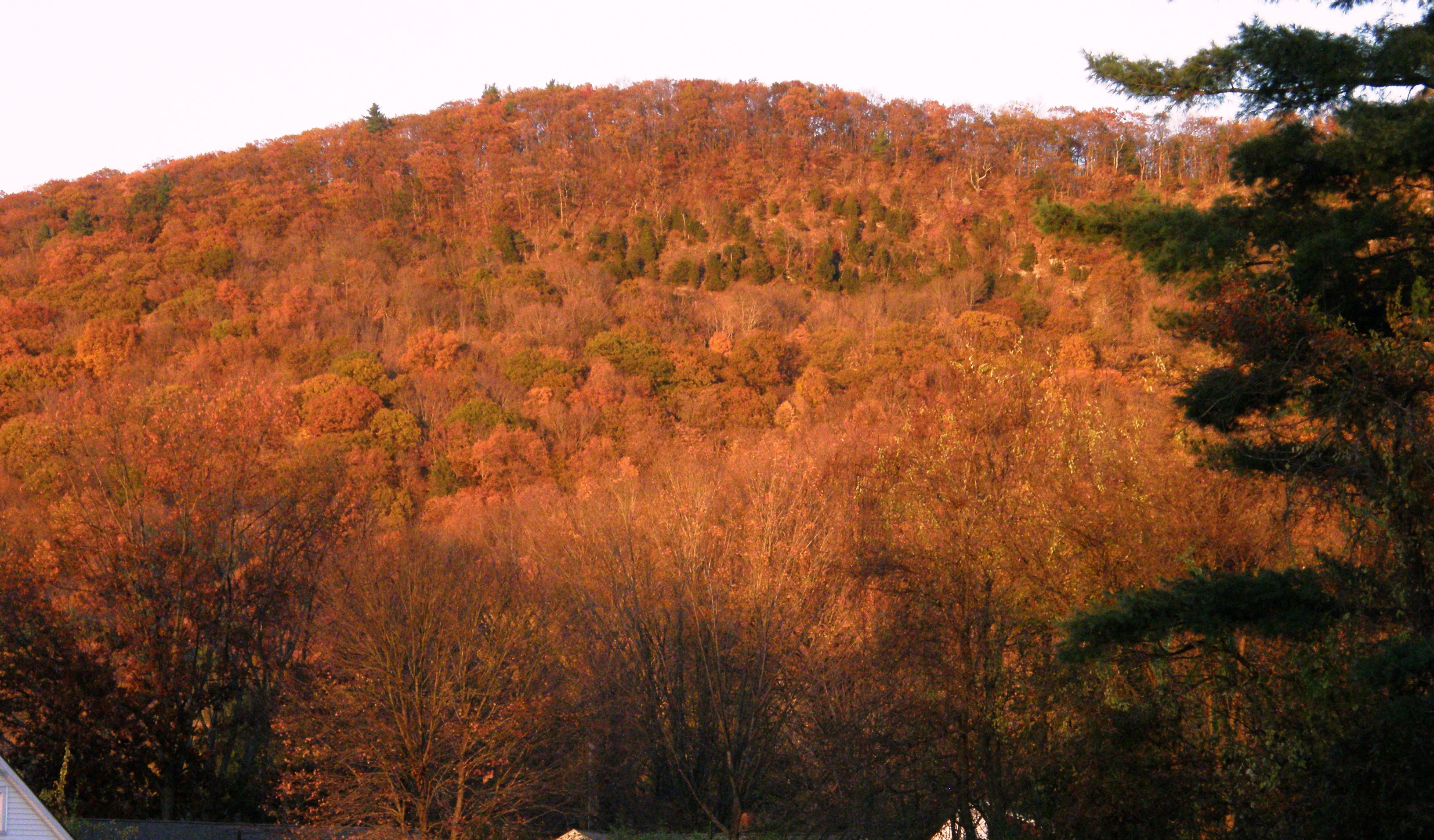
Massachusetts turned on its fall colors for me as we drove each evening ater calss in the glow of the setting sun.
Massachusetts turned on its fall colors for me as we drove home each evening after some weaving in the glow of the setting sun. Here is a shot of what Lausanne in Vermont has dubbed “cinnamon hills”.

And winter was definitely in the air with frosty mornings. Only the brave sat outside for lunch! I was one of them for about 5 minutes.

south deerfield group

dt.common.streams.StreamServerThe round table  was a perfect set-up among Liz’s natural yarns and fibers, locally made scarves and shawls and crafts.  It was a sweet space in which to weave.

RIght now Liz and her partner John are involved in the 500 Hats event which John came up with to celebrate the 75th anniversary of the Dr Seuss book. You can read more about the project here…there are over 1600 hats so far in their living room.

Moving over to nearby Northampton….here are a couple of things that Chris worked on..

chris northampton backstrap projectsHere you can see her pick-up band finished and decorated with a triangular braid (which I now know how to do….yay!, thanks Chris) as well as her ñawi awapa piece on which she has just about finished twisting and binding the warp ends.

It was a second time weaving with these friends and we did some more pebble weave, made tubular bands and sewed them to pouches which we later dressed up with decorative stitching.

Lisa decorates the mouth of the Bolivian woven pouch, which she edged with a tubular band, with cross knit looping..a sewn technique.
The mouth of a Bolivian woven pouch is decorated, after having been edged with a tubular band, with cross knit looping which is a sewn technique.
The hands above belong to Lisa, on the left seen here learning a new complementary-warp technique aong with Mary-Lou. Lisa is wearing one of her gorgeous deflected double weave scarves.
The hands above belong to Lisa, on the left, seen here weaving a complementary-warp band alongside Mary-Lou. Lisa is wearing one of her own gorgeous deflected double weave scarves.

Barbara invited friends to her home in Connecticut and her fabulous weaving studio for another gathering where we all wove together….

Claudia and Susan learn how to decorate a warp-faced band with both single and double faced patterning techniques.
Claudia and Susan  decorate a warp-faced band with both single and double-faced patterning techniques.

And here in California yesterday, we gathered to practice setting up for wider projects. Some people in this group were weaving with me for their their third and fifth times while others were on their second time.

Picture by Ruth Temple
Cookie's finished piece will be folded into a long narrow bag for a backstrap loom that she was recently given.
Cookie’s finished piece will be folded into a long narrow bag for a small backstrap loom that she was recently given.

So, we had a group with a variety of experience levels. I think that “experience level” is often most evident in the kind of warp a weaver can create in terms of evenness of tension. Here is where the “short and narrow” mantra comes into play.

Perfect your warping techniques winding short and narrow warps over and over again!  SHORT, because you will weave off your project quickly and get another valuable chance to warp again soon. NARROW, because there are different tips and tricks yet to be learned for creating successful wide warps once winding narrow ones with consistent tension has become natural.

The idea was to go wider without necessarily going longer. You can see Ruth’s pretty warp above made from Tahki Cotton Classic onto which she is putting her first set of string heddles. The strip of orange and purple down the middle will be used to create a pattern in the  Andean Pebble Weave structure.

She is going to weave the other plain parts using the “thick border” technique described in my first book. This will cause the plain parts to narrow and thicken to match the thickness of her pebble section. Therefore, her finished band will be a lot narrower than the warp appears in this picture. This might become her backstrap.

We needed to refresh some things that are necessary for creating wider pieces, such as putting the string heddles on a stick instead of tying them in a little bunch.

Picture by Ruth Temple. Kathy gets a refresher in heddle making for wder warps
Picture by Ruth Temple. Kathy gets a refresher in heddle making for wider warps
Kathy chose to make abackstrap using Plymouth Yarn Fantasy Naturale and a double- faced warp float pattern
Kathy chose to make a backstrap using Plymouth Yarn Fantasy Naturale and a double- faced warp float pattern.
Kathleen chose to use overtwisted wool that she got in a class with Jaquetta Nisbet many years ago. She has already made a beautiful backsrap with this wool and knows how it behaves. She wants to make a small pouch with a pebble weave motif and wrote to me about how this warp feesl "slive" after having used cotton for some time.
Kathleen chose to use overtwisted wool that she got in a class with Jacquetta Nisbet many years ago. She has already made a beautiful backsrap with this wool and knows how it behaves. She wants to make a small pouch with a pebble weave motif and wrote to me about how this warp feels “alive” after having used cotton for some time. As you can see we were in a soothing environment in Betsey’s home surrounded by textiles that she has collected in her travels.
Dorothy's project in Tahki cotton classic is so beautifully arranged. It will have three strips of pebble weave pattern and the color combination is so gorgeous! I am wondering when she will have tie for ti as she is off to the Tinkuy in Peu this Friday!! we are all so excited for her. Goodness knows what kinds of inspiration she will bring back with her.
Dorothy’s project in Tahki cotton classic is so beautifully arranged. It will have three strips of pebble weave pattern and the color combination is so gorgeous! I am wondering when she will have time for it as she is off to the Tinkuy in Peru this Friday!! We are all so excited for her. Goodness knows what kinds of inspiration she will bring back with her. By the way, Dorothy’s loom is made by Terri at Magical Moons. I hadn’t seen one of these before made by Terri. The loom bars are silky smooth….beautiful work!!

Betsey’s project was the narrowest but with by far the finest thread and I neglected to photograph it, unfortunately. She warped for a pebble weave pattern using the thick borders and her piece will do nicely as a cellphone pouch.

Somewhere in-between all that, Barbara took me to Shelburne Falls Ma to visit Vavstuga Weaving School. That’s a name that constantly comes up in the weaving groups on Ravelry and I was excited to finally be able to see it and meet the staff. I was surprised to find Cindy, one of my backstrap weaving friends, apprenticing there.

What a beautiful location right next to the Bridge of Flowers which even at this late time of year is full of color against its backdrop of cinnamon hills.

bridge of flowers next to vavstugaColor inspiration anyone? This was in the bridge garden…never seen anything like it!

??????????????????????

Becky, her apprentice ad Vavstuga staff showed me around. As we chatted at the table Becky pulled out one gorgeous texyile afte another to spread on the table.
Becky Ashenden along with her newest apprentice and other Vavstuga staff showed me around. As we chatted at the table, Becky pulled out one gorgeous textile after another to spread on the table.

??????????????????????Not that I know much about Scandinavian weaving, but the textiles were everything I expected and more…rep weave, white on white, linen, crisp and clean, simple, classic, impeccable!

Becky opened a door to a closet which housed hundreds of samples. More samples were draped over loom beams for further inspiration, instruction and guidance but, most importantly, gorgeous handwoven textiles were everywhere to be seen and touched and used in in the house and studio….not just sterile samples to be taken out and studied and then put away. They added warmth and comfort and a lovely sense of home and familiarity. This must be a lovely place in which to learn to weave!

??????????????????????This hanging adorned the wall of Vavstuga student dining room which overlooks the river. I had heard it all before in the online groups…everything at Vavstuga is handwoven. It was wonderful to see it all…. from curtains to hand towels and floor coverings and hangings.

And then there was the band weaving with the typical Scandinavian backstrap set-up…(look at the piece of fabric under the backstrap…that was one of my favorite pieces)

??????????????????????Becky wove that backstrap. Isn’t it gorgeous? She wove one end of the waist band as a tubular band in order to more easily hook on the clever wooden device that holds  the warp . Look at that sweet rigid heddle and there is also a lovely wooden smooth shaped sword that completes the set-up. I guess that I just couldn’t hide the smile and delight I felt at seeing all this as, when Barbara and I were about to leave, I was given this mystery package….

??????????????????????No prizes for guessing what was inside!!

Some of the other textiles I met along the way….

??????????????????????Many thanks to Ruth who brought this along to share with me. It is warp-faced double weave cloth, although in many places the warps are quite spread and reveal the weft. A band has been cut into strips and sewn to make this bag. We don’t know its origin but I really appreciated the opportunity to look at it.

Ute always keeps me supplied with textile goodies to photograph and examine. Here is a beautiful presentation of some of her own tablet-woven bands…

??????????????????????

And here is a bag from Tibet, owned by Ute, that was made by sewing pieces of a tablet-woven belt together….fabulous motifs for intermesh.

???????????????????????????????And here I am today in the home of inkle weaver, guitar strap and sash maker Annie. While she is at work I get to rummage through baskets of her colorful bands and sashes and samples….no two alike, so every visit brings forth something new!

??????????????????????Thank you to Kathleen who took me down to ground level to be an ant last weekend. Kathleen is a marine biologist and took me to the beach to go tide pooling…super fun!…While swathes of slumbering and interesting seaweed waited out lowtide above water, we peered into pools and found whole worlds of life and variety and movement and color and cleverness within.

And when we got home, Kathleen’s husband had made this…

??????????????????????I had remarked to Kathleen earlier that day that the vertical pieces of rebar sticking out of the top of the wall would make great warping stakes. It was too bad that they were soon to disappear within another row of blocks. I then told her about the woman in Peru who had warping stakes embedded in the wall of the hall of her house. She would stroll up and down the length of her hall creating her warps. And so, an idea was born.

Those metal pieces of pipe will be locked into place when concrete is poured into the blocks. Then, dowel rods will be placed within the pipes…..a wall warping board. I am jealous! Next will come hooks in the wall to which Kathleen can attach her backstrap. Warm, sunny days outdoors weaving….lovely!

Jennifer Moore, DY Begay and I in Santa Fe in July

Tinkuy is next week!!! I am not going… what will keep me from pining is the fact that I will be over the ocean thinking like a bird on my way to Australia on the14th.

My weaving friends Dorothy and Karen are going. A few of my Argentinian Facebook friends will be there and Jennifer Moore, with whom I backstrap wove in Santa Fe this year, will be going to teach the Peruvian weavers balanced double-weave pick-up.  Jennifer wrote to me this morning to tell me that we will be roomies at CNCH next year. There will be some stories to tell!!

I hope that if you go, you will send me stories, reports and pictures that I could share on this blog or links to your own sites that I can include here. Have a wonderful time all of you!!!

Dorinda from PAZA Bolivia (no link as the website is temporarily unavailable.) and my weaving teacher, Maxima, will be going again. Last I heard, Dorinda was also going to take one of the teenagers. Dorinda met her funding needs with many generous donations from a variety of sources. Look out for Dorinda and Maxima there. I wonder if Maxima will outspin the Peruvian ladies in the speed spinning competitions again this time!

Dorinda and Maxima were my roomies at Tinkuy 2010

Jasmin Pitt of Sustainable Bolivia was recently in Independencia with Dorinda and her weaver friends and made a documentary about the weavers. Here is Dorinda’s description from her PAZA newsletter:

Making a documentary with the weavers of Huancarani became reality last April after over a year of talking about the possibility. Thanks to Sustainable Bolivia’s artist in residence Jasmine Pitt, most of the footage was shot in Huancarani in a day. Jasmine directed, filmed, and edited the documentary. The women were ready with their thoughts, comments, and stories about the past, present, and future of their millennium long weaving tradition. More interviews were held in Independencia and Jasmine and Dorinda walked miles so Jasmine could capture the breathtaking landscape on film. The musical group Sacambaya generously granted permission for use of their  music. It was a collective volunteer effort. Through Jasmine’s lens you will gain insight into the personalities and lives of the weavers and their concerns for the future of their weaving tradition.  

ENJOY THE VIDEO! and see you next time!

Backstrap Weaving – A Few Unconventional Moves

A Few Unconventional Moves…..If I am to talk about some unconventional things that I did at my backstrap loom this week, I think that I would have to first define what is meant by “conventional” in the world of backstrap weaving….an impossible task!

What is normal, or traditional, or conventional in one backstrap weaving community may not be so on the other side of the world or even within the same region or country.

ju-warpingAdding string heddles as one winds the warp, as Montagnard weaver Ju Nie does, would certainly be  looked upon with wonder as something strange and unusual by backstrap weavers here in Bolivia.

This one of Miguel Andrango's looms pictured here with his granddaughter. You can see the two shed rods above the heddle sticks. The space for the extra shed rod is programmed into the warp by using an extra stake during the warping process.

The way that many backstrap weavers in Ecuador spread the threads in the shed rod shed over two shed rods is something that I have not seen outside of Ecuador. This makes opening the shed rod shed, with its heavy load of wool warps, easier. You can see the two shed rods in Miguel Andrango’s warp above. Unconventional, you might say, but to weavers like Miguel Andrango, this is perfectly normal. And Mr Andrango is up for a bit “unconventionality” in his weaving  too by using motifs that are not traditional in Otavalan weaving.

montagnard_weavers-jpeg-scaled-1000The use of a tiny sweet wooden temple on even the narrowest of warps by the Montagnard backstrap weavers is something else that would seem less than normal to many backstrap weavers on this side of the world.

I have yet to see a circular warp being used by backstrap weavers in Bolivia but it is commonplace in Ecuador as is the use of a foot brace.

Burmese weaver Dar Ku weaves her patterns with supplementary weft while facing the wrong side of the cloth. She kept smiling and telling me how easy it is. I wonder what the Guatemalan weavers with whom I have worked, who also work with supplementary wefts, would think of that!

Dar Ku at work??????????????????????In Ecuador I never saw women weaving wide heavy wool pieces on backstrap looms. This was a task for men. The work is considered too heavy for women, I was told.

In Peru, men do weave at backstrap looms and there are communities where most of the backstrap weaving is in their hands. However, this is the exception rather than the rule.

I wonder what the male Ecuadorian weavers would think coming to Peru and seeing the wide and heavy warps being managed by the female weavers.

I wonder what the belt weavers in Salasaca, who use an enormous meat cleaver type of wooden implement to beat weft into place on their narrow belts with a couple of quick, heavy and powerful slams, would think seeing the way a Bolivian weaver pushes weft firmly into place bit by bit across the wdith of the warp with the tip of a llama bone tool.

3868486832_48e6a1c778All the implements were strange and unusual in my hands the first time. I can’t tell you how many times I forgot to let go of the weft before slamming that meat cleaver tool down….ouch. The llama bone was a bit more subtle but I still ended up with blisters from tightly clenching it and pushing that weft into place with all my strength. My weaving teachers considered tightness of weave to be a very important feature of well made cloth and I was determined to achieve their approval.

On the other hand, it was interesting to watch the gentle tappy-tapping of the beater in Dar Ku’s hands in contrast to the yell of “wham-wham” as Ju Nie showed us how firmly weft should be beaten! Clearly there is no general rule about how firm warp-faced cloth woven on a backstrap loom should feel.

I would love to see my teacher Maxima’s reaction to the set-up and way that weavers in coastal Ecuador add bands to the edges of their fabrics with their wooden rigid heddle that slides from side to sde along the floor to change sheds.

rh edgingSo…conventional? What is conventional in the world of backstrap weaving?

As for my aforementioned “unconventional” moves…let’s just say that I did some things that I haven’t seen backstrap weavers do. Of course, the day will probably come when I see this done somewhere. I have, after all, just scratched the surface of the backstrap weaving world here in Latin America and have had but the slightest glimpse into Montagnard, Burmese and Bhutanese weaving.

I have been finishing off the little supplementary-weft sampler that I have been working on these last couple of weeks. I wanted to get a piece off the loom and make it into a bag to take along on my next trip. I had experimented with positive and negative space. However, there was still a fair amount of warp left and the Guatemalan cotton is precious to me as I am not sure when or if I will be able to get more. I really didn’t want to waste any of it.

So here is what I did…I wove a dowel into the warp so that I could cut off my little bag piece and continue weaving the left over warp.

weaving a dowel into the warpI will probably fold that little flap of cloth over the dowel and tack it down and then lash the dowel to a bigger one. I think that should be sturdy enough to allow me to keep weaving. I have to admit that this wasn’t my idea. There was a discussion in one of the online groups where a floor loom weaver wanted to cut off her first towel on a long warp and then continue weaving. Someone said “weave in a dowel”. I am not sure if what I did is in fact what she meant when she said that but it was enough to have me wanting to try to “weave in a dowel”. I think it will work!

clamp toolI still have this Bedouin patterned embedded double weave piece that I cut and then clamped so that I could continue working on it. It is still there….I feel that that the woven-in dowel is a more secure system. We will see. Now I can compare!

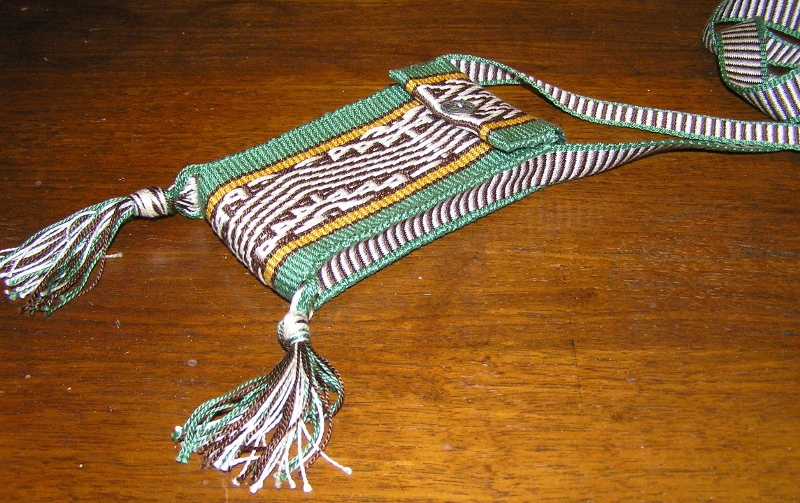
Bedouin design amulet bagHere is the wee pouch that I made with the first part of that warp.

So, the piece of supplementary-weft patterned fabric was cut off the loom. Now to see how best to fold it.

back and front of supp weft pouchThere are the back and front views.  I decided to leave the flap on the front unpatterned as I wanted to edge the whole thing with a tubular band and I thought that things might look a bit too busy with pattern on the flap as well.

design on inside flap backstrap woven pouchHowever, I thought that it would be cute to have a design on the inside when the flap is open.

And that is another place where I got kind of unconventional.

The design on the inside of the flap had to be on the “wrong” face of the fabric to be in the right position once everything was folded. So, I turned the warp over and wove on the other side leaving the heddles on the back side of the fabric.

I wove the flower head pattern that I had been creating in the negative space at the beginning of the piece. I think it gives a nice touch to this little pouch…a nice little surprise when you open it up.

weaving on the back side of the cloth backstrap weavingFolding and then sewing done…it was time to start embellishing.

fron tof pouch with tubular bandThis is all I have done so far… a ñawi awapa tubular band around the outside. The eyes of the tubular band are red on the back side which matches the predominantly red patterning on that side. I will decide what to do with the tassels at the bottom and whether I should add some kind of finish to the bottom edge. Then there is a strap to be made and a button to be found for the front for some sort of closure.

pouch front and back backstrap weavingSo, after that experience with flipping the warp upside down and weaving on the other side so easily, I have a clear idea about what to do with the rest of the warp. I am excited to get started on that. I would like to continue with the supplementary-weft patterning but use both sides of the cloth, flipping back and forth, so that the finished piece has completely different patterns on both faces…or perhaps the same motifs but in completely different color schemes. It would need to become a finished product that would  allow both faces to be visible. This, of course, will be the sampler for a “real” project later.

In between sewing and embellishing, I got something else started on a loom. I am preparing some warps so I can weave at the Spin-In Day at the Mannings in June. Are you coming? I will be weaving away with my warp tied up to a tree. Come and say hello!

two heddle intermesh bhutan designHere is one of the warps I have prepared so far. This one is two-heddle intermesh which will have a large Bhutanese labyrinth design taken from David Barker’s first book (see the RESOURCES page for information on this free download).

pebble weave bandsAnd if you are tired of seeing red and black today, here is a bit of relief.

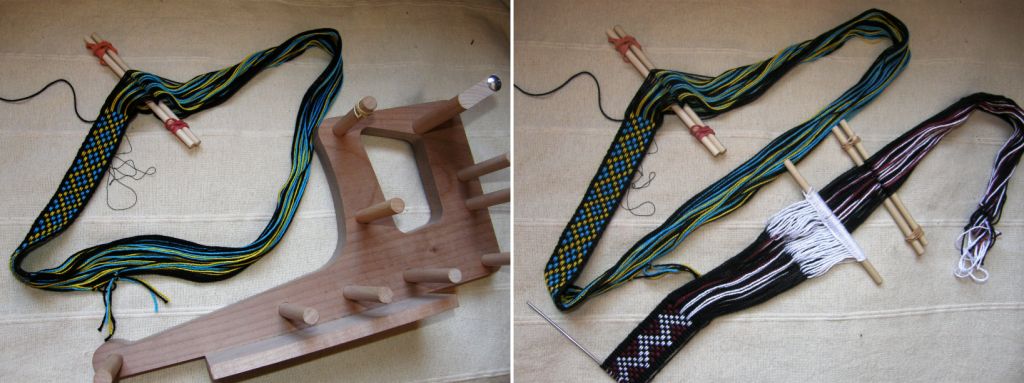
I have been recycling some of the many sample warps that I use which end up being a chaotic mix of odds and ends of sample motifs.

I unwove some of them and have several more to go. I am  re-weaving them using the same Andean pebble weave motifs along the length of each.

I can also finish this week’s post with some nice pieces in other color combinations too that were sent to me from online friends.

larisa pebble (2)

???????????????????????????????Larisa patterned her piece that is destined to become her backstrap with pebble weave patterns from my first book.

Gmpicket also sent me a picture of a great pouch that she made  using a design influenced by a belt of the Tarahumara people of Mexico that she saw on my blog. I have two Tarahumara patterns charted in my second book but this is not one of them. I love that brown, yellow and green combination.

So, I will be on the road again as from Wednesday next week. .hoping for nice weather and lots of people to chat to about backstrap weaving. If you have backstrap weavings to show me, please bring them along! I probably won’t blog next Thursday but will as soon as I can. I hope to meet lots of online friends at ANWG too and reunite with backstrap weaving friends in Humboldt County California. And then there’s a New Mexico adventure in mind… See you soon!

Backstrap Weaving – New Challenges: Wider, Longer, Finer.

While doing some house keeping in my album of weavings on Facebook, I came across a picture I took of the first red, black and white wall hanging I made entitled “Starry Night”. My caption read that I was weaving this in order to push myself beyond my current width comfort zone. That was a nice reminder as I am now on the third piece of similar width in this series and I have to say that I feel very comfortable with this width now! Seems that I need to go wider.

The first two pieces in the wall hanging series
The first two pieces in the wall hanging series.

Here is where I stand with piece number three. That snake continues to slither its way up the cloth.

O

The pick-up is a piece of cake now…really! There’s nothing like repetition to firmly embed a design in your head and fingers. It began with lots of tedious chart reading which was made a lot easier with the use of removable highlighter tape. Then I played a favorite game…read the cloth and guess what comes next. Then, before passing the weft, sneak a peek at the chart to see if you are correct. Next comes reading the cloth, deciding what comes next and going for it. Beat, pass the weft and then look at the cloth, not at the chart, to see if you were correct. Eventually you reach that chart-free happy place.

But then….you finish the weaving, you start something entirely new with a totally different structure and the fun begins again!

As for going wider….there are still quite a few more pieces I want to make in this current series, but when I do get to the point when I am ready to break out of the old comfort zone, I will need some new equipment…longer loom bars for a start. I already have some pretty long swords.  I would also love to have the kind of backstrap that some of the weavers in Peru use.

Chiclayo and Santiago Atitlan

With its two sets of straps, it was designed to accommodate different widths of weaving.

And, I would like to weave longer pieces. The scarf that I recently made had me extended to the limits of my weaving space. I rolled up part of the warp at the far loom bar but I really prefer to have the warp unrolled at full stretch.

backstrap warp for scarf project

There was just enough space to put my cushion and sit with my back against the closet door. So, if I am to go longer, it is a simple matter of using a circular warp. I have woven on these kinds of warps on a few occasions. Anyone who does inkle weaving certainly knows about circular warps.

circular-and-single-plane-warps

The pictures above show a band on which I was working on my inkle loom. The warp is a complete circle. The black band next to it has been warped in a single plane in the same way as the long black scarf warp. Once weaving is finished, the circular warp is cut apart and the band can be extended to its full length.

The Montagnard weavers with whom I studied use circular warps for their long blanket and skirt panels.

montagnard weaver opening heddle shedYou can see Ju Nie above weaving the top part of her circular warp.

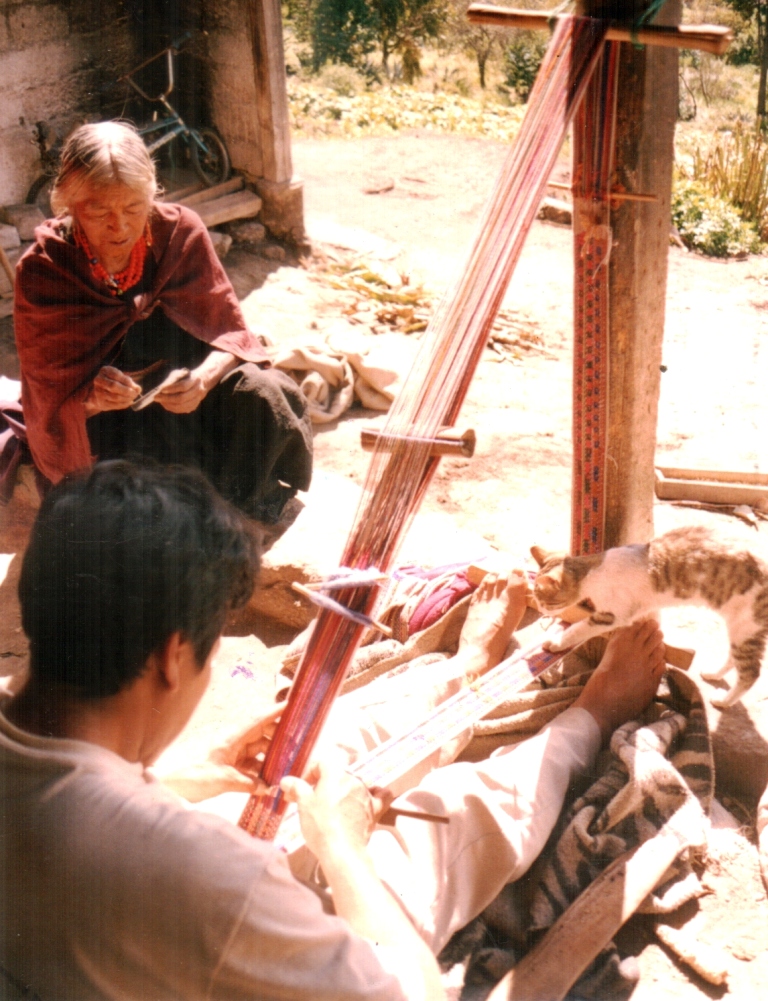
Probably the most time I spent weaving on a circular warp was when I learned to weave the typical belt of Salasaca, Ecuador. My teacher, Felipe, wove on his narrow front porch and his way of setting up a circular warp allowed him to sit and weave the very long belt even in that small space.

dovetail warp Salasaca Ecuador

Felipe’s belt will not have to be cut once the weaving is finished. He has warped in what is known as “dovetail”  fashion.

dovetail warp set-up

The following diagram will show you how he is using five of the six sticks you can see in the above picture to wind the warp for the white ground weave. The stick marked with the red arrow is the one around which the warps “dovetail”. When weaving is finished, the stick will be removed and the belt can be opened out. You can see the dovetail stick in the photo of Felipe weaving. It is in the section of  band that lies along the porch post.

dovetail warping path

And, if you are wondering about the sixth stick…that stick is used to hold the colored supplementary warps. Salasacan belts are woven in a supplementary-warp technique.

my salasaca belt

The diagram above shows the path of the white warps in the ground weave. The following diagram shows the path of the colored supplementary warps. In Salasaca, the supplementary warps all go together in a heddle of their own rather than being split between the two ground weave sheds.

dovetail warp path 2

angela-and-hammock-loomYou can see that when the dovetail stick or cord is removed, the end loops of the warp will stay intact. The loops can be very useful for finishing the woven item.

Guaraní hammock weavers here in Santa Cruz use the dovetail warping method and use the intact end loops for attaching the cords from which the hammock will be suspended.

So, longer warps are on the drawing board for me which will mean building a new warping board or modifying my existing ones.

I would really like to have a set-up like Felipe’s. Too bad I don’t have a porch on which to sit (and, yes, the view was lovely from there). I have seen pictures and videos of many Asian weavers with similar “triangular” set-ups. I will have to see into which wall I can drill holes in a place where I can still get good light! The idea of raising my bed way up high to give myself more space is gaining more and more merit.

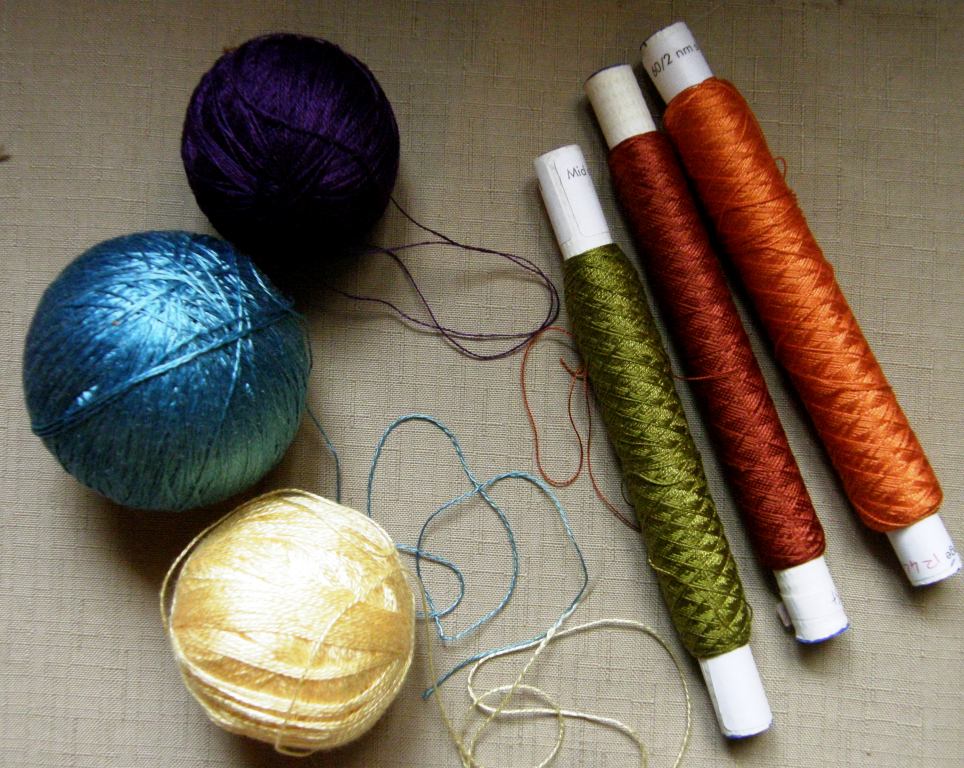
The third challenge is to use finer yarn and I am already in training for that with my scarf projects made from Guatemalan cotton. I have a ball of fabulous indigo-dyed silk that an English teaching colleague brought back for me from Japan years ago. It is heavier than the 60/2 silk that I have been using as supplementary weft and I think that it is a good weight for a first large silk weaving experiment.

Light blue Japanese silk, spools of 60/2 silk, yellow 8/2 tencel and purple Guatemalan cotton.

pebble weave with silkHowever, this doesn’t mean an end to band weaving! I love weaving bands just for the pure fun of it and don’t care if I don’t have a particular use for them.

Narrow bands are a good way to test new yarn or check the proportions of a newly charted motif.

I love weaving miniatures too and have already used the 60/2 silk in a small pebble weave band (at left) to test the yarn, check how difficult it might be to see for doing pick-up as well as to try out a new pebble weave motif.

Band weaving for me is also a nice way to take a break from large pieces on which I might be working…only 16 threads to pick up rather than the 286 in my current project and I can attach to a toe and weave on the sofa.

Much of last year was spent finishing my second book which involved a lot of weaving of samples… mostly bands and a few larger pieces. I have buckets of bands here! They won’t be made into anything. Some of them are very useful in that they travel to my workshops and make good teaching tools.

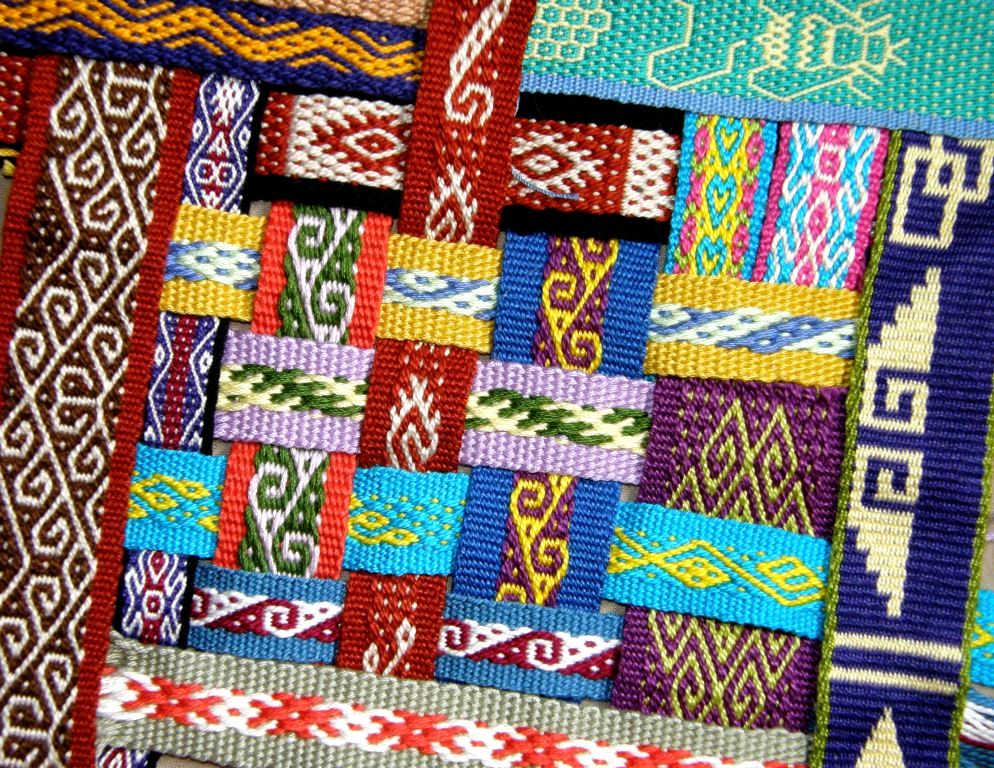
I took this next idea from my friend Yonat who put together a display of her inkle bands to photograph. I  put together a few of the bands that went into my book last year. They are of different widths and lengths…some barely two inches long… and so, my display is not as pretty and uniform and Yonat’s.

backsrap woven bands for book

The resulting book with yet more bands on the cover…

More adventures book cover dsz

You can download it from Patternfish.com.

ANWG 2013

The North West Weavers Conference, which will be held in Bellingham, Washington this June, recently opened its registration. I am going and hope to see you there!

To finish, here are some great projects from members of the Ravelry group…

carrie

Carrie wove this warp-faced band using the frame of her rigid heddle loom on which to extend her warp. She used string heddles and a shed rod rather than the rigid heddle. The patterns were created with supplementary warps. Gorgeous! We all love the soft colors she chose.

amandaAmanda kindly shared part of her band with her first attempt at creating patterns with supplementary wefts. She shows the difference that applying less tension to her warp made to the amount of coverage she achieved with the supplementary weft. She is using #10 crochet cotton for warp and embroidery floss as her supplementary weft.

janet

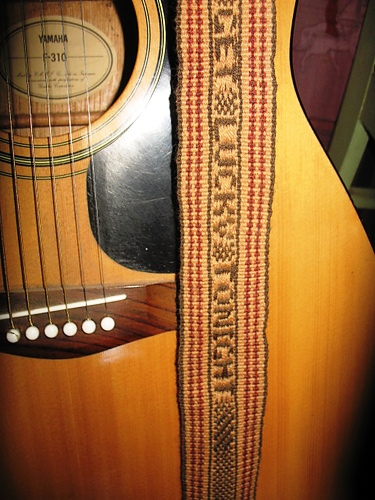
Janet wove this guitar strap for her husband with her own hand-spun and dyed wool. She used instructions for the pick-up patterns from Anne Dixon’s inkle weaving book.  She included words from a song which her husband wrote in the design and used guitar strap hardware made by our friend Annie MacHale to put it all together.

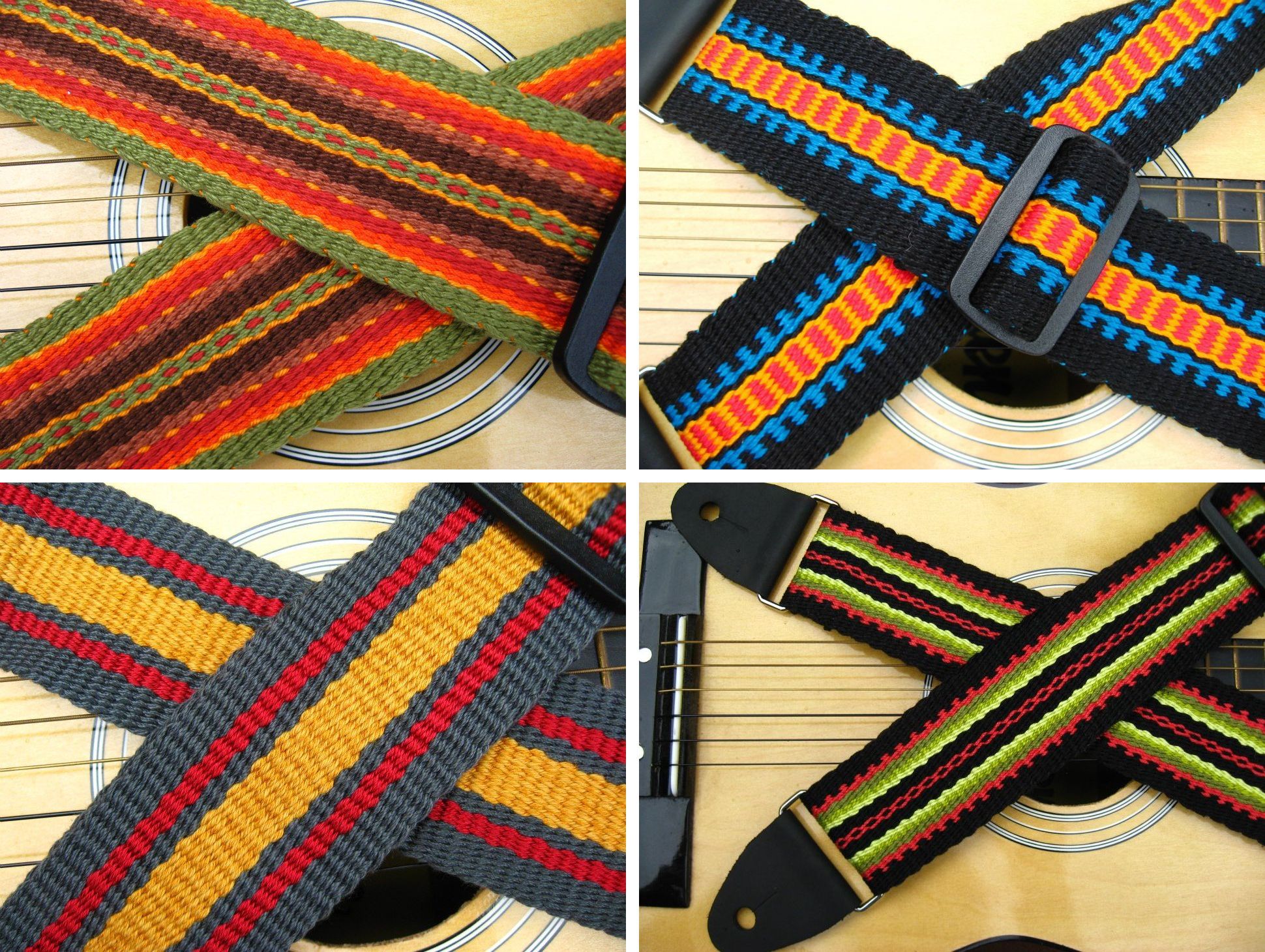
Speaking of Annie, she has been dazzling us on Facebook with the gorgeous straps she has been making on her inkle loom to sell at a big guitar show this weekend in California. Annie is all about color…I will leave you with just four examples of the more than forty guitar straps she will have for sale!

annies straps

So, my challenges are longer, wide, finer. What are yours?