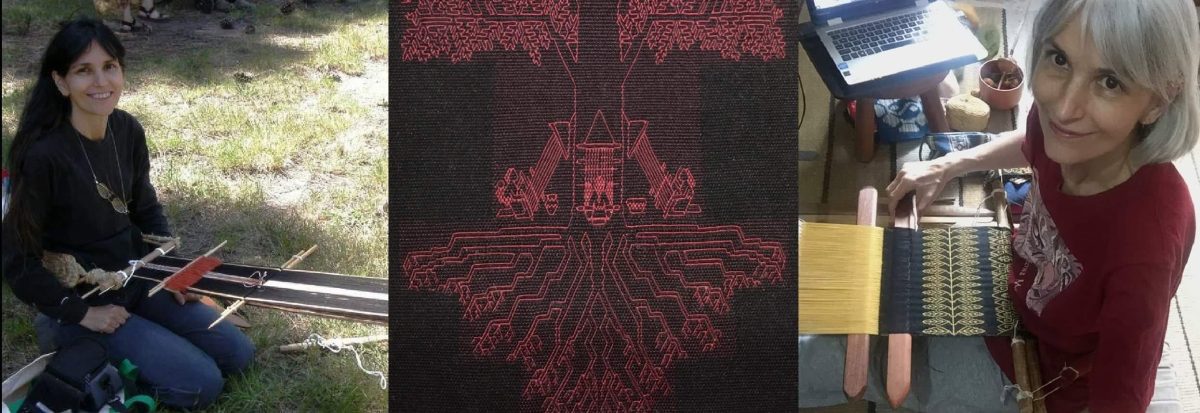
Backstrap Weaving – Braids 2012, Threads that Move

Braids 2012 is all over and all the British attendees must be back home now wondering what hit them. Many of the foreign visitors went off to families or packed their things into rented vans and hit the road leaving  just Elizabeth Kolb of Canada, Ingrid Crickmore of the USA and myself, all of us more or less “homeless”, together here in the MMU dorms.

So, what did we do with our time alone here? Ingrid and I had a fun morning checking out the Costume Museum and the Ede festivities in a nearby park yesterday. Today we all caught up on some much needed sleep and laundry then of course, of course, what else?…we braided.

I spent this afternoon editing my pictures and wondering why I hadn’t taken a whole lot more.

This is the first big conference at which I have registered, signed up for classes and taught which meant that there really wasn’t much free time to just wander about, soak up the atmosphere and take pictures. It was up early every day to participate in a steady stream of activities.  Coffee and meal breaks seemed to be spent waving the food about in the air in our hands while  trying to explain a braiding or weaving move rather than actually consuming the stuff!
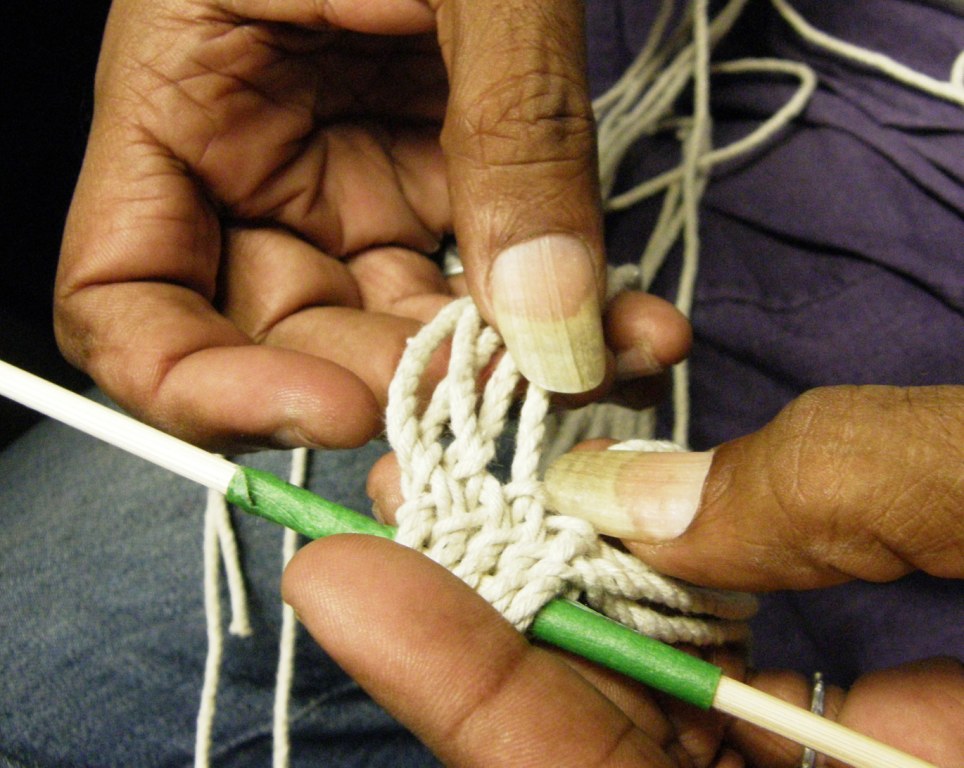
That is why I have decided to re-name this conference “Hands that Express”.

I was getting frustrated with my photos which had been taken indoors in low-light conditions with so much movement going on. My pictures always seemed to show two people in deep conversation with a blur of hands in front of their faces…hands that flitted and floated and turned gracefully in the air as they described their craft. Then I understood that my pictures with the blurred hands actually captured better than anything the spirit and essence of this event….expressive hands, conveying passion and ideas even when not putting threads into motion.

Too bad I only realized this after already having deleted many of the pictures!

And such interesting hands. Above we see the hands of Errol Pires Nelson of India with their built-in ply-splitting tools. He is starting off a ply-split braid for a new student in one of his many impromptu classes outside his scheduled teaching days. I, too, rely heavily on a long thumbnail as a handy tool for my backstrap weaving, especially for heddle making, but I am a bit shy to leave it long when I am out and about.

The city of Manchester was a wonderful place for this event with its fascinating role in British and world textile industry history. The MMU made a nice home for us all. I have always loved communal living and staying in the dorms took me back to my ski bum days except that we were all tucked up in bed early each night so we would have enough energy to face the full days of lectures, classes, conversation and all that hand-waving!

The little I saw of the city itself was impressive…all that brick and stone…old and new side by side with the gorgeous Palace Hotel, with its landmark clock tower pictured above, built in the late 1800s and early 1900s, standing majestically on the other side of the street from the Holiday Inn Express.

The old and new, the very old British structures and the newer items representing the British melting pot of cultures stand sometimes comfortably, sometimes clumsily and very often very colorfully side by side….the lovely old “Picture House” perched on top of the  MacDonald’s….  But this is just the quick impression I got from the very little time I got to spend out and about before and after the conference.

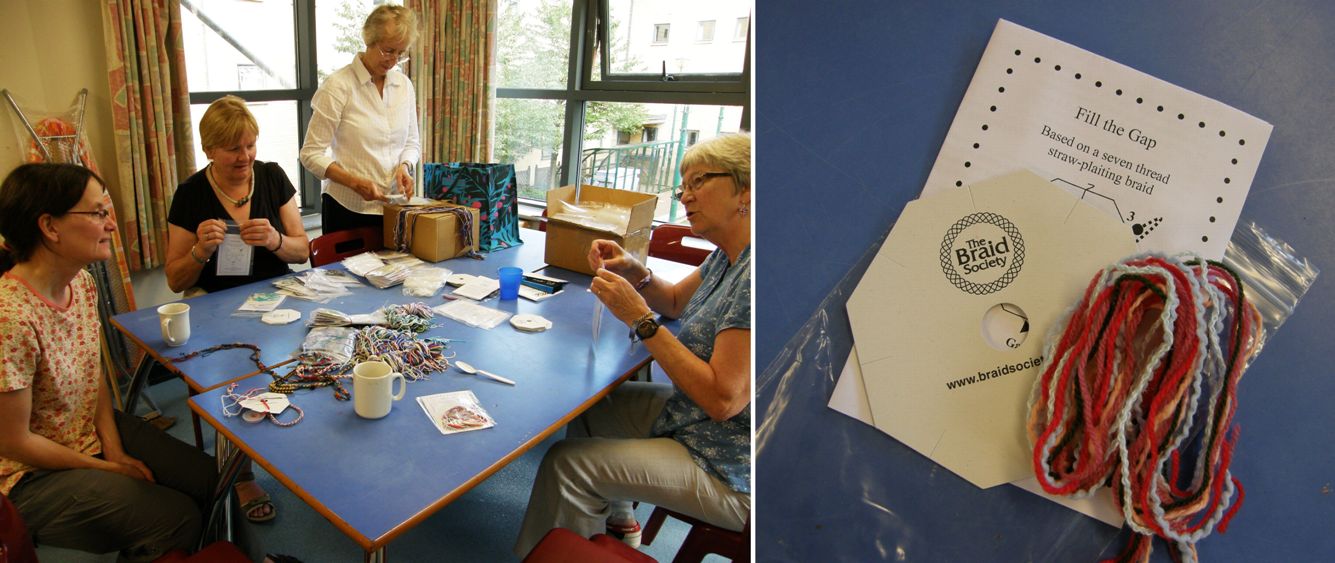
Day one pre conference was spent settling and meeting my dorm-mates…the “naughty old British ladies” as they called themselves. We spent the first evening putting together “fill-the-gap” braiding kits which we were to use to teach braiding to visitors at the Museum of Science and Industry the following day. These humble “fill-the-gap” kits were responsible for providing a considerable part of the funding for the Braids 2012 event. Braid Society volunteers attended fiber events during the many years of planning, taught braiding and sold the little kits. Hundreds of people were introduced to this fun craft for a tiny fee which helped make Braids 2012 possible….impressive!
It was a lot of fun seeing Rosie and Sally in action at the museum. Of course they had no problem getting kids to try braiding. It was a little more difficult convincing some of the adults but Sally and Rosie obviously had a lot of experience with this and their cheeky sense of humor soon had entire families of all ages sitting and standing about completely absorbed in braiding. The kits were free at this event.
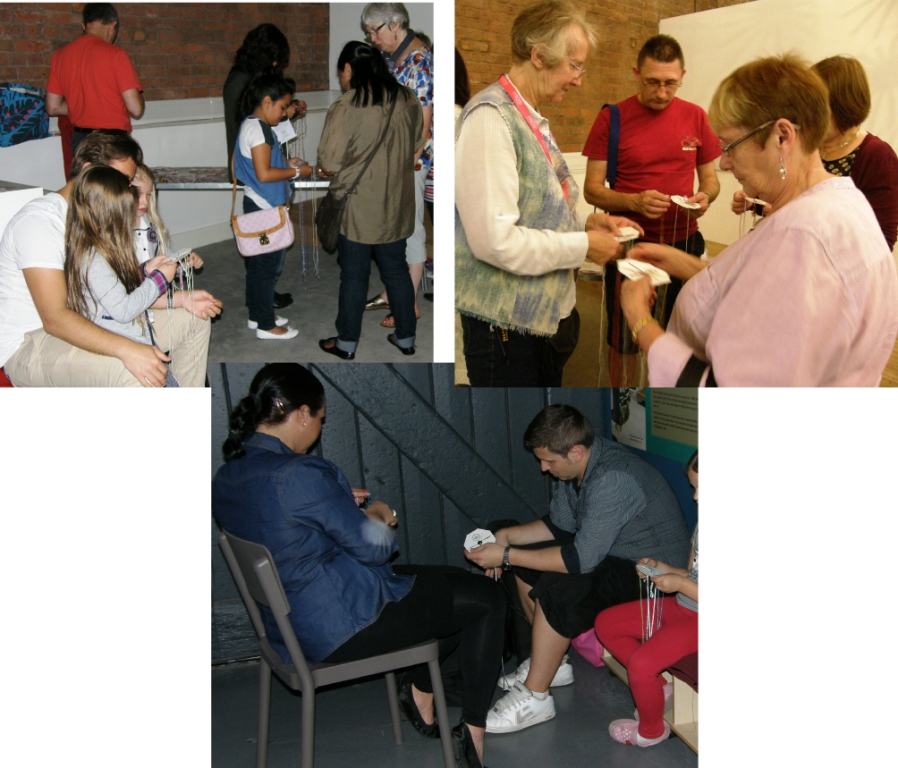
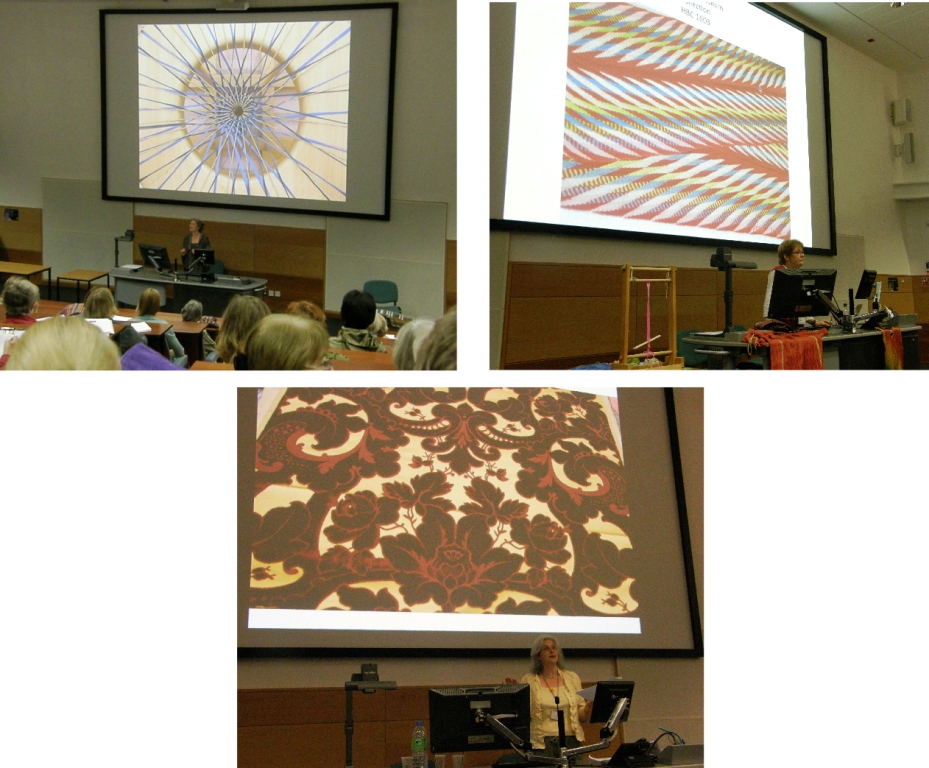
About 100 braiding kits later….we went directly to the conference opening and were welcomed by the Chairman of the Braid Society, Steve Pretty. Society President Jacqui Carey gave the keynote speech. We were then treated to a koto recital by Enokido Fuyuki  who then invited us to come and try our hand at this traditional Japanese instrument. Steve Pretty is being given some playing tips below. It was a lovely way to open the event considering the large number of Japanese attendees and the many traditional Japanese braiding techniques that were being offered in the workshops.

Morning lectures included those offered by Carol James and Stacey Harvey-Brown, pictured above, on North American Braided Sashes and Northwest Archives for Research and Inspiration.

There are those expressive hands at work while Ingrid and Carol discuss techniques besides Carol’s display of beautiful finger-woven pieces.

I signed up for Anne Dyer’s class on a technique which she calls “snagging” on tablet-woven bands which has given me some cool ideas for plain-weave tubular bands that I make on my backstrap loom. I also took Robyn Spady’s class on handwoven decorative trim on an inkle loom. I was happy to have Susan Foulkes as my classmate and we were both rebels and wove on backstrap looms rather than on inkle looms. Susan used a rigid heddle and I used my usual string heddles and a shed loop.

Both instructors gave a us a run down of the technique and a multitude of inspiring samples and then let us run with it and create. It was fun to stop every now and then to take a spin about the room to see which direction the other students were taking. This was very interesting for me as the techniques I teach need to be built up in steps throughout the entire duration of the class leaving little class time for any free wheeling and experiments. Things need to be more structured. It is always so wonderful being a student again and especially in the hands of such great teachers. I get to evaluate the way my classmates and I react to the material, the pace of the instruction and the general learning atmosphere. I learn so much that I can then apply to my own teaching.
On Monday night we had the Braiders’ Bazaar. I bought nothing!

Happily, I was too busy demonstrating backstrap weaving and meeting various online weaving friends as well as talking about my first book  Andean Pebble Weave. It was fun to tell an Italian attendant about the translation that has been made of the e-book to her language.

Happily, I was also able to show the front cover and also tell everyone about my follow-up book which had just gone up for sale the night before on Patternfish.com.

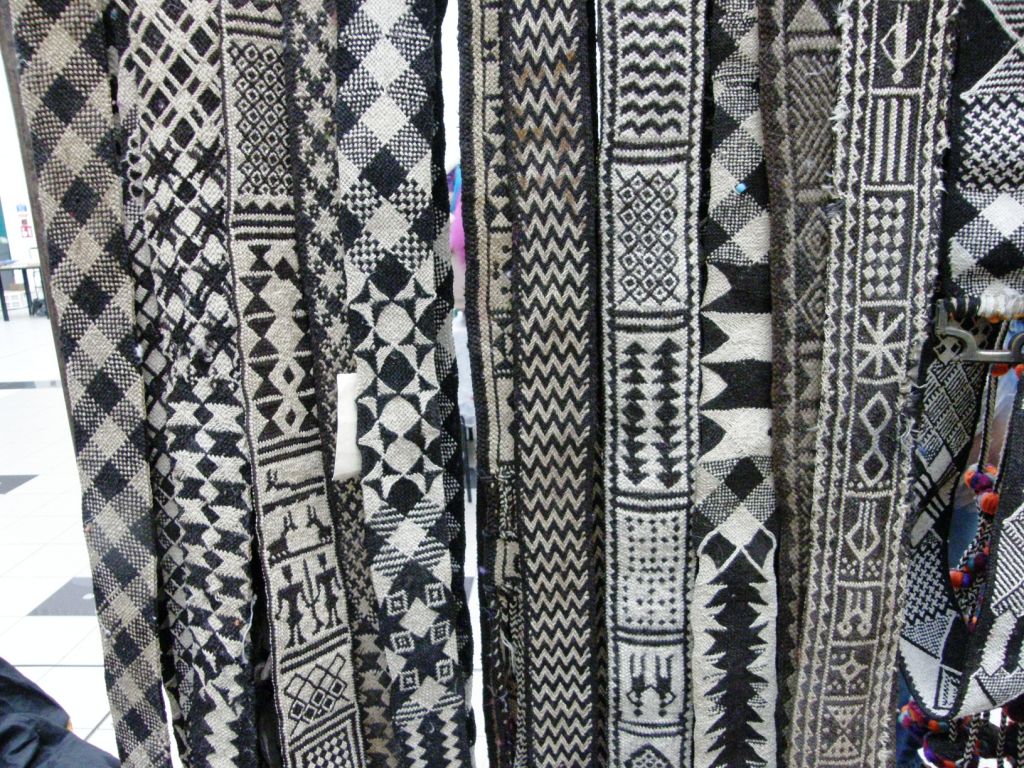
Later I heard about all the wonderful things that had been offered at the bazaar…books, tools, yarn and textiles including some amazing ply-split camel girths, which I did manage to photograph (see above). Ingrid and I were oblivious at our table where I was weaving a pebble weave band on my backstrap loom while she demonstrated how to do what would normally be a two-person/four-handed braid on one pair of hands.

Evenings had us gathered in our communal kitchens, showing what we had learned that day and sharing new techniques with the usual flurry of enthusiastic hand gestures….doing the techniques, talking the techniques, watching (although you weren’t allowed to get away with just watching for too long!), enjoying, discussing…it went on and on.
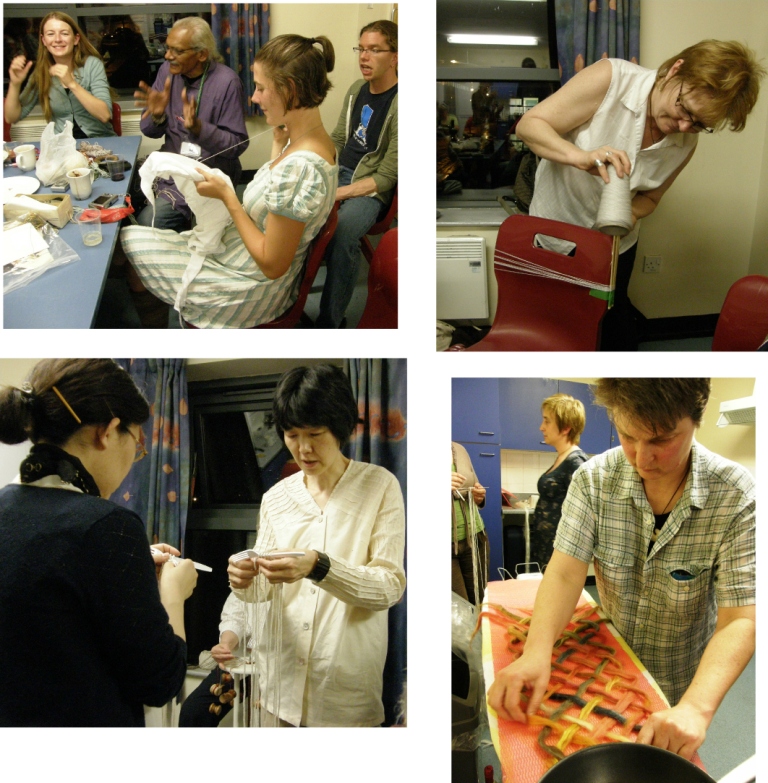
 Many a warp was wound…all Carol needed was a chair and pair of chopsticks. With an ironing board and frying pan Helen sets about making a braided and felted scarf. All hands were occupied and, if you walked in without a craft, you would soon find yourself with strings dangling from your fingers as did the Japanese visitors above.
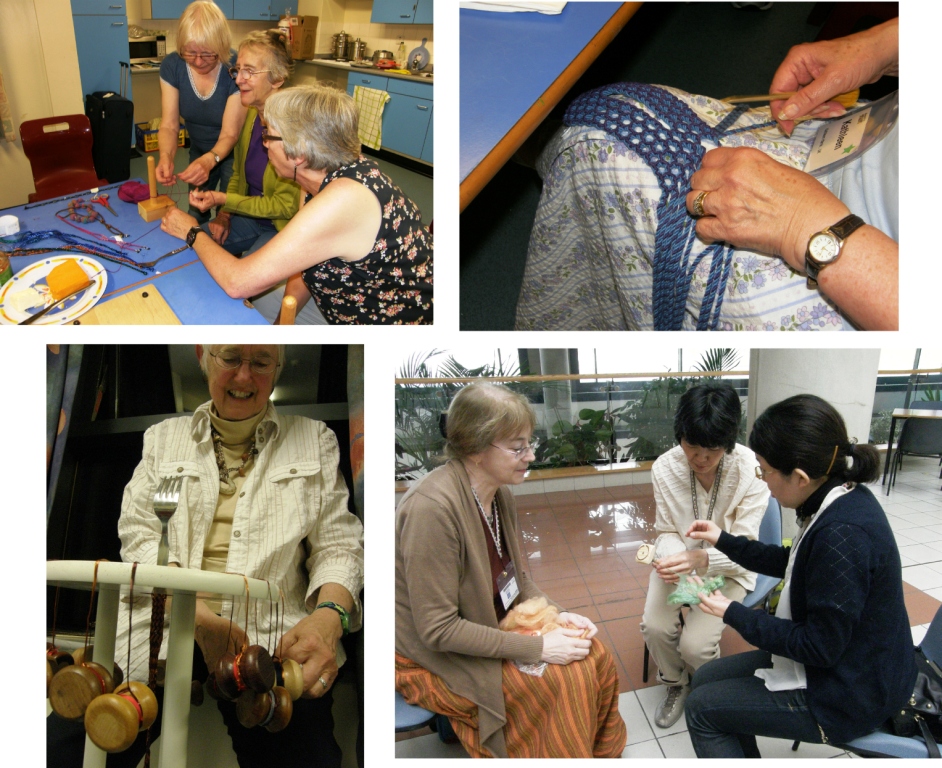
Kathleen has a ply-split scarf in progress on her knee and Sally, Rosie and Phyllis are knotting bracelets. Ruth found the coffee break a good time to teach silk spinning on one of her home made spindles to Mari Omura who lectured on Chinese and Korean loop braids. And if you run out of chairs, as often happened, just perch yourself on the window sill as Shirley did with her marudai. Carol is finger weaving with her work suspended from the kitchen cupboard while Steve and Elizabeth can do their ply-split braiding anywhere anytime without tools or supports.

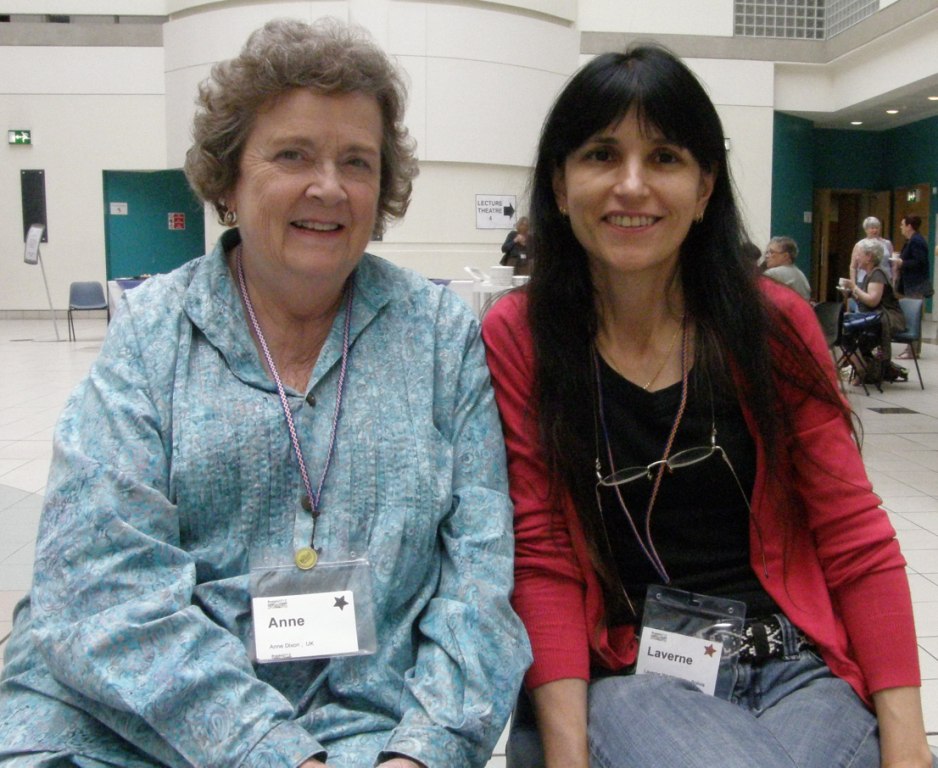
A still moment for a photo op with Anne Dixon…two “warp-faced” ladies, an inkler and a backstrapper who love to weave pick-up patterns.

Every now and then we did manage to sneak out of our classrooms to peek into others and the teachers were all very welcoming. I was lucky to find a moment to pop into Rodrick Owens’s classroom and see his stunning display of Peruvian sling braids which has made us all the more enthusiastic about his up and coming book.
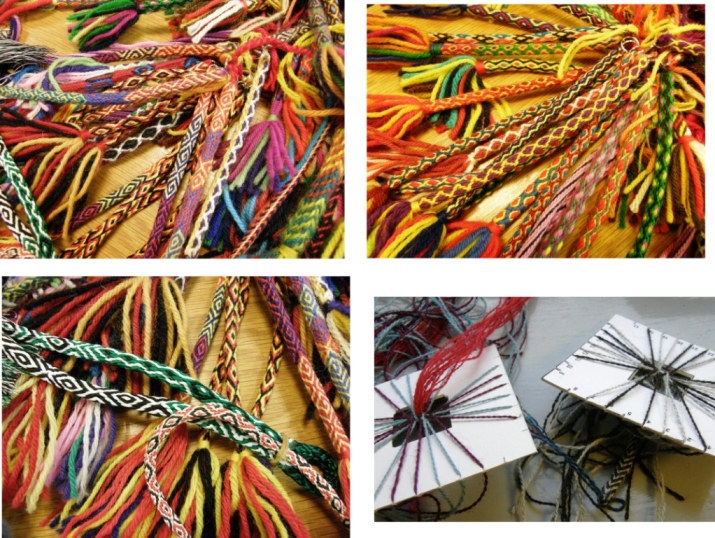
I didn’t get to see Jacqui Carey’s class on Chinese Braid Embroidery in progress but I heard so many wonderful things about it and did manage to see her display of  Chinese braiding bobbins,  a few of which are pictured above. We were also able to see her Chinese braid embroidery work called “Jo’s Jacket” which is breathtaking. I am sorry, but I have nothing to show you about that.  All I can say is “just wait until you see it!”

On Wednesday we had what was called a “rest day” and were taken off to be fully immersed in the history of silk weaving in Maccelsfield with visits to the Heritage Center, Paradise Mill and Silk Industry Museum…a wonderful day out.

This, along with my weekend visit to the Museum of Science and Industry, gave me a glimpse into life at the peak of the cotton and silk weaving industries in Manchester and Maccelsfield….It really is all too much to go into here…life working in a mill, Sunday school and home life for the working children, the hardships of the mill workers, the cloth, the buttons, the costumes, the magnificent looms and machinery….it was a full day which left our heads spinning. I know that I am leaving you hanging here with a bunch of pictures with no description, but maybe I will be able to elaborate in another blog post some time in the future.

Ingrid and I were both slated to weave and braid on Thursday and Friday. Here’s Ingrid with Debbie Richardson, the amazing organizer of this brilliant event, on Thursday morning. I can see Ingrid’s enthusiasm shining in her eyes. I know that all the braiders were thrilled with her.
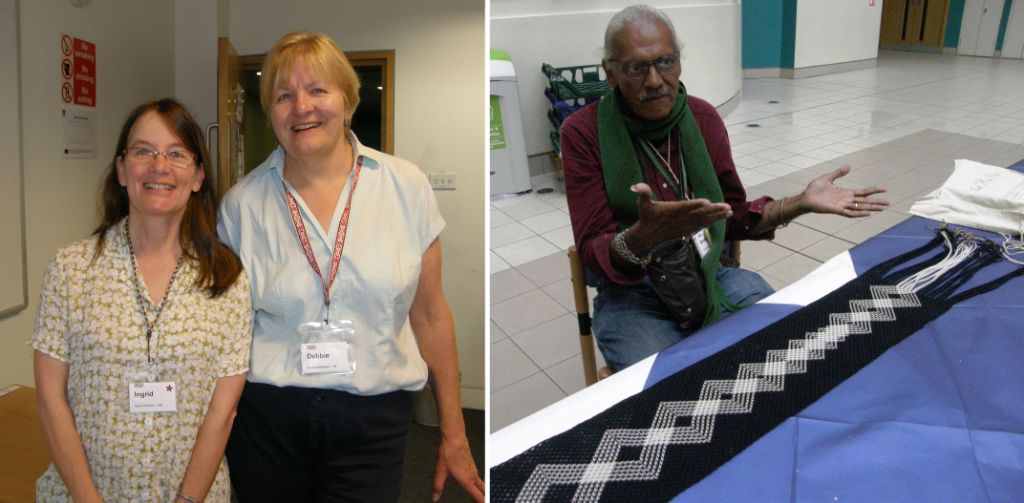
Errol was also ply-splitting those days and had already made himself a big favorite with his quiet presence and special dry sense of humor. He seemed to be able to just produce out of nowhere at any time one of his fabulous ply-split creations.
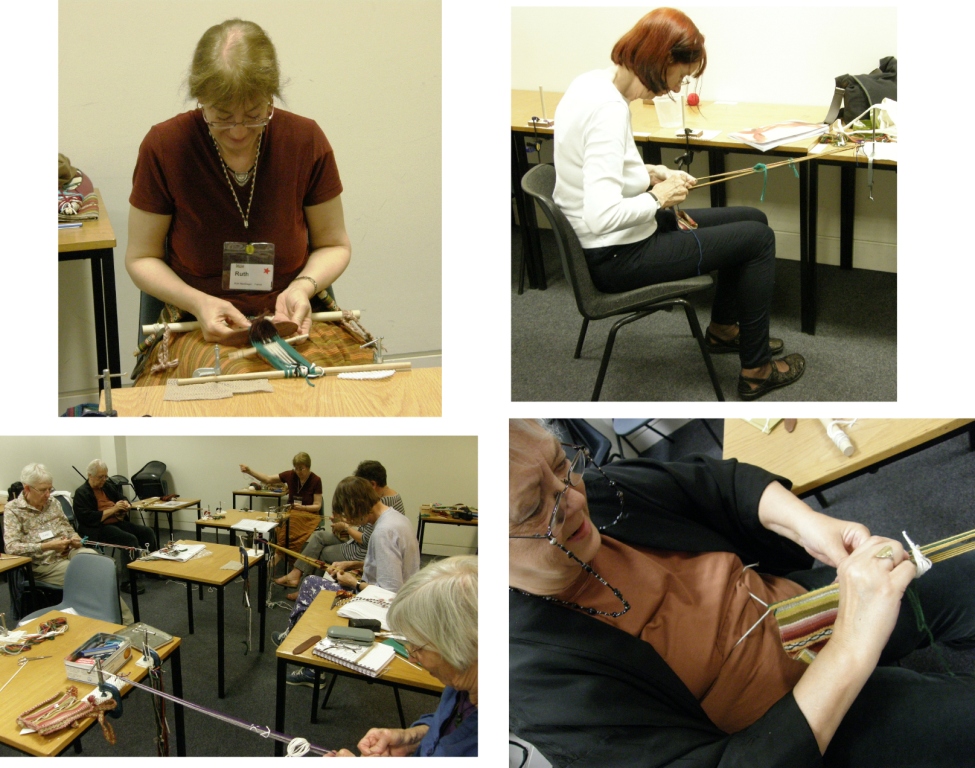
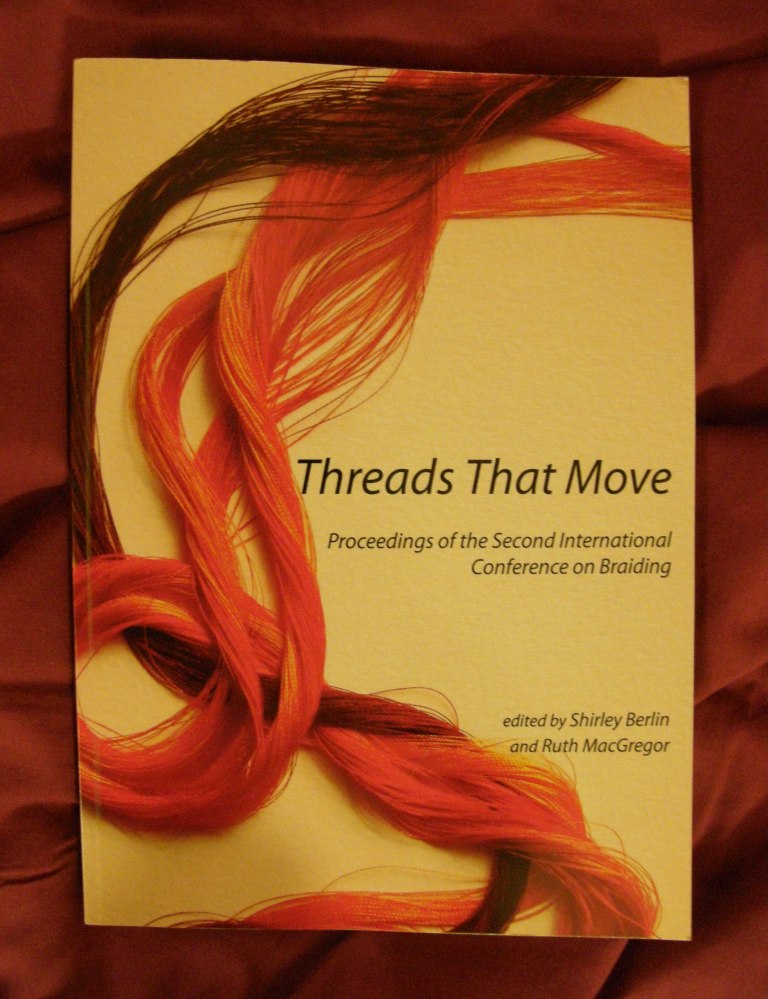
My goodness, I had a fabulous hard-working group! I suggested we not have tea break on day one and everyone was more than happy to stay in and continue working. We also started at 8am on day two rather than at 10am as scheduled. Why not squeeze as much out of this as we can?! It really was a pleasure to have such keen and tenacious weavers. Susan Foulkes joined us on day two for the Andean tubular band segment. Ruth MacGregor, who edited the conference proceedings (along with Shirley Berlin) was also there with Clare, Margot, Marge, Bridget, Janet and Mayako.

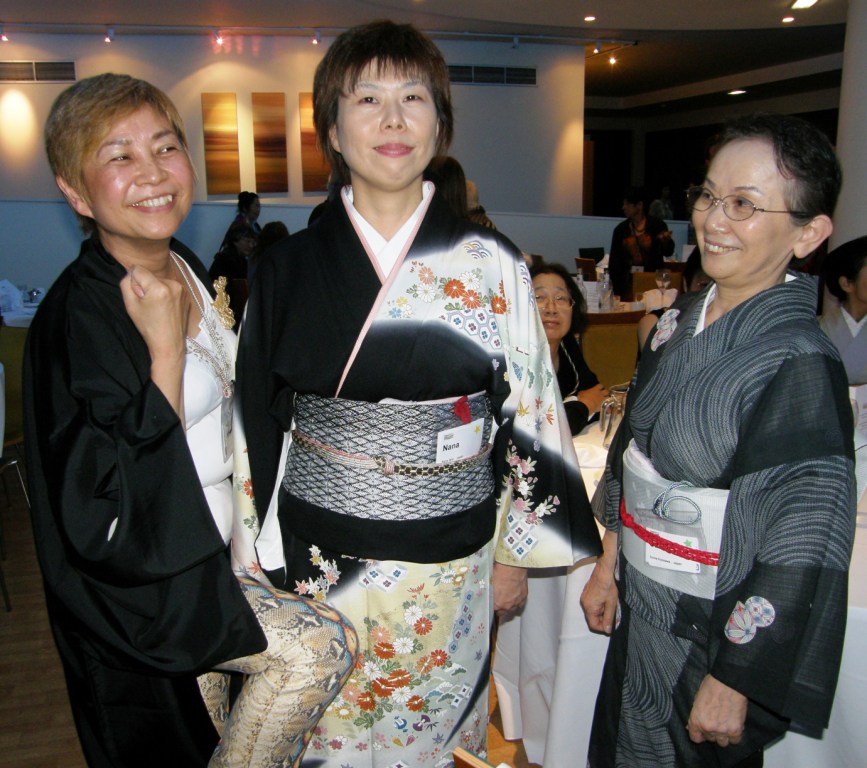
Thursday night was banquet night and a chance to congratulate and thank all involved with the organization of the conference before everyone started disappearing on Friday evening and Saturday. At the banquet it was announced that Braids 2016 will be in the hands of Robyn Spady and will be held in Seattle USA. It was a night for dressing up and our Japanese visitors did not disappoint!
And that brings me to my last night in Manchester. As I said, I am sitting here looking at the pictures and wondering where the week went and why there are so few pictures to tell this story. I hope I have been able to convey just a little of the fun we had and have you all thinking that maybe a trip to Braids 2016 in Seattle is something you should be planning.
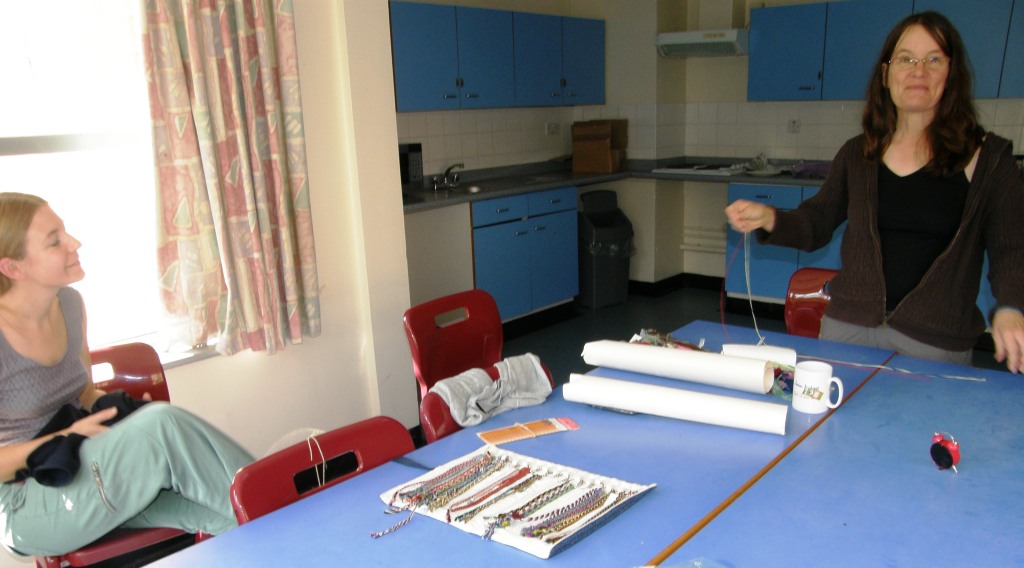
Lucky Elizabeth and I got private braiding classes with Ingrid today. I am off to Cambridge tomorrow. I wonder if I will see Elizabeth again somewhere sometime. Ingrid always weaves with me when I am in California so we are bound to meet again soon. That kind of thought always makes the goodbyes easier.

Backstrap Weaving – Greetings from Manchester!

Hello from Manchester, England! Sorry to have disappeared these last two weeks. It was all book, book, book and preparation for this trip and now I can hardly believe I am here.

Braids 2012, Manchester England! What a beautifully organized event by Debbie Richardson and all her helpers at the Braid Society. Today was registration, key note speech and welcome and all the big action starts tomorrow bright and early. Not that there hasn’t been any action so far….you will get a full report later as I am still in a mist of jet lag. That was a heck of a trip from Santa Cruz to here with something like 30 hours door to door. But I am a lucky gal. A surprise  upgrade on British Airways  gave me a very comfortable night flight into London from Miami.

Now I am trying to sort through names and faces…people whose books I own, whose work I have admired, people who have become familiar from online contact but whom I have never seen. All very exciting!

But what I am really here to tell you all is that my new book is now up on the Patternfish.com site and ready to buy! It was my goal to have it finished before the Braids Conference and I just scraped it in. I came back to my room after a busy day to find the link in my inbox and several copies already purchased!

If you are an experienced “Andean Pebble Weaver”, get ready to use all the skills that you acquired by working through the step-by-step lessons in my first book. With those under your belt you will be ready to weave and enjoy over 150 new patterns. Over 100 are for pebble weave and there are new techniques and new charts covering other patterns from the highlands and lowlands of South America and beyond.

Maybe you bought my first book but haven’t used it yet….well, it’s time to go get it out, dust it off, or find it on your desktop, and get to work so you can then enjoy all the patterns, tips and techniques in the new book!

My next post will have lots of pictures and news from the conference. It should be an intense week. And now it is bedtime on this side of the world just when I feel like celebrating!

See you soon!


Backstrap Weaving – A Little Weaving Therapy

I guess that two months isn’t really such a long time to be away from home. It’s just that I haven’t done an extended trip like that in a long time. I am reminded of the times when I lived at the southernmost tip of continental Chile and used to go up to Peru and Bolivia for the winters. I would spend months away wandering about, only going home when I had become too skinny and undernourished (I always traveled on a typical backpacker’s budget!). It is always bewildering after you have seen so much, experienced so many different things, met so many cool people and learned so much to go home and find that everything is the same!

How could this be when you feel so different?! However, returning home this time was a little different because things had changed. Stuff happened, people disappeared, things accumulated….one of them being DUST…two months of the wretched stuff!

But now I am back into the old routine. Yes, here I am blogging away on Thursday in socks and sweaters. Fifty-five degrees…that’s COLD for Santa Cruz. The palm trees look rather forlorn against the grey sky.

Time for some weaving therapy!

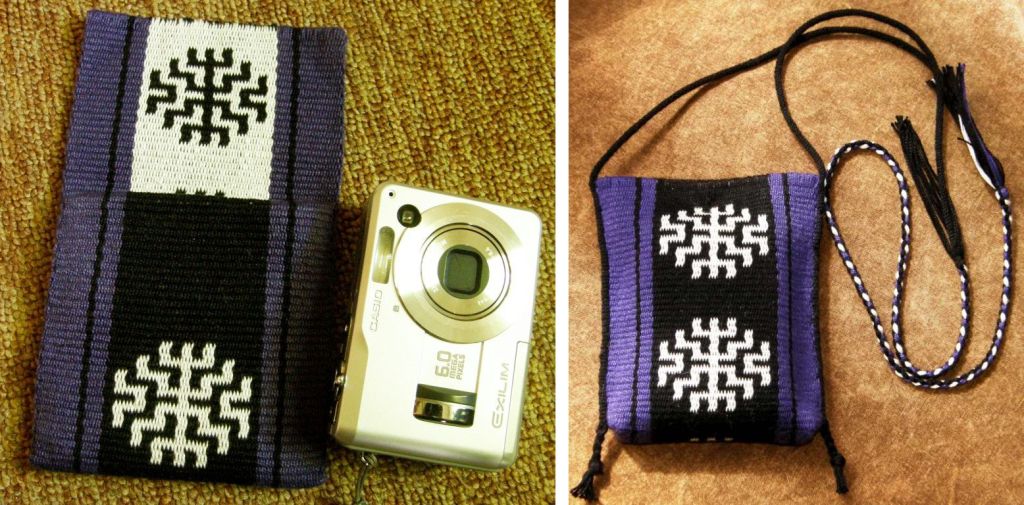
I made up the bag for the wee Casio camera.

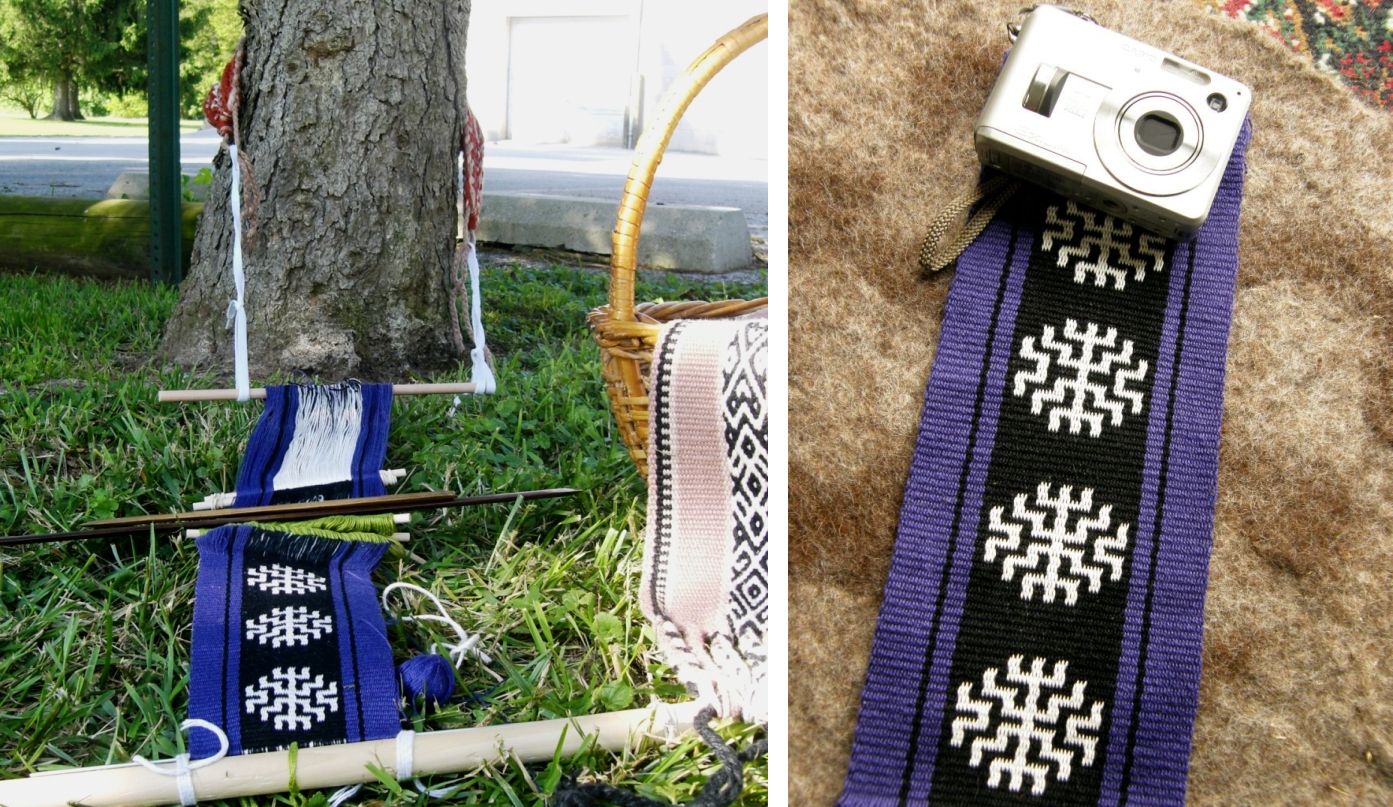
This project accompanied me on the road and was hitched to numerous places along the way. I finished the weaving while I was up in Massachusetts. The pattern is one from Bhutanese textiles. Now, how to sew it up?

The first idea was the one on the left…a bag with a flap which I would cut and shape and edge with a tubular band. However, the motifs were not ideally placed for that and so I ended up with the style on the right.

I squared off the bottom of the bag and added a single large  snap closure on the inside. It is edged with a sixteen-end black plain-weave tubular band. I continued weaving the tubular band after covering the edge so that I could also use it as a strap and then added a four-strand braid to that for extra length.

The transition from tubular band to four-strand braid is covered by a tassel…a trick I learned from my sling braiding teacher in Peru.

I think these tubular bands are very cool and so handy. I have been playing with some other plain-weave ones in different materials. The one on my bag is in #10 crochet cotton and here are a couple of others that I made in wool.

The yellow and blue one is woven with a DK weight wool I love the way the simple stripes spiral.

The other one is in a lighter weight wool and you can see that even a lightly twisted yarn works. As the warps are so narrow, the problems of stickiness that usually occur when using wool in warp-faced projects are not a big deal. The warps did not break but my weft did once from pulling it very tightly but that was not a  problem.

Another cool thing about tubular bands is that it does not matter what the lower face of the band looks like. That gets hidden within the tube.

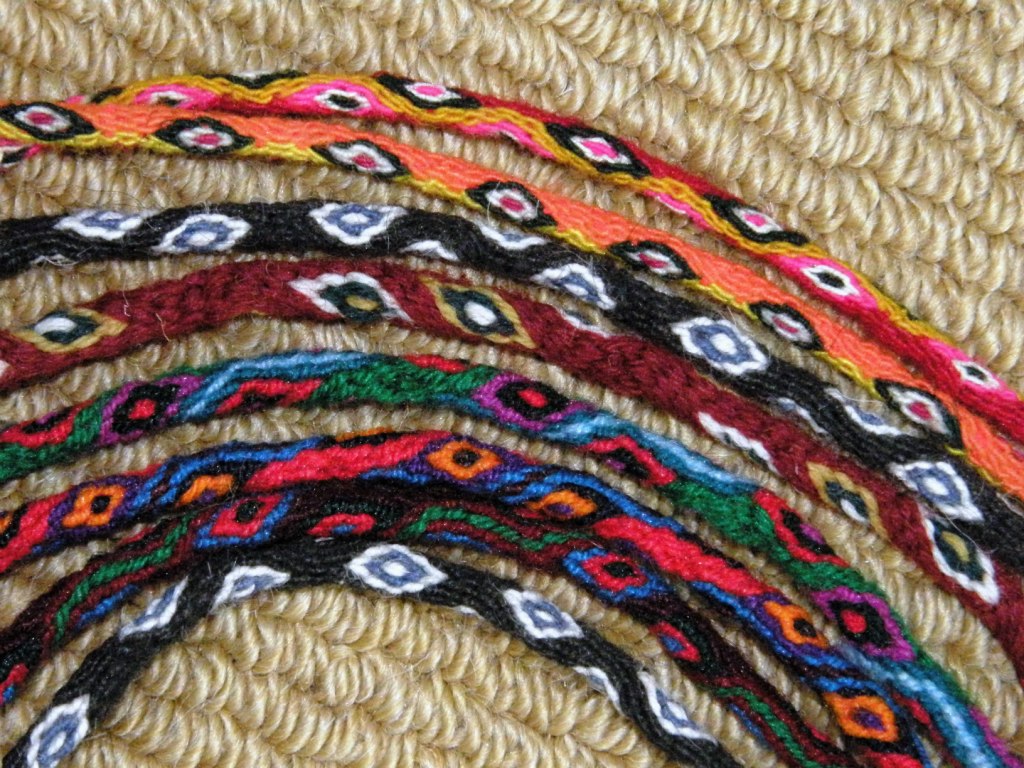
I wove a ñawi awapa band (see some ñawi awapa bands pictured on the left) as an experiment as a flat rather than tubular band and saw the chunky chaos of crossed and twisted floats that is created on the back side of the band from all the strange warp crossings and manipulations.

But that does that matter? No! All that gets hidden within the tube.

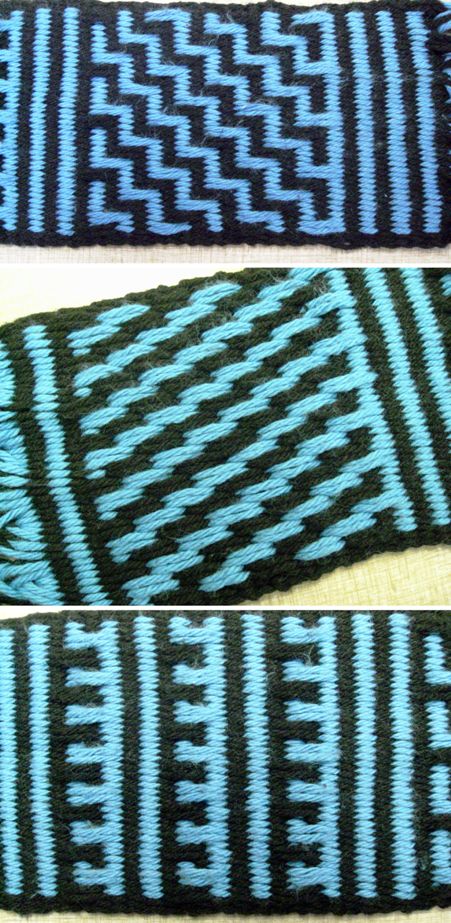
Now what other technique do I know that has a pretty “right” side and a messy “wrong” side of awkwardly long floats?…the warp subsitution technique, of course!

Actually, any warp-faced band whether it be plain or patterned with any kind of pick-up can be made into a tubular band but, since the warp substitution technique is often overlooked because of the long floats that are created on the reverse of the fabric, why not use it for tubular bands where none of that matters?

So, the other band pictured above has three-color horizontal bars which I was able to create with the warp substitution technique.

All the cumbersome long floats are hidden within the tube.

These bands are fast and fun to weave, quick to warp and can be stretched between a toe and finger to weave.

If that doesn’t suit you, you can attach one end to your waist with a cord through the end loops.

If you don’t fancy using your big toe, as the weaver from Tarabuco pictured at left is doing, a cord can be passed through the end loops at the other end of the warp which can then be wedged inside a drawer or looped over a “C” clamp.

I am going to use these tubular bands as pretty ties for my loom and any other time I need cord for my weaving projects and I hope to experiment a lot more with designs and colors.

So, that was one on-the-road project finished. My other demo warp is something quite different. A big white canvas looking at me and asking to be decorated…

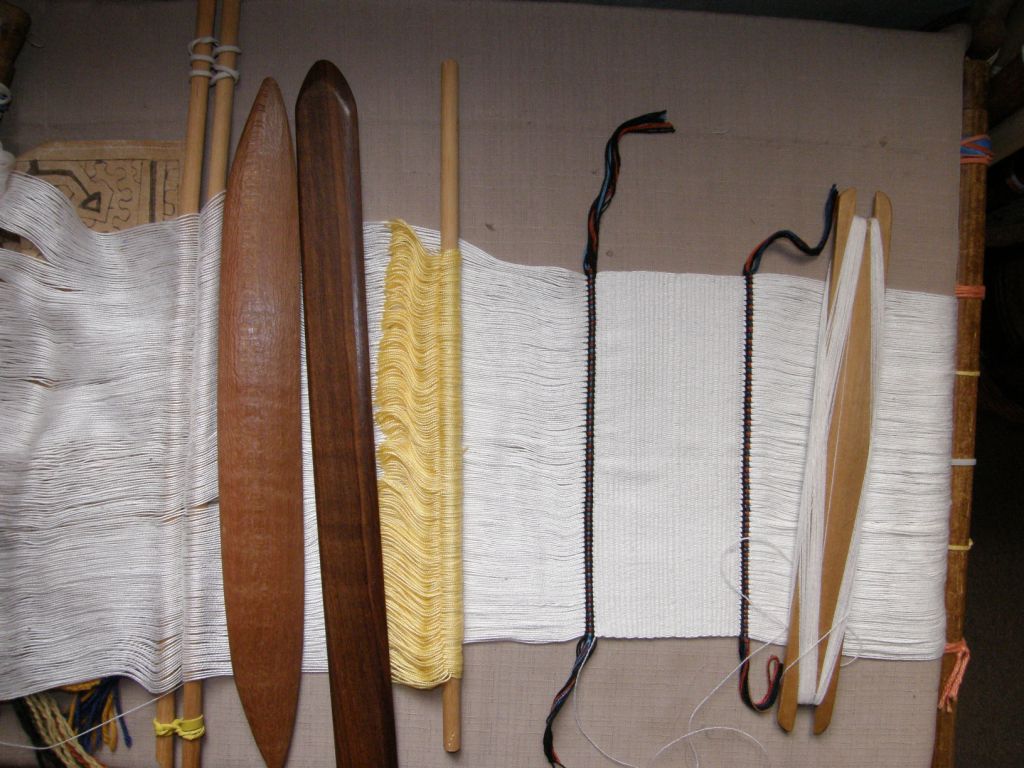
There is something very lovely and somehow “earthy” about creating this plain and simple warp-faced white cloth and I want to make any patterning minimal. I have added a couple of weft-twined sections. Perhaps I will do some more weft-twining or maybe some soumak with a bit of added patterning with supplementary wefts. I left a lot of unwoven warp at the start in case I want to add a large weft-twined pattern later. As usual I don’t have plans for the finished piece. I will just see what happens.

Then there was time to do something with a sample piece that I had completed shortly before leaving.

You may remember the ikat weave-along that we were having on Ravelry.

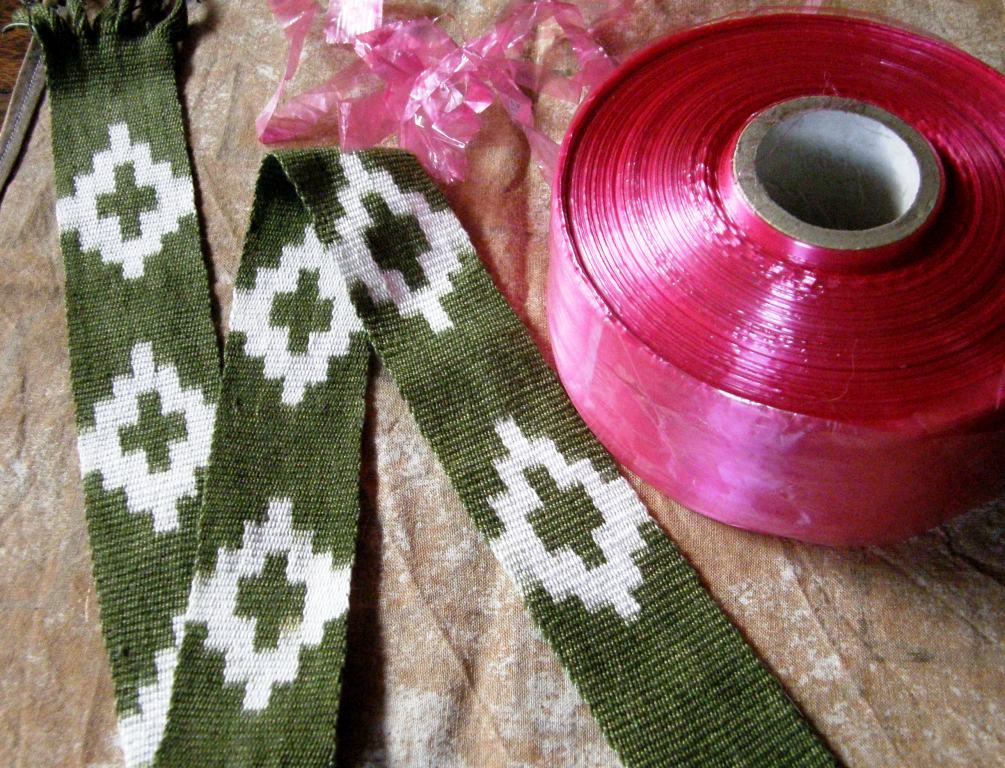
My friend Betty in the US gave me a huge roll of ikat wrapping tape so there will be many more ikat experiments in my future!

I have been using cassette tape until now and had a small “oopsy” in my last project when my dye solution was too hot for the tape.

I am sure that this special tape has been designed to stand up to being boiled in dye baths. It is very wide but tears easily into perfectly straight narrower strips…what a dream!

Here is the second warp which I tried after the green one above. This was my first time trying over-dyeing with a second color and spot dyeing.

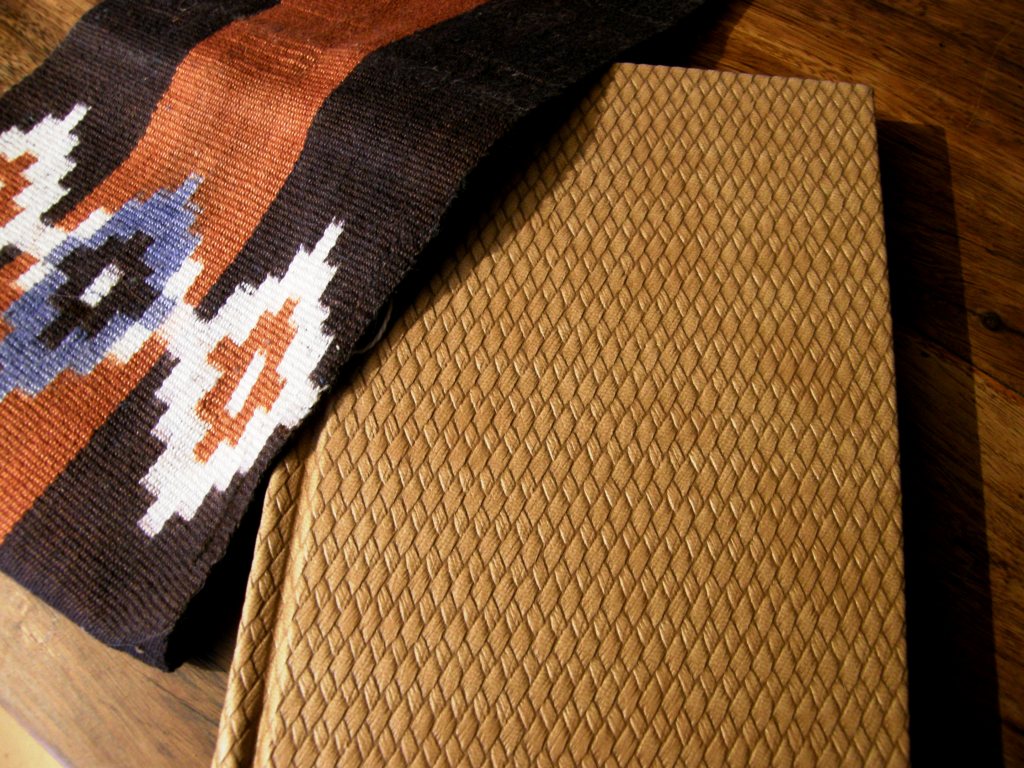
My friend Jeen in the US gave me a lovely travel journal and, even though its cover is very beautiful, I decided that my experimental ikat piece would make a wonderful jacket for this book.

I have to admit I was a little nervous. Was I about to ruin both sample and journal?

I used contact cement which is pretty strong stuff. Would it eat into the material on the journal’s cover and destroy it? Would I mess up and glue it on crookedly?

I have done that before with contact cement when gluing cork sheets to a table top. Once that stuff is ready to go you are pretty much committed and it won’t forgive any mistakes! Fortunately it all came together and I am very happy with the result.

The little vessel in the picture was a gift from a friend in Ecuador. The pen is made from sandalwood and was brought to me from India over forty years ago! Goodness knows how I have managed to hang onto it after all these years of moving around and having to abandon possessions along the way. The mug rug on the far right is part of a set inspired by African designs that I made on my backstrap loom in double weave.

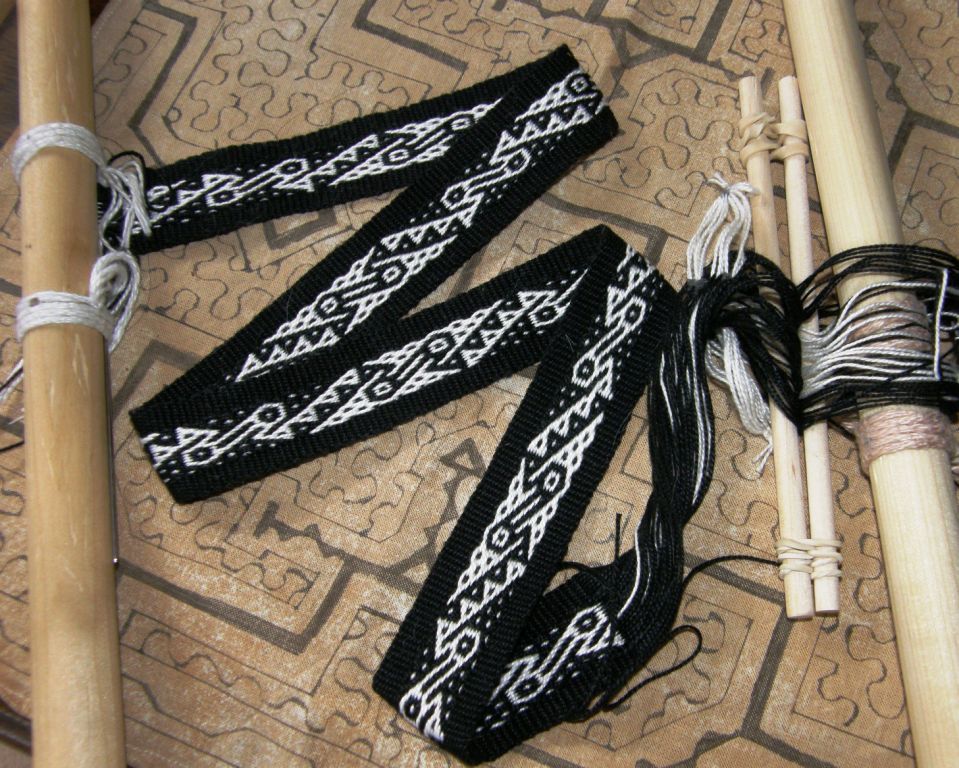
My new-to-me used camera got a dressing up too with a new strap. I was happy to have a chance to weave that bird design again…the one on the old fragment that Tom Knisely showed me…

Here it is off the loom and on the camera…

And here it is on my backstrap loom. I love the way the bird motif changes from black to white along the length of the band.

And now I have a new strap to study which was lent to me by Susan  who visited me when I was traveling. She brought it along and I was delighted to be able to see both sides of it. There are so many pictures online of these bands from Oaxaca, Mexico but you never get to see the back side. There are many more examples of these on Teyacapan’s Flickr page of Mexican textiles.

Perhaps this structure is woven somewhere here in South America too but I have never come across it so this is a great opportunity to take a good look. Maybe it was woven here in pre-Columbian times. She urged me to take it home and just send it back to her when I am done. How cool is that?

I have this urge to go back to some simpler things and explore them more…like the white plain-weave piece I am doing, some more very simple ikat motifs which again involves just plain weave and I have been also looking again at simple warp floats.

One of my weaving friends in the US wove this cool backstrap after having woven simple warp floats with me.

We just played a little with floating both colors and she went on and ran with it.

At left you can see various parts of Kristi’s backstrap which is patterned with floats in two colors. She used it the second time we wove together.

When I was at Maryland Sheep and Wool I got to see many people of all ages being introduced to fiber activities.

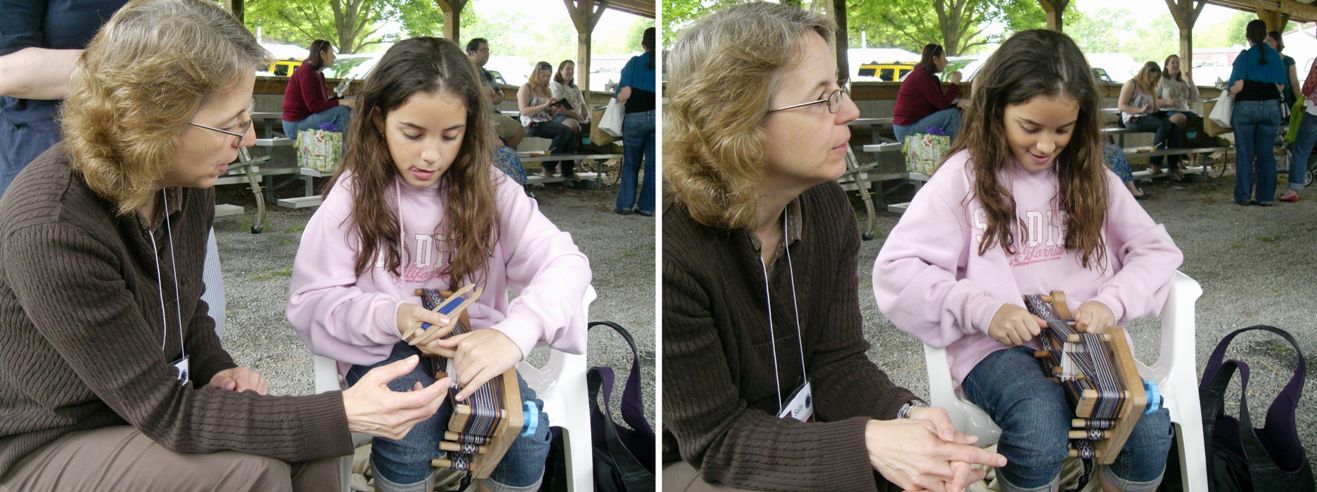
Elisabeth Hill, who I have known some time online and whose fabulous work on deflected double weave I always follow on her Flickr page (she’ll be teaching it at Convergence), came to Sheep and Wool with her niece Kylie. Kylie got a class in inkle weaving from Sally Orgren on her famous and well-traveled loom when we had a Weavolution meet-up at midday. Look at that smile. It looks like a new weaver has been born.

One of Elisabeth’s deflected double weave pieces won first prize in the exhibit at Sheep and Wool. I don’t think the picture I took does it justice so please take a look at her Flickr page to see all her beautiful creations.

Some lessons, like the one Kylie had, were completely impromptu. I wonder if as Kylie grows and continues to weave (and what wonderful inspiration she has in her aunt Lisa) she will remember her very first lesson there in the Rabbit Barn at Sheep and Wool on Sally’s “Inky”. Other classes were more formal…

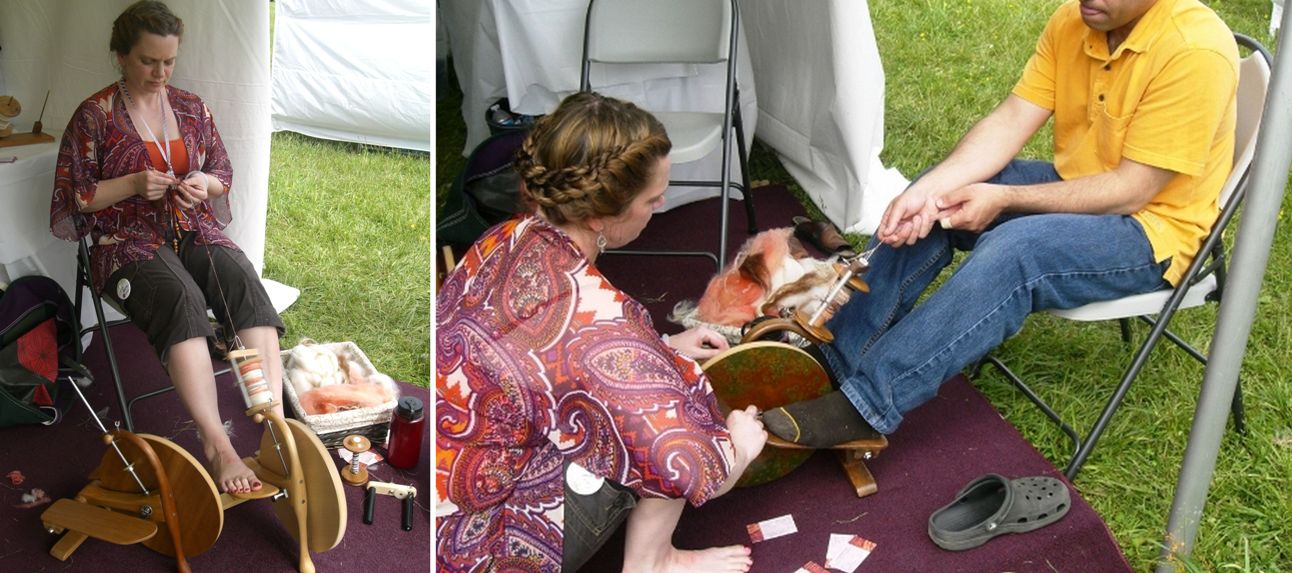
There’s my friend Claudia chatting with spinning teacher Maggie Casey before class and Richard Ashford was at The Mannings booth giving spinning tips with Tom Knisely looking on.

And the guys were into it too. Here is a gentleman having a spinning class on the ”Pocket Wheel” which was a big hit.

It was fun to see the team of young guys and gals who entered the Sheep to Shawl Competition this year.

Some things I saw at Sheep and Wool inspired this little project this week…

A simple little pebble weave band, right? But wait until you see the band that inspired this…

Isn’t that spectacular! Now you can see where my little purple and yellow band fits in! This was woven in Ayacucho, Peru and is probably from the same area or at least very close to the place from which my pebble weave teachers originated. Although they taught me in Huancayo, they are natives of Ayacucho and the little animal motifs on this band are very much like the ones they taught me. I would guess that this band was woven with the same two-heddle method that I learned in Huancayo with some additions for the third color.

The quality of the weaving is superb. Sadly it probably won’t be “popular” with some tourists who generally seem to prefer handspun wool and natural dyes. There is so much weaving in Peru that we just don’t get to see and coming across these bands at the Sheep and Wool festival was such a treat for me especially since I have not seen anything like the motifs I was taught back in 1996 in the books I have on Peruvian weaving.

Except for the purple and yellow section, it is a three-color pebble weave. Aren’t those braids and pom poms beautiful?!

Here is a little something I picked up from the same stand. I was tipped off by braider Rodrick Owen that these were available there….a sweet braid with tassels from Ayacucho being sold as a keyfob.

And finally, here is a wonderful display of bands made by Yonat. Yonat feels more comfortable on an inkle loom and so takes what she weaves with me and transfers it to her loom. Not everything here was originally backstrap weaving. Some bands, for example, are from the workshop on Sami weaving by Susan Foulkes and others are Yonat’s original creations.

See you next time. I hope that all of you can take some time off for a little weaving therapy this week.

Backstrap Weaving – New Looms, New People, New England!

I have a Facebook friend who posts up to ten of those motivational/inspirational quotes a day…all in a row on my newsfeed. I must admit that I don’t read them but for some reason this one caught my eye…

If A equals success, then the formula is A=X + Y and Z, with X being work, Y play, and Z keeping your mouth shut. -Einstein

Now, I don’t find anything particularly remarkable about this and I don’t know why I paused to read it. Perhaps it was the name “Einstein” that attracted me and the fact that we tend to think that everything and anything a famous or much admired person says, no matter in which field they excel or excelled, must be deeply profound and noteworthy.

This could have been said by Joe Eintstein of Blogsville Pennsylvania who is just having some fun with his famous last name for all we know.

I don’t claim to know what the meaning of success is but the short saying had me thinking a little about the proportions of “X and “Y” in my life and I was happy to find that at least at this stage of my life both elements seem to have pleasantly blended. As for keeping my mouth shut, I am a pretty quiet person, but I was given a fun t-shirt by some of the Ravelry gals who live over in the northwest which serves as a reminder!

Can you make out the t-shirt slogan? Could this be the formula for success? Something to keep one focused! And I needed focus with this particular project as it had to be done in a hurry. I needed a long wool warp-faced band to which we could attach tubular bands as Pam was having groups of friends coming to weave in her barn. She helped get me set up on this new-to-me equipment with Harrisville Shetland wool from her stash and away I went.

 A little strumming was required to get the sheds to open cleanly but I am well used to that from weaving on my backstrap loom.

I think that I could have gotten in more picks per inch if I had woven it on my backstrap loom. The higher tension on this Macomber loom did not allow me to beat the weft in as well but I love the feel of the resulting band…long and flowing. Tony the cat loved it too.

So, this is what we used for sewing tubular bands. Yes, the band got cut into pieces. I know, I didn’t want to do it either but that was its destiny right from the start.

This is the plain-weave tubular band that Chris was weaving and sewing to the edge of the fabric. One of the keys to achieving a nicely woven and sewn tubular band, in my opinion, is knowing exactly where to insert the needle in the fabric.

And above you can see Chris’s ñawi awapa tubular band in progress. Tubular bands can be woven as independent bands or attached to fabric, in which case, they are woven and sewn simultaneously to the edge of the textile.

I attached one to the edge a mug rug at left.

We also used bands that I had commissioned from PAZA in Cochabamba Bolivia which were woven on leaning vertical looms with hand spun wool dyed with natural substances.

One of the young ladies in the club de chicas who is learning to weave produced this band and I was pleased to be able to buy and put one of her learning pieces to good use. I know you might be horrified by all this cutting up of these lovely bands but the weavers in PAZA themselves also do this to make cell phone pouches to sell.

The handspun yarn is overtwisted and the beat when weaving is firm to say the least. Of course this band had an entirely different feel to the one I wove on the floor loom and behaved in an entirely different way when I cut it into pieces.

I just folded the pieces in half and pinned them together. Having them sit like that for a couple of days settled them quite a bit and they served their purpose. The two bands were very different but suited our needs equally well.

Here are the ladies weaving away. In my experience so far, weaving and sewing a tubular band is usually accompanied by a lot of mumbling and whispers. One has to resist the urge to talk one’s way through the moves in a loud voice so as not to disturb the rest of the group. These groups, however, were particularly silent and seemed to be relying on the wee voices in their heads to help  them work through the process.

I will be heading home tomorrow (Tuesday) and thankfully have all day today to pack and organize my stuff.

I have been staying a week here with Pam and her barn is weaving paradise! The Buddha in her field will soon be hidden as the grass grows to form a maze. I have never been here at the right time of year to enjoy that.

One day was spent at Ravelry member Jeen’s home nearby where we wove pebble weave together.

It was wonderful to meet Jeen after having “known” her for so long online.

It was nice to see in person some of Jeen’s warp-faced bands.

On Tuesday I met more of Pam’s weaving friends who come to work in the studio under her guidance on a variety of looms and learn different techniques from Navajo and card weaving to overshot and boundweave. This was the second last week before summer break and so I got to see quite a few pieces being cut off their looms.

Joanne and Sheilah are obviously very happy with their pieces. Joanne’s is bound weave which she will sew into a bag and decorate with finger looped braids and Sheilah, with her quilter’s eye for color and pattern, made a rag rug with beautiful color progression.

Bev is trying her hand at double weave pick-up and Joan, who introduced me to a local Burmese backstrap weaver on my visit last year, is threading a rigid heddle to do tapestry on the Leclerc Penelope tapestry loom. And that’s not all…Pam has more weavers working away on all kinds of things there on Tuesdays and Thursdays and the studio is open for whenever one wants to drop by and continue working on their project.

Pam’s studio is as always a treasure trove of ethnic textiles from around the world. Joan has been working with a basket weaver from Burundi, Patricia Kayobera, and Pam has a display of her pieces. When Patricia was unable to find the materials with which she was used to working at home, she used cut up plastic rice bags. The baskets she made in Burundi were white and the plastic bags were an acceptable substitute.

Now she is starting to work with raffia.

The flyer and baskets are posed on a piece of  indigo dyed cloth that Pam recently bought from an exhibit of textiles of Ghana.

She has colorful strips of Kente cloth woven by the Ashanti and Ewe people of Ghana. (Also see Tien Chu’s fascinating blog post on her visit to Ghana and contact with the Ewe people). The vast difference in use of color between the two groups is interesting. I can’t decide which I like better.

The dyeing technique in the other piece, I am told, is called plangi and involves sewing thread into the woven cloth which is then pulled to pleat and ruffle the fabric before dyeing. The dye is able to penetrate some areas more easily than others and that is what creates the patterns.

A piece of Palestinian cross-stitch embroidered fabric and a sweet example of soumak on a tiny piece from Azerbaijan. While I doubt that I will ever get into cross stitch embroidery, as beautiful as it is, (there simply isn’t time for everything) I definitely see soumak in my future!

As for my weaving, another on-the-road project went on the loom and one came off.

A week in Pennsylvania gave me another chance to hitch to a tree and weave the camera bag project.

At Pam’s place I warped the small red band because this time I wanted to make a more complete replica of the bird design on the textile fragment that Tom Knisely had showed me at The Mannings.

I liked the way that the bird motif changed from white to red and I learned a lot by weaving this piece.

The camera bag project was finished at Pam’s indoors because the weather was quite gnarly when I arrived (now we have been enjoying days of the most gorgeous spring weather).

It came off the loom to be sewn. I want to cut and shape the flap and sew a tubular band to it and I need to find a nice button closure.

Here is the “bird” band about to come off the loom. I just wanted to weave the two color versions of the bird and I will most likely make this into a keyfob.

The purple and black piece will make a bag for the camera just in time for me to put it back on the shelf. It has served me very well since my bigger Olympus camera died in Oregon but now I have the camera that you see at left!…

A friend of my brother’s in Australia gave me his Olympus…the exact same model as the one I have been using and loving these past three years.

Apparently he bought it for a trip to India in 2007 and then decided that he would rather have something that he could slip into his pocket.

The Olympus has sat untouched since then…just waiting for me!

So I am back in business with a camera with which I am already very familiar. Now to weave a strap for it and find a suitable woven gift for Surrey who gave me the camera.

You can see the double weave strap I wove for the other camera at left.

Now, if I had been smart, I would have made a strap with the “bird” band. Well, there’s nothing stopping me from weaving another, right?

Oh, and the book on which the cameras are posed…that is a beauty, and has enabled me to read more about some of the Colombian textiles that Laritza brought to show me when we wove together.

And the Maryland Sheep and Wool Festival report still does not appear. I miss blog posts and get overwhelmed with stuff! I will however show you what I bought at Sheep and Wool…

These are examples of the rug wool colors that I bought for my Moroccan weft substitution project.

You may remember that while I was visiting in California, Yonat showed me a piece woven in Morocco. We suspected that it was a rug. I was excited to see first hand an example of the weft substitution technique about which I had heard and immediately started dreaming about trying it.

Part of Yonat’s “rug” can be seen above. Wool simply does not exist in the lowland area of Bolivia in which I live and so I knew that I would have to find something while here in the US. The main colors are cream and black with tiny bits of red and mustard yellow bordering each pattern section and I think I found just the thing at Sheep and Wool.

Betty in Oregon gave me some fine wool warp from her stash and I am hoping that with all this I will be good to go. I can use one of my Navajo forks to beat and I guess I will set it up on my backstrap loom. I will need to play around with the sett to find what is ideal. I am NOT planning on making a rug!  Perhaps it will be center piece for a table. It is a long long time since I did anything weft-faced. I will need to sample for sure.

After looking around online I found a site called The View from Fez –  Beginners’ Guide to Moroccan Rugs which shows these kinds of Moroccan pieces. These images are from there…

The article tells us that these pieces are cloaks rather than rugs but that they are often sold in stores as rugs. They are called hendiras. It explains that the cloak is worn with the loose loops of wool outermost in the snowy weather as the snow tends to fall off the wool loops rather than accumulate and soak the fabric. There is more on the site mentioned above. Do take a look. The latest issue of Shuttle, Spindle & Dyepot also has an article on a cooperative that is preserving the Berber weaving tradition of Morocco in which the beautiful hendiras also appear.

Well, I think I am done with this week’s blog post. This is my last day in the beautiful Massachusetts spring weather and it is calling me out to play. I will be heading home to a Bolivian lowland late fall which will most likely be every bit as hot and humid as any other time of year!

I will leave you with Pam’s husband Jim Engberg’s photo of an iris taken in their garden…spring in New England.

Eating lashings of pistachio icecream on the porch at the end of a perfect spring day looking down towards Pam’s barn weaving studio….a lovely way to end this trip. Tomorrow…back on the long road home!

Backstrap Weaving – From Baby Steps Come Big Things

The close of this fun and very long trip is approaching.

I can’t believe that two weeks from now I will be home.

Yet, I still have lots of people with whom to weave so somehow it really doesn’t feel like things are about to end. A very peaceful week spent in the home of Ron, Carol and Helen has really enabled me to do some outdoor weaving, not to mention the chance I have had to go through everything in the Mannings store, meet Tom Knisely’s beginner weaving students, hang out with the twining group that meets here once a month and see Tom’s collection of old textile fragments and tools. And then there’s Sara and all the staff at The Mannings who cater to my every need…what a nice way to spend time towards the end of this trip.

Yesterday was one of those heavenly warm and sunny days…too warm to be out at noon but just perfect in the early evening. I set up my backstrap loom on the grass across from the stream that runs at the bottom of the Mannings property. This really isn’t something I would do at home…I would soon be carried off by the insects!

Local kids were fishing and Stipples, one of The Mannings cats, soon got chummy with them…..not one, not two but three free meals for her kittens. It was hard to catch a good picture of her as she trotted on by. I was, after all, attached to my loom and this was a cat on a mission.

I was weaving there on the grass tied up to the perfect tree with the perfect amount of shade.

The pick-up design is from a pattern I found in one of David Barker’s books on textile designs of Bhutan.

Check out my RESOURCES page to see where you can download these books for free.

The finished piece will be made into a bag for the wee camera that has served me well since my big camera died shortly after arriving in the US for this trip. It will certainly be better than the somewhat battered bag that I am using now.

The whole camera story has a very happy ending and I will tell you about that when I get to Massachusetts next week. The sword in the picture is one I bought at Maryland Sheep and Wool.

I have also done some other just-for-fun weaving this week. Tom Knisely brought in some textile fragments of old Peru which were given to him…three beautifully mounted and displayed sets in glass cases. I decided to copy one of the sea bird motifs and make a keyfob for Tom.

The old fragment has the sea birds changing from white to red and back again along its length and I would like to weave a longer piece now to reproduce those color changes.

Just one set of sea birds was enough to make the keyfob. A metal ring and some braids completed it.

Tom brought in not only the fabulous fragments but also these amazing tools which were given to him!

Look at that distaff and gorgeous carved sword! They are posed in this picture on a cheerful handwoven bag made in Guatemala. The bag is sold at The Mannings as the tote for the Cricket loom that is commissioned from Mayan Hands by Schacht.  It is just perfect for the loom.

The sword is actually a little on the wonky side and it seems strange that someone would go to the trouble of carving a piece of wood that was not in better shape. That makes me think that maybe this sword was not created to be used. A lot of the swords that I have picked up in my travels show that they have been well used by the indentations along their edges where the warp threads have “bitten” into the wood. However, the edges on this sword are clean. I am thinking that perhaps it is a weaving tool that had been made to be buried alongside a weaver and so was never intended to be used.

It does, however, have ends that have been blunted possibly as a result of having fallen to the floor many times. I recognize this feature as that is what the swords that I lend friends end up looking like.

As new weavers struggle to find that “sweet spot” with the right amount of tension on the warp where the sword will sit up nicely and stay in the open shed, they have to put up with having the sword pop out frequently and clatter to the floor…result: blunt tips.

Maybe the person in the US who first acquired this tool was a novice backstrap weaver and was using it in their loom and having to deal with it taking frequent nose dives. These are of course all “maybes, perhapses and I wonders” –  all  pure guess-work!

Who knows what the story is behind this beautiful tool and its maker and owner and the many hands through which it has passed before ending up here. It is fun to try and imagine what happened.

In any case it is gorgeous. The carved figures look like pumas, llamas and a condor.

Let’s look at the distaff…

Tom doesn’t know the origin of these pieces and I am not even going to speculate. Maybe someone out there can tell us.

It wasn’t easy just hanging out in a yarn store for a week! I can tell you when every trip to get water or tea meant walking by shelves and shelves of yarn and tools! And then there were weavers and twiners all around to chat with. Talk about happy distractions.

Fortunately I am not really a “yarny” person. That doesn’t mean that I didn’t make my purchases…I took the chance to restock yarn and supplies for my future weaving projects and was happy to find good substitutes for yarn that I have been happily using only to find now discontinued. Carol was great helping me with that. She can take a look at yarn and immediately come up with something in the store that very closely resembles it.

Last weekend I wove with some ladies including two mother-and-daughter pairs who seem to have decided that backstrap weaving together would be a cool way to celebrate Mothers Day…I agree!

We were able to dress up some of our plain-weave samples with patterns using supplementary wefts. Bolivian hatbands were our inspiration.

Here are the two mom-and-daughter pairs concentrating hard as they coordinate their newly acquired skills. That’s Kathy with daughter Amanda and Rae with Kara. Rae is the mom above right who also wove with me here last spring.

Here are the other weavers helping and supporting each other in their first attempt at four-stake warping…Sharon, Bonnie, Lynn and Marge. I met Bonnie on my blog. We finally got to meet in person here at The Mannings.

I mention in the title of this week’s post that “from baby steps come big things”. Well, that is what I am always hoping after people weave with me. I know that people want to try this kind fo weaving for many reasons. Some just want a little treat or vacation from their typical weekend and want to get away from the computer and work and all the ”stuff” that is going on at home. Trying out something new can be just the thing to set them free from all that for a while.

Others are intrigued by the backstrap loom and its simplicity and would be happy to sit quietly and do plain weave all day enjoying being part of the loom and moving with it while they weave their cloth.

Some want to try the pick-up techniques so that they can apply them to not only backstrap but other looms. Not many go straight home, put a loom together and continue weaving. Some get together with me again to weave six months later. I love seeing them again whether they have been weaving or not!

Of course, I am always pleased when someone out of the blue sends me a picture of things that they have gone on to create after having woven with me.

Yonat adapts all the pick-up techniques we weave together to her inkle loom and recently showed off her collection on Facebook in one picture. There are samples there from the three times that we have woven together. There are also bands that she has gone on to create herself….fabulous!!

Yonat inkle bands

Yes, from baby steps come big things. It tickles me to see the simple diamond motif that we weave as we learn to create patterns with simple warp floats show up in large stunning pieces from around the world.

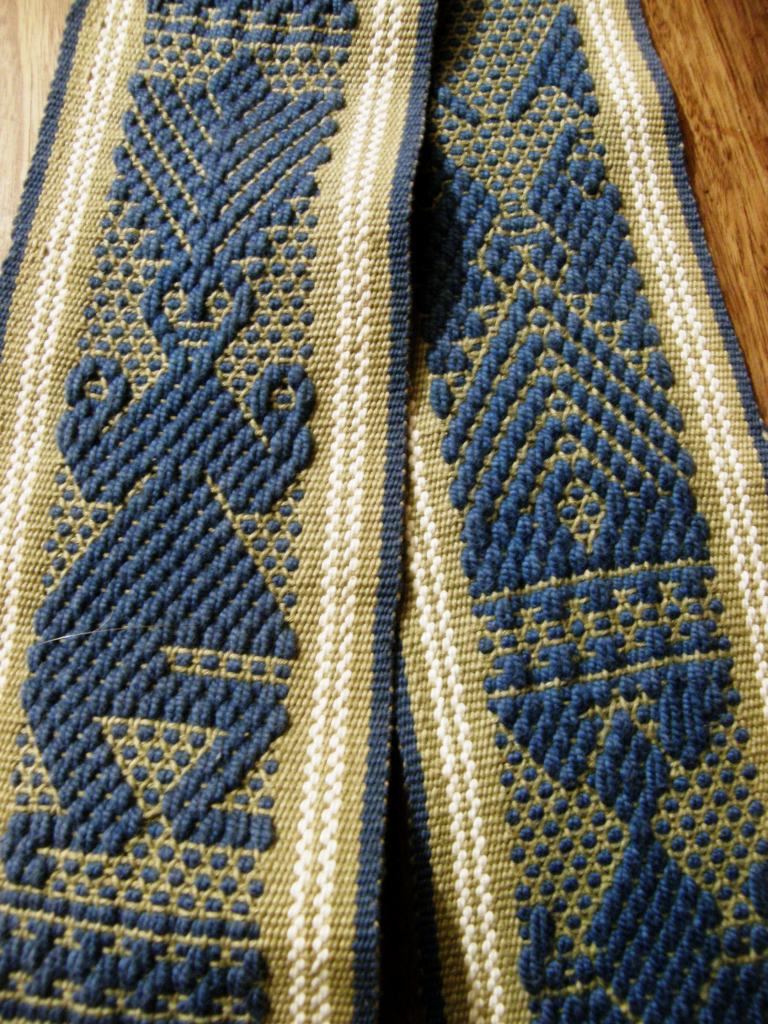
That little warp-float diamond could grow up to be this…!

This is the “dragon cloth” that Deb McClintock showed me in Texas from her collection of textiles from South East Asia. Can you see the dragons…aren’t they spectacular? Perhaps the little diamond is a puff of smoke coming from the dragon’s nostrils.

This simple warp float technique is often dismissed when people are studying my tutorials here. A lot of people find the horizontal bars on which the floats sit distracting. Marsha Knox aka Pandula Arts is one person who learned the technique from my blog and really explored it making bags, backstraps and pouches with the patterned fabric she created.

Eladio Torres in Mexico has also woven large and beautiful pieces with it…

Speaking of baby steps, I can only hope that my baby steps in ikat….

…will some day, with much practice and perseverance and tenacity, remotely resemble something like this…

Ha! Well, I can dream, can’t I?

And then if I had another couple of lifetimes…maybe these???

These pieces are from Timor and I photographed them at one of the stands at the Maryland Sheep and Wool Festival a couple of weeks ago. I could go on and on and show you some images of incredible Sulawesi ikat pieces and their creators that collector Chris Buckley recently sent me but I will save those for next week along with my report on Sheep and Wool…all way, way too much for one blog post.

As for the baby steps and the big things to come, I will remind myself that the little girls in Peru who make these…

…very often grow up under the constant watchful eyes of their wise and skilled weaving elders to weave things like this…

Hmmm….I wonder where my baby steps in discontinuous warp technique will lead me? Arrgh…so much to learn and so little time!

I have lots more to show and tell….Maryland Sheep and Wool for one which I attended with Claudia and Janet, at left, and all the wonderful textiles I saw there and people I got to hang out with, fun at Claudia’s place spinning and backstrap weaving and learning to thread her floor loom with its four-shaft project and a day of weaving with Laritza and Terri.

Laritza is from Colombia and brought textiles and accessories from the Guambiano Indians to show me as well as a mochila made by the Arahuaca people.

I have some really cool things from Ravelry weavers to show too. I am saving all of it for next week.

The stream, that tree and that grassy piece of shade is calling me to come weave!!

I have been told that the weather in Massachusetts right now is a wee bit on the chilly side and so I must make the most of this sun and warmth while I can.

Hard to imagine a more peaceful setting!