Long time no see. A lot has been happening but at the same time not a lot has been happening.
In the “a lot has been happening” category I’ve undergone a dramatic change of scene:

It’s certainly dramatic for someone who has been living in a landlocked country for the last twenty-seven years. The following might give you a clue as to my whereabouts….

Yes, I’m back in Australia for good after having talked about making this move for years. But I’m still in transition mode as I will be staying with my brother and sister-in-law in this beachy area on the mid north coast of NSW until mid November when I will then move to my own place in the Blue Mountains.
It’s a lovely area for strolling in bushland and by the shore. I walk around the block to a large open field where kangaroos come to graze in the late afternoon. They’re far too shy to allow me to photograph them. We stop still and stare at each other for a good five minutes after which they nervously return to their grazing. However, I only have to take one very cautious and almost imperceptible step closer and they’re off.

Kookaburras create quite a racket when I take a stroll around the neighborhood but will instantly pipe down the moment I turn on my camera to record them.
I had long planned to fly out of Bolivia on April 28. I had my accident with the four-legged black torpedo that I described in my last post one month prior and it almost messed up everything. Needless to say it was tough leaving after thirty-two years in South America and all the fuss after the accident didn’t make it any easier. I was in need of both mental and physical therapy by the time I reached my brother’s place on May 4.
I’m alone now house-sitting for my brother and his wife who are away traveling for two months. I watched the bag I wove and sewed for my sister-in-law back in 2006 head out the door for yet another world adventure…

Here they are in Alaska on this current trip where Deb’s using it to hold her binoculars….

The best mental therapy during this newest transition period has come in the form of sitting on the beach in the sunshine, inhaling the sea air while listening to and watching the waves roll in. It reminds of this weaving I did some years ago….

Now it’s humpback whale migration season and on the next clear day I’ll head to the lighthouse to see if I can spot them.
Other forms of therapy…..smelling eucalyptus leaves burning as folks rake the fallen ones up to burn in the cool evening air (such nostalgia!), walking along accompanied by all the magical birdsong that I recognize from my younger days in Australia, making new friends which has turned out to be super easy in this wonderfully friendly community.

One such friend that I met at the weekly craft group happened to mention in conversation that she had lived in Papua New Guinea. I immediately asked her if she had seen the bilum bags that artisans there make from plant fiber. The stitch they use is exactly the same as that used by the Ayoreo people in Bolivia although the plant material used is different. I remember my Ayoreo teacher being fascinated by the fact that these people on the other side of the world are making bags using the same technique.
The main difference is that the bilum bags are stitched much more loosely. The looping is very much more open, even more open than the work by the Wichi artisans in Argentina. The bilums are also worked as a continuous round and are, therefore, seamless whereas the Ayoreo artisans work a row from left to right and then flip the work and return, once again working from left to right. Jey brought a bag to show me that she had collected fifty years ago. I’m guessing the colors are from natural sources and it’s amazing how vibrant they are after all these years.

The Ayoreo work is so much tighter that, when set next to the bilum, it’s very difficult to see that the looping technique used in both is indeed the same. It was very exciting for me to be able to see this work and I can’t wait to send a photo to my teacher in Bolivia. Jey tells me that she even used to have a small hammock made in this technique for one of her babies.
What do I do when I go along to these weekly craft group meet-ups with my rehabilitating hand? Well, I’m just about able to put enough twist into my takli spindle to spin some of my brown cotton. There’s progress because when I first arrived here I couldn’t do it at all…couldn’t even grip the spindle. It’s not the most comfortable thing in the world and I can’t do it forever and a day as I used to.

There are issues with my wrist and I’m not recovering the range of movement that I had hoped. It’s taken me this long to get an appointment with an orthopedist here and I’ll see him on Wednesday to find out what’s going on and if there’s any reason for concern.

BUT I have been able to weave! In my last post I showed how I had trained my left hand to operate the loom and do pick-up. In this way, the hatband I’d started before the accident slowly got finished and my friend did a fabulous job of attaching it to his hat after I had already left Bolivia.

Well, now I can do all that using my injured right hand. I’m able to wind a decent warp, make string heddles and weave narrow bands with pick-up using medium weight cotton thread. I’ve never before thought about what role each of my two hands plays in my weaving process. When I’m using two sets of heddles, it turns out that it’s my left hand that does the twisting and rolling action on one set while my right only needs to pull the other set straight up. It can manage that and do the pick-up!
So, I’ve been making some key fob thank-you gifts:

This band got folded in half with its ends clamped between the jaws of the key fob hardware. Then I made another for one of my physiotherapists who I felt had gone above and beyond. I found out that she has two much-adored golden retrievers that have their own Instagram page and so I wove a fob with their names.

I think it’s fun that the lettering matches the rather unsteady and quirky writing on my hand-written thank-you note! Fortunately, my former bank in Bolivia has been the only place so far that has insisted on my producing a perfect signature.

Alison Irwin created a chart of letters in this structure that I call Andean Pebble Weave which was published in the Winter ’22 edition of Little Looms magazine. I sometimes need to make adjustments to the letters in order to create the ideal spacing in the particular words I’m weaving. The chart for the paw prints can be found in my Complementary-warp Pattern Book along with two other versions.
There’s a long list of people to thank. I’ll be busy at the loom making gifts and that’s yet another form of therapy. Luckily the guest-room bed has a wooden base and I’ve been able to anchor my loom to it in much the same way as I did in Bolivia.
It might be a while before I can get into this though….

Some of it is insanely fine but I do enjoy weaving with fine thread and…..silk! I can’t even imagine untying those skeins and winding the thread into balls. Actually, my hand could probably manage that but right now I can’t trust it to wind a good well-tensioned warp with such fine stuff. I wouldn’t be able to maintain a steady grip on the thread. That’s something to aspire to. I think I’ll have to take on working with increasingly fine material in slow steps as I slowly recover function in my right hand.
At craft group I also got to meet up with the lady who two years ago had given me a skein of gorgeous variegated silk. I’d sent her photos of what I’d made with it but now I could take the finished piece and show it to her in person. You might remember this project…..

Now she’s teaching me how to crochet winter slippers. Remember that it’s winter down here. I’m so slow though that I’m not sure I’ll have these finished in time! There’s wrist rotation involved in working the hook and I can’t do that yet. So, I hold the hook steady and move the work around instead. It seems to be working! We’re just using scrap wool for this initial sample while I get the hang of it.
I love that things that I’ve been weaving over the years are now coming out and being used on a daily basis. I never used this bag in Bolivia and now it goes with me everywhere!


I was having a bit of a down day at the radiologist having my wrist x-rayed when the receptionist admired this bag that I happened to be using that day. She was quite bewildered when I explained that I’d made it myself…..from scratch. No, I hadn’t bought the fabric. I took yarn, tied a pattern onto it, put it into two different colored dye baths with more tying in between, removed all the ties, wove it into fabric on a simple loom of sticks, then sewed the cloth into a bag, wove a strap and edged the flap. Sometimes I forget what this must sound like to a non-fiber, non-weaver person! And then the inevitable question…how long did it take? After all that, she may have regretted having complimented my bag but that simple compliment had made my day ❤️.
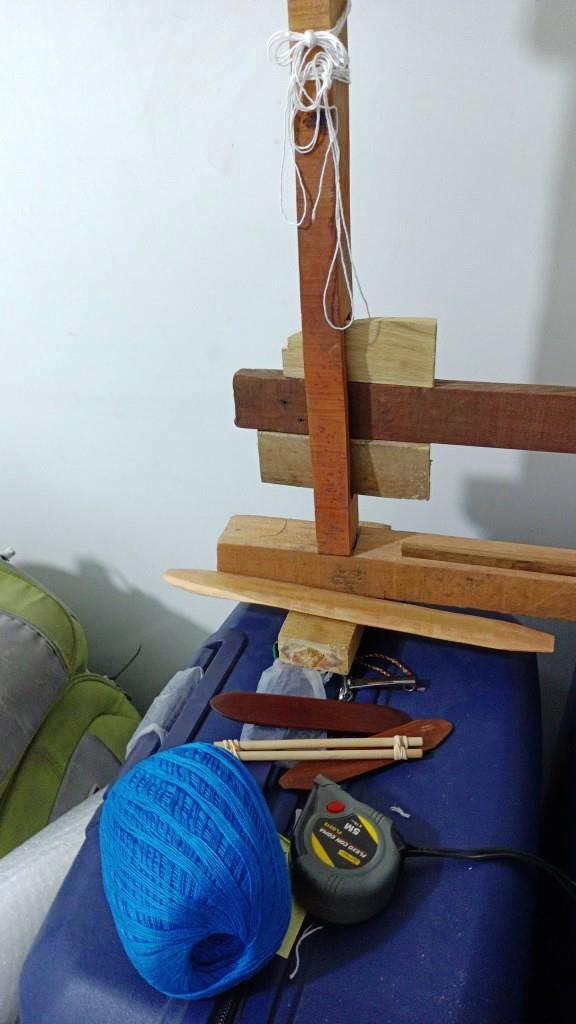
So, while I’m excited about the fact that my hand can tolerate my making a couple of key fobs, the thing that has made me happiest is that there is a new backstrap weaver in the making here in Lake Cathie. Courtney, who comes along to every second session of our craft group meet-ups, showed up today with this….

She had just finished crocheting a stunning mochila bag when I first met her and was, as a never-ever weaver, busily researching how to weave a strap. Well, you know that I can’t help myself and I took one of my key fob warps along to show her. She was immediately hooked and went off with links to my Backstrap Basics article and my Basic Warping for Backstrap Looms video class which are both free and available here on my blog. What a great job she’s done rounding up the bits and pieces and getting herself set up. She made my day when she brought this this morning to show me. How I miss in-person teaching!
Do I miss Bolivia and the folks that I have left behind?…of course I do! Oh my aching heart. I had a teary moment on my way back here when I visited a mega supermarket in the States. I noted the rows and rows of neatly and attractively arranged goods, the lack of raucous cumbia music, the wide open spaces, the comfortable controlled temperature and immediately missed the chaos of the Santa Cruz street markets with their dirt, heat, crowds, odours and noise! (And prices, I might add. Phew, that has been an adjustment!) But, sigh, choices have to be made.
So, that’s all for this post. My hand is saying “enough!” (and unfortunately I had quite a painful and restless night as both hand and shoulder protested against my having typed all this at my laptop). They’re much happier weaving.
I’ll leave you with something I spotted at the beach the other day. Nope, I’m definitely not in Bolivia any more.