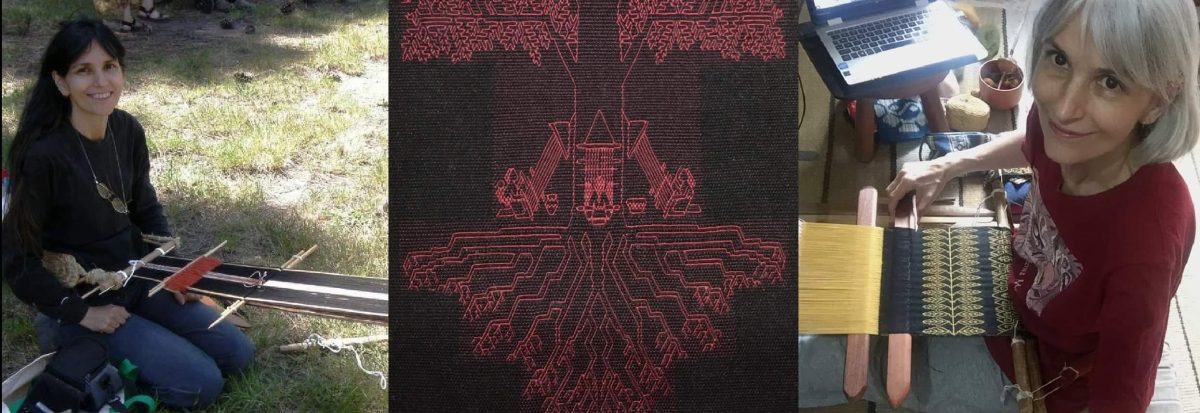
By Laverne Waddington. My weaving , my inspiration, tutorials and more……..
Author: Laverne Waddington
I am an Australian who has recently returned to Australia after having lived for 32 years in South America where I was teaching English, weaving, writing, and studying indigenous weaving techniques. I have been learning and documenting traditional textile techniques of various Latin American countries with indigenous weavers since 1996. Although I have studied using several types of simple looms, my loom of choice is the backstrap loom.
After many years of largely replicating, adapting and embellishing patterns that had been shared with me by my weaving teachers and friends, I now design my own unique pieces while continuing to employ the woven structures used by my mentors in South and Central America.
In 2009 I decided to leave my English teaching job to focus on weaving and, since then, have self-published eight PDFs on technique and patterns which were sold on various websites over the years. I now plan to sell them here on this blog...coming soon. Please subscribe to this blog for updates.
Instead of Christmas cake or pudding we have paneton, or Christmas bread. This is a mini paneton-they usually come much larger than this!
The drink is cola de mono-literally ”monkey’s tail” and is a traditional Christmas drink in Chile. During my five years in Chile we had this every Christmas but it was always home made and, therefore, always slightly different as everyone seemed to have their own recipe. The typical ingredients are coffee, milk, vanilla, cinnamon or nutmeg and cloves and a white alcohol, like white rum, pisco or aguardiente. I managed to find a bottle of it made here in Bolivia for this Christmas.
Those festive little llamas are bread dough figures that I bought in Ecuador. The town of Calderon, near Quito, is famous for these handmade figures. Bread dough baby figures were originally made and the practice has pre- Columbian origins when the figures were associated with death and burial rituals. The rituals were modified with the arrival of the Spanish and mixed with Christian traditions and are now made for All Souls’ Day ceremonies in November each year. Originally fashioned from corn, pumpkin, honey and beeswax, the figures are now made from wheat flour and heavily varnished for durability. All kinds of figures are now made and sold all year round.
Bread dough figures from Ecuador
Finally, they are all seated on a little pinwheel cloth that I have been making with a rigid heddle on my backstrap loom.
I love double weave! I particularly like the clean solid designs this technique produces on a nice smooth background. The same design appears on the back of the textile with its colors reversed. There are, in fact, two layers being woven together.
The problem with double weave for beginners practicing with heavy yarns, is that it produces a thick textile. Now this is just what you want if you would like to make a belt or perhaps a strap for a bag or a musical instrument.
A double woven strap for a Bolivian charango
But what about a small project for a beginner who would like to learn this technique? I always recommend that beginners start with heavier yarns and gradually work their way down to the finer ones as they gain more experience. So I have been trying to think of a useful small project made in a medium to heavy weight yarn (around 12 wpi) that a beginner could make once they have practiced the fundmentals of the technique on a sample band.
And this is what I came up with……………..MUG RUGS!!
South American and North African themed mug rugs
Woven in a 12wpi mercerized cotton, these are thick and firm-they really feel like mini rugs- and look great on the table. I guarantee that these will protect your good polished table from the hottest of mugs!
The black ones have adaptations of South American motifs from several countries. I got ideas for the designs on the brown ones from a book on North African carpets that I have. I really had fun making these. With the 12 wpi yarn they weave up really fast. I have never been a fan of rolling up long warps as I find I get much better tension control on shorter ones so I wove three mug rugs on a one-yard warp. I find warping for the backstrap loom a pleasure as there is no cutting or threading involved so making multiple warps for these two sets of mug rugs really wasn’t a problem for me.
Here they are as they come off the loom………..
I sewed over the last wefts and between the fringes with an ”invisible” nylon thread to finish these off while they were still under tension on the loom.
So, if you would like to learn how to make these you can find my tutorial for ONE-WEFT DOUBLE WEAVE in the Backstrap weaving Group at Weavolution. Weavolution is a free gathering place for handweavers. You will need to join Weavolution first and then join the Backstrap Group so you can access the tutorial.
South American motif mug rugs on the loom
Here is a sample pattern chart for these mug rugs using forty-one warp pairs.
Once you feel comfortable with this technique, you can move on to using finer yarns- on the right, 12 wpi; lower center, 35wpi; and upper center, plied sewing thread.
Double weave in various yarn weights
A LITTLE BACKGROUND……
I learned this technique in Potosi in Bolivia in 1996. I weave it now on my backstrap loom and, in terms of comfort, this is like flying First Class compared to the way I was taught this weave on a staked-out ground loom!
Weaving on the staked-out ground loom in Potosi
Julia and her sister Hilda allowed me to come to their home to learn to weave crouched over the loom in their yard for six hours a day during three weeks. You can see from the bandaids that the bone tool that is used to beat the weft into place was taking a toll on my soft gringa hands! That was about ten years ago. I doubt I could maintain that position for long now. Here I am making a four-selvedge piece in the lively colors favored by my teachers which I later turned into a shoulder bag. The piece has bands of patterned double weave on plain weave.
This technique is put to many different uses in various regions here in Bolivia. It is used to make the belts which form part of the typical woman’s outfit in the highland province of Potosi. Woven with several brightly colored stripes and covered with little figures, these belts are very sturdy and are woven just long enough to encircle the waist once. The weavers put a lot of effort into beating the weft in firmly and the quality of a finished piece and the skill of the weaver is judged by the belt’s stiffness. I was surprised to see when I went to Ecuador that these belts are now much sought after and prized by women in Otavalo, who are themselves skilled weavers, and are being used by many together with their typical Otavalan costume.
Belts made in one-weft double weave technique in Potosi
I’ll leave you here as it is time for morning tea-there it is below! Remember, if you have any questions or if you just liked this post, I would be delighted to hear from you. Please leave a comment 🙂 Laverne.
I did an equipment swap with another weaver at Weavolution.com. When I went up into the highlands a few months ago, I bought a bunch of Bolivian drop spindles at the market and then offered them at Weavolution in return for stuff that I can’t get here in Bolivia.
An offer was made to adopt my last drop spindle and we negotiated the swap-cotton sliver in indigo, terracotta and natural. I learned to spin cotton in Ecuador a couple of years ago and have gone through my small quantity of raw material. Santa Cruz used to be an important cotton producing region in the old days but not a single boll to be found now. So I jumped at the chance to get this sliver in such gorgeous sounding colors!
My package arrived and this is what I found!
The contents of my spindle-swap package
Okay, now you can see why I am so excited! Yes, I got my gorgeous sliver. The white stuff in the middle is, in fact, tussah silk! A teeny spindle was included and there below……..TWO RIGID HEDDLES!!
It is like she read my mind. I have been wanting to weave with a rigid heddle on my backstrap loom for a long time. WHY?-when I know all these wonderful intricate pick-up weave techniques? What I wanted to do was show knitters, spinners and other never-ever weavers that backstrap weaving is not only about warp-faced fabrics with pick up patterning. You can also weave balanced weave textiles and produce kitchen towels, scarves, table runners, placemats-all the things that we like to make on our rigid heddle looms. I was also aware that most of the ready-made backstrap kits available come with a rigid heddle- so I really wanted to try it out.
First project-a red table runner in plain weaveSecond project-green placemat
Now, I have tried balanced weaves on my backstrap loom without a rigid heddle with success-a log cabin piece, a simple pin wheel and a twill using three heddles but it is really fussy. You have to be constantly watching the warps as they want to stray over into warp faced. You end up unweaving and adjusting as the width varies too. Yes, it is do-able but the word TENACITY springs to mind.
It was a breeze with the rigid heddle. I used 8/2 thread doubled in the 10dpi heddle and made two lovely cloths. I am stupidly excited about being able to make something that feels like ”cloth”!-as opposed to my complementary and supplementary warp-faced weaves which are more on the stiff side.
The two cloths off the loom
Yes, those fringes are a bit unruly but they will be trimmed. I have already found good use for these two projects.
A ''camba''/ ''gaucho'' breakfast
”Camba” is the name for people from Santa Cruz. The green cloth lines my basket of ”cunape”. These cheesy bread rolls are a typical breakfast or tea time snack. The ”gaucho” or, Argentinean, part of this set up is the ”yerba mate” . Yerba mate is a kind of tea typical of Argentina and Uruguay. You put the leaves in the small silver pot, add hot water and sugar and sip it through the wodden straw. There are many different ways to prepare it. I can take it or leave it but some Argentineans are totally addicted to it and go around everywhere with their pot and thermos. The pot is usually shared with a group-passed around with each person taking a sip.
And here is the red cloth in action………….
achachairu-every good ''camba's'' favorite fruit!
This fruit is in season now, but beware, they are very acid. My teeth ache for days after eating these!
So, if you are thinking of taking up weaving and are interested in trying the portable, inexpensive backstrap loom, you can add a rigid heddle for under $30 to your equipment and make these lovely balanced weave pieces.
Here’s a place that sells rigid heddle segments-just a few inches wide- for under $10 in three sizes-
WELCOME TO THE FIRST POST ON MY BACKSTRAP WEAVING BLOG.
My name is Laverne Waddington and I have been learning the traditional weaving techniques of South America since 1995.
I wove the above piece on my backstrap loom as a wall hanging for a friend of mine in Utah. The designs are typical of the Guarani people of lowland Bolivia where I live. A snake skin design adorns the outer bands while the center is made up of stars. Each star has a slightly different inner pattern some of which are my own. This piece has been woven in pebble weave -a complementary warp technique which I learned in Huancayo, Peru with my very first indigenous weaving teacher.
Margarita – my first teacher in Peru
I plan to frequently contribute to this blog with stories of my experiences learning to weave and live here in South America as well as with details of my current projects and aspirations.
Santa Cruz-my home in Bolivia
I hope you will learn something here about the simple joy of backstrap weaving and maybe even be inspired to try it yourself.
At my loom weaving the above Guarani- design piece.