Backstrap Weaving – Star Gazing

Every night when no one is around I go up onto the terrace of my condo block and walk about star gazing for half an hour or so. It’s a peaceful, quite extensive space that covers the top of eight apartments. I don’t need to wear a mask up there and in spite of the light pollution from the inner city area in which I live, I can enjoy looking at some of the stars and planets while getting in some stretches and exercise. The air is fresh after a steamy summer’s day and I often wish that I could string up a hammock and sleep up there.

I remember one of the few times I was able to enjoy a night sky that was completely devoid of man-made light. It inspired me to weave stars into what I call my ‘Starry Night” wall hanging. I remember stepping outside my little room on Taquile Island on Lake Titicaca in Peru to go to the bathroom on a clear and bitterly cold night and being stunned and almost knocked over by the brilliance and abundance of the stars in the black, black sky over that dark, silent island. Kurt Laitenberger wove this motif with tablets and and I asked his permission to transpose it into the Andean Pebble Weave structure.

It’s interesting that it was this very same motif that caught my teacher Maxima’s eye the last time I was with her up in the highlands. I had taken many woven samples to show the ladies in the weaving cooperative and Maxima had chosen this one. Her first attempt to copy it on her own was not successful. Actually, she had started out very well but suddenly got stumped and stopped. She asked if she could watch me weave it so that she could learn. 

This image has an empty alt attribute; its file name is with-max-at-leaning-loom.jpg

I wove one motif and that was enough. Maxima was then able to continue just by following my woven example.

This image has an empty alt attribute; its file name is maxima-star-band-central-boloivian-highlands.jpg

Up on the terrace In these early months of 2022, it’s been nice greeting Orion on its return to the 8pm night sky on my side of the world and I am currently waiting on the Southern Cross to complete its circle low in the south and once more climb high enough to reveal itself above the light pollution and buildings.

An invitation in one of the online weaving groups to show-and-share star patterns prompted me to write this post. I actually wrote about this same topic about ten years ago but there has been quite a lot to add to it since then. Back then, I was able to share the Andean Pebble Weave strap on which I combined motifs woven by the Guaraní people here in the lowland part of Bolivia in which I live…
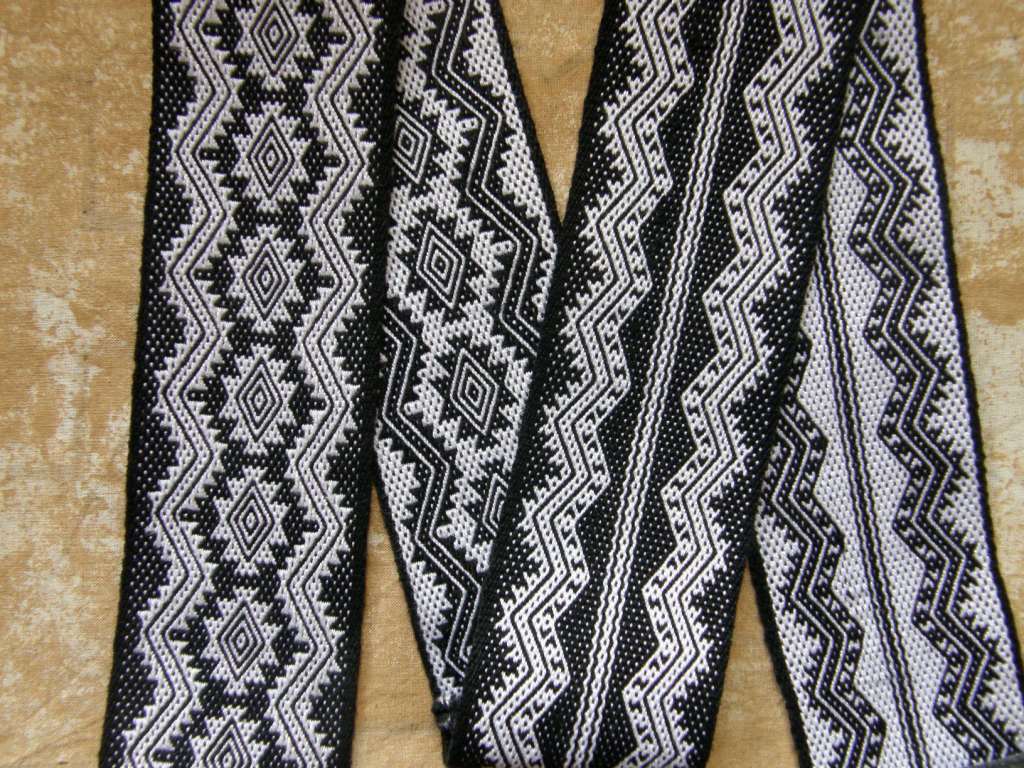
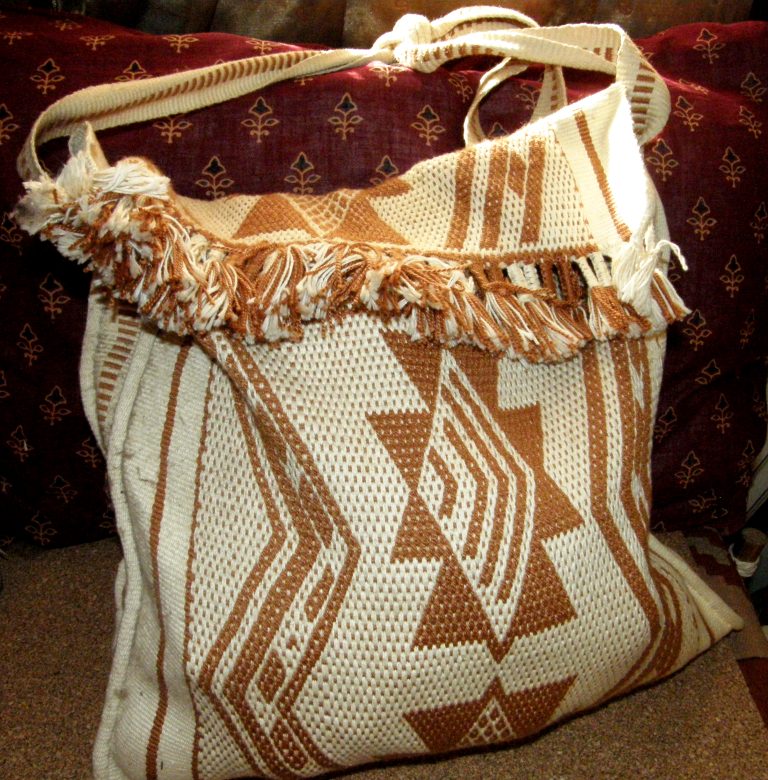
The Guaraní weavers use two types of complementary-warp structures in their cotton cloth. In the structure that they call Moisy, they represent all the natural beauty of their surroundings in large, bold renditions of trees, butterflies, birds, plants and flowers. However, in the pebble structure that I used above, they only ever weave two motifs – a snake and stars –  and there are an endless number of versions of these two items. You can see one such version on the woven bag.

My teacher told me that it was a snake that came to the first weaver in her dreams to teach her the patterns. The Guaraní people who live along the Parapetí River here in Santa Cruz also use the snake motif to represent that life-giving water. The stars are important guides in their agricultural cycle.

I found a story translated from Guaraní to Spanish in a book published by Artecampo, which is a craft cooperative store here in Santa Cruz, about a legend behind the use of the star motifs in Guaraní weaving…..it says that…

One day the children were taken and placed  like stars in the heavens and this is why women cry out about stars in their weaving. The stars not only speak of the sky but also about the richness of nature because one woman, in an attempt to stop her child from being taken, grabbed hold of a finger (or toe, it is not clear in the Spanish translation which). As she pulled on the finger, unfortunately, a piece broke off and this piece was buried. From the burial of this piece a corn plant sprouted. In this way, weaving symbolizes abundance which comes from the piece of the child. And this is why food crops are not only considered elements that feed and sustain men, they are part of Man himself just as the stars are part of Man and Society. Songs name those who are living in the sky and those that sing wear woven cloth to show that they are still with them even though they are distant.

Dionicia added these stars to her pattern repertoire after my visit. She wove them into a bench cover that she sells locally. Being able to include a “novel” pattern gives her a little advantage over other weavers who might also be selling their woven bench covers. 

This image has an empty alt attribute; its file name is dioniciac-1.jpg

The star patterns above are charted in my book More Andean Pebble Weave Patterns. And, speaking of the ladies up in the highlands, Dorinda has just written a new blog post on her most recent visit now that she is back home in the States. Dorinda had been away in the USA for going on two years and I can only imagine the happy reunion when she visited in November. 

In the Bolivian highlands, stars are woven into cloth by the weavers of the community of Tinkipaya. According to Veronica Cereceda in her book which catalogs the designs on these textiles, these ch’askas, stars, are a representation of the world above known as janaq pacha.

The small band in cotton that I wove to test the pattern is pictured above with a couple of wooden tools I got in a market in Potosi, the province in which Tinkipaya is located. I was told that the tool on the left is used to push down the warps behind the heddle rod when the weaver is opening the heddle shed. I have never seen a weaver actually use one of these and I have never seen another one like it. The one I have has a red stain on it and I like to think that it might be cochineal from one day when its owner was preparing to dye. The other tool, of which you can only see the tip, is used for beating and strumming and I have seen tools like this in use in several places in Bolivia and Peru although they are more typically made from a llama leg bone.

The structure used in this piece is yet another style of complementary-warp. The warp floats that surround and fill the star motif are aligned and arranged in a certain way that distinguishes this style from others. Below you can see the same star motifs woven with my hand spun llama fiber into a band that I wear as a wrist cuff. 

This image has an empty alt attribute; its file name is wrist-cuff-in-handspun-llama.jpg

And here it appears yet again in wool on a little bag I made when one of the online groups held an “orange challenge” several years ago.

This image has an empty alt attribute; its file name is 194951393_6181681991845586_2057187051893150363_n_medium.jpg

I published the chart for this pattern in my More Adventures with Warped Faced Pick-up Patterns book and Susan Torntore, one of my new Zoom weaving friends who refreshed her Andean Pebble Weave skills via a Zoom class with me, transposed it into the Andean Pebble Weave structure and then went on to create something like fifteen beautiful variations. Here are a couple of them. She plans to use this band as a bell pull.

This image has an empty alt attribute; its file name is susan-torntore-stars-crop.jpg

The Andean Pebble Weave structure has the advantage of having two regularly repeating rows which can be produced automatically by enclosing those arrangements of threads in heddles. Some weavers choose to do that because motifs can be woven much faster this way. Others prefer not to fuss with heddles and weave the patterns using pick-up for every row. In the structure used for the traditional Tinkipaya pattern, there’s no choice. Each “row” is unique and the threads for each must be picked up manually.
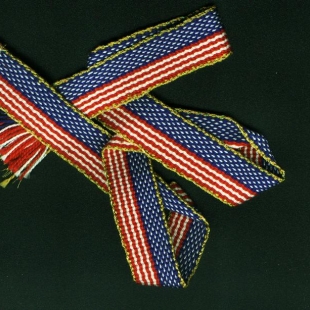
Wikipedia tells me that the stars on the flag of the United States represent the fifty States in the Union. Well, I knew that. I was hoping to find out why exactly stars had been chosen as opposed to some other figure but I guess there doesn’t have to be a reason. I am sure that we could all come up with some kind of symbolic meaning for a star. I swear that some of the indigenous weavers with whom I have studied have made up things about the motifs they are using just to please or else have a bit of fun with me…I have seen the twinkle in their eyes and the way they look sideways at each other!

Gail wove this very patriotic collar for her dog on her inkle loom many years ago and I have seen this pattern and variations of it show up in the various online Inkle Loom groups many times over the years around the fourth of July. Gail was forever coming up with clever collar designs for what must have been the best-dressed dog in New York.

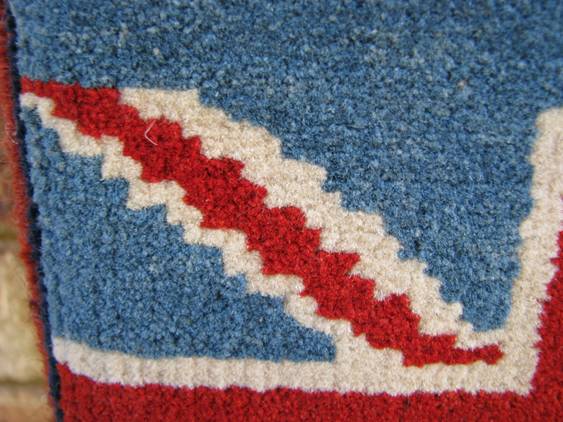
Speaking of flags and patriotic weaving, I assume that the next starry piece was made by someone who is proud to be Australian. I have this very cool cut-pile weaving of a representation of the design on the Australian flag…
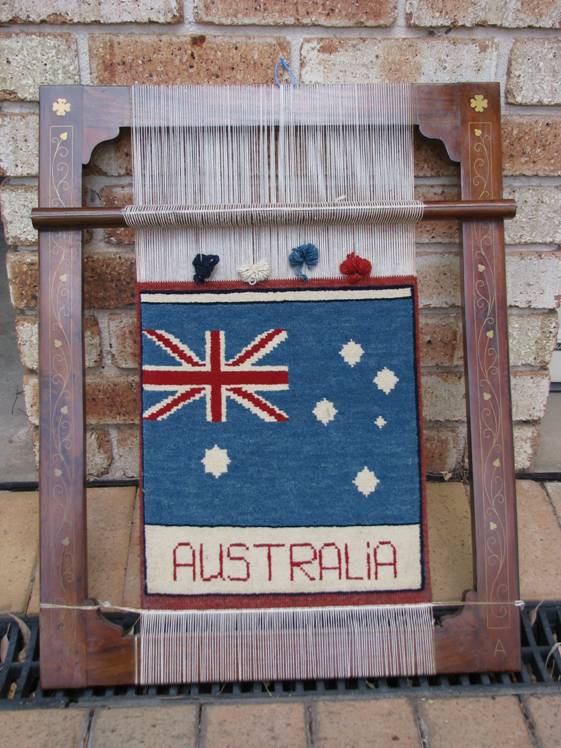
The group of stars is the Southern Cross constellation which really is a sight to behold there in the southern sky. I am so happy to be able to see it low on the Bolivian horizon and it makes me feel somehow connected to Australia and  the people I know and love so far away. It is little wonder we so love stars and choose to use them in our cloth.

The large single star, which should only have seven points, represents the Nation’s seven states and territories. This cut pile piece on its beautiful frame is gorgeously dense and I would love to meet its creator.

It was given to my brother as compensation from the Indian owner of a furniture store who went out of business before he could supply all the chairs for my brother’s dining room setting. My brother then gave it to me. One day I will track down this furniture maker and see if I can talk to him about this weaving technique.

I don’t know if the weaver intended to continue with the design. There is so little space at this point and the tension on the warp is so high I can hardly imagine being able to do so.

There are a lot of representations of stars in Andean weaving. I took one small motif  and combined it with others to make the guitar strap below in colors reminiscent of the desert and canyons of the US southwest… a winding river, moon and stars. It took me back to clear, warm nights camping in the depths of Utah canyons with nothing between me and the stars. Moonlight bounced of red canyon walls and dozens of frogs singing away at the water’s edge. These were other precious occasions on which I could star gaze without man-made light pollution.

Combining several small motifs in this way is a nice stepping stone toward designing your own unique patterns. I teach the Andean Pebble Weave technique for those who use a standard inkle loom in my book Andean Pebble Weave on Inkle Looms which you can buy as a PDF or as a spiral-bound book from Taproot Video.

And then there are many motifs that look like stars to our eyes but which and perhaps represent something else all together. Maybe one day I will find out what exactly they mean to the weaver. There’s what I believe to be an Andean ch’aska  in Andean Pebble Weave on the left. In the center are the star-like motifs that I replicated from Central Asian yurt bands. A motif on a belt from Ecuador is on the right. Its star-like motif is woven using supplementary warp threads.
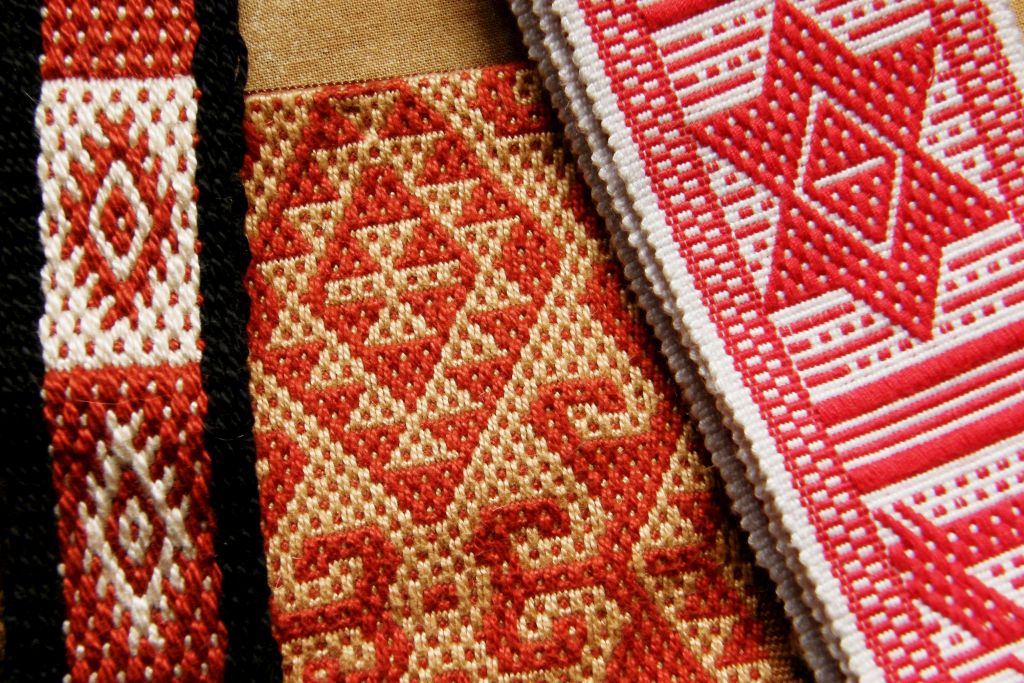
I chose a star motif for my first ever attempt at using 60/2 silk as warp on my backstrap loom. The motif did not have any symbolic significance to me. I simply needed to use something that was smooth-sided and symmetric. This was because I wanted to use a supplementary-weft technique in which the additional weft is not carried from selvedge to selvedge. I didn’t want the supplemental weft to thicken the cloth and so I used a technique in which the weft just travels back and forth from edge to edge of the motif itself. This only looks nice, in my opinion, when regular rather than irregular shapes are used. So, who knows why certain motifs ae chosen by weavers? It could be for what they symbolize or the choice could also just as easily be for purely practical reasons, as was the case in my silk piece.

There aren’t any stars on my current three-color Andean Pebble Weave piece. It’s all about flowers and hummingbirds. If you have been following me on Instagram (I go by my name: lavernewaddington there) you will have seen some of my progress. At some point I unconsciously stopped being concerned about my hand-spun wool being up to the challenge and have been simply enjoying how lovely it feels instead. But for now, I will stick with the Starry topic and wait to show you more of my three-color pebble in my next post here on this blog.

Let me finish by showing you some beautiful creations that were shared with me by another new Zoom weaving friend, Laurice Johnson. She has converted her pretty inkle-loom-woven bands into these gorgeous star ornaments by following online tutorials. There are several tutorials on Youtube for fabric stars that can be used for inkle bands. They are really stunning. My friend Jennifer Williams also has a tutorial on her blog for a different kind of star made from narrow bands.

I’ll be heading upstairs soon for another night of star gazing. See you next time.

Backstrap Weaving – What if?

When I last posted, I had just wound this warp using my “Zoom” hand spun, that is, the wool that I had been spinning and plying on a drop spindle during the various pandemic Zoom sessions that I have been attending. It took a while for some participants to get used to my sitting there with my arm raised as I attempted to get maximum drop distance for my spindle. I was often asked if I was signaling my desire to ask a question. I hope I wasn’t too annoying!

I dyed the blue and tobacco colors so that I could have three colors that would work well together on both faces of this three-color warp. Basically, I wanted to work with a dark, a medium and a light color and the challenge was finding a medium color that contrasts well with both the light and dark.

I am not sure why I always seem to find myself working with wool at some point in the hot, steamy summer months we have here. It kind of made sense when I was traveling a lot as these summer months used to be the longest period of uninterrupted time I would get to spend at home. I would work on as many different projects as possible before having to think about workshop prep, packing and traveling again. But now I have all the time in the world as I play it safe at home and can be more selective about which project I tackle, and when. I suppose stash limitations may have something to do with my choices now.

In my last post I told you that I had bought Joan Ruane’s video class on Spinning Cotton on a Takli from Taproot Video. I am using Joan’s spelling of the word takli. I am only 30 minutes in on her 2-hour 20-minute class and have already learned so much. I get to spend a little time with Joan via Zoom as she is part of the Taproot Video team and I was once her roommate at the Mannings. However, I had never seen her in teaching mode and I can tell you that it is no surprise that she is fabulous.

The blue and brown above are my early attempts with the takli from a few years ago. The white is the remainder of what I bought from a spinner in Guatemala back in 2008. It’s what I used to weave the little sheer-cloth sample that you can see in the photo.

I got some lessons in spinning cotton with Trini and her mother, Luz in coastal Ecuador in 2007.

Now I just need to figure out a way to use the takli comfortably while participating in the Zoom gatherings. I had a few wool plying mishaps when I got too engrossed in what was happening on the Zoom screen. I expect I will be presenting a furrowed brow of concentration to everyone as I try to put what Joan is teaching me into practice. I have a wooden mortar that I could clamp between my knees to use as the platform for the takli. Joan says that using something wooden has the advantage of being virtually noiseless although she does say that it is better if the bowl does not have high sides. I’ll see what I can figure out.

What to do with the cotton? Well, I guess that I would like to use singles in another sheer cloth piece using one of my bamboo reeds. This is what I wove using the hand-spun singles that I brought back from Guatemala. This is part of a scarf that I wove.

But of course I am getting way ahead of myself! I know that I need to put in lots of miles of practice before I can produce something with which I am satisfied.

As for my current hand-spun wool project, I have always said that warp-faced weaving really flatters my hand spun. It’s a very forgiving structure for those thick and thin bits in my yarn. When the threads are all pressed up close together they look wonderfully even. I am pleased to say that my yarn is holding up beautifully. I don’t have to think anymore about the possibility of it being abraded to the point of breaking and am focusing on the colors and patterns instead now.

Which is where the “what-if” comes into it. I have given up any thought of creating an orderly and cohesive design on this strap because I simply can’t resist the urge to explore the what-ifs. What if the hummingbird is outlined in white with a tan filler, for example….what if I reverse that…what if the body and wings are two different colors…what if I change the pebble spot color…how many variations can I create? And so on!

5 hummingbird varieties.

I have a nice assemblage of tools by my side…swords, pick-up sticks and a tool I use to press the weft extra-firmly into place. I have to add my long thumbnails to that group. They really are my favorite tools! I am blessed with having nails that grow as hard as rock. I usually have to cut them back now and then to a socially acceptable length.

You’ll also see some leafy what-ifs here.

This is destined to become a bag strap. I have some lovely wool singles that I bought from a co-op farm while in California. The owners used to allow my group of backstrap weaving friends to gather in their barn. It will be nice to weave something with fiber from their sheep that they had sent out to be spun. I guess I will dye it dark blue and use it for the body of the bag. I am thinking plain dark blue with perhaps a three-color edging to which I will add this fancy strap. And what if I add some lines of color in weft twining to the body of the bag? I love those what-ifs!

Wool singles from the farm.
Fond memories of weaving in the barn.

Maybe I’ll have some of my hand-spun cotton efforts to show next time. And before I forget, you may remember my mentioning, Allen Berry as the maker of beautiful swords for backstrap weavers (allenrberry on Instagram) when my weaving friends gifted me two of his gorgeous pieces a few years ago. Here’s one…

An Allen Berry sword with some of my wrist cuffs.

He doesn’t have a website and so you will need to go to Instagram to see his work. You can contact him via a direct message there. I am not sure if he still making the swords but the reason I am telling you this is because he has added, along with his many other wooden spinning and weaving tools, ADORABLE dishes for supported spindles. Here’s just one example. Go check him out on Instagram (allenrberry).

And while you are there, you might like to follow me. I am on Instagram as lavernewaddington. I post quite a few things there between my blog posts. See you next time.

Backstrap Weaving – Making the Most of It

Back when I was doing my training to be a teacher of English as a foreign language, I remember being told over and over to make sure that any original materials that we created were designed to be multi-functional. Why go to all the time and trouble to create something that would be used once in only one context?

I loved creating my own materials for English-teaching. Back then when I didn’t have much time for weaving, it seems that I poured all my creative juices into doing that. It was multi-functional in that I got to be creative while at the same time providing some welcome fun time for my students away from the text books. And I got better and better with using the same material in different ways with a variety of groups in a variety of contexts at different levels in their learning. And, as a bonus, it gave me a reason to buy stationery. I discovered that I have a thing for stationery.

Give me a chance to draw and paste and sticky-tape and color and I am happy as a baby.

When it comes to weaving, I have folders and closet shelves piled high with charts that I have created for projects. They got used once and then filed away, like the mega chart that I created for my Shipibo-inspired project that you can see above. Sometimes I wonder why I keep them. But then you know how that goes….about a week after you throw something away, you find that you need it, right?

My cat always enjoyed my get-down-on-the-floor-to-chart time.

So, with all that in mind, I am pleased that I have been taking the hummingbird charts, over which I have long labored, and using them in a variety of ways…making the most of all that time and effort. And, I am not done yet. I have a theme in my head for a future project…something that I wish to express, and all this sampling is hopefully leading me there. It’s all just a vague idea at the moment and I am still waiting for the light bulb to come on. In the meantime, I’ll just keep weaving hummingbirds.

I wanted to see what my hummingbird motifs looked like in a large format. I had completed my piece in 60/2 silk. In that fine thread, the stepped nature of the lines that form the various diagonals and curves is not all that noticeable. But what about in something much heavier? Would those lines then become clumsy and ugly? I combed through my stash and found that the only thing I had that would work in terms of having two high contrast colors was 8/2 Tencel and so I created a short warp for sampling. Some particularly high-twist crochet cotton made pretty heddles for warp-faced double weave.

What a dream it has been to weave with this heavier thread! Firstly, the Tencel is gorgeous to handle. It plays well with the crochet cotton heddles and is so easy to see when doing pick-up compared to to the 60/2 silk…no surprises there. I do think it is a shame to use Tencel, which is so much appreciated for its draping qualities, in a dense structure like warp-faced double weave but it was the only option in my available stash for this experiment. I promise that I won’t do it again!

Because the theme that I have in my head concerns embellishment and also the lack thereof, I decided to embellish my king-sized hummingbird to the max. I really enjoyed planning those “hippy bandanna” curls and swirls and I think they add to the playfulness, the love of life and joy of flight that hummingbirds always suggest to me. The hummingbird will be my new signature pattern.

I felt that the curve-like lines and stepped diagonals looked fine. I certainly did not feel distracted by the fact that the steps in these lines are more obvious than they are in finer thread. In fact, I would have to say that I was pretty thrilled with the whole thing.

So, what was next? I could see that 8/2 in warp-faced double weave in something of this width (3″) would simply not be useful for much…too wide for a sturdy belt or bag strap and much too thick and heavy for anything else. So I turned once again to my stash for something a little finer. I happen have, courtesy of my friend Deanna, a good supply of natural-colored 30/2 silk along with a small quantity of it that I had dyed in a color called “rye” for an ikat project I wove last year. The problem was that I did not have any other color that would allow me to weave pick-up patterns in double weave. Yes, I could dye some but…sigh…I wasn’t in the mood!

Solution….use supplementary weft to create the patterns. Bonus: for the supplementary weft structure, I can use the same chart as I do for double weave. I like to use several strands of a finer thread for the supplementary weft which gave me a nice selection from which to choose in my stash of 60/2 silk. I went with rye warp and teal supplementary weft.

The pattern color that you see in the double weave version on the right comes from warp threads that do not float as opposed to the silk piece in which the pattern is formed by floating weft threads. I love the added dimension that the supplemental weft threads give to the cloth. Bonus: I only made one set of heddles for this structure as opposed to four for the double weave piece. The double weave bonus: I can create horizontal lines of any length I please which I can’t do in the supplemental weft structure as the weft floats need to be limited to a certain practical length. That meant that some parts of my original charts needed to be modified. Long horizontal lines for wings needed to be transformed into sweeping curves. It took some time but wasn’t difficult to do and I am really pleased with the way they turned out.

While I wait for that light bulb to come on which will enable me to figure out how exactly to compose the themed piece that I have in mind, I will weave these embellished hummingbirds into something useful. I think I will use my embellished hummers with some indigo-dyed cotton from Guatemala that I have and use it to make journal covers as I have in the past. That will involve an outing to the stationery store to find a nice sized journal. I want something quite big so that I can squeeze in a lot of hummingbirds. I am hoping to get something that has paper that is nice for sketching.

The indigo and champagne colored Guatemalan thread along with the initial width sample that I wove for the first journal.

I used this 30/2 cotton in the past for mini-journal covers which I have given away as gifts. I wove my friends’ initials into the spines of the books…no re-gifting allowed!

For these, I used embroidery floss for the supplementary weft but I can tell you that removing strands from the slightly twisted six strands of floss is a royal pain if you are wanting to use very long lengths. I like to split all six strands and then lay them back together again so that all twist is removed. That way they lie flat and ribbon-like on the cloth just the way I like it. Yes, it’s a pain and so I might use silk instead. Combining threads to create multi-stranded weft is so much easier than pulling stands apart.

In the meantime, Zoom time is still spinning-and-plying time and progress is ever so slow. It gives me lots of time to think about how I would like to over-dye some of these colors and what I would like to weave with them. The planning is all the more important when using one’s own handspun and I already blew it by over-dyeing a really nice green with black the last time I used this handspun to weave some cuffs.

I also have another idea for an ikat project developing in which I combine it with three-color reversible pebble weave. I am sure that it will happen long before this handspun is ready for use.

And so I keep myself busy and out of trouble and keep my spirits lifted. Book sales at Taproot Video are keeping me afloat and I am hoping that the cooler temperatures in the northern hemisphere mean more cozy time at home weaving for those who live up there and maybe time to try some of the patterning techniques that I teach in my books. As always, thank you all for your support!

Backstrap Weaving – Thinking Outside the Walls

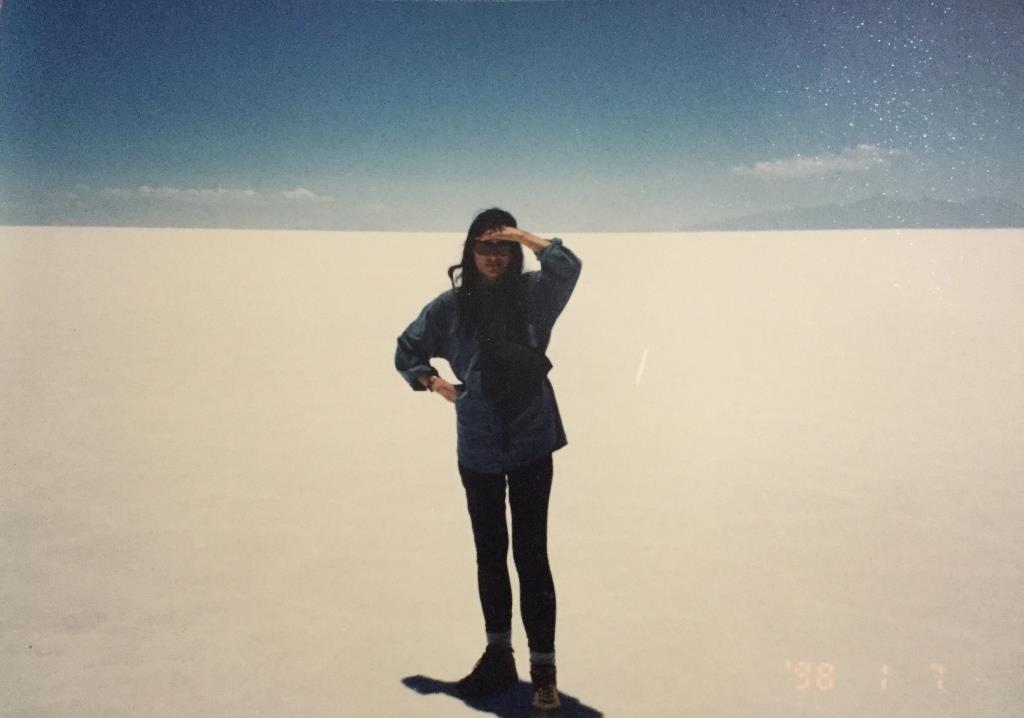
Is there anybody out there?! This was taken on a visit many years ago to the fabulous Salar de Uyuni here in Bolivia.

Fully vaccinated (albeit with the Sinopharm one in which I have little faith), I decided it was time to think outside the walls and venture out for my first outing, since the arrival of Covid-19 in Bolivia, that didn’t involve the supermarket or the dentist.

What would I find out there? Would I find that I have been behaving in an overly cautious way all this time and perhaps one of the few still hiding away within walls?

Would everything be completely normal? After all, we are not under any kind of restrictions now. Case, hospitalization and death numbers rise and fall from day to day as the third-wave curve wends its way downward. The fourth wave has already been predicted to arrive in October. Have we all just learned to live with this?

I have always been good at physical distancing! This was taken on a visit to a large expanse of sand dunes that inexplicably emerge from the surrounding jungle right here in Santa Cruz where I live.

This outing wasn’t about visiting spectacular salt lakes or mysterious sand dunes. It was simply about eating a burger with a friend in one of my old favorite hang-outs…the main Plaza here in the center of Santa Cruz. I used to live one and a half blocks away from it and would pass through it every day on my way to and from work. After finishing work at 10pm, I used to love stopping to sit there on balmy summer nights. The place would be full of activity as others gathered to enjoy the relative coolness of the evening before reluctantly heading home to face a restless night within heated walls.

My companion suggested the Plaza. The thought of being amongst all those people doing something that required the removal of masks made me nervous, even though it was an outdoor setting.

A typical sunny weekend afternoon would see the Plaza completely full…standing room only… as families gathered to eat ice cream and watch the world go by. There would be wandering coffee cart vendors in their crisp white uniforms, others selling cotton candy, balloon animals and toys and trinkets, people feeding the pigeons, kids chasing the pigeons, teenagers gathered in their little groups in every corner, the shoe shine guys poised ready for the next customer, elderly men playing chess surrounded by youngsters studying their moves, wanna-be models having their photos taken outside the cathedral. The Municipal Police would be strolling around although it is hard to imagine anything “bad” happening in that place of good clean fun. In a city in which it is often impossible to escape the blast of salsa and cumbia music, the Plaza is blissfully music-free.

And so it was with a mixture of relief and sadness that we found the Plaza almost deserted. There was no need to make circuits while looking for a place in the shade. Clearly people are being careful and largely staying home which is a big ask when home can often be a simple adobe or single brick dwelling, the interior of which resembles a pizza oven on hot days. It was sad to see this popular cooling refuge abandoned in this way.

Yes, I admit that it is strange to be writing several paragraphs about an outing to get a burger! So I’ll get back to the weaving now. In my last post I showed you the start of my hummingbird piece. This is another effort to think outside the walls and capture a feeling of uninhibited movement and joy.

I am weaving this in warp-faced double weave. It is certainly not the fastest patterning technique that I know. However, you might remember that I have just spent seven months picking up threads one by one to form intricate patterns on four panels. As a result, nothing feels slow any more and I just simply enjoy watching each and every one of the little figures I have created emerge. I loved designing the plants and piecing all the figures together. Weaving this lifts my spirits!

This is the final third of the band which I photographed so that you can see what the two faces look like. The plant at the very top is the one which is showering the scene with its parachuting seeds.

There was never meant to be an end product but I did find myself thinking about cutting this strip into three and sewing the pieces side by side to make something useful. But then a couple of people in a recent band-weaving Zoom gathering suggested weaving two more strips to flank this one. They could reveal more of the garden that surrounds this happy scene. I like that idea. It spares me the agony of having to do any cutting. All of you who produce hand woven cloth will know exactly what I mean. Plus it gives me a chance to do some more designing in this fun double- weave structure. It amazes me how far removed this is from the kind of pieces that I generally choose to weave.

And so I get to sprawl on the floor and do some more double-weave doodling. The chart for the hummingbird piece ended up being 130 inches long! I suppose I could photograph it in sections, erase the drawings and re-use the paper.

I was very pleased to see that Vicky Erker has been designing her own double-weave motifs after having learned the technique from my book Warp-faced Double Weave on Inkle Looms. My book includes a section on designing in which I use a leaf motif as the example. Some people take to designing more easily and quickly than others while some have no desire to design at all and are happy weaving from charts that have been provided in books.

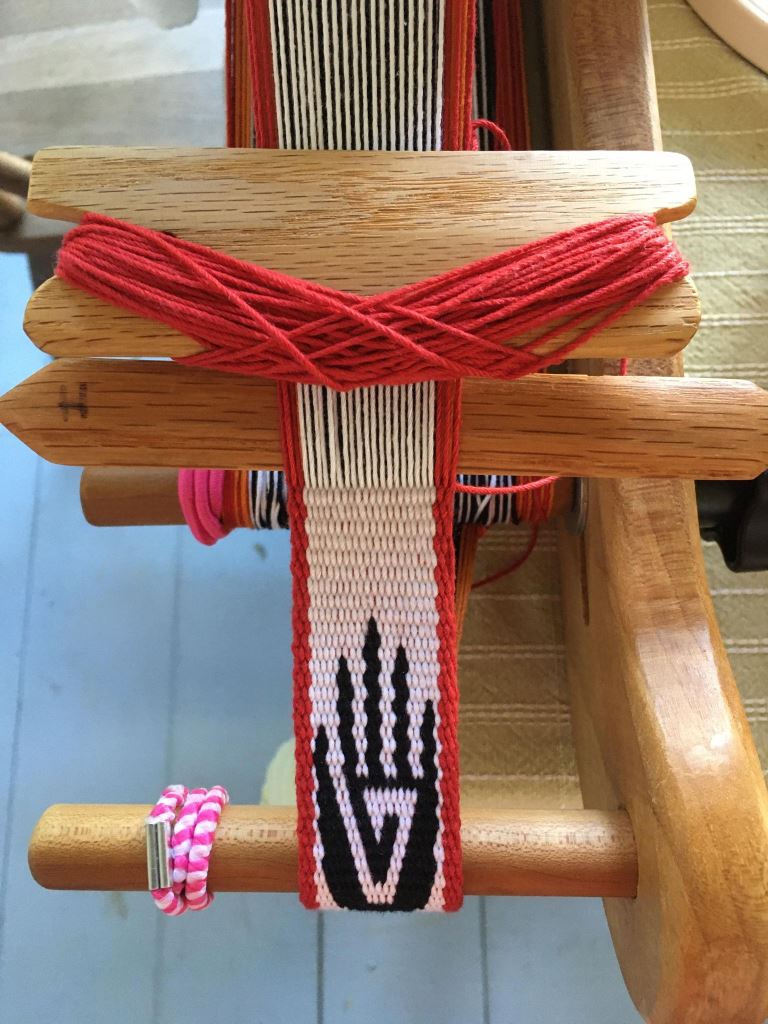
This striking hand petroglyph is the first pattern that Vicki showed me…..

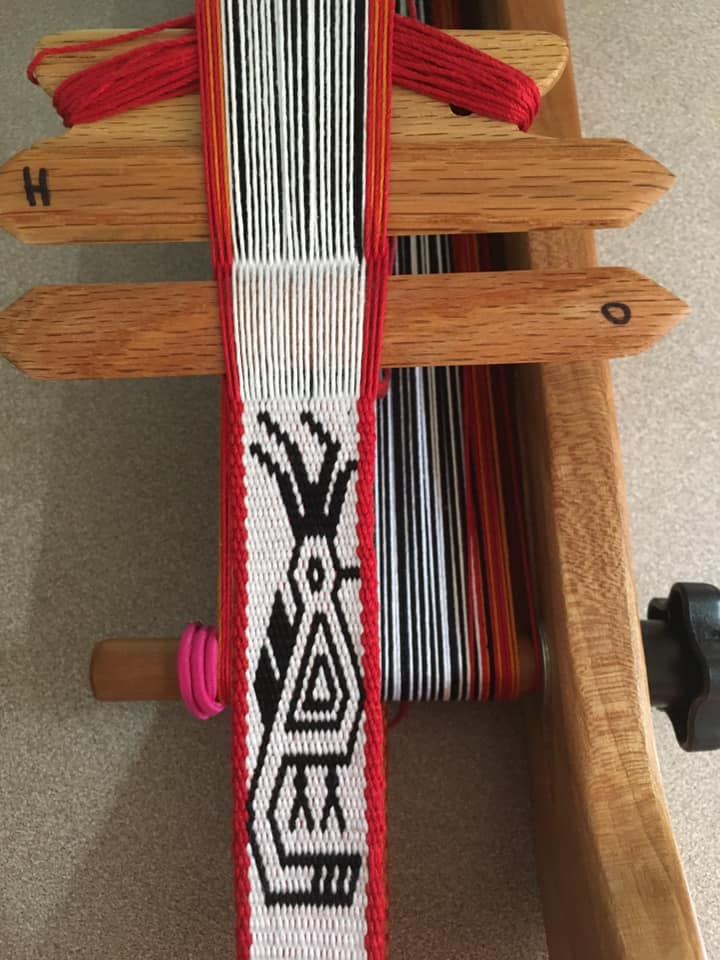
And then she blew me away with this pattern that she based on a Quetzal motif that is often used in textiles of Guatemala. In Guatemala it is woven using completely different patterning structures.. Isn’t that awesome!

If you are wondering about the H and O lettering on Vicki’s swords. it is something I suggest doing to help you keep track of the shed in which you are working when weaving double weave. You can always mark tape and apply that to the sword if you don’t want to mark your sword. The H stands for Heddle Shed and the O for Open Shed. It is one of the tips I give weavers for working in double weave which of course will make much more sense when you are using the book. I hope you might consider trying warp-faced double weave. There are plenty of charts in the book and perhaps you will feel motivated to try creating some of your own designs.

When I was going through my old photos and finding the ones I posted earlier of the Uyuni Salt Lake and the sand dunes, one of my first thoughts on seeing those pictures, was…wow, not a single tree to which I could attach a backstrap loom! Of course, a tree would not be entirely necessary as backstrap weavers can turn themselves into completely self-contained looms using our feet or toes to hold the end of the warp.

Carolin shows here that if you happen to find yourself at the Uyuni salt lake while cycling from Alaska to Ushuaia, one’s bicycle can always provide a handy anchor point for the end of the warp….

Carolin with tiny loom tied to her bike and weaving on the salt lake.

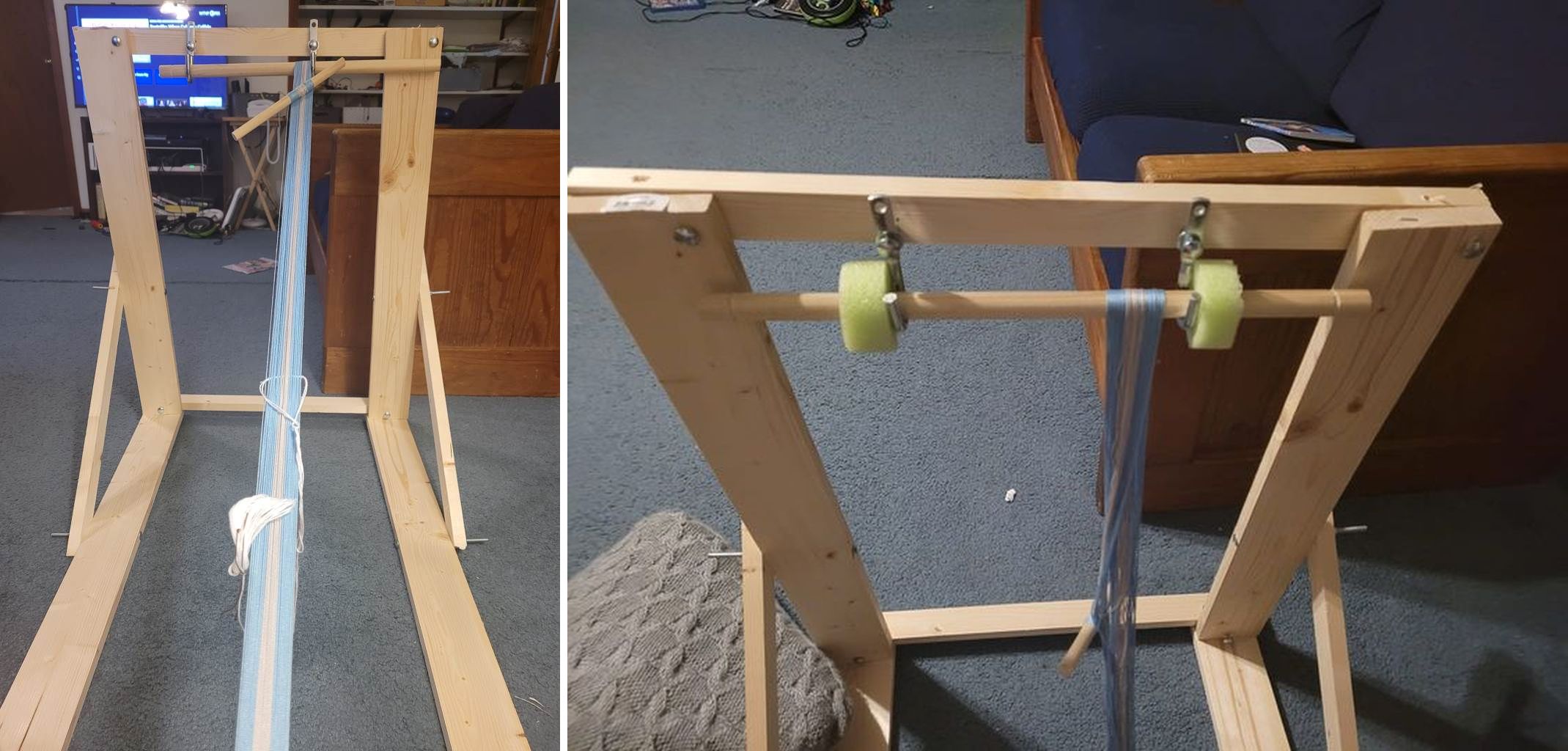
Others have chosen to create something a little more comfortable that can be picked up, carried around and enjoyed both indoors and out. I don’t quite remember who started the frame-making thing in the Facebook group but several members have found these to be a really nice idea when they got fed up with looking for suitable places in their homes, both indoors and out, to which they can attach the ends of their warps. Here’s the one that Martina in Germany built….

Here’s Jenny’s with a clever pool-noodle hack to stop the beam from sliding….

And here are models by Carlos on the left and Rosemary on the right…

Ritika Mittal allowed me to show this image of a weaver in Nagaland using a study frame to hold the end of her warp and provide a nice place for her to brace her feet.

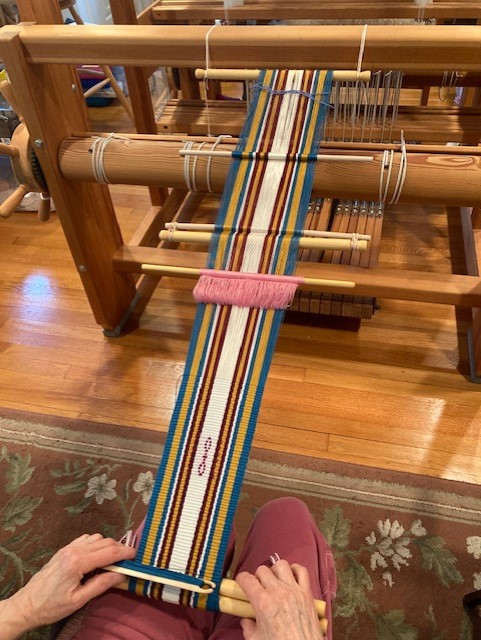
Nancy’s anchor point isn’t exactly a portable one, but I always enjoy seeing a simple backstrap warp being attached to the more complex floor loom…this is Nancy’s first ever backstrap loom project and its a beauty.

When I was having my Operating a Backstrap Loom class filmed, we had some trouble finding an anchor spot in the studio that was close enough to the set because I insisted on sitting on the floor. Eventually we managed to pile a lot of heavy stuff into a portable storage bin and use that.

While on the topic of that video class, Operating a Backstrap Loom, I’ll take this opportunity to let you know that the stock of DVDs is really low now and that I won’t be replacing them when Taproot Video runs out. The purchase of the Lifetime Streaming option caught up with, and now far outnumbers, the purchases of DVDs. So, if DVDs are your preference (they still are mine), you might want to make sure you get one while they are still around.

I showed Nancy’s first-ever weaving on a backstrap loom. I neglected to ask her if this piece is destined to become a backstrap. The dimensions are right. The backstrap itself is often a new backstrap-loom user’s first project and I am happy to see that the article I wrote about weaving your own backstrap way back in 2009 is still being used and enjoyed.

Here are a couple of backstraps that have been woven recently by Lieve on the left and Louise on the right….

My birthday is on Friday (lucky Friday the 13th) and I’ll hopefully be venturing outside the walls again for a little celebration.

Until next time.

Backstrap Weaving – A Bit of the Blues

I don’t have the blues. In fact, the opposite is true. I have been getting such a lift from the various Zoom events that I have been attending lately and I try to focus on these rather than on the news.

One such Zoom event that I found very uplifting was the annual conference of WARP (Weave a Real Peace) that took place last weekend. My friend Dorinda had given me a one-year subscription to this organization which allowed me to take part in the Members Only social sessions over the course of the three-day gathering. The rest of the conference was free and open to the general public. The webinar style of the panel discussions did not give us the chance to see who else was attending and so the social sessions were particularly nice in that they enabled me to see and chat with many of my “old” weaving friends, some new friends that I have made during the pandemic and meet new-to-me textile enthusiasts via the break-out rooms.

Zoom and loom…they are both still very much major parts of my life.

During the Sunday morning coffee social, Mari took a screen shot to show what we were all working on while chatting. It seems that I am not the only fiber person who finds it hard to sit still with hands unoccupied. I have been using Zoom time to spin on my drop spindle.

I chose to use the word “blues” in my title for this post because I have finally shifted away from the red and black that I have been using for the last seven months. I started sampling my new hummingbird figures in warp-faced double weave on a sample warp of black and gold 60/2 silk. Yes, black again, but I find that sampling in black is handy because I can adjust the patterns on the cloth with a black charcoal pencil before changing my chart. Most of the charcoal dusts off with some coaxing if I want to revert to the original. Now, a variety of blues are creeping into my work.

There is no lack of images of hummingbirds on the internet to help me chart my patterns. I think it must be quite a feat to be able to capture an image of one in flight with its wings showing sharply. I have read that they flap their wings up to eighty times per second. The giant varieties that are found in South America flap at more like ten to fifteen times per second. But even without internet access there was an image available to me right under my nose….

There it is, the picaflor gigante! This new Ten Boliviano bill has been around for a few years now and I can’t believe that I had never noticed this! I am not sure what made me stop and examine the bill just the other day and discover the hummingbird.

It didn’t take me long to fill my black sample band with figures, many of which were multiple re-workings of the same motif and I was still left dissatisfied. Some looked too chubby, some too pigeon-like. Back to the warping board. I could barely face the black thread again!

In the meantime, I found an article about the Guaraní people’s legend of the hummingbird. One of the regions that the Guaraní people inhabit is the part of Bolivia in which I live. I studied for a while with a Guaraní weaver here and while her textiles in the Moisy structure contain images of birds, they are not recognizable to me as hummingbirds. If I ever find my Guaraní teacher again, I hope to ask her about that.

Polytmus guainumbi (source watermarked)

The legend tells of the forbidden love between Poti, (flower in Guaraní), a princess belonging to one of the tribes, and Guanumby, a member of another rival tribe.

When the affair is discovered, it is forbidden and a marriage is arranged with a member within Poti’s own tribe. In her despair she begs the gods to kill her. Instead, they turn her into a flower. The moon tells Guanumby of this and he extends his arms to beg the heavens to help him find Poti. He is transformed into a hummingbird going from flower to flower trying to recognize the kiss of his beloved Poti.

Before I could make it to the warping board, I suddenly remembered a silk warp that has been lying dormant in one of the drawers for a few years. It was the warp that I used to sample my arrangement of paisley shapes before I moved on to the real project. It was all heddled up and ready to go. Brilliant. As much as I love making string heddles, being spared having to make the seven hundred and twenty that have already been made for this warp made me very happy. I loved being able to revive this warp. The rubber bands had rotted but the sticks had not jumped out of the cross. I don’t know if it was a conscious need to be color coordinated when I chose that pretty blue for the string heddles. That’s a DMC mercerized cotton thread in size 60, from memory.

Because the silk threads are so fine and because there are so many ends, I use four sets of string heddles to help me to do the double weave pick-up. Warp-faced double weave can also be done using just two basic sheds which is what enables us to do it on inkle looms. That is the method I teach in my book Warp-faced Double Weave on inkle Looms. It works beautifully when weaving narrower bands using thread of larger girth.

The pattern appears on both faces of the cloth with colors reversed. I find warp-faced double weave a very nice structure for designing and include a tutorial in my book with suggestions on how to go about it. There are no warp-floats to consider which means that anything that you draw on the chart will be structurally sound.

I used a metal rod in the warp ends which is then lashed to the warp beam. This enables me to create a third selvedge. You can see that in the center picture above. Using a metal rod is not traditional and is just one of my own quirky practices! It works for me and makes it easy to remove a partly-woven project from the beam and store it away. These soft colors are so nice to look at after all those months of black!

And so, I continue sampling my hummingbirds and can test my charts of bits of foliage in the process.

In the real project, whatever that might turn out to be, I won’t be leaving all that open space. That will be mostly filled with foliage. It will be quite a busy scene.

This is one thing about warp-faced double weave that should be kept in mind. In places where there is no pick-up pattern, the two layers of double weave do not connect. The two layers of double weave in this piece are bound at their edges by the green strips of plain weave. Wherever there is pattern, the layers are connected. The fabric can feel unstable or even experience a sort of ballooning effect if there are large plain solid-color areas between the figures.

I think that I am pretty happy with these two figures but there’s still some work to be done on the others. I also want to experiment with weaving the hummingbirds as solid shapes rather than as outlined figures. I think that it is fun seeing the birds emerging from the splash of paisley shapes. I enjoy using my ice cream-stick shuttles which are just the right size for this piece

This will keep me busy for a while and in the meantime, I will think of what exactly I want to weave once I am happy with the designs. If you know me at all, you will know that I am really all about the process. The idea for the product may only come once the fabric is off the loom. I agree that it’s a strange way to operate.

And here’s some more gorgeous blue. Lately, I have been creating to-do piles instead of to-do lists and so my bedroom floor is an obstacle course of little piles of yarn, woven samples and scribbled notes to remind me of my intentions. Among the piles is some beautiful indigo-dyed 30/2 (or perhaps it’s 20/2s?…I don’t remember now) cotton from Guatemala that I bought at an ANWG conference way back in 2013, I think. I don’t think that it is possible to buy more and so I must choose its project very carefully. I used some of it to weave a couple of journal covers as gifts. You can see my friend Claudia’s initials in this piece that I wove some years ago which lay along the spine of the book….

At the moment the thread sits in a pile next to my weaving spot simply because I like looking at it. I haven’t yet come up with the idea of what I would like to do with it. Actually, just pausing to stare at this picture on the screen is starting to give me ideas. Maybe it is in fact 20/2s. Hmmm….I have some white 20/2s but do I have dye for cotton?

But then there are all the other piles to consider. There is certainly no shortage of projects to keep me busy for the rest of the year. I know that I won’t be traveling anywhere this year no matter how optimistic some people seem to be in other parts of the world.

I know that one day my life might be very different and I will be wishing that I had more time to weave and so I plan to make the most of the rest of this enforced time at home. What about you?

Until next time…..